

Page 1
Global LCD Panel Exchange Center
www.panelook.com
TENT
All infor
mation in this technical data sheet is tentative
and subject to change without notice.
15.0”XGA
ATIVE
TECHNICAL
SPECIFICATION
MAA150DXN07
Melco Display Technology Inc.
Date: Jun.29, ’07
MDTI Conf
One step solution for LCD / PDP / OLED panel application: Datasheet, inventory and accessory!
idential
(1/2
3) MAA150DXN07_02_00
www.panelook.com
Page 2
Global LCD Panel Exchange Center
CONTENTS
No. Item Page
-- COVER 1
www.panelook.com
-- CONTENTS 2
1 APPLICATION 3
2 OVERVIEW 4
3 ABSOLUTE MAXIMUM RATINGS 5
4 ELECTRICAL CHARACTERISTICS 5, 6, 7
5 INTERFACE PIN CONNECTION 8, 9
6 INTERFACE TIMING 10, 11, 12, 13, 14
7 BLOCK DIAGRAM 15
8 MECHANICAL SPECIFICATION 16, 17
9 OPTICAL CHARACTERISTICS 18, 19
10 RELIABILITY TEST CONDITION 20
11 HANDLING PRECAUTIONS FOR TFT-LCD MODULE 21, 22, 23
MDTI Confidential (2/23) MAA150DXN07_02_00
One step solution for LCD / PDP / OLED panel application: Datasheet, inventory and accessory!
www.panelook.com
Page 3
Global LCD Panel Exchange Center
1. APPLICATION
This specification applies to color TFT-LCD module, MAA150DXN07.
These specification papers are the proprietary product of Melco Display Technology Inc. (“MDTI”)
and include materials protected under copyright of MDTI. No part of this document may be
reproduced in any form or by any means without the express written permission of MDTI.
MDTI does not assume any liability for infringement of patents, copyrights or other intellectual
property rights of third parties by or arising from use of a product specified in this document. No
license, express, implied or otherwise, is granted under any patents, copyrights or other intellectual
property rights of MDTI or of others.
MDTI classifies the usage of the TFT-LCD module as follows. Please confirm the usage before using
the product.
(1) Standard Usage
(2) Special Usage
(3) Specific Usage
Computers, office equipment, factory automation equipment, test and measurement
equipment, communications, transportation equipment(automobiles, ships, trains, etc.),
provided, however, that operation is not influenced by TFT-LCD directly.
Medical equipment, safety equipment, transportation equipment, provided, however, that
TFT-LCD is necessary to its operation.
Cockpit Equipment, military systems, aerospace equipment, nuclear reactor control systems,
life support systems and any other equipment. MDTI should make a contract that stipulate
apportionment of responsibilities between MDTI and our customer.
www.panelook.com
The product specified in this document is designed for “Standard Usage” unless otherwise specified
in this document. If customers intend to use the product for applications other than those specified
for “Standard Usage”, they should contact MDTI sales representative in advance.
MDTI has been making continuous effort to improve the reliability of its products. Customers
should implement sufficient reliability design of their application equipments such as redundant
system design, fail-safe functions, anti-failure features.
MDTI assumes no responsibility for any damage resulting from the use of the product that does not
comply with the instructions and the precautions specified in this document.
MDTI Confidential (3/23) MAA150DXN07_02_00
One step solution for LCD / PDP / OLED panel application: Datasheet, inventory and accessory!
www.panelook.com
Page 4

Global LCD Panel Exchange Center
2. OVERVIEW
MAA150DXN07 is 15.0” color TFT-LCD (Thin Film Transistor Liquid Crystal Display) modules
composed of LCD panel, driver ICs, control circuit, and backlight unit.
By applying 6 bit or 8 bit digital data, 1024 × 768, 262K-color or 16.7M-color images are displayed
on the 15.0” diagonal screen. Input power voltage is 3.3 V for LCD driving.
The type of data and control signals are digital and transmitted via LVDS interface per Typ. 65
MHz clock cycle.
Inverter for backlight is not included in this module. General specifications are summarized in the
following table:
ITEM SPECIFICATION
www.panelook.com
Display Area (mm)
Number of Dots 1024 × 3 (H) × 768 (V)
Pixel Pitch (mm) 0.297 (H) × 0.297 (V)
Color Pixel Arrangement RGB vertical stripe
Display Mode Normally white TN
Number of Color 262K(6 bit/color)16.7M(8 bit/color)
Luminance (cd/m2) 450
Wide Viewing Angle Technology Optical Compensation Film
Viewing Angle (CR ≥ 10) -75~75° (H) -60~50° (V)
Surface Treatment Anti-glare and hard-coating 3H
Electrical Interface LVDS(6 bit/8 bit)
Optimum Viewing Angle (Contrast ratio) 6 o’clock
Module Size (mm) 326.0 (W) × 255.0 (H) × 16.6 (D)
Module Mass (g) 1380
304.1 (H) × 228.1 (V)
(15.0-inch diagonal)
Backlight Unit CCFL, 4-tubes, edge-light, replaceable
Characteristic value without any note is typical value.
MDTI Confidential (4/23) MAA150DXN07_02_00
One step solution for LCD / PDP / OLED panel application: Datasheet, inventory and accessory!
www.panelook.com
Page 5
Global LCD Panel Exchange Center
g
g
y
www.panelook.com
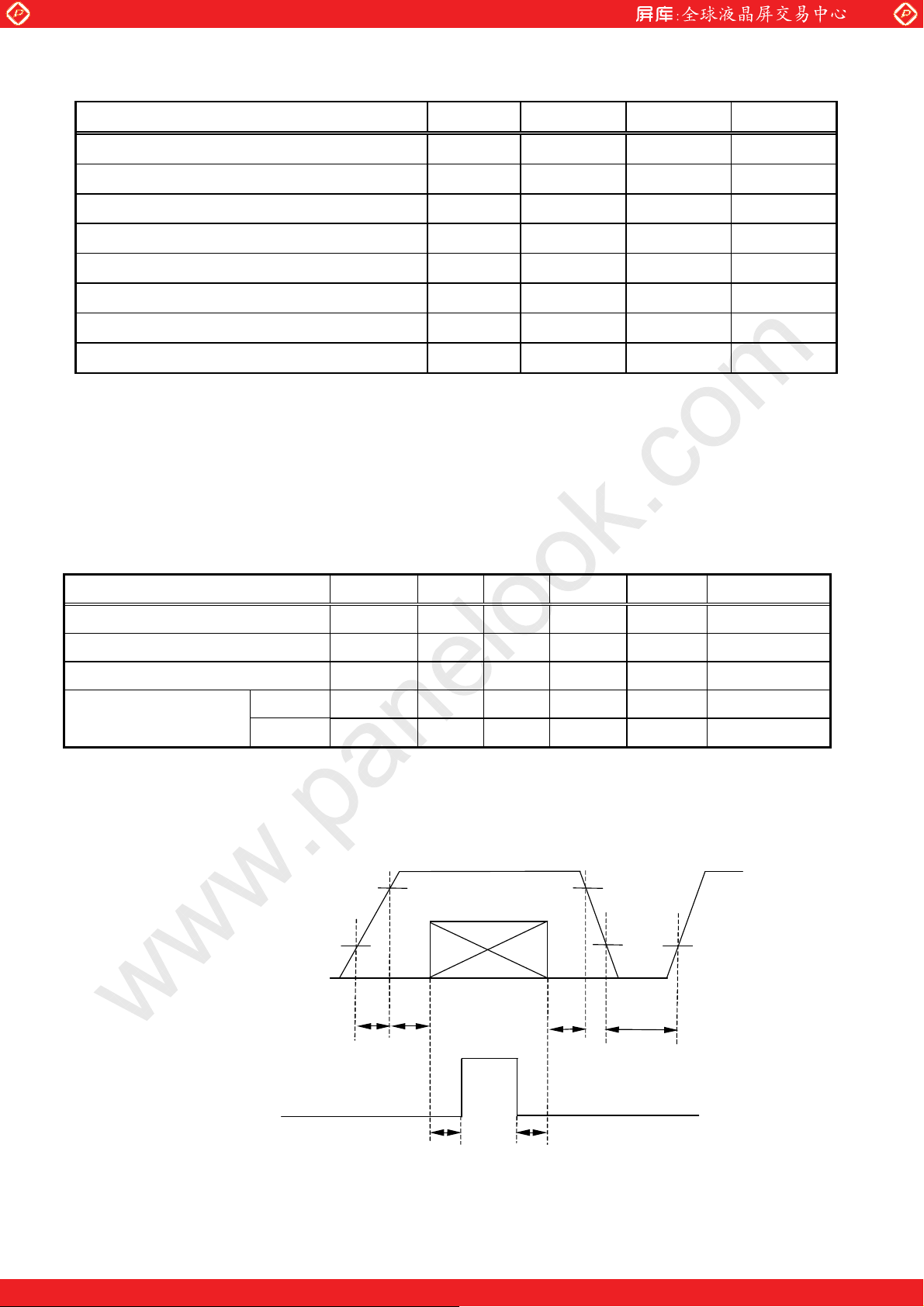
3. ABSOLUTE MAXIMUM RATINGS
ITEM SYMBOL MIN. MAX. UNIT
Power Supply Voltage for LCD VCC 0 4.0 V
Logic Input Voltage VI −0.3 VCC+0.3 V
Lamp Voltage VL 0 2500 Vrms
Lamp Current IL 0 10.0 mArms
Lamp Frequency FL -- 100 kHz
Operation Temperature (Panel)
Operation Temperature (Ambient)
Storage Temperature
[Note]
1) Measured at the center of active area and at the center of panel back surface
2) Top,Tstg ≤ 40°C : 90%RH max. without condensation
Top,Tstg > 40°C : Absolute humidity shall be less than the value of 90%RH at 40°C without
condensation.
Note 1,2)
T
Note 2)
T
Note 2)
T
op(Panel)
op(Ambient)
stg
−20 70 °C
−20 70 °C
−20 80 °C
4. ELECTRICAL CHARACTERISTICS
(1) TFT- LCD Ambient Temperature : Ta = 25°C
ITEM SYMBOL MIN. TYP. MAX. UNIT Remarks
Power Supply Voltage for LCD VCC 3.0 3.3 3.6 V *1)
Power Supply Current for LCD ICC -- 410 700 mA *2)
Permissive Input Ripple Voltage VRP -- -- 100 mVp-p VCC = +3.3 V
Logic Input Voltage
*1) Power and signals sequence:
LCD Power Supply
Lo
ic Signal
High VIH 2.0 -- VCC+0.3 V MODE, SC
Low VIL 0 -- 0.8 V MODE, SC
t1
≤ 10 ms 200 ms ≤ t4
0 <
0 < t3
≤ 50 ms 200 ms ≤ t5
t2
≤ 50 ms 0 ≤ t6
VCC
0.9VCC
data
㩷
0.1VCC
0.9VCC
0.1VCC
0.1VCC
t2
Backli
t1
VL
ht Power Suppl
t5 t6
data: RGB DATA, DCLK, DENA, MODE, SC
t3
t4
MDTI Confidential (5/23) MAA150DXN07_02_00
One step solution for LCD / PDP / OLED panel application: Datasheet, inventory and accessory!
www.panelook.com
Page 6
Global LCD Panel Exchange Center
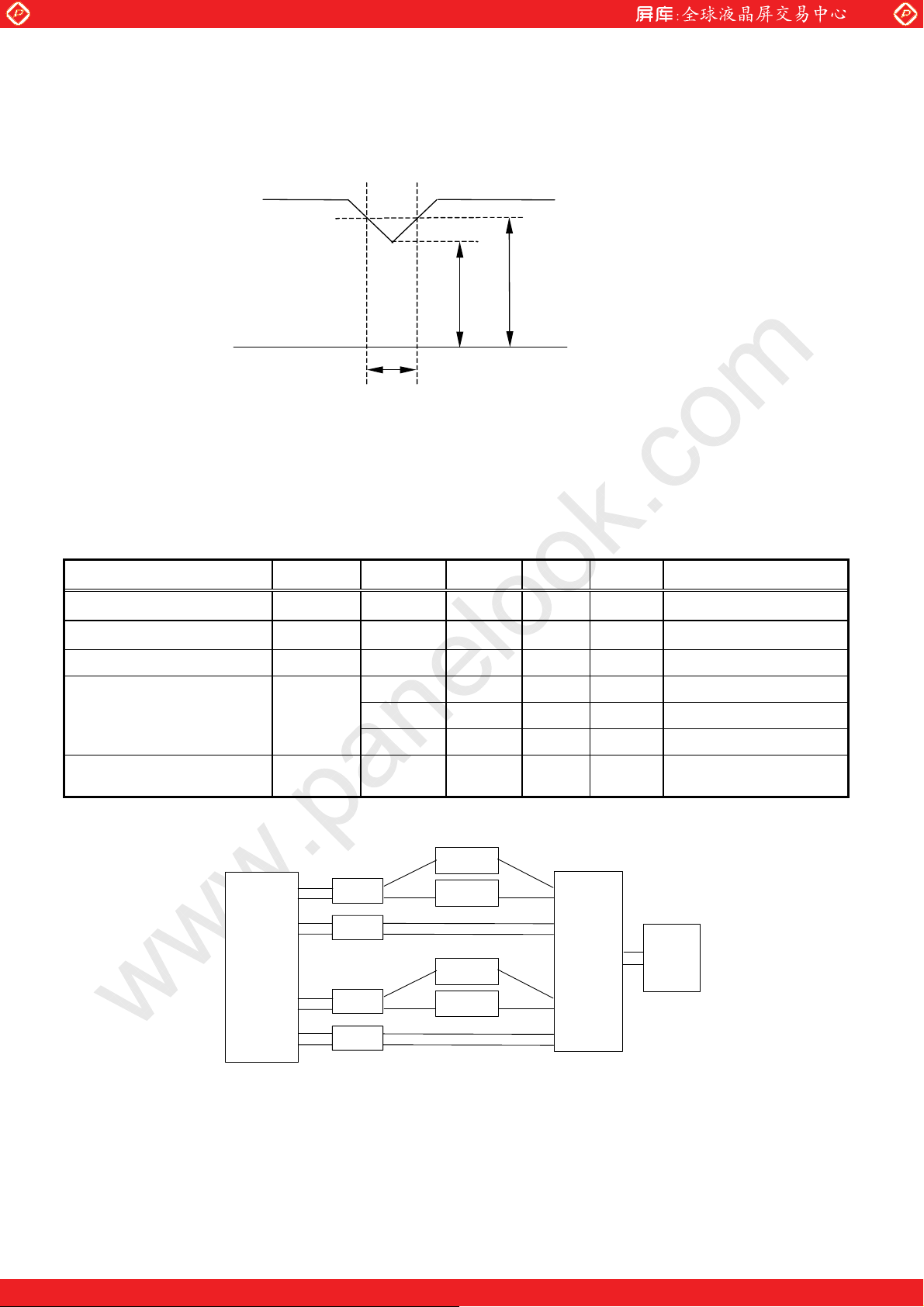
VCC-dip conditions:
1) When 2.6 V
≤ VCC < 3.0 V, td ≤ 10 ms
2) When VCC < 2.6 V
VCC-dip conditions should also follow the power and signals sequence.
*2) Typical current condition:
64-gray-bar-pattern(6 bit)
256-gray-bar-pattern(8 bit)
768 line mode
VCC = +3.3 V, f
www.panelook.com
2.6 V
td
= 48.4 kHz, fV= 60 Hz, f
H
3.0 V
= 65 MHz
CLK
VCC
(2) Backlight Ta = 25°C
ITEM SYMBOL MIN. TYP. MAX. UNIT Remarks
Lamp Voltage VL -- 620 -- Vrms IL = 6.5 mArms
Lamp Current IL 3.5 6.5 8.0 mArms *2),*6)
Lamp Frequency FL 40 -- 70 kHz *3)
1300 -- -- Vrms Ta = 25°C
Starting Lamp Voltage VS
1500 -- -- Vrms Ta = 0°C
1650 -- -- Vrms Ta = −20°C
Lamp Life Time LT 50000 -- -- h
*4),*5) IL = 6.5 mArms,
Continuous Operation
*1) Please use synchronous inverter.
*2) Lamp Current measurement method (The current meter is inserted in low voltage line.)
A
A
Power
A
A
Inverter
Supply
LCD
Module
CTL
CTL
CTH
CTH
CTL
CTL
CTH
CTH
*3) Lamp frequency of inverter may produce interference with horizontal synchronous frequency,
and this may cause horizontal beat on the display. Therefore, please adjust lamp frequency, and
keep inverter as far from module as possible or use electronic shielding between inverter and
module to avoid the interference.
MDTI Confidential (6/23) MAA150DXN07_02_00
One step solution for LCD / PDP / OLED panel application: Datasheet, inventory and accessory!
www.panelook.com
Page 7
Global LCD Panel Exchange Center
*4) Lamp life time is defined as the time either when the brightness becomes 50% of the initial
value, or when the starting lamp voltage does not meet the value specified in this table.
*5) The life time of the backlight depends on the ambient temperature. The life time will decrease
under low/high temperature.
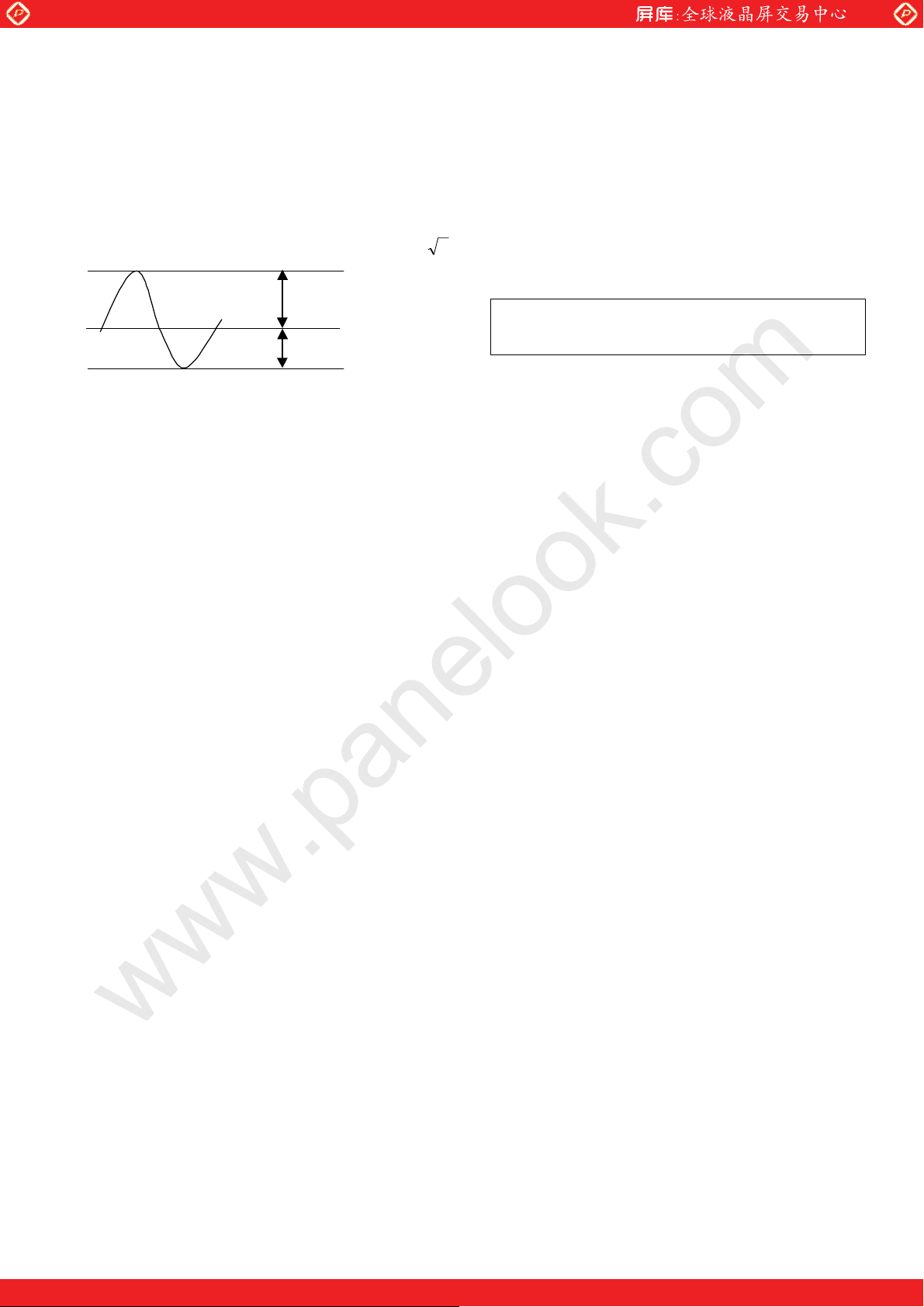
*6) Please use the inverter which has symmetrical current wave form as follows,
The degree of unbalance: less than 10%
www.panelook.com
The ratio of wave height: less than
CURRENT WAVE FORM
±10%
2
I
PH
I
PL
IPH: High side peak
I
: Low side peak
PL
The degree of unbalance = |IPH - IPL| / Irms
The ratio of wave height =
I
(or IPL) / Irms
PH
100(%)
×
MDTI Confidential (7/23) MAA150DXN07_02_00
One step solution for LCD / PDP / OLED panel application: Datasheet, inventory and accessory!
www.panelook.com
Page 8

Global LCD Panel Exchange Center
V
www.panelook.com
5. INTERFACE PIN CONNECTION
(1) CN 1(Interface Signal)
Used Connector: DF14H-20P-1.25H(56)(HIROSE)
Corresponding connector: DF14-20S-1.25C(HIROSE)
Pin
No.
*) Recommended wiring of Pin 17,18 (6 bit input)
Symbol
1 VCC +3.3 V Power supply ←
2 VCC +3.3 V Power supply ←
3 GND GND ←
4 GND GND ←
5 Link 0- R0, R1, R2, R3, R4, R5, G0 R2, R3, R4, R5, R6, R7, G2 R0, R1, R2, R3, R4, R5, G0
6 Link 0+ R0, R1, R2, R3, R4, R5, G0 R2, R3, R4, R5, R6, R7, G2 R0, R1, R2, R3, R4, R5, G0
7 GND GND ←
8 Link 1- G1, G2, G3, G4, G5, B0, B1 G3, G4, G5, G6, G7, B2, B3 G1, G2, G3, G4, G5, B0, B1
9 Link 1+ G1, G2, G3, G4, G5, B0, B1 G3, G4, G5, G6, G7, B2, B3 G1, G2, G3, G4, G5, B0, B1
10 GND GND ←
11 Link 2- B2, B3, B4, B5, DENA B4, B5, B6, B7, DENA B2, B3, B4, B5, DENA
12 Link 2+ B2, B3, B4, B5, DENA B4, B5, B6, B7, DENA B2, B3, B4, B5, DENA
13 GND GND ←
14 CLKIN- Clock −←
15 CLKIN+ Clock + ←
16 GND GND ←
17 Link3- See: *2) R0, R1, G0, G1, B0, B1 R6, R7, G6, G7, B6, B7
18 Link3+ See: *2) R0, R1, G0, G1, B0, B1 R6, R7, G6, G7, B6, B7
19 MODE Low=ISP 6 bit compatibility mode
20 SC Scan direction control ( Low = Normal , High = Reverse ) ←
Function(ISP 6 bit compatibility mode)
6 bit input 8 bit input
Function(ISP 8 bit
compatibility mode)
High=ISP
8 bit compatibility mode
LVD S
transmitter
(2) CN 2,4(Backlight)
Backlight-side connector: BHSR-02VS-1(JST)
Inverter-side connector: SM02B-BHSS-1-TB(JST)
[Note]
(3) CN 3,5(Backlight)
Backlight-side connector: BHR-02VS-1(JST)
Inverter-side connector: SM02(4.0)B-BHS-1-TB(JST)
LOW data
680
Pin 17
Pin 18
or
620
Pin No. Symbol Function
1, 2 CTH
VBLH
(High Voltage)
VBLH-VBLL = VL
Pin No. Symbol Function
VBLL
1, 2 CTL
(Low Voltage)
[Note]
VBLH-VBLL = VL
CC
Ω
Pin 17
Pin 18
Ω
MDTI Confidential (8/23) MAA150DXN07_02_00
One step solution for LCD / PDP / OLED panel application: Datasheet, inventory and accessory!
www.panelook.com
Page 9

Global LCD Panel Exchange Center
(4) ISP data mapping
a. ISP 6 bit compatibility mode(6 bit input)
CLKIN+/-
www.panelook.com
1CLK
Link0+/-
Link1+/-
Link2+/-
b. ISP 6 bit compatibility mode(8 bit input)
CLKIN+/-
Link0+/-
Link1+/-
Link2+/-
R1G0 R5 R4 R3 R2 R0
G2B1 B0 G5 G4 G3 G1
B3DENA B5 B4 B2
1CLK
R3G2 R7 R6 R5 R4 R2
G4B3 B2 G7 G6 G5 G3
B5DENA B7 B6 B4
Link3+/-
c. ISP 8 bit compatibility mode
CLKIN+/-
Link0+/-
Link1+/-
Link2+/-
Link3+/-
R1B1 B0 G1 G0 R0
1CLK
R1G0 R5 R4 R3 R2 R0
G2B1 B0 G5 G4 G3 G1
B3DENA B5 B4 B2
R7B7 B6 G7 G6 R6
MDTI Confidential (9/23) MAA150DXN07_02_00
One step solution for LCD / PDP / OLED panel application: Datasheet, inventory and accessory!
www.panelook.com
Page 10

Global LCD Panel Exchange Center
6. INTERFACE TIMING
LVDS transmitter input signal
(1) Timing Specifications
ITEM SYMBOL MIN. TYP. MAX. UNIT
www.panelook.com
DCLK
DENA
Frequency f
Period t
Active Time t
Blanking Time t
Horizontal
Frequency f
Period
t
Active Time t
Blanking Time t
Vertical
Frequency f
Period
t
CLK
CLK
HA
HB
H
H
VA
VB
V
V
50 65 80 MHz
12.5 15.4 20 ns
1024 1024 1024 t
20 320 511 t
42.4 48.4 60 kHz
16.6 20.7 23.6 μs
768 768 768 t
3 38 -- t
55 60 75 Hz
13.3 16.7 18.2 ms
[Note]
1) DENA (Data Enable) shall always be positive polarity as shown in the timing specification.
2) DCLK shall appear during all invalid period.
3) LVDS timing follows the timing specifications of LVDS receiver IC: THC63LVDF84B(Thine).
4) In case of blanking time fluctuation, please satisfy following condition.
t
VBn
> t
VBn-1
− 3(t
)
H
CLK
CLK
H
H
MDTI Confidential (10/23) MAA150DXN07_02_00
One step solution for LCD / PDP / OLED panel application: Datasheet, inventory and accessory!
www.panelook.com
Page 11

Global LCD Panel Exchange Center
V
V
(2) Timing Chart
a. Horizontal Timing Chart
DCLK
www.panelook.com
First Data Last Data
DATA
(R,G,B)
t
HB
DENA
b. Vertical Timing Chart
LINE DATA
1 2
1 2 767 768 3Invalid Data Invalid Data
t
VB
3Invalid Data Invalid Data
t
HA
tH=1/f
t
A
1023 1024
H
DENA
tV=1/f
MDTI Confidential (11/23) MAA150DXN07_02_00
One step solution for LCD / PDP / OLED panel application: Datasheet, inventory and accessory!
www.panelook.com
Page 12

Global LCD Panel Exchange Center
(3) Color Data Assignment
a. 6 bit input
COLOR
R5 R4 R3 R2 R1 R0 G5 G4 G3 G2 G1 G0 B5 B4 B3 B2 B1 B0
MSB LSB MSB LSB MSB LSB
BLACK 0 0 0 0 000000000 0 0 000
RED(63) 1 1 1 1 110000000 0 0 000
GREEN(63) 0 0 0 0 0 0 1 1 11110 0 0 000
www.panelook.com
INPUT DATA
R DATA G DATA B DATA
BASIC
COLOR
RED
GREEN
BLUE(63) 0 0 0 0 000000001 1 1 111
CYAN 0 0 0 0 001111111 1 1 111
MAGENTA 1 1 1 1 110000001 1 1 111
YELLOW 1 1 1 1 111111110 0 0 000
WHITE 1 1 1 1 111111111 1 1 111
RED(1) 0 0 0 0 010000000 0 0 000
RED(2) 0 0 0 0 100000000 0 0 000
RED(62) 1 1 1 1 100000000 0 0 000
RED(63) 1 1 1 1 110000000 0 0 000
GREEN(1) 0 0 0 0 0 0 0 0 00010 0 0 000
GREEN(2) 0 0 0 0 0 0 0 0 00100 0 0 000
GREEN(62) 0 0 0 0 0 0 1 1 11100 0 0 000
GREEN(63) 0 0 0 0 0 0 1 1 11110 0 0 000
BLUE(1) 0 0 0 0 000000000 0 0 001
BLUE(2) 0 0 0 0 000000000 0 0 010
BLUE
BLUE(62) 0 0 0 0 000000001 1 1 110
BLUE(63) 0 0 0 0 000000001 1 1 111
[Note]
1) Definition of gray scale
Color (n) --- n indicates gray scale level.
Higher n means brighter level.
2) Data
1:High, 0: Low
MDTI Confidential (12/23) MAA150DXN07_02_00
One step solution for LCD / PDP / OLED panel application: Datasheet, inventory and accessory!
www.panelook.com
Page 13

Global LCD Panel Exchange Center
b. 8 bit input
www.panelook.com
INPUT DATA
COLOR
BASIC
COLOR
RED
GREEN
BLACK
RED(255)
GREEN(255)
BLUE(255)
CYAN
MAGENTA
YELLOW
WHITE
RED(1)
RED(2)
RED(255)
GREEN(1)
GREEN(2)
R DATA G DATA B DATA
R7 R6 R5 R4 R3 R2 R1 R0 G7 G6 G5 G4 G3 G2 G1 G0 B7 B6 B5 B4 B3 B2 B1 B0
MSB LSB MSB LSB MSB LSB
0 0 0 0 0 0 0 0 0 0 0 0 0 0 0 0 0 0 0 0 0 0 0 0
1 1 1 1 1 1 1 1 0 0 0 0 0 0 0 0 0 0 0 0 0 0 0 0
0 0 0 0 0 0 0 0 1 1 1 1 1 1 1 1 0 0 0 0 0 0 0 0
0 0 0 0 0 0 0 0 0 0 0 0 0 0 0 0 1 1 1 1 1 1 1 1
0 0 0 0 0 0 0 0 1 1 1 1 1 1 1 1 1 1 1 1 1 1 1 1
1 1 1 1 1 1 1 1 0 0 0 0 0 0 0 0 1 1 1 1 1 1 1 1
1 1 1 1 1 1 1 1 1 1 1 1 1 1 1 1 0 0 0 0 0 0 0 0
1 1 1 1 1 1 1 1 1 1 1 1 1 1 1 1 1 1 1 1 1 1 1 1
0 0 0 0 0 0 0 1 0 0 0 0 0 0 0 0 0 0 0 0 0 0 0 0
0 0 0 0 0 0 1 0 0 0 0 0 0 0 0 0 0 0 0 0 0 0 0 0
1 1 1 1 1 1 1 1 0 0 0 0 0 0 0 0 0 0 0 0 0 0 0 0
0 0 0 0 0 0 0 0 0 0 0 0 0 0 0 1 0 0 0 0 0 0 0 0
0 0 0 0 0 0 0 0 0 0 0 0 0 0 1 0 0 0 0 0 0 0 0 0
GREEN(255)
BLUE(1)
BLUE(2)
BLUE
BLUE(255)
[Note]
1) Definition of gray scale
Color (n) --- n indicates gray scale level.
2) Data
1:High, 0: Low
0 0 0 0 0 0 0 0 1 1 1 1 1 1 1 1 0 0 0 0 0 0 0 0
0 0 0 0 0 0 0 0 0 0 0 0 0 0 0 0 0 0 0 0 0 0 0 1
0 0 0 0 0 0 0 0 0 0 0 0 0 0 0 0 0 0 0 0 0 0 1 0
0 0 0 0 0 0 0 0 0 0 0 0 0 0 0 0 1 1 1 1 1 1 1 1
Higher n means brighter level.
MDTI Confidential (13/23) MAA150DXN07_02_00
One step solution for LCD / PDP / OLED panel application: Datasheet, inventory and accessory!
www.panelook.com
Page 14

Global LCD Panel Exchange Center
(4) Display Position and Scan Direction
D(X,Y) shows the data number of input signal for LCD panel signal processing PCB.
www.panelook.com
SC: Low
SC: High
CN4
D(1,1) D(1024,1)
CN5
D(1,768)
D(1024,768)
CN2
CN3
CN4
D(1024,768) D(1,768)
CN5
CN2
D(1024,1) D(1,1)
CN3
MDTI Confidential (14/23) MAA150DXN07_02_00
One step solution for LCD / PDP / OLED panel application: Datasheet, inventory and accessory!
www.panelook.com
Page 15

Global LCD Panel Exchange Center
7. BLOCK DIAGRAM
www.panelook.com
CN1
Timing
Controller
Voltage Supply
for Gray Levels
and Vcom
DC/DC
Converter
Source Driver
LCD Panel
Gate Driver
1024 X 3 X 768
CCFL
CN2, 4
1
2
1
2
CN3, 5
MDTI Confidential (15/23) MAA150DXN07_02_00
One step solution for LCD / PDP / OLED panel application: Datasheet, inventory and accessory!
www.panelook.com
Page 16

Global LCD Panel Exchange Center
8. MECHANICAL SPECIFICATIONS
(1) Front side
www.panelook.com
MDTI Confidential (16/23) MAA150DXN07_02_00
One step solution for LCD / PDP / OLED panel application: Datasheet, inventory and accessory!
(Unit: mm)
www.panelook.com
Page 17

Global LCD Panel Exchange Center
(2) Rear side
www.panelook.com
MDTI Confidential (17/23) MAA150DXN07_02_00
One step solution for LCD / PDP / OLED panel application: Datasheet, inventory and accessory!
(Unit: mm)
www.panelook.com
Page 18

Global LCD Panel Exchange Center
www.panelook.com
9. OPTICAL CHARACTERISTICS
Ta = 25°C, VCC = 3.3 V, Input Signals: Typ. Values shown in Section 6
ITEM SYMBOL CONDITION MIN. TYP. MAX. UNIT Remarks
Contrast Ratio CR θV=0°, θH=0° 270 450 -- -- *1)*2)*5)
Luminance Lw θ
Luminance Uniformity ΔLw θ
tr θ
Response Time
tf θ
Viewing
Angle
Horizontal θ
Vertical θ
Horizontal θ
Vertical θ
−65∼65 −75∼75 -- ° *1)*5)
H
V
−70∼70 −80∼80 -- ° *1)*5)
H
V
=0°, θH=0° 270 450 -- cd/m
V
=0°, θH=0° -- -- 30 % *1)*3)*5)
V
=0°, θH=0° -- 6 -- ms *1)*4)*5)
V
=0°, θH=0° -- 19 -- ms *1)*4)*5)
V
CR ≥ 10
−50∼40 −60∼50 -- ° *1)*5)
CR ≥ 5
−70∼60 −80∼70 -- ° *1)*5)
Image Sticking tis 2 h -- -- 2 s *6)
Red Rx 0.575 0.605 0.635
Ry 0.310 0.340 0.370
Green Gx 0.281 0.311 0.341
Color
Coordinates
Blue Bx 0.124 0.154 0.184
Gy 0.535 0.565 0.595
θV=0°, θH=0°
By 0.100 0.130 0.160
White Wx 0.283 0.313 0.343
Wy
0.299 0.329 0.359
[Note]
These items are measured using CS1000(MINOLTA) for color coordinates, EZContrast(ELDIM) for
viewing angle, and CS1000 or BM-5A(TOPCON) for others under the dark room condition (no
ambient light) after more than 30 minutes from turning on the lamp unless noted.
2
*1)*5)
-- *1) *5)
Condition: IL = 6.5 mArms, Inverter frequency: 50 kHz
*1) Measurement Point
Contrast Ratio, Luminance, Response Time, Viewing Angle, Color Coordinates: Display Center
Luminance Uniformity: point 1
∼5 shown in a figure below
(1,1)
192
384
576
256 512 768
1
3
2
5
4
(1024,768)
*2) Definition of Contrast Ratio
CR=Luminance with all white pixels / Luminance with all black pixels
MDTI Confidential (18/23) MAA150DXN07_02_00
One step solution for LCD / PDP / OLED panel application: Datasheet, inventory and accessory!
www.panelook.com
Page 19

Global LCD Panel Exchange Center
*3) Definition of Luminance Uniformity
ΔLw=[Lw(MAX)/Lw(MIN)-1] × 100
*4) Definition of Response Time
White
Luminance
www.panelook.com
90%90%
tr
*5) Definition of Viewing Angle (
Left (-)
LCD panel
θV, θ
)
H
Upper(+)
Normal Axis
θ
V
10%10% Black
θ
H
Lower(-)
tf
Right (+)
*6) Image Sticking
Continuously display the test pattern shown in the figure below for two-hours. Then display a
completely white screen. The previous image shall not persist more than two seconds at 25°C.
Cols 510-514
White
Area
Rows 382-386
Black
Lines
TEST PATTERN FOR IMAGE STICKING TEST
MDTI Confidential (19/23) MAA150DXN07_02_00
One step solution for LCD / PDP / OLED panel application: Datasheet, inventory and accessory!
www.panelook.com
Page 20

Global LCD Panel Exchange Center
www.panelook.com
10. RELIABILITY TEST CONDITION
(1) Temperature and Humidity
ITEM CONDITIONS
HIGH TEMPERATURE
HIGH HUMIDITY OPERATION
HIGH TEMPERATURE OPERATION 70°C, 240 h
LOW TEMPERATURE OPERATION −20°C, 240 h
HIGH TEMPERATURE STORAGE 80°C, 240 h
LOW TEMPERATURE STORAGE −20°C, 240 h
THERMAL SHOCK (NON-OPERATION)
(2) Shock & Vibration
ITEM CONDITIONS
SHOCK
(NON-OPERATION)
Shock level: 980 m/s2(100 G)
Waveform: half sinusoidal wave, 2 ms
Number of shocks: one shock input in each direction of three mutually
40°C, 90% RH, 240h
(No condensation)
BETWEEN −20°C (1h) and 80°C(1h),
100 CYCLES
Perpendicular axes for a total of six shock inputs
Vibration level: 9.8 m/s2 (1.0 G)zero to peak
Waveform: sinusoidal
VIBRATION
(NON-OPERATION)
(3) Judgment standard
The judgment of the above tests should be made as follow:
Pass: Normal display image, no damage of the display function. (ex. no line defect)
Partial transformation of the module parts should be ignored.
Fail: No display image, damage of the display function. (ex. line defect)
Frequency range: 5 to 500 Hz
Frequency sweep rate: 0.5 octave /min
Duration: one sweep from 5 to 500 Hz in each of three mutually
perpendicular axis(each x,y,z axis: 1 hour, total 3 hours)
MDTI Confidential (20/23) MAA150DXN07_02_00
One step solution for LCD / PDP / OLED panel application: Datasheet, inventory and accessory!
www.panelook.com
Page 21

Global LCD Panel Exchange Center
www.panelook.com
11. HANDLING PRECAUTIONS FOR TFT-LCD MODULE
Please pay attention to the followings in handling TFT-LCD products;
(1) ASSEMBLY PRECAUTION
a. Please mount the LCD module by using mounting hole with a screw clamping torque less than
0.5 Nm. Please do not bend or wrench the LCD module in assembling. Please do not drop, bend
or twist the LCD module in handling. Please mount the invertor circuit board by using
mounting hole of rear side with a screw clamping torque less than 0.2 Nm.
b. Please design display housing in accordance with the following guide lines.
(a) Housing case must be designed carefully so as not to put stresses on LCD all sides and not to
wrench module. The stresses may cause non-uniformity even if there is no non-uniformity
statically.
(b) Keep sufficient clearance between LCD module back surface and housing when the LCD
module is mounted. Approximately 1.0mm of the clearance in the design is recommended
taking into account the tolerance of LCD module thickness and mounting structure height on
the housing.
(c) When some parts, such as, FPC cable and ferrite plate, are installed underneath the LCD
module, still sufficient clearance is required, such as 0.5mm. This clearance is, especially, to
be reconsidered when the additional parts are implemented for EMI countermeasure.
(d) Design the inverter location and connector position carefully so as not to give stress to lamp
cable, or not to interface the LCD module by the lamp cable.
(e) Keep sufficient clearance between LCD module and the others parts, such as inverter and
speaker so as not to interface the LCD module. Approximately 1.0mm of the clearance in the
design is recommended.
(f) To avoid local elevation/decrease of temperature, considering location of heating element,
heat release, thermal design should be done.
c. Please do not push or scratch LCD panel surface with anything hard. And do not soil LCD panel
surface by touching with bare hands. (Polarizer film, surface of LCD panel is easy to be flawed.)
d. Please do not press any parts on the rear side such as source TCP, gate TCP, control circuit
board and FPCs during handling LCD module. If pressing rear part is unavoidable, handle the
LCD module with care not to damage them.
e. Please wipe off LCD panel surface with absorbent cotton or soft cloth in case of it being soiled.
f. Please wipe off drops of adhesives like saliva and water on LCD panel surface immediately. They
might damage to cause panel surface variation and color change.
g. Please do not take a LCD module to pieces and reconstruct it. Resolving and reconstructing mod-
ules may cause them not to work well.
h. Please do not touch metal frames with bare hands and soiled gloves. A color change of the metal
frames can happen during a long preservation of soiled LCD modules.
i. Please handle metal frame carefully because edge of metal frame is very sharp.
j. Please pay attention to handling lead wire of backlight so that it is not tugged in connecting with
inverter.
MDTI Confidential (21/23) MAA150DXN07_02_00
One step solution for LCD / PDP / OLED panel application: Datasheet, inventory and accessory!
www.panelook.com
Page 22

Global LCD Panel Exchange Center
k. Please connect the metal frame of LCD module to GND in order to minimize the effect of
external noise and EMI.
l. Be sure to connect the cables and the connectors correctly.
(2) OPERATING PRECAUTIONS
a. Please be sure to turn off the power supply before connecting and disconnecting signal input
cable.
b. Please do not change variable resistance settings in LCD module. They are adjusted to the most
suitable value. If they are changed, it might happen LCD does not satisfy the characteristics
specification.
c. LCD backlight takes longer time to become stable of radiation characteristics in low temperature
than in room temperature.
d. The interface signal speed is very high. Please pay attention to transmission line design and
other high speed signal precautions to satisfy signal specification.
www.panelook.com
e. A condensation might happen on the surface and inside of LCD module in case of sudden change
of ambient temperature.
f. Please pay attention not to display the same pattern for very long time. Image might stick on
LCD. Even if image sticking happens, it may disappear as the operation time proceeds.
g. Please obey the same safe instructions as ones being prepared for ordinary electronic products.
(3) PRECAUTIONS WITH ELECTROSTATICS
a. This LCD module use CMOS-IC on circuit board and TFT-LCD panel, and so it is easy to be
affected by electrostatics. Please be careful with electrostatics by the way of your body
connecting to the ground and so on.
b. Please remove protection film very slowly from the surface of LCD module to prevent from
electrostatics occurrence.
(4) STORAGE PRECAUTIONS
a. Please do not leave the LCDs in the environment of high humidity and high temperature such
as 60°C90% RH.
b. Please do not leave the LCDs in the environment of low temperature; below -20°C.
(5) SAFETY PRECAUTIONS
a. When you waste damaged or unnecessary LCDs, it is recommended to crush LCDs into pieces
and wash them off with solvents such as acetone and ethanol, which should later be burned.
b. If any liquid leaks out of a damaged glass cell and comes in contact with the hands, wash off
thoroughly with soap and water.
c. Be sure to turn off the power supply when inserting or disconnecting the cable.
d. Inverter should be designed carefully so as not to keep working in case of detecting over current
MDTI Confidential (22/23) MAA150DXN07_02_00
One step solution for LCD / PDP / OLED panel application: Datasheet, inventory and accessory!
www.panelook.com
Page 23

Global LCD Panel Exchange Center
or open circuit on the lamp.
(6) OTHERS
a. A strong incident light into LCD panel might cause display characteristics changing inferior
because of polarizer film, color filter, and other materials becoming inferior. Please do not
expose LCD module direct sunlight and strong UV rays.
b. Please pay attention to a panel side of LCD module not to contact with other materials in
preserving it alone.
c. For the packaging box, please pay attention to the followings;
(a) Packaging box and inner case for LCD are designed to protect the LCDs from the damage or
scratching during transportation. Please do not open except picking LCDs up from the box.
(b) Please do not pile them up more than 5 boxes. (They are not designed so.) And please do not
turn over.
(c) Please handle packaging box with care not to give them sudden shock and vibrations. And
www.panelook.com
also please do not throw them up.
(d) Packaging box and inner case for LCDs are made of cardboard. So please pay attention not
to get them wet. (Such like keeping them in high humidity or wet place can occur getting
them wet.)
MDTI Confidential (23/23) MAA150DXN07_02_00
One step solution for LCD / PDP / OLED panel application: Datasheet, inventory and accessory!
www.panelook.com
 Loading...