

Page 1

GASOLINE
AIR COMPRESSOR
OPERATOR'S MANUAL
CAUTION
RISK OF INJURY! READ ENTIRE MANUAL
BEFORE OPERATING! THIS MANUAL IS AN IMPORTANT
PART OF THE AIR COMPRESSOR AND MUST REMAIN
WITH THIS UNIT WHEN YOU SELL OR RENT IT!
©Copyright 2005, Mi-T-M Corporation® Form #37-0484-E/S-012109
Mi-T-M® Gasoline Air Compressor Manual 1
Page 2

TABLE OF CONTENTS
INTRODUCTION ................................................................................................................ 3
IMPORTANT ..................................................................................................................3
INSPECTION ......................................................................................................................3
SAFETY WARNINGS......................................................................................................4-7
RISK OF EXPLOSION OR FIRE ...........................................................................4
RISK OF BURSTING .............................................................................................5
RISK TO BREATHING ...........................................................................................5
RISK OF BURNS ...................................................................................................6
RISK OF FLYING OBJECTS ................................................................................. 6
RISK FROM MOVING PARTS ..............................................................................6
RISK FROM NEGLIGENCE .................................................................................. 7
RISK OF AIR COMPRESSOR DAMAGE ..............................................................7
FEATURES DRAWINGS .......................................................................................... 8 & 10
FEATURES REVIEW .................................................................................................9 & 11
PREPARATION ................................................................................................................14
INITIAL SET-UP ................................................................................................... 14
LOCATION .......................................................................................................... 14
GASOLINE ENGINE ...........................................................................................14
PRE-START CHECKLIST ...................................................................................14
OPERATION ....................................................................................................................15
START-UP ........................................................................................................... 15
SHUTDOWN .......................................................................................................15
MAINTENANCE ............................................................................................................... 15
TROUBLESHOOTING ................................................................................................16-17
WARRANTY ..................................................................................................................... 18
NOTES ..............................................................................................................................19
2 Mi-T-M® Gasoline Air Compressor Manual
Page 3
INTRODUCTION
Congratulations on the purchase of your new Mi-T-M® Air Compressor! You can be assured your Mi-T-M Air
Compressor was constructed with the highest level of precision and accuracy. Each component has been
rigorously tested by technicians to ensure the quality, endurance and performance of this air compressor.
This operator's manual was compiled for your benet. By reading and following the simple safety, installation and
operation, maintenance and troubleshooting steps described in this manual, you will receive years of troublefree
operation from your new Mi-T-M Air Compressor. The contents of this manual are based on the latest product
information available at the time of publication. Mi-T-M reserves the right to make changes in price, color,
materials equipment, specications or models at any time without notice.
IMPORTANT!
A "DANGER, WARNING or CAUTION" safety warning will be surrounded by a "SAFETY ALERT BOX".
This box is used to designate and emphasize Safety Warnings that must be followed when operating this
air compressor. Accompanying the safety warnings are "Signal Words" which designate the degree or
level of hazard seriousness. The "Signal Words" used in this manual are as follows:
DANGER: Indicates an imminently hazardous situation which, if not avoided,
WILL result in death or serious injury.
WARNING: Indicates a potentially hazardous situation which, if not avoided,
COULD result in death or serious injury.
CAUTION: Indicates a potentially hazardous situation which, if not avoided
MAY result in minor or moderate injury or damage to the air
compressor.
The symbols set to the left of this paragraph are "Safety Alert Symbols". These
symbols are used to call attention to items or procedures that could be
dangerous to you or other persons using this equipment.
ALWAYS PROVIDE A COPY OF THIS MANUAL TO ANYONE USING THIS EQUIPMENT. READ ALL
INSTRUCTIONS IN THIS MANUAL AND ANY INSTRUCTIONS SUPPLIED BY MANUFACTURERS OF
SUPPORTING EQUIPMENT BEFORE OPERATING THIS AIR COMPRESSOR AND ESPECIALLY POINT
OUT THE "SAFETY WARNINGS" TO PREVENT THE POSSIBILITY OF PERSONAL INJURY TO THE
OPERATOR.
INSPECTION
Unbox the air compressor and write in the serial number in the space provided below. Inspect for signs of obvious
or concealed freight damage. Be sure that all damaged parts are replaced and any mechanical problems are
corrected prior to the operation of the air compressor.
SERIAL NUMBER_________________________________
If you have questions, contact your Mi-T-M® Customer Service Representative at 1-800-553-9053
Please have the following information available for all service calls:
1. Model Number
2. Serial Number
3. Date and Place of Purchase
Mi-T-M® Corporation 8650 Enterprise Drive, Peosta, IA 52068
Mi-T-M® Gasoline Air Compressor Manual 3
Page 4
SAFETY WARNINGS
WARNING: WHEN USING THIS PRODUCT, BASIC PRECAUTIONS SHOULD ALWAYS BE OBSERVED, INCLUDING
THE FOLLOWING. READ ALL SAFETY WARNINGS BEFORE USING AIR COMPRESSOR
HAZARD
RISK OF
EXPLOSION OR FIRE
POTENTIAL CONSEQUENCE
Serious injury or death may occur
from normal sparks in the engine
ignition system or engine exhaust/
mufer.
PREVENTION
Always operate air compressor
in a well ventilated area free of
ammable vapors, combustible
dust, gases or other combustible
materials.
DO NOT SMOKE if spraying
ammable material. Locate the air
compressor at least 20 feet away
from the spray area. (An additional
hose may be required.)
Injury or death may occur as a
result of improper fueling.
Do not smoke while lling engine
fuel tank.
Never ll the engine fuel tank while
the engine is running or hot. Allow
the engine to cool two minutes
before refueling.
Do not refuel indoors or in a poorly
ventilated area.
Always refuel slowly to avoid the
possibility of spilled fuel which may
cause a risk of re.
Do not operate the unit if gasoline
is spilled. Wipe the air compressor
clean and move it away from the
spill. Avoid creating any ignition
until the gasoline has evaporated.
Do not store the air compressor
near an open ame or any
equipment such as a stove,
furnace, water heater, etc. which
utilizes a pilot light or sparking
device.
4 Mi-T-M® Gasoline Air Compressor Manual
Serious injury may occur if any air
compressor ventilation openings
are restricted, causing the air
compressor to overheat and start
a re.
A spark arrester must be added
to the mufer of this engine if it is
to be used on any forest covered,
brush covered or grass covered
unimproved land. The arrester
must be maintained in effective
working order by the operator.
Never place objects against or on
top of air compressor. Operate air
compressor at least 12 inches away
from any wall or obstruction that
would restrict proper ventilation.
Page 5
SAFETY WARNINGS
READ ALL SAFETY WARNINGS BEFORE USING AIR COMPRESSOR
HAZARD
RISK OF
BURSTING
POTENTIAL CONSEQUENCE
Serious injury or death may occur
from an air tank explosion if air
tanks are not properly maintained.
Serious injury may occur from
an air compressor malfunction or
exploding accessories if incorrect
system components, attachments
or accessories are used.
PREVENTION
Drain air tank daily or after each
use to prevent moisture buildup in
the air tank.
If air tank develops a leak, replace
the air tank immediately. Never
repair, weld or make modications
to the air tank or its attachments.
Use only genuine Mi-T-M® repair
parts for your air compressor.
Never make adjustments to the
factory set pressures.
Never exceed manufacturers
maximum allowable pressure
rating of attachments.
Because of extreme heat, do
not use plastic pipe or lead tin
soldered joints for a discharge
line.
RISK TO
BREATHING
Serious injury or death could occur
from inhaling compressed air. The
air stream may contain carbon
monoxide, toxic vapors or solid
particles.
Serious injury or death may occur
from inhaling engine exhaust.
Sprayed materials such as paint,
paint solvents, paint remover,
insecticides, weed killers, etc.
contain harmful vapors and
poisons.
Never use air compressor to
inate small, low pressure objects
such as toys.
Never inhale air from the air
compressor either directly or from
a breathing device connected to
the air compressor.
This air compressor was designed
for outdoor use. Never operate
this air compressor in an enclosed
area. Always make certain there
is adequate ventilation (fresh
outside air) for breathing and
combustion. This will prevent
the buildup of dangerous carbon
monoxide gases. Beware of
poorly ventilated areas, or areas
with inadequate exhaust fans.
Operate air compressor only in
a well ventilated area. Follow all
safety instructions provided with
the materials you are spraying.
Use of a respirator may be
required when working with some
materials.
Mi-T-M® Gasoline Air Compressor Manual 5
Page 6
READ ALL SAFETY WARNINGS BEFORE USING AIR COMPRESSOR
HAZARD
RISK
OF BURNS
SAFETY WARNINGS
POTENTIAL CONSEQUENCE
Serious injury could occur
from touching exposed metal
parts. These areas can remain
hot for some time after the air
compressor is shutdown.
PREVENTION
Never allow any part of your body
or other materials to make contact
with any exposed metal parts on
the air compressor.
Never allow any part of your body
to contact the engine mufer or
adjacent areas.
RISK
OF FLYING OBJECTS
Soft tissue damage can occur
from the compressed air stream.
Serious injury can occur from
loose debris being propelled at a
high speed from the compressed
air stream.
Always wear safety glasses to
shield the eyes from ying debris.
Never point the air stream at any
part of your body, anyone else or
animals.
Never leave pressurized air in
the air compressor. Shut off air
compressor and relieve pressure
when storing or attempting
maintenance.
Always maintain a safe distance
from people and animals while
operating the air compressor.
Do not move the air compressor
while air tank is under pressure.
Do not attempt to move the air
compressor by pulling on the
hose.
RISK FROM
MOVING PARTS
6 Mi-T-M® Gasoline Air Compressor Manual
Risk of bodily injury from moving
parts.
Before performing maintenance,
always turn off air compressor.
Bleed pressure from the air hose
and disconnect spark plug wire
to prevent engine from starting
unexpectedly. All repairs to the air
compressor should be made by an
Authorized Service person.
Do not operate without protective
covers/guards. Always turn off
air compressor before removing
any guard. Replace damaged
covers/guards before using the air
compressor.
Page 7

READ ALL SAFETY WARNINGS BEFORE USING AIR COMPRESSOR
HAZARD
RISK FROM
NEGLIGENCE
SAFETY WARNINGS
POTENTIAL CONSEQUENCE
Risk of injury from negligent use.
PREVENTION
Never allow children or
adolescents to operate this air
compressor!
Stay alert-watch what you are
doing. Do not operate the air
compressor when fatigued or
under the inuence of alcohol or
drugs.
Know how to stop the air
compressor. Be thoroughly
familiar with controls.
RISK
OF AIR COMPRESSOR
DAMAGE
Risk of major repair.
! SAVE THESE INSTRUCTIONS !
Do not operate air compressor
without an air lter.
Do not operate air compressor in a
corrosive environment.
Always operate the air compressor
in a stable, secure position to
prevent air compressor from
falling.
Follow all maintenance
instructions listed in this manual.
Mi-T-M® Gasoline Air Compressor Manual 7
Page 8
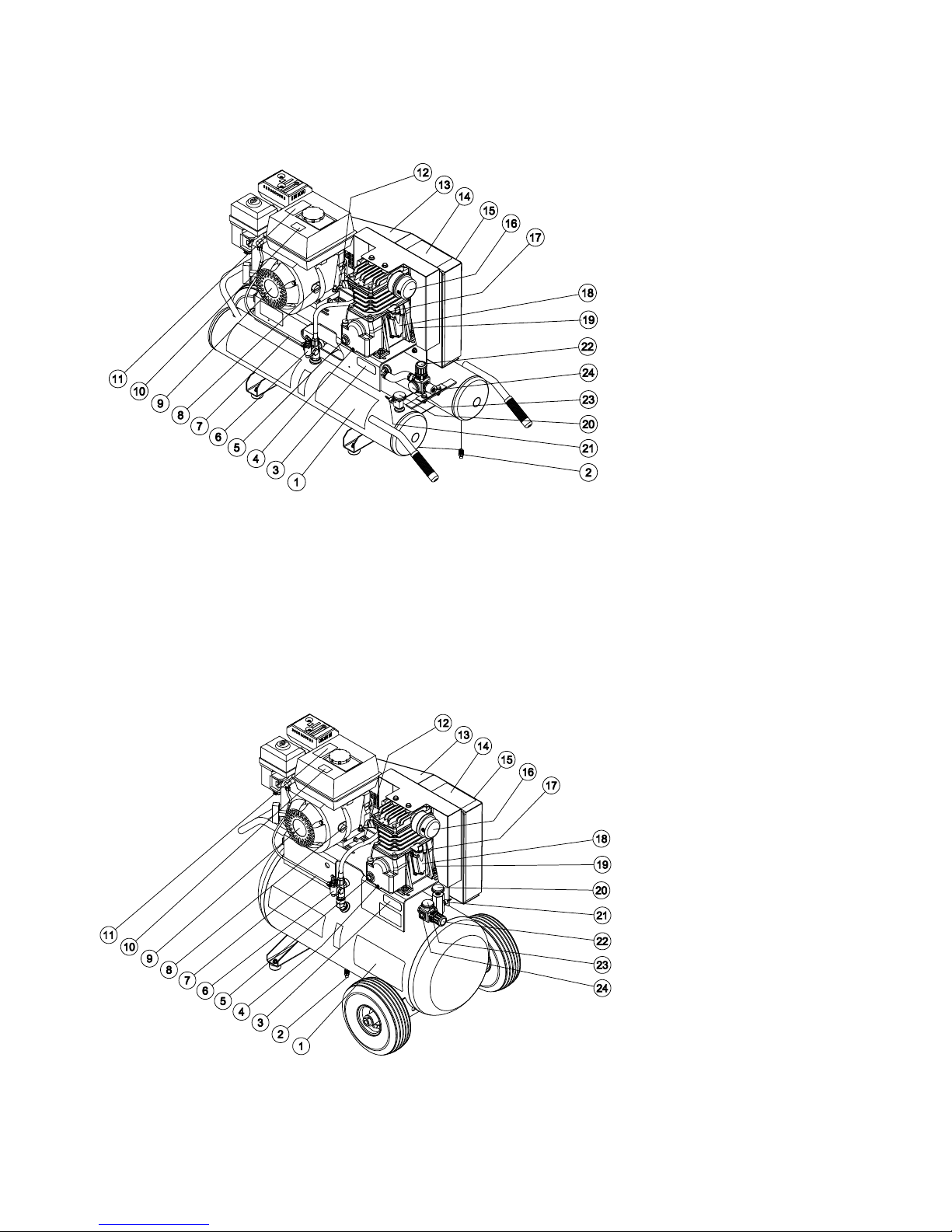
AC1-PH55-08 FEATURE-041205-DLG
Mi-T-M GASOLINE AIR COMPRESSOR FEATURES
(SINGLE STAGE)
1. Decal: Danger/Warning/Caution
2. Tank Drain Valves
3. Decal- Warning: Hot
4. Pump Oil Drain
5. Oil Sight Glass
6. Pilot Valve
7. Engine Air Throttle Control
8. Engine Switch
9. Engine
10. Decal- Caution: Risk of Fire
11. Decal- Warning: Hot Surface
12. Pump Discharge Line
13. Beltguard
14. Decal- Warning: Risk of Injury
15. Decal- Warning: Beltguard
16. Air Filter
17. Oil Fill Port
18. Pump
19. Ventilation Openings
20. Pressure Gauge - Tank PSI
21. Pressure Relief Valve
22. Pressure Regulator
23. Pressure Gauge - Outlet PSI
24. Outlet Fitting
AC1-PH55-20M W/THROTTLE CONTROL-041205-DLG
8 Mi-T-M® Gasoline Air Compressor Manual
Page 9

EXPLODED VIEW & EXPLANATION OF AIR COMPRESSOR FEATURES
SAFETY RELIEF VALVE: This valve is designed to prevent system failures by reliev-
ing pressure from the system when the compressed air reaches a predetermined level.
The valve is preset by the manufacturer and must not be modied in any way. To verify
the valve is working properly, pull on the ring. Air pressure should escape. When the
ring is released, it will reseat.
PILOT VALVE: When the toggle is in the upright position, all air from the air compressor
is vented through the discharge mufer. This gives an easy start feature. For normal
operation, the toggle is in the 90° position.
AIR INTAKE FILTER: This lter is designed to clean air coming into the pump. To
ensure the pump continually receives a clean, cool, dry air supply this lter must always
be clean and ventilation opening free from obstructions. Replace lter element when
necessary.
OIL FILL PORT/VENT: Pour oil into the Oil Fill Port/Vent when required.
OIL SIGHT GLASS: The Oil Sight Glass displays the oil level in the pump. The oil
level should be at the center of the Oil Sight Glass. If low, add SAE 30W non-detergent oil.
AIR COMPRESSOR PUMP: To compress air, the pistons move up and down in the
cylinders. On the downstroke, air is drawn in through the air intake valves while the
exhaust valves remain closed. On the upstroke, air is compressed, the intake valves
close and compressed air is forced out through the exhaust valves, into the discharge
line, through the pilot valve and into the air tank.
AIR TANK PRESSURE GAUGE: The air tank pressure gauge indicates the reserve
air pressure in the air tank (s).
PRESSURE REGULATOR: The air pressure coming from the air tank is controlled by
the regulator knob. Turn the pressure regulation knob clockwise to increase discharge
pressure, and counterclockwise to decrease discharge pressure.
OUTLET PRESSURE GAUGE: The outlet pressure gauge indicates the air pressure
available at the outlet side of the regulator. This pressure is controlled by the regulator
and is always less or equal to the air tank pressure.
AIR TANK DRAIN VALVE: The drain valve is used to remove moisture from the air
tank(s) after the air compressor is shut off. NEVER attempt to open the drain valve
when more than 10 PSI of air pressure is in the air tank! To open the drain valve,
turn the knob counterclockwise.
Mi-T-M® Gasoline Air Compressor Manual 9
Page 10
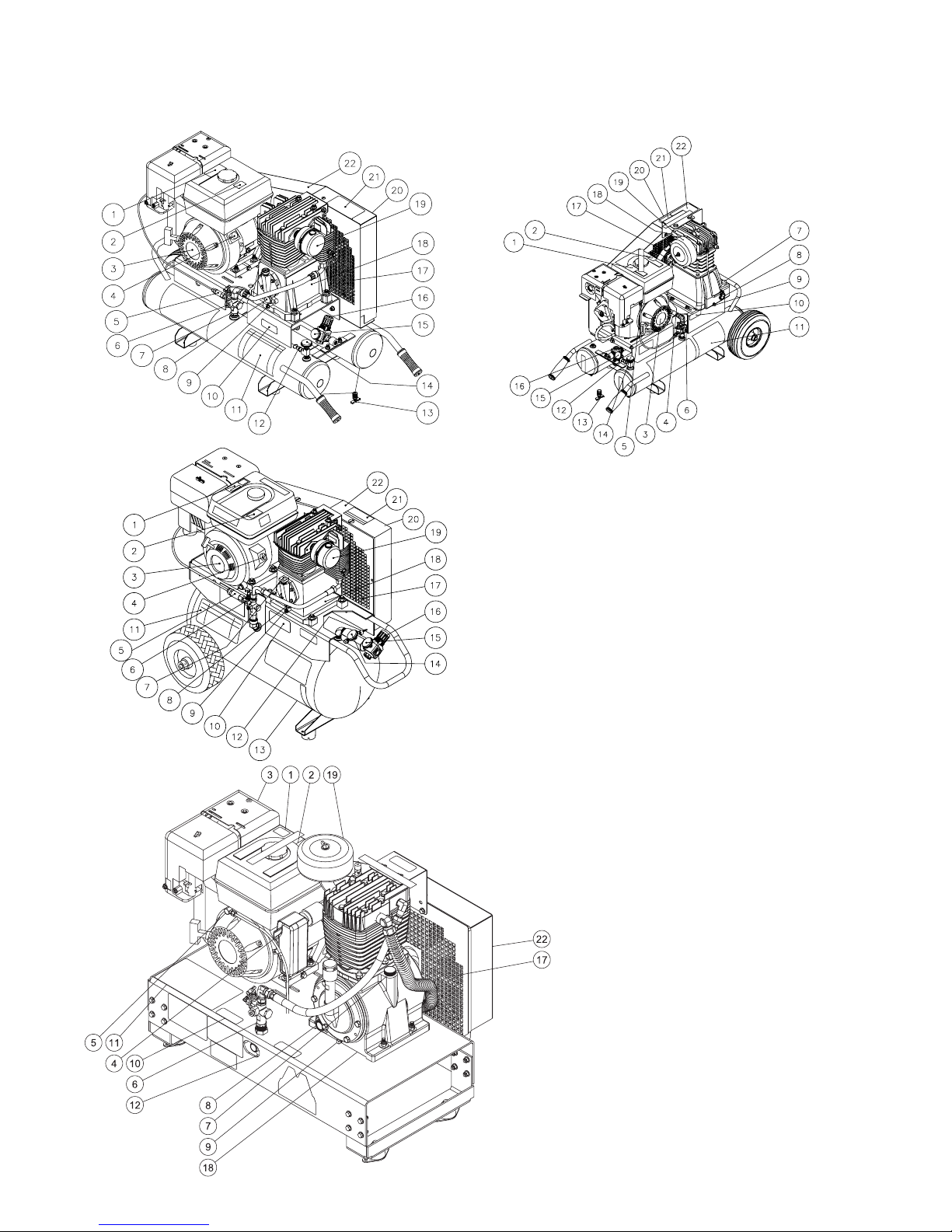
AC2-PH08-PV09-20-FEATURE-012704-DLG AC2-PH08-PV09-FEATURES-012704-DLG
Mi-T-M GASOLINE AIR COMPRESSOR FEATURES
(TWO STAGE)
AS2-PH08-PR09-PV09-08 FEATURES-012704-DLG
1. Decal- Warning: Hot Surfaces
2. Decal- Warning: Risk of Fire
3. Engine
4. Engine Switch
5. Engine Throttle Control
6. Pilot Valve
7. Oil Fill Port
8. Pump Oil Sight Glass
9. Pump Oil Drain
10. Decal- Warning: Hot
11. Decal- Danger/Warning/Caution
12. Pressure Relief Valve
13. Tank Drain Valves
14. Pressure Gauge- Tank PSI
15. Pressure Gauge- Outlet PSI
16. Pressure Regulator
17. Ventilation Openings
18. Air Compressor Pump
19. Air Filter
20. Decal- Warning: Beltguard
21. Decal- Warning: Injury
22. Beltguard
AM2-SH09-B-FEATURE-011509-RSW
10 Mi-T-M® Gasoline Air Compressor Manual
Page 11
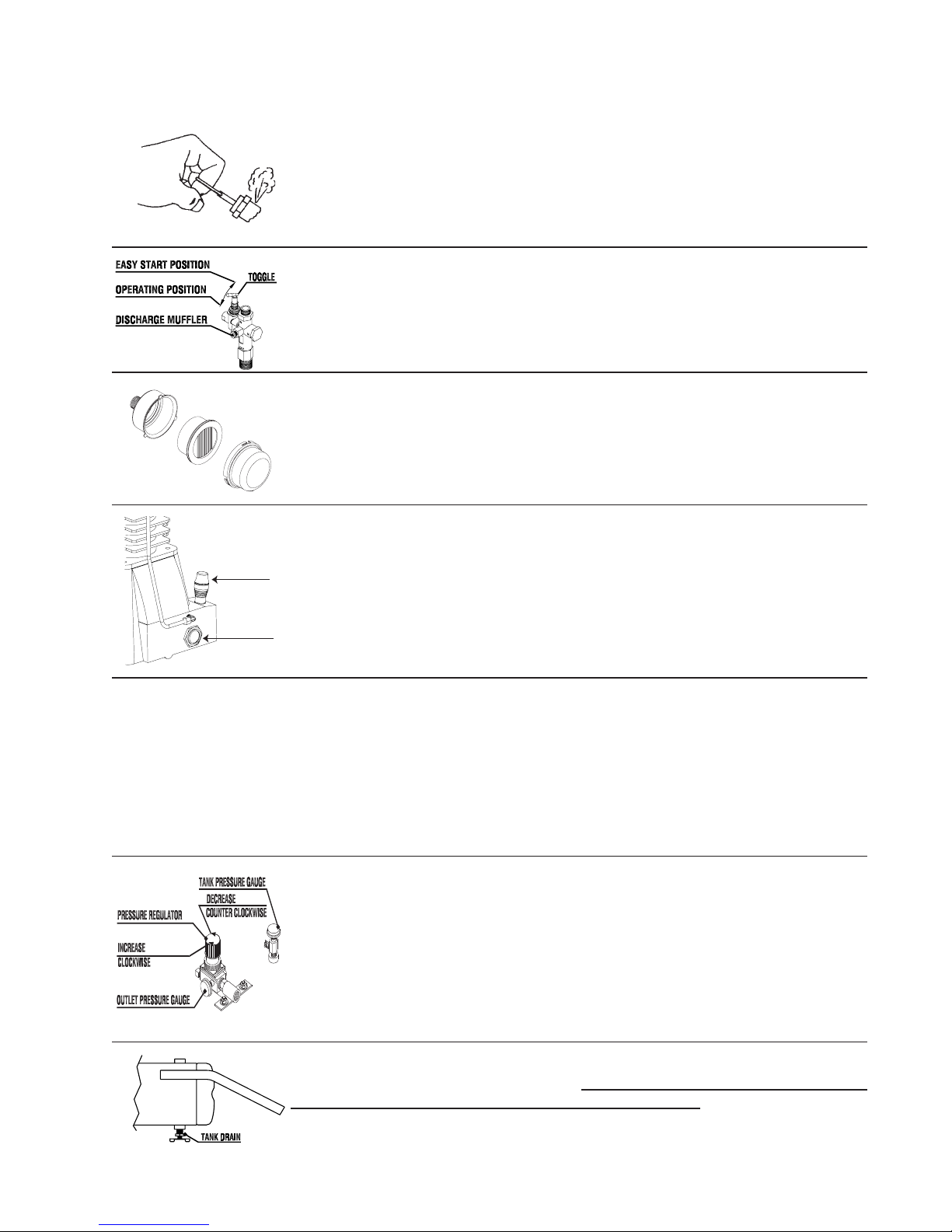
EXPLODED VIEW & EXPLANATION OF AIR COMPRESSOR FEATURES
OIL FILL PORT
OIL SIGHT GLASS
SAFETY RELIEF VALVE: This valve is designed to prevent system failures by relieving pressure from the system when the compressed air reaches a predetermined
level. The valve is preset by the manufacturer and must not be modied in any way.
To verify the valve is working properly, pull on the ring. Air pressure should escape.
When the ring is released, it will reseat.
PILOT VALVE: When the toggle is in the upright position, all air from the air compres-
sor is vented through the discharge mufer. This gives an easy start feature. For
normal operation, the toggle is in the 90° position.
AIR INTAKE FILTER: This lter is designed to clean air coming into the pump. To
ensure the pump continually receives a clean, cool, dry air supply this lter must always be clean and ventilation opening free from obstructions. Replace lter element
when necessary.
OIL FILL PORT/VENT: Pour oil into the Oil Fill Port/Vent when required.
OIL SIGHT GLASS: The Oil Sight Glass displays the oil level in the pump. The oil
level should be at the center of the Oil Sight Glass. If low, add SAE 30W non-detergent oil.
AIR COMPRESSOR PUMP: A two stage compressor pump uses two different size
cylinders with the intake valve of the second smaller cylinder linked to the exhaust
valve of the rst larger cylinder. On the down stroke of the large cylinder, air is drawn
through the intake valve while the exhaust valve remains closed. On the upstroke, air
is compressed, the intake valve closes and compressed air is forced out through the
exhaust valve, into the inter cooler and through the intake valve of the second smaller
cylinder on its down stroke. On the upstroke of the smaller cylinder, the intake valve
closes and the compressed air is compressed a second time and forced out the exhaust
valve into the discharge line, through the tank check valve and into the air tank.
AIR TANK PRESSURE GAUGE: The air tank pressure gauge indicates the reserve
air pressure in the air tank (s).
PRESSURE REGULATOR: The air pressure coming from the air tank is controlled by
the regulator knob. Turn the pressure regulation knob clockwise to increase discharge
pressure, and counterclockwise to decrease discharge pressure.
OUTLET PRESSURE GAUGE: The outlet pressure gauge indicates the air pressure
available at the outlet side of the regulator. This pressure is controlled by the regulator
and is always less or equal to the air tank pressure.
AIR TANK DRAIN VALVE: The drain valve is used to remove moisture from the air
tank(s) after the air compressor is shut off. NEVER attempt to open the drain valve
when more than 10 PSI of air pressure is in the air tank! To open the drain valve,
turn the knob counterclockwise.
Mi-T-M® Gasoline Air Compressor Manual 11
Page 12

NOTES
12 Mi-T-M® Gasoline Air Compressor Manual
Page 13

WARNING
THE FOLLOWING PAGES CONTAIN OPERATING AND MAINTENANCE
INSTRUCTIONS.
DO NOT ATTEMPT TO OPERATE THIS AIR COMPRESSOR UNTIL YOU
HAVE READ AND UNDERSTOOD ALL SAFETY PRECAUTIONS AND
INSTRUCTIONS LISTED IN THIS MANUAL.
INCORRECT OPERATION OF THIS UNIT CAN CAUSE SERIOUS
INJURY!!
DO NOT ALTER OR MODIFY THIS EQUIPMENT IN ANY MATTER!
Mi-T-M® Gasoline Air Compressor Manual 13
Page 14
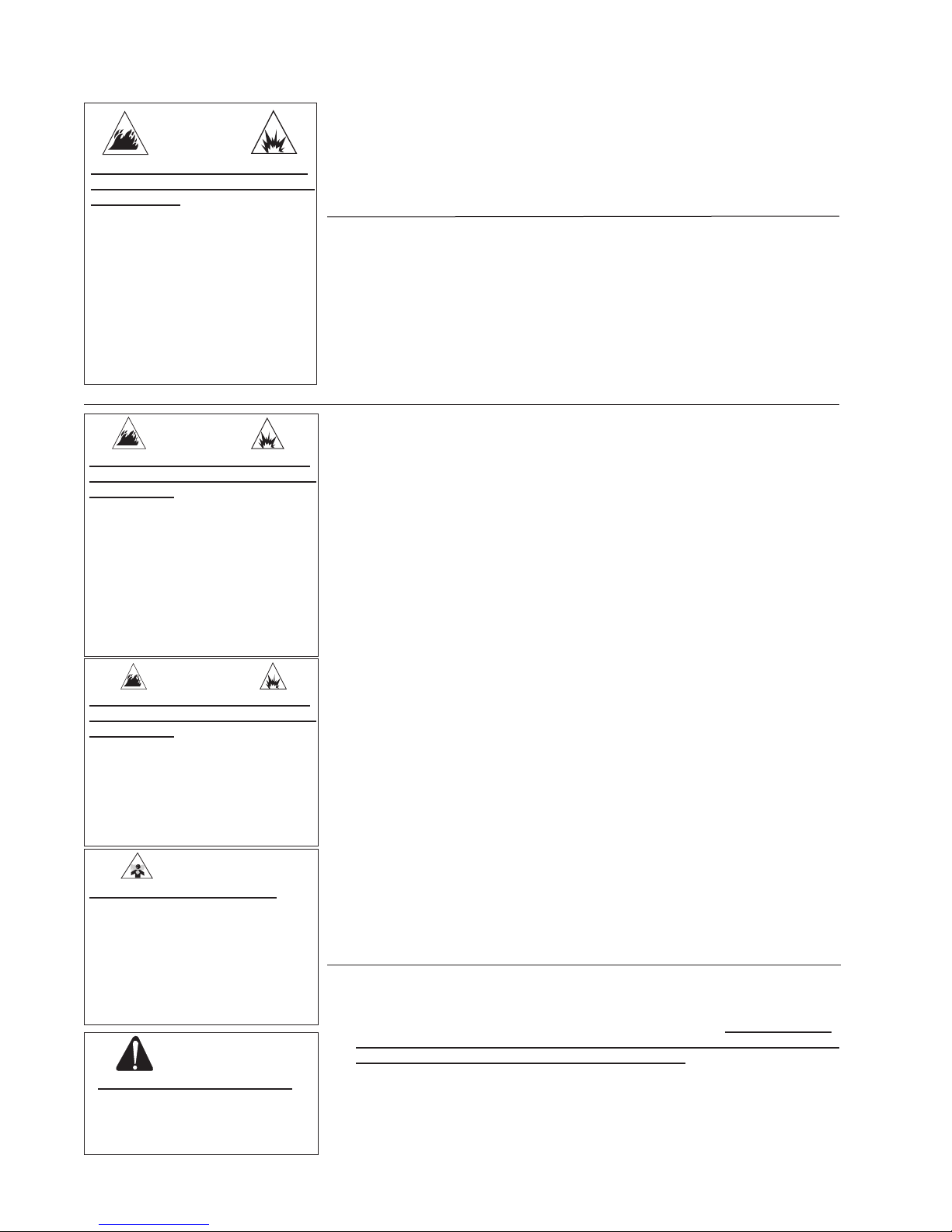
RISK OF EXPLOSION OR FIRE
WARNING
CAUSING SERIOUS INJURY
OR DEATH!
Do not allow the engine or
mufer to come in contact
with ammable vapors, com-
bustible dust, gases or other
combustible materials. A
spark may cause a re.
When using the air compressor for spray painting, place
the air compressor as far
away from the work area as
possible, using extra air hoses
if needed.
DANGER
RISK OF EXPLOSION OR FIRE
CAUSING SERIOUS INJURY
OR DEATH!
Do not smoke while fueling!
Do not ll fuel tank while air
compressor is running or hot.
Allow air compressor and
engine to cool down for two
minutes before refueling.
Do not ll fuel tank to point
of o verf lowing . Allo w
approximately 1/4" of tank
space for fuel expansion.
PREPARATION
INITIAL SET-UP:
1. Read safety warnings before setting-up air compressor.
2. Ensure the oil level in the air compressor pump is adequate. If low,
add SAE 30W non-detergent oil.
LOCATION:
1. In order to avoid damaging the air compressor, do not incline the air
compressor transversely or longitudinally more than 10°.
2. Place air compressor at least 12 inches away from obstacles that may
prevent proper ventilation. Do not place air compressor in an area:
-where there is evidence of oil or gas leaks.
-where ammable gas vapors or materials may be present.
-where air temperatures fall below 32°F or exceed 104°F.
-where extremely dirty air or water could be drawn into the air
compressor.
GASOLINE ENGINE:
1. Review "Risk of Fire or Explosion" pg. 4 before fueling.
2. Read the engine manual accompanying this air compressor for
correct engine start-up maintenance procedures.
3. Read and understand the safety labels located on the air compressor.
4. A minimum of 86 octane fuel is recommended for use with this air
compressor. Do not mix oil with gasoline.
5. Use of clean, fresh, lead free gasoline is recommended. Leaded gasoline
may be used if lead free is not available. Do not use gasoline
containing methanol or alcohol.
6. Check the engine oil level before starting. (See engine manual.)
7. Fill the fuel tank according to the engine manual instruction.
8. Refer to the engine manual for all necessary maintenance and
adjustments.
WARNING
RISK OF EXPLOSION OR FIRE
CAUSING SERIOUS INJURY
OR DEATH!
Do not place unit in an area
where ammable gas vapors
may be present. A spark could
cause an explosion or re.
Always store fuel away from
the air compressor while it is
running or hot.
WARNING
RISK OF ASPHYXIATION!
Do not operate in an enclosed
area. Use this product only
in well ventilated areas! The
exhaust from the engine
contains carbon monoxide,
a poisonous, odorless and
invisible gas. Breathing the
gas can cause serious injury,
illness and possible death.
WARNING
RISK OF BODILY INJURY!
Never attempt to open the
Air Tank Drain Valve when
more than 10 PSI of air
pressure is in the air tank!
14 Mi-T-M® Gasoline Air Compressor Manual
PRE-START CHECKLIST:
1. Check oil level. Add if necessary.
2. Remove any moisture in the air compressor air tank. NEVER
attempt to open the Air Tank Drain Valve when more than
10 PSI of air pressure is in the air tank! Remove excessive
pressure with an air tool, then open the Air Tank Drain Valve in the bottom
of the air tank. Close tightly when drained.
3. Make sure the Engine Switch is in the "OFF" position.
4. Make sure the Safety Relief Valve is working correctly.
5. Make sure all guards and covers are in place and securely mounted.
Page 15
OPERATION
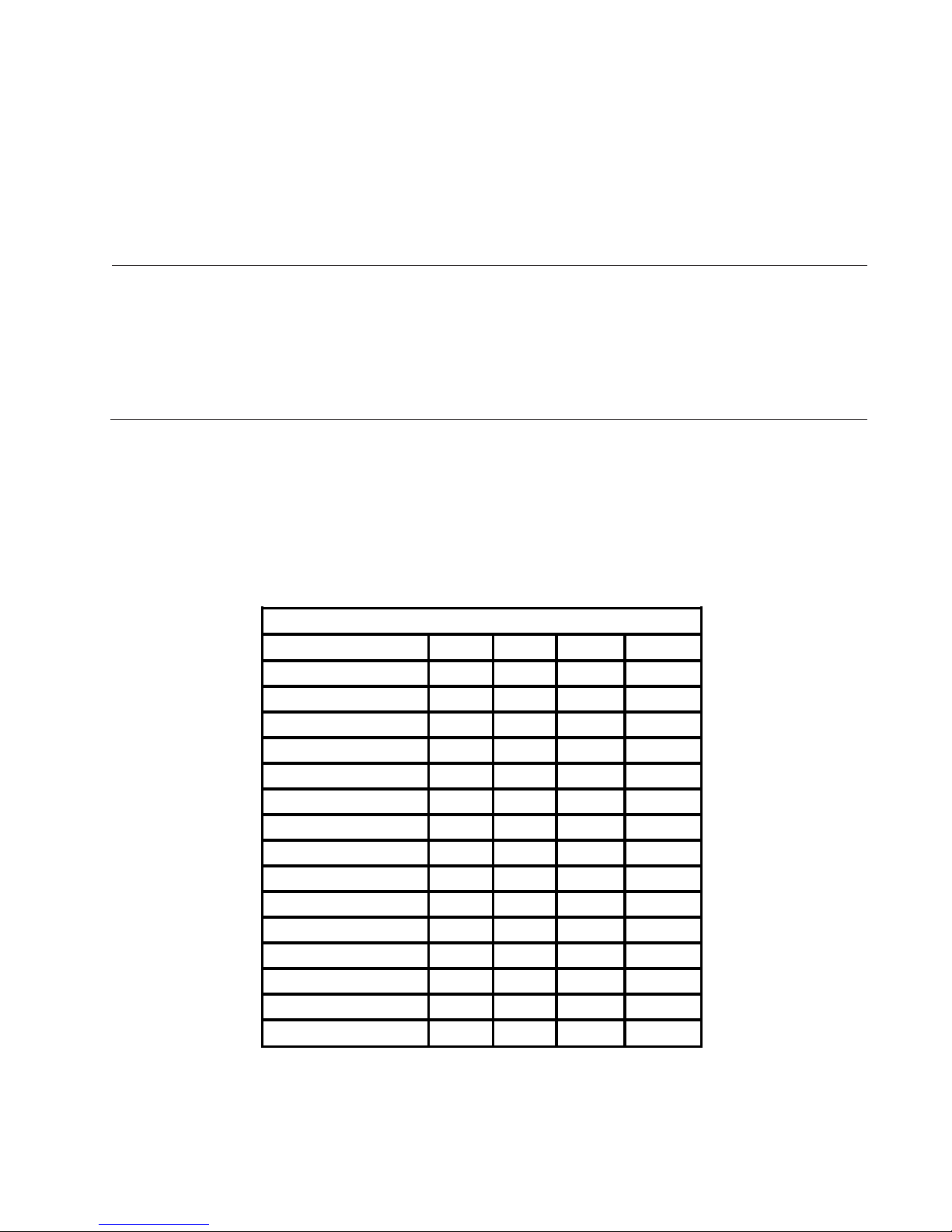
AC Gas Maintenance Chart
MAINTENANCE CHART
PROCEDURE DAILY WEEKLY MONTHLY 200 HOURS
Check pump oil level X
Check engine oil level X
Oil leak inspection X
Check engine air filter X
Drain condensation in air tank (s) X
Inspect guards/covers X
Check for unusual noise/vibration X
Check for air leaks X
Clean exterior of compressor X
Inspect air filter X
Inspect belt X
Check safety relief valve X
Change pump oil * X
Replace air filter X
Check engine spark plug X
START-UP:
1. Read safety warnings before performing operation.
2. Flip the toggle on top of the Pilot Valve to the upright position. This provides a loadless start. The air
compressor will unload and allow easier engine start-up.
3. Start the engine. (Refer to the Engine Manual accompanying this unit.)
4. When the engine has run for 1-2 minutes, ip toggle back to the original position.
5. Set pressure by adjusting the Pressure Regulator counterclockwise for less pressure and clockwise for more
pressure.
6. If you notice any unusual noise or vibration, stop the air compressor and refer to "Troubleshooting".
SHUTDOWN:
1. To stop the air compressor, move the Engine Switch to the "Off" position. (Refer to the Engine Manual
accompanying this unit.)
2. Drain air from the air tanks by releasing air with an attached air tool or by pulling on the Safety Relief
Valve.
3. Once the Air Tank Pressure Gauge registers under 10 pounds, open the drain valve under each air tank to
drain any moisture.
4. Allow the air compressor to cool down.
5. Wipe air compressor clean and store in a safe, non-freezing area.
MAINTENANCE
Read the instruction manual before performing maintenance. The following procedures must be performed
when stopping the air compressor for maintenance or service.
1. Turn off air compressor.
2. Disconnect spark plug wire from engine.
3. Open all drains.
4. Wait for the air compressor to cool before starting service.
*The pump oil must be changed after the rst 50 hours of operation and every 200 hours or 3 months,
whichever comes rst.
The engine oil must be changed after the rst 8 hours of operation and every 50 hours or 3 months, whichever
comes rst.
Every 2 years, an Authorized Service Technician should check the check valve, intake valves and delivery
valves.
Mi-T-M® Gasoline Air Compressor Manual 15
MAINTENANCE CHART
Page 16

TROUBLESHOOTING
SYMPTOM PROBABLE CAUSE REMEDY
Engine will not start.
Various engine problems.
Refer to the engine manual
accompanying your air compressor.
Noisy operation.
Pressure drop in air tank or
rapid pressure loss when air
compressor is shut off.
Low engine oil level.
Loose engine pulley or pump
ywheel.
Lack of oil in the pump.
Carbon deposits on pistons or
valves.
Bearing, piston or connecting rod
failure.
Air leaks at connections. Allow air compressor to build pres-
Air leak in air tank.
Engine is equipped with an Oil Alert
System which will not allow the engine to start if oil level is low. Add oil,
if needed.
Tighten pulley and or ywheel.
Add correct amount of oil. Check for
bearing damage.
Remove cylinder head and inspect.
Clean or replace.
STOP THE AIR COMPRESSOR!
Contact Mi-T-M Customer Service.
sure to the maximum allowed. Turn
off and brush a soapy water solution
onto all connections. Check connections for air bubbles. Tighten the connections where leaks are present.
Air tank must be replaced. Do not
attempt to repair air tank!
Insufcient pressure at air tool
or accessory.
Air leaks from Safety Relief
Valve
Defective Pilot Valve.
Pressure Regulator not turned to
high enough pressure or defective.
Restricted air intake .
Air leaks or restrictions.
Hose or hose connections are too
small or long.
Slipping belt.
Air compressor is not large
enough for air requirement.
Restriction in Pilot Valve.
Possible defective Safety Relief
Valve.
Excessive air tank pressure.
Clean or replace.
Adjust Pressure Regulator to proper
setting or replace.
Clean or replace Air Intake Filter.
Check for leaks and repair.
Replace with larger hose or
connectors.
Tighten or replace.
Check the accessory air requirement.
If it is higher than the CFM or pressure supply to the air compressor, use
a larger air compressor.
Clean or replace.
Operate Safety Relief Valve manually
by pulling on ring. If it still leaks, it
should be replaced.
Clean, reset or replace Pilot Valve.
16 Mi-T-M® Gasoline Air Compressor Manual
Page 17

TROUBLESHOOTING
SYMPTOM PROBABLE CAUSE REMEDY
Air leaks at pump. Defective gaskets.
Air blowing from Air Intake
Filter.
Moisture in discharge air.
Excessive oil consumption or oil
in hose.
Defective inlet (reed) valve. Contact Mi-T-M Customer Service.
Condensation in air tank caused by
high level of atmospheric humidity
or air compressor is not run long
enough.
Restricted Air Intake Filter.
Air compressor on unlevel surface.
Crankcase overlled with oil.
Wrong viscosity.
Plugged oil dipstick vent.
Plugged crankcase breather.
Torque head bolts: Single Stage= 17
ft./lbs. Two Stage= 33 ft./lbs.
Run air compressor a minimum of
one hour to prevent condensation
buildup. Drain air tank after every
use. Drain air tank more often in hu-
mid weather and use an air line lter.
Clean or replace.
Do not incline the air compressor
more than 10° in any direction while
running.
Drain oil. Rell to proper level with
SAE-30W non-detergent oil.
Drain oil. Rell to proper level with
SAE-30W non-detergent oil.
Clean.
Clean or replace.
Oil leaks.
Worn piston rings or scored cylinder.
Oil has milky appearance. Water in oil due to condensation.
Torque head bolts: Single Stage=
17 ft./lbs. Two Stage= 33 ft./lbs.
Contact Mi-T-M Customer Service.
Change oil and move air compressor
to a less humid environment.
Mi-T-M® Gasoline Air Compressor Manual 17
Page 18

Mi-T-M GASOLINE AIR COMPRESSOR
STATEMENT OF WARRANTY
Mi-T-M Corporation warrants all parts, (except those referred to below), of your new air compressor to be free
from defects in materials and workmanship during the following periods:
For Two (2) years from the date of original purchase:
Compressor Pump Plumbing
Tank Assembly
For Six (6) months from date of original purchase:
Pressure Switch Regulator
Check Valve Pilot Valve
Copper/stainless steel line
For Ninety (90) days from the date of original purchase:
Pressure Gauges Safety Relief Valves
Drain Valves
Defective parts not subject to normal wear and tear will be repaired or replaced at our option during the warranty
period. In any event, reimbursement is limited to the purchase price paid.
ExCLuSIONS
1. Engine is covered under separate warranty by its respective manufacturer and is subject to the terms set
forth therein.
2. Normal wear parts:
Isolators Air Filter
3. This warranty does not cover parts damaged due to normal wear, abnormal conditions, misapplication,
misuse, accidents, operation at other than recommended speeds, pressures or temperature, improper storage
or freight damage. Parts damaged or worn by operation in dusty environments are not warranted. Failure to
follow recommended operating and maintenance procedures also voids warranty.
4. Labor charges, loss or damage resulting from improper operation, maintenance (other than routine air tank
draining and oil changes, if applicable) or repairs made by persons other than a Mi-T-M Authorized Service
Center.
5. The use of other than Genuine Repair Parts will void warranty. Parts returned, prepaid to our factory or to
an Authorized Service Center will be inspected and replaced free of charge if found to be defective and subject
to warranty. Under no circumstances shall the manufacturer bear any responsibility for loss of use of the unit,
loss of time or rental, inconvenience, commercial loss or consequential damages. There are no warranties
which extend beyond the description of the face hereof.
For Service or Warranty consideration, contact:
Mi-T-M Corporation, 8650 Enterprise Drive, Peosta, IA 52068-0050
563-556-7484 / 800-553-9053 / Fax 563-556-1235
Monday-Friday 8:00 a.m. - 5:00 p.m. CST
18 Mi-T-M® Gasoline Air Compressor Manual
Page 19

NOTES
Mi-T-M® Manual de operador de compresor de aire gasolina. 19
Page 20

TABLA DE MATERIAS
INTRODUCCION ..............................................................................................................21
IMPORTANTE ..............................................................................................................21
INSPECCIONE .................................................................................................................21
ADVERTENCIAS IMPORTANTES DE SEGURIDAD .................................................22-25
RIESGO DE EXPLOSIÓN ...................................................................................22
RIESGO DE ESTALLIDO .................................................................................... 23
RIESGOS A LA RESPIRACIÓN .......................................................................... 23
RIESGO DE QUEMADURAS ..............................................................................24
RIESGO DE OBJETOS VOLANTES ................................................................... 24
RIESGO DE PARTES EN MOVIMIENTO ...........................................................24
RIESGO DE NEGLIGENCIA ............................................................................... 25
RIESGO DE AVERÍAS DEL COMPRESOR DE AIRE .........................................25
ILUSTRACIONES DE LOS ELEMENTOS Y COMPONENTES ............................ 26 & 28
REPASO DE LOS ELEMENTOS Y COMPONENTES ........................................... 27 & 29
INSTRUCCIONES DE PREPARACIÓN ..........................................................................31
PREPARACIÓN ...................................................................................................31
COLOCACIÓN ....................................................................................................31
MOTOR DE GASOLINA ...................................................................................... 31
CONTROLES ANTES DEL ARRANQUE ............................................................ 31
INSTRUCCIONES DE OPERACIÓN ............................................................................... 32
OPERACIÓN ....................................................................................................... 32
APAGAMIENTO ................................................................................................... 32
MANTENIMIENTO ...........................................................................................................32
LOCALIZACIÓN AVERÍAS .........................................................................................33-34
DECLARACIÓN DE GARANTÍA ..................................................................................... 35
20 Mi-T-M® Manual de operador de compresor de aire gasolina.
Page 21
INTRODUCCION
¡Felicitaciones por la compra de su nueva compresor de aire gasolina! Puede estar seguro que su compresor
de aire gasolina fue construida con el nivel más. Cada componente ha sido probado rigurosamente por técnicos
para asegurar la calidad, la resistencia y el rendimiento de esta unidad.
Este manual del operador fue compilado para su benecio. Leyendo y siguiendo los pasos simples de seguridad,
instalación, operación, mantenimiento y localización de fallas descritos en este manual ayudará a prolongar
aun más la operación libre de fallas que usted puede esperar de su compresor de aire gasolina. El contenido
de este manual está basado en la información actualizada disponible al momento de la publicación. Mi-T-M®
se reserva el derecho de efectuar cambios en precio, color, materiales, equipo, especicaciones o modelos en
cualquier momento sin previo aviso.
¡IMPORTANTE!
Estos párrafos están rodeados por una “CASILLA DE ALERTA DE SEGURIDAD”. Esta casilla
se usa par designar y enfatizar las Advertencias de Seguridad que deben seguirse al operar
esta lavadora a presión. Acompañando a las Advertencias de Seguridad están las “palabras
de alerta” que designan el grado o nivel de seriedad de riesgo. Las “palabras de alerta”
usadas en este manual son las siguientes:
PELIGRO: Indica una situación inminente riesgosa la cual, si no se evita, RESULTARA
en la muerte o en lesiones graves.
ADVERTENCIA: Indica una situación potencialmente riesgosa la cual, si no se
evita, PODRIA resultar en la muerte o en lesiones graves.
PRECAUCION: Indica una situación potencialmente riesgosa la cual, si no se evita
PUEDE resultar en lesiones menores o moderadas.
El símbolo indicado a la izquierda de este párrafo es el “Símbolo de Alerta de Seguridad”.
Este símbolo se usa para alertarlo acerca de artículos o procedimientos que podrían ser
peligrosos para usted u otras personas usando este equipo.
PROVEA SIEMPRE UNA COPIA DE ESTE MANUAL A CUALQUIER PERSONA QUE USE ESTE EQUIPO.
LEA TODAS LAS INSTRUCCIONES ANTES DE OPERAR ESTA LAVADORA A PRESION, OBSERVANDO
EN PARTICULAR LAS “ADVERTENCIAS DE SEGURIDAD” PARA EVITAR LA POSIBILIDAD DE LESIONES
PERSONALES AL OPERADOR.
Escriba el número de serie de su unidad en el espacio provisto abajo, una vez que la unidad haya sido
desempacada.
NUMERO DE SERIE___________________________
Inspeccione por daño el contenido de la caja. Si algo parece dañado, NO LA DEVUELVA AL LUGAR DE
COMPRA. Llame a su representante de servicio al cliente de al 800-553-9053.
Por favor tenga disponible la información siguiente para todas las llamadas de servicio:
1. Número de modelo
2. Número de serie
3. Fecha y lugar de compra
Mi-T-M® Manual de operador de compresor de aire gasolina. 21
Mi-T-M® Corporation
8650 Enterprise Drive
Peosta, IA 52068-0050
Page 22
ADVERTENCIAS IMPORTANTES DE SEGURIDAD
ADVERTENCIA: Al usar este producto, deben observarse ciertas precauciones básicas, como las siguientes:
LEA TODAS LAS ADVERTENCIAS DE SEGURIDAD ANTES DE USAR LA COMPRESOR DE AIRE.
PELIGRO
RIESGO DE EXPLOSIÓN O
DE INCENDIO
POSIBLE CONSECUENCIA PREVENCIÓN
O fuego chipas normales de
sistema de encendido del motor
o de exhosto de motor/moe
puede causar lesiones graves y la
muerte. .
Siempre funcionar el compresor
de aire en ambientes de bien
ventilados sin vapores amables,
polvos combusible, gases, o toras
materiales combustibles.
No fumar si pulverizando
materiales amables. Poner el
compresor de aire más de 20
pisos de ambiente de pulverizar.
(Puede necesitar un otro tubo.)
Un resulto de abastecer de
combustible incorrecto es lesiones
graves y la muerte.
No fumar cuando llenar el tanque
de motor con combustible (fuel).
Nunca llenar el tanque del motor
con fuel cuando motor es calor o
funcionamiento. Permitir el motor
2 (dos) minutos para enifriarse
antes de más fuel.
No dar más fuel adentro o en
ambientes con mal ventilados.
Siempre reabastecer de fuel
despacio para evitar derrames
que puede causar riesgo de
fuego.
No funcionar el unito si hay
derrames de gasolina. Limpiar el
compresor de aire y mover afuera
de derrame. Evitar encendido
o funcionar hasta gasolina ha
evaporar.
No guardar el compresor de aire
cerca de fuegos o máquinas como
una estufa, horno, calentador de
agua, etc. cual utilizar una luz
pilota o dispositivo de chispas.
22 Mi-T-M® Manual de operador de compresor de aire gasolina.
Abiertas limitados de ventilación
de compresor de aire puded
causar lesiones graves. Necesitar
ventilación para evitar excesivo
calor y empieza del fuego.
Necesitar tener arrestador de
chispas en el moee de este
motor para usar con algo tierra
que tener hierba o arboles. Esta
parte mantener efectuar por
operador.
No poner objectos cerca o arriba
de compresor de aire. Funcionar
compresor de aire más de 12
pulgudos afuera de pared o
obstrución que limitar ventilación
apropriado.
Page 23
ADVERTENCIAS IMPORTANTES DE SEGURIDAD
ADVERTENCIA: Al usar este producto, deben observarse ciertas precauciones básicas, como las siguientes:
LEA TODAS LAS ADVERTENCIAS DE SEGURIDAD ANTES DE USAR LA COMPRESOR DE AIRE.
PELIGRO
RIESGO DE ESTALLIDO
POSIBLE CONSECUENCIA PREVENCIÓN
Si no se respeta el mantenimiento
adecuado el depósito de aire podría
estallar y causar lesiones graves o
la muerte.
Vaciar el depósito de aire todos
los días o al nal de cada uso,
para evitar que se acumule la
condensación.
Si el depósito de aire tiene una
fuga, sustituirlo inmediatamente. No
reparar, soldar o modicar jamàs el
depósito de aire o sus accesorios.
Usar sólo piezas originales para el
compresor de aire.
No modicar jamàs las presiones
ajustadas en al fàbrica.
RIESGOS A LA RESPIRACIÓN
El funcionamiento incorrecto del
compresor o, en el caso en que se
empleen componentes o accesorios
inadecuados, el estallido de sus
accesorios podría causar lesiones
graves o la muerte.
La inhalación de aire comprimido
puede causar lesiones graves e
incluso la muerte. El chorro de
aire podría contener monóxido
de carbono, vapores tóxicos o
partículas sólidas.
La inhalación de gases de motor
puede causar lesiones graves y la
muerte.
No superar jamàs las presiones
màximas permitidas de los
accesorios, recomendadas por el
fabricante.
Debido al excesivo calor, no usar
tubos de plàstico o uniones con
soldaduras de plomo en la línea de
descarga.
No usar jamás un compresor de aire
para inar objetos pequeños o que
requieren poca presión como los
juguetes.
No inhalar jamás el aire porcedente
del compresor de aire ni a través de
cualquier dispositivo de respricaión
conectado al compresor de aire.
Este compresor de aire se disenado
para funcionar en aire libre. Nunca
funcionar este compresor de aire
en ambientes cerrados, empre
tener ventilación adecuado. Este
prevenirá la acumule de gases
peligros que contener monóxido de
carbono. Ten ciudad de ambientes
de mal ventilados.
Mi-T-M® Manual de operador de compresor de aire gasolina. 23
Materiales pulverizados como
pinturas, solventes para pinturas,
desbarnizadores, insecticidas,
herbicidas, etc. contienen vapores
dañinos y venenos.
El compresor de aire debe funcionar
sólo en ambientes bien ventilados.
Atenerse a las instrucciones de
seguridad indicadas para los
materiales que se pulverizan. Al
pulverizar ciertos materiales podría
ser necesario usar un respirador.
Page 24
ADVERTENCIAS IMPORTANTES DE SEGURIDAD
ADVERTENCIA: Al usar este producto, deben observarse ciertas precauciones básicas, como las siguientes:
LEA TODAS LAS ADVERTENCIAS DE SEGURIDAD ANTES DE USAR LA COMPRESOR DE AIRE.
PELIGRO
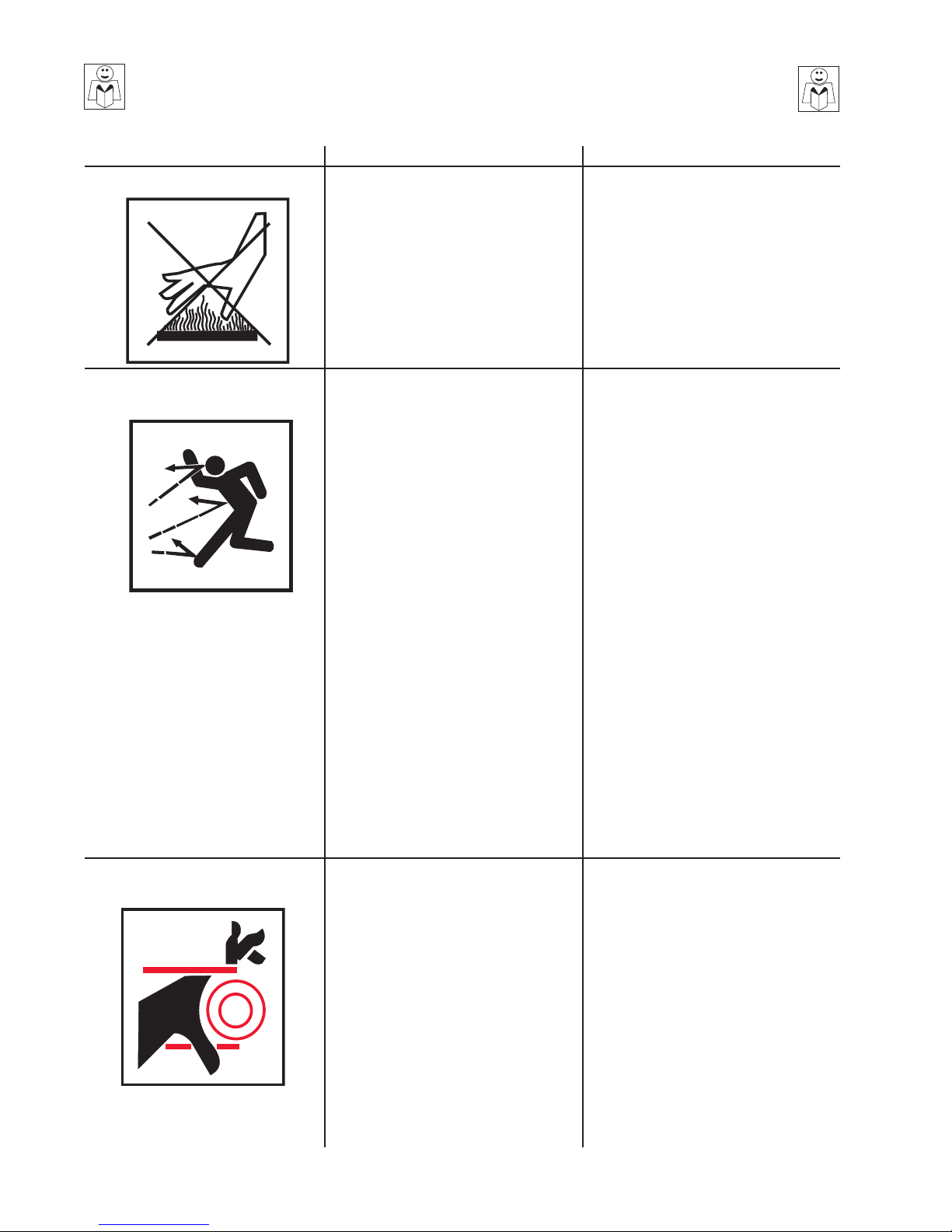
RIESGO DE QUEMADURAS
POSIBLE CONSECUENCIA PREVENCIÓN
El tocar partes metálicas
expuestas podría causar lesiones
graves. La temperatura en estas
zonas no baja inmediatamente al
apagar el compresor de aire.
Asegurarase que ninguna parte
del cuerpo o de otros materiales
entre en contacto con las
partes metálicas expuestas del
compresor de aire.
Nunca tener contacto de su
cuerpo y el moetle del motor o
ambientes adyacentes.
RIESGO DE OBJETOS
VOLANTES
RIESGO DE PARTES EN
MOVIMIENTO
El chorro de aire comprimido
podría causar lesiones a los
tejidos blandos.
La proyección de partículas del
chorro de aire comprimido a
velocidad elevada puede causar
lesiones graves.
Riesgo de lesiones graves de
partes en movimiento.
Usar siempre las gafas de
protección para proteger los ojos
de las particulas volantes.
No dirigir jamás el chorro de aire a
cualquier parte de su cuerpo o del
cuerpo de otra persona o animal.
No dejar jamás un compresor
de aire bajo presión sin
vigilancia. Apagar el compresor
y descargar la presión antes de
efectuar cualquier operación de
mantenimiento, conectar cualquier
herramienta o accesorio.
Con el compresor de aire en
marcha mantener siempre
una distancia de seguridad de
presonas y animales.
No debe moverse el compresor
de aire cuando el depósito de
aire está bajo presión. No intentar
mover el compresor de aire
tirando del tubo.
Antes de hacer mantemiento
siempre parar el compresor de aire.
Purgar presión de tubo de aire y
desmontar el cable de bomba de
chispa para impedir el encendido
de motor. Todas reparaciones
hacer de personas autorizadas de
servicio.
No usar el compresor de aire sin las
protecciones de seguridad. Siempre
remova el enchufe del compresor
del aire antes de remover cualquier
guarda. Sustituir las protecciones
dañadas antes de encender le
compresor de aire.
24 Mi-T-M® Manual de operador de compresor de aire gasolina.
Page 25

ADVERTENCIAS IMPORTANTES DE SEGURIDAD
ADVERTENCIA: Al usar este producto, deben observarse ciertas precauciones básicas, como las siguientes:
LEA TODAS LAS ADVERTENCIAS DE SEGURIDAD ANTES DE USAR LA COMPRESOR DE AIRE.
PELIGRO
RIESGO DE NEGLIGENCIA
POSIBLE CONSECUENCIA PREVENCIÓN
Un uso negligente del compresor
puede ocasionar lesiones.
No permitir jamás que niños o
adolescentes pongan en marcha
el compresor de aire.
Prestar mucha atención a
la operación que se está
cumpliendo. No se debe poner
en marcha el compresor de aire
en caso de cansancio o bajo la
inuencia de alcohol o drogas.
Es necesario saber apagar el
compresor de aire. Es preciso
conocer bien todos los mandos.
RIESGO DE AVERÍAS DEL
COMPRESOR DE AIRE
Riesgo de graves averías.
No encender el compresor de aire
sin el ltro de aire.
No encender el compresor de aire
sin el ltro de aire.
No encender el compresor de
aire en un ambiente corrosivo. El
compresor de aire debe funcionar
en una posición estable y segura
para prevenir que caiga.
Atenerse a las instrucciones de
mantenimiento descritas en este
manual.
¡GUARDE ESTAS INSTRUCCIONES!
Mi-T-M® Manual de operador de compresor de aire gasolina. 25
Page 26
AC1-PH55-08 FEATURE-041205-DLG
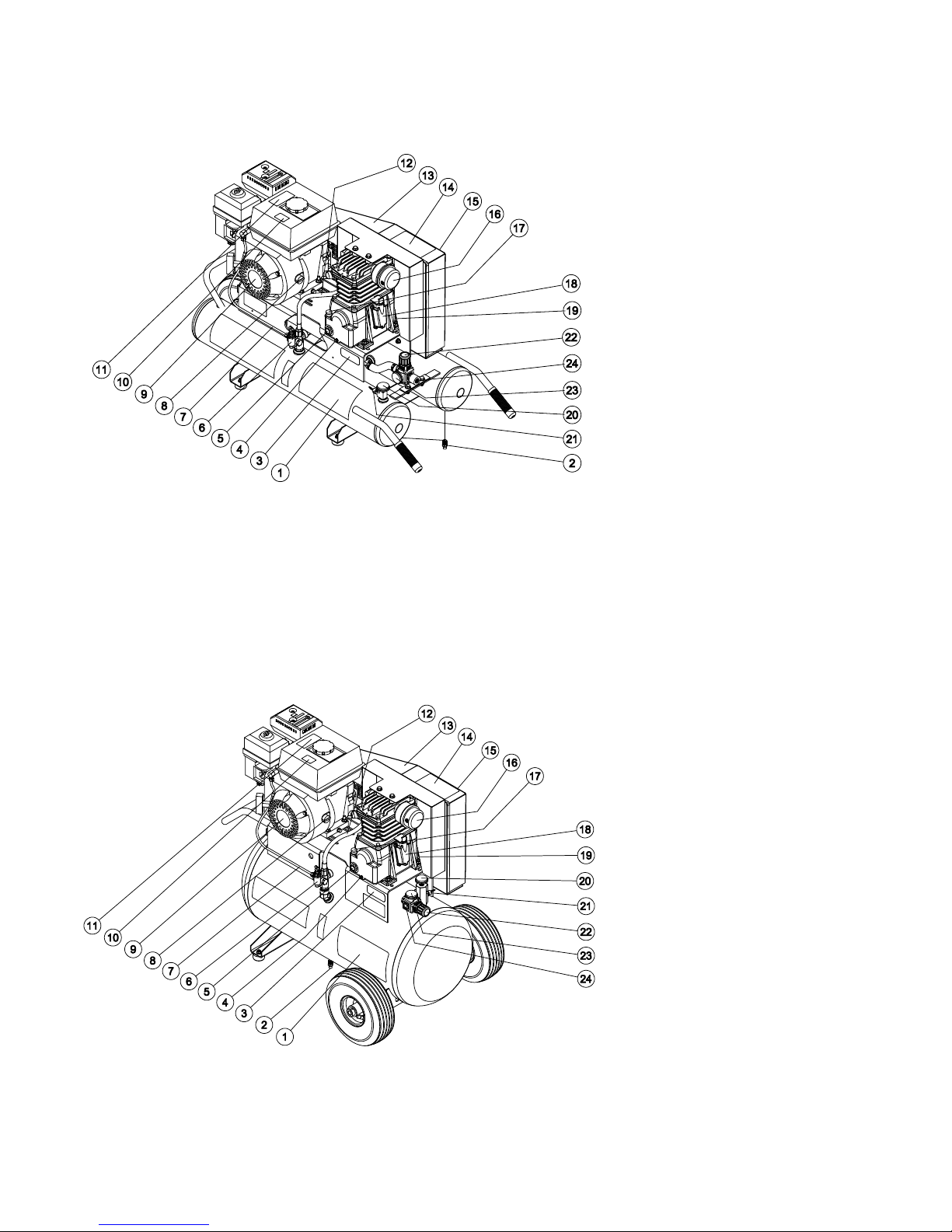
Mi-T-M COMPONENTES DE COMPRESOR DE AIRE GASOLINA
(ESTAPA SENCILLA)
1. Calcomanía- Peligro/Advertencia/
Precaución
2. Válvula (s) de descargar del tanque
de aire
3. Calcomanía- Advertencia: Calientes
4. Sumidero del aceite de bomba
5. Cristal De la Vista Del Aceite
6. Válvula de piloto
7. Control de regulador de motor
8. Interruptor de motor
9. Motor
10. Calcomanía- Riesgo de Incendido
11. Calcomanía- Advertencia:
Supercies Calientes
12. Cuerda de depósito de bomba
13. Guardia del cintúron
14. Calcomanía- Advertencia:
Riesgo de lesiones
15. Calcomanía- Advertencia:
Guardia del cintúron está en lugar
16. Filtro de aire
17. Puerto de relleno del aceite
18. Bomba
19. Abiertas de ventilación
20. Indicador de presión de tanque
de aire
21. Valvula de alivio de presión
22. Regulador de presión
23. Indicador de presión de salida
24. Instalaciónes de salida
AC1-PH55-20M W/THROTTLE CONTROL-041205-DLG
26 Mi-T-M® Manual de operador de compresor de aire gasolina.
Page 27
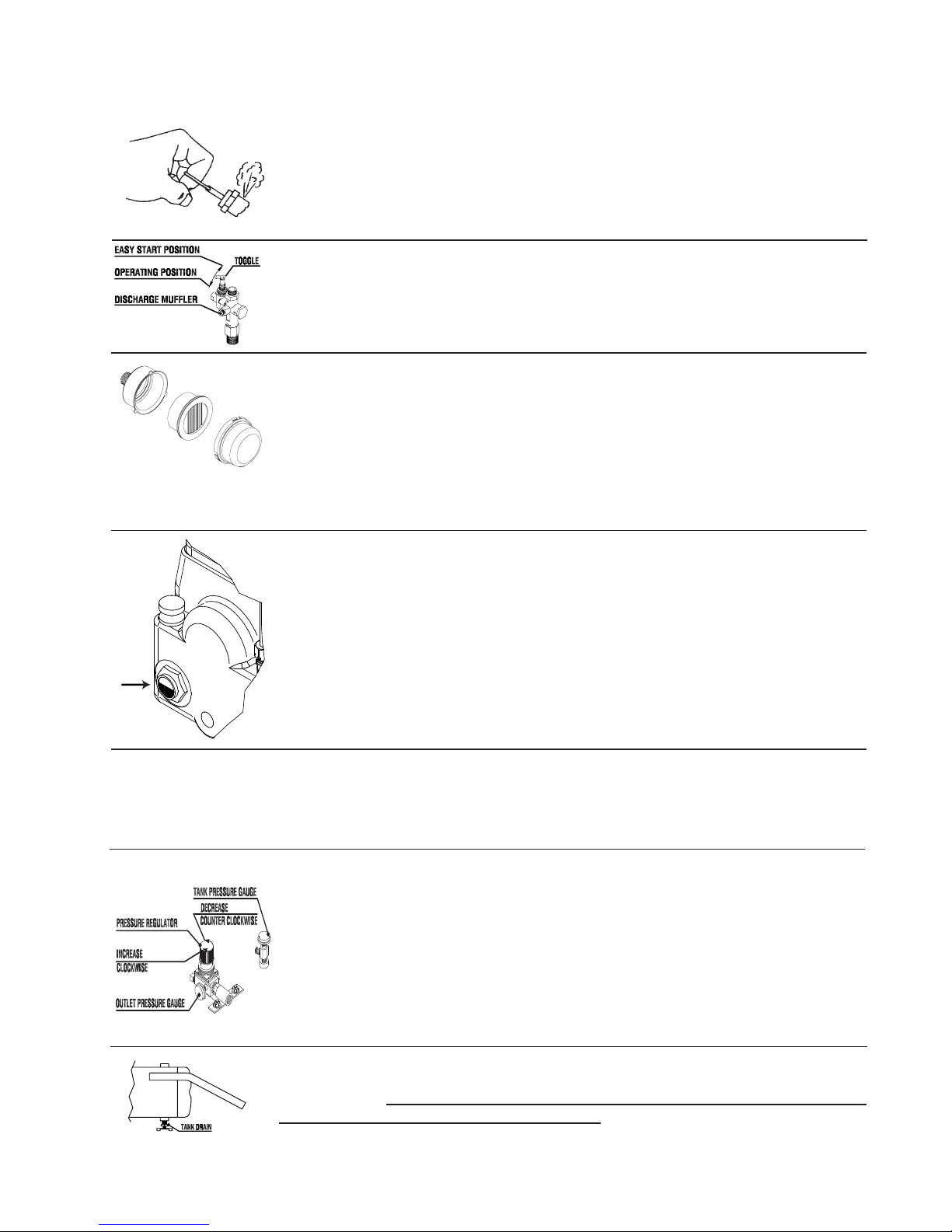
VISTA EXPLOTADA & EXPLICACIÓN DE ELEMENTOS DE COMPRESOR DE AIRE
VÁLVULA DE ALIVIO DE SEGURIDAD: Esta válvula sea diseñado para prevenir
falla de la sistema por aliviando alcance un nivel predeterminado. La válvula ha pre-
programado por el fabricante y no puede modicar en ninguna manera. Para vericar
que la válvula está trabajando correctamente, tire en el anillo. Presión de aire debe
escapar. Cuando el anillo sea liberado, lo volver a cero.
VÁLVULA DE PILOTO: Cuando el muletilla está en posición vertical, todo el aire de
compresor de aire descargó por el moe de depósito. Este da una característica de encender fácil. Para operación normal la muletilla está en posición de noventa grados.
FILTRO DE LA ENTRADA DEL AIRE: Este ltro sea diseñado para limpiar aire que
veniendo en la bomba. Para asegurar la bomba reciba continuamente un suministro
de aire limpio, fresco, y seco el ltro tiene que ser limpio y el abierto de ventilación no
tiene obstruciónes. Reemplace el elemento del ltro cuando necesario.
PUERTO DE RELLENO DEL ACEITE / TIRO: Tire el aceite en el puerto de relleno
del aceite / tiro cuando necesario.
VIDRIO DE VISTA DEL ACEITE: El vidrio de vista del aceite expone el nivel del aceite
en la bomba. El nivel del aceite debe estar en el medio del vidrio de vista del aceite. Si
bajo agregue SAE30W aceite sin detergente.
BOMBA DE COMPRESOR DE AIRE: Para comprimir aire, los pistones mueven arriba
y abajo en los cinlindros. En el tiempo abajo aire sea retraido por las válvulas entradas
mientras las válvulas de exhausto quedan cerrado. En el tiempo arriba el aire sea comprimido, las válvulas entradas cierran y aire comprimido sean forzados por las válvulas
de exhausto en la linea descarga por la válvula pilota y en el tanque de aire.
INDICADOR DE PRESIÓN DE TANQUE DE AIRE: El indicador de presión de tanque
de aire indica la presión de aire reserva en los tanques de aire.
REGULADOR DE PRESIÓN: La presión de aire veniendo de tanque de aire sea controlado por la perilla de regulador. Gire la perilla de regulación de presión de las agujas
del reloj para aumentar presión descarga y en sentido contrario a las aguajas del reloj
para disminuir la presión descarga.
INDICADOR DE PRESIÓN SALIDA: El indicador de presión salida indica la presión
de aire disponsible en el lado de salida del regulador. Esta presión sea controlado por
el regulador y siempre sea menos o igual a la presión de tanque de aire.
VÁLVULA DE DESCARGAR DEL TANQUE DE AIRE: La válvula de descargar sea
usado para quitar la humedad de las tanques de aire despues de apagarse del compresor de aire. NUNCA trate abrir la válvula de descargar cuando más de 10PSI
de presión de aire está en el tanque de aire! Para abrir la válvula de descargar, gire
la perilla en sentido contrario a las agujas.
Mi-T-M® Manual de operador de compresor de aire gasolina. 27
Page 28
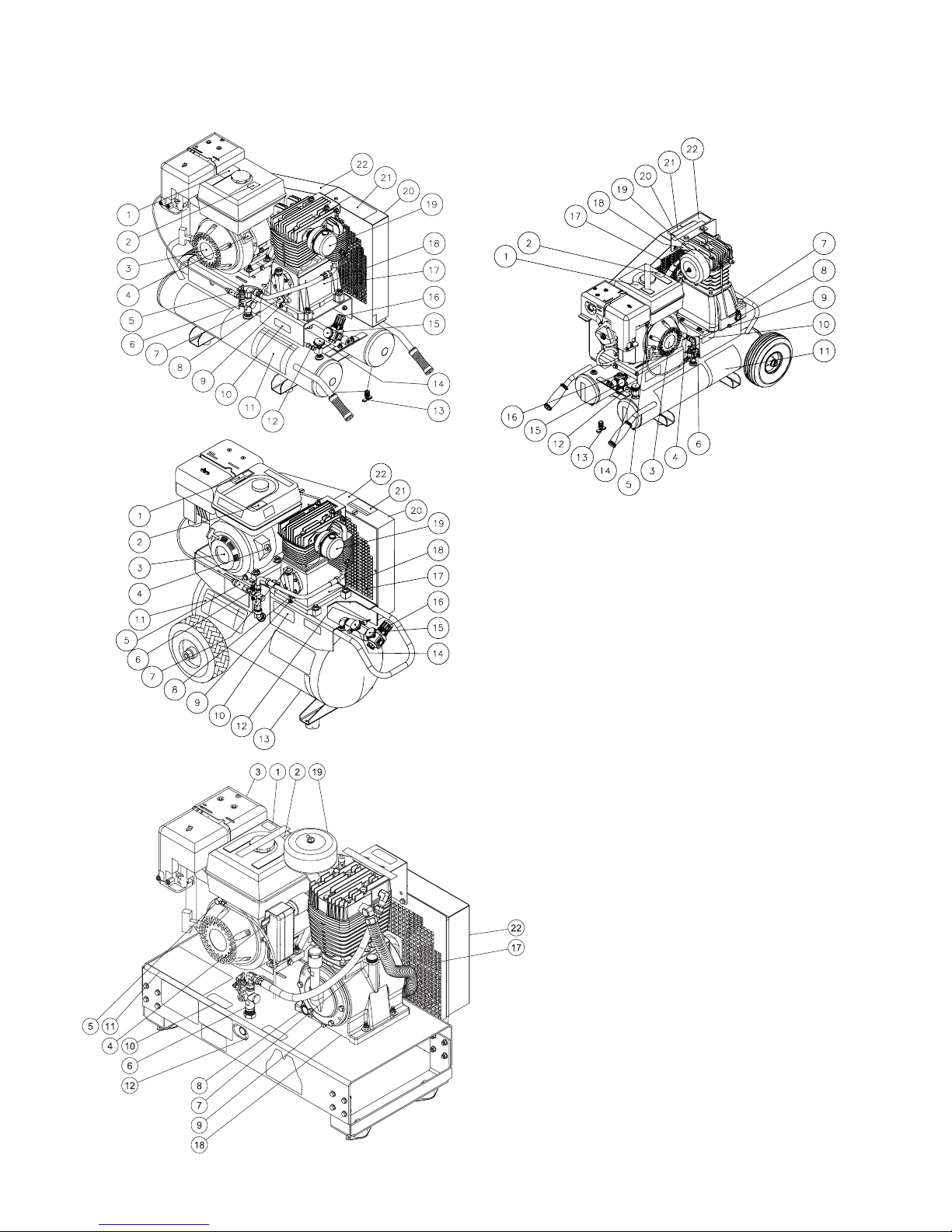
Mi-T-M COMPONENTES DE COMPRESOR DE AIRE GASOLINA
(ETAPA SENCILLA)
AS2-PH08-PR09-PV09-08 FEATURES-012704-DLG
AC2-PH08-PV09-20-FEATURE-012704-DLG AC2-PH08-PV09-FEATURES-012704-DLG
1. Calcomanía- Advertencia: Supercies
Calientes
2. Calcomanía- Advertencia: Caliente
3. Motor
4. Interruptor de motor
5. Control de regulador de motor
6. Válvula de piloto
7. Puerto de relleno del aceite de la
bomba
8. Varilla del aceite
9. Sumidero del aceite
10. Calcomanía- Advertencia: Calientes
11. Calcomanía- Peligro / Advertencia /
Precaución
12. Válvula de alivio de presión
13. Vávula (s) de descargar del tanque de
aire
14. Indicador de presión de tanque de aire
15. Indicador de presión de tanque de aire
16. Regulador de presión
17. Abiertas de ventilación
18. Bomba de compresor de aire
19. Filtro de aire
20. Calcomanía- Advertencia: Guardia del
cintúron está en lugar.
21. Calcomanía- Advertencia: Riesgo de
lesiones
22. Guardia del cintúron
AM2-SH09-B-FEATURE-01809-RSW
28 Mi-T-M® Manual de operador de compresor de aire gasolina.
Page 29
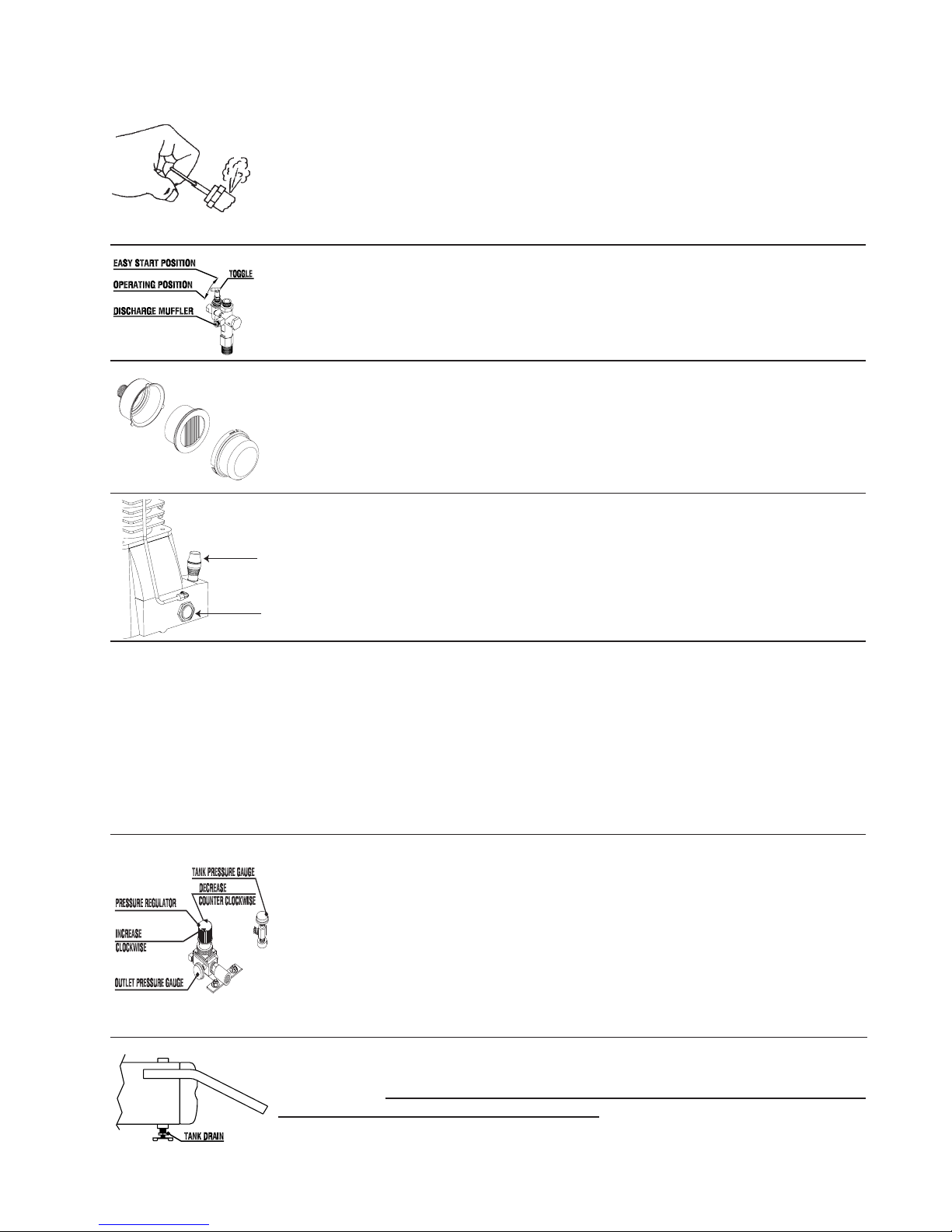
VISTA EXPLOTADA & EXPLICACIÓN DE ELEMENTOS DE COMPRESOR DE AIRE
OIL FILL PORT
OIL SIGHT GLASS
VÁLVULA DE ALIVIO DE SEGURIDAD: Esta válvula sea diseñado para prevenir falla de
la sistema por aliviando alcance un nivel predeterminado. La válvula ha preprogramado
por el fabricante y no puede modicar en ninguna manera. Para vericar que la válvula
está trabajando correctamente, tire en el anillo. Presión de aire debe escapar. Cuando
el anillo sea liberado, lo volver a cero.
VÁLVULA DE PILOTO: Cuando el muletilla está en posición vertical, todo el aire de
compresor de aire descargó por el moe de depósito. Este da un elemento de empezar
fácil. Para operación normal, la muletilla está en posición de 90°.
FILTRO DE LA ENTRADA DEL AIRE: Este ltro sea diseñado para limpiar aire que
veniendo en la bomba. Para asegurar la bomba reciba continuamente un suministro
de aire limpio, fresco, y seco el ltro tiene que ser limpio y el abierto de ventilación no
tiene obstruciónes. Reemplace el elemento del ltro cuando necesario.
PUERTO DE RELLENO DEL ACEITE / TIRO: Tire el aceite en el puerto de relleno
del aceite / tiro cuando necesario.
VIDRIO DE VISTA DEL ACEITE: El vidrio de vista del aceite expone el nivel del aceite
en la bomba. El nivel del aceite debe estar en el medio del vidrio de vista del aceite. Si
bajo agregue SAE30W aceite sin detergente.
BOMBA DE COMPRESOR DE AIRE: Una bomba de compresor de dos estapas usa
cilindros de dos tamaños diferentes con la válvula entrada de el más pequeño y segundo cilindro que unir cilindro. En el tiempo abajo aire sea retraido por las válvulas
entradas mientras las válvulas de exhausto quedan cerrado. En el tiempo arriba el
aire sea comprimido las válvulas entradas cierran y aire comprimido sea forzados
por las válvulas de exhausto entre el entre frigerante y por la válvula entrada de el
más pequeno y segundo cilindro en el tiempo abajo. En el tiempo arriba del cilindro
pequeno, la válvula entrada cierra y aire comprimido comprimir un tiempo segundo y
forzad afuera de válvula de exhausto entre la linea de deposito por válvula de revisar
de tanque y entre el tanque de aire.
INDICADOR DE PRESIÓN DE TANQUE DE AIRE: El indicador de presión de tanque
de aire indica la presión de aire reserva en los tanques de aire.
REGULADOR DE PRESIÓN: La presión de aire veniendo de tanque de aire sea controlado por la perilla de regulador. Gire la perilla de regulación de presión de las agujas
del reloj para aumentar presión descarga y en sentido contrario a las aguajas del reloj
para disminuir la presión descarga.
INDICADOR DE PRESIÓN SALIDA: El indicador de presión salida indica la presión
de aire disponsible en el lado de salida del regulador. Esta presión sea controlado por
el regulador y siempre sea menos o igual a la presión de tanque de aire.
VÁLVULA DE DESCARGAR DEL TANQUE DE AIRE: La válvula de descargar sea
usado para quitar la humedad de las tanques de aire despues de apagarse del compresor de aire. NUNCA trate abrir la válvula de descargar cuando más de 10PSI
de presión de aire está en el tanque de aire! Para abrir la válvula de descargar, gire
la perilla en sentido contrario a las agujas.
Mi-T-M® Manual de operador de compresor de aire gasolina. 29
Page 30

ADVERTENCIA
LAS PAGINAS SIGUIENTES CONTIENEN INSTRUCCIONES DE OPERACION Y
MANTENIMIENTO
NO TRATE DE OPERAR ESTA LAVADORA A PRESION HASTA QUE HAYA
LEIDO Y ENTENDIDO TODAS LAS PRECAUCIONES E INSTRUCCIONES DE
SEGURIDAD LISTADAS EN ESTE MANUAL.
¡¡LA OPERACION INCORRECTA DE ESTA UNIDAD PUEDE CAUSAR
LESIONES GRAVES!!
¡¡DE NINGUNA MANERA ALTERE O MODIFIQUE ESTE EQUIPO!!
30 Mi-T-M® Manual de operador de compresor de aire gasolina.
Page 31
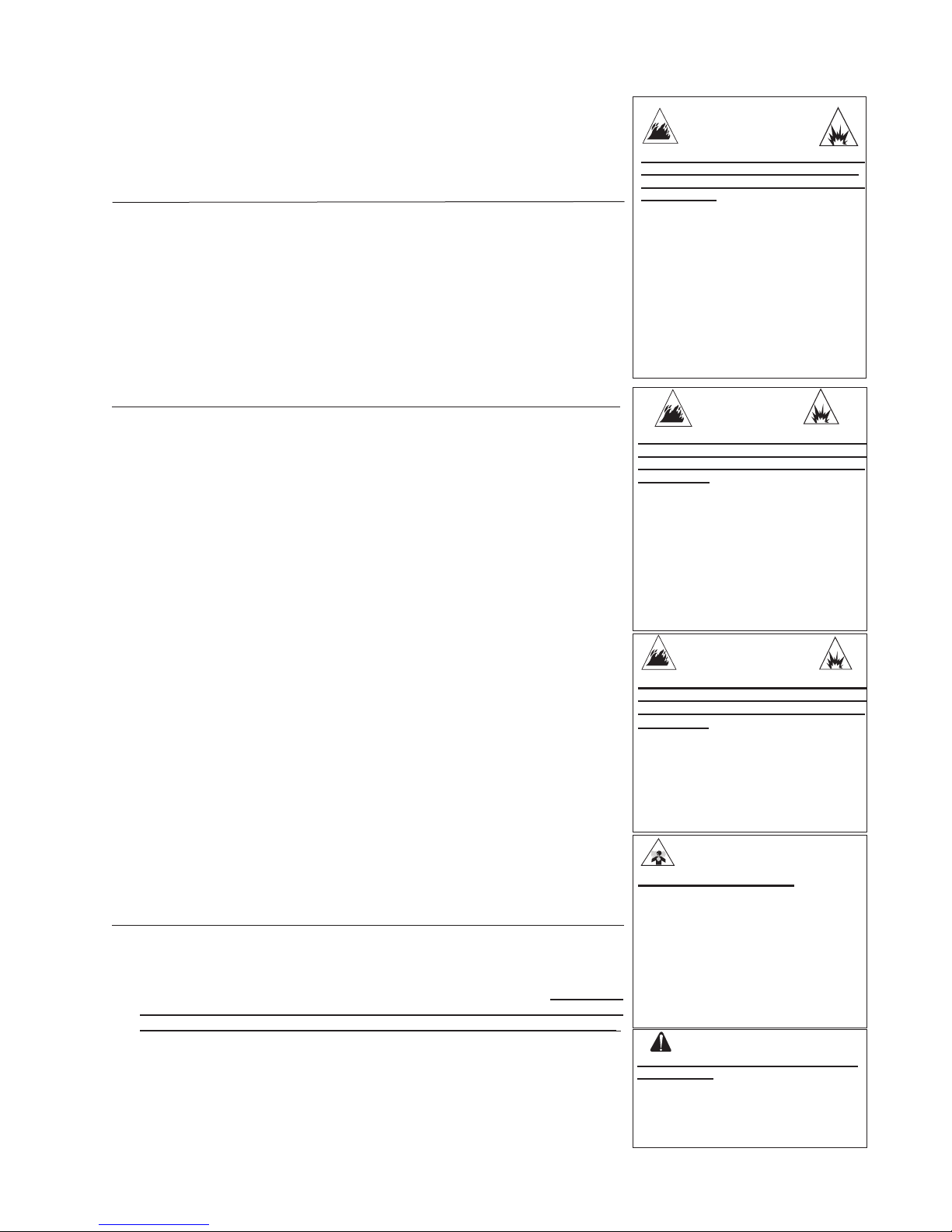
INSTRUCCIONES DE PREPARACIÓN
PREPARACIÓN:
1. Lea las advertencias de seguridad antes de preparar el compresor del
aire.
2. Asegurar que el nivel del aceite en bomba de compresor de aire es
adecuado. Si bajo, agregar SAE-30W, aceite sin-detergente.
COLOCACIÓN:
1. Para evitar daños al compresor de aire, éste no debe inclinarse
transversalmente o longitudinalmente a más de 10°.
2. Colocar el compresor de aire a una distancia mínima de 12 pulgadas
de cualquier obstáculo que impida una correcta ventilación. No
colocar jamás un compresor de aire en una zona:
-donde hay fugas de aceite o gas.
-donde puede haber vapores o materiales inamables.
-donde la temperatura del aire es inferior a 32°F o superior a 104°F.
-donde aire sucio o agua podria ser aspirado por el compresor de
aire.
ADVERTENCIA
RIESGO DE EXPLOSIÓN O
FUEGO QUE PUEDE CAUSAR
LESIONES GRAVES Y LA
MUERTE!
No tener contacto de motor y
moee con vapores amables,
polvos combustiles, o otras
materiales combustibles.
Una chispa puede causar un
fuego.
Cuando usando el compresor
de aire para pintar, poner el
compresor de aire demasiado
afuera, de ambiente de trabajar.
Usar más tubos de aire si
necesitar.
MOTOR DE GASOLINA:
1. Revisar "Riesgo de expolsión o fuego" antes de agregar fuel.
2. Leer manual de motor que acompando este compresor de aire para
mantenimiento correcto de encender de motor.
3. Leer y comprender las etiquetas de seguridad que situado en el
compresor de aire.
4. Recomendar usar fuel del minimo de 86 octano con este compresor
de aire. No mezclar aceite con gasolina.
5. Recomendar usar gasolina sin plomo y limpiado y fresco. Puede usar
gasolina con plomo si no tener gasolina sin plomo. No usar gasolina con
metano o alcohol.
6. Antes de empezar, controlar el nivel del aceite. (ver manual de motor.)
7. Llenar el tanque de fuel en accordancia de manual de instruccion.
8. Referir a manual de motor para mantenimiento necesario y ajustados.
RIE SG O DE EXPL OSIÓ N
O FUEGO QU E CA US AR
LESIONES GRAVES Y LA
MUERTE! No fumar cuando
dando fuel!
No llenar el tanque de fuel
cuando compresor de aire
encendido o calor. Permitiar
dos minutos para enfriar antes
de más fuel/combustible.
Permitir 1/4" de espacio de
tanque para expansión de fuel.
No llenar el tanque completo.
PELIGRO
ADVERTENCIA
RIE SG O DE EXPL OSIÓ N
O FUEGO QU E CA US AR
LESIONES GRAVES Y LA
MUERTE!
No poner el unito en ambientes
con vapores amables. Una
chispa pue de cau sar un
explosión o unfuego.
Siempre guardar el fuel afuera
de compresor de aire cuando
funcionando o calor.
ADVERTENCIA
RIESGO DE ASFIXIA!
No funcionar en ambientes
de mal ventilados. usar este
producto en ambientes de
buen ventila dos sól o. El
CONTROLES ANTES DEL ARRANQUE:
1. Controlar el nivel del aceite. Reponer si es necesario.
2. Eliminar la condensación del depósito del compresor de aire. Peligro de
lesiones al cuerpo. NO INTENTE JAMÁS abrir la válvula de descarga
cuando hay más de 10 PSI de presión en el interior del depósito!
Descargar la presión excesiva con una herramienta de aire, luego
abrir la vàlvula de descarga del depósito de aire ubicada en la parte
inferior del depósito. Cerrar bien una vez descargado.
3. Controlar el boton de motor es en posición de "OFF".
4. Controlar que la válvula de seguridad funcionando correcto.
5. Controlar que todas tapas y cubiertas están en posición y montar
seguriando.
Mi-T-M® Manual de operador de compresor de aire gasolina. 31
exhusto del motor contener
monóxido de carbono. Esun
gas inodoro, venenoso, y
invisible. Respiración de este
gas puede causar lesiones
graves, enfermos, y posible
la muerte.
ADVERTENCIA
RIESGO DE LESIONES AL
CUERPO!
Nunca abrir la válvula de
descargas del tanque de aire
cuando hay más de 10 PSI de
presión de aire en el tanque
de aire!
Page 32
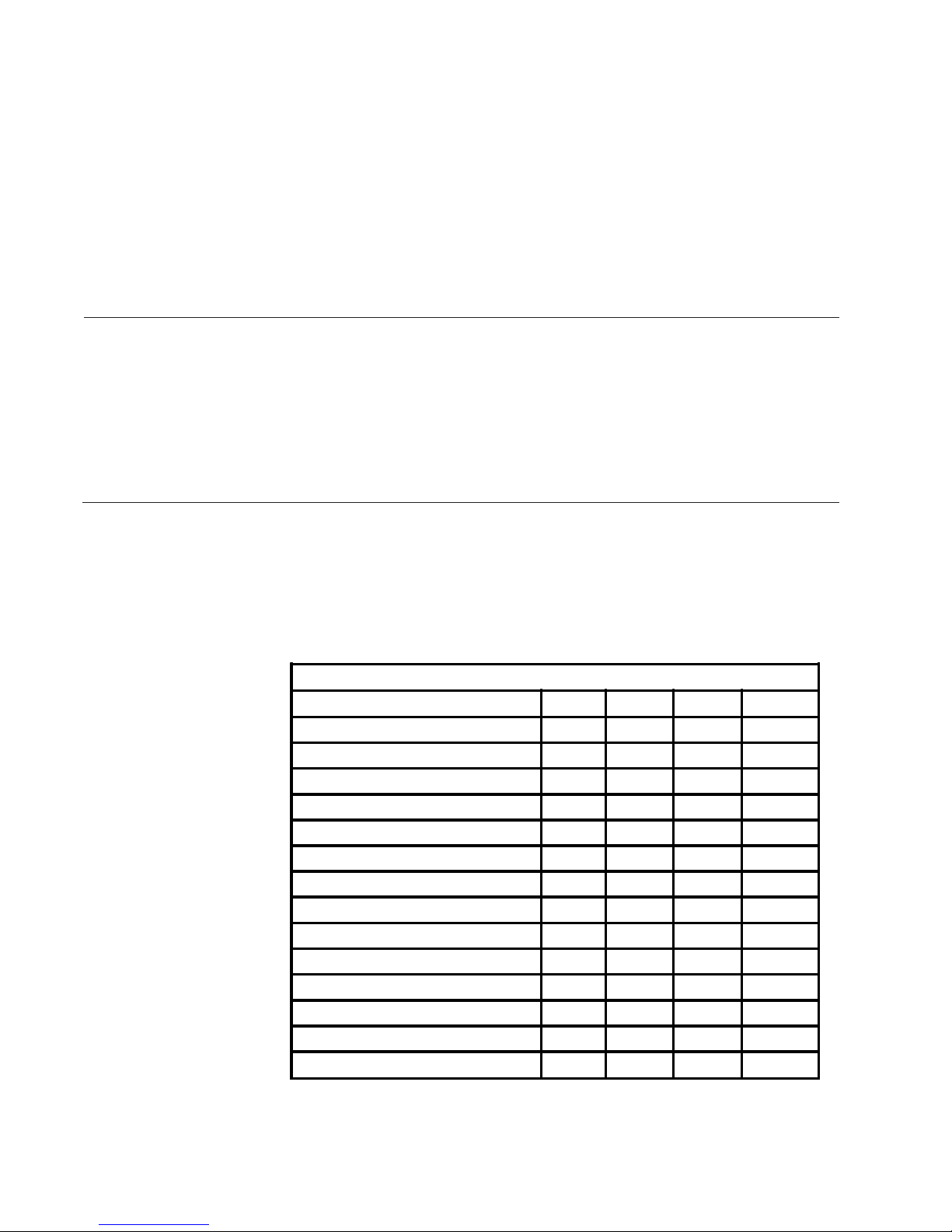
OPERACIÓN
AC Gas Spanish Maintenance Chart
TABLA DE MANTENIMIENTO
OPERACIÓN DIARIA SEMANAL MENSUAL 200 HORAS
Controlar el nivel del aceite de la bomba X
Controlar el nivel del aceite de motor X
Inspeccionar que no haya pérdidas de aceite X
Controlar el filtro de aire de motor X
Descargar la condensación del depósito/s de aire X
Controlar el cubierta/tapa X
Controlar que no hay ruidos/viraciones anómalos X
Inspeccionar que no hay fugas de aire X
Limpiar el compresor de aire exteriormente X
Controlar el filtro del aire X
Controlar el correa X
Controlar la válvla de seguridad X
Cambiar el aceite de la bomba* X
Sustituir el filtro del aire X
OPERACIÓN:
1. Leer atentamente las advertencias de seguridad antes de efectuar esta
operación.
2. Colocar muletilla que estar en la arriba de válvula pilota a posición vertical. Este
dar una empezada sin descargar. Este compresor de aire puede descargar y
tener una empezada de motor más facil.
3. Encender el motor. (Referir a manual de este unito de motor.)
4. Despues de 1-2 minutos de funcionando, poner muletilla en posición orginal.
5. Ajustar la presión moviendo el regulador de presión en el sentido contrario a las
manecillas del reloj para reducir la presión y en el sentido de las manecillas del
reloj para aumentaria.
6. En caso de ruidos o vibraciones anómalos, detener el compresor de aire y
consultar la sección "Localización de Averías".
APAGAMIENTO:
1. Para parar el compresor de aire mover el boton de motor a posición de "OFF".
(Referir a manual de motor de este unito.)
2. Descargar el aire de los depósitos de aire, por medio de una herramienta
conectada o tirando los anillos de la válvula de seguridad.
3. Una vez que le presión en el interior de los depósitos de aire es inferior a 10
libras, abrir la válvula de descarga debajo de cada depósito de aire para eliminar
la humedad.
4. Dejar enfriar el compresor de aire.
5. Limpiar el compresor de aire con un paño y colocarlo en un lugar seguro, donde
no exista el riesgo de congelación.
MANTENIMIENTO
Leer el manual de instrucciónes antes de efecturar cualquier operación de mantenimiento. Las operaciónes descritas a continuación deben ser llevadas a cabo cuando
el compresor se apaga por mantenimiento o reparaciónes.
1. Apagar el compresor de aire.
2. Desconectar el cable de la toma de corriente principal.
3. Abrir todas las descargas.
4. Esperar que el compresor de aire se haya enfriado antes de
comenzar las operaciónes.
*El aceite de la bomba debe cambiarse después de 50 horas de trabajo y cada 200 horas o 3 meses, según la
condición que ocurra antes. Se recomienda el uso de sustancias puras sin detergente.
Cada dos anòs, un técnico autorizado de servicio debe inspeccionar la válvula, válvulas de entrar y válvulas
de liberar.
32 Mi-T-M® Manual de operador de compresor de aire gasolina.
Page 33

LOCALIZACIÓN DE AVERÍAS
SÍNTOMA CAUSA (S) POSIBLE (S) SOLUCIÓN
El motor no encender.
Varías problemos de motor.
Referir a manual de motor de su compresor de aire.
Funcionamiento ruidoso
Abajo de presión en tanque de
aire o abajo de presión rapidamente cuando el compresor de
aire está apagado.
Nivel de aceite de motor bajo.
Polea de motor o bomba de rueda
voldao es suelto.
Falta aceite en la bomba.
Residuos de carbono en los pistones o en las válvulas.
Avería del cojinete, pistón o biela.
Los accesorios no han sido apretados bien.
La válvula de retención y la
válvula piloto es defectuose.
El motor se equipa de un sistema de
alerta del aceite que no permita que
el motor comience si el nivel de aceite
es bajo. Agregue el aceite, si está
necesitado.
Apretar polea y/o rueda volado.
Reponer la cantidad de aceite
necesaria. Controlar que los
cojinetes no se hayan dañado.
Desmontar e inspeccionar la
culata del cilindro. Limpiar y
sustituir.
PARAR EL COMPRESOR!
Póngase en contacto con la Asisten-
cia Clientes.
Aretar los accesorios donde se oye
que el aire dale. Controlar los accesorios con una solución de agua y
jabón. No apretar demasiado.
Desmontar, limpiar o sustituir.
Fugas de aire del depósito de
aire.
Presión insuciente en la herramienta o en los accesorios.
El aire sale de la válvula de
seguridad.
Mi-T-M® Manual de operador de compresor de aire gasolina. 33
Fugas de aire.
Filtro aspiración aire obstruido.
Los tubos o los empalmes de los
tubos son demasiado pequeños o
largos.
El compresor de aire no produce la
capacidad de aire requerida.
El regulador de presión no ha sido
ajustado a una presión sucientemente alta o avería del regulador de
presión.
Las resbalaban de correa.
Válvula pilota restrica.
La válvula de seguridad probablemente es defectuosa.
La presión de aire en el depósito
es excesiva.
Sustituir el depósito de aire. No in-
tentar reparar el depósito.
Localizar las fugas y reparar.
Limpiar o sustituir.
Sustituir con tubos o empalmes más
grandes.
Controlar el requisito de aire del accesorio. Si es superior al CMF o a la
presión suministrada or el compresor
de aire, es necesario usar un compresor más grande.
Ajustar el regulador de presión al
valor adecuado o sustituir.
Haga mas apretado o reemplace.
Limpie o reemplace.
Activar la válvula de seguridad manu-
almente tirando del anillo.
Si el aire sigue saliendo, debe ser
sustituida. Interruptor motor/presión
defectuoso. Sustituir.
Page 34

LOCALIZACIÓN DE AVERÍAS
SÍNTOMA CAUSA (S) POSIBLE (S) SOLUCIÓN
Fugas de aire en la bomba.
Soufement d'air provenant
du ltre d'admission d'air.
Condensación en el aire
de descarga.
Excesivo consumo de aceite
en la bomba.
Juntas defectuosas.
Soupape (reed) d'admission
défectuuese.
Condensación en el depósito de
aire debido a una elevada humedad atmosférica o el compresor
de aire no ha funcionado por un
tiempo suciente.
Filtro aspiración aire obstrucido.
Compresor de aire sobre supercie
no nivelada.
Cárter demasiado lleno de aceite.
Viscocidad incorrecto.
Ventilación de la varilla indicadora
de nivel aceite atascada.
Sustituir y apretar los pernos de la
culata.
Sustituir.
Opera el compresor de aire por una
hora para impedir demasiado
condensión. Vaciar el depósito de
aire después de cada empleo. Vaciar
el depósito de aire más frecuentemente en climas húmedos y usar un
ltro en la línea de aire.
Limpiar o sustituir.
No inclinar el compresor de aire a
un ángulo superior a 10° en ninguna
dirección mientras esté en marcha.
Vaciar el aceite. Reponer con aceite
hasta el nivel apropiado.
Elimina el aceite. Llene al nivel
correcto con SAE-30W aceite sin
detergente.
Limpiar.
Condensación en el aire
de descarga.
Pérdidas de aceite.
Anillos del pistón desgastados o
cilindro rayado.
Respirado de cárter es taparo.
Condensación en el depósito de
aire debido a una elevada humedad atmosférica.
Reparar.
Ponerse en contacto con la Asistencia Clientes.
Limpiar o sustituir.
Opera el compresor de aire por una
hora para impedir demasiado
condensión. Vaciar el depósito
de aire después de cada empleo.
Vaciar el depósito de aire más frecuentemente en climas húmedos y
usar un ltro en la línea de aire.
34 Mi-T-M® Manual de operador de compresor de aire gasolina.
Page 35

DECLARACIÓN DE GARANTÍA
Mi-T-M® garantiza que todas las piezas (excepto aquellas a las que se hace referencia abajo), de su nueva
lavadora a presión libres de defectos en materiales y mano de obra durante los periodos siguientes:
Por dos (2) años a partir de la fecha original de compra:
Bomba de Compresor Cañerias
Asamblea de Tanque
Por seis (6) mes a partir de la fecha original de compra:
Interruptor de Presión Reguladores
Vàlvula de revisar Válvula de piloto
Linea de cobre/acero inoxidable
Por noventa (90) días a partir de la fecha original de compra:
Indicadores de presión Válvula de alivio de seguridad
válvulas de desagüe
Las piezas defectuosas que no están sujetas a deterioro causado por el uso serán reparadas o
reemplazadas a nuestra opción durante el periodo de garantía. En todo caso, el reembolso está limitado al
precio de compra pagado.
EXCLUSIONES
1. El motor está cubierto bajo una garantía separada proporcionada por el fabricante respectivo y está sujeta
a los términos en ella establecidos.
2. Partes de desgaste normal:
Aisladores ltrodeaire
3. Esta garantía no cubre las piezas dañadas debido al deterioro normal causado por el uso, mala aplicación,
mal uso, operación a velocidades, presiones o temperaturas diferentes a las recomendadas. Las piezas
dañadas o gastadas a causa del uso de líquidos cáusticos o por la operación en medios ambientes abrasivos
o corrosivos o bajo condiciones que causan cavitación de la bomba no están garantizadas. La falla en
seguir los procedimientos recomendados de operación y mantenimiento también cancela la garantía.
4. Cobras de trabajar, peridio o daño resultando de operación mala, mantenimiento (otro de descarga de
tanque de aire rutina y cambios de aceite si aplica) o reparaciones hace por personas otro de Mi-T-M Centro
de servicio autorizado.
5. El uso de piezas de repuesto diferentes a las genuinas Mi-T-M cancelará la garantía. Las piezas devueltas,
con franqueo pagado a un Centro de Servicio Autorizado Mi-T-M serán inspeccionadas y reemplazadas,
libre de cargos, si se determina que están defectuosas y sujetas a la garantía. No existen garantías que
se extiendan más allá de la descripción contenida aquí. Bajo ninguna circunstancia Mi-T-M® Corporation
será responsable por la pérdida de uso de la unidad, pérdida de tiempo, inconvenientes, pérdida comercial
o daños consecuentes.
PARA SERVICIO O CONSIDERACION DE LA GARANTIA CONSULTE CON:
Mi-T-M® Corporation/8650 Enterprise Drive, Box 50/Peosta, IA 52068-0050
Mi-T-M® Manual de operador de compresor de aire gasolina. 35
Telefono: 563-556-7484/Telefone gratis en los
EE. UU.: 800-553-9053/Fax 563-556-1235
Lunes - Viernes 8:00 a.m. - 5:00 p.m. CST
Page 36

36 Mi-T-M® Manual de operador de compresor de aire gasolina.
 Loading...