

Page 1
MIPRO Electronics Co., Ltd.
2CE409A
Headquarters: 814 Pei-Kang Road, Chiayi, 60096, Taiwan.
Web: www.mipro.com.tw
E-mail: [email protected]
MH-80 Handheld Microphone Transmitter
User Guide
Design and specifications are subject to change without prior notice
AS110730
Page 2

Handheld Transmitter Handheld Transmitter
CONTENTS
1 Key Features
2 Handheld Controls and Indicators
perating Instructions for Insertion &
4 O
Removing Battery
5 Operating Instructions
6 General Tips for Improving System
Performance
KEY FEATURES
! High stability and low spurious emissions PLL synthesized
fixed frequency RF technology.
! Pre-matched working channel of receivers and transmitters
allows fast and accurate sync when power on.
! Ergonomic and aesthetics housing design. Advanced RF and
AF circuits for perfect sound quality.
! MIPRO proprietary exterior metal windscreen design and
interior multi-layer fine copper mesh replacing conventional
sponge filter protects the capsule against impact, rolling and
minimizes wind and “pop” noises, and is able to be detached
easily for cleaning and good hygiene practices.
! The microphone capsule is connected to the transmitter PCB
and then screwed onto the housing to prevent the potential
malfunction caused by improper contact.
! Modularized PCB and microphone capsule can be easily
detached and assembled. Optional premium microphone
capsule modules are available.
! MH-80 is constructed of sturdy plastic housing to enhance
the transmission efficiency. Special finish treatment prevents
from handling noise and paint stripping.
! Durable construction of integrated housing and battery
compartment, allowing 2 AA type batteries easily to be
inserted and replaced.
! Battery housing design ensures the battery installation to
prevent the malfunction when knocked. Multi-color rings for
easy channel identification.
! LED indicator above the on/off switch lightens when power
on and low battery power.
! Proprietary lockable on/off switch to avoid accident power off.
! MIPRO vocal condenser microphone capsule MU-89 exhibits
high fidelity, wide dynamic range, fast transient responses,
low feedback howling, accurate sound image characteristics,
transparent sound quality and extremely low handling noise.
! Proprietary high dynamic range modulation circuitry sustains
a maximum SPL of 140dB so performers can be confident it
won't distort when sing loudly.
0 1
Page 3
Handheld Transmitter Handheld Transmitter
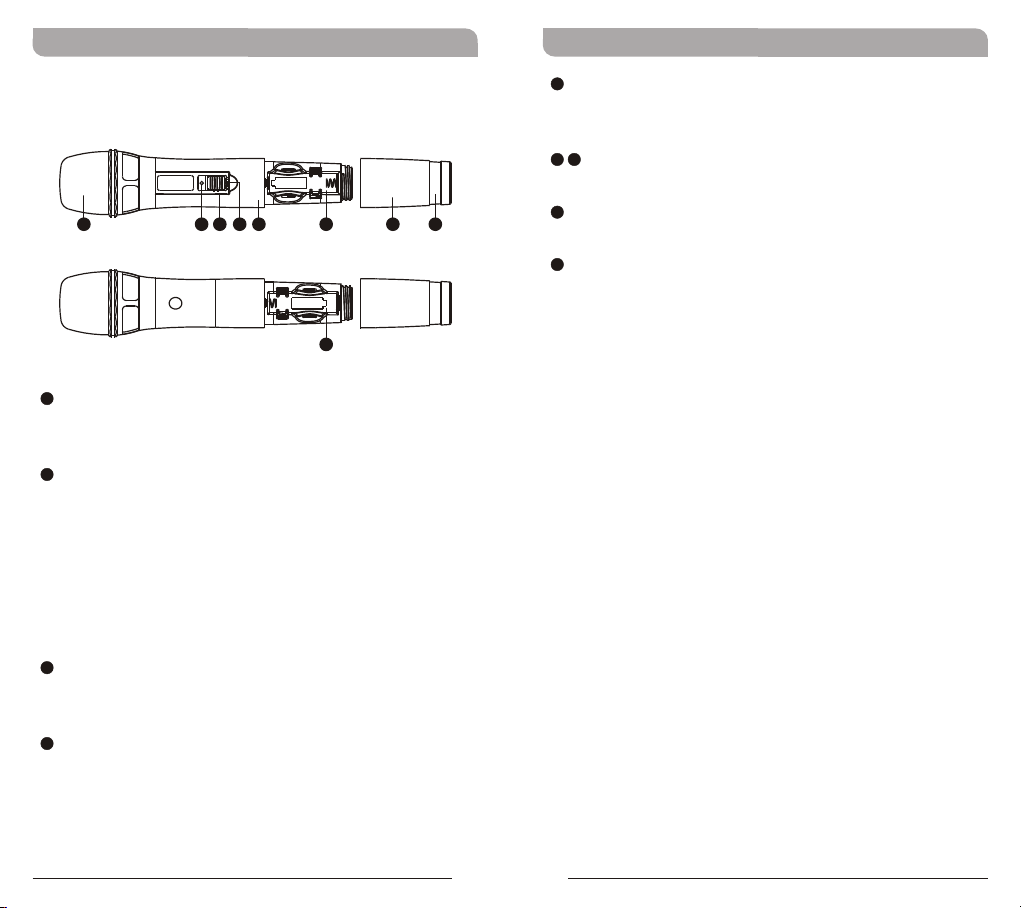
HANDHELD CONTROLS AND INDICATORS
293 4 5
1
Top Grille: Protects detachable microphone
capsule module and internal foam prevents
breathing, wind and POP noises.
2
Battery Status Indicator: Indicates power on
/ off and the battery status.
!
Normal Battery Red indicator glows briefly
and dims.
!
Low Battery Red indicator glows. Replace
batteries.
!
Drained Battery Red indicator does not
glow. Replace batteries.
3
Power On/Off Switch: Slide the power switch
to the “ON” position for use or to the “OFF”
position when not in use.
4
Lockable On/Off Switch: Slide the switch to
the “ON” position after power-on to avoid
accidental power off during performance. Slide
the switch to “OFF” position before power-off
and conserve battery power.
6
7 81
(Fig ur e 1)
5
Housing: Upper portion connects to the
microphone capsule module. Internally it holds
the transmitter PCB and battery compartment.
6
9
Battery Compartment: Accommodates 2 AA
alkaline.
7
Battery Compartment Cover: Protects
battery compartment and holds batteries.
8
Color-Coded Ring: Available in different colors
for channel differentiation.
2 3
Page 4
Handheld Transmitter Handheld Transmitter
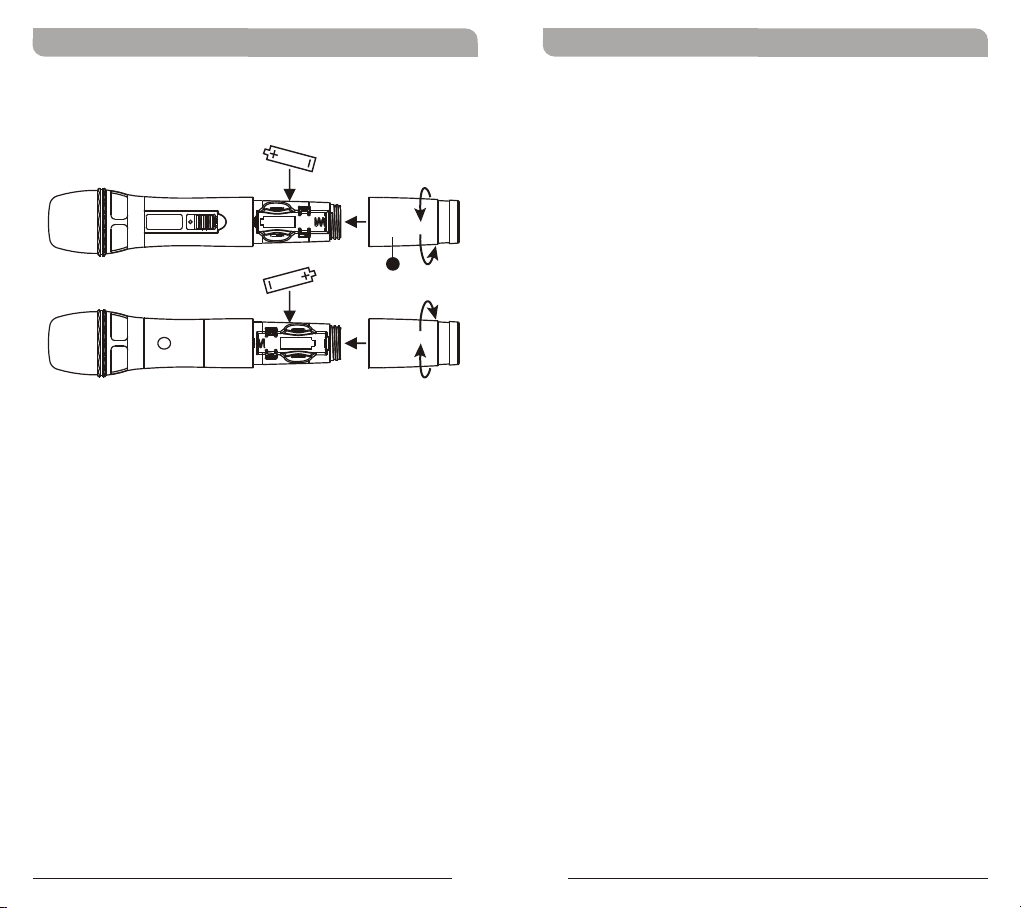
OPERATING INSTRUCTIONS FOR
INSERTION & REMOVING BATTERY
7
(Fig ur e 2)
1. Gently twist the microphone housing in a
counter-clockwise direction.
2. Remove the old batteries from the battery
compartment, if any are installed.
3. Insert two new AA alkaline batteries in the
battery compartment with correct polarity
orientation. If normal, the red LED indicator will
light solid for a second after the transmitter is
turned-on. Fasten the microphone housing when
done.
4. In the case of low battery, the red LED indicator
will stay illuminated. Change to new fresh
batteries.
5. In the case of dead battery, the red LED indictor
will not be illuminated.
OPERATING INSTRUCTIONS
1. The red LED indicator will light solid for a second
and the RF level/indicator shown on the receiver
will remain illuminated after the transmitter is
turned-on, denoting normal status. No
illumination in the red LED indicates an incorrect
battery polarity insertion, dead batteries or
malfunction.
2. The audio level or indicator show on the receiver
will be lit when there is audio line or microphone
input from the transmitter.
CAUTION
Remove the batteries if unused for a long period of
time to prevent battery leakage, corrosion and
causes damage to electronics.
4 5
Page 5

Handheld Transmitter Handheld Transmitter
GENERAL TIPS FOR IMPROVING SYSTEM
PERFORMANCE
1. Performer should avoid holding the microphone over or
near the antenna section as this will deteriorate
transmission efficiency. Severe deterioration if performer
directly covers up the antenna section with both hands.
2. Many performers tend to hold the microphone by the
top grille. Unfortunately, this position seriously degrades
both the sound quality and directionality of a
microphone. Even the most expensive microphones will
have its original sound quality compromised by this
method. Grabbing a microphone by the grille will isolate
the capsule's acoustic resonance circuit and or change
the capsule resonator's frequency. This results in an
inferior performance in both frequency response and the
separation of directionality. In addition, a palm's soundfocusing effect will tend to strengthen resonances in
certain frequencies and can cause unwanted echo.
3. A proper technique is required for using directional
microphones because the distance between the
microphone and your mouth has a significant impact on
sensitivity and performance. There is an inverse
relationship between microphone sensitivity and the
distance from the mouth to the microphone.
Consequently, performers with a ''weaker'' sound level
cannot expect to hold the microphone too far away from
their mouth and compensate by turning up the amplifier
volume to increase the sound level as this can easily
cause echo or feedback. In contrast, performers with a
''louder'' sound level should not hold the microphone too
close as this can easily result in distortion by causing
the amplifier system to be overloaded.
6 7
4. Furthermore, a large-diaphragm directional microphone
has a very distinct proximity effect. When the
microphone is close to the mouth, the bass response is
strengthened as the distance gets closer. Therefore, if a
performer's sound is insufficient in bass, they can hold
the microphone closer and use the proximity effect to
help compensate for the lower bass level. Conversely, if
a performer's voice is too heavy in the bass register,
increasing the distance between the microphone and
their mouth will decrease the proximity effect and
reduce the bass response, thus making their voice
become clearer and brighter.
5. It is recommended to keep the grille and sponge
windscreen clean to avoid any substance blocking the
proximity effect of the microphone.
& IC - ID
THIS DEVICE COMPLIES WITH PART 74 OF THE FCC RULES AND
RSS-123 ISSUE2 OF CANADA. OPERATION IS SUBJECT TO THE
FOLLOWING TWO CONDITIONS:
(1) This device may not cause interference.
(2) This device must accept any interference, including interference
that may cause undesired operation of the device. This equipment
complies with FCC RF radiation exposure limits set forth for an
uncontrolled environment.
Disposal
2005 -08-1 32005 -08-1 3
Dispose of any unusable devices or batteries
responsibly and in accordance with any applicable
regulations.
Disposing of used batteries with domestic waste is to
be avoided!
Batteries / NiCad cells often contain heavy metals such
as cadmium(Cd), mercury(Hg) and lead(Pb) that
makes them unsuitable for disposal with domestic
waste. You may return spent batteries/ accumulators
free of charge to recycling centres or anywhere else
batteries/accumulators are sold.
By doing so, you contribute to the conservation of our
environment!
 Loading...