

Page 1
[AVE USER GUIDE]
An Introduction to Audio-Visual Entrainment
Page 2

Version 1, Revision 8
May 2019
All rights reserved.
Reproduction in whole or in part is forbidden without
the express written consent of Mind Alive Inc.
© 2019
Mind Alive Inc.
Edmonton, Alberta, Canada
Page 3

TABLE OF CONTENTS
INTRODUCTION .................................................................................................................. 1
THE EFFECTS OF AVE ........................................................................................................ 2
BRAINWAVE FREQUENCIES ............................................................................................ 3
WHAT IS AVE?...................................................................................................................... 5
EEG ACTIVITY CHANGES ................................................................................................................... 6
AVE INDUCES MEDITATIVE DISSOCIATION ................................................................................... 7
CEREBRAL BLOOD FLOW INCREASES .............................................................................................. 8
NEUROTRANSMITTERS CHANGE ....................................................................................................... 9
GETTING STARTED ......................................................................................................... 10
HOW TO USE THE PERSONAL PROFILE QUESTIONNAIRE......................................................... 10
PERSONAL PROFILE QUESTIONNAIRE .................................................................... 11
I. REST ............................................................................................................................................... 11
II. LIFE EVENTS & SELF AWARENESS .......................................................................................... 12
III. ANXIETY ...................................................................................................................................... 13
IV. MOOD .......................................................................................................................................... 14
V. DISENGAGEMENT ........................................................................................................................ 15
VI. NUTRITION ................................................................................................................................. 16
VII. MEDICATIONS ........................................................................................................................... 17
CHOOSING A DAVID SESSION ...................................................................................... 18
ADDITIONAL RESOURCES................................................................................................................ 18
PERSONAL PROFILE INTERPRETATION ................................................................. 19
I. REST ............................................................................................................................................... 19
II. LIFE EVENTS & SELF AWARENESS .......................................................................................... 19
III. ANXIETY ...................................................................................................................................... 20
IV. MOOD .......................................................................................................................................... 20
V. DISENGAGEMENT ........................................................................................................................ 21
VII. NUTRITION ................................................................................................................................ 21
NUTRITION ........................................................................................................................ 22
DAVID SESSION GUIDE .................................................................................................. 23
REFERENCES ..................................................................................................................... 24
Page 4

[1]
INTRODUCTION
Welcome to the world of Audio-Visual Entrainment (AVE). Mind Alive Inc. is
dedicated to assisting you in your quest for wellness. Our patented DAVID
AVE devices allow various areas of the brain to work together in harmony.
By using your DAVID device you may experience your mind in a new and
beneficial way.
The DAVID devices integrate the necessary principles of audio and visual
stimulation to safely and effectively guide you into desired states of
relaxation, consciousness, attention, and boosted brain performance - ideal
for those who want to expand their personal development, boost their mood
and sharpen their mind. In order to obtain the maximum enjoyment and
benefits from your DAVID device, we have created this user guide to
introduce the core concepts of AVE, which will provide you with a starting
point for your journey of self-improvement.
AVE is a non-invasive form of stimulation: no electrical current is passed
through the user. All resulting effects are produced in the brain solely by the
audio-visual stimuli.
Cranio-Electro Stimulation (CES) is available on select DAVID devices. CES
technology does pass a small current of electricity through the user, but must
be actively initiated by pushing the CES buttons located on our CES-capable
DAVID devices. CES can be used in combination with AVE, or on its own.
USING THIS GUIDE
This guide is designed to be a companion and introduction to the world of
AVE. Everything you need to know about operating your DAVID device, and
the specific sessions contained within it, is included in the Operator’s
Manual. The information in this guide is provided to help you understand
what AVE is and how it can benefit you in your everyday life.
The first part of the guide contains an introduction to AVE principles and
concepts. We start by describing the method and cornerstones of AVE,
detailing the psychological and physiological benefits you may experience.
Several other concepts related to good mental health are also described.
The second part of the guide contains a self-guided survey to help you select
which types of sessions you may want to try. Part of the survey is designed
to help you identify areas of stress and anxiety in your life. The rest of the
survey will help you evaluate which session groups will provide you with
the most benefits.
Page 5

[2]
THE EFFECTS OF AVE
Many users of the DAVID have reported experiencing:
• deep relaxation while feeling more energized
• visual images, colors and patterns
• the sense of feeling “grounded” and calm
• increased mental clarity for resolving problems
• enhanced interpersonal relationships
• cheerfulness
• mental sharpness.
This deep state of AVE-induced regeneration has proven to be useful for
many of the mental, emotional and physical challenges that nearly all of us
face at one time or another in our lives. When the body/mind effects from
experiencing AVE are fully appreciated, the experience becomes as regular
and beneficial as many other life essentials such as quality sleep, good
nutrition, pure water and exercise.
Page 6
[3]
BRAINWAVE FREQUENCIES
Activity in the brain is often measured by observing and recording
“brainwaves” which are rhythmic or repetitive neural activity. Brainwaves
can be observed through an Electroencephalography (EEG) which is a test
that measures electrical brainwave activity along the scalp. Brainwaves are
categorized by frequency with each category having different positive and
negative effects, depending on your current and desired level of arousal or
alertness.
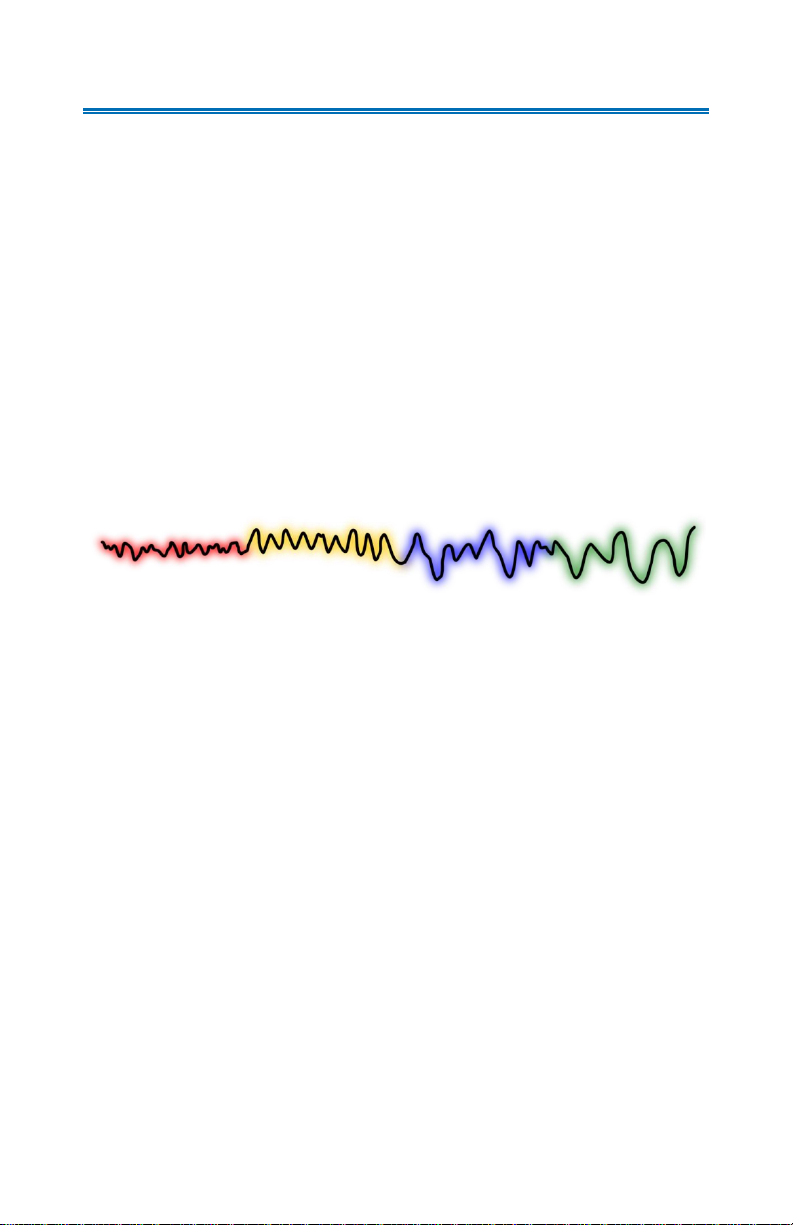
Brainwaves indicate both the level and type of arousal in a part of the brain.
When a person is awake and engaging in a task, delta, theta and alpha
activity should be low, revealing beta as the dominant wave. As a person
relaxes, alpha quickly increases. As a person becomes deeply relaxed and
especially with eyes closed, theta will become the dominant brainwave and
as a person falls asleep, delta becomes the dominant brainwave with
occasional short bursts of sensori-motor rhythm (SMR) in the sensori-motor
strip to prevent sleep-walking.
Beta
(awake/alert)
Alpha
(relaxed)
Theta
(falling asleep)
Delta
(sleeping)
Brainwaves are situation specific. Therefore, any brainwave can be either a
benefit or detriment to the activity a person is trying to engage in. Stress,
hectic lifestyle, and less than optimal diet suppresses relaxing brainwaves.
And likewise, when we are tired during the day, the brainwaves which are
essential for mental performance are suppressed. It’s easy to see that if a
person’s brain is making the wrong frequency for a given situation, the
result will be detrimental to his/her ability to succeed at the task at hand.
The brain needs to flex with the various activities that one is engaging in.
The following chart demonstrates the positive as well as the negative
attributes of each brainwave frequency category.
Page 7

[4]
BRAINWAVE FREQUENCIES
Frequency
Proper Expression
Improper Expression
Delta
1-4 Hz
Deep Sleep.
Deep axonal/glial injury.
Theta
5-7 Hz
Dreamy, pre-sleep,
hypnogogic, creativity.
ADHD, dementia, Closedhead injury-especially when
eyes-open.
Alpha
8-12 Hz
Main idling rhythm when
eyes are closed. Deep
meditation, 1st stage of
falling asleep, relaxed.
ADD, mild head injury, foggyheaded, too much alpha is
associated with internalized
anxiety.
Optimal Alpha
10.2-10.8 Hz
The best grad-students
have an eyes-closed alpha
here.
Near 11 Hz can bring on
anxiety and edginess.
Beta 1 / SMR
12-15 Hz
Relaxed attention, calm
body, involved in REM
sleep.
When continuously present,
can indicate Chronic Fatigue
Syndrome.
Beta 2
16-24 Hz
Active attention & sharp
mind.
Cannot fall asleep.
Beta 3
25-35 Hz
On high-alert, as when
under attack. Seen in flightor fight response.
High physical tension and
anxiety. Cannot fall asleep or
reason well.
Page 8

[5]
WHAT IS AVE?
Audio-Visual Entrainment (AVE) is a technique that provides pulses of light
and sound at specific frequencies in the brainwave range. Through the
process of entrainment (the tendency of one’s physiological processes to
mirror environmental stimuli), AVE is capable of producing situational
appropriate brainwave frequencies, increasing cerebral blood flow (blood
flow in the brain), and increasing the metabolization of glucose in the brain
for improved functioning of the neurons. The combined outcome of these
processes is improved mental performance.
THE FOUR CORNERSTONES OF AVE
There are many benefits and positive effects caused by the use of AVE.
Several changes take place during and following an AVE session that lead to
these positive results. Over the next few pages, we will illustrate and discuss
the Four Cornerstones of AVE:
1. EEG ACTIVITY CHANGES
2. AVE INDUCES MEDITATIVE DISSOCIATION
3. CEREBRAL BLOOD FLOW INCREASES
4. NEUROTRANSMITTERS CHANGE
Page 9
[6]
THE FOUR CORNERSTONES OF AVE
EEG ACTIVITY CHANGES
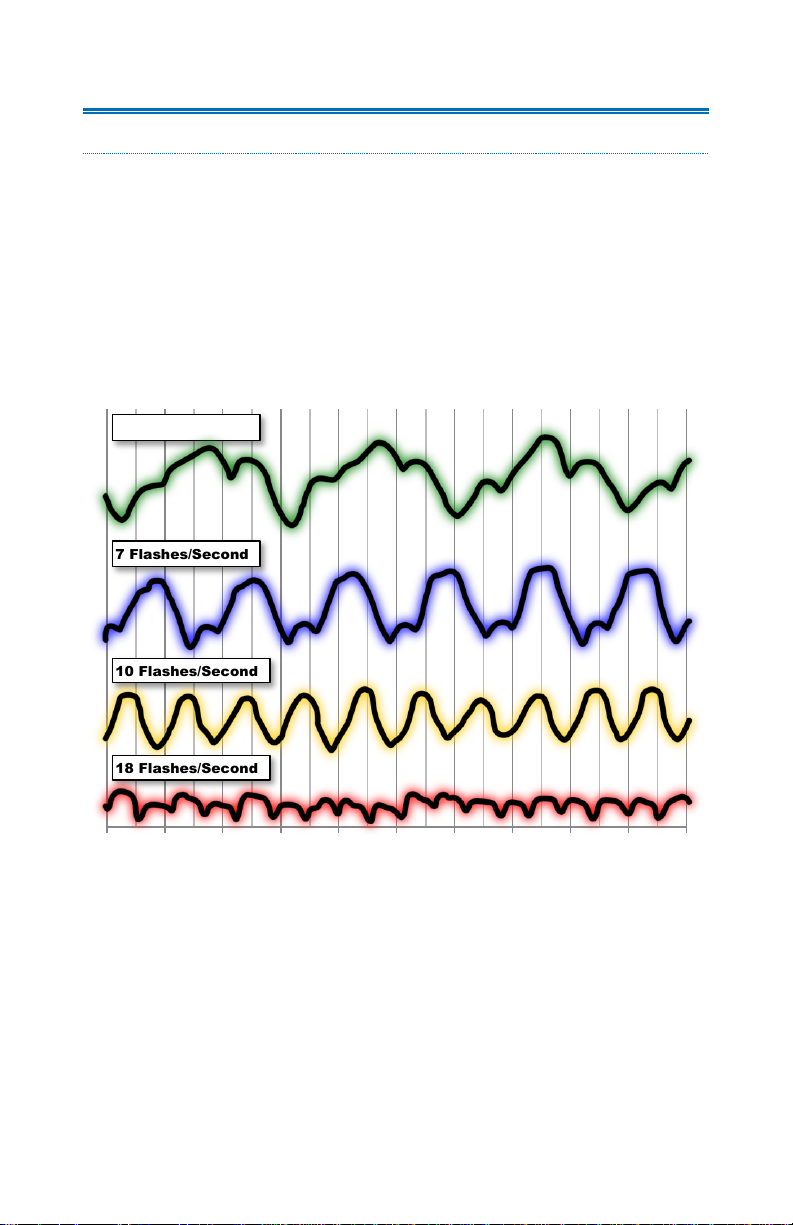
The concept of entrainment is about altering brainwave activity.
Quantitative EEG (QEEG) studies have confirmed the normalization of brain
activity following an AVE session. Aberrant brainwave activity in various
conditions such as depression, anxiety, ADD, seasonal affective disorder,
chronic fatigue, etc., may be restructured into healthier patterns. For more
information on brainwave frequencies see page 3.
EV OKE D PO TEN TIA LS AT VAR IOU S STI MUL ATION RATE S
0 0.1 0.2 0.3 0.4 0.5 0.6 0.7 0.8 0.9 1
Time (s)
3 Flashes/Second
7 Flashes/Second
10 Flashes/Second
18 Flashes/Second
Page 10
[7]
THE FOUR CORNERSTONES OF AVE
AVE INDUCES MEDITATIVE DISSOCIATION
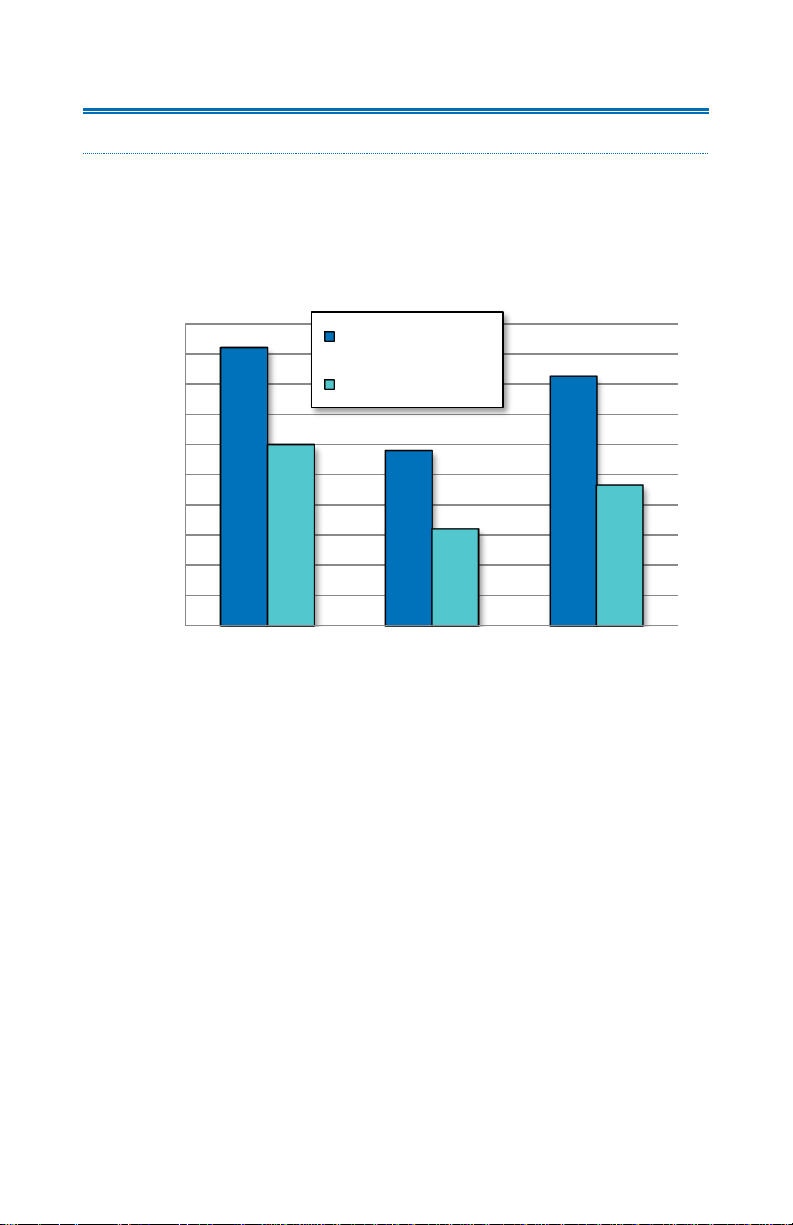
Dissociating is the first step towards effective clearing of the mind and
meditation. This clearing of thoughts and loss of body awareness is similar
to what an experienced meditator would achieve (Glicksohn, 1986-87).
CO MPA RIN G AVE W ITH VA RIO US DISS OCI ATI VE TEC HNI QUES
The dissociative state can be first observed by noticing deep and
diaphragmatic breathing. Hands and feet become warmer as arteries dilate.
Skin color will become pinker as blood flow increases throughout the face
and body. This deep state of AVE-induced regeneration has proven to be
useful for many of the mental, emotional and physical challenges that nearly
all of us face at one time or another in our lives, including but not limited to:
anxiety, depression, insomnia, migraines, PMS, blood pressure, and chronic
fatigue, along with improved attention, learning and ADD/ADHD.
0
2
4
6
8
10
12
14
16
18
20
AVE Dot Staring Stim Deprivation
Change in Dissociation Score
after using technique
High Dissociators
Low Dissociators
Page 11
[8]
THE FOUR CORNERSTONES OF AVE
CEREBRAL BLOOD FLOW INCREASES
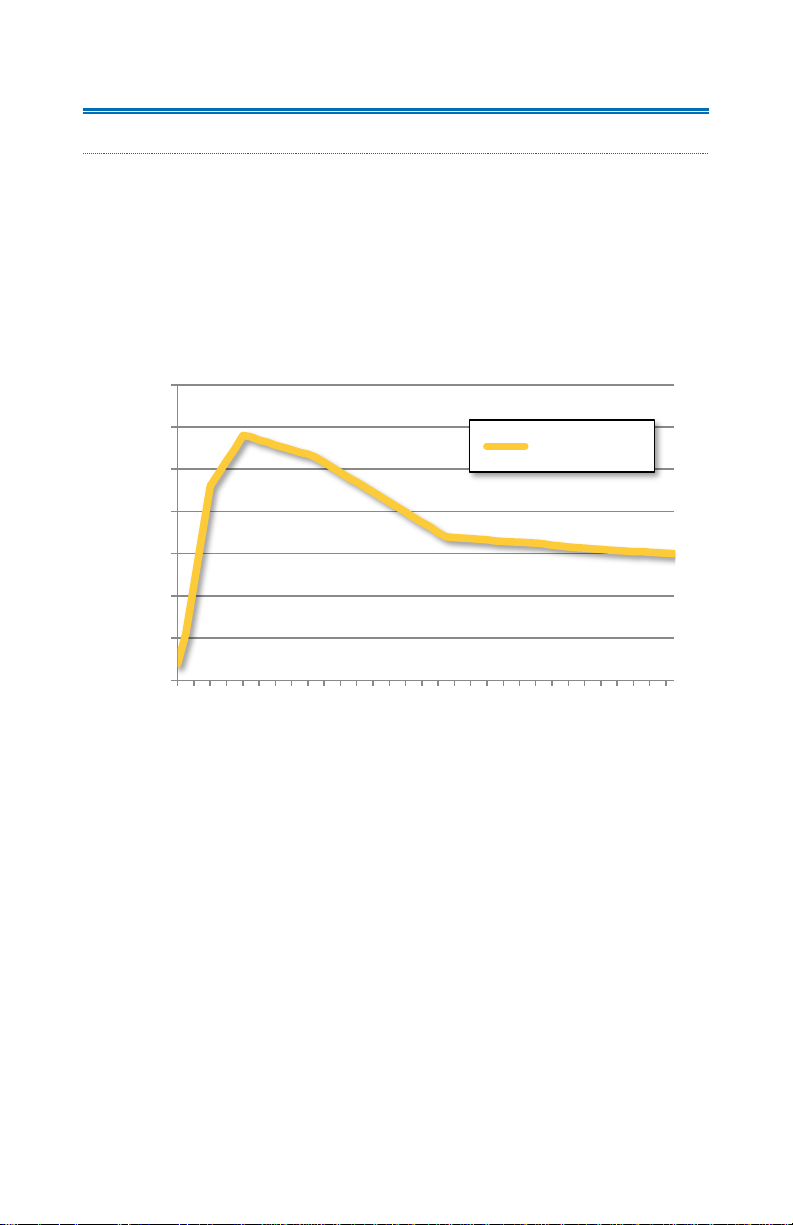
Most cognitive and emotional disorders (depression, ADHD, one type of
anxiety, cognitive decline in seniors/drug users) involve areas of the brain
that are low (hypoperfused) in blood flow. A 1985 study showed AVE
increased cerebral blood flow up to 28%, peaking at 7.8 Hz (Fox & Raichle,
1985).
CO MPA RIN G CE REB RAL BL OOD FL OW INCREAS ES
WI TH FLI CKE R FR EQU ENC Y
0
5
10
15
20
25
30
35
0 10 20 30 40 50 60
Regional Cerebral Blood Flow
(% Change)
Stimulus Rate (Hz)
Visual Cortex
Page 12
[9]
THE FOUR CORNERSTONES OF AVE
NEUROTRANSMITTERS CHANGE
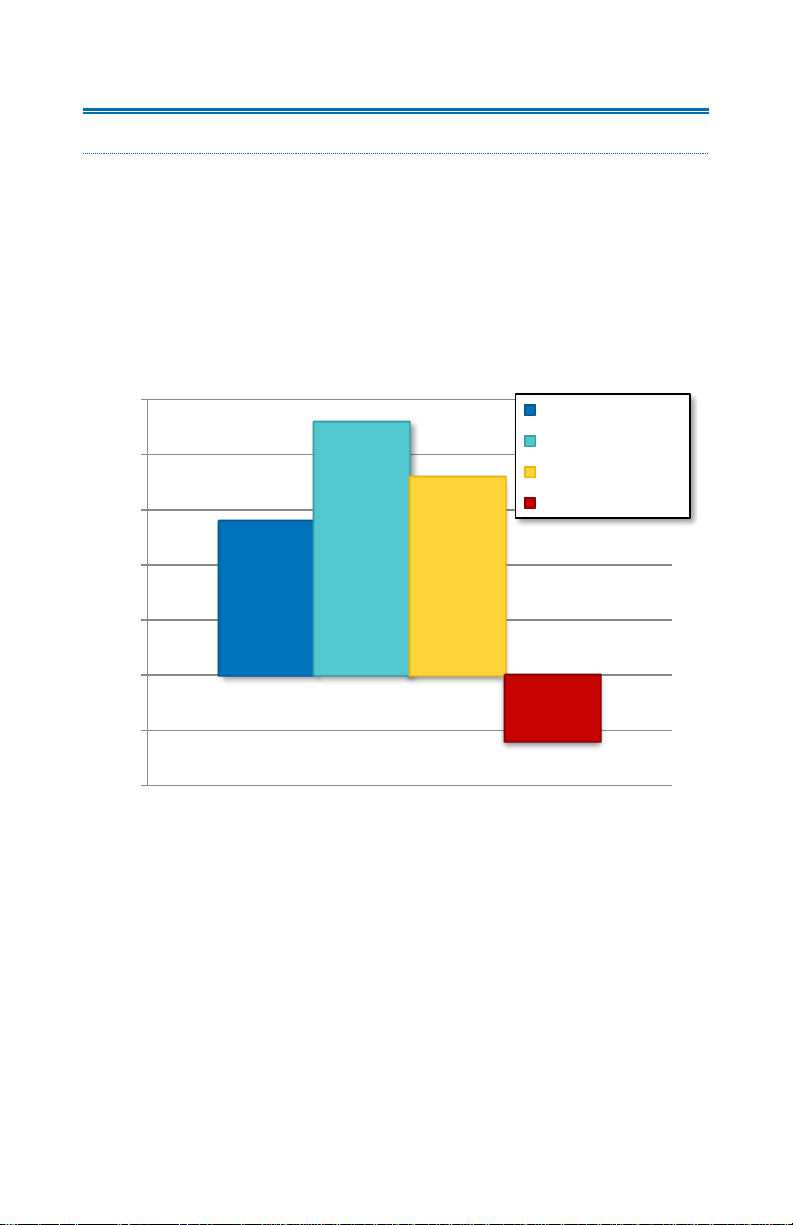
A 1989 study has shown that serotonin, norepinephrine and endorphins (all
positive neurotransmitters) increase, while melatonin, associated with
Seasonal Affective Disorder (SAD), is reduced following the use of AVE
(Shealy, et al., 1989).
NEUR OTRA NSM ITT ER CHAN GES
FO LLO WIN G AVE STI MULA TIO N A T 10 HZ.
Serotonin increases relaxation and boosts happiness and socialization. It
helps to moderate emotions such as depression, as well as sexual or violent
urges. Norepinephrine is crucial for a sharp mental focus. When a person is
low in serotonin, their norepinephrine often over-expresses dramatically,
producing violent tendencies, while impairing sleep, mental performance
and socialization. When both serotonin and norepinephrine are moderately
high, the person feels great, relaxed, sharp and in the mood for chatting!
This is called the “Festive Brain” as this is what humans love to do during
big festive events like Thanksgiving, Christmas, Chanukah, Ramadan, etc.
-10
-5
0
5
10
15
20
25
Beta Endorphine
Serotonin
Norepinephrine
Melatonin
Page 13

[10]
GETTING STARTED
COMPLETING THE PERSONAL PROFILE QUESTIONNAIRE
The purpose of this questionnaire is to give you a sense of how your stress
level, sleep patterns, nutrition, and other factors may be influencing your
mind and ultimately your quality of life. By quantifying your concerns, this
questionnaire can illuminate certain areas which may require adjustment,
and help you to decide which AVE stimulation category will be of most
benefit to you.
HOW TO USE THE PERSONAL PROFILE QUESTIONNAIRE
Follow the instructions at the top of each page of the questionnaire. Answer
the questions according to the time frame stated in each instruction section.
Tally your scores at the bottom of pages 13, 14 and 15. Then refer to page
18 & 19 of this guide to discover which Session Group is best for you.
YOU CAN VIEW THIS GUIDE ONLINE AT
https://mindalive.com/manuals/
Page 14

[11]
PERSONAL PROFILE QUESTIONNAIRE
Prepared for Mind Alive Inc. by Brain Gym PR March, 2012
I. REST
1) Approximately, how many hours do you sleep at night?
less than 3 hours
4-6 hours
7-9 hours
2) Do you sleep all night long without interruptions or
sleeplessness?
Yes
No
3) When you lay down to sleep, do you fall asleep within the first
half hour?
Yes
No
4) Do you take any medication for sleep?
Yes Which one? __________ Since when? _____________
No
5) Do you find yourself dwelling on a particular concern or worry
that interferes with your sleep?
Yes. Specify: ____________________________
No
6) When you wake up, do you feel tired?
Always
Often
Sometimes
Rarely
Page 15

[12]
PERSONAL PROFILE QUESTIONNAIRE
II. LIFE EVENTS & SELF AWARENESS
Indicate any of the situations that have occurred to you within the last year
(or those which have happened to somebody very close to you).
Divorce /Separation
Disease or Hospitalization
Loss of employment
Pregnancy or birth of a child
Change of duties at work
Reconciliation
Change of a supervisor
Change of residence
Problems with the law
Economic problems
Change of financial status
Beginning a new job
Difficulty raising children
Beginning a new relationship
Death of a relative (relation: ________________________________________)
Other(s)_________________________________________________________________
__________________________________________________________________________
__________________________________________________________________________
__________________________________________________________________________
__________________________________________________________________________
Page 16

[13]
PERSONAL PROFILE QUESTIONNAIRE
III. ANXIETY
Read carefully and identify the symptom(s) that you have experienced
during the last month. For each symptom, circle the number which indicates
the frequency at which you perceive that symptom.
0: Never
3: Most of the time
1: Rarely
4: Constant/Overwhelming
2: Some of the time
Symptoms
Frequency
Nagging thoughts
0 1 2 3 4
Negative thoughts or feelings about yourself
0 1 2 3 4
Feeling insecure
0 1 2 3 4
Fear that someone will notice your anxiety and what
might happen if it is noticed
0 1 2 3 4
Upset stomach
0 1 2 3 4
Sweating / Perspiration
0 1 2 3 4
Tremors or shakiness
0 1 2 3 4
Muscle Tension and discomfort
0 1 2 3 4
Palpitating or racy heart
0 1 2 3 4
Constant squirming (feet, hands, scratching, etc.)
0 1 2 3 4
Smoking, eating or drinking in excess
0 1 2 3 4
Avoiding social situations
0 1 2 3 4
Sensation of breathlessness
0 1 2 3 4
Feeling annoyed
0 1 2 3 4
Feeling irritable
0 1 2 3 4
Difficulty concentrating or maintaining focus
0 1 2 3 4
Page 17

[14]
PERSONAL PROFILE QUESTIONNAIRE
IV. MOOD
Identify the symptom(s) that you have felt during the last two weeks.
For each symptom, circle the number which indicates the frequency at which
you perceive that symptom.
0: Never
2: Most of the time
1: Some of the time
3: Constant/Overwhelming
Symptoms
Frequency
Feelings of Sadness
0 1 2 3 Feeling Pessimistic
0 1 2 3 Feeling like a Failure
0 1 2 3 Lack of Pleasure
0 1 2 3 Feelings of Guilt
0 1 2 3 Feelings of being punished by life
0 1 2 3 Self-Critical
0 1 2 3 Thoughts of self-harm or suicide
0 1 2 3 Weeping or crying
0 1 2 3 Restlessness
0 1 2 3 Lack of interest in most everything
0 1 2 3 Difficulty in making decisions
0 1 2 3 Lack of self-appreciation
0 1 2 3 Lack of energy
0 1 2 3 Irritability
0 1 2 3 Changes in sleeping pattern
0 1 2 3 Changes of appetite
0 1 2 3 Difficulty with concentration
0 1 2 3 Fatigue
0 1 2 3 Loss of interest in sex
0 1 2
3
Page 18

[15]
PERSONAL PROFILE QUESTIONNAIRE
V. DISENGAGEMENT
Identify the symptom(s) that you have felt during the past year.
For each symptom, circle the number which indicates the frequency at which
you perceive that symptom.
0: Never
2: Most of the time
1: Some of the time
3: Constant/Overwhelming
Symptoms
Frequency
Difficulty paying close attention to details
0 1 2 3 Difficulty sustaining attention in tasks
0 1 2 3 Difficulty organizing tasks and activities
0 1 2 3 Avoiding tasks that require mental effort
0 1 2 3 Losing things necessary for tasks or activities
0 1 2 3 Easily distracted
0 1 2 3 Difficulty following instructions and making mistakes
0 1 2 3 Forgetful in daily activities
0 1 2 3 Fidgets with hands or feet or squirms in seat
0 1 2 3 Always ‘‘on the go’’
0 1 2 3 Interrupts or intrudes on others
0 1 2 3 Difficulty waiting for one’s turn
0 1 2 3 Often late for events and appointments
0 1 2
3
Page 19

[16]
PERSONAL PROFILE QUESTIONNAIRE
VI. NUTRITION
1) Do you include fresh fruits and vegetables in your diet?
No
Yes How much? _______________________________
7) Do you eat green leaves or seaweed?
No
Yes How much? _______________________________
8) How many cups of water do you drink daily? ____________
9) Does your diet contain artificial colors, preservatives or
additives?
No
Yes
10) Do you drink sodas or carbonated drinks?
No
Yes How many cans/bottles daily?___________
11) Do you drink coffee or caffeinated drinks?
No
Yes How many cups per week? ______________
12) Do you smoke cigarettes or marijuana?
No
Yes How many per week? ____________________
13) Do you drink alcohol?
No
Yes How many drinks per week? ____________
14) Do you use white sugar and/or products with refined flours?
No
Yes
15) Do you need comfort foods (chocolate, fried food, red meat, etc.)
No
Yes What foods? _______________________________
16) Do you take vitamin supplements?
No
Yes
Page 20

[17]
PERSONAL PROFILE QUESTIONNAIRE
VII. MEDICATIONS
Make a list of the pharmaceutical drugs that you are taking or have taken in
the past 6 months:
Condition
Medication
Diabetes
Thyroid
ADD/ADHD
Hypertension
Asthma
1) What have you done to feel better?
__________________________________________________________________________
__________________________________________________________________________
__________________________________________________________________________
2) Have you visited a doctor, specialist or have you been in the
emergency room due to any of these symptoms?
Yes
No
If “Yes”, what was done to help you feel better?
__________________________________________________________________________
__________________________________________________________________________
__________________________________________________________________________
Page 21
[18]
CHOOSING A DAVID SESSION
Once you have calculated your scores for each section of the questionnaire, use
the following guide to determine which sessions may be of most benefit to you.
Select a session type based on whichever category (or categories) yielded the
highest scores, therefore indicating the greatest concern.
III. Anxiety – Try the Meditation and/or Feeling Better sessions.
If your anxiety keeps you up at night, consider the Sleep category as well.
IV. Mood – Try the Feeling Better and/or Meditation sessions.
V. Disengagement– Try a Brain Brightener and/or Energizer session.
FOR YOUR FIRST DAVID EXPERIENCE, WE OFTEN RECOMMEND THAT
YOU TRY AN “ALPHA BRAINWAVE” SESSION, SUCH AS THOSE FOUND IN
THE MEDITATION CATEGORY. YOU MAY EVEN WANT TO TRY A FEW
MEDITATION SESSIONS DURING YOUR FIRST WEEK, BEFORE MOVING ON
TO THE SESSION GROUP SUGGESTED BY THE QUESTIONNAIRE.
There is no harm in alternating between sessions and categories from one
day to the next until you find a protocol which works for you. For instance,
you can try an Energizer session one day and a Brain Brightener the
next. Or alternate between and .
This is a guideline only. You will discover which times work best for you.
ADDITIONAL RESOURCES
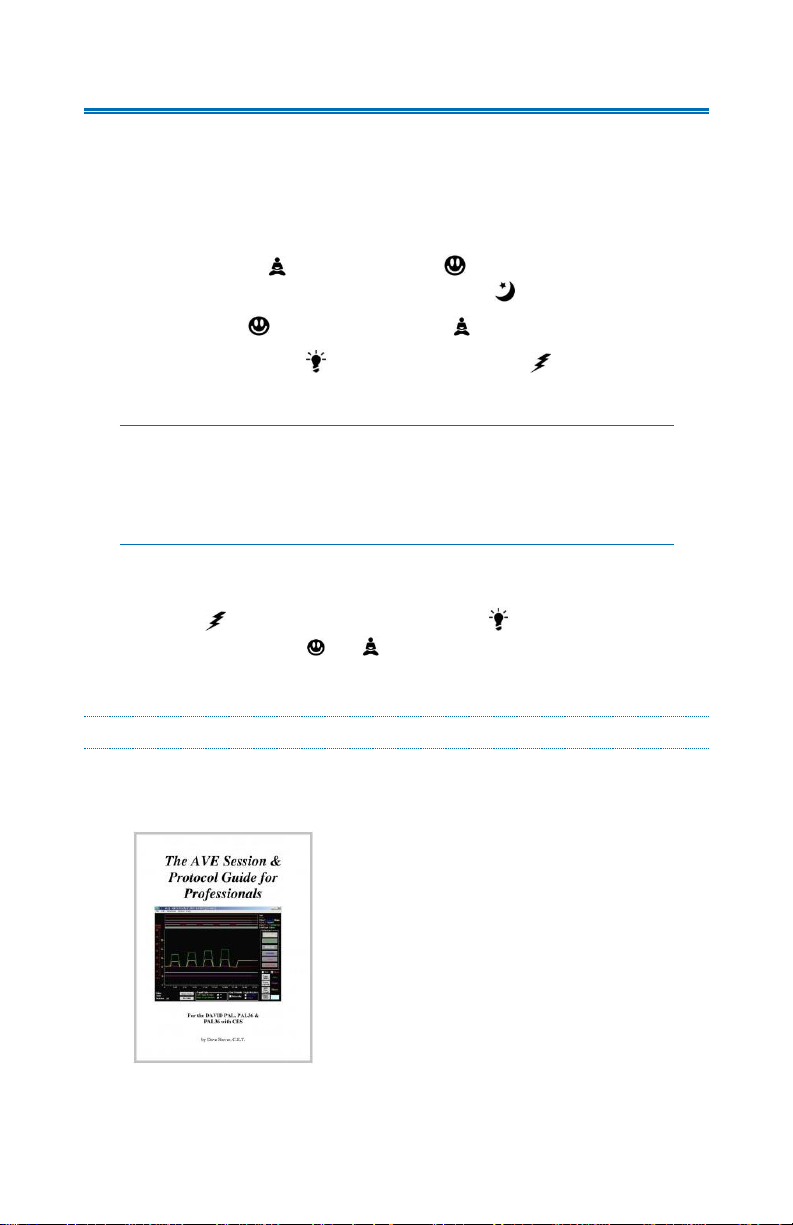
AVE Session & Protocol Guide
for Professionals
by Dave Siever
Page 22

[19]
PERSONAL PROFILE INTERPRETATION
I. REST
This section helps to determine if you have particular worries or perhaps
nutritional/health issues, which may be interfering with your sleep.
IS MY INSOMNIA CAUSED BY STRESS OR A NUTRITIONAL ISSUE?
Good nutrition is absolutely necessary for good brain function! This is very
important in relation to sleep. To determine if you have a sleeping problem
that is caused by inadequate nutrition, first ask yourself these questions:
Is there a reoccurring theme to the thoughts which keep you up at
night? Is your mind filled with thoughts of issue s with your mate,
assignments or upcoming exams? Are you worrying about money
issues or perhaps concerned about something you saw in the news,
the state of the environment, health issues, or a personal crisis?
If you answered yes to any of the above questions, you may have stress
issues. The DAVID can help soothe the mind and quiet troubling thoughts.
However, if your thoughts are just a bunch of random nonsense, then it’s
more likely that your insomnia is due to a nutritional issue. The following
supplements will almost always reduce, and often eliminate insomnia:
1) Vitamin D
3
2) Omega 3s
3) Minerals - particularly magnesium
4) B complex
See Page 22 for more information.
II. LIFE EVENTS & SELF AWARENESS
Depending on the extent of the stressors and/or major changes in your life,
symptoms of anxiety, insomnia, depression or mixed mood could simply be
evidence of adaptive behavior in response to stressful situations. However,
if your troubles persist beyond a reasonable time frame, given the initial
stressor, we recommend that you consult with a psychologist in case these
are symptoms of a larger-scale problem or clinical disorder.
Once you have identified the source of your symptoms, you can begin to
address the problem through AVE.
See Page 23 for session information.
Page 23

[20]
III. ANXIETY
Total Scores
Result
0 – 16 points
Minimal symptoms of anxiety
16 – 20 points
Slight anxiety
21 – 30 points
Symptoms of moderate anxiety
Consider consulting a psychologist
31 – 64 points
Symptoms of severe anxiety
Consider consulting a psychologist
IV. MOOD
Total Scores
Result
0 – 13 points
Minimal depressive symptoms
14 – 19 points
Slight depressive symptoms
20 – 28 points
Moderate depressive symptoms
29 – 60 points
Severe depressive symptoms
Consider consulting a psychologist
Audio-Visual Entrainment (AVE) is an effective tool for dissociating a
depressed/anxious person out of his/her destructive thoughts, leaving them
with emotional neutrality and somatic re-stabilization (Siever, 2000). Even
with increasing anxiety, AVE has been shown to reduce heart rate and may
be used as a desensitization tool (Leonard & Telch, 2000). AVE also
increases norepinephrine and serotonin (Shealy, 1989).
See Page 23 for session information
Page 24

[21]
PERSONAL PROFILE INTERPRETATION
V. DISENGAGEMENT
Total Scores
Result
0 – 10 points
Minimal symptoms of inattention
10 – 14 points
Possible mild ADD
Inattentive type
14 – 20 points
Possible mild ADD/ADHD
Hyperactive type.
21 – 30 points
Possible moderate ADD/ADHD
Hyperactive type
30 – 39 points
Very hyperactive
Severe ADHD symptoms.
An under-engaged mind over several years could be an indication of ADD or
ADHD (hyperactivity). If the symptoms have been of shorter duration, it
could be an indication of stress, depression, poor nutrition or eating a
typical sugary breakfast.
When people feel tired, depressed or foggy-headed, they often crave high
glycemic foods or simple carbohydrates such as pasta, cake, cookies,
doughnuts, chocolate, sugary breakfast cereals, etc. And although this will
temporarily perk up the brain for an hour or so, insulin will inevitably cause
your glucose levels to crash, and unfortunately, your temporary mental
alertness will crash along with it. Behaviorally, this often shows up as
anxiety, inattention, impulsiveness and grumpy behavior.
Intake of these high glycemic foods should be restricted whenever possible.
Most breakfast cereals contain simple sugars and have very little nutrition.
It’s better to eat a high protein breakfast such as ham & eggs, or peanut
butter on sprouted grain breads and cereals, as many people have difficulty
tolerating the gluten found in whole grains such as wheat, rye, and barley.
VI. NUTRITION
Evaluate your nutritional habits. Proper nutrition is a critical factor in
overall mental and physical health. Consult with your physician or dietician
if necessary.
Page 25

[22]
NUTRITION
Ensuring proper daily intake of vitamins and good general nutrition is vital
for anyone trying to maintain optimum mental health. Most children and
adults have been found to be deficient in vitamin D, tryptophan and omega 3
as well as many other minerals. Recent studies have shown that fish oil
supplements have reduced the symptoms of ADD/ADHD more effectively
than stimulant drugs.
Poor nutrition can cause symptoms to occur in three of the major categories
of the personal profile questionnaire (Anxiety, Mood, and Disengagement).
Most issues involving the mind also involve a nutritional deficit of some sort.
THINGS YOU CAN DO:
1) Supplement with liquid vitamin D throughout the winter
• Liquid (oil-based) vitamin D
3
is the most effective form
• Dosage: If you have not been tanning or taking D
3
in the past 2months, begin with 10,000IU/day for 2-weeks then reduce to
3000IU/day for the average woman and 4000 IU/day for the
average man. (Pure Encapsulations® is an excellent brand).
• Consult with your physician or get a test kit if you would like your
vitamin D levels tested.
• Refer to Dave’s article on vitamins for more information
2) Take Omega 3s, liquid minerals and Vitamin B complex
• 6 drops of a liquid trace mineral supplement like ConcenTrace®
• Only take Vitamin B complex with food. If you notice a stomach
ache after taking vitamin B complex, then you are taking too much.
Break your tablets in half or take less often.
3) Take iodine/iodide in the morning
• 1 drop of Iosol Iodine every other day or 1/10
of a tablet of
Iodorol® daily
4) Eat organic foods from Farmers’ Markets as much as possible
• Organic foods have been shown to contain 3-5 times more nutrition
than supermarket-bought foods.
YOU CAN FIND ARTICLES AND DISCUSSIONS ON NUTRITION
ON OUR WEBSITE AT www.mindalive.com
Page 26

[23]
AVE SESSION GUIDE
ENERGIZER
These are best used upon wakening, as they have a tendency to wake a
person up and can act as a replacement for coffee. We recommend these
sessions be used only in the morning or as an energy boost before an
evening of socializing.
Those with ADD/ADHD will often fall asleep during Energizer sessions and
wake up completely relaxed. So, although we normally recommend that
these sessions be used in the morning, those with ADD/ADHD can try
running these sessions at bedtime if they need help falling asleep.
MEDITATE
Meditation sessions are designed to lower arousal levels associated with
frantic, unsettled thoughts and stress. They can be used at any time of day,
but are best used after lunch.
BRAIN BRIGHTENER
These sessions have been shown to boost concentration and memory.
We recommend using this category in the morning.
MOOD BOOSTER
These sessions have been proven to reduce depressed feelings and increase
happiness. They will also boost logical thinking and organizational abilities.
They are best used upon awakening as a way to start your day with a happy
disposition. However, they can also be helpful at bedtime.
SLEEP
These are best used at bedtime. For those on a modified sleep schedule
(such as shift workers), these may be used in the AM, before falling asleep
The low-frequency sessions such as Schumann, Paradise, Alpha-Theta are
best used when the issue involves a busy mind AND a tense body.
The SMR Sleep session is for those with a busy mind, but a relaxed body.
Many people are not often aware as to just how tense they are until they
find relief. Therefore, we generally suggest that people begin with the lowfrequency sessions, and then move to the SMR type after a few weeks, once
the AVE has allowed their body to relax.
Page 27

REFERENCES
Collura, T., & Siever, D. Chapter 8. In Audio-visual entrainment in relation to
mental health and EEG. Quantitative EEG and Neurofeedback (2nd ed., pp.
195-220).
Fox, P., & Raichle, M. (1985). Stimulus rate determines regional blood flow
in striate cortex. Annals of Neurology , 17 (3), 303-305.
Frederick, J., Lubar, J., Rasey, H., Brim, S., & Blackburn, J. (1999). Effects of
18.5 Hz audiovisual stimulation on EEG amplitude at the vertex. Journal of
Neurotherapy , 3 (3), 23-27.
Glicksohn, J. (1986-87). Photic driving and altered states of consciousness:
An exploratory study. Imagination, Cognition and Personality , 6 (2), 167-
182.
Leonard, K., Telch, M., & Harrington, P. (1999). Dissociation in the
laboratory: A comparison of strategies. Behaviour Research and Therapy , 37,
49-61.
Leonard, K., Telch, M., & Harrington, P. (2000). Fear response to dissociation
challenge. Anxiety, Stress and Coping , 13, 355-369.
Shealy, N., Cady, R., Cox, R., Liss, S., Clossen, W., & Veehoff, D. (1989). A
comparison of depths of relaxation produced by various techniques and
neurotransmitters produced by brainwave entrainment. Shealy and Forest
Institute of Professional Psychology. A study done for Comprehensive Health
Care . Unpublished.
Siever, D. (2006). Audio-Visual Entrainment: Finding a treatment for post-
traumatic stress disorder. Retrieved from Mind Alive Inc.
Siever, D. (2007). Chapter 7. In Audio-Visual Entrainment: History,
Physiology, and Clinical Studies. Handbook of Neurofeedback: Dynamics and
Clinical Applications (pp. 155-183).
Page 28
Toll Free: 800.661.MIND(6463)
Phone: 780.465.MIND(6463)
E-mail: [email protected]
Website: www.mindalive.com
6716 75 St NW
Edmonton, Alberta
Canada T6E 6T9
 Loading...