

Page 1
LuminataTM Classico
Western HRP Substrate
Introduction
Luminata Classico Western HRP Substrate is a premixed,
ready-to-use reagent for chemiluminescent detection in western
blotting applications that employ horseradish peroxidase (HRP)conjugated antibodies. Luminata Classico Substrate is ideal for the
detection of high to medium abundance proteins. It can be used
with traditional immunodetection techniques or the SNAP i.d.®
Protein Detection System. Visualization of target proteins is
achieved through x-ray lm or another imaging method.
Package Contents
Luminata Classico
Western HRP Substrate, 100 mL
Catalogue number WBLUC0100
Luminata Classico
Western HRP Substrate, 500 mL
Catalogue number WBLUC0500
covers 1,000 cm2 of
membrane area
covers 5,000 cm2 of
membrane area
Storage/Shelf Life
Store at 2–8 °C. Protection from light is not required. Refer to
bottle label for expiration date.
Usage Guidelines
Luminata Classico Substrate is slightly more sensitive than
other chemiluminescent HRP substrates, but it is less sensitive
than Luminata Crescendo, Luminata Forte, and the original
Immobilon® Western HRP Substrates. Compared with these three
detection reagents, Luminata Classico Substrate requires a higher
concentration of antigen and/or antibodies. See the table below for
general guidelines.
Luminata
HRP Substrate
Sensitivity
Antibody
Concentration
Prior to using this product, review the Material Safety Data Sheet
(MSDS) to ensure awareness of associated hazards and use of
appropriate controls.
Classico
● ●● ●●● ●●●
●●● ●● ● ●
Other Important Considerations
■ If switching to Luminata Classico Substrate from a colorimetric
substrate, the primary and secondary antibody concentrations
may need to be decreased to achieve the optimal signal-tonoise ratio.
■ If switching to Luminata Classico Substrate from Luminata
Crescendo, Luminata Forte or Immobilon HRP Substrates, the
primary and secondary antibody concentrations may need to
be increased to achieve the optimal signal-to-noise ratio, or the
x-ray lm exposure time may need to be increased.
■ Optimum exposure time to the x-ray lm should be determined
for each antibody system.
■ Use of blocking buffer to dilute antibodies may reduce background and increase sensitivity.
Luminata
Crescendo
Luminata
Forte
Immobilon
Western
■ To avoid membrane tearing or high background in the blots,
always wear gloves and use blunt tip forceps (such as
Millipore cat. no. XX6200006) when handling the membrane.
■ Never use objects (scissors or forceps) that show visible signs
of rusting, since they may create undesirable artifacts or high
background areas.
■ Do not use sodium azide in any blocking buffers or wash
solutions, since it inhibits HRP activity.
Chemiluminescent Detection
Approximately 0.1 mL of HRP substrate is required per cm2 of
membrane area. The volumes of HRP substrate needed for some
common membrane sizes are indicated below:
Blot Size (cm) HRP Substrate Required
7 × 8.4 6 mL
10 × 10 10 mL
8.5 × 13.5 12 mL
1. Place the blot protein-side up in a container or clear plastic
sheet protector, and add the HRP substrate onto the blot.
2. Incubate the blot for 2 to 5 minutes at room temperature.
3. Drain the excess substrate, transfer to a clean sheet protector,
and cover the blot with plastic wrap or another sheet protector.
4. Expose the blot to a suitable x-ray lm for an appropriate
amount of time. Typical exposure time for Luminata Classico
Substrate is 1 to 5 minutes. The chemiluminescent signal on
the blot will last for at least 30 minutes. If higher sensitivity is
desired, the detection procedure can be repeated on the same
blot, using Luminata Crescendo, Luminata Forte, or Immobilon
HRP Substrate.
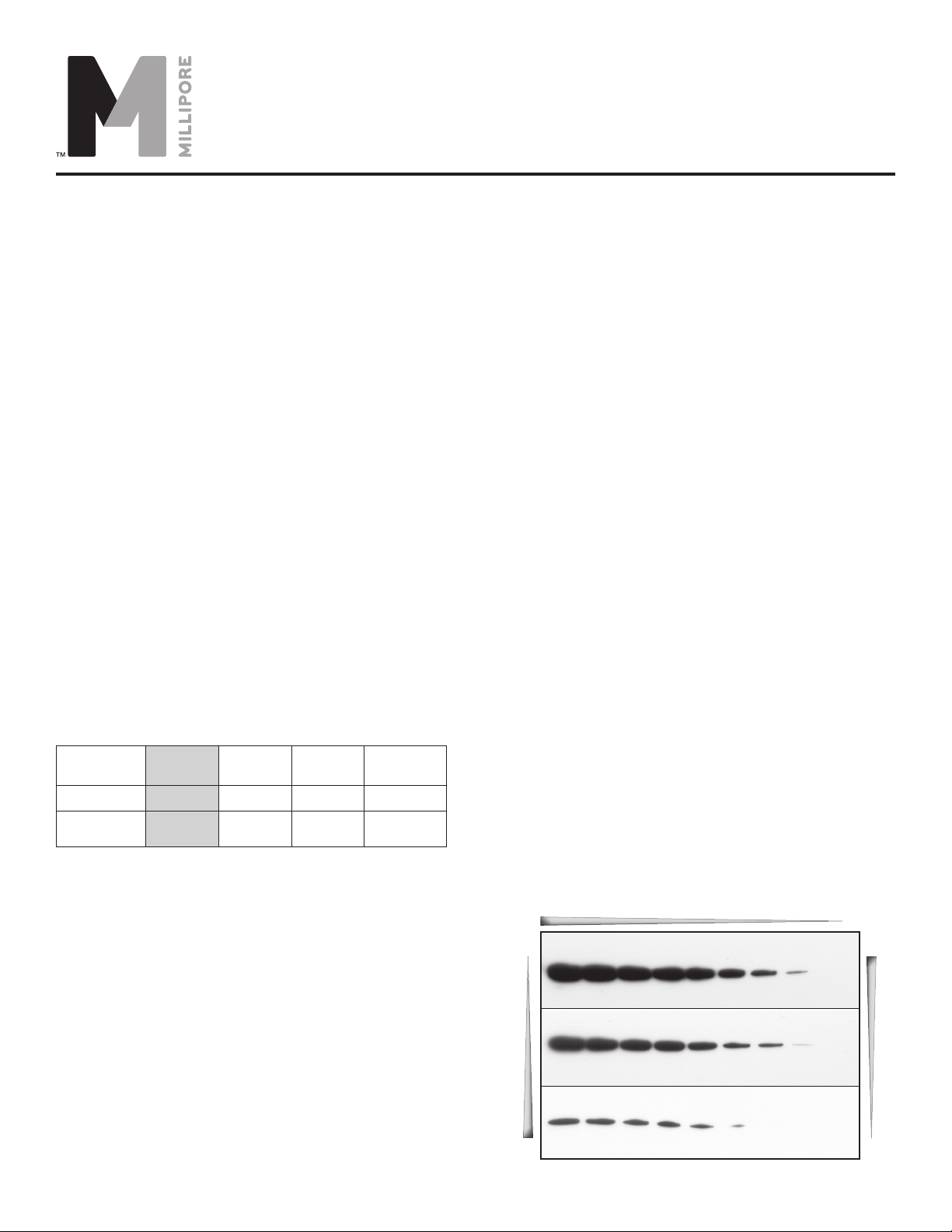
Proof of Performance
Comparison of Signals from Luminata Forte, Crescendo, and
Classico HRP Substrates
Blots of A431 cell lysates (a series of two-fold dilutions ranging from
10 µg to 0.04 µg) were prepared using Immobilon-P membrane and
probed with varying concentrations of anti-GAPDH antibody on the
SNAP i.d. Protein Detection System. Following incubation with a
goat anti-mouse HRP-conjugated secondary antibody, the blots were
visualized with Luminata Classico, Crescendo, or Forte Substrate.
µg of Lysate Loaded
5
10
1:10,000 dilution
1:5,000 dilution
anti-GAPDH Concentration
1:1,000 dilution
2.5 1.2 0.6 0.3 0.15 0.08 0.04
Forte
Crescendo
Classico
Sensitivity
Page 2

Troubleshooting
Ordering Information, continued
Symptom Possible Cause Solution
High background
Negative staining
(white bands on black
background)
Nonspecic bands
Signal disappears
quickly in a blot that
initially had a very high
signal
Weak or no signal Ab concentration is too
Ab concentration is too
high.
High HRP-Ab
concentration has
exhausted the substrate
prematurely.
low.
Expose to x-ray for shorter
period of time.
Decrease Ab
concentration.
Use a lower sensitivity
HRP detection substrate.
Decrease antigen
concentration.
Decrease Ab
concentration signicantly.
Use a lower sensitivity
HRP detection substrate.
Decrease antigen
concentration.
Expose to x-ray for longer
period of time.
Use a higher sensitivity
HRP detection substrate.
Increase Ab concentration.
Increase antigen
concentration.
Change the blocking
solution.
Ordering Information
This section lists the catalogue numbers for Luminata Classico
Substrate and related products. See the Technical Assistance
section for information about contacting Millipore. You can also
purchase Millipore products on-line at www.millipore.com/products.
Luminata and Immobilon Western Chemiluminescent
Substrates for Western Blotting and ELISA Applications
Description Qty Cat. No.
Luminata Classico
Western HRP Substrate
Luminata Crescendo
Western HRP Substrate
Luminata Forte
Western HRP Substrate
Immobilon Western
HRP Substrate
Luminata Crescendo
ELISA HRP Substrate
Luminata Forte
ELISA HRP Substrate
100 mL
500 mL
100 mL
500 mL
100 mL
500 mL
50 mL
100 mL
500 mL
100 mL
200 mL
100 mL ELLUF0100
WBLUC0100
WBLUC0500
WBLUR0100
WBLUR0500
WBLUF0100
WBLUF0500
WBKLS0050
WBKLS0100
WBKLS0500
ELLUR0100
ELLUR0200
SNAP i.d. Protein Detection System and Components
Description Qty Cat. No.
SNAP i.d. Protein Detection System 1 WBAVDBASE
SNAP i.d. Triple Well Blot Holder 20 WBAVDBH03
SNAP i.d. Double Well Blot Holder 30 WBAVDBH02
SNAP i.d. Single Well Blot Holder 30 WBAVDBH01
Other Western Blotting Related Products
Forceps 1 XX6200006
blØkTM-CH Buffer 500 mL WBAVDCH01
blØk-FL Buffer 500 mL WBAVDFL01
blØk-PO Buffer 500 mL WBAVDP001
ReBlotTM Western Blot Recycling Kit 1 2060
ReBlot Plus Kit 1 2500
Immobilon-P PVDF Membrane (0.45 µm pore size) for
General Western Blotting Applications
Description Dimensions (cm) Qty Cat. No.
Roll 26.5 × 375 1 IPVH00010
Cut Sheet 26 × 26 10 IPVH304F0
20 × 20 10 IPVH20200
15 × 15 10 IPVH15150
10 × 10 10 IPVH10100
9 × 12 10 IPVH09120
8.5 × 13.5 10 IPVH08130
8 × 10 10 IPVH08100
7 × 8.4 50 IPVH07850
Technical Assistance
For more information, contact the Millipore ofce nearest you. In
the U.S., call 1-800-MILLIPORE (1-800-645-5476). Outside the
U.S., see your Millipore catalogue for the phone number of the
ofce nearest you or go to our web site at www.millipore.com/
ofces for up-to-date worldwide contact information. You can also
visit the tech service page on our web site at www.millipore.com/
techservice.
Material Safety Data Sheets (MSDS) are available on our web site.
Go to www.millipore.com and enter your catalogue number in the
search box.
Standard Warranty
The applicable Millipore Warranty and limited liability for products
listed in this publication may be found at www.millipore.com (search
on “Terms and Conditions of Sale”).
00112797 Rev. C, 07/10
Copyright 2010, Millipore Corporation. All rights reserved.
Millipore, Immobilon, and SNAP i.d. are registered trademarks of Millipore Corporation.
The M mark, blØk, ReBlot, and Luminata are trademarks of Millipore Corporation.
 Loading...