

Page 1
MicW
Audio
a member of BSWA Technology Ltd.
Unit 1003, North Ring Center, No.18 Yumin Road, Xicheng District
Beijing 100029, China
Phone: +86-10-51285118
Fax: +86-10-8225 1626
Email: [email protected]
Web: www.mic-w.com
2008,
MicW
microphones
Product features and specifications are subject to change without notice.
N151/N151-Pair
Studio Microphone
User’s Manual
www.mic-w.com
Page 2

1. INTRODUCTION
Welcome to use
MicW
series professional microphones!
MicW
N151 has outstanding characteristics that make the microphone a valuable tool in
the studio, music hall and on the stage.
2. SAFETY INSTRUCTION
It is important to read all safety precautions and operating instructions before
attempting to operate the unit. Keep all safety precautions and operating instructions for
future reference.
Warning:
Condenser microphones are extremely moisture-sensitive. Never use your microphone
in close proximity to water (e.g. bath tubs, wash basins, sinks, washing machines, pools,
etc.). When doing voice recordings, always use the enclosed windscreen to safely
protect the capsule from moisture.
Please don’t touch the vibration parts especially the diaphragm behind the protection
grid. Don’t move the capsule when it is in operation. Take care not to drop your
microphone as this can lead to severe damage.
MicW
assumes no liability for any
damage caused by the user.
After each use, place it back into its protective casing. Then, lay the small bag
containing the moisture-absorbing crystals on top of the microphone head.
3. POWER SUPPLY
Phantom power (+48 V) is required to operate your microphone. We assume no
liability for damage caused to your N151 through defective phantom power. Before
activating phantom power, mute your playback system and connect the N151 to the
microphone input of your mixing console. After activating phantom power, the N151
requires several seconds to stabilize itself.
4. APPLICATIONS
The
MicW
N151 is a state-of-the-art stereo kit. Therefore, it is particularly well-suited
for stereo recordings. Regardless of whether you are miking an entire ensemble or a
single sound source (e.g. drums, piano or background vocals), this microphone lets you
achieve outstanding spatial impressions in every recording session.
Of course, you can use
MicW
N151-pair that feature two matched N151 microphones as
well. Each pair is guaranteed to the sensitivity match within 0.5 dB and phase match
within 5°.
MICROPHONE N151/N151-Pair
Capsule diameter
23.8 mm
Polar pattern
Cardioid
Sensitivity (±2dB)
22mv/Pa; -33 dB re. 1v/Pa
Frequency Response
20 Hz ~ 20kHz
Power Supply
48 V Phantom power
Total harmonic distortion
(THD)
<1% up to 130 dB SPL peak
Thermal Noise
<16 dBA
Output impedance
<200 Ohm
Length
157mm
weight
165g
Connector
3-pin XLR
8. SPECIFICATIONS:
9. Contents in the case
N151/N151-Pair microphone(s);
Wind screen;
User’s manual..
Page 3
5. MICROPHONE INSTALLATION
First screw a clamp onto the stand before attaching the microphone itself.
6. AUDIO CONNECTION
To connect the N151 to your equipment, use a balanced XLR microphone cable with
the following pin assignment: Pin 1 = shielding, pin 2 = +, pin 3 = -. Since all contact
points of the N151 are gold-plated, your microphone cable should feature gold-plated
connectors, if possible.
7. Directional characteristic
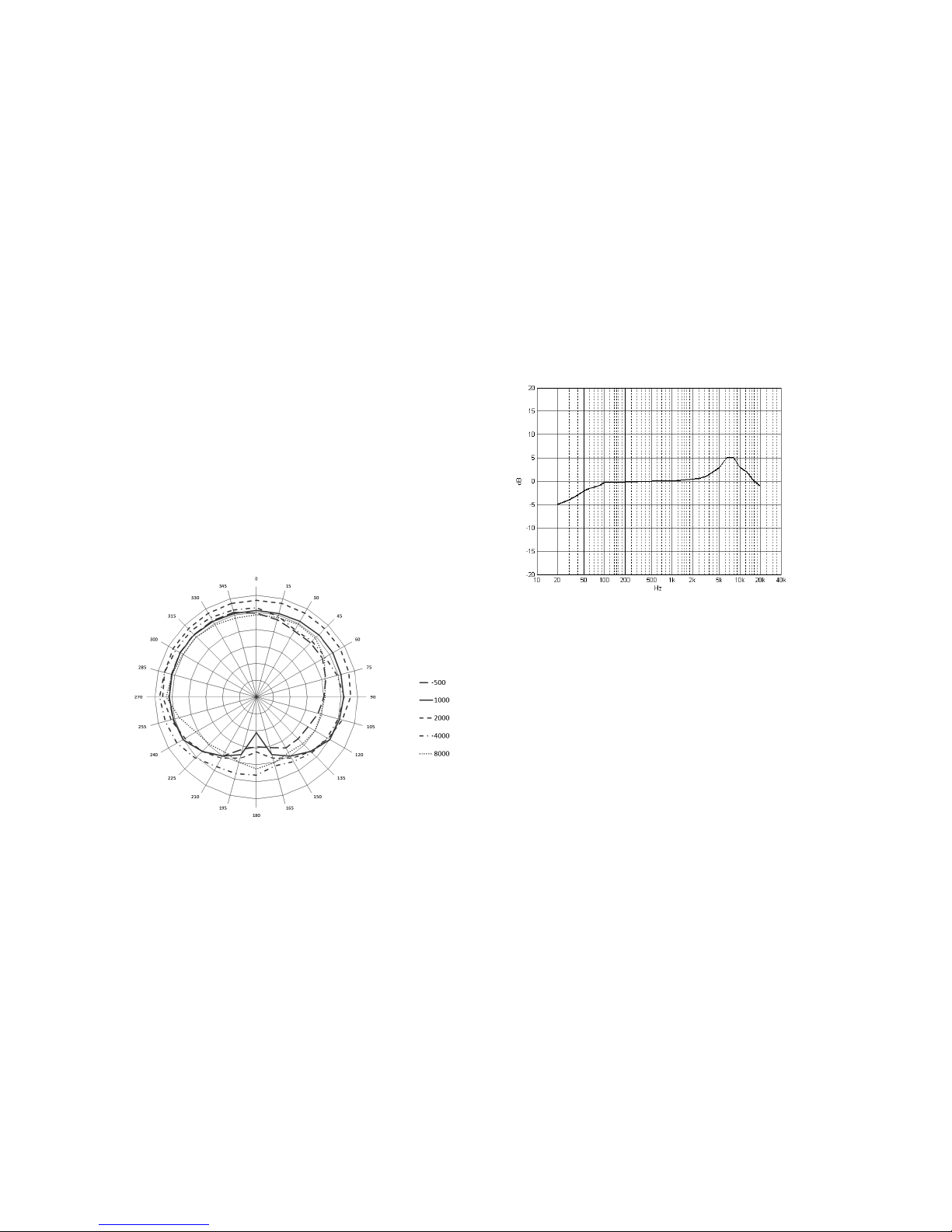
The microphone features a capsule with a Cardioid pickup pattern. Microphones with
this polar pattern are most sensitive to sound coming from in front of the microphone,
and also to a lesser extent from the sides. Sound coming from behind the microphone
will be greatly attenuated.
Polar pattern
N151/N151-Pair Frequency Response
 Loading...