

Page 1
841AR-Aerosol
Super ShieldTM
Nickel Conductive Coating
841AR Technical Data Sheet
Description
• Sensors
• Controllers
• Receivers
• Test Equipment
• Scientific equipment
• Medical Equipment
• Communication devices
• Satellite dishes and radar systems
• Antennas
• Aerospace applications
• Electric vehicles
• Cable boxes
• Networking gear, firewalls
• Military equipment
• Cellphones, laptops, PDA’s
• GPS’s, navigation systems
• TV’s, monitor’s, and displays
• Consumer electronics
• Electronic sporting equipment
• Audio equipment
• Electric guitars and other amplified
instruments
• Drones and other RC vehicles
• Repairing damage to existing shielding
• Conductive undercoat for electroplating
• Protecting metal surfaces from oxidation
• Providing electric continuity for circuits
• Grounding
ENVIRONMENT
RoHS Compliant
Low-VOC
The 841AR Super ShieldTM Nickel Conductive Coating is a one-part durable acrylic lacquer pigmented with
a highly conductive nickel flake, packaged in convenient aerosol format. It utilizes a solvent based system
with no heat cure necessary. The cured coating is smooth, hard, and abrasion resistant. It provides strong
adhesion to plastics, excellent conductivity, and strong corrosion resistance, even in marine environments.
Applications & Usages
The 841AR is designed to provide a conductive coating to the interior of plastic electronic enclosures to
suppress EMI/RFI emissions. It excels when corrosion resistance is a concern.
The 841AR is commonly used by manufacturers of these devices:
Other applications for 841AR include:
Benefits and Features
• UL Recognized (File # E202609)
• Provides effective EMI/RFI shielding over a broad frequency range
• Volume resistivity of 0.0076 cm
• Smooth, durable and, abrasion resistant
• Available in liquid format
• Quick dry time, no heat cure required
• Mild solvent system
• Strong adhesion to acrylic, ABS, polycarbonate, and other injection molded plastics
• Excellent adhesion to wood and ceramics
• Corrosion resistant, suitable for marine environments
• Low VOC; HAP Free; Does not contain toluene, xylene, or MEK
Date: 15 June 2017 / Ver. 2.02
Page 1 of 8
Page 2
841AR-Aerosol
Super ShieldTM
Nickel Conductive Coating
841AR Technical Data Sheet
Properties
Value
Recoat time (liquid)
3 min
Drying Time @22 °C [72 °F]
24 h
Drying Time @65 °C [149 °F]
30 min
Shelf Life
2 y
Theoretical 340G Spray
≤2 500 cm2
Can Coverage a)
≤390 in2
Properties
Value
Constant Service
Temperature
-40 to 120 °C
[-40 to 248 °F]
Intermittent Temperature
-50 to 125 °C
Limits
[-58 to 257 °F]
Storage Temperature Limits b)
-5 to 40 °C
[23 to 104 °F]
Electrical & Magnetic Properties
Method
Value
Volume Resistivity
Method 5011.5
in MIL-STD-883H
0.0076 cm
130 S/cm
Surface Resistance
Resistance a)
Conductance
a)
Surface Resistance : 1 coat @2.1 mil
Square probe
0.62 /sq
1.6 S
Surface Resistance : 2 coats @4.2 mil
Square probe
0.38 /sq
2.6 S
Surface Resistance : 3 coats @6.1 mil
Square probe
0.34 /sq
2.9 S
Magnetic Class
Ferromagnetic
Relative Permeability
≥100
Shielding Attenuation for 51 m [2.0 mil]
IEEE STD 299-1997
Shielding Attenuation >10 to 100 kHz
"
84 dB to 89 dB
Shielding Attenuation >100 kHz to 1 MHz
"
65 dB to 88 dB
Shielding Attenuation >1 MHz to 10 MHz
"
39 dB to 60 dB
Shielding Attenuation >10 MHz to 100 MHz
"
32 dB to 52 dB
Shielding Attenuation >100 MHz to 1 GHz
"
52 dB to 61 dB
Shielding Attenuation >1 GHz to 10 GHz
"
56 dB to 74 dB
Shielding Attenuation >10 GHz to 18 GHz
"
49 dB to 68 dB
Usage Parameters
a) Idealized estimate based on a coat thickness
of 50 m [2.0 mil] and 50% transfer
efficiency
Temperature Ranges
b) The product must stay within the storage
temperature limits stated. ATTENTION! Aerosol
container will be crushed at ≤-26.5 °C
[≤15.7 °F].
Principal Components
Name CAS Number
Nickel Flake (high purity) 7440-02-0
Acrylic Resin 25608-33-7
Acetone 67-64-1
Dimethyl carbonate 616-38-6
Heptan-2-one 110-43-0
Properties of Cured 841AR
Date: 15 June 2017 / Ver. 2.02
Page 2 of 8
Page 3
841AR-Aerosol
Super ShieldTM
Nickel Conductive Coating
841AR Technical Data Sheet
Physical Properties
Method
Value
Paint Type
—
Lacquer (Thermoplastic)
Color
Visual
Dark grey
Abrasion Resistant
—
Yes
Blister Resistant
—
Yes
Peeling Resistant
—
Yes
Water Resistant
—
Yes
Mechanical Properties
Method
Value
Adhesion b)
ASTM D3359
5B
Pencil Hardness b)
ASTM D3363
HB, soft
Environmental & Ageing Study
Method
Value
Salt Fog Test @35 °C [95 °F], 96 h b)
ASTM B117-2011
SalResistivity before
MG-ELEC-120
380 msq
SalResistivity after
"
510 msq
Sal% Conductivity after
"
75%
Cross-Hatch Adhesion
ASTM D3359-2009
5B
Cracking, unwashed area
ASTM D661-93
None
Visual Color, unwashed area
ASTM D1729-96
Slightly darker
0
0.1
0.2
0.3
0.4
0.5
0.6
0.7
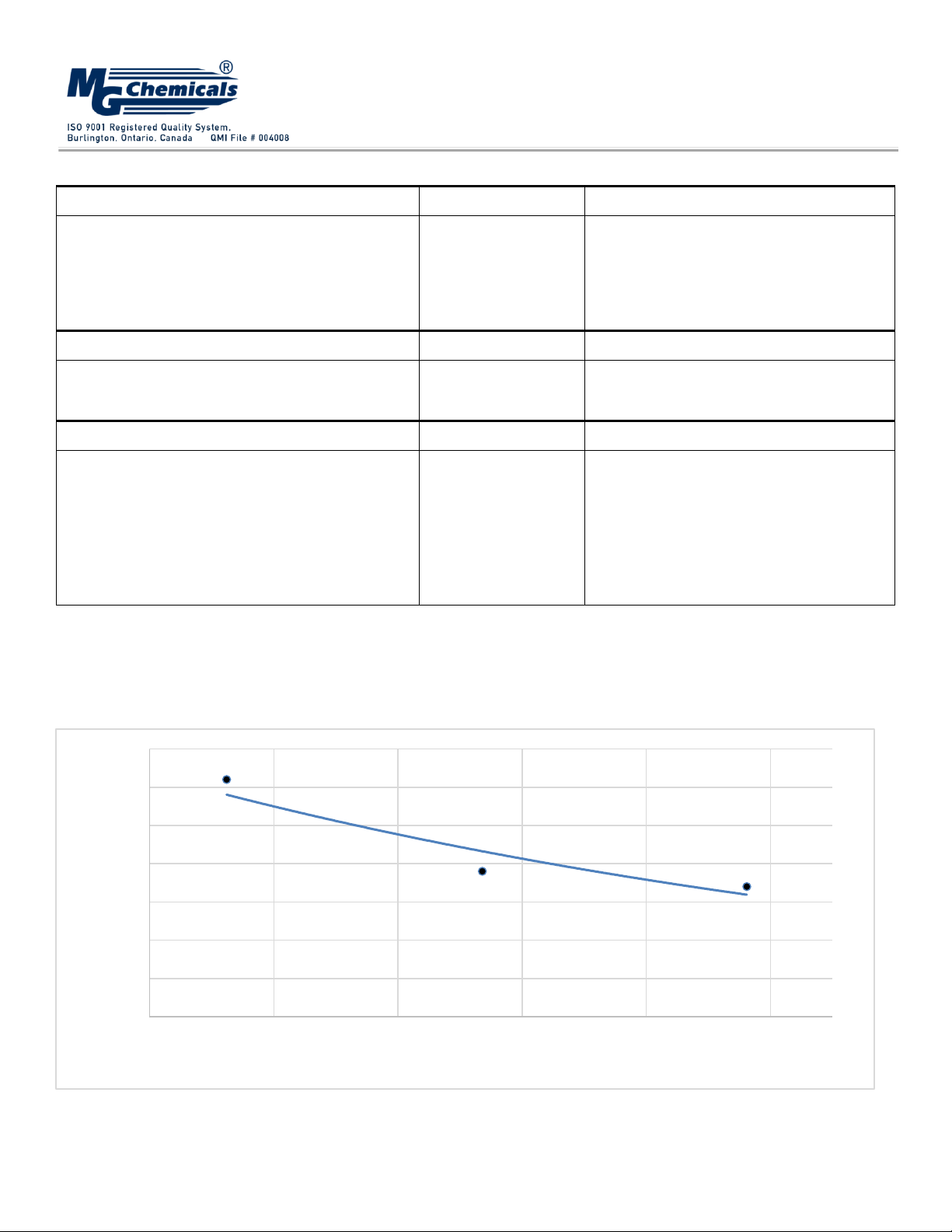
1.5 2.5 3.5 4.5 5.5 6.5
Surface Resistance (Ω/sq)
Thickness (mil)
a) Surface resistance is given in sq and the corresponding conductance in Siemens (S or -1
b) Tested using HVLP spray gun application on acrylonitrile butadiene styrene (ABS) coupons
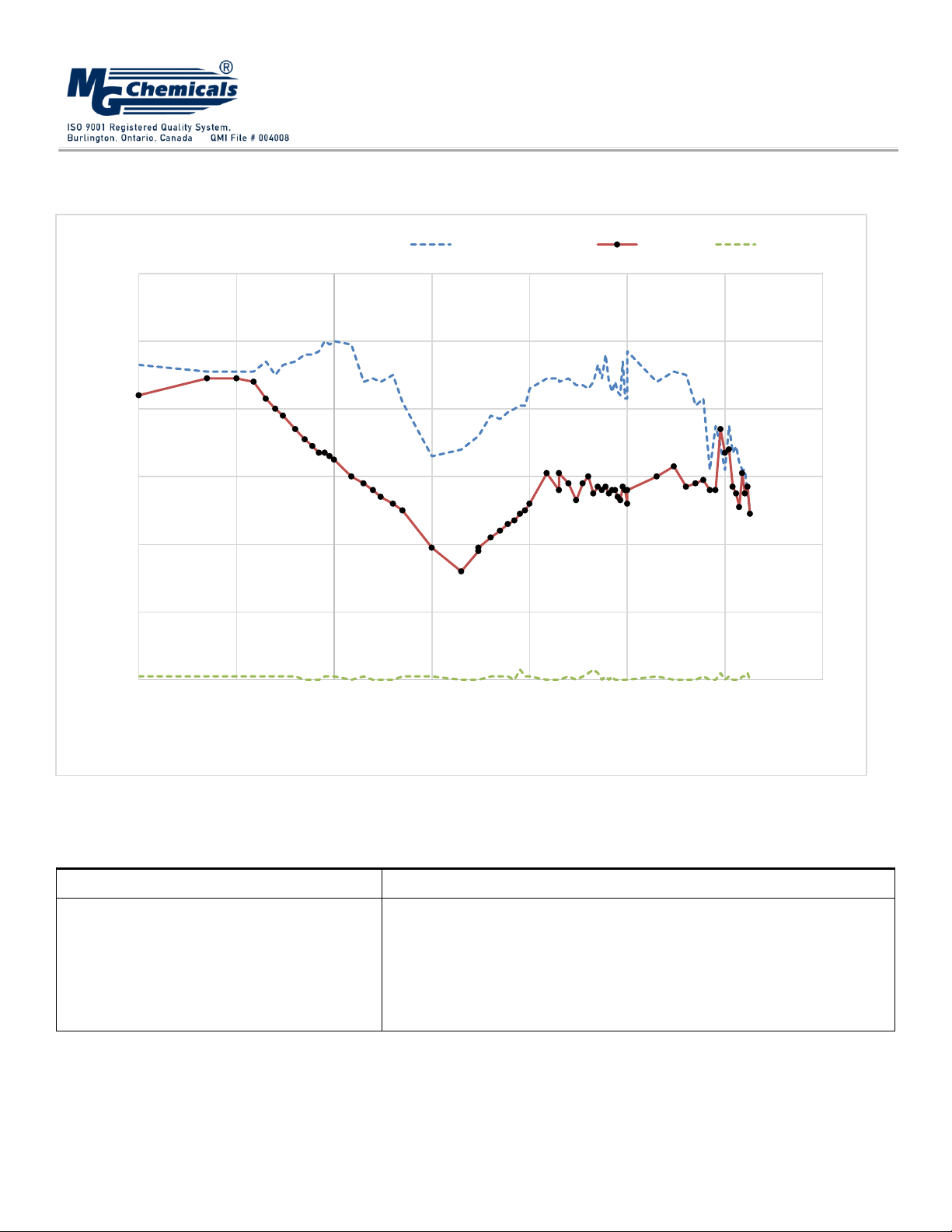
The coating surface resistance and attenuation are plotted in Figures 1 and 2.
Surface Resistance by Coating Thickness
Figure 1. Nickel conductive coating surface resistance at different thicknesses (the dots indicate typical
successive coat thicknesses)
Date: 15 June 2017 / Ver. 2.02
Page 3 of 8
Page 4
841AR-Aerosol
Super ShieldTM
Nickel Conductive Coating
841AR Technical Data Sheet
Physical Properties
Mixture
Color
Dark grey
Density @25 °C [77 °F]
1.3 g/mL
Solids Percentage (wt/wt)
38%
Viscosity @25 °C [77 °F] a)
61 cP [45 mm2/s]
Flash Point
-17 °C [1.4 °F]
Odor
Ethereal
0
20
40
60
80
100
120
0.01 0.1 1 10 100 1000 10000 100000
Attenuation (dB)
Frequency (MHz)
Aluminum Panel 841AR Blank
Shielding Attenuation
Figure 2. Attenuation of 841AR coating at different frequencies
Properties of Uncured 841AR
a) Brookfield viscometer at 60 RPM with spindle LV S61
Date: 15 June 2017 / Ver. 2.02
Page 4 of 8
Page 5
841AR-Aerosol
Super ShieldTM
Nickel Conductive Coating
841AR Technical Data Sheet
Substrate
Note
Acrylonitrile Butadiene Styrene (ABS)
Chemically etches a) and adheres well to this substrate.
Polybutlylene Terephtalate (PBT)
"
Polycarbonate
"
Polyvinyl Acetate (PVA)
"
Polyvinyl Chloride (PVC)
"
Polyamide (Nylon 6^6)
"
Acrylics or Acrylic Paints
Adheres well to clean surface
Epoxy, FR4 substrate
"
Polyurethane
Adheres well to clean surface for most urethane types
Wood
Adheres well with surface preparation
Compatibility
Chemical—Nickel has good resistance to oxidation in a variety of corrosive environments, including
marine environments. In normal atmosphere or freshwater, nickel typically corrodes less than 0.0025 mm
per year. Since nickel forms a passive protective film on its surface that slows down or stops further
corrosion, the passive nickel resists corrosion better than pure copper fillers. In addition, nickel is harder
than its silver or copper filled counterparts, helping provide greater durability.
The thermoplastic acrylic resin is incompatible common paint solvents like toluene, xylene, acetone, and
MEK. Further, it will not withstand chronic exposures to engine oils, fuels and other similar hydrocarbons.
While this makes the coating unsuitable for solvent rich environments, it does offers great repair and
rework characteristics.
Adhesion—The 841AR coating adheres to ABS, PBT, and most materials found on printed circuit
assemblies; however, it is not compatible with contaminants like water, oil, and greasy flux residues that
may affect adhesion. If contamination is present, clean the surface to be coated first.
841AR Adherence Compatibility
a) Etching is similar to sanding, except that it also softens the surface helping to meld the paint to the
plastic for superior adhesion.
ATTENTION! Do not use on thin plastics or on plastics where you want to keep original surface intact.
The 841AR spray contains a controlled amount of solvents designed to chemically etch plastic surfaces to
help adhesion by melding the acrylic coating into the plastic substrate. This prevents flaking or peeling.
Using the 4351-1L thinner lessens the etching effects for chemically sensitive substrates.
Storage
Store between -5 and 40 °C [23 and 104 °F] in dry area away from sunlight. Temperatures below or
above these outer limits will result in the container being crushed and/or ruptured.
Date: 15 June 2017 / Ver. 2.02
Page 5 of 8
Page 6
841AR-Aerosol
Super ShieldTM
Nickel Conductive Coating
841AR Technical Data Sheet
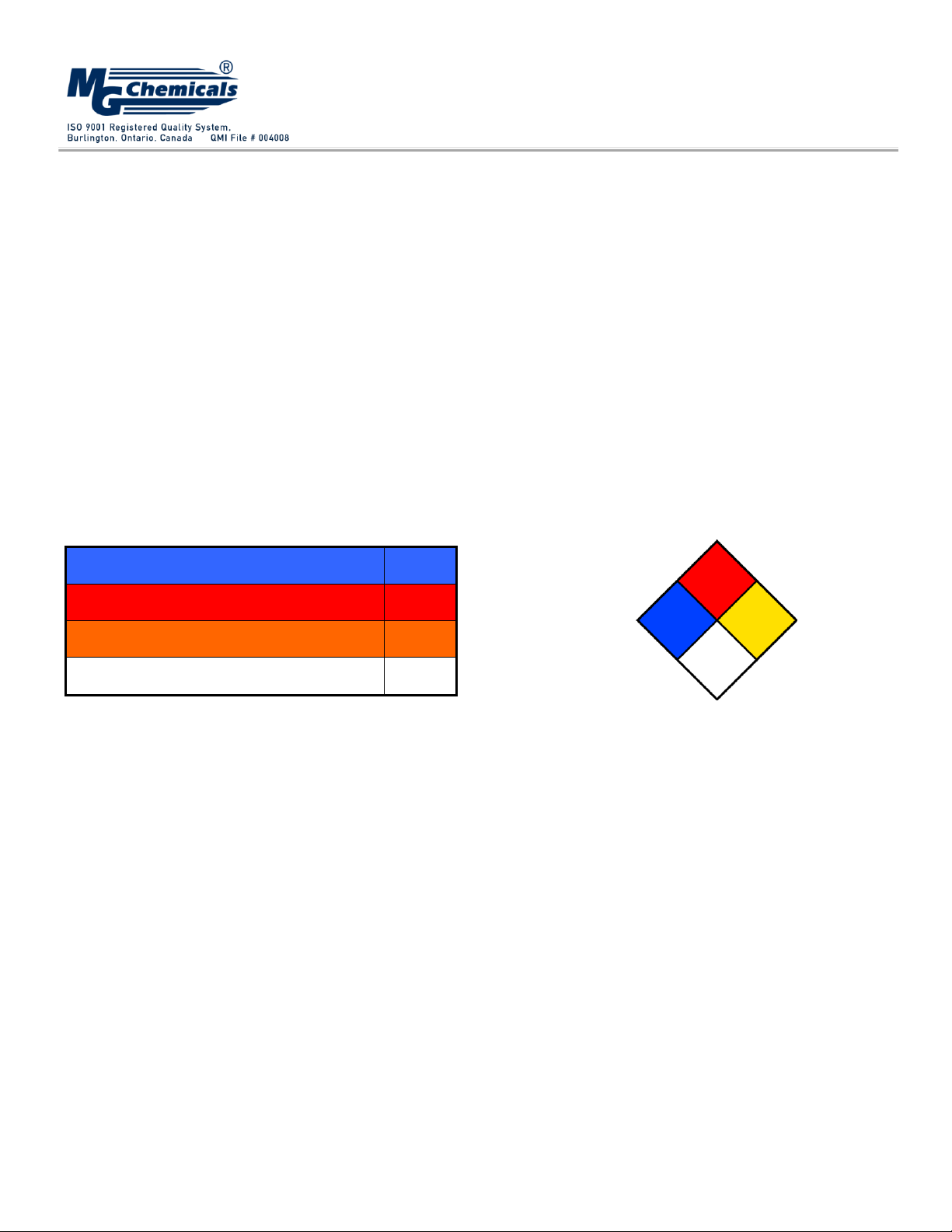
HMIS® RATING
NFPA® 704 CODES
HEALTH:
*
2
FLAMMABILITY:
3
PHYSICAL HAZARD:
0
PERSONAL PROTECTION:
2 0
3
Health, Safety, and Environmental Awareness
Please see the 841AR-Aerosol Safety Data Sheet (SDS) for greater details on transportation, storage,
handling and other security guidelines.
Environmental Impact: The VOC (Volatile Organic Compound) content is 34% (456 g/L) by EPA and
WHMIS standards.
This product meets the European Directive
2011/65/EU Annex II (ROHS);
recasting 2002/95/EC.
Health and Safety: The solvents in 841AR can ignite if exposed to flames or sparks and can cause
respiratory track irritation. If ignited, then flame flash back is possible. Use in well-ventilated area.
Solvents can cause skin irritation and have some reproductive effects. Wear safety glasses or goggles and
disposable gloves to avoid exposures.
Approximate HMIS and NFPA Risk Ratings Legend:
0 (Low or none); 1 (Slight); 2 (Moderate); 3 (Serious); 4 (Severe)
Aerosol Application Instructions
Follow the procedure below for best results. We recommend a coat with a dry film thickness of roughly
1 mil [25 m]. For thicker coats, apply many thin coats as opposed to spraying a single thick coat.
Prerequisites
• Ensure surface to be coated is oil free, dust free and clean
Material & Equipment
Personal protection equipment (See 841AR-Aerosol SDS)
Date: 15 June 2017 / Ver. 2.02
Page 6 of 8
Page 7
841AR-Aerosol
Super ShieldTM
Nickel Conductive Coating
841AR Technical Data Sheet
To apply the coating
1. Shake the can vigorously for 2 minutes. You should hear the bead swirling around freely at the
bottom if the settled material has lifted back in solution.
2. Spray a test pattern. This step ensures good flow quality and helps establish appropriate distance
to avoid runs.
3. At a distance of 15 to 20 cm (6 to 8 inches), spray a thin and even coat onto a vertical surface. For
best results, use spray-and-release strokes with an even motion to avoid excess paint in one spot.
Start and end each stroke off the surface.
4. Before the next coat, rotate the surface 90° or change stroke direction (horizontal or vertical) to
ensure good coverage.
5. Wait 1 minute, shake can, and spray another coat. The delay avoids trapping solvent between
coats.
6. Apply additional coats until desired thickness is achieved (go to Step 3).
7. Let dry for 3 minutes (flash off time) at room temperature.
NOTE: Swirling the aerosol can slightly while waiting prevents settling.
ATTENTION!
• Holding the can at a non-vertical angle during the spray application may result in uneven
application.
• Coats that are applied too thick cause runs and hamper solvent evaporation.
• Spraying onto horizontal surfaces is not recommended.
After use, clear the nozzle of the aerosol
1. Immediately invert the aerosol can upside down.
2. Press button until clear propellant comes out. The propellant should become clear in a few seconds.
3. Ensure the face of the button is clean of residues by wiping with a cloth or paper towel.
ATTENTION! Failure to clear nozzle can lead to valve being blocked open or closed in a non-noticeable
way.
• If blocked closed, the can will not be usable.
• If blocked slightly open, the contents can spill out overnight creating a mess.
To cure at Room temperature
• Let air dry 24 hours
To accelerate cure by heat
• After flash off, put in oven or under heat lamp at 65 °C for 30 min.
NOTE: Coats that are very thick require more time to dry. Heat curing ensures optimal
performance.
ATTENTION! If heat curing, do not exceed 65 °C as this may cause surface defects due to
solvents evaporating off too quickly.
Date: 15 June 2017 / Ver. 2.02
Page 7 of 8
Page 8
841AR-Aerosol
Super ShieldTM
Nickel Conductive Coating
841AR Technical Data Sheet
Cat. No.
Packaging
Net Volume
Net Weight
Packaging Weight
841AR-P
Pen
5.0 mL
0.16 fl oz
7.57 g
0.26 oz
0.03 kg
0.07 lb
841AR-340G
Aerosol
232 mL
7.84 fl oz
340 g
12 oz
TBD
TBD
841AR-15ML
Jar
12 mL
0.4 fl oz
20.2 g
0.71 oz
0.08 kg
0.17 lb
841AR-150ML
Can
150 mL
5.0 fl oz
253 g
8.93 oz
0.30 kg
0.67 lb
841AR-900ML
Can
850 mL
1.79 pt
1.43 kg
3.16 lb
1.77 kg
3.90 lb
841AR-3.78L
Can
3.60 L
3.8 qt
6.07 kg
13.3 lb
6.80 kg
15.0 lb
Packaging and Supporting Products
Note: TBD = To Be Determined
Thinners & Conductive Coating Removers
• Thinner: Cat. No. 435-1L, 435-4L
• Thinner 1: Cat. No. 4351-1L, 4351-4L
Disclaimer
This information is believed to be accurate. It is intended for professional end users having the skills to
evaluate and use the data properly. M.G. Chemicals Ltd. does not guarantee the accuracy of the data and
assumes no liability in connection with damages incurred while using it.
Date: 15 June 2017 / Ver. 2.02
Page 8 of 8
 Loading...