

Page 1
Portable Water Activity Measurement System
Operator’s Manual
METER Group, Inc.
Version: July 19, 2017 — 07:03:59
Page 2

Pawkit
METER Group, Inc.
2365 NE Hopkins Court
Pullman WA 99163
Phone: 509-332-5601
Fax: 509-332-5158
Website: www.metergroup.com
Email: [email protected] or
Trademarks
AquaLab is a registered trademark of METER Group, Inc.
c
2017 METER Group, Inc.
ii
Page 3

Pawkit CONTENTS
Contents
1 Introduction 1
1.1 Customer Support . . . . . . . . . . . . . . . . . . . . 1
1.2 About This Manual . . . . . . . . . . . . . . . . . . . 1
1.3 Warranty . . . . . . . . . . . . . . . . . . . . . . . . . 2
1.4 Seller’s Liability . . . . . . . . . . . . . . . . . . . . . . 2
2 About the Pawkit 3
2.1 Pawkit Instrument Specifications . . . . . . . . . . . . 3
2.2 How the Pawkit Works . . . . . . . . . . . . . . . . . . 4
2.3 Accuracy . . . . . . . . . . . . . . . . . . . . . . . . . 4
2.4 Getting Started . . . . . . . . . . . . . . . . . . . . . . 4
2.4.1 Components of your Pawkit System . . . . . . 4
2.5 Preparing for Operation . . . . . . . . . . . . . . . . . 5
3 Water Activity Theory 6
3.1 Moisture Content . . . . . . . . . . . . . . . . . . . . . 6
3.2 Water Activity . . . . . . . . . . . . . . . . . . . . . . 6
3.3 Water Potential . . . . . . . . . . . . . . . . . . . . . . 8
3.4 Sorption Isotherms . . . . . . . . . . . . . . . . . . . . 9
4 Getting Started 11
4.1 Features . . . . . . . . . . . . . . . . . . . . . . . . . . 11
4.2 Sample Preparation and Placement . . . . . . . . . . . 12
4.2.1 Sample Preparation . . . . . . . . . . . . . . . 12
4.2.2 Sample Placement . . . . . . . . . . . . . . . . 13
4.3 Taking Measurements . . . . . . . . . . . . . . . . . . 15
4.4 Turning Pawkit off . . . . . . . . . . . . . . . . . . . . 18
4.5 Sampling Precautions . . . . . . . . . . . . . . . . . . 18
4.6 Pawkit and Temperature . . . . . . . . . . . . . . . . . 19
5 Cleaning and Maintenance 20
5.1 Cleaning . . . . . . . . . . . . . . . . . . . . . . . . . . 20
5.1.1 Cleaning Supplies . . . . . . . . . . . . . . . . 20
5.2 Maintenance . . . . . . . . . . . . . . . . . . . . . . . 21
5.2.1 Sensor Filter Cleaning/Replacement . . . . . . 21
5.2.2 Thermopile Sensor Cleaning . . . . . . . . . . . 23
5.2.3 Chamber Cleaning Instructions . . . . . . . . . 23
iii
Page 4

CONTENTS Pawkit
5.2.4 Battery Replacement . . . . . . . . . . . . . . . 24
6 Verification and Calibration 27
6.1 Verification Standards . . . . . . . . . . . . . . . . . . 27
6.2 Steps to Verify Calibration . . . . . . . . . . . . . . . 28
7 Support and Repair 31
7.1 Repair Costs . . . . . . . . . . . . . . . . . . . . . . . 32
7.2 Loaner Service . . . . . . . . . . . . . . . . . . . . . . 32
8 Further Reading 33
8.1 Water Activity Theory & Measurement . . . . . . . . 33
9 Declaration of Conformity 55
iv
Page 5

Pawkit 1 INTRODUCTION
1 Introduction
Welcome to the Pawkit Water Activity Measurement system. The
Pawkit allows you to make quick measurements of water activity to
ensure the safety of your product. We hope you find the contents of
this manual useful in understanding your instrument and maximizing
its benefit to you.
1.1 Customer Support
If you ever need assistance with your Pawkit, have any questions or
feedback, there are several ways to contact us. METER has Customer Service Representatives available to speak with you Monday
through Friday, between 7 am and 5 pm Pacific time.
Note: If you purchased your Pawkit through a distributor, please
contact them for assistance.
Email:
[email protected] or [email protected]
Phone:
509-332-5601
Fax:
509-332-5158
If contacting us by email or fax, please include as part of your message your instrument serial number, your name, address, phone, fax
number, and a description of your problem or question.
1.2 About This Manual
This manual includes instructions for setting up your Pawkit, verifying the calibration of the instrument, preparing samples, and maintaining and caring for your instrument. Please read these instructions before operating your instrument to ensure that the instrument
1
Page 6

1 INTRODUCTION Pawkit
performs to its full potential.
1.3 Warranty
The Pawkit has a 30-day satisfaction guarantee and a one-year warranty on parts and labor. Your warranty is automatically validated
upon receipt of the instrument.
1.4 Seller’s Liability
Seller warrants new equipment of its own manufacture against defective workmanship and materials for a period of one year from the
date of receipt of equipment.
Note: We do not consider the results of ordinary wear and tear,
neglect, misuse, accident and excessive deterioration due to corrosion from any cause as defects.
The seller’s liability for defective parts shall in no event exceed the
furnishing of replacement parts Freight On Board the factory where
originally manufactured. Material and equipment covered hereby
which is not manufactured by Seller shall be covered only by the
warranty of its manufacturer. Seller shall not be liable to Buyer for
loss, damage or injuries to persons (including death), or to property
or things of whatsoever kind (including, but not without limitation,
loss of anticipated profits), occasioned by or arising out of the installation, operation, use, misuse, nonuse, repair, or replacement of said
material and equipment, or out of the use of any method or process
for which the same may be employed. The use of this equipment constitutes Buyer’s acceptance of the terms set forth in this warranty.
There are no understandings, representations, or warranties of any
kind, express, implied, statutory or otherwise (including, but without limitation, the implied warranties of merchantability and fitness
for a particular purpose), not expressly set forth herein.
2
Page 7

Pawkit 2 ABOUT THE PAWKIT
2 About the Pawkit
The Pawkit is designed to be a simple, rapid and portable system
for measurement of water activity. It is easy to use, durable, and
requires little maintenance.
2.1 Pawkit Instrument Specifications
Sensor Type: Capacitance Sensor
Water Activity Range: 0.00to1.00 a
w
Water Activity Accuracy: ±0.02
Water Activity Resolution: 0.01
Sample Temperature Accuracy: ±0.2◦C
Sample Temperature Resolution: 0.1◦C
Read Time: 5 min
Sample Dish Capacity: 7.5 mL Recommended (15 mL Full)
Operating Environment: 4 to 50◦C; 0 to 90% Relative Humidity
(non-condensing)
Case Dimensions: 6.6 x 10.7 x 2.0 cm
Weight: 115 g (4 oz)
Case Material: Stainless Steel and Valox 325 Plastic
Display: 6-digit Custom LCD with Symbols
Data Communications: NA
Power: 2 to 3 Volt 16 mm coin cell batteries (Three Years)
Warranty: 1 year parts and labor
3
Page 8

2 ABOUT THE PAWKIT Pawkit
2.2 How the Pawkit Works
The Pawkit uses a capacitance humidity sensor to measure the water
activity of a sample. The sensor converts the humidity value into a
specific capacitance, which is then measured electronically by the circuit. This signal is then translated by the software and displayed as
water activity on the instrument screen. At equilibrium, the relative
humidity of the air in the chamber is the same as the water activity
of the sample.
2.3 Accuracy
The Pawkit is accurate to ±0.02 aw. For many applications, this accuracy is more than adequate. If you require higher accuracy in your
measurements, we recommend you use METER’s AquaLab water activity meter, which is a lab-grade, bench-top instrument that has an
accuracy of ±0.003 aw, and measures based upon the chilled-mirror
dew point method. Contact METER for more details.
2.4 Getting Started
2.4.1 Components of your Pawkit System
Your Pawkit should have been shipped to you with the following
items:
• Pawkit main unit
• Operator’s Manual
• Quick Start Guide
• Certificate of Analysis
• Calibration Certificates
• Anti-Skid Pad
• Durable carrying case
• 60 disposable sample cups with lids
4
Page 9

Pawkit 2 ABOUT THE PAWKIT
• Spare sensor filters
• Reusable stainless steel cup
• Two vials each of the following verification standards:
2.33 mol/kg NaCl (0.920 aw)
6.00 mol/kg NaCl (0.760 aw)
13.41 mol/kg LiCl (0.250 aw)
• AquaLab cleaning kit
2.5 Preparing for Operation
To ensure that your Pawkit operates correctly and consistently, always place it on a level surface when measuring. This mitigates
the risk of sample material spilling inside the instrument. To avoid
inaccurate readings, place your Pawkit in a location where the temperature remains fairly stable. This location should be well away
from air conditioner and heater vents, open windows, outside doors,
refrigerator exhausts, or other items that may cause rapid temperature fluctuation.
5
Page 10

3 WATER ACTIVITY THEORY Pawkit
3 Water Activity Theory
Water is a major component of foods, pharmaceuticals, and cosmetics. Water influences the texture, appearance, taste and spoilage of
these products. There are two basic types of water analysis: moisture
content and water activity
3.1 Moisture Content
The meaning of the term moisture content is familiar to most people.
It implies a quantitative analysis to determine the total amount of
water present in a sample. There are two primary methods for determining moisture content: loss on drying and Karl Fisher titration,
but you can also use secondary methods such as infrared and NMR.
Moisture content determination is essential in meeting product nutritional labeling regulations, specifying recipes and monitoring processes. However, moisture content alone is not a reliable indicator for
predicting microbial responses and chemical reactions in materials.
The limitations of moisture content measurement are attributed to
differences in the intensity with which water associates with other
components.
3.2 Water Activity
Water activity is a measure of the energy status of the water in a
system, and thus is a far better indicator of perishability than water
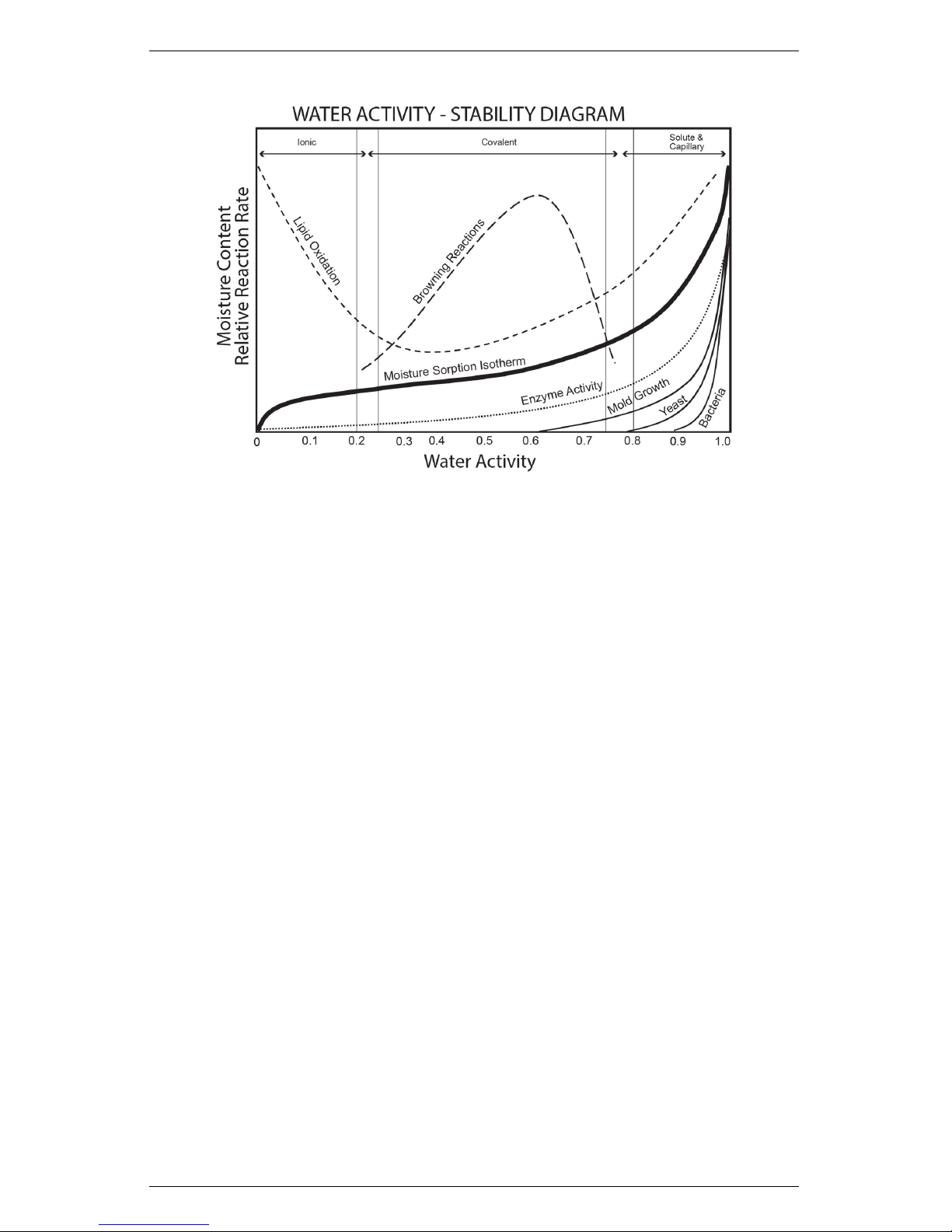
content. Figure 1 shows how the relative activity of microorganisms,
lipids and enzymes relate to water activity. While other factors, such
as nutrient availability and temperature, can affect the relationships,
water activity is the best single measure of how water affects these
processes. Researchers measure the water activity of a system by
equilibrating the liquid phase water in the sample with the vapor
phase water in the headspace and measuring the relative humidity
of the headspace. In the Pawkit, place a sample in the sample cup
that fits underneath the Pawkit. Inside the sensor block is a capacitive humidity sensor. Changes in the electrical capacitance of the
polymide layer of the sensor occur as the relative humidity of the
6
Page 11
Pawkit 3 WATER ACTIVITY THEORY
Figure 1: Water Activity Diagram adapted from Labuza
chamber changes. The Pawkit computes the relative humidity of the
headspace by monitoring the change in electrical capacitance. When
the water activity of the sample and the relative humidity of the air
are in equilibrium, the measurement of the headspace humidity gives
the water activity of the sample.
In addition to equilibrium between the liquid phase water in the
sample and the vapor phase, the internal equilibrium of the sample
is important. If a system is not at internal equilibrium, one might
measure a steady vapor pressure (over the period of measurement)
which is not the true water activity of the system. An example of this
might be a baked good or a multi-component food. Initially out of
the oven, a baked good is not at internal equilibrium; the outer surface is at a lower water activity than the center of the baked good.
One must wait a period of time in order for the water to migrate
and the system to come to internal equilibrium. It is important to
remember the restriction of the definition of water activity to equilibrium.
Temperature Effects
Temperature plays a critical role in water activity determination.
7
Page 12

3 WATER ACTIVITY THEORY Pawkit
Most critical is the measurement of the difference between sample
and capacitance sensor temperature. Best accuracy is therefore obtained when the sample is near chamber temperature.
3.3 Water Potential
Some additional information may be useful for understanding what
water activity is and why it is such a useful measure of moisture
status in products. Water activity is closely related to a thermodynamic property called the water potential, or chemical potential (µ)
of water, which is the change in Gibbs free energy (∆G) when water
concentration changes. Equilibrium occurs in a system when (µ) is
the same everywhere in the system. Equilibrium between the liquid
and the vapor phases implies that (µ) is the same in both phases.
It is this fact that allows us to measure the water potential of the
vapor phase and use that to determine the water potential of the liquid phase. Gradients in (µ) are driving forces for moisture movement.
Thus, in an isothermal system, water tends to move from regions
of high water potential (high aw) to regions of low water potential
(low aw). Water content is not a driving force for water movement,
and therefore can not be used to predict the direction of water movement, except in homogeneous materials.
Factors In Determining Water Activity
The water activity of the water in a system is influenced by factors
that effect the binding of water. They include osmotic, matric, and
pressure effects. Typically water activity is measured at atmospheric
pressure, so only the osmotic and matric effects are important.
Osmotic Effects: Osmotic effects are well known from biology and
physical chemistry. Water is diluted when a solute is added. If
this diluted water is separated from pure water by a semi-permeable
membrane, water tends to move from the pure water side through
the membrane to the side with the added solute. If sufficient pressure
is applied to the solute-water mixture to just stop the flow, this pressure is a measure of the osmotic potential of the solution. Addition
8
Page 13

Pawkit 3 WATER ACTIVITY THEORY
of one mole of an ideal solute to a kilogram of water produces an
osmotic pressure of 22.4 atm. This lowers the water activity of the
solution from 1.0 to 0.98 aw. For a given amount of solute, increasing
the water content of the systems dilutes the solute, decreasing the
osmotic pressure, and increasing the water activity. Since microbial
cells are high concentrations of solute surrounded by semi-permeable
membranes, the osmotic effect on the free energy of the water is important for determining microbial water relations and therefore their
activity.
Matric Effects: The sample matrix affects water activity by physically binding water within its structure through adhesive and cohesive forces that hold water in pores and capillaries, and to particle
surfaces. If cellulose or protein were added to water, the energy status of the water would be reduced. Work would need to be done to
extract the water from this matrix. This reduction in energy status
of the water is not osmotic, because the cellulose or protein concentrations are far too low to produce any significant dilution of water.
The reduction in energy is the result of direct physical binding of
water to the cellulose or protein matrix by hydrogen bonding and
van der Waal forces. At higher water activity levels, capillary forces
and surface tension can also play a role.
3.4 Sorption Isotherms
Relating Water Activity to Water Content
Changes in water content affect both the osmotic and matric binding
of water in a product. Thus a relationship exists between the water
activity and water content of a product. This relationship is called
the sorption isotherm, and is unique for each product. Besides being
unique to each product, the isotherm changes depending on whether
it was obtained by drying or wetting the sample. These factors need
to be kept in mind if one tries to use water content to infer the
stability or safety of a product. Typically, large safety margins are
built into water content specifications to allow for these uncertainties.
While the sorption isotherm is often used to infer water activity from
9
Page 14

3 WATER ACTIVITY THEORY Pawkit
water content, one could easily go the other direction and use the water activity to infer the water content. This is particularly attractive
because water activity is much more quickly measured than water
content. This method gives particularly good precision in the center
of the isotherm. In order to infer water content from water activity,
one needs an isotherm for the particular product. METER sells an
Isotherm Generator called the AquaLab Vapor Sorption Analyzer or
you can also have METER run the isotherm for a fee.
For example, if one were to monitor the water content of dried potato
flakes, one would measure the water activity and water content of
potato flakes dried to varying degrees using the standard drying process for those flakes. An isotherm would be constructed using those
data, and the water content would be inferred using the measured
water activity of samples and that isotherm.
We cannot overemphasize the importance of the concept of water
activity for foods, pharmaceuticals, and cosmetics. Water activity is
a measure of the energy status of the water in a system. More importantly, the utility of water activity in relation to microbial growth,
chemical reactivity, and stability over water content has been shown.
10
Page 15
Pawkit 4 GETTING STARTED
4 Getting Started
Operation of the Pawkit is very simple. Once you have ensured
that you have a stable working environment, you are ready to begin
sampling. The following is a description of the features and operation
of the instrument.
4.1 Features
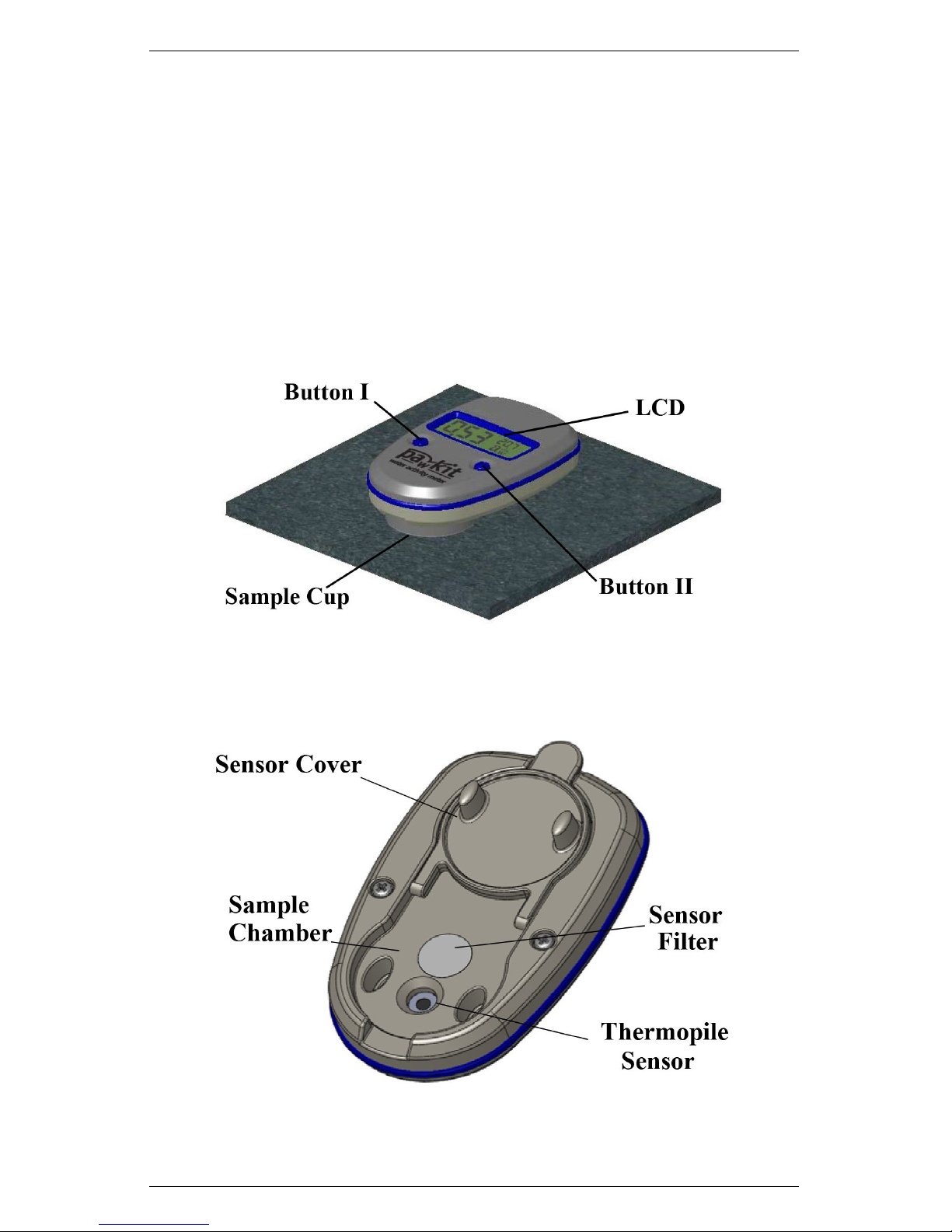
Figure 2: Pawkit Features Top
Figure 3: Pawkit Features Bottom
11
Page 16

4 GETTING STARTED Pawkit
4.2 Sample Preparation and Placement
Your Pawkit system comes with 60 disposable plastic sample cups
and one stainless steel sample cup. If you run out, you can purchase
additional cups from METER.
4.2.1 Sample Preparation
Take special care when preparing the sample in order to get the
best readings possible. Always follow the bulleted guidelines when
preparing samples.
• Make sure that the sample to be measured is homogeneous. Multi-component samples (e.g., muffins with raisins)
or samples that have outside coatings (like deep-fried, breaded
foods) can be measured, but may take longer to equilibrate.
Samples like these may require additional preparation (crushing or grinding) to obtain a representative sample.
• Completely cover the bottom of the cup with the sample, if possible. The Pawkit is able to accurately measure
a sample that leave small spaces of the cup bottom exposed.
For example, raisins only need to be placed in the cup and not
flattened to cover the bottom. A larger sample surface area
increases instrument efficiency by shortening the time needed
to reach vapor equilibrium.
• Fill the cup no more than half-full of the sample. The
Pawkit does not require a large sample size to make its reading.
As long as the sample covers the bottom of the cup and the
sample is representative of the product you wish to measure,
you should be able to make accurate readings. If the sample
cup is too full, you risk contaminating the sensor, which can
lead to inaccurate readings.
• Make sure that the rim and outside of the sample cup
are clean. Wipe any excess sample material from the rim
of the cup with a clean tissue. Material left on the rim or the
outside of the cup can be transferred to subsequent samples and
may affect the accuracy of your readings. The rim of the cup
12
Page 17
Pawkit 4 GETTING STARTED
forms a vapor seal with the sensor. Any sample material left
on the cup rim may prevent this seal and contaminate future
samples.
• If you are reading a sample at a later time, put the
sample cup disposable lid on the cup to restrict water
transfer. To seal the lid, place tape or ParafilmTMcompletely
around the cup/lid junction. It is necessary to seal the cup if
it is going to be a long time before you make the measurement.
4.2.2 Sample Placement
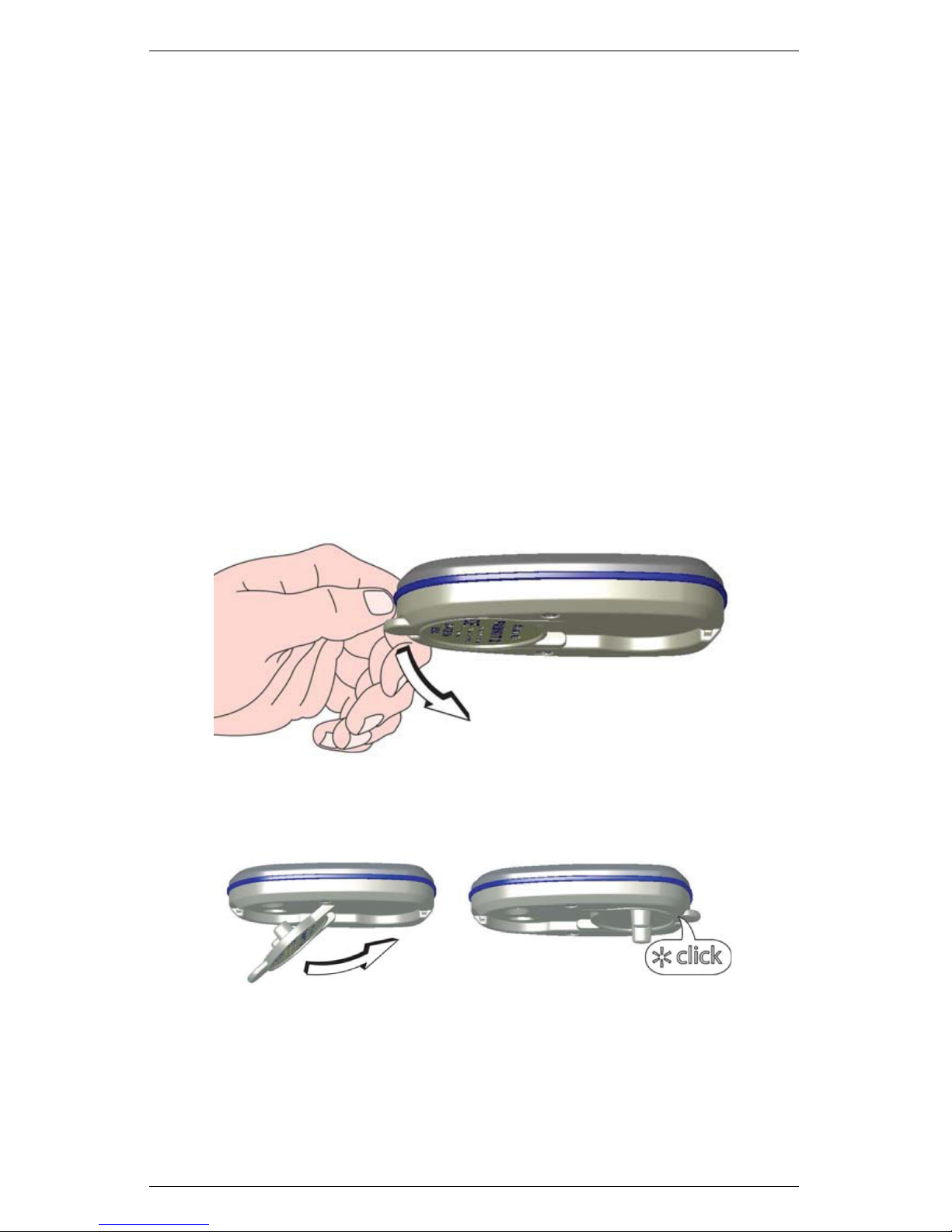
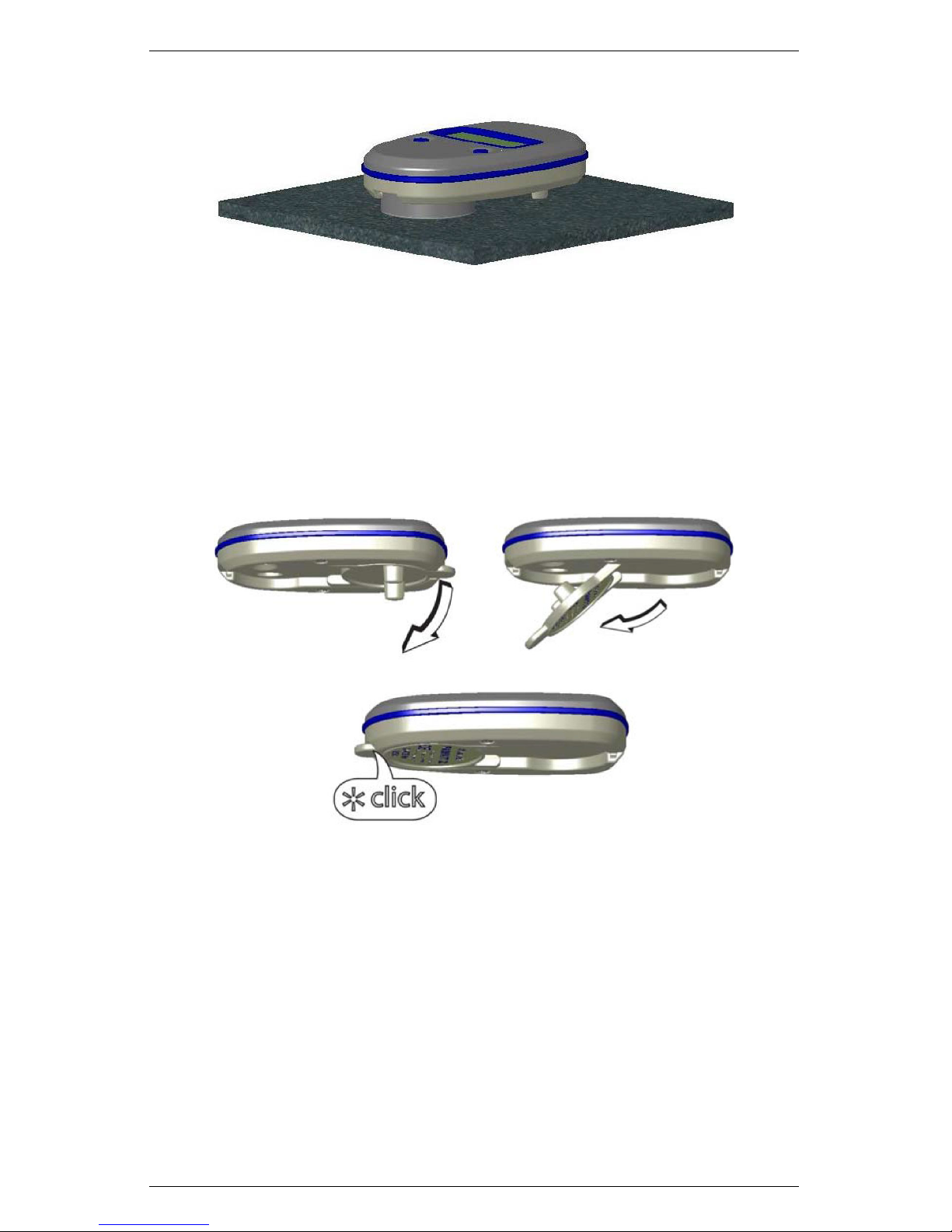
1. Open the Pawkit by holding the case near the LCD with one
hand and pulling down on the plastic sensor cover tab with the
other hand.
The sensor cover rotates and snaps into the open position.
13
Page 18
4 GETTING STARTED Pawkit
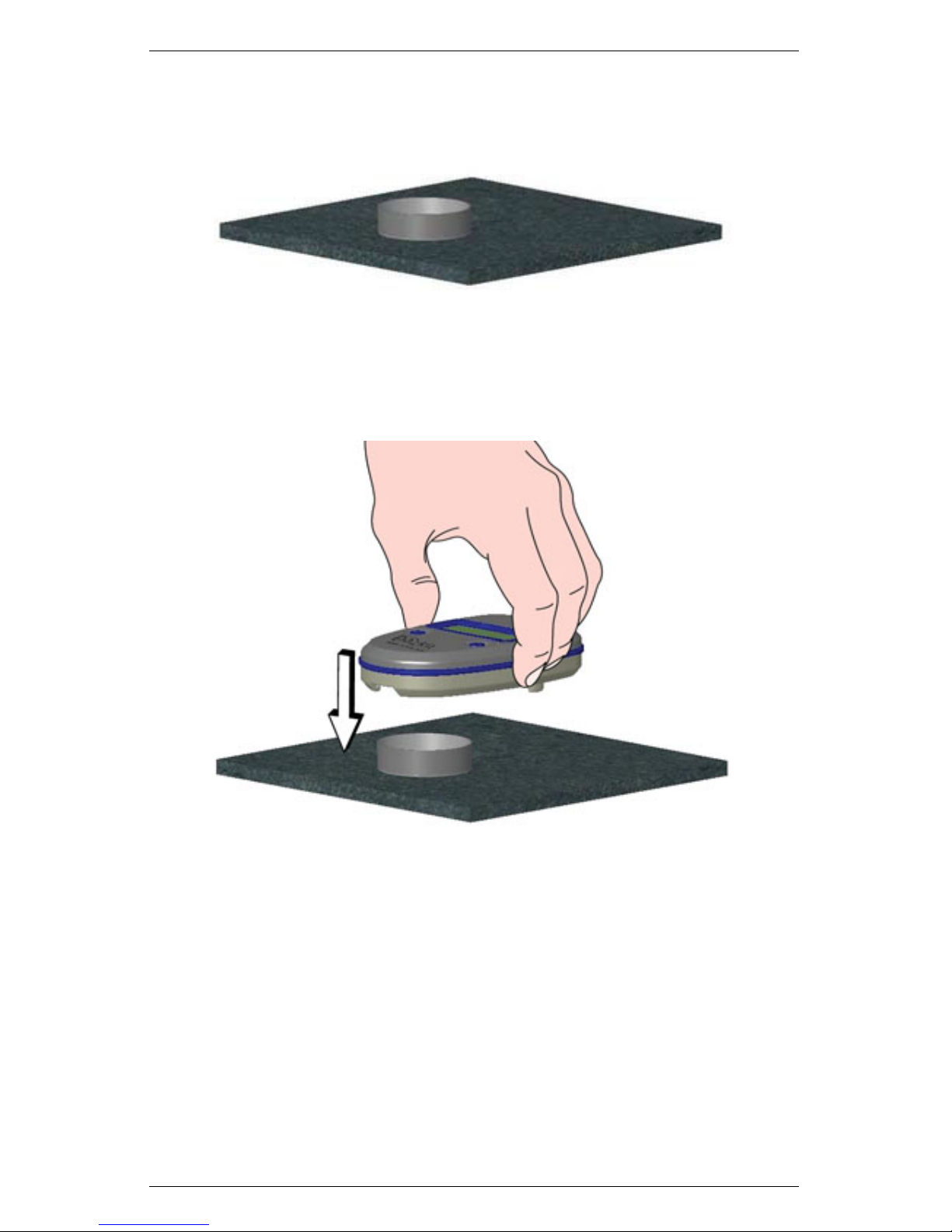
2. Place your prepared sample cup onto a level surface.
Next, place the opened Pawkit onto the prepared sample cup.
The cup fits under the sensor into a recess in the bottom of the
Pawkit.
A correctly positioned cup results in the Pawkit being level on
the bench when sitting on the cup and the sensor cover legs.
Ensure the cup is entirely within the recess. Otherwise, the
Pawkit may not be level on the bench and the cup might not
make a vapor seal with the sensor.
14
Page 19
Pawkit 4 GETTING STARTED
3. Once you have the Pawkit properly positioned over the sample
cup, you are now ready to take readings.
4. To close the instrument, reverse the opening procedure. With
one hand holding the case near the LCD pull down on the
plastic sensor cover tab with the other hand and rotate until it
snaps into the closed position covering the sensors.
4.3 Taking Measurements
1. Make sure the sample cup is positioned as described in the
Sample Placement section.
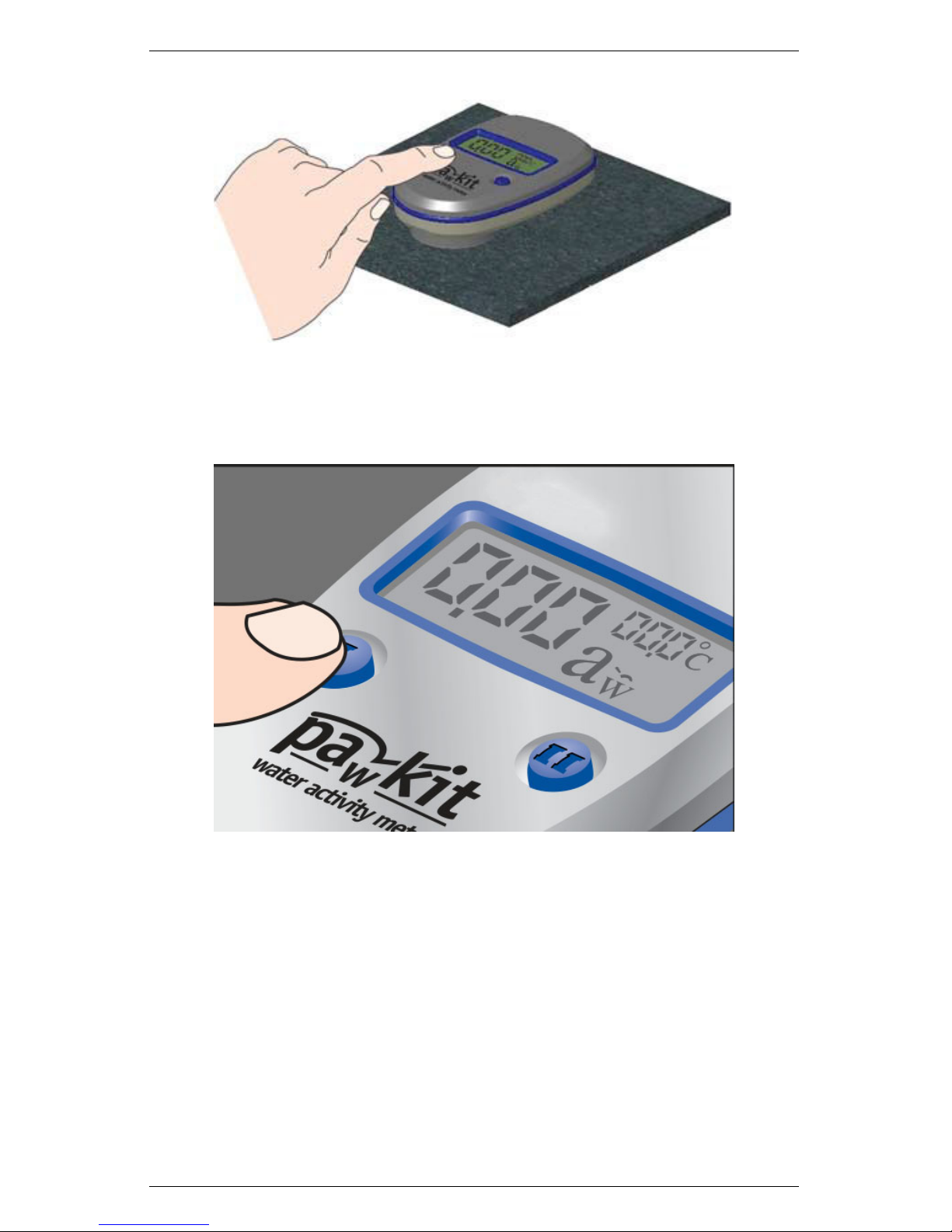
2. Press the left button (I) to turn on the instrument. It displays
the last reading taken. This allows you to begin a measurement
and leave without having to attend the instrument throughout
the measurement. If it is already on, proceed to the next step.
15
Page 20
4 GETTING STARTED Pawkit
3. Press button I to begin the water activity measurement. The
LCD display resets to 0.00aw.
Note: Pressing button I any time during a measurement restarts
the water activity measurement.
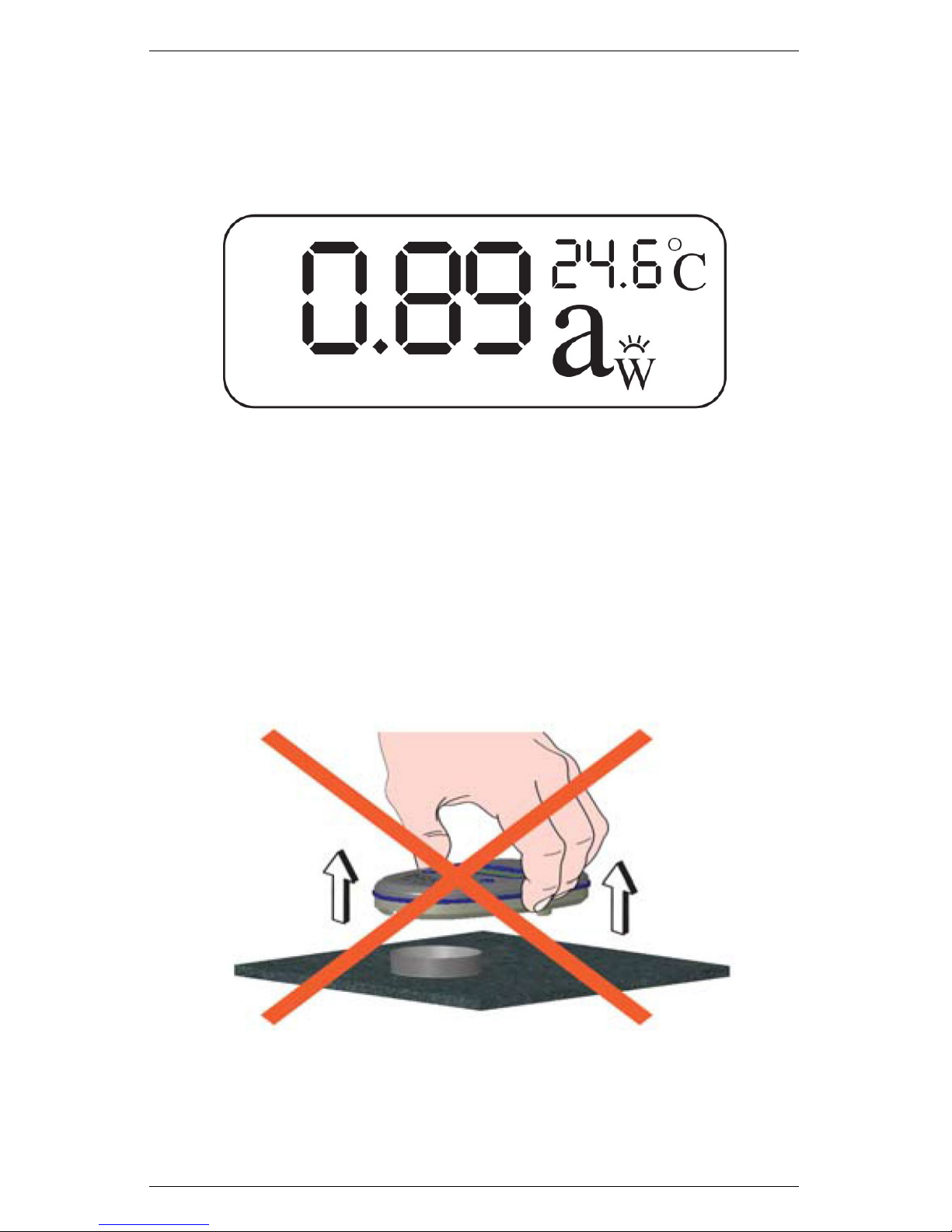
4. Once the measurement process has been started, the Pawkit
begins to display water activity measurements as well as temperature after five seconds updating the display every second
thereafter. During this time you are be able to see that it is
measuring by looking at the “sunburst” icon to the right of the
water activity value. As it measures, you may see the “beams”
of the sunburst move from left to right.
16
Page 21
Pawkit 4 GETTING STARTED
Note: The final water activity measurement is not be displayed
until the instrument beeps and the sunburst icon disappears
from the screen.
If you receive an error code of 9.99 at any time during the
process, it indicates that the sensor has failed and that the
instrument needs to be serviced. Refer to Section 7 for instructions on how to return your Pawkit for repair.
Note: DO NOT lift or move the instrument during the measurement. You risk contaminating the chamber and breaking
the chamber vapor seal and invalidates the water activity measurement.
5. After five minutes, the instrument displays the final water activity and beep five times. The sunburst disappears when the
water activity reading is finished.
17
Page 22
4 GETTING STARTED Pawkit
Note: We recommend you record the reading value before proceeding.
At this point you can either restart the measurement by pressing button I again or end the measurement procedure.
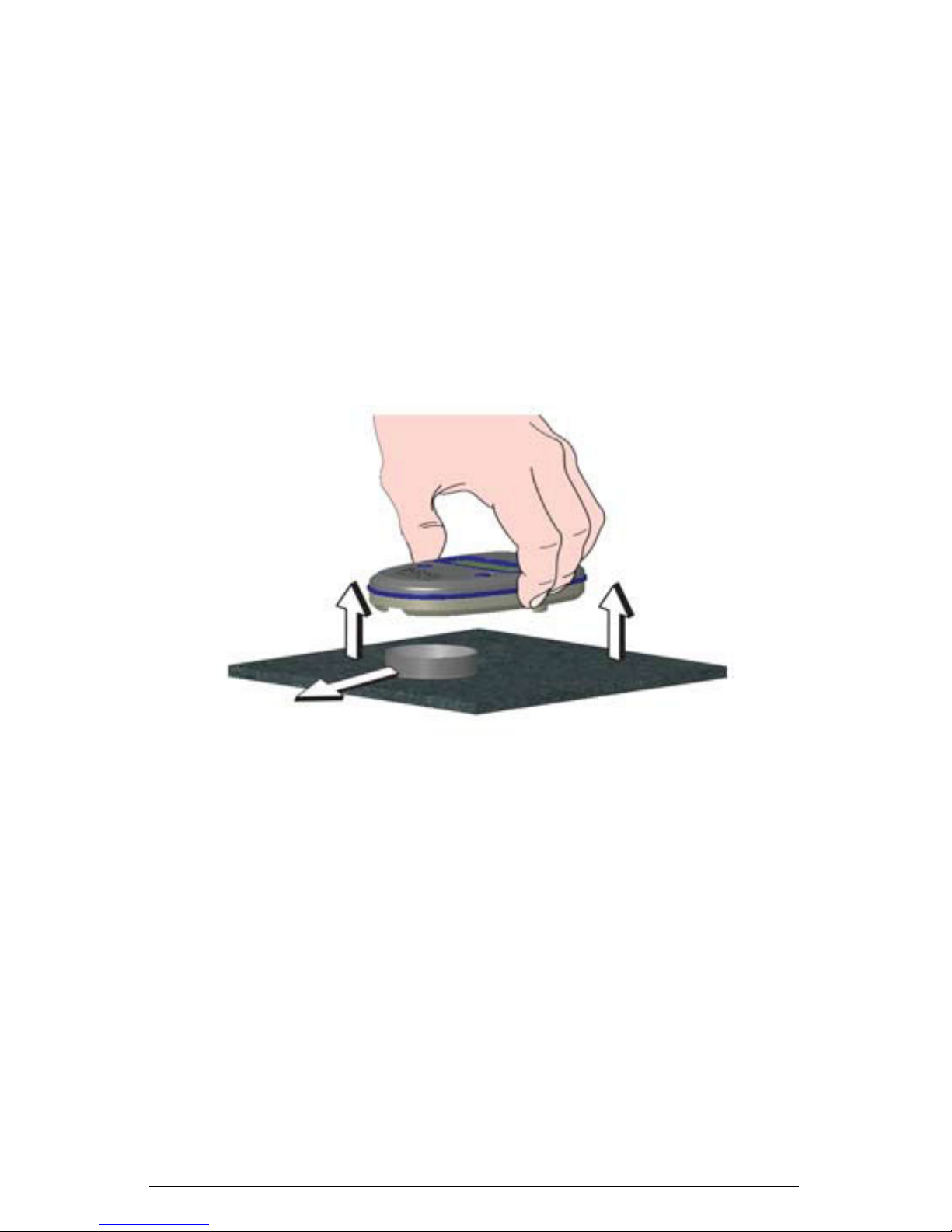
6. Remove the sample cup by lifting the Pawkit. Lift the Pawkit
straight up as shown to avoid spilling the sample cup. The
sample may now be discarded or covered with a lid if it is to
be re-measured at a later time.
4.4 Turning Pawkit off
To turn off the Pawkit, leave it idle for more than five minutes, and
it shuts off automatically. If the Pawkit has automatically shut itself
off, pressing the “I” button wakes up the instrument and display the
last water activity measurement.
Remember to close the lid before storing the case.
4.5 Sampling Precautions
Long exposure to a variety of volatile substances or to samples with
water activities near 1.00 can shift the sensor calibration. Therefore,
18
Page 23
Pawkit 4 GETTING STARTED
always remove samples as soon as the Pawkit is finished sampling
(beeps) to avoid damage to the sensor. If a sample is accidentally
left in the chamber for an extended period of time, be sure to check
the calibration when you next use the instrument.
If sensor damage occurs, the instrument displays an error code of
9.99 on the screen. Refer to Section 7 for further instructions on how
to return your Pawkit for repair.
4.6 Pawkit and Temperature
The Pawkit makes its most accurate measurements when the sample
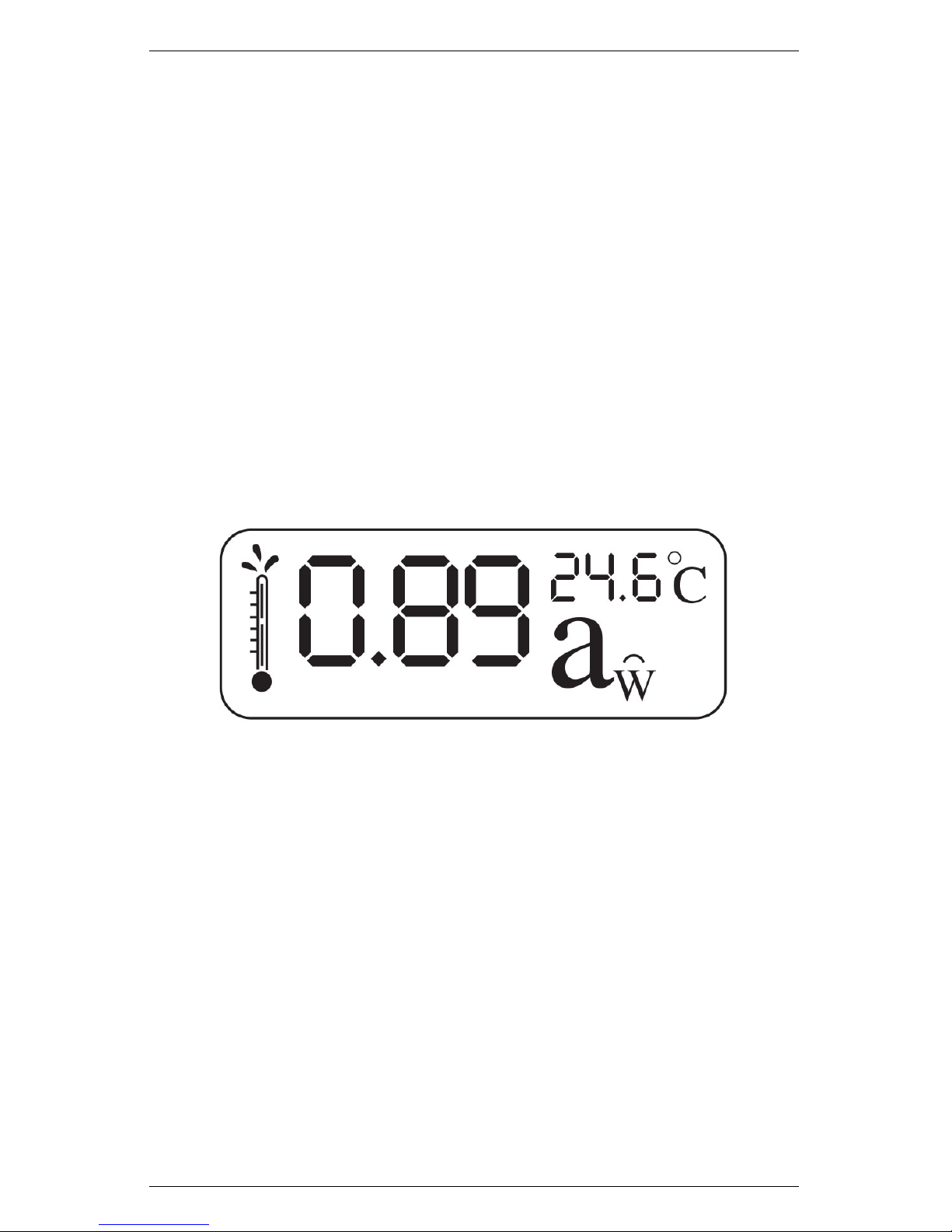
and instrument temperatures are within 1◦C. If the sample is too
warm, the thermometer icon on the left of the screen appears.
You see the “mercury” go up the thermometer and pop out of the
top, and the instrument beeps, indicating that the sample temperature is too high and there is danger of condensing water in the sample
chamber and on the sensor. If you get this warning while sampling,
remove the Pawkit, place the cup lid on the sample and wait until it
has reached ambient temperature before attempting to read again.
If your sample is colder than the ambient temperature of the Pawkit,
the accuracy of your reading after five minutes may be questionable.
Wait until the sample temperature is similar to that of the Pawkit.
19
Page 24

5 CLEANING AND MAINTENANCE Pawkit
5 Cleaning and Maintenance
5.1 Cleaning
The accuracy of your Pawkit is dependent on keeping your instrument clean. Dust and sample debris can contaminate the sampling
chamber, and must therefore be regularly cleaned out. To clean your
instrument, carefully follow the instructions in this Section.
5.1.1 Cleaning Supplies
Your new instrument comes with the compact AquaLab Cleaning
Kit that contains all the materials needed to clean the instrument for
about a year. If you need to purchase a new cleaning kit, please contact us by phone at 509-332-5601 or at [email protected].
AquaLab offers two sizes of cleaning kits. The larger cleaning kit is
primarily used for benchtop units and the compact is more useful for
the handheld. The following supplies are included in the compact
cleaning kit.
• Swab (a thin plastic rod)
• Steam Distilled Water
• Cleaning Solution
• Kimwipe
R
Strips
• Sample Cup with Charcoal Pellets
• Cleaning Procedure Information Card
Note: Wash your hands with soap and water and/or use clean lab
gloves before starting the cleaning procedure. This prevents oils from
contaminating the cleaning materials, the sample chamber and/or
the sensors.
Here are four tips for keeping your Pawkit clean.
1. First, watch the instructional AquaLab Pawkit and Lite cleaning video at http://www.aqualab.com/education/aqualab-pawkit-
lite-cleaning-video/ to see step-by-step instructions on how to
clean your Pawkit.
20
Page 25

Pawkit 5 CLEANING AND MAINTENANCE
2. Use only a soft cotton cloth to clean the LCD. Tissues can
scratch the plastic, causing damage.
3. Use moist Kimwipes or soft cotton cloth to clean the rest of
the outer case.
4. Begin each step cleaning the chamber and thermopile sensor
using a new Kimwipe strip wrapped around the plastic swab
included in your kit. If you have spilled sample material on
the sensor filter and it does not come off replace the filter as
explained in the next section. It is important that contamination of this filter is minimized, as the relative humidity of the
sample is measured via the filter.
5.2 Maintenance
5.2.1 Sensor Filter Cleaning/Replacement
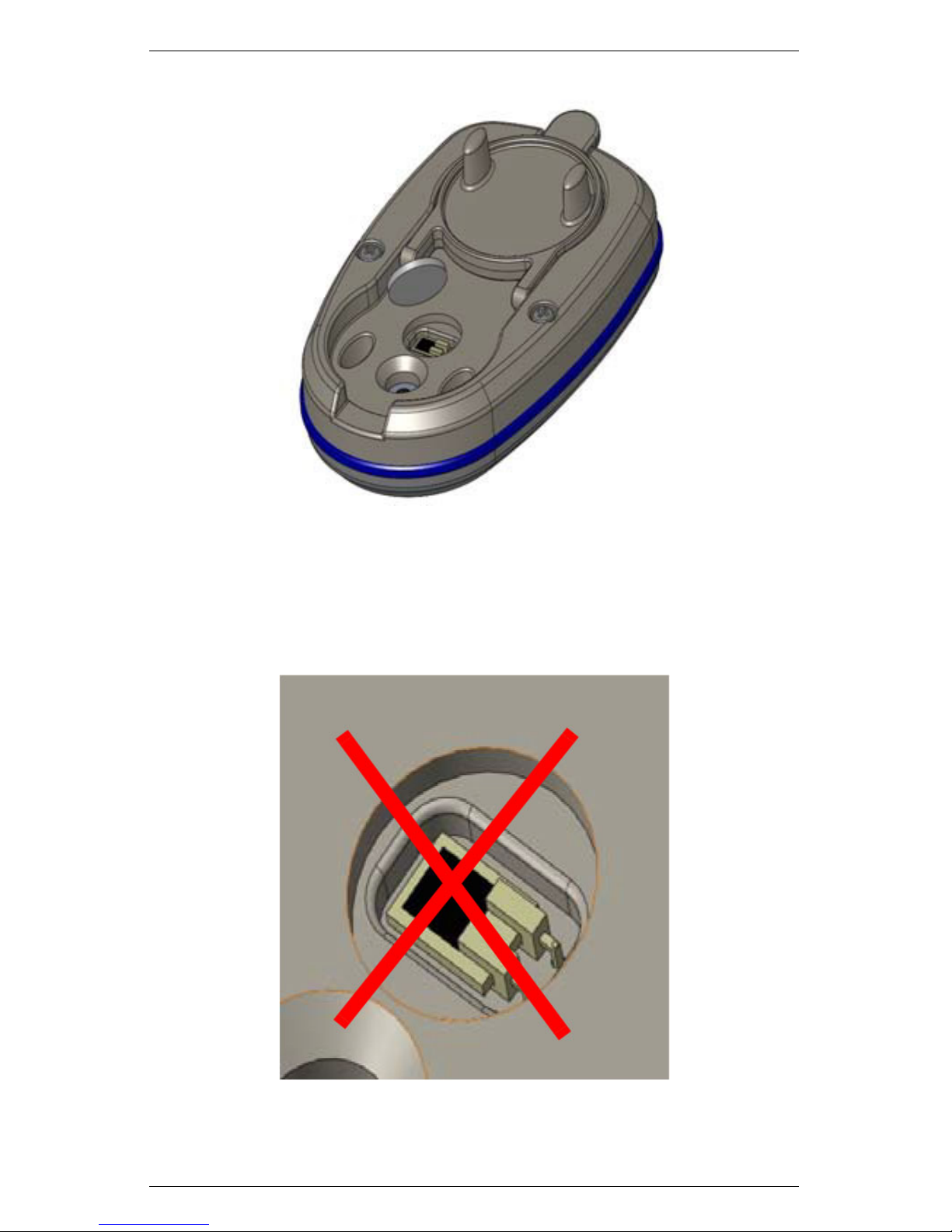
You may periodically need to replace the porous white humidity
sensor filter if it becomes dirty. To remove the sensor filter use a
knife or needle point to gently pry up the edge of the filter. Your
Pawkit shipped with three spare filters and you can order more by
contacting METER through email at [email protected] or
by phone at 509-332-5601.
21
Page 26
5 CLEANING AND MAINTENANCE Pawkit
Figure 4: Removal of Filter
Caution: The capacitance humidity sensor below the filter
is extremely fragile, Do not touch it.
22
Page 27

Pawkit 5 CLEANING AND MAINTENANCE
5.2.2 Thermopile Sensor Cleaning
The lens of this sensor must be free of all dirt and lint to be accurate.
1. WASH–using a Kimwipe tissue moistened with cleaning solution or isopropyl alcohol to clean the thermopile sensor.
2. RINSE–using a new Kimwipe moistened with steam distilled
water to rinse the cleaning solution from the sensor.
3. DRY–use a dry Kimwipe to help remove any moisture remaining from the cleaning process.
5.2.3 Chamber Cleaning Instructions
Wrap a new Kimwipe strip around the end of the swab (included in
the cleaning kit) and moisten it with cleaning solution or isopropyl
alcohol.
1. WASH–clean the surrounding chamber area with the moist
Kimwipe. The chamber area, especially where the cup seals,
must be free of all contamination.
2. RINSE–repeat the steps above using a new Kimwipe strip moistened with steam distilled water.
3. DRY–repeat steps above again, this time using a dry Kimwipe
strip to remove any moisture remaining from the cleaning process.
Note: Do NOT reuse Kimwipes.
23
Page 28
5 CLEANING AND MAINTENANCE Pawkit
5.2.4 Battery Replacement
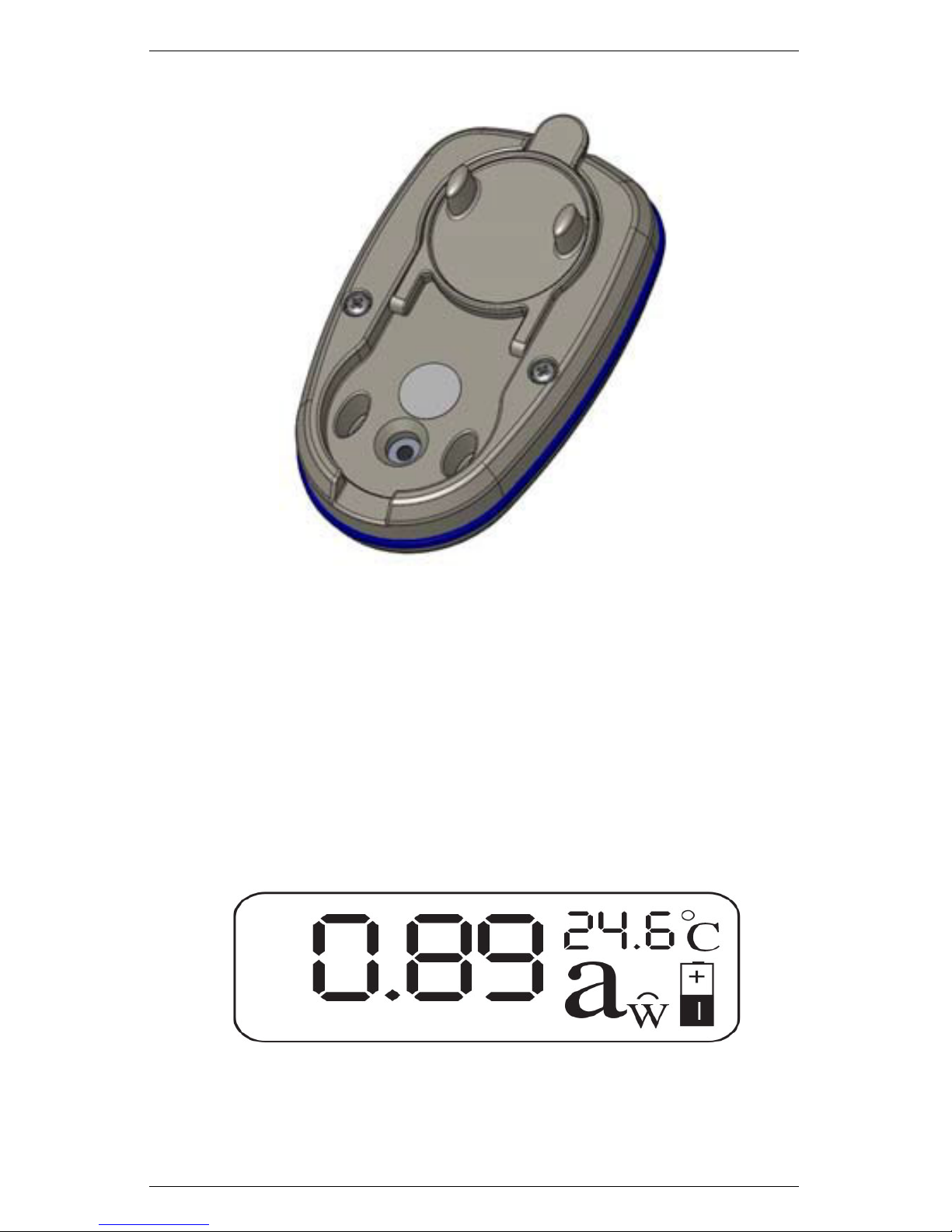
The Pawkit uses two Lithium-ion battery cells that should last
for several years. If the battery charge is low, you may see a
low-battery indicator icon appear in the lower right corner of
the screen
Note: An occasional low battery indication does not mean the
battery needs replacing.
33
Follow steps 1 through 4 to replace the battery.
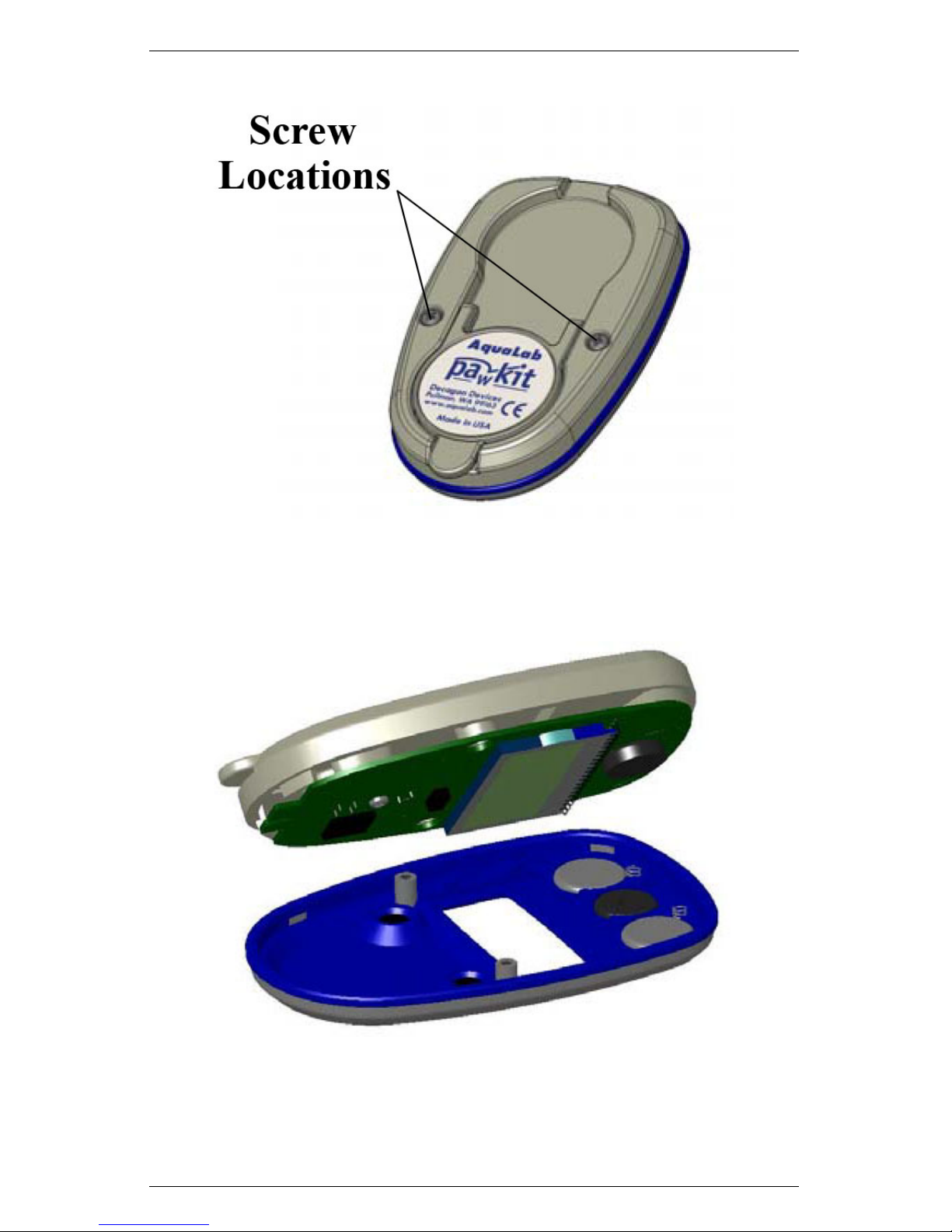
1. Remove the Pawkit bottom by unscrewing the two screws.
24
Page 29
Pawkit 5 CLEANING AND MAINTENANCE
2. Separate the stainless steel top and elastomer (which contains
the batteries) from the white plastic bottom.
3. Remove the old Lithium-ion batteries. Replace with new CR1632
or equivalent 3V lithium coin cells. Make sure to orient the
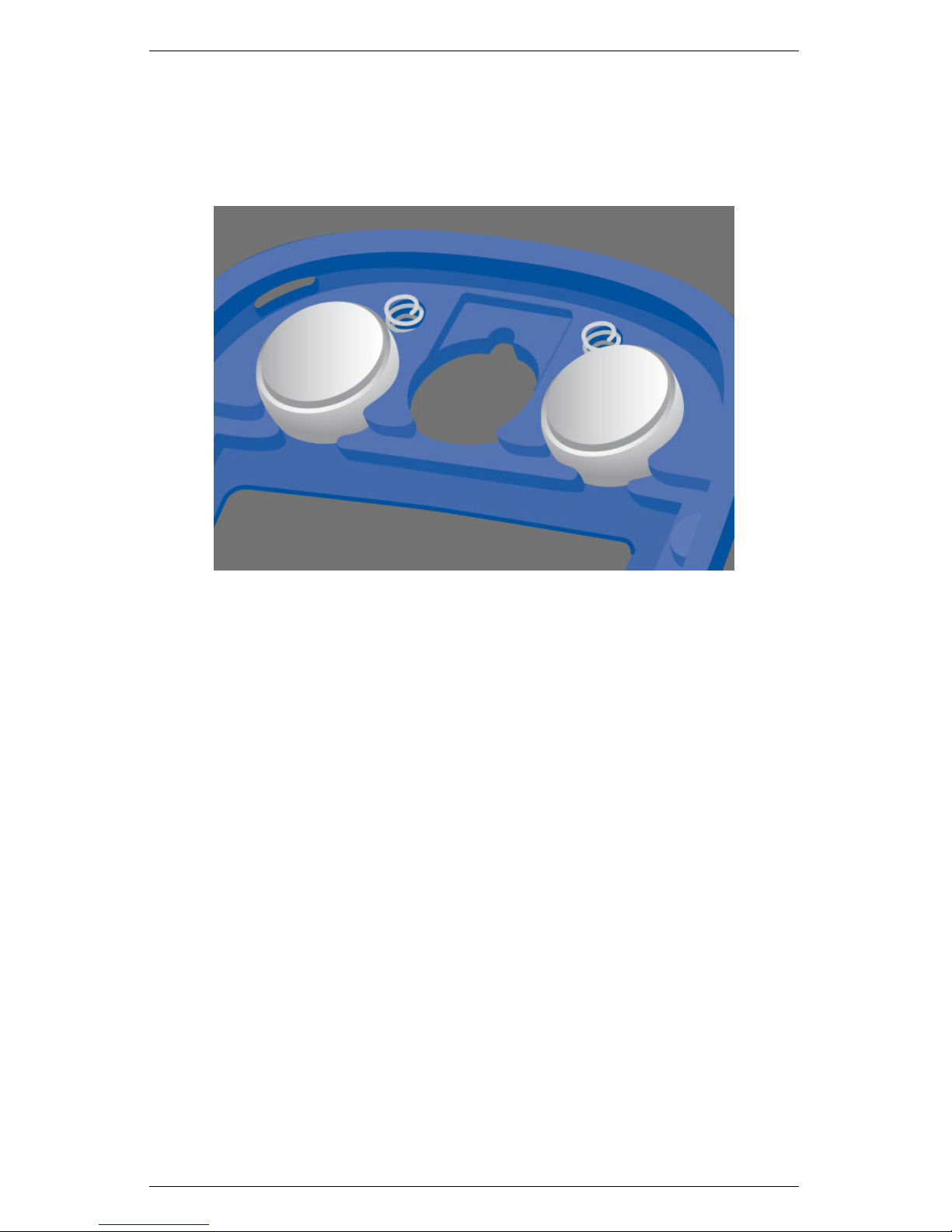
batteries so the positive (+) contact is facing down into the
25
Page 30
5 CLEANING AND MAINTENANCE Pawkit
elastomer pocket. Make sure the two small springs which make
contact between the (+) battery terminal and the circuit board
are in place.
4. Replace the circuit board/plastic bottom in the elastomer top.
Tighten the two screws to complete the assembly of the Pawkit.
26
Page 31

Pawkit 6 VERIFICATION AND CALIBRATION
6 Verification and Calibration
The Pawkit takes water activity measurements by measuring the
change in electrical properties of a special polymer held between two
electrodes. Due to the nature of the capacitance humidity sensor, it is
important to verify the AquaLab water activity calibration against
known standards to guarantee optimal performance and accuracy.
METER recommends verification daily, once per shift or before each
use. METER also recommends annual factory calibration to maintain optimal performance.
6.1 Verification Standards
The Pawkit uses four calibration standards: 6.00 mol/kg NaCl (0.760
aw), 13.41 mol/kg LiCl (0.250 aw), and 2.33 mol/kg NaCl (0.920 aw).
You received a small supply of these standards with your instrument.
These standards are specially prepared salt solutions at specific concentrations for constant and accurate water activity measurements.
They have been produced under a strict quality assurance regime,
and their accuracy is verified by an independent third party instrument. They are very accurate, easy to use, and readily available from
METER. Most importantly, they greatly reduce preparation errors.
Because of these reasons, we recommend using these standards for
the most accurate calibration of your Pawkit. The verification standards are shelf-stable for one year.
If these standards are not available you can make a saturated Sodium
Chloride (NaCl) slurry with a water activity value of 0.75 aw. To
make a salt slurry of NaCl add water until the salt can absorb no
more water, as evidenced by the presence of free liquid. The slurry
should take the shape of the cup and flow when tipped with the
amount of free liquid at a minimum.
Note: To avoid inaccurate water activity readings, verification standards should be used once immediately after opening and not stored
in sample cups for repeated use.
27
Page 32
6 VERIFICATION AND CALIBRATION Pawkit
6.2 Steps to Verify Calibration
1. Take a vial of the 0.760 awNaCl standard and empty the entire
contents of the vial into a sample cup. Place the Pawkit over
the sample cup as described in the Sample Placement section.
2. Press the left button (I) to take a reading. If it is reading the
correct water activity ±0.02, your Pawkit needs no adjustment
for this standard. Skip to step 9.
3. If the first reading was not the correct water activity (±0.02),
clean the Pawkit according to the instructions in Section 5 and
take a second reading. If it is reading the correct water activity
±0.02, your Pawkit needs no adjustment at this time and you
may now skip to step 9. If it is not reading correctly, continue
to the next step.
Note: An error code of 9.99 at any time during the process indicates that the sensor has failed and that the instrument needs
to be serviced. Refer to Section 7 for shipping instructions.
4. Once the reading is finished, the right button (II) activates.
Button II is only active until the Pawkit shuts itself off. Press
it once to get the Calibration Mode screen.
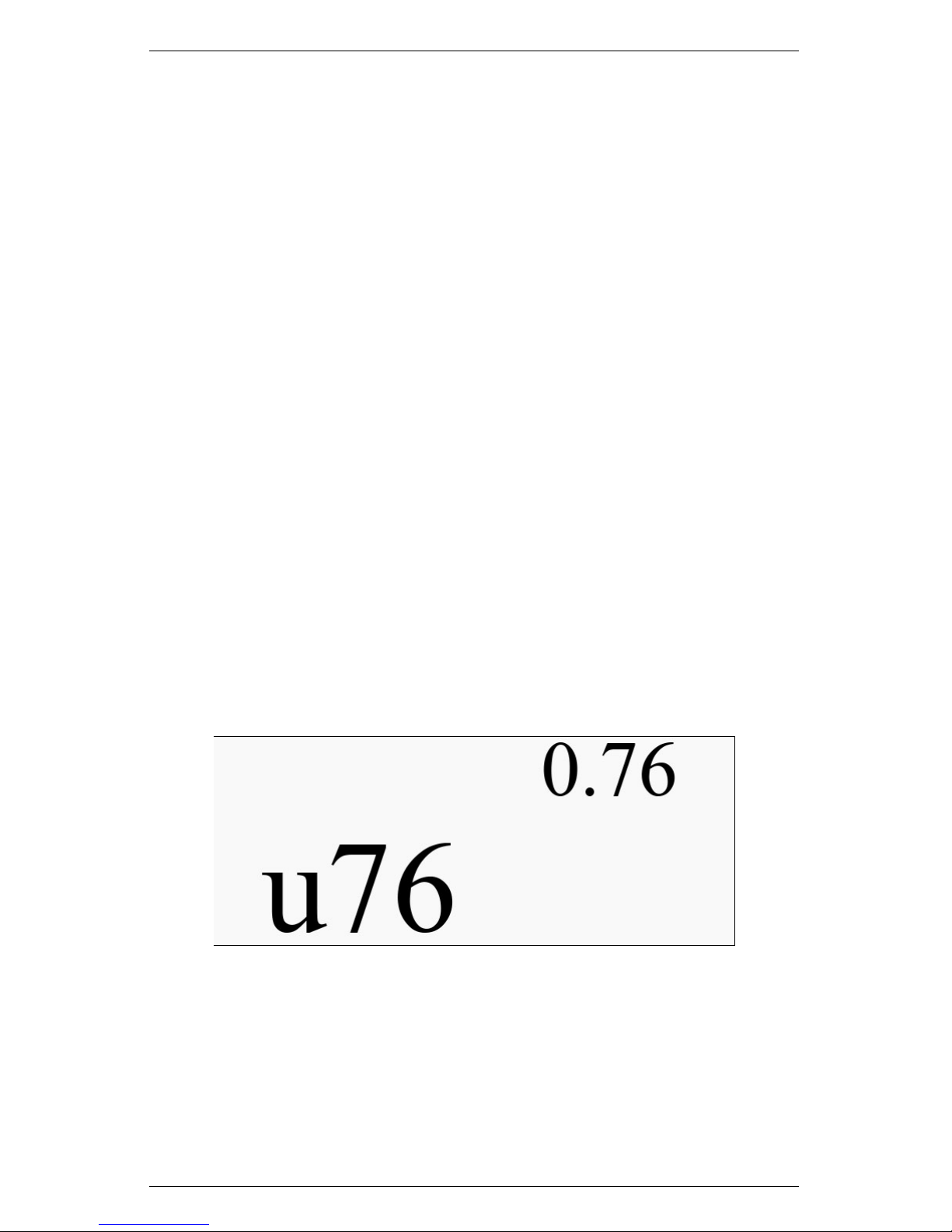
5. This screen shows that you are in the calibration mode. This
one in particular shows that you are ready to adjust calibration upwards for the 0.76 standard. The number in the upper right corner indicates the water activity measurement that
your Pawkit just read. Press the II button to scroll through
the other selections. They are: u76, d76, u25, d25, Sto, u92
28
Page 33

Pawkit 6 VERIFICATION AND CALIBRATION
and d92. The “u” and “d” before each number stand for “up”
or “down” adjustment for each standard. The numbers (25,
76, and 92) correspond to the water activity of a verification
standard (0.76, 0.25, and 0.92 aw). The “Sto” position stores
a reading.
6. As an example, if your NaCl reading is lower than it should
be, press the II button to scroll to “u76” (“adjust up for 0.76
standard”). If it is higher than it should be, scroll to “d76”
(“adjust down for 0.76 standard”).
Note: If you accidentally scroll past your desired adjustment
screen, simply keep pressing the II button until you cycle back
to the right screen.
7. Once you have scrolled to the proper screen for calibration
adjustment, press the I button to adjust the value to what it
should be. Each time you press the I button, the value in the
corner changes by an increment of 0.01.
8. When you have it set to the correct value, press the II button to
scroll until “Sto” appears in the lower right corner, then press
I. This stores the new value you have set. You then return to
the main screen and begin a new measurement.
Note: If you do not press “Sto” no change is made to the calibration of the Pawkit.
9. Verify with a second standard, either the 0.25 standard or the
0.92 standard. Choose the one that is closest to the water activity range of the sample material you are testing. In other
words, if it is normally higher than 0.76 aw, use the 0.92 standard. If it is normally lower than 0.76 aw, use the 0.25 standard.
If the Pawkit measures the second standard correctly (±0.02),
begin testing your product. If it does not measure correctly,
repeat steps 3 for 8 for the second standard.
10. If you inadvertently enter the calibration routine, keep pressing
button II until you scroll back to the main screen.
Note: The 0.76 standard adjustment adjusts the calibration in-
29
Page 34
6 VERIFICATION AND CALIBRATION Pawkit
tercept, while the 0.25 and 0.92 adjusts the slope. Changes in
the intercept are more likely to occur than changes in the slope,
so the 0.76 verification check is the most important and should
be done more frequently.
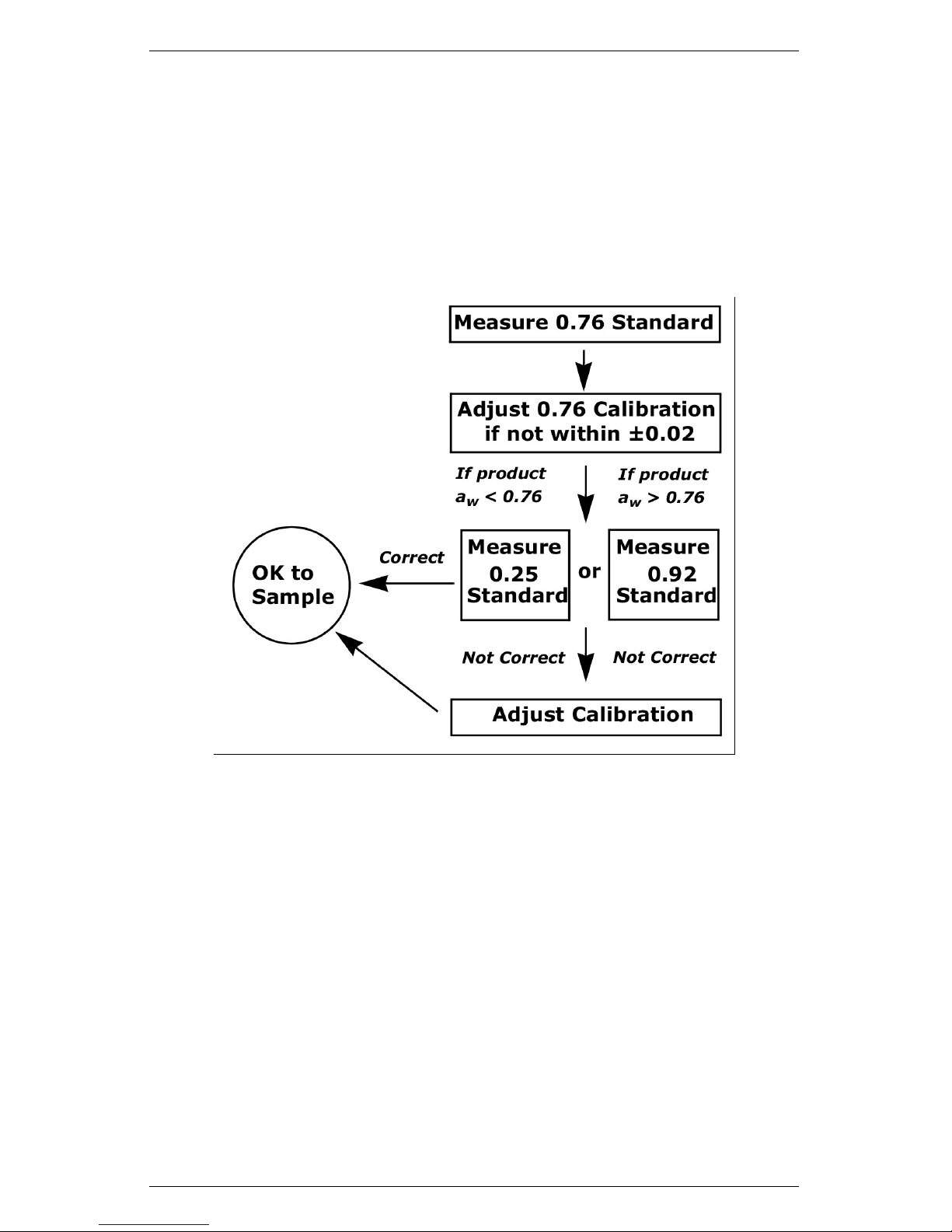
Review the graphical representation of the calibration routine in Figure 5.
Figure 5: Calibration Routine Flowchart
30
Page 35

Pawkit 7 SUPPORT AND REPAIR
7 Support and Repair
Note: If you purchased your Pawkit from one of our international
distributors, please contact them. They can provide you with local
support and service.
When encountering problems with your AquaLab that you are unable to resolve with the help of this manual, please contact METER
Customer Support at [email protected], 509-332-5601
or fax us at 509-332-5158. Please have the serial number and model
of the instrument ready.
All Pawkits returning to METER for servicing must be accompanied with a Return Material Authorization (RMA) number. Prior to
shipping the instrument, please contact a METER customer support
representative to obtain an RMA.
Shipping Directions
The following steps can help to ensure the safe shipping and processing of your AquaLab.
1. Pack the Pawkit in its carrying case, securely in its original box.
If the original packaging is not available, pack the box moderately tight with packing material (e.g. styrofoam peanuts
or bubble wrap), ensuring the instrument is suspended in the
packing material. Use a box that has at least two inches of
space between your instrument and each wall of the box.
2. Include a copy of the RMA form in the shipment. Please verify
the ship to and bill to information, contact name, and problem
description. If anything is incorrect please contact a METER
representative.
3. Tape the box in both directions for added support.
31
Page 36

7 SUPPORT AND REPAIR Pawkit
Ship to:
METER Group, Inc.
ATTN: RMA (insert your RMA #)
2365 NE Hopkins Court
Pullman, WA 99163
7.1 Repair Costs
We repair manufacturer defects and instruments within the one-year
warranty at no charge. Non-warranty repair charges for parts, labor
and shipping are billed to you. An extra fee may be charged for rush
work. METER can provide an estimated repair cost, if requested.
7.2 Loaner Service
METER has loaner instruments available to keep you measuring water activity while your instrument is being serviced. Please contact customer support for pricing and availability of loaners. If your
AquaLab is being serviced under warranty, you qualify for a free
loaner.
32
Page 37

Pawkit 8 FURTHER READING
8 Further Reading
8.1 Water Activity Theory & Measurement
Bousquet-Ricard, M., G. Qualyle, T. Pharm, and J. C. Cheftel. 1980.
Comparative study of three methods of determining water activity
in intermediate moisture foods. Lebensm Wiss Technol 13:169-173.
Cazier, J.B., and V. Gekas. 2001. Water activity and its prediction: a review. International Journal of Food properties 4(1):35-43.
Chirife, J., G. Favetto, C. Ferro-Fontn, and S.L.Resnik. 1983. The
water activity of standard saturated salt solutions in the range of
intermediate moisture foods. Lebensm Wiss Technol 16:36-38.
Duckworth, R. 1975. Water relations of foods. Academic Press,
New York.
Gmez, R., and J. Fernandez-Salguero. 1992. Water activity and
chemical composition of some food emulsions. Food Chem 45:91-93.
Greenspan, L. 1977. Humidity fixed points of binary saturated aqueous solutions. J Res Nat Bur Stand - A Phys Chem 81A:89-96.
Karmas, E. 1981. Measurement of moisture content. Cereal Foods
World 26:332-334.
Kitic, D., D.C. Pereira-Jardim, G.J. Favetto, S.L. Resnik, and J.
Chirife. 1986. Theoretical prediction of the water activity of standard saturated salt solutions at various temperatures. Journal of
Food Science 51:1037-1042.
Labuza, T.P., and R. Contreras-Medellin. 1981. Prediction of moisture protection requirements for foods. Cereal Foods World 26:335-
343.
Labuza, T.P., K. Acott, S.R. Tatini, R.Y. Lee, J. Flink, and W.
McCall. 1976. Water activity determination: A collaborative study
33
Page 38

8 FURTHER READING Pawkit
of different methods. Journal of Food Science 41:910-917.
Marcolli, C., and Th. Peter. 2005. Water activity in polyol/water
systems: new UNIFAC parameterization. Atmospheric Chemistry
and Physics 5:1545-1555.
Ninni, L., M.S. Camargo, and A.J.A. Meirelles. 2000. Water activity in polyol systems. Journal of Chemical and Engineering Data
45:654-660.
Prior, B.A. 1979. Measurement of water activity in foods: A review. Journal of Food Protection 42:668-674.
Rahman, M.S. and S.S. Sablani. 2001. Measurement of water activity by electronic sensors. P. A2.5.1-A2.5.4 In R.E.Wrolstad (ed.)
Current Protocols In Food Analytical Chemistry. John Wiley &
Sons, Inc., New York.
Rahman, M.S., S.S. Sablani, N. Guizani, T.P. Labuza, and P.P.
Lewicki. 2001. Direct manometic determination of vapor pressure.
P. A2.4.1-A2.4.6. In R.E. Wrolstad (ed.) Current Protocols In Food
Analytical Chemistry. John Wiley & Sons, Inc., New York.
Reid, D.S., A.J. Fontana, M.S. Rahman, S.S. Sablani, T.P. Labuza,
N. Guizani, and P.P. Lewicki. 2001. Vapor pressure measurements
of water p. A2.1.1-A2.5.4. In R.E. Wrolstad (ed.) Current Protocols
In Food Analytical Chemistry. John Wiley & Sons, Inc., New York.
Reid, D.S. 1976. Water activity concepts in intermediate moisture
foods. p. 54-65. In R. Davies, G.G. Birch, and K.J. Parker (ed.)
Intermediate Moisture Foods. Applied Science Publishers, London.
Richard, J., and T.P. Labuza. 1990. Rapid determination of the
water activity of some reference solutions, culture media and cheese
using a dew point method. Sci. des Aliments 10:57-64.
Roa,V., and M.S. Tapia de Daza. 1991. Evaluation of water activity
measurements with a dew point electronic humidity meter. Lebensm
34
Page 39

Pawkit 8 FURTHER READING
Wiss Technol 24:208-213.
Rodel, W. 2001. Water activity and its measurement in food. P.
453-483. In E. Kress-Rogers, and C.B. Brimelow (ed.) Instrumentation and sensors for the food industry. CRC Press LLC, Boca Raton,
FL.
Roos, K.D. 1975. Estimation of water activity in intermediate moisture foods. Food Tech 29:26-30.
Scott, V.N., and D.T. Bernard. 1983. Influence of temperature on
the measurement of water activity of food and salt systems. Journal
of Food Science 48:552-554.
Snavely, M.J., J.C. Price, and H.W. Jun. 1990. A comparison of
three equilibrium relative humidity measuring devices. Drug Dev.
Ind. Pharm. 16:1399-1409.
Stamp, J.A., S. Linscott, C. Lomauro, and T.P. Labuza. 1984. Measurement of water activity of salt solutions and foods by several electronic methods as compared to direct vapor pressure measurement.
Journal of Food Science 49:1139-1142.
Stoloff, L. 1978. Calibration of water activity measuring instruments
and devices: Collaborative study. Journal of the Association of Official Analytical Chemists 61:1166-1178.
Troller, J.A. 1983. Methods to measure water activity. Journal of
Food Protection 46:129-134.
Troller, J.A., and J.H.B Christian. 1978. Water Activity and Food.
Academic Press, New York.
Troller, J.A., and V.N. Scott. 1992. Measurement of water activity(aw)
and acidity. p. 135-151. In C. Vanderzant, and D.F. Splittstoesser
(ed.) Compendium of Methods for the Microbiological Examination
of Foods. American Public Health Association, Washington, D.C.
35
Page 40

8 FURTHER READING Pawkit
Van den Berg, C. 1986. Water activity. p. 11-36. In D. MacCarthy
(ed.) Concentration and drying of foods. Elsevier Applied Science
Publishers, London.
Van den Berg, C. 1991. Food-water relations: Progress and integration, comments and thoughts. In H. Levine, and L. Slade (ed.)
Water Relationships in Foods. Plenum Press, New York.
Van den Berg, C., and S. Bruin. 1981. Water activity and its estimation in food systems: Theoretical aspects. p. 1-61. In L.B. Rockland,
and G.F. Stewart (ed.) Water Activity: Influences on Food Quality.
Academic Press, New York.
Vega-Mercado, H., and G.V. Barbosa-Canovas. 1994. Prediction
of water activity in food systems: A review on theoretical models.
Revista Espanola De Ciencia Y Tecnologia De Alimentos 34:368-388.
Vega-Mercado, H., B. Romanach, and G.V. Barbosa-Canovas. 1994.
Prediction of water activity in food systems: A computer program
for predicting water activity in multicomponent foods. Revista Espanola De Ciencia Y Tecnologia De Alimentos 34:427-440.
Vos, P.T., and T.P. Labuza. 1974. Technique for measurements of
water activity in the high awrange. J. Agric. Food Chem. 22:326-
327.
Voysey, P. 1993. An evaluation of the AquaLab CX-2 system for
measuring water activity. F. M. B. R. A. Digest No. 124 24-25.
Food Safety and Microbiology
Bei, Z.H., and R.-M.J. Nout. 2000. Effects of temperature, water activity and gas atmosphere on mycelial growth of tempe fungi
Rhizopus microsporus var. microcporus and R. microsporus var.
oligosporus. World Journal of Microbiology and Biotechnology 16:853-
858.
Beuchat, L.R. 1981. Microbial stability as affected by water activity.
36
Page 41

Pawkit 8 FURTHER READING
Cereal Foods World 26:345-349.
Brandt, L. 1996. Bound for success. Controlling water activity gives
technologists the edge in developing safe, shelf-stable foods. Food
Formulating 2:41-48.
Chirife, J., and M.P. Buera. 1994. Water activity, glass transition and microbial stability in concentrated/semimoist food systems.
Journal of Food Science 59:921-927.
Chirife, J., and M.P. Buera. 1995. A critical review of some nonequilibrium situations and glass transitions on water activity values of
foods in the microbiological growth range. Journal of Food Engineering 25:531-552.
Chirife, J., and M.P. Buera. 1996. Water activity, water glass dynamics, and the control of microbiological growth in foods. Critical
Rev. in Food Sci. Nutr. 36:465-513.
Farberm, J.M., F. Coates, and E. Daley. 1992. Minimum water activity requirements for the growth of Listeria monocytogenes. Lett
Appl Microbiol 15:103-105.
Franks, F. 1991. Water activity: a credible measure of food safety
and quality? Trends Food Sci Technol March:68-72.
Garcia de Fernando, G.D., O. Diaz, M. Fernandez, and J.A. Ordonez. 1992. Changes in water activity of selected solid culture
media throughout incubation. Food Microbiology 9:77-82.
Gibson, A.M., J. Baranyi, J.I. Pitt, M.J. Eyles, and T.A. Roberts.
1994. Predicting fungal growth: The effect of water activity on Aspergillus flavus and related species. International Journal of Food
Microbiology 23:419-431.
Goaleni, N., J.E. Smith, J. Lacey, and G. Gettinby. 1997. Effects of
temperature, water activity, and incubation time on production of
aflatoxins and cyclopiazonic acid by an isolate of Aspergillus flavus
37
Page 42

8 FURTHER READING Pawkit
in surface agar culture. Appl Environ Microbiol 63:1048-1053.
Hardman, T.M. 1988. Water and food quality. Elseiver Press, London.
Hocking, A.D., and B.F. Miscamble. 1995. Water relations of some
Zygomycetes isolated from food. Mycological Research 99:1113-1118.
Hocking, A.D., B.F. Miscamble, and J.I. Pitt. 1994. Water relations of Alternaria alternata, Cladosporium cladosporioides, Cladosporium sphaerospermum, Curvulario lunata and Curvulario pallescens. Mycological Research 98:91-94.
Houtsma, P.C., A. Heuvelink, J. Dufrenne, and S. Notermans. 1994.
Effect of sodium lactate on toxin production, spore germination and
heat resistance of proteolytic Clostridium botulinum strains. Journal
of Food Protection 57:327-330.
Kress-Rogers, E. 1993. Food quality measurement. Food Industry
News September:23-26.
Kuntz, L.A. 1992. Keeping microorganisms in control. Food Product Design August:44-51.
Levine, H., and L. Slade. 1991. Water Relationships in Foods.
Plenum Press, New York.
Li, K.Y., and J.A. Torres. 1993. Water activity relationships for
selected mesophiles and psychrotrophs at refrigeration temperature
Journal of Food Protection 56:612-615.
Lopez-Malo, A., S. Guerrero, and S.M. Alzamora. 2000. Probabilistic modeling of Saccharomyces cerevisiae inhibition under the
effects of water activity, pH, and potassium sorbate concentration.
Journal of Food Protection 63:91-95.
Mannheim,C.H., J.X. Liu, and S.G. Gilbert. 1994. Control of water
in foods during storage. Journal of Food Engineering 22:509-532.
38
Page 43

Pawkit 8 FURTHER READING
Marauska, M., A. Vigants, A. Klincare, D. Upite, E. Kaminska, and
M. Bekers. 1996. Influence of water activity and medium osmolality
on the growth and acid production of Lactobacillus casei var. alactosus. Proceedings of the Latvian Academy of Sciences Section B
Natural Exact and Applied Sciences 50:144-146.
Masana, M.O., and J. Baranyi. 2000. Growth/no growth interface of
Brochothrix thermosphacta as a function of pH and water activity.
Food Microbiology 17:485-858.
Mattick, K. L., F. Jorgensen, J.D. Legan, M.B. Cole, J. Porter, H.M.
Lappin-Scott, and T.J. Humphrey. 2000. Survival and filamentation
of Salmonella enterica serovar Enteritidis PT4 and Salmonella enterica serovar Typhimurium DT104 at low water activity. Appl Environ
Microbiol 66:1274-1279.
Mattick, K.L., F. Jorgensen, J.D. Legan, H.M. Lappin-Scott, and
T.J. Humphrey. 2000. Habituation of Salmonella spp. at reduced
water activity and its effect on heat tolerance. Appl Environ Microbiol 66:4921-4925.
Mattick, K.L., F. Jorgensen, J.D. Legan, H.M. Lappin-Scott, and
T.J. Humphrey. 2001. Improving recovery of Salmonella enterica
Serovar Typhimurium DT104 cells injured by heating at different
water activity values. Journal of Food Protection 64:1472-1476.
McMeekin, T.A., and T. Ross. 1996. Shelf life prediction: Status
and future possibilities. International Journal of Food Microbiology
33:65-83.
Miller, A.J. 1992. Combined water activity and solute effects on
growth and survival of Listeria monocytogenes. Journal of Food
Protection 55:414-418.
Nakajo, M., and Y. Moriyama. 1993. Effect of pH and water activity on heat resistance of spores of Bacillus coagulans. Journal of
the Japanese Society for Food Science and Technology 40:268-271.
39
Page 44

8 FURTHER READING Pawkit
Nelson, K.A., and T.P. Labuza. 1994. Water activity and food
polymerscience: Implications of state on arrhenius and WLF models
in predicting shelf life. Journal of Food Engineering 22:271-289.
Nesci, A., M. Rodrigues, and M. Etcheverry. 2003. Control of
Aspergillus growth and aflatoxin production using antioxidants at
different conditions of water activity and pH. Journal of Applied Microbiology 95:279-287.
Nolan, D.A., D.C. Chamblin, and J.A. Troller. 1992. Minimal water activity levels for growth and survival of Listeria monocytogenes
and Listeria innocua. International Journal of Food Microbiology
16:323-335.
Noorlidah, A., A. Nawawi, and I. Othman. 2000. Fungal spoilage of
starch-based foods in relation to its water activity (aw). Journal of
Stored Products Research 36:47-54.
Park, C.M., and L.R. Beuchat. 2000. Survival of Escherichia coli
O157:H7 in potato starch as affected by water activity, pH and temperature. Lett Appl Microbiol 31(5):364-367.
Petersson, S., and J. Schnuerer. 1995. Biocontrol of mold growth
in high-moisture wheat stored under airtight conditions by Pichia
anomala, Pichia guilliermondii, and Saccharomyces cerevisiae. Appl
Environ Microbiol 61:1027-1032.
Pitt, J.I., and B.F. Miscamble. 1995. Water relations of Aspergillus
flavus and closely related species. Journal of Food Protection 58:86-
90.
Plaza, P., J. Usall, N. Teixido, and I. Vinas. 2003 Effect of water
activity and temperature on germination and growth of Penicillium
digitatum, P. italicum and Geoteichum candidum. Journal of Applied Microbiology 94:549-554.
Quintavalla, S., and G. Parolari. 1993. Effects of temperature, water
40
Page 45

Pawkit 8 FURTHER READING
activity and pH on the growth of Bacillus cells and spore: A response
surface methodology study. International Journal of Food Microbiology 19:207-216.
Rockland, L.B., and G.F. Stewart. 1981. Water activity: Influences on food quality. Academic Press, New York.
Rockland, L.B., and S.K. Nishi. 1980. Influence of water activity
on food product quality and stability. Food Tech 34:42-59.
Saad, R.R. 1992. Effect of water activity on growth and lipids of
xerophilic fungi, Aspergillus repens and Aspergillus amstelodami.
Zentralblatt Fuer Mikrobiologie 147:61-64.
Salter, M.A., D.A. Ratkowsky, T. Ross, and T.A. McMeekin. 2000.
Modelling the combined temperature and salt (NaCl) limits for growth
of a pathogenic Escherichia coli strain using nonlinear logistic regression. International Journal of Food Microbiology 61:159-167.
Santos, J., T.M. Lopez-Diaz, M.C. Garcia-Lopez, M.C. GarciaFernandez, and A. Otero. 1994. Minimum water activity for the
growth of Aeromonas hydrophila as affected by strain, temperature
and humectant. Lett Appl Microbiol 19:76-78.
Sautour, M., A. Rouget, P. Dantigny, C. Divies, and M. Bennsoussan.
2001. Prediction of conidial germination of Penicillium chrysogenum
as influenced by temperature, water activity and pH. Lett Appl Microbiol 32:131-134.
Seow, C.C., T.T. Teng, and C.H. Quah. 1988. Food preservation
by moisture control. Elsevier, New York.
Shebuski, J.R., O. Vilhelmsson, and K.J. Miller. 2000. Effects of
growth at low water activity on the thermal tolerance of Staphylococcus aureus. Journal of Food Protection 63:1277-1281.
Taoukis, P., W. Breene, and T.P. Labuza. 1988. Intermediate moisture foods. Adv Cereal Sci Technol 9:91-128.
41
Page 46

8 FURTHER READING Pawkit
Tapia de Daza, M.S., Y. Villegas, and A. Martinez. 1991. Minimal water activity for growth of Listeria monocytogenes as affected
by solute and temperature. International Journal of Food Microbiology 14:333-337.
Tokuoka, K., and T. Ishitani. 1991. Minimum water activities for
the growth of yeasts isolated from high-sugar foods. Journal of General and Appied Microbiology 37:111-119.
Torres, R., J. Usall, N. Teixido, M. Abadias, and I. Vinas. 2003.
Liquid formulation of the biocontrol agent Candida sake by modifying water activity or adding protectants. Journal of Applied Microbiology 94:330-339.
Ucar, F., and I. Guneri. 1996. The effect of water activity, pH
and temperature on the growth of osmophilic yeasts. Turkish Journal of Biology 20:37-46.
Wijtzes, T., P.J. Mcclure, M.H. Zwietering, and T.A. Roberts. 1993.
Modelling bacterial growth of Listeria monocytogenes as a function
of water activity, pH and temperature. International Journal of Food
Microbiology 18:139-149.
Zwietering, M.H., T. Wijtzes, J.C. de Wit, and K.Van’T Riet. 1992.
A decision support system for prediction of the microbial spoilage in
foods. Journal of Food Protection 55:973-979.
Meat and Seafood
Allen, K., D. Cornforth, D. Whittier, M. Vasavada, and B. Nummer. 2007. Evaluation of high humidity and wet marinade methods
for pasteurization of jerky. Journal of Food Science. 72:C351-C355.
Chen, H.C. 1995. Seafood microorganisms and seafood safety. Journal of Food and Drug Analysis 3:133-144.
Clavero, M.R.S., and L.R. Beuchat. 1996. Survival of Escherichia
42
Page 47

Pawkit 8 FURTHER READING
coli O157:H7 in broth and processed salami as influenced by pH, water activity, and temperature and suitability of media for its recovery.
Appl Environ Microbiol 62:2735-2740.
Duffy, L.L., P.B. Vanderlinde, and F.H. Grau. 1994. Growth of
Listeria monocytogenes on vacuum-packed cooked meats: Effects of
pH, aw, nitrite and ascorbate. International Journal of Food Microbiology 23:377-390.
Elgasim, E.A., and M.S. Al Wesali. 2000. Water activity and Hunter
colour values of beef patties extended with samh (Mesembryanthemum forsskalei Hochst) flour. Food Chem 69(2):181-185.
Gmez, R., andJ. Fernandez-Salguero. 1993. Note: Water activity
of Spanish intermediate moisture fish products. Revista Espanola
De Ciencia Y Tecnologia De Alimentos 33:651-656.
Hand, L. 1994. Controlling water activity and pH in snack sticks.
Meat Marketing and Technology May:55-56.
Lee, M.B., and S. Styliadis. 1996. A survey of pH and water activity levels in processed salamis and sausages in Metro Toronto.
Journal of Food Protection 59:1007-1010.
Luecke, F.K. 1994. Fermented meat products. Food Res Intl 27:299-
307. Minegishi, Y., Y. Tsukamasa, K. Miake, T. Shimasaki, C. Imai,
M.
Sugiyama, and H. Shinano. 1995. Water activity and microflora
in commercial vacuum-packed smoked salmons. Journal of the Food
Hygienic Society of Japan 36:442-446.
Nunez, F., M.C. Diaz, M. Rodriguez, E. Aranda, A. Martin, and
M.A. Asensio. 2000. Effects of substrate, water activity, and temperature on growth and verrucosidin production by Penicillium polonicum
isolated from dry-cured ham. Journal of Food Protection 63:231-236.
Placido, M. and M.P. Aleman. 2002. Rapid hygrometric method for
43
Page 48

8 FURTHER READING Pawkit
determing water activity. Ciencia y Tecnologia Alimentaria 3(4):229-
235.
Rocha-Garza, A.E., and J.F. Zayas. 1996. Quality of broiled beef
patties supplemented with wheat germ protein flour. Journal of Food
Science 61:418-421
Sabadini, E., M.D. Hubinger, P.-J.d.Sobral, and B.C. Carvalho, Jr.
2001. Change of water activity and meat colour in the elaborationprocess of dehydrated salted meat. Ciencia e Tecnologia de Alimentos 21(1):14-19.
Shimasaki, T., K. Miake, Y. Tsukamasa, M.A. Sugiyama, Y. Minegishi,
and H. Shinano. 1994. Effect of water activity and storage temperature on the quality and microflora of smoked salmon. Nippon Suisan
Gakkaishi 60:569-576.
Untermann, F., and C. Muller. 1992. Influence of awvalue and
storage temperature on the multiplication and enterotoxin formation of staphylococci in dry-cured raw hams. International Journal
of Food Microbiology 16:109-115.
Williams, S.K., G.E. Rodrick, and R.L. West. 1995. Sodium lactate
affects shelf life and consumer acceptance of fresh Catfish (Ictalurus nebulosus, marmoratus) fillets under simulated retail conditions.
Journal of Food Science 60:636-639.
Dairy Products
Clavero, M.R.S., and L.R. Beuchat. 1996. Survival of Escherichia
coli O157:H7 in broth and processed salami as influenced by pH, water activity, and temperature and suitability of media for its recovery.
Appl Environ Microbiol 62:2735-2740.
Correia, R., M. Magalhaes, M. Pedrini, A. da Cruz, and I. Clementino.
2008. Ice cream made from cow and goat milk: chemical composition and melting point characteristics. Revista Ciencia Agronomica
39:251-256.
44
Page 49

Pawkit 8 FURTHER READING
Duffy, L.L., P.B. Vanderlinde, and F.H. Grau. 1994. Growth of
Listeria monocytogenes on vacuum-packed cooked meats: Effects of
pH, aw, nitrite and ascorbate. International Journal of Food Microbiology 23:377-390.
Gmez, R., and J. Fernandez-Salguero. 1993. Note: Water activity of
Spanish intermediate moisture fish products. Revista Espanola De
Ciencia Y Tecnologia De Alimentos 33:651-656.
Hand, L. 1994. Controlling water activity and pH in snack sticks.
Meat Marketing and Technology May:55-56.
Hardy, J., J. Scher, and S. Banon. 2002. Water activity and hydration of dairy powders. Lait 82:441-442.
Lee, M.B., and S. Styliadis. 1996. A survey of pH and water activity levels in processed salamis and sausages in Metro Toronto.
Journal of Food Protection 59:1007-1010.
Luecke, F.K. 1994. Fermented meat products. Food Res Intl 27:299-
307.
Malec, L.S., A.S. Pereyra-Gonzales, G.B. Naranjo, and M.S. Vigo.
2002. Influence of water activity and storage temperature on lysine
availability of a milk like system. Food Res Intl 35(9):849-853.
Minegishi, Y., Y. Tsukamasa, K. Miake, T. Shimasaki, C. Imai, M.
Sugiyama, and H. Shinano. 1995. Water activity and microflora in
commercial vacuum-packed smoked salmons. Journal of the Food
Hygienic Society of Japan 36:442-446.
Rocha-Garza, A.E., and J.F. Zayas. 1996. Quality of broiled beef
patties supplemented with wheat germ protein flour. Journal of Food
Science 61:418-421.
Shah, N.P., and R.R. Ravula. 2000. Influence of water activity on
fermentation, organic acids production and viability of yoghurt and
45
Page 50

8 FURTHER READING Pawkit
probiotic bacteria. Australian Journal of Dairy Technology 55(3):127-
131.
Shimasaki, T., K. Miake, Y. Tsukamasa, M.A. Sugiyama, Y. Minegishi, and H. Shinano. 1994. Effect of water activity and storage temperature on the quality and microflora of smoked salmon. Nippon
Suisan Gakkaishi 60:569-576.
Untermann, F., and C. Muller. 1992. Influence of awvalue and
storage temperature on the multiplication and enterotoxin formation of staphylococci in dry-cured raw hams. International Journal
of Food Microbiology 16:109-115.
Williams, S.K., G.E. Rodrick, and R.L. West. 1995. Sodium lactate
affects shelf life and consumer acceptance of fresh Catfish (Ictalurus nebulosus, marmoratus) fillets under simulated retail conditions.
Journal of Food Science 60:636-639.
Fruits and Vegetables
Ayub, M., R. Khan, S. Wahab, A. Zeb, and J. Muhammad. 1995.
Effect of crystalline sweeteners on the water activity and shelf stability of osmotically dehydrated guava. Sarhad Journal of Agriculture
11:755-761.
Beveridge,T., and S.E. Weintraub. 1995. Effect of blanching pretreatment on color and texture of apple slices at various water activities. Food Res Intl 28:83-86.
Clavero, M.R.S., R.E. Brackett, L.R. Beuchat, and M.P. Doyle. 2000.
Influence of water activity and storage conditions on survival and
growth of proteolytic Clostridium botulinum in peanut spread. Food
Microbiology 17(1):53-61.
Fouskaki, M., K. Karametsi, and N.A. Chaniotakis. 2003. Method
for the determination of water content in sultana raisins using a water activity probe. Food Chem 82:133-1337.
46
Page 51

Pawkit 8 FURTHER READING
Gogus, F., C. Cuzdemir, and S. Eren. 2000. Effects of some hydrocolloids and water activity on nonenzymic browning of concentrated
orange juice. Nahrung 44(6):438-442.
Hubinger, M., F.C. Menegalli, R.J. Aguerre, and C. Suarez. 1992.
Water vapor adsorption isotherms of guava, mango and pineapple.
Journal of Food Science 57:1405-1407.
Jimenez, M., M. Manez, and E. Hernandez. 1996. Infuence of water
activity and temperature on the production of zearalenone in corn by
three Fusarium species. International Journal of Food Microbiology
29:417-421.
Khalloufi, S., J. Giasson, and C. Ratti. 2000. Water activity of
freeze dried mushrooms and berries. Canadian Agricultural Engineering 42(1):51-56.
Kiranoudis, C.T., Z.B. Maroulis, E. Tsami, and D. Marinos-Kouris.
1993. Equilibrium moisture content and heat of desorption of some
vegetables. Journal of Food Engineering 20:55-74.
Lopez-Malo, A., and E. Palou. 2000. Modeling the growth/nogrowth
interface of Zygosaccharomyces bailii in Mango puree. Journal of
Food Science: 65:516-520.
Makower, B., and S. Myers. 1943. A new method for the determination of moisture in dehydrated vegetables. Proceedings of Institute
of Food Technologists, 4th Conference 156.
Maltini, E., D. Torreggiani, B.R. Brovetto, and G. Bertolo. 1993.
Functional properties of reduced moisture fruits as ingredients in
food systems. Food Res Intl 26:413-419.
Marin, S., N. Magan, M. Abellana, R. Canela, A.J. Ramos, and
V. Sanchis. 2000. Selective effect of propionates and water activity on maize mycoflora and impact on fumonisin B1 accumulation.
Journal of Stored Products Research 36:203-214.
47
Page 52

8 FURTHER READING Pawkit
Marin, S., V. Sanchis, I. Vinas, R. Canela, and N. Magan. 1995.
Effect of water activity and temperature on growth and fumonisin
B-1 and B-2 production by Fusarium proliferatum and F. moniliforme on maize grain. Lett Appl Microbiol 21:298-301.
Monsalve-Gonzalez, A., G.V. Barbosa-Canovas, and R.P. Cavalieri.
1993. Mass transfer and textural changes during processing of apples
by combined methods. Journal of Food Science 58:1118-1124.
Pinsirodom, P., and K.L. Parkin. 2000. Selectivity of Celite immobilized patatin (lipid acyl hydrolase) from potato (Solanum tuberosum
L.) tubers in esterification reactions as influenced by water activity
and glycerol analogues as alcohol acceptors. J. Agric. Food Chem.
48(2):155-160.
Tapia de Daza, M.S., C.E. Aguilar, V. Roa, and R.V. Diaz de Tablante.
1995. Combined stress effects on growth of Zygosaccharomyces rouxii
from an intermediate moisture papaya product. Journal of Food Science 60:356-359.
Zeb, A., R. Khan, A. Khan, M. Saeed, and S.A. Manan. 1994. Influence of crystalline sucrose and chemical preservatives on the water
activity and shelf stability of intermediate banana chips. Sarhad
Journal of Agriculture 10:721-726.
Zhang, X.W., X. Liu, D.X. Gu, W. Zhou, R.L. Wang, and P. Liu.
1996. Desorption isotherms of some vegetables. Journal of the Science of Food and Agriculture 70:303-306.
Baked Goods and Cereals
Abellana, M., A.J. Ramos, V. Sanchis, and P.V. Nielsen. 2000. Effect of modified atmosphere packaging and water activity on growth
of Eurotium amstelodami, E. chevalieri and E. herbariorum on a
sponge cake analogue. Journal of Applied Microbiology 88:606-616.
Aramouni, F.M., K.K. Kone, J.A. Craig, and D.Y.C. Fung. 1994.
Growth of Clostridium sporogenes PA 3679 in home-style canned
48
Page 53

Pawkit 8 FURTHER READING
quick breads. Journal of Food Protection 57:882-886.
Cahagnier, B., L. Lesage, and D. Richard-Molard. 1993. Mould
growth and conidiation in cereal grains as affected by water activity
and temperature. Lett Appl Microbiol 17:7-13.
Clawson, A.R., and A.J. Taylor. 1993. Chemical changes during
cooking of wheat. Food Chem 47:337-343.
Fleurat-Lessard, F. 2002. Qualitative reasoning and integrated management of the quality of stored grain: a promising new approach.
Journal of Stored Products Research 38:191-218.
Gmez, R., J. Fernandez-Salguero, M.A. Carmona, and D. Sanchez.
1993. Water activity in foods with intermediate moisture levels: Bakery and confectionery products: Miscellany. Alimentaria 30:55-57.
Guynot, M.E., A.J. Ramos, L. Seto, P. Purroy, V. Sanchis, and S.
Marin. 2003. Antifungal activity of volatile compounds generated by
essential oils against fungi commonly causing deterioration of bakery
products.
Harris, M., and M. Peleg. 1996. Patterns of textural changes in brittle cellular cereal foods caused by moisture sorption. Cereal Chem
73:225-231.
Hope, R., and N. Magan. 2003. Two-dimensional environmental profiles of growth, deoxynivalenol and nivalenol production by Fusarium
culmorum on wheat-based substrate. Lett Appl Microbiol 37:70-74.
Michniewicz, J., C.G. Biliaderis, and W. Bushuk. 1992. Effect of
added pentosans on some properties of wheat bread. Food Chem
43:251-257.
Moreno-Contreras, M.D., A.J. Martinez-Yepez, and R.R. Martinez.
2000. Determination of deoxynivalenol (DON) in wheat, barley and
corn and its relationship with the levels of total molds, Fusarium spp.,
infestation percentage, and water activity. Archivos Latinoameri-
49
Page 54

8 FURTHER READING Pawkit
canos de Mutricion. 50(2):183-186.
Phoungchandang, S., and J.L. Woods. 2000. Moisture diffusion and
desorption isotherms for banana. Journal of Food Science 65:651-657.
Ramanathan, S., and S. Cenkowski. 1995. Sorption isotherms of
flour and flow behaviour of dough as influenced by flour compaction.
Canadian Agricultural Engineering 37:119-124.
Roessler, P.F., and M.C. Ballenger. 1996. Contamination of an unpreserved semisoft baked cookie with a Xerophilic Aspergillus species.
Journal of Food Protection 59:1055-1060.
Schebor, C., and J. Chirife. 2000. A survey of water activity and
pH values in fresh pasta packed under modified atmosphere manufactured in Argentina and Uruguay. Journal of Food Protection
63:965-969.
Seiler, D.A.L. 1979. The mould-free shelf life of bakery products.
FMBRA Bulletin April:71-74.
Sumner, S.S., J.A. Albrecht, and D.L. Peters. 1993. Occurrence
of enterotoxigenic strains of Staphylococcus aureus and enterotoxin
production in bakery products. Journal of Food Protection 56:722-
724.
Tesch, R., M.D. Normand, and M. Peleg. 1996. Comparison of
the acoustic and mechanical signatures of two cellular crunchy cereal
foods at various water activity levels. Journal of the Science of Food
and Agriculture 70:347-354.
Weegels, P.L., J.A. Verhoek, A.M.G. de Groot, and R.J. Hamer.
1994. Effects of gluten of heating at different moisture contents: I.
Changes in functional properties. Journal of Cereal Science 19:31-38.
Beverages, Soups, Sauces, and Preserves
Cardelli, C., and T.P. Labuza. 2001. Application of Weibull Hazard
50
Page 55

Pawkit 8 FURTHER READING
Analysis to the determination of shelf life of roasted and ground coffee. Lebensm Wiss Technol 34:273-278.
Carson, K.J., J.L. Collins, and M.P. Penfield. 1994. Unrefined,
dried apple pomace as a potential food ingredient. Journal of Food
Science 59:1213-1215.
Cavia, M.M., M.A. Fernandez-Muio, J.F. Huidobro, and M.T. Sancho. 2004. Correlation between Moisture and Water Activity of
Honeys Harvested in Different Years. Journal of Food Science 69:C368-370.
Durrani, M.J., R. Khan, M. Saeed, and A. Khan. 1992. Development of concentrated beverages from Anna apples with or without
added preservatives by controlling activity of water for shelf stability.
Sarhad Journal of Agriculture 8:23-28.
Ferragut, V., J.A. Salazar, and A. Chiralt. 1993. Stability in the
conservation of emulsified sauces low in oil content. Alimentaria
30:67-69.
Gleiter, R.A., H. Horn, and H.-D. Isengard. 2006. Influence of type
and state of crystallization on the water activity of honey. Food
Chem 96:441-445.
Hajmeer, M.N., F.M. Aramouni, and E.A.E.Boyle. 2000. Shelflife of lite syrup after opening and storage at room or refrigerated
temperature. Journal of Food Quality 23:529-540.
Ibarz, A., J. Pagan, and R. Miguelsanz. 1992. Rheology of clarified
fruit juices: II. Blackcurrant juices. Journal of Food Engineering
15:63-74.
Khalloufi, S., Y. El-Maslouhi, and C. Ratti. 2000. Mathematical
model for prediction of glass transition temperature of fruit powders. Journal of Food Science 65:842-848.
Kusumegi,K., T.Takahashi, and M.Miyagi. 1996. Effects of addition
51
Page 56

8 FURTHER READING Pawkit
of sodium citrate on the pasteurizing conditions in Tuyu, Japanese
noodle soup. Journal of the Japanese Society for Food Science and
Technology 43:740-747.
Perera, C.O. 2005. Selected quality attributes of dried foods. Drying
Technology 23:717-730.
Sa, M.M., and A.M. Sereno. 1993. Effect of temperature on sorption
isotherms and heats of sorption of quince jam. International Journal
of Food Science & Technology 28:241-248.
Shafi ur-Rahman, M. 2005. Dried food properties: challenges ahead.
Drying Technology 23:695-715.
Pharmaceuticals/Cosmetics
Ahlneck, C., and G. Zografi. 1990. The Molecular basis of moisture effects on the physical and chemical stabilty of drugs in the
solid state. International Journal of Pharmaceutics 62:87-95.
Bell, L.N., and K.L. White. 2000. Thiamin Stability in Solids as
Affected by the Glass Transition. Journal of Food Science 65:498-
501.
Cochet, N., and A.L. Demain. 1996. Effect of water activity on
production of beta-lactam antibiolics by Streptomyces clavuligerus
in submerged culture. Journal of Applied Bacteriology 80:333-337.
Constantino, H.R., R. Langer, and A.M. Klibanov. 1994. SolidPhase Aggregation of Proteins under Pharmaceutically Relevant Conditions. Journal of Pharmaceutical Science 83:1662-1669.
Enigl, D.C. 2001. Pharmaceutical stability testing using water activity. European Pharmaceutical Review 6:46-49.
Enigl, D.C., and K.M.Sorrel. 1997. Water Activity and Self-Preserving
Formulas. p. 45-73. In J.J. Kabara, and D.S. Orth (ed.) PreservativeFree and Self-Preserving Cosmetics and Drugs: Principles and Prac-
52
Page 57

Pawkit 8 FURTHER READING
tice. Marcel Dekker.
Hageman, M.J. 1988. The Role of Moisture in Protein Stability.
Drug Dev. Ind. Pharm. 14:2047-2070.
Heidemann, D.R., and P.J. Jarosz. 1991. Preformulation Studies
Involving Moisture Uptake in Solid Dosage Forms. Pharmaceutical
Research 8:292-297.
Kontny, M.J. 1988. Distribution of Water in Solid Pharmaceutical Systems. Drug Dev. Ind. Pharm. 14:1991-2027.
Sablani, S.S., K. Al-Belushi, I. Al-Marhubi, and R. Al-Belushi. 2007.
Evaluating Stability of Vitamin C in Fortified Formula Using Water
Activity and Glass Transition. International Journal of Food Properties 10:61-71.
Zografi, G. 1988. States of Water Associated with Solids. Drug
Dev. Ind. Pharm. 14:1905-1926.
Zografi, G., and M.J. Kontny. 1986. The interactions of water with
cellulose- and starch-derived pharmaceutical excipients. Pharmaceutical Research 3:187-193.
Miscellaneous
Bell, L.N. 1995. Kinetics of non-enzymatic browning in amorphous
solid systems: Distinguishing the effects of water activity and the
glass transition. Food Res Intl 28:591-597.
Bell, L.N., and T.P. Labuza. 1992. Compositional influence on the
pH of reduced-moisture solutions. Journal of Food Science 57:732-
734.
Bell, L.N., and T.P. Labuza. 1994. Influence of the low-moisture
state on pH and its implication for reaction kinetics. Journal of
Food Engineering 22:291-312.
53
Page 58

8 FURTHER READING Pawkit
Bhandari, B., and I. Bareyre, 2003. Estimarion of crystalline phase
present in glucose crystal-solution mixture by water activity measurement. Lebensm Wiss Technol 36:729-733(5).
Brake, N.C., and O.R. Fennema. 1993. Edible coatings to inhibit
lipid migration in a confectionery product. Journal of Food Science
58:1422-1425.
Dole, M., and L. Faller. 1950. Water sorption by synthetic high
polymers. Journal of the American Chemical Society 12:414-419.
Fernandez-Salguero, J., R. Gmez, and M.A. Carmona. 1993. Water
activity in selected high-moisture foods. Journal of Food Composition and Analysis 6:364-369.
Juhan, K., and G.K. Byung. 2000. Lipase-catalyzed synthesis of
lysophosphatidylcholine using organic cosolvent for in situ water activity control. Journal of American Oil Chemists’ Society 77(7):701-
797.
Lima, J.R., S.D.S. Campos, and L.-A.G. Goncalves. 2000. Relationship between water activity and texture of roasted and salted
cashew kernel. Journal of Food Science and Technology 37(5):512-
513.
Lomauro, C.J., A.S. Bakshi, and T.P.Labuza. 1985a. Evaluation
of food moisture sorption isotherm equations. Part II: Milk, coffee,
tea, nuts, oilseeds, spices and starchy foods. Lebensm Wiss Technol
18:118-124.
Lomauro, C.J., A.S. Bakshi, and T.P. Labuza. 1985b. Evaluation of
food moisture sorption isotherm equations. Part I: Fruit, vegetable
and meat products. Lebensm Wiss Technol 18:111-117.
54
Page 59

Pawkit 9 DECLARATION OF CONFORMITY
9 Declaration of Conformity
Application of Council Directive: 2004/108/EC and 2011/65/EU
Standards to which conformity is
declared:
EN 61326-1:2013 and
EN 50581:2012
Manufacturer’s Name: METER Group, Inc.
2365 NE Hopkins Ct.
Pullman, WA 99163 USA
Type of Equipment: water activity meter.
Model Number: Pawkit
Year of First Manufacture: 2007
The undersigned hereby declares on behalf of METER Group, Inc.
that the above referenced products, to which this declaration relates,
fully conform to the provisions of the Council Directives and standards referenced above.
Michael Wadsworth
Engineering Director
7-9-2015
55
Page 60

Index
Accuracy, 4
Aqualab, 4
Battery
Lithium-ion, 24
Replacement, 24
Beeper, 17, 19
Binding, 8, 9
Buttons, 15
to Begin Measurement, 16
Calibration, 19, 27
Capillaries, 9
Cautions, 22
with Sampling, 18
CE Compliance, 55
Cleaning, 20
Closing the Chamber, 15
Cold Samples, 19
Contact Information, 1
Cosmetics, 6, 10
Customer Support, 1, 31
d25, 28
d76, 28
d92, 29
Declaration of Conformity, 55
Display
LCD, 16
LCD Cleaning, 21
Email, 1, 31
Environment, for Sampling, 5
Enzymes, and Water Activity, 6
Equilibrium, 7
of sample awand rh, 7
Gibbs Free Energy, 8
Homogeneous, 8
Hot Samples, 19
Humidity, Related to aw, 4
Inserting Samples, 13
LiCl Standards, 27
Lids, for Sample Cups, 13
Lipids, and aw, 6
Liquid Phase Water, 6
Location, for Sampling, 5
Loss on Drying, 6
Low Battery Indicator, 24
Maintenance, 20, 21
Matric Effects, 9
Measurement
Taking, 15
Time, 17
Microbial Growth, 10
Molality, of Calibration Standards,
27
Multi-Component Food, 7
NaCl Standards, 27
Off, Turning Off, 18
Opening the Chamber, 13
Operation, Environment, 5
Osmotic Effects, 8
Pawkit
Accessories, 4
Features, 11
Operation, 11
56
Page 61

Pawkit INDEX
Perishability, 6
Pharmaceuticals, 6, 10
Preparation
for Operation, 5
of Samples, 12
Pressure Effects, 8
Quantitative Analysis, 6
References
Baked Goods and Cereals, 48
Beverages, Soups,
Sauces, Preserves, 50
Dairy Products, 44
Food Safety and Microbiol-
ogy, 36
Fruits and Vegetables, 46
Meat and Seafood, 42
Miscellaneous, 53
Water Activity Theory & Mea-
surement, 33
Regulations, 6
Relative Humidity, 6
Repair, Costs, 32
Sample
Insertion, 13
Multi-Component, 12
Sample Cups, 4, 12
Filling Level, 12
Stainless Steel, 12
Seller’s Liability, 2
Sensor
Damage, 19
Filter, 21
Filter Cleaning, 21
Filter Replacement, 21
Sorption Isotherm, 9
Specifications, 3
Sto, 28
Temperature, 19
Effects, 7
Effects on Water Activity, 7
Equilibrium, 7
Theory, 6
Water Activity, 6
Thermodynamic Property, 8
Time for Measurement, 17
u25, 28
u76, 28
u92, 28
Vapor Phase, 6, 8
Verification Standards, 5, 27
Verification Steps, 28
Volatiles, 18
Warranty, 2, 32
Water Activity, 6
Effect on Food, 6
Microbial Growth, 6
Stability Diagram, 7
Water Content, 9
Definition, 6
versus Water Activity, 6
Water Potential, 8
Wet Samples, Cautions, 18
57
 Loading...