

Page 1
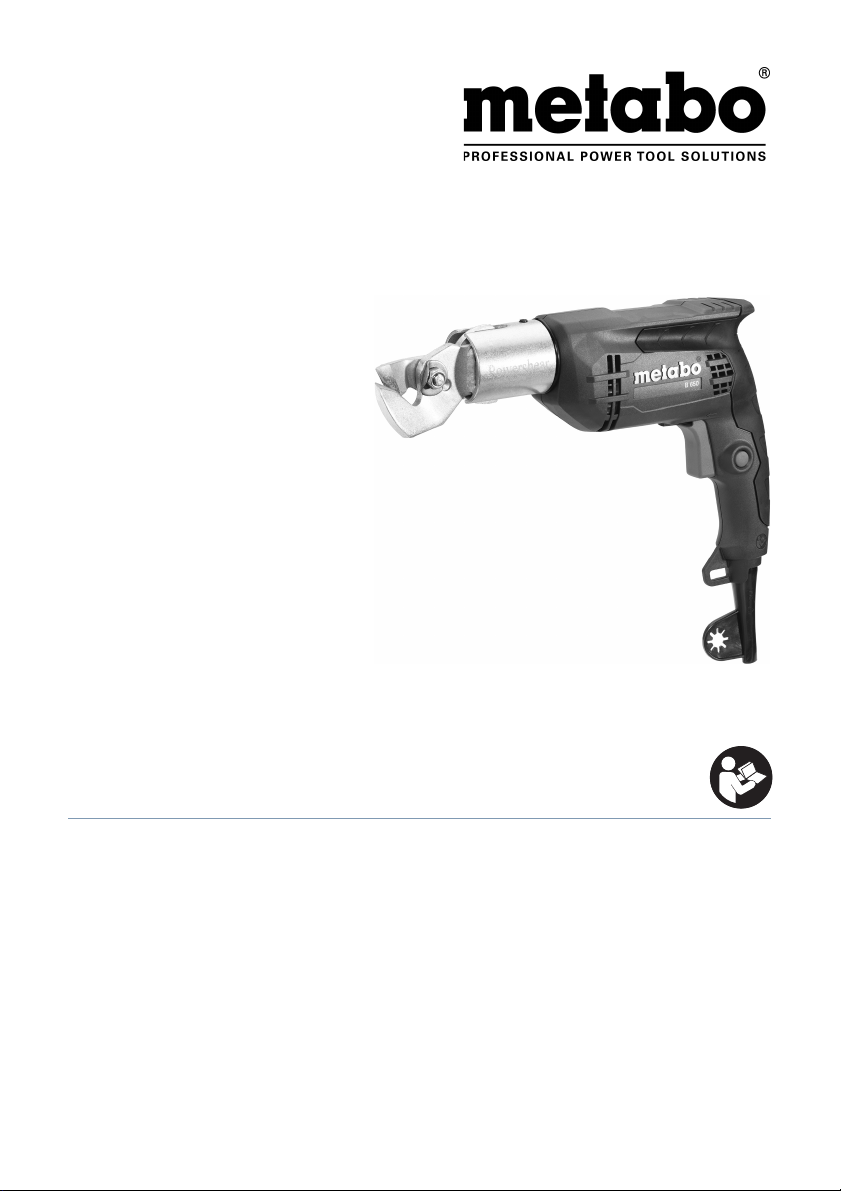
B 650 Powershear
en Original instructions 4
www.metabo.com
Page 2
1
2
YESNO
3
S
YES
Figure 1
Figure 2 Figure 3
2
Page 3

B 650 Powershear
14.
*1) Serial Number: 600740190
P
1
P
2
B
St
B
lnox
B
Al
W 650
W 320
mm 1,6
mm 1,2
mm 2,0
m kg (lbs) 1,8 (4.0)
a
h/Kh
L
pA/KpA
L
WA/KWA
2
m/s
dB(A) 86 / 13
dB(A) 97 / 3
4,8 / 1,5
*2) 2014/30/EU, 2006/42/EC, 2011/65/EU
*3) EN 62841:2015, EN 62841-2-8:2016, EN IEC 63000:2018
2021-04-21, Bernd Fleischmann
Direktor Produktentstehung & Qualität (Vice President Product Engineering & Quality)
*4) Metabowerke GmbH - Metabo-Allee 1 - 72622 Nuertingen, Germany
3
Page 4

ENGLISHen
Original instructions
1. Specified Conditions of Use
The machine is designed for cutting, separating and
trimming sheet material and cuttable plastics. Is is
suitable for straight cutting, cut-outs and tight
corners.
The user bears sole responsibility for any damage
caused by inappropriate use.
Generally accepted accident prevention
regulations and the enclosed safety information
must be observed.
Any other use is considered to be not as specified
and not allowed. The manufacturer assumes no
liability for any damage caused by unspecified use.
Modification of the machine or use of parts not
approved by the manufacturer can cause
unforeseeable damage!
2. General Safety Information
For your own protection and for the
protection of your power tool, pay
attention to all parts of the text that are
marked with this symbol!
WARNING – Read the operating
instructions to reduce the risk of injury.
General Power Tool Safety Warnings
WARNING Read all safety warnings,
instructions, illustrations and
specifications provided with this power tool.
Failure to follow all instructions listed below may
result in electric shock, fire and/or serious injury.
Save all warnings and instructions for future
reference. The term “power tool” in the warnings
refers to your mainsoperated (corded) power tool or
battery-operated (cordless) power tool.
1 Work area safety
a) Keep work area clean and well lit. Cluttered or
dark areas invite accidents.
b) Do not operate power tools in explosive
atmospheres, such as in the presence of
flammable liquids, gases or dust. Power tools
create sparks which may ignite the dust or fumes.
c) Keep children and bystanders away while
operating a power tool. Distractions can cause
you to lose control.
2 Electrical safety
a) Power tool plugs must match the outlet.
Never modify the plug in any way. Do not use
any adapter plugs with earthed (grounded)
power tools. Unmodified plugs and matching
outlets will reduce risk of electric shock.
b) Avoid body contact with earthed or
grounded surfaces, such as pipes, radiators,
ranges and refrigerators. There is an increased
risk of electric shock if your body is earthed or
grounded.
4
c) Do not expose power tools to rain or wet
conditions. Water entering a power tool will
increase the risk of electric shock.
d) Do not abuse the cord. Never use the cord
for carrying, pulling or unplugging the power
tool. Keep cord away from heat, oil, sharp
edges or moving parts. Damaged or entangled
cords increase the risk of electric shock.
e) When operating a power tool outdoors, use
an extension cord suitable for outdoor use. Use
of a cord suitable for outdoor use reduces the risk of
electric shock.
f) If operating a power tool in a damp location is
unavoidable, use a residual current device
(RCD) protected supply. Use of an RCD reduces
the risk of electric shock.
3 Personal safety
a) Stay alert, watch what you are doing and use
common sense when operating a power tool.
Do not use a power tool while you are tired or
under the influence of drugs, alcohol or
medication. A moment of inattention while
operating power tools may result in serious
personal injury.
b) Use personal protective equipment. Always
wear eye protection. Protective equipment such
as a dust mask, non-skid safety shoes, hard hat or
hearing protection used for appropriate conditions
will reduce personal injuries.
c) Prevent unintentional starting. Ensure the
switch is in the off-position before connecting
to power source and/or battery pack, picking
up or carrying the tool. Carrying power tools with
your finger on the switch or energising power tools
that have the switch on invites accidents.
d) Remove any adjusting key or wrench before
turning the power tool on. A wrench or a key left
attached to a rotating part of the power tool may
result in personal injury.
e) Do not overreach. Keep proper footing and
balance at all times. This enables better control of
the power tool in unexpected situations.
f) Dress properly. Do not wear loose clothing or
jewellery. Keep your hair and clothing away
from moving parts. Loose clothes, jewellery or
long hair can be caught in moving parts.
g) If devices are provided for the connection of
dust extraction and collection facilities, ensure
these are connected and properly used. Use of
dust collection can reduce dust-related hazards.
h) Do not let familiarity gained from frequent
use of tools allow you to become complacent
and ignore tool safety principles. A careless
action can cause severe injury within a fraction of a
second.
4 Power tool use and care
a) Do not force the power tool. Use the correct
power tool for your application. The correct
power tool will do the job better and safer at the rate
for which it was designed.
b) Do not use the power tool if the switch does
not turn it on and off. Any power tool that cannot
be controlled with the switch is dangerous and must
Page 5

be repaired.
c) Disconnect the plug from the power source
and/or remove the battery pack, if detachable,
from the power tool before making any
adjustments, changing accessories, or storing
power tools. Such preventive safety measures
reduce the risk of starting the power tool
accidentally.
d) Store idle power tools out of the reach of
children and do not allow persons unfamiliar
with the power tool or these instructions to
operate the power tool. Power tools are
dangerous in the hands of untrained users.
e) Maintain power tools and accessories.
Check for misalignment or binding of moving
parts, breakage of parts and any other
condition that may affect the power tool’s
operation. If damaged, have the power tool
repaired before use. Many accidents are caused
by poorly maintained power tools.
f) Keep cutting tools sharp and clean. Properly
maintained cutting tools with sharp cutting edges
are less likely to bind and are easier to control.
g) Use the power tool, accessories and tool bits
etc. in accordance with these instructions,
taking into account the working conditions and
the work to be performed. Use of the power tool
for operations different from those intended could
result in a hazardous situation.
h) Keep handles and grasping surfaces dry,
clean and free from oil and grease. Slippery
handles and grasping surfaces do not allow for safe
handling and control of the tool in unexpected
situations.
5Service
a) Have your power tool serviced by a qualified
repair person using only identical replacement
parts. This will ensure that the safety of the power
tool is maintained.
b) Never service damaged battery packs.
Service of battery packs should only be performed
by the manufacturer or authorized service
providers.
3. Special safety instructions
Never use the shear attachment in reverse
direction.
Always wear gloves and safety glasses whilst using
the Power Shears.
Always secure the material to be cut firmly and cut
only within the capacity of the machine.
Never use the Power Shear where it can come into
contact with live electricity.
Always keep hands away from the cutting edge.
Only use the shear on the specified drill supplied.
Never force the machine through the material to be
cut.
Remove chips and similar material only when the
machine is at a standstill.
Shavings are sharp and may cause injuries.
ENGLISH en
Secure the workpiece to prevent slipping or rotation
(e.g. by securing with screw clamps).
Always wear protective goggles, gloves, and sturdy
shoes when working with this tool.
Keep hands away from the cutting area.
Always switch on the machine before offering up to
the workpiece.
Wear ear protectors. Exposure to noise can cause
hearing loss.
Hold the power tool by insulated gripping
surfaces, when performing an operation where
the cutting accessory may contact hidden
wiring or its own cord. Cutting accessory
contacting a "live" wire may make exposed metal
parts of the power tool "live" and could give the
operator an electric shock.
Pull the plug out of the plug socket before any
adjustments or servicing are performed.
Ensure that the spot where you wish to work is free
of power cables.
Avoid inadvertent starts by always unlocking the
switch when the plug is removed from the mains
socket or in case of a power cut.
4. Overview
See page 2.
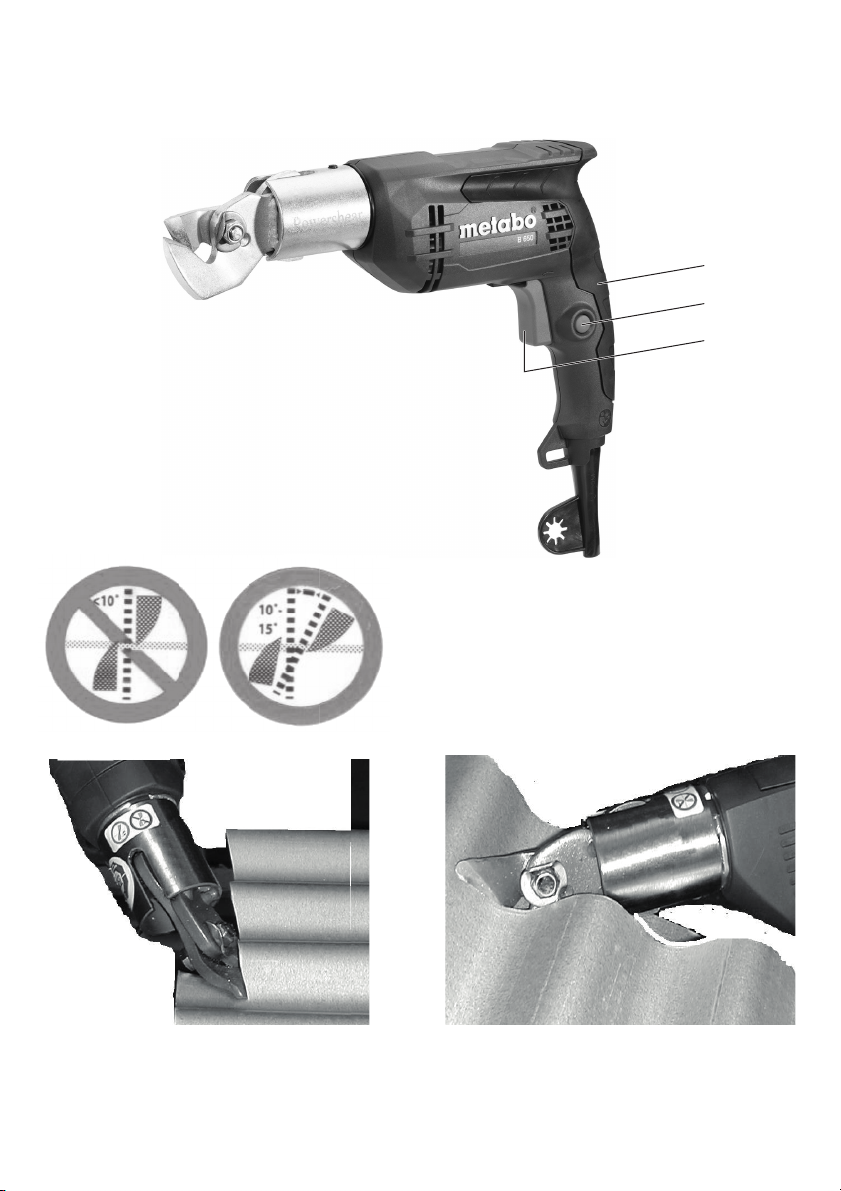
1 Lock button (continuous operation)
2Handle
3Trigger
5. Initial Operation
Before commissioning, check that the
rated mains voltage and mains frequency
stated on the type plate match your power
supply.
Always install an RCD with a maximum trip
current of 30 mA upstream.
6. Use
6.1 Working
See Figures on page 2.
1. Hold the drill firmly and start the opening of the
cutter against the material.
2. Now angle the drill on approximately a 10°- 15 °
angle as shown in figure 1 & 2.
3. Simply turn on the machine and gently push the
cutter through the material maintaining the angle
shown in Figure 1.
4. When cutting corrugated sheets, whilst on the
angle as shown in figure 1, follow the contours
on the sheet for easier and smoother cutting.
(See Figure 2 & 3)
6.2 Switching On and Off
Press the trigger switch (3) to switch on the
machine.
Press the trigger switch to change the speed.
5
Page 6
ENGLISHen
For continuous operation, the trigger button can be
locked using the lock button (1) . Press the trigger
switch again to stop the machine.
In continuous operation, the machine
continues running if it is forced out of your
hands. Therefore, always hold the machine
with both hands using the handles provided,
stand securely and concentrate.
f
7. Accessories
Use only genuine Metabo accessories.
Use only accessories that fulfil the requirements
and specifications listed in these operating
instructions.
Fit accessories securely. If the machine is operated
in a holder: secure the machine well. Loss of control
can cause personal injury.
For the complete range of accessories, see
www.metabo.com or the main catalogue.
8. Repairs
Repairs to electrical tools must ONLY be
carried out by qualified electricians!
A defective mains cable must be replaced only with
a special, original mains cable from Metabo
available from the Metabo service.
Contact your local Metabo representative if you
have Metabo power tools requiring repairs. For
addresses see www.metabo.com.
You can download a list of spare parts from
www.metabo.com.
~ AC Power
The technical specifications quoted are subject to
tolerances (in compliance with relevant valid
standards).
Emission values
These values make it possible to assess the
emissions from the power tool and to compare
different power tools. Depending on the operating
conditions, the condition of the power tool or the
accessories, the actual load may be higher or lower.
For assessment purposes, please allow for breaks
and periods when the load is lower. Based on the
adjusted estimates, arrange protective measures
for the user e.g. organisational measures.
Vibration total value
determined in accordance with EN 62841:
a
= Typical estimated acceleration
h
in the hand/arm area
K
(cutting sheet metal)
= Uncertainty (vibration)
h
Typical A-effective perceived sound levels
L
pA
L
WA
K
pA
During operation the noise level can exceed
80 dB(A).
= Sound pressure level
= Acoustic power level
, KWA= Uncertainty
Wear ear protectors!
= Stroke rate at idle speed
h
0
h
= Stroke rate at rated load
1
r
= Smallest curve radius
min
(vector sum of three directions)
:
9. Environmental Protection
Observe national regulations on environmentally
compatible disposal and on the recycling of disused
machines, packaging and accessories.
Only for EU countries: never dispose of
power tools in your household waste!
According to European Directive 2012/19/EU
on Waste from Electric and Electronic Equipment
and implementation in national law, used power
tools must be collected separately and recycled in
an environmentally-friendly manner.
10. Technical Specifications
Explanatory notes on the specifications on page 3.
Changes due to technological progress reserved.
P
= Rated input power
1
P
= Power output
2
B
= Maximum sheet thickness (sheet steel)
St
B
= Maximum sheet thickness (stainless
Inox
B
m = Weight without mains cable
Measured values determined in conformity with
EN 62841.
6
steel)
= Maximum sheet thickness (aluminium)
Al
Machine in protection class II
Page 7

Page 8

170 27 8200 - 0521
Metabowerke GmbH
Metabo-Allee 1
72622 Nuertingen
Germany
www.metabo.com
 Loading...