

Page 1
Mercedes-Benz
S
500
S
600
Operator's Manual
1
Page 2

Product information
Kindly observe the following in your own best interest:
We recommend using Mercedes-Benz original parts as well as conversion parts and accessories explicitly approved by us for
your vehicle model. We have tested these parts to determine their reliability, safety and their special suitability for MercedesBenz vehicles.
We are unable to make an assessment for other products and therefore cannot be held responsible for them, even if in individual cases
an official approval or authorization by governmental or other agencies should exist. Use of such parts and accessories could
adversely affect the safety, performance or reliability of your vehicle. Please do not use them. Mercedes-Benz original parts as well as
conversion parts and accessories approved by us are available at your authorized Mercedes-Benz Center where you will receive
comprehensive information, also on permissible technical modifications, and where proper installation will be performed.
Our company and staff congratulate you on the purchase of your new Mercedes-Benz.
Your selection of our product is a demonstration of your trust in our company name. Further, it exemplifies your desire to own an
automobile that will be as easy as possible to operate and provide years of service.
Your Mercedes-Benz represents the efforts of many skilled engineers and craftsmen. To ensure your pleasure of ownership, and
for your safety and that of your passengers, we ask you to make a small investment of your time:
• Please read this manual carefully before putting it aside. Then return it to your vehicle where it will be handy for
your reference.
• Please abide by the recommendations contained in this manual. They are designed to acquaint you with the
operation of your Mercedes-Benz.
• Please abide by the warnings and cautions contained in this manual. They are designed to help improve the safety
of the vehicle operator and occupants.
We extend our best wishes for many miles of safe, pleasurable driving.
DaimlerChrysler AG
2
Page 3

Operator's manual
This Operator's Manual contains a great deal of useful information. We urge you to read it carefully and familiarize yourself with the
vehicle before driving.
For your own safety and longer service life of the vehicle, we urge you to follow the instructions and warnings contained in this
manual. Ignoring them could result in damage to the vehicle or personal injury to you or others. Vehicle damage caused by failure to
follow instructions is not covered by the Mercedes-Benz Limited Warranty.
Your vehicle may have some or all of the equipment described in this manual. Therefore, you may find explanations for optional
equipment not installed in your vehicle. If you have any questions about the operation of any equipment, your authorized MercedesBenz Center will be glad to demonstrate the proper procedures.
Owner’s Service and Warranty Policy
The Owner’s Service and Warranty Information Booklet contains detailed information about the warranties covering your
Mercedes-Benz, including:
• New Car Limited Warranty,
• Emission System Warranty,
• Emission Performance Warranty,
• State Warranty Enforcement Laws (Lemon Laws).
3
Page 4

Important notice for California retail buyers of Mercedes-Benz automobiles
Under California law you may be entitled to a replacement of your vehicle or a refund of the purchase price, if Mercedes-Benz USA,LLC
or its authorized Mercedes-Benz Center fails to conform the vehicle to its express warranties after a reasonable number of repair attempts
during the period of one year or 12 000 miles from original delivery of the vehicle. A reasonable number of repair attempts is presumed for
a retail buyer (1) if the vehicle is out of service by reason of repair of substantial nonconformities for a cumulative total of more than 30
calendar days or (2) the same substantial non-conformity has been subject to repair four or more times and you have at least once
directly notified us in writing of the need to repair the non-conformity and have given us an opportunity to perform the repair
ourselves. Notifications should be sent to the nearest Mercedes-Benz Regional Office listed in the Service and Warranty
Information Booklet.
Maintenance
The Service Booklet describes all the necessary maintenance work which should be performed at regular intervals.
Always have the Service Booklet with you when you take the vehicle to your authorized Mercedes-Benz Center for service.
The service advisor will record each service in the booklet for you.
Roadside assistance
The Mercedes-Benz Roadside Assistance Program provides factory trained technical help in the event of a breakdown. Calls to the
toll-free Roadside Assistance number:
1-800-222-0100 (inthe USA) only
will be answered by Mercedes-Benz Client Assistance Representatives 24 hours a day, 365 days a year.
For additional information refer to the Mercedes-Benz Roadside Assistance Program brochure in your glove box.
4
Page 5

Change of address or ownership
If you change your address, be sure to send in the "Change of Address Notice" found in the Owner's Service
and Warranty Policy Booklet. It is in your own interest that we can contact you should the need arise.
If you sell your Mercedes, please leave all owner's literature with the vehicle to make it available to the next owner.
If you bought this vehicle used, be sure to send in the "Notice of Purchase of Used Car" found in the Owner's
Service and Warranty Policy Booklet.
Operating your vehicle outside the USA or Canada
If you plan to operate your vehicle in foreign countries, please be aware that service facilities or replacement
parts may not be readily available.
Certain Mercedes-Benz models are available for delivery in Europe under our European Delivery Program.
For details, consult your authorized Mercedes-Benz dealer or write to:
In the USA: In Canada:
Mercedes-Benz USA, Mercedes-Benz Canada, Inc.
LLCEuropean Delivery Department European Delivery Department
One Mercedes Drive 849 Eglinton Avenue East
Montvale, NJ 07645 Toronto, Ontario M4G 2L5
5
Page 6

We continuously strive to improve our product, and ask for your understanding that we reserve the right to make changes in design and
equipment. Therefore, information, illustrations and descriptions in this Operator's Manual might differ from your vehicle.
Optional equipment is also described in this manual, including operating instructions wherever necessary. Since they are special-order
items, the descriptions and illustrations herein may vary slightly from the actual equipment of your vehicle.
If there are any equipment details that are not shown or described in this Operator's Manual, your authorized MercedesBenz Center will be glad to inform you of correct care and operating procedures.
The Operator's Manual and Service Booklet are important documents and should be kept with the vehicle.
6
Page 7

Check Regularly and Before a Long Trip
See Index
The First 1000 Miles (1500 km)
The more cautiously you treat your vehicle during the break-in period, the more satisfied you will be with its
performance later on. Therefore, drive your vehicle during the first 1500 km (1000 miles) at moderate vehicle and
engine-speeds.
During this period, avoid heavy loads (full throttle driving) and high RPM (no more than 2/3 of maximum
permissible speed in each gear as indicated on the speedometer).
Avoid accelerating by kickdown. It is not recommended to brake the vehicle by manually shifting to a lower gear.
We recommend to select positions "3" or "2"only at moderate speeds (for hill driving).
After 1000 miles (1500 km) speeds may be gradually increased to the permissible maximum
Maintenance
We strongly recommend that you have your vehicle serviced by your authorized Mercedes-Benz dealer, in accordance with the
Maintenance Booklet.
Failure to have the vehicle maintained in accordance with the Maintenance Booklet may result in vehicle damage not covered by
the Mercedes-Benz Limited Warranty.
7
Page 8

Introduction
Product information
Operator's manual
Consumer Information 135 Doors and Trunk Lid 35 Pop-Up Feature 66
Problems with your vehicle
Reporting Safety Defects
Index
Instruments and Controls
Instruments and Controls
Instrument Cluster
Indicator Lamp Symbols 13 Adjustable Steering Wheel 43
Starting and Turning Off the Engine
Driving Instructions
Operation
Air Outlets
Automatic Climate Control
Rear Passenger Compartment:
Adjustable Air Outlet
Active Charcoal Filter 27 Inside and Exterior
Car Keys
Infrared Remote Control 29 Sun Visors 62
Central Locking System
Doors
Trunk
Power Windows and
2 Sliding/Pop-Up Roof 34 Lighter 65
3 Power Closing Assist for Sliding Roof with Rear
136 Anti-Theft Alarm System 36
137 Power Seats, Front 37 Rear Window Sunshade 68
139 Lumbar Support 40
Multicontour Backrest
Heated Seats 41 Shelf below Rear Window 70
Power Head Restrains, Rear
10 Armrest, Front 43
12 Armrest, Rear
15 Seat Belts and Supplemental 44
16 Restrain System (SRS) Drinking and Driving 72
Seat Belts 45
Emergency Tensioning
Retractor (ETR)
22 Airbags 50
23 Steering Lock 55
Combination Switch 56
27 Exterior Lamp Switch 58
28 Rear View Mirrors 59
32 Vanity Mirrors 62
32 Interior Lighting 63
33 Storage Compartments 64
Ashtrays 65
Power Windows
Rear Window Defroster
Setting Clock
40
Antenna
42
Cellular Telephone
Driving
Parking Brake
49 Driving Off 72
Automatic Transmissions 73
Rear Fender Indicators
Cruise Control
Charge Indicator Lamp
Engine Oil Pressure Gauge with Oil
Pressure Warning Lamp
Low Engine Oil Level
Warning Lamp
Engine Oil Consumption
Fuel Consumption Gauge
67
69
70
70
72
76
76
78
78
79
79
79
69
8
Page 9

Fuel Reserve Warning Lamp
Outside Temperature Checking Engine Oil Level 94 Roof 120
Indicator
Coolant Temperature Gauge
Low Engine Coolant Level Trunk Lamp 96 Roof Rack 122
Warning Lamp 81 Spare Wheel, Lug Wrench 96 Mercedes-Benz
Low Windshield and Headlamp First Aid Kit 96 Spare Parts Service 122
Washer System Fluid Level Stowing Things in the Vehicle 96
Warning Lamp 81 Vehicle Jack 97
Exterior Lamp Failure Vehicle Tools 97
Indicator Lamp 82 Storage Compartment below
Seat Belt Warning Lamp 82 Vehicle Tool Box 97
Brake Pad Wear Indicator lamp 82 Wheels 98
Brake Warning Lamp 83 Changing Wheels 100
Antilock Brake System (ABS) 84 Tire Inflation Pressure 103
Acceleration Slip Control (ASR) 85 Battery 104
Driving with Snow Chains 86 Exterior Lamps 105
Adaptive Damping System (ADS) 87 Fuses 109
Emission Control 88 Jump Starting 110
On-Board Diagnostic System 88 Towing the Vehicle 112
Traveling Abroad 89 Cleaning and Care of the Vehicle 113
Winter Driving 89 Testing Infrared Remote Control 116
Snow Chains 88 Front Head Restrains 117
Practical Hints Manual Closing of Trunk Lid 118
Hood 92 Trunk Lid Handle 117
Checking Coolant Level 93 Replacing Wiper Blades 119
Adding Coolant 93 Emergency Operation of Sliding
80
Checking Automatic Manual Release of Fuel Filler Flap 121
80
80
Transmission Fluid Level 95 Layout of Poly-V-Belt Drive 120
Technical Data. Fuels, Coolants,
Lubricants etc. Consumer Info.
Identification Plates
Vehicle Data Card
Warranty Coverage
Technical Data
S 500
S 600
Fuels, Coolants, Lubricants etc.
Capacities
Engine Oils
Engine Oils Additives
Air Conditioner Refrigerant
Brake Fluid
Rear Seat Cushion 118
Manual Retraction of
Premium Unleaded Gasoline
Fuels Requirements
Gasoline Additives 133
Coolants
Check Regularly and before
a long trip 143
124
125
125
126
128
130
132
132
132
131
132
132
133
134
9
Page 10

Instruments and Controls
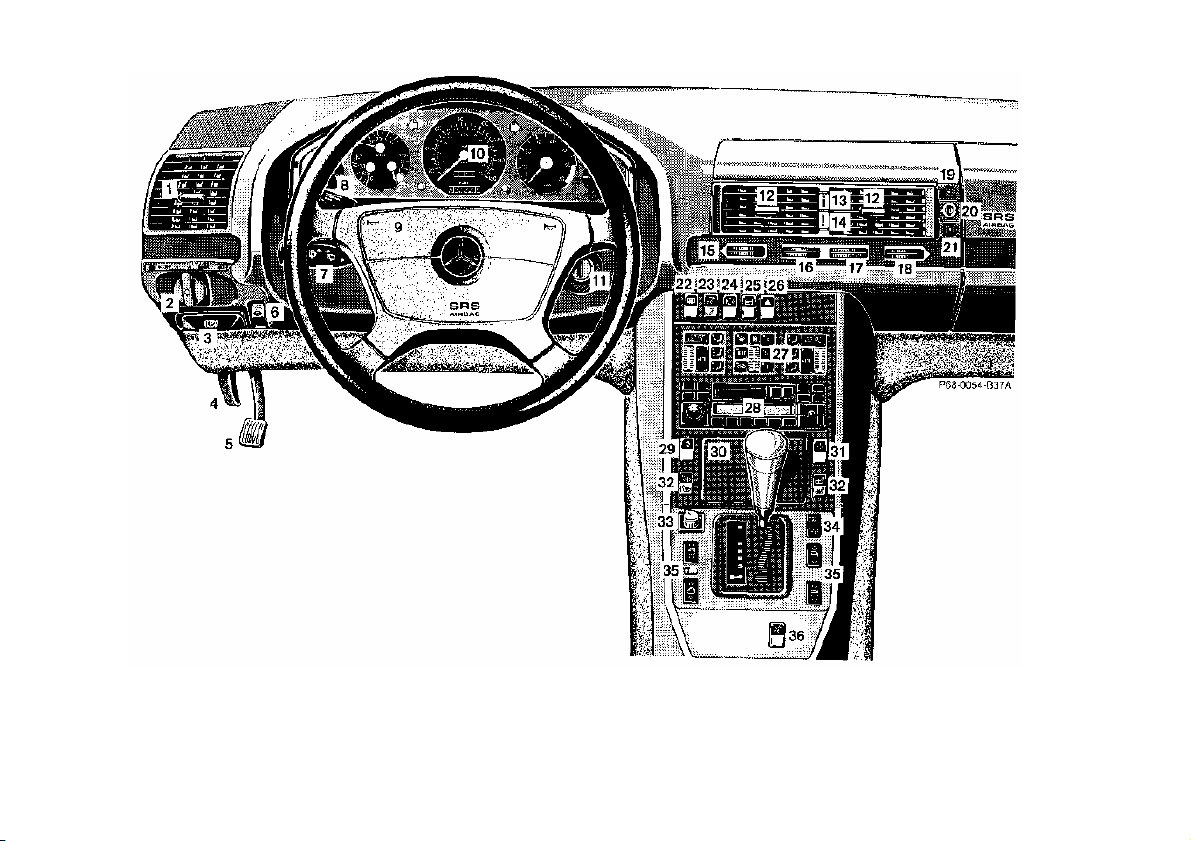
For more detailed descriptions see Index.
Adjustable air outlet
1
Exterior lamp switch
2
Parking brake release
3
Hood lock release
4
Parking brake pedal
5
Steering wheel adjustment switch
6
Combination switch
7
Cruise control switch
8
Horn, airbag
9
Instrument cluster
10
Steering lock with preglow / starter switch
11
Adjustable air outlet
12
Heated air supply button – center air outlet
13
Non – heated /coolant air supply button center air outlet
14
Air volume control for left air outlet
15
Air volume control for left center air outlet
16
Air volume control for right center air outlet
17
Air volume control for right air outlet
18
Telephone control unit compartment
19
Lock for telephone control unit compartment and glove box
20
Glove box (illuminated with key in steering lock position 2)
21
Rear window defroster switch
22
Switch for rear seat head restrains
23
Active charcoal filter switch
24
Central locking switch, Indicator lamp for anti-theft alarm system
25
Hazard warning flasher switch
26
Automatic climate control
27
Radio
28
Snow chain switch
29
Ashtray with lighter
30
Adaptive damping system adjustment switch
31
Seat heater switch
32
Mirror adjustment switch
33
Switch for rear window sunshade
34
Power window switch
35
Seat belt extender
36
10
Page 11
11
Page 12
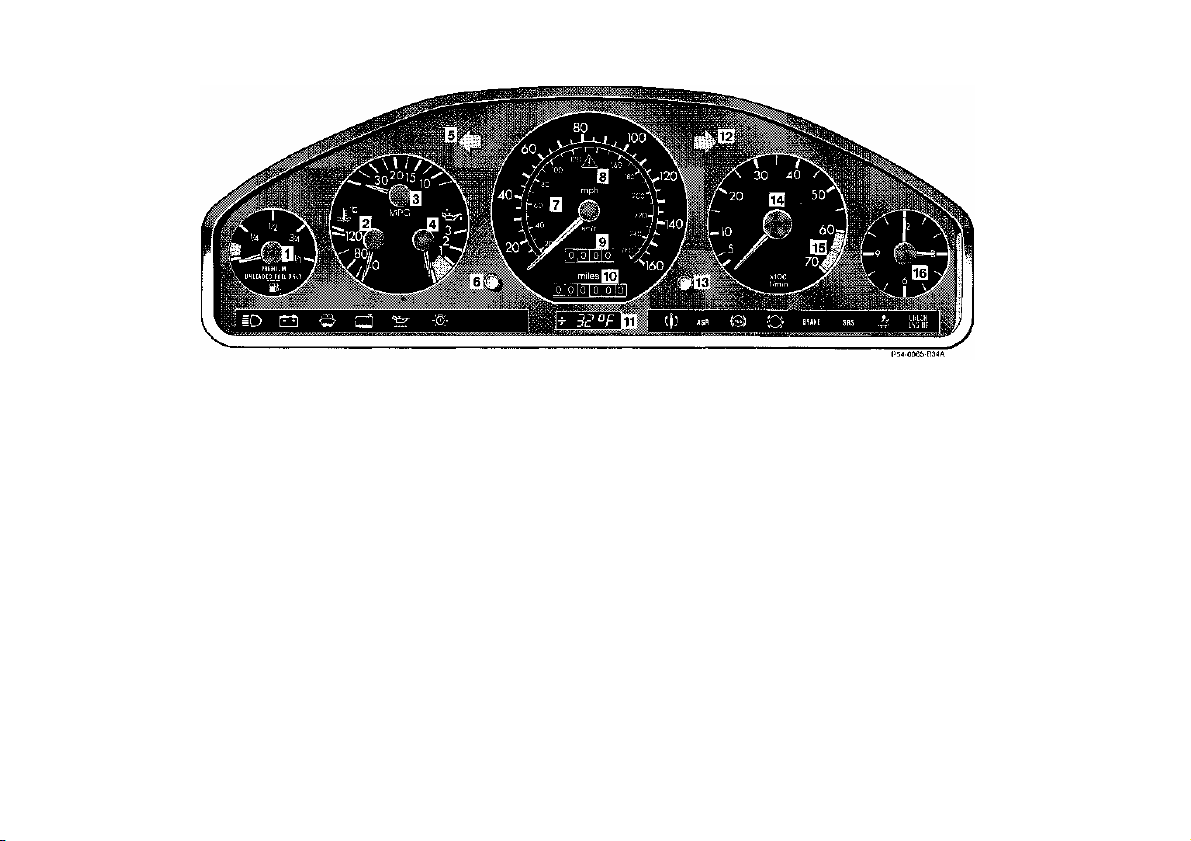
Instrument Cluster
1
Fuel gauge with reserve warning lamp (yellow).
See
Index.
Index.
9
Trip odometer
.
2
Coolant temperature gauge.
See
Index.
10
Main odometer
3
Fuel consumption gauge.
See
Index.
11
Outside temperature indicator. See
Index.
4
Engine oil pressure gauge (bar) with warning lamp (red).
See
Index.
12
Right turn signal indicator lamp (green)
5
Left turn signal indicator lamp (green)
13
Knob for sett
ing clock
(to adjust pull knob out).
6
Knob for instrument lamps and trip odometer
.
See
Index.
14
Tachometer.
7
Speedometer
15
Red marking on tachometer: Excessive engine
8
ASR function indicator lamp (yellow).
See
Index.
16
Clock. See Index
12
Page 13
Indicator Lamp Symbols
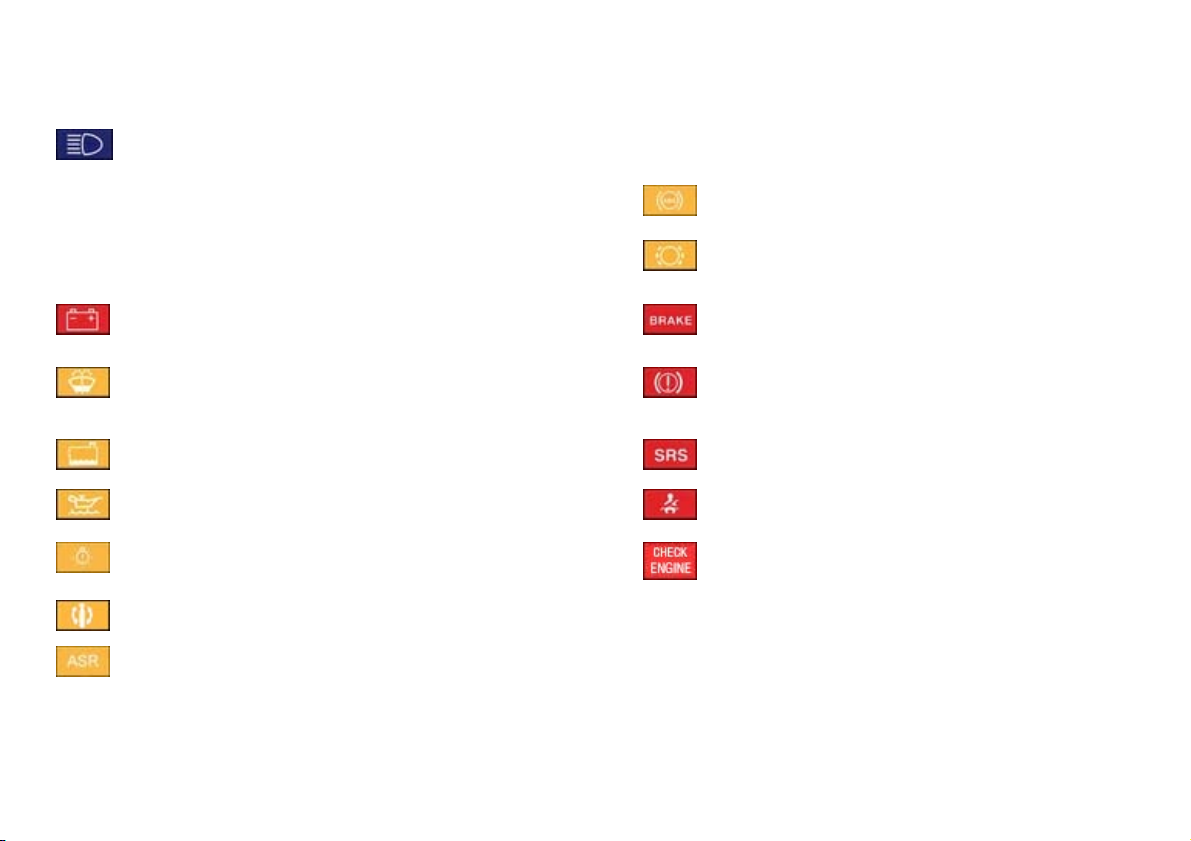
Function Indicator Lamp
High beam
ABS malfunction
Warning Lamps
(should go out with the engine running unless)
Battery not being charged properly. See Index Brake fluid low (except Canada).
Fluid level for windshield and headlamp washer
system low. See Index.
Coolant level low. See Index. SRS malfunction. See Index.
Engine oil level low. See Index. Fasten seat belts. See Index.
Exterior lamp failure. See Index.
ADS malfunction. See Index.
ASR malfunction. See Index.
Brake pads worn down. See Index.
Parking brake engaged. See Index.
Brake fluid low (Canada only).
Parking brake engaged. See Index.
Engine malfunction (California only). If the
lamp comes on when the engine is running, it
indicates a malfunction of the fuel injection system
or emission control system. In either case, we
recommend that you have the malfunction checked
as soon as possible. See Index.
13
Page 14

Catalytic Converter
Caution!
Warning!
Your Mercedes-Benz is equipped with
monolithic type catalytic converters, an
important element in conjunction with
the O2 sensor to achieve substantial
control of the pollutants in the exhaust
emissions. Keep your vehicle in proper
operating condition by following our
recommended maintenance instructions
as outlined in your Maintenance
Booklet.
To prevent damage to the catalytic
converters, use only premium unleaded
gasoline in this vehicle.
Any noticeable irregularities in engine
operation should be repaired promptly.
Otherwise, excessive unburned fuel
may reach the catalytic converter
causing it to overheat.
As with any vehicle, do not idle, park
or operate this vehicle in areas where
combustible materials such as grass,
hay or leaves can come into contact
with the hot exhaust system, as these
materials could be ignited.
14
Page 15

Starting and Turning Off the Engine
Turning Off
Important!
Before Starting
Engage parking brake and ensure
selector lever is in position "P" or "N".
Turn key in steering lock to position 2.
The charge indicator lamp should come
on.
Cold Engine
Do not depress accelerator. Turn key
in steering lock clockwise to the stop.
Release key only when the engine is
firing regularly.
Hot Engine
Do not depress accelerator. Turn key in
steering lock clockwise to the stop.
If the engine has not fired after approx.
4 seconds, depress accelerator and
continue cranking until the engine is
firing regularly. Release key and back
off accelerator.
At very high coolant temperatures the
engine starting time can be shortened if
the accelerator is depressed slowly at
the beginning of the starting process.
Turn the key in the steering lock to
position 0 to stop the engine.
The key can only be removed with the
selector lever in position "P".
If the coolant temperature is very high
(e.g. after hard driving on mountain
roads), do not shut off the engine
immediately, but allow it to run for 1 2 minutes at increased idle speed with
selector lever in position "P" or "N".
Due to the installed starter non-repeat
feature, the key must be turned
completely to the left before attempting
to start the engine again.
Observe the oil pressure gauge
immediately after starting the engine.
In a very cold engine the oil pressure
will rise slowly after the engine has
started. Do not speed up the engine
before pressure is registered on the
pressure gauge. If you do not see the
gauge register oil pressure, stop the
engine and have it checked.
The charge indicator lamp should go
out as soon as the engine has started.
In areas where temperatures frequently
drop below -4°F (-20°C) we
recommend that an engine block heater
be installed. Your authorized
Mercedes-Benz dealer will advise you
on this subject.
15
Page 16

Driving Instructions
Warning!
Warning!
Power Assistance
Warning!
When the engine is not running, the
brake and steering systems are
without power assistance. Under
these circumstances, a much greater
effort is necessary to stop or steer the
vehicle.
Brakes
Caution!
When driving down long and steep
grades, relieve the load on the brakes
by shifting into "3", "2" or "B". This
helps prevent overheating of the brakes
and reduces brake pad wear. Do not
exceed engine speed limits. Refer to
Technical Data for downshift points.
After hard braking, it is advisable to
drive on for some time, rather than
immediately parking, so the air stream
will cool down the brakes faster.
After driving in heavy rain for some
time without applying the brakes or
through water deep enough to wet
brake components, the first braking
action may be somewhat reduced
and increased pedal pressure may be
necessary. Be sure to maintain a safe
distance from vehicles in front.
The condition of the parking brake
system is checked each time the car is
in the shop for the required
maintenance.
Between maintenance checks, it is a
good practice to apply the parking
brake once or twice while driving at
approximately 30 mph (50 km/h) on a
dry straight road. Apply parking brake
lightly while pulling the release handle
out until a slight drag on the wheels is
felt. Keep applying the brake for about
10 seconds while pulling the release
handle out before releasing the parking
brake completely. This practice will
keep the parking brake at maximum
efficiency
The stop lamps will not come on
when applying the parking brake
only. Perform the procedure in the
previous paragraph only when the
road is clear of other traffic.
Resting your foot on the brake pedal
will cause excessive and premature
wear of the brake pads.
It can also result in the brakes
overheating thereby significantly
reducing their effectiveness. It may
not be possible to stop the car in
sufficient time to avoid an accident.
All checks and maintenance work on
the brake system should be carried out
by an authorized Mercedes-Benz dealer
16
Page 17
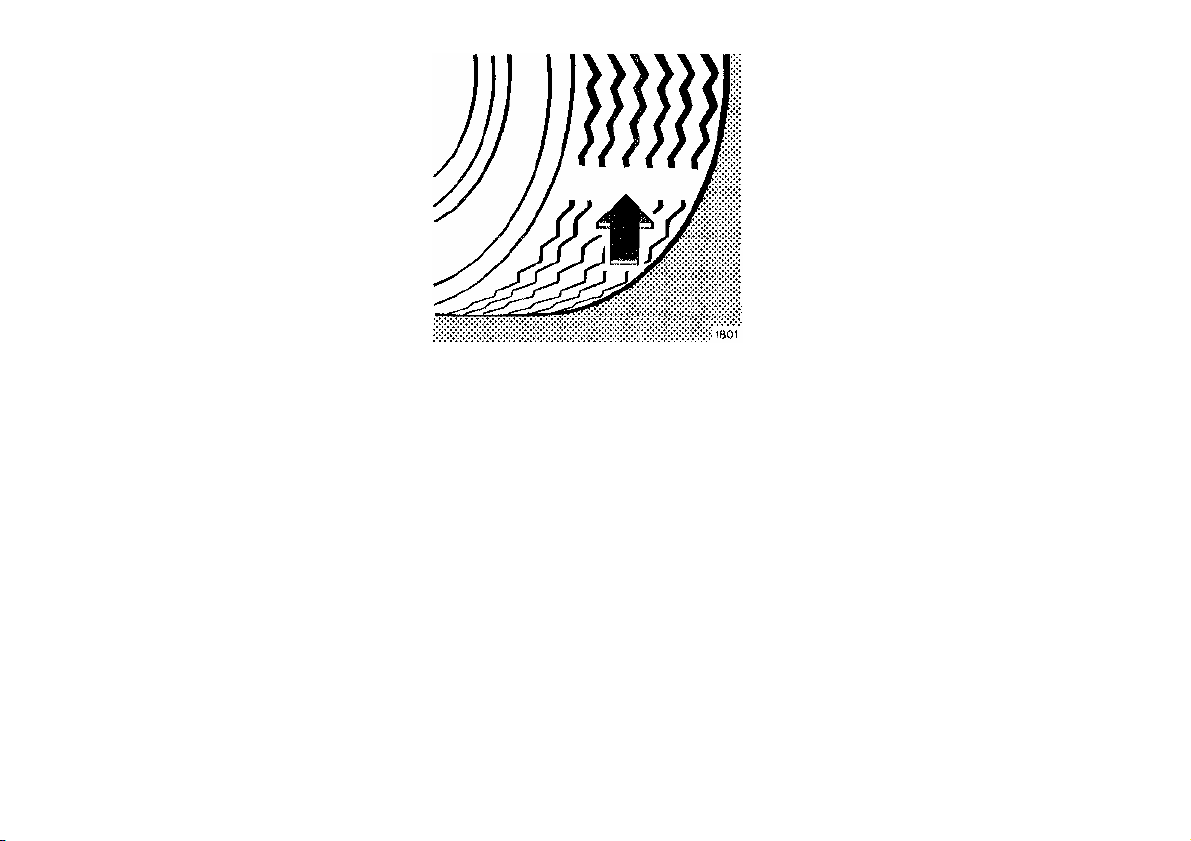
If the parking brake is released and the
brake warning lamp in the instrument
cluster stays on, the brake fluid level in
the reservoir is too low.
Brake pad wear or a leak in the system
may be the reason for low brake fluid
in the reservoir.
Have the brake system inspected at an
authorized Mercedes-Benz dealer
immediately.
Install only brake pads and brake fluid
recommended by Mercedes-Benz.
Warning!
Tires
Warning!
Do not allow your tires to wear down
too far. With less than1/16in (1.5
mm) of tread, the adhesion
properties on a wet road are sharply
reduced.
Depending upon the weather and/or
road surface (conditions), the tire
traction varies widely.
Specified tire pressures must be
maintained. This applies particularly if
the tires are subjected to high loads
(e.g. high speeds, heavy loads, high
ambient temperatures).
If other than recommended brake
pads are installed, the braking
properties of the vehicle can be
degraded to an extent that safe
braking is substantially impaired.
Tread wear indicators (TWI) are
required by law. These indicators are
located in six places on the tread
circumference and become visible at a
depth of approximately1/16in
(1.5 mm), at which point the tire is
considered worn and should be
replaced.
The tread wear indicator appears as a
solid band across the tread.
Warning!
Do not drive with a flat tire. A flat
tire affects the ability to steer or
brake the vehicle. You may lose
control of the car. Continued driving
with a flat tire or driving at high
speed with a flat tire will cause
excessive heat build-up and possibly
a fire.
17
Page 18

Aquaplaning
Depending on the depth of the water
layer on the road, aquaplaning may
occur, even at low speeds and with new
tires. Reduce vehicle speed, avoid track
grooves in the road and apply brakes
cautiously in the rain.
Tire Traction
The safe speed on a wet, snow covered
or icy road is always lower than on a
dry road.
You should pay particular attention to
the condition of the road whenever the
outside temperatures are close to the
freezing point.
Warning!
If ice has formed on the road, tire
traction will be substantially
reduced. Under such weather
conditions, drive, steer and brake
with extreme caution.
We recommend M + S radial-ply tires
for the winter season for all four wheels
to insure normal balanced handling
characteristics.
On packed snow, they can reduce
your stopping distance as com-pared
with summer tires. Stopping distance,
however, is still considerably greater
than when the road is wet or dry.
Tire Speed Rating
Your vehicle is factory equipped with an
"H"-rated tire, which has a speed rating
of 130 mph (210 km/h). An electronic
speed limiter prevents your vehicle from
exceeding the speed resting.
Notwithstanding tire speed rating, local
speed limits should be obeyed, and
prudent driving speeds appropriate to
prevailing conditions should be
employed.
Warning!
Never operate a vehicle at speeds
greater than the maximum speed
rating of the tires with which it is
equipped. Exceeding the maximum
speed for which tires are rated can
lead to sudden tire failure, causing
loss of vehicle control, and
resulting in personal injury and
possible death.
Parking
Warning!
To reduce the risk of personal injury
as a result of vehicle movement,
before turning off the engine and
leaving the vehicle always:
1. Keep right foot on brake
pedal.
2. Firmly depress parking brake
pedal.
3. Move the selector lever to
position "P".
4. Slowly release brake pedal.
5. Turn front wheels towards
the road curb.
6. Turn the key to steering
lock position 0 and remove.
Important!
It is advisable to set the parking brake
whenever parking or leaving the
vehicle. In addition, move selector
lever to position "P".
When parking on hills, always set the
parking brake.
18
Page 19

Winter Driving Instructions
The most important rule for slippery or
icy roads is to drive sensibly and to
avoid abrupt acceleration, braking and
steering maneuvers. Do not use the
cruise control system under such
conditions.
When the vehicle is in danger of
skidding, move selector lever to
position "N". Try to keep the vehicle
under control by corrective steering
action.
Road salts and chemicals can adversely
affect braking efficiency. Increased
pedal force may become necessary to
produce the normal brake effect. We
therefore recommend depressing the
brake pedal periodically when traveling
at length on salt-strewn roads. This can
bring road salt impaired braking
efficiency back to normal.
A prerequisite is, however, that this is
done without endangering other drivers
on the road.
If the vehicle is parked after being
driven on salt treated roads, the braking
efficiency should be tested as soon as
possible after driving is resumed while
observing the safety rules in the
previous paragraph.
Warning!
If the vehicle becomes stuck in snow,
make sure that snow is kept clear of
the exhaust pipe and from around
the vehicle with engine running.
Otherwise, deadly carbon monoxide
(CO) gases may enter vehicle interior
resulting in unconsciousness and
death.
To assure sufficient fresh air
ventilation, open a window slightly
on the side of the car that is out of
the wind
Passenger Compartment
Warning!
Always fasten items being carried as
securely as possible.
In an accident, during hard braking
or sudden maneuvers, loose items
will be thrown around inside the
vehicle, and cause injury to vehicle
occupants unless the items are
securely fastened in the vehicle.
19
Page 20

20
Page 21

Operation
21
Page 22
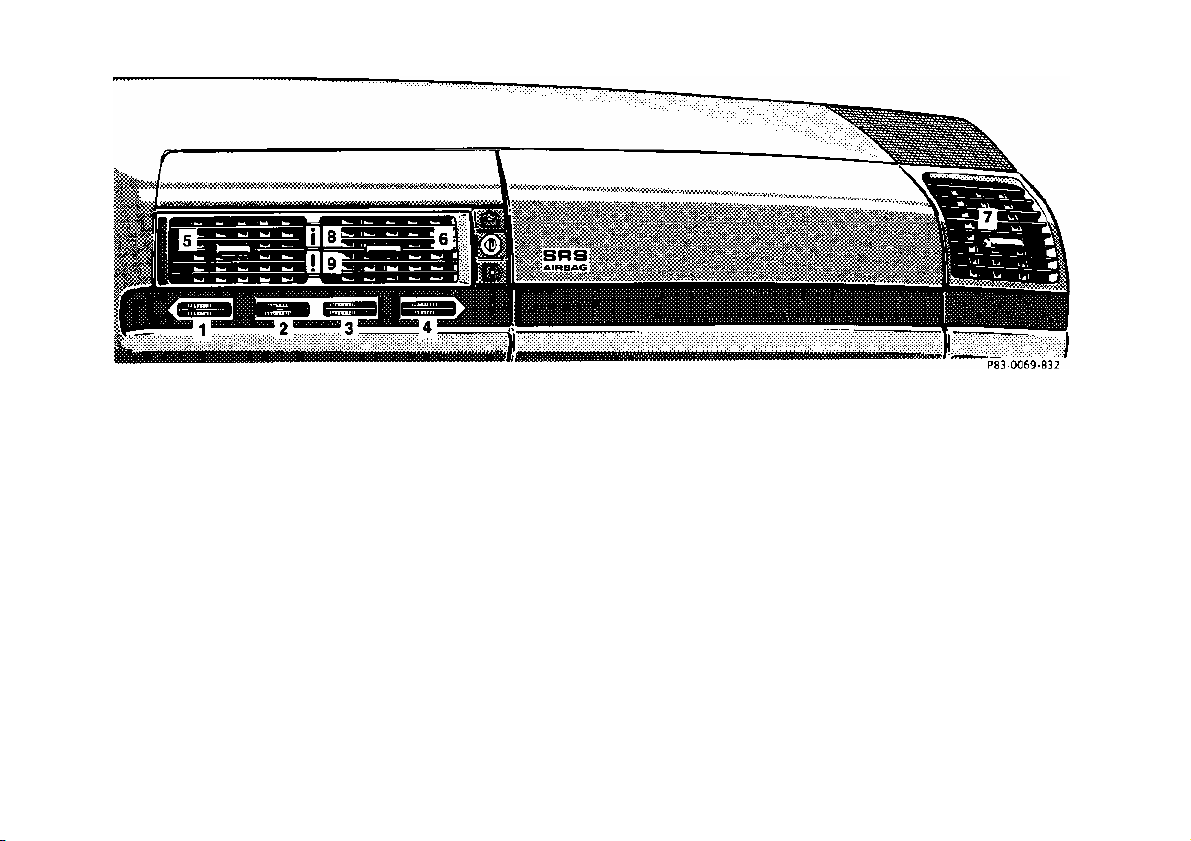
Air Outlets 5
Air volume control for left air
1
outlet, turn left open
Air volume control for left center adjustable Certain and pollen are filtered
2
air outlet, turn left open Out before outside air enters
Air volume control for right center
3
outlet, turn left open
Air volume control for right air
4
outlet, turn left to open
Left center air outlet, adjustable
Right center air outlet, adjustable
6
Side air outlet, left and right, Dust particles ( down to a
7
Push-button for center air outlets
Heated air supply ( red indicator) through the air distribution
8
Non-heated/cooled air supply (blue indicator) system.
9
Basic mode:
None of the push-buttons (8 or 9) is pressed.
Dust Filter
the passenger compartment
22
Page 23
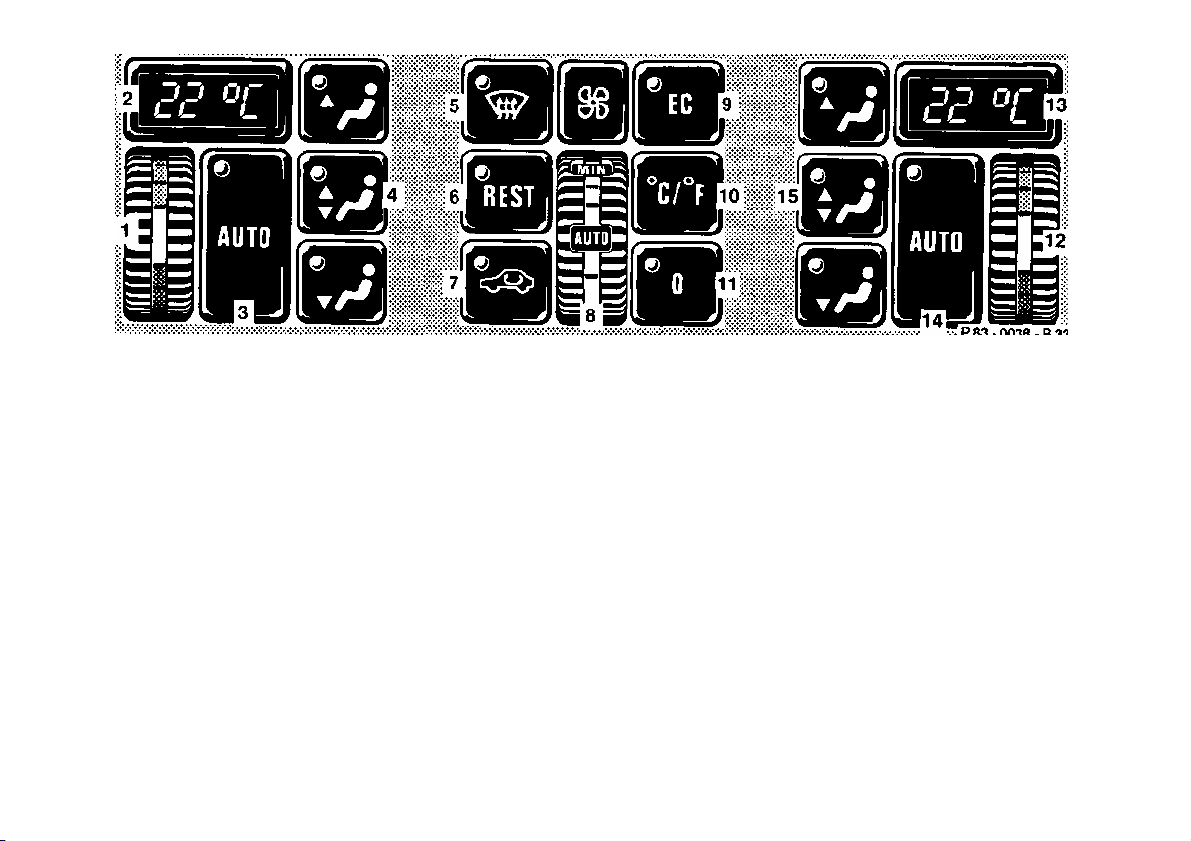
Automatic Climate Control
Left side passenger compartment
Temperature selector
1
Temperature display
2
Automatic mode
3
Air distribution buttons
4
Defrost
5
Residual engine heat utilization
6
Air recirculation
7
Air volume selector
8
Economy
9
Selection switch
10
Off
11
Right side passenger
compartment:
Temperature selector
12
Temperature display
13
Automatic mode
14
Air distribution buttons
15
23
Page 24

The temperature selected with the
temperature selector is reached as
quickly as possible.
The temperature selector should be left
at the desired temperature setting.
With the center air outlets open and the
system in heating mode, switch the
outlets to non-heated/ cooled air by
pressing the blue button (indicator lamp
lights up).
With the center air outlets open and the
system in cooling mode, switch the
outlets to non-heated/ fresh air by
pressing the red button (indicator lamp
lights up).
The system will not heat or cool any
quicker by setting a higher or lower
temperature.
The automatic climate control only
operates with the engine running.
The automatic climate control removes
considerable moisture from the air
during operation in the cooling mode.
It is normal for water to drip on the
ground through ducts in the underbody
1, 12 Temperature Selector
The desired interior temperature can be
selected separately for the left and right
side of the passenger compartment.
A basic setting in the white field of the
selector is recommended, and can be
used for driving year round.
The selected temperature can be shown
in the display window (2) in either °F
or °C.
3, 14 Automatic Mode
This is the normal setting.
Air volume and distribution are
controlled automatically.
To select: Press button
(indicator lamp lights up)
To change selection:
Press or
button (indicator lamp of selected
button lights up). The indicator lamp
for button goes out.
Note:
If the Automatic Climate Control is in
the "Diagnosis Mode", turn key in
steering lock to position 0 to return it to
its normal operation.
5 Defrost
Maximum heated and automatically
controlled amount of air is directed to
the windshield and side windows.
As the engine coolant temperature
increases, the air volume is automatically increased, thereby defrosting
as quickly as possible.
Open and direct air outlets (7) towards
the side windows.
Note:
Press once again to return to
previous setting.
Defogging Windows
Switch off , or switch on
(left and right side), or switch on
Note:
To quickly defog the inside of the
windshield, select the largest air
volume and air distribution button
24
Page 25

6 Residual Engine Heat
Utilization
With the engine switched off, it is
possible to continue heating the interior
for a short while. The rear passenger
compartment air outlet must be closed.
The system will automatically
shut off
• after approx. 30 minutes,
• if the engine coolant temperature
drops below 122°F (50°C),
• if the battery voltage drops.
The system will automatically switch
from recirculated air to fresh air if
button is pressed
• after approx. 5 minutes at
outside temperatures below
approx. 40°F(5°C),
Air volume and distribution are
controlled automatically.
To select:
Turn key in steering lock to position 1
or 0 or remove key.
Press button (indicator lamp
lights up). This function selection will
not activate if the engine coolant
temperature is below 122°F (50°C) or
if the battery charge level is insufficient.
To cancel:
• Press button
(indicator lamp goes out).
• Turn key in steering lock to
position 2.
7 Air Recirculation
Outside air is not supplied to the car's
interior.
This mode can be selected to prevent
annoying odors or dust from entering
the car's interior.
To select:
Press button (indicator
lamp lights up).
To cancel:
Press button
(indicator lamp goes out
• after approx. 20 minutes, at
outside temperatures above
approx. 40°F (5°C),
If button is pressed after approx.
5 minutes.
Notes:
If the windows should fog up from the
inside, switch from recirculated air
back to fresh air.
At high outside temperatures, the
system automatically engages the
recirculated air mode thereby
increasing the cooling capacity
performance, switching to partially
fresh air within 20 minutes.
25
Page 26

8 Air Volume Selector
9 Economy
11 Off
The air volume is automatically
regulated in
AUTO = Normal setting
and all intermediate positions, except
when selecting
MIN = minimum air flow,
MAX = maximum air flow.
The function of this setting
corresponds to the automatic mode.
However, because the air conditioning
compressor will not engage (fuel
savings), it is not possible to air
condition in this setting.
The fresh air supply to the car interior
is shut off.
While driving, use this setting only
temporarily, otherwise the windshield
could fog up.
Important!
This vehicle is equipped with an air
conditioner system that uses HFC-134a
(ozone-friendly hydro-fluorocarbon) as
a refrigerant.
Repairs should always be performed by
a qualified technician, and refrigerant
should be collected in a recovery
system for recycling.
26
Page 27
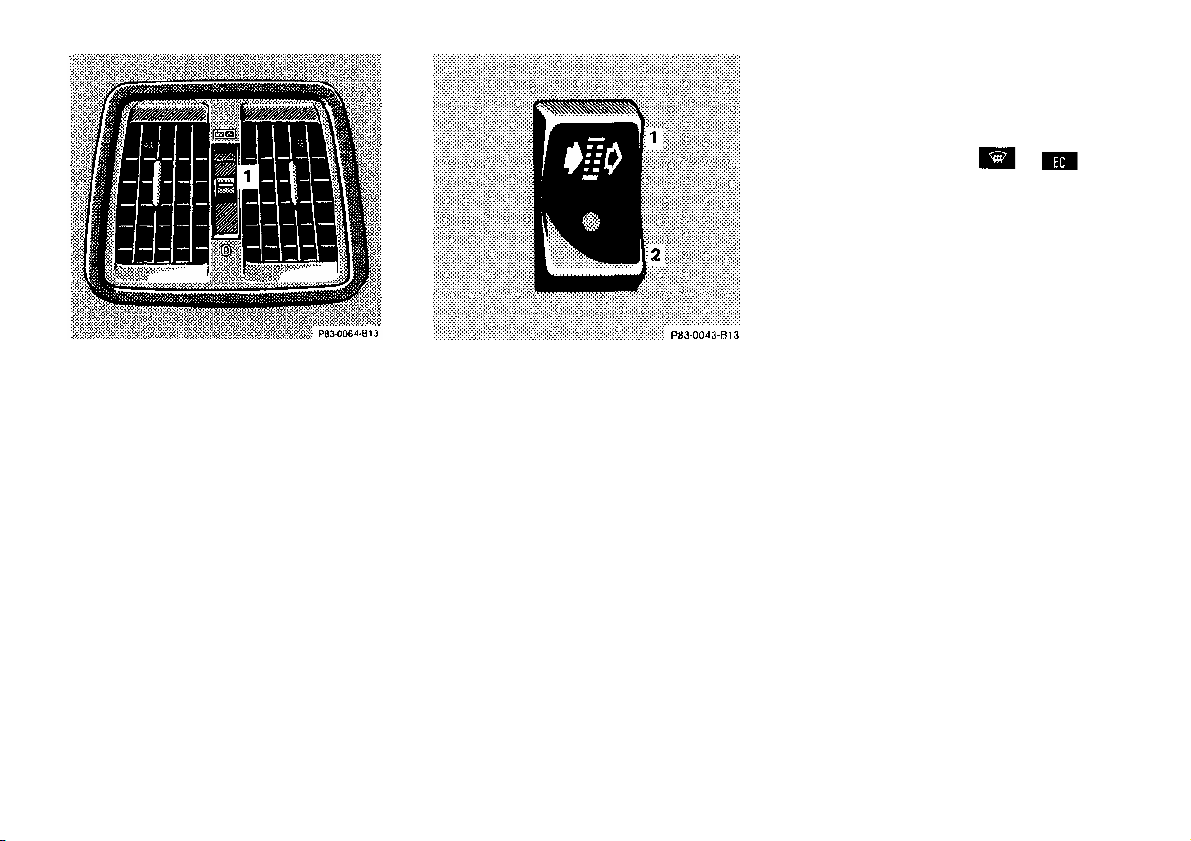
Rear Passenger Compartment
Adjustable Air Outlet
Vehicles without rear passenger
compartment climate control.
Slide switch (1) up to open outlet for
fresh/cooled air only.
An active charcoal filter markedly
reduces bad odors and removes
pollutants from the air entering the
passenger compartment.
When pressing button or , the
filter is automatically switched off.
Note:
The active charcoal filter should be
switched off when windows fog up on
the inside, or if the passenger
compartment needs to be quickly
heated up or cooled down.
Active Charcoal Filter
1 Switch on
2 Switch off
27
Page 28
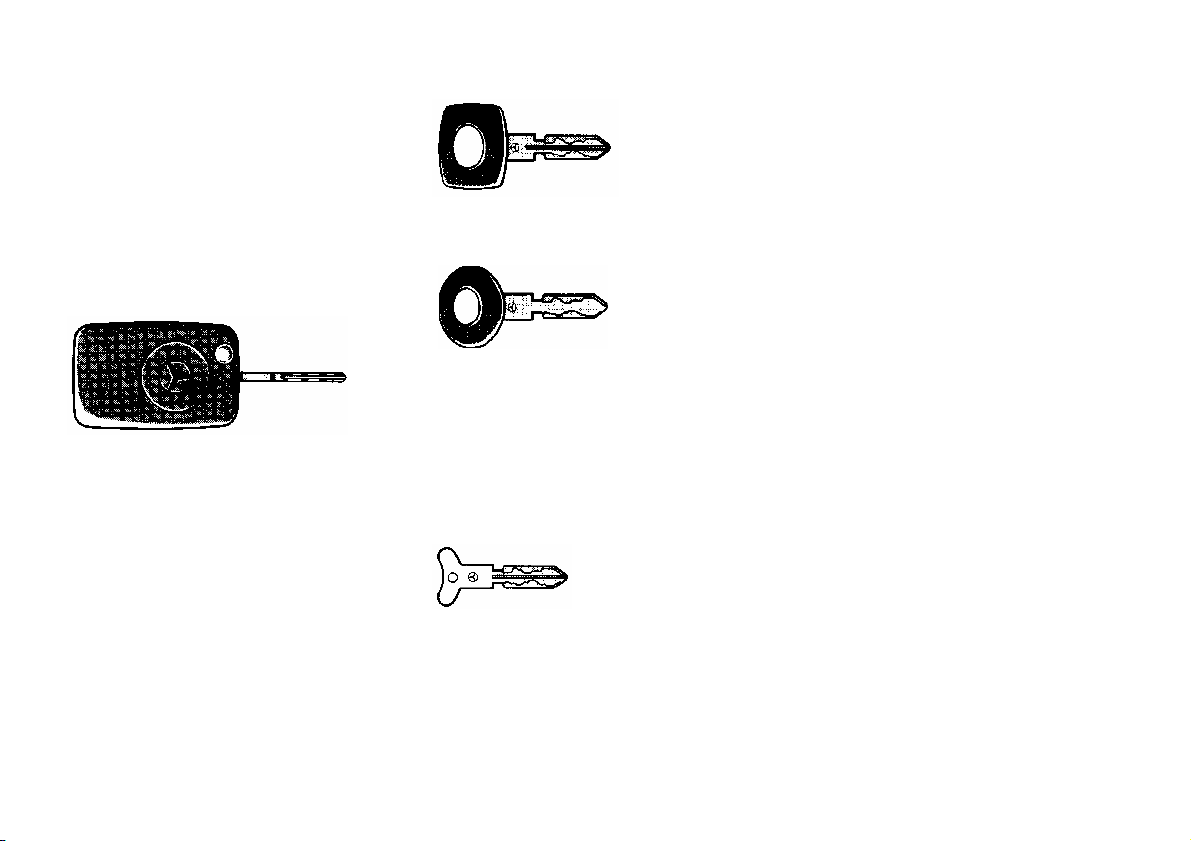
Car Keys
Included with your vehicle are:
Master Key
Notes:
Do not give the master key to an
unauthorized person.
• 2 Master keys with infrared
remote control,
• 1 Master key,
• 1 Valet key,
• 1 Flat key.
Infrared Remote Control with
Foldering Master Key
The master key fits all locks on the car.
The transmitter for the infrared remote
control is located in the key holder, the
receivers are located in the door
handles and next to the trunk lock.
The master key fits all locks on the car.
Valet Key
The valet key fits only the door locks
and the steering lock.
The valet key will not fit the trunk lock
or storage compartments lock in the
dashboard.
Flat Key
The flat key fits all locks on the car.
We recommend that you carry the flat
key with you and keep it in a safe place
(e.g. your wallet) so that it is always
handy. Never leave the flat key in the
vehicle.
Warning!
When leaving the vehicle always
remove the key from the steering
lock. Do not leave children
unattended in the vehicle.
Unsupervised use of vehicle
equipment may cause serious
personal injury.
Obtaining Replacement Keys
Your vehicle is equipped with a theft
deterrent locking system requiring a
special key manufacturing process. For
security reasons, replacement keys can
only be obtained from your authorized
Mercedes-Benz dealer.
28
Page 29
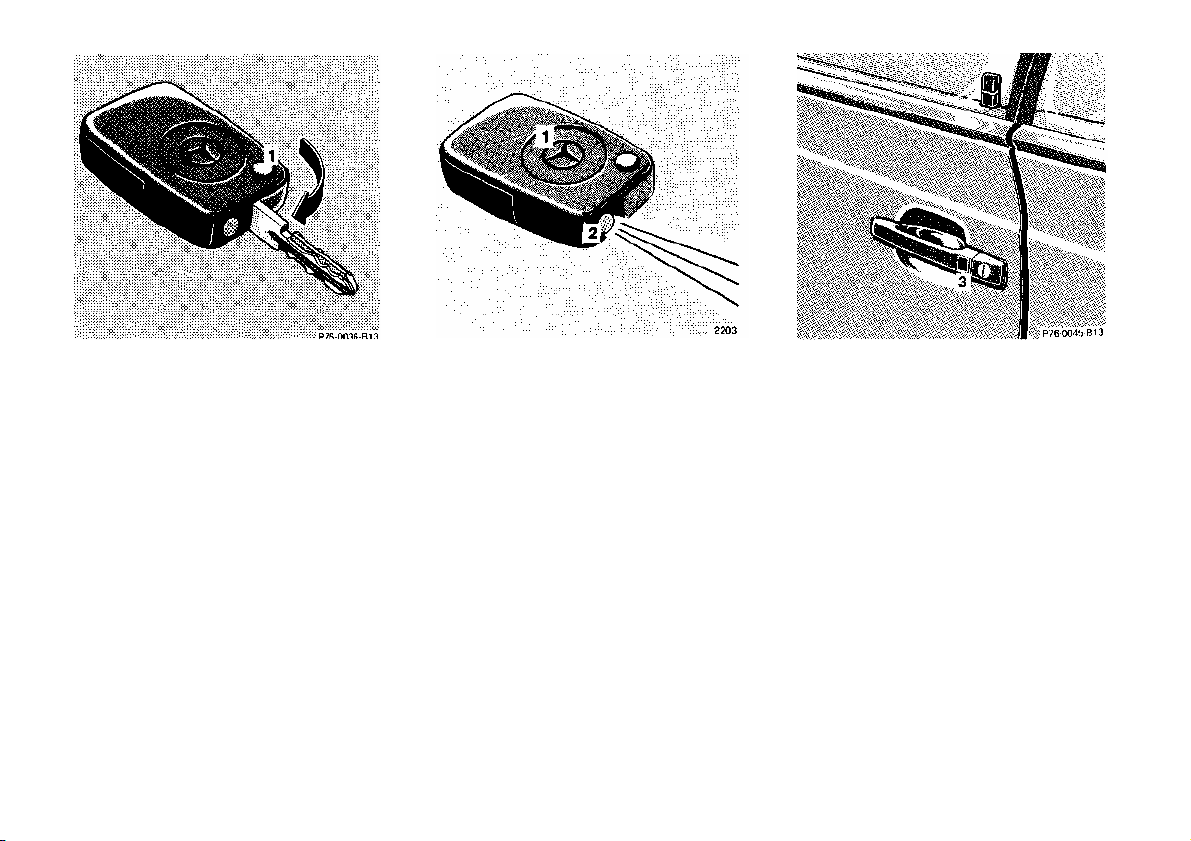
Master Key in Key Holder
Infrared Remote Control
3 Receiver in door handle
1 Release button for master key
Releasing: press release button (1). The
key unfolds from the holder by itself.
Storing: press release button (1) and
fold key back into holder.
1 Transmit button
Transmitter eye and battery check
The vehicle can be centrally locked and
unlocked, as well as the windows and
sliding roof closed with infrared remote
control.
The transmitter is located in the key
holder, the receivers are located in the
door handles and next to the trunk lock.
Unlocking:
Aim transmitter eye (2) at a receiver
(3) and press transmit button (1).
Distance to receiver max. 20 ft (6 m).
The green indicator lamps on the
receivers should blink. They stop
blinking when the vehicle is unlocked.
Note:
If the trunk was previously locked
separately, it will remain locked
(see Index).
29
Page 30
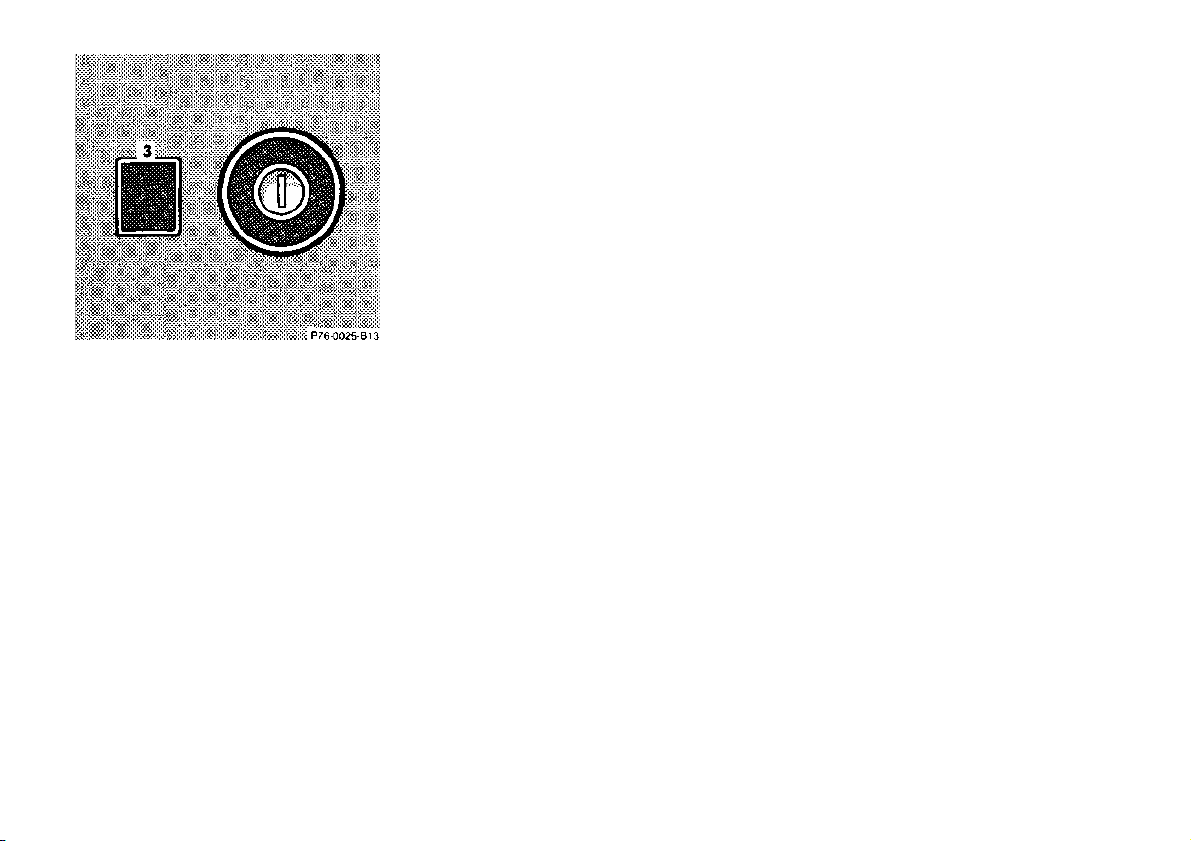
Locking:
Notes:
3 Receiver next to trunk lock
Aim transmitter eye (2) at a receiver
(3) and press transmit button (1).
Distance to receiver max. 20 ft (6 m).
The red indicator lamps on the
receivers should blink. They stop
blinking after approximately 3 seconds
when the vehicle is properly locked.
If a door or the trunk is not properly
closed after you attempt to lock the car
by remote control, the red indicator
lamps will continue to blink (max. 10
seconds). Open the door or trunk lid,
close it properly, and lock the car
again.
If the vehicle cannot be locked or
unlocked by pressing the transmit
button (1), then it may be necessary to
change the batteries in the transmitter
(if ok, battery indicator lamp in
transmitter will light briefly when
transmitting) or to synchronize the
system, see Remote Control, Infrared
in Index
30
Page 31

Closing Windows and Sliding/
Pop-Up Roof from Outside
Continue to press transmit button (1)
after locking car. Distance to receiver
max. 10 ft. (3 m).
The windows and sliding/pop-up roof
begin to close after approx. 1 second.
Warning!
Never close the windows or
sliding/pop-up roof if there is the
possibility of anyone being harmed
by the closing procedure.
In case the closing procedure
causes potential danger, the closing
procedure can be immediately
reversed by releasing and pressing
the remote control button again
until the green indicator lamp at the
receiver blinks. The sliding/pop-up
roof and windows will open again.
The sliding/pop-up roof will only
open if it was not fully closed.
Note:
If the side windows and sliding/ popup roof cannot be closed
automatically by using the key or by
pressing the transmit button of the
infrared remote control (e.g. after a
battery change), press side of
power window switch in center
console until the window is
completely closed and hold for
additional 2 seconds. Repeat
procedure for each window.
The automatic closing procedure of
the windows and sliding/pop-up roof
should now be restored.
31
Page 32

Central Locking System
Doors
Central locking switch
The entire vehicle may be locked or
unlocked by either using the master key
in the door or trunk locks, or central
locking switch located in driver's door.
The central locking system also locks or
unlocks the fuel filler flap.
Note:
If the fuel filler flap cannot be opened,
refer to Fuel Filler Flap, Manual
Release (see Index).
1 Opening - pull handle
2 Unlocking
3 Locking
4 Individual door from inside:
• Push lock button down to lock.
• Pull lock button up to unlock.
When you lock the car, all door lock
buttons should move down. If any one
stays up, the respective door is not
properly closed.
You should then unlock the car, open
and reclose this door, and lock the
car again. Each individual door can be
locked with door lock button - the
driver's door can only be locked when
it is closed.
32
Page 33

The doors can only be locked with the
central locking switch, if the front
doors are closed.
The doors cannot be unlocked with the
central locking switch, if car was
previously locked from outside.
When opening a front door, the entire
car is unlocked, if it was previously
locked with the central locking switch.
Notes:
In case of a malfunction in the central
locking system the doors and trunk can
be locked and unlocked individually.
To lock, turn key to position 3 or push
down lock buttons.
To unlock, turn key to position 2 or
pull up lock buttons.
If the car has previously been locked
from the outside, only the door being
opened from the inside will unlock, the
remaining doors, the trunk lid and fuel
filler flap remain locked.
Trunk
1 Neutral position - push to open
2 Unlocking
3 Locking (detent)
4 Separate locking of trunk -
remove key in this position.
When the trunk is separately locked, it
remains locked when unlocking any
door.
To deny any unauthorized person
access to the trunk, lock it separately.
Leave only the valet key with the
vehicle.
The trunk lid can be lowered by using
the recessed grips in the trunk lid liner,
and closed with the dirt-free retracting
handle.
If the trunk lid cannot be closed, refer
to Trunk Lid, Manual Closing
(see Index).
33
Page 34

Door lock, left
and trunk lock
Power Windows and Sliding/
Pop-Up Roof
1 Closing
2 Interrupting
3 Opening
Door lock, right
When locking doors or trunk, turn key
in door lock or trunk lock to position 1
and hold. The windows and the
sliding/pop-up roof begin to close
automatically after approximately 1
second.
To interrupt the closing procedure,
turn key to position 2.
Warning!
Never close the windows or sliding/
pop-up roof if there is the possibility
of anyone being harmed by the
closing procedure.
In case the closing procedure
causes potential danger, the closing
procedure can be immediately
reversed by turning the key to the
unlocking position (3) within 10
seconds. The sliding/pop-up roof
and windows will open again. The
sliding/pop-up roof will only open
if it was not fully closed.
Note:
If the closing procedure is interrupted, it
can only be continued by first turning
the key to the unlocked position (3) and
then again to the locking position (1)
and hold.
34
Page 35

Power Closing Assist for Doors and
Trunk Lid
The doors and trunk lid close
automatically if:
• doors are pushed against the lock,
• trunk lid is lowered against the lock,
It is not necessary to slam doors or
trunk lid closed, a pneumatic powerassisted mechanism will latch doors
and trunk lid quietly and automatically
once the lid or door has been brought
to a close. When the pneumatic powerassisted mechanism has stopped, doors
and/or trunk can be reopened.
Note:
If the trunk lid does not close, refer to
Trunk Lid, Manual Closing in Index.
Warning!
To prevent possible personal injury,
always keep hands and fingers away
from the door or trunk opening
when closing a door or the trunk lid.
Be especially careful when small
children are around.
The pneumatic power closing assist
mechanism cannot be interrupted
once it has been engaged.
To prevent personal injury, never
activate the closing assist mechanism
by tampering with the door or trunk
lid latch.
35
Page 36

Anti-Theft Alarm System
The anti-theft alarm is automatically
armed or disarmed with any of your
vehicle's keys or infrared remote
control by locking or unlocking either
front door or the trunk.
A blinking lamp (1) indicates that the
alarm is armed. Now the engine
cannot be started.
The alarm will last approximately 150
seconds in the form of blinking exterior
lamps. At the same time an additional
horn will sound intermittently for 60
seconds, pause for 30 seconds, and
repeat for another 60 seconds. The
alarm will stay on even if the activating
element (a door, for example) is
immediately closed.
Note:
1 Indicator lamp in switch located
in center console
The anti-theft alarm is disarmed when
unlocking either front door or the trunk
with any of your vehicle's keys or
infrared remote control.
Operation
Once the alarm system has been
armed, the exterior vehicle lamps will
flash and the horn will sound
intermittently when someone:
• opens a door,
• opens the trunk,
• opens the hood,
• removes the radio,
• switches on or bridges the ignition
circuit,
• steps on the brake pedal.
Do not give the master key to an
unauthorized person. We recommend
that you carry the flat key safely with
you so that it is always handy. The flat
key has the same functions as the
master key.
36
Page 37

Seat and head restraint adjustment:
Power Seats, Front
The slide switches are located in each
front door.
Turn key in steering lock to position 1
or 2 (with the driver's or front
passenger's door open, the power seats
can also be operated with the key
removed or in steering lock position 0).
A Seat, fore/aft, up/down
B Seat tilt
C Seat cushion depth
D Backrest tilt
E Head restraint
Adjust head restraint to support the
back of the head approximately at
ear level. The head restraint
inclination can also be adjusted
manually.
Note:
Your car is equipped with power
head restraints, do not try to raise or
lower them manually.
Warning!
Do not adjust the driver's seat while
driving. Adjusting the seat while
driving could cause the driver to
lose control of the vehicle.
Never ride in a moving vehicle with
the seat back reclined. Sitting in an
excessively reclined position can be
dangerous. You could slide under
these at belt in a collision. If you
slide under it, the belt would apply
force at the abdomen or neck. That
could cause serious or even fatal
injuries. The seat back and seat
belts provide the best restraint
when the wearer is in an upright
position and belts are properly
positioned on the body.
Never place hands under or near
any moving parts while a seat is
being adjusted.
37
Page 38

Storing seat/head restraint/ steering
wheel/exterior and inside rear view
mirror positions in memory:
Recalling seat/head restraint/ steering
wheel/exterior and inside rear view
mirror positions stored in memory:
F Memory button
G Position buttons
Three sets of seat/head restraint/
steering wheel/exterior and inside rear
view mirror positions may be
programmed into memory. After the
seat/head restraint/steering wheel/
exterior and inside rear view mirrors
are positioned, push memory button F,
release, and within 3 seconds push
position button "1". A second and third
set of positions for the same seat/ head
restraint/steering wheel/ exterior and
inside rear view mirrors can be
programmed into memory by pushing
first button "F" and then "2",
respectively "3".
Note:
See Index for instructions on
adjustment of steering wheel and
mirrors.
To recall a seat/head restraint/ steering
wheel/exterior and inside rear view
mirror position, push and hold position
button "1", "2" or "3" until seat/head
restraint/ steering wheel/exterior and
inside rear view mirror movement has
stopped. The seat/head restraint/
steering wheel/exterior and inside rear
view mirror movement stops when the
position button is released.
Caution!
Do not remove head restraints except
when mounting seat covers. For
removal and installation refer to Head
Restraints, Removal in Index.
Whenever restraints have been
removed be sure to reinstall them
before driving.
38
Page 39

Important!
Bring seat backrest to upright position
before the vehicle is put into motion.
Entering Rear Passenger
before recalling a stored seat/head
restraint/steering wheel/exterior and
inside rear view mirror position,
otherwise the front seats could get
forced against a rear seat and be
damaged.
Prior to operating the vehicle, the
driver should adjust the seat height for
proper vision as well as fore/aft
placement and seat back angle to insure
adequate control, reach, operation, and
comfort. The head restraint should also
be adjusted for proper height.
Both the inside and outside rear view
mirrors should be adjusted for adequate
rearward vision.
Fasten seat belts. Infants and small
children should be seated in a properly
secured restraint system that complies
with U.S. Federal Motor Vehicle Safety
Standard 213 and Canadian
Motor Vehicle Safety Standard 213.1.
All seat, head restraint, and rear view
mirror adjustments as well as
fastening of seat belts should be done
Backrest lock
1 Release button
When a door is open, the backrests can
be folded forward without pushing the
button.
With doors closed and key in steering
lock position 2 the backrests are
locked.
The lock can be released by pushing
button (1).
Compartment
With the door open, fold front seat
backrest forward. Automatically the seat
will slide forward and the head restraint
move down.
When folding the seat backrest back,
seat and head restraint return to their
previous positions.
To interrupt the automatic process,
activate the power seat switch.
Warning!
Never place hands under seat or
near any moving parts during the
seat adj ustment procedure.
39
Page 40

The amount of cushion height and
curvature may be adjusted after turning
the key in steering lock to position 2.
The center section (2) can be selected
together with bottom section (1) or top
section (3).
The inflation pressure of the air cushion
can be continuously varied between
position "0" = without pressure, and
position "5" = maximum pressure, by
changing the pressure regulator (4)
setting.
Lumbar Support
1 Pressure regulator
The seats have an inflatable air cushion
built into the backrest to provide
additional lumbar support.
The inflation pressure of the air
cushion can be continuously varied
between position "0" = without
pressure, and position "5" = maximum
pressure, by changing the pressure
regulator (1) setting.
Multicontour Backrest
1 Bottom
2 Center
3 Top
4 Pressure regulator
5 Side bolster adjustment
Some models may be equipped with
orthopedic seats. These seats have
inflatable air cushions built into the
backrest to provide additional lumbar
and side support.
The side bolsters of the backrest can
be adjusted with push button (5):
• pushing forward increase side support,
• pushing backward decrease side support.
If the engine is turned off, the last
cushion setting is retained in memory,
and automatically adjusts the cushion
to this setting when the engine is
restarted.
40
Page 41

The front seat heaters can be switched
on with the key in steering lock
positions 1 or 2, the rear seat heaters
only in steering lock position 2.
Press switch to turn on heater:
Note:
When in operation, the seat heater
consumes a large amount of power. It is
advisable not to use the seat heater
longer than necessary.
Heated Seats
The front seat heater switches are
located to the left and right side of the
center console ashtray.
1 Normal heating mode. One
indicator lamp in the switch
lights up.
2 Rapid heating mode. Both
indicator lamps in the switch
light up.
After approximately 5 minutes in
the rapid heating mode, the heater
automatically switches to normal
operation and only one indicator
lamp will stay on.
Turning off heater:
If one indicator lamp is on, press upper
half of switch.
If both indicator lamps are on, press
lower half of switch.
If left on, the heater automatically
turns off after approximately 30
minutes of operation
The seat heaters may automatically
switch off if too many power
consumers are switched on at the same
time, or if the battery charge is low.
When this occurs, the indicator lamp in
the switch will blink (both indicator
lamps blink during rapid seat heating).
The seat heaters will switch on again
automatically as soon as sufficient
voltage is available.
If the blinking of the indicator lamps is
distracting to you, the seat heaters can
be switched off.
41
Page 42

Important!
For safety reasons, always drive with
the rear head restraints in the upright
position when the rear seats are
occupied.
Keep area around head restraints clear
of articles (e.g. clothing) to not obstruct
the folding operation of the head
restraints.
Switches in center consoles
Power Head Restraints, Rear
Turn key in steering lock to position 1
or 2 (with the driver's or passenger's
door open, the power head restraints
can also be operated with the key
removed or in steering lock position 0).
Activate switch:
1 Place head restraint upright.
2 Fold head restraint backward.
Switch in front center console:
Both head restraints together can be
placed in either upright or fold-down
position.
Switches in rear center console:
The head restraints can be placed
individually in either upright or folddown position.
Inclination of head restraints:
The head restraint inclination can be
adjusted manually.
42
Page 43

Armrest with Compartment for
Telephone Handset
(Front Seats)
1 Armrest folded down
2 Normal use (3 comfort positions)
3 Armrest folded up
Folding down:
Raise armrest past top comfort position
and push down.
Adjusting height:
Raise armrest to desired position
Press button (4) to open cover.
Warning!
The armrest does not suffice as a
child restraint system. In case of a
frontal collision a child can be
catapulted forward over the locked
armrest. Infants and small children
should always be seated in a
properly secured restraint system
that complies with U.S. Federal
Motor Vehicle Safety Standard 213
and Canadian Motor Vehicle Safety
Standard 213.1.
Armrest with integrated Storage
Compartment (Rear Seats)
Pull down the armrest by its strap.
Before storing the armrest in the
backrest, close its storage compartment
lid.
For the removal of the Rear Seat
Cushion, see Index.
43
Page 44

Adjustable Steering Wheel
Turn key in steering lock to position 1
Note:
or 2 (with the driver's or front
passenger's door open, the steering
wheel can also be operated with the
key removed or in steering lock
position 0).
The steering wheel position can be
stored in memory together with the
seat/head restraint/exterior and inside
rear view mirror positions, see Index.
Warning!
To lengthen or shorten the steering
column, push in or pull out switch (1).
To raise or lower steering wheel, push
switch (1) up or down.
Do not adjust the steering wheel
while driving. Adjusting the steering
wheel while driving could cause the
driver to lose control of the vehicle.
44
Page 45

Seat Belts and Supplemental
Restraint System (SRS)
Your vehicle is equipped with seat
belts for all seats, emergency
tensioning retractors for the front seats,
as well as airbags and knee bolsters for
driver and front passenger.
Seat Belts
Important!
Laws in most states and all Canadian
provinces require seat belt use.
Warning!
Never ride in a moving vehicle with
the seat back reclined. Sitting in an
excessively reclined position can be
dangerous. You could slide under the
seat belt in a collision. If you slide
under it, the belt would apply force
at the abdomen or neck. That could
cause serious or even fatal injuries.
The seat back and seat belts provide
the best restraint when the wearer is
in an upright position and belts are
properly positioned on the body.
Seat Belt Warning System
With the key in steering lock position
2, an audible warning sounds for a
short time if the driver's seat belt is not
fastened.
Warning!
Failure to wear and properly fasten
and position your seat belt greatly
increases your risk of injuries and
their likely severity in an accident.
You and your passengers should
always wear seat belts.
All states and provinces require use of
child restraints that comply with U.S.
Federal Motor Vehicle Safety Standard
213 and Canadian Motor Vehicle
Safety Standard 213.1.
We strongly recommend their use
Warning!
If you are ever in an accident, your
injuries can be considerably more
severe without your seat belt
properly buckled. Without your seat
belt buckled, you can hit the interior
of the vehicle or be ejected from it.
You can be seriously injured or
killed.
In the same crash, the possibility for
injury or death is lessened with your
seat belt buckled.
45
Page 46

Seat Belt Extender
When the respective door is closed and
the key is in steering lock position 1 or
2, the seat belt extender brings the belt
forward within easy reach of the
occupant.
The seat belt extender also brings the
belt forward, if the seat is not occupied.
Switch on center console
With the doors closed and seat belt not
buckled, the seat belt extender can also
be brought forward by using the
switch.
If the seat belt is not buckled within 30
seconds, the seat belt extender will
return to its rest position.
This is also the case if the key is turned
to steering lock position 1 or if a door
is opened.
Warning!
The seat belt extender must be in its
rest position for the seat belt to
provide proper protection. If the
electrical system fails, forcibly push
the extender back to its rest position.
If the seat belt extender cannot be
brought to its rest position, the seat
belt cannot provide proper
protection in case of an accident.
In this case have the system checked
at your authorized Mercedes-Benz
dealer.
46
Page 47

1 Latch plate
2 Buckle
3 Release button
Fastening of Seat Belts
Adjust seat belt so that shoulder
portion is located as close as possible
to the middle of your shoulder. Do not
twist the belt. A twisted seat belt may
cause injury.
Unfastening of Seat Belts
Push the release button (3) in the belt
buckle (2).
Allow the retractor to completely
rewind the seat belt by guiding the
latch plate (1).
Notes:
Operation:
The inertia reel stops the belt from
unwinding during sudden vehicle stops
or when quickly pulling on the belt.
The locking function of the reel may be
checked by quickly pulling out the belt.
Push latch plate (1) into buckle (2)
until it clicks.
The lap belt should be positioned as low
as possible on your hips and not across
the abdomen.
Tighten the lap portion to a snug fit by
pulling shoulder portion up.
Tighten to a snug fit by feeding belt
toward retractor.
The shoulder portion of the seat belt
must be pulled snug and checked for
snugness immediately after engaging
it. The height setting for the shoulder
portion of the front seat belts are
automatically adjusted by the fore/aft
movement of the front seat.
For safety reasons, avoid adjusting the
seat or seat back into positions which
could affect the correct seat belt
position.
47
Page 48

Warning!
Improperly positioned seat belts do
wear the shoulder belt under
USE SEAT BELTS PROPERLY.
• Each occupant should wear their
seat belt at all times, because seat
belts help reduce the likelihood of
and potential severity of injuries
in accidents, including rollovers.
"SRS" (driver airbag, passenger
airbag), "ETR"(seat belt
emergency tensioning retractors),
and knee bolsters are designed to
enhance the protection offered to
properly belted occupants in
certain frontal impacts which
exceed preset deployment
tresholds.
•
not provide maximum protection
and may cause serious injuries in
case of an accident.
• Never
your arm, against your neck or off
your shoulder. In a crash, your
body would move too far forward.
That would increase the chance of
head and neck injuries. The belt
would also apply top much force
to the ribs, which could severely
injure internal organs such as
your liver or spleen
• Position the lap belt as low as
possible on your hips and not
across the abdomen. If the belt is
positioned across your abdomen,
it could cause serious injuries in a
crash.
• Each seat belt should never be
used for more than one person at
a time. Do not fasten a seat belt
around a person and objects.
• Belts should not be worn twisted.
In a crash, you wouldn't have the
full width of the belt to take
impact forces. The twisted belt
against your body could cause
injuries.
• Pregnant women should also use a
lap-shoulder belt. The lap belt
portion should be positioned as
low as possible on the hips to
avoid any possible pressure on the
abdomen.
USE CHILD RESTRAINTS
PROPERLY.
• Infants and small children must be
seated in an infant or child
restraint system, which is properly
secured by a lap belt or lap belt
portion of a lap-shoulder belt.
Children could be endangered in
an accident if their child restraints
are not properly secured in the
vehicle.
• Rear-facing child restraints must
not be used in the front seat with
a passenger side airbag. They
could be struck by the airbag
when it inflates in a crash. If this
happens, a child in the restraint
could be seriously injured.
48
Page 49

• According to accident statistics,
children are safer when properly
restrained in the rear seating
positions than in the front seating
positions.
• Children too big for child restraint
systems should ride in rear seats
using regular seat belts. Position
shoulder belt across chest and
shoulder, not face or neck. A
booster seat may be necessary to
achieve proper belt positioning.
• Adjust the front passenger seat as
far as possible rearward from the
dashboard when a child restraint
is installed.
Supplemental Restraint System
(SRS)
The SRS uses two crash severity levels
(thresholds) to activate either the ETR
or airbag or both. Activation depends
on exceeding the thresholds and
fastening of the seat belt.
Seat belt fastened
• first threshold exceeded:
ETR activates
• second threshold exceeded:
airbag also activates
Seat belt not fastened
• first threshold exceeded:
airbag activates, but not ETR
Driver and front passenger systems
operate independently from each other.
Emergency Tensioning Retractor
(ETR)
The seat belts for the front seats are
equipped with emergency tensioning
retractors. These tensioning retractors
are located in each belt's inertia reel and
become operationally ready with the
key in steering lock position 1 or 2.
The emergency tensioning retractors
are designed to activate only when the
seat belts are fastened during frontal
and front-angled impacts exceeding the
first threshold of the SRS. They remove
slack from the belts in such a way that
the seat belts fit more snugly against
the body restricting its forward
movement as much as possible.
In cases of other frontal impacts,
roll-overs, certain side impacts, rear
collisions, or other accidents without
frontal forces, the emergency
tensioning retractors will not be
activated. The driver and passengers
will then be protected by the fastened
seat belts and inertia reel in the usual
manner.
For seat belt and emergency tensioning
retractor safety guidelines see Safety
Guidelines in Index.
49
Page 50

Airbags
The most effective occupant restraint
system yet developed for use in
production vehicles is the seat belt. In
some cases, however, the protective
effect of a seat belt can be further
enhanced by an airbag.
The driver airbag (1) is located in the
steering wheel hub. The passenger
airbag (2) is located in the dashboard
ahead of the passenger. In conjunction
with wearing the seat belts with
emergency tensioning retractors (4),
they provide increased protection for
the driver and passenger in certain
major frontal and front angled impacts.
The operational readiness of the airbag
system is verified by the indicator lamp
"SRS" (3) in the instrument cluster. If
no fault is detected, the lamp will go out
after approximately 4 seconds; after the
lamp goes out, the system continues to
monitor the components and circuitry of
the airbag system and will indicate a
malfunction by coming on again.
50
Page 51

The following system components are
monitored or undergo a self-check:
crash-sensor, airbag ignition circuits,
driver and passenger seat belt buckles.
Initially, when the key is turned from
steering lock position 0 to positions 1
or 2, malfunctions in the crash-sensor
are detected and indicated (the "SRS"
indicator lamp stays on longer than 4
seconds).
In the operational mode, after the
indicator lamp has gone out following
the initial check, interruptions and short
circuits in the airbag ignition circuit
and in the driver and passenger seat
belt buckle harnesses, and low voltage
in the entire system are detected and
indicated.
In the event a malfunction of the "SRS"
is indicated as outlined above, the
"SRS" may not be operational. We
strongly recommend that you visit an
authorized Mercedes-Benz dealer
immediately to have the system
checked; otherwise the "SRS" may not
be activated when needed.
Important!
The airbags are designed to activate
only in certain frontal and frontangled impacts (within the shaded
area shown in the illustration on
page 48). Only during these types of
impacts will they provide their
supplemental protection. The driver
and passenger should always wear
the seat belts, otherwise it is not
possible for the airbags to provide
their intended supplemental
protection.
In cases of other frontal impacts,
roll-overs, certain side impacts, rear
collisions, or other accidents without
sufficient frontal forces, the airbag
will not be activated. The driver and
passengers will then be protected by
the fastened seat belts.
We caution you not to rely on the
presence of an airbag in order to
avoid wearing your seat belt.
51
Page 52

Important!
health, nor does it indicate a fire in the
The "SRS" is designed to reduce the
potential of injury in certain frontal
and front-angled impacts which may
cause injuries, however, no system
available today can totally eliminate
injuries and fatalities.
The activation of the "SRS"
temporarily releases a small amount
of dust from the air-bags. This dust,
however, is neither injurious to your
vehicle.
The service life of the airbags extends
to the date indicated on the label
located on the driver-side door latch
post. To provide continued reliability
after that date, they should be
inspected by an authorized MercedesBenz dealer at that time and replaced
when necessary.
Warning!
It is very important for your safety
to always be in a properly seated
position and to wear your seat belt.
For maximum protection in the
event of a collision always be in
normal seated position with your
back against the seat back. Fasten
your seat belt and ensure that it is
properly positioned on the body.
Since the airbag inflates with
considerable speed and force, a
proper seating position will keep you
in a safe distance from the airbag:
• Sit properly belted in an upright
position with your back against
the seat back.
• Adjust the driver seat as far
as possible rearward, still
permitting proper operation
of vehicle controls.
• Do not lean with your head or
chest close to the steering wheel
or dashboard.
• Adjust the passenger seat as far
as possible rearward from the
dashboard.
• Infants and small children should
only be seated in a rear seat and
be properly secured in a child
restraint system.
• Rear-facing child restraints must
not be used in a front seat with a
passenger side airbag.
Failure to follow these instructions
can result in severe injuries to you or
other occupants.
52
Page 53

Safety Guidelines for the Seat Belt,
must
that
Emergency Tensioning Retractor
and Airbag
Warning!
• The "SRS" is designed to function
on a one-time-only basis. An
airbag or emergency tensioning
retractor (ETR) that was activated
must be replaced.
• Improper work on the system,
including incorrect installation
and removal, can lead to possible
injury through an uncontrolled
activation of the "SRS".
• Damaged belts or belts that were
highly stressed in an accident
be replaced and their anchoring
points must also be checked. Use
only belts installed or supplied by
an authorized Mercedes-Benz
dealer.
• Do not pass belts over sharp edges.
• Do not make any modification
could change the effectiveness of
the belts.
• No modifications of any kind may
be made to any components or
wiring of the "SRS". This includes
the installation of additional trim
material, badges etc. over the
steering wheel hub or front
passenger airbag cover and
installation of additional electrical/
electronic equipment on or near
"SRS" components and wiring.
• Several airbag system components
at the steering wheel get hot after
the airbag has inflated. Don't try
to touch them.
• In addition, through improper
work there is the risk of
rendering the "SRS" inoperative.
Work on the "SRS" must
therefore only be performed by
an authorized Mercedes-Benz
dealer.
• When scrapping the airbag
unit or emergency tensioning
retractor, it is mandatory to
follow our safety instructions.
These instructions are available
at your authorized MercedesBenz dealer.
When you sell the vehicle we strongly
urge you to give notice to the
subsequent owner that it is equipped
with an "SRS" by alerting him to the
applicable section in the Owner's
Manual.
53
Page 54

Infant and Child Restraint Systems
raints must not be
Infants and small children should never
Infants and small children should never
share a seat belt with another occupant.
We recommend that all infants and
children be restrained at all times while
the vehicle is in motion.
Important!
The use of infant or child restraints is
required by law in all 50 states and all
Canadian provinces.
Infants and small children should be
seated in an infant or child restraint
system, which is properly secured by a
lap belt or lap belt portion of a lapshoulder belt, and that complies with
U.S. Federal Motor Vehicle Safety
Standard 213 and Canadian Motor
Vehicle Safety Standard 213.1. A statement by the child restraint manufacturer
of compliance with this standard can be
found on the instruction label on the
restraint and in the instruction manual
provided with the restraint.
When using any infant or child restraint
system, be sure to carefully read and
follow all manufacturer's instructions
for installation and use.
Warning!
According to accident statistics,
children are safer when properly
restrained in the rear seating positions
than in the front seating positions.
Rear-facing child rest
used in the front passenger seat. They
could be struck by the airbag when it
inflates in a crash. If this happens, a
child in the restraint could be seriously
injured.
be held on the lap while the vehicle is in
motion. During an accident they would
be almost impossible to hold, and could
be crushed between the adult and the
dashboard.
During an accident, they could be
crushed between the occupant and seat
belt.
Children too big for child restraint
systems should ride in rear seats
using regular seat belts. Position
shoulder belt across chest and
shoulder, not face or neck. A booster
seat may be necessary to achieve
proper belt positioning.
When the child restraint is not in
use, remove it from the car or secure
it with the seat belt to prevent the
child restraint from becoming a
projectile in the event of an accident.
U.S.A. Models only:
Since 1986 all U.S. child restraints
comply with U.S. regulations without
the use of a tether strap.
Canada Models only:
This vehicle can be equipped with
tether anchorages for a top tether strap.
Consult your authorized MercedesBenz dealer for installation of these
anchorages.
In compliance with Canadian Motor
Vehicle Safety Standard 210.1, child
restraint tether anchorage hardware is
attached to the tool kit located in the
trunk.
54
Page 55

1 Steering is unlocked.
(If necessary, move steering wheel
slightly to allow the key to be
turned clockwise to position 1.)
Most electrical consumers can be
operated. For detailed information
see respective subjects.
2 Driving position.
Notes:
A warning will sound when the driver's
door is opened with the key in steering
lock position 1 or 0.
With the engine at idle speed, the
charging rate of the alternator (output)
is limited.
Steering Lock
0 The key can be withdrawn in this
position only. The steering is locked
with the key removed from the
steering lock. The key can be
removed only with the selector lever
in position "P". After removing the
key or with the key in steering lock
position 0, the selector lever is
locked in position "P".
3 Starting position.
Refer to Index for Starting and turning
off the engine.
Warning!
When leaving the vehicle always
remove the key from the steering
lock. Do not leave children
unattended in the vehicle.
Unsupervised use of vehicle
equipment may cause serious
personal injury.
It is therefore recommended to turn
off unnecessary electrical consumers
while driving in stop-and-go traffic.
This precaution helps to avoid draining
of the battery.
Unnecessary strain on the battery and
charging system may be minimized by
turning off the following power
consumers, for example: Heated seats,
rear window defroster. In addition, the
automatic climate air volume control
should be set to "MIN"
Caution!
To prevent accelerated battery
discharge and a possible dead battery,
always remove the key from the
steering lock. Do not leave the key in
steering oock position 0.
55
Page 56

Combination Switch
1 Low beam (exterior lamp
switch position )
2 High beam (exterior lamp
switch position )
3 High beam flasher (high beam
available independent of
exterior lamp switch position)
4 Turn signals, right
5 Turn signals, left
To signal minor directional changes,
such as changing lanes on a highway,
move combination switch to the point
of resistance only and hold it there.
To operate the turn signals
continuously, move the combination
switch past the point of resistance (up
or down). The switch is automatically
canceled when the steering wheel is
turned to a large enough degree.
6 Press switch briefly:
One wipe without washer water
(select only if window is wet
Press switch past resistance point:
Windshield washer, windshield
wiper; headlamp cleaning system
(only in exterior lamp switch
positions or ).
7 Windshield wiper
0 Wiper off
I Intermittent wiping
II Normal wiper speed
III Fast wiper speed
When coming to a stop or driving
slower than approx. 16 mph (25
km/h), the wiper speed
automatically switches to the next
lower setting.
In setting "I", the interval between
wipes is lengthened.
Upon accelerating again, the wiper
speed returns to the previous
setting.
Note:
The windshield washer reservoir,
hoses and nozzles are automatically
heated.
56
Page 57

Windshield Washer Fluid Mixing
or snow, remove key from steering lock.
Ratio
For temperatures above freezing:
MB Windshield Washer
Concentrate "S" and water
1 part "S" to 100 parts water
(40 ml "S" to 1 gallon water).
For temperature below freezing:
MB Windshield Washer Concentrate
"S" and commercially available
premixed windshield washer
solvent/antifreeze
1 part "S" to 100 parts solvent
(40 ml "S" to 1 gallon solvent).
Windshield Wiper Smears
If the windshield wiper smears the
windshield, even during rain, activate
the washer system as often as necessary.
The fluid in the washer reservoir should
be mixed in the correct ratio.
Blocked Windshield Wiper
If the windshield wiper becomes
blocked (for example, due to snow),
switch off the wiper motor.
For safety reasons before removing ice
Remove blockage.
Activate combination switch again
(key in steering lock position 1).
Emergency Operation of
Windshield Wiper
In case of windshield wiper malfunction
in switch positions I or III, turn
combination switch to wiper setting II.
Have the system checked at your
authorized Mercedes-Benz dealer as
soon as possible.
Signaling Turns with Hazard
Flasher in Use
For example, when the vehicle is being
towed (key in steering lock turned to
position 2):
With hazard flasher on, activate
combination switch for left or right
turn signal - only the selected turn
signal will blink.
Upon canceling the turn signal, the
hazard flasher will operate again.
Turn Signal Failure
If one of the turn signals fails, the turn
signal indicator system flashes and
sounds at a faster than normal rate. In
addition, the exterior lamp failure
indicator will come on.
57
Page 58

Off
Standing Lamps
Exterior Lamp Switch
Canada only:
When the engine is running, the low
beam (includes parking lamps, side
marker lamps, tail lamps, license plate
lamps and instrument panel lamps) are
automatically switched on.
Note:
For nighttime driving the exterior lamp
switch should be turned to position
to permit activation of the high beam
headlamps
Parking lamps (also side
marker lamps, taillamps,
license plate lamps,
instrument panel lamps)
Canada only: When the
engine is running, the low
beam is additionally
switched on.
Parking lamps plus low
beam or high beam
headlamps (combination
switch pushed forward)
Standing lamps, right
(turn left one stop)
Standing lamps, left
(turn left two stops)
Fog lamps
(pull out one stop) with
parking
and/or headlamps on
Rear fog lamp (pull out to
2nd detent) in addition to
fog lamps. Indicator lamp
in lamp switch comes on.
When the vehicle is parked on the
street the standing lamps (right or left
side parking lamps) can be turned on,
making the vehicle more visible to
passing vehicles.
The standing lamps cannot be operated
with the key in steering lock position 2.
Note:
With the key removed and a front door
open, an audible warning will sound if
the vehicle's exterior lamps (except
standing lamps) are not switched off.
Fog lamps will operate with the
parking lamps and the low or high
beam headlamps. Fog lamps should
only be used in conjunction with low
beam headlamps. Consult your state
Motor Vehicle Regulations regarding
allowable lamp operation.
Fog lamps are automatically switched
off when the exterior lamp switch is
turned to position O.
58
Page 59

Inside and Exterior Rear View
Mirrors
Inside Rear View Mirror
Turn key in steering lock to position 2
(with either front door open, the mirror
can be operated with key removed or in
steering lock position 0 or 1).
The mirror is electrically adjustable.
Use your inside mirror to determine the
size and distance of objects seen in the
passenger side convex mirror.
Turn switch to position .
To adjust, move the switch forward,
backward or to either side.
Antiglare Night Position
With the key in steering lock position
2, the mirror responds to changes in
light sensitivity.
The switch is located on the center
console.
59
Page 60

Exterior Rear View Mirrors
(with either front door open, the mirrors
Note:
Exterior rear view mirror, left
Exterior rear view mirror, right
Turn key in steering lock to position 2
can be operated with key removed or in
steering lock position 0 or 1).
Turn switch to select the mirror to be
adjusted.
To adjust, move the switch forward,
backward or to either side.
The exterior mirrors have electrically
heated glass. The heater switches on
automatically, depending on outside
temperature.
If an exterior mirror housing is forcibly
pivoted from its normal position, it must
be repositioned by applying firm
pressure until it snaps into place.
Warning!
Exercise care when using the
passenger-side mirror. The passengerside exterior mirror is convex
(outwardly curved surface for a wider
field of view). Objects in mirror are
closer than they appear. Check your
inside rear view mirror or glance over
your shoulder before changing lanes.
60
Page 61

Exterior Rear View Mirror
come noticeable, especially when
Multiple Images
This vehicle is equipped with antifogging dual-pane side windows to
provide extra insulation against heat,
cold and noise. Because of the second
pane of glass, under certain light and
weather conditions a multiple image
may be
looking through the side windows at an
outside rear view mirror.
Storing Mirror Positions in
Memory
The exterior and inside rear view
mirror positions are stored in memory
with the seat/head restraint/ steering
column position and can be’ recalled
when necessary, see Index.
Note:
If the inside rear view mirror was
adjusted separately, the originally stored
position remains in memory. To recall
position, press the desired position
button.
Folding the mirrors out
Turn switch to point rearward. Press
switch forward until the mirrors are
folded out.
Important!
Do not fold mirrors out, forcing them
by hand. This will damage the
operating mechanism of the mirrors.
Folding the mirrors in
Turn switch to point rearward. Press
switch rearward until the mirrors are
folded in.
Important!
Before running the vehicle through an
automatic car wash, fold mirror in,
otherwise they may get damaged.
61
Page 62

Sun Visors
Swing sun visors down to protect
against sun glare.
If sunlight enters through a side
window, disengage visor from inner
mounting and pivot to the side. From
this position, the visor can slide
forward and backward on its shaft
Illuminated Vanity Mirrors
Front seats:
With the visor engaged in its inner
mounting, the lamp can be switched on
by opening the cover.
Warning!
Do not use the vanity mirror while
driving.
62
Page 63

2 Interior Lamps
Entrance Lamps, Exit Lamps
Interior Lighting
1 Interior Lamps (Door contact)
A B
A Interior lamps are switched on,
and off delayed, when unlocking
or locking the vehicle, or when
opening either front door.
However, there will be no delay
when the key is in steering lock
position 2.
B Interior lamps switched off
A B
A Interior lamps switched off
B Interior lamps switched on
3 Rear Courtesy Lamps
A B
A Courtesy lamps switched off
B Courtesy lamps switched on
Note:
The courtesy lamps cannot be
switched off as long as a rear door
is open.
4 Reading Lamps, Front
A
B
A Reading lamp switched off
B Reading lamp switched on
The lamps are switched on and off by
the door contact switches.
Note:
To prevent the vehicle battery from
being discharged, do not leave doors
open for a long period of time.
63
Page 64

Storage Compartments in the
Dashboard
1 Storage/eyeglasses
compartment
2 Button for storage/
eyeglasses compartment
3 Glove box
4 Button for glove box
5 Lock
Storage/Eyeglasses
Compartment
To open: Press button (2).
Glove Box
The glove box lid is equipped with a
container for coins and small accessories.
To open: Press button (4).
Note:
The storage compartments may be locked
and unlocked by using the master key in
lock (5).
Locking:
Turn master key in lock (5) to the
right and remove.
Unlocking:
Turn master key back to vertical
position.
Storage Compartment between Rear
Seats
Lock only when compartment is fully
closed, otherwise the lock may get
damaged.
Storage Compartments in the Door
6 Button for door pocket
To open:
Press button.
Caution!
Keep compartment lids closed. This
will prevent stored objects from being
thrown about and injuring vehicle
occupants during an accident.
64
Page 65

in center console, front
With the gear selector lever in position
in rear doors
Lighter
Ashtrays
By touching the top of the cover lightly,
the ashtray opens automatically.
Prior to removing the ashtray insert
move gear selector lever to position "N".
Warning!
"N", turn off the engine and set. The
parking brake. Otherwise the vehicle
might move unintentionally.
To remove ashtray from center console:
Push sliding knob (1) toward the right to
eject the insert.
To remove ashtray from rear door: Hold
left and right side of insert and pull up.
To install ashtray:
Install insert into ashtray frame and push
down to engage.
Turn key in steering lock to position
1 or 2.
Push in lighter (1); it will pop out
automatically when hot.
Warning!
Never touch the heating element or
sides of the lighter, hold at knob
only.
65
Page 66

Glass Sliding Roof with Rear
Pop-Up Feature
An additional screen can be slid into
the roof opening to guard against sun
rays. When sliding the roof open, the
screen will also retract.
Warning!
When closing the sliding roof, be
sure that there is no danger of
anyone being harmed by the closing
procedure.
Sliding Roof with Rear Pop-Up
Feature
1 to slide roof open
2 to slide roof closed
3 to raise roof at rear
4 to lower roof at rear
Turn key in steering lock to position 1
or 2 (with either front door open, the
sliding/pop-up roof can be operated
with key removed or in steering lock
position 0).
The switch is illuminated when the
exterior lamps are switched on (except
standing lamps).
Notes:
The sliding roof can be opened or
closed manually should an electrical
malfunction occur, refer to Emergency
Operation in Index.
The sliding roof can also be closed
with the key or infrared remote control
while locking the vehicle doors (see
Central Locking System in Index).
66
Page 67

Express Opening and Closing
Press switch or past resistance point and release - window
opens or closes completely.
To interrupt procedure, briefly press
or
If the upward movement of the
window is blocked during the closing
procedure, the window will stop
during the last few inches before
closure and open slightly.
in center console, front
Power Windows
Switches for:
1 left, front
2 left, rear
3 right, front
4 right, rear
5 safety switch
6 individual switches (rear doors)
in rear doors
Turn key in steering lock to position
1 or 2.
Press switch in to resistance point:
to close
to open
Release switch when window is in
desired position.
When pressing and holding the
switch to close the window, and
upward movement of the window is
blocked during the last few inches
before closure, it will stop but not
open slightly.
Blocking of Rear Door Window
Operation
If no operation of the rear windows by
switch (6) (for instance by children)
is desired, slide safety switch (5) to
right, symbol becomes visible.
67
Page 68

Warning!
When closing the windows, be sure
that there is no danger of anyone
being harmed by the closing
procedure.
The power windows can also be closed
with the key or infrared remote control
while locking the vehicle doors (see
Central Locking System in Index).
Warning!
In case of obstruction, the
automatic reversal will not operate if
a window is being closed by
pressing the switch to its resistance
point and holding it there, or when
using a key or the remote control.
The closing procedure can be
immediately reversed by either
pressing the switch , turning
the key to the unlocking position, or
releasing and pressing the transmit
button, and holding it
When leaving the vehicle, always
remove the key from the steering
lock. Do not leave children
unattended in the vehicle.
Unsupervised use of vehicle
equipment can cause serious
personal injury.
Note:
If the side windows cannot be fully
opened or closed automatically by
pressing the button past the point of
resistance (e.g. after a vehicle battery
change), press down side of power
window switch until the window is
completely closed and hold for
additional 2 seconds. Repeat procedure
for each window.
The automatic full opening and closing
procedure of the windows should now
be restored.
Rear Window Sunshade
1 Raising
2 Lowering
The switches are located on the center
console and between the single rear
seats.
The sunshade should always be either
fully raised or fully lowered.
68
Page 69

Note:
The rear window defroster uses a large
amount of power. To keep the battery
drain to a minimum, turn off the
defroster as soon as the window is clear.
The defroster is automatically turned
off after a maximum of 20 minutes of
operation.
Heavy accumulation of snow and ice
should be removed before activating the
defroster.
Rear Window Defroster
The switch is located in the center
console.
Turn key in steering lock to position
1 or 2.
When activating the rear window
defroster, the indicator lamp in the
switch will come on.
If several power consumers are turned
on simultaneously, or the battery is only
partially charged, it is possible that the
defroster will automatically turn itself
off. When this happens, the indicator
lamp inside the switch starts blinking.
As soon as the battery has sufficient
voltage, the defroster automatically
turns itself back on.
Setting Clock
Adjusting clock one minute ahead or
back:
Pull out adjustment knob (1), briefly
turn to the right respectively left and
release knob.
Adjusting clock more than one minute
ahead or back: Pull out adjustment
knob (1), turn to the right respectively
left and hold until the desired time is
set. Within the first 2 seconds, the
minute hand advances 8 minutes and
advances another 8 minutes every
additional second thereafter.
69
Page 70

Shelf below Rear Window
Antenna
Cellular Telephone
Warning!
The shelf below the rear window
should not be used to carry
objects. This will prevent such
objects from being thrown about
and injuring vehicle occupants
during an accident or sudden
The antenna extends when switching
on the radio and/or telephone.
Note:
To retract the antenna (e.g. when
entering a car wash) both radio and
telephone must be switched off.
The vehicle is prepared for the
installation of a cellular telephone. For
further information and installation
contact your authorized MercedesBenz dealer.
Warning!
Some jurisdictions prohibit the
driver from using a cellular
telephone while driving a vehicle.
Whether or not prohibited, for
safety reasons, the driver should not
use the cellular telephone while the
vehicle is in motion. Stop the vehicle
in a safe location before answering
or placing a call.
70
Page 71

Driving
71
Page 72

Drinking and Driving
To engage, firmly depress parking brake
Driving Off
Warning!
Drinking and driving can be a very
dangerous combination. Even a small
amount of alcohol or drugs can affect
your reflexes, perceptions and
judgement.
The possibility of a serious or even
fatal accident is sharply increased
when you drink and drive.
Please don't drink and drive or allow
anyone to drive after drinking.
Parking Brake
pedal. When the key is in steering lock
position 2, the brake warning lamp in
the instrument cluster should come on
brightly.
To release the parking brake, pull
handle on instrument panel. The brake
warning lamp in the instrument cluster
should go out.
Also see Brake Warning Lamp Test in
Index.
Test the brakes briefly after driving off.
Perform this procedure only when the
road is clear of other traffic.
Warm up the engine smoothly. Do not
place full load on the engine until the
operating temperature has been
reached.
Warning!
Keep driver's foot area clear at all
times. Objects stored in this area
may impair pedal movement.
72
Page 73

Automatic Transmission
Shift selector lever to the desired driving
The automatic transmission selects
individual gears automatically,
dependent upon
• Selector lever position
• Accelerator position
• Vehicle speed
Important!
When parking the car and before
working on the vehicle with the engine
running, firmly depress the parking
brake pedal and shift the selector lever
into "P".
Driving
The selector lever is automatically
locked while in position "P". To move
the selector lever out of position "P",
the service brake pedal must be firmly
depressed before the shift lock will
release.
position only when the engine is idling
and the service brake is applied. Do not
release
the brake until ready to drive. The
vehicle may otherwise start creeping
when the selector lever is in drive or
reverse position.
Warning!
It is dangerous to shift the selector
lever out of "P" or "N" if the engine
speed is higher than idle speed. If
your foot is not on the brake pedal,
the car could accelerate quickly
forward or in reverse. You could lose
control of the car and hit someone or
something. Only shift info gear when
the engine is idling normally and
when your right foot is firmly on the
brake pedal.
Important!
After selecting any driving position
from "N" or "P", wait a moment to
allow the gear to fully engage before
accelerating, especially when the
engine is cold.
Accelerator position
Partial throttle = early up shifting
= normal acceleration
Full throttle = later up shifting =
rapid acceleration
Kick down (depressing the accelerator
beyond full throttle) = downshifting to
next lowest gear = maximum
acceleration. Once the desired speed is
attained, ease up on the accelerator the transmission shifts up again
73
Page 74

With the key removed, the selector
lever is locked in position "P".
4 Upshift to 4th gear only. Suitable
for performance driving.
Selector Lever Positions
The automatic gear shifting process
can be adapted to specific operating
conditions using the selector lever.
P Parking lock.
The parking lock is an additional
safeguard to the parking brake when
parking the vehicle. Engage only
with the car stopped.
Note:
The key can be removed from the
steering lock only with the
selector lever in position "P".
R Reverse gear.
Shift to reverse gear only with the
car stopped.
N Neutral.
No power is transmitted from the
engine to the rear axle. When the
brakes are released, the vehicle can
be moved freely (pushed or towed).
Do not engage "N" while driving
except to coast when the vehicle is
in danger of skidding (e.g. on icy
roads, see Winter Driving
Instructions in Index).
Important!
Coasting the vehicle, or driving for
any other reason with selector lever
in "N", can result in transmission
damage that is not covered by the
Mercedes-Benz Limited Warranty.
D The transmission automatically
upshifts to 5th gear. Position "D"
provides optimum driving
characteristics under all normal
operating conditions.
3 Upshift to 3rd gear only. Suitable
for moderately steep hills. Since
the transmission does not shift
higher than 3rd gear, this gear
selection will allow use of the
engine's braking power downhill.
B Upshift to 2nd gear only. For
driving in mountainous regions or
under extreme operating
conditions. This gear selection will
allow use of the engine's braking
power when descending steep
grades.
Important!
With selector lever in position "D", "4"
or "3", upshifting from 2nd to 3rd gear
is delayed depending on vehicle speed
and engine temperature. This allows
the catalytic converter to heat up more
quickly to operating temperatures.
During the brief warm-up period this
delayed upshift and increased engine
noise might be perceived as a
malfunction. However, neither the
engine nor transmission are negatively
affected by this mode of operation
74
Page 75

The delayed up shift is effective with
vehicle speeds below 31 mph (50
km/h) at partial throttle and engine
temperatures below 95°F (35°C).
Do not exceed the vehicle speed
limits for individual gear selections.
Overrevving the engine when selector
lever is moved to a lower driving
range could result in serious damage
to the engine that is not covered by
the Mercedes-Benz Limited Warranty.
Refer to Technical Data for downshift
points.
Warning!
On slippery road surfaces, never
downshift in order to obtain braking
action. This could result in rear
wheel slip and reduced vehicle
control. Your vehicle's ABS will not
prevent this type of loss of control
This applies particularly for position
"B".
To prevent the engine from laboring at
low RPMs, do not allow the engine
speed to drop too low on uphill
gradients.
Depending on the degree of the incline,
shift selector lever to a lower gear early
enough to maintain engine RPM within
the best torque range.
Maneuvering
To maneuver in tight areas, e.g. when
pulling into parking space, control the
car speed by gradually releasing the
brakes. Accelerate gently and never
abruptly step on the accelerator.
To rock a car out of soft ground (mud
or snow), alternately shift from forward
to reverse, while applying slight partial
throttle.
Rocking a car free in this manner may
cause the ABS warning lamp to come
on. Turn off and restart the engine to
clear the malfunction indication.
Stopping
For brief stops, e.g. at traffic lights,
leave the transmission in gear and hold
vehicle with the service brake.
For longer stops with the engine idling,
shift into "N" or "P".
When stopping the car on an uphill
incline, do not hold it with the
accelerator, use the brake. This avoids
unnecessary transmission heat build up.
Warning!
Getting out of your car with the
selector lever not fully engaged in
position "P" is dangerous. When
parked on an incline, position "P"
alone may not prevent your vehicle
from moving, possibly hitting people
or objects.
Always set the parking brake in
addition to shifting to position "P".
When parked on an incline, also turn
downhill side of front wheel against
curb
75
Page 76

Rear Fender Indicators
When the reverse gear is selected, the
rear fender indicators will extend
upward from the rear corners of the
fenders.
Normally the vehicle is accelerated to
the desired speed with the accelerator.
Speed is set by briefly pushing the
lever to position 1 or 2. The accelerator
can be released.
The rear fender indicators retract
delayed when shifting out of reverse.
They retract immediately when turning
key in steering lock to position 0.
Note:
Before shifting into reverse gear,
ensure that the rear fender indicators
can extend freely.
Cruise Control
Any given speed above approximately
25 mph (40 km/h) can be maintained
with the cruise control by operating the
lever.
1 Accelerate and set:
Lift lever briefly to set speed. Hold
lever up to accelerate.
2 Decelerate and set:
Depress lever briefly to set speed.
Hold lever down to decelerate.
The speed can be increased (e.g. for
passing) by using the accelerator. As
soon as the accelerator is released, the
previously set speed will be resumed
automatically.
If a set speed is to be increased or
decreased slightly, e.g. to adapt to the
traffic flow, hold lever in position 1 or
2 until the desired speed is reached, or
briefly tip the control lever in the
appropriate direction for increases or
decreases in 0.6 mph (1 km/h)
increments. When the lever is released,
the newly set speed remains.
76
Page 77

3 Canceling
exceeding approx. 25 mph (40 km/h),
was set prior to the cancellation of the
Note:
Warning!
To cancel the cruise control, briefly
push lever to position 3.
When you step on the brake or the
vehicle speed drops below approx.
25 mph (40 km/h), for example
when driving upgrade, the cruise
control will be canceled.
If the cruise control cancels by itself
and remains inoperative until the
engine is restarted, have the system
checked at your authorized
Mercedes-Benz dealer as soon as
possible.
4 Resume
If the lever is briefly pushed to
position 4 when driving at a speed
the vehicle resumes the speed which
cruise control. The last memorized
speed is canceled when the key in the
steering lock 's turned to position
1 or 0
If the engine does not brake the vehicle
sufficiently while driving on a
downgrade, the speed you set on the
cruise control may be exceeded and
you may have to step on the brake
pedal to slow down. As soon as the
grade eases, the cruise controlled speed
will again be maintained as long as the
brakes were not previously applied, or
the lever may be used to resume the
previously set speed if the brakes were
applied.
Caution!
When driving with the cruise control,
the transmission selector lever must not
be shifted to position "N" as otherwise
the engine will overrev.
Only use the cruise control if the
traffic and weather conditions make
it advisable to travel at a steady
speed.
• The use of cruise control can be
dangerous on winding roads or in
heavy traffic because conditions
do not allow safe driving at a
steady speed.
• The use of cruise control can be
dangerous on slippery roads.
Rapid changes in tire adhesion
can result in wheel spin and loss
of control.
The "Resume" function should only
be operated if the driver is fully
aware of the previously set speed
and wishes to resume this particular
preset speed.
77
Page 78

Charge Indicator Lamp
temperature.
Should the charge indicator lamp fail to
come on prior to starting when the key
is in steering lock position 2 or should
it fail to go out after starting or come
while the engine is running, this
indicates a fault which must be repaired
at an authorized Mercedes-Benz dealer
immediately.
If the charge indicator lamp comes on
while the engine is running, this may
indicate that the poly-V-belt has broken.
Should this condition occur, the poly-Vbelt must be replaced before continuing
to operate the vehicle. Otherwise, the
engine will overheat due to an
inoperative water pump which may
result in damage to the engine.
Do not continue to drive the vehicle
with the charge indicator lamp
illuminated. Doing so could result in
engine damage that is not covered by
the Mercedes-Benz Limited Warranty.
Oil Pressure Gauge with Oil
Pressure Warning Lamp
With the key in steering lock position
2, the oil pressure warning lamp comes
on and should go out when the engine
is running.
The oil pressure at idle speed may drop
if the engine is at operating
This will not jeopardize the engine's
operational reliability.
Pressure must, however, rise
immediately upon acceleration.
Note:
If the oil pressure warning lamp does
not go out after starting the engine or
comes on while driving and the oil
pressure gauge needle drops to "0",
then damage to the engine may occur
with continued operation. Turn off
engine immediately and contact an
authorized Mercedes-Benz dealer. Do
not operate the car until the condition
is repaired.
There is no need for concern should the
oil pressure warning lamp light up
briefly, (for example, in sharp turns or
hard braking) provided the lamp goes
out immediately. We recommend you
to drive to the nearest service station
where the engine oil should be topped
to the "full" mark on the dipstick with
an approved oil.
78
Page 79

Low Engine Oil Level Warning
Lamp
With the key in steering lock position
2, the oil level warning lamp comes on
and should go out when the engine is
running.
If the warning lamp comes on with the
engine running and at operating
temperature, the engine oil level has
dropped to approximately the minimum
mark on the dipstick.
When this occurs, the warning lamp
will first come on intermittently and
then stay on if the oil level drops
further.
If no oil leaks are noted and there is no
loss in engine oil pressure, continue to
drive to the nearest service station
where the engine oil should be topped
to the "full" mark on the dipstick with
an approved oil.
The low engine oil level warning light
should not be ignored. Extended
driving with the light illuminated
could result in engine damage that is
not covered by the Mercedes-Benz
Limited Warranty.
In addition to the warning lamp, the
engine oil level should be periodically
checked with the dipstick, for example
during a fuel stop, or before a long trip.
See Index.
Engine Oil Consumption
Engine oil consumption checks should
only be made after the break-in period.
During the break-in period, higher oil
consumption may be noticed and is
normal. Frequent driving at high
engine speeds results in increased
consumption.
Fuel Consumption Gauge
While driving, current fuel
consumption is indicated in miles per
gallon (mpg), or in Canada liters per
100 kilometers (1/100 km).
With the engine switched off, the
needle reads "0".
Due to system design, maximum
consumption is indicated at engine idle
speed.
79
Page 80

Fuel Reserve Warning Lamp
Warning!
Warning!
With the key in steering lock position
2, the fuel reserve warning lamps come
on and should go out when the engine
is running.
If the warning lamps do not go out
after starting the engine or if they come
on while driving, it indicates that the
fuel level is down to the reserve
quantity of approx. 3.3 gal (12.5 liters).
Outside Temperature Indicator
The temperature sensor is located in
the front bumper area. Due to its
location, the sensor can be affected by
road or engine heat during idling or
slow driving. This means that the
accuracy of the displayed temperature
can only be verified by comparison to a
thermometer placed next to the sensor,
not by comparison to external displays
(e.g. bank signs etc.).
Adaptation to ambient temperature
takes place in steps and depends on the
prevailing driving conditions (stopand-go or moderate, constant driving)
and amount of temperature change.
The outside temperature indicator is
not designed to serve as an IceWarning Device and is therefore unsuitable for that purpose. Indicated
temperatures just above the freezing
point do not guarantee that the road
surface is free of ice.
Coolant Temperature Gauge
If the antifreeze mixture is effective to
-22°F (-30°C), the boiling point of the
coolant in the pressurized cooling
system of your vehicle is approx.
266°F (130°C).
During severe operating conditions
and stop-and-go city traffic, the
coolant temperature may rise close to
the red marking.
The engine should not be operated
with the coolant temperature in the red
zone. Doing so may cause serious
engine damage which is not covered
by the Mercedes-Benz Limited
Warranty.
• Driving when your engine is badly
overheated can cause some fluids
which may have leaked into the
engine compartment to catch fire.
You could be seriously burned.
Turn off the engine and get out of
the car until it cools down.
• Steam from an overheated engine
can cause serious burns and can
occur just by opening the engine
hood. Stay away from the engine
if you see or hear steam coming
from it. Turn off the engine and
do not stand near the car until it
cools down.
80
Page 81

Low Engine Coolant Level
Warning Lamp
With the key in steering lock position
2, the warning lamp comes on and goes
out when the engine is running.
If the warning lamp does not go out
after starting the engine, or if it comes
on while driving, then the coolant level
has dropped below the required level.
If no leaks are noticeable and the
engine temperature does not increase,
continue to drive to the nearest service
station and have coolant added to the
coolant system. See Index.
The low engine coolant level warning
light should not be ignored. Extended
driving with the light illuminated may
cause serious engine damage not
covered by the Mercedes-Benz
Limited Warranty.
In cases of major or frequent minor
coolant loss, have the cooling system
checked at your authorized MercedesBenz dealer as soon as possible.
Note:
Do not drive without coolant in the
cooling system. The engine will
overheat causing major engine damage.
Monitor the coolant temperature gauge
while driving.
Warning!
Do not spill antifreeze on hot engine
parts. Antifreeze contains ethylene
glycol which may burn if it comes
into contact with hot engine parts.
You can be seriously burned.
Low Windshield and Headlamp
Washer System Fluid Level
Warning Lamp
With the key in steering lock position
2, the warning lamp comes on and
goes out when the engine is running.
If the warning lamp comes on with the
engine running, the level of the
reservoir has dropped to approx.1/4of
the total volume. The reservoir should
be refilled with MB Windshield
Washer Concentrate "S" and water (or
commercially available premixed
windshield washer solvent/antifreeze,
depending on ambient temperature see Index) at the next opportunity. The
reservoir for the windshield and
headlamp washer system is located in
the engine compartment next to the
radiator.
The fluid level can be checked visually
at the sight glass located next to the
reservoir filler cap
81
Page 82

Exterior Lamp Failure Indicator
Lamp
With the key in steering lock position
2, a dim indicator lamp comes on, and
goes out when the engine is running.
With the key in steering lock position 2
or with the engine running, a bright
illumination of this lamp indicates an
exterior lamp failure.
If an exterior lamp fails, the indicator
lamp will come on only when that lamp
is switched on.
If a brake or turn signal lamp fails, the
lamp failure indicator will come on
when applying the brake or actuating
the turn signal and stay on until the
engine is turned off.
Note:
The indicator lamp will also come on if
an incorrect bulb is installed.
If additional lighting equipment is
installed (e.g. auxiliary headlamps etc.)
be certain to connect into the fuse
before the failure indicator monitoring
unit in order to avoid damaging the
system.
Seat Belt Warning Lamp
With the key in steering lock position
2, the warning lamp comes on and an
audible warning sounds for a short time
if the driver's seat belt is not fastened.
After starting the engine, the warning
lamp blinks for a brief period to remind
the driver and passengers to fasten seat
belts before driving off.
Brake Pad Wear Indicator Lamp
The brake pad wear indicator lamp in
the instrument cluster comes on when
the key in the steering lock is turned to
position 2 and goes out when the
engine is running.
If the indicator lamp lights up during
braking, this indicates that the front
wheel brake pads are worn down.
Have the brake system checked at your
authorized Mercedes-Benz dealer as
soon as possible.
82
Page 83

Brake Warning Lamp
The brake warning lamp will come on
with the key in steering lock position 2
and should go out when the engine is
running.
The brake warning lamp will come on:
• when there is insufficient brake
fluid in the reservoir (engine
running and parking brake
released)
• when the parking brake is set
(engine running).
Warning!
Driving with the brake warning
lamp on can result in an accident.
Have your brake system checked
immediately if the brake warning
lamp stays on. Don't add brake fluid
before checking the brake system.
Overfilling the brake fluid reservoir
can result in spilling brake fluid on
hot engine parts and the brake fluid
catching fire. You can be seriously
burned.
When the minimum mark on the
reservoir is reached, have the brake
system checked for brake pad thickness
and leaks.
To test the brake warning lamp, turn
key in steering lock to position 2. The
brake warning lamp comes on, and
should go out when the engine is
running.
83
Page 84

Antilock Brake System (ABS)
The ABS prevents the wheels from
locking up above a vehicle speed of
approximately 2 mph (3 km/h)
independent of road surface conditions.
It is necessary, however, that the
vehicle speed reaches at least 5 mph
(8 km/h) before commencing to brake.
At the instant one of the wheels is
about to lock up, a slight pulsation can
be felt in the brake pedal, indicating
that the ABS is in the regulating mode.
On slippery road surfaces, the ABS
will respond even with only slight
brake pedal pressure. The pulsating
brake pedal can be an indication of
hazardous road conditions and
functions as a reminder to take extra
care while driving.
The ABS warning lamp in the
instrument cluster comes on with the
key in steering lock position 2 and
should go out when the engine is
running.
If the charging voltage falls below 10
volts, the warning lamp comes on and
the ABS is switched off. When the
voltage is above this value again, the
warning lamp should go out and the
ABS will be operational.
If the ABS warning lamp does not go
out or comes on while driving, it
indicates that the ABS has detected a
malfunction and has switched off. In
this case, the brake system functions in
the usual manner, but without antilock
assistance.
Have the system checked at your
authorized Mercedes-Benz dealer as
soon as possible.
Warning!
Even the ABS cannot prevent the
natural laws of physics from acting
on the vehicle. The ABS cannot
prevent accidents, including those
resulting from excessive speed in
turns, following another vehicle too
closely, or aquaplaning. Only a safe,
attentive, and skillful driver can
prevent accidents. The capabilities of
an ABS equipped car must never be
exploited in a reckless or dangerous
manner which could jeopardize the
user's safety or the safety of others.
Note:
To alert following vehicles to slippery
road conditions you discover, operate
your hazard warning flashers as
appropriate.
84
Page 85

Acceleration Slip Control (ASR)
The acceleration slip control will engage
at all vehicle speeds, if one or both drive
wheels begin to lose traction and spin.
While engaged, the yellow function
indicator in the speedometer lights up.
With the acceleration slip control engaged,
the brake is applied to the spinning drive
wheel until it regains sufficient traction.
If both drive wheels lose traction and spin,
the brake is applied to both drive wheels
and simultaneously, engine torque is
limited.
As traction on the road surface increases,
the allowable engine torque also increases
again and the brake is no longer applied to
drive wheels.
Caution!
If the vehicle is towed with the front
axle raised (see Towing the vehicle in
Index), the key must not be in
steering lock position 2. Otherwise,
the acceleration slip control will
immediately be engaged and will
apply the rear wheel brakes.
Notes:
With the key in steering lock position
2, the yellow function indicator lamp
and the yellow ASR warning lamp in
the instrument cluster come on. They
must go out when the engine is
running.
If the ASR warning lamp comes
on with the engine running, a
malfunction has been detected.
Pressing the accelerator pedal will
require greater effort. Only partial
engine output is available.
Have the acceleration slip control
checked at your authorized MercedesBenz dealer as soon as possible.
Driving the vehicle with varied size
tires will cause the wheels to rotate at
different speeds, therefore the
acceleration slip control will activate
(yellow ASR function indicator lamp in
instrument cluster comes on). For this
reason, all wheels, including the spare
wheel, must have the same tire size.
When testing the parking brake on a
brake test dynamometer, the key must
not be in steering lock position 2.
Otherwise, the acceleration slip control
will immediately be engaged and will
apply the rear wheel brakes.
In winter operation, the maximum
effectiveness of the acceleration slip
control is only achieved with
Mercedes-Benz recommended M + S
radial-ply tires.
The brake pad wear warning lamp
indicates brake pad wear for the front
as well as the rear brakes.
85
Page 86

Snow chain switch
Driving with Snow Chains
When driving with snow chains,
press the upper half of the snow chain
switch, located on the instrument
panel (the indicator lamp in the
switch comes on).
This mode is effective at speeds up to
25 mph (40 km/h). It remains stored
in memory up to 37 mph (60 km/h)
and automatically engages again
when the vehicle speed drops below
25 mph (40 km/).
The mode is canceled in memory
above 37 mph (60 km/h) and the
indicator lamp in the switch goes out,
To switch off: press lower half of
switch (the indicator lamp in the switch
goes out).
86
Page 87

Adaptive Damping System (ADS)
Depending upon road surface
conditions, load, driving style, ADS
will automatically adjust the optimal
ride firmness.
The indicator lamp comes on with the
key in steering lock position 2 and goes
out when the engine is running.
If the indicator lamp stays on after the
engine is running or comes on while
driving, then the system has detected a
malfunction.
We recommend that you visit an
authorized Mercedes-Benz dealer as
soon as possible to have the system
checked-out.
Note:
If the battery was disconnected, the
indicator lamp will only go out after the
engine is started and the steering wheel
is turned from full left - to- full right
lock and returned to the center position.
Adaptive Damping System
Adjustment
The switch is located in the center
console.
1 Firm damping program. This setting
should be used for sporty driving.
During the setting for sporty driving
the indicator lamp in the switch
lights up.
2 Soft damping program. This setting
should be used for regular driving.
Note:
The firm damping program must be
selected again when restarting the
engine.
87
Page 88

Emission Control
Certain systems of the engine serve to
keep the toxic components of the
exhaust gases within permissible limits
required by law.
These systems, of course, will function
properly only when maintained strictly
according to factory specifications.
Any adjustments on the engine should,
therefore, be carried out only by
qualified Mercedes-Benz technicians.
Engine adjustments should not be
altered in any way. Moreover, the
specified service and maintenance jobs
must be carried out regularly according
to Mercedes-Benz servicing
requirements. For details refer to the
Maintenance Booklet.
Warning!
Inhalation of exhaust gas is
hazardous to your health. All exhaust
gas contains carbon monoxide, and
inhaling it can cause unconsciousness
and lead to death.
Do not run the engine in confined
areas (such as a garage) which are
not properly ventilated. If you think
that exhaust gas fumes are entering
the vehicle while driving, have the
cause determined and corrected
immediately. If you must drive
under these conditions, drive only
with at least one window fully open.
On-Board Diagnostic System
S 500 (California version only);
S 600 (all)
The Sequential Multiport Fuel Injection
(SFI) control module monitors emission
control components that either provide
input signals to or receive output
signals from the control module.
Malfunctions resulting from interruptions
or failure of any of these components
are indicated by the "CHECK ENGINE"
mal-function indicator lamp in the
instrument cluster and are simultaneously stored in the SFI control
module.
If the "CHECK ENGINE" malfunction
indicator lamp comes on, have the
system checked at your authorized
Mercedes-Benz dealer as soon as
possible.
An on-board diagnostic connector with
pushbutton and light emitting diode
(LED) is located on the engine
compartment firewall, allowing the
accurate identification of system
malfunctions through the readout of
diagnostic trouble codes.
88
Page 89

Traveling Abroad
the engine can always be
Abroad, there is a widely-spread
Mercedes-Benz service network at your
disposal. If you plan to travel into areas
which are not listed in the index of
your dealer directory, you should
request pertinent information from your
authorized Mercedes-Benz dealer.
Winter Driving
Have your car winterized at your
authorized Mercedes-Benz dealer
before the onset of winter.
• Change the engine oil if the engine
contains an oil which is not
approved for winter operation. For
viscosity (SAE class) and filling
quantity, see Capacities: Fuels,
Coolants, Lubricants etc. in Index.
• Check engine coolant anticorrosion/
antifreeze concentration.
• Additive for the windshield washer
and headlamp cleaning system: Add
MB Concentrate "S" to a premixed
windshield washer solvent/antifreeze
which is formulated for below
freezing temperatures (see Index).
• Test battery: Battery capacity drops
with decreasing ambient
temperature. A well charged battery
ensures that
started, even at low ambient
temperatures.
• Tires: We recommend M + S radial
tires on all four wheels for the
winter season. Observe permissible
maximum speed for M + S radial
tires and the legal speed limit.
Note:
In winter operation, the maximum
effectiveness of the acceleration slip
control is only achieved with M + S
radial tires.
Snow Chains
Important!
Use only snow chains that are tested
and recommended by Mercedes-Benz.
Your authorized Mercedes-Benz dealer
will be glad to advise you on this
subject.
Chains should only be used on the rear
wheels. Follow the manufacturer's
mounting instructions.
Snow chains should only be driven on
snow covered roads at speeds not to
exceed 30 mph (50 km/h). Remove
chains as soon as possible when driving
on roads without snow.
For tips on driving on slippery winter
roads, refer to Index.
Vehicles with Acceleration Slip Control
(ASR):
When driving with snow chains, press
the snow chain switch, refer to Index.
89
Page 90

90
Page 91

Practical Hints
91
Page 92

Warning!
To help prevent personal injury;
stay clear of moving parts when the
hood is open and the engine is
running. Be sure the hood is
properly closed before driving.
The engine is equipped with a
transistorized ignition system.
Because of the high voltage it is
dangerous to touch any components
(ignition coil, distributor, spark plug
sockets, ignition cables, diagnostic
socket) of the ignition system
Hood
To open:
To unlock the hood, pull release lever
(1) under the driver's side of the
instrument panel. At the same time
handle (2) will extend out of the
radiator grill (it may be necessary to lift
the hood up slightly).
Caution!
To avoid damage to the windshield
wipers or hood, open the hood only
with wipers in the parked position.
Pull handle (2) completely out of
radiator grill and open hood (do not
pull up on handle).
To close:
Lower hood and let it drop into lock
from a height of approx. 1 ft (30 cm),
assisting with flat hands placed only on
edges of hood (3).
To avoid hood damage, if hood is not
fully closed, repeat closing procedure.
• with the engine running,
• while starting the engine,
• if the ignition is "on" and the
engine is turned manually.
We recommend that you do not open
the hood, if you see flames or smoke
coming from the engine compartment.
92
Page 93

Warning!
Adding Coolant
Coolant reservoir of S 600 shown
Checking Coolant Level
To check the coolant level, the vehicle
must be parked on level ground and the
engine stopped.
Check coolant level only when coolant
is cold.
The coolant should reach the marking
inside the filler neck.
• Use extreme caution when opening
the hood if there are any signs of
steam or coolant leaking from the
cooling system.
• Do not remove pressure cap on
coolant reservoir if engine
temperature is above 194°F
(90°C). Allow engine to cool-down
before removing cap. The coolant
reservoir contains hot fluid and is
under pressure.
• Using a rag, turn cap to first
notch to relieve excess pressure. If
opened immediately, scalding hot
fluid and steam will be blown out
under pressure, possibly causing
personal injury.
• Do not spill antifreeze on hot
engine parts. Antifreeze contains
ethylene glycol which may burn if
it comes into contact with hot
engine parts. You can be seriously
burned
If coolant has to be added, a 50/50
mixture of water and MB anticorrosion/
antifreeze should be added.
The drain plugs for the cooling system
are located on the right and left sides of
the engine block and at the bottom of
the radiator.
Anticorrosion/antifreeze, see
Coolants in Index.
93
Page 94

Add oil, if needed, only
to the upper mark
(max).
Do not overfill engine.
For viscosity and capacity, see
Capacities: Fuels, Coolants,
Lubricants etc. in Index.
For low engine oil level warning lamp,
see Index.
S 500
Checking Engine Oil Level
1 Oil dipstick
2 Oil filler cap
To check the engine oil level, park
vehicle on level ground, with engine at
normal operational temperature.
S 600
Check engine oil level approximately
5 minutes after stopping the engine,
allowing for the oil to return to the oil
pan.
Wipe the dipstick clean before
checking.
94
Page 95

Checking Automatic
Transmission Fluid Level
Dipstick locking lever
1 Break seal
2 Release
3 Engage
Regular automatic transmission fluid
level checks are not required. For this
reason the dipstick opening is sealed.
When noticing fluid loss or gear shifting
malfunctions, we recommend to have
your authorized Mercedes-Benz dealer
check the transmission fluid level.
The transmission fluid level should only
be checked with the engine idling,
parking brake engaged and selector lever
in position "P". The vehicle must be
parked on level ground.
Prior to the check, allow engine to idle
for approx. 1 to 2 minutes.
To pull dipstick from tube, break seal by
moving plastic pin (1) sideways. Then
open cap by releasing locking lever (2).
Measure fluid level with the dipstick
completely inserted and the locking lever
released (2).
Extreme cleanliness must be observed!
To wipe the dipstick, use a clean, lintfree cloth.
To fill the transmission with fluid, pour it
through a fine-mesh filter into the
dipstick opening. Even the slightest
impurity may cause operational troubles.
The level of the transmission fluid is
dependent upon its temperature. Two
sets of maximum and minimum fluid
level marks on the dipstick are
applicable references only if the
transmission fluid has either reached
its normal operating temperature of
176° F (80°C), or its temperature is
86°F (30°C).
Important!
The fluid level must not exceed the
dipstick maximum mark. Drain or
siphon excess fluid, if required.
Then push dipstick all the way in and
swing locking lever downward (3).
Note:
Damage to transmission caused by
contamination of transmission fluid or
overfilling of transmission may result
in serious transmission damage which
is not covered by the Mercedes-Benz
Limited Warranty.
95
Page 96

Trunk Lamp
Spare Wheel, Lug Wrench
First Aid Kit
1 Switching off
2 Switching on
Switch off trunk lamp if the trunk is to
remain open for along period of time.
This prevents the vehicle battery
from being discharged.
The lamp switches on automatically,
when you open the trunk again the
next time.
When you switch off the trunk lamp,
the trunk l id handle will also retract.
To close the trunk lid by its handle,
first switch on the trunk lamp.
1 Trunk floor
2 Strap
3 Luggage bowl
4 Lug wrench
Roll back the floor mat. Lift the trunk
floor (1) and engage strap (2) in the
eyelet on the edge of the trunk lid.
To remove the spare tire, turn luggage
bowl (3) to the left and remove.
1 Opening lid
The first aid kit is stored in the shelf
below the rear window.
Stowing Things in the Vehicle
Warning!
To help avoid personal injury during
a collision or sudden maneuver,
exercise care when stowing things.
Put luggage or cargo in the trunk if
possible. Do not pile luggage or cargo
higher than the seat backs. Do not
place anything on the shelf below the
rear window.
96
Page 97

Vehicle Jack
1 Jack arm
2 Jack base
See illustration for proper storage of
jack.
Before storing the jack on the felt in the
spare wheel well, the jack arm (1) must
be lowered almost to the base (2) of the
jack.
Warning!
The jack is designed exclusively for
jacking up the vehicle at the jack
tubes built into either side of the
vehicle. Use the jack only to lift the
vehicle during a wheel change. Never
get beneath the vehicle while it is
supported by the jack. Keep hands
and feet away from the area under
the lifted vehicle. Always firmly set
parking brake and block wheels
before raising vehicle with jack.
Do not disengage parking brake
while the vehicle is raised. Be certain
that the jack is always vertical when
in use, especially on hills. Always try
to use the jack on level surface. Be
sure that the jack arm is fully
inserted in the jack tube. Lower the
vehicle onto sufficient capacity jack
stands before working under the
vehicle.
Vehicle Tools, Storage Compartment
below Tool Box
1 Lock tool box lid
2 Unlock tool box lid
To open the storage compartment: Lift
out tool box.
To insert the tool box: Position rear
end of tool box, press down its front
end.
97
Page 98

Wheels
1 Wheel bolt for
71/2J x 16 H 2 wheel rim
2 Wheel bolt for
8 J x 16 H 2 wheel rim
Replace rims or tires with the same
designation, manufacturer and type as
shown on the original part. See your
authorized Mercedes-Benz dealer for
further information.
Important!
The spare wheel rim size is
71/2J x 16 H 2.
In the case of a flat tire or breakdown,
you may temporarily use a 71/2J x 16
H 2 instead of the 8 J x 16 H 2 wheel
rim on the rear axle, when observing
the following restrictions:
• Use only the wheel bolts
supplied in the vehicle tool kit.
• Do not exceed vehicle speed of
50 mph (80 km/h).
• Drive to the nearest repair
facility.
For additional information, refer to
"Technical Data".
Warning!
Do not mix different tire construction types (i.e. radial, bias, and
bias-belted) on your car because
handling may be adversely affected
and may result in loss of control.
See your authorized Mercedes-Benz
dealer for information on tested and
recommended rims and tires for
summer and winter operation. They
can also offer advice concerning tire
service and purchase.
Tire Replacement
Front tires should be replaced in sets.
Furthermore - in the event of tire
replacement - the spare wheel, if
possible, should be used on the rear
axle. Rims and tires must be of the
same size and type. For dimensions,
see "Technical Data".
We recommend that you break in new
tires for approx. 60 miles (100 km) at
moderate speed. It is imperative that
the wheel mounting bolts be
retightened after approx. 60-300 miles
(100-500 km).
98
Page 99

On new vehicles retightening is carried
wheel is used for the first time or when a
out during the 1st inspection.
Retightening is also necessary whenever
wheels are fitted, e.g. when the spare
set of wheels with M + S tires is
installed.
Tightening torque:
110 ft. lb. (150 Nm).
For rim and tire specifications, refer to
"Technical Data".
Warning!
Worn, old tires can cause accidents.
If the tire tread is badly worn, or if
the tires have sustained damage,
replace them.
When replacing rims, use only
genuine Mercedes-Benz wheel bolts
(identified by Mercedes star)
specified for the particular rim type.
Failure to do so can result in the
bolts loosening and possibly an
accident.
Rotating Wheels
Tire rotation is permissible only, if all
four wheel rims are of the same size.
The wheels can be rotated according to
the degree of tire wear while retaining
the same direction of travel.
Rotating, however, should be carried
out at the scheduled maintenance
intervals, before the characteristic tire
wear pattern (shoulder wear on front
wheels and tread center wear on rear
wheels) becomes visible, as otherwise
the driving properties deteriorate.
Important!
Unidirectional snow tires must always
be mounted with arrow on tire sidewall
pointing in direction of vehicle forward
movement.
Note:
Thoroughly clean the inner side of the
wheels any time you rotate the wheels
or wash the vehicle underside.
The use of retread tires is not
recommended. Retread tires may
adversely affect the handling
characteristics and safety of the vehicle.
Dented or bent rims can cause tire
pressure loss and damage to the tire
beads. For this reason, check rims for
damage at regular intervals. The rim
flanges must be checked for wear
before a tire is mounted. Remove burrs,
if any.
99
Page 100

Warning!
Changing Wheels
The jack is designed exclusively for
jacking up the vehicle at the jack
tubes built into either side of the
vehicle. Use the jack only to lift the
vehicle during a wheel change. Never
get beneath the vehicle while it is
supported by the jack. Keep hands
and feet away from the area under
the lifted vehicle. Always firmly set
parking brake and block wheels
before raising vehicle with jack.
Do not disengage parking brake while
the vehicle is raised. Be certain that
the jack is always vertical when in use,
especially on hills. Always try to use
the jack on level surface. Be sure that
the jack arm is fully inserted in the
jack tube. Lower the vehicle onto
sufficient capacity jack stands before
working under the vehicle.
Move vehicle to a level area which is a
safe distance from the roadway.
1. Set parking brake and turn on
hazard warning flasher.
2. Move selector lever to position "P"
and turn off engine.
3. Prevent vehicle from rolling away
by blocking wheels with - wheel
chocks (not supplied with vehicle)
or sizable wood block or stone.
When changing a wheel on a hill,
place chocks on the downhill side
blocking both wheels of the other
axle. On a level road, place one
chock in front of and one behind
the wheel that is diagonally
opposite to the wheel being
changed.
4 Unfold wrench, loosen but do not
yet remove the wheel bolts.
100
 Loading...