

Page 1

Sommer\ Corporate\ Media\ AG
Ê5/t2g+Ë
Bild in der Größe
215x70 mm einfügen
Operator’s Manual
E-Class Sedan
2115841871
Order No. 6515 1157 13 Part No. 211 584 18 71 USA Edition B 2006
Operator’s Manual E-Class Sedan
Page 2

E320CDI
E350
E 350 4MATIC
E500
E 500 4MATIC
E55AMG
Page 3

Our company and staff congratulate you
on the purchase of your new
Mercedes-Benz.
앫 Please read this manual carefully, then
return it to your vehicle where it will be
handy for your reference.
Your selection of our product is a demonstration of your trust in our company
name. Furthermore, it exemplifies your
desire to own an automobile that will be as
easy as possible to operate and provide
years of service.
Your Mercedes-Benz represents the efforts of many skilled engineers and craftsmen. To help assure your driving pleasure,
as well as your and your passengers' safety, we ask you to make a small investment
of time:
앫 Please follow the recommendations
contained in this manual. They are designed to assist you with the operation
of your Mercedes-Benz.
앫 Please pay attention to the warnings
and cautions contained in this manual.
They are designed to help improve the
safety of the vehicle operator and occupants.
We extend our best wishes for many miles
of safe, pleasurable driving.
Mercedes-Benz USA, LLC
A DaimlerChrysler Company
Page 4

Contents
Introduction.......................................... 9
Product information................................ 9
Operator’s Manual ............................... 10
Service and warranty information .. 10
Important notice for California
retail buyers and lessees of
Mercedes-Benz automobiles .......... 11
Maintenance .................................. 12
Roadside Assistance ...................... 12
Change of address or ownership.... 12
Operating your vehicle outside
the USA or Canada......................... 13
Where to find it .................................... 14
Symbols............................................... 15
Operating safety .................................. 16
Proper use of the vehicle ............... 16
Problems with your vehicle .................. 17
Reporting safety defects...................... 18
Reporting safety defects ................ 18
Vehicle data recording ......................... 19
Information regarding electronic
recording devices........................... 19
At a glance .......................................... 21
Cockpit................................................. 22
Instrument cluster ................................ 24
Multifunction steering wheel ................ 26
Center console ..................................... 27
Upper part ...................................... 27
Lower part ...................................... 28
Overhead control panel ........................ 29
Storage compartments......................... 30
Door control panel................................ 32
Getting started................................... 33
Unlocking ............................................. 34
Unlocking with the SmartKey ......... 34
Unlocking with KEYLESS-GO*......... 35
Starter switch positions .................. 36
Adjusting .............................................. 40
Seats .............................................. 40
Steering wheel ................................ 42
Mirrors............................................ 45
Driving.................................................. 47
Fastening the seat belts ................. 47
Starting the engine ......................... 50
Parking brake ................................. 53
Driving ............................................ 53
Switching on headlamps ................. 54
Turn signals .................................... 55
Windshield wipers........................... 56
Problems while driving.................... 58
Parking and locking .............................. 60
Parking brake ................................. 61
Switching off headlamps................. 62
Turning off engine ........................... 62
Releasing seat belts........................ 63
Locking ........................................... 63
Page 5

Contents
Safety and Security........................... 65
Occupant safety................................... 66
Air bags .......................................... 67
Seat belts ....................................... 73
Active head restraints .................... 77
Children in the vehicle .................... 78
Blocking of rear door window
operation........................................ 89
Panic alarm .......................................... 91
Activating ....................................... 91
Deactivating ................................... 91
Driving safety systems......................... 92
ABS ................................................ 92
BAS ................................................ 94
®
ESP
.............................................. 94
Electrohydraulic brake system ....... 97
Four wheel electronic traction
system (4MATIC) with the ESP
Anti-theft systems.............................. 101
Immobilizer................................... 101
Anti-theft alarm system................ 101
Tow-away alarm ........................... 103
®
... 100
Controls in detail............................. 105
Locking and unlocking ....................... 106
SmartKey ..................................... 106
SmartKey with KEYLESS-GO* ...... 111
Opening the doors
from the inside ............................. 119
Opening the trunk ........................ 120
Closing the trunk.......................... 121
Trunk emergency release ............. 127
Valet locking ................................ 128
Automatic central locking ............ 129
Locking and unlocking
from the inside ............................. 129
Seats ................................................ 131
Front seat active head restraints . 131
Rear seat head restraints ............. 131
Lumbar support............................ 133
Drive-Dynamic seat* with
multicontour features................... 134
Seat heating* ............................... 135
Seat ventilation* .......................... 136
Memory function ............................... 138
Storing positions into memory ..... 139
Recalling positions from memory. 139
Storing exterior rear view mirror
parking position ........................... 140
Lighting ............................................. 141
Exterior lamp switch .................... 141
Combination switch ..................... 145
Hazard warning flasher ................ 146
Interior lighting in the front .......... 147
Door entry lamps ......................... 148
Interior lighting in the rear ........... 149
Trunk lamp ................................... 149
Instrument cluster ............................. 150
Instrument cluster illumination .... 150
Coolant temperature indicator..... 151
Trip odometer .............................. 151
Tachometer.................................. 152
Outside temperature indicator ..... 152
Page 6

Contents
Control system .................................. 153
Multifunction display.................... 153
Multifunction steering wheel........ 154
Menus .......................................... 156
Standard display menu ................ 159
AUDIO menu ................................ 159
NAV* menu .................................. 161
Distronic* menu........................... 161
Vehicle status message memory
menu............................................ 162
Settings menu .............................. 163
Trip computer menu..................... 178
TEL menu* ................................... 180
Automatic transmission..................... 183
Gear selector lever position ......... 185
Driving tips................................... 186
Gear ranges ................................. 188
Automatic shift program .............. 189
Gear selector lever one-touch
gearshifting .................................. 190
Steering wheel gearshift control
one-touch gearshifting E 55 AMG 191
Manual shift program E 55 AMG.. 193
Emergency operation
(Limp Home Mode) ...................... 196
Good visibility ..................................... 197
Headlamp cleaning system* ......... 197
Rear view mirrors.......................... 197
Sun visors ..................................... 199
Rear window sunshade* ............... 200
Roller sunblind* in the rear doors. 201
Rear window defroster.................. 201
Dual-zone automatic climate control
(USA only) .......................................... 202
Deactivating the climate control
system .......................................... 206
Operating the climate control
system in automatic mode............ 206
Setting the temperature................ 207
Adjusting air distribution............... 208
Adjusting air volume ..................... 209
Front defroster.............................. 209
Air recirculation mode .................. 210
Air conditioning............................. 212
Rear passenger compartment
adjustable air vents....................... 213
4-zone automatic climate control*..... 214
Deactivating the climate control
system .......................................... 219
Operating the climate control
system in automatic mode ........... 220
Setting the temperature ............... 221
Adjusting air distribution .............. 222
Adjusting air volume ..................... 223
Front defroster ............................. 223
Maximum cooling MAX COOL ....... 224
Air recirculation mode .................. 224
Air conditioning ............................ 227
Residual heat and ventilation
(Canada only)................................ 228
Rear climate control ..................... 229
Power windows .................................. 231
Opening and closing the windows 231
Synchronizing power windows...... 233
Summer opening feature .............. 234
Convenience closing feature......... 235
Power tilt/sliding sunroof* ................ 236
Opening and closing the power
tilt/sliding sunroof........................ 236
Synchronizing the power
tilt/sliding sunroof........................ 238
Page 7

Contents
Panorama roof with power
tilt/sliding panel* .............................. 239
Opening and closing the roller
sunblinds for the panorama roof
with power tilt/sliding panel ........ 239
Opening and closing the
panorama roof with power
tilt/sliding panel........................... 240
Synchronizing the panorama
roof with power tilt/sliding panel . 242
Driving systems ................................. 243
Cruise control............................... 243
Distronic*..................................... 247
Airmatic DC (Dual Control)* ......... 259
Parktronic system
(Parking assist)*........................... 263
Loading .............................................. 268
Roof rack*.................................... 268
Ski sack*...................................... 268
Split rear bench seat* .................. 271
Expanding the cargo area* ........... 273
Loading instructions ..................... 274
Cargo tie-down rings* .................. 275
Useful features .................................. 276
Storage compartments ................ 276
Cup holders.................................. 278
Ashtrays ....................................... 281
Cigarette lighter ........................... 282
Power outlet................................. 283
Heated steering wheel* ............... 283
Floormats..................................... 284
Telephone* .................................. 285
Tele Aid ........................................ 286
Garage door opener ..................... 293
Operation ......................................... 301
The first 1 000 miles (1 500 km) ........ 302
Driving instructions ........................... 303
Drive sensibly – save fuel............. 303
Drinking and driving ..................... 303
Pedals .......................................... 303
Power assistance ......................... 304
Brakes.......................................... 304
Driving off .................................... 306
Parking......................................... 306
Tires ............................................. 307
Hydroplaning................................ 307
Tire traction ................................. 308
Tire speed rating .......................... 308
Winter driving instructions ........... 309
Standing water............................. 310
Passenger compartment .............. 311
Driving abroad ............................. 311
Control and operation of radio
transmitter ................................... 311
Catalytic converter
(Gasoline engine) ......................... 312
Oxidation catalyst (Diesel engine) 312
Emission control .......................... 313
Coolant temperature.................... 314
Page 8

Contents
At the gas station .............................. 315
Refueling ...................................... 315
Check regularly and before a
long trip........................................ 317
Engine compartment ......................... 319
Hood ............................................ 319
Engine oil ..................................... 320
Transmission fluid level................ 324
Coolant level ................................ 325
Batteries ...................................... 326
Windshield washer system and
headlamp cleaning system*......... 327
Tires and wheels ................................ 328
Important guidelines .................... 328
Tire care and maintenance........... 329
Direction of rotation..................... 331
Loading the vehicle ...................... 331
Recommended tire inflation
pressure ....................................... 337
Checking tire inflation pressure ... 339
MOExtended system* .................. 343
Tire labeling.................................. 344
Load identification ....................... 348
DOT, Tire Identification Number
(TIN) ............................................. 349
Maximum tire load ....................... 350
Maximum tire inflation pressure ... 351
Uniform Tire Quality Grading
Standards (U.S. vehicles) .............. 351
Tire ply material ............................ 353
Tire and loading terminology......... 353
Rotating tires ................................ 356
Winter driving ..................................... 358
Winter tires ................................... 358
Block heater* (Canada only) ......... 359
Snow chains.................................. 359
Maintenance....................................... 360
Maintenance service indicator
message ....................................... 360
Calling up the maintenance
service indicator display ............... 362
Resetting the maintenance
service indicator ........................... 362
Vehicle care........................................ 364
Cleaning and care of vehicle ......... 364
Practical hints .................................. 373
What to do if … ................................... 374
Lamps in instrument cluster ......... 374
Lamp in center console ................ 384
Vehicle status messages in the
multifunction display .................... 386
Where will I find ...? ............................ 422
First aid kit.................................... 422
Spare wheel .................................. 422
Luggage box ................................. 423
Vehicle tool kit.............................. 424
Vehicle jack .................................. 424
Unlocking/locking in an emergency .. 426
Unlocking the vehicle ................... 426
Locking the vehicle ....................... 427
Fuel filler flap emergency release . 428
Manually unlocking the gear
selector lever ................................ 428
Opening/closing in an emergency ..... 429
Power tilt/sliding sunroof* or
panorama roof with power
tilt/sliding panel* ......................... 429
Resetting activated head restraints.... 430
Page 9

Contents
Replacing SmartKey batteries............ 431
SmartKey ..................................... 431
SmartKey with KEYLESS-GO*....... 432
Replacing bulbs ................................. 433
Bulbs ............................................ 433
Replacing bulbs for front lamps.... 436
Replacing bulbs for rear lamps ..... 438
Replacing wiper blades ...................... 439
Removing wiper blades ................ 439
Installing wiper blades.................. 440
Flat tire .............................................. 441
Preparing the vehicle.................... 441
Mounting the spare wheel ............ 441
MOExtended system*................... 448
Bleeding the fuel system
(Diesel engine only) ........................... 449
Batteries ............................................ 450
Disconnecting the battery ............ 451
Removing the battery ................... 452
Charging and reinstalling the
battery.......................................... 452
Reconnecting the battery ............. 453
Jump starting ..................................... 454
Towing the vehicle ............................. 457
Installing towing eye bolt.............. 460
Fuses ................................................. 461
Aids for replacing fuses................ 461
Main fuse box in passenger
compartment ............................... 462
Fuse box in trunk ......................... 462
Technical data ................................. 465
Parts service ...................................... 466
Warranty coverage............................. 467
Loss of Service and Warranty
Information Booklet ..................... 467
Identification labels ........................... 468
Layout of poly-V-belt drive ................. 469
E 350/ E 350 4MATIC .................. 469
E 500/ E 500 4MATIC .................. 469
E 55 AMG..................................... 470
E 320 CDI..................................... 470
Engine................................................ 471
Rims and tires.................................... 473
Same size tires............................. 475
Mixed size tires ............................ 478
MOExtended tires*....................... 479
Spare wheel ................................. 480
Electrical system ............................... 481
Main dimensions and weights ........... 482
Main dimensions.......................... 482
Weights ........................................ 483
Fuels, coolants, lubricants etc........... 484
Capacities .................................... 484
Engine oils ................................... 487
Engine oil additives ...................... 487
Air conditioning refrigerant .......... 487
Brake fluid.................................... 487
Premium unleaded gasoline
(Gasoline engine) ......................... 488
Gasoline additives
(Gasoline engine) ......................... 488
Fuel requirements ........................ 489
Coolants ...................................... 490
Windshield and headlamp
washer system ............................. 492
Technical terms............................... 493
Index................................................. 501
Page 10

왔
Product information
Please observe the following in your own
best interest:
We recommend using Genuine
Mercedes-Benz parts as well as conversion
parts and accessories explicitly approved
by us for your vehicle model.
We have tested these parts to determine
their reliability, safety and special
suitability for Mercedes-Benz vehicles.
We are unable to make an assessment for
other products and therefore cannot be
held responsible for them, even if in individual cases an official approval or authorization by governmental or other agencies
should exist. Use of such parts and accessories could adversely affect the safety,
performance or reliability of your vehicle.
Please do not use them.
Introduction
Product information
Genuine Mercedes-Benz parts as well as
conversion parts and accessories
approved by us are available at your
authorized Mercedes-Benz Center where
you will receive comprehensive information, also on permissible technical modifications, and where proper installation will
be performed.
9
Page 11

Introduction
Operator’s Manual
This Operator’s Manual contains a great
deal of useful information. We urge you to
read it carefully and familiarize yourself
with the vehicle before driving.
For your own safety and longer service life
of the vehicle, we urge you to follow the instructions and warnings contained in this
manual. Ignoring them could result in damage to the vehicle or personal injury to you
or others. Vehicle damage caused by failure to follow instructions is not covered by
the Mercedes-Benz Limited Warranty.
Your vehicle may have some or all of the
equipment described in this manual.
Therefore, you may find explanations for
optional equipment not installed in your
vehicle. If you have any questions about
the operation of any equipment, your authorized Mercedes-Benz Center will be
glad to demonstrate the proper procedures.
We continuously strive to improve our
product, and ask for your understanding
that we reserve the right to make changes
in design and equipment. Therefore, information, illustrations and descriptions in
this Operator’s Manual might differ from
your vehicle.
Optional equipment is also described in
this manual, including operating instructions wherever necessary. Since they are
special-order items, the descriptions and
illustrations herein may vary slightly from
the actual equipment of your vehicle.
If there are any equipment details that are
not shown or described in this Operator’s
Manual, your authorized Mercedes-Benz
Ce nter w ill be glad to info r m you of correc t
care and operating procedures.The Operator’s Manual and Maintenance Booklet are
important documents and should be kept
with the vehicle.
Service and warranty information
The Service and Warranty Information
Booklet contains detailed information
about the warranties covering your
Mercedes-Benz, including:
앫 New Car Limited Warranty
앫 Emission System Warranty
앫 Emission Performance Warranty
앫 California, Maine, Massachusetts, and
Vermont Emission Control System
Warranty
(California, Maine, Massachusetts, and
Vermont only)
앫
State Warranty Enforcement Laws
1
(Lemon Laws)
10
1
Applicable to vehicles with gasoline engine only.
Page 12

Introduction
Operator’s Manual
Important notice for California retail
buyers and lessees of Mercedes-Benz
automobiles
Under California law you may be entitled to
a replacement of your vehicle or a refund
of the purchase price or lease price, if
Mercedes-Benz USA, LLC and/or its authorized repair or service facilities fail to fix
one or more substantial defects or malfunctions in the vehicle that are covered by
its express warranty after a reasonable
number of repair attempts. During the period of 18 months from original delivery of
the vehicle or the accumulation of
18000 miles (approximately 29 000 km)
on the odometer of the vehicle, whichever
occurs first, a reasonable number of repair
attempts is presumed for a retail buyer or
lessee if one or more of the following occurs:
(1) the same substantial defect or mal-
function results in a condition that is
likely to cause death or serious bodily
injury if the vehicle is driven, that defect or malfunction has been subject to
repair two or more times, and you have
directly notified Mercedes-Benz USA,
LLC in writing of the need for its repair,
(2) the same substantial defect or mal-
function of a less serious nature than
category (1) has been subject to repair
four or more times and you have directly notified us in writing of the need for
its repair, or
(3) the vehicle is out of service by reason
of repair of the same or different substantial defects or malfunctions for a
cumulative total of more than
30 calendar days.
Written notification should be sent to us,
not a dealer, at Mercedes-Benz USA, LLC,
Customer Assistance Center, One
Mercedes Drive, Montvale,
NJ 07645-0350.
11
Page 13

Introduction
Operator’s Manual
Maintenance
The Maintenance Booklet describes all the
necessary maintenance work which should
be performed at regular intervals.
Always have the Maintenance Booklet with
you when you take the vehicle to your authorized Mercedes-Benz Center for service. The service advisor will record each
service in the booklet for you.
Roadside Assistance
The Mercedes-Benz Roadside Assistance
Program provides factory trained technical
help in the event of a breakdown. Calls to
the toll-free Roadside Assistance number
1-800-FOR-MERCedes (in the USA)
1-800-387-0100 (in Canada)
will be answered by Mercedes-Benz
Customer Assistance Representatives
24 hours a day, 365 days a year.
For additional information refer to the
Mercedes-Benz Roadside Assistance Program brochure in your vehicle literature
portfolio.
Change of address or ownership
If you change your address, be sure to
send in the “Change of Address Notice”
found in the Service and Warranty Information Booklet, or simply call the
Mercedes-Benz Customer Assistance
Center (in the USA) at
1-800-FOR-MERCedes, or Customer Service (in Canada) at 1-800-387-0100. It is in
your own interest that we can contact you
should the need arise.
If you sell your Mercedes, please leave all
literature with the vehicle to make it available to the next operator.
If you bought this vehicle used, be sure to
send in the “Notice of Purchase of Used
Car” found in the Service and Warranty Information Booklet, or call the
Mercedes-Benz Customer Assistance Center (in the USA) at 1-800-FOR-MERCedes,
or Customer Service (in Canada) at
1-800-387-0100.
12
Page 14

Introduction
Operator’s Manual
Operating your vehicle outside the USA or Canada
If you plan to operate your vehicle in foreign countries, please be aware that:
앫 service facilities or replacement parts
may not be readily available,
앫 unleaded gasoline for vehicles with cat-
alytic converters may not be available;
the use of leaded fuels will damage the
catalysts,
앫 gasoline may have a considerably low-
er octane rating, and improper fuel can
cause engine damage.
Certain Mercedes-Benz models are available for delivery in Europe under our European Delivery Program. For details, consult
your authorized Mercedes-Benz Center or
write to:
In the USA:
Mercedes-Benz USA, LLC
European Delivery Department
One Mercedes Drive
Montvale, NJ 07645-0350
In Canada:
Mercedes-Benz Canada, Inc.
European Delivery Department
98 Vanderhoof Avenue
Toronto, Ontario M4G 4C9
13
Page 15

Introduction
Where to find it
This Operator’s Manual is designed to provide comprehensive support information
for you, the vehicle operator. Each section
has its own reference color.
At a glance
Here you will find an overview of all the
controls that can be operated from the
driver’s seat.
Getting started
Here you will find all the information you
need for your first drive. You should read
this section first if this is your first
Mercedes-Benz vehicle or if you are renting or borrowing this vehicle.
Safety and Security
Here you will find descriptions of the safety
and security features of your vehicle.
Controls in detail
Here you will find detailed information
about the equipment installed in your vehicle. This section expands on the “Getting
started” section and also describes technical innovations. If you are already familiar
with the basic functions of your vehicle,
this section will be of particular interest to
you.
Operation
Here you will find all the information you
need for the proper operation of your vehicle.
Practical hints
This section provides fast assistance for
dealing with problems you may encounter.
Technical data
All important technical data for your vehicle can be found in this section.
Indexes
The glossary provides explanations of the
most important technical terms.
The table of contents and the index are designed to help you find information quickly
and easily.
The following publications are part of your
vehicle documentation:
앫 this Operator’s Manual
앫 the Maintenance Booklet
Separate operating instructions will be
provided as required depending on the
equipment options installed in your vehicle.
14
Page 16

왔 Symbols
Registered trademarks®:
®
앫 ESP
앫 HomeLink
The following symbols are found in this
Operator’s Manual:
* Optional equipment is identified
is a registered trademark of
DaimlerChrysler.
®
is a registered trademark
of Prince, a Johnson Controls Company.
with an asterisk. Since standard
equipment varies between models,
the descriptions and illustrations in
this manual may differ slightly from
the actual equipment of your vehicle.
Warning! G
Warning notices draw your attention to hazards that may endanger your health or life,
or the health or life of others.
!
Highlights hazards that may result in
damage to your vehicle.
i
Helpful hints or further information you
may find useful.
Introduction
Symbols
왘 This symbol points to instructions for
you to follow.
왘 A number of these symbols appearing
in succession indicates a multiple-step
procedure.
컄 Page This symbol tells you where to
look for further information on a
topic.
컄컄 This continuation symbol marks
an interrupted procedure which
will be continued on the next
page.
-> In the glossary of technical
terms, this symbol is used to indicate cross-references to term
definitions.
Display
Words appearing in the multifunction display are printed in
the type shown here.
15
Page 17

Introduction
Operating safety
Warning! G
Work improperly carried out on electronic
components and associated software could
cause them to cease functioning. Because
the vehicle’s electronic components are interconnected, any modifications made may
produce an undesired effect on other systems. Electronic malfunctions could seriously impair the operating safety of your
vehicle.
See your authorized Mercedes-Benz Center
for repairs or modifications to electronic
components.
Other improper work or modifications on the
vehicle could also have a negative impact on
the operating safety of the vehicle.
Some safety systems only function while the
engine is running. You should therefore never turn off the engine while driving.
Warning! G
Heavy blows against the vehicle underbody
or tires / wheels, for example when running
over an obstacle, road debris or a pothole,
may cause serious damage to and impair the
operating safety of your vehicle. If you feel a
sudden strong vibration or ride disturbance,
or you suspect that damage to your vehicle
has occurred, you should turn on your hazard warning flashers, carefully slow down,
and drive with caution to an area which is a
safe distance from the road.
Inspect the vehicle underbody and
tires / wheels for possible damage. If the vehicle appears unsafe, have it towed to the
nearest authorized Mercedes-Benz Center
or other qualified maintenance or repair facility for further inspection or repairs.
Proper use of the vehicle
Proper use of the vehicle requires that you
are familiar with the following information
and rules:
앫 the safety precautions in this manual
앫 the “Technical data” section in this
manual
앫 traffic rules and regulations
앫 motor vehicle laws and safety stan-
dards
Warning! G
Various warning labels are attached to your
vehicle. These warning labels are intended
to make you and others aware of various
risks. You should not remove any of these
warning labels unless explicitly instructed to
do so by information on the label itself. Removal of any of these labels may cause you
and others to be unaware of certain risks
which may result in an accident and/or personal injury.
16
Page 18

Introduction
Problems with your vehicle
왔 Problems with your vehicle
If you should experience a problem with your vehicle, particularly one that you believe may affect its safe operation, we urge you to
immediately contact an authorized Mercedes-Benz Center to have the problem diagnosed and corrected if required. If the matter is
not handled to your satisfaction, please discuss the problem with the Mercedes-Benz Center management, or if necessary contact us
at one of the following addresses:
In the USA:
Customer Assistance Center
Mercedes-Benz USA, LLC
One Mercedes Drive
Montvale, NJ 07645-0350
In Canada:
Customer Relations Department
Mercedes-Benz Canada, Inc.
98 Vanderhoof Avenue
Toronto, Ontario M4G 4C9
17
Page 19

Introduction
Reporting safety defects
For the USA only:
The following text is published as required of manufacturers under Title 49, Code of U.S. Federal Regulations, Part 575 pursuant to the
“National Traffic and Motor Vehicle Safety Act of 1966.”
Reporting safety defects
If you believe that your vehicle has a defect which could cause a crash or could cause injury or death, you should immediately inform
the National Highway Traffic Safety Administration (NHTSA) in addition to notifying Mercedes-Benz USA, LLC.
If NHTSA receives similar complaints, it may open an investigation, and if it finds that a safety defect exists in a group of vehicles, it
may order a recall and remedy campaign. However, NHTSA cannot become involved in individual problems between you, your dealer,
or Mercedes-Benz USA, LLC.
To contact NHTSA, you may either call the Auto Safety Hotline toll-free at 1-888-327-4236 (or 366-0123 in Washington, D.C. area) or
write to: NHTSA, U.S. Department of Transportation, Washington, D.C. 20590. You can also obtain other information about motor vehicle safety from the Hotline.
18
Page 20

Introduction
Vehicle data recording
왔 Vehicle data recording
Information regarding electronic recording devices
(Including notice pursuant to California Code § 9951)
Please note that your vehicle is equipped with devices that can record vehicle systems data and, if equipped with the Tele Aid system,
may transmit some data in certain accidents.
This information helps, for example, to diagnose vehicle systems after a collision and to continuously improve vehicle safety.
DaimlerChrysler may access the information and share it with others
앫 for safety research or vehicle diagnosis purposes
앫 with the consent of the vehicle owner or lessee
앫 in response to an official request by law enforcement or other government agency
앫 for use in dispute resolution involving DaimlerChrysler, its affiliates or sales/service organization and/or
앫 as otherwise required or permitted by law.
Please check the Tele Aid subscription service agreement for details regarding the information that may be recorded or transmitted
via that system.
19
Page 21

20
Page 22

At a glance
Cockpit
Instrument cluster
Multifunction steering wheel
Center console
Overhead control panel
Storage compartments
Door control panel
21
Page 23
At a glance
Cockpit
22
Page 24

At a glance
Cockpit
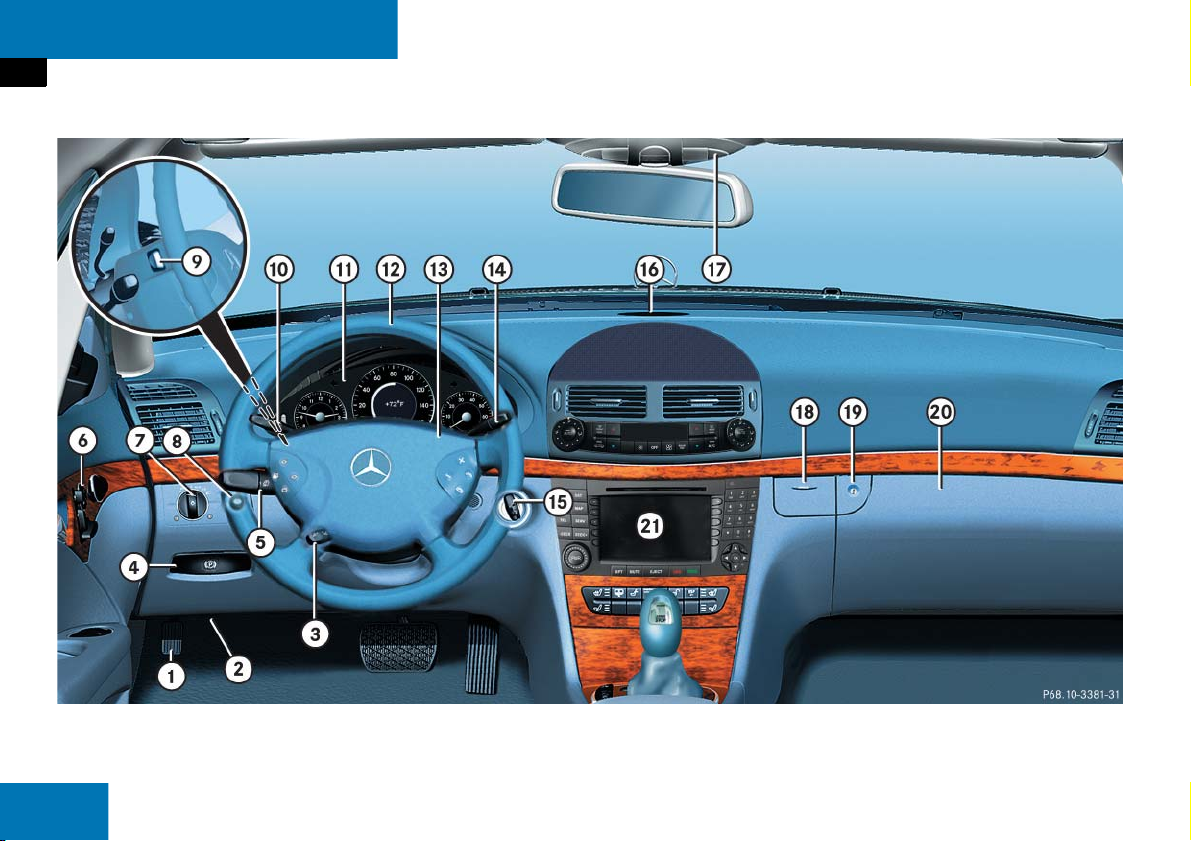
Item Page
1 Parking brake pedal 53, 61
2 Hood lock release 319
3 Steering wheel adjustment
43
stalk
Heated steering wheel* 283
4 Parking brake release 53
5 Combination switch
앫 Turn signals 55
앫 Windshield wipers 56
앫 High beam 55
6 Door control panel 32
7 Exterior lamp switch 141
Item Page
8 Headlamp washer button* 197
9 Steering wheel gearshift
191
control (E55 AMG only)
a Cruise control lever
앫 Cruise control 243
앫 Distronic* 247
b Instrument cluster 24,
150
c Multifunction steering
wheel
26,
154
d Horn
e Lever for voice control sys-
tem*, see separate
operating instructions
Item Page
f Starter switch 36
g Front Parktronic* warning
263
indicator
h Overhead control panel 29
j Mobile phone/Glasses box 276
k Glove box lid release, glove
276
box lock
l Glove box 276
m Center console 27
23
Page 25
At a glance
Instrument cluster
24
Page 26

At a glance
Instrument cluster
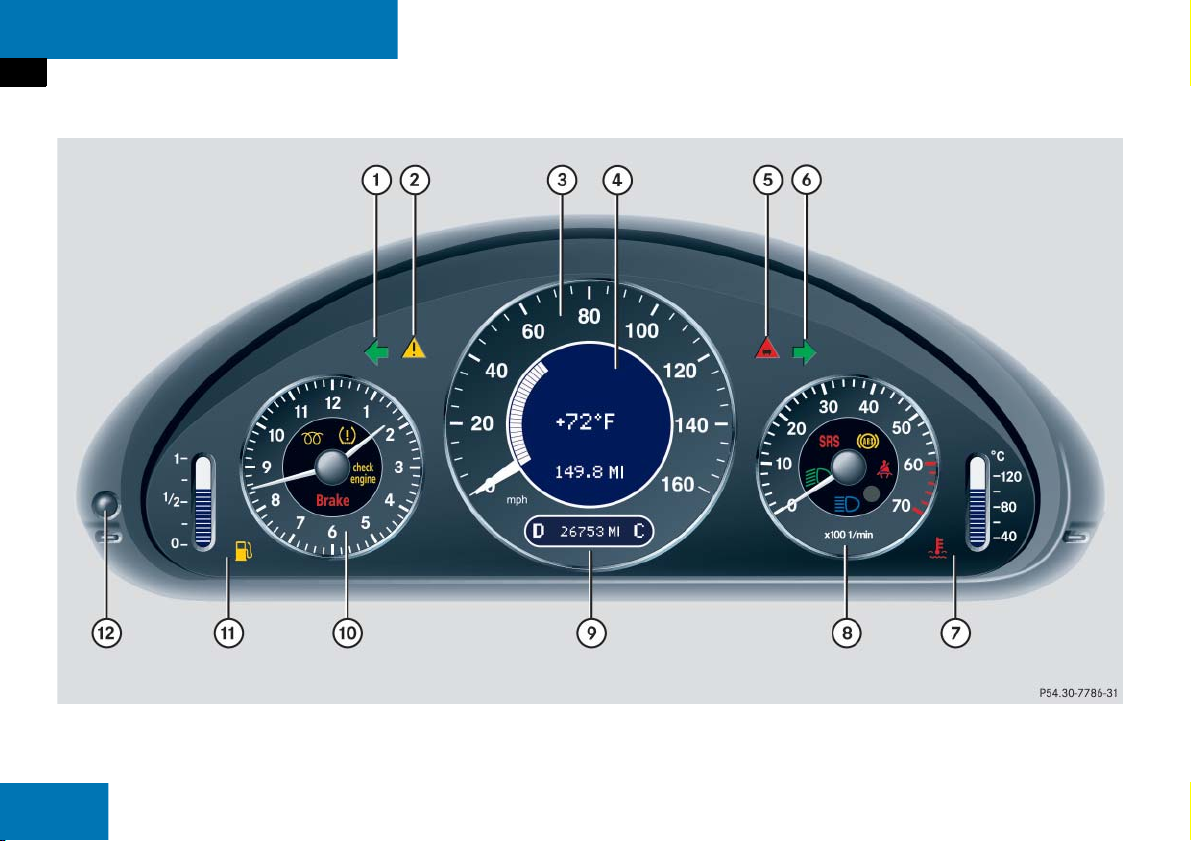
Item Page
1 L Left turn signal
indicator lamp
2 v ABS/ESP® warning
375
lamp
3 Speedometer
4 Multifunction display 153
5 l Distance warning lamp
380
Vehicles without Distronic*:
Warning lamp without function. It illuminates when the
ignition is on. It should go out
when the engine is running.
6 K Right turn signal
indicator lamp
7 Coolant temperature
151
indicator with:
• Coolant temperature
379
warning lamp
Item Page
8 Tachometer with:
1 Supplemental
383
Restraint Sys tem (SRS)
indicator lamp
- Antilock Brake System
374
(ABS) indicator lamp
< Seat belt telltale 380
B Low beam headlamp
54
indicator lamp
A High beam headlamp
145
indicator lamp
9 Main odometer with:
앫 Gear selector lever
50
position
앫 Program mode 189
a Clock with: 168
; Brake warning lamp,
376
USA only
3 Brake warning lamp,
376
Canada only
Item Page
ú Engine malfunction
indicator lamp,
USA only
± Engine malfunction
indicator lamp,
Canada only
H Combination low tire
pressure/TPMS malfunction telltale*
q Preglow indicator
lamp, Diesel engine
only
b Fuel display with:
A Fuel reserve warning
lamp
c Reset button for:
앫 Resetting trip odometer 151
앫 Adjusting instrument
cluster illumination
앫 Confirming new time
settings
377
377
381
51
380
150
168
25
Page 27
At a glance
Multifunction steering wheel
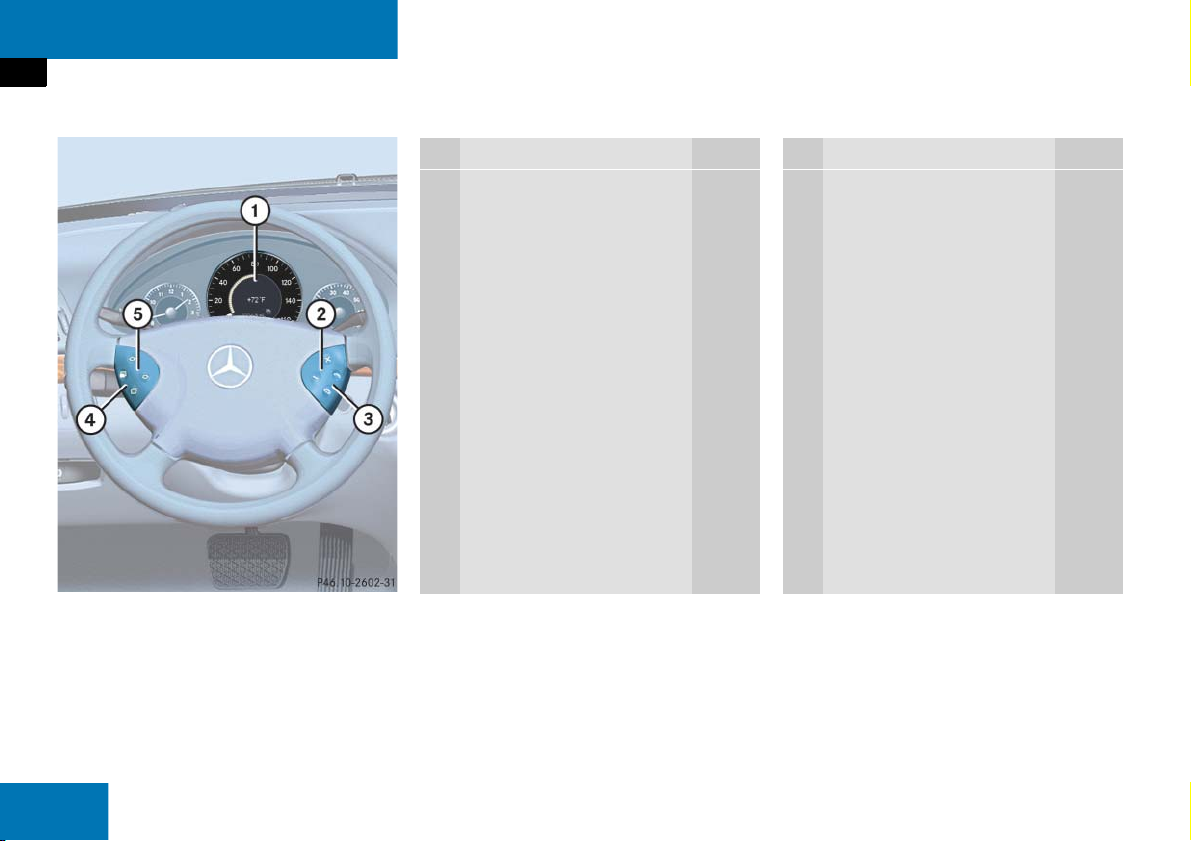
Item Page
1 Multifunction display in
speedometer
Operating control system 154
2 Selecting the submenu or
setting the volume:
Press button
æ up/to increase
ç down/to decrease
3 Telephone*:
Press button
s to take a call
to dial a call
t to end a call
to reject an incoming
call
153
Item Page
4 Menu systems:
Press button
è for next menu
ÿ for previous menu
5 Moving within a menu:
Press button
j for next display
k for previous display
26
Page 28
왔 Center console
Upper part
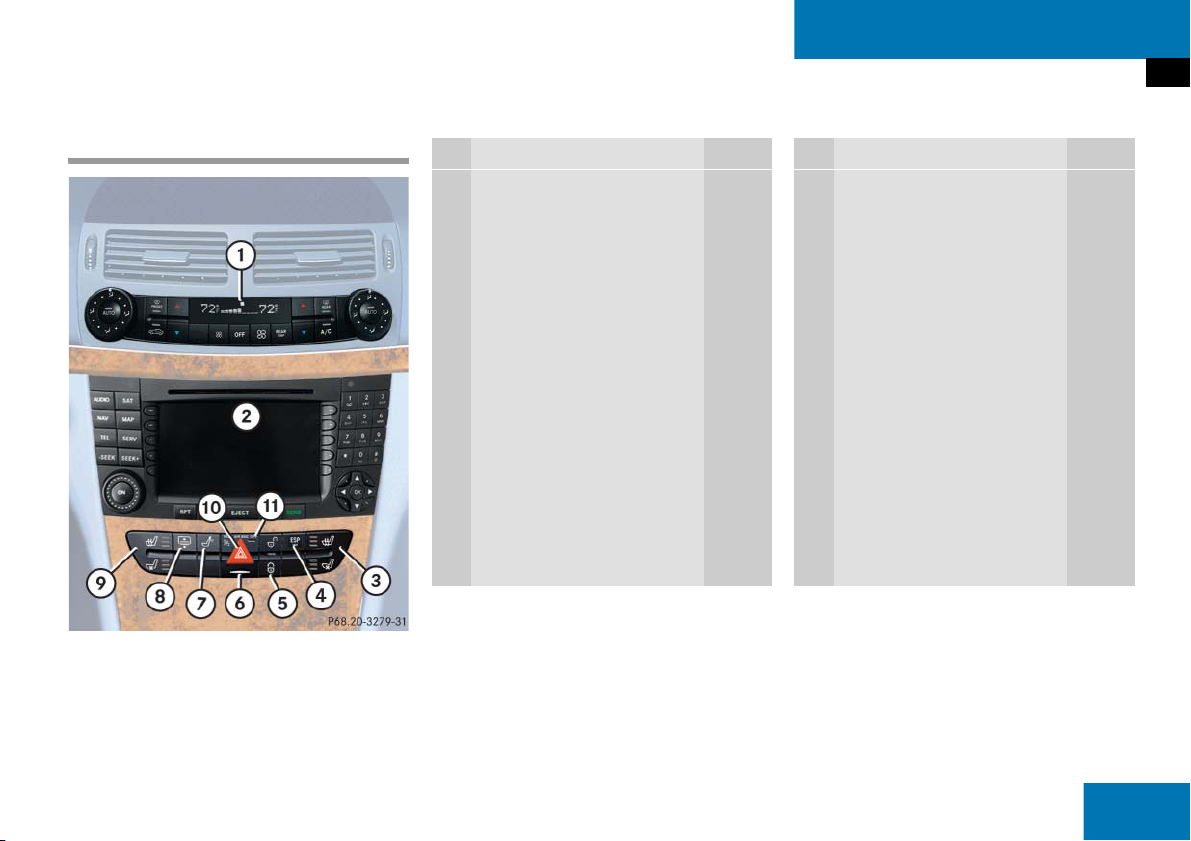
Item Page
1 Dual-zone automatic
climate control, USA only
4-zone automatic climate
control*
2 COMAND system, see sepa-
rate operating instructions
3 Seat heating*, front passen-
ger side
Seat ventilation*, front passenger side
4 Electronic Stability Program
5 Central locking switch 130
®
(ESP
) control switch
202
214
135
136
96
At a glance
Center console
Item Page
6 Opening/closing button for
storage tray or CD changer*, see separate operating
instructions
7 Rear seat head restraints
switch, folding down
8 Rear window sunshade
switch*
9 Seat heating*, driver’s side 135
Seat ventilation*, driver’s
side
a Hazard warning flasher
switch
b Front passenger front air
bag off indicator lamp
276
131
200
136
146
85
27
Page 29
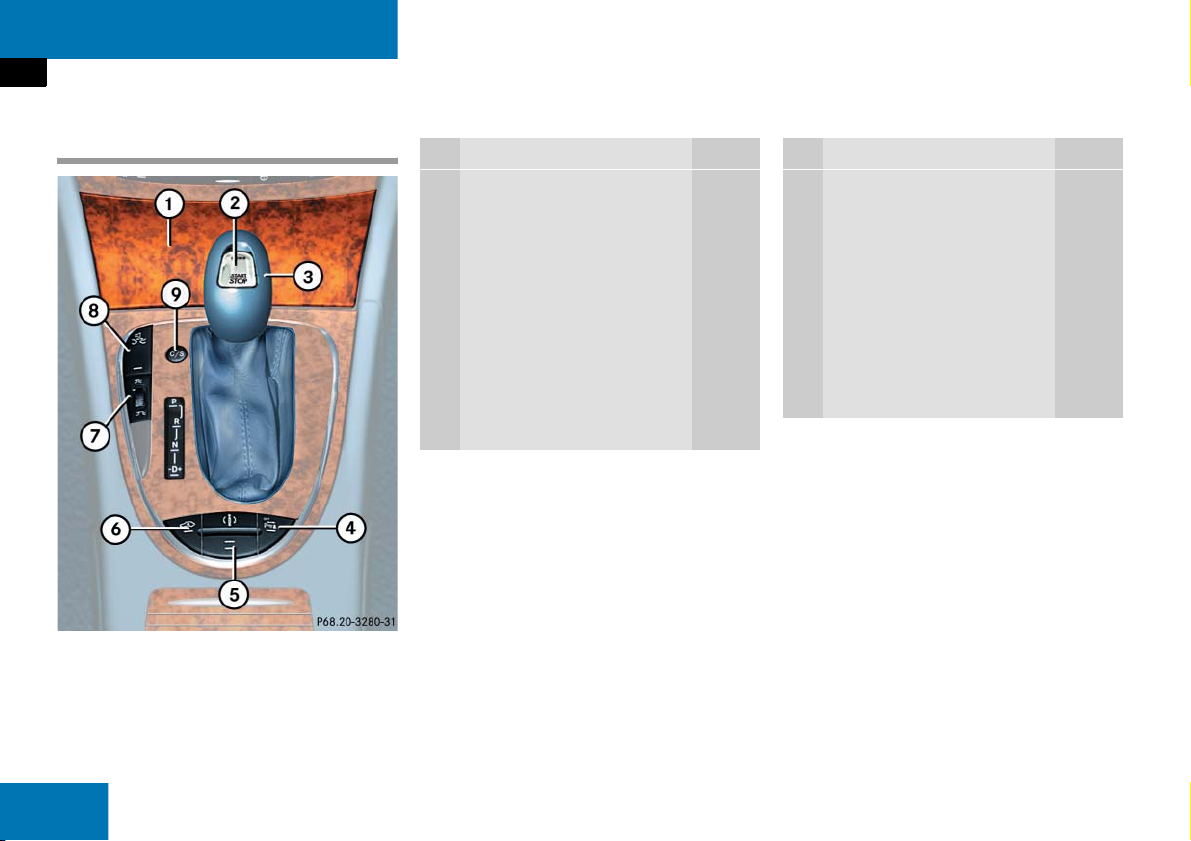
At a glance
Center console
Lower part
Item Page
1 Ashtray 281
2 KEYLESS-GO* start/stop
button
3 Gear selector lever for
automatic transmission
4 Parking assist (Parktronic
system)* deactivation
switch
5 Adaptive Damping System
(ADS)* switch
37
50,
185
263
259
Item Page
6 Vehicle level control
switch*
7 Thumbwheel for setting
distance for Distronic*
8 Distance warning function*
on/off switch
9 Program mode selector
switch for automatic
transmission
260
255
256
189
28
Page 30
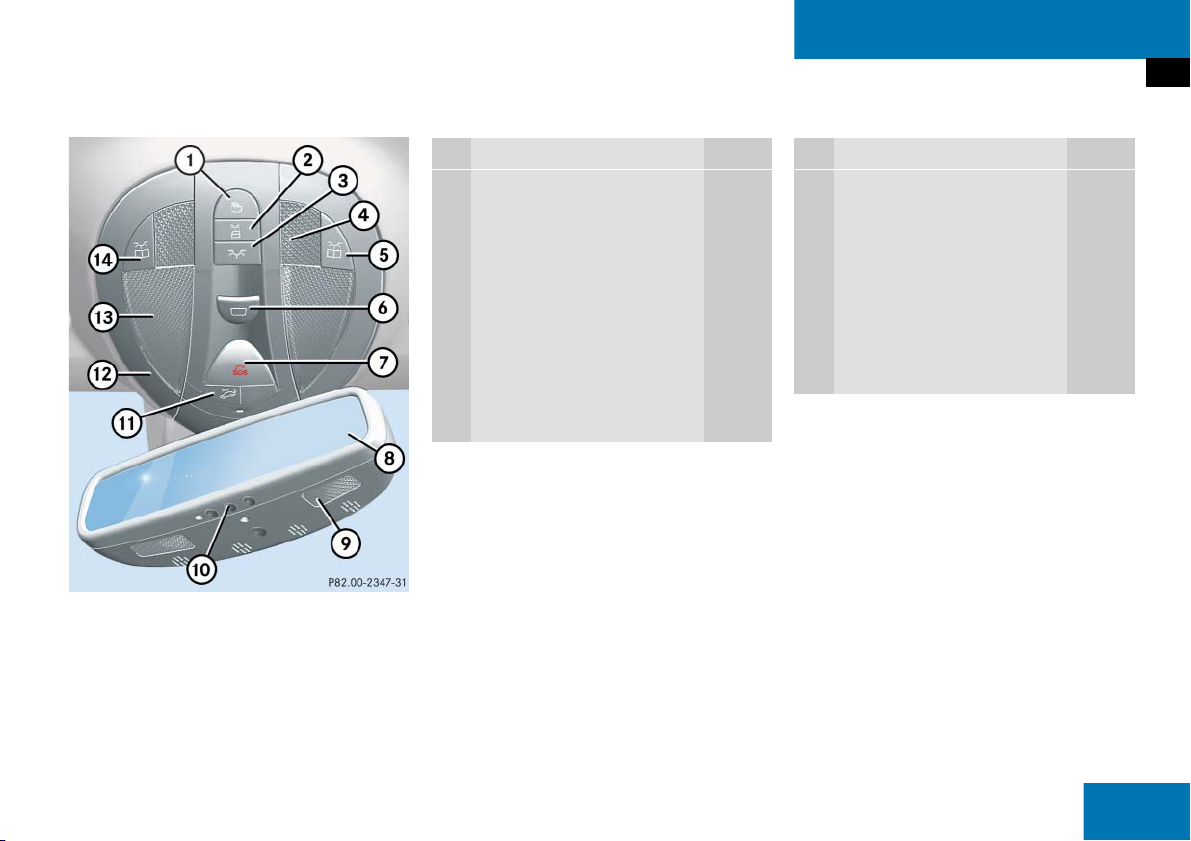
왔 Overhead control panel
At a glance
Overhead control panel
Item Page
1 Rear interior lighting on/off 147
2 Automatic interior lighting 147
3 Front interior lighting on/off 147
4 Temperature sensor
5 Right reading lamp on/off 147
6 Tilt/sliding sunroof* or
tilt/sliding panel*
7 Tele Aid (emergency call
system) button
236,
239
286
Item Page
8 Rear view mirror 197
9 Reading lamps 147
a Garage door opener 293
b Tow-away alarm button 103
c Ambient lighting 172
d Interior lighting
e Left reading lamp on/off 147
29
Page 31

At a glance
Storage compartments
30
Page 32

At a glance
Storage compartments
Item Page
1 Glove box 276
2 Front passenger seat storage
compartment with first aid kit
3 Door pocket
4 Ashtray 281
5 Ruffled storage bag 277
6 Door pocket
7 Side storage pocket in trunk*
8 Luggage box under the trunk
floor
9 Door pocket
a Ruffled storage bag 277
b Ashtray 281
422
423
Item Page
c Door pocket
d Driver’s seat storage compart-
ment
e Sun visor card clip
f Storage tray or CD changer* 276
g Ashtray with cigarette lighter 281
h Mobile phone/Glasses box 276
j Parcel net in front passenger
footwell
k Storage compartment with
cup holders
l Rear storage compartment in
the rear center console
m Cup holder in the rear armrest 279
278
279
277
31
Page 33

At a glance
Door control panel
Item Page
1 Door handle 119
2 Seat adjustment 41
3 Memory function (for stor-
ing seat, exterior mirror and
steering wheel settings)
4 Exterior rear view mirror ad-
justment
5 Switches for opening/clos-
ing front and rear side windows, rear window override
switch
6 Remote trunk release
switch, Trunk opening/closing system*
138
45
231
121
32
Page 34

Getting started
Unlocking
Adjusting
Driving
Parking and locking
33
Page 35

Getting started
Unlocking
The “Getting started” section provides an
overview of the vehicle’s most basic
functions.
If you are already familiar with the basic
functions described here, the “Controls in
detail” section will provide you with further
information. The corresponding page references are located at the end of each segment.
Unlocking with the SmartKey
SmartKey with remote control
1 ‹ Lock button
2 Š Unlock button for trunk
3 ΠUnlock button
4 Â Panic button (
컄 page 91)
Warning! G
When leaving the vehicle, always remove the
SmartKey from the starter switch, take it
with you, and lock the vehicle. Do not leave
children unattended in the vehicle, or with
access to an unlocked vehicle. Unsupervised use of vehicle equipment may cause
an accident and/or serious personal injury.
왘 Press unlock button Œ on the
SmartKey.
앫 All turn signal lamps flash once.
앫 An acoustic signal sounds once
(if equipped and feature activated).
For more information, see “Factory
setting” (
앫 The locking knobs in the doors
컄 page 108).
move up.
앫 The anti-theft alarm system is dis-
armed.
34
Page 36

Getting started
Unlocking
i
The electrohydraulic brake system is
activated (
왘 Get in the vehicle and insert the
SmartKey in the starter switch.
For more information, see “Locking and
unlocking” (
컄 page 97).
컄 page 106).
Unlocking with KEYLESS-GO*
With the KEYLESS-GO function, you can
lock and unlock the vehicle without using
the remote control buttons on the
SmartKey and start the engine without inserting the SmartKey in the starter switch.
i
To unlock the vehicle, the SmartKey
with KEYLESS-GO must be outside the
vehicle, no further than approximately
3 feet (1 meter) away from the door.
Warning! G
When leaving the vehicle, always take the
SmartKey with KEYLESS-GO with you, and
lock the vehicle. Do not leave children unattended in the vehicle, or with access to an
unlocked vehicle. Unsupervised use of vehicle equipment may cause an accident
and/or serious personal injury.
왘 Pull an outside door handle.
앫 All turn signal lamps flash once.
앫 An acoustic signal sounds once
(if equipped and feature activated).
For more information, see “Factory
setting” (
앫 The locking knobs in the doors
컄 page 114).
move up.
앫 The anti-theft alarm system is dis-
armed.
i
The electrohydraulic brake system is
activated (
왘 Get in the vehicle.
For more information, see “SmartKey with
KEYLESS-GO*” (
컄 page 97).
컄 page 111).
35
Page 37

Getting started
Unlocking
Starter switch positions SmartKey
Warning! G
When leaving the vehicle, always remove the
SmartKey or SmartKey with KEYLESS-GO*
from the starter switch, take it with you, and
lock the vehicle. Do not leave children unattended in the vehicle, or with access to an
unlocked vehicle. Unsupervised use of vehicle equipment may cause an accident
and/or serious personal injury.
Starter switch
0 For removing SmartKey
1 Power supply for some electrical con-
sumers, such as seat adjustment
2 Ignition (power supply for all electrical
consumers) and driving position.
All lamps (except low beam headlamp
indicator lamp, high beam headlamp indicator lamp, and turn signal indicator
lamps unless activated) in the instrument cluster come on. If a lamp in the
instrument cluster fails to come on
when the ignition is switched on, have
it checked and replaced if necessary. If
a lamp in the instrument cluster remains on after starting the engine or
comes on while driving, refer to “Lamps
in instrument cluster” (
컄 page 374).
3 Starting position
36
Page 38

Getting started
Unlocking
i
When you switch on the ignition, the indicator and warning lamps (except low
beam headlamp indicator lamp, high
beam headlamp indicator lamp, and
turn signal indicator lamps unless activated) in the instrument cluster come
on. The indicator and warning lamps
(except low beam headlamp indicator
lamp, high beam headlamp indicator
lamp, and turn signal indicator lamps if
activated) should go out when the engine is running. This indicates that the
respective systems are operational.
i
The SmartKey can only be removed
from the starter switch with the gear
selector lever in position P.
!
If the SmartKey cannot be turned in the
starter switch, the starter battery may
not be sufficiently charged.
앫 Check the battery and charge it if
necessary (
앫 Get a jump start (컄 page 454).
To prevent accelerated battery discharge or a completely discharged battery, always remove the SmartKey from
the starter switch when the engine is
not in operation.
For information on starting the engine using the SmartKey, see “Starting with the
SmartKey” (
컄 page 452).
컄 page 50).
SmartKey with KEYLESS-GO*
Pressing the KEYLESS-GO start/stop button on the gear selector lever corresponds
to turning the SmartKey to the various
starter switch positions.
If you firmly depress the brake pedal during pressing the KEYLESS-GO start/stop
button, the engine starts automatically.
i
The function of the SmartKey overrules
the KEYLESS-GO function.
37
Page 39

Getting started
Unlocking
KEYLESS-GO start/stop button
1 USA only
2 Canada only
The SmartKey with KEYLESS-GO must be
located in the vehicle.
왘 Make sure the gear selector lever is set
to P.
왘 Do not depress the brake pedal.
Position 0
Before you press the KEYLESS-GO start/
stop button, the vehicle’s on-board electronics have status 0 (as with Sma rtK ey re-
moved).
Position 1
왘 Press KEYLESS-GO start/stop button
once.
This supplies power for some electrical
consumers, such as seat adjustment.
i
If you now press the KEYLESS-GO
start/stop button
앫 once again, the ignition (position 2)
is switched on.
앫 twice, the power supply is again
switched off.
Ignition (or position 2)
왘 Press KEYLESS-GO start/stop button
twice.
This supplies power for all electrical
consumers. All lamps in the instrument
cluster (except low beam headlamp indicator lamp, high beam headlamp indicator lamp, and turn signal indicator
lamps unless activated) come on. If a
lamp in the instrument cluster fails to
come on when the ignition is switched
on, have it checked and replaced if necessary. If a lamp in the instrument cluster remains on after starting the engine
or comes on while driving, see “Lamps
in instrument cluster” (
컄 page 374).
i
If you now press the KEYLESS-GO
start/stop button once, the power supply is again switched off.
38
Page 40

i
When you switch on the ignition, the indicator and warning lamps (except low
beam headlamp indicator lamp, high
beam headlamp indicator lamp, and
turn signal indicator lamps unless activated) in the instrument cluster come
on. The indicator and warning lamps
(except low beam headlamp indicator
lamp, high beam headlamp indicator
lamp, and turn signal indicator lamps if
activated) should go out when the engine is running. This indicates that the
respective systems are operational.
For information on starting the engine using the KEYLESS-GO start/stop button,
see “Starting with KEYLESS-GO*”
(
컄 page 51).
Getting started
Unlocking
39
Page 41

Getting started
Adjusting
Warning! G
All seat, head restraint, steering wheel, and
rear view mirror adjustments, as well as fastening of seat belts, must be done before
the vehicle is put into motion.
Seats
Warning! G
Do not adjust the driver’s seat while driving.
Adjusting the seat while driving could cause
the driver to lose control of the vehicle.
Never ride in a moving vehicle with the seat
backrest in an excessively reclined position
as this can be dangerous. You could slide
under the seat belt in a collision. If you slide
under it, the belt would apply force at the abdomen or neck. That could cause serious or
fatal injuries. The seat back and seat belts
provide the best restraint when the wearer
is in a nearly upright position and belts are
properly positioned on the body.
Your seat must be adjusted so that you can
correctly fasten your seat belt (
Never place hands under the seat or near
any moving parts while a seat is being adjusted.
컄 page 47).
Warning! G
When leaving the vehicle, always remove the
SmartKey or the SmartKey with
KEYLESS-GO* from the starter switch, take
it with you, and lock the vehicle.
Even with the SmartKey or the SmartKey
with KEYLESS-GO* removed from the starter switch or the SmartKey with
KEYLESS-GO* removed from the vehicle,
the power seats can be operated when the
respective door is open. Therefore, do not
leave children unattended in the vehicle, or
with access to an unlocked vehicle. Unsupervised use of vehicle equipment may
cause an accident and/or serious personal
injury.
Warning! G
According to accident statistics, children
are safer when properly restrained in the
rear seating positions than in the front seating position. Thus, we strongly recommend
that children be pl aced in the rear seats. Regardless of seating position, children
12 years old and under must be seated and
properly secured in an appropriate infant or
toddler restraint, or booster seat recommended for the size and weight of the child.
For additional information, see “Children in
the vehicle” (
A child’s risk of serious or fatal injuries is
significantly increased if the child restraints
are not properly secured in the vehicle and
the child is not properly secured in the child
restraint.
컄 page 78).
40
Page 42

Getting started
Adjusting
Seat adjustment
The seat adjustment switches are located
on the front doors.
1 Head restraint height
2 Seat height
3 Seat cushion tilt
4 Seat fore and aft adjustment
5 Backrest tilt
왘 Switch on the ignition (컄 page 36).
or
왘 Open the respective door.
i
The memory function (컄 page 138) lets
you store the settings for the seat position together with the settings for the
steering wheel and the exterior rear
view mirrors.
Seat fore and aft adjustment
왘 Press the switch forward or backward
in direction of arrow 4.
Adjust a comfortable seating position
that still allows you to reach the accelerator/brake pedal safely. The position
should be as far to the rear as possible,
consistent with ability to properly operate controls.
!
When moving the seat, make sure
there are no items in the footwell or behind the seats. Otherwise you could
damage the seats.
Seat cushion tilt
왘 Press the switch up or down in direc-
tion of arrow 3 until your upper legs
are lightly supported.
Backrest tilt
왘 Press the switch forward or backward
in direction of arrow 5 until your arms
are slightly angled when holding the
steering wheel.
Seat height
왘 Press the switch up or down in direc-
tion of arrow 2.
41
Page 43

Getting started
Adjusting
Head restraint height
왘 Press the switch up or down in direc-
tion of arrow 1.
i
Adjust the head restraint in such a way
that it is as close to the head as possible.
Warning! G
For your protection, drive only with properly
positioned head restraints.
Adjust head restraint so that the center of
the head restraint supports the back of the
head at eye level. This will reduce the potential for injury to the head and neck in the
event of an accident or similar situation.
Do not drive the vehicle without the seat
head restraints. Head restraints are intended to help reduce injuries during an accident.
Head restraint tilt
Manually adjust the angle of the head restraint.
왘 Push or pull on the lower edge of the
head restraint cushion.
i
Adjust the head restraint in such a way
that it is as close to the head as possible.
For more information on seats, see the
“Controls in detail” section (
컄 page 131).
Steering wheel
Warning! G
Do not adjust the steering wheel while driving. Adjusting the steering wheel while driving could cause the driver to lose control of
the vehicle.
When leaving the vehicle, always remove the
SmartKey or the SmartKey with
KEYLESS-GO* from the starter switch, take
it with you, and lock the vehicle.
Even with the SmartKey or the SmartKey
with KEYLESS-GO* removed from the starter switch or the SmartKey with
KEYLESS-GO* removed from the vehicle,
the steering wheel adjustment feature can
be operated when the driver’s door is open.
Therefore, do not leave children unattended
in the vehicle, or with access to an unlocked
vehicle. Unsupervised use of vehicle equipment may cause an accident and/or serious
personal injury.
42
Page 44

Getting started
Adjusting
Steering wheel adjustment
The stalk for steering wheel adjustment is
located on the lower left of the steering
column.
1 Adjusting steering column, in or out
2 Adjusting steering column, up or down
왘 Switch on the ignition (컄 page 36).
or
왘 Open the driver’s door.
Adjusting steering column in or out
왘 Move stalk in direction of arrows 1
until a comfortable steering wheel position is reached with your arms slightly
bent at the elbow.
Adjusting steering column up or down
왘 Move stalk in direction of arrows 2.
Make sure your legs can move freely
and all the displays (incl. malfunction
and indicator lamps) on the instrument
cluster are clearly visible.
i
The memory function (컄 page 138) lets
you store the settings for the steering
wheel together with the settings for the
exterior rear view mirrors and the
driver’s seat position.
Easy-entry/exit feature
This feature allows for easier entry into and
exit from the vehicle. When entering and
exiting the vehicle, the steering wheel is in
its uppermost position.
The easy-entry/exit feature can be activated or deactivated in the
menu of the control system (
Convenience
컄 page 175).
sub-
Warning! G
You must make sure no one can become
trapped or injured by the moving steering
wheel when the easy-entry/exit feature is
activated.
To stop steering wheel movement, do one of
the following:
앫 Move steering column stalk.
앫 Press one of the memory buttons or the
memory button M (
컄 page 139). 컄컄
43
Page 45

Getting started
Adjusting
컄컄
Do not leave children unattended in the vehicle, or with access to an unlocked vehicle.
Children could open the driver’s door and
unintentionally activate the easy-entry/exit
feature, which could result in an accident
and/or serious personal injury.
With the easy-entry/exit feature activated,
the steering wheel will return to its last set
position when you:
앫 close the driver’s door with the ignition
switched on,
or
앫 insert the SmartKey into the starter
switch or press the KEYLESS-GO*
start/stop button (
컄 page 38) once
with the driver’s door closed
i
The last set steering wheel position is
stored when
앫 the ignition is switched off
앫 the position is stored in memory
(
컄 page 139)
With the easy-entry/exit feature activated,
the steering wheel tilts upwards when you:
앫 remove the SmartKey from the starter
switch,
or
앫 open the driver’s door with the
SmartKey in starter switch position 0
or 1 or the KEYLESS-GO* start/stop
button (
컄 page 38) in position 1.
i
If the current position for the steering
wheel is in the uppermost tilt position,
the steering wheel will no longer be
able to move upward when the
easy-entry/exit feature is activated.
The adjustment procedure is briefly interrupted when the engine is started.
Warning! G
Let the system complete the adjustment
procedure before setting the vehicle in motion. All steering wheel adjustment must be
completed before setting the vehicle in motion. Driving off with the steering wheel still
adjusting could cause the driver to lose control of the vehicle.
44
Page 46

Getting started
Adjusting
Mirrors
Adjust the interior and exterior rear view
mirrors before driving so that you have a
good view of the road and traffic conditions.
Warning! G
In case of an accident, liquid electrolyte may
escape the mirror housing if the mirror glass
breaks.
Electrolyte has an irritating effect. Do not allow the liquid to come into contact with
eyes, skin, clothing, or respiratory system.
In case it does, immediately flush affected
area with water, and seek medical help if
necessary.
!
Electrolyte drops coming into contact
with the vehicle paint finish can only be
completely removed while in their liquid state and by applying plenty of water.
Interior rear view mirror
왘 Manually adjust the interior rear view
mirror.
For more information, see “Rear view mirrors” (
컄 page 197).
Exterior rear view mirrors
Warning! G
Exercise care when using the
passenger-side exterior rear view mirror.
The mirror surface is convex (outwardly
curved surface for a wider field of view). Objects in mirror are closer than they appear.
Check your interior rear view mirror or
glance over your shoulder before changing
lanes.
The buttons are located on the driver’s
door.
1 Passenger-side exterior rear view mir-
ror button
2 Adjustment button
3 Driver’s side exterior rear view mirror
button
45
Page 47

Getting started
Adjusting
왘 Switch on the ignition (컄 page 36).
왘 Press button 3 for the driver’s side ex-
terior rear view mirror or button 1 for
the passenger-side exterior rear view
mirror.
왘 Push adjustment button 2 up, down,
left or right according to the desired
setting.
!
If an exterior rear view mirror was forcibly pushed forward (hit from the rear)
or forcibly pushed rearward (hit from
the front), reposition it by applying firm
pressure until it snaps into place. The
mirror housing is now properly positioned and you can adjust the mirror
normally.
i
The memory function (컄 page 138) lets
you store the setting for the seat position together with the setting for the
steering wheel and the exterior rear
view mirrors.
At low ambient temperatures, the exterior rear view mirrors will be heated automatically.
For more information, see “Activating exterior rear view mirror parking position”
(
컄 page 198).
For more information, see “Rear view mirrors” (
컄 page 197).
46
Page 48

왔 Driving
Getting started
Driving
Warning! G
Do not lay any objects in the driver’s footwell. Be careful that floor mats or carpets in
the driver’s footwell have sufficient clearance for the pedals.
During sudden driving or braking maneuvers
the objects could get caught between the
pedals. You could then no longer brake or
accelerate.
Fastening the seat belts
Warning! G
Always fasten your seat belt before driving
off. Always make sure all of your passengers
are properly restrained, even those sitting in
the rear and pregnant women.
Failure to wear and properly fasten and
position your seat belt greatly increases
your risk of injuries and their likely severity
in an accident. You and your passengers
should always wear seat belts.
If you are ever in an accident, your injuries
can be considerably more severe without
your seat belt properly buckled. Without
your seat belt buckled, you are much more
likely to hit the interior of the vehicle or be
ejected from it. You can be seriously injured
or killed.
In the same crash, the possibility of injury or
death is lessened if you are wearing your
seat belt. The air bags can only provide the
protection they were designed to afford if
the occupants are using their seat belts
(
컄 page 73).
Warning! G
According to accident statistics, children
are safer when properly restrained in the
rear seating positions than in the front seating position. Thus, we strongly recommend
that children be placed in the rear seats.
Regardless of seating position, children
12 years old and under must be seated and
properly secured in an appropriate infant or
toddler restraint, or booster seat recommended for the size and weight of the child.
For additional information, see “Children in
the vehicle” (
A child’s risk of serious or fatal injuries is
significantly increased if the child restraints
are not properly secured in the vehicle and
the child is not properly secured in the child
restraint.
컄 page 78).
47
Page 49

Getting started
Driving
Warning! G
Never let more people ride in the vehicle
than there are seat belts available. Be sure
everyone riding in the vehicle is correctly
restrained with a separate seat belt. Never
use a seat belt for more than one person at
a time.
Warning! G
Never ride in a moving vehicle with the seat
backrest in an excessively reclined position
as this can be dangerous. You could slide
under the seat belt in a collision. If you slide
under it, the belt would apply force at the
abdomen or neck. That could cause serious
or even fatal injuries. The seat backrest and
seat belt provide the best restraint when the
wearer is in a nearly upright position and the
belt is properly positioned on the body.
Warning! G
Read and observe the additional warning notices printed in the “Safety and Security”
section (
컄 page 70) and (컄 page 74).
1 Belt outlet
2 Latch plate
3 Buckle
4 Release button
왘 With a smooth motion, pull the belt
from belt outlet 1.
48
Page 50

Getting started
Driving
왘 Place the shoulder portion of the belt
across the top of your shoulder and the
lap portion across your hips.
왘 Push latch plate 2 into buckle 3 until
it clicks.
왘 If necessary, tighten the lap portion to
a snug fit by pulling shoulder portion
up.
Belt outlet height adjustment
1 Release button
왘 Press release button 1 and move the
seat belt height adjuster upward or
downward.
Proper use of seat belts
앫 Do not twist the belt when fastening.
앫 Adjust seat belt so that the shoulder
portion is located as close as possible
to the middle of the shoulder (it should
not touch the neck). Never pass the
shoulder portion of the belt under your
arm.
앫 Position the lap belt as low as possible
on your hips (over hip joint) and not
across the abdomen.
앫 Place the seat backrest in a nearly
upright position.
앫 Never use a seat belt for more than one
person at a time.
앫 Do not fasten a seat belt around a
person and another object at the same
time. When using a seat belt to secure
infant or toddler restraints or children
in booster seats, always follow the
child seat manufacturer’s instructions.
앫 Check your seat belt periodically
during travel to make sure that it is
properly positioned.
앫 Make sure that the seat belt is always
fitted snugly. Take special care of this
when wearing loose clothing.
Warning! G
Do not pass belts over sharp edges. They
could tear.
Do not allow the belt to get caught in the
door or in the seat adjustment mechanism.
This could damage the belt.
Never attempt to make modifications to
seat belts. This could impair the effectiveness of the belts.
Do not bleach or dye seat belts as this may
severely weaken them. In a crash they may
not be able to provide adequate protection.
Damaged seat belts or belts that were highly
stressed in an accident must be replaced.
Contact an authorized Mercedes-Benz
Center.
49
Page 51

Getting started
Driving
Starting the engine Automatic transmission
Warning! G
Inhalation of exhaust gas is hazardous to
your health. All exhaust gas contains carbon
monoxide, and inhaling it can cause unconsciousness and possible death.
Do not run the engine in confined areas
(such as a garage) which are not properly
ventilated. If you think that exhaust gas
fumes are entering the vehicle while driving,
have the cause determined and corrected
immediately. If you must drive under these
conditions, drive only with at least one window fully open.
Gearshift pattern for automatic
transmission
P Park position with gear selector lever
lock
R Reverse gear
N Neutral
D Drive position
For more information, see the “Controls in
detail” section (
컄 page 188).
Starting with the SmartKey
For information on turning off the engine
with the SmartKey, see “Turning off engine” (
컄 page 62).
Gasoline engine:
왘 Make sure the gear selector lever is set
to P.
왘 Do not depress the accelerator.
왘 Turn the SmartKey in the starter switch
to position 3 and hold until the engine
starts (
컄 page 36).
i
You can also use the “touch-start”
function. Turn the SmartKey to
position 3 and release it again immediately. The engine then starts automatically.
50
Page 52

Getting started
Driving
Diesel engine:
왘 Make sure the gear selector lever is s et
to P.
왘 Do not depress the accelerator.
왘 Turn the SmartKey in the starter switch
to position 2 (
컄 page 36).
The preglow indicator lamp q in the
instrument cluster comes on.
왘 As soon as the preglow indicator
lamp q goes out, turn the SmartKey
in the starter switch to position 3
(
컄 page 36) and release it.
The engine starts automatically.
i
If the engine is at operating temperature, the preglow indicator lamp q
may not stay on and you can start the
engine without preglowing.
Starting with KEYLESS-GO*
Warning! G
As long as the SmartKey with KEYLESS-GO
is in your vehicle, the vehicle can be started.
Therefore, never leave children unattended
in the vehicle, as they could otherwise accidentally start the engine.
When leaving the vehicle, always take the
SmartKey with KEYLESS-GO with you and
lock the vehicle. Do not leave children unattended in the vehicle, or with access to an
unlocked vehicle.
You can start your vehicle without the
SmartKey in the starter switch using the
KEYLESS-GO start/stop button on the
gear selector lever.
For information on turning off the engine
with KEYLESS-GO, see “Turning off with
KEYLESS-GO*” (
컄 page 62).
The SmartKey with KEYLESS-GO must be
located in the vehicle.
KEYLESS-GO start/stop button
1 USA only
2 Canada only
Gasoline engine:
왘 Make sure the gear selector lever is set
to P.
왘 Depress the brake pedal during the
starting procedure. Do not depress accelerator.
The gear selector lever lock is released.
컄컄
51
Page 53

Getting started
Driving
왘 Press KEYLESS-GO start/stop button
컄컄
(
컄 page 51) once.
The engine starts if the SmartKey with
KEYLESS-GO is in the vehicle.
Diesel engine:
왘 Make sure the gear selector lever is set
to P.
왘 Depress the brake pedal during the
starting procedure. Do not depress accelerator.
The gear selector lever lock is released.
왘 Press KEYLESS-GO start/stop button
(
컄 page 51) once.
The engine begins to preglow and will
start automatically.
If the engine is at operating temperature,
the preglow indicator lamp q may not
stay on and you can start the engine without preglowing:
왘 Press KEYLESS-GO start/stop button
(
컄 page 51) until the engine is running.
Starting difficulties
If the engine does not start as described,
carry out the following steps:
왘 If you are starting the engine with the
SmartKey, turn SmartKey in starter
switch to position 0 and repeat starting
procedure.
왘 If you are starting the engine with
KEYLESS-GO: Close any doors that
may be open to allow for better detection of the SmartKey with
KEYLESS-GO.
Or:
Start the engine with the SmartKey as
radio signals from another source may
be interfering with the SmartKey with
KEYLESS-GO.
왘 Repeat the starting procedure
(
컄 page 50). Remember that extended
starting attempts can drain the battery.
왘 Get a jump start (컄 page 454).
If the engine does not start after several
starting attempts, there could be a malfunction in the engine electronics or in the
fuel supply system.
왘 Notify an authorized Mercedes-Benz
Center.
52
Page 54

Getting started
Driving
Parking brake
1 Parking brake pedal
2 Release handle
Warning! G
When leaving the v ehicle, always remove the
SmartKey or the SmartKey with
KEYLESS-GO* from the starter switch, take
it with you, and lock the vehicle. Do not
leave children unattended in the vehicle, or
with access to an unlocked vehicle. Children
could release the parking brake, which
could result in an accident and/or serious
injury.
왘 Release the parking brake by pulling on
release handle 2.
The warning lamp ; (USA only) or
3 (Canada only) in the instrument
cluster goes out.
Driving
왘 Depress the brake pedal.
왘 Move the gear selector lever to
position D or R.
i
Wait for the gear selection process to
complete before setting the vehicle in
motion.
왘 Release the brake pedal.
왘 Carefully depress the accelerator
pedal.
Once the vehicle is in motion, the automatic central locking system engages and the
locking knobs drop down.
i
You can open a locked door from the
inside. Open door only when conditions
are safe to do so.
컄컄
53
Page 55

Getting started
Driving
컄컄
!
If you hear a warning signal and the
message
Release parking brake
pears in the multifunction display when
driving off, you have forgotten to release the parking brake.
Release the parking brake.
After a cold start, the automatic transmission engages at a higher revolution. This allows the catalytic converter (gasoline
engine) or the oxidation catalyst (Diesel
engine) to heat up more quickly to operating temperature.
Warning! G
On slippery road surfaces, never downshift
in order to obtain braking action. This could
result in drive wheel slip and reduced vehicle control. Your vehicle’s ABS will not prevent this type of loss of control.
ap-
Warning! G
It is dangerous to shift the gear selector le-
ver out of P or N if the engine speed is high-
er than idle speed. If your foot is not firmly
on the brake pedal, the vehicle could accel-
erate quickly forward or in reverse. You
could lose control of the vehicle and hit
someone or something. Only shift into gear
when the engine is idling normally and when
your right foot is firmly on the brake pedal.
For more information on driving, see “Driving instructions” (
컄 page 303).
!
Simultaneously depressing the accelerator pedal and applying the brake reduces engine performance and causes
premature brake and drivetrain wear.
Switching on headlamps
Low beam headlamps
The exterior lamp switch is located on the
dashboard to the left of the steering wheel.
Exterior lamp switch
1 Off
2 Low beam headlamps on
왘 Turn the exterior lamp switch to
position B.
The low beam headlamp indicator
lamp B in the instrument cluster
comes on (
컄 page 24).
54
Page 56

Getting started
Driving
High beam
The combination switch is located on the
left of the steering column.
Combination switch
1 High beam
2 High beam flasher
왘 Push the combination switch in direc-
tion of arrow 1.
The high beam headlamp indicator
lamp A in the instrument cluster
comes on (
컄 page 145).
For more information on headlamps, see
“Lighting” (
컄 page 141).
Turn signals
The combination switch is located on the
left of the steering column.
Combination switch
1 Turn signals, right
2 Turn signals, left
왘 Press the combination switch in direc-
tion of arrow 1 or 2.
The corresponding turn signal indicator
lamp L or K in the instrument
cluster flashes.
The combination switch resets automatically after major steering wheel movements.
i
To signal minor directional changes
such as changing lanes, press the combination switch only to point of resistance and release. The corresponding
turn signals will flash three times.
55
Page 57

Getting started
Driving
Windshield wipers
The combination switch is located on the
left of the steering column.
Combination switch
1 Single wipe
Wiping with windshield washer fluid
2 Switching on windshield wipers
왘 Switch on the ignition (컄 page 36).
!
Do not operate the windshield wipers
when the windshield is dry. Dust that
accumulates on a windshield might
scratch the glass and/or damage the
wiper blades when wiping occurs on a
dry windshield. If it is necessary to operate the windshield wipers in dry
weather conditions, always operate the
windshield wipers with windshield
washer fluid (
Switching on windshield wipers
왘 Turn the combination switch to the de-
sired position depending on the intensity of the rain.
0 Windshield wipers off
I Intermittent wiping
II Normal wiper speed
III Fast wiper speed
컄 page 57).
Intermittent wiping
!
Do not leave windshield wipers in
intermittent setting when the vehicle is
taken to an automatic car wash or
during windshield cleaning. Windshield
wipers will operate in the presence of
water sprayed on the windshield, and
windshield wipers may be damaged as
a result.
Intermittent wiping interval is dependent
on wetness of windshield.
왘 Turn the combination switch to
position I.
After the initial wipe, pauses between
wipes are automatically controlled by the
rain sensor.
56
Page 58

Getting started
Driving
i
Intermittent wiping is interrupted when
the vehicle is at a standstill and a front
door is opened. This protects persons
getting into or out of the vehicle from
being sprayed.
Intermittent wiping will be continued
when
앫 all doors are closed
and
앫 the gear selector lever is in
position D or R
or
앫 the wiper setting is changed using
the combination switch
Single wipe
왘 Press the combination switch briefly in
direction of arrow 1 to the resistance
point.
The windshield wipers wipe one time
without washer fluid.
Wiping with windshield washer fluid
왘 Push the combination switch in direc-
tion of arrow 1 past the resistance
point.
The windshield wipers operate with
washer fluid.
i
To prevent smears on the windshield,
wipe with windshield washer fluid every
now and then even when it is raining.
For information on filling up the washer
reservoir, see “Windshield washer system
and headlamp cleaning system*”
(
컄 page 327).
57
Page 59

Getting started
Driving
!
If anything blocks the windshield wipers (leaves, snow, etc.), switch them off
immediately.
앫 For safety reasons, stop the vehicle
in a safe location and
앫 remove SmartKey from starter
switch
or
앫 turn off the engine by pressing
the KEYLESS-GO* start/stop
button and open the driver’s
door (with the driver’s door
open, starter switch is in position 0, same as with SmartKey
removed from starter switch)
before attempting to remove any
blockage.
앫 Remove blockage.
앫 Turn the windshield wipers on
again.
If windshield wipers fail to function at
all in combination switch position I,
앫 set the combination switch to the
next highest wiper speed
앫 have the windshield wipers
checked at the nearest authorized
Mercedes-Benz Center.
Problems while driving
The engine runs erratically and misfires
앫 An ignition cable may be damaged.
앫 The engine electronics may not be op-
erating properly.
앫 Unburned gasoline may have entered
the catalytic converter and damaged it
(Gasoline engine only).
왘 Give very little gas.
왘 Have the problem repaired by an au-
thorized Mercedes-Benz Center as
soon as possible.
58
Page 60

Getting started
Driving
The coolant temperature is above
248°F (120°C)
The coolant is too hot and is no longer
cooling the engine.
왘 Stop the vehicle as soon as possible in
a safe location and turn off the engine.
Allow engine and coolant to cool.
왘 Check the coolant level and add cool-
ant if necessary (
컄 page 325).
In case of accident
If the vehicle is leaking fuel:
왘 Do not start the engine under any cir-
cumstances.
왘 Notify local fire and/or police authori-
ties.
If the extent of the damage cannot be de-
termined:
왘 Notify an authorized Mercedes-Benz
Center.
If no damage can be determined on the
앫 major assemblies
앫 fuel system
앫 engine mount:
왘 Start the engine in the usual manner.
59
Page 61

Getting started
Parking and locking
You have now completed your first drive.
You have properly stopped and parked
your vehicle. End your drive as follows.
Warning! G
With the engine not running, there is no
power assistance for the brake and steering
systems. In this case, it is important to keep
in mind that a considerably higher degree of
effort is necessary to brake and steer the vehicle.
Warning! G
Vehicles with Airmatic*: If you have selected
the Comfort suspension tuning
(
컄 page 259), the vehicle lowers slightly
when it is locked. You should therefore
make sure that no one is standing near the
wheel arches or lying underneath the vehicle when it is being locked. Otherwise, personal injury could result.
Warning! G
Do not park this vehicle in areas where com-
bustible materials such as grass, hay or
leaves can come into contact with the hot
exhaust system, as these materials could be
ignited and cause a vehicle fire.
To reduce the risk of personal injury as a re-
sult of vehicle movement, before turning off
the engine and leaving the vehicle always:
앫 Keep right foot on brake pedal.
앫 Firmly depress parking brake pedal.
앫 Move the gear selector lever to
position P.
앫 Slowly release brake pedal.
앫 When parked on an incline, turn front
wheel towards the road curb.
앫 Turn the SmartKey to starter switch
position 0 and remove, or press
start-/ stop button (vehicles with
KEYLESS-GO*).
앫 Take the Smart Key or the SmartKey with
KEYLESS-GO* and lock vehicle when
leaving.
!
Vehicles with Airmatic*: If you have selected the Comfort suspension tuning
(
컄 page 259), the vehicle lowers slight-
ly when you lock it within approximately 60 seconds after switching off the
engine. When parking, make sure that
your vehicle cannot come into contact
with other objects, such as a curb,
while lowering. Your vehicle could otherwise be damaged.
60
Page 62

Parking brake
Warning! G
Getting started
Parking and locking
Warning! G
1 Parking brake pedal
2 Release handle
왘 Step firmly on parking brake pedal 1.
When the engine is running, the warning lamp ; (USA only) or 3
(Canada only) in the instrument cluster
will be illuminated.
When leaving the v ehicle, always remove the
SmartKey or the SmartKey with
KEYLESS-GO* from the starter switch, take
it wit h yo u an d lo ck t he v ehi cle . Do not le ave
children unattended in the vehicle, or with
access to an unlocked vehicle. Children
could release the parking brake and/or
move the gear selector lever from
position P, either of which could result in an
accident and/or serious injury.
Getting out of your vehicle with the gear selector lever not fully engaged in position P is
dangerous. Also, when parked on an incline,
position P alone may not prevent your vehicle from moving, possibly hitting people or
objects.
Always set the parking brake in addition to
shifting to position P.
When parked on an incline, turn front wheels
towards the road curb.
61
Page 63

Getting started
Parking and locking
Switching off headlamps
왘 Turn the exterior lamp switch to M
(
컄 page 54).
For more information, see the “Controls in
detail” section (
컄 page 141).
Turning off engine
왘 Move the gear selector lever to
position P.
왘 Apply the parking brake (컄 page 61).
i
Always set the parking brake in addition to shifting to position P.
On slopes, turn the front wheels towards the road curb.
Turning off with the SmartKey
왘 Turn the SmartKey in the starter switch
(
컄 page 36) to position 0 and remove
it.
The immobilizer is activated.
i
The SmartKey can only be removed
from the starter switch with the gear
selector lever in position P.
Turning off with KEYLESS-GO*
왘 Place the gear selector lever in P.
왘 Press the KEYLESS-GO start/stop but-
ton to shut off the engine.
With the driver’s door closed, the starter switch is now in position 1. With the
driver’s door opened, the starter switch
is set to position 0, same as SmartKey
removed from starter switch
(
컄 page 36).
!
If you hear a warning signal, you have
either
앫 forgotten to switch off the vehicle’s
exterior lamps before opening the
driver’s door,
or
앫 tried to turn off the engine while the
gear selector lever is not in P.
Turn off the lights or place the gear selector lever in P.
62
Page 64

Getting started
Parking and locking
Releasing seat belts
왘 Press the seat belt release button
(
컄 page 48).
Allow the retractor to completely rewind the seat belt by guiding the latch
plate.
!
Make sure the seat belt retracts fully so
that the seat belt and/or latch plate
cannot get caught or pinched in the
door or in the seat mechanism. This
can damage the seat belt and impair
the effectiveness of the seat belt,
and/or cause damage to the door
and/or door trim panel. Such damage
is not covered by the Mercedes-Benz
Limited Warranty.
Damaged seat belts must be replaced.
Contact an authorized Mercedes-Benz
Center.
Locking
Warning! G
To prevent possible personal injury, always
keep hands and fingers away from the door
openings when closing the doors. Be especially careful when small children are
around.
Before closing doors, make sure that there
is no possibility of someone getting caught
in a door during closing.
Warning! G
When leaving the vehicle, always take the
SmartKey or the SmartKey with
KEYLESS-GO* with you, and lock the vehicle. Do not leave children unattended in the
vehicle, or with access to an unlocked vehicle. Unsupervised use of vehicle equipment
may cause an accident and/or serious personal injury.
i
A warning sounds and the message
Switch off lights
tifunction display if the vehicle’s exterior lamps are not switched off
앫 with the SmartKey removed from
the starter switch and the driver’s
door open
앫 with the engine turned off using the
KEYLESS-GO* start/stop button
and the driver’s door open (same as
SmartKey removed from starter
switch)
Switch off the exterior lamps.
왘 Exit the vehicle and close all doors and
the trunk.
appears in the mul-
63
Page 65

Getting started
Parking and locking
Locking with the SmartKey
왘 After exiting the vehicle, press lock
button ‹ on the SmartKey
(
컄 page 34).
앫 All turn signal lamps flash three
times.
앫 An acoustic signal sounds three
times (if equipped and feature activated).
For more information, see “Factory
setting” (
앫 The locking knobs in the doors
컄 page 108).
move down.
앫 The anti-theft alarm system is
armed.
For more information, see the “Controls in
detail” section (
컄 page 106).
Locking with KEYLESS-GO*
1 Lock button
왘 After exiting the vehicle, press lock
button 1 on an outside door handle or
on the trunk lid.
앫 All turn signal lamps flash three
times.
앫 An acoustic signal sounds three
times (if equipped and feature activated).
For more information, see “Factory
setting” (
앫 The locking knobs in the doors
컄 page 114).
move down.
앫 The anti-theft alarm system is
armed.
For more information, see the “Controls in
detail” section (
컄 page 111).
64
Page 66

Safety and Security
Occupant safety
Panic alarm
Driving safety systems
Anti-theft systems
65
Page 67

Safety and Security
Occupant safety
In this section you will learn the most
important facts about the restraint system
components of the vehicle.
앫 Seat belts (컄 page 73)
앫 Child restraints (컄 page 86)
앫 Lower anchors and tethers for children
(LATCH) (
컄 page 88)
Supplemental Restraint System (SRS) with
앫 Air bags (컄 page 67)
앫 Air bag control unit (with crash
sensors)
앫 Emergency tensioning device (ETD) for
seat belts (
컄 page 76)
Air bag system components with
앫 75 indicator lamp
(
컄 page 85)
앫 Front passenger seat with Occupant
Classification System (OCS)
(
컄 page 81)
As independent systems, their protective
functions work in conjunction with each
other.
i
For information on infants and children
traveling with you in the vehicle and
restraint systems for infants and children, see “Children in the vehicle”
(
컄 page 78).
The SRS system conducts a self-test when
the ignition is switched on and in regular
intervals while the engine is running. This
facilitates early detection of malfunctions.
The
1 indicator lamp in the instrument
cluster lights up when the ignition is
switched on and goes out no later than a
few seconds after the engine has been
started.
The SRS components are in operational
readiness if the
1 indicator lamp is not
lit when the engine is running.
A malfunction in the system has been
detected if the
앫 fails to go out after approximately
1 indicator lamp:
4 seconds after the engine was started
앫 does not come on at all
앫 comes on after the engine was started
or while driving
66
Page 68

Safety and Security
Occupant safety
Warning! G
In the event that the 1 indicator lamp
comes on during driving or does not come
on at all, the SRS self-check has detected a
malfunction. For your safety, we strongly
recommend that you visit an authorized
Mercedes-Benz Center immediately to have
the system checked; otherwise the SRS may
not be activated when needed in an accident, which could result in serious or fatal
injury, or it might deploy unexpectedly and
unnecessarily which could also result in
injury.
In addition, improper repair work on the SRS
creates a risk of rendering the SRS inoperative or causing unintended air bag deployment. Work on the SRS must therefore only
be performed by qualified technicians. Contact an authorized Mercedes-Benz Center.
If it is necessary to modify an air bag system
to accommodate a person with disabilities,
contact your local authorized
Mercedes-Benz Center or call our Customer
Assistance Center at 1-800-FOR-MERCedes
(1-800-367-6372) for details.
Air bags
Warning! G
Air bags are designed to reduce the potential of injury and fatality in certain frontal impacts (front air bags), side impacts (side
impact air bags and head protection window
curtain air bags) or rollovers (head protection window curtain air bags). However, no
system available today can totally eliminate
injuries and fatalities.
The activation of the air bags temporarily releases a small amount of dust from the
air bags. This dust, however, is neither injurious to your health, nor does it indicate a
fire in the vehicle. The dust might cause
some temporary breathing difficulty for people with asthma or other breathing trouble.
To avoid this, you may wish to get out of the
vehicle as soon as it is safe to do so. If you
have any breathing difficulty but cannot get
out of the vehicle after the air bag inflates,
then get fresh air by opening a window or
door.
67
Page 69

Safety and Security
Occupant safety
Warning! G
To reduce the risk of injury when the front
air bags inflate, it is very important for the
driver and front passenger to always be in a
properly seated position and to wear their
respective seat belts.
For maximum protection in the event of a
collision always be in normal seated position
with your back against the backrest. Fasten
your seat belt and make sure that it is properly positioned on your body.
Since the air bag inflates with considerable
speed and force, a proper seating and hands
on steering wheel position will help to keep
you at a safe distance from the air bag.
Occupants who are unbelted, out of position
or too close to the air bag can be seriously
injured or killed by an air bag as it inflates
with great force in the blink of an eye:
앫 Sit properly belted in a nearly upright
position with your back against the seat
backrest.
앫 Adjust the driver seat as far as possible
rearward, still permitting proper operation of vehicle controls. The distance
from the center of the driver’s breastbone to the center of the air bag cover
on the steering wheel must be at least
10 in (25 cm) or more. You should be
able to accomplish this by a combination of adjustments to the seat and
steering wheel. If you have any problems, please see your authorized
Mercedes-Benz Center.
앫 Do not lean your head or chest close to
the steering wheel or dashboard.
앫 Keep hands on the outside of steering
wheel rim. Placing hands and arms
inside the rim can increase the risk and
potential severity of hand/arm injury
when driver front air bag inflates.
앫 Adjust the front passenger seat as far as
possible rearward from the dashboard
when the seat is occupied.
앫 Occupants, especially children, should
never place their bodies or lean their
heads in the area of the door where the
side impact air bag inflates. This could
result in serious injuries or death should
the air bag be triggered. Always sit nearly upright, properly use the seat belts
and use an appropriately sized infant or
toddler restraint or booster seat recommended for the size and weight of the
child.
Failure to follow these instructions can
result in severe injuries to you or other
occupants.
If you sell your vehicle, it is important that
you make the buyer aware of this safety
information. Be sure to give the buyer this
Operator’s Manual.
68
Page 70

Safety and Security
Occupant safety
Warning! G
Accident research shows that the safest
place for children in an automobile is in the
rear seat.
It should be noted that with respect to both
front and rear side impact air bags there is a
possibility for a side impact air bag related
injury if occupants, especially children, are
not properly seated or restrained when next
to a side impact air bag which needs to deploy rapidly in a side impact in order to do its
job.
To help avoid the possibility of injury, please
follow these guidelines:
(1) Occupants, especially children, should
never place their bodies or lean their
heads in the area of the door where the
side impact air bag inflates. This could
result in serious injuries or death should
the side impact air bag be deployed.
(2) Always sit nearly upright, properly use
the seat belts and for children 12 years
old and under, use an appropriately
sized infant or toddler restraint or booster seat recommended for the size and
weight of the child.
(3) Always wear seat belts properly.
If you believe that, even with the use of
these guidelines, it would be safer for your
rear seat occupants to have the rear mounted side impact air bags deactivated, then
deactivation can be accomplished upon
your written request to do so at your authorized Mercedes-Benz Center at an additional
cost.
Please contact your local authorized
Mercedes-Benz Center or call our Customer
Assistance Center at 1-800-FOR-MERCedes
(1-800-367-6372) for details.
i
Air bags are designed to deploy only in
certain frontal impacts (front air bags),
side impacts (side impact and head
protection window curtain air bags)
which exceed preset thresholds and in
certain rollovers (head protection window curtain air bags). Only during
these events will they provide their
supplemental protection.
The driver and passengers should always wear their seat belts. Otherwise it
is not possible for air bags to provide
their supplemental protection.
69
Page 71

Safety and Security
Occupant safety
In case of other types of impacts and
impacts below air bag deployment
thresholds, air bags will not be deployed. The driver and passenger will
then be protected to the extent possible by a properly fastened seat belt. A
properly fastened seat belt is also
needed to provide the best possible
protection in a rollover.
We caution you not to rely on the presence of the air bags in order to avoid
wearing your seat belt.
It is important to your safety and that of
your passengers that you replace deployed air bags and repair any malfunctioning air bags to make sure that the
vehicle will continue to provide supplemental crash protection for occupants.
Safety guidelines for the seat belt,
emergency tensioning device and
air bag
Warning! G
앫 Damaged seat belts or belts that were
highly stressed in an accident must be
replaced and their anchoring points
must also be checked. Use only belts installed or supplied by an authorized
Mercedes-Benz Center.
앫 Air bags and emergency tensioning de-
vices (ETDs) are designed to function on
a one-time-only basis. An air bag or ETD
that was activated must be replaced.
앫 No modifications of any kind may be
made to any components or wiring of
the SRS. This includes changing or removing any component or part of the
SRS, the installation of additional trim
material, badges etc. over the steering
wheel hub, front passenger front air bag
cover, outboard sides of the front seat
backrests, door trim panels,
or door frame trims, and installation of
additional electrical/electronic equipment on or near SRS components and
wiring. Keep area between air bags and
occupants free from objects (e.g. packages, purses, umbrellas, etc.).
앫 Do not pass belts over sharp edges.
They could tear.
앫 Do not make any modification that could
change the effectiveness of the belts.
앫 Do not bleach or dye seat belts as this
may severely weaken them. In a crash
they may not be able to provide adequate protection.
앫 Do not hang items such as coat hangers
from the coat hooks or handles over the
door. These items may turn into projectiles and cause head and other injuries
when curtain air bag is deployed.
앫 Never place your feet on the instrument
panel, dashboard, or on the seat. Always
keep both feet on the floor in front of the
seat.
70
Page 72

Safety and Security
Occupant safety
앫 Air bag system components will be hot
after an air bag has inflated. Do not
touch.
앫 In addition, improper repair work on the
SRS creates a risk of rendering the SRS
inoperative or causing unintended
air bag deployment. Work on the SRS
must therefore only be performed by
qualified technicians. Contact an authorized Mercedes-Benz Center.
앫 For your protection and the protection
of others, when scrapping the air bag
unit or emergency tensioning device,
our safety instructions must be followed. These instructions are available
from your authorized Mercedes-Benz
Center.
앫 Given the considerable deployment
speed, required inflation volume, and
the textile structure of the air bags,
there is the possibility of abrasions or
other more significant injuries resulting
from air bag deployment.
Warning! G
Only use seat covers which have been tested and approved by Mercedes-Benz for your
vehicle model. Using other seat covers may
interfere with or prevent the deployment of
the front side impact air bags. Contact your
authorized Mercedes-Benz Center for availability.
When you sell your vehicle we strongly
urge you to give notice to the subsequent
owner that it is equipped with an SRS by
alerting them to the applicable section in
the Operator’s Manual.
Front air bags
1 Driver’s air bag
2 Passenger air bag
Driver and front passenger air bags are deployed:
앫 in the event of certain frontal impacts
앫 if impact exceeds a preset deployment
threshold
앫 independently of the side impact
air bags
71
Page 73

Safety and Security
Occupant safety
i
The front air bags in this vehicle have
been designed to inflate in two stages.
This allows the air bag to have different
rates of inflation that are based on the
rate of relevant vehicle deceleration as
assessed by the air bag control unit.
On the front passenger side, the front
air bag deployment is additionally influenced by the passenger’s weight category as identified by the Occupant
Classification System (OCS)
(
컄 page 81).
The lighter the front passenger side occupant, the higher the vehicle deceleration rate required for the second
stage inflation of the air bag.
The air bags will not deploy in impacts
which do not exceed the system’s deployment thresholds. You will then be protected by the fastened seat belts.
The passenger front air bag will only be
deployed if:
앫 the system, based on OCS weight sen-
sor readings, senses that the front passenger seat is occupied
앫 the 75 indicator lamp in the
center console is not lit (
앫 the impact exceeds a preset deploy-
컄 page 85)
ment threshold
Side impact air bags, window curtain
air bags
1 Side impact air bags
2 Window curtain air bag
The side impact air bags 1 and window
curtain air bags 2 are deployed:
앫 on the impacted side of the vehicle
앫 in impacts exceeding a preset deploy-
ment threshold
앫 independently of the front air bags
In addition, the window curtain air bags 2
are deployed:
앫 in certain vehicle rollovers
The side impact air bags 1 and window
curtain air bags 2 are not deployed in impacts which do not exceed the system’s
deployment threshold.
72
Page 74

Safety and Security
Occupant safety
Seat belts
When the engine is started the seat belt
telltale < illuminates for a maximum of
6 seconds and a warning chime sounds to
remind you and your passengers to fasten
your seat belts.
If after these 6 seconds, the driver’s or the
front passenger’s seat belt (with the front
passenger seat occupied) are not fastened
with all doors closed,
앫 and the vehicle speed does not exceed
15 mph (25 km/h), the seat belt telltale < remains illuminated for as
long as either the driver’s or front passenger’s seat belt is not fastened.
앫 and the vehicle speed exceeds 15 mph
(25 km/h), the seat belt telltale <
starts flashing and a warning chime
sounds with increasing intensity until
both the driver’s and front passenger’s
seat belt are fastened, or for a maximum of 60 seconds from the time the
vehicle speed exceeded 15 mph
(25 km/h) if either the driver’s or front
passenger’s seat belt remains unfastened.
If the driver’s or front passenger’s seat
belt remains unfastened after
60 seconds, the seat belt telltale <
stops flashing and the warning chime
stops sounding. The seat belt
telltale < then continues to be illuminated for as long as either the driver’s or front passenger’s seat belt are
not fastened.
The seat belt telltale < will only go out
if both the driver’s and front passenger’s
seat belt (with the front passenger seat oc-
cupied) are fastened, or the vehicle is
standing still and a front door is opened.
For more information, see “Practical hints”
(
컄 page 380).
Always wear your seat belt. All vehicle occupants always need to have their seat
belts fastened and wear them properly.
In addition, applicable motor vehicle safety
laws require you to wear seat belts. Even
where this is not the case, we strongly recommend that all vehicle occupants have
their seat belts fastened and wear them
properly.
For more information, see “Fastening the
seat belts” (
컄 page 47).
i
For information on infants and children
traveling with you in the vehicle and
restraint systems for infants and children, see “Children in the vehicle”
(
컄 page 78).
73
Page 75

Safety and Security
Occupant safety
Warning! G
Always fasten your seat belt before driving
off. Always make sure all of your passengers
are properly restrained, even those sitting in
the rear and pregnant women.
Failure to wear and properly fasten and position your seat belt greatly increases your
risk of injuries and their likely severity in an
accident. You and your passengers should
always wear seat belts.
If you are ever in an accident, your injuries
can be considerably more severe without
your seat belt properly buckled. Without
your seat belt buckled, you are much more
likely to hit the interior of the vehicle or be
ejected from it. You can be seriously injured
or killed.
In the same crash, the possibility of injury or
death is lessened if you are properly wearing
your seat belt. Air bags can only protect as
they are designed if the occupants are properly wearing their seat belts.
Warning! G
Never ride in a moving vehicle with the seat
backrest in an excessively reclined position
as this can be dangerous. You could slide
under the seat belt in a collision. If you slide
under it, the belt would apply force at the ab-
domen or neck. That could cause serious or
even fatal injuries. The seat backrest and
seat belt provide the best restraint when the
wearer is in a nearly upright position and the
belt is properly positioned on the body.
Warning! G
Never let more people ride in the vehicle
than there are seat belts available. Be sure
everyone riding in the vehicle is correctly
restrained with a separate seat belt. Never
use a seat belt for more than one person at
a time.
Warning! G
Damaged seat belts or belts that were highly
stressed in an accident must be replaced
and their anchoring points must also be
checked.
Only use seat belts which have been approved by Mercedes-Benz.
Do not make any modifications to the seat
belts. This can lead to unintended activation
or to failure.
Do not bleach or dye seat belts as this may
severely weaken them. In a crash they may
not be able to provide adequate protection.
Have all work carried out only by qualified
technicians. Contact an authorized
Mercedes-Benz Center.
74
Page 76

Safety and Security
Occupant safety
Warning! G
USE SEAT BELTS PROPERLY
앫 Seat belts can only work when used
properly. Never wear seat belts in any
other way than as described in this section, as that could result in serious injuries in case of an accident.
앫 Each occupant should wear their seat
belt at all times, because seat belts help
reduce the likelihood of and potential
severity of injuries in accidents, including rollovers. The integrated restraint
system includes SRS (driver air bag,
passenger front air bag, side impact
air bags, head protection window
curtain air bags for side windows), ETD
(seat belt emerg ency tensioning device),
and front seat knee bolsters.
The system is designed to enhance the
protection offered to properly belted occupants in certain frontal (front air bags
and ETD) and side (side impact and window curtain air bags and ETD) impacts
which exceed preset deployment
thresholds and in certain rollovers (window curtain air bags and ETD).
앫 Never wear the shoulder belt under your
arm, against your neck or off your shoulder. In a frontal crash, your body would
move too far forward. That would increase the chance of head and neck injuries. The belt would also apply too
much force to the ribs or abdomen,
which could severely injure internal organs such as your liver or spleen.
앫 Never wear belts over rigid or breakable
objects in or on your clothing, such as
eyeglasses, pens, SmartKeys etc., as
these might cause injuries.
앫 Position the lap belt as low as possible
on your hips and not across the abdomen. If the belt is positioned across your
abdomen, it could cause serious injuries
in a crash.
앫 Never use a seat belt for more than one
person at a time. Do not fasten a seat
belt around a person and another person or other objects.
앫 Belts should not be worn twisted. In a
crash, you wouldn’t have the full width
of the belt to distribute impact forces.
The twisted belt against your body could
cause injuries. 컄컄
75
Page 77

Safety and Security
Occupant safety
컄컄
앫 Pregnant women should also use a
lap-shoulder belt. The lap belt portion
should be positioned as low as possible
on the hips to avoid any possible pressure on the abdomen.
앫 Never place your feet on the instrument
panel, dashboard, or on the seat. Always
keep both feet on the floor in front of the
seat.
앫 When using a seat belt to secure infant
or toddler restraints or children in booster seats, always follow the child seat
manufacturer’s instructions.
Emergency tensioning device (ETD),
seat belt force limiter
The seat belts for the front and rear outer
seats are equipped with emergency tensioning devices and belt force limiters.
The ETD is designed to activate in the following cases:
앫 in frontal or rear-end impacts exceed-
ing a preset severity level
앫 in certain vehicle rollovers
앫 if the restraint systems are operational
and functioning correctly, see
1 indicator lamp (
컄 page 66)
i
The ETDs for the front seats will only
activate if the front seat belts are fastened (latch plate properly inserted
into buckle).
The ETDs for the rear outer seats will
activate with or without the respective
seat belts fastened.
In an impact, emergency tensioning devices remove slack from the belts. Belt force
limiters reduce the force exerted by the
seat belts on occupants during a crash.
Warning! G
An emergency tensioning device (ETD) that
was activated must be replaced.
When disposing of the emergency tensioning device, our safety instructions must be
followed. These are available at your authorized Mercedes-Benz Center.
Automatic comfort-fit feature seat belt
An automatic comfort-fit feature for front
seats reduces the retracting force of the
seat belts when they are in normal use.
76
Page 78

Safety and Security
Occupant safety
Active head restraints
The active head restraints are intended to
offer the driver and front passenger increased protection from head and neck injury. In the event of a rear-end collision,
the active head restraints on the driver’s
and front passenger’s seats are designed
to move forward in the direction of travel,
providing the head with increased support
earlier on in the collision sequence. The active head restraints move forward whether
the seat is occupied or not.
Warning! G
Only use seat or head restraint covers which
have been tested and approved by
Mercedes-Benz for your vehicle model. Using other seat or head restraint covers may
interfere with or prevent the activation of
the active head restraints. Contact your authorized Mercedes-Benz Center for availability.
Warning! G
For your protection, drive only with properly
positioned head restraints.
Adjust head restraint so that the center of
the head restraint supports the back of the
head at eye level. This will reduce the potential for injury to the head and neck in the
event of an accident or similar situation.
Do not drive the vehicle without the seat
head restraints. Head restraints are intended to help reduce injuries during an accident.
You cannot remove the active head restraint on the driver’s and passenger’s
seats.
For removal of the active head restraints
we recommend that you contact an authorized Mercedes-Benz Center.
For information on reseting the activated
active head restraints, see “Resetting activated head restraints” (
컄 page 430).
For information on head restraint adjustment, see “Seats” (
컄 page 40).
77
Page 79

Safety and Security
Occupant safety
Children in the vehicle
If an infant or child is traveling with you in
the vehicle:
앫 Secure the child using an infant or child
restraint appropriate to the age and
size of the child.
앫 Make sure that the infant or child is
properly secured at all times while the
vehicle is in motion.
Infant and child restraint seats and
information on choosing an appropriate
restraint system can be obtained from any
Mercedes-Benz Center.
Infant and child restraint systems
We recommend all infants and children be
properly restrained at all times while the
vehicle is in motion.
All lap-shoulder belts except the driver’s
seat belt have special seat belt retractors
for secure fastening of child restraints.
To fasten a child restraint, follow child
restraint instructions for mounting. Then
pull the shoulder belt out completely and
let it retract. During seat belt retraction, a
ratcheting sound can be heard to indicate
that the special seat belt retractor is activated. The belt is now locked. Push down
on child restraint to take up any slack.
To deactivate, release seat belt buckle and
let seat belt retract completely. The seat
belt can again be used in the usual manner.
i
Information on child seats with mounting fittings for tether anchorages
(
컄 page 86).
For information on LATCH-type child
seat mounts (
!
The use of infant or child restraints is
required by law in all 50 states, the District of Columbia, the U.S. territories
and all Canadian provinces.
Infants and small children should be
seated in an appropriate infant or child
restraint system properly secured by a
lap/shoulder belt or, if so equipped, a
top tether anchorage point and a child
restraint lower anchorage system that
complies with U.S. Federal Motor Vehicle Safety Standards 213 and 225 and
Canadian Motor Vehicle Safety Standards 213 and 210.2.
컄 page 88).
78
Page 80

Safety and Security
Occupant safety
Warning! G
Never release the seat belt buckle while the
vehicle is in motion, since the special seat
belt retractor will be deactivated.
!
A statement by the child restraint
manufacturer of compliance with this
standard can be found on the
instruction label on the restraint and in
the instruction manual provided with
the restraint.
When using any infant or child restraint
system, be sure to carefully read and
follow all manufacturer’s instructions
for installation and use.
Please read and observe warning labels
affixed to the inside of the vehicle and
to infant or child restraints.
Warning! G
According to accident statistics, children
are safer when properly restrained in the
rear seating positions than in the front seating position. Thus, we strongly recommend
that children be placed in the rear seats
whenever possible. Regardless of seating
position, children 12 years old and under
must be seated and properly secured in an
appropriate infant or child restraint recommended for the size and weight of the child.
The infant or child restraint must be properly
secured with the vehicle’s seat belt, the seat
belt and top tether strap, or lower anchors
and top tether strap, fully in accordance
with the child seat manufacturer’s instructions.
Children can be killed or seriously injured by
an inflating air bag. Note the following important information when circumstances require you to place a child in the front
passenger seat:
앫 Your vehicle is equipped with air bag
technology designed to turn off the front
passenger front air bag in your vehicle
when the OCS senses the weight of a
typical 12-month-old child or less along
with the weight of a standard appropriate child restraint on the front passenger seat.
앫 A child in a rear-facing child restraint on
the front passenger seat will be seriously injured or even killed if the front passenger front air bag inflates in a collision
which could occur under some circumstances, even with the air bag technology installed in your vehicle. The only
means to completely eliminate this risk
is to never place a child in a rear-facing
child restraint in the front seat. We
therefore strongly recommend that you
always place a child in a rear-facing
child restraint in the back seat.
컄컄
79
Page 81

Safety and Security
Occupant safety
컄컄
앫 If you must install a rear-facing child re-
straint on the front passenger seat because circumstances require you to do
so, make sure that the
75 indicator lamp is illuminated, indicating that the front passenger
air bag is deactivated. Should the light
not illuminate or go out while the restraint is installed, please check installation. Periodically check the indicator
lamp while driving to make sure the
lamp is illuminated. If the
75 indicator lamp goes out or
remains out, do not transport a child on
the front passenger seat until the system has been repaired. A child in a
rear-facing child restraint on the front
passenger seat will be seriously injured
or even killed if the front passenger front
air bag inflates.
앫 If you have to place a child in a
forward-facing child restraint on the
front passenger seat, move the seat as
far back as possible, use the proper
child restraint recommended for the
age, size and weight of the child, and secure child restraint with the vehicle’s
seat belt according to the child seat
manufacturer’s instructions. For
children larger than the typical
12-month-old child, the front passenger
air bag may or may not be activated
컄 page 82).
(
Warning! G
Infants and small children should never
share a seat belt with another occupant.
During an accident, they could be crushed
between the occupant and seat belt.
A child’s risk of serious or fatal injuries is
significantly increased if the child restraints
are not properly secured in the vehicle and
the child is not properly secured in the child
restraint.
Children too big for a toddler restraint must
ride in seats using regular seat belts. Position shoulder belt across chest and shoulder, not face or neck. A booster seat may be
necessary to achieve proper belt positioning
for children from 41 lbs until they reach a
height where a lap/shoulder belt fits properly without a booster.
80
Page 82

Safety and Security
Occupant safety
When the child restraint is not in use, remove it from the vehicle or secure it with the
seat belt to prevent the child restraint from
becoming a projectile in the event of an accident.
Do not leave children unattended in the vehicle, even if the children are secured in a
child restraint system. Unsupervised children in a child restraint system may use vehicle equipment and may cause an accident
and/or serious personal injury.
Occupant Classification System
The Occupant Classification System (OCS)
automatically turns the front passenger
front air bag on or off based on the classi-
fied occupant weight category determined
by weight sensor readings from the front
passenger seat.
i
The system does not deactivate the
front passenger side impact air bag,
the window curtain air bag and the
emergency tensioning device.
Occupants must sit properly belted in a
nearly upright position with their back
against the seat backrest and feet on the
floor to be correctly classified. If the occu-
pant’s weight is transferred to another
object in the vehicle (e.g. by leaning on
armrests), the OCS may not be able to
properly approximate the occupant’s
weight category.
Furthermore, the occupant weight may appear to increase or decrease due to
objects hanging on the seat, other passengers pushing on the seat, objects lodged
underneath the seat or stuffed between
seat and middle console or between seat
and door or due to objects applying pressure on the back of the seat. Always make
sure that the seat has clearance in all directions at all times.
i
If your seat, including your trim cover
and cushion needs to be serviced in
any way, take the vehicle to your authorized Mercedes-Benz Center.
Only seat accessories approved by
Mercedes-Benz may be used.
Both driver and the front passenger should
always use the 75 indicator
lamp as an indication of whether or not the
front passenger is properly positioned.
81
Page 83

Safety and Security
Occupant safety
Warning! G
If the 75 indicator lamp illuminates when an adult or someone larger than
a small individual is in the front passenger
seat, have the front passenger re-position
himself or herself in the seat until the light
goes out, or check whether objects are
caught under or around the seat.
More information about air bag display messages (
컄 page 393).
In the event of a collision, the air bag control
unit will not allow front passenger front
air bag deployment when the OCS classified
the front passenger seat occupant as being
up to or less than the weight of a typical
12-month-old child in a standard child restraint or if the front passenger seat is
sensed as being empty.
When the OCS senses that the front passen-
ger seat occupant is classified as being up
to or less than the weight of a typical
12-month-old child in a standard child re-
straint, the 75 indicator lamp will
illuminate when the engine is started and re-
main illuminated, indicating that the front
passenger front air bag is deactivated.
When the OCS senses that the front passen-
ger seat is classified as being empty, the
75 indicator lamp will illuminate
when the engine is started and remain illu-
minated, indicating that the front passenger
front air bag is deactivated.
When the OCS senses that the front passenger seat occupant is classified as being
heavier than the weight of a typical
12-month-old child seated in a standard
child restraint or as being a small individual
(such as a young teenager or a small adult),
the 75 indicator lamp will illuminate for approximately 6 seconds when the
engine is started and then, depending on occupant weight sensor readings from the
seat, remain illuminated or go out. With the
75 indicator lamp illuminated, the
front passenger front air bag is deactivated.
With the 75 indicator lamp out,
the front passenger front air bag is activated.
When the OCS senses that the front passenge r se at o ccu pan t is clas sif ied as a n ad ult or
someone larger than a small individual, the
75 indicator lamp will illuminate
for approximately 6 seconds when the engine is started and then go out, indicating
that the front passenger front air bag is activated.
82
Page 84

Safety and Security
Occupant safety
If the 75 indicator lamp is illuminated, the front passenger front air bag is
deactivated and will not be deployed.
If the 75 indicator lamp is not illuminated, the front passenger front air bag is
activated and will be deployed:
앫 in the event of certain frontal impacts
앫 if impact exceeds a preset deployment
threshold
앫 independently of the side impact
air bags.
If the front passenger front air bag is
deployed, the rate of inflation will be
influenced by:
앫 the rate of relevant vehicle deceleration
as assessed by the air bag control unit
앫 front passenger’s weight category as
identified by the Occupant Classification
System (OCS).
Warning! G
According to accident statistics, children
are safer when properly restrained in the
rear seating positions than in the front seating position. Thus, we strongly recommend
that children be placed in the rear seats
whenever possible. Regardless of seating
position, children 12 years old and under
must be seated and properly secured in an
appropriate infant or child restraint recommended for the size and weight of the child.
The infant or child restraint must be properly
secured with the vehicle’s seat belt, the seat
belt and top tether strap, or lower anchors
and top tether strap, fully in accordance
with the child seat manufacturer’s instructions.
Children can be killed or seriously injured by
an inflating air bag. Note the following important information when circumstances require you to place a child in the front
passenger seat:
앫 Your vehicle is equipped with air bag
technology designed to turn off the front
passenger front air bag in your vehicle
when the system senses the weight of a
typical 12-month-old child or less along
with the weight of a standard appropriate child restraint on the front passenger seat.
앫 A child in a rear-facing child restraint on
the front passenger seat will be seriously injured or even killed if the front passenger front air bag inflates in a collision
which could occur under some circumstances, even with the air bag technology installed in your vehicle. The only
means to completely eliminate this risk
is to never place a child in a rear-facing
child restraint in the front seat. We
therefore strongly recommend that you
always place a child in a rear-facing
child restraint in the back seat.
컄컄
83
Page 85

Safety and Security
Occupant safety
컄컄
앫 If you must install a rear-facing child re-
straint on the front passenger seat because circumstances require you to do
so, make sure that the
75 indicator lamp is illuminated, indicating that the front passenger
air bag is deactivated. Should the light
not illuminate or go out while the restraint is installed, please check installation. Periodically check the indicator
lamp while driving to make sure the
lamp is illuminated. If the
75 indicator lamp goes out or
remains out, do not transport a child on
the front passenger seat until the system has been repaired. A child in a
rear-facing child restraint on the front
passenger seat will be seriously injured
or even killed if the front passenger front
air bag inflates.
앫 If you have to place a child in a
forward-facing child restraint on the
front passenger seat, move the seat as
far back as possible, use the proper
child restraint recommended for the
age, size and weight of the child, and secure child restraint with the vehicle’s
seat belt according to the child seat
manufacturer’s instructions. For
children larger than the typical
12-month-old child, the front passenger
air bag may or may not be activated
컄 page 82).
(
i
Deployment of the driver front air bag
does not mean that the front passenger
front air bag also should have deployed.
The Occupant Classification System
(
컄 page 81) may have determined:
앫 that the seat was empty or occu-
pie d b y t he we ig ht up to o r l es s t ha n
that of a typical 12-month-old child
seated in a standard child restraint
- both instances where the system
suppresses deployment of the passenger front air bag even though
the impact met the criteria and was
of sufficient severity to deploy the
driver front air bag.
84
Page 86

Safety and Security
Occupant safety
앫 that the seat was occupied by a
small individual (such as a young
teenager or a small adult) or a child
weighing more than the weight of a
typical 12-month-old child in a standard child restraint - instances
where the system may suppress deployment of the passenger front
air bag even though the impact met
the criteria and was of sufficient severity to deploy the driver front
air bag.
The 75 indicator lamp is located
in the center console.
The 75 indicator lamp 1 will be
illuminated, except with the SmartKey re-
moved or in starter switch position 0.
Warning! G
If the 1 indicator lamp and the
75 indicator lamp are lit at the
same time, there is a malfunction in the
Occupant Classification System. The front
passenger front air bag will be deactivated
in this case.
In order to ensure proper operation of the
air bag system and OCS:
앫 Have the system checked as soon as
possible by qualified technicians.
Contact an authorized Mercedes-Benz
Center.
앫 Do not place more than 4.4 lbs (2 kg)
into the ruffled storage bag on the back
of the front passenger seat. Otherwise,
the OCS may not be able to properly approximate the occupant weight
category.
앫 Do not place objects under and/or
around the front passenger seat.
앫 Do not hang anything from or attach any
items to the seats.
앫 Do not stuff objects such as books be-
tween the middle console and the front
passenger seat.
앫 Do not move the front passenger seat
backwards against stiff objects.
앫 Sit properly belted in a nearly upright
position with your back against the seat
backrest.
앫 Do not lean on the armrests or lift your-
self from the seat by using the handle
over the door as this may cause the OCS
to be unable to correctly approximate
the occupant weight category.
앫 Only have the seat repaired or replaced
by an authorized Mercedes-Benz
Center.
앫 Read and observe all warnings in this
chapter.
1 Indicator lamp
85
Page 87

Safety and Security
Occupant safety
Self-test Occupant Classification System
After turning the SmartKey in the starter
switch to position 1 or 2 or pressing the
KEYLESS-GO* start/stop button once or
twice, the 75 indicator lamp 1
located in the center console illuminates. If
an adult occupant is properly sitting on the
front passenger seat and the system senses the occupant as being an adult, the
75 indicator lamp will illuminate
and go out after approximately 6 seconds.
If the seat is not occupied and the system
senses the front passenger seat as being
empty, the 75 indicator lamp will
illuminate and not go out.
Warning! G
If the indicator lamp should not illuminate,
the system is not functioning. You must see
an authorized Mercedes-Benz Center before
seating any child on the front passenger
seat.
For more information, see the “Practical
hints” section (
컄 page 393).
Warning! G
Never place anything between seat cushion
and child seat (e.g. pillow), since it reduces
the effectiveness of the Occupant Classifi-
cation System. The bottom of the child seat
must make full contact with the passenger
seat cushion. An incorrectly mounted child
seat could cause injuries to the child in case
of an accident, instead of increasing protec-
tion for the child.
Follow the manufacturer’s instructions for
installation of child seats.
Installation of infant and child restraint
systems
This vehicle is equipped with tether anchorages for a top tether strap at each of
the rear seating positions.
Not foldable rear seat backrest
1 Cover
왘 Remove cover 1 from anchorage ring.
왘 Guide tether strap between head re-
straint and top of the seat back.
86
Page 88

Safety and Security
Occupant safety
왘 Head restraint must be installed (if re-
movable) and positioned such that the
top tether strap can pass freely between the head restraint and the top of
the seat back.
Make sure the tether strap is not twisted.
2 Hook
3 Anchorage ring
왘 Securely fasten the hook 2 to the an-
chorage ring 3.
i
For safety, make sure the hook 2 has
attached to the ring 3 beyond the
safety catch, as illustrated.
Once the top tether anchorage hook is at-
tached, the child restraint itself can be se-
cured. Secure the child restraint and
tighten the top tether strap according to
the child restraint manufacturer’s instruc-
tions.
Foldable rear seat backrest*
왘 Fold rear seat backrest slightly forward
(
컄 page 271).
왘 Remove cover from anchorage ring.
왘 Guide tether strap between head re-
straint and top of the seat back.
왘 Head restraint must be positioned such
that the top tether strap can pass freely
between the head restraint and the top
of the seat back.
2 Hook
3 Anchorage ring
왘 Securely fasten the hook 2 to the an-
chorage ring 3.
i
For safety, make sure the hook 2 has
attached to the ring 3 beyond the
safety catch, as illustrated below.
컄컄
Make sure the tether strap is not twisted.
87
Page 89

Safety and Security
Occupant safety
컄컄
2 Hook
3 Anchorage ring
왘 Swing rear seat backrest to the rear un-
til it engages.
왘 Check the rear seat backrest to be
locked in its upright position
(
컄 page 399).
Once the top tether anchorage hook is
attached, the child restraint itself can be
secured. Secure the child restraint and
tighten the top tether strap according to
the child restraint manufacturer’s instructions.
Child seat anchors - LATCH type
This vehicle is equipped with two LATCH
(L
ower Anchors and Tethers for CHildren)
type anchors (at each of the outer rear
seats) for the installation of a “LATCH”
child seat with the matching mounting fittings.
The anchors are located behind an upholstery blend.
1 Indicates the position of the anchors
2 Anchors
왘 Lift up upholstery blend to access the
anchors.
왘 Install child seat according to the
manufacturer’s instructions.
88
Page 90

Safety and Security
Occupant safety
!
Make sure the seat belt for the center
seat can operate freely with a child
seat installed.
i
Non-LATCH type child seats may also
be used and can be installed using the
vehicle’s seat belt system (
Install child seat according to the manufacturer’s instructions.
컄 page 78).
Warning! G
Children too big for a toddler restraint must
ride in seats using regular seat belts. Position shoulder belt across chest and shoulder, not face or neck. A booster seat may be
necessary to achieve proper belt positioning
for children over 41 lbs until they reach a
height where a lap/shoulder belt fits properly without a booster.
Install child seat according to manufacturer’s instructions.
Th e ch ild sea t mu st b e fi rml y at tac hed i n th e
right and left side anchors 2.
An incorrectly mounted child seat may come
loose during an accident which could result
in serious injury or death to the child.
Damaged or impact damaged child seats or
child seat mounting fittings must be replaced.
Do not leave children unattended in the vehicle, even if the children are secured in a
child restraint system.
Blocking of rear door window operation
1 Override switch
2 Indicator lamp
왘 Press override switch 1.
Indicator lamp 2 comes on. The rear
door windows can no longer be operated using the switches located in the
rear doors.
!
Operation of the rear door windows
with the switches located on the door
control panel of the driver’s door is still
possible.
89
Page 91

Safety and Security
Occupant safety
Warning! G
Activate the override switch when children
are riding in the back seats of the vehicle.
The children may otherwise injure themselves, e.g. by becoming trapped in the window opening.
When leaving the vehicle, always remove the
SmartKey or SmartKey with KEYLESS-GO*
from the starter switch, take it with you, and
lock the vehicle. Do not leave children unattended in the vehicle, or with access to an
unlocked vehicle. Unsupervised use of vehicle equipment can cause an accident
and/or serious personal injury.
For more information on power windows,
see the “Controls in detail” section
(
컄 page 231).
90
Page 92

왔 Panic alarm
An audible alarm and flashing exterior
lamps will operate for approximately
2½ minutes.
(2) this device must accept any inter-
ference received, including interference that may cause undesired
operation.
Safety and Security
Panic alarm
Activating
왘 Press and hold button 1 for at least
1 second.
1 Â button
i
USA only:
This device complies with Part 15 of
the FCC Rules. Operation is subject to
the following two conditions:
(1) This device may not cause harmful
interference, and
Any unauthorized modification to this
device could void the user’s authority
to operate the equipment.
i
Canada only:
This device complies with RSS-210 of
Industry Canada. Operation is subject
to the following two conditions:
(1) This device may not cause interfer-
ence, and
(2) this device must accept any inter-
ference received, including interference that may cause undesired
operation of the device.
Any unauthorized modification to this
device could void the user’s authority
to operate the equipment.
Deactivating
왘 Press button 1 again.
or
왘 Insert the SmartKey or the SmartKey
with KEYLESS-GO* in the starter
switch.
or
왘 Press the KEYLESS-GO* start/stop
button.
The SmartKey with KEYLESS-GO must
be inside the vehicle.
91
Page 93

Safety and Security
Driving safety systems
In this section you will find information on
the following driving safety systems:
앫 ABS (Antilock Brake System)
앫 BAS (Brake Assist System)
앫 ESP
®
앫 Electrohydraulic brake system
앫 4MATIC (Four Wheel Electronic
(Electronic Stability Program)
Traction System)
i
In winter operation, the maximum effectiveness of the ABS, the BAS, the
®
ESP
, electrohydraulic brake system
and 4MATIC is only achieved with winter tires (
as required.
컄 page 358), or snow chains
Warning! G
The following factors increase the risk of accidents:
앫 Excessive speed, especially in turns
앫 Wet and slippery road surfaces
앫 Following another vehicle too closely
®
The ABS, BAS, ESP
system and 4MATIC cannot reduce this risk.
Always adjust your driving style to the prevailing road and weather conditions.
, electrohydraulic brake
ABS
Warning! G
Do not pump the brake pedal. Use firm,
steady brake pedal pressure instead. Pumping the brake pedal defeats the purpose of
the ABS and significantly reduces braking
effectiveness.
The Antilock Brake System (ABS) regulates
the brake pressure so that the wheels do
not lock during braking. This allows you to
maintain the ability to steer your vehicle.
The ABS is functional above a speed of approximately 5 mph (8 km/h) independent
of road surface conditions.
On slippery road surfaces, the ABS will respond even to light brake pressure.
The - indicator lamp in the instrument
cluster comes on when you switch on the
ignition. It goes out when the engine is running.
92
Page 94

Safety and Security
Driving safety systems
Braking
If the ABS activates during braking, the
ABS/ESP
®
warning lamp v in the in-
strument cluster dial flashes. Because of
the electrohydraulic brake system, you will
not feel any pulsation in the brake pedal.
왘 Keep firm and steady pressure on the
brake pedal.
Continuous, steady brake pedal pressure
yields the advantages provided by the ABS,
namely braking power and the ability to
steer the vehicle.
The ABS/ESP
®
warning lamp v flashes
whenever the ABS is activated which can
be an indication of hazardous road conditions and functions as a reminder to take
extra care while driving.
Emergency brake maneuver
왘 Keep continuous full pressure on the
brake pedal.
Warning! G
When the ABS is malfunctioning, the BAS
and the ESP
When the ABS is malfunctioning, the wheels
may lock during hard braking, reducing
steering capability and extending the braking distance.
®
are also switched off.
Warning! G
The ABS cannot prevent the natural laws of
physics from acting on the vehicle, nor can
it increase braking or steering efficiency beyond that afforded by the condition of the
vehicle brakes and tires or the traction afforded. The ABS cannot prevent accidents,
including those resulting from excessive
speed in turns, following another vehicle too
closely, or hydroplaning. Only a safe, attentive, and skillful driver can prevent accidents. The capabilities of an ABS equipped
vehicle must never be exploited in a reckless or dangerous manner which could jeopardize the user’s safety or the safety of
others.
For more information, see the “Practical
hints” section (
컄 page 375).
93
Page 95

Safety and Security
Driving safety systems
BAS
The Brake Assist System (BAS) operates in
emergency situations. If you apply the
brakes very quickly, the BAS automatically
provides full brake boost, thereby potentially reducing the braking distance.
왘 Apply continuous full braking pressure
until the emergency braking situation is
over.
The ABS will prevent the wheels from
locking.
When you release the brake pedal, the
brakes function again as normal. The BAS
is then deactivated.
Warning! G
If the BAS is malfunctioning, the brake system is still functioning normally, but without
the additional brake boost available that
BAS would normally provide in an emergency braking maneuver. Therefore, the braking
distance may increase.
Warning! G
The BAS cannot prevent the natural laws of
physics from acting on the vehicle, nor can
it increase braking efficiency beyond that
afforded by the condition of the vehicle
brakes and tires or the traction afforded.
The BAS cannot prevent accidents, including those resulting from excessive speed in
turns, following another vehicle too closely,
or hydroplaning. Only a safe, attentive, and
skillful driver can prevent accidents. The capabilities of a BAS equipped vehicle must
never be exploited in a reckless or dangerous manner which could jeopardize the user’s safety or the safety of others.
®
ESP
The Electronic Stability Program (ESP®) is
operational as soon as the engine is running and monitors the vehicle’s traction
(force of adhesive friction between the
tires and the road surface) and handling.
The ESP
®
recognizes when a wheel is spinning or if the vehicle starts to skid. By applying brakes to the appropriate wheel and
by limiting engine output, the ESP
to stabilize the vehicle. The ESP
®
works
®
is especially useful while driving off and on wet or
slippery road surfaces. The ESP
®
also stabilizes the vehicle during braking maneuvers.
The ABS/ESP
instrument cluster flashes when the ESP
®
warning lamp v in the
®
is engaged.
The ABS/ESP
®
warning lamp v in the
instrument cluster comes on when you
switch on the ignition. It goes out when the
engine is running.
94
Page 96

Safety and Security
Driving safety systems
Warning! G
Never switch off the ESP® when you see the
ABS/ESP
the instrument cluster. In this case proceed
as follows:
앫 While driving off, apply as little throttle
앫 While driving, ease up on the accelera-
앫 Adapt your speed and driving style to
Failure to observe these guidelines could
cause the vehicle to skid.
The ESP® cannot prevent accidents resulting from excessive speed.
®
warning lamp v flashing in
as possible.
tor.
the prevailing road conditions.
Warning! G
The ESP® cannot prevent the natural laws of
physics from acting on the vehicle, nor can
it increase the traction afforded. The ESP
cannot prevent accidents, including those
resulting from excessive speed in turns, or
hydroplaning. Only a safe, attentive, and
skillful driver can prevent accidents. The capabilities of an ESP
never be exploited in a reckless or dangerous manner which could jeopardize the user’s safety or the safety of others.
®
equipped vehicle must
®
!
The ESP® will only function properly if
you use wheels of the recommended
tire size (
컄 page 473).
!
Vehicles without 4MATIC:
Because of the ESP’s
ation, the engine and the ignition must
be shut off (SmartKey in starter switch
position 0 or 1 or KEYLESS-GO
start/stop button* in position 0 or 1)
when:
앫 the parking brake is being tested on
a brake test dynamometer
앫 the vehicle is being towed with the
front axle raised
Active braking action through the ESP
may otherwise seriously damage the
brake system.
For information on vehicles with
4MATIC, see “Four wheel electronic
traction system (4MATIC) with the
®
ESP
” (컄 page 100).
For more information, see the “Practical
hints” section (
컄 page 375).
®
automatic oper-
®
95
Page 97

Safety and Security
Driving safety systems
Switching off the ESP
®
Warning! G
The ESP® should not be switched off during
normal driving other than in the circumstances described below. Disabling of the
system will reduce vehicle stability in driving
maneuvers.
Do not switch off the ESP
Minispare or collapsible tire is mounted.
®
when a
To improve the vehicle’s traction, turn off
the ESP
®
in driving situations where it
would be advantageous to have drive
wheels spin and thus cut into surfaces for
better grip such as:
앫 when driving with snow chains
앫 in deep snow
앫 in sand or gravel
!
Turn on the ESP® immediately if the
aforementioned circumstances do not
apply anymore.
When you switch off the ESP
앫
the ESP® does not stabilize the vehicle
앫 the engine output is not limited, which
®
allows the drive wheels to spin and
thus cut into surfaces for better grip
앫 the traction control will still brake a
spinning wheel
앫 the ESP
®
continues to operate when
you are braking
앫 you cannot activate Distronic*
i
When the ESP® is switched off and one
or more drive wheels are spinning, the
ABS/ESP
speedometer flashes. However, the
ESP
®
warning lamp v in the
®
will then not stabilize the vehicle.
The switch is located on the center console.
®
1 ESP
왘 Press ESP
switch (off/on)
ABS/ESP
®
switch 1 until the
®
warning lamp v in the
instrument cluster comes on.
The ESP
®
is deactivated.
96
Page 98

Safety and Security
Driving safety systems
Warning! G
When the ABS/ESP® warning lamp v is
illuminated continuously, the ESP
switched off.
Adapt your speed and driving to the prevailing road conditions and to the non-operating
status of the ESP
®
.
®
is
!
Avoid spinning of a drive wheel for an
extended period with the ESP
switched off. This may cause serious
damage to the drivetrain which is not
covered by the Mercedes-Benz Limited
Warranty.
®
Switching on the ESP
왘
Press ESP® switch 1.
The ABS/ESP
®
®
warning lamp v in
the instrument cluster goes out.
You are now again in normal driving
mode with the ESP
®
switched on.
!
Turn on the ESP® immediately if the
aforementioned circumstances do not
apply anymore.
Electrohydraulic brake system
The electrohydraulic brake system combines a hydraulic brake circuit with electronically controlled brake servo
assistance. You have increased braking
safety and improved braking comfort.
Warning! G
Never ignore a brake malfunction indicated
in the speedometer display, for example by
the ; (USA only) or 3 (Canada only)
warning lamp. Refer to the “Practical hints”
section (
serve the messages in the instrument cluster display (
컄 page 376). Also read and ob-
컄 page 386).
97
Page 99

Safety and Security
Driving safety systems
Warning! G
The electrohydraulic brake system requires
electrical power to operate.
A malfunction in the vehicle’s power supply
or electrical system may impair brake system operation and switch it into its emergency operation mode. In such a case, the
red brake warning lamp (
warning messages in the instrument cluster
(
컄 page 386) come on while driving. To
brake, the driver must then apply significantly greater brake pedal pressure and depress the pedal much further to obtain the
expected braking effect. If necessary, apply
full pressure to the brake pedal. Brakes may
only be applied to the front wheels. Stopping distance is increased!
If there is a malfunction in the electrohydraulic brake system, we recommend that
the vehicle be transported with all wheels
off the ground using flatbed or appropriate
wheel lift/dolly equipment.
컄 page 376) and
A tow bar must be used if circumstances do
not permit the use of the recommended
towing methods and the vehicle requires
towing with all four wheels on the ground.
Towing the vehicle with all four wheels on
the ground is only permissible for distances
up to 3 0 m ile s (5 0 k m) a nd a t a s pee d not to
exceed 30 mph (50 km/h). For more information, refer to “Towing the vehicle”
(
컄 page 457).
The electrohydraulic brake system is automatically activated when you
앫 unlock the vehicle with the SmartKey
or the KEYLESS-GO*
앫 open the driver’s or passenger door
앫 turn the SmartKey in the starter switch
to position 1
앫 in vehicles with KEYLESS-GO*, press
the start/stop button on the gear selector lever once
앫 depress the brake pedal
i
If the electrohydraulic brake system is
activated as the brake pedal is first depressed, you may feel a reduced pedal
resistance and longer pedal travel than
normal. When releasing the pedal, you
may also feel the brake pedal pulsate
and you may hear a sound which is
caused by the activation of the electrohydraulic brake system pump. This is
normal and not an indication of a malfunction. Pedal travel returns to normal
when you release the brake pedal and
the sound soon ceases.
If you experience the above while driving and the red brake warning lamp
(
컄 page 376) illuminates and/or warn-
ing messages appear in the instrument
cluster (
is malfunctioning. Follow the instructions of the warning message(s) and
have the brake system checked immediately.
컄 page 386), the brake system
98
앫 release the parking brake
Page 100

Safety and Security
Driving safety systems
Warning! G
Have brake pad replacement and other work
on the electrohydraulic brake system carried out by qualified technicians only. Contact an authorized Mercedes-Benz Center
for further information. The electrohydraulic
brake system must be deactivated prior to
working on the system. High pressure is intermittently built up in the system as part of
its automatic self-test. In addition, the system is automatically activated when the vehicle is unlocked by SmartKey, when the
driver or passenger door is opened, when
the starter switch is turned to position
when the brake pedal is depressed or when
the parking brake is released. Failure to deactivate the system prior to maintenance
will cause brake pistons to extend and brake
fluid to leak, which may result in injuries
(contusions and acid burns). Extended
brake pistons may also cause injury.
1,
The electrohydraulic brake servo assistance switches off automatically
앫 approximately 2 minutes after you
turned the SmartKey in the starter
switch to position 0 or removed the
SmartKey
앫 approximately 2 minutes after you
pressed the KEYLESS-GO* start/stop
button to turn off the engine or power
supply and opened the driver’s door
(with driver’s door open, the starter
switch is set to position 0, same as
SmartKey removed from starter
switch)
앫 approximately 20 seconds after you
locked the vehicle from outside.
Note on driving with the electrohydraulic brake system
앫 Following extended periods of only mi-
nor loads to your brake system, you
should occasionally apply the brakes
when traveling at high speeds. This improves the grip of the brake pads.
Warning! G
Be very careful not to endanger other road
users when you apply the brakes.
앫 After driving on wet or snow-covered
roads, you should apply your brakes
firmly before parking your vehicle. This
produces heat which serves to dry the
brake disks and help prevent corrosion.
앫 On long and steep grades, shift to a
lower gear (gear range 1, 2, or 3) to
prevent the brakes from overheating
and to reduce brake wear.
99
 Loading...