

Page 1
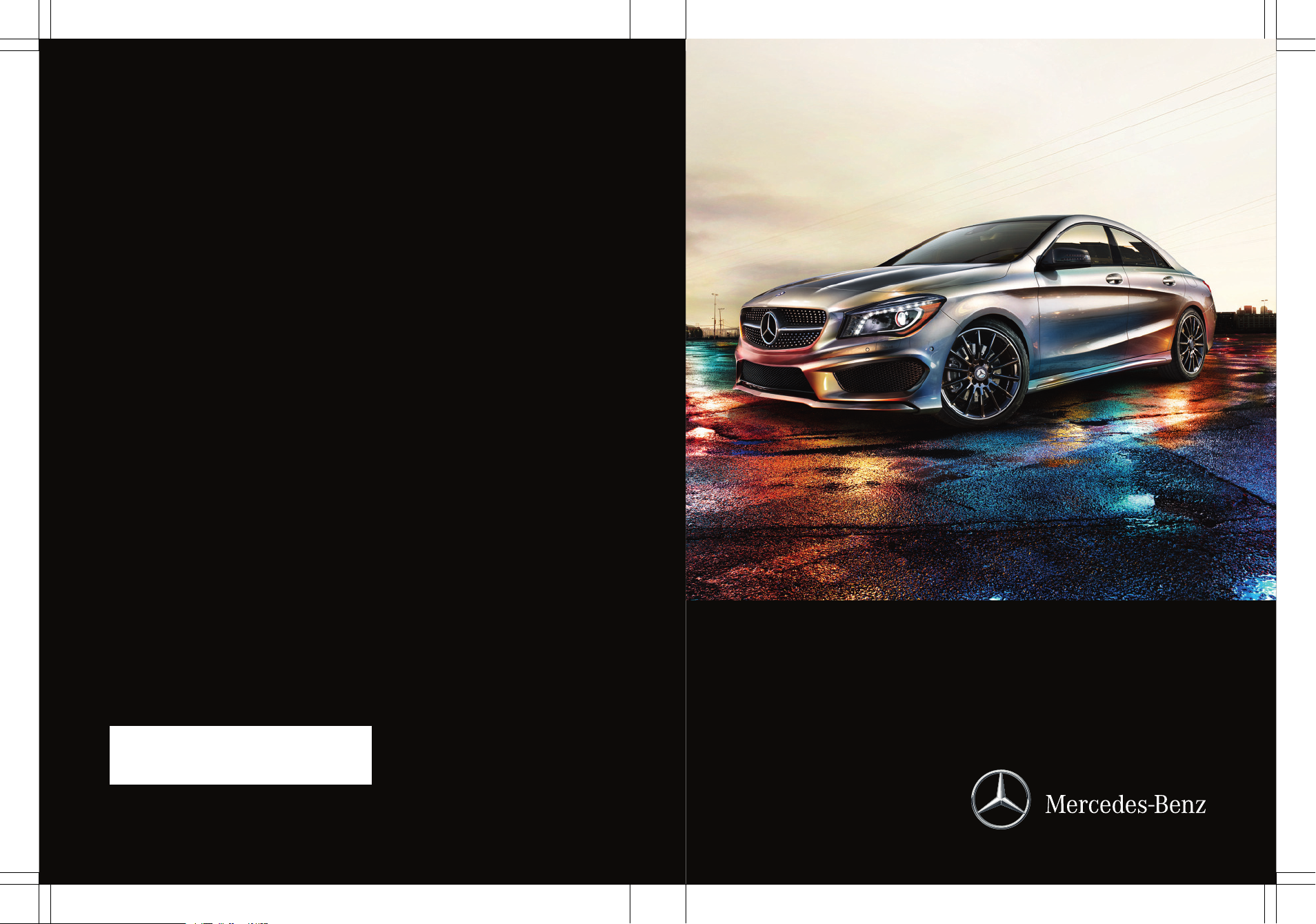
CLA
Operator's Manual
Order no. 65155227 13 Part no. 1175844900 Edition A 2015
É1175844900[ËÍ
1175844900
CLA Operator's Manual
Page 2

Publication details
Internet
Further information about Mercedes-Benz
vehicles and about Daimler AG can be found
on the following websites:
http://www.mbusa.com (USA only)
http://www.mercedes-benz.ca (Canada
only)
Editorial office
©
Daimler AG: Not to be reprinted, translated
or otherwise reproduced, in whole or in part,
without written permission from Daimler AG.
Vehicle manufacturer
Daimler AG
Mercedesstraße 137
70327 Stuttgart
Germany
Symbols
Registered trademarks:
R
Bluetooth®is a registered trademark of
Bluetooth SIG Inc.
R
DTS is a registered trademark of DTS, Inc.
R
Dolby and MLP are registered trademarks
of DOLBY Laboratories.
R
BabySmart™, ESP®and PRE-SAFE®are
registered trademarks of Daimler AG.
R
HomeLink®is a registered trademark of
Johnson Controls.
R
iPod®and iTunes®are registered trademarks of Apple Inc.
R
Logic7®is a registered trademark of Harman International Industries.
R
Microsoft®and Windows media®are registered trademarks of Microsoft Corporation.
R
SIRIUS is a registered trademark of Sirius
XM Radio Inc.
R
HD Radio is a registered trademark of iBiquity Digital Corporation.
R
Gracenote®is a registered trademark of
Gracenote, Inc.
R
ZAGATSurvey®and related brands are registered trademarks of ZagatSurvey, LLC.
In this Operator's Manual you will find the following symbols:
G
WARNING
Warning notes make you aware of dangers
which could pose a threat to your health or
life, or to the health and life of others.
H
Environmental note
Environmental notes provide you with information on environmentally aware actions or
disposal.
!
Notes on material damage alert you to
dangers that could lead to damage to your
vehicle.
i
Practical tips or further information that
could be helpful to you.
X
This symbol indicates an instruction
that must be followed.
X
Several of these symbols in succession indicate an instruction with several steps.
(Y
page)
This symbol tells you where you can
find more information about a topic.
YY
This symbol indicates a warning or an
instruction that is continued on the
next page.
Dis
play
This font indicates a display in the
multifunction display/COMAND display.
Parts of the software in the vehicle are protected by copyright©2005
The FreeType Project
http://www.freetype.org. All rights
reserved.
As at 04.11.2013
Page 3
Welcome to the world of Mercedes-Benz
We urge you to read this Operator's Manual
carefully and familiarize yourself with the
vehicle before driving. For your own safety
and a longer vehicle life, follow the instructions and warning notices in this manual.
Ignoring them could result in damage to the
vehicle or personal injury to you or others.
Vehicle damage caused by failure to follow
instructions is not covered by the MercedesBenz Limited Warranty.
The equipment or product designation of your
vehicle may vary depending on:
R
model
R
order
R
country specification
R
availability
Mercedes-Benz therefore reserves the right
to introduce changes in the following areas:
R
design
R
equipment
R
technical features
The equipment in your vehicle may therefore
differ from that shown in the descriptions and
illustrations.
The following are integral components of the
vehicle:
R
Operator's Manual
R
Maintenance Booklet
R
Equipment-dependent supplements
Keep these documents in the vehicle at all
times. If you sell the vehicle, always pass all
documents on to the new owner.
You can also use the CLA Guide smartphone
app:
Apple®iOS
Android™
Please note that the Mercedes-Benz Guides
App may not yet be available in your country.
The technical documentation team at
Daimler AG wishes you safe and pleasant
motoring.
Mercedes-Benz USA, LLC
Mercedes-Benz Canada, Inc.
A Daimler Company
1175844900
É1175844900[ËÍ
Page 4

Page 5

Index ....................................................... 4
Introduction ......................................... 22
At a glance ........................................... 31
Safety ................................................... 41
Opening and closing ........................... 75
Seats, steering wheel and mirrors .... 95
Lights and windshield wipers .......... 109
Climate control ................................. 125
Driving and parking .......................... 141
On-board computer and displays .... 197
Stowage and features ...................... 259
Maintenance and care ...................... 285
Breakdown assistance ..................... 299
Wheels and tires ............................... 317
Technical data ................................... 349
Contents
3
Page 6

1, 2, 3 ...
12 V socket
see Sockets
4ETS
see ETS/4ETS (Electronic Traction System)
4MATIC (permanent all-wheel
drive)
Function/notes .............................180
4MATIC (permanent four-wheel
drive)
Display message ............................ 245
A
ABS (Anti-lock Braking System)
Display message ............................ 217
Function/notes ................................ 65
Warning lamp ................................. 249
Accident
Automatic measures after an acci-
dent ................................................. 58
Activating/deactivating cooling
with air dehumidification ................. 131
Active Parking Assist
Canceling ....................................... 187
Detecting parking spaces .............. 184
Display message ............................ 238
Exiting a parking space .................. 186
General notes ................................ 183
Important safety notes .................. 183
Parking .......................................... 185
ADAPTIVE BRAKE ................................. 73
Adaptive Brake Assist
Display message ............................ 225
Function/notes ................................ 67
Adaptive Highbeam Assist
Display message ............................ 232
Function/notes .............................114
Switching on/off ........................... 115
Additional speedometer ................... 210
Additives (engine oil) ........................ 354
Air bags
Deployment ..................................... 56
Display message ............................ 228
Front air bag (driver, front
passenger) ....................................... 49
Important safety notes .................... 48
Introduction ..................................... 48
Knee bag .......................................... 50
PASSENGER AIR BAG OFF indica-
tor lamp ...........................................43
Side impact air bag .......................... 50
Window curtain air bag .................... 50
Air-conditioning system
see Climate control
Air vents
Important safety notes .................. 138
Rear ............................................... 139
Setting ........................................... 138
Setting the center air vents ........... 138
Setting the side air vents ............... 138
Alarm
ATA (Anti-Theft Alarm system) ......... 73
Switching off (ATA) .......................... 73
Switching the function on/off
(ATA) ................................................ 73
Alarm system
see ATA (Anti-Theft Alarm system)
Ambient lighting
Setting the brightness (on-board
computer) ...................................... 211
AMG
Performance Seat .......................... 100
AMG menu (on-board computer) ..... 213
Anti-lock braking system
see ABS (Anti-lock Braking System)
Anti-Theft Alarm system
see ATA (Anti-Theft Alarm system)
Ashtray ............................................... 268
Assistance display (on-board com-
puter) .................................................. 207
Assistance menu (on-board com-
puter) .................................................. 207
ASSYST PLUS
Displaying a service message ........ 291
Hiding a service message .............. 291
Notes ............................................. 290
Resetting the service interval dis-
play ................................................ 291
Service message ............................ 290
Special service requirements ......... 291
4
Index
Page 7

ATA (Anti-Theft Alarm system)
Activating/deactivating ...................73
Function ........................................... 73
Switching off the alarm .................... 73
ATTENTION ASSIST
Activating/deactivating .................208
Display message ............................ 236
Function/notes .............................191
Audio menu (on-board computer) .... 204
Audio system
see separate operating instructions
Authorized Mercedes-Benz Center
see Qualified specialist workshop
Authorized workshop
see Qualified specialist workshop
AUTO lights
Display message ............................ 232
see Lights
Automatic car wash (care) ...............292
Automatic engine start (ECO start/
stop function) ....................................146
Automatic engine switch-off (ECO
start/stop function) .......................... 145
Automatic headlamp mode .............. 111
Automatic transmission
Accelerator pedal position ............. 151
Automatic drive program ...............153
Changing gear ............................... 151
DIRECT SELECT lever ..................... 148
Drive program display .................... 149
Drive program display (selector
lever) ............................................. 150
Driving tips .................................... 151
Emergency running mode .............. 157
Engaging drive position .................. 150
Engaging neutral ............................ 150
Engaging park position (AMG vehi-
cles) ............................................... 151
Engaging reverse gear ................... 149
Engaging the park position ............ 149
Holding the vehicle stationary on
uphill gradients .............................. 151
Kickdown ....................................... 152
Manual drive program .................... 154
Overview ........................................ 148
Problem (malfunction) ................... 157
Program selector button ................ 152
Pulling away ................................... 144
Selector lever ................................ 150
Starting the engine ........................ 144
Steering wheel paddle shifters ...... 153
Transmission positions .................. 151
Automatic transmission emer-
gency mode ....................................... 157
B
Backup lamp
Changing bulbs .............................. 119
Display message ............................ 231
BAS (Brake Assist System) ................. 65
Battery (SmartKey)
Checking .......................................... 78
Important safety notes .................... 78
Replacing ......................................... 78
Battery (vehicle)
Charging ........................................ 307
Display message ............................ 234
Important safety notes .................. 305
Jump starting ................................. 309
Belt
see Seat belts
Blind Spot Assist
Activating/deactivating ................. 209
Display message ............................ 238
Notes/function .............................. 193
Brake Assist
see BAS (Brake Assist System)
Brake fluid
Display message ............................ 223
Notes ............................................. 354
Brake lamps
Changing bulbs .............................. 119
Display message ............................ 230
Brakes
ABS .................................................. 65
Adaptive Brake Assist ...................... 67
BAS .................................................. 65
Brake fluid (notes) ......................... 354
Display message ............................ 217
HOLD function ............................... 178
Important safety notes .................. 164
Maintenance .................................. 165
Parking brake ................................ 160
Index
5
Page 8

Riding tips ...................................... 164
Warning lamp .................................249
Breakdown
Where will I find...? ........................ 300
see Flat tire
see Towing away
see Tow-starting
Brightness control (instrument
cluster lighting) ................................... 33
Bulbs
see Replacing bulbs
C
California
Important notice for retail cus-
tomers and lessees .......................... 24
Calling up a malfunction
see Display messages
Car
see Vehicle
Care
Carpets .......................................... 298
Car wash ........................................ 292
Display ...........................................296
Exhaust pipe .................................. 296
Exterior lights ................................ 295
Gear or selector lever .................... 297
General notes ................................ 291
Interior ...........................................296
Matte finish ................................... 294
Paint .............................................. 293
Plastic trim ....................................297
Power washer ................................ 293
Rear view camera .......................... 296
Roof lining ...................................... 298
Seat belt ........................................ 298
Seat cover ..................................... 297
Sensors ......................................... 295
Steering wheel ............................... 297
Trim pieces ....................................297
Washing by hand ........................... 292
Wheels ...........................................294
Windows ........................................ 294
Wiper blades .................................. 295
Wooden trim .................................. 297
Cargo compartment enlargement ... 263
Cargo tie down rings ......................... 265
Center console
Lower section .................................. 37
Upper section .................................. 36
Central locking
Automatic locking (on-board com-
puter) ............................................. 212
Locking/unlocking (SmartKey) ........76
Changing bulbs
Brake lamps ...................................119
Cornering light function ................. 119
High-beam headlamps ................... 118
Low-beam headlamps .................... 118
Rear fog lamp ................................ 119
Reversing lamps ............................ 119
Turn signals (front) ......................... 119
Turn signals (rear) .......................... 119
Child-proof locks
Important safety notes .................... 63
Rear doors ....................................... 63
Children
In the vehicle ................................... 58
Restraint systems ............................ 59
Special seat belt retractor ...............59
Child seat
Forward-facing restraint system ...... 62
LATCH-type (ISOFIX) child seat
anchors ............................................ 60
On the front-passenger seat ............ 62
Rearward-facing restraint system .... 62
Top Tether .......................................61
Cigarette lighter ................................ 269
Cleaning
Mirror turn signal ...........................295
Climate control
Air-conditioning system ................. 127
Automatic climate control (dual-
zone) .............................................. 129
Controlling automatically ...............133
Cooling with air dehumidification .. 131
Defrosting the windows ................. 135
Defrosting the windshield .............. 135
General notes ................................ 126
Indicator lamp ................................ 133
Information about using auto-
matic climate control ..................... 130
Maximum cooling .......................... 135
6
Index
Page 9

Notes on using the air-condition-
ing system .....................................128
Overview of systems ......................126
Problems with cooling with air
dehumidification ............................ 133
Problem with the rear window
defroster ........................................ 137
Refrigerant ..................................... 356
Refrigerant filling capacity ............. 357
Setting the air distribution ............. 134
Setting the airflow ......................... 134
Setting the air vents ......................138
Setting the temperature ................ 133
Switching air-recirculation mode
on/off ............................................ 137
Switching on/off ........................... 131
Switching residual heat on/off ...... 137
Switching the rear window
defroster on/off ............................ 136
Switching the ZONE function on/
off ..................................................134
Climate control system
Automatic engine start .................. 146
Automatic engine switch-off .......... 145
Deactivating/activating ................. 146
General information ....................... 145
Important safety notes .................. 145
Introduction ................................... 145
Cockpit
Overview .......................................... 32
see Instrument cluster
COLLISION PREVENTION ASSIST
Activating/deactivating the dis-
tance warning function .................. 208
Display message ............................ 217
Operation/notes .............................. 66
COLLISION PREVENTION ASSIST
PLUS
Activating/deactivating ................. 208
Display message ............................ 224
Operation/notes .............................. 68
COMAND
see separate operating instructions
Combination switch .......................... 112
Compass
Calibrating ..................................... 283
Calling up ....................................... 282
Setting ...........................................282
Consumption statistics (on-board
computer) .......................................... 201
Convenience closing feature .............. 88
Convenience opening feature ............ 87
Coolant (engine)
Checking the level ......................... 289
Display message ............................ 233
Filling capacity ............................... 355
Important safety notes .................. 355
Temperature (on-board computer,
AMG vehicles) ................................ 213
Temperature gauge ........................ 198
Warning lamp ................................. 255
Cooling
see Climate control
Copyright ............................................. 29
Cornering light function
Changing bulbs .............................. 119
Display message ............................ 229
Function/notes .............................113
Crash-responsive emergency light-
ing ....................................................... 116
Cruise control
Activation conditions ..................... 168
Cruise control lever ....................... 168
Deactivating ................................... 169
Display message ............................ 240
Driving system ............................... 168
General notes ................................ 168
Important safety notes .................. 168
Setting a speed .............................. 169
Storing and maintaining current
speed ............................................. 169
Cup holder
Center console .............................. 267
Important safety notes .................. 266
Rear compartment ......................... 267
see Cup holder
Customer Assistance Center
(CAC) ..................................................... 27
Customer Relations Department ....... 27
Index
7
Page 10

D
Dashboard
see Instrument cluster
Data
see Technical data
Daytime running lamps
Display message ............................ 231
Switching on/off (on-board com-
puter) .............................................210
Switching on/off (switch) .............. 111
Declarations of conformity ................. 26
Delayed switch-off
Exterior lighting (on-board com-
puter) ............................................. 211
Interior lighting .............................. 211
Diagnostics connection ......................26
Digital speedometer .........................202
DIRECT SELECT lever
Automatic transmission ................. 148
Display (cleaning instructions) ........296
Display messages
ASSYST PLUS ................................ 290
Calling up (on-board computer) ..... 216
Driving systems .............................236
Engine ............................................ 233
General notes ................................ 216
Hiding (on-board computer) ........... 216
Lights ............................................. 229
Safety systems .............................. 217
SmartKey ....................................... 247
Tires ............................................... 241
Vehicle ...........................................243
Distance recorder .............................201
see Odometer
see Trip odometer
Distance warning function
Activating/deactivating ................. 208
Function/notes ................................ 66
Warning lamp ................................. 257
DISTRONIC PLUS
Activation conditions ..................... 172
Cruise control lever ....................... 171
Deactivating ................................... 175
Display message ............................ 239
Displays in the multifunction dis-
play ................................................ 176
Driving tips .................................... 176
Function/notes ............................. 170
Important safety notes .................. 170
Setting the specified minimum
distance ......................................... 174
Warning lamp ................................. 257
Doors
Automatic locking (on-board com-
puter) ............................................. 212
Automatic locking (switch) ............... 82
Central locking/unlocking
(SmartKey) ....................................... 76
Control panel ................................... 39
Display message ............................ 245
Emergency locking ........................... 83
Emergency unlocking ....................... 83
Important safety notes .................... 81
Opening (from inside) ...................... 81
Drinking and driving ......................... 163
Drive program
Automatic ...................................... 153
Display ........................................... 150
Display (DIRECT SELECT lever) ...... 149
Manual ........................................... 154
SETUP (on-board computer) .......... 213
Driver's door
see Doors
Driving abroad
Mercedes-Benz Service ................. 291
Symmetrical low beam .................. 110
Driving on flooded roads .................. 167
Driving safety systems
ABS (Anti-lock Braking System) ....... 65
ADAPTIVE BRAKE ............................. 73
Adaptive Brake Assist ...................... 67
BAS (Brake Assist System) .............. 65
COLLISION PREVENTION ASSIST .... 66
COLLISION PREVENTION ASSIST
PLUS ................................................ 68
Distance warning function ............... 66
EBD (electronic brake force distri-
bution) ............................................. 72
ESP®(Electronic Stability Pro-
gram) ............................................... 69
ETS/4ETS (Electronic Traction
System) ........................................... 69
Important safety information ........... 64
8
Index
Page 11

Overview .......................................... 64
STEER CONTROL ............................. 73
Driving systems
Active Parking Assist ..................... 183
ATTENTION ASSIST ........................ 191
Blind Spot Assist ............................193
Cruise control ................................ 168
Display message ............................ 236
DISTRONIC PLUS ........................... 170
HOLD function ............................... 178
Lane Keeping Assist ......................195
Lane Tracking package .................. 193
PARKTRONIC ................................. 180
RACE START (AMG vehicles) .......... 179
Rear view camera .......................... 188
Speed Limit Assist ......................... 192
Driving tips
Automatic transmission ................. 151
Brakes ...........................................164
Break-in period .............................. 142
Checking brake lining thickness .... 166
DISTRONIC PLUS ........................... 176
Downhill gradient ........................... 164
Drinking and driving ....................... 163
Driving abroad ............................... 110
Driving in winter .............................167
Driving on flooded roads ................ 167
Driving on wet roads ......................167
Exhaust check ............................... 163
Fuel ................................................ 163
General .......................................... 162
Hydroplaning ................................. 167
Icy road surfaces ........................... 167
Limited braking efficiency on sal-
ted roads ....................................... 165
Snow chains .................................. 321
Symmetrical low beam .................. 110
Wet road surface ........................... 165
DVD video (on-board computer) ...... 205
E
EASY-VARIO-PLUS system
Cargo compartment enlargement .. 263
EBD (electronic brake force distribution)
Display message ............................ 219
Function/notes ................................ 72
ECO display
Function/notes ............................. 163
On-board computer ....................... 202
Electronic Stability Program
see ESP®(Electronic Stability Program)
Emergency
Automatic measures after an acci-
dent ................................................. 58
Emergency release
Driver's door .................................... 83
Trunk ............................................... 85
Vehicle ............................................. 83
Emergency Tensioning Devices
Activation ......................................... 56
Emissions control
Service and warranty information .... 23
Engine
Check Engine warning lamp ........... 255
Display message ............................ 233
ECO start/stop function ................ 145
Engine number ............................... 351
Irregular running ............................ 147
Jump-starting ................................. 309
Starting problems .......................... 147
Starting the engine with the
SmartKey ....................................... 144
Switching off .................................. 160
Tow-starting (vehicle) ..................... 314
Engine electronics
Problem (malfunction) ................... 147
Engine jump starting
see Jump starting (engine)
Engine oil
Adding ........................................... 288
Additives ........................................ 354
Checking the oil level ..................... 287
Checking the oil level using the
dipstick .......................................... 288
Display message ............................ 235
Filling capacity ............................... 354
General notes ................................ 287
Notes about oil grades ................... 353
Temperature (on-board computer,
AMG vehicles) ................................ 213
Viscosity ........................................ 354
Index
9
Page 12

ESP®(Electronic Stability Program)
Activating/deactivating (onboard computer, except AMG
vehicles) ........................................ 207
AMG menu (on-board computer) ...213
Characteristics ................................. 69
Deactivating/activating (button
in AMG vehicles) .............................. 70
Deactivating/activating (notes;
except AMG vehicles) ......................70
Display message ............................ 217
ETS/4ETS ........................................ 69
Function/notes ................................ 69
General notes .................................. 69
Important safety information ........... 69
Trailer stabilization ........................... 72
Warning lamp ................................. 251
ETS/4ETS (Electronic Traction Sys-
tem) ...................................................... 69
Exhaust check ................................... 163
Exhaust pipe (cleaning instruc-
tions) .................................................. 296
Exterior lighting
Setting ........................................... 110
Setting options .............................. 110
see Lights
Exterior mirrors
Adjusting ....................................... 103
Dipping (automatic) ....................... 104
Folding in/out (automatically) ....... 104
Folding in/out (electrically) ........... 103
Folding in when locking (on-board
computer) ...................................... 212
Out of position (troubleshooting) ... 104
Setting ........................................... 104
Storing settings (memory func-
tion) ............................................... 106
Storing the parking position .......... 105
Eyeglasses compartment ................. 261
F
Filler cap
see Fuel filler flap
Filling capacities (Technical data) ... 351
Flat tire
MOExtended tires .......................... 301
Preparing the vehicle ..................... 300
TIREFIT kit ...................................... 302
Floormats ........................................... 283
Fog lamps
Extended range .............................. 114
Switching on/off ........................... 111
Front fog lamps
Display message ............................ 230
Switching on/off ........................... 111
Fuel
Additives ........................................ 353
Consumption statistics .................. 201
Displaying the current consump-
tion ................................................ 202
Displaying the range ...................... 202
Driving tips .................................... 163
Fuel gauge ....................................... 33
Grade (gasoline) ............................ 352
Important safety notes .................. 352
Premium-grade unleaded gaso-
line ................................................. 352
Problem (malfunction) ................... 159
Refueling ........................................ 157
Tank content/reserve fuel ............. 352
Fuel filler flap
Opening ......................................... 158
Fuel level
Calling up the range (on-board
computer) ...................................... 202
Fuel tank
Capacity ........................................ 352
Problem (malfunction) ................... 159
Fuses
Allocation chart ............................. 315
Before changing ............................. 314
Fuse box in the engine compart-
ment .............................................. 314
Fuse box in the front-passenger
footwell .......................................... 315
Important safety notes .................. 314
G
Garage door opener
Clearing the memory ..................... 282
General notes ................................ 279
10
Index
Page 13

Important safety notes .................. 279
Opening/closing the garage door .. 281
Programming (button in the rear-
view mirror) ................................... 279
Gear indicator (on-board com-
puter, AMG vehicles) .........................213
Gear or selector lever (cleaning
guidelines) ......................................... 297
Genuine parts ...................................... 22
Glove box ...........................................261
H
Handbrake
see Parking brake
Hazard warning lamps
Display message ............................ 246
Notes ............................................. 113
Headlamps
Fogging up ..................................... 115
see Lights
Head restraints
Adjusting ......................................... 98
Adjusting (electrically) ..................... 99
Adjusting (manually) ........................ 99
Adjusting (rear) .............................. 100
General notes .................................. 99
Heating
see Climate control
High-beam headlamps
Changing bulbs .............................. 118
Display message ............................ 230
Switching on/off ........................... 113
Hill start assist .................................. 144
HOLD function
Activating ....................................... 178
Deactivating ................................... 179
Display message ............................ 237
Function/notes .............................178
Hood
Closing ...........................................287
Display message ............................ 245
Important safety notes .................. 286
Opening ......................................... 286
Horn ...................................................... 32
Hydroplaning ..................................... 167
I
Ignition lock
see Key positions
Immobilizer .......................................... 73
Indicator lamps
see Warning and indicator lamps
Indicators
see Turn signals
Inspection
see ASSYST PLUS
Instrument cluster
Overview .......................................... 33
Settings ......................................... 210
Warning and indicator lamps ........... 34
Instrument cluster lighting .............. 198
Interior lighting ................................. 115
Automatic control .......................... 116
Delayed switch-off (on-board
computer) ...................................... 211
Emergency lighting ........................ 116
Important safety notes .................. 116
Manual control ............................... 116
Overview ........................................ 115
Reading lamp ................................. 115
Setting the brightness of the
ambient lighting (on-board com-
puter) ............................................. 211
J
Jack
Storage location ............................ 300
Using ............................................. 341
Jump starting (engine) ......................309
K
Kickdown
Driving tips ....................................152
Manual drive program .................... 156
Knee bag .............................................. 50
Index
11
Page 14

L
Lamps
see Warning and indicator lamps
Lane Keeping Assist
Activating/deactivating .................209
Display message ............................ 237
Function/information .................... 195
Lane Tracking package ..................... 193
Lap time (RACETIMER) ...................... 213
LATCH-type (ISOFIX) child seat
anchors ................................................ 60
License plate lamp (display mes-
sage) ................................................... 230
Light function, active
Display message ............................ 232
Lights
Activating/deactivating the inte-
rior lighting delayed switch-off ....... 211
Automatic headlamp mode ............ 111
Cornering light function ................. 113
Display message ............................ 229
Driving abroad ............................... 110
Fog lamps ...................................... 111
Fog lamps (extended) .................... 114
Hazard warning lamps ................... 113
High beam flasher .......................... 113
High-beam headlamps ................... 113
Light switch ................................... 110
Low-beam headlamps .................... 111
Parking lamps ................................ 112
Rear fog lamp ................................ 112
Setting the brightness of the
ambient lighting (on-board com-
puter) ............................................. 211
Standing lamps .............................. 112
Switching the daytime running
lamps on/off (on-board com-
puter) ............................................. 210
Switching the daytime running
lamps on/off (switch) .................... 111
Switching the exterior lighting
delayed switch-off on/off (on-
board computer) ............................ 211
Switching the surround lighting
on/off (on-board computer) .......... 211
Turn signals ................................... 112
see Interior lighting
see Lights
see Replacing bulbs
Light sensor (display message) ....... 232
Loading guidelines ............................ 260
Locking
see Central locking
Locking (doors)
Automatic ........................................ 82
Emergency locking ........................... 83
From inside (central locking but-
ton) .................................................. 82
Locking centrally
see Central locking
Locking verification signal (on-
board computer) ............................... 212
Low-beam headlamps
Changing bulbs .............................. 118
Display message ............................ 229
Setting for driving abroad (sym-
metrical) ........................................ 110
Switching on/off ........................... 111
Lumbar support
Adjusting the 4-way lumbar sup-
port ................................................ 100
M
M+S tires ............................................ 320
Maintenance
see ASSYST PLUS
Malfunction message
see Display messages
Matte finish (cleaning instruc-
tions) .................................................. 294
mbrace
Call priority .................................... 274
Display message ............................ 223
Downloading destinations
(COMAND) ..................................... 274
Downloading routes ....................... 278
Emergency call .............................. 271
General notes ................................ 270
Geo fencing ................................... 278
Locating a stolen vehicle ............... 277
12
Index
Page 15

MB info call button ........................ 273
Remote vehicle locking .................. 276
Roadside Assistance button ..........273
Search & Send ............................... 275
Self-test ......................................... 271
Speed alert ....................................278
System .......................................... 271
Triggering the vehicle alarm ........... 278
Vehicle remote malfunction diag-
nosis .............................................. 277
Vehicle remote unlocking .............. 276
Mechanical key
Function/notes ................................ 77
Inserting .......................................... 77
Locking vehicle ................................ 83
Unlocking the driver's door .............. 83
Media Interface
see Separate operating instructions
Memory card (audio) ......................... 205
Memory function ............................... 106
Message memory (on-board com-
puter) ..................................................216
Messages
see Display messages
Mirrors
see Exterior mirrors
see Rear-view mirror
see Vanity mirror (in the sun visor)
Mobile phone
Menu (on-board computer) ............ 205
Modifying the programming
(SmartKey) ...........................................77
MOExtended tires .............................. 301
Mounting wheels
Lowering the vehicle ...................... 344
Mounting a new wheel ................... 343
Preparing the vehicle .....................340
Raising the vehicle ......................... 341
Removing a wheel .......................... 343
Securing the vehicle against roll-
ing away ........................................ 341
MP3
Operation ....................................... 205
see separate operating instructions
Multifunction display
Function/notes .............................200
Permanent display ......................... 210
Multifunction steering wheel
Operating the on-board computer .. 199
Overview .......................................... 35
N
Navigation
Menu (on-board computer) ............ 203
see separate operating instructions
Notes on breaking-in a new vehi-
cle ....................................................... 142
O
Occupant Classification System
(OCS)
Conditions ....................................... 51
Faults ............................................... 55
Operation ......................................... 51
System self-test ............................... 53
Occupant safety
Automatic measures after an acci-
dent ................................................. 58
Children in the vehicle ..................... 58
Important safety notes .................... 43
Pets in the vehicle ........................... 64
OCS
Conditions ....................................... 51
Faults ............................................... 55
Operation ......................................... 51
System self-test ............................... 53
Oil
see Engine oil
On-board computer
AMG menu ..................................... 213
Assistance menu ........................... 207
Audio menu ................................... 204
Convenience submenu .................. 212
Displaying a service message ........291
Display messages .......................... 216
DISTRONIC PLUS ........................... 176
Factory settings submenu ............. 213
Important safety notes .................. 198
Instrument cluster submenu .......... 210
Lighting submenu .......................... 210
Menu overview .............................. 201
Message memory .......................... 216
Navigation menu ............................ 203
Index
13
Page 16

Operation ....................................... 199
RACETIMER ................................... 213
Service menu ................................. 209
Settings menu ...............................209
Standard display ............................ 201
Telephone menu ............................ 205
Trip menu ...................................... 201
Vehicle submenu ........................... 212
Video DVD operation ..................... 205
Opening and closing the side trim
panels ................................................. 119
Operating safety
Declaration of conformity ................ 26
Important safety notes .................... 25
Operating system
see On-board computer
Operator's Manual
Vehicle equipment ........................... 23
Outside temperature display ........... 199
Overhead control panel ...................... 38
Override feature
Rear side windows ........................... 64
P
Paint code number ............................ 350
Paintwork (cleaning instructions) ... 293
Panic alarm .......................................... 42
Panorama roof with power tilt/
sliding panel
Important safety notes .................... 89
Operating ......................................... 90
Problem (malfunction) ..................... 93
Reversing feature ............................. 90
Parcel net ........................................... 263
Parking ............................................... 159
Important safety notes .................. 159
Parking brake ................................ 160
Position of exterior mirror, front-
passenger side ............................... 105
Rear view camera .......................... 188
see Active Parking Assist
see PARKTRONIC
Parking aid
Active Parking Assist ..................... 183
see Exterior mirrors
see PARKTRONIC
Parking assistance
see PARKTRONIC
Parking brake
Display message ............................ 220
Electric parking brake .................... 160
Warning lamp ................................. 254
see Parking brake
Parking lamps
Switching on/off ........................... 112
PARKTRONIC
Deactivating/activating ................. 182
Driving system ............................... 180
Function/notes ............................. 180
Important safety notes .................. 180
Problem (malfunction) ................... 183
Range of the sensors ..................... 181
Warning display ............................. 182
PASSENGER AIR BAG OFF
Indicator lamp .................................. 43
Problems (malfunction) .................. 228
Pets in the vehicle ............................... 64
Plastic trim (cleaning instruc-
tions) .................................................. 297
Power washers .................................. 293
Power windows
see Side windows
Program selector button .................. 152
Protection against theft
ATA (Anti-Theft Alarm system) ......... 73
Immobilizer ...................................... 73
Protection of the environment
General notes .................................. 22
Pulling away
Automatic transmission ................. 144
Q
Qualified specialist workshop ........... 27
R
RACE START (AMG vehicles) ............. 179
RACETIMER (on-board computer) .... 213
Radar sensor system
Activating/deactivating ................. 212
Display message ............................ 237
14
Index
Page 17

Radio
Selecting a station ......................... 204
see separate operating instructions
Radio-wave reception/transmission in the vehicle
Declaration of conformity ................ 26
Rain closing feature (panorama
roof with power tilt/sliding panel) .... 91
Reading lamp ..................................... 115
Rear compartment
Setting the air vents ...................... 139
Rear fog lamp
Changing bulbs .............................. 119
Display message ............................ 231
Switching on/off ........................... 112
Rear lamps
see Lights
Rear seats
Folding the backrest forwards/
back ............................................... 264
Rear view camera
Cleaning instructions ..................... 296
Function/notes ............................. 188
Switching on/off ........................... 188
Rear-view mirror
Anti-glare (manual) ........................ 103
Dipping (automatic) ....................... 104
Rear window defroster
Problem (malfunction) ................... 137
Switching on/off ........................... 136
Recuperation display ........................ 202
Refrigerant (air-conditioning system)
Important safety notes .................. 356
Refueling
Fuel gauge ....................................... 33
Important safety notes .................. 157
Refueling process .......................... 158
see Fuel
Remote control
Garage door opener ....................... 279
Programming (garage door
opener) .......................................... 279
Replacing bulbs
Important safety notes .................. 116
Overview of bulb types .................. 117
Removing/replacing the cover
(front wheel arch) .......................... 118
Reporting safety defects .................... 27
Reserve (fuel tank)
see Fuel
Reserve fuel
Display message ............................ 235
Warning lamp ................................. 255
see Fuel
Residual heat (climate control) ........ 137
Restraint system
Display message ............................ 225
Introduction ..................................... 42
Problem (malfunction) ................... 254
Warning lamp (function) ................... 43
Reverse gear (selector lever) ........... 150
Reversing feature
Panorama sliding sunroof ................ 90
Roller sunblinds ............................... 91
Side windows ................................... 86
Roadside Assistance (breakdown) .... 24
Roller sunblind
Opening/closing .............................. 92
Panorama roof with power tilt/
sliding panel ..................................... 91
Roof carrier ........................................ 265
Roof lining and carpets (cleaning
guidelines) ......................................... 298
Roof load (maximum) ........................ 357
Route (navigation)
see Route guidance (navigation)
Route guidance (navigation) ............ 203
S
Safety
Children in the vehicle ..................... 58
Child restraint systems .................... 59
Occupant Classification System
(OCS) ............................................... 51
Safety system
see Driving safety systems
Index
15
Page 18

Seat belts
Adjusting the height .........................46
Cleaning .........................................298
Correct usage .................................. 46
Fastening ......................................... 46
Important safety guidelines ............. 44
Introduction ..................................... 44
Releasing ......................................... 47
Warning lamp ................................. 247
Warning lamp (function) ................... 47
Seats
Adjusting (AMG Performance
Seat) .............................................. 100
Adjusting (electrically) ..................... 98
Adjusting (manually) ........................ 98
Adjusting the 4-way lumbar sup-
port ................................................ 100
Adjusting the head restraint ............ 98
Calling up a stored setting (mem-
ory function) .................................. 107
Cleaning the cover ......................... 297
Correct driver's seat position ........... 96
Folding the backrest (rear com-
partment) forwards/back .............. 264
Important safety notes .................... 97
Seat heating problem .................... 102
Storing settings (memory func-
tion) ............................................... 106
Switching seat heating on/off ....... 100
Selector lever
see Automatic transmission
Sensors (cleaning instructions) ....... 295
Service Center
see Qualified specialist workshop
Service menu (on-board com-
puter) .................................................. 209
Service products
Brake fluid ..................................... 354
Coolant (engine) ............................ 355
Engine oil ....................................... 353
Fuel ................................................ 352
Important safety notes .................. 351
Refrigerant (air-conditioning sys-
tem) ............................................... 356
Washer fluid ................................... 356
Settings
Factory (on-board computer) ......... 213
On-board computer ....................... 209
Setting the air distribution ............... 134
Setting the airflow ............................ 134
SETUP (on-board computer) ............. 213
Side impact air bag ............................. 50
Side marker lamp (display mes-
sage) ................................................... 231
Side windows
Cleaning ......................................... 294
Convenience closing feature ............ 88
Convenience opening feature .......... 87
Important safety information ........... 86
Opening/closing .............................. 87
Problem (malfunction) ..................... 89
Resetting ......................................... 88
Reversing feature ............................. 86
Sliding sunroof
see Panorama roof with power
tilt/sliding panel
SmartKey
Changing the battery ....................... 78
Changing the programming ............. 77
Checking the battery ....................... 78
Convenience closing feature ............ 88
Convenience opening feature .......... 87
Display message ............................ 247
Door central locking/unlocking ....... 76
Important safety notes .................... 76
Loss ................................................. 80
Mechanical key ................................ 77
Positions (ignition lock) ................. 143
Problem (malfunction) ..................... 80
Starting the engine ........................ 144
SmartKey positions (ignition lock) .. 143
Snow chains ...................................... 321
Sockets
Center console .............................. 269
Points to observe before use ......... 269
Rear compartment ......................... 270
Trunk ............................................. 270
Specialist workshop ............................ 27
Special seat belt retractor .................. 59
Speed, controlling
see Cruise control
16
Index
Page 19

Speed Limit Assist
Activating/deactivating the warn-
ing function .................................... 207
Display message ............................236
Display message in the multifunc-
tion display ....................................193
General notes ........................ 192, 193
Important safety notes .................. 192
Speedometer
Activating/deactivating the addi-
tional speedometer ........................ 210
Digital ............................................ 202
In the Instrument cluster ................. 33
Segments ...................................... 199
Selecting the unit of measure-
ment .............................................. 210
SPORT handling mode
Activating/deactivating (AMG
vehicles) .......................................... 70
Warning lamp ................................. 252
SRS (Supplemental Restraint System)
see Restraint system
Standing lamps
Display message ............................ 231
Switching on/off ........................... 112
Start/stop function
see ECO start/stop function
Starting (engine) ................................ 143
STEER CONTROL .................................. 73
Steering (display message) .............. 246
Steering assistant STEER CONTROL
see STEER CONTROL
Steering wheel
Adjusting (manually) ......................102
Button overview ............................... 35
Buttons (on-board computer) ......... 199
Cleaning ......................................... 297
Important safety notes .................. 102
Paddle shifters ............................... 153
Steering wheel paddle shifters ........153
Stopwatch (RACETIMER) ................... 213
Stowage
Center console (front) .................... 261
Stowage areas ................................... 261
Stowage compartments
Armrest (front) ............................... 262
Armrest (under) .............................262
Center console (rear) ..................... 263
Cup holders ................................... 266
Eyeglasses compartment ...............261
Glove box ....................................... 261
Important safety information ......... 261
Parcel net ...................................... 263
Under driver's seat/front-
passenger seat .............................. 262
Stowage well beneath the trunk
floor .................................................... 265
Summer tires ..................................... 320
Sun visor ............................................ 267
Surround lighting (on-board com-
puter) ..................................................211
Switching air-recirculation mode
on/off ................................................. 137
T
Tachometer ........................................ 199
Tail lamps
Display message ............................ 230
see Lights
Tank
see Fuel tank
Tank content
Fuel gauge ....................................... 33
Technical data
Information ....................................350
Tires/wheels ................................. 344
Vehicle data ................................... 357
TELEAID
Call priority ....................................274
Downloading destinations
(COMAND) ..................................... 274
Downloading routes ....................... 278
Emergency call .............................. 271
General notes ................................ 270
Geo fencing ................................... 278
Locating a stolen vehicle ...............277
MB info call button ........................ 273
Remote vehicle locking .................. 276
Roadside Assistance button .......... 273
Search & Send ............................... 275
Self-test ......................................... 271
Index
17
Page 20

Speed alert .................................... 278
System .......................................... 271
Triggering the vehicle alarm ........... 278
Vehicle remote malfunction diag-
nosis .............................................. 277
Vehicle remote unlocking .............. 276
Telephone
Accepting a call ............................. 206
Display message ............................ 246
Menu (on-board computer) ............ 205
Number from the phone book ........ 206
Redialing ........................................ 206
Rejecting/ending a call ................. 206
Temperature
Coolant .......................................... 198
Coolant (on-board computer,
AMG vehicles) ................................ 213
Engine oil (on-board computer,
AMG vehicles) ................................ 213
Outside temperature ...................... 199
Setting (climate control) ................ 133
Through-loading ................................ 263
Through-loading feature ................... 263
Time
see separate operating instructions
Timing (RACETIMER) ......................... 213
TIREFIT kit .......................................... 302
Tire pressure
Calling up (on-board computer) ..... 325
Checking manually ........................ 324
Display message ............................ 241
Important safety notes .................. 325
Maximum ....................................... 324
Notes ............................................. 323
Not reached (TIREFIT) .................... 304
Reached (TIREFIT) .......................... 304
Recommended ............................... 321
see Tire pressure
Tire pressure monitor
Checking the tire pressure elec-
tronically ........................................ 326
Function/notes ............................. 325
General notes ................................ 325
Restarting ...................................... 327
Warning lamp ................................. 258
Warning message .......................... 327
Tires
Aspect ratio (definition) ................. 338
Average weight of the vehicle
occupants (definition) .................... 337
Bar (definition) ............................... 337
Changing a wheel .......................... 339
Characteristics .............................. 337
Checking ........................................ 319
Curb weight (definition) ................. 338
Definition of terms ......................... 337
Direction of rotation ...................... 340
Display message ............................ 241
Distribution of the vehicle occu-
pants (definition) ............................ 339
DOT, Tire Identification Number
(TIN) ............................................... 336
DOT (Department of Transporta-
tion) (definition) ............................. 337
GAWR (Gross Axle Weight Rating)
(definition) ..................................... 337
General notes ................................ 344
GVW (Gross Vehicle Weight) (def-
inition) ........................................... 338
GVWR (Gross Vehicle Weight Rat-
ing) (definition) .............................. 338
Important safety notes .................. 318
Increased vehicle weight due to
optional equipment (definition) ...... 337
Information on driving .................... 318
Kilopascal (kPa) (definition) ........... 338
Labeling (overview) ........................ 333
Load bearing index (definition) ...... 339
Load index ..................................... 336
Load index (definition) ................... 338
M+S tires ....................................... 320
Maximum loaded vehicle weight
(definition) ..................................... 338
Maximum load on a tire (defini-
tion) ............................................... 338
Maximum permissible tire pres-
sure (definition) ............................. 338
Maximum tire load ......................... 331
Maximum tire load (definition) ....... 338
MOExtended tires .......................... 320
Optional equipment weight (defi-
nition) ............................................ 339
PSI (pounds per square inch) (def-
inition) ........................................... 338
18
Index
Page 21

Replacing .......................................340
Service life ..................................... 320
Sidewall (definition) ....................... 339
Snow chains .................................. 321
Speed rating (definition) ................ 338
Storing ...........................................340
Structure and characteristics
(definition) ..................................... 337
Summer tires ................................. 167
Summer tires in winter .................. 320
Temperature .................................. 333
TIN (Tire Identification Number)
(definition) ..................................... 339
Tire bead (definition) ......................339
Tire pressure (definition) ................ 339
Tire pressures (recommended) ...... 337
Tire size (data) ............................... 344
Tire size designation, load-bearing
capacity, speed rating .................... 334
Tire tread ....................................... 319
Tire tread (definition) ..................... 339
Total load limit (definition) ............. 339
Traction ......................................... 332
Traction (definition) ....................... 339
Tread wear ..................................... 332
Uniform Tire Quality Grading
Standards ...................................... 332
Uniform Tire Quality Grading
Standards (definition) .................... 337
Wear indicator (definition) ............. 339
Wheel and tire combination ........... 346
Wheel rim (definition) .................... 337
see Flat tire
Top Tether ............................................ 61
Towing a trailer
ESP®(Electronic Stability Pro-
gram) ............................................... 72
Towing away
Important safety guidelines ........... 311
Installing the towing eye ................ 312
Removing the towing eye ............... 313
Transporting the vehicle ................ 314
With both axles on the ground ....... 313
With front axle raised ..................... 313
Tow-starting
Emergency engine starting ............ 314
Important safety notes .................. 311
Installing the towing eye ................ 312
Removing the towing eye ............... 313
Transmission
see Automatic transmission
Transmission position display ......... 149
Transporting the vehicle .................. 314
Trim pieces (cleaning instruc-
tions) .................................................. 297
Trip computer (on-board com-
puter) .................................................. 201
Trip odometer
Calling up ....................................... 201
Resetting (on-board computer) ...... 202
see Trip odometer
Trunk
Emergency release .......................... 85
Emergency release button ............... 86
Important safety notes .................... 84
Opening/closing (manually from
outside) ............................................ 84
Opening (automatically from out-
side) ................................................. 84
Opening automatically from
inside ............................................... 85
Trunk emergency release button ....... 86
Trunk lid
Display message ............................ 245
Opening dimensions ...................... 357
Trunk load (maximum) ...................... 357
Turn signals
Changing bulbs (front) ................... 119
Changing bulbs (rear) .................... 119
Display message ............................ 229
Switching on/off ........................... 112
Type identification plate
see Vehicle identification plate
U
Unlocking
Emergency unlocking ....................... 83
From inside the vehicle (central
unlocking button) ............................. 82
Index
19
Page 22

V
Vanity mirror (in the sun visor) ........ 268
Vehicle
Correct use ...................................... 27
Data acquisition ............................... 28
Equipment ....................................... 23
Individual settings .......................... 209
Limited Warranty ............................. 28
Loading .......................................... 328
Locking (in an emergency) ............... 83
Locking (SmartKey) .......................... 76
Lowering ........................................ 344
Maintenance .................................... 24
Parking for a long period ................ 162
Pulling away ................................... 144
Raising ........................................... 341
Reporting problems ......................... 27
Securing from rolling away ............ 341
Towing away .................................. 311
Tow-starting ................................... 311
Transporting .................................. 314
Unlocking (in an emergency) ........... 83
Unlocking (SmartKey) ...................... 76
Vehicle data ................................... 357
Vehicle data ....................................... 357
Vehicle dimensions ........................... 357
Vehicle emergency locking ................ 83
Vehicle identification number
see VIN
Vehicle identification plate .............. 350
Vehicle maintenance
see ASSYST PLUS
Vehicle tool kit .................................. 300
Video (DVD) ........................................ 205
VIN
Seat ............................................... 351
Type plate ...................................... 350
W
Warning and indicator lamps
ABS ................................................ 249
Brakes ........................................... 249
Check Engine ................................. 255
Coolant .......................................... 255
Distance warning ........................... 257
DISTRONIC PLUS ........................... 257
ESP®.............................................. 251
ESP®OFF ....................................... 252
Fuel tank ........................................ 255
Overview .......................................... 34
PASSENGER AIR BAG OFF ............... 43
Reserve fuel ................................... 255
Restraint system ............................ 254
Seat belt ........................................ 247
SPORT handling mode ................... 252
Tire pressure monitor .................... 258
Warranty .............................................. 23
Washer fluid
Display message ............................ 246
Wheel and tire combination
see Tires
Wheel bolt tightening torque ........... 344
Wheel chock ...................................... 341
Wheels
Changing a wheel .......................... 339
Checking ........................................ 319
Cleaning ......................................... 294
Cleaning (warning) ......................... 340
General notes ................................ 344
Important safety notes .................. 318
Information on driving .................... 318
Interchanging/changing ................ 340
Mounting a new wheel ................... 343
Mounting a wheel .......................... 340
Removing a wheel .......................... 343
Snow chains .................................. 321
Storing ........................................... 340
Tightening torque ........................... 344
Wheel size/tire size ....................... 344
Window curtain air bag
Display message ............................ 226
Operation ......................................... 50
Windows
see Side windows
Windshield
Defrosting ...................................... 135
see Windshield
Windshield washer system
Adding washer fluid ....................... 290
Important safety notes .................. 356
Windshield wipers
Display message ............................ 246
Problem (malfunction) ................... 123
20
Index
Page 23

Replacing the wiper blades ............ 121
Switching on/off ........................... 120
Winter driving
Slippery road surfaces ................... 167
Snow chains .................................. 321
Winter operation
General notes ................................ 320
Winter tires
M+S tires ....................................... 320
Wiper blades
Cleaning ......................................... 295
Important safety notes .................. 121
Replacing (windshield) ................... 121
Wooden trim (cleaning instruc-
tions) .................................................. 297
Workshop
see Qualified specialist workshop
Z
ZONE function
Switching on/off ........................... 134
Index
21
Page 24

Protection of the environment
General notes
H
Environmental note
Daimler's declared policy is one of comprehensive environmental protection.
The objectives are for the natural resources
that form the basis of our existence on this
planet to be used sparingly and in a manner
that takes the requirements of both nature
and humanity into account.
You too can help to protect the environment
by operating your vehicle in an environmentally responsible manner.
Fuel consumption and the rate of engine,
transmission, brake and tire wear are affected
by these factors:
R
operating conditions of your vehicle
R
your personal driving style
You can influence both factors. You should
bear the following in mind:
Operating conditions:
R
avoid short trips as these increase fuel consumption.
R
always make sure that the tire pressures
are correct.
R
do not carry any unnecessary weight.
R
remove roof racks once you no longer need
them.
R
a regularly serviced vehicle will contribute
to environmental protection. You should
therefore adhere to the service intervals.
R
always have service work carried out at a
qualified specialist workshop.
Personal driving style:
R
do not depress the accelerator pedal when
starting the engine.
R
do not warm up the engine when the vehicle
is stationary.
R
drive carefully and maintain a safe distance
from the vehicle in front.
R
avoid frequent, sudden acceleration and
braking.
R
change gear in good time and use each gear
only up to Ô of its maximum engine speed.
R
switch off the engine in stationary traffic.
R
keep an eye on the vehicle's fuel consumption.
Environmental concerns and recommendations
Wherever the operating instructions require
you to dispose of materials, first try to regenerate or re-use them. Observe the relevant
environmental rules and regulations when
disposing of materials. In this way you will
help to protect the environment.
Genuine Mercedes-Benz parts
H
Environmental note
Daimler AG also supplies reconditioned major
assemblies and parts which are of the same
quality as new parts. They are covered by the
same Limited Warranty entitlements as new
parts.
!
Air bags and Emergency Tensioning Devices, as well as control units and sensors for
these restraint systems, may be installed in
the following areas of your vehicle:
R
doors
R
door pillars
R
door sills
R
seats
R
cockpit
R
instrument cluster
R
center console
Do not install accessories such as audio
systems in these areas. Do not carry out
repairs or welding. You could impair the
operating efficiency of the restraint systems.
Have aftermarket accessories installed at a
qualified specialist workshop.
22
Introduction
Page 25

You could jeopardize the operating safety of
your vehicle if you use parts, tires and wheels
as well as accessories relevant to safety
which have not been approved by Mercedes.
This could lead to malfunctions in safety-relevant systems, e.g. the brake system. Use
only genuine Mercedes-Benz parts or parts of
equal quality. Only use tires, wheels and
accessories that have been specifically
approved for your vehicle.
Genuine Mercedes-Benz parts are subject to
strict quality control. Every part has been specifically developed, manufactured or selected
for and adapted to Mercedes-Benz vehicles.
Only genuine Mercedes-Benz parts should
therefore be used.
More than 300,000 different genuine
Mercedes-Benz parts are available for
Mercedes-Benz models.
All authorized Mercedes-Benz Centers maintain a supply of genuine Mercedes-Benz parts
for necessary service and repair work. In addition, strategically located parts delivery centers provide quick and reliable parts service.
Always specify the vehicle identification number (VIN) when ordering genuine MercedesBenz parts (Y page 350).
Operator's Manual
Vehicle equipment
This Operator's Manual describes all models
and all standard and optional equipment of
your vehicle available at the time of going to
print. Country-specific differences are possible. Bear in mind that your vehicle may not
feature all functions described here. This also
applies to safety-relevant systems and functions. The equipment in your vehicle may
therefore differ from that shown in the
descriptions and illustrations.
The original purchase agreement lists all systems installed in your vehicle.
Should you have any questions concerning
equipment and operation, please consult an
authorized Mercedes-Benz Center.
The Operator's Manual and Maintenance
Booklet are important documents and should
be kept in the vehicle.
Service and vehicle operation
Warranty
The implied warranty for your vehicle applies
in accordance with the warranty terms and
conditions in the Service and Warranty Information booklet.
Your authorized Mercedes-Benz Center will
replace and repair all factory-installed parts in
accordance with the following warranty terms
and conditions:
R
New Vehicle Limited Warranty
R
Emission System Warranty
R
Emission Performance Warranty
R
California, Connecticut, Maine, Massachusetts, New York, Pennsylvania, Rhode
Island and Vermont Emission Control System Warranty
R
State warranty enforcement laws (lemon
laws)
Replacement parts and accessories are covered by the Mercedes-Benz Parts and Accessories warranties. These are available at any
authorized Mercedes-Benz Center.
i
Should you lose your Service and Warranty Information booklet, have an authorized Mercedes-Benz Center arrange for a
replacement. The new Service and Warranty Information booklet will be posted to
you.
Introduction
23
Z
Page 26

Information for customers in California
Under California law you may be entitled to a
replacement of your vehicle or a refund of the
purchase price or lease price, if after a reasonable number of repair attempts
Mercedes-Benz USA, LLC and/or its authorized repair or service facilities fail to fix one or
more substantial defects or malfunctions in
the vehicle that are covered by its express
warranty. During the period of 18 months
from original delivery of the vehicle or the
accumulation of 18,000 miles (approximately
29,000 km) on the odometer of the vehicle,
whichever occurs first, a reasonable number
of repair attempts is presumed for a retail
buyer or lessee if one or more of the following
occurs:
(1) the same substantial defect or malfunc-
tion results in a condition that is likely to
cause death or serious bodily injury if the
vehicle is driven, that defect or malfunction has been subject to repair two or
more times, and you have directly notified Mercedes-Benz USA, LLC in writing
of the need for its repair,
(2) the same substantial defect or malfunc-
tion of a less serious nature than category (1) has been subject to repair four or
more times and you have directly notified
us in writing of the need for its repair, or
(3) the vehicle is out of service by reason of
repair of the same or different substantial
defects or malfunctions for a cumulative
total of more than 30 calendar days.
Please send your written notice to:
Mercedes-Benz USA, LLC
Customer Assistance Center
One Mercedes Drive
Montvale, NJ 07645-0350
Maintenance
The Service and Warranty Booklet describes
all the necessary maintenance work which
should be done at regular intervals.
Always have the Service and Warranty Booklet with you when you bring the vehicle to an
authorized Mercedes-Benz Center. The service advisor will record every service for you
in the Service and Warranty Booklet.
Roadside Assistance
The Mercedes-Benz Roadside Assistance
Program offers technical help in the event of a
breakdown. Calls to the toll-free Roadside
Assistance Hotline are answered by our
agents 24 hours a day, 365 days a year.
1-800-FOR-MERCedes(1-800-367-6372)
(USA)
1-800-387-0100 (Canada)
For additional information, refer to the
Mercedes-Benz Roadside Assistance Program brochure (USA) or the "Roadside Assistance" section in the Service and Warranty
booklet (Canada). You will find both in your
vehicle literature portfolio.
Change of address or change of ownership
In the event of a change of address, please
send us the "Notification of Address Change"
in the Service and Guarantee booklet or simply call the Mercedes-Benz Customer Assistance Center (USA) at the hotline number
1-800-FOR-MERCedes(1-800-367-6372) or
Customer Service Center (Canada) at
1-800-387-0100. This will assist us in contacting you in a timely manner should the
need arise.
If you sell your Mercedes, please leave the
entire literature in the vehicle so that it is
available to the next owner.
If you have purchased a used car, please send
us the "Notification of Used Car Purchase" in
24
Introduction
Page 27

the Service and Guarantee booklet or simply
call the Mercedes-Benz Customer Assistance
Center (USA) at the hotline number
1-800-FOR-MERCedes(1-800-367-6372) or
Customer Service (Canada) at
1-800-387-0100.
Vehicle operation outside the USA
and Canada
If you plan to operate your vehicle in foreign
countries, please be aware that:
R
service facilities or replacement parts may
not be readily available.
R
unleaded fuel for vehicles with a catalytic
converter may not be available. Leaded fuel
may cause damage to the catalytic converter.
R
the fuel may have a considerably lower
octane rating. Unsuitable fuel can cause
engine damage.
Some Mercedes-Benz models are available
for delivery in Europe through our European
Delivery Program. For details, consult an
authorized Mercedes-Benz Center or write to
one of the following addresses.
In the USA
Mercedes-Benz USA, LLC
European Delivery Department
One Mercedes Drive
Montvale, NJ 07645-0350
In Canada
Mercedes-Benz Canada, Inc.
European Delivery Department
98 Vanderhoof Avenue
Toronto, Ontario M4G 4C9
Operating safety
Important safety notes
G
WARNING
If you do not have the prescribed service/
maintenance work or any required repairs
carried out, this can result in malfunctions or
system failures. There is a risk of an accident.
Always have the prescribed service/maintenance work as well as any required repairs
carried out at a qualified specialist workshop.
G
WARNING
If you switch off the ignition while driving,
safety-relevant functions are only available
with limitations, or not at all. This could affect,
for example, the power steering and the brake
boosting effect. You will require considerably
more effort to steer and brake. There is a risk
of an accident.
Do not switch off the ignition while driving.
G
WARNING
Flammable material such as leaves, grass or
twigs may ignite if they come into contact with
hot parts of the exhaust system. There is a risk
of fire.
When driving off road or on unpaved roads,
check the vehicle's underside regularly. In
particular, remove parts of plants or other
flammable materials which have become
trapped. In the case of damage, contact a
qualified specialist workshop.
G
WARNING
Modifications to electronic components, their
software as well as wiring can impair their
function and/or the function of other networked components. In particular, systems
relevant to safety could also be affected. As a
result, these may no longer function as intended and/or jeopardize the operating safety of
the vehicle. There is an increased risk of an
accident and injury.
Never tamper with the wiring as well as electronic components or their software. You
should have all work to electrical and electronic equipment carried out at a qualified
specialist workshop.
Introduction
25
Z
Page 28

If you make any changes to the vehicle electronics, the general operating permit is rendered invalid.
!
There is a risk of damage to the vehicle if:
R
the vehicle becomes stuck, e.g. on a high
curb or an unpaved road
R
you drive too fast over an obstacle, e.g. a
curb or a hole in the road
R
a heavy object strikes the undercarriage
or parts of the chassis
In situations like this, the body, the undercarriage, chassis parts, wheels or tires
could be damaged without the damage
being visible. Components damaged in this
way can unexpectedly fail or, in the case of
an accident, no longer withstand the strain
they are designed to.
If the underbody paneling is damaged,
combustible materials such as leaves,
grass or twigs can gather between the
underbody and the underbody paneling. If
these materials come in contact with hot
parts of the exhaust system, they can catch
fire.
In such situations, have the vehicle
checked and repaired immediately at a
qualified specialist workshop. If on continuing your journey you notice that driving
safety is impaired, pull over and stop the
vehicle immediately, paying attention to
road and traffic conditions. In such cases,
visit a qualified specialist workshop.
Declarations of conformity
Vehicle components which receive
and/or transmit radio waves
USA: "The wireless devices of this vehicle
comply with Part 15 of the FCC Rules. Operation is subject to the following two conditions: 1) These devices may not cause harmful interference, and 2) These devices must
accept any interference received, including
interference that may cause undesired operation. Changes or modifications not expressly
approved by the party responsible for compliance could void the user’s authority to
operate the equipment."
Canada: "The wireless devices of this vehicle
comply with Industry Canada license-exempt
RSS standard(s). Operation is subject to the
following two conditions: (1) These devices
may not cause interference, and (2) These
devices must accept any interference, including interference that may cause undesired
operation of the device."
Diagnostics connection
The diagnostics connection is only intended
for the connection of diagnostic equipment at
a qualified specialist workshop.
G
WARNING
If you connect equipment to the diagnostics
connection in the vehicle, it may affect the
operation of the vehicle systems. As a result,
the operating safety of the vehicle could be
affected. There is a risk of an accident.
Do not connect any equipment to a diagnostics connection in the vehicle.
G
WARNING
Objects in the driver's footwell can restrict the
pedal travel or obstruct a depressed pedal.
The operating and road safety of the vehicle is
jeopardized. There is a risk of an accident.
Make sure that all objects in the vehicle are
stowed correctly, and that they cannot enter
the driver's footwell. Install the floormats
securely and as specified in order to ensure
sufficient clearance for the pedals. Do not use
loose floormats and do not place floormats on
top of one another.
!
If the engine is switched off and equipment on the diagnostics connection is
used, the starter battery may discharge.
Connecting equipment to the diagnostics
connection can lead to emissions monitoring
information being reset, for example. This
may lead to the vehicle failing to meet the
26
Introduction
Page 29

requirements of the next emissions test during the main inspection.
Qualified specialist workshop
An authorized Mercedes-Benz Center is a
qualified specialist workshop. It has the necessary specialist knowledge, tools and qualifications to correctly carry out the work
required on your vehicle. This is especially the
case for work relevant to safety.
Observe the notes in the Maintenance Booklet.
Always have the following work carried out at
an authorized Mercedes-Benz Center:
R
work relevant to safety
R
service and maintenance work
R
repair work
R
alterations, installation work and modifications
R
work on electronic components
Correct use
If you remove any warning stickers, you or
others could fail to recognize certain dangers.
Leave warning stickers in position.
Observe the following information when driving your vehicle:
R
the safety notes in this manual
R
the Technical Data section in this manual
R
traffic rules and regulations
R
laws and safety standards pertaining to
motor vehicles
Problems with your vehicle
If you should experience a problem with your
vehicle, particularly one that you believe may
affect its safe operation, we urge you to contact an authorized Mercedes-Benz Center
immediately to have the problem diagnosed
and rectified. If the problem is not resolved to
your satisfaction, please discuss the problem
again with a Mercedes-Benz Center or contact us at one of the following addresses.
In the USA
Customer Assistance Center
Mercedes-Benz USA, LLC
One Mercedes Drive
Montvale, NJ 07645-0350
In Canada
Customer Relations Department
Mercedes-Benz Canada, Inc.
98 Vanderhoof Avenue
Toronto, Ontario M4G 4C9
Reporting safety defects
USA only:
The following text is published as required of
manufacturers under Title 49, Code of U.S.
Federal Regulations, Part 575 pursuant to the
"National Traffic and Motor Vehicle Safety Act
of 1966".
If you believe that your vehicle has a defect
which could cause a crash or could cause
injury or death, you should immediately
inform the National Highway Traffic Safety
Administration (NHTSA) in addition to notifying Mercedes-Benz USA, LLC.
If NHTSA receives similar complaints, it may
open an investigation, and if it finds that a
safety defect exists in a group of vehicles, it
may order a recall and remedy campaign.
However, NHTSA cannot become involved in
individual problems between you, your
dealer, or Mercedes-Benz USA, LLC.
To contact NHTSA, you may call the Vehicle
Safety Hotline toll-free at
1-888-327-4236(TTY: 1-800-424-9153); go
to http://www.safercar.gov; or write to:
Administrator, NHTSA, 400 Seventh Street,
SW., Washington, DC 20590.
You can also obtain other information about
motor vehicle safety from
http://www.safercar.gov
Introduction
27
Z
Page 30

Limited Warranty
!
Follow the instructions in this manual
about the proper operation of your vehicle
as well as about possible vehicle damage.
Damage to your vehicle that arises from
culpable contraventions against these
instructions is not covered either by the
Mercedes-Benz Limited Warranty or by the
New or Used-Vehicle Warranty.
Data stored in the vehicle
Data recording
This vehicle is capable of recording diagnostic
information relating to vehicle operation, malfunctions, and user settings. This may include
information about the performance or status
of various systems, including but not limited
to, engine, throttle, steering or brake systems, that is stored and can be read out with
suitable devices, particularly when the vehicle is serviced. The data obtained is used to
properly diagnose and service your vehicle or
to further optimize and develop vehicle functions.
COMAND/mbrace (Canada: TELEAID)
If the vehicle is equipped with COMAND or
mbrace, additional data about the vehicle’s
operation, the use of the vehicle in certain
situations, and the location of the vehicle may
be compiled through COMAND or the mbrace
system.
For additional information please refer to the
COMAND User Manual and/or the mbrace
Terms and Conditions.
Event data recorders
This vehicle is equipped with an event data
recorder (EDR). The main purpose of an EDR
is to record data that will assist in understanding how a vehicle’s systems performed
in certain crash or near crash-like situations,
such as during air bag deployment or when
hitting a road obstacle. The EDR is designed
to record data related to vehicle dynamics
and safety systems for a short period of time,
typically 30 seconds or less.
The EDR in this vehicle is designed to record
such data as:
R
how various systems in your vehicle are
operating
R
whether or not the driver and passenger
seat belts are fastened
R
how far (if at all) the driver is depressing the
accelerator and/or brake pedal and
R
how fast the vehicle is traveling
This data can help provide a better understanding of the circumstances in which
crashes and injuries occur. NOTE: EDR data is
recorded by your vehicle only if a non-trivial
crash situation occurs; no data is recorded by
the EDR under normal driving conditions and
no personal data (e.g., name, gender, age,
and crash location) are recorded. However,
other parties, such as law enforcement, can
combine the EDR data with the type of personal identification data routinely acquired
during a crash investigation.
To read data recorded by an EDR, special
equipment is required, and access to the vehicle or the EDR is needed. In addition to the
vehicle manufacturer, other parties that have
the special equipment, such as law enforcement, can read the information by accessing
the vehicle or the EDR.
EDR data may be used in civil and criminal
matters as a tool in accident reconstruction,
accident claims, and vehicle safety. Since the
Crash Data Retrieval CDR tool that is used to
extract data from the EDR is commercially
available, Mercedes-Benz USA, LLC
("MBUSA") expressly disclaims any and all liability arising from the extraction of this information by unauthorized Mercedes-Benz personnel.
MBUSA will not share EDR data with others
without the consent of the vehicle owners or,
if the vehicle is leased, without the consent of
28
Introduction
Page 31

the lessee. Exceptions to this representation
include responses to subpoenas by law
enforcement; by federal, state or local government; in connection with or arising out of
litigation involving MBUSA or its subsidiaries
and affiliates; or, as required by law.
Warning: The EDR is a component of the
Restraint System Module. Tampering with,
altering, modifying or removing the EDR component may result in a malfunction of the
Restraint System Module and other systems.
State laws or regulations regarding EDRs that
conflict with federal regulation are pre-empted. This means that in the event of such conflict, the federal regulation governs. As of
February 2013, 13 states have enacted laws
relating to EDRs.
Information on copyright
General information
Information on license for free and opensource software used in your vehicle and its
electronic components is available on the following website:
http://www.mercedes-benz.com/
opensource
Introduction
29
Z
Page 32

30
Page 33

Cockpit ................................................. 32
Instrument cluster .............................. 33
Multifunction steering wheel ............. 35
Center console .................................... 36
Overhead control panel ...................... 38
Door control panel .............................. 39
31
At a glance
Page 34

Cockpit
Function Page
:
Steering wheel paddle
shifters 153
;
Combination switch 112
=
Instrument cluster 33
?
Horn
A
DIRECT SELECT lever 148
B
PARKTRONIC warning display 180
C
Overhead control panel 38
Function Page
D
Climate control systems 126
E
Ignition lock 143
F
Adjusts the steering wheel 102
G
Cruise control lever 168
H
Electric parking brake 160
I
Light switch 110
J
Diagnostics connection 26
K
Opens the hood 286
32
Cockpit
At a glance
Page 35

Instrument cluster
Displays and controls
Function Page
:
Speedometer with segments 199
;
Multifunction display 200
=
Tachometer 199
Function Page
?
Coolant temperature 198
A
Fuel gage
B
Instrument cluster lighting 198
Instrument cluster
33
At a glance
Page 36

Warning and indicator lamps
Function Page
:
L Low-beam headlamps
111
;
T Parking lamps
112
=
K High-beam headlamps
113
?
÷ ESP
®
251
A
Electric parking brake (red)
F (USA only)
! (Canada only)
254
B
! Electric parking brake
(yellow)
254
C
· Distance warning
257
D
#! Turn signals
112
E
6 Restraint system
42
F
ü Seat belt
247
Function Page
G
M SPORT handling
mode in AMG vehicles 252
H
? Coolant
255
I
R Rear fog lamp
112
J
N Fog lamps
111
K
; Check Engine
255
L
h Tire pressure monitor
258
M
æ Reserve fuel
255
N
å ESP®OFF
251
O
! ABS
249
P
Brakes 249
$ (USA only)
J (Canada only)
34
Instrument cluster
At a glance
Page 37

Multifunction steering wheel
Function Page
:
Multifunction display 200
;
Audio/COMAND display;
see the separate operating
instructions
= ?
Switches on the Voice Control System; see the separate operating instructions
? ~
Rejects or ends a call 205
Exits phone book/redial
memory
6
Makes or accepts a call
Switches to the redial memory
WX
Adjusts the volume
8
Mute
Function Page
A
=;
Selects a menu 199
9:
Selects a submenu or
scrolls through lists 199
a
Confirms your selection 199
Hides display messages 216
B %
Back 199
Switches off the Voice Control System; see the separate operating instructions
Multifunction steering wheel
35
At a glance
Page 38

Center console
Center console, upper section
Function Page
:
Audio system/COMAND;
see the separate operating
instructions
;
c Seat heating
100
=
c PARKTRONIC
180
?
¤ ECO start/stop function 145
Function Page
A
£ Hazard warning
lamps
113
B
45PASSENGER
AIR BAG OFF indicator lamp
43
C
Ú Selects the drive pro-
gram 152
å AMG vehicles: ESP
®
70
36
Center console
At a glance
Page 39

Center console, lower section
Function Page
:
Ashtray 268
Cigarette lighter 269
Socket 269
Stowage compartment 261
;
Stowage compartment 261
=
Cup holder 266
Function Page
?
Stowage compartment with
Media Interface 261
A
Audio/COMAND controller; see the separate operating instructions
Center console
37
At a glance
Page 40

Overhead control panel
Function Page
:
u Switches the rear
compartment interior lighting on/off
116
;
p Switches the righthand reading lamp on/off 115
=
| Switches the front
interior lighting/automatic
interior lighting control off
116
?
ï MB Info call button
(mbrace system) 273
A
Rear-view mirror 103
B
Sets the compass 282
C
Buttons for the garage door
opener 281
Function Page
D
G SOS button (mbrace
system) 271
E
F Roadside Assistance
call button (mbrace system)
273
F
Eyeglasses compartment 261
G
3 Opens/closes the
panorama roof with power
tilt/sliding panel with roller
sunblinds
90
H
c Switches the front
interior lighting on 116
I
p Switches the lefthand reading lamp on/off
115
38
Overhead control panel
At a glance
Page 41

Door control panel
Function Page
:
Opens the door 81
;
%&Unlocks/locks
the vehicle
82
=
r45= Saves
the seat and exterior mirror
settings
106
?
Adjusts the seats electrically
98
A
7 Z ö \
Adjusts and folds the exterior mirrors in/out electrically
103
Function Page
B
W Opens/closes the
side windows
87
C
n Activates/deactivates the override feature
for the side windows in the
rear compartment
64
D
o Opens the trunk
85
Door control panel
39
At a glance
Page 42

40
Page 43

Useful information .............................. 42
Panic alarm .......................................... 42
Occupant safety .................................. 42
Children in the vehicle ........................ 58
Pets in the vehicle .............................. 64
Driving safety systems ....................... 64
Protection against theft ..................... 73
41
Safety
Page 44

Useful information
i
This Operator's Manual describes all
models and all standard and optional equipment of your vehicle available at the time of
publication of the Operator's Manual.
Country-specific differences are possible.
Please note that your vehicle may not be
equipped with all features described. This
also applies to safety-related systems and
functions.
i
Read the information on qualified specialist workshops (Y page 27).
Panic alarm
X
To activate: press ! button : for at
least one second.
An alarm sounds and the exterior lighting
flashes.
X
To deactivate: press ! button :
again.
or
X
Insert the SmartKey into the ignition lock.
Occupant safety
Restraint system: introduction
The restraint system reduces the risk of vehicle occupants coming into contact with parts
of the vehicle's interior in the event of an
accident. The restraint system can also
reduce the forces to which vehicle occupants
are subjected during an accident.
The restraint system comprises:
R
Seat belt system
R
Air bags
R
Child restraint system
R
Child seat securing systems
The components of the restraint system work
in conjunction with each other. They can only
deploy their protective function if, at all times,
all vehicle occupants:
R
have fastened their seat belts correctly
(Y page 46)
R
have adjusted their seat and head restraint
properly (Y page 97).
As the driver, you also have to make sure that
the steering wheel is adjusted correctly.
Observe the information relating to the correct driver's seat position (Y page 96).
You also have to make sure that an air bag can
inflate properly if deployed (Y page 48).
An air bag supplements a correctly worn seat
belt. As an additional safety device, the air
bag increases the level of protection for vehicle occupants in the event of an accident. For
example, if, in the event of an accident, the
protection offered by the seat belt is sufficient, the air bags are not deployed. When an
accident occurs, only the air bags that
increase protection in that particular accident
situation are deployed. However, seat belts
and air bags generally do not protect against
objects penetrating the vehicle from the outside.
Information on restraint system operation
can be found under "Triggering of the Emergency Tensioning Device and air bags"
(Y page 56).
For more information about children traveling
with you in the vehicle and on child restraint
systems, see "Children in the vehicle"
(Y page 58).
42
Occupant safety
Safety
Page 45

Important safety notes
G
WARNING
Modifications to the restraint system may
cause it to no longer work as intended. The
restraint system may then not perform its
intended protective function and may fail in an
accident or trigger unexpectedly, for example.
This poses an increased risk of injury or even
fatal injury.
Never modify parts of the restraint system.
Never tamper with the wiring, the electronic
components or their software.
If it is necessary to modify an air bag system to
accommodate a person with disabilities, contact an authorized Mercedes-Benz Center for
details. USA only: for further information contact our Customer Assistance Center at
1-800-FOR-MERCedes (18003676372).
Restraint system warning lamp
The functions of the restraint system are
checked after the ignition is switched on and
at regular intervals while the engine is running. Therefore, malfunctions can be detected in good time.
The 6 restraint system warning lamp in
the instrument cluster lights up when the ignition is switched on. It goes out no later than a
few seconds after the engine is started. The
components of the restraint system are in
operational readiness.
A malfunction has occurred if the 6
restraint system warning lamp:
R
does not light up after the ignition is
switched on
R
does not go out after a few seconds with
the engine running
R
lights up again while the engine is running
G
WARNING
If restraint system is malfunctioning, restraint
system components may be triggered unintentionally or might not be triggered at all in
the event of an accident with a high rate of
vehicle deceleration. This can affect the Emergency Tensioning Device or air bag, for example. This poses an increased risk of injury or
even fatal injury.
Have the restraint system checked and
repaired in a qualified specialist workshop as
soon as possible.
PASSENGER AIR BAG indicator lamp
PASSENGER AIR BAG ON indicator lamp :
and PASSENGER AIR BAG OFF indicator
lamp ; are part of the Occupant Classification System (OCS).
The indicator lamps display the status of the
front-passenger front air bag.
R
PASSENGER AIR BAG ON : lights up: the
front-passenger front air bag is enabled. If,
in the event of an accident, all deployment
criteria are met, the front-passenger front
air bag is deployed.
R
PASSENGER AIR BAG OFF ; lights up: the
front-passenger front air bag is deactivated. It will then not be deployed in the event
of an accident.
Depending on the person in the frontpassenger seat, the front-passenger front air
bag must either be disabled or enabled; see
the following points. You must make sure of
this both before and during a journey.
R
Children in a child restraint system:
whether the front-passenger front air bag is
enabled or deactivated depends on the
installed child restraint system, and the age
Occupant safety
43
Safety
Z
Page 46

and size of the child. Therefore, be sure to
observe the notes on the "Occupant Classification System (OCS)" (Y page 51) and
on "Children in the vehicle" (Y page 58).
There you will also find instructions on rearward and forward-facing child restraint systems on the front-passenger seat.
R
All other persons: depending on the classification of the person in the frontpassenger seat, the front-passenger front
air bag is enabled or deactivated
(Y page 51). Be sure to observe the notes
on "Seat belts“ (Y page 44) and "Air bags"
(Y page 48). There you can also find information on the correct seat position.
Seat belts
Introduction
Seat belts are the most effective means of
restricting the movement of vehicle occupants in the event of an accident or the vehicle rolling over. This reduces the risk of vehicle occupants coming into contact with parts
of the vehicle interior or being ejected from
the vehicle. Furthermore, the seat belt helps
to keep the vehicle occupant in the best position in relation to the air bag.
The seat belt system comprises:
R
Seat belts
R
Emergency Tensioning Devices for the
front seat belts and the outer seat belts in
the rear
R
Seat belt force limiters for the front seat
belts and the outer seat belts in the rear
If the seat belt is pulled out of the belt outlet
quickly or with a jerky movement, the belt
retractor locks. The belt strap cannot be
extracted any further.
The Emergency Tensioning Device tightens
the seat belt in an accident, pulling the belt
close against the body. However it does not
pull the vehicle occupant back in the direction
of the backrest.
The Emergency Tensioning Device does not
correct an incorrect seat position or the routing of an incorrectly fastened seat belt.
When triggered, seat belt force limiters help
to reduce the force exerted by the seat belt on
the vehicle occupant.
The seat belt force limiters for the front seats
are synchronized with the front air bags,
which absorb part of the deceleration force.
This can reduce the force exerted on the vehicle occupants during an accident.
!
If the front-passenger seat is unoccupied,
do not insert the belt tongue into the buckle
of the front-passenger seat. This may otherwise lead to the triggering of the Emergency Tensioning Device in the event of an
accident, which will then need to be
replaced.
Important safety notes
The use of seat belts and child restraint systems is required by law in:
R
all 50 states
R
the U.S. territories
R
the District of Columbia
R
all Canadian provinces
Even where this is not required by law, all
vehicle occupants should correctly fasten
their seat belts before starting the journey.
G
WARNING
If the seat belt is incorrectly fastened, it cannot protect as intended. Furthermore, an
incorrectly fastened seat belt can cause additional injury, for example, in an accident, during braking or when abruptly changing direction. This poses an increased risk of injury or
even fatal injury.
Make sure that all vehicle occupants are
seated properly with a correctly fastened seat
belt.
G
WARNING
The seat belt does not offer the intended level
of protection if you have not moved the back-
44
Occupant safety
Safety
Page 47

rest to an almost vertical position. When braking or in the event of an accident, you could
slide underneath the seat belt and sustain
abdomen or neck injuries, for example. This
poses an increased risk of injury or even fatal
injury.
Adjust the seat properly before beginning
your journey. Always ensure that the backrest
is in an almost vertical position and that the
shoulder section of your seat belt is routed
across the center of your shoulder.
G
WARNING
Persons under 5 ft (1.50 m) in height cannot
fasten the seat belt correctly without an additional suitable restraint system. If the seat
belt is incorrectly fastened, it cannot protect
as intended. Furthermore, an incorrectly fastened seat belt can cause additional injury, for
example, in an accident, during braking or an
abrupt change of direction. This poses an
increased risk of injury or even fatal injury.
For this reason, always secure persons under
5 ft (1.50 m) in height in suitable restraint
systems.
If a child younger than 12 years and under 5 ft
(1.50 m) in height is traveling in the vehicle:
R
always secure the child in a child restraint
system suitable for this Mercedes-Benz
vehicle. The child restraint system must be
appropriate to the age, weight and size of
the child
R
always observe the instructions and safety
notes in the "Children in the vehicle" section of this Operator's Manual
(Y page 58) in addition to the child
restraint system manufacturer's installation instructions
R
be sure to observe the instructions and
safety notes on the "Occupant classification system (OCS)" (Y page 51)
G
WARNING
The seat belts may not perform their intended
protective function if:
R
they are damaged, modified, extremely
dirty, bleach or dyed
R
the seat belt buckle is damaged or
extremely dirty
R
the Emergency Tensioning Devices, belt
anchorages or inertia reels have been modified
Seat belts may be damaged in an accident,
although the damage may not be visible, e.g.
due to splinters of glass. Modified or damaged
seat belts may tear or fail, e.g. in an accident.
Modified Emergency Tensioning Devices
could accidentally trigger or fail to deploy
when necessary. This poses an increased risk
of injury or even fatal injury.
Never modify the seat belts, Emergency Tensioning Devices, belt anchorages or inertia
reels. Make sure that the seat belts are
undamaged, not worn out and clean. Following an accident, have the seat belts checked
immediately at a qualified specialist workshop.
Only use seat belts that have been approved
for your vehicle by Mercedes-Benz. Any such
modifications could invalidate the vehicle's
general operating permit.
Vehicles with a sports seat or AMG Performance seat: these seats are designed for
the standard three-point seat belt. If you
install another multipoint seat belt, e.g. sport
or racing seat belts, the restraint system cannot provide the best level of protection.
G
WARNING
If you feed seat belts through the opening in
the seat backrest, the seat backrest may be
damaged or may even break in the event of an
accident. This poses an increased risk of
injury or even fatal injury.
Only use the standard three-point seat belt.
Never modify the seat belt system.
Occupant safety
45
Safety
Z
Page 48

Proper use of the seat belts
Observe the safety notes on the seat belt
(Y page 44).
All vehicle occupants must be wearing the
seat belt correctly before beginning the journey. Also make sure that all vehicle occupants are always wearing the seat belt correctly while the vehicle is in motion.
When fastening the seat belt, always make
sure that:
R
the seat belt tongue is only inserted to the
belt buckle belonging to that seat.
R
the seat belt is tight across your body.
Avoid wearing bulky clothing, e.g. a winter
coat.
R
the seat belt is not twisted.
Only then can the forces which occur be
distributed over the area of the belt.
R
the shoulder section of the belt is always
routed across the center of your shoulder.
The shoulder section of the belt must not
come into contact with your neck or be
routed under your arm. Where possible,
adjust the seat belt to the appropriate
height.
R
the lap belt passes tightly and as low down
as possible across your lap.
The lap belt must always be routed across
your hip joints and not across your abdomen. This applies particularly to pregnant
women. If necessary, push the lap belt
down to your hip joint and pull it tight using
the shoulder section of the belt.
R
the seat belt is not routed across sharp,
pointed or fragile objects.
If you have such items located on or in your
clothing, e.g. pens, keys or eyeglasses,
store these in a suitable place.
R
only one person is using a seat belt at a
time.
Infants and children must never travel sitting on the lap of a vehicle occupant. In the
event of an accident, they could be crushed
between the vehicle occupant and seat
belt.
R
objects are never secured with a seat belt if
the seat belt is also being used by one of the
vehicle's occupants.
Seat belts are only intended to secure and
restrain vehicle occupants. Always observe
the "Loading guidelines" for securing objects,
luggage or loads (Y page 260).
Fastening and adjusting the seat belts
Observe the safety notes on the seat belt
(Y page 44) and the notes on correct use of
seat belts (Y page 46).
X
Adjust the seat (Y page 96).
The seat backrest must be in an almost
vertical position.
X
Pull the seat belt smoothly from belt outlet
=.
X
Engage seat belt tongue ; in belt
buckle :.
X
If necessary, pull upwards on the shoulder
section of the seat belt to tighten the belt
across your body.
46
Occupant safety
Safety
Page 49

The shoulder section of the seat belt must
always be routed across the center of the
shoulder. Adjust the belt outlet if necessary.
X
To raise: slide the belt outlet upwards.
The belt outlet will engage in various positions.
X
To lower: hold belt outlet release : and
slide the belt outlet downwards.
X
Let go of belt outlet release : in the
desired position and make sure that the
belt outlet engages.
All seat belts except the driver's seat belt are
equipped with a special seat belt retractor to
securely fasten child restraint systems in the
vehicle. Further information can be found
under "Special seat belt retractor"
(Y page 59).
Releasing seat belts
!
Make sure that the seat belt is fully rolled
up. Otherwise, the seat belt or belt tongue
will be trapped in the door or in the seat
mechanism. This could damage the door,
the door trim panel and the seat belt. Damaged seat belts can no longer fulfill their
protective function and must be replaced.
Visit a qualified specialist workshop.
X
Press release button :, hold belt
tongue ; firmly and guide it back towards
belt outlet =.
Belt warning for the driver and front
passenger
The 7 seat belt warning lamp in the instrument cluster is a reminder that all occupants
must fasten their seat belts. It may light up
continuously or flash. In addition, there may
be a warning tone.
Regardless of whether the driver's seat belt
has already been fastened, the 7 seat belt
warning lamp lights up for six seconds each
time the engine is started. If, after
six seconds, the driver or front-passenger
seat belt has not been fastened and the doors
are closed, the 7 seat belt warning lamp
lights up again. As soon as the driver's and
front-passenger seat belts are fastened or a
front door is opened again, the 7 seat belt
warning lamp goes out.
If the driver's seat belt is not fastened after
the engine is started, an additional warning
tone will sound. This warning tone stops after
six seconds or when the driver's seat belt is
fastened.
If the vehicle's speed exceeds 15 mph
(25 km/h) once and the driver's and frontpassenger seat belts are not fastened, a
Occupant safety
47
Safety
Z
Page 50

warning tone sounds. The warning tone
sounds with increasing intensity for
60 seconds or until the driver or front
passenger have fastened their seat belts.
If the driver or front passenger unfasten their
seat belts during the journey, the seat belt
warning is activated again.
i
For more information on the 7 seat
belt warning lamp, see "Warning and indicator lamps in the instrument cluster, seat
belts" (Y page 247).
Air bags
Introduction
The installation point of an air bag can be recognized by the AIR BAG symbol.
An air bag complements the correctly fastened seat belt. It is no substitute for the seat
belt. The air bag provides additional protection in applicable accident situations.
Not all air bags are deployed in an accident.
The different air bag systems function independently from one another (Y page 56).
However, no system available today can completely eliminate injuries and fatalities.
It is also not possible to rule out a risk of injury
caused by an air bag due to the high speed at
which the air bag must be deployed.
Important safety notes
G
WARNING
If you do not sit in the correct seat position,
the air bag cannot protect as intended and
could even cause additional injury when
deployed. This poses an increased risk of
injury or even fatal injury.
To avoid hazardous situations, always make
sure that all of the vehicle's occupants:
R
have fastened their seat belts correctly,
including pregnant women
R
are sitting correctly and maintain the greatest possible distance to the air bags
R
follow the following instructions
Always make sure that there are no objects
between the air bag and the vehicle's occupants.
R
Adjust the seats properly before beginning
your journey. Always make sure that the
seat is in an almost upright position. The
center of the head restraint must support
the head at about eye level.
R
Move the driver's and front-passenger
seats as far back as possible. The driver's
seat position must allow the vehicle to be
driven safely.
R
Only hold the steering wheel on the outside. This allows the air bag to be fully
deployed.
R
Always lean against the backrest while driving. Do not lean forwards or lean against
the door or side window. You may otherwise be in the deployment area of the air
bags.
R
Always keep your feet in the footwell in
front of the seat. Do not put your feet on the
dashboard, for example. Your feet may otherwise be in the deployment area of the air
bag.
R
For this reason, always secure persons less
than 5 ft (1.50 m) tall in suitable restraint
systems. Up to this height, the seat belt
cannot be worn correctly.
If a child is traveling in your vehicle, also
observe the following notes:
R
Always secure children under 12 years of
age and less than 5 ft (1.50 m) in height in
suitable child restraint systems.
R
Child restraint systems should be installed
on the rear seats.
48
Occupant safety
Safety
Page 51

R
Only secure a child in a rearward-facing
child restraint system on the frontpassenger seat when the front-passenger
front air bag is deactivated. If the
PASSENGER AIR BAG OFF indicator lamp is
permanently lit, the front-passenger front
air bag is deactivated (Y page 43).
R
Always observe the instructions and safety
notes on the "Occupant Classification System (OCS)" (Y page 51) and on "Children
in the vehicle" (Y page 58) in addition to
the child restraint system manufacturer's
installation instructions.
Objects in the vehicle interior may prevent the air bag from functioning correctly. Before starting your journey and to
avoid risks resulting from the speed of the air
bag as it deploys, make sure that:
R
there are no people, animals or objects
between the vehicle occupants and an air
bag.
R
there are no objects between the seat, door
and B-pillar.
R
no hard objects, e.g. coat hangers, hang on
the grab handles or coat hooks.
R
no accessories, such as cup holders, are
attached to the vehicle within the deployment area of an air bag, e.g. to doors, side
windows, rear side trim or side walls.
R
no heavy, sharp-edged or fragile objects
are in the pockets of your clothing. Store
such objects in a suitable place.
G
WARNING
If you modify the air bag cover or affix objects
such as stickers to it, the air bag can no longer
function correctly. There is an increased risk
of injury.
Never modify an air bag cover or affix objects
to it.
G
WARNING
Sensors to control the air bags are located in
the doors. Modifications or work not performed correctly to the doors or door paneling, as well as damaged doors, can lead to the
function of the sensors being impaired. The air
bags might therefore not function properly
any more. Consequently, the air bags cannot
protect vehicle occupants as they are
designed to do. There is an increased risk of
injury.
Never modify the doors or parts of the doors.
Always have work on the doors or door paneling carried out at a qualified specialist workshop.
Front air bags
Driver's air bag : deploys in front of the
steering wheel; front-passenger front air
bag ; deploys in front of and above the glove
box.
When deployed, the front air bags offer additional head and thorax protection for the
occupants in the front seats.
The PASSENGER AIR BAG OFF and
PASSENGER AIR BAG ON indicator lamps
inform you about the status of the frontpassenger front air bag (Y page 43).
Front-passenger front air bag ; will only
deploy if:
R
the system, based on the OCS weight sensor readings, detects that the frontpassenger seat is occupied (Y page 51).
The PASSENGER AIR BAG ON indicator
lamp is lit (Y page 51)
R
the restraint system control unit predicts a
high accident severity
Occupant safety
49
Safety
Z
Page 52

Knee bags
Driver's knee bag : deploys under the steering column and front-passenger knee bag ;
under the glove box. The driver's and frontpassenger knee bags are triggered together
with the front air bags.
The driver's and front-passenger knee bags
offer additional thigh, knee and lower leg protection for the occupants in the front seats.
Side impact air bags
G
WARNING
Unsuitable seat covers could restrict or even
prevent the deployment of the air bags integrated into the seats. Consequently, the air
bags cannot protect vehicle occupants as
they are designed to do. In addition, the function of the Occupant Classification System
(OCS) could be restricted. This poses an
increased risk of injury or even fatal injury.
You should only use seat covers that have
been approved for the respective seat by
Mercedes-Benz.
Front side impact air bags : and rear side
impact air bags ; deploy next to the outer
bolster of the seat backrest.
When deployed, the side impact air bag offers
additional thorax protection. It also offers
additional pelvis protection for occupants in
the front seats. However, it does not protect
the:
R
head
R
neck
R
arms
In the event of a side impact, the side impact
air bag is deployed on the side on which the
impact occurs.
The side impact air bag on the frontpassenger side (front) deploys in the following situations:
R
the OCS system detects that the frontpassenger seat is occupied or
R
the belt tongue is engaged in the belt
buckle of the front-passenger seat
If the belt tongue is engaged in the belt
buckle, the side impact air bag on the frontpassenger side deploys if an appropriate accident situation occurs. In this case, deployment is independent of whether the frontpassenger seat is occupied or not.
Window curtain air bags
Window curtain air bags : are integrated
into the side of the roof frame and deployed in
the area from the A-pillar to the C-pillar.
When deployed, the window curtain air bag
enhances the level of protection for the head.
50
Occupant safety
Safety
Page 53

However, it does not protect the chest or
arms.
In the event of a side impact, the window curtain air bag is deployed on the side on which
the impact occurs.
If the system determines that they can offer
additional protection to that provided by the
seat belt, a window curtain air bag may be
deployed in other accident situations
(Y page 56).
Occupant Classification System
(OCS)
Introduction
The Occupant Classification System (OCS)
categorizes the person in the front-passenger
seat. Depending on that result, the frontpassenger front air bag and front-passenger
knee bag are either enabled or deactivated.
The system does not deactivate:
R
the side impact air bag
R
the window curtain air bag
R
the Emergency Tensioning Devices
Prerequisites
To be classified correctly, the front passenger
must sit:
R
with the seat belt fastened correctly
R
in an almost upright position with their
back against the seat backrest
R
with their feet resting on the floor, if possible
If the front passenger does not observe these
conditions, OCS may produce a false classification, e.g. because the front passenger:
R
transfers their weight by supporting themselves on a vehicle armrest
R
sits in such a way that their weight is raised
from the seat cushion
If it is absolutely necessary to install a child
restraint system on the front-passenger seat,
be sure to observe the correct positioning of
the child restraint system. Never place
objects under or behind the child restraint
system, e.g. cushions. The entire base of the
child restraint system must always rest on the
seat cushion of the front-passenger seat. The
backrest of the forwards-facing child restraint
system must, as far as possible, be resting on
the backrest of the front-passenger seat.
The child restraint system must not touch the
roof or be put under strain by the head
restraint. Adjust the angle of the seat backrest and the head restraint position accordingly.
Only then can OCS be guaranteed to function
correctly. Always observe the child restraint
system manufacturer's installation instructions.
Occupant Classification System operation (OCS)
:
PASSENGER AIR BAG ON indicator lamp
;
PASSENGER AIR BAG OFF indicator lamp
The indicator lamps inform you whether the
front-passenger front air bag is deactivated or
enabled.
X
Turn the SmartKey to position 1 or 2 in the
ignition lock.
The system carries out self-diagnostics.
The PASSENGER AIR BAG OFF and
PASSENGER AIR BAG ON indicator lamps
must light up simultaneously for approximately six seconds.
Occupant safety
51
Safety
Z
Page 54

The indicator lamps display the status of the
front-passenger front air bag.
R
PASSENGER AIR BAG ON : lights up: the
front-passenger front air bag is enabled. If,
in the event of an accident, all deployment
criteria are met, the front-passenger front
air bag is deployed.
R
PASSENGER AIR BAG OFF ; lights up: the
front-passenger front air bag is deactivated. It will then not be deployed in the event
of an accident.
If the status of the front-passenger front air
bag changes while the vehicle is in motion, an
air bag display message appears in the instrument cluster (Y page 228). When the frontpassenger seat is occupied, always pay attention to the PASSENGER AIR BAG ON and
PASSENGER AIR BAG OFF indicator lamps. Be
aware of the status of the front-passenger
front air bag both before and during the journey.
G
WARNING
If the PASSENGER AIR BAG OFF indicator
lamp is lit, the front-passenger front air bag is
disabled. It will not be deployed in the event of
an accident and cannot perform its intended
protective function. A person in the frontpassenger seat could then, for example, come
into contact with the vehicle's interior, especially if the person is sitting too close to the
dashboard. This poses an increased risk of
injury or even fatal injury.
When the front-passenger seat is occupied,
always ensure that:
R
the classification of the person in the frontpassenger seat is correct and the frontpassenger front air bag is enabled or disabled in accordance with the person in the
front-passenger seat
R
the front-passenger seat has been moved
back as far back as possible.
R
the person is seated correctly.
Make sure, both before and during the journey, that the status of the front-passenger
front air bag is correct.
G
WARNING
If you secure a child in a rearward-facing child
restraint system on the front-passenger seat
and the PASSENGER AIR BAG ON indicator
lamp is lit up, the front-passenger front air bag
may deploy in an accident. The child could be
struck by the air bag. This poses an increased
risk of injury or even fatal injury.
Make sure that the front-passenger front air
bag has been disabled. The PASSENGER AIR
BAG OFF indicator lamp must be lit.
If the PASSENGER AIR BAG OFF indicator
lamp remains off and/or the PASSENGER AIR
BAG ON indicator lamp lights up, do not install
a rearward-facing child restraint system on
the front-passenger seat. You can find more
information on OCS under "Problems with the
Occupant Classification System"
(Y page 55).
G
WARNING
If you secure a child in a forward-facing child
restraint system on the front-passenger seat
and you position the front-passenger seat too
close to the dashboard, in the event of an
accident, the child could:
R
come into contact with the vehicle's interior if the PASSENGER AIR BAG OFF indicator lamp is lit, for example
R
be struck by the air bag if the PASSENGER
AIR BAG ON is lit up
This poses an increased risk of injury or even
fatal injury.
Move the front-passenger seat as far back as
possible. Always make sure that the shoulder
belt strap is correctly routed from the vehicle
belt outlet to the shoulder belt guide on the
child restraint system. The shoulder belt strap
must be routed forwards and downwards
from the vehicle belt outlet. If necessary,
adjust the vehicle belt outlet and the frontpassenger seat accordingly. Always observe
the child restraint system manufacturer's
installation instructions.
52
Occupant safety
Safety
Page 55

If OCS determines that:
R
the front-passenger seat is unoccupied, the
PASSENGER AIR BAG OFF indicator lamp
lights up after the system self-test and
remains lit. This indicates that the frontpassenger front air bag is deactivated.
R
the front-passenger seat is occupied by a
child of up to 12 months old in a standard
child restraint system, the PASSENGER AIR
BAG OFF indicator lamp lights up after the
system self-test and remains lit. This indicates that the front-passenger front air bag
is deactivated.
But in the case of a 12-month-old child in a
standard child restraint system, the
PASSENGER AIR BAG ON can light up permanently after the system self-test. This
indicates that the front-passenger front air
bag is activated. The result of the classification is dependent on, among other factors, the child restraint system and the
child's stature. It is recommended that you
install the restraint system on a suitable
rear seat.
R
the front-passenger seat is occupied by a
person of smaller stature (e.g. a teenager
or small adult), either the PASSENGER AIR
BAG ON or PASSENGER AIR BAG OFF indicator lamp lights up and remains lit after
the system self-test depending on the
result of the classification.
-
If the PASSENGER AIR BAG ON indicator
lamp lights up, move the front-passenger
seat as far back as possible. Alternatively, a person of smaller stature can sit
on a rear seat.
-
If the PASSENGER AIR BAG OFF indicator
lamp is lit, a person of smaller stature
should not use the front-passenger seat.
R
the front-passenger seat is occupied by an
adult or a person of a stature corresponding to that of an adult, the PASSENGER AIR
BAG ON indicator lamp lights up after the
system self-test and remains lit. This indicates that the front-passenger front air bag
is activated.
If children are traveling in the vehicle, be sure
to observe the notes on "Children in the vehicle" (Y page 58).
When OCS is malfunctioning, the red 6
restraint system warning lamp in the instrument cluster and the PASSENGER AIR BAG
OFF indicator lamp light up simultaneously.
The front-passenger front air bag is deactivated in this case and does not deploy during an
accident. Have the system checked by qualified technicians as soon as possible. Consult
an authorized Mercedes-Benz Center. The
front-passenger seat should only be repaired
at an authorized Mercedes-Benz Center.
If the front-passenger seat, the seat cover or
the seat cushion is damaged, have the necessary repair work carried out at an authorized Mercedes-Benz Center.
For safety reasons, Mercedes-Benz recommends that you only use seat accessories
that have been approved by Mercedes-Benz.
If the driver's air bag deploys, this does not
mean that the front-passenger front air bag
will also deploy. The Occupant Classification
System (OCS) categorizes the occupant in the
front-passenger seat. Depending on that
result, the front-passenger front air bag is
either enabled or deactivated.
System self-test
G
DANGER
If both the PASSENGER AIR BAG OFF and
PASSENGER AIR BAG ON indicator lamps do
not light up during the system self-test, the
system is malfunctioning. The frontpassenger front air bag might be triggered
unintentionally or might not be triggered at all
in the event of an accident with high deceleration. This poses an increased risk of injury or
even fatal injury.
In this case the front-passenger seat may not
be used. Do not install a child restraint system
on the front-passenger seat. Have the Occupant Classification System (OCS) checked
and repaired immediately at a qualified specialist workshop.
Occupant safety
53
Safety
Z
Page 56

G
DANGER
If the PASSENGER AIR BAG OFF indicator
lamp remains lit after the system self-test, the
front-passenger front air bag is disabled. It will
not be deployed in the event of an accident. In
this case, the front-passenger front air bag
cannot perform its intended protective function, e.g. when a person is seated in the frontpassenger seat.
That person could, for example, come into
contact with the vehicle's interior, especially
if the person is sitting too close to the dashboard. This poses an increased risk of injury or
even fatal injury.
When the front-passenger seat is occupied,
always ensure that:
R
the classification of the person in the frontpassenger seat is correct and the frontpassenger front air bag is enabled or disabled in accordance with the person in the
front-passenger seat
R
the person is seated properly with a correctly fastened seatbelt
R
the front-passenger seat has been moved
back as far back as possible
If the PASSENGER AIR BAG OFF indicator
lamp remains lit when it should not, the frontpassenger seat may not be used. Do not
install a child restraint system on the frontpassenger seat. Have the Occupant Classification System (OCS) checked and repaired
immediately at a qualified specialist workshop.
G
WARNING
Objects between the seat surface and the
child restraint system could affect OCS operation. This could result in the front-passenger
air bag not functioning as intended during an
accident. This poses an increased risk of
injury or even fatal injury.
Do not place any objects between the seat
surface and the child restraint system. The
entire base of the child restraint system must
always rest on the seat cushion of the frontpassenger seat. The backrest of the forwards-
facing child restraint system must, as far as
possible, be resting on the backrest of the
front-passenger seat. Always comply with the
child restraint system manufacturer's installation instructions.
After the system self-test, the PASSENGER
AIR BAG OFF or PASSENGER AIR BAG ON
indicator lamp display the status of the frontpassenger front air bag (Y page 51).
For more information about the OCS, see
"Problems with the Occupant Classification
System" (Y page 55).
54
Occupant safety
Safety
Page 57

Problems with the Occupant Classification System (OCS)
Be sure to observe the notes on "System self-test" (Y page 53).
Problem
Possible causes/consequences and M Solutions
The PASSENGER AIR
BAG OFF indicator
lamp lights up and
remains lit, even
though the frontpassenger seat is occupied by an adult or a
person of a stature corresponding to that of an
adult.
The classification of the person on the front-passenger seat is
incorrect.
X
Make sure the conditions for a correct classification of the person on the front-passenger seat are met (Y page 51).
X
If the PASSENGER AIR BAG OFF indicator lamp remains lit, the
front-passenger seat may not be used.
X
Have OCS checked as soon as possible at an authorized
Mercedes-Benz Center.
The PASSENGER AIR
BAG OFF indicator
lamp does not light up
and/or does not stay
on.
The front-passenger
seat is:
R
unoccupied
R
occupied by the
weight of a child up
to 12 months old in a
child restraint system
OCS is malfunctioning.
X
Make sure there is nothing between the seat cushion and the
child seat.
X
Make sure that the entire base of the child restraint system rests
on the seat cushion of the front-passenger seat. The backrest of
the forward-facing child restraint system must lie as flat as possible against the backrest of the front-passenger seat. If necessary, adjust the position of the front-passenger seat.
X
When installing the child restraint system, make sure that the
seat belt is tight. Do not pull the seat belt tight using the frontpassenger seat adjustment. This could result in the seat belt and
the child restraint system being pulled too tightly.
X
Check for correct installation of the child restraint system.
Make sure that the head restraint does not apply a load to the
child restraint system. If necessary, adjust the head restraint
accordingly.
X
Make sure that no objects are applying additional weight onto
the seat.
X
If the PASSENGER AIR BAG OFF indicator lamp remains off and/
or the PASSENGER AIR BAG ON indicator lamp lights up, do not
install a child restraint system on the front-passenger seat. It is
recommended that you install the restraint system on a suitable
rear seat.
X
Have OCS checked as soon as possible at an authorized
Mercedes-Benz Center.
Occupant safety
55
Safety
Z
Page 58

Deployment of Emergency Tensioning
Devices and air bags
Important safety notes
G
WARNING
The air bag parts are hot after an air bag has
been deployed. There is a risk of injury.
Do not touch the air bag parts. Have a
deployed air bag replaced at a qualified specialist workshop as soon as possible.
G
WARNING
A deployed air bag no longer offers any protection and cannot provide the intended protection in an accident. There is an increased
risk of injury.
Have the vehicle towed to a qualified specialist workshop in order to have a deployed air
bag replaced.
It is important for your safety and that of your
passenger to have deployed air bags replaced
and to have any malfunctioning air bags
repaired. This will help to make sure the air
bags continue to perform their protective
function for the vehicle occupants in the
event of a crash.
G
WARNING
Pyrotechnic Emergency Tensioning Devices
that have been deployed are no longer operational and are unable to perform their intended protective function. This poses an
increased risk of injury or even fatal injury.
Therefore, have pyrotechnic Emergency Tensioning Devices which have been triggered
immediately replaced at a qualified specialist
workshop.
If Emergency Tensioning Devices or air bags
are deployed, you will hear a bang, and a small
amount of powder may also be released. The
6 restraint system warning lamp lights up.
Only in rare cases will the bang affect your
hearing. The powder that is released generally does not constitute a health hazard, but it
may cause short-term breathing difficulties in
people with asthma or other respiratory problems. To avoid this, you may wish to get out of
the vehicle or open the windows as soon as it
is safe to do so.
Air bags and pyrotechnic Emergency Tensioning Devices (ETDs) contain perchlorate material, which may require special handling and
regard for the environment. National guidelines must be observed during disposal. In
California, see www.dtsc.ca.gov/
HazardousWaste/Perchlorate/
index.cfm.
Method of operation
During the first stage of a collision, the
restraint system control unit evaluates important physical data relating to vehicle deceleration or acceleration, such as:
R
duration
R
direction
R
intensity
Based on the evaluation of this data, the
restraint system control unit deploys the
Emergency Tensioning Devices during a frontal or rear collision.
An Emergency Tensioning Device can only be
deployed, if:
R
the ignition is switched on
R
the components of the restraint system are
operational; see "Restraint system warning
lamp" (Y page 43)
R
the belt tongue is engaged in the buckle on
the respective front-passenger seat
The Emergency Tensioning Devices in the
rear compartment are deployed independently of the lock status of the seat belts.
56
Occupant safety
Safety
Page 59

If the restraint system control unit detects a
more severe accident, further components of
the restraint system are activated independently of each other in certain frontal collision
situations:
R
Front air bags as well as driver's and frontpassenger knee bags
R
Window curtain air bag, if the system determines that deployment can offer additional
protection to that provided by the seat belt
The front-passenger front air bag is activated
or deactivated depending on the person on
the front-passenger seat. The frontpassenger front air bag can only deploy in an
accident if the PASSENGER AIR BAG ON indicator lamp is lit. Observe the information on
the PASSENGER AIR BAG indicator lamps
(Y page 43).
Your vehicle has two-stage front air bags.
During the first deployment stage, the front
air bag is filled with propellant gas to reduce
the risk of injuries. The front air bag is fully
deployed with the maximum amount of propellant gas if a second deployment threshold
is reached within a few milliseconds.
The deployment threshold of the Emergency
Tensioning Devices and the air bag are determined by evaluating the rate of vehicle deceleration or acceleration which occurs at various points in the vehicle. This process is preemptive in nature. Deployment should take
place in good time at the start of the collision.
The rate of vehicle deceleration or acceleration and the direction of the force are essentially determined by:
R
the distribution of forces during the collision
R
the collision angle
R
the deformation characteristics of the vehicle
R
the characteristics of the object with which
the vehicle has collided
Factors which can only be seen and measured
after a collision has occurred do not play a
decisive role in the deployment of an air bag,
nor do they provide an indication of air bag
deployment.
The vehicle can be deformed considerably,
without an air bag being deployed. This is the
case if only parts which are relatively easily
deformed are affected and the rate of deceleration is not high. Conversely, air bags may
be deployed even though the vehicle suffers
only minor deformation. This is the case if, for
example, very rigid vehicle parts such as longitudinal body members are hit, and sufficient
deceleration occurs as a result.
If the restraint system control unit detects a
side impact or that the vehicle is rolling over,
the relevant restraint system components are
activated independently of one another
depending on the apparent type of accident.
If the system determines a need for additional
protection for the vehicle occupants, the
Emergency Tensioning Devices are deployed.
R
Side impact air bags on the side of impact,
independently of the Emergency Tensioning Device and the use of the seat belt on
the driver's seat and outer seats in the second row
The side impact air bag on the frontpassenger side (front) deploys in the following situations:
-
the OCS system detects that the frontpassenger seat is occupied or
-
the belt tongue is engaged in the belt
buckle of the front-passenger seat
R
Window curtain air bag on the side of
impact, independently of the use of the
seat belt and independently of whether the
front-passenger seat is occupied
R
Window curtain air bags on the driver's and
front-passenger side in certain situations
when the vehicle rolls over, if the system
determines that deployment can offer additional protection to that provided by the
seat belt
i
Not all air bags are deployed in an accident. The different air bag systems work
independently of each other.
Occupant safety
57
Safety
Z
Page 60

How the air bag system works is determined by the severity of the accident detected, especially the vehicle deceleration or
acceleration and the apparent type of accident:
R
frontal collision
R
side impact
R
rollover
Automatic measures after an accident
Immediately after an accident, the following
measures are implemented, depending on
the type and severity of the impact:
R
the hazard warning lamps are activated
R
the emergency lighting is activated
R
the vehicle doors are unlocked
R
the front side windows are lowered
R
the engine is switched off
R
the fuel supply is cut off
R
vehicles with mbrace: automatic emergency call
Children in the vehicle
Important safety notes
Accident statistics show that children
secured in the rear seats are safer than children secured in the front-passenger seat. For
this reason, Mercedes-Benz strongly advises
that you install a child restraint system on a
rear seat. Children are generally better protected there.
If a child younger than 12 years and under 5 ft
(1.50 m) in height is traveling in the vehicle:
R
always secure the child in a child restraint
system suitable for Mercedes-Benz vehicles. The child restraint system must be
appropriate to the age, weight and size of
the child
R
be sure to observe the instructions and
safety notes in this section in addition to
the child restraint system manufacturer's
installation instructions
R
be sure to observe the instructions and
safety notes on the "Occupant classification system (OCS)" (Y page 51)
G
WARNING
If you leave children unsupervised in the vehicle, they could set it in motion by, for example:
R
release the parking brake.
R
shift the automatic transmission out of the
parking position P.
R
start the engine.
In addition, they may operate vehicle equipment and become trapped. There is a risk of
an accident and injury.
When leaving the vehicle, always take the
SmartKey with you and lock the vehicle. Never
leave children unsupervised in the vehicle.
G
WARNING
If persons, particularly children are subjected
to prolonged exposure to extreme heat or
cold, there is a risk of injury, possibly even
fatal. Never leave children unattended in the
vehicle.
G
WARNING
If the child restraint system is subjected to
direct sunlight, parts may get very hot. Children may burn themselves on these parts,
particularly on the metal parts of the child
restraint system. There is a risk of injury.
If you leave the vehicle, taking the child with
you, always ensure that the child restraint
system is not exposed to direct sunlight. Protect it with a blanket, for example. If the child
restraint system has been exposed to direct
sunlight, let it cool down before securing the
child in it. Never leave children unattended in
the vehicle.
Always ensure that all vehicle occupants have
their seat belts fastened correctly and are sitting properly. Particular attention must be
paid to children.
58
Children in the vehicle
Safety
Page 61

Observe the safety notes on the seat belt
(Y page 44) and the notes on correct use of
seat belts (Y page 46).
A booster seat may be necessary to achieve
proper seat belt positioning for children over
41 lbs (18 kg) or until they reach a height
where a lap/shoulder belt can be fastened
properly without a booster seat.
Special seat belt retractor
G
WARNING
If the seat belt is released while driving, the
child restraint system will no longer be
secured properly. The special seat belt retractor is disabled and the inertia real draws in a
portion of the seat belt. The seat belt cannot
be immediately refastened. There is an
increased risk of injury, possibly even fatal.
Stop the vehicle immediately, paying attention to road and traffic conditions. Reactivate
the special seat belt retractor and secure the
child restraint system properly.
All seat belts except the driver's seat belt are
equipped with a special seat belt retractor.
When activated, the special seat belt retractor ensures that the seat belt will not slacken
once the child restraint system has been
secured.
Installing a child restraint system:
X
Always comply with the child restraint system manufacturer's installation instructions.
X
Pull the seat belt smoothly from the belt
outlet.
X
Engage the seat belt tongue in the belt
buckle.
Activating the special seat belt retractor:
X
Pull the seat belt out fully and let the inertia
reel retract it again.
While the seat belt is retracting, you should
hear a ratcheting sound. The special seat
belt retractor is activated.
X
Push the child seat restraint system down
so that the seat belt is tight and does not
loosen.
Removing a child restraint system/deactivating the special seat belt retractor:
X
Always comply with the child restraint system manufacturer's installation instructions.
X
Press the release button on the belt buckle,
hold the belt tongue firmly and guide it back
towards the belt outlet.
The special seat belt retractor is deactivated.
Child restraint system
The use of seat belts and child restraint systems is required by law in:
R
all 50 states
R
the U.S. territories
R
the District of Columbia
R
all Canadian provinces
You can obtain further information about the
correct child restraint system from any
authorized Mercedes-Benz Center.
G
WARNING
If the child restraint system is installed incorrectly on a suitable seat, it cannot protect as
intended. The child cannot then be restrained
in the event of an accident, heavy braking or
sudden changes of direction. There is an
increased risk of injury, possibly even fatal.
Make sure that you observe the child restraint
system manufacturer's installation instructions and the notes on use. Please ensure,
that the base of the child restraint system is
always resting completely on the seat cush-
Children in the vehicle
59
Safety
Z
Page 62

ion. Never place objects, e.g. cushions, under
or behind the child restraint system. Only use
child restraint systems with the original cover
designed for them. Only replace damaged
covers with genuine covers.
G
WARNING
If the child restraint system is installed incorrectly or is not secured, it can come loose in
the event of an accident, heavy braking or a
sudden change in direction. The child
restraint system could be thrown about, striking vehicle occupants. There is an increased
risk of injury, possibly even fatal.
Always install child restraint systems properly, even if they are not being used. Make
sure that you observe the child restraint system manufacturer's installation instructions.
You will find further information on stowing
objects, luggage or loads under "Loading
guidelines" (Y page 260).
G
WARNING
Child restraint systems or their securing systems which have been damaged or subjected
to a load in an accident can no longer protect
as intended. The child cannot then be
restrained in the event of an accident, heavy
braking or sudden changes of direction. There
is an increased risk of injury, possibly even
fatal.
Replace child restraint systems which have
been damaged or subjected to a load in an
accident as soon as possible. Have the securing systems on the child restraint system
checked at a qualified specialist workshop,
before you install a child restraint system
again.
Securing systems for the child restraint system are:
R
the seat belt system
R
the ISOFIX (LATCH-type) securing rings
R
the Top Tether anchorages
i
If it is absolutely necessary to carry a child
on the front-passenger seat, be sure to
observe the information on the "Occupant
Classification System (OCS)" (Y page 51).
There you will also find information on
deactivating the front-passenger front air
bag.
All child restraint systems must meet the following standards:
R
U.S. Federal Motor Vehicle Safety Standards 213 and 225
R
Canadian Motor Vehicle Safety Standards
213 and 210.2
Confirmation that the child restraint system
corresponds to the standards can be found
on an instruction label on the child restraint
system. This confirmation can also be found
in the installation instructions that are included with the child restraint system.
Observe the warning labels in the vehicle interior and on the child restraint system.
LATCH-type (ISOFIX) child seat securing system
G
WARNING
LATCH-type (ISOFIX) child restraint systems
do not offer sufficient protective effect for
children whose weight is greater than 48 lbs
(22 kg) who are secured using the safety belt
integrated in the child restraint system. In the
event of an accident, a child might not be
restrained correctly. This poses an increased
risk of injury or even fatal injury.
If the child weighs more than 48 lbs (22 kg),
only use LATCH-type (ISOFIX) child restraint
systems with which the child is also secured
with the vehicle seat belt. Also secure the
child restraint system with the Top Tether
belt, if available.
Always comply with the manufacturer's
installation and operating instructions for the
child restraint system used.
60
Children in the vehicle
Safety
Page 63

Before every trip, make sure that the LATCHtype (ISOFIX) child restraint system is
engaged correctly in both LATCH-type (ISOFIX) securing rings
!
When installing the child restraint system,
make sure that the seat belt for the middle
seat does not get trapped. The seat belt
could otherwise be damaged.
:
LATCH-type (ISOFIX) securing rings
X
Install the LATCH-type (ISOFIX) child
restraint system on both LATCH-type (ISOFIX) securing rings :.
ISOFIX is a standardized securing system for
specially designed child restraint systems on
the rear seats. LATCH-type (ISOFIX) securing
rings : for two LATCH-type (ISOFIX) child
restraint systems are installed on the left and
right rear seats.
Non-LATCH-type (ISOFIX) child seats may
also be used and can be installed using the
vehicle's seat belt system. Install child seats
according to the manufacturer's instructions.
Top Tether
Introduction
Top Tether provides an additional connection
between the child restraint system secured
with a LATCH-type (ISOFIX) child seat mount
and the vehicle. This helps reduce the risk of
injury even further. If the child restraint system is equipped with a Top Tether belt, this
should always be used.
Important safety notes
G
WARNING
If the rear seat backrests are not locked, they
could fold forwards in the event of an accident, heavy braking or sudden changes of
direction. As a result, child restraint systems
cannot perform their intended protective
function. Rear seat backrests that are not
locked can also cause additional injuries, e.g.
in the event of an accident. This poses an
increased risk of injury or even fatal injury.
Always lock rear seat backrests after installing a Top Tether belt. Observe the lock verification indicator. Adjust the rear seat backrests so that they are in an upright position.
If the rear backrest is not engaged and
locked, the red lock verification indicator will
be visible (Y page 263).
Top Tether anchorages
The Top Tether anchorage points are installed
in the rear compartment behind the head
restraints on the parcel shelf.
Children in the vehicle
61
Safety
Z
Page 64

Example: Top Tether belt with one belt strap
X
Press down the rear of cover ; in the
direction of the arrow.
Cover ; is raised slightly at the front.
X
Fold cover ; upwards.
X
Install the LATCH-type (ISOFIX) child
restraint system with Top Tether. Always
comply with the child restraint system
manufacturer's installation instructions
when doing so.
X
Top Tether belt with one belt strap: route
Top Tether belt A centrally over head
restraint :.
or
X
Top Tether belt with two belt straps:
route one Top Tether belt A to the left and
one to the right past the side of head
restraint :.
X
Hook Top Tether hook ? into Top Tether
anchorage =.
Make sure that Top Tether belt A is not
twisted.
X
Tension Top Tether belt A. Always comply
with the child restraint system manufacturer's installation instructions when doing so.
Child restraint system on the frontpassenger seat
General notes
Accident statistics show that children
secured in the rear seats are safer than children secured in the front-passenger seat. For
this reason, Mercedes-Benz strongly advises
that you install a child restraint system on a
rear seat.
If it is absolutely necessary to install a child
restraint system to the front-passenger seat,
be sure to observe the instructions and safety
notes on the "Occupant classification system
(OCS)" (Y page 51).
You can thus avoid the risks that could arise
as a result of:
R
an incorrectly categorized person in the
front-passenger seat
R
the unintentional deactivation of the frontpassenger front air bag
R
the unsuitable positioning of the child
restraint system, e.g. too close to the dashboard
Rearward-facing child restraint system
If it is absolutely necessary to install a rearward-facing child restraint system on the
front-passenger seat, always make sure that
the front-passenger front air bag is deactivated. Only if the PASSENGER AIR BAG OFF
indicator lamp is permanently lit (Y page 43)
is the front-passenger front air bag deactivated.
Always observe the child restraint system
manufacturer's installation and operating
instructions.
Forward-facing child restraint system
If it is absolutely necessary to install a
forward-facing child restraint system on the
front-passenger seat, always move the frontpassenger seat as far back as possible. The
entire base of the child restraint system must
always rest on the seat cushion of the frontpassenger seat. The backrest of the child
restraint system must, as far as possible, lie
flat against the backrest of the frontpassenger seat. The child restraint system
must not touch the roof or be put under strain
by the head restraint. Adjust the angle of the
seat backrest and the head restraint position
accordingly. Always make sure that the shoul-
62
Children in the vehicle
Safety
Page 65

der belt strap is correctly routed from the
vehicle belt sash guide to the shoulder belt
guide on the child restraint system. The shoulder belt strap must be routed forwards and
downwards from the vehicle belt sash guide.
If necessary, adjust the vehicle belt sash
guide and the front-passenger seat accordingly.
Always observe the child restraint system
manufacturer's installation and operating
instructions.
Child-proof locks
Important safety notes
G
WARNING
If children are traveling in the vehicle, they
could:
R
open doors, thus endangering other people
or road users
R
exit the vehicle and be caught by oncoming
traffic
R
operate vehicle equipment and become
trapped
There is a risk of an accident and injury.
Always activate the child-proof locks and
override feature if children are traveling in the
vehicle. When leaving the vehicle, always take
the key with you and lock the vehicle. Never
leave children unattended in the vehicle.
Override feature for:
R
the rear doors (Y page 63)
R
the rear side windows (Y page 64)
G
WARNING
If you leave children unsupervised in the vehicle, they could set it in motion by, for example:
R
release the parking brake.
R
shift the automatic transmission out of the
parking position P.
R
start the engine.
In addition, they may operate vehicle equipment and become trapped. There is a risk of
an accident and injury.
When leaving the vehicle, always take the
SmartKey with you and lock the vehicle. Never
leave children unsupervised in the vehicle.
G
WARNING
If persons, particularly children are subjected
to prolonged exposure to extreme heat or
cold, there is a risk of injury, possibly even
fatal. Never leave children unattended in the
vehicle.
G
WARNING
If the child restraint system is subjected to
direct sunlight, parts may get very hot. Children may burn themselves on these parts,
particularly on the metal parts of the child
restraint system. There is a risk of injury.
If you leave the vehicle, taking the child with
you, always ensure that the child restraint
system is not exposed to direct sunlight. Protect it with a blanket, for example. If the child
restraint system has been exposed to direct
sunlight, let it cool down before securing the
child in it. Never leave children unattended in
the vehicle.
Child-proof locks for the rear doors
You secure each door individually with the
child-proof locks on the rear doors. A door
secured with a child-proof lock cannot be
opened from inside the vehicle. When the
Children in the vehicle
63
Safety
Z
Page 66

vehicle is unlocked, the door can be opened
from the outside.
X
To activate: press the child-proof lock
lever up in the direction of arrow :.
X
Make sure that the child-proof locks are
working properly.
X
To deactivate: press the child-proof lock
lever down in the direction of arrow ;.
Override feature for the rear side windows
X
To activate/deactivate: press button :.
If indicator lamp ; is lit, operation of the
rear side windows is disabled. Operation is
only possible using the switches in the driver's door. If indicator lamp ; is off, operation is possible using the switches in the
rear compartment.
Pets in the vehicle
G
WARNING
If you leave animals unattended or unsecured
in the vehicle, they could press buttons or
switches, for example.
As a result, they could:
R
activate vehicle equipment and become
trapped, for example
R
activate or deactivate systems, thereby
endangering other road users
Unsecured animals could also be flung around
the vehicle in the event of an accident or sud-
den steering or braking, thereby injuring vehicle occupants. There is a risk of an accident
and injury.
Never leave animals unattended in the vehicle. Always secure animals properly during
the journey, e.g. use a suitable animal transport box.
Driving safety systems
Overview of driving safety systems
In this section, you will find information about
the following driving safety systems:
R
ABS (Anti-lock Braking System)
(Y page 65)
R
BAS (Brake Assist System) (Y page 65)
R
COLLISION PREVENTION ASSIST (distance
warning function and adaptive Brake
Assist) (Y page 66)
R
COLLISION PREVENTION ASSIST PLUS
(Y page 66)
R
ESP®(Electronic Stability Program)
(Y page 69)
R
EBD (Electronic Brake force Distribution)
(Y page 72)
R
ADAPTIVE BRAKE (Y page 73)
R
STEER CONTROL (Y page 73)
Important safety notes
If you fail to adapt your driving style or
become distracted, the driving safety systems can neither reduce the risk of accident
nor override the laws of physics. Driving
safety systems are merely aids designed to
assist driving. You are responsible for the distance to the vehicle in front, for vehicle speed
and for braking in good time. Always adapt
your driving style to suit the prevailing road,
weather and traffic conditions and maintain a
safe distance from the vehicle in front. Drive
carefully.
64
Driving safety systems
Safety
Page 67

i
The driving safety systems described only
work as effectively as possible when there
is adequate contact between the tires and
the road surface. Pay particular attention to
the information regarding tires, recommended minimum tire tread depths etc. in the
"Wheels and tires" section (Y page 318).
In wintry driving conditions, always use
winter tires (M+S tires) and if necessary,
snow chains. Only in this way will the driving safety systems described in this section
work as effectively as possible.
ABS (Anti-lock Braking System)
General information
ABS regulates brake pressure in such a way
that the wheels do not lock when you brake.
This allows you to continue steering the vehicle when braking.
The ! ABS warning lamp in the instrument
cluster lights up when the ignition is switched
on. It goes out when the engine is running.
Important safety notes
i
Observe the "Important safety notes" section for driving safety systems (Y page 64).
G
WARNING
If ABS is faulty, the wheels could lock when
braking. The steerability and braking characteristics may be severely impaired. Additionally, further driving safety systems are deactivated. There is an increased danger of skidding and accidents.
Drive on carefully. Have ABS checked immediately at a qualified specialist workshop.
When ABS is malfunctioning, other systems,
including driving safety systems, will also
become inoperative. Observe the information
on the ABS warning lamp (Y page 249) and
display messages which may be shown in the
instrument cluster (Y page 217).
ABS works from a speed of about 5 mph
(8 km/h), regardless of road-surface condi-
tions. ABS works on slippery roads, even if
you only brake gently.
Braking
X
If ABS intervenes: continue to depress the
brake pedal vigorously until the braking situation is over.
X
To make a full brake application:
depress the brake pedal with full force.
If ABS intervenes when braking, you will feel a
pulsing in the brake pedal.
The pulsating brake pedal can be an indication of hazardous road conditions, and functions as a reminder to take extra care while
driving.
BAS (Brake Assist System)
General information
BAS operates in emergency braking situations. If you depress the brake pedal quickly,
BAS automatically boosts the braking force,
thus shortening the stopping distance.
Important safety notes
i
Observe the "Important safety notes" sec-
tion (Y page 64).
G
WARNING
If BAS is malfunctioning, the braking distance
in an emergency braking situation is
increased. There is a risk of an accident.
In an emergency braking situation, depress
the brake pedal with full force. ABS prevents
the wheels from locking.
Braking
X
Keep the brake pedal firmly depressed until
the emergency braking situation is over.
ABS prevents the wheels from locking.
The brakes will function as usual once you
release the brake pedal. BAS is deactivated.
Driving safety systems
65
Safety
Z
Page 68

COLLISION PREVENTION ASSIST
General notes
COLLISION PREVENTION ASSIST consists of
the Adaptive Brake Assist and the distance
warning function, which are described in the
following.
Distance warning function
Important safety notes
i
Observe the "Important safety notes" sec-
tion (Y page 64).
G
WARNING
The distance warning function does not react:
R
to people or animals
R
to oncoming vehicles
R
to crossing traffic
R
when cornering
Thus, the distance warning function cannot
provide a warning in all critical situations.
There is a risk of an accident.
Always pay careful attention to the traffic situation and be ready to brake.
G
WARNING
The distance warning function cannot always
clearly identify objects and complex traffic
situations.
In such cases, the distance warning function
may:
R
give an unnecessary warning
R
not give a warning
There is a risk of an accident.
Always pay careful attention to the traffic situation and do not rely solely on the distance
warning function.
Function
X
To activate/deactivate: activate or deactivate the distance warning function in the
on-board computer (Y page 208).
If the distance warning function is activated,
the Ä symbol appears in the assistance
graphics display.
The distance warning function can help you to
minimize the risk of a collision with a vehicle
ahead or reduce the effects of such a collision. If the distance warning function detects
that there is a risk of a collision, you will be
warned visually and acoustically. Without
your intervention, the distance warning function cannot prevent a collision.
Starting at a speed of around 4 mph (7 km/h),
the distance warning function warns you if
you rapidly approach a vehicle in front. An
intermittent warning tone will then sound,
and the · distance warning lamp will light
up in the instrument cluster.
X
Brake immediately in order to increase the
distance from the vehicle in front.
or
X
Take evasive action provided it is safe to do
so.
Due to the nature of the system, particularly
complicated but non-critical driving conditions may also cause the system to display a
warning.
With the help of the radar sensor system, the
distance warning function can detect obstacles that are in the path of your vehicle for an
extended period of time.
Up to a speed of about 40 mph (70 km/h), the
distance warning function can also react to
stationary obstacles, such as stopped or
parked vehicles.
If you approach an obstacle and the distance
warning function detects a risk of a collision,
the system will initially alert you both visually
and acoustically.
In particular, the detection of obstacles can
be impaired if:
R
dirt on the sensors or anything else covering the sensors
R
there is snow or heavy rain
R
there is interference by other radar sources
66
Driving safety systems
Safety
Page 69

R
there are strong radar reflections, for
example in parking garages
R
a narrow vehicle traveling in front, e.g. a
motorbike
R
a vehicle traveling in front on a different line
relative to the center of your vehicle
R
new vehicles or after a service on the COLLISION PREVENTION ASSIST PLUS system
Observe the notes in the section on breaking-in (Y page 142).
Following damage to the front end of the vehicle, have the configuration and operation of
the radar sensor checked at a qualified specialist workshop. This also applies to collisions at low speeds where there is no visible
damage to the front of the vehicle.
Adaptive Brake Assist
i
Observe the "Important safety notes" section for driving safety systems (Y page 64).
G
WARNING
Adaptive Brake Assist cannot always clearly
identify objects and complex traffic situations.
In such cases, Adaptive Brake Assist may:
R
intervene unnecessarily
R
not intervene
There is a risk of an accident.
Always pay careful attention to the traffic situation and be ready to brake. Terminate the
intervention in a non-critical driving situation.
G
WARNING
Adaptive Brake Assist does not react:
R
to people or animals
R
to oncoming vehicles
R
to crossing traffic
R
to stationary obstacles
R
when cornering
As a result, Adaptive Brake Assist may not
intervene in all critical conditions. There is a
risk of an accident.
Always pay careful attention to the traffic situation and be ready to brake.
Due to the nature of the system, particularly
complicated but non-critical driving conditions may also cause Brake Assist to intervene.
Adaptive Brake Assist aids you in braking during hazardous situations at speeds above
4 mph (7 km/h) and uses the radar sensor
system to evaluate the traffic situation.
With the help of a sensor system, adaptive
Brake Assist can detect obstacles that are in
the path of your vehicle for an extended
period of time.
Should you approach an obstacle and Adaptive Brake Assist has detected a risk of collision, Adaptive Brake Assist calculates the
braking force necessary to avoid a rear-end
collision. Should you apply the brakes vigorously, Adaptive Brake Assist will automatically increase the braking force to a level suitable for the traffic conditions.
X
Keep the brake pedal depressed until the
emergency braking situation is over.
ABS prevents the wheels from locking.
The brakes will work normally again if:
R
you release the brake pedal.
R
there is no longer any danger of a collision.
R
no obstacle is detected in front of your
vehicle.
Adaptive Brake Assist is then deactivated.
Vehicles with PRE-SAFE®: if adaptive Brake
Assist requires particularly high brake pressure, preventative passenger protection
measures (PRE-SAFE®) are deployed simultaneously.
Up to vehicle speeds of around 250 km/h,
adaptive Brake Assist is capable of reacting to
moving objects that have already been recognized as such at least once over the period
of observation. Adaptive Brake Assist does
not react to stationary obstacles.
Up to vehicle speeds of around 155 mph
(250 km/h), adaptive Brake Assist is capable
Driving safety systems
67
Safety
Z
Page 70

of reacting to moving objects that have
already been recognized as such at least once
over the period of observation. Adaptive
Brake Assist does not react to stationary
obstacles.
If Adaptive Brake Assist is not available due to
a malfunction in the radar sensor system, the
brake system remains available with full
brake boosting effect and BAS.
In particular, the detection of obstacles can
be impaired if there is:
R
dirt on the sensors or anything else covering the sensors
R
there is snow or heavy rain
R
there is interference by other radar sources
R
there are strong radar reflections, for
example in parking garages
R
a narrow vehicle traveling in front, e.g. a
motorbike
R
a vehicle traveling in front on a different line
relative to the center of your vehicle
R
new vehicles or after a service on the COLLISION PREVENTION ASSIST PLUS system
Observe the notes in the section on breaking-in (Y page 142).
Following damage to the front end of the vehicle, have the configuration and operation of
the radar sensor checked at a qualified specialist workshop. This also applies to collisions at low speeds where there is no visible
damage to the front of the vehicle.
COLLISION PREVENTION ASSIST PLUS
General information
COLLISION PREVENTION ASSIST PLUS is
only available on vehicles with DISTRONIC.
COLLISION PREVENTION ASSIST PLUS
extends the functionality of COLLISION PREVENTION ASSIST with an automatic braking
function. COLLISION PREVENTION ASSIST
PLUS can help you to minimize the risk of a
front-end collision with a vehicle ahead or
reduce the effects of such a collision. If COLLISION PREVENTION ASSIST PLUS detects
that there is a risk of a collision, you will be
warned visually and acoustically. In critical
situations COLLISION PREVENTION ASSIST
PLUS also initiates automatic braking.
Function
X
To activate/deactivate: activate or deactivate COLLISION PREVENTION ASSIST
PLUS in the on-board computer
(Y page 208).
If COLLISION PREVENTION ASSIST PLUS is
activated, the Ä symbol appears in the
assistance graphics display.
If the driver's seat belt is fastened, COLLISION PREVENTION ASSIST PLUS can brake
automatically within a speed range of
between 4 mph (7 km/h) and 124 mph
(200 km/h).
COLLISION PREVENTION ASSIST PLUS can
also react to stationary obstacles with automatic braking within a speed range of
between 4 mph (7 km/h) and 19 mph
(30 km/h).
In particular, the detection of obstacles can
be impaired if:
R
dirt on the sensors or anything else covering the sensors
R
there is snow or heavy rain
R
there is interference by other radar sources
R
there are strong radar reflections, for
example in parking garages
R
a narrow vehicle traveling in front, e.g. a
motorbike
R
a vehicle traveling in front on a different line
relative to the center of your vehicle
R
new vehicles or after a service on the COLLISION PREVENTION ASSIST PLUS system
Observe the notes in the section on breaking-in (Y page 142).
Following damage to the front end of the vehicle, have the configuration and operation of
the radar sensor checked at a qualified specialist workshop. This also applies to collisions at low speeds where there is no visible
damage to the front of the vehicle.
68
Driving safety systems
Safety
Page 71

ESP®(Electronic Stability Program)
General notes
i
Observe the "Important safety notes" section (Y page 64).
ESP®monitors driving stability and traction,
i.e. power transmission between the tires and
the road surface.
If ESP®detects that the vehicle is deviating
from the direction desired by the driver, one
or more wheels are braked to stabilize the
vehicle. The engine output is also modified to
keep the vehicle on the desired course within
physical limits. ESP®assists the driver when
pulling away on wet or slippery roads. ESP
®
can also stabilize the vehicle during braking.
ETS/4ETS (Electronic Traction System)
i
Observe the "Important safety notes" section (Y page 64).
ETS/4ETS traction control is part of ESP®.
ETS brakes the drive wheels individually if
they spin. This enables you to pull away and
accelerate on slippery surfaces, for example
if the road surface is slippery on one side. In
addition, more drive torque is transferred to
the wheel or wheels with traction.
ETS remains active when you deactivate
ESP®.
Important safety notes
G
WARNING
If ESP®is malfunctioning, ESP®is unable to
stabilize the vehicle. Additionally, further driving safety systems are deactivated. This
increases the risk of skidding and an accident.
Drive on carefully. Have ESP®checked at a
qualified specialist workshop.
!
If you test the parking brake using a brake
dynamometer, switch the ignition off.
Application of the brakes by ESP®may otherwise destroy the brake system.
!
Vehicles with 4MATIC: switch off the ignition when the electric parking brake is
being tested on a brake dynamometer.
Application of the brakes by ESP®may otherwise destroy the brake system.
!
Vehicles with 4MATIC: function or performance tests may only be carried out on
a 2-axle dynamometer. Before you operate
the vehicle on such a dynamometer, please
consult a qualified workshop. You could
otherwise damage the drive train or the
brake system.
!
Do not tow vehicles with 4MATIC with the
front or rear axle raised.
Vehicles without 4MATIC: when towing your
vehicle with the front axle raised, it is important that you observe the notes on ESP
®
(Y page 313).
Vehicles with 4MATIC: when towing your
vehicle with both axles on the ground, it is
important that you observe the notes on ESP
®
(Y page 313).
ESP®is deactivated if the å ESP®OFF
warning lamp in the instrument cluster lights
up continuously when the engine is running.
If the ÷ ESP®warning lamp and the å
ESP®OFF warning lamp are lit continuously,
ESP®is not available due to a malfunction.
Observe the information on warning lamps
(Y page 251) and display messages which
may be shown in the instrument cluster
(Y page 217).
i
Only use wheels with the recommended
tire sizes. Only then will ESP®function
properly.
Characteristics of ESP
®
General information
If the ÷ ESP warning lamp goes out before
beginning the journey, ESP®is automatically
active.
If ESP®intervenes, the ÷ ESP®warning
lamp flashes in the instrument cluster.
Driving safety systems
69
Safety
Z
Page 72

If ESP®intervenes:
X
Do not deactivate ESP®under any circumstances.
X
Only depress the accelerator pedal as far as
necessary when pulling away.
X
Adapt your driving style to suit the prevailing road and weather conditions.
ECO start/stop function
The ECO start/stop function switches the
engine off automatically when the vehicle
stops moving. The engine starts automatically when the driver wants to pull away again.
ESP®remains in its previously selected status. Example: if ESP®was deactivated before
the engine was switched off, ESP®remains
deactivated when the engine is switched on
again.
Deactivating/activating ESP®(except
AMG vehicles)
Important safety notes
You can select between the following states
of ESP®:
R
ESP®is activated.
R
ESP®is deactivated.
G
WARNING
If you deactivate ESP®, ESP®no longer stabilizes the vehicle. There is an increased risk
of skidding and an accident.
Only deactivate ESP®in the situations described in the following.
It may be best to deactivate ESP®in the following situations:
R
when using snow chains
R
in deep snow
R
on sand or gravel
i
Activate ESP®as soon as the situations
described above no longer apply. ESP®will
otherwise not be able to stabilize the vehi-
cle if the vehicle starts to skid or a wheel
starts to spin.
!
Avoid spinning the driven wheels for an
extended period with ESP®deactivated.
You could otherwise damage the drivetrain.
Deactivating/activating ESP
®
You can deactivate or activate ESP®via the
on-board computer.
X
To deactivate: (Y page 207).
The å ESP®OFF warning lamp in the
instrument cluster lights up.
X
To activate: (Y page 207).
The å ESP®OFF warning lamp in the
instrument cluster goes out.
Characteristics when ESP®is deactivated
If ESP®is deactivated and one or more wheels
start to spin, the ÷ ESP®warning lamp in
the instrument cluster flashes. In such situations, ESP®will not stabilize the vehicle.
If you deactivate ESP®:
R
ESP®no longer improves driving stability.
R
engine torque is no longer limited and the
drive wheels are able to spin.
The spinning of the wheels results in a cutting action for better traction on loose surfaces.
R
traction control is still activated.
R
ESP®still provides support when you
brake.
Deactivating/activating ESP®(AMG
vehicles)
Important safety notes
i
Observe the "Important safety notes" section (Y page 64).
You can select between the following states
of ESP®:
R
ESP®is activated.
R
SPORT handling mode is activated.
R
ESP®is deactivated.
70
Driving safety systems
Safety
Page 73

G
WARNING
When SPORT handling mode is activated,
there is a greater risk of skidding and accidents.
Only activate SPORT handling mode in the situations described in the following.
G
WARNING
If you deactivate ESP®, ESP®no longer stabilizes the vehicle. There is an increased risk
of skidding and an accident.
Only deactivate ESP®in the situations described in the following.
In the following situations, it may be better to
activate SPORT handling mode or deactivate
ESP®:
R
when using snow chains
R
in deep snow
R
on sand or gravel
R
on designated roads when the vehicle's
own oversteering and understeering characteristics are desired
Driving in SPORT handling mode or without
ESP®requires an extremely qualified and
experienced driver.
i
Activate ESP®as soon as the situations
described above no longer apply. ESP®will
otherwise not be able to stabilize the vehicle if the vehicle starts to skid or a wheel
starts to spin.
!
Avoid spinning the driven wheels for an
extended period with ESP®deactivated.
You could otherwise damage the drivetrain.
Deactivating/activating ESP
®
X
To activate SPORT handling mode:
briefly press button :.
The M SPORT handling mode warning
lamp in the instrument cluster lights up.
The
SPORT handling mode message
appears in the multifunction display.
X
To deactivate SPORT handling mode:
briefly press button :.
The M SPORT handling mode warning
lamp in the instrument cluster goes out.
X
To deactivate ESP®: press button : until
the å ESP®OFF warning lamp lights up
in the instrument cluster.
The ÷
OFF message appears in the mul-
tifunction display.
X
To activate ESP®: briefly press button :.
The å ESP®OFF warning lamp in the
instrument cluster goes out. The ÷
ESP
®
ON message appears in the multifunc-
tion display.
Characteristics of activated SPORT handling mode
If SPORT handling mode is activated and one
or more wheels start to spin, the ÷ ESP
®
warning lamp in the instrument cluster
flashes. ESP®only stabilizes the vehicle to a
limited degree.
When SPORT handling mode is activated:
R
ESP®only improves driving stability to a
limited degree.
R
traction control is still activated.
Driving safety systems
71
Safety
Z
Page 74

R
engine torque is only restricted to a limited
degree, and the drive wheels are able to
spin.
The spinning of the wheels results in a cutting action for better traction on loose surfaces.
R
ESP®still provides support when you
brake.
Characteristics when ESP®is deactivated
If ESP®is deactivated and one or more wheels
start to spin, the ÷ ESP®warning lamp in
the instrument cluster does not flash. In such
situations, ESP®will not stabilize the vehicle.
If you deactivate ESP®:
R
ESP®no longer improves driving stability.
R
engine torque is no longer limited and the
drive wheels are able to spin.
The spinning of the wheels results in a cutting action for better traction on loose surfaces.
R
traction control is still activated.
R
PRE-SAFE®is no longer available, nor is it
activated if you brake firmly and ESP
®
intervenes.
R
COLLISION PREVENTION ASSIST is no longer available; nor is it activated if you brake
firmly with assistance from ESP®.
R
ESP®still provides support when you
brake.
ESP®trailer stabilization
General information
If your vehicle/trailer combination begins to
swerve, ESP®assists you in this situation.
ESP®slows the vehicle down by braking and
limiting the engine output until the vehicle/
trailer combination has stabilized.
Important safety notes
G
WARNING
If road and weather conditions are poor,
trailer stabilization will not be able to prevent
the vehicle/trailer combination from swerving. Trailers with a high center of gravity can
tip over before ESP®can detect this. There is
a risk of an accident.
Always adapt your driving style to the prevailing road and weather conditions.
If your vehicle with trailer (vehicle/trailer
combination) begins to lurch, you can only
stabilize the vehicle/trailer combination by
depressing the brake firmly.
ESP®trailer stabilization is active above
speeds of about 40 mph (65 km/h).
ESP®trailer stabilization does not work if
ESP®is deactivated or disabled because of a
malfunction.
EBD (electronic brake force distribution)
General information
EBD monitors and controls the brake pressure on the rear wheels to improve driving
stability while braking.
Important safety notes
i
Observe the "Important safety notes" sec-
tion for driving safety systems (Y page 64).
G
WARNING
If EBD has malfunctioned, the rear wheels can
still lock, e.g. under full braking. This increases the risk of skidding and an accident.
You should therefore adapt your driving style
to the different handling characteristics. Have
the brake system checked at a qualified specialist workshop.
Observe information regarding indicator and
warning lamps (Y page 249) as well as display messages (Y page 219).
72
Driving safety systems
Safety
Page 75

ADAPTIVE BRAKE
ADAPTIVE BRAKE enhances braking safety
and offers increased braking comfort. In addition to the braking function, ADAPTIVE BRAKE
also has the HOLD function (Y page 178) and
hill start assist (Y page 144). For further
information, see Driving tips (Y page 164).
STEER CONTROL
General information
STEER CONTROL helps you by transmitting a
noticeable steering force to the steering
wheel in the direction required for vehicle
stabilization.
This steering assistance is provided in particular if:
R
both right wheels or both left wheels are on
a wet or slippery road surface when you
brake.
R
the vehicle starts to skid.
Important safety notes
No steering support is provided from STEER
CONTROL, if:
R
ESP®is malfunctioning.
R
the lighting is faulty.
Power steering will, however, continue to
function.
Protection against theft
Immobilizer
The immobilizer prevents your vehicle from
being started without the correct SmartKey.
X
To activate: remove the SmartKey from
the ignition lock.
X
To deactivate: switch on the ignition.
When leaving the vehicle, always take the
SmartKey with you and lock the vehicle. The
engine can be started by anyone with a valid
SmartKey that is left inside the vehicle.
i
The immobilizer is always deactivated
when you start the engine.
In the event that the engine cannot be started (yet the vehicle's battery is charged),
the system is not operational. Contact an
authorized Mercedes-Benz Center or call
1-800-FOR-MERCedes (in the USA) or
1-800-387-0100 (in Canada).
ATA (anti-theft alarm system)
X
To arm: lock the vehicle with the SmartKey.
Indicator lamp : flashes. The alarm system is armed after approximately
15 seconds.
X
To disarm: unlock the vehicle with the
SmartKey.
or
X
Insert the SmartKey into the ignition lock.
A visual and audible alarm is triggered if the
alarm system is armed and you open:
R
the vehicle with the mechanical key
R
a door
R
the trunk lid
R
the hood
X
To stop the alarm: insert the SmartKey
into the ignition lock.
The alarm is switched off.
or
X
Press the % or & button on the
SmartKey.
The alarm is switched off.
Protection against theft
73
Safety
Z
Page 76

The alarm is not switched off, even if you
close the open door that triggered it, for
example.
i If the alarm continues for more than
30 seconds, the mbrace emergency call
system automatically notifies the Customer Assistance Center. This is done
either by text message or data connection.
The emergency call system sends the message provided that:
R
you have subscribed to the mbrace service.
R
the mbrace service has been activated
properly.
R
the necessary mobile phone network is
available.
74
Protection against theft
Safety
Page 77

Useful information .............................. 76
SmartKey ............................................. 76
Doors .................................................... 81
Trunk .................................................... 84
Side windows ...................................... 86
Panorama roof with power tilt/
sliding panel ........................................ 89
75
Opening and closing
Page 78

Useful information
i
This Operator's Manual describes all
models and all standard and optional equipment of your vehicle available at the time of
publication of the Operator's Manual.
Country-specific differences are possible.
Please note that your vehicle may not be
equipped with all features described. This
also applies to safety-related systems and
functions.
i
Read the information on qualified specialist workshops (Y page 27).
SmartKey
Important safety notes
G
WARNING
If children are left unsupervised in the vehicle,
they could:
R
open the doors, thus endangering other
people or road users.
R
get out and disrupt traffic.
R
operate the vehicle's equipment.
Additionally, children could set the vehicle in
motion if, for example, they:
R
release the parking brake.
R
shifting the automatic transmission out of
park position P
R
Start the engine.
There is a risk of an accident and injury.
When leaving the vehicle, always take the
SmartKey with you and lock the vehicle. Never
leave children or animals unattended in the
vehicle. Always keep the SmartKey out of
reach of children.
G
WARNING
If you attach heavy or large objects to the
SmartKey, the SmartKey could be unintentionally turned in the ignition lock. This could
cause the engine to be switched off. There is a
risk of an accident.
Do not attach any heavy or large objects to the
SmartKey. Remove any bulky key rings before
inserting the SmartKey into the ignition lock.
!
Keep the SmartKey away from strong
magnetic fields. Otherwise, the remote
control function could be affected.
Strong magnetic fields can occur in the
vicinity of powerful electrical installations.
Do not keep the SmartKey:
R
with electronic devices, e.g. a mobile
phone or another SmartKey
R
with metallic objects, e.g. coins or metal
foil
R
inside metallic objects, e.g. a metal case
SmartKey functions
:
& To lock the vehicle
;
F To open the trunk lid
=
% To unlock the vehicle
X
To unlock centrally: press button =.
If you do not open the vehicle within approximately 40 seconds of unlocking:
R
the vehicle is locked again.
R
protection against theft is reactivated.
X
To lock centrally: press button :.
The SmartKey centrally locks/unlocks:
R
the doors
R
the trunk lid
R
the fuel filler flap
76
SmartKey
Opening and closing
Page 79

The turn signals flash once when unlocking
and three times when locking.
i
When it is dark, the surround lighting also
comes on if it is activated in the on-board
computer (Y page 211).
i
You can also set an audible signal to confirm that the vehicle has been locked. The
audible signal can be activated and deactivated using the on-board computer
(Y page 212).
X
To open the trunk lid automatically:
press and hold button ; until the trunk lid
opens (Y page 84).
Changing the settings of the locking
system
You can change the settings of the locking
system. When you then unlock the vehicle
only the driver's door and the fuel filler flap
are unlocked. This is useful if you frequently
travel on your own.
X
To change the setting: press and hold
down the % and & buttons simultaneously for approximately six seconds until
the battery check lamp (Y page 78)
flashes twice.
i If the setting of the locking system is
changed within the signal range of the vehicle, pressing the & or % button:
R
locks or
R
unlocks the vehicle
The SmartKey now functions as follows:
X
To unlock the driver's door: press the
% button once.
X
To unlock centrally: press the % but-
ton twice.
X
To lock centrally: press the & button.
X
To restore the factory settings: press
and hold down the % and & buttons
simultaneously for approximately six seconds until the battery check lamp flashes
twice (Y page 78).
Mechanical key
General notes
If the vehicle can no longer be unlocked with
the SmartKey, use the mechanical key.
If you use the mechanical key to unlock and
open the driver's door, the anti-theft alarm
system will be triggered (Y page 73).
There are several ways to turn off the alarm:
X
Press the % or & button on the
SmartKey.
or
X
Insert the SmartKey into the ignition lock.
If you unlock the vehicle using the mechanical
key, the fuel filler flap will not be unlocked
automatically.
X
To unlock the fuel filler flap: insert the
SmartKey into the ignition lock.
Removing the mechanical key
X
Push release catch : in the direction of
the arrow and at the same time remove
mechanical key ; from the SmartKey.
For further information about:
R
unlocking the driver's door (Y page 83)
R
unlocking the trunk (Y page 85)
R
locking the vehicle (Y page 83)
Inserting the mechanical key
X
Push mechanical key ; completely into
the SmartKey until it engages, and release
catch : is back in its basic position.
SmartKey
77
Opening and closing
Z
Page 80

SmartKey battery
Important safety notes
G
WARNING
Batteries contain toxic and corrosive substances. If batteries are swallowed, it can result in
severe health problems. There is a risk of fatal
injury.
Keep batteries out of the reach of children. If
a battery is swallowed, seek medical attention
immediately.
The SmartKey batteries contain perchlorate
material, which may require special handling
and regard for the environment. National
guidelines must be observed during disposal.
In California, see www.dtsc.ca.gov/
HazardousWaste/Perchlorate/
index.cfm.
Mercedes-Benz recommends that you have
the batteries replaced at a qualified specialist
workshop.
Checking the battery
X
Press the & or % button.
The battery is working properly if battery
check lamp : lights up briefly.
The battery is discharged if battery check
lamp : does not light up briefly.
X
Change the battery (Y page 78).
i If the SmartKey battery is checked within
the signal reception range of the vehicle,
pressing the & or % button:
R
locks or
R
unlocks the vehicle
i
You can get a battery at any qualified spe-
cialist workshop.
Replacing the battery
You require a CR 2025 3 V cell battery.
X
Take the mechanical key out of the SmartKey (Y page 77).
X
Press mechanical key ; into the opening
in the SmartKey in the direction of the
arrow until battery tray cover : opens.
When doing so, do not hold cover : shut.
X
Remove battery tray cover :.
X
Repeatedly tap the SmartKey against your
palm until battery = falls out.
X
Insert the new battery with the positive terminal facing upwards. Use a lint-free cloth
to do so.
78
SmartKey
Opening and closing
Page 81

X
Make sure that the surface of the battery is
free of lint, grease and other contaminants.
X
Insert the front tabs of battery tray cover :
and then press to close it.
X
Insert mechanical key into the SmartKey
(Y page 77).
X
Check the function of all SmartKey buttons
on the vehicle.
SmartKey
79
Opening and closing
Z
Page 82

Problems with the SmartKey
Problem
Possible causes/consequences and M Solutions
You cannot lock or
unlock the vehicle
using the SmartKey.
The SmartKey battery is discharged or nearly discharged.
X
Try again to lock/unlock the vehicle using the remote control
function of the SmartKey. Point the tip of the SmartKey at the
driver's door handle from close range and press the % or
& button.
If this does not work:
X
Check the SmartKey battery and replace it if necessary
(Y page 78).
X
Unlock (Y page 83) or lock (Y page 83) the vehicle using the
mechanical key.
There is interference from a powerful source of radio waves.
X
Try again to lock/unlock the vehicle using the remote control
function of the SmartKey. Point the tip of the SmartKey at the
driver's door handle from close range and press the % /
& button.
The SmartKey is faulty.
X
Unlock (Y page 83) or lock (Y page 83) the vehicle using the
mechanical key.
X
Have the SmartKey checked at a qualified specialist workshop.
You have lost a SmartKey.
X
Have the SmartKey deactivated at a qualified specialist workshop.
X
Report the loss immediately to the vehicle insurers.
X
If necessary, have the locks changed as well.
You have lost the
mechanical key.
X
Report the loss immediately to the vehicle insurers.
X
If necessary, have the locks changed as well.
80
SmartKey
Opening and closing
Page 83

Problem
Possible causes/consequences and M Solutions
The engine cannot be
started using the
SmartKey.
The on-board voltage is too low.
X
Switch off non-essential consumers, e.g. seat heating or interior
lighting, and try to start the engine again.
If this does not work:
X
Check the starter battery and charge it if necessary
(Y page 305).
or
X
Jump-start the vehicle (Y page 309).
or
X
Consult a qualified specialist workshop.
The engine cannot be
started using the
SmartKey.
The steering lock is mechanically blocked.
X
Remove the SmartKey and reinsert it into the ignition lock. While
doing this, turn the steering wheel in both directions.
Doors
Important safety notes
G
WARNING
If children are left unsupervised in the vehicle,
they could:
R
open the doors, thus endangering other
people or road users.
R
get out and disrupt traffic.
R
operate the vehicle's equipment.
Additionally, children could set the vehicle in
motion if, for example, they:
R
release the parking brake.
R
shifting the automatic transmission out of
park position P
R
Start the engine.
There is a risk of an accident and injury.
When leaving the vehicle, always take the
SmartKey with you and lock the vehicle. Never
leave children or animals unattended in the
vehicle. Always keep the SmartKey out of
reach of children.
You should preferably place luggage or loads
in the trunk. Observe the loading guidelines
(Y page 260).
Unlocking and opening doors from
the inside
i
When a door is opened, the side window
on that side opens slightly. When the door
is closed, the side window closes again.
!
The side windows will not open/close if
the battery is discharged or if the side windows have iced up. It will then not be possible to close the door. Do not attempt to
force the door closed. You could otherwise
damage the door or the side window.
Doors
81
Opening and closing
Z
Page 84

X
To unlock and open a front door: pull
door handle ;.
If the door is locked, locking knob : pops
up. The door is unlocked and opens.
X
To unlock a rear door: pull up locking
knob :.
The door is unlocked and can be opened.
X
To open a rear door: pull door handle ;.
You can open a door from inside the vehicle
even if it has been locked. You can open the
rear doors from inside the vehicle unless they
are secured by the child-proof lock
(Y page 63).
If the vehicle has previously been locked with
the SmartKey, opening a door from the inside
will trigger the anti-theft alarm system.
Switch off the alarm (Y page 73).
Centrally locking and unlocking the
vehicle from the inside
You can centrally lock or unlock the vehicle
from the inside. This can be useful if you wish
to lock the vehicle before pulling away, for
example.
X
To unlock: press button :.
X
To lock: press button ;.
If all the doors and the trunk lid are closed,
the vehicle locks.
Meanwhile, the fuel filler flap will not be
locked or unlocked.
You cannot unlock the vehicle centrally from
the inside if the vehicle has been locked with
the SmartKey.
You can open a door from inside the vehicle
even if it has been locked. You can open the
rear doors from inside the vehicle unless they
are secured by the child-proof lock
(Y page 63).
If the vehicle has previously been locked with
the SmartKey, opening a door from the inside
will trigger the anti-theft alarm system.
Switch off the alarm (Y page 73).
If a locked door is opened from the inside, the
previous unlock status of the vehicle will be
taken into consideration if:
R
the vehicle was locked using the locking
button for the central locking, or
R
if the vehicle was locked automatically
The vehicle will be fully unlocked if it had previously been fully unlocked. If only the driver's
door had been previously unlocked, only the
door which has been opened from the inside
is unlocked.
Automatic locking feature
X
To disarm: press and hold button : for
about five seconds until a tone sounds.
X
To arm: press and hold button ; for about
five seconds until a tone sounds.
i
If you press one of the two buttons and do
not hear a tone, the relevant setting has
already been selected.
82
Doors
Opening and closing
Page 85

The vehicle is locked automatically when the
ignition is switched on and the wheels are
turning.
You could therefore lock yourself out if:
R
the vehicle is being pushed.
R
the vehicle is being towed.
R
the vehicle is on a roller dynamometer.
You can also switch the automatic locking
function on and off using the on-board computer (Y page 212).
Unlocking the driver's door (mechanical key)
If the vehicle can no longer be unlocked with
the SmartKey, use the mechanical key.
If you use the mechanical key to unlock and
open the driver's door, the anti-theft alarm
system will be triggered (Y page 73).
X
Take the mechanical key out of the SmartKey (Y page 77).
X
Insert the mechanical key into the lock of
the driver's door as far as it will go.
X
Turn the mechanical key counter-clockwise
as far as it will go to position 1.
The door is unlocked.
X
Turn the mechanical key back and remove
it.
X
Insert the mechanical key into the SmartKey (Y page 77).
Locking the vehicle (mechanical key)
If the vehicle can no longer be locked with the
SmartKey, use the mechanical key.
X
Open the driver's door.
X
Close the front-passenger door, the rear
doors and the trunk lid.
X
Press the locking button (Y page 82).
X
Check whether the locking knobs on the
front-passenger door and the rear doors
are still visible. Press down the locking
knobs by hand, if necessary.
X
Close the driver's door.
X
Take the mechanical key out of the SmartKey (Y page 77).
X
Insert the mechanical key into the lock of
the driver's door as far as it will go.
X
Turn the mechanical key clockwise as far as
it will go to position 1.
X
Turn the mechanical key back and remove
it.
X
Make sure that the doors and the trunk lid
are locked.
X
Insert mechanical key into the SmartKey
(Y page 77).
i
If you lock the vehicle as described above,
the fuel filler flap is not locked. The antitheft alarm system is not armed.
Doors
83
Opening and closing
Z
Page 86

Trunk
Important safety notes
G
WARNING
Combustion engines emit poisonous exhaust
gases such as carbon monoxide. Exhaust
gases can enter the vehicle interior if the
trunk lid is open when the engine is running,
especially if the vehicle is in motion. There is a
risk of poisoning.
Always switch off the engine before opening
the trunk lid. Never drive with the trunk lid
open.
!
The trunk lid swings upwards when
opened. Therefore, make sure that there is
sufficient clearance above the trunk lid.
i
The opening dimensions of the trunk lid
can be found in the "Vehicle data" section
(Y page 357).
You should preferably place luggage or loads
in the trunk. Observe the loading guidelines
(Y page 260).
Do not leave the SmartKey in the trunk. You
could otherwise lock yourself out.
The trunk lid can be:
R
opened and closed manually from outside
R
opened automatically from outside
R
opened automatically from inside
R
unlocked from inside with the mechanical
key
Opening and closing manually from
outside
Opening
X
Press the % button on the SmartKey.
X
Pull handle :.
X
Raise the trunk lid.
Closing
X
Pull down the trunk lid using handle :.
X
Let the trunk lid drop into the lock.
X
If necessary, lock the vehicle with the &
button on the SmartKey.
Opening automatically from outside
Important safety notes
G
WARNING
Combustion engines emit poisonous exhaust
gases such as carbon monoxide. Exhaust
gases can enter the vehicle interior if the
trunk lid is open when the engine is running,
especially if the vehicle is in motion. There is a
risk of poisoning.
Always switch off the engine before opening
the trunk lid. Never drive with the trunk lid
open.
84
Trunk
Opening and closing
Page 87

!
The trunk lid swings upwards when
opened. Therefore, make sure that there is
sufficient clearance above the trunk lid.
i
Opening dimensions of the trunk lid
(Y page 357).
Opening
You can open the trunk lid automatically
using the SmartKey or the handle in the trunk
lid.
X
Press and hold the F button on the
SmartKey until the trunk lid opens.
or
X
If the trunk lid is unlocked, pull the trunk lid
handle and let it go again immediately.
Opening automatically from inside
Important safety notes
G
WARNING
Combustion engines emit poisonous exhaust
gases such as carbon monoxide. Exhaust
gases can enter the vehicle interior if the
trunk lid is open when the engine is running,
especially if the vehicle is in motion. There is a
risk of poisoning.
Always switch off the engine before opening
the trunk lid. Never drive with the trunk lid
open.
!
The trunk lid swings upwards when
opened. Therefore, make sure that there is
sufficient clearance above the trunk lid.
i
The opening dimensions of the trunk lid
can be found in the "Vehicle data" section
(Y page 357).
Opening
You can open the trunk lid from the driver's
seat when the vehicle is stationary and
unlocked.
X
To open: pull remote operating switch for
trunk lid : until the trunk lid opens.
Emergency release
If the trunk lid can no longer be opened from
outside the vehicle, use the emergency
release on the inside of the trunk lid.
!
The trunk lid swings upwards when
opened. Therefore, make sure that there is
sufficient clearance above the trunk lid.
i
The opening dimensions of the trunk lid
can be found in the "Vehicle data" section
(Y page 357).
You can reach the emergency release via the
trunk. Fold the rear backrests forward
(Y page 264).
Trunk
85
Opening and closing
Z
Page 88

X
Insert suitable tool ;, e.g. a screwdriver,
horizontally on the left-hand side into emergency release slot :.
X
Push tool ; evenly in the direction of the
arrow and open the trunk lid.
i
When you lock the vehicle (Y page 83),
the trunk is also locked.
Emergency release button
You can open the trunk lid from inside the
vehicle with the emergency release button.
X
Press emergency release button : briefly.
The trunk lid unlocks and opens.
The trunk lid can be unlocked and opened
with the trunk lid emergency release when
the vehicle is stationary or while driving.
The trunk lid emergency release does not
open the trunk lid if the battery is disconnected or discharged.
Trunk lid emergency release light:
R
emergency release button : flashes for
30 minutes after the trunk lid is opened
R
emergency release button : flashes for
60 minutes after the trunk lid is closed.
Side windows
Important safety notes
G
WARNING
While closing the side windows, body parts in
the closing area could become trapped. There
is a risk of injury.
When closing make sure that no parts of the
body are in the closing area. If somebody
becomes trapped, release the switch or press
the switch to open the side window again.
G
WARNING
If children operate the side windows they
could become trapped, particularly if they are
left unsupervised. There is a risk of injury.
Activate the override feature for the rear side
windows. When leaving the vehicle, always
take the SmartKey with you and lock the vehicle. Never leave children unsupervised in the
vehicle.
Side window reversing feature
The side windows are equipped with an automatic reversing feature. If a solid object
blocks or restricts a side window from traveling upwards during the automatic closing
process, the side window opens again automatically. During the manual closing process,
the side window only opens again automatically after the corresponding switch is
released. The automatic reversing feature is
only an aid and is no substitute for your attention when closing a side window.
G
WARNING
The reversing feature does not react:
R
to soft, light and thin objects, e.g. small fingers
R
while resetting
This means that the reversing feature cannot
prevent someone being trapped in these situations. There is a risk of injury.
86
Side windows
Opening and closing
Page 89

Make sure that no body parts are in close
proximity during the closing procedure. If
someone becomes trapped, press the switch
to open the side window again.
Opening and closing the side windows
The switches for all side windows are located
on the driver's door. There is also a switch on
each door for the corresponding side window.
The switches on the driver's door take precedence.
:
Front left
;
Front right
=
Rear right
?
Rear left
i
When the override feature for the side
windows is activated (Y page 64), the side
windows cannot be operated from the rear.
X
Turn the SmartKey to position 1 or 2 in the
ignition lock.
X
To open manually: press and hold the corresponding switch.
X
To open fully: press the switch beyond the
point of resistance and release it.
Automatic operation is started.
X
To close manually: pull the corresponding
switch and hold it.
X
To close fully: pull the switch beyond the
point of resistance and release it.
Automatic operation is started.
X
To interrupt automatic operation:
press/pull the corresponding switch again.
i
If you press/pull the switch beyond the
point of resistance, automatic operation is
started in the corresponding direction. You
can stop automatic operation by pressing/
pulling the switch again.
i
You can continue to operate the side windows after you switch off the engine or
remove the SmartKey. This function is
available for up to five minutes or until the
driver's or front-passenger door is opened.
Convenience opening
You can ventilate the vehicle before you start
driving. To do this, the SmartKey is used to
carry out the following functions simultaneously:
R
unlock the vehicle
R
open the side windows
R
open the panorama roof with power tilt/
sliding panel and the roller sunblind
i
The convenience opening feature can
only be operated using the SmartKey. The
SmartKey must be close to the driver's
door handle.
X
Point the tip of the SmartKey at the driver's
door handle.
X
Press and hold the % button until the
side windows and the panorama sunroof
are in the desired position.
If the roller sunblind of the panorama roof
with power tilt/sliding panel is closed, the
roller sunblind is opened first.
X
Press and hold the % button again until
the panorama roof with power tilt/sliding
panel is in the desired position.
X
To interrupt convenience opening:
release the % button.
Side windows
87
Opening and closing
Z
Page 90

Convenience closing feature
G
WARNING
When the convenience closing feature is operating, parts of the body could become trapped
in the closing area of the side window and the
sliding sunroof. There is a risk of injury.
Observe the complete closing procedure
when the convenience closing feature is operating. Make sure that no body parts are in
close proximity during the closing procedure.
When you lock the vehicle, you can simultaneously:
R
close the side windows
R
close the panorama roof with power tilt/
sliding panel
On vehicles with a panorama roof with power
tilt/sliding panel, you can then close the
roller sunblind.
i
The SmartKey must be close to the driv-
er's door handle.
X
Press and hold the & button until the
side windows and the panorama roof with
power tilt/sliding panel are fully closed.
X
Make sure that all the side windows and the
panorama roof with power tilt/sliding
panel are closed.
On vehicles with a panorama roof with power
tilt/sliding panel:
X
Press and hold the & button again until
the roller sunblind of the panorama roof
with power tilt/sliding panel closes.
X
To interrupt convenience closing:
release the & button.
Resetting the side windows
You must reset each side window if:
R
the side window opens again slightly after
being closed fully.
R
the side window can no longer be fully
opened or closed.
X
Close all the doors.
X
Turn the SmartKey to position 1 or 2 in the
ignition lock.
X
Pull the corresponding switch on the door
control panel until the side window is completely closed (Y page 87).
X
Hold the switch for an additional second.
If the side window opens again slightly:
X
Immediately pull the corresponding switch
on the door control panel until the side window is completely closed (Y page 87).
X
Hold the switch for an additional second.
X
If the corresponding side window remains
closed after the button has been released,
the side window has been reset correctly. If
this is not the case, repeat the steps above
again.
88
Side windows
Opening and closing
Page 91

Problems with the side windows
G
WARNING
If you close a side window again immediately after it has been blocked or reset, the side window
closes with increased or maximum force. The reversing feature is then not active. Parts of the
body could be trapped in the closing area in the process. This poses an increased risk of injury or
even fatal injury.
Make sure that no parts of the body are in the closing area. To stop the closing process, release
the switch or push the switch again to reopen the side window.
Problem
Possible causes/consequences and M Solutions
A side window cannot
be closed because it is
blocked by objects, e.g.
leaves in the window
guide.
X
Remove the objects.
X
Close the side window.
A side window cannot
be closed and you cannot see the cause.
If a side window is obstructed during closing and reopens again
slightly:
X
Immediately after the window blocks, pull the corresponding
switch again until the side window has closed.
The side window is closed with increased force.
If a side window is obstructed again during closing and reopens
again slightly:
X
Immediately after the window blocks, pull the corresponding
switch again until the side window has closed.
The side window is closed without the anti-entrapment feature.
Panorama roof with power tilt/sliding
panel
Important safety notes
In the following section, the term "sliding sunroof" refers to the panorama roof with power
tilt/sliding panel.
G
WARNING
While opening and closing the sliding sunroof,
body parts in close proximity could become
trapped. There is a risk of injury.
Make sure that no body parts are in close
proximity during the opening and closing procedures.
If somebody becomes trapped:
R
release the switch immediately, or
R
during automatic operation, push the
switch briefly in any direction
The opening or closing procedure will be stopped.
G
WARNING
If children operate the sliding sunroof they
could become trapped, particularly if they are
left unsupervised. There is a risk of injury.
When leaving the vehicle, always take the
SmartKey with you and lock the vehicle. Never
leave children unsupervised in the vehicle.
Panorama roof with power tilt/sliding panel
89
Opening and closing
Z
Page 92

G
WARNING
At high speeds the raised sliding sunroof automatically lowers slightly at the rear. This could
trap you or other persons. There is a risk of
injury. Make sure that nobody reaches into
the sweep of the sliding sunroof whilst the
vehicle is in motion.
If somebody becomes trapped, immediately
pull back the sliding sunroof switch. The sliding sunroof lifts during opening.
!
Only open the sliding sunroof if it is free of
snow and ice. Otherwise, malfunctions may
occur.
Do not allow anything to protrude from the
sliding sunroof. Otherwise, the seals could
be damaged.
!
The weather can change abruptly. It could
start to rain or snow. Make sure that the
sliding sunroof is closed when you leave the
vehicle. The vehicle electronics can be
damaged if water enters the vehicle interior.
i
Resonance noises can occur in addition to
the usual airflow noises when the sliding
sunroof is open. They are caused by minor
pressure fluctuations in the vehicle interior.
Change the position of the sliding sunroof
or open a side window slightly to reduce or
eliminate these noises.
Sliding sunroof reversing feature
The sliding sunroof is equipped with an automatic reversing feature. If a solid object
blocks or restricts the sliding sunroof during
the closing process, the sliding sunroof opens
again automatically. The automatic reversing
feature is only an aid and is no substitute for
your attention when closing the sliding roof.
G
WARNING
The reversing feature does not react:
R
to soft, light and thin objects, e.g. small fingers
R
over the last 1/6 in(4 mm) of the closing
movement
R
during resetting
R
when closing the sliding sunroof again manually immediately after automatic reversing
This means that the reversing feature cannot
prevent someone being trapped in these situations. There is a risk of injury.
Make sure that no body parts are in close
proximity during the closing procedure.
If somebody becomes trapped:
R
release the switch immediately, or
R
during automatic operation, push the
switch briefly in any direction
The closing process is stopped.
Operating the sliding sunroof
Overhead control panel
:
To raise
;
To open
=
To close/lower
X
Turn the SmartKey to position 1 or 2 in the
ignition lock.
X
Make sure that the roller sunblind is open.
X
Press or pull the 3 switch in the corresponding direction.
90
Panorama roof with power tilt/sliding panel
Opening and closing
Page 93

i
If you press/pull the 3 switch beyond
the point of resistance, automatic operation is started in the corresponding direction. You can stop automatic operation by
pressing/pulling the switch again.
Automatic operation for raising is available
only when the sliding sunroof is closed.
i
You can continue to operate the sliding
sunroof after switching off the engine or
removing the SmartKey from the ignition
lock. This function remains active for five
minutes or until you open a front door.
Rain-closing feature
The raised sliding sunroof automatically lowers at the rear when driving if it starts to rain.
The sliding sunroof is lowered depending on:
R
the road speed and
R
the intensity of the rain.
You can manually cancel the automatic closing procedure. Press or pull the 3 switch
in any direction.
To raise the sliding sunroof again, press the
3 switch in direction :. The rain-closing
feature remains activated.
Operating the roller sunblind for the
sliding sunroof
Important safety notes
G
WARNING
When opening or closing the roller sunblind,
parts of the body could be trapped between
the roller sunblind and the frame or sliding
sunroof. There is a risk of injury.
When opening or closing make sure that no
parts of the body are in the sweep of the roller
sunblind.
If somebody becomes trapped:
R
release the switch immediately, or
R
during automatic operation, push the
switch briefly in any direction
The opening or closing procedure will be stopped.
The roller sunblind shields the vehicle interior
from sunlight. The roller sunblind can only be
opened and closed when the sliding sunroof
is closed.
Roller sunblind reversing feature
The roller sunblind is equipped with an automatic reversing feature. If a solid object
blocks or restricts the roller sunblind during
the closing process, the roller sunblind opens
again automatically. The automatic reversing
feature is only an aid and is not a substitute
for your attentiveness to the roller sunblind
while it is closing.
G
WARNING
The reversing feature does not react:
R
to soft, light and thin objects, e.g. small fingers
R
when closing the roller sunblind again manually immediately after automatic reversing
This means that the reversing feature cannot
prevent someone being trapped in these situations. There is a risk of injury.
When closing make sure that no parts of the
body are in the sweep of the roller sunblind.
If somebody becomes trapped:
R
release the switch immediately, or
R
during automatic operation, push the
switch briefly in any direction
The closing process is stopped.
Panorama roof with power tilt/sliding panel
91
Opening and closing
Z
Page 94

Opening and closing
Overhead control panel
:
To open
;
To open
=
To close
X
Turn the SmartKey to position 1 or 2 in the
ignition lock.
X
Press or pull the 3 switch in the corresponding direction.
i
If you press/pull the 3 switch beyond
the point of resistance, automatic operation is started in the corresponding direction. You can stop automatic operation by
pressing/pulling the switch again.
i
After opening the sliding sunroof, the
roller sunblind closes slightly automatically. This reduces drafts in the vehicle interior.
Resetting the sliding sunroof and the
roller sunblind
Reset the sliding sunroof and the roller sunblind if the sliding sunroof or the roller sunblind does not move smoothly:
X
Turn the SmartKey to position 1 or 2 in the
ignition lock.
X
Pull the 3 switch repeatedly to the point
of resistance in the direction of arrow =
until the sliding sunroof is fully closed.
X
Keep the 3 switch pulled for an additional second.
X
Pull the 3 switch repeatedly to the point
of resistance in the direction of arrow =
until the roller sunblinds are fully closed.
X
Keep the 3 switch pulled for an additional second.
X
Make sure that the sliding sunroof
(Y page 90) and the roller sunblind
(Y page 92) can be fully opened and closed
again.
X
If this is not the case, repeat the steps
above again.
92
Panorama roof with power tilt/sliding panel
Opening and closing
Page 95

Problems with the sliding sunroof
G
WARNING
If you do not reset the sliding sunroof after a malfunction or voltage supply interruption, then the
backing up function will malfunction or not work. The sliding sunroof closes with increased or
maximum force. Parts of the body could be trapped in the closing area in the process. This poses
an increased risk of injury or even fatal injury.
In such or similar situations always make sure that no parts of the body are in the closing area.
Always reset the sliding sunroof after a malfunction or voltage supply interruption.
!
If the sliding sunroof still cannot be opened or closed as a result of a malfunction, contact
a qualified specialist workshop.
Problem
Possible causes/consequences and M Solutions
The sliding sunroof cannot be closed and you
cannot see the cause.
If the sliding sunroof is obstructed during closing and reopens
again slightly:
X
Immediately after the sliding sunroof blocks, pull the 3
switch in the overhead control panel down to the point of resistance and hold it until the sliding sunroof is closed.
The sliding sunroof is closed with increased force.
If the sliding sunroof is obstructed again during closing and then
reopens slightly:
X
Immediately after the sliding sunroof blocks, pull the 3
switch in the overhead control panel down to the point of resistance and hold it until the sliding sunroof is closed.
The sliding sunroof is closed without the anti-entrapment feature.
Panorama roof with power tilt/sliding panel
93
Opening and closing
Z
Page 96

94
Page 97

Useful information .............................. 96
Correct driver's seat position ............ 96
Seats .................................................... 97
Steering wheel .................................. 102
Mirrors ............................................... 103
Memory functions ............................. 106
95
Seats, steering wheel and mirrors
Page 98

Useful information
i
This Operator's Manual describes all
models and all standard and optional equipment of your vehicle available at the time of
publication of the Operator's Manual.
Country-specific differences are possible.
Please note that your vehicle may not be
equipped with all features described. This
also applies to safety-related systems and
functions.
i
Read the information on qualified specialist workshops (Y page 27).
Correct driver's seat position
G
WARNING
You could lose control of your vehicle if you do
the following while driving:
R
adjust the driver's seat, head restraint,
steering wheel or mirrors
R
fasten the seat belt
There is a risk of an accident.
Adjust the driver's seat, head restraint, steering wheel and mirror and fasten your seat belt
before starting the engine.
Observe the safety guidelines on seat adjustment (Y page 97).
X
Make sure that seat = is adjusted properly.
Manual seat adjustment (Y page 98)
Electrical seat adjustment (Y page 98)
When adjusting the seat, make sure that:
R
you are as far away from the driver's air
bag as possible.
R
you are sitting in a normal upright position.
R
you can fasten the seat belt properly.
R
you have moved the backrest to an
almost vertical position.
R
you have set the seat cushion angle so
that your thighs are gently supported.
R
you can depress the pedals properly.
X
Check whether the head restraint is adjusted properly (Y page 98).
When doing so, make sure that you have
adjusted the head restraint so that the back
of your head is supported at eye level by the
center of the head restraint.
Observe the safety guidelines on steering
wheel adjustment (Y page 102).
X
Make sure that steering wheel : is adjusted properly.
Adjusting the steering wheel
(Y page 102)
When adjusting the steering wheel, make
sure that:
R
you can hold the steering wheel with your
arms slightly bent.
R
you can move your legs freely.
R
you can see all the displays in the instrument cluster clearly.
Observe the safety guidelines for seat belts
(Y page 44).
X
Check whether you have fastened seat
belt ; properly (Y page 46).
96
Correct driver's seat position
Seats, steering wheel and mirrors
Page 99

The seat belt should:
R
fit snugly across your body
R
be routed across the middle of your
shoulder
R
be routed in your pelvic area across the
hip joints
X
Before starting off, adjust the rear-view mirror and the exterior mirrors (Y page 103) in
such a way that you have a good view of
road and traffic conditions.
X
Vehicles with a memory function: save
the seat and exterior mirror settings
(Y page 106).
Seats
Important safety notes
G
WARNING
Children could become trapped if they adjust
the seats, particularly when unattended.
There is a risk of injury.
When leaving the vehicle, always take the
SmartKey with you and lock the vehicle. Never
leave children unsupervised in the vehicle.
The seats can still be adjusted when there is
no SmartKey in the ignition lock.
G
WARNING
If the driver's seat is not engaged, it could
move unexpectedly while the vehicle is in
motion. This could cause you to lose control of
the vehicle. There is a risk of an accident.
Always make sure that the driver's seat is
engaged before starting the engine.
G
WARNING
You could lose control of your vehicle if you do
the following while driving:
R
adjust the driver's seat, head restraint,
steering wheel or mirrors
R
fasten the seat belt
There is a risk of an accident.
Adjust the driver's seat, head restraint, steering wheel and mirror and fasten your seat belt
before starting the engine.
G
WARNING
If you adjust the seat height carelessly, you or
other vehicle occupants could be trapped and
thereby injured. Children in particular could
accidentally press the electrical seat adjustment buttons and become trapped. There is a
risk of injury.
While moving the seats, make sure that your
hands or other body parts do not get under the
lever assembly of the seat adjustment system.
G
WARNING
When you adjust a seat, you or other vehicle
occupants could become trapped, e.g. on the
seat guide rail. There is a risk of injury.
Make sure when adjusting a seat that no one
has any body parts in the sweep of the seat.
Observe the safety notes on "Air bags"
(Y page 48) and "Children in the Vehicle"
(Y page 58).
!
To avoid damage to the seats and the seat
heating, observe the following information:
R
keep liquids from spilling on the seats. If
liquid is spilled on the seats, dry them as
soon as possible.
R
if the seat covers are damp or wet, do not
switch on the seat heating. The seat
heating should also not be used to dry
the seats.
R
clean the seat covers as recommended;
see the "Interior care" section.
R
do not transport heavy loads on the
seats. Do not place sharp objects on the
seat cushions, e.g. knives, nails or tools.
The seats should only be occupied by
passengers, if possible.
R
when the seat heating is in operation, do
not cover the seats with insulating mate-
Seats
97
Seats, steering wheel and mirrors
Z
Page 100

rials, e.g. blankets, coats, bags, seat covers, child seats or booster seats.
!
Make sure that there are no objects in the
footwell under or behind the seats when
moving the seats back. There is a risk that
the seats and/or the objects could be damaged.
i Further related subjects:
R
cargo compartment enlargement (folding down the rear seats) (Y page 263)
Adjusting the seats manually
Seat fore-and-aft adjustment
X
Lift handle : and slide the seat forwards
or backwards.
X
Release lever : again.
Make sure that you hear the seat engage in
position.
Backrest angle
X
Relieve the pressure on the backrest.
X
Turn handwheel ? forwards or backwards.
Seat height
X
Pull handle = upwards or push it down
repeatedly until the seat has reached the
desired height.
Seat cushion angle
Adjust the angle so that your thighs are lightly
supported.
X
Turn handwheel ; forwards or backwards.
Adjusting the seats electrically
:
Head restraint height
1
;
Seat cushion angle
=
Seat height
?
Seat fore-and-aft adjustment
A
Backrest angle
i
You can store the seat settings using the
memory function (Y page 106).
Adjusting the head restraints
G
WARNING
You could lose control of your vehicle if you do
the following while driving:
R
adjust the driver's seat, head restraint,
steering wheel or mirrors
R
fasten the seat belt
There is a risk of an accident.
Adjust the driver's seat, head restraint, steering wheel and mirror and fasten your seat belt
before starting the engine.
G
WARNING
If head restraints are not installed and adjusted correctly, they cannot provide protection
1
Not available on vehicles with sports seats.
98
Seats
Seats, steering wheel and mirrors
 Loading...