

Page 1
www.stereokotoucky.cz
STEREO 35 - operating instructions
type No. 72404
Description of the camera
The STEREO 35 is a photographic camera for taking stereoscopic pictures.
The individual pictures of the stereo pair have to be punched from the film strip with the aid of a special punch; then
they are ready for insertion into a stereo viewer disc. Viewing the pictures through the MEOSKOP viewer gives full
stereoscopic impression.
For taking pictures by the STEREO 35 camera any standard black-and-white or colour 35 mm reversal film in a
135-type cartridge may be used. The film travels along a slant path in the camera; this arrangement gives rise to
two rows of 13,5 by 11,5 mm (0,53" by 0,45") pictures. Of each stereo pair the right-hand picture lies in the upper
row, the left-hand picture in the lower row. This arrangement ensures a perfect exploitation of the film area.
The STEREO 35 camera is supplied with two identical lenses of the type MIRAR 3,5/25. No focusing is necessary
due to the large depth of field of these lenses.
The double behind-lens type shutter has two speed settings only: 1/60 s and "B". The shutter takes care of equal
exposure for both pictures of the stereo pair. Standard PC flash synchronising outlets for flash bulbs (M) and for
electronic flash (X) are provided. They are located on the top side of the camera, together with the accessory shoe.
A bright frame is superimposed in the viewfinder field, determining the actual taking angle for a most accurate
choice of picture composition.
The film is advanced by means of an advance lever on the top side of the camera. The film advance and shutter
tripping mechanisms are mutually blocked, preventing double or multiple exposures.
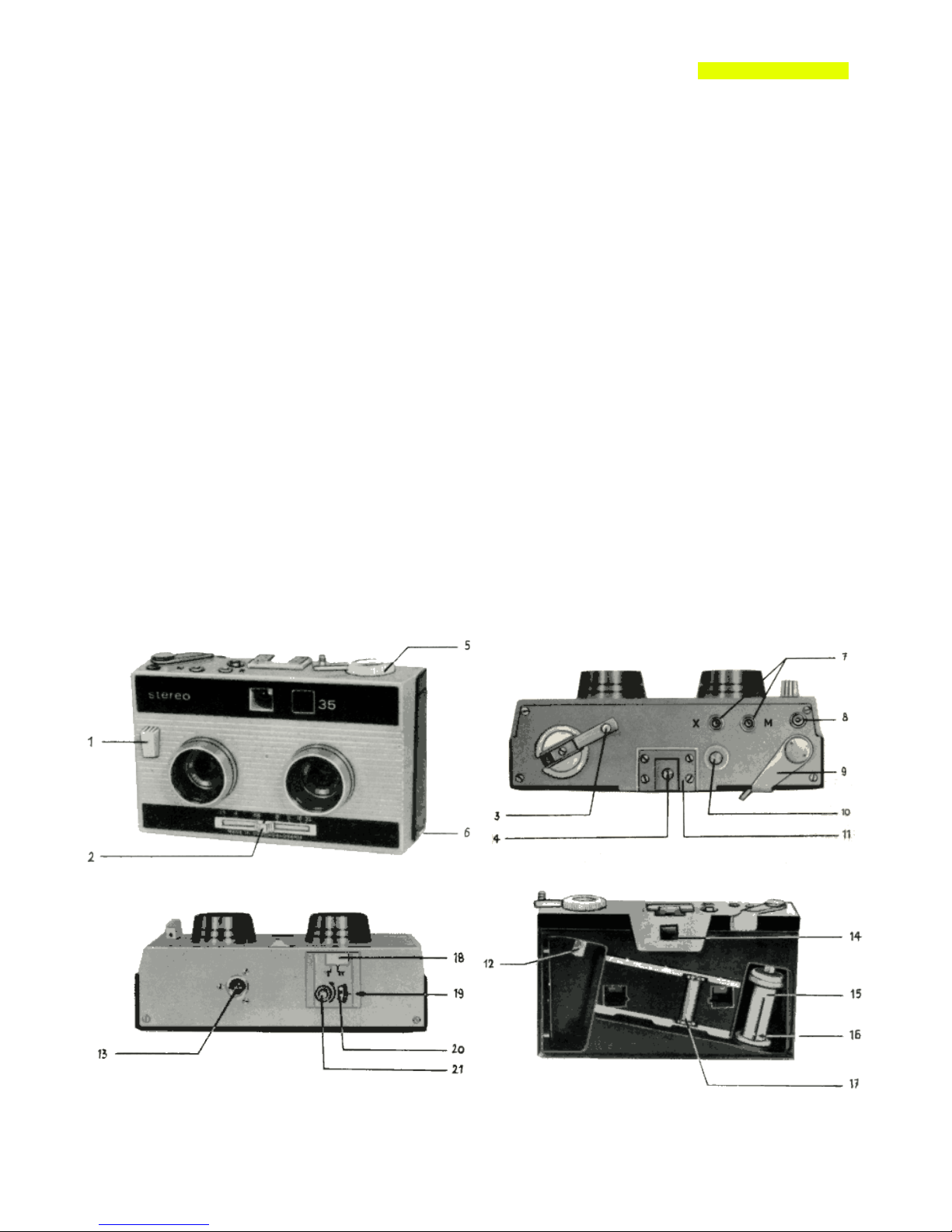
A 3/8" screw socket (13) on the bottom side of the camera can be used for mounting the camera on a tripod when
desired.
Page 2

www.stereokotoucky.cz
1. Loading the camera
Pull out the locking tab (6) and open the back cover. Insert a fresh film cartridge into the left film chamber * so that
its spool engages with the rewind hub (12). If necessary, align the hub slot with the cartridge spool by turning the
rewind knob (5) slightly.
Insert the film leding end into the slot of the take-up spool (15). The spool can be turned in both directions. Make
sure that the catch (16) engages with one of the film perforations. Turn the take-up spool by about 3/4 revolution to
the right, until the film lies flat in its track and the teeth of the feed sprocket (17) engage with the film perforations.
Close the back cover. Turn the ratcheted frame counter wheel (21) in the camera bottom recess until the indicator
(20) shows the triangular mark aligned with the index (19). Push the film advance lever to the right by one full
stroke. Should the lever be blocked, push the shutter release (1) on the camera front. This will trip the shutter and
unblock the film advance. After completing the advance stroke, the advance lever returns to its original position
automatically. Proceed this way until the frame counter (20) reads "0". The camera is now ready for the first shot.
2. Exposure
The shutter speeds 1/60 sec. or B can be set by shifting a slide (18) on the camera bottom. The lens diaphragm
apertures are marked on the front side of the camera. The lenses can be stopped down by shifting the slide (2),
always starting at 3,5. The diaphragm mechanisms of both lenses are linked together. It is advisable to use a
reliable exposure meter for correct exposure determination.
The STEREO 35 camera can be used for taking pictures of objects at a distance between 3 meters (10 ft) and
infinity. Photographing at shorter distances is possible with the set of appropriate close-up lenses.
3. Taking the pictures
After proper setting of the shutter speed and lens stop the picture can be taken. The camera should be held by both
hands, pressed against the forehead and the photographed scene followed visually through the viewfinder (14).
The actual photographed area is marked in the viewfinder by a bright frame. The camera must always be held
horizontally. The shutter release (1) falls under the right index finger; it should always be pressed steadily, without a
jolt.
A cable release can be screwed into a socket (8) on the top side of the camera.
It is not possible to take vertical pictures the camera must be held horizontally in any circumstances.
4. Futher exposures
After pushing the shutter release (1), the advance lever (9) is unblocked. By pushing it to the right one full stroke,
the film is advanced by one frame. At the same time the frame counter advances by one division.
The whole film is exposed in this manner. It is important not to obstruct the rewind knob (5) rotation during the film
advance. An excessive force necessary for advancing the film (this may occur near the film end) is an indication of
a blocking cartridge; this might cause incorrect picture spacing on the film. Should this situation happen, it can be
corrected by loosening of the film in the cartridge by turning the rewind knob against the arrow slightly.
One standard (36-exposure) cartridge should be sufficient for about 80 stereo pair exposures. The actual number
depends on the amount of film used during the loading of the camera.
5. Rewinding of the exposed film
Full exposure of the whole cartridge load (about 80 exposures) is indicated by a sudden stiff resistance of the
advance lever (9) against further advance, since the film end is fastened to the cartridge spool. Push the rewind
release button (10) and rewind the film by turning the rewind knob (5) either directly or by means of the flip-out
crank (3) in the direction indicated by the arrow. Go on rewinding until the whole film is rewound. The end of the
rewinding process can be recognised by a sudden decrease of the rewind force. Open the back cover and take the
cartridge out.
Should it happen that the film end is torn out of the cartridge, it must be taken out of the camera in total darkness.
Page 3

www.stereokotoucky.cz
6. Flash pictures
Standard PC outlets for flash synchronisation (7) are located on the top side of the camera. For electronic flash use
the outlet marked "X", for flashbulbe use the outlet "M". The "M" synchronising contact is also connected to the ,,hot
shoe" contact. Both X and M contacts are arranged so that the flash fires when the shutter is fully open.
Correct exposure with flash is determined by proper setting of the lens stop. A simple calculation is necessary,
using the formula:
lens stop = flash guide number : flash-object distance
Example: An object is 5 meters far from the flash (usually the flash is located on the camera or very near of it). The
flash guide number given by the flash maker for the film sensitivity used is 20. According to the formula: lens stop =
20 : 5 = 4.
7. Maintenance and handling
Every photographic camera requires careful handling. Guard the camera against moisture, chemical fumes, dust,
mechanical shocks and temperatures in excess of 50°C.
Before loading clean the inside of the camera with a very soft brush. The glass surfaces of the lenses or of the
viewfinder may be cleaned by a clean soft lint-free tissue.
8. Cutting the pictures from the film
The pictures that will be inserted into viewer discs must be cut from the film strip with a great degree of precision. It
is absolutely necessary to perform this operation by the special puncher "STEOMAT 35", supplied by the Meopta
factory as a special accessory under the order number 73942.
9. Special accessories.
a. Eveready case, type No. 73122. The case is made of artificial leather and can be closed by a zipper. A
wrist-strap is attached to the case. The wrist-strap can be fastened to the camera by a screw that fits into
the tripod socket on the camera bottom.
b. Close-up lenses 3 m - 1 m, type No. 70715. They are designated for taking pictures at distance of 3 m - 1
m from camera. Close-up lenses 1 m - 0,6 m, type No. 70716. They are designated for taking pictures at
distance of 1 m - 0,6 m from camera.
c. Filters are supplied in screw-in holders with M 30X0,5 threads. For photographing on colour reversal film
an ultraviolet-absorbing filter UVO, type 80521 can be used. The following filters can be used for black and
white reversal films: UV colourless, type 80522; G1 light yellow, type 80523; G2 medium yellow, type
80524; G3 dark yellow, type 80525; GGR1 yellow-green, type 80526; R1 red, type 80528, GR1 green, type
80527; B1 blue, type 80529; N1 light gray, type 80530; N2 medium gray, type 80531. The filters are to be
screved into the threads cut into the front sides of the lens hoods.
d. The STEOMAT 35 punch, type 73942 serves for accurate punching of the finished picture pairs from the
film strip.
e. Viewer discs, type 73929, supplied empty; individual pictures of the stereo pairs, punched from the film
strip by means of the STEOMAT punch can be inserted into these discs.
f. Stereo viewer MEOSKOP accepts the Type 73929 discs for trus stereoscopic viewing of the pictures.
g. Projector DIAMET type No. 76105 is designated for projection of one picture of the stereoscopic pair.
Technical designer of the camera: MACOUN Karel
Shape designer: HEINZ František
Typographical designer of manual: ŘEHÁK Otto
 Loading...