

Page 1
Page 2

2
If you have questions about operating or installing your new Megatech
product, or if you are missing parts... Please Call Megatech First!
DO NOT RETURN THIS PRODUCT TO THE STORE
Call our Customer Service Department at:
(201) 662-2800
10:00am - 5:00pm, EST Monday through Friday (except holidays)
Technical assistance is also available on-line at www.megatech.com
or by e-mail to [email protected]
Congratulations. You have just purchased a radio controlled regattaready racing sloop that has been designed from the keel up to handle
®
like a full-scale racing yacht. Your new Megatech
a low-drag composite hull design, removable racing keel with ballast
Table of Contents
Nirvana features
bulb, deep-water rudder, super-ridged carbon fi ber main mast and
fully-proportional sail control. All of this technology combines to
make the Nirvana incredibly stable and one of the best R/C sailboats
in the world. Plus, it comes 95% pre-assembled, so it’s less than an
hour from the box to the water (no glue required).
Please read this entire manual carefully before you attempt to build or
sail your Nirvana.
If you experience any problems, DO NOT take your Nirvana back to the
store! Call one of our MegaTechnicians at 1-888-MEGA-911 or send an
e-mail to: [email protected]
10:00am - 5:00pm, EST Monday through Friday (except holidays)
DO NOT RETURN THIS PRODUCT TO THE STORE
TABLE OF CONTENTS
Getting Acquainted with your Nirvana.......................................................3
Assembling your Nirvana .........................................................................4
Adjusting the Sails .....................................................................................7
Installing Batteries .....................................................................................8
Sailing Basics ............................................................................................9
Racing Your Nirvana ..............................................................................12
The Race Course ...................................................................................17
Obtaining Spare Parts ............................................................................18
Troubleshooting ......................................................................................18
Limited Warranty .....................................................................................19
Page 3
Important! Before you begin, please read the warnings listed on
the following page. Failure to comply with the following
recommendations could result in loss or damage to your boat.
The Megatech Nirvana is not intended for those under 18 years
of age without proper adult supervision.
Getting Acquainted with Your Nirvana
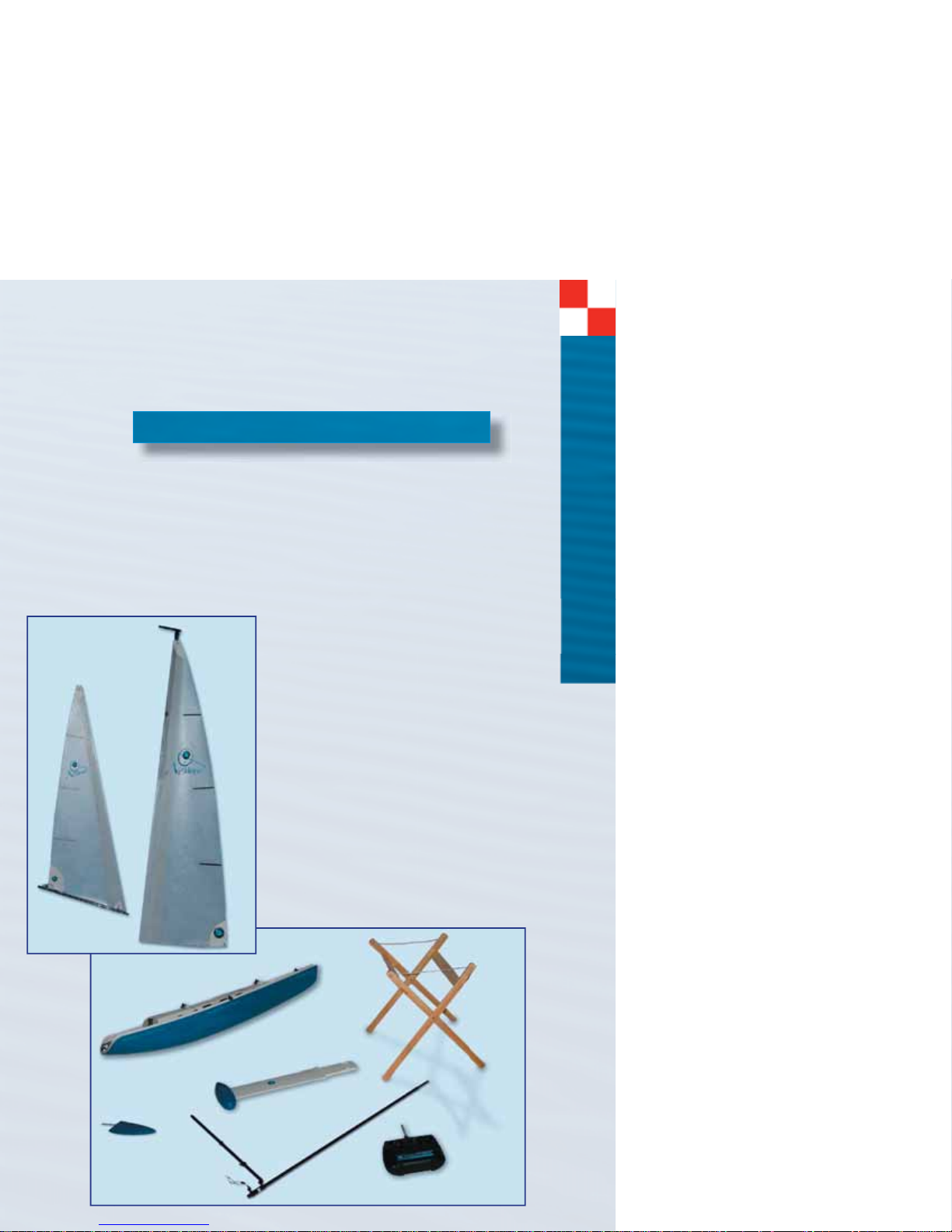
PACKAGE CONTENTS
Unpack your new Nirvana. Carefully disconnect the sails from the
foam packaging, being careful not to wrinkle them. Take all of the
parts out of the box. Before going any further, please check that your
Nirvana package contains all of the following items, using the
following picture as a guide:
A. Jib Sail
B
A
B. Main Sail
C. Hull
D. Keel
E. Rudder
F. Mast and Boom Set
G. Radio Control
H. Stand
I. Number Sheet (Not pictured)
3
Package Contents
If any of these items are missing
from your package, please contact
Megatech.
C
D
E
F
H
G
Page 4
4
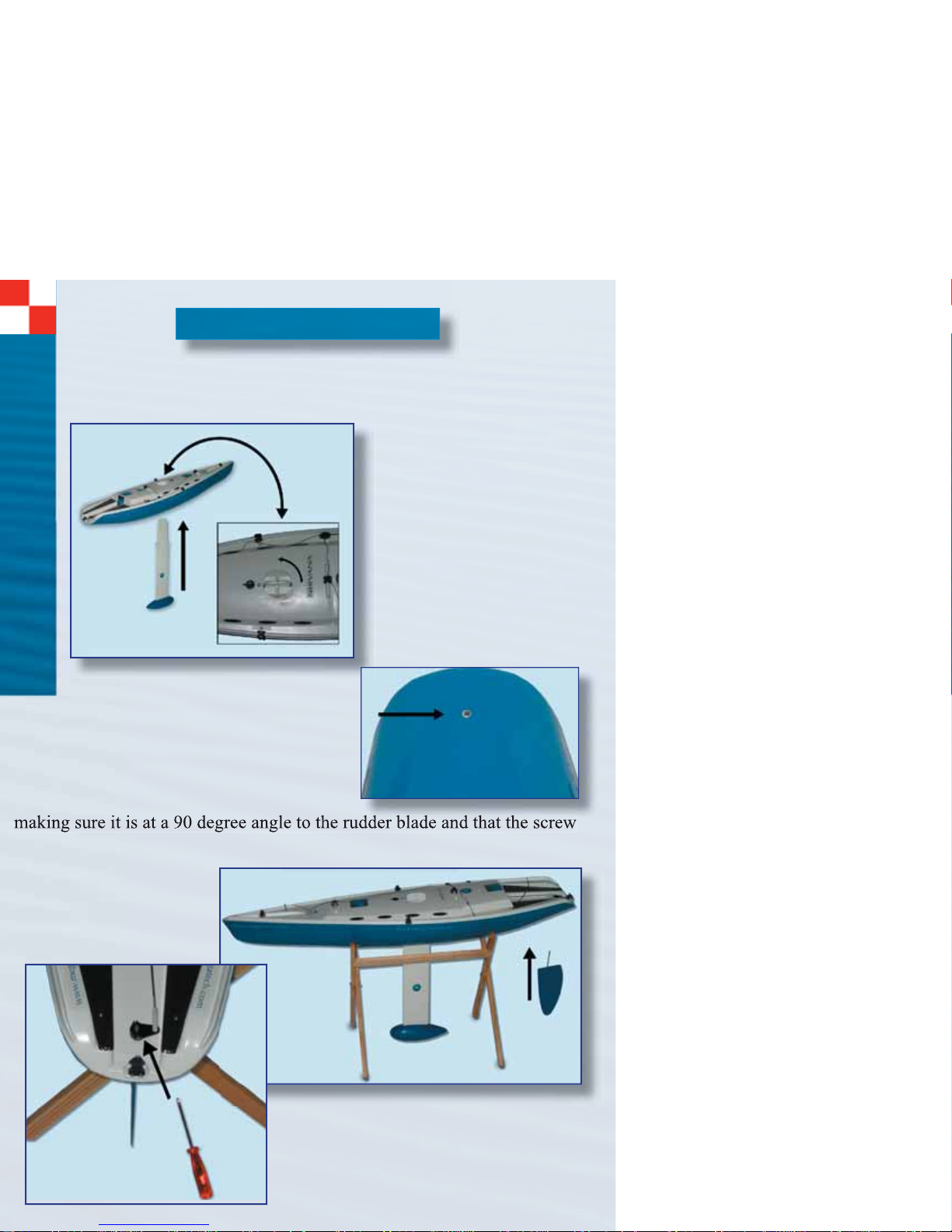
The Keel
Slide the keel through the slot on the bottom of the hull. Make sure
the rounded side is facing the bow (front) of the boat.
Once fully inserted, turn
the locking lever 90 degrees
to secure the keel into place.
You should now place
your boat upright in
the stand.
Assembling the Nirvana
The Rudder
Locate the rudder tube at the stern
(back) of the boat. Insert the rudder shaft into
the rudder tube as shown, so that the fl at side
of the rudder is facing the bow of the boat.
Assembling Your Nirvana
Slide the rudder collar onto the rudder shaft,
is aligned with the fl at section of the shaft. Now tighten the collar into place
using a Philips head
screwdriver.
Page 5
The Mast and Boom
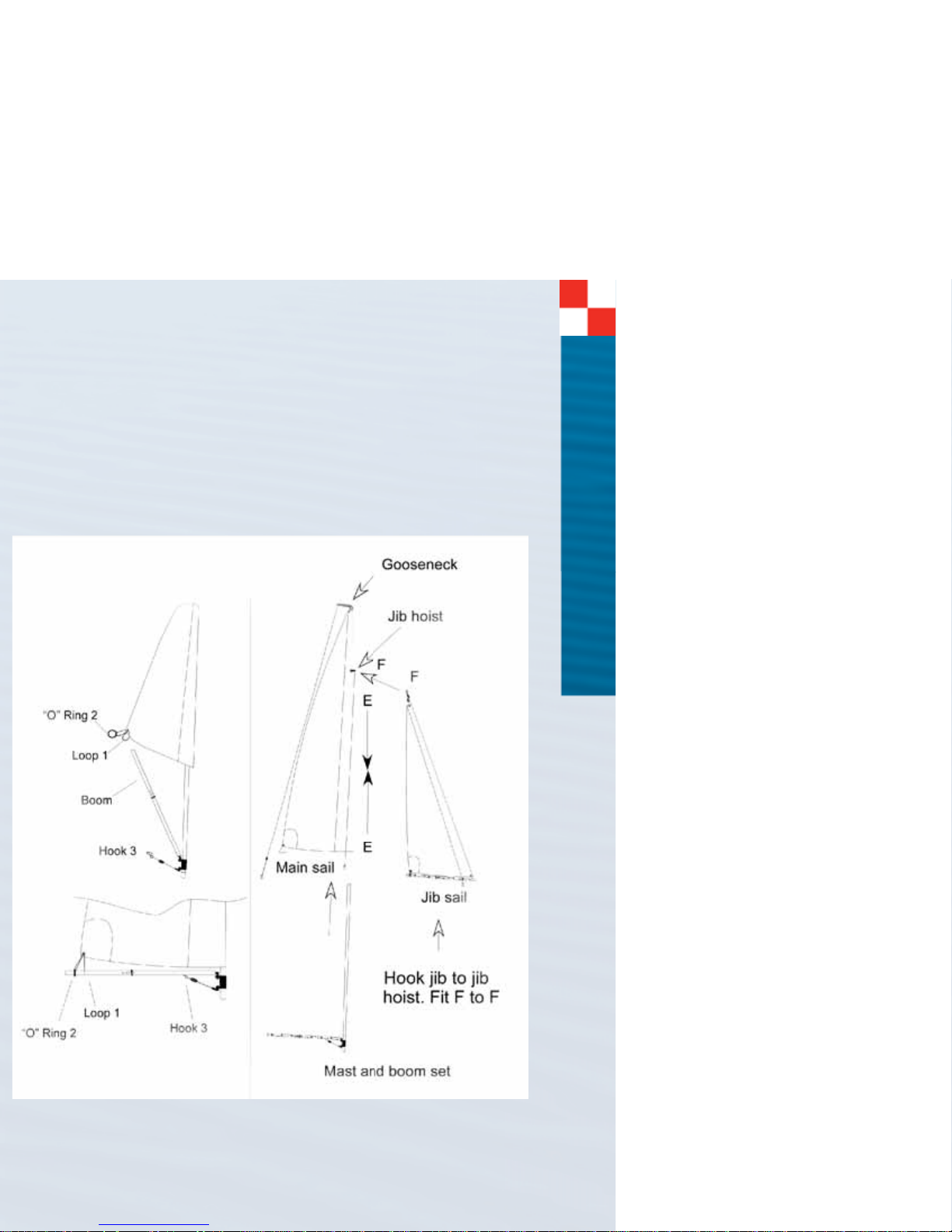
Next, locate the mast and boom section. Insert the mast into the sleeve
of the main sail. Before you completely insert the mast, slide the boom
through loop 1 and then slide O-ring 2 onto the boom. Then connect
the bottom half of the mast to the top half of the mast which is already
inside the sleeve of the sail (Fit E to E). Make sure the gooseneck on
top of the boom is pointing back and the jib hoist is pointing forward.
Now connect hook 3 to the loop on the bottom of the boom.
5
The Mast and Sails
Find your jib sail. Attach the jib hoist, atop of the jib sail, to the jib hoist
about ¼ way down the mast (Fit F to F). Don’t be concerned, the jib sail will
hang loosely until assembly is complete.
Page 6
6
Attaching the Mast
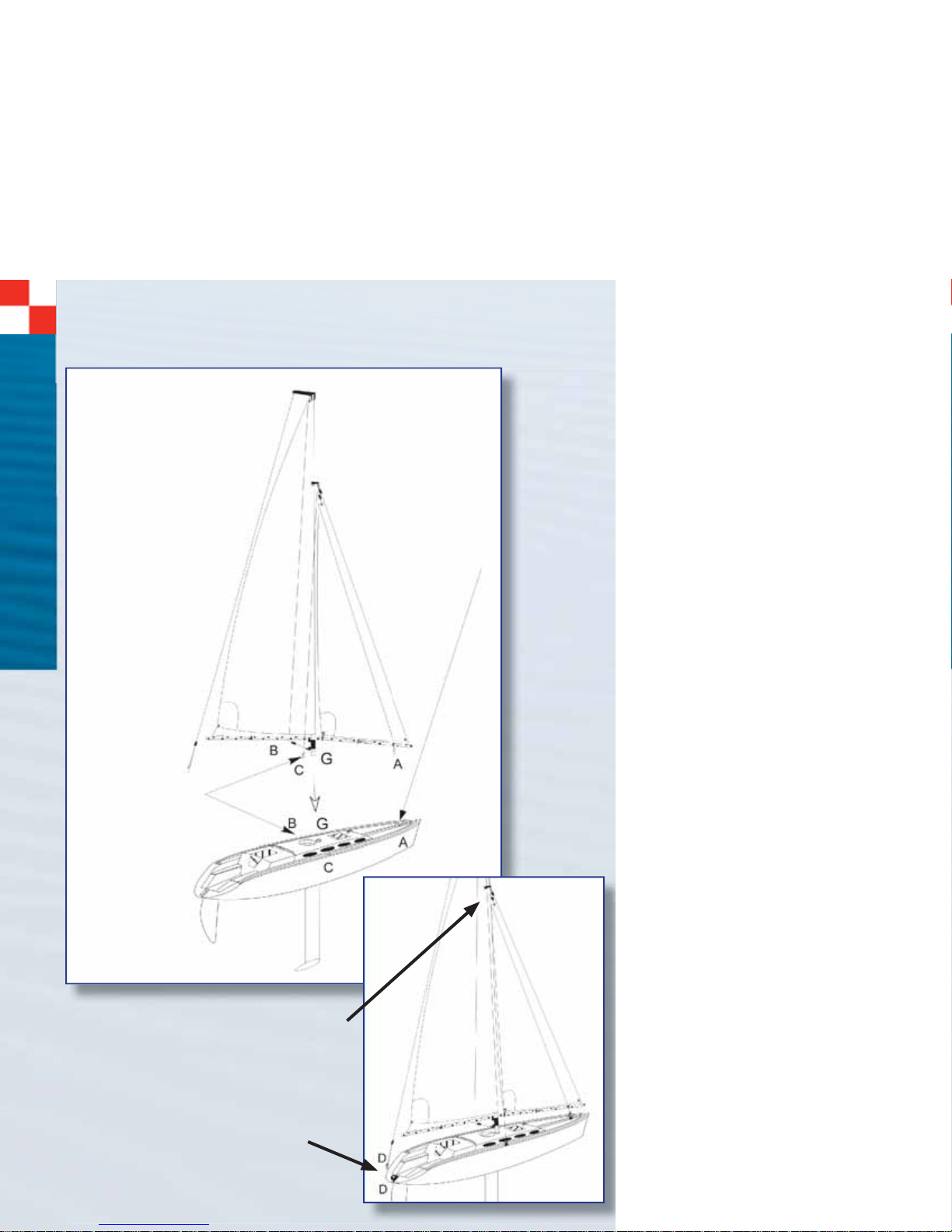
Gently slide the mast butt into the hole in the deck (Fit G to G).
Attaching the Mast
Using the bowsies (small plastic slide
tensioners connected to the lines),
gently tighten the side shrouds and the
backstay lines.
Hook the backstay to the backstay
bracket at the stern of the boat (Fit D
to D).
Page 7
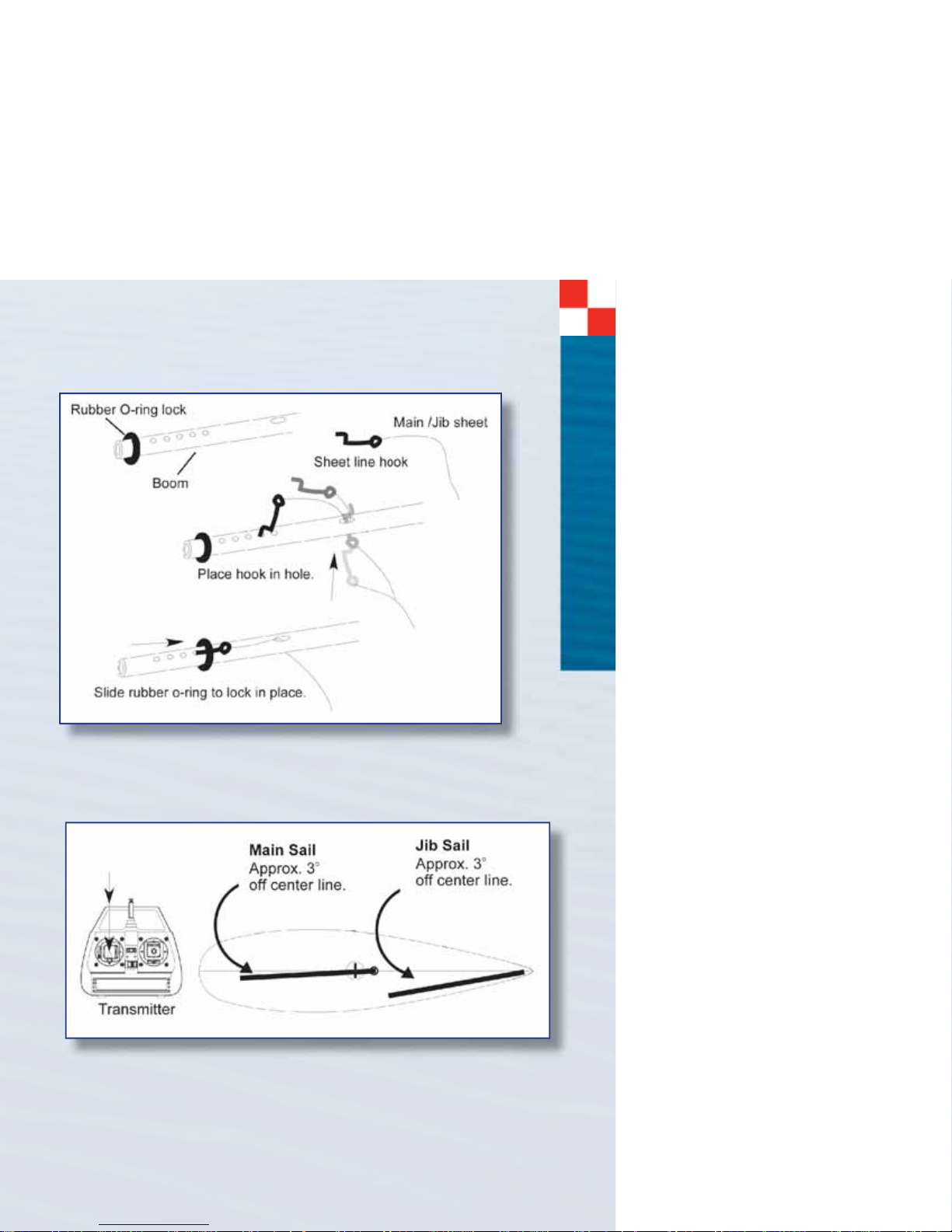
Take the main sheet line and hook and feed them through the hole in
the main boom. Then insert the sheet hook into one of the small holes
in the boom and lay it fl at. Next slide back the O-ring to lock the hook
into place.
Now repeat this procedure for the jib sail by taking the jib sheet line and hook
and feeding them through the hole in the jib boom. Insert the sheet hook into
one of the small holes in the jib boom and lay it fl at. Then slide back the
O-ring to lock the hook into place.
7
Adjusting the Sails
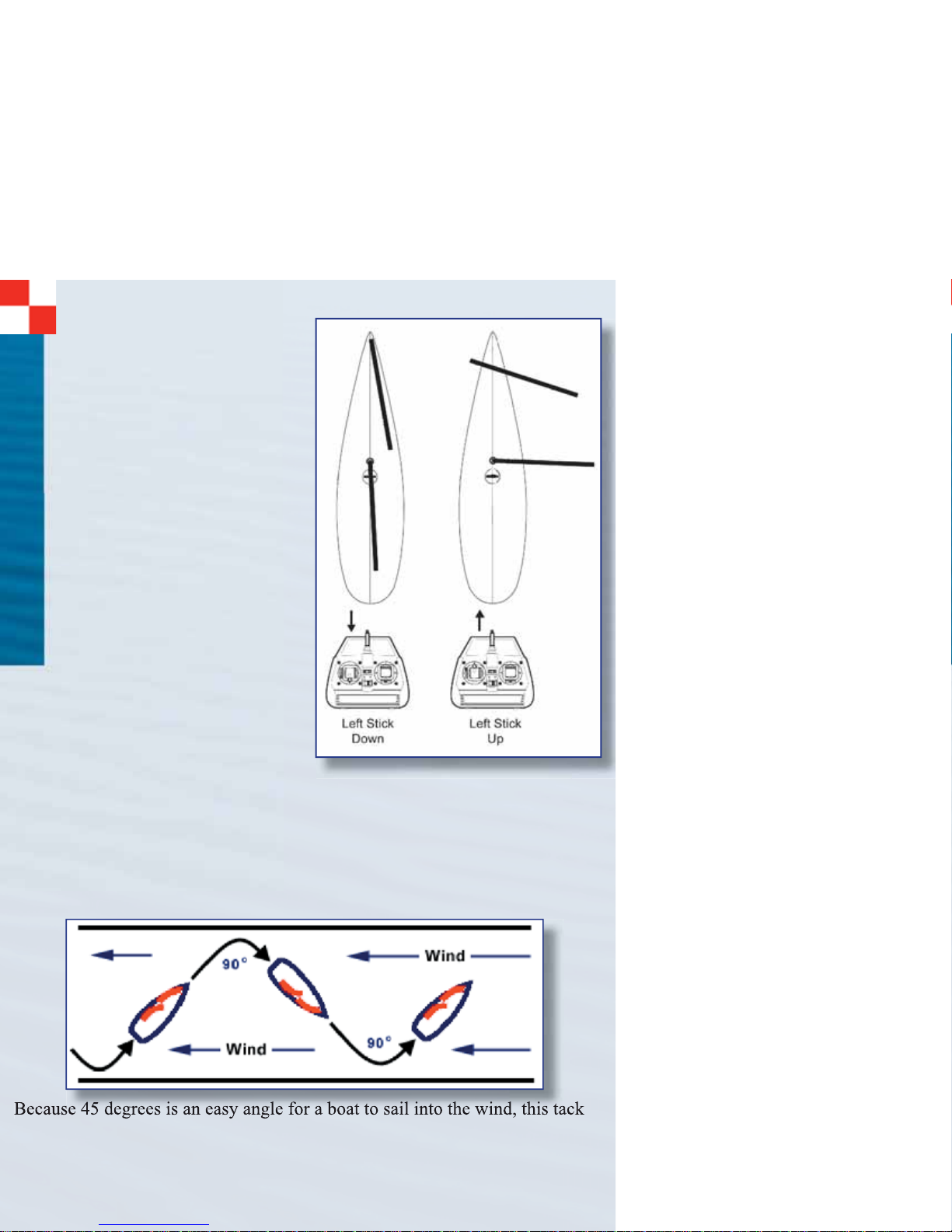
It is very important to make sure your sheet line hooks are in the correct positions. To check this, fi rst install the batteries in the transmitter and switch it on
and then install the batteries in your Nirvana and switch it on (see
instructions). When the left stick on the transmitter is down (in the back position), the booms should look like the drawing above. You may have to try the
hooks in different holes to fi nd the correct position. Once you fi nd the correct
hole, you may wish to mark it with a dot of white model paint or nail polish, so
you won’t have to remember for next time.
page 8 for
Page 8
8
Installing the Batteries
to always use fresh alkaline batteries, especially in the transmitter. To
be safe, you should insert fresh batteries into the boat after a few hours
of use. We recommend Megatech’s
R/C products.
The Radio Control
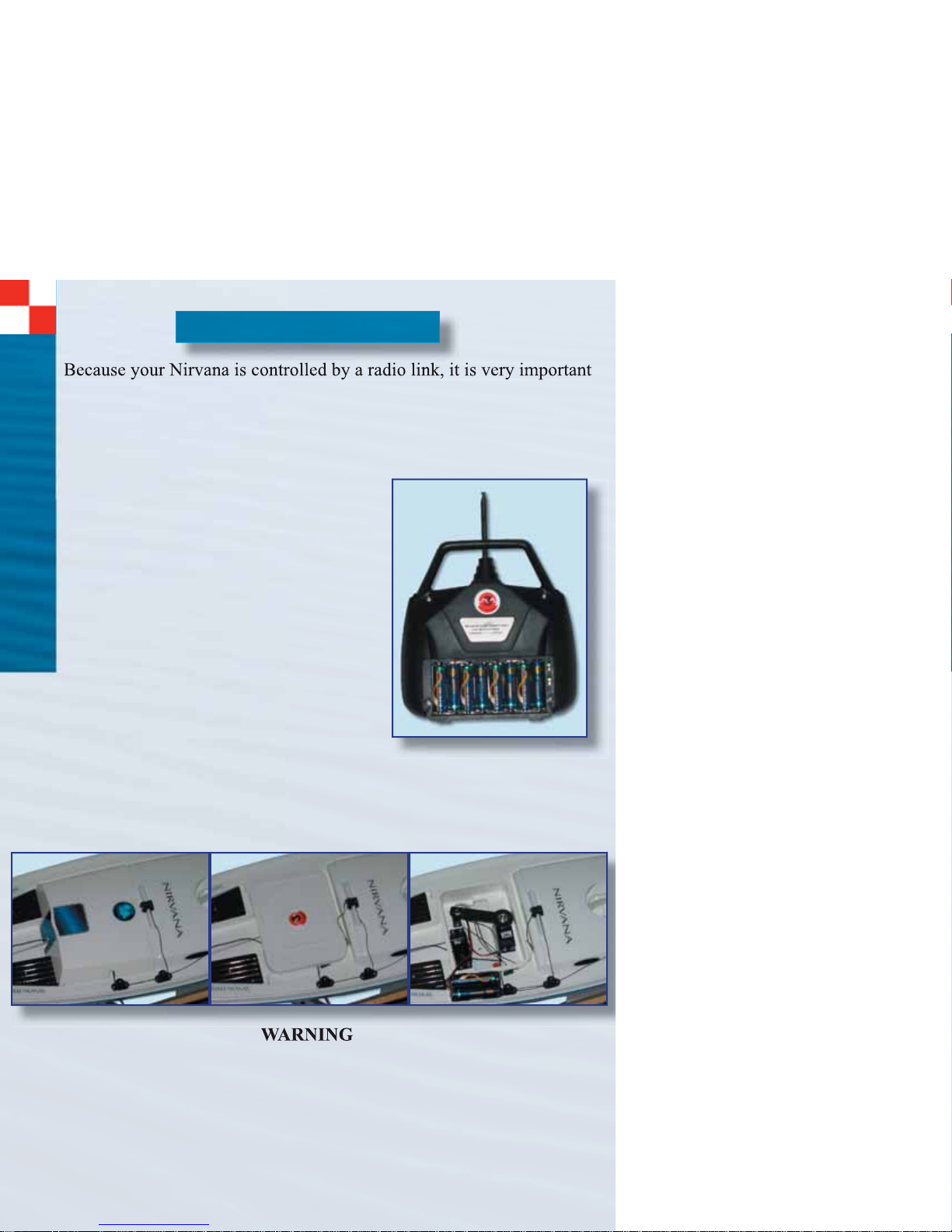
Open the hatch on the rear of the radio
control. Install 8 AA alkaline batteries. Be
sure the batteries are properly arranged or
your controller will not function. Reattach
the battery hatch.
Installing Batteries
The Boat
The hatch cover and hatch seal protect
the batteries and servo. Gently pull up on
the lip at the rear of the hatch cover to remove it
and then lift off the hatch seal. Next, carefully
pull out the battery holder and insert 4 AA
alkaline batteries. Take care to insert the batteries in the correct direction.
Carefully reinsert the battery holder into the boat, put the hatch seal on,
making sure that it seals snugly and then snap the hatch cover back into place.
Make sure the tiller arm and antenna cord come through the slot at the rear of
the hatch cover.
®
Golden Power series, designed for
ALWAYS SWITCH ON THE TRANSMITTER FIRST… THEN
SWITCH ON THE BOAT.
Failure to do so may result in damage to the Nirvana’s servos. Always turn on
the transmitter and then it’s safe to switch on the boat.
Now it’s time to go sailing!
Page 9
Sailing Basics
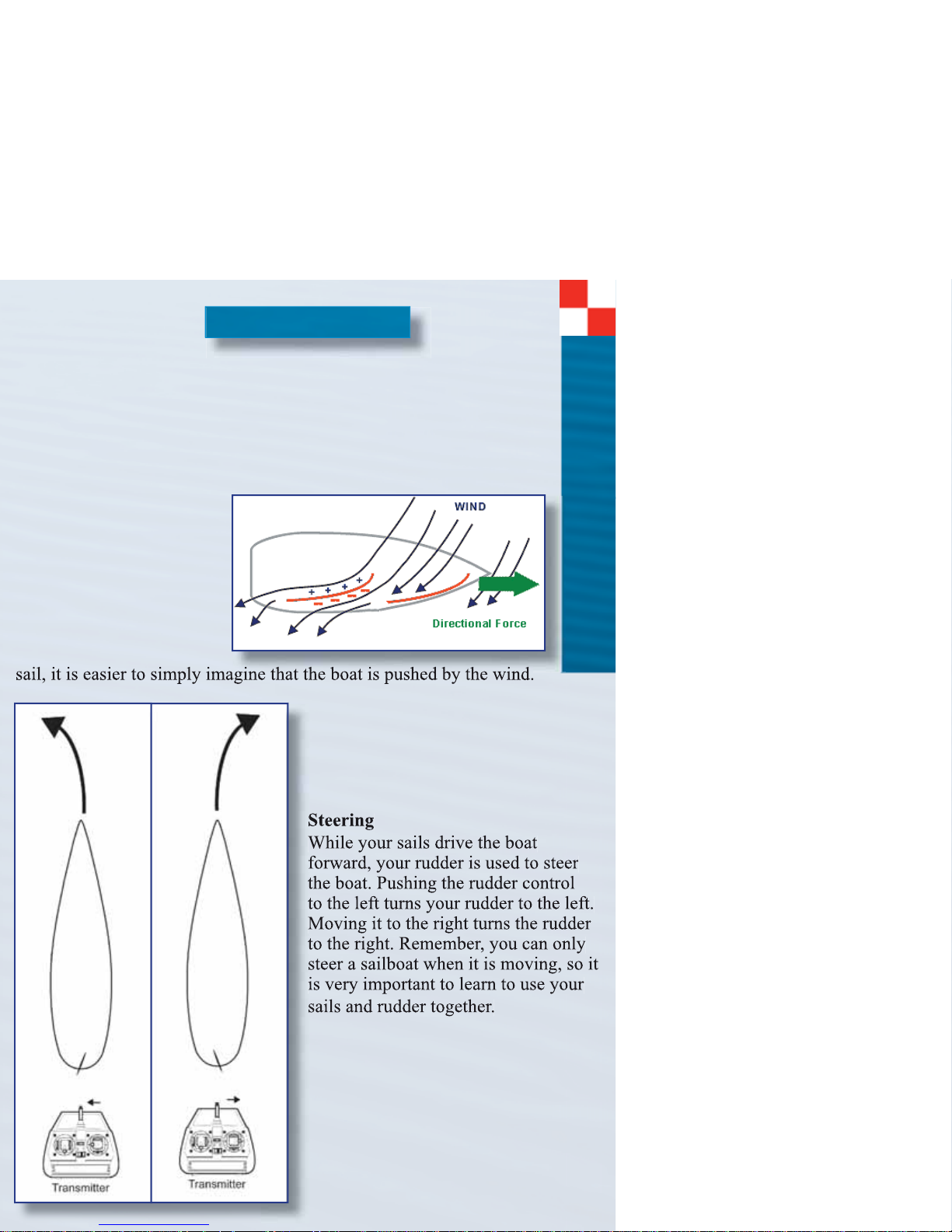
Wind is the only source of propulsion for your Nirvana. The sails use
the wind to propel your boat through the water. Your sail pivots off
the mast allowing it to catch the wind at a variety of different angles,
making it possible to sail in many directions, including against the
wind. Technically, the sail acts as an airfoil, like the wings of an airplane, when the wind hits it. The air moving along the inside of the
sail is forced to move more
slowly than the air on the
outer side of the sail. This
creates a pocket of low
pressure on the forward
side of the sail, which pulls
the boat through the water.
While that is scientifi cally
accurate, when learning to
9
Sailing Basics
Left
Turn
Right
Turn
Page 10
10
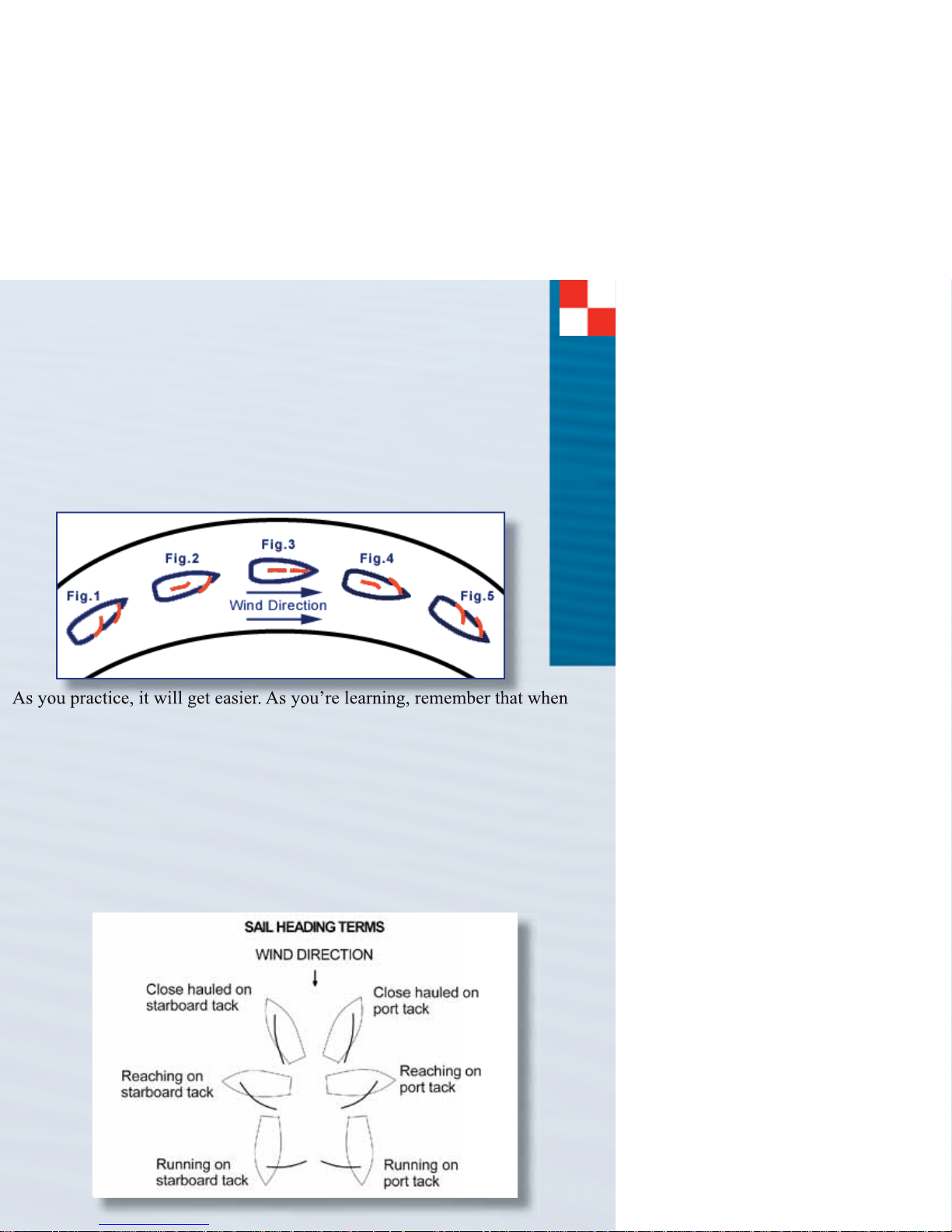
It’s when you want to go in a different
direction than the wind that things get
tricky. Sailboats cannot sail directly into the wind. If a boat is pointed directly
into the wind, the sail will luff. So, how does the boat move to a point directly
upwind? It zigzags, or tacks its way into the direction of the wind. Sailboats
can only sail at angles to the wind. The closest angle is approximately 30
degrees, although 45 degrees is recommended. To tack, you must change the
boat’s direction so that the bow comes through the eye of the wind (point
directly into the wind).
When sailing upwind or
downwind, your boat’s
performance will depend
upon the angle of your sail,
also known as your sail trim.
To pull the sails in, move the
sail stick down. To ease the
sails out, move the sail stick
up. A good way to fi nd the
right trim is to ease the sails
out until they begin to luff
(fl ap like a fl ag in the breeze).
Then simply trim back in just
Tacking
enough to stop the luffi ng.
Sailing with the wind is easy.
You just let the sails trim all
the way out (as in the
illustration to the far right)
and let the wind push you
along. This is called “running.”
requires a turn of 90 degrees. As the boat turns and the bow comes through
the eye of the wind, the sails will move across to the opposite side of the boat.
Your main sail will then refi ll on this side, you can straighten your rudder, and
the boat will assume the new heading.
Page 11
Jibing is the turning maneuver when travelling downwind. When you
Jibe, you take the stern of the boat through the eye of the wind. As
your boat turns and the stern comes through the eye of the wind, the
sails will come across to the opposite side of the boat.
Jibing should be executed carefully! If there is much wind as the
boat is turned, the boom can pass over the boat with incredible force
and your rig could be damaged in an uncontrolled situation. You can
prevent mishap simply by pulling in the mainsheet and easing it out
again as the boom passes from side to side.
your sailboat comes close to the wind, you should pull the sails in tight. As
you point further away from the wind, you can ease your sails out.
11
Jibing
You should consider tying a small ribbon or fl ag to the gooseneck on
top of the mast. This will act as a telltale to help you see the direction of the
wind while you are sailing.
Use this simple guideline for trimming your sail properly: No matter what
course you are sailing, ease the sail out until it begins to luff (fl ap), then pull it
back in until the luffi ng stops.
Page 12

12
Racing Your Nirvana
Choosing a Sailing Area
Generally, look for a space approximately the size of two regulationsized basketball courts. Make sure the body of water is calm, free from
debris, at least 15 inches deep, and has an easy area to launch your
boat.
We suggest that you begin sailing your Nirvana in a quiet lake or pond
as you become acquainted with the controls. We do not recommend
running your boat in salt water, as this will cause corrosion and
premature failure.
Choosing a Day
Until you become comfortable with sailing the Nirvana, it is best to
choose a day with light, but steady wind. We strongly recommend that
you avoid sailing on days with strong gusty winds.
Radio Transmitter Controls
To pull the sail in and sail a close-hauled course, move the sail stick
down. To ease the sail out to reach or run, move the sail stick up.
When you move the rudder stick on the transmitter to the right, your
Nirvana will turn to the right. When you move the rudder stick to the
left, the boat will turn left.
Racing Your Nirvana
Sailboat racing is a lot of fun. If you are already familiar with
yacht racing rules, those may be used when racing your Nirvana.
The following are fi ve basic rules that will allow you to compete
with experienced sailors.
Five Basic Rules of Racing
1. Port Tack/Starboard Tack Rule
Port refers to the left side of the boat when facing the bow
from the stern. Starboard refers to the right side. A boat
in motion is either on port tack or starboard tack. When
the boom is left of the center of the boat and the wind is
coming across the starboard side, the boat is sailing on
starboard tack. When the boom is to the right and the wind
is coming across the port side, the boat is sailing on port
tack.
RULE: When sailing on a collision course, boats sailing on
starboard tack have the “right of way” over boats sailing on
port tack. Boats on port tack MUST yield to boats on
starboard tack.
Page 13
2.
13
Buoy Room Rule
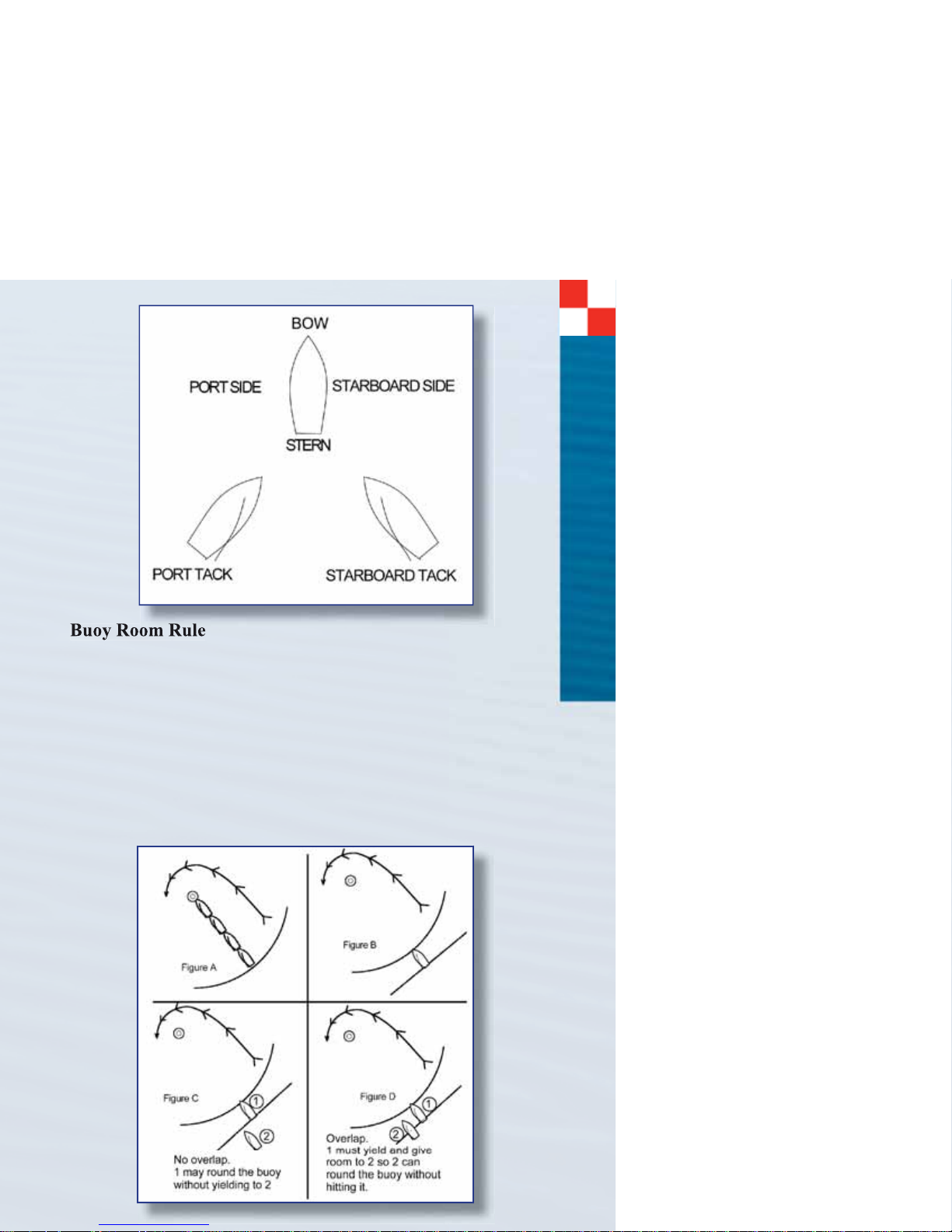
The buoy room rule applies when boats are rounding or
passing a buoy or an obstruction on a race course. You should
imagine a circle around a buoy – the radius of the circle is four
boat lengths (See Figure A). When your boat’s bow enters this
circle (See Figure B), you have the right of way (See Figure
C), unless the bow of another boat from behind you overlaps
the stern of your boat on the inside of the turn. If there is a boat
that has crossed this line on the inside of the turn and there is
an overlap (See Figure D), then your boat must yield to that
boat.
Page 14
14
Contact with Buoys Rule
3. Contact with Buoys Rule
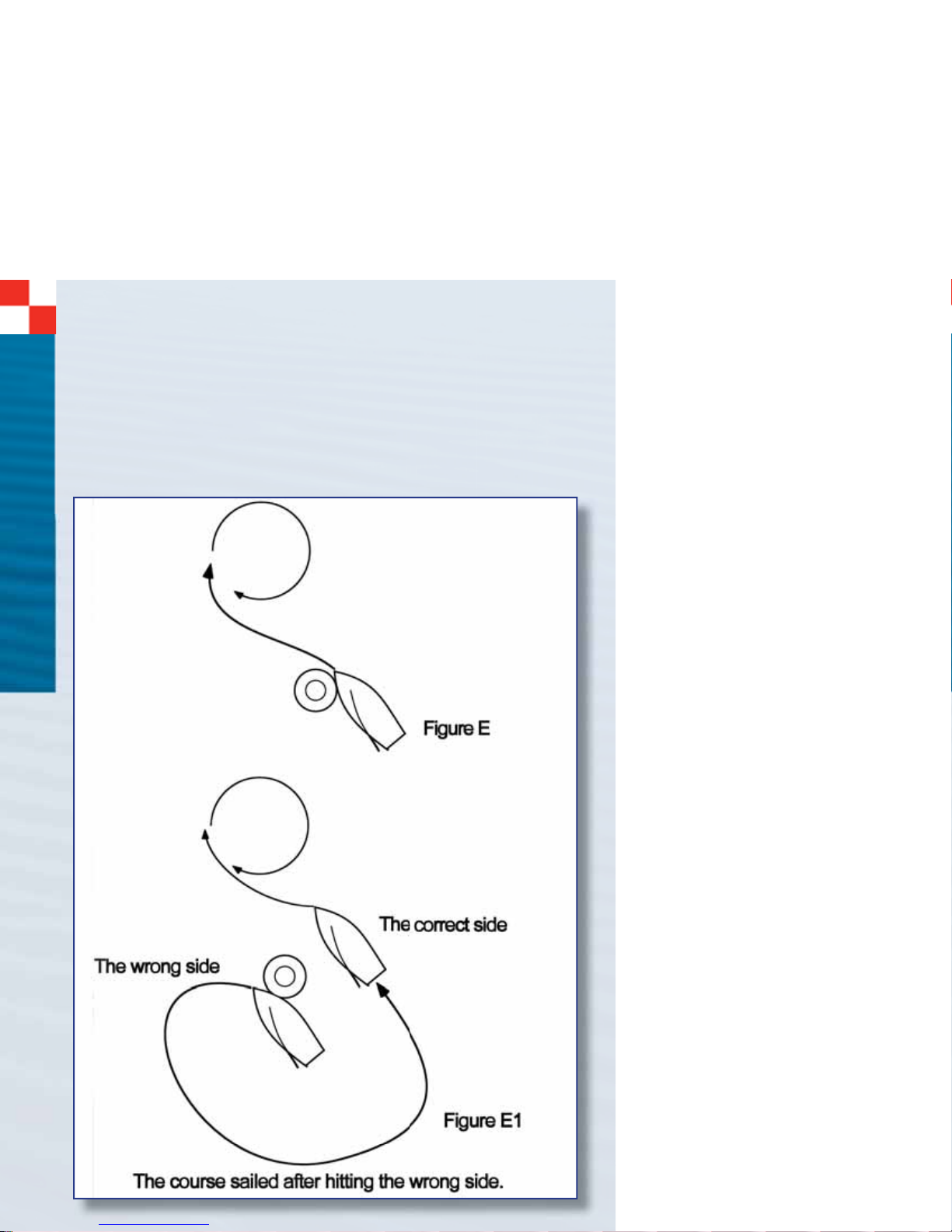
A boat that makes contact with a buoy must sail away from the
fl eet, out of the way of other boats, and do a 360-degree penalty
turn (See Figure E). After the penalty turn, the boat may resume
racing. If the boat hits the buoy on the wrong side of the buoy,
it must re-round the buoy on the correct side before doing the
360-degree penalty turn (see Figure E1).
Page 15
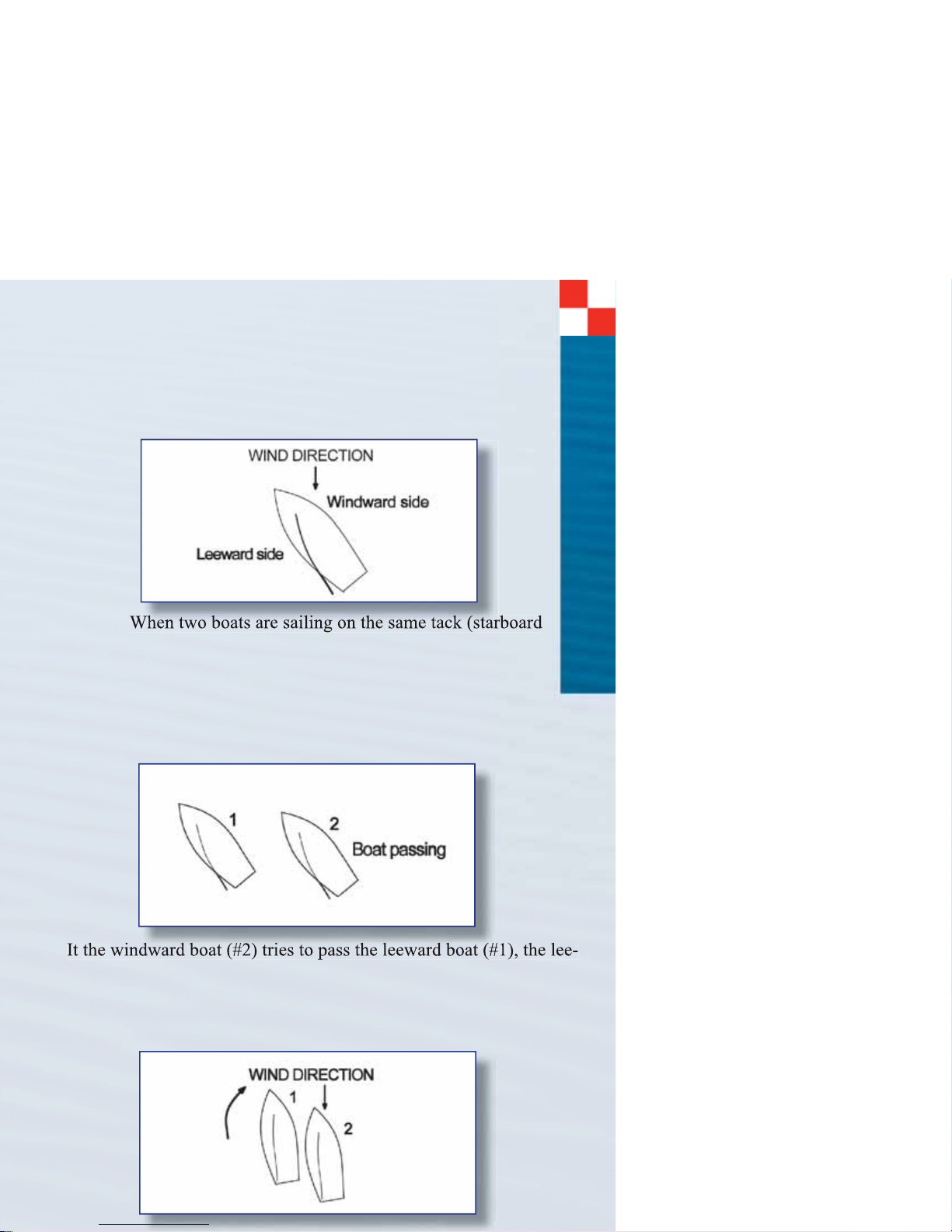
4. Luffi ng Rights Rule
This rule applies when you are passing another boat at close
proximity. The fi gure below indicates the windward and
leeward sides of the boat. On the starboard tack, the starboard
side of the boat is the windward side. On port tack, the port
side of the boat is the windward side.
RULE:
tack for these examples) at close proximity (See the illustration
below), the leeward boat (#1) has the right of way over the
windward boat (#2). If you are a windward boat on the offensive,
you must pass with enough room to avoid the leeward boat. If you
cannot avoid the leeward boat, you must steer away to avoid a
collision.
15
Luffi ng Rights Rule
ward boat (#1) can “luff up” the windward boat (#2) by steering into
the wind, causing #2’s sail to luff (See below). When a boat’s sail luffs,
it loses power and speed. Luffi ng up is mostly used as a defensive
maneuver.
Page 16
16
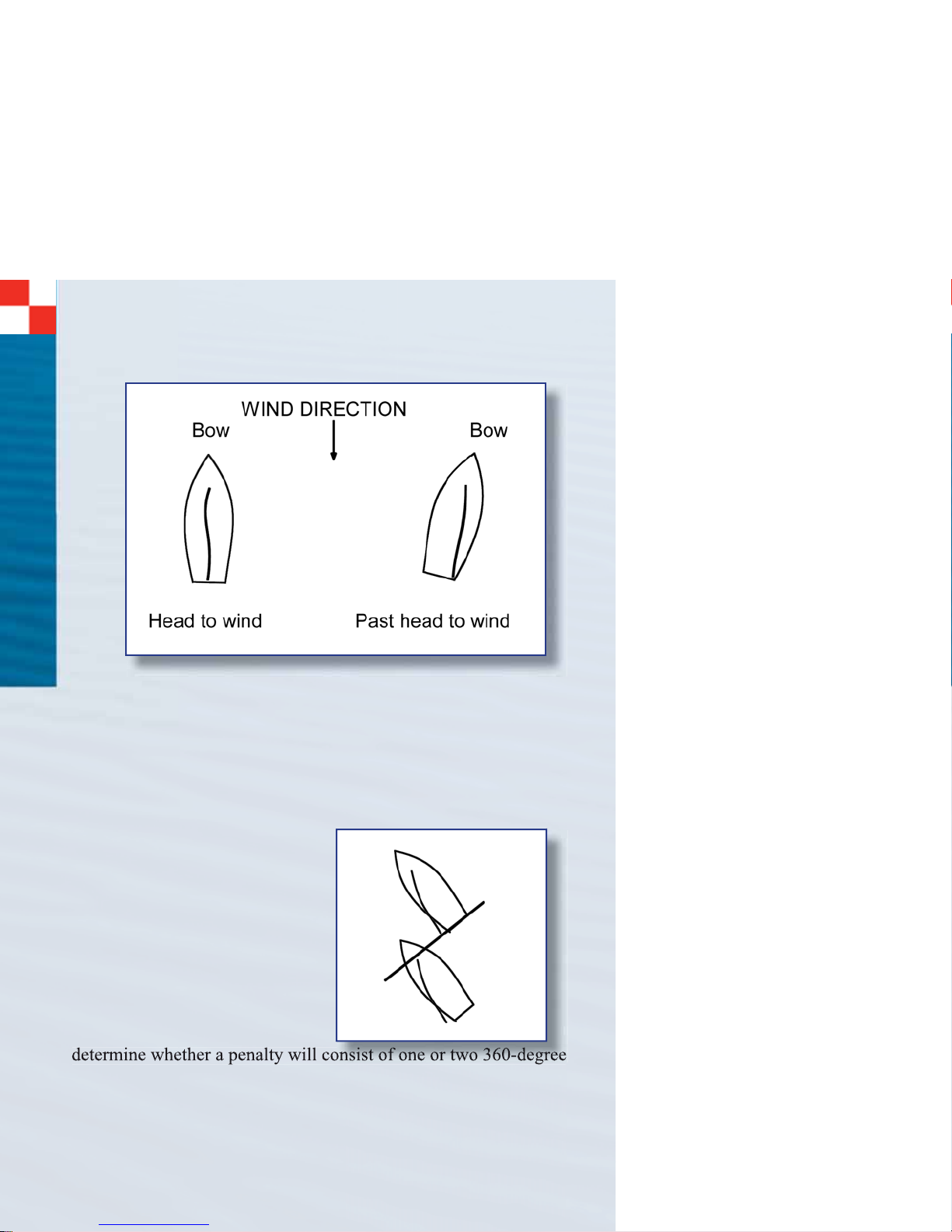
The leeward boat is not permitted to sail past head to wind to “luff up”
the other boat.
Collision Rule
When your boats bow is facing directly into the wind, it is called “head
to wind.” If you steer your boat into the wind, past the point when it
is head to wind, you have sailed “past head to wind.” The leeward boat is not
permitted to sail past head to wind to “luff up” the other boat. If you do, you
lose the right of way, regardless of which tack you are sailing on. If there is a
collision after the leeward boat is past head to wind, the leeward boat must do
a penalty turn (see Rule 5).
5. Collision Rule
Whenever you collide with
another boat, or fail to avoid a
collision, you must sail clear of
all other boats and complete a
penalty turn before continuing
the race. Before the start of each
race, the race committee or racers
turns. Generally, only one turn is required in light wind conditions.
Page 17
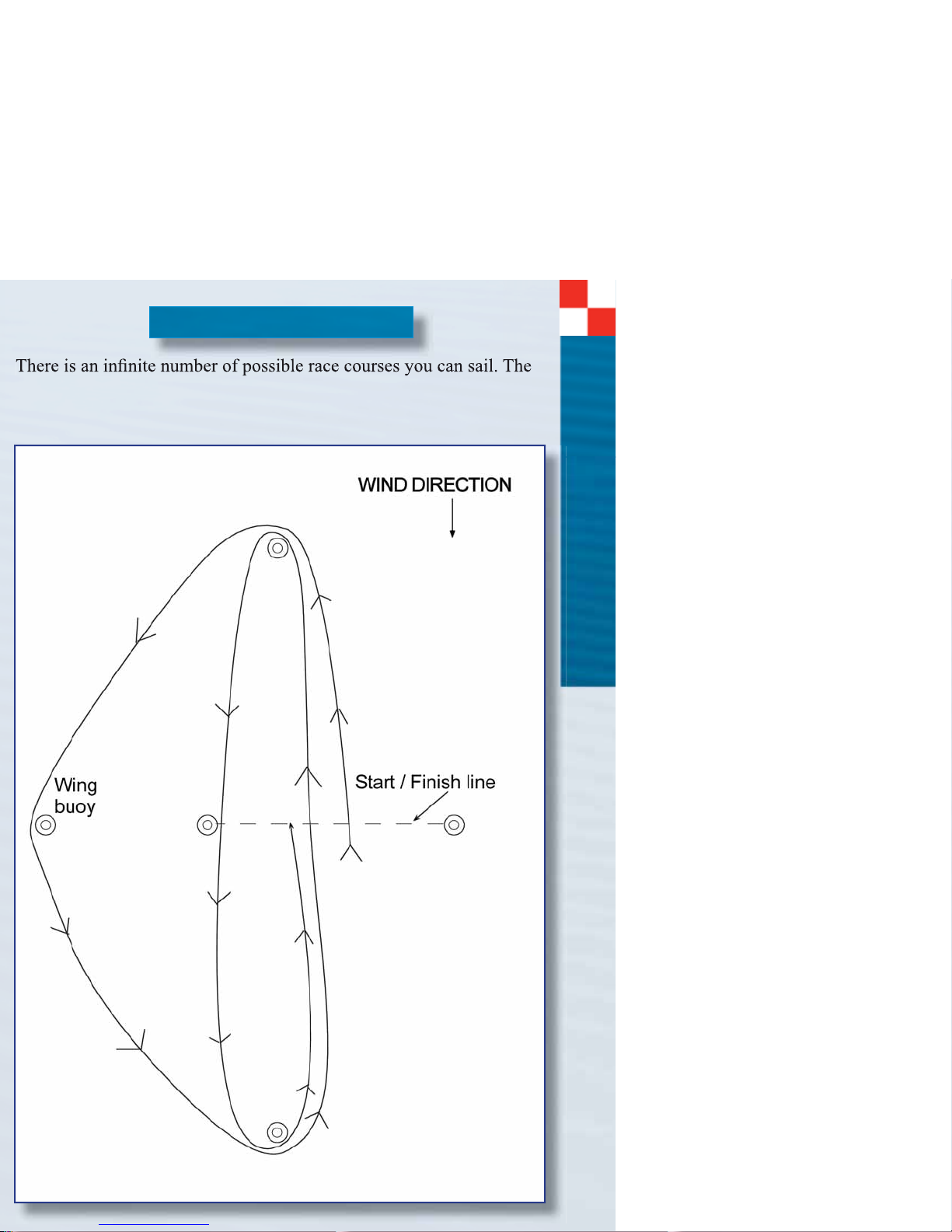
The Race Course
17
only limit is your imagination. The most common course is the
Modifi ed Olympic course.
The Race Course
Jockey for the best
position during a
one-minute countdown.
Sail two laps around the
course, not rounding
the wing buoy on the
second lap.
Page 18

18
Troubleshooting
PROBLEM
No power to radio 1. Power switch is 1. Move switch to the
control transmitter. in the “off” position. “on” position.
2. Batteries are 2. Make sure batteries
incorrectly installed. are installed correctly.
3. Batteries are 3. Replace the batteries
exhausted. with new alkaline
batteries.
Nirvana is not 1. Radio control 1. Slide the switch to the
under control. transmitter is not “on” position.
turned on.
2. Transmitter 2. Fully extend the
antenna is not fully antenna.
extended.
3. Transmitter 3. Replace the batteries
batteries are with new alkaline
exhausted. batteries.
4. Boats batteries 4. Replace the batteries
are exhausted. with new alkaline
batteries.
5. You have sailed 5. Be careful not to let
out of range. your Nirvana sail too far
away from you.
6. Seaweed has 6. Get it to shore and clear
wrapped around away any obstruction.
your rudder.
Obtaining Spare Parts
Spare, repair and replacement parts are readily available for your Nirvana.
Should you need parts, visit your local hobby dealer fi rst. If unavailable, you
may order directly from Megatech. Use this list as a guide.
Spare Parts List
Part Numbers & Descriptions
690101.....Complete Hull
690102.....Mast
690103.....Gooseneck (Boom & Jib Boom)
690104.....Rudder And Tiller Arm
690105.....Sail Set
690106.....
690107.....Battery Box W/ On/Off Switch
690108.....Keel With Lead Weight
Stainless Steel Side Stays w/ Connectors
Part Numbers & Descriptions
690109.....Complete Decal Set
690110.....Boom Set
690111.....Complete Rigging Set
690112.....Pulley & Deck Fittings
690113.....Cover Set (Inner & Outer)
690114.....Sail Servo Arm
690115.....Rudder Pushrod & Clevis
Page 19

Limited Warranty
19
Megatech
®
defects for a period of 90 days from date of purchase. If any
component of this product fails to function properly due to defects
in materials or manufacturing process during this 90 day period,
the manufacturer’s obligations are limited and manufacturer can
choose to either repair or replace the item.
This warranty is void if the product in question has been altered or
repaired by anyone other than Megatech
®
International or an
authorized agent.
Under no circumstances will Megatech
®
International or any of
its representatives be held liable for injury to persons or property
damage resulting from assembly or use of the product. Megatech
®
is not liable if any outside radio frequencies interfere with the
product’s frequency causing loss of control. Megatech
®
International will not be held liable for any injury to persons or
property damage resulting from an out-of-control model caused by
use or misuse of the product. Megatech
®
International expressly
excludes any and all express warranties not specifi cally stated here
and all implied warranties of merchantability and fi tness for a
particular purpose. There are no warranties which extend beyond
the description of the warranties contained herein.
Contact the Megatech
®
International Service Department before
returning any item that is defective according to the limitations
listed above. Please be sure to pack the returned item(s) carefully.
The customer must return the product along with proof of
purchase, a letter describing the problem and the customer’s
address and telephone number. At this point in time we will either
repair the defective part or replace it and return it to the customer.
Return shipping and handling in the 48 contiguous states is $12.99.
Shipping outside of the 48 states will be quoted by location.
This warranty does not cover any damage caused by use, misuse,
alteration, accident, or neglect, nor does it cover normal wear and
tear of the product. Product returned to us which falls under this
category will be submitted to our service department for repair.
We reserve the right to charge any service and parts fees incurred
when repairing the item.
Troubleshooting
Megatech
®
International
8300 Tonnelle Avenue
North Bergen, NJ 07047
(201) 662-2800
www.megatech.com
Page 20
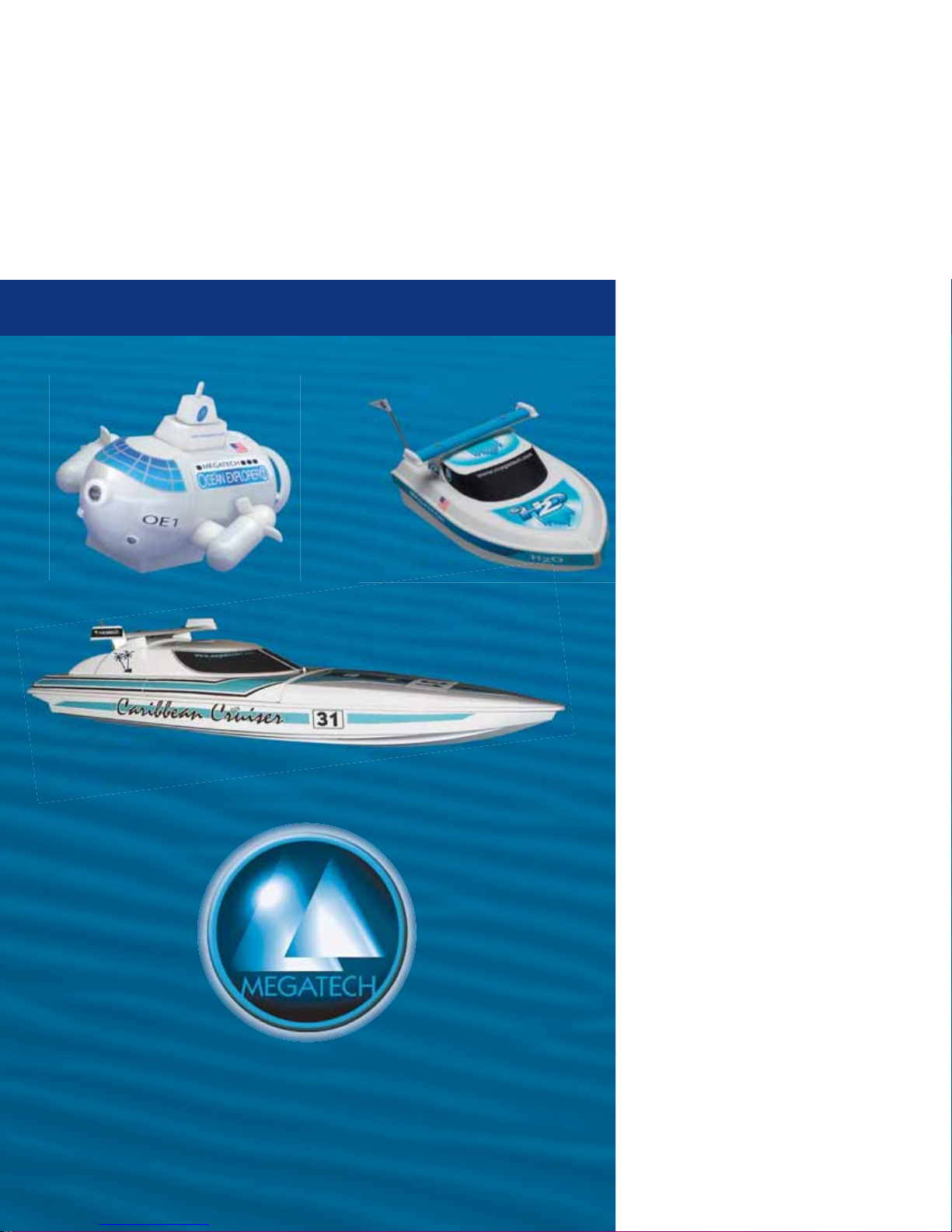
LOOK FOR THESE OTHER FINE MEGATECH PRODUCTS
OCEAN EXPLORER 1 R/C SUBMARINE
MTC7702
MTC6902
CARIBBEAN CRUISER ELECTRIC TWIN-MOTOR R/C RACER
MTC7701
H2O ELECTRIC MINI R/C SPEEDBOAT
Megatech International
8300 Tonnelle Avenue
North Bergen, NJ 07047
(201) 662-2800
 Loading...