

Page 1
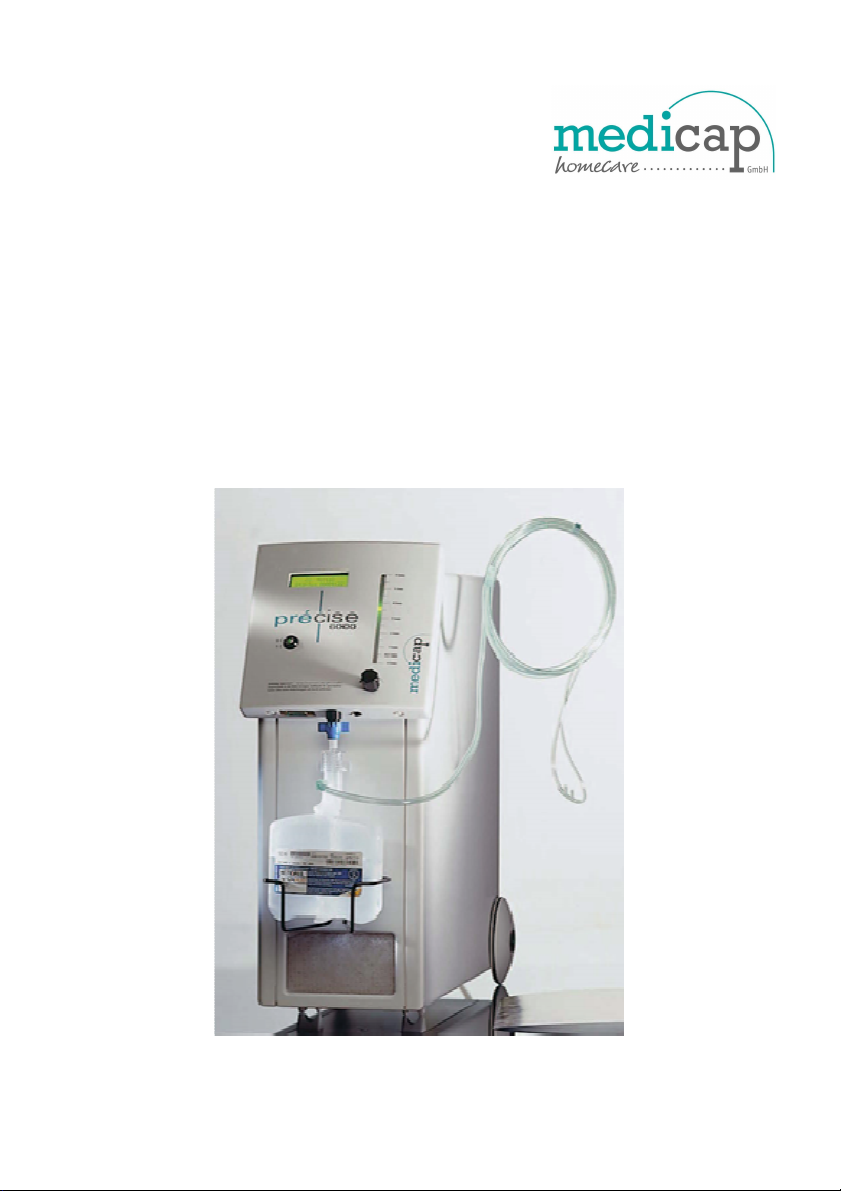
(DE) Gerätebeschreibung und Gebrauchsanweisung
(GB) Operation Manual
(F) Description de l’appareil
Précise 6000
Sauerstoffkonzentrator
Page 2

Page 3

Inhaltsverzeichnis
1. Einleitung ......................................................................................................................... 3
1.1. Verwendungszweck ..................................................................................................3
1.2. Funktionsbeschreibung .............................................................................................4
1.3. Wichtige Gebrauchs- und Sicherheitshinweise .........................................................4
2. Bedienung ........................................................................................................................ 6
2.1. Vorbereitung zum Betrieb ........................................................................................6
2.2. Einschalten ................................................................................................................6
2.3. Betrieb ......................................................................................................................6
2.4. Ausschalten ...............................................................................................................6
2.5. Sauerstoffkonzentrationsüberwachung (OCSI) .........................................................6
2.6. Datenschnittstelle Version D.....................................................................................7
2.7. Ionisation Version I ...................................................................................................7
3. Service & Diagnose .......................................................................................................... 7
4. Störungen und deren Beseitigung ................................................................................... 8
5. Reinigung ......................................................................................................................... 9
6. Wartungsintervalle ........................................................................................................ 10
7. Technische Daten........................................................................................................... 11
8. Lieferumfang .................................................................................................................. 11
9. Garantie ......................................................................................................................... 13
10. Anleitungs- und Herstellererklärung EMV ................................................................... 13
11. Sauerstoffkonzentrator Précise 6000 .......................................................................... 17
11.1 Innenansicht linke Seite .........................................................................................17
11.2 Innenansicht rechte Seite ......................................................................................18
Anhang: Konformitätserklärung
Rev. D 2018-11 2
Page 4

1. Einleitung
1.1. Verwendungszweck
Précise 6000 – für die Sauerstoffanreicherung der Atemluft bei der Sauerstoff-Inhalations-
Therapie zu Hause und in Kliniken. Nur für Patienten, deren Lebensfunktionen nicht
unmittelbar und nicht ununterbrochen von einer erhöhten Sauerstoffkonzentration der
Atemluft abhängen. Die Sauerstoff-Inhalations-Therapie sollte jedoch immer nur nach
eingehender ärztlicher Untersuchung erfolgen. Sauerstoff für medizinische Zwecke ist ein
hochwirksames Arzneimittel. Bei falscher Anwendung kann es zu Nebenwirkungen
kommen. Die Anweisungen des Arztes sind exakt zu befolgen.
Jede Störung des Wohlbefindens ist unverzüglich dem behandelnden Arzt zu melden.
Gegenanzeigen:
Eine Sauerstoff-Inhalations-Therapie darf nur unter besonderer Vorsicht durchgeführt
werden bei:
- Patienten im hohen Alter
- Fettsucht
- Gleichzeitiger ACTH- oder Glukokortikoid-Behandlung
- Patienten mit hoher Kohlendioxid-Konzentration im arteriellen (sauerstoffreichen) Blut
- Vergiftungen mit Substanzen, die die Atemtätigkeit herabsetzen
- Störungen der Atemkontrolle im Zentralnervensystem
- Fieber
Die Anwendung einer reinen Sauerstoffbehandlung sollte bei akuter Atemschwäche
(respiratorische Insuffizienz auf der Basis einer chronischen Emphysembronchitis) wegen
der drohenden Abnahme der Lungenbelüftung nicht durchgeführt werden.
Nebenwirkungen:
Unter Beachtung der Gegenanzeigen sind Nebenwirkungen bei der Verwendung mit
normalem Sauerstoffdruck nicht zu erwarten. Bei der Sauerstoffbeatmung von Patienten
mit verminderter Lungenbelüftung kann es zu einem raschen Anstieg der
Kohlendioxid-Werte kommen.
Bei einer Behandlung mit 50%-igem Sauerstoff bis zu 7 Tagen sind keine klinisch
bedeutenden Symptome beobachtet worden. 100%-iger Sauerstoff über 24 Stunden
verabreicht, führt jedoch zu zellulären und funktionalen Schädigungen der Lunge
(Zellveränderung des Alveolarepithels, Sekreteindickung, Einschränkung der
Ziliarbewegung, Atelektasen sowie Veränderung des Minutenvolumens,
Kohlendioxidretention und pulmonale Vasodilatation).
Das bedeutet, dass in der Regel bei einer Behandlung mit 1 Atmosphäre Überdruck über
längere Zeit oder bei noch höheren Sauerstoffdrücken in der Atemluft nach kurzer
Behandlung mit Vergiftungserscheinungen (Hyperventilation, Azidose bis zur
Rev. D 2018-11 3
Page 5

Entwicklung eines Lungenödems) zu rechnen ist. Dabei ist zu beachten, dass eine zu rasche
Verminderung des Teildruckes eine lebensgefährliche Sauerstoffunterversorgung
(Hypoxämie) herbeiführen kann.
Bei Neugeborenen kann eine lang anhaltende und hochkonzentrierte (mehr als 40%)
Sauerstoffbehandlung eine zu Erblindung führende Augenlinsenschädigung (retrolentale
Fibroplasie) verursachen. Darüber hinaus besteht die Gefahr des Auftretens von Blutungen
(pulmonare Hämorrhagien), zell- und/oder Funktionsstörungen in der Lunge (fokalen
Atelektasen sowie hyalinen Membranschäden mit diffuser Lungenfibrose). Um die
Entwicklung eines solchen Zusammenbruchs der Lungenfunktion (bronchopulmonale
Dysplasie) zu vermeiden, ist es unerläßlich, während der Behandlung wiederholt den
Sauerstoffdruck im arteriellen (sauerstoffreichen) Blut zu prüfen.
1.2. Funktionsbeschreibung
Das Grundprinzip der Sauerstoffgewinnung durch Sauerstoffkonzentratoren ist das Druckwechselverfahren.
Hier wird in einem
1. Schritt Umgebungsluft von einem Kompressor angesaugt und in einem Behälter mit
Molekularsieb verdichtet,
2. Schritt die Stickstoffmoleküle an der Oberfläche des Molekularsiebes gebunden und
dadurch von den Sauerstoffmolekülen getrennt, die das Molekularsieb
passieren,
3. Schritt das Molekularsieb entlüftet, indem mit einem Teil des gewonnenen Sauerstoffs
der darin befindliche Stickstoff ausgespült wird.
Bei der 3-Säulentechnik wird wechselweise (zyklisch) immer eine Säule gefüllt, in einer
weiteren der Stickstoff vom Sauerstoff getrennt und in der dritten Säule das Molekularsieb
gespült. Diese Technik sorgt, so ohne zusätzliches Sauerstoffreservoir, für einen
kontinuierlichen Sauerstofffluss. Hierdurch wird ein extrem schneller
Sauerstoffkonzentrationsaufbau, unmittelbar nach dem Einschalten des Gerätes, erreicht.
1.3. Wichtige Gebrauchs- und Sicherheitshinweise
Voraussetzung für den bestimmungsgemäßen Gebrauch des Sauerstoffkonzentrators
Précise 6000 ist die genaue Kenntnis und Beachtung dieser Gebrauchsanweisung.
• Der Précise 6000 und alle Zubehörteile, die mit Sauerstoff in Berührung kommen,
sind frei von Öl und Fett zu halten.
• Es sind nur Originalteile zu verwenden.
• Der Précise 6000 ist vor Nässe und Feuchtigkeit zu schützen.
• Rauchen, offenes Licht und Feuer sind während des Gebrauchs verboten.
• Durch elektromagnetische Störungen von außen tritt keine Gefährdung des
Anwenders ein.
• Bei Verwendung von Einweg-Sprudelbefeuchtern sicherstellen, dass diese auf
Rev. D 2018-11 4
Page 6

keinen Fall ungeöffnet am Gerät betrieben werden. Beim späteren Öffnen
entsteht Unterdruck, der zu Wassereintritt und Schäden am Gerät führen kann.
(Flow Null)
• Das Gerät nicht mit zugedrehtem Flowmeter betreiben. Beim Öffnen kann
Unterdruck entstehen und Wasser aus dem Befeuchter in das Gerät eindringen.
Tragbare und mobile HF-Kommunikationseinrichtungen können medizinische elektrische
Geräte beieinflussen. Dies kann zu Funktionsstörungen an den Geräten führen.
Deshalb müssen Strahlungsquellen (Geräte, die elektromagnetische Wellen ausstrahlen) im
Umfeld laufender medizinischer elektrischer Geräte einen bestimmten Mindestabstand
einhalten. Sie nachstehende Tabelle.
Strahlungsquellen
Mindesabstand zum medizinisch elektrischen
Gerät einschließlich aller Anschlusskabel
Mobil-Telefon
3.3 m
(Handy)
DECT Telefon
1.2 m
(Schnurloses Telefon)
Bluetooth Geräte
0.7 m
(Laptops, Handy)
Funkfernbedienungen 1.2 m
WLAN Geräte
2.3 m
(z.B.: Laptops, Repeater,
Access Point, Print
Server)
Das Netzkabel darf eine maximale Länge von 4m nicht überschreiten.
Die Verwendung von anderen als in der Gebrauchsanleitung aufgeführtem Zubehör und
Leitungen kann zu einer erhöhten Störaussendung oder eine reduzierte Störfestigkeit des
Gerätes führen.
Rev. D 2018-11 5
Page 7

2. Bedienung
2.1. Vorbereitung zum Betrieb
Zum Transport ist der Tragegriff herauszuklappen. Der Précise 6000 ist in einem gut
belüfteten, trockenen, kühlen und staubfreien Raum aufzustellen. Der Précise 6000 sollte
möglichst nicht in der Nähe von Heizkörpern, Heizlüftern etc. aufgestellt werden. Die
Luftzufuhr darf nicht beeinträchtigt werden, da Kühlluft für den Kompressor benötigt wird.
Der Précise 6000 ist mit dem mitgelieferten Netzkabel zu verbinden. Den Netzstecker in
eine Steckdose einstecken.
WICHTIG!
Beim Gebrauch von Art. Nr. 006.357 FireSafe™ Cannula oder Art. Nr. 006.359 FireSafe™
Nozzle ist die MONTAGEANWEISUNG - FIRESAFE™ Rückschlagventil unbedingt zu
beachten!
2.2. Einschalten
Wenn das Gerät bei Temperaturen unter 10 °C gelagert wurde, muss sich das Gerät an
die Zimmertemperatur angleichen, sonst können Betriebsstörungen auftreten. EIN/AUSSchalter drücken, das Gerät führt einen Selbsttest durch. Im Fehlerfalle ertönt ein
akustischer Alarm und im Display wird der Fehler und die Servicetelefonnummer
angezeigt.
2.3. Betrieb
Nach dem Einschalten können Sie mit dem Regler am Flowmeter den von Ihrem Arzt
empfohlenen Flowwert (Sauerstoffabgabe in Liter / min) einstellen. Im Display werden die
Betriebsstunden, der Betriebszustand und bei der Option I die Behandlungszeit
(Ionisation ist eingeschaltet) angezeigt. Beim Betrieb mit Anfeuchter ist der
Schlauchanschluß abzudrehen, die Anfeuchterflasche in das Gestell zu setzen und
anzuschrauben. Der Schlauch wird dann am Anfeuchter aufgesteckt.
2.4. Ausschalten
EIN/AUS-Schalter drücken. Das Display erlischt. Wenn am gleichen Tag kein Betrieb mehr
erfolgt, ist die Anfeuchterflasche zu entleeren und zu reinigen. Das Wasser ist nicht aufzubewahren (Keimbildung). Bei längerem Nichtgebrauch ist der Stecker aus der Steckdose
zu ziehen.
2.5. Sauerstoffkonzentrationsüberwachung (OCSI)
Durch Einsatz eines verschleißfreien Sauerstoffsensors auf Ultraschallbasis erfolgt eine
permanente Überwachung der Sauerstoffkonzentration im Produktgas. Bei
Rev. D 2018-11 6
Page 8

Unterschreiten von Grenzwerten werden diese im Display angezeigt (siehe 4. Störung und
dessen Beseitigung). Der Sensor muss nicht nachkalibriert werden.
2.6. Datenschnittstelle Version D
Mit Hilfe des mitgelieferten Kabels kann der Konzentrator an einen Computer mit serieller
Schnittstelle angeschlossen werden. Dadurch wird der Service des Konzentrators
erleichtert.
2.7. Ionisation Version I
Dazu ist die Schlauchtülle abzuschrauben und an ihrer Stelle wird der Ionisationszusatz
angeschraubt. Der Stecker ist auf die entsprechende Buchse zu stecken. Die
Sauerstoffmaske ist auf den Ionisationskopf aufzustecken. Es wird empfohlen vor jeder
Behandlung die Sauerstoffmaske mit dem Antistatikspray einzusprühen. Desweiteren
kann ein Bakterienfilter eingesetzt werden. Bei der Ionisation ist kein Befeuchter zu
verwenden. Mit Hilfe der mitgelieferten Fernbedienung kann durch Betätigen der Taste
I/O die Ionisation aktiviert werden. Die Behandlungszeit wird mit den Tasten und in 5
Minutenschritten zwischen 5 bis 95 Minuten gewählt. Mit der Taste Start beginnt die
Behandlung. Im Display wird die restliche Behandlungszeit angezeigt. Die Behandlung
kann mit der Taste Pause unterbrochen werden und mit der Taste Start weitergeführt
werden. Nach dem Ablauf der Behandlungszeit ertönt ein akustisches Signal und im
Display erscheint Behandlungsende. Einmal wöchentlich oder bei Patientenwechsel sollte
der abnehmbare Ionisationskopf gereinigt werden (siehe 5. Reinigung).
3. Service & Diagnose
Im Sauerstoffkonzentrator Précise 6000 ist eine umfangreiche Selbstdiagnose
implementiert. Durch Betätigen des Tasters rechts vom Sauerstoffauslaß wird die
Diagnose aufgerufen. Die Displays werden durch Tasten weitergeschaltet.
Nach Drücken der Servicetaste sind folgende Daten zu sehen:
Serviceknopf
x mal drücken
1 Sprache DEUTSCH Sprache wählbar
2
3 Seriennummer
4 O2 Sensorwerte
Rev. D 2018-11 7
Softwareversion
<<V1.56 –M->>
Benennung Information
Software Version & Ausstattung
z.B. Précise 6000M
Individuelle Seriennummer des
Geräts
Temperatur- und
Konzentrationswert
Page 9

5 Flow Sensorwerte Flowwert l/min
6 Netzschalter invertiert Werkseitig eingestellt
7
8
9 Batterieüberwachung Werkseitig eingestellt
10 O2 < 82% Ionenabschaltung Werkseitig eingestellt
11 O2 Konzentration anzeigen Werkseitig eingestellt
12 Flow zu klein Überwachung Werkseitig eingestellt
13 Flow zu groß Überwachung Werkseitig eingestellt
14 Konzentratorvariante Werkseitig eingestellt
15 Servicetelefonnummer
16 Intervallzeit Werkseitig eingestellt
17 Datum Einstellbar
18 Uhrzeit Einstellbar
19 Betriebsstunden 1 = Patient 2 = Total
20
21
22 Fehlerspeicher letzte 10 Alarme
Konzentrationsüberwachung:
< 80% O2
Konzentrationsüberwachung:
< 72% O2
min. Druckwerte von allen 3
Säulen
max. Druckwerte von allen 3
Säulen
Werkseitig eingestellt
Werkseitig eingestellt
Servicetelefonnummer des
Fachhandelspartners
Defekt von Hauptventil, Säulen,
Sensor, Kompressor usw.
Defekt von Hauptventil, Säulen,
Sensor, Kompressor usw.
Anzeige der Fehler mit Datum und
Uhrzeit
4. Störungen und deren Beseitigung
Ausfallerscheinung Fehlerursache Fehlerbeseitigung
Gerät läuft nicht Display
NETZ Intervallton ertönt
Gerät läuft Display O2 <
82%
Kompressor aus Display
O2<72% Intervallton
ertönt
Rev. D 2018-11 8
Keine Netzspannung
Gerätesicherung defekt
Service anrufen
Flow zu groß korrekten Flow einstellen
Sauerstoffkonzentration <
72%
Prüfen, ob Netzkabel korrekt
angeschlossen ist gegeben
falls Haussicherung prüfen
Gerät aus- und wieder
einschalten. Service anrufen
Page 10

Gerät läuft Display O2
Flow zu klein
Kompressor aus Display
Temperatur Intervallton
ertönt
Flowregler zugedreht
Sauerstoffschlauch
abgeknickt
Gerät wurde zu warm, da
falsch aufgestellt Gerät
wurde zu warm, da
Grobstaubfilter verstopft
Gerät defekt
korrekten Flow einstellen
Schlauch überprüfen
Gerät 30 min abkühlen
lassen, korrekt aufstellen
und wieder einschalten
Filtervlies reinigen und Gerät
wieder einschalten Service
anrufen
Kompressor aus Display
Druck zu klein
Intervallton ertönt
Kompressor aus Display
Druck zu groß
Intervallton ertönt
Kompressor aus Display
Säulen - Ventil
Intervallton ertönt
Gerät läuft, Display Kopf
prüfen Intervallton
ertönt
Gerät läuft Display Ionen
nicht OK Intervallton
ertönt
Grobstaubfilter verstopft
Ansaugfilter verstopft Gerät
defekt
Gerät defekt Service anrufen
Schlauchverbindung Ventil Säule undicht
Ionisationskopf nicht
korrekt aufgeschraubt
Ionisationskopf nass Gerät
defekt
Filtervlies reinigen und
wieder einschalten, Service
anrufen Service anrufen
Service anrufen
Ionisationskopf korrekt
aufschrauben
Ionisationskopf trocknen
Service anrufen
5. Reinigung
Bevor Sie mit der Reinigung beginnen, bitte das Gerät ausschalten und den Netzstecker
aus der Steckdose ziehen. Das Außengehäuse Ihres Gerätes können Sie mit
handelsüblichen Reinigungsmitteln abwaschen. Hierbei sollten Sie aber keine scharfen,
kratzenden oder ätzenden Mittel benutzen.
Angaben zum Desinfektionsmittel beachten!
Zur Desinfektion können z.B. folgende Mittel eingesetzt werden:
KORSOLEX FF – Konzentrat (Bode Chemie, Hamburg)
Biguanid Fläche (Dr. Schumacher, Melsungen)
Keine Flüssigkeit ins Innere des Gerätes gelangen lassen.
Rev. D 2018-11 9
Page 11

• Täglich
Anfeuchterflasche und Kappe mit klarem, warmen Wasser innen spülen. Saubere
Flaschenbürste benutzen. Kein Spülmittel verwenden. Nasenformteil der Nasenbrille mit
klarem, warmem Wasser spülen.
• Wöchentlich
Anfeuchterflasche und Kappe, wie oben beschrieben, reinigen. Anschließend in Wasser
auskochen, ca. 10 bis 15 Minuten, oder im Geschirrspüler bei maximaler Temperatur
spülen (ohne Spülmittel).
• Option I
Ionisationskopf reinigen Ionisationskopf abschrauben und mit klarem, warmem Wasser
spülen. Einmal wöchentlich in Wasser auskochen, ca. 10 bis 15 Minuten, oder im
Geschirrspüler bei maximaler Temperatur spülen (ohne Spülmittel). Anschließend
trocknen lassen. Die Maske und der Ionisationskopf können mit dem angebotenen
Desinfektionsspray behandelt werden. Nur einen trockenen Ionisationskopf verwenden.
6. Wartungsintervalle
Inspektion und Wartung Jährlich oder nach max. 2800 Betriebsstunden durch den
zuständigen Servicetechniker
* Grobstaubfilter
* Feinfilter
* Mikrofilter
Patienten-Bakterienfilter
Inhalationseinrichtung
(z.B. Nasenbrille) und
SauerstoffVerlängerungsschlauch
* Hinweis !
Filtervlies wöchentlich reinigen, oder austauschen durch
den Betreiber.
Nach max. 2800 Betriebsstunden austauschen durch den
zuständigen Servicetechniker.
Nach max. 2800 Betriebsstunden austauschen durch den
zuständigen Servicetechniker
Bei Inspektion und Wartung austauschen durch den
zuständigen Servicetechniker.
Austauschen nach Anweisung des behandelnden Arztes.
Alle Wartungsintervalle sind Richtwerte. Im Einzelfall
können diese durch veränderte Umweltbedingungen
hinsichtlich Temperatur, Feuchte, Staub etc. kürzer sein.
Bei Geräten mit 6 l Leistung verkürzt sich die
Filterstandzeit um bis zu 20 %.
Rev. D 2018-11 10
Page 12

7. Technische Daten
Modell Précise 6000 M Modell Précise 6000 MS
Umgebungstemperatur
Betrieb
Abmessungen: 55 x 21,5 x 55 cm 55 x 21,5 x 55 cm
Gewicht: ca. 21 kg ca. 21 kg
Betriebsspannung:
Nennstrom: 2,0 A 2,0 A
Flow: 0,1 - 5 l/min 0,1 - 6 L/min
Sauerstoffkonzentration:
Schalldruckpegel: ca. 38 dB(A) ca. 39 dB(A)
Ausgangsdruck: 300-350 mbar 300-350 mbar
Sauerstoffmessung:
Option I
Ionisationsleistung:
Bei Geräten mit 6 Litern Leistung verkürzt sich die Filterstandzeit um bis zu 20%
10 bis 40 °C 10 bis 40 °C
230 V+/-10%
50 Hz
0,1-3 l/min
95 +/- 3 Vol.% O2
-4 l/min
90 +/- 3 Vol.% O2
-5 l/min
82 +/- 3 Vol.% O2
21-98 Vol.% O2
+/- 3 Vol.-% O2
ca. 5 Mio. Ionen/cm3
230 V+/-10%
50 Hz
0,1-4 l/min
95 +/- 3 Vol.%O2
-5 l/min
88 +/- 3 Vol.%O2
-6 l/min
80 +/- 3 Vol.%O2
8. Lieferumfang
Bezeichnung Best.Nr.
Précise 6000 M bestehend aus:
Grundgerät (Sauerstoffkonzentrator Überwachung) mit Netzkabel,
Einweg-Sprudelbefeuchter 500 ml, 2 m Verlängerungsschlauch,
Nasenbrille, Schlauchverbindungsstück gerade, Ersatzgrobstaubfilter
Précise 6000 M I bestehend aus:
Grundgerät siehe Précise 6000 M ohne Einwegsprudelanfeuchter
Ionisationsadapter, Fernbedienung, Sauerstoffmaske, Stativ
Précise 6000 M D bestehend aus:
Grundgerät siehe Précise 6000 M, mit Schnittstellenanschluss
Rev. D 2018-11 11
006.100
006.110
006.101
Page 13

Précise 6000 M S bestehend aus:
Grundgerät (höhere Leistung, Sauerstoffkonzentrator Überwachung),
mit Netzkabel, Einweg-Sprudelbefeuchter 500 ml, 2 m
Verlängerungsschlauch, Nasenbrille, Schlauchverbindungsstück gerade,
Ersatzgrobstaubfilter
Précise 6000 M S I bestehend aus:
Grundgerät siehe Précise 6000 MS Ionisationsadapter, Fernbedienung,
Sauerstoffmaske, Stativ
Précise 6000 M S D bestehend aus:
Grundgerät siehe Précise 6000 MS, mit Schnittstellenanschluss
Précise 6000 M S I D bestehend aus:
Grundgerät siehe Précise 6000 MS, ohne Einwegsprudelanfeuchter und
Halterung, Ionisationsadapter, Fernbedienung, Sauerstoffmaske, Stativ,
Schnittstellenanschluss
Zubehör und Ersatzteile:
• Nasenbrille
• Sauerstoffmaske ohne Schlauch
• Sauerstoffmaske mit Schlauch
• Anfeuchterflasche autoklavierbar
• Sterilwasser 500 ml
• Sauerstoffschlauch 2 m
• Sauerstoffschlauch 15 m
• Schlauchverbinder gerade Winkeladapter mit 30 cm Silikonschlauch
• Grobstaubfilter
• Schlauchtülle mit Überwurfmutter
• Netzkabel
• FireSafe™ Cannula
• FireSafe™ Nozzle
• Antistatikspray
• Bakterienfilter
• Desinfektionsspray
• Stativ
• Schnittstellenkabel
• Konzentrator Computer Software
007.100
007.110
007.101
007.111
Rev. D 2018-11 12
Page 14

Anleitungs
- und Hersteller
- Erklärung
– Elektromagnetische Strahlung
Strahlungstest
Das
Précise 6000
verwendet HF
-
Strahlung
Das
Précise 6000
eignet sich für die Verwendung in
Harmonische
Klasse A
Spannungs
-
Stimmt überein
9. Garantie
Garantie gewähren wir für Mängel, die auf Material- oder Fabrikationsfehler
zurückzuführen sind. Mängel, die unter den Garantieanspruch fallen, werden im Rahmen
unserer Garantiebedingungen behoben. Darüber hinaus gewährleistet medicap homecare
keine Garantie, wenn der Betreiber die Funktionen des Gerätes durch Nichtbeachtung
dieser Gebrauchsanweisung, nicht bestimmungsgemäße Anwendung oder durch
Fremdeingriff gefährdet.
In diesen Fällen geht die Haftung auf den Betreiber über.
Wichtig
Die Garantie kann nur in Verbindung mit dem Kaufbeleg in Anspruch genommen werden.
Änderungen von technischen Details gegenüber den Angaben und Abbildungen der
Betriebsanleitung sind vorbehalten. Nachdruck, Übersetzung und Vervielfältigung, auch
auszugsweise, ist ohne schriftliche Genehmigung nicht erlaubt.
10. Anleitungs- und Herstellererklärung EMV
Das Précise 6000 ist für die Verwendung in den unten aufgeführten elektromagnetischen
Umgebungen bestimmt. Der Kunde oder Benutzer des Précise 6000 sollte sicher stellen, dass das
Gerät in solchen Umgebungen verwendet wird.
Übereinstimmung Elektromagnetische Umgebung - Anleitung
HF-Strahlung
CISPR 11/EN55011
HF-Strahlung
CISPR 11/EN 55011
Strahlung
IEC/EN 61000-3-2
fluktuation/
Flimmerstrahlung
IEC/EN 61000-3-3
Rev. D 2018-11 13
Gruppe1
Klasse B
ausschließlich für seine inneren Funktionen. Aus
diesem Grunde ist die HF-Strahlung des Gerätes
sehr gering, und es ist eher unwahrscheinlich, dass
das Gerät Störungen bei sich in der Nähe
befindlichen elektronischen Geräten hervorruft.
Umgebungen des typischen Gesundheitswesens,
die direkt an öffentliche Niederspannungs-Netze
angeschlossen sind.
Page 15

Anleitungs
- und Hersteller
- Erklärung
– Elektromagnetische Unempfindlichkeit
Unempfind
-
IEC/EN 60601
-
Überein
-
Elektromagnetische Umgebung
-
Elektrostatische
+/-
6kV Kontakt
+/-
6kV Kontakt
Der Boden sollte aus Holz, aus
schnelle transiente
+/-
2kV für
+/-
2kV f
ür
Die
Impulsspannung
+/-1kV
Gegentakt
-
+/-1kV Gegentakt
-
Die
Spannungseinbrüc
>5% Ut
>5% Ut
Die Qualität der
Magnetfeld bei der
3 A/m 3 A/m Magnetfelder bei der Netzfrequenz
Das Précise 6000 ist für die Verwendung in den unten aufgeführten elektromagnetischen
Umgebungen bestimmt. Der Kunde oder Benutzer des Précise 6000 sollte sicher stellen, dass das
Gerät in solchen Umgebungen verwendet wird.
lichkeitstest
Entladung (ESD)
IEC/EN 61000-4-2
elektrische
Störgrößen / Burts
nach IEC 61000-4-4
IEC/EN 61000-4-5
he, Kurzzeitunterbrechungen und
Schwankungen der
Versorgungsspannung nach
IEC 6100-4-11
Testpegel
+/- 8kV
Atmosphäre
Netzleitungen
+/- 1kV für
Eingangs- und
Ausgangsleitungen
spannung
+/-2kV Gleichtaktspannung
(>95% Einbruch der
Ut) für ½ Periode
40% Ut
(60% Einbruch der
Ut) für 5 Perioden
70% Ut
(30% Einbruch der
Ut) für 25 Perioden
>5% Ut
(>95% Einbruch der
Ut) für 5 s
stimmungspegel
+/- 8kV
Atmosphäre
Netzleitungen
+/- 1kV für
Eingangs- und
Ausgangsleitungen
spannung
+/-2kV Gleichtaktspannung
(>95% Einbruch
der Ut) für ½
Periode
40% Ut
(60% Einbruch der
Ut) für 5 Perioden
70% Ut
(30% Einbruch der
Ut) für 25
Perioden
>5% Ut
(>95% Einbruch
der Ut) für 5 s
Anleitung
Beton oder aus Keramikkacheln
bestehen. Falls der Boden mit
synthetischem Material bedeckt
ist, sollte die relative
Luftfeuchtigkeit bei mindestens
30% liegen.
Hauptstromversorgungsqualität
sollte der einer typischen
Geschäfts- oder
Krankenhausumgebung
entsprechen.
Hauptstromversorgungsqualität
sollte der einer typischen
Geschäfts- oder
Krankenhausumgebung
entsprechen.
Versorgungsspannung sollte der
einer typischen Geschäfts- oder
Krankenhausumgebung
entsprechen. Wenn der Anwender
des Précise 6000 fort-gesetzte
Funktion auch beim Auftreten von
Unterbrechungen der
Energieversorgung fordert, wird
empfohlen das Précise 6000 aus
einer unterbrechungsfreien Stromversorgung oder einer Batterie zu
speisen.
Versorgungsfreque
nz (50/60Hz) nach
IEC 61000-4-8
Anmerkung Ut ist die Netzwechselspannung vor der Anwendung der Prüfpegel.
Rev. D 2018-11 14
sollten den typischen Werten, wie
sie in der Geschäfts- und
Krankenhausumgebung
vorzufinden sind, entsprechen.
Page 16
Anle
itungs
- und Herstellererklärung
– Elektromagnetische
Unempfindlichkeit
Das
Précise 6000
ist für den Betrieb in der unten angegebenen elektromagnetischen Umgebung
Störfestig
keits
-
IEC 60601
-
Übereinstimmu
Elektromagnetische Umgebung
-
Tragbare und mobile Funkgeräte sollten
in
Anmerkung 1
:
Anmerkung 2:
bestimmt. Der Kunde oder der Anwender des Précise 6000 sollte sicher stellen, dass das Gerät in
solchen Umgebungen verwendet wird.
prüfungen
Geleitete
HF-Störgrössen
nach IEC
61000-4-6
Gestrahlte
HF-Störgrössen
nach IEC
61000-4-3
Prüfpegel
3 V rms
150 kHz
bis 80 MHz
3 V/m
80 MHz bis
2,5 GHz
ngspegel
3 V rms
3 V/m
Leitlinien
einem geringeren Abstand zum Gerät
einschließlich der Leitungen verwendet werden
als dem empfohlenen Schutzabstand, der nach
der für die Sendefrequenz zutreffenden
Gleichung berechnet wird.
Empfohlener Schutzabstand:
d = 1,2 * Wurzel aus P
d= 1,2 * Wurzel aus P; 80 MHz bis 800 MHz
d= 2,3 * Wurzel aus P; 800 MHz bis 2,5 GHz
mit P als der Nennleistung des Senders in Watt
(W) gemäß Angaben des Senderherstellers und
d als empfohlenem Schutzabstand in Meter
(m).
Die Feldstärke stationärer Funksender sollte
bei allen Frequenzen gemäß einer
Untersuchung vor Ort² geringer als der
Übereinstimmungspegel sein.³
In der Umgebung von Geräten, die das
folgende Bildzeichen tragen, sind Störungen
möglich.
Bei 80 MHz und 800 MHz gilt der höhere Frequenzbereich.
Diese Leitlinien mögen nicht in allen Fällen anwendbar sein.
Die Ausbreitung elektro- magnetischer Größen wird durch Absorption und Reflexionen der
Gebäude, Gegenstände und Menschen beeinflusst.
² Die Feldstärke stationärer Sender, wie z.B. Basisstationen von Funktelefonen und mobilen
Landfunkgeräten, Amateurfunkstationen, AM- und FM-Rundfunk- und Fernsehsender können
theoretisch nicht genau vorherbestimmt werden. Um die elektromagnetische Umgebung
hinsichtlich der stationären Sendern zu ermitteln, sollte eine Studie des Standortes erwogen
werden. Wenn die gemessene Feldstärke an dem Standort, an dem das Gerät benutzt wird, die
obigen Übereinstimmungspegel überschreitet, sollte das Gerät beobachtet werden, um die
bestimmungsgemäße Funktion nachzuweisen. Wenn ungewöhnliche Leistungsmerkmale
beobachtet werden, können zusätzliche Maßnahmen erforderlich sein, wie z.B. eine veränderte
Ausrichtung oder ein anderer Standort des Gerätes.
Rev. D 2018-11 15
Page 17

Empfohlene Schutzabstände zwischen tragbaren und mobilen HF
–
Telekommunikationsgeräten
Das
Précise 6000
ist für den Betrieb in einer elektromagnetischen Umgebung bestimmt, in
Schutzabstand abhängig von der Sendeleistung in Meter
Nennle
istung des
150 kHz bis 80 MHz
80 MHz bis 800 MHz
800 MHz bis 2,5 GHz
0,01 0,12 0,12 0,23
0,1 0,38 0,38 0,73
1 1,2 1,2 2,3
10 3,8 3,8 7,3
100 12 12 23
Anmerkung 1:
Anmerkung 2:
Gebäude, Gegenstände und Menschen beeinflusst.
³ Über den Frequenzbereich von 150 kHz bis 80 MHz sollte die Feldstärke geringer 3 V rms sein.
und dem Précise 6000
der die HF-Störgrössen kontrolliert sind. Der Kunde oder der Anwender des Gerätes kann
dadurch helfen, elektromagnetische Störungen zu vermeiden, indem er den Mindestabstand
zwischen tragbaren und mobilen HF – Telekommunikationsgeräten (Sendern) und dem Gerät –
abhängig von der Ausgangsleistung des Kommunikationsgerätes, wie unten angegeben – einhält.
Senders
Für Sender, deren maximale Nennleistung in obiger Tabelle nicht angegeben ist, kann
der empfohlene Schutzabstand d in Metern (m) unter Verwendung der Gleichung
ermittelt werden. die zur jeweiligen Spalte gehört, wobei P die maximale Nennleistung
des Senders in Watt (W) gemäß Angabe des Herstellers ist.
Bei 80 MHz und 800 MHz gilt der höhere Frequenzbereich.
Diese Leitlinie mögen nicht in allen Fällen anwendbar sein. Die Ausbreitung elektromagnetischer
Größen wird durch Absorptionen und Reflexionen der
d= 1,2 * Wurzel aus P
d= 1,2 * Wurzel aus P
d= 2,3 * Wurzel aus P
Rev. D 2018-11 16
Page 18
Art.-Nr. 006.192
Art. Nr. 006.313
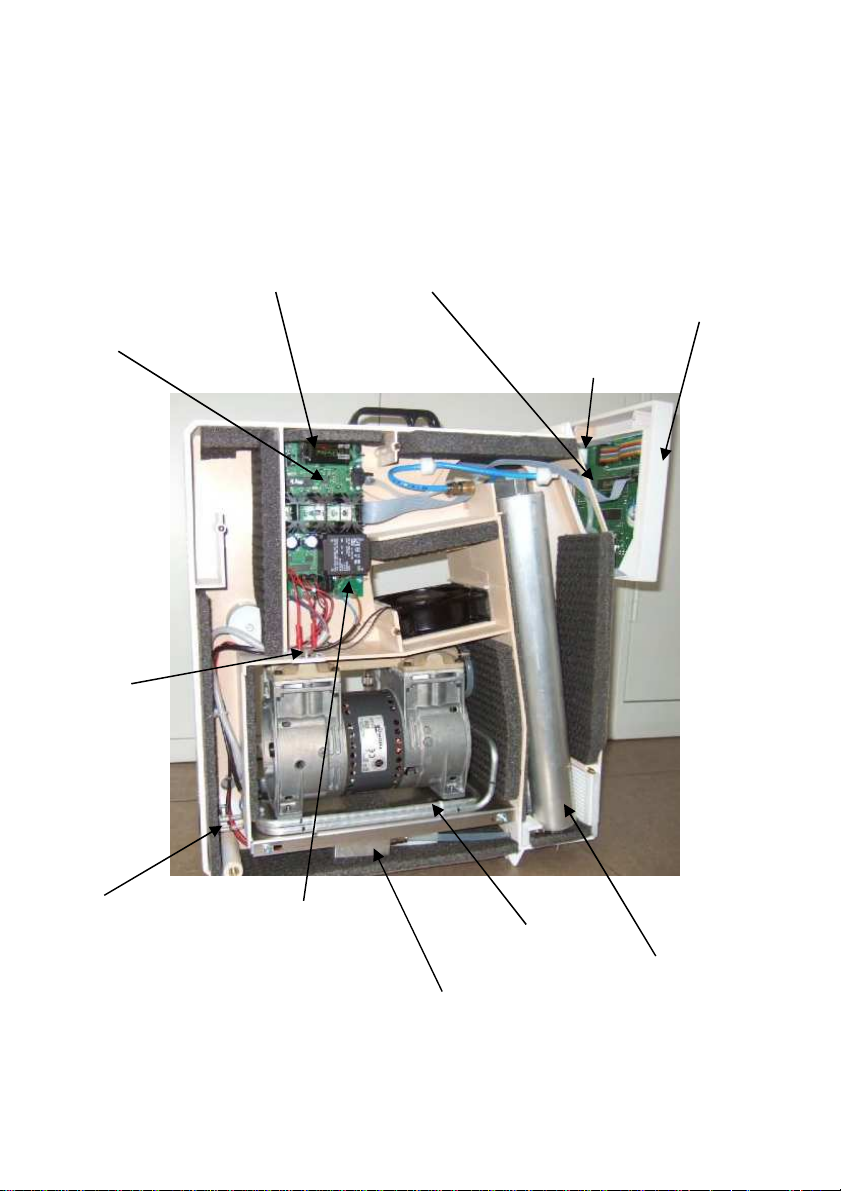
11. Sauerstoffkonzentrator Précise 6000
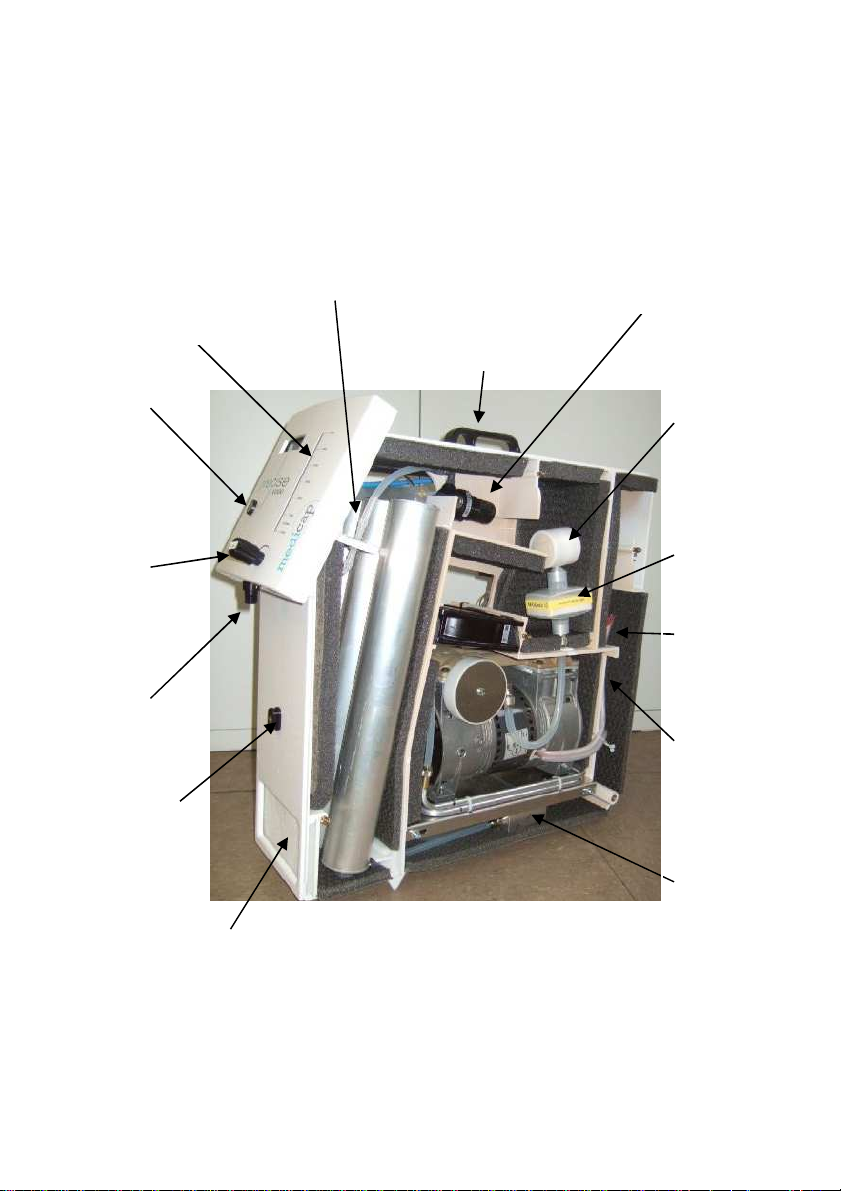
11.1 Innenansicht linke Seite
Netzplatine mit
Mikrokontroller
Temp.
Sensor
006.265
Netzanschlußdose
mit Netzsicherung
T 2,5 A 250V
Art. Nr. 006.199
Netzausfall-
batterie 9V
Art. Nr. 6030
Feinsicherung
T 0.16 A 250V
Art. Nr. 006.317
Hauptventil
Abbildung kann vom Original abweichen.
Frontplatine mit
Mikrokontroller
Art. Nr. 006.314
O2 Sensor
Art. Nr. 006.315
Kühle
Molekularsiebe, Satz
P6000 m Art. 006.200
P6000 ms Art. 006.229
Netztaster
Art. Nr.
006.316
Lüftungsgitter
Kühlluft
Rev. D 2018-11 17
Page 19
mit Bargraph
Kabel
Art. Nr. 006.210
006.185
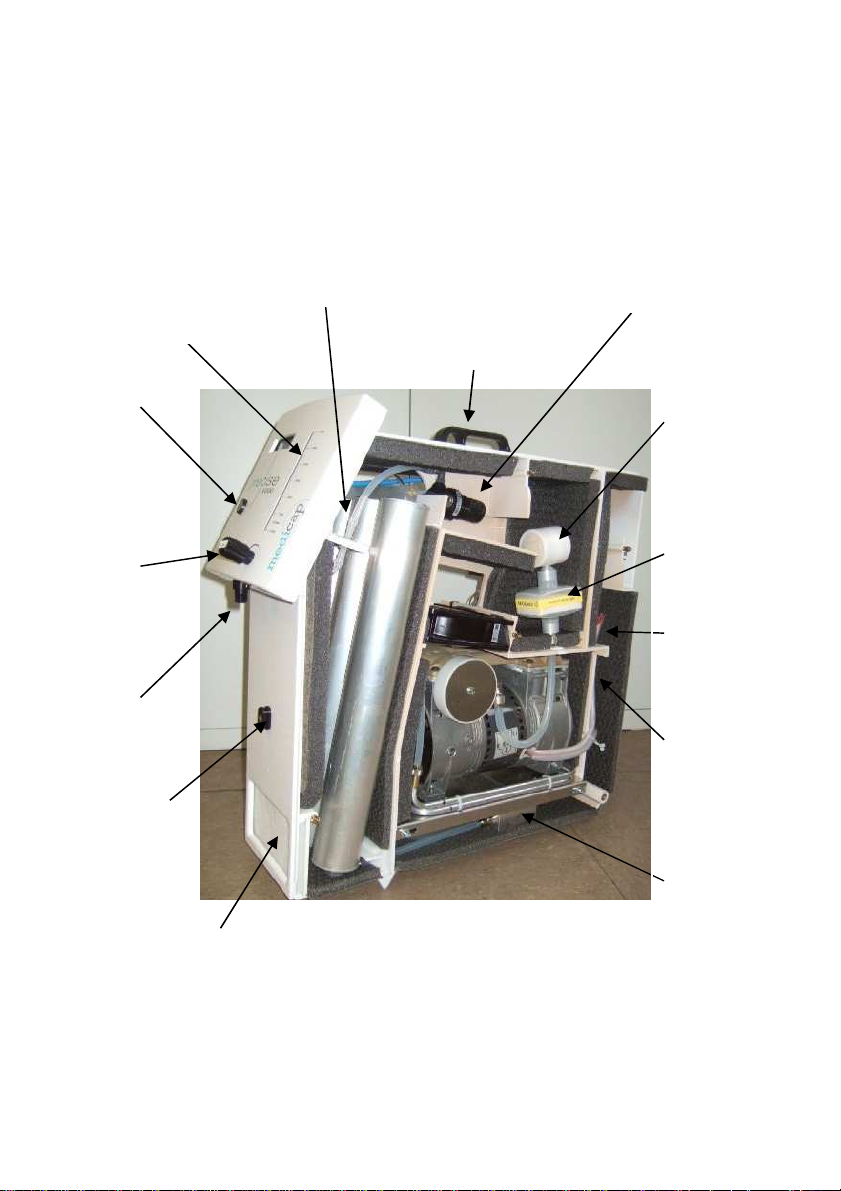
11.2 Innenansicht rechte Seite
Flowanzeige
Netztaster
Art. Nr.
006.316
kompl. m.
Flowregler
komplett
Art. Nr.
006.240
O2 Ausgang
9/16“
Art. Nr.
006.242
Aufhängung
für
Befeuchterhalterung
Grobstaubfilter
Art. Nr. 006.183
Bakterienfilter
Membrane
Art. Nr. 006.194
Abbildung kann vom Original abweichen.
Druckminderer
Tragegriff
Feinfilter
1 Paar
Art. Nr.
006.184
Mikrofilter
Art. Nr.
Lüfter
Art. Nr.
006.227
Motorkondensator
006.268
Hauptventil
Art. Nr.
006.192
Rev. D 2018-11 18
Page 20
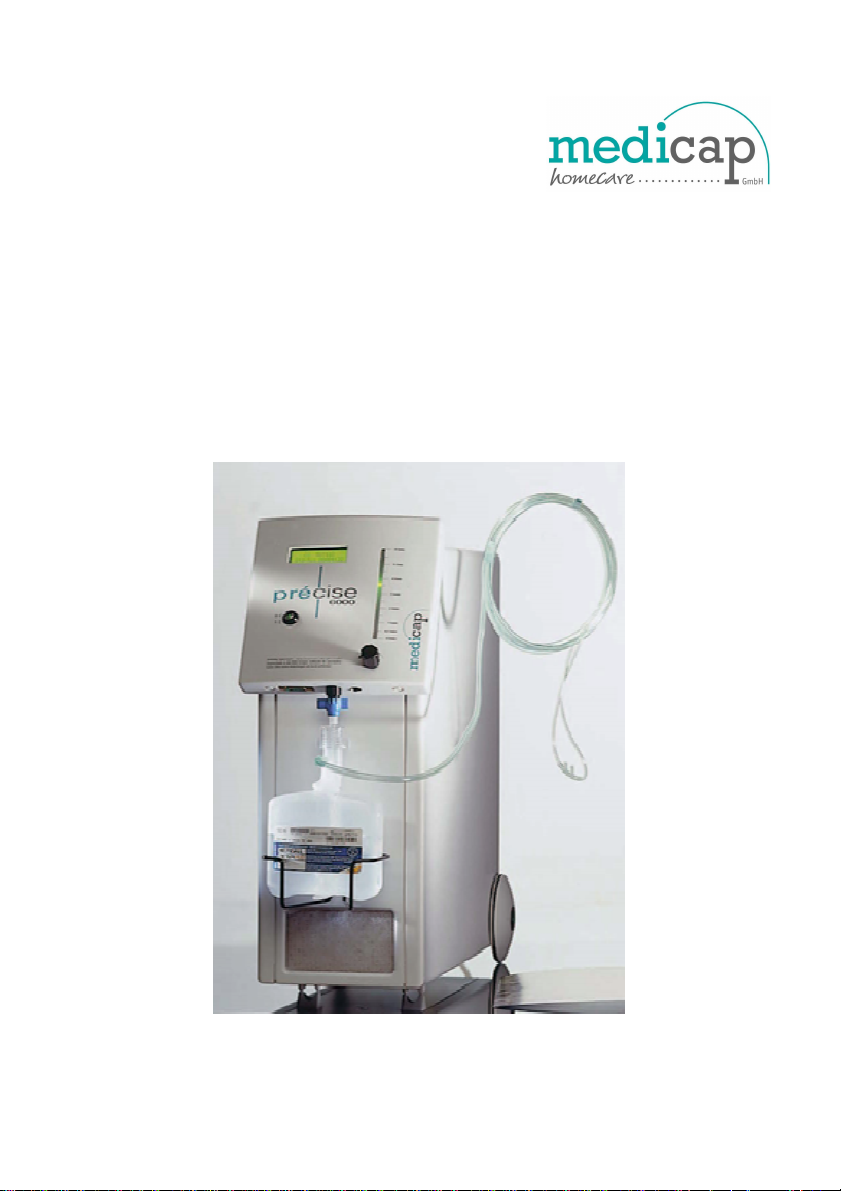
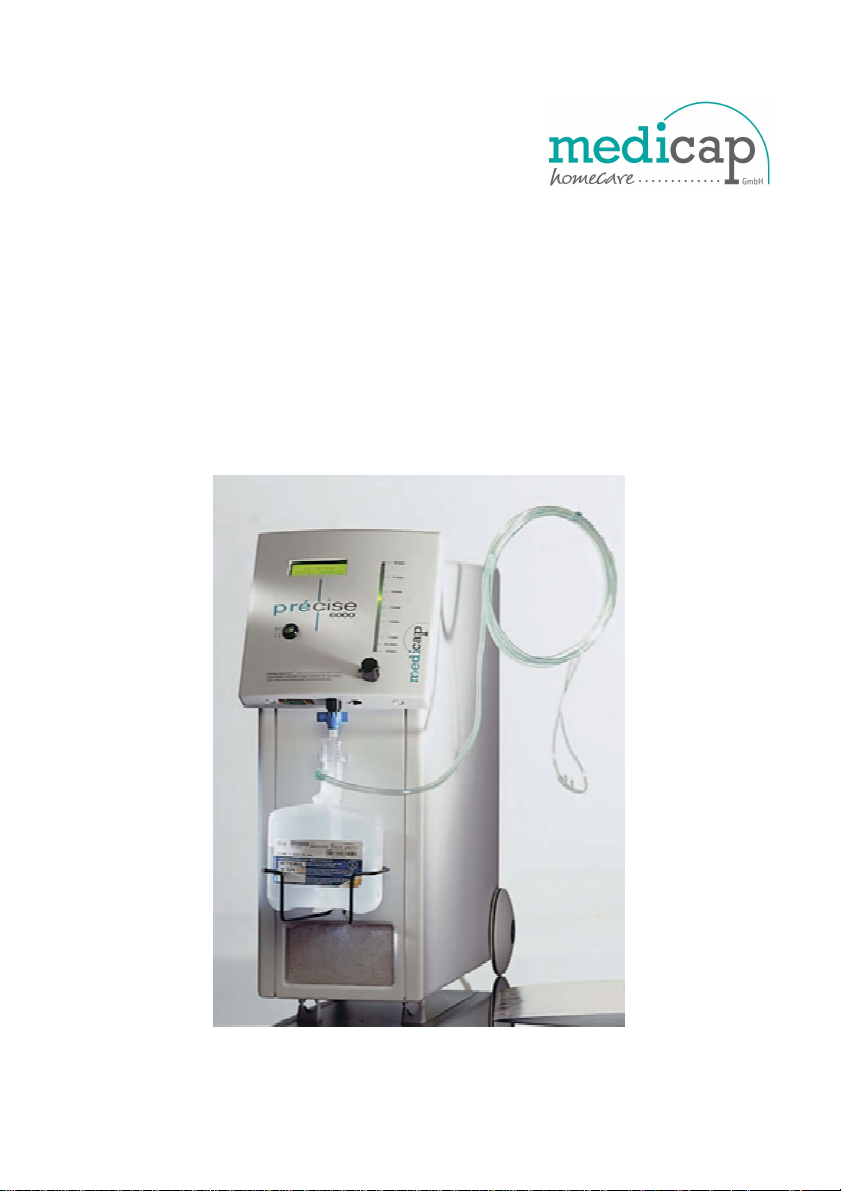
(GB) Operation Manual
Précise 6000
Oxygen Concentrator
Picture may differ from original product.
Rev. D 2018-11 19
Page 21

Table of Contents
1. Introduction .................................................................................................................... 21
1.1. Use .......................................................................................................................... 21
1.2. Functional Characteristics ....................................................................................... 22
1.3. Important Use and Safety Instructions ................................................................... 22
2. Operation ........................................................................................................................ 24
2.1. Preparation ............................................................................................................. 24
2.2. Switching On ........................................................................................................... 24
2.3. Operate ................................................................................................................... 24
2.4. Discontinuing Operation ......................................................................................... 24
2.5. Oxygen Concentration Monitoring (OCSI) Option................................................... 24
2.6. Data Interface Option D .......................................................................................... 25
2.7. Ionization Option I .................................................................................................. 25
3. Diagnosis ......................................................................................................................... 26
4. Troubleshooting Guide ................................................................................................... 27
5. Cleaning .......................................................................................................................... 28
6. Maintenance Intervals .................................................................................................... 28
7. Specifications .................................................................................................................. 29
8. Equipment supplied ........................................................................................................ 30
9. Guarantee ....................................................................................................................... 31
10. EMC regulations ............................................................................................................ 31
11. Oxygen concentrator Précise 6000 .............................................................................. 35
11.1 Interior left side ..................................................................................................... 35
11.2 Interior right side ................................................................................................... 36
Annex: Declaration of conformity
Rev. D 2018-11 20
Page 22

1. Introduction
1.1. Use
Précise 6000 - for the oxygen enrichment of the air for domestic and clinical oxygen
inhalation therapies. Only for patients whose life functions are not directly and
permanently dependent on a higher oxygen concentration in the air. The oxygen
inhalation therapy, however, should only be carried out after thorough examination by a
physician. Oxygen for medical purposes is a highly effective drug. Wrong application
might cause side effects. The instructions of the physician are to be strictly adhered to.
Every physical disorder has to be reported to the physician in attendance immediately.
Contraindications
An oxygen therapy can only be carried out taking special care in the following cases:
• patients of high age – obesity
• simultaneous ACTH- or glucocorticoid-treatment
• patients with high carbon dioxid concentration in arterial (oxygenrich) blood
• poisoning with substances that reduce breathing.
• breathing control disorders in the central nervous system
• fever
The application of a pure oxygen treatment should not be carried out in case of acute
trouble in breathing (respiratory insufficiency on the base of a chronic obstructive
emphysema bronchitis) because of the impending decrease in ventilation of the lungs.
Side effects
Taking into consideration the contraindications, side effects under normal oxygen
pressure are not to be expected. Patients suffering from insufficient lung ventilation
might encounter a rapid increase of the carbon dioxid value inhaling oxygen.
• No clinically significant symptoms have been diagnosed during treatments with
50% oxygen for up to seven days. 100% oxygen given for 24 hours, however,
leads to cellular and functional lesions of the lungs (cell changes of the
respiratory epithelium, secretion inspissation, restriction of ciliar movement,
atelectasis as well as changes of the minute volume, carbon dioxide dretension
and pulmonial vasodilation)
• This means that generally during treatments carried out over longer periods of
time at 1 at-mosperic excess pressure or at even higher oxygen pressures in the
air, symptoms of poisoning (hypoventilation, acidosis up to development of an
edema of the lungs) are to be expected.
• It is to be observed that decreasing the partial pressure too rapidly can lead to a
critically insufficient oxygen supply (hypoxemia).
Rev. D 2018-11 21
Page 23

• Newborn children receiving highly concentrated (more than 40%) oxygen
treatments for longer periods of time can suffer from lesions to the eyelenses
that can cause blindness (retrolenticular fibroplasia).
• Apart from that there is danger that bleedings (pulmonial hemorrhage), cellular
and/or functional disorders of the lungs (focal atelectasis as well as hyalin
membrane lesions with diffuse pulmonary fibrosis) occur.
• In order to prevent such a collapse of the lung functions (bronchopulmonial
dysplasia), it is imperative to check the oxygen pressure in the arterial (oxygenrich) blood repeatedly.
1.2. Functional Characteristics
The basic principle of oxygen extraction with the help of oxygen concentrators is the
pressure change method following 3 steps:
• 1st Step: Surrounding air is sucked in by a compressor and is compressed in a
container with a molecular sieve
• 2nd Step: nitrogen molecules are bound at the surface of the molecular sieve
and are separated from the oxygen molecules in this way. The oxygen
molecules pass the molecular sieve.
• 3rd Step: The molecular sieve airs by expelling the nitrogen contained with the
help of a part of the extracted oxygen.
By this 3-column method alternately (cyclically) a column is always filled, in the next one
the nitrogen is separated from oxygen and in the third one the molecular sieve is aired. By
this method a continuous oxygen flow is provided without an additional oxygen source.
In this way an extremely rapid development of oxygen concentration is attained, right
after switching on the device.
1.3. Important Use and Safety Instructions
Precondition for the correct use of the oxygen concentrator Précise 6000 is detailed
knowlegde and adherance of instructions given in this manual. The apparatus must only
be opened by authorized service technicians.
• The Précise 6000 and all equipment sup-plied that have contact with oxygen
are to be kept free of grease and oil. Use only original parts.
• Do not put the Précise 6000 in wet and humid places.
Rev. D 2018-11 22
Page 24

• Only qualified service personnel may check the apparatus in case of damages to
the plug or mains cable, malfunctioning, general damages from falling down
onto the ground or into water.
• In case the apparatus cannot be switched off, pull out the plug and call a service
technician.
• Smoking, open fire and light are not allowed when using the device.
• The user is not put at risk by external electromagnetical interferances.
Portable and mobile RF communication equipment can affect medical
electrical equipment. This may cause a malfunction of the device.
For this reason, radiation sources (devices emitting electromagnetic waves) in the
vicinity of medical electrical equipment have to maintain a given minimum distance. See
following table.
Radiation sources
Minimum distance from medical
electrical equipment, including all
connecting cables
Mobile phone
3.3 m
(cell phone)
DECT phone
1.2 m
(cordless phone)
Bluetooth devices
0.7 m
(laptops, cell phone)
Radio remote controls 1.2 m
WLAN devices
2.3 m
(e.g.: laptops, repeater,
Access Point, Print
Server)
The power cord must not exceed a maximum length of 4m.
The use of accessories and cables other than those listed in the instructions for use may
lead to increased interference emissions or reduced immunity to interference of the
device.
Rev. D 2018-11 23
Page 25

2. Operation
2.1. Preparation
Unfold the carrier handle for convenient transportation. The Précise 6000 should be set
up in a well aired, dry, cool and dust-free room. The Précise 6000 should not be placed
near radiators, fan heaters etc.. The air supply must not be obstructed because cooling air
is needed for the compressor. Connect the Précise 6000 to the mains cable supplied.
Insert plug into mains.
ATTENTION!
If you use Item No. 006.357 FireSafe™ Cannula or Item No. 006.359 FireSafe™ Nozzle
please note Installation Instructions - FIRESAFE™.
2.2. Switching On
If the apparatus was stored at room temperatures below 10°C the device needs to adapt
to the room temperature, otherwise malfunctions might turn up. Switch the ON/OFF
button for automatic check of all functions. Any malfunctions will be indicated in the
display window together with the service telephone number.
2.3. Operate
After switching on the device the flow value administered by your attending physician can
be set with the help of the control button of the flow meter (oxygen output in liter/min.).
The middle of the bowl of the flowmeter indicates the set value. Working hours,
operating state and at Option I the treatment hours (ionisation is switched on) are
indicated in the display. When operated with humidifyer switch off the hose connection,
set the humidifyer bottle into the rack and connect the bottle. Then connect the hose to
the humidifyer.
2.4. Discontinuing Operation
Press the ON/OFF button. The display fades out. If the device is not used again during the
same day disconnect the humidifyer bottle. Do not keep the water (risk of germ
development). If not in use over longer periods of time pull the plug from mains.
2.5. Oxygen Concentration Monitoring (OCSI) Option
A permanent monitoring of the oxygen concentration in the product gas works by using a
wear resisting oxygen sensor on an ultrasound basis. Set values falling below limits are
Rev. D 2018-11 24
Page 26

indicated in the display (see also 4. Troubleshooting Guide). The sensor does not need
new calibration.
2.6. Data Interface Option D
By means of the cable supplied the concentrator can be connected to a computer with
SB-interface. This makes the concentrator’s service easier. Apart form that the interface
serves as a connection to a low consumption oxygen monitor.
2.7. Ionization Option I
• To use the ionization option I unscrew the hose nozzle and connect the
ionization supplement in its place. Connect the plug to the relevant bush.
• Put the oxygen mask on the ionziation head. We recommend to apply an anti-
static spray to the mask every time before it is used. Additionally an antibacteria filter can be inserted.
• Do not use a humidifyer during ionization.
• The ionization can be activated by pressing I/O on the remote control supplied.
The treatment intervals are set with the buttons marked and in 5 minutes
steps between 5 and 95 minutes.
• The treatment begins by pressing Start. The remaining treatment time is
indicated in the display. The treatment can be interrupted by pressing Pause
and continued by pressing Start.
• An acoustic signal indicates the end of the treatment and End of Treatment
appears in the display.
• The detachable ionization head should be cleaned once a week or when used by
a different patient (see also 5. Cleaning).
Rev. D 2018-11 25
Page 27

3. Diagnosis
An extensive autodiagnosis system has been implemented into the oxygen concentrator
Précise 6000. By pressing the button next to the oxygen outlet on the right the diagnosis
is called up. The displays can be called up by pressing the button.
Servicebutton
press x times
1 Language ENGLISH Select language
2
3 Serial number
4 O2 Sensor value
5 Flow Sensor value Flow value l/min
6 Power switch inverts Factory adjusted
7
8
9 Battery monitoring Factory adjusted
10 O2 < 82% Ionization disconnection Factory adjusted
11 O2 Concentration display Factory adjusted
12 Flow to small (Monitoring) Factory adjusted
13 Flow to high (Monitoring) Factory adjusted
14 Equipment version Factory adjusted
15 Service telephon number
16 Interval time Factory adjusted
17 Date Adjusted
18 Time Adjusted
19 Working hours counter 1 = Patient 2 = Total
20
21
22
Softwareversion
<<V1.56 –M->>
Concentration monitoring:
< 80% O2
Concentration monitoring:
< 72% O2
min. of pressure values of all 3
columns
max. of pressure values of all 3
columns
Error memory bank of last 10
Alarms
Designation Information
Software version & equipment
e.g. Précise 6000M
Individual serial number on the
equipment
Temperature and
concentration value
Factory adjusted
Factory adjusted
Servicetelefonnummer des
Fachhandelspartners
Defect of main valve, columns,
sensor, compressor etc.
Defect of main valve, columns,
sensor, compressor etc.
Indicates the error with date
and time
Rev. D 2018-11 26
Page 28
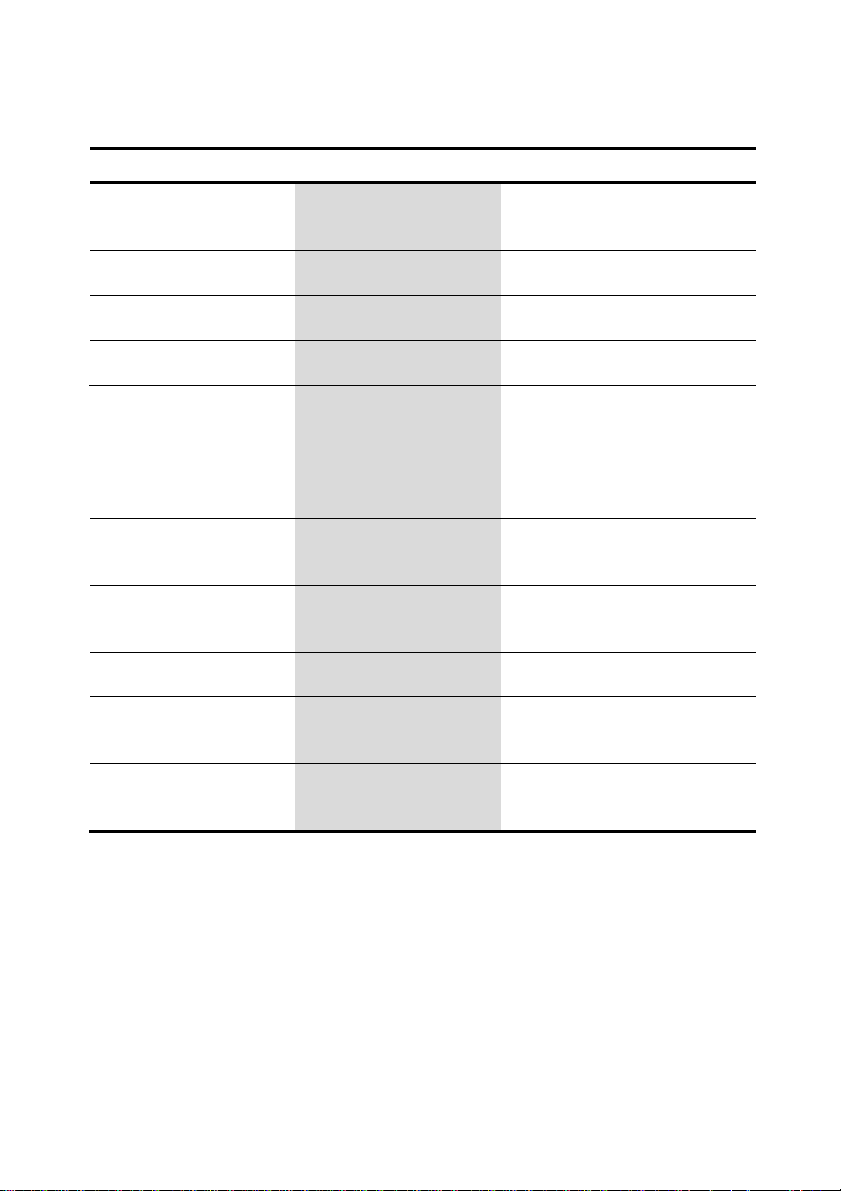
4. Troubleshooting Guide
Symptom Cause Remedy
Device does not run
Display: MAINS Interval
Sound
Device is running
Display: 02 82%
Compressor off Display:
O2 72%
Device is running
Display: 02 Flow too low
Compressor off Display:
Temperature Interval
sound
Compressor off Display:
Pressure too low Interval
sound
Compressor off Display:
Pressure too high
Interval sound
Compressor off Display:
Column-valve
Device is running
Display: Check Head
Interval sound
Device is running
Display: Ions not OK
Interval sound
No line voltage Defective
fuse
Flow too high Set to correct flow
Oxygen concentration
less 72%
Flow regulator turned
off Oxygen hose break
Device became too hot
due to wrong placing
Device became too hot
because coarse dust
filter is blocked Device
defect
Coarse dust filter
blocked Intake filter
blocked Device defect
Device defect Call service
Hose connection valvecolumn not tight
Ionization head not
screwed on correctly
Ionization head is wet
Device defect
Check if mains cable is
connected correctly In case
check main fuse Call service
Turn device on and off call
service
Set to correct flow Check hose
Let device cool off for 30 min.,
place correctly, turn on again
Clean filter fleece and turn on
again Call service
Clean filter fleece and turn on
again Call service Call service
Call service
Screw on ionization head
correctly
Dry ionization head Call service
Rev. D 2018-11 27
Page 29

5. Cleaning
Turn off the device and pull the plug from mains before cleaning. The external box may be
cleaned with customary cleaning agents. Do not, however, use any caustic, scratching or
acidic cleaning agents. Do not bring water into the device’s interior.
Please pay attention to the instructions of the disinfection manufacturer.
For disinfection the following agents can be used:
KORSOLEX FF – Liquid (Bode Chemie, Hamburg)
Biguanid Fläche (Dr. Schumacher, Melsungen)
Make sure that no Liquid come inside the Précise 6000!
• Daily
Rinse the nasal canula with clear, warm water. When an autoclavable effervescent
humidifyer is used it should be cleaned, respectively autoclaved, according to the
instructions given by the producer of that autoclave effervescent humidifyer. Nonobservance of the instructions can lead to a contamination of the effervescent
humidifyer.
• Weekly
Rinse the nasal canula with clear, warm water (see daily instruction). Afterward to decoct
10 till 15 minutes in water or with dishwasher on high level (no fluid or dish liquid).
• Option I
Clean Ionization Head Unscrew ionization head and rinse with clear, warm water. Boil out
once a week for 10 to 15 mi-nutes clean in dishwasher at maximum temperature. Leave
to dry afterwards. The mask and the ionization head can be treated with the desinfection
spray offered. Use only dry ionization heads.
6. Maintenance Intervals
Inspection and
maintenance
* Coarse dust filter
* Fine filter
* Microfilter Exchange every six month or after max. 2000 working
Patient bacteria filter Exchange during inspection and maintenance by the
Rev. D 2018-11 28
Once a year or after max. 2800 working hours by the
service technician responsible
Clean filter fleece once a week. If blocked, exchange by
the service technician responsible
Exchange every six month or after max. 2000 working
hours by the service technician responsible
hours by the service technician responsible
Page 30

service technician responsible
Inhalation equipment (e.g.
nasal canula) and oxygen
extension hose
* Note !
Exchange according to instructions of the attending
physician
All maintenance intervals are guidelines. In different
cases these can be shorter due to changing conditions
regarding temperature, humidity, dust etc. The filter
service life is 20% less in devices with 6 l capacity
7. Specifications
Modell Précise 6000 M Modell Précise 6000 MS
Ambient temperature
running:
Dimensions: 55 x 21,5 x 55 cm 55 x 21,5 x 55 cm
Weight: ca. 21 kg ca. 21 kg
Line voltage:
Nominal current: 2,0 A 2,0 A
10 bis 40 °C 10 bis 40 °C
230 V+/-10%
50 Hz
230 V+/-10%
50 Hz
Flow: 0,1 - 5 l/min 0,1 - 6 L/min
Oxygen concentration
at 20°C, 1013 hPa
50% rel. humidity :
Sound pressure level: ca. 38 dB(A) ca. 39 dB(A)
Output pressure: 300-350 mbar 300-350 mbar
Oxygen measurement:
Option I
Ionization capacity:
Rev. D 2018-11 29
0,1-3 l/min
95 +/- 3 Vol.% O2
-4 l/min
90 +/- 3 Vol.% O2
-5 l/min
82 +/- 3 Vol.% O2
21-98 Vol.% O2
+/- Vol.-% O2
approx. 5 mio. ions//cm3/s
0,1-4 l/min
95 +/- 3 Vol.%O2
-5 l/min
88 +/- 3 Vol.%O2
-6 l/min
80 +/- 3 Vol.%O2
Page 31

8. Equipment supplied
Description order no.
Précise 6000 M consists of:
main unit (oxygencon. monitoring) with mains cable, spare coarse dust
filter
Précise 6000 MI consists of:
main unit see Précise 6000 M, ionization adapter, remote control, tripod
Précise 6000 M D consists of:
main unit see Précise 6000 M, interface
Précise 6000 M S consists of:
main unit (higher output, oxygen concentration, monitoring), with
mains cable, spare coarse filter
Précise 6000 M S I consists of:
main unit see Précise 6000 MS Ionization adapter, remote control,
tripod
Précise 6000 M S D consists of:
main unit Précise 6000 MS, interface
Précise 6000 M S I D consists of:
main unit see Précise 6000 MS, Ionization adaptor, remote control,
tripod, interface
Recommended Equipment and Spare Parts:
• Nasal canula
• Oxygen mask without hose
• Oxygen mask with hose
• Steril water 500ml Kendall
• Fixing device for sterile water 500 ml
• Oxygen hose 2 m
• Hose connection straight
• Angle adaptor with 30 cm silicone hose
• Coarse dust filter
• Hose nozzle with coupling ring
• Power cable
• Anti-static spray
• Battery filter
• Desinfection spray
• FireSafe™ Cannula
• FireSafe™ Nozzle
• Tripod
• Interface cable Concentrator Computer
• Software
• Interface Concentrator low consumption monitor
Rev. D 2018-11 30
006.100
006.110
006.101
007.100
007.110
007.101
007.111
Page 32

Regulations and declaration of manufacturer
- Electromagnetic compatibility, interference
Measurement of
The
Précise 6000
uses HF energy solely for its
HF-
emissions acc.
Emission of
Emission of voltage
9. Guarantee
The guarantee is granted for defects that are due to improper materials or manufacturing
faults. Defects covered by the guarantee will be cleared in accordance with our terms and
conditions of guarantee service. medicap homecare does not grant a guarantee if the user
endangers the functioning of the device by non-observance of this instruction manual,
using the apparatus in a not agreed manner or by third party interference.
Any such cases are the sole liability of the user.
Important
The guarantee is valid only upon presentation of the original invoice/cash receipt.
Technical details and illustrations printed in this manual are subject to change. No copy,
translation and reproduction, also in parts, may be made without written permission.
10. EMC regulations
emission
The Précise 6000 is intended for use in an environment as described below. The operator of the
Précise 6000 must make sure that the unit is operated in such an environment.
interference
emission
HF- emissions acc.
to
CISPR 11/EN55011
Compatibility Electromagnetic environment - regulations
Group1
own function. The HF emission is therefore very
low and any interference with adjacent
electronic equipment is very unlikely
to
CISPR 11/EN 55011
harmonics acc. to
IEC/EN 61000-3-2
fluctuations /
flickers acc. to
IEC/EN 61000-3-3
Class B
Class A
compatible
Rev. D 2018-11 31
The Précise 6000 is intended for use in all
facilities, including living quarters and other
environments that
are connected to the public supply network,
which also supplies buildings used for the
purpose of living.
Page 33

Regulations and declaration of manufacturer
- Electromagnetic compatibility, interference
The
Précise 6000
is intended for use in an environment as described below. The operator of the
IEC/EN 60601
-
Compatibility
Electromagnetic environment
-
Discharge of static
+/-
6kV contact
+/-
6kV contact
Floors should be made of wood or
fast transient
+/-
2kV for mains
+/-
2kV for mains
The quality of the supply voltage
Surge voltage acc.
+/-1kV Push
- pull
+/-1kV Push
- pull
The quality of the supply voltage
Voltage dips,
>5% Ut
>5% Ut
The quality of the supply voltage
Magnetic field at a
3 A/m 3 A/m Magnetic fields at mains frequency
emission
Précise 6000 must make sure that the unit is operated in such an environment.
Immunity test
test level
level
regulations
electricity (ESD)
acc. to
IEC/EN 61000-4-2
electric
interference /
bursts acc. to
IEC 61000-4-4
to
IEC/EN 61000-4-5
shortterm
interruptions and
fluctuations in
supply voltage acc.
to IEC 6100-4-11
supply frequency
(50/60Hz) acc. to
IEC 61000-4-8
discharge
+/- 8kV
Air discharge
leads
+/- 1kV for input /
output leads
+/-2kV asymmetrical voltage
(>95% dip in Ut) for
½ period
40% Ut
(60% dip in Ut) for
5 period
70% Ut
(30% dip in Ut) for
25 period
>5% Ut
(>95% dip in Ut) for
5 s
discharge
+/- 8kV Air
discharge
leads
+/- 1kV for input /
output leads
+/-2kV asymmetrical voltage
(>95% dip in Ut)
for ½ period
40% Ut
(60% dip in Ut) for
5 period
70% Ut
(30% dip in Ut) for
25 period
>5% Ut
(>95% dip in Ut)
for 5 s
concrete or should be covered with
ceramic the floor is covered with
synthetic materials, the relative
humidity must be at least 30%.
should match the typical office or
hospital environment.
should match the typical office or
hospital environment.
should match the typical office or
hospital environment.
must comply with the typical vales
found in office or hospital
environments.
Note: Ut is the a.c. supply voltage before application of the test levels.
Rev. D 2018-11 32
Page 34
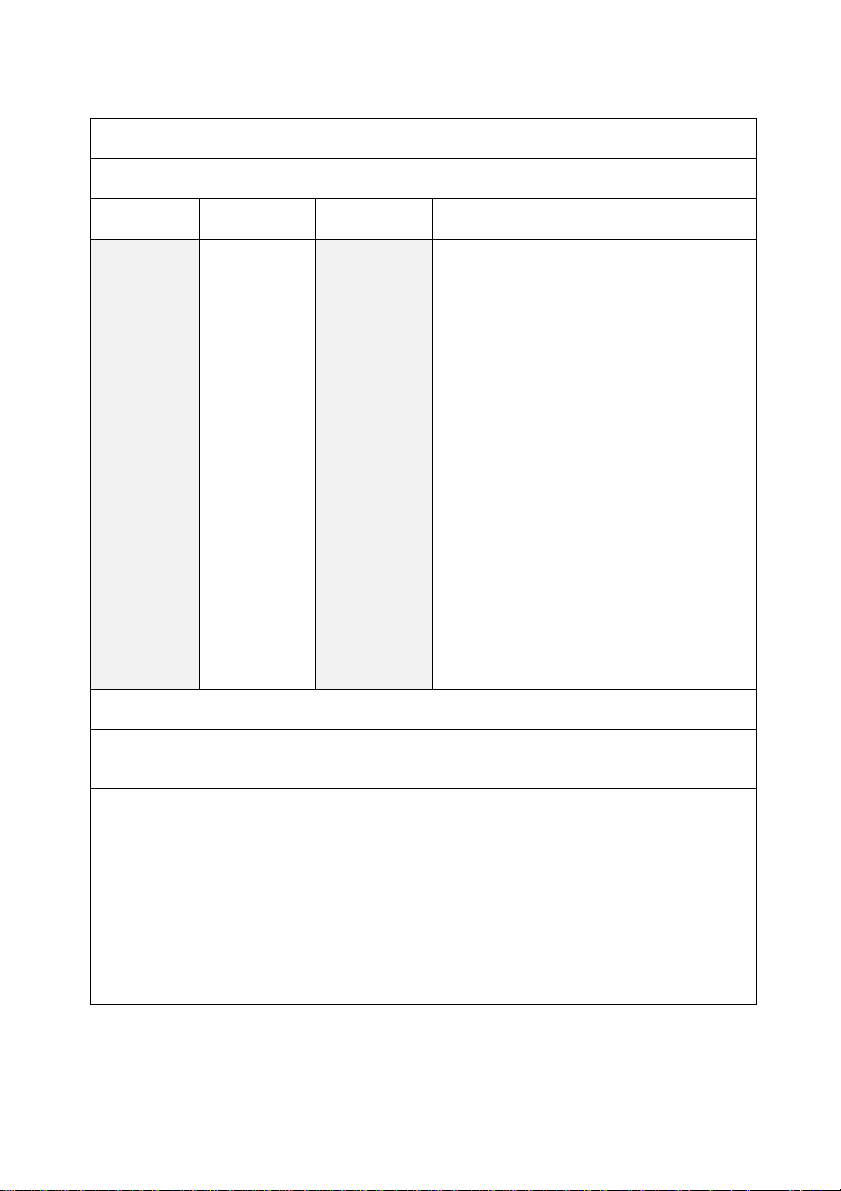
Regulations and declaration of manufact
urer-
Electromagnetic compatibility,
The
Précise 6000
is intended for use in an environment as described below. The operator of
IEC/E
N 60601
-
Compatibility
Electromagnetic environment
-
Portable and mobile radio equipment should
Note 1:
Note
2:
interference emission
the Précise 6000 must make sure that the unit is operated in such an environement.
Immunity test
Guided
HFinterference
according to
IEC 61000-4-6
Radiated
HFinterference
in
conformance
with
IEC 61000-4-3
test level
3 V rms
150 kHz
to 80 MHz
3 V/m
80 MHz to
2,5 GHz
level
3 V rms
3 V/m
regulations
not be used closer to the Précise 6000 and the
leads, than the safety distance calculated by
using the equation applicable for the
transmission frequency.
Recommended safety distance:
d= 1,2 * root from P
d= 1,2 * root from P; for 80 MHz to 800 MHz
d= 2,3 * root from P; for 800 MHz to 2,5 GHz
with P being the rated power of the transmitter
in Watt (W) acc. to the specifications of the
transmitter manufacturer and d being the
recommended safety distance in meters (m)
According to an in-situ examination² the field
intensity of stationary radio transmitters is with
all frquencies lower than the compatibility
level³.
For 80 MHz and 800 MHz the higher is valid.
These regulations may not apply in all situations. The propagation of electromagnetic waves is
influenced by the absorption and reflection by building, objects and persons.
² The field intensity of stationary transmitters, such as base stations of radiophones and land mobile
services, amateur stations, Am- and FM-radio and television stations con theoretically not be
exactly predetermined. In order to determine the electromagnetic environment and the effect of
stationary HF transmitter, it is recommend to examine the corresponding location. If the detected
field intensity at the location of the Précise 6000 exceeds the compatibility level specified above,
the Précise 6000 must be examined at a different location, with respect to ist normal operation. If
unusual performance characteristics are detected, it may be necessary to apply additional
measures, such as reorientation or relocation of the Précise 6000.
³ Beyond the frequency range from 150 kHz to 80 MHz the field intensity is less than 3 V/m.
Rev. D 2018-11 33
Page 35

Recommended safety distance
s between portable and mobile HF communication equipment
The
Précise 6000
is intended for operation in an electromagnetic environment with controlled HF
Safety dis
tance acc. to transmitting frequency m
Rated power of
150 kHz to 80 MHz
80 MHz to 800 MHz
800 MHz to 2,5 GHz
0,01 0,12 0,12 0,23
0,1 0,38 0,38 0,73
1 1,2 1,2 2,3
10 3,8 3,8 7,3
100 12 12 23
Note 1
Note2
and the Précise 6000
interferences. The customer or user of the Précise 6000 can help to avoid electromagnetic
interferences by maintaining minimum distances between the portable and mobile HF
communication equipment (transmitter) and the Précise 6000, according to the maximum output
power of the communication equipment, as recommended below.
transmitter W
For transmitters for which the rated power is not contained in the tale above, the distance can be
calculated using the equation for the corresponding column, whereby P represents the rated power
of the transmitter in Watt (W), specified by the transmitter manufacturer.
For calculation of the recommended safety distance for transmitters in the frequency range from 80
MHz to 2,5 GHz an additional of 10/3 was used, in order to reduce the likelihood that a mobile /
portable communication unit, that has unintentionally been brought near the patient, will trigger an
interference.
These regulations may not apply in all situations, The propagation of electromagnetic waves is
influenced by the absorption and reflection by building, objects and persons.
d= 1,2 * root from P
d= 1,2 * root from P
d= 2,3 * root from P
Rev. D 2018-11 34
Page 36
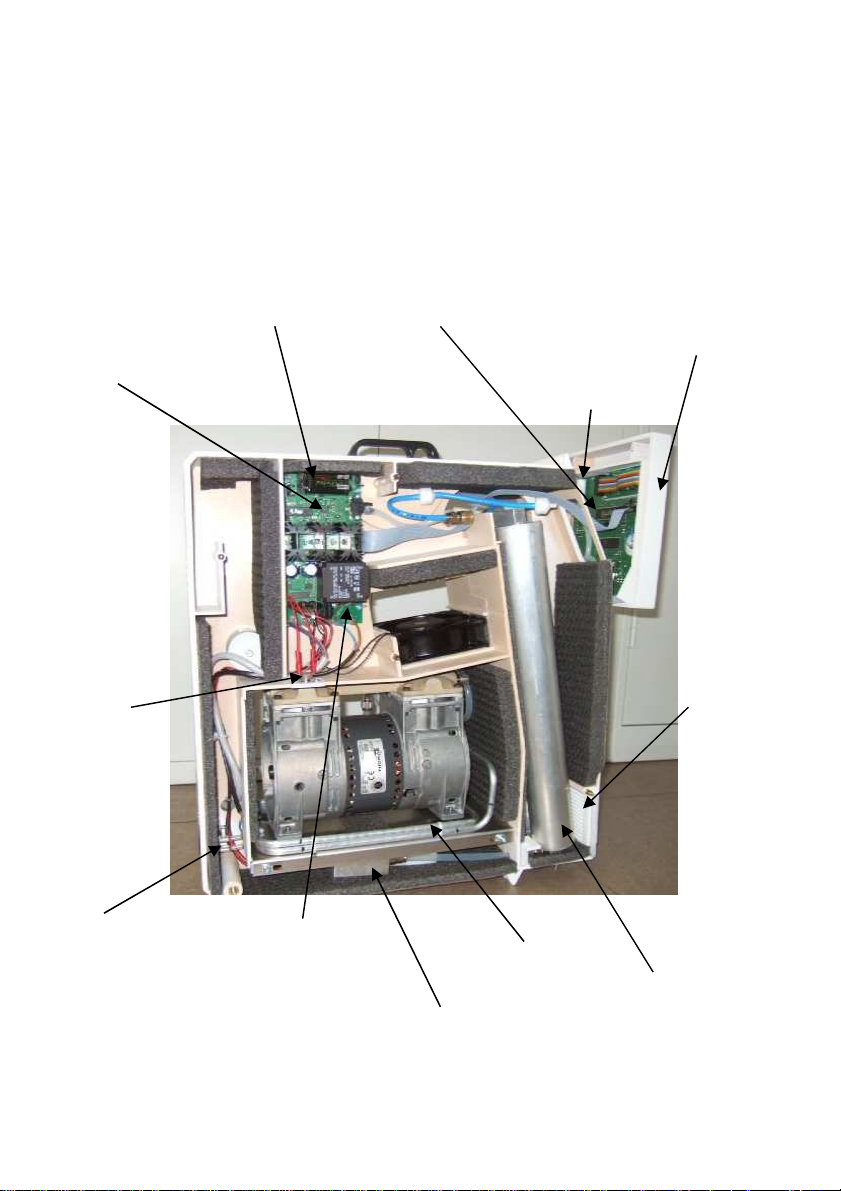
Art.-Nr. 006.192
Art. Nr. 006.313
11. Oxygen concentrator Précise 6000
11.1 Interior left side
Main PC Board
Temp.
sensor
006.265
Mains connection
socket
Art. Nr. 006.199
Rev. D 2018-11 35
Batterie 9V
Art. Nr.
6030
Fuse
Art. Nr.
006.317
Front Board
Art. Nr. 006.314
Main valve
Mains switch
Art. Nr.
006.316
Oxygen sensor
Art. Nr. 006.315
Air grillecooling
air
cooler
Molecular sieves set
P6000 m Art. Nr.
006.200
Page 37
wiith b
argraph
Art. Nr. 006.210
Picture may differ from original product.
11.2 Interior right side
Flow display
Power switch
Art. Nr.
006.316
Flow control
Art. Nr.
006.240
O2 outlet
9/16“
Art. Nr.
006.242
Knob for
humidifier
holder
Dust filter
Art. Nr. 006.183
Bacterial filter
Art. Nr. 006.194
Picture may differ from original product.
Pressure reducer
Carrier handle
Fine filter
1 pair
Art. Nr.
006.184
Microbe
filter
Art. Nr.
006.185
cooler
Art. Nr.
006.227
condenser
Art. Nr.
006.268
Main
valve
Art. Nr.
006.192
Rev. D 2018-11 36
Page 38
(F) Description de l’appareil
Précise 6000
Concentrateur d’oxygène
L'image peut différer de l'original
Rev. D 2018-11 37
Page 39

Table des matières
1. Introduction .................................................................................................................... 39
1.1. Application .............................................................................................................. 39
1.2. Description fonctionnelle ........................................................................................ 40
1.3. Principales instructions de service et consignes de sécurité .................................. 40
2. Commande ..................................................................................................................... 41
2.1. Préparation au service ............................................................................................ 41
2.2. Mise en fonctionnement ........................................................................................ 42
2.3. Mise en service ....................................................................................................... 42
2.4. Arrêt de l‘appareil ................................................................................................... 42
2.5. Surveillance de la concentrati-on en oxygène (OCSI) option .................................. 42
2.6 Interface de données option D ................................................................................ 43
2.7. Ionisation option I ................................................................................................... 43
3. Diagnostic ....................................................................................................................... 43
4. Perturbations et élimination des perturbations ............................................................. 45
5. Nettoyage ....................................................................................................................... 46
6. Intervalles de maintenance ............................................................................................ 47
7. Caractéristiques techniques ........................................................................................... 47
8. Volume de commande .................................................................................................... 48
9. Garantie .......................................................................................................................... 49
10. EMC regulations ............................................................................................................ 50
11. Concentrateur d’oxygène Précise 6000 ........................................................................ 54
11.1 Vue intérieure page gauche ................................................................................... 54
11.2 Vue intérieure page droite ..................................................................................... 55
Appendice: Déclaration de conformité
Rev. D 2018-11 38
Page 40

1. Introduction
1.1. Application
Précise 6000 permet l‘enrichissement de l‘oxygène de l‘air inhalé lors d‘oxygénothérapies
– thérapies par inhalation – pratiquées à domicile ou en clinique. Thérapie exclusivement
réservée aux patients dont les fonctions vitales ne sont pas directement et en
permanence dépendantes de la présence d‘une concentration accrue en oxygène dans
l‘air respiré. La thérapie d‘inhalation d‘oxygène ne doit toutefois jamais être appliquée
sans un examen médical approfondi préalable. L‘oxygène inhalée à des fins médicales
constitue une médication extrêmement efficace. Appliquée dans des cas non indiqués,
cette thérapie peut cependant entraîner certains effets secondaires. Il est impératif de
suivre très exactement les instructions du médecin. Toute sensation de malaise doit
immédiatement être signalée au médecin traitant.
Contre-indications
L‘oxygénothérapie ne doit être appliquée qu‘avec une extrême prudence dans les cas
spécifiés ci-dessous:
• Patients très âgés
• Obésité
• Traitement glucocorticoïde ou ACTH administré parallèlement
• Patients présentant une forte concentration en dioxyde de carbone dans le sang
artériel (riche en oxygène).
• Intoxications par des substances ayant pour effet de diminuer l‘activité
respiratoire.
• Troubles du contrôle respiratoire dans le système nerveux central
• Fièvre
L‘application d‘une oxygénothérapie intégrale est contre-indiquée en cas de faiblesse
respiratoire ai-guë (insuffisance respiratoire basée sur une bron-chite emphysémateuse
chronique obstructive), en raison des risques de diminution de la ventilation pulmonaire
qu‘elle pourrait provoquer.
Effets secondaires
Sous réserve de stricte observation des contre-in-dications indiquées ci-dessus, aucun
effet secon-daire n‘est à craindre lors de l‘application de la thérapie avec une pression
d‘oxygène normale. Pratiquée sur des patients souffrant de ventilation pulmonaire
amoindrie, la ventilation peut entraî-ner une augmentation rapide des valeurs de dioxyde de carbone.
• Aucun symptôme clinique significatif n‘a été observé lors d‘une
oxygénothérapie à 50 % d‘une durée de jusqu‘à 7 jours. Par contre, une
oxygéno-thérapie à 100 % pratiquée sur une durée supérieure à 24 heures peut
Rev. D 2018-11 39
Page 41

provoquer des détéri-orations cellulaires et fonctionnelles du poumon
(modifications cellulaires de l‘épithélium alvéo-laire, épaississement des
sécrétions, limitation du mouvement ciliaire, atélectasie, modification du
volume minute, rétention d‘oxyde de carbone et vasodilatation pulmonaire).
• Chez le nouveau-né, une oxygénothérapie pro-longée et fortement concentrée
(plus de 40%) peut provoquer une détérioration du cristallin (fi-broplasie
rétrolentale) avec risques de cécité. Il existe par ailleurs un risque d‘hémorragie
pulmo-naire, de troubles des cellules et / ou des fonctions pulmonaires
(atélectasies focales et détériorations hyalines de la membrane avec fibrose
pulmonaire diffuse). Si l‘on veut éviter ce type de dysfonc-tionnements de la
fonction pulmonaire (dysplasie broncho-pulmonaire), il est indispensable de
procéder au cours du traitement à des contrôles répétés de la pression
d‘oxygène dans le sang ar-tériel (riche en oxygène).
1.2. Description fonctionnelle
Le gain d‘oxygène obtenu par concentration est basé sur le principe fondamental du
processus de changement de pression. Il s‘agit d‘un processus comportant les étapes
suivantes:
• 1ère étape: aspiré par un compresseur, l‘air ambi-ant est ensuite condensé
dans un réservoir doté d‘un tamis moléculaire.
• 2ème étape: la molécule d‘azote est fixée à la sur-face du tamis moléculaire, ce
qui permet de la séparer des molécules d‘oxygène filtrées par le ta-mis
moléculaire.
• 3ème étape: le tamis moléculaire est soumis à aération, ce qui a pour effet
d‘expulser l‘azote qu‘il contient.
La technique des 3 colonnes consiste toujours à remplir alternativement (selon différents
cycli-ques) la première colonne, tandis qu‘il est procédé à la séparation de l‘oxygène dans
la deuxième co-lonne et au rinçage du tamis moléculaire dans la troisième. Cette
technique permet d‘assurer un flux d‘oxygène continu qu‘un réservoir à oxygène
supplémentaire soit nécessaire. Ce processus permet d‘obtenir une formation
extrêmement rapide de la concentration d‘oxygè-ne immédiatement après la mise en
marche de l‘appareil.
1.3. Principales instructions de service et consignes de
sécurité
Une utilisation du concentrateur d‘oxygène Précise 6000 conforme aux recommandati-
Rev. D 2018-11 40
Page 42

ons suppose impérativement une bonne connais-sance préalable et une stricte
observance des pré-sentes instructions de service. Seul un technicien du service
technique agréé est habilité à procéder à l‘ouverture de l‘appareil.
• Le Précise 6000 et l‘ensemble des pièces accessoires se trouvant en contact
avec l‘oxygène doivent être absolument exempts de toute trace de graisse ou
d‘huile.
• Veiller à n‘utiliser que des pièces de rechange d‘origine.
• Le Précise 6000 doit être tenu soigneuse-ment à l‘abri de toute source
l‘humidité.
• L‘appareil doit faire l‘objet d‘un contrôle et, le cas d‘échéant, de réparations
effectuées par un membre du personnel du service technique dans les cas
suivants: fiche défectueuse ou câble endommagé, dysfonctionnement, chute,
détérioration ou immersion dans l‘eau de l‘appareil.
• En cas d‘impossibilité d‘arrêter l‘appareil, il importe de débrancher la fiche de
contact et d‘informer le technicien de service.
• Il est strictement interdit de fumer ou de travailler sur l‘appareil à proximité
d‘une source lumineuse ou d‘une flamme.
• Les dérangements électromagnétiques ex-térieurs ne présentent aucun danger
pour l‘utilisa-teur.
2. Commande
2.1. Préparation au service
Rabattre la poignée de manutention lors du transport. Le Précise 6000 doit être placé
dans une pièce bien aérée, impeccablement propre et fraîche et parfaitement protégée
de l‘humidité. Eviter autant que possible de placer le Précise 6000 à proximité de
radiateurs ou de toute autre source de chaleur. L‘alimentation en air ne doit en aucun cas
être entravée, l‘air de refroidissement étant indispens-able pour le compresseur. Le
Précise 6000 doit être raccordé au câble de réseau inclus dans la livraison. Brancher la fiche de contact.
IMPORTANT !
Lors de l'utilisation de FireSafe™ Cannula (n° art. 006.357) ou de FireSafe™ Nozzle (n° art.
006.359), il est impératif de suivre les INSTRUCTIONS DE MONTAGE du clapet antiretour
FIRESAFE™ !
Rev. D 2018-11 41
Page 43

2.2. Mise en fonctionnement
Lorsque l‘appareil a été entreposé à une température inférieure à 10°C, une adaptation à
la température ambiante est dans un premier temps nécessaire s‘il l‘on veut éviter les
perturbations de fonctionnement.
Presser sur la touche MARCHE / ARRET ; l‘appareil effectue alors un contrôle
automatique. Les anomalies sont signalées par le déclenchement d‘un signal sonore,
l‘erreur et le numéro de téléphone du service technique sont indiqués sur l‘écran
d‘affichage.
2.3. Mise en service
Après la mise en marche de l‘appareil, vous pouvez, à l‘aide du régulateur dont est équipé
le débitmètre, procéder au réglage du débit recommandé par votre médecin traitant
(dégagement d‘oxygène en litres / min.). Le milieu de la boule du débitmètre indique le
débit fixé par réglage. Sur l‘écran d‘affichage sont indiquées les heures de service, l‘état
de fonctionnement et, en option I, la durée du traitement (mise en marche de
l‘ionisation).
Pendant le fonctionnement avec humidifica-teur, fermer le raccordement du tube, placer
la bouteille d‘humidification sur le support et la vis-ser solidement. Le tube est ensuite
branché à l‘hu-midificateur.
2.4. Arrêt de l‘appareil
Presser la touche MARCHE / ARRET. L‘écran d‘affichage s‘éteint. Enlever la bouteille
d‘humidification lorsque aucune autre mise en fonctionnement n‘est prévue pour la
journée. Ne pas conserver l‘eau (risque de formation de germes). Lorsque l‘appareil
demeure inutilisé sur une longue durée, débrancher la fiche.
2.5. Surveillance de la concentrati-on en oxygène (OCSI)
option
L‘utilisation d‘un détecteur d‘oxygène résistant à l‘usure à base d‘ultrasons permet
d‘exercer une surveillance permanente de la concentration en oxygène contenue dans le
gaz du produit. Tout sous-dépassement des valeurs limites est signalé sur l‘affichage (voir
rubrique 4. Perturbations et élimination des perturbations). Il n‘est pas nécessaire de
procéder à un recalibrage du détecteur.
Rev. D 2018-11 42
Page 44

2.6 Interface de données option D
Le concentrateur peut être raccordé à un ordinateur à port série à l‘aide du câble inclus
dans la livraison. Cela permet de simplifier le service du concentrateur. L‘interface permet
par ailleurs d‘assurer la liaison avec un moniteur économiseur d‘oxygène.
2.7. Ionisation option I
• Dévisser également l‘olive raccord tuyau et visser à la place un auxiliaire
d‘ionisation. Brancher la fiche à la douille prévue à cet effet.
• Poser le masque à oxygène sur la tête d‘ionisation. Il est recommandé de
vaporiser le masque à oxygène d‘un spray antistatique avant chaque
traitement. Un filtre anti-bactérien peut également être utilisé.
• Ne pas utiliser d‘humidificateur lors de l‘ionisation.
• Le processus d‘ionisation peut être stimulé en activant la touche I / O sur la
télécommande in-cluse à la livraison. La durée du traitement est sélectionnée
entre 5 et 95 minutes par la touche et selon des mouvements de 5 minutes.
• Le traitement commence par la touche Démarrage. La durée de traitement
restante est indiquée à l‘affichage. Le traitement peut être interrompu en
actionnant la touche Pause et poursuivi en actionnant la touche Démarrage.
• Une fois la durée de traitement écoulée un signal sonore est déclenché et
l‘indication Fin du traitement apparaît sur l‘écran d‘affichage.
• La tête d‘ionisation détachable doit être nettoyée une fois par semaine ou à
chaque changement de patient (voir rubrique 5. Nettoyage).
3. Diagnostic
Un auto-diagnostic détaillé est mis en application dans le concentrateur d‘oxygène
Précise 6000. Le diagnostic apparaît sur simple actionnement du bouton de touche situé à
droite de la sortie d‘oxygène.
La commutation des écrans d‘affichage est effectuée au moyen de touches.
Rev. D 2018-11 43
Page 45

Appuyer sur
le bouton de
service x fois
1 Langue ALLEMAND Sélectionner la langue
2
Version de logiciel
<<V1.56 –M->>
3 Numéro de série
4 O2 valeurs détectées Température et concentration
5 Débit valeurs détectées Débit l/min
6
7
8
Commutateur principal
inversé
Surveillance de la
concentration : < 80 % O2
Surveillance de la
concentration : < 72 % O2
9 Surveillance de la batterie Réglage usine
10
O2 < 82 % arrêt de
l'ionisation
11 O2 Afficher la concentration Réglage usine
12
13
Surveillance du débit trop
faible
Surveillance du débit trop
élevé
14 Variante du concentrateur Réglage usine
15
Numéro de téléphone de
l'assistance
16 Intervalle Réglage usine
17 Date Réglable
18 Heure Réglable
19 Heures de fonctionnement 1 = Patient 2 = Total
20
21
22
Valeurs minimales de
pression des 3 colonnes
Valeurs maximales de
pression des 3 colonnes
Mémoire des erreurs 10
dernières alarmes
Désignation Information
Version de logiciel & matériel,
exemple : Précise 6000M
Numéro de série individuel de
l'appareil
Réglage usine
Réglage usine
Réglage usine
Réglage usine
Réglage usine
Réglage usine
Numéro de téléphone d'assistance du
revendeur spécialisé
Panne de la vanne principale, des
colonnes, du capteur, du compresseur,
etc.
Panne de la vanne principale, des
colonnes, du capteur, du compresseur,
etc.
Affichage des erreurs avec date et
heure
Rev. D 2018-11 44
Page 46
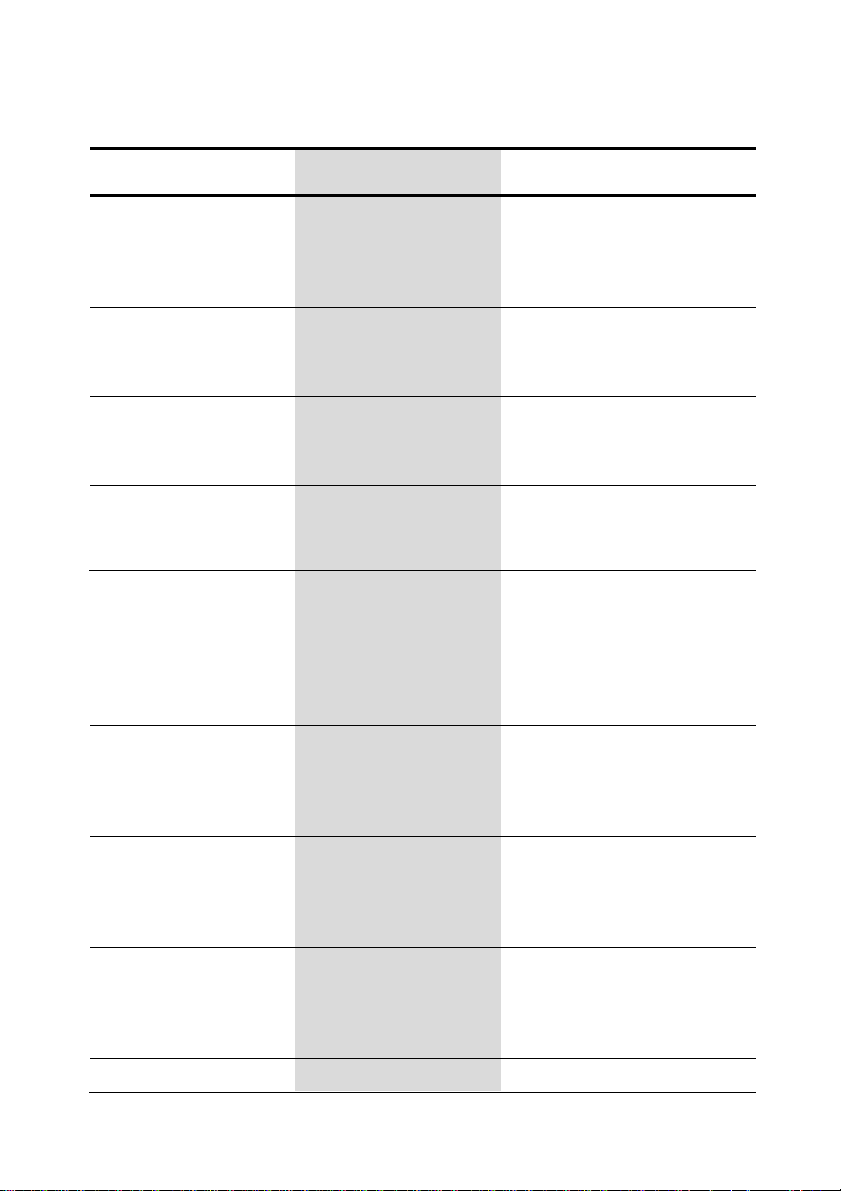
4. Perturbations et élimination des perturbations
Manifestation de de la
panne
L‘appareil ne fonctionne
pas Ecran d‘affichage
RESEAU Signal sonore
intermittent
L‘appareil est en marche
Ecran d‘affichage:
02<72% Signal sonore
intermittent
Le compresseur est
arrêté Ecran d‘affichage:
02<72% Signal sonore
intermittent
L‘appareil est en marche
Ecran d‘affichage: 02
débit trop faible
Le compresseur est
arrêté Ecran d‘affichage:
température Signal
sonore intermittent
Le compresseur est
arrêté Ecran d‘affichage:
pression trop faible
Signal sonore
intermittent
Le compresseur est
arrêté Ecran d‘affichage:
pression trop forte
Signal sonore
intermittent
Le compresseur est
arrêté Ecran d‘affichage:
colonnes – soupape
Signal sonore
intermittent
L‘appareil est en La tête d‘ionisation n‘a Visser correctement la tête
Origine de l‘erreur Elimination l‘erreur
Absence de tension de
réseau Système de
sécurité de l‘appareil
défectueux
Excès de débit Régler le débit correct
Concentration d‘oxygène
<72 %
Le régulateur de débit
est fermé Le tube
d‘oxygène est coudé
Surchauffe de l‘appareil
dû à un mauvais réglage
Surchauffe de l‘appareil
dû à un engorgement du
filtre à poussière
Appareil défectueux
Engorgement du filtre à
poussière Engorgement
du filtre aspirant
Appareil défectueux
Appareil défectueux Appeler le service technique
Raccordement de tube
Soupape – colonne: fuite
Vérifier si le câble de réseau est
correctement branché et le cas
échéant contrôler les fusibles
de la maison Appeler le service
technique
Arrêter et remettre en marche
l‘appareil Appeler le service
technique
Régler le débit correct Vérifier
le tube
Laisser refroidir l‘appareil
pendant minutes, le
positionner correctement et le
remettre en marche. Nettoyer
la membrane filtrante et
remettre l‘appareil en marche
Appeler le service technique
Nettoyer la membrane filtrante
et remettre l‘appareil en
marche. Appeler le service
technique Appeler le service
technique
Appeler le service technique
Rev. D 2018-11 45
Page 47

marche, Ecran
d‘affichage: contrôler la
tête Signal sonore
intermittent
L‘appareil est en marche
Ecran d‘affichage: ions
non corrects Signal
sonore intermittent
pas été vissée
correctement
La tête d‘ionisation est
mouillée L‘appareil est
défectueux
d‘ionisation
Sécher la tête d‘ionisation
Appeler le service technique
5. Nettoyage
Avant de commencer le nettoyage, arrêter l‘appareil et débrancher la fiche de contact.
Vous pouvez laver les surfaces extérieures du carter de votre appareil avec des produits
d‘entretien usuels. Eviter toutefois d‘utiliser des produits agressifs, corrosifs ou
susceptibles de rayer la surface nettoyée. Veiller à ce qu‘aucune goutte d‘eau ne pénètre
dans l‘appareil.
Les produits suivants peuvent être utilisées pour la désinfection:
KORSOLEX FF – Konzentrat (Bode Chemie, Hamburg)
Biguanid Fläche (Dr. Schumacher, Melsungen)
Ne laisser aucun liquide pénétrer à l'intérieur de l'appareil.
• Chaque jour:
rincer à l‘eau chaude l‘élément nasal de la canule nasale. Si on utilise un humidificateur
bouillonnant autoclavable, celui-ci doit être nettoyé ou autocla vé conformément aux
indications fournies par le fabricant. Le non-respect des prescriptions indiquées peut
entraîner une contamination de l‘hu midificateur bouillonnant.
• Une fois par semaine
Nettoyer l'humidificateur et le capuchon comme décrit plus haut. Faire bouillir ensuite
dans l'eau, pendant 10 à 15 minutes environ, ou laver au lave-vaisselle à température
maximale (sans détergent).
• Option I
Nettoyer la tête d‘ionisation Dévisser la tête d‘ionisation et rincer à l‘eau chaude. Faire
bouillir une fois par semaine pendant 10 à 15 minutes dans de l‘eau ou dans le lavevaissel le à une température maximum (sans produit vaisselle). Laisser sécher. Le masque
et la tête d‘ionisation doivent être traités au moyen du spray désinfectant proposé.
N‘utiliser qu‘une tête d‘ionisation parfaitement sèche.
Rev. D 2018-11 46
Page 48

6. Intervalles de maintenance
Inspection et maintenance Une fois par an ou au bout de 2800 heures de service
par le technicien de service responsable
* Filtre à poussière Nettoyage de la membrane filtrante chaque semaine
ou remplacement par l’utilisateur
* Filtre fin Le faire changer deux fois par an ou au plus tard au
bout de 2000 heures de service par le technicien de
service responsable
* Filtre bactérien pour
patients
Dispositif d‘inhalation(par ex.
canule nasale) et rallonge du
tube d‘oxygène
Inhalation equipment (e.g.
nasal canula) and oxygen
extension hose
*Nota ! Tous les intervalles de maintenance indiqués ont une
Le faire changer lors de l‘inspection et de la
maintenance par le technicien de service responsable
Le faire changer selon les instructions du médecin
traitant.
Exchange according to instructions of the attending
physician
valeur purement infortive. Des intervalles plus
rapprochés peuvent être nécessaires selon les cas, par
ex. si les conditions ambiantes (température,
humidité, poussière, etc.) changent. Avec les appareils
d’une capacité de 6 l, la durée de vie du filtre es
réduite de jusqu’à 20%
7. Caractéristiques techniques
Modell Précise 6000 M Modell Précise 6000 MS
Service temperature
ambiante
Dimensions: 55 x 21,5 x 55 cm 55 x 21,5 x 55 cm
Poids: Env. 21 kg Env. 21 kg
Tension de service: 230 V+/-10%
Courant nominal: 2,0 A 2,0 A
Débit: de 0,1 à 5 l/min de 0,1 à 6 l/min
Rev. D 2018-11 47
10° à 40°C de 10° à 40°C
230 V+/-10%
50 Hz
50 Hz
Page 49

Concentration d‘oxygène à
20°C, 1013 hPa,
50% humidité rel.
Niveau de pression
acoustique:
Pression de sortie: 300-350 mbar 300-350 mbar
0,1-3 l/min
95 +/- 3 Vol.% O2
-4 l/min
90 +/- 3 Vol.% O2
-5 l/min
82 +/- 3 Vol.% O2
38 dB(A) 39 dB(A)
0,1-4 l/min
95 +/- 3 Vol.%O2
-5 l/min
88 +/- 3 Vol.%O2
-6 l/min
80 +/- 3 Vol.%O2
Mesure de l‘oxygène:
Option I
Puissance d‘ionisation:
21-98 Vol.% O2
+/- 3 Vol.-% O2
env. 5 millions d‘ions /
cm3/s
8. Volume de commande
Désignation
Précise 6000 M composé des éléments suivants:
appareil de base (surveillance de concentration d‘oxygène)
à câble de réseau, filtre de corps étrangers de rechange
Précise 6000 MI composé des éléments suivants:
appareil de base voir Précise 6000 M, adaptateur d‘ionisation,
télécommande, support
Précise 6000 M D composé des éléments suivants:
appareil de base voir Précise 6000 M, Raccord d‘interface
Précise 6000 M S composé des éléments suivants:
appareil de base (puissance accrue, surveillance de concentration
d‘oxygène), à câble de réseau, filtre de corps étrangers de rechange
Précise 6000 M S I composé des éléments suivants:
appareil de base voir Précise 6000 MS adaptateur d‘ionisation,
télécommande, support
Précise 6000 M S D composé des éléments suivants:
appareil de base voir Précise 6000 MS, Raccord d‘interface
Précise 6000 M S I D composé des éléments suivants:
appareil de base voir Précise 6000 MS, adaptateur d‘ionisation,
télécommande, support, raccord d‘interface
no. de
commande
006.100
006.110
006.101
007.100
007.110
007.101
007.111
Rev. D 2018-11 48
Page 50

Accessoires et pièces de rechange conseillés:
• Canule nasale
• Masque d‘oxygène sans tube
• Eau stérilisée 500 ml Kendall
• Fixation pour eau stérilisée 500ml
• Tube d‘oxygène 2m
• Tube d‘oxygène 15 m
• Raccord de tube droit
• Adaptateur angulaire à tube de silicone de 30 cm
• Filtre de corps étrangers
• Olive raccord tuyau à écrou d‘accouplement
• Câble de réseau
• Spray antistatique
• FireSafe™ Cannula
• FireSafe™ Nozzle
• Filtre antibactérien
• Spray désinfectant
• Statif
• Câble d‘interface concentrateur-ordinateur
• Logiciel
• Câble d‘interface concentrateur-moniteur économiseur
9. Garantie
Notre garantie couvre les vices de matériau ou de fabrication. Les vices couverts par la
garantie sont réparés conformément à nos conditions de garantie. Medicap n‘accorde
cependant aucune garantie dans le cas où l‘utilisateur met en danger les fonc-tions de
l‘appareil par le non-respect des présentes instructions de mise en service, une utilisation
non conforme aux prescriptions ou une manipula-tion étrangère. La responsabilité civile
est, dans les cas spécifiés ci-dessus, transférée vers l‘utilisateur.
Remarque importante:
la garantie ne peut jouer que sur présentation du justificatif d‘achat.
Sous réserve de droit de modification de détails techniques par rapport aux indications et
aux illustrations figurant dans les instructionsde service. Toute réimpression, traduction
ou polycopie – même partielle – du présent document n’est possible que sur autorisation
écrite.
Rev. D 2018-11 49
Page 51
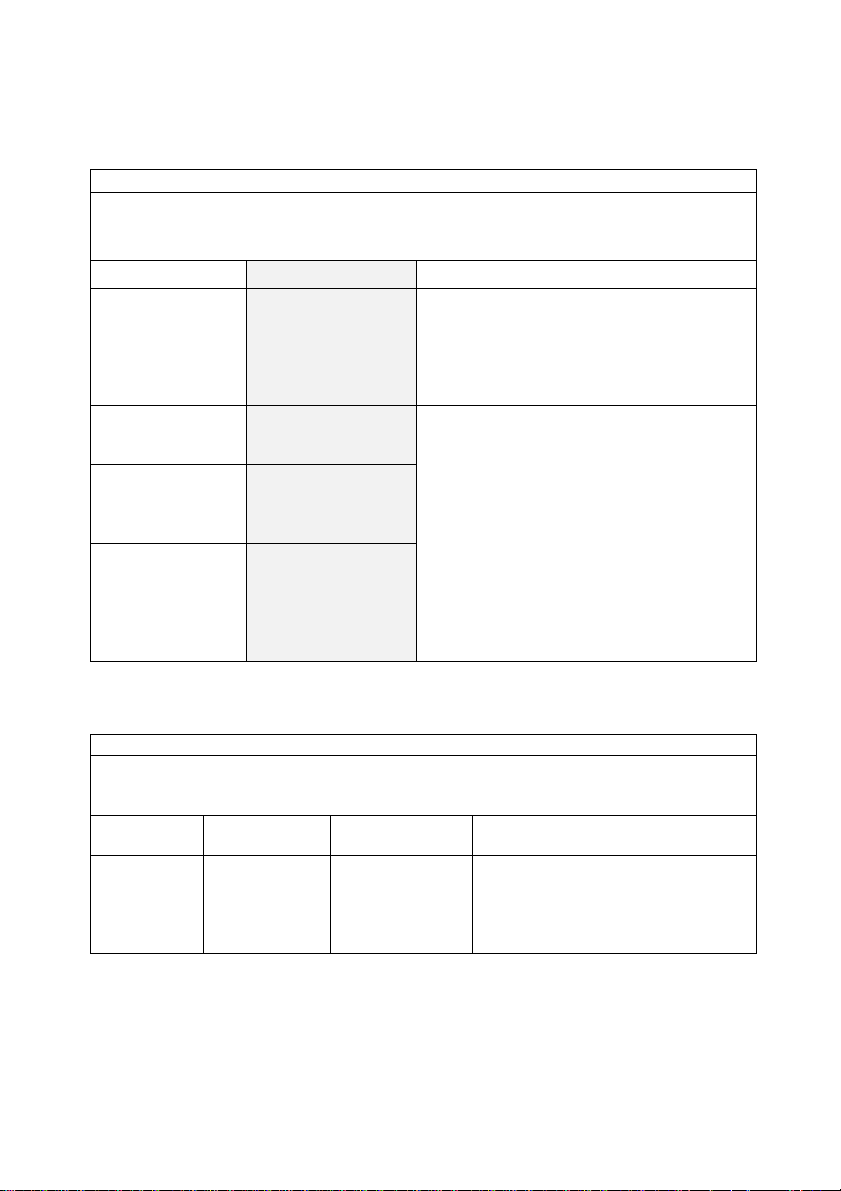
Directives et déclaration du fabricant : émissions
électromagnétiques
Le
Précise 6000
est prévu pour être utilisé dans l'environnement électromagnétique décrit
Essai d’émissions
Conformité
Environnement électromagnétique
- Directives
Émissions RF
Groupe1
Le
Précise 6000
utilise l’énergie RF uniquement
Émissions RF
Classe B
Le
Précise 6000
peut être utilisé dans tous les
Émissions
Classe A
Émissions dues aux
Conforme
Directives et déclaration du fabricant
: immunité électromagnétique
Le Précise 6000
est prévu pour être utilisé dans l'environnement électromagnétique décrit ci
-
Essai
Niveau d’essai
Niveau de
Environnement électromagnétique
-
Décharge
+/-
6kV au
+/-
6kV au contact
Les sols doivent être en bois, en béton
10. EMC regulations
cidessous. Il revient au client ou à l’utilisateur de s’assurer que le Précise 6000 est bien utilisé
dans un tel environnement.
CISPR
11/EN55011
CISPR 11/EN
55011
d’harmoniques
ISO/EN
61000-3-2
fluctuations de
tension/
papillotement
ISO/EN
61000-3-3
pour son fonctionnement interne.
Par conséquent, ses émissions RF sont très
faibles et ne sont pas susceptibles de provoquer
des interférences avec les équipements
électroniques environnants.
environnements médicaux classiques,
directement reliés au réseau public
d'alimentation électrique basse tension.
dessous. Il revient au client ou à l’utilisateur de s’assurer que le Précise 6000 est bien utilisé dans un
tel environnement.
d’immunité
électrostatique
(DES) CEI/EN
61000-4-2
IEC/EN60601
contact
+/- 8kV dans l’air
conformité
+/- 8kV dans l’air
Directives
ou carrelés. Si les sols sont recouverts de
matériaux synthétiques, l’humidité
relative doit être d’au moins 30 %.
Rev. D 2018-11 50
Page 52

Transitoires
+/-
2kV pour les
+/-
2kV pour les
La qualité du réseau d'alimentation
Ondes de choc
+/-
1kV mode
+/-1 kV mode
La qualité du réseau d'alimentation
Creux de
> 5 % Ut
(creux
> 5 % Ut (creux
La qualité du réseau d'alimentation
Champ
3 A/m 3 A/m Les champs magnétiques à la fréquence
Remarque: Ut est la tension du réseau alternatif avant l’application du
niveau d’essai.
Directives et déclaration du fabricant
: immunité électromagnétique
Le Précise 600
0
est prévu pour être utilisé dans l'environnement électromagnétique décrit ci
-
Essais
Niveau
Niveau de
Environnement électromagnétique
- Directives
électriques
rapides
en salves
CEI 61000-4-4
CEI/EN 610004-5
tension,
coupures
brèves et
variations de
tension
CEI 6100-4-11
magnétique à
la fréquence
du réseau
électrique
(50/60 Hz)
CEI 61000-4-8
lignes
d’alimentation
électrique
+/- 1kV pour les
lignes
d’entrée/sortie
différentiel
+/-2 kV mode
commun
> 95 %
de Ut) pendant ½
cycle
40 % Ut (creux =
60 % de Ut)
pendant 5 cycles
70 % Ut (creux =
30 % de Ut)
pendant
25 cycles
> 5 % Ut (creux
> 95 % de Ut)
pendant 5 s
lignes
d’alimentation
électrique
+/- 1kV pour les
lignes
d’entrée/sortie
différentiel
+/-2 kV mode
commun
> 95 % de Ut)
pendant ½ cycle
40 % Ut (creux =
60 % de Ut)
pendant 5 cycles
70 % Ut (creux =
30 % de Ut)
pendant 25 cycles
> 5 % Ut (creux
> 95 % de Ut)
pendant 5 s
électrique doit être celle d'un
environnement commercial ou
hospitalier standard.
électrique doit être celle d'un
environnement commercial ou
hospitalier standard.
électrique doit être celle d'un
environnement commercial ou
hospitalier standard. Si l’utilisation du
Prrécise 6000 exige le fonctionnement
continu pendant les coupures du réseau
d’alimentation électrique, il est
recommandé d'alimenter le Précise 6000
à partir d’une pile ou d’une alimentation
sans interruption.
du réseau électrique doivent
correspondre à ceux d’un
environnement commercial ou
hospitalier standard.
dessous. Il revient au client ou à l’utilisateur de s’assurer que le Précise 6000 est bien utilisé dans un
tel environnement.
d’immunité
Rev. D 2018-11 51
d’essai
conformité
Page 53

CEI 60601
Les appareils de communication RF portables et
Remarque 1: à 80
MHz et à 800
MHz, la gamme de fréquences la plus haute s’applique.
² L’intensité des champs émis par les émet
teurs fixes, tels que les stations de base pour les
RF conduites
CEI 61000-4-6
RF rayonnées
CEI 61000-4-3
Remarque 2: ces directives peuvent ne pas s’appliquer dans toutes les situations. La propagation
électromagnétique est affectée par l’absorption et par la réflexion des structures, des objets et des
personnes.
3 V rms
de 150 kHz
à 80 MHz
3 V/m
de 80 MHz
à 2,5 GHz
3 V rms
3 V/m
mobiles ne doivent pas être utilisés à proximité de
l’appareil et de ses câbles. Il convient de respecter
la distance de séparation recommandée, calculée à
partir de l’équation applicable à la fréquence de
l’émetteur.
Distance de séparation recommandée:
d = 1,2 * racine de P
d = 1,2 * racine de P ; de 80 MHz à 800 MHz
d = 2,3 * racine de P ; de 800 MHz à 2,5 GHz
où P est la puissance nominale de sortie maximale
de l’émetteur en watts (W), indiquée par le
fabricant de l’émetteur, et d est la distance de
séparation recommandée en mètres (m).
L’intensité de champ des émetteurs RF fixes,
déterminée par une étude électromagnétique sur
site², doit être inférieure au niveau de conformité
pour chaque gamme de
fréquences.³
Des interférences peuvent se produire à proximité
d’appareils portant le symbole suivant.
radiotéléphones et les radios mobiles terrestres, le matériel de radio amateur, les radios AM et FM
et les téléviseurs ne peut pas être estimée théoriquement avec exactitude. Pour évaluer
l’environnement électromagnétique dû aux émetteurs fixes, une étude électromagnétique sur site
doit être envisagée. Si l’intensité du champ mesurée à l’endroit où l’appareil est utilisé dépasse de
niveau de conformité RF applicable figurant ci-dessus, il faudra s’assurer du bon fonctionnement de
l’appareil partout où il sera utilisé. En cas d’anomalie, des mesures supplémentaires peuvent être
nécessaires, telles qu’un changement de l’orientation ou de l’emplacement de l’appareil.
³ Sur la gamme de fréquences 150 kHz à 80 MHz, l’intensité du champ doit être inférieure à 3 V rms.
Rev. D 2018-11 52
Page 54
Distances de séparation recommandées entre les appareils de communication RF portables et
Le Précise 600
0 est prévu pour être utilisé dans un environnement élec
tromagnétique dans lequel
Distance de séparation selon la puissance de l’émetteur en mètres
Puissance nominale de
150 kHz à 80
MHz
80 MHz à 800
MHz
800 MHz à 2,5
GHz
0,01 0,12 0,12 0,23
0,1 0,38 0,38 0,73
1 1,2 1,2 2,3
10 3,8 3,8 7,3
100 12 12 23
Pour les émetteurs dont la puissance nominale maxima
le ne figure pas dans le tableau ci
-
dessus, la
mobiles et le Précise 6000
les perturbations RF sont contrôlées. Le client ou l’utilisateur de l’appareil peut contribuer à
prévenir les interférences électromagnétiques en respectant une distance minimale, telle que celles
recommandées ci-dessous, entre les appareils de communication RF portables et mobiles
(émetteurs) et le Précise 6000, en fonction de la puissance de sortie de l’appareil de
communication.
l’émetteur
distance de séparation recommandée en mètres (m) peut être déterminée à l'aide de l'équation
applicable à la fréquence de l'émetteur, où P est la puissance nominale maximale de l'émetteur en
watts (W) indiquée par le fabricant.
Remarque 1: à 80 MHz et à 800 MHz, la gamme de fréquences la plus haute s’applique.
Remarque 2: ces directives peuvent ne pas s’appliquer dans toutes les situations. La propagation
électromagnétique est affectée par l’absorption et par la réflexion des structures, des objets et des
personnes.
d= 1,2 * racine de P
d= 1,2 * racine de P
d= 2,3 * racine de P
Rev. D 2018-11 53
Page 55
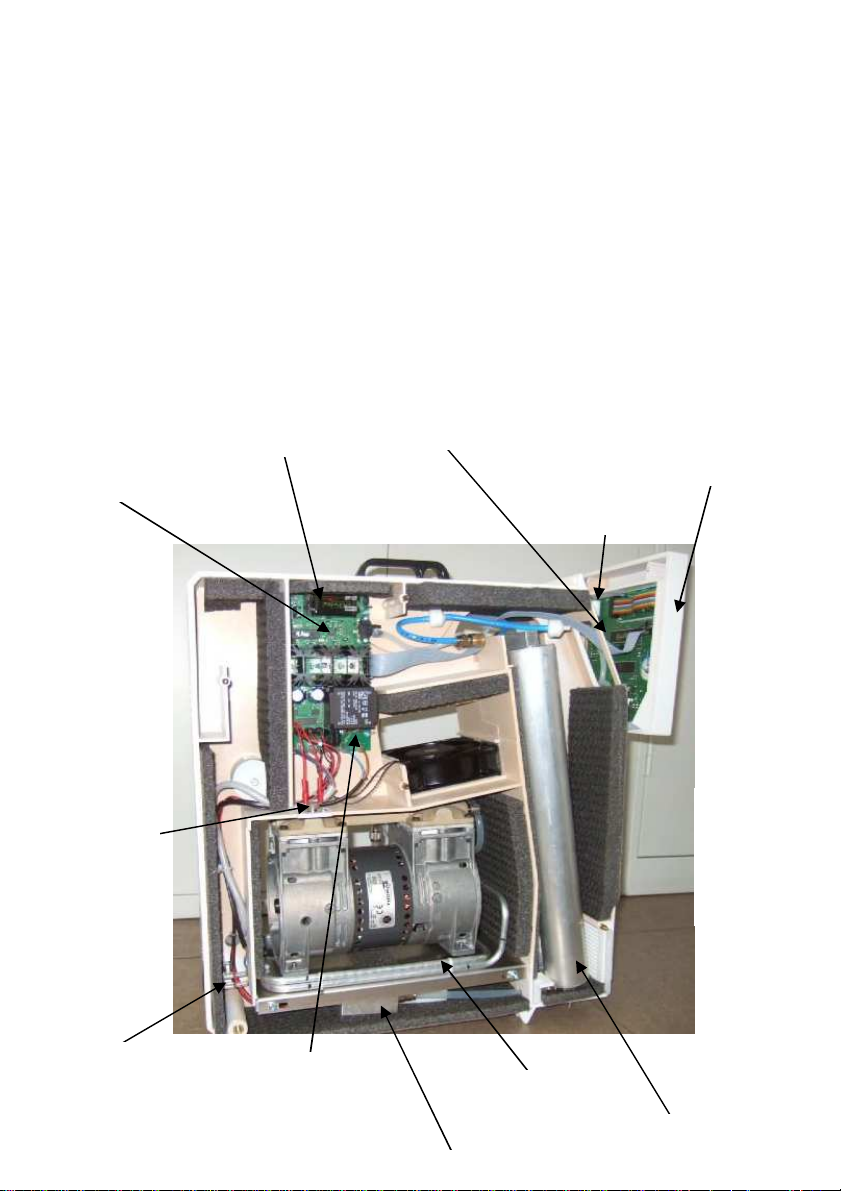
006.316
Art. Nr. 006.199
11. Concentrateur d’oxygène Précise 6000
11.1 Vue intérieure page gauche
Platine avec
microcontrôleur
Art. Nr. 006.313
Capteur
de temp.
006.265
Boîte de
raccordement au
réseau avec fusible
Rev. D 2018-11 54
secteur T 2,5A 250V
Batterie de
secours 9 V
Art. Nr. 6030
Fusible fin T
0,16 A 250 V
Art. Nr. 006.317
Platine avant avec
microcontrôleur
Art. Nr. 006.314
Refroidis
Vanne principale
Bouton
d'alimentation
Art. Nr.
Capteur d'oxygène
Art. Nr. 006.315
Grille de
ventilatio
n air de
refroidisse
ment
Tamis moléculaire, jeu
P6000 m Art. Nr. 006.200
P6000 ms Art. Nr. 006.229
Page 56
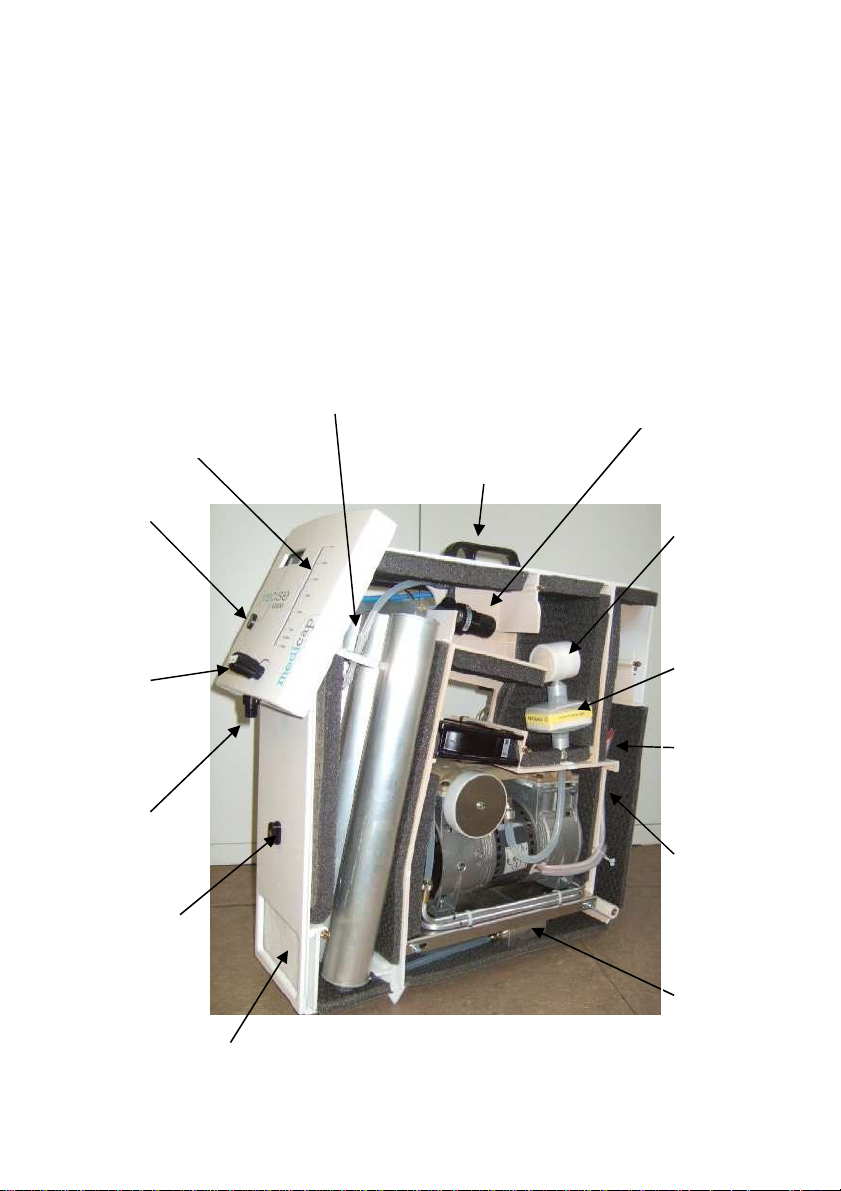
débit
pression
Art. Nr.
006.185
L'image peut différer de l'original.
11.2 Vue intérieure page droite
avec graphique
à barres de
Bouton
d'alimentatio
n Art. Nr.
006.316
Régulateur
de débit
complet Art.
Nr. 006.240
Oxygène
sortie 9/16“
Art. Nr.
006.242
Suspension
pour support
d'humidificateur
Filtre à grosses
particules Art. Nr.
Rev. D 2018-11 55
Membrane du
filtre à bactéries
Art. Nr. 006.194
Poignée de transport
Réducteur de
Filtre fin
1 paire
Art. Nr.
006.184
Microfiltre
Art. Nr.
Ventilateur
Art. Nr.
006.227
Condensateur de
moteur
006.268
Vanne
principale
Art. Nr.
006.192
Page 57

L'image peut différer de l'original.
KONFORMITÄTSERKLÄRUNG
Declaration of conformity / Déclaration de conformité
MEDICAP HOMECARE GMBH
HOHERODSKOPFSTR. 22, D-35327 ULRICHSTEIN
Tel.: 06645 / 970-0, Fax: 06645 / 970-200
erklärt in alleiniger Verantwortung, dass das Produkt Klasse IIa
/declare under our sole responsibility, that our product class IIa
/déclare sous sa seule responsabilité que le produit de classe IIa
Sauerstoffkonzentrator Précise 6000 M
Art.Nr.: 006.100
auf das sich diese Erklärung bezieht, mit den folgenden Richtlinien
übereinstimmt, sowie alle zutreffenden, harmonisierten Standards
/to which this declaration relates following the provision of directives, and any relevant
harmonized standards
/auquel se rapporte cette déclaration, est conforme aux directives suivantes ainsi qu'à toutes
les normes harmonisées correspondantes
93/42/EWG Anhang II
93/42/EEC Annex II /93/42/CEE annexe II
Zertifikatsnummer /certifcate number / numéro de certificat :
28 232 032976
gültig bis /valid until / valable jusqu'au : 26.08.2017
Konformitätsbewertungsstelle
/Notified Body/ Organisme d'évaluation de la conformité :
TÜV NORD CERT GmbH
Langemarckstr. 22
D-45141 Essen
Kennnummer /code number / Numéro d'identification : CE 0044
Rev. D 2018-11 56
Page 58
0044
Ulrichstein, 28.08.2014
G. Rahn Dipl. Ing. Th. Schiffczyk
Geschäftsführer Entwicklung
/General manager / Development
/Directeur / Développement
Rev. D 2018-11 57
 Loading...