

Page 1
A34 A1
Printed in U.S.A.
10.13
Page 2

1
Congratulations!
As the owner of the MDHearingAid®PRO Hearing Aid, you may once
again enjoy the sounds of your environment and conversations with
your family and friends at a price you can afford. In order to get the
most out of your MDHearingAid
®
PRO, please read this User Manual in
its entirety. Your satisfaction with hearing aids depends on the type and
degree of your hearing loss as well as your expectations. No hearing
aid can restore normal hearing, and not everyone will benet equally.
Please read this User Manual in its entirety before using your
MDHearingAid
®
PRO. Thank You!
The MDHearingAid
®
Story ....2
Hearing Aid Diagram ........4
Quick Start Guide...........5
Fitting & Assembly
1. Select Ear Dome........ 6
2. Cut Tubing.............8
3. Attach Tubing ..........9
4. Insert Battery..........10
5. Place Behind Ear ...... 11
6. Turn Hearing Aid On ....12
Getting the Most from ......13
Your Hearing Aid
Maintenance & Care .......18
In Case of Malfunction ......19
Troubleshooting ...........20
Optional Accessories .......24
Replacement of ...........25
Tubes & Domes
Battery Information.........26
Using the Telephone .......28
Warranty & Repair .........29
Return Policy .............30
Warning to Hearing ........32
Aid Dispensers
Important Notice for ........34
Prospective Users
Notice of Cancellation ......36
Technical Specications.....37
Table of Contents
Page 3

2 3
Dr. Cherukuri worked with world-class Doctors of Audiology and Audiologists
to create the MDHearingAid®PRO to their exact technical specications, so
that the range of sounds associated with the human voice would be amplied,
without overly amplifying background sounds.
The MDHearingAid®PRO has been rigorously tested by leaders in the
hearing loss eld (ENT Physicians and Audiologists) who have unanimously
agreed that the sound quality and output is incredibly accurate.
The MDHearingAid® Story
The MDHearingAid®PRO was developed by a board-certied Ear,
Nose and Throat physician in Chicago, IL, Dr. Cherukuri. He
encountered patients in his daily practice who would benet from
hearing aids, but many simply couldn’t afford the thousands of
dollars needed to pay for them. As a physician, he knew the
effects of untreated hearing loss: depression, social isolation,
anxiety, and other symptoms consistent with Alzheimer’s disease.
Dr. Cherukuri set out to nd a reasonable solution that could help with
the most common types of hearing loss at a reasonable price. He was
looking for a “one-size-ts-most” hearing aid, similar to reading glasses,
that can easily be purchased at the drug store.
He evaluated numerous hearing aids and sound ampliers, including
those seen on television. He found almost all of these devices only
amplied low frequencies (below 1000 Hz); however, the majority of
hearing loss is in the higher frequencies (1000-4000 Hz), those most
related to the human voice.
Page 4
4 5
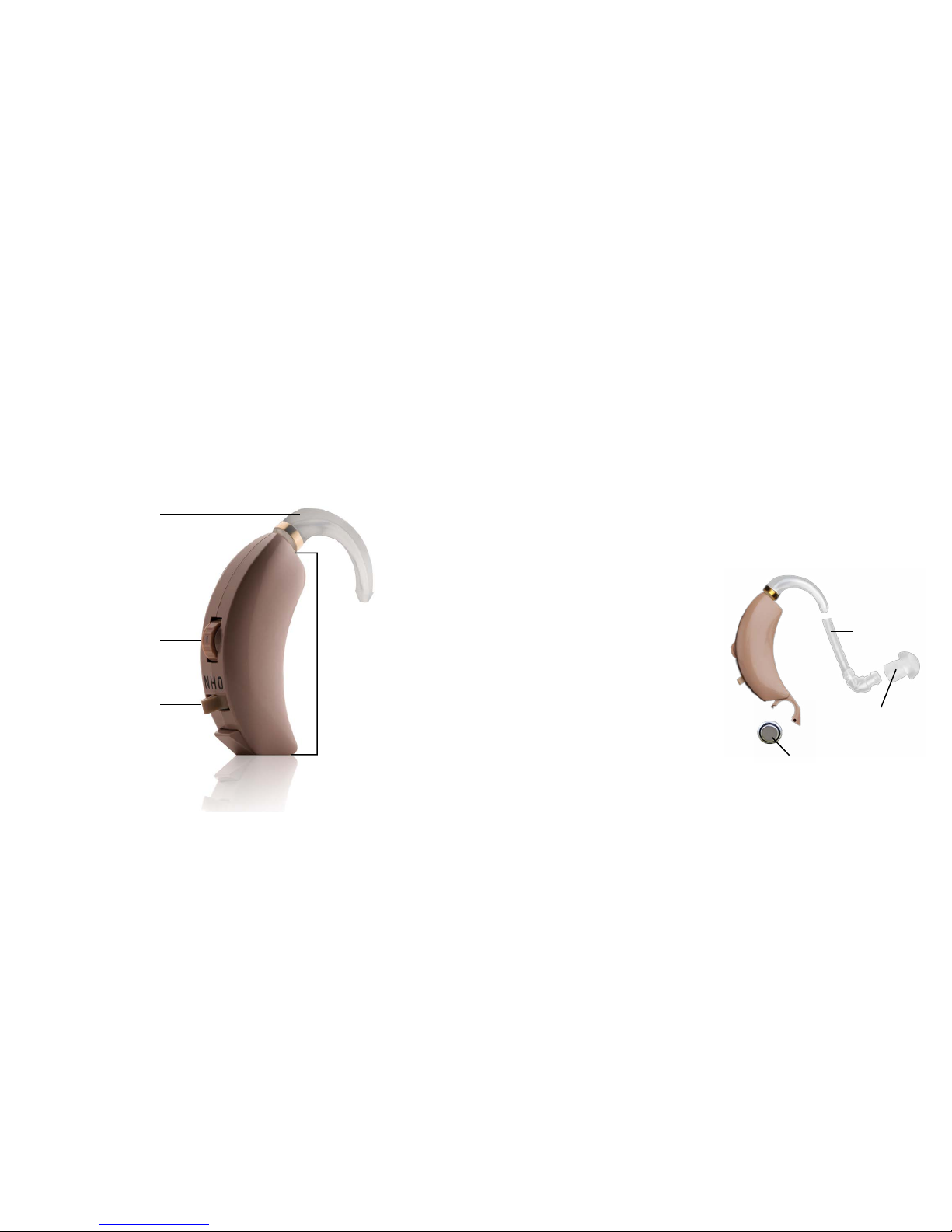
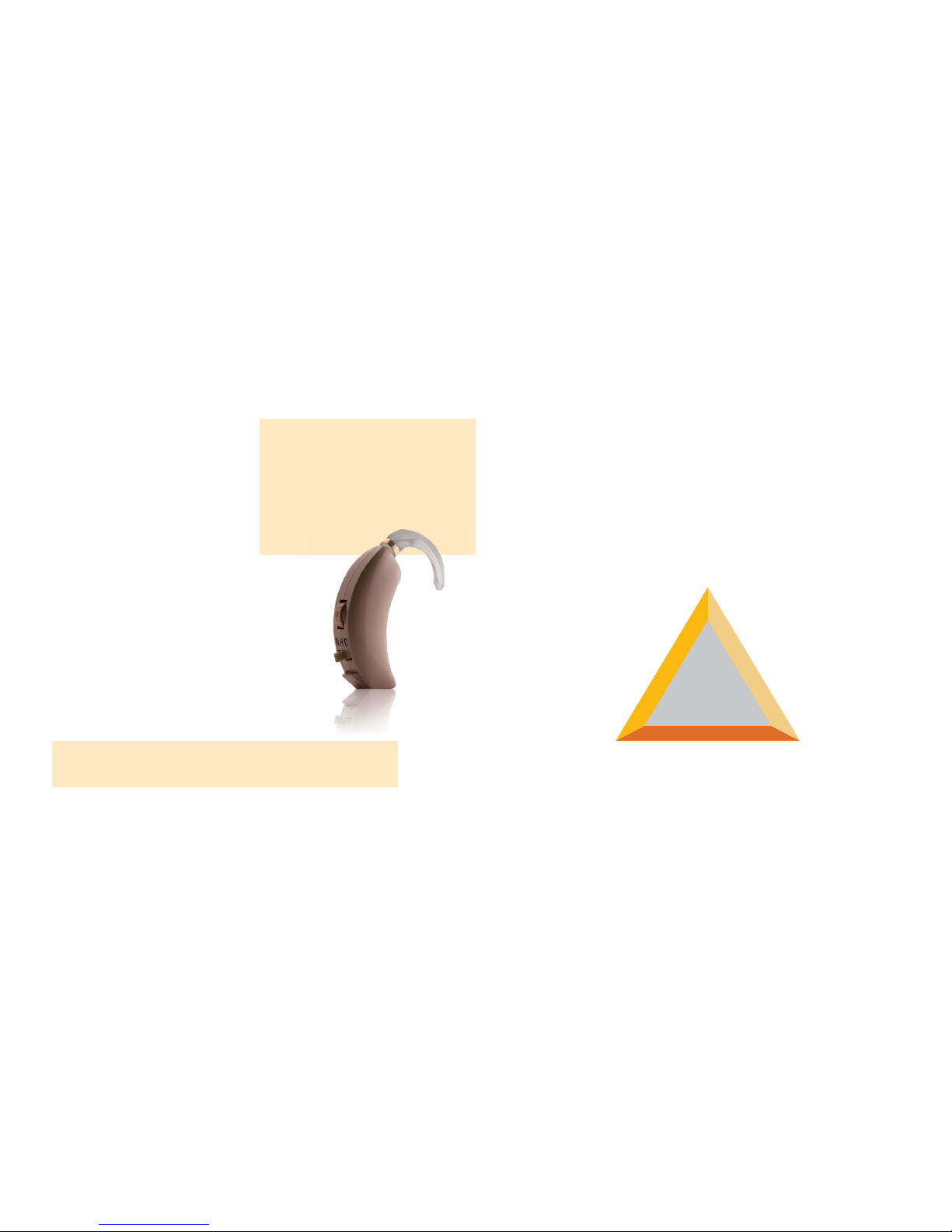
Hearing Aid Diagram
Earhook
Volume Control
Power &
Channel Switch
Battery
Compartment
Steps
Quick Start Guide
Six Easy Steps for Fitting and
Assembling Your MDHearingAid
®
PRO
Step 1: Select the Correct Ear Dome Size
Step 2: Cut Tubing Length
Step 3: Attach Tubing to Earhook
Step 4: Insert Battery
Step 5: Place Hearing Aid Behind Ear
Step 6: Turn the MDHearingAid®PRO On
Body
Tubing
(cut)
Battery
Ear Dome
Page 5

6 7
Step 1
Fitting and Assembly
Step 1: Select the Correct
Ear Dome Size
Your MDHearingAid®PRO comes with
clear Traditional Tubing and ve different
sized silicone Ear Domes to t most
adult ears. Test the Ear Dome size by
attaching Ear Dome to Tubing before
inserting into ear canal.
Attach Ear Dome to Tubing
a) Hold the Elbow of the Tubing with
one hand and hold the ‘mushroom’
top of the Ear Dome with the other hand.
b) Push the Ear Dome over the ridges
on the end of the Elbow.
c) Pull lightly in the reverse direction
to make sure the Ear Dome is
attached securely.
Insert Ear Dome in Ear Canal
Hold the Elbow of the Tubing (with Ear Dome attached) and insert
Ear Dome into the ear canal. The Ear Dome should nestle in the ear
canal without force (similar to placing a sink stopper into a sink).
The ‘mushroom’ top of the Ear Dome should be in the ear canal
and not protrude into the outer bowl of the ear.
Test Ear Dome for Fit
• Turn head side to side and simulate chewing.
If the Ear Dome pops out, it is too big.
• Nod head towards the ground. If the Ear
Dome slips out easily, it is too small.
When the Ear Dome is too small, there is
space between the Ear Dome and the ear
canal, and you may hear whistling when the
Hearing Aid is on.
Repeat the steps above with different sized
EarDomestondthebesttforyou.
a)
b)
OK
Not Secure
Ear Canal
Page 6
98
Step 2
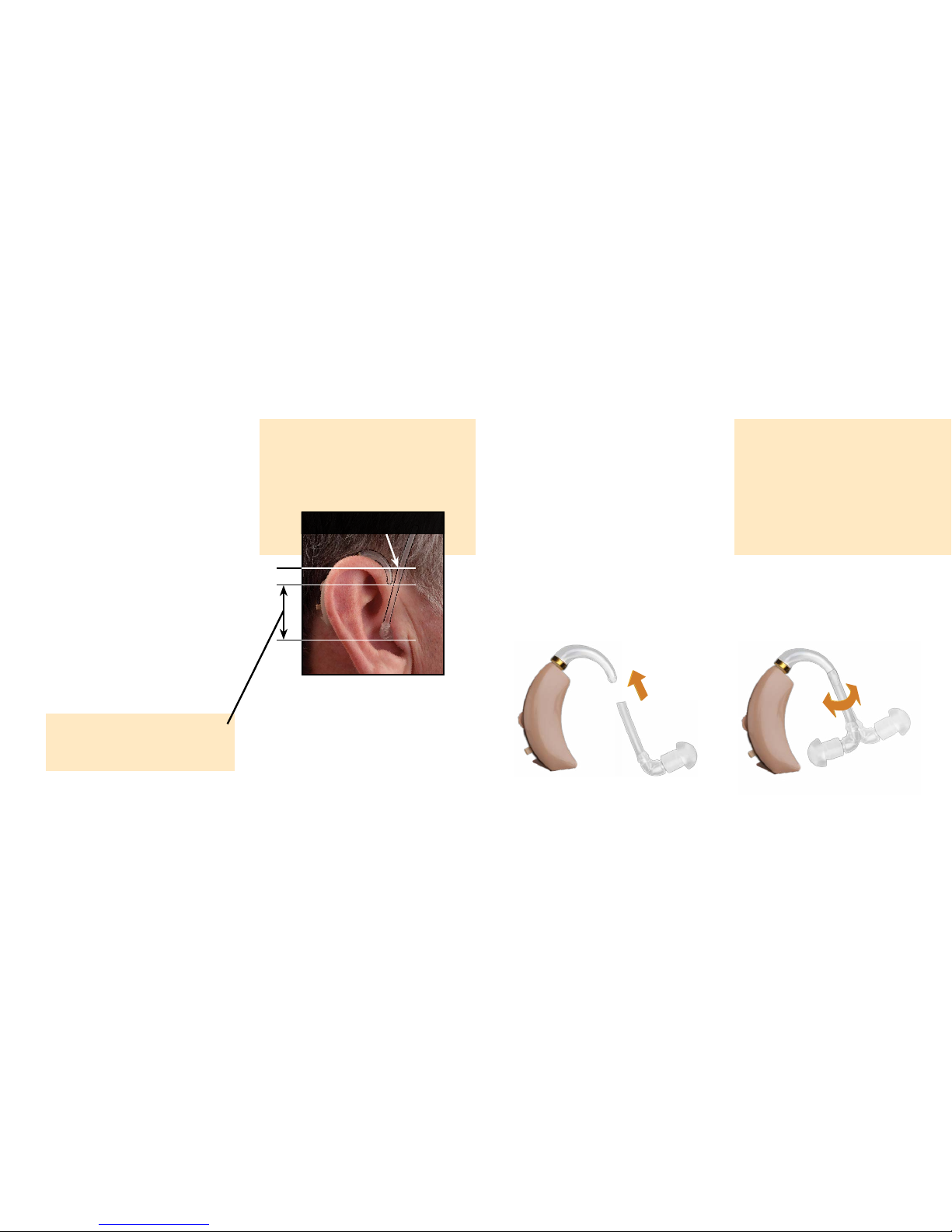
Step 2: Cut Tubing Length
a) Place the Hearing Aid Body
behind the ear so the Earhook
rests comfortably on top of the
ear (in front of any eye wear).
b) Insert Ear Dome, with Tubing
attached, into ear canal, and
align Tubing next to Earhook.
c) Use a pen and mark a line
on the Tubing ABOVE the
bottom of the Earhook tip.
Cut Tubing at marked line.
Mark and Cut Here
Overlap
Step 3
Step 3: Attach Tubing
to Earhook
Using your thumb and rst nger, hold
the Tubing up to the Earhook tip, and
twist back and forth until the Tubing
slides OVER the Earhook tip.
Make sure the ‘mushroom’ portion of the
Ear Dome points into the ear canal.
‘Measure twice, cut once!’
Please note: This length will vary.
Tubing must be measured and cut
separately for each of your ears.
Page 7
11
Step 4 Step 5
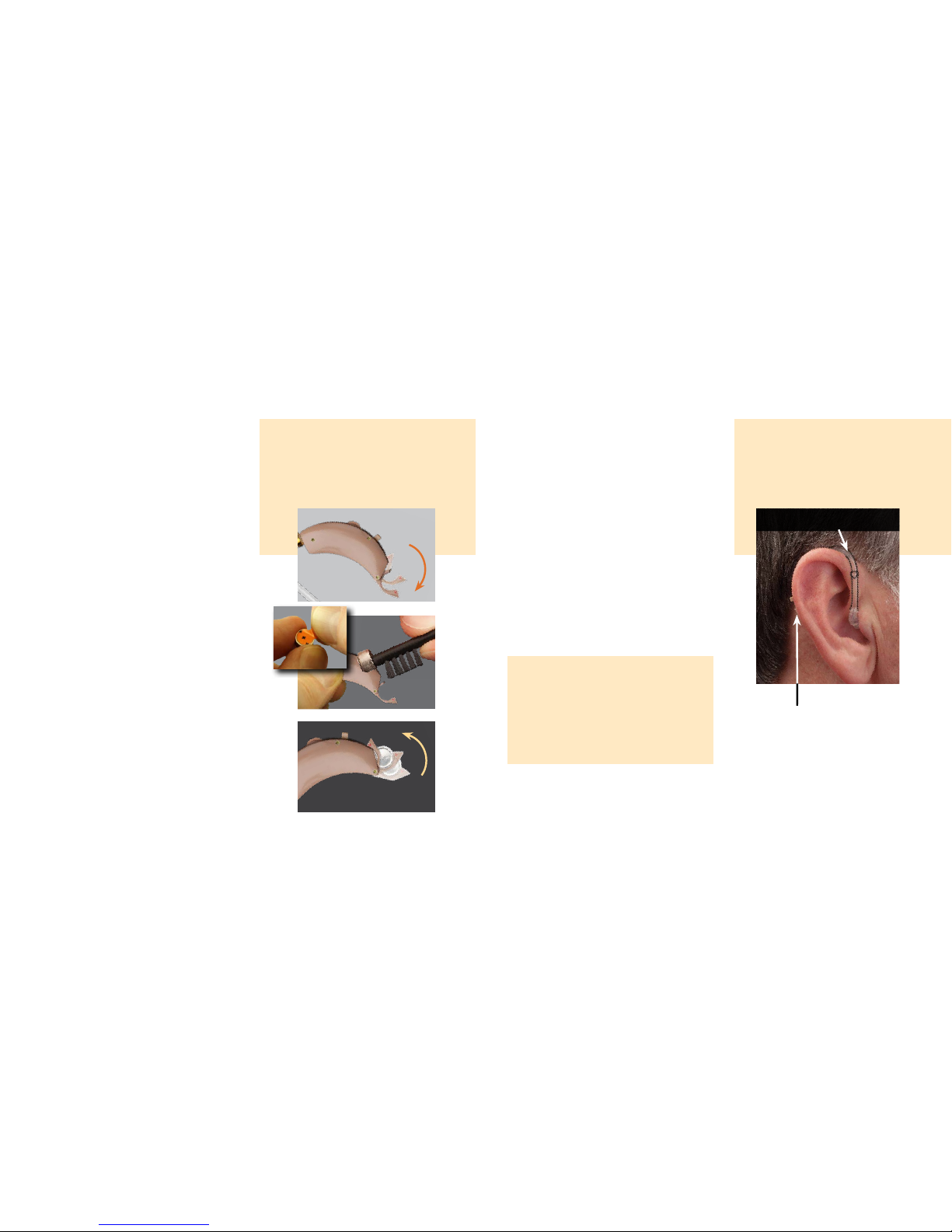
Step 5: Place Hearing Aid
Behind Ear
a) Insert Ear Dome into the ear canal
until the Ear Dome ts securely.
(For more details see Step 1 on page 7.)
b) Place the Hearing Aid Body over
the top of the ear so the curve of the
Earhook rests comfortably (in front of
any eye wear).
Step 4: Insert Battery
To power up your Hearing Aid, please insert
one of the included size 13 batteries.
a) Push the Nail Grip downward to
open the Battery Compartment.
b) Remove the orange adhesive tab from
the battery. With the red “+” side of Battery
Compartment facing up, use the Cleaning
Tool Magnet to insert the Battery.
Or, use orange adhesive tab to place
battery in the Battery Compartment.
Then remove adhesive tab and discard.
c) Close the Battery Compartment.
If the Battery Compartment does not
close easily, the battery is inserted
upside down.
Positive
side up
a)
b)
c)
Hearing Aid
Body
Earhook
IMPORTANT: If the Hearing Aid is
not positioned securely in your ear,
the Hearing Aid may whistle when it
is turned on. This is normal. Once the
Ear Dome is properly inserted in your
ear, the whistling will stop.
10
Page 8
1312
Step 6
Getting the Most from Your Hearing Aid
Your satisfaction with Hearing Aids depends on the type and degree of your
hearing loss and your expectations. No hearing aid can restore the normal
hearing of youth, including those costing thousands of dollars.
However, you can maximize the return on your investment by understanding
the 3 keys to Hearing Aid Happiness:
Step 6: Turning the
Hearing Aid On
On the Power & Channel Switch
‘O’ indicates Off. Flip the switch to the
‘N’ or ‘H’ Channel to turn Hearing Aid on.
‘N’ indicates Normal amplication of
high, mid, and low frequencies. Use
this Channel if you have a “at” loss
(a hearing loss in all frequencies).
‘H’ indicates High to mid frequency amplication
with less amplication in low frequencies. Use
this Channel if you have a “sloping” hearing loss,
or if you desire less background noise.
Try both Channels at various volumes to see
which combination works best for you.
CAUTION! Please raise the volume SLOWLY until you can hear
speech at a normal range and to avoid a sudden blast of sound.
Balance
Patience
Fit
Happiness
Patience: Using Hearing Aids takes practice and patience.
Balance: Both ears
need to hear.
Fit: If the Hearing Aid
does not t properly,
it will not work.
Page 9

14 15
Key #1 — Fit
Hearing Aids, no matter how expensive, will not work unless they
are tted correctly. Without a proper t, it is impossible to reap
the full benet of your investment.
• Make sure the Hearing Aid Tubing is cut to the correct length for your
ear. Tubing that is too long or too short will not allow the Ear Dome to t
properly in your ear canal. (See Step 2: Cut Tubing Length, page 8.)
• Your MDHearingAid®PRO comes with ve different sizes of silicone Ear
Domes. Choose the appropriate size so the t inside the ear canal is snug.
If the Ear Dome is loose, the Hearing Aid may make a whistling sound.
• You may nd that you require a different size Ear Dome once your ear has
adjusted to wearing Hearing Aids regularly.
• If your hearing loss is mild to moderate, you may consider the optional
PRO Thin Tubing with Open-Fit Ear Domes which can help reduce the
plugged ear sensation even more. (See Optional Accessories, page 24.)
• If you still are having difculty tting your Hearing Aids please contact
MDHearingAid® Customer Service ([email protected])
for guidance.
Key #2 — Balance
We are born with two ears for balance. If you have hearing loss in both ears,
medical studies have shown that you will get far greater satisfaction and
the BEST results by wearing two Hearing Aids for the following reasons:
• You will have a signicantly better understanding of speech and
conversation, since the brain is receiving sound from both ears.
• You will nd there will be less overall background noise amplication.
• You will have better hearing and understanding in noisy situations.
• You will have better localization of the direction of sounds.
• Your listening will be more pleasing, effortless, and less frustrating.
If you have hearing loss in both ears and only ordered one Hearing Aid,
we strongly encourage you to use the enclosed coupon for a discount on a
second MDHearingAid® PRO. As always, you will receive a 45-day risk-free
trial with our money-back guarantee.
Page 10

16 17
Key #3 — Patience
New hearing aids can be a big adjustment. Your brain has to re-learn how to
hear and listen. After many years of not hearing well, it takes time and practice
to redevelop these skills. Medical studies show that your brain requires
approximately 21 days to adjust to your new Hearing Aids. During this time:
• You may initially notice lots of background sounds. These sounds
have always been a part of your environment. In time your brain will
re-learn how to process these sounds by prioritizing foreground over
background sounds.
• You may nd that a quiet environment is more comfortable in the beginning
of the adjustment period.
• Your voice may sound too loud. This effect is very common for new
hearing aid users, but most people get used to it over time.
• You voice may also sound ‘plugged up’ or like you’re talking in a barrel.
This occlusion effect is normal. The sensation usually goes away in the
rst few weeks.
• In noisy environments, you may nd it easier to understand speech by
facing the speaker. Reading lips and observing facial expressions and
body language reinforce the sound communication.
• It takes time for Hearing Aids to feel comfortable. For the quickest
acclamation we recommend wearing the Hearing Aids all day long.
If this becomes unbearable, try wearing them for 30 to 60 minutes a
day at rst, and gradually extend the time that you wear them.
Using Hearing Aids takes practice and patience. Some
people adjust very quickly and most adapt within a few
weeks. Please do not give up prematurely. A whole new
world of sound awaits you.
Page 11
18 19
Maintenance & Care
Follow these suggestions to keep the Hearing Aid performing optimally:
• Wipe your Hearing Aid daily with a tissue or soft cloth. Water, alcohol, or
other liquid agents will damage it.
• Keep your ears clean to maximize the benet of your MDHearingAid® PRO.
Earwax can clog up Tubing. For best results, it may be benecial to clean
your ears with an over-the-counter ear wash kit or visit your physician.
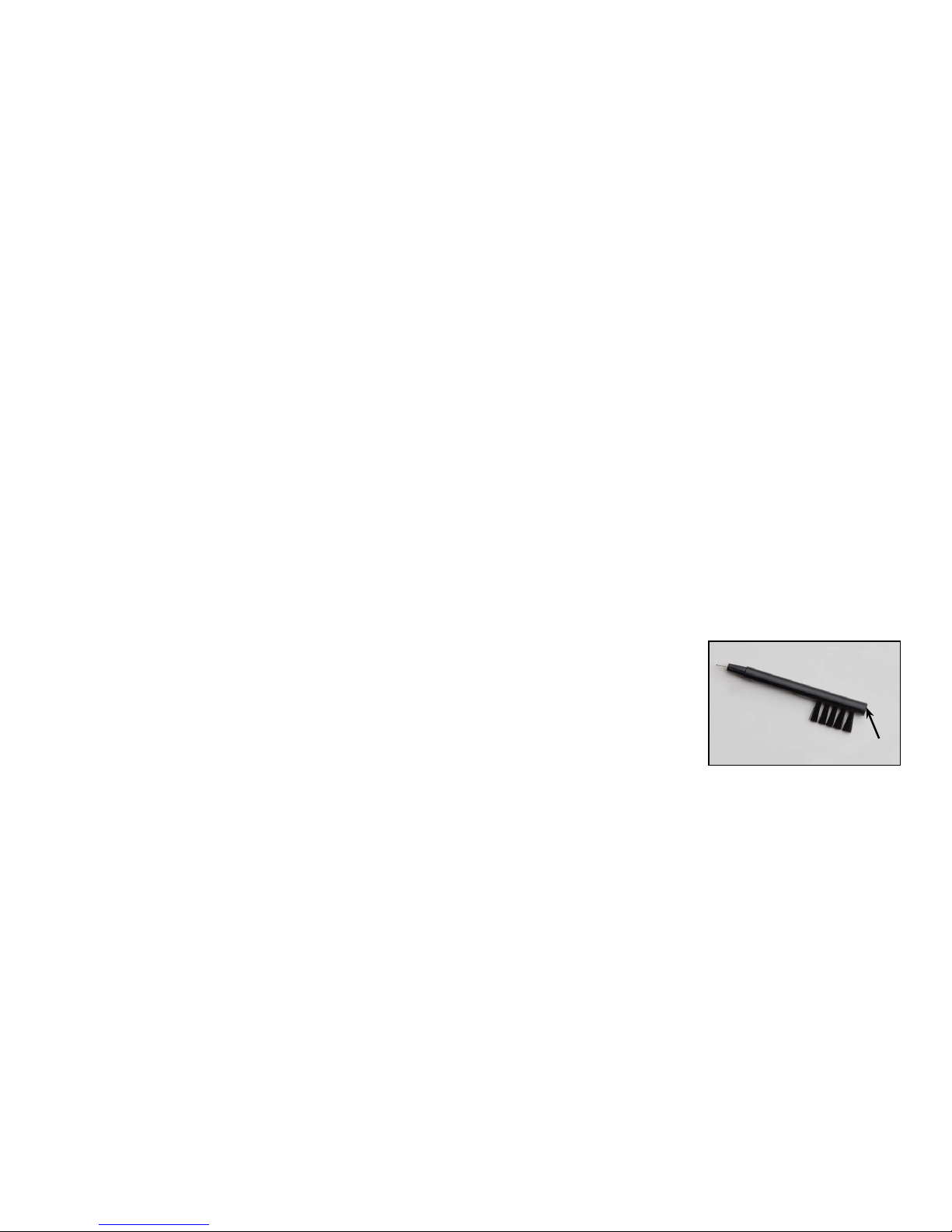
• Use the brush on the Cleaning Tool to gently clean away wax and other debris
on the Hearing Aid.
• Do not let the Hearing Aid get wet. Do not use hair spray or a hair dryer while
wearing the Hearing Aid. Do not expose the Aid to excess moisture or heat.
• Avoid physical shock to the Hearing Aid, such as dropping it on the oor.
• Store your Hearing Aid in a cool dry place when not in use with the Battery
Compartment door open.
• If you are not going to use the Hearing Aid for a prolonged period of time,
remove the battery to prevent corrosion.
In Case of Malfunction
Should your Hearing Aid not function properly, try the following:
1. Make sure the Hearing Aid is switched on.
2. Change the battery and make sure the new battery is
inserted correctly.
3. Check that the Ear Dome or Tubing is not blocked by earwax.
Use the included Cleaning Tool.
4. Disconnect the Tubing from the Earhook and check for
moisture in the Tubing.
5. Read the Troubleshooting guide
on the following pages.
6. Check the website
www.mdhearingaid.com/
customer-service/
for more Troubleshooting tips.
Magnet
Enclosed Cleaning Tool
Page 12

20 21
• Occasionally, whistling may
occur when you have a blockage
of wax in the ear canal from a
cold or any condition that causes
sound to be reected from the
ear canal. In these cases, the t
may be ne and the whistling will
disappear when the condition
is corrected.
• Check for any cracks in the Tubing
or the Earhook. For optimal
performance, the Hearing Aid Ear
Domes and Tubing should be
replaced every 3-6 months.
• Lower the volume if it is set too high.
• Clean any wax that may be
interfering with the Hearing Aid.
(See enclosed Cleaning Tool.)
• If you still are having difculty
tting your Hearing Aids please
contact MDHearingAid® Customer
Service at customerservice@
mdhearingaid.com or call
312-219-8422 for guidance.
The ofce hours are Monday to
Friday, 8:30am to 4:30pm (CST).
• Whistling (feedback) occurs when
amplied sound returns to the
microphone and is re-amplied.
Most hearing aids will whistle until
it is properly tted on your ear.
• Conrm that the Hearing Aid is
working properly by removing the
Aid and covering the end of the
Tubing or attached Ear Dome
with your nger. The whistling
should stop.
• Try reinserting the Ear Dome
into ear so it ts better. If that
doesn’t work, try a different
size Ear Dome.
• Make sure you cut the Tubing to
the proper length. If the Tubing
is too long, it may cause the Ear
Dome to become dislodged from
the ear canal and cause whistling.
Troubleshooting
1. Instrument makes a whistling sound
Page 13

22 23
3. Sound is distorted or intermittent
• Flick the Power & Channel Switch
back and forth, in case dust or lint
has collected in the controls.
• Check the battery contacts for
corrosion.
• If the Hearing Aid were in a
humid environment or subject
to sweat, moisture may clog
the Aid and distort sounds.
Consider using a Hearing Aid
dehumidier overnight.
• Lower the volume.
• Replace the battery with a
fresh one.
• Check the Ear Domes and
Tubing for wax that may be
blocking sound, or for any signs
of wear. Replace the Tubing and
Ear Domes if they appear stiff,
bent, cracked,or frayed.
Replacements can be ordered at:
www.mdhearingaid.com/
accessories.
• If you still are having difculty
with your Hearing Aids please
contact MDHearingAid® Customer
Service at customerservice@
mdhearingaid.com or call
312-219-8422 for guidance.
The ofce hours are Monday to
Friday, 8:30am to 4:30pm (CST).
2. Instrument has a weak or no sound
• Make sure the Hearing Aid is
on. The volume dial should
be set above the number 1.
• Make sure battery is fresh.
If there is any doubt, try a
new battery.
• Make sure battery is
inserted correctly and
Battery Compartment
is completely closed.
• Check the battery contacts
for corrosion.
• Reposition the Hearing Aid Tubing
and Ear Dome in your ear canal.
• If you still are having difculty
with your Hearing Aids, please
contact MDHearingAid® Customer
Service at customerservice@
mdhearingaid.com or call
312-219-8422 for guidance.
The ofce hours are Monday to
Friday, 8:30am to 4:30pm (CST).
Page 14
24 25
• Over time, Hearing Aid Tubing and
Ear Domes may become stiff and
discolored.
• Replacing Tubing and Ear Domes
regularly keeps your Hearing Aids
sounding and feeling like new.
• Visit www.mdhearingaid.com/
accessories, where we offer a
choice of both Traditional Tubing
as well as PRO Thin Tubing/
Open-Fit Ear Dome Kit.
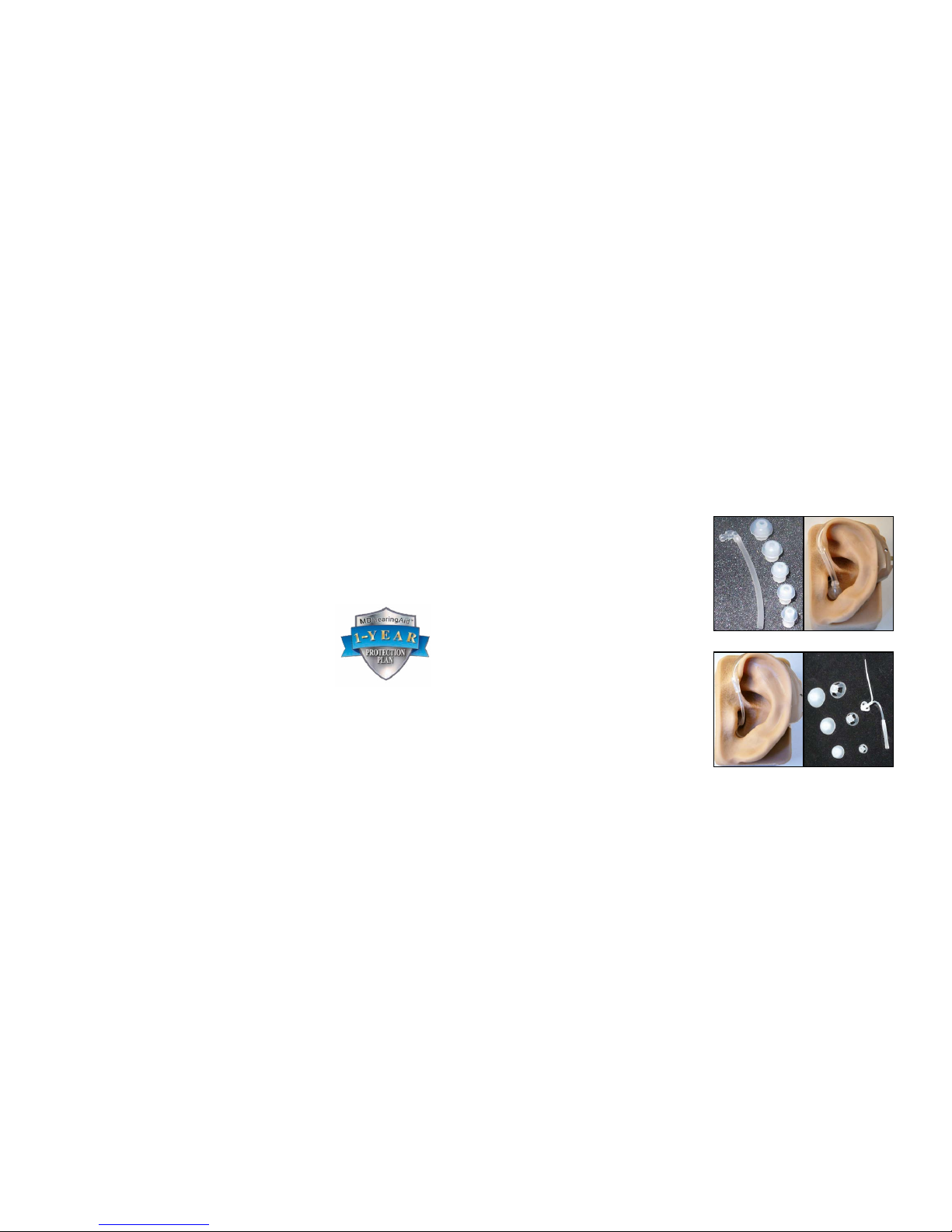
Replacement of Tubing & Ear Domes
For OPTIMAL PERFORMANCE, the Hearing Aid Tubing
and Ear Domes should be replaced
every 3 to 6 months:
Traditional Tubing Replacement Kit
PRO Thin Tubing / Open-Fit Kit
Optional Accessories
PRO Thin Tubing / Open-Fit Kit for MDHearingAid®PRO
• Thin Tubing gives the wearer a modern, nearly invisible prole. Open-Fit Ear
Domes have vent holes which allow natural sound to enter the ear.
• Open-Fit Ear Domes reduce the ‘plugged up’ feeling of having something
in your ear. These are best for individuals with high frequency loss who do
not require a high volume.
• Visit www.mdhearingaid.com/accessories for more information.
MDHearingAid® Product Protection Plan
• With MDHearingAid® Product Protection Plans you
are 100% protected from ALL types of accidental
damage and almost anything else that may go wrong,
including things not covered by our standard warranty
(water damage, battery corrosion, stepping on the Hearing Aid, etc.)
• Coverage must be purchased within your initial warranty period.
• This service contract lasts for 1 year from the date of purchase
of your Hearing Aid.
• Visit www.mdhearingaid.com/accessories for more information.
Page 15
27
Recommended Battery Type:
The MDHearingAid®PRO uses size 13/13A zinc-air batteries.
Battery Life:
Depends on a number of factors, such as the settings of your
Hearing Aids and the number of hours used per day.
For extended battery life, open the Battery Compartment
if the Hearing Aid will not be used for a prolonged period
of time. This can be performed every night, after removal,
before going to sleep.
Please note: Do not leave exhausted
batteries in the Hearing Aid, as they
may leak and damage the Hearing Aid.
Battery Removal:
Hold the Hearing Aid over a table (with
the screws facing up). Open the Battery
Compartment, then turn the Hearing Aid
over, and the battery will fall out.
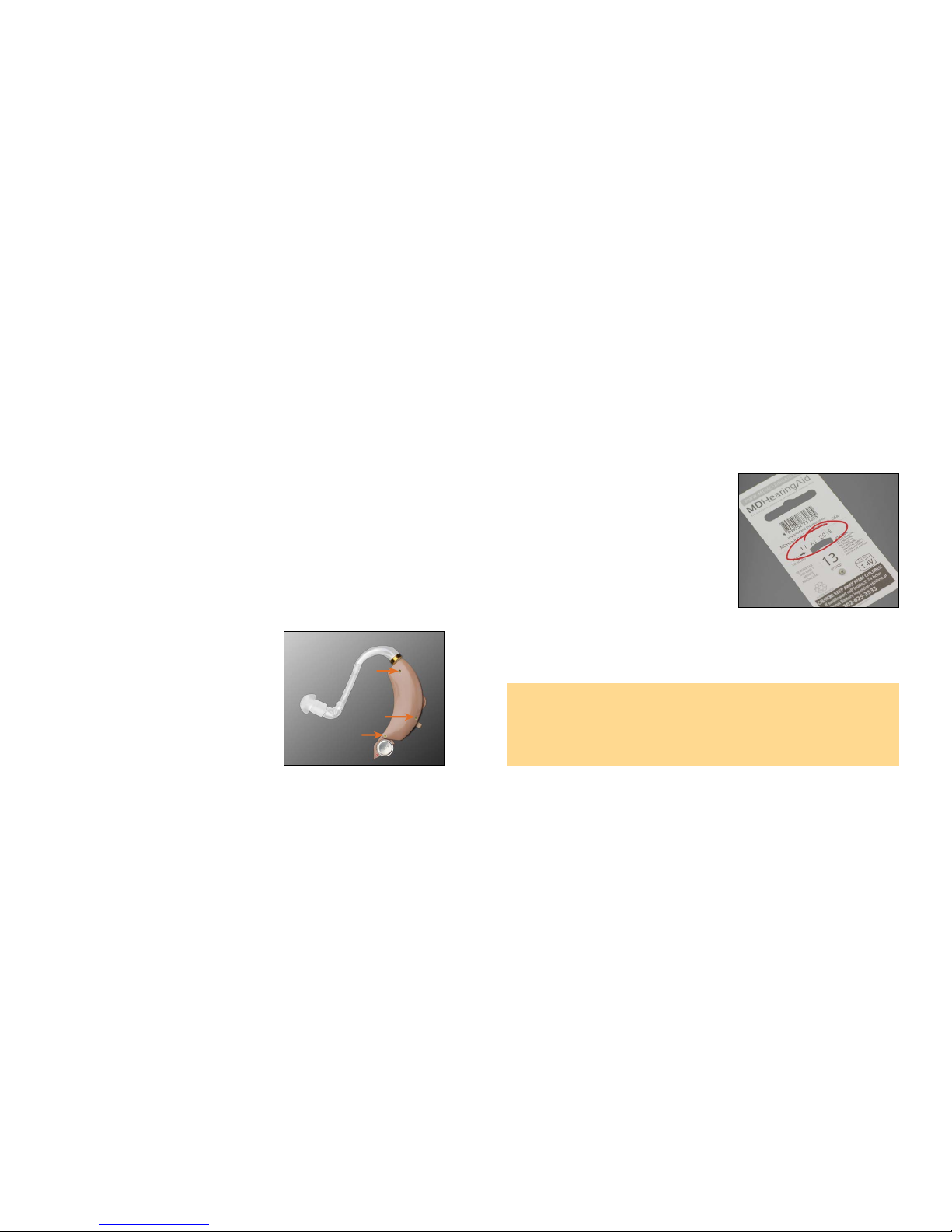
Battery Expiration Date:
The battery expiration date is located
on the back of the battery package.
In rare cases, a new battery may be
exhausted because it was not sealed
properly. If your Hearing Aid does not
work after replacing the battery, try
inserting a different new battery.
Please recycle exhausted batteries.
Caution! Batteries can be harmful if swallowed. Be sure to keep
batteries out of reach from children and pets. If a battery is accidentally
swallowed, seek medical attention immediately, or call The National
Battery Hotline collect at 202-625-3333.
Battery Information
Screws on Hearing Aid Body
Expiration Date for Batteries
Positive
side up
26
Page 16

28 29
Warranty & Repair
The MDHearingAid®PRO is covered against defects in materials and workmanship
for 90 days from the date you receive your Hearing Aid. If our examination
determines that the unit failed to work due to parts, materials or workmanship, we
will repair or replace it for free. This warranty does not cover malfunctions due to
unusual wear and tear or mistreatment of the Hearing Aid, such as physical shock,
damage from moisture or sweat, excessive wax build-up, or tampering with the
instrument, all of which void the warranty.
If you require Warranty or Repair Service, please contact Customer
Service for a Return Merchandise Authorization (RMA) number, repair costs,
and instructions.
For fastest service e-mail:
Or, call Customer Service at:
312-219-8422. Ofce hours:
Monday to Friday,
8:30am to 4:30pm (CST).
Repair Facility address:
MDHearingAid®, Inc.
Repairs Department
18447 W. 8 Mile Road
Detroit, MI 48219-1520
Please do not mail to this
address without contacting
CustomerServicerst.
Using the Telephone
If your Hearing Aid whistles while using the telephone, try various positions
with the telephone receiver, until you discover the arrangement that works
best for you.
1. Use the phone with your Hearing Aids on your preferred Channel ‘N’ or ‘H’.
2. Try holding the phone near the Hearing Aid microphone at the front
and top of the Hearing Aid Body (where the Earhook attaches to the
Hearing Aid Body).
3. Also try holding the phone behind your ear, below your ear, or angled such
that the phone receiver is tilted and open forward.
Please note: The speaker function on your phone also works well with
your MDHearingAid®PRO Hearing Aids.
Page 17

30 31
At MDHearingAid® your satisfaction is guaranteed.
To get the most out of your MDHearingAid®PRO Hearing Aids, please
understand that no hearing aid will restore normal hearing. Your satisfaction
with the MDHearingAid®PRO depends to some degree on your expectations
and commitment to re-training your brain how to hear and listen.
45 Day Trial Period
You have 45 days from the date of purchase to return the Hearing Aids. The
reason for this long trial period is that often it takes several weeks to get
used to the sound of new Hearing Aids.
21 Day Full Refund Policy
Medical studies show that your brain requires approximately 21 days to adjust
to new hearing aids. If, after 21 days of using the MDHearingAid®PRO
(and before the 45th day from purchase), you are still not satised,
please contact us for a Return Merchandise Authorization (RMA) number.
You will receive a full refund of your purchase price less shipping costs
(or as directed by the site where you made the purchase). Detailed return
instructions will be explained over the phone or can be e-mailed to you along
with your RMA number.
For fastest service, please e-mail [email protected]. Alternatively,
you may call 312-219-8422. Customer Support ofce hours are Monday to
Friday, 8:30am to 4:30pm Central Standard Time.
Restocking Fees
Requests for an RMA number prior to trying the Hearing Aids for 21 days
will be granted but will carry a 10% restocking fee. Returns made without
a RMA number will incur a twenty percent (20%) restocking fee.
We are sorry, but we are unable to honor return requests after 45 days
from the date of purchase.
Return Policy
Page 18

32 33
Stop using the MDHearingAid® and consult a physician if:
Warning to Hearing Aid Dispensers
A hearing aid dispenser should advise a prospective hearing aid user to
consult promptly with a licensed physician (preferably an ear specialist) before
dispensing a hearing aid if the hearing aid dispenser determines through
inquiry, actual observation, or review of any other available information
concerning the prospective user, that the prospective user has any of the
following conditions:
• Visible congenital or traumatic
deformity of the ear.
• History of active drainage from the
ear within the previous 90 days.
• History of sudden or rapidly
progressive hearing loss within the
previous 90 days.
• Acute or chronic dizziness.
• Pain or discomfort in the ear.
• Unilateral hearing loss of sudden
or recent onset within the previous
90 days.
• Audiometric air-bone gap equal
to or greater than 15 decibels at
500 hertz (Hz), 1,000 Hz, and
2,000 Hz.
• Visible evidence of signicant
cerumen accumulation or a
foreign body in the ear canal.
• Hearing in one or both ears
worsens.
• Hearing does not improve while
using the MDHearingAid® PRO.
• Skin irritation develops in or
around your ear canal.
• Your ear becomes occluded with
excessive ear wax.
• You develop an infection of your
ear or ear canal.
Special care should be exercised in selecting and tting a hearing aid whose
maximum sound pressure level exceeds 132 decibels because there may be
risk of impairing the remaining hearing of the hearing aid user.
A hearing aid will not restore normal hearing and will not prevent or improve a
hearing impairment resulting from organic conditions. In most cases infrequent
use of a hearing aid does not permit a user to attain full benet from it. The
use of a hearing aid is only part of hearing rehabilitation and may need to be
supplemented by auditory training and instruction in lip reading.
Page 19

34 35
Important Notice for Prospective Users
If you have reservations about your ability to adapt to amplication, you should
inquire about the availability of a trial/rental or purchase/option program. Many
hearing aid dispensers now offer programs that permit you to wear a hearing
aid for a period of time for a fee after which you may decide if you want to
purchase the hearing aid.
Federal law restricts the sale of hearing aids to those individuals who have
obtained a medical evaluation from a licensed physician. Federal law permits a
fully informed adult to sign a waiver statement declining the medical evaluation
for religious or personal beliefs that preclude consultation with a physician. The
exercise of such a waiver (without prior consultation by an ear specialist) is not
in your best health interest and its use is strongly discouraged.
Children with hearing loss
This product is not for use by anyone under 18 years of age. In addition
to seeing a physician for a medical evaluation, a child with a hearing loss
should be directed to an audiologist for evaluation and rehabilitation. Hearing
loss may cause problems in language development, educational growth, and
social growth of a child. An audiologist is qualied by training and experience
to assist in the evaluation and rehabilitation of a child with a hearing loss.
Good health practice requires that a person with a hearing loss have a medical
evaluation by a licensed physician (preferably a physician who specializes
in diseases of the ear) before purchasing a hearing aid. Licensed physicians
who specialize in diseases of the ear are often referred to as otolaryngologists,
otologists or otorhinolaryngologists. The purpose of a medical evaluation is
to assure that all medically treatable conditions that may affect hearing are
identied and treated before the hearing aid is purchased.
Following the medical evaluation, the physician will give you a written
statement that states that your hearing loss has been medically evaluated and
that you may be considered a candidate for a hearing aid. The physician will
refer you to an audiologist or a hearing aid dispenser, as appropriate, for a
hearing aid evaluation.
The audiologist or hearing aid dispenser will conduct a hearing aid evaluation
to assess your ability to hear with and without a hearing aid. The hearing aid
evaluation will enable the audiologist or dispenser to select and t a hearing
aid to your individual needs.
Page 20

36 37
Notice of Cancellation Technical Specifications
MAX OSPL90.......................... 118 dBSPL
HF Average OSPL90 .................... 112 dBSPL
HFA Full-on-gain ........................ 45 dBSPL
THD@ ..............................500 Hz 5.6%
800 Hz. 1.0%
1600 Hz 0.5%
EQUIV INPUT NOISE ........................20 dB
BATTERY CURRENT DRAIN ................0.54 mA
YOU MAY CANCEL THIS TRANSACTION, WITHOUT ANY PENALTY OR
OBLIGATION, AFTER 21 DAYS AND BEFORE 45 DAYS FROM THE DATE
OF PURCHASE. IF YOU CANCEL, ANY PROPERTY TRADED IN, ANY
PAYMENTS MADE BY YOU UNDER THE CONTRACT OR SALE LESS
ANY NONREFUNDABLE RESTOCKING FEE, AND ANY NEGOTIABLE
INSTRUMENT EXECUTED BY YOU WILL BE RETURNED WITHIN 10
BUSINESS DAYS FOLLOWING RECEIPT BY THE SELLER OF YOUR
CANCELLATION NOTICE AND ALL MERCHANDISE PERTAINING TO THIS
TRANSACTION, AND ANY SECURITY INTEREST ARISING OUT OF THE
TRANSACTION WILL BE CANCELLED. IF YOU CANCEL, YOU MUST
RETURN TO THE SELLER, IN SUBSTANTIALLY AS GOOD CONDITION
AS WHEN RECEIVED, ANY GOODS DELIVERED TO YOU UNDER THIS
CONTRACT OR SALE. TO CANCEL THIS TRANSACTION, MAIL OR DELIVER
A SIGNED AND DATED COPY OF THIS CANCELLATION NOTICE OR ANY
OTHER WRITTEN NOTICE, OR SEND A TELEGRAM, TO MDHEARINGAID,
917 W. WASHINGTON BLVD, SUITE 202, CHICAGO, IL 60607 NO LATER
THAN MIDNIGHT OF THE 45TH DAY AFTER THE INITIAL TRANSACTION. “I
HEREBY CANCEL THIS TRANSACTION,” SIGNED:
(Buyer’s Signature) (Date)
 Loading...