

Page 1
INSTRUCTION
MANUAL
Model no.
IMPORTANT:
Please read this manual carefully before
using this product, and save it for reference.
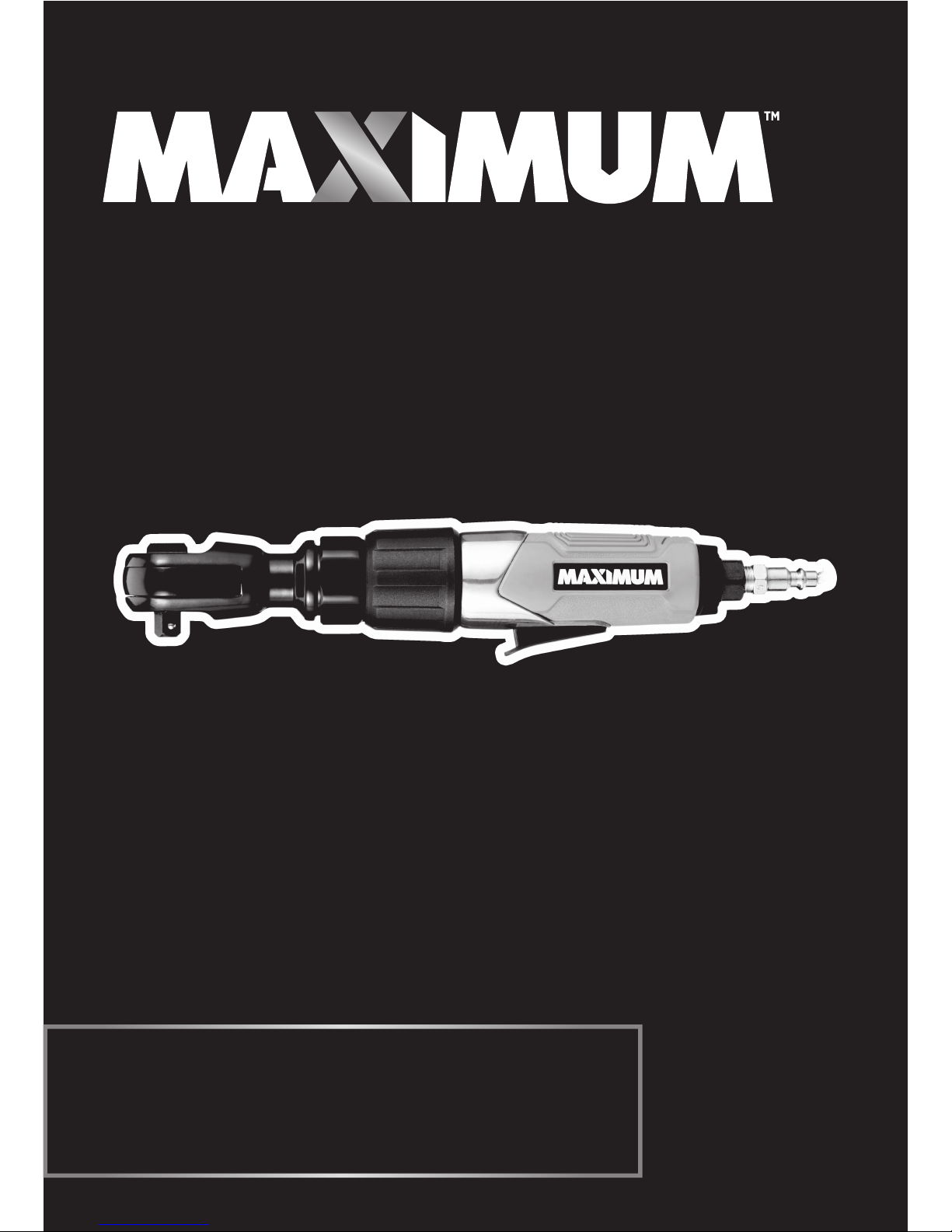
Air-Powered Ratchet
058-9372-4
Page 2
NOTE:
If any parts are missing or damaged, or if you
have any questions, please call our toll-free helpline at
1-888-670-6682.
SAVE THESE INSTRUCTIONS
This manual contains important safety and operating instructions. Read all instructions and follow
them with use of this product.
TECHNICAL SPECIFICATIONS
SAFETY GUIDELINES
KEY PARTS DIAGRAM
TECHNICAL INFORMATION
OPERATING INSTRUCTIONS
MAINTENANCE
TROUBLESHOOTING
EXPLODED VIEW
PARTS LIST
WARRANTY
TABLE OF CONTENTS
3
4
5
10
11
14
16
18
21
20
22
TM
Page 3
4
5
model no. 058-9372-4 | contact us 1-888-670-6682
NOTE: The word “Note” is used to inform the reader of
something he/she needs to know about the tool.
TECHNICAL SPECIFICATIONS
This manual contains information that relates to PROTECTING PERSONAL
SAFETY and PREVENTING EQUIPMENT PROBLEMS. It is very important
to read this manual carefully and understand it thoroughly before using
the product. The symbols listed below are used to indicate this
information.
These precautions are intended for the personal safety of the user and
others working with the user.
Please take time to read and understand them.
DANGER!
WARNING!
CAUTION!
PERSONAL SAFETY
Potential hazard that will result in serious
injury or loss of life.
Potential hazard that could result in
serious injury or loss of life.
Potential hazard that may result in
injury or damage to equipment.
SQUARE DRIVE
SPEED (NO LOAD)
MAXIMUM TORQUE
CFM REQUIREMENT
WORKING PRESSURE
AIR INLET
AIR HOSE REQUIRED
WEIGHT
3/8" (9.5 mm)
160 RPM
60 ft-lb (80 N/m)
3.1 @ 90 PSI
90 PSI
1/4"-18 NPT
3/8" (9.5 mm)
2 lb 10 oz (1.2 kg)
CFM: Cubic Feet per Minute (the volumetric flow rate of air
corrected to standardized conditions of temperature and pressure).
NPT: National Pipe Thread.
TM
Page 4
76
model no. 058-9372-4 | contact us 1-888-670-6682
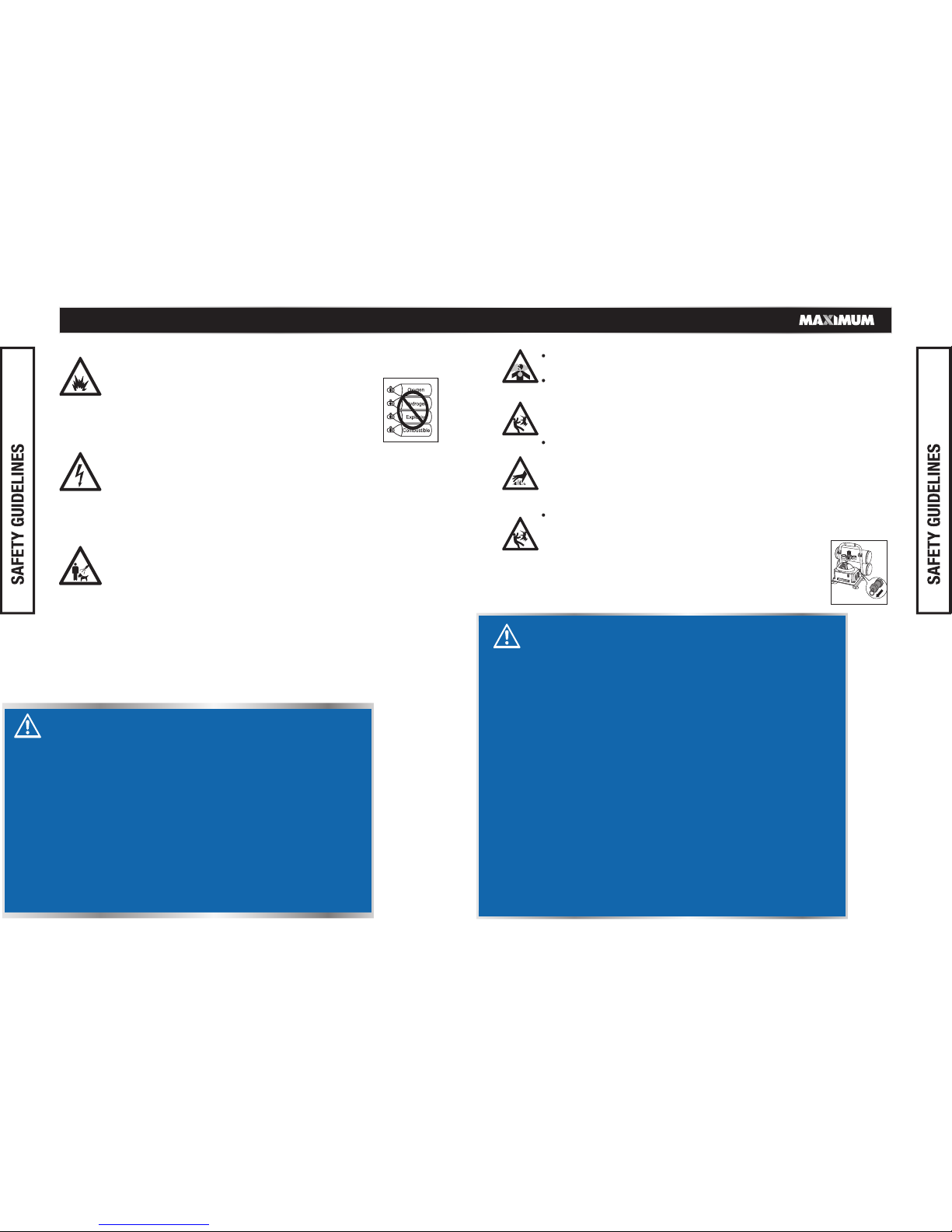
• Do not use oxygen or any other combustible or bottled gas to
power air-powered tools. Failure to observe this warning
can cause explosion and serious personal injury or
death. Use only compressed air to power
air-powered tools. Use a minimum of 25' (7.6 m) of
hose to connect the tool to the compressor. Failure
to comply will result in serious injury or loss of life.
• Risk of electric shock. Do not expose a compressor to rain.
Store it indoors. Disconnect the compressor from the power
source before servicing. Compressor must be grounded. Do
not use grounding adaptors.
• Risk of personal injury. Do not direct compressed air from
the air hose towards the user or other persons.
Risk for breathing. Never directly inhale the air produced by
the compressor.
Risk of bursting. Do not adjust the pressure switch or safety
valve for any reason. They have been preset at the factory for
the compressor’s maximum pressure. Tampering with the
pressure switch or the safety valve may cause personal injury
or property damage.
Risk of burns. The pump and the manifold generate high
temperatures. In order to avoid burns or other injuries, do not
touch the pump, the manifold, or the transfer tube while the
compressor is running. Allow the parts to cool down before
handling or servicing. Keep children away from the
compressor at all times.
Risk of bursting. Make sure the regulator is adjusted so
that the compressor outlet pressure is set lower than
the maximum operating pressure of the tool. Before
starting the compressor, pull the ring on the safety
valve to make sure the valve moves freely. Drain
water from tank after each use. Do not weld or
repair tank. Relieve all pressure in the hose before
removing or attaching accessories.
DANGER!
• Keep children away from the work area. Do not allow
children to handle power tools.
• Do not use this tool in the presence of flammable
liquids or gases. Sparks that are created during use
may ignite gases.
• Do not point the tool towards yourself or other people,
even when the tool has stopped. Keep hands, feet, and
all other parts of the body clear from work area.
• Always ensure that the workpiece is firmly secured
leaving both hands free to control the tool.
• Always ensure that the tool has stopped before putting
it down after use, in the interest of safety and to prevent
possible damage to the tool or personal injury.
WARNING!
Potential hazard that could result in serious injury or
loss of life.
• Do not allow unskilled or untrained individuals to operate
the Air-powered Ratchet or any air-powered tool.
• Always ensure that accessories such as sockets are specially
designed/rated for use with the Air-powered Ratchet. Also
ensure they are secured and correctly fastened before
connecting the tool to the air supply.
• Use only lightweight coil type hoses to connect the tool to
compressor coupling. Do not fit quick-change couplings onto
the machine as vibration can cause the coupling to fail.
• Do not use the Air-powered Ratchet for a task that it is not
designed to perform. Do not use the tool without having been
instructed by a qualified person.
• Disconnect the tool from the air supply when it is not in use,
and store it in a safe, clean, dry, and childproof location.
• Do not carry the Air-powered Ratchet by the air hose. Failure
to comply could result in personal injury.
• Locate the compressor in a well-ventilated area for cooling, a
minimum of 12" (31 cm) away from the nearest wall.
• Protect the air hose and the power cord from damage and
puncture. Inspect them for weak or worn spots every week,
and replace them if necessary.
TM
Page 5
9
model no. 058-9372-4 | contact us 1-888-670-6682
• Always ensure that the user is free of medical problems. Persons who
use vibrating tools regularly or for an extended period should first be
examined by a doctor, and then have regular medical check-ups to
ensure medical problems are not being caused or worsened from use.
• Do not allow a pregnant woman or person with improper blood
circulation of the hand, history of hand injury, nervous system
disorder, diabetes, or Raynaud's disease to operate the vibrating tool.
• Seek medical advice immediately if you feel any vibration-related
symptoms such as tingling, numbness, and white or blue fingers.
• Do not smoke while using the vibrating tool to avoid the risk of
vibration-related injury.
• Use appropriate gloves to reduce the vibration effects on the hands.
• Use tools with the lowest vibration when there is a choice.
• Do not perform vibration-related work continuously.
• Hold the vibrating tool gently and safely. Grip the tool lightly and let it
perform the work, while keeping control of it.
• Stop the tool immediately if abnormal vibration occurs.
VIBRATION PRECAUTION!
Potential hazard that could result in serious injury or loss
of life.
• Read and follow the safety instructions before using the
vibrating tool to avoid temporary or permanent physical
injury, particularly to the hands, arms, and shoulders, and
to reduce the risk of vibration-related injury.
• Always ensure that the tool has stopped before connecting the tool to
the air supply.
• Do not wear watches, rings, bracelets, or loose clothing when using
any air-powered tool.
• Maintain proper footing at all times in order to ensure correct
balance. Make sure the floor is not slippery and wear non-slip shoes.
• Do not overload the tool. Allow the tool to operate at its optimum
speed for maximum efficiency.
• Do not use a tool that is leaking air, with missing or damaged parts,
or that requires repairs. Verify that all screws are securely tightened.
• For optimal safety and tool performance, inspect the tool daily in
order to ensure free movement of the trigger, safety mechanisms, and
springs.
• Always keep your air tool clean and lubricated. Daily lubrication is
essential to avoid internal corrosion and possible failure.
• Keep the work area clean. A cluttered or dirty workbench may lead to
an accident. Floors should be kept clear.
• Use the tool only in a well-ventilated area.
• Handling and storage of oil: Use with adequate ventilation. Avoid
contact of oil with eyes, skin, and clothing. Avoid breathing spray or
mist. Store in a tightly closed container in a cool, dry, well-ventilated
area free from incompatible substances.
• Do not use the tool near or below the freezing point, as doing so may
cause tool failure.
• Do not store the tool in a freezing environment to prevent ice
formation on the operating valves of the tool, as doing so may cause
tool failure.
Disconnect tool from the air supply and turn off
the compressor before performing any maintenance
or changing accessories, when the tool is not in use,
when it is being handed to another person, and
when it is left unattended. Failure to comply may
result in injury or damage to equipment.
Use safety goggles and ear protection:
Wear safety glasses with side shields when
operating the tool/compressor and verify that
others in the work area are also wearing safety
glasses. Safety glasses must provide. protection
from flying particles from the front and the sides.
Air-powered tools are loud and the sound can
cause hearing damage. Always wear ear protection
to prevent hearing damage and loss.
Failure to comply may result in injury.
8
CAUTION!
Potential hazard that may result in moderate injury
or damage to equipment.
NOTE: Recycle unwanted materials rather than disposing of
them as waste. Sort tools, hoses, and packaging in specific
categories and take to the local recycling centre or dispose of
them in an environmentally safe way.
• Always wear hearing protection when using the air compressor.
Failure to do so may result in hearing loss.
• Do not carry the compressor while it is running.
• Do not operate the compressor if it is not in a stable position.
• Do not operate the compressor on a rooftop or in an elevated
position that could allow the unit to fall or be tipped over.
TM
Page 6
3
1
5
2
4
1110
model no. 058-9372-4 | contact us 1-888-670-6682
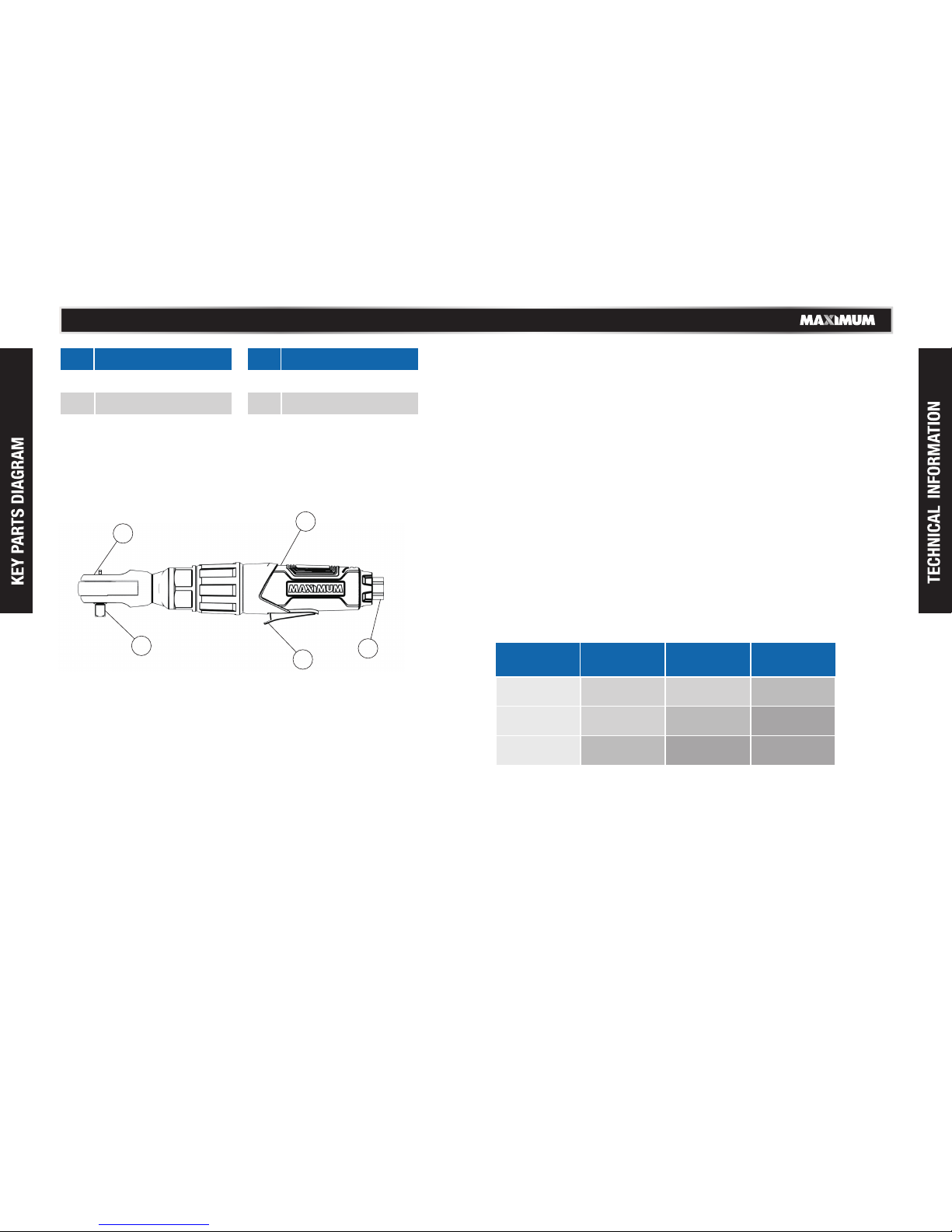
No.
1
2
Square drive
Forward/reverse switch
Handle
3
No.
4
5
Trigger
The MAXIMUM® Air-powered Ratchet features a lightweight body mad e of
aluminum, a steel angle head, and ergonomically designed grips for
comfort even during extended use. Exhaust is discharged at the front of
the tool. The ratchet can be ideally used for automotive applications such
as removing or replacing radiators and spark plugs, air conditioning
system repairs, and water pump repairs. The ratchet is compact and
powerful to turn bolts in confined spaces.
General description
Compatible compressor and air tool
GUIDELINES FOR PROPER USAGE AND OPERATION
Always ensure the use of appropriately matched air tools and compressors.
The compressor should be able to supply a minimal air delivery of 3 CFM
@ 90 PSI to ensure it can run continuously with the MAXIMUM
®
Air-powered
Ratchet. Using a tool or combinations of tools that together or separately
require more than compressor capacity will reduce performance and could
void the guarantee/warranty of compressor or tool.
Air Compressor
Size and Power
2 HP 2 1/2 HP 3+ HP
5–6 Gallons
8–11 Gallons
15+ Gallons
Light-duty and
intermittent use
Light-duty and
intermittent use
Medium-duty and
intermittent use
Light-duty and
intermittent use
Medium-duty and
intermittent use
Heavy-duty and
continuous use
Medium-duty and
intermittent use
Heavy-duty and
continuous use
Heavy-duty and
continuous use
Air inlet plug
Description Description
TM
Page 7
3
5
4
6
7
2
1
1312
model no. 058-9372-4 | contact us 1-888-670-6682
• It is recommended that an automatic in-line filter-regulator-lubricator be
used and be located as close to the tool as possible.
• If a filter-regulator-lubricator is not installed, place up to 6 drops of
pneumatic tool oil directly into the air inlet plug before each use.
• If a filter-regulator-lubricator is installed, keep the air filter clean. A dirty
filter will reduce the air pressure to the tool, which will cause a reduction
in power, efficiency, and general performance.
AIR TOOLS
Read this Instruction Manual thoroughly or have the tool
operators read thoroughly before using the tool.
• Read all safety rules and precautions (see “Safety Guidelines” section) at
the beginning of this manual.
• Always inspect the air tool prior to each use in order to
– Ensure proper use of power source.
– Determine whether the tool is in proper working order.
• Drain the compressor tank daily. Water in the air supply line will damage
the tool.
• Clean air inlet and filter weekly.
• Line pressure should be increased to compensate for unusually long air
hoses. The hose diameter should be 3/8" ID. The fittings must have the
same inside dimensions.
• Ensure that the trigger is not pressed while connecting the tool to the air
supply.
• Ensure the air supply is clean and is maintained at the regulated pressure
of 90 PSI and recommended air flow rate (see section “Technical
Specifications”).
WARNING!
Potential hazard that could result in serious injury or
loss of life.
• Do not exceed the maximum and minimum pressures.
The use of the wrong pressure (too high or too low)
or the use of unclean air may cause excessive noise
and rapid wear, which will shorten the life of the tool.
• Keep hands and other parts of the body away from
the work area when connecting the air supply. Failure
to comply could lead to serious injury or loss of life.
• Make sure all connections in the air supply system are
sealed in order to prevent air from leaking. Failure to
comply may result in injury or damage to
equipment.
CAUTION!
Potential hazard that may result in injury or damage to
equipment.
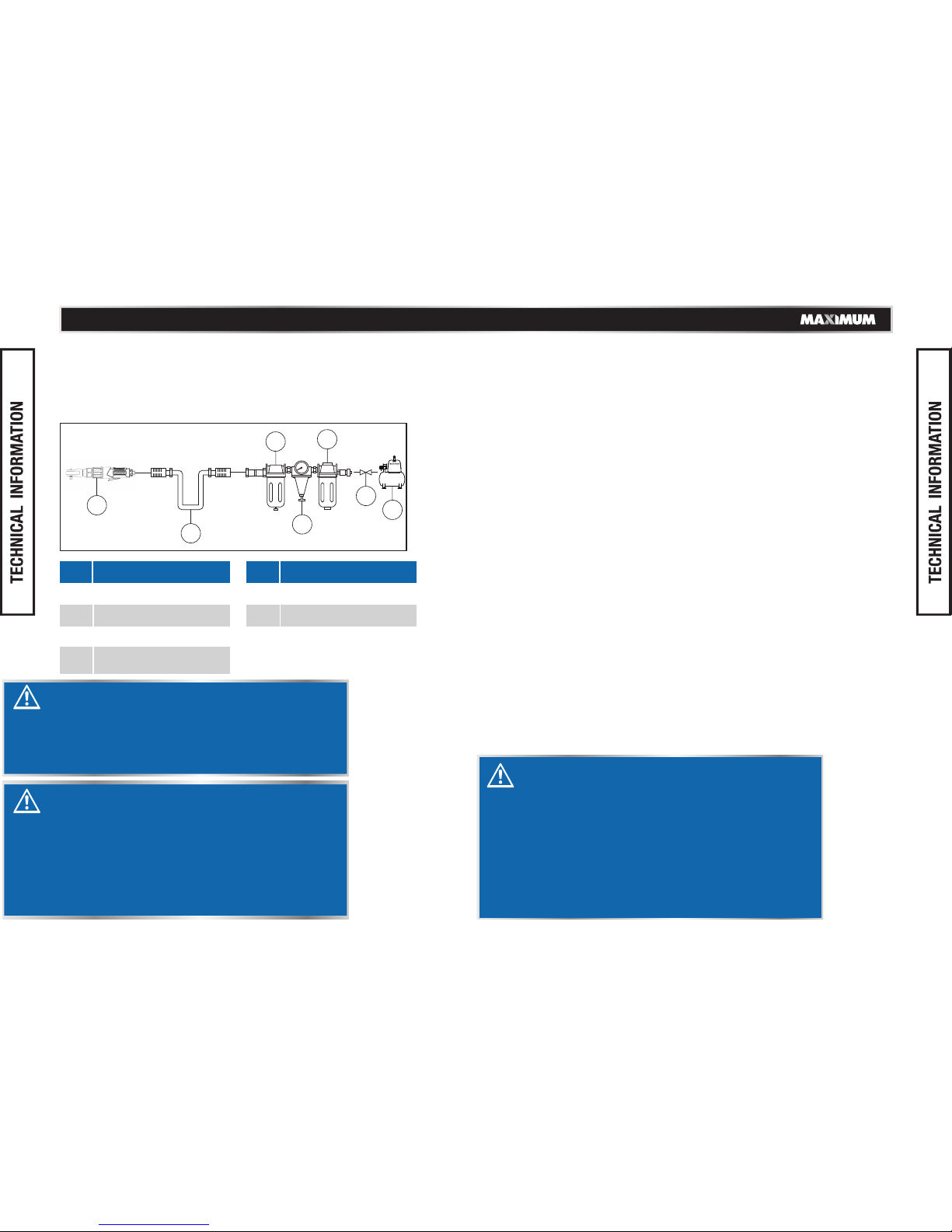
MAXIMUM®
Air-powered
Ratchet
DescriptionNo.
1
2
3
4
No.
5
6
7
Filter
Cut-off valve
Air compressor
Air system
• Always use clean, dry, regulated, compressed air at the recommended
pressure and specific flow rate (see “Technical Specifications” section).
Lubricator
Regulator 0-123PSI
(0 to 8.5 bar)
Description
Air hose
WARNING!
Potential hazard that could result in serious injury or
loss of life.
• Do not use the tool if it is not in proper working order.
• Do not use oxygen or any other combustible or bottled
gas to power this tool.
• Do not use this tool in the presence of any flammable
liquids or gases.
• Keep hose away from heat, oil, and sharp edges. Check
hose for wear and tear, and ensure that all connections
are secure. Failure to comply could lead to serious
injury or loss of life.
TM
Page 8
1
1514
model no. 058-9372-4 | contact us 1-888-670-6682
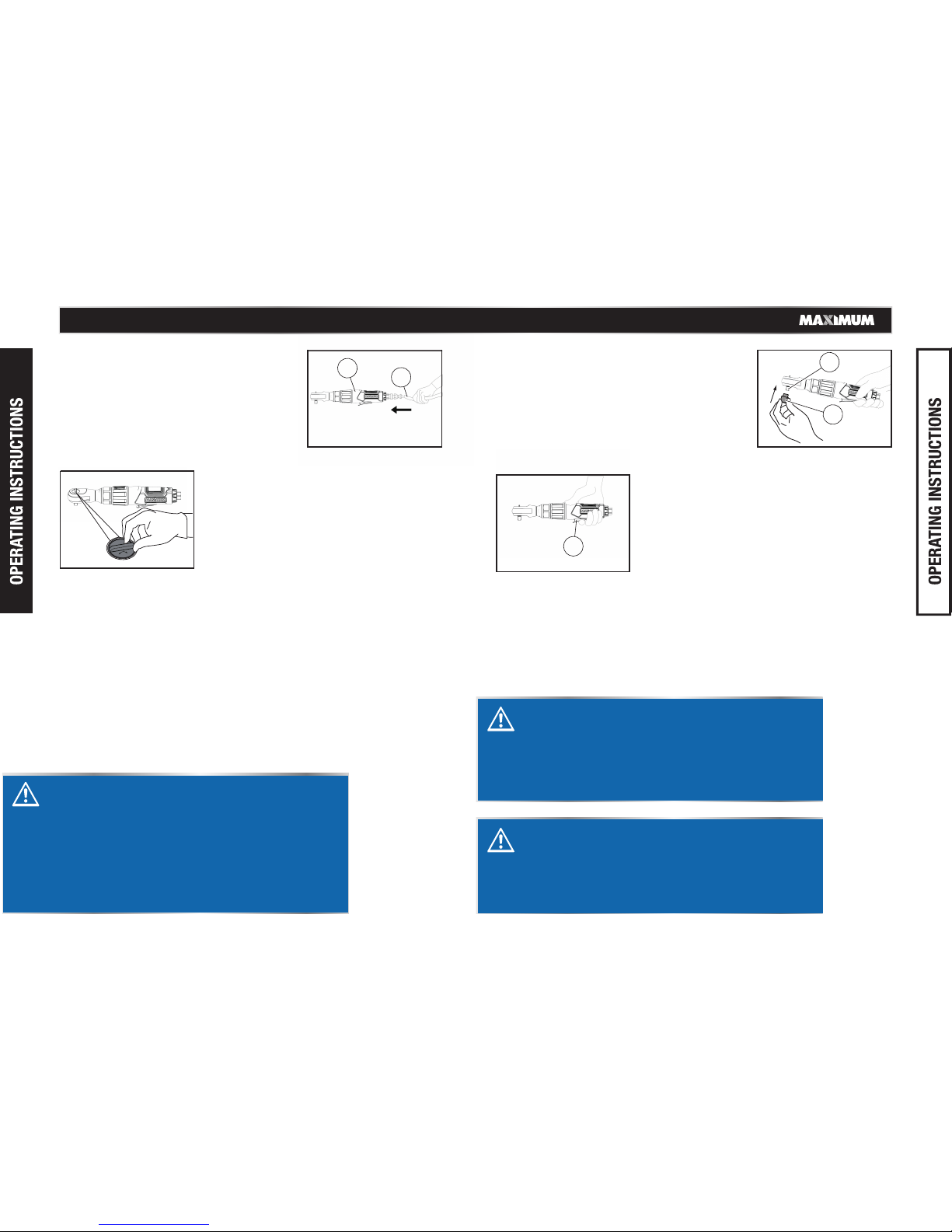
3. Place and lock the socket (1) over the
square drive (2) of the tool (Fig. C).
• Use only the sockets that are specifically designed for
this Air-powered Ratchet. Failure to comply may result
in injury or damage to the tool.
CAUTION!
Potential hazard that may result in injury or damage to
equipment.
2. Rotate the forward/reverse switch
clockwise towards “F” for tightening
operation, and counter-clockwise
towards “R” for loosening operation
(Fig. B).
4. Place the socket on the nut to be
removed or installed, and press the
trigger (1) to operate the tool (Fig. D).
1. Plug in compressor, turn it on, set the
pressure regulator to 90 PSI, attach one
end of the air hose to the compressor
and the other end of the air hose (1) to
the tool (2) (Fig. A).
OPERATION
DANGER!
Potential hazard that will result in serious injury or
loss of life.
• Keep children away from the work area. Do not allow
children or untrained persons to handle power tools.
Failure to comply will result in serious injury or loss of
life.
WARNING!
Potential hazard that could result in serious injury or
loss of life.
• Do not allow the tool to free run for extended periods
of time as this will shorten its life.
• Ensure the air supply is clean and has a regulated
pressure of 90 PSI.
• Do not use additional and excessive force on the tool
to remove a nut. Failure to comply could lead to
serious injury or loss of life.
2
1
Preparation before use
1. Attach the air hose to the air inlet plug of the Air-powered Ratchet.
Note: Add a few drops of pneumatic tool oil to the air inlet plug before
operation, if the automatic oiler system is not used. Add a few
drops more after each hour of continuous use.
2. Set the compressor air pressure to 90 PSI. Do not exceed the
recommended air pressure (see “Technical specifications” section).
3. Check the air connection for leaks. Now the tool is ready for use.
Note: Turn off the air compressor and disconnect the air hose before
you change a socket. After you attach the socket, connect the
air hose and turn the air compressor back on.
1
2
Fig. A Fig. C
Fig. D
Fig. B
TM
Page 9
1716
model no. 058-9372-4 | contact us 1-888-670-6682
Storage
If it is necessary to store the tool for an extended period of time, apply a
generous amount of lubrication before storing. The tool should be allowed
to run for approximately 30 seconds after lubricating, in order to ensure
that the lubrication is uniformly distributed throughout the tool.
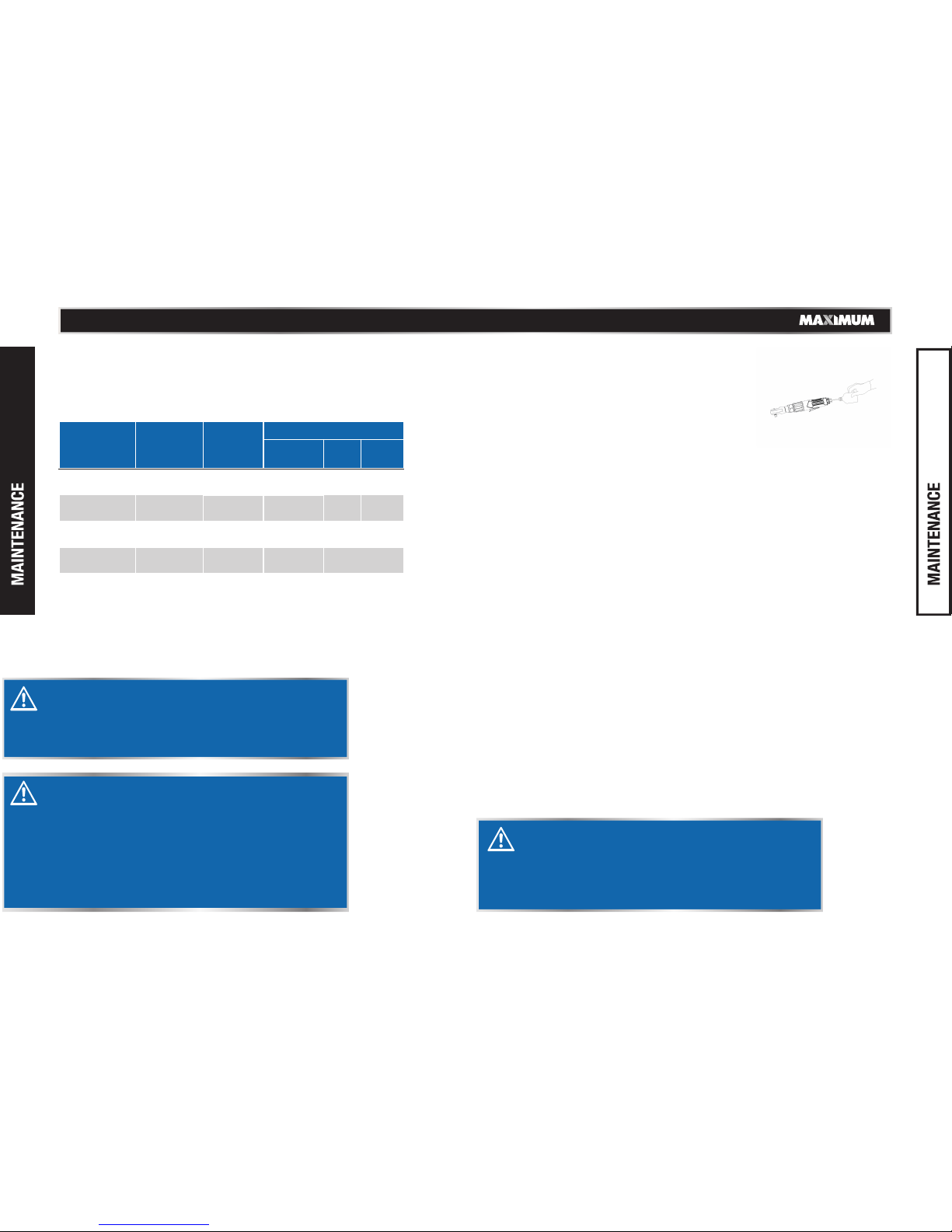
• Lubrication: If the Air-powered Ratchet and the
compressor are not equipped with an in-line
lubrication system, place up to 6 drops of
pneumatic tool oil into the air inlet before each
work day or after every 2 hours of continuous
use, depending on the characteristics of the
workpiece.
• Do not use worn or damaged sockets. Inspect the tool periodically, and
replace the worn or broken parts in order to ensure that the tools are
operating safely and efficiently.
• Disconnect the tool from the air supply when it is not in use.
• Loss of power or erratic action may be due to the following
- Excessive drain in the air line.
- Moisture or restriction in the air pipe.
- Incorrect size or type of hose connector. Check the air supply and follow
instructions.
General inspectionfree movement
Trigger, spring,
safety mechanism
None
X
Worn or broken
parts
X X
Replace worn or
broken parts
X
Lubrication See below
Pneumatic
X
MAINTENANCE
REQUIRED
DESCRIPTION
TOOLS OR
MATERIALS
REQUIRED
MAXIMUM SERVICE INTERVAL
Each use or
every 2 hrs
Monthly
As
needed
In-depth inspection
DANGER!
Potential hazard that will result in serious injury or
loss of life.
• Keep children away from the work area.
Do not allow children to handle power tools.
WARNING!
Potential hazard that could result in serious injury or
loss of life.
• Disconnect the tool from the air supply before changing
accessories, servicing, or performing maintenance.
• Do not use the tool before replacing or repairing any
damaged parts or accessories.
• Use only recommended and properly rated replacement
parts. Non-authorized parts may be dangerous. Failure
to comply could lead to serious injury or loss of life.
tool oil
CAUTION!
Potential hazard that may result in moderate injury or
damage to equipment.
• Store the tool in a clean and dry environment. Failure
to comply may result in injury or damage to
equipment.
TM
Page 10
1918
model no. 058-9372-4 | contact us 1-888-670-6682
NOTE: For further repair information, please
call 1-888-670-6682.
PROBLEM POSSIBLE CAUSES SOLUTIONS
Tool runs at
low speed.
Air flows
slightly from
exhaust.
Motor parts are
jammed with dirt.
Power regulator is in
closed position.
Air flow is blocked
by dirt.
Check whether there is blockage
in air inlet and filter.
Pour pneumatic tool oil into air
inlet plug as per instructions.
Operate the tool, changing
direction of rotation back and
forth in short bursts. Repeat the
above steps as needed.
Tool stops
working.
Air flows
freely from
exhaust.
One or more motor
vanes are stuck
due to material build up.
Pour pneumatic tool oil into the air
inlet plug.
Tap motor housing gently with
plastic mallet.
Operate the tool, changing the
direction of rotation back and forth
in short bursts (wherever applicable).
Disconnect the tool from the air
supply. Operate motor manually by
rotating the drive shaft (wherever
applicable).
Tool does
not shut off.
Throttle valve O-rings
are dislodged from
inlet valve.
If the problem persists,
call 1-888-670-6682.
WARNING!
Potential hazard that could result in serious injury or
loss of life.
• If any of the following symptoms appear while the tool
is in use, turn it off and disconnect it from the air
supply immediately. Failure to heed this warning will
result in serious personal injury.
• Disconnect the tool and the electrical plug from the air
supply before making any adjustments.
• Repairs must be performed by a qualified service
technician only.
Replace O-rings.
Troubleshooting
The following chart lists common issues and solutions. Please read it
carefully and follow all instructions closely.
Tool runs at
normal speed
but loses
power under
load.
Motor parts are worn
or damaged.
Cam clutch is worn or
stuck due to lack of
lubricant.
PROBLEM POSSIBLE CAUSES SOLUTIONS
1. Lubricate clutch housing.
2. Check for excess clutch oil,
overfilling can cause drag on
high speed clutch parts. A typical
oiled/lubricated wrench requires
1/2 ounce (1.5 ml) of oil.
Grease lubrication:
Heat is generated due to
insufficient grease in the chamber.
Severe operating conditions may
require frequent lubrication.
If the problem persists,
call 1-888-670-6682
1.
2.
1.
2.
3.
1.
2.
3.
1.
2.
3.
4.
TM
Page 11
21
20
model no. 058-9372-4 | contact us 1-888-670-6682
1
1
1
1
1
1
1
1
1
1
3
3
No.
1
1
1
1
1
1
1
1
1
2
2
1
1
Qty
1
1
1
1
1
1
1
1
4
1
1
1
1
1
1
1
1
1
1
1
1
2
1
1
No. Qty
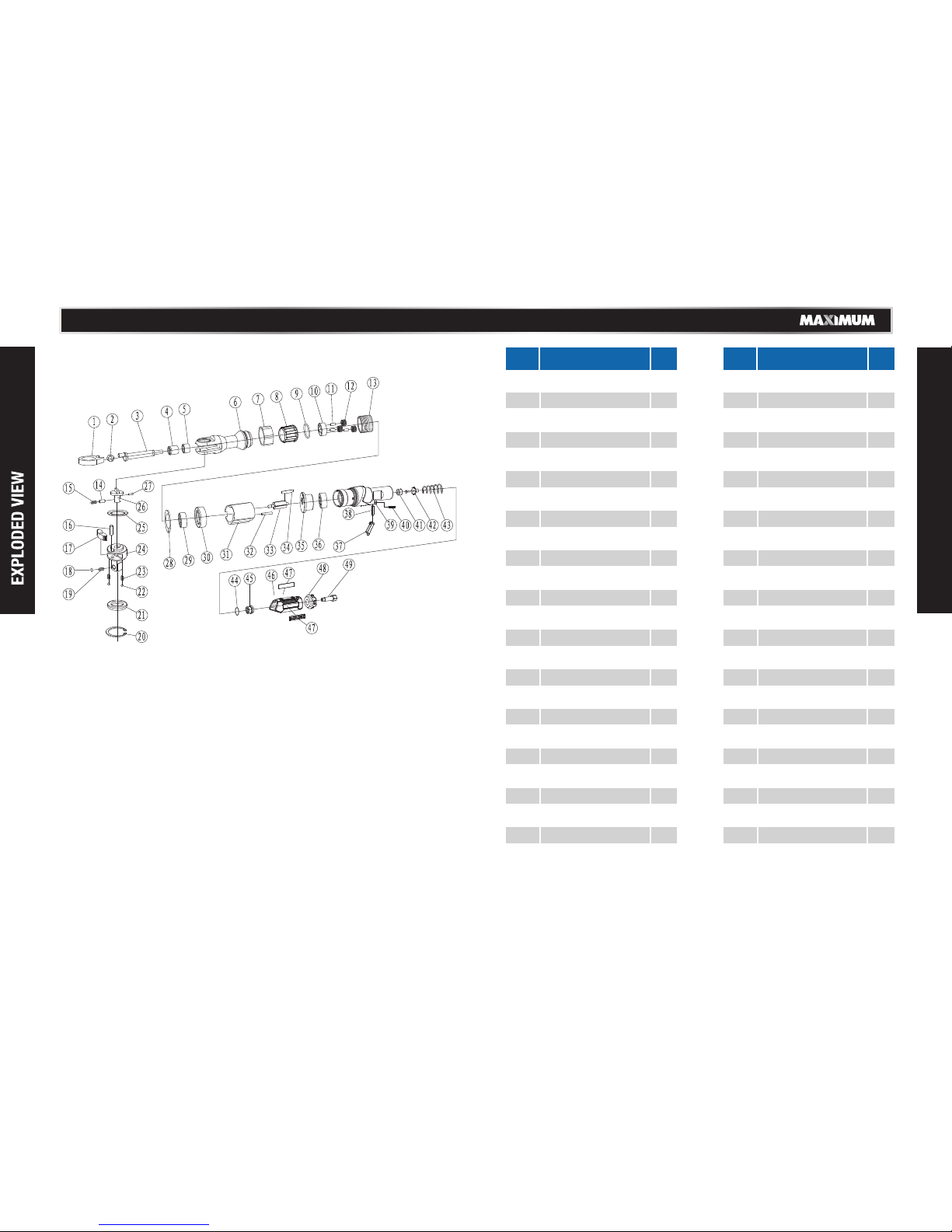
If any parts are missing or damaged, or if you have any questions, please
call 1-888-670-6682.
Description Description
PARTS LIST
26
27
28
29
30
31
32
33
34
35
36
37
38
39
40
41
42
43
44
45
46
47
48
49
1
2
3
4
5
6
7
8
9
10
11
12
13
14
15
16
17
18
19
20
21
22
23
24
25
Ratchet yoke
Drive bushing
Eccentric shaft
Needle bearing
Bearing sleeve
H handle
Hex clamp nut
Exhaust cover
O-ring 35 x 2
Idler gear seat
Idler gear pin
Idler gear
Thread ring gear
Top cover
SpringⅠ
Pin
Ratchet pawl
Steel ball Dw=4.5
Spring Ⅱ
Retainer ring 30
Washer
Steel ball Dw=4
Spring Ⅲ
Ⅲ
Ratchet anvil
Washer
Reverse button
Pin 2 x 6
V Washer
Bearing 608zz
Front cover
Cylinder
Pin 1.5 x 6
Rotor
Rotor blade
Back cover
Bearing 626zz
Trigger
Trigger pin
Housing
Pin 2 x 18
Inlet valve seat
Valve assembly
Spring
O-ring 14.5 x 1.8
Sealing connector
Housing sleeve
Label
End cover
Air inlet
TM
Page 12
2322
model no. 058-9372-4 | contact us 1-888-670-6682
TM
This MAXIMUM product is guaranteed for a period of 5 years
from the date of original retail purchase against defects in
workmanship and materials only and is subject to the following
components:
a) Component A: The carrying case is guaranteed for a period of
1-year from the date of original retail purchase against defects in
workmanship and materials.
These warranties are subject to the following conditions and
limitations:
Subject to the conditions and limitations described below, this product,
if returned to us with proof of purchase within the stated warranty
period and if covered under this warranty, will be repaired or replaced
(with the same model, or one of equal value or specification), at the sole
discretion of the Maximum Canada authorised repair centre (“Service
Provider”). We will bear the cost of any repair or replacement and any
costs of labour relating thereto.
A bill of sale verifying the purchase and purchase date must be provided;
Defects in workmanship and material to be assessed and determined by
the Service Provider;
This warranty will not apply to any product or part thereof which is worn
or broken or which has become inoperative due to abuse, misuse,
accidental damage, neglect or lack of proper installation, operation or
maintenance (as outlined in the applicable owner’s manual or operating
instructions);
This warranty does not apply to normal wear and tear or to expendable
parts or accessories (including drill bits and saw blades) that may be
supplied with the product that by their nature have a limited life span
and are expected to become inoperative or unusable after a reasonable
period of use;
This warranty will not apply to routine maintenance and consumable
items such as, but not limited to,anvils, vans, washers, bearings, plates,
pins, ratchet yokes, ratchet pawls, chisels, springs, rubber o-rings, tune-ups
or adjustments;
This warranty excludes the following components that may accompany
your product:
(1) The carrying case, which is only for a period of 1-year from the date of
original retail purchase against defects in workmanship and materials.
(2) Accessories, including drill bits and saw blades, which do not carry a
warranty of any kind.
This warranty will not apply where damage is caused by repairs made or
attempted by others (i.e. persons not authorized by the manufacturer),
and any such unauthorized repairs or attempted repairs shall void this
warranty in its entirety;
FURTHER, THE WARRANTIES SET OUT HEREIN ARE IN LIEU OF ALL OTHER
WARRANTIES OR CONDITIONS, WHETHER EXPRESS, IMPLIED OR
STATUTORY (INCLUDING SUCH AS ARISE UNDER THE SALE OF GOODS
ACT OR THE INTERNATIONAL SALE OF GOODS ACT), ARISING OUT OF A
COURSE OF DEALING OR USAGE OF TRADE OR OTHERWISE, INCLUDING,
SUBJECT TO APPLICABLE LAW, ANY IMPLIED WARRANTIES OR
CONDITIONS OF MERCHANTABILITY, MERCHANTABLE QUALITY, FITNESS
OR ADEQUACY FOR A PARTICULAR PURPOSE OR USE, AND ALL OTHER
SUCH WARRANTIES ARE EXPRESSLY DISCLAIMED BY THE RETAILER
AND MANUFACTURER.
a)
b)
c)
d)
e)
f)
g)
This warranty will not apply to any parts other than original parts,
except to the extent that the retailer or manufacturer or persons
authorized by either of them have repaired or replaced them;
This warranty will not apply to any product that was sold to the original
purchaser as a reconditioned or refurbished product (unless otherwise
specified in writing);
This warranty will not apply to any product or part thereof if any part
from another manufacturer is installed therein or any repairs or
alterations have been made or attempted by unauthorized persons;
This warranty will not apply to normal deterioration of the exterior finish,
such as, but not limited to, scratches, dents, paint chips, or to any
corrosion or discolouring by heat, abrasive and chemical cleaners; and
This warranty will not apply to component parts sold by and identified as
the product of another company, which shall be covered under that
product manufacturer’s warranty, if any;
Any products replaced by the retailer in attempt to fulfill warranty
obligations is subject to the original product warranty conditions and
related time period as initiated by the original date of purchase; if
product is purchased in Quebec, the warranty term will be extended for
a period equal to the time during which the Quebec retailer possesses
the product in attempt to fulfill warranty obligations; replaced product
will not default to new product warranty conditions; and
The retailer and manufacturer’s sole obligation and the purchaser’s sole
remedy under this warranty shall be as set out herein. The warranties
contained herein are not transferable and are given only to the purchaser.
h)
i)
j)
k)
l)
m)
n)
model no. 058-9372-4 | contact us 1-888-670-6682
TM
Page 13
2524
model no. 058-9372-4 | contact us 1-888-670-6682
TM
Additional Limitations
This warranty applies only to the original purchaser and may not be transferred.
This warranty applies for a period of 5 years from the date of original retail
purchase, as indicated on the bill of sale.
Neither the retailer, Maximum Canada, nor the manufacturer shall be liable for
any other expense, loss or damage, including, without limitation, any indirect,
incidental, consequential or exemplarydamages arising in connection with the
sale, use or inability to use this product.
Under no circumstances shall the retailer, Maximum Canada, or manufacturer
be liable to the purchaser for any claim for (a) indirect, special, punitive,
incidental, exemplary, or consequential damages, (b) compensation for loss of
profits, anticipated revenue, savings or goodwill, or other economic loss of the
purchaser, (c) exemplary, aggravated or punitive damages howsoever incurred,
(d) contribution or set-off in respect of any claims against the purchaser, (e)
any damages whatsoever relating to third party products or services or the
purchaser’s materials, or (f) any damages whatsoever relating to interruption,
delays, errors or omissions; in each case under any theory of law or equity,
arising out of or in any way related to this warranty, even if advised of the
possibility thereof. Notwithstanding any provision herein or entitlement of the
purchaser at law, in equity or otherwise, in no event shall the liability of the
retailer or manufacturer under this warranty, whether in contract, tort, product
liability or otherwise, exceed, in the aggregate, the amount paid by the purchaser
to the retailer for the product to which this warranty applies.
*Notice to Consumer
This warranty gives you specific legal rights, and you may have other rights,
which may vary from province to province. The provisions contained in this
warranty are not intended to limit, modify, take away from, disclaim or exclude
any statutory warranties set forth in any applicable provincial or federal
legislation.
In addition to the 5-Year Limited Warranty, this MAXIMUM product is
covered by our:
1-Year Repair Warranty
Maximum Canada will maintain this product and replace critical parts
which have worn beyond reasonable use through normal use of such
product, any time during the first year after purchase.
The following are excluded from this 1-Year Repair Warranty:
a)Missing or damaged parts or components that are a result of abuse
or misuse;
b)Any wear and tear to non-critical parts or accessories that do not
affect the core function of the product.
90-Day Satisfaction Guarantee
If you are not completely satisfied with the performance of your
MAXIMUM product for any reason, you can return it within 90 days
from the date of purchase with proof of purchase for exchange or a
full refund.
Made in China,
Imported by
MAXIMUM Canada Toronto, Canada M4S 2B8
 Loading...