

Page 1
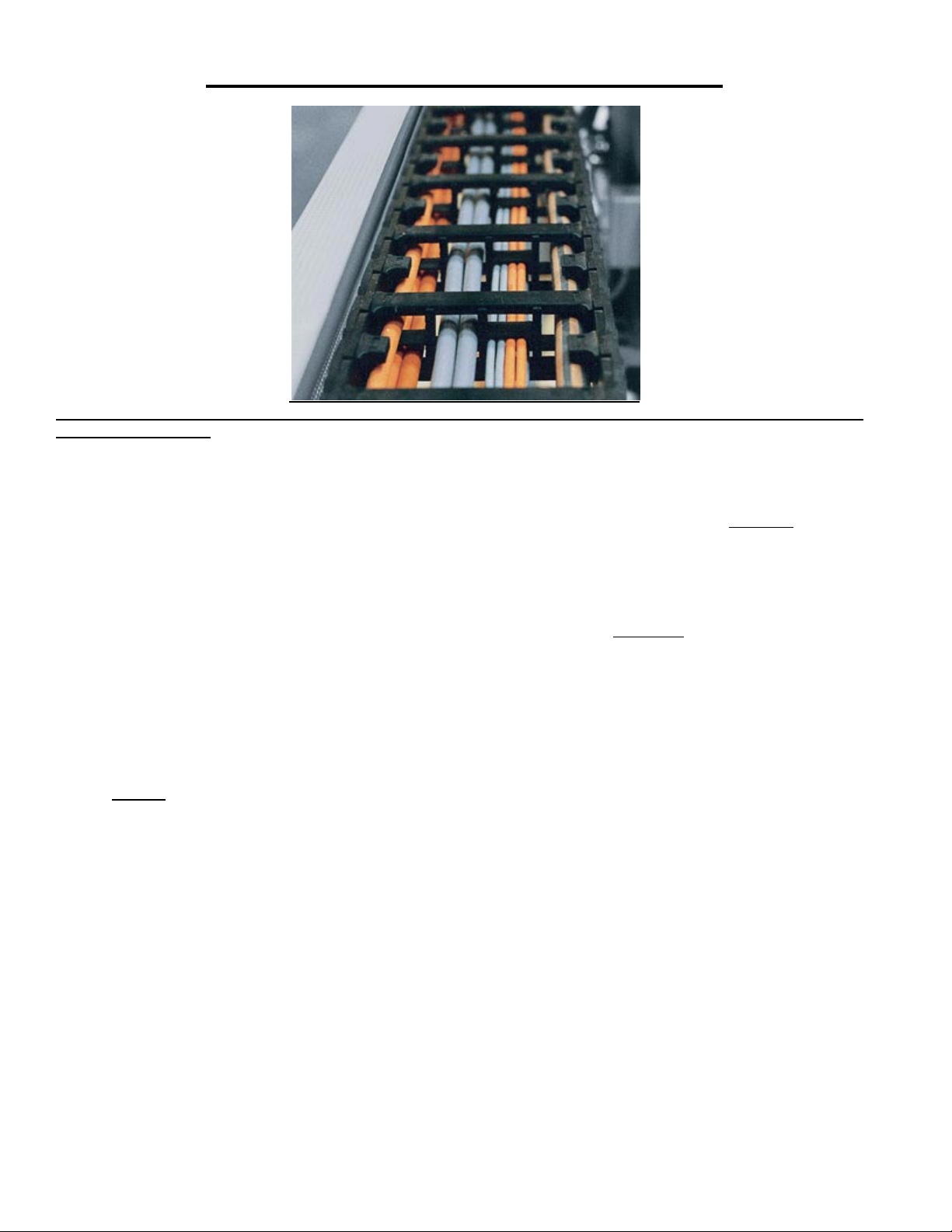
Marathon Cable Installation Guidelines
The following guidelines are considered as “industry accepted” practices for continuous flex cables installed
within cable carriers.
• Choose a cable carrier that does not operate below the minimum bend radius of the largest cable within a
single carrier. Marathon Cable products with an overall braided shield have a minimum bend radius of 12
times the cable diameter and are rated for 30 million cycles at or above this bend radius.
• Never pull coiled cable perpendicular from the direction of which it is coiled. Cable should ALWAYS be
unrolled and any twisting in the cable should not be allowed during unrolling, installation or in final location.
• Lay cable completely flat and straight on the floor (optimally overnight) prior to installation. This allows the
cable to relax and regain the original shape as it was manufactured. This also relieves any internal stresses
that were present due to the spooling process.
• Cable carrier separators will maximize the cable life since they prevent overlapping and tangling of the
individual cables. Overlapping causes pressure points which prevent the necessary movement of the internal
conductors. Any restriction to the internal conductor movement will cause the individual conductors to fold,
kink, roll and cork screw inside the cable jacket, which will rapidly diminish the cable life. Cable of different
jacket material that are allowed to rub together can bond or stick which restricts the necessary free float of the
cable and also reduces the life of the cable jacket. Lane separators as well as tier or layer separators should
always be used. If it is necessary to stack cables without a tier separator, make sure that cables are of like
size so as to prevent wedging of the top cable with the lower cable. Larger heavier cables should always be on
the bottom since they require the largest bend radius and can add undue friction on a smaller cable below.
• 10% minimum free space should be allowed within the confines of each individual separator space.
• NEVER tie wrap cable in any location as this is one of the worst types of pressure points.
• Light broad strain relief should only be used at the exit of the driven end of the carrier. This will prevent the
cable from migrating out of the driven side of the cable carrier and producing an excess loop. Broad (approx
1”) light pressure, only enough to prevent modest axial forces of the cable from allowing the cable to migrate
out of the carrier. A good rule of thumb is a pull force greater than 10 lbs should slip inside the strain relief.
• Avoid tight bends along the entire cable length. Cables that droop should be provided with a means of a
gradual waterfall like bend. An immediate droop which turns vertical over a span of a few inches is often times
too small of a bend radius.
• Where practical, excess cable should be shortened to just what is required for the installation. Coiling of
excess cable should always be avoided especially near the cable carrier. If excess cable cannot be avoided,
double the minimum bend radius for every complete loop of excess cable. Remember don’t tie wrap the
excess loop, use loose fitting clamps or loose fitting Velcro straps.
• Fluid power hoses should always be separated from electrical cables since they expand due to pressure
changes, and can bind the necessary free float of the cables.
MC
Marathon Cable Corporation 19678 Harper Avenue Grosse Pointe Woods, MI 48236 PH: 313-884-4420 FX: 313-884-8191
April/2012
 Loading...