

Page 1
Mapa Chemical
StanZoil NL-34/334
Chemical Product CAS #
BTT
(minutes)
Permeation
level
Standard
Degradation
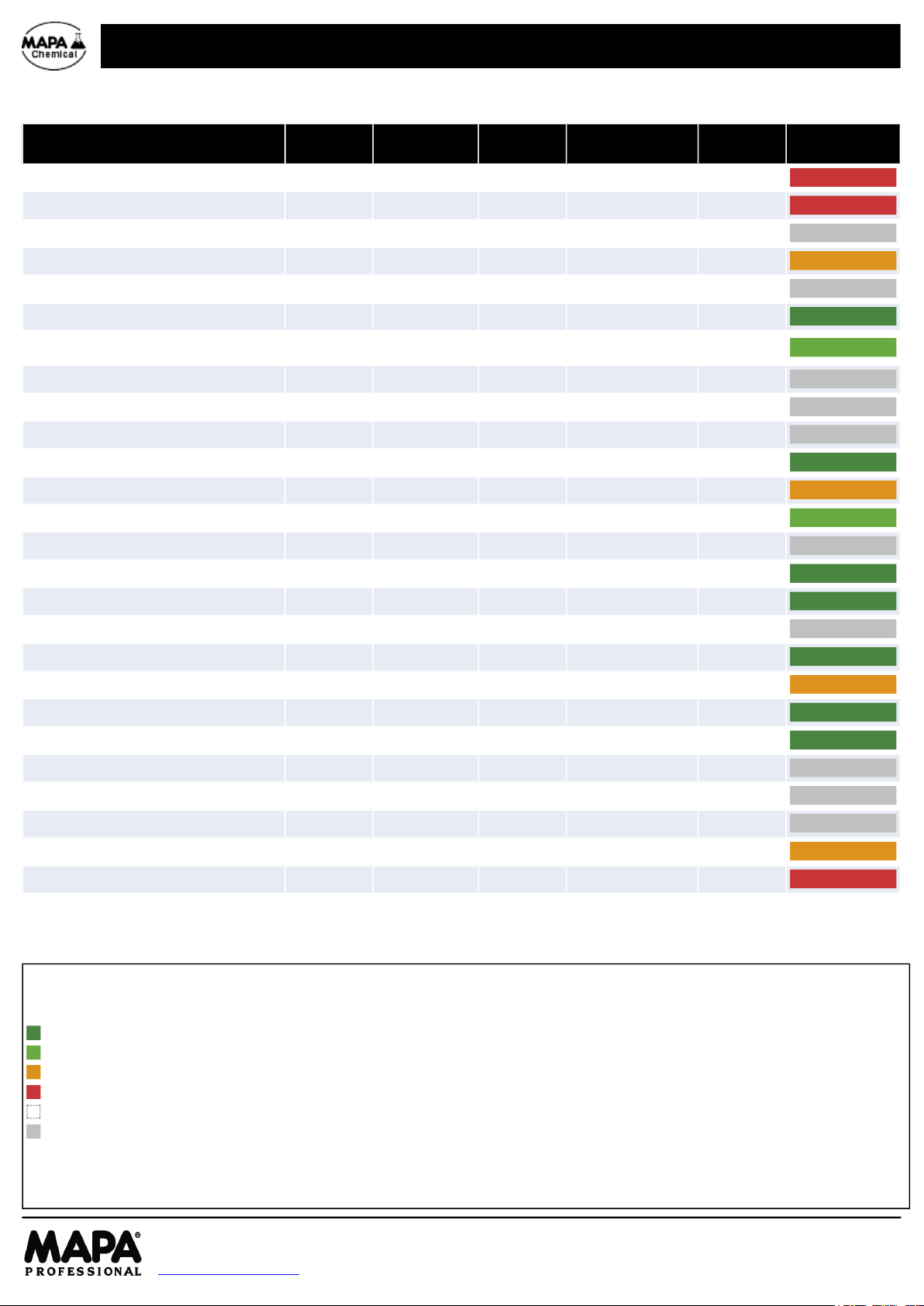
1,1,1-Trichloroethane 99% 71-55-6 20 1 ASTM F739 1
1,1,2-Trichloroethane 97% 79-00-5 7 0 ASTM F739 2
1,2 - dichloroethane 99% 107-06-2 6 0 ASTM F739 NT
2-Bromo-ethyl acetate 97% 927-68-4 52 2 ASTM F739 2
2-Hydroxyethyl Methacrylate 97% 868-77-9 480 6 ASTM F739 NT
2-Propanol (Isopropanol) 99% 67-63-0 450 5 ASTM F739 4
2,6-Dimethyl-4-Heptanone
(Diisobutyl Ketone) 80%
108-83-8 56 2 ASTM F739 3
Acetaldehyde 99% 75-07-0 5 0 ASTM F739 NT
Acetic acid 10% 64-19-7 NT NT 4
Acetic acid 50% 64-19-7 NT NT 4
Acetic acid 99% 64-19-7 210 4 ASTM F739 4
Acetone 99% 67-64-1 8 0 ASTM F739 3
Acetonitrile 99% 75-05-8 53 2 ASTM F739 4
Acrylate 2-Hydroxyethyl 96% 818-61-1 480 6 ASTM F739 NT
Acrylic acid 95% 79-10-7 480 6 ASTM F739 4
level
Rating
-
-
NA
=
NA
++
+
NA
NA
NA
++
=
+
NA
++
Acrylic acid 99% 79-10-7 480 6 ASTM F739 4
Acrylonitrile 99% 107-13-1 19 1 ASTM F739 NT
Ammonium hydroxide solution 29% 1336-21-6 265 5 ASTM F739 4
Amyl Acetate 99% 628-63-7 25 1 ASTM F739 2
Amyl Alcohol 99% 71-41-0 480 6 ASTM F739 4
Aniline 99% 62-53-3 142 4 ASTM F739 4
Benzene 99% 71-43-2 3 0 ASTM F739 NT
Benzotrichloride 100% 98-07-7 63 3 ASTM F739 NT
Benzoyl Chloride 100% 98-88-4 28 1 ASTM F739 NT
Benzyl Chloride 99% 100-44-7 17 1 ASTM F739 2
Butyl Acetate 99% 123-86-4 17 1 ASTM F739 1
Overall Chemical Protection Rating
*not normalized result
++
NA
++
=
++
++
NA
NA
NA
=
-
Protection rating is determined by taking into account the effects of both permeation and degradation in an attempt to
provide users with an overall protection guideline when using our glove products against specific chemicals.
Used for high chemical exposure or chemical immersion, limited to BTT based on a working day.
Used for repeated chemical contact, limited to total chemical exposure i.e. : accumulative BTT based on a working day.
Splash protection only, on chemical exposure the gloves should be discarded and new gloves worn as soon as possible.
Not recommended, these gloves are deemed unsuitable for work with this chemical.
NT : Not tested
NA : Not applicable because not fully tested (only degradation OR permeation results)
The chemical test data and overall chemical protection rating should not be used as the absolute basis for glove selection. Actual in-use conditions may
vary glove performance from the controlled conditions of laboratory tests. Factors other than chemical contact time, such as concentration and
temperature, glove thickness and glove reuse, may also affect performance. Other glove requirements, such as length, dexterity, cut, abrasion,
puncture and snag resistance, or glove grip also need to be considered in making your final selection.
Mapa Professionnel
Défense Ouest - 420, rue d'Estienne d'Orves - 92705 Colombes Cedex - France
Tel: (33) 1 49 64 22 00 - Fax: (33) 1 49 64 24 29
www.mapa-pro.com
Document generated on 2017-11-10 - Page 1/5
Page 2
Mapa Chemical
StanZoil NL-34/334
Chemical Product CAS #
BTT
(minutes)
Permeation
level
Standard
Degradation
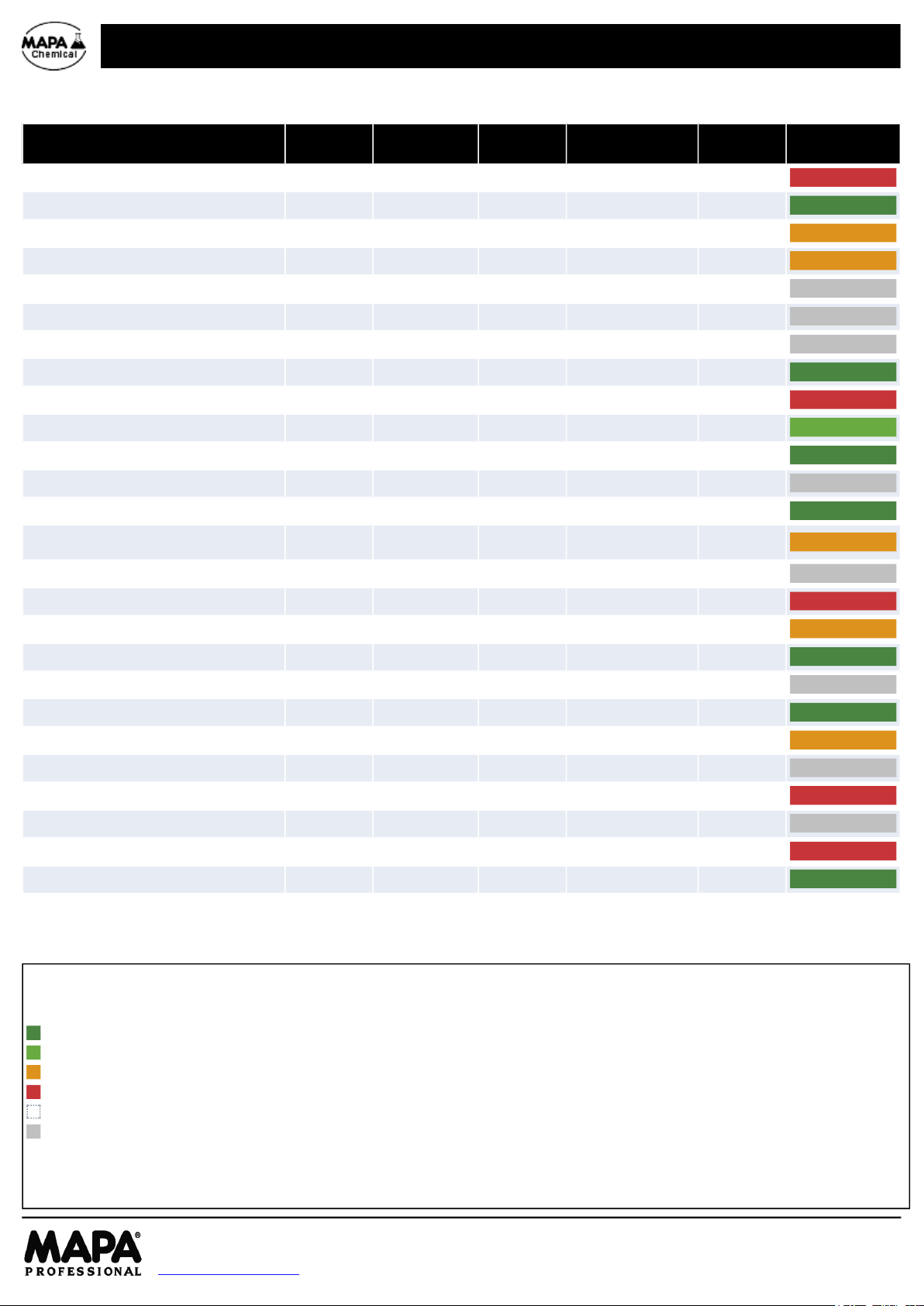
Butyl Acrylate 99% 141-32-2 15 1 ASTM F739 1
Calcium Hydroxide 0,18% 1305-62-0 480 6 ASTM F739 4
Carbon disulfide 99% 75-15-0 1 0 ASTM F739 3
Carbon Tetrachloride 99% 56-23-5 24 1 ASTM F739 3
Chlorine 100% 7782-50-5 480 6 ASTM F739 NT
Chlorine 99% 7782-50-5 44 2 ASTM F739 NT
Chloroform 99% 67-66-3 2 0 ASTM F739 NT
Chromic Acid 50% 7738-94-5 348 5 ASTM F739 4
Cumene 98% 98-82-8 22 1 ASTM F739 1
Cyclohexane 99% 110-82-7 35 2 ASTM F739 3
Cyclohexanol 99% 108-93-0 480 6 ASTM F739 4
Cyclooctadiene 99% 111-78-4 23 1 ASTM F739 NT
Dibutyl Phthalate 99% 84-74-2 480 6 ASTM F739 4
Dichloromethane (Methylene
Chloride) 99%
75-09-2 4 0 ASTM F739 3
Diethylamine 98% 109-89-7 4 0 ASTM F739 NT
level
Rating
-
++
=
=
NA
NA
NA
++
-
+
++
NA
++
=
NA
Dimethyl Sulfide 99% 75-18-3 2 0 ASTM F739 1
Dimethylformamide 99% 68-12-2 30 1 ASTM F739 3
Dimethylsulfoxide 99% 67-68-5 456 5 ASTM F739 4
Diphenyl Phospite NA 4712-55-4 480 6 ASTM F739 NT
Ethanol 95% 64-17-5 363 5 ASTM F739 4
Ether (Diethyl Ether) 99% 60-29-7 4 0 ASTM F739 3
Ethyl acetate 99% 141-78-6 8 0 ASTM F739 NT
Ethyl acrylate 99% 140-88-5 18 1 ASTM F739 1
Ethyl benzene 99% 100-41-4 1 0 ASTM F739 NT
Ethyl Chloroformate 97% 541-41-3 4 0 ASTM F739 2
Ethylene glycol 99% 107-21-1 480 6 ASTM F739 4
Overall Chemical Protection Rating
*not normalized result
-
=
++
NA
++
=
NA
-
NA
-
++
Protection rating is determined by taking into account the effects of both permeation and degradation in an attempt to
provide users with an overall protection guideline when using our glove products against specific chemicals.
Used for high chemical exposure or chemical immersion, limited to BTT based on a working day.
Used for repeated chemical contact, limited to total chemical exposure i.e. : accumulative BTT based on a working day.
Splash protection only, on chemical exposure the gloves should be discarded and new gloves worn as soon as possible.
Not recommended, these gloves are deemed unsuitable for work with this chemical.
NT : Not tested
NA : Not applicable because not fully tested (only degradation OR permeation results)
The chemical test data and overall chemical protection rating should not be used as the absolute basis for glove selection. Actual in-use conditions may
vary glove performance from the controlled conditions of laboratory tests. Factors other than chemical contact time, such as concentration and
temperature, glove thickness and glove reuse, may also affect performance. Other glove requirements, such as length, dexterity, cut, abrasion,
puncture and snag resistance, or glove grip also need to be considered in making your final selection.
Mapa Professionnel
Défense Ouest - 420, rue d'Estienne d'Orves - 92705 Colombes Cedex - France
Tel: (33) 1 49 64 22 00 - Fax: (33) 1 49 64 24 29
www.mapa-pro.com
Document generated on 2017-11-10 - Page 2/5
Page 3
Mapa Chemical
StanZoil NL-34/334
Chemical Product CAS #
BTT
(minutes)
Permeation
level
Standard
Degradation
level
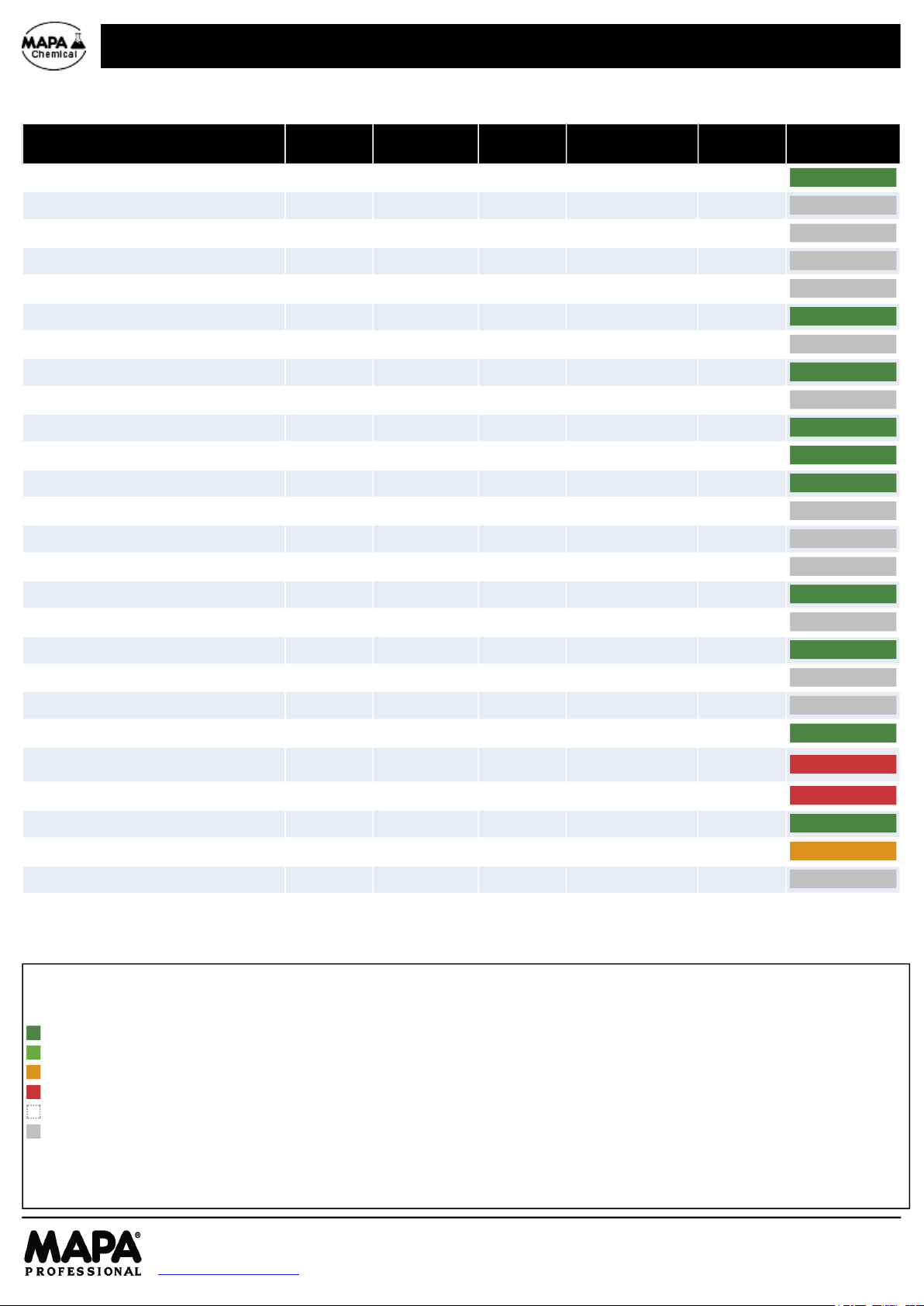
Formaldehyde 37% 50-00-0 480 6 ASTM F739 4
Formic Acid 96% 64-18-6 NT NT 4
Fuel oils mixture 68476-34-6 480 6 ASTM F739 NT
Glutaraldehyde 50% 111-30-8 NT NT 4
Hexachlorocyclopentadiene 100% 77-47-4 30 1 ASTM F739 NT
Hydrazine 35% 302-01-2 480 6 ASTM F739 4
Hydrazine 70% 302-01-2 NT NT 4
Hydrochloric acid 10% 7647-01-0 480 6 ASTM F739 4
Hydrochloric acid 35% 7647-01-0 NT NT 4
Hydrochloric acid 37% 7647-01-0 480 6 ASTM F739 4
Hydrofluoric Acid 10% 7664-39-3 480 6 ASTM F739 4
Hydrofluoric Acid 49% 7664-39-3 480 6 ASTM F739 4
Hydrogen fluoride Anhydrous 99% 7664-39-3 35 2 ASTM F739 NT
Hydrogen peroxide 30% 7722-84-1 NT NT 4
Hypophosphorous Acid 50% 6303-21-5 480 6 ASTM F739 NT
Rating
++
NA
NA
NA
NA
++
NA
++
NA
++
++
++
NA
NA
NA
Isobutyl alcohol 99% 78-83-1 480 6 ASTM F739 4
m,o,p-Chlorotoluene mixture 25168-05-2 15 1 ASTM F739 NT
Maleic Acid 9,1% 110-16-7 480 6 ASTM F739 4
meta-Xylene 99% 108-38-3 NT NT 2
Methanol 85% 67-56-1 NT NT 4
Methanol 99% 67-56-1 195 4 ASTM F739 4
Methyl Ethyl Ketone (2-Butanone)
99%
78-93-3 9 0 ASTM F739 1
Methyl methacrylate 95% 80-62-6 15 1 EN 374-3:2003 1
Methylamine 40% 74-89-5 391 5 ASTM F739 4
Methylisobutylketone 99% 108-10-1 19 1 ASTM F739 2
Mineral Spirits 100% 64475-85-0 127 4 ASTM F739 NT
Overall Chemical Protection Rating
*not normalized result
++
NA
++
NA
NA
++
-
-
++
=
NA
Protection rating is determined by taking into account the effects of both permeation and degradation in an attempt to
provide users with an overall protection guideline when using our glove products against specific chemicals.
Used for high chemical exposure or chemical immersion, limited to BTT based on a working day.
Used for repeated chemical contact, limited to total chemical exposure i.e. : accumulative BTT based on a working day.
Splash protection only, on chemical exposure the gloves should be discarded and new gloves worn as soon as possible.
Not recommended, these gloves are deemed unsuitable for work with this chemical.
NT : Not tested
NA : Not applicable because not fully tested (only degradation OR permeation results)
The chemical test data and overall chemical protection rating should not be used as the absolute basis for glove selection. Actual in-use conditions may
vary glove performance from the controlled conditions of laboratory tests. Factors other than chemical contact time, such as concentration and
temperature, glove thickness and glove reuse, may also affect performance. Other glove requirements, such as length, dexterity, cut, abrasion,
puncture and snag resistance, or glove grip also need to be considered in making your final selection.
Mapa Professionnel
Défense Ouest - 420, rue d'Estienne d'Orves - 92705 Colombes Cedex - France
Tel: (33) 1 49 64 22 00 - Fax: (33) 1 49 64 24 29
www.mapa-pro.com
Document generated on 2017-11-10 - Page 3/5
Page 4
Mapa Chemical
StanZoil NL-34/334
Chemical Product CAS #
BTT
(minutes)
Permeation
level
Standard
Degradation
level
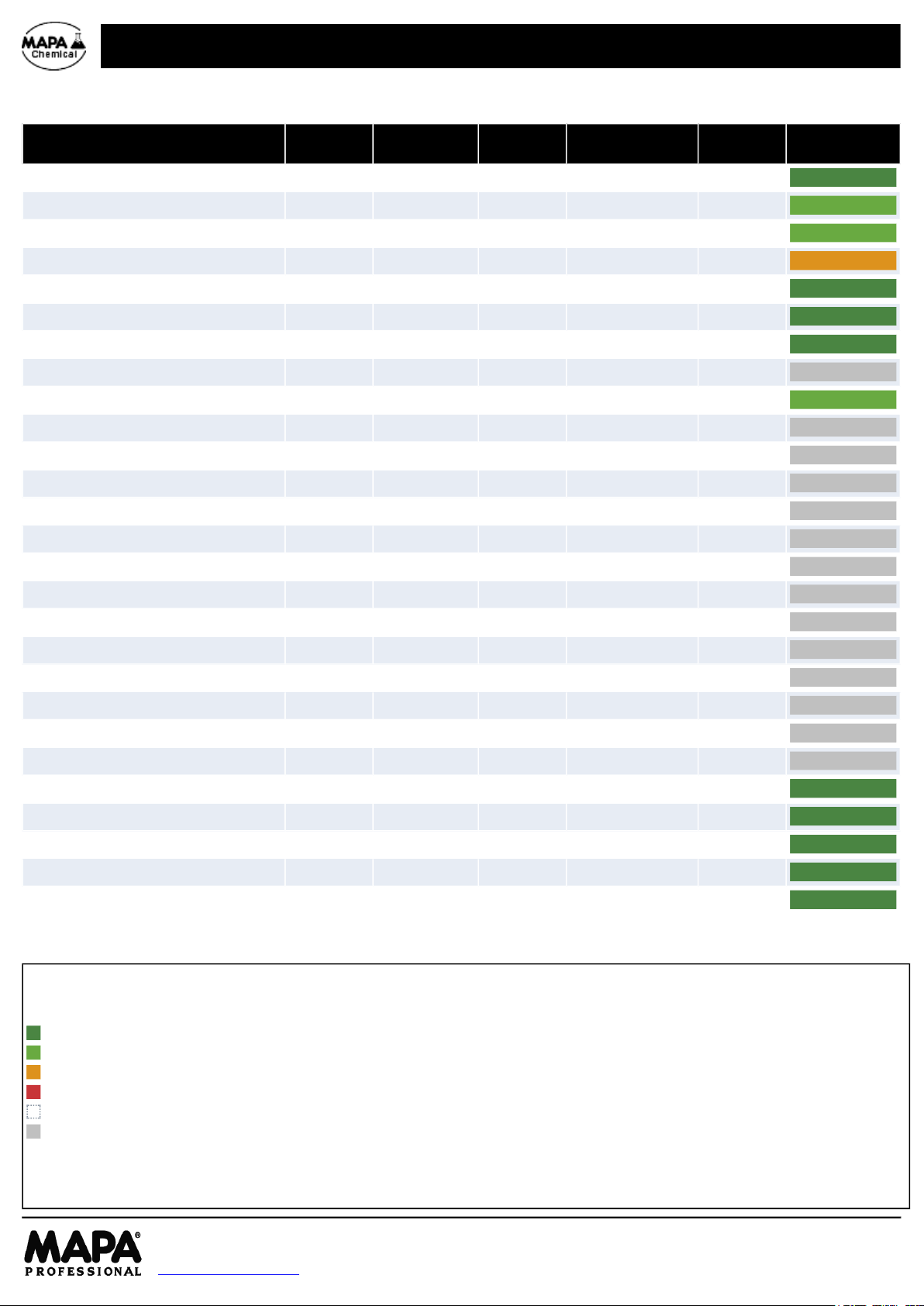
n-Butanol 99% 71-36-3 480 6 ASTM F739 4
n-Heptane 99% 142-82-5 50 2 ASTM F739 4
n-hexane 95% 110-54-3 36 2 ASTM F739 4
N-N dimethyl acetamide 99% 127-19-5 45 2 ASTM F739 2
n-Propanol 99% 71-23-8 480 6 ASTM F739 4
N,N-Diisopropylethylamine 99% 7087-68-5 301 5 ASTM F739 4
Naphtha (Stoddart Solvent) mixture 8052-41-3 241 5 ASTM F739 3
Naphtha Heavy mixture 68551-17-7 NT NT 4
Naphtha VM&P mixture 8032-32-4 23 1 ASTM F739 4
Nitric acid 10% 7697-37-2 NT NT 4
Nitric acid 20% 7697-37-2 NT NT 4
Nitric acid 40% 7697-37-2 NT NT 4
Nitric acid 50% 7697-37-2 NT NT 4
Nitric acid 68% 7697-37-2 NT NT 4
Nitric acid 70% 7697-37-2 NT NT 4
Rating
++
+
+
=
++
++
++
NA
+
NA
NA
NA
NA
NA
NA
Nitric acid 90% 7697-37-2 3 0 ASTM F739 NT
Nitrobenzene 99% 98-95-3 52 2 ASTM F739 NT
Nonylphenol 99% 25154-52-3 480 6 ASTM F739 NT
Oleic Acid 90% 112-80-1 NT NT 3
Oleum (free SO3) 30% 8014-95-7 10 0 ASTM F739 NT
Parachlorobenzotrichloride 99% 5216-25-1 70 3 ASTM F739 NT
Pentane 99% 109-66-0 NT NT 4
Phenol 85% 108-95-2 480 6 ASTM F739 4
Phosphoric acid 75% 7664-38-2 480 6 ASTM F739 4
Phosphoric acid 85% 7664-38-2 480 6 ASTM F739 4
Potassium Hydroxide 50% 1310-58-3 480 6 ASTM F739 4
Potassium Iodide 59% 7681-11-0 480 6 ASTM F739 4
Overall Chemical Protection Rating
*not normalized result
NA
NA
NA
NA
NA
NA
NA
++
++
++
++
++
Protection rating is determined by taking into account the effects of both permeation and degradation in an attempt to
provide users with an overall protection guideline when using our glove products against specific chemicals.
Used for high chemical exposure or chemical immersion, limited to BTT based on a working day.
Used for repeated chemical contact, limited to total chemical exposure i.e. : accumulative BTT based on a working day.
Splash protection only, on chemical exposure the gloves should be discarded and new gloves worn as soon as possible.
Not recommended, these gloves are deemed unsuitable for work with this chemical.
NT : Not tested
NA : Not applicable because not fully tested (only degradation OR permeation results)
The chemical test data and overall chemical protection rating should not be used as the absolute basis for glove selection. Actual in-use conditions may
vary glove performance from the controlled conditions of laboratory tests. Factors other than chemical contact time, such as concentration and
temperature, glove thickness and glove reuse, may also affect performance. Other glove requirements, such as length, dexterity, cut, abrasion,
puncture and snag resistance, or glove grip also need to be considered in making your final selection.
Mapa Professionnel
Défense Ouest - 420, rue d'Estienne d'Orves - 92705 Colombes Cedex - France
Tel: (33) 1 49 64 22 00 - Fax: (33) 1 49 64 24 29
www.mapa-pro.com
Document generated on 2017-11-10 - Page 4/5
Page 5
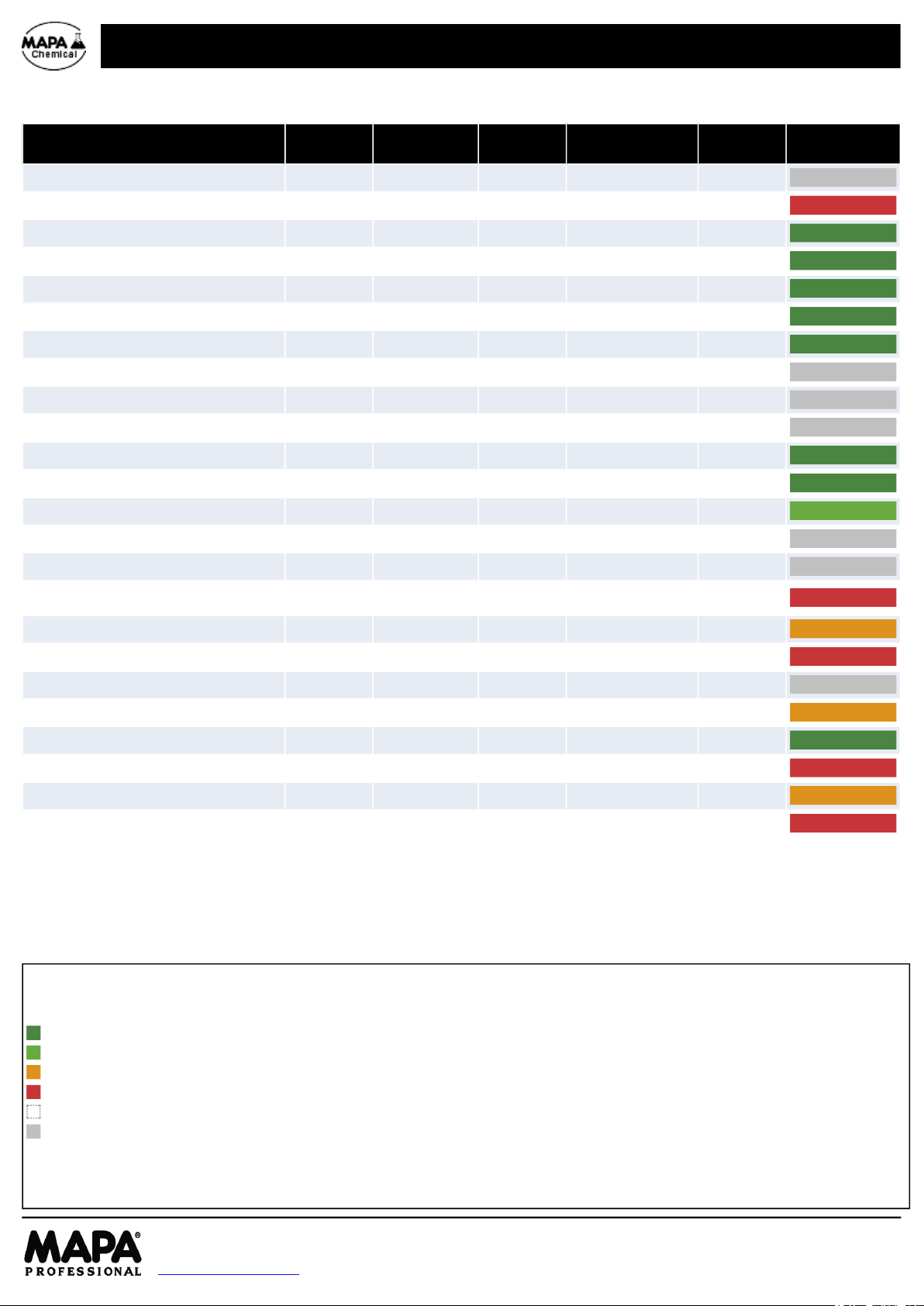
Mapa Chemical
StanZoil NL-34/334
Chemical Product CAS #
BTT
(minutes)
Permeation
level
Standard
Degradation
level
Propylene Oxide 99% 75-56-9 1 0 ASTM F739 NT
Pyridine 99% 110-86-1 10 0 ASTM F739 1
Sodium Carbonate 21,6% 497-19-8 480 6 ASTM F739 4
Sodium hydroxide 20% 1310-73-2 480 6 ASTM F739 4
Sodium hydroxide 40% 1310-73-2 480 6 ASTM F739 4
Sodium hydroxide 50% 1310-73-2 480 6 ASTM F739 4
Sodium Thiosulfate 41,2% 7772-98-7 480 6 ASTM F739 4
Styrene 99% 100-42-5 2 0 ASTM F739 NT
Sulfur Dichloride 100% 10545-99-0 30 1 ASTM F739 NT
Sulfur Monochloride 100% 10025-67-9 480 6 ASTM F739 NT
Sulfuric acid 10% 7664-93-9 480 6 EN 374-3:2003 4
Sulfuric acid 40% 7664-93-9 480 6 EN 374-3:2003 4
Sulfuric acid 96% 7664-93-9 88 3 ASTM F739 2
t-Butyl Methyl Ether 98% 1634-04-4 6 0 ASTM F739 NT
tert-Butyl Hydroperoxide 70% 75-91-2 454 5 ASTM F739 NT
Tetrachloroethylene
(Perchloroethylene) 99%
127-18-4 7 0 ASTM F739 1
Tetrahydrofurane 99% 109-99-9 3 0 ASTM F739 3
Rating
NA
-
++
++
++
++
++
NA
NA
NA
++
++
+
NA
NA
-
=
Toluene 99% 108-88-3 6 0 ASTM F739 1
Trichloroethylene 99% 79-01-6 1 0 ASTM F739 NT
Triethylamine 99% 121-44-8 35 2 ASTM F739 2
Trifluoroacetic Acid 99% 76-05-1 480 6 ASTM F739 4
Unleaded gasoline mixture 8006-61-9 8 0 ASTM F739 1
Vinyl acetate 99% 108-05-4 14 1 ASTM F739 2
Xylene 99% 1330-20-7 17 1 ASTM F739 1
Overall Chemical Protection Rating
*not normalized result
-
NA
=
++
-
=
-
Protection rating is determined by taking into account the effects of both permeation and degradation in an attempt to
provide users with an overall protection guideline when using our glove products against specific chemicals.
Used for high chemical exposure or chemical immersion, limited to BTT based on a working day.
Used for repeated chemical contact, limited to total chemical exposure i.e. : accumulative BTT based on a working day.
Splash protection only, on chemical exposure the gloves should be discarded and new gloves worn as soon as possible.
Not recommended, these gloves are deemed unsuitable for work with this chemical.
NT : Not tested
NA : Not applicable because not fully tested (only degradation OR permeation results)
The chemical test data and overall chemical protection rating should not be used as the absolute basis for glove selection. Actual in-use conditions may
vary glove performance from the controlled conditions of laboratory tests. Factors other than chemical contact time, such as concentration and
temperature, glove thickness and glove reuse, may also affect performance. Other glove requirements, such as length, dexterity, cut, abrasion,
puncture and snag resistance, or glove grip also need to be considered in making your final selection.
Powered by TCPDF (www.tcpdf.org)
Mapa Professionnel
Défense Ouest - 420, rue d'Estienne d'Orves - 92705 Colombes Cedex - France
Tel: (33) 1 49 64 22 00 - Fax: (33) 1 49 64 24 29
www.mapa-pro.com
Document generated on 2017-11-10 - Page 5/5
 Loading...