

Page 1
25
www m-p-llc com
GASOLINE POWERED
GENERATOR
MMG25FHZ
OPERATING MANUAL
Page 2

INTRODUCTION
WARNING
This manual provides information and procedures to safely operate and maintain the engine and generator. For your
own safety and protection from physical injury, carefully read, understand, and observe the safety instructions
described in this manual. The information contained in this manual was based on machines in production at the time
of publication. Magnum Products LLC reserves the right to change any portion of this information without notice.
DO NOT MODIFY or use this equipment for any application other than which it was designed for.
Magnum Products LLC recommends that a trained and licensed professional perform all electrical wiring and testing
functions. Any wiring should be in compliance with the United States National Electric Code (NEC), state and local
codes and Occupational Safety and Health Association (OSHA) guidelines.
Keep a copy of this manual with the unit at all times. Additional copies are available from Magnum Products LLC, or
can be found at www.m-p-llc.com. An engine operator’s manual was also supplied with the unit at the time of
shipment from the factory. The manual provides detailed operation and maintenance procedures for the engine.
Additional copies of the engine operators manual are available from the engine manufacturer.
MAGNUM PRODUCTS LLC
215 Power Drive • Berlin, WI 54923
U.S.A.
Phone: 920-361-4442
FAX: 920-361-4416
Toll Free: 1-800-926-9768
www.m-p-llc.com
For technical or parts QUESTIONS, please contact Magnum Products’ Customer Support or
Technical Support team at 920-361-4442. Please have your serial number available.
To ORDER SERVICE PARTS, please contact the dealer from which you purchased the unit, or call
Magnum Products to locate a dealer in your area.
Supplemental information may be available for your unit; when ordering parts ALWAYS check for a
supplement that applies to your unit. A supplement may have been provided with your unit and can
be found on the Magnum Products LLC website.
Engine Make: __________________________________________
Engine Serial Number: ___________________________________
Engine Model Number: ___________________________________
Generator Make:________________________________________
Generator Model Number: ________________________________
Generator Serial Number:_________________________________
Unit Model Number: _____________________________________
Unit Serial Number:______________________________________
CALIFORNIA PROPOSITION 65 WARNING: Engine exhaust and some of its constit-
uents are known to the state of California to cause cancer, birth defects and other
2
reproductive harm.
Page 3

TABLE OF CONTENTS
page
INTRODUCTION ................................................................................................................................... 2
TABLE OF CONTENTS ......................................................................................................................... 3
SAFETY NOTES .................................................................................................................................... 4
OPERATING SAFETY ........................................................................................................................... 4
ENGINE SAFETY .................................................................................................................................. 5
ELECTRICAL SAFETY .......................................................................................................................... 5
TOWING SAFETY ................................................................................................................................. 6
REPORTING TRAILER SAFETY DEFECTS ......................................................................................... 6
SAFETY SYMBOL SUMMARY .............................................................................................................. 7
SPECIFICATIONS ................................................................................................................................. 8
UNIT DIMENSIONS ............................................................................................................................... 9
UNIT SERIAL NUMBER LOCATIONS ...................................................................................................9
COMPONENT LOCATIONS ................................................................................................................ 10
FRONT HOOD OPERATION ............................................................................................................... 11
REAR HOOD OPERATION ..........................................................................................................12 - 13
MAIN CONTROL PANEL FEATURES ................................................................................................. 14
MAGNUM DIGITAL CONTROLLER (MDC) ......................................................................................... 15
DIGITAL CONTROLLER FEATURES AND FUNCTIONS ................................................................... 15
GENERATOR MONITORING .............................................................................................................. 16
ENGINE MONITORING ....................................................................................................................... 17
FINE VOLTAGE ADJUSTMENT ......................................................................................................... 18
GENERATOR START UP .................................................................................................................... 19
PRE- START CHECK LIST .................................................................................................................. 19
MANUAL STARTING OF THE GENERATOR ..................................................................................... 19
“AUTO” (REMOTE) STARTING OF THE GENERATOR .................................................................... 21
SHUTTING DOWN THE GENERATOR .............................................................................................. 21
MDC CONTROLLER INFORMATION DISPLAYS, FUNCTIONS AND RESET .................................. 22
MAGNUM DIGITAL CONTROLLER (MDC) – GENERATOR OPERATIONAL STATUS .................... 22
MAGNUM DIGITAL CONTROLLER (MDC) - ALARM MANAGEMENT .............................................. 22
MAGNUM DIGITAL CONTROLLER (MDC)- LIST OF POSSIBLE ALARMS/DESCRIPTIONS .......... 23
ENGINE CONTROLLER ...................................................................................................................... 24
ADJUSTING THE DISPLAY BACK LIGHTING ................................................................................... 24
MAGNUM DIGITAL CONTROLLER (MDC) – HISTORY .................................................................... 25
RESETTING OF THE “TIME TO SERVICE” REMINDER ...................................................................26
CHECK ENGINE LIGHT ...................................................................................................................... 26
TROUBLESHOOTING AUTOMATIC SHUTDOWN CONDITIONS ..................................................... 26
GENERATOR OUTPUT CONNECTION LUGS ................................................................................... 28
GENERATOR CAM LOCK CONNECTIONS (OPTIONAL) .................................................................. 29
VOLTAGE SELECTOR SWITCH ......................................................................................................... 30
4-POSITION VOLTAGE SELECTOR SWITCH (OPTIONAL) .............................................................. 31
EMERGENCY STOP SWITCH ............................................................................................................ 32
MAIN CIRCUIT BREAKER .................................................................................................................. 32
VOLTAGE REGULATION .................................................................................................................... 32
CUSTOMER CONVENIENCE OUTLETS ........................................................................................... 33
DERATING FOR ALTITUDE ................................................................................................................ 33
REMOTE START TERMINAL BLOCK ................................................................................................. 34
ENGINE BREAK-IN REQUIREMENTS ............................................................................................... 35
DAILY WALK AROUND INSPECTION ................................................................................................ 35
ENGINE AND GENERATOR MAINTENANCE .................................................................................... 35
DAILY MAINTENANCE CHECKS ........................................................................................................ 36
LIFTING THE GENERATOR ............................................................................................................... 37
TOWING THE TRAILER ...................................................................................................................... 37
TRAILER WHEEL BEARINGS ........................................................................................................
TRAILER WIRING DIAGRAM .............................................................................................................. 38
ELECTRIC BRAKE WIRING DIAGRAM .............................................................................................. 38
AC WIRING DIAGRAM ........................................................................................................................ 39
AC WIRING DIAGRAM: 4-POSITION PHASE SWITCH ..................................................................... 40
DC WIRING DIAGRAM ........................................................................................................................ 41
SERVICE LOG ..................................................................................................................................... 42
NOTES: ................................................................................................................................................ 43
....37
3
Page 4
SAFETY NOTES
DANGER
CAUTION
This is the safety alert symbol. It is used to alert you to potential personal injury hazards.
Obey all safety messages that follow this symbol to avoid possible injury or death.
This manual contains DANGERS, WARNINGS, CAUTIONS, NOTICES and NOTES which must
be followed to prevent the possibility of improper service, damage to the equipment, personal
injury or death. The following formatting options will apply when calling the readers attention to
the DANGERS, WARNINGS, CAUTIONS, NOTICES and NOTES.
INDICATES A HAZARDOUS SITUATION WHICH, IF NOT AVOIDED,WILL RESULT IN
Indicates a hazardous situation which, if not avoided, could result in death or serious
Indicates a hazardous situation which, if not avoided, may result in minor or moderate injury.
Indicates a hazardous situation which, if not avoided, may result in property or equipment
DEATH OR SERIOUS INJURY.
WARNING
injury.
NOTICE
damage.
Note: Notes contain additional information important to a procedure and will be found within the regular text body
of this manual.
OPERATING SAFETY
Before using the generator be sure you read and understand all of the instructions! This equipment was
designed for specific applications; DO NOT modify or use this equipment for any application other than
which it was designed for. Equipment operated improperly or by untrained personnel can be dangerous!
Read the operating instructions and familiarize yourself with the location and proper use of all instruments
and controls. Inexperienced operators should receive instruction from someone familiar with the equipment
before being allowed to operate or set up the generator. The following points should be practiced at all times:
• The area immediately surrounding the generator should be dry, clean, and free of debris.
• NEVER start a unit in need of repair.
• Make certain the generator is securely fastened to a good earthen ground before use.
• NEVER operate on a combustible surface.
• NEVER operate the generator if any of the following conditions exist during operation:
1. Noticeable change in engine speed.
2. Loss of electrical output.
3. Equipment connected to the generator overheats.
4. Sparking occurs.
5. Engine misfires or there is excessive engine/generator vibration.
6. Protective covers are loose or missing.
7. If the ambient air temperature is above 120° F.
• Make sure slings, chains, hooks, ramps, jacks, and other types of lifting devices are attached securely
and have enough weight-bearing capacity to lift or hold the equipment safely. Always remain aware
of the position of other people around you when lifting the equipment.
4
Page 5

ENGINE SAFETY
Internal combustion engines present special hazards during operation and fueling! Failure to follow the
safety guidelines described below could result in severe injury or death. Read and follow all safety warnings
described in the engine operator's manual. A copy of this manual was supplied with the unit when it was
shipped from the factory.
• DO NOT run engine indoors or in an area with poor ventilation unless exhaust hoses are used. Gasoline
exhaust contains carbon monoxide, a deadly, odorless and colorless gas which, if inhaled, can cause
nausea, fainting or death. Make sure engine exhaust cannot seep into closed rooms or ventilation
equipment.
• DO NOT fill fuel tank near an open flame, while smoking, or while engine is running. DO NOT fill tank
in an enclosed area with poor ventilation.
• DO NOT operate with the fuel tank cap loose or missing.
• DO NOT touch or lean against hot exhaust pipes or engine cylinders.
• DO NOT clean air filter with gasoline or other types of low flash point solvents.
• DO NOT remove engine coolant cap while engine is hot.
• DO NOT operate the unit without a functional exhaust system. Prolonged exposure to sound
levels in excess of 85 DBA can cause permanent hearing loss. Wear hearing protection when working
around a running engine.
• Keep hands, feet and loose clothing away from moving parts on the generator and engine.
• Keep area around exhaust pipes and air ducts free of debris to reduce the chance of an accidental fire.
• Batteries contain sulfuric acid which can cause severe injury or death. Sulfuric acid can cause eye
damage, burn flesh or eat holes in clothing. Protective eye wear and clothing are necessary when
working on or around the battery. Always disconnect the NEGATIVE (-) battery cable from the
corresponding terminal before performing any service on the engine or other components.
ELECTRICAL SAFETY
The unit is powered by a generator driven by a gasoline powered engine. While the engine is running,
potentially lethal voltages are present at the 120V Ground Fault Circuit Interrupt (GFCI) outlets and the
240V twist lock outlets located on the control panel, and at the connection lugs and cam lock receptacles.
Failure to follow the safety guidelines described below could result in severe injury or death.
• Only a qualified and licensed electrician should make connections to the generator.
• NEVER wash the unit with any high pressure hoses or power washers.
• NEVER start the unit under load. The circuit breakers must be in the “OFF” position when starting the
unit in MANUAL mode. The circuit breakers can be in the “ON” position only when started in the AUTO
mode. A transfer switch must be used in the AUTO mode to deflect the load upon start up.
• ALWAYS disconnect the NEGATIVE (-) battery cable from the corresponding terminal before perform-
ing any service on the engine, generator or any other components. Remove the NEGATIVE (-) battery
cable from the corresponding terminal if the unit is to be stored or transported.
• ALWAYS use extreme caution when servicing this unit in damp conditions. Do not service the unit if
your skin or clothing is wet. Do not allow water to collect around the base of the unit.
• ALWAYS connect the unit to a good earthen ground before use. Follow any local, state or United
States National Electric Code (NEC) guidelines.
5
Page 6

TOWING SAFETY
Towing a trailer requires care! Both the trailer and vehicle must be in good condition and securely fastened
to each other to reduce the possibility of an accident. Also, some states require that large trailers be
registered and licensed. Contact your local Department of Transportation office to check on license
requirements for your particular unit.
• Check that the hitch and coupling on the towing vehicle are rated equal to, or greater than, the trailer's
“gross vehicle weight rating” (GVWR).
• Check tires on trailer for tread wear, inflation, and condition.
• Inspect the hitch and coupling for wear or damage. NEVER tow trailer using defective parts!
• Make sure the trailer hitch and the coupling are compatible. Make sure the coupling is securely fastened
to the vehicle.
• Connect safety chains in a crossing pattern under the tongue and attach the breakaway cable TO THE
REAR BUMPER OF THE TOWING VEHICLE. Do not attach the cable to the trailer hitch.
• Make sure directional and brake lights on the trailer are connected and working properly.
• Check that lug nuts holding wheels are tight and that none are missing.
• Maximum recommended speed for highway towing is 45 mph. Recommended off-road towing speed
is not to exceed 10 mph or less depending on terrain.
Before towing the trailer, check that the weight of the trailer is equal across all tires. On trailers with
adjustable height hitches, adjust the angle of the trailer tongue to keep the trailer as level as possible. On
units equipped with a tandem axle trailer, a large angle between the trailer and tow vehicle will cause more
weight to be carried by one axle, which could cause premature wear on the tires and axles and cause
potentially unsafe operating conditions.
The trailer is equipped with hydraulic surge brakes or electric surge brakes. Check the operation of the
brakes by braking the vehicle at a slow speed before entering traffic. Both the trailer and the vehicle should
brake smoothly. If the trailer seems to be pushing, check the level in the surge brake fluid reservoir.
When towing, maintain extra space between vehicles and avoid soft shoulders, curbs and sudden lane
changes. If you have not pulled a trailer before, practice turning, stopping, and backing up in an area away
from heavy traffic.
A film of grease on the coupler will extend coupler life and eliminate squeaking. Wipe the coupler clean
and apply fresh grease each time the trailer is towed.
REPORTING TRAILER SAFETY DEFECTS
If you believe your trailer has a defect which could cause a crash or could cause injury or death, you should immediately
inform the National Highway Traffic Safety Administration (NHTSA) in addition to notifying Magnum Products LLC.
If NHTSA receives similar complaints, it may open an investigation; and if it finds that a safety defect exists in a group
of vehicles, it may order a recall and remedy campaign. However, NHTSA cannot become involved in individual
problem between you, your dealer, or Magnum Products LLC.
To contact NHTSA, you may either call the Auto Safety Hotline toll-free at 1-888-327-4236 (TTY:1-800-424-9153),
go to http://www.safercar.gov; or write to:
Administrator
NHTSA
1200 New Jersey Avenue S.E.
Washington, DC 20590
You can also obtain other information about motor vehicle safety from http://www.safercar.gov.
6
Page 7

SAFETY SYMBOL SUMMARY
This equipment has been supplied with numerous safety and operating decals. These decals provide important
operating instructions and warn of dangers and hazards. Replace any missing or hard-to-read decals and use care
when washing or cleaning the unit. Decal placement and part numbers can be found in the parts section or parts
manual included with your unit. Below is a summary of the intended meanings for the symbols used on the decals.
Safety alert symbol; Used to
alert you to potential personal
injury hazards.
Hot surface(s) nearby.
Belt/entanglement hazard; Keep
body parts clear of this area.
Fan hazard; Keep body parts
clear of this area.
Pinch/crush hazard; Keep body
parts clear of this area.
Never change position of voltage
selector switch while engine is
running.
Asphyxiation hazard; Operate
in well ventilated area.
Dangerous voltage may be
present.
Anchor/tie down point.
Isolate generator to prevent
electrocution hazard.
Use unleaded gasoline only.
Remove negative battery
cable before performing
any service on unit.
Stop engine before making
connections.
Stop engine before fueling.
Hearing protection required
while operating unit with doors
open.
Lift here only.
Engine running.
Read and understand the
supplied operator’s manual
before operating unit.
Unit electrical ground.
Fire/explosion hazard; Keep
open flames away from unit.
Burn/scald hazard;
pressurized steam.
7
Page 8

SPECIFICATIONS
Read this manual carefully before attempting to use this generator. The potential for property damage, personal injury or
death exists if this equipment is misused or installed incorrectly. Read all of the manuals included with this unit. Each
manual details specific information regarding items such as set up, use and service requirements. SPECIFICATIONS
ARE SUBJECT TO CHANGE WITHOUT NOTICE.
MAGNUM MODEL MMG25FHZ
Generator Specifications
Engine
Make/Brand...................................................................... Zenith
Model ............................................................................... ZPP-428
Horsepower - prime hp (kW) .......................................... 45 (34)
Horsepower - standby hp (kW) ....................................... 53 (40)
Operating Speed rpm .....................................................1800
Displacement in3 (L) ...................................................... 171 (2.8)
Cylinders - qty .................................................................. 4
Fuel Consumption - 100% prime gph (Lph) ...................3.8 (14.3)
Battery Type..................................................................... Group 24
Battery Voltage (Quantity per Unit) ..................................12V (1)
Battery Rating .................................................................. 720 CCA
Generator
Make/Brand...................................................................... Marathon Electric
Model ............................................................................... 282NSL1505
Type, Insulation................................................................ Brushless, H
Generator Set (Engine/Generator)
3Ø - Standby kW (kVA) ................................................... 32 (40)
Amps - 3Ø Standby 480V (208V) A ................................ 30 (69)
3Ø - Prime kW (kVA) ...................................................... 28 (35)
Amps - 3Ø Prime 480V (208V) A .................................... 28 (64)
1Ø - Standby kW (kVA) ................................................... 30 (30)
Amps - 1Ø Standby - 240V A .......................................... 67
1Ø - Prime kW (kVA) ...................................................... 26 (26)
Amps - 1Ø Prime - 240V A ............................................. 63
Frequency Hz .................................................................. 60
Power Factor.................................................................... 1 (1Ø), 0.8 (3Ø)
Sound dB(A) 23 ft @ prime ...........................................66
Weights
Dry Weight, Skid Mounted lbs (kg) .................................1966 (892)
Operating Weight, Skid Mounted lbs (kg) ......................2349 (1065)
Dry Weight, Trailer Mounted* lbs (kg) ............................2343 (1063)
Operating Weight, Trailer Mounted* lbs (kg) ..................2726 (1236)
*Standard single axle trailer only. Consult factory for dual axle or custom trailer weights.
Capacities
Fuel Tank Volume gal (L) ................................................ 66 (250)
Usable Fuel Volume gal (L) ............................................56 (212)
Coolant (incl. engine) qt (L) ............................................ 12.0 (11.4)
Oil (incl. filter) qt (L) ........................................................ 6.7 (6.3)
Maximum Run Time hrs .................................................17
AC Distribution
Circuit Breaker Size ......................................................... 90
Voltage Selection .............................................................3 Position Switch (lockable)
Voltage Regulation........................................................... +/- 1%
Voltages Available 1Ø...................................................... 120, 139, 208, 220, 240, 277
Voltages Available 3Ø...................................................... 208, 220, 440, 480
Trailer
Number of Axles .............................................................. 1
Capacity - Axle Rating lbs (kg) ....................................... 3500 (1588)
Tire Size in ......................................................................15
Brakes.............................................................................. N/A
Hitch - Standard ............................................................... 2" Ball
Maximum Tire Pressure psi ............................................ 50
8
Page 9
MAGNUM PRODUCTS LLC
BERLIN, WI 54923 USA
(800) 926-9768
MODEL
SERIAL NUMBER
000000
kg lbs
MADE IN USA
MANUFACTURED BY/FABRIQUE PAR: MAGNUM PRODUCTS LLC
GVWR/PNBV:
DATE:
COLD INFL. PRESS./PRESS.
DE GONF A FROID
GAWR/PNBE TIRE/PNEU RIM/JANTE
KPA(PSI/LPC)
SGL/DUAL
THIS VEHICLE CONFORMS TO ALL APPLICABLE STANDARDS PRESCRIBED UNDER THE
CANADIAN MOTOR VEHICLE SAFETY REGULATIONS IN EFFECT ON THE DATE OF
MANUFACTURE. / CE VEHICULE EST CONFORME A TOUTES LES NORMES QUI LUI
SONT APPLICABLES EN VERTU DU REGLEMENT SUR LA SECURITE DES VEHICULES
AUTOMOBILES DU CANADA EN VIGUEUR A LA DATE SA FABRICATION.
V.I.N./N.I.V.: 00000000000000000
TYPE/TYPE DE VEHICULE: TRAILER
THIS VEHICLE CONFORMS TO ALL
APPLICABLE U.S. FEDERAL MOTOR
VEHICLE SAFETY STANDARDS
(FMVSS) IN EFFECT ON THE DATE
OF MANUFACTURE SHOWN ABOVE.
Serial Number
kg
lbs
rpm hz amb. temp.
V
A
Model
RATING: CONT. STAND BY
3 Phase
1 Phase
KVA
LR 114630-1
FOR ELECTRICAL
EQUIPMENT ONLY.
POUR MATERIAL
ELECTRIQUE SEULEMENT.
MADE IN USA
PRODUCTS LLC
215 Power Drive
Berlin, WI 54923
1-800-926-9768
TM
Mfg. Code
V
A
KW
®
Located on control panel.
UNIT ID Tag
Trailer ID Tag
V.I.N. Tag
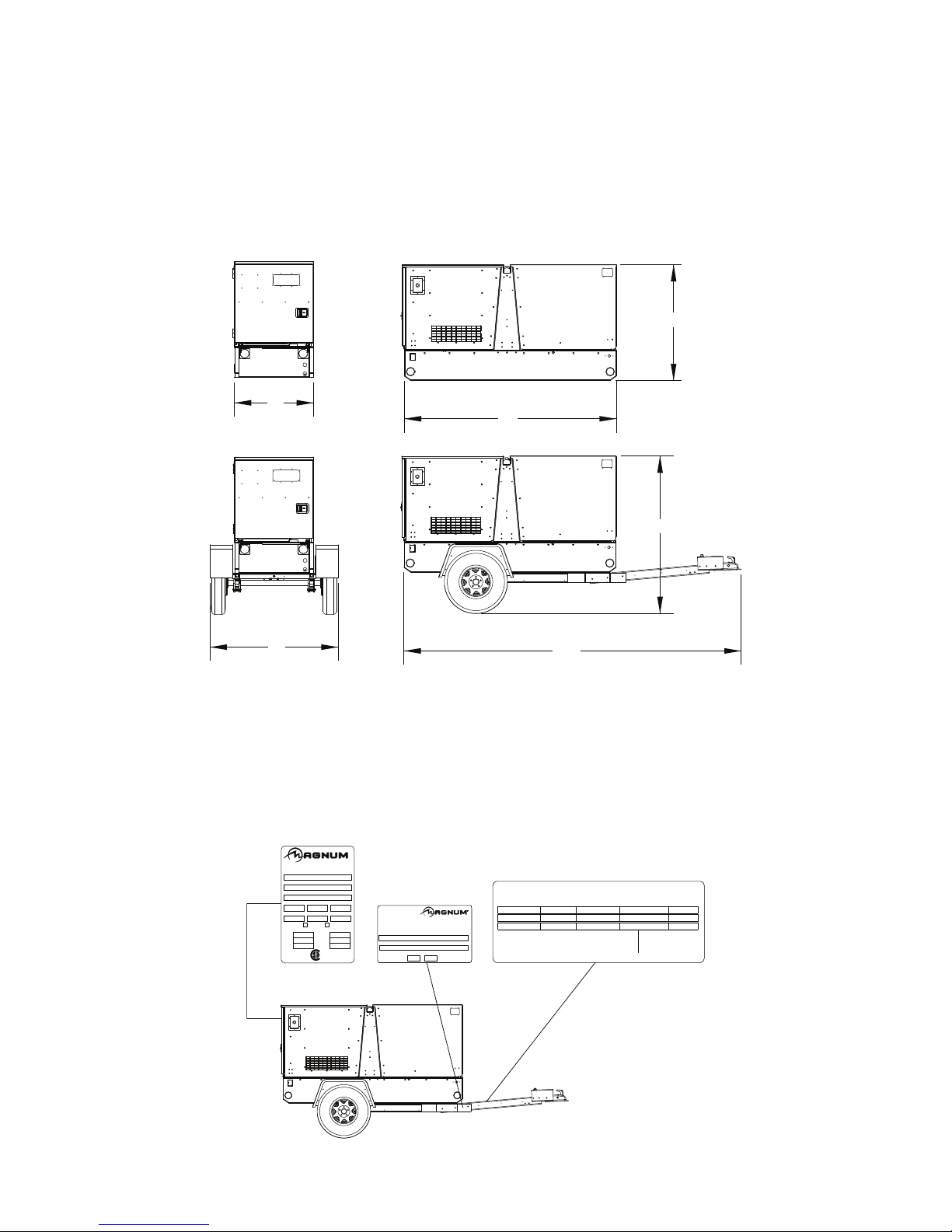
UNIT DIMENSIONS
67”
150”
57”
35”
95”
52”
Read this manual carefully before attempting to use this generator. The potential for property damage, personal injury or
death exists if this equipment is misused or installed incorrectly. Read all of the manuals included with this unit. Each
manual details specific information regarding items such as set up, use and service requirements. SPECIFICATIONS
ARE SUBJECT TO CHANGE WITHOUT NOTICE.
Dimensions (L x W x H)
Skid Mounted in (m) ....................................................... 95 x 35 x 52 (2.41 x 0.89 x 1.32)
Trailer Mounted in (m) .................................................... 150 x 57 x 67 (3.81 x 1.45 x 1.70)
UNIT SERIAL NUMBER LOCATIONS
Refer to the locations illustrated below to find the unit ID tag, V.I.N. tag and trailer ID tag on your unit. Important
information, such as the unit serial number, model number and Vehicle Identification Number (V.I.N.) for your trailer
are found on these tags. Record the information from these tags, so it is available if the tags are lost or damaged.
When ordering parts or requesting technical service information, you may be asked to specify this information.
9
Page 10
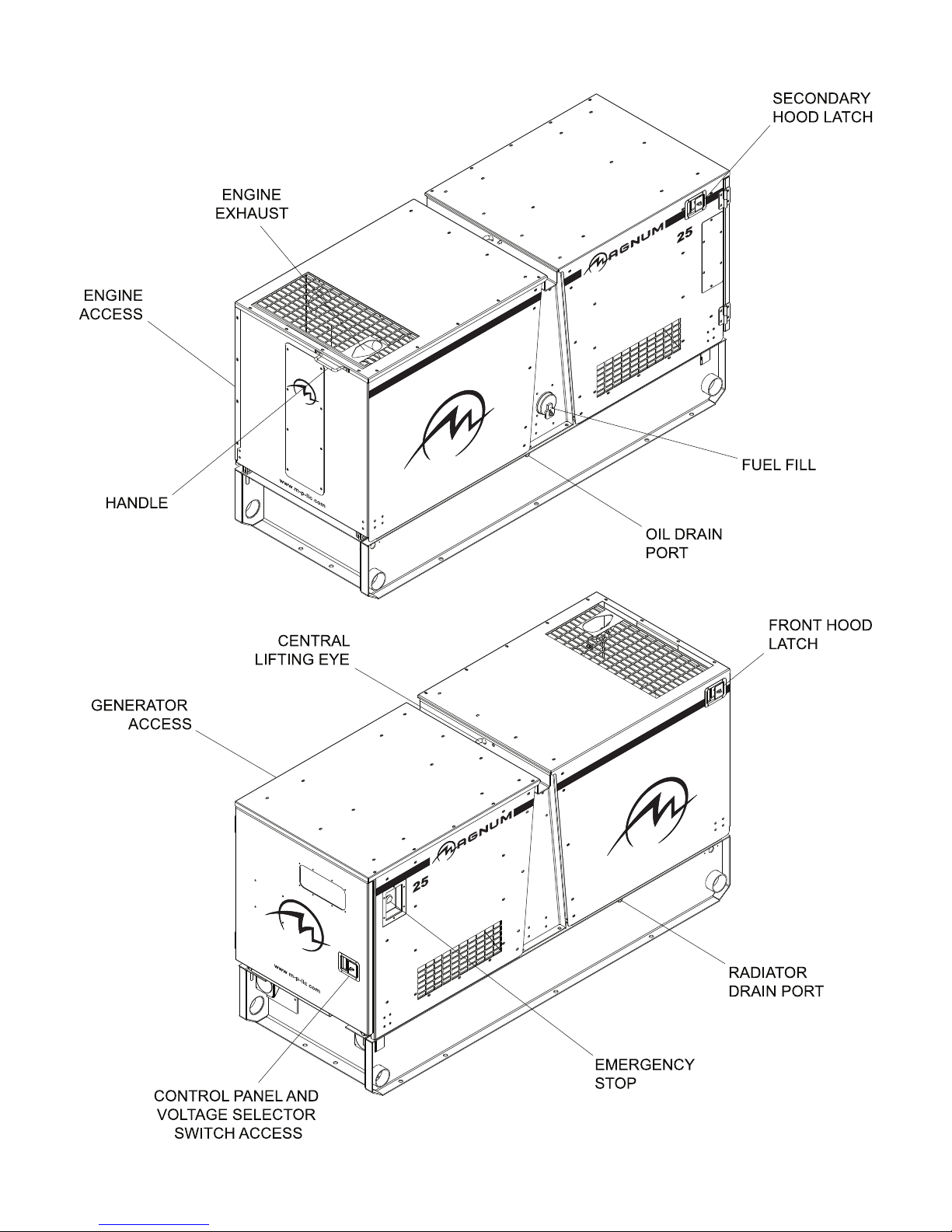
COMPONENT LOCATIONS
10
Page 11
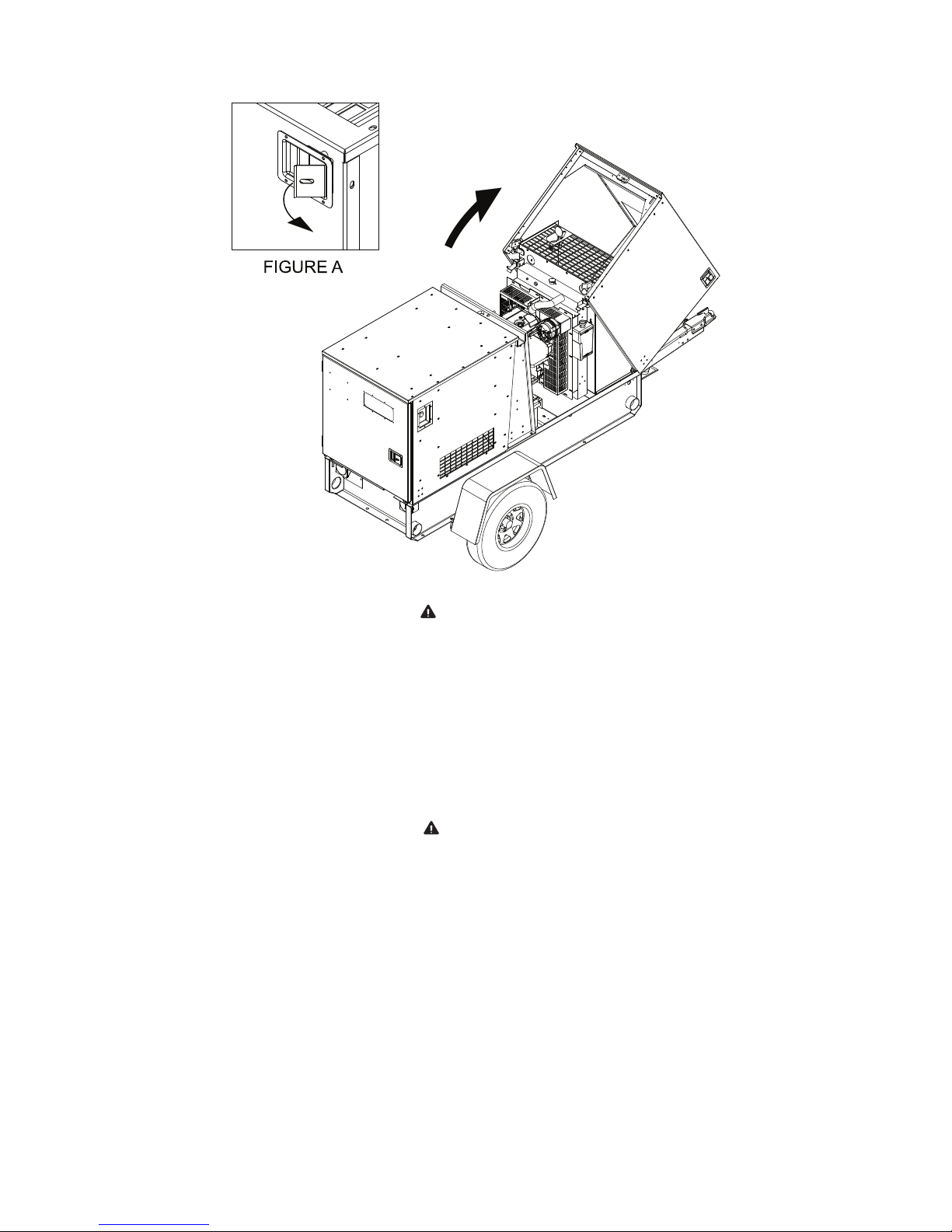
FRONT HOOD OPERATION
CAUTION
WARNING
Stay clear of hood and lift structure when opening and closing generator hoods.
Personal injury may result.
To open the front hood:
1. With your right hand, grip the handle located on the upper right side of the front panel.
2. With your left hand, pull the hood latch located on the upper corner of the left hood side (see Figure A). Tilt the
hood open until it contacts the bulkhead panel.
Generator hoods are heavy. Use caution when opening or closing.
To close the front hood:
1. Make sure the skid is free of debris and all personnel are clear of unit.
2. Slowly push hood forward and allow it to close firmly to ensure the hood latch is engaged.
3. Verify the hood is securely closed by attempting to open without pulling the hood latch.
11
Page 12
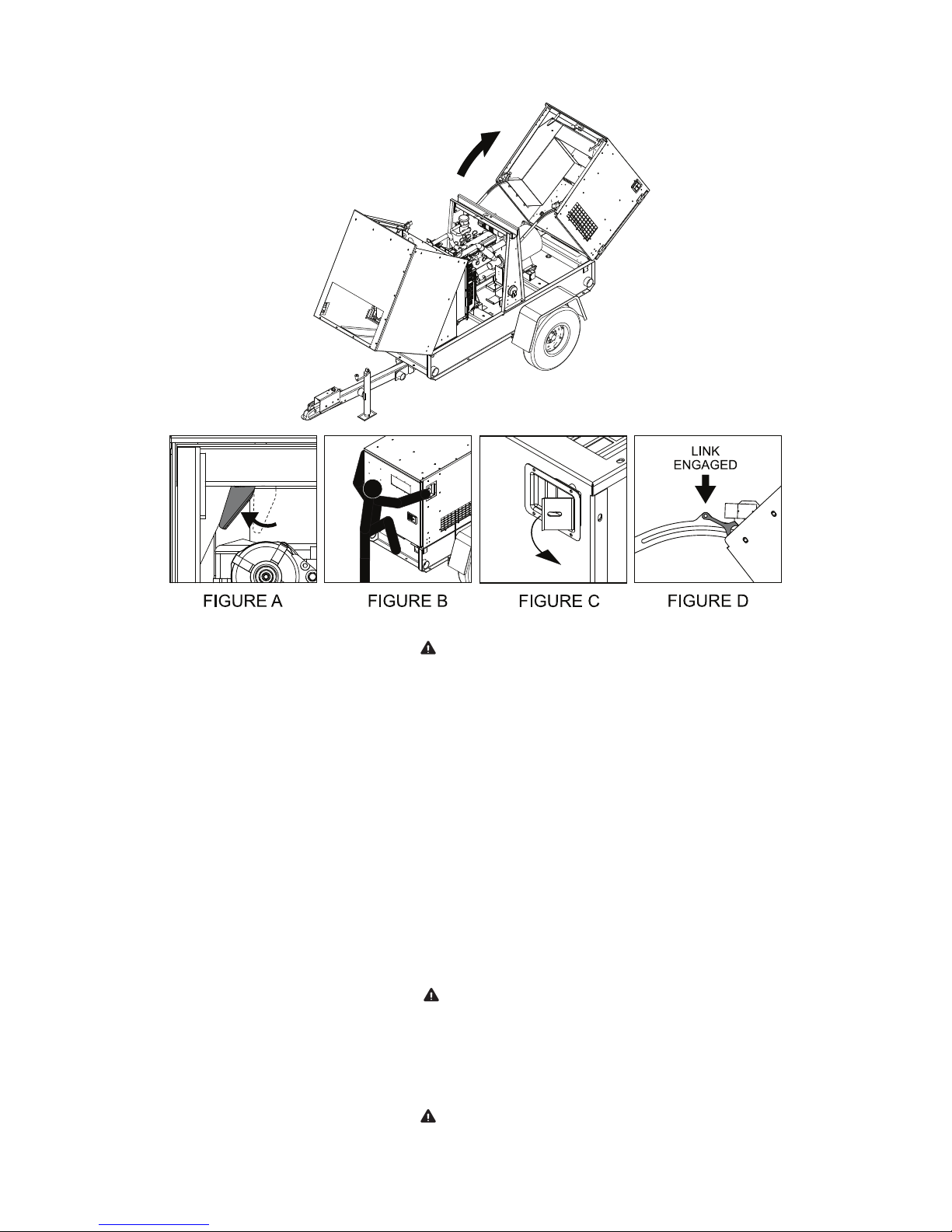
REAR HOOD OPERATION
CAUTION
WARNING
Stay clear of hood and lift structure when opening and closing generator hoods.
Personal injury may result.
To open the rear hood:
1. Open front hood.
2. Verify that the control door is completely closed and secure.
3. Pull lever located under lift structure to release the primary hood latch (see Figure A).
4. Proceed to rear of unit to release the secondary hood latch and tilt the hood open (see Figure B).
A. With your right hand, grip the lip of the emergency stop panel on the right side of the unit.
B. With your left hand, pull the hood latch located on the upper corner of the left hood side (see Figure C). Tilt
the hood completely open; travel is limited by two metal guide straps.
Generator hoods are heavy. Use caution when opening or closing.
5. Verify the red safety link is engaged and undamaged. This link is located on the left side metal guide strap (see
Figure D).
If the red safety link is not properly engaged, unintentional closing of the hood could
result, causing personal injury or equipment damage.
12
WARNING
Page 13
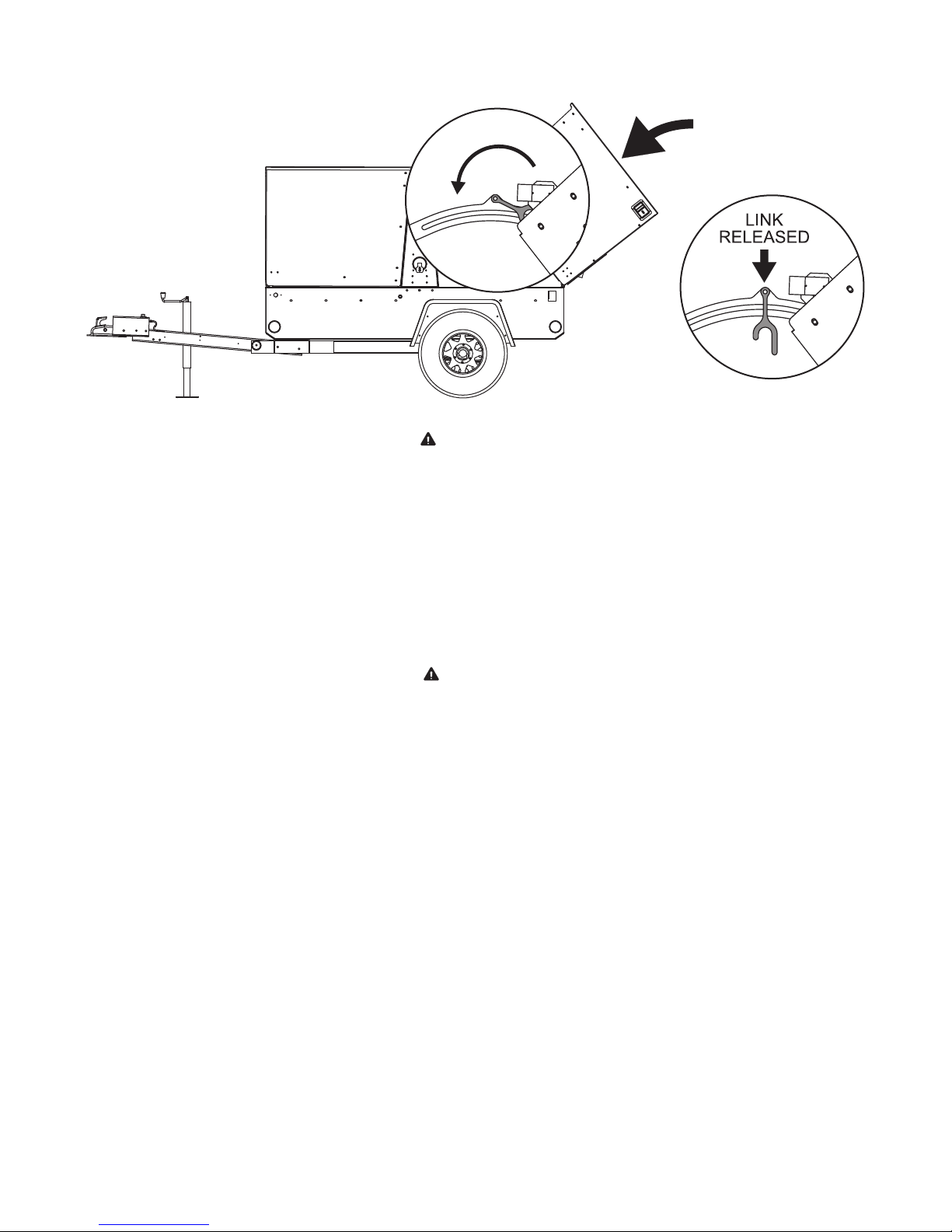
REAR HOOD OPERATION, CONTINUED
CAUTION
Stay clear of hood and lift structure when opening and closing generator hoods.
Personal injury may result.
WARNING
To close the rear hood:
1. Make sure the skid is free of debris and all personnel are clear of unit.
2. Verify that the control door is completely closed and secure.
3. Release the red safety link located on the left side metal guide strap by rotating the link counterclockwise.
Generator hoods are heavy. Use caution when opening or closing.
4. Slowly push hood forward and allow it to close firmly to ensure the hood latches have engaged.
5. Verify the hood is securely closed by attempting to open without releasing the hood latches.
NOTICE
Failure to release the safety link could result in damage to the link or other components.
13
Page 14
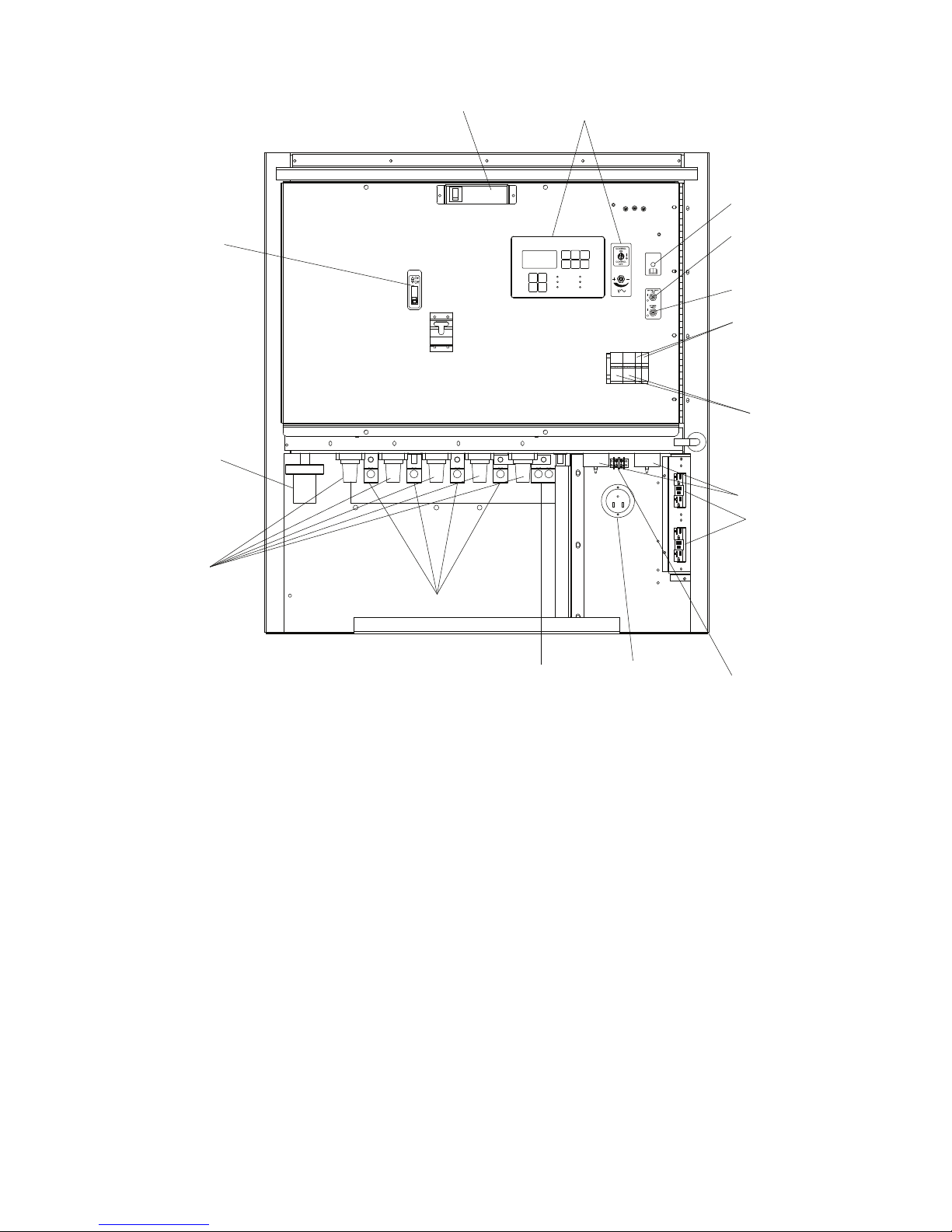
MAIN CONTROL PANEL FEATURES
14
15
1
2
16
3
CHECK
ENGINE
4
5
6
7
8
13
12
11
10
9
1. CONTROL PANEL LIGHT (OPTIONAL)
2. MAGNUM DIGITAL CONTROL PANEL: Controls and monitors engine and generator operation. See page 15
for more information.
3. CONTROL PANEL LIGHT SWITCH (OPTIONAL): Operates optional control panel light.
4. INTERIOR LIGHT SWITCH (OPTIONAL): Operates optional interior light.
5. 20A CIRCUIT BREAKERS: Circuit breakers for the 120V GFCI outlets.
6. 50A CIRCUIT BREAKERS: Circuit breakers for the 120/240V twist-lock outlets.
7. 120/240V TWIST-LOCK CONVENIENCE OUTLETS: These two outlets are used for connecting additional
loads or equipment to the generator.
8. 120V GFCI DUPLEX CONVENIENCE OUTLETS: These two outlets are used for connecting additional loads
or equipment to the generator.
9. REMOTE START TERMINAL BLOCK: This allows the generator to be started from a remote location with a
dry-contact closure switch when the generator is used for standby or remote power.
10. ENGINE ACCESSORY CONNECTION: Connection for battery charger and other engine accessories.
11. GENERATOR GROUND CONNECTION LUG: This lug is for connecting a good earthen ground per any
local, state or National Electric Code (NEC) guidelines before starting the generator.
12. GENERATOR OUTPUT CONNECTION LUGS: These lugs allow appropriate loads to be wired directly to the
generator.
13. CAM LOCK CONNECTORS (OPTIONAL): Series 16 Taper Nose 400A, 600V cam locks are connected here.
See page 29 for more information.
14. VOLTAGE SELECTOR SWITCH: This is a three position switch that mechanically changes the connections
between the generator output leads and the connection lugs on the main control panel.
15. MAIN CIRCUIT BREAKER: This breaker will disconnect power to the connection lugs (items 11-15). It WILL
NOT disconnect power to the convenience outlets when the engine is running.
16. CHECK ENGINE LIGHT: Indicates an engine malfunciton has occured. See page 26 for more information.
14
Page 15

MAGNUM DIGITAL CONTROLLER (MDC)
The Magnum Digital Controller (MDC) is an enhanced digital generator controller used to start, stop and monitor the
operation of the generator and the engine. The controller constantly monitors vital generator and engine functions
for a number of pre-programmed alarm and fault conditions. When a fault condition occurs, the engine will shut down
automatically and the Liquid Crystal Display (LCD) window will display the fault that caused the shutdown; to resume
operation the fault condition must be resolved. The controller has the ability to provide the display readout in English
and Spanish; other languages are available. A screen print out of the display screen is also available. This controller
also records a “History” of the unit’s performance which may be viewed at any time and will not be removed or lost
when the controller is powered down.
23
1
MAN AUT
0
k
Ready
PF 0.00
RPM 0
0
45
The MDC panel consists of five sections, including: the “CONTROL ON” / “CONTROL OFF” Toggle Switch and Fine
Voltage Adjustment Screw; the “OPERATION” keypad; the LCD window; the “DIAGNOSTICS” keypad; and the
“STATUS” Light Emitting Diodes (LED’s). The following is a brief summary of the operation of each section of the
control panel:
DIGITAL CONTROLLER FEATURES AND FUNCTIONS
1. The “CONTROL ON” / “CONTROL OFF” Toggle Switch and Fine Voltage Adjustment Screw
• Control On/Off Toggle Switch
This toggle switch powers-up the control panel and the controller.
• Fine Voltage Adjustment Screw
This screw may be adjusted to set the generator output voltage after the voltage selector switch has been
changed from one phase to another. This adjustment must
so that the unit does not experience a shut down alarm for “SENSING”.
2. The “OPERATION” Keypad
• “ENGINE START” Button
The Power Screen Display must be in the “MAN” mode in the upper left corner of the LCD window display
and the “Ready/Manual” LED lit in the “Status” portion of the controller. Press the green “ENGINE START”
button to start the unit.
• “ENGINE STOP” Button
Press the red “ENGINE STOP” button to shut down the unit and start the “Stop Value” timer.
•“MANUAL W” Button
Press this button to change from the Automatic (Remote) starting mode to Manual starting mode.
be accomplished within 45 seconds of start-up
15
Page 16

• “AUTO X” Button
Press this button to change from Manual starting mode to Automatic (remote) starting mode.
• “ALARM CANCEL” Button
When an alarm is activated, either visually or audibly, press this button to silence or cancel the alarm.
• “FAULT RESET” Button
Press this button to clear the fault from the LCD window after the fault has been corrected.
3. The Liquid Crystal Display (LCD)
• This window will toggle between the Generator Display Screen and the Engine Display Screen upon startup of the unit. By viewing these screens, the operator will be able to monitor both the engine and generator
status while the unit is running.
4. The “DIAGNOSTICS” Keypad
•“S” Scroll-Up Button
Press this button to scroll-up within the LCD window.
•“T” Scroll-Down Button
Press this button to scroll-down within the LCD window.
• “PAGE SELECT” Button
Pressing this button will select the next display screen.
• “ENTER” Button
Pressing this button will place you inside the particular display to review the generators preprogrammed
setpoints or parameters.
5. The “STATUS” Light Emitting Diodes (LED’s)
• These 6 LED’s will illuminate to display the current operational status of the generator;
- Alarm/Fault: Indicates active or inactive alarms, but not reset shutdown alarms.
- Warning: Indicates an active or inactive alarm, or a warning alarm that has not been reset
- Ready/Manual: Indicates the controller is ready to start and in the manual mode.
- Ready/Auto: Indicates the unit is in the “AUTO” mode ready for the remote start signal.
- Running: Indicates the unit is running.
- Supplying Load: Indicates a load is being applied to the generator.
GENERATOR MONITORING
Generator information is shown on the Liquid Crystal Display (LCD) window in a toggling manner with the Engine
information after the first 60 seconds of operation, then every five seconds thereafter. The generator display screen
will show frequency, line to neutral voltage, line to line voltage and amperage.
Note: When loading the generator, it is important to observe the amperage to determine the load balance on each
line of the generator. Minor load unbalances, usually 5% or less, will not cause any particular problems. Every effort
should be made to distribute the load equally between all lines.
•Hertz: Displays output frequency.
• Generator Output Voltage: Line to Neutral display, single phase (1Ø).
• Generator Output Voltage: Line to Line display, 3 phase (3Ø).
•Amps: Displays the AC output amperage produced by the generator.
16
Page 17

ENGINE MONITORING
Engine information is shown on the Liquid Crystal Display (LCD) window in a toggling manner with the Generator
information after the first 60 seconds of operation and then every five seconds thereafter. The engine display screen
will show oil pressure, engine coolant temperature, fuel level and battery voltage.
• Oil Press: Displays engine oil pressure. The display registers oil pressure between 0-100 psi. Normal
operating pressure is between 35-80 psi.
•Eng Temp: Displays the temperature of the engine’s coolant. If the coolant temperature exceeds the
Maximum Water Temperature of 230° F the engine will automatically shut down. Zero “0” will be displayed
until a minimum temperature of 100° F is reached.
• Fuel Level: Displays the relative fuel level in the fuel tank in percent (50% = 1/2 tank, 75% = 3/4 tank, etc.).
If the fuel level drops below a programmed low fuel point – usually at 15%, a low fuel warning and optional
audio alarm will be activated. If the fuel level drops below the programmed low fuel limit, usually at 5%, the
engine will automatically shut down.
•Vbat: Displays the engine battery voltage. A normal reading is 13-14V on 12 volt systems and 24-26 on 24
volt systems, (with the engine running).
Additional information may be viewed while the unit is in “MANUAL” or “AUTO” mode. By pressing the “Page Select”
button, the operator will select one of the following screens; “Running” screen, “Password” screen, or “History” screen.
In each of these page selections the operator may press the “S” or “T” buttons on the “DIAGNOSTICS” keypad to
display additional information as follows:
• “Running” screen: The operator may press the “S” or “T” buttons on the “DIAGNOSTICS” keypad to
display the “Alarm List” screen, “ECU Alarm List” screen, “Run Hours” screen, “ECU Values” screen, Engine
display screen and Generator display screen.
• “Password” screen: The operator may press the “S” or “T” buttons on the “DIAGNOSTICS” keypad to
move the “>” cursor up or down a list of text.
• “History” screen: The operator may press the “S” or “T” buttons on the “DIAGNOSTICS” keypad to move
the “>” cursor up or down a list of the latest alarm or shutdown codes. Pressing the “Enter” button at a
particular selection will allow the operator to scroll to the right in the LCD window to view the generator
operating parameters at the time of the alarm or shutdown. The history of alarms or codes of the unit are
saved in the digital controller. The most recent alarm or code is the first to be listed, with the time/date of the
17
Page 18

alarm or code at the bottom of the screen. The controller stores up to 118 codes. When full, the controller
CONTROL
ON
CONTROL
OFF
VOLTAGE
ADJUSTMENT
RHEOSTAT
will automatically remove the oldest file. These codes will not be lost when the control power toggle switch
is powered off.
FINE VOLTAGE ADJUSTMENT
Upon start-up of the generator, the “Running” screen of the Magnum Digital Controller (MDC) will display “SENSING”
and will countdown from 45 seconds to “0” Zero. This is a safety feature of the
controller to protect the generator from over or under voltage upon start-up.
“SENSING” is a 45 second time delay and count down process before the MDC
records the generator nominal output voltage. This nominal generator voltage
is then compared to the current set point voltage of the voltage selector switch.
If the nominal voltage recorded by the controller is greater than or lower than
the current set point voltage of the voltage selector switch setting by 10% or
more, the controller will shut the generator down automatically. The display will
read: Wrn VG1 or 2 or 3 Under/Over and/or Sd Vg1 or 2 or 3 Under/Over. This
means the controller warned (“Wrn”) or even shut down (“Sd”) the unit due to
an output voltage irregularity.
The output voltage of the generator may be adjusted after the generator is running by use of the fine voltage adjustment
screw. The adjusting screw is located directly below the control On/Off toggle switch on the control panel. This screw
turns a rheostat that will provide an increase (“+”) or a decrease (“-”) in the generator output voltage as displayed
on the Power Display Screen on the control panel. When making this adjustment, if the voltage is increased or
decreased too fast or too slow, the unit will automatically shut down. This adjustment needs to be made within the
45 second delay and countdown to “0” Zero period.
To adjust the output voltage, check the output voltage on the Liquid Crystal Display (LCD) window labeled Gen freq
& Hz. Look at the L1N voltage or the L12 voltage on the display. The generator nominal output voltage should be
within 10% of the voltage rating on the voltage selector switch.
To adjust the output voltage loosen the lock nut at the base of the screw and turn the screw in the desired direction
until the required voltage shown on the LCD window matches the stated voltage on the voltage selector switch.
Note: Each time the voltage selector switch is changed from one setting to another, an adjustment will need to be
made to the fine voltage using this adjustment screw.
For Example: With the voltage selector switch set to “208/120V” 3 Phase position, the voltage displayed on
the Gen freq & Hz screen must be within ± 10% of the 208/120 position (188-228 V Line to
Line / 108-132 V Line to Neutral).
If the voltage is not set within 10% of the applied voltage or the voltage is not reset within
the 45 second delay period, the generator will shut down automatically and the display will
read Wn VG1 or 2 or 3 Under/Over and/or Sd Vg1 or 2 or 3 Under/Over.
18
Page 19

GENERATOR START UP
Before starting the generator, carefully read over the pre-start check list. Make sure that all of the items are checked
before trying to start the generator. This check list applies to both manual and remote starting of the generator.
PRE- START CHECK LIST
Make sure the control ON/OFF toggle switch is in the OFF “O” position.
Make sure that the circuit breakers (main and convenience) are switched OFF “O”.
Check that the generator is properly grounded to a good earthen ground per any local and NEC
regulations.
Check all electrical connections at the connection lugs. Are they wired correctly?
Are the connection lugs tight?
Check the voltage selector switch and make sure that it is set to the desired voltage.
Is the generator sitting level?
Thoroughly check for any water inside the unit, on or near the generator. Dry the unit before starting.
Check oil, coolant and fuel levels and engine battery connections.
Check engine fan belt tension and condition.
Check engine fan belt guard.
Check engine exhaust system for loose or rusted components.
Check radiator and surrounding shroud for debris.
Are any of the generator covers loose or missing?
Are all preventative maintenance procedures up to date?
Check that the battery disconnect switch is on, if equipped.
MANUAL STARTING OF THE GENERATOR
1. Move the control ON/OFF toggle switch to the “CONTROL ON / I” position.
2. The Liquid Crystal Display (LCD) window will quickly display system information, all Light Emitting Diodes
(LED’s) will flash.
3. The LCD window will indicate MANUAL mode and Ready. The Ready/Manual LED will be lit.
Note: The unit must be in the “MAN” Mode with the Ready/Manual LED lit to start the unit.
19
Page 20

4. Press the green “ENGINE START” button. The Prestart (Preheat) screen will be displayed (if equipped)
and a countdown will begin from 20 seconds to 0.
5. The Starting screen will be displayed. The engine will crank and start running.
6. The Running screen will display.
Note: It may take a few seconds for the engine to run smoothly and reach its governed operating speed.
The 45 second “SENSING” time delay will start to count down.
7. The LCD window will then toggle from the Running screen to the Generator Display Screen and then to
the Engine Display Screen.
8. If the engine does not start after the first cranking attempt, the engine will pause for 15 seconds to allow
the starter to cool. The LCD window will show “PAUSE”. The engine will make two more attempts to
start for a total of three crank cycles.
9. Should the engine not start and run within 3 starting cycles, the LCD window will show “SD Start fail”.
The starting sequence may be repeated after the starter has had a minimum of two minutes to cool.
Press the “FAULT RESET” button to clear the controller. To start the unit, press the green “ENGINE
START” button.
Note: The engine controller may skip the preheat engine steps on some of the larger models.
20
Page 21

10. Once the engine starts it will immediately begin speeding up to a constant 1800 rpm. On units with
isochronous engine governing, the engine may hunt or change speeds until operating temperature is
reached. After a few minutes of operation, the engine will be warmed up and the LCD window will show
engine and generator operating parameters. Temperature will be shown as “0” until the engine
temperature is approximately 100° F.
11. Once the generator is at normal operating temperature, check the generator for excessive noise or
vibration and any coolant, oil or fuel leaks before applying any loads.
12. Check that the AC output voltage is correct. The output voltage can be fine adjusted by using the fine
voltage adjustment screw (rheostat), as described on page 18.
13. Check that the frequency (Hz) is correct. With no loads connected to the generator, the frequency should
read approximately 60-62 Hz, depending on the type of engine governing used.
14. If all wiring connections have been made correctly, switch the main circuit breaker to the “ON / I” position
and then add any loads attached to the convenience outlets by switching the respective circuit breaker
to the “ON / I” position. You will notice a slight change in engine sound when a load is applied to the unit.
“AUTO” (REMOTE) STARTING OF THE GENERATOR
The “AUTO” button is used when the generator is started from a location other than the control panel and by using
a dry-contact closure remote start switch (transfer switch). “AUTO” (remote start) is the normal setting when the
generator is being used as a standby power supply. Before putting the generator in the “AUTO” mode, review the
Pre-Start Check List and Manual Starting of the Generator sections beginning on page 19. Also follow all safety
warnings and information on isolating the generator with a transfer switch if the unit is to be used as a standby power
supply (see page 34). Then continue with the steps described below:
1. Perform a manual start of the generator at least once to verify that the engine is operating correctly.
2. If a check of the remote start circuit is desired, remove the wires from the remote start terminal block.
Press the “AUTO” button, the Liquid Crystal Display (LCD) window should highlight “AUTO” in the upper
left corner. Attach a jumper wire (minimum 16 gauge) across the two terminals on the remote start
terminal block. This applies a ground to the Magnum Digital Controller (MDC) to close the starting circuit
contacts. The engine should crank, start and run.
3. Remove the jumper wire from the remote start terminal block and the engine will stop. Reconnect any
necessary wires from the remote start switch (transfer switch) to the remote start terminal block.
4. Confirm unit is in “AUTO” mode. The LCD window should have “AUT” highlighted in the upper left corner.
5. Close (set to “ON / I”) the main circuit breaker.
6. Secure the generator by closing and locking all access doors.
7. The generator is now ready for remote starting.
SHUTTING DOWN THE GENERATOR
Check with personnel using power supplied by the generator and let them know that the power is going to be turned
off. Make sure the power shutdown will not create any hazards by accidentally turning off equipment that needs to
be kept on (pumps, compressors, lights, etc.).
1. Remove all loads from the generator by opening (turn to OFF / “O”) all circuit breakers.
2. Let the engine run for approximately five minutes to allow it to cool down.
3. Push the red “ENGINE STOP” button. Pressing “Engine Stop” will result in the generator going into the
shutdown cycle and starting a 15 second shutdown timer called “Stop Value”. If the unit does not shutdown
within 15 seconds a “Stop Fail” alarm will be displayed on the Liquid Crystal Display (LCD) window.
4. Move the “CONTROL ON / I” toggle switch to the “CONTROL OFF / O” position.
21
Page 22

MDC CONTROLLER INFORMATION DISPLAYS, FUNCTIONS AND RESET
No. Engine State Machine Description
1 AfterCool Engine aftercooling, Cooling Pump output is closed.
2 Cooling The generator is cooling before stop.
3 Cranking Engine is cranking.
4 EmergMan Emergency Manual gen-set operation.
5 Init Autotest during controller power on.
6 Loaded
The generator is running at nominal speed and GCB OPEN/CLOSE is
closed.
7 Not Ready The generator is not ready to start.
8 Pause Pause between start attempts.
9 Prestart Prestart sequence in process, Prestart output is closed.
10 Ready The generator is ready to run.
11 Running The generator is running at nominal speed.
12 Shutdown Shut-down alarm is activated.
13 Starting Starting speed is reached and the
Idle timer
is running.
14 Stop Stop
No. Electrical State Machine Description
1 StabilTO Stabilization Timeout
No. Type Description
1 Sensor fail (FLS)
Sensor fail is detected when measured value is 6% out of the selected
characteristic. Sensor fail indicated by ##### symbol instead measured
value.
2 Warning (WRN) When warning comes up, see list of possible alarms.
3 Shut down (SD)
When the shut-down alarm comes up the Magnum Digital Controller opens
outputs GCB CLOSE/OPEN, FUEL, SOLENOID, STARTER AND
PRESTART to stop the engine immediately.
The Magnum Digital Controller (MDC) constantly monitors vital generator and engine functions for a number of
operation, alarm and fault conditions. When a fault condition occurs, the engine will shut down automatically and the
Liquid Crystal Display (LCD) window will show the fault that has caused the shut down. To resume operation, the
fault condition must be resolved. To reset the controller and resume operation, press the “FAULT RESET” button.
The operation of the Magnum Digital Controller (MDC) is divided into the following sections:
MAGNUM DIGITAL CONTROLLER (MDC) – GENERATOR OPERATIONAL STATUS
The Magnum Digital Controller (MDC) displays the operational status of the generator using the following codes:
MAGNUM DIGITAL CONTROLLER (MDC) - ALARM MANAGEMENT
The Magnum Digital Controller (MDC) is capable of displaying the following alarms:
22
Page 23

MAGNUM DIGITAL CONTROLLER (MDC)- LIST OF POSSIBLE ALARMS/DESCRIPTIONS
No.
Events
Specification
Protection
Type
Information
on Binary
Output
Available
Description
1 AnInIOM Sd SD YES
Shutdown alarm configurable on the input of IG-IOM/IGS-PTM.
2 AnInIOM Wrn WRN YES
Warning alarm configurable on the input of IG-IOM/IGS-PTM.
3 Battery Flat SD YES
If the controller switches off during starting sequence due to
bad battery condition it doesn't try to start again and activates
this protection.
4 Binary Input Configurable YES
Configurable Warning/Shutdown alarms on the inputs of IL-NT.
5 ChrgAlternFail WRN YES
Failure of the alternator for charging the battery.
6 EmergencyStop SD NO
If the input
Emergency stop
is opened shutdown is immediately
activated.
7 Engine Temp Sd SD NO
Water temperature is greater than
Sd Water temp
setpoint.
8 Engine Temp Wrn WRN YES
Water temperature is greater than
Wrn Water temp
setpoint.
9 Fgen <, > SD YES
The generator frequency is out of limits given by
Gen >f
and
Gen <f
setpoints.
10 Fuel Level Sd SD YES
Fuel level is less than
Sd Fuel Level
setpoint.
11 Fuel Level Wrn WRN YES
Fuel level is less than
Wrn Fuel Leve
l setpoint.
12 GCB fail SD NO
Failure of the generator circuit breaker.
13 Igen unbl SD NO
The generator current is unbalanced.
14 Low BackupBatt WRN NO
RTC backup battery is flat.
15 Oil Press Sd SD NO
Oil pressure is less than
Sd Oil press
setpoint.
16 Oil Press Wrn WRN YES
Oil pressure is less than
Wrn Oil press
setpoint.
17 Overload SD YES
The load is greater than the value given by
Overload
setpoint.
18 Overspeed SD YES
The protection comes active if the speed is greater than
Overspeed
setpoint.
19 ParamFail NONE NO
Wrong checksum of parameters. Happens typically after
downloading new firmware or changing of the parameter. The
controller stays in INIT mode. Check all parameters write at
least one new parameter.
20 PickupFault SD NO
Failure of the magnetic pick-up sensor for speed measurement.
21 Sd IOM fail SD NO
Shutdown alarm in case of lost connection to IG-IOM/IGS-PTM
module.
22 SprinklActive WRN NO
The protection is active if the output
Sprinkler
is closed.
23 Start failed SD YES
Gen-set start failed
24 Stop fail SD YES
Gen-set stop failed.
25 Ubat WRN YES
Battery voltage is out of limits given by
Batt overvolt
and
Batt
undervolt
setpoints.
26 Underspeed SD YES
During starting of the engine when the RPM reaches the value
of
Starting RPM
setpoint the starter is switched off and the
speed of the engine can drop under
Start RPM
again. Then the
Underspeed protection becomes active. Protection evaluation
starts 5 sec
27 Vgen <, > SD YES
The generator voltage is out of limits given by
Gen <V
and
Gen >V
setpoints.
Shut down and warning fault conditions and the displayed message are described in the following table:
23
Page 24

ENGINE CONTROLLER
28 Vgen unbal SD NO
The generator voltage is unbalanced more than the value of
Volt unbal
setpoint.
29 Wrn ECU Alarm WRN NO
ECU alarm list is not empty.
30 Wrn RA15 fail WRN NO
Warning alarm in case of lost connection to IGL-RA15 module.
31 WrnServiceTime WRN NO
The period for servicing is set by the
NextServTime
setpoint.
The protection comes active if the running hours of the engine
reach this value.
The Zenith ZPP 428 is equipped with an engine controller that regulates the engine speed (RPM) and constantly
monitors vital engine functions for a number of operation, alarm and fault conditions. When an operation, alarm or
fault condition occurs, the Liquid Crystal Display (LCD) window on the Magnum Digital Controller (MDC) will alert
the operator either visually or audibly. Press the “S” Scroll-Up button (on the diagnostic keypad) to view the “Alarm
List.” This will allow you to view a description of the fault.
ADJUSTING THE DISPLAY BACK LIGHTING
The backlighting on the Liquid Crystal Display (LCD) window may be adjusted brighter or darker by the operator
whenever the Magnum Digital Controller (MDC) is powered up.
1. Press and hold “Enter” and press “S” or “T” on the Diagnostics keypad to increase or decrease the
display contrast as needed.
2. Release the “Enter” button and the “S” or “T”buttons when the desired backlighting is attained.
Note: Anytime an “*” is displayed on the LCD, the text or set point cannot be changed with out the use of a password.
Contact Magnum Products Technical Support for assistance.
24
Page 25

MAGNUM DIGITAL CONTROLLER (MDC) – HISTORY
No.
Record Structure
Abbreviation
Historical value
1 AIM1 IG-IOM, IGS-PTM Analog input 1 value (when configured IG-IOM, IGS-PTM)
2 AIM2 IG-IOM, IGS-PTM Analog input 2 value (when configured IG-IOM, IGS-PTM)
3 AIM3 IG-IOM, IGS-PTM Analog input 3 value (when configured IG-IOM, IGS-PTM)
4 AIM4 IG-IOM, IGS-PTM Analog input 4 value (when configured IG-IOM, IGS-PTM)
5 BIM IG-IOM, IGS-PTM Binary inputs (when configured IG-IOM, IGS-PTM)
6 BIN Binary inputs IL-NT
7 BOM IG-IOM, IGS-PTM Binary outputs (when configured IG-IOM, IGS-PTM)
8 BOUT Binary inputs IL-NT
9 Date Date of historical event in format DD/MM/YY
10 EngT IL-NT Analog input 2 value (default Water temperature)
11 FC ECU alarm FailureCode
12 FLvl IL-NT Analog input 3 value (default Fuel level)
13 FMI ECUalarm Failure Mode Identifier
14 Gfrg Generator frequency
15 Ig1 Generator current L1
16 Ig2 Generator current L2
17 Ig3 Generator current L3
18 LChr Character of the load
19 Num Number of historical event
20 OilP IL-NT Analog input 1 value (default Oil pressure)
21 PF Generator PF
22 Pwr Generator active power
23 Reason Event specification
24 RPM Engine Speed
25 Time Time of historical event in format HH:MM:SS
26 Ubat Battery voltage
27 Vg1 Generator voltage L1
28 Vg2 Generator voltage L2
29 Vg3 Generator voltage L3
The Magnum Digital Controller (MDC) controller stores a record of each important event into the history file of the
controller. The history file seats 118 records. When the history file is full, the oldest records are removed.
25
Page 26

RESETTING OF THE “TIME TO SERVICE” REMINDER
The Magnum Digital Controller (MDC) will display the message “WrnServiceTime” when the unit is due for
maintenance or service. The maintenance or service interval is set at 250 hours of engine running time. Once the
unit has been serviced, the “ServiceTime” reminder needs to be reset to the 250 hour interval. The following procedure
demonstrates how to reset the running hours to 250:
1. With the unit shut down, power up the controller with the “Control On/Off” Toggle Switch. The initialization
screen will be displayed. The controller will toggle automatically to the “Ready” Display screen.
2. Press the “S” button. The “Alarm List” display screen will appear. The next screen will display lines of
text; starting with the word “Password”, then “Basic Settings”, “Engine Params”, “Engine Protect” etc.
The top line has a “>” cursor before the word ‘Password”.
3. Press the “T” button to move the “>” cursor down to the “Engine Protect” line of text.
4. Press Enter. “NextServTime” will appear at the top of the display screen on the left side, with the current
service time hour setting (250) one line below on the right side
5. Press Enter. The current run time in hours will now appear on the left side of the display screen, directly
under “NextServTime”
6. Press the “S” button and reset the current run time hour setting to 250. If you overshoot the 250 time
interval use the “T” button to get back to the 250 time interval.
7. Press “Enter” to save the current run time hour setting.
8. Move the “CONTROL ON / I” toggle switch to the “CONTROL OFF / O” position.
CHECK ENGINE LIGHT
The “Check Engine” light will illuminate when there is an engine malfunction. Once the malfunction has been
diagnosed and addressed the “Check Engine” light will not automatically turn off. In order to reset the light, turn the
generator on and off using the appropriate start/stop procedures on pages 19 and 21. If the engine fault has been
properly diagnosed and addressed the “Check Engine” light will be reset (turned off) on the fourth start/stop cycle.
TROUBLESHOOTING AUTOMATIC SHUTDOWN CONDITIONS
LOW FUEL LEVEL SHUTDOWN
1. Check the fuel level on the Liquid Crystal Display (LCD) window.
2. Check for leaks in the fuel tank. The fuel tank should not run dry under normal circumstances. The engine
controller will shut the engine down when there is 5% of fuel remaining in the tank. This is done to keep
the fuel lines from running dry.
3. If the fuel level is good and no leaks are found, check the fuel level sender and the connecting wiring
for damage. To check for continuity between the sender and the engine controller, remove the bolts at
the top and bottom of the control panel and open the panel like a door. Consult the appropriate DC wiring
diagram on page 41 for the proper path between the engine controller and the fuel level sender.
LOW OIL PRESSURE SHUTDOWN
1. Check the level of the engine oil with the dipstick. The engine controller will shut the engine down when
the oil pressure is less than 20 psi. Add oil if required.
2. Visually inspect the engine for oil leaks.
3. If the oil level is good, restart the unit and verify the loss of oil pressure. Shut the engine down immediately
if the oil pressure value does not read 5 PSI within five (5) seconds.
4. Check the oil pressure sender on the engine block and the connecting wiring for damage. To check for
continuity between the sender and the engine controller, remove the bolts at the top and bottom of the
control panel and open the panel like a door. Consult the appropriate DC wiring diagram on page 41 for
the proper path between the engine controller and the pressure sender.
5. If the oil level, pressure sender and wiring are good, the oil loss may be caused by engine failure. Consult
the ENGINE OPERATION AND MAINTENANCE MANUAL for additional information on excessive oil
consumption.
26
Page 27

LOW COOLANT LEVEL SHUTDOWN
1. Allow the engine to cool.
2. Check the coolant level in the radiator. Remove the radiator cap and add coolant until it is 3/4” below
the filler neck. Secure the radiator cap back into its original position.
3. Inspect coolant hoses, engine block and water pump for visible leaks.
HIGH COOLANT TEMPERATURE SHUTDOWN
4. Check the coolant level in the overflow jug.
5. Restart the engine and read the coolant temperature to verify High Coolant Temperature Shutdown.
Stop the engine immediately if the coolant temperature is 230°F or more.
6. Allow the engine to cool. Add coolant to the overflow jug if it is low and then check the level of coolant
in the radiator. Remove the radiator cap and add coolant until it is 3/4” below the filler neck. Secure the
radiator cap back into its original position.
7. Check the radiator shroud and ducting for blockage and remove any foreign matter.
8. Inspect coolant hoses, engine block and water pump for visible leaks.
9. Check the tension of the serpentine drive belt for the water pump.
10. Check the coolant temperature sender on the engine block and the connecting wiring for damage. To
check for continuity between the sender and the engine controller, remove the bolts at the top and bottom
of the control panel and open the panel like a door. Consult the appropriate DC wiring diagram on page
41 for the proper path between the engine controller and the temperature sender.
11. If the sender and wiring are good and no other problems are found, remove the load on the generator
and restart the engine. Observe the coolant temperature and shut the engine down immediately if it
starts to overheat. Consult the ENGINE OPERATION AND MAINTENANCE MANUAL for additional
information on engine overheating.
OVERCRANK SHUTDOWN
1. Check the fuel level in tank.
2. Check for proper operation of the fuel pump.
3. Check air filter for blockage.
4. If the engine will not start, consult the ENGINE OPERATION AND MAINTENANCE MANUAL for
additional information on troubleshooting starting problems.
OVERSPEED OR UNDERSPEED SHUTDOWN
1. Disconnect all loads and restart the generator. Read the frequency (Hz) on the LCD display. With no
loads on the generator, the frequency should read 60.0 Hz.
2. If the frequency is above or below 60.0 Hz, the engine speed will have to be adjusted. See the engine
manual for throttle adjustments on mechanical governed units and see the electronic governor manual
for electronically controlled units.
27
Page 28

GENERATOR OUTPUT CONNECTION LUGS
DANGER
The generator is equipped with connection lugs behind the lug door next to the customer convenience outlets. The
lugs provide connection points for attachment of external loads to the generator. A large decal on the inside of the
connection lug door details the proper connections for selected voltages.
WARNING
It is HIGHLY RECOMMENDED that only a trained and licensed electrician perform any
wiring and related connections to the generator. Installation should be in compliance
with the NATIONAL ELECTRIC CODE (NEC) as well as any local or state guidelines
as required by law. Failure to follow proper installation requirements may result in
equipment or property damage, personal injury or death.
WARNING
Before any connections are made to the generator, make sure that the main circuit
breaker and the engine start switch are in the OFF “O” position and that the negative
(-) battery cable is disconnected. Potentially lethal voltages may be present at the
generator connection lugs.
IMPROPER OR INCORRECT CONNECTIONS TO A BUILDINGS ELECTRICAL SYSTEM
CAN CAUSE POTENTIALLY LETHAL VOLTAGE TO BACKFEED ONTO UTILITY LINES.
THIS MAY RESULT IN INJURY OR ELECTROCUTION TO UTILITY WORKERS NEARBY.
MAKE SURE THE GENERATOR IS SUPPLYING POWER TO AN ISOLATED OBJECT
OR BUILDING THAT IS NOT CONNECTED TO ANY UTILITY LINES.
Use a hex-wrench to tighten the cable connections. The lug door is equipped with safety interlock switches that will
trip the main circuit breaker and disable the voltage regulator, dropping the operator output to residual voltage, if the
door is opened while the unit is operating.
WARNING
Never attempt to disable or modify the lug door safety switches. Equipment damage,
personal injury or death may result.
A ground connection is located on the far right of the cam lock panel. The unit MUST be connected to a good earthen
ground for proper operating safety. The ground connection SHOULD BE IN COMPLIANCE WITH THE NATIONAL
ELECTRIC CODE (NEC) AS WELL AS ANY STATE OR LOCAL GUIDELINES OR CODES.
28
Page 29

LOCK
L1
L2
L3
N (Neutral)
G (Ground)
Black
Red
Blue
White
Green
GENERATOR CAM LOCK CONNECTIONS (OPTIONAL)
DANGER
The generator may be equipped with cam lock connections located behind the lug door next to the customer
convenience outlets. These receptacles provide connection points for attachment of external loads to the generator.
A large decal on the inside of the connection lug door details the proper connections for selected voltages.
WARNING
It is HIGHLY RECOMMENDED that only a trained and licensed electrician perform any
wiring and related connections to the generator. Installation should be in compliance
with the NATIONAL ELECTRIC CODE (NEC) as well as any local or state guidelines
as required by law. Failure to follow proper installation requirements may result in
equipment or property damage, personal injury or death.
WARNING
Before any connections are made to the generator, make sure that the main circuit
breaker and the engine start switch are in the OFF “O” position and that the negative
(-) battery cable is disconnected. Potentially lethal voltages may be present at the
generator cam lock receptacles.
IMPROPER OR INCORRECT CONNECTIONS TO A BUILDINGS ELECTRICAL SYSTEM
CAN CAUSE POTENTIALLY LETHAL VOLTAGE TO BACKFEED ONTO UTILITY LINES.
THIS MAY RESULT IN INJURY OR ELECTROCUTION TO UTILITY WORKERS NEARBY.
MAKE SURE THE GENERATOR IS SUPPLYING POWER TO AN ISOLATED OBJECT
OR BUILDING THAT IS NOT CONNECTED TO ANY UTILITY LINES.
Connections should be made by plugging power cables equipped with series 16 taper nose 400A, 600V cam lock
plugs into the cam lock receptacles. Secure the connection by rotating the plug a 1/4 turn to the right. The cam lock
connection door is equipped with safety interlock switches that will trip the main circuit breaker and disable the voltage
regulator, dropping the operator output to residual voltage, if the door is opened while the unit is operating.
WARNING
Never attempt to disable or modify the lug door safety switches. Equipment damage,
personal injury or death may result.
A ground connection is located on the far right of the cam lock panel. The unit MUST be connected to a good earthen
ground for proper operating safety. The ground connection SHOULD BE IN COMPLIANCE WITH THE NATIONAL
ELECTRIC CODE (NEC) AS WELL AS ANY STATE OR LOCAL GUIDELINES OR CODES.
29
Page 30

VOLTAGE SELECTOR SWITCH
The voltage selector switch is located under the control panel, next to the output connection lugs. The selector switch
is a three position switch that mechanically changes the connections between the generator output leads and the
connection lugs or optional cam lock connectors. Voltage ranges are selected by rotating the handle on the switch
to the desired voltage.
NOTICE
NEVER attempt to change the voltage selector switch while the engine is running! This will
cause severe arcing and damage to the switch and generator windings.
The connection lug door is equipped with safety interlock switches that will trip the main circuit breaker and disable
the voltage regulator, dropping the operator output to residual voltage, if the door is opened while the unit is operating.
Never attempt to disable or modify the lug door safety switches. Equipment damage,
Note: When the voltage selector switch is in position for 480/277V 3Ø, voltage at the two GFCI duplex convenience
outlets is 139 Volts and the voltage at the two twist-lock outlets is 240/139 Volts. When the voltage selector switch
is in position for 208/120V 3Ø, voltage at the two twist-lock outlets and the two GFCI duplex convenience outlets is
208/120 Volts.
30
WARNING
personal injury or death may result.
Page 31

4-POSITION VOLTAGE SELECTOR SWITCH (OPTIONAL)
The voltage selector switch is located under the control panel, next to the connection lugs. This optional selector
switch is a four position switch that mechanically changes the connection between the generator output leads and
the connection lugs or optional cam lock connectors. Voltage ranges are selected by rotating the handle on the switch
to the desired voltage.
NOTICE
NEVER attempt to change the voltage selector switch while the engine is running! This will
cause severe arcing and damage to the switch and generator windings.
The connection lug door is equipped with safety interlock switches that will trip the main circuit breaker and disable
the voltage regulator, dropping the operator output to residual voltage, if the door is opened while the unit is operating.
Never attempt to disable or modify the lug door safety switches. Equipment damage,
Note: (The following applies to units without a convenience outlet buck transformer.) When the voltage selector
switch is in position for 480/277V 3Ø, voltage at the two GFCI duplex convenience outlets is 139 Volts, and the
voltage at the two twist-lock convenience outlets is 240/139 Volts. When the voltage selector switch is in position for
208/120V 3Ø, voltage at the two GFCI duplex convenience outlets is 120 Volts, and the voltage at the two twist-lock
convenience outlets is 208/120 Volts. When the voltage selector switch is in position for 120/240 3Ø (DELTA), voltage
at the two GFCI duplex convenience outlets is 120 Volts, and the two TWIST-LOCK OUTLETS SHOULD NOT BE
USED. When the voltage selector switch is in position for 120/240V 1Ø, voltage at the two GFCI duplex convenience
outlets is 120 Volts, and the voltage at the two twist-lock outlets is 120/240 Volts.
WARNING
personal injury or death may result.
31
Page 32

ON I
OFF O
EMERGENCY STOP SWITCH
CAUTION
The generator is equipped with one emergency stop switch, located on
the rear corner of the unit next to the control panel door. The switch is
clearly labeled with “EMERGENCY STOP” and it is red in color. The
switch can be accessed and activated with all doors closed and locked.
Activate the emergency stop switch by pushing the red button in until it
locks down. This will trip the main circuit breaker which will open the
contact disconnecting the load to the connection lugs. This will also open
the fuel circuit, shutting down the engine. The “EMERGENCY STOP
FAULT” will be displayed on the LCD.
The switch will remain closed until it is pulled out.
NOTICE
Use the emergency stop switch only when the generator must be shut down immediately.
For any other shut down, follow the detailed procedure on page 21.
MAIN CIRCUIT BREAKER
The main circuit breaker is located on the main control panel. When the breaker is in
the OFF “O” position, power is interrupted between the customer connection lugs and
the generator. Once the connections have been made to the connection lugs and the
generator has been started and allowed to reach normal operating temperature, the
breaker may be switched to the ON “I” position.
The main circuit breaker will be tripped, disconnecting power to the connection lugs,
if any of the following items occur while the unit is running:
1. Overload of the generator circuits to the connection lugs.
2. The door covering the customer connection lugs is opened.
3. If the emergency stop switch is activated.
Make sure that any problems that cause the main circuit breaker to trip are corrected before returning the switch to
the ON “I” position.
The main circuit breaker interrupts power to the customer connection lugs only! The customer
convenience outlets have power even if the main circuit breaker is in the OFF “O” position.
To disconnect power to the convenience outlets, use the individual circuit breakers located
near each outlet.
VOLTAGE REGULATION
The electronic voltage regulator controls the output of the generator by regulating the current into the exciter field.
The regulator has three screwdriver adjustable potentiometers that may be adjusted for voltage, stability and under
frequency (U/F). The voltage regulator on your unit is adjusted before shipment from the factory. Contact Magnum
Products LLC for additional information before attempting to adjust the voltage regulator.
32
Page 33

CUSTOMER CONVENIENCE OUTLETS
The generator is equipped with four convenience outlets. The large outlets
are 240/120 VAC twist-lock receptacles rated at 50A each. The smaller
outlets are 120 VAC duplex receptacles rated at 20A each with ground fault
interrupt (GFCI) protection. These receptacles are not routed through the
main circuit breaker. Each receptacle has its own circuit breaker, located
directly above the receptacle panel, with the breaker sized to the maximum
rating of the corresponding outlet.
NOTICE
Power to the outlets is available any time the generator is
running, EVEN IF THE MAIN CIRCUIT BREAKER IS OFF
“O”. MAKE SURE THAT ANY EQUIPMENT CONNECTED
TO THE CONVENIENCE OUTLETS IS TURNED OFF
BEFORE TURNING THE BREAKERS ON. Make sure that
the voltage selector switch is in the proper position and that
the output voltage is correct for the equipment that is
connected to the outlets. Improper voltage may cause
equipment damage or malfunction.
Note: When the voltage selector switch is in position for 480/277V 3Ø,
voltage at the two GFCI duplex convenience outlets is 139 Volts, and the
voltage at the two twist-lock outlets is 240/130 Volts. When the voltage
selector switch is in position for 208/120V 3Ø, voltage at the two twist-lock
outlets and the two GFCI duplex convenience outlets is 208/120 Volts.
DERATING FOR ALTITUDE
All generator sets are subject to derating for altitude and temperature; this will reduce the available power for operation
of tools and accessories connected to the auxiliary outlets. Typical reductions in performance are 2-4% for every
1000 ft. (305 meters) of elevation and 1% per 10º F (3-5º C) increase in ambient air temperature over 72º F (22.2º C).
33
Page 34

INCOMING
UTILITY
POWER
WHITE = INCOMING
UTILITY POWER
GRAY = NORMAL UTILITY
POWER CIRCUIT
BLACK = EMERGENCY
GENERATOR POWER CIRCUIT
UTILITY
METER
TRANSFER
SWITCH
MAIN DISTRIBUTION
PAN EL
(UTILITY POWER)
EMERGENCY
DISTRIBUTION PANEL
(GENERATOR POWER)
POWER FROM
GENERATOR
REMOTE START TERMINAL BLOCK
DANGER
.
The remote start terminal block is located between the two 240/120V
VAC twist-lock convenience outlets. It provides a connection for
installation of a remote start switch which will allow the generator to
be started by a remote dry-contact closure switch.
Before pressing the AUTO button, verify the contacts on any remote
switch linked to the generator are OPEN. If the contacts on a remote
switch are closed, the generator will crank and start when AUTO is
selected. Attach the switch leads to the two unused terminals on the
generator’s remote start block. For additional information on starting
the generator, see page 19.
When the generator is used as a standby power supply, it must be equipped with a transfer switch which isolates it
from the utility’s distribution system. A transfer switch is designed to transfer electrical loads from the normal power
source (utility) to the emergency power source (generator) when normal voltage falls below a prescribed level. The
transfer switch automatically returns the load back to the normal source when power is restored back to operating
levels.
FAILURE TO ISOLATE THE
GENERATOR FROM THE NORMAL
POWER UTILITY CAN CAUSE
POTENTIALLY LETHAL VOLTAGE
TO BACKFEED INTO THE UTILITY
LINES. THIS MAY RESULT IN
INJURY OR ELECTROCUTION OF
UTILITY WORKERS NEARBY. MAKE
SURE THAT THE GENERATOR IS
ISOLATED BY A TRANSFER
SWITCH FROM ANY LOCAL UTILITY
LINES. THIS ALSO APPLIES IF THE
GENERATOR IS BEING USED AS A
BACK UP TO SOME OTHER TYPE
OF POWER SUPPLY.
Installation of a transfer switch or other type
of remote starting device is the responsibility of the generator user. Installation of such devices must be performed
by following all directions supplied by the manufacturer of the switch. If attaching generator to a power supply normally
serviced by a utility company, notify the utility company and check local and state regulations. Familiarize yourself
with all instructions and warning labels supplied with the switch.
It is strongly recommended that ONLY a licensed electrician perform any wiring and
any related connections to the generator. Installation should be in compliance of the
National Electric Code as well as any state or local codes or regulations. Failure to
follow these procedures could result in property damage, personal injury or death.
Before any connections are attempted, make sure the main circuit breaker and the
engine start switch are in the OFF “O” position and that the negative (-) battery cable
has been disconnected from the engine starting battery.
When using the generator as a standby or substitute power supply, make sure the output
voltage and phase rotation of the generator match those of the local power utility. Improper
voltage or phase rotation may cause equipment damage or malfunction.
34
WARNING
.
NOTICE
Page 35

ENGINE BREAK-IN REQUIREMENTS
CAUTION
Note: During the first 20 hours of operation, avoid long periods of no load or sustained maximum load operation. If
the generator is to run for longer than five minutes without a load, shut the generator down.
The engine is supplied with engine break-in oil from the factory. Extra care during the first 100 hours of engine
operation will result in better performance and longer engine life. DO NOT exceed 100 hours of operation with the
break-in oil. Operate the engine at heavy loads (60-90% of maximum) as much as possible. If the engine has spent
significant time at idle, constant speed(s) and/or light load or if makeup oil is required, a longer break in period may
be needed. Consult the engine OPERATION AND MAINTENANCE MANUAL for a full description of necessary
procedures on the addition of oil and extension of the break-in period. Use the schedule table on page 36 as a guide
for regular maintenance intervals.
DAILY WALK AROUND INSPECTION
Look for conditions that could hinder performance or safety, such as (but not limited to) oil/coolant/fuel leakage,
blocked vents, loose/missing hardware and electrical connections.
Visually inspect the fan belt for cracks, fraying, stretching and that the belt is properly seated in pulley groves. Replace
the belt according to the manufacturer’s recommendations.
Failure to perform a daily inspection may result in serious damage to the prime mover.
Note: At the 2500 hour/10 month service interval, it is recommended that the belt be removed and checked for wear.
While the belt is removed, inspect pulleys and bearings. Rotate and feel for hard turning or unusual sounds. If pulleys
or bearings need replacement contact engine manufacturer.
ENGINE AND GENERATOR MAINTENANCE
Poorly maintained equipment can become a safety hazard! In order for the equipment to operate safely and properly
over a long period of time, periodic maintenance and occasional repairs are necessary. NEVER perform even routine
service (oil/filter changes, cleaning, etc.) unless all electrical components are shut off. When servicing this equipment
always follow the instructions listed below.
• Before servicing the machine, make sure the engine start switch is turn to the OFF “O” position.
• The circuit breakers are open (OFF, “O”).
• The emergency stop switch is activated (pushed in).
• The negative (-) terminal on the battery is disconnected.
• Attach a “DO NOT START” sign to the control panel. This will notify everyone that the unit is being serviced and will reduce the chance of someone inadvertently trying to start the unit.
• If the unit is connected to a remote start or transfer switch, make sure the remote switch is also off and
tagged.
• Never wash the unit with a high pressure hose or with any kind of power washer.
• Never wash the engine block or fuel tank with a power washer or steam cleaner. Water may enter the
cabinet and collect in the generator windings or other electrical parts causing damage.
• If the unit is stored outside, check for water inside the cabinet and generator before each use. If wet, dry
the unit thoroughly before starting.
35
Page 36

DAILY MAINTENANCE CHECKS
Check the engine oil level daily before starting engine. DO NOT start the generator if the oil level is below the ADD
mark on the dipstick. The normal operating level for the engine oil is anywhere in the crosshatch pattern between
the FULL and ADD markings. Add oil to the engine only if the level is below the ADD mark on the bottom of the
crosshatch pattern. DO NOT OVERFILL the crankcase. Consult the engine OPERATION AND MAINTENANCE
MANUAL for the proper grade of oil, including special operating conditions such as a change in season or climate.
Check the coolant level daily. The coolant is checked by visually inspecting the level in the coolant overflow jug,
located near the radiator. The normal operating level is anywhere between the FULL and ADD markings on the
overflow jug, with the optimum level noted as “NORMAL RANGE”. Coolant may be added directly to the overflow
jug WHEN THE ENGINE IS STOPPED AND COMPLETELY COOL. Consult the engine OPERATION AND
MAINTENANCE MANUAL for coolant recommendations and proper mixture.
Check the condition of the air filter by viewing the level of vacuum draw on the filter minder gauge. Replace the air
filter when the yellow center bar reaches the red section on the gauge (20 in. H
2
0).
ITEM DAILY
50
HRS.
250
HRS.
500
HRS.
1000
HRS.
Check engine oil level
Check air cleaner and filter minder gauge*
Check engine coolant level
Visual walk around inspection
Check fuel filter
Service battery
Inspect radiator for blockage, clean as necessary
Change engine oil and replace filter**
Replace fuel filter element
Inspect oil vapor recirculation filter (if equipped)
Check air intake hoses, connections and system
Check automatic belt tensioner and belt wear
Check cooling system
Perform coolant solution analysis
Replace oil vapor recirculation filter (if equipped)
Pressure test cooling system
Flush cooling system***
Check and adjust engine valve clearance
* Replace primary air cleaner when restriction indicator shows a vacuum of 25 in. H
** Change the oil and oil filter after the first 100 hours, then every 250 hours.
*** If engine manufacturer’s recommended coolant is used, the flushing interval may be extended. See engine
OPERATION AND MAINTENANCE MANUAL.
36
O.
2
Page 37

LIFTING THE GENERATOR
A large central lifting eye is located on the top of the generator.
The eye is connected to a central lifting frame inside the unit.
Attach a sling or hook directly to the lifting eye only if the devices
are in good condition and the equipment being used to raise the
unit has sufficient capacity. Approximate weights can be found
on page 8. Always remain aware of others around you when
moving or lifting the generator. Keep the cabinet doors closed
and locked.
TOWING THE TRAILER
1. Use the jack to raise or lower the trailer onto the hitch of the towing vehicle. Lock the hitch coupling and attach
the safety chains or cables to the vehicle. Release the jack locking pin and rotate the jack into the travel position.
Make sure the locking pin snaps into place.
2. Connect any trailer wiring to the tow vehicle. Check for proper operation of the stop and signal lights.
3. Make sure all doors are closed and secure.
4. Check for proper inflation of the trailer tires. Maximum tire pressures can be found on page 8.
5. Check the wheel lugs. Tighten or replace any that are loose or missing. If a tire has been removed for axle service
or replaced, tighten the lugs in the order shown to the following specifications:
A. Start all lug nuts by hand.
B. First pass tighten to 20-25 Ft-Lbs (27-33 Nm).
C. Second pass tighten to 50-60 Ft-Lbs (67-81 Nm).
D. Third pass tighten to 90-120 Ft-Lbs (122-162 Nm).
After the first road use, re-torque the lug nuts in sequence.
1
4
3
2
5
3
1
5
6
2
4
6. Maximum recommended speed for highway towing is 45
mph. Recommended off-road towing speed is not to
exceed 10 mph or less depending on terrain.
5-Stud Sequence
6-Stud Sequence
TRAILER WHEEL BEARINGS
Some trailers are equipped with a grease zerk fitting to allow lubrication of the wheel bearings without the need to
disassemble the axle hub. To lubricate the axle bearings, remove the small rubber plug on the grease cap, attach a
standard grease gun fitting to the grease zerk fitting and pump grease into the fitting until new grease is visible around
the nozzle of the grease gun. Use only a high quality grease made specifically for lubrication of wheel bearings. Wipe
any excess grease from the hub with a clean cloth and replace the rubber plug when finished. The minimum
recommended lubrication is every 12 months or 12,000 miles; more frequent lubrication may be required under
extremely dusty or damp operating conditions.
37
Page 38

TRAILER WIRING DIAGRAM
ELECTRIC BRAKE WIRING DIAGRAM
BLU
BLK
GREEN
YELLOW
BROWN
WHITE
38
BREAK
AWAY SW
+ BATT -
TO BRAKES
RIGHT TURN/STOP
LEFT TURN/STOP
TAIL/MARKER
GROUND
Page 39

BREAKER
240V 50A
240V 50A
BREAKER
59
13
6
10 14
78111215
16
(T7)
L2 L3
SHUNT
L1
BREAKER
BLK
BLK
1
2
3
4
(2.5K, 2 WATT)
ADJUSTMENT
VOLTAGE
L0
60HZ
50HZ
ON REGULATOR
4 AMP FUSE
WHT
FF+
3
4
6
7
BLK
MECHANICAL LUGS
50A
240V
RCPT.
GFCI
RECPT
120V
17
21
25
18
22
26
1920232427
28
RCPT.
240V
50A
GENERATOR
F-
F+
120V
20A
BRKER
120V
RECPT
GFCI
SE350
VOLTAGE REGULATOR
12VDC
(T9)
BRKER
20A
120V
GND
CIRCUIT
SAFETY SWITCH
LUG DOOR
T1
T3
T4
T5
T6
T7
T8
T9
T10
T12
T2
T11
BRK L1
BRK L2
GB T2
BRK L3
PS 16
BRK L3
PS 1
BRK L1
PS 13
GB T5
GB T4
GB T6
PS 26
GB T9
GB T8
GB T10
GB T11
PS 7
PS 6
PS 10
PS 2
PS 18
PS 25
GB T12
PB T9
PB T9
PB T7
(LO)
GB T7
BRN/WHT
YEL/WHT
ORN/WHT
BLU
BLK
BLK
BLU
BLU
RED
BLK
BLK
BLK
RED
BRN/WHT
BLK
WHT
BRN/WHT
BLK/WHT
BLK/WHT
GRN
GRN
GRN
GRN
GRN
GRN
GRN
1
7
6
12
BLK/WHT
CT1
CT2
CT3
X1
X1
X1
GRN
GRN
GRN
BRN/WHT
YEL/WHT
ORN/WHT
BRN
YEL
ORN
MDC GENERATOR CONTROLLER
GENERATOR
VOLTAGE
NL1L2L3
GENERATOR
CURRENT
COM
L1
L2 L3
BRN
YEL
ORG
WHT
GRN
PB L0
PB L0
WHT 10GA
BUCK XFORMER
POWER RELAY
WHT 14GA
RED 10GA
BLK 10GA
X3X1
H4
H2
X2 X4H3H1
COM
NO
NC
BLK 14GA
BLK 14GA
65
8
7
2
VOLTAGE RELAY
BLK
BLK
REMOVED FOR BUCK/BOOST OPTION
BLK
BLK
BLK
BLK
BLK
BLK
AC WIRING DIAGRAM
39
Page 40

BREAKER
240V 50A
240V 50A
BREAKER
(T7)
SHUNT
BREAKER
BLK
BLK
(2.5K, 2 WATT)
ADJUSTMENT
VOLTAGE
60HZ
50HZ
WHT
FF+
3
E3/4
6
7
BLK
50A
240V
RCPT.
GFCI
RECPT
120V
RCPT.
240V
50A
120V
20A
BRKER
120V
RECPT
GFCI
PM300
VOLTAGE REGULATOR
12VDC
(T9)
BRKER
20A
120V
CIRCUIT
SAFETY SWITCH
LUG DOOR
(LO)
BRN/WHT
YEL/WHT
ORN/WHT
BRN/WHT
YEL/WHT
ORN/WHT
BLU
BLK
BLK
BLU
BLU
BLK
RED
BRN
BLK
WHT
BLK/WHT
BLK/WHT
GRN
GRN
GRN
GRN
GRN
GRN
BRN
YEL
ORN
CT1
CT2
CT3
X1
X1
X1
GRN
GRN
GRN
WHT 10GA
BUCK XFORMER
POWER RELAY
WHT 14GA
RED 10GA
BLK 10GA
X3X1
H4
H2
X2 X4H3H1
COM
NO
NC
BLK 14GA
BLK 14GA
65
8
7
2
VOLTAGE RELAY
VOLT REGULATION
RELAY
YEL
ORN
BLK
BLK
GRN
RED
3564
18
7
2
MDC GENERATOR CONTROLLER
GENERATOR
VOLTAGE
NL1L2L3
GENERATOR
CURRENT
COM
L1
L2 L3
BRN
YEL
ORG
WHT
BRN
BRN
REMOVED FOR BUCK/BOOST OPTION
L2 L3L1
L0
MECHANICAL LUGS
GND
BLK
GENERATOR
F-
F+
T1
T3
T4
T5
T6
T7
T8
T9
T10
T12
T2
T11
CB L1
CB L2
CB L3
PS 1
PS 43
PS 24
PS 11
PS 7
PS 33
PS 2
PS 21
PS 27
RED
BLK
1
7
6
12
BRN
ORN
36 40812 164 20 24 28 32
34
33
29
37
38
35 39
59
13
6
10 14
1
2
17
21
25
18
22
26
711153 19 23 273031
GEN T7
GEN T12
GEN T2
GEN T5
GEN T8
T7
GEN T4
GEN T10
T9
GEN T11
GEN T9
GEN T6
CB L1
CB L3
PS 5
GEN T1
PS 26
PS 30
PS 32
GEN T3
L0
44
41
42
43
48
45
46
47
TO CONTROL
POWER SWITCH (DC)
RED
R/BLK RD/BK
BLK/WHT
BLK/WHT
BRN/W
BLK/W
BLK/WHT
BLK
BLK
GRN
GRN
CB L2
CB L2
E1
BLK
PMG
BRN
CAP
IN GEN
BOX
P1
14
14
P1
15
15
AC WIRING DIAGRAM: 4-POSITION PHASE SWITCH
40
Page 41

DC WIRING DIAGRAM
SHIELD
4NO
3NO
2NC
1NC
4NO
R/VIO
3NO
BLK
V/YEL
SHIELD
RED/W
BLK
BLK
BLK
BLK
BLK
BLK
WHT
BLK
SPLICE
V/YEL
L2L1 L3
SHIELD
SHIELD
VIO
SHIELD
BLK
VIO
WHT/YEL
GRY/BLK
ACTUATOR
C
B
"OPTION"
BK/YL
VIO
VIO
R/YEL
RED 12AWG
SHIELD
WHT/YEL
BLK
GRY/BLK
BLK
GY/OR
REMOTE START
SPLICE
ALTERNATOR
RED
SPLICE
BATTERY
OPTIONAL
PLUG LOCATION
SMALL 4 PIN GENERATOR CURRENT
SEE AC PRINT
WHT
ORN/WHT
BRN/WHT
YEL/WHT
L1
L3
L2
COM
TOP
RPM GND
2 PIN PLUG (RPM)
PLUG LOCATION
BOTTOM
SHIELD
RPM IN
CT NEUTRAL
SEE AC PRINT
4
NEUTRAL
PLUG LOCATION
TOP
LARGE 4 PIN GENERATOR VOLTAGE
SWITCH ONLY
TO PHASE SW
4 POS PHASE
SEE AC PRINT
R/BLK
RED/W
CONTROL POWER
RELAY BOARD
RD/BK
RD/BK
PLUG LOCATION
BOTTOM
BLK
D+
-
+
POWER + DC
D+
POWER - DC
RED/W
R/YEL
BO1
C1 (+12VDC)
BO1
SRT
R/VIO
R/BLK
BO2
C2 (+12VDC)
BO2
FUE
BLK/YEL
BO3
PREHEAT
BO4
OPEN
BO5
OPEN
BO6
OPEN
BO7
OPEN
AI1
PLUG LOCATION
BOTTOM
SMALL 3 PIN ANALOG INPUTS
OIL IN
W/BLU
AI2
W/YEL
WATER IN
W/VIO
AI3
FUEL IN
7 PIN PLUG (BINARY INPUTS)
GRY/BLK
GRY/ORN
BI1
BI5
BI6
BI6
BI3
B14
LOW COOLANT OPTION
OPEN
OPEN
OPEN
OPEN
BI7
OPEN
BI2
PLUG LOCATION
TOP
REMOTE START
DISCONNECT
MDC CONTROLLER
41
Page 42

SERVICE LOG
OIL GRADE AND TYPE: ____________________________ BRAND: __________________________________
COOLANT MIXTURE: ______________________________ BRAND: __________________________________
__________________________________________________________________________________________
__________________________________________________________________________________________
__________________________________________________________________________________________
__________________________________________________________________________________________
__________________________________________________________________________________________
__________________________________________________________________________________________
__________________________________________________________________________________________
__________________________________________________________________________________________
__________________________________________________________________________________________
__________________________________________________________________________________________
42
Page 43

NOTES:
__________________________________________________________________________________________
__________________________________________________________________________________________
__________________________________________________________________________________________
__________________________________________________________________________________________
__________________________________________________________________________________________
__________________________________________________________________________________________
__________________________________________________________________________________________
__________________________________________________________________________________________
__________________________________________________________________________________________
__________________________________________________________________________________________
__________________________________________________________________________________________
__________________________________________________________________________________________
__________________________________________________________________________________________
__________________________________________________________________________________________
__________________________________________________________________________________________
__________________________________________________________________________________________
__________________________________________________________________________________________
__________________________________________________________________________________________
__________________________________________________________________________________________
__________________________________________________________________________________________
__________________________________________________________________________________________
__________________________________________________________________________________________
__________________________________________________________________________________________
__________________________________________________________________________________________
__________________________________________________________________________________________
__________________________________________________________________________________________
__________________________________________________________________________________________
__________________________________________________________________________________________
__________________________________________________________________________________________
__________________________________________________________________________________________
43
Page 44

REV: ORG (WD)
PART NO:27459
05.12.09
 Loading...