

Page 1

LIGHT TOWER
MLT4150 • MLT4200 • MLT4200ICAN
OPERATING MANUAL
Parts manuals available online www.magnumpower.com
01129
Page 2

INTRODUCTION
This manual provides information and procedures to safely operate and maintain the Magnum Power Products LLC
unit. For your own safety and protection from physical injury, carefully read, understand, and observe the safety
instructions described in this manual. Keep a copy of this manual with the unit at all times. Additional copies are
available from Magnum Power Products LLC, or can be found at www.magnumpower.com.The information
contained in this manual was based on machines in production at the time of publication. Magnum Power Products
LLC reserves the right to change any portion of this information without notice.
Read all of the manuals included with the unit. Each manual details specific information regarding items such as
setup, use and service requirements. An engine operator’s manual provides detailed operation and maintenance
procedures for the engine. Additional copies of the engine operator’s manual are available from the engine
manufacturer.
DO NOT MODIFY or use this equipment for any application other than which it was designed for.
Magnum Power Products LLC recommends that a trained and licensed professional perform all electrical wiring and
testing functions. Installation should be in compliance with the National Electrical Code (NEC), state and local
regulations and Occupational Safety and Health Association (OSHA) guidelines.
MAGNUM POWER PRODUCTS LLC
215 Power Drive • Berlin, WI 54923
U.S.A.
Phone: 920-361-4442
FAX: 920-361-4416
Toll Free: 1-800-926-9768
www.magnumpower.com
For technical or parts QUESTIONS, please contact the Magnum Power Products LLC Customer
Support or Technical Support team at 1-800-926-9768. Please have your serial number available.
To ORDER SERVICE PARTS, please contact the dealer from which you purchased the unit, or call
Magnum Power Products LLC to locate a dealer in your area.
Engine Make:__________________________________________
Engine Serial Number:___________________________________
Engine Model Number: __________________________________
Generator Make: _______________________________________
Generator Model Number: ________________________________
Generator Serial Number: ________________________________
Unit Model Number:_____________________________________
Unit Serial Number: _____________________________________
CALIFORNIA PROPOSITION 65 WARNING: Diesel engine exhaust and some of its
constituents are known to the state of California to cause cancer, birth defects and
2
WARNING
other reproductive harm.
Page 3

TABLE OF CONTENTS
INTRODUCTION ................................................................................................................................ 2
SAFETY NOTES ................................................................................................................................ 4
OPERATING SAFETY ....................................................................................................................... 4
ENGINE SAFETY............................................................................................................................... 5
SERVICE SAFETY............................................................................................................................. 6
TOWING SAFETY.............................................................................................................................. 6
REPORTING TRAILER SAFETY DEFECTS ..................................................................................... 7
SAFETY SYMBOL SUMMARY .......................................................................................................... 8
SPECIFICATIONS - MLT4150, MLT4200 .......................................................................................... 9
SPECIFICATIONS - MLT4200ICAN................................................................................................. 10
UNIT DIMENSIONS ......................................................................................................................... 11
UNIT SERIAL NUMBER LOCATIONS ............................................................................................ 12
COMPONENT LOCATIONS ............................................................................................................ 13
LIGHT TOWER SET UP................................................................................................................... 14
RAISING THE MAST........................................................................................................................ 15
RAISING THE MAST WITH ELECTRIC WINCH OPTION............................................................... 16
MAIN CONTROL PANEL ................................................................................................................. 17
PRESTART CHECKLIST ................................................................................................................. 18
EMERGENCY STOP SWITCH ........................................................................................................ 18
STARTING THE UNIT...................................................................................................................... 18
AUTOMATIC SHUTDOWN ..............................................................................................................19
LIGHT OPERATION......................................................................................................................... 19
VOLTAGE REGULATION ................................................................................................................ 20
DERATING FOR ALTITUDE ............................................................................................................ 20
WET STACKING ............................................................................................................................. 20
RECEPTACLE PANEL..................................................................................................................... 20
SHUTTING DOWN THE UNIT ......................................................................................................... 21
LOWERING THE MAST................................................................................................................... 21
LOWERING THE MAST WITH ELECTRIC WINCH OPTION.......................................................... 22
REMOVING THE LIGHTS FOR TRANSPORTATION ..................................................................... 22
TOWING THE UNIT ......................................................................................................................... 22
LIFTING THE UNIT .......................................................................................................................... 23
GENERAL MAINTENANCE .............................................................................................................24
BASIC MAINTENANCE SCHEDULE - MITSUBISHI ENGINE ........................................................ 25
BASIC MAINTENANCE SCHEDULE - ISUZU ENGINE .................................................................. 26
WINCH USE, OPERATION & MAINTENANCE - MANUAL ............................................................. 27
WINCH USE, OPERATION & MAINTENANCE - ELECTRIC ..........................................................27
JACK MAINTENANCE ..................................................................................................................... 28
TRAILER WHEEL BEARINGS ......................................................................................................... 29
LOWER RADIATOR HOSE HEATER OPTION - USE AND MAINTENANCE................................. 29
TROUBLESHOOTING THE LIGHTS ............................................................................................... 30
MAST LIGHT CONNECTIONS ........................................................................................................ 31
AC WIRING DIAGRAM ................................................................................................................... 32
AC WIRING DIAGRAM - RECEPTACLE PANEL ............................................................................ 33
AC WIRING DIAGRAM - RECEPTACLE PANEL OPTIONS (1 OF 2)............................................. 34
AC WIRING DIAGRAM - RECEPTACLE PANEL OPTIONS (2 OF 2)............................................. 35
DC WIRING DIAGRAM .................................................................................................................... 36
DC WIRING DIAGRAM - ELECTRIC WINCH OPTION ...................................................................37
DC WIRING DIAGRAMS FOR OPTIONAL EQUIPMENT................................................................ 38
TRAILER LIGHTS WIRING DIAGRAM ............................................................................................ 39
SERVICE LOG ................................................................................................................................. 40
NOTES ............................................................................................................................................. 41
Page
3
Page 4
SAFETY NOTES
This is the safety alert symbol. It is used to alert you to potential personal injury hazards. Obey all safety
messages that follow this symbol to avoid possible injury or death.
This manual contains DANGERS, WARNINGS, CAUTIONS, NOTICES and NOTES which must be
followed to prevent the possibility of improper service, damage to the equipment, personal injury or death.
The following formatting options will apply when calling the reader’s attention to the DANGERS,
WARNINGS, CAUTIONS, NOTICES and NOTES.
INDICATES A HAZARDOUS SITUATION WHICH, IF NOT AVOIDED, WILL RESULT IN
Indicates a hazardous situation which, if not avoided, could result in death or serious
Indicates a hazardous situation which, if not avoided, may result in minor or moderate injury.
DANGER
DEATH OR SERIOUS INJURY.
WARNING
injury.
CAUTION
Indicates a hazardous situation which, if not avoided, may result in property or equipment
damage.
Note: Notes contain additional information important to a procedure and will be found within the regular text body
of this manual.
OPERATING SAFETY
Before using the unit, be sure to read and understand all of the instructions. This equipment was
designed for specific applications; DO NOT modify or use this equipment for any application other than
which it was designed for. Equipment operated improperly or by untrained personnel can be dangerous.
Read the operating instructions and familiarize yourself with the location and proper use of all instruments
and controls. Inexperienced operators should receive instruction from someone familiar with the equipment
before being allowed to operate or set up the unit. The following points should be practiced at all times:
• The area immediately surrounding the unit should be dry, clean, and free of debris.
• Position and operate the unit on a firm, level surface.
• NEVER start a unit in need of repair.
• ALWAYS lower the mast when not in use, or if high winds or electrical storms are expected in the area.
• Make certain the unit is securely fastened to a good earthen ground. Follow the National Electrical
Code (NEC), state and local regulations.
• NEVER operate the unit on a combustible surface.
• The mast extends up to 30 ft (9.14 m). ALWAYS make sure the area above the unit is open and clear
of overhead wires and obstructions.
• Keep area around the unit clear of people while raising and lowering the mast.
• Keep all body parts, clothing, and other loose items clear of winch and cable during operation and
while in tension.
• Bulbs become extremely hot during use. Allow bulb and light fixture to cool 10-15 minutes before
handling.
• NEVER raise, lower or turn the mast while the unit is operating.
4
Page 5

• ALWAYS extend the outriggers and level the unit before raising the mast. DO NOT retract the outriggers
while the mast is up.
• If for any reason any part of the mast hangs up or winch cable develops slack while raising or lowering
the mast, STOP immediately and contact an authorized service representative.
• NEVER remove safety pin or pull mast locking pin while the mast is up.
• NEVER use the unit if insulation on electrical cord is cut or worn through.
• NEVER operate the lights without protective lens cover in place or with a lens cover that is cracked
or damaged.
• Only use mild soap and water to clean the lens covers. Other chemicals may have an adverse effect
on the glass.
• NEVER operate a unit while tired, distracted, or under the influence of drugs or alcohol.
ENGINE SAFETY
Internal combustion engines present special hazards during operation and fueling. Failure to follow the
safety guidelines described below could result in severe injury or death. Read and follow all safety warnings
described in the engine operator's manual. A copy of this manual was supplied with the unit when it was
shipped from the factory.
• DO NOT run engine indoors or in an area with poor ventilation unless exhaust hoses are used. Diesel
engine exhaust contains carbon monoxide, a deadly, odorless and colorless gas which, if inhaled,
can cause nausea, fainting or death. Make sure engine exhaust cannot seep into closed rooms or
ventilation equipment.
• DO NOT operate the unit on a combustible surface.
• DO NOT fill fuel tank near an open flame, while smoking, or while engine is running. DO NOT fill tank
in an enclosed area with poor ventilation.
• DO NOT operate with the fuel tank cap loose or missing.
• DO NOT touch or lean against hot exhaust pipes or engine cylinders.
• DO NOT clean air filter with gasoline or other types of low flash point solvents.
• DO NOT remove engine coolant cap while engine is hot.
• DO NOT operate the unit without a functional exhaust system. Prolonged exposure to sound levels
in excess of 85 dB(A) can cause permanent hearing loss. Wear hearing protection when working
around a running engine.
• Keep area around exhaust pipes and air ducts free of debris to reduce the chance of an accidental fire.
• Batteries contain sulfuric acid which can cause severe injury or death. Sulfuric acid can cause eye
damage, burn flesh or eat holes in clothing. Protective eye wear and clothing are necessary when
working on or around the battery. Always disconnect the negative (-) battery cable from the
corresponding terminal before performing any service on the engine or other components.
• Shut the engine down if any of the following conditions exist during operation:
1. Noticeable change in engine speed.
2. Loss of electrical output.
3. Equipment connected to the generator overheats.
4. Sparking occurs.
5. Engine misfires or there is excessive engine/generator vibration.
6. Protective covers are loose or missing.
7. If the ambient air temperature is above 120°F (49°C).
5
Page 6

SERVICE SAFETY
This unit uses high voltage circuits capable of causing serious injury or death. Only a qualified and
licensed electrician should troubleshoot or repair electrical problems occurring in this equipment.
• Before servicing, make sure the Control Power switch and circuit breakers are in the OFF (O) position,
and the negative terminal on the battery is disconnected. NEVER perform even routine service (oil/
filter changes, cleaning, etc.) unless all electrical components are shut down.
• NEVER allow water to accumulate around the base of the unit. If water is present, DO NOT service.
• ALWAYS use extreme caution when servicing the unit in damp conditions. NEVER service the unit if
your skin or clothing is wet. DO NOT allow water to collect/accumulate around the base of the unit. If
water is present, DO NOT service. If the unit is stored outside, check the engine and generator for
any moisture and dry the unit before use.
• NEVER wash the unit with high pressure hoses or power washers.
• Open the main circuit breaker before disconnecting battery cables.
• Keep all body parts, clothing, and other loose items away from moving parts on the unit.
• Make sure slings, chains, hooks, ramps, jacks, and other types of lifting devices are attached securely
and have enough weight-bearing capacity to lift or hold the unit safely. Always remain aware of the
position of other people around when lifting the unit.
• NEVER start the unit under load. The circuit breakers must be in the OFF (O) position when starting
the unit.
• ALWAYS disconnect the negative (-) battery cable from the corresponding terminal before performing
any service on the engine, generator or any other components. Remove the negative (-) battery cable
from the corresponding terminal if the unit is to be stored or transported.
• Replace all guards and safety devices immediately after servicing.
• Wear heavy leather gloves when handling winch cables. Never let cables slip through bare hands.
TOWING SAFETY
Towing a trailer requires care. Both the trailer and vehicle must be in good condition and securely fastened
to each other to reduce the possibility of an accident. Some states require that large trailers be registered
and licensed. Contact your local Department of Transportation office to check on license requirements for
your particular unit.
• Check that the hitch and coupling on the towing vehicle are rated equal to, or greater than, the trailer's
Gross Vehicle Weight Rating (GVWR).
• Check tires on trailer for tread wear, inflation, and condition.
• NEVER tow trailer using defective parts. Inspect the hitch and coupling for wear or damage.
• Make sure the trailer hitch and the coupling are compatible. Make sure the coupling is securely fastened
to the vehicle.
• Connect safety chains in a crossing pattern under the tongue to the rear bumper of the towing vehicle.
• Make sure directional and brake lights on the trailer are connected and working properly.
• Check that all lug nuts holding wheels on are tight and none are missing.
• Maximum recommended speed for highway towing is 45 mph (72 km/h). Recommended off-road
towing speed is not to exceed 10 mph (16 km/h) or less, depending on terrain.
• When towing, maintain extra space between vehicles and avoid soft shoulders, curbs and sudden
lane changes. If you have not pulled a trailer before, practice turning, stopping, and backing up in an
area away from heavy traffic.
6
Page 7

REPORTING TRAILER SAFETY DEFECTS
If you believe your trailer has a defect which could cause a crash or could cause injury or death, you should immediately
inform the National Highway Traffic Safety Administration (NHTSA) in addition to notifying Magnum Power Products
LLC.
If NHTSA receives similar complaints, it may open an investigation; and if it finds that a safety defect exists in a group
of vehicles, it may order a recall and remedy campaign. However, NHTSA cannot become involved in an individual
problem between you, your dealer, or Magnum Power Products LLC.
To contact NHTSA, you may either call the Auto Safety Hotline toll-free at 1-888-327-4236 (TTY:1-800-424-9153),
go to http://www.safercar.gov; or write to:
Administrator
NHTSA
1200 New Jersey Avenue S.E.
Washington, DC 20590
You can also obtain other information about motor vehicle safety from http://www.safercar.gov.
7
Page 8
SAFETY SYMBOL SUMMARY
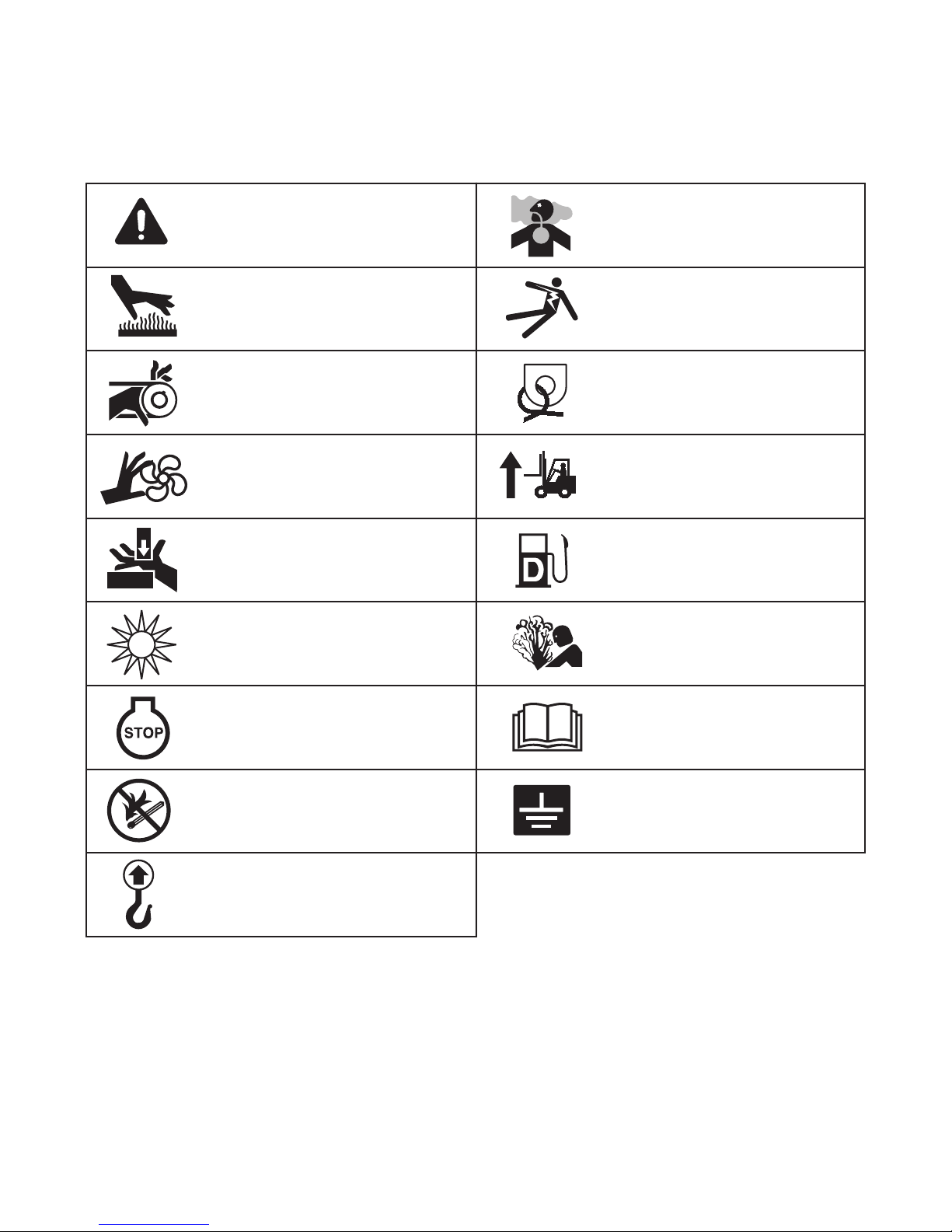
This equipment has been supplied with numerous safety and operating decals. These decals provide important
operating instructions and warn of dangers and hazards. Replace any missing or hard-to-read decals and use care
when washing or cleaning the unit. Decal placement and part numbers can be found in the parts manual. Below is
a summary of the intended meanings for the symbols used on the decals.
UV
Safety alert symbol; used to
alert you to potential personal
injury hazards.
Hot surface(s) nearby.
Belt/entanglement hazard; keep
body parts clear of this area.
Fan hazard; keep body parts
clear of this area.
Crush hazard; keep body parts
clear of this area.
Ultraviolet radiation hazard;
operate only with lens intact.
Asphyxiation hazard; operate
in well ventilated area.
Dangerous voltage may be
present.
Anchor/tie down point.
Forklift here only.
Use clean diesel fuel only.
Burn/scald hazard;
pressurized steam.
Stop engine before fueling.
Fire/explosion hazard; keep
open flames away from unit.
Lift here only.
Read and understand the
supplied operator’s manual
before operating unit.
Unit electrical ground.
00197
8
Page 9

SPECIFICATIONS - MLT4150, MLT4200
MAGNUM MODEL MLT4150 MLT4200
Engine
Make/Brand................................................................... Mitsubishi......................................Isuzu
Model ............................................................................ S4L2-W461ML .............................. 4LE1NYGV-03 or
Horsepower - prime hp (kW) ........................................ 23.5 (17.5) ....................................31.5 (23.5)
Horsepower - standby hp (kW)..................................... 24.7 (18.4) ....................................34.5 (25.7)
Operating Speed rpm ................................................... 1800 ..............................................1800
Displacement in3 (L) ..................................................... 107.40 (1.76) ................................134.25 (2.20)
Cylinders - qty ............................................................... 4 ....................................................4
Fuel Consumption - 100% prime gph (Lph)................. 1.30 (4.92) ....................................1.80 (6.81)
Battery Type - Group Number ....................................... 24.................................................. 24
Battery Voltage (Quantity per Unit) ............................... 12V (1) ..........................................12V (1)
Battery Rating ............................................................... 440 CCA .......................................720 CCA
Generator
Make/Brand................................................................... Marathon Electric.......................... Marathon Electric
Model ............................................................................ 333CSA3024 ................................334CSA3028
Type, Insulation............................................................. Brushless, F..................................Brushless, F
Generator Set (Engine/Generator)
Output - Standby kW (kVA) ........................................... 15.0 (15.0) ....................................20.0 (20.0)
Output Voltage V ........................................................... 120/240, single phase...................120/240, single phase
Output Amperes 120V (240V) A .................................... 125 (63) ........................................167 (83)
Frequency Hz................................................................ 60.................................................. 60
Power Factor................................................................. 1 (1Ø)............................................1 (1Ø)
4LE1NYGV-03E
Weights
Dry Weight lbs (kg)....................................................... 2015 (914) ....................................2122 (963)
Operating Weight lbs (kg) ............................................ 2413 (1095) ..................................2520 (1143)
Capacities
Fuel Tank Volume gal (L).............................................. 56 (212) ........................................56 (212)
Usable Fuel Volume gal (L).......................................... 56 (212) ........................................56 (212)
Coolant (incl. engine) qt (L) .......................................... 11.6 (11.0).....................................11.6 (11.0)
Oil (incl. filter) qt (L) ...................................................... 5.7 (5.4) ........................................8.6 (8.1)
Maximum Run Time hrs ............................................... 43 .................................................. 31
AC Distribution
Circuit Breaker Size ...................................................... 70 .................................................. 100
Voltage Regulation........................................................ +/-1% ............................................+/-1%
Voltages Available 1Ø ................................................... 120, 240........................................120, 240
Lighting
Lighting Type, Ballast Type ............................................ Metal Halide, Coil & Core .............Metal Halide, Coil & Core
Lumens.......................................................................... 440,000 .........................................440,000
Coverage acres (m2)..................................................... 5 - 7 (20,234 - 28,328) ..................5 - 7 (20,234 - 28,328)
Trailer
Number of Axles............................................................ 1 ....................................................1
Capacity - Axle Rating lbs (kg)..................................... 3000 (1361) ..................................3000 (1361)
Tire Size in.................................................................... 15..................................................15
Hitch - Standard ............................................................ 2" Ball............................................2" Ball
Maximum Tire Pressure psi.......................................... 50..................................................50
Specifications are subject to change without notice.
9
Page 10

SPECIFICATIONS - MLT4200ICAN
MAGNUM MODEL MLT4200ICAN
Engine
Make/Brand..........................................................................................................................Isuzu
Model ...................................................................................................................................4LE1NYGV-03G
EPA Tier ............................................................................................................................... 4f
Horsepower - prime hp (kW) ...............................................................................................31.5 (23.5)
Horsepower - standby hp (kW)............................................................................................ 34.5 (25.7)
Operating Speed rpm ..........................................................................................................1800
Displacement in3 (L) ............................................................................................................134.25 (2.20)
Cylinders - qty ......................................................................................................................4
Fuel Consumption - 100% prime gph (Lph)........................................................................1.80 (6.81)
Battery Type - Group Number .............................................................................................. 24
Battery Voltage (Quantity per Unit) ......................................................................................12V (1)
Battery Rating ......................................................................................................................720 CCA
Generator
Make/Brand..........................................................................................................................Marathon Electric
Model ...................................................................................................................................334CSA3028
Type, Insulation.................................................................................................................... Brushless, F
Generator Set (Engine/Generator)
Output - Standby kW (kVA) ..................................................................................................20.0 (20.0)
Output Voltage V ..................................................................................................................120/240, single phase
Output Amperes 120V (240V) A ...........................................................................................167 (83)
Frequency Hz....................................................................................................................... 60
Power Factor........................................................................................................................1 (1Ø)
Weights
Dry Weight lbs (kg)..............................................................................................................2122 (963)
Operating Weight lbs (kg) ...................................................................................................2520 (1143)
Capacities
Fuel Tank Volume gal (L).....................................................................................................56 (212)
Usable Fuel Volume gal (L).................................................................................................56 (212)
Coolant (incl. engine) qt (L) .................................................................................................11.6 (11.0)
Oil (incl. filter) qt (L) .............................................................................................................8.6 (8.1)
Maximum Run Time hrs ......................................................................................................31
AC Distribution
Circuit Breaker Size .............................................................................................................100
Voltage Regulation...............................................................................................................+/-1%
Voltages Available 1Ø ..........................................................................................................120, 240
Lighting
Lighting Type, Ballast Type ...................................................................................................Metal Halide, Coil & Core
Lumens.................................................................................................................................440,000
Coverage acres (m2)............................................................................................................5 - 7 (20,234 - 28,328)
Trailer
Number of Axles...................................................................................................................1
Capacity - Axle Rating lbs (kg)............................................................................................ 3000 (1361)
Tire Size in........................................................................................................................... 15
Hitch - Standard ...................................................................................................................2" Ball
Maximum Tire Pressure psi.................................................................................................50
Specifications are subject to change without notice.
10
Page 11
UNIT DIMENSIONS
B
A
C
D
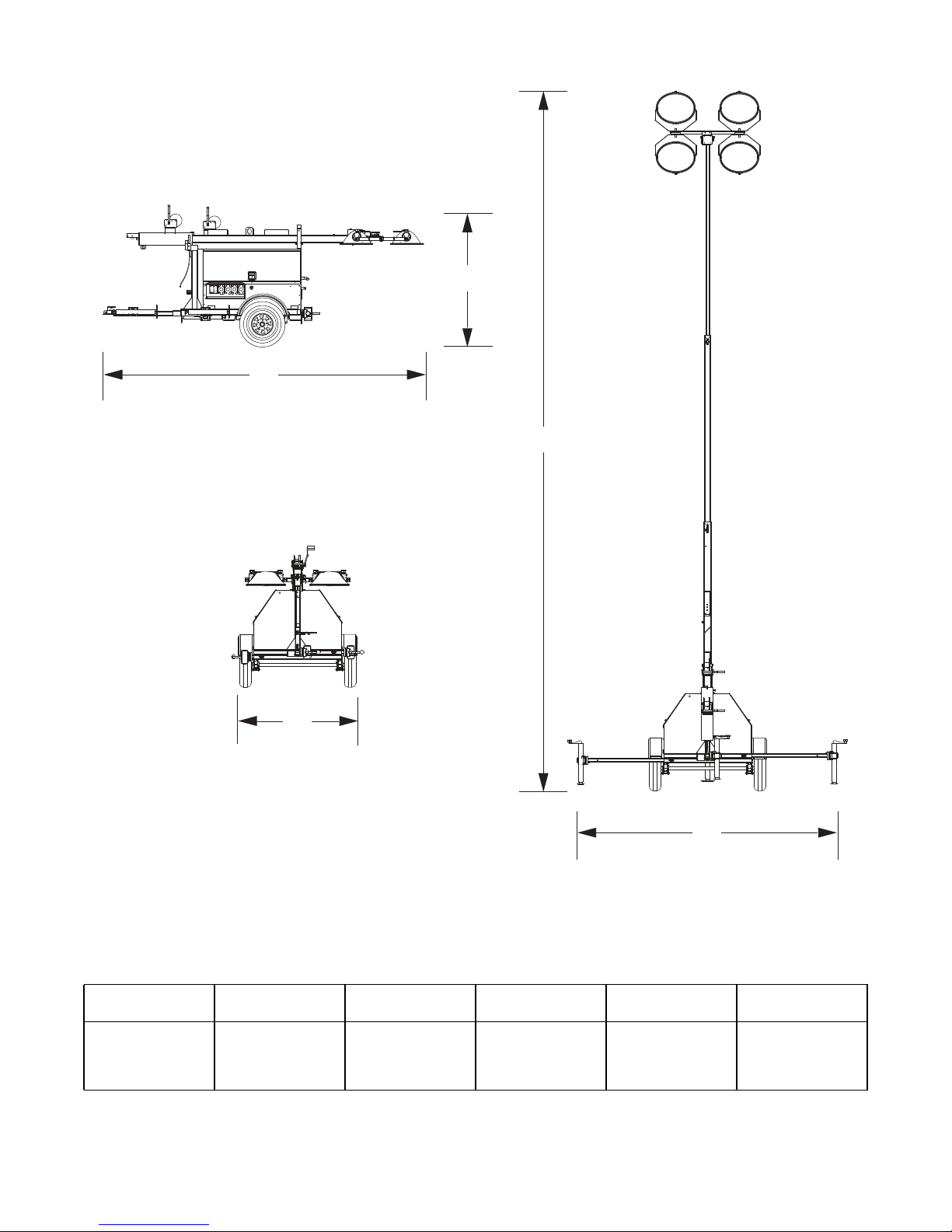
ABCDE
MLT4150,
MLT4200,
MLT4200ICAN
Specifications are subject to change without notice.
170 in
(4.32 m)
70 in
(1.78 m)
30 ft
(9.14 m)
68 in
(1.73 m)
E
00209
140 in
(3.56 m)
11
Page 12
UNIT SERIAL NUMBER LOCATIONS
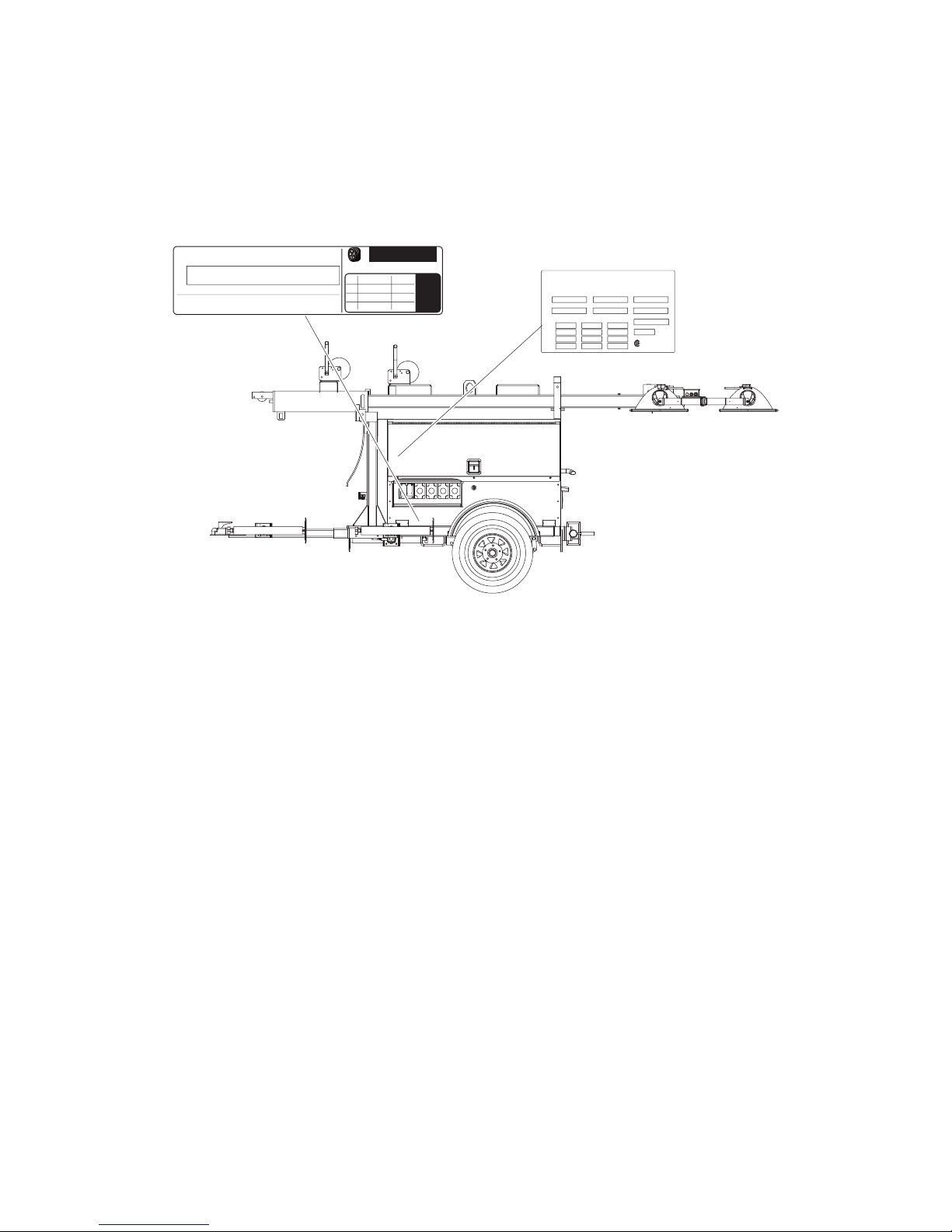
Refer to the illustration to locate the unit ID tag and Vehicle Identification Number (VIN) tag on the unit. Important
information, such as the unit serial number, model number, VIN and tire loading information are found on these tags.
Record the information from these tags so it is available if the tags are lost or damaged. When ordering parts or
requesting assistance, you may be asked to provide this information.
VIN Tag
MANUFACTURED BY/FABRIQUE PAR: Magnum Power Products LLC DATE: 00/0000
GVWR/PNBV: 000KG (0000LBS) COLD INF. PRESS./
PRESS. DE
GAWR / PNBE TIRE / PNEU RIM / JANTE GONF A FROID - KPA(PSI/LPC) SGL / DUAL
EACH
AXLE
THIS VEHICLE CONFORMS TO ALL APPLICABLE STANDARDS PRESCRIBED UNDER THE U.S. FEDERAL MOTOR VEHICLE SAFETY STANDARDS(FMVSS) AND CANADIAN
MOTOR VEHICLE SAFETY REGULATIONS IN EFFECT ON THE DATE OF MANUFACTURE.
CE VEHICULE EST CONFORME A TOUTES LES NORMES QUI LUI SONT APPLICABLES EN VERTU DU REGLEMENT SUR LA SECURITE DES VEHICULES AUTOMOBILES DU CANADA EN VIGUEUR A LA DATE SA
FABRICATION.
00000000000000000
V.I.N./N.I.V.:
XXX000
MODEL:
TYPE:
TRAILER
TIRE AND LOADING INFORMATION
RENSEIGNEMENTS SUR LES
PNEUS ET LE CHARGEMENT
The weight of cargo should never exceed 0000KG (0000LBS)
Le poids du chargement ne doit jamais depasser 0000KG (0000LBS)
SEE OWNER’S
MANUAL FOR
ADDITIONAL
INFORMATION
VOIR LE
MANUEL DE
L’USAGER
POUR
PLUS DE
RENSEIGNEMENTS
Unit ID Tag
Located on inside
of front panel
Manufactured by Magnum Power Products, LLC.,
a subsidiary of Generac Power Systems, Inc.
(920) 361-4442 (800) 926-9768
Country of Origin
Manufacturing Code
1 ph. 1.0PF 3 ph. .8PF 3 ph. 1.0PF
KW
KVA
V
A
Serial Number
Model
Weight (lbs/kg) RPM/Frequency
Rating
FOR ELECTRICAL EQUIPMENT
ONLY. POUR MATERIAL
ELECTRIQUE SEULEMENT.
209649
Form: SFC626B
Ins. Class
01131
12
Page 13
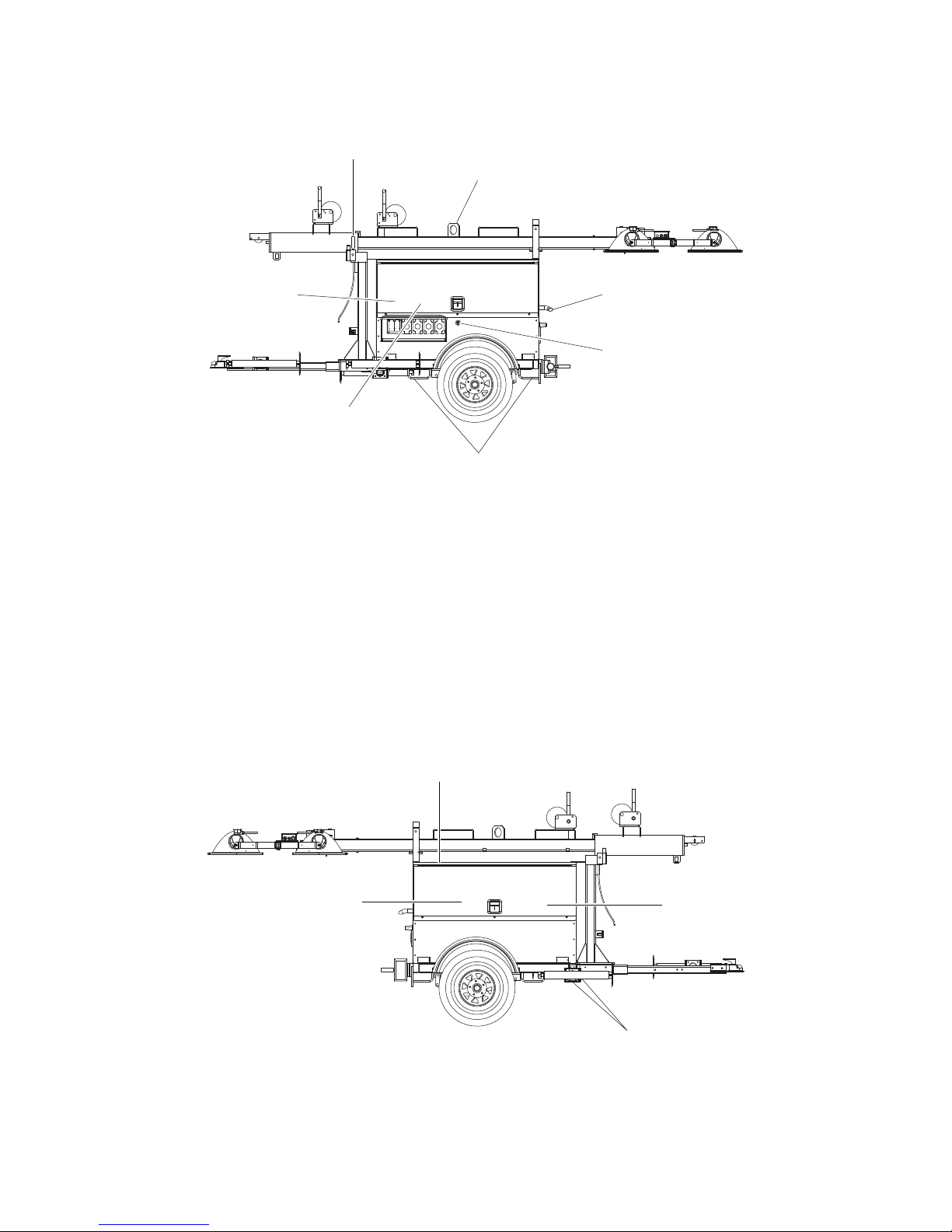
COMPONENT LOCATIONS
Mast
Rotation
Knob
Central
Lift Point
Control
Box
Engine
Exhaust
Emergency Stop
Switch
Battery
Forklift
Pockets
LEFT SIDE
Engine
Access
Radiator
Access
Fuel Fill
Outriggers
RIGHT SIDE
00105
13
Page 14
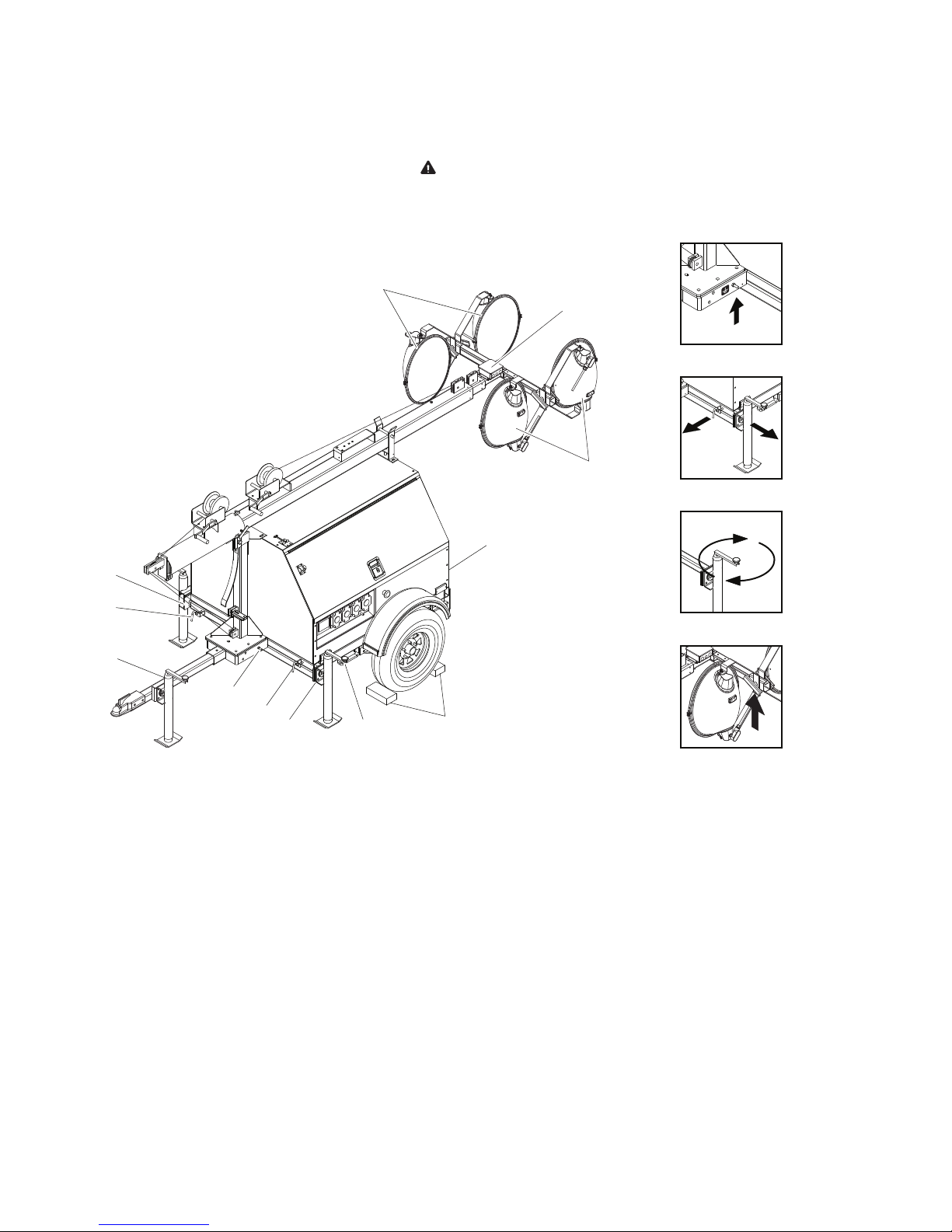
LIGHT TOWER SET UP
1. For maximum light coverage, locate the unit at ground level or in a spot higher than the area being illuminated
by the lamps.
WARNING
The mast extends up to 30 ft (9.14 m). Make sure area above the unit is open and clear
of overhead wires and obstructions. Do not set up the unit if high winds or storms
capable of producing lightning are expected in the area
H
J
DETAIL C
H
DETAIL D
F
E
D
DETAIL G
B
C
D
E
2. Place the unit on firm ground that is relatively flat, then block the wheels to keep it from moving (A). This will
make it easier to level the unit.
3. Pull the locking pin on the tongue jack and rotate the jack 90°. Replace the locking pin (B). Turn the jack handle
clockwise to raise the trailer tongue off of the towing vehicle.
4. Connect a good earthen ground to the grounding stud on the frame of the trailer at the base of the mast post (C).
Note: Refer to local codes for proper grounding requirements.
G
A
DETAIL H
00152
5. Pull the locking pin (D) on the outrigger (E) and pull each outrigger out until the spring loaded locking pin snaps
back into place. Pull the locking pin on the outrigger jack and rotate each jack 90° so the jack pad is facing down.
Replace the locking pin.
6. Pull the locking pin on the rear jack (F) and rotate the jack 90°. Replace the locking pin. Turn the jack handle
clockwise to start leveling the trailer. Adjust all four jacks by turning their handles clockwise (G) until they are
firmly in contact with the ground and the trailer is as level as possible.
14
Page 15

7. Before raising the mast, it may be necessary to adjust the lamps. The lamps may be adjusted up, down, left or
right by loosening the wing nuts on the trunnion (H) and aiming them in the desired direction. Tighten the hardware
completely and make sure the lamps are connected to the junction box (J).
RAISING THE MAST
1. Set up and level the unit. Refer to “Light Tower Set
Up” on page 14.
WARNING
The unit must be leveled with the
outriggers extended before raising the
mast. The outriggers must remain
extended while the mast is up. Failure
to level the unit or extend the
outriggers will severely reduce the
stability and could allow the unit to tip
and fall.
2. Remove mast cradle locking pin from mast cradle (A).
DETAIL A
DETAIL C
DETAIL E
STOP
DETAIL G
3. Check the mast cables for excessive wear or damage. Make sure the cables are properly centered in
each pulley (B). Check the electrical cord for damage.
B
G
A
WARNING
Do not start the unit if insulation on the
electrical cord is cut or worn through.
Bare wires in contact with the mast or
frame may energize the unit and cause
electrocution. Repair or replace a
damaged cord.
4. Make sure the area around the unit is clear before
raising the mast to the vertical position.
5. Remove the safety pin from the mast lock bar (C).
Using the handle for the lower mast winch (D), raise
the mast until it is vertical and the tab on the mast is
positioned into the mast lock. The mast lock bar
should snap into place automatically. Secure the lock
with the safety pin (E).
6. After the mast is up and locked into place, use the
upper mast winch (F) to telescope the mast to the desired height. Extend the mast slowly, making sure the
electrical cord is extending at the top sections of the mast. If, for any reason, the winch cable begins to develop
slack or any of the mast sections get stuck, STOP IMMEDIATELY and contact an authorized service center.
F
D
H
B
C, E
00179
Do not extend the mast beyond the colored mark on the middle mast tube (G).
7. Rotate the mast by loosening the mast rotation knob at the bottom of the mast (H). Turn the mast until the lights
face in the desired direction and then tighten the knob.
Never raise or lower the mast while the unit is operating. Never remove the safety pin or
release the mast lock while the mast is up. Releasing the lock will cause the mast to fall.
CAUTION
WARNING
15
Page 16

RAISING THE MAST WITH ELECTRIC WINCH OPTION
1. Set up and level the unit. Refer to “Light Tower Set
Up” on page 14.
WARNING
The unit must be leveled with the
outriggers extended before raising the
mast. The outriggers must remain
extended while the mast is up. Failure
to level the unit or extend the
outriggers will severely reduce the
stability and could allow the unit to tip
and fall.
DETAIL C
DETAIL E
DETAIL D
DETAIL F
2. Remove mast cradle locking pin from mast cradle (A).
3. Check the mast cables for excessive wear or damage. Make sure the cables are properly centered in
each pulley (B). Check the electrical cord for damage.
B
G
DETAIL G
A
STOP
DETAIL H
WARNING
Do not start the unit if insulation on the
electrical cord is cut or worn through.
Bare wires in contact with the mast or
frame may energize the unit and cause
electrocution. Repair or replace a
damaged cord.
4. Make sure the area around the unit is clear before
raising the mast to the vertical position.
5. Remove the safety pin from the mast lock bar (C).
Press the lower winch control switch (D) upward to
raise the mast into the vertical position. Hold the
switch until the mast lock is engaged. The mast lock
bar should snap into place automatically. Secure the lock with the safety pin (E).
Note: a limit switch on the mast tube will disconnect power to the lower electric winch to prevent deadheading the
winch.
F
D
C,E
B
H
00189
6. Press and hold the upper winch control switch (F) upward to telescope the mast to the desired height. Extend
the mast slowly, making sure that the coiled electrical cord is extending at the top sections of the mast. If, for
any reason, the winch cable begins to develop slack or any of the mast sections get stuck, STOP IMMEDIATELY
and contact an authorized service center.
Do not extend the mast beyond the colored mark on the middle mast tube (G). A limit switch
on the main mast section will disconnect power to the upper electric winch to prevent
7. Rotate the mast by loosening the locking knob at the bottom of the mast (H). Turn the mast until the lights face
in the desired direction and then tighten the knob.
Never raise or lower the mast while the unit is operating. Never remove the safety pin or
release the mast lock while the mast is up. Releasing the lock will cause the mast to fall.
16
CAUTION
overextending the mast.
WARNING
Page 17

MAIN CONTROL PANEL
240VAC
MAIN CIRCUIT
BREAKER
ON
12 354
BALLAST INDICATOR LIGHTS
I
I
I
ON
ON ON ON ON
O
O
O
MAST LIGHT SWITCHES
I
O
6
TURN
MAIN
BREAKER
OFF
NEUTRAL BONDED TO FRAME
GLOW
PLUGS
OFF
RUN
START
GLOW PLUG
INDICATOR
7
00163
1. MAIN CIRCUIT BREAKER: This 240V (70A or 100A) breaker will disconnect power to the lights and receptacles.
2. CIRCUIT BREAKER INDICATOR LIGHT: This light indicates that the main circuit breaker must be opened
(switched off) before starting the engine.
3. LIGHT SWITCHES: One circuit breaker is supplied for each light.
4. BALLAST INDICATOR LIGHTS: Indicates power from the ballast to each light.
5. ENGINE HOUR METER: Keeps track of engine hours for service.
6. CONTROL POWER SWITCH: Keyed switch operates glow plugs, starts and stops engine.
7. GLOW PLUG INDICATOR: Indicates operation of the engine glow plugs. (Mitsubishi engines only.)
17
Page 18

PRESTART CHECKLIST
Before starting the unit, all items in the prestart checklist must be completed.
Read and understand ALL safety sections at the beginning of this manual.
Ensure all maintenance procedures are up to date. For more information, refer to “General
Maintenance” on page 24 and Basic Maintenance Schedules beginning on page 25.
The unit must be level.
The unit must be dry. Check for any water inside, on, or near the unit, dry if needed.
Ensure the unit is properly grounded to a good earthen ground. Installation should be in compliance
with the National Electrical Code (NEC), state and local regulations.
Switch the Control Power switch to the OFF (O) position.
Switch all circuit breakers to the OFF (O) position.
Inspect all electrical cords; repair or replace any that are cut, worn, or bare.
Ensure all winch cables are in good condition and centered on each pulley. Do not use if cables are
kinked or beginning to unravel.
Check oil, coolant, and fuel levels. For more information, refer to “General Maintenance” on page 24.
Ensure engine battery connections are secure.
Turn the battery disconnect switch on, if equipped.
Ensure the Emergency Stop switch is pulled out.
EMERGENCY STOP SWITCH
The unit is equipped with one emergency stop switch. For location of the emergency
stop switch, refer to “Component Locations” on page 13. The red switch is clearly
labeled “EMERGENCY STOP.” The switch can be accessed and activated with all
doors closed and locked.
Activate the emergency stop switch by pushing the red button in until it locks down.
This will trip the main circuit breaker which will open the contact, disconnecting the
load to the connection lugs. This will also open the fuel circuit, shutting down the engine.
The switch will remain closed until it is pulled out.
Use the emergency stop switch only when the unit must be shut down immediately. For any
other shut down, refer to “Shutting Down the Unit” on page 21.
STARTING THE UNIT
1. Check that the main circuit breaker and individual
circuit breakers for each of the lights are in the OFF
(O) position.
Note: When the red Turn Main Breaker Off light is
illuminated, the main circuit breaker must be turned to
the OFF (O) position.
2. Turn the key on the Control Power switch to the left
Glow Plug position and hold the key in place for five
seconds, or until the glow plug indicator turns red.
(Kubota units do not have a glow plug indicator.) As
CIRCUIT BREAKERS
I
O
G
E
R
N
E
M
E
I
I
O
O
C
Y
S
T
P
O
00230
I
O
00202
18
Page 19

soon as it is glowing, turn the key to the right Start position and hold it until the engine cranks and starts running.
A
Release the key, it will move to the Run position.
Note: For cold weather conditions, refer to the engine operator’s manual for appropriate glow plug interval.
CTIVATE GLOW PLUG
OFF
GLOW
PLUG
RUN
START
CRANK ENGINE TO START
GLOW
PLUG
OFF
RUN
START
RELEASE KEY
OFF
GLOW
PLUG
RUN
START
00203
Do not crank the engine longer than 10 seconds at a time. If the engine will not start, wait
30 seconds to allow the starter motor to cool and then repeat the starting procedure.
Excessive cranking will cause damage to the starter.
Note: If oil pressure is not obtained within 15 seconds after the key is switched to the Run position, the low-oil
automatic shutdown will turn off the fuel supply, stopping the engine. Check the oil level and turn the key to the OFF
position to reset the oil pressure timer before attempting to restart the engine.
3. Once the engine is running, allow it to reach normal operating temperature before switching on any loads.
AUTOMATIC SHUTDOWN
This unit is equipped with a low oil pressure and high coolant temperature automatic shutdown system. This system
will automatically shut off the fuel supply to stop the engine if oil pressure drops too low or the engine exceeds normal
operating temperature. Return the switch to the OFF position to reset the unit after you have determined the cause
of the shutdown.
LIGHT OPERATION
WARNING
NEVER OPERATE THE LIGHTS WITHOUT THE PROTECTIVE LENS COVER OR WITH
A LENS COVER THAT IS CRACKED OR DAMAGED. The bulbs in the light fixtures
produce high temperatures and operate under pressure. A broken or missing lens
cover could cause the bulbs to shatter, causing injury.
1. Once the engine is up to temperature and running
smoothly, switch the main circuit breaker (A) to the
A
ON (I) position.
240VAC
MAIN CIRCUIT
2. With main circuit breaker on, switch each individual
circuit breaker for the lights (B) to ON (I), one at a time.
BREAKER
ON
ON
IOIOIOI
ON ON ON ON
3. The ballast indicator lights (C) will come on and
continue to get brighter as the lights warm up, and
then remain on. This confirms that power is coming
TURN
MAIN
BREAKER
OFF
from the ballasts to the lights.
4. If an indicator light does not come on, the ballast may
need to be serviced. If the indicator light comes on
and stays lit but the related light is not illuminated,
check the bulb or the mast wiring. Refer to “Trouble-
NEUTRAL BONDED TO FRAME
shooting the Lights” on page 30.
BALLAST INDICATOR LIGHTS
MAST LIGHT SWITCHES
BC
O
OFF
GLOW
PLUGS
GLOW PLUG
INDICATOR
RUN
START
00148
19
Page 20

5. The lights require a warm up period of 5-15 minutes before they reach full output. If the lights are shut down,
they require a cool down period of approximately 10 minutes before they can be switched on again.
6. The light tower uses four 1000W bulbs. When checking or replacing the bulbs, wipe them with a clean cloth to
avoid leaving any grease, oil residue or fingerprints on the glass. Any residue can create a hot spot on the bulb,
causing premature bulb failure.
CAUTION
Bulbs become extremely hot when in use. Allow bulb fixture to cool 10-15 minutes before
handling or lowering the mast.
VOLTAGE REGULATION
Units are equipped with an electronic voltage regulator. The voltage regulator controls the output of the generator
by regulating the current into the exciter field. The voltage regulator is adjusted before shipment from the factory.
Contact Magnum Power Products LLC for additional information before attempting to adjust the voltage regulator.
DERATING FOR ALTITUDE
All units are subject to derating for altitude and temperature; this will reduce the available power for operating tools
and accessories connected to the receptacles. Typical reductions in performance are 2-4% for every 1000 ft. (305
m) of elevation and 1% per 10ºF (5.6ºC) increase in ambient air temperature over 72ºF (22ºC).
WET STACKING
The unit is powered by a diesel engine. Diesel engines are susceptible to wet stacking if lightly loaded. Wet stacking
occurs when an engine is run at less than 30% of its full load capacity, causing unburned fuel to accumulate in the
exhaust system. Wet stacking can be detected by continuous black exhaust when the unit is under a constant load.
It can also cause fouling of injectors and buildup on engine valves. Diesel engines operate properly when applied
loads are between 30% and 100% capacity. Appropriate generator sizing is determined by the anticipated load. If
the unit is in a wet stack condition, load the unit heavily for five hours or until the exhaust is clear.
RECEPTACLE PANEL
The receptacle panel is equipped with six receptacles for
running accessories or tools from the generator. Power
is supplied to the receptacles any time the engine is
running and the main circuit breaker is switched to the
ON (I) position.
Should the main breaker, or any of the individual circuit
breakers trip, remove some of the load to the receptacles
before turning them back on.
Each receptacle has an individual circuit breaker, located
inside the cabinet under a flip-up cover. Each circuit
breaker correspond with the receptacle directly below it.
Receptacle Panel
Grounding Stud
00195
With all of the lights off, the full generator output may be used with the receptacles.
Note: To ensure proper grounding, anytime the generator is providing power to any equipment or load panels that
do not have a grounded plug, a ground wire MUST BE added between the equipment and the grounding stud on
the receptacle panel per the National Electrical Code (NEC), state and local regulations.
20
Page 21

SHUTTING DOWN THE UNIT
Check with personnel using power supplied by the unit and let them know the power is going to be turned off. Make
sure the power shutdown will not create any hazards by accidentally turning off equipment that needs to be kept on
(pumps, compressors, lights, etc.).
When you have finished using the unit, proceed with shut down as follows:
1. Remove any loads from the receptacles.
2. Switch the individual circuit breakers for each light to the OFF (O) position.
3. Switch the main circuit breaker to the OFF (O) position.
4. Turn the Control Power switch to the OFF position.
CIRCUIT BREAKERS
I
OIO
OIO
I
ENGINE START SWITCH
OFF
GLOW
PLUG
RUN
START
00201
Note: For extended storage time, disconnect the battery. For extended storage requirements, refer to the engine
operator’s manual.
LOWERING THE MAST
1. Shut down the lights and engine. Allow the lights to cool 10-15 minutes before lowering the mast.
2. Loosen the mast rotation knob. Rotate the mast until the white arrows are aligned and the metal stop tabs are
touching. Tighten the mast rotation knob.
3. Turn the upper mast winch handle counterclockwise to collapse the mast to its lowest position. Ensure the
electrical cord does not get caught in, or pinched by, the mast while it is being lowered.
CAUTION
STOP IMMEDIATELY if the mast hangs up, or the winch cable begins to develop slack.
Excess slack in the cable could cause the mast to collapse, which could result in personal
injury or equipment damage. Contact an authorized service center.
4. Release the mast lock by pulling the safety pin on the mast lock and pulling the lock bar free. Turn the handle
of the lower mast winch counterclockwise until the mast rests in the transport cradle.
Note: If the mast lock bar does not pull free, activate the lower winch slightly to relieve pressure on the mast bar.
5. After the mast is completely down, insert the mast cradle locking pin and secure it with the safety pin.
Note: If the trailer is going to be moved, Magnum Power Products LLC strongly recommends the lights be removed
from the mast and stowed for transportation. Refer to “Removing the Lights for Transportation” on page 22.
21
Page 22

LOWERING THE MAST WITH ELECTRIC WINCH OPTION
1. Shut down the lights and engine. Allow the lights to cool 10-15 minutes before lowering the mast.
2. Loosen the mast rotation knob. Rotate the mast until the white arrows are aligned and the metal stop tabs are
touching. Tighten the mast rotation knob.
3. Press and hold the upper winch control toggle switch downward to collapse the mast to its lowest position. Ensure
the electrical cord does not get caught in, or pinched by, the mast while it is being lowered.
Note: Some electric winch models are equipped with an anti-backlash safety limit switch. This switch will disconnect
power to the winch if excess cable slack is detected, preventing accidental lowering of the mast.
CAUTION
STOP IMMEDIATELY if the mast hangs up, or the winch cable begins to develop slack.
Excess slack in the cable could cause the mast to collapse, which could result in personal
injury or equipment damage. Contact an authorized service center.
4. Release the mast lock by pulling the safety pin on the mast lock and pulling the lock bar free. Lower the mast
by holding the lower winch control toggle switch to the right until the mast is resting in the transport cradle.
Note: If the mast lock bar does not pull free, activate the lower winch slightly to relieve pressure on the mast bar.
5. After the mast is completely down, insert the mast cradle locking pin and secure it with the safety pin.
Note: If the trailer is going to be moved, Magnum Power Products LLC strongly recommends that the lights be
removed from the mast and stowed for transportation. Refer to “Removing the Lights for Transportation” on page 22.
REMOVING THE LIGHTS FOR TRANSPORTATION
1. On units equipped with quick disconnect fittings for the lights, disconnect the power
cords from the junction box at the top of the mast. Replace the dust caps on the
junction box. On hard wired units, remove the junction box cover, located on the
top of the mast, and disconnect ONLY the mast light wires from the connectors.
To release the mast light wires from the connectors, flip the locking levers down
and pull out the appropriate wires.
2. Remove the lights by removing the wing nut that holds the light fixture bracket to
the cross tube. Attach the lights to the storage brackets (if equipped) located on
the mast tube on either side of the central lift point.
00232
TOWING THE UNIT
Once the engine is shut down and the mast and lights are properly stowed, follow these steps to prepare the unit
for towing.
1. Raise the rear jack completely and release the locking pin to rotate it up into the travel position. Make sure the
locking pin snaps into place.
2. Raise the outrigger jacks completely and release the jack locking pin to swing the jacks up into the travel position.
Make sure the locking pins snap into place. Release the outrigger locking pins and slide the outriggers into the
trailer frame until the locking pins snap into place.
22
Page 23

3. Use the tongue jack to raise or lower the trailer onto the hitch of the towing vehicle. Lock the hitch coupling and
attach the safety chains or cables to the vehicle. Remove the jack locking pin and rotate the jack into the travel
position. Replace the locking pin.
Note: A film of grease on the coupler will extend coupler life and eliminate squeaking. Wipe the coupler clean and
apply fresh grease each time the unit is towed.
4. To ensure proper operation of the jacks, lube the grease fittings located on the leveling jacks. Refer to “Jack
Maintenance” on page 28. For maintenance interval information, refer to Basic Maintenance Schedules beginning
on page 25.
5. Connect any trailer wiring to the tow vehicle. Check for proper operation of the direction and brake lights.
6. Make sure the mast cradle locking pin is in place.
7. Make sure the doors are properly latched.
8. If the unit is going to be driven over rough ground, remove the bulbs from the light fixtures.
9. Check for proper inflation of the trailer tires. Refer to Specifications beginning on page 9.
10. Check the wheel lugs. Tighten or replace any that are loose or missing. If a tire
has been removed for axle service or replaced, tighten the lugs, in the order shown,
to the following specifications:
1
A. Start all lug nuts by hand.
B. First pass tighten to 20-25 ft-lbs (27-33 Nm).
C. Second pass tighten to 50-60 ft-lbs (67-81 Nm).
4
3
2
5
D. Third pass tighten to 90-120 ft-lbs (122-162 Nm).
Note: After the first road use, re-torque the lug nuts in sequence.
00204
11. Maximum recommended speed for highway towing is 45 mph (72 km/h). Recommended off-road towing speed
is not to exceed 10 mph (16 km/h) or less, depending on the terrain.
LIFTING THE UNIT
When lifting the unit, attach any slings, chains or hooks
directly to the central lift point.
1. Make sure the equipment being used to lift the unit
has sufficient capacity. For approximate weights,
refer to Specifications beginning on page 9.
2. Make sure the cradle locking pin is in place.
3. Always remain aware of people and objects around
the unit while moving.
4. Use the upper or lower forklift pockets with care.
Approach the unit as perpendicular as possible to
avoid any damage to the unit. Make sure the mast
winch handles or any other obstructions are clear of
the forklift tines before lifting.
Upper Forklift
Pockets
Lower Forklift
Pocket
Central
Lift Point
Lower Forklift
Pocket
01132
23
Page 24

GENERAL MAINTENANCE
Poorly maintained equipment can become a safety hazard. In order for the equipment to operate safely and properly
over a long period of time, periodic maintenance and occasional repairs are necessary. NEVER perform routine
service (oil/filter changes, cleaning, etc.) unless all electrical components are shut off. Before servicing the unit always
follow the instructions listed below.
• Ensure the Control Power switch is turned to the OFF (O) position.
• Ensure the circuit breakers are turned to the OFF (O) position.
• Activate (push in) the emergency stop switch.
• Disconnect the negative (-) terminal on the battery.
• Attach a Do Not Start sign to the control panel. This will notify everyone that the unit is being serviced and
will reduce the chance of someone inadvertently trying to start the unit.
• Never wash the unit with a high pressure hose or with any kind of power washer.
• Never wash the engine block or fuel tank with a power washer or steam cleaner. Water may enter the cabinet
and collect in the generator windings or other electrical parts, causing damage.
• If the unit is stored outside, check for water inside the cabinet and generator before each use. If wet, dry the
unit thoroughly before starting.
• Inspect condition of electrical cords. DO NOT use the unit if insulation is cut or worn through.
• Check that winch cables are in good condition
and are centered on each pulley. DO NOT use a
cable that is kinked or starting to unravel.
• Check that the safety pins for the mast lock rod
and mast lock bar are present and secured with
a chain. Check that the spring located in the mast
lock bar is not broken or missing. Check the
operation of the mast lock bar.
• Check the wheel lugs. Refer to “Towing the Unit”
on page 22.
• Check coolant levels. Refer to the engine oper-
ator’s manual when determining proper mixture.
○ Coolant is checked visually by inspecting the level in coolant overflow jug near the radiator.
○ Normal operation is between the Full and Add markings on the overflow jug, this is known as “Normal
Range.”
○ WHEN ENGINE IS STOPPED AND COMPLETELY COOL, coolant may be added directly to the jug.
• Check the oil levels. Refer to the engine operator’s manual when determining proper viscosity.
○ DO NOT start the unit if the engine oil level is below the Add mark on the dipstick.
○ Normal operation is between the Full and Add markings on the dipstick.
○ Add oil only if oil level is below cross-hatch pattern on the dipstick. DO NOT OVERFILL crankcase.
• Check fuel level
PROPER MAST CABLE ROUTING
00131
Note: If the engine was run out of fuel or the fuel tank was drained, it may be necessary to bleed the fuel lines. Refer
to the engine operator’s manual supplied with the unit.
24
Page 25

BASIC MAINTENANCE SCHEDULE - MITSUBISHI ENGINE
Refer to the original equipment manufacturer’s operating manual for a complete list of
maintenance requirements. Failure to comply with the procedures as described in the engine
operator’s manual will nullify the warranty, decrease performance and cause equipment
damage or premature equipment failure. Maintenance records may be required to complete
a warranty request.
Use the schedule in the following table as a guide for regular maintenance intervals. For additional or replacement
copies of the engine operator’s manual, contact an authorized dealer in your area.
Item Daily
Check Oil Level
Check Coolant Level
Check Fuel Level
Check Tire Pressure
Check All Electrical Connections
Inspect Radiator Fins For Debris, Clean As
Required
Inspect Light Tower Winch For Proper Operation
Fuel Tank - Drain Water
Check Air Cleaner
Replace Engine Oil And Oil Filter *
Belt And Belt Tension - Inspect And Adjust
Replace Fuel Filter
Drain And Clean Fuel Tank **
Check Glow Plugs
Lubricate Leveling Jacks
Bolts And Nuts On The Engine - Retighten *
Replace Heated Fuel Filter (If Equipped)
Inspect Engine Starting Battery
Air Cleaner Element - Clean, Check And Replace
Fuel System - Bleed Air
Water Sedimenter - Drain Water
50
Hours
250
Hours
400
Hours
500
Hours
1000
Hours
As
Required
* Perform after the initial 50 hours of operation, then on the regularly scheduled interval indicated in the schedule
above.
** Certain conditions may require the fuel tank to be drained and cleaned more often. When operating in extremely
dusty conditions, clean the fuel tank as often as necessary.
25
Page 26

BASIC MAINTENANCE SCHEDULE - ISUZU ENGINE
Refer to the original equipment manufacturer’s operating manual for a complete list of
maintenance requirements. Failure to comply with the procedures as described in the engine
operator’s manual will nullify the warranty, decrease performance and cause equipment
damage or premature equipment failure. Maintenance records may be required to complete
a warranty request.
Use the schedule in the following table as a guide for regular maintenance intervals. For additional or replacement
copies of the engine operator’s manual, contact an authorized dealer in your area.
Item Daily
Check Oil Level
Check Coolant Level
Check Fuel Level
Drain Fuel Filter
Check Tire Pressure
Check All Electrical Connections
Clean Battery
Check Fan Belt Tension (Replace If Necessary)
Inspect Radiator Fins For Debris, Clean As Required
Preheating Condition Check
Check Engine Starting Conditions And Noise Conditions
Check Exhaust Smoke Condition
Inspect Light Tower Winch For Proper Operation
Replace Engine Oil
Replace Fuel Filter Element
Clean Water Sedimenter Element
Electromagnetic Pump Filter Replacement or Cleaning
Check Fan Belt Tension (Replace If Necessary)
Oil Filter Element Replacement
Replace Air Filter Element
Lubricate Leveling Jacks
Replace Heated Fuel Filter (If Equipped)
Inspect Engine Starting Battery
250
Hours
500
Hours
1000
Hours
26
Page 27

WINCH USE, OPERATION & MAINTENANCE - MANUAL
PRIOR TO USE
• Inspect rope or cable and replace if damaged.
• Check mounting hardware for proper tightness and re-torque if necessary.
• Gears, ratchet pivot point and shaft bushings must be kept lubricated with a thin oil or grease.
OPERATION
Take Line/Load In:
1. The cable must be securely fastened to the object being lifted and to the winch drum.
2. Always be sure that the cable and cable attachments are not damaged and are strong enough for the
load. Ensure there is an adequate safety factor of at least three times the maximum load for all components
used.
3. Referring to the Cable In/Cable Out decal on the winch, turn handle according to the specified direction
to lift. The ratchet MUST make a loud clicking sound while pulling line in.
Let Line/Load Out:
1. Referring to the Cable In/Cable Out decal on the winch, turn handle according to the specified direction
to lower. No clicking will be heard because the brake system is activated.
MAINTENANCE
The following procedures should be performed at least annually:
1. The gears and bushings of the winch must be kept lubricated. Apply a thin film of grease to the gear
teeth, and oil the bushings as needed.
2. The ratchet pawl pivot point must be kept lubricated with a thin oil.
3. Do not get oil or grease on the friction discs.
Grease
Oil
Friction Discs
(No Grease/Oil)
WINCH USE, OPERATION & MAINTENANCE - ELECTRIC
• Keep winch free of dirt, oil, grease, water and other substances.
• Check all mounting bolts and make sure they are tightened to the recommended torque values. Replace
any damaged fasteners.
• Periodically check all connections to be sure they are tight and free of corrosion.
• Check cable for visible damage every time winch is operated. Examples of damage are: cuts, knots, mashed
or frayed portions, and broken strands. Replace cable immediately if damaged. Failure to replace a damaged
cable could result in breakage.
• Regularly check brake for slippage or drift. This is detected visually when winch is under load. If winch drum
continues to turn after controls are released, the brake may need to be replaced.
• Periodically clean and grease brake assembly. This will ensure proper performance and extend the life of
the winch. If winch seems to labor or get excessively hot during the lowering of loads, the brake will need
to be serviced or replaced.
00244
27
Page 28

• Check motor brushes periodically and replace when necessary.
Note: Only the motor brushes and brake assembly require periodic replacement.
PREVENTIVE MAINTENANCE SCHEDULE
Semi-Annually Or
After Each 25 Hours
Of Operation
Maintenance Activity
After First
Operation
Before Each Use
Check Fasteners
Check Electrical Connections
Clean And Grease Brake Assembly
Check Motor Brushes
Visually Check Winch And Control
MECHANICAL BRAKE
The mechanical brake generates heat when loads are lowered and the wire cable is powered out. Care must be
taken to avoid overheating the mechanical brake.
Whine or chatter associated with a new mechanical brake is normal and typically disappears with use.
Overheating the mechanical brake may result in permanent damage to, or failure of, the brake. Replace any damaged
brake components before resuming use of the winch.
JACK MAINTENANCE
The following procedures should be performed at least annually.
SIDE-WIND MODELS
• The internal gearing and bushings of the jack must be kept lubricated. Apply a small amount of automotive
grease to the internal gearing by removing the jack cover, or if equipped, use a needle nose applicator or
standard grease gun on the lubrication point found on the side of the jack near the crank. Rotate the jack
handle to distribute the grease evenly.
• A lightweight oil must be applied to the handle unit at both sides of the tube.
• If equipped, the axle bolt and nut assembly of the caster wheel must also be lubricated with the same light
weight oil.
TOP-WIND MODELS
• Apply a lightweight oil to the screw stem.
Oil
Grease
Grease
Oil
Grease
Oil
Oil
Oil
00243
28
Page 29

TRAILER WHEEL BEARINGS
The trailer axles are equipped with a grease zerk fitting to allow lubrication of the wheel bearings without the need
to disassemble the axle hub. To lubricate the axle bearings, remove the small rubber plug on the grease cap, attach
a standard grease gun fitting to the grease zerk fitting and pump grease into the fitting until new grease is visible
around the nozzle of the grease gun. Use only a high quality grease made specifically for lubrication of wheel bearings.
Wipe any excess grease from the hub with a clean cloth and replace the rubber plug when finished. The minimum
recommended lubrication is every 12 months or 12,000 miles (19,312 km). More frequent lubrication may be required
under extremely dusty or damp operating conditions.
LOWER RADIATOR HOSE HEATER OPTION - USE AND MAINTENANCE
CAUTION
Improper use of the lower radiator hose heater could result in damage to the engine or
personal injury. Do not modify the location of the lower radiator hose heater.
The following points should be followed when operating a unit equipped with a lower radiator hose heater.
• Ensure the cooling system is full of the proper mixture of water and engine coolant before each heater use.
• The heater is designed for all-night operation, however, 2-5 hours of heating just prior to starting is usually
sufficient for proper engine starting.
• The unit must be level to maintain proper orientation of the heater while it is in operation.
• Use only an undamaged, outdoor rated, three-prong grounded 120VAC extension cord with a minimum
amperage rating of 10A. Connect the cord to a properly grounded 120VAC, GFCI receptacle.
• Before starting the engine, unplug the extension cord from the power first, then unplug the heater cordset
from the extension cord.
29
Page 30

TROUBLESHOOTING THE LIGHTS
DANGER
THIS UNIT USES HIGH VOLTAGE CIRCUITS CAPABLE OF CAUSING SERIOUS
INJURY OR DEATH. ONLY A QUALIFIED ELECTRICIAN SHOULD TROUBLESHOOT
OR REPAIR ELECTRICAL PROBLEMS OCCURRING IN THIS EQUIPMENT.
MAST LIGHTS OFF BUT BALLAST INDICATORS ON CONTROL PANEL ARE ON
1. Mast light is too hot. Allow light to cool 10-15 minutes before restarting.
2. Faulty bulb connection. Check that the bulb is tight in the socket.
3. Bulb broken. Check for broken arc tube or outer bulb jacket, broken or loose components in bulb envelope
or blackening/deposits inside tube.
4. Check the connections inside the mast junction box and each mast light housing/socket.
5. Check the mast electrical cord for damage and check the cord connections inside the control box.
MAST LIGHTS OFF AND BALLAST INDICATORS ON CONTROL PANEL ARE OFF
1. Check the connections inside the control box and inside each ballast box.
2. Generator output incorrect. Check the incoming voltage to the ballast by checking the available voltage
on the duplex receptacle. Incoming voltage should be 120V +/- 5V. If voltage is incorrect, the engine
speed may need to be adjusted or generator may require service.
3. Low transformer output. The voltage from the transformer should read approximately 400 VAC as the
light “strikes” (induces an arc), then drop and slowly rise back up to stabilize at 240-260 VAC. On quick
disconnect models, measure across the junction box terminals when the light is unplugged. On hard
wired models, remove the mast junction box cover and insert the wire probes into the connector blocks
for the light and ground. If proper voltage is not achieved, perform capacitor check to determine if the
capacitor or coil needs to be replaced.
MAST LIGHTS ON BUT THE LIGHT OUTPUT IS LOW
1. Fixture or lens is dirty. Clean reflective surface inside fixture and both inside and outside surface of glass
lens. Use mild soap and water to clean lens. Other chemicals may have an adverse effect on the glass.
2. Bulb worn due to normal use. Replace bulb.
3. Check the mast coil cord, mast junction box and mast light connections.
4. Generator output incorrect. Check the incoming voltage to the ballast. Incoming voltage should be 120V
+/- 5V. If voltage is incorrect, engine speed may need to be adjusted or generator may require service.
5. Low transformer output. The voltage from the transformer should read approximately 400 VAC as the
light “strikes” (induces an arc), then drop and slowly rise back up to stabilize at 240-260 VAC. On quick
disconnect models, measure across the junction box terminals when the light is unplugged. On hard
wired models, remove the mast junction box cover and insert the wire probes into the connector blocks
for the light and ground. If proper voltage is not achieved, perform capacitor check to determine if the
capacitor or coil needs to be replaced.
If problems persist, contact Magnum Power Products LLC Technical Service at 1-800-926-9768 for assistance.
30
Page 31

MAST LIGHT CONNECTIONS
MAST JUNCTION BOX WIRING
4-LIGHT
MAST LIGHT CONNECTIONS
4-LIGHT
21
2
1
43
4
3
00175
31
Page 32

AC WIRING DIAGRAM
BL
3
RD
2
BK
LED BOARD
YL
BL
WT
GN
3
BK
WT
WT
GN
1
BK
RD
WT
BK
GN
CAP 4
14
23
RD
BK
CAP 2 CAP 3
14
23
GN
4
WT
BK
WT
GN
2
BK
YL
BL
WT/BK
CAP 1
MAST CABLE
GY
BL
BL
BK
RD
GY
BL
BK
RD
BLU
BLK
BLU
BLK
RED
RED
GRY
GRY
1
2
9876543
11
10
12
3 1
RD
2
BK
3 1
RD
2
BK
3 1
RD
2
BK
1
1
2345678
BL
BL
12 43
TRANSFORMERS
9
11
10
12
MAIN
CIRCUIT
TO RECEPTACLES
BREAKER
L1
GEN
LIGHT SWITCHES
RD
BK
15A 15A
RD
BK
15A 15A
30A
L2
RD
BK
RD
BK
90454_B_06.21.14
32
Page 33

AC WIRING DIAGRAM - RECEPTACLE PANEL
BREAKER
TO MAIN
BLK
RED
BLK
RED
BLK
RED
BLK
RED
RED
50 AMP
CIRCUIT
BREAKER
50 AMP
CIRCUIT
30 AMP
CIRCUIT
BREAKER BREAKER
BLK
RED
BLK
RED
BLK
RED
RED
50 AMP
240 VOLT
50 AMP
240 VOLT
30 AMP
240 VOLT
TWIST-LOCK
TWIST-LOCK
RECEPTACLE RECEPTACLE
TWIST-LOCK
RECEPTACLE
WHT
WHT
GRN GRN
WHT
GRN
WHT
TO NEUTRAL
TO GROUND
WHT
GRN
30 AMP
CIRCUIT
BREAKER
BLKBLK
20 AMP
CIRCUIT
BREAKER
RED
20 AMP
CIRCUIT
RED
BREAKER
30 AMP
120 VOLT
WHT
G.F.I
20 AMP
G.F.I
20 AMP
GRN
RV RECPTACLE
WHT
GRN
RECEPTACLE
GRN
(2x5-20R, 1xTT-30, 1xL14-30R, 2x14-50)
RECEPTACLE
90317_ORG_07.06.11
33
Page 34

AC WIRING DIAGRAM - RECEPTACLE PANEL OPTIONS (1 OF 2)
TO GROUND
TO NEUTRAL
TO MAIN
BREAKER
20 AMP
G.F.I
OUTLET
20 AMP
G.F.I
OUTLET
20 AMP
CIRCUIT
BREAKER
20 AMP
CIRCUIT
BREAKER
GRN
WHT
RED
RED
20 AMP
G.F.I
OUTLET
GRN
20 AMP
CIRCUIT
BREAKER
BLKBLK
WHT
GRN
WHT
30 AMP
CIRCUIT
BREAKER
240 VOLT
30 AMP
TWIST LOCK
RECEPTACLE
GRN
RED
BLK
RED
BLK
RED
BLK
WHT
30 AMP
CIRCUIT
BREAKER
240 VOLT
30 AMP
TWIST LOCK
RECEPTACLE
GRN
RED
BLK
RED
BLK
WHT
RED
50 AMP
CIRCUIT
BREAKER
RED
240 VOLT
50 AMP
TWIST LOCK
RECEPTACLE
GRN GRN
WHT
BLK
BLK
50 AMP
CIRCUIT
BREAKER
240 VOLT
50 AMP
TWIST LOCK
RECEPTACLE
RED
RED
WHT
Receptacle Panel (2x5-20R, 2xL6-30R, 2xL14-50) 90315_ORG_10.14.11
TO GROUND
TO NEUTRAL
GRN
WHT
RED
RED
20 AMP
G.F.I
OUTLET
GRN
20 AMP
CIRCUIT
BREAKER
BLKBLK
240 VOLT
WHT
GRN
WHT
TWIST LOCK
RECEPTACLE
30 AMP
CIRCUIT
BREAKER
30 AMP
TO MAIN
BREAKER
RED
BLK
RED
BLK
RED
BLK
TWIST LOCK
GRN
RECEPTACLE
WHT
CIRCUIT
BREAKER
240 VOLT
30 AMP
30 AMP
RED
BLK
RED
BLK
TWIST LOCK
GRN
RECEPTACLE
WHT
RED
30 AMP
CIRCUIT
BREAKER
RED
240 VOLT
30 AMP
GRN GRN
WHT
BLK
BLK
TWIST LOCK
RECEPTACLE
CIRCUIT
BREAKER
240 VOLT
50 AMP
RED
50 AMP
RED
WHT
BLK
BLK
BLK
BLK
Receptacle Panel (2x5-20R, 3xL6-30R, 1xL14-50)
RED
20 AMP
G.F.I
OUTLET
20 AMP
CIRCUIT
BREAKER
GRN
20 AMP
CIRCUIT
BREAKER
RED
20 AMP
G.F.I
OUTLET
GRN
Receptacle Panel (2x5-20R, 3xL6-20R, 1x50A) 90319_ORG_07.06.11
34
90318_ORG_07.06.11
TO GROUND
TO NEUTRAL
GRN
WHT
BLKBLK
240 VOLT
WHT
WHT
TWIST LOCK
RECEPTACLE
CIRCUIT
BREAKER
20 AMP
20 AMP
GRN
RED
RED
RED
WHT
TO MAIN
BREAKER
BLK
BLK
BLK
20 AMP
CIRCUIT
BREAKER
240 VOLT
20 AMP
TWIST LOCK
RECEPTACLE
GRN
RED
BLK
RED
BLK
240 VOLT
TWIST LOCK
RECEPTACLE
WHT
RED
BLK
20 AMP
CIRCUIT
BREAKER
BLK
RED
20 AMP
GRN GRN
WHT
50 AMP
CIRCUIT
BREAKER
240 VOLT
50 AMP
TWIST-LOCK
RECEPTACLE
RED
BLK
BLK
RED
WHT
Page 35

AC WIRING DIAGRAM - RECEPTACLE PANEL OPTIONS (2 OF 2)
TO GROUND
TO NEUTRAL
TO MAIN
BREAKER
20 AMP
G.F.I
OUTLET
20 AMP
G.F.I
OUTLET
20 AMP
CIRCUIT
BREAKER
20 AMP
CIRCUIT
BREAKER
GRN
WHT
RED
RED
20 AMP
G.F.I
OUTLET
GRN
20 AMP
CIRCUIT
BREAKER
BLKBLK
WHT
GRN
WHT
30 AMP
CIRCUIT
BREAKER
240 VOLT
30 AMP
TWIST LOCK
RECEPTACLE
GRN
RED
BLK
RED
BLK
30 AMP
CIRCUIT
BREAKER
RED
BLK
240 VOLT
30 AMP
TWIST LOCK
RECEPTACLE
GRN
WHT
Receptacle Panel (2x5-20R, 3xL14-30R, 1x50A)
TO GROUND
TO NEUTRAL
GRN
WHT
RED
RED
20 AMP
G.F.I
OUTLET
GRN
20 AMP
CIRCUIT
BREAKER
BLKBLK
WHT
GRN
WHT
RECEPTACLE
30 AMP
CIRCUIT
BREAKER
240 VOLT
30 AMP
TWIST-LOCK
GRN
TO MAIN
BREAKER
RED
BLK
BLK
RED
30 AMP
CIRCUIT
BREAKER
BLK
RED
240 VOLT
30 AMP
TWIST-LOCK
RECEPTACLE
GRN
WHT
RED
BLK
RED
BLK
WHT
RED
BLK
BLK
RED
WHT
RED
30 AMP
CIRCUIT
BREAKER
RED
240 VOLT
30 AMP
TWIST LOCK
RECEPTACLE
GRN GRN
WHT
RED
30 AMP
CIRCUIT
BREAKER
RED
240 VOLT
30 AMP
TWIST-LOCK
RECEPTACLE
GRN GRN
WHT
BLK
50 AMP
CIRCUIT
BREAKER
BLK
240 VOLT
50 AMP
TWIST-LOCK
RECEPTACLE
90320_ORG_07.06.11
BLK
30 AMP
CIRCUIT
BREAKER
BLK
240 VOLT
30 AMP
TWIST-LOCK
RECEPTACLE
RED
BLK
BLK
RED
WHT
RED
BLK
BLK
RED
WHT
Receptacle Panel (2x5-20R, 4xL14-30R)
RED
20 AMP
G.F.I
OUTLET
20 AMP
CIRCUIT
BREAKER
GRN
20 AMP
CIRCUIT
BREAKER
RED
20 AMP
G.F.I
OUTLET
GRN
Receptacle Panel (2x5-20R, 2xTT-30, 2x14-50) 90355_ORG_07.06.11
90321_ORG_07.06.11
TO GROUND
TO NEUTRAL
GRN
WHT
BLKBLK
WHT
WHT
RV RECPTACLE
30 AMP
CIRCUIT
BREAKER
120 VOLT
30 AMP
GRN
TO MAIN
BREAKER
RED
BLK
RED
30 AMP
CIRCUIT
BREAKER BREAKER
RED
120 VOLT
30 AMP
RV RECEPTACLE
GRN
WHT
BLK
50 AMP
CIRCUIT
BLK
240 VOLT
50 AMP
TWIST-LOCK
RECEPTACLE RECEPTACLE
GRN GRN
WHT
RED
BLK
BLK
RED
WHT
50 AMP
CIRCUIT
BREAKER
240 VOLT
50 AMP
TWIST-LOCK
RED
BLK
BLK
RED
WHT
35
Page 36

DC WIRING DIAGRAM
HOUR
VIO/YEL
BLK/WHT
VIO/YEL
RED
10 AMP
CIRCUIT
BREAKER
BLK
FUEL
PUMP
BLK/WHT
RED
GRY/BLU
GRY/VIO
OIL
WARNING
PRESSURE
SWITCH (N.C.)
WARNING
OVERHEAT
SWITCH (N.O.)
VI/YL
RD/YL
RD/YL
VI/YL
BLK/YEL
BLK/YEL
RED/WHT
CONTROL
RESISTANCE
BLK/YEL
GLOW PLUGS
RD/VI
STARTER SWITCH
SPLICE
RED/YEL
ORG/YEL
AUX SWITCH
MAIN BREAKER
BLU
BLK
VIO/WHT
VIO
BLK/WHT
N/O
COM
N/C
-
RELAY
+
TIME DELAY
12V BATTERY
E-STOP
SWITCH
RED
STARTER
BLK
RED/VIO
ALTERNATOR
WHT (PULL)
RED (HOLD)
SOLENOID
BLU (COM)
RED (PULL)
WHT (HOLD)
SOLENOID
BLU (COM)
ISUZU
36
MITSUBISHI
"TURN MAIN
BREAKER OFF"
WARNING LIGHT
90322_B_03.07.14
Page 37

DC WIRING DIAGRAM - ELECTRIC WINCH OPTION
YL
WINCH 2
BL
5A
F2
BLK
CONTACTOR 2
BLK
WHT
UP
DOWN
SWITCH 2SWITCH 1
BK
RD
CONTACTOR 2
BL YL
RELAY 2
PROX. AUX
BK BN GN
87
VI
8586
BRN
BLK
87A
30
J
1
5
463
72
P
VIEWED FROM
WIRE INSERTION END
6 7532
6
5
413
27
BLU
BLK
BRN
VIEWED FROM
WIRE INSERTION END
LIFT
PROX. SWITCH 2
YL
WINCH 1
BL
5A
F1
BLK
BLK
DOWN
CONTACTOR 1
WHT
UP
BL YL
BK
RD
BK BN GN
87
RELAY 1
PROX. AUX
86 85
BRN
BLK
87A
VI/YL
BLK
RED
30
BLK
RED
-+
12 V
J2
P2
BATTERY
BLU
BLK
TILT
PROX. SWITCH 1
1
BRN
J1
P1
90463_B_07.16.14
37
Page 38

DC WIRING DIAGRAMS FOR OPTIONAL EQUIPMENT
BLK
RED
-
+
12 V
BATTERY
BATTERY CHARGER
EDISON PLUG
BLU
BRN
YEL/GRN
16/3
BATTERY
CHARGER
HEATED FUEL FILTER
RD/BK
RD/WT
2
R
BK/WT
1
R
R
B
B
STARTER SWITCH
25A
FUSE
BK
8586
87
ACC
C
NCCOM
87A
RD/VI
SPLICE
BK
TO
GND
BAR
30
RD/BK
NO-
TIME
DELAY
+
TO CNTRL
PANEL START
SOL WIRE
TO
GND
BAR
TO MAIN
BREAKER AUX
OR/YL2
21
20A
SWITCH NC PIN
OR/YL1
ESTOP
RD/WT
BK/WT1
TO
GND
BAR
BK
BK
RPM
SENSOR
WT
BK/WT
-
+
12 V
BATTERY
BK/WT2
43
GY
CIRCUIT
BREAKER
RD
POSITIVE AIR SHUTDOWN 6-20KW
BK/WT
FLOAT
SWITCH
LOW FUEL SHUTDOWN
SOLENOID
PASS
OPT
SW
RPM
PWR
GND
NCCOM
BK1
GND
TIME
+
SOL
PNK
DELAY
PASS
NO-
WT/VI
SPLICE
SPLICE
BATTERY
DISCONNECT
ALT CONFIG
MTB PIN 12
INTERIOR LIGHT BATTERY DISCONNECT
-
+
12 V
BATTERY
10A
FUSE
2
R
1
R
R
B
B
STARTER SWITCH
LIGHT
ACC
C
BK
WT
RD
38
90323_K_06.04.14
Page 39

TRAILER LIGHTS WIRING DIAGRAM
AMBER
MARKER
LAMP
MARKER
LAMP
RED
RIGHT
TAIL/TURN
LAMP
BK
WT
BN
YL
PLUG
GN
TRAILER
BK
SPLICE
SPLICE
WT
BN
BK
SPADE
BK
SPADE
WT
RING
RD
SPLICE
GN
BK
WT
SPLICE
SPLICE
BK
BK
LAMP
AMBER
MARKER
BN
WT
BN
SPADE
BK
RED
BN
WT
SPADE
BK
LAMP
MARKER
YL
SPADE
RDWTBK
LEFT
TAIL/TURN
LAMP
BN
WT
BK
SPADE
SPADE
WT
90341_B_12.20.13
LAMP
PLATE
LICENSE
39
Page 40

SERVICE LOG
OIL GRADE AND TYPE: ____________________________BRAND:___________________________________
COOLANT MIXTURE: ______________________________ BRAND:___________________________________
__________________________________________________________________________________________
__________________________________________________________________________________________
__________________________________________________________________________________________
__________________________________________________________________________________________
__________________________________________________________________________________________
__________________________________________________________________________________________
__________________________________________________________________________________________
__________________________________________________________________________________________
__________________________________________________________________________________________
__________________________________________________________________________________________
40
Page 41

NOTES
__________________________________________________________________________________________
__________________________________________________________________________________________
__________________________________________________________________________________________
__________________________________________________________________________________________
__________________________________________________________________________________________
__________________________________________________________________________________________
__________________________________________________________________________________________
__________________________________________________________________________________________
__________________________________________________________________________________________
__________________________________________________________________________________________
__________________________________________________________________________________________
__________________________________________________________________________________________
__________________________________________________________________________________________
__________________________________________________________________________________________
__________________________________________________________________________________________
__________________________________________________________________________________________
__________________________________________________________________________________________
__________________________________________________________________________________________
__________________________________________________________________________________________
__________________________________________________________________________________________
__________________________________________________________________________________________
__________________________________________________________________________________________
__________________________________________________________________________________________
__________________________________________________________________________________________
__________________________________________________________________________________________
__________________________________________________________________________________________
__________________________________________________________________________________________
__________________________________________________________________________________________
__________________________________________________________________________________________
41
Page 42

__________________________________________________________________________________________
__________________________________________________________________________________________
__________________________________________________________________________________________
__________________________________________________________________________________________
__________________________________________________________________________________________
__________________________________________________________________________________________
__________________________________________________________________________________________
__________________________________________________________________________________________
__________________________________________________________________________________________
__________________________________________________________________________________________
__________________________________________________________________________________________
__________________________________________________________________________________________
__________________________________________________________________________________________
__________________________________________________________________________________________
__________________________________________________________________________________________
__________________________________________________________________________________________
__________________________________________________________________________________________
__________________________________________________________________________________________
__________________________________________________________________________________________
__________________________________________________________________________________________
__________________________________________________________________________________________
__________________________________________________________________________________________
__________________________________________________________________________________________
__________________________________________________________________________________________
__________________________________________________________________________________________
__________________________________________________________________________________________
__________________________________________________________________________________________
__________________________________________________________________________________________
__________________________________________________________________________________________
__________________________________________________________________________________________
42
Page 43

Page 44

REV: L
PART NO: 12685
11.17.14
 Loading...