

Page 1
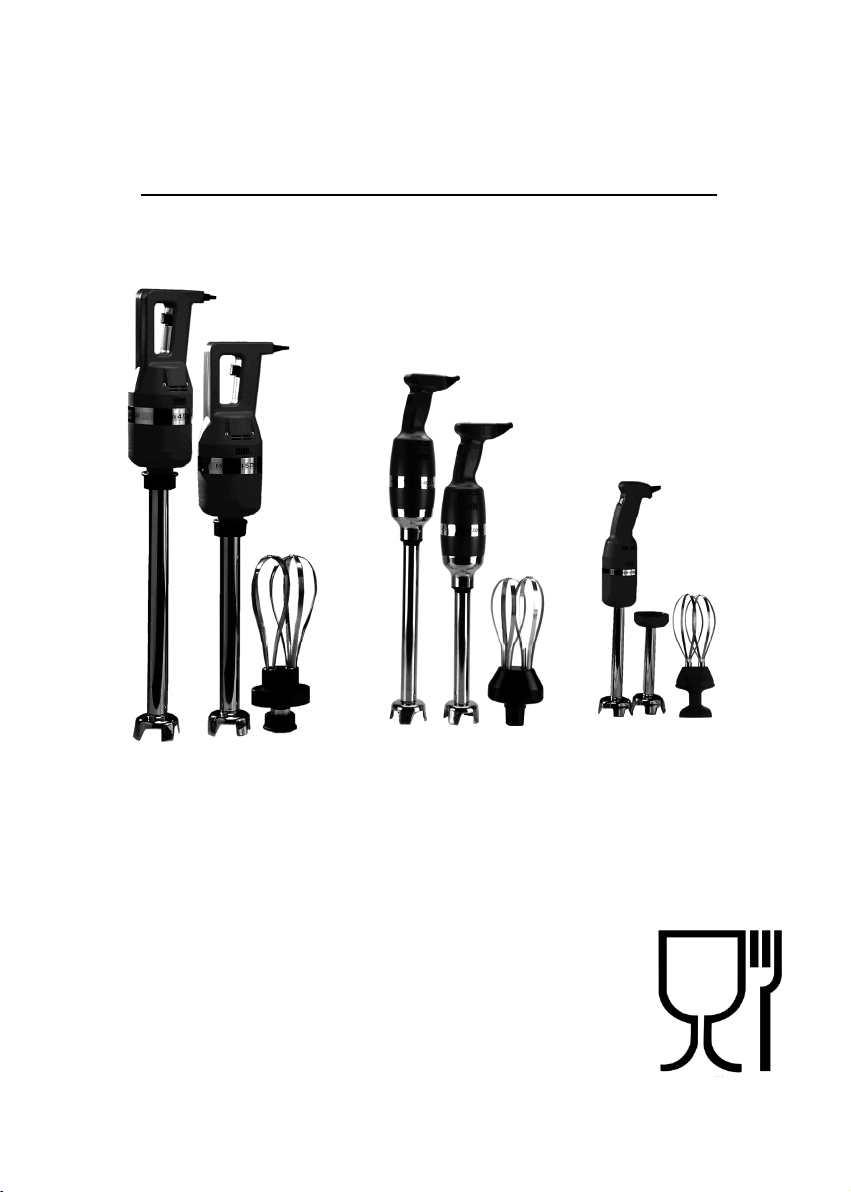
Mixer
Manuale delle istruzioni per l’uso
GB MIXER OPERATING MANUAL
E MIXER MANUAL DE INSTRUCCION
F MIXER
MANUEL D’UTILIZATION
D STABMIXER BEDIENUNGSANLEITUNG
RUS МИКСЕР
РУКОВОДСТВО ПО
ИСПОЛЬЗОВАНИЮ
Page 2

INDICE
CAP. 1. ORGANIZZAZIONE DEL CONTENUTO E MODALITÀ DI CONSULTAZIONE 3
CAP. 2. INFORMAZIONI GENERALI E CARATTERISTICHE 4
CAP. 3. ISTRUZIONI PER LA SICUREZZA 8
ITALIANO
CAP. 4. MESSA IN SERVIZIO ED USO 8
CAP. 5. MANUTENZIONE, RICERCA GUASTI E PULIZIA 11
CAP. 6. SMALTIMENTO 13
CAP. 7. MATERIALI DI COSTRUZIONE 13
GARANZIA
La macchina è garantita 12 (dodici) mesi dalla data della vendita.
La garanzia copre le riparazioni delle macchine acquistate presso i punti di vendita autorizzati, qualora venga dimostrato che
esse siano difettose nei materiali o nell'assemblaggio, alle condizioni qui di seguito stabilite:
1. per garanzia si intende la sostituzione gratuita di tutte quelle parti che sono risultate difettose di fabbricazione. La
garanzia decade se non accompagnata da scontrino fiscale o fattura attestante l'acquisto e per i seguenti casi:
a. manomissione della macchina o danneggiamento dello stesso dovuto ad incuria;
b. utilizzo della macchina con modalità non conformi alle avvertenze riportate sul libretto istruzioni;
c. danni provocati dalla non idoneità dell'ambiente in cui l'apparecchio opera e da fenomeni non dipendenti dal
normale funzionamento della macchina (irregolarità dei valori tensione e frequenza nell'impianto di rete);
d. interventi di riparazione effettuati da persone o centri non autorizzati dal fabbricante,
2. la richiesta di intervento in garanzia dovrà essere effettuata unicamente a punti di vendita o laboratori autorizzati;
3. la macchina dovrà essere resa in porto franco al costruttore per la riparazione le spese di trasporto sono sempre a carico
del destinatario,
4. è esclusa la sostituzione della macchina nonché il prolungamento della garanzia a seguito di intervento per guasto;
5. il fabbricante non risponde per danni diretti o indiretti di qualsiasi natura a persone o cose per l'uso improprio della
macchina o per mancato uso durante il tempo occorrente per le riparazioni.
Manuale delle istruzioni per l’uso
Edizione
Gennaio 2015
2 13
ISTRUZIONI ORIGINALI
Pag. di
Page 3

CAP. 1. ORGANIZZAZIONE DEL CONTENUTO E MODALITà DI CONSULTAZIONE
SCOPO DEL MANUALE
IMPORTANZA DEL MANUALE
Il presente manuale delle istruzioni per l’uso è da considerarsi come parte integrante della macchina:
1. deve essere custodito per tutta la vita della macchina.
2. deve accompagnare la macchina in caso di cessione della stessa.
3. oltre a riportare tutte le notizie utili per gli operatori, contiene (raccolti in capitoli specifici), gli schemi elettrici che
serviranno per gli eventuali interventi di manutenzione e riparazione.
SCOPO / FINALITÀ DEL MANUALE
Il Manuale delle istruzioni per l’uso ha lo scopo di fornire al committente tutte le informazioni necessarie affinché, oltre ad un
adeguato utilizzo della macchina fornita, sia in grado di gestire la stessa nel modo più autonomo e sicuro possibile.
Inoltre il presente manuale è stato redatto allo scopo di fornire indicazioni ed avvertenze per conoscere la macchina fornita,
per comprendere i suoi principi e limiti di funzionamento. Per eventuali dubbi interpellare il Centro di Assistenza Autorizzato.
DESTINATARI
Il presente manuale delle istruzioni per l’uso, consegnato in numero di n. 1 copia assieme alla macchina, viene fornito come
parte integrante dello stesso, è rivolto sia agli operatori che ai tecnici qualificati abilitati all’installazione, uso e manutenzione.
Il responsabile del servizio di prevenzione e protezione del committente e gli ulteriori addetti cui è destinata la macchina,
devono prendere visione del presente manuale delle istruzioni per l’uso, al fine di adottare tutte le misure tecniche ed
organizzative
RESPONSABILITÀ
I responsabili di stabilimento, che sovrintendono alle attività lavorative, devono, nell’ambito delle rispettive
Nel caso il presente manuale subisca danneggiamenti o venga smarrito, è possibile richiederne copia al
Centro di Assistenza Autorizzato.
Il presente manuale rispecchia lo stato della tecnica al momento della costruzione della macchina; il
costruttore si riserva il diritto di aggiornare la produzione e di conseguenza altre edizioni del manuale,
senza l’obbligo di aggiornare produzioni o manuali precedenti, se non in casi particolari riguardanti la
salute e la sicurezza delle persone.
Porre particolare attenzione al contenuto dei rischi residui presenti sulla macchina e le prescrizioni a cui
devono attenersi gli operatori.
Il costruttore si ritiene responsabile per la macchina nella sua originale configurazione.
Il costruttore non si ritiene responsabile per danni arrecati dall’uso improprio o non corretto della
macchina e della documentazione o per danni arrecati dalla violazione di norme imperative, negligenza,
imperizia, imprudenza e non rispetto di norme regolamentari da parte del datore di lavoro, dell’operatore
o del manutentore e per ogni eventuale guasto causato da un uso irragionevole, improprio e/o sbagliato
Il costruttore non si ritiene responsabile per le conseguenze causate dall’uso di parti di ricambio non
originali o di caratteristiche equivalenti.
Il costruttore si ritiene responsabile solo per le informazioni riportate nella versione originale del
manuale in lingua italiana.
L’inosservanza delle prescrizioni contenute in questo manuale provocherà l’immediato decadimento
della garanzia.
attribuzioni e competenze:
attuare le misure di sicurezza previste;
rendere edotti gli operatori dei rischi specifici cui sono esposti e portare a loro conoscenza le norme
essenziali di prevenzione;
disporre ed esigere che i singoli operatori osservino le norme di sicurezza ed usino i mezzi di protezione
messi a loro disposizione:
porre più di un operatore, contemporaneamente, al lavoro su tale manufatto.
ITALIANO
ITALIANO
3 13
ISTRUZIONI ORIGINALI
Pag. di
Page 4
SIGNIFICATO DELLA SIMBOLOGIA
Di seguito viene chiaramente specificato il significato dei simboli e delle definizioni che verranno utilizzate nel presente
documento.
ITALIANO
PERICOLO
Indica la presenza di un pericolo per chi opera sulla macchina e per chi si trova nelle vicinanze perciò l’attività
segnalata deve essere svolta nel rispetto delle norme antinfortunistiche vigenti e delle indicazioni riportate nel
presente manuale.
PRECAUZIONE
Indica un’avvertenza su informazioni utili e/o ulteriori raccomandazioni e/o accorgimenti inerenti l’operazione
in corso.
ATTENZIONE
Indica un’operazione da eseguire con attenzione per evitare di arrecare danno alla macchina.
CAP. 2. INFORMAZIONI GENERALI E CARATTERISTICHE
DESTINAZIONE USO E PARTI COSTRUTTIVE
Il mixer nel seguito denominata “macchina”, è una macchina portatile progettata per sbattere, frullare, triturare, sminuzzare,
emulsionare ,ridurre in poltiglia, etc.., da utilizzare nella ristorazione collettiva e istituzionale.
Con la macchina in funzione dell’utensile che si utilizza, è possibile preparare direttamente in pentola minestroni, zuppe, purè,
creme, pastelle, maionese, pasta di mandole, creme di formaggio e quanto altro di simile.
La macchina è costituita da un motore elettrico inserito in una unica fusione di materiale plastico (corpo macchina base), in cui
l’albero motore è connesso all’utensile di lavoro: frullatore o frusta.
L’utensile viene connesso e bloccato al corpo macchina o con una ghiera avvitata, oppure tramite un attacco a sgancio rapido.
Il prodotto alimentare viene caricato manualmente nel contenitore e successivamente, con l’uso di entrambe le mani ed
afferrando la macchina nelle zone previste (vedi figura pag. 11), la stessa viene:
1. posizionata con l’utensile entro il recipiente o la pentola;
2. avviata, e utilizzata sino al termine della lavorazione del prodotto alimentare;
3. spenta e posizionata su un adeguato banco di appoggio.
In base alle modalità operative, e all’utensile utilizzato , la macchina può:
1. funzionare stando appoggiata sul fondo del contenitore (con l’utensile frullatore), non superando comunque la tacca di
immersione,
2. funzionare mantenendola sospesa , con l’uso di entrambe le mani (con l’utensile frusta),
3. funzionare posizionata su uno speciale supporto che può essere adattato alla pentola. Il supporto agisce come sostituto
dell’operatore per operazioni che richiedono tempi lunghi o per trattamenti alimentari che possono presentare rischi di
ustioni (vapore o schizzi).
Lo scarico del prodotto alimentare , terminato il ciclo di lavorazione avviene in maniera manuale dopo aver estratto la
macchina dal recipiente.
Tutti i materiali a diretto contatto con il prodotto alimentare sono conformi alle vigenti normative igieniche per alimenti.
A seconda delle esigenze di funzionamento e di produzione, la macchina può essere costituita con diverse parti opzionali.
La macchina è provvista di targhetta di identificazione sulla quale sono riportati i seguenti dati:
[fac simile]
4 13
ISTRUZIONI ORIGINALI
Pag. di
Page 5
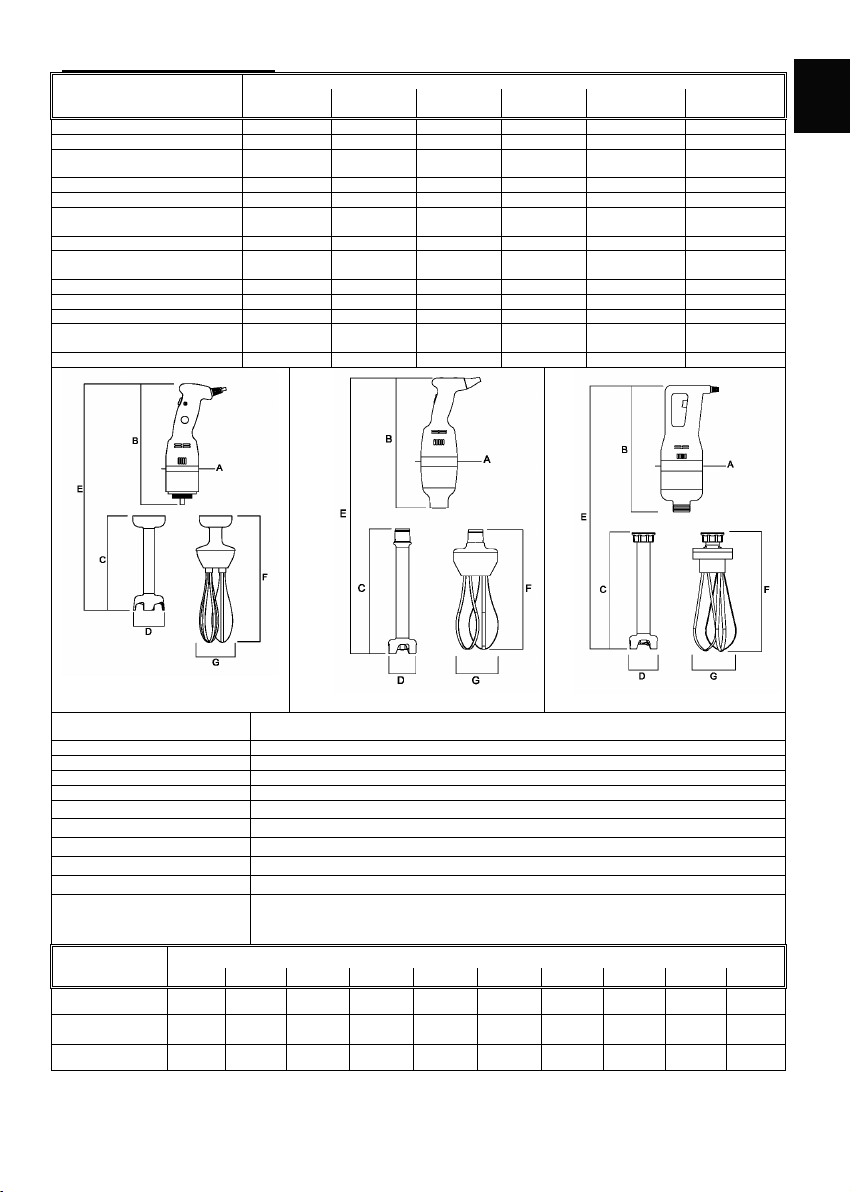
DATI TECNICI E COSTRUTTIVI
DATI TECNICI
Potenza motore (W) 250 300 350 400 450 650
Velocità massima (giri/min) 15000 13000 15000 15000 17000 13000
Velocità variabile (giri/min)
solo modelli VV
Dimensioni: A (mm) Ø75
Dimensioni: B (mm) 285 350 360 350 380 400
Dimensioni: C (mm)
Dimensioni: D (mm) Ø75 Ø85 Ø95 Ø85 Ø95 Ø95
Dimensioni: E (mm)
Dimensioni: F (mm) 290 330 360 330 360 360
Dimensioni: G (mm) 90 120 120 120 120 120
Massa corpo macchina (kg) 1,0 1,8 2,6 2,1 3,2 3,6
Massa frullatore (kg)
Massa frusta (kg) 0,450 0,800 1,0 0,800 1,0 1,0
250VF
250VV
2500 ÷ 15000 2000 ÷ 9000 2000 ÷ 9000 2000 ÷ 9000 2000 ÷ 11000 2000 ÷ 9000
220 / 270
470/ 520
0,400/ 0,450
300VV 350VF
Ø100 Ø130 Ø100 Ø130 Ø130
340 / 440 /
540
650/ 750
/ 850
0,850 /1,0
/ 1,2
350VV
330 / 430 /
530 / 630
680/ 780 /
880 / 980
1,2 / 1,5/
1,7 / 1,9
MODELLO
400VV 450VF
340 / 440 /
540
650 / 750/
850
0,850 /1,0
/ 1,2
330 / 430 / 530
450VV
/ 630
700 / 800 /
900 / 1000
1,2 / 1,5/
1,7 / 1,9
650VF
650VV
330 / 430 / 530
/630
720 / 820
920/ 1020
1,2/1,5/
1,7 / 1,9
ITALIANO
ITALIANO
250 VF-VV
Livello di pressione acustica
continuo equivalente ponderato A
Natura della corrente - Frequenza Cfr. targa della macchina
Corrente a pieno carico Cfr. targa della macchina
Tensione nominale d’impiego Cfr. targa della macchina
Tensione dei circuiti ausiliari Cfr. targa della macchina
Sistema di protezione Doppio isolamento
Grado di protezione IP X3
Temperatura aria ambiente max +40°C
Illuminazione minima richiesta 500 lux
Conformità direttive di prodotto
DATI TECNICI
Velocità variabile /
Utensile frullatore
Utensile frusta /
5 13
250VF 250VV 300VV 350VF 350VV 400VV 450VF 450VV 650VF 650VV
● ●
● ● ● ● ● ● ● ● ● ●
● ●
300 / 400 VV
Minore di 70dBA
2006/42/CE, 2006/95/CE e successive modifiche ed integrazioni, Reg. 1935/2004
MODELLO
/
/
ISTRUZIONI ORIGINALI
● ●
● ●
350 / 450 / 650 VF-VV
/
●
/
●
/
●
/
●
Pag. di
Page 6
ITALIANO
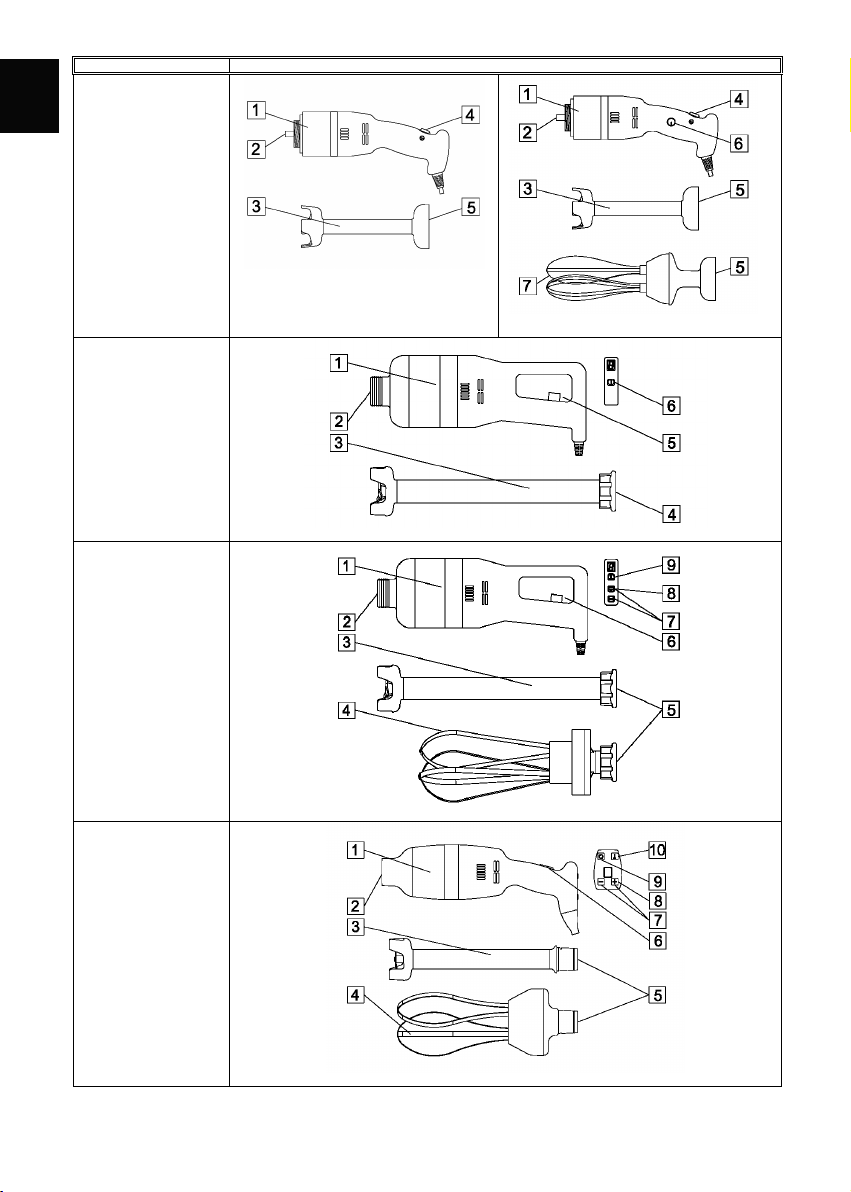
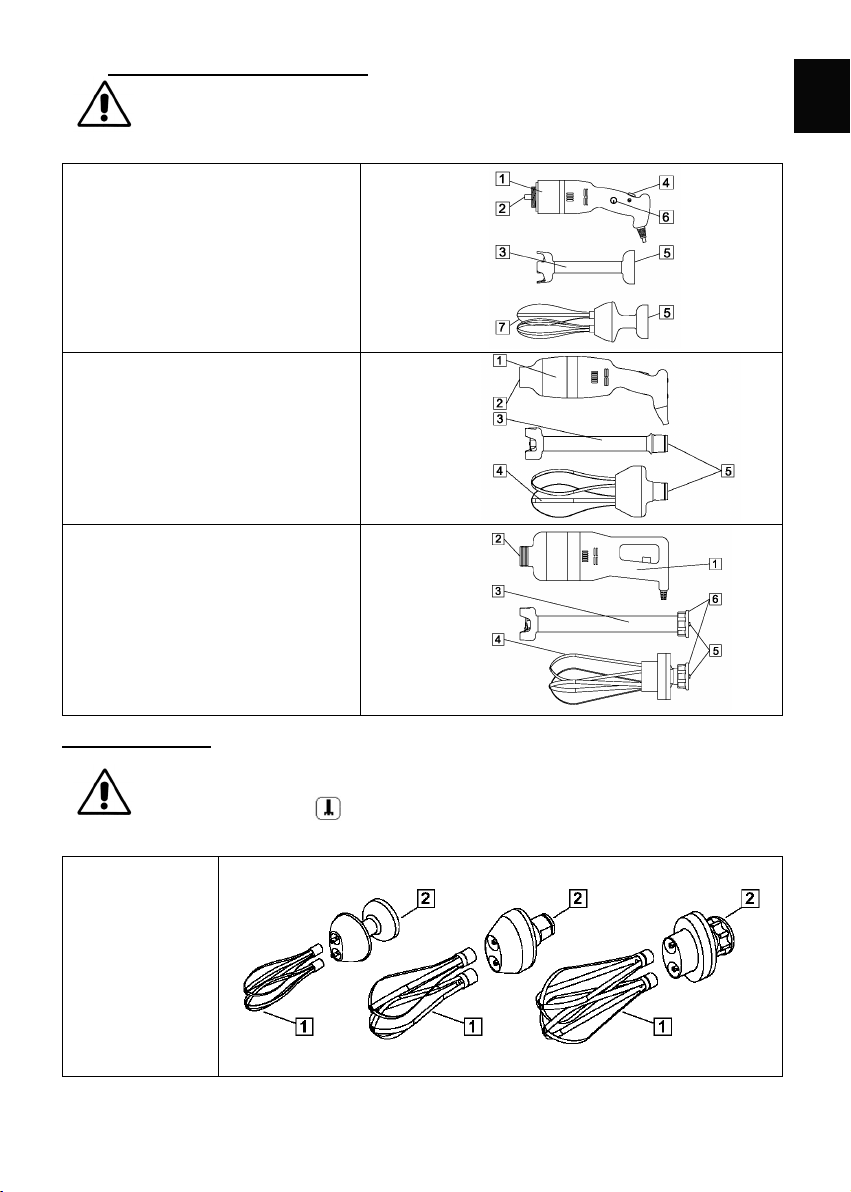
1. corpo macchina
2. attacco per utensili
3. utensile frullatore
4. pulsante di avvio
5. ghiera bloccaggio
utensile
6. variatore velocità
7. utensile frusta
GRUPPO ESEMPIO
250VF
250VV
1. corpo macchina
2. attacco per utensili
3. utensile frullatore
4. ghiera bloccaggio
utensile
5. pulsante di avvio
6. tasto sicurezza per
avviamento
350 / 450 / 650 VF
1. corpo macchina
2. attacco per utensili
3. utensile frullatore
4. utensile frusta
5. ghiera bloccaggio
utensile
6. pulsante di avvio
7. comandi variazione
velocità
8. tasto sicurezza per
avviamento
9. commutatore frullatore /
frusta
350 / 450 / 650 VV
1. corpo macchina
2. attacco per utensili
3. utensile frullatore
4. utensile frusta
5. innesto rapido
bloccaggio utensile
6. pulsante di avvio
7. comandi variazione
velocità
8. tasto sicurezza
avviamento
9. tasto uso continuativo
10. commutatore frullatore
/ frusta
6 13
ISTRUZIONI ORIGINALI
300 / 400 VV
Pag. di
Page 7

USO NORMALE, USO IMPROPRIO, USO NON CORRETTO O VIETATO
La macchina descritta nel presente manuale delle istruzioni per l’uso è prevista per essere condotto da un solo operatore
addestrato ed edotto sui rischi residui, ma con le competenze, in materia di sicurezza, degli addetti alla manutenzione.
L'operatore dovrà possedere almeno l'età minima prevista dalle leggi sociali nell'ambito del lavoro ed aver fruito della
necessaria preparazione tecnica almeno da un operatore più esperto che lo abbia preliminarmente addestrato all'uso corretto
della macchina.
7 13
Nel suo USO NORMALE, e ragionevolmente prevedibile, la macchina può essere utilizzata soltanto per
schiacciare, frullare, triturare, sminuzzare, sbattere, ridurre in poltiglia, emulsionare, etc… direttamente in
pentola o recipiente adeguato, da utilizzare nella ristorazione collettiva e istituzionale.
A seconda del tipo utensile, è possibile preparare direttamente in pentola minestroni, zuppe, purè, creme,
pastelle, maionese, pasta di mandole, creme di formaggio e quanto altro di simile.
La macchina deve essere afferrata, sostenuta e maneggiata, posizionando le mani nelle zona prescritte (vedi
figura pag. 11)
La macchina non deve essere utilizzata IN MODO IMPROPRIO; in particolare:
1. non deve essere impiegata per usi domestici,
2. non deve essere fatta funzionare con parametri diversi da quelli riportati nella tabella delle caratteristiche
tecniche,
3. per ogni uso della macchina con modalità diverse da quelle indicate nel presente manuale, il costruttore
ne declina ogni responsabilità,
4. l’utilizzatore è responsabile dei danni risultanti dalla mancata osservanza delle condizioni di esercizio
concordate in sede di specifica tecnica e di conferma d’ordine,
5. gli utensili non devono essere fatti funzionare a vuoto;
6. non manomettere o deteriorare volutamente né rimuovere o nascondere le etichette.
La macchina non deve essere utilizzata IN MODO NON CORRETTO ovvero VIETATO in quanto si
potrebbero causare danni o ferite per l’operatore; in particolare:
1. è vietato tirare il cavo di alimentazione elettrica o la macchina per scollegare la spina di
alimentazione,
2. è vietato porre dei pesi sulla macchina o sul cavo di alimentazione elettrica,
3. è vietato posizionare il cavo di alimentazione elettrica su parti taglienti o con pericolo di ustione,
4. è vietato l’impiego della macchina con il cavo di alimentazione elettrica od i dispositivi di comando
danneggiati e non integri;
5. è vietato lasciare la macchina spenta con il cavo di alimentazione elettrica allacciato alla spina,
6. è vietato infilare qualsiasi tipo di oggetto all’interno della calotta di ventilazione del motore;
7. è vietato posizionare la macchina sopra oggetti diversi da un banco di lavoro impiegato nel settore
alimentare di altezza compresa tra 900 - 1100mm dal piano di calpestio,
8. è vietato l’impiego di sostanze infiammabili, corrosive o nocive per la pulizia o prodotti
eccessivamente alcalini quali la soda caustica o ammoniaca,
9. è vietato immergere la macchina in acqua o altri liquidi;
10. è vietato l’impiego a personale non autorizzato e con vestiario diverso da quello indicato per l’uso,
11. è vietato l’uso dell’utensile frusta nelle macchine a velocità fissa,
12. è vietato introdurre nella pentola con la macchina inserita ed in funzione, prodotti od oggetti
aventi caratteristiche diverse da quelle indicate nell’uso normale, quali per es. ossa, carne congelata,
prodotti non alimentari, od altri oggetti quali sciarpe, etc…,
13. è vietato afferrare, sostenere e maneggiare la macchina, posizionando le mani in zone diverse da
quelle indicate nell’uso normale e comunque mantenere in funzione la macchina con una sola mano,
14. è vietato spingere o far spingere da altri i prodotti alimentari o gli ingredienti verso il fondo della
pentola con la macchina inserita ed in funzione, ed in generale introdurre le mani o qualsiasi altre
parte del corpo, nella pentola durante il funzionamento della macchina,
15. è vietato introdurre la macchina nella pentola, oltre la tacca d’immersione e comunque oltre la
ghiera di bloccaggio dell’utensile,
16. è vietato
rimuovere la macchina dalla pentola, prima che l’utensile si sia completamente arrestato
e comunque prima di 10 sec dal comando di arresto della macchina,
17. è vietato agire sui sistemi di blocco degli utensili prima dell’arresto completo dell’utensile, e
comunque prima di 10 sec dal comando di arresto della macchina ed allacciata all’alimentazione
elettrica,
18. è vietata la parziale rimozione delle protezioni e delle segnalazioni di pericolo.
19. è vietato il funzionamento senza che siano stati adottati da parte dell’utilizzatore tutti i provvedimenti
circa l’eliminazione dei rischi residui,
20. è vietato fumare od usare apparecchi a fiamma libera e manipolare materiali incandescenti, a meno
che non siano adottate idonee misure di sicurezza,
21. è vietato azionare o regolare i dispositivi di controllo e di bloccaggio quali pomelli o simili sia
durante il funzionamento della macchina, sia se non si è autorizzati
L’utilizzatore è comunque responsabile dei danni risultanti dalla mancata osservanza delle condizioni di uso
normale specificate. Per eventuali dubbi rivolgersi al Centro di Assistenza Autorizzato.
ISTRUZIONI ORIGINALI
Pag. di
ITALIANO
ITALIANO
Page 8
CAP. 3. ISTRUZIONI PER LA SICUREZZA
PREMESSA
ITALIANO
La mancata applicazione delle norme e procedure di sicurezza può essere fonte di pericolo e di danno.
La macchina s’intende vincolata nell’uso al rispetto, da parte dell’utente finale, di:
1. tutte le regole, d’inserimento nell’ambiente e di comportamento delle persone, stabilite dalle leggi e/o
norme applicabili; con particolare riferimento all’impianto fisso a monte della macchina fornita e per il
suo allacciamento/funzionamento;
2. tutte le ulteriori istruzioni e avvertenze d’impiego facenti parte della documentazione tecnico/grafica
annessa alla macchina stessa.
Eccetto dove diversamente specificato, il personale che esegue gli interventi di installazione, allacciamento,
manutenzione, reinstallazione e riutilizzazione, ricerca guasti o avarie, demolizione e smantellamento
deve essere un personale esperto addestrato in materia di sicurezza ed edotto sui rischi residui, con le
competenze, in materia di sicurezza, degli addetti alla manutenzione.
AMBIENTI, POSTI DI LAVORO E DI PASSAGGIO
L’ambiente di lavoro deve rispondere ai requisiti della direttiva 89/654/CEE. Nell’area di lavoro non devono essere presenti
oggetti estranei. Il datore di lavoro, nel rispetto della direttiva 89/391/CEE, concernente l'attuazione di misure volte a
promuovere il miglioramento della sicurezza e della salute dei lavoratori durante il lavoro, deve provvedere ad eliminare o
ridurre i rischi residui indicati come previsto nel presente manuale.
AVVERTIMENTI IN MERITO AI RISCHI RESIDUI
RISCHIO RESIDUO DOVUTO ALLA RIMOZIONE DEI RIPARI FISSI, INTERVENTI SU PARTI
ROTTE/USURATE
Per qualsiasi evenienza l'operatore non deve mai tentare di aprire o rimuovere un riparo fisso o
manomettere un dispositivo di sicurezza.
Nella fase di attrezzaggio, di manutenzione, di sostituzione degli utensili e di pulizia, e durante tutte le
ulteriori operazioni manuali che avvengono introducendo le mani o altre parti del corpo nelle aree pericolose
della macchina, permane un rischio residuo dovuto soprattutto a:
1. urti con parti costruttive della macchina,
2. strisciamento e/o abrasione con parti ruvide della macchina,
3. puntura con le parti appuntite,
4. taglio con parti affilate degli utensili.
Inoltre nella fase di pulizia o sblocco dei pezzi incastrati nelle lame che avviene anche introducendo le mani
in prossimità egli utensili di taglio, permane un rischio residuo dovuto soprattutto a taglio con parti affilate
degli utensili.
L’operatore ed il manutentore devono essere addestrati per l'intervento connesso alle operazioni manuali
con ripari aperti, devono essere istruiti sui conseguenti rischi connessi e devono essere autorizzati da persona
responsabile e devono impiegare adeguati dispositivi di protezione individuale, guanti antitaglio a cinque
dita. Tutti gli interventi sui dischi deve avvenire tenendoli con le lame rivolte verso il basso.
CAP. 4. MESSA IN SERVIZIO ED USO
8 13
La gestione della macchina è consentita unicamente a personale autorizzato ed opportunamente istruito e
dotato di una sufficiente esperienza tecnica.
Prima di accendere la macchina effettuare le seguenti operazioni:
leggere attentamente la documentazione tecnica,
conoscere quali protezioni e dispositivi di emergenza sono disponibili sulla macchina, la loro
localizzazione ed il loro funzionamento.
L’utilizzo non autorizzato di parti commerciali ed accessori facenti parte delle protezioni e dei dispositivi di
sicurezza può provocare il verificarsi di malfunzionamenti e l’insorgere di situazioni di pericolo per il
personale operatore. L’operatore deve inoltre avere ricevuto una adeguata formazione.
ISTRUZIONI ORIGINALI
Pag. di
Page 9
MONTAGGIO / SMONTAGGIO
Le operazioni di montaggio / smontaggio di qualsiasi organo della macchina vanno effettuate a macchina
ferma e con la spina scollegata dalla presa, ovvero con il dispositivo di sezionamento in OFF.
Il montaggio della macchina si svolge in varie fasi (in modo esemplificativo è riportata la macchina con corpo base).
MONTAGGIO UTENSILE
MODELLO 250 VF-VV
1. Allineare ed inserire l’accoppiamento (5) del
2. Avvitare il frullatore (3) o la frusta(7) fino a fissarlo
MONTAGGIO UTENSILI
MODELLO 300/400 VV
1. Allineare ed inserire l’accoppiamento degli utensili
2. Girare gli utensili (3-4) fino a fissarli saldamente al
MONTAGGIO UTENSILI
MODELLO 350/450/650 VF-VV
1. Allineare ed inserire l’accoppiamento (5) degli
2. Avvitare la ghiera (6) fino a fissarli saldamente al
frullatore (3) o della frusta (7) nell’innesto (2) del
corpo macchina (1)
saldamente al corpo macchina (1)
(5) nell’innesto rapido (2) del corpo motore (1)
corpo macchina (l)
utensili (3-4) nell’innesto (2) del corpo macchina (1)
corpo macchina (1).
250 VF-VV
300 / 400 VV
ITALIANO
ITALIANO
350 /450 / 650 VF-VV
Le attività di smontaggio si svolgono seguendo in modo a ritroso le fasi di montaggio precedentemente descritte.
È vietato l’uso dell’utensile frusta nelle macchine a velocità fissa (VF)
E vietato l’uso dell’utensile frusta nelle macchine a velocità variabile (VV)
con la funzione max velocità
MONTAGGIO
SMONTAGGIO
DELLE FRUSTE
Per lo smontaggio tirare le
fruste (1) finché non si
separano da gruppo
riduttore (2).
Per montarle inserire la
base delle fruste (1) nel
perno
del gruppo riduttore (2) e
spingere fino in fondo.
9 13
ISTRUZIONI ORIGINALI
Pag. di
Page 10
DESCRIZIONE DEL FUNZIONAMENTO
I dispositivi di comando sono progettati e costruiti in modo da essere sicuri affidabili e resistenti alle normali sollecitazioni di
servizio, agli sforzi prevedibili ed agli agenti esterni. Sono inoltre chiaramente visibili, individuabili e contrassegnati da una
marcatura adatta. Di seguito sono riportati i dispositivi di comando:
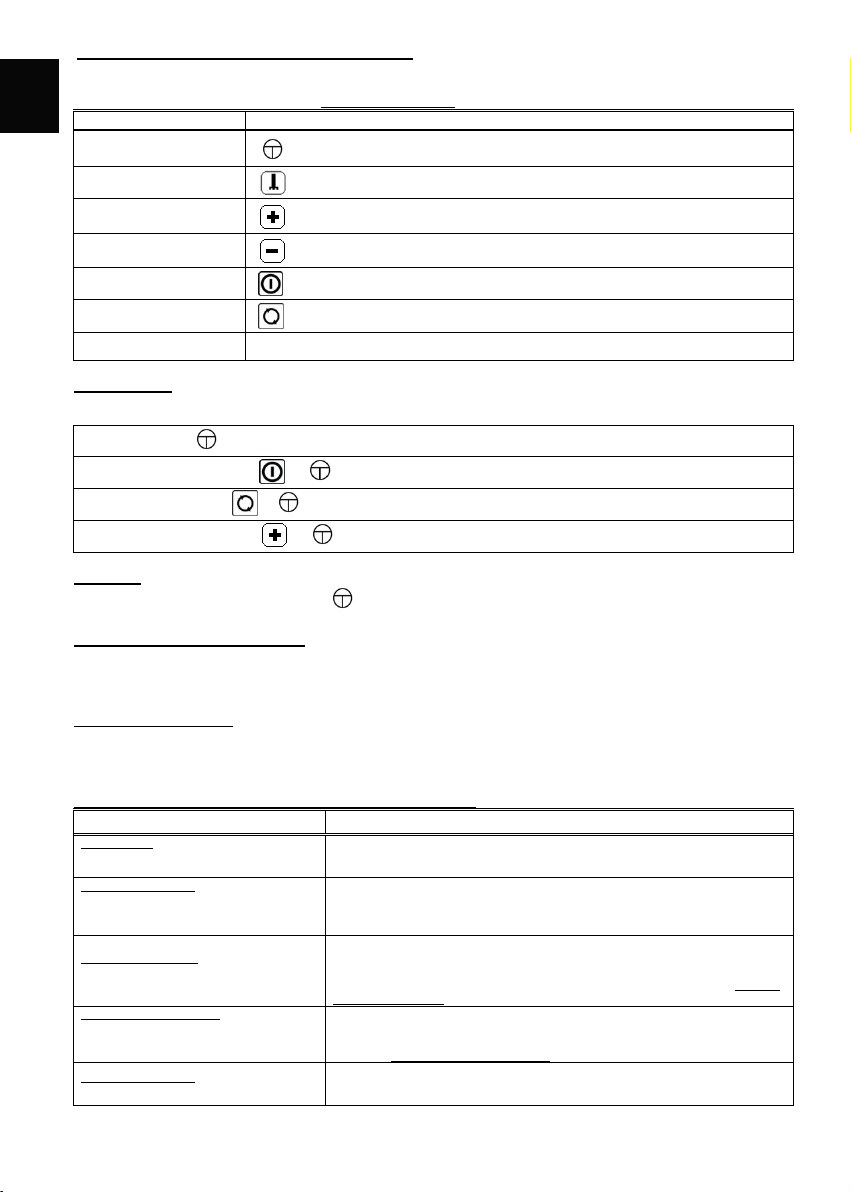
TIPO / COLORE RIFERIMENTO / DESCRIZIONE
ITALIANO
Pulsante / nero
Tasto / nero
Tasto / nero
Tasto / nero
Tasto / nero
Tasto / nero
” / Pulsante per il comando di avvio della macchina ad azione mantenuta
“
” / Tasto di commutazione max velocità solo per utensile frullatore
“
“
” / Tasto per aumento velocità / tasto sicurezza avviamento (modelli VV 350/450/650)
” / Tasto per diminuzione velocità
“
“
” / Tasto sicurezza avviamento della macchina (solo modelli VF 350/450/650)
“
” / Tasto sicurezza avviamento della macchina (solo modelli VV 300/400)
Display / rosso Visualizzazione della velocità: da 1 a 9 / visualizzazione velocità massima
AVVIAMENTO
L’avviamento con impulso della macchina è possibile soltanto con una azione volontaria sul dispositivo di comando
previsto a tal fine:
macchina VF 250:
Solo uso ad azione mantenuta
macchine VF 350 / 450 / 650 : + . Solo uso ad azione continuata.
macchine VV 300 / 400 : + . Solo uso ad azione continuata.
macchine VV 350 / 450 / 650 : + . Solo uso ad azione continuata.
ARRESTO
Per il comando di arresto premere il pulsante .
SICUREZZA DI FUNZIONAMENTO
Nel caso in cui la macchina sia sottosforzo, oppure sia sottoposta a tempi di funzionamento troppo lunghi o sottoposta a
sovraccarico, la stessa si arresta immediatamente per l’entrata in funzione della protezione termica. In questo caso attendere
che si sia completamente raffreddata prima di procedere alla funzione di avviamento.
ASSENZA DI TENSIONE
In caso di interruzione dell’alimentazione elettrica o se la macchina viene staccata dalla rete elettrica , quest’ultima potrà essere
riavviata solamente seguendo la funzione di avviamento, dopo il ritorno dell’alimentazione elettrica od il riallaccio alla
rete elettrica.
CONTROLLI E VERIFICHE PRIMA DELLA MESSA IN MOTO
VERIFICA / CONTROLLO MODALITÀ E RISCONTRI
Accertarsi che:
Non vi siano entro la pentola oggetti
estranei
Accertarsi della pulizia:
delle parti esterne della macchina
dell’utensile lungo la sua superficie
delle parti interne dell’utensile
Accertarsi dell’integrità:
dei ripari fissi
del corpo della macchina
Accertarsi della funzionalità:
delle parti del sistema di comando /
controllo relative alla sicurezza;
dei dispositivi di comando.
Accertarsi dell’assenza:
di rumori strani dopo la messa in moto
10 13
Controllo visivo delle parti indicate, per accertarsi dell’assenza di oggetti o corpo estranei
quali per es. utensili vari, stracci, etc… e che non vi sia comunque il prodotto alimentare.
In caso di presenza provvedere alla loro rimozione.
Tutti le superfici delle parti indicate, prima dell’impiego della macchina devono essere
controllate visivamente per accertarsi della loro pulizia.
In caso di presenza di muffe o altro tipo di sporcizia, provvedere alla procedura di pulizia
secondo le indicazioni di cui al capitolo 5.
Tutti i ripari fissi, etc.. devono svolgere la funzione per cui sono stati previsti.
Controllo visivo delle parti indicate per accertarsi della loro integrità nella parte esterna della
loro superficie.
Le parti devono essere comunque sostituite ai primi segni di erosione o rottura (cfr. Centro di
Assistenza Autorizzato).
Tutti i dispositivi devono svolgere la funzione per cui sono stati previsti. Comandare
direttamente i dispositivi affinchè questi determinano la funzione attesa.
Gli attuatori e tutte le parti devono essere comunque sostituiti ai primi segni di erosione o
rottura (cfr. Centro di Assistenza Autorizzato).
Durante l’accertamento della funzionalità dei dispositivi di comando, nel caso in cui vi siano
rumori strani, dovuti per esempio ad un grippaggio o rotture meccaniche, arrestare
immediatamente la macchina, ed attivare il servizio di manutenzione.
ISTRUZIONI ORIGINALI
Pag. di
Page 11
Per qualsiasi tipo d’intervento o per la sostituzione delle parti che risultano danneggiate, attivare il servizio di manutenzione.
L’eventuale sostituzione deve avvenire con prodotti originali del costruttore od almeno di qualità, sicurezza e caratteristiche
equivalenti. Per approfondimenti contattare il Centro di Assistenza Autorizzato.
MESSA IN FUNZIONE
L’operatore della macchina, può mettere in funzione la macchina, seguendo in ordine le indicazioni sotto riportate:
1. Esito positivo dei controlli di cui alla operazioni preliminari di
preparazione,
2. Esito positivo dei controlli di cui all’alimentazione elettrica,
3. Allaccio della spina in opportuna presa di corrente,
4. Esito positivo dei controlli di cui al montaggio,
5. Esito positivo dei controlli / verifiche prima della messa in moto,
6. Esito positivo dei controlli finalizzati ad accertare il rispetto di tutte le
condizioni di sicurezza,
7. Introdurre manualmente il prodotto alimentare entro la pentola,
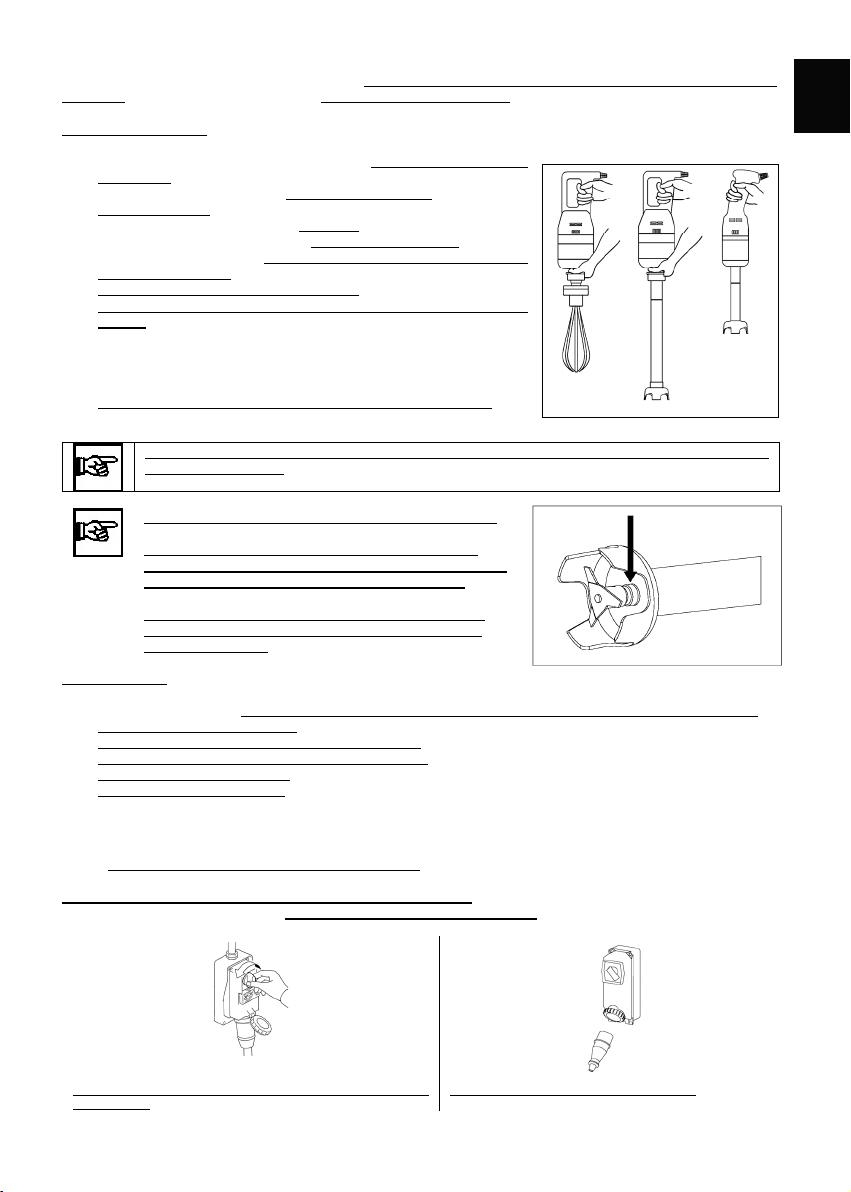
8. Con l’uso di entrambe le mani afferrare la macchina nelle zone
previste:
a. posizionarla con l’utensile entro la pentola,
b. avviarla, mantenerla e maneggiarla sino al termine della
lavorazione del prodotto alimentare,
9. Quando il prodotto alimentare ha raggiunto la consistenza desiderata,
arrestare la macchina e posizionata su un adeguato banco di appoggio,
10. scaricare manualmente il prodotto alimentare dalla pentola, afferrandola con
entrambe le mani e versando il prodotto alimentare dove necessario.
è vietato introdurre la macchina nella pentola, oltre la tacca d’immersione e comunque oltre la ghiera di
bloccaggio dell’utensile
Si raccomanda di non fare funzionare la macchina a vuoto.
Si raccomanda di controllare periodicamente l’integrità
della guarnizione in gomma posta sotto la lama (vedi disegno
a lato) e sostituirla nel caso sia danneggiata o usurata.
L’integrità della guarnizione impedisce l’infiltrazione del
prodotto di lavorazione all’interno dell’utensile evitando
danni al mescolatore
SPEGNIMENTO
In successione, le operazioni di spegnimento devono seguire quanto di seguito indicato:
1. prima dello spegnimento attendere la conclusione della lavorazione, ovvero attendere che il prodotto alimentare abbia
raggiunto la consistenza desiderata,
2. arrestare la macchina rilasciando i dispositivi di comando previsti,
3. posizionare la macchina su un adeguato banco di appoggio
4. scollegare la spina della macchina dalla presa di alimentazione,
5. eseguire gli interventri di pulizia.
CAP. 5. MANUTENZIONE, RICERCA GUASTI E PULIZIA
PRESCRIZIONI DI MANUTENZIONE
ISOLAMENTO DALLE FONTI DI ALIMENTAZIONE ESTERNE
Prima di eseguire qualsiasi operazione manutenzione, pulizia e sostituzione parti, si devono sezionare ed isolare le fonti di
alimentazione esterne.
ITALIANO
ITALIANO
Posizionare a “zero” il dispositivo di protezione posto a monte della linea
d’alimentazione dell’equipaggiamento elettrico.
11 13
ISTRUZIONI ORIGINALI
Disinserire il dispositivo di sezionamento generale e provvedere a
proteggere la spina con appositi sistemi
Pag. di
Page 12
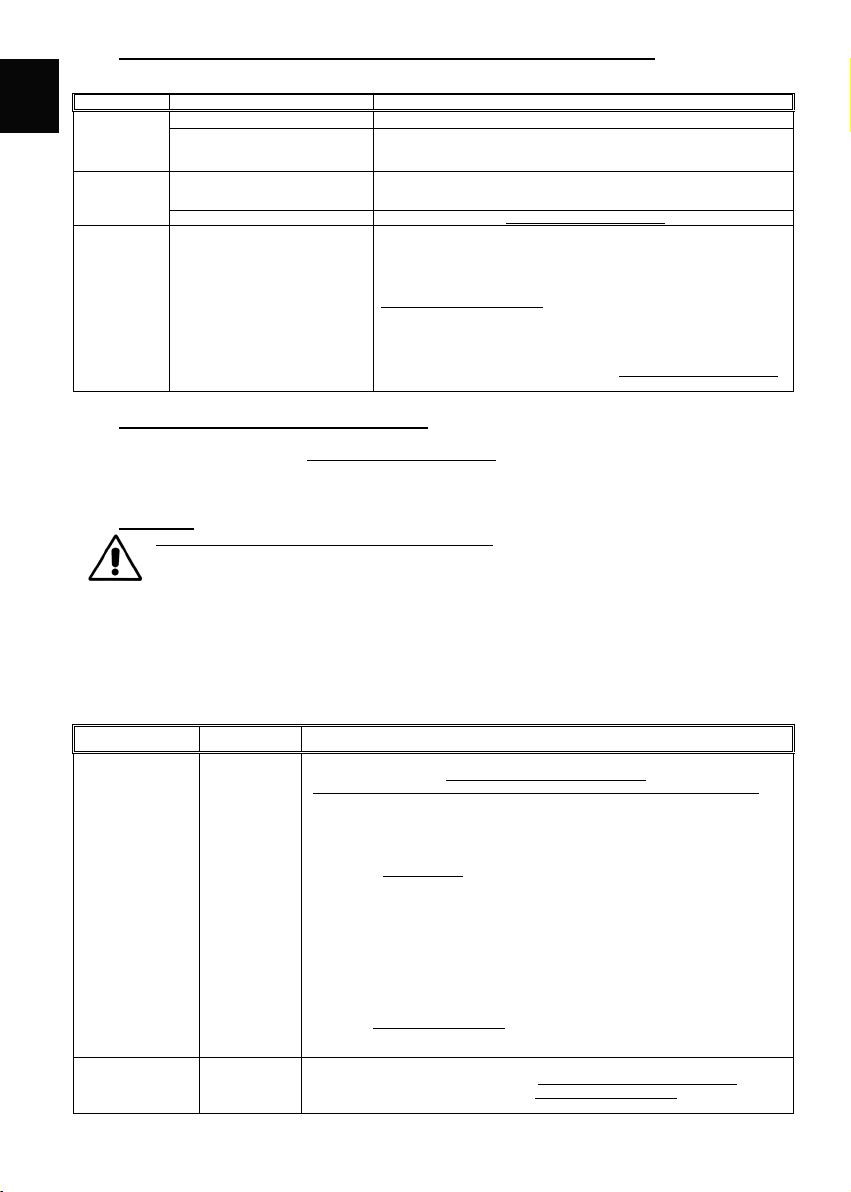
RICERCA GUASTI O AVARIE E SBLOCCO ELEMENTI MOBILI
Di seguito sono indicati gli interventi per la ricerca guasti o avarie e sblocco elementi mobili che possono essere svolti da
manutentori.
TIPO POTENZIALE/I CAUSA/E MODALITÀ E RISCONTRI
ITALIANO
Mancanza
tensione di rete
Interruzione di
funzionamento
La macchina
non funziona:
le lame non
ruotano o non
eseguono il
taglio
correttamente
Black out generale Contattare l’ente distributore dell’energia elettrica
Intervento di fusibili o magnetotermici
posti a monte della linea
d’alimentazione della macchina
Intervento del dispositivo di protezione
interno alla macchina
Causa/e non identificabili Contattare direttamente il Centro di Assistenza Autorizzato
Mancanza tensione di alimentazione.
Dispositivi di sezionamento su “O”.
Mancato funzionamento del pulsante di
marcia
Intervento termico dovuto a
surriscaldamento
Visualizzazione sul display della
lettera “E”
Dopo avere eliminato le cause che hanno determinato l’intervento del dispositivo di
protezione, ripristinarlo. In caso di persistenza del problema contattate un tecnico
elettricista.
Contattate un tecnico elettricista: dopo avere eliminato le cause che hanno
determinato l’intervento di un dispositivo di protezione, ripristinarlo.
Controllare e ripristinare l’energia elettrica.
Inserire la spina su presa di alimentazione
Controllare l’efficienza del pulsante ed eventualmente contattare direttamente il
Centro di Assistenza Autorizzato.
Attendere il completo raffreddamento prima del riavvio della macchina
Lettore velocità guasto, contattare direttamente il Centro di Assistenza Autorizzato
MANUTENZIONE STRAORDINARIA
Per gli interventi di manutenzione straordinaria, conseguenti a rotture o revisioni o guasti meccanici o elettrici, è necessaria
una richiesta d’intervento direttamente al Centro di Assistenza Autorizzato.
Le istruzioni relative alla manutenzione straordinaria, non compaiono nel presente manuale delle istruzioni per l’uso e
devono pertanto essere esplicitamente richieste al fabbricante.
PULIZIA
E’ vietato pulire a mano gli organi e gli elementi in moto.
Tutti gli interventi di pulizia devono essere messi in atto solo ed esclusivamente, dopo aver scaricato la
macchina con il prodotto alimentare in lavorazione ed averla isolata dalla fonte di alimentazione
elettrica e di energia esterne.
La macchina, l’apparecchiatura elettrica ed i componenti a bordo macchina, non devono essere mai lavati
utilizzando acqua, tanto meno in forma di getti di qualunque natura e quantità; quindi, senza “secchio”
La classificazione del livello di igiene della macchina e delle attrezzature associate, per l'uso previsto, è 2 (due):
macchina che, in seguito a una valutazione del rischio di igiene, è conforme ai requisiti delle norme internazionali applicabili,
ma richiede un disassemblaggio programmato per la pulizia.
FREQUENZA PERSONALE
Al termine di ogni
turno di lavoro e
comunque prima
dell’uso giornaliero
12 13
né “gomma” né “spugna”. Non porre mai direttamente la macchina nel lavandino o sotto il rubinetto.
MODALITÀ
Operatore Tutte le superfici e le parti delle macchina destinate a venire a contatto con il prodotto alimentare,
ovvero, le zone alimentari (superficie esterna ed interna degli utensili) e le zone spruzzi
(superficie superiore dell’utensile in attacco alla macchina e superficie esterna della macchina),
devono essere pulite e disinfettate con le modalità sotto riportate. Per le attività di smontaggio degli
utensili , vedere precedenti descrizioni.
Scrostare le superfici dagli eventuali residui di prodotto alimentare (per es. con raschiatori
di plastica);
Pulire tutte le superfici della zona alimentare e zona spruzzi con un panno morbido
inumidito (non sgocciolante) con detergente diluito in acqua calda (anche del comune
sapone per piatti va benissimo).Utilizzare prodotti specifici per acciaio, questi debbono essere
liquidi (non in crema o paste comunque abrasive) e soprattutto non debbono contenere cloro.
Contro le sostanze grasse si può usare l’alcool denaturato.
Risciacquare con acqua calda pulita e successivamente asciugare tutte le superfici della
zona alimentare e zona spruzzi con un panno morbido che non perda peli.
L’utensile frullatore, pur essendo in acciaio inox, non può essere lavato in lavastoviglie,
tanto meno le parti plastiche.
Il rimontaggio deve avvenire solo a seguito di una esigenza di lavorazione, lasciare i pezzi
avvolti in un panno morbido asciutto che non perda peli.
PERIODI DI LUNGA INATTIVITÀ
Durante i periodi di lunga inattività della macchina provvedere a passare energicamente su
tutte le superfici in acciaio (specialmente se inox) una panno imbevuto di olio di vaselina in
modo da stendere un velo protettivo.
COSE DA NON FARE PRIMA O DURANTE LA PULIZIA:
Accedere agli elementi mobili senza essersi preventivamente accertati del loro arresto;
Accedere agli elementi mobili senza averla fermata in sicurezza garantita (bloccaggio nella
posizione di zero dei dispositivi di sezionamento dell’alimentazione elettrica)
ISTRUZIONI ORIGINALI
Pag. di
Page 13
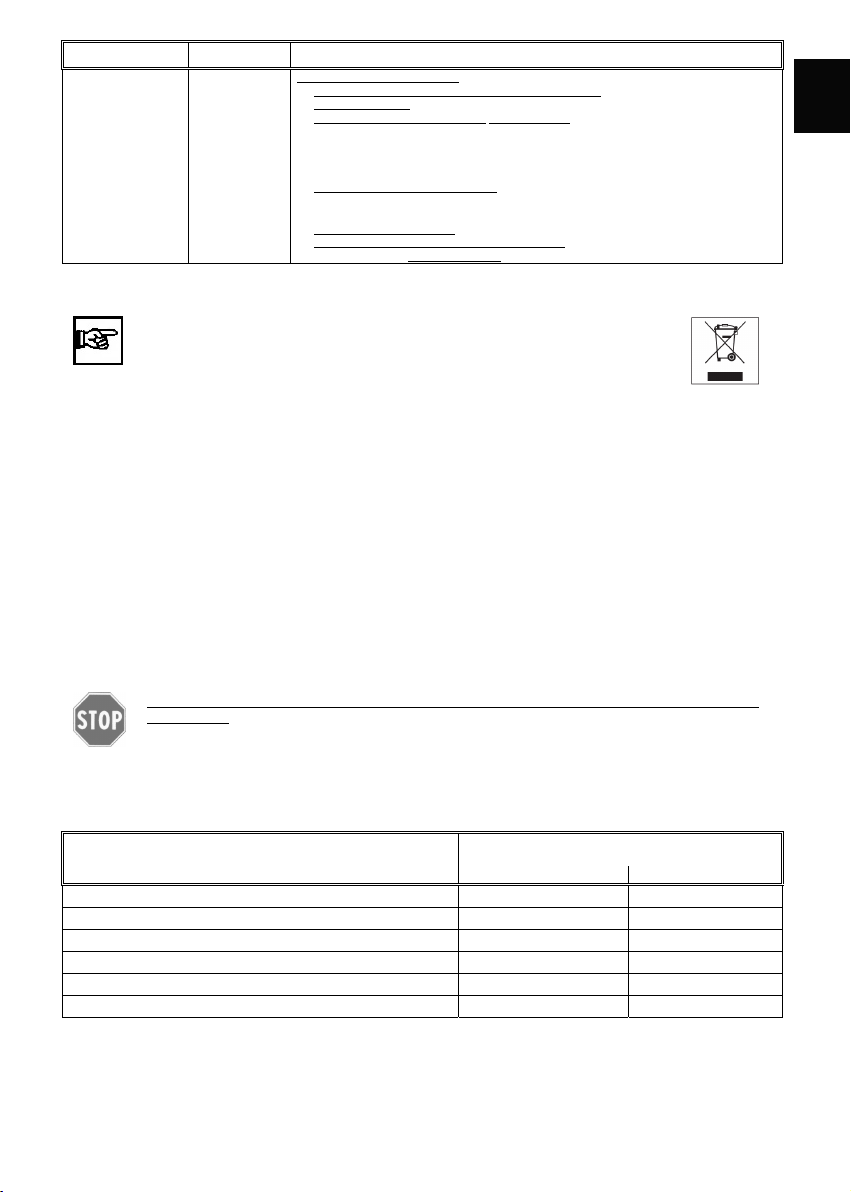
FREQUENZA PERSONALE MODALITÀ
PRODOTTI DA NON USARE:
aria compressa con getti verso le zone con depositi di farina ed in generale verso la macchina;
apparecchi a vapore;
detergente che contengono CLORO (anche se diluiti) o suoi composti come: la candeggina,
l’acido muriatico, prodotti per sturare lo scarico, prodotti per la pulizia del marmo,
decalcificanti in generale, etc … possono attaccare la composizione dell’acciaio, macchiandolo
od ossidandolo irreparabilmente. Le sole esalazioni dei suddetti prodotti possono ossidare ed in
alcuni casi corrodere l’acciaio;
paglietta, spazzole o dischetti abrasivi realizzati con altri metalli o leghe (es. acciaio comune,
alluminio, ottone, etc…) oppure utensili che abbiano precedentemente pulito altri metalli o
leghe.
detergenti in polvere abrasivi;
benzina, solventi o fluidi infiammabili e/o corrosivi;
sostanze impiegate per pulire l’argento.
CAP. 6. SMALTIMENTO
Nel caso si decida di non utilizzare piu’ la macchina perchè obsoleta, guasta o usurata , la sua messa fuori servizio deve essere
affidata a personale specializzato ed attrezzato.Al temine delle attività di smantellamento tutte le targhette di identificazione ed
altro documento devono essere distrutti. La macchina puo’essere smaltita senza bisogno di ridurla in pezzi minuti, è sufficiente
scollegare i principali gruppi che la compongono e mandarli alla rottamazione.
Non smaltire la macchina come rifiuto urbano misto, effettuare la raccolta differenziata.
I sistemi di ritiro o di raccolta della macchina sono:
Nella macchina non sono presenti sostanze pericolose con effetti potenzialmente negativi sull’ambiente e sulla salute umana.
E’ fondamentale che gli acquirenti contribuiscano al riutilizzo, al riciclaggio e ad altre forme di recupero della macchina.
E’ obbligo del datore di lavoro essere a conoscenza delle leggi vigenti in merito nel proprio paese e operare in modo ad
ottemperare a tali legislazioni.
Il simbolo del cassonetto barrato riportato sulla macchina indica che il prodotto alla fine
della sua vita utile debba essere raccolto separatamente dagli altri rifiuti
Ritiro tramite consorzio
Possibilità di consegna al distributore della macchina equivalente all’atto di acquisto di una macchina nuova.
È vietato ed inoltre passibile di sanzioni abbandonare la macchina e l’equipaggiamento elettrico
nell’ambiente
CAP. 7. MATERIALI DI COSTRUZIONE
A seconda delle esigenze di funzionamento e di produzione, la macchina può essere costituita con diverse tipologie di materiali
di costruzione.
GRUPPO
Corpo macchina
Utensile di taglio del frullatore
Campana dell’utensile frullatore
Tubo dell’utensile frullatore
Scatola riduttore utensile frusta
Utensile frusta
TIPOLOGIA MATERIALI
Acciaio inox AISI 304 Plastica per alimenti
●
●
●
●
●
●
ITALIANO
ITALIANO
13 13
ISTRUZIONI ORIGINALI
Pag. di
Page 14

Page 15

Page 16

INDEX
CHAP. 1. CONTENT ORGANIZATION AND CONSULTATION MODALITY 3
CHAP. 2. GENERAL INFORMATION AND CHARACTERISTICS 4
CHAP. 3. SAFETY INSTRUCTIONS 8
CHAP. 4. PUT ON SERVICE AND USE 8
CHAP. 5. MAINTENANCE, BREAKS RESEARCH AND CLEANING 11
CHAP. 6. SELLING 13
CHAP. 7. MANUFACTURING MATERIALS 13
ENGLISH
GUARANTEE
The machine is guaranteed 12 (twelve) months from the sale date.
The guarantee covers the machines reparations acquired c/o the authorized sale points, if it is demonstrated that they are faulty
in the materials or in the assembly, to the conditions here follow described:
1. For guarantee gets on the free change of all parts that are resulted manufacturing defect. The guarantee decades if not
coupled from fiscal ticket or invoice certifying the purchase and for the following cases:
a. Machine tampering or damaging due to negligence;
b. Machine use with non conformance modalities to the warnings described in the instructions handbook;
c. Damages caused from the non environment suitability in which the device works and from phenomenon not
dependent from the machine normal functioning (voltage values irregularities and frequency in the net plant);
d. Reparations interventions performed from people or centers not authorized from the manufacturer,
2. The intervention request in guarantee will have to be performed only in the sale points or authorized laboratories;
3. The machine will have to be free port returned to the manufacturer for the reparation and the transportation expenses are
always charged to the receiver,
4. It is excluded the machine change nor the guarantee prolongation following the intervention for damage;
5. The manufacturer doesn’t answer for direct or indirect damages of any nature to people or things for the improper use of
the machine or for lacked use during the time occurring for the reparations.
Instructions manual for the use
Issue
January 2015
2 13
ORIGINAL INSTRUCTIONS TRANSLATION
Pag. di
Page 17

CHAP. 1. CONTENT ORGANIZATION AND CONSULTATION MODALITY
MANUAL PURPOSE
MANUAL IMPORTANCE
The present instruction manual for the use is to be considered as integral part of the machine:
1. Must be kept for all the machine life.
2. Must be coupled with the machine in case of its ceasing.
3. Besides to show all useful notices for the operators, contains (collected in specific chapters) the electric diagrams that
will be used for the possible maintenance interventions and reparation.
SCOPE / MANUAL PURPOSE
The instructions manual for the use has the purpose to furnish to the commitment all necessary information so that, except of
an adequate supplied machine use, is able to manage the same in the more autonomous way and possibly safe.
Besides the present manual has been written with the purpose to supply indications and warnings to know the supplied
machine, to understand its principles and functioning limits. For possible doubts you can call the Authorized Assistance Center
RECEIVERS
The present instruction manual for the use, delivered in number of 1 copy together with the machine, is supplied as integral
part of the machine, is turned both to the operators both to the skilled technicians qualified to the installation, use and
maintenance.
The prevention and protection service responsible of the commitment and the additional employees, to whom is assigned
the machine, must take vision of the present instructions manual for the use, with the aim to adopt all technical and
organizational measures.
RESPONSIBILITY
The factory responsible, that supervision to the working activities, in the field of the foreseen respective
If the present manual endures damages or is lost, it is possible to request a copy to the Authorized
Assistance Center.
The present manual reflects the technical state during the machine manufacturing; the manufacturer
reserves the right to update the production and of consequence other manual issues, without the obligation
to update productions or previous manuals, if not in particular cases regarding the health and the people
safety.
Pay particularly attention to the residual risks content present on the machine and the prescriptions to
which the operators must keep.
The manufacturer is the responsible for the machine in its original configuration.
The manufacturer isn’t the responsible for damages caused from the improper use or not correct of the
machine and documentation or for damages caused from the imperative standards violation, negligence,
lack of experience, imprudence and the not respect of regulation standards on behalf of the employer, of
the operator or the maintenance man and for every possible damage, caused from an irrational, improper
and/or wrong use.
The manufacturer isn’t the responsible for the consequences caused from the not original spare parts use
or of equal characteristics.
The manufacturer is the responsible only for the information showed in the manual original version in
Italian language.
The non-fulfillment prescriptions contained in this manual will cause the guarantee immediate decay.
attributions and competence, must:
Carry out the foreseen safety measures;
Make informed the operators about the specific risks whom are exposed and bring to their knowledge the
prevention essential standards;
Prepare and require that the single operators observe the safety standards and use the protection means put
at their disposal;
Get down to work more operators, contemporary, on this product.
ENGLISH
3 13
ORIGINAL INSTRUCTIONS TRANSLATION
Pag. di
Page 18
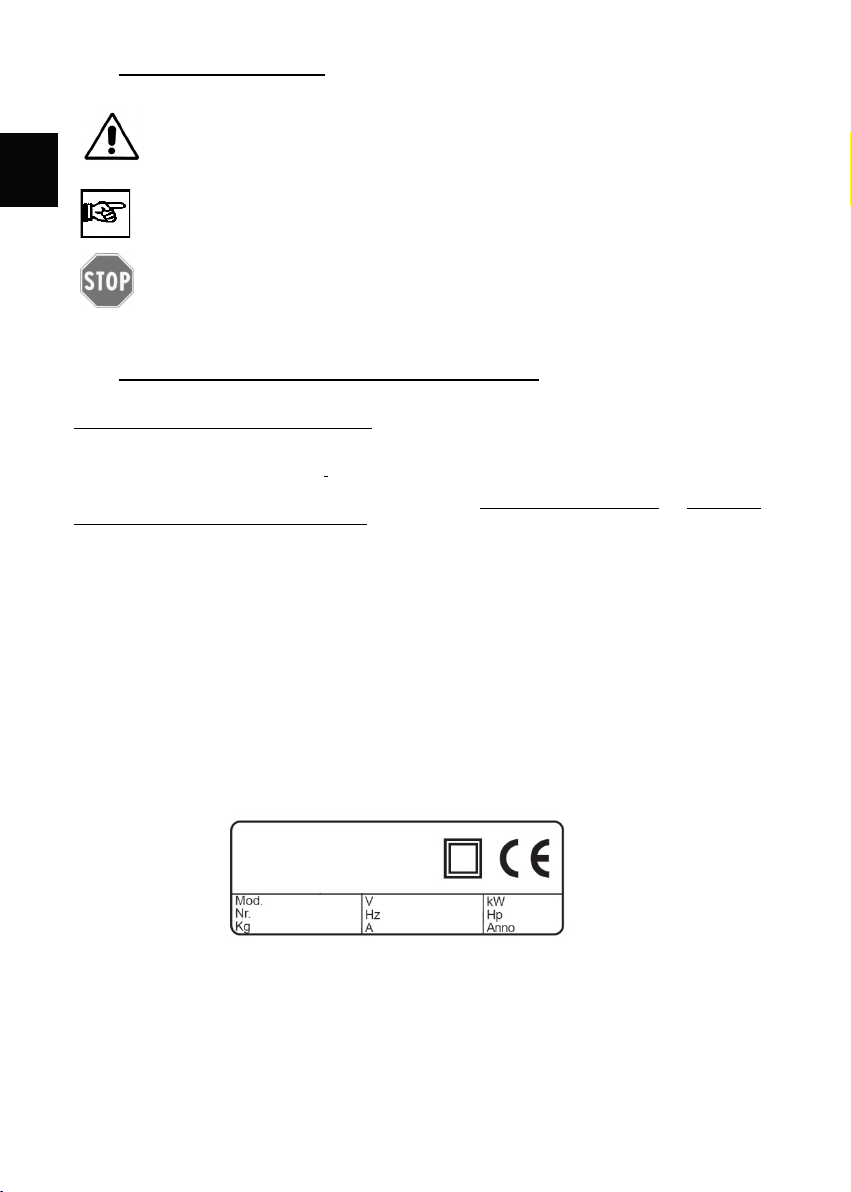
SIMBOLOGY MEANING
Here follow it is clearly specified the symbols and definitions meaning, which will be used in the present document.
DANGER
It shows the danger presence for who works on the machine and for who is in the vicinity, so the indicated
activity must be performed in accordance with the actual accident prevention standards and with the indications
showed in the present manual.
ENGLISH
PRECAUTION
It shows a warning on useful information and/or further recommendations and/or shrewdness about the actual
operation.
ATTENTION
It shows an operation to perform with attention to avoid damage to the machine.
CHAP. 2. GENERAL INFORMATION AND CHARACTERISTICS
USE DESTINATION AND MANUFACTURE PARTS
The mixer here follow called “machine”, is a portable machine designed to beat, whisk, mince, crumble, emulsify , reduce in
mash, etc, to use in the collective and institutional restoration.
With the machine in function of the tool that is used, it is possible to prepare directly in pot thick vegetable and pasta soups,
soups, mashed potatoes, creams, batters, mayonnaise, almonds pulp, cheese creams and what other like that.
The machine is constituted from an electric motor inserted in a unique fusion of plastic material (base machine body), in which
the motor shaft is connected to the work tool: electric mixer or whisk.
The tool is connected and blocked to the machine body or with a screwed nut, or through a fast unhook junction.
The feed product is charged manually in the container and successively, with the use of both the hands and grasping the
machine in the foreseen areas (see figure pag. 11), the same is:
1. Placed with the tool inside the container or the pot;
2. Screwed, and used up to the end of the feed product working;
3. Switched off and placed on an adequate support bench.
On the basis of the operative modalities, and to the used tool, the machine can:
1. Work while is relied on the bottom of the container (with the mixer tools), not exceeding however the immersion nick,
2. Work maintaining it hung, with the use of both the hands (with the whisk tool),
3. Work placed on a special support that can be adapted to the pot. The support works as the operator substitute for
operations that request long times or for feed treatments that can present burns risks (vapor or spatters).
The feed product unload, when the working cycle is finished, happens in manual way after having extracted the machine from
the container.
All materials on direct contact with the food product are in accordance with the actual hygienic standards for food.
In accordance with the functioning requirements and production, the machine can be constituted with different optional parts.
The machine is supplied with the identification plate on which the following data are showed:
[fac simile]
4 13
ORIGINAL INSTRUCTIONS TRANSLATION
Pag. di
Page 19
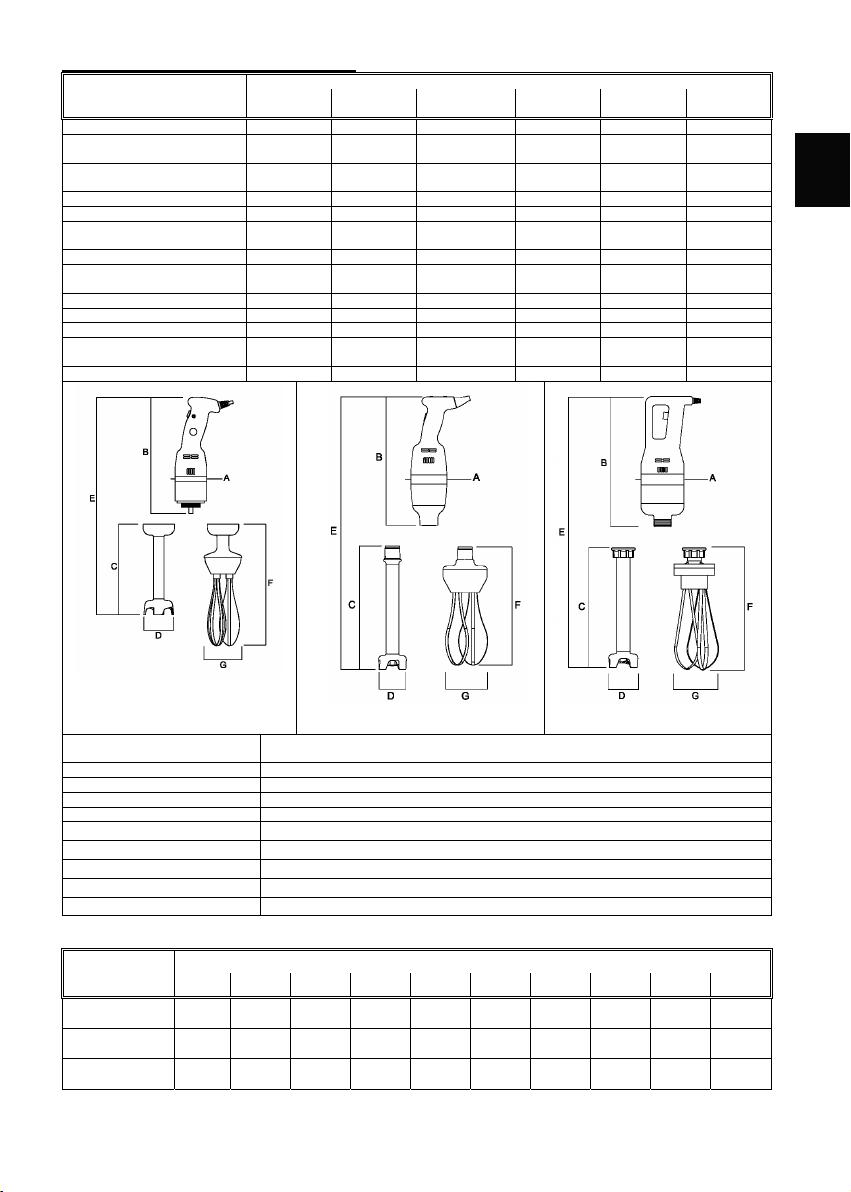
TECHNICAL AND MANUFACTURING DATA
TECHNICAL DATA
Motor power (W) 250 300 350 400 450 650
Maximum speed
(revolutions/min)
Variable speed (revolutions/min)
only VV models
Sizes: A (mm) Ø75
Sizes: B (mm) 285 350 360 350 380 400
Sizes: C (mm)
Sizes: D (mm) Ø75 Ø85 Ø95 Ø85 Ø95 Ø95
Sizes: E (mm)
Sizes: F (mm) 290 330 360 330 360 360
Sizes: G (mm) 90 120 120 120 120 120
Machine body mass (kg) 1,0 1,8 2,6 2,1 3,2 3,6
Mixer Mass (kg)
Whisk mass (kg) 0,450 0,800 1,0 0,800 1,0 1,0
250VF
250VV
15000 13000 15000 15000 17000 13000
2500 ÷
15000
220 / 270
470/ 520
0,400/ 0,450
300VV 350VF
2000 ÷ 9000 2000 ÷ 9000 2000 ÷ 9000
Ø100 Ø130 Ø100 Ø130 Ø130
340 / 440 /
540
650/ 750 /
850
0,850 /1,0
/ 1,2
MODEL
350VV
330 / 430 / 530
/ 630
680 / 780 /
880 / 980
1,2 / 1,5/
1,7 / 1,9
400VV 450VF
340 / 440 /
540
650 / 750 /
850
0,850 / 1,0
/ 1,2
450VV
2000 ÷
11000
330 / 430 /
530 / 630
700 / 800 /
900 / 1000
1,2 / 1,5/
1,7 / 1,9
2000 ÷ 9000
330 / 430 /
720 / 820 /
920/ 1020
650VF
650VV
530 / 630
1,2 / 1,5/
1,7 / 1,9
ENGLISH
250 VV-VF
Continue acoustic power level
considered equal to considered A
Current nature – frequency Cfr. Machine plate
Full charge current Cfr. Machine plate
Use nominal voltage Cfr. Machine plate
Auxiliary circuits voltage Cfr. Machine plate
Protection system Double insulation
Protection degree IP X3
Max environment air temperature +40°C
Requested minimum illumination 500 lux
Product directive conformance
300 / 400 VV
Minor of 70dBA
2006/42/CE, 2006/95/CE and successive modifications and integration, Reg. 1935/2004
350 / 450 / 650 VF-VV
TECHNICAL
DATA
Variable speed /
Mixer tool
Whisk tool /
250VF 250VV 300VV 350VF 350VV 400VV 450VF 450VV 650VF 650VV
● ●
/
● ● ● ● ● ● ● ● ● ●
● ●
/
MODEL
● ●
● ●
/
●
/
●
/
●
/
●
5 13
ORIGINAL INSTRUCTIONS TRANSLATION
Pag. di
Page 20
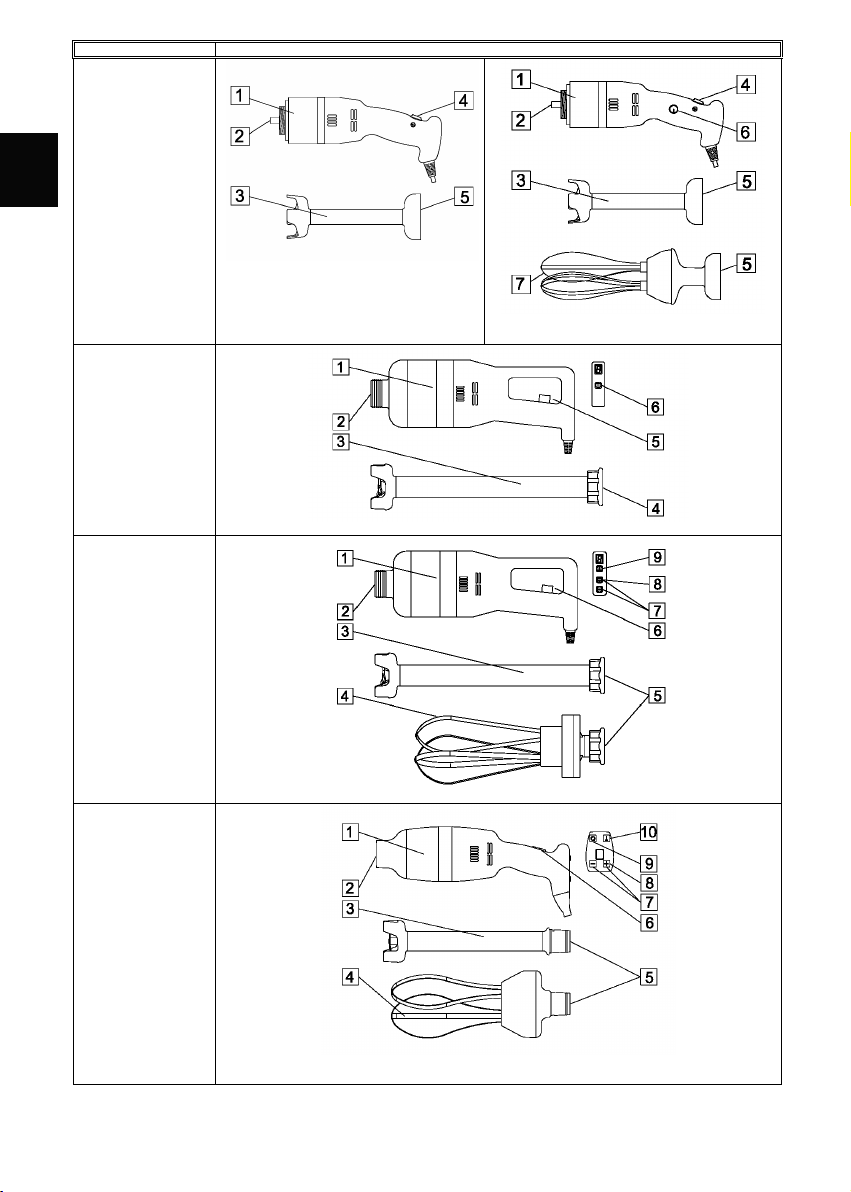
1. machine body
2. joint for tools
3. mixer tool
4. starting button
5. tool blocking nut
ENGLISH
6. speed variator
7. whisk tool
GROUP EXAMPLE
250VF
250VV
1. machine body
2. joint for tools
3. mixer tool
4. tool blocking nut
5. starting button
6. safety key for
starting
1. machine body
2. joint for tools
3. mixer tool
4. whisk tool
5. tool blocking nut
6. starting button
7. speed change
controls
8. safety key for
starting
9. mixer switch / whisk
1. machine body
2. joint for tools
3. mixer tool
4. whisk tool
5. tool blocking fast
clutch
6. starting button
7. speed change controls
8. starting safety button
9. continuative use
button
10. mixer switch / whisk
350 / 450 / 650 VF
350 / 450 / 650 VV
300 / 400 VV
6 13
ORIGINAL INSTRUCTIONS TRANSLATION
Pag. di
Page 21
NORMAL USE, IMPROPER USE, NOT CORRECT USE OR FORBIDDEN
The machine described in the present instructions manual for the use is foreseen to be driven from an only operator skilled
and prepared on residual risks, but with the competence, in safety matter, of maintenance employees.
The operator should have at least the minimum age foreseen from the social laws about the work and having had the necessary
technical training at least from a more expert operator that had him preliminarily trained for the correct use of the machine.
7 13
In its NORMAL USE, and reasonably foreseeable, the machine can be used only to beat, whisk, mince,
crumble, emulsify , reduce in mash, directly in pot or an adequate container to use in the collective and
institutional restoration.
According to the tool type, it is possible to prepare directly in pot thick vegetable and pasta soups, soups, mashed
potatoes, creams, batters, mayonnaise, almonds pulp, cheese creams and what other like that.
The machine must be taken, supported and handled, placing the hands in the prescribed zone (see figure pag.
11).
The machine must not be used IN IMPROPER WAY; in particular:
1. It must not be used for domestic uses,
2. It must not functioned with parameters different from those showed in the technical characteristics table,
3. For every use of the machine with modalities different from those showed in the present manual, the
manufacturer declines every responsibility,
4. The user is responsible of the damages resulting from the lacked exercise conditions observance in
accordance with the agreed technical specifications and order confirmation,
5. the tools must not be functioned on vacuum;
6. Not tamper or damage intentionally nor remove or hide the labels.
The machine must not be used IN NOT CORRECT WAY or FORBIDDEN so some damages or injuries
could be caused for the operator; in particular:
1. It is forbidden to draw the electric feeding cable or the machine to disconnect the feeding plug,
2. It is forbidden to put weights on the machine or on the electric feeding cable,
3. It is forbidden to put the electric feeding cable on sharp parts or with burn danger,
4. It is forbidden the machine use with the damaged and not integer electric feeding cable or with the
control devices;
5. It is forbidden to leave the machine off with the electric feeding cable connected with the feeding plug,
6. It is forbidden to insert any type of object inside the motor ventilation cap;
7. It is forbidden to put the machine above different objects from the working ground used in the food
field of height included between 900 – 1100mm from the trampling level,
8. It is forbidden the use of inflammable substances, corrosive or harmful for the cleaning or products
excessively alkalines as the caustic soda or ammonia,
9. It is forbidden to plunge the machine in water or in other liquids;
10. It is forbidden the not authorized personnel use and with clothes different from that showed for the use,
11. It is forbidden the use of the whisk tool in the machines with fixed speed,
12. It is forbidden to introduce in the pot with the machine inserted and in function, products or objects
having characteristics different from those showed in the normal use, such as for example bones, frozen
meat, not food products, or other objects as scarves, etc…,
13. It is forbidden to take, support and handle the machine, placing the hands in different zones from
those showed in the normal use and however maintain in function the machine with an only hand,
14. It is forbidden to push or lets push from others the feed products or the ingredients towards the
bottom of the pot with the inserted machine and in function, and in general introduce the hands or any
other body part, in the pot during the machine functioning,
15. It is forbidden to introduce the machine in the pot, more than the immersion nick and however over
the tool blocking nut,
16.
It is forbidden to remove the machine from the pot, before that the tool is completely stopped and
however before 10 sec from the machine stop control,
17. It is forbidden to work on the tools block systems before the tool complete stop, and however before 10
sec from the machine stop control and connected to the electric feeding,
18. It is forbidden the partial removal of the protections and of the danger signals.
19. It is forbidden the functioning without that all the precautions about the residual risks elimination have
been adopted on behalf of the user,
20. It is forbidden to smoke or use free flame devices and manipulate incandescent materials, unless some
suitable safety measures aren’t adopted,
21. It is forbidden to activate or set the control and blockage devices as knobs or similar both during the
machine functioning both if you aren’t authorized
The user is however responsible of the damages resulting from the lacked observance of the specified normal
use conditions. For possible doubts you can enquire at the Authorized Assistance Center.
ORIGINAL INSTRUCTIONS TRANSLATION
Pag. di
ENGLISH
Page 22
CHAP. 3. SAFETY INSTRUCTIONS
INTRODUCTION
The lacked standards and safety procedures applications can be danger and damage sources.
The machine means bound in the use for the respect, on behalf of the final user, of:
1. all rules, of insertion in the environment and of people behavior, fixed from the laws and/or applicable
standards; with particular reference to the fixed plant upstream of the supplied machine and for its
connection / functioning;
ENGLISH
2. All further instructions and use warnings making part of the technical / graphic documentation annexed
to the same machine.
Except where differently specified, the personnel which performs the installation interventions,
connection, maintenance, reassembly, and reuse, damages or breakdowns, demolition and dismantling
must be a skilled personnel qualified in safety matter and educated on the residual risks, with the
competencies, in safety matter, of the maintenance employees.
ENVIRONMENTS, WORKING AND PASSING PLACES
The work environment must answer to the directive 89/654/CEE requirements. In the working area foreign object must not be
present. The employer, in the directive 89/391/CEE respect, concerning the measures realization turned to promote the safety
and workers health improvement during the work, must provide to eliminate or reduce the showed residual risks as foreseen in
the present manual.
WARNINGS ON THE RESIDUAL RISKS
RESIDUAL RISK DUE TO THE FIXED PROTECTIONS REMOVAL, INTERVENTIONS ON BROKEN/WORN
PARTS
For any occasion the operator must not try to open or remove a fixed protection or tamper a safety
device.
In the phase of equipment, maintenance, tools change and cleaning, and during all further manual
operations that happens introducing the hands or other body parts in the machine dangerous areas, a residual
risk remains due above all to:
1. Knocks with machine manufacturing parts,
2. Grazing and/or abrasion with machine rough parts,
Sharp pain with the sharpened parts,
3.
4. Cut with tools sharpened parts.
Besides in the cleaning phase or unblock of the inserted pieces in the blades that happens also introducing
the hands near the cutting tools, a residual risk remains due above all to a cut with tools sharpened parts.
Besides, the operator and the maintenance man must be skilled for the intervention connected to the
manual operations with open protections, must be trained on the joined consequent risks and must be
authorized from a responsible person and must use adequate individual protection devices, five fingers anti
cutting gloves. All interventions on the discs must happen keeping them with the blades towards the
bottom side.
CHAP. 4. PUT ON SERVICE AND USE
The machine management is allowed only to the authorized personnel and opportunely educated and endowed
of a sufficient technical experience.
Before to switch on the machine perform the following operations:
Read with attention the technical documentation,
Know what protections and emergency devices are available on the machine, their location and
functioning.
The not authorized use of commercial parts and accessories making part of the protections and safety devices
can cause some malfunctions and the ranger situation beginning for the operators. The operator must besides
have received an adequate training.
8 13
ORIGINAL INSTRUCTIONS TRANSLATION
Pag. di
Page 23
ASSEMBLY / DISASSEMBLY
The assembly / disassembly operations of every device of the machine are performed with the machine stop
and with the plug disconnected from the socket, or with the sectioning device in OFF.
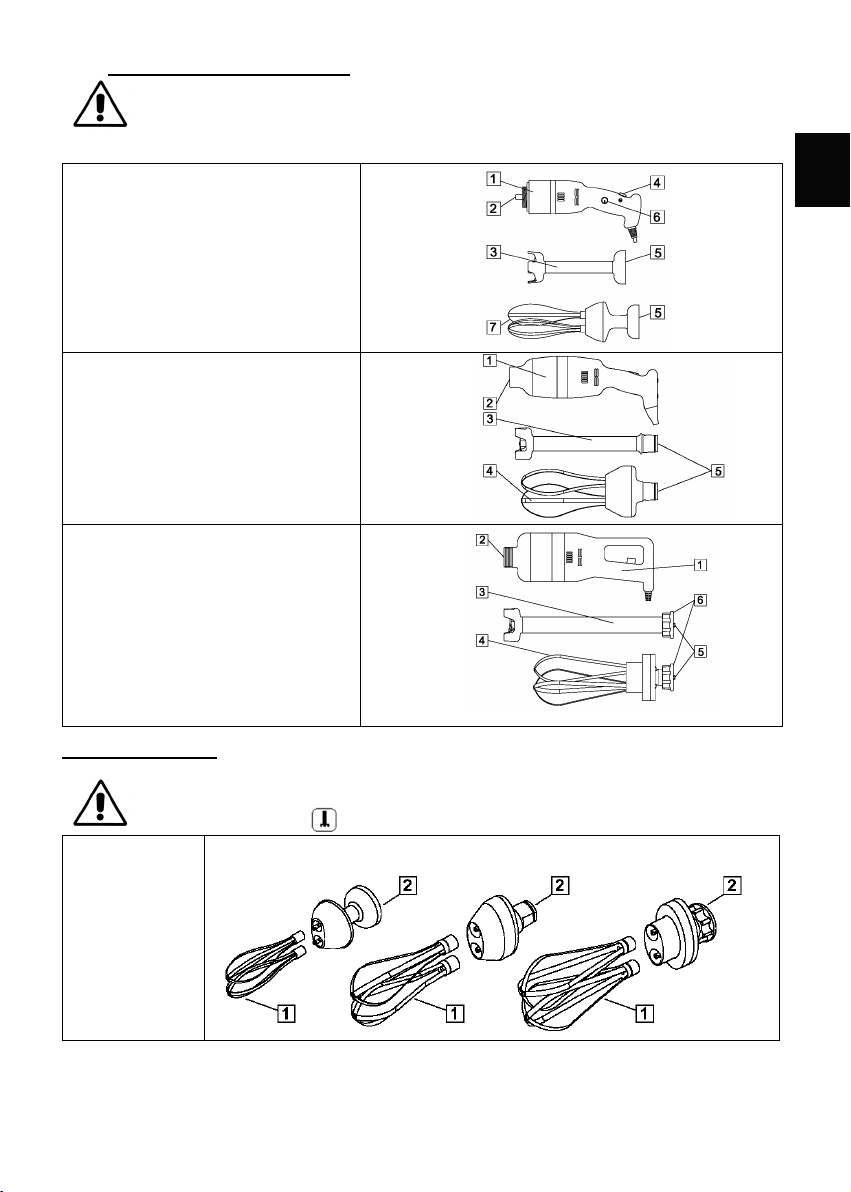
The machine assembly goes on in different phases (for example it is showed the machine with base body).
TOOLS ASSEMBLY
MODEL 250VF-VV
1. Align and insert the coupling (5) of the mixer (3) in
the clutch (2) of the machine body (1)
2. Screw the mixer (3) up to fasten it firmly to the
machine body (1)
250 VF-VV
TOOLS ASSEMBLY
MODEL 300/400 VV
1. Align and insert the tools coupling (5) in the quick
clutch (2) of the motor body (1)
2. Turn the tools (3-4) up to fasten them firmly to the
machine body (l)
300 / 400 VV
TOOLS ASSEMBLY
MODEL 350/450/650 VF-VV
1. Align and insert the coupling (5) of the tools (3-4) in
the clutch (2) of the machine body (1)
2. Screw the nut (6) up to fasten them firmly to the
machine body (1).
350 / 450 / 650 VF-VV
The disassembly activities perform following in a backwards way the assembly phases previously described.
It is forbidden the use of the whisk tool in the fixed speed machines (VF)
It is forbidden the whisk tool use in the machines with variable speed (VV)
WHISKS
ASSEMBLY
DISASSEMBLY
For the disassembly pull
the whisks (1) as soon as
they don’t part from a
reducer group (2).
To assemble them insert
the whisks basis (1) in the
reducer group pivot (2)
and push thoroughly.
with the max speed function
9 13
ORIGINAL INSTRUCTIONS TRANSLATION
Pag. di
ENGLISH
Page 24
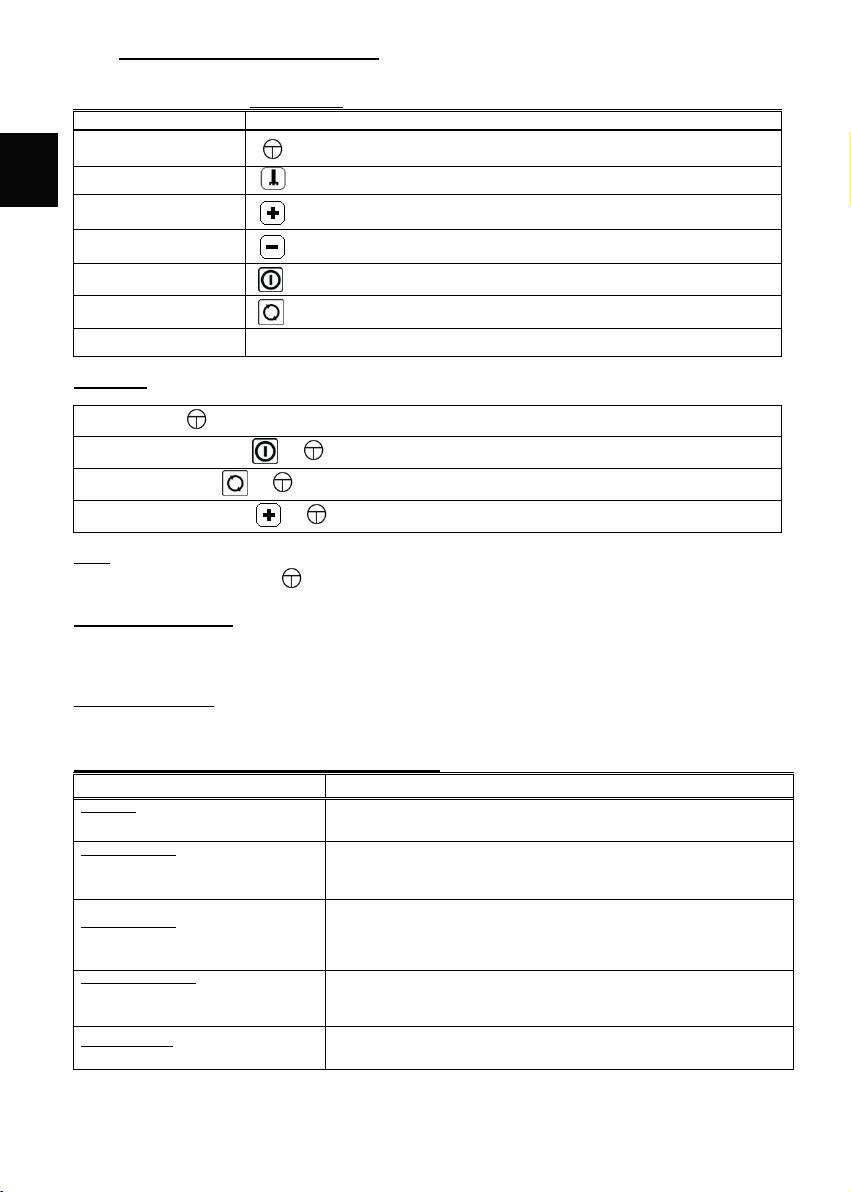
FUNCTIONING DESCRIPTION
The control devices are designed and manufactured so as much sure and reliable and resistant to the service normal stresses, to
the foreseeable strains and to the external agents. Besides they are clearly visible, locatable and marked from a suitable
marking. Here follow the main control devices are showed:
TYPE/ COLOR REFERENCE / DESCRIPTION
Button / black
Key / black
ENGLISH
Key / black
Key / black
Key / black
Key / black
Display / red Speed visualization: from 1 to 9 / maximum speed visualization
STARTING
The machine starting with impulse is possible only with a voluntary action on the control device foreseen for this aim:
machine VF 250:
only use with maintained action
Machines VF 350 / 450 / 650: + . Only use with continued action.
Machines VV 300 / 400: . + . Only use with continued action.
Machines VV 350 / 450 / 650: + . Only for continued action use.
STOP
For the stop control push the button .
FUNCTIONING SAFETY
If the machine is under stress, or is submitted to too long functioning times or submitted at overloaded, the same stops
immediately for the thermal protection functioning. In this case wait that it is completely cooled before proceeding to the
starting function.
VOLTAGE LACKING
In case of electric feeding breaking or if the machine is disconnected from the electric net, this last one will be able to be
restarted only following the starting function, after the electric feeding back or the reconnection to the electric net.
CONTROLS AND VERIFICATIONS BEFORE STARTING
VERIFICATION / CONTROL MODALITIES AND CHECKS
Check that:
There aren’t inside the pot extraneous
objects
Check the cleaning:
Of the machine external sides
of the tool along its surface
of the tool external sides
Check the integrity:
of the fixed protections
of the machine body
Check the functionality:
of the control system parts / control
about the safety;
of the control devices.
Check the absence:
of strange noises after the starting
” / Button for the machine starting control with maintained action
“
” / Max speed switching button only for blender tool
“
” / Key for speed increase / safety key for starting (only models VV 350/450/650)
“
“
” / Key for speed reduction
“
” / Key for the machine starting safety (only models VF 350/450/650)
” / Key for the machine starting safety (only models VV 300/400)
“
Sight control of the indicated parts, to check of objects or extraneous bodies lacking as for
example different tools, clothes, etc … and that there isn’t however the food product
All indicated parts surfaces, before the machine use must be checked visually to verify their
cleaning. In case of molds presence or other type of dirtiness, provide with the cleaning
procedure in accordance with the chapter 5 indications.
All fixed protections, etc.. must perform the function for which have been foreseen. Indicated
parts sight check to verify their integrity in their surface external part. The parts must be
however changed at the first erosion signals or breaking (cfr. Authorized Assistance Center).
All devices must perform the function for which have been foreseen. Control directly the
devices so that these ones determine the waiting function.
The actuators and all parts must be however changed to the first erosion signals or breaking
(cfr. Authorized Assistance Center).
During the functionality checking of the control devices, if there are strange noises, due for
example to a seizing or mechanical breaks, stop immediately the machine and activate the
maintenance service.
10 13
ORIGINAL INSTRUCTIONS TRANSLATION
Pag. di
Page 25
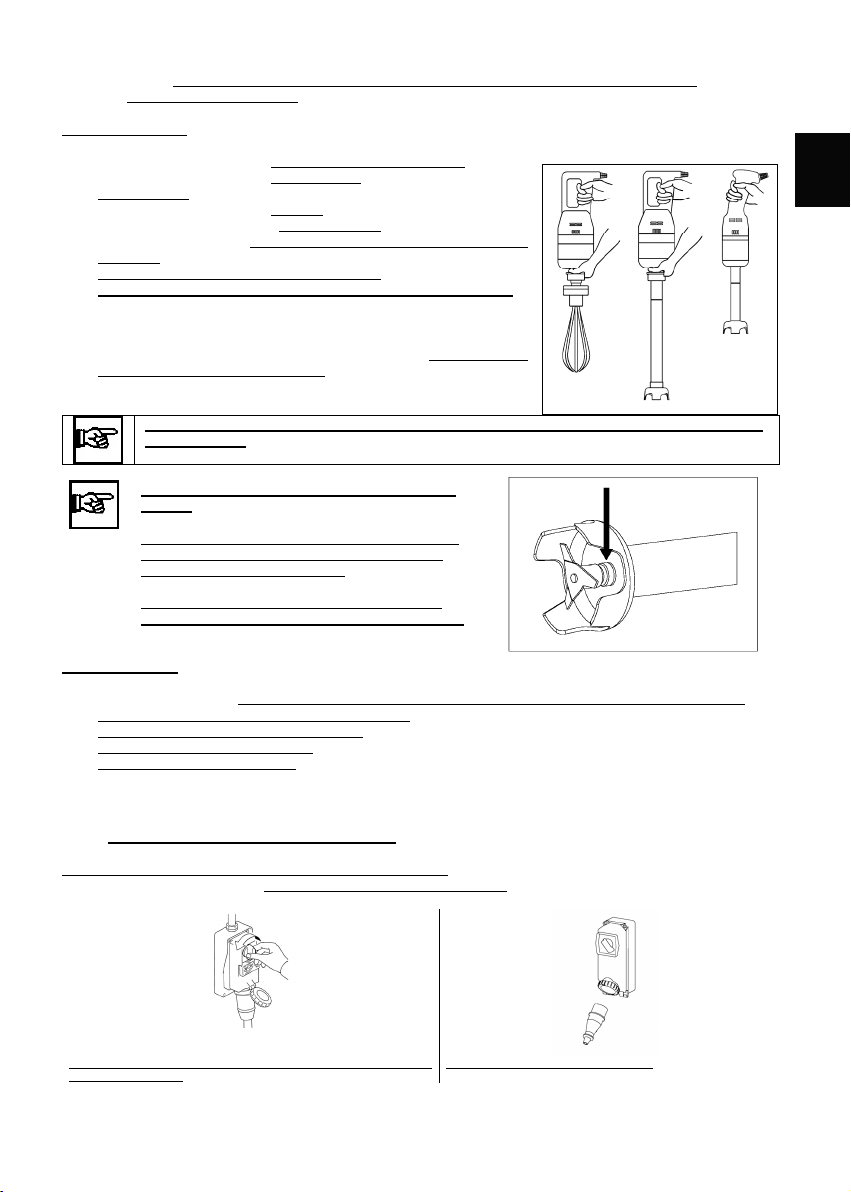
For any intervention type or for the parts change that are damaged, activate the maintenance service. The possible change
must happen with manufacturer original products or at least of quality, safety and equivalent characteristics. For analysis
contact the Authorized Assistance Center.
PUT IN FUNCTION
The machine operator can put in function the machine following in order the under reported indications:
1. Positive controls result for the preparation preliminary operations,
2. Positive controls result for the electric feeding,
3. Plug connection in opportune current socket,
4. Positive controls result for the assembly,
5. Positive controls result / checks before the starting,
6. Positive controls result finalized to check the respect of all safety
conditions,
7. Introduce manually the feed product inside the pot,
8. With the use of both the hands take the machine in the foreseen zones:
a. Place it with the tool inside the pot,
b. Start, maintain and handle it up to the end of the feed product
work,
9. When the food product has reached the desired solidity, stop the machine
and placed on a support adequate bench,
10. Discharge manually the pot feed product, taking it with both the hands and
pouring out the feed product where necessary.
It is forbidden to introduce the machine in the pot, more than the immersion nick and however over the
tool blocking nut
It is recommended to make not work the machine on
vacuum.
We recommend to control periodically the tire gasket
integrity placed under the blade (see drawing) and
change it if it is damaged or worn.
The gasket integrity prevents the working product
seepage inside the tool avoiding damages to the mixer.
SWITCHING OFF
In succession, the switching off must follow what here under indicated:
1. Before the switching off wait the working conclusion, or wait that the feed product has reached the desired solidity,
2. Stop the machine releasing the foreseen control devices,
3. Place the machine on a support adequate bench
4. Disconnect the plug from the machine from the feeding socket,
5. Perform the cleaning interventions.
CHAP. 5. MAINTENANCE, BREAKS RESEARCH AND CLEANING
MAINTENANCE PRESCRIPTIONS
INSULATION FROM THE EXTERNAL FEEDING SOURCES
Before to perform any operation of maintenance, cleaning and parts change, the external feeding sources must be sectioned
and insulated.
ENGLISH
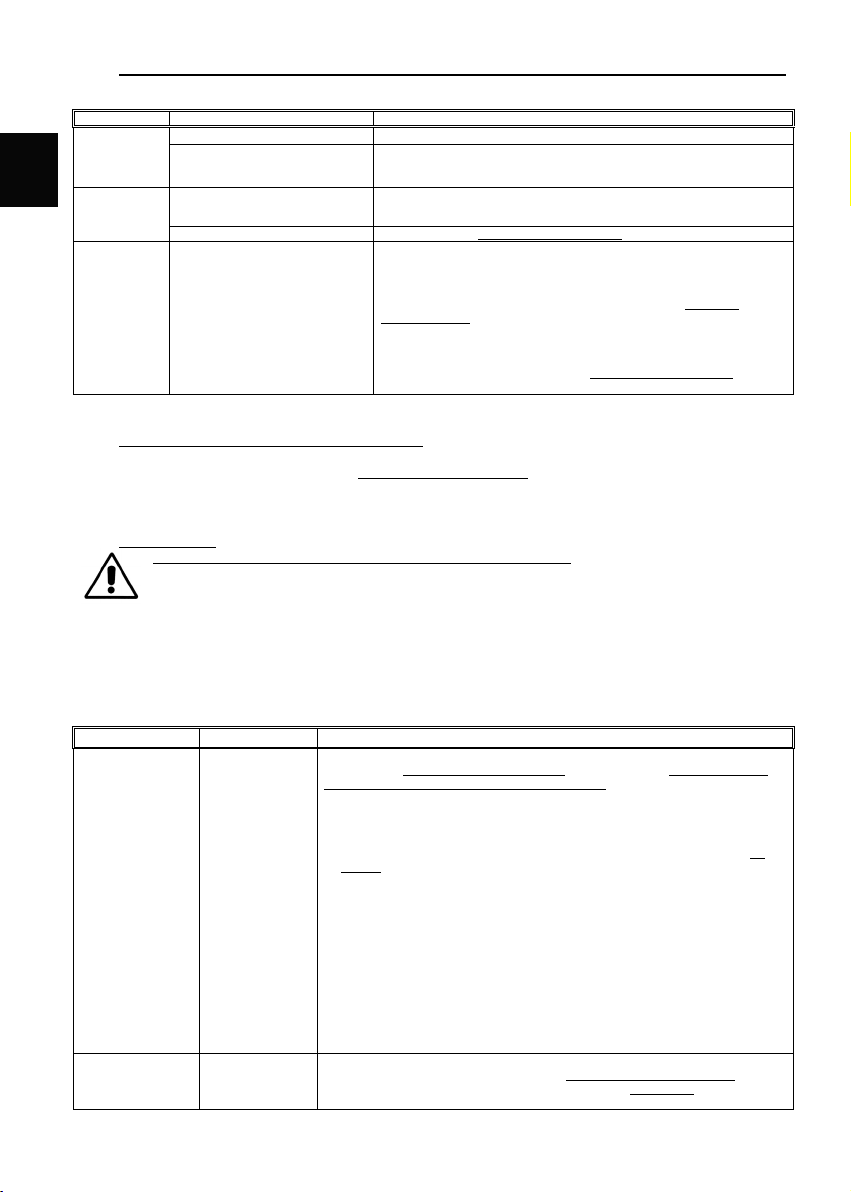
Position on “zero” the protection device placed upstream of the electric
equipment feeding line.
11 13
ORIGINAL INSTRUCTIONS TRANSLATION
Disconnect the general sectioning device and provide to protect
the plug with proper systems.
Pag. di
Page 26
BREAKS OR DAMAGES RESEARCH AND MOVING ELEMENTS UNBLOCKING
Here follow are indicate the interventions for the breaks or damages research and moving elements unblocking which can
be performed from maintenance men.
TYPE POTENTIAL/S CAUSE/S MODALITY AND COMPARISON
Net voltage
lacking
ENGLISH
Functioning
intervention
The machine
doesn’t
function: the
blades don’t
rotate or don’t
perform
correctly the
cutting
General Blackout Contact the electric energy distributor
Fuses or magneto thermals intervention
place upstream of the machine feeding
line
Protection device intervention inside
the machine
Cause/s not identifiable Contact directly the Authorized Assistance Center
Feeding voltage lacking.
Sectioning devices set on “OFF”.
Lacked running button functioning
Thermal intervention due to the
overheating
Visualization on the display of the
letter “E”
After having eliminated the causes that have determined the protection device
intervention, restore it. In case of problem persistency contact an electrician
technician.
Contact an electrician technician: after having eliminated the causes that have
determined the protection device intervention, restore it.
Check and restore the electric energy
Connect the plug on the feeding socket
Check the button efficiency and eventually contact directly the Authorized
Assistance Center.
Wait the complete cooling before to machine restarting
Speed reader damaged, contact directly the Authorized Assistance Center
EXTRAORDINARY MAINTENANCE
For the intervention of extraordinary maintenance, consequent to breaks or revisions or mechanical and electric damages, it
is necessary an intervention request directly to the Authorized Assistance Center.
The instructions about the extraordinary maintenance don’t appear in the present instruction manual for the use and so
must be explicitly requested to the manufacturer.
CLEANING
It is forbidden to clean by hand the organs and the elements in motion.
All cleaning interventions must be started only and exclusively, after having unloaded the machine with the
food product in working and having insulated from the electric feeding source and from external energy.
The machine, the electric equipment and the machine board components must not be ever washed utilizing
water, and not in any kind of jets form and quantity; so, without “bucket” nor “rubber” nor “towel”.
The machine hygiene level classification and the associated equipment, for the foreseen use, are 2 (two): machine that,
after a hygiene risk evaluation, is in conformance with applicable international standards requirements, but requests a
programmed disassembly for the cleaning.
At the end of every
shift work and
however before the
daily use
12 13
Don’t put ever directly the machine in the sink or under the tap.
FREQUENCY PERSONNEL MODALITY
Operator All the surface and the machine parts destined to come in contact with the food product or with
the food zones (tools external and internal surface) and the jets zones (tool superior surface
connected with the machine and machine external surface), must be cleaned and disinfected
with the under reported modalities. For the grinding group disassembly activities see the
previous descriptions.
Scrape the surfaces from the possible food product residuals (for example with plastic
scrapers);
Clean all the food zone surfaces and jets zone with a morbid dampened clothes (not
draining) with detergent diluted in hot water (also common soap for dishes is good).
Don’t soak them. With a towel clean inside the grinding mouth. Use specific products for
steel, which must be liquids (not in cream or pastries however abrasive) and above all must
not contain chlorine. Against the fat substances the denatured alcohol.
Rinse with cleaned hot water and successively dry all food zone surfaces and jets zone
with soft clothes that don’t lose coats.
The mixer tool, being in stainless steel, cannot be washed in dishwasher, much less the
plastic parts.
The reassembly must happen only following working requirements, leave the pieces
wrapped up in soft dry clothes that don’t lose coats.
PERIODS OF LONG INACTIVITY
During the machine long inactivity periods provide to pass vigorously on all steel surfaces
(especially if stainless) a clothes soaked of Vaseline oil so that to spread a protective veil.
THINGS NOT TO DO BEFORE OR DURING THE CLEANING:
Enter towards the moving elements without to be previously checked of their stop;
Enter towards the moving elements without have stopped it in safety stop (blockage in zero
position of the electric feeding sectioning devices)
ORIGINAL INSTRUCTIONS TRANSLATION
Pag. di
Page 27
FREQUENCY PERSONNEL MODALITY
PRODUCTS NOT TO USE:
Compressed air with jets towards the zones with flour warehouses and in general towards
the machine;
Vapor equipment;
Detergent that contains CHLORO (also if diluted) or its compounds as: the bleach, the
muriatic acid, products to clear the drain, products for the marble cleaning, in general
decalcifying, etc … can attack the steel composition, staining and oxidizing it unavoidable.
The only above described products fumes can oxidize and in any case corrode the steel;
Steel wool, brushes or abrasive discs produced with other metals or alloys (ex. Common
steel, aluminum, brass, etc…) or tools that have previously cleaned other metals or alloys,
that except to scratch the surface.
Detergents in abrasive dust;
Fuel, solvents or inflammable and/or corrosive fluids;
Substances used to clean the silver.
CHAP. 6. SELLING
If we decide to not use ever the machine because it is obsolete, damaged or worn, its out of service must be entrusted to
specialized and trained personnel. At the end of the dismantling activities all identification plates and other document must be
destroyed. The machine can be sold without the possibility to reduce it in small pieces; it is sufficient to disconnect the main
groups that compose it and to send them for the scrapping.
Don’t sell the machine like mixed urban refusal, perform the waste separation.
The machine collection or harvest systems are:
In the machine there aren’t dangerous substances with potentially negative effects on the ambient and on the human health. It
is fundamental that the purchasers contribute to the reuse, to the recycling and to the other forms of machine restoring. It is the
employer obligation to be aware of the actual laws of own country and work so to be comply with these legislations.
The crossed container symbol on the machine shows that the product at the end of its
useful life must be collected separately from other refusals
Collection through distributor consortium
Delivery possibility to the machine distributor equivalent to the purchasing certificate of a new machine.
It is forbidden and besides liable of penalties to leave the machine and the electric equipment in the
ambient.
CHAP. 7. MANUFACTURING MATERIALS
In accordance with the functioning and production requirements, the machine can be constituted with different typology of
manufacturing materials.
GROUP
Machine body
Mixer cutting tool
Mixer tool bin
Mixer tool pipe
Reducer case for whisk tool
Whisk tool
MATERIALS TYPOLOGY
Stainless Steel AISI 304 Plastic for food
●
●
●
●
●
●
ENGLISH
13 13
ORIGINAL INSTRUCTIONS TRANSLATION
Pag. di
Page 28

Page 29

Page 30

INDICE
CAP. 1. ORGANIZACIÓN DEL CONTENIDO Y MODALIDAD DE CONSULTACION 3
CAP. 2. INFORMACIONES GENERALES Y CARACTERÍSTICAS 4
CAP. 3. INSTRUCCIONES POR LA SEGURIDAD 8
CAP. 4. PUESTA EN SERVICIO Y USO 8
CAP. 5. MANUTENCIÓN, BÚSQUEDA AVERÍAS Y LIMPIEZA 11
CAP. 6. DESMANTELAMIENTO 13
CAP. 7. MATERIALES DE CONSTRUCCIÓN 13
ESPAÑOL
GARANTÍA
La máquina es garantizada 12 (doce) meses de la fecha de la venta.
La garantía cubre las reparaciones de las máquinas adquiridas cerca de los puntos de venta autorizados, en caso de que sea
demostrado que éstas sean defectuosas en los materiales o en el ensamblaje, a las condiciones aquí en seguida establecidas::
1. por garantía se entiende la sustitución gratuita de todas aquéllas partes que han resultado defectuosas de fabricación. La
garantía decae si no acompañada por resguardo fiscal o factura que certifica la adquisición y para los siguientes casos:
a. manumisión de la máquina o perjuicio de la misma debida a incuria;
b. empleo de la máquina con modalidad no conforma a las advertencias indicadas sobre el manuale de instrucciones;
c. daños provocados por el no idoneidad del entorno en que el aparato obra y de fenómenos no dependientes del
normal funcionamiento de la máquina (irregularidad de los valores tensión y frecuencia en la instalación de red);
d. intervenciones de reparación efectuadas por personas o centros no autorizados por el fabricante,
2. la solicitud de intervención en garantía tendrá que únicamente ser efectuada a puntos de venta o a laboratorios
autorizados;
3. la máquina tendrá que ser devuelta en puerto franco al constructor por la reparación, los gastos de transporte siempre
estan a cargo del destinatario,
4. es excluida la sustitución de la máquina además de la prolongación de la garantía a causa de intervención por avería;
5. el fabricante no contesta por daños directos o indirectos de cualquiera natura a personas o a cosas por el empleo
impropio de la máquina o por fallido empleo durante el tiempo necesario por las reparaciones.
Manual de instrucciones y uso
Edición
Enero 2015
2 13
TRADUCCIÓN DE LAS INSTRUCCIONES ORIGINALES
Pag. di
Page 31

CAP. 1. ORGANIZACIÓN DEL CONTENIDO Y MODALIDAD DE CONSULTACION
OBJETIVO DEL MANUAL
IMPORTANCIA DEL MANUAL
El presente manual de instrucciones y uso es que considerarse como parte integrante de la máquina:
1. tiene que ser custodiado por toda la vida de la máquina.
2. tiene que acompañar la máquina en caso de cesión de la misma.
3. además de reconducir todas las noticias útiles para los operadores, contiene (recogido en capítulos específicos), los
esquemas eléctricos que servirán para las eventuales intervenciones de manutención y reparación.
OBJETIVO / FINALIDAD DEL MANUAL.
El Manual de instrucciones y uso tiene el objetivo de proveer al cliente todas las informaciones necesarias para que, más de un
adecuado empleo de la máquina suministrada, sea capaz de administrar la misma en el modo más autónomo y seguro posible.
Además el presente manual ha sido redactado al objetivo de proveer indicaciones y advertencias para conocer la máquina
suministrada, para comprender sus principios y límites de funcionamiento. Por eventuales dudas interpelar el Centro de
Asistencia Autorizado.
DESTINATARIOS
El presente manual de instrucciones y uso, remitido en número de n. 1 copia junto a la máquina, es provisto como parte
integrante del mismo, es dirigido sea a los operadores sea a los técnicos calificados habilitados a la instalación, empleo y
manutención.
El responsable del servicio de prevención y protección del cliente y los ulteriores empleados a los que es destinada la
máquina, tienen que examinar el presente manual de instrucciones y uso, para adoptar todas las medidas técnicas y
organizativas
RESPONSABILIDAD
Los responsables de establecimiento, que gobiernan las actividades laborales, deben, en el ámbito de las
En el caso el presente manual padezca perjuicios o sea perdido, es posible solicitar copia de ello al
Centro de Asistencia Autorizado.
El presente manual refleja el estado de la técnica al momento de la construcción de la máquina; el
constructor se reserva el derecho a poner al día la producción y por consiguiente otras ediciones del
manual, sin la obligación de poner al día producciones o manuales precedentes, si no en casos
particulares que conciernen la salud y la seguridad de las personas.
Poner particular atención al contenido de los riesgos residuos que hay sobre la máquina y las
prescripciones a que tienen que atenerse los operadores.
El constructor es responsable por la máquina en su original configuración.
El constructor no es responsable por daños traídos por el empleo impropio o no corregido de la máquina
y de la documentación o por daños traídos por la violación de normas imperativas, negligencia,
impericia, imprudencia y no respeto de normas reglamentarias de parte del empresario, del operador o
del manutentor y por cada eventual avería causada por un empleo irrazonable, impropio y/o equivocado
El constructor no es responsable por las consecuencias causadas por el empleo de partos de repuesto no
original o con características equivalentes.
El constructor es responsable sólo por las informaciones indicadas en la versión original del manual en
lengua italiana.
La inobservancia de las prescripciones contenidas en este manual provocará el inmediato decaimiento de
la garantía.
correspondientes atribuciones y competencias:
actuar las medidas de seguridad previstas;
instruir a los operadores de los riesgos específicos a cuyo estan expuestos y llevar ellos a conocimiento
de las normas esenciales de prevención;
disponer y exigir que cada operador observe las normas de seguridad y use los medios de protección
puestos a disposición:
poner más que un operador, al mismo tiempo, al trabajo sobre tal manufactura.
ESPAÑOL
3 13
TRADUCCIÓN DE LAS INSTRUCCIONES ORIGINALES
Pag. di
Page 32
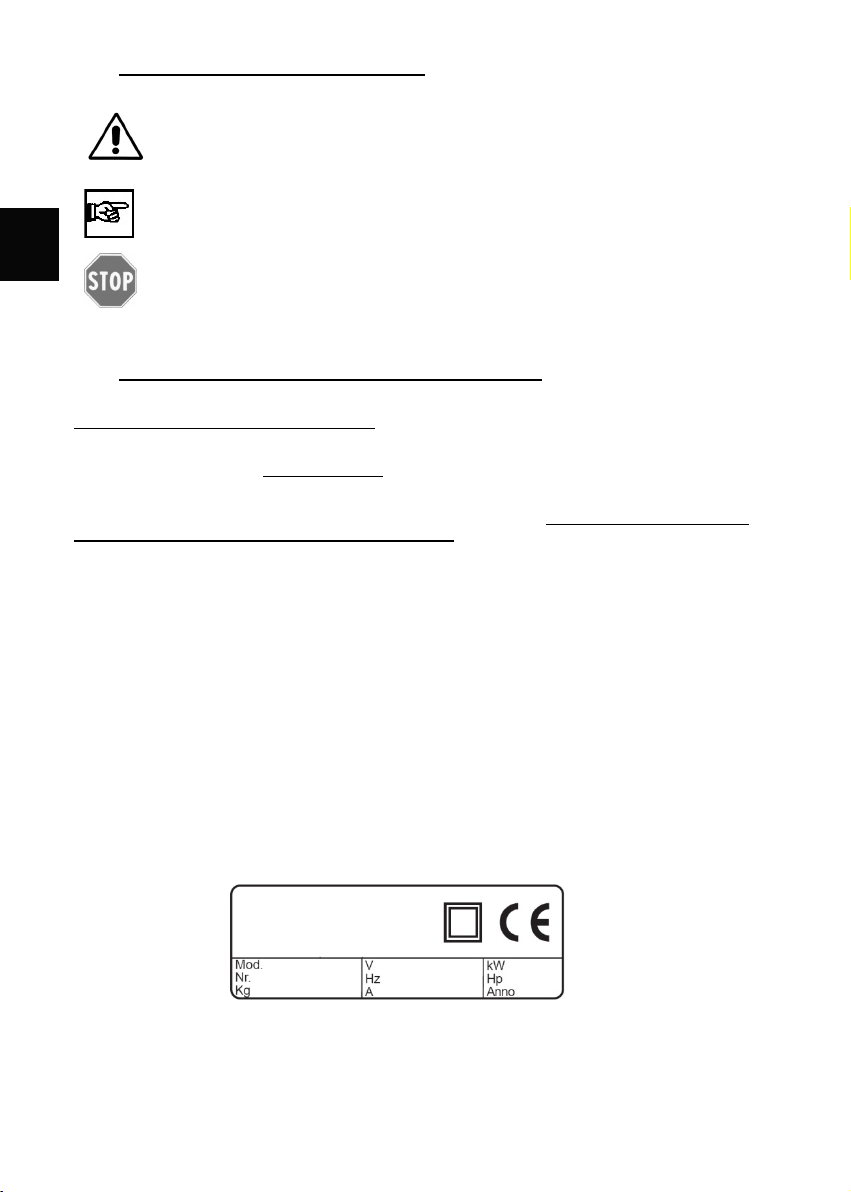
SIGNIFICADO DE LA SIMBOLOGÍA
En seguida es precisado claramente el sentido de los símbolos y las definiciones que serán utilizadas en el presente documento.
PELIGRO
Indica la presencia de un peligro por quien obra sobre la máquina y por quien se encuentra en las vecindades
por tanto la actividad insigne tiene que ser desarrollada en el respeto de las normas de previdencia sobre el
trabajo vigentes y de las indicaciones indicadas en el presente manual.
PRECAUCIÓN
Indica una advertencia sobre informaciones útiles y/o ulteriores recomendaciones y/o tretas inherentes la
operación en curso.
ESPAÑOL
ATENCIÓN
Indica una operación que ejecutar con atención para evitar traer daño a la máquina.
CAP. 2. INFORMACIONES GENERALES Y CARACTERÍSTICAS
DESTINACION USO Y PARTES CONSTRUCTIVOS
El mezclador en la continuación denominado "máquina", es una máquina portátil planeada para sacudir, batir, moler,
desmenuzar, emulsionar, reducir en papilla, etc.., de utilizar en la restauración colectiva e institucional.
Con la máquina en función del utensilio que se utiliza, es posible preparar directamente en olla potajes, empapados, puré,
cremas, pastel, mayonesa, pasta de bandurrias, cremas de queso y cuanto otro de parecido.
La máquina es constituida por un motor eléctrico integrado en una única fusión de material plastico (cuerpo maquina base), en
cuyo el árbol motor es conectado al utensilio de trabajo: batidora o varilla.
El utensilio es conectado y atascado al cuerpo maquina o con una abrazadera atornillada, o bien por un ataque a desengancho
rápido.
El producto alimenticio es cargado manualmente en el contenedor y sucesivamente, con el empleo de ambas las manos y
agarrando la máquina en las zonas previstas (ver figura pag.11), la misma viene:
1. posicionada con el utensilio dentro del recipiente o la olla;
2. encaminada, y utilizada hasta al final de la elaboración del producto alimenticio;
3. apagada y situads sobre un adecuado banco de apoyo.
Segun las modalidades operativas, y al utensilio utilizado, la máquina puede:
1. funcionar estando apoyada sobre el fondo del contenedor (con el utensilio batidora), no superando en todo caso la
muesca de inmersión,
2. funcionar manteniéndola suspendida, con el empleo de ambas las manos (con el utensilio varilla),
3. funcionar posicionada sobre uno especial soporte que puede ser conformado con la olla. El soporte actúa como sustituto
del operador por operaciones que solicitan tiempos largos o por tratos alimenticios que pueden presentar riesgos de
quemaduras (vapor o bosquejos).
El descargue del producto alimenticio, acabado el ciclo de elaboración ocurre de manera manual después de haber extraído la
máquina del recipiente.
Todos los materiales a directo contacto con el producto alimenticio están conformes a las vigentes normativas higiénicas por
alimentos.
A segunda de las exigencias de funcionamiento y producción, la máquina puede ser constituida con muchas partes opcionales.
La máquina es provista de etiqueta de identificación sobre la que son reconducidos los siguientes datos:
[fac simile]
4 13
TRADUCCIÓN DE LAS INSTRUCCIONES ORIGINALES
Pag. di
Page 33
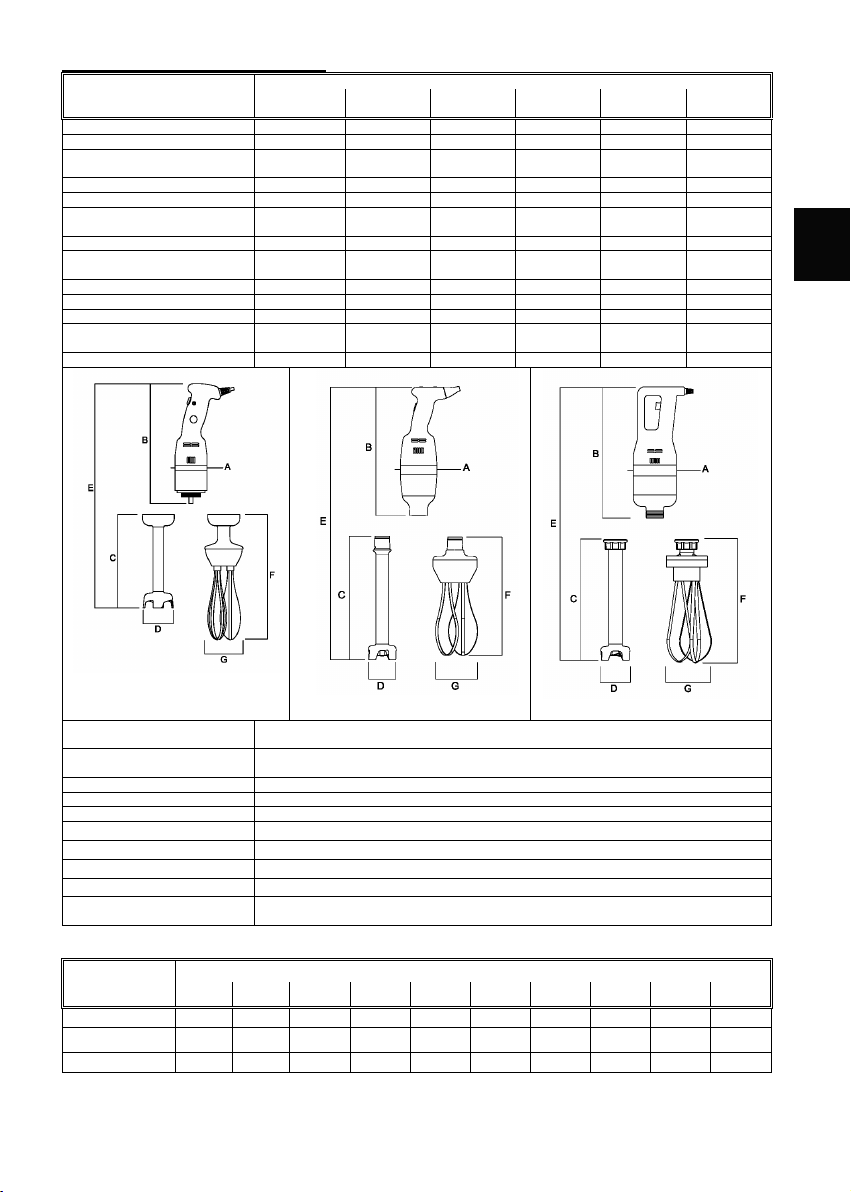
DATOS TÉCNICOS Y CONSTRUCTIVOS
DATOS TECNICOS
Potencia motor (W) 250 300 350 400 450 650
Velocidad maxima (giros/min) 15000 13000 15000 15000 17000 13000
Velocidad variables (giros/min)
solo modelos VV
Tamaño: A (mm) Ø75
Tamaño: B (mm) 285 350 360 350 380 400
Tamaño: C (mm)
Tamaño: D (mm) Ø75 Ø85 Ø95 Ø85 Ø95 Ø95
Tamaño: E (mm)
Tamaño: F (mm) 290 330 360 330 360 360
Tamaño: G (mm) 90 120 120 120 120 120
Masa cuerpo maquina (kg) 1,0 1,8 2,6 2,1 3,2 3,6
Masa batidora (kg)
Masa varilla (kg) 0,450 0,800 1,0 0,800 1,0 1,0
250VF
250VV
2500 ÷ 15000 2000 ÷ 9000 2000 ÷ 9000 2000 ÷ 9000
220 / 270
470/ 520
0,400/ 0,450
300VV 350VF
Ø100 Ø130 Ø100 Ø130 Ø130
340 / 440 /
540
650/ 750 /
850
0,850 /1,0
/ 1,2
350VV
330 / 430 /
530 / 630
680/ 780 /
880 / 980
1,2 / 1,5 /
1,7 / 1,9
MODELO
400VV 450VF
340 / 440 /
540
650 / 750 /
850
0,850 /1,0
/ 1,2
450VV
2000 ÷
11000
330 / 430 /
530 / 630
700 / 800 /
900 / 1000
1,2 / 1,5 /
1,7 / 1,9
2000 ÷ 9000
330 / 430 /
530 / 630
720 / 820 /
920/ 1020
1,2 /1,5 /
1,7 / 1,9
650VF
650VV
ESPAÑOL
250 VV-VF
Nivel de presión acústica continúo
equivalente ponderado A
Naturaleza de la corriente Frecuencia
Corriente a llena carga Cfr. placa de matrícula de la máquina
Tensión nominal de empleo Cfr. placa de matrícula de la máquina
Tensión de los circuitos auxiliares Cfr. placa de matrícula de la máquina
Sistema de protección
Grado de protección
Temperatura aire entorno max
Iluminación mínima solicitada
Conformidades directivas de
producto
300 / 400 VV
Cfr. placa de matrícula de la máquina
2006/42/CE, 2006/95/CE y siguientes modificaciones e integraciones, Reg. 1935/2004
Minor de 70dBA
Doble aislamiento
IP X3
+40°C
500 lux
350 / 450 / 650 VF-VV
DATOS
TECNICOS
Velocidad variable /
Utensilio batidora
Utensilio varilla /
5 13
250VF 250VV 300VV 350VF 350VV 400VV 450VF 450VV 650VF 650VV
● ●
/
● ● ● ● ● ● ● ● ● ●
● ●
TRADUCCIÓN DE LAS INSTRUCCIONES ORIGINALES
/
MODELO
● ●
● ●
/
●
/
●
/
/
Pag. di
●
●
Page 34
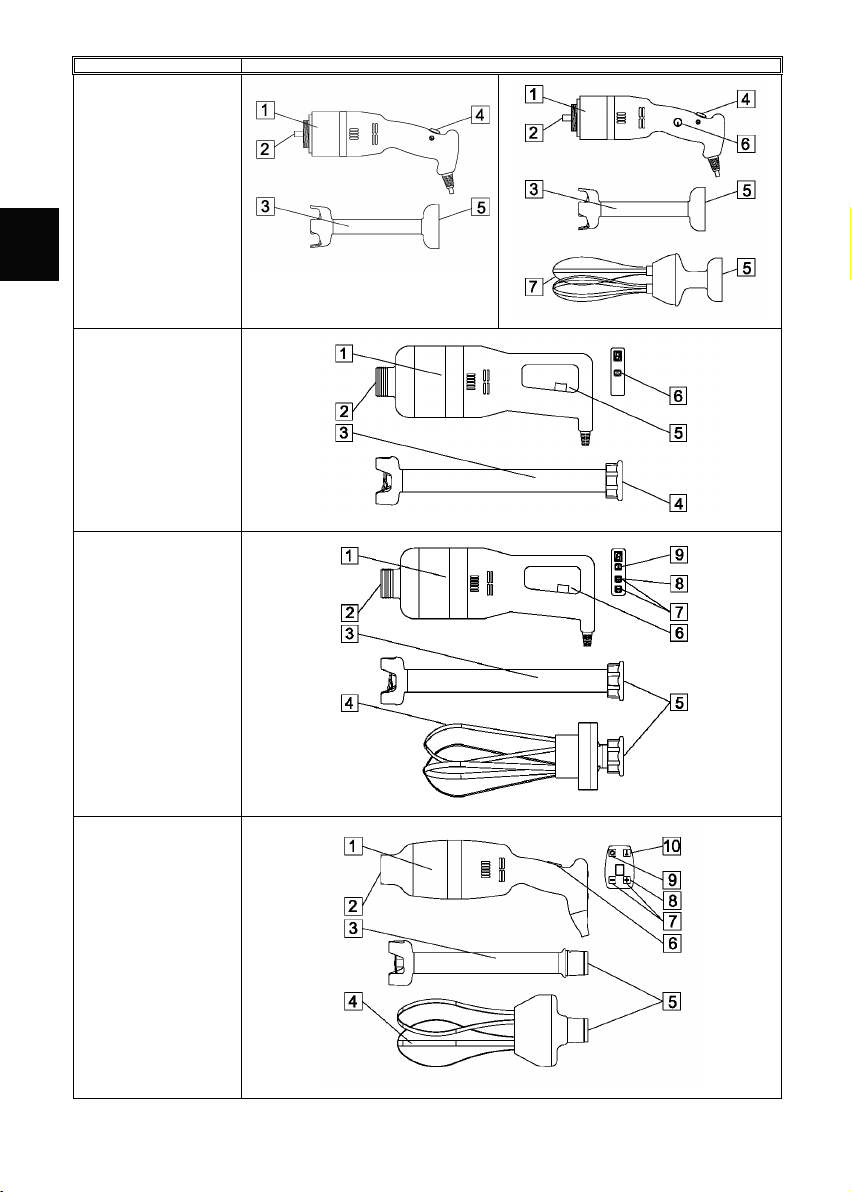
GRUPO EJEMPIO
1. cuerpo maquina
2. ataque por utensilios
3. utensilio batidora
4. pulsante de inicio
5. abrazadera bloqueo
utensilio
6. cambiador de velocidad
7. utensilio varilla
ESPAÑOL
250VF
1. cuerpo maquina
2. ataque por utensilios
3. utensilio batidora
4. abrazadera bloqueo
utensilio
5. pulsante de inicio
6. tecla seguridad por
arranque
1. cuerpo maquina
2. ataque por utensilios
3. utensilio batidora
4. utensilio varilla
5. abrazadera bloqueo
utensilio
6. pulsante de inicio
7. mandos variación
velocidad
8. tecla seguridad por
arranque
9. conmutador batidora /
varilla
1. cuerpo maquina
2. ataque por utensilios
3. utensilio batidora
4. utensilio varilla
5. injerto rápido bloqueo
utensilio
6. pulsante de inicio
7. mandos variación velocidad
8. tecla seguridad arranque
9. tecla empleo continuativo
10. conmutador batidora /
varilla
350 / 450 / 650 VF
350 / 450 / 650 VV
250VV
300 / 400 VV
6 13
TRADUCCIÓN DE LAS INSTRUCCIONES ORIGINALES
Pag. di
Page 35
USO NORMAL, USO IMPROPIO, USO NO CORRECTO O PROHIBIDO
La máquina descrita en el presente manual de instrucciones y uso es prevista para ser conducida por un solo operador
adiestrado e informado sobre los riesgos residuos, pero con las competencias, en materia de seguridad, de los empleados a la
manutención. El operador tendrá que poseer al menos la edad mínima prevista por las leyes sociales en el ámbito del trabajo y
haber disfrutado necesaria preparación técnica al menos de un operador más experto que lo haya adiestrado preliminarmente al
empleo correcto de la máquina.
7 13
En su USO NORMAL, y razonablemente previsible, la máquina puede ser utilizada solamente para pisar,
batir, moler, desmenuzar, sacudir, reducir en papilla, emulsionar, etc… directamente en olla o recipiente
adecuado, de utilizar en la restauración colectiva e institucional.
A segunda del tipo utensilio, es posible preparar directamente en olla potajes, empapados, puré, cremas, pastel,
mayonesa, pasta de bandurrias, cremas de queso y cuanto otro de parecido.
La máquina tiene que ser agarrada, grave y manejada, posicionando las manos en la zona prescrita (ver
figura pág. 11).
La máquina no tiene que ser utilizada DE MODO IMPROPIO; en particular:
1. no tiene que ser empleada para usos domésticos
2. no tiene que ser hecha funcionar con parámetros diferentes de aquellos indicados en el tablero de las
características técnicas
3. por cada empleo de la máquina con modalidades diferentes de aquellos indicados en el presente manual,
el constructor declina cada responsabilidad
4. el usario es responsable de los daños resultantes de la fallida observancia de las condiciones de ejercicio
concordada durante específica técnica y de confirmación de orden,
5. los utensilios no tienen que ser hechos funcionar a vacío;
6. no forzar o deteriorar intencionalmente ni remover o esconder las etiquetas.
La máquina no tiene que ser utilizada DE MODO NO CORRECTO o bien PROHIBIDO en cuanto se pudieran
causar daños o heridas para el operador, en particular:
1. es prohibido tirar el cable de alimentación eléctrica o la máquina para desconectar la espina de alimentación,
2. es prohibido poner pesos sobre la máquina o sobre el cable de alimentación eléctrica,
3. es prohibido posicionar el cable de alimentación eléctrica sobre partes cortantes o con peligro de quemadura,
4. es prohibido el empleo de la máquina con el cable de alimentación eléctrica u los aparatos de mando dañado
y no integros;
5. es prohibido dejar la máquina apagada con el cable de alimentación eléctrica anudado a la espina,
6. es prohibido enhebrar cualquier tipo de objeto dentro del casquete de ventilación del motor;
7. es prohibido posicionar la máquina sobre objetos diferentes de un banco de trabajo empleado en el sector
alimenticio de altura incluida entre 900 - 1100mm del plan de pisoteo,
8. es prohibido el empleo de sustancias inflamables, corrosivas o nocivas por la limpieza o producidos
excesivamente alcalinos cuál la sosa cáustica o amoniaco,
9. es prohibido sumergir la máquina en agua u otros líquidos;
10. es prohibido el empleo a personal no autorizado y con ropa diferente de aquellas indicada por el empleo,
11. es prohibido el empleo del utensilio varilla en las máquinas a velocidad fija,
12. es prohibido introducir en la olla con la máquina insertada y en función, producidos u objetos habientes
características diferentes de aquellas indicadas en el empleo normal, cuales por ej. huesos, carne congelada,
productos no comestibles u otros objetos cuál bufandas, etc…,
13. es prohibido agarrar, sustentar y manejar la máquina, posicionando las manos en zonas diferentes de las
indicadas en el empleo normal y en todo caso mantener en función la máquina con una sola mano,
14. es prohibido empujar o hacer empujar de otros los productos alimenticios o los ingredientes hacia el fondo
de la olla con la máquina insertada y en función, y en general introducir las manos o cualquiera otra parte del
cuerpo, en la olla durante el funcionamiento de la máquina,
15. es prohibido introducir la máquina en la olla, más allá de la muesca de inmersión y en todo caso más allá
de la abrazadera de bloqueo del utensilio,
16. es prohibido remover la máquina de la olla, antes que el utensilio se haya completamente parado y en todo
caso antes de 10 seg del mando de detención de la máquina,
17. es prohibido actuar sobre los sistemas de bloque de los utensilios antes de la detención completa del utensilio,
y en todo caso
18. es prohibida la parcial eliminación de las protecciones y las señales de peligro.
19. es prohibido el funcionamiento sin que hayan sido adoptados de parte del usario todas las medidas acerca de la
eliminación de los riesgos restantes,
20. es prohibido fumar u usar aparatos a llama libre y manipular materiales incandescentes, a menos que no sean
adoptadas idóneas medidas de seguridad,
21. es prohibido accionar o regular los aparatos de control y bloqueo cuál pómulos o parecidos sea durante el
funcionamiento de la máquina, sea si no se ha autorizado
antes de 10 seg del mando de detención de la máquina y abrochada a la alimentación eléctrica,
El usario es en todo caso responsable de los daños resultantes de la fallida observancia de las condiciones de
empleo normal precisada. Por eventuales dudas dirigirse al Centro de Asistencia Autorizado.
TRADUCCIÓN DE LAS INSTRUCCIONES ORIGINALES
Pag. di
ESPAÑOL
Page 36
CAP. 3. INSTRUCCIONES POR LA SEGURIDAD
ANTEPUESTA
La fallida aplicación de las normas y procedimientos de seguridad puede ser manantial de peligro y daño.
La máquina se entiende vinculada en el empleo al respeto, de parte del usuario final, de:
1. todas las reglas, de inserción en el entorno y de comportamiento de las personas, establecidas por las
leyes y/o normas aplicables; con particular referencia a la instalación fija a monte de la máquina dotada y
por su atadura/funcionamiento;
2. todas las ulteriores instrucciones y advertencias de empleo que hacen parte de la documentación
técnico/gráfica anexa a la máquina misma.
Excepto dónde de otra manera precisado, el personal que ejecuta las intervenciones de instalación, atadura,
ESPAÑOL
manutención, reinstalación y reutilizacion, búsqueda averías, demolición y desmantelamiento tiene que
ser un personal experto adiestrado en materia de seguridad e informado sobre los riesgos residuos, con las
competencias, en materia de seguridad, de los empleados a la manutención.
ENTORNOS, PUESTOS DE TRABAJO Y DE PASO
El entorno de trabajo tiene que contestar a los requisitos de la norma 89/654/CEE. En el área de trabajo no tienen que ser
presentes objetos extraños. El empresario, en el respeto de la norma 89/391/CEE, que atañe la realización de medidas dirigida
a promover la mejoría de la seguridad y la salud de los trabajadores durante el trabajo, tiene que proveer a eliminar o reducir
los riesgos residuos indicados como previstos en el presente manual.
ADVERTENCIAS EN MÉRITO A LOS RIESGOS RESIDUOS
RIESGO RESIDUO DEBIDO A LA ELIMINACIÓN DE LOS REPARTES FIJOS, INTERVENCIONES SOBRE
PARTES ROTAS/ GASTADAS
Por cualquiera eventualidad el operador no tiene que intentar nunca abrir o remover un amparo fijo o
forzar un aparato de seguridad.
En la fase de attrezzaggio, de manutención, de sustitución de los utensilios y de limpieza, y durante todas
las ulteriores operaciones manuales que ocurren introduciendo las manos u otros partes del cuerpo en las
áreas peligrosas de la máquina, queda sobre todo un riesgo residuo debido a:
1. choques con partes constructivos de la máquina
2. arrastramiento y/o abrasión con partes rudas de la máquina
3. picadura con las partes puntiagudas
4. corte con partes afilados de los utensilios.
Además en la fase de limpieza o desbloqueo de los trozos encajados en las hojas que también ocurre
introduciendo las manos en proximidad de los utensilios de corte, queda sobre todo un riesgo restante debido
a corte con partes afiladas de los utensilios.
El operador y el manutentor tienen que ser adiestrados por la intervención conexa a las operaciones
manuales con amparos abiertos, tienen que ser instruidos sobre los consiguientes riesgos conectados y tienen
que ser autorizados por persona responsable y tienen que emplear adecuados aparatos de protección individual,
guantes anticorte a cinco dedos. Todas las intervenciones sobre los discos tiene que ocurrir teniéndolos
hacia abajo con las hojas revueltas hacia abajo.
CAP. 4. PUESTA EN SERVICIO Y USO
La gestión de la máquina es permitida únicamente a personal autorizado y oportunamente instruido y
dotado de una suficiente experiencia técnica.
Antes de encender la máquina efectuar las siguientes operaciones:
leer cuidadosamente la documentación técnica
conocer cuáles protecciones y aparatos de emergencia están disponibles sobre la máquina, su
localización y su funcionamiento.
El empleo no autorizado de partes comerciales y accesorios que hacen parte de las protecciones y de los
aparatos de seguridad puede provocar el averiguarse de funcionamientos defectuosos y el sublevarse de
situaciones de peligro para el personal operador. El operador tiene que haber recibido una adecuada
formación.
8 13
TRADUCCIÓN DE LAS INSTRUCCIONES ORIGINALES
Pag. di
Page 37
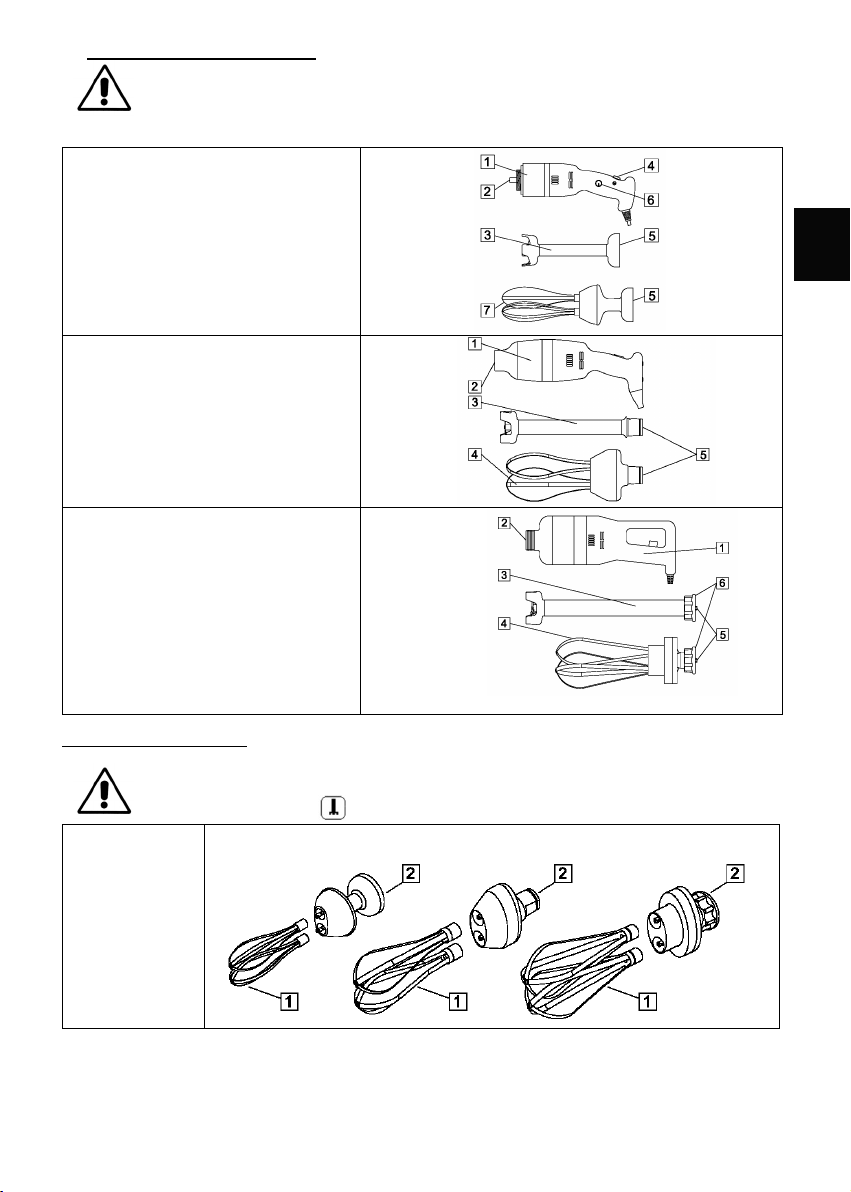
MONTAJE / DESMONTAJE
Las operaciones de montaje / desmontaje de cualquier órgano de la máquina deben ser efectuadas a máquina
firme y con la espina desconectada por la toma, o bien con el aparato de seccionamiento en OFF.
Il montaggio della macchina si svolge in varie fasi (in modo esemplificativo è riportata la macchina con corpo base).
MONTAJE UTENSILIO
MODELO 250 VF-VV
1. Alinear e insertar el acoplamiento (5) de la batidora
(3) en el injerto (2) del cuerpo maquina (1)
2. Atornillar la batidora (3) hasta fijarse firmemente en
él al cuerpo maquina (1)
250 VF-VV
MONTAJE UTENSILIOS
MODELO 300/400 VV
1. Alinear e insertar el acoplamiento de los utensilios (5)
en el injerto rápido (2) del cuerpo motor (1)
2. Girar los utensilios (3-4) hasta fijarse firmemente al
cuerpo maquina (l)
300 / 400 V
MONTAJE UTENSILIO
MODELO 350/450/650 VF-VV
1. Alinear e insertar el acoplamiento (5) de los utensilios
(3-4) en el injerto (2) del cuerpo maquina (1)
2. Atornillar la abrazadera (6) hasta fijarse firmemente al
cuerpo maquina (1).
350 / 450 / 650 VF-VV
Las actividades de desmontaje se desarrollan siguiendo a reacio las fases de montaje anteriormente descritas.
Es prohibido el empleo del utensilio varilla en las máquinas a velocidad fija (VF)
Está prohibido el uso del útil frusta en las máquinas de velocidad variable (VV)
MONTAJE
DESMONTAJE
DE LAS VARILLAS
Por el desmontaje tirar
las varillas (1) hasta que
no se separan de grupo
reductor (2).
Para montarle insertar la
base de las varillas (1)
en el gozne
del grupo reductor (2) y
empujar hasta el final.
con la función máx velocidad
ESPAÑOL
9 13
TRADUCCIÓN DE LAS INSTRUCCIONES ORIGINALES
Pag. di
Page 38
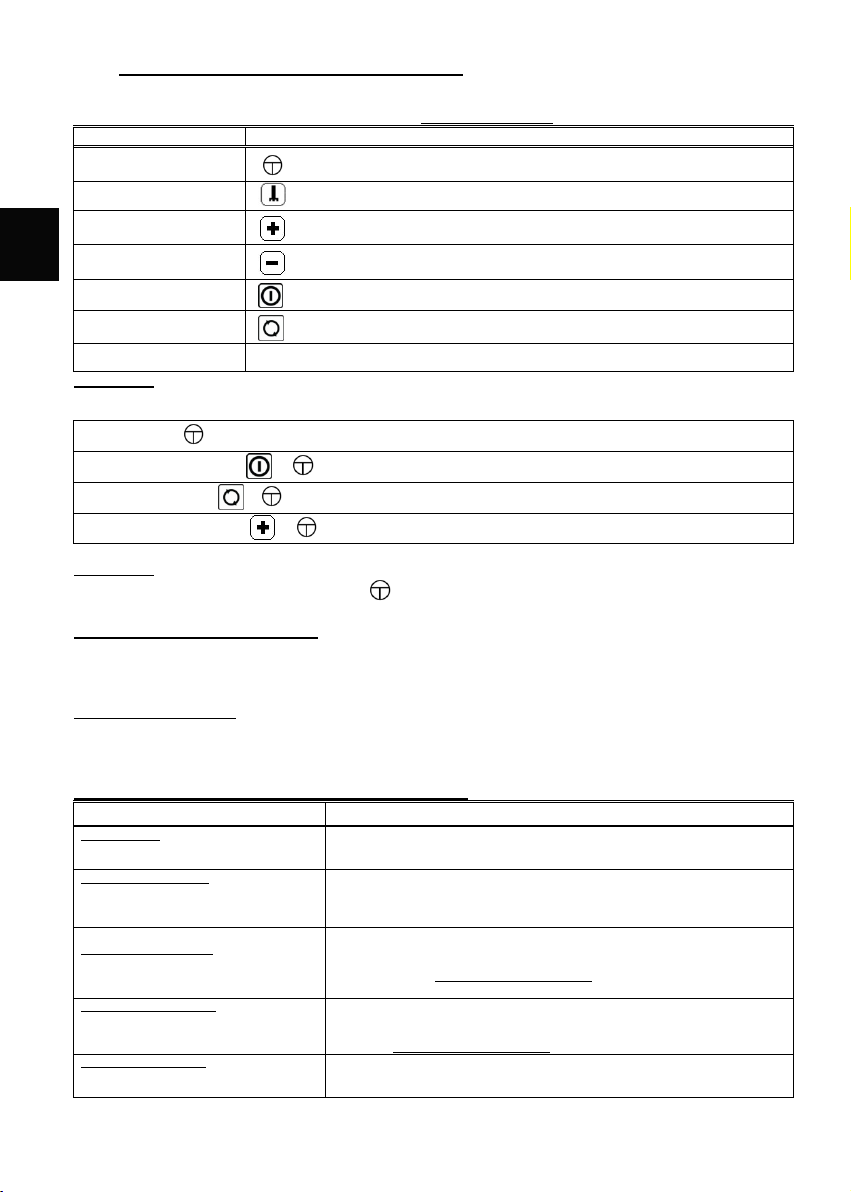
DESCRIPCIÓN DEL FUNCIONAMIENTO
Los dispositivos de mando son planeados y construidos para estar muy seguros y confiables y resistentes a los apremios
normales de servicio, a los esfuerzos previsibles y a los agentes externos. Además son claramente visibles y contraseñados por
un marcaje apto. En seguida son reconducidos los principales dispositivos de mando:
TIPO / COLOR REFERIMIENTO / DESCRIPCIÓN
Pulsante / negro
Tecla / negro
Tecla / negro
ESPAÑOL
Tecla / negro
Tecla / negro
Tecla / negro
Display / rojo Visualización de la velocidad: de 1 a 9 / visualización velocidad maxima
ARRANQUE
El arranque con impulso de la máquina es solamente posible con una acción voluntaria sobre el aparato de mando previsto
a tal fin:
máquina VF 250: Sólo empleo con acción mantenida
máquinas VF 350 / 450 / 650 : + . Sólo empleo a acción continuada.
máquinas VV 300 / 400 : + . Sólo empleo a acción continuada.
máquinas VV 350 / 450 / 650 : + . Sólo empleo a acción continuada.
ARRANQUE
Por el mando de detención comprimir el interruptor .
SEGURIDAD DE FUNCIONAMIENTO
En el caso en que la máquina sea bajoesfuerzo, o bien sea sometida a tiempos de funcionamiento demasiado largos o sometida
a sobrecargado, la misma se para enseguida por la entrada en función de la protección térmica. En este caso esperar que se
haya completamente enfriada antes de proceder a la función de arranque.
AUSENCIA DE TENSIÓN
En caso de interrupción de la alimentación eléctrica o si la máquina es despegada por la red eléctrica, este última podrá ser
reavivada solo siguiendo la función de arranque, después de la vuelta de la alimentación eléctrica u el reanudo a la red
eléctrica.
CONTROLES Y VERIFICACIONES ANTES DEL ARRANQUE
VERIFICACIÓN / CONTROL MODALIDAD Y COTEJOSV
Cerciorarse que:
No se hayan dentro de la olla objetos
extraños
Cerciorarse de la limpieza:
de las partes externas de la máquina
del utensilio a lo largo de su superficie
de las partes interiores del utensilio
Cerciorarse de la integridad:
de las protecciones fijas
del cuerpo de la máquina
Cerciorarse de las funciónes:
de las partes del sistema de mando /
control relativo a la seguridad;
de los aparatos de mando.
Cerciorarse de la ausencia:
de ruidos extraños después del
arranque
10 13
” / Pulsante por el mando de inicio de la máquina a acción mantenida
“
” / Tecla de conmutación máx velocidad sólo para útil liquadora
“
“
” / Tecla por aumento velocidad / tecla seguridad por arranque (solo modelos VV 350/450/650)
“
” / Tecla por disminución velocidad
“
” / Tecla seguridad por arranque de la máquina (solo modelos VF 350/450/650)
“
” / Tecla seguridad por arranque de la máquina (solo modelos VV 300/400)
Control visual de las partes indicadas, para cerciorarse de la ausencia de objetos o cuerpo
extraños cuál utensilios varios, harapientas, etc… y que no hay en todo caso el producto
alimenticio. En caso de presencia proveer a su eliminación.
Todas las superficies de las partes indicadas, antes del empleo de la máquina tienen que ser
controladas visualmente para cerciorarse de sus limpieza. En caso de presencia de mohos u
otro tipo de suciedad, proveer al procedimiento de limpieza según las indicaciones de que al
capítulo 5.
Todos los amparos fijos, etc.. tienen que desarrollar la función por que han sido previstos.
Control visual de las partes indicadas para cerciorarse su integridad en la parte externa de su
superficie. Las partes tienen que ser reemplazados en todo caso a las primeras señales de
erosión o rotura (cfr. Centro de Asistencia Autorizado).
Todos los aparatos tienen que desarrollar la función por que han sido previstos. Mandar
directamente los dispositivos para que ésta determinen la función esperada. Los actuadores y
todas las partes tienen que ser reemplazados en todo caso a las primeras señales de erosión o
rotura (cfr. . Centro de Asistencia Autorizado).
Durante la comprobación de la función de los dispositivos de mando, en el caso en que se
hayan ruidos extraños, debidos por ejemplo a un agarrotamiento o roturas mecánicas, parar
enseguida la máquina, y activar el servicio de manutención.
TRADUCCIÓN DE LAS INSTRUCCIONES ORIGINALES
Pag. di
Page 39
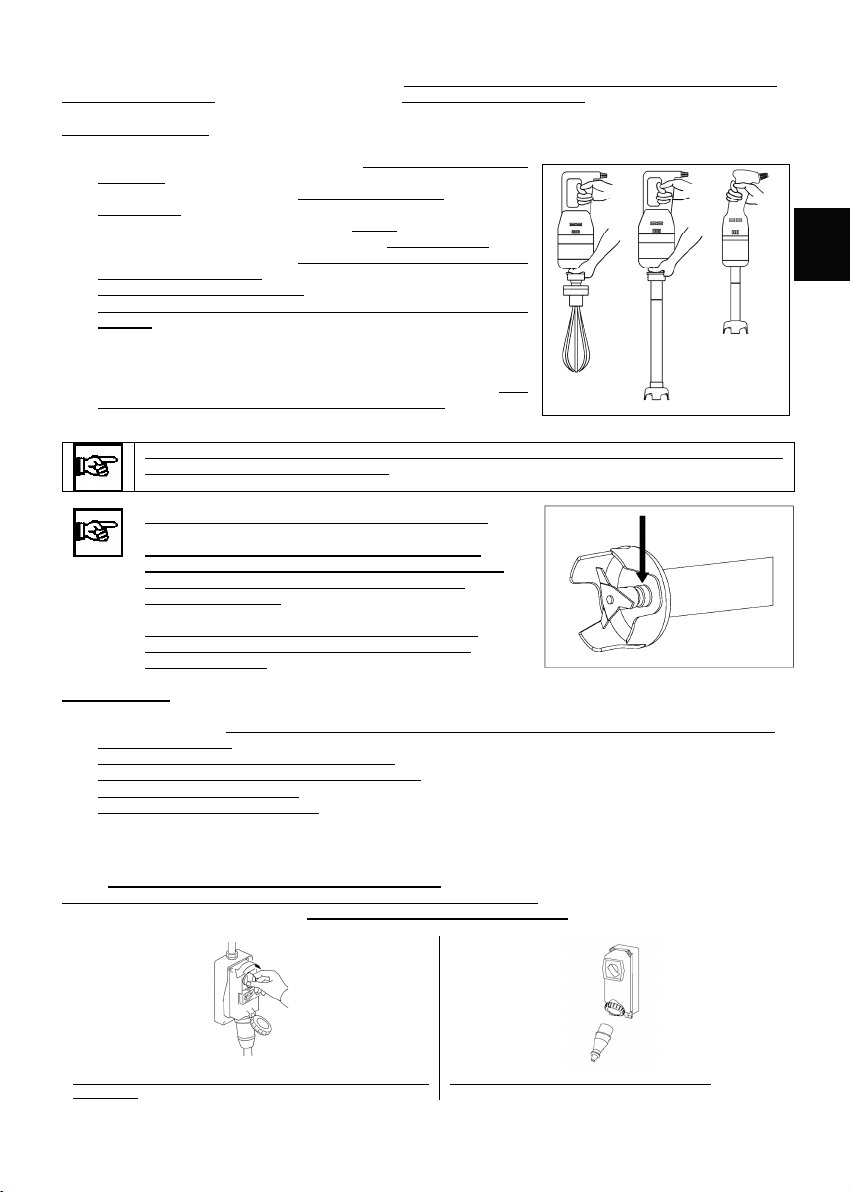
Para cualquier tipo de intervención o por la sustitución de las partes que resultan dañadas, activar el servicio de manutención.
La eventual sustitución tiene que ocurrir con productos originales del constructor u al menos de calidad, seguridad y
características equivalentes. Por ahondamientos contactar el Centro de Asistencia Autorizado
PUESTA EN FUNCIÓN
El operador de la máquina, puede poner en función la máquina, siguiendo en orden las indicaciones bajo reconducidas:
1. Resultado positivo de los controles de las operaciones preliminares de
preparación,
2. Resultado positivo de los controles a la alimentación eléctrica,
3. Abrocho de la espina en oportuna toma de corriente,
4. Resultado positivo de los controles de que al montaje,
5. Resultado positivo de los controles / verificaciones antes del arranque,
6. Resultado positivo de los controles finalizados a verificar el respeto de todas
las condiciones de seguridad,
7. Introducir manualmente el producto alimenticio dentro de la olla,
8. Con el empleo de ambas las manos agarrar la máquina en las zonas
previstas:
a. posicionarla con el utensilio dentro de la olla,
b. encaminarla, mantenerla y manejarla hasta al final de la
elaboración del producto alimenticio,
9. Cuando el producto alimenticio ha alcanzado la consistencia deseada, parar
la máquina y posicionarla sobre un adecuado banco de apoyo,
10. descargar manualmente el producto alimenticio de la olla, agarrándola con
ambas las manos y vertiendo el producto alimenticio dónde necesario.
es prohibido introducir la máquina en la olla, más allá de la muesca de inmersión y en todo caso más allá
de la abrazadera de bloqueo del utensilio
Se encomienda de no hacer funcionar la máquina a vacío.
Se recomienda el control periódico de la integridad de la
guarnición de goma situada debajo de la lama (ver dibujo al
lado) y el reemplazo de la misma en el caso en que sea
perjudicada o gastada.
La integridad de la guarnición impide la infiltración del
producto de elaboración adentro del utensilio evitando
daños al mezclador .
APAGAMIENTO
En sucesión, las operaciones de apagamiento tienen que seguir cuánto en seguida indicado:
1. antes del apagamiento esperar la conclusión de la elaboración, o bien esperar que el producto alimenticio haya alcanzado
la consistencia deseada,
2. parar la máquina concediendo los aparatos de mando previstos,
3. posicionar la máquina sobre un adecuado banco de apoyo
4. desconectar la espina de la máquina de la toma de alimentación,
5. ejecutar las intervenciones de limpieza.
CAP. 5. MANUTENCIÓN, BÚSQUEDA AVERÍAS Y LIMPIEZA
PRESCRIPCIONES DE MANUTENCIÓN
AISLAMIENTO DE LOS MANANTIALES DE ALIMENTACIÓN EXTERNA
Antes de ejecutar cualquiera operación de manutención, limpieza y sustitución partes, se tienen que seccionar y aislar los
manantiales de alimentación externa.
ESPAÑOL
Posicionar a "cero" el aparato de protección puesto a monte de la línea de
alimentación del equipo eléctrico.
11 13
TRADUCCIÓN DE LAS INSTRUCCIONES ORIGINALES
Desconectar el aparato de seccionamiento general y proveer a
proteger la espina con adecuados sistemas
Pag. di
Page 40
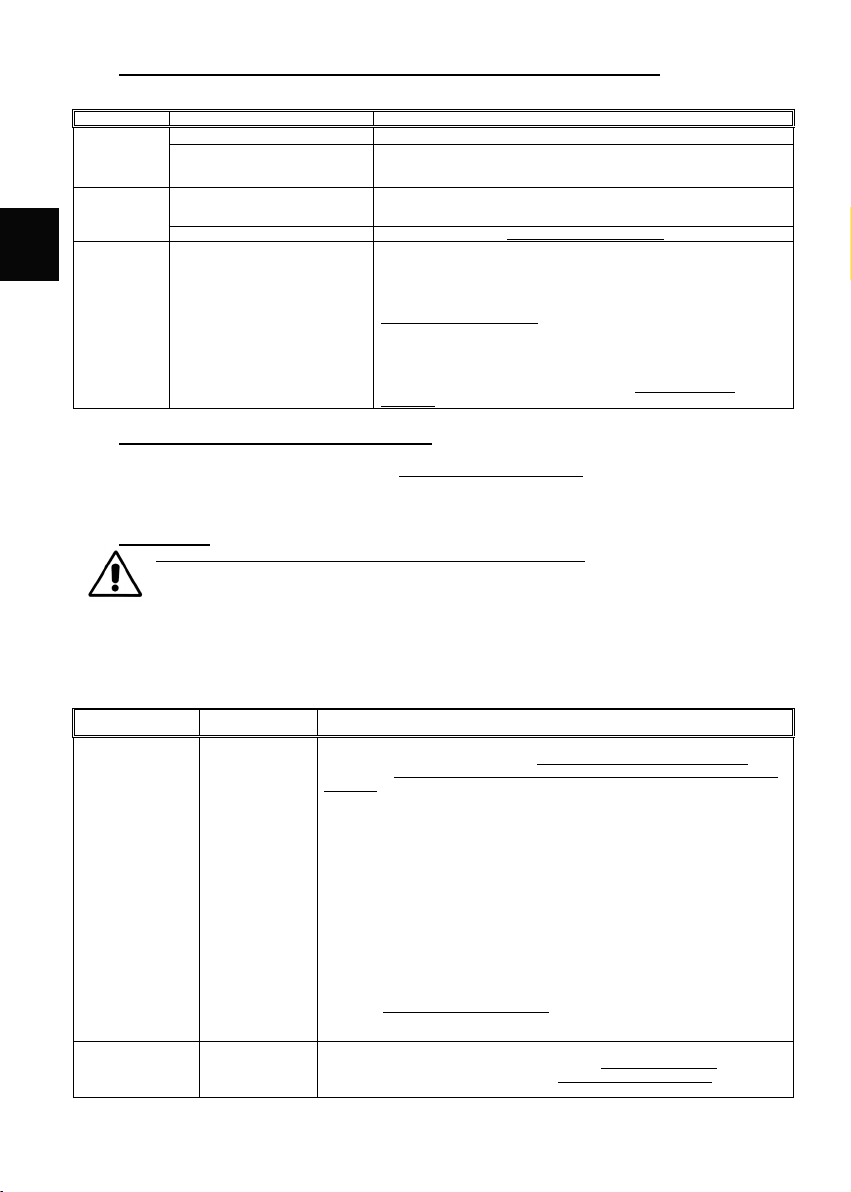
BUSQUEDA AVERÍAS Y DESBLOQUEO ELEMENTOS MÓVILES
En seguida son indicados las intervenciones por la búsqueda estropeas o averías y desbloqueo elementos móviles que
pueden ser desarrollados por el manutentor.
TIPO POTENZIAL/ES CAUSA/S MODALIDAD Y COTEJOS
Falta tensión de
red
Interrupción de
funcionamiento
ESPAÑOL
La máquina no
funciona: las
hojas no giran
o no ejecutan
correctamente
el corte
Black out general Contactar el ente distribuidor de la energía eléctrica
Intervención de fusibles o
magnetotérmicos sitios aguas arriba de
la línea de alimentación de la máquina
Intervención del aparato de protección
interno a la máquina
Causa/s no identificables Contactar directamente el Centro de Asistencia Autorizado
Falta tensión de alimentación.
Aparatos de seccionamiento sobre “O”.
Faltado funcionamiento del interruptor
de marcha
Intervención térmica debida a
sobrecalentamiento
Visualización sobre la pantalla de la
letra “E”
Después de haber eliminado las causas que han determinado la intervención del
aparato de protección, restablecerlo. En caso de persistencia del problema contactar
a un técnico electricista.
Contactar a un técnico electricista: después de haber eliminado las causas que han
determinado la intervención de un aparato de protección, restablecerlo.
Controlar y restablecer la energía eléctrica.
Insertar la espina sobre toma de alimentación
Controlar la eficiencia del interruptor y eventualmente contactar directamente el
Centro de Asistencia Autorizado.
Esperar el completo enfriamiento antes del reavivo máquina
Lector velocidad estropeo, contactar directamente el Centro de Asistencia
Autorizado
MANUTENCIÓN EXTRAORDINARIA
Por las intervenciones de manutención extraordinaria, consiguientes a roturas o a revisiones o daños mecanicos o electricos,
es necesaria una solicitud de intervención directamente al Centro de Asistencia Autorizado.
Las instrucciones relativas a la manutención extraordinaria, no comparecen en el presente manual de instrucciones y
uso y tienen que ser explícitamente solicitadas al fabricante.
LIMPIEZA
Es prohibido limpiar a mano los órganos y los elementos en movimiento.
Todas las intervenciones de limpieza tienen que ser puestos en acto sólo y exclusivamente, después de haber
descargado la máquina con el producto alimenticio en elaboración y haberla aislada del manantial de
alimentación eléctrica y energía externa.
La máquina, la instrumentación eléctrica y los componentes a bordo máquina, no tienen que ser lavados
nunca utilizando agua, tan menos en forma de chorros de cualquiera natura y cantidad; por tanto, sin
La clasificación del nivel de higiene de la máquina y los aparejos asociados, por el empleo previsto, es 2 (dos):
máquina que, en consecuencia de una valoración del riesgo de higiene, está conforme a los requisitos de las normas
internacionales aplicables, pero solicita un desensamblaje programado por la limpieza.
FRECUENCIA PERSONAL MODALIDAD
Al término de cada
turno de trabajo y en
todo caso antes del
empleo diario
12 13
"cubo" ni "goma" ni "esponja". No poner nunca directamente la máquina en el lavabo o bajo el grifo.
Operador Todas las superficies y las partes de las maquina destinadas a venir a contacto con el producto
alimenticio, o bien, las zonas alimenticias (superficie externa e interna de los utensilios), y las
zonas rocías (superficie superior del utensilio en ataque a la máquina y a superficie externa de
la máquina), tienen que ser limpiadas y desinfectadas con las modalidades bajo reconducidas.
Por las actividades de desmontaje de los utensilios, ver anteriores descripciones.
Desconchar las superficies de los eventuales restos de producto alimentar (por ej. con
raspador de plástico);
Limpiar todas las superficies de la zona alimenticia y zona rocías con un paño blando
humedecido (no goteato) con detergente diluido en agua caliente (también del común
jabón por platos va muy bien). Utilizar productos específicos por acero, estos tienen que ser
líquidos (no en crema o pastas en todo caso abrasivas) y sobre todo no tienen que contener
cloro. Contra las sustancias gordas se puede usar el alcohol desnaturalizado.
Aclarar con agua caliente limpia y sucesivamente secar todas las superficies de la zona
alimenticia y zona rocía con un paño blando que no pierda pelos.
El utensilio batidora, incluso estando de acero inoxidable, no puede ser lavado en
lavavajillas, tan menos las partes plásticas.
El reensamblaje tiene que sólo ocurrir a causa de una exigencia de elaboración, dejar los
trozos envueltos de un paño blando seco que no pierda pelos.
PERÍODOS DE LARGA INACTIVIDAD
Durante los períodos de larga inactividad de la máquina proveer a dar enérgicamente
sobre todas las superficies de acero (especialmente si inoxidable) un paño mojado de aceite
de vaselina de modo de tender un velo protector.
COSAS DE NO HACER ANTES O DURANTE LA LIMPIEZA:
Acceder a los elementos móviles sin haber verificado preventivamente el paro;
Acceder a los elementos móviles sin haberla parada en seguridad garantizada (bloqueo en la
posición de cero de los aparatos de seccionamiento de la alimentación eléctrica)
TRADUCCIÓN DE LAS INSTRUCCIONES ORIGINALES
Pag. di
Page 41
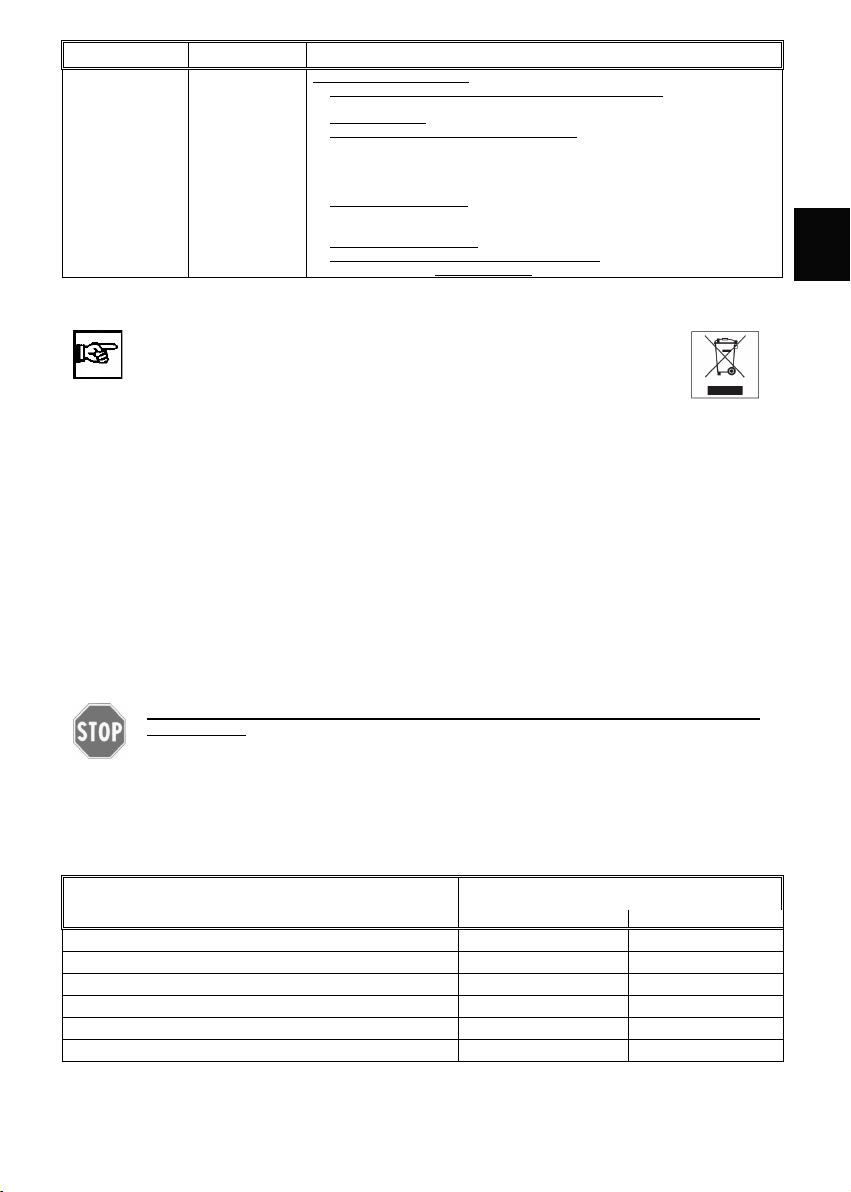
FRECUENCIA PERSONAL MODALIDAD
PRODUCTOS DE NO USAR:
aire comprimido con chorros hacia las zonas con depósitos de harina y en general hacia la
máquina;
dispositivos a vapor;
detergente que contienen CLORO (aunque diluidos) o sus compuestos como: la lejía, el
ácido muriático, productos para desatascar el descargue, productos para la limpieza del
mármol, decalcificantes en general, etc… pueden atacar la composición del acero,
manchándolo u oxidándolo irreparablemente. Las solas exhalaciones de susodichos
productos pueden oxidar y en algunos casos corroer el acero;
pajuela, cepillos o disquetes abrasivos realizados con otros metales o ligas, ej. acero común,
aluminio, latón, etc…) o bien utensilios que hayan limpiado anteriormente otros metales o
ligas.
detergentes en polvo abrasivos;
gasolina, solventes o fluidos inflamables y/o corrosivos;
sustancias empleadas para limpiar la plata.
CAP. 6. DESMANTELAMIENTO
En caso de que decida no utilizar más la máquina porque ha quedado obsoleta, estropeada o desgastada, su puesta fuera de
servicio debe ser realizada por personal debidamente cualificado y equipado. Al finalizar la actividad de desmantelamiento,
todas la placas relativas a las especificaciones técnicas y demás documentos deben ser destruidos. La máquina puede ser
eliminada sin necesidad de reducirla en piezas diminutas, siendo suficiente desconectar los principales grupos que la componen
y enviarlos al desguace.
No elimine la máquina como residuo urbano mixto sino que debe efectuar la recogida diferenciada.
Los sistemas de retiro o de recogida de la máquina son:
En la máquina no hay sustancias peligrosas con efectos potencialmente nocivos sobre el medio ambiente o la salud humana. Es
fundamental que los compradores contribuyan a la reutilización, al reciclaje y otras formas de recuperación de la máquina. Es
una obligación del empleador estar al corriente de las leyes vigentes que regulan la materia en su propio país y actuar de modo
que pueda cumplir dichas obligaciones.
El símbolo del cubo de basura tachado en la máquina indica que el producto, al final de
su vida útil, debe ser tratado separadamente de otros residuos.
Retiro a través del consorcio del distribuidor.
Posibilidad de entrega de la máquina al distribuidor, equivalente al acto de compra de una máquina nueva.
Queda prohibido y, es susceptible de sanciones, el abandono de la máquina y del equipo eléctrico en el
medio ambiente.
CAP. 7. MATERIALES DE CONSTRUCCIÓN
A segunda de las exigencias de funcionamiento y producción, la máquina puede ser constituida con muchas tipologías de
materiales de construcción.
GRUPO
Cuerpo maquina
Utensilio de corte de la batidora
Campana del utensilio batidora
Tubo del utensilio batidora
Caja reductor utensilios varilla
Utensilios varilla
TIPOLOGÍA MATERIALES
Acero inox AISI 304 Plástico por alimentos
●
●
●
●
●
●
ESPAÑOL
13 13
TRADUCCIÓN DE LAS INSTRUCCIONES ORIGINALES
Pag. di
Page 42

Page 43

Page 44

INDEX
CHAP. 1. ORGANISATION DU CONTENU ET MODALITES DE CONSULTATION 3
CHAP. 2. INFORMATIONS GENERALES ET CARACTERISTIQUES 4
CHAP. 3. INSTRUCTIONS POUR LA SECURITE 8
CHAP. 4. MISE EN ROUTE ET EMPLOI 8
CHAP. 5. ENTRETIEN, RECHERCHE PANNES ET NETTOYAGE 11
CHAP. 6. EVACUATION 13
CHAP. 7. MATERIAUX DE CONSTRUCTION 13
FRANÇAIS FRANÇAIS
GARANTIE
La machine est garantie 12 (douze) mois dès la date de la vente.
La garantie couvre les réparations des machines achetées chez les points de vente autorisés, au cas où il serait démontré
qu’elles sont défectueuses dans les matériaux ou dans l’assemblage, aux conditions établies ci-de suite:
6. par garantie l’on entend le remplacement gratuit de toutes les parties qui sont résultées défectueuses de fabrication. La
garantie déchoit si non accompagnée de ticket de caisse ou facture attestant l'achat et pour les cas suivants:
a. effraction de la machine ou endommagement de la machine même dû à incurie;
b. emploi de la machine avec des modalités non conformes aux avertissements rapportés sur le mode d’emploi ;
c. dommages provoqués par la non aptitude du milieu dans lequel l'appareil opère et par des phénomènes non
dépendants du fonctionnement normal de la machine (irrégularité des valeurs tension et fréquence dans
l’installation de réseau);
d. interventions de réparation effectuées par des personnes ou centres non autorisés par le fabricant,
7. la demande d’ intervention en garantie devra être effectuée uniquement à des points de vente ou des laboratoires
autorisés;
8. la machine devra être rendue en port franc au constructeur pour la réparation les frais de transport sont toujours à la
charge du destinataire,
9. le remplacement de la machine et le prolongement de la garantie suite à intervention pour panne sont exclus;
10. le fabricant ne répond pas de pannes directes ou indirectes de n’importe quelle nature à des personnes ou choses pour
l'emploi impropre de la machine ou pour inemploi pendant le temps nécessaire pour les réparations.
Notice d’emploi
Edition
Janvier 2015
2 13
TRADUCTION DES MODES D’EMPLOIS ORIGINALS
Pag. di
Page 45

CHAP. 1. ORGANISATION DU CONTENU ET MODALITES DE CONSULTATION
BUT DU MANUEL
IMPORTANCE DU MANUEL
Le mode d’emploi présent doit être considéré comme partie intégrante de la machine:
1. il doit être gardé pendant toute la vie de la machine.
2. il doit accompagner la machine en cas de cession de la même.
3. outre à rapporter toutes les informations utiles pour les opérateurs, il contient (recueillis en des chapitres spécifiques), les
schémas électriques qui serviront pour les interventions éventuelles d’entretien et réparation.
BUT / FINALITES DU MANUEL
La notice d’utilisation a le but de fournir au client toutes les informations nécessaires afin que, outre à un emploi adéquat de la
machine fournie, il soit en état de gérer la même dans la façon la plus autonome et sure possible.
En outre, le manuel présent a été rédigé dans le but de fournir des indications et des avertissements pour connaître la
machine fournie, pour comprendre ses principes et limites de fonctionnement. Pour des doutes éventuels appeler le Centre d’
Assistance Autorisé.
DESTINATAIRES
Le mode d’emploi présent, livré en numéro de nr. 1 copie avec la machine, et fourni comme partie intégrante du même,
s’adresse soit aux opérateurs soit aux techniciens qualifiés habilités à l’installation, emploi et entretien.
Le responsable du service de prévention et protection du client et les préposés ultérieurs auxquels la machine est destinée,
doivent prendre vision du mode d’emploi présent dans le but d’ adopter toutes les mesures techniques et organisationnelles
RESPONSABILITES
Les responsables d’usine, qui dirigent les activités de travail, doivent, dans le domaine des attributions et
Au cas où le manuel présent subirait des endommagements ou serait égaré, il est possible en demander
une copie au Centre d’ Assistance Autorisé.
Le manuel présent reflète l’état de la technique au moment de la construction de la machine; le
constructeur se réserve le droit de mettre à jour la production et par conséquent d’autres éditions du
manuel, sans l’obligation de mettre à jour les productions ou les manuels précédant, sinon en des cas
particuliers concernant la santé et la sécurité des personnes.
Faire particulièrement attention au contenu des risques résidus présents sur la machine et les prescriptions
que les opérateurs doivent suivre.
Le constructeur se considère responsable pour la machine dans sa configuration originelle.
Le constructeur ne se considère pas responsable pour des endommagements provoqués par l’emploi
impropre ou non correct de la machine et de la documentation ou pour des endommagements provoqués
par l’effraction de normes impératives, négligence, maladresse, imprudence et non respect de normes
réglementaires de la part de l’employeur, de l’opérateur ou du manutentionnaire et pour toute panne
éventuelle causée par un emploi irraisonnable, impropre et/ou incorrect
Le constructeur ne se considère pas responsable pour les conséquences provoquées par l’emploi de pièces
de rechanges non originelles ou de caractéristiques équivalentes.
Le constructeur se considère responsable seulement pour les informations rapportées dans la version
originelle du manuel en langue italienne.
L’inobservance des prescriptions contenues dans ce manuel provoquera l’immédiate déchéance de la
garantie.
compétences respectives:
Réaliser les mesures de sécurité prévues;
Informer les opérateurs des risques spécifiques auxquels ils sont exposés et faire leur connaître les normes
essentielles de prévention;
Disposer et exiger que chaque opérateur observe les normes de sécurité et emploie les moyens de
protection mis à leur disposition:
Placer plus d’un opérateur, en contemporaine, au travail sur ce produit manufacturé.
AIS
FRANÇ
3 13
TRADUCTION DES MODES D’EMPLOIS ORIGINALS
Pag. di
Page 46
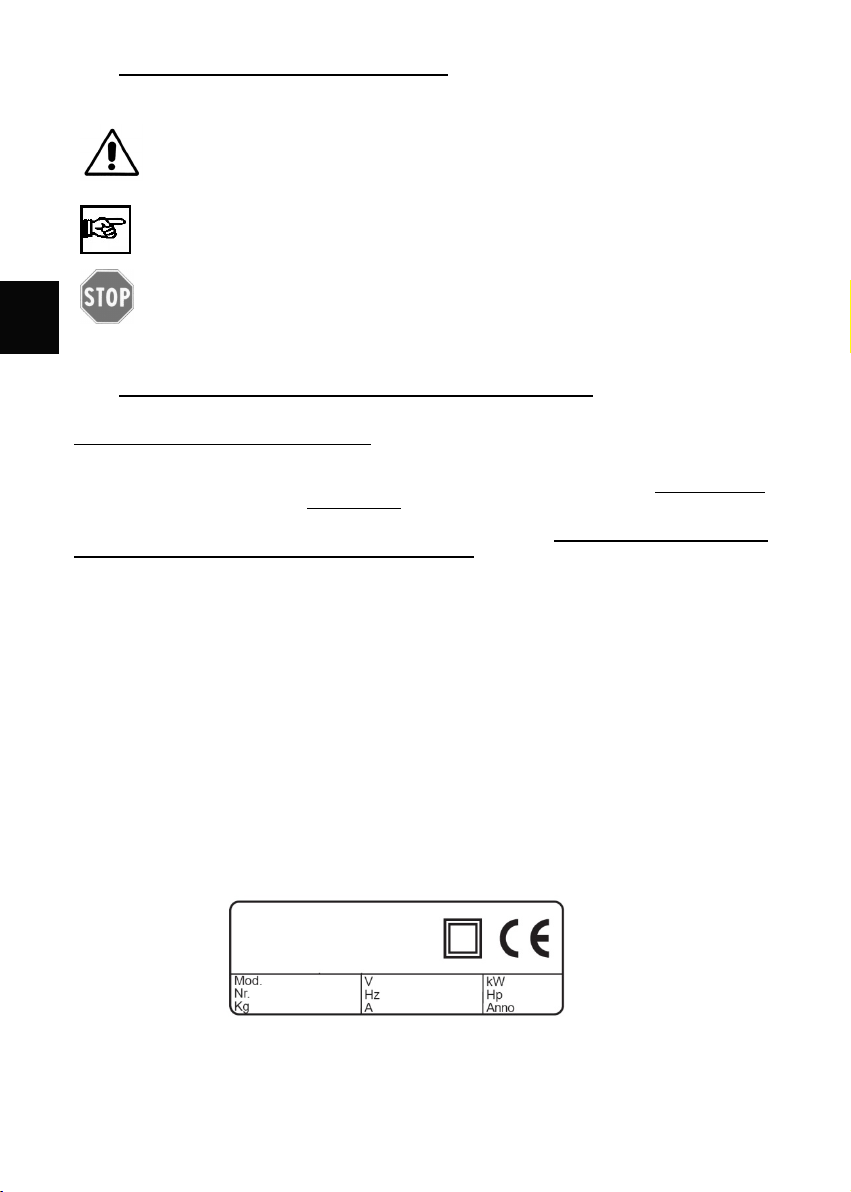
SIGNIFICATION DE LA SYMBOLOGIE
Ci de suite on spécifique clairement la signification des symboles et des définitions qui seront utilisés dans le
document présent.
DANGER
Il indique la présence d’un danger pour celui qui opère sur la machine et pour celui qui se trouve dans les
environs donc l’activité signalée doit être effectuée en respectant les normes anti-accidents en vigueur et les
indications rapportées dans le manuel présent.
PRECAUTION
Il indique un avertissement sur des informations utiles et/ou des recommandations ultérieures et/ou des procédés
concernant l’opération en cours.
FRANÇAIS FRANÇAIS
CHAP. 2. INFORMATIONS GENERALES ET CARACTERISTIQUES
ATTENTION
Il indique une opération à exécuter avec attention pour éviter d’endommager la machine.
DESTINATION EMPLOI ET PARTIES CONSTRUCTIVES
Le mixer ci de suite appelé “machine”, est une machine portable projetée pour fouetter, mixer, broyer, émietter, émulsionner,
réduire en bouillie, etc.., à utiliser dans la restauration collective et institutionnelle.
Avec la machine en marche de l’outil que l’on utilise, il est possible préparer directement dans la casserole des minestrones,
des soupes, des purées, des crèmes, des pastelles, de la mayonnaise, de la pâte d’amandes, des crèmes de fromage et toute autre
chose de semblable.
La machine se compose d’ un moteur électrique introduit dans une unique fusion de matériel plastique (corps machine base),
dans lequel l’arbre moteur est connecté à l’outil de travail: mixer ou fouet.
L’outil est connecté et bloqué au corps machine ou par une virole vissée, ou par une attache à déclenchement instantané.
Le produit alimentaire est chargé manuellement dans le conteneur et successivement, en employant toutes les deux mains et
en saisissant la machine dans les zones prévues (voir figure page11), la même est:
1. positionnée avec l’outil dans le récipient ou la casserole;
2. vissée et utilisée jusqu’à la fin de l’usinage du produit alimentaire;
3. arrêtée et positionnée sur un banc d’appui adéquat.
Selon les modalités opérationnelles et l’outil utilisé, la machine peut :
1. marcher restant appuyée sur le fond du conteneur (avec l’outil mixer), sans dépasser de toute façon le cran d’ immersion,
2. marcher en la tenant suspendue, à l’aide de toutes les deux mains (avec l’outil fouet),
3. marcher positionnée sur un support spécial qui peut être adapté à la casserole. Le support agit comme remplacement de
l’opérateur pour des opérations qui demandent des temps longs ou pour des traitements alimentaires qui peuvent
présenter des risques d’ ustions (vapeur ou giclées).
Le déchargement du produit alimentaire, une fois le cycle d’usinage terminé, est effectué manuellement après avoir extrait la
machine du récipient.
Tous les matériaux à contact direct avec le produit alimentaire sont conformes aux normes hygiéniques pour aliments en
vigueur.
Selon les exigences de fonctionnement et de production, la machine peut être constituée avec des différentes parties
optionnelles.
La machine est douée de plaquette d’ identification sur laquelle elles sont rapportées les données suivantes:
[fac-similé]
4 13
TRADUCTION DES MODES D’EMPLOIS ORIGINALS
Pag. di
Page 47
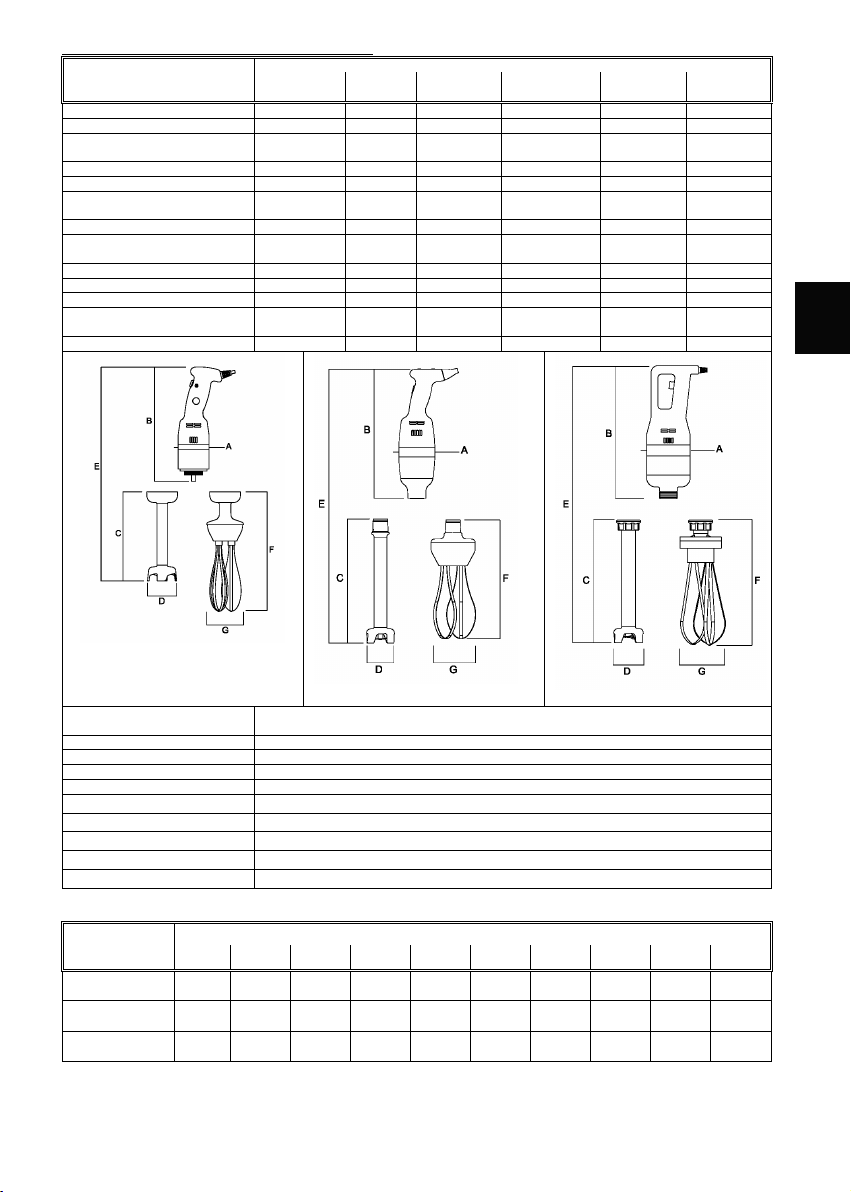
DONNEES TECHNIQUES ET CONSTRUCTIVES
DONNEES TECHNIQUES
Puissance moteur (W) 250 300 350 400 450 650
Vitesse maximum (tours/min) 15000 13000 15000 15000 17000 13000
Vitesse variable (tours/min)
seulement modèles VV
Dimensions: A (mm) Ø75
Dimensions: B (mm) 285 350 360 350 380 400
Dimensions: C (mm)
Dimensions: D (mm) Ø75 Ø85 Ø95 Ø85 Ø95 Ø95
Dimensions: E (mm)
Dimensions: F (mm) 290 330 360 330 360 360
Dimensions: G (mm) 90 120 120 120 120 120
Masse corps machine (kg) 1,0 1,8 2,6 2,1 3,2 3,6
Masse mixer (kg)
Masse fouet (kg) 0,450 0,800 1,0 0,800 1,0 1,0
250VF
250VV
2500 ÷ 15000
220 / 270
470/ 520
0,400/ 0,450
300VV 350VF
2000 ÷
9000
Ø100 Ø130 Ø100 Ø130 Ø130
340 / 440
/ 540
650/ 750 /
/ 850
0,850 /1,0
/ 1,2
MODELE
350VV
2000 ÷ 9000 2000 ÷ 9000
330 / 430 /
530 / 630
680/ 780 /
880 / 980
1,2 / 1,5/
1,7 / 1,9
400VV 450VF
340 / 440 / 540
650 / 750 /
850
0,850 /1,0
/ 1,2
450VV
2000 ÷
11000
330 / 430 /
530 / 630
700 / 800 /
900 / 1000
1,2 / 1,5/
1,7 / 1,9
2000 ÷ 9000
330 / 430 /
530 /630
720 / 820 /
920/ 1020
1,7 / 1,9
650VF
650VV
1,2/1,5/
AIS
FRANÇ
Niveau de pression acoustique
continu équivalent pondéré A
Nature du courant - Fréquence Cfr. Plaque de la machine
Courant à pleine charge Cfr. Plaque de la machine
Tension nominale d’emploi Cfr. Plaque de la machine
Tension des circuits auxiliaires Cfr. Plaque de la machine
Système de protection Double isolément
Degré de protection IP X3
Température air milieu max +40°C
Eclairage minimum demandé 500 lux
Conformités directives de produit
250 VV-VF
300 / 400 VV
2006/42/CE, 2006/95/CE et modifications successives et intégrations, Reg. 1935/2004
350 / 450 / 650 VF-VV
Mineur de 70dBA
DONNEES
TECHNIQUES
Vitesse variable /
Outil mixer
Outil fouet /
5 13
250VF 250VV 300VV 350VF 350VV 400VV 450VF 450VV 650VF 650VV
● ●
/
● ● ● ● ● ● ● ● ● ●
● ●
TRADUCTION DES MODES D’EMPLOIS ORIGINALS
/
MODELE
● ●
● ●
/
●
/
●
/
/
Pag. di
●
●
Page 48
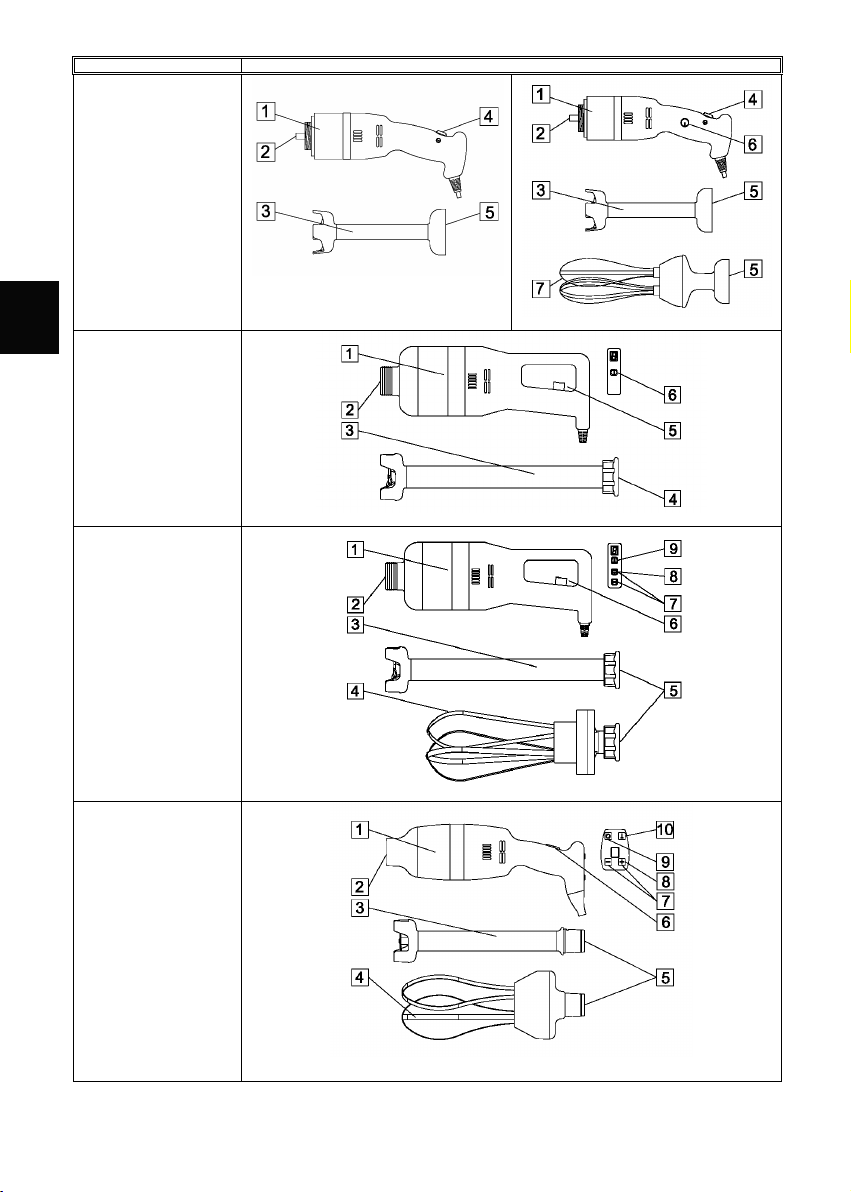
GROUPE EXEMPLE
1. corps machine
2. attache pour outils
3. outil mixer
4. poussoir de démarrage
5. collier blocage outil
6. variateur vites
7. outil fouet
FRANÇAIS FRANÇAIS
1. corps machine
2. attache pour outils
3. outil mixer
4. collier blocage outil
5. poussoir de démarrage
6. touche sécurité pour
démarrage
250VF
250VV
1. corps machine
2. attache pour outils
3. outil mixer
4. outil fouet
5. collier blocage outil
6. poussoir de démarrage
7. commandes variation
vitesse
8. touche sécurité pour
démarrage
9. commutateur mixer / fouet
1. corps machine
2. attache pour outils
3. outil mixer
4. outil fouet
5. embrayage rapide blocage
outil
6. poussoir de démarrage
7. commandes variation
vitesse
8. touche sécurité démarrage
9. touche emploi continu
10. commutateur mixer / fouet
350 / 450 / 650 VF
350 / 450 / 650 VV
300 / 400 VV
6 13
TRADUCTION DES MODES D’EMPLOIS ORIGINALS
Pag. di
Page 49
EMPLOI NORMAL, EMPLOI IMPROPRE, EMPLOI NON CORRECT OU
INTERDIT
La machine décrite dans le mode d’emploi présent est prévue pour être conduite par un seul opérateur formé et renseigné sur
les risques résidus, mais avec les compétences, en matière de sécurité, des préposés à l’entretien.
L'opérateur devra posséder au moins l'âge minimum prévu par les lois sociales dans le domaine du travail et avoir joui de la
préparation technique nécessaire au moins d’un opérateur plus expert qui l’ait préliminairement formé à l’emploi correct de la
machine.
7 13
Dans son EMPLOI NORMAL, et raisonnablement prévisible, la machine peut être utilisée seulement pour écraser,
mixer, broyer, émietter, fouetter, réduire en bouillie, émulsionner, etc… directement en casserole ou récipient adéquat, à
utiliser dans la restauration collective et institutionnelle.
Selon le type d’outil, il est possible préparer directement en casserole des minestrones, des soupes, des purées, des
crèmes, des pastelles, de la mayonnaise, de la pâte d’amandes, des crèmes de fromage et toute autre chose de semblable.
La machine doit être saisie, soutenue et maniée, en positionnant les mains dans les zones prescrites (voir figure page
11).
La machine ne doit pas être utilisée DE FAÇON IMPROPRE; en particulier:
1. elle ne doit pas être employée pour des emplois domestiques,
2. il ne faut pas la faire marcher avec des paramètres différents de ceux rapportés dans la tabelle des caractéristiques
techniques,
3. pour chaque emploi de la machine avec des modalités différentes de celles indiquées dans le manuel présent, le
constructeur en décline toute responsabilité,
4. l’utilisateur est responsable des dommages résultant de la non observance des conditions d’exercice concordées en
siège de spécification technique et de confirmation de commande,
5. il ne faut pas faire marcher les outils à vide;
6. ne pas altérer ou détériorer volontairement ni enlever ou cacher les étiquettes.
La machine ne doit pas être utilisée DE FAÇON NON CORRECTE ou INTERDITE puisque l’on pourrait causer des
dommages ou des blessures pour l’opérateur; en particulier:
1. il est interdit de tendre le câble d’ alimentation électrique ou la machine pour débrancher la fiche d’
alimentation,
2. il est interdit de placer des poids sur la machine ou sur le câble d’alimentation électrique,
3. il est interdit de positionner le câble d’ alimentation électrique sur des parties coupantes ou avec danger d’
ustion,
4. il est interdit l’emploi de la machine avec le câble d’ alimentation électrique ou les dispositifs de commande
endommagés et non intacts;
5. il est interdit de laisser la machine arrêtée avec le câble d’ alimentation électrique branché à la fiche,
6. il est interdit d’ introduire n’importe quel type d’objet à l’intérieur de la calotte de ventilation du moteur;
7. il est interdit de positionner la machine sur des objets différents d’ un banc de travail employé dans le secteur
alimentaire de hauteur comprise entre 900 - 1100mm du plan de piétinement,
8. il est interdit l’emploi de substances inflammables, corrosives ou nuisibles pour le nettoyage ou produits
excessivement alcalins tels que la soude caustique ou ammoniaque,
9. il est interdit de plonger la machine dans l’eau ou d’autres liquides;
10. il est interdit l’emploi à un personnel non autorisé et avec des vêtements différents de ceux indiqués pour
l’emploi,
11. il est interdit l’emploi de l’outil fouet dans les machines à vitesse fixe,
12. il est interdit d’introduire dans la casserole avec la machine branchée et en marche, des produits ou des
objets ayant des caractéristiques différentes de celles indiquées dans l’emploi normal, tels que par exemple des
os, de la viande congelée, des produits non alimentaires, ou d’autres objets tels que écharpes, etc…,
13. il est interdit de saisir, soutenir et manier la machine, en positionnant les mains en des zones différentes de
celles indiquées dans l’emploi normal et de toute façon maintenir en fonction la machine avec une seule main,
14. il est interdit de pousser ou faire pousser par d’autres les produits alimentaires ou les ingrédients vers le
fond de la casserole avec la machine insérée et en fonction, et en général introduir les mains ou toute autre
partie du corps dans la casserole pendant le fonctionnement de la machine,
15. il est interdit d’introduire la machine dans la casserole outre le cran d’immersion et de toute façon outre le
collier de serrage de l’outil,
16. il est interdit d’enlever la machine de la casserole avant que l’outil se soit complètement arrêté et de toute
façon avant 10 sec de la commande d’arrêt de la machine,
17. il est interdit d’agir sur les systèmes de blocage des outils
10 sec de la commande d’ arrêt de la machine et branchée à l’alimentation électrique,
18. il est interdit l’ enlèvement partiel des protections et des signalisations de danger.
19. il est interdit le fonctionnement sans que l’utilisateur n’ait pas adopté toutes les mesures concernant
l’élimination des risques résidus,
20. il est interdit de fumer ou utiliser des appareils à flamme libre et manipuler des matériaux incandescents, au
moins que l’on n’ait pas adopté des mesures de sécurité appropriées,
21. il est interdit d’actionner ou régler les dispositifs de contrôle et de blocage tels que pommeaux ou similaires
soit pendant le fonctionnement de la machine, soit si l’on n’est pas autorisés
avant l’arrêt complet de l’outil et de toute façon avant
L’utilisateur est de toute façon responsable des dommages résultant de la non observance des conditions
d’emploi normal spécifiées. Pour des doutes éventuels s’adresser au Centre d’ Assistance Autorisé.
TRADUCTION DES MODES D’EMPLOIS ORIGINALS
Pag. di
AIS
FRANÇ
Page 50
CHAP. 3. INSTRUCTIONS POUR LA SECURITE
PREMESSE
La non application des normes et procédures de sécurité peut être source de danger et de dommage.
La machine s’entend vinculée dans l’emploi au respect, de la part de l’usager final, de:
3. toutes les règles, d’introduction dans le milieu et de comportement des personnes, établies par les lois
et/ou normes appliquables; avec une référence particulière à l’installation fixe en amont de la machine
fournie et pour son branchement /fonctionnement;
4. toutes les instructions ultérieures et avertissements d’emploi faisant partie de la documentation
technique/graphique annexe à la machine même.
Sauf où différemment spécifié, le personnel qui exécute les interventions d’ installation, branchement,
entretien, réinstallation et réutilisation, recherche pannes ou avaries, démolition et démantèlement doit
être un personnel expert formé en matière de sécurité et reinsegné sur les risques résidus, avec les
compétences, en matière de sécurité, des préposés à l’entretien.
FRANÇAIS FRANÇAIS
MILIEUX, PLACES DE TRAVAIL ET DE PASSAGE
Le milieu de travail doit répondre aux qualités requises par la directive 89/654/CEE. Dans la zone de travail ils ne doivent pas
être présents des objets étrangers. L’employeur , dans le respect de la directive 89/391/CEE, concernant la réalisation de
mesures visées à favoriser l’améliorement de la sécurité et de la santé des ouvriers pendant le travail, doit pourvoir à éliminer
ou reduire les risques résidus indiqués comme prévu dans le manuel présent.
AVERTISSEMENTS CONCERNANT LES RISQUES RESIDUS
RISQUE RESIDU DU A L’ENLEVEMENT DES ABRIS FIXES, INTERVENTIONS SUR DES PARTIES
CASSEES/USEES
A tout hasard l'opérateur ne doit jamais essayer d’ouvrir ou enlever un abri fixe ou forcer un dispositif de
sécurité.
Dans la phase d’ outillage, d’ entretien, de remplacement des outils et de nettoyage, et pendant toutes les
ultérieures opérations manuelles qui sont effectuées en introduisant les mains ou d’autres parties du corps
dans les zones dangereuses de la machine, un risque résidu persiste dû surtout à:
1. des collisions avec des parties constructives de la machine,
2. frottement et/ou abrasion avec des parties rugueuses de la machine,
3. piqûre avec les parties pointues,
4. coupure avec des parties affilées des outils.
En outre dans la phase de nettoyage ou déblocage des pièces encastrées dans les lames qui se produit aussi en
introduisant les mains à proximité des outils de coupure, un risque résidu dû surtout à coupure avec des parties
affilées des outils persiste.
L’opérateur et le manutentionnaire doivent être formés pour l'intervention liée aux opérations manuelles
avec des abris ouverts, doivent être formés sur les risques conséquant liés et doivent être autorisés par une
personne responsable et doivent employer des dispositifs adéquats de protection individuelle, des gants anti-
coupe à cinq doigts. Toutes les interventions sur les disques doivent se produire en les tenant avec les lames
tournées vers le bas.
CHAP. 4. MISE EN ROUTE ET EMPLOI
La gestion de la machine est consentie uniquement à un personnel autorisé et opportunément formé et doué
d’une expérience technique suffisante.
Avant de démarrer la machine effectuer les opérations suivantes:
lire attentivement les documents techniques,
connaître quels protections et dispositifs d’émergence sont disponibles sur la machine, leur localisation et
leur fonctionnement.
L’emploi non autorisé de parties commerciales et accessoires faisant partie des protections et des dispositifs de
sécurité peut provoquer des défaillances et des situations de danger pour le personnel opérateur. L’opérateur
doit en outre avoir reçu une formation adéquate.
8 13
TRADUCTION DES MODES D’EMPLOIS ORIGINALS
Pag. di
Page 51
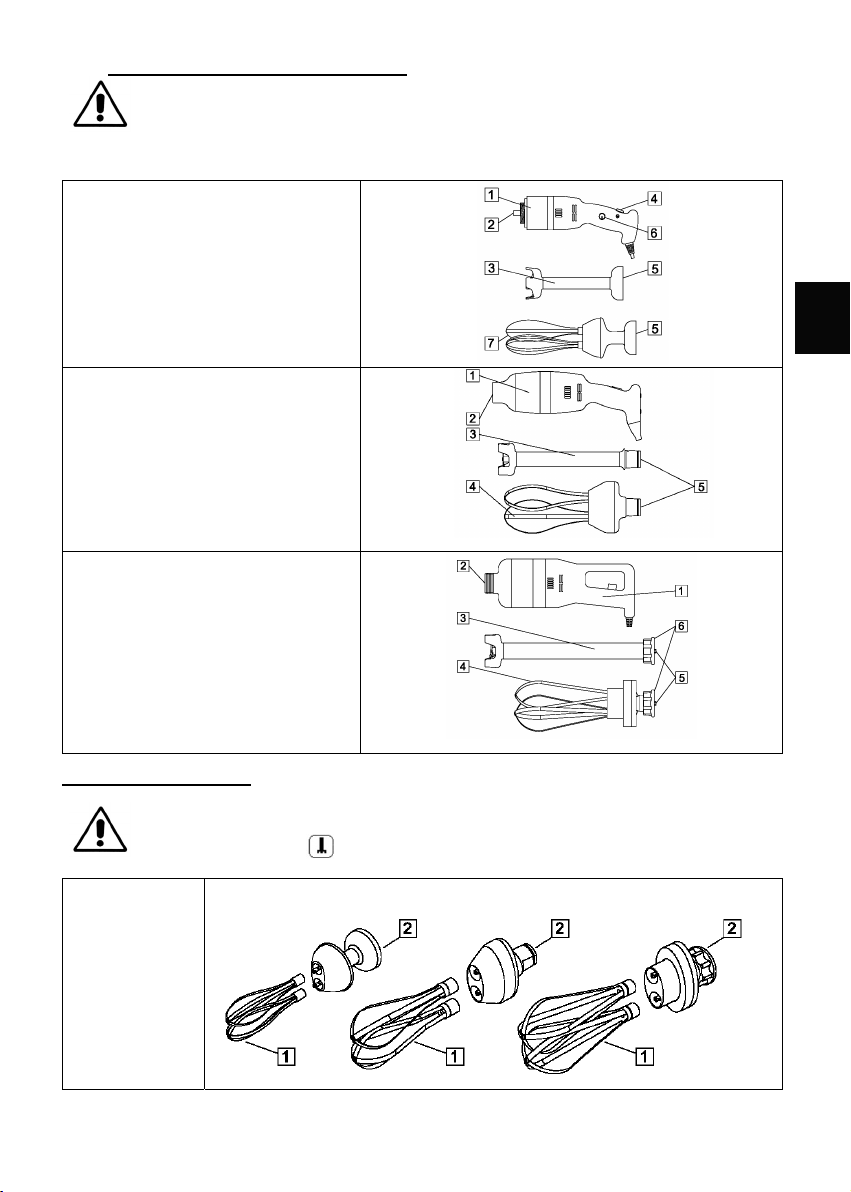
ASSEMBLAGE / DESASSEMBLAGE
Les opérations d’assemblage / désassemblage de n’importe quel organe de la machine doivent être effectuées à
machine arrêtée et avec la fiche débranchée de la prise, c’est-à-dire avec le dispositif de sectionnement en
OFF.
L’assemblage de la machine se déroule en des différentes phases (de façon-exemple on a rapporté la machine avec corps
base).
ASSEMBLAGE OUTIL
MODELE 250VF-VV
1. Aligner et introduire l’accouplement (5) du mixer (3)
2. Visser le mixer (3) jusqu’à le fixer fortement au corps
ASSEMBLAGE OUTILS
MODELE 300/400 VV
1. Aligner et introduire l’accouplement des outils (5)
2. Tourner les outils (3-4) jusqu’à les fixer fortement au
ASSEMBLAGE OUTILS
MODELE 350/450/650 VF-VV
1. Aligner et introduire l’accouplement (5) des outils (3-
2. Visser le collier (6) jusqu’à le fixer fortement au corps
dans l’embrayage (2) du corps machine (1)
machine (1)
dans l’embrayage rapide (2) du corps moteur (1)
corps machine (l)
4) dans l’embrayage (2) du corps machine (1)
machine (1).
250 VF-VV
300 / 400 VV
AIS
FRANÇ
Les activités de désassemblage se déroulent en suivant de façon à rebour les phases d’assemblage décrites précédemment.
350 / 450 / 650 VF-VV
Il est interdit l’emploi de l’outil fouet dans les machines à vitesse fixe (VF)
Il est interdit l’emploi de l’outil fouet dans les machines à vitesse variable (VV)
avec la fonction max vitesse
ASSEMBLAGE
DESASSEMBLAGE
DES FOUETS
Pour le désassemblage
tendre les fouets (1)
jusqu’à ce qu’elles ne se
séparent du groupe
réducteur (2).
Pour les assembler
introduire la base des
fouets (1) dans le pivot du
groupe réducteur (2) et
pousser jusqu’au fond.
9 13
TRADUCTION DES MODES D’EMPLOIS ORIGINALS
Pag. di
Page 52
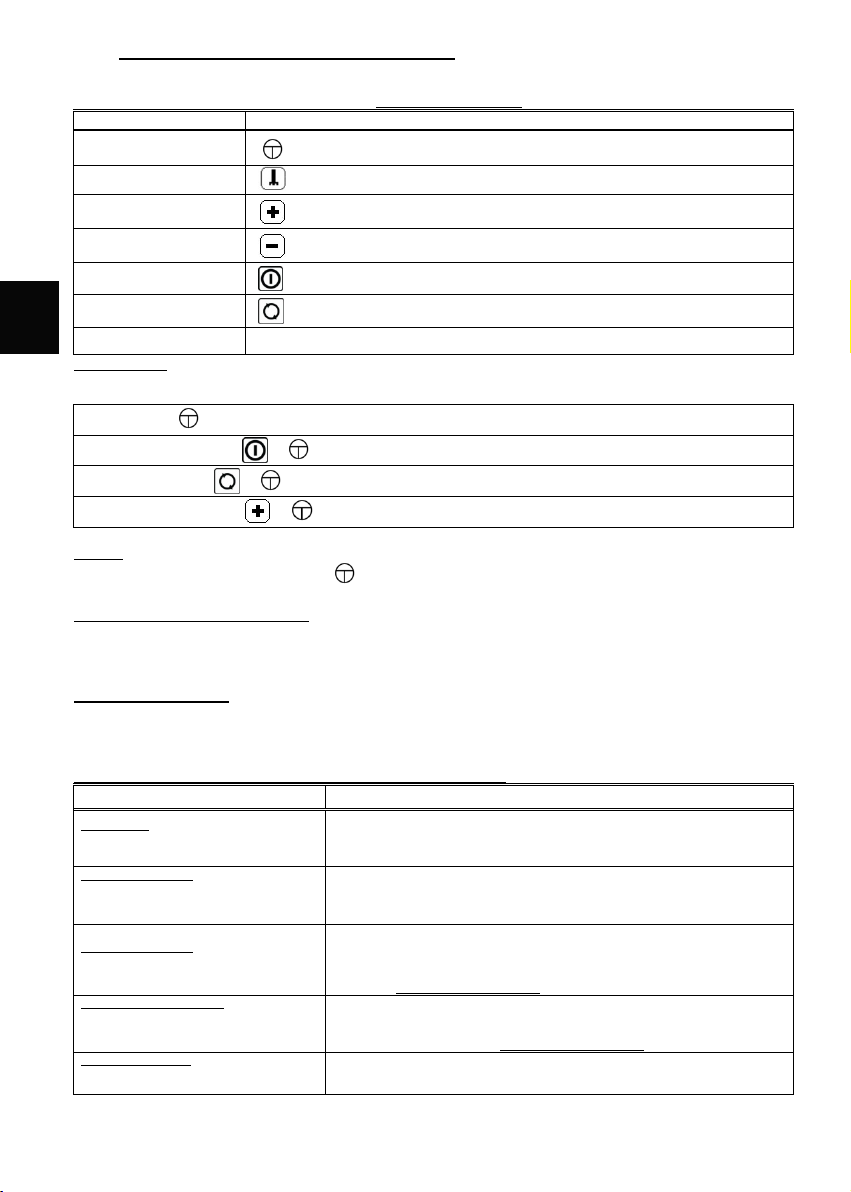
DESCRIPTION DU FONCTIONNEMENT
Les dispositifs de commande sont projetés et construis de façon telle à être sûrs fiables et résistant aux normales sollicitations
de service, aux efforts prévisibles et aux agents extérieurs. Ils sont en outre clairement visibles, repérables et marqués par un
marquage approprié. Ci-dessous ils sont rapportés les dispositifs de commande:
TYPE / COULEUR REFERENCE / DESCRIPTION
Poussoir / noir
Touche / noir
Touche / noir
Touche / noir
Touche / noir
Touche / noir
Display / rouge Visualisation de la vitesse: d’ 1 à 9 / visualisation vitesse maximum
FRANÇAIS FRANÇAIS
DEMARRAGE
Le démarrage avec impulsion de la machine est possible seulement avec une action volontaire sur le dispositif de commande
prévu dans ce but:
machine VF 250: Seulement emploi à action maintenue
machines VF 350 / 450 / 650 : + . Seulement emploi à action continue.
machines VV 300 / 400 : + . Seulement emploi à action continue.
machines VV 350 / 450 / 650 : + . Seulement emploi à action continue.
ARRET
Pour la commande d’arrêt presser le poussoir .
SECURITE DE FONCTIONNEMENT
Au cas où la machine serait sous effort, ou serait soumise à des temps de fonctionnement trop longs ou soumise à une
surcharge, la même s’arrête immédiatement pour l’entrée en service de la protection thermique. En ce cas-ci attendre qu’elle
se soit complètement refroidie avant de procéder à la fonction de démarrage.
ABSENCE DE TENSION
En cas d’ interruption de l’alimentation électrique ou si la machine est débranchée du réseau électrique, ce dernier pourra être
redémarré seulement en suivant la fonction de démarrage, après le retour de l’alimentation électrique ou le réattachement
au réseau électrique.
CONTROLES ET VERIFICATIONS AVANT LA MISE EN MARCHE
VERIFICATION / CONTROLE MODALITES ET VERIFICATIONS
S’assurer que:
Il n’y ait pas d’objets dans la casserole
d’objets étrangers
S’assurer du nettoyage:
des parties externes de la machine
de l’outil le long de sa surface
des parties intérieures de l’outil
S’assurer de l’intégrité:
des abris fixes
du corps de la machine
S’assurer de la fonctionnalité:
des parties du système de commande /
contrôle concernant la sécurité;
des dispositifs de commande.
S’assurer de l’absence:
de bruits étranges après la mise en
service
10 13
“
” / Poussoir pour la commande de démarrage de la machine à action maintenue
“ ” / Touche de commutation max vitesse seulement pour outil mixeur.
“
” / Touche pour augmentation vitesse / touche sécurité pour démarrage (VV 350/450/650)
“
” / Touche pour diminution vitesse
“
” / Touche sécurité démarrage de la machine (seulement modèles VF 350/450/650)
“
” / Touche sécurité démarrage de la machine (seulement modèles VV 300/400)
Contrôles visuels des parties indiquées, pour s’assurer de l’absence d’ objets ou corps
étrangers tels que par ex. des outils différents, des chiffons, etc… et qu’il n’y ait pas de toute
façon le produit alimentaire.
En cas de présence pourvoir à leur enlèvement.
Toutes les surfaces des parties indiquées, avant l’emploi de la machine, doivent être
contrôlées visuellement pour s’assurer de leur nettoyage.
En cas de présence de moisissures ou autre type de saleté, pourvoir à la procédure de
nettoyage selon les indications dont il est question au chapitre 5.
Tous les abris fixes, etc.. doivent exércer la fonction pour laquelle ils ont été prévus.
Contrôle visuel des parties indiquées pour s’assurer de leur intégrité dans la partie externe de
leur surface.
Les parties doivent être de toute façon remplacées aux premières marques d’ érosion ou
rupture (cfr. Centre d’ Assistence Autorisé).
Tous les dispositifs doivent exércer la fonction pour laquelle ils ont été prévus. Commander
directement les dispositifs afin qu’ils déterminent la fonction attendue.
Les actionneurs et toutes les parties doivent être de toute façon remplacés aux premières
marques d’érosion ou rupture (cfr. Centre d’ Assistence Autorisé).
Pendant la vérification de la fonctionnalité des dispositifs de commande, au cas où il y aurait
des bruits étranges, dus par exemple à un grippage ou ruptures mécaniques, arrêter
immédiatement la machine, et activer le service d’entretien.
TRADUCTION DES MODES D’EMPLOIS ORIGINALS
Pag. di
Page 53
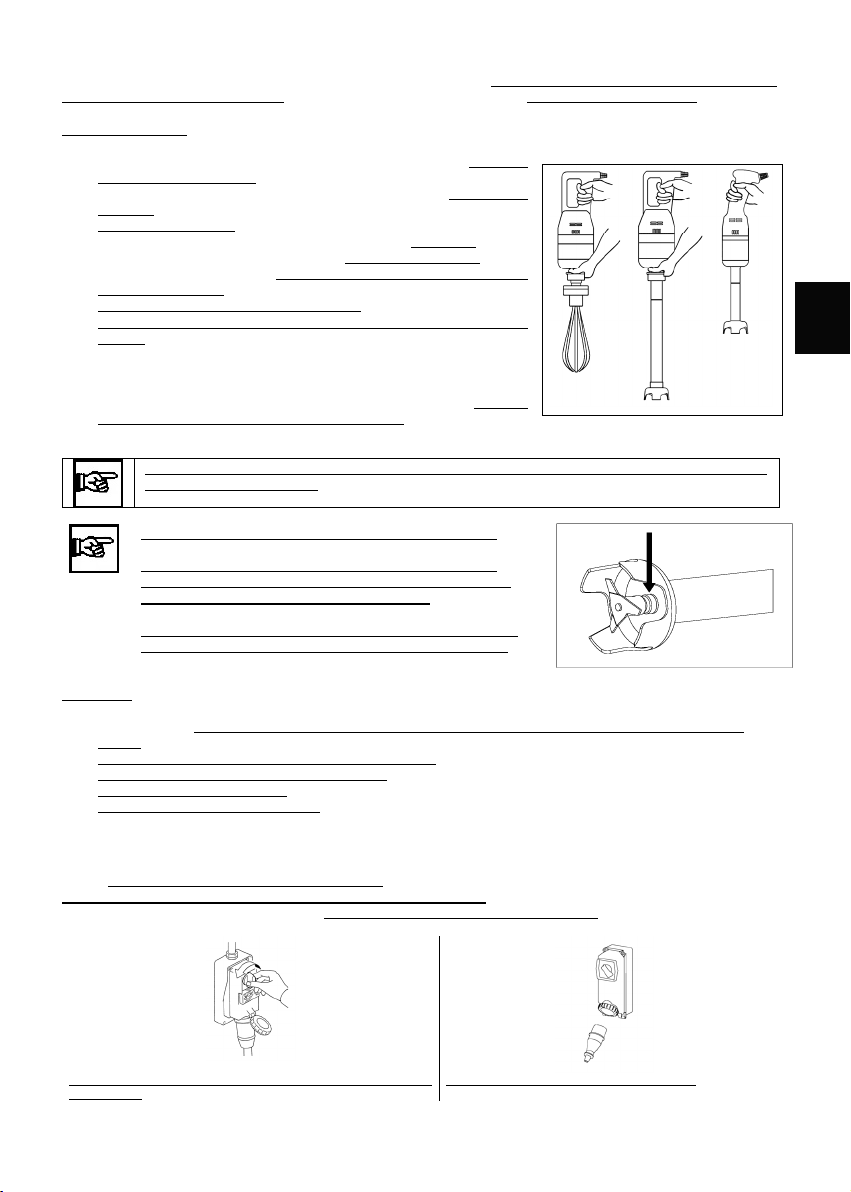
Pour n’importe quel type d’intervention ou pour le remplacement des parties qui résultent endommagées, activer le service d’
entretien. Le remplacement éventuel doit être effectuée avec des produits originaux du constructeur ou au moins de qualité,
sécurité et caractéristiques équivalentes. Pour des approfondissements contacter le Centre d’ Assistence Autorisé.
MISE EN SERVICE
L’opérateur de la machine peut mettre en service la machine, en suivant dans l’ordre les indications rapportées ci-dessous:
1. Résultat positif des contrôles dont il est question dans opérations
préliminaires de préparation,
2. Résultat positif des contrôles dont il est question dans l’alimentation
électrique,
3. Branchement de la fiche dans une prise de courant convenable,
4. Résultat positif des contrôles dont il est question dans l’assemblage,
5. Résultat positif des contrôles / vérifications avant la mise en marche,
6. Résultat positif des contrôles finalisés à vérifier le respect de toutes les
conditions de sécurité,
7. Introduire manuellement le produit alimentaire dans la casserole,
8. Avec l’emploi de toutes les deux mains saisir la machine dans les zones
prévues:
a. La positionner avec l’outil dans la casserole,
b. La démarrer, la maintenir et la manier jusqu’au terme de
l’usinage du produit alimentaire,
9. Quand le produit alimentaire a atteint la consistence désirée, arrêter la
machine et la positionner sur un banc d’appui adéquat,
10. décharger manuellement le produit alimentaire de la casserole, en la saisissant avec toutes les deux mains et en versant le
produit alimentaire où nécessaire.
il est interdit d’introduire la machine dans la casserole outre le cran d’immersion et de toute façon outre
le collier de serrage de l’outil
On recommande de ne pas faire marcher la machine à vide.
On recommande de contrôler périodiquement l’intégrité du
joint en caoutchouc placé sous la lame (voir dessin à coté) et le
remplacer au cas où il serait endommagé ou usé.
L’intégrité du joint empêche l’infiltration du produit d’usinage
à l’intérieur de l’outil en évitant des dommages au mélangeur
COUPURE
En succession, les opérations de coupure doivent suivre ce qui est indiqué ci-dessous:
1. avant la coupure attendre la conclusion de l’usinage, ou attendre que le produit alimentaire ait atteint la consistence
désirée,
2. arrêter la machine en relâchant les dispositifs de commande prévus,
3. positionner la machine sur un banc d’appui adéquat
4. débrancher la fiche de la machine de la prise d’ alimentation,
5. exécuter les interventions de nettoyage.
CHAP. 5. ENTRETIEN, RECHERCHE PANNES ET NETTOYAGE
PRESCRIPTIONS D’ENTRETIEN
ISOLEMENT DES SOURCES D’ ALIMENTATION EXTERIEURES
Avant d’exécuter n’importe quelle opération entretien, nettoyage et remplacement parties, il faut sectionner et isoler les
sources d’ alimentation extérieures.
AIS
FRANÇ
Positionner sur “zéro” le dispositif de protection placé en amont de la ligne
d’alimentation de l’équipement électrique.
11 13
TRADUCTION DES MODES D’EMPLOIS ORIGINALS
Débrancher le dispositif de sectionnement général et pourvoir à
protéger la fiche par des systèmes faits exprès
Pag. di
Page 54
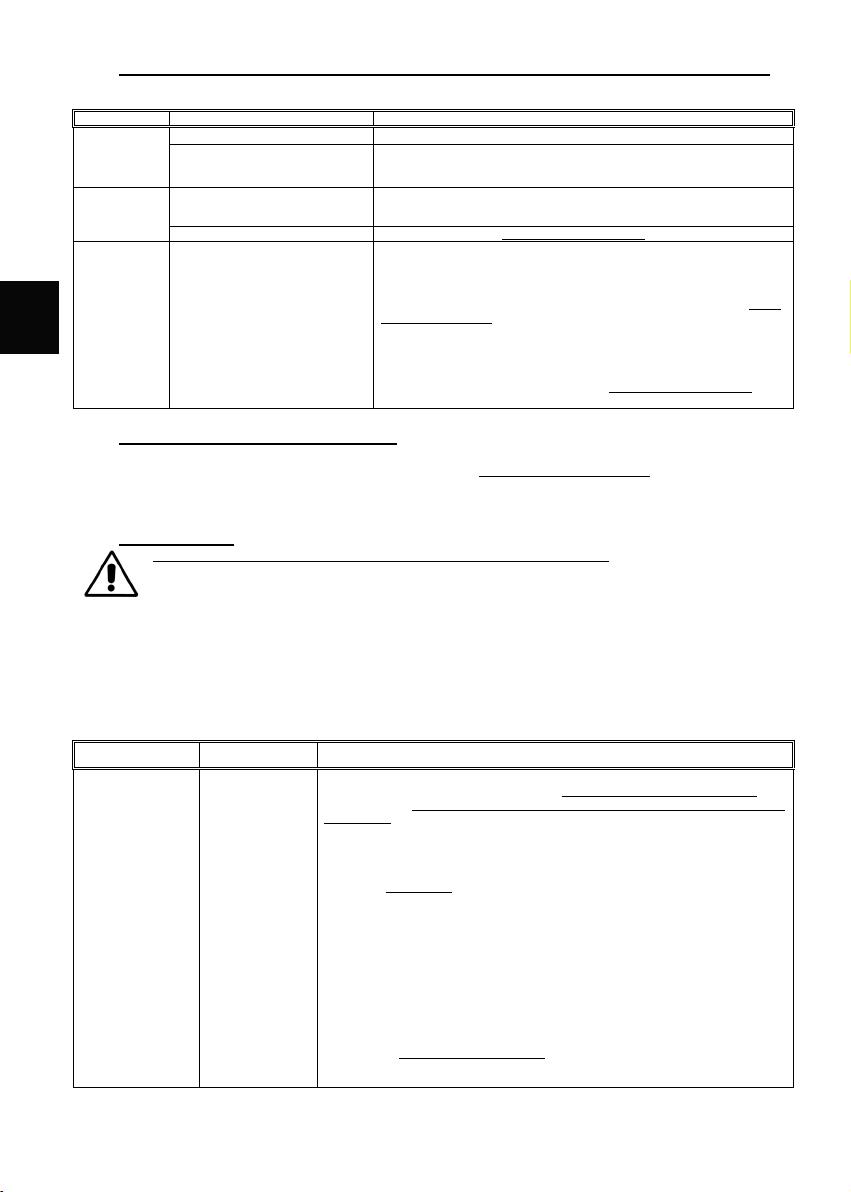
RECHERCHE PANNES OU AVARIES ET DEBLOCAGE ELEMENTS MOBILES
Ci-de suite elles sont indiquées les interventions pour la recherche pannes ou avaries et déblocage éléments mobiles qui
peuvent être exécutés par les manutentionnaires.
TYPE POTENTIEL/S CAUSE/S MODALITES ET VERIFICATIONS
Manque
tension de
réseau
Interruption de
fonctionnement
La machine ne
marche pas: les
lames ne
tournent pas ou
n’exécutent pas
FRANÇAIS FRANÇAIS
la coupe
correctement
Black out général Contacter l’organisme distributeur de l’énergie électrique
Intervention de fusibles ou
magnétothermiques placés en amont de
la ligne d’alimentation de la machine
Intervention du dispositif de protection
intérieur à la machine
Cause/s non identifiables Contacter directement le Centre d’ Assistence Autorisé
Manque tension d’ alimentation.
Dispositifs de sectionnement sur “O”.
Non fonctionnement du poussoir de
marche
Intervention thermique due à
surchauffe
Visualisation sur le display de la lettre
“E”
Après avoir éliminé les causes qui ont déterminé l’intervention du dispositif de
protection, le rétablir. En cas de persistance du problème contacter un technicien
électricien.
Contacter un technicien électricien: après avoir éliminé les causes qui ont déterminé
l’intervention d’ un dispositif de protection, le rétablir.
Contrôler et rétablir l’énergie électrique.
Introduir la fiche sur la prise d’ alimentation
Contrôler l’efficacité du poussoir et éventuellement contacter directement le Centre
d’ Assistence Autorisé.
Attendre le refroidissement complet avant le redémarrage de la machine
Lecteur vitesse panne, contacter directement le Centre d’ Assistence Autorisé
ENTRETIEN EXTRAORDINAIRE
Pour les interventions d’ entretien extraordinaire, conséquentes à des ruptures ou révisions ou pannes mécaniques ou
électriques, il est nécessaire une demande d’intervention directement au Centre d’ Assistence Autorisé.
Les instructions relatives à l’entretien extraordinaire, ne sont pas présents dans ce mode d’emploi et doivent donc être
explicitement demandées au fabricant.
NETTOYAGE
Il est interdit de nettoyer à la main les organes et les éléments en mouvement.
Toutes les interventions de nettoyage doivent être réalisées seulement et exclusivement, après avoir déchargé
la machine avec le produit alimentaire en usinage et l’avoir isolée de la source d’ alimentation électrique
et d’énergie extérieures.
La machine, l’appareillage électrique et les composants à bord de la machine, ne doivent être jamais lavés en
utilisant de l’eau, moins encore sous forme de jets de n’importe quelle nature et quantité; donc, sans
La classification du niveau d’hygiène de la machine et des appareillages associés, pour l’emploi prévu, est 2 (deux):
machine qui, suite à une évaluation du risque d’ hygiène, est conforme aux qualités requises des normes internationales
applicables, mais elle demande un désassemblage programmé pour le nettoyage.
Au terme de chaque
équipe de travail et
de toute façon avant
l’emploi journalier
12 13
“séau” ni “caoutchouc” ni “éponge”. Ne jamais placer directement la machine dans l’évier ou sous le robinet.
FREQUENCE PERSONNEL
Opérateur Toutes les surfaces et les parties des machines destinées à venir en contact avec le produit
TRADUCTION DES MODES D’EMPLOIS ORIGINALS
alimentaire, c’est-à-dire, les zones alimentaires (surface extérieure et intérieure des outils) et
les zones giclées (surface supérieure de l’outil en attachement à la machine et surface extérieure
de la machine), doivent être nettoyées et désinfectées avec les modalités rapportées ci-dessous.
Pour les activités de désassemblage des outils, voir les descriptions précédentes.
Ecrouter les surfaces des résidus éventuels de produit alimentaire (par ex. avec des
gratteurs en plastique);
Nettoyer toutes les surfaces de la zone alimentaire et zone giclées avec un chiffon mou
mouillé (non égouttant) avec un détergent dilué dans de l’eau chaude (aussi du commun
savon pour la vaisselle ira très bien). Utiliser des produits spécifiques pour l’ acier, ils
doivent être liquides (non en crème ou pâtes de toute façon abrasives) et surtout ils ne
doivent pas contenir de chlore. Contre les subtances graisse l’on peut utiliser l’alcool
dénaturé.
Rincer avec de l’eau chaude nette et successivement sécher toutes les surfaces de la
zone alimentaire et zone giclées avec un chiffon mou qui ne perde pas de poils.
L’outil mixer, bien qu' il soit en acier inox, ne peut pas être lavé dans la lave-vaisselle,
moins encore les parties plastiques.
Le réassemblage doit être effectué seulement suite à une exigence d’usinage, laisser les
pièces enveloppées dans un chiffon mou sec qui ne perde pas de poils.
PERIODES DE LONGUE INACTIVITE
Pendant les périodes de longue inactivité de la machine pourvoir à passer énergiquement
sur toutes les surfaces en acier (spécialement si inox) un chiffon imbibé d’huile de vaseline
de façon à étendre un voile de protection.
MODALITES
Pag. di
Page 55
FREQUENCE PERSONNEL MODALITES
CHOSES A NE PAS FAIRE AVANT OU PENDANT LE NETTOYAGE:
Accéder aux éléments mobiles sans s’être assurés préventivement de leur arrêt;
Accéder aux éléments mobiles sans l’avoir arrêtée en sécurité garantie (blocage dans la
position de zéro des dispositifs de sectionnement de l’alimentation électrique)
PRODUITS A NE PAS EMPLOYER:
Air comprimé avec des giclées vers les zones avec des dépôts de farine et en général vers la
machine;
Appareils à vapeur;
Détergents qui contiennent du CHLORE (même si dilué) ou ses composés comme: l’eau de
Javel, l’acide muriatique, des produits pour déboucher la vidange, des produits pour le
nettoyage du marbre, des décalcifiants en général, etc … peuvent attaquer la composition de
l’acier, en le tachant ou en l’oxydant irréparablement. Les seules exhalations des produits
susmentionnés peuvent oxyder et en certains cas corroder l’acier;
Paille de fer, brosses ou disquettes abrasifs réalisés avec d’autres métaux ou alliages (par ex.
acier commun, aluminium, laiton, etc…) ou des outils qui aient précédemment nettoyé
d’autres métaux ou alliages.
détergents en poudre abrasifs;
essence, solvants ou fluides enflammables et/ou corrosifs;
subtances employées pour nettoyer l’argent.
CHAP. 6. EVACUATION
Dans le cas où vous décidez de ne plus utiliser la machine à cause de son ancienneté, d’un endommagement ou de l’usure, son
déclassement doit être géré par un personnel spécialisé et équipé. Une fois les activités de démantèlement terminées, toutes les
plaques d’identification et les documents doivent être détruits. L’élimination de la machine ne nécessite pas son broyage. Il
suffit de déconnecter les groupes principaux qui composent la machine et les envoyer à la mise au rebut.
Ne pas jeter la machine dans les déchets mixtes mais l’apporter dans une déchetterie.
Les systèmes de collecte de la machine sont:
La machine ne contient aucune substance dangereuse aux effets potentiellement négatifs pour l’environnement et pour la santé
de l’homme. Il est très important que les acheteurs s’engagent à réutiliser, recycler et trouver d’autres solutions afin de
valoriser la machine. A ce propos, l’employeur est tenu de connaître les lois en vigueur dans son pays afin de bien respecter
ces normes.
Le symbole de la benne à ordures barrée présent sur la machine signifie que le produit
doit être séparé des autres déchets à la fin de sa durée de vie.
Retrait par un consortium du distributeur
Possibilité de livraison au distributeur de la machine dans le cas où vous achetez la même machine chez le même
distributeur.
Il est interdit d’abandonner la machine et son équipement électrique dans la nature sous peine de
sanctions.
CHAP. 7. MATERIAUX DE CONSTRUCTION
Selon les exigences de fonctionnement et de production, la machine peut être construite avec des différentes typologies de
matériaux de construction.
GROUPE
Corps machine
Outil de coupe du mixer
Calotte de l’outil mixer
Tuyau de l’outil mixer
Boîte réducteur outil fouet
Outil fouet
TYPOLOGIE MATERIAUX
Acier inox AISI 304 Plastique pour aliments
●
●
●
●
●
●
AIS
FRANÇ
13 13
TRADUCTION DES MODES D’EMPLOIS ORIGINALS
Pag. di
Page 56

Page 57

Page 58

INHALT
KAP. 1. INHALT UND BENUTZUNG DER BEDIENUNGSANLEITUNG 3
KAP. 2. ALLGEMEINE INFORMATIONEN UND EIGENSCHAFTEN 4
KAP. 3. SICHERHEITSANLEITUNGEN 8
KAP. 4. INBETRIEBNAHME UND ANWENDUNG 8
KAP. 5. WARTUNG, FEHLERSUCHE UND REINIGUNG 11
KAP. 6. ENTSORGUNG 13
KAP. 7. BAUMATERIAL 13
DEUTSCH
GARANTIE
Das Gerät besitzt eine Garantie über 12 (zwölf) Monate ab Verkaufsdatum.
Die Garantie deckt Reparaturen an Geräten, die bei einer anerkannten Verkaufsstelle erworben wurden, wenn nachgezeigt
werden konnte, dass sie im Material oder in der Zusammensetzung Defekte aufweisen, unter den unten stehenden vereinbarten
Bedingungen:
1. unter Garantie versteht sich die kostenlose Ersetzung aller Teile, die Fabrikationsfehler aufweisen. Die Garantie verfällt,
wenn weder ein Kassenzettel noch eine Rechung vorgewiesen werden kann, welche den Kauf des Geräts nachweisen,
sowie in folgenden Fällen:
a. Beschädigung des Geräts durch Nachlässigkeit;
b. Anwendung des Geräts unter Bedingungen, die nicht den Hinweisen der vorliegenden Bedienungsanleitung
entsprechen;
c. Durch Unangebrachtheit des Aufstellraums entstandene Schäden oder Schäden, die nicht vom normalen Betrieb
des Geräts abhängig sind (Unregelmäßigkeit der Spannungswerte und Frequenz des Stromnetzes);
d. Reparaturen, die durch unbefugte Personen oder durch vom Hersteller nicht anerkannte Verkaufsstellen
2. Die Inanspruchnahme der Garantieleistung darf ausschließlich bei den anerkannten Verkaufsstellen oder Werkstätten
3. Das Gerät muss dem Hersteller für die Reparatur frei Hafen zugeschickt werden; die Transportkosten sind immer zu
4. Die Ersetzung des Geräts sowie die Verlängerung der Garantiedauer infolge eines Eingriffs wegen einer Störung sind
5. Der Hersteller übernimmt keine Haftung für direkte oder indirekte Schäden jeglicher Art an Personen oder
Bedienungsanleitung
Ausgabe
durchgeführt worden sind,
erfolgen;
Lasten des Empfängers,
ausgeschlossen;
Gegenständen, die bei Missbrauch des Geräts oder bei Nichtgebrauch während der für Reparaturen nötigen Dauer
entstehen könnten.
Januar 2015
2 13
ÜBERSETZUNG DER ANLEITUNGEN IM ORIGINAL
Pag. di
Page 59

KAP. 1. INHALT UND BENUTZUNG DER BEDIENUNGSANLEITUNG
ZIEL DER BEDIENUNGSANLEITUNG
WICHTIGKEIT DER BEDIENUNGSANLEITUNG
Das vorliegende Bedienungshandbuch ist als ganzheitlicher Teil des Geräts zu betrachten:
1. Für die ganze Lebensdauer des Geräts muss es beim Gerät aufbewahrt werden.
2. Beim Verkauf des Geräts muss das Handbuch mit dem Gerät ausgeliefert werden.
3. Im Handbuch befinden sich neben allen für den Bediener nützlichen Informationen auch die Schaltpläne (in spezifischen
Kapiteln zusammengefasst), welche für allfällige Wartungs- und Reparatureingriffe benötigt werden.
ZIEL DER BEDIENUNGSANLEITUNG
Die Bedienungsanleitung hat zum Ziel, dem Kunden alle nötigen Informationen zu geben, die ihm eine geeignete
Anwendung und eine sichere und selbständige Handhabung des Geräts erlauben.
Außerdem wurde das vorliegende Handbuch mit dem Ziel erstellt, Hinweise und Warnungen bekannt zu geben zur besseren
Kenntnis des Geräts, sowie der Grundlagen und Einschränkungen für dessen Betrieb. Bei Zweifeln wenden Sie sich bitte an
die anerkannte Kundendienststelle.
ZIELPUBLIKUM
Das vorliegende Handbuch, von dem 1 Ausgabe als vollständiges Bestandteil des Geräts geliefert wird, richtet sich an die
Bediener sowie an mit der Installation, dem Betrieb und der Wartung beauftragte, qualifizierte Techniker.
Die für den Arbeitsschutz im Betrieb verantwortliche Person und die anderen Mitarbeiter für die das Gerät bestimmt ist,
müssen das vorliegende Handbuch einsehen, damit sie alle vorgeschriebenen technischen und organisatorischen Maßnahmen
ergreifen können.
HAFTUNG
Die Werksverantwortlichen sind im Rahmen der ihnen zugeteilten Befugnisse und Kompetenzen für folgende
Falls das Handbuch beschädigt wird oder verloren geht, kann eine Kopie davon bei der anerkannten
Kundendienststelle beantragt werden.
Das vorliegende Handbuch widerspiegelt den Stand der Technik zum Zeitpunkt der Herstellung des
Geräts; der Hersteller behält sich das Recht vor, die Produktion und dementsprechend die anderen
Ausgaben des Handbuchs zu aktualisieren ohne die Verpflichtung, frühere Produktionen oder
Handbücher zu aktualisieren, außer in besonderen Fällen, die die Gesundheit und die Sicherheit von
Personen betreffen.
Besondere Aufmerksamkeit sollte den Restrisiken an dem Gerät und den Vorschriften für die Bediener
gewidmet werden.
Der Hersteller haftet für das Gerät in seiner Original-Konfiguration.
Der Hersteller haftet nicht für Schäden, die durch Missbrauch oder falsche Anwendung des Geräts oder
des Handbuchs entstehen könnten, ebenso wenig für Schäden die durch Nichtbeachtung von zwingenden
Vorschriften, Nachlässigkeit, Unerfahrenheit, Unvorsichtigkeit oder Nichtbeachtung der
Verordnungsbestimmungen seitens des Arbeitgebers, des Bedieners oder des Wartungstechnikers und
für eventuelle Störungen durch unvernünftigen Gebrauch, Missbrauch und/oder unzweckmäßigen
Gebrauch entstehen könnten
Der Hersteller haftet nicht für Folgen aus der Anwendung nicht originaler oder nicht gleichwertiger
Ersatzteile.
Der Hersteller haftet nur für die in der italienischen Originalversion enthaltenen Informationen.
Die Nichtbeachtung der in diesem Handbuch enthaltenen Vorschriften verursacht das sofortige Entfallen
der Garantie.
Punkte zuständig:
Umsetzung der vorgeschriebenen Sicherheitsmaßnahmen;
Die Arbeiter über die spezifischen Risiken, denen sie ausgesetzt sind, und über die wichtigsten Schutz-
und Vorsorgemaßnahmen unterrichten;
Anordnen und verlangen, dass die einzelnen Mitarbeiter die Sicherheitsvorschriften beachten und die
ihnen zur Verfügung gestellten Schutzausrüstungen benutzen:
Mehr als einen Mitarbeiter gleichzeitig auf dem Gerät arbeiten lassen.
DEUTSCH
3 13
ÜBERSETZUNG DER ANLEITUNGEN IM ORIGINAL
Pag. di
Page 60
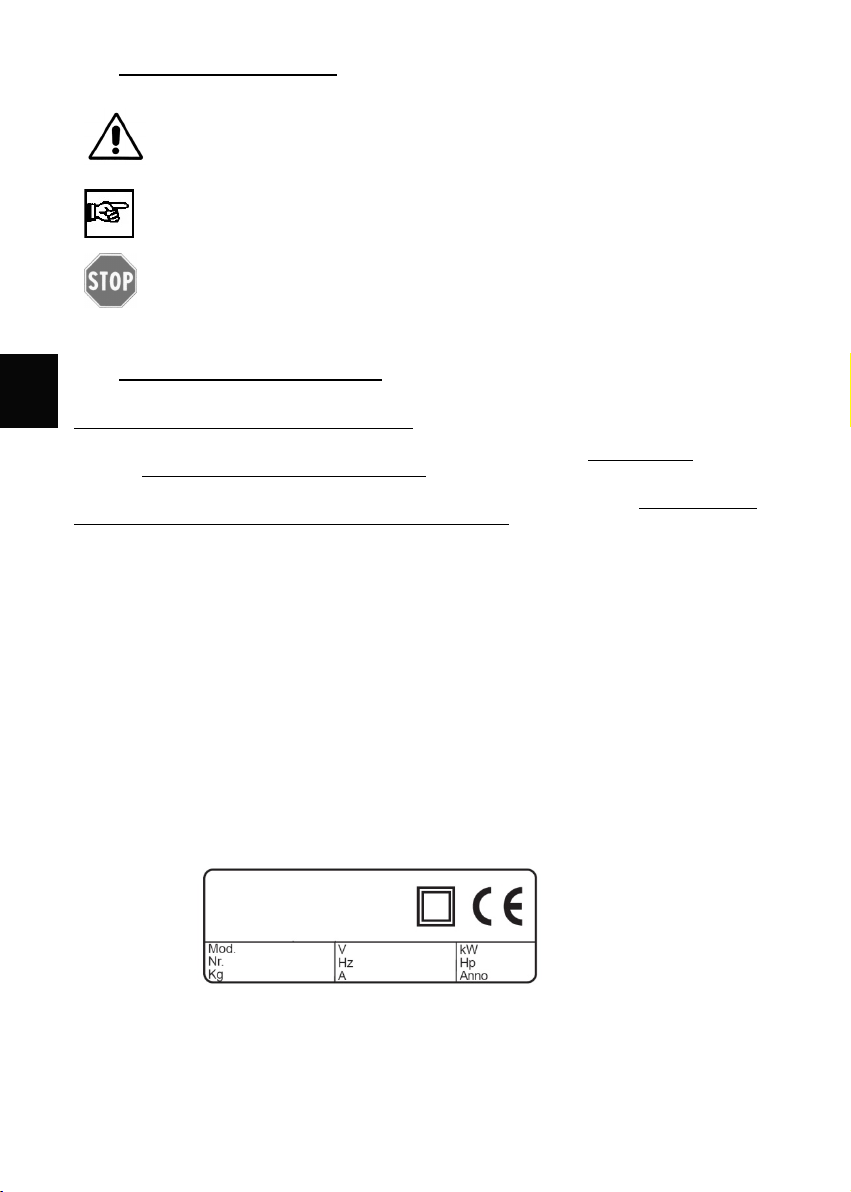
SYMBOLERLÄUTERUNG
Im Folgenden werden die Bedeutungen der in diesem Handbuch benutzten Symbole und Begriffe erläutert.
GEFAHR
Weist auf eine Gefahr hin für den Bediener des Geräts und für alle, die sich in der Nähe des Geräts befinden.
Daher sollte die aufgezeigte Tätigkeit unter Beachtung der geltenden Unfallverhütungsvorschriften und der im
vorliegenden Handbuch angegebenen Maßnahmen ausgeführt werden.
HINWEIS
Weist auf nützliche und/oder zusätzliche Empfehlungen hin und/oder auf besondere Maßnahmen bezüglich der
gerade auszuführenden Tätigkeit.
ACHTUNG
Weist auf einen Arbeitsschritt hin, der zur Verhinderung einer Beschädigung am Gerät mit Sorgfalt ausgeführt
werden soll.
KAP. 2. ALLGEMEINE INFORMATIONEN UND EIGENSCHAFTEN
ANWENDUNG UND BAUTEILE
Der Mixer, nachfolgend „Gerät” genannt, ist ein tragbares Gerät, das zum Schlagen, Quirlen, Zermahlen, Hacken, Vermengen,
Mischen, usw... für Catering und Großküchen verwendet werden kann.
DEUTSCH
Mit diesem Gerät ist es möglich, je nach benutztem Zubehör direkt im Topf Suppen, Pürees, Cremen, Teige, Mayonnaise,
Marzipan, Käsecremen u.ä. zuzubereiten.
Das Gerät besteht aus einem elektrischen Motor, der in einem Kunststoffguss eingefügt ist (loser Gerätekörper), in dem die
Motorwelle mit einem der folgenden Bearbeitungszubehörteile verbunden ist: Mixstab oder Schneebesen.
Der benötigte Zubehörteil wird mittels Feststellring oder Schnellkopplung am Gerätekörper angebracht.
Das Lebensmittelprodukt wird von Hand in den Behälter eingefügt und anschließend wird das Gerät mit beiden Händen und
durch Festhalten an den dafür vorgesehenen Stellen (siehe Abb. Seite 11):
1. mit dem angebrachten Zubehörteil in den Behälter oder in den Topf gestellt;
2. gestartet und bis zum Ende der Produktbearbeitung betrieben;
3. ausgeschaltet und auf eine geeignete Fläche abgelegt.
Auf Grund der Betriebsarten des Geräts und der Beschaffenheit des Geräts selbst, kann dieses funktionieren:
1. während es den Boden des Behälters (mit Mixstab) berührt, wobei die Eintauch-Markierung jedoch nicht überschritten
werden darf,
2. wenn es in der Luft, jedoch mit beiden Händen gehalten wird (mit Schneebesen),
3. wenn es auf eine spezielle Halterung fixiert wird, die an den Topf angepasst werden kann. Die Halterung entlastet den
Bediener bei Bearbeitungen, die viel Zeit in Anspruch nehmen oder bei denen Verbrennungsgefahr besteht (Dampf oder
Spritzer).
Die Entleerung des Lebensmittelprodukts am Ende des Bearbeitungszyklus erfolgt von Hand, nachdem das Gerät aus dem
Behälter entfernt worden ist.
Alle Materialien, die direkt mit Lebensmitteln in Kontakt kommen, entsprechen den geltenden Vorschriften für
Lebensmittelhygiene.
Je nach Betriebs- und Produktionsbedürfnissen kann das Gerät mit verschiedenen Zusatzteilen ausgestattet werden.
Auf dem Gerät befindet sich ein Kennschild, auf dem die folgenden Daten aufgeführt sind:
[Beispiel-Abbildung]
4 13
ÜBERSETZUNG DER ANLEITUNGEN IM ORIGINAL
Pag. di
Page 61
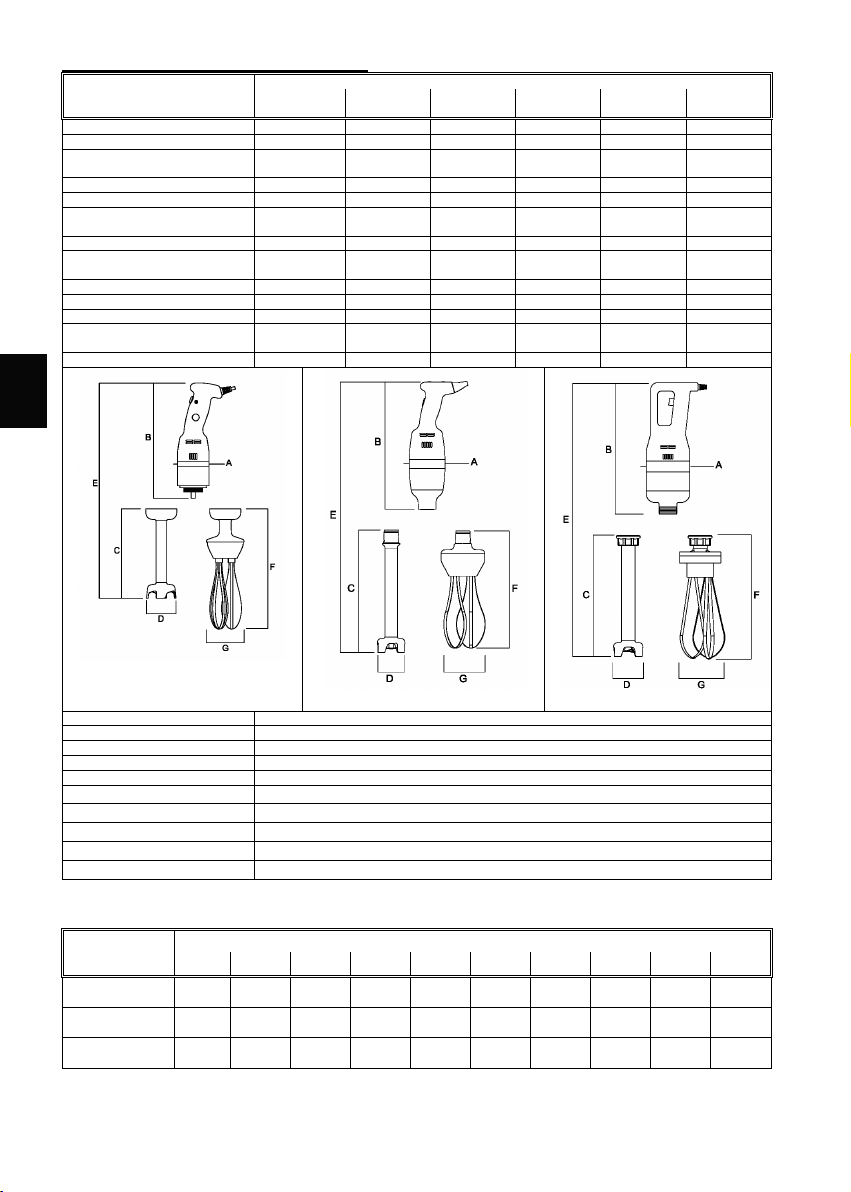
TECHNISCHE UND BAUTECHNISCHE DATEN
TECHNISCHE DATEN
Motorleistung (W) 250 300 350 400 450 650
Max. Geschwindigkeit (U./Min) 15000 13000 15000 15000 17000 13000
Variable Geschwindigkeit
(U/Min.) nur Modelle VV
Abmessung: A (mm) Ø75
Abmessung: B (mm) 285 350 360 350 380 400
Abmessung: C (mm)
Abmessung: D (mm) Ø75 Ø85 Ø95 Ø85 Ø95 Ø95
Abmessung: E (mm)
Abmessung: F (mm) 290 330 360 330 360 360
Abmessung: G (mm) 90 120 120 120 120 120
Gewicht Maschinenkörper (kg) 1,0 1,8 2,6 2,1 3,2 3,6
Gewicht Mixstab (kg)
Gewicht Schneebesen (kg) 0,450 0,800 1,0 0,800 1,0 1,0
250VF
250VV
2500 ÷ 15000 2000 ÷ 9000 2000 ÷ 9000 2000 ÷ 9000
220 / 270
470/ 520
0,400/ 0,450
300VV 350VF
Ø100 Ø130 Ø100 Ø130 Ø130
340 / 440 /
540
650/ 750 /
850
0,850 /1,0
/ 1,2
350VV
330 / 430 /
530 / 630
680/ 780 /
880 / 980
1,2 / 1,5/
1,7 / 1,9
MODELL
400VV 450VF
340 / 440 /
540
650 / 750 /
850
0,850 /1,0
/ 1,2
450VV
2000 ÷
11000
330 / 430 /
530 / 630
700 / 800 /
900 / 1000
1,2 / 1,5/
1,7 / 1,9
650VF
650VV
2000 ÷ 9000
330 / 430 /
530 / 630
720 / 820 /
920/ 1020
1,2/1,5/ 1,7 /
1,9
DEUTSCH
250 VV-VF
Äquivalenter Dauerschallpegel A unter 70dBA
Strombeschaffenheit – Frequenz Siehe Kennschild am Gerät
Nennleistung Siehe Kennschild am Gerät
Nominale Betriebsspannung Siehe Kennschild am Gerät
Spannung Hilfskreise Siehe Kennschild am Gerät
Schutzsystem Doppelisolierung
Schutzgrad IP X3
Max. Lufttemperatur +40°C
Min. Beleuchtung 500 lux
Konformität Produktrichtlinien
300 / 400 VV
2006/42/CE, 2006/95/CE und folgende Änderungen und Ergänzungen, Verordn. 1935/2004
350 / 450 / 650 VF-VV
TECHNISCHE
DATEN
Variable
Geschwindigkeit
Mixstab
Schneebesen /
5 13
250VF 250VV 300VV 350VF 350VV 400VV 450VF 450VV 650VF 650VV
/
● ●
/
● ● ● ● ● ● ● ● ● ●
● ●
ÜBERSETZUNG DER ANLEITUNGEN IM ORIGINAL
/
MODELL
● ●
● ●
/
●
/
●
/
/
Pag. di
●
●
Page 62
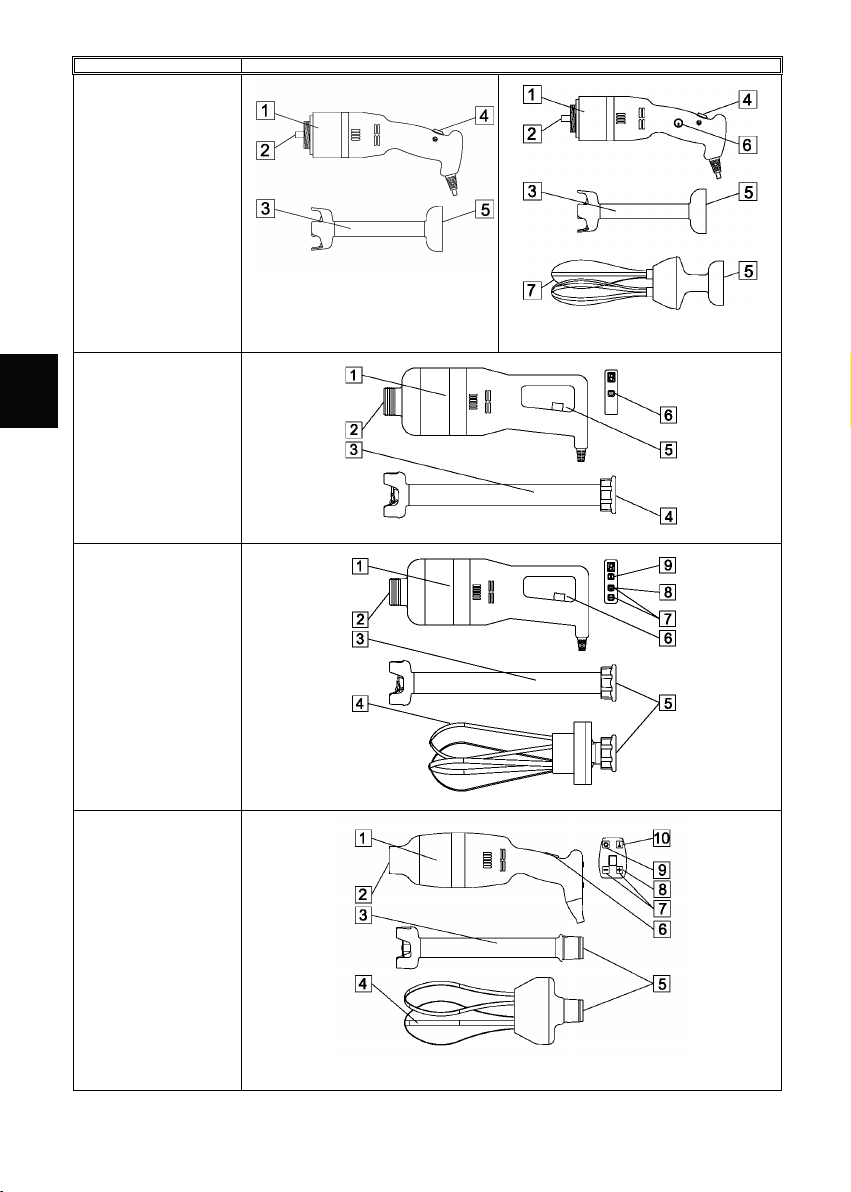
GRUPPE BEISPIEL
1. Gerätekörper
2. Utensilienansatz
3. Mixstab
4. EIN-Schalter
5. Feststellring
6. Geschwindigkeitsregler
7. Schneebesen
1. Gerätekörper
DEUTSCH
2. Utensilienansatz
3. Mixstab
4. Feststellring
5. EIN-Schalter
6. Sicherheitsschaltung
250VF
250VV
350 / 450 / 650 VF
1. Gerätekörper
2. Utensilienansatz
3. Mixstab
4. Schneebesen
5. Feststellring
6. EIN-Schalter
7. Tasten Geschwindigkeitseinstellung
8. Sicherheitsschaltung
9. Umschalter Mixstab /
Schneebesen
350 / 450 / 650 VV
1. Gerätekörper
2. Utensilienansatz
3. Mixstab
4. Schneebesen
5. Schnellkopplung
6. EIN-Schalter
7. Tasten Geschwindigkeitseinstellung
8. Sicherheitsschaltung
9. Taste anhaltender Betrieb
10. Umschalter Mixstab /
Schneebesen
300 / 400 VV
6 13
ÜBERSETZUNG DER ANLEITUNGEN IM ORIGINAL
Pag. di
Page 63

ZWECKMÄßIGER GEBRAUCH, MISSBRAUCH, FALSCHER ODER VERBOTENER
GEBRAUCH
Das im vorliegenden Handbuch beschriebene Gerät ist für die Anwendung durch einen einzigen Bediener vorgesehen. Dieser
sollte ausgebildet und bezüglich der Restrisiken informiert sein und zugleich in Bezug auf Sicherheit die Kenntnisse eines
Wartungstechnikers aufweisen.
Benutzer müssen mindestens das gesetzlich vorgesehene Mindestarbeitsalter aufweisen und müssen die nötige technische
Einführung durch einen Benutzer mit mehr Erfahrung erhalten, der sie zuvor in die richtige Anwendung des Geräts
eingewiesen hat.
7 13
Beim ZWECKMÄßIGEN und vernünftigerweise voraussehbaren GEBRAUCH kann das Gerät nur zum
Zerkleinern, Quirlen, Zermahlen, Kleinhacken, Schlagen, Mischen, Vermengen, etc… direkt in der Pfanne oder
in einem passenden Behälter für Catering und Großküchen verwendet werden.
Je nach Gerätetyp können direkt im Topf Gemüsesuppen, andere Suppen, Püree, Cremen, Teige, Mayonnaise,
Marzipan, Käsecremen u.ä. zubereitet werden.
Das Gerät ist mit den Händen wie angegeben an den entsprechenden Stellen (siehe Abb. S. 11) zu greifen,
halten und handhaben.
Das Gerät darf nicht MISSBRAUCHT werden; im Besonderen:
1. Kein Gebrauch für den Haushalt,
2. Es darf nicht mit anderen Parametern, als die in der Tabelle zu den technischen Eigenschaften
aufgeführten, betrieben werden
3. Für jeden anderen als die im vorliegenden Handbuch aufgeführten Anwendungszwecke lehnt der
Hersteller jede Haftung ab,
4. Der Anwender ist verantwortlich für Schäden, die aus der Nichtbeachtung der Betriebsbedingungen im
technischen Datenblatt und in der Auftragsbestätigung hervorgehen,
5. Das Gerät nicht leer laufen lassen;
6. Die Etiketten nicht absichtlich beschädigen und auch nicht entfernen oder verbergen.
Das Gerät darf nicht AUF UNZWECKMÄßIGE bzw. VERBOTENE WEISE verwendet werden, da dies Schäden
oder Verletzungen an den Bediener verursachen könnte; im Besonderen:
1. Es ist verboten, das Stromkabel oder das Gerät zu ziehen um das Gerät vom Stromnetz zu trennen,
2. Es ist verboten, auf dem Gerät oder auf dem Stromkabel Gewichte aufzulegen,
3. Es ist verboten, das Stromkabel auf schneidende Teile oder Teile, die Verbrennungsgefahren bergen, zu legen,
4. Es ist verboten, das Gerät mit beschädigten oder nicht vollständigen Stromkabel oder Steuervorrichtungen zu
betreiben;
5. Es ist verboten, das Gerät mit einem an das Stromnetz angeschlossenen Stromkabel ausgeschaltet zu lassen,
6. Es ist verboten, irgendeinen Gegenstand ins Innere der Lüfterhaube des Motors einzuführen;
7. Es ist verboten, das Gerät auf andere Gegenstände als ein Arbeitstisch aufzustellen; dieser muss für den
Lebensmittelbereich geeignet sein und zwischen 900 - 1100mm vom Fußboden reichen,
8. Es ist verboten, entflammbare, korrodierende oder schädliche Reinigungsmittel sowie übermäßig
alkalische Mittel wie z.B. Ätznatron oder Ammoniak zu verwenden,
9. Es ist verboten, das Gerät in Wasser oder andere Flüssigkeiten einzutauchen;
10. Es ist verboten, die Anwendung nicht befugtem Personal oder Personen ohne die vorgeschriebene
Arbeitskleidung zu überlassen,
11. Es ist verboten den Schneebesen auf Geräten mit fester Geschwindigkeit zu benutzen,
12. Es ist verboten bei eingeschaltetem und laufendem Gerät Produkte oder Gegenstände in den Topf
einzuführen, die andere Eigenschaften aufweisen als die für den zweckmäßigen Gebrauch vorgegebenen, wie
z.B. Knochen, tiefgekühltes Fleisch, Nicht-Nahrungsmittel oder andere Gegenstände wie Halstücher, etc…,
13. Es ist verboten das Gerät an anderen als die für den normalen Gebrauch angegebenen Stellen zu ergreifen,
halten und handhaben und jedenfalls das Gerät mit nur einer Hand zu betätigen,
14. Es ist verboten andere Lebensmittel oder die Zutaten auf den Boden des Topfes bei angeschlossenem und
laufendem Gerät zu drücken oder durch andere drücken zu lassen, so wie generell die Hände oder jeden
anderen Körperteil während des Betriebs des Geräts in den Topf einzuführen,
15. Es ist verboten das Gerät weiter als bis zur Eintauch-Markierung und jedenfalls früher als den
Feststellring am Gerät in den Topf einzuführen,
16. Es ist verboten das Gerät bevor es vollständig abgestellt worden ist und jedenfalls früher als
Abschaltung des Geräts aus dem Topf herauszuziehen.
17. Es ist verboten die Vorrichtung zur Utensilienfestsetzung zu betätigen, bevor das Gerät vollständig
angehalten worden ist, und jedenfalls früher als 10 Sek. nach Abschaltung des am Stromnetz angeschlossenen
Geräts,
18. Es ist verboten, Schutzvorrichtungen und Warnhinweise teilweise zu entfernen.
19. Es ist verboten, das Gerät zu betreiben wenn durch den Anwender nicht alle Maßnahmen zur Beseitigung der
Restrisiken ergriffen worden sind,
20. Es ist verboten zu rauchen oder Geräte mit offener Flamme und glühende Materialien zu benutzen, außer
bei Anwendung der passenden Sicherheitsmaßnahmen,
21. Es ist verboten, sowohl während des Betriebs als auch bei nicht erteilter Erlaubnis Überwachungs- und
Feststellvorrichtungen wie Knäufe und Ähnliches zu betreiben oder einzustellen
10 Sek. nach der
Der Anwender ist in jedem Fall verantwortlich für Schäden, die aus der fehlenden Beachtung der
aufgeführten Anwendungsbedingungen hervorgehen. Für allfällige Zweifel wenden Sie sich bitte an den
anerkannten Kundendienst.
ÜBERSETZUNG DER ANLEITUNGEN IM ORIGINAL
Pag. di
DEUTSCH
Page 64
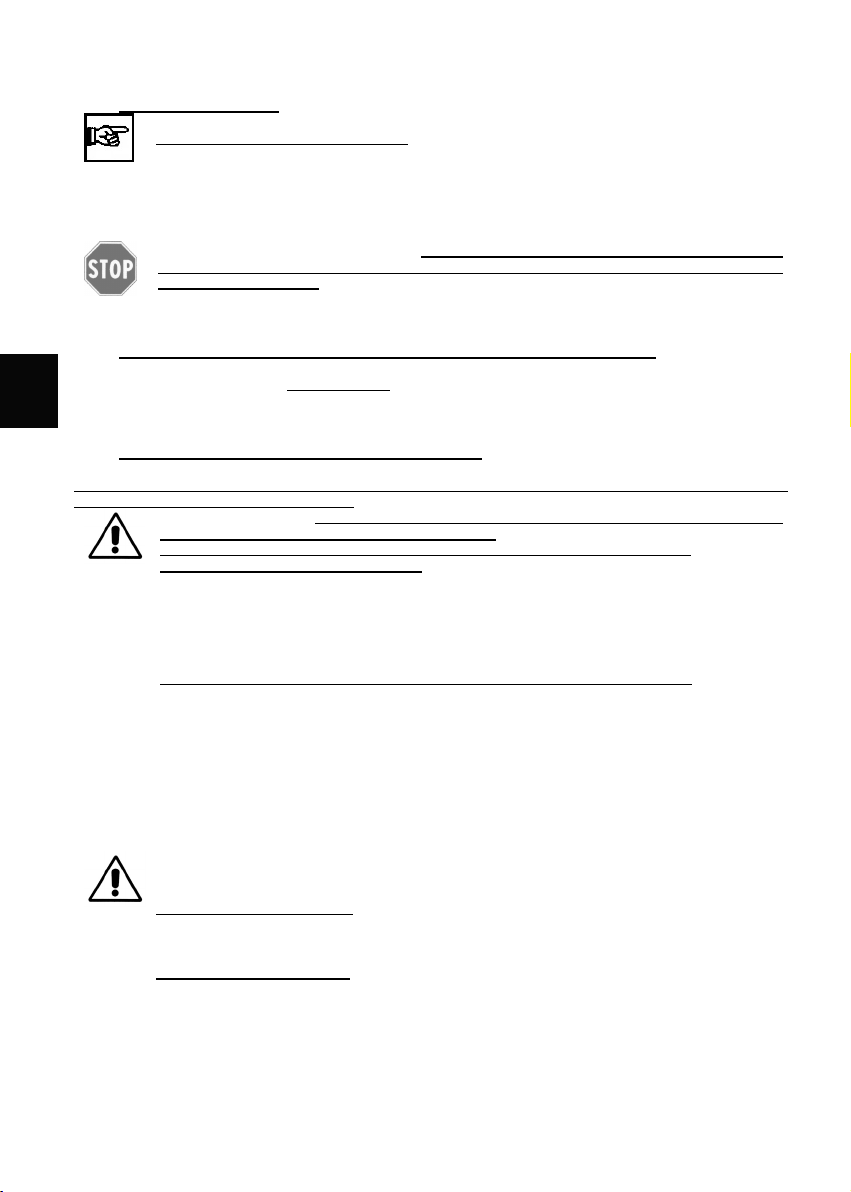
KAP. 3. SICHERHEITSANLEITUNGEN
VORBEMERKUNG
Die Nichtbeachtung der Sicherheitsnormen und -vorgänge kann Gefahren oder Schäden herbeiführen.
Die Benutzung des Geräts ist nur gestattet unter Beachtung durch den Endverbraucher von:
1. allen Regelungen, die die Aufstellung des Geräts und das Verhalten der Personen betreffen, die auf
Grund von anwendbaren Gesetzen und/oder Normen festgelegt wurden; mit besonderem Bezug auf die
am Gerät vorgeschaltete feste Anlage für den Anschluss/Betrieb des Geräts;
2. allen weiteren Anweisungen und Warnhinweise für die Benutzung des Geräts, die als Teil der
technischen/grafischen Anlagen zum Gerät zu betrachten sind.
Wo nichts anderes festgelegt wurde, muss das Personal, das Eingriffe zu Installation, Anschluss, Wartung,
Wiederinstallation und Wiederverwendung, Fehlersuche oder Störungen, Verschrottung und Abbau
durchführt erfahren sein und über die Sicherheitsvorschriften unterrichtet und über die Restrisiken
informiert worden sein. Außerdem muss dieses Personal im Bereich der Sicherheit die Fachkenntnisse von
Wartungstechnikern besitzen.
RÄUMLICHKEITEN, ARBEITSPLATZ UND DURCHGANGSORT
Der Arbeitsraum muss den Anforderungen der Richtlinie 89/654/EWG entsprechen. Im Arbeitsbereich dürfen keine
Fremdgegenstände vorhanden sein. Der Arbeitgeber hat gemäß Richtlinie 89/391/EWG bezüglich der Umsetzung der
Maßnahmen zur Verbesserung der Sicherheit und des Gesundheitsschutzes der Arbeitnehmer bei der Arbeit die
ordnungsgemäß im Handbuch angegeben Restrisiken zu beseitigen oder zu reduzieren.
DEUTSCH
WARNUNGEN BEZÜGLICH RESTRISIKEN
RESTRISIKO AUF GRUND DER ABNAHME VON FESTEN ABSCHIRMUNGEN, EINGRIFFEN AN
BESCHÄDIGTEN/ABGENUTZTEN TEILEN
Unter keinen Umständen darf der Bediener versuchen, eine feste Abschirmung zu öffnen oder zu
entfernen oder eine Sicherheitsvorrichtung abzuändern.
Während der Bestückung, Wartung, Auswechslung der Rührelemente und der Reinigung, sowie
während aller anderen manuellen Eingriffe, die das Einführen der Hände oder anderer Körperteile in die
gefährlichen Bereiche des Geräts beinhalten, bleibt ein Restrisiko, das vor allem besteht aus:
1. Stößen an Bauteilen des Geräts,
2. Reibung und/oder Aufschürfung an rauhen Geräteteilen,
3. Verletzung an den spitzen Teilen,
4. Schnitt an den scharfen Teilen.
Außerdem bleibt während der Reinigung oder der Entfernung von Resten aus den Messern durch die
nötige Einführung der Hände in der Nähe der Schneidelemente ein Restrisiko bestehen, das vor allem zu dem
Schnitt an scharfen Teilen führen kann.
Außerdem müssen der Bediener und der Wartungstechniker für manuelle Eingriffe bei offenen
Abschirmungen ausgebildet werden und müssen über die daraus folgenden Risiken unterrichtet und durch
den Verantwortlichen befugt werden. Sie müssen ebenfalls angemessene persönliche Schutzvorrichtungen
tragen bzw. schnittfeste Handschuhe. Alle Eingriffe an Scheiben sind bei nach unten gerichteten Messern
durchzuführen.
KAP. 4. INBETRIEBNAHME UND ANWENDUNG
Die Handhabung des Geräts ist einzig und allein dem befugten und entsprechend ausgebildeten Personal zu
überlassen, das außerdem ausreichende technische Erfahrung aufweisen muss.
Vor der Einschaltung des Geräts die folgenden Schritte durchführen:
Die technischen Unterlagen genau durchlesen,
Die Schutz- und Nothaltvorrichtungen am Gerät, ihre Lage und ihre Betriebsweise kennen.
Die Benutzung durch Unbefugte der Geräteteile und des Zubehörs, das als Schutz- und
Sicherheitsvorrichtung eingesetzt wird, kann Störungen oder Gefahrensituationen für die Bediener
herbeiführen. Der Bediener muss außerdem eine angebrachte Ausbildung besitzen.
8 13
ÜBERSETZUNG DER ANLEITUNGEN IM ORIGINAL
Pag. di
Page 65
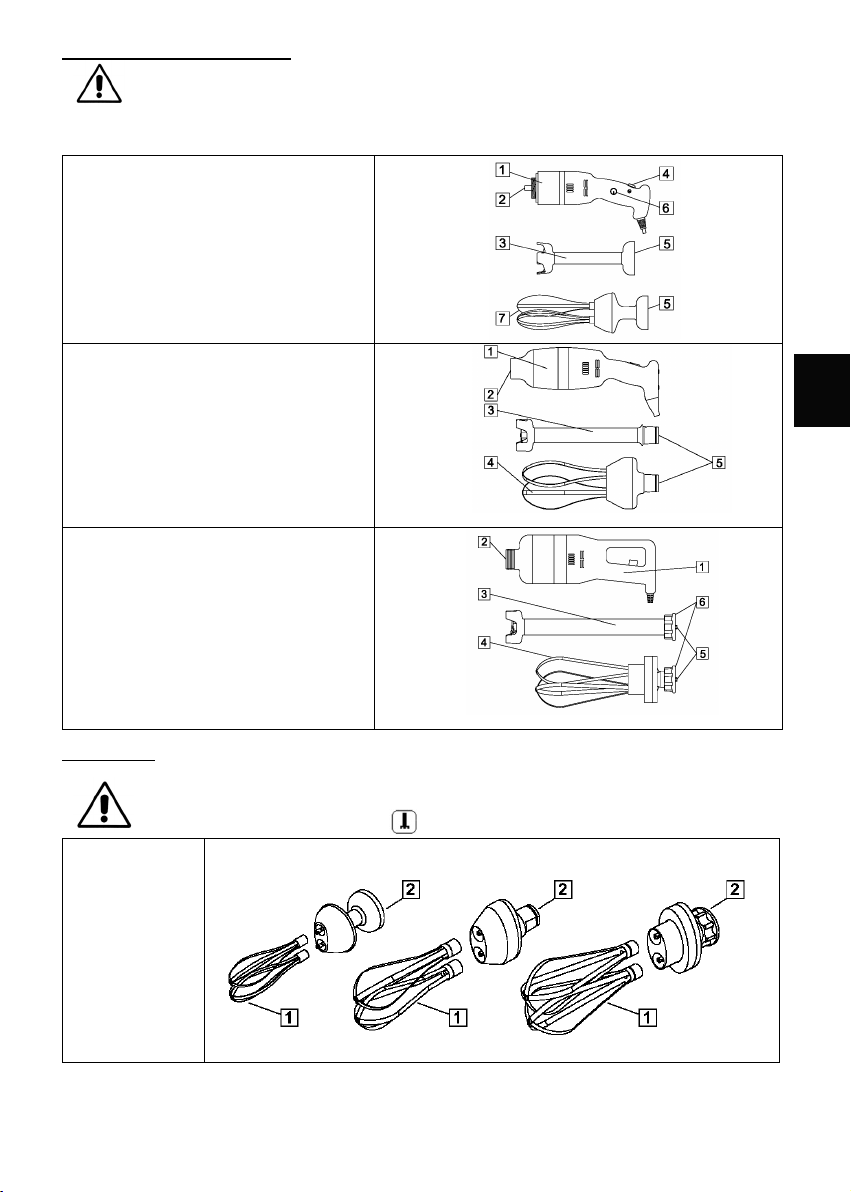
MONTAGE / ABMONTAGE
Alle Eingriffe zur Montage / Abmontage eines jeden Organs am Gerät müssen bei still stehendem Gerät und
bei ausgezogenem Netzstecker bzw. bei Netz-Trennschalter auf OFF erfolgen
Die Zusammensetzung des Geräts erfolgt in mehreren Schritten (Als Beispiel wird hier das Gerät mit losem Gerätekörper
dargestellt).
Die Abmontage erfolgt gemäß den gleichen, oben für die Montage beschriebenen Schritten in umgekehrter Reihenfolge.
MONTAGE
MODELL 250VF-VV
1. Den Aufsatz (5) des Mixstabs (3) an die
Schnellkopplung (2) des Gerätekörpers (1) ansetzen
2. Den Mixstab (3) anschrauben, bis er fest am
Gerätekörper (1) einrastet.
250 VF-VV
MONTAGE
MODELL 300/400 VV
1. Den Aufsatz (5) mit der Schnellkopplung (2) des
Gerätekörpers (1) anreihen und zusammenfügen
2. Die Utensilien (3-4) drehen, bis sie fest mit dem
Gerätekörper (l) zusammengesetzt wurden.
300 / 400 VV
MONTAGE
MODELL 350/450/650 VF-VV
1. Den Aufsatz (5) der Utensilien (3-4) an die
Schnellkopplung (2) des Gerätekörpers (1) anreihen und
damit zusamenfügen
2. den Ring (6) festschrauben bis die Utensilien fest am
Gerätekörper (1) befestigt sind.
350 / 450 / 650 VF-VV
Es ist verboten, den Schneebesen in Geräten mit fester Geschwindigkeit (VF) zu benutzen
Der Knethaken darf bei Maschinen mit variabler Geschwindigkeitsregelung nicht verwendet werden
MONTAGE
ABMONTAGE
DER SCHNEEBESEN
Für die Abmontage die
Schneebesen (1) so
lange ziehen, bis sie sich
von der Motoreinheit (2)
lösen.
Für die Montage den
Ansatz der Schneebesen
(1) in den Stift der
Motoreinheit (2)
einführen und
andrücken.
(VV)mit Funktion max. Geschwindigkeit
9 13
ÜBERSETZUNG DER ANLEITUNGEN IM ORIGINAL
Pag. di
DEUTSCH
Page 66
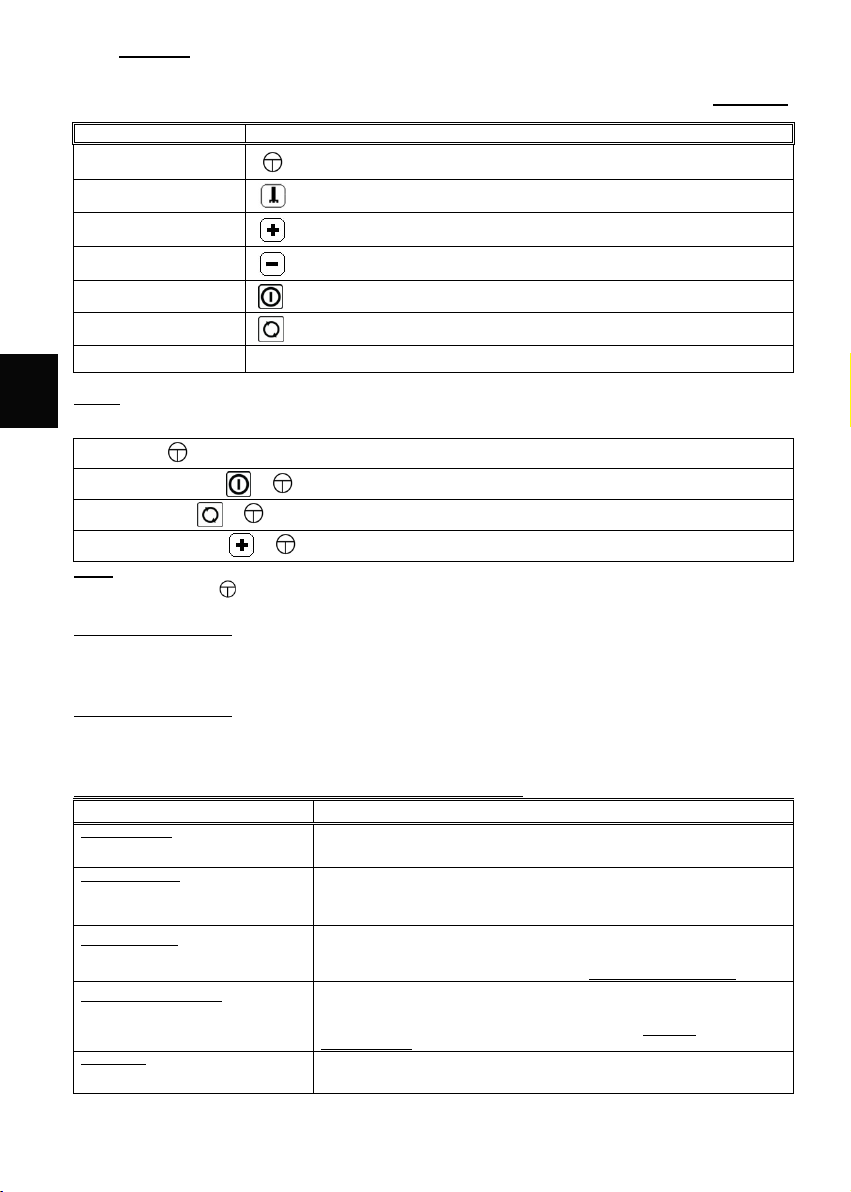
BETRIEB
Die Steuerungen wurden entwickelt und hergestellt um sicher, zuverlässig und widerstandsfähig gegenüber Beanspruchungen
bei Normalbetrieb, voraussehbaren Beanspruchungen und äußeren Faktoren wirken zu können. Außerdem sind sie gut sichtbar
und erkennbar und mit der entsprechenden Markierung gekennzeichnet. Im Folgenden werden die wichtigsten Steuerungen
erläutert:
TYP / FARBE BESCHREIBUNG
Knopf / schwarz
Taste / schwarz
Taste / schwarz
Taste / schwarz
Taste / schwarz
Taste / schwarz
Display / rot Anzeige der Geschwindigkeit: 1 bis 9 / Anzeige max. Geschwindigkeit
START
Der Impulsstart des Geräts kann nur durch eine gewollte Handlung auf der dafür vorgesehenen Steuerungseinheit
DEUTSCH
erfolgen:
Gerät VF 250: Betrieb nur bei gedrückter Taste
Gerät VF 350 / 450 / 650 : + . Nur anhaltenden Betrieb.
Gerät VV 300 / 400 : + . Nur anhaltenden Betrieb.
Gerät VV 350 / 450 / 650 : + . Nur anhaltenden Betrieb.
HALT
Für den Gerätehalt Taste betätigen.
BETRIEBSSICHERHEIT
Falls das Gerät stark beansprucht, übermäßig langen Betriebszeiten ausgesetzt oder überlastet wird, stellt es automatisch ab auf
Grund des Ansprechens eines Thermoschutzschalters. In diesem Fall warten, bis das Gerät vollkommen abgekühlt ist,
bevor es wieder eingeschaltet werden kann.
FEHLENDE SPANNUNG
Bei unterbrochener Stromversorgung oder wenn das Gerät vom Stromnetz getrennt wird, kann es nur durch einen Startvorgang
wieder eingeschaltet werden, nachdem die Stromversorgung wieder hergestellt oder das Gerät wieder an das Stromnetz
angeschlossen wurde.
KONTROLLEN UND ÜBERPRÜFUNGEN VOR DER EINSCHALTUNG
ÜBERPRÜFUNG / KONTROLLE VORGEHEN
Sicherstellen, dass:
Im Topf keine fremden Gegenstände
vorhanden sind
Reinheit überprüfen:
der Außenteile des Geräts
der Oberfläche der Zubehörteile
der Innenteile des Geräts
Zustand überprüfen:
der festen Schutzvorrichtungen
des Gerätekörpers
Betriebsfähigkeit überprüfen:
der für die Sicherheit vorgesehenen
Steuer-/Kontrollteile;
der Steuerungen.
Sicherstellen:
dass keine seltsamen Geräusche
nach dem Start zu hören sind
10 13
“
” / Taste für den Gerätestart anhaltender Betrieb
“
” / Umschalttaster max. Geschwindigkeit nur für Mixer
“
” / Taste Beschleunigung / Sicherheitsschaltung (nur Modelle VV 350/450/650)
“
” / Taste Verlangsamung
“
” / Sicherheitsschaltung (nur Modelle VF 350/450/650)
“
” / Sicherheitsschaltung (nur Modelle VV 300/400)
Sichtprüfung der angegebenen Teile zur Sicherstellung, dass keine fremden Gegenstände wie
z.B. Werkzeuge, Tücher, etc… und dass auch keine Nahrungsmittel vorhanden sind. Bei
Auffinden solcher Gegenstände, diese entfernen.
Alle Flächen der angegebenen Teile müssen vor der Benutzung des Geräts einer Sichtprüfung
unterzogen werden, um ihre Reinheit zu überprüfen.
Bei Auffinden von Schimmel oder anderen Unreinheiten die Reinigung dieser Teile gemäß
beschriebenem Vorgang in Kapitel 5 durchführen.
Alle festen Abschirmungen, etc.. müssen ihre vorgesehene Funktion erfüllen.
Sichtprüfung der angegebenen Teile um sicherzustellen, dass diese auf ihrer Außenseite
unbeschädigt sind. Diese Teile müssen auf jeden Fall ersetzt werden, sobald erste Anzeichen
von Abnutzung oder Beschädigung sichtbar sind (siehe anerkannte Kundendienststelle).
Alle Vorrichtungen müssen die für sie vorgesehene Funktion erfüllen. Die Vorrichtungen direkt
steuern, so dass diese die erwartete Funktion ausführen.
Die Stellglieder und alle anderen Teile müssen auf jeden Fall ersetzt werden, sobald erste
Anzeichen von Abnutzung oder Beschädigung sichtbar sind (siehe anerkannte
Kundendienststelle).
Falls während der Überprüfung der Steuerungen seltsame Geräusche festgestellt werden, die
z.B. auf Festfressen oder mechanische Brüche hinweisen, sofort das Gerät anhalten und den
Wartungsdienst benachrichtigen.
ÜBERSETZUNG DER ANLEITUNGEN IM ORIGINAL
Pag. di
Page 67
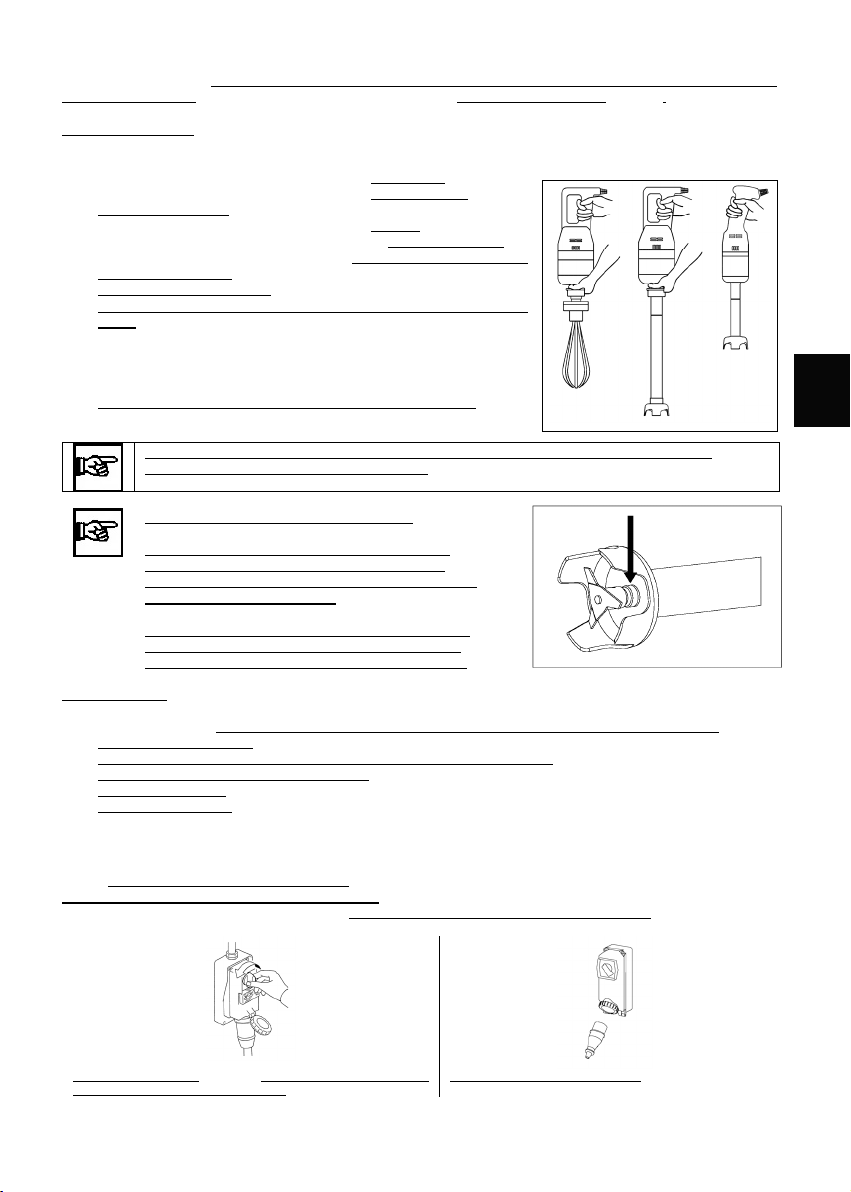
Für jede Art Eingriff oder für die Ersetzung der beschädigten Teile den Wartungsdienst benachrichtigen. Für die allfällige
Ersetzung müssen durch Original-Teile des Herstellers oder mindestens Teile von gleichwertiger Qualität, Sicherheit und
gleichen Eigenschaften benutzt werden. Weitere Auskünfte sind beim anerkannten Kundendienst erhältlich.
INBETRIEBNAHME
Der Bediener des Geräts kann das Gerät unter Beachtung der folgenden Anweisungen in der angegebenen Reihenfolge
einschalten:
1. Positives Ergebnis der Kontrollen bezüglich der Vorbereitung,
2. Positives Ergebnis der Kontrollen bezüglich der Stromversorgung,
3. Anschluss des Steckers an die passende Steckdose,
4. Positives Ergebnis der Kontrollen bezüglich der Montage,
5. Positives Ergebnis der Kontrollen / Überprüfungen vor der Einschaltung,
6. Positives Ergebnis der Kontrollen für die Einhaltung aller
Sicherheitsvorschriften,
7. Die Nahrungsmittel von Hand in den Topf einführen,
8. Mit beiden Händen das Gerät an den dafür vorgesehenen Stellen
halten:
a. Das Gerät mit dem Zubehörteil in den Topf setzen,
b. Gerät starten, und dabei bis zum Ende der
Lebensmittelbearbeitung halten;
9. Sobald das Lebensmittelprodukt die gewünschte Beschaffenheit erreicht hat,
das Gerät ausschalten und auf eine passende Arbeitsfläche ablegen,
10. Von Hand das Produkt aus der Pfanne entfernen: dabei die Pfanne mit
beiden Händen halten und das Produkt in einen geeigneten Behälter leeren.
Es ist verboten das Gerät weiter als bis zur Eintauch-Markierung und jedenfalls früher als den
Feststellring am Gerät in den Topf einzuführen
Auf keinen Fall das Gerät leer laufen lassen.
Es wird empfohlen, die Gummidichtung unter dem
Messer (siehe die Abbildung unten) regelmäßig zu
kontrollieren und, sollte sie beschädigt bzw. verbraucht
sein, gegebenenfalls zu ersetzen.
Der unverzehrte Zustand der Dichtung verhindert das
Eindringen des Verarbeitungsprodukt ins Innere des
Geräts und somit die Schädenentstehung am Mischer.
AUSSCHALTEN
Die Abschaltung in folgenden Schritten durchführen:
1. vor der Abschaltung abwarten, bis die Bearbeitung abgeschlossen wurde, bzw. bis das Produkt die gewünschte
Beschaffenheit erreicht hat,
2. das Gerät anhalten durch Loslassen der entsprechenden Steuerungsvorrichtungen,
3. das Gerät auf eine geeignete Ablagefläche legen
4. den Stecker des Geräts aus der Steckdose ziehen,
5. Reinigung durchführen.
KAP. 5. WARTUNG, FEHLERSUCHE UND REINIGUNG
WARTUNGVORSCHRIFTEN
ABTRENNEN VON ÄUßEREN STROMQUELLEN
Vor der Ausführung der Eingriffe im Bereich Wartung, Reinigung und Ersetzung von Teilen müssen die äußeren
Stromquellen abgetrennt und isoliert werden.
DEUTSCH
Die vor der Stromleitung des Geräts geschaltete Sicherheitsvorrichtung
der elektrischen Anlage auf „Null” schalten.
11 13
ÜBERSETZUNG DER ANLEITUNGEN IM ORIGINAL
Haupt-Netz-Trennschalter deaktivieren und den Stecker mit
entsprechenden Systemen abdecken
Pag. di
Page 68
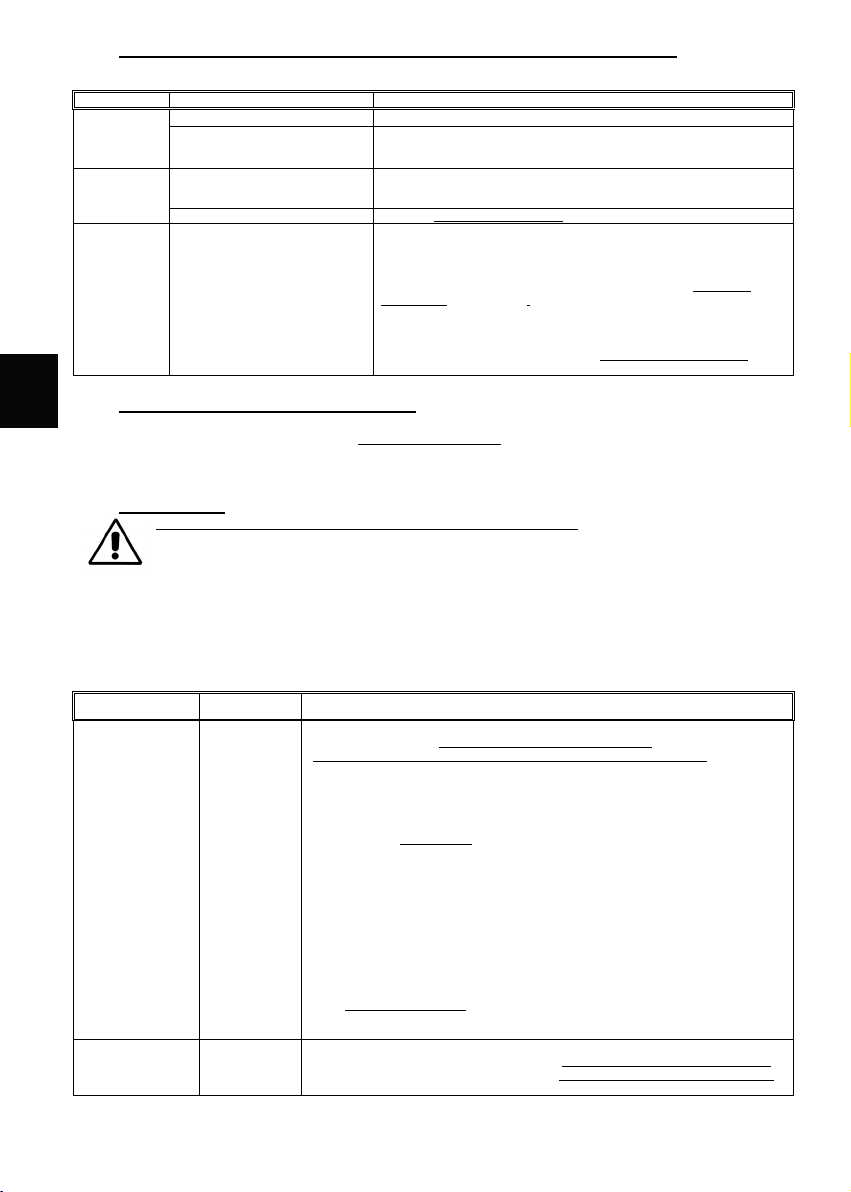
FEHLERSUCHE UND ENTSPERRUNG VON BEWEGLICHEN ELEMENTEN
Im Folgenden werden die Schritte angegeben für die Fehlersuche und Entsperrung von beweglichen Elementen, die durch
das Wartungspersonal ausgeführt werden müssen.
TYP MÖGLICHE URSACHE/N VORGEHEN
Netzausfall
Betriebsunterbrechung
Gerät
funktioniert
nicht: die
Messer drehen
sich nicht oder
schneiden nicht
richtig
Generelles Black Out Stromversorgungsgesellschaft anfragen
Vorgeschaltete Sicherungen oder
Thermomagnetschalter haben
angesprochen
Ansprechen der Schutzvorrichtung im
Inneren des Geräts
Ursache/n nicht identifizierbar Direkt den anerkannten Kundendienst beiziehen
Fehlende Speisespannung.
Netz-Trennvorrichtung auf „O”.
Starttaste nicht betriebsfähig
Thermoschalter hat wegen
Überhitzung angesprochen
Buchstabe „E” erscheint auf dem
Display.
Nach Behebung der Ursachen, die zum Ansprechen der Schutzvorrichtung geführt
haben, diese Vorrichtung wieder herstellen. Bei Anhalten des Problems einen
Elektriker beiziehen.
Einen Elektriker beiziehen: nach Behebung der Ursachen, die zum Ansprechen der
Schutzvorrichtung geführt haben, diese Vorrichtung zurück stellen.
Stromzufuhr überprüfen und wieder herstellen.
Den Stecker in die Steckdose einführen
Betriebsfähigkeit der Taste überprüfen und falls nötig direkt den anerkannten
Kundendienst benachrichtigen.
Vor dem Neustart des Geräts völlige Abkühlung abwarten
Geschwindigkeitserfassung defekt, direkt die anerkannte Kundendienststelle
benachrichtigen
AUßERORDENTLICHE WARTUNG
Für Eingriffe im Bereich außerordentliche Wartung die infolge von Brüchen, Überholungen oder mechanischen oder
DEUTSCH
elektrischen Störungen nötig sind, muss direkt der anerkannte Kundendienst angefragt werden.
Die Anweisungen bezüglich der außerordentlichen Wartung sind im vorliegenden Bedienungshandbuch nicht enthalten
und müssen daher ausdrücklich beim Hersteller angefordert werden.
REINIGUNG
Es ist untersagt, laufende Organe oder Elemente von Hand zu reinigen.
Alle Reinigungseingriffe dürfen ausschließlich durchgeführt werden, nachdem das Gerät komplett von dem
bearbeiteten Nahrungsmittel befreit und von der äußeren Stromversorgungsquelle isoliert wurde.
Das Gerät, die elektrische Anlage und die Bestandteile auf dem Gerät dürfen niemals mit Wasser gereinigt
werden, ebenso wenig mit einem Strahl, ungeachtet welcher Beschaffenheit oder welcher Menge auch
immer; deshalb ohne „Kessel”, „Schlauch” oder „Schwamm” reinigen. Niemals das Gerät direkt in ein
Die Hygienestufe des Geräts und dessen Zubehör ist für die vorgesehene Anwendung 2 (zwei): Geräte, die auf Grund
einer hygienebezogene Risikoanalyse den internationalen Anforderungen entsprechen, jedoch eine programmierte Zerlegung
des Geräts für die Reinigung erfordern.
HÄUFIGKEIT PERSONAL VORGANG
Am Ende jeder
Arbeitsschicht und
jedenfalls vor der
täglichen Benutzung
12 13
Spülbecken oder unter einen Wasserhahn stellen.
Bediener Alle Oberflächen und die Teile am Gerät, die mit Nahrungsmittel in Berührung kommen, bzw.
Nahrungsmittelbereiche (Außenfläche und Innenfläche der Utensilien) und die Spritzbereiche
(Obere Fläche des am Gerät befestigten Zubehörteils und äußere Fläche des Geräts), müssen
gereinigt und desinfiziert werden wie unten angegeben. Für die Abmontage der Utensilien, siehe
vorhergehende Beschreibungen.
Die Oberflächen von eventuellen Nahrungsmittelrückständen befreien (z.B. mit einem
Plastikschaber);
Alle Oberflächen des Nahrungsmittelbereichs und Spritzbereichs mit einem feuchten
weichen Tuch (nicht triefend) und in warmem Wasser verdünntem Reinigungsmittel
reinigen (gewöhnliche Abwaschseife genügt). Spezifische Mittel für Stahl verwenden, die
flüssig sein müssen (keine Cremes oder Schleifpasten) und vor allem dürfen sie kein Chlor
enthalten. Gegen Fett kann denaturierter Alkohol verwendet werden.
Mit sauberem warmem Wasser spülen und anschließend alle Oberflächen des
Nahrungsmittelbereichs und Spritzbereichs mit einem weichen, nicht faserigen Tuch
abtrocknen.
Obwohl der Mixstab aus Edelstahl besteht, sollte er nicht im Geschirrspüler gewaschen
werden, ebenso wenig Kunststoffteile.
Die Neumontage muss nur bei Bedürfnis für eine neue Bearbeitung erfolgen; die Teile in
einem weichen, nicht faserigen Tuch eingewickelt aufbewahren.
LANGE BETRIEBSLOSIGKEIT
Bei langer Betriebslosigkeit des Geräts muss auf alle Stahloberflächen (besonders diejenigen
aus Edelstahl) reichlich Vaselinöl mit einem Tuch aufgetragen werden, damit diese Teile durch
eine zusätzliche Schicht geschützt werden.
VOR ODER WÄHREND DER REINIGUNG IST ES UNTERSAGT:
auf bewegliche Elemente zuzugreifen, ohne dass zuvor überprüft wurde, ob diese still stehen;
auf bewegliche Elemente zuzugreifen ohne dass das Gerät garantiert sicher angehalten wurde
(Netz-Trennvorrichtung auf Position Null)
ÜBERSETZUNG DER ANLEITUNGEN IM ORIGINAL
Pag. di
Page 69
HÄUFIGKEIT PERSONAL VORGANG
PRODUKTE, DIE NICHT BENUTZT WERDEN DÜRFEN:
Druckluftstrahlen gegen Bereiche, in denen sich Mehl befindet und generell gegen das Gerät;
Dampfreinigungsgeräte;
Reinigungsmittel, die CHLOR enthalten (auch verdünnt) oder daraus zusammengesetzt sind,
wie: Bleichlauge, Chlorwasserstoffsäure, Entstopfungsmittel, Reinigungsmittel für Marmor,
Entkalkungsmittel, etc … diese können die Beschaffung des Stahls angreifen und können
unwiderrufliche Flecken oder Oxidation verursachen. Die losen Ausströmungen der oben
genannten Mittel können oxidieren und in einigen Fällen den Stahl anfressen;
Metallplättchen, Bürsten oder Polierscheiben aus anderen Metallen oder Legierungen (z.B.
gewöhnlicher Stahl, Alu, Messing, etc…) oder Werkzeuge, die zuvor für die Reinigung anderer
Metalle oder Legierungen benutzt wurden.
reibende Reinigungspulver;
Benzin, Lösungsmittel oder entflammbare und/oder korrodierende Fluide;
Silberreinigungsmittel.
KAP. 6. ENTSORGUNG
Für den Fall, dass man entscheidet, die Maschine nicht mehr zu benutzen, weil sie obsolet, kaputt oder abgenutzt ist, ihre
Außerbetriebnahme muss spezialisiertem und ausgerüstetem Personal anvertraut werden. Am Ende der Demontage müssen
alle Identifikationsschilder und alle andere Dokumente zerstört werden. Die Maschine kann entsorgt werden ohne sie in kleine
Stücke zu zerbrechen, es genügt die Aggregate zu trennen, aus denen sie zusammengesetzt ist, und diese zu verschrotten.
Die Maschine als städtische gemischte Abfälle nicht entsorgen, Mülltrennung beachten
Die Abfuhrsysteme der Maschine sind:
Rücknahme durch den Verteiler
•
Möglichkeit von Auslieferung an den Verteiler der Maschine gleichwertig mit der Kaufurkunde einer neuen Maschine.
•
Die Maschine hat keinen Gefahrenstoff mit potentiellen negativen Wirkungen auf die Umwelt und die menschliche
Gesundheit. Es ist wesentlich, dass die Abnehmer zu der Wiederwerwendung, dem Recycling und anderen Formen der
Rückgewinnung der Maschine beitragen. Der Arbeitgeber muss Kenntnisse der in seinem eigenen Land geltenden Gesetze
haben und sich verhalten, um solche Gesetze zu folgen.
Das auf die Maschine geschriebene Symbol der durchgestrichenen Mülltonne zeigt,
dass das Produkt am Ende der Betriebsdauer getrennt von dem anderen Abfall entsorgt
werden muss.
Es ist verboten, und dazu mit Sanktionen belegt, die Maschine und die elektrische Ausrüstung in die
Landschaft zu werfen.
KAP. 7. BAUMATERIAL
Je nach Betriebs- und Produktionsbedürfnis kann das Gerät aus verschiedenen Materialtypologien bestehen.
GRUPPE
Gerätekörper
Messer Mixstab
Glocke Mixstab
Rohr Mixstab
Motoreinheit Schneebesen
Schneebesen
MATERIALTYP
Edelstahl
AISI 304
Kunststoff für
Nahrungsmittel
●
●
●
●
●
●
DEUTSCH
13 13
ÜBERSETZUNG DER ANLEITUNGEN IM ORIGINAL
Pag. di
Page 70

Page 71

Page 72

ОГЛАВЛЕНИЕ
ГЛАВА 1. УСТРОЙСТВО РУКОВОДСТВА 3
ГЛАВА 2. ОБЩИЕ ДАННЫЕ И ХАРАКТЕРИСТИКИ 4
ГЛАВА 3.
ИНСТРУКЦИИ ПО ТЕХНИКЕ БЕЗОПАСНОСТИ 8
ГЛАВА 4. УСТАНОВКА И ИСПОЛЬЗОВАНИЕ 8
ГЛАВА 5. ТЕХНИЧЕСКОЕ ОБСЛУЖИВАНИЕ, ВЫЯВЛЕНИЕ НЕПОЛАДОК И ЧИСТКА 11
ГЛАВА 6. УНИЧТОЖЕНИЕ 13
ГЛАВА 7. ИСПОЛЬЗОВАННЫЕ МАТЕРИАЛЫ 13
ГАРАНТИЯ
Гарантия предоставляется на12 (двенадцать) месяцев с даты продажи.
Гарантия покрывает ремонт оборудования, приобретенного в уполномоченных торговых точках, если будет доказано,
что в оборудовании имеются дефекты материала или сборки, на приведенных ниже условиях:
1. под гарантией подразумевается бесплатная замена всех деталей, на которых выявлены фабричные дефекты.
Гарантия является недействительной в случае
приобретении, а также в приведенных ниже случаях:
а. поломка или повреждение оборудования по неаккуратности;
б. использование оборудования без учета предостережений, приведенных в инструкции;
в. поврежения, вызванные несоответствием окружающей среды, в которой работает оборудование, и
явлениями, не зависящими от нормального функционирования оборудования (нарушения напряжения
и
частоты в сети);
г. ремонт, выполненный лицами или центрами, не уполномоченными производителем;
2. необходимо делать запросы на гарантийное обслуживание исключительно в уполномоченные торговые точки и
мастерские.
3. оборудование должно передаваться производителю для ремонта на условиях франко-порт, доставка
осуществляется за счет получателя.
4. исключена замена оборудования, а также продление сроков
5. производитель не несет ответственности за прямой и косвенный ущерб любого типа, нанесенный людям или
предметам, в связи с неправильным использованием оборудования или за его неиспользование в период,
необходимый для его ремонта.
Руководство по использованию
Выпуск
Январе 2015
отсутствия чека или счет-фактуры, свидетельствующих о
гарантии вследствие ремонта повреждений.
2 14
ПЕРЕВОД ОРИГИНАЛА ИНСТРУКЦИ
Pag. di
Page 73
ГЛАВА. 1. УСТРОЙСТВО РУКОВОДСТВА
ЦЕЛЬ РУКОВОДСТВА
ВАЖНОСТЬ РУКОВОДСТВА
Данное руководство по использованию считается неотъемлемой частью оборудования.
1. необходимо хранить руководство в течение всего периода использования оборудования.
2. руководство должно прилагаться к оборудованию в случае его передачи.
3. помимо всех сведений, необходимых пользователю, руководство содержит (по разделам) электрические схемы,
которые необходимы для технического обслуживания и возможного ремонта.
ЦЕЛЬ РУКОВОДСТВА
Целью руководства по использованию является предоставление заказчику всей информации, необходимой не только
для правильного использования поставленного оборудования, но и для как можно более надежной и автономной
работы с ним.
Кроме того, данное руководство составлено с целью предоставления указаний и предупреждений, которые позволят
изучить поставленное оборудование и понять принципы и пределы его функционирования. В случае возможных
сомнений обращаться в Уполномоченный Центр Обслуживания.
КОМУ ПРЕДНАЗНАЧЕНО
Данное руководство по использованию, поставляемое в одной копии вместе с оборудованием, является его
неотъемлемой частью и предназначено как операторам, так и квалифицированным специалистам, занимающимся его
установкой, использованием и техническим обслуживанием.
Ответсвенный за технику безопасности заказчика и другие работники, которым предназначено оборудование,
должны изучить данное руководство по использованию, чтобы выполнить все технические и организационные
указания.
ОТВЕТСТВЕННОСТЬ
Ответственные лица предприятия, отвечающие за рабочую деятельность
В случае повреждения или утери данного руководства, можно запросить его копию в
Уполномоченном Центре Обслуживания.
Данное руководство соответствует состоянию техники на момент создания оборудования;
производитель оставляет за собой право обновлять продукцию и, следовательно, последующие
издания руководства, не обновляя при этом предыдущую продукцию и издания, за исключением
особых случаев, касающихся здоровья и безопасности людей.
Следует придать особое значение остаточным рискам, присутствующим на оборудовании, и
указаниям, которых должны придерживаться работники.
Производитель несет ответственность за оборудование в его первоначальном состоянии.
Производитель не несет ответственность за повреждения, вызванные несоответсвующим или
неправильным использованием оборудования и документации, или за повреждения, вызванные
нарушением норм, невнимательностью, неосторожностью, неумением и невыполнением
предписанных норм со стороны работодателя, оператора или наладчика, и за любые возможные
повреждения, вызванные неправильным и/или несоответствующим использованием.
Производитель не несет ответственность за последствия использования нефирменных запасных
частей или запасных частей с неравноценными характеристиками.
Производитель несет ответственность только за информацию, приведенную в оригинале
руководства на итальянском языке.
Несоблюдение указаний, содержащихся в данном руководстве, ведет к немедленному
прекращению гарантии.
, в сфере соответствующих
полномочий и компетенций должны:
Применять предусмотренные меры безопасности;
Уведомлять операторов об определенных рисках, которым они подвергаются, и доводить до их
сведения основные нормы техники безопасности;
Требовать от всех операторов исполнения норм техники безопасности и использования средств
защиты, предоставленых в их распоряжение;
Этим должны
заниматься одновременно несколько работников.
3 14
ПЕРЕВОД ОРИГИНАЛА ИНСТРУКЦИ
Pag. di
Page 74
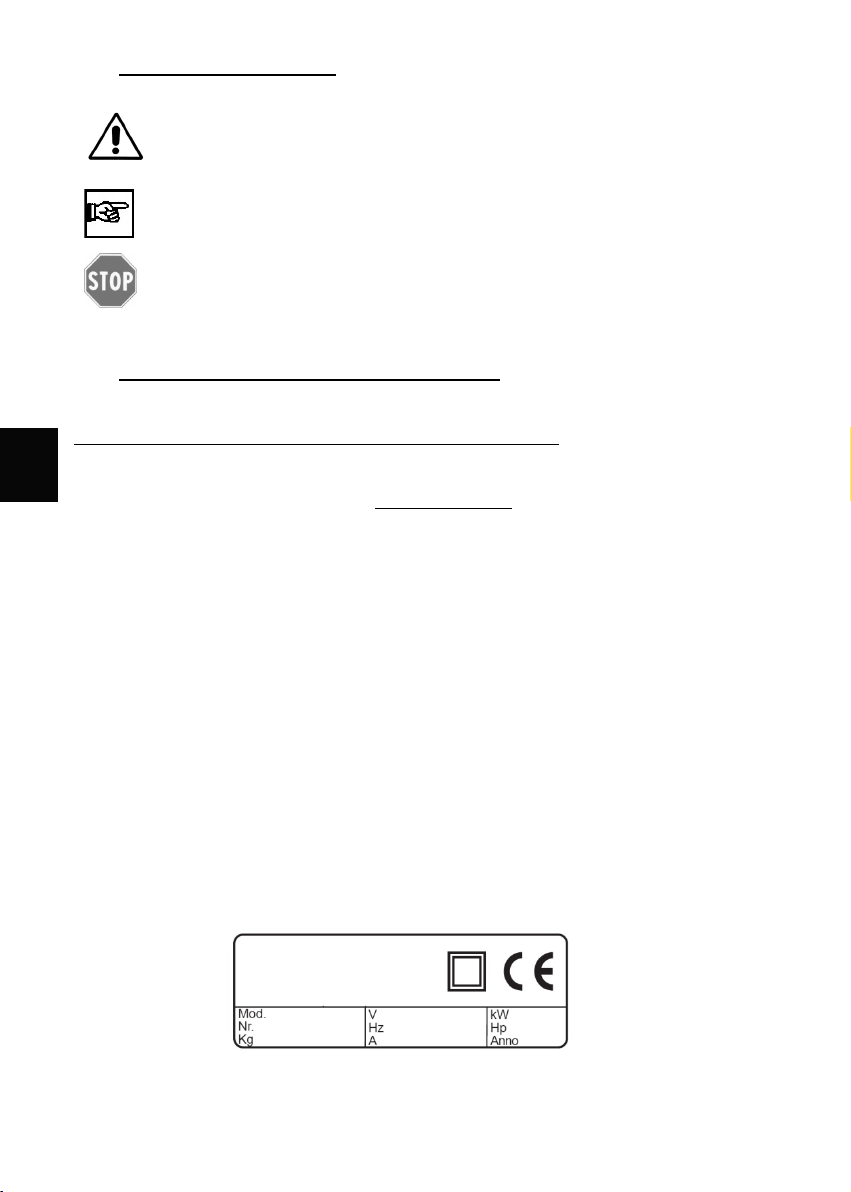
ЗНАЧЕНИЯ СИМВОЛОВ
Далее приведены значения и определения символов, которые используются в данном документе.
ОПАСНОСТЬ
Указывает на опасность, которой могут подвергаться лица, работающие на оборудовании и
находящиеся вблизи его, в связи с чем данные операции должны выполняться с соблюдением
действующих норм техники безопасности и указаний, приведенных в данном руководстве.
ОСТОРОЖНО
Указывает на наличие полезной информации и/или дополнительных рекомендаций и/или
предосторежений, связанных с выполняемой операцией.
ВНИМАНИЕ
Указывает на операцию, которую следует выполнять внимательно во избежание повреждений
оборудования..
ГЛАВА. 2. ОБЩИЕ ДАННЫЕ И ХАРАКТЕРИСТИКИ
ПРЕДНАЗНАЧЕНИЕ И ОСНОВНЫЕ ЧАСТИ
Миксер, в дальнейшем называемый «машина», представляет собой портативный прибор, предназначенный для того,
чтобы взбивать, размельчать, крошить, эмульгировать, превращать в кашицу и т.д. для использования в сфере
общественного питания.
При помощи этого прибора и в зависимости от используемого инструмента можно готовить непосредственно в
кастрюле минестроны, супы, пюре, кремы, панировочное тесто, майонез, миндальное тесто, крем из сыра и тому
подобное.
Машина состоит из электрического мотора, включенного единым сплавом из пластичного материала (базовый корпус
машины), в котором вал двигателя подсоединен к рабочему инструменту: блендеру или венчику.
Инструмент присоединяется и блокируется на корпусе машины посредством блокирующего кольца или последством
быстроразъемного крепления.
Пищевой продукт загружается вручную в емкость и затем, при помощи обеих рук и посредством захвата машины в
предусмотренных для этого точках (см. рисунок на стр. 11), выполняется следующее:
1. машина устанавливается таким образом, чтобы инструмент находился внутри емкости
2. машина включается и используется до завершения обработки пищевого продукта;
3. машина выключается и устанавливается на соответствующую опорную поверхность.
В зависимости от режима функционирования и используемого инструмента, машина может выполнять следующее:
1. работать с упором на дно емкости (при использовании блендера), не выходя в любом случае за засечку
погружения,
2. работать без опоры при использовании обеих рук (при использовании венчика),
3. работать с установкой на специальную опору, которую можно приспосабливать к кастрюле. Данная опора
действует как замена оператора для выполнения операций, требующих длительного времени, или операций по
обработке пищевых продуктов, влекущих за собой опасность ожогов (паром или брызгами).
По завершению цикла обработки пищевой продукт выгружается вручную, предварительно вынув машину из емкости.
Все материалы, непосредственно соприкасающиеся с пищевыми продуктами, соответствуют действующим
гигиеническим нормам.
В зависимости от потребностей функционирования и производства, машина может быть оснащена различными
дополнительными деталями.
На машине установлена опознавательная табличка, на которой приведены следующие данные:
или кастрюли;
[образец]
4 14
ПЕРЕВОД ОРИГИНАЛА ИНСТРУКЦИ
Pag. di
Page 75
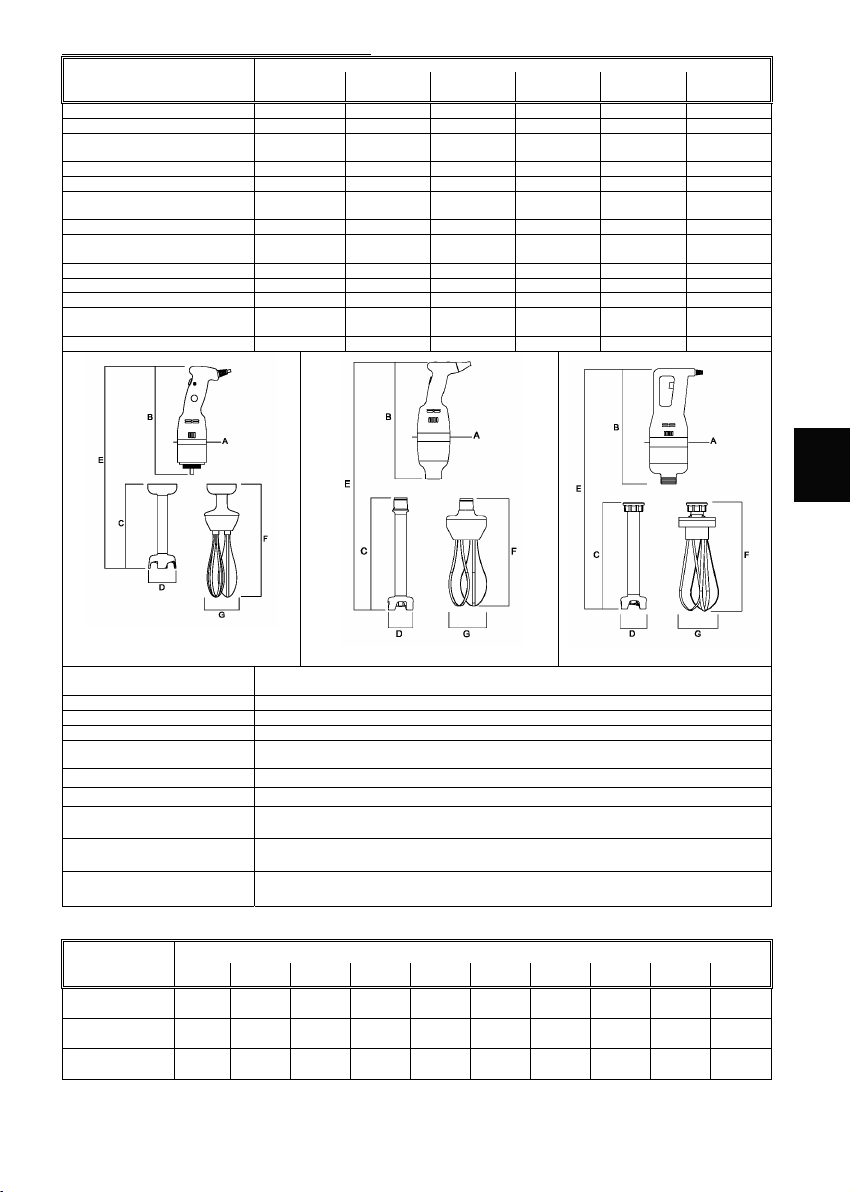
ТЕХНИЧЕСКИЕ ДАННЫЕ И КОНСТРУКЦИЯ
ТЕХНИЧЕСКИЕ ДАННЫЕ
Мощность мотора (W) 250 300 350 400 450 650
Макс. скорость (об./мин.) 15000 13000 15000 15000 17000 13000
Изменяемая скорость (об./мин.)
только на мод. VV
Размеры: A (mm) Ø75
Размеры: B (mm) 285 350 360 350 380 400
Размеры: C (mm)
Размеры: D (mm) Ø75 Ø85 Ø95 Ø85 Ø95 Ø95
Размеры: E (mm)
Размеры: F (mm) 290 330 360 330 360 360
Размеры: G (mm) 90 120 120 120 120 120
Масса корпуса машины (kg) 1,0 1,8 2,6 2,1 3,2 3,6
Масса блендера (kg)
Масса венчика (kg) 0,450 0,800 1,0 0,800 1,0 1,0
250VF
250VV
2500 ÷ 15000 2000 ÷ 9000 2000 ÷ 9000 2000 ÷ 9000
220 / 270
470/ 520
0,400/ 0,450
300VV 350VF
Ø100 Ø130 Ø100 Ø130 Ø130
340 / 440 /
540
650/ 750
/ 850
0,850 /1,0
/ 1,2
МОДЕЛЬ
350VV
330 / 430 /
530 / 630
680/ 780 /
880 / 980
1,2 / 1,5/
1,7 / 1,9
400VV 450VF
340 / 440 /
540
650 / 750 /
850
0,850 /1,0
/ 1,2
450VV
2000 ÷
11000
330 / 430 /
530 / 630
700 / 800 /
900 / 1000
1,2 / 1,5/
1,7 / 1,9
650VF
650VV
2000 ÷ 9000
330 / 430 /
530 /630
720 / 820 /
920/ 1020
1,2/1,5 /
1,7 / 1,9
250 VV-VF
Уровень акустического давления
постоянный равный коэфф. A
Вид тока - Частота См. табличку машины
Ток при полной загрузке См. табличку машины
Номинальное напряжение См. табличку машины
Напряжение вспомогательных
цепей
Система защиты Двойная изоляция
Степень защиты IP X3
Макс. температура воздуха
окружающей среды
Минимальное требуемое
освещение
Соответствие изделия
директивам
300 / 400 VV
См. табличку машины
2006/42/CE, 2006/95/CE и последующие изменения и дополнения, Рег. 1935/2004
Ниже 70dBA
+40°C
500 lux
350 / 450 / 650 VF-VV
ТЕХНИЧЕСКИ
Е ДАННЫЕ
Изменяемая
скорость
Блендер
Венчик /
5 14
250VF 250VV 300VV 350VF 350VV 400VV 450VF 450VV 650VF 650VV
/
● ●
/
● ● ● ● ● ● ● ● ● ●
● ●
ПЕРЕВОД ОРИГИНАЛА ИНСТРУКЦИ
/
МОДЕЛЬ
● ●
● ●
/
●
/
●
/
/
Pag. di
●
●
Page 76
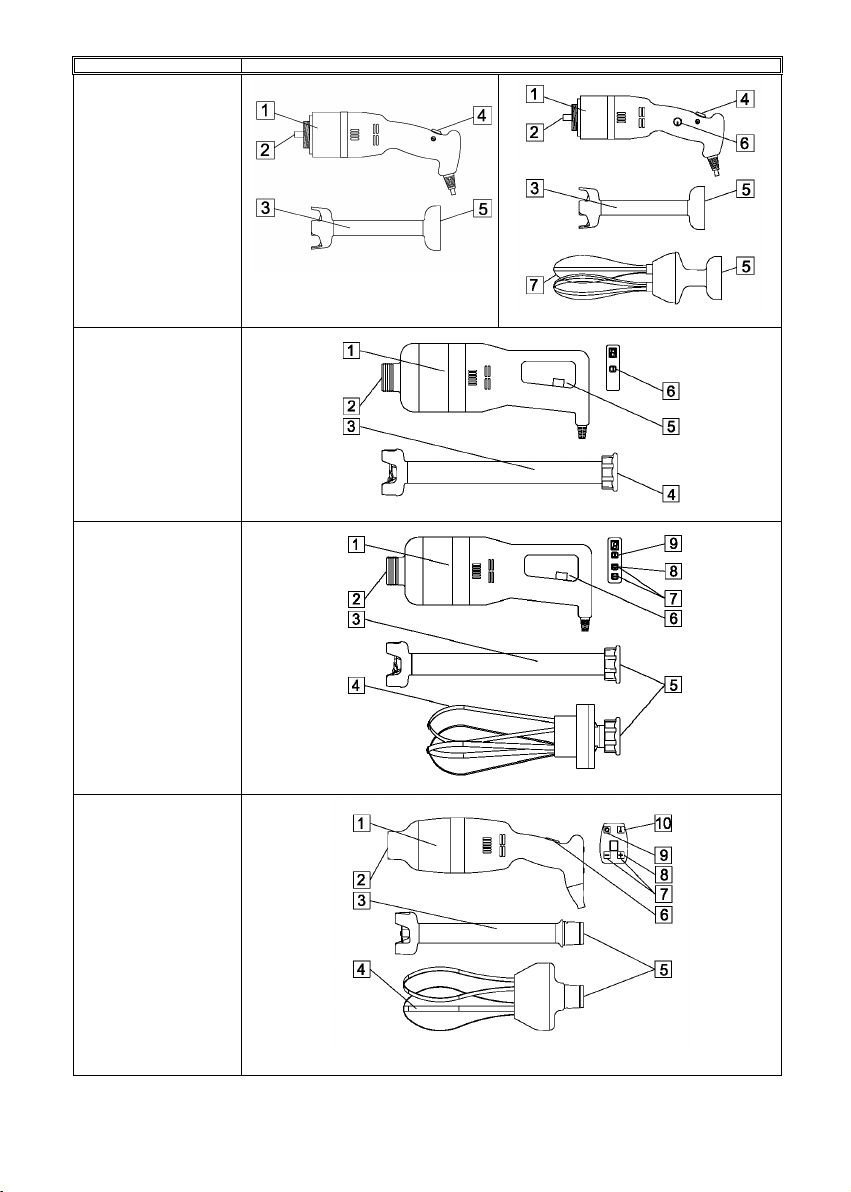
УЗЕЛ ПРИМЕР
1. корпус машины
2. крепление для
инструментов
3. блендер
4. кнопка пуска
5. кольцо блокировки
инструмента
6. Регулятор скорости
7. венчик
1. корпус машины
2. крепление для
инструментов
3. блендер
4. кольцо блокировки
инструмента
5. кнопка пуска
6. предохранительная
кнопка пуска
1. корпус машины
2. крепление для
инструментов
3. блендер
4. венчик
5. кольцо блокировки
инструмента
6. кнопка пуска
7. переключатели скорости
8. предохранительная
кнопка пуска
9. переключатель блендер /
венчик
250VF
350 / 450 / 650 VF
250VV
1. корпус машины
2. крепление для
инструментов
3. блендер
4. венчик
5. быстроразъемное
соединение для
блокировки инструмента
6. кнопка пуска
7. переключатели скорости
8. предохранительная
кнопка пуска
9. кнопка повторяющегося
использования
10. переключатель блендер /
венчик
350 / 450 / 650 VV
300 / 400 VV
6 14
ПЕРЕВОД ОРИГИНАЛА ИНСТРУКЦИ
Pag. di
Page 77

КОРРЕКТНОЕ ИСПОЛЬЗОВАНИЕ, НЕСООТВЕТСТВУЮЩЕЕ
ИСПОЛЬЗОВАНИЕ, НЕКОРРЕКТНОЕ ИЛИ ЗАПРЕЩЕННОЕ ИСПОЛЬЗОВАНИЕ
Машина, описанная в данном руководстве, предусмотрена для управления ей одним оператором, обученным и
оповещенном об остаточных рисках, и имеющим знания в области техники безопасности на уровне ответственных за
техническое обслуживание. Оператор должен достигнуть минимального возраста, предусмотренного трудовым
законодательством, и быть достаточно технически подготовленным, по крайней мере более опытным оператором,
который предварительно обучил его правильному использованию машины.
При КОРРЕКТНОМ ИСПОЛЬЗОВАНИИ, несомненно, машина должна применяться только для
того, чтобы давить, взбивать, размельчать, крошить, эмульгировать, превращать в кашицу и т.д.
непосредственно в кастрюле или другой подходящей для этого емкости, для использования в сфере
общественного питания. В зависимости от используемого инструмента можно готовить непосредственно в
кастрюле минестроны, супы, пюре, кремы, панировочное тесто, майонез, миндальное тесто, крем из сыра и
тому подобное. Поднимать, держать машину и манипулировать ей следует при помощи обеих рук и путем
захвата в предусмотренных для этого точках (см. рисунок на стр. 11).
Машину нельзя использовать НЕСООТВЕТСТВУЮЩИМ ОБРАЗОМ, в частности:
1. не допускается домашнее использование,
2. машина не должна работать при значениях, отличных от значений, приведенных на табличке с
техническими характеристиками,
3. в случае использования машины способами, отличными от приведенных в данном руководстве,
производитель снимает с себя любую ответственность.
4. пользователь несет ответственность за повреждения, вызванные несоблюдением условий эксплуатации,
оговоренных в
5. Инструменты не должны работать вхолостую,
6. не повреждать и не портить специально, а также не снимать и не прятать этикетки.
Машину нельзя использовать НЕКОРРЕКТНЫМ или ЗАПРЕЩЕННЫМ ОБРАЗОМ, поскольку это может
повлечь за собой нанесение ущерба или ранений оператору, в частности:
1. запрещено тянуть за электрический провод машины или за саму машину для ее отключения от
розетки,
2. запрещено ставить тяжелые предметы на машину или на электрический провод,
3. запрещено устанавливать электрический провод на режущие или могущие обжечь детали,
4. запрещено использование
управления;
5. запрещено оставлять выключенной машину при включенном в розетку электрическом проводе,
6. запрещено вставлять любые предметы в вентиляционную крышку мотора;
7. запрещено устанавливать машину не на рабочий стол, применяемый в пищевой промышленности и
высотой 900 – 1100 mm от уровня пола,
8. запрещено применение воспламеняющихся, коррозивных
чрезмерно щелочных веществ, таких как каустическая сода или аммиак,
9. запрещено погружать машину в воду или другие жидкости;
10. запрещено использование неуполномоченного персонала и персонала в одежде, не предусмотренной
для работы на машине,
11. запрещено использование венчика на машинах с неменяющейся скоростью,
12. запрещено
имеющие характеристики, отличающиеся от предусмотренных для нормального использования, такие
как, например, кости, замороженное мясо, не пищевые продукты и другие предметы, например, шарфы и
т.д.
13. запрещено брать, поднимать машину и манипулировать ей за точки, отличные от указанных для
нормального ее использования и, а также держать одной рукой работающую машину,
14. запрещено проталкивать самим или давать кому-либо проталкивать пищевые продукты или
ингредиенты внутрь кастрюли при вставленной и включенной машине и, в любом случае,
помещать руки и другие части тела в кастрюлю во время работы машины,
15. запрещено вставлять машину
пределы кольца блокировки инструмента.
16. запрещено вынимать машину из кастрюли до полной остановки инструмента и, в любом случае,
ранее, чем через 10 секунд после нажатия кнопки останова машины.
17. запрещено воздействовать на сисемы блокировки инструментов до полной остановки инструмента и
любом случае, ранее, чем через 10 секунд после нажатия кнопки останова машины и при подключенном
электрическом питании
18. запрещено частичное снятие защитных приспособлений и сигнализаций.
19. запрещено функционирование без применения со стороны пользователя всех мер по предотвращению
остаточных рисков,
20. запрещено курить или использовать приборы с открытым пламенем и использовать
воспламеняющиеся материалы, если только не приняты все соответствующие меры техники
безопасности,
21. запрещено подключать или регулировать контрольные и блокирующие устройства, такие как
рукоятки и подобное во время работы машины, а также неуполномоченным лицам.
технических спецификациях и при подтверждении заказа.
машины при поврежденных электрических проводах или механизмах
или вредных веществ для чистки или
помещать в кастрюлю при вставленной и работающей машине продукты или предметы,
в кастрюлю за пределы засечки погружения и, в любом случае, за
, в
7 14
ПЕРЕВОД ОРИГИНАЛА ИНСТРУКЦИ
Pag. di
Page 78
Пользователь в любом случае несет ответственность за повреждения, вызванные несоблюдением
указанных условий корректного использования. В случае возможных сомнений обращаться в
Уполномоченный Центр Обслуживания.
ГЛАВА. 3. ИНСТРУКЦИИ ПО ТЕХНИКЕ БЕЗОПАСНОСТИ
ВСТУПЛЕНИЕ
Невыполнение норм и процедур техники безопасности может быть источником опасности и
повреждений.
Машина должна использоваться при соблюдении окончательным пользователем следующего:
1. всех правил расположения оборудования в помещении и поведения людей, установленных
действующими законами и применяемыми нормами, с особым вниманием по отношению к
устройству, усановленному в верхней части поставленного оборудования и к его подключению и
функционированию;
2. всех дополнительных инструкций и предостережений, содержащихся в технической
документации и чертежах, прилагаемых к машине.
За исключением случаев, в которых предусмотрено иное, персонал, выполняющий установку,
подключение, техническое обслуживание, повторную установку и повторное использование,
выявление поломок или аварий, демонтаж, должен быть опытным, обученным технике
безопасности и оповещенным об остаточных рисках на уровне ответственных за техническое
обслуживание.
ПОМЕЩЕНИЕ И РАБОЧИЕ МЕСТА
Рабочие помещения должны соответствовать требованиям директивы 89/654/CEE. В рабочий зоне не должны
присутствовать посторонние предметы. Работодатель, в соответствии с директивой 89/391/CEE, касающейся
принятия мер, направленных на повышение техники безопасности и охраны здоровья трудящихся во время работы,
должен позаботиться об уничтожении или понижении остаточных рисков, указанных а данном руководстве.
ПРЕДОСТОРЕЖЕНИЯ, КАСАЮЩИЕСЯ ОСТАТОЧНЫХ РИСКОВ
ОСТАТОЧНЫЙ РИСК, ВЫЗВАННЫЙ СНЯТИЕМ ФИКСИРОВАННЫХ ЗАЩИТНЫХ ПРИСПОСОБЛЕНИЙ
И РАБОТОЙ С ПОЛОМАННЫМИ/ ИЗНОШЕННЫМИ ДЕТАЛЯМИ
Ни в коем случае оператор не должен пытаться открыть или снять фиксированные защитные
приспособления или приборы.
В моменты сборки, технического обслуживания, замены инструментов и чистки, а также во время
всех дальнейших ручных операций, при которых руки и другие части тела находятся в опасных
зонах, присутствуют остаточные риски, состоящие в основном в:
1. ударах об детали машины,
2. царапинах и/или ссадинах, полученных при контакте с шероховатыми деталями машины,
3. уколах об острые детали,
4. порезах об острые детали машины.
Кроме того, во время операций по чистке и удалению застрявших в лезвиях
кусков, которые
выполняются при помощи рук, которые при этом находятся вблизи от режущих инструментов, остается
остаточный риск, связанный прежде всего с возможность порезов об острые части интструментов.
Оператор и специалист по техническому обслуживанию должны быть подготовлены к ручным
операциям, выполняемым при открытых предохранительных приспособлениях, и должны быть
оповещены о связанных с этим рисках
, должны быть уполномочены ответственным лицом, а также
должны использовать соответствующие средства индивидуальной защиты, такие как перчатки с пятью
пальцами, защищающие от порезов. Все операции на дисках должны выполняться при лезвиях,
направленных вниз.
ГЛАВА. 4. УСТАНОВКА И ИСПОЛЬЗОВАНИЕ
8 14
Машиной может управлять исключительно уполномоченный, должным образом обученный
персонал, имеющий достаточный технический опыт. .
Перед включением машины произвести следующие операции:
внимательно изучить техническую документацию,
изучить все защитные и аварийные приспособления, имеющиеся на машине, их расположение и
функционирование.
Неуполномоченное использование основных и дополнительных защитных устройств, может привести
к плохому функционированию и возникновению опасных для персонала ситуаций.
Кроме того, оператор должен пройти соответствующую подготовку.
ПЕРЕВОД ОРИГИНАЛА ИНСТРУКЦИ
Pag. di
Page 79
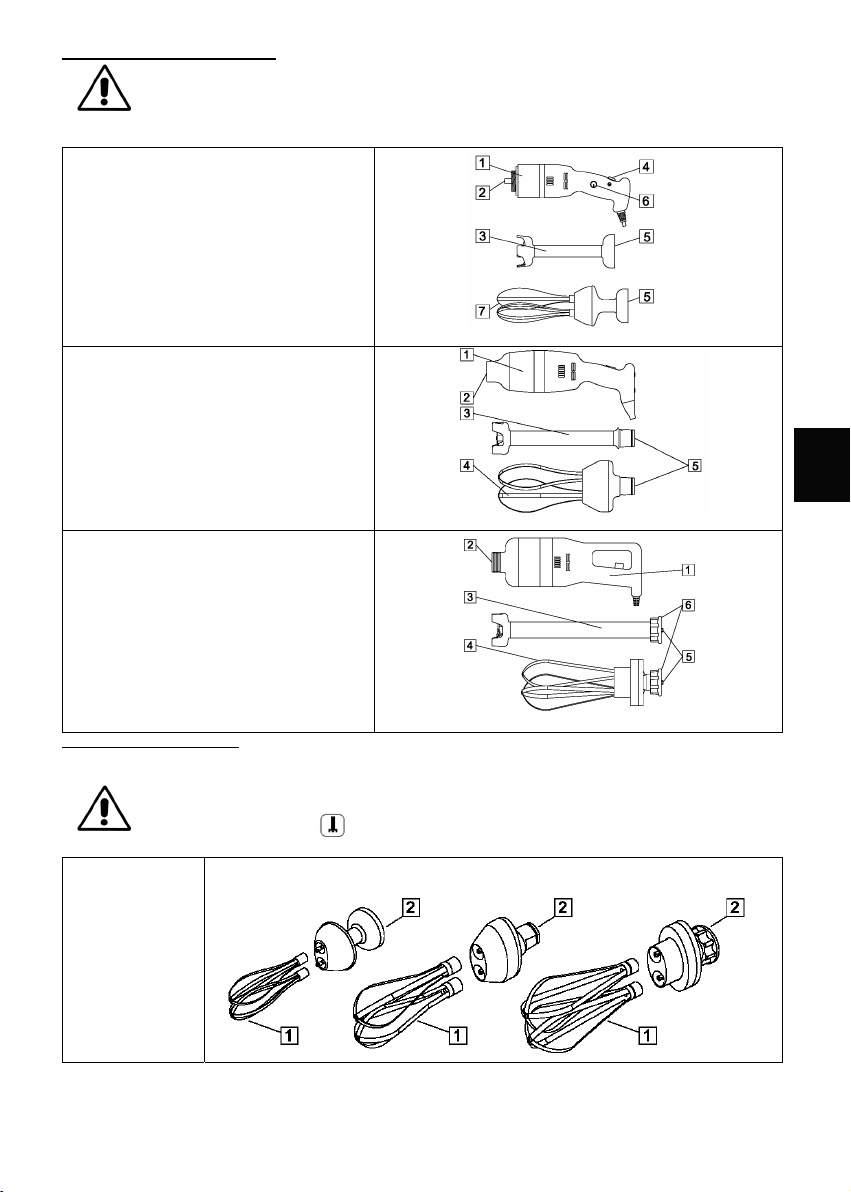
МОНТАЖ / ДЕМОНТАЖ
Операции по монтажу/ демонтажу любой детали машины должны выполняться при неработающей
машине и при вилке, отключенной от розетки, то есть, при устройстве секционирования в
положении OFF.
Монтаж машины выполняется в несколько фаз (в качестве иллюстрации приведет базовый корпус машины).
МОНТАЖ ИНСТРУМЕНТА
МОДЕЛЬ 250 VF-VV
1. Расположить по центру и вставить сцепление (5)
2. Завинтить блендер (3) до надежного его закрепления
МОНТАЖ ИНСТРУМЕНТОВ
МОДЕЛЬ 300/400 VV
1. Расположить по центру и вставить сцепление
2. Завинтить инструменты (3-4) до надежного их
МОНТАЖ ИНСТРУМЕНТОВ
МОДЕЛЬ 350/450/650 VF-VV
1. Расположить по центру и вставить сцепление (5)
2. Завинтить кольцо (6) до надежного их закрепления
Операции по демонтажу выполняются в порядке, обратном по отношению к описаннам выше монтажным
операциям.
МОНТАЖ
ДЕМОНТАЖ
ВЕНЧИКОВ
Для снятия венчиков
потянуть за них (1) до
их отделения от узла
редуктора (2).
Для их монтажа
вставить основание
венчиков (1) в штырь
узла редуктора (2) и
протолкнуть до упора.
блендера (3) в соединение (2) копруса машины (1)
на копрусе машины (1)
250 VF-VV
инструментов (5) в быстроразъемное соединение (2)
копруса машины (1)
закрепления на копрусе машины (l)
300 / 400 VV
инструментов (3-4) в соединение (2) корпуса
машины (1)
на копрусе машины (1).
350 / 450 / 650 VF-VV
Запрещено использование венчика на машинах с неменяющейся скоростью (VF)
Запрещается использование венчика в машинах с регулируемой скоростью (VV)
на максимальной скорости
9 14
ПЕРЕВОД ОРИГИНАЛА ИНСТРУКЦИ
Pag. di
Page 80
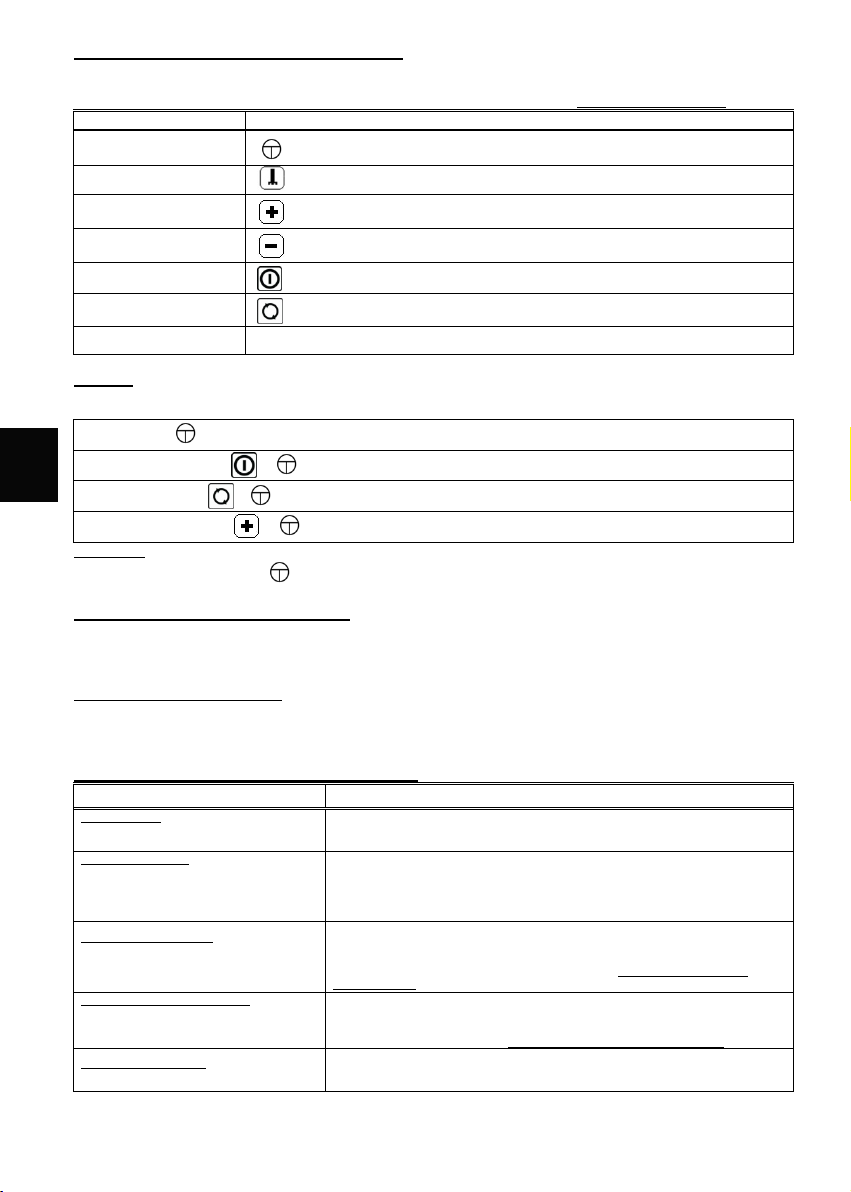
ОПИСАНИЕ ФУНКЦИОНИРОВАНИЯ
Устройства управления спроектированы и выполнены так, чтобы быть надежными и прочными к нормальным
рабочим воздействиям, к предусмотренным усилиям и внешним веществам. Кроме того, они хорошо видны, легко
отличимы и помечены соответствующей маркировкой. Ниже приведены основные устройства управления:
ТИП / ЦВЕТ ССЫЛКА / ОПИСАНИЕ
Кнопка / черный
Кнопка / черный
Кнопка / черный
Кнопка / черный
Кнопка / черный
Кнопка / черный
Дисплей / красный Показ скорости: от 1 до 9 / показ максимальной скорости
ЗАПУСК
Импульсный пуск машины возможен только при специальном воздействии на соответствующее устройство
управления:
машина VF 250: . ИСПОАЗОВАТЬ СОХРАНЯЯ ДЕЙСТВИЯ
машины VF 350 / 450 / 650 : + Только повторяющееся действие.
машины VV 300 / 400 : + . Только повторяющееся действие.
машины VV 350 / 450 / 650 : + . Только повторяющееся действие.
ОСТАНОВ
Для останова нажать на кнопку .
НАДЕЖНОСТЬ ФУНКЦИОНИРОВАНИЯ
Если машина находится под усилием, подвергается слишком продолжительному функционированию или
функционированию под чрезмерной нагрузкой, она немедленно останавливается благодаря вступлению термической
защиты. В этом случае дождаться полного ее охлаждения, прежде чем вновь запускать ее.
ОТСУТСТВИЕ НАПРЯЖЕНИЯ
В случае прерывания электрического питания или отключения машины от электрической сети, можно производить ее
запуск, следуя соответствующей процедуре, только после восстановления электрического питания или
подключения к сети.
КОНТРОЛЬ И ПРОВЕРКИ ПЕРЕД ПУСКОМ В ХОД
ПРОВЕРКА / КОНТРОЛЬ СПОСОБЫ ВЫПОЛНЕНИЯ
Убедиться, что:
В кастрюле отсутствуют посторонние
предметы
Убедиться в чистоте:
внешней поверхности машины
инструментов по всей их
поверхности
внутренних частей иструментов
Убедиться в целостности:
фиксированных защитных
приспособлений
корпуса машины
Убедиться в функционировании:
деталей системы управления /
контроля системы безопасности;
устройств управления.
Убедиться в отсутствии:
необычных шумов при пуске в ход
10 14
“ ” / Кнопка пуска машины для непрерывного действия
“ ” / Кнопка переключения на максимальную скорость только для блендера
“ ” / Кнопка повышения скорости / предохранительная кнопка пуска (модели VV 350/450/650)
“ ” / Кнопка понижения скорости
“ ” / Предохранительная кнопка пуска машины (только модели VF 350/450/650)
“ ” / Предохранительная кнопка пуска машины (только модели VV 300/400)
Визуальный контроль указанных частей для выявления отсутсвия посторонних
предметов, таких как, например, различные инструменты, тряпки и т.д. и отсутствия в
любом случае пищевых продуктов. В случае наличия удалить их.
Необходимо визуально проверить все поверхности указанных деталей перед
использованием машины, чтобы убедиться в их чистоте.
В случае наличия плесени или других загрязнений, произвести очистку следуя
указаниям главы 5.
Все фиксированные и другие защитные приспособления должны выполнять функции,
для которых они предусмотрены. Производить визуальный контроль указанных
деталей для проверки целостности их внешней поверхности. При первых признаках
эрозии или поломки детали необходимо ее заменить (в Уполномоченном Центре
Обслуживания).
Все устройства должны выполнять функции, для которых они предусмотрены.
Управлять непосредственно устройствами для выполнения ими необходимых функций.
Исполнительные механизмы и все другие детали должны заменяться при первых
признаках эрозии или поломки (в Уполномоченном Центре Обслуживания).
Во время проверки функционирования устройств управления, в случае наличия
необычных шумов, вызванных, например, заеданиями или механическими поломками,
немедленно остановить машину и обратиться в ремонтный отдел.
ПЕРЕВОД ОРИГИНАЛА ИНСТРУКЦИ
Pag. di
Page 81
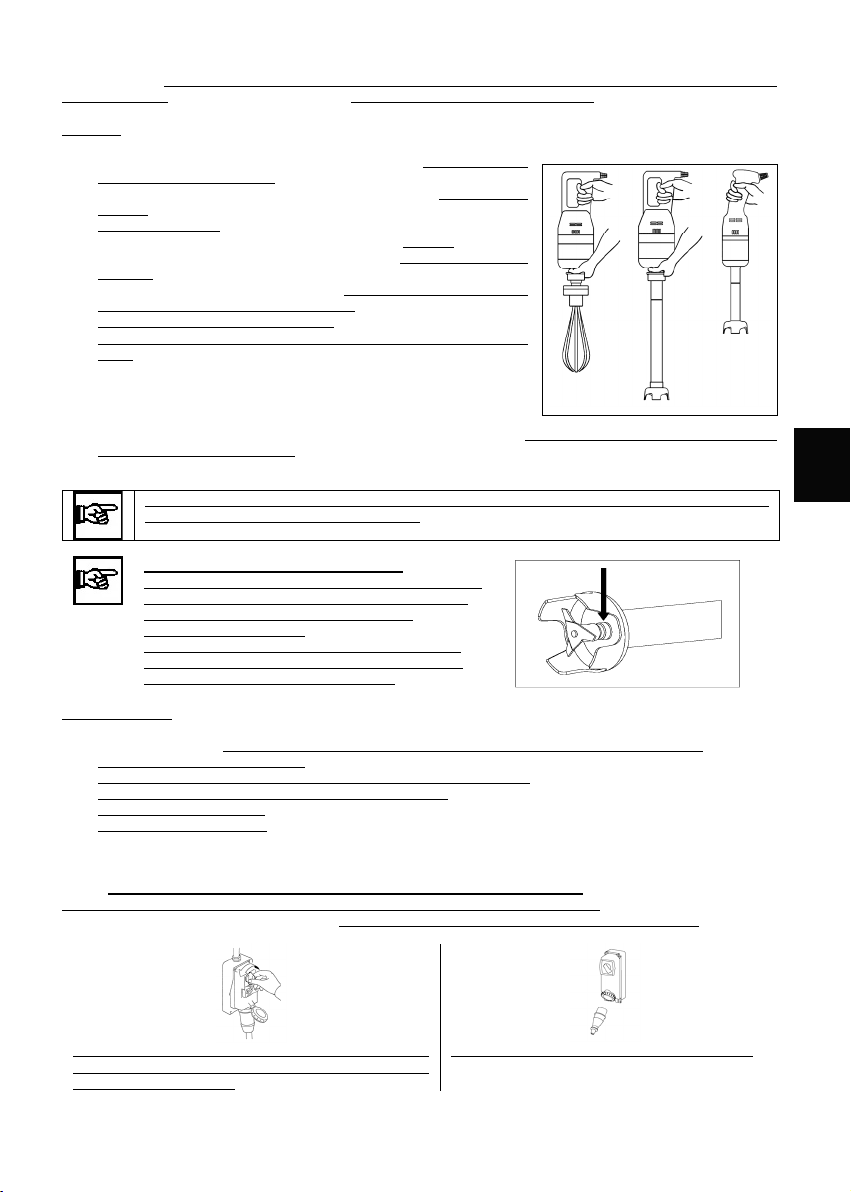
Для любого ремонта или замены поврежденных деталей обращаться в ремонтный отдел. Для замены должны
использоваться фирменные детали производителя или, по крайней мере, детали, равные по качеству, надежности и
характеристикам . Для уточнений обращаться в Уполномоченный Центр Обслуживания.
ЗАПУСК
Оператор машины может произвести ее запуск, учитывая следующее:
1. Положительный результат проверок, описанных в предварительных
подготовительных операциях,
2. Положительный результат проверок, описанных в электрическом
питании,
3. Подключение вилки к соответствующей розетке,
4. Положительный результат проверок, описанных в монтаже,
5. Положительный результат контроля/ проверок, проводящихся перед
запуском,
6. Положительный результат проверок, направленных на выявление
соответствия всем условиям безопасности,
7. Вкладывать вручную пищевой продукт в кастрюлю,
8. При помощи обеих рук брать машину за предусмотренные для этого
точки:
a. Расположить машину таким образом, чтобы инструмент
находился в кастрюле,
b. запустить машину, держать ее и манипулировать ей до
завершения обработки пищевого продукта,
9. Как только пищевой продукт достигнет необходимой консистенции, остановить машину и расположить ее на
соответствующем рабочем столе,
10. Выгрузить вручную пищевой продукт из кастрюли, взяв ее обеими руками и переливая содержимое если это
необходимо.
запрещено вставлять машину в кастрюлю за пределы засечки погружения и, в любом случае, за
пределы кольца блокировки инструмента.
Машина не должна работать вхолостую.
Рекомендуется периодически проверять целостность
резиновой прокладки, расположенной под лезвием
(см. рисунок сбоку) и заменять ее в случае
повреждений или износа.
Целостность прокладки препятствует попаданию
обрабатываемого продукта во внутреннюю часть,
предотвращая повреждения смесителя.
ВЫКЛЮЧЕНИЕ
Операции по выключению должны выполняться в указанной ниже последовательности:
1. перед выключением дождаться завершения обработки, то есть дождаться достижения необходимой
консистенции пищевого продукта,
2. остановить машину отпустив предусмотренные устройства управления,
3. расположить машину на соответствующем рабочем столе,
4. отсоединить вилку машины от розетки электрического питания,
5. произвести чистку машины.
ГЛАВА. 5. ТЕХНИЧЕСКОЕ ОБСЛУЖИВАНИЕ, ВЫЯВЛЕНИЕ НЕПОЛАДОК И
ЧИСТКА
УКАЗАНИЯ ПО ТЕХНИЧЕСКОМУ ОБСЛУЖИВАНИЮ
ОТКЛЮЧЕНИЕ ОТ ВНЕШНИХ ИСТОЧНИКОВ ЭЛЕКТРИЧЕСКОГО ПИТАНИЯ
Перед выполнением любой операции по по техническому обслуживанию, чистке и замене деталей необходимо
отсоединить и изолировать все внешние источники электрического питания..
Установить на “ноль” защитное устройство,
расположенное в верхней части линии питания
Отключить устройство общего секционирования и
защитить вилку при помощи специальных систем.
электрического оснащения.
11 14
ПЕРЕВОД ОРИГИНАЛА ИНСТРУКЦИ
Pag. di
Page 82
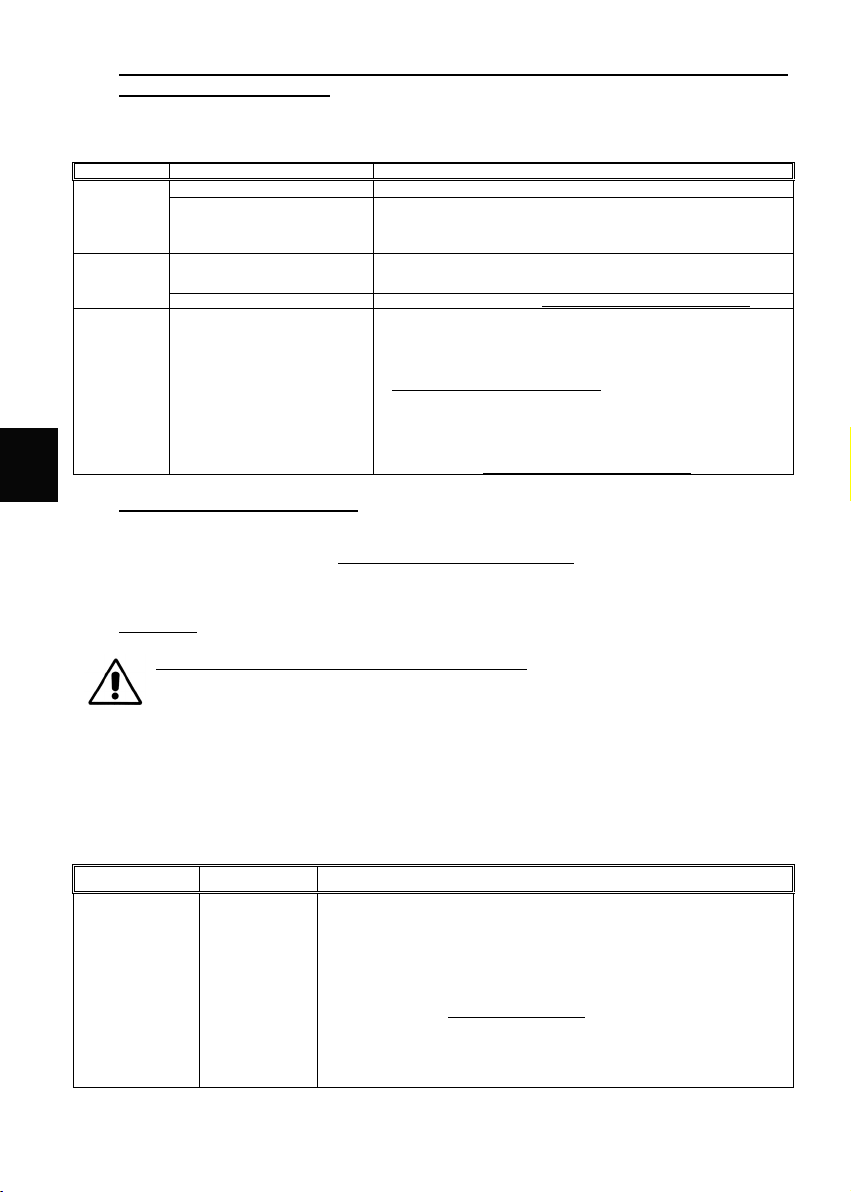
ВЫЯВЛЕНИЕ НЕПОЛАДОК ИЛИ ПОЛОМОК И РАЗБЛОКИРОВАНИЕ
ПОДВИЖНЫХ ЧАСТЕЙ
Ниже перечислены операции по выявлению неполадок или поломок и разблокированию подвижных частей,
которые могут выполняться специалистом по техническому обслуживанию.
ТИП ВОЗМОЖНЫЕ ПРИЧИНЫ СПОСОБ ВЫЯВЛЕНИЯ
Отсутствие
напряжения в
сети
Прерывание
функционирования
Машина не
функционирует: лезвия
не вращаются
или не
производят
резание
правильно
Общий black out. Обратиться на фирму, поставляющую электроэнерию.
Подключение предохранителей или
термомагнитов, расположенных в
верхней части линии электрического
питания машины.
Подключение внутреннего
защитного устройства машины.
Не выявленные причины. Обратиться непосредственно в Уполномоченный Центр Обслуживания.
Отсутствие напряжения.
Устройства секционирования
установлены на “OFF”.
Не функционирующая кнопка пуска.
Подключение термической защиты
в связи с перегревом.
Появление на дисплее буквы “E”.
После устранения причин, которые повлекли за собой подключение
защитного устройства, восстановить его. В случае неустранения проблемы,
обратиться к электрику.
Обратиться к электрику: после устранения причин, которые повлекли за собой
подключение защитного устройства, восстановить его.
Проверить и восстановить подачу электрической энергии.
Вставить вилку в розетку.
Проверить работу кнопки и при необходимости обратиться непосредственно
в Уполномоченный Центр Обслуживания.
Дождаться полного охлаждения, прежде чем вновь запускать машину.
Повреждено устройство считывания скорости, необходимости обратиться
непосредственно в Уполномоченный Центр Обслуживания.
ВНЕОЧЕРЕДНОЙ РЕМОНТ
Для осуществления внеочередного ремонта вследствие поломок, механических или электрических повреждений,
необходимо обращаться непосредственно в Уполномоченый Центр Обслуживания.
Инструкции по внеочередному ремонту не предусмотрены в данном руководстве по использованию, поскольку
должны специально запрашиваться непосредственно у производителя.
ЧИСТКА
Запрещено чистить вручную органы и детали в движении.
Все операции по чистке должны выполняться непременно только после выгрузки из машины
обрабатываемого пищевого продукта и после изоляции ее от внешних источников
электрического питания и энергии.
Машину, электрическое оборудование и приборы машины нельзя мыть водой, тем более используя
струи любого типа и количества, следовательно, без “ведра”, “резины” и “губки”. Никогда не
Что касается гигиены, машина и соответствующее оборудование классифицированы в отношении
предусмотренного использования как уровень 2 (два): машина, в результате оценки гигиенического риска,
признана отвечающей соответствующим международным требованиям, но требует периодической разборки для
чистки.
В конце каждой
рабочей смены и, в
любом случае, перед
ежедневным
использованием.
12 14
ставить машину непосредственно в раковину или под кран.
ЧАСТОТА ПЕРСОНАЛ
Оператор Все поверхности и детали машины, соприкасающиеся с пищевым продуктом, то есть,
пищевые зоны (внутренняя и внешняя поверхность инструментов) и зоны попадания
брызг (верхняя поверхность инструмента в креплении на машине и внешняя
поверхность машины) необходимо чистить и дизенфецировать приведенным ниже
способом. Для демонтажа инструментов смотри приведенные ранее указания.
Удалить с поверхности возможные остатки пищевого продукта (например, при
помощи пластмассовых скребков);
Очистить все поверхности пищевой зоны и зоны попадания брызг мягкой
влажной тряпкой (с тряпки не должно капать) и водой с растворенным в ней
моющим средством (прекрасно подойдет обычное мыло для посуды). Использовать
специальные средства для стали, они должны быть жидкими (не в виде крема или
пасты и, в любом случае, не должны быть абразивными) и, прежде всего, не должны
содержать хлор. Для удаления жирных веществ можно использовать
денатурированный спирт.
ПЕРЕВОД ОРИГИНАЛА ИНСТРУКЦИ
СПОСОБ
Pag. di
Page 83
ЧАСТОТА ПЕРСОНАЛ СПОСОБ
Сполоснуть теплой чистой водой, затем вытереть все поверхности пищевой
зоны и зоны попадания брызг мягкой тряпкой, не оставляющей ворсинок.
Блендер, хотя от и выполнен из нержавеющей стали, а тем более пластмассовые
детали, нельзя мыть в посудомоечной машине.
Последующая сборка должна выполняться только в связи с рабочей потребностью.
Хранить детали завернутыми в мягкую тряпку, не оставляющую ворсинки.
ПЕРИОДЫ ДЛИТЕЛЬНОГО БЕЗДЕЙСТВИЯ
Во время периодов длительного бездействия машины следует энергично
протирать все поверхности из стали (особенно нержавеющей) тряпкой, пропитанной
вазелиновым маслом, для образования защитного слоя.
ЧТО НЕЛЬЗЯ ДЕЛАТЬ ДО ИЛИ ВО ВРЕМЯ ЧИСТКИ:
13 14
Дотрагиваться до подвижных деталей, не убедившись предварительно в их останове;
Дотрагиваться до подвижных деталей, не установив машину в безопасное положение
(блокировка в положении «ноль» устройств секционирования электрического
питания)
ВЕЩЕСТВА, КОТОРЫЕ НЕЛЬЗЯ ИСПОЛЬЗОВАТЬ:
Сжатый воздух со струей, направленной в сторону резервуаров с мукой и вообще в
сторону машины;
Паровые приборы;
Моющие средства, содержащие ХЛОР (даже разбавленный) или его соединения,
такие как: хлорка, соляная кислота, вещества для прочистки стоков, вещества для
чистки мрамора, любые декальцифицирующие вещества и т.д. Они могут
непоправимо разъесть сталь, вызвать появление пятен и окисление. Даже испарения
данных веществ могут вызвать окисление и даже ржавение стали;
Металлические губки, щетки или чистящие диски абразивные, выполненные из
других металлов и сплавов (например из обычной стали, аллюминия, меди, и т.д.) или
инструменты, которые ранее использовались для чистки других металлов и сплавов;
порошковые абразивные чистящие средства;
бензин, растворители, воспламеняющиеся и/или коррозивные жидкости;
вещества, применяющиеся для чистки серебра.
ПЕРЕВОД ОРИГИНАЛА ИНСТРУКЦИ
Pag. di
Page 84
ГЛАВА. 6. УНИЧТОЖЕНИЕ
Если было принято решение о дальнейшем неиспользовании машины в случае ее устаревания, поломки или износа,
вывод ее из эксплуатации должен быть поручен квалифицированным специалистам, обладающим соответствующими
техническими средствами. По завершении утилизации все идентификационные таблички и документы должны быть
уничтожены. Для утилизации нет необходимости делить машину на более мелкие компоненты, достаточно
отсоединить
Не допускается утилизация машины в качестве смешанных бытовых отходов, необходимо осуществлять раздельный
сбор отходов.
Системы вывоза или сбора следующие:
В машине отсутствуют опасные вещества,
человека. Очень важно, чтобы покупатели вносили свой вклад в повторное использование, переработку и другие
формы регенерации машины. Знание норм закона, действующих в стране, и выполнение работ с соблюдением таких
норм является обязанностью работодателя.
Символ перечеркнутого контейнера, нанесенный на машину, означает, что по
завершении срока эксплуатации изделие должно быть утилизировано отдельно от
остальных отходов.
основные, составляющие ее узлы и отправить их на металлолом.
Вывоз совместно с распространителем
Возможность оправки распространителю равноценной машины с договором о приобретении новой.
потенциально способные нанести вред окружающей среде и здоровью
Запрещается и влечет за собой применение штрафных санкций бросать машину и
электрические компоненты в окружающую среду
ГЛАВА. 7. ИСПОЛЬЗОВАННЫЕ МАТЕРИАЛЫ
В зависимости от потребностей функционирования и производства, машина может быть выполнена из различных
материалов.
УЗЕЛ
Корпус машины
Режущий инструмент блендера
Колпак блендера
Труба блендера
Коробка редуктора венчика
Венчик
Нержавеющая сталь AISI
ТИП МАТЕРИАЛА
Пластмасса для
304
пищевых продуктов
●
●
●
●
●
●
14 14
ПЕРЕВОД ОРИГИНАЛА ИНСТРУКЦИ
Pag. di
Page 85

Page 86
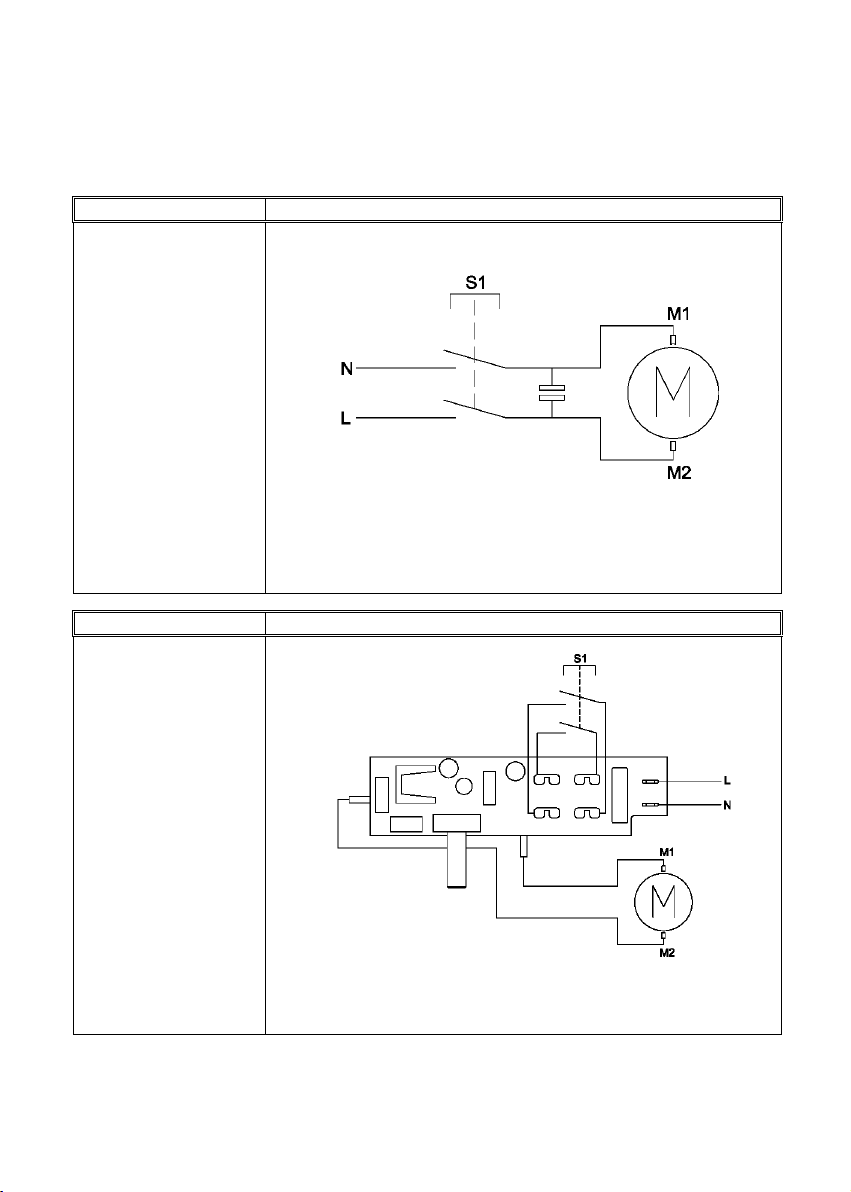
S1= pulsante di start
M1-M2 = motore
L-N = 2 AC 230V 50-60Hz
S1= start button
M1-M2 = motor
L-N = 2 AC 230V 50-60Hz
S1= interruptor de start
M1-M2 = motor
L-N = 2 AC 230V 50-60Hz
S1= poussoir de start
M1-M2 = moteur
L-N = 2 AC 230V 50-60Hz
S1= Start-Taste
M1-M2 = Motor
L-N = 2 AC 230V 50-60Hz
S1= кнопка старт
M1-M2 = мотор
L-N = 2 AC 230V 50-60Hz
S1= pulsante di start
M1-M2 = motore
L-N = 2 AC 230V 50-60Hz
S1= start button
M1-M2 = motor
L-N = 2 AC 230V 50-60Hz
S1= interruptor de start
M1-M2 = motor
L-N = 2 AC 230V 50-60Hz
S1= poussoir de start
M1-M2 = moteur
L-N = 2 AC 230V 50-60Hz
S1= Start-Taste
M1-M2 = Motor
L-N = 2 AC 230V 50-60Hz
S1= кнопка старт
M1-M2 = мотор
L-N = 2 AC 230V 50-60Hz
SCHEDE ELETTRONICHE
ELECTRONIC CARDS
FICHAS ELECTRÓNICAS
FICHES ELECTRONIQUES
LEITERPLATTEN
ЭЛЕКТРОННЫЕ СХЕМЫ
250VF (1 N PE AC 230-240V 50-60Hz)
250VV (1 N PE AC 230-240V 50-60Hz)
Page 87
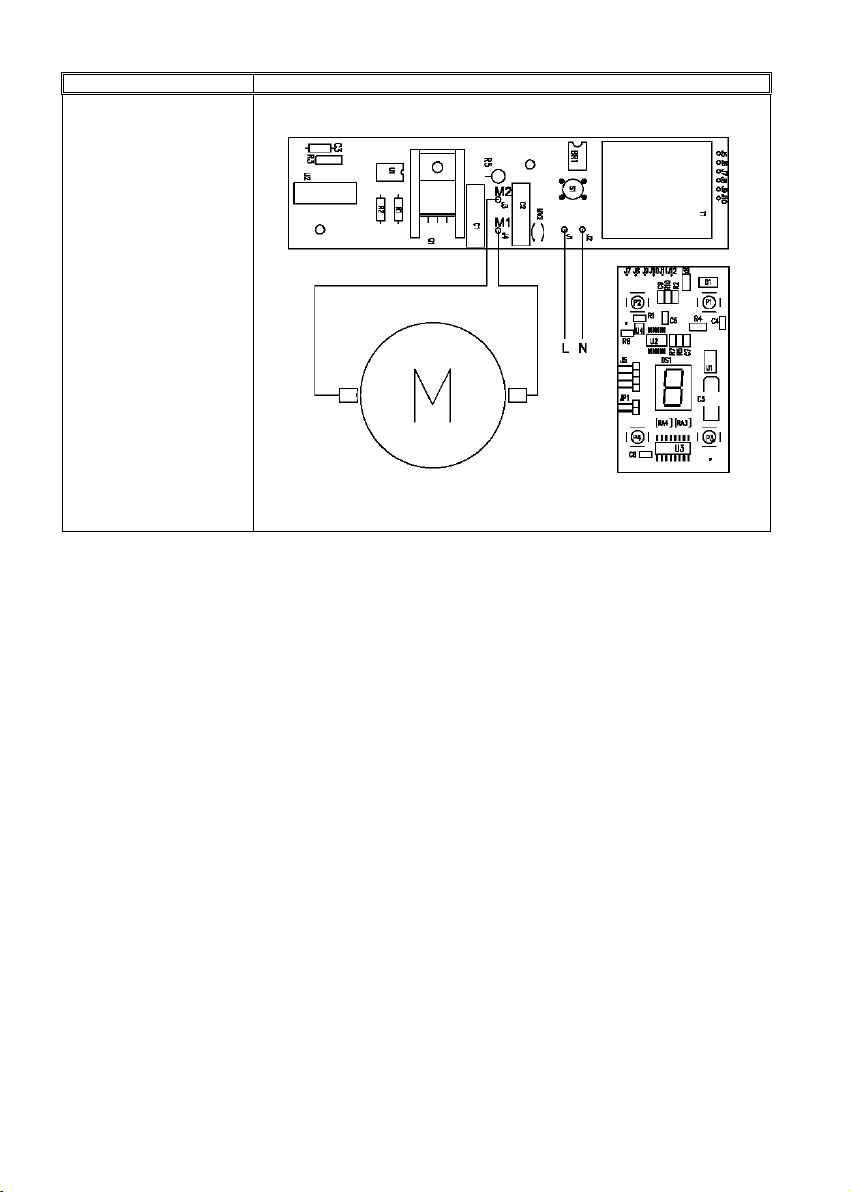
LEGENDA 300 / 400 VV (1 N PE AC 230-240V 50-60Hz)
M1-M2 = motore
L-N = 2 AC 230V 50-60Hz
M1-M2 = motor
L-N = 2 AC 230V 50-60Hz
M1-M2 = motor
L-N = 2 AC 230V 50-60Hz
M1-M2 = moteur
L-N = 2 AC 230V 50-60Hz
M1-M2 = motor
L-N = 2 AC 230V 50-60Hz
M1-M2 = мотор
L-N = 2 AC 230V 50-60Hz
2 3
Pag. di
Page 88
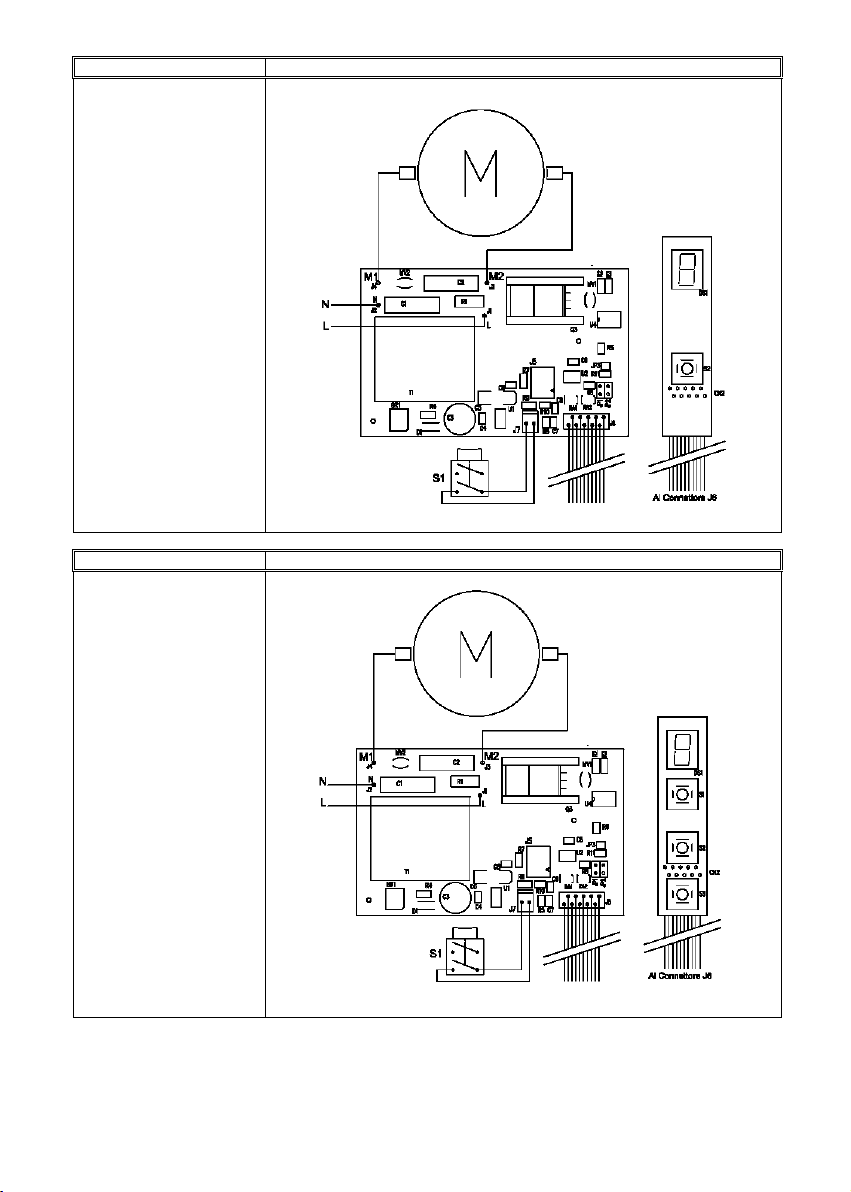
S1= pulsante di start
M1-M2 = motore
L-N = 2 AC 230V 50-60Hz
S1= start button
M1-M2 = motor
L-N = 2 AC 230V 50-60Hz
S1= interruptor de start
M1-M2 = motor
L-N = 2 AC 230V 50-60Hz
S1= poussoir de start
M1-M2 = moteur
L-N = 2 AC 230V 50-60Hz
S1= Start-Taste
M1-M2 = Motor
L-N = 2 AC 230V 50-60Hz
S1= кнопка старт
M1-M2 = мотор
L-N = 2 AC 230V 50-60Hz
350 / 450 / 650 VF (1 N PE AC 230-240V 50-60Hz)
350 / 450 / 650 VV (1 N PE AC 230-240V 50-60Hz)
S1= pulsante di start
M1-M2 = motore
L-N = 2 AC 230V 50-60Hz
S1= start button
M1-M2 = motor
L-N = 2 AC 230V 50-60Hz
S1= interruptor de start
M1-M2 = motor
L-N = 2 AC 230V 50-60Hz
S1= poussoir de start
M1-M2 = moteur
L-N = 2 AC 230V 50-60Hz
S1= Start-Taste
M1-M2 = Motor
L-N = 2 AC 230V 50-60Hz
S1= кнопка старт
M1-M2 = мотор
L-N = 2 AC 230V 50-60Hz
3 3
Pag. di
 Loading...