

Page 1
Indice
Pagina
Introduzione
1
Descrizione
1
Significato LED di stato
2
Impostazione parametri da App LOVATO NFC
2
Tabella parametri
3
Funzioni
5
Schemi di connessione
15
Dimensioni meccaniche (mm)
15
Caratteristiche tecniche
15
Cronologia revisioni manuale
16
Index
Page
Introduction
1
Description
1
Status LED meaning
2
Parameter setting (setup) through LOVATO NFC App
2
Parameters table
3
Functions
5
Wiring diagrams
15
Mechanical dimensions (mm)
15
Technical characteristics
15
Manual revision history
16
Introduzione
Il TMM1 NFC è un temporizzatore elettronico multifunzione, multiscala,
multitensione, con 1 contatto di uscita e programmabile con tecnologia NFC e
App LOVATO NFC (scaricabile gratuitamente dal Google Play Store).
Le 40 funzioni integrate lo rendono estremamente flessibile e adatto per qualsiasi
tipo di applicazione.
È possibile inoltre configurarlo come contatore e contaore.
Introduction
The TMM1 NFC is a multifunction time relay, multiscale, multivoltage, with 1
output contact and programmable with NFC technology and LOVATO NFC App
(freely downloadable from Google Play Store).
The 40 integrated functions makes this timer extremely flexible and suitable for
several applications.
It can also be configured as counter and hour counter.
Descrizione
Tensione di alimentazione ausiliaria: 12…240VAC/DC.
Frequenza operativa: 50/60Hz.
40 funzioni disponibili.
Tempi di fondo scala regolabili da 0.1s a 999 giorni.
1 ingresso di comando esterno utilizzabile come abilitazione funzione o per
mettere in pausa la temporizzazione.
1 uscita a relè con contatto in scambio, 8A 250VAC.
Connessione con tecnologia NFC per programmazione parametri via
smartphone o tablet dotati di connettività NFC e App LOVATO NFC,
scaricabile gratuitamente da Google Play Store.
1 LED verde per segnalazione presenza alimentazione ausiliaria / download di
una nuova configurazione / stato contatore (se configurato).
1 LED rosso per segnalazione stato dell’uscita a relè e temporizzazione.
QR code frontale per l’accesso diretto al sito web Lovato Electric per il
download del manuale tecnico.
Contenitore modulare DIN43880 (1 modulo), adatto per fissaggio su profilato
omega 35mm (IEC/EN 60715).
Grado di protezione frontale IP40 (se montato in contenitore e/o quadro
avente IP40), IP20 morsetti.
QR code per il download della App LOVATO NFC:
Description
Auxiliary supply voltage: 12…240VAC/DC.
Operative frequency: 50/60Hz.
40 selectable functions.
Time of scale range from 0.1s to 999 days.
1 external command input for the enabling of the function or to pause the
timing.
1 relay output with changeover contact, 8A 250VAC.
NFC connectivity for the programming of the parameters via smartphone or
tablet provided with NFC connectivity and LOVATO NFC App, freely
downloadable from Google Play Store.
1 green LED indicator for the signaling of the presence of auxiliary supply /
download of a new configuration / status of the counter (if configured).
1 red LED indicator for the signaling of the relay output status and timing.
Frontal QR code for the direct access to the Lovato Electric website for the
download of the technical manual.
Modular DIN43880 housing (1 module), suitable for fixing on 35mm DIN rail
(IEC/EN 60715).
IEC degree of protection IP40 on front (only when mounted in housing or
electric board with IP40), IP20 on terminals.
QR code for the download of the LOVATO NFC App:
I562 I GB 07 18 31100401
TEMPORIZZATORE MULTIFUNZIONE, MULTISCALA, MULTITENSIONE,
1 CONTATTO, CON TECNOLOGIA NFC E APP
Manuale operativo
MULTIFUNCTION TIME RELAY, MULTISCALE, MULTIVOLTAGE,
1 CONTACT, WITH NFC TECHNOLOGY AND APP
User manual
TMM1 NFC
Doc: I562IGB07_18.docx 20/07/2018 p. 1 / 16
Page 2
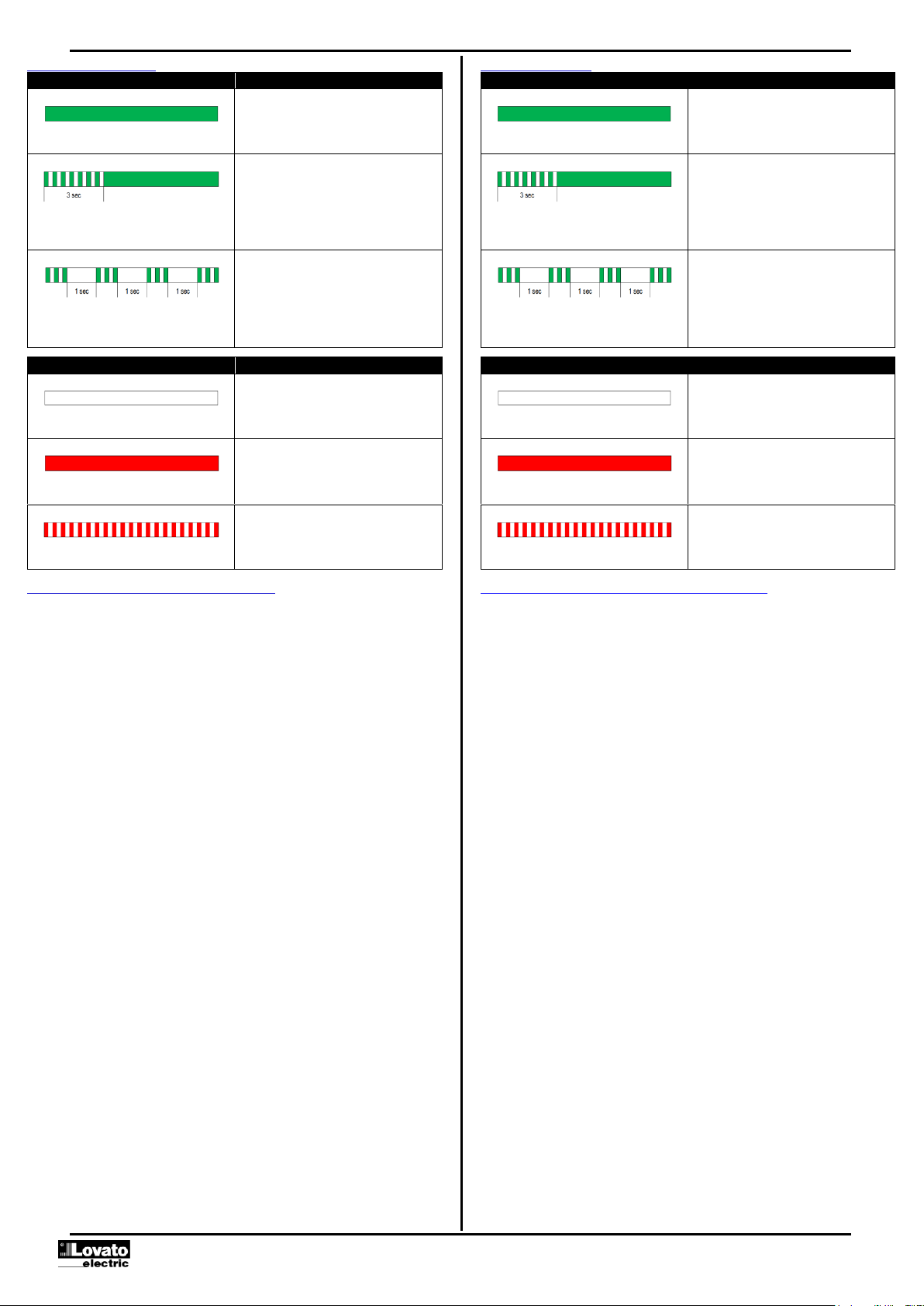
Significato LED di stato
LED verde “ON”
Significato
Acceso fisso
Alimentazione ausiliaria presente.
Lampeggiante per 3 secondi e poi
acceso fisso
È stata scritta una nuova
configurazione da App LOVATO
NFC.
Alternanza tra 3 lampeggi e pausa di
1 secondo.
Segnalazione di fine conteggio del
contatore: il contatore (P02.02) ha
raggiunto il valore di preset P02.01.
Per dettagli vedere il menu M02
CONTATORE.
LED rosso
Significato
Spento
Uscita a relè diseccitata (contatto 1516 chiuso, 15-18 aperto).
Acceso fisso
Uscita a relè eccitata (contatto 15-16
aperto, 15-18 chiuso).
Lampeggiante
Temporizzazione in corso.
Nota. La frequenza dei lampeggi può
variare a seconda della funzione
impostata.
Status LED meaning
Green LED “ON”
Meaning
Steady on
Auxiliary power supply is present.
Blinking for 3 seconds, then steady
on
It has been downloaded a new
configuration from the Lovato NFC
App.
Alternation between 3 blinks and 1
second of pause.
The counter (P02.02) has reached
the preset value set in P02.01.
For details see menu M02
COUNTER.
Red LED
Meaning
Off
Relay output de-energized (contact
15-16 closed, 15-18 opened).
Steady on
Relay output energized (contact 1516 opened, 15-18 closed).
Blinking
Timing in progress.
Note. The frequency of the flashes
can be different according to the
function selected.
Impostazione parametri da App LOVATO NFC
Mediante l’App LOVATO NFC, disponibile per smart devices Android
(smartphone e tablet), è possibile accedere alla programmazione dei parametri
in un modo semplice ed innovativo, che non ha bisogno di alcun cavo di
connessione ed è in grado di operare addirittura con TMM1 NFC disalimentato.
Semplicemente appoggiando uno smart device sul frontale delle TMM1 NFC è
possibile trasferire la programmazione dei parametri.
Condizioni per il funzionamento:
o Lo smart device deve avere la funzione NFC supportata, attivata e deve
essere sbloccato (attivo).
o Se è impostata una password (vedere menu M03-PASSWORD), questa
deve essere nota, altrimenti l’accesso non sarà possibile.
Passaggi da seguire per la configurazione:
1) Attivare la funzionalità NFC sullo smart device dal menù impostazioni.
Nota. L’interfaccia grafica varia in base ai diversi modelli di smart
device.
2) Posizionare lo smart device sul fronte del TMM1 NFC, nella posizione
indicata dalla immagine nella pagina seguente e tenendolo in
posizione per pochi secondi si udirà un beep.
Se la App LOVATO NFC non è già installata sullo smart device, si
apre il collegamento a Google Play Store per il download della App.
Nota. La posizione dell’antenna NFC può variare a seconda del
modello di smart device utilizzato.
3) Installare la App LOVATO NFC sullo smart device.
4) Aprire la App LOVATO NFC e cliccare sul pulsante “Scarica driver” per
installare i driver dei dispositivi.
Nota. Questa operazione è necessaria solo alla prima installazione.
5) Posizionare nuovamente lo smart device sul fronte del TMM1 NFC. Al
riconoscimento del dispositivo si aprirà automaticamente l’Home Page
della App LOVATO NFC che mostra informazioni relative al tipo di
dispositivo rilevato.
6) Premere il pulsante “Parametri” per accedere alle impostazioni del
TMM1 NFC.
Per i dettagli relativi alla configurazione dei parametri e funzioni fare
riferimento ai capitoli Tabella parametri e Funzioni.
7) Dopo aver effettuato le modifiche volute, premere il tasto “Invia” ed
appoggiare di nuovo lo smart device sul fronte del TMM1 NFC. I
parametri saranno trasferiti e resi operativi con un riavvio
dell’apparecchio. Questa operazione viene evidenziata dal lampeggio
del LED verde per 3 secondi.
Parameter setting (setup) through LOVATO NFC App
Using the LOVATO NFC App, available for Android-based smart devices
(smartphones or tablets), you can access the programming parameters in a
simple and innovative way, which does not need any connection cable and is
able to operate even with non-powered TMM1 NFC.
You can transfer the programming parameters by simply placing a smart
device on the front of the TMM1 NFC.
Operation conditions:
o The smart device must support the NFC function and have it enabled. The
smart device must be unlocked (Active).
o If a password is set (see menu M03-PASSWORD), this must be known,
otherwise the access to parameters will not be possible.
Steps to follow for the configuration:
1) Enable the NFC functionality on the smart device from the settings
menu. Note. The graphical interface can be different according to the
various models of smart devices.
2) Place the smart device on the front of TMM1 NFC, roughly in the
position indicated by the picture in the next page and holding it in place
for a few seconds, you will hear a beep.
If the LOVATO NFC App is not already installed on the smart device, it
appears automatically a link to Google Play Store for the download of
the App.
Note. The position of the NFC antenna can be different according to
the model of smart device used.
3) Install the LOVATO NFC App on the smart device.
4) Open the LOVATO NFC App and clic on the button “Download driver”
to install the drivers of the devices.
Note. This operation is necessary only at the first installation.
5) Place again the smart device on the front of TMM1 NFC. When the
device is recognized, will be automatically opened the Home Page of
the LOVATO NFC App which shows information about the type of
device connected.
6) Press the button “Setup” to access to the settings of the TMM1 NFC.
For details about the configuration of the parameters and functions see
the chapters Parameters table and Functions.
7) After having applied the desired changes, press the “Send” button and
place again the smart device in contact with the front of TMM1 NFC.
The parameters will be transferred and implemented after the device
re-initialization. This is signaled by the flashing of the green LED for 3
seconds.
Doc: I562IGB07_18.docx 20/07/2018 p. 2 / 16
Page 3
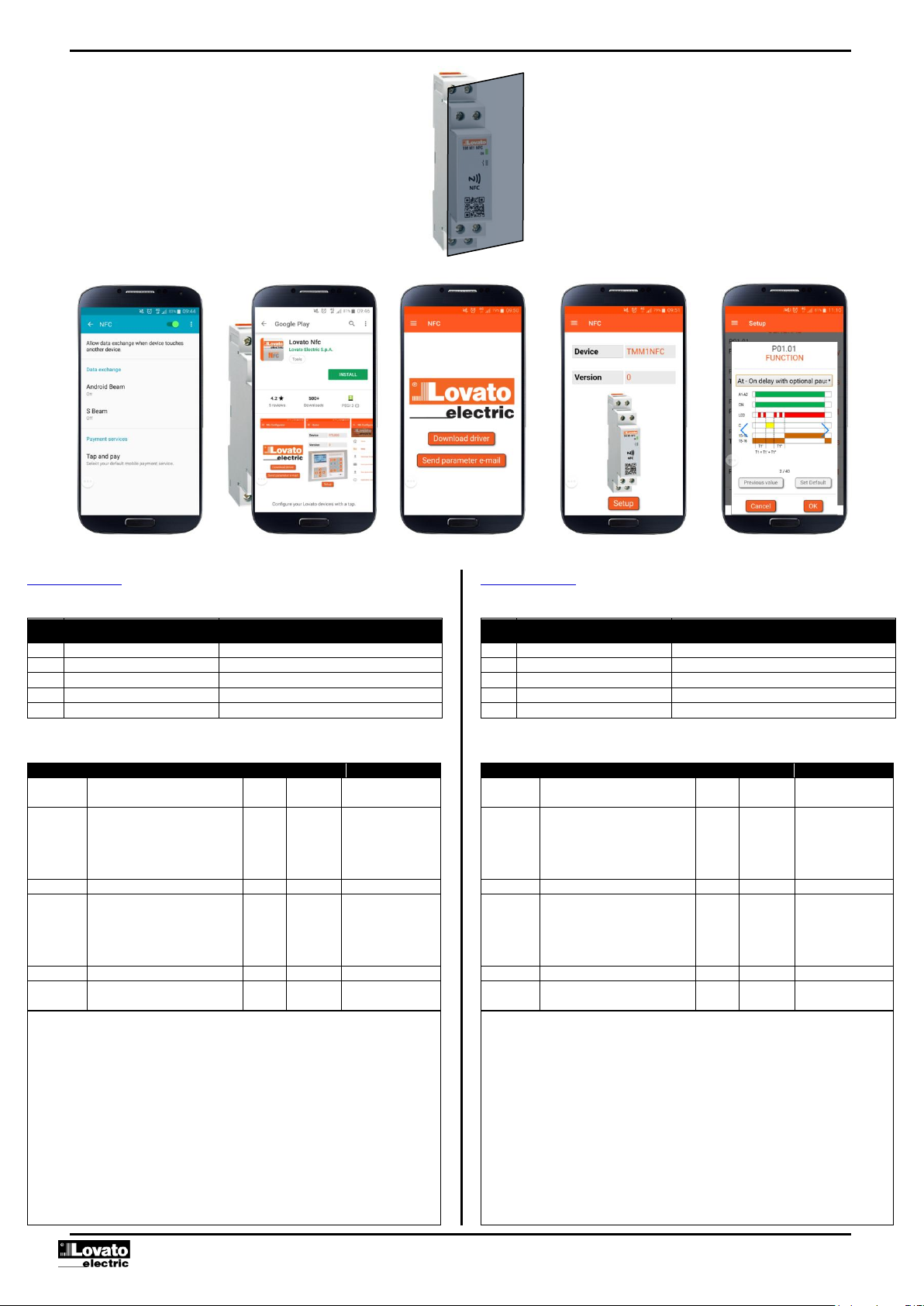
Tabella parametri
I parametri sono suddivisi nei seguenti menù.
Cod.
MENU
DESCRIZIONE
M01
GENERALE
Impostazione funzione, tempi, ecc..
M02
CONTATORE
Impostazione preset contatore
M03
PASSWORD
Impostazione password di accesso
M04
CONTAORE
Impostazione funzione contaore
M05
NUMERO SERIALE
Lettura numero seriale del temporizzatore
Di seguito la descrizione dettagliata dei parametri
M01 – GENERALE
UdM
Default
Range
P01.01
Funzione A
A….OFF (vedere
capitolo Funzioni)
P01.02
Base tempi T1
1s
100ms
1s
1min
1h
1giorno
P01.03
Preset T1 1
1-999
P01.04
Base tempi T2
1s
100ms
1s
1min
1h
1giorno
P01.05
Preset T2 1
1-999
P01.06
Modo RESET
INP
PWR
INP
P01.01 – Selezione della funzione del temporizzatore. Per dettagli fare riferimento al
capitolo Funzioni.
P01.02 – Alcune funzioni prevedono l’impostazione di un solo tempo (T1), altre di due
tempi indipendenti (T1 e T2), per dettagli fare riferimento al capitolo Funzioni. Questo
parametro consente l’impostazione della base tempi di T1.
P01.03 – Impostazione del preset del tempo T1, riferito alla base tempi impostata in
P01.02. Esempio: per impostare un tempo di 5 minuti, settare P01.02=1min e P01.03 = 5.
P01.04 – Alcune funzioni prevedono l’impostazione di due tempi indipendenti (T1 e T2),
per dettagli fare riferimento al capitolo Funzioni. Questo parametro consente
l’impostazione della base tempi di T2.
P01.05 – Impostazione del preset del tempo T2, riferito alla base tempi impostata in
P01.04. Esempio: per impostare un tempo di 5 minuti, settare P01.04=1min e P01.05 = 5.
P01.06 – Impostazione della modalità di reset della funzione del temporizzatore. Per le
funzioni avviate da ingresso di comando esterno (vedere il capitolo Funzioni) è possibile
selezionare la modalità di reset della funzione: INP = ogni volta che l’ingresso di
Parameters table
The parameters are divided in the following menu.
Cod.
MENU
DESCRIPTION
M01
GENERAL
Settings of function, timing, etc..
M02
COUNTER
Setting of counter preset
M03
PASSWORD
Password settings
M04
HOUR COUNTER
Setting of hour counter function
M05
SERIAL NUMBER
Reading of the serial number of the timer
Here below the detailed description of the parameters.
M01 – GENERAL
UoM
Default
Range
P01.01
Function A
A…OFF (see the
chapter Functions)
P01.02
Time range T1
1s
100ms
1s
1min
1h
1day
P01.03
Preset T1 1
1-999
P01.04
Time range T2
1s
100ms
1s
1min
1h
1day
P01.05
Preset T2 1
1-999
P01.06
RESET mode
INP
PWR
INP
P01.01 – Selection of the function of the timer. For details see the chapter Functions.
P01.02 – Some functions require the setting of only one preset time (T1), while other
functions require the settings of two independent preset times (T1 and T2), for details see
the chapter Functions. These parameter allow to set the time range of the time T1.
P01.03 – Setting of the preset time of T1, referred to the time range set in P01.02.
Example: to set a time of 5 minutes, set P01.02=1min and P01.03 = 5.
P01.04 – Some functions require the setting of two independent preset times (T1 and
T2), for details see the chapter Functions. These parameter allow to set the time range
of the time T2.
P01.05 – Setting of the preset time of T2, referred to the time range set in P01.04.
Example: to set a time of 5 minutes, set P01.04=1min and P01.05 = 5.
P01.06 – Setting of the reset mode of the function of the timer. For the functions which
are started from the externa command input (see chapter Functions) is possible to set the
mode of reset of the function: INP = every time the command input is activated, the
function is performed. PWR = after the first execution of the function, even if the
1 2-3 4 5 6
Doc: I562IGB07_18.docx 20/07/2018 p. 3 / 16
Page 4
comando viene chiuso, viene rieseguita la funzione. PWR = dopo la prima esecuzione
della funzione, anche attivando nuovamente l’ingresso di comando la funzione non viene
più eseguita. Per ripartire è necessario disalimentare e rialimentare il temporizzatore.
command input is activated again, the function is no longer executed. To restart to
perform the function is necessary to turning off and on the power of the timer.
M02 - CONTATORE
UdM
Default
Range
P02.01
Preset contatore
OFF
OFF / 1-9999
P02.02
Conteggio contatore
0 -
Il temporizzatore TMM1 NFC può funzionare anche da contatore.
P02.01 – Impostazione del preset del contatore. Questo parametro conteggia il numero
delle chiusure dell’uscita del temporizzatore, indipendentemente dalla funzione
selezionata in P01.01. Quando il numero di chiusure dell’uscita (il cui valore corrente è
visualizzabile leggendo il parametro P02.02) raggiunge il valore impostato in P02.01, il
temporizzatore va in “blocco” e non è più possibile eseguire la funzione. Per ripartire ad
eseguire la funzione è necessario disalimentare e rialimentare il temporizzatore.
Per le funzioni ad intermittenza attivate da ingresso di comando (Cc e Dc) il valore
impostato in P02.01 conteggia il numero di chiusure dell’uscita eseguite a seguito del
comando di start (S). Quando il contatore P02.02 raggiunge il valore impostato in P02.01:
se P01.06=INP, ad una nuova chiusura dell’ingesso di comando viene rieseguita la
funzione (ovvero l’uscita si attiva ad intermittenza per il numero di cicli impostati in
P02.01); se P01.06=PWR per rieseguire la funzione è necessario disalimentare e
rialimentare il temporizzatore.
P02.02 - Questo parametro in sola lettura visualizza il valore corrente del contatore.
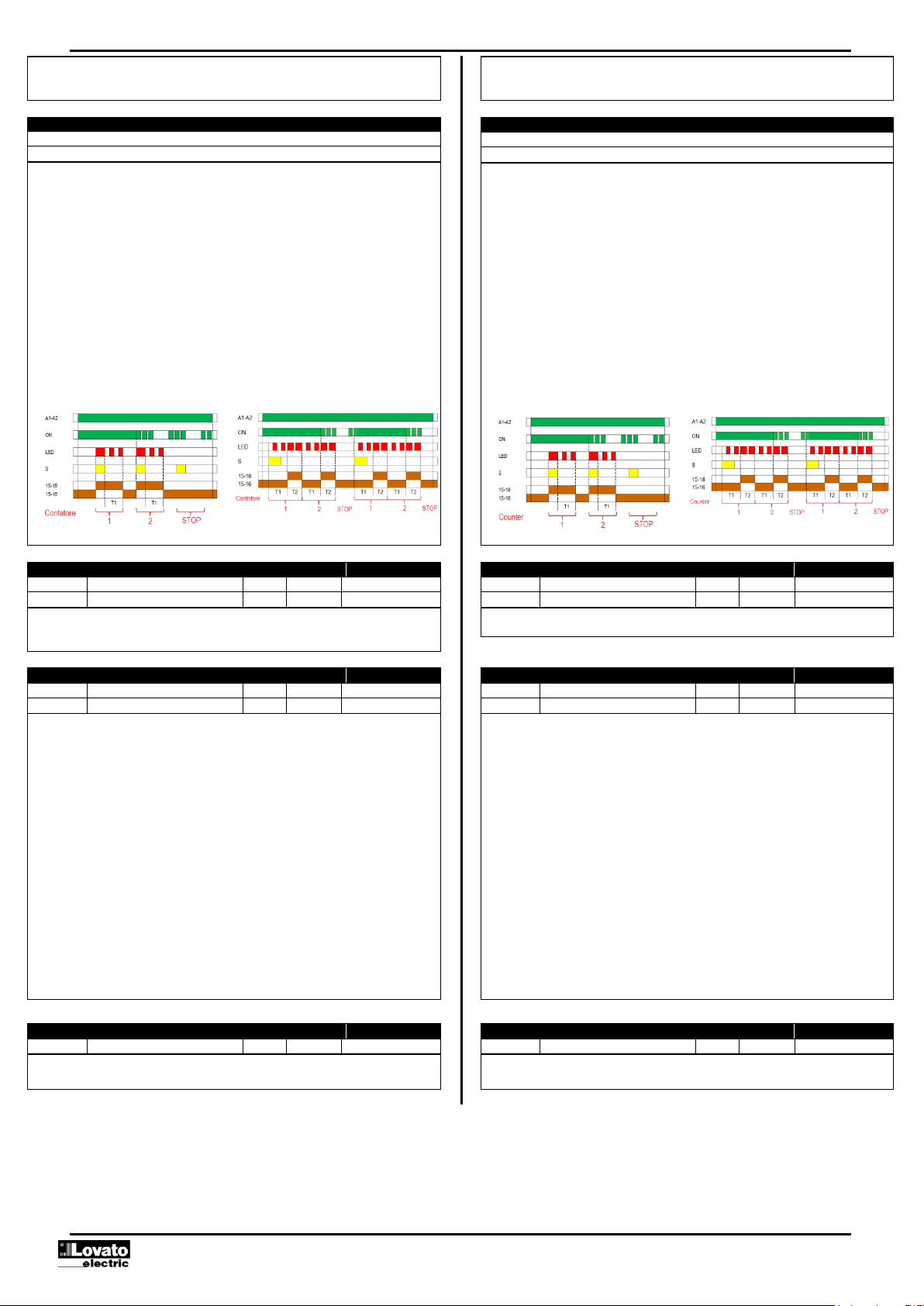
Esempio 1: Funzione E, Preset contatore = 2.
Esempio 2: Funzione Cc, Preset contatore = 2.
M02 – COUNTER
UoM
Default
Range
P02.01
Preset counter
OFF
OFF / 1-9999
P02.02
Counter value
0 -
The TMM1 NFC timer can work also as counter.
P02.01 – Setting of the preset of the counter. This parameter counts the number of the
closures of the relay output of the timer, independently from the function selected in
P01.01. When the number of the closures of the relay output (which can be monitored by
reading the parameter P02.02) reaches the value set in P02.01, the timer goes into a
“lock” status and is no longer possible to perform the function. To restart to perform the
function is necessary to turning off and on the power of the timer.
For the flashing functions activated by command input (Cc and Dc) the value set in
P02.01 counts the number of closures of the output after a start command (S). When the
counter P02.02 reaches the value set in P02.01: if P01.06=INP, after a new closure of the
command input the function is performed again (the relay output activates intermittently
for the number of cycles set in P02.01); if P01.06=PWR, to perform again the function is
necessary to turning off and on the power of the timer.
P02.02 - This read-only parameter (non modifiable) which cointains the current value of
the counter.
Example 1: Function E, Preset counter = 2.
Example 2: Function Cc, Preset counter = 2.
M03 – PASSWORD
UdM
Default
Range
P03.01
Abilitazione password
OFF
OFF-ON
P03.02
Password
2000
0-9999
P03.01 – Se impostato ad OFF, la gestione delle password è disabilitata e l’accesso alle
impostazioni è libero.
P03.02 – Con P03.01=ON, valore da specificare per abilitare l’accesso alle impostazioni.
M03 – PASSWORD
UoM
Default
Range
P03.01
Password enable
OFF
OFF-ON
P03.02
Password
2000
0-9999
P03.01 – If set to OFF, password management is deactivated; access to settings is free.
P03.02 – With P03.01=ON, value to be specified to enable the access to the settings.
M04 – CONTAORE
UdM
Default
Range
P04.01
Preset contaore
Ore
100
1-9999
P04.02
Conteggio contaore
Ore 0 0-9999
Questo menù è utilizzabile solamente se il temporizzatore viene settato con
funzione Contaore, P01.01=N.
Con questa funzione il TMM1 NFC conta il numero di ore per la quale è rimasto
alimentato, utile per esempio per segnalare una richiesta di manutenzione sull’impianto.
Il contaore viene aggiornato e salvato nella memoria interna del TMM1 NFC ogni 10
minuti e rimane memorizzato anche quando il temporizzatore viene disalimentato.
Quando viene raggiunto il numero di ore impostato, l’uscita del temporizzatore si eccita e
rimane eccitata. Per resettare il contaore (e diseccitare l’uscita) è necessario chiudere
l’ingresso di comando esterno.
Per dettagli vedere il capitolo Funzioni.
P04.01 – Impostazione del preset del contaore: in questo parametro viene impostato il
numero di ore di funzionamento del temporizzatore al raggiungimento della quale deve
eccitarsi l’uscita a relè.
P04.02 – In questo parametro viene salvato automaticamente il valore corrente delle ore
conteggiate dal temporizzatore, visualizzabile tramite la App LOVATO NFC. Quando il
numero di ore conteggiate in P04.02 è maggiore o uguale al valore di preset P04.01 il
relè di uscita si eccita. Per resettare il contaore (e di conseguenza diseccitare l’uscita) è
necessario chiudere l’ingresso di comando esterno. È inoltre possibile anticipare il
raggiungimento del valore di preset P04.01 modificando manualmente il valore di P04.02
tramite la App LOVATO NFC.
M04 – HOUR COUNTER
UoM
Default
Range
P04.01
Preset hour counter
hours
100
1-9999
P04.02
Hour counter
hours 0 0-9999
This menu is active only if the timer is set with fucntion Hour counter, P01.01=N.
With this function the TMM1 NFC counts the number of the hours for which it has been
powered on, useful for example to signal a request of maintenance on the plant.
The hour counter value is updated and saved into the internal memory of the TMM1 NFC
every 10 minutes and it remains stored even when the timer is powered off.
When it is reached the number of preset hours, the relay output of the timer energises
and remains energised. To reset the hour counter (and de-energise the relay output) is
necessay to close the external command input.
For details see the chapter Function.
P04.01 – Setting of the hour counter preset: in this parameter is set the number of the
hours of functioning of the timer after which the relay output energises.
P04.02 – In this parameter is automatically saved the current value of the hours counted
by the timer, that can be read from the LOVATO NFC App. When the number of the
hours counted in P04.02 is greater or equal to the preset value P04.01 the relay output
energises. To reset the hour counter (and consequently de-energise the relay output) is
necessary to close the external command input. Is also possible to anticipate the
achieving of the preset value P04.01 by modifying manually the value of parameter
P04.02 from the LOVATO NFC App.
M05 – NUMERO SERIALE
UdM
Default
Range
P05.01
Numero seriale
- -
P05.01 – Questo parametro in sola lettura (non modificabile) contiene il numero seriale
del temporizzatore.
M05 – SERIAL NUMBER
UdM
Default
Range
P05.01
Serial number
- -
P05.01 – This read-only parameter (non modifiable) cointains the serial number of the
timer.
Doc: I562IGB07_18.docx 20/07/2018 p. 4 / 16
Page 5
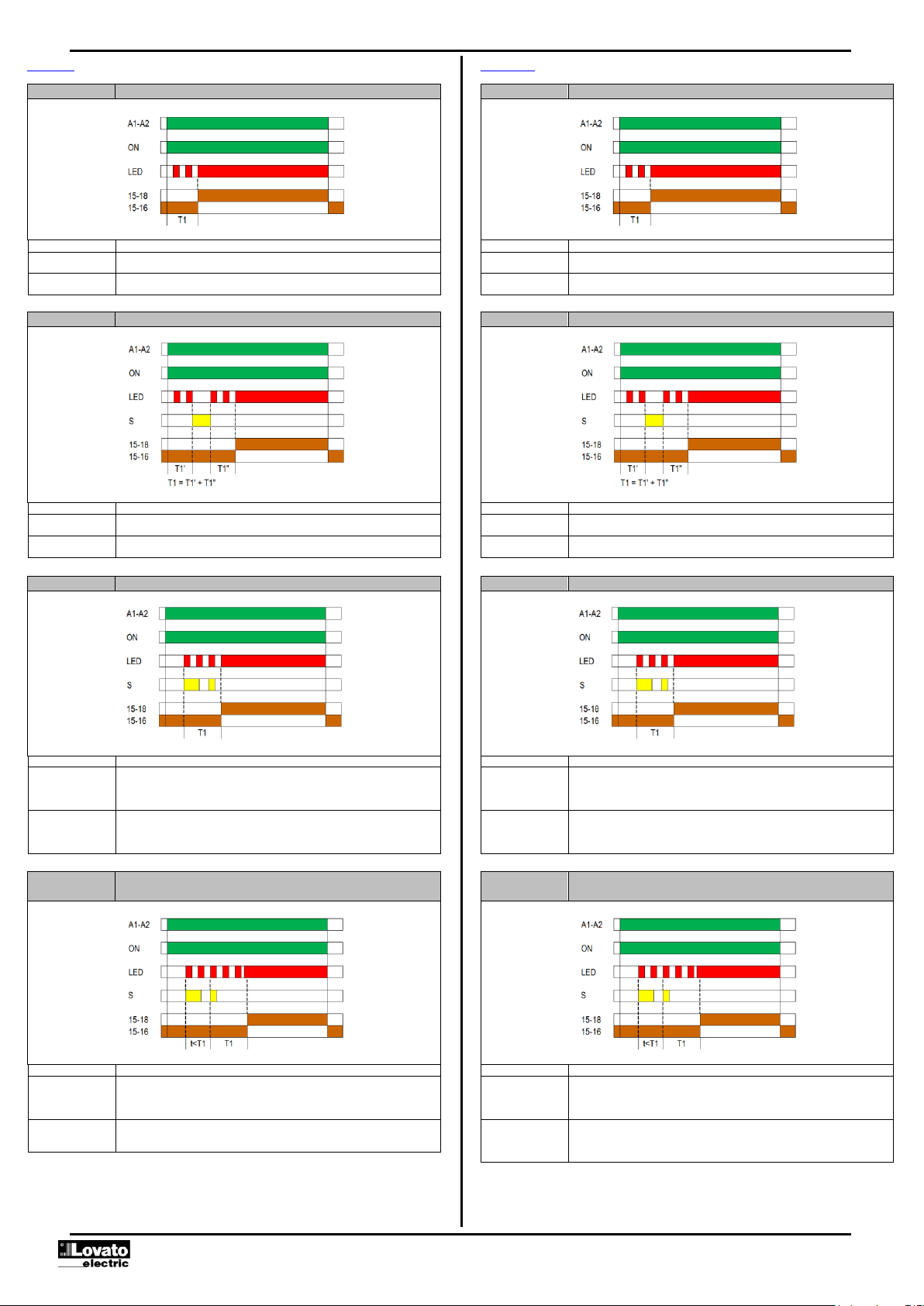
Funzioni
A
Eccitazione ritardata del relè
Parametro
Descrizione
Modo reset
P01.06
Non ha effetto (indipendentemente dal settaggio INP o PWR, per rieseguire la funzione è
necessario rimuovere e ridare alimentazione al temporizzatore).
Preset contatore
P02.01
Non ha effetto (dopo il tempo T1 l’uscita rimane sempre eccitata finché non viene tolta
alimentazione al temporizzatore).
Functions
A
On delay
Parameter
Description
Reset mode
P01.06
This parameter has no effect (independently from the setting INP or PWR, to restart the
function is necessary to turn off and on the power supply of the timer).
Preset counter
P02.01
This parameter has no effect (after the time T1 the output remains energised until you remove
the power supply to the timer).
At
Eccitazione ritardata del relè con opzione pausa tramite contatto
Parametro
Descrizione
Modo reset
P01.06
Non ha effetto (indipendentemente dal settaggio INP o PWR, per rieseguire la funzione è
necessario rimuovere e ridare alimentazione al temporizzatore).
Preset contatore
P02.01
Non ha effetto (dopo il tempo T1 l’uscita rimane sempre eccitata finché non viene tolta
alimentazione al temporizzatore).
At
On delay with optional pause with contact
Parameter
Description
Reset mode
P01.06
This parameter has no effect (independently from the setting INP or PWR, to restart the
function is necessary to turn off and on the power supply of the timer).
Preset counter
P02.01
This parameter has no effect (after the time T1 the output remains energised until you remove
the power supply to the timer).
Ac
Eccitazione ritardata del relè alla chiusura di un contatto
Parametro
Descrizione
Modo reset
P01.06
INP = ogni volta che viene chiuso l’ingresso di comando S la funzione viene eseguita.
PWR = la funzione viene eseguita una sola volta, al termine della quale nuove chiusure
dell’ingresso di comando S vengono ignorate e per rieseguire la funzione è necessario
disalimentare e rialimentare il temporizzatore.
Preset contatore
P02.01
Quando l’uscita a relè raggiunge il numero di chiusure impostato in P02.01, il temporizzatore
rimane in “blocco” (nuove chiusure dell’ingresso di comando S vengono ignorate) e per
eseguire nuovamente la funzione devo disalimentare e rialimentare il temporizzatore.
Ac
On delay, start from contact
Parameter
Description
Reset mode
P01.06
INP = every time you close the command input S the function is performed.
PWR = the function is performed just one time, after that, new closures of the command input
S are ignored and to perform again the function is necessary to turn off and on the power
supply of the timer.
Preset counter
P02.01
When the number of the closures of the relay output reaches the value set in P02.01, the
timer goes into a “lock” status and is no longer possible to perform the function (new closures
of the command input S are ignored). To restart to perform the function is necessary to turn
off and on the power supply of the timer.
Al
Eccitazione ritardata del relè alla chiusura di un contatto,
riarmabile
Parametro
Descrizione
Modo reset
P01.06
INP = ogni volta che viene chiuso l’ingresso di comando S la funzione viene eseguita.
PWR = la funzione viene eseguita una sola volta, al termine della quale nuove chiusure
dell’ingresso di comando S vengono ignorate e per rieseguire la funzione è necessario
disalimentare e rialimentare il temporizzatore.
Preset contatore
P02.01
Quando l’uscita a relè raggiunge il numero di chiusure impostato in P02.01, il temporizzatore
rimane in “blocco” (nuove chiusure dell’ingresso di comando S vengono ignorate) e per
eseguire nuovamente la funzione devo disalimentare e rialimentare il temporizzatore.
Al
On delay, start from contact, reloadable
Parameter
Description
Reset mode
P01.06
INP = every time you close the command input S the function is performed.
PWR = the function is performed just one time, after that, new closures of the command input
S are ignored and to perform again the function is necessary to turn off and on the power
supply of the timer.
Preset counter
P02.01
When the number of the closures of the relay output reaches the value set in P02.01, the
timer goes into a “lock” status and is no longer possible to perform the function (new closures
of the command input S are ignored). To restart to perform the function is necessary to turn
off and on the power supply of the timer.
Doc: I562IGB07_18.docx 20/07/2018 p. 5 / 16
Page 6
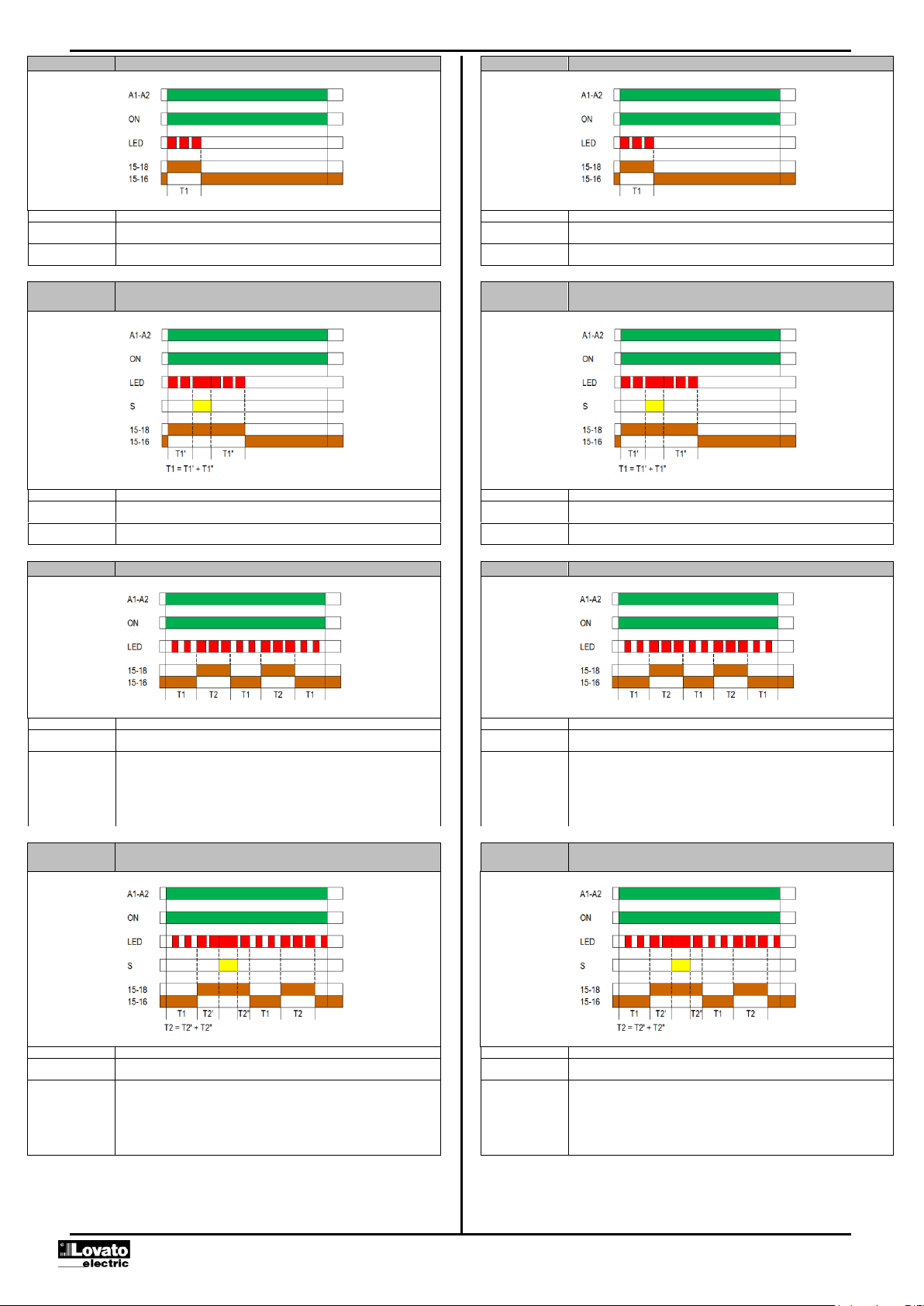
B
Diseccitazione ritardata del relè
Parametro
Descrizione
Modo reset
P01.06
Non ha effetto (indipendentemente dal settaggio INP o PWR, per rieseguire la funzione è
necessario rimuovere e ridare alimentazione al temporizzatore).
Preset contatore
P02.01
Non ha effetto (dopo il tempo T1 l’uscita rimane sempre diseccitata finché non viene tolta
alimentazione al temporizzatore).
B
Off delay
Parameter
Description
Reset mode
P01.06
This parameter has no effect (independently from the setting INP or PWR, to restart the
function is necessary to turn off and on the power supply of the timer).
Preset counter
P02.01
This parameter has no effect (after the time T1 the output remains de-energised until you
remove the power supply to the timer).
Bt
Diseccitazione ritardata del relè con opzione pausa tramite
contatto
Parametro
Descrizione
Modo reset
P01.06
Non ha effetto (indipendentemente dal settaggio INP o PWR, per rieseguire la funzione è
necessario rimuovere e ridare alimentazione al temporizzatore).
Preset contatore
P02.01
Non ha effetto (dopo il tempo T1 l’uscita rimane sempre diseccitata finché non viene tolta
alimentazione al temporizzatore).
Bt
Off delay with optional pause with contact
Parameter
Description
Reset mode
P01.06
This parameter has no effect (independently from the setting INP or PWR, to restart the
function is necessary to turn off and on the power supply of the timer).
Preset counter
P02.01
This parameter has no effect (after the time T1 the output remains de-energised until you
remove the power supply to the timer).
C
Intermittenza, inizio OFF, tempi asimmetrici
Parametro
Descrizione
Modo reset
P01.06
Non ha effetto (indipendentemente dal settaggio INP o PWR, per rieseguire la funzione è
necessario rimuovere e ridare alimentazione al temporizzatore).
Preset contatore
P02.01
Quando l’uscita a relè raggiunge il numero di chiusure impostato in P02.01, il temporizzatore
rimane in “blocco” e per eseguire nuovamente la funzione devo disalimentare e rialimentare il
temporizzatore. Default = OFF (infiniti cicli).
Esempio: con P02.01=3, una volta alimentato il temporizzatore l’uscita esegue 3 cicli pausalavoro (T1-T2, T1-T2, T1-T2), al termine della quale l’uscita si diseccita e rimane diseccitata
finché non viene tolta e ridata alimentazione al temporizzatore.
C
Flasher, starting with OFF, asymmetrical timings
Parameter
Description
Reset mode
P01.06
This parameter has no effect (independently from the setting INP or PWR, to restart the
function is necessary to turn off and on the power supply of the timer).
Preset counter
P02.01
When the number of the closures of the relay output reaches the value set in P02.01, the
timer goes into a “lock” status and is no longer possible to perform the function . To restart to
perform the function is necessary to turn off and on the power supply of the timer. Default =
OFF (infinite cycles).
Example: with P02.01=3, once the timer is supplied the relay outputs performs 3 cycles (T1T2, T1-T2, T1-T2), at the end of which the relay output de-energises and remains deenergised until you turn off and on the power supply of the timer.
Ct
Intermittenza, inizio OFF, tempi asimmetrici, con opzione pausa
tramite contatto
Parametro
Descrizione
Modo reset
P01.06
Non ha effetto (indipendentemente dal settaggio INP o PWR, per rieseguire la funzione è
necessario rimuovere e ridare alimentazione al temporizzatore).
Preset contatore
P02.01
Quando l’uscita a relè raggiunge il numero di chiusure impostato in P02.01, il temporizzatore
rimane in “blocco” e per eseguire nuovamente la funzione devo disalimentare e rialimentare il
temporizzatore. Default = OFF (infiniti cicli).
Esempio: con P02.01=3, una volta alimentato il temporizzatore l’uscita esegue 3 cicli pausalavoro (T1-T2, T1-T2, T1-T2), al termine della quale l’uscita si diseccita e rimane diseccitata
finché non viene tolta e ridata alimentazione al temporizzatore.
Ct
Flasher, starting with OFF, asymmetrical timings, with optional
pause with contact
Parameter
Description
Reset mode
P01.06
This parameter has no effect (independently from the setting INP or PWR, to restart the
function is necessary to turn off and on the power supply of the timer).
Preset counter
P02.01
When the number of the closures of the relay output reaches the value set in P02.01, the
timer goes into a “lock” status and is no longer possible to perform the function . To restart to
perform the function is necessary to turn off and on the power supply of the timer. Default =
OFF (infinite cycles).
Example: with P02.01=3, once the timer is supplied the relay outputs performs 3 cycles (T1T2, T1-T2, T1-T2), at the end of which the relay output de-energises and remains deenergised until you turn off and on the power supply of the timer.
Doc: I562IGB07_18.docx 20/07/2018 p. 6 / 16
Page 7
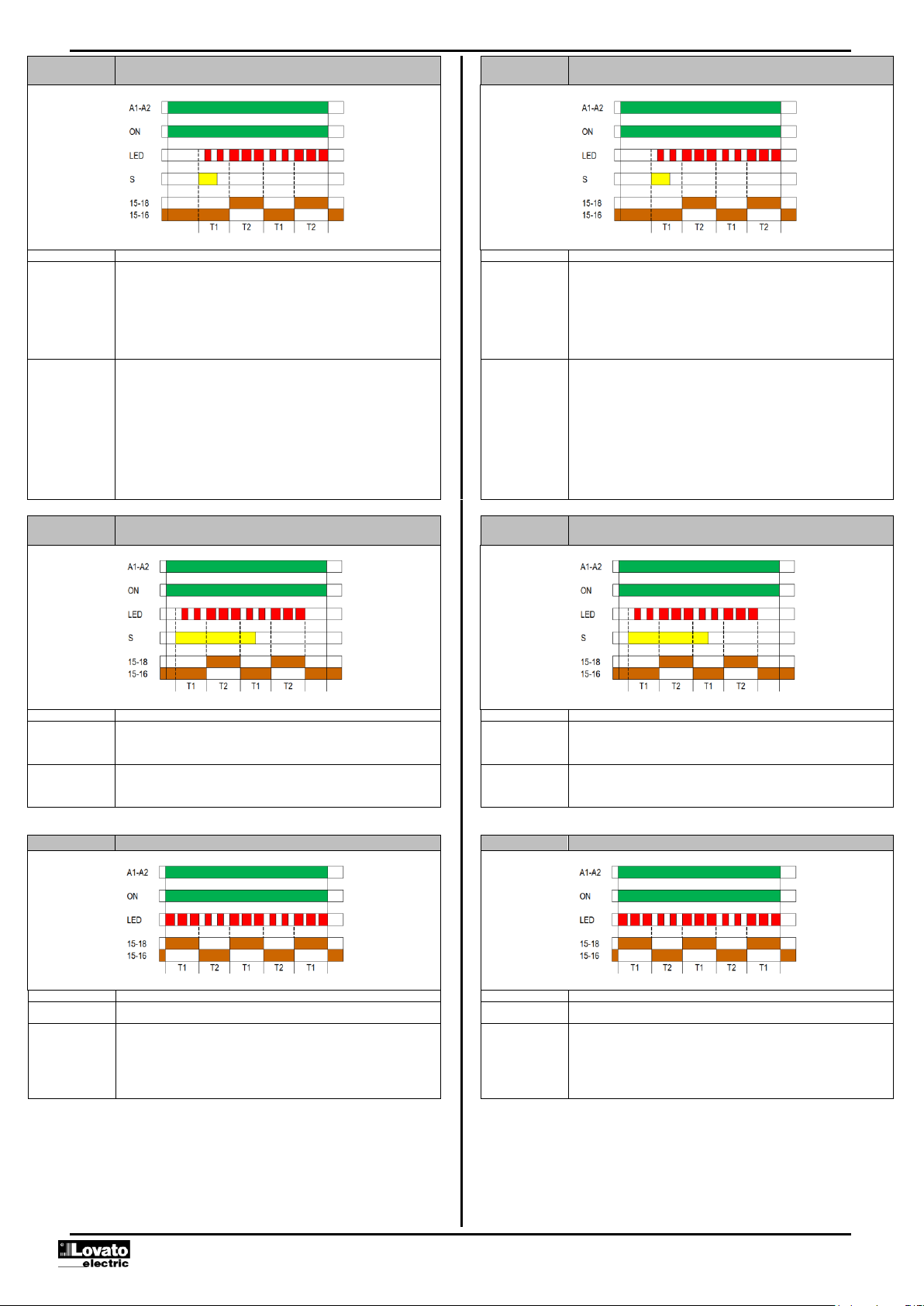
Cc
Intermittenza, inizio OFF, tempi asimmetrici, start da contatto
Parametro
Descrizione
Modo reset
P01.06
Se è stato impostato Preset contatore P02.01=OFF (= infiniti cicli) questa impostazione non
ha effetto: con P01.06 impostato a INP o PWR, dopo la chiusura dell’ingresso di comando S il
temporizzatore esegue infiniti cicli pausa-lavoro (fintanto che è presente alimentazione).
Se invece è stato impostato Preset contatore P02.01 diverso da OFF:
Se Modo reset P01.06=INP: ogni volta che viene chiuso l’ingresso di comando S la
funzione viene eseguita.
Se Modo reset P01.06=PWR: la funzione viene eseguita una sola volta, al termine della
quale nuove chiusure dell’ingresso di comando S vengono ignorate e per rieseguire la
funzione è necessario disalimentare e rialimentare il temporizzatore.
Preset contatore
P02.01
Quando l’uscita a relè raggiunge il numero di chiusure impostato in P02.01, il temporizzatore
rimane in “blocco” e per eseguire nuovamente la funzione:
se Modo reset P01.06=INP, è sufficiente chiudere nuovamente l’ingresso di comando S.
Esempio: con P01.06=2, ogni volta che viene chiuso l’ingresso S vengono eseguiti 2
cicli pausa-lavoro (T1-T2, T1-T2), poi l’uscita si diseccita e rimane diseccitata fino ad
una nuova chiusura dell’ingresso di comando S.
se Modo reset P01.06=PWR per rieseguire la funzione è necessario disalimentare e
rialimentare il temporizzatore.
Esempio: con P01.06=2, la prima volta che viene chiuso l’ingresso S vengono eseguiti 2
cicli pausa-lavoro (T1-T2, T1-T2), al termine della quale l’uscita si diseccita e rimane
diseccitata (nuove chiusure dell’ingresso S vengono ignorate). Per rieseguire la funzione
è necessario disalimentare e rialimentare il temporizzatore.
Cc
Flasher, starting with OFF, asymmetrical timings, start from
contact
Parameter
Description
Reset mode
P01.06
If you have set Preset counter P02.01=OFF (= infinite cycles) this setting has not effect: with
P01.06 set to INP or PWR, after the closure of the command input S the timer performs
infinite flasher cycles (as long as the power supply is present).
Otherwise, if you have set Preset counter P02.01 different from OFF:
If Reset mode P01.06=INP: every time you close the command input S the function is
performed.
If Reset mode P01.06=PWR: the function is performed just one time, at the end of which
new closures of the input command S are ignored and to restart to perform the function
is necessary to turn off and on the power supply of the timer.
Preset counter
P02.01
When the number of the closures of the relay output reaches the value set in P02.01, the
timer goes into a “lock” status and is no longer possible to perform the function. To restart to
perform the function:
if Reset mode P01.06=INP, you have to close again the command input S.
Example: with P01.06=2, every time you close the command input S are performed 2
cycles (T1-T2, T1-T2), then the output de-energises and remains de-energised until a
new closure of the command input S;
if Reset mode P01.06=PWR, to restart to perform the function is necessary to turn off
and on the power supply of the timer.
Example: with P01.06=2, the first time you close the command input S are performed 2
cycles (T1-T2, T1-T2), at the end of which the output de-energises and remains deenergised (new closures of the command input S are ignored). To restart to perform the
function is necessary to turn off and on the power supply of the timer.
Cc2
Intermittenza, inizio OFF, tempi asimmetrici, start da contatto
con comando mantenuto
Parametro
Descrizione
Modo reset
P01.06
INP = ogni volta che viene chiuso l’ingresso di comando S la funzione viene eseguita.
PWR = la funzione viene eseguita una sola volta, al termine della quale nuove chiusure
dell’ingresso di comando S vengono ignorate e per rieseguire la funzione è necessario
disalimentare e rialimentare il temporizzatore.
Preset contatore
P02.01
Quando l’uscita a relè raggiunge il numero di chiusure impostato in P02.01, il temporizzatore
rimane in “blocco” (nuove chiusure dell’ingresso di comando S vengono ignorate) e per
eseguire nuovamente la funzione devo disalimentare e rialimentare il temporizzatore.
Cc2
Flasher, starting with OFF, asymmetrical timings, start from
contact with maintained command
Parameter
Description
Reset mode
P01.06
INP = every time you close the command input S the function is performed.
PWR = the function is performed just one time, after that, new closures of the command input
S are ignored and to perform again the function is necessary to turn off and on the power
supply of the timer.
Preset counter
P02.01
When the number of the closures of the relay output reaches the value set in P02.01, the
timer goes into a “lock” status and is no longer possible to perform the function (new closures
of the command input S are ignored). To restart to perform the function is necessary to turn
off and on the power supply of the timer.
D
Intermittenza, inizio ON, tempi asimmetrici
Parametro
Descrizione
Modo reset
P01.06
Non ha effetto (indipendentemente dal settaggio INP o PWR, per rieseguire la funzione è
necessario rimuovere e ridare alimentazione al temporizzatore).
Preset contatore
P02.01
Quando l’uscita a relè raggiunge il numero di chiusure impostato in P02.01, il temporizzatore
rimane in “blocco” e per eseguire nuovamente la funzione devo disalimentare e rialimentare il
temporizzatore. Default = OFF (infiniti cicli).
Esempio: con P02.01=3, una volta alimentato il temporizzatore l’uscita esegue 3 cicli lavoropausa (T1-T2, T1-T2, T1-T2), al termine della quale l’uscita rimane diseccitata finché non
viene tolta e ridata alimentazione al temporizzatore.
D
Flasher, starting with ON, asymmetrical timings
Parameter
Description
Reset mode
P01.06
This parameter has no effect (independently from the setting INP or PWR, to restart the
function is necessary to turn off and on the power supply of the timer).
Preset counter
P02.01
When the number of the closures of the relay output reaches the value set in P02.01, the
timer goes into a “lock” status and is no longer possible to perform the function. To restart to
perform the function is necessary to turn off and on the power supply of the timer. Default =
OFF (infinite cycles).
Example: with P02.01=3, once the timer is supplied the relay outputs performs 3 cycles (T1T2, T1-T2, T1-T2), at the end of which the relay output de-energises and remains deenergised until you turn off and on the power supply of the timer.
Doc: I562IGB07_18.docx 20/07/2018 p. 7 / 16
Page 8
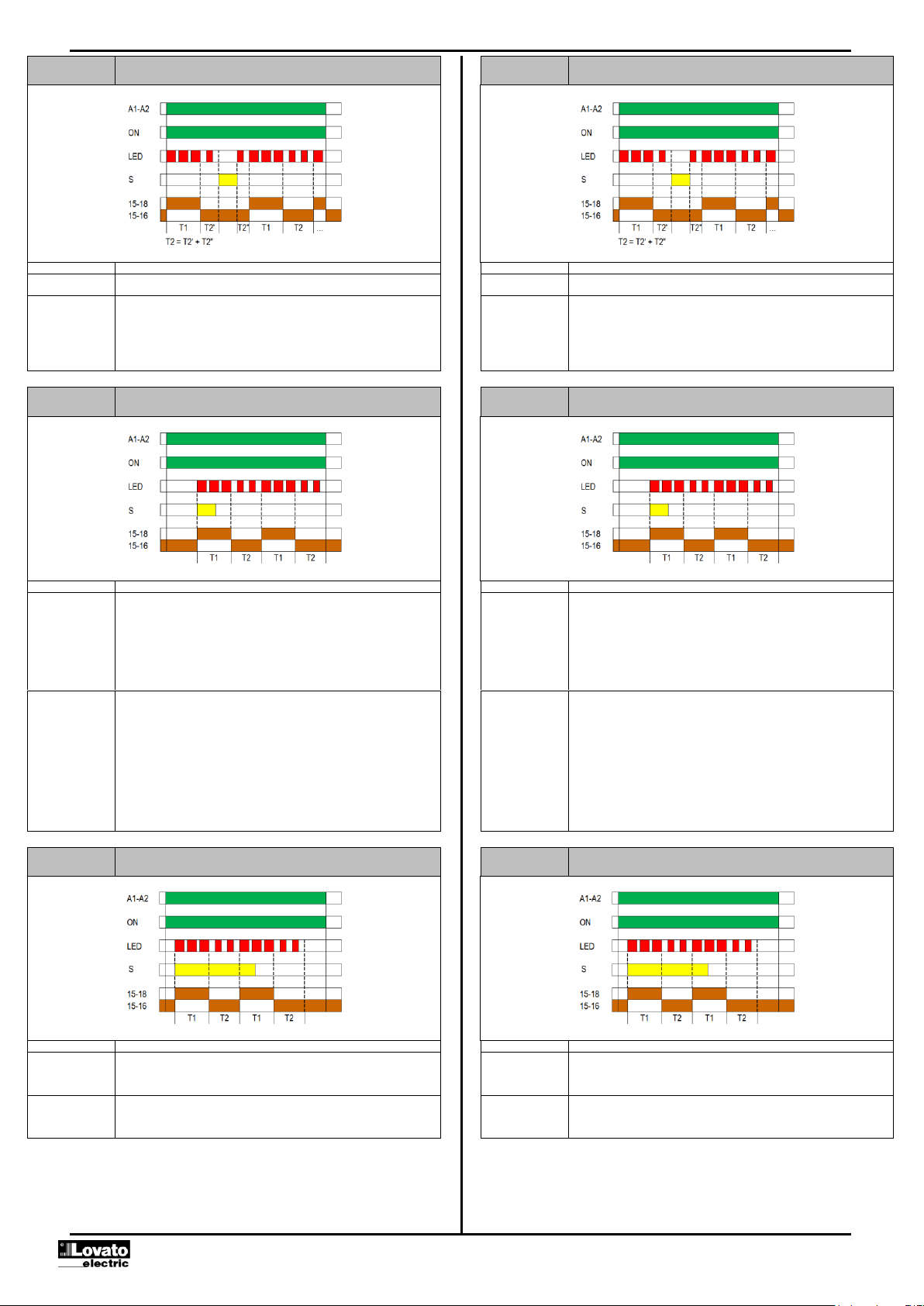
Dt
Intermittenza, inizio ON, tempi asimmetrici, con opzione pausa
tramite contatto
Parametro
Descrizione
Modo reset
P01.06
Non ha effetto (indipendentemente dal settaggio INP o PWR, per rieseguire la funzione è
necessario rimuovere e ridare alimentazione al temporizzatore).
Preset contatore
P02.01
Quando l’uscita a relè raggiunge il numero di chiusure impostato in P02.01, il temporizzatore
rimane in “blocco” e per eseguire nuovamente la funzione devo disalimentare e rialimentare il
temporizzatore. Default = OFF (infiniti cicli).
Esempio: con P02.01=3, una volta alimentato il temporizzatore l’uscita esegue 3 cicli lavoropausa (T1-T2, T1-T2, T1-T2), al termine della quale l’uscita rimane diseccitata finché non
viene tolta e ridata alimentazione al temporizzatore.
Dt
Flasher, starting with ON, asymmetrical timings, with optional
pause with contact
Parameter
Description
Reset mode
P01.06
This parameter has no effect (independently from the setting INP or PWR, to restart the
function is necessary to turn off and on the power supply of the timer).
Preset counter
P02.01
When the number of the closures of the relay output reaches the value set in P02.01, the
timer goes into a “lock” status and is no longer possible to perform the function . To restart to
perform the function is necessary to turn off and on the power supply of the timer. Default =
OFF (infinite cycles).
Example: with P02.01=3, once the timer is supplied the relay outputs performs 3 cycles (T1T2, T1-T2, T1-T2), at the end of which the relay output de-energises and remains deenergised until you turn off and on the power supply of the timer.
Dc
Intermittenza, inizio ON, tempi asimmetrici, start da contatto
Parametro
Descrizione
Modo reset
P01.06
Se è stato impostato Preset contatore P02.01=OFF (= infiniti cicli) questa impostazione non
ha effetto: con P01.06 impostato a INP o PWR, dopo la chiusura dell’ingresso di comando S il
temporizzatore esegue infiniti cicli lavoro-pausa (fintanto che è presente alimentazione).
Se invece è stato impostato Preset contatore P02.01 diverso da OFF:
Se Modo reset P01.06=INP: ogni volta che viene chiuso l’ingresso di comando S la
funzione viene eseguita.
Se Modo reset P01.06=PWR: la funzione viene eseguita una sola volta, al termine della
quale nuove chiusure dell’ingresso di comando S vengono ignorate e per rieseguire la
funzione è necessario disalimentare e rialimentare il temporizzatore.
Preset contatore
P02.01
Quando l’uscita a relè raggiunge il numero di chiusure impostato in P02.01, il temporizzatore
rimane in “blocco” e per eseguire nuovamente la funzione:
se Modo reset P01.06=INP, è sufficiente chiudere nuovamente l’ingresso di comando S.
Esempio: con P01.06=2, ogni volta che viene chiuso l’ingresso S vengono eseguiti 2
cicli lavoro-pausa (T1-T2, T1-T2), poi l’uscita rimane diseccitata fino ad una nuova
chiusura dell’ingresso di comando S.
se Modo reset P01.06=PWR per rieseguire la funzione è necessario disalimentare e
rialimentare il temporizzatore.
Esempio: con P01.06=2, la prima volta che viene chiuso l’ingresso S vengono eseguiti 2
cicli lavoro-pausa (T1-T2, T1-T2), al termine della quale l’uscita rimane diseccitata
(nuove chiusure dell’ingresso S vengono ignorate). Per rieseguire la funzione è
necessario disalimentare e rialimentare il temporizzatore.
Dc
Flasher, starting with ON, asymmetrical timings, start from
contact
Parameter
Description
Reset mode
P01.06
If you have set Preset counter P02.01=OFF (= infinite cycles) this setting has not effect: with
P01.06 set to INP or PWR, after the closure of the command input S the timer performs
infinite flasher cycles (as long as the power supply is present).
Otherwise, if you have set Preset counter P02.01 different from OFF:
If Reset mode P01.06=INP: every time you close the command input S the function is
performed.
If Reset mode P01.06=PWR: the function is performed just one time, at the end of which
new closures of the input command S are ignored and to restart to perform the function
is necessary to turn off and on the power supply of the timer.
Preset counter
P02.01
When the number of the closures of the relay output reaches the value set in P02.01, the
timer goes into a “lock” status and is no longer possible to perform the function. To restart to
perform the function:
if Reset mode P01.06=INP, you have to close again the command input S.
Example: with P01.06=2, every time you close the command input S are performed 2
cycles (T1-T2, T1-T2), then the output de-energises and remains de-energised until a
new closure of the command input S;
if Reset mode P01.06=PWR, to restart to perform the function is necessary to turn off
and on the power supply of the timer.
Example: with P01.06=2, the first time you close the command input S are performed 2
cycles (T1-T2, T1-T2), at the end of which the output de-energises and remains deenergised (new closures of the command input S are ignored). To restart to perform the
function is necessary to turn off and on the power supply of the timer.
Dc2
Intermittenza, inizio ON, tempi asimmetrici, start da contatto con
comando mantenuto
Parametro
Descrizione
Modo reset
P01.06
INP = ogni volta che viene chiuso l’ingresso di comando S la funzione viene eseguita.
PWR = la funzione viene eseguita una sola volta, al termine della quale nuove chiusure
dell’ingresso di comando S vengono ignorate e per rieseguire la funzione è necessario
disalimentare e rialimentare il temporizzatore.
Preset contatore
P02.01
Quando l’uscita a relè raggiunge il numero di chiusure impostato in P02.01, il temporizzatore
rimane in “blocco” (nuove chiusure dell’ingresso di comando S vengono ignorate) e per
eseguire nuovamente la funzione devo disalimentare e rialimentare il temporizzatore.
Dc2
Flasher, starting with ON, asymmetrical timings, start from
contact with maintained command
Parameter
Description
Reset mode
P01.06
INP = every time you close the command input S the function is performed.
PWR = the function is performed just one time, after that , new closures of the command input
S are ignored and to perform again the function is necessary to turn off and on the power
supply of the timer.
Preset counter
P02.01
When the number of the closures of the relay output reaches the value set in P02.01, the
timer goes into a “lock” status and is no longer possible to perform the function (new closures
of the command input S are ignored). To restart to perform the function is necessary to turn
off and on the power supply of the timer.
Doc: I562IGB07_18.docx 20/07/2018 p. 8 / 16
Page 9
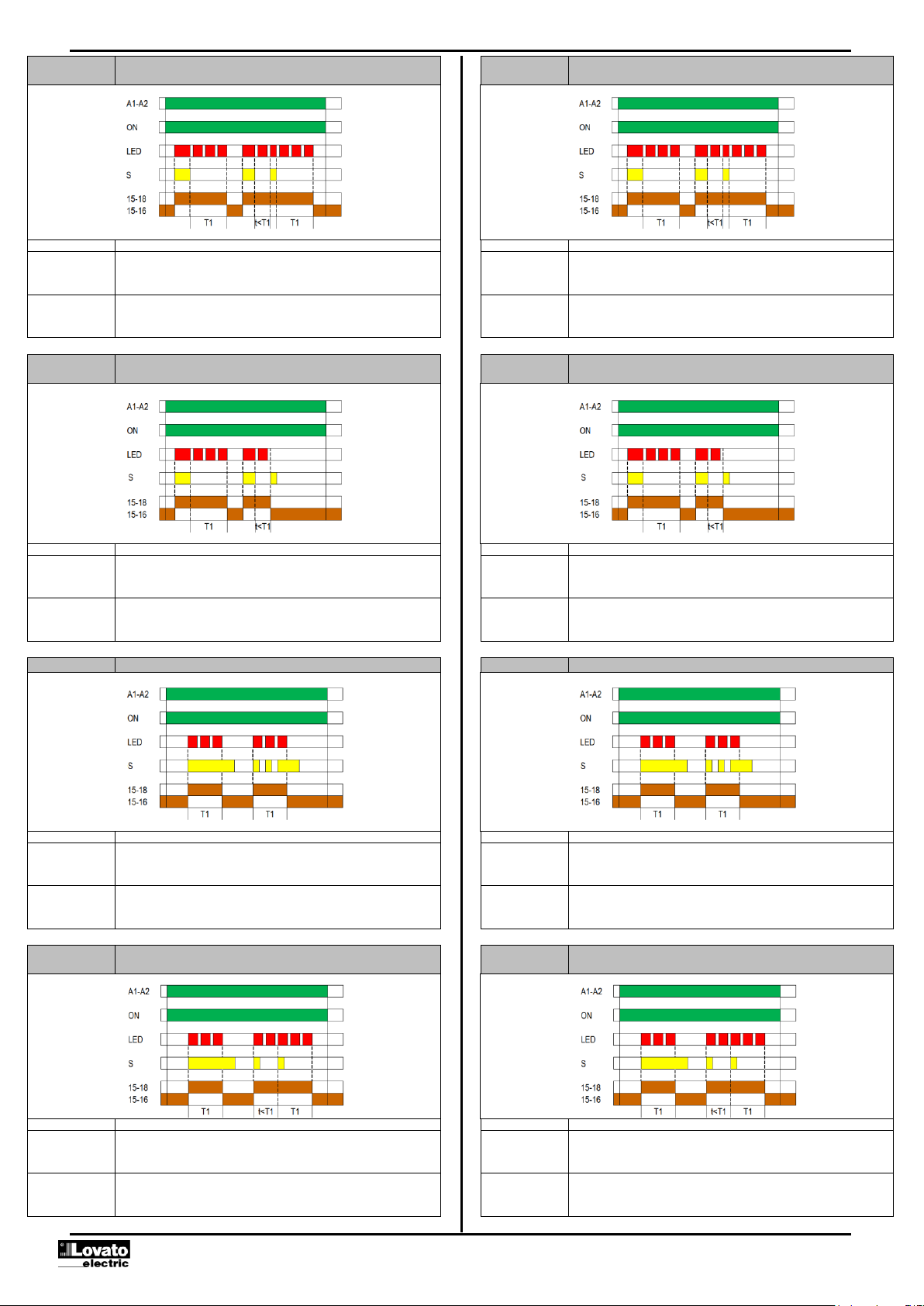
E
Eccitazione del relè alla chiusura di un contatto e diseccitazione
ritardata all’apertura, riarmabile
Parametro
Descrizione
Modo reset
P01.06
INP = ogni volta che viene chiuso l’ingresso di comando S la funzione viene eseguita.
PWR = la funzione viene eseguita una sola volta, al termine della quale nuove chiusure
dell’ingresso di comando S vengono ignorate e per rieseguire la funzione è necessario
disalimentare e rialimentare il temporizzatore.
Preset contatore
P02.01
Quando l’uscita a relè raggiunge il numero di chiusure impostato in P02.01, il temporizzatore
rimane in “blocco” (nuove chiusure dell’ingresso di comando S vengono ignorate) e per
eseguire nuovamente la funzione devo disalimentare e rialimentare il temporizzatore.
E
Energising at contact closing, OFF delay starting at the contact
opening, reloadable
Parameter
Description
Reset mode
P01.06
INP = every time you close the command input S the function is performed.
PWR = the function is performed just one time, after that, new closures of the command input
S are ignored and to perform again the function is necessary to turn off and on the power
supply of the timer.
Preset counter
P02.01
When the number of the closures of the relay output reaches the value set in P02.01, the
timer goes into a “lock” status and is no longer possible to perform the function (new closures
of the command input S are ignored). To restart to perform the function is necessary to turn
off and on the power supply of the timer.
Er
Eccitazione del relè alla chiusura di un contatto e diseccitazione
ritardata all’apertura, resettabile
Parametro
Descrizione
Modo reset
P01.06
INP = ogni volta che viene chiuso l’ingresso di comando S la funzione viene eseguita.
PWR = la funzione viene eseguita una sola volta, al termine della quale nuove chiusure
dell’ingresso di comando S vengono ignorate e per rieseguire la funzione è necessario
disalimentare e rialimentare il temporizzatore.
Preset contatore
P02.01
Quando l’uscita a relè raggiunge il numero di chiusure impostato in P02.01, il temporizzatore
rimane in “blocco” (nuove chiusure dell’ingresso di comando S vengono ignorate) e per
eseguire nuovamente la funzione devo disalimentare e rialimentare il temporizzatore.
Er
Energising at contact closing, OFF delay starting at the contact
opening, resettable
Parameter
Description
Reset mode
P01.06
INP = every time you close the command input S the function is performed.
PWR = the function is performed just one time, after that, new closures of the command input
S are ignored and to perform again the function is necessary to turn off and on the power
supply of the timer.
Preset counter
P02.01
When the number of the closures of the relay output reaches the value set in P02.01, the
timer goes into a “lock” status and is no longer possible to perform the function (new closures
of the command input S are ignored). To restart to perform the function is necessary to turn
off and on the power supply of the timer.
F
Eccitazione temporizzata del relè alla chiusura di un contatto
Parametro
Descrizione
Modo reset
P01.06
INP = ogni volta che viene chiuso l’ingresso di comando S la funzione viene eseguita.
PWR = la funzione viene eseguita una sola volta, al termine della quale nuove chiusure
dell’ingresso di comando S vengono ignorate e per rieseguire la funzione è necessario
disalimentare e rialimentare il temporizzatore.
Preset contatore
P02.01
Quando l’uscita a relè raggiunge il numero di chiusure impostato in P02.01, il temporizzatore
rimane in “blocco” (nuove chiusure dell’ingresso di comando S vengono ignorate) e per
eseguire nuovamente la funzione devo disalimentare e rialimentare il temporizzatore.
F
Pulse on relay energising with start at contact closing
Parameter
Description
Reset mode
P01.06
INP = every time you close the command input S the function is performed.
PWR = the function is performed just one time, after that , new closures of the command input
S are ignored and to perform again the function is necessary to turn off and on the power
supply of the timer.
Preset counter
P02.01
When the number of the closures of the relay output reaches the value set in P02.01, the
timer goes into a “lock” status and is no longer possible to perform the function (new closures
of the command input S are ignored). To restart to perform the function is necessary to turn
off and on the power supply of the timer.
Fl
Eccitazione temporizzata del relè alla chiusura di un contatto,
riarmabile
Parametro
Descrizione
Modo reset
P01.06
INP = ogni volta che viene chiuso l’ingresso di comando S la funzione viene eseguita.
PWR = la funzione viene eseguita una sola volta, al termine della quale nuove chiusure
dell’ingresso di comando S vengono ignorate e per rieseguire la funzione è necessario
disalimentare e rialimentare il temporizzatore.
Preset contatore
P02.01
Quando l’uscita a relè raggiunge il numero di chiusure impostato in P02.01, il temporizzatore
rimane in “blocco” (nuove chiusure dell’ingresso di comando S vengono ignorate) e per
eseguire nuovamente la funzione devo disalimentare e rialimentare il temporizzatore.
Fl
Pulse on relay energising with start at contact closing,
reloadable
Parameter
Description
Reset mode
P01.06
INP = every time you close the command input S the function is performed.
PWR = the function is performed just one time, after that , new closures of the command input
S are ignored and to perform again the function is necessary to turn off and on the power
supply of the timer.
Preset counter
P02.01
When the number of the closures of the relay output reaches the value set in P02.01, the
timer goes into a “lock” status and is no longer possible to perform the function (new closures
of the command input S are ignored). To restart to perform the function is necessary to turn
off and on the power supply of the timer.
Doc: I562IGB07_18.docx 20/07/2018 p. 9 / 16
Page 10
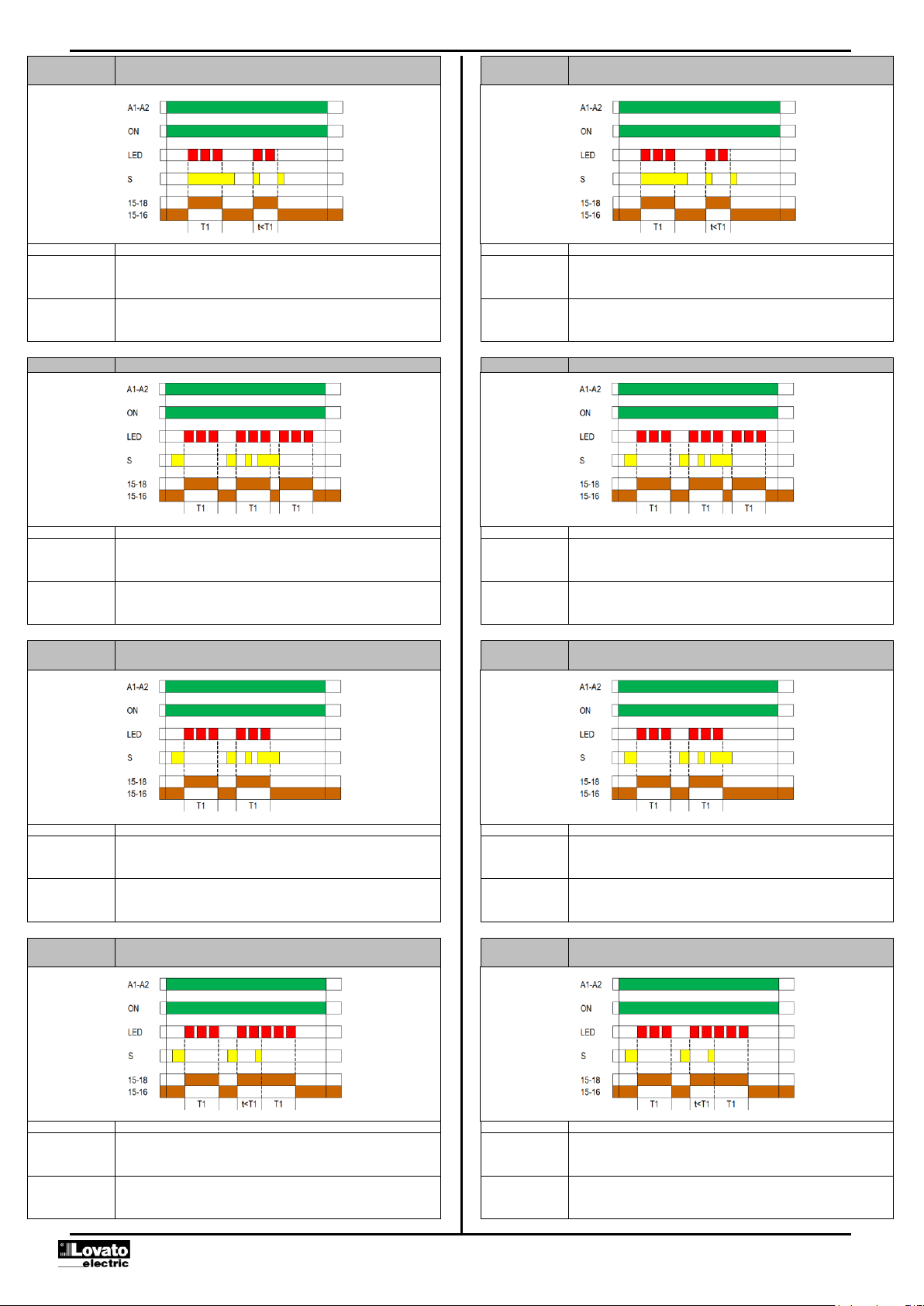
Fr
Eccitazione temporizzata del relè alla chiusura di un contatto,
resettabile
Parametro
Descrizione
Modo reset
P01.06
INP = ogni volta che viene chiuso l’ingresso di comando S la funzione viene eseguita.
PWR = la funzione viene eseguita una sola volta, al termine della quale nuove chiusure
dell’ingresso di comando S vengono ignorate e per rieseguire la funzione è necessario
disalimentare e rialimentare il temporizzatore.
Preset contatore
P02.01
Quando l’uscita a relè raggiunge il numero di chiusure impostato in P02.01, il temporizzatore
rimane in “blocco” (nuove chiusure dell’ingresso di comando S vengono ignorate) e per
eseguire nuovamente la funzione devo disalimentare e rialimentare il temporizzatore.
Fr
Pulse on relay energising with start at contact closing,
resettable
Parameter
Description
Reset mode
P01.06
INP = every time you close the command input S the function is performed.
PWR = the function is performed just one time, after that , new closures of the command input
S are ignored and to perform again the function is necessary to turn off and on the power
supply of the timer.
Preset counter
P02.01
When the number of the closures of the relay output reaches the value set in P02.01, the
timer goes into a “lock” status and is no longer possible to perform the function (new closures
of the command input S are ignored). To restart to perform the function is necessary to turn
off and on the power supply of the timer.
G
Eccitazione temporizzata del relè all’apertura di un contatto
Parametro
Descrizione
Modo reset
P01.06
INP = ogni volta che viene chiuso l’ingresso di comando S la funzione viene eseguita.
PWR = la funzione viene eseguita una sola volta, al termine della quale nuove chiusure
dell’ingresso di comando S vengono ignorate e per rieseguire la funzione è necessario
disalimentare e rialimentare il temporizzatore.
Preset contatore
P02.01
Quando l’uscita a relè raggiunge il numero di chiusure impostato in P02.01, il temporizzatore
rimane in “blocco” (nuove chiusure dell’ingresso di comando S vengono ignorate) e per
eseguire nuovamente la funzione devo disalimentare e rialimentare il temporizzatore.
G
Pulse on relay energising with start at contact opening
Parameter
Description
Reset mode
P01.06
INP = every time you close the command input S the function is performed.
PWR = the function is performed just one time, after that , new closures of the command input
S are ignored and to perform again the function is necessary to turn off and on the power
supply of the timer.
Preset counter
P02.01
When the number of the closures of the relay output reaches the value set in P02.01, the
timer goes into a “lock” status and is no longer possible to perform the function (new closures
of the command input S are ignored). To restart to perform the function is necessary to turn
off and on the power supply of the timer.
Gb
Eccitazione temporizzata del relè all’apertura di un contatto,
variante
Parametro
Descrizione
Modo reset
P01.06
INP = ogni volta che viene chiuso l’ingresso di comando S la funzione viene eseguita.
PWR = la funzione viene eseguita una sola volta, al termine della quale nuove chiusure
dell’ingresso di comando S vengono ignorate e per rieseguire la funzione è necessario
disalimentare e rialimentare il temporizzatore.
Preset contatore
P02.01
Quando l’uscita a relè raggiunge il numero di chiusure impostato in P02.01, il temporizzatore
rimane in “blocco” (nuove chiusure dell’ingresso di comando S vengono ignorate) e per
eseguire nuovamente la funzione devo disalimentare e rialimentare il temporizzatore.
Gb
Pulse on relay energising with start at contact opening,
variant
Parameter
Description
Reset mode
P01.06
INP = every time you close the command input S the function is performed.
PWR = the function is performed just one time, after that , new closures of the command input
S are ignored and to perform again the function is necessary to turn off and on the power
supply of the timer.
Preset counter
P02.01
When the number of the closures of the relay output reaches the value set in P02.01, the
timer goes into a “lock” status and is no longer possible to perform the function (new closures
of the command input S are ignored). To restart to perform the function is necessary to turn
off and on the power supply of the timer.
Gl
Eccitazione temporizzata del relè all’apertura di un contatto,
riarmabile
Parametro
Descrizione
Modo reset
P01.06
INP = ogni volta che viene chiuso l’ingresso di comando S la funzione viene eseguita.
PWR = la funzione viene eseguita una sola volta, al termine della quale nuove chiusure
dell’ingresso di comando S vengono ignorate e per rieseguire la funzione è necessario
disalimentare e rialimentare il temporizzatore.
Preset contatore
P02.01
Quando l’uscita a relè raggiunge il numero di chiusure impostato in P02.01, il temporizzatore
rimane in “blocco” (nuove chiusure dell’ingresso di comando S vengono ignorate) e per
eseguire nuovamente la funzione devo disalimentare e rialimentare il temporizzatore.
Gl
Pulse on relay energising with start at contact opening,
reloadable
Parameter
Description
Reset mode
P01.06
INP = every time you close the command input S the function is performed.
PWR = the function is performed just one time, after that , new closures of the command input
S are ignored and to perform again the function is necessary to turn off and on the power
supply of the timer.
Preset counter
P02.01
When the number of the closures of the relay output reaches the value set in P02.01, the
timer goes into a “lock” status and is no longer possible to perform the function (new closures
of the command input S are ignored). To restart to perform the function is necessary to turn
off and on the power supply of the timer.
Doc: I562IGB07_18.docx 20/07/2018 p. 10 / 16
Page 11
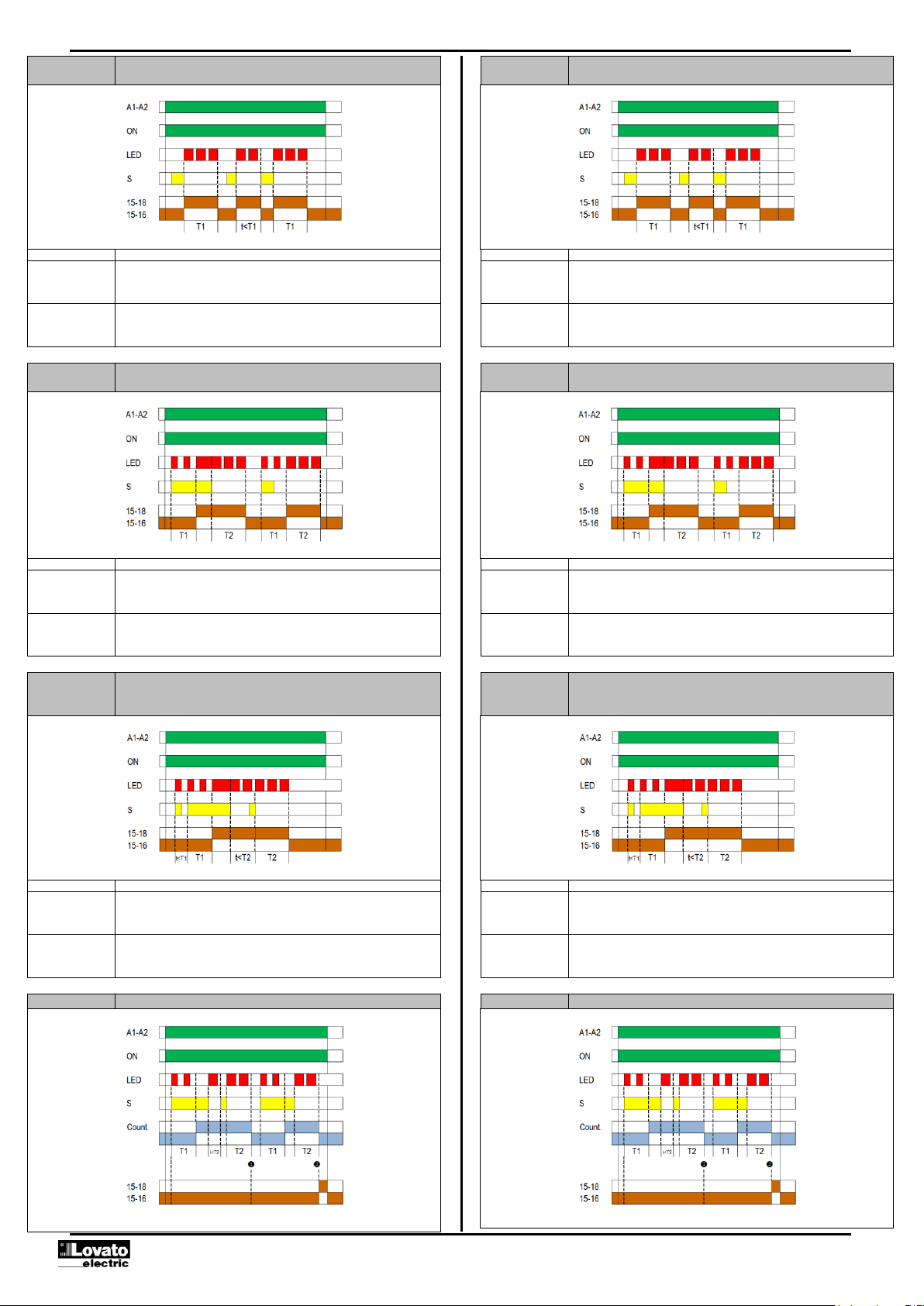
Gr
Eccitazione temporizzata del relè all’apertura di un contatto,
resettabile
Parametro
Descrizione
Modo reset
P01.06
INP = ogni volta che viene chiuso l’ingresso di comando S la funzione viene eseguita.
PWR = la funzione viene eseguita una sola volta, al termine della quale nuove chiusure
dell’ingresso di comando S vengono ignorate e per rieseguire la funzione è necessario
disalimentare e rialimentare il temporizzatore.
Preset contatore
P02.01
Quando l’uscita a relè raggiunge il numero di chiusure impostato in P02.01, il temporizzatore
rimane in “blocco” (nuove chiusure dell’ingresso di comando S vengono ignorate) e per
eseguire nuovamente la funzione devo disalimentare e rialimentare il temporizzatore.
Gr
Pulse on relay energising with start at contact opening,
resettable
Parameter
Description
Reset mode
P01.06
INP = every time you close the command input S the function is performed.
PWR = the function is performed just one time, after that , new closures of the command input
S are ignored and to perform again the function is necessary to turn off and on the power
supply of the timer.
Preset counter
P02.01
When the number of the closures of the relay output reaches the value set in P02.01, the
timer goes into a “lock” status and is no longer possible to perform the function (new closures
of the command input S are ignored). To restart to perform the function is necessary to turn
off and on the power supply of the timer.
H
Eccitazione ritardata del relè alla chiusura di un contatto e
diseccitazione ritardata all’apertura, tempi asimmetrici
Parametro
Descrizione
Modo reset
P01.06
INP = ogni volta che viene chiuso l’ingresso di comando S la funzione viene eseguita.
PWR = la funzione viene eseguita una sola volta, al termine della quale nuove chiusure
dell’ingresso di comando S vengono ignorate e per rieseguire la funzione è necessario
disalimentare e rialimentare il temporizzatore.
Preset contatore
P02.01
Quando l’uscita a relè raggiunge il numero di chiusure impostato in P02.01, il temporizzatore
rimane in “blocco” (nuove chiusure dell’ingresso di comando S vengono ignorate) e per
eseguire nuovamente la funzione devo disalimentare e rialimentare il temporizzatore.
H
ON delay at contact closing and OFF delay at contact opening,
asymmetrical timings
Parameter
Description
Reset mode
P01.06
INP = every time you close the command input S the function is performed.
PWR = the function is performed just one time, after that, new closures of the command input
S are ignored and to perform again the function is necessary to turn off and on the power
supply of the timer.
Preset counter
P02.01
When the number of the closures of the relay output reaches the value set in P02.01, the
timer goes into a “lock” status and is no longer possible to perform the function (new closures
of the command input S are ignored). To restart to perform the function is necessary to turn
off and on the power supply of the timer.
Hl
Eccitazione ritardata del relè alla chiusura di un contatto e
diseccitazione ritardata all’apertura, tempi asimmetrici,
riarmabile
Parametro
Descrizione
Modo reset
P01.06
INP = ogni volta che viene chiuso l’ingresso di comando S la funzione viene eseguita.
PWR = la funzione viene eseguita una sola volta, al termine della quale nuove chiusure
dell’ingresso di comando S vengono ignorate e per rieseguire la funzione è necessario
disalimentare e rialimentare il temporizzatore.
Preset contatore
P02.01
Quando l’uscita a relè raggiunge il numero di chiusure impostato in P02.01, il temporizzatore
rimane in “blocco” (nuove chiusure dell’ingresso di comando S vengono ignorate) e per
eseguire nuovamente la funzione devo disalimentare e rialimentare il temporizzatore.
Hl
ON delay at contact closing and OFF delay at contact opening,
asymmetrical timings, reloadable
Parameter
Description
Reset mode
P01.06
INP = every time you close the command input S the function is performed.
PWR = the function is performed just one time, after that , new closures of the command input
S are ignored and to perform again the function is necessary to turn off and on the power
supply of the timer.
Preset counter
P02.01
When the number of the closures of the relay output reaches the value set in P02.01, the
timer goes into a “lock” status and is no longer possible to perform the function (new closures
of the command input S are ignored). To restart to perform the function is necessary to turn
off and on the power supply of the timer.
Hlc
Contapezzi con filtro analogico
Hlc
Pieces counter with analog filter
Doc: I562IGB07_18.docx 20/07/2018 p. 11 / 16
Page 12
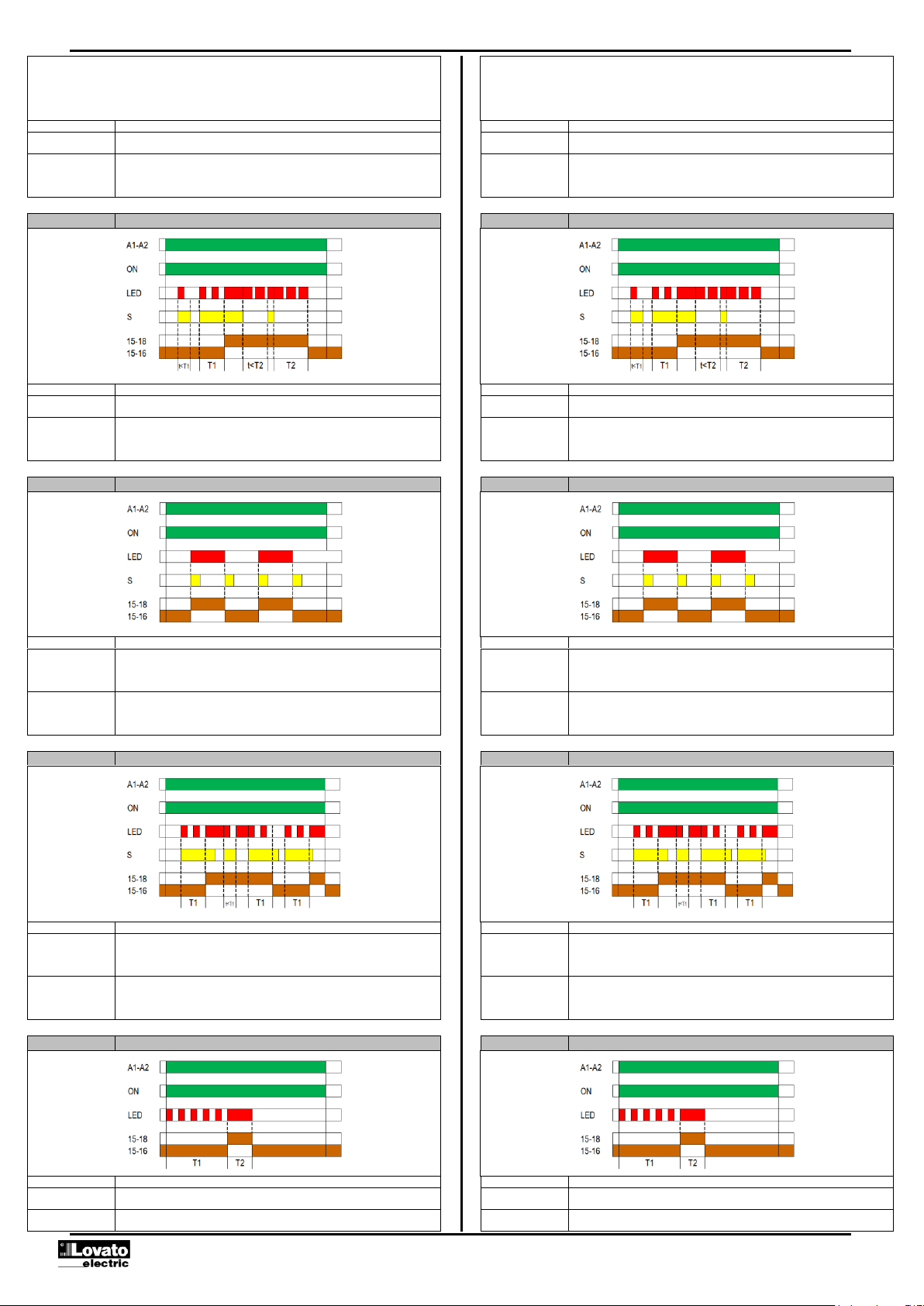
Note
T1 filtra le chiusure dell’ingresso di comando S. T2 filtra le aperture dell’ingresso di comando S.
Count è un contatore interno al temporizzatore che conta il numero di chiusure dell’ingresso S filtrato, il cui valore
corrente è consultabile tramite il parametro P02.02.
L’uscita a relè si eccita quando il valore corrente del contatore P02.02 aggiunge il valore impostato nel parametro
P02.01 Preset contatore.
Parametro
Descrizione
Modo reset
P01.06
Non ha effetto.
Preset contatore
P02.01
Quando il contatore interno (Count, consultabile da P02.02) conta un numero di chiusure (e
relative aperture) dell’ingresso di comando S (filtrato) pari al valore impostato in P02.01,
l’uscita a relè si eccita e rimane eccitata finché non viene tolta alimentazione al
temporizzatore, con conseguente azzeramento del contatore.
Notes
T1 filters the closures of the command input S. T2 filters the openings of the command input S.
Count is an internal counter which counts the number of closures of the filtered command input S. It current value can
be read from the parameter P02.02.
The relay output energises when the current value of the counter P02.02 reaches the value set in the parameter P02.01
Preset counter.
Parameter
Description
Reset mode
P01.06
This parameter has no effect.
Preset counter
P02.01
When the internal counter (Count, readable from P02.02) counts a number of closures (and
relative openings) of the command input S (filtered) equal to the value set in P02.01, the relay
output energises and remains energised until you turn off the power supply of the timer,
which consequent reset of the counter.
Hf
Filtro analogico
Parametro
Descrizione
Modo reset
P01.06
Non ha effetto.
Preset contatore
P02.01
Quando l’uscita a relè raggiunge il numero di chiusure impostato in P02.01, il temporizzatore
rimane in “blocco” (nuove chiusure dell’ingresso di comando S vengono ignorate) e per
eseguire nuovamente la funzione devo disalimentare e rialimentare il temporizzatore.
Hf
Analog filter
Parameter
Description
Reset mode
P01.06
This parameter has no effect.
Preset counter
P02.01
When the number of the closures of the relay output reaches the value set in P02.01, the
timer goes into a “lock” status and is no longer possible to perform the function (new closures
of the command input S are ignored). To restart to perform the function is necessary to turn
off and on the power supply of the timer.
I
Relè passo-passo alla chiusura di un contatto
Parametro
Descrizione
Modo reset
P01.06
INP = ogni volta che viene chiuso l’ingresso di comando S la funzione viene eseguita.
PWR = la funzione viene eseguita una sola volta, al termine della quale nuove chiusure
dell’ingresso di comando S vengono ignorate e per rieseguire la funzione è necessario
disalimentare e rialimentare il temporizzatore.
Preset contatore
P02.01
Quando l’uscita a relè raggiunge il numero di chiusure impostato in P02.01, il temporizzatore
rimane in “blocco” (nuove chiusure dell’ingresso di comando S vengono ignorate) e per
eseguire nuovamente la funzione devo disalimentare e rialimentare il temporizzatore.
I
ON-OFF trigger at contact closing
Parameter
Description
Reset mode
P01.06
INP = every time you close the command input S the function is performed.
PWR = the function is performed just one time, after that , new closures of the command input
S are ignored and to perform again the function is necessary to turn off and on the power
supply of the timer.
Preset counter
P02.01
When the number of the closures of the relay output reaches the value set in P02.01, the
timer goes into a “lock” status and is no longer possible to perform the function (new closures
of the command input S are ignored). To restart to perform the function is necessary to turn
off and on the power supply of the timer.
If
Relè passo-passo alla chiusura di un contatto, ingresso filtrato
Parametro
Descrizione
Modo reset
P01.06
INP = ogni volta che viene chiuso l’ingresso di comando S la funzione viene eseguita.
PWR = la funzione viene eseguita una sola volta, al termine della quale nuove chiusure
dell’ingresso di comando S vengono ignorate e per rieseguire la funzione è necessario
disalimentare e rialimentare il temporizzatore.
Preset contatore
P02.01
Quando l’uscita a relè raggiunge il numero di chiusure impostato in P02.01, il temporizzatore
rimane in “blocco” (nuove chiusure dell’ingresso di comando S vengono ignorate) e per
eseguire nuovamente la funzione devo disalimentare e rialimentare il temporizzatore.
If
ON-OFF trigger at contact closing, filtered input
Parameter
Description
Reset mode
P01.06
INP = every time you close the command input S the function is performed.
PWR = the function is performed just one time, after that , new closures of the command input
S are ignored and to perform again the function is necessary to turn off and on the power
supply of the timer.
Preset counter
P02.01
When the number of the closures of the relay output reaches the value set in P02.01, the
timer goes into a “lock” status and is no longer possible to perform the function (new closures
of the command input S are ignored). To restart to perform the function is necessary to turn
off and on the power supply of the timer.
J
Impulso ritardato
Parametro
Descrizione
Modo reset
P01.06
Non ha effetto.
Preset contatore
P02.01
Non ha effetto.
J
Pulse generator, delayed starting
Parameter
Description
Reset mode
P01.06
This parameter has no effect.
Preset counter
P02.01
This parameter has no effect.
Doc: I562IGB07_18.docx 20/07/2018 p. 12 / 16
Page 13
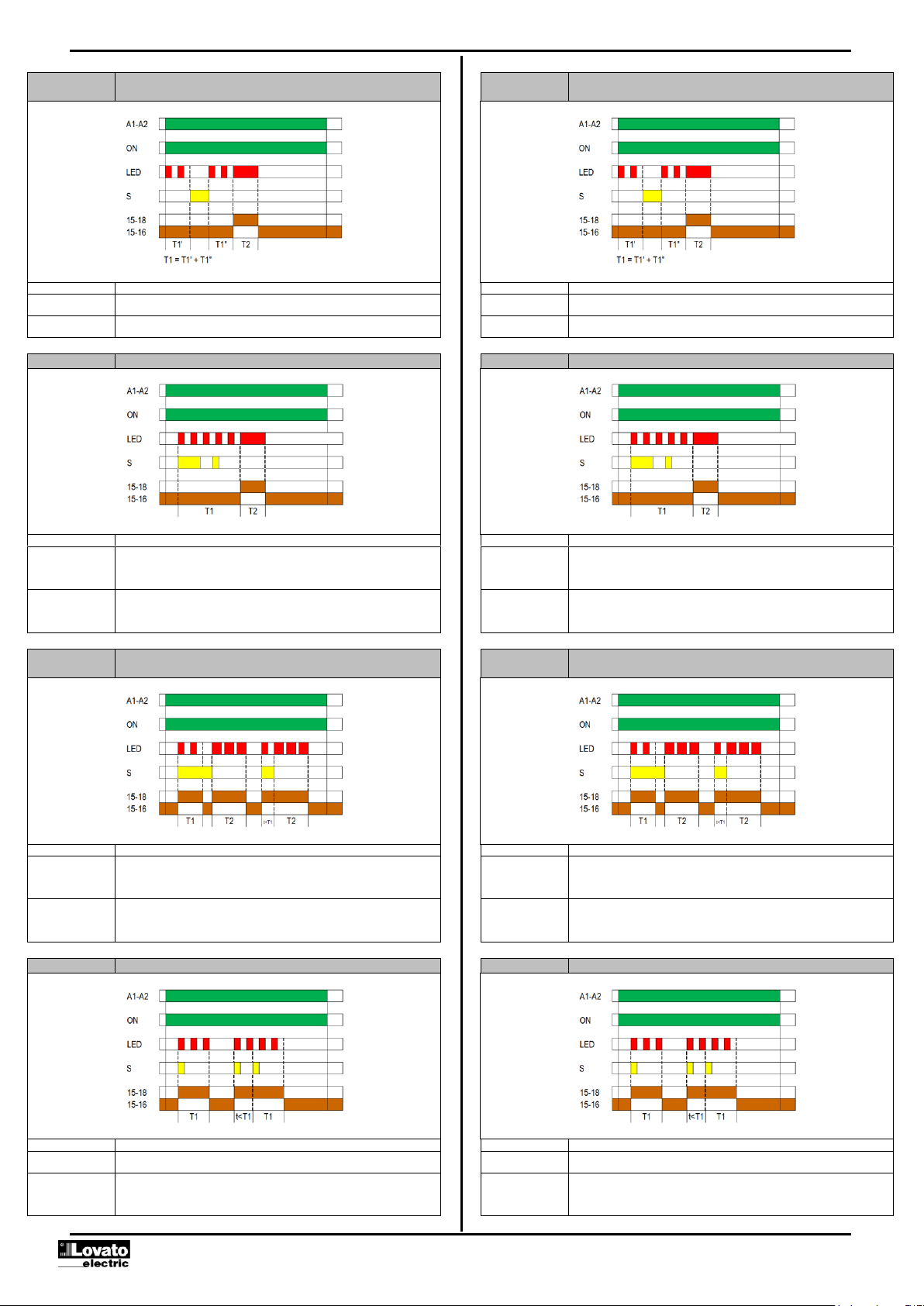
Jt
Impulso ritardato, con opzione pausa tramite contatto
Parametro
Descrizione
Modo reset
P01.06
Non ha effetto.
Preset contatore
P02.01
Non ha effetto.
Jt
Pulse generator, delayed starting, with optional pause with
contact
Parameter
Description
Reset mode
P01.06
This parameter has no effect.
Preset counter
P02.01
This parameter has no effect.
Jc
Impulso ritardato alla chiusura di un contatto
Parametro
Descrizione
Modo reset
P01.06
INP = ogni volta che viene chiuso l’ingresso di comando S la funzione viene eseguita.
PWR = la funzione viene eseguita una sola volta, al termine della quale nuove chiusure
dell’ingresso di comando S vengono ignorate e per rieseguire la funzione è necessario
disalimentare e rialimentare il temporizzatore.
Preset contatore
P02.01
Quando l’uscita a relè raggiunge il numero di chiusure impostato in P02.01, il temporizzatore
rimane in “blocco” (nuove chiusure dell’ingresso di comando S vengono ignorate) e per
eseguire nuovamente la funzione devo disalimentare e rialimentare il temporizzatore.
Jc
Pulse generator, delayed starting from contact closing
Parameter
Description
Reset mode
P01.06
INP = every time you close the command input S the function is performed.
PWR = the function is performed just one time, after that , new closures of the command input
S are ignored and to perform again the function is necessary to turn off and on the power
supply of the timer.
Preset counter
P02.01
When the number of the closures of the relay output reaches the value set in P02.01, the
timer goes into a “lock” status and is no longer possible to perform the function (new closures
of the command input S are ignored). To restart to perform the function is necessary to turn
off and on the power supply of the timer.
K
Impulso temporizzato alla chiusura di un contatto e impulso
temporizzato all’apertura, tempi asimmetrici
Parametro
Descrizione
Modo reset
P01.06
INP = ogni volta che viene chiuso l’ingresso di comando S la funzione viene eseguita.
PWR = la funzione viene eseguita una sola volta, al termine della quale nuove chiusure
dell’ingresso di comando S vengono ignorate e per rieseguire la funzione è necessario
disalimentare e rialimentare il temporizzatore.
Preset contatore
P02.01
Quando l’uscita a relè raggiunge il numero di chiusure impostato in P02.01, il temporizzatore
rimane in “blocco” (nuove chiusure dell’ingresso di comando S vengono ignorate) e per
eseguire nuovamente la funzione devo disalimentare e rialimentare il temporizzatore.
K
Pulse on relay at contact closing and pulse on relay at contact
opening , asymmetrical timings
Parameter
Description
Reset mode
P01.06
INP = every time you close the command input S the function is performed.
PWR = the function is performed just one time, after that , new closures of the command input
S are ignored and to perform again the function is necessary to turn off and on the power
supply of the timer.
Preset counter
P02.01
When the number of the closures of the relay output reaches the value set in P02.01, the
timer goes into a “lock” status and is no longer possible to perform the function (new closures
of the command input S are ignored). To restart to perform the function is necessary to turn
off and on the power supply of the timer.
L
Salvaguardia
Parametro
Descrizione
Modo reset
P01.06
Non ha effetto.
Preset contatore
P02.01
Quando l’uscita a relè raggiunge il numero di chiusure impostato in P02.01, il temporizzatore
rimane in “blocco” (nuove chiusure dell’ingresso di comando S vengono ignorate) e per
eseguire nuovamente la funzione devo disalimentare e rialimentare il temporizzatore.
L
Watchdog
Parameter
Description
Reset mode
P01.06
This parameter has no effect.
Preset counter
P02.01
When the number of the closures of the relay output reaches the value set in P02.01, the
timer goes into a “lock” status and is no longer possible to perform the function (new closures
of the command input S are ignored). To restart to perform the function is necessary to turn
off and on the power supply of the timer.
Doc: I562IGB07_18.docx 20/07/2018 p. 13 / 16
Page 14
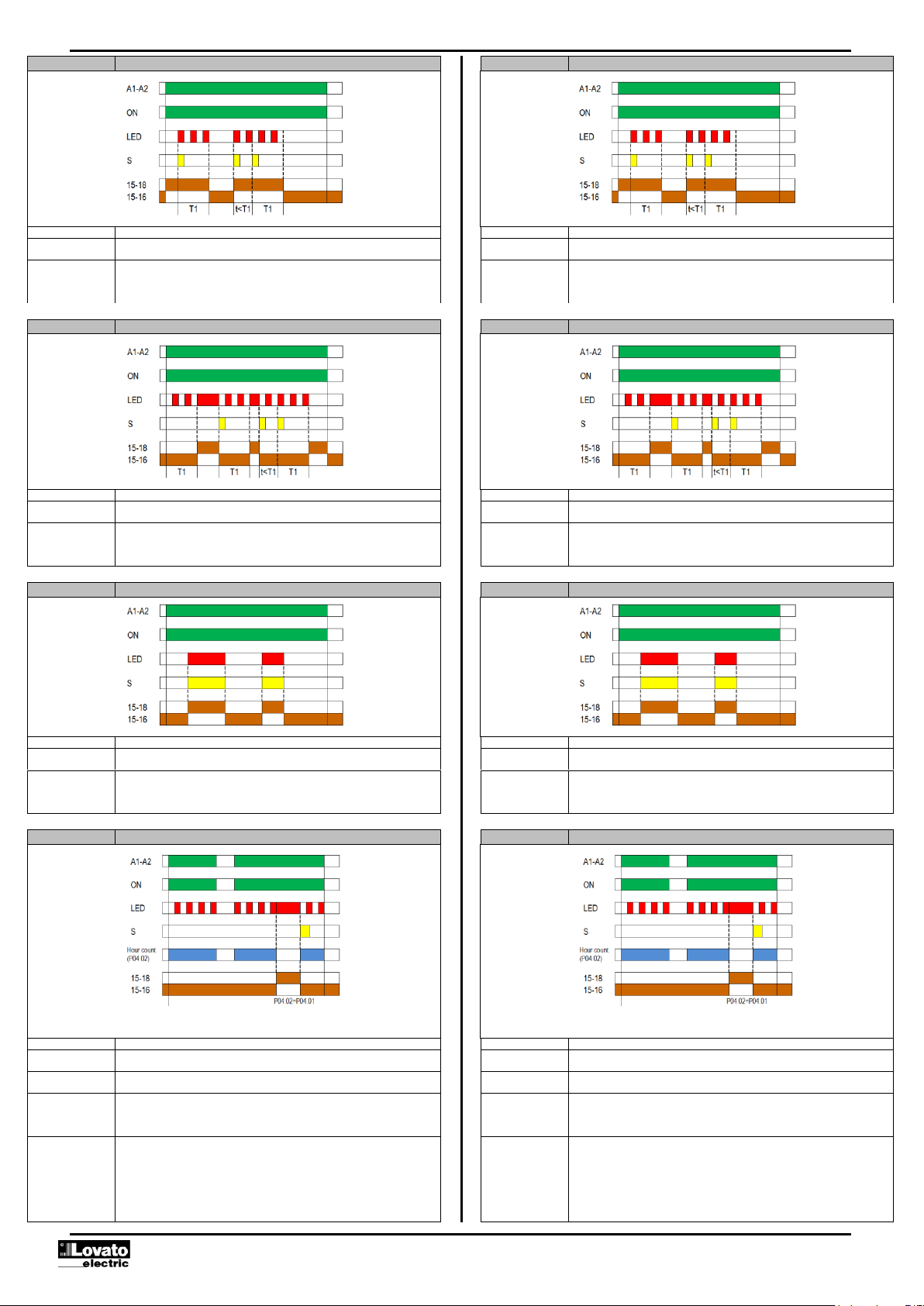
Lb
Salvaguardia, variante con relè eccitato alla partenza
Parametro
Descrizione
Modo reset
P01.06
Non ha effetto.
Preset contatore
P02.01
Quando l’uscita a relè raggiunge il numero di chiusure impostato in P02.01, il temporizzatore
rimane in “blocco” (nuove chiusure dell’ingresso di comando S vengono ignorate) e per
eseguire nuovamente la funzione devo disalimentare e rialimentare il temporizzatore.
Lb
Watchdog, variant with relay energised at starting
Parameter
Description
Reset mode
P01.06
This parameter has no effect.
Preset counter
P02.01
When the number of the closures of the relay output reaches the value set in P02.01, the
timer goes into a “lock” status and is no longer possible to perform the function (new closures
of the command input S are ignored). To restart to perform the function is necessary to turn
off and on the power supply of the timer.
Ln
Salvaguardia, variante con funzionamento alla rovescia
Parametro
Descrizione
Modo reset
P01.06
Non ha effetto.
Preset contatore
P02.01
Quando l’uscita a relè raggiunge il numero di chiusure impostato in P02.01, il temporizzatore
rimane in “blocco” (nuove chiusure dell’ingresso di comando S vengono ignorate) e per
eseguire nuovamente la funzione devo disalimentare e rialimentare il temporizzatore.
Ln
Watchdog, variant with reverse functioning
Parameter
Description
Reset mode
P01.06
This parameter has no effect.
Preset counter
P02.01
When the number of the closures of the relay output reaches the value set in P02.01, the
timer goes into a “lock” status and is no longer possible to perform the function (new closures
of the command input S are ignored). To restart to perform the function is necessary to turn
off and on the power supply of the timer.
M
Monostabile
Parametro
Descrizione
Modo reset
P01.06
Non ha effetto.
Preset contatore
P02.01
Quando l’uscita a relè raggiunge il numero di chiusure impostato in P02.01, il temporizzatore
rimane in “blocco” (nuove chiusure dell’ingresso di comando S vengono ignorate) e per
eseguire nuovamente la funzione devo disalimentare e rialimentare il temporizzatore.
M
Monostable
Parameter
Description
Reset mode
P01.06
This parameter has no effect.
Preset counter
P02.01
When the number of the closures of the relay output reaches the value set in P02.01, the
timer goes into a “lock” status and is no longer possible to perform the function (new closures
of the command input S are ignored). To restart to perform the function is necessary to turn
off and on the power supply of the timer.
N
Contaore
Note.
Per utilizzare la funzione Contaore impostare P01.01=N e fare riferimento al menu M04-CONTAORE.
Conteggio contaore è una variabile interna al TMM1 NFC che contiene il valore corrente del contaore.
Parametro
Descrizione
Modo reset
P01.06
Non ha effetto.
Preset contatore
P02.01
Non ha effetto.
Preset contaore
P04.01
In questo parametro viene impostato il numero di ore di funzionamento del temporizzatore al
raggiungimento della quale deve eccitarsi l’uscita a relè.
Esempio. Impostando P04.01=100, l’uscita a relè si eccita quando il contaore raggiunge 100
ore.
Conteggio contaore
P04.02
In questo parametro viene salvato automaticamente il valore corrente delle ore conteggiate
dal temporizzatore, visualizzabile tramite la App LOVATO NFC. Il conteggio viene aggiornato
ogni 10 minuti e rimane salvato in memoria anche in assenza di alimentazione. Quando il
numero di ore conteggiate in P04.02 è maggiore o uguale al valore di preset P04.01 il relè di
uscita si eccita. Per resettare il contaore (e di conseguenza diseccitare l’uscita) è necessario
chiudere l’ingresso di comando esterno S. È inoltre possibile anticipare il raggiungimento del
valore di preset P04.01 modificando manualmente il valore di P04.02 tramite la App LOVATO
NFC.
N
Hour counter
Notes.
To use the function Hour counter set P01.01=N and refer to the menu M04-HOUR COUNTER..
Hour counting is an internal variable of the TMM1 NFC which contains the current value of the hour counter.
Parameter
Description
Reset mode
P01.06
This parameter has no effect.
Preset counter
P02.01
This parameter has no effect.
Preset hour counter
P04.01
When the timer counts a number of working hours equal to the value set in this parameter,
the relay output energises.
Example. If you set P04.01=100, the relay output energises when the hour counter reaches
the value 100 hours.
Hour counter
P04.02
In this parameter is automatically saved the current value of the hours counted by the timer,
that can be read from the LOVATO NFC App. The hour counter value is updated every 10
minutes and it remains saved in the memory of the timer even in absence of power supply.
When the number of the hours counted in P04.02 is greater or equal to the preset value
P04.01 the relay output energises. To reset the hour counter (and consequently de-energise
the relay output) is necessary to close the external command input S. Is also possible to
anticipate the achieving of the preset value P04.01 by modifying manually the value of
parameter P04.02 from the LOVATO NFC App.
Doc: I562IGB07_18.docx 20/07/2018 p. 14 / 16
Page 15
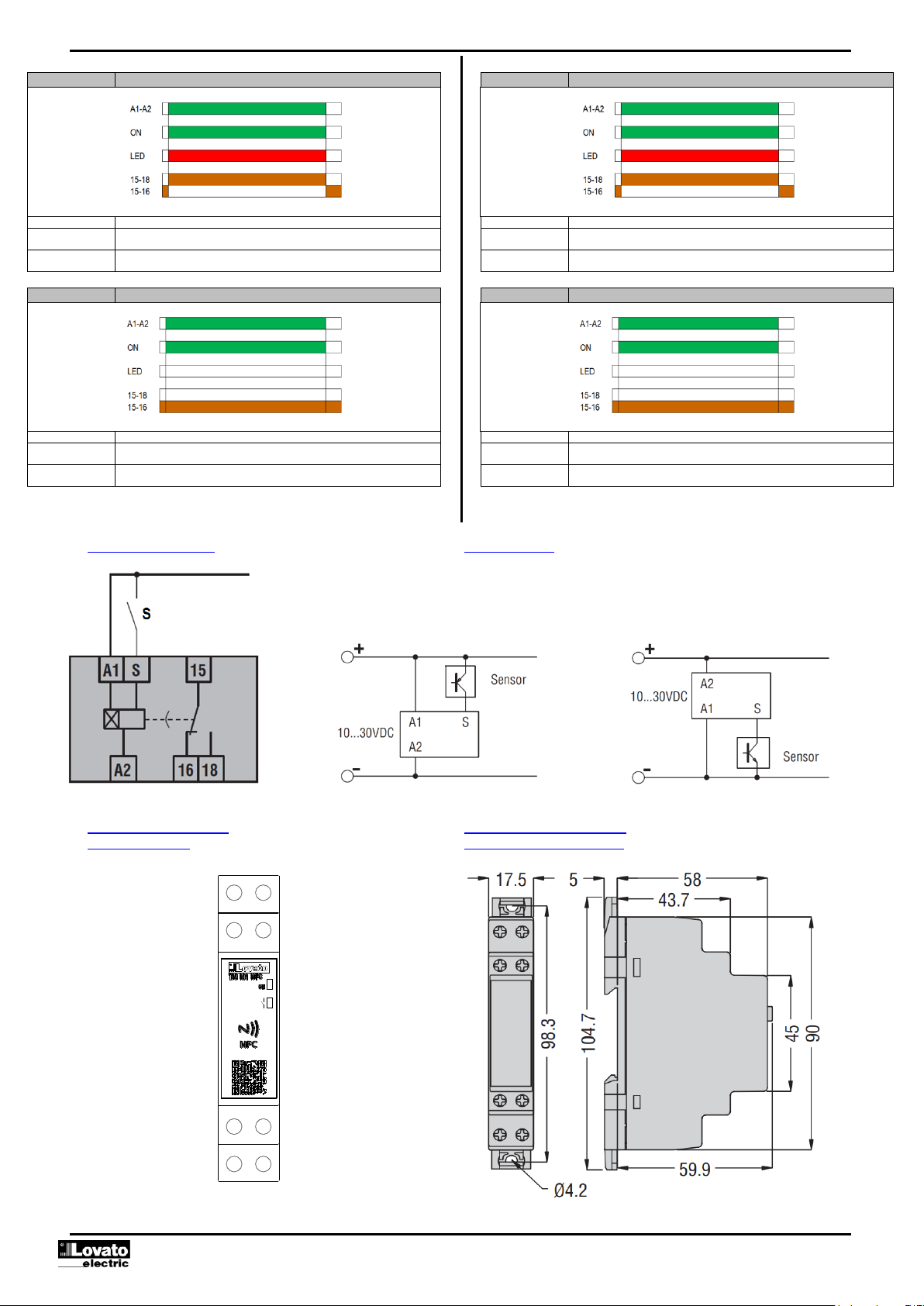
Schemi di connessione
Wiring diagrams
Disposizione connessioni
Dimensioni meccaniche (mm)
Terminals position
Mechanical dimensions (mm)
ON
Relè sempre eccitato
Parametro
Descrizione
Modo reset
P01.06
Non ha effetto.
Preset contatore
P02.01
Non ha effetto.
ON
Relay always energised
Parameter
Description
Reset mode
P01.06
This parameter has no effect.
Preset counter
P02.01
This parameter has no effect.
OFF
Relè sempre diseccitato
Parametro
Descrizione
Modo reset
P01.06
Non ha effetto.
Preset contatore
P02.01
Non ha effetto.
OFF
Relay always de-energised
Parameter
Description
Reset mode
P01.06
This parameter has no effect..
Preset counter
P02.01
This parameter has no effect.
Comando con uscita statica.
Comando con un sensore con uscita PNP.
Control with static output.
Connection with PNP sensor.
Comando con uscita statica.
Comando con un sensore con uscita NPN.
Control with static output.
Connection with NPN sensor.
18 15
16
A2A1
S
Doc: I562IGB07_18.docx 20/07/2018 p. 15 / 16
Page 16
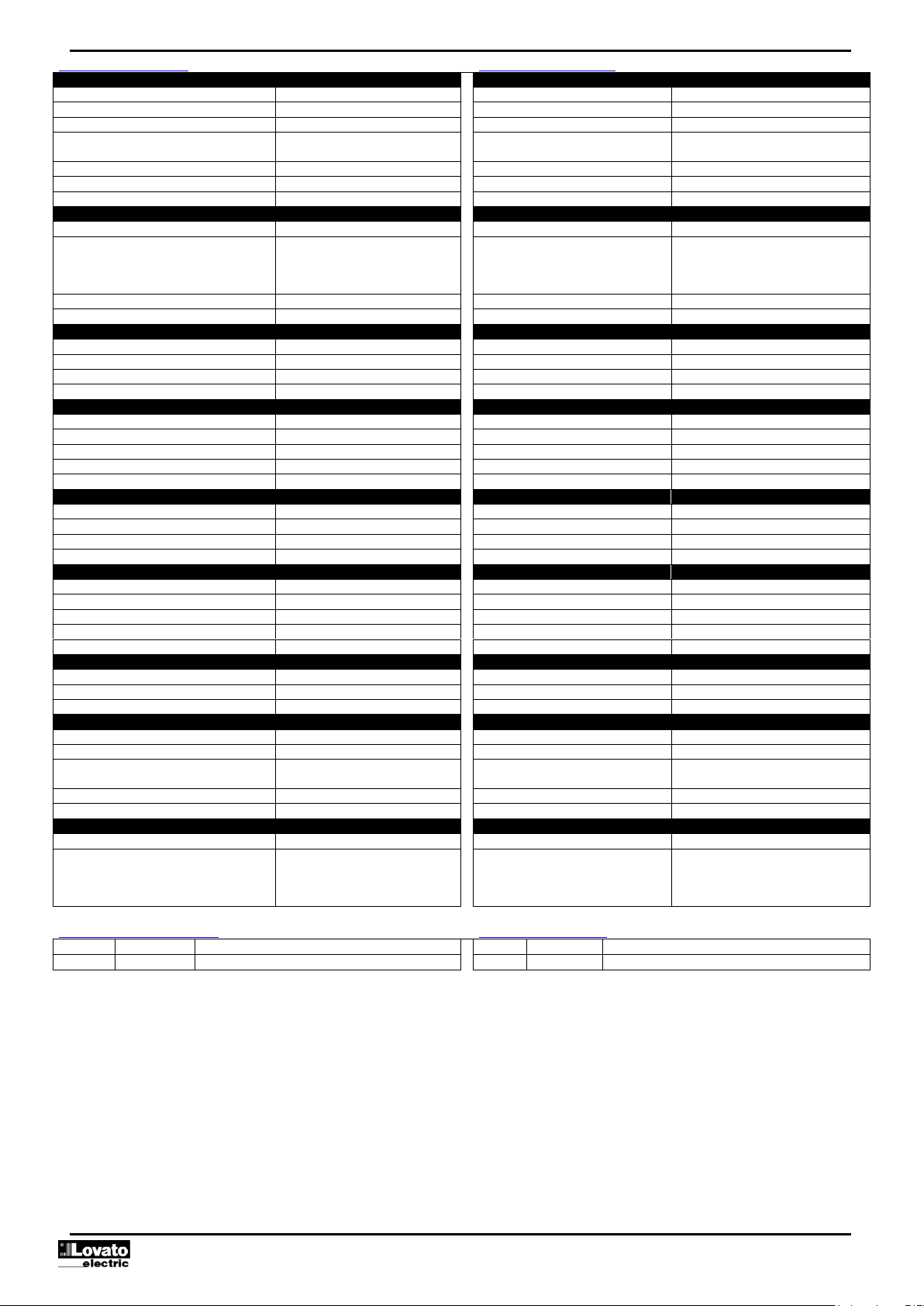
Caratteristiche tecniche
Technical characteristics
Alimentazione ausiliaria: morsetti A1-A2
Auxiliary supply: terminals A1-A2
Tensione nominale Ue
12…240VAC/DC
Rated operational voltage Ue
12…240VAC/DC
Frequenza nominale
50/60Hz ±5%
Rated frequency
50/60Hz ±5%
Limiti di funzionamento
0.85…1.1 Ue
Operating range
0.85…1.1 Ue
Potenza assorbita/dissipata
1.6VA / 1.2W max (110…240VAC/DC)
0.6VA / 0.3W max (12…48VAC/DC)
Power consumption / dissipation
1.6VA / 1.2W max (110…240VAC/DC)
0.6VA / 0.3W max (12…48VAC/DC)
Tempo di recupero
>100ms
Recovery time
>100ms
Valore di disimpegno
3VAC / 4VDC
Disenganging value
3VAC / 4VDC
Immunità alla microinterruzione
≤25ms
Micro-breaking immunity
≤25ms
Ingresso di comando esterno S
External command input S
Tensione nominale Uc
12…240VAC/DC
Rated control circuit voltage Uc
12…240VAC/DC
Potenza assorbita/dissipata
0.9VA / 0.8W max (110…240VAC/DC)
0.15VA / 0.15W max (12…48VAC/DC)
Power consumption / dissipation
0.9VA / 0.8W max
(110…240VAC/DC)
0.15VA / 0.15W max
(12…48VAC/DC)
Durata minima comando
≥25ms
Minimum control time
≥25ms
Tempo inserzione
Illimitato
Connection time
Permanent
Errori Errors
Impostazione
0%
Programming
0%
Ripetibilità
< ±0.5%
Repeatability
< ±0.5%
Variazione di tensione
< ±0.01%
Voltage variation
< ±0.01%
Variazione di temperatura
< ±0.2%
Temperature variation
< ±0.2%
Uscita a relè: morsetti 15-16-18
Relay output: terminals 15-16-18
Tipo uscita
1 relè con contatto in scambio
Type of output
1 relay with changeover contact
Tensione nominale
250VAC
Rated voltage
250VAC
Designazione secondo IEC/EN 60947-5-1
AC1 8A 250VAC B300
Designation per IEC/EN 60947-5-1
AC1 8A 250VAC B300
Durata elettrica (operazioni)
105
Electrical life (ops)
105
Durata meccanica (operazioni)
30 x 106
Mechanical life (ops)
30 x 106
Isolamento
Insulation
Tensione nominale di tenuta a impulso
4kV
Rated impulse withstand voltage
4kV
Tensione di tenuta a frequenza d’esercizio
2kV
Power frequency withstand voltage
2kV
Tensione nominale d’isolamento Ui
250VAC
Rated insulation voltage Ui
250VAC
Livello di immunità
3
Immunity limit
3
Condizioni ambientali
Ambient conditions
Temperatura d’impiego
-20…+60°C
Operating temperature
-20…+60°C
Temperatura di stoccaggio
-30…+80°C
Storage temperature
-30…+80°C
Umidità relativa
<90%
Relative humidity
<90%
Grado di inquinamento
2
Maximum pollution degree
2
Categoria di sovratensione
3
Overvoltage category
3
Connessioni
Connections
Tipo di terminali
Fissi
Type of terminal
Fixed
Sezione conduttori
0.2 – 4.0 mm2 (24 – 12 AWG)
Conductor cross section
0.2 – 4.0 mm2 (24 – 12 AWG)
Coppia di serraggio
0.8Nm (7lbin)
Tightening torque
0.8Nm (7lbin)
Contenitore
Housing
Esecuzione (n. moduli)
1 (DIN 43880)
Version (no. of modules)
1 (DIN 43880)
Materiale
Poliammide
Material
Polyamide
Montaggio / fissaggio
Guida DIN 35mm (IEC/EN 60715)
Vite diam. 4mm max
Mounting / fixing
35mm DIN rail (IEC/EN 60715)
Screw diam. 4mm max
Grado di protezione
IP40 frontale, IP20 terminali
Protection degree
IP40 on front, IP20 terminals
Peso
86g
Weight
86g
Omologazioni e conformità
Certifications and compliance
Omologazioni (in corso)
cULus, EAC
Certifications (pending)
cULus, EAC
Conformi alle norme
IEC/EN 61812-1, IEC/EN 61000-6-2,
IEC/EN 61000-6-3, IEC/EN 60068-2-
6, IEC/EN 60068-2-27, IEC/EN 60068-
2-61, UL508, CSA C22.2 n°14
Comply with standards
IEC/EN 61812-1, IEC/EN 61000-6-2,
IEC/EN 61000-6-3, IEC/EN 60068-2-6,
IEC/EN 60068-2-27, IEC/EN 60068-2-61,
UL508, CSA C22.2 n°14
Cronologia revisioni manuale
Manual revision history
Rev.
Data
Note Rev
Date
Notes
00
06/07/2018
Release iniziale
00
06/07/2018
Initial release
Doc: I562IGB07_18.docx 20/07/2018 p. 16 / 16
 Loading...