

Page 1
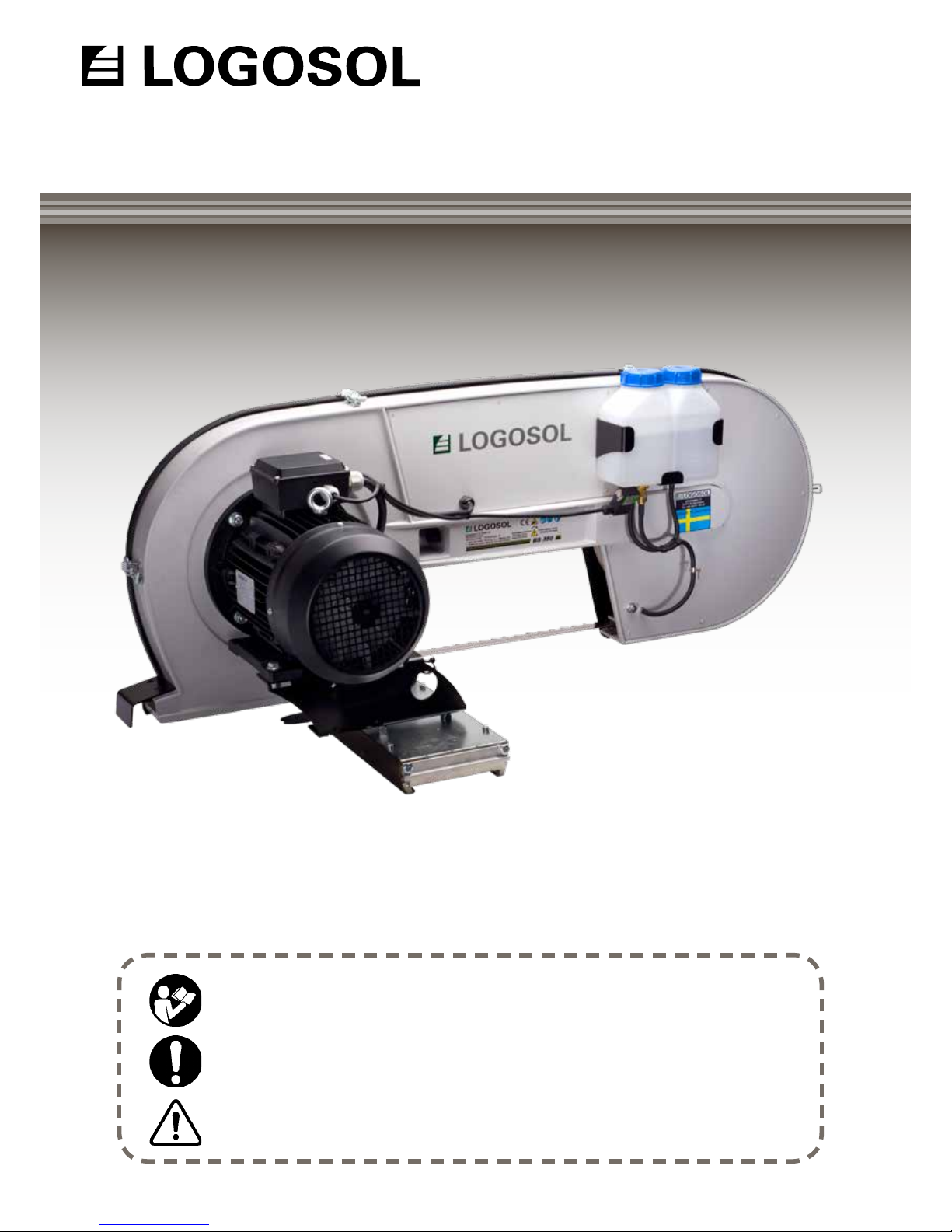
LOGOSOL BS350
LOGOSOL BS350
Read through the user manual carefully and make sure you understand its contents
before you use the machine.
This user manual contains important safety instructions.
Warning! Incorrect use can result in serious or fatal injuries to the operator or others.
uSer manuaL
TRANSLATION OF ORIGINAL USER MANUAL.
ARTICLE NO: 0458-395-0236
Page 2

LOGOSOL began production of the Logosol Sawmill in 1989. Since then we have developed a product
programme for small-scale wood processing. We have a wide range of machines and accessories
that enable you to be in charge throughout the entire process, from tree felling to nished wood
products. For the Logosol Sawmill there are several accessories available, e.g. chainsaws, extensions,
supplement for oversized logs, log house moulder, safety equipment, aids for log handling, etc.
Call LOGOSOL, and we will send you information about our entire wood processing programme. If
you are interested in a specic product, we have video lms which show the machines in action.
You have now bought the BS350, an efcient bandsaw adapted for the Logosol Sawmill. If you have
any questions about your BS350, do not hesitate about contacting us at LOGOSOL. Our aim is to
make you yet another satised owner of one of our products.
We wish you all the best with your new machine!
Bengt-Olov Byström
MD and founder of Logosol
Thank you for choosing a machine from LOGOSOL.
2
LOGOSOL is constantly developing its products. For
that reason we reserve the right to make changes in
the design and construction of our products.
Text and illustrations: Mattias Byström, 2004-06-01.
Translation: Anna Olsgren Byström
Revised 2009-01-07
Copyright 2004 LOGOSOL, Härnösand, Sweden
Introduction
Safety Instructions
Machine Description
Using bandsaws
Installation
Starting the Bandsaw
The Carriage
Before each Work Shift
After each Work Shift
Changing Saw Blade
Maintenance of the Saw Blade
Adjusting the Blade Guides
Cooling the Saw Blade
Sawing with the BS320
Make Sure That...
Circuit Diagram
Technical Data
EU Declaration of Conformity
2
3
4
4
4
4
4
5
5
5
6
6
7
8
9
10
11
11
Page 3
LOGOSOL BS350
Safety Instructions
Make sure that the equipment is in good
condition, and that all screws are rmly tightened.
When using the Bandsaw the Logosol Sawmill must
stand on plane and level ground. The Logosol
Sawmill should be equipped with feet (ref. no.
4510-723-1500) and support legs (ref. no. 4510-
720-6800) which are fastened to the ground with
sturdy screws or bolts.
The Bandsaw may not be connected until you have
made sure that it is properly mounted on the guide
rail, and that the bandsaw carriage clasps both the
guide rail anges so that it cannot be lifted from the
guide rail. Also make sure that the plastic safety
cover is correctly mounted and locked.
Before starting the bandsaw, always check
that:
...the Logosol Sawmill is securely fastened to the
ground.
... the BS350 is properly mounted on the sawmill's
guide rail.
...no tools are inside the plastic safety cover.
...you are standing rmly.
...the log is lying rmly on the log beds of the
sawmill.
...no assistants or onlookers are within the safety
distance of the Logosol Sawmill.
Always pull out the plug before:
...opening the plastic safety cover.
...tensioning the saw blade.
...cleaning or other maintenance is performed.
...removing the saw from the sawmill.
Be aware that the bandsaw is a dangerous tool
that should always be handled with respect. Always
switch off the bandsaw when you are not sawing.
The saw should always be switched off when you
are lifting logs on or off the sawmill.
Always stand behind the control arm, and never
reach over the sawmill guide rail while the machine
is running.
Do never reverse the saw while it is running. Wait
until the saw blade has stopped, otherwise the saw
blade can be hurled out from the wheels.
Never leave the bandsaw unattended when it is
plugged in. The machine may only be started by
a person who has read and understood all of the
instructions in this manual. The manual should
always be accessible to those who use the sawill.
The manual should go with the sawmill when it is
lent or sold to someone else.
For your own safety, do not use the
equipment before having read and
understood the entire manual. Do not
let other persons who have not read the
instructions use the equipment. Also
read the manual for the Logosol Sawmill
and the chainsaw you are using.
Use approved hearing protectors and
eye protectors. Hearing can be impaired
after only a short exposure to the highfrequency sounds of the saw.
Use protective gloves when operating
BS350. It is especially important to have
stout protective gloves when handling
the saw blades.
Use protective shoes or boots with
deeply patterned soles. Shoes with steel
toes are recommended.
3
Read the manual and safety instructions for the saw
unit that is used on the Logosol Sawmill.
Do not place the electric cable where you can tread
or trip on it. The electric cable should be suspended
by a wire choker rope above the sawmill (Wire Kit
10 m ref. nr: 6605-000-0300)
The machine may not be altered or modied. Only
use original parts from LOGOSOL. LOGOSOL
disclaims all responsibility for personal injury or
damage on property caused by a sawmill equipped
with non-approved parts, or modied in any other
way.
After service and maintenance, the machine must
be restored to its original condition.
Clean the bandsaw every time you have used it.
Always keep your work site clean from things you
can trip on.
The Bandsaw may only be used in good visibility
conditions.
Never start the saw when the plastic
safety cover is removed. If the saw blade
is hurled out from the wheels it can cause
personal injury.
How to lift the Bandsaw.
The Logosol Sawmill should be equipped with a
loading ramp (ref. no. 7000-000-0000). It takes two
persons to lift the bandsaw onto the guide rail.
Page 4
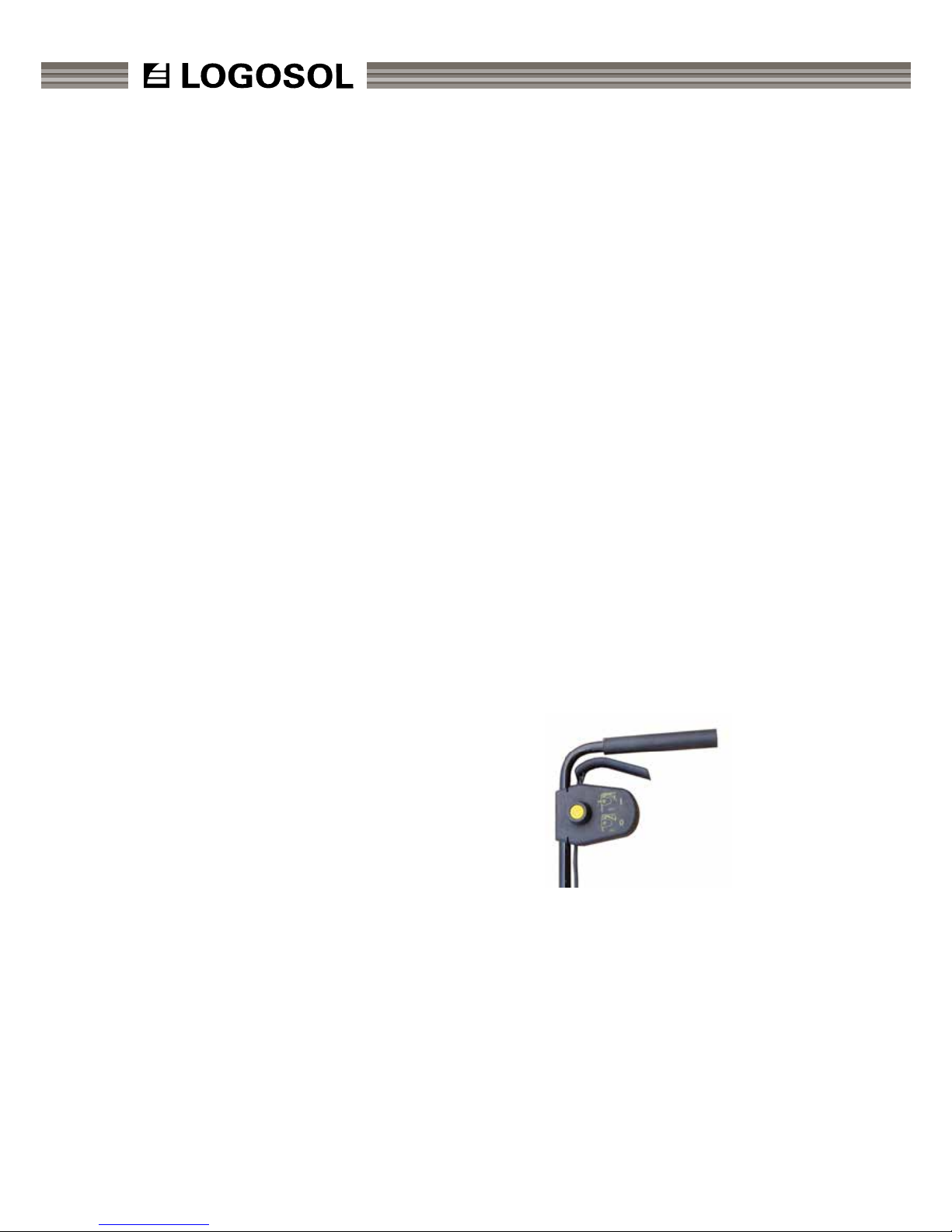
The bandsaw's start control
with "dead man's handle".
Starting the Bandsaw
The bandsaw is equipped with a safety control.
To start the machine:
Make sure that there is no one within the safety
distance of the Logosol Sawmill and that the
bandsaw is ready for start according to the safety
instructions.
1. Connect the electric cable.
2. Turn on the main power switch.
3. Press down the yellow button
4. Squeeze the black handle and the motor will start.
When you release the handle the motor stops.
Machine Description
BS350 is constructed for mounting on the Logosol
sawmill. The frame is made from cast aluminium in
order to minimize the weight. Aluminium also has
the unique ability to reduce vibrations.
The wheels, on which the saw blade runs, are
also made of cast aluminium and equipped with
bearinged hubs of steel. The saw blade is guided
by adjustable glide blocks in graphite.
The bandsaw comes with a 35 x 1.1 mm (1 7/16''
x 1/16") tooth tip tempered saw blade with a tooth
pitch of 3/4”. The saw blade is directly run by a
three-phase motor with 5 kW continuous output.
The saw blade must be lubricated and cooled by,
for example, water. Whe the saw is turned off, the
water ow is stopped by a solenoid valve.
The saw blade is tensioned with the help of a spring
loaded threaded bar which is placed between the
centres of the wheels to minimize tensions in the
construction.
The bandsaw carriage is equipped with ball
bearings.
The saw bench is stabilized with extra mid-struts
which comes with the package.
Using Bandsaws
The saw blade on the bandsaw is approx. 1 mm
(ca. 1/16") thick. This entails both advantages and
disadvantages. One advantage is that the sawblade
kerf is narrow, which enables you to saw very fast.
There will be little sawdust, and the sharpness of
the saw blade will last comparatively longer. One
disadvantage is that the thin saw blade is more
sensitive to variations in the wood, such as knots.
You can, however, minimize those deviations by
decreasing the feeding speed when suspecting big
knots in the wood.
Sawing with a bandsaw is not as easy as it looks.
It takes a certain amount of carefulness, practice,
and experience to obtain a perfect result.
The Carriage
The sliding function of the carriage is accomplished
by two slide proles which ensure an exact position
of the carriage on the guide rail. The pressure on
these slide proles is reduced by four ball bearings,
in order to make it easy to push the saw by hand.
4
Installation
The Logosol Sawmill must be xed to the ground
according to its manual. In addition, support legs
are to be tted to each end of the guide rail. These
support legs are also to be firmly fixed to the
ground.
Two extra guide rail struts are tted to the centre
of the sawmill guide rail. The loading ramp is tted
in the end of the guide rail, i.e. the end where you
will push the bandsaw onto the sawmill.
Suspend the electric cable by a wire above the
sawmill so that you do not risk treading or tripping
on it. Use Logosol's wire kit 6605-000-0300.
Page 5
LOGOSOL BS350
Before each Work Shift
- Tension the saw blade until you can see the
red mark (see "Changing Saw Blade"). The
knowledge of the proper tension of the saw
blade is one of the things you gradually learn
when using a bandsaw. One basic rule is that
the saw blade should be as little tensioned as
possible. The bandsaw should stop within 10
seconds after the black handle is released. If it
takes longer time for the saw blade to stop, it
should be more tensioned.
- Make sure that the saw blade rotates in the
correct direction. If it rotates the wrong way,
you can change the direction by rotating the
phase reverser (a white plastic disc in the
connecting plug, which can be rotated with a
at screwdriver).
- Make sure the equipment is in good condition.
Also check the electric cable and the Logosol
Sawmill.
- Make sure that the saw is properly mounted on
the guide rail.
After each Work Shift
- Pull out the plug.
- Loosen the blade tension (see "Changing Saw
Blade") so that the saw blade is slack.
- Clean and check the equipment.
- Cover the saw with a tarpaulin if it is stored
outdoors.
- Empty the water out of the water system if there
is risk of temperatures below 0°C.
- Electric motors are to be stored in a heated
room to prevent condensation in the motor
housing, something that can occur when there
are uctuations of temperature. If the motor is
stored in a cold room, you should check that
there is no water in the motor before connecting
it to electricity. Sealed electric motors have a
tap on the underside that you loosen to check
if there is water in the motor.
Changing Saw Blade
Use protective gloves.
- Stop the saw and pull out the plug.
- Open the plastic safety cover.
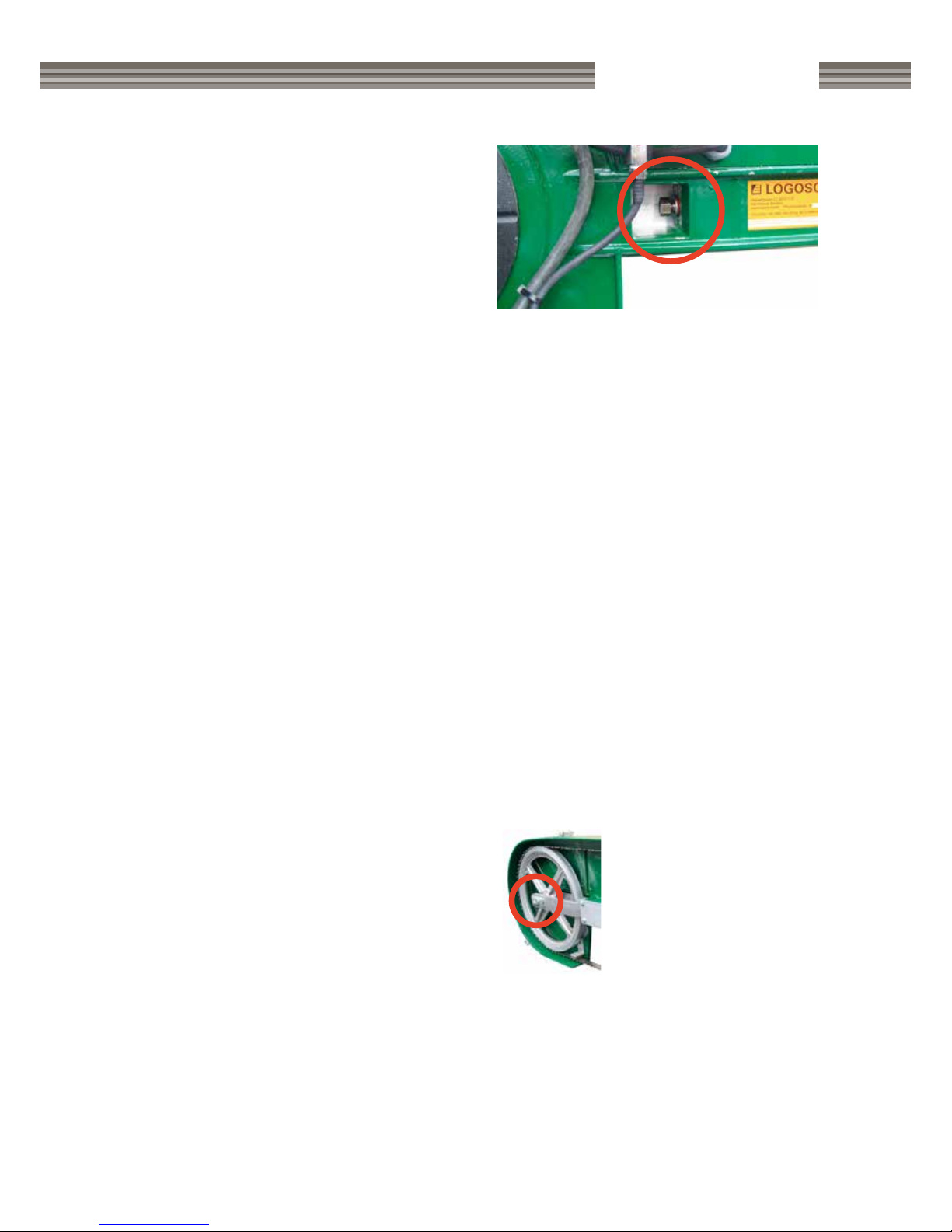
- Loosen the blade tension with a 19 mm spanner,
according to the picture in the upper right
corner.
- Lift off the old blade.
The saw blade is tensioned
with a 19 mm spanner.
Clean the saw from sawdust, and make sure
that:
- the blade guides are not worn.
- all screws are rmly tightened.
Make sure that the teeth on the new saw blade
point in the correct direction. If this is not the
case, turn the saw blade inside out. Handle the
saw blade carfully when unpacking it and do not
bend it with force. There is risk of being injured by
the sharp teeth, and the saw blade can get ridges
which cannot be straightened out.
- Fit the new saw blade.
- Tension the saw blade until the red mark is
visible. The saw blade should stop within 10
seconds.
Rotate the wheels manually a couple of turns, and
make sure the saw blade is completely centred
on the wheels. The teeth should not be in contact
with the wheels. If the teeth do not run freely the
tooth set will be damaged.
If the saw blade is not properly centred you
can adjust its position:
Open the lock nut on the outer axle, and adjust
the tilt screw in order to reposition the saw blade.
If you turn the screw anticlockwise the saw blade
will move outwards, if you turn
it clockwise the saw blade
moves inwards. Rotate the
wheels manually a couple of
turns to see the effect of the
adjustment. Tighten the lock
nut.
Close the plastic safety cover.
Check that the machine stops within 10 seconds.
Take a couple of cuts and then check once more
that the blade is completely centred.
5
Page 6
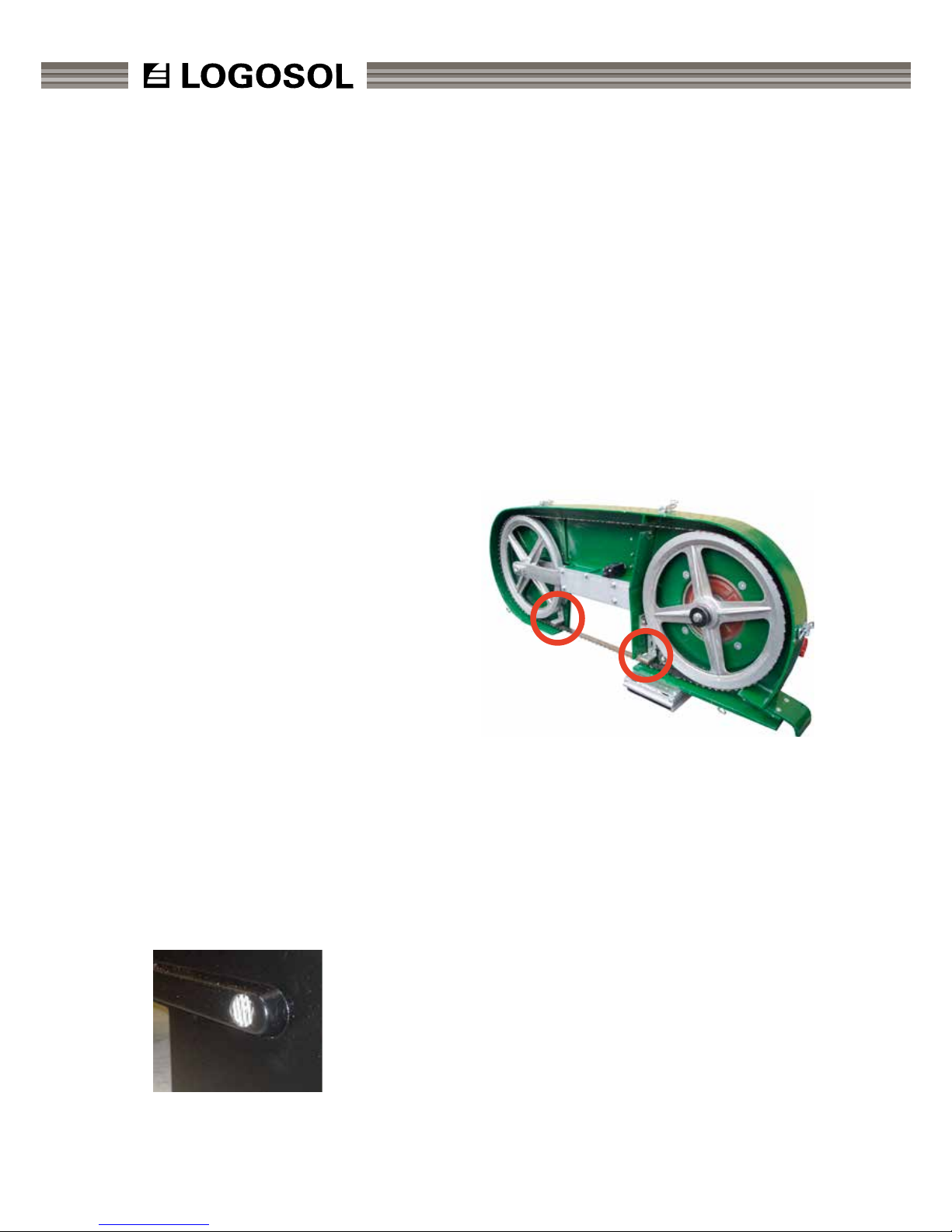
Adjusting the Blade Guides
The blade guides should touch the blade with a
fairly light pressure. With the help of the blade
guides the saw blade can be adjusted so that it is
parallel with the log bed.
Both blade guides
are fastened with a
M8 screw.
6
Maintenance of Saw Blades
Sawing is almost always trouble-free with a new
saw blade. After some time of sawing with the
blade the results will begin to degrade, though.
When this happens, you have to change saw blade
immediately.
A saw blade that does not work cannot be made
to saw straight by the help of the blade guides or
increased blade tension. Sometimes, however, you
can increase the serviceable time somewhat by
tensioning the saw blade a bit more.
The number of cuts you can make before changing
the saw blade can vary considerably. This is mostly
due to how much dirt there is in the bark of the
logs. Normally you can cut 15-25 logs, or 25-50
cuts through bark.
The majority of saw blades for small timber
bandsaws are tooth tip tempered, and are often
considered as disposables which are to be thrown
away when the sharpness is lost. You can, however,
sharpen the blades. Machines for sharpening
bandsaw blades can be more or less advanced.
The simplest type of machines only sharpens the
front of the tooth and the gullet. Since the blades
can only be sharpened a couple of times, it is not
necessary to sharpen the tooth back.
Sharpening the front of the teeth brings the
sharpness back; sharpening the gullets prevents
cracks in the blade.
After a couple of sharpenings the saw blade is worn
out, and cracks appear in the gullets. The cracks
grow quickly, and the blade breaks if you do not stop
sawing. Clear clicking sounds is an indication that
the blade is about to break. Immediately interrupt
sawing if you hear that the blade is starting to
break. A saw blade that breaks can damage the
equipment.
If the saw blade is sharpened several times, it
can be necessary to adjust the tooth set. There
are machines for this too, but in practise the only
realistic alternative is to do it manually with the
help of a pair of special pliers for adjusting the
tooth set.
A built-in chip extractor! As you can see
in the picture under "Adjusting the Blade
Guides" there is a barrier in front of the
driving wheel that creates a fan housing.
The air intake at the centre of the wheel
further improves the air ow. Sawdust
always accumulates in bandsaws, but
the design of the machine signicantly
reduces this problem!
Page 7
LOGOSOL BS350
Cooling the Saw Blade
You can cool the bandsaw blade with water, but
there are also additives which you can mix in the
water to improve the lubrication.
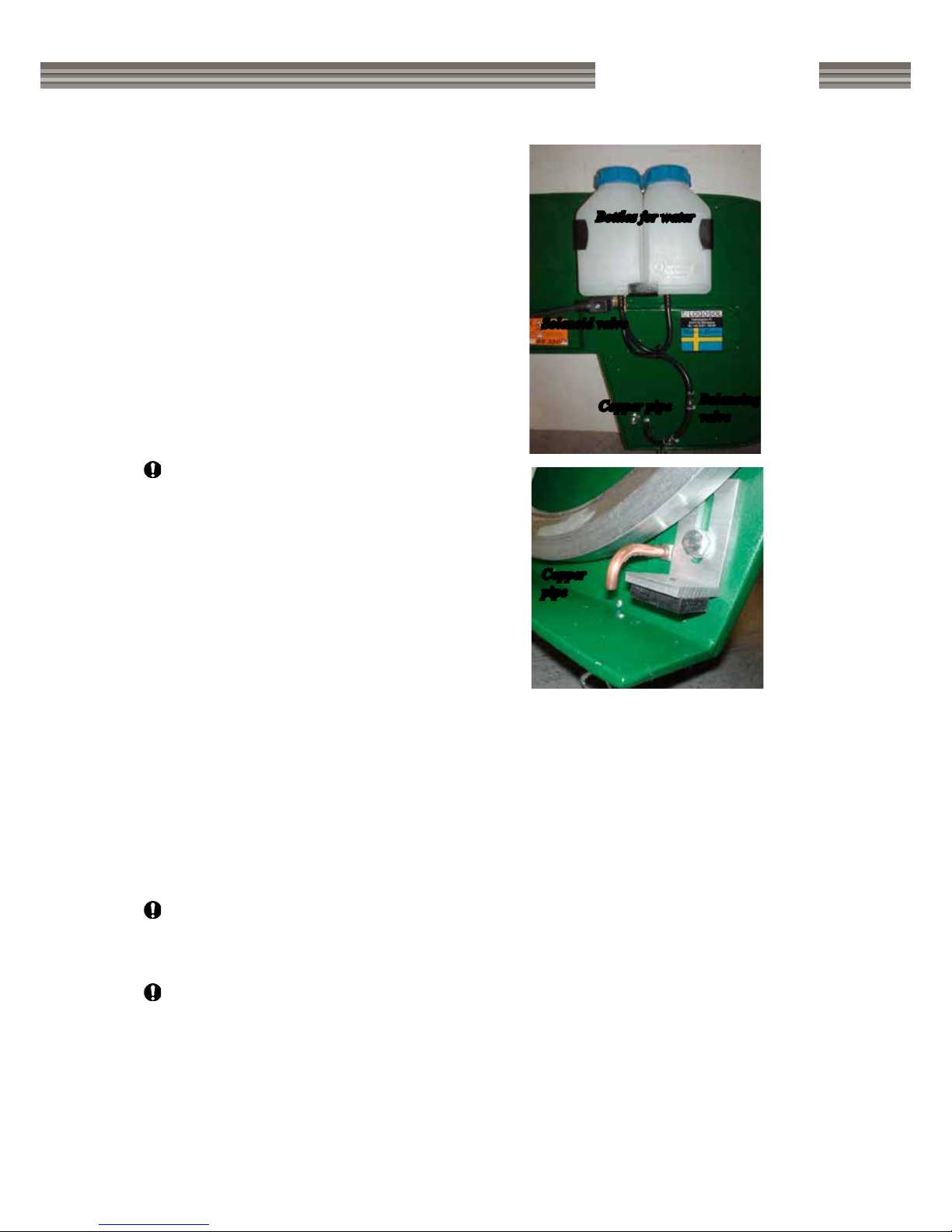
Fill the two connected bottles with water. Together,
the both bottles hold 2 litres. This is normally
enough for 2-4 logs. When sawing fresh timber, the
water ow should be approx. 4 drops per second.
Increase the ow when sawing dry timber.
The water supply is controlled by a solenoid valve
which opens when the motor starts running and
closes when the motor stops. The ow is adjusted
with the handle on the tube.
TIP: Keep a water container nearby the sawmill so
that you can easily rell the water bottle.
Avoid getting sawdust in the water bottles.
If the water supply stops:
1. Loosen the tube from the copper pipe down by
the saw blade and blow the copper pipe clean
using compressed air.
If this does not help:
2. Remove the saw blade and remount the plastic
safety cover.
3. Empty the bottles and let them stay open.
4. Open the water-flow balancing valve
completely.
5. Loosen the tube from the copper pipe down by
the saw blade.
6. Start the motor so that the solenoid valve opens,
and blow compressed air through the back way
of the tube.
If water is still not supplied, it can be due to a
defective solenoid valve. Contact Logosol.
To prevent the solenoid valve and the balancing
valve from freezing, empty the water system if
there is risk of the bandsaw getting exposed to
temperatures below 0°C.
Add glycol to the water when using the saw in
temperatures below 0°C.
Copper
pipe
Balancing
valve
Solenoid valve
Copper pipe
Bottles for water
7
Page 8

8
Sawing with the BS350
You can saw logs up to about 40 cm (16'') in
diameter on Logosol's bandsaw, and the cant
width can be 32 cm (13'') as a maximum. For larger
diameters the bandsaw must be supplemented with
a chainsaw. Usually one cut with the chainsaw is
enough to make the log t for bandsawing.
If the chainsaw is to be used mainly for sawing
occational cuts to decrease the dimension of logs
so that the logs can be sawn with the bandsaw, a
powerful petrol-powered chainsaw is in most cases
a suitable alternative. If you want higher capacity
and a more silent-running chainsaw Logosol has
electric chainsaw units, e.g. Logosol E5000.
There are, however, another reason for using a
chainsaw than the fact that the logs sometimes are
too large for the BS350. A bandsaw blade is very
sensitive to dirt on the logs, while a saw chain is
considerably more durable and, in addition, easily
sharpened several times. Due to this, BS350 is
often used only for cutting the boards, while the rst
cuts are taken with a chainsaw. The sharpness of
the blade will last for a large number of cants, the
sawing yield will signicantly increase, and you can
saw the cants quickly.
By combining a chainsaw with a bandsaw you will
have a very efcient small-scale sawmill with a
great degree of exibility, a high sawing yield, and
a capacity that is close to the capacity of more
expensive machines. If a considerable part of the
work is to be made with the help of a chainsaw, an
electric sawing unit is, of course, preferable.
If you want your bandsaw blades to have longer
serviceable time, barking the timber is an alternative
to making cants with a chainsaw.
If you want to saw as much as possible using the
bandsaw, i.d. also cut the cants with it, it is important
that you make sure the diameter of the timber is
within the limit of what the bandsaw can take.
A cut is quickly and easily made with the bandsaw.
Make sure the saw blade cuts perfectly. If the
blade changes direction when sawing through big
knots, it can be a sign that the blade needs to be
tensioned, or that the feeding speed is to high, but
it can also be the rst sign of the blade starting to
lose its sharpness, which means that it has to be
replaced. If you do not change the blade in time, you
will inevitably end up with imperfectly sawn timber.
Thus, it is important that you make sure the blade
is sawing straight. As long as the blade follows the
sawn surface on the log when pulling the saw back,
the blade is cutting the way it is supposed to.
The Logosol Sawmill is designed to be used
together with a chainsaw that has a kerf width of
approx. ¼ inch, or just over 6 mm. When cutting a
log into boards with a chainsaw, you get boards with
dimensions that correspond to even quarter-inch
steps. With a bandsaw blade, whith a kerf of only
2 mm (1/8"), you get dimensions that are approx.
2 mm under, or approx. 4 mm (3/16") over even
quarter-inch steps. With the Logosol M7 Sawmill
you have the possibility to use half quarter-inch
steps, which means that the boards will either be
approx. 1 mm (1/16") thinner or 1 mm thicker than
when sawing with a chainsaw.
Another aspect is that the stability of the Logosol
Sawmill is adapted for using a chainsaw. A chainsaw
has only a small part of its weight outside the guide
rail, while the bandsaw has an overhang, which
makes the centre of gravity lie just outside the guide
rail edge. In addition, the bandsaw is heavier than
a chainsaw.
The stability of the Logosol Sawmill is increased
by using the extra mid-strut, which comes with
the BS350 package, and sturdy support legs that
secure the guide rail ends, but the cutting unit is
still fairly unstable. This means that the cutting unit
will move when you start the motor, but once the
cutting process has started, the saw will move in a
straight line, and the limited stability will not affect
the sawing precision at all.
Page 9

LOGOSOL BS350
Make sure that:
1. you read and follow all safety instructions.
2. the blade tension is loosened when the bandsaw
in not in use.
3. you use protective gloves when handling bandsaw
blades.
4. you cover the electric equipment when the
bandsaw is stored outdoors.
5. you bark dirty logs, or make them into cants with
a chainsaw.
6. you change saw blade when it does not cut
straight.
7. you stop the saw immediately when you hear
clicking sounds indicating that the blade is about
to break.
8. you never reverse the saw while the saw blade
is running.
9. you call Logosol if you have any problems, or just
to tell us that the saw works well.
If some form of operational disturbance occurs,
immediately stop sawing and turn the machine
off before solving the problem. Be aware that
accidents with dangerous machines, no matter
if it is a Logosol Sawmill or another machine,
happen most frequently when the operator e.g.
is removing sawdust or is trying to correct a
small problem while the machine is running.
An operational stop can seldom be seen on the
nished product.
9
Page 10
10
Lethal voltage! Risk of electric shock.
Do not open the the electrical system if you
are not a qualied electrician.
Electrical installations may only be carried
out by a qualied electrician.
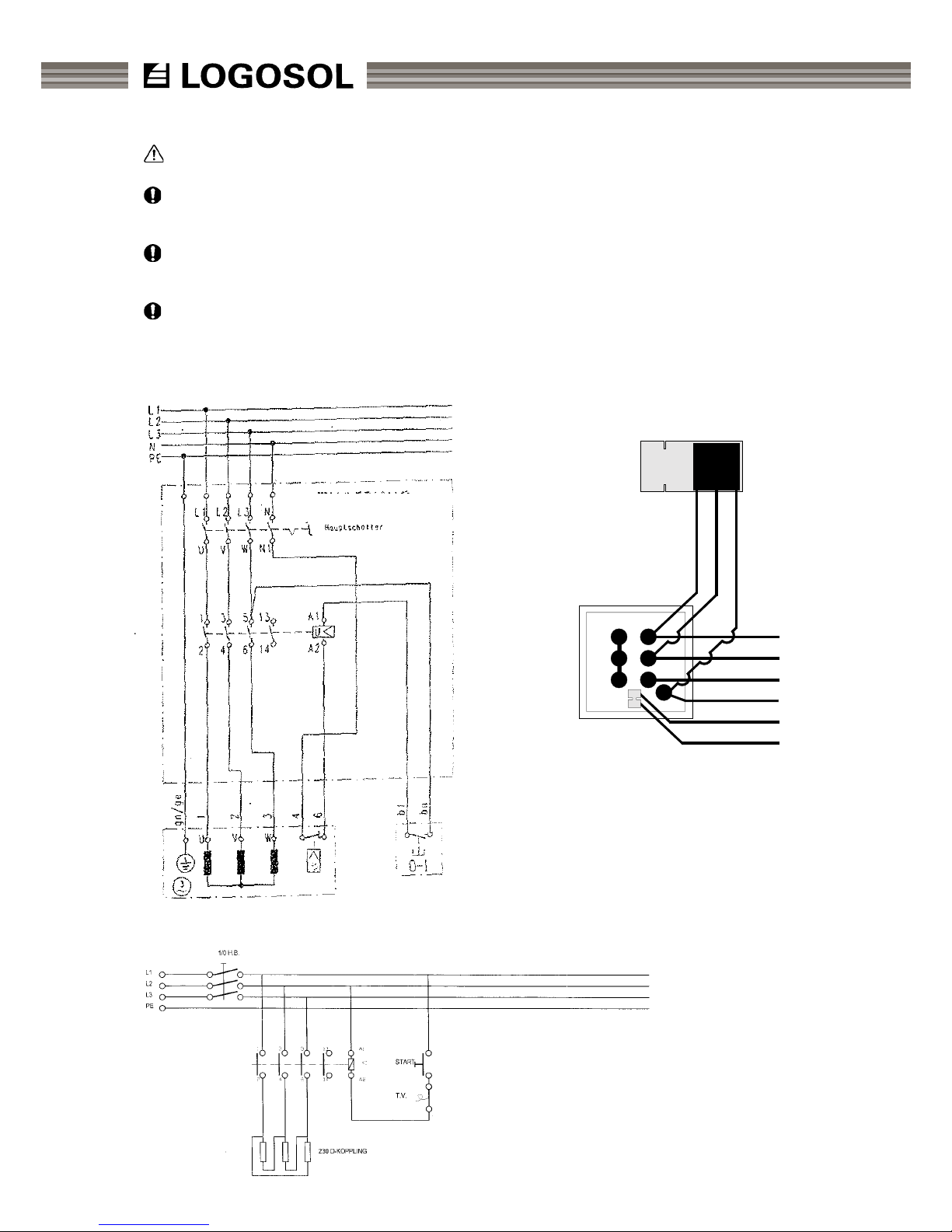
The circuit diagrams that are placed inside
the electric box of the bandsaw are the ones
that are relevant.
Circuit diagram for 3x400V
Circuit diagram for 3x230V
1
2
3
Earth
4
6
Brown
Blue
Yellow-green
earth
Connection between the junction box
on the motor and the solenoid valve.
Junction box
Solenoid valve
Page 11

LOGOSOL BS350
11
Declaration of Conformity
The manufacturer, Logosol AB, Industrigatan 13, S-871 53 Härnösand, tel. +46 611 18285,
hereby declares that BS 350, ref. no. 9999-000-7500, is manufactured in accordance
with:
Machinery Directive 98/37/EG, EMC-directive 2004/108/EG and LVD-directive 2006/95/
EG,
and that it is manufactured in accordance with the following harmonized standards: EN
ISO 12100-1, -2:2003, EN 1807:1999, EN 60204-1:2006, EN 61000-6-1, -3.
The equipment may only be used together with the Logosol Sawmill.
Certifying body:
SMP Swedish Machinery Testing Institute AB 0404, Uppsala, Sweden
has issued:
Type approval certicate: 484/95/1/E2
Machines with ref. no. 9999-000-7500 correspond with the one examined by SMP.
Technical Data
Effect
Continuous Output: 5 kW
Peak Power: approx. 10 kW
Electrical System
Electricity Supply: 50 Hz 400 V 16 A, or 50 Hz 3x230V depending on the model.
Enclosure protection class: IP 54
Plug, 400V: CEE system (round plug) 16A, with phase reverser
Contactor operated, with auxiliary relay. Thermo guards in the motor coils
Blade Speed: approx. 30 m/s. Recommended by the blade manufacturer.
Blade
Type: Tooth tempered 35 x 1,1 mm (1 7/16'' x 1/16'') with a tooth pitch of 3/4” (other types can be used).
Length: approx. 2900 mm (114'')
Lubrication/Cooling: Adjustable drip lubrication with solenoid valve
Blade tension: Linear. Spring loaded threaded bar.
Blade Guides: Adjustable graphite blocks
Construction
Chassis: High strength cast aluminium
Wheels: Cast aluminium wheels with steel coating in the centre. Diameter 390 mm (15'').
Carriage: Slide proles of low-friction plastic with adjustable ball bearings.
Sound Levels
Sound Pessure Level: In operation100 dB(A)
LwA : LwA 109 dB(A)
Dimensions
Height: 0,5 m (19 3/4'')
Length: 1,25 m (49 5/16'')
Width: 0,5 m (19 3/4'')
Weight: approx. 50 kg (110 lbs)
Accessories Ref. no.
25 m (82 ft) electric cablel 2,5 mm
2
9999-000-6801
Plug CPE 416-6 9999-000-6090
Socket Coupler CSE 416-6 9999-000-6091
Loading Ramp 9999-000-0920
Support legs
6600-000-3001
Wire kit 10 m (33 ft)
6605-000-0300
Härnösand 2008-02-27
Bengt-Olov Byström, MD
Page 12

LogosoL sWeden
Fiskaregatan 2, SE-871 33 Härnösand, Sweden
Phone +46 (0)611-182 85 | Fax +46 (0)611-182 89
[email protected] | www.logosol.com
 Loading...