

Page 1
Instruction Manual:
Wompat Baby Carrier
Page 2
- 2 - - 3 -
Wompat soft structured carrier is designed and carefully hand
made in Finland. Wompat carrier is a great help in everyday life: it
helps you to bond with your child from the start. A newborn baby
feels secure and it is easier for you to meet baby’s needs when he
is close. On the other hand an overwhelmed toddler enjoys the
closeness equally.
Read all instructions carefully before assembling and using the
baby carrier. Keep instructions for further use. Check the carrier
before each use: make sure the buckles, straps and adjustments
are secure. Before each use check for ribbed seams, torn straps
or fabric or any damaged fasteners. Ensure the child is properly
placed in the carrier and his legs are placed correctly.
Wompat baby carrier comes in four sizes. The baby size is for
about 0-18 months, medium size for 1-3 years, toddler size 2-4
years and the pre-school size 3-5 years. The minimum weight
limit for the baby size Wompat is 3,5 kg (7 lbs). The maximum
weight for baby size is 20 kg (45 lbs). The maximum weight for
the medium, toddler and pre-school Wompat is 22 kg (48 lbs). If
you need help choosing the right size, please contact your local
distributor or the manufacturer.
You can carry the child on the front or on the back. Always carry
the child in an upright position and facing towards you. Carry a
small baby high against your chest and her head close enough
to kiss. Carry the child in the ergonomic frog leg position: baby’s
legs open and his knees at the same level or higher than her bottom. Never open the waist buckle while the child is in the carrier!
Practice with a doll or teddy and use a mirror as help. Ask another
adult to help you, if you feel unsure – specially with the back carries. When you first start wearing the baby, make sure that baby
is well fed and calm. It is also good practise to start moving when
the baby is in the carrier for example take a walk. The movement
will calm the baby.
Baby’s face should always be visible – do not cover baby’s face.
Baby’s nose should not be pressed against your body. The carrier
should be tight enough so that baby’s chin will not curl against
his chest but not too tight so that baby can move his head easily. Always monitor the baby in the carrier and make sure that
baby can breath easily. Premature infants, infants with respiratory
problems and babies under 4 months are at greatest risk of suffocation.
Follow the manufacturer’s instructions and use common sense.
Baby’s safety is always your responsibility. Do not perform any
activities that might put your baby in danger for example bike or
horse riding, running, jogging, jumping etc. Never use the carrier
while engaging in activities such as cooking or cleaning which
involves a heat source or exposure to chemicals. Never wear the
baby carrier while driving or being a passenger in a motor vehicle.
Do not lay down or sleep while baby is in the carrier. Never use
the carrier when your balance or mobility is impaired because of
exercise, drowsiness or medical conditions.
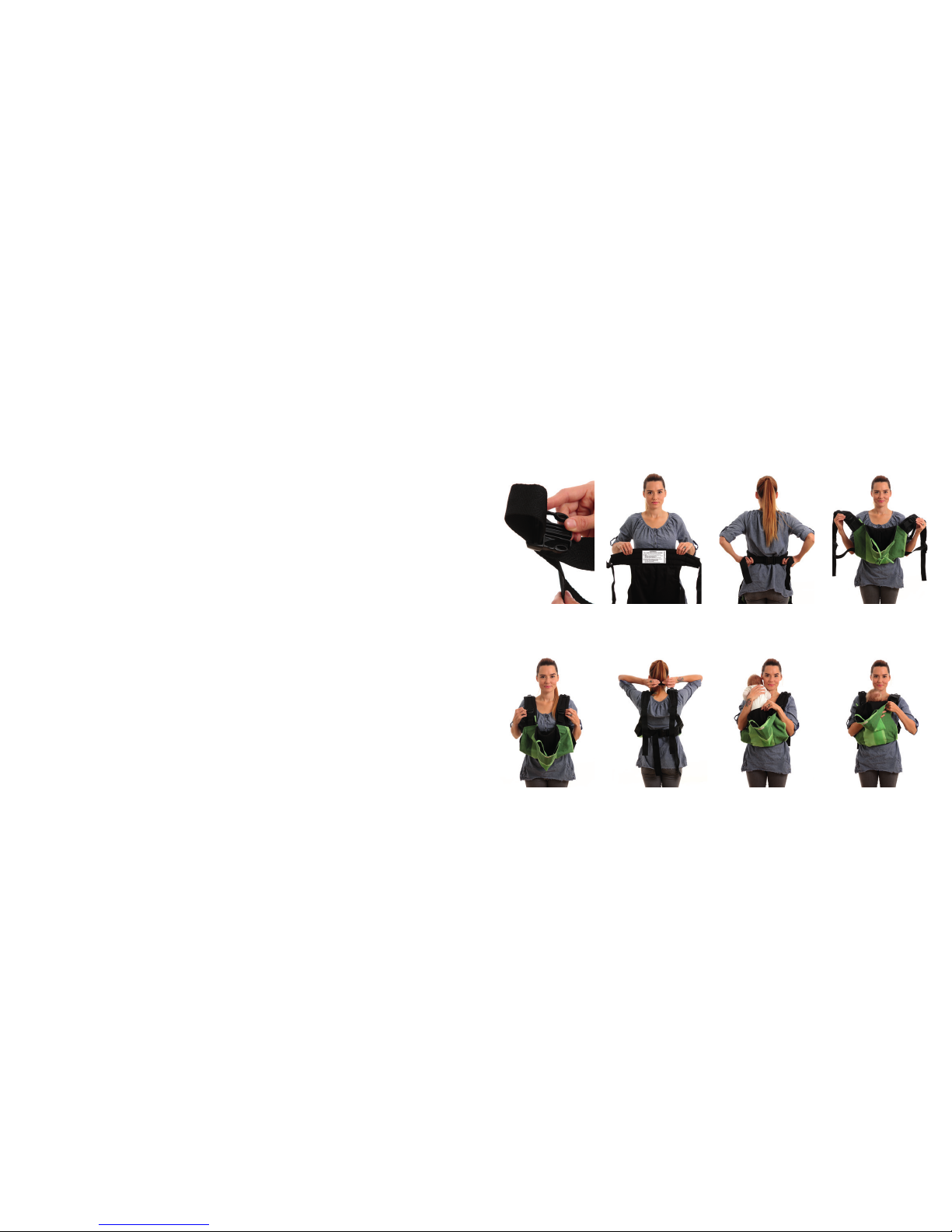
Introduction & safety Newborn carry
This carry is for babies under about 2 months. The waist belt is worn the other way around than normally. This way the body panel creates a safe pouch
for the baby. You can wear the shoulder straps straight or crossed on your back. 3,5-5 kg / 7-11 lbs.
3. Fasten the buckle and adjust.
5. Put on both shoulder straps. Leave
the body panel loose enough so that
you can easily slide the baby in.
1. Take off both buckles of waist belt
and turn them over. Thread the buckles back on. Pull the webbing and
make sure the buckles won’t slip. You
only need to do this 2 times: when
you start newborn carry and again
when baby is about 2 months.
4. Fasten the buckles of shoulder
straps to the corresponding buckles
at the sides of body panel. Leave the
straps loose.
6. Fasten the small chest strap behind
your neck. Adjust if necessary.
2. Put on the waist belt: the body panel hangs straight towards the ground
and the warning label faces out. Wear
the waist belt as high around your
waist as possible.
7. Hold baby with both hands and
slide him inside the carrier. Baby
should face towards you.
8. Pull the carrier up to baby’s neck
and back of the head. Baby’s legs
should be inside the carrier in the natural frog leg position. At the picture
16 you can see how baby’s legs are
inside the carrier.
Page 3
- 4 - - 5 -
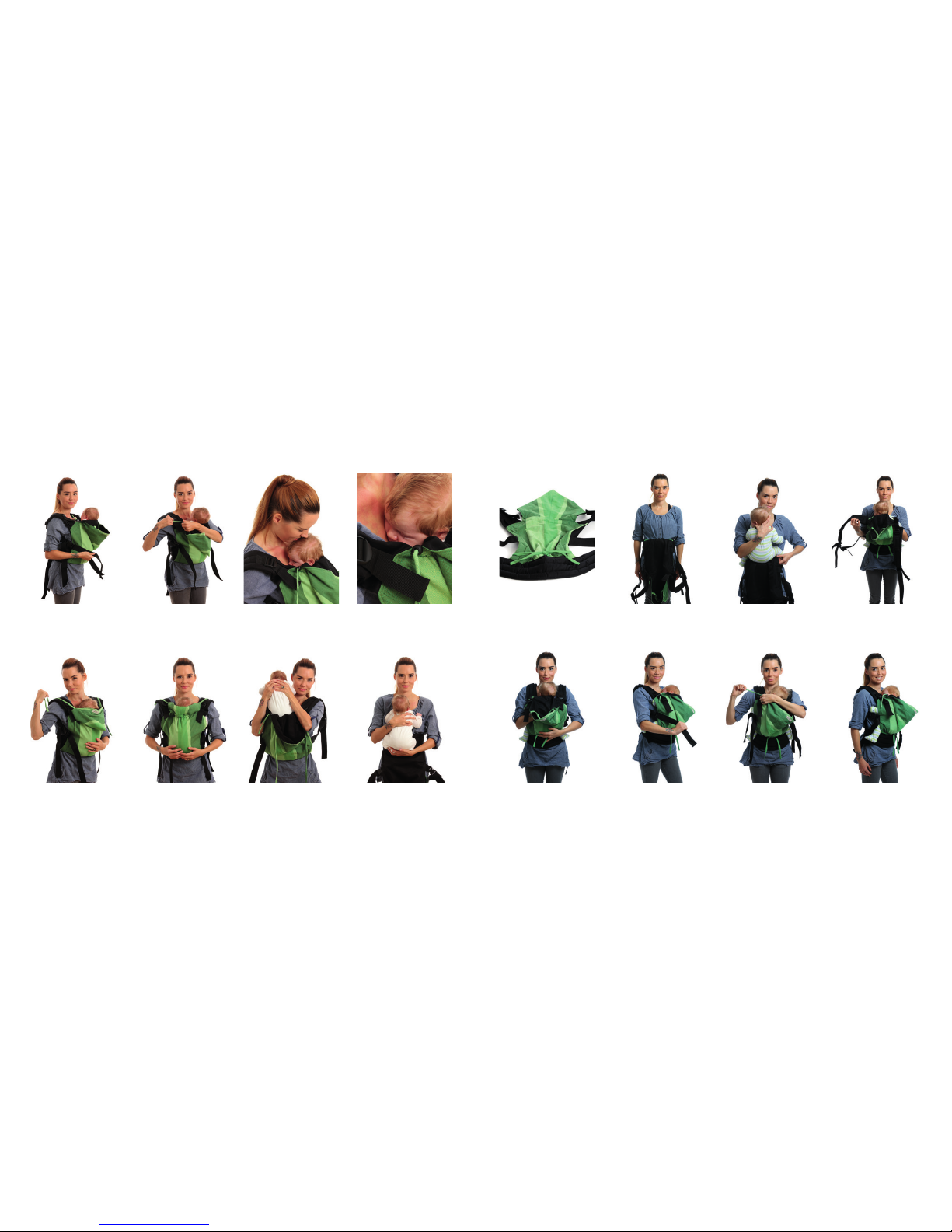
13. If you need extra support for baby’s head, use the sleep hood. Do not
cover baby’s head with the hood but
leave the hood behind baby’s back of
the head.
16. Here you can see how baby’s legs
are curled into the frog leg position
inside the carrier.
14. Another way to use the hood: roll
it up and tie the strings to the shoulder straps.
5. Put on the shoulder straps one at a
time. Hold the baby always with your
other hand. Fasten the chest strap behind your neck.
15. Taking the baby out: loosen the
shoulder straps and lift baby up and
out of the carrier.
6. Adjust the shoulder straps by pulling forward. Baby should be firmly
against your body.
9. Adjust the shoulder straps by pulling forward. Baby should be firmly
against your body and well supported
by the fabric. The fabric on both sides
of the carrier should be against your
body.
12. When baby falls asleep turn baby’s
cheek towards your chest so that baby
can easily breathe. Check the sleeping
baby regularly and make sure he has
free airways.
3. Hold baby facing towards you. Baby’s legs are wide open at the frog
position. Check that the width of
the body panel is suitable: the fabric
should reach from baby’s knee-pit to
knee-pit but no further.
10. Adjust the string at the upper
edge of the body panel so that the
fabric will support baby’s neck.
1. Tie a narrow string or scarf around
the base of the body panel to make
it narrower.
4. Lift up the carrier. The upper edge
should reach baby’s neck or back of
the head.
11. Baby is at suitable level when you
can easily kiss his head. Baby’s face
should always be visible and not covered by fabric.
2. Put on the waist belt – the warning
label should be towards your body. If
you have turned the buckles over for
the newborn carry, take the buckles
out, turn them and put back on the
original way.
Front Carry: 2-4 months
It is time to move to this carry when baby’s legs don’t seem to fit inside the carrier any more. Also if the upper edge of the carrier doesn’t reach baby’s neck
any more, baby has outgrown the newborn carry. 5-7 kg / 11-15 lbs.
7. Adjust the string at the upper edge
of the body panel so that the fabric
will support baby’s neck.
8. Baby’s face should always be visible
and not covered by fabric. Check the
sleeping baby regularly and make sure
he has free airways.
Page 4
- 6 - - 7 -
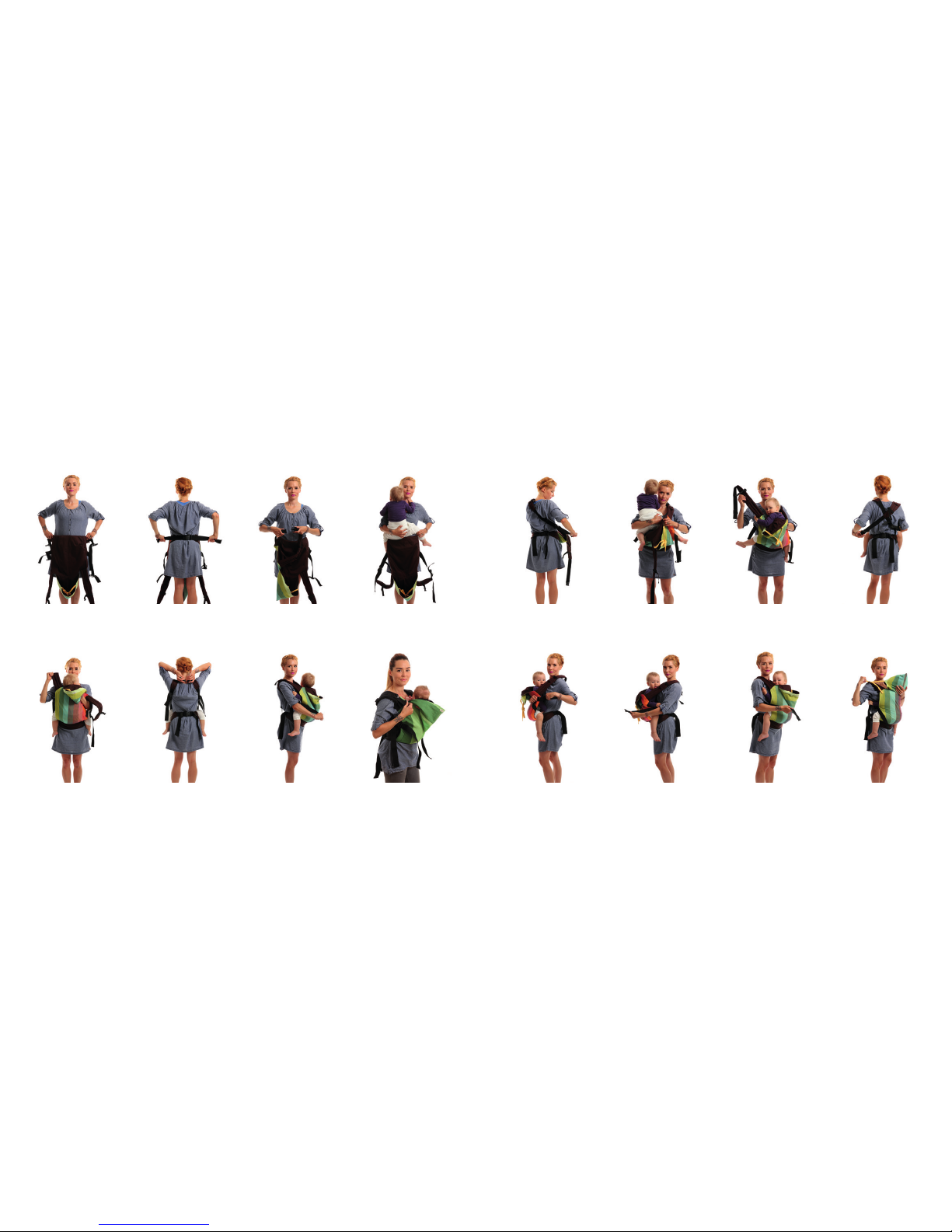
5. Lift up the carrier and put the shoulder straps on one at a time. Hold the
baby with your other hand.
8. You can also adjust the length of
the straps at the base of the shoulder
strap.
6. Fasten the chest strap behind your
neck. Adjust it.
5. Fasten the buckles to the opposite
side of the carrier.
7. Adjust the shoulder straps. Pull forward. Baby should be firmly against
your body.
6. Tighten the shoulder strap. Pull the
webbing forward.
7. Tighten also the other shoulder
strap. Baby should be firmly against
your body.
Front Carry
This carry is for older babies and toddlers (from about 4-6 months on). You can wear the shoulder straps straight or crossed on your back.
7-22 kg / 15-48 lbs.
1. Put on the waist belt. You can wear
it on your waist or hips. Baby is at the
suitable level when you are able to kiss
his head easily.
4. Hold baby facing towards you. Baby’s legs are wide open at the frog
position.
3. Lift up the right shoulder strap.
Hold the baby with your other hand.
2. Fasten the buckle and adjust tightly. 1. Put on the left shoulder strap and
fasten it to the buckle on the opposite side of the carrier. The webbing
goes across your back. Leave the strap
loose.
4. Pull the right shoulder strap across
your back with your left hand. Hold
the baby securely with your right
hand.
3. Fasten the buckles of shoulder
straps to the corresponding buckles
at the sides of the carrier. Adjust the
length of straps.
2. Hold the baby and slide him into
the carrier. Make sure his left foot
goes under the webbing.
Front Carry: straps crossed on the back
8. When baby falls asleep or you need
extra cover, lift up the sleep hood and
tie the long strings to the loops on top
of each shoulder strap.
Page 5
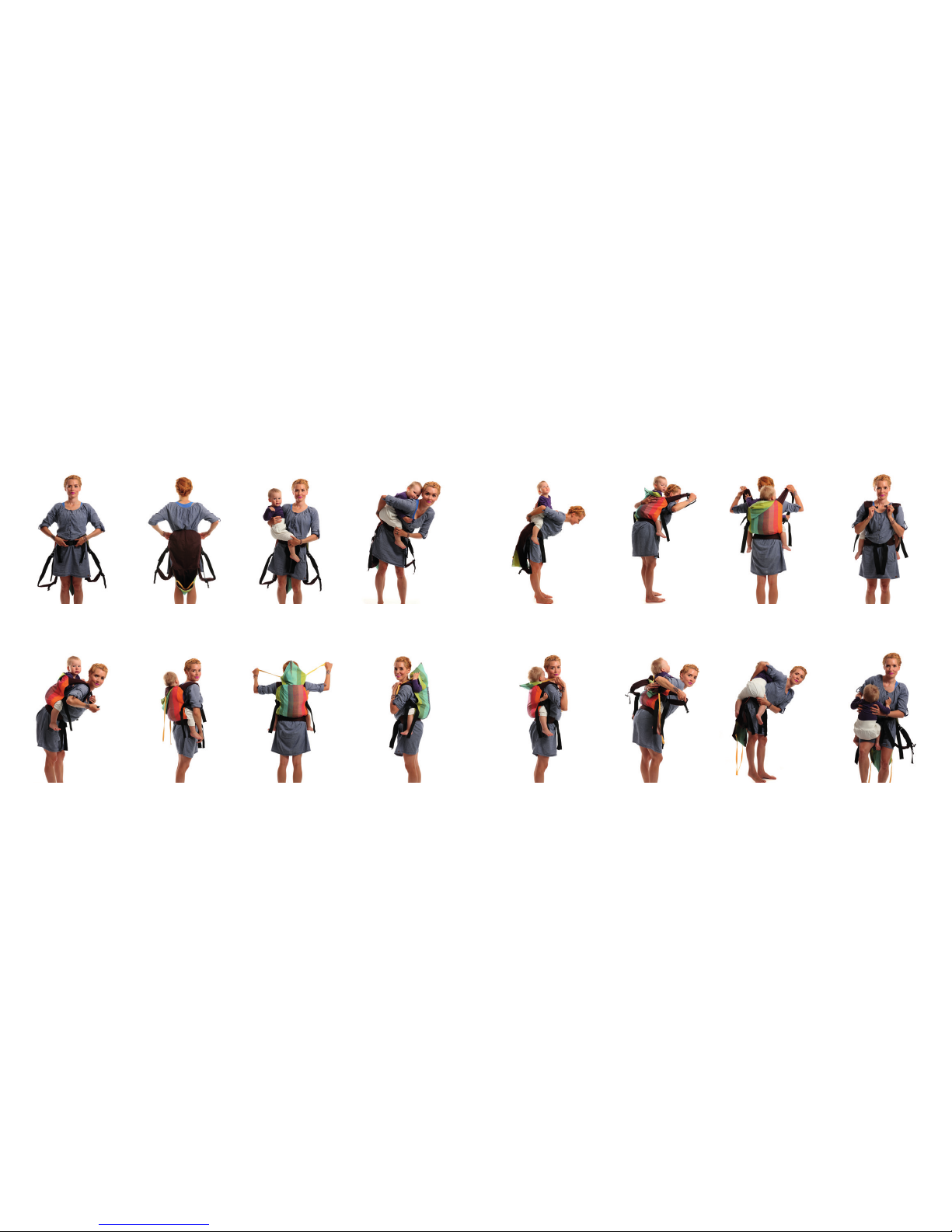
- 8 - - 9 -
1. Put on the waist belt. You can wear
it on your waist or hips. Many parents
feel most comfortable when the baby
is high on the back.
4. Bend forward and move the baby
under your arm and to your back.
7. Put on the other shoulder strap as
well. Pull both straps upwards and
make a couple of hops to get the baby
deeper inside the carrier.
2. Fasten the shoulder straps to the
buckles on each side of the carrier.
5. Place the baby in the middle of your
back. Hold him all the time with one
hand.
8. Fasten the chest strap and tighten
if necessary.
3. There are several ways to get the
baby on your back. Here is one option.
Hold baby on your hip.
6. Grab one shoulder strap and pull
the carrier up. Put the shoulder strap
on.
9. Tighten the shoulder straps. Pull
the webbing forward. Baby should be
firmly against your body.
10. Make sure baby’s legs are well
supported and he is sitting in the middle of the carrier.
11. When the baby falls a sleep, you
can lift up the sleep hood.
Back Carry
12. Tie the strings to the small loops
on top of each shoulder strap.
15. Move baby under your arm to
your hip.
13. You can also use the hood to support just baby’s neck.
16. You can use your leg to support
the baby, too.
14. Taking the baby out: open the
chest strap, bend forward, put down
the shoulder straps and the carrier.
Carrying a bigger baby or a toddler often feels more comfortable on the back. You can start backcarrying at the age of about 6 months or older.
Ask another adult to help you at first. 9-22 kg / 20-48 lbs.
Page 6
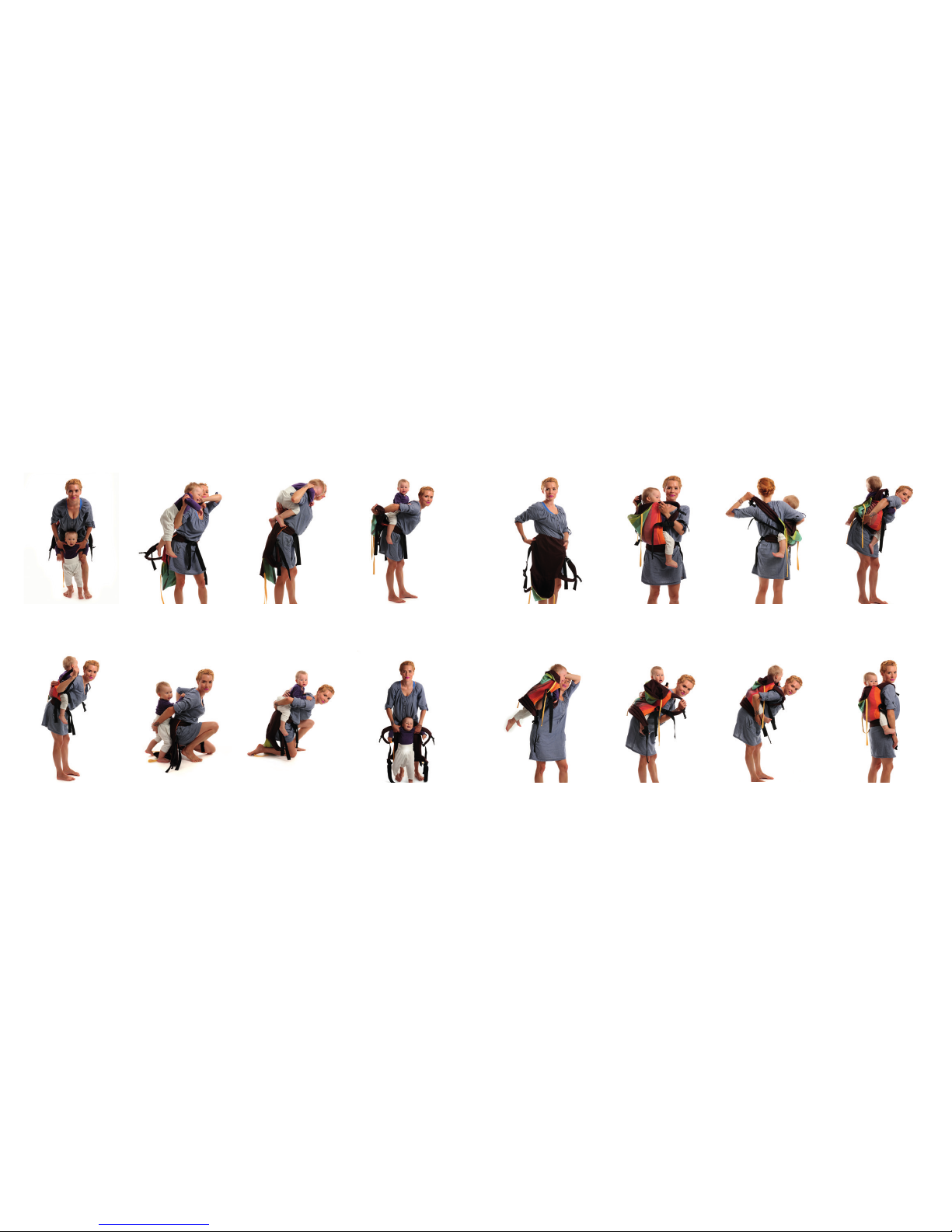
- 10 - - 11 -
Different ways to get baby on your back
A1. Hold the baby at his upper arms.
The baby can either stand or sit in
front of you.
A4. Bend forward and hold baby with
your arm. With your other hand find
one shoulder strap and lift up the
carrier.
B3. Put on the left shoulder strap. Pull
the strap behind your back.
A2. Lift baby up and swing him over
your shoulder.
B1. Put on the waist belt. Leave it
loose and wear it on your right hip.
B4. Move baby under your arm and to
your back with the carrier. Pull the left
shoulder strap at the same time.
A3. Settle him to your upper back.
B5. Put on the right shoulder strap as
well. Tighten the waist belt and shoulder straps.
C2. Help the child up and then lift up
the carrier.
D1. Place the carrier over baby’s back.
Hold baby at his upper arms. Baby can
either stand or sit in front of you. Keep
the carrier in place at the same time.
C1. An older child can climb to your
back while you crouch.
D2. Lift baby up and swing him and
the carrier over your shoulder. Bend
forward.
D3. Put on the shoulder straps.
B2. Hold the baby on your hip and lift
up the carrier.
D4. Put on the waist belt and tighten
the straps.
D5. Ready!
Page 7
Wompat baby carrier can be machine washed at cool temperature cycle for delicates (30 C / 86 F). Use only small amount of liquid washing detergent. Do not
use any fabric softeners. We recommend to spot clean the carrier when possible
and only wash it infrequently. Shape the carrier when still moist and air dry. The
hood and the panel can be ironed but do not iron the paddings.
Check the carrier regularly. Make sure all the buckles, webbing, straps and
seams are intact. Do not use a broken carrier. Please contact the manufacturer
or distributor, if you need any spare parts.
Some babies can chew the shoulder straps or the upper parts of the carrier.
Chewing can break the fabric eventually. Please monitor your child and offer him
an alternative item to chew.
Liinalapsi Oy offers a 12 month warranty for the Wompat baby carrier. The warranty covers for materials and workmanship. The warranty does not cover any
faults that are caused by improper use or improper care of the product. Proof of
purchase is required. The broken carrier needs to be sent to us.
The child’s safety is always your responsibility. The instructions for use are a
guide for safer carrying of baby but they do not guarantee the full safety of the
child. All legal proceedings or lawsuit are processed by the Finnish law and at
the court of Finland.
FALL HAZARD: INFANTS CAN FALL THROUGH A WIDE LEG OPENING OR OUT
OF THE CARRIER. BEFORE EACH USE, MAKE SURE ALL FASTENERS AND
STRAPS ARE SECURE. NEVER OPEN THE WAIST BUCKLE WHILE THE CHILD IS IN THE CARRIER. TAKE
SPECIAL CARE WHEN LEANING OR WALKING. NEVER BEND AT WAIST; BEND AT KNEES. ONLY USE THIS
CARRIER FOR CHILDREN BETWEEN 7 LB AND 45 LB (3,5 KG – 20 KG).
SUFFOCATION HAZARD: INFANTS UNDER 4 MONTHS CAN SUFFOCATE IN THIS PRODUCT, IF FACE IS
PRESSED TIGHT AGAINST YOUR BODY. DO NOT STRAP INFANT TOO TIGHT AGAINST YOUR BODY. ALLOW ROOM FOR HEAD MOVEMENT. KEEP INFANT’S FACE FREE FROM OBSTRUCTIONS AT ALL TIMES.
Washing and caring for
your Wompat baby carrier
Liinalapsi Oy
Leipäläntie 49 | 20300 Turku | FINLAND
e-mail: niina@liinalapsi.fi
www.wompatbaby.com | www.liinalapsi.fi
 Loading...