

Page 1
Connect 4G
MFL68500901 (1.0)
ENGLISH
User Guide
Page 2

&RS\ULJKW/*(OHFWURQLFV,QF$OOULJKWVUHVHUYHG
/*DQGWKH/*ORJRDUHUHJLVWHUHGWUDGHPDUNVRI/*&RUS
DQGLWVUHODWHGHQWLWLHV$OORWKHUWUDGHPDUNVDUHWKHSURSHUW\
RIWKHLUUHVSHFWLYHRZQHUV
Page 3

3
Important Customer Information
Before you begin
Before reading this user guide and getting started, please review the
separate Product Safety and Warranty Information guide for important
product safety and warranty information about your device.
Page 4

4
Important Customer Information..............................................3
Table of Contents .......................................................................4
The Basics ...................................................................................7
Phone Overview .....................................................................................................7
Setting Up Your Phone .......................................................................................10
Removing the Battery and SIM Card ................................................................13
Inserting and Removing a Memory Card ..........................................................14
Charging the Phone ............................................................................................15
Optimizing Battery Life ......................................................................................16
Turning the Phone On and Off ..........................................................................18
Phone’s Status Icons .........................................................................................22
Getting to Know the Home Screen .................................................................. 24
Touchscreen ........................................................................................................ 29
Apps: How to View, Open, and Switch .............................................................36
Working with Menus ..........................................................................................42
Managing Notifications .....................................................................................43
Searching Your Phone and the Web ................................................................. 47
Locking the Screen ............................................................................................49
Guest Mode ........................................................................................................53
Customizing the Home Screen .........................................................................54
Connecting to Networks and Devices ................................... 57
Connecting to Mobile Networks ....................................................................... 57
Connecting to Wi-Fi Networks .........................................................................58
USB Connection .................................................................................................60
SmartShare .......................................................................................................... 61
Calls .......................................................................................... 62
Placing and Ending Calls ..................................................................................62
Answering or Rejecting Calls ............................................................................65
Working With the Call Logs Tab .......................................................................66
Calling Your Contacts.........................................................................................68
Options During a Call ........................................................................................70
Managing Multiple Calls ..................................................................................... 71
Listening to Your Voicemail ............................................................................... 72
Table of Contents
Page 5

5
Table of Contents
Web ............................................................................................74
Chrome ................................................................................................................ 74
Communication ....................................................................... 84
Contacts ..............................................................................................................84
Messaging ...........................................................................................................90
Email ....................................................................................................................96
Gmail .................................................................................................................. 101
Hangouts ............................................................................................................107
Entertainment ......................................................................... 110
Camera ............................................................................................................... 110
Video Camera .................................................................................................... 116
Gallery ............................................................................................................... 120
Video Player ...................................................................................................... 124
Play Store .......................................................................................................... 125
Music ..................................................................................................................127
YouTube™ .......................................................................................................... 133
Tools ......................................................................................... 134
QuickMemo ...................................................................................................... 134
QSlide ................................................................................................................ 136
Calendar ............................................................................................................ 138
Calculator .......................................................................................................... 142
Alarm/Clock ...................................................................................................... 144
Maps .................................................................................................................. 14 8
Weather ............................................................................................................. 149
Voice Recorder ................................................................................................. 150
ThinkFree Viewer .............................................................................................. 152
File Manager ..................................................................................................... 153
Tasks .................................................................................................................. 154
Page 6

6
Table of Contents
Settings ...................................................................................156
Safety ........................................................................................181
Consumer Information About Radio Frequency Emissions ......................... 183
Consumer Information on SAR ......................................................................187
FCC Hearing-Aid Compatibility (HAC) Regulations
for Wireless Devices ......................................................................................... 189
Caution:
Avoid potential hearing loss. ............................................................................ 191
TIA Safety Information .................................................................................... 192
Safety Information ........................................................................................... 196
FDA Consumer Update ................................................................................... 201
Specifications ..........................................................................211
LIMITED WARRANTY STATEMENT ....................................212
Index ........................................................................................216
Page 7
7
The Basics
Phone Overview
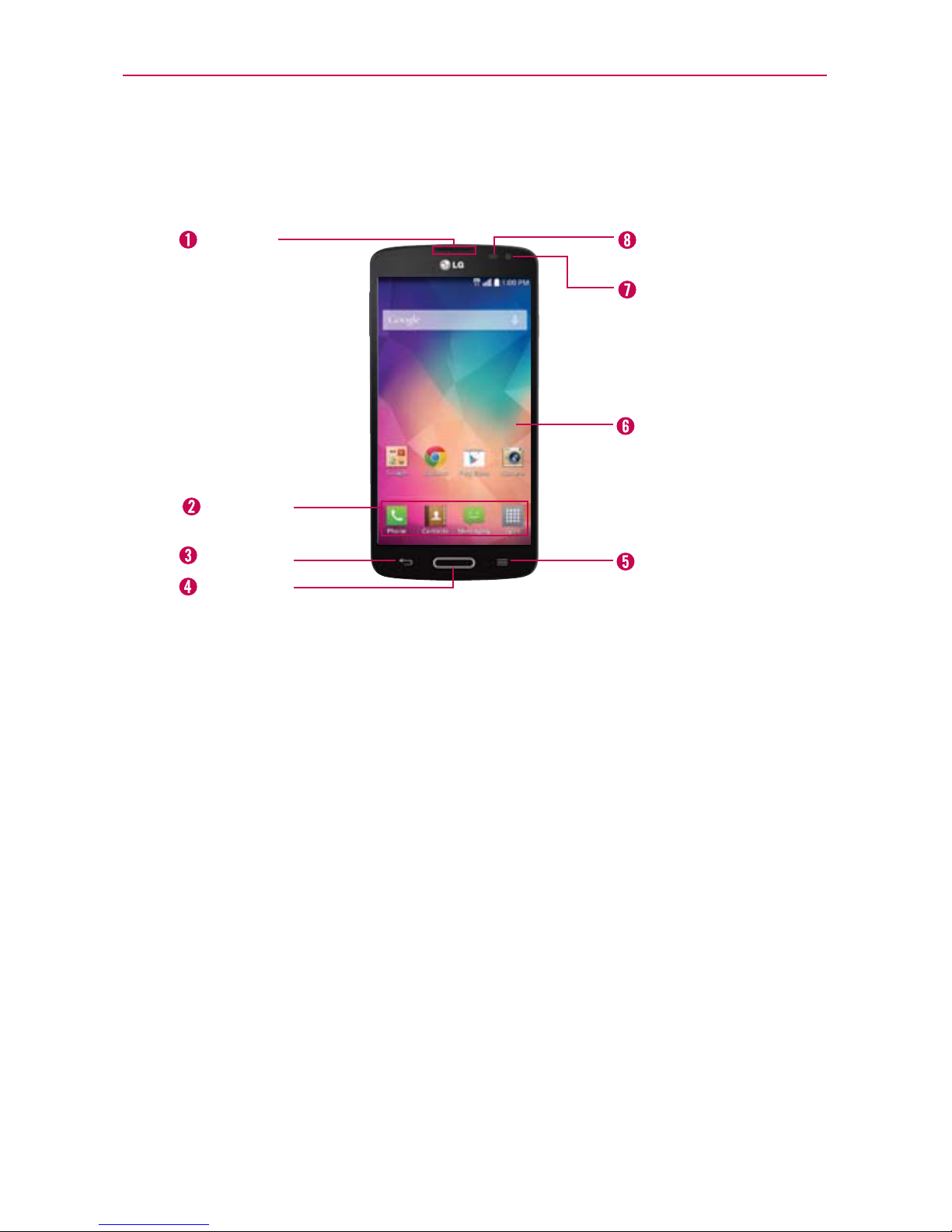
Front View
Proximity
Sensor
QuickTap
Bar
Back Key
Home Key
Menu Key
Home Screen
Earpiece
Front Camera
Lens
NOTES • All screen shots in this guide are simulated. Actual displays may vary.
• Instructions to perform tasks in this guide are based on the default settings and may
change depending on the mode and software version on your phone.
1. Earpiece Lets you hear callers and automated prompts.
2. QuickTap Bar Provides icons for quick, one-touch access to the apps
you use most often.
NOTE You can change the icons in the QuickTap Bar to suit your needs. To reposition, add, or
remove an icon, see page 25.
3. Back Key Tap to return to the previous screen. It also closes pop-up
items such as menus, dialog boxes, and the on-screen keyboard. Touch
and hold it to display your most recently used apps.
4. Home Key Press to return to the Home screen (or your default Home
screen panel from any of the Home screen extension panels). Y
ou can
also press it to wake your phone from screen timeout. Press and hold it
to access Google Now.
NOTE The
Home Key
LED illuminates when you have pending notification(s).
Page 8
8
The Basics
5. Menu Key Tap to open an Options menu with options that affect the
current screen or app. This only applies when available, depending on
the screen or app.
6. Home Screen Displays all of the items needed to operate your phone
including icons for app access, widgets, and the Status Bar (with status
icons) allowing simple touch access to all of its functions and features.
WARNING! Placing a heavy object on the phone or sitting on it can damage the LCD and
touchscreen functions.
7. Front Camera Lens Use to take pictures and record videos of yourself.
You can also use this for video chatting. Keep it clean for optimal
performance.
8. Proximity Sensor Senses proximity toward other objects. When making
and receiving calls, it automatically turns the backlight off and locks the
touchscreen by sensing when the phone is near your ear. This extends
battery life and prevents you from unintentionally activating the
touchscreen during calls.
NOTE Do not block the sensor or near the sensor to avoid problems with the touchscreen.
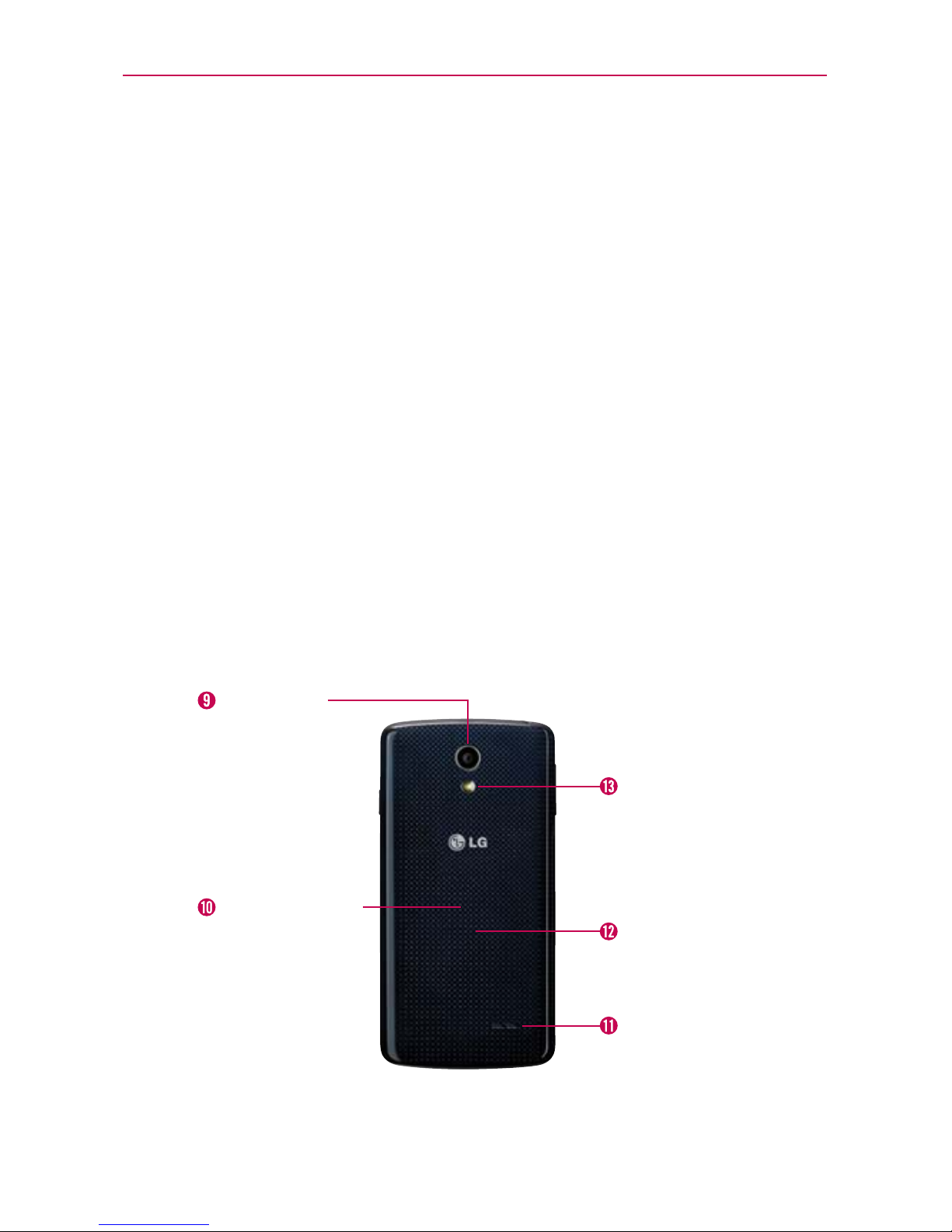
Rear View
Rear Camera
Lens
LED Flash
Back Cover
Speaker
NFC Touchpoint
9. Rear Camera Lens Use to take photos and record videos. Keep it clean
for optimal performance.
Page 9
9
The Basics
10. NFC Touchpoint Use to exchange data with other NFC compatible
devices. Tap this location to an NFC tag or another NFC compatible
device.
11. Speaker Use to listen to the audio from the selected function (e.g.,
music, videos, sound clips, speakerphone, etc.).
12. Back Cover Encloses the battery compartment which protects the
battery and internal antenna.
13. LED Flash Brightens up the captured image or recorded video when
you turn on the flash.
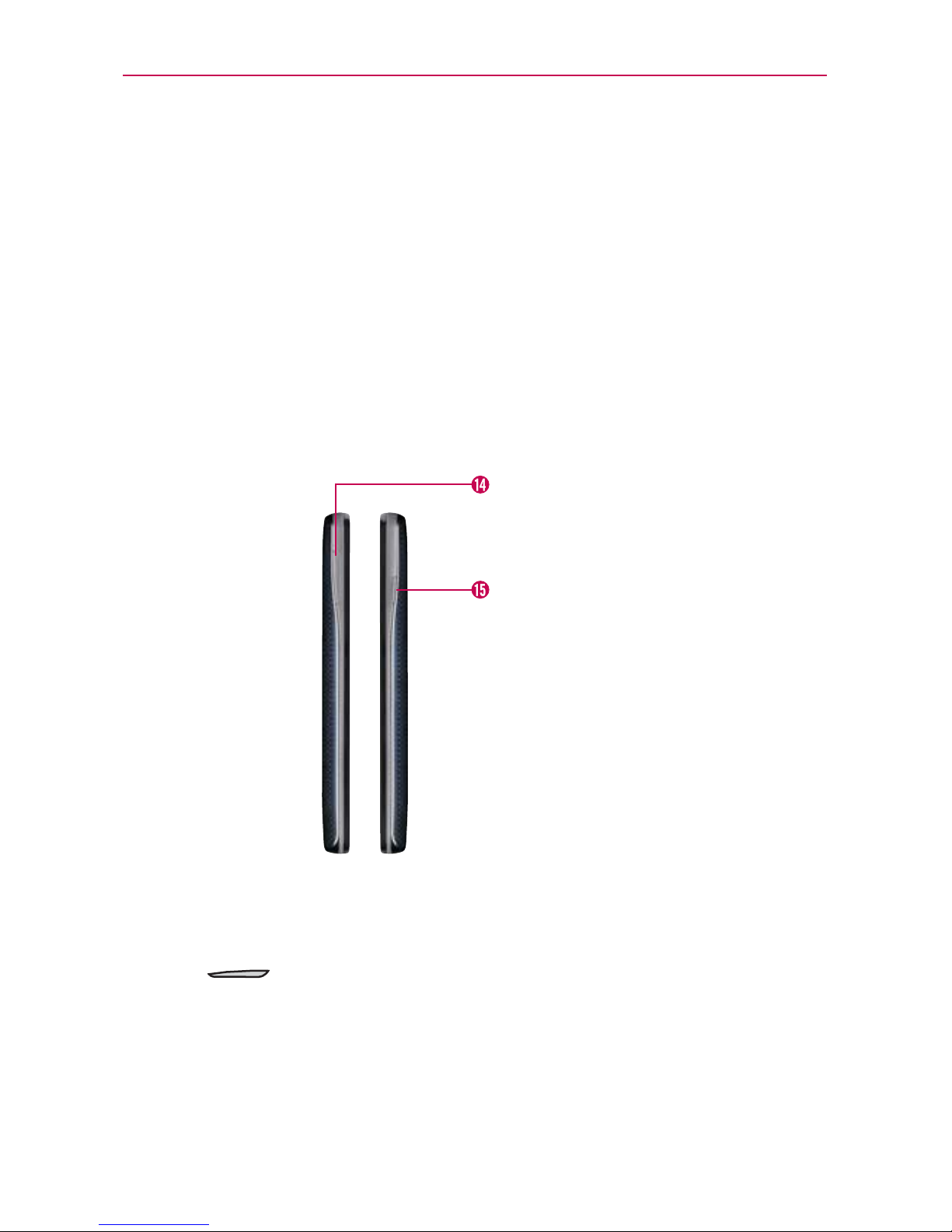
Side Views
Power/Lock Key
Volume Keys
14. Volume Keys Press to adjust the ringer, the media volumes, or the
in-call volume during a call.
TIP With the screen backlight off (asleep), you can press and hold either of the
Volume
Keys
to activate the
Camera
app.
15. Power/Lock Key Press to turn off the screen backlight and lock the
screen, or turn the screen backlight back on. Press and hold to turn the
phone on/off, restart it, activate/deactivate Airplane mode, and change
the sound settings.
Page 10
10
The Basics
Top and Bottom Views
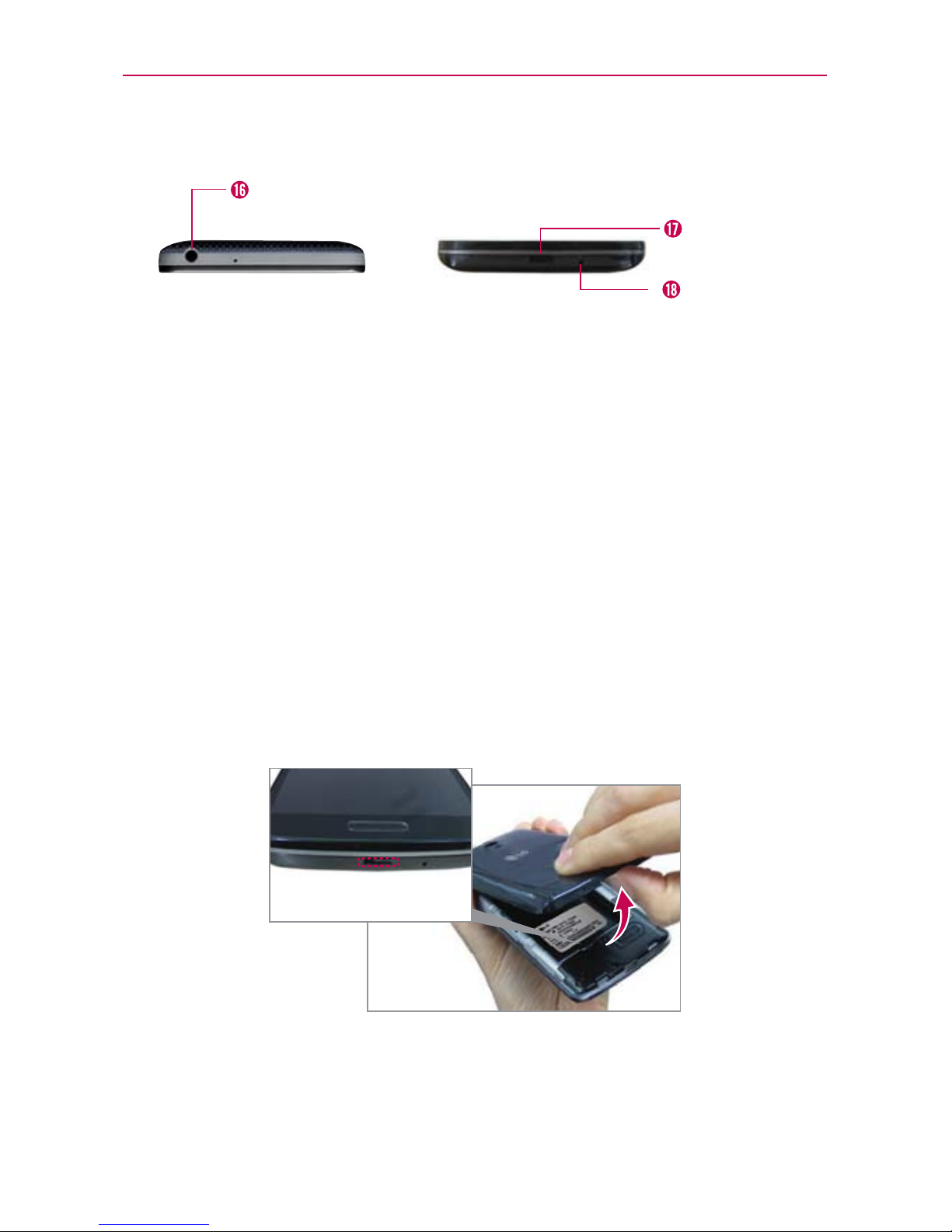
USB/
Charging
Port
3.5mm
Headset Jack
Microphone
16. 3.5mm Headset Jack Allows you to plug in an optional headset for
convenient, hands-free conversations. You can also plug in headphones
to listen to music.
17. USB/Charging Port Allows you to connect the phone and the USB
Cable for use with the Charger Adapter
, or other compatible
accessories.
18. Microphone Transmits your voice to the other caller. It's also used for
voice-activated functions.
Setting Up Your Phone
Step 1. Remove the Back Cover
Place your fingernail in the USB/Charging Port at the bottom of the phone
and pull the back cover off the phone.
Page 11
11
The Basics
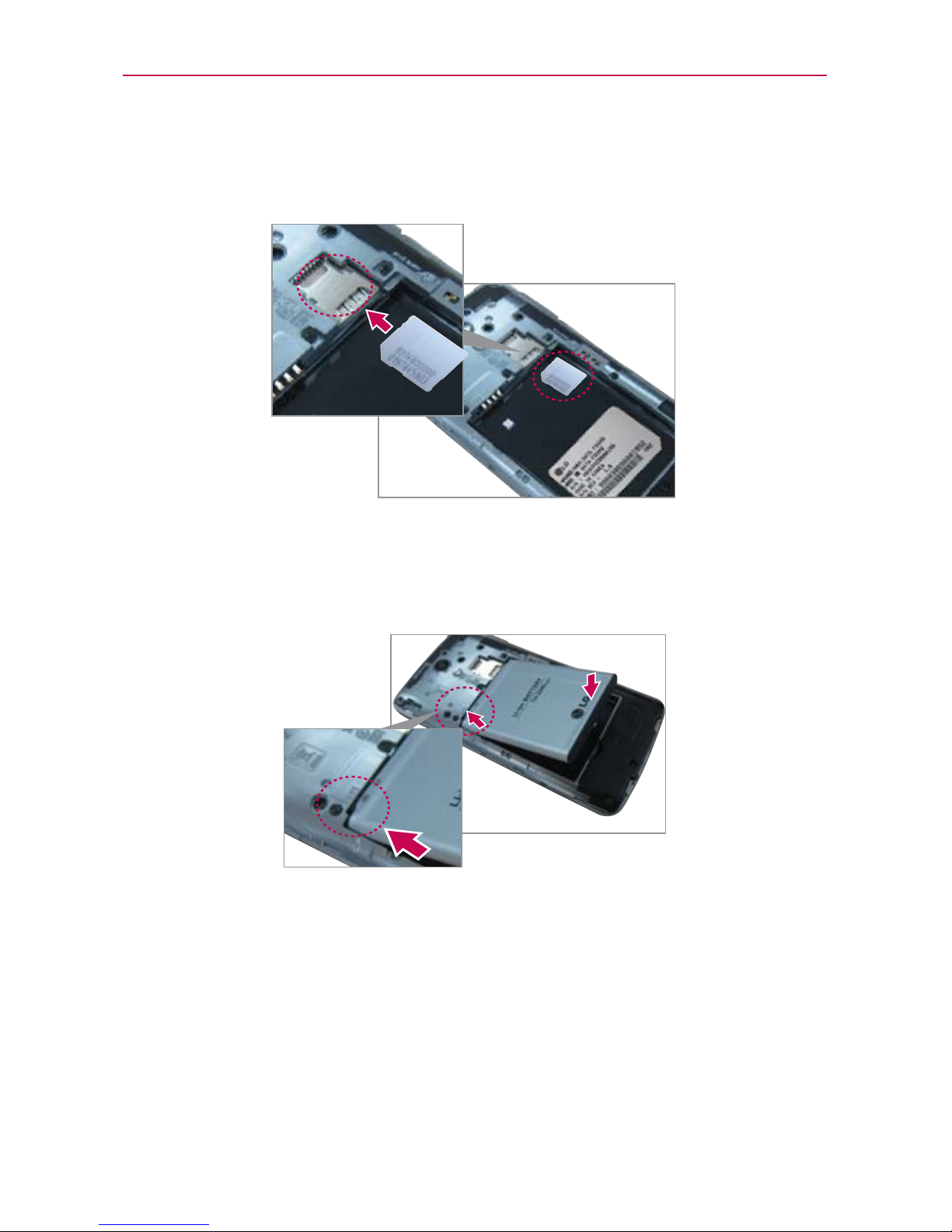
Step 2. Insert the SIM Card
Slide the SIM Card into the lower slot, located under the back cover.
Step 3. Insert the Battery
Insert the battery in its compartment, making sure to align the gold
contacts. Press down gently to secure the battery.
Page 12
12
The Basics
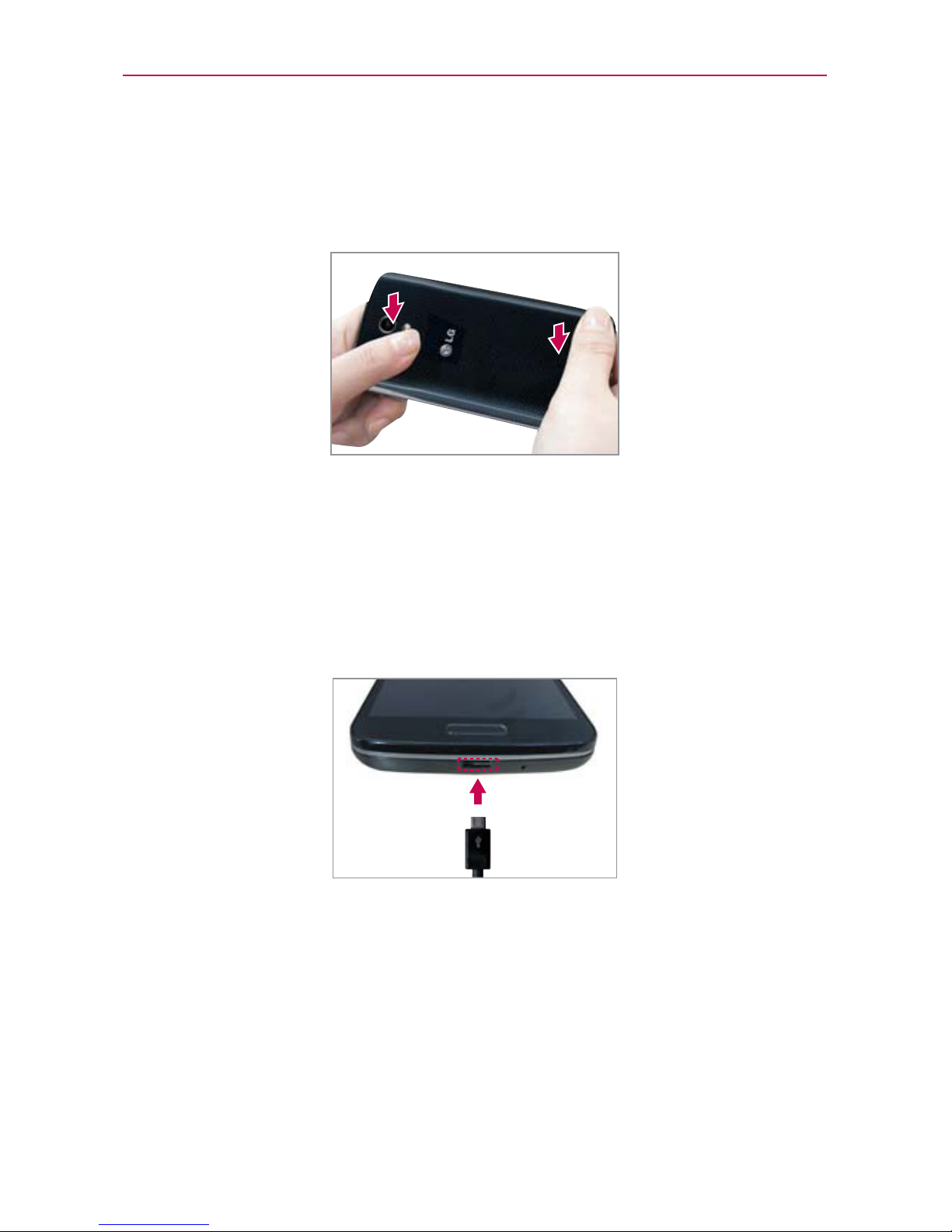
Step 4. Replace the Back Cover
Place the cover over the back of the phone, then press down along the
edges to secure the cover.
Step 5. Charge the Phone
Before turning on your phone, fully charge the battery. Be sure to use the
USB cable and Charger adapter that came with your phone. Correctly orient
the USB cable plug before inserting it in the USB/Charging Port to avoid
damage to your phone. See
Charging the phone
on pages 15 & 16 for
more information.
NOTE It’s important to fully charge the battery before initial use of the phone.
Page 13
13
The Basics
Removing the Battery and SIM Card
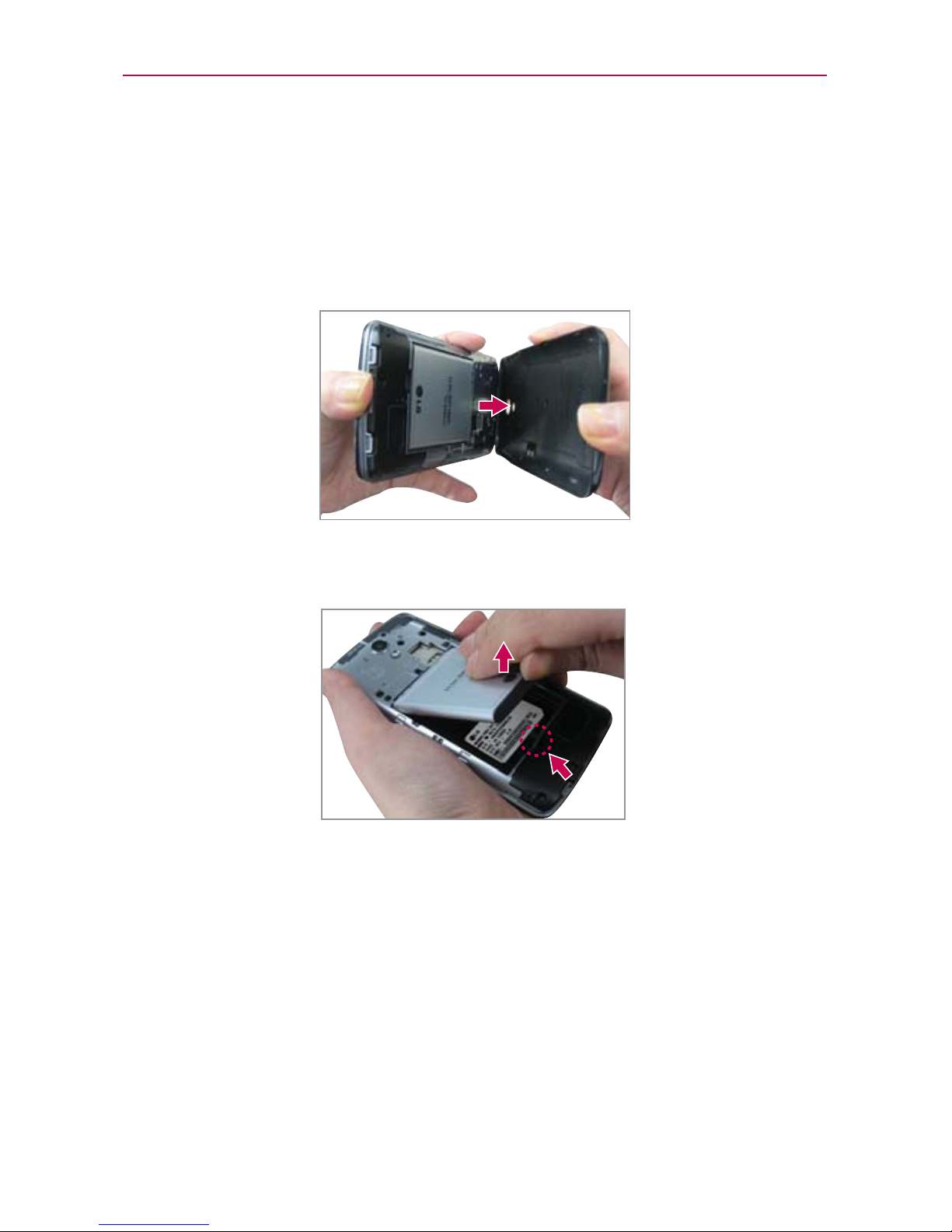
Removing the battery
1.
Turn the phone off and insert your fingernail in the USB/Charging Port at the
bottom of the phone, then gently pull the back cover off to remove it.
2. Use the fingertip cutout at the bottom of the battery compartment to lift the
battery out.
Page 14
14
The Basics
Removing the SIM card
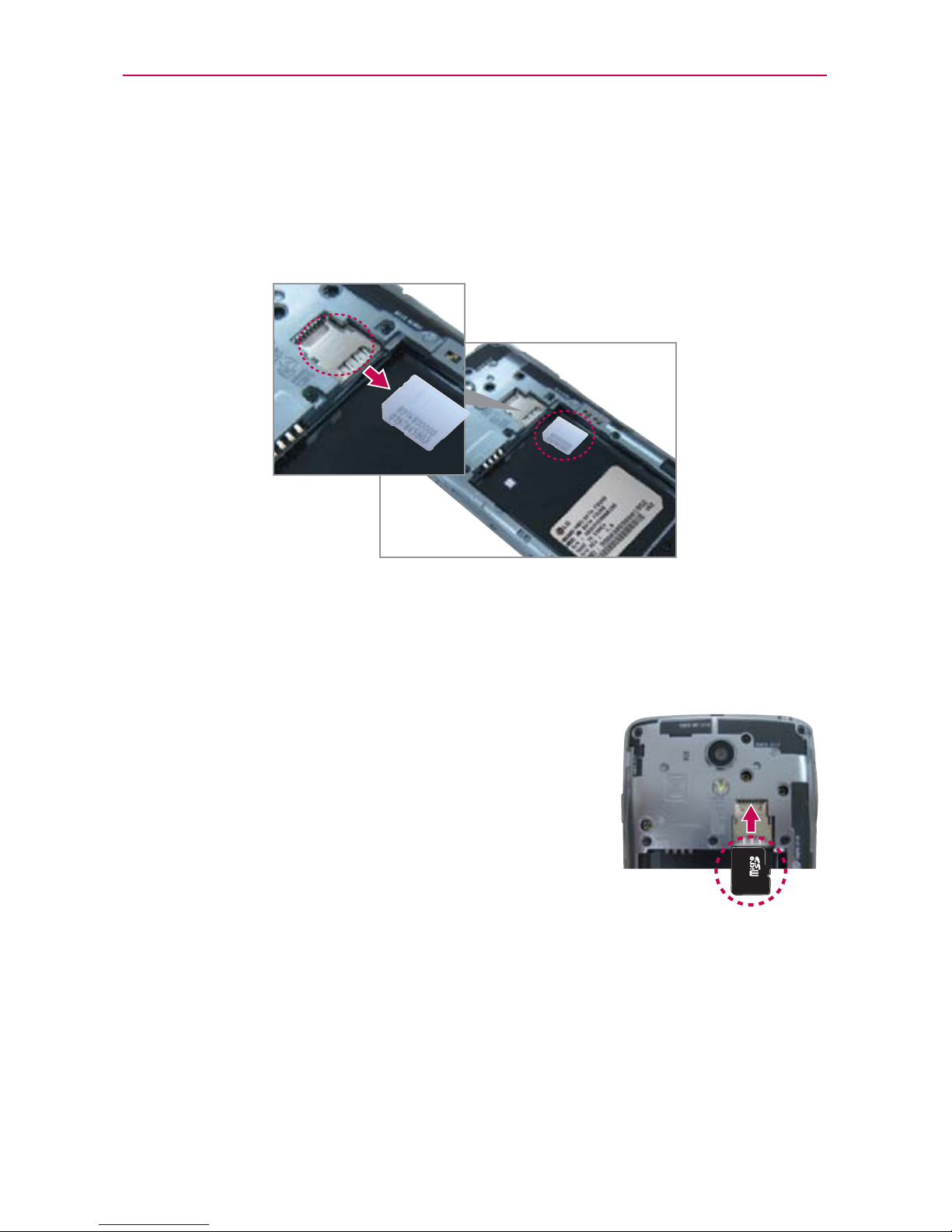
1. Turn the phone off, then remove the back cover and the battery (as
demonstrated in the previous instructions).
2. Locate the lower slot and gently slide the SIM Card out to remove it.
CAUTION If the microSD card is installed in your phone, please remove it from the upper slot
before trying to remove the SIM card.
Inserting and Removing a Memory Card
Inserting a microSD card
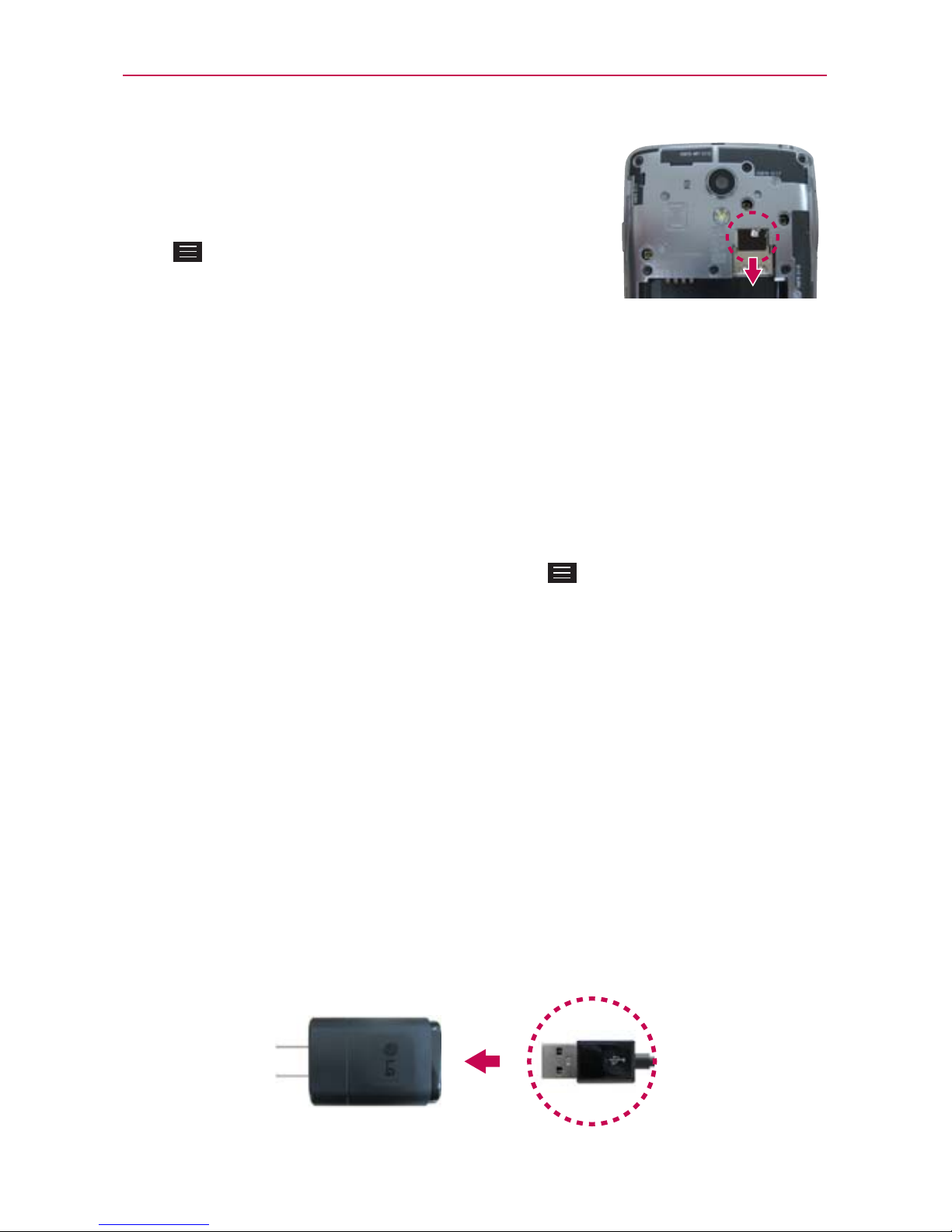
1. Remove the back cover (as demonstrated in the
previous instructions) and locate the dual slot
just above the upper-right corner of the battery
compartment. (microSD is inscribed near the
slot opening).
2. Position the microSD card (sold separately) with
the label side facing up and the gold contacts
toward the slot, then carefully slide it into the
upper slot until it's secured in place.
NOTE The microSD card can be easily damaged by improper operation. Please be careful when
inserting, removing, or handling it.
Page 15
15
The Basics
To remove the microSD card
1. Unmount the microSD card.
From the Home screen, tap the
Menu Key
>
System settings
>
General
tab >
Storage > Unmount SD card
.
2. Remove the back cover and locate the microSD
card slot (as demonstrated in the previous
instructions).
3. Carefully pull the microSD card out to remove it.
To unmount the microSD card
It’s important to unmount the microSD card prior to removing it from the
phone to avoid damage to it or the data saved on the card.
1. From the Home screen, tap the
Menu Key
.
2. Tap
System settings
>
General
tab >
Storage
.
3. Tap
Unmount SD card
.
Charging the Phone
Your phone comes with a USB cable and a Charger adapter which connect
together to charge your phone. Correctly orient the USB cable plug before
inserting it in the USB/Charging Port to avoid damaging your phone.
NOTE Please only use an approved charging accessory to charge your LG phone. Improper
handling of the USB/Charging Port, as well as the use of an incompatible charger, may
cause damage to your phone and void the warranty.
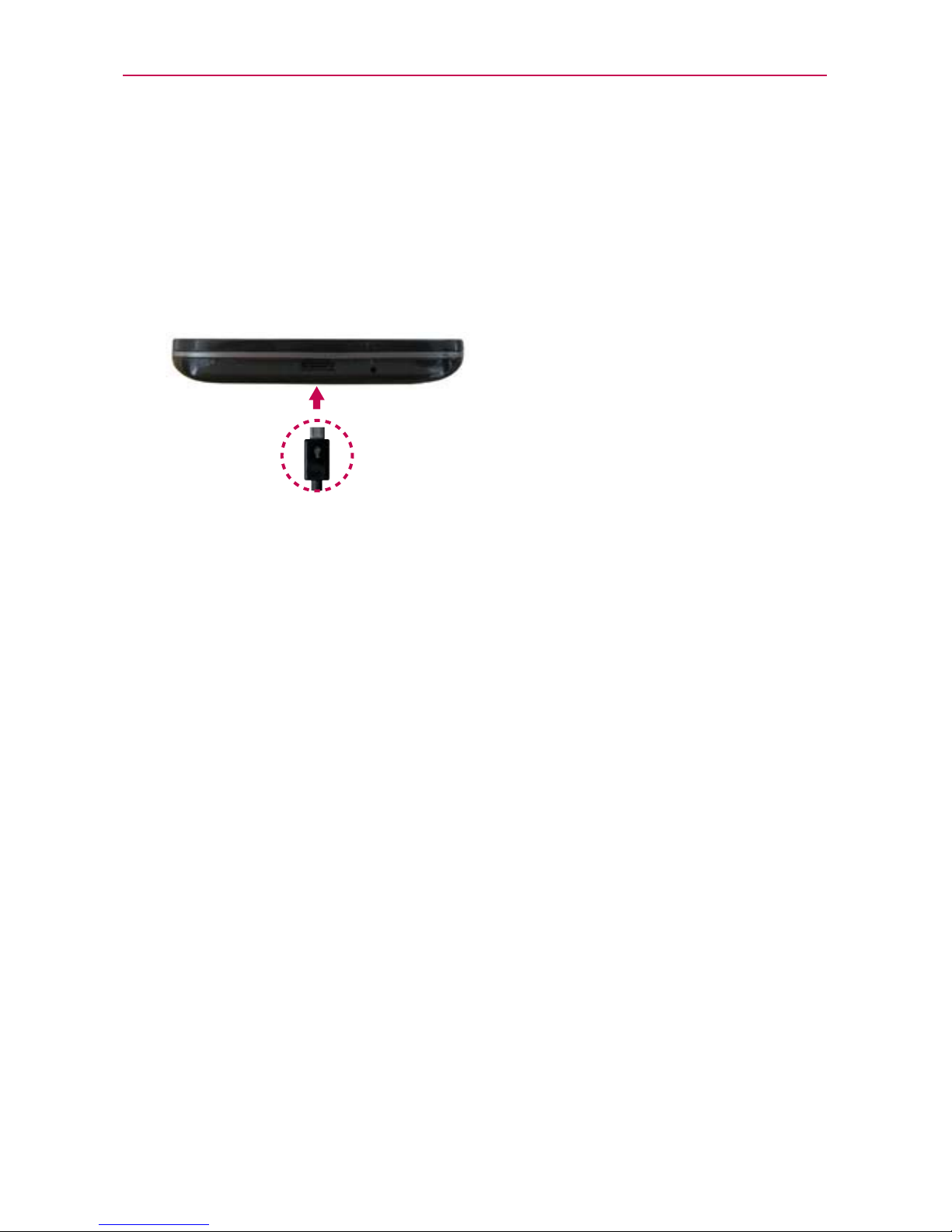
1. Correctly orient the USB cable with the Charger adapter, and connect
them (as shown below).
USB Cable
Charger
Adapter
Page 16
16
The Basics
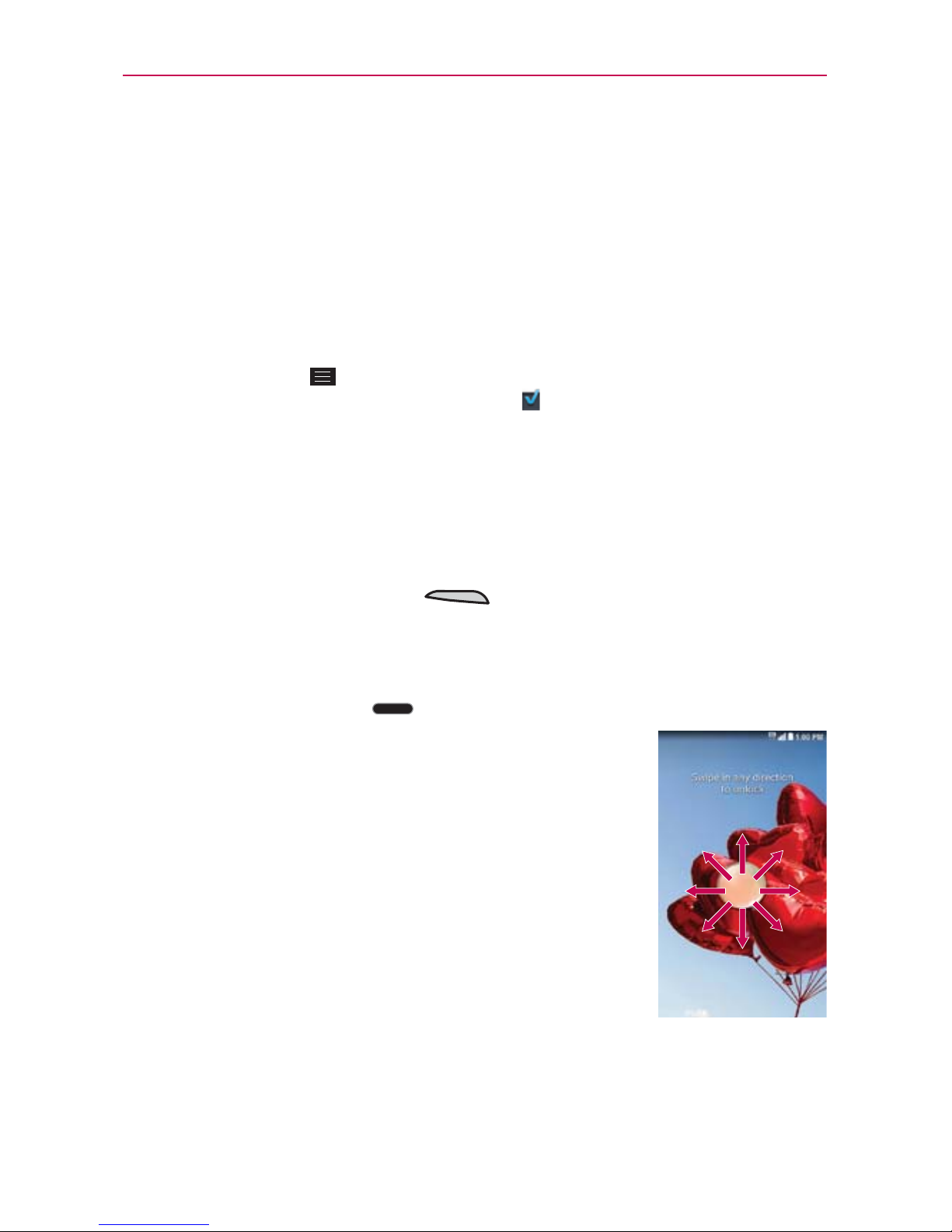
2. The USB/Charging Port is located at the bottom of the phone. Correctly
orient the plug with the port before plugging it in. As shown below, the
USB logo on the cable will face upward.
3. Plug the adapter into an electrical outlet to begin charging.
Charging with the USB Cable
USB Cable
NOTE Make sure to correctly orient the
plug with the port before plugging it in.
When the phone is facing upward, the USB
logo on the cable will also face upward.
You can use your computer to charge your phone. To be able to charge with
the USB cable, you need to have the necessary USB drivers installed on
your PC first. Connect one end of the USB cable to the USB/Charging Port
on your phone (as shown above) and connect the other end to a USB port
on your PC. It’s best to use the rear USB port when connecting to a desktop
PC. The USB hub should be powered by an external power source.
NOTE You may experience a slower charging rate when charging from your computer.
Optimizing Battery Life
You can extend your battery’s life between charges by turning off features
that run in the background. You can also monitor how apps and system
resources consume battery power.
Tips to extend the life of your battery
Reduce the screen brightness and set a shorter screen timeout.
Turn off radio communications (such as Wi-Fi, Bluetooth, GPS, etc.) that
you’re not actively using. (Note that the GPS receiver is only turned on
when you’re using an app that makes use of it).
Turn off automatic syncing for Gmail, Calendar, Contacts, and other apps
if you don’t need it.
Page 17

17
The Basics
Use the Battery saver feature (accessed in the Settings menu) to control
data activity, Wi-Fi connection, Bluetooth connection, and power used for
the phone such as screen brightness and notification light.
NOTE Allowing other devices to use your device's hotspot connection will drain your battery
more quickly.
To check the battery charge level
From the Home screen, tap the
Menu Key
>
System settings
>
General
tab >
Battery
.
The battery level (as a percentage of fully charged) and the battery status
(Charging or Discharging) is displayed at the top of the screen.
Checkmark the
Battery percentage on status bar
checkbox to display
the percentage of remaining battery charge on the Status Bar next to the
battery icon.
Tap
Battery saver
to view and/or modify your Battery saver settings.
To monitor and control what uses the battery
The Battery use screen allows you to see which apps are consuming the
most battery power. Information on this screen allows you to identify
downloaded apps you may want to turn off when not being used, so you
can get the most out of your battery power.
From the Home screen, tap the
Menu Key
>
System settings
>
General
tab >
About phone > Battery > Battery use. The top of this
screen displays a usage graph and below it, battery usage times. It lists
all of the apps or services using battery power from the greatest amount
of energy used to the least amount.
Tap an app or service in the Battery use screen to see the details about
its power consumption, including either how long since last connected
to a power source or how long you were last running on battery power.
Different apps or services offer different kinds of information, and they
may even include options to modify the settings so you can reduce
power consumption by that app.
Page 18

18
The Basics
Battery saver mode
Battery saver mode changes certain settings to conserve battery power
until you can recharge your phone. If you turn Battery saver mode On, it will
automatically activate when the battery charge level drops to the level you
set. If Battery saver mode is off, you’ll be prompted to turn on Battery
saver mode when the battery reaches low levels.
1. From the Home screen, tap the
Menu Key
>
System settings
>
General
tab >
Battery
>
Battery saver > Turn Battery saver on
.
2. Select the option you want. Choose from
Immediately
, when the charge
drops to
10%, 20%, 30%
, and
50%
.
3. Checkmark each battery saving item you want to include. You can set
Auto-sync, Wi-Fi, Bluetooth, Vibrate on touch, Brightness, Screen
timeout, Front touch key light, and Home button LED.
4. Tap the switch
at the top of the screen to turn it on.
NOTE You can also activate Battery saver mode using the Status Bar. Open the Notifications
panel, then tap the Battery saver icon
in the Quick settings to toggle it on or off.
Turning the Phone On and Off
Turning the phone on
Press and hold the
Power/Lock Key
for a couple of seconds until
the screen turns on.
Turning the phone off
1. Press and hold the
Power/Lock Key
until the Phone options
menu appears.
2. Tap
Power off
in the Phone options menu.
3. Tap
OK
to confirm that you want to turn off the phone.
Page 19
19
The Basics
Turning the screen on using the KnockON feature
The KnockON feature allows you to double-tap the screen to easily turn the
screen on or off.
Quickly double-tap the center of the screen to turn the screen on.
Quickly double-tap the Status Bar, an empty area on the Home screen,
or the Lock screen to turn the screen off.
NOTE The KnockON feature can be turned off in the Gestures menu. From the Home screen,
tap
Menu Key
>
System settings
>
General
tab >
Gestures
> remove the
checkmark from the
Screen on/off
checkbox .
To unlock the phone
If you don’t use the phone for a while, the screen and backlight will turn off
to conserve battery power. To unlock the phone:
1. Turn the screen on.
Press the
Power/Lock Key
. The default Lock screen will
appear.
OR
Press the
Home Key
to display the default Lock screen.
2. From the center of the screen, swipe in any
direction to unlock it.
To use a shortcut, swipe the shortcut icon at the
bottom of the screen in any direction. The screen
will unlock and launch the app.
NOTE The default Lock screen simply locks the screen to prevent
unintentional actions. For more security to guard against
unauthorized use, you can set an unlock requirement (such
as a pattern, PIN, password, knock code, or face recognition)
that will need to be entered to unlock it.
Page 20

20
The Basics
To turn the phone sounds off
If you’re in a place where your phone sounds may disturb others, you can
quickly silence your phone from the Home screen.
From the Home screen, press and hold the
Power/Lock Key
then
tap the
Silent mode
icon .
NOTE Only one mode can be selected at a time. The currently activated mode (Silent ,
Vibration
, or Sounds ) is underlined in blue. Tap any of the sounds mode icons to
switch to that mode.
OR
Open the Notifications panel and tap the Sound icon until
is displayed.
NOTE You can also use the
Volume Down Key
to silence the phone, but not from the
Lock screen or screen timeout (which will launch the
Camera
app instead). Press it until
vibration is set, then press it again to turn all sounds off.
Your Google Account
You must sign into a Google Account to use Gmail, Hangouts, Google
Calendar, and other Google apps; to download apps from the Play Store; to
back up your settings to Google servers; and to take advantage of other
Google services on your phone.
IMPORTANT
• If you don’t sign into a Google Account during setup, you're prompted to sign in or to create a
Google Account the first time you start an app that requires one, such as Gmail or Play Store.
• When you sign in, you’re prompted to enter your username and password using the on-screen
keyboard.
• After you sign in, your contacts, Gmail messages, Calendar events, and other information from
these apps and services on the web are synchronized with your phone.
• If you have an enterprise account through your company or other organization, your IT
department may have special instructions on how to sign into that account.
Page 21

21
The Basics
Setting up your Google Account
If you use Setup Wizard to set up your Google Account, it guides you
through the following steps.
1. At the Google Account setup screen, tap
Yes
if you already have a
Google Account, or tap No if you want to create a new account.
2. Enter your username and password (and any other necessary
information if creating an account), then tap the
Continue
icon . Tap
OK
to agree to your Google Account terms and conditions.
NOTE Tap the
Back Key
to close the on-screen keyboard.
3. Choose to join Google+ which makes sharing on the web more like
real-life sharing. You can choose Circles, Instant Upload, and Messenger.
Tap
Join Google
+ or
Not Now
.
4. Complete the Backup and restore screen to allow your Google Account
to back up your apps, settings, and other data, then tap the
Continue
icon
.
Your Gmail, Google Contacts, and Google Calendar events will all be
synchronized with your phone automatically.
NOTE This is automatic for the first Google Account you add. When adding additional Google
accounts, you have to select which options to synchronize.
5. Choose whether or not to set up your credit card information for Play
Store purchases.
6. Confirm your setup checklist choices, then tap
Done
.
You can use the area below to record your Google Account information for
future reference.
Username:___________________________________________@gmail.com
Password:____________________________________________
Page 22
22
The Basics
Phone’s Status Icons
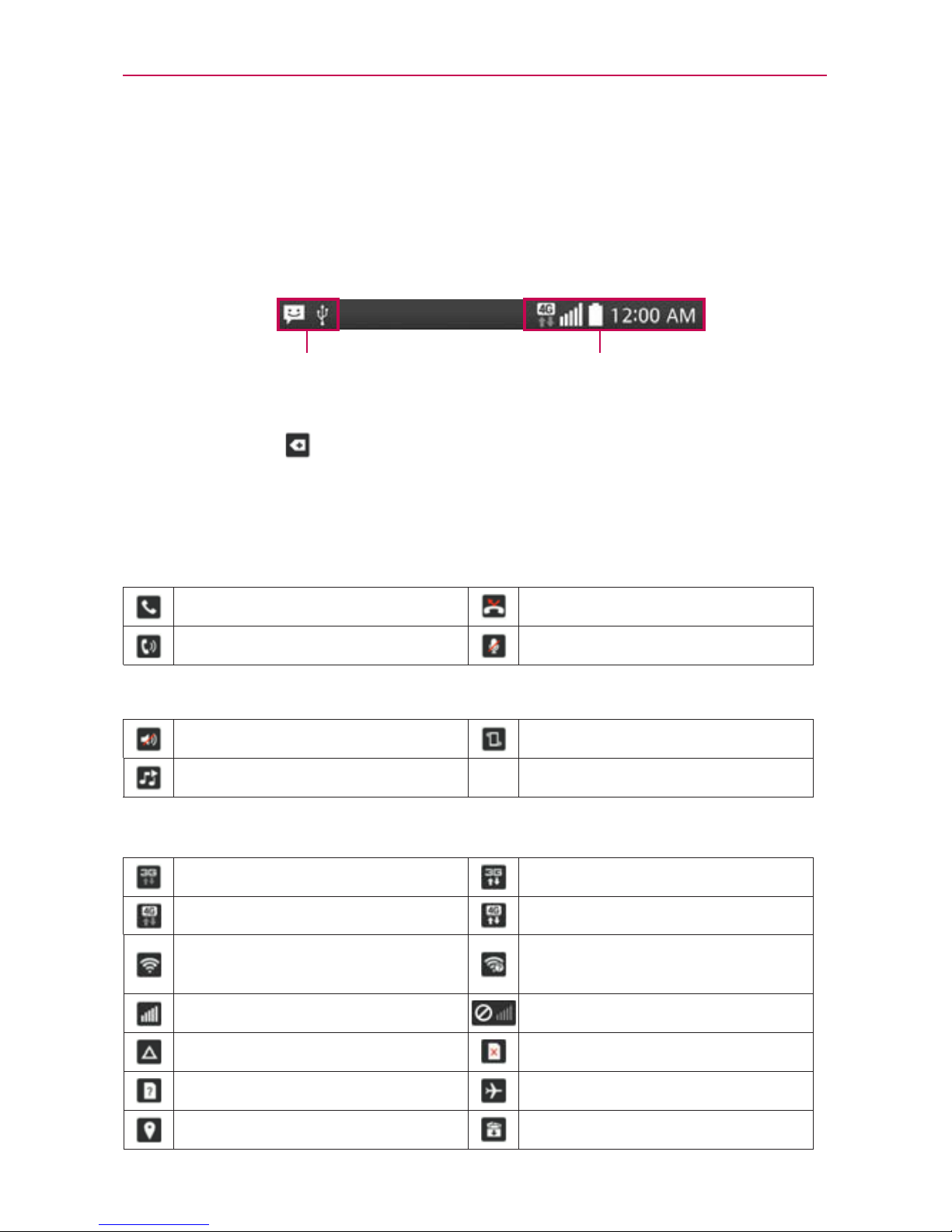
The Status Bar appears at the top of every screen. It displays icons
indicating that you’ve received notifications (on the left) and icons indicating
the phone’s status (on the right), along with the current time.
Notification icons Status icons
If you have more notifications than can fit in the Status Bar, the More
notifications icon
is displayed as an indicator to open the Notifications
panel to view them all.
The following icons may appear in the Status Bar.
Call icons
In call Missed call
Speakerphone is on Microphone is muted
Sound icons
Silent mode is activated Vibrate mode is activated
Music is playing
Network icons
3G connection 3G in use
4G LTE connection 4G LTE in use
Wi-Fi network is connected
An open Wi-Fi network is
within range
Signal strength No signal
Roaming No SIM card
Unknown SIM card Airplane mode is activated
Location is on App update is available
Page 23
23
The Basics
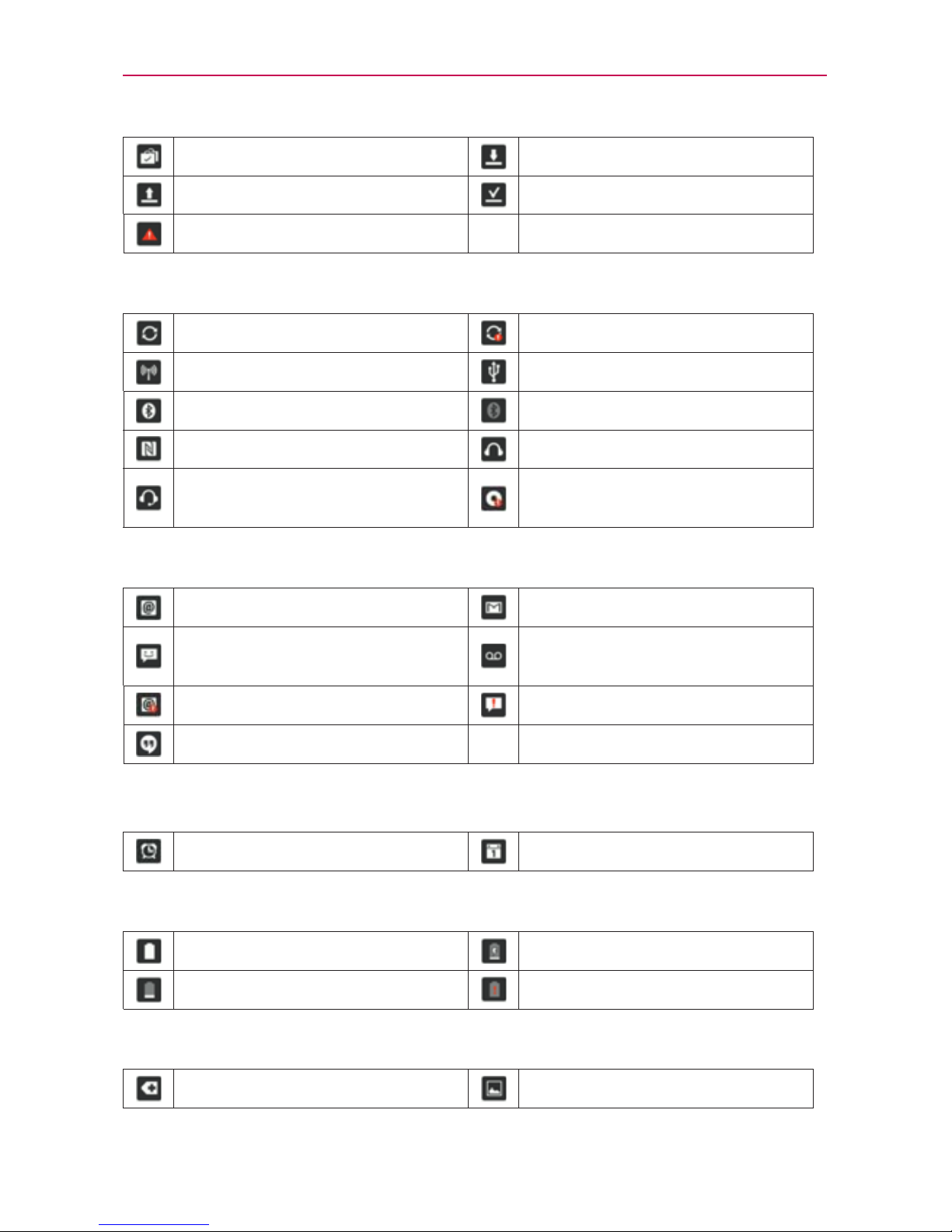
App update was successful Downloading
Uploading Download was successful
Emergency Alert
Connectivity icons
Syncing Problem with sign-in or sync
Mobile Hotspot is on USB connection
Bluetooth connection Bluetooth is on
NFC is on Headset is connected
Headset with microphone is
connected
Internal storage is full
Email and Messaging icons
New email New Gmail message
New text or multimedia
message
New voicemail
Email not sent Message not sent
New Hangouts message
Calendar and Alarm icons
Alarm is set Upcoming event
Battery icons
Full battery Charging battery
Low battery Empty battery
Other icons
More notifications available Screenshot saved
Page 24
24
The Basics
Getting to Know the Home Screen
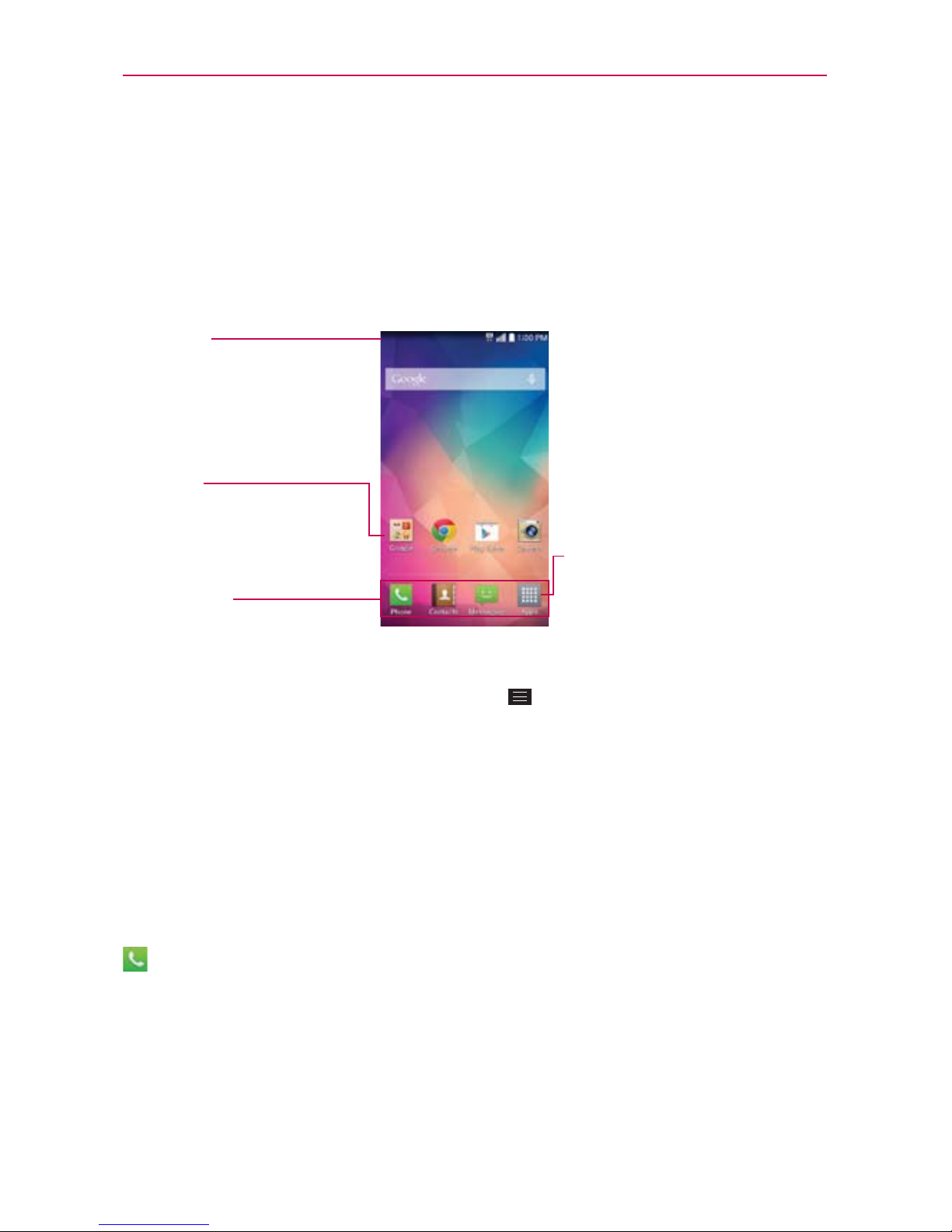
The Home screen is your starting point to access all of the features on your
phone using simple motions on the touchscreen. It’s comprised of multiple
panels (swipe horizontally to switch). You can customize all of your Home
screen panels with shortcuts icons, widgets, and other features.
Status Bar
Shows device status
information, including the
time, signal strength, battery
status, and notification icons.
App Icon
Tap an icon (app, widget,
folder, etc.) to open and use
it.
QuickTap Bar
Icons that provide easy,
one-touch access to the
functions used most often.
Apps Icon
Tap here to open the Apps screen to
view all of your installed apps.
NOTE From the Home screen, tap the
Menu Key
tap
Home screen settings
, then
checkmark
Portrait view only
to keep the Home screen from rotating to landscape view.
This is a separate setting from the
Auto-rotate screen
setting that applies to the rest of
the screens.
QuickTap Bar icons
The QuickTap Bar is located on all of your Home screen panels (at the
bottom of the screen in portrait view and on the right side in landscape
view) to allow quick and easy navigation to the apps you use most often.
The following five icons are included by default in the QuickTap bar.
: Opens the
Phone
app which displays the dialpad so you can dial a
number not stored in your phone’s memory. It also provides additional
tabs at the top of the screen to access your Recent calls, Contacts,
Favorites, and Groups.
Page 25

25
The Basics
: Opens the Contacts app which displays the names and numbers stored in
your phone's memory. It also provides additional tabs at the top of the
screen to access the dialpad, your Recent calls, Favorites, and Groups.
: Opens the
Messaging
application so you can send and view text and
multimedia messages.
: Opens the Apps
screen
which displays phone features and apps. It also
provides a Widget tab, a Search icon
, and an Edit icon at the top
of the screen.
Modifying the QuickTap Bar icons
You can modify the icons in the QuickTap Bar to suit your needs.
Rearrange
: Touch and hold the icon to move, then drag it to another
position in the QuickTap Bar.
Add
: Open the Apps screen, then drag the icon you want onto the
QuickTap Bar.
Delete
: Touch and hold the icon to delete, then drag it to the Remove
icon that appears at the top of the screen.
To return to the Home screen
Press the
Home Key
at any time, from any app to return to the
Home screen.
Page 26
26
The Basics
To view other Home screen panels
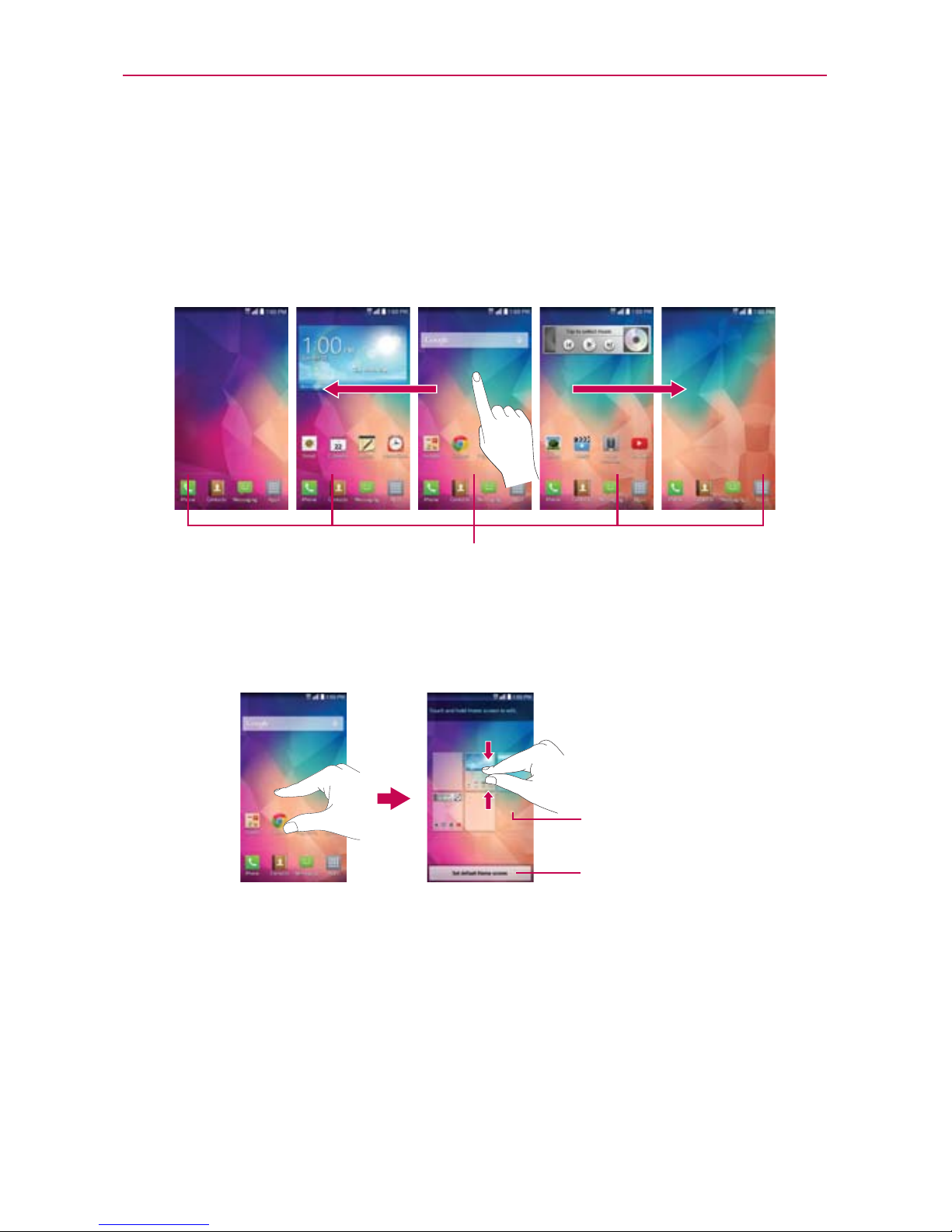
Swipe (or flick) your finger left or right across the Home screen. The
Home screen is comprised of five sliding panels, but you can add up to
seven panels to allow more space for icons, widgets, shortcuts, and
other items.
Home Screen Panel Indicator
The white bar above the QuickTap Bar indicates the current
Home screen panel.
Pinch in on the Home screen to display the mini panel view, then tap the
Home screen panel you want to view.
Tap here to set the
default Home screen
panel.
Tap here to add
another panel.
Full Screen View Mini Panel View
Mini panel view
Mini panel view allows direct access to any of the Home screen panels and
also allows you to manage them. You can add, delete, and rearrange the
panel order as well as set the default Home screen panel.
Pinch in on any of the Home screen panels to change from full screen view
to mini panel view. From mini panel view you have the following options:
Page 27

27
The Basics
To go directly to any panel, simply tap the one you want.
To add another panel, tap the
Add panel
icon .
To delete a panel, touch and hold the panel to delete, drag it to the
Remove bar at the top of the screen, then lift your finger.
To rearrange your panels, touch and hold the panel to move, drag it
where you want it, then lift your finger. The remaining panels shift
accordingly.
To set another panel as the default Home screen, tap the
Set default
Home screen
bar (at the bottom of the screen), then tap the panel you
want to set as the default Home screen panel.
NOTE Changing the default Home screen panel does not change its position with the other
panels.
Hiding items on the Home screen
Place two fingers on the screen, then spread them apart to hide the items
on your Home screen so that only your wallpaper and the Status Bar are
displayed. To redisplay your normal Home screen with all of its apps and
widgets, pinch in on the screen or tap the
Back Key
.
NOTE The phone automatically reverts to the normal Home screen view after screen timeout.
Using Dual View
Dual view allows you to easily add items to any of the Home screen panels.
Touch and hold an empty spot on a Home screen panel to view your Home
screen on top and the choices (
Apps
tab,
Widgets
tab, or
Wallpapers
tab)
at the bottom. Flick sideways to scroll through the Home screen panels to
display the panel you want. At the bottom of the screen, tap the type of
item you want to add (Apps, Widgets, or Wallpapers), then flick sideways
to scroll through the available choices. Simply tap the item you want to
automatically add it to the panel viewed at the top of the screen.
NOTE The QuickTap Bar icons are not accessible while in Dual view.
To return to the full screen view, tap the
Back Key
or tap one of the
Home screen panels.
NOTE The phone automatically reverts to the normal Home screen view after screen timeout.
Page 28

28
The Basics
Home screen version
EasyHome is a more simplified version of the Home screen that you can
choose to use on your phone.
From the Home screen, tap the
Menu Key
>
Home screen settings
>
Select Home > EasyHome
.
The EasyHome setting displays the Home screen like a remote control
device. The main part of the screen is the dialpad to allow you to make
calls, but it also has icons to access the
Messaging
app, the
Contacts
app,
the
Camera
app, the
Gallery
app, the
Alarm/Clock
app, the
Chrome
app, the
Apps
screen icon, and the
Add
icon that allows you to select an app of your
choice for that position. The Weather widget is displayed at the top of the
screen. The EasyHome screen has two panels. Slide the screen to the left
to access it and add additional icons for easy access.
To change back to the Android Home screen
From the EasyHome screen, tap the
Apps
icon >
Settings
>
Display
tab >
Home screen
>
Select Home
>
Home
.
Global access
The
Global access
function provides a shortcut to the
Google Now
feature or
the
QuickMemo
feature from any screen.
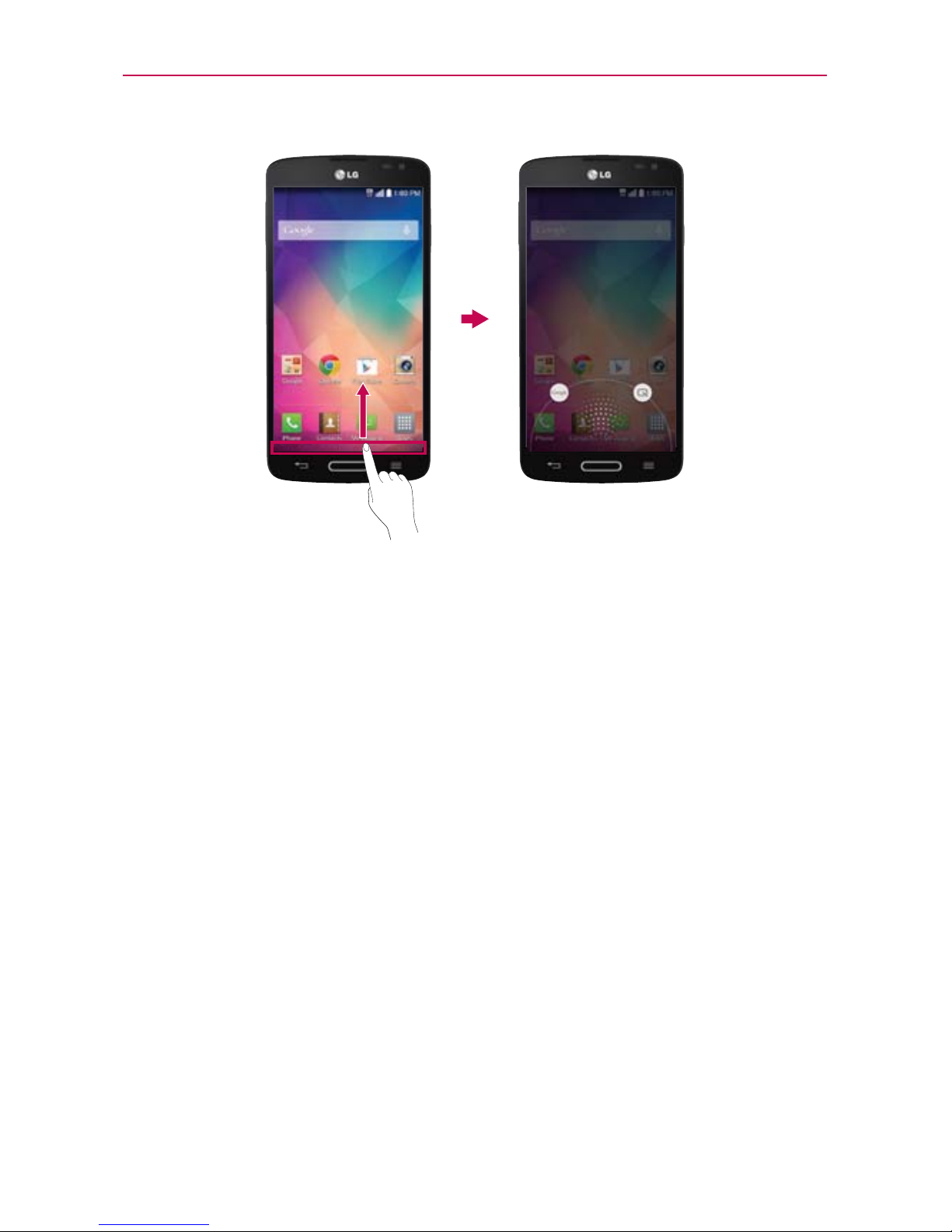
Global access
is activated by
dragging your finger from the Touch Key area (below the touchscreen) onto
the touchscreen. As you drag, the
Google Now
icon and the
QuickMemo
icon appear on a white arc. Position your finger over the
Global access icon you want to use, then let go to launch it.
Page 29
29
The Basics
Touchscreen
Your touchscreen provides an excellent way to interact with and use your
phone. With the touch of your finger, you can download and use available
apps, make menu selections, and access data saved to your phone.
The following terms are used for describing the different available actions
using the touchscreen:
Touch or tap A single finger touch selects items. For example, tap an
icon (e.g., an app, widget, or folder), tap words (e.g., menu selection or to
answer an on-screen question), or touch letters and numbers to type.
NOTE Don't press too hard on the touchscreen. It's sensitive enough to detect a light, firm tap.
Touch and hold Touch and hold an item on the screen by touching it and
not lifting your finger until an action occurs. For example, to open a
Context menu for editing a contact, touch and hold a contact entry until
the menu pops up.
Drag Touch and hold an item for a moment and then, without lifting your
finger
, move your finger on the screen until you reach the target position.
For example, you can drag items on the Home screen to reposition them.
Page 30
30
The Basics
Swipe, slide, or flick Move your finger quickly across the surface of the
screen, without pausing when you first touch it (so you don’t drag an item
instead). For example, you can browse through the different Home
screens by swiping from left to right (and vise versa), slide the screen up
or down to scroll a list, or remove an app from the Recent apps screen by
flicking its graphic off the screen.
Double-tap Tap the screen twice quickly to zoom, highlight text, or turn
the screen off. For example, quickly double-tap a section of a web page to
zoom that section to fit the width of the screen and control the zoom in
Maps and in other apps. Double-tap a word to highlight it. Double-tap can
also activate the KnockON feature to turn the touchscreen on or off.
Pinch-to-zoom Use your index finger and thumb in a pinch motion (to
zoom out) or spread motion (to zoom in) when using Chrome, a map,
photos, the rear camera lens, the Contacts list, the Favorites list, the
Groups list, the Messaging list, a music list, and ThinkFree Viewer
documents. Spread apart to make screen information larger (easier to see
and read), or pinch together to view more area and information. The pinch
gesture also changes the Home screen. Pinch in on the Home screen to
change to mini panel view, then spread apart to return to the normal
Home screen view. Spread apart on the normal Home screen to hide all of
your Home screen items, then pinch in to redisplay them.
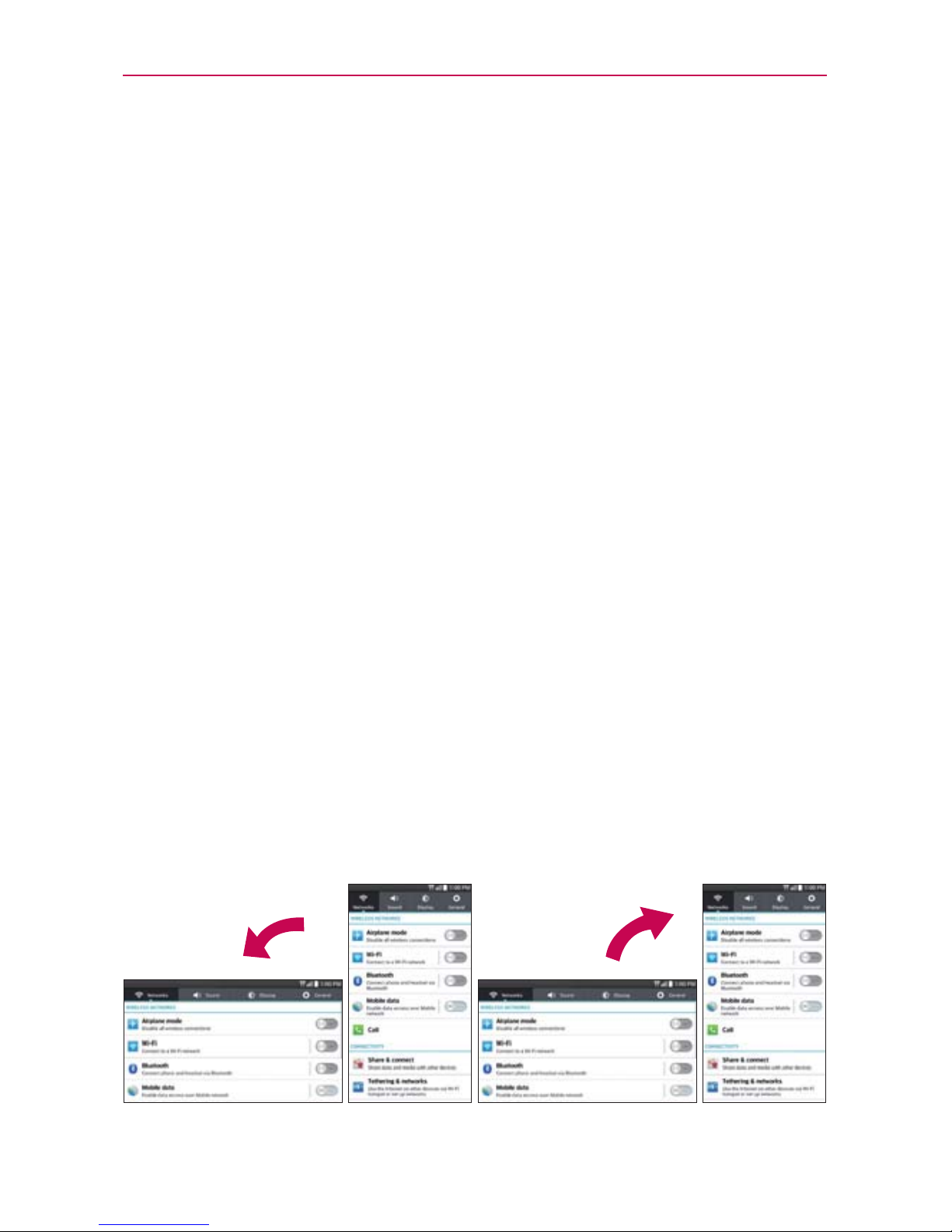
Rotate the screen From many apps and menus, the orientation of the
screen adjusts to the phone’
s physical orientation. You can deactivate this
function in the Display settings menu.
Rotate the phone sideways for
landscape orientation.
Rotate the phone upright for portrait
orientation.
Page 31

31
The Basics
Capturing the screen Press and hold the
Volume Down Key
and
the Power/Lock Key
at the same time to capture the current image
on the screen. The captured image is saved in the
Gallery
app in the
Screenshots folder.
NOTE You cannot capture an image from some videos and apps.
The Smart screen and Smart video features
The Smart screen and Smart video features keep the phone from activating
screen timeout when it detects your eyes looking at the screen. When you
turn these features on, you can set a shorter screen timeout setting to
conserve your battery power, but still allow you to view a screen for a
longer period of time without having to touch it to keep it activated.
To turn these features on, from the Home screen, tap the
Menu Key
>
System settings
>
Display
tab > checkmark the
Smart screen
checkbox
and/or the
Smart video
checkbox.
NOTE The following situations may prevent these features from functioning properly:
• When the phone is in the dark or against bright light.
• When the front camera lens can't detect the location of your eyes.
• When the front camera is used at the same time with other apps.
Page 32

32
The Basics
Text Input Methods
The on-screen keyboard displays automatically on the screen when you
need to enter text. To manually display the on-screen keyboard, simply tap
a text field where you want to enter text.
Touch and hold to enter text
by voice or access the clip
tray and keyboard settings.
Toggles between 123/SYM
mode and ABC mode.
Selection Box
Tap an item (e.g., letter,
word, or symbol) to insert it
in the text field.
Typing tips
Enter other
characters
Tap the
Numbers/Symbols Key
to display the
numbers and symbols keyboard. To view more
symbols, tap the
Arrow Keys
. From the
Numbers/Symbols keyboard, you can also tap
the Graphics key to enter graphics into your
text. To enter foreign characters, touch and hold
the associated key to display a pop-up of
character choices (e.g., the “a” key also includes
an accent mark “á”)
Enter one capital
letter
Tap the
Shift Key
to capitalize the next letter.
The key changes to .
Enter all capital
letters
Double-tap the Shift Key
to set caps lock.
The key changes to . Tap again to revert to
lowercase.
Page 33

33
The Basics
Highlight text
Double-tap a word to highlight it. To highlight a
range of text, double-tap a word, then drag the
blue highlight markers to highlight the text you
want.
Cut or copy selected
text
Highlight the desired text, then tap Cut, Copy,
or Select all in the action box displayed above
the highlighted text.
Paste cut or
copied text
Tap the location where you want to paste the
text, then tap the marker
. Tap Paste in the
action box that appears.
Delete a character
Tap the Delete Key
.
Language toggle
Tap the
Language Key
to toggle between the
languages you set in the Input language and
type menu. Touch and hold this key to modify
your language settings.
NOTE This key is only available when multiple languages have
been enabled for text entry.
Entering text by
voice
Tap the
Voice input Key
(Google voice typing
must be enabled).
Accessing the Clip
Tray
Touch and hold the
Settings
, then tap the
Clip
Tray
icon .
NOTE The Keyboard Settings key is the default option for the
LG Keyboard. If you select the Voice input option, the
chosen key will be displayed instead.
Page 34

34
The Basics
Text input settings
To change your text input settings and see the dictionary of terms you’ve
used, from the Home screen, tap the
Menu Key
>
System settings
>
General
tab >
Language & input
. The following options are available in the
KEYBOARD & INPUT METHODS section.
Default
- Allows you to choose the default keyboard to use when
entering text.
LG Keyboard
- Tap the Settings icon to change the following
settings.
Input language and type
: Allows you to select the keyboard language
and type. This is where you can select multiple languages for your
keyboard input.
Word suggestion
: Allows you to set Auto correction, Suggest next
word, Advanced word suggestion, and Clear history.
Auto capitalization
: Checkmark to automatically capitalize the first
letter of each new sentence.
Auto punctuation:
Checkmark to automatically insert a period when
you double-tap the Space Key.
Voice input
: Checkmark to show the
Voice Input Key
on the
keyboard.
Path input:
Checkmark to enter a word by drawing a path through all
of the letters.
Hide keyboard
: Checkmark to swipe the keyboard down to hide it.
Split keyboard
: Checkmark to spread two fingers to split the
keyboard.
One-handed operation
: Checkmark to allow you to position the LG
keyboard on the left or right side of the screen so that it’s easier to
type with just one hand.
Page 35

35
The Basics
Additional settings
: Allows you to set the additional settings that
include Keyboard theme, Vibrate on keypress, Sound on keypress,
and Preview on keypress.
Help
: Displays text input settings information.
Google voice typing
- Checkmark to select Google voice typing to
enter text. Tap the Settings icon
to change the Google voice typing
settings.
Choose input languages
: Allows you to select the languages to
support with Google voice typing.
Block offensive words
: Checkmark to hide recognized offensive text.
Offline speech recognition
: Allows you to manage the downloaded
languages.
Languages
You can set only one default language for your phone, but you can set
multiple languages used for the on-screen keyboard.
To change the default language
From the Home screen, tap the
Menu Key
>
System settings
>
General
tab >
Language & input
>
Language
> tap the language you
want.
To add additional languages for your keyboard
From the Home screen, tap the
Menu Key
>
System settings
>
General
tab >
Language & input
. Tap the
Settings
icon to the right of
LG Keyboard
, tap
Input language and type
, then checkmark the
languages you want the keyboard to be able to use.
OR
Open the Notifications panel (when an app that allows text input is
open), tap
Choose input method
>
Setup input methods
> the
Settings
icon to the right of
LG Keyboard
>
Input language and type
, then
checkmark the language you want to be able to use.
Page 36

36
The Basics
Apps: How to View, Open, and Switch
All of the apps on your phone, including any apps that you downloaded and
installed from Play Store or other sources, are grouped together on the
Apps screen, which you access from your Home screen. If you have more
apps than can fit on the Apps screen, you can slide the screen left or right
to view more.
Home screen
Apps screen
Tap an app icon to open
the app.
Tap these to select Apps,
Widgets, Search, or Edit.
Tap the Apps icon
to open the
Apps screen.
Slide the screen left or
right to bring more icons
into view.
Opening and Closing the Apps screen
Opening the Apps screen
It’s easy to access the Apps screen no matter what feature you’re currently
using. Simply press the
Home Key
, then tap the Apps icon (in the
QuickTap Bar).
Page 37

37
The Basics
Closing the Apps screen
To manually close the Apps screen, press the
Home Key
or tap the
Back Key
.
NOTE The Apps screen closes automatically when you tap an icon to open its app. Dragging an
icon onto your Home screen also closes the Apps screen automatically.
Customizing the Apps screen
The phone includes a wide variety of apps and you can download even
more apps to your phone. You can customize these items on the Apps
screen for faster, more convenient access (less scrolling) to the apps you
use most often.
Apps screen options
You can change the look of your Apps screen.
1. From the Home screen, tap
the Apps icon
(in the QuickTap Bar).
2. Tap the
Menu Key
to access the following Apps screen options:
View apps by
: Tap to sort your apps either in alphabetical order, by
downloaded date, or user customized.
Show small/large icons
: Tap to change the app icons to either small
or large, then tap
Yes
to set your choice.
Apps wallpaper
: Tap to change the wallpaper background. Scroll
horizontally to view all of your choices, tap the one you want, then tap
Apply
.
Hide/Show apps
: Tap to set which app icons will be displayed in your
Apps screen. Checkmark the icons you want to hide, then tap
OK
.
Rearranging the Apps screen icons
You can rearrange the order of the icons on the Apps screen to provide
more convenient access to the apps you use the most.
1. From the Home screen, tap the
Apps
icon (in the QuickTap Bar).
2. Tap the
Menu Key
>
View apps by
>
User customized
.
Page 38

38
The Basics
3. Tap the
Apps
tab at the top of the screen (if necessary), then tap the
Edit
icon
(in the upper-right corner of the tab bar). changes to a
checkmark
.
4. Touch and hold the app icon you want to move, drag it to its new
position, then lift your finger. The remaining icons shift to the right.
NOTE If you drag the app icon onto another app icon, it creates a folder with both of the apps in
it.
Checking app information
To check on an app’s detail information from the Apps screen:
1. From the Home screen, tap the
Apps
icon (in the QuickTap Bar).
2. Tap the
Apps
tab (if necessary), then tap the
Edit
icon (in the upper-
right corner of the tab bar).
changes to a checkmark .
3. Tap any of the app icons to display an information dialog box.
4. Tap
OK
to exit.
NOTE The
Edit
icon also allows you to display an information dialog box for a widget you
select.
Opening and Switching Apps
Multi-tasking is easy with Android™ because you can use and switch
among several open apps. Android™ manages each app, stopping and
starting them as needed, to ensure that idle apps don’t consume resources
unnecessarily.
Opening an app
Open an app simply by tapping its icon on the screen.
TIP You can customize your Home screen panels with the app icons you use most often.
Apps are located on the Apps screen, but you can copy any app icon to your Home
screen for faster, more convenient access. No matter where the icon is, on the Apps
screen or your Home screen, just tap it to open and use it.
Opening multiple apps
1. Tap an app icon to open it.
2. Press the
Home Key
.
NOTE If the app icon you want is on your Home screen, simply tap the icon to open and use it.
Page 39

39
The Basics
3. Tap the
Apps
icon (in the QuickTap Bar).
4. Tap the
Apps
tab (if necessary), then tap the icon for the other app you
want to open.
Switching between multiple apps
1. Press and hold the
Menu Key
. A screen opens and displays a
scrolling list of all of the apps that are currently open.
2. Tap the app you want to use or tap the
Back Key
to return to the
current screen.
Tap an icon to use it.
You can also tap the app image, but if
you tap the screen background, you
return to the Home screen.
Flick an app icon to the right or left to
close the app and remove it from the list.
Swipe up or down to view
the entire list of open apps.
NOTE Navigation in the Recent apps screen depends on the phone orientation. When held
sideways, swipe left and right to view the entire list. Flick an app icon up or down off the
screen to close the app and remove it from the list.
Page 40

40
The Basics
Adding items to the Home screen
Customize your Home screen with the apps you use most often.
Apps screen
1. From the Home screen, tap the
Apps
icon (in the QuickTap Bar) and
tap the
Apps
tab, if necessary.
NOTE You can also tap the
Widget
tab (at the top of the screen) to place a widget on the Home
screen.
2. Touch and hold the icon you want to add to your Home screen. The Apps
screen closes and the Home screen is displayed.
3. Lift your finger to place it or drag the icon to where you want it on the
screen, then lift your finger.
Dual view
1. Touch and hold an empty spot on any of the Home screen panels to
view your Home screen on top and the choices (
Apps
tab,
Widgets
tab,
or
Wallpapers
tab) on the bottom.
2. Flick sideways to scroll through the Home screen panels to display the
panel you want.
3. Tap the tab for the type of item you want to add (Apps, Widgets, or
Wallpapers) at the bottom of the screen, then flick sideways to scroll
through the available choices.
4. Tap the item you want to automatically add it to the panel viewed at the
top of the screen.
Moving apps to other Home screen panels
You can place app icons on any of the Home screen panels. Touch and hold,
then drag the icon to the left or right edge of the screen to advance to the
other panels before lifting your finger.
Page 41

41
The Basics
Customizing an app icon on your Home screen
You can create your own custom app icon(s) using the images in your
Gallery. Your customized app icon(s) are only applied to icons on your Home
screen. The Apps screen is not affected.
Touch, hold, release,
then tap an icon to
edit it.
Customize Icon
Screen
Home Screen
1. Touch and hold the icon you want to customize, then release the icon.
An editing icon
appears in the upper-right corner of the app icon.
NOTE If an icon you placed can be resized, you'll see a blue box around the icon after you
touch, hold, and release it. Drag the edges of the box to resize it.
2. Tap the app icon (while the edit icon is still displayed).
3. Tap the icon design you want from the available
Theme icon
choices and
change the size (if desired), then tap
OK
.
OR
㻌 Tap
Photo icon
, then tap
Add new
. Set the size for the icon, then tap
OK
. Select the image you want to use for the app. Crop the image
(choose
Crop photo
or
Crop picture
, then
Always
or
Just once
), then tap
OK
.
NOTE Your custom photo icons are saved so you can easily select them for any of your icon
images.
Page 42

42
The Basics
Changing an icon into a widget
Some app icons can be changed into a convenient widget to use on your
Home screen.
1. Touch and hold the icon you want to customize, then release the icon.
㻌
A blue frame appears around the icon if it can be resized and changed
into a widget (if it can’t, only the Edit icon is displayed).
2. Drag the corners of the frame to make it larger and change it into a
widget.
㻌
Touch, hold, and release the widget again to change the size of the
widget, if necessary.
㻌
You can also change it back into a normal icon by dragging the corners
of the resizing frame back in.
Working with Menus
Options menus
Options menus contain tools that apply to the activities of the current
screen or app, not to any specific item on the screen. To open the available
Options menu, tap the
Menu Key
. Not all apps have Options menus; if
you tap the
Menu Key
on a screen that has no Options menu, nothing
will happen.
Context menus
Context menus contain options that apply to a specific item on the screen.
To open a Context menu, touch and hold an item on the screen. Not all
items have Context menus. If you touch and hold an item that has no
Context menu, nothing will happen.
Page 43

43
The Basics
When you touch and
hold certain items on
a screen, a Context
menu opens.
Managing Notifications
Notification icons report the arrival of new messages, calendar events,
alarms, as well as ongoing events, such as when you’re in a call.
When you receive a notification, the notification icon will be displayed in the
Status Bar. You can open the Notifications panel to view a list of all of your
recent notifications. Depending on your settings, you may hear a notification
sound, and/or see a notification light around the Home Key
, and/or the
phone may vibrate.
To open the Notifications panel
Touch and drag the Status Bar to the bottom of the screen.
The Notifications panel displays a list of your current notifications, organized
into ongoing and event-based notifications. It also includes two icon bars.
The Quick Settings bar allows you to quickly and easily change commonly
used settings. The QSlide apps bar allows you to use an app in a small,
moveable window (similar to picture-in-picture on a TV).
NOTE You can also access the complete Settings menu from this panel by tapping the
Settings
icon
(in the upper-right corner of the screen).
Page 44

44
The Basics
Clear Button
Tap here to clear your list of
event-based notifications.
Tap a notification to open it.
Quick Settings Bar
Tap an icon to change its
setting.
QSlide Apps Bar
Tap an icon to activate a
QSlide window.
Home screen Notifications Panel
To respond to a notification
1. Open the Notifications panel. Your current notifications are listed in the
panel, each with a brief description.
2. Tap a notification to view it.
The Notifications panel will close and the app that corresponds to your
selection will open. For example, new voicemail notifications dial your
voicemail box and Gmail notifications open the Gmail app so you can
read your new messages.
To clear all notifications
1. Open the Notifications panel.
2. Tap the
Clear
button
on the right side of the screen.
All event-based notifications will be cleared; ongoing notifications will
remain in the list.
To close the Notifications panel
Touch and drag the handle at the bottom of the Notifications panel to the
top of the screen or just tap the
Back Key
.
The panel will also close when you touch a notification.
NOTE You can also flick the Notifications panel handle upward to quickly close it.
Page 45

45
The Basics
Quick settings on the Notifications panel
The top of the Notifications panel includes a Quick settings bar. The icons in
this bar provide a quick, convenient way to change settings without
accessing any apps. If you set more than five icons on the bar, swipe left
and right to scroll through the list.
Using the Quick settings bar icons
Tap any of the Quick settings icons to toggle through the available settings:
QuickMemo
starts a QuickMemo.
QSlide On
or QSlide Off .
Sound On
, Vibrate , or Silent .
Wi-Fi On
or Wi-Fi Off .
Mobile Data On
or Mobile Data Off .
Rotation On
or Rotation Off .
Location On
or Location Off .
Bluetooth On
or Bluetooth Off .
Hotspot On
or Hotspot Off .
Airplane mode On
or Airplane mode Off .
Sync On
or Sync Off .
NFC On
or NFC Off .
Battery saver On
or Battery saver Off .
Miracast On
or Miracast Off .
Quiet mode On
or Quiet mode Off .
Screen timeout 30 seconds
, 5 minutes or 15 minutes .
Wireless storage On
or Wireless storage Off .
Tap the
Settings
icon (at the top right corner of the screen) to access the
complete Settings menu.
Page 46

46
The Basics
Customizing the Quick settings bar icons
You can set the order of the icons displayed in the Quick settings bar as
well as which icons are displayed.
1. Open the Notifications panel, then tap the
Edit
icon at the right side
of the Quick settings bar.
Drag one of the icon handles
at the right side of the screen to
move its icon to another position in the Quick settings bar.
Checkmark each of the items you want to appear in the Quick
settings bar.
NOTE Changing the checkmarks reorganizes the icons in the Quick settings bar.
2. Tap the
Back Key
to return to the Notifications panel.
QSlide apps bar on the Notifications panel
QSlide apps are displayed in a bar on the Notifications panel below the
Quick settings bar. These icons provide a quick, convenient way to multitask on the same screen (similar to picture-in-picture on a TV). QSlide
displays a small app window on the screen that can be moved, resized, or
made transparent.
Using the QSlide apps
Tap any of the QSlide apps in the bar to activate it. When activated, the
QSlide feature opens the app in a window in the foreground, allowing you
to access other apps in the background. You can open up to two QSlide
windows at a time.
Drag the QSlide title bar to move it to another position on the screen.
Drag the bottom right corner of the QSlide window to resize it.
Move the circle on the slider bar to the left to make it transparent. This
will allow you to interact with items beneath the transparent QSlide
window. Move the slider back to the right to use the QSlide window
again.
Page 47

47
The Basics
Tap the QSlide icon
(in the upper-left corner of the title bar) to open
the app in full screen view. To go back to the QSlide window, tap the
QSlide icon (in the top of the screen).
Tap the Close icon
(in the upper-right corner of the title bar) to close
the QSlide window.
Customizing the QSlide bar apps
You can set the order of the apps displayed in the QSlide bar, as well as
which apps are displayed.
1. Open the Notifications panel, then tap the
Edit
icon on the far right of
the QSlide apps bar.
Drag one of the icon handles
at the right side of the screen to
move its icon to another position in the QSlide apps bar.
Checkmark the QSlide apps you want to display and remove the
checkmark for the ones you want to remove.
2. Tap the
Back Key
to return to the Notifications panel.
Searching Your Phone and the Web
You can search for information on your phone and on the web using the
Google Search app. The Google Search widget is pre-loaded on your Home
screen.
Some apps, such as Gmail, Contacts, and Chrome have the ability to search
for contents within those specific apps.
You can conduct the search by typing in the search terms or saying what
you’re looking for. As you enter text, the search app can provide
suggestions so you don’t necessarily have to type out your full request.
Phone and Web search using text entry
1. Tap the
Google Search
widget on the Home screen.
Google Search opens automatically and the on-screen keyboard is
displayed.
Page 48

48
The Basics
Voice Search
Tap here to search by voice.
2. Enter the text you’re searching for in the search box.
As you type, search results from your
phone, previous search terms, and
web search suggestions appear. Tap
an item to activate that search result.
3. Tap the
Search Key
on the on-screen keyboard to use the Google
Search app to search for the text you entered in the search box.
NOTE You can tap
Web, Images, News
, or
More
(at the bottom of the screen) for alternate,
specific types of search results.
Google Search Options menu
Tap the
Menu Key
to access
Settings, Send feedback
, and
Help
.
Page 49

49
The Basics
Locking the Screen
You can lock your phone so that only you can unlock it to make calls, access
your data, buy apps, and prevent unauthorized use.
Setting a Screen Lock for the First Time
1. From the Home screen, tap the
Menu Key
>
Lock screen settings
.
2. Tap
Select screen lock
.
3. Tap
None
, Swipe,
Knock Code
, Face Unlock, Pattern, PIN, or
Password.
None
: No lock screen is enabled so the screen will never be locked from
use.
S
wipe
: A swipe motion in any direction on the touchscreen will unlock
the screen. This is the default Lock screen that simply guards against
unintentional actions.
Knock Code
: Unlocks the screen using a knock pattern on a 2x2 grid.
The first time you set a knock code, you'll see a tutorial with instructions
on how to create it. Tap a sequence on the 2x2 grid (from 2 to 8 taps),
then tap
Continue
. Tap your sequence again and tap
Continue
once
more to confirm.
NOTE You're prompted to create a Backup PIN as a safety measure in case you forget your
Knock code unlock sequence.
Face Unlock: Unlocks the screen using face recognition. The phone
captures your image to identify you. Keep in mind that Face Unlock is
less secure than a pattern, knock code, PIN, or password because it
uses generalized shape and dimension to verify your face.
Pattern
: Unlocks the screen using a pattern you draw with your finger.
The first time you set an unlock pattern, you'll see a tutorial with
instructions on how to create it. Read the tutorial, then tap
Next
. Draw
your pattern (connect at least 4 dots) and tap
Continue
. Then redraw
your pattern and tap
Confirm
.
NOTE You're prompted to create a Backup PIN as a safety measure in case you forget your
unlock pattern sequence.
Page 50

50
The Basics
PIN:
Unlocks the screen with a number sequence. Enter a PIN (at least 4
digits) and tap
Continue
. Reenter your PIN and tap OK to confirm it.
Password:
Unlocks the screen with an alphanumeric sequence. Enter a
password (at least 4 characters) and tap
Continue
. Re-enter your
password and tap OK to confirm it.
From then on, any time you want to unlock the screen, you'll need to
perform the unlock action you set (swipe, face recognition, pattern,
knock code, PIN, or password) to gain access to it.
Disabling the Screen Lock
1. From the Home screen, tap the
Menu Key
>
Lock screen settings
.
2. Tap
Select screen lock
.
3. Confirm your unlock information (if necessary).
4. Tap
None
.
Changing Your Screen Lock
1. From the Home screen, tap the
Menu Key
>
Lock screen settings
.
2. Tap
Select screen lock
.
3. Confirm your unlock information (if necessary).
4. Tap the desired screen lock option.
5. You’re prompted to enter your screen lock.
6. If necessary, enter a Backup PIN and tap
Continue
. Then confirm your
Backup PIN and tap OK.
NOTES • If you've set up a Microsoft Exchange account, you might only be able to use a
password.
• If you can't remember your unlock sequence, tap the
Forgot
button in the bottom
right-hand corner of the screen, then you can unlock the phone using your Google
Account (if you created it on the phone) or your Backup PIN that you created when you
set up the screen lock sequence.
– Enter your Google Account username and password, then tap
Sign in
.
– Enter your Backup PIN, tap
Done
at the bottom right corner of the keypad, then tap
OK
.
Page 51

51
The Basics
Unlocking your screen using the Knock Code feature
The Knock Code feature allows you to create your own unlock code using a
combination of knocks (or taps) on the screen.
1. While the screen is off, tap the same sequence you established anywhere
on the screen. The Home screen will be accessed directly.
NOTE KnockON is deactivated when Knock Code is in use.
Lock timer
If a security lock is enabled, you can set the delay time after the screen
darkens due to inactivity before the screen automatically locks and requires
you to enter your unlock sequence.
1. From the Home screen, tap the
Menu Key
>
Lock screen settings
.
2. Tap
Lock timer
, then tap the setting you want to use.
Power button instantly locks
If a security lock is enabled, checkmark the
Power button instantly locks
checkbox to override the Security lock timer setting and lock the screen as
soon as you press the
Power/Lock Key
.
1. From the Home screen, tap the
Menu Key
>
Lock screen settings
.
2. Checkmark the
Power button instantly locks
checkbox.
The Lock screen wallpaper
You can set the Lock screen wallpaper separately from your Home screen
wallpaper.
1. From the Home screen, tap the
Menu Key
>
Lock screen settings
.
2. Tap
Wallpaper
.
Tap
Gallery
to select an image from your Gallery.
Tap
Wallpaper gallery
to select one of the available wallpaper images.
Page 52

52
The Basics
The default Lock screen
The default Lock screen is
Swipe
which protects against unintentional
touchscreen actions. Press the
Power/Lock Key
or the
Home Key
to illuminate the touchscreen if it timed-out. The
Swipe
default Lock
screen is displayed, but you can still conveniently check the date, time, and
Status Bar icons. You can drag the Status Bar down to open and use the
Notifications Panel without unlocking the screen. In addition, you can also
quickly access four shortcut apps (the
Phone
app , the
Messaging
app ,
the
Email
app , and the
Camera
app ) without unlocking the screen
first. Simply swipe an icon upward to open and use it.
Changing the shortcut icons on the default Lock Screen
1. From the Home screen, tap the
Menu Key
>
Lock screen settings
.
2. Tap
Shortcuts.
NOTE You can access the
Shortcuts
setting only when the lock screen is set to
Swipe
.
3. Tap one of the icons at the bottom of the screen, then tap the app you
want to replace it with.
4. Tap
Save
to save these settings.
Hard Reset (Factory Data Reset)
If you forget your lock sequence and backup PIN, you’ll have to perform a
hard reset to gain access to your phone.
WARNING Performing a hard reset deletes all of your user data, which includes pictures, videos,
and music saved to your internal memory. Please make sure to back up your information
prior to performing a hard reset.
1. Turn the phone off.
2. Press and hold the following keys at the same time:
Volume Down Key
+
Power/Lock Key
.
3. Release both of the keys when the System recovery screen is displayed.
4. Press either of the
Volume Keys
to highlight
Factory data reset
,
then press the
Power/Lock Key
.
NOTE Highlight
Continue reboot
to simply restart your phone without performing a hard reset.
Page 53

53
The Basics
5. The Factory data reset screen is displayed. Press either of the
Volume
Keys
to highlight
Yes
(or No to exit), then press the
Power/Lock
Key
to continue.
6. Your phone will perform a hard reset.
Guest Mode
Use
Guest mode
when you let someone else use your phone. They’ll only
be able to use the apps that you’ve selected. Once you set it up, you can
easily put your phone in Guest mode by accessing the Lock screen and
drawing the guest pattern that you set, which is different from your normal
unlock pattern.
NOTE Guests can also use apps that your selected apps are linked.
Setting up Guest mode
1. From the Home screen, tap the
Menu Key
>
System settings
>
General
tab >
Guest mode
.
2. Tap
Set pattern
, then set the pattern you want to use to put your phone
in Guest mode.
3. Tap
Set apps
to view which apps can be accessed in Guest mode. Tap
the
Add
icon (in the upper-right corner of the screen) to change the
Guest apps list.
Checkmark the apps that can be accessed.
Remove checkmarks from the apps that you don't want to be
accessed.
Tap
OK
when all of the checkboxes are set as you want.
4. Tap the
Back Key
to return to the Guest mode settings, then tap the
Guest mode
switch (in the upper-right corner of the screen) to turn
it on.
If your Lock screen is not set to Pattern, tap
OK
, then tap
Pattern
and
enter your normal unlock pattern as necessary.
NOTE If your unlock sequence is set to a PIN or password, you'll need to enter it to be able set
the unlock pattern.
Page 54

54
The Basics
Using Guest mode
After you’ve set up and enabled Guest mode, lock the screen, then press
the
Power/Lock Key
to re-display the Lock screen. Enter your Guest
mode pattern. The Guest mode Home screen is displayed with only the
apps you’ve selected for guest access. To exit Guest mode, simply access
the Lock screen again and enter your normal unlock pattern.
NOTE The
Guest mode
feature is automatically turned off if your lock sequence is changed
from Pattern. Otherwise, manually disable it if you no longer want to allow guest access.
Customizing the Home Screen
You can personalize your Home screen by adding app icons, shortcuts,
widgets, and other items to any Home screen panel. You can also change
the wallpaper.
To add an item to the Home screen
1. Touch and hold an empty spot on the Home screen panel where you
want to add the item. The screen changes to Dual view (your Home
screen panels on top and the Apps screen on the bottom).
NOTE If the panel you've selected is full, make space by deleting or moving items, or switch to
another panel where there is space for new items.
2.
The Apps, Widgets
, and
Wallpapers
category tabs are displayed at the
bottom of the screen. Tap the one that corresponds to the item you
want to add.
Item List
Touch and hold an icon, then drag it
onto the panel where you want it.
Category Tabs
Tap one of the item categories you want
to add to a Home screen panel.
Slide the screen right or left to view
different Home screen panels.
Page 55

55
The Basics
3. Swipe left and right to scroll through the available choices in the
category tab you selected. Touch and hold the item you want, then drag
it onto the Home screen panel, or simply tap it to automatically place it
on the panel.
To move an item on the Home screen
1. Touch and hold the item.
2. Drag the item to a new location on the screen.
Pause at the left or right edge of the screen to drag the item onto the
next available Home screen panel.
3. When the item is where you want it, lift your finger.
To remove an item from the Home screen
1.
Touch and hold the item.
2.
Drag the item to the
Remove
icon
at the top of the screen.
3. When the
Remove
icon changes to , lift your finger.
To change the look of your Home screen
From the Home screen, tap the
Menu Key
>
Home screen settings
to
access the following settings to personalize your Home screen.
Select Home
: Sets the type of Home screen layout. Choose Home
(standard Android layout) or EasyHome (simplified version for users less
familiar with Android navigation).
NOTE To change from the EasyHome setting to the Home setting, tap the
Menu Key
>
System settings
>
Display
tab >
Home screen > Select Home > Home
.
Theme
: Sets the overall ambiance of the Home screen.
Wallpaper
: Sets the wallpaper. Choose from Gallery, Live Wallpapers,
Multi-photo, Photos, and Wallpaper gallery.
Screen swipe effect
: Sets how the items on the Home screen panels
slide from one to the next. Choose from Basic, Breeze, Accordion,
Panorama, Carousel, Layer, and Domino.
Page 56

56
The Basics
Allow Home screen looping
: Checkmark this setting so that the Home
screen panels rotate continuously (first screen redisplays after the last
screen).
Portrait view only
: Checkmark this setting so that the Home screen is
always displayed in portrait view even if you rotate the phone to
sideways.
Home backup & restore
: Allows you to back up and restore app and
widget layouts and themes applied to the Home screen.
Help
: Tap to view help information about customizing the Home screen.
Page 57

57
Connecting to Networks and Devices
Connecting to Mobile Networks
When you buy your phone and sign up for service, your phone is configured
to use your provider’s mobile networks for voice calls and for transmitting
data.
Different locations may have different mobile networks available.
Initially, your phone is configured to use the fastest mobile network
available for data. You can also configure your phone to access a different
set of networks entirely, or to behave in specific ways when roaming.
The following icons in the Status Bar indicate which kind of data network
you’re connected to and the network signal strength.
Connected to the 4G network (LTE).
Connected to the EVDO network (EVDO revA).
Signal strength - the more bars that are lit, the stronger the
wireless signal.
Connected to another wireless service provider’s network
(roaming).
When connected to slower networks, you may want to postpone using
your phone for data-intensive tasks until you’re connected to a faster
network again or find a Wi-Fi network to connect to.
To disable data when roaming
You can prevent your phone from transmitting data over other carriers’
mobile networks when you leave an area that is covered by your carrier’s
networks. This is useful for controlling expenses if your cell plan doesn’t
include data roaming.
1. From the Home screen, tap the
Menu Key
>
System settings
>
Networks
tab >
Tethering & networks > Mobile networks
.
2. Tap
Data roaming
to remove the checkmark from the box. You can still
transmit data with a Wi-Fi connection when
Data roaming
is disabled.
Page 58

58
Connecting to Networks and Devices
Connecting to Wi-Fi Networks
Wi-Fi is a wireless networking technology that can provide Internet access
at distances of up to 100 meters, depending on the Wi-Fi router and your
surroundings.
To use Wi-Fi on your phone, you must connect to a wireless access point.
Some access points are open and you can simply connect to them. Others
are hidden or implement other security features, so you must configure
your phone so it can connect to them.
Turn off Wi-Fi when you’re not using it, to extend the life of your battery.
The following Status Bar icon indicates your Wi-Fi status.
Connected to a Wi-Fi network (waves indicate connection
strength).
When you connect to a Wi-Fi network, the phone obtains a network
address and other information it needs from the network, using the DHCP
protocol. To configure the phone with a static IP address and other
advanced settings, from the Wi-Fi settings screen, touch
and hold the
connected network. Tap Modify network in the Context menu that appears,
then checkmark the Show advanced options
checkbox.
To turn Wi-Fi on and connect to a Wi-Fi network
1. From the Home screen, tap the
Menu Key
>
System settings
>
Networks
tab >
Wi-Fi
.
If the Wi-Fi button
is on the left and the icon is grey-colored, drag
the button to the right to turn on Wi-Fi. Your phone scans for available
Wi-Fi networks.
2. Tap a network, then tap
Connect
to connect to it.
If the network is open, you can connect to the network directly by
tapping the network name.
If the network is secured, you’ll be prompted to enter a password
(Ask your network administrator for details).
Page 59

59
Connecting to Networks and Devices
When you’re connected to a network, you can tap the network name
in the Wi-Fi settings screen for details about the speed, security,
address, and related settings.
To add a Wi-Fi network
You can add a Wi-Fi network so the phone will remember it, along with any
security credentials, and connect to it automatically when it’s in range. You
can also add a Wi-Fi network manually if it doesn’t broadcast its name
(SSID) or if you want to add a Wi-Fi network when you’re out of its range.
To add a secured network, you need to contact the network’s administrator
to obtain the password or other required security credentials.
1. Turn on Wi-Fi, if it’s not already on, then tap
Wi-Fi
in the Settings menu.
2. From the Wi-Fi settings screen, tap the
Menu Key
, then tap
Add
network
.
3. Enter the Network SSID (name) of the network.
4. If the network is secured, tap Security and tap the type of security
deployed on the network.
Enter the required passwords and security
credentials.
5. Tap
Connect
to save the information.
The phone will connect to the wireless network (if it's currently within
range). Any credentials that you entered are saved, so you're connected
automatically anytime you come within range of this network.
To forget a Wi-Fi network
You can make the phone forget about the details of a Wi-Fi network that
you added. For example, if you don’t want the phone to connect to it
automatically or if it’s a network that you no longer use.
1. Turn on Wi-Fi, if it’s not already on, then tap
Wi-Fi
in the Settings menu.
2. In the Wi-Fi settings screen, touch and hold the name of the network
that you want to forget.
3. Tap
Forget network
in the Context menu that appears.
Page 60

60
Connecting to Networks and Devices
USB Connection
USB connection is a feature that allows your phone to connect to a PC
using a USB Cable.
To select a USB mode for a connection
1. From the Home screen, tap the
Menu Key
>
System settings
>
General
tab > PC connection > Select USB connection method.
2. Tap
Media sync (MTP), Tethering, LG software
, or
Send images (PTP)
to
connect to the PC.
Tap Charge phone to use only the charging function and not the USB
function. It also allows you to safely disconnect your phone from your
PC.
NOTE The MTP driver may not be installed on your PC by default. The driver is dependent on
the PC's versions of Windows
®
and Windows Media Player (WMP).
Connection mode prompt
You can choose to be asked to confirm the USB connection when
connecting to a computer.
1. From the Home screen, tap the
Menu Key
>
System settings
>
General
tab >
PC connection
.
2. Checkmark the
Ask upon connecting
checkbox to display a USB
selection window each time you connect your phone to a PC.
Using the Status Bar to change the connection mode setting
The Status Bar displays the current USB connection mode so you can
easily change the setting as needed.
When connected via USB, the current USB connection mode also appears
on the Notifications panel. Tap the connection setting to display a screen
where you can change the USB connection mode.
NOTE If the Ask upon connecting checkbox is marked, the pop-up message is only provided
during USB connection, but is not provided in the notification area.
Page 61

61
Connecting to Networks and Devices
SmartShare
You can use the SmartShare feature easily in the Gallery, Music, Video
apps.
Enjoying content via a variety of devices
You can share your phone’s content with a variety of devices. Tap to
share the content in the Gallery, Music, Videos apps.
Playing/Sending
Play
: You can play the content via a TV, a Bluetooth speaker or etc.
Beam
: You can send the content to the device of Bluetooth and
SmartShare Beam supported.
SmartShare Beam
: Transferring the content feature fast via Wi-Fi
Direct.
< Play > < Beam >
Enjoying the content from Nearby devices
You can enjoy the content from nearby devices (i.e. PC.NAS, Mobile) in the
Gallery, Music, Videos apps.
Connecting devices
Connect your device and other DLNA-supported devices in the same Wi-Fi
network.
Searching other devices
1. Tap
Nearby devices
to view the available nearby DLNA-supported
devices.
2. Connect to the device to view the content.
Page 62

62
Calls
Placing and Ending Calls
The
Phone
app allows you to dial phone numbers manually or make calls
from your phone’s memory. Manually dial calls using the
Dial tab
. Dial from
your phone’s memory using the
Call logs
calls tab, the
Contacts
tab, the
Favorites
tab, or the
Groups
tab.
To open the Phone app
From the Home screen, tap the
Phone
icon (in the QuickTap Bar).
Phone app tabs
The
Phone
app tabs (
Dial
,
Call logs
,
Contacts
,
Favorites
, and
Groups
) are at the top of the screen.
Moving between the Phone app tabs
Tap any of the
Phone
app tabs (
Dial
,
Call logs
,
Contacts
,
Favorites
, and
Groups
) at the top of the screen to view that tab. You can also
flick horizontally on the screen to scroll to the other tabs. The blue slide
triangle on the tab bar indicates the current tab.
Modifying the Phone app tabs
You can rearrange the order of the Phone app tabs and/or delete the
Favorites and Groups tabs.
1. From the Home screen, tap the
Phone
icon (in the QuickTap Bar).
2. Tap the Menu Key
, then tap
Edit tabs
.
Drag a tab handle
to move it to the position where you want it in
the list.
Tap the
Favorites
or
Groups
checkbox (a checkmark displays the tab;
no checkmark deletes it from the Phone app tabs bar).
3. When you're finished making changes, tap
Save
.
Page 63

63
Calls
To place a call by dialing
1. From the Home screen, tap the
Phone
icon (in the QuickTap Bar) to
open the
Dial
tab of the
Phone
app.
Touch and hold to enter
the plus ( + ) symbol to dial an
international number.
Message Key
Tap here to send a message to
the number that you entered.
Dial Tab
Displays the dialpad.
Call Key
Tap here to dial the number that
you entered manually.
Delete Key
Tap here to delete incorrect
number(s) (appears after you
begin entering numbers).
2. Enter the number you want to call on the dialpad.
If you enter a wrong number, tap the
Delete Key
to erase digits
one by one.
To erase the entire number, touch and hold the
Delete Key
.
To dial an international number, touch and hold
to enter the plus ( + )
symbol. Then enter the international prefix for the country, followed by
the full phone number.
3. Tap the
Call Key
to dial the number that you entered.
Press the
Volume Keys
to adjust the call volume.
Use the on-screen buttons to enter additional numbers, place the call
on hold to take another incoming call, add another call, use the
speakerphone, end the call, and other options.
You can use other phone features while the call is underway. If you
open another app, the
Call
icon appears in the Status Bar for the
duration of the call.
NOTE If you opened other apps while on a call, you'll need to return to the Call screen to end
the call. To return to the Call screen, you can press the
Home Key
, then tap the
Phone
icon (in the QuickTap Bar), or drag the Notifications panel down and tap the
Call
icon . You can also tap the ongoing call icon in the upper-left corner of the
Home screen.
Page 64

64
Calls
To end a call
Simply tap the
End
button on the Call screen to end the call.
If you accessed other device functions while the call was in progress, there
are several ways to return to the Call screen to end the call.
Press the
Home Key
, tap the
Phone
icon (in the QuickTap Bar),
then tap the
End
button on the Call screen.
Press the
Home Key
, tap the ongoing call icon in the upper-left
corner of the Home screen, then tap the
End
button on the Call
screen.
Drag the Notifications panel down, then tap the
End call
button on
the Notifications panel.
NOTE You can also press the
Power/Lock Key
, to end the call, if you activated this
feature in the Call settings menu.
Calling numbers in your phone’s memory
You can place calls using information stored in your phone. Anywhere you
see a Call icon
next to a number, tap it to automatically dial it.
Speed dialing
If you set up Speed dials in the
Contacts
app, you can dial a number by
simply touching and holding the Speed dial number on the dialpad.
From the Home screen, tap the
Phone
icon (in the QuickTap Bar),
then touch and hold the Speed dial number.
Direct dialing
A Direct dial widget is like a speed dial button on your Home screen. Tap it
to automatically call the number you set (for example, your home phone
number).
To place a Direct dial widget on your Home screen
1. Touch and hold an empty area on your Home screen.
2. Tap the
Widgets
tab >
Direct dial
.
Page 65

65
Calls
3. Tap the contact in your Contacts list.
TIP You can change the look of each Direct dial icon for easy identification. Touch, hold, and
release the Direct Dial icon, then tap it. Select a theme icon or a photo icon, then tap
OK
.
Answering or Rejecting Calls
When you receive a phone call, the Incoming call screen opens with the
caller ID and any additional information about the caller that you’ve saved in
the Contacts list. All incoming calls are recorded in the Call logs tab.
To answer a call
Swipe the
Answer
icon in any direction to answer the call.
If you were already on a call, tap the
Answer Key
to place the first call
on hold while you answer the new call.
NOTE To silence the incoming call ringer, press either of the
Volume Keys
.
Swipe the Answer
icon in any direction
to answer the call.
Page 66

66
Calls
To decline a call and divert it to voicemail
Swipe the
Decline
icon in any direction to ignore the call.
The caller is sent directly to your voicemail box to leave a message.
Swipe the
Decline with
message
icon in any direction
to send a quick message to
the caller and forward them to
your voicemail.
Swipe the Decline
icon
in any direction
to decline the call.
NOTE To silence the ringer, press either of the
Volume Keys
.
To decline a call and send a text message
The Decline with message option is only displayed on the incoming call
screen.
Swipe the
Decline with message
icon in any direction.
Tap the text message you want to send in place of answering the call.
NOTE This feature can only be used to send a message to another mobile phone. It's not
applicable to incoming landline calls.
Working With the Call Logs Tab
The Call logs tab records all of the calls you’ve dialed, received, or missed.
It offers a convenient way to redial a number, return a call, or add a number
to your Contacts.
To open the Call logs tab
From the Home screen, tap the
Phone
icon (in the QuickTap Bar).
then tap the
Call logs
tab at the top of the screen.
Page 67

67
Calls
The Call logs tab lists your calls chronologically by phone number and call
type. The number in parenthesis indicates the number of calls recorded
for that phone number.
Call logs Tab
Tap to display the
history of all of your
calls.
Call Icon
Tap here to call this
phone number.
Viewing call entry details
Open the
Call logs
tab, then tap an entry to view all of the entries for that
phone number. Calls are listed chronologically and each one includes the
call type (received
, dialed , and missed ), the date, and the time of
the call.
Filtering your list of calls
To view a specific call list, from the
Call logs
tab, tap the
Menu Key
,
then tap
Filter
. Tap the call type you want to view.
Tap the
Back Key
to to return to the
Call logs
tab screen.
To dial a number in the Call logs tab
From the
Call logs
tab, tap the
Call Key
at the right of the call entry.
From the
Call logs
tab, tap the image to the left of the call entry to view
all of the contact's numbers saved in your phone’s memory. Tap a phone
number to dial it.
TIP You can edit a phone number in the
Call logs
tab before you place the call (e.g., to insert
an area code when you're traveling). Touch and hold the entry, then tap
Edit number
before call
in the Context menu. Edit the number as necessary, then tap the
Call Key
on the keypad.
Page 68

68
Calls
To add a number from the Call logs tab to your Contacts
1. Open the
Call logs
tab, then touch and hold the call entry.
2. Tap
Add to Contacts
in the Context menu.
3. Tap
New contact
or
Update contact
and save it as necessary.
Clearing your recent calls
You can delete the entire list of recent calls at once or selectively delete
entries.
1. Open the
Call logs
tab.
2. Tap the
Menu Key
.
Tap
Delete
to select entries to remove from the list. Checkmark the
entries to delete, tap
Delete
, then
Yes
.
Tap
Delete all
to remove all of the entries from the list. Tap
Yes
to
confirm you want to clear the entire list.
NOTE You can also select a specific number to be deleted. Touch and hold an entry in the
Call
logs
list to open the Context menu. Tap
Delete all logs of this number
, then tap
Ye s
to
confirm.
Calling Your Contacts
Instead of manually dialing phone numbers using the dialpad, you can use
your Contacts list to dial quickly and easily. You can also quickly call a
contact using Quick Contact or Direct dial icons that you placed on your
Home screen.
If you have contacts on the web, they’re synchronized with your phone
when you first synchronize with your Google™ Account.
To call a contact
1. From the Home screen, tap the
Contacts
icon (in the QuickTap Bar).
2. Tap the contact you want to call.
3. Tap the contact’s phone number you want to call.
Page 69

69
Calls
To call a favorite contact
1. From the Home screen, tap the
Contacts
icon (in the QuickTap Bar),
then tap the
Favorites
tab at the top of the screen.
2. Tap the contact you want to call.
3. Tap the contact’s phone number you want to call.
Instant List
Instant list is displayed on the
Dial
tab to help you use the information
stored in your phone without needing to search for it first. Once you begin
entering numbers, Instant list displays entries from your Contacts list or
Recent calls that match the sequence you entered.
Sequence matches
Your phone searches for the entered sequence anywhere in the number;
beginning, end, or anywhere in-between. The matching number sequence
is displayed within the number in blue text. The name and type of number
(i.e., Mobile, Work, etc.) associated with the number you entered is
displayed above the dialpad. When there are multiple matches, the Instant
list displays the number of matches in your phone's memory. Tap the
Instant list icon
on the right side of the screen to view the entire list of
matching entries. Tap
Cancel
(at the bottom of the screen) to close the list.
Selecting an Instant list entry
Tap an entry in the Instant list to insert it on the dialpad and tap the
Call Key
(on the dialpad) to dial it.
Page 70

70
Calls
Options During a Call
Mute Button
Tap here to mute the microphone
during a call. The light bar
illuminates when the microphone
is muted.
Bluetooth Button
Tap here to switch between a
Bluetooth device and the phone.
The light bar illuminates to indicate
that the call is using a Bluetooth
device. The button is gray out
when there's no Bluetooth device
available.
Speaker Button
Tap here to turn the speakerphone
on or off. The light bar illuminates
when it's on.
To mute the microphone
Tap the
Mute
button
on the Call screen.
The light bar on the
Mute
button illuminates to indicate that the
microphone is muted.
When viewing the Call screen, you can unmute the microphone by
tapping the
Mute
button again.
The microphone is unmuted automatically when the call ends.
To turn the speakerphone on or off
Tap the
Speaker
button
on the Call screen.
The light bar on the
Speaker
button illuminates to indicate that the
speakerphone is on.
When viewing the Call screen, you can turn the speakerphone off by
tapping the
Speaker
button again.
The speaker is turned off automatically when the call ends.
WARNING! To avoid damage to your hearing, do not hold the phone against your ear when the
speakerphone is turned on.
Page 71

71
Calls
To switch between a Bluetooth headset and the phone
When a Bluetooth headset is paired and connected to your phone, you can
conduct calls on the headset for hands-free conversation. During a call, you
can opt to use the Bluetooth headset or just the phone.
When using the Bluetooth headset during a call, the Ongoing Call
notification icon is blue in the Status Bar (the icon is green when using the
phone).
Tap the
Bluetooth
button
on the Call screen to switch the call from
the phone to the Bluetooth device, or vice versa.
Managing Multiple Calls
Contact your wireless service provider to find out which call services are
supported.
To switch between current calls
Tap the
Swap calls
button on the Call screen.
The current call will be placed on hold and you'll be connected with the
other call.
Swap Calls Button
Tap here to switch
between your active calls.
To set up a conference call
Contact your wireless service provider to find out whether they support
conference calls and how many participants you can include.
Page 72

72
Calls
1. Place a call to the first participant.
2. When you’re connected, tap the
Menu Key
>
Add call
.
3. Enter a phone number on the dialpad.
Use the
Phone
app tabs (at the top of the screen) to select a saved
number.
OR
Use the keys on the dialpad to manually enter a number.
4. Tap the
Call Key
(on the dialpad) to place the call.
5. After you’re connected, tap the
Merge calls
button . The participant is
added to the conference call.
Merge Calls Button
Tap here to merge the separate
calls into a conference call.
Speaker Button
Tap here to turn the
speakerphone on (or off). The
light bar illuminates when the
speakerphone is on.
Dialpad Button
Tap here to dial another number to
participate in the conference call.
Mute Button
Tap here to mute the microphone
during a call. The light bar illuminates
when the microphone is muted.
Listening to Your Voicemail
When you have a new voicemail message, the
Voicemail notification
icon
appears in the Status Bar. If you haven’t set up your voicemail number,
or if you need to change it, you can do that in the Call settings.
To listen to your Voicemail
Open the Notifications panel and tap
New voicemail
.
OR
Page 73

73
Calls
From the Home screen, tap the
Phone
icon (in the QuickTap Bar),
then tap the
Voicemail Key
.
To set up your Voicemail
Typically, your carrier’s voicemail system guides you through the process of
listening to and managing your voicemail. The first time you call your
voicemail, it also guides you through the process of recording greetings,
setting a password, etc.
1. From the Home screen, tap the
Phone
icon (in the QuickTap Bar).
2. Tap and hold
to dial your voice mailbox.
3. Follow the setup tutorial.
Enter a password.
Record a voice signature and greetings for your voice mailbox.
Airplane mode
Some locations may require you to turn off your phone’s wireless connections
by placing your phone in Airplane mode.
Press and hold the
Power/Lock Key
, then tap
Turn on Airplane
mode
in the Dialog box that appears.
OR
From the Home screen, tap the
Menu Key
>
System settings
>
Networks
tab >
Airplane mode > OK
.
OR
Drag the Status Bar downward, then tap
Airplane mode
(in the Quick
settings bar at the top of the screen).
NOTE Each of these access methods toggle the setting on or off.
Page 74

74
Web
Chrome
The
Chrome
app allows you to access the Internet from your phone.
Access and selections within this feature are dependent upon your service
provider. For specific information on Internet access through your phone,
contact your service provider.
NOTES • You may incur additional charges for accessing the web and downloading media. For
details, contact your service provider.
• Chrome may differ from this user guide due to updates via Play Store.
Browse web pages
1. From the Home screen, tap
Chrome
.
2. Tap the URL input field to access a specific web page. Enter the web
address (URL) of the web page, then tap
on the on-screen keyboard.
3. Tap the Menu Key
to access Chrome options.
URL Input Field
(address bar)
Tap here to enter a web
address for the web page
you want to access.
Open Tabs Icon
Tap here to view your open
webpage tabs.
Search the web
When you begin entering text in the URL input field (to search the web or
type in a specific web address), suggestions appear below the address bar.
Each address suggestion displays one of the following icons:
The Search icon
appears next to searches.
The Bookmark icon
appears next to bookmarked sites.
The History icon
appears next to sites from your browsing history.
Page 75

75
Web
The Globe icon
appears next to related sites.
You can set the default search engine for the address bar by tapping the
Menu Key
>
Settings
>
Search engine
.
Search within a webpage
1. From the webpage you want to search, tap the Menu Key , then tap
Find in page
.
2. Type the text you’re looking for in the find bar at the top of the screen.
Matches are highlighted on the page (the current match in orange and
the remaining matches in yellow).
The find bar displays the total number of matches. Tap the up
and
down
arrows (to the right of the find bar) to go to each match.
Found matches are also indicated in the scroll column along the right
side of the screen. Tap any of the highlights to jump directly to that
match.
Sign in to Chrome
When you sign in to Chrome with your Google Account, you can take
advantage of several time-saving services:
Sync
lets you access your Chrome bookmarks, browsing history, and
open tabs from other devices where you’re also signed in.
Chrome to Mobile
lets you send webpages from your computer to your
mobile phone with one click.
Auto sign-in
helps you sign in to Google services with a touch of a
button. No need to type your username and password.
Browse with tabs
Your phone displays webpages in a tab format allowing you to browse
several webpages simultaneously. Create multiple tabs for the sites you
want, then tap the
Open tabs
icon (in the upper-right corner of the
screen) to quickly and easily access them.
Page 76

76
Web
Create a new tab
From the
Chrome
app, tap the Menu Key , then tap
New tab
.
The New Tab page
The following options are available when you create a new tab. These
options, located at the bottom of the screen, help you open the page that
you want quickly.
Most Visited
Snapshots of the webpages that you visit the most are
shown here. Just tap a snapshot to visit the site using the new tab you
created. Touch and hold a snapshot to open a Context menu to access
Open in new tab, Open in incognito tab
, or
Remove
.
Bookmarks
Icons for sites that you’ve bookmarked are listed here.
Tap a bookmark icon to visit the site using the new tab you created.
Touch and hold a bookmark to open a Context menu to access
Open in
new tab, Open in incognito tab, Edit bookmark
, or
Delete bookmark
.
Other devices
Chrome tabs that are opened on other devices are
shown here. Tap a page icon to open the same tab on your phone. You
must be signed in to Chrome to sync your open tabs across your
devices.
NOTE When you edit items in the Most Visited and Bookmarks options, it can take up to 15
seconds for open tabs to refresh on other devices.
Working with tabs
Open an Incognito tab (browse in private)
From the
Chrome
app, tap the Menu Key , then tap
New incognito tab
.
When browsing in incognito mode, your browsing history, cookies, and
cache are automatically cleared once you’ve closed all of your incognito
tabs. You still have access to your usual bookmarks and omnibox
predictions. Changes that you’ve made to your bookmarks are saved.
Switch in and out of Incognito mode
1. From the
Chrome
app, tap the
Open tabs
icon at the top right of the
screen.
Page 77

77
Web
2. Drag from right to left to bring Incognito tabs to the front.
Drag from left to right to return to your standard browsing tabs.
Switch to another tab
1. From the
Chrome
app, tap the
Open tabs
icon at the top right of the
screen.
2. Your open tabs are stacked vertically. Scroll up or down, then tap the tab
that you want to switch to.
You can also swipe to switch tabs. While viewing an open tab:
Swipe horizontally across the toolbar (at the top of the tab) to quickly
switch tabs.
Close your tabs
Close a single tab
: Tap the
Open tabs
icon then tap the X in the
upper-right corner of the tab that you want to close. You can also swipe
the tab to the left or right off of the screen to close it.
Close Incognito tabs
: Tap the
Open tabs
icon . From the stacked
Incognito tabs view, tap the
Menu Key
, then tap
Close incognito
tabs
.
Close all tabs
: Tap the
Open tabs
icon , tap the
Menu Key
, then
tap
Close all tabs
.
NOTE Closing the
Chrome
app (or even turning the phone off) will not close your open tabs.
Your tabs remain open until you close them.
Download files
1. Touch and hold a download link.
2. Tap
Save link
in the Context menu that appears.
To view downloaded files:
From the Apps screen, tap the
Apps
tab (if necessary) > the
Downloads
icon
.
To open a downloaded file, tap it.
Page 78

78
Web
To view earlier downloads, tap the heading date you want to view.
To share downloads, tap the
Share
icon (at the top of the screen),
checkmark the ones to share, then tap
Share
(at the bottom of the
screen), choose a sharing method from the list, then complete the
sharing steps as necessary.
To delete downloads, tap the
Delete
icon (at the top of the screen),
checkmark the ones to delete, tap
Delete
(at the bottom of the screen),
then
Yes
to confirm.
Tap
Date, Size,
or
Name
(at the top left of the screen), to switch the
download file sort criteria.
Tap the
Menu Key
>
Clear history
to select files to clear from your
download history.
Using bookmarks
Bookmarks let you revisit your favorite webpages with one touch.
Create a bookmark
1. While viewing the page you want to set as a Favorite, tap the
Menu Key
, then tap the
Favorites
icon at the top of the Options menu.
2. Edit the bookmark’s name and address, if necessary.
3. By default it will be saved to your mobile bookmarks folder. Tap the
Folder
field to change the location (or create a new folder for it).
4. Tap
Save
to save the bookmark.
Open a bookmark
1. From the
Chrome
app, tap the
Menu Key
, then tap
Bookmarks
(or
open a new tab and tap the Favorite icon
at the bottom of the screen).
2. Tap the bookmark you want to visit.
NOTE If you don't see the bookmark, tap the folder you saved it in, or tap the filepath to access
the location where it was saved.
Page 79

79
Web
Edit or delete bookmark
1. From the
Chrome
app, tap the
Menu Key
, then tap
Bookmarks
(or
open a new tab and tap the Favorite icon
at the bottom of the
screen).
2. Touch and hold the bookmark you want to edit or delete.
Tap
Edit bookmark
. Once you’re finished editing, tap
Save
.
Tap
Delete bookmark
.
TIP Sign in to Chrome to sync your bookmarks to your Google Account. Then you can
access them from any device.
Chrome Settings
To access the settings specific to the Chrome app:
1. From the
Chrome
app, tap the
Menu Key
.
2. Tap
Settings
.
3. Tap the setting you want.
BASICS
Google account
All of your Google accounts are displayed. Tap one to set settings that only
apply to that account.
1. From the
Chrome
app, tap the
Menu Key
>
Settings
.
2. Tap a Google account to change its settings.
Tap
Sync
to turn sync on or off, set the items to sync, and
Reset
Sync
.
Checkmark the
Chrome to Mobile
checkbox to send webpages from
your computer to your mobile devices.
Checkmark the
Auto sign-in
checkbox to sign in to Google sites
automatically.
Tap
DISCONNECT GOOGLE ACCOUNT
to sign out of your account in
the Chrome app.
Page 80

80
Web
Search engine
Sets your default search engine for searching the Internet.
1. From the Chrome app, tap the
Menu Key
>
Settings
>
Search
engine
.
2. Tap the search engine you want to use.
Autofill forms
Use the autofill feature to fill in web forms with a single tap.
Enable or disable autofill
1. From the
Chrome
app, tap the
Menu Key
>
Settings > Autofill
forms
.
2. Tap the
Autofill forms
switch at the top of the screen to toggle it
On (blue) or Off (gray).
Manage your autofill entries
From the
Chrome
app, tap the
Menu Key
>
Settings > Autofill forms
.
Tap
Add profile
to add your personal information such as company,
address, etc.
Tap
Add credit card
to add a new credit card.
Edit an entry
by tapping the profile in the list. Tap
Save
at the bottom of
the screen when you’ve finished updating.
Delete an entry
by tapping the profile in the list. Tap
Delete
at the bottom
of the screen to remove the entry.
Save passwords
You can let Chrome remember your passwords for the sites you use.
Enable or disable saving passwords
1. From the
Chrome
app, tap the
Menu Key
>
Settings > Save
passwords
.
2. Tap the
Save passwords
switch at the top of the screen to toggle
it On (blue) or Off (gray).
Page 81

81
Web
Manage password prompts
If you enable Chrome to save your passwords, you’ll get a prompt every
time when you sign in to a new website.
Tap
Yes
if you want Chrome to remember your sign-in credentials for
that site. Chrome will automatically complete the sign-in fields for you
when you visit the website again.
Tap
Never
if you don’t want Chrome to save your username and
password for the website you accessed.
Change password setting sites
1. From the
Chrome
app, tap the
Menu Key
>
Settings > Save
passwords
.
2. Tap the site that you want to remove from the list.
3. Tap
Delete
.
ADVANCED
Privacy
Set your search privacy settings
1. From the
Chrome
app, tap the
Menu Key
>
Settings
>
Privacy
.
2. Configure your privacy settings as necessary.
Clear your browsing data
1. From the
Chrome
app, tap the
Menu Key
>
Settings
>
Privacy
.
2. Tap
CLEAR BROWSING DATA
at the bottom of the screen.
3. Checkmark the items you want to clear, then tap
Clear
.
Accessibility
Adjust text size on webpages
1. From the
Chrome
app, tap the
Menu Key
>
Settings > Accessibility
.
2. Drag the
Text scaling
slider along the bar to adjust the text size scaling.
The Preview box displays how it will appear on webpages.
Page 82

82
Web
Force enable zoom
1. From the
Chrome
app, tap the
Menu Key
>
Settings > Accessibility
.
2. Checkmark the
Force enable zoom
checkbox to override a site's zoom
functionality and allow zooming in or out.
Manage Content settings
Adjust the type of content that websites can show and the information
they can use to enhance your web experience.
1. From the
Chrome
app, tap the
Menu Key
>
Settings
.
2. Tap
Content settings
.
Accept cookies
: Checkmark to enable websites to store small files on
your phone in order to save your preferences on websites or keep you
signed in. Remove the checkmark to prevent webpages from storing
cookies on your phone.
Enable JavaScript
: Checkmark to enable JavaScript. Many web
developers use JavaScript to make their websites more interactive.
Sites may function correctly only if they can run JavaScript on your
phone.
Block pop-ups
: Checkmark to prevent websites from showing
additional windows automatically.
Protected content
: Tap to change this settings. On allows websites to
authenticate your device to ensure it is authorized to play premium,
protected videos.
Google Translate
: Tap to change this setting. On allows Google to
translate pages written in other languages using Google translate.
You can also reset your translate settings from this setting.
Location settings
: Tap to set your location access used by websites.
Website settings
: Tap to set advanced settings for individual websites.
Page 83

83
Web
Manage Bandwidth settings
Preload webpages
Chrome helps you open webpages faster by predicting where you might go
next on the page. The browser preloads the page’s data in the background,
so the page can open immediately if you tap its link. Keep in mind this
feature may use a large amount of data on your phone, but you can always
control when Chrome uses this feature:
1. From the
Chrome
app, tap the
Menu Key
>
Settings > Bandwidth
management
.
2. Tap
Preload webpages
.
3. Select an option:
Always
: Chrome will preload webpages no matter how you’re
connected (e.g., mobile data, Wi-Fi, etc.).
Only on Wi-Fi
: Chrome will preload webpages only if you’re not using
mobile data.
Never
: Chrome won’t preload webpages.
About Chrome
Allows you to view the Application version, Operating system, Blink
version, JavaScript version, Executable path, Profile path, and Legal
information.
1. From the Chrome app, tap the
Menu Key
>
Settings
>
About
Chrome
.
Page 84

84
Communication
Contacts
The
Contacts
app allows you to store names, phone numbers, and other
information in your phone’s memory. Entries are listed alphabetically. You
can scroll through the list, or tap the Favorites tab or Groups tab (at
the top of the screen).
Use the
Contacts
app to add, view, and communicate with your friends,
acquaintances, and associates.
To open your Contacts app
From the Home screen, tap the Apps icon
(in the QuickTap Bar) > the
Apps
tab (if necessary) > Contacts .
OR
Press
the
Home Key
>
Contacts
(in the QuickTap Bar).
If you have a new phone and haven’t added any contacts yet, the
Contacts
app will display hints on how to start adding contacts to your
phone.
Contacts list
When you open the
Contacts
app, your contacts list is displayed. The
alphabet is displayed vertically along the right side of the screen with a blue
bar that indicates where you’re in the list.
To search for a contact
1. From the Home screen, tap
Contacts (in the QuickTap Bar).
2. Tap the
Search contacts
box and enter the contact name using the
keyboard.
Searching your online contacts simultaneously
You can search for your contacts simultaneously from all of your online
accounts.
To set your phone to search simultaneously, open the
Contacts
app, tap the
Menu Key
(Touch Key below the touchscreen) >
Settings
> checkmark
the
Online search
checkbox.
Page 85

85
Communication
To open a list of your favorite contacts
Open the
Contacts
app and tap the
Favorites
tab (at the top of the
screen).
Favorites
lists the contacts you’ve designated as your favorites (at the
top of the screen) and entries you’ve contacted frequently (at the bottom
of the screen). While viewing the
Favorites
tab, tap the
Menu Key
to
change how your favorites are displayed (
Grid view
or
List view
).
To open your groups list
Open the
Contacts
app and tap the
Groups
tab (at the top of the
screen).
Groups
displays your contacts by category (at the top of the screen) and
your accounts (at the bottom of the screen).
Resizing the entries
While viewing your Contacts (contacts list, favorites list, or groups), place
two fingers on the screen, then spread them apart to increase the size of
the entries for easier viewing. Pinch in to decrease the size and see more
entries on the screen.
To view details about a contact
1. Open the
Contacts
app.
2. Tap the contact whose details you want to view.
Page 86

86
Communication
3. The information you entered for the contact is displayed. The following
options are available (depending on the types of information saved).
The
Dial
icon places a call to the number.
The
Messages
icon starts a message.
The
Email
icon starts an email.
Tap the Menu Key
to access the following menu options: Delete,
Share, Join, Separate, Set as default, Export, and
Add to Home
screen
.
Adding Contacts
You can add contacts on your phone and synchronize them with the
contacts in your Google™ Account, Microsoft Exchange account, or other
accounts that support syncing contacts.
Since your contacts can come from a variety of sources, the
Contacts
app
attempts to join new information with existing similar contact entries, to
create a single entry. You can also manage that process manually by joining
or splitting entries.
To add a new contact
1. Open the
Contacts
app.
2. Tap the
New contact
icon (to the right of the search box).
3. If you have more than one account with contacts, select the account
where you want to save the contact.
NOTE To change the account later, edit the entry, tap the account (at the top of the screen),
then tap the account you want it assigned to.
4. Enter the contact’s name.
5. Tap a category of contact information, such as phone number or email
address, to enter that kind of information about your contact.
Tap a category’s
Add new
icon to add more than one entry for that
category. For example, in the phone number category, enter a work
number and add a home number. Tap the label field to the right of the
Page 87

87
Communication
entered information to open a drop-down menu of preset labels. For
example,
HOME or WORK
for a phone number.
Tap
Add another field
at the bottom of the screen to add additional
fields including
Organization, IM, Notes, Nickname, Website
, and
Events
.
6. Personalize the contact entry.
Tap the
Picture frame
icon to select a picture to identify the name
in your list of contacts and in other apps.
Set a ringtone to identify calls from this contact.
Set the notification LED (color that illuminates the
Home Key
)
to identify notifications from this contact.
7. When you’re finished, tap
Save
.
Editing a Contacts entry
1. Open the
Contacts
app, then tap the contact entry you want to edit.
2. Tap the
Edit
icon (at the top of the screen).
3. Edit the entry as needed, then tap
Save
(at the bottom of the screen).
Setting the default phone number
When you save more than one phone number in a contact entry, you can
set one of them as the default number.
1. Open the
Contacts
app, then tap the contact entry you want.
2. Touch and hold the number you want to set as the default number.
3. Tap
Set as default number
in the Context menu that appears. A red
checkmark indicates the default number.
Favorites Contacts
The
Favorites
tab contains a short list of the contacts you communicate
with most often.
Page 88

88
Communication
Adding or removing contacts in your Favorites list
1. Open the
Contacts
app, then tap a contact to view its details.
2. Tap the star in the upper-right corner of the screen.
A gold-colored star indicates a Favorite.
A gray-colored star indicates a normal contact.
Contacts Options menu
From the
Contacts
app, tap the
Menu Key
to access the Options
menus:
From the
Contacts
tab: Delete, Share, Send message, Send email,
Speed dial, Join Contacts, Import/Export, Edit tabs, and Settings.
From the
Favorites
tab: Add favorites, Remove favorites, Share, Send
message, Send email, List/Grid view, Edit tabs, and Settings.
From the
Groups
tab: New group, Delete, Share, Change order, Edit
tabs, and Settings.
Joining and separating contacts
When you have two or more entries for the same contact, you can join
them into a single entry. You can also separate contacts that were joined.
1. Open the
Contacts
app, then tap the
Menu Key
.
2. Tap
Join contacts
.
3. Select a tab at the top of the screen.
Tap
Join suggestion
to select entries to merge.
Tap
Joined contacts
to select entries to separate.
4. Checkmark the entry (or entries) you want, then tap
Join
or
Separate
.
Setting Speed Dial
1. Open the
Contacts
app, then tap the
Menu Key
.
2. Tap
Speed dial
.
3. Tap the speed dial number to assign.
Page 89

89
Communication
4. Tap the Contact entry.
NOTE If an entry has multiple numbers, make sure you tap the number you want set to for that
speed dial.
Transfer type
When you want to send your contacts entries, you can combine them all
into one file or you can send separate vCard files.
To set the transfer type, from the
Contacts
app, tap the
Menu Key
>
Settings
>
Transfer type
.
Send as one file
: This setting combines all of your contacts into one file.
It allows a faster transfer, but some devices can't receive contact
information sent using this option.
Send separately
: This setting sends each contact as a separate vCard
file. It allows all devices to receive your files.
Communicating With Your Contacts
The
Contacts
app shares information with many other apps allowing you to
quickly and easily initiate communication with your saved entries.
General communication
1. Tap a contact to view the entry details (from the
Contacts
tab, the
Favorites
tab, the
Groups
tab, or the
Call logs
tab).
2. Tap the icon corresponding to the type of communication you want to
start.
The
Dial
icon places a call to the number.
The
Messages
icon starts a message.
The
Email
icon starts an email.
NOTE The communication icons displayed depend on the types of information you've saved for
the contact.
Quick Contact for Android™
1. Tap a contact to view the entry details (from the
Contacts
tab, the
Favorites
, the
Groups
tab, or the
Call logs
tab).
Page 90

90
Communication
2. Tap the contact’s picture on the left side of the entry to display the Quick
Contact icons.
3. Tap the icon corresponding to the type of communication you want to
start (the
Dial
icon , the
Messages
icon , the
Email
icon , or the
others).
NOTE The icons displayed depend on the types of information you've saved for the contact.
Messaging
Two apps are preloaded on your phone that allow you to send messages:
the
Messaging
app and the
Hangouts
app . You can set any of these
as your default messaging app.
To open the Messaging app
From the Home screen, tap the
Messaging
icon (in the QuickTap
Bar).
Using the Messaging app
Tap the
New message
icon (in the upper-right corner of the screen) to
start a new text or multimedia message.
Tap here to create a new message.
Tap an existing message thread to open it.
NOTE Pinch in (or spread apart) on your list of messages to resize it for easier viewing or
navigation.
To delete a message thread from the Messaging window
1. Touch and hold the message thread.
2. Tap
Delete
in the Context menu that opens.
3. Tap
Yes
to confirm you want to delete the message thread.
Page 91

91
Communication
To send a text message
1. Open the
Messaging
app (set it as your default messaging app, if
necessary), then tap the
New message
icon (in the upper-right corner
of the screen).
2. Enter the recipient(s) in your Contacts) in the
To
field.
Tap the
Contacts
icon (to the right of the To field) to select one or
more entries from your Contacts list.
Enter a name or number, then select a suggestion from your Contacts
list (displayed below the To field).
Enter a number manually for phone numbers not in your Contacts list.
3. Tap the text field to enter your message.
A character counter is displayed to the right of the message field to let
you know how many more characters you can type and also the number
of pages in the message.
Contacts icon
Tap here to enter the recipient(s) by
selecting from entries in your
Contacts.
To field
Tap here to enter the
recipient(s) manually.
QSlide icon
Tap here to open the
Messaging app in a
QSlide window.
Message field
Tap here to enter
your message.
Attachment icon
Tap here to add an attachment to
your message.
Character counter
Displays the number of characters
entered and the amount remaining.
If you tap the
Back Key
while composing a message, it’s
automatically saved as a draft. The Draft icon on the right side of the
message thread indicates a pending draft message to the recipient. Tap
the message to resume composing it.
4. Tap the green
Send
button (on the right side of the screen) to send the
message.
Page 92

92
Communication
Your message is displayed and responses appear in the same window,
creating a message thread with that contact.
To create and send a multimedia message
1. Open the
Messaging
app (set it as your default messaging app, if
necessary), then tap the
New message
icon (in the upper-right corner
of the screen).
2. Enter the recipient(s) in the
To
field.
Tap the
Contacts
icon (to the right of the To field) to select one or
more entries from your Contacts list.
Enter a name, number, or email address, then select a suggestion
from your Contacts list (displayed below the To field).
Enter a number or email address manually.
3. Tap the text field to enter your message.
4. Tap the
Menu Key
>
Add subject
to add a message subject.
The subject text appears above the body text in bold letters.
5. Tap the
Attachment
icon to open a dialog box where you can choose
the type of media file to attach to the message.
Tap
Image
to select a picture from your Gallery.
Tap
Take photo
to take a photo and attach it.
Tap Video to select a video from your Gallery.
Tap
Record video
to record a video and attach it.
Tap
Audio
to select an audio file.
Tap
Record voice
to record an audio message and attach it.
Tap
Location
to select a map location to send.
Tap
Contact
to select either vCard or text to attach.
Tap
Memo
to select a memo and insert it.
Page 93

93
Communication
Tap
Slide
to assemble photos, audio file(s), videos, and texts into
individual slides (up to 10 slides) to attach to the message.
Tap
Draw
to draw a memo and attach it.
NOTE To delete an attachment, simply tap the
Delete
icon on the attached file.
6. Tap the green
Send MMS
button (on the right side of the screen), to
send the message.
Using Direct message
A Direct message widget is like a speed dial button to send a message. If
you placed a Direct message widget on your Home screen, simply tap the
contact’s Direct message widget to automatically start a message to that
contact.
Receiving and viewing messages
If you’re working in a message window, messages that you receive from
that contact are displayed. Otherwise, you receive a new message
notification and a new message icon
appears in the Status Bar. When
you tap the new message notification, the Message screen opens where
you can reply to the message. If the
New message
pop-up setting is
activated, you’ll receive a pop-up notification on the current screen which
you can use to directly reply.
If the Auto-retrieve setting isn’t checkmarked, tap
Download
(at the bottom
of the screen) to view the full message.
If the message contains a media file, tap the
Play
button to view, watch, or
listen to it. Touch and hold the media file to open a Context menu with
additional options.
To respond to messages you receive
While viewing the received message, tap the text field at the bottom of the
screen, complete your response as necessary, then tap the green
Send
button (on the right side of the text field).
Page 94

94
Communication
Changing Messaging Settings
To change the Messaging settings, open the
Messaging
app, tap the
Menu Key
>
Settings
.
Set default SMS app
Sets the default app to use for your messaging. Choose from
Messaging
and
Hangouts
.
Storage
Delete old messages
: Checkmark this setting to allow the phone to delete
older messages in a thread when the
Text message limit
or
Multimedia
message limit
’s reached. Uncheckmark this setting to keep all messages.
Text message limit
: Tap to set the number of text messages to save per
thread.
Multimedia message limit
: Tap to set the number of multimedia messages
to save per thread.
Attachment storage
: Tap to set where your to save your attachments.
Choose
Internal storage
or
SD card
.
Signature
: Checkmark this setting to automatically add a signature that you
set.
Callback number
: Checkmark this setting to automatically enter a callback
number. The default is the phone number, but you can change it to another
number.
Text message
Delivery reports
: Checkmark this setting to allow your phone to receive
delivery reports for the messages you send.
Priority
: Tap to set your text message priority. Choose
Normal
or
High
.
Multimedia message
Delivery reports
: Checkmark this setting to allow your phone to receive
delivery reports for the multimedia messages you send.
Page 95

95
Communication
Allow delivery reports
: Checkmark this setting to send a delivery report
when it’s requested.
Auto-retrieve
: Remove the checkmark from this setting to download only
the heading of multimedia messages, so you can manually download the
whole message when you’re ready. This is useful for controlling how much
data you download.
Roaming auto-retrieve
: Checkmark this setting to automatically retrieve
messages while roaming.
Priority
: Tap to set your multimedia message priority. Choose from
Low
,
Normal
, and
High
.
Conversation theme
Sets how your conversations are displayed. Tap the
Wallpaper
tab to
choose the conversation background. Choose from the 6 options provided,
a photo from your Gallery, or take a picture to use. Tap the
Bubble
tab to
choose the conversation style. Choose from the 6 options provided.
Notification
Notifications
: Checkmark this setting to allow your phone to receive a
notification in the Status Bar whenever you receive a new message.
New message pop-up
: Checkmark this setting to show a pop-up when
new messages are received which allows you to directly respond in the
pop-up window.
Preview
: Checkmark this setting to preview message contents when a
new message is received.
Notification sound
: Tap to select the ringtone to sound when you receive a
new message notification.
Vibrate
: Tap to set when the phone will vibrate for a new message
notification.
Repeat alert
: Tap to set how often the phone will repeat the alert for unread
messages.
Page 96

96
Communication
Send message with Enter key
Tap to set when the
Return Key
(on the on-screen keyboard) will send
your composed message.
Email
The
Email
app allows you to read email from services other than Gmail™.
The following account types are supported: Microsoft Exchange, IMAP/
POP3 accounts.
Email icons
Mail message received
Mail message sending or
receiving failed
To open the Email app
From the Home screen, tap the
Apps
icon (in the QuickTap Bar) > the
Apps
tab >
Email
or tap the
Email
icon directly from the Home
screen.
The first time you open the
Email
app, a setup wizard opens to help you
add an email account. After the initial setup, the Email app displays the
contents of your Inbox.
The Accounts list
The Accounts list displays all of your email accounts.
Open the
Email
app. Tap the Accounts list icon (at the top of the screen)
to display a drop-down list of all of your email accounts.
Each account in the Accounts list displays the number of unread mail.
Tap an account to view its Inbox.
While viewing the combined list of your email messages, each account
is indicated by the vertical lines of each color along the left side of the
list.
Page 97

97
Communication
Using the Email app
Tap the
Compose
icon (in the upper-right corner) to compose a new
message.
Tap the Accounts list icon
(at the top of the screen) to switch
between your email accounts.
Tap the
Select all
icon (in the upper-left corner) to select all of your
messages. Then you can tap
Mark as read/unread, Move to
, or
Delete
at
the bottom of the screen.
Tap the checkbox next to a message, then you can tap
Mark as read/
unread, Move to
, or
Delete
at the bottom of the screen.
Tap the
Favorite
icon next to an email message to designate it as an
important or favorite message.
Touch and hold an email entry to open a Context menu to access
Reply,
Reply all, Forward, Delete
, and
Mark as read/unread
(read messages
have a gray background).
Tap the
Menu Key
to open the Options menu to access
Search,
Refresh, Folders, Sort by, Downloads
, and
Settings
.
Tap the
QSlide
icon (at the top of the screen) to open the
Email
app
in a QSlide window.
Message search
Tap the
Search
icon , enter the text you’re looking for, then tap the
Search icon
on the on-screen keyboard. You can refine your search by
tapping
All, Sender, Recipient
, or
Subject
(at the top of the screen).
Reading Your Email
You can read your email from the Inbox, or from other folders within each
individual account. Tap a message entry to open it.
NOTE If you enable the Auto-rotate screen setting, the Email app is displayed in a split-screen
format when the phone is held horozontally. Your Inbox (or any other selected folder) is
displayed on the left side of the screen. Tap an email to open and display its contents on
the right side of the screen.
Page 98

98
Communication
To read an email
1. Open the
Email
app, then tap the
Accounts list
icon (at the top of the
screen).
2. Tap an account to display that account’s Inbox.
Tap the
Menu Key
, then tap
Folders
. The account’s folder list is
displayed. Tap one to change folders.
NOTE When new email arrives, a notification appears in the Status Bar. Drag the Notifications
panel downward and tap the email notification.
Email settings
Open the
Email
app, tap the Menu Key , then tap Settings.
General settings
Set default account
Tap to select which email account to designate as
your default account.
Select download storage
Tap to select to save email to
Internal storage
or
SD card
.
Email preview
Tap to set how many lines of email text to download on
your phone as a preview.
Conversation view
Checkmark to view the email messages sent or
received with the same subject in one thread.
Split view
Checkmark to display your email list on the left and an open
email message on the right when the phone is held in landscape
orientation. This setting is grayed-out if the Auto-rotate screen setting (in
the Settings Display menu) is off.
Load linked images
Tap to select when you want to load linked images.
Ask before deleting
Checkmark if you want to be asked before deleting
email.
Auto-advance
Tap to select which screen to display after deleting or
moving an email.
Resize image
Tap to set the default size for an image attached to your
email.
Page 99

99
Communication
Trusted certificates
Tap to view the list of trusted certificates that you
added.
ACCOUNTS
Tap an account to access settings specific to that email account including:
DISPLAY NAMES
Account name
Tap to change the name to easily identify the account.
Your name
Tap to change your name displayed with your sent email.
Use signature
Checkmark to send a signature with your email from this
account.
Signature
Tap to change the signature sent with your email from this
account.
SYNC, SEND & RECEIVE
Update schedule
Tap to choose the schedule for updating email.
Folders to sync
(for Exchange accounts) Tap to select which folders you
want to sync.
Days to sync email
(for Exchange accounts) Tap to select how many
days you want to sync email for.
Message format
(for Exchange accounts) Tap to set the format you want
to receive email in.
Number of emails to show
Tap to set the number of emails to display.
Message size limit
Tap to set the maximum message size your phone
will display automatically. To view a received message that exceeds the
limit you set, tap
Load full message
at the bottom of the Inbox screen.
Download over Wi-Fi
Checkmark to download large attachments when
connected to Wi-Fi.
File size to download over Wi-Fi
Tap to select the file size limit for files
you want to download over Wi-Fi and not the mobile network.
Accounts & sync
Tap to access your accounts and sync information.
Calendar events to sync
(for Exchange accounts) Tap to select how long
you want to sync your Exchange Calendar events.
Page 100

100
Communication
Auto resend times
Tap to set the number of tries to resend a failed
email message.
Always Cc/Bcc me
Tap to automatically insert your mail address in the
Cc field or the Bcc field (or select Off) when you compose an email.
Out of office settings
(for Exchange accounts) Tap to configure your out
of office message.
Security settings
Tap to set digital signatures and encryption to secure
your email.
Corporate directory
(for Exchange accounts) Tap to search for recipients
using the Exchange account’s online directory.
Server policy
(for Exchange accounts) Tap to view the current server
policy.
NOTIFICATIONS SETTINGS
Notifications
Checkmark to display new email notifications.
Notification sound
Tap to set the sound when you receive a new email
notification.
Vibrate
Tap to set when the phone will vibrate for a new email
notification.
SERVER SETTINGS
Exchange server settings
(for Exchange accounts) Tap to manually
change your Exchange server settings.
Incoming server settings
(for IMAP/POP3 accounts) Tap to view and/or
modify your incoming server settings.
Outgoing server settings
(for IMAP/POP3 accounts) Tap to view and/or
modify your outgoing server settings.
REMOVE
Remove account
Tap to remove the account.
To add an account
From the
Email
app, tap the
Menu Key
>
Settings
>
Add account
.
Then, configure the new email account settings as necessary.
 Loading...