

Page 1
LOOK FOR THIS SYMBOL TO POINT OUT SAFETY PRECAUTIONS. IT MEANS:
BECOME ALERT—YOUR SAFETY IS INVOLVED.
IF YOU DO NOT FOLLOW THESE
LESTRONIC II BATTERY CHARGER
MODEL 07210
PLEASE SAVE THESE IMPORTANT SAFETY AND OPERATING INSTRUCTIONS
For correct operation of the equipment, it is important to read and be familiar
with this entire manual before installing and operating the charger.
DO NOT DISCARD THIS MANUAL AFTER READING.
SAFETY INSTRUCTIONS, INJURY OR PROPERTY DAMAGE CAN OCCUR.
1. This manual contains important safety and
operating instructions for your battery charger.
2. Before using battery charger, read all
instructions and cautionary markings on battery
charger, battery, and product using battery.
CAUTION: TO REDUCE RISK OF INJURY,
CHARGE ONLY LIQUID ELECTROLYTE (WET)
LEAD ACID RECHARGEABLE BATTERIES.
OTHER TYPES OF BATTERIES MAY BURST
CAUSING PERSONAL INJURY AND DAMAGE.
3. Do not expose charger to rain or snow.
4. Use of an attachment not recommended or sold
by the battery charger manufacturer may result
in a risk of fire, electric shock, or injury to
persons.
5. To reduce risk of damage to electric plug and
cord, pull by plug rather than cord when
disconnecting charger.
6. Make sure cord is located so that it will not be
stepped on, tripped over, or otherwise subjected
to damage or stress.
7. An extension cord should not be used unless
absolutely necessary. Use of improper
extension cord could result in a risk of fire and
electric shock. If extension cord must be used,
make sure:
a. Pins on plug of extension cord are the same
number, size, and shape as those of plug on
charger.
b. Extension cord is properly wired and in good
electrical condition.
c. Wire size is large enough for AC ampere
rating of charger.
8. Do not operate charger with damaged cord or
plug; replace it immediately.
9. Do not operate charger if it has received a sharp
blow, been dropped, or otherwise damaged in
any way; take it to a qualified service center.
10. Do not disassemble charger; take it to a
qualified service center when service or repair is
required. Incorrect reassembly may result in a
risk of electric shock or fire.
11. To reduce risk of electric shock, unplug charger
from a live outlet or disconnect AC power to the
outlet before attempting any maintenance or
cleaning. Turning off controls will not reduce
this risk.
www.lesterelectrical.com 1 32698D
Page 2
INTRODUCTION
This battery charger is a self-regulating charger with
a minimum of moving parts, designed for long,
trouble-free service. Built-in line voltage compensation produces a consistent output when the AC
supply voltage varies by as much as 10% from
nominal. The charger utilizes convection cooling
which maximizes the reliability and minimizes any
maintenance costs. Only liquid electrolyte (wet) lead
acid batteries should be recharged with this charger
to ensure superior battery performance and life. A
patented electronic circuit turns the charger on and
off automatically. When the battery has reached its
maximum state of charge, the circuitry will turn the
charger off.
RECEIVING AND INSTALLING THE CHARGER
When the charger is received, portable chargers
should be checked for possible in-transit damage. If
any damage is found, it should be reported as a
claim to the carrier.
Proper installation of the charger is important in
order to achieve good charger performance and to
prevent damage to the charger and batteries. The
charger should be located in a clean, cool, dry and
well ventilated area. To permit free air flow for
convection cooling, allow three inches (3") minimum
between the charger and any wall and six inches
(6") between the charger and other equipment.
Position the charger on a foundation of stone, brick,
concrete or grounded metal.
DANGER: TO REDUCE THE RISK OF FIRE,
DO NOT USE THE CHARGER NEAR
FLAMMABLE MATERIALS OR VAPORS.
AC INPUT AND GROUNDING INSTRUCTIONS
CAUTION: TO REDUCE THE RISK OF
ELECTRIC SHOCK OR FIRE, DISCONNECT
POWER TO RECEPTACLE BEFORE INSTALLING
OR REMOVING UNIT.
For 120 VAC Nominal, 60 Hz Chargers:
Chargers should be grounded to reduce the risk of
electric shock. Charger is equipped with an electric
cord having an equipment-grounding conductor and
a grounding plug. The installed plug must be
plugged into an outlet that is properly installed and
grounded in accordance with all electrical codes and
ordinances.
DANGER: NEVER ALTER AC CORD OR
PLUG PROVIDED IF IT WILL NOT FIT OUTLET.
HAVE A PROPER OUTLET INSTALLED BY A
QUALIFIED ELECTRICIAN. IMPROPER
CONNECTION CAN RESULT IN A RISK OF
ELECTRIC SHOCK.
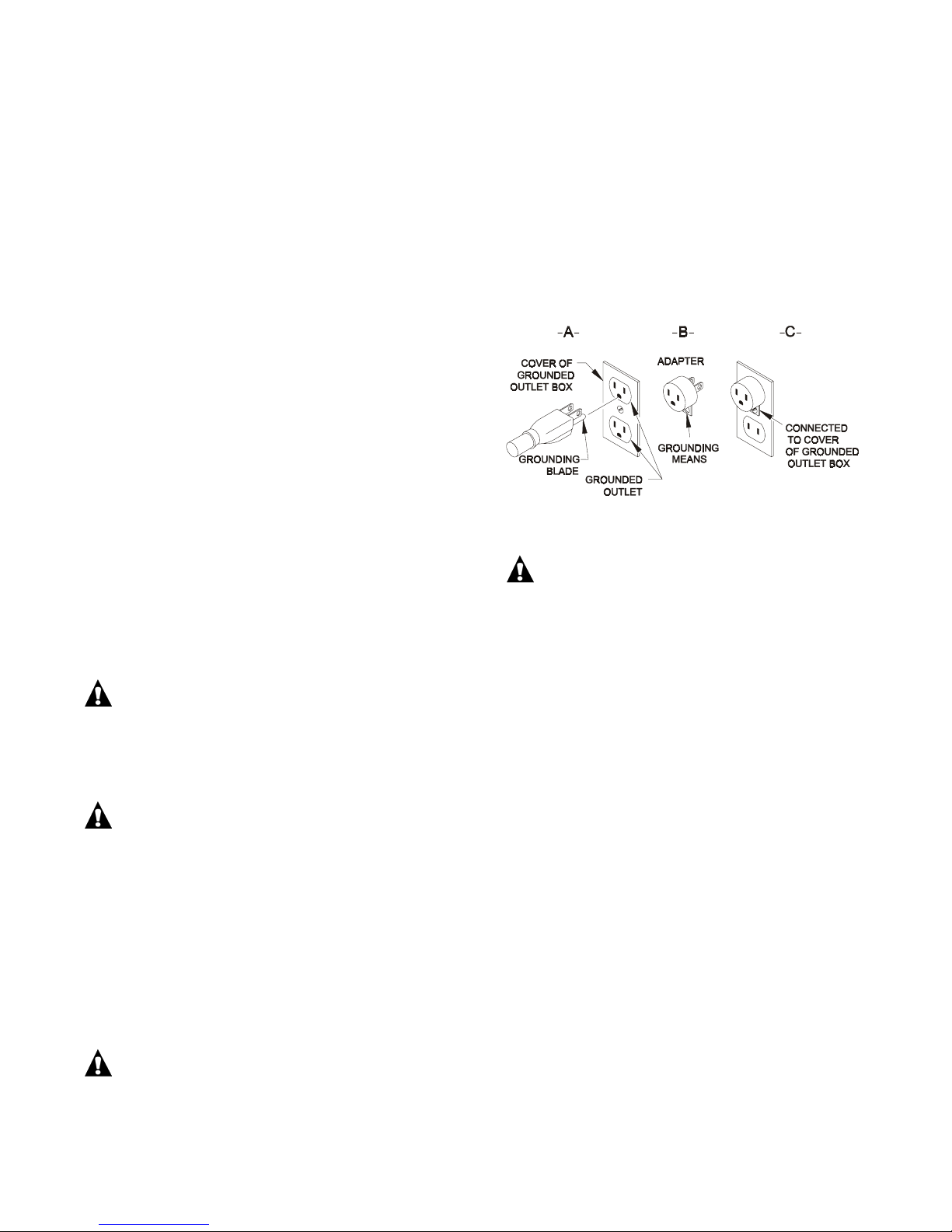
This battery charger is for use on a nominal 120 volt
circuit and has a grounding plug, which looks like the
adapter illustrated in Figure A. A temporary adapter,
which looks like the adapter illustrated in Figures B
and C, may be used to connect this plug to a twopole receptacle as shown in Figure B if a properly
grounded outlet is not available. The temporary
adapter should be used only until a grounded outlet
can be installed by a qualified electrician.
GROUNDING METHODS
NOTE: The use of the adapter shown in figures B
and C is not permitted in Canada.
DANGER: BEFORE USING ADAPTER AS
ILLUSTRATED, BE CERTAIN THE CENTER
SCREW OF OUTLET PANEL IS GROUNDED.
The green-colored rigid ear or lug extending from
adapter must be connected to a properly grounded
outlet. If necessary, replace original outlet cover
plate screw with a longer screw that will secure
adapter ear or lug to outlet plate and make ground
connection to grounded outlet.
For 230 VAC Nominal, 50 Hz Chargers:
This battery charger must be grounded to reduce the
risk of electric shock. This charger is equipped with
an electrical cord having an equipment-grounding
conductor which must be connected to the ground
prong of an appropriate plug for a nominal 230 Volt,
50 Hertz circuit. This plug must be connected to an
appropriate AC outlet which is properly installed and
grounded in accordance with the National Electrical
Code and all local codes and ordinances.
EXTENSION CORD REQUIREMENTS
Always use a three conductor No. 12 AWG heavy
duty cord with ground, properly wired, in good
electrical condition and keep it as short as possible.
Make sure the pins on the plug of the extension cord
are the same number, size and shape as the AC
plug of the battery charger. The use of an improper
extension cord could result in a risk of fire or
electrical shock. Locate all cords so they will not be
www.lesterelectrical.com 2 32698D
Page 3

stepped on, tripped over or otherwise subjected to
damage or stress.
OPERATING INSTRUCTIONS
1. Connect AC supply cord to a properly grounded
single phase outlet of the proper voltage and
frequency as specified on the charger front.
2. Connect the DC output plug, if not already
connected, by grasping the plug body and
pushing it straight into the receptacle until it is
fully engaged. The BLACK wire must be
connected to battery negative (-), and the RED
or WHITE wire to battery positive (+). Make
sure all connections are clean and tight.
3. The charger will start after a short delay as
indicated by the transformer hum and the
ammeter movement.
WARNING: LEAD ACID BATTERIES
GENERATE GASES WHICH CAN BE EXPLOSIVE.
CHARGE ONLY IN WELL VENTILATED AREAS.
DO NOT DISCONNECT CHARGER DC OUTPUT
TERMINALS FROM BATTERY WHEN CHARGER
IS ON. THE RESULTING ARCING AND BURNING
COULD CAUSE THE BATTERY TO EXPLODE.
KEEP SPARKS, FLAME AND SMOKING
MATERIALS AWAY FROM BATTERY.
If the charger must be stopped, always
disconnect the AC cord from its outlet to
terminate the charge.
4. Monitor the ammeter for correct charge rate.
Normal charging at the finish charge rate for the
last 3 to 5 hours is important to achieve
equalization of all battery cells every time the
batteries are charged. New batteries or
batteries charged in cold temperatures (below
50°F) will require more time to achieve full
charge.
5. Charger turns off automatically when battery is
fully charged. Charge time varies with battery
size and depth of discharge. Allow 8 hours for
normal charging. Severely discharged batteries
may require up to 12 hours to be properly
charged and equalized. After the charger has
turned off, disconnect the AC supply cord from
outlet, then disconnect the DC output plug from
the battery on portable chargers only.
CAUTION: DO NOT LEAVE CHARGER ON
WHILE UNATTENDED FOR MORE THAN TWO
CONSECUTIVE DAYS. SEVERE OVERCHARGING AND POSSIBLE DAMAGE TO
BATTERIES WILL RESULT IF CHARGER
SHOULD FAIL TO TURN OFF.
MAINTENANCE INSTRUCTIONS
The battery charger requires minimal maintenance.
It should be kept clean and all connections are to be
tightly secured. In the event of intermittent
operation, examine and tighten, if necessary, all
connections. Be sure the chassis is securely
grounded. If any problems cannot be resolved,
consult a qualified service center.
Observe the following battery cycle maintenance
procedures to obtain good performance and
maximum cycle life.
1. Always observe the following personal safety
precautions when working with lead acid
batteries:
a. Someone should be within range of your
voice or close enough to come to your aid
when you work near a battery.
b. Have plenty of fresh water and soap nearby
in case battery acid contacts skin, clothing
or eyes.
c. Wear complete eye protection and clothing
protection. Avoid touching eyes while
working near battery.
d. If battery acid contacts skin or clothing,
wash immediately with soap and water. If
acid enters eye, immediately flood eye with
running cold water for at least ten minutes
and get medical attention.
e. Never smoke or allow a spark or flame in the
vicinity of batteries.
f. Be extra cautious to reduce risk of dropping
a metal tool onto battery. It might spark or
short-circuit battery or other electrical part
that may cause explosion.
g. Remove personal metal items such as rings,
bracelets, necklaces, and watches when
working with a lead acid battery. A lead acid
battery can produce a short-circuit current
high enough to weld a ring or the like to
metal, causing a severe burn.
h. Never charge a frozen battery.
DANGER: TO REDUCE RISK OF ELECTRIC
SHOCK, ALWAYS DISCONNECT THE AC
SUPPLY CORD FROM ITS OUTLET AND THE DC
OUTPUT CORD FROM THE BATTERY BEFORE
ATTEMPTING ANY MAINTENANCE (CHANGING
FUSES, ETC.) OR CLEANING OF THE BATTERY
CHARGER.
2. New batteries should be given a full charge
before their first use because it is difficult to
know how long batteries have been stored.
3. Limit use of new batteries for first five cycles.
New batteries are not capable of their rated
www.lesterelectrical.com 3 32698D
Page 4

output until they have been discharged a
number of times.
4. Do not excessively discharge batteries.
Excessive discharge can cause polarity reversal
of individual cells resulting in complete failure
shortly thereafter. Limited use of new batteries
will minimize the chance of cell reversal.
5. Check the level of the electrolyte in conventional
liquid electrolyte lead acid batteries monthly.
Maintain the proper electrolyte level by adding
distilled or purified water when necessary.
Electrolyte levels lower during discharge and
rise during charge. Therefore, it is mandatory
that water be added to cells only when they are
fully charged; do not overfill. Old batteries
require more frequent additions of water than
new batteries.
6. Keep tops of batteries clean and dry to prevent
excessive self-discharge. Keep battery terminals
reasonably tight..
www.lesterelectrical.com 4 32698D
Page 5
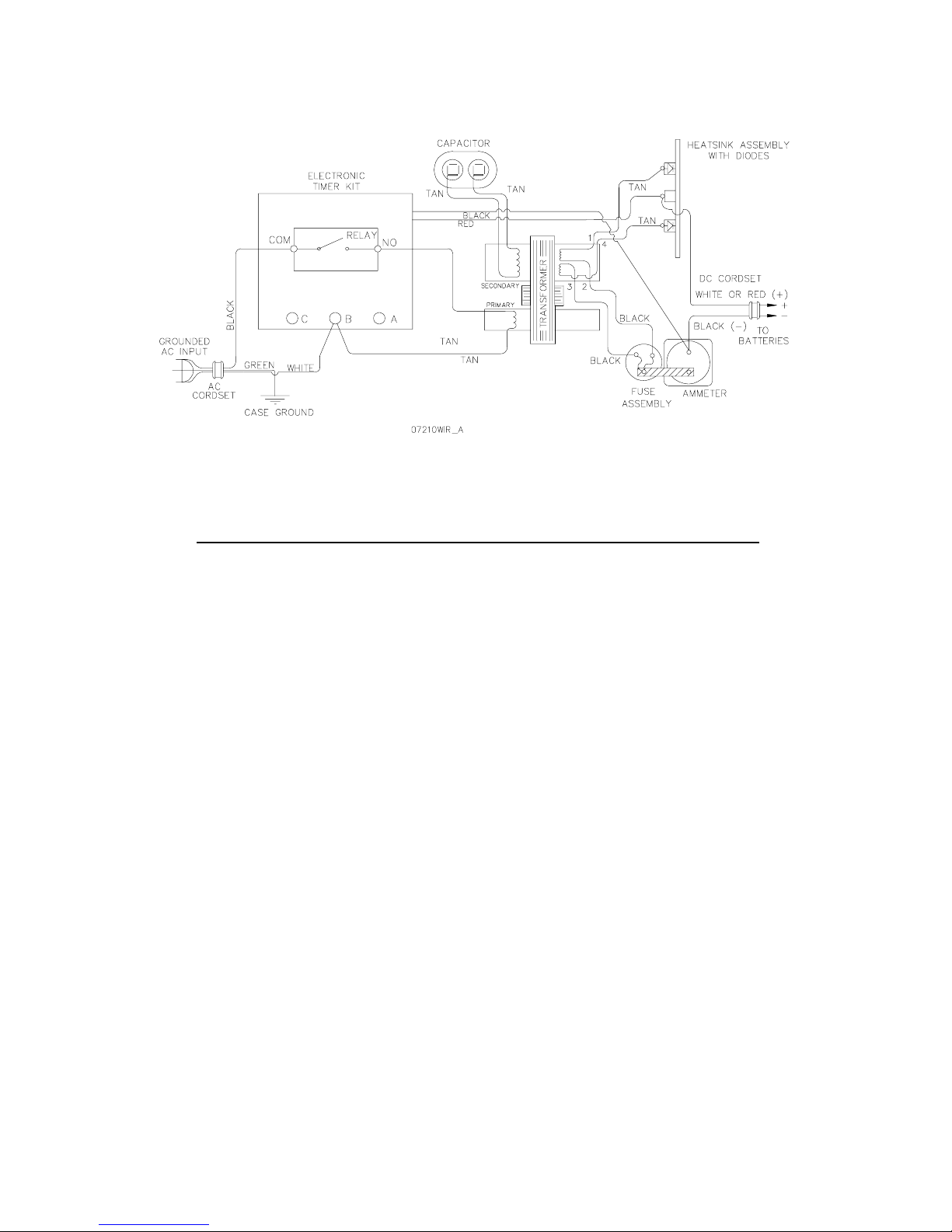
WIRING DIAGRAM
5
PARTS LIST FOR LESTRONIC II CHARGER
MODEL 07210, TYPE 24LC25-8ET, 115 VAC / 60 HZ
PART NO.
10044S CASE ASSEMBLY
11576S TRANSFORMER ASSEMBLY
02390S CAPACITOR, 6.0 MFD, 660 VAC
16354S HEATSINK ASSEMBLY, W/ DIODES
08776S FUSE ASSEMBLY
04127S AMMETER, 0-30 AMP
24800S ELECTRONIC TIMER ASSEMBLY
* 04483S RELAY, FOR ELECTRONIC TIMER
** 23385S RELAY, FOR ELECTRONIC TIMER
02028S BUSHING, 7W-2, INSULATOR FOR CORDSETS
03574S CORDSET, AC, 14/3, 102", MOLDED PLUG
07874S CORDSET, AC, 14/3, 6", MOLDED PLUG
13333S CORDSET, AC, 14/3, 108”, TWIST LOCK PLUG
33014S CORDSET, AC, 14/3, 248”, MOLDED PLUG
08512S CORDSET, DC, NO PLUG, 12/2 , 9 9"
14284S CORDSET, DC, NO PLUG, 12/2 , 1 18"
08807S CORDSET, DC, RING TERMINALS, 96"
14973S CORDSET, DC, MOLDED P LUG, GRAY , 103"
08020S CORDSET, DC, LESTER PLUG, 103"
08607S CORDSET, DC, 50 AMP PLUG, GRAY, 56"
10716S CORDSET, DC, 50 AMP PLUG, GRAY, 218"
08224S CORDSET, DC, 175 AMP PLUG, GRAY , 101"
10536S CORDSET, DC, EZ GO P LUG, 122"
12227S CORDSET, DC, 50 AMP PLUG, RED, 99"
12284S CORDSET, DC, 175 AMP PLUG, RED, 101"
13332S CORDSET, DC, RING TERMINALS, 120”
13948S CORDSET, DC, 50 AMP PLUG, GRAY, 64”
08313S PLUG ASSEMBLY, DC, 50 AMP ANDERSON PLUG
02957S PLUG ASSEMBLY, DC, 175 AMP ANDERSON PLUG
* FOR USE WITH CHARGERS BUILT BEFORE 39/03
** FOR USE WITH CHARGERS BUILT AFTER 39/03
DESCRIPTION
www.lesterelectrical.com 32698D
Page 6

LIMITED WARRANTY
6
Lester Electrical warrants each new Lester Battery Charger for defects in material and workmanship for a period
of two (2) years from the date of manufacture of the complete unit.
Repairs can be made at the Lester Electrical factory. To do so, FIRST obtain a "Return Material Authorization"
number by calling the Service Department of Lester Electrical (402 477-8988) or by e-mailing
[email protected] and send the defective unit with transportation charges prepaid to:
Lester Electrical
625 West A Street
Lincoln, NE 68522-1794 USA
Attention: Service Department
RMA #
For repairs made at other than the Lester Electrical factory, Lester will provide only the replacement parts.
Defective parts should be sent with transportation charges prepaid to the Lester Electrical factory at the address
noted above.
If the unit or parts are found, in the reasonable judgment of Lester Electrical, to be defective in material
or workmanship, repair, or replacement will be made by Lester Electrical without charge for parts or
labor. Repair or replacement will be at the discretion of Lester Electrical, with replacements being made
using current models or parts performing the equivalent function. Labor charges other than those
incurred at the Lester Electrical factory are not covered under this warranty. All expenses associated
with delivering defective items to the Lester Electrical factory and the expense of returning repaired or
replaced items from the Lester Electrical factory to the owner will be paid for by the owner. All warranty
work accomplished at the Lester Electrical factory will be completed within a reasonable time after
receipt of defective items.
This warranty does not cover any semiconductor parts, such as diodes, which are vulnerable to electrical
overloads beyond the control of Lester Electrical. Warranty on parts not manufactured by Lester Electrical, which
include, but are not limited to, timers and ammeters is limited to the period specified in the original
manufacturer's warranty.
This warranty does not cover any charger that has been subject to misuse, neglect, negligence, or accident, or
operated in any way contrary to instructions specified on the charger case and in the owner's manual. No claim
of breach of warranty shall be cause for cancellation of the contract of sale of any Lester Electrical charger.
Lester Electrical assumes no responsibility for loss of time, inconvenience, or other damage, consequential or
otherwise, resulting from a defective charger. All implied warranties (including merchantability) are limited in
duration to two (2) years from date of manufacture warranty period.
Some states do not allow the exclusion or limitation of incidental or consequential damages, or limitations on
how long an implied warranty lasts, so the above limitations may not apply to you. This warranty gives you
specific legal rights, and you may also have other rights which vary from state to state.
Lester Electrical's obligation under this warranty is strictly and exclusively limited to the repair or replacement of
defective items. Lester Electrical issues this warranty in good faith and with full confidence in the workmanship
and quality of Lester Electrical products.
www.lesterelectrical.com 32698D
 Loading...