

Page 1
1 / 7 Powered by LESI
HATL01FPC
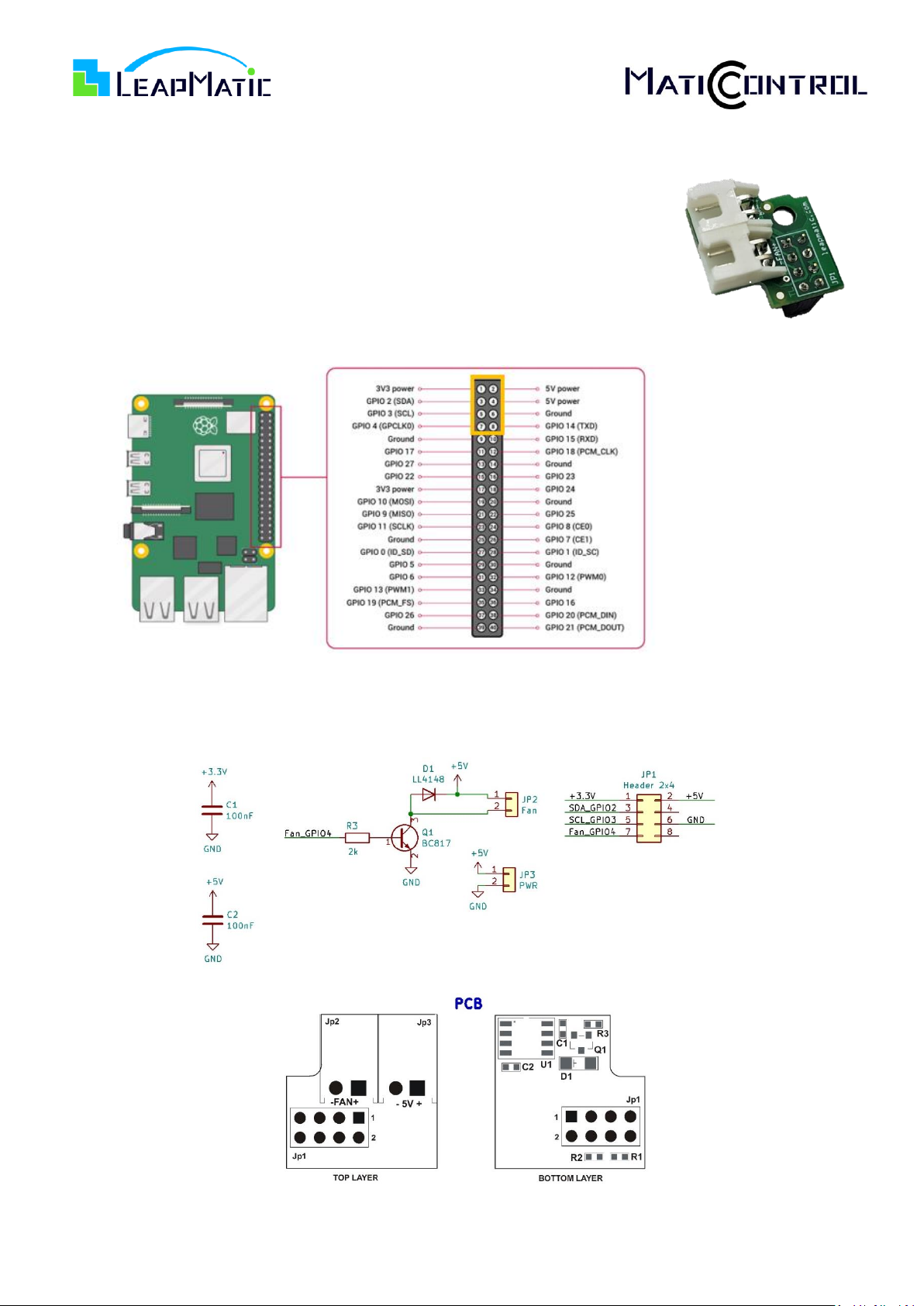
Automatic fan control module for Raspberry Pi with 5V connector on top
and crypto module for software protection.
Do you want to extend the life of your fan, reduce its noise and control it
automatically, while also protect your data with a crypto module?
With this MaticControl crypto fan module you can! As a bonus, the second
connector provides access to the 5V pins.
Place it on pins 1-8 and connect your fan to the connector on the top. And this is all
you have to do on the hardware.
Note: This MaticControl module covers the pins for: I2C, GPIO15 (RXD) and GPIO14 (TXD). If you want
to use them, we offer modules (HATs) that provide access to these pins via separate connector on the
top of the board. For more see LeapMatic.com
Electrical Scheme of the module:
Page 2
2 / 7 Powered by LESI
I. Fan Control
About the software settings you have two options:
1. Graphical
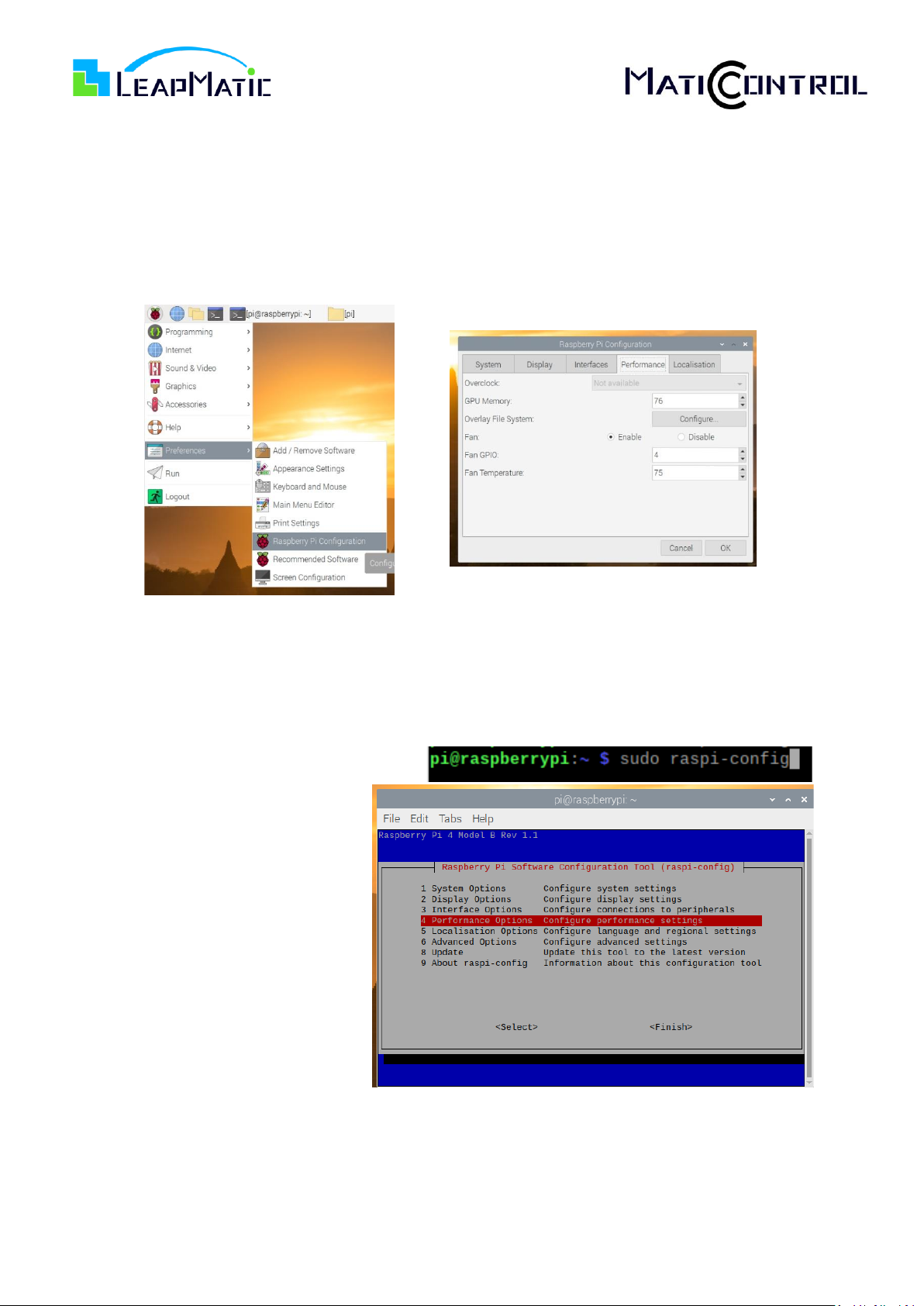
From Raspberry icon > Preferences> Raspberry Pi Configuration > Performance tab >set fan enable;
Fan GPIO 4; and the temperature at which you want the fan to turn on. Save with OK
Thus, when the processor reaches the temperature you set, the fan will turn on. It will turn on off only
when the processor temperature drops 10 degrees below the set on temperature. (For example, if you
set the On temperature to 75 degrees, the fan will turn off when the processor reaches 65 degrees).
With these few easy steps, you now have automatic fan control.
2. Console
Open the Console and type
sudo raspi-config
You will open a graphical interface
menu where you need to choose
Performance Options:
Page 3
3 / 7 Powered by LESI
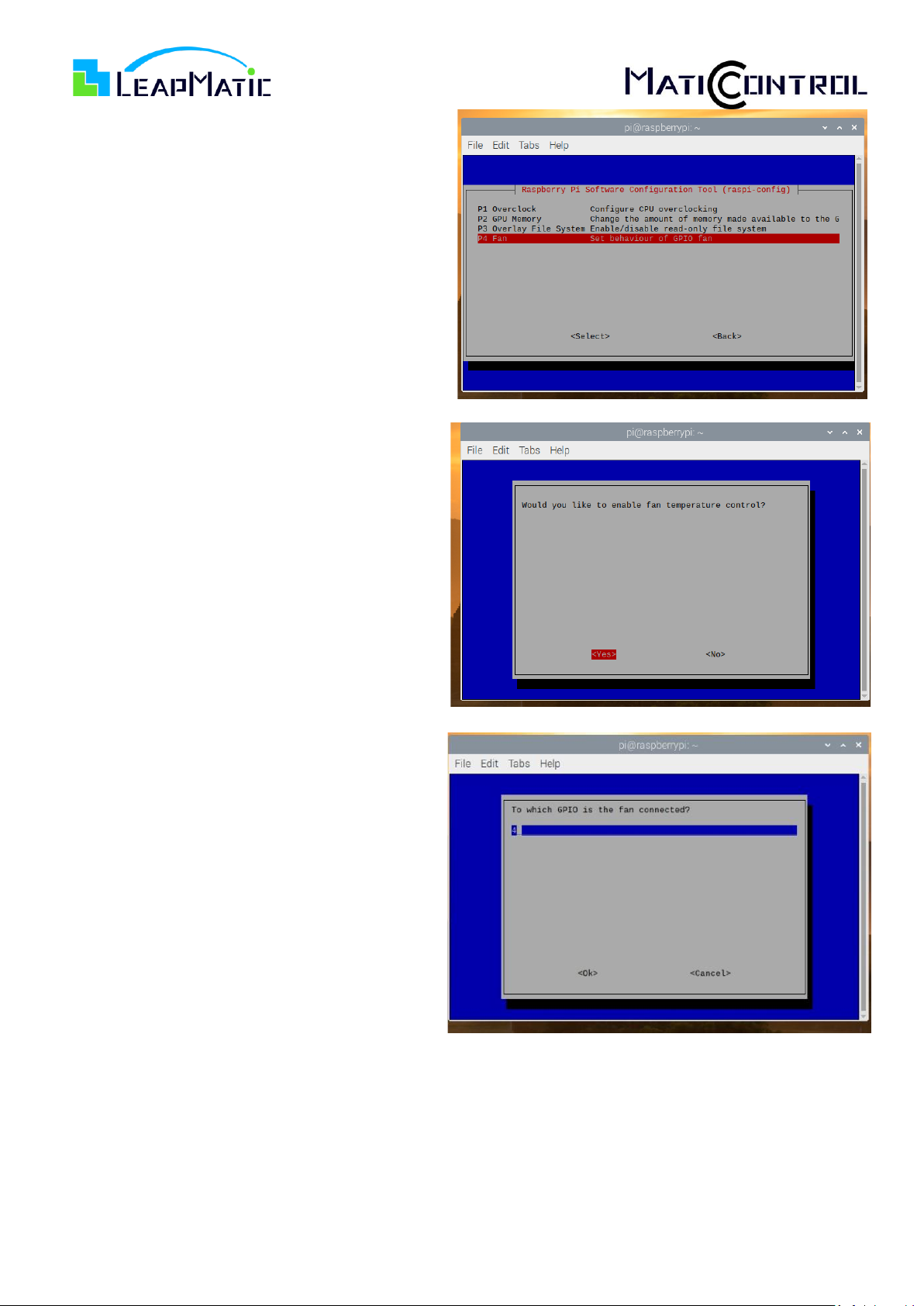
Then Choose “Fan”
It will ask you if you want to enable fan
temperature control? – Choose “Yes”
Here you need to set GPIO 4
Page 4
4 / 7 Powered by LESI
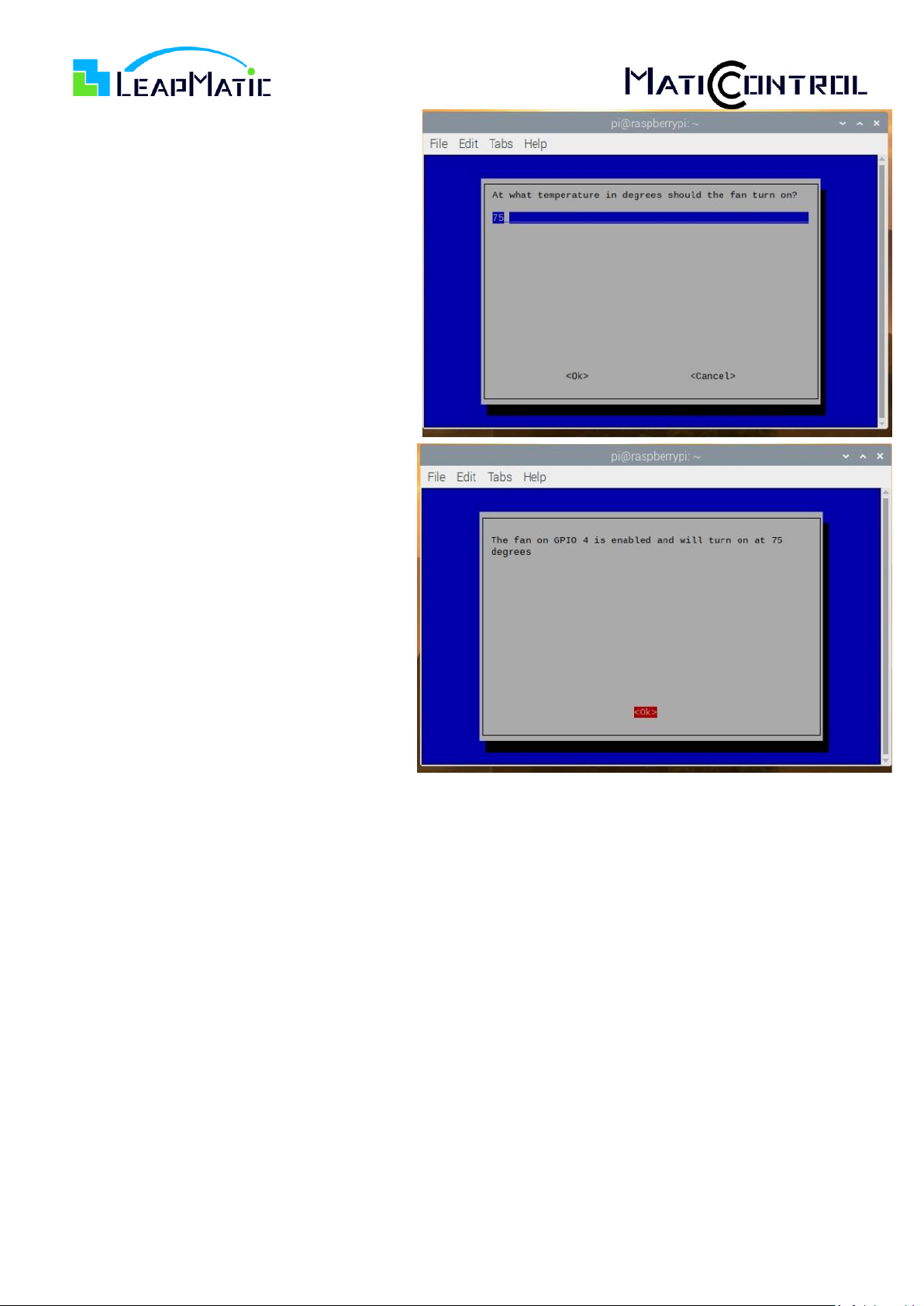
Then set the temperature on which the
fan will turn on
At last, the system will inform you about
the changes.
II. 5V Connector
Use of 5V connector as output – You can connect hats or other devices which need to be supplied with
5V.
Use of 5V connector as input – You can power your raspberry via this connector from an external power
supply. It can be very convenient when you have several Pi’s and you can power them from one source.
Power supply cables can run on either side of the MaticBox. This way you don't have to set aside space
on the side for the power connector that is on the Raspberry Pi itself. This will allow you to mount
many Pi`s close to each other, with the power cables coming out from under the cover of MaticBox.
Page 5
5 / 7 Powered by LESI
III. Crypto-module
Keep your software safe from stealing with this
MaticControl crypto module. Most
microcontrollers are not designed to protect
against snoopers, but a crypto-authentication
chip can be used to lock away private keys
securely.
Once the private key is saved inside, it can’t be
read out, all you can do is send it challengeresponse queries. That means that even if someone gets hold of your hardware and can read
back the firmware, they won’t be able to extract it!
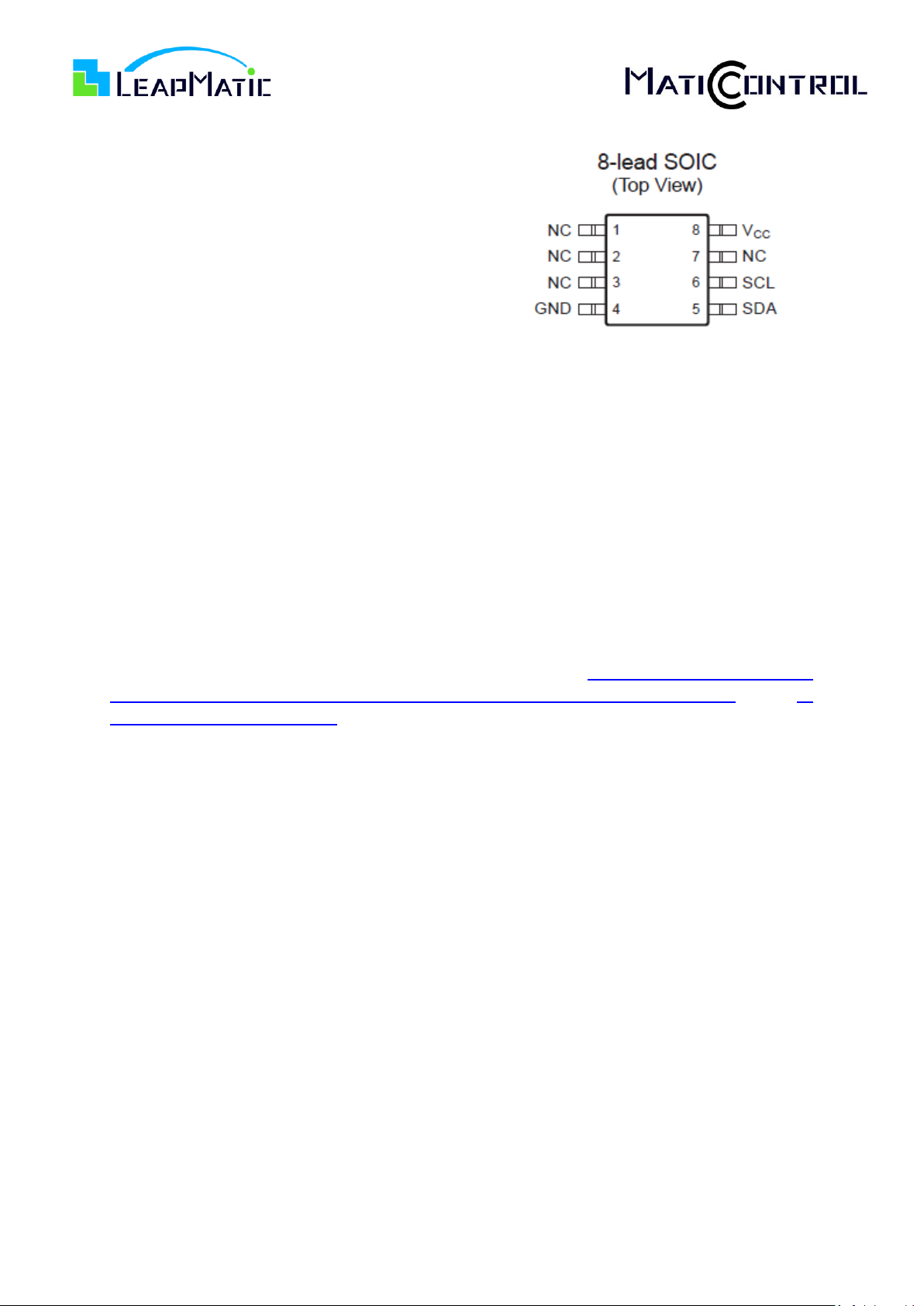
The ATECC608 is the latest crypto-auth chip from Microchip and to make working with the it
as easy as possible, we’ve put it on a PCB . This allows you to use it with Raspberry Pi or other
similarly equipped boards without needing to solder.
ATECC608 uses I2C to send/receive commands. It will work with 3.3V or 5V power/logic
micros, so it’s ready to get to work with a range of development boards. Once you ‘lock’ the
chip with your details, you can use it for ECDH and AES-128 encrypt/decrypt/signing. There’s
also hardware support for random number generation, and SHA-256/HMAC hash functions to
greatly speed up a slower micro’s cryptography commands.
For our surprise this chip does not have a public datasheet, but it is compatible with the
ATECC508 earlier version which does, so please refer to that complete datasheet as well as
the ATECC608 summary sheet.
Some quick notes from the official Microchip datasheet:
Applications
The ATECC508A device is a member of the Microchip CryptoAuthentication™ family of crypto
engine authentication devices with highly secure hardware-based key storage.
The ATECC508A device has a flexible command set that allows use in many applications,
including the following:
• Network/IoT Node Protection - Authenticates node IDs, ensures the integrity of messages,
and supports key agreement to create session keys for message encryption.
• Anti-Counterfeiting - Validates that a removable, replaceable, or consumable client is
authentic. Examples of clients could be system accessories, electronic daughter cards, or other
spare parts. It can also be used to validate a software/firmware module or memory storage
element.
• Protecting Firmware or Media - Validates code stored in flash memory at boot to prevent
unauthorized modifications, encrypt downloaded program files as a common broadcast, or
uniquely encrypt code images to be usable on a single system only.
• Storing Secure Data - Stores secret keys for use by crypto accelerators in standard
Page 6

6 / 7 Powered by LESI
microprocessors. Programmable protection is available using encrypted/authenticated reads
and writes.
• Checking User Password - Validates user-entered passwords without letting the expected
value become known, maps memorable passwords to a random number, and securely
exchanges password values with remote systems.
Device Features
The ATECC508A includes an EEPROM array which can be used for storage of up to 16 keys,
certificates, miscellaneous read/write, read-only or secret data, consumption logging, and
security configurations. Access to the various sections of memory can be restricted in a variety
of ways and then the configuration can be locked to prevent changes.
The ATECC508A features a wide array of defense mechanisms specifically designed to prevent
physical attacks on the device itself, or logical attacks on the data transmitted between the
device and the system. Hardware restrictions on the ways in which keys are used or generated
provide further defense against certain styles of attack.
Access to the device is made through a standard I2C Interface at speeds of up to 1 Mb/s. The
interface is compatible with standard Serial EEPROM I2C interface specifications. The device
also supports a Single- Wire Interface (SWI), which can reduce the number of GPIOs required
on the system processor, and/or reduce the number of pins on connectors. If the Single-Wire
Interface is enabled, the remaining pin is available for use as a GPIO, an authenticated output
or tamper input.
Using either the I2C or Single-Wire Interface, multiple ATECC508A devices can share the same
bus, which saves processor GPIO usage in systems with multiple clients such as different color
ink tanks or multiple spare parts, for example.
Each ATECC508A ships with a guaranteed unique 72-bit serial number. Using the
cryptographic protocols supported by the device, a host system or remote server can verify a
signature of the serial number to prove that the serial number is authentic and not a copy.
Serial numbers are often stored in a standard Serial EEPROM; however, these can be easily
copied with no way for the host to know if the serial number is authentic or if it is a clone.
The ATECC508A can generate high-quality FIPS random numbers and employ them for any
purpose, including usage as part of the device’s crypto protocols. Because each random
number is guaranteed to be essentially unique from all numbers ever generated on this or any
other device, their inclusion in the protocol calculation ensures that replay attacks (i.e. retransmitting a previously successful transaction) will always fail.
Cryptographic Operation
The ATECC508A implements a complete asymmetric (public/private) key cryptographic
signature solution based upon Elliptic Curve Cryptography and the ECDSA signature protocol.
The device features hardware acceleration for the NIST standard P256 prime curve and
supports the complete key life cycle from high quality private key generation, to ECDSA
signature generation, ECDH key agreement, and ECDSA public key signature verification.
Page 7

7 / 7 Powered by LESI
The hardware accelerator can implement such asymmetric cryptographic operations from ten
to onethousand times faster than software running on standard microprocessors, without the
usual high risk of key exposure that is endemic to standard microprocessors.
The device is designed to securely store multiple private keys along with their associated
public keys and certificates. The signature verification command can use any stored or an
external ECC public key. Public keys stored within the device can be configured to require
validation via a certificate chain to speed up subsequent device authentications.
Random private key generation is supported internally within the device to ensure that the
private key can never be known outside of the device. The public key corresponding to a
stored private key is always returned when the key is generated and it may optionally be
computed at a later time.
The ATECC508A also supports a standard hash-based challenge-response protocol in order to
simplify programming. In its most basic instantiation, the system sends a challenge to the
device, which combines that challenge with a secret key via the MAC, HMAC or SHA
commands and then sends the response back to the system. The device uses a SHA-256
cryptographic hash algorithm to make that combination so that an observer on the bus cannot
derive the value of the secret key, but preserving the ability of a recipient to verify that the
response is correct by performing the same calculation with a stored copy of the secret on the
recipient’s system.
Due to the flexible command set of the ATECC508A, these basic operation sets (i.e. ECDSA
signatures, ECDH key agreement and SHA-256 challenge-response) can be expanded in many
ways. Using the GenDig command, the values in other slots can be included in the response
digest or signature, which provides an effective way of proving that a data read really did come
from the device, as opposed to being inserted by a man-in-the-middle attacker. This same
command can be used to combine two keys with the challenge, which is useful when there
are multiple layers of authentication to be performed. In a host-client configuration where the
host (for instance, a mobile phone) needs to verify a client (for instance, an OEM battery),
there is a need to store the secret in the host in order to validate the response from the client.
The CheckMac command allows the device to securely store the secret in the host
system and hides the correct response value from the pins, returning only a yes or no answer
to the system.
Finally, the hash combination of a challenge and secret key can be kept on the device and
XORed with the contents of a slot to implement an encrypted Read command, or it can be
XORed with encrypted input data to implement an encrypted Write command.
All hashing functions are implemented using the industry-standard SHA-256 secure hash
algorithm, which is part of the latest set of high-security cryptographic algorithms
recommended by various government agencies and cryptographic experts. The ATECC508A
employs full-sized 256-bit secret keys to prevent any kind of exhaustive attack.
 Loading...