

Page 1
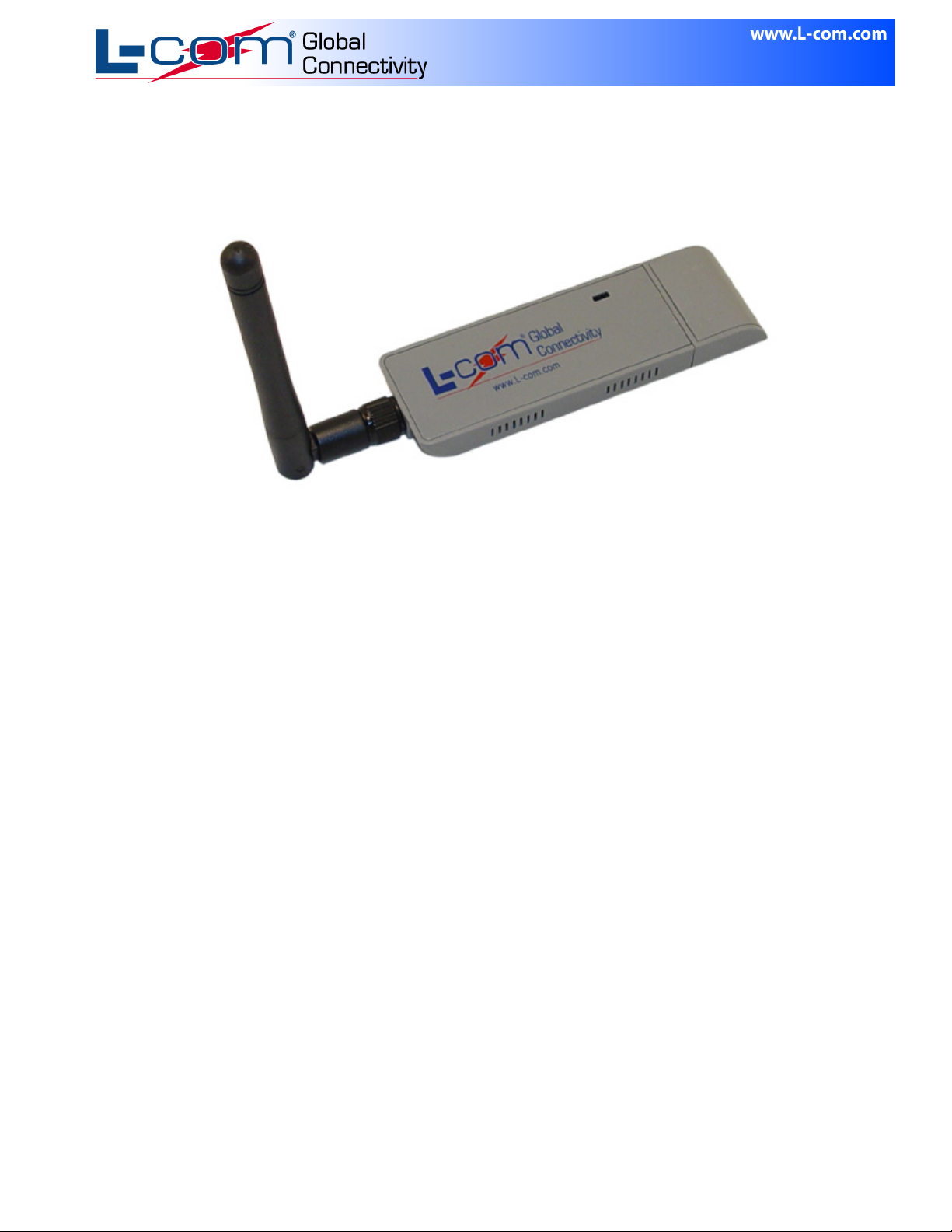
External Antenna USB Adapter
WLAN-LCUSB-01
User Manual
(For 802.11b/g Wireless Networks)
Revision: B / Date: 11/11
WWW.L-COM.COM E-MAIL: [email protected] PHONE: 1-800-343-1455 FAX: 1-978-689-9484
© L-com, Inc. All Rights Reserved. L-com Global Connectivity and the L-com logo are registered marks.
L-COM, INC. 45 BEECHWOOD DRIVE NORTH ANDOVER, MA 01845
Page 2

Index
1 Overview ................................................................................................... 3
1.1 Product Introduction ......................................................................... 3
1.2 System Requirements ...................................................................... 3
1.3 Packing List ...................................................................................... 3
2 Installation ................................................................................................. 4
2.1 Installation Guide ............................................................................. 4
2.2 Uninstall the Software .................................................................... 10
3 Configuration ........................................................................................... 10
3.1 Connection status Page of Main UI ................................................ 11
3.2 Site Survey Page of Main UI ......................................................... 111
3.3 Profile config Page of Main UI ........................................................ 14
3.3.1 Add a Profile ......................................................................... 15
3.3.2 Delete a Profile ..................................................................... 21
3.3.3 Edit a Profile ......................................................................... 21
3.3.4 Activate a Profile ................................................................... 21
3.3.5 WPS ..................................................................................... 21
4 WPS Configuration .................................................................................. 22
WWW.L-COM.COM E-MAIL: [email protected] PHONE: 1-800-343-1455 FAX: 1-978-689-9484
© L-com, Inc. All Rights Reserved. L-com Global Connectivity and the L-com logo are registered marks.
L-COM, INC. 45 BEECHWOOD DRIVE NORTH ANDOVER, MA 01845
Page 3

Overview
Product Introduction
Thank you for purchasing the WLAN-LCUSB-01.
This adapter is designed to provide a high-speed and unrivaled wireless performance for your PC. With a faster
wireless connection, you can get a better Internet service, such as downloading, gaming, video streaming and
so on.
The WLAN-LCUSB-01 supports IEEE 802.11b/g 2.4GHz radio operation. With auto-sensing capability, the
adapter packet transfer rate is up to 54 Mbps. Additionally, the WLAN-LCUSB-01 has good capability in antijamming and supports WEP, TKIP, AES, WPA, and WPA2 encryption, which prevents outside intrusion, protecting
your personal information from being exposed. Featuring high-performance transmission rate, simple installation
and adaptability, as well as strong security, the WLAN-LCUSB-01 is the perfect solution for small office and home
needs.
System Requirements
Recommended system requirements are as follows:
Windows 2000, Windows XP 32-Bit, Windows Vista 32-Bit and Windows 7 32-Bit
Standard USB 2.0 port
32MB system memory or larger
300MHz processor or higher
Packing List
The packing list of the WLAN-LCUSB-01 contains the following items:
1x WLAN-LCUSB-01
1 x CD(contain user manual)
1X Antenna
WWW.L-COM.COM E-MAIL: [email protected] PHONE: 1-800-343-1455 FAX: 1-978-689-9484
© L-com, Inc. All Rights Reserved. L-com Global Connectivity and the L-com logo are registered marks.
L-COM, INC. 45 BEECHWOOD DRIVE NORTH ANDOVER, MA 01845
Page 4
Installation
This chapter describes how to install the driver and utility of the WLAN-LCUSB-01. The following procedure is
illustrated in Windows XP.
Installation Guide
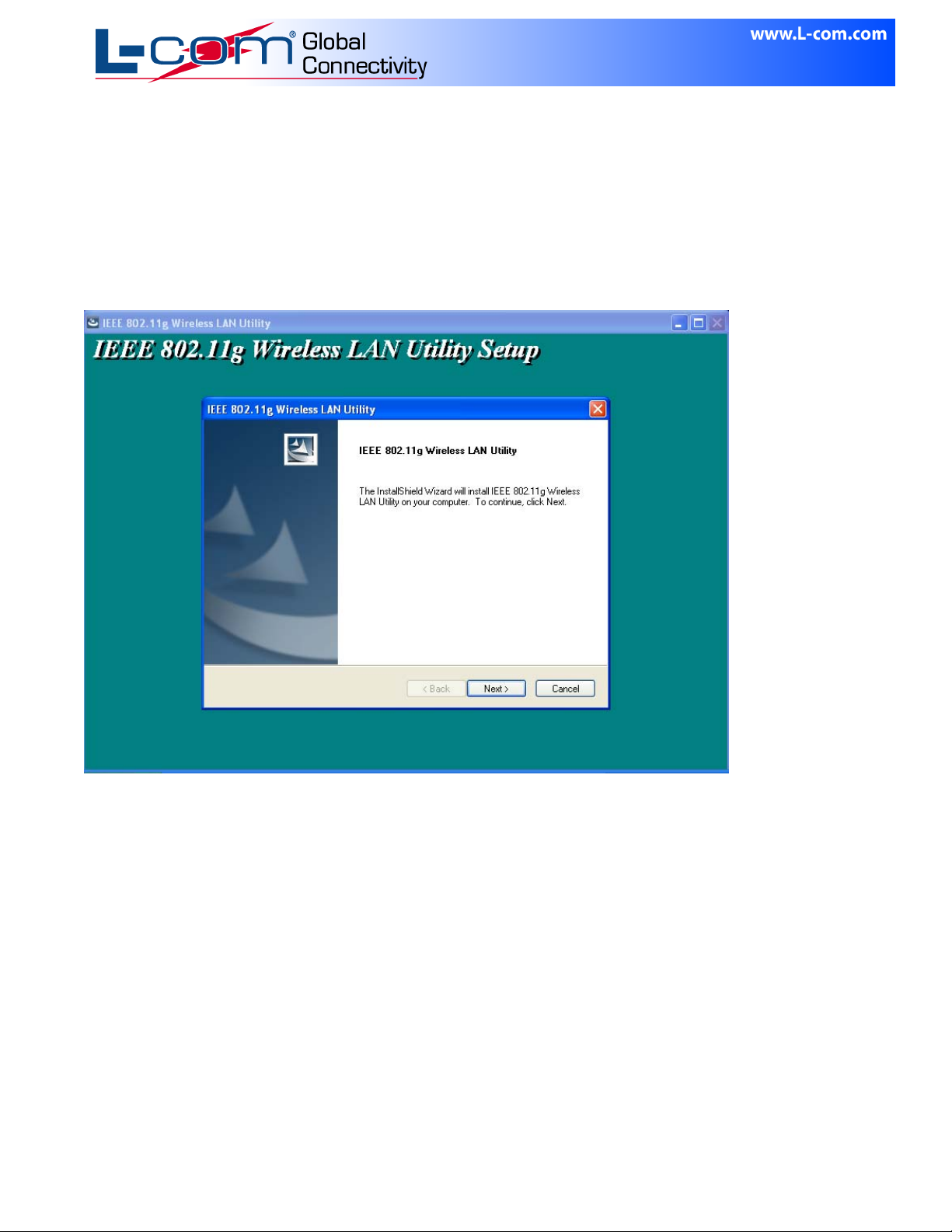
Step 1 Find the setup file named WLAN-LCUSB-01 .exe on the included CD and then double-click on it to
start the installation. The page shown in the following figure appears. Then click “Next” to continue.
WWW.L-COM.COM E-MAIL: [email protected] PHONE: 1-800-343-1455 FAX: 1-978-689-9484
© L-com, Inc. All Rights Reserved. L-com Global Connectivity and the L-com logo are registered marks.
L-COM, INC. 45 BEECHWOOD DRIVE NORTH ANDOVER, MA 01845
Page 5
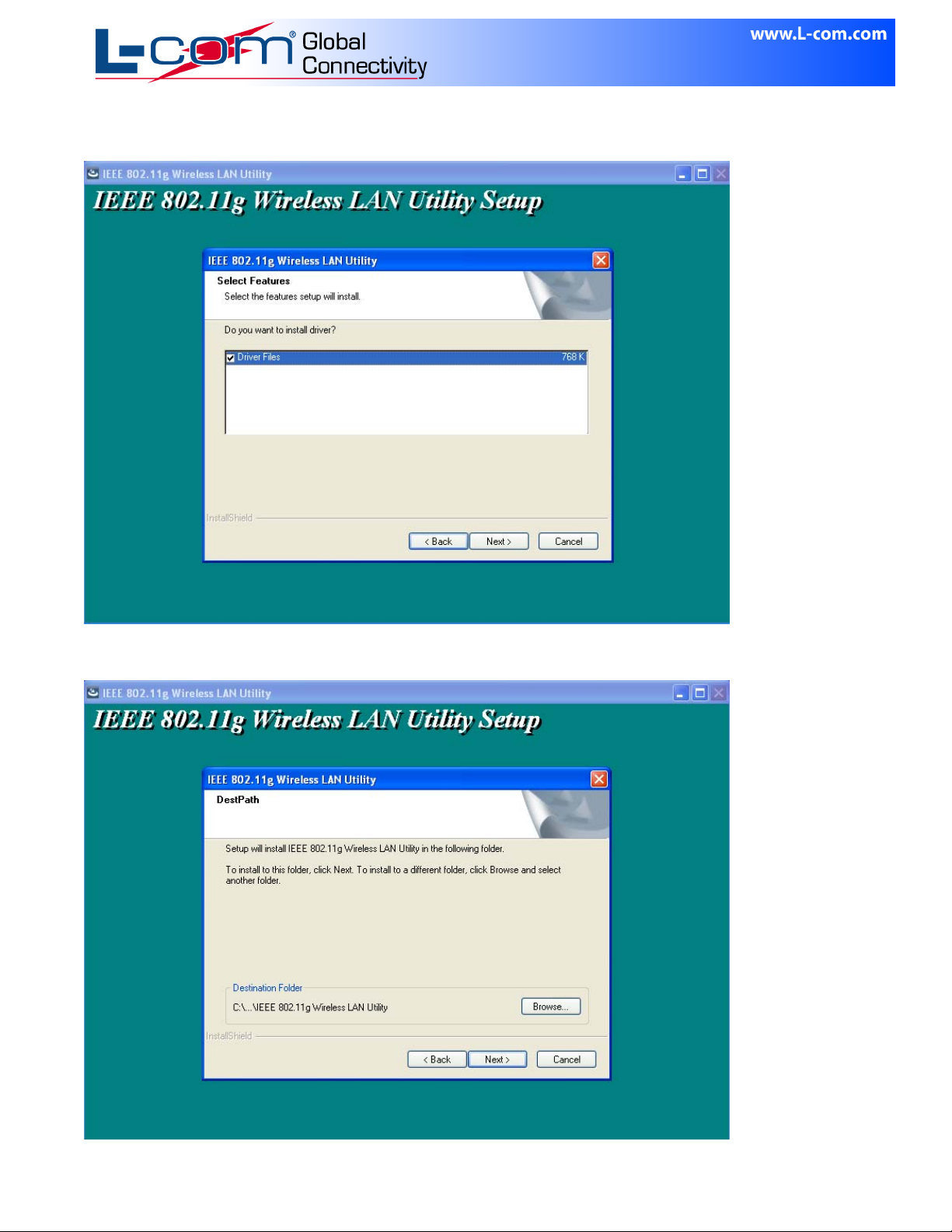
Be sure “Driver Files” are checked and click “Next” to continue.
Step 2 Select a destination folder for installation files. Then click “Next” to continue.
WWW.L-COM.COM E-MAIL: [email protected] PHONE: 1-800-343-1455 FAX: 1-978-689-9484
© L-com, Inc. All Rights Reserved. L-com Global Connectivity and the L-com logo are registered marks.
L-COM, INC. 45 BEECHWOOD DRIVE NORTH ANDOVER, MA 01845
Page 6
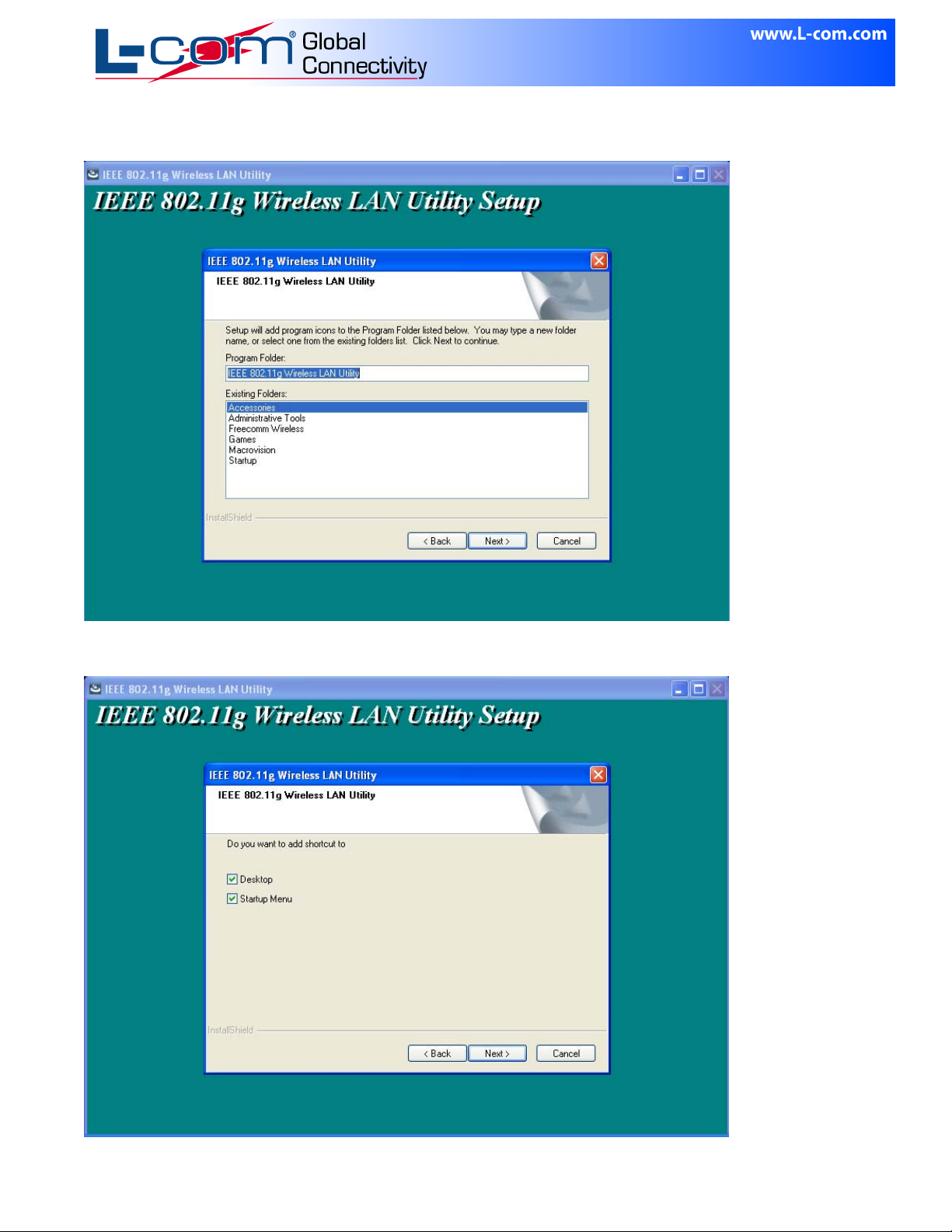
Step 3 Click “Next” to continue.
Step 4 Click “Next” to continue.
WWW.L-COM.COM E-MAIL: [email protected] PHONE: 1-800-343-1455 FAX: 1-978-689-9484
© L-com, Inc. All Rights Reserved. L-com Global Connectivity and the L-com logo are registered marks.
L-COM, INC. 45 BEECHWOOD DRIVE NORTH ANDOVER, MA 01845
Page 7
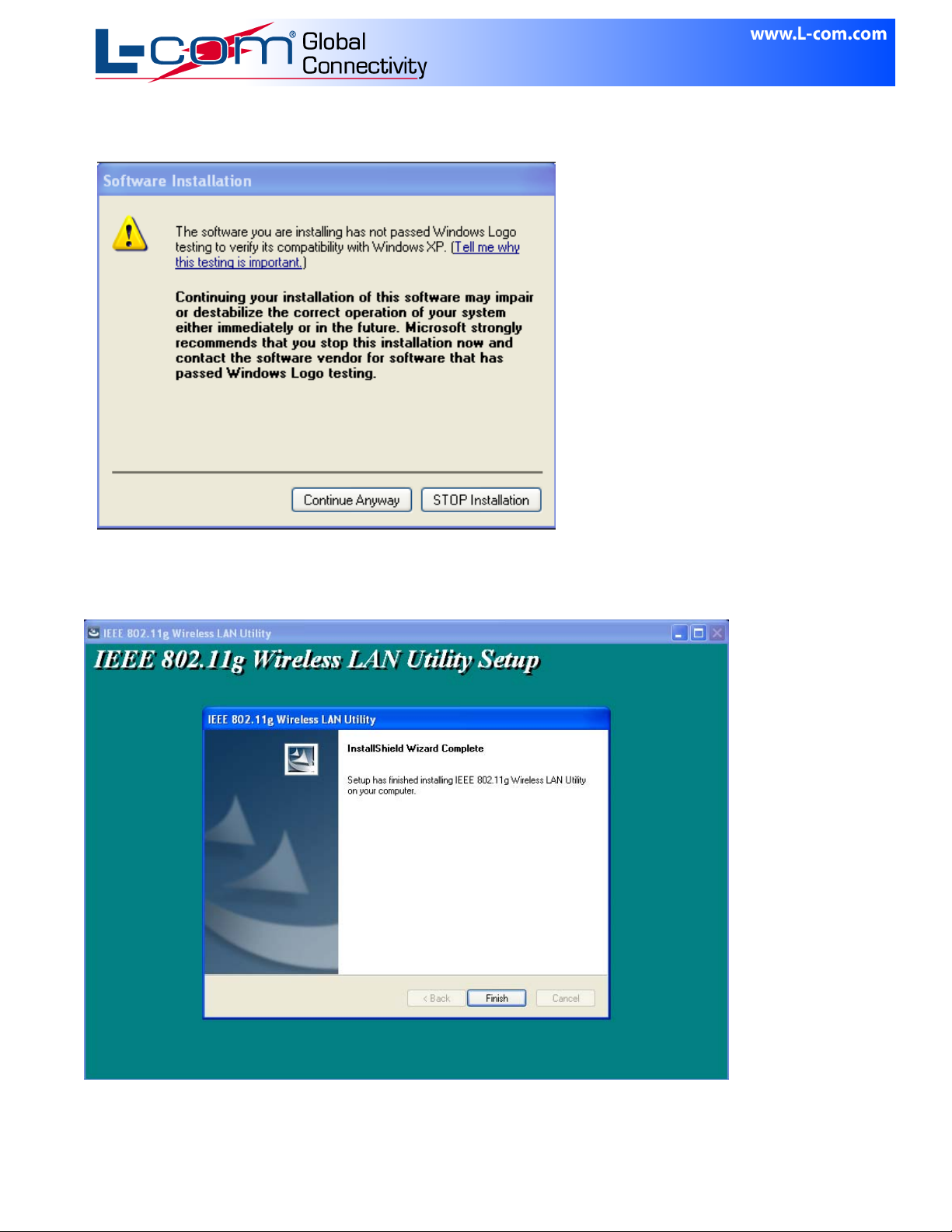
Step 5 The following warning will appear. Click the “Continue Anyway” button to continue the installation.
Step 6 After the installation has been completed, click “Finish” to exit the setup wizard.
WWW.L-COM.COM E-MAIL: [email protected] PHONE: 1-800-343-1455 FAX: 1-978-689-9484
© L-com, Inc. All Rights Reserved. L-com Global Connectivity and the L-com logo are registered marks.
L-COM, INC. 45 BEECHWOOD DRIVE NORTH ANDOVER, MA 01845
Page 8
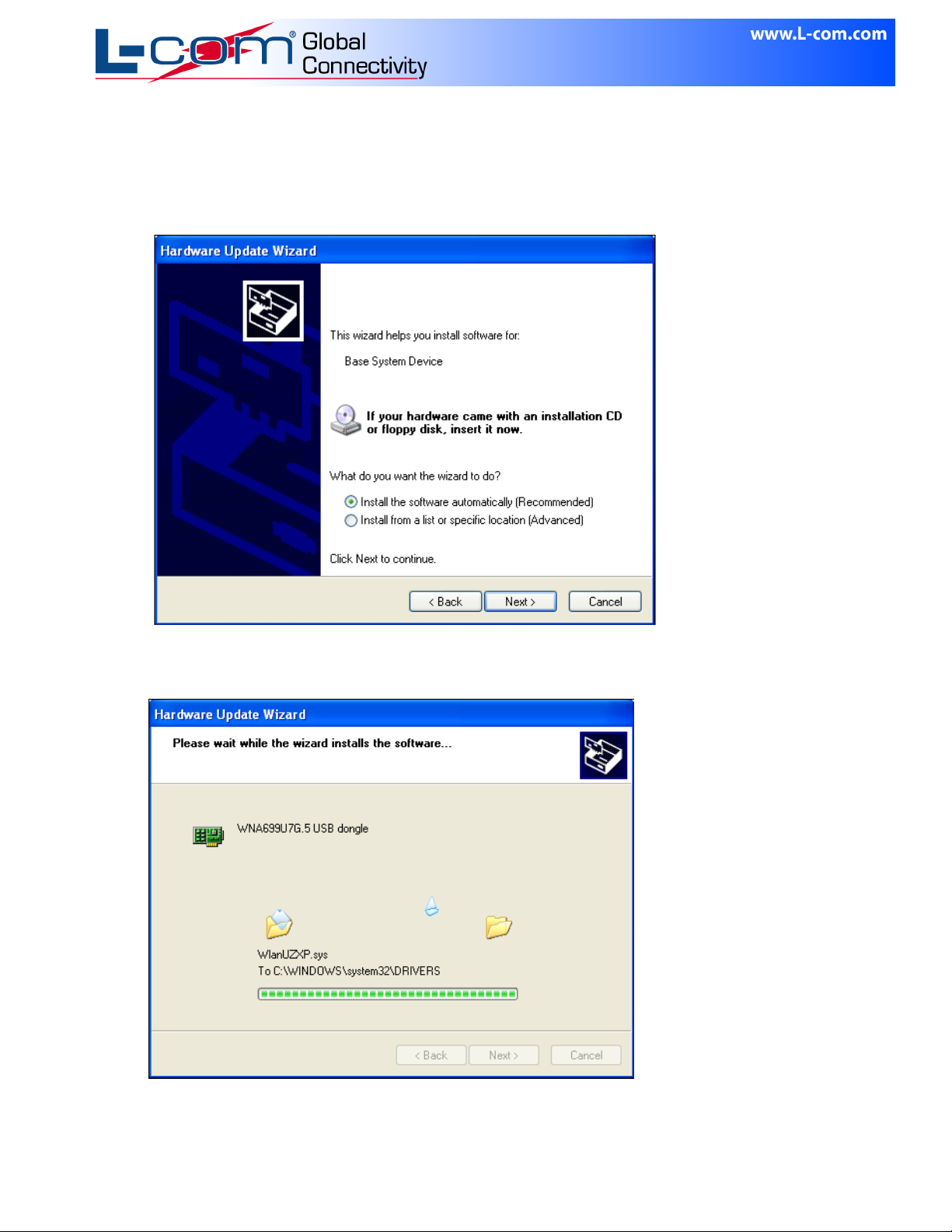
Step 7 Driver Installation
Step 8.1 After step 7, plug the USB adapter into any open USB slot on computer. The page
shown in the following figure appears within seconds. Select “Install the software
automatically” and click “Next” to continue.
The drivers will then begin to install.
L-COM, INC. 45 BEECHWOOD DRIVE NORTH ANDOVER, MA 01845
WWW.L-COM.COM E-MAIL: [email protected] PHONE: 1-800-343-1455 FAX: 1-978-689-9484
© L-com, Inc. All Rights Reserved. L-com Global Connectivity and the L-com logo are registered marks.
Page 9
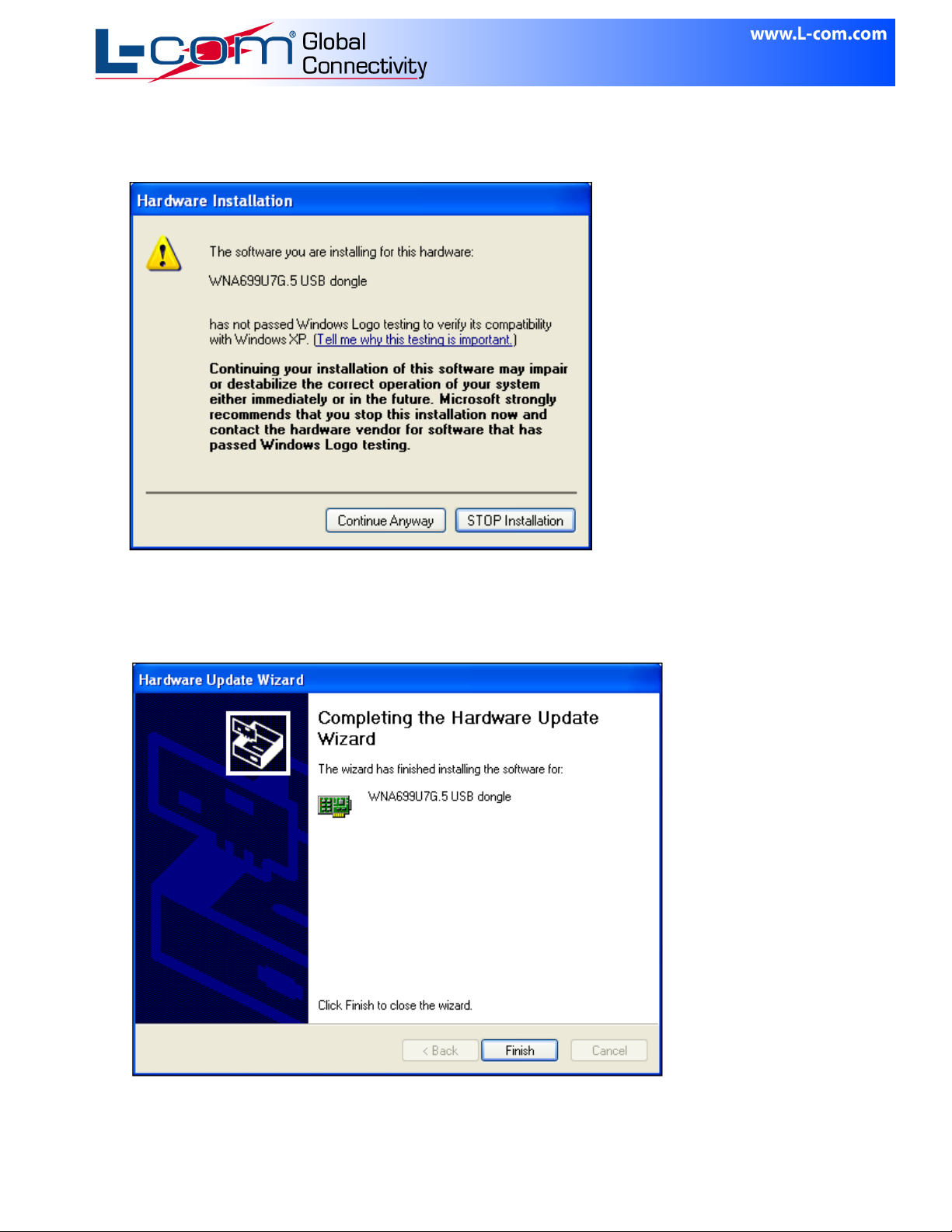
Step 8.2 The following warning will appear. Click the “Continue Anyway” button to continue
the installation.
Step 8.3 After the installation has been completed, click “Finish” to exit the setup wizard.
WWW.L-COM.COM E-MAIL: [email protected] PHONE: 1-800-343-1455 FAX: 1-978-689-9484
© L-com, Inc. All Rights Reserved. L-com Global Connectivity and the L-com logo are registered marks.
L-COM, INC. 45 BEECHWOOD DRIVE NORTH ANDOVER, MA 01845
Page 10
Uninstall the Software and Driver
Uninstall the utility software and driver from your PC
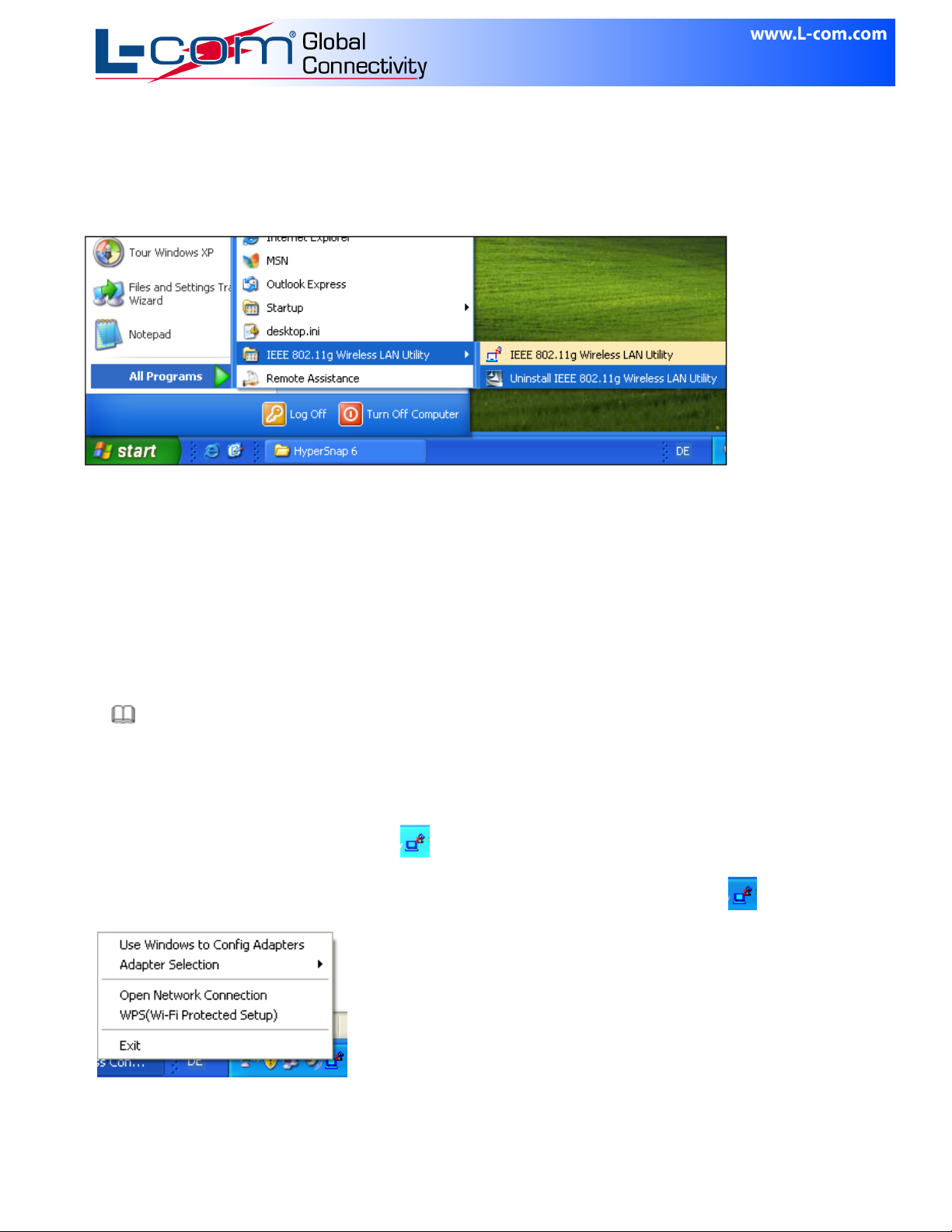
Step 1 Choose Start > All Programs > IEEE 802.11g Wireless LAN Utility, and the page shown in the
following figure appears. Then choose Uninstall IEEE 802.11g Wireless LAN Utility from the menu.
Step 2 Follow the Install Shield Wizard to uninstall the utility software and driver from your PC.
Configuration
The WLAN-LCUSB-01 can be configured by its utility in Windows 2000, Windows XP or Windows Vista. This
chapter describes how to configure your wireless adapter for wireless connectivity with trustable data security
encryption features. The configuration procedures in Windows 2000, Windows Vista and Windows XP are similar.
Note:
If your operation system (OS) is Windows XP, you can use Windows XP to configure the wireless network
settings. (To use this function, you must upgrade the OS with SP2).
Checking the Utility
After completing the adapter's driver, choose Start > All Programs > IEEE 802.11g Wireless LAN Utility >
to run the utility. Then the adapter’s icon
If you want to configure the wireless network settings in Windows XP, right-click the icon in the system tray.
will appear in the system tray.
Then choose Use Windows To Config Adapters to switch the utility.
WWW.L-COM.COM E-MAIL: [email protected] PHONE: 1-800-343-1455 FAX: 1-978-689-9484
© L-com, Inc. All Rights Reserved. L-com Global Connectivity and the L-com logo are registered marks.
L-COM, INC. 45 BEECHWOOD DRIVE NORTH ANDOVER, MA 01845
Page 11
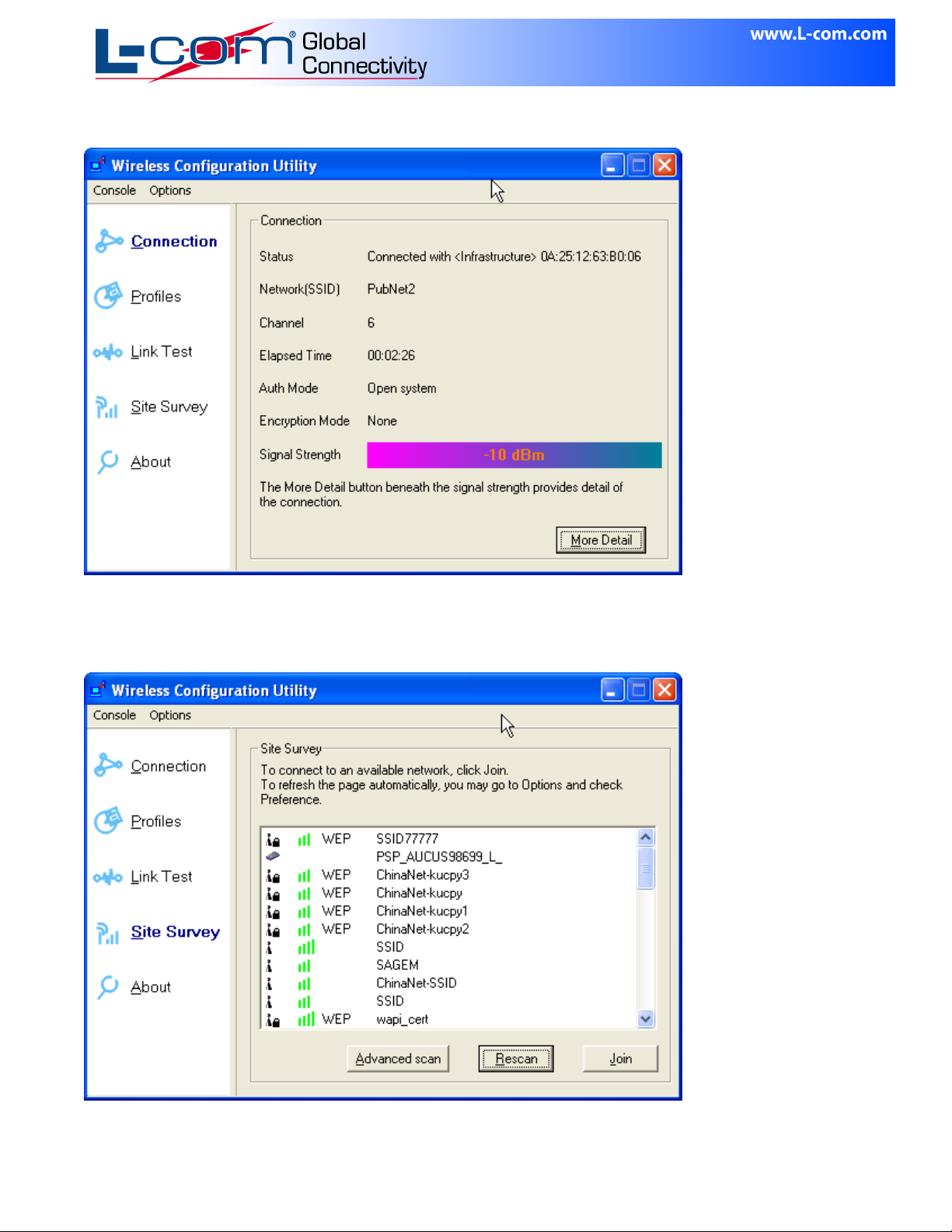
Connection status page of Main User Interface (UI)
This page shows the connection status information, such as SSID, Channel and so on.
Site Survey Page of Main UI
This page shows Site Survey information. Users may select one AP to connect to.
L-COM, INC. 45 BEECHWOOD DRIVE NORTH ANDOVER, MA 01845
WWW.L-COM.COM E-MAIL: [email protected] PHONE: 1-800-343-1455 FAX: 1-978-689-9484
© L-com, Inc. All Rights Reserved. L-com Global Connectivity and the L-com logo are registered marks.
Page 12
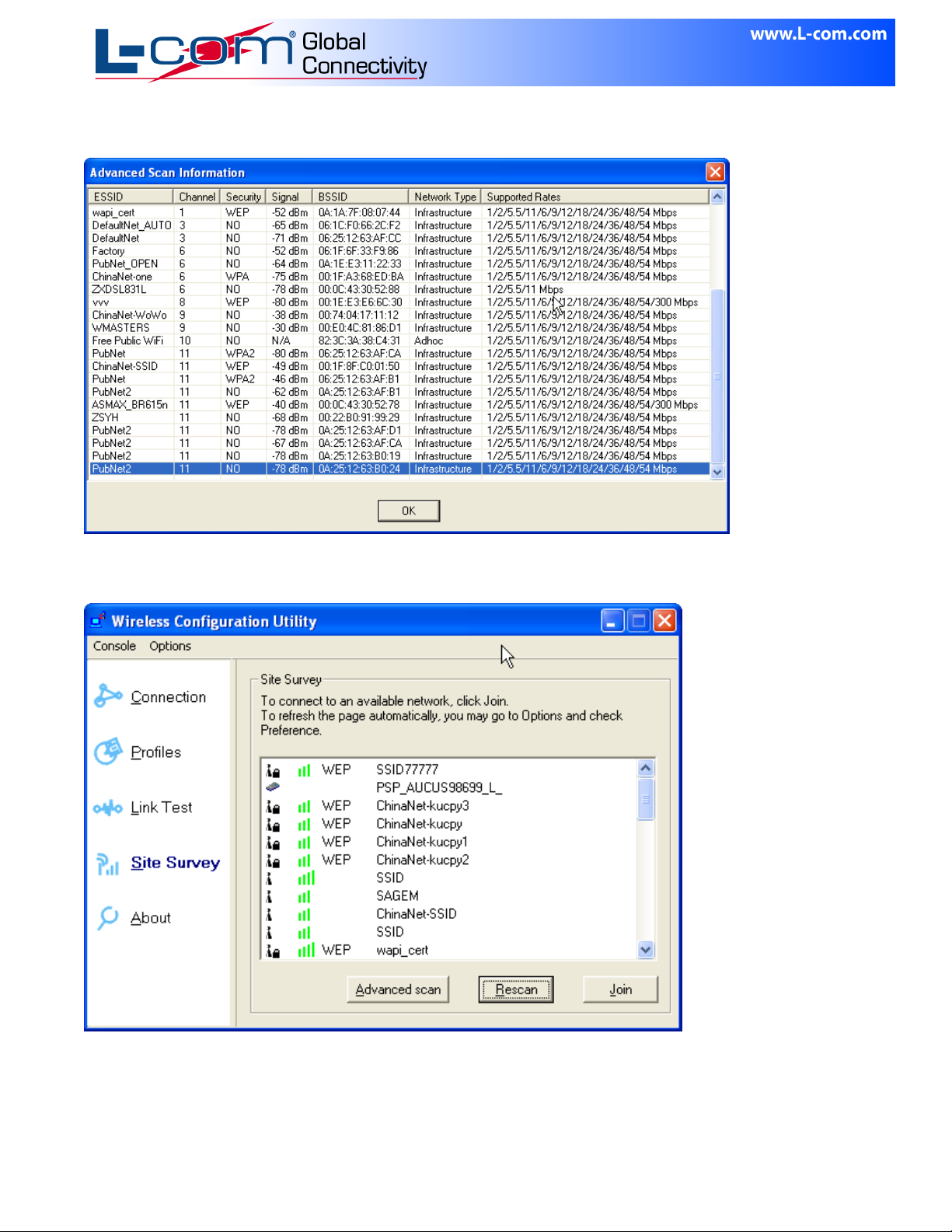
The Button “Advanced Scan” will show more information as in the following picture:
The “Rescan” Button will refresh information in the list.
To select an AP, click the “Join” button.
L-COM, INC. 45 BEECHWOOD DRIVE NORTH ANDOVER, MA 01845
WWW.L-COM.COM E-MAIL: [email protected] PHONE: 1-800-343-1455 FAX: 1-978-689-9484
© L-com, Inc. All Rights Reserved. L-com Global Connectivity and the L-com logo are registered marks.
Page 13
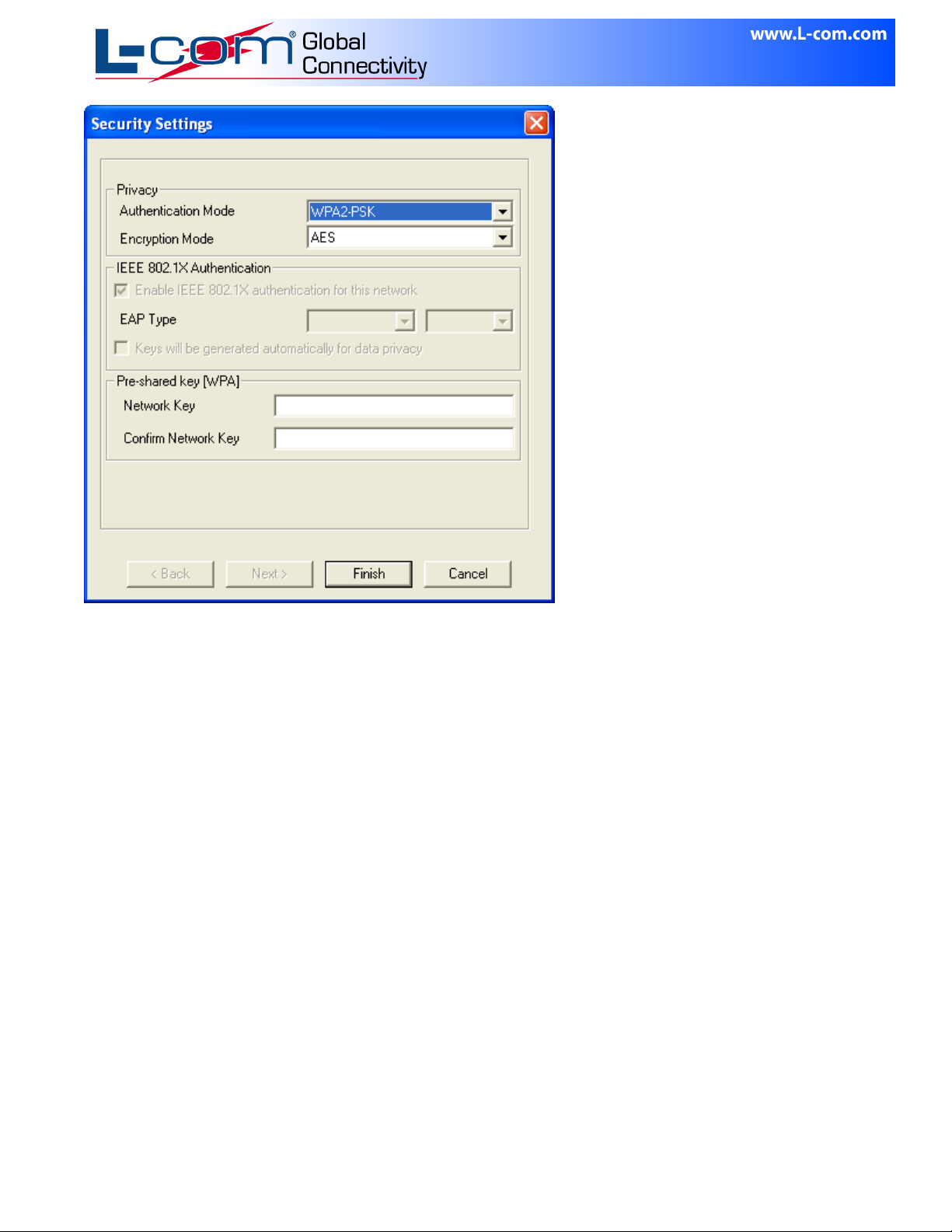
After selecting an AP, the user must choose Authentication Mode, Encryption Mode and Network Key to connect to
the AP selected. After those fields are filled in, click the “Finish” button to start connect progress.
WWW.L-COM.COM E-MAIL: [email protected] PHONE: 1-800-343-1455 FAX: 1-978-689-9484
© L-com, Inc. All Rights Reserved. L-com Global Connectivity and the L-com logo are registered marks.
L-COM, INC. 45 BEECHWOOD DRIVE NORTH ANDOVER, MA 01845
Page 14
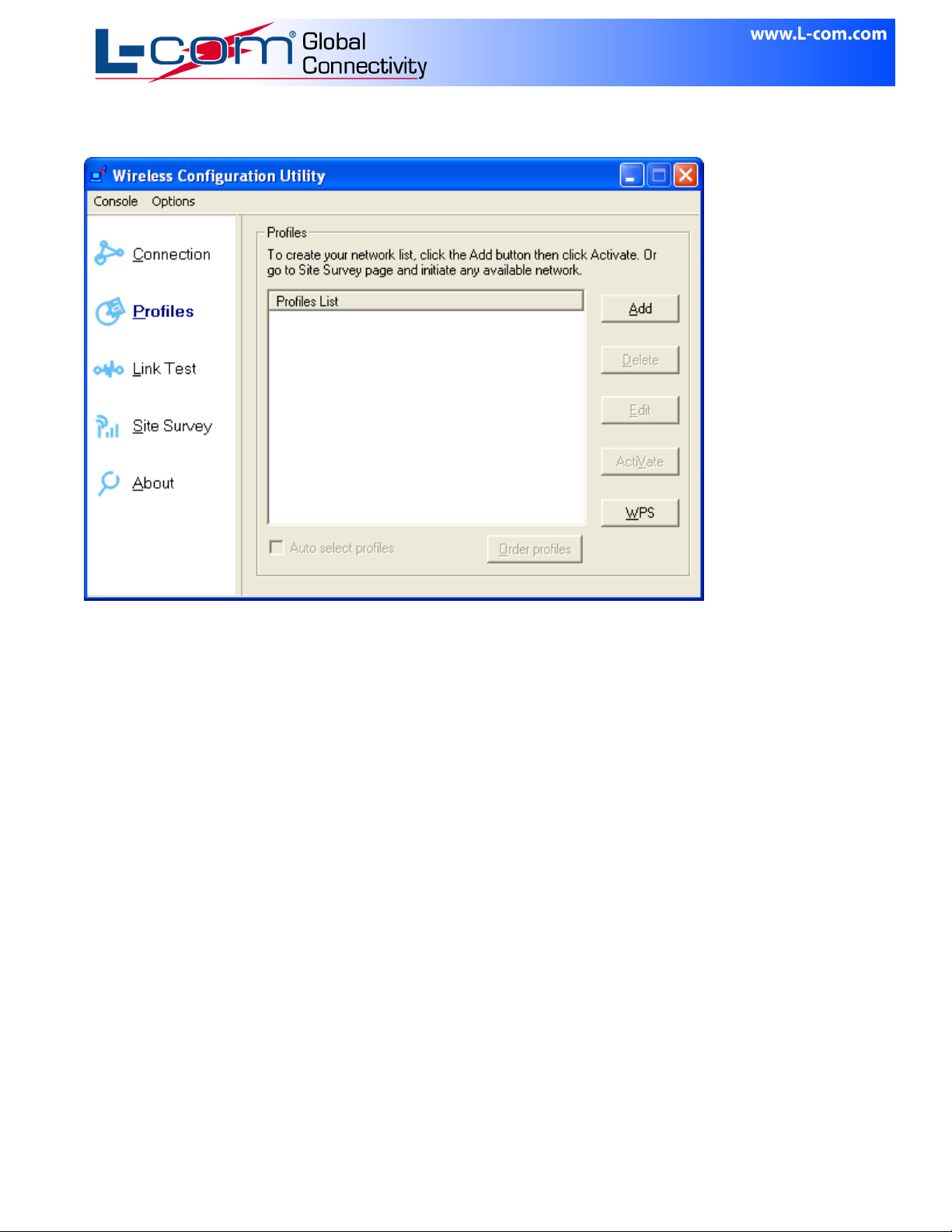
Profile Configuration Page of Main UI
On this page, the user can Add, Delete, Edit, Activate a Profile and use WPS to Connect an AP.
WWW.L-COM.COM E-MAIL: [email protected] PHONE: 1-800-343-1455 FAX: 1-978-689-9484
© L-com, Inc. All Rights Reserved. L-com Global Connectivity and the L-com logo are registered marks.
L-COM, INC. 45 BEECHWOOD DRIVE NORTH ANDOVER, MA 01845
Page 15
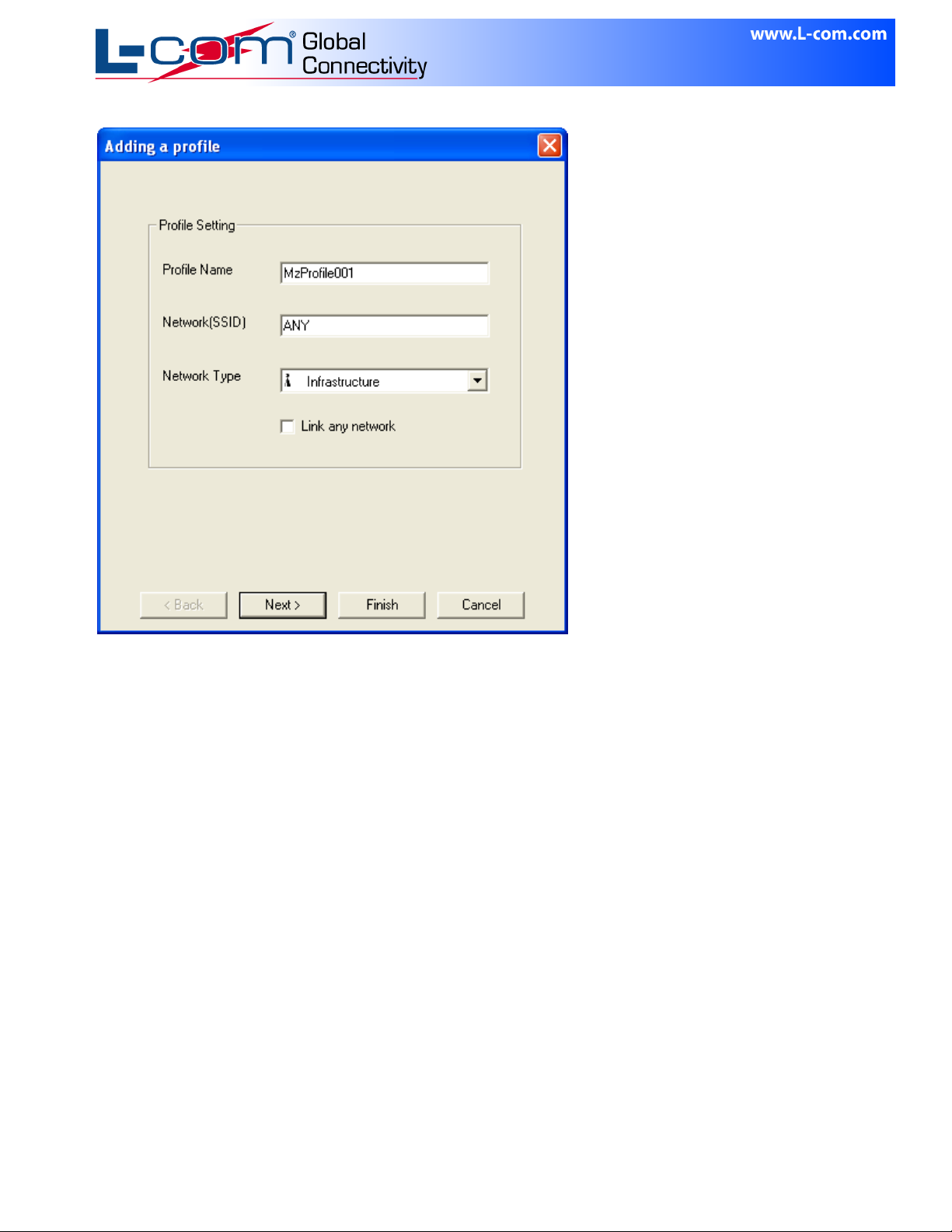
Add a Profile
Enter Profile Name, SSID and select Network Type on this page and click the “Next” button.
WWW.L-COM.COM E-MAIL: [email protected] PHONE: 1-800-343-1455 FAX: 1-978-689-9484
© L-com, Inc. All Rights Reserved. L-com Global Connectivity and the L-com logo are registered marks.
L-COM, INC. 45 BEECHWOOD DRIVE NORTH ANDOVER, MA 01845
Page 16
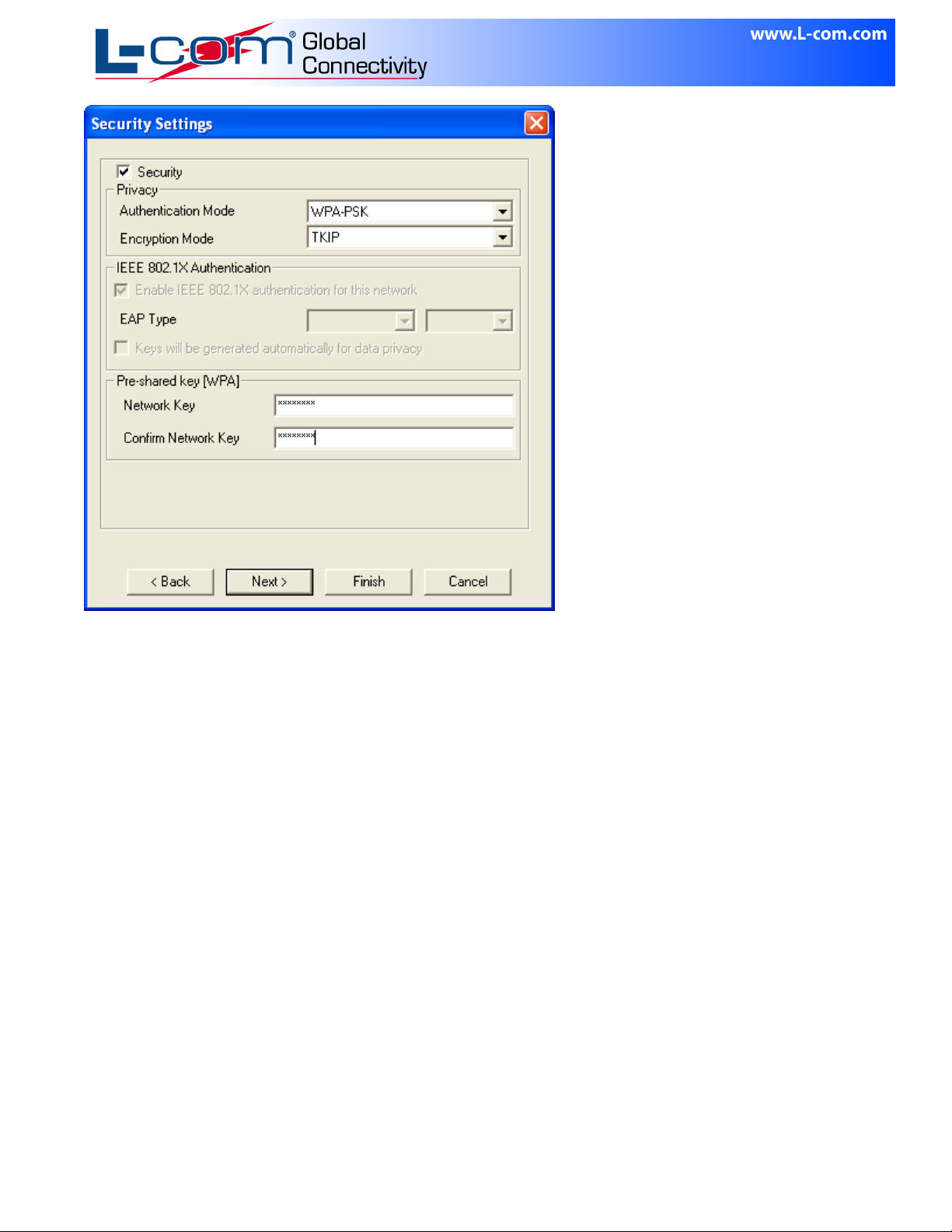
Select Authentication Mode, Encryption Mode and enter Network Key in on this page and click the
“Next” button (if this information is not required, just use the default configurations, then click the
“Finish” button to start connect).
WWW.L-COM.COM E-MAIL: [email protected] PHONE: 1-800-343-1455 FAX: 1-978-689-9484
© L-com, Inc. All Rights Reserved. L-com Global Connectivity and the L-com logo are registered marks.
L-COM, INC. 45 BEECHWOOD DRIVE NORTH ANDOVER, MA 01845
Page 17
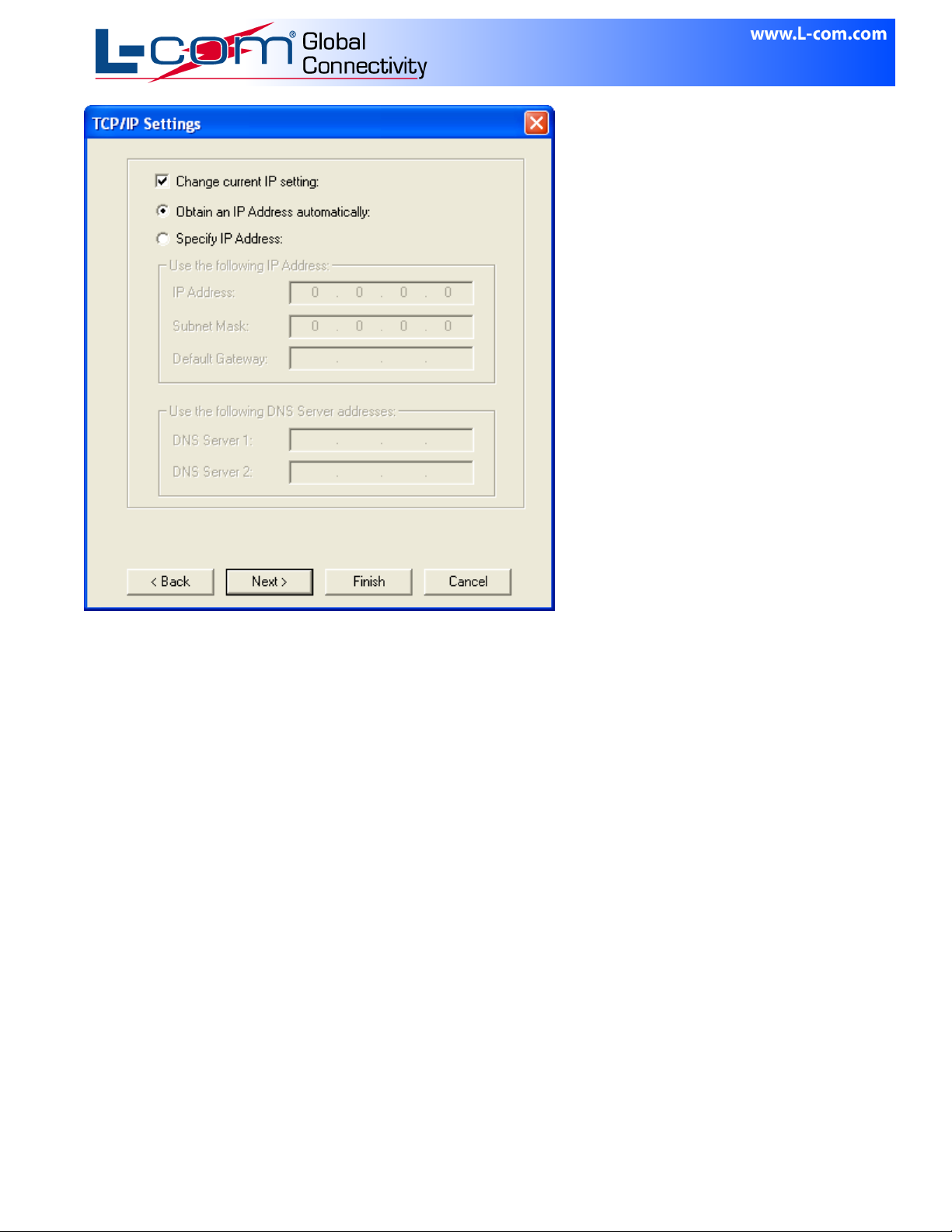
Select to Specify IP Address or Obtain an IP Address automatically.
WWW.L-COM.COM E-MAIL: [email protected] PHONE: 1-800-343-1455 FAX: 1-978-689-9484
© L-com, Inc. All Rights Reserved. L-com Global Connectivity and the L-com logo are registered marks.
L-COM, INC. 45 BEECHWOOD DRIVE NORTH ANDOVER, MA 01845
Page 18
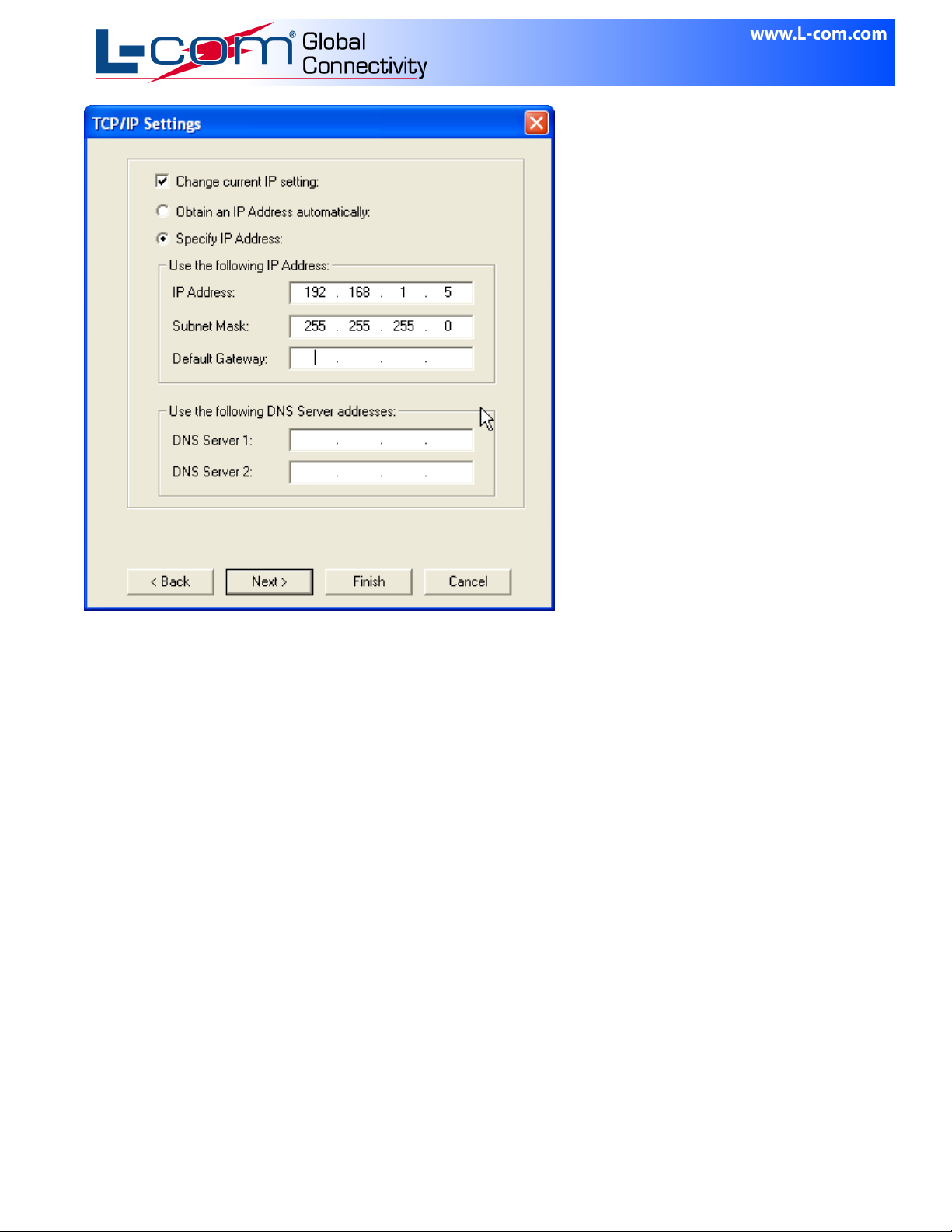
If selecting an IP address, fill in the required information. Check with your network administrator for IP
address information.
WWW.L-COM.COM E-MAIL: [email protected] PHONE: 1-800-343-1455 FAX: 1-978-689-9484
© L-com, Inc. All Rights Reserved. L-com Global Connectivity and the L-com logo are registered marks.
L-COM, INC. 45 BEECHWOOD DRIVE NORTH ANDOVER, MA 01845
Page 19

For advance settings, the Default is recommended. Click “Next” to continue.
WWW.L-COM.COM E-MAIL: [email protected] PHONE: 1-800-343-1455 FAX: 1-978-689-9484
© L-com, Inc. All Rights Reserved. L-com Global Connectivity and the L-com logo are registered marks.
L-COM, INC. 45 BEECHWOOD DRIVE NORTH ANDOVER, MA 01845
Page 20
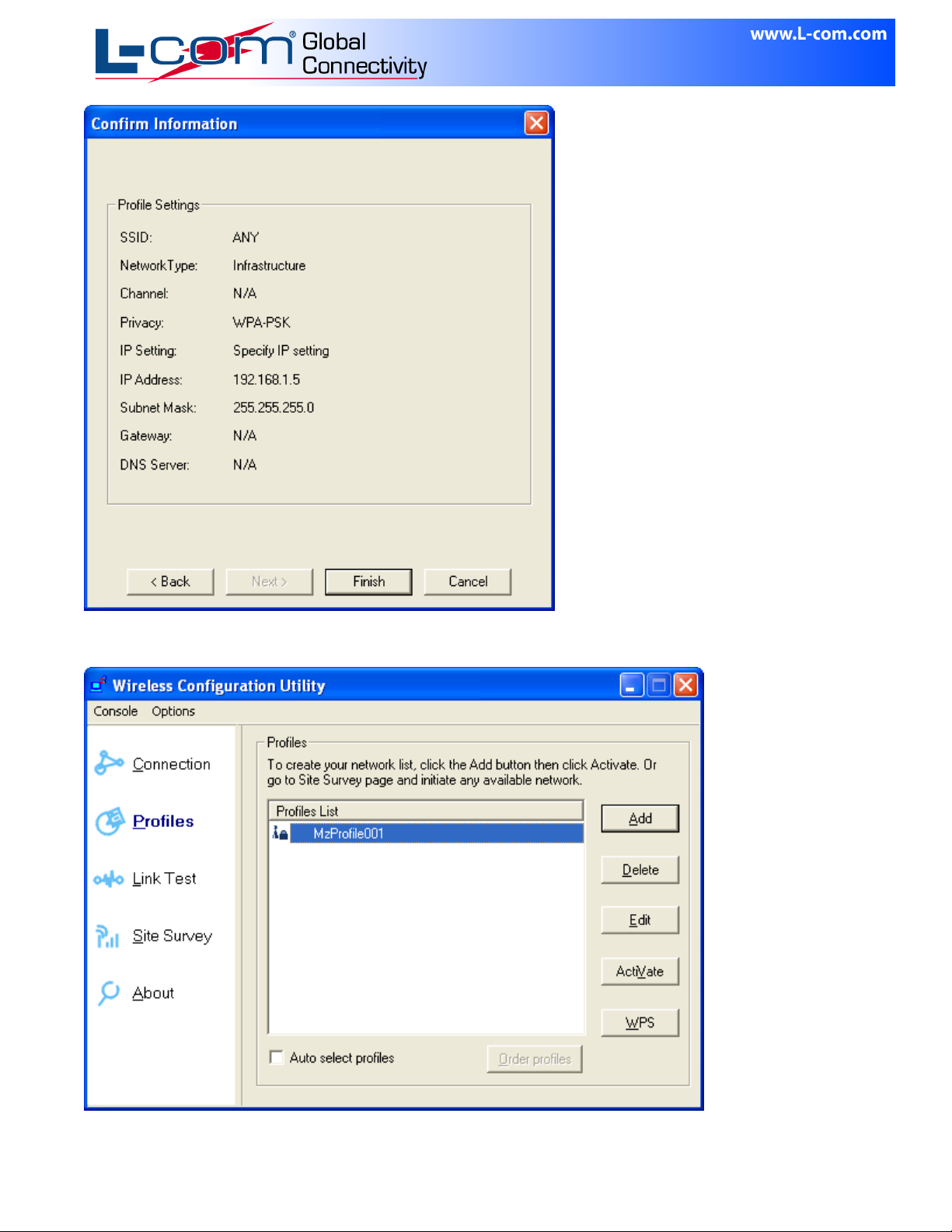
Click “Finish” to return to the Profile Configuration page of Main UI, A profile has been created.
WWW.L-COM.COM E-MAIL: [email protected] PHONE: 1-800-343-1455 FAX: 1-978-689-9484
© L-com, Inc. All Rights Reserved. L-com Global Connectivity and the L-com logo are registered marks.
L-COM, INC. 45 BEECHWOOD DRIVE NORTH ANDOVER, MA 01845
Page 21

Additional options on this page include:
Delete a Profile:
Please select a profile and click the “Delete” button. The Profile will be deleted.
Edit a Profile:
Please select a profile and click the “Edit” button. You can then edit the parameters of the profile.
Activate a Profile:
Please select a profile and click the “ActiVate” button. This will activate the selected profile.
WPS:
Please refer to the next section “WPS Configuration”
WWW.L-COM.COM E-MAIL: [email protected] PHONE: 1-800-343-1455 FAX: 1-978-689-9484
© L-com, Inc. All Rights Reserved. L-com Global Connectivity and the L-com logo are registered marks.
L-COM, INC. 45 BEECHWOOD DRIVE NORTH ANDOVER, MA 01845
Page 22
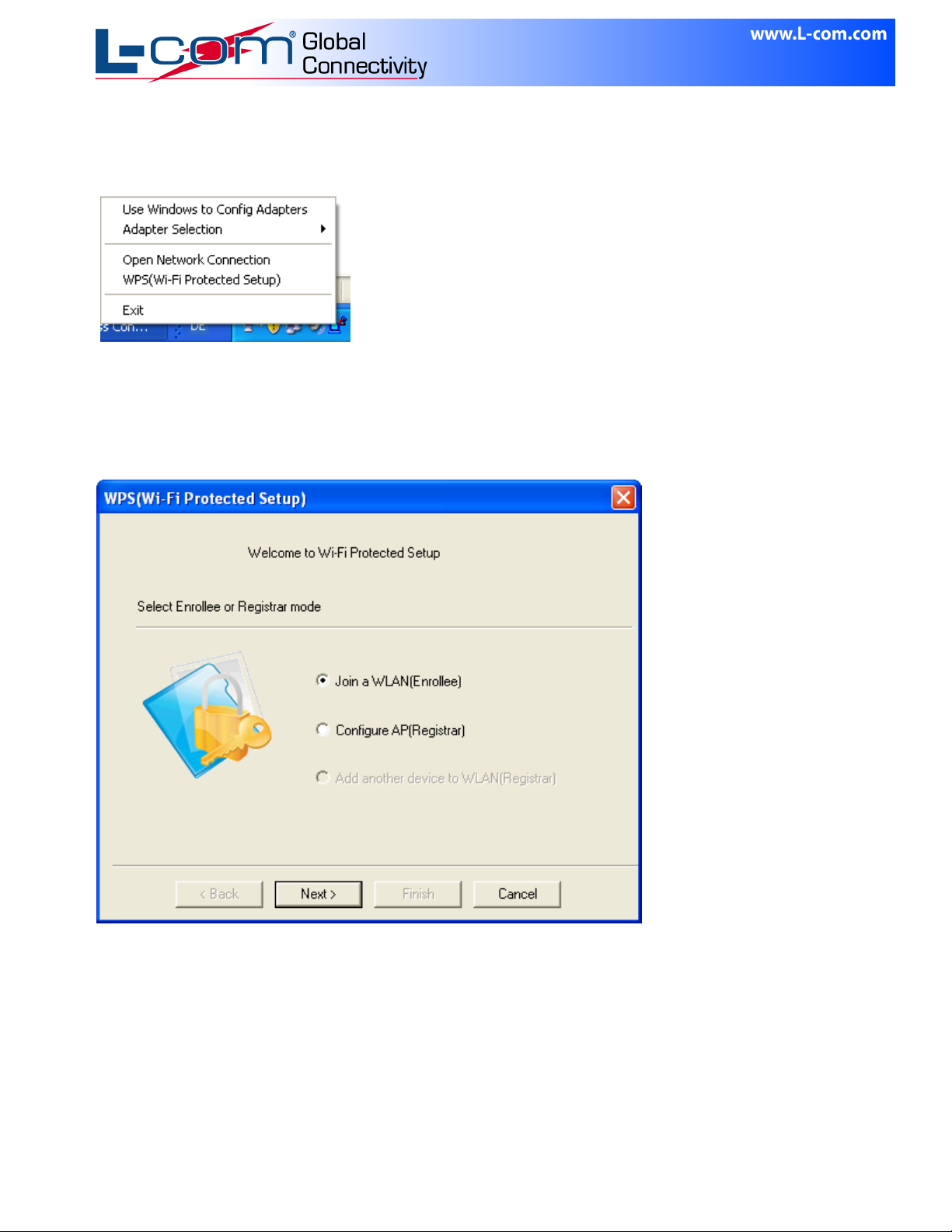
WPS Configuration
WPS Configuration has three methods, PBC, PIN code (Enrollee, Registrar);
Select WPS (Wi-Fi Protected Setup)
For Enrollee setup, select “Join a WLAN(Enrollee)” and click the “Next” button.
WWW.L-COM.COM E-MAIL: [email protected] PHONE: 1-800-343-1455 FAX: 1-978-689-9484
© L-com, Inc. All Rights Reserved. L-com Global Connectivity and the L-com logo are registered marks.
L-COM, INC. 45 BEECHWOOD DRIVE NORTH ANDOVER, MA 01845
Page 23
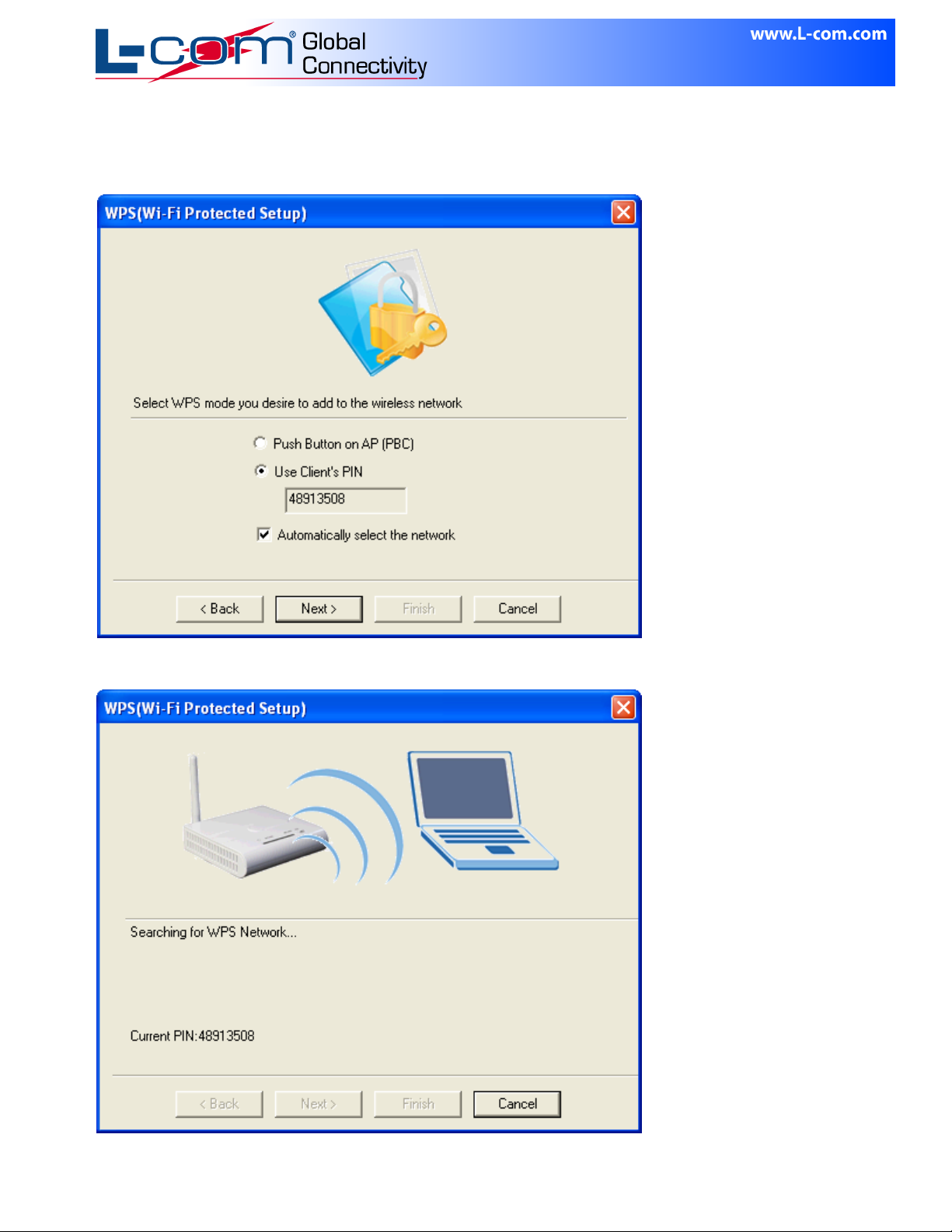
If PBC mode is selected, click “Next”. The user must now press the AP’s WPS button within 2
minutes. This will start the normal WPS process. If Client PIN mode is selected, remember the PIN
code (48913508). Click the “Next” button to continue.
User must input the PIN Code into the AP within 2 minutes. The WPS process will be start normally.
WWW.L-COM.COM E-MAIL: [email protected] PHONE: 1-800-343-1455 FAX: 1-978-689-9484
© L-com, Inc. All Rights Reserved. L-com Global Connectivity and the L-com logo are registered marks.
L-COM, INC. 45 BEECHWOOD DRIVE NORTH ANDOVER, MA 01845
Page 24
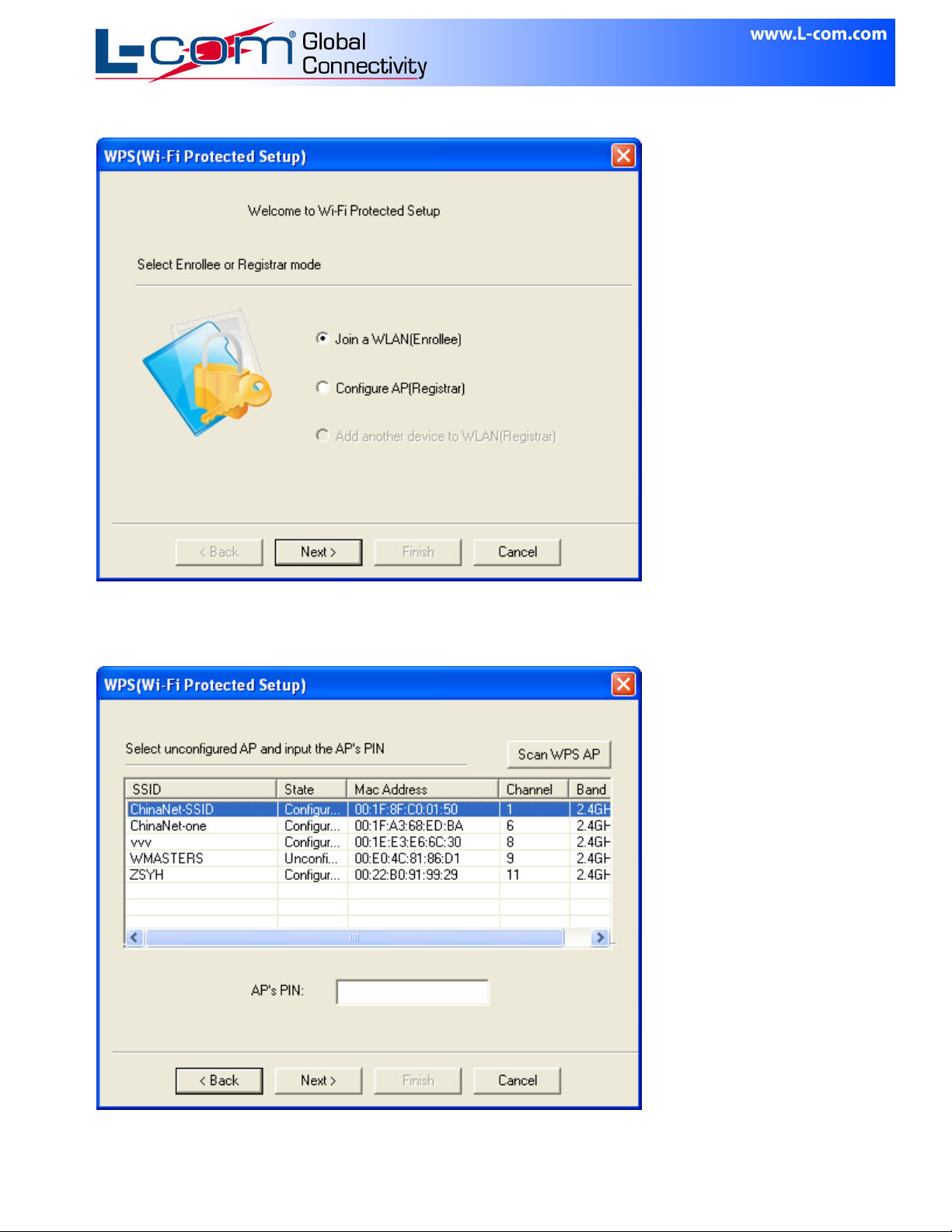
If user selects Configure AP(Registrar) mode:
Please select the AP and input AP‘s PIN code in the “AP’s PIN:” field and click the “Next” button.
WWW.L-COM.COM E-MAIL: [email protected] PHONE: 1-800-343-1455 FAX: 1-978-689-9484
© L-com, Inc. All Rights Reserved. L-com Global Connectivity and the L-com logo are registered marks.
L-COM, INC. 45 BEECHWOOD DRIVE NORTH ANDOVER, MA 01845
Page 25
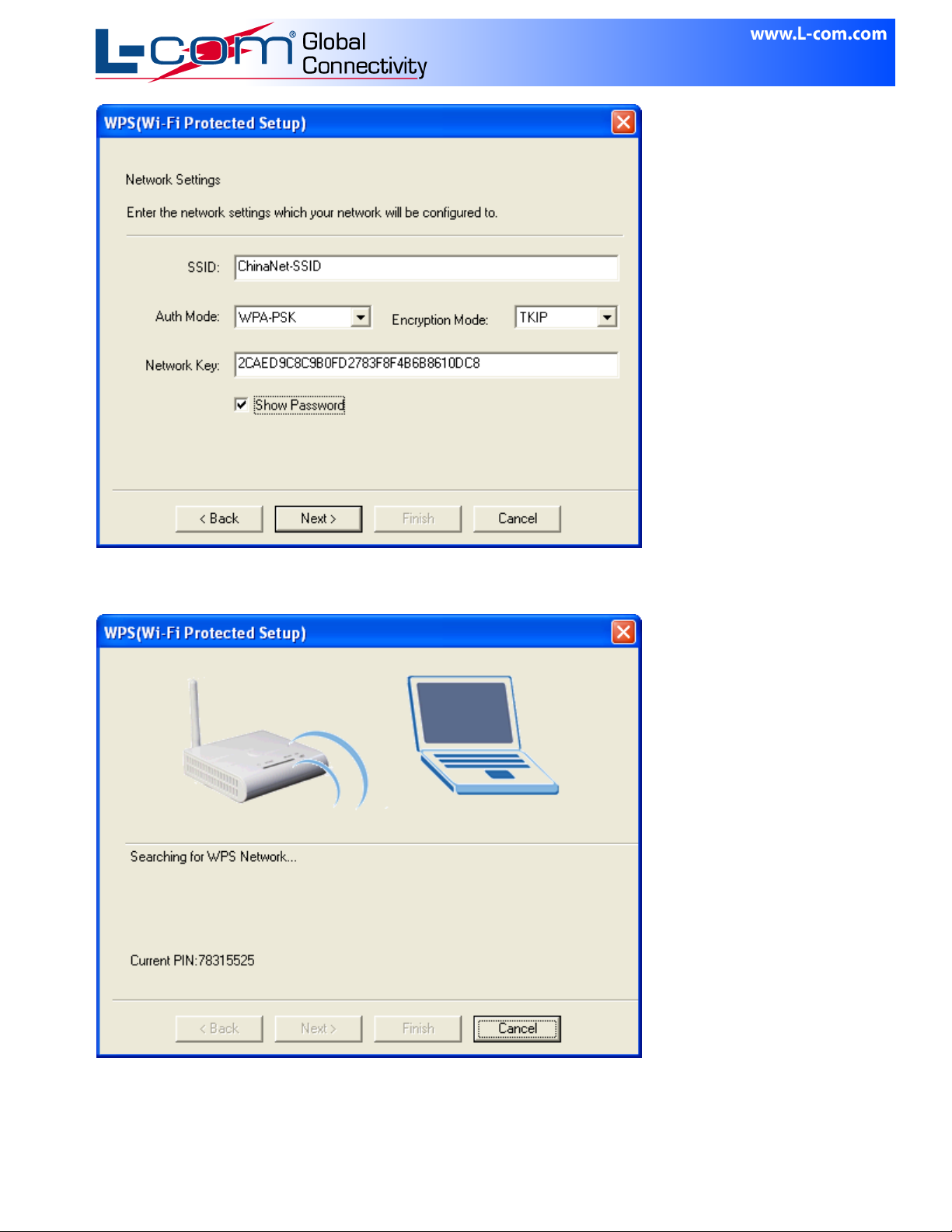
On this page the user can configure the AP’s information. Then click the “Next” button.
The WPS Progress will start.
WWW.L-COM.COM E-MAIL: [email protected] PHONE: 1-800-343-1455 FAX: 1-978-689-9484
© L-com, Inc. All Rights Reserved. L-com Global Connectivity and the L-com logo are registered marks.
L-COM, INC. 45 BEECHWOOD DRIVE NORTH ANDOVER, MA 01845
Page 26

Appendix A Glossary
802.11n - 802.11n builds upon previous 802.11 standards by adding MIMO (multiple-input multipleoutput). MIMO uses multiple transmitter and receiver antennas to allow for increased data
throughput via spatial multiplexing and increased range by exploiting the spatia l diversity, perhaps
through coding schemes like Alamouti coding. The Enhanced Wireless Consortium (EWC)] was
formed to help accelerate the IEEE 802.11n development process and promote a technology
specification for interoperability of next-generation wireless local area networking (WLAN) products.
802.11b - The 802.11b standard specifies a wireless networking at 11 Mbps using direct-sequence
spread-spectrum (DSSS) technology and operating in the unlicensed radio spectrum at 2.4GHz, and
WEP encryption for security. 802.11b networks are also referred to as Wi-Fi networks.
802.11g - Specification for wireless networking at 54 Mbps using direct-sequence spread-spectrum
(DSSS) technology, using OFDM modulation and operating in the unlicensed radio spectrum at
2.4GHz, and backward compatibility with IEEE 802.11b devices, and WEP encryption for security.
Ad-hoc Network - An ad-hoc network is a group of PCs, each with a wireless adapter, connected as
an independent 802.11 wireless LAN. Ad-hoc wireless PCs operate on a peer-to-peer basis,
communicating directly with each other without the use of an access point. Ad-hoc mode is also
referred to as an Independent Basic Service Set (IBSS) or as peer-to-peer mode, and is useful at a
departmental scale or SOHO operation.
DSSS (Direct-Sequence Spread Spectrum) - DSSS generates a redundant bit pattern for all data
transmitted. This bit pattern is called a chip (or chipping code). Even if one or more bits in the chip
are damaged during transmission, statistical techniques embedded in the receiver can recover the
original data without the need for retransmission. To an unintended receiver, DSSS appears as low
power wideband noise and is rejected (ignored) by most narrowband receivers. However, to an
intended receiver (i.e. another wireless LAN endpoint), the DSSS signal is recognized as the only
valid signal, and interference is inherently rejected (ignored).
FHSS (Frequency Hopping Spread Spectrum) - FHSS continuously changes (hops) the carrier
frequency of a conventional carrier several times per second according to a pseudo-random set of
channels. Because a fixed frequency is not used, and only the transmitter and receiver know the hop
patterns, interception of FHSS is extremely difficult.
Infrastructure Network - An infrastructure network is a group of PCs or other devices, each with a
wireless adapter, connected as an 802.11 wireless LAN. In infrastructure mode, the wireless devices
communicate with each other and to a wired network by first going through an access point. An
infrastructure wireless network connected to a wired network is referred to as a Basic Service Set
(BSS). A set of two or more BSS in a single network is referred to as an Extended Service Set (ESS).
Infrastructure mode is useful at a corporation scale, or when it is necessary to connect the wired and
wireless networks.
Spread Spectrum - Spread Spectrum technology is a wideband radio frequency technique.
WWW.L-COM.COM E-MAIL: [email protected] PHONE: 1-800-343-1455 FAX: 1-978-689-9484
© L-com, Inc. All Rights Reserved. L-com Global Connectivity and the L-com logo are registered marks.
L-COM, INC. 45 BEECHWOOD DRIVE NORTH ANDOVER, MA 01845
Page 27
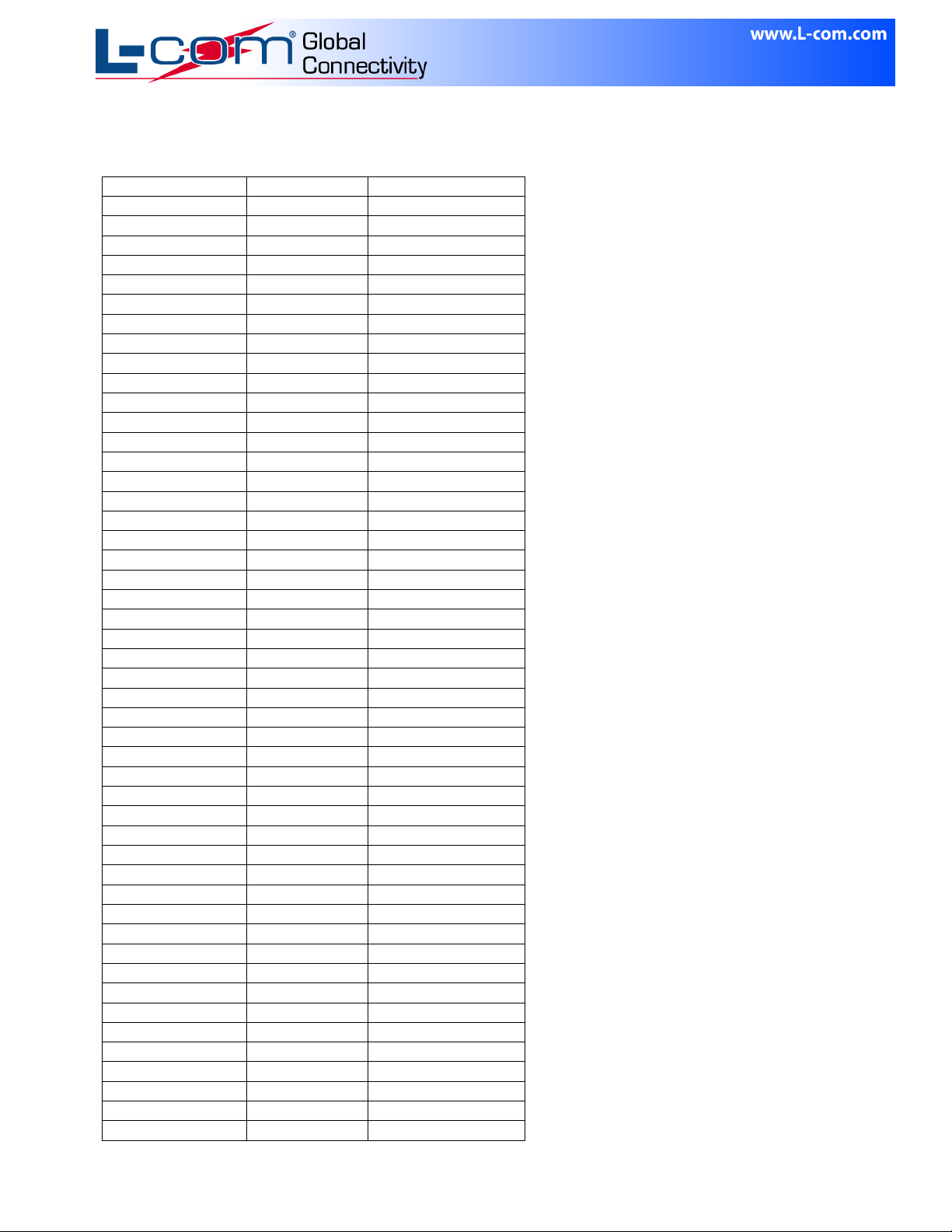
Appendix B Country Channel List
The following table displays the country channel list, channel classification, and range.
Country Classification Range
Argentina 0 CH1~11
Australia 1 CH1~13
Austria 1 CH1~13
Bahrain 1 CH1~13
Belarus 1 CH1~13
Belgium 1 CH1~13
Bolivia 1 CH1~13
Brazil 0 CH1~11
Bulgaria 1 CH1~13
Canada 0 CH1~11
Chile 1 CH1~13
China 1 CH1~13
Colombia 0 CH1~11
Costa Rica 1 CH1~13
Croatia 1 CH1~13
Cyprus 1 CH1~13
Czech Republic 1 CH1~13
Denmark 1 CH1~13
Ecuador 1 CH1~13
Egypt 1 CH1~13
Estonia 1 CH1~13
Finland 1 CH1~13
France 3 CH10~13
France2 1 CH1~13
Germany 1 CH1~13
Greece 1 CH1~13
Hong Kong 1 CH1~13
Hungary 1 CH1~13
Iceland 1 CH1~13
India 1 CH1~13
Indonesia 1 CH1~13
Ireland 1 CH1~13
Israel 6 CH3~9
Italy 1 CH1~13
Japan 5 CH1~14
Japan2 4 CH14~14
Japan3 1 CH1~13
Jordan 3 CH10~13
Kuwait 1 CH1~13
Latvia 1 CH1~13
Lebanon 1 CH1~13
Latvia 1 CH1~13
Lebanon 1 CH1~13
Liechtenstein 1 CH1~13
Lithuania 1 CH1~13
Luxembourg 1 CH1~13
Macedonia 1 CH1~13
Malaysia 1 CH1~13
WWW.L-COM.COM E-MAIL: [email protected] PHONE: 1-800-343-1455 FAX: 1-978-689-9484
© L-com, Inc. All Rights Reserved. L-com Global Connectivity and the L-com logo are registered marks.
L-COM, INC. 45 BEECHWOOD DRIVE NORTH ANDOVER, MA 01845
Page 28
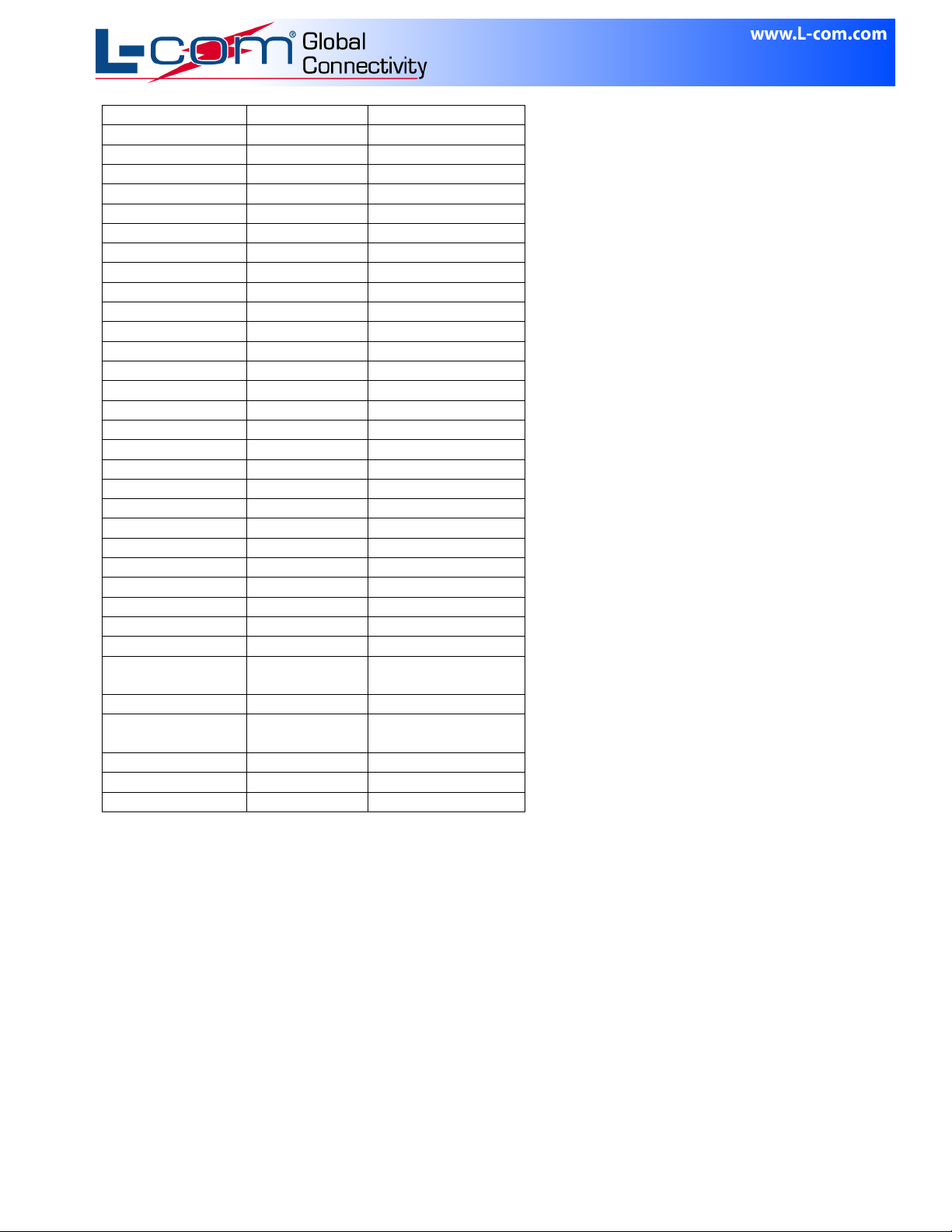
Country Classification Range
Mexico 0 CH1~11
Morocco 1 CH1~13
Netherlands 1 CH1~13
New Zealand 1 CH1~13
Nigeria 1 CH1~13
Norway 1 CH1~13
Panama 1 CH1~13
Paraguay 1 CH1~13
Peru 1 CH1~13
Philippines 1 CH1~13
Poland 1 CH1~13
Portugal 1 CH1~13
Puerto Rico 1 CH1~13
Romania 1 CH1~13
Russia 1 CH1~13
Saudi Arabia 1 CH1~13
Singapore 1 CH1~13
Slovakia 1 CH1~13
Slovenia 1 CH1~13
South Africa 1 CH1~13
South Korea 1 CH1~13
Spain 2 CH10~11
Sweden 1 CH1~13
Switzerland 1 CH1~13
Taiwan 0 CH1~11
Thailand 1 CH1~13
Turkey 1 CH1~13
United Arab
Emirates
United Kingdom 1 CH1~13
United States of
America
Uruguay 1 CH1~13
Venezuela 1 CH1~13
Yugoslavia 0 CH1~11
1 CH1~13
0 CH1~11
WWW.L-COM.COM E-MAIL: [email protected] PHONE: 1-800-343-1455 FAX: 1-978-689-9484
© L-com, Inc. All Rights Reserved. L-com Global Connectivity and the L-com logo are registered marks.
L-COM, INC. 45 BEECHWOOD DRIVE NORTH ANDOVER, MA 01845
Page 29

FCC Information
FCC Information
This equipment complies with CFR 47, Part 15.19 of the FCC rules. Operation of the equipment is
subject to the following conditions: (1) this dev ice may not cause harmful interference, and (2) this
device must accept any interference received; including interference that may cause undesired
operation.
This device must not be co-located or operating in conjunction with any other antenna or
transmitter
NOTE: THE MANUFACTURER IS NOT RESPONSIBLE FOR ANY RADIO OR TV INTERFERENCE CAUSED BY
UNAUTHORIZED MODIFICATIONS TO THIS EQUIPMENT. SUCH MODIFICATIONS COULD VOID THE
USER’S AUTHORITY TO OPERATE THE EQUIPMENT.
Federal Communications Commission (FCC) Requirements, Part 15
This equipment has been tested and found to comply with the limits for a class B digital device,
pursuant to part 15 of the FCC Rules. These limits are designed to provide reasonable protection
against harmful interference in a residential installation.
This equipment generates, uses and can radiate radio frequency energy and, if not installed and used
in accordance with the instructions, may cause harmful interference to radio communications.
However, there is no guarantee that interference will not occur in a particular installation. If this
equipment does cause harmful interference to radio or television reception, which can be determined
by turning the equipment off and on, the user is encouraged to try to correct the interference by one
or more of the following measures:
---Reorient or relocate the receiving antenna.
---Increase the separation between the equipment and receiver.
---Connect the equipment into an outlet on a circuit different from that to which the receiver is
connected.
---Consult the dealer or an experienced radio/TV technician for help.
Regulatory information / Disclaimers
Installation and use of this Wireless LAN device must be in strict accordance with the instructions included
in the user documentation provided with the product. Any changes or modifications (including the antennas)
made to this device that are not expressly approved by the manufacturer may void the user’s authority to
operate the equipment. The manufacturer is not responsible for any radio or television interference caused by
unauthorized modification of this device, or the substitution of the connecting cables and equipment other
than manufacturer specified. It is the responsibility of the user to correct any interference caused by such
unauthorized modification, substitution or attachment. Manufacturer and its authorized resellers or
distributors will assume no liability for any damage or violation of government
CAUTION: To maintain compliance with FCC’s RF exposure guidelines, this equipment should be
installed and operated with minimum distance 20cm between the radiator and your body. Use only the
supplied antenna. Unauthorized antenna, modification, or attachments could damage the transmitter
and may violate FCC regulations.
MPE Statement (Safety Information)
Your device contains a low power transmitter. When device is transmitted it sends out Radio Frequency
(RF) signal.
Safety Information
In order to maintain compliance with the FCC RF exposure guidelines, this equipment should be
installed and operated with minimum distance 20cm between the radiator and your body. Use only
with supplied antenna. Unauthorized antenna, modification, or attachments could damage the
transmitter and may violate FCC regulations.
WWW.L-COM.COM E-MAIL: [email protected] PHONE: 1-800-343-1455 FAX: 1-978-689-9484
© L-com, Inc. All Rights Reserved. L-com Global Connectivity and the L-com logo are registered marks.
L-COM, INC. 45 BEECHWOOD DRIVE NORTH ANDOVER, MA 01845
 Loading...