

Page 1
5 018341 076832
Our products are designed to be used correctly and with care for the purpose for which they are intended.
No liability is accepted by The Tool Connection Ltd. for incorrect use of any of our products, and the Tool
Connection Ltd cannot be held responsible for any damage to personnel, property or equipment when
using the tools. Incorrect use will also invalidate the warranty.
If applicable, the applications database and any instructional information provided has been designed
to offer general guidance for a particular tool’s use and while all attention is given to the accuracy of the
data no project should be attempted without referring first to the manufacturer’s technical documentation
(workshop or instruction manual) or the use of a recognised authority such as Autodata.
It is our policy to continually improve our products and thus we reserve the right to alter specifications and
components without prior notice. It is the responsibility of the user to ensure the suitability of the tools and
information prior to their use.
7683
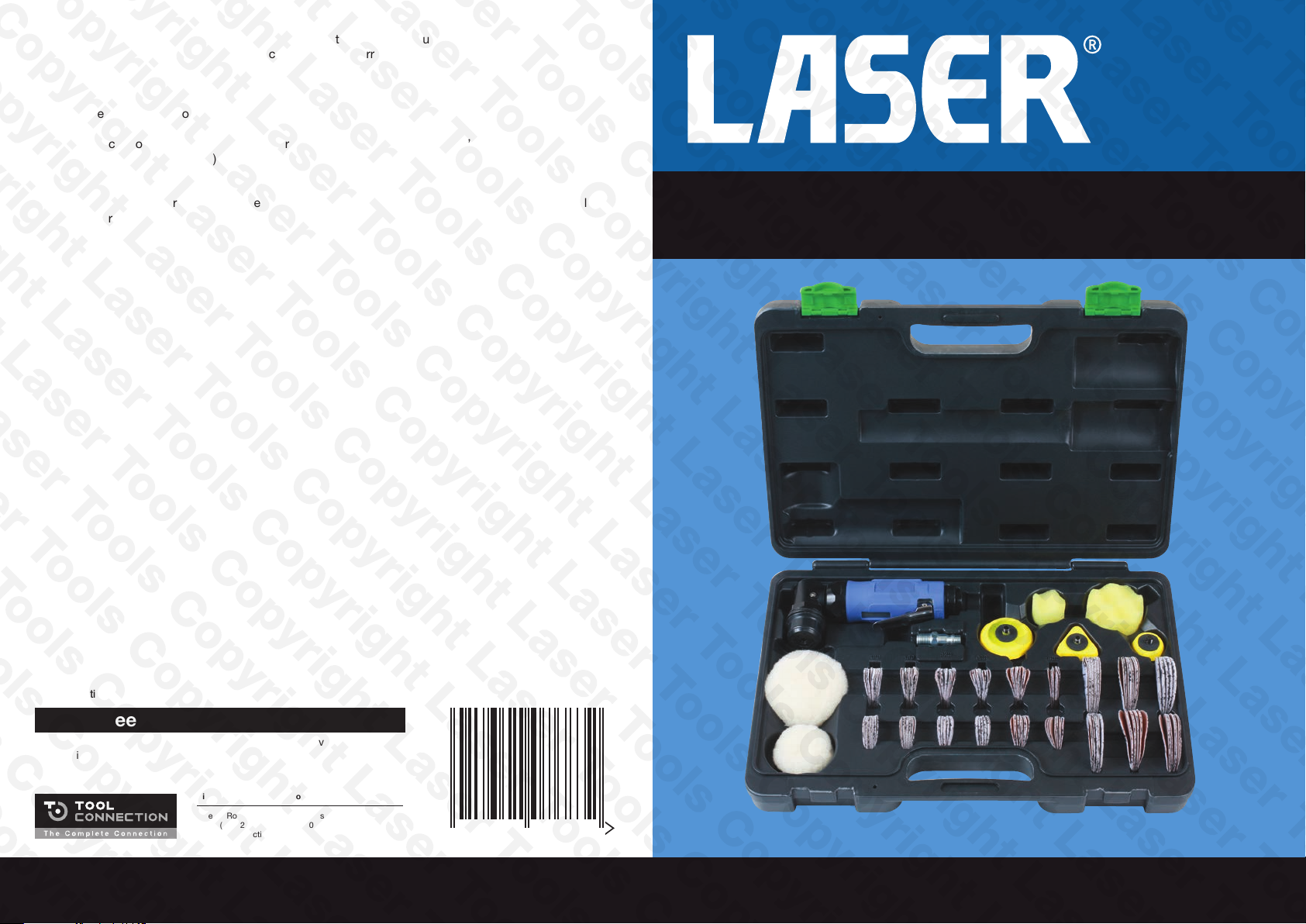
Pneumatic Spot Repair Sander
7683_Instructions_V2
Guarantee
This item contains consumable elements and are NOT covered by the Tool
Connection Guarantee. For spares contact our service department direct on:
+44 (0) 1926 818186.
Distributed by The Tool Connection Ltd
Kineton Road, Southam, Warwickshire CV47 0DR
T +44 (0) 1926 815000 F +44 (0) 1926 815888
info@toolconnection.co.uk www.toolconnection.co.uk
www.lasertools.co.uk
www.lasertools.co.uk
Page 2
Pneumatic Spot Repair Sander
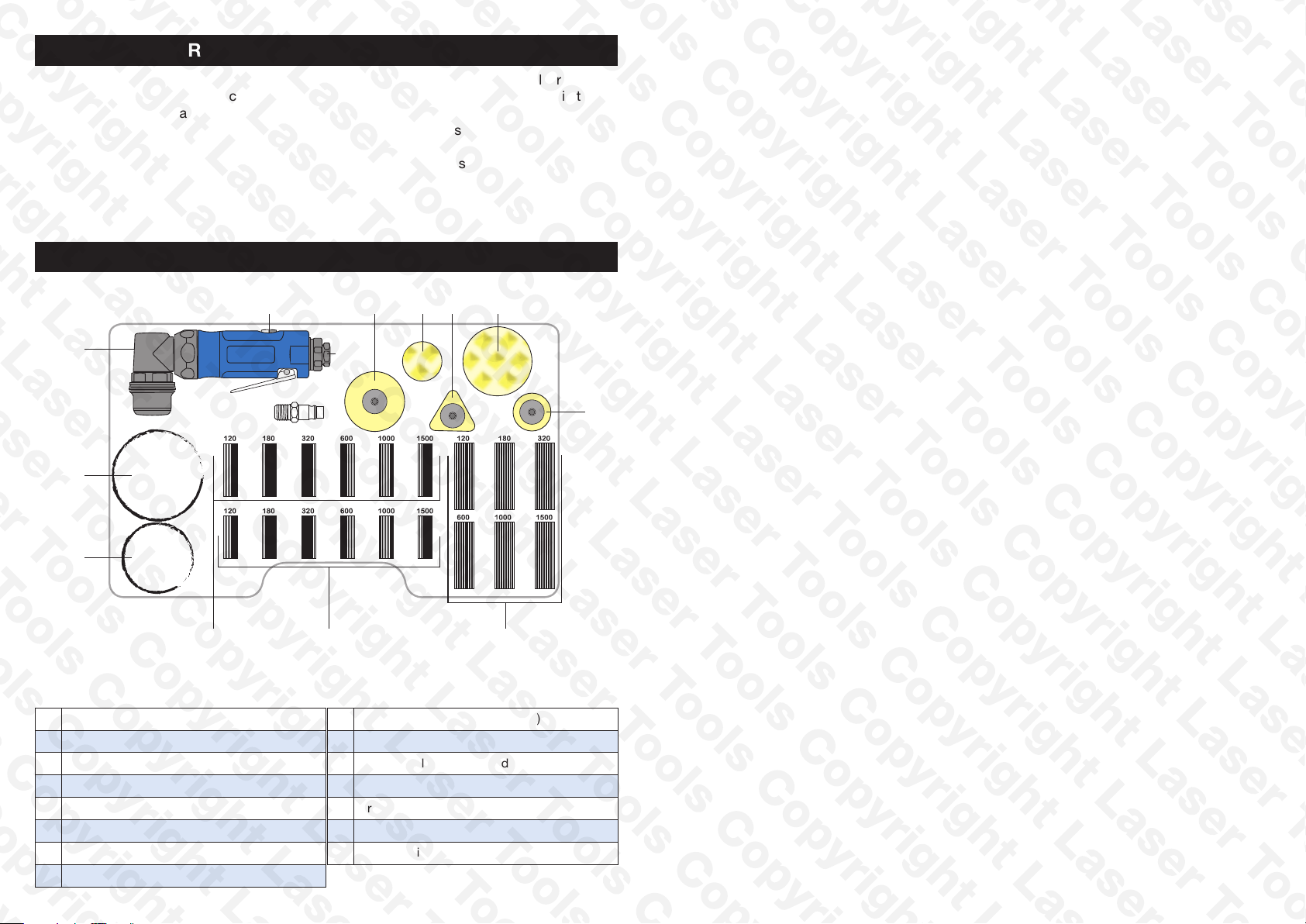
The Laser Tools spot repair orbital sander and polisher is a compact but powerful air tool that
is powered from the workshop compressed air supply (recommended pressure 90psi at the
tool). It is supplied as part of a comprehensive kit that includes three different sized sanding
pads, two foam polishing heads and two lambswool polishing heads.
The speed of the spot repair sander can be easily adjusted on the instrument.
Additionally an excellent selection of abrasive sanding discs (in the three sizes) is included
(120, 180, 320, 600, 1000, 1500 grit). Consumables are available.
Components
A
K
L
Fig 1
B
D
I JFC G
D
B
E
M N O
H
Sander
A
Trigger
B
Speed control
C
Air inlet
D
Air line adaptor (Euro)
E
Pad 48mm (2")
F
Triangular detail pad
G
Pad 30mm (1.2")
H
2 7
Foam polishing pad 30mm (1.2")
I
Foam Polishing pad 48mm (2")
J
Lambswool polishing head 48mm (2")
K
Lambswool polishing head 30mm (1.2")
L
Triangular pad sanding discs
M
Sanding discs 30mm (1.2")
N
Sanding discs 48mm (2")
O
Page 3
Consumables Available
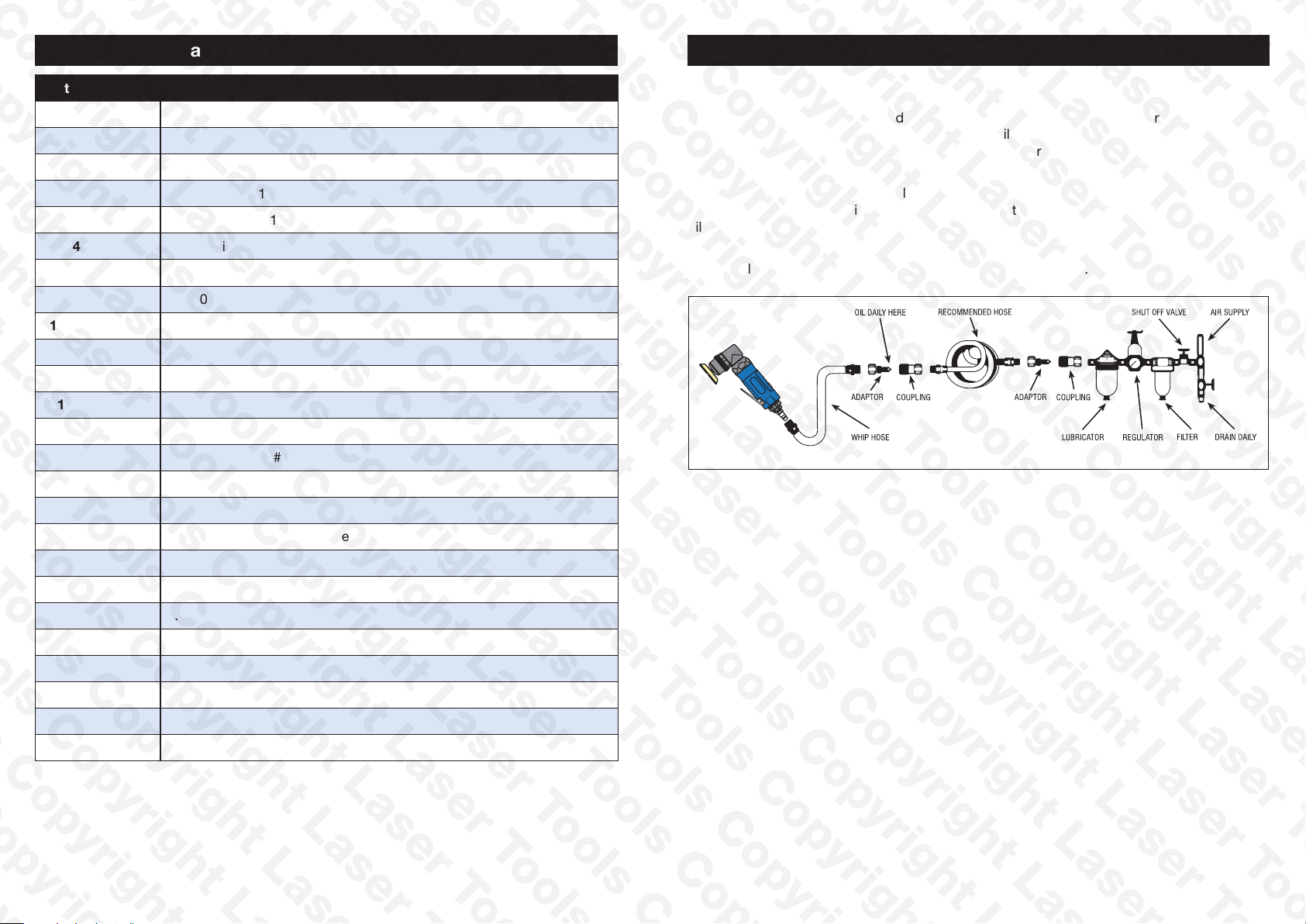
Fig 2
Operation
Part Number Description
61109 2" Velcro Pad - 1pc
61110 1.2" Velcro Pad - 1pc
61111 Triangle mini Velcro Pad - 1pc
61112 2" Wool Pad - 1pc
61113 1.2" Wool Pad - 1pc
61114 2" Polishing Pad - 1pc
61115 1.2" Polishing Pad - 1pc
61116 2" 120# Sandpapers - 10pc
61117 2" 180# Sandpapers - 10pc
61118 2" 320# Sandpapers - 10pc
61119 2" 600# Sandpapers - 10pc
61120 2" 1000# Sandpapers - 10pc
61121 2" 1500# Sandpapers - 10pc
61122 Triangle mini 120# Sandpapers - 10pc
61123 Triangle mini 180# Sandpapers - 10pc
61124 Triangle mini 320# Sandpapers - 10pc
Compressed air supply:
The tool must be connected to a suitable, clean, dry and lubricated workshop air supply (refer
to Figure 2, this is the recommended workshop air supply procedure). It is recommended
that the air pressure measures 90psi at the tool while running free. Water in the air line will
damage the tool. Drain the air tank daily and drain any dryer/filter unit when necessary.
Lubrication: For first use of the tool, add a few drops of light machine oil to the compressed
air line connection. In use, if an in-line oiler is not installed, add a few drops of light machine
oil daily. Adequate lubrication will help to ensure long tool service life.
When tool is not in use, disconnect from compressed air supply.
61125 Triangle mini 600# Sandpapers - 10pc
61126 Triangle mini 1000# Sandpapers - 10pc
61127 Triangle mini 1500# Sandpapers - 10pc
61128 1.2" 120# Sandpaper - 10pc
61129 1.2" 180# Sandpapers - 10pc
61130 1.2" 320# Sandpapers - 10pc
61131 1.2" 600# Sandpapers - 10pc
61132 1.2" 1000# Sandpapers - 10pc
61133 1.2" 1500# Sandpapers - 10pc
6 3
Page 4
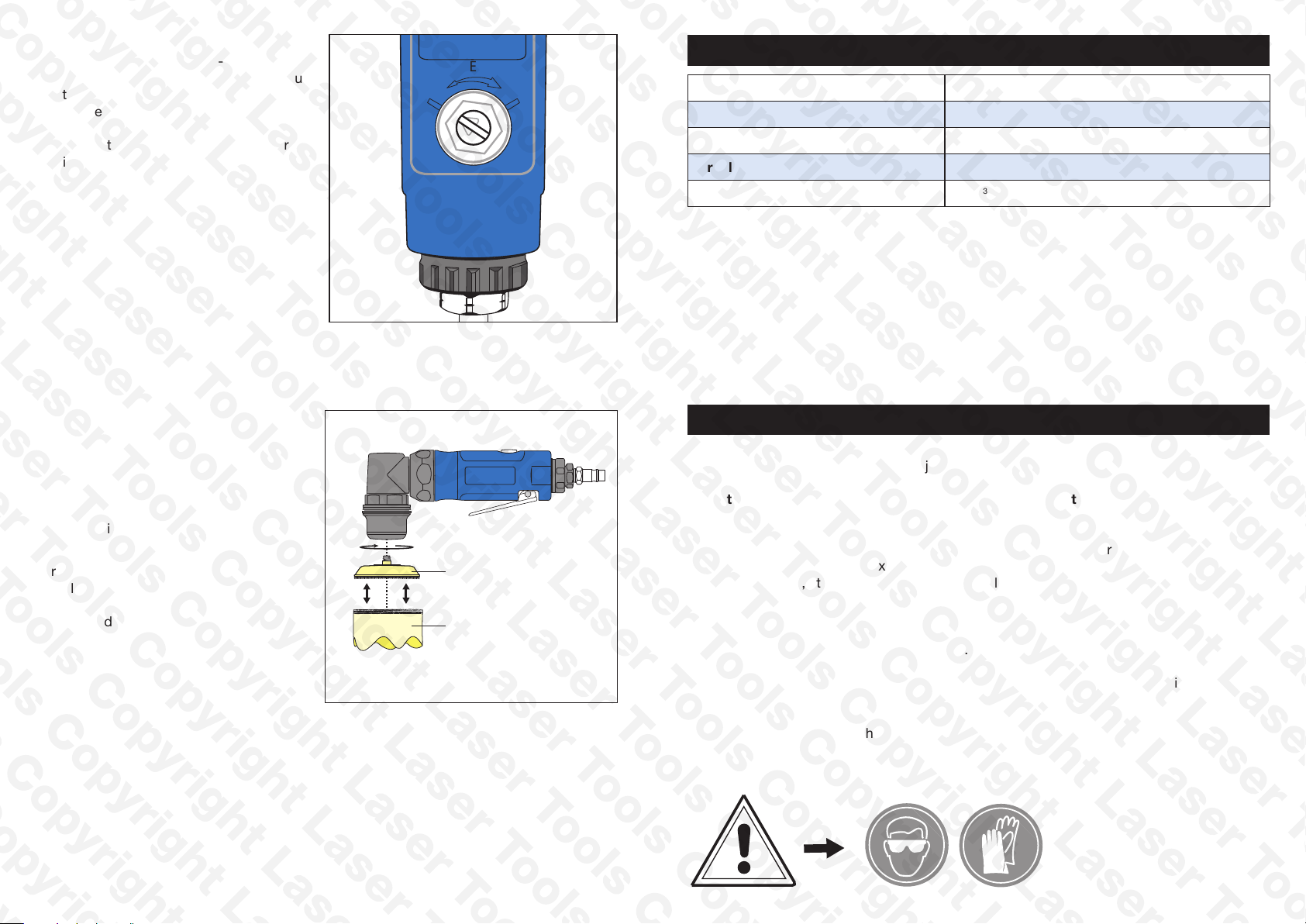
Regulating the speed:
Refer to Figure 3: using a flat-bladed
screwdriver or similar, adjust the air pressure
and therefore the speed of the instrument by
turning the speed control towards LO or HI.
Lower speeds are recommended for detail
work using the smaller pads or triangular
detail pad.
Fig 3
E
E
P
D
S
LO HI
Specifications
Weight 0.5kg (1.1 lbs)
Length 155mm (6.1")
RPM 13,000
Air inlet 1/4"
3
Average air consumption 2.6 ft
/min
Attachments:
Refer to Figure 1 and Figure 4: the sanding
pads (F, G or H) are simply screwed onto the
head of the tool.
For sanding, the correctly sized sanding disc
is applied directly onto the sanding pad.
For polishing, the foam polishing pad (I or
J), or lambswool polishing head (K or L), is
applied directly onto the appropriate
sanding pad.
Fig 4
Safety Precautions
• Eye and face protection plus heavy work gloves and suitable work clothing must be
used. Never wear loose clothing or jewellery that could be trapped by moving parts.
• Dust hazard: a suitable-grade dust mask or respirator must be used for any dustgenerating operations, particularly on glassfibre substrates.
• Vibration hazard: exposure to vibration can cause damage to nerves and blood supply of
F
J
the hands and arms. If you experience numbness, tingling, pain or whitening of the skin in
fingers or hands, stop using the tool immediately.
• Noise hazard: unprotected exposure to high noise levels can cause hearing loss and
tinnitus (ringing or buzzing in the ears). Wear suitable ear protection as required by
occupational health and safety regulations.
• Do not attempt to remove or change a sanding pad until the tool has been disconnected
from the compressed air supply.
• Never carry an air tool by the hose.
• Keep the instrument clean and well-maintained. Store in case when not in use.
4 5
 Loading...