

Page 1
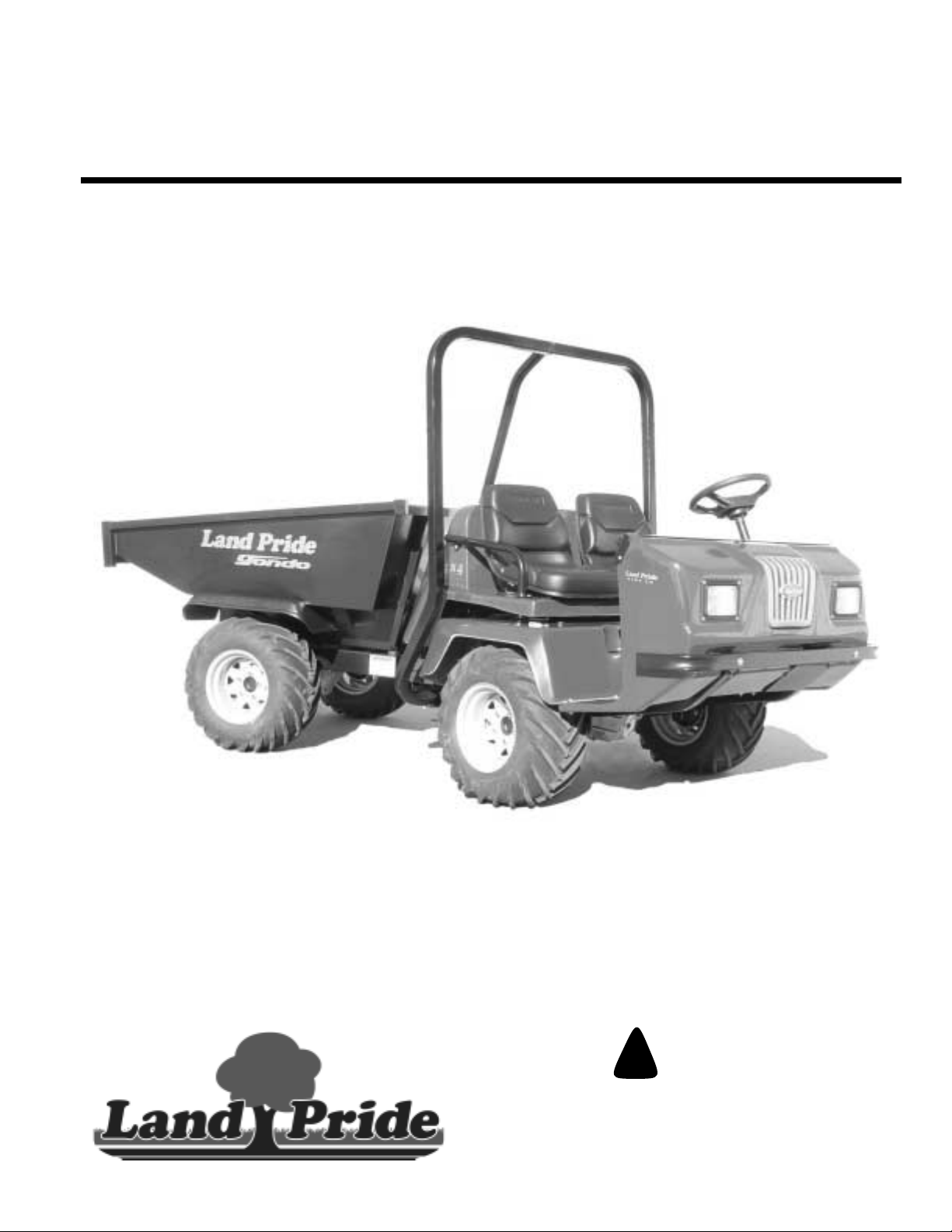
Table of Contents
Gondo
4400EX Heavy Duty Off Road Utility Vehicle
21341
Cover illustration may show optional equipment not supplied with standard unit
720-051M
Operator’s Manual
Read the Operator’s manual entirely. When
you see this symbol, the subsequent
!
instructions andwarningsare serious - follow
without exception. Your life and the lives of
others depend on it!
© Copyright 2008 Printed
Cover photo may show optional equipment
not supplied with standard unit.
7/14/08
Page 2

Table of Contents
Section 1: Introduction . . . . . . . . . . . . . . . . . . . . . . 1
Safety First . . . . . . . . . . . . . . . . . . . . . . . . . . . . . . . 1
Using This Manual . . . . . . . . . . . . . . . . . . . . . . . . . 1
Terminology . . . . . . . . . . . . . . . . . . . . . . . . . . . . 1
Definitions . . . . . . . . . . . . . . . . . . . . . . . . . . . . . . 1
Application . . . . . . . . . . . . . . . . . . . . . . . . . . . . . . . 1
Models Covered . . . . . . . . . . . . . . . . . . . . . . . . . 1
Getting Acquainted with your Gondo . . . . . . . . . 1
Owner Assistance . . . . . . . . . . . . . . . . . . . . . . . . . 2
Serial Number Plate . . . . . . . . . . . . . . . . . . . . . . . . 2
Section 2: Important Safety Information . . . . . . . . 3
Safety Symbol . . . . . . . . . . . . . . . . . . . . . . . . . . . . 3
Safe Operating Procedures . . . . . . . . . . . . . . . . . . 5
Safety Decals . . . . . . . . . . . . . . . . . . . . . . . . . . . . . 7
Section 3: Pre-Delivery and Check List . . . . . . . 12
Pre-Delivery Certificate . . . . . . . . . . . . . . . . . . . . 12
Vehicle Information . . . . . . . . . . . . . . . . . . . . . . 12
Dealer Service and Inspection List . . . . . . . . . . 12
Dealer Test Ride List . . . . . . . . . . . . . . . . . . . . 12
Dealer Delivery To Customer List . . . . . . . . . . . 13
Customer Acceptance List . . . . . . . . . . . . . . . . 13
Section 4: Operating Instructions . . . . . . . . . . . . 14
Operator Responsibilities . . . . . . . . . . . . . . . . . . . 14
Pre-Start Check List . . . . . . . . . . . . . . . . . . . . . 14
General Operation . . . . . . . . . . . . . . . . . . . . . . . . 14
Starting the Engine . . . . . . . . . . . . . . . . . . . . . . 14
Dashboard Switches and Instruments . . . . . . . 14
Foot Operated Controls . . . . . . . . . . . . . . . . . . 15
Hand Operated Controls . . . . . . . . . . . . . . . . . . 16
Fuel Indicator . . . . . . . . . . . . . . . . . . . . . . . . . . 16
Steering . . . . . . . . . . . . . . . . . . . . . . . . . . . . . . 17
Driving Conditions . . . . . . . . . . . . . . . . . . . . . . . . 17
Towing the Gondo . . . . . . . . . . . . . . . . . . . . . . . . 18
Traveling Tips From the Trail Masters . . . . . . . . . 19
Section 5: Options and Accessories . . . . . . . . . . 21
Gondo Options . . . . . . . . . . . . . . . . . . . . . . . . . . . 21
Rear Cargo Box . . . . . . . . . . . . . . . . . . . . . . . . 21
Tires . . . . . . . . . . . . . . . . . . . . . . . . . . . . . . . . . 21
Gondo Accessories . . . . . . . . . . . . . . . . . . . . . . . 21
Section 6: Maintenance . . . . . . . . . . . . . . . . . . . . 22
General Maintenance . . . . . . . . . . . . . . . . . . . . . 22
Prepare Vehicle for Maintenance . . . . . . . . . . . . . 22
Torque Values . . . . . . . . . . . . . . . . . . . . . . . . . . . 22
Wheel Lug Nuts . . . . . . . . . . . . . . . . . . . . . . . . 22
Engine Torques . . . . . . . . . . . . . . . . . . . . . . . . . 23
All Other Torques . . . . . . . . . . . . . . . . . . . . . . . 23
Tire Maintenance . . . . . . . . . . . . . . . . . . . . . . . . . 23
Jacking the Vehicle . . . . . . . . . . . . . . . . . . . . . . . 23
Shock Absorbers . . . . . . . . . . . . . . . . . . . . . . . . . 23
Electrical System . . . . . . . . . . . . . . . . . . . . . . . . . 23
Battery . . . . . . . . . . . . . . . . . . . . . . . . . . . . . . . . . 24
Jump Starting the Battery . . . . . . . . . . . . . . . . . . . 24
Prepare Vehicle to Jump-Start . . . . . . . . . . . . . . 24
Connecting Jumper Cables . . . . . . . . . . . . . . . . 25
Disconnecting Jumper Cables . . . . . . . . . . . . . . 25
Fuel System . . . . . . . . . . . . . . . . . . . . . . . . . . . . . 25
Filling the Fuel Tank . . . . . . . . . . . . . . . . . . . . . . 26
Emptying the Fuel Tank . . . . . . . . . . . . . . . . . . . 26
Fuel Filter and Fuel Line Maintenance . . . . . . . 26
Engine Maintenance . . . . . . . . . . . . . . . . . . . . . . . 26
General Information . . . . . . . . . . . . . . . . . . . . . . 26
High Altitude Carburetor Kit . . . . . . . . . . . . . . . . 27
Power Steering Belt . . . . . . . . . . . . . . . . . . . . . . . 27
Engine Air Filter . . . . . . . . . . . . . . . . . . . . . . . . . . 28
Air Filter Maintenance Schedule . . . . . . . . . . . . 28
Precleaner Foam Element . . . . . . . . . . . . . . . . . 28
Paper Element . . . . . . . . . . . . . . . . . . . . . . . . . . 28
Spark Arrester . . . . . . . . . . . . . . . . . . . . . . . . . . . 29
Spark Arrester Maintenance Schedule . . . . . . . 29
Spark Arrester Maintenance Procedure . . . . . . 29
Replacement Parts . . . . . . . . . . . . . . . . . . . . . . 29
Maintenance Schedule . . . . . . . . . . . . . . . . . . . 30
Section 7: Lubrication and Fluids . . . . . . . . . . . . 31
Engine Oil . . . . . . . . . . . . . . . . . . . . . . . . . . . . . . . 31
Differential Oil . . . . . . . . . . . . . . . . . . . . . . . . . . . . 33
Transmission Fluid . . . . . . . . . . . . . . . . . . . . . . . . 34
Brake Fluid . . . . . . . . . . . . . . . . . . . . . . . . . . . . . . 34
Steering & Cargo Lift Cylinder Fluid . . . . . . . . . . . 35
Grease Type Lubrication . . . . . . . . . . . . . . . . . . . . 35
Driveline U-Joints . . . . . . . . . . . . . . . . . . . . . . . 35
Pillow Block Bearing . . . . . . . . . . . . . . . . . . . . . 36
Rotating Bearing Surfaces . . . . . . . . . . . . . . . . . 36
Section 8: Seasonal Storage . . . . . . . . . . . . . . . . . 37
Engine Preparation for Storage . . . . . . . . . . . . . 37
Vehicle Storage Preparation . . . . . . . . . . . . . . . 37
Vehicle Removal From Storage Preparation . . . 37
Section 9: Body Repair . . . . . . . . . . . . . . . . . . . . . 38
Introduction . . . . . . . . . . . . . . . . . . . . . . . . . . . . . . 38
Light Scuff . . . . . . . . . . . . . . . . . . . . . . . . . . . . . . . 38
Scratch . . . . . . . . . . . . . . . . . . . . . . . . . . . . . . . . . 38
Deep Gouge . . . . . . . . . . . . . . . . . . . . . . . . . . . . . 39
Section 10: Specifications and Capacities . . . . . 40
Section 11: Troubleshooting . . . . . . . . . . . . . . . . . 41
Section 12: Appendix . . . . . . . . . . . . . . . . . . . . . . 45
Torque Values Chart . . . . . . . . . . . . . . . . . . . . . . . 45
Notes . . . . . . . . . . . . . . . . . . . . . . . . . . . . . . . . . . 46
Land Pride Limited Warranty . . . . . . . . . . . . . . . . 47
© Copyright 2008 All rights Reserved
LandPride providesthis publication“as is”without warrantyof anykind, eitherexpressedor implied.While everyprecaution hasbeen takenin thepreparation ofthis manual,
Land Pride assumes no responsibility for errors or omissions. Neither is any liability assumedfor damages resulting from theuse of the information contained herein.Land
Pride reserves the right to revise and improve its products as it sees fit. This publication describes thestate of this product at the time of its publication, and may not reflect
the product in the future. The illustrations in this manual are not intended for safe and proper assembly or disassembly of equipment. The illustrations are intended for
ordering parts only.
Land Pride is a registered trademark.
All other brands and product names are trademarks or registered trademarks of their respective holders.
Printed in the United States of America.
4400EX Heavy Duty Off Road Utility Vehicle 720-051M
7/14/08
Page 3
Table of Contents
Section 1: Introduction
Section 1: Introduction
Land Pride welcomes you to its growing familyof new
productowners.Gondoseries trucks are heavy duty utility
vehicles that have been designed with care andbuilt by
skilled workers using quality materials. Proper set-up,
maintenance andsafe operating practiceswill help you
get years of satisfactory use from this vehicle.
Safety First
Land Pride is fully aware of the need for safe operating
procedures around all ofour equipment. We hope youwill
make a sincere effort to put safety above all other
priorities. The Gondo is designed and built for serious
work, recreation and enjoyment;however, improper and
irresponsible operation could resultin serious injury or
death. Sincethis is an off-road vehicle, operators will
seldom seethe road safety and warning signs they are
accustomed toseeing on highways andpublic streets.
This placesadditional responsibility on the driver to
operate thisvehicle well within thesafe operational limits
and capabilitiesof the unit.
This manual hasbeen prepared toinstruct you in thesafe
and responsible operationof yourGondo. Please read
andabide by all safetyalert information about this vehicle.
If you do not understand any part of this manual, contact
your local dealer for additionalinformation and
clarification. As the operator of this pieceof equipment,
you are in completecontrol. Only you can prevent an
accident fromhappening!
Using This Manual
Prior toany vehicle operation it isabsolutely essential
•
that youread and comprehend each sectionin this
manualtodevelopanunderstandingofyourvehicleand
safetypractices.Afterreviewingthismanual,storeitina
dry andeasily accessible place for futurereference.
• The Operator’s Section is designed to help familiarize
you withsafety, assembly, operation, adjustments,
troubleshooting andmaintenance. Read this manual
and followthe recommendations to help ensuresafe
and efficientoperation.
• The information contained within this manual was
current atthe time of printing. Someparts may change
slightly toassure you of the bestperformance.
• To order a newOperator’sorParts Manual contact your
authorized dealer.Manuals can also be downloaded,
free-of-charge fromour website at www.landpride.com
orprintedfromtheLandPride Service & Support Center
by yourdealer.
Terminology
Right-hand andleft-hand as used in thismanual are
determined by facing thedirection the vehicle will travel
while inuse unless otherwise stated.
Definitions
The following terms areused throughout this manual.
IMPORTANT: Aspecial pointof information relatedto
its preceding topic. Land Pride’s intention is that this
information should be read and noted before
continuing.
NOTE:Aspecialpoint of information that theoperator
must beaware of before continuing.
Application
Models Covered
4400EX
Getting Acquainted with your Gondo
The LandPride Gondo is an extreme utilityvehicle
designed exclusively for off-road use. It is not designed,
properly equipped, or licensed to be safely operatedon
public streets and highways. This 2200lb. payload hauler
is designed to carrytwo people inthecab and agenerous
amount ofcargo, gear, and supplies safely and
conveniently over extremely difficult or rough terrain.
The Gondofeatures centerarticulating power steering
coupled witha pivotinginteractive frame for unexcelled
terrain hugging capabilityand maximum traction.Traction
capabilitiesare evenfurther maximized with incorporation
of full-timeshaft driven four-wheeled drive. TheGondo is
poweredby the proven624cc 20hp Kohler Command Pro
Series Engine and a fully automotive 4 or 5 speed
synchromesh manualtransmission. Engaging the eightinchmanualclutchdeliverspowertotheautomotivegrade
front andrear open differentials.
TheGondoisequipped with highly dependable fourwheel
hydraulically activated automotivedrum type brakes. A
manual park brake isincluded as standard equipment.
Engine brakingis inherently available through the
standard transmissionwhen needed for traveling down
steepor slippery andtreacherous grades.Allfourtiresare
26x12-12 4-plyand are available with turf or bar type
tread.
The Gondoframe is tractor tough and constructed out of
welded and formed heavywalltubing that iscoatedwith a
durableblacksatin powder paint finish.A certifiedrollover
protection system(ROPS) with seat belts is standard
equipment. (Butmay beleft off by customer’s choosing.)
The consolebody and optional cab areconstructed of
extratough fiberglass withanattractivegel coat finish. The
high capacity cargobeds are madeofwelded and formed
heavygauge sheet metalfinishedwith black satin powder
7/14/08
4400EX Heavy Duty Off Road Utility Vehicle 720-051M
1
Page 4
Section 1: Introduction
Table of Contents
paint. Customerscan choose either a 23 cu. ft. capacity
gondola stylebox oran 18 cu. ft. capacity tilt box witha
standard tailgate. Choosing the hydraulictilt option
makesboth boxescapableof hydraulically dumping their
full 1800lb. payload capacity by simple activation of a
leveron the operator’sconsole. A standardreceivertype
hitch comesas standard equipment and thisunit is
capable of up to2500 lbs. of towing capacity.
The operator’sstation is acab-forwardstyle console that
hingesforwardandhas aft suspensionover two coil-over
shocksprovidinga smoother rideandincreasedoperator
andpassenger comfort. Twocushioned high back bucket
seats are provided as standardequipment and seatbelts
are alsostandard forunits equipped with a ROPS. The
operators consoleis equipped with a standard hour
meter,voltmeter,12voltkeyedignition,andlightswitchto
activate the two standard halogen beam headlights.
Customers needingadditional protection from the
elements andsurrounding environment can also order
additional accessories such as cabs with safety glass
windshields, powered wipers, and soft sidedcab doors.
Snowplowsandlog skidders arealsoavailablefor added
versatility.
Whetheryouarehauling big game, farmingtools,hunting
and fishingcamp supplies, construction equipment,
livestock feed, military cargo, or fire fighting and rescue
equipment, the Gondo iscapableof getting you and your
cargothere and back over tough and extremeterrain and
in allkinds of weather.
Owner Assistance
The safety videoshould be viewedby the ownerand the
Warranty Registration card should be filled out bythe
dealer atthe time of purchase. The owner should also
receive a copy of the safety video upon purchasing the
vehicle as well as have participated ina short drivers
training coursewith the dealer. This information is
necessary to provide you with quality customer service.
Theparts onyourGondoHeavyDuty Utility Vehiclehave
been speciallydesigned and should only bereplaced
with genuineLand Pride parts.
If customer serviceor repairparts are requiredcontact a
Land Pridevehicle dealer. They have trained personnel,
genuine repairparts and equipmentspecially designed
to repairLand Pride products.
Serial Number Plate
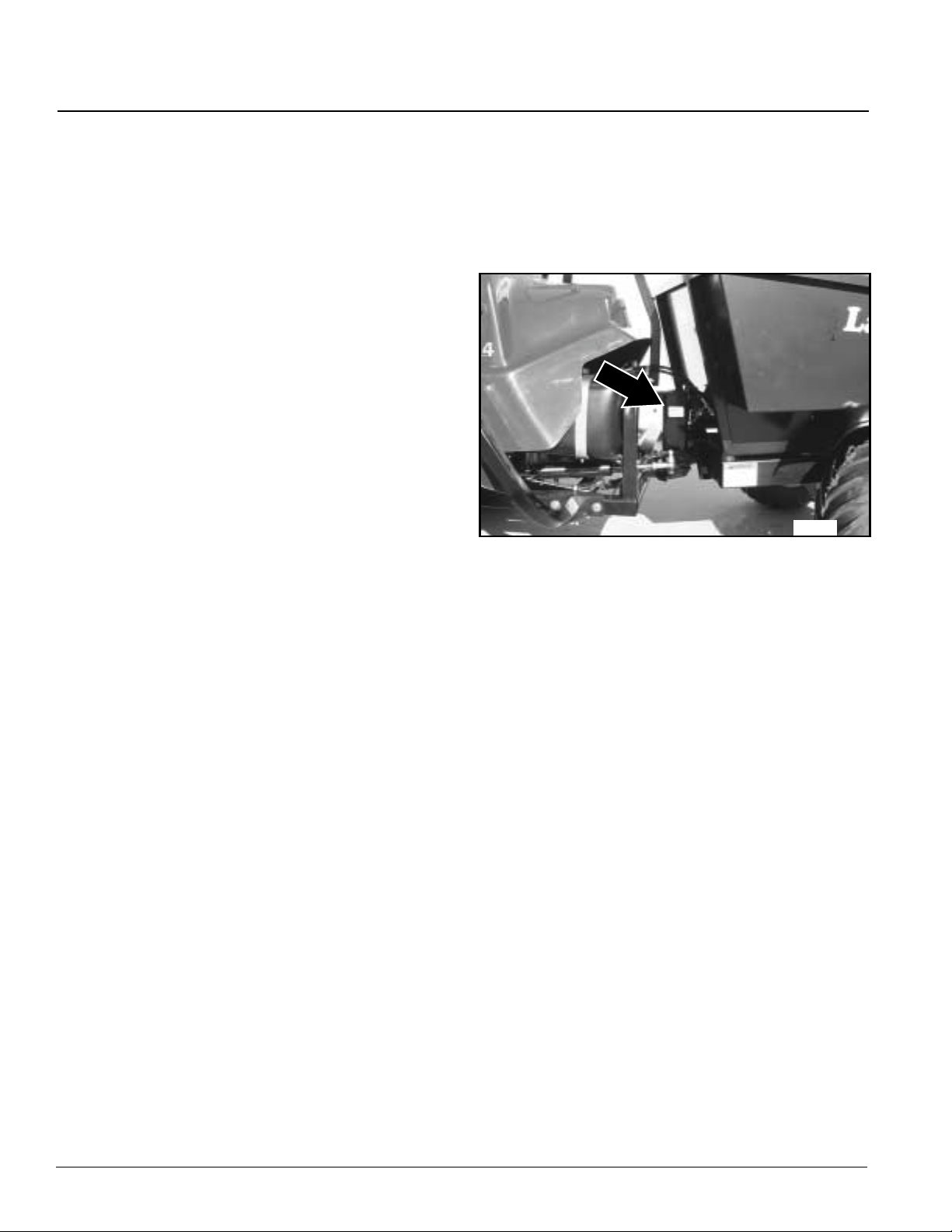
Refer to Figure 1
Always use serial andmodel number when ordering
parts from your Land Pride dealer. The serial-number
plate islocated on the driver’s side on the center swivel
yoke as shown below.
21469
Serial Number Plate
Figure 1
Record your vehicle model number (4400EX) and serial
number here for quick reference:
Model Number:___________________________
Serial Number: ___________________________
YourLandPridedealerwantsyoutobesatisfiedwithyour
new vehicle. If you do not understand any part of this
manual orare not satisfied with the service received,
please take the following actions.
1. Discuss thematter with your dealership service
manager.Makesuretheyareawareof any problems
so they can assist you.
2. If you are still unsatisfied, seek out theowner or
general managerof the dealership.
3. For further assistancewrite to:
Product Support
Land Pride Service Department
1525 East North Street
P.O.Box 5060
Salina, Ks. 67402-5060
4400EX Heavy Duty Off Road Utility Vehicle 720-051M
2
E-mail address
lpservicedept@landpride.com
7/14/08
Page 5
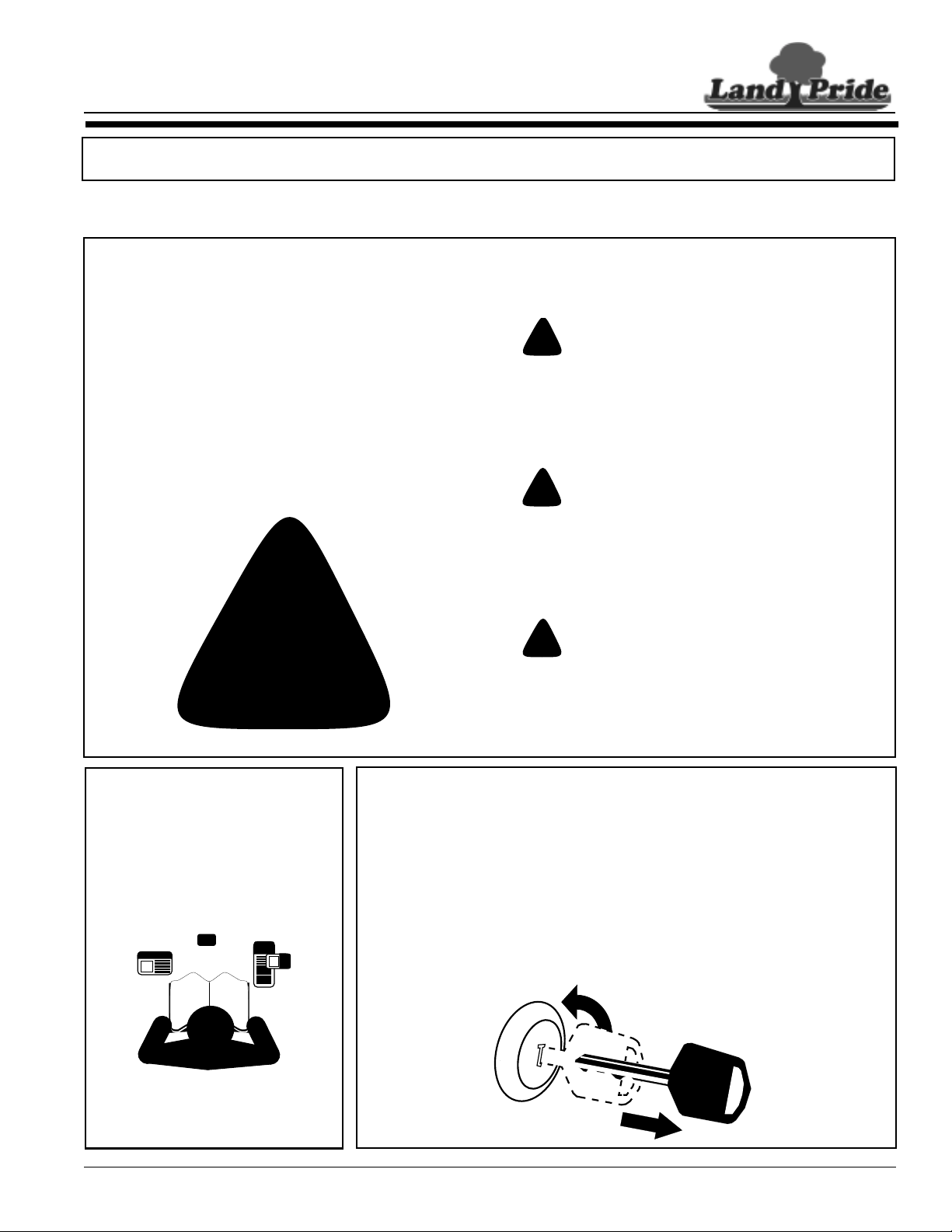
Table of Contents
Section 2: Important Safety Information
Section 2: Important Safety Information
Important: Read and understand all pages in this manual thoroughly before operating your v ehicle.
These are common practices that may or may not be applicable to the products described in
this manual.
Safety Symbol
Look for the Safety symbol throughout this
manual.TheSAFETY ALERTSYMBOLindicates
there isa potential hazard to personalsafety
involved and extra safety precaution must be
taken. When you see this symbol, be alert and
carefully readthe message that followsit. In
additiontodesignandconfigurationof equipment,
hazard controland accident prevention are
dependent uponthe awareness, concern,
prudence and proper training of personnel
involved inthe operation,transport, maintenance
and storageof equipment.
!
Be Aware of Signal Words
Signal wordsdesignate a degree or level of
hazard seriousness.The signal words are:
!
DANGER
DANGERindicates animminentlyhazardous situation
which, if not avoided, will result in serious injury or
death. This signal word islimited to the most extreme
situations, typically for vehicle components that, for
functional purposes, cannot be guarded.
!
WARNING
WARNINGindicates a potentiallyhazardous situation
which, if not avoided, could result in death or serious
injury, and includes hazards that are exposed when
guards are removed. It may also be used to alert
against unsafe practices.
!
CAUTION
CAUTIONindicates a potentiallyhazardoussituation
which, if not avoided, may result in minor or moderate
injury. It may also be used to alert against unsafe
practices.
For Your Protection
▲ Thoroughly read and understand
the “Safety Decal”section, readall
instructions noted on the decals.
7/14/08
Before Operating
▲ This Gondo Heavy Duty Utility
Vehicle is not to be driven on
public roads.
▲ Do not operate this vehicle under
the influence of alcohol or drugs.
▲ Always inspect the vehicle before
operating it. See "Pre-Start Check
List" on page 14.
OFF
4400EX Heavy Duty Off Road Utility Vehicle 720-051M
▲ Do not operate this machine
unless all safety shields are in
place and all badlyworn, broken or
missing parts have been properly
replaced.
▲ Wear appropriate protective gear
and clothing such as safety
helmet, goggles, gloves, coveralls,
etc., when conditions warrant.
▲ No driver under age of 16.
3
Page 6
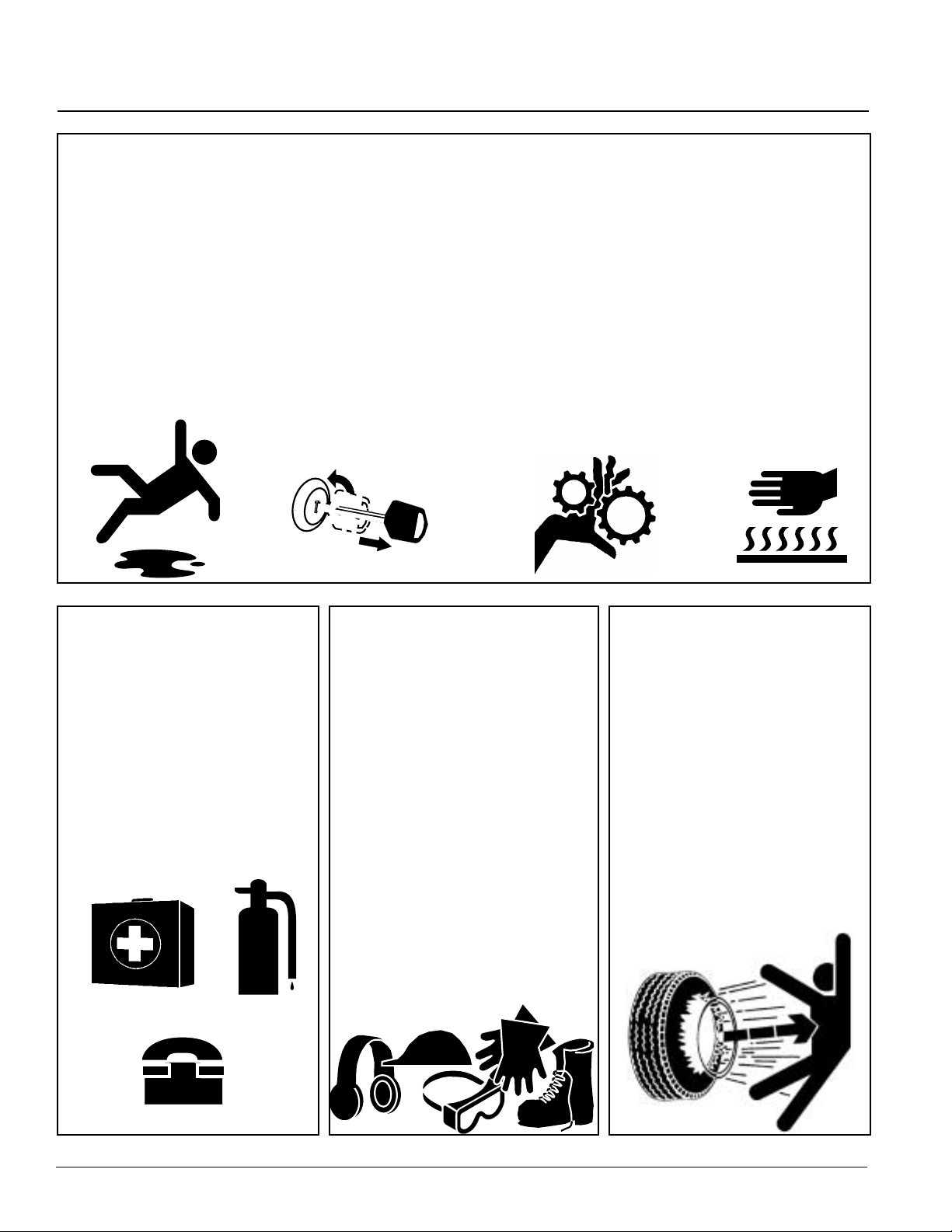
Table of Contents
Section 2: Important Safety Information
Practice Safe
Maintenance
▲ Understand procedure before
doing work. Use proper tools and
equipment.Refertothis manual for
additional information.
▲ Work in a clean, dry area.
▲ Place the vehicle in neutral, set
parking brake, turn off engine and
remove key before performing
maintenance. Chock wheels if you
must perform maintenance on a
slope.
▲ Make sure all moving parts have
stopped and allsystempressure is
relieved.
▲ Allow the engine to cool
completely.
▲ Disconnect battery ground cable
(-) before servicing or adjusting
electrical systems or before
welding.
OFF
▲ Inspect all parts. Make sure parts
are ingood condition and installed
properly.
▲ Remove build-up of grease, oil or
debris.
▲ Remove all toolsand unusedparts
from the Gondo before operation.
Prepare for
Emergencies
▲ Be prepared if a fire starts.
▲ Keep a first aid kit and fire
extinguisher handy.
▲ Keep emergency numbers for
doctor, ambulance, hospital and
fire department near phone.
Wear Pr otective
Equipment
▲ Wear protective clothing and
equipment.
▲ Wear clothing and equipment
appropriate for the job. Avoid
loose-fitting clothing.
▲ Because prolonged exposure to
loud noise can cause hearing
impairment or hearing loss, it is
best to wear suitable hearing
protection such as earmuffs or
earplugs.
▲ Because operating equipment
safely requires your full attention,
avoid wearing radio headphones
while operating machinery.
▲ It is the discretion of the operator
and passenger to wear Seat Belts
when available.
Tire Safety
Tire changingcan be dangerous
and should beperformed by trained
personnel usingcorrect tools and
equipment.
▲ When inflating tires, use a clip-on
chuck and extension hose long
enough for you to stand to one
side–not in front of or over tire
assembly. Use a safety cage if
available.
▲ When removing and installing
wheels, use wheel-handling
equipment adequate for weight
involved.
911
4400EX Heavy Duty Off Road Utility Vehicle 720-051M
4
7/14/08
Page 7
Table of Contents
Section 2: Important Safety Information
Safe Operating Procedures
Thesafeoperationofanymachinery is a big concerntoall
consumers. Your Gondo has been designed with many
built-in safety features. However, no one should operate
this vehicle before carefullyreading this Operator’s
Manual. Alsoread all instructions noted onthe safety
decals.
!
WARNING
Mostaccidentswith off roadvehicles occur when travelingup,
down, or across the face of a slope. Refer to operation
instructions and safety video forproper operation procedures.
▲ Be familiar with all functions of this vehicle.
▲ Keep all bystanders away from this vehicle during
operation.
▲ Do not allow anyone to operate this vehicle who has not
fully read and comprehended this manual and who has
not been properly trained in the safe operation of this
vehicle.
▲ Do notoperatea vehicle with damagedordefectiveparts.
Repair all damages and defective parts before putting
vehicle back in to service.
▲ Do not allow anyone under 16 years of age to operate
this vehicle.
▲ Operator must always use both hands on the steering
wheel.
▲ A rider may, without knowing it, place his foot on the
accelerator pedal while bracing himself against a rough
ride. This makes it impossible to slow down the vehicle
until the passenger removes his foot from the pedal.
Inform the passenger to keep his foot off the accelerator
and always slow down before the ride gets rough.
▲ Operator and passenger are responsible for deciding if
their situation warrants using seat belts if so equipped.
▲ Do not use cargo bed as an additional passenger carrier.
▲ Do not use cargo bed as a working platform.
▲ The cargo power lift is designed to dump cargo only. Do
not use it to lift other objects.
▲ No riders allowed except in factory designed and
supplied seating and no more than one person in a seat.
Do not use cargo bed for carrying people. Maximum
vehicle occupancy including driver is 2.
▲ Operate vehicle from driver’s seat only.
▲ Do not leave vehicle unattended with engine running.
▲ Do not dismount a moving vehicle as serious injury or
death could occur.
▲ Always operate vehicle with all guards installed. Do not
leave pulleys, belts and other rotating components
exposed.
▲ Wear snug-fitting clothing to avoid entanglement with
moving parts.
▲ Do not wear clothing or other articles that hangs loosely.
Hanging clothing, long hair, jewelry etc. can catch in the
tires and other rotating objects.
▲ Keep hands, feet, long hair, clothing and jewelry away
from moving parts and obvious pinch points to avoid
getting caught.
▲ Some conditions may warrant extra safety gear to be
worn such as safety helmets and/or goggles.
▲ Keep hands, arms, feet and all bodily appendages safely
inside the confinesof the vehicle. Always be aware ofand
avoid tree limbs and brush that have a potential of hitting
and/or pokingindividuals riding the vehicle. Serious body
harm could result.
▲ Make sure area behind cargo box is clear of personnel
before operating the dump lever. Bodily harm can result
from being pinched between the cargo box and another
object or from a load dumping and/or rolling onto a
bystander.
▲ Do not touch engine, engine exhaust pipe and/or muffler
while they are hot.
▲ Use extreme caution when driving through dry grass,
brush and other fire hazard materials. Never stop or park
over combustible materials. Keep grass and brush from
collecting on and around engine and muffler parts.
▲ Battery fumes are explosive. A spark will ignite battery
fumes. Wear a face shield when charging or jumping a
battery. Follow all battery safety rules outlined in this
manual.
▲ Always disconnect the negative battery terminal before
making adjustments to the vehicle electrical system or
welding on this vehicle.
▲ Avoid battery acid spills. Do not get battery acid on eyes,
face, or other body parts. Flush eyes and other body
parts immediately with water for at least 15 minutes if
battery acid has gotten on them.
▲ Avoid pinch point hazards. Cargo bed, seat platform and
vehicle center pivot steering hinge creating pinch points.
▲ Do not stand, reach or allow any body part to enter
between the cab and cargo bed (articulating area) while
vehicle is running. This is an extremely high dangerous
pinch point area caused from turning the steering wheel.
▲ Always make certain the articulating area between the
cab and cargo bedis clear of personnelbeforeturning the
steering wheel.The steering wheel will turn the vehicleat
its articulation point whether the vehicle is running or not.
▲ Do not operate this vehicle on highways, public roads, or
where it may be a hazard to faster moving traffic.
▲ Never attempt wheelies, jumps, or other stunts. Never
drive recklessly. Always operate your vehicle at a safe
speed that will allow you to maintain control.
▲ Never modify any parts on the vehicle without
authorization. Unauthorized modifications will void
warranty to all parts directly and indirectly affected by the
modification.
7/14/08
4400EX Heavy Duty Off Road Utility Vehicle 720-051M
5
Page 8

Table of Contents
Section 2: Important Safety Information
▲ Never use this vehicle for racing.This vehicle isdesigned
to achieveground speeds up to17mph.Any unauthorized
modifications intended to increase the ground speed of
this vehicle above 17mph mayresult in cancellation ofthe
vehicle warranty and may be in direct violation of laws
regulating current air quality standards.
▲ Avoid sudden stops, starts and turns.
▲ Be aware of cargo shifting when stopping or moving.
Make sure all cargo is properly secured and tied down.
Injury could result from loose cargo.
▲ Do not operate vehicle while drinking or under the
influence of alcohol or drugs.
▲ Always make sure vehicle pathway is clear of all objects
when backing up. Know location of persons around
vehicle and especially location of small children. Take
extra precautions when rear view is hindered by cargo.
▲ Do not exceed total payload capacity of this vehicle.
Over-loading can cause loss of control resulting in sever
injury or death.
▲ Always maintain proper tire inflation. See "Tire
Maintenance" on page 23.
▲ Do not pull a trailer or implement exceeding 2,500 lbs.
towing capacity and 250 lbs. tongue weight. Loss of
control may result.
▲ Do not attach an implement, trailer or other device to the
hitch that will produce negative tongue weight.
▲ Do not tow or pull the Gondo behind another vehicle
exceptto retrieve it ashort distancefrom an areawhere a
trailer won’t go. The Gondo should be loaded on a trailer
for towing. Follow all towing instructions in this manual
when towing the Gondo.
▲ Do not use the vehicle as an anchor device.
▲ Beware, tow ropes, cables and chains can break when
pulling anothervehicle or object causingserious injury or
death to anyone in line with the whipping action created
when they break. Never jerk when pulling, always ease
into a pull gently. Always stay clear of the tow line. Never
be in line with the tow line.
▲ Reduce speed and payload on hilly, rough, wet, slick or
unstable ground.
▲ Reduce speedwhenloaded with cargo. Heavy cargo load
takes longer to stop.
▲ Always make turns at aspeed that willmaintain control of
vehicle. Never make turns at full speed. Reduce speed
when turning empty and reduce speed even more when
turning loaded. Theheavierthe cargo load,theslower the
turn should be.
▲ The certified ROPS (Roll OverProtection System) serves
only as a protection device. Always avoid rollovers.
▲ Do not load ROPS with heavy equipment. Rollover could
result from such loading.
▲ Always park on level ground, stop engine, set park brake
and remove ignition key before leaving the vehicle. Chock
tires if condition warrants.
▲ Use extreme caution whencresting hillsor whenvisibility
is limited. Proceed slowly until you are sure trail
conditions immediately ahead are safe.
▲ Keep front wheels straight when cresting hills or going
over bumps.
▲ Do not stop, start suddenly or over accelerate on hills.
Loss of control and rollover could result.
▲ Use extreme caution when descending hills, running on
loose slippery surfaces, or when towing at maximum
capacity. Towing, braking and tractive capabilities are
greatly diminished.
▲ Do not operate vehicle on slopes over 15
▲ Avoid changing direction or making sharp steering
o
.
corrections on slopes or rollover may occur.
▲ If thisvehiclebegins to tipwhencrossing a slope,turn the
front wheels downhill to regain stability and control.
▲ When crossing a slope on soft terrain, turn the front
wheels slightly uphill and maintain a constant speed to
maintain a straight line of travel.
▲ When descendinghillsor slopes apply steadypressure to
the foot brake to avoid potential freewheeling orrunaway.
Do not shift vehicle out of gear. Take full advantage of
engine breaking.
▲ Never allow vehicle to coast or free wheel in neutral or
loss of control may result.
▲ If your vehicle loses power and stops on a hill,
immediately engage the foot brake. Press down on the
clutch and gently release brakes while backing slowly
down the hill maintaining a straight downhill line of travel.
Do not attemptto turn thevehiclesidewayson the hill ora
rollover could result.
▲ When traveling at night always use your headlights and
reduce speed according to visibility, trail and terrain
conditions.
▲ Avoid water crossings when possible and never cross a
body of waterwhere depth isunknown. Loss ofpowerwill
occur if engine becomessubmerged orwet.Unnecessary
crossing of streamsand waterwayserodes shore lineand
damages water-born habitat. If you must cross, do it at a
point where banks are not steep and proceed at a slow
and steady speed. Do not travel in water that is higher
than the floor board. Water higher than this can damage
the engine stalling the vehicle. However, intermittent
stream crossings where depth of water briefly comes into
contact with bottom of engine is acceptable. See "Going
Out on the Trail" Note 7 on page 19.
▲ Front bumper, brush guards and cargo box are not
designed as pusher bars. Do not attempt to push other
vehicles or implements or damage may result.
▲ When refuelinguse aULapprovednon-metalliccontainer
that has no screen or filter. Set the container on the
ground before fueling to eliminate staticdischarge and do
not use Methanol fuel.
4400EX Heavy Duty Off Road Utility Vehicle 720-051M
6
7/14/08
Page 9
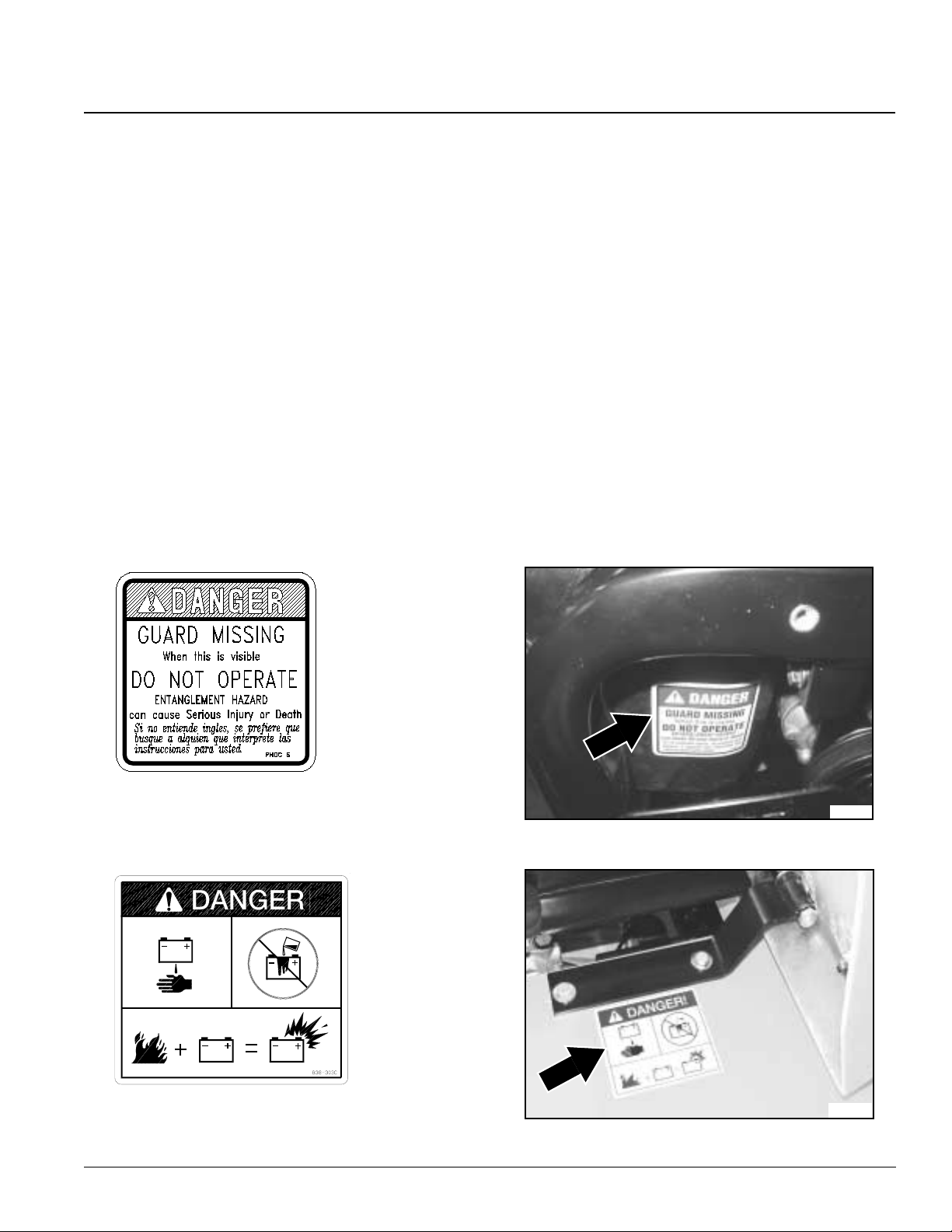
Table of Contents
Section 2: Important Safety Information
▲ Do not smoke or use electrical devices including cell
phones while refueling.
▲ Always checkwheel lug nuttorque values twohours after
initial operation and two hours after each tire repair and/
or replacement. Routinely check lug nut torque valves
every 100 hours of operation. See "Wheel Lug Nuts" on
page 22.
▲ Support this vehicle securely before working beneath.
Chock wheels to prevent vehicle from rolling.
▲ Do not inspect hydraulic leaks with bare hands. Always
use an object such as a stick to inspect for leaks. Serve
injury can occur from pressurized oil breaking through
skin.
▲ Do not operate the vehicle with hydraulic leaks, frayed or
kinked hoses. Repair or replace hydraulic leaks and
damaged hoses immediately.
Safety Decals
1. Your Gondo Heavy Duty Utility Vehicle comes equipped
with all safety decals in place. They were designed to help
you safely operate this vehicle and to serveas a reminder to
keep safety uppermostin your mind. Readand follow decal
directions.
2. Keep all safety decals clean and legible.
3. Replace all damaged or missing decals. Order new safety
decals through your Land Pride dealer.
4. Some newequipmentinstalledduringrepairrequiressafety
labels to be affixed to the replaced component as specified
by Land Pride. When ordering new parts or components,
also request corresponding safety decals.
5. Refer to this section forproper labelplacement. Installnew
decals as follows
a. Clean the area on whichthe decal is to be placed.
b. Spray soapy water on the surfacewhere thedecal isto
be placed.
c. Peel backing from decal. Press firmly on surface,
being careful not to causeair bubbles under decal.
d. Squeeze out air bubbles with the edge of acredit card.
818-543C
Danger: Guard Missing
838-303C
Danger: Battery
7/14/08
21434
21435
4400EX Heavy Duty Off Road Utility Vehicle 720-051M
7
Page 10

Table of Contents
Section 2: Important Safety Information
838-492C
Caution: MaximumPowerSource
21440
838-629C
Warning: Pinch Point or Crushing Hazard
21443a21458
21443a21443a
4400EX Heavy Duty Off Road Utility Vehicle 720-051M
8
21443b
7/14/08
Page 11
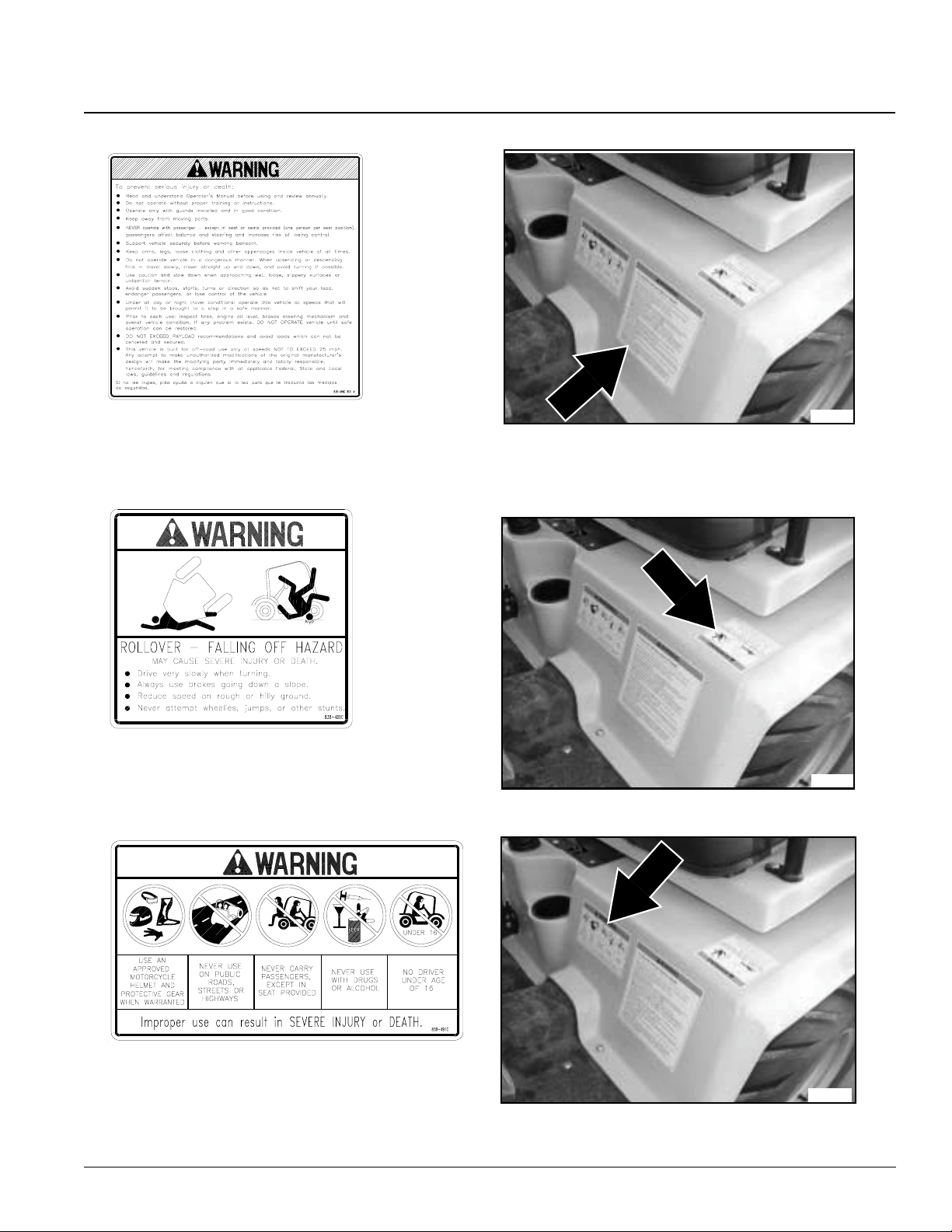
Table of Contents
Section 2: Important Safety Information
838-486C
Warning: General Utility Vehicle
838-489C
Warning: Rollover Hazard
21439
21439
838-491C
Warning: Improper Use
7/14/08
21439
4400EX Heavy Duty Off Road Utility Vehicle 720-051M
9
Page 12
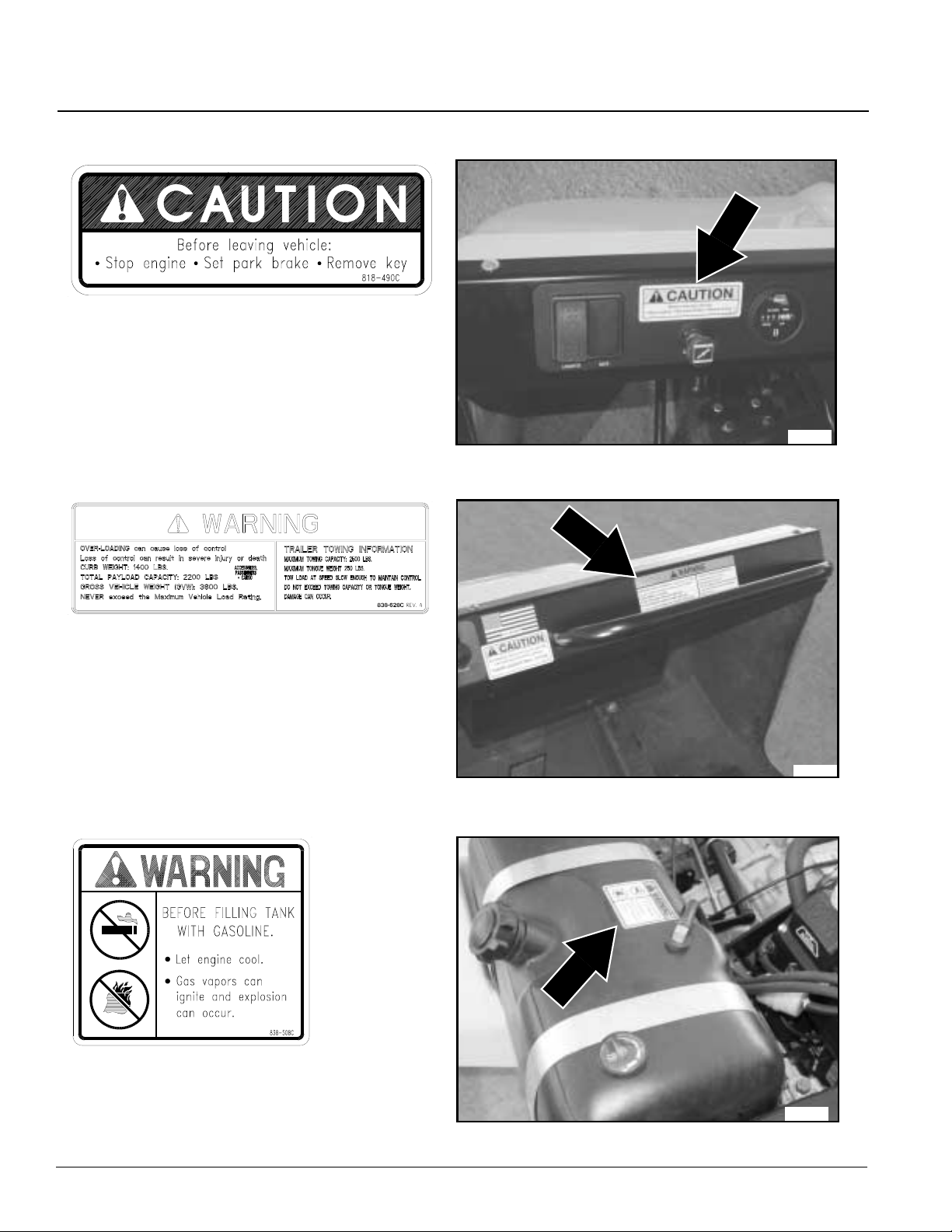
Table of Contents
Section 2: Important Safety Information
838-490C
Caution: StopEngine
21438
838-628C
Warning: Load Rating and
Trailer Towing Information
838-508C
Warning: Before Filling Tankwith Gasoline
21442
21441
4400EX Heavy Duty Off Road Utility Vehicle 720-051M
10
7/14/08
Page 13
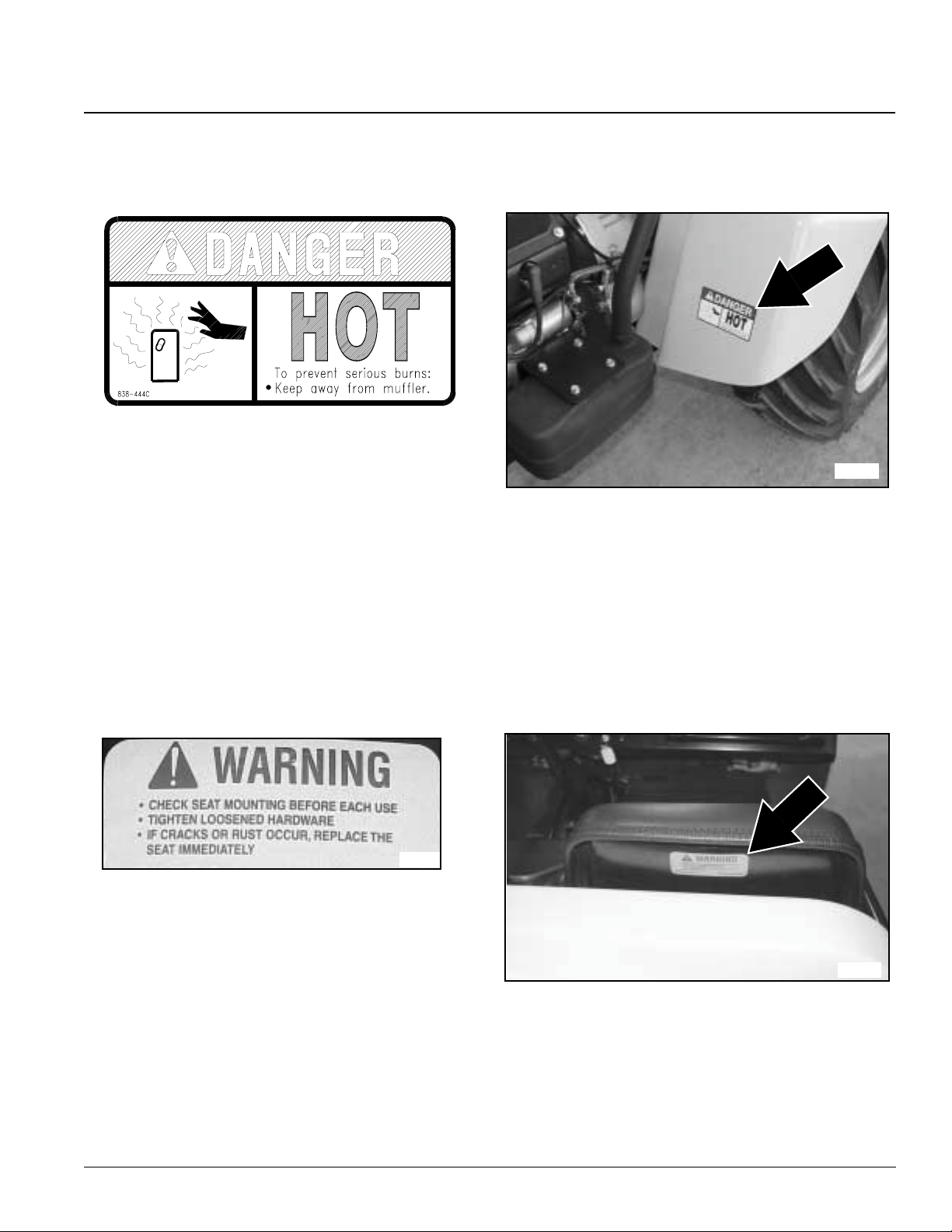
Table of Contents
Section 2: Important Safety Information
838-444C
Danger: Muffler hot
21436
Warning Label Included with Seat
Warning: Check Seat mounting
7/14/08
20971
4400EX Heavy Duty Off Road Utility Vehicle 720-051M
21345
11
Page 14

Table of Contents
Section 3: Pre-Delivery and Check List
Section 3: Pre-Delivery and Check List
Each vehicle mustundergo a Pre-Delivery Inspection by the Dealer. Listed below is an exampleof the checklist that is
included withthe Warranty Registration that is to be submitted toLand Pride upon Retail Sale.The Pre-Delivery
Certificate and Warranty Registration must be submitted to Land Pride in order to activate thevehicle warranty.
Pre-Delivery Certificate
The dealeris required to complete LandPride’s
“Certificate of Heavy Duty Utility Vehicle Pre-Delivery”
form before customer maytake possession ofthe vehicle.
Theinformationmustbefilled in and check list checked off
or initialedby individuals performing the checks.
Dealership’s name, signatures of individuals filling in the
form, seller’s signature, customer’s signature and signing
datesarealsorequiredbeforetheformisreturned to Land
Pride. Below is a list of the information foundin the form
that isrequired to be completed andchecked off.
Vehicle Information
Model No. _________________
Date _________________
Serial No. _________________
Engine Serial No. _________________
Dealer Service and Inspection List
___Fully chargebattery. Check battery voltage to verify
that itis fully charged.
___Check tire pressure to make sure front tires have 15
psi andrear tires have 20psi.
___Make sure wheel lug bolts/nuts are tightened to 90
Newton meters/(65ft. lbs.).
___Check master cylinder to make sure it is filled.
___Checkengineoillevelat thedipstick. Add SAE 10W30
oil ifoil is below the full mark on the dipstick.
___Check engine for correct RPM. Setto factory
specification ifneeded. (See page 40)
___Check steering cylinder for tightness.
___Check choke control.It should moveand return freely.
___Step onfoot brake to make surethere is plenty of
pedal and thatbrakeshold pressure anddo not bleed
off. Add brake fluid and bleed brakes if required.
___Make sure seats and seatbelts areproperly fastened
to theframe if so equipped.
___Make sure all safety decalsare in place.
___Check headlights to make sure they are working and
are properly mounted.
___Inspect aircleaner element. Make certain it is clean
and inplace.
___Inspect thefuel tank to make sure it isproperly
installed andthat there are no leaks.
___Check fuel level to makesure thereis at least 1/8 ofa
tank ofgas prior to performing initialstarting
operations.
___Inspect fuellines to make sure they are properly
installed andthat there are no leaks.
___Check steering by executing a full lock to lock turn in
each direction.
___Checkparkbraketo make sure it will engage,holdand
release.
___Make sure neutral start feature is working by
depressing theclutch to start theunit.
___Check throttle control to make sure it movesand
returns freely.
___Check differential oil level atthe differentialoil plug.
Add 80/90gear lube if oil isbelow oilplug outlet.
___Checkoverallappearanceforcleanlinessandforbody
and moldingdamage.
Dealer Test Ride List
___Check engine for starting, accelerating,running and
idling smoothly.
___Check steering response. There shouldbe no free-
play.
___Checkforward,neutral and reverse shifting response.
Also check neutralstart response by depressing the
clutch tostart the vehicle.
___Check park braketo make sureit engages, holds and
disengages.
___Make sure rocker switches are all working.
___Make sure throttle is responsive andreturns freely.
___Make sure suspension ride is satisfactory and stable.
___Make sure there are no fuel or petroleum leaks.
___Make sure the foot brakehas afirm engagement and
that stoppingis straight.
___Make sure there are no bad rattles or vibrations.
4400EX Heavy Duty Off Road Utility Vehicle 720-051M
12
7/14/08
Page 15

Table of Contents
Section 3: Pre-Delivery and Check List
Dealer Delivery To Customer List
___Warranty registration form is complete.
___Owner’s Manual has been delivered to and reviewed
by the customer.
___EngineManualhas been delivered to and reviewedby
the customer.
___Warranty Policy limits and requirementshave been
explained to the customer.
___Customer hasreviewed the safety video.
___Location andfunctions of vehicle controls have been
explained.
___Fuel transportation and storage procedures have
been explained.
___Fluid filland lubricationpoints have been located and
explained to the customer.
___Customer hascompleted the driving course.
___Information onthe safety decals have beenreviewed
with thecustomer.
Customer Acceptance List
Customerinitialsrequiredwhere acceptedassuccessfully
completed.
___Customer hasreviewed and understands Land Pride
warranty policy.
___Customer hasinspected the vehicle and it meets
customer’s satisfaction.
___Customerunderstandstheimportanceoffollowingthe
owner’smanual instructions.
___Customer hascompleted the Land Pride safety
training course.
7/14/08
4400EX Heavy Duty Off Road Utility Vehicle 720-051M
13
Page 16

Section 4: Operating Instructions
Section 4: Operating Instructions
Operator Responsibilities
Table of Contents
!
WARNING
It is the operator’s responsibility to have read this manual
thoroughlyand to know how tooperatethis vehicle safely in all
situations. See "Section 2: Important Safety Information"
starting on page 3.
Pre-Start Check List
• Lubricate the vehicle as indicated in the Lubrication
portion of"Section 7: Lubrication and Fluids" on
page 31.
• Check tire pressure as indicated in the "Tire Inflation
Chart" onpage 23.
• Make sure wheel lug bolts/nutsare tightened to65ft. lbs.
• Allnuts,bolts,screwsandfastenersshouldbe checked.
Refer tothe Torque Value Chart in"Section 12:
Appendix" startingon page 45.
• Turn on headlights to make sure battery has a charge
and electricallighting circuit is working.
• Step on the foot brake and hold down to make sure it
canbeappliedwith plenty of pedalmovementremaining
and thatthe brakes hold without loosingpressure. Add
brake fluidas indicated in "Brake Fluid" on page 34.
Bleed brakesif required.
• Check parkbrake tomake sureit will engage, hold and
release.
• Check steering by executing a full lock to lock turn in
each direction.
• Check neutral start feature by depressing the clutchand
starting the vehicle. (Thevehicle shouldnotstart unless
the clutchis depressed.)
• Check engine oil level at the dipstick. Add oil as
indicated in "EngineOil" on page 31if oil isator below
the addmark on the dipstick. Donot overfill or plug
fouling willoccur.
• Check differential oil level atthe differentialoil plug.Add
gear lub as indicated in"Differential Oil"on page 33 if
oil isbelow oil plug outlet.
• Check fuel level to make sure there is at least 1/8 ofa
tankof gas prior toperforming initialstarting operations.
• Allow engine to warms up for 15 minutes or more to
reach operatingtemperature before checking to make
sure engineidle speed is set at1100 +/- 100 rpm and
that maximumengine static speed does notexceed
3800 rpm.Modifying or adjusting the carburetor to
increase vehicle speed above factory set
specificationis a safety violation and could result in
voiding the warranty.
General Operation
Starting the Engine
Followstarting procedures displayedatthe gearshift lever
and asnoted below.
!
DANGER
Avoid injury or death from entanglement in the rotating
components and pinch points. All shields must be in place and
secure when operating. Keep all persons away from rotating
components and pinch points.
1. Set park brake.
2. Place gearshiftin neutral. Depress clutch pedal.
Engine willnot start with clutch pedal out.
3. Apply choke fully when engine is cold.
4. Turn ignition key fully clockwiseand hold until engine
starts.
5. Release ignitionkey to run position and choke to
normal operating position immediately after engine
starts.
6. Turn ignition key counterclockwise to stop engine.
Operating a Gondo is likeoperating acar with a standard
transmission that hasfouror five speeds forward and one
reverse.Thekeyed 12volt electronic ignition with a neutral
start and clutch depressed feature makes for safe and
easy starting.
Braking isaccomplished bysimply depressing the
automotive style brake pedal located onthe floorboard.
This activates bothfront and rear automotive type
hydraulic drum brakes. Depress clutch and brake pedals
when comingto a complete stop. A lever action parking
brakeismountedonthefloor board between operator and
passenger seats. Push the lever forward tothe horizontal
position toengage the park brake and pull back to the
vertical position to release.
Raise cargo boxby pulling backand holding onthe dump
lever. Push forward on the lever and hold tolower the
cargo box. Stopcargo box movement by releasingthe
lever.
!
DANGER
Make sure area behind cargo box is clear of personnel before
operating the dump lever. Bodily harm can result from being
pinched between the cargo box and another object or from a
load dumping and/or rolling onto a bystander.
Dashboard Switches and Instruments
Refer to Figure 4-1A and Figure 4-1B onpage 15
#1 Light Switch: Turns on two sealed beamhead lights
when the switch key is on.Presstop of lightswitchto
turn on lights and bottomof switchto turn offlights.
#2 Auxiliary Switch Slot: A12 volton/off accessory
switchmay be installedat thislocation to operatean
auxiliary accessory such as a power winch.
4400EX Heavy Duty Off Road Utility Vehicle 720-051M
14
7/14/08
Page 17

Section 4: Operating Instructions
Table of Contents
#3 Choke Switch: Used to increase fuel mixtureto help
start the engine when it is cold. Pull choke knobout
and holdto start a cold engine. Release knob after
engine hasstarted. Do not choke an engine that is
hot fromoperating. Engine flooding may result. To
avoid running the battery down, allow a flooded
engine toset 15 to 30 minutesbefore attempting to
restart it. Hold theaccelerator pedal all thewaydown
without applying the choke while starting a flooded
engine.
#4 Hour Meter: Indicates number of hours vehicle has
run to the nearest 1/10of an hour.
1 2
3
Figure 4-1A
4
21438
the dipstick and oil light stays on after the engine is
running.
NOTE:It is normalfortheoillighttocomeonwhenthe
ignitionswitchis turnedonandstayonuntiltheengine
is running.
#8 Power Plug Outlet: 12 volt accessories such as a
cell phoneor light can be connectedto this outlet.
Foot Operated Controls
Refer to Figure 4-2
#9 Accelerator Pedal: Changesengine rpm and
vehicleground speed. Pressdownontheaccelerator
pedal withyour foot to increase speed and let up on
the pedalto decrease speed.
IMPORTANT: Vehicleshouldnotmoveonlevelground
while engine is idling and brakes are not applied. See
your nearest Land Pride dealer if vehicle mov es .
!
WARNING
Always release clutch pedal slowly when starting and changing
gears. Sudden release of the pedal can damagethe power train
and jerk the vehicle injuring the operator and/or passenger.
#5 Volt Meter: Indicates battery ischarging. Check
battery if volt meter registers a charge that is lower
than normal. See yourauthorized Land Pride dealer
if battery is good and volt meter still register low
charge.
#6 IgnitionSwitch:Startsandshutsofftheengine. The
engine isoff when the switch key is in its vertical
position. See "Starting the Engine" on page 14 for
correct starting procedures.
5
21342
#7 Oil Light: Indicates low oil pressure if illuminated
while engine is running. Stopengine immediately if
light ison. Check oil level and add if low. See your
authorized Land Pridedealer if oil levelshows full on
6
7
Figure 4-1B
8
10
Figure 4-2
#10 Clutch Pedal: Stops transferof engine powerto the
transmission withoutstopping the engine from
running. Always changegears while holding the
clutchpedaldown.The clutch and brakemustalways
be appliedwhen bringing thevehicle toa complete
stop. See #11, Brake Pedal for stopping the vehicle.
IMPORTANT: Alwa ys press clutch pedal fully do wn.
Resting your foot on clutch pedal can cause clutch
plates to slip and shorten their life.
9
11
21343
7/14/08
4400EX Heavy Duty Off Road Utility Vehicle 720-051M
15
Page 18

Table of Contents
Section 4: Operating Instructions
!
DANGER
Sudden hard braking pressure can throw occupants forward
causing body injury and death. Whenever possible, apply
pressure to the brake pedal gently and increase presser slowly
until desired braking force is achieved.
#11 Brake Pedal: Slows vehicle speed quickly and stops
vehicle.Slow vehicle speed quickly byremovingyour
foot from the acceleratorpedal and then apply
pressure tothe brakepedal. Apply clutch and brake
pedal before comingto a complete stop.
NOTE: Do not rest foot on brake pedal while driving
vehicleexceptwhenslowingorstopping. Pressure on
the brake pedalwill shorten life expectancy ofbrake
liners.
Hand Operated Controls
Refer to Figure 4-3
#12 Park Brake Lever: The park brake lever is located
onthe floor boardrightof the operator and should be
set atall times the vehicle is not inoperation. Push
the lever forward tothe horizontalposition to set the
brake.Releasethebrakebypullingbackon the lever
to the verticalposition. Do notdrivevehiclewith park
brake on.
The knob on the end of the handle maybe turned to
make minor adjustments to the braking capabilities.
Major adjustments should be made at either end of
the brake cable.
#13 Dump Lever: Dump lever activatesthe hydraulic
cylinder to raiseand lower thecargo box. Push lever
forward to raise cargo box. Pull leverback tolower
cargo box.
#14 Auxiliary Lever: Auxiliary leveris used to operate a
hydraulic cylinder on a front mountedsnow blade or
to operateequipment pulled by the Gondo.
Additional accessories must be purchased to make
hydraulic connections.
gear only after reaching sufficientspeed andengine
RPM. Continueshifting up to the next higher gear
until highest gear is reached. Shift down one or two
gears ifloss of engine power is noticed.
Alwaysplacegearshift in first gearwhendescending
a steepgrade under load to make use of the
additional brakingforce provided by the engine.
Knob
12
14
13
21344
Figure 4-3
15
Fuel Indicator
Refer to Figure 4-4
#16 Fuel Gauge: The fuel gauge,located on the gas tank,
displays approximately how much fuel you have in
thefuel tank. Alwayspark the vehicle on levelground
to getan accurate reading. The fueltank is empty
whenthe fuel gauge needlepointstoE and full when
the needle points to F.
IMPORTANT: Release dump lev erimmediately when
cargo box is fully up or down to e xtend hydraulic seal
life and to prevent overheating.
#15 Gear Shift Lever: Changes transmission gears from
neutral to one of the four forward speeds or reverse.
Alwaysstart engine with gear shift in neutral. Follow
theshiftpatternontheshiftleverto find yourselected
gear.
Always start infirst gear when under load or on an
incline. You may start in second gear if on the level
withnoloadand no incline. Shift up to the next higher
4400EX Heavy Duty Off Road Utility Vehicle 720-051M
16
16
21441
Figure 4-4
7/14/08
Page 19

Section 4: Operating Instructions
Table of Contents
Steering
Refer to Figure 4-5
Steering: The vehiclesteers by pivoting aboutthe center
swivelyoke with the aid of a hydraulic cylinder.
IMPORTANT: Become familiar with the steering
capabilitiesof the Gondo beforeputtingthe vehicleinto
service. Be certain to practice steering going forward
and backing up as it has a different feel than normal
front wheel steered vehicles.
Center Swivel
Yoke
Power Steering
Hydraulic Cylinder
21346
Figure 4-5
Driving Conditions
Terrains vary creating different driving situations. The
following are circumstances you might encounter and
suggestions onhow to operate the Gondo safely. Always
approach eachnew situation with extremecaution until
you have become experienced in handling your vehicle.
We recommend for your safetyand the safety of others
that you allowonly operatorsexperienced in driving a
standardtransmission,understand all potentialdangersof
operatingthisvehicle,has studiedthis manual, viewedthe
video safety tapesupplied with this vehicle and has
received actual hands-on instructions from an
experienced operator.
Sandy Terrain
Tires withhigh air pressure perform better in loose sand.
Also,stayin low gear to avoidspinningthewheels.Always
maintainvehiclecontrol,don’tmakesharpturnsandavoid
hard brakingwhen possible.
Muddy Terrain
Better tractionis achieved by accelerating the vehicle
slowly to avoid spinning the wheels. Making sharp turns
and hardbraking can cause the vehicle to skid out of
control. Letup on the accelerator pedal and stop when
skidding outof control.
Clean off mud residue stuck to rotatingdriveshafts and to
the tiresas quickly as possible.Mud clinging to rotating
parts causes and imbalance that can damage vehicle
components.Alsocleanthebrakedrums of mud to reduce
premature brake wear.
Watery Terrain
Always determine the depth of water before driving
through it.Do not drive through water that ishigher than
the bottomof the floor board. Always enter the water
slowly and continue traveling slowly through the water to
minimizesplashing. The vehiclecould stall iftheelectrical
system getswet. Never allow water to get uparound the
engine.A wet engine is likelyto stallor becomedamaged.
Test the brakes for stoppingcapabilities oncethrough the
water.Allow the brakestodry beforeproceedingif braking
capabilities arereduced. Brakescan be dried faster by
driving the vehicleslowly on a levelsurfacewhile applying
light pressureto the brake pedal.
Snowy and icy Terrain
Like muddy terrain, accelerate the vehicle slowlyto avoid
spinning thewheels. Avoid making sharp turns andhard
braking. Letup on the accelerator pedal and stopwhen
skidding outof control. Always maintaina steady slow
speed allowing time to slow down and stop. Remember
slicksurfacesrequiremore time toslow down, make turns
and stops.
Uneven Terrain
The Gondo’s centerarticulating steering enables the four
driving wheels to maintain contact in various uneven
terrainsituations.Becauseof this, the vehicleiscapableof
maneuvering over rough surfaces, up and down steep
inclines. Avoid operatingon excessively steep hills and
especially onhills that are steeper than15 degrees.
Climbing Steep Hills
Alwaysapproach a steep hill straight on in 1st(lowgear)to
reduce enginestrain and minimize stalling. Continue
straightupthe hill in low gear moving rightorleftonly to go
around obstacles. Do not attempt to turn the vehicle
around during a steep climb. If thevehiclestalls or should
youdecide to stopthe climb,place vehicle inreverse gear
andbackdownthe hill slowly and as straight aspossibleto
a safe location. If needed,apply the brakes very lightly to
assist slowing downvehicle’sdescent. Hard braking can
cause totalloss of control and arollover situation. Don’t
depress theclutch while backing down except when
bringing the vehicle to a complete stop.
Maximum traction and control is achieved whiletraveling
upa steep incline in1st gearat thelowest possible speed.
Also traveling slowly allows more time to correct a
dangerous situation.
7/14/08
4400EX Heavy Duty Off Road Utility Vehicle 720-051M
17
Page 20

Section 4: Operating Instructions
Table of Contents
Descending Steep Hills
!
WARNING
Do not descend a steep hill with rear cargo box removed.
Dangerous forward weight distribution is created.
Descend mosthills straight down in 1st gear.When
necessary, use steady pressure on the brakes without
locking them up. Hard braking can cause total loss of
control anda rollover situation.
Always consider ground conditions and load distributions
as outlinedbelow before descending a steep hill:
• Is the ground surface wet or dry? Wet surfaces can
result inloss of control and shouldnot be attempted.
• Is the groundsurface firmorloose? Loose surfaces can
result inloss of control and shouldnot be attempted.
• Is theterrain fairly even or is it eroded and uneven with
holes andboulders? Surfaces that are notfairly even
canresult in loss of controland shouldnot be attempted.
• Can the descent be made fairly straight or will you be
required toturn to a degree thatis approaching crosshill travelmaking the vehicle subject toimbalance and
turning over.
• Consider the vehicle’s center ofgravity. Isit frontheavy,
loaded highwith cargo and is therea passenger along
adding weight over the frontaxle? The rear axle should
have sufficientweight overit tocounter balanceweight
distributedoverthefrontaxle.A vehicle with poor center
of gravityis subject to flipping forwardend over end.
• Is the vehicle approaching maximum load rating
capacity. Is thevehicletotal loaded weightapproaching
maximum ratedgross weight? Too much weightcan
reduce operator’sability to brake and controlthe
vehicle.
• Is the vehicle towing a trailer and if so is the trailer
carryingaloadapproachinggrossweightoftheGondo?
Again,toomuchtrailer weight can reduce the operator’s
ability tobrake and control the vehicle.
Traverse Traveling on Steep Hills
Cross asteep slope only if noother alternative exists.
When crossing,consider ground conditions and load
distributions outlined in "DescendingSteep Hills" onpage
18. Make certain thatthe weighton the uphill side ofthe
vehicle is equal toor heavierthan the weight on the
downhill side of the vehicle. Crossin 1st gear and if your
vehicle starts to tip over,turn the vehicle down hillquickly
to regainstability and control.
Pulling Loads
The Gondois capable of pulling a load weighing many
times morethan its own weight. Because of thisit is
important thatyouknowthevehicle’scapabilityandhow to
operateitinawaythat willnotdamagethevehicleorinjure
yourself or others. Always consider the following:
• Does the loadexceed therecommendtowingcapacity?
Too muchweight will push the vehiclearound and
hinder itsstopping capabilities.
• Is the load front heavy placing too much weight on the
hitch?Excessive hitch weight will makethe front wheels
light onthe ground causing you toloose steering and
traction capabilities.
• What type ofterrainis the loadbeingpulled over? Isthe
groundsoft,wet,dry or inclined. Any of these can hinder
vehicle control.See "Descending Steep Hills" onpage
18 whenconsidering type of terrain.
When towing always start in1st gear and shift toa higher
gear onlyif thevehicle hassufficient power. Do not travel
ina gear that cannotcontrolthe load. Heavy loads should
be towed in1st or 2nd gear dependingon their ability to
hold theload backfrom pushing the vehicle when letting
up onthe accelerator pedal. Remember, the heavier the
load thelonger it takes forthe brakesto stop the vehicle.
Towing the Gondo
The Gondoshould be loaded on atrailer for towing.
However, it can be towed behind a tractor or another
vehicle for a short distanceto retrieve it from an area
where atrailer won’tgo.
IMPORTANT: Owner assumes all responsibility and
liability resulting from towing the Gondo.
IMPORTANT: Donot tow the Gondo atspeeds o ver 5
mph. Higher speeds may result in loss of control and
damage to the Gondo, vehicle towing the Gondo and
personnel.
Towing Without a Trailer
Thefollowingprecautions shouldbe followedwhentowing
the Gondobehind a tractor or another vehicle:
• Approved tow chain or rope must besecurely attached
to theGondo at a location thatwill not damage the
vehicle orcome loose from the vehicle.
• The gear selector must be placed in neutral position.
• The park brake must be off.
• Someone must be steering the vehicle while it is being
towed forit to track properly.
• Whenpossible, the engine should be running to operate
thepowersteering.Ifthe engine will not run,thesteering
will bevery heavy and will eventuallyquit as oil is bled
from itssteering sector.
• Do nottow the Gondo at speedsover 5 mph.Higher
speeds mayresult inloss of control and damage to the
Gondo, vehicletowing the Gondo and personnel.
• Donottowanothertrailerorvehiclebehind a Gondo that
is beingtowed.
• Do not tow the Gondo on roadways or across open
areas accessible witha trailer. Instead,load the vehicle
onto atrailer for towing.
4400EX Heavy Duty Off Road Utility Vehicle 720-051M
18
7/14/08
Page 21

Section 4: Operating Instructions
Table of Contents
Towing Loaded on a Trailer
The Gondomay bedriven or winched onto a trailer.The
following precautions should be followedwhen loading
and towing the Gondo on a trailer:
• Always make certain loading ramps are capable of
supporting the Gondo’s weight, properly spaced forthe
Gondo wheels and secured tothe trailerbefore loading
the Gondo.
• Twopeopleshouldbepresentwhenloadingthevehicle.
One stands clearofthe Gondo ashe guides thevehicle
up theramps and onto the trailer.The other sits in the
Gondo andsteers the vehicle as itis being loaded.
• Drive or winch vehicle onto the trailer slowly to prevent
accidents.
• Once loaded, turnthe switchkeyoff, set parkbrake and
place transmissionin 1st gear.
• Properly secure the vehicleat itsfour cornersto thefour
corners ofthe trailer with tie downchains or other
approved tiedowns. Tie downs must bedesigned to
withstand forces inducedintothem during acceleration,
making turnsand applying brakes.
• Always tow at a speed where the driver is in control of
his vehicleat all times.
• Always allow enough traveling distance to slow down
and stop.The Gondo’s added weight tothe trailer will
require additionaltime and distance to slowdown.
• Slow down when turning to prevent loss of control and
rollovers.
• Do not allowanyone to ridein the Gondowhile towing it
on atrailer.
• Obey all state and local laws for towing. Traveling Tips From the Trail Masters
At LandPride we want you to get maximum working and
recreational enjoyment outof yourutility vehiclewhether
you are using oneof our All-Terrain Runaboutsor one of
our terrainhugging Gondo utility trucks. If your work
projectorrecreationaladventureis going to takeyouonan
extended ride deep into the wilderness orway out on the
prairie, you’ll needto seriously consider some ofthe
following tips from experienced pros about safety, gear,
clothing, suppliesand driving techniques.
Preparation and Planning
Do acomplete equipment check as follows:
1. Make sure youhaveplenty of fuel and oilto make the
trip and then some.
2. Make sure your tires have proper inflation, your lug
bolts are tightandthat you havea spare andthetools
to change, repairand inflate atire. Consider addinga
puncture sealantto your tires as a preventative
measure.
3. Check for any loose or missing parts and definitely
makethose needed repairsbeforegoinganywhere.It
is especiallyimportant that you checksteering,
braking, throttle, electrical and engine components
thoroughly.
Plan Your Route
1. Plan your route,destination and rendezvous points
before starting out.
2. Don’t goit alone if at allpossible. Takingsomeone
elsealongreducesthepotentialforloss of lifeormajor
injury to inclement weather,animal attacks, or
accidents. Besides, it’smore fun when you have
someone toshare the adventure with.
3. Obtain trailor area maps of your travel routes to and
from your destination. Communicate your travelplans
to responsible friends and or proper authorities. Plan
rendezvous points at conspicuouslandmarks along
yourroutejustincaseyourunintounexpectedtrouble
on thetrail.
4. Make sure you take a weather radio andtwo-way
communication devices such as cell phones or long
range-two way radios. It is also good to have ground
flares, a flare gun, a smoke canister, emergency
strobe light,a reflecting mirror, matchesfor asignal
fire anda compass.
Plan Your Gear
1. Check the shortand longrangeweather forecast and
take protective gear and clothing tocover all
contingencies. It doesn’t have to snow for you tofall
victim tohypothermia or exposure. Take or wear
appropriate eye and headprotection, gloves, boots, a
long sleeve shirt, longpants, a jacket, rain gear, dry
socks and a fullchange of dry clothing.
2. Plan your gear and gear up for the best and worst of
environmental conditions.
3. Packa first aid kit, sunblocker, lip balm, water, insect
repellent, personal medications, tarp or tent, flash
light, survival knife, binoculars, camera, tool kit, rope,
duct tape, tow strap, winch or come-along, eating,
utensils, cooking utensils and high energy trail food.
4. Tie and lash down your gear and supplies securely.
Keepthe bulk of the weight centered and mounted as
low as possible on the vehicle in order to maintain a
lowcenter of gravityforsafeand stable off-road travel.
Going Out on the Trail
1. Take it all in when hitting the trail but do it safely!
2. Make sure you brief your passenger on proper safety
procedures like keeping hands, arms, feet and other
bodily appendages inside the vehicle. Passengers
shouldonly be transportedinfactory supplied seating.
3. Operator and passenger are responsible for deciding
if their situation warrants using Seat Belts.
7/14/08
4400EX Heavy Duty Off Road Utility Vehicle 720-051M
19
Page 22

Section 4: Operating Instructions
Table of Contents
4. Avoidoperating on excessively steep hills and
especially on hills that are steeper than 15 degrees.
Avoidcrossing slopes if possible and don’t make
sharp uphill steering corrections or a rollover could
result. If your vehicle starts to tip over on a slope turn
the front wheels quickly down hill to regain stability
andcontrol.The best waytoclimbmost hills is to drive
straight up while maintaining a steady ground speed
and constant engine rpm. The best way to descend
mosthillsisstraightdownwhile using steady pressure
on the brakes without locking them up. Locking up the
brakes in a steep downhill situation can result in loss
oftraction,steering and control. When you must cross
a slope on soft terrain, keep the front wheels turned
slightly uphill and maintain a constant speed and a
straight line of travel.
5. Driving too fast, being inattentive and turning too
sharplyonslipperysurfacescanresultin rolloversand
accidents almost quicker than any other ground
condition we know of. Snow cover, wet trails, loose
graveland frozen ground can all contribute to this
dangerous condition. In these conditions maintain
sharpfocusonthetrailahead. Don’t make sharp turns
and avoid the need for hard braking if at all possible.
Slow down and stop If you do start to slide.
6. Avoidpaved surfaces. Land Pride vehicles are
designed exclusively for off-road use only.We
understand that occasionally operators have to cross
publicroads or right of ways to gain access to work or
recreationsites,butdon’tgetinthewayof fastertraffic
and cross quickly and safely.
7. The Gondo is capable of crossing intermittent
streams where the depth of the water briefly comes
intocontactwiththebottomofthefloorboards,butyou
must keep these considerations in mind; You must
know how deep the water is and the strength of the
current. Cross where you have a gradual incline for
entry and exit and the bottomis fairly clean and free of
obstacles. Maintain a slow steady speed disturbing
the stream bed as little as possible. If you submerge
the engine, you will lose forward momentum and
power. If you submerge the engine or the whole
vehicle,donotattempttostart the vehiclebuttakeit to
your nearest dealer immediately. After intermittent
stream or shallow water crossings, dry out the brake
linings by slightly accelerating the engine rpm while
riding the brakes momentarily until full drive power
and braking are restored.
8. Backing up in an off-road situation might seem a
simplethingtodotoanovice,buthavingto back down
a hill is a very dangerous situation. If you are on level
ground always look behind you and back up slowly.If
you find yourself having to back down a hill, apply the
brakes very lightly. Hard braking can cause total loss
of control and a rollover situation. Try to back straight
down the hill without turning. Turning in this situation
can also cause a rollover.
9. Wheneverpossible, park your vehicle on a level
surface with the transmission in gear, set the park
brakeand remove the key. If you do have to park on a
hillside make to sure chock the rear wheels on the
downhill side to prevent a roll away. It’s a good idea to
keep your spare key stashed separately.
10. Never operate a vehicle under the influence of drugs
or alcohol. When you’re driving off-road vehicles you
need to keep your senses keen and capable of quick
reaction, sharp perception and good balance.
11. Workingorrecreationinthedeepwilderness or on the
prairies can be personally rewarding and very
enjoyable to those who truly love and understand
nature and the outdoors. Good judgement, maturity,
proper preparation and planning can turn these
adventuresinto great experiencesyou’ll talk about for
a lifetime. Share these adventures with young people
wheneveryou can and show them how to do it
properly. Don’t let anyone under 16 operate this
vehicle. They just aren’t mature and experienced
enough to take on the serious responsibility of
operating a vehicle in the off-road environment
without the benefit of an experienced adult with them.
Remember, the only one who can prevent and avoid
an accident is the operator in control and that’s you!
4400EX Heavy Duty Off Road Utility Vehicle 720-051M
20
7/14/08
Page 23

Section 5: Options and Accessories
Section 5: Options and Accessories
Table of Contents
Gondo Options
There are several options Land Pride offers when
selecting your Gondo.
Rear Cargo Box
There are two styles of rear cargo boxesavailablefor you
Land Pride Gondo.
• Gondo style dump bed without tail gate
• Cargo style dump bed with tail gate
Tires
Refer to figure 5-1
There are two types of tires available for your Land Pride
Gondo.See figure 5-1. Both are 4-ply rated. The Bar Tire
withitschevronbarsisa good tire to choose when traction
is your first priority.This tire is a tough tire for going over
rough terrain. The Turf Tire is a good selection when one
wants to preserve the terrain being traveled over. Golf
courses, parks and other maintained areas make the Turf
Tire an excellent choice.
Gondo Accessories
A variety of accessory equipment has been designed to
complement your needs and make your Land Pride
Gondo a very functional and useful vehicle. See your
nearest Land Pride Dealer for all accessories available.
Accessories available are:
• Grab light
• Rear receiver type hitch
• Hydraulic bed lift
• Pup trailer with lug tires (without cargo box)
• CertifiedROPSwithseatbelts(ifnot originally equipped
with ROPS)
• Cab enclosure with soft doors and windshield wiper
• Front snow blade
• Log skidder
• Cold weather engine kit (Prevents carburetor icing)
7/14/08
Bar Tire
figure 5-1
Turf Tire
21387
4400EX Heavy Duty Off Road Utility Vehicle 720-051M
21
Page 24

Table of Contents
Section 6: Maintenance
Section 6: Maintenance
General Maintenance
!
WARNING
Read and observe all safety warnings in this manual and in the
engine service manual.
!
WARNING
Except when checking or changing components, always keep
protective shields on for safety as well as for cleanliness.
!
WARNING
Keep engine clean of oil, grease, trash and debris which can
cause engine overheating, fires and belt wear. Clean only after
the engine has completely cooled. Weargloves to protect hands
from cuts, puncture wounds and burns.
!
WARNING
DO NOT have engine running when servicing or making
adjustments to the vehicle. Shut engine off, place transmission
in gear, set park brake and remove ignition switch key for
maximum safety.
!
DANGER
Repairs or maintenance specifically requiring engine power
should be performed by trained personnel only. Transmission
gearshouldbesetinneutralwithtiresproperly chockedor with
drive tires properly supported off the floor. Enclosed areas
should be properly ventilated to prevent carbon monoxide
poisoning.
Some repairs require the assistance of a trained service
mechanic and should not be attempted by unskilled
personnel. Consult your Land Pride dealer when
assistance is needed.
Prepare V ehicle for Maintenance
Before servicing the vehicle the following procedure must
be followed to secure the vehicle:
1. Park vehicle on a level surface. Don’t work under or
around a vehicle parked on a steep incline.
2. Place gear selector in 1st or reverse.
3. Set park brake.
4. Turn ignition switch off and remove switch key.
5. Block pinch point area at the center swivel yoke to
preventmovement. (See DANGER below.)
6. Chock front and back side of the wheels not being
raised off the ground whenever jacking a vehicle or
when ground surface slopes.
7. Always use jack stands to support the vehicle when
working under the vehicle.
!
DANGER
Pivoting about the center swivel yoke must be blocked to
prevent movement before working on or around the vehicle.
This articulation area is an extremely dangerous pinch point
area caused by just a slight turning of the steering wheel even
when the vehicle is not running.
Torque Values
!
DANGER
Exercise extreme caution when working with and around the
driveshaft and power steering belt. Make certain the engine
cannot be accidentally started. Shut engine off and remove
ignitionswitchkeyformaximumsafety.Repairsor maintenance
requiring engine power should be performed by trained
personnel only.
Regular maintenance is the best prevention for costly
downtime or expensive,premature repair. The following
pages contain suggested maintenance information and
schedules which the operator should follow on a routine
basis.
Remainalert for unusualnoises, they couldbe signaling a
problem. Visually inspect the vehicle for any abnormal
wearor damage. A good time to detect potential problems
is while performing scheduled maintenance service.
Correcting the problem as quickly as possible is the best
insurance.
4400EX Heavy Duty Off Road Utility Vehicle 720-051M
22
Wheel Lug Nuts
!
WARNING
Particular attention must be given to tightening the wheel lug
nuts. Failure to correctly torque these items may result in the
loss of a wheel, which can cause personal injury and damage to
the vehicle.
Torque Values
FT -lbs. Nm
Wheel lug
65 - 75 88.14 - 101.7
nuts
Always check wheel lug nut torque values two hours after
initial operation and two hours after each tire repair and/or
replacement
100 hours of operation. See "Maintenance Schedule" on
page 30.
. Routinely check lug nut torque valves every
7/14/08
Page 25

Section 6: Maintenance
Table of Contents
Engine Torques
For engine torque values, see engine owner’s manual.
All Other Torques
For all other torques refer to “Torque Values Chart”
page 45.
Tire Maintenance
Use only tires recommended by Land Pride.
It is important for your safety and the safety of others that
the tires have correct air pressure. Check air pressure in
all four tires before each use. Visually inspect tires for loss
of air throughout each day of operation. See Tire Inflation
Chart below for correct tire pressure.
Tire Inflation Chart
Tire Inflation PSI
Front Tires 15*
Rear Tires 20*
*Maximum tire pressure is noted on tire side wall.
6. Work may now be performed on the vehicle. Be sure
to properly torque all bolts that were loosened. Wheel
bolts should be torqued after the vehicle is lowered to
the ground.
7. Lower the vehicle by first jacking the vehicle up high
enough to remove the jack stands. Then carefully
lower the jack until the vehicle is on the ground.
8. Remove wheel chocks.
.
21350
Figure 6-1
Jacking the Vehicle
!
DANGER
For your safety and safety of others, a jacked vehicle must be
supported properly with jack stands before working under and
around it. Also the wheels on the ground must be chocked on
both sides to prevent the vehicle from rolling forward or
backward.
IMPORTANT: Use a hydraulic jack, floor jack, or
scissor type jack to lift vehicle.Do not use a handyman
jackor bumper jack and don’t jack against the bumper,
body, differential case, axles or hydraulic lines.
1. Prepare vehicle for maintenance as outlined in steps
1-6 on page 22.
2. Loosen the lug nuts on a wheel being removed
approximately1/2turncounterclockwisewhileitisstill
on the ground.
3. See important note above. Place proper jack under
vehicle as follows:
a. Front tires: Refer to Figure 6-1. Place jack under
the main frame just behind the axle.
b. Rear tires: Refer to Figure 6-2. Place jack under
the main frame just in front of the axle.
4. Jack vehicle only high enough to do the work
intended.
5. Support vehicle securely with jack stands before
working under and around the vehicle.
21351
Figure 6-2
Shock Absorbers
Shock absorbers are located under the seat to make the
ridemore comfortable.Travelingfastmaycause theshock
absorbers to bottom-out making the ride rough.
Electrical System
A 12 volt, 25 amp, negative ground electrical system is
provided. The electrical system is protected by a fuse
located behind the dash near the key switch and a
moisture proof self-resetting circuit breaker in the wiring
harness near the starter at the engine. The amp ratings
are as follows:
• Fuse behind the dash - 30 Amps
• Self-resetting circuit breaker - 30 Amps
7/14/08
4400EX Heavy Duty Off Road Utility Vehicle 720-051M
23
Page 26

Table of Contents
Section 6: Maintenance
Common circuit failures can be from “shorts”, corroded or
dirty terminals, loose connections, defective wire
insulation or broken wires. Switches, solenoids and
ignitioncomponentscanalsonotfunction,causing a short
or open circuit.
Before attempting any fault diagnosis of the electrical
system, use a test light or voltmeter to check the battery
voltage. If the battery voltage is satisfactory, check the
cleanliness and tightness of the terminals and ground
connections. A general understanding of electrical
servicing and useof basic test equipment is necessaryfor
troubleshooting and repair.
Major overhaul or repair of the starting motor or alternator
should be performed by trained technicians only.
Battery
The battery is located in the engine compartment. It may
be either a maintenance-free sealed battery or a
maintenance-free battery with removable vent caps.
Inspect your battery and know which battery your have.
Water can not be added to sealed batteries as the vent
caps are not removable.
!
CAUTION
Do not overfill battery with water. Electrolytes may overflow
and damage paint, wiring or structure. Use soap and water to
clean the battery. Be careful not to get soap and water into the
battery. Use baking soda mixed in water to clean corrosion off
the terminals.
!
WARNING
Acid can cause serious injury to skin and eyes. Avoid skin
contact with battery acid and always wear eye protection when
checking the battery. Flush area with clean water and call a
physician immediately. Acid will also damage clothing.
!
WARNING
Sparks can cause a battery gas explosion which will result in
personalinjury.Keepbattery terminalsfromtouchinganymetal
parts when removing or installing the battery. Do not allow
metaltoolstoshortbetween battery terminals and metal vehicle
parts.
!
WARNING
Do not allow an open flame near the battery when charging.
Hydrogen gas forms inside the battery. This gas is both toxic
and flammable and may cause an explosion if exposed to a
flame.
Checkwaterlevelonceayear.The waterlevelineach cell
should be up to the level indicator. If not, add water.
Distilledwatershouldbe used to fill each cell in thebattery.
However,tapwater may be used if tap water is not hard or
does not have high mineral or alkali content. Do not
overfill. Have the charging system checked by your local
Land Pride dealer if the battery requires water every few
months.
Land Pride recommends a maintenance-free battery size
BCI group U1/U1R. The battery should also have a
minimum of 300 cold cranking AMP’s and 375 cranking
AMP’s at 32oF. Always follow the manufacturer’s
maintenance, safety,storing and charging specifications.
Jump Starting the Battery
Refer to Figure 6-3
The battery will discharge if the lights or any other
electricalequipmentisleftonaftertheenginehasstopped
running. Also, the battery will discharge if the lights or
power plug outlet is used over a prolong period while the
engine is idling.
The engine can be jump-started with a booster battery.
Follow procedures listed below when jump-starting.
!
WARNING
Incorrect battery cable connections can damage vehicle’s
electrical system and cause battery cables to spark. Sparks
around a battery can result in a battery gas explosion and
personal injury.
• Always disconnect negative (black) battery cable before
disconnecting positive (red) cable.
• Always reconnect positive (red) battery cable to the
positive(+)post before reconnectingnegative(black)cable
to the negative (-) post.
4400EX Heavy Duty Off Road Utility Vehicle 720-051M
24
Prepare Vehicle to Jump-Start
1. Use only a 12-volt battery to jump-start the ATR.
Higher voltages can damage the starter motor and
other electrical components. Do not use a 24 volt
battery or two 12-volt batteries connected in series.
2. Do not disconnect the vehicle’s battery that needs a
jump-start. Disconnecting thebattery can damage the
vehicle’s electrical system.
3. Park the live vehicle close to the vehicle needing a
boost without touching the two vehicles together. Set
parking brake on both vehicles.
4. Turn off all ignition switches, electric switches, light
switches and set parking brakes on both vehicles.
7/14/08
Page 27

Table of Contents
Section 6: Maintenance
Red Jumper Cable
12 volt
Booster
Battery
Black Jumper Cable
Metal Surface
Figure 6-3
Connecting Jumper Cables
Refer to Figure 6-3
1. Inspect battery terminals for corrosion. Remove
excess corrosion before connecting jumper cables.
2. Connect one end of the red jumper cable to the
positive (+) terminal on the dead battery.
3. Connect the other end of the red jumper cable to the
positive (+) terminal on the booster battery.
4. Connect one end of the black jumper cable to the
negative (-) terminal on the booster battery.
!
WARNING
Make connection in step 5 below to a metal surface away from
the battery. Never connect to the negative (-) post of the dead
battery or to a metal surface near the battery.Sparkingnearthe
battery can result in a battery gas explosion and personal
injury.
5. Connect the other end of the black jumper cable to a
metalsurfaceonthevehiclethathasthedead battery.
Inspect jumper cables to make certain they are not in
thewayofmovingorrotatingcomponents.Reposition
any cables that will be in the way.
!
DANGER
Make certain everyone is clear of all moving and rotating
components before starting either vehicle.
6. Start the livevehicleandrunitatamoderatespeedfor
a few minutes to charge the dead battery.
7. After waiting a few minutes, start the dead vehicle. It
shouldstart withinseveraltries.Ifthevehicledoesnot
start, then theproblemmight be something other than
the battery.
Disconnecting Jumper Cables
Refer to Figure 6-3
1. Let both vehiclesrun forseveralminutesto charge up
the dead battery before removing the jumper cables.
Dead
Battery
2. Disconnect the black jumper cable from the metal
surface on the vehicle that had the dead battery.
3. Disconnect the other end of the black jumper cable
from the negative post on the booster battery.
4. Disconnect the red jumper cable from the positive (+)
post on the booster battery.
5. Disconnectthe other end of the red jumper cable from
the positive (+) post on the dead battery.
6. Drive the vehicle that had the dead battery for a while
to recharge the battery or recharge the battery with a
battery charger.Followall battery charger instructions
when recharging a battery with a battery charger.
Fuel System
!
DANGER
• Observe usual fuel handling precautions.
• Do not smoke while handling fuel.
• Keep fuel away from an open flame or spark.
• Refuel outdoors preferably, or in a well ventilated area.
• Allow engine to cool before servicing the fuel system.
• Do not fill tank with engine running or while engine is hot.
Allowtheenginetocoolbeforefilling. Spilling fuel overthe
engine, muffler, or a hot object may result in a fire or
explosion.
• Clean up any gasoline spills immediately.
• Store the vehicle away from open flame or spark if there is
fuel in the tank.
• Use extra caution when handling gasoline and other fuels.
They are flammable and vapors are explosive. A fire or
explosion from gasoline can burn you and others and can
damage property.
• Neverattempttostart engine when thereisastrongodor of
gasoline fumes present. Locate and correct cause.
• Store gasoline in an approved container and keep it out of
children’s reach.
• Never buy more than a 30 day supply of gasoline.
• Do not fill gasoline containers inside a vehicle, on a truck,
or on a trailer. Interior carpets and plastic truck bed liners
insulate the container and slow loss of static charge.
• When practical,removeequipment fromthetruckortrailer
and refuel the equipment with its wheels on the ground. If
thisisnot possible,thenrefuel theequipmenton the truckor
trailer using a portable container and not a gasoline
dispenser nozzle. If a gasoline dispenser nozzle must be
used, keep the nozzle in contact with the rim of the fuel tank
or container opening at all times until fueling is complete.
• Gasoline is a poison harmful or fatal if swallowed.
• Long-termexposureto vapors can cause serious injuryand
illness.
• Avoidprolongedbreathing of vapors.
• Keep face away from nozzle and gas tank opening.
• Keep gas away from eyes and skin.
7/14/08
4400EX Heavy Duty Off Road Utility Vehicle 720-051M
25
Page 28

Section 6: Maintenance
Table of Contents
Filling the Fuel Tank
Refer to Figure 6-4 on page 26
The fuel tank is located on the left side under the seat
console. Total fuel capacity is 8 gallons.
When filling the fuel tank, place gear shift in 1st or reverse
gear, set park brake, turn off engine and remove ignition
key. Tilt seat console forward to access fuel tank. Clean
dirt from around fuel cap, remove cap and begin filling.
When finished, screw cap back on securely and wipe up
any spilled gasoline. Use regular unleaded gasoline with
an octane rating of 87 or higher.
IMPORTANT: Never use methanol, gasoline
containing methanol and/or gasohol containing more
than 10% ethanol. These fuels can damage the
vehicle’s fuel system. Do not mix oil with gasoline.
Using a fuel stabilizer/conditioner in the vehicle can
provide benefits such as:
1. Keeps gasoline fresh during storage of 90 days or
less. The fuel tank should be emptied for longer
storage.
2. Cleans the engine during operation.
3. Eliminates gum-like varnish build-up in the fuel system.
Fuel Filter and Fuel Line Maintenance
Refer to Figure 6-4
The fuel filter (Land Pride Part No. 831-031C) is installed
in the fuel line between the fuel tank and engine and
should be replaced annually. At the same time check the
fuellinehosesforanycracksor leaks.Inspectandreplace
fuel filter and fuel lines as follows:
1. Prepare vehicle for maintenance as outlined in steps
1-6 on page 22.
2. Safely secure the seat console in the raised position.
3. Following all Fuel Safety Cautions and Warnings,
removeclamps securingthefuelfilterandremovefuel
filter for inspection.
4. Checkfuelfilter forsediment and water accumulation.
Check fuel lines for cracks and leaks.
5. Replace damaged fuel lines with new ones.
6. Replace fuel filter when sediment or water is present.
7. Reattach fuel filter to fuel line with arrow on the filter
pointing in the same direction fuel flows in the line.
Fuel flows towards the engine.
Fuel Cap and
Fuel Fill Opening
IMPORTANT: Do not use fuel additives containing
methanol or ethanol.
Addthe correct amountof gas stabilizer/conditioner to the
gas. Follow the gas stabilizer/conditioner manufacturer’s
directions for best results.
Emptying the Fuel Tank
!
DANGER
Never siphon a fuel tank by sucking on a hose with your mouth.
Gasoline is a poison. Also fuel vapors and gas are harmful to
your lungs and can permanently damage them. Always use a
siphon pump.
The fuel tank will need emptying when preparing for long
term storage or replacing a damaged one.
1. Prepare vehicle for maintenance as outlined in steps
1-6 on page 22.
2. Follow all Fuel Safety Cautions, Warnings and
Dangers.
3. Remove fuel cap and siphon fuel through the fuel fill
opening with a siphon pump into an approved gas
container. Make sure the container or containers are
capableofholdingallthegas.Donotdump fuel on the
ground.
Fuel Gauge
Fuel Filter
Figure 6-4
8. Install hose clamps around fuel filter.
9. Start vehicle and inspect for fuel leaks along fuel line
and fuel filter.
10. Shut off vehicle and remove wheel chocks if used.
21441
Engine Maintenance
General Information
Detailed instructions and recommendations for break-in
and regular maintenance are specified in the engine
operator’s manual. Engine warranty is backed by the
engine manufacturer. Please refer to engine
manufacturer’smanualfor engine servicing, lubricating oil
levels, oil quality and viscosity recommendations, bolt
torques,etc.Specialattention should be paidtoapplicable
data that is not duplicated here.
4400EX Heavy Duty Off Road Utility Vehicle 720-051M
26
7/14/08
Page 29

Table of Contents
Section 6: Maintenance
High Altitude Carburetor Kit
IMPORTANT: The air-fuel mixture in carburetors
modified for high elevation is too lean when operating
at elevations below 5,000 feet. Operating engines with
modified carburetors below 5,000 feet can result in
engine overheating and serious engine damage.
Return carburetor to original factory specifications
when operating at low elevations.
Gondo vehicles shipped from the factory are equipped
with carburetors designed to operate efficiently between
0 and 4,999 feet. Carburetor change overkits for different
altitudes may be purchased from your nearest Land Pride
Dealer. The following kits are available:
Elevation Carburetor Kit No.
0’ - 7,999’ Engine Standard
8,000’ & up 24755125-S
Power Steering Shield
21346
Figure 6-5
Refer to Figure 6-5
5. Remove bolts securing belt cover and remove cover.
Po wer Steering Belt
Refer to Figure 6-5 & Figure 6-6
Power steering belt and pump are positioned behind the
engine and are protected by a shield. Do not remove
shield except to service the belt and always replace
shield after servicing the belt.
Replace power steering belt when it shows signs of
severe cuts, tears, excessive weather checking and
cracking or burns caused by slipping. Slight raveling of
belt covering does not indicate failure. Trim ravelings with
a sharp knife.
Inspect belt pulley grooves and flanges for wear. A new
belt, or one in good condition, should never run against
bottom of pulley groove. Replace pulley when this is the
case, otherwise belt will lose power and slip excessively.
Never pry a belt to get it on a pulley as this will cut or
damage the fibers of the belt covering.
Keep oil and grease away from belts and never use belt
dressings.Anyofthesewilldestroythebeltcompositionin
a very short time.
!
CAUTION
Make certain to keep fingers from getting caught between belt
and pulley when rotating belt over pulley.
Replace power steering belt as follows:
1. Prepare vehicle for maintenance as outlined in steps
1-6 on page 22.
2. Safely secure the seat console in the raised position.
3. Disconnect negative battery cable.
4. Safely secure cargo box and seat console in the up
position to prevent injury.
Drive Pulley
Power Steering
Pump
Figure 6-6
Refer to Figure 6-6
6. Loosen belt take-up bolt and hand squeeze belt
together. This should allow room to remove the belt.
7. Remove belt by rolling it off over the drive pulley and
then lifting it up off the driven pulley.
8. Reinstall new belt by placing it over the driven pulley
and then rolling it over the drive pulley.
9. Re-tension power steering belt and tighten take-up
bolt.
10. Reinstall belt cover and fasteners.
11. Reconnect battery negative cable.
12. Remove blocks securing cargo box up and lower
cargo box.
Take-up Bolt & Slot
Driven Pulley
21353
7/14/08
4400EX Heavy Duty Off Road Utility Vehicle 720-051M
27
Page 30

Section 6: Maintenance
Table of Contents
Engine Air Filter
Refer to Figure 6-7
A specially designed high density paper filter element
surrounded by an oil filled foam precleaner filter element
cleans the air supplied to the engine. Protect your engine
byordering only genuine Land Pride partswhenreplacing
the air filter elements.
NOTE:Do not operateenginewithadamagedairfilter
or without the air filter elements installed. Dirt will
enter the engine and cause a dust ingested engine
failure.
Air Filter Maintenance Schedule
• Check air filter daily before starting engine for dirt and
debri buildup. Also check daily for loose and damaged
filter components. Tighten loose components and
replace damaged components.
• Service precleaner foam element ever 25 hours of
operation. Service more often when operating in
extremely dusty or dirty conditions.
• Service paper element every 100 hours of operation.
Service more often when operating in extremely dusty
or dirty conditions.
Precleaner Foam Element
Refer to Figure 6-7 and Figure 6-8
1. Prepare vehicle for maintenance as outlined in steps
1-6 on page 22.
2. Safely secure the seat console in the raised position.
3. Loosen air cleaner cover knob and remove cover.
4. Remove outside precleaner element from the paper
element.
5. Wash precleaner element with warm water and
detergent. Rinse thoroughly to remove all traces of
detergent. Do not wring precleaner. Squeeze
excess water out and allow time to air dry.
6. Saturate precleaner with new engine oil and gently
squeeze all excess oil out.
7. Inspectprecleaner element forholesand tears before
reinstalling it. Replace element if damaged.
8. Reinstall precleaner element over the paper element
being careful not to damage the elements.
9. Reinstall air cleaner cover and secure with cover
retaining knob.
Order genuine Land Pride parts when replacing the
precleaner element.
Description Part No.
Precleaner Element (61 mm deep) . . . . 24-083-02-S
Paper Element
Refer to Figure 6-7, Figure 6-8 and Figure 6-9
1. Prepare vehicle for maintenance as outlined in steps
1-6 on page 22.
2. Safely secure the seat console in the raised position.
Air Cleaner Cover
21368
Figure 6-7
Element
Cover
Paper Element
Air Cover Knob
Element Cover
Wing Nut
Behind Precleaner
PrecleanerFoam
21369
Figure 6-8
Air Cleaner
Base
21370
Figure 6-9
Element
Rubber Seal On
Air Cleaner Stud
3. Loosen air cleaner cover knob and remove cover.
4. Removeelement cover nut, element cover and paper
element with precleaner element.
5. Remove precleaner element from paper element.
Service precleaner as described in Precleaner
Service Procedure.
6. Do not wash paper element or blow pressurized
air over and through it. This will damage the
element. Always handle the element, new or used,
4400EX Heavy Duty Off Road Utility Vehicle 720-051M
28
7/14/08
Page 31

Section 6: Maintenance
Table of Contents
carefully to prevent damaging it. Inspect and replace
the element if it is dirty, bent or damaged with a
genuineLand Pride element. Do not use an element
if its sealing surfaces are bent or damaged.
7. Check air cleaner base. Make sure it is not bent or
damaged and is secured.
8. Check element cover. Make sure it is not bent or
damage and that it fits properly. Replace all damaged
air cleaner components.
9. Inspecttheaircleanerbaseforloosedirt or debristhat
mayhavefallenon it when the element was removed.
Be careful that none of the dirt drops into the intake
throat, remove base and wipe it clean.
10. Check the condition of the rubber seal on the air
cleaner stud, replace it if its condition is questionable
in any way. A new rubber seal is provided with the
replacement paper element in a sealed packaged.
11. Reinstall paper element, precleaner, element cover,
element cover nut, and air cleaner cover. Secure
cover with cover retaining knob.
Ordergenuine Land Prideparts when replacing the paper
element.
Description Part No.
Paper Element (65 mm deep) . . . . . . . . 47-083-03-S
Spark Arrester Maintenance Schedule
• Inspect every 100 hours for carbon build-up and screen
damage.
• Clean whenever carbon build-up is visible or whenever
lost of engine power is detected.
• Replace when damaged.
Spark Arrester Maintenance Procedure
Refer to Figure 6-10
1. Remove spark arrester mounting screws, exhaust
deflector and spark arrester from the muffler.
2. Remove carbon deposits from spark arrester screen
witha wire bristle brush. Be careful not to damage the
spark arrester screen.
3. Inspect the spark arrester for holes or breaks in the
screen and replace if damaged.
4. Reattach spark arrester and exhaust deflector to
muffler with mounting screws.
Spark Arrester
!
DANGER
The spark arrester does not stop all fire emitting sparks from
escapingthemuffler. Use extremecautionwhendrivingthrough
dry grass, brush and other fire hazard materials. Never stop or
park the vehicle over combustible materials.
!
WARNING
The muffler is very hot and will burn upon contact. Allow time
to cool before servicing the spark arrester.
!
CAUTION
Tomaintainefficiency,thespark arrester must beservicedevery
100 hours.
!
CAUTION
Be careful not to damage the spark arrester screen when
cleaning.
Refer to Figure 6-10
The spark arrester is mounted inside the muffler behind
the muffler exhaust deflector. It is designed to suppress
sparks from escaping the muffler while they are still
glowing.
Muffler
Spark
Arrester
Exhaust
Deflector
Mounting
Screws
21349
Figure 6-10
Replacement Parts
Description Part No.
Spark Arrester . . . . . . . . . . . . . . . . . . . . . . 840-174C
7/14/08
4400EX Heavy Duty Off Road Utility Vehicle 720-051M
29
Page 32

Section 6: Maintenance
Table of Contents
Maintenance Schedule
Maintenance Operation Daily
Check Engine Oil level X 31
Check Hydraulic Fluid Level (1) X 35
Check Tire Pressure X 23
Check for Fluid Leaks X
Inspect All Nuts and Bolts for Tightness X 22
Check and Clean Area Around Air Intake X 28
Grease Zerk Fittings for rotating surfaces - 2
places
Service Air Cleaner Pre-cleaner Foam
Element(2)
Check Wheel Lug Nuts (Torque 65 to 75 Ft. lbs.)
(3)
Grease Zerk Fittings for bearings - 3 places X 35 & 36
Service Air cleaner Paper Element (4) X 28
Change Engine Oil (5) & (6) X X 32
Change Engine Oil Filter (5) & (6) X X 32
Check Differential Fluid Level (7) X X 33
Check Transmission Fluid Level (8) X X 34
Check Battery Charge and Water Level X 23
Inspect Drum Brakes X
Inspect Parking Brake X
Check Master Cylinder Brake Fluid X 34
Check & Regap Spark Plugs (1.02 mm / .04 in.) X
Check Fuel Line Hoses and Clamps X26
Replace In-line Fuel Filter X26
Clean Battery and Terminals X23
Check Power Steering Belt X27
Clean Spark Arrester (9) X29
Service Bendix star ter dr ive (10) X
Disassemble and clean solenoid shift starter (10) X
X36
Every
25 Hrs
X28
Every
100
Hrs.
X22
Every
200
Hrs.
Every
6
Mos.
Every
Season
Refer to
Page
(1) Reservoir should be 3/4 full when all hydraulic accessories are in retract position.
(2) Replace air cleaner pre-cleaner if damaged.
(3) Check tightness after first 2 hours of initial operation and 2 hours after removal for repair and/or replacement.
(4) Replace paper element if extremely dirty or damaged.
(5) Make first oil and filter change after the first month of operation or at 20 hours of operation (whichever comes first).
(6) Service every 100 hours or 6 months (whichever comes first).
(7) Change differential oil ever year or every 400 hours (whichevercomes first).
(8) Transmissionfluid does not require changing unless contaminated with water.Change immediately if contaminated with water.
(9) Clean spark arrester whenever loss of engine power is noticed or every season (whichever comes first).
(10) Have a Land Pride dealer perform this service every year or every 500 hours (whichever comes first)
4400EX Heavy Duty Off Road Utility Vehicle 720-051M
30
7/14/08
Page 33

Section 7: Lubrication and Fluids
Section 7: Lubrication and Fluids
Multi-purpose
spray lube
Table of Contents
Multi-purpose
grease lube
Multi-purpose
oil lube
50
Intervals at which
lubrication is required
Engine Oil
Engine lubrication is essential and must be maintained to
ensure long engine life. It is extremely important to use
proper type and weight of oil in the crankcase. It is also
extremely important to check oil daily and change it
regularly as outlined in the maintenance schedule.
See Engine Operator’s Manual for a detailed description
of engine oil maintenance. Also the Engine Operator’s
Manualprovidesadditionalinformationnecessary to keep
the engine in top operating condition. Follow all
maintenance procedures provided in the Engine
Operator’sManual.
NOTE: Running engine low on oil can cause engine
damage and void engine warranty.
NOTE:Overfillingof oil levelcan cause loss of power,
engine damage and void engine warranty.
Engine Oil Maintenance Schedule
• Check oil level daily before starting engine.
• Make first oil change after the first month of operation or
at 20 hours of operation (whichever comes first).
• Make all subsequent oil changes every 6 months or
every 100 hours of operation (whichever comes first)
2. Allow enough time for engine oil to settle before
checking oil level with dipstick.
3. Clean around the dipstick before removing it to keep
dirt and debris out of the engine.
4. Remove dipstick and wipe clean.
5. Fully insert dipstick and remove. Oil level on the
dipstick should be up to the “F” mark but not over.
6. If oil level on dipstick is low, remove filler cap located
on the top left valve cover and fill with recommended
oil. Repeat steps 2, 3, 4 and 5 until oil levelon dipstick
indicates full. Do not overfill or plug fouling and
power loss will occur.
7. Replace filler cap and dipstick
Dip Stick
Filler Cap
Engine Oil Type and Capacity
See also "Section 10: Specifications and Capacities" on
page 40
• Type of Lubrication based on temperature range
expected before next oil change:
0oF and up - SAE 10W-30
32oF and down - Synthetic SAE 5W-20 or 5W-30
• Service Class: SG, SH, SJ or higher
• Engine Oil Capacity:
2 US qts. / 1.9 liters with filter replacement
or Fill to upper limit mark on dipstick.
Engine Oil Level Check
Refer to figure 7-1 and figure 7-2
Daily
Check engine oil with the dipstick daily as follows:
1. Prepare vehicle for maintenance as outlined in steps
1-6 on page 22.
21354
figure 7-1
21372
figure 7-2
7/14/08
4400EX Heavy Duty Off Road Utility Vehicle 720-051M
31
Page 34

Table of Contents
Section 7: Lubrication and Fluids
Engine Oil and Filter Change
Refer to Figures 7-1, 7-2, 7-3, 7-4 & 7-5
6mo/100hrs
Drain used engine oil while the engine and oil are still
warm. The oil will drain more freely and carry awaymore
impurities. Change oil as follows:
1. Prepare vehicle for maintenance as outlined in steps
1-6 on page 22.
2. Clean the area around the oil filter to keep dirt and
debris out of the engine.
3. Place a suitable container below the engine to catch
used oil as it drains. Remove filler cap. Turn oil drain
valve 1/4 turn counterclockwise and pull out to drain
oil.
4. Remove oil filter located on left side of engine with a
filter wrench. Let remaining oil drain out.
5. Push oil drain valve in and turn clockwise until hand
tight. Replace oil drain cap.
6. Clean oil filter base where the oil filter seats against it.
7. Place a new replacement filter in a shallow pan with
the open end up. Pour new engine oil in through the
threaded center hole until oil reaches the bottom of
the threads. Allow one or two minutes for the oil to be
absorbed by the filter material.
8. Coat new filter O-ring with clean engine oil and install
filter to engine filter base.
9. Hand tighten oil filter until O-ring seats. Finish
tightening by turning in the filter an additional 2/3 to 1
turn.
10. Dispose of used motor oil and filter in a manner that is
compatible with the environment. Do not throw used
oil in the trash, pour it on the ground, or down a drain.
11. Fillengine with recommended oil and quantity.Do not
overfill. See "Engine Oil Type and Capacity" and
"Engine Oil Level Check" on page 31.
12. Replace filler cap, start engine and check engine and
oil filter for leaks. Correct any leaks before placing
engine into service.
13. Stop engine and check oil level. Add additional oil if
not to the full mark “F” on the dipstick.
Oil Drain Valve
Oil Filter
Base
21371
Oil Drain Cap
21363
figure 7-3
Oil Filter
Figure 7-4
4400EX Heavy Duty Off Road Utility Vehicle 720-051M
32
21134
Oil Filter O-Ring
Figure 7-5
7/14/08
Page 35

Section 7: Lubrication and Fluids
Table of Contents
Differential Oil
Refer to Figure 7-6 and Figure 7-7
Differential lubrication is essential and must be
maintained to ensure long life of the differentials. It is
extremely important to use proper type and weight of oil.
Also, it is important to check and change oil as outlined in
the maintenance schedule below.
NOTE: Running vehicle low on differential oil can
damage differential and void its warranty.
Differential Maintenance Schedule
• Check case housing for damage and possible oil
leakage after each use.
• Check gear lube level every 6 months or every 100
hours (whichever comes first).
• Change gear lube every 5 years or every 500 hours
(whichever comes first).
Differential Oil Type and Capacity
See also "Section 10: Specifications and Capacities" on
page 40.
• Type of lubrication: S.A.E 80-90 wt. GL-5 Gear Lube
• Lubrication capacity: 2 quarts or fill to bottom of check
plug opening.
Warm oil drains quickly and completely. Drain used oil
while it is still warm as follows:
1. Parkvehicleonalevelsurface,set park brake,turnoff
ignition switch and remove switch key.
2. Place a suitable container below housing to catch
used oil. Remove fill plug, level plug and drain plug.
3. Allow used oil to drain completely and then reinstall
drain plug and tighten securely with 5 to 15 in. lbs. of
torque.
4. Disposeofusedoilinamannerthatis compatiblewith
the environment. Do not throw used oil in the trash,
pour it on the ground, or down a drain.
5. Fill front and rear differentialcases with 2 quarts or to
bottom of oil levelhole with recommended gear lube.
See "Section 10: Specifications and Capacities" on
page 40.
6. Replace fill plug and oil level plug. Tighten securely
with 5 to 15 in. lbs. of torque.
Oil Fill Plug
Differential Oil Level Check
6 mo/100hrs
Check differential gear lube level at oil level check plugs
(SeeFigure7-6andFigure7-7).Gearlubelevelshouldbe
filled to edge of oil level check hole.
1. Prepare vehicle for maintenance as outlined in steps
1-6 on page 22.
2. Removeoillevelplug andverifyoil is levelwith bottom
of plug hole.
3. If low on oil, remove fill plug and add new differential
oil until oil is level with bottom of fill hole.
4. Replace both plugs and tighten securely with 5 to 15
in. lbs of torque.
Differential Oil Change
5 yrs/500hrs
Oil Level Plug
21365
21364
Figure 7-6
Oil Drain Plug
7/14/08
Figure 7-7
4400EX Heavy Duty Off Road Utility Vehicle 720-051M
33
Page 36

Section 7: Lubrication and Fluids
Table of Contents
Transmission Fluid
Transmission lubrication is essential and must be
maintained to ensure long life of the transmission. It is
extremely important to use proper fluid. Also, it is
important to check and change oil as outlined in the
maintenance schedule below.
NOTE: Running vehicle low on transmission oil can
damage transmission and void its warranty.
Transmission Maintenance Schedule
• Check case housing for damage and possible fluid
leakage after each use.
• Check fluid level every 6 months or every 100 hours
(whichever comes first).
• Change fluid once every 4 years or every 400 hours
(whichever comes first).
Transmission Fluid Type and Capacity
See also "Section 10: Specifications and Capacities" on
page 40.
• Type of Fluid: Dextron 3 automatic transmission fluid
• Fluid capacity: 2 quarts or fill to bottom of fill plug.
Transmission Oil Level Check
Refer to Figure 7-8
6mo/100hrs
Transmission Fluid Change
Not Required
unless water
gets in the fluid
The transmission fluid needs to be changed only if water
gets into it. Drain transmission fluid by siphoning the fluid
out through the fill hole or remove transmission from the
vehicle to drain the fluid out through the fill hole.
Brake Fluid
Foryour safety and the safetyof others it is important that
themastercylinderfluidbe maintained. HaveaLandPride
Service Technician inspect the vehicle if the master
cylinder is loosing fluid frequently.
Brake Fluid Maintenance Schedule
• Check fluid reservoir monthly.
• Fill reservoir immediately if low or if braking capabilities
begin to fade.
Brake Fluid Type and Capacity
See also "Section 10: Specifications and Capacities" on
page 40
• Type of fluid: DOT 3
• Quantity: Fill to within 1/2” of reservoir opening.
Brake Fluid Level Check
Refer to Figure 7-9
Checktransmission oil level at fill plug (See Figure 7-8) as
follows:
1. Prepare vehicle for maintenance as outlined in steps
1-6 on page 22.
2. Removefillplug and verify oil is levelwith bottom of fill
hole.
3. Add new fluid at the check hole if fluid level is low.
4. Replace fill plug and tighten securely.
Transmission Plug
Engine Muffler
21358
Figure 7-8
Monthly
The master cylinder fluid reservoir is located just above
the foot pedals. Remove filler cap and visually inspect
levelof fluid inside the reservoir. Add DOT 3 fluid to the
reservoir until filled to within 1/2” of reservoir opening.
Fill Cap
Reservoir
21360
Figure 7-9
4400EX Heavy Duty Off Road Utility Vehicle 720-051M
34
7/14/08
Page 37

Section 7: Lubrication and Fluids
Table of Contents
Steering & Cargo Lift Cylinder Fluid
!
WARNING
Hydraulic fluid under pressure can penetrate skin. Wear
protective gloves and safety glasses or goggles when working
withhydraulicsystems. use a piece of cardboardor wood rather
than hands when searching for hydraulic leaks. If hydraulic
fluid is injected into the skin, it must be surgically removed
within a few hours by a doctor or gangrene may result.
The hydraulic fluid operates the power steering, cargo lift
and hydraulic controlled accessory equipment. For your
safety and the safety of others it is important that the
hydraulic fluid be maintained. If the reservoir is loosing
fluid frequently, have a Land Pride Dealer inspect the
vehicle.
Hydraulic Fluid Maintenance Schedule
• Check fluid reservoir monthly.
• Fill reservoir immediately if low or if hydraulics are
operating poorly.
Hydraulic Fluid Type and Capacity
See also "Section 10: Specifications and Capacities" on
page 40
• Type of fluid: Dextron 3 automatic transmission fluid
• Quantity: 2 quarts. Tank should be 3/4 full when all
accessories are in retracted position.
Grease Type Lubrication
There are several points on the vehicle that require
lubrication. It is important that these points be lubricated
frequently to maintain ease of lever operation and to
ensure long bearing life.
Driveline U-Joints
Refer to Figure 7-11 and Figure7-12
100 hrs
Grease every 100 hours of operation
• Type of Grease: Multipurpose
• Quantity: 3 or 4 pumps of the grease gun. Stop adding
grease if lubricant is emerging through the seals.
Hydraulic Fluid Level Check
Refer to Figure 7-10
Monthly
The fluid reservoiris located on the driver’sside under the
seat. Visually inspect fluid level inside the reservoir.
Remove filler cap and add automatic transmission fluid if
low.
21361
Figure 7-10
21355
Front Drive Line U-Joint
Figure 7-11
21356
Rear Drive Line U-Joint
Figure7-12
7/14/08
4400EX Heavy Duty Off Road Utility Vehicle 720-051M
35
Page 38

Table of Contents
Section 7: Lubrication and Fluids
Pillow Block Bearing
Refer to Figure 7-13
100 hrs
The Pillow block bearingis located along side the left side
of the engine below the fuel filter.
• Grease every 100 hours of operation
• Type of Grease: Multipurpose
• Quantity: 3 or 4 pumps of the grease gun.
Stop adding grease if lubricant emerges through the
seals.
21352
Figure 7-13
Rotating Bearing Surfaces
Refer to Figure 7-14 and Figure 7-15
Daily
The swivel tube is located in the rear frame (See
Figure 7-14).
The shift selector vertical pivot is located along the left
side of the transmission (See Figure 7-15).
• Grease daily before putting into service
• Type of Grease: Multipurpose
• Quantity: Grease until lubricant emerges from one end
of the bushing.
21356
Figure 7-14
4400EX Heavy Duty Off Road Utility Vehicle 720-051M
36
21357
Figure 7-15
7/14/08
Page 39

Table of Contents
Section 8: Seasonal Storage
Section 8: Seasonal Storage
!
CAUTION
Fuelvaporsareflammable and explosive.Donot store a vehicle
withfuelinthetankinabuilding where fumescanreacha spark
or an open flames (i.e. plug-in sockets, light switches, light
fixtures, power tools, welders, pilot lights and stoves).
Engine exhaust fumes contain carbon monoxide. Do not run a
vehicle inside a building any longer than what it takes to move
it. Serious illness or death may result from prolong exposureto
carbon monoxide.
Engine Preparation for Storage
1. Take vehicle out of gear, set park brake and run
engine outside for 15 minutes minimum. Then shut
vehicle off and remove ignition key.
2. Drain oil from crankcase while engine is still warm.
3. Change oil filter. Refer to page 32.
4. Refill with fresh oil of proper viscosity. Refer to
page 31.
5. Replace fuel filter if needed. Refer to page 26.
6. Prepare fuel system as follows:
Short term storage (90 days or less):
a. Siphon most of the fuel from the tank.
b. Add fuel stabilizer to the tank per manufacturers
recommendation.
IMPORTANT: Do not use fuel additives containing
methanol or ethanol.
8. Clean dirt and chaff from cylinders and fins, blower
housing and muffler.
9. Check oil fill cap and fuel tank cap to make certain
they are securely in place.
Vehicle Storage Preparation
1. Perform separate engine preparations listed
previously before storing the vehicle.
2. Store vehicle in a clean, dry place.
3. Always set park brake, leave vehicle in gear and
remove ignition key when parking the vehicle.
4. Before working around or on the vehicle, allow it to
cool.
5. Remove all dirt and trash.
6. Clean and touch up all scrapes per “Section 9: Body
Repair” on page 38.
7. Checkthoroughly for any worn or damaged parts that
need replacing including decals and order them from
your Land Pride Dealer.
8. Thoroughly lubricate the vehicle according to
lubrication instructions.
9. Block vehicle up to take weight off the tires.
NOTE: Do not deflate tires.
10. Clean battery and battery post. Check battery
electrolyte level. Protect battery from freezing
temperatures.Occasionallyrechargingbattery during
storage will extend battery life.
11. Secure a waterproof cover over the vehicle if stored
outside.
c. Fill fuel tank with fresh fuel to prevent water
condensation build-up.
d. Run engine to circulate fresh fuel throughout
engine components.
Long term storage (over 90 days):
a. Siphon most of the fuel from the tank.
b. Run engine until it stops from lack of fuel.
NOTE: Gasoline evaporates if left in carburetor for
longperiods, forming gum and varnish deposits in the
carburetor. These deposits will cause engine flooding
and loss of power.
c. Remove spark plugs and pour a tablespoon of
engine oil into each spark plug hole. Install plugs,
but do not reconnect plug leads.
d. Crank engine with starter at least a dozen
revolutionstodistributeoil over cylinder wallsand
valve mechanism.
7. Clean exterior surface of engine. Spread a light film of
oiloveranyexposedmetalsurfacesofenginethatare
subject to corrosion.
Vehicle Removal From Storage Preparation
1. Remove waterproof cover if used.
2. Clean vehicle, removing trash and dirt accumulation.
3. Install all safety shields and review safety precautions
listed in this manual.
4. Reconnect spark plug leads to spark plugs.
5. Check engine oil level.
6. Checktransmission oil level.If4-wheel drive, check 4wheeltransfercase and front differentialtransmission
oil level.
7. Charge battery.
8. Fill fuel tank with fresh gasoline.
9. Run vehicle at half speed for 5 minutes, checking
operation of steering control levers.
10. Stop engine and check for oil leaks, loose fittings and
overall condition of the vehicle.
11. Tighten any bolts that may have loosened.
12. Check and inflate tires to correct air pressure.
7/14/08
4400EX Heavy Duty Off Road Utility Vehicle 720-051M
37
Page 40

Section 9: Body Repair
Section 9: Body Repair
Table of Contents
Introduction
Land Pride Gondo bodies are constructed of fiberglass.
Scuffs, light scratches and deep gouges are in most
situations repairable. Land Pride recommends that you
use a professional body shop to restore your vehicle’s
body. For your consideration, we have provided below a
listof recommended tools, materialsandsteps suggested
for repairing the fiberglass body.
NOTE:LandPride does not supply the required tools,
paint and materialsneeded to repair the vehiclebody.
All tools, paint and materials should be purchased
locally.
Light Scuff
Required Tools and Materials
(See note above)
• 1,000 rpm buffing tool, DeWalt #849
• Meguiars buffing compound #8432
• Meguiars polish #8232 (optional)
• Meguiars maroon cutting pad #W-7006
• Meguiars tan polishing pad #W-9006 (optional)
• Meguiars backing plate #W-64
• Soft clean cotton cloths
Steps to Repair
1. Clean entire area of repair.Clean water is fine for this
purpose. Do not use solvent as this will damage the
body surface.
2. Install cutting pad #7006 on buffer (maroon pad).
3. Spread compound on area of repair, use about as
much as it takes to cover a half-dollar coin, this is a
good starting point.
4. Set buffing tool to lowest possible speed on dial, do
not buff at a high speed as this will heat and warp
material.
5. Buff damage area until surface scuff disappears. A
second and third application of compound may be
required. Keep buffer moving over surface, this will
help keep the surface cool. Clean compound residue
off surface after each buffing operation. Do not
continuetobuffcompounduntildry,orbuffthesurface
when dry. When all scuff marks have been buffed out
the surface may still appear a little dull, if so, proceed
to #6.
6. Install polish on surface as in step #3.
7. Spread #8232 polish on surface as in step #3.
8. Polish to a high luster or as required to match
surrounding material.
9. Wipe clean with soft clean cloth; any dirt on cloth will
mar surface.
Scratch
Required Tools and Materials
(See note to left)
• 1,000 rpm buffing tool, DeWalt #849
• Meguiars buffing compound #8432
• Meguiars polish #8232 (optional)
• Meguiars maroon cutting pad #W-7006
• Meguiars tan polishing pad #W-9006 (optional)
• Meguiars backing plate #W-64
• Soft clean cotton cloths
• 3M interface sanding pad #05774
• Air Vantage finishing sander with 6-inch hook and loop
pad
• 3M-P800 sanding film #00970
Steps to Repair
1. Clean entire area of repair.Clean water is fine for this
purpose. Do not use solvent as this will damage the
body surface.
2. Install interface-sanding pad onto finishing sander.
Attach sanding film to Interface pad. (Take care in
centering sanding pad and film on sander.)
3. Sand surfaceusing about 45 P.S.I. air pressure at tool
inlet,donot sand at a high padspeed, because speed
causes the sanding film to load with dust and heats
the body surface. Proper sander pad speed is based
on cut and travel speed of pad, and downward
pressure applied by the operator. To clean sanding
pad surface, run sander face at 90 degrees on the
edge of a piece of cardboard. This cleaning operation
will help keep the sanding film clean and run cooler.
Continue to sand surface until original scratch
damage is no longer visible. Wipe the surface with a
cloththeninspectto be sure the entire originalscratch
has been fully sanded away (very important).
4. Install cutting pad #7006 on buffer (maroon pad).
5. Spreadcompound #8432 on area of repair,useabout
as much as it takes to cover a half-dollar coin, this is a
good starting point.
6. Set buffing tool to lowest possible speed on dial, do
not buff at a high speed as this will heat and warp
material.
7. Buff sanded area until surface scuff disappears.
4400EX Heavy Duty Off Road Utility Vehicle 720-051M
38
7/14/08
Page 41

Table of Contents
Section 9: Body Repair
8. A second and third application of compound may be
required. Keep buffer moving over surface, this will
help keep the surface cool. Clean compound residue
off surface after each buffing operation. Do not
continue to buff compound until dry.
9. Buff the surface of the body when dry. When all scuff
marks have been buffed out the surface may still
appear a little dull, if so, proceed to #10.
10. Install polishing pad #W-9006 on buffer (tan pad).
11. Spread #8232 polish on surface as in step #3.
12. Polish to a high luster or as required to match
surrounding material.
13. Wipe clean with
mar surface.
soft clean cloth; any dirt on cloth will
Deep Gouge
Required Tools and Materials
(See note on page 37)
• 1,000 rpm buffing tool, DeWalt #849
• Evercoat Body Filler Easy Sand
• Sanding Pad
• DuPont Full-Thane Primer 421-15
• DuPont 3939 Cleaner
• DuPont Sealer 42470
• DuPont Chroma Base/ Clear Coat Paint System
• HVLP Paint Sprayer
Steps to Repair
1. Sand damaged area with 500-grit paper to remove
raisededgesandtocreate abraded surfaceforproper
adhesion.
2. Fill damaged area with Evercoat body filler (2-part
system) and allow to completely dry.
3. Sanddown high spots with 500-grit paper.Ifrecesses
are still visible due to filler shrinkage, apply second
skimcoatandagain allow todry completely,thensand
surface flush with surrounding area.
4. Apply DuPont Full-Thane Primer 421-15 over body
filler.
5. Once primer is completely dry, clean surface with
DuPont 3939 Cleaner and again allow surface to dry
completely.
6. Apply 42470 Sealer over body filler.
7. Apply color-matched paint system with HVLP paint
sprayeraccording to supplier’s recommendations.
7/14/08
4400EX Heavy Duty Off Road Utility Vehicle 720-051M
39
Page 42

Table of Contents
Section 10: Specifications and Capacities
Section 10: Specifications and Capacities
4400EX Series
Engine Kohler Command Pro Series Steering Wheel Dia. 14"
Engine Type 4 stroke - air cooled V-Twin Body Cowling Fiberglass
Horse Power 20 Floorboards Fiberglass
Displacement 624 cc Frame Construction Tube & channel
Cylinders 2 Frame. Suspension Pivoting interactive
Valving OHV Fenders Front: Integral
Rear: Bed mounted
Lubrication Pressurized Front Bumper Standard
Engine Oil Type SAE 10W30 Front Brush Guard Optional
Engine Oil Capacity 2 US quarts
1.9 Liters
Engine Idle rpm 1100 r pm +/- 100 rpm ROPS Standard
Maximum Engine Static rpm 3800 rpm Rear Hitch 2” receiver
Max. Torque 32.5 lb@2600 Approximate Curb Weight 1400 lbs.
Cooling Air Total Payload of Base Unit 2200 lbs.
ACG Output 12V/20A Total Gross Vehicle Weight 3600 lbs.
Ignition Keyed Rear Cargo Box Capacity 1800 lbs.
Battery 300 cca Maximum Tongue Weight 250 lbs.
Spark Arrestor Standard Maximum Towing Capacity 2500 lbs.
Headlights Standard Wheel Base 68”
Tail Lights Standard Tread Center Front 43"
Fuel Capacity 8 gallons Tread Center Rear 43"
Fuel Type Unleaded fuel with 87 min
octane (Methanol fuel not
allowed)
Front & Rear Differential
Oil Capacity and Type
Transmission Case
Fluid Capacity and Type
Transmission 4 or 5 - speed
Gear Selection 4 - forward and 1- reverse Floorboard Height With bar tires: 14"
Max. Speed up to 17 mph Min. Ground Clearance 7 1/2”
Brakes Front: Hydraulic drum
Brake oil DOT 3 Tire Pressure (Front) 15 psi
Steering & Cargo Lift Type Hydrostatic steering
Steering & Cargo Reservoir
Fluid Capacity & Type
2 US qts. S.A.E 80-90wt.
GL-5 Gear Lube
2 US qts. Dextron 3
automatic transmission fluid
manual transmission
Rear: Hydraulic drum
Hydraulic lift
2 US qts. Dextron 3
automatic transmission fluid
Width at front tires 56"
Width at rear tires 56”
Tire Size (Bar & Turf) 4-ply 26x12-12
Tire Pressure (Rear) 20 psi**
Seating Buckets - 2
Height 54.5” top of steering
wheel
76.5” top of ROPS
Length 117” without cargo box
135” with cargo box
With turf tires: 13.5”
Tire pressure may be increased to accommodate additional cargo load. Max.tire pressure is noted on tire side wall.
**
4400EX Heavy Duty Off Road Utility Vehicle 720-051M
40
7/14/08
Page 43

Table of Contents
Section 11: Troubleshooting
Section 11: T roubleshooting
Symptoms Probable Causes Suggested Remedies
Battery is dead
Battery will not charge up
Brakes are sticking (won’t release)
Brakes don’t function
Electrical system does not work
Key switch is not in the off position. Switch key to off position.
Battery is worn out or defective. Replace battery.
Starter solenoid is shorted. Replace starter solenoid.
Battery connections are loose or
corroded.
Battery fluid level is low. Add distilled water to battery cell.
Battery cell is dead. Replace battery.
Battery is worn out or defective.
Master cylinder linkage is out of
adjustment.
Master cylinder return spring is broken. Replace master cylinder return spring.
Ground debris in brake linkage. Clean debris from brake linkage.
Master cylinder oil level is low. Add brake fluid to the master cylinder.
Brake line is broken. Replace brake line.
Brake line has air in it. Bleed brake line and add brake fluid.
Master cylinder is defective. Replace master cylinder.
Electrical fuse is blown or missing. Replace electrical fuse.
Battery connections are loose or
corroded.
Disconnect and recharge battery.
Clean and tighten battery connections.
Adjust master cylinder linkage.
Clean and tighten battery connections.
Clutch is malfunctioning
Engine backfires
Engine knocks
Battery is worn out or defective. Replace battery.
Ignition switch is defective. Replace ignition switch.
Clutch does not engage. Readjust clutch linkage and/or replace
Clutch does not disengage. Readjust clutch linkage and/or replace
Clutch worn out. Replace clutch.
Spark plug is fouled. Replace or clean spark plug.
Air intake restrictor upstream of air
cleaner is missing or incorrectly
installed.
Throttle cable is defective or out of
adjustment.
Engine speed is set too low. Adjust engine idle screw.
Engine is overloaded. Avoid overloading the engine.
Fuel is stale or dirty. Replace fuel with new fuel.
throw-out bearing.
throw-out bearing.
Replace or correctly install air intake
restrictor.
Clean and oil throttle cable. Replace
worn or damaged cable.
7/14/08
4400EX Heavy Duty Off Road Utility Vehicle 720-051M
41
Page 44

Table of Contents
Section 11: Troubleshooting
Symptoms Probable Causes Suggested Remedies
Engine loses power
Engine overheats
Throttle cable is sticking. Clean and oil throttle cable. Replace
Choke cable is sticking. Clean and oil choke cable. Replace
Spark plugs are defective. Replace spark plugs.
Spark plugs are fouled. Clean spark plugs or replace.
Fuel supply is restricted. Check for dirt in fuel tank.
Fuel line is plugged, pinched, or kinked. Clean or replace fuel line.
Fuel leaks into the crankcase. Clean or replace fouled spark plugs.
Engine oil level is high. Drain excess oil, check for gas in the
Fuel octane is incorrect. Use unleaded 87 minimum octane.
Throttle cable is faulty or out of
adjustment.
Air cleaning element is plugged. Replace or clean air cleaner with air.
Engine is overheating. See Symptoms for engine
Engine cooling fins are plugged. Allow engine to cool. Clean cooling
worn or damaged cable.
worn or damaged cable.
Verify choke position is not stuck on.
oil.
Adjust or replace throttle cable.
overheating.
fins with high pressure air.
Engine runs unevenly
Engine oil level is low. Add specified engine oil.
Carburetor air intake tube is plugged. Clean air intake tube.
Air cleaning element is plugged or
missing.
Electrical connections are loose. Reattach electrical connections.
Engine cooling fins are plugged. Allow engine to cool. Clean cooling
Throttle cable is sticking. Clean and oil throttle cable. Replace
Choke cable is sticking. Clean and oil choke cable. Replace
Fuel is stale or dirty. Replace fuel with new fuel.
Fuel line is plugged. Clean fuel line.
Fuel type is incorrect. Use unleaded 87 minimum octane.
Fuel leaks into the crankcase. Clean or replace fouled spark plugs.
Spark Plug wiring is defective. Replace spark plug wiring.
Spark plug is defective. Replace spark plugs.
Spark plug is fouled. Clean spark plugs or replace.
Replace or clean air cleaner with air.
fins with high pressure air.
worn or damaged cable.
worn or damaged cable.
(Methanol not allowed).
Verify choke position is not stuck on.
4400EX Heavy Duty Off Road Utility Vehicle 720-051M
42
Carburetor is not adjusted correctly. Adjust carburetor.
Air cleaner is plugged. Replace or clean air cleaner with air.
7/14/08
Page 45

Table of Contents
Section 11: Troubleshooting
Symptoms Probable Causes Suggested Remedies
Engine starts in gear
Engine stops running
Gear Shift is malfunctioning
Park brake doesn’t work
Clutch switch is improperly adjusted. Adjust clutch switch to be engaged
with clutch fully down.
Gas tank is empty. Refill gas tank.
Spark Plug wiring is defective. Replace spark plug wiring.
Ignition switch is defective. Replace ignition switch.
Battery is worn out or defective. Replace battery
Crankshaft is broke. Replace broken crankshaft.
Clutch is not fully depressed. Fully depress clutch.
Clutch plate does not release. Adjust clutch linkage
Shift linkage is out of adjustment. Adjust shift linkage.
Synchronizer is defective. Replace synchronizer.
Transmission jumps out of gear. Withgear shift in neutral, adjust shifter
link at transmission to be in neutral
position.
Park brake cable is broken. Replace park brake cable.
Park brake cable is jammed with debris. Clean debris from park brake cable.
Park brake is out of adjustment. Adjustknobon end of park brake lever
clockwise to tighten brake tension and
counterclockwise to loosen brake
tension.
Starter cranks slowly
Battery power is low. Recharge battery.
Battery connections are loose or
corroded.
Battery is worn out or defective. Replace battery.
Harness connections are loose. Reconnect harness connections.
Harness pin connections are bent. Straighten harness pins.
Harness is defective. Replace harness.
Ignition switch is defective. Replace ignition switch.
Starter is defective. Replace starter.
Engine oil is too heavy. Replace with SAE 10W30 oil.
Clean and tighten battery connections.
7/14/08
4400EX Heavy Duty Off Road Utility Vehicle 720-051M
43
Page 46

Table of Contents
Section 11: Troubleshooting
Symptoms Probable Causes Suggested Remedies
Starter does not work
Steering does not track correctly
Steering play is excessive
Vehic le speed does not reach 17 MPH
Neutral switch is not engaged. Adjust neutral switch to be engaged
Neutral switch is defective. Replace neutral switch.
Battery power is low. Recharge battery.
Battery connections are loose or
corroded.
Battery is worn out or defective. Replace battery.
Harness connections are loose. Reconnect harness connections.
Harness pin connections are bent. Straighten harness pins.
Harness is defective. Replace harness.
Ignition switch is defective. Replace ignition switch.
Starter is defective. Replace starter switch.
Improper tire inflation. Inflate all tires to correct tire pressure.
Hydraulic steering cylinder is not
operating properly.
Worn mounting bushings at hydraulic
cylinder connecting pins.
Malfunctioning steering sector. Inspect and repair worn parts.
Throttle cable housing is set too close to
engine preventing proper cable
movement.
with gear shift in neutral.
Clean and tighten battery connections.
Inspect thoroughly and replace or
tighten malfunctioning components.
Inspect and replace all worn bushing
and connecting pins.
Repositioncablehousingtowardseats
until all cable slack is removed
between cable housing and engine.
Vehic le looses ground speed without
loosing engine speed
Carburetor is icing up. Install Cold Weather Kit.
Clutch out of adjustment. Adjust clutch linkage.
Clutch worn out. Replace clutch.
4400EX Heavy Duty Off Road Utility Vehicle 720-051M
44
7/14/08
Page 47

Section 12: Appendix
Section 12: Appendix
Table of Contents
Torque Values Chart
Bolt Head Identification
Bolt Head Identification
Bolt Size
(Inches)
1
in-tpi
1/4" - 20 7.4 5.6 11 8 16 12 M 5 X 0.8 4 3 6 5 9 7
1/4" - 28 8.5 6 13 10 18 14 M 6 X 1 7 5 11 8 15 11
5/16” - 18 15 11 24 17 33 25 M 8 X 1.25 17 12 26 19 36 27
5/16" - 24 17 13 26 19 37 27 M 8 X 1 18 13 28 21 39 29
3/8" - 16 27 20 42 31 59 44 M10 X 1.5 33 24 52 39 72 53
3/8" - 24 31 22 47 35 67 49 M10 X 0.75 39 29 61 45 85 62
7/16" - 14 43 32 67 49 95 70 M12 X 1.75 58 42 91 67 125 93
7/16" - 20 49 36 75 55 105 78 M12 X 1.5 60 44 95 70 130 97
1/2" - 13 66 49 105 76 145 105 M12 X 1 90 66 105 77 145 105
1/2" - 20 75 55 115 85 165 120 M14 X 2 92 68 145 105 200 150
9/16" - 12 95 70 150 110 210 155 M14 X 1.5 99 73 155 115 l215 160
9/16" - 18 105 79 165 120 235 170 M16 X 2 145 105 225 165 315 230
5/8" - 11 130 97 205 150 285 210 M16 X 1.5 155 115 240 180 335 245
5/8" - 18 150 110 230 170 325 240 M18 X 2.5 195 145 310 230 405 300
3/4" - 10 235 170 360 265 510 375 M18 X 1.5 220 165 350 260 485 355
3/4" - 16 260 190 405 295 570 420 M20 X 2.5 280 205 440 325 610 450
7/8" - 9 225 165 585 430 820 605 M20 X 1.5 310 230 650 480 900 665
7/8" - 14 250 185 640 475 905 670 M24 X 3 480 355 760 560 1050 780
1" - 8 340 250 875 645 1230 910 M24 X 2 525 390 830 610 1150 845
1" - 12 370 275 955 705 1350 995 M30 X 3.5 960 705 1510 1120 2100 1550
1-1/8" - 7 480 355 1080 795 1750 1290 M30 X 2 1060 785 1680 1240 2320 1710
1 1/8" - 12 540 395 1210 890 1960 1440 M36 X 3.5 1730 1270 2650 1950 3660 2700
1 1/4" - 7 680 500 1520 1120 2460 1820 M36 X 2 1880 1380 2960 2190 4100 3220
1 1/4" - 12 750 555 1680 1240 2730 2010
1 3/8" - 6 890 655 1990 1470 3230 2380
1 3/8" - 12 1010 745 2270 1670 3680 2710
1 1/2" - 6 1180 870 2640 1950 4290 3160
1 1/2" - 12 1330 980 2970 2190 4820 3560
Torque tolerance + 0%, -15% of torquing values. Unless otherwise specified use torque values listed above.
Grade 2 Grade 5
Grade 8
N · ft-lb N · ft-lb N · ft-lb mm x N · ft-lb N · ft-lb N · ft-lb
Bolt Size
(Metric)
1
in-tpi = nominal thread diameter in inches-threads per
2
N· m = newton-meters
3
ft-lb= foot pounds
4
mm x pitch = nominal thread diameter in millimeters x
5.8 8.8 10.9
Class 5.8 Class 8.8 Class 10.9
7/14/08
4400EX Heavy Duty Off Road Utility Vehicle 720-051M
45
Page 48

Section 12: Appendix
Notes
Table of Contents
4400EX Heavy Duty Off Road Utility Vehicle 720-051M
46
7/14/08
Page 49

Section 12: Appendix
Land Pride, A Division of Great Plains Manufacturing, Inc., 1525 East North Street, Salina, Kansas, USA
(hereinafter“Land Pride”) warrantsfor aperiod oftwelve (12) monthsfrom thedate ofinitial retailpurchase
from anauthorized Land Pride UtilityVehicle dealer that each newLand Pride Utility Vehicleshall be free,
under normaluse and maintenance, fromany defect in material andworkmanship subject to thefollowing
conditions, exclusions, obligations and limitations.
1. Coverage Any material or workmanship found and determined to be defective by Land Pride within the
(12) twelve month warranty period shall be remedied without charge for parts or labor at any authorized
Land Pride Utility Vehicle dealership.
2. Owner’s Obligations The following obligations must be fulfilled by the owner to maintain the validity of
Land Pride warranty:
b. The original owner must service the vehicle according tothe periodic maintenance charts contained in
the Operator’s Manual as neglecting to do so can impede the warranty process. These inspections,
maintenance services and adjustments are to be performed at the owner’s expense.
c. The owner must present a copy of the warranty registration card or other positive proof of initial retail
purchase date issued at the time of purchase, to an authorized Land Pride Utility Vehicle dealer at the
time the warranty repairs are to be performed on the vehicle.
3. Exclusions The following are specifically excluded from this warranty:
a. Any Land Pride Utility Vehicle used for rental purposes.
b. Any Land Pride Utility Vehicle used to tow loads in excess of the maximum trailer weight specified in
the Operator’s Manual.
c. Any Land Pride Utility Vehicle used to carry loads in excess of the maximum vehicle load rating
including occupants and cargo as stated in the Operator’s Manual.
d. Any Land Pride Utility Vehicle that has been altered or modified without Land Pride’s specific
recommendation, approval and authorization in writing.
e. Any Land Prideaccessories that arecovered by theLand Pride Partsand Accessories WarrantyPolicy.
f. Any Land Pride UtilityVehicle that has not beencompletely and properly assembled and pre-delivered
by an authorized Land Pride Utility Vehicle dealer.
4. Limitations This warranty shall not apply to or include any of the following:
a. Repair or replacement required as result of (I) accident, (II) misuse or neglect, (III) lack of reasonable
and proper maintenance, (IV) repairs improperly performed or replacements improperly installed, (V)
use of replacement parts or accessories not conforming to Land Pride specifications which adversely
affect performance and/ordurability, (VI) alterations or modifications notrecommended or approved in
writing by Land Pride and/or (VII) wear and deterioration occasioned by the use of this vehicle.
b. Pre-delivery, routine maintenance, service and adjustments.
c. Engine (Warranty is covered by the original engine manufacturer).
d. Tires, belts, shocks, brakes and body (Considered wear items).
5. Limited Liability The liability of Land Pride under the twelve (12) month warranty is limited solely to the
remedying ofdefects in materials or workmanship byan authorized Land Pride Utility Vehicledealer at its
place of business during customary business hours. This warranty does not cover inconvenience, loss of
use of the vehicle, or transportation of thevehicle to or from the Land Pride dealer. Land Pride shall not
be liable for any other expense, loss, or damage, whether direct, incidental, consequential, or
exemplary arising in connection with the sale or use of or the inability to use the LandPride Utility
Vehicle for any purpose. Some states, provinces or countries do not allow the exclusion or limitation of
any incidental or consequential damages, so the above limitation or exclusion may not apply to you.
a. No express warranty is given by LandPride with respect to the Land Pride UtilityVehicle except as set
forth herein. Any warranty implied by law, including any warranty of merchantability or fitness for a
particular purpose, is expressly limited to the twelve (12) month warranty terms set forth herein. The
foregoingstatements of warrantyare exclusiveand inlieu ofall other remedies.Some states,provinces
or countries donot allow limitations on how long an implied warrantylasts, so the above limitation may
not apply to you.
b. No dealer is authorized to modify this Land Pride Utility Vehicle Warranty.
c. Any breach of warranty claim must be brought forth within 15 months of original sale.
6. Legal Rights This warranty gives you specific legal rights and youmay also have other rights which vary
from state, province or country.
Effective January 2, 2003
Table of Contents
Land Pride Limited Warranty
Utility Vehicle
7/14/08
4400EX Heavy Duty Off Road Utility Vehicle 720-051M
47
Page 50

Corporate Office: P.O. Box 5060
Salina, Kansas 67402-5060 USA
www.landpride.com
 Loading...