

Page 1

CHLORINE - DPD TABLET
1200 COLORIMETER, 0-4 ppm
CODE 3670-01
QUANTITY CONTENTS CODE
100 *Chlorine DPD #1 Instrument Grade Tablets *6903A-J
100 *Chlorine DPD #3 Instrument Grade Tablets *6197A-J
1 Colorimeter Tubes, w/caps,set of 6 0290-6
1 Water Sample Collecting Bottle 0688
1 1200 Colorimeter for Chlorine DPD 26728
*WARNING: Reagents marked with an * are considered to be potential health hazards.
To view or print a Material Safety Data Sheet (MSDS) for these reagents go to
www.lamotte.com. To obtain a printed copy, contact LaMotte by e-mail, phone or fax.
To order individual reagents or test kit components, use the specifi ed code number.
INTRODUCTION
Chlorine is added to water to kill bacteria and other disease-producing organisms,
control algae, and remove undesirable odors and colors. Chlorine added to water
quickly forms hypochlorous acid, HClO, also known as Free Available Chlorine, the
active ingredient responsible for chlorine*s sanitizing capabilities. Free Available
Chlorine combines with impurities in the water to form chloramines and other organic
nitrogen compounds. In combined form, its sanitizing capability diminishes, and
higher levels of chlorine are necessary to achieve effective sanitation.
Therefore, it is essential to chlorinate to the point of establishing a Free Available
Chlorine Residual, and then to maintain that residual at a recommended level. The
LaMotte DPD tablet test method distinguishes levels of Free Available Chlorine,
Combined Chlorine, and Total Residual Chlorine, using a single test sample.
Page 2
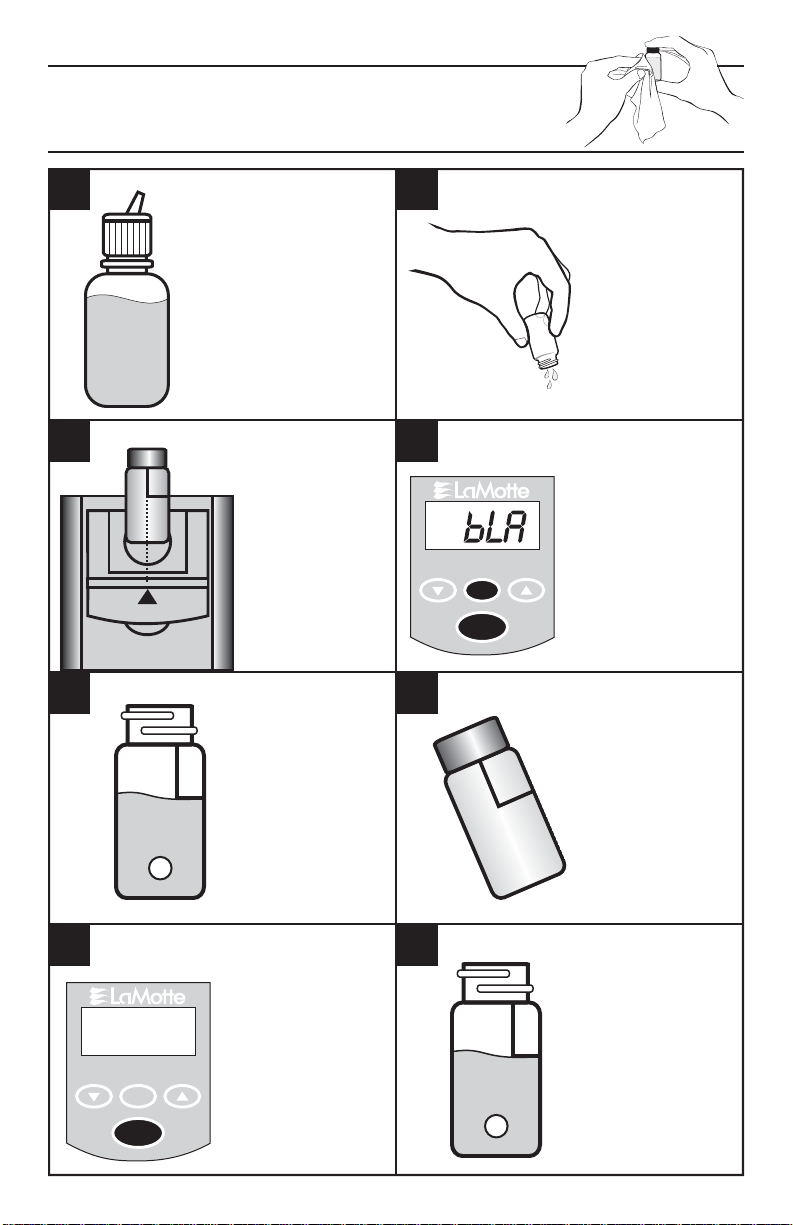
CHLORINE TEST PROCEDURE - DPD METHOD
Read the 1200 Colorimeter Manual before proceeding. Carefully
wipe tubes dry before inserting into the colorimeter chamber.
FREE AVAILABLE CHLORINE
1.
3.
5.
Fill the Water Sample
Collecting Bottle
(0688) with sample
water. This will be
used to dispense
sample water for the
tests.
Insert the
tube into the
chamber, being
sure to align
the index line
with the arrow
on the meter.
Close the lid.
This tube is the
blank or zero.
Remove the
tube and add
one *Chlorine
DPD#1 IG
Tablet (6903A).
2.
4.
1200 COLORIMETER
••••••••••••••••••••••
ZERO
READ
6.
Rinse and fill a
colorimeter tube
(0290) to the
10 mL line with
sample water.
Cap and wipe
dry.
Push the READ
button to turn the
meter on. Press
the ZERO button
and hold it for
2 seconds until
bla is displayed.
Release the button
to take a zero
reading (0.00 ppm).
Cap tube and
shake for 10
seconds. Invert
slowly 5 times.
Make reading
within 30 seconds.
Align the index line with the
7.
arrow on the meter, insert tube
into chamber.
the lid. Push the
READ button.
1200 COLORIMETER
••••••••••••••••••••••
ZERO
READ
Record results as
ppm Free Available
Chlorine. Save
reacted sample for
the T otal Residual
Chlorine test.
8.
Add one
Chlorine DPD
#3 IG Tablet
(6197A) to the
sample from
Step 6.
Page 3
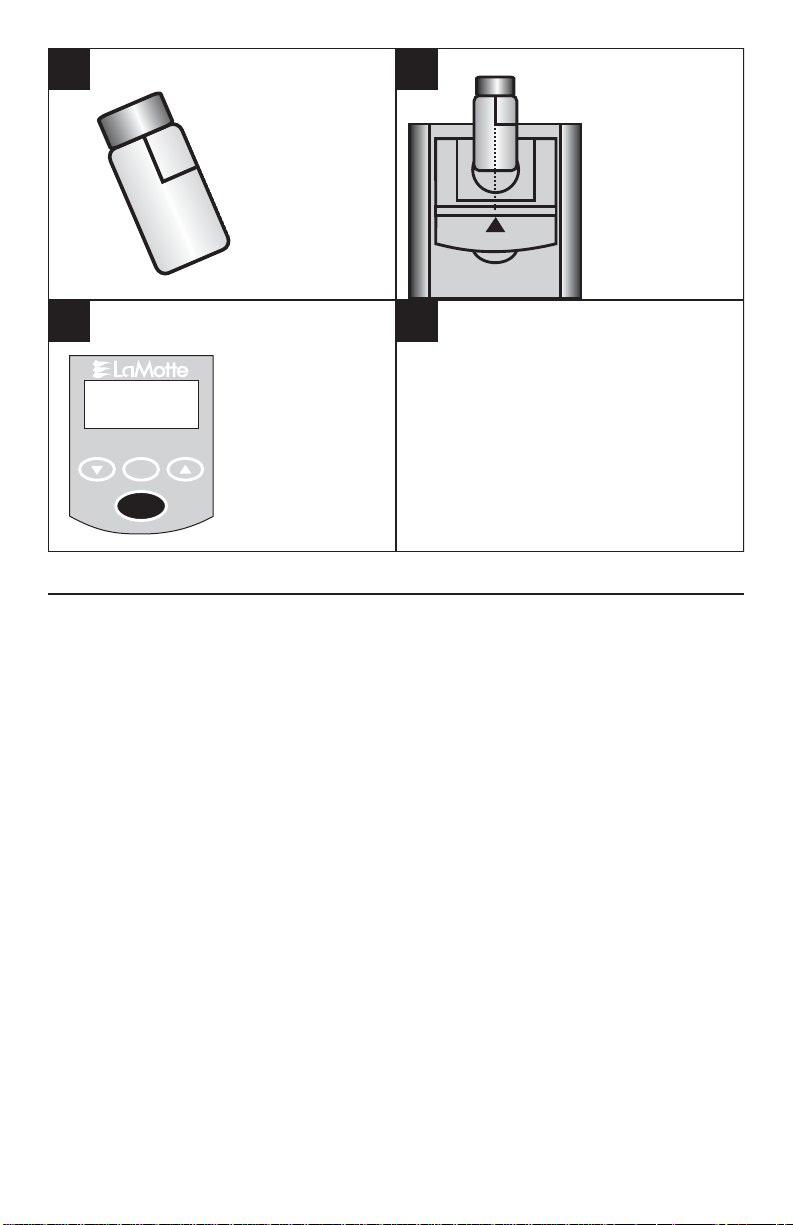
9.
Cap tube and
shake for 10
seconds. Invert
slowly 5 times.†
10.
Insert the
tube into the
chamber, being
sure to align
the index line
with the arrow
on the meter.
Close the lid.
11.
Push the READ
button. Record
reading as ppm
2.55
1200 COLORIMETER
ZERO
READ
TOTAL RESIDUAL CHLORINE
If either chlorine reading displays Er2, repeat procedure on diluted sample, and
multiply the result by the appropriate dilution factor. See 1200 Colorimeter Instruction
Manual for procedure.
Levels of chlorine above 10 mg/L will cause a bleaching effect on the DPD indicator,
and may give a false indication that no chlorine is present. If it is possible that the
chlorine concentration is greater than 10 mg/L (e.g. after shock treatment), perform
test on a diluted sample and multiply the result by appropriate dilution factor.
CAUTION: DO NOT leave reacted DPD samples in test tubes. Discard sample
and thoroughly rinse tubes. If allowed to remain, DPD will stain tubes, signifi cantly
impairing the operation of the 1200 Colorimeter. If necessary, acid wash, and
vigorously clean glassware with test tube brush and detergent.
† For wastewater samples, Standard Methods for the Examination of Water and Wastewater recommends waiting 2 minutes
for full color development.
Total Residual
Chlorine.
12.
Subtract the Free Available
Chlorine reading from the Total
Residual Chlorine reading
to determine ppm Combined
Chlorine (Monochloramine,
Dichloramine, and Nitrogen
Trichloride) present in the
water sample.
Page 4

DPD CHLORINE
TEST METHOD SPECIFICATIONS
APPLICATION
Drinking water supplies and distribution systems, swimming pool and spas, sewage
and chlorinated waste waters, process waters and sanitizing solutions.
RANGE
0 to 4.0 ppm Chlorine (may be extended by dilution)
METHOD
In the absence of Iodide, Free Available Chlorine reacts instantly with the buffered
diethyl-p-phenylenediamine indicator (DPD) to produce a red color in proportion to
the amount of chlorine present. Subsequent addition of potassium iodide produces a
rapid color response from the combined forms of chlorine (chloramines).
HANDLING & PRESERVATION
Chlorine in aqueous solutions, particularly weak solutions, is not stable. Exposure to
sunlight or agitation will accelerate the reduction of chlorine. Fill sample containers to
the top and cap tightly. Analyze samples as soon as possible after collection.
INTERFERENCES
The only interfering substance likely to be encountered is oxidized manganese. The
extent of this interference can be determined by treating a sample with sodium arsenite
to destroy the chlorine present, so that the amount of interference can be measured.
CALIBRATION
The single test colorimeter is precalibrated. In order to comply with NPDWR or
NPDES reporting regulations, the calibration should be checked periodically by
using a set of reference standards including a 0 mg/L blank and 0.3, 1.0, and 3.5
mg/L chlorine. To prepare these standards, a LaMotte 1000 mg/L standard chlorine
equivalent solution (Code 3858) is available. Consult with your local regulatory
agency to determine.
LaMOTTE COMPANY
Helping People Solve Analytical Challenges
PO Box 329 • Chestertown • Maryland • 21620 • USA
800-344-3100 • 410-778-3100 (Outside USA) • Fax 410-778-6394
Visit us on the web at www.lamotte.com
63670-01 01/13
®
 Loading...