

Page 1

LaCie DVD Recorder User’s Manual
Rev.1
02/11/06
Page 2

Copyrights
Copyright © 2002 LaCie. All rights reserved. No part of this publication may
be reproduced, stored in a retrieval system, or transmitted in any form or by
any means, electronic, mechanical, photocopying, recording or otherwise,
without the prior written consent of LaCie.
Trademarks
Microsoft, Windows 98, Windows 98SE, Windows Millennium Edition,
Windows 2000 and Windows XP are registered trademarks of Microsoft
Corporation. Other trademarks mentioned in this manual are the property of
their respective owners.
Changes
The material in this document is for information only and subject to change
without notice. While reasonable efforts have been made in the preparation of
this document to assure its accuracy, LaCie assumes no liability resulting from
errors or omissions in this document, or from the use of the information
contained herein. LaCie reserves the right to make changes or revisions in the
product design or the product manual without reservation and without
obligation to notify any person of such revisions and changes.
2
Federal Communications Commission Radio Frequency
Interference Statement (FCC)
WARNING: Changes or modifications to this unit not expressly approved by
the party responsible for compliance could void the user’s authority to operate
the equipment. This equipment has been tested and found to comply with the
limits for a Class B digital device, pursuant to Part 15 of the FCC Rules. These
limits are designed to provide reasonable protection against harmful
interference when the equipment is operated in a commercial environment.
This equipment generates, uses, and can radiate radio frequency energy, and
if not installed and used in accordance with the instructions, may cause
harmful interference to radio communications. However, there is no
guarantee that interference will not occur in a particular installation. If this
equipment does cause harmful interference to radio or television reception,
which can be determined by turning the equipment off and on, the user is
encouraged to correct the interference by one of the following measures:
• Reorient or relocate the receiving antennas.
• Increase the separation between the equipment and the receiver.
• Connect the equipment into an outlet on a circuit different from that to
which the receiver is connected.
• Consult the reseller or an experienced radio/TV technician for help.
Shielded cables and I/O cards must be used for this equipment to comply with
the relevant FCC regulations. This device complies with Part 15 of the FCC
rules. Operation is subject to the following two conditions: (1) this device may
not cause harmful interference, and (2) this device must accept any
Page 3

interference received, including interference that may cause undesired
operation.
Canada Compliance Statement
This Class A digital apparatus meets all requirements of the Canadian
Interference-Causing Equipment Regulations.
Manufacturer’s Declaration for CE Certification
We, LaCie, solemnly declare that this product conforms to the following
European standards:
Class B EN60950, EN55022, EN50082-1, EN60555-2
With reference to the following conditions:
73/23/EEC Low Voltage Directive
89/336/EEC EMC Directive
Laser Products
This equipment is certified to comply with DHHS Rule 21 CFR Chapter I,
subchapter J in effect as of date of manufacture. This equipment is classified
as a Class I Laser product and no hazardous laser radiation is emitted outside
the drive.
3
Page 4

1. Introduction ..........................................................................................5
1.1 Icons Used In This Manual .....................................................................5
1.2 LaCie DVD Utilities.................................................................................6
2. Getting to Know Your LaCie DVD Recorder...................................7
2.1 Minimum System Requirements .............................................................7
2.2 Supported DVD/CD Formats..................................................................7
4
2.3 LaCie DVD Recorder – Views
..................................................................9
3. Installing Your LaCie DVD Recorder ............................................11
3.1 Electro Static Discharge (ESD)...............................................................11
3.2 Hardware Installation
...........................................................................11
3.3 Pin Assignments...................................................................................15
4. Using Your LaCie DVD Recorder ....................................................16
5. Technical Information
.......................................................................18
5.1 Device Configuration Jumper (Master and Slave) Settings ...................18
5.2 Advice on MPEG-II Decoders................................................................19
6. Troubleshooting.................................................................................20
7. Contacting Customer Service..........................................................24
7.1 Warranty
..............................................................................................26
8. Glossary...............................................................................................27
9. Health and Safety Precautions .......................................................35
Page 5
1. Introduction
Congratulations on the purchase of your new LaCie DVD Recorder. Thanks to
its support of CD-ROM, CD-R, CD-RW, DVD-ROM, DVD-R, and DVD-RW
media, this stylish, high-performance internal drive will allow you to quickly
and easily record audio, video and data on either DVD-R/RW general use
discs or CD-R/RW media.
With all it can do for you, we’re confident that your LaCie DVD Recorder will
quickly become an important tool in your day-to-day business and personal
computing.
This manual will help you to:
• Install your new LaCie DVD Recorder properly
• Get it up and running
1.1 Icons Used in This Manual
Italicized paragraphs feature an icon describing the type of information being
given.
5
Important Note
Warning! (This icon indicates potential hazard).
Precautions
Always follow the basic precautions to use your LaCie DVD Recorder safely
and correctly. Respecting these guidelines will help to avoid the possibility of
personal injury to yourself or others, as well as to prevent damage to your
device and other computer equipment. For a complete list of precautions,
please see 9. Health and Safety Precautions of this manual.
Warranty
LaCie and its suppliers accept no liability for any loss of data during the use of
this device, or for any of the problems caused as a result.
Manual Updates
LaCie is constantly striving to give you the most up-to-date, comprehensive
User’s Manuals available on the market. It is our goal to provide you with a
friendly, easy-to-use format that will help you quickly install and utilize the
many functions of your new device.
Technical Information or News
If your manual does not reflect the configurations of the product that you
purchased, please check our Web site for the most current version available.
You can access our manuals at: www.lacie.com/support/manuals
Page 6

1.2 LaCie DVD Utilities
The LaCie DVD Utilities software enables Windows users to write to CD and
DVD media for backup, storage or audio and video applications. Users need
to install this software on their computer before using their LaCie drive to
record to DVD-R/RW and CD-R/RW media. Please refer to the LaCie DVD
Rewritable Drive Software Guide on the LaCie DVD Utilities CD-ROM for
further explanations of the software capabilities and installation steps.
6
Page 7
2. Getting to Know Your LaCie DVD Recorder
What can your LaCie DVD Recorder do?
• Create professional quality DVDs.
• Archive your home movies onto DVD.
• Master your own audio, video or data CD-R/RWs and DVD-R/RWs.
2.1 Minimum System Requirements
• Windows 98 SE (Second Edition), Windows Me (Millennium Edition),
Windows 2000, or Windows XP
• Pentium III 500MHz compatible processor or greater, 128MB RAM
• Available 5 1/4 inch CD-ROM drive bay
2.2 Supported DVD/CD Formats
Your LaCie drive is compatible with most popular DVD and CD formats:
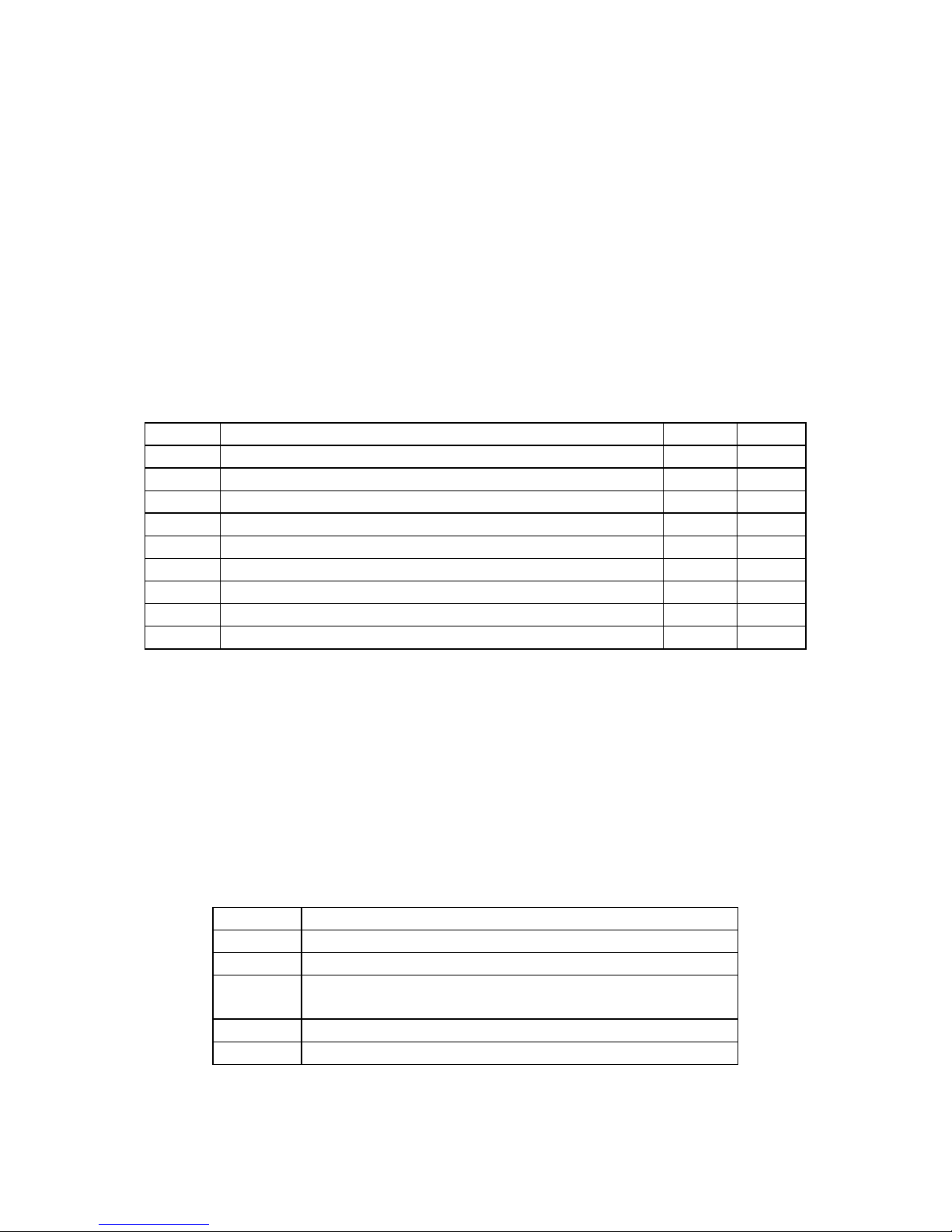
Format Type of Disc Record Read
DVD DVD-R (General use only for write) X X
DVD-RW (General use only for write) X X
DVD-ROM (single and dual layer) -- X
DVD (single and dual layer) 80 mm disc -- X
CD CD-R X X
CD-RW (supports AM2) X X
CD-ROM -- X
CD-ROM XA Mode2 (form 1, form 2) -- X
CD-Extra -- X
7
RPC and DVD-Video
Nearly all commercially-available DVD discs feature a Region Protection Code
(RPC). In order to watch DVD-Video discs, the RPC needs to match the setting
on the DVD player. By default, all LaCie DVD-Video-compatible drives are set
to the RPC zone of the country in which it was purchased. This RPC setting may
be changed using your hardware or software MPEG-II decoder (please refer to
the documentation supplied with your decoder for more information). DVDVideo discs that do not feature RPC II encoding may be played on all DVD
players set to Zone 1.
The worldwide RPC zones are:
Zone 1 USA and Canada
Zone 2 Europe, Japan, the Middle East and South Africa
Zone 3 Southeast Asia (including Hong Kong)
Zone 4 Australia, New Zealand, Central and South
America
Zone 5 Northwest Asia, North Africa
Zone 6 China
Page 8

When you insert a DVD-Video disc into your drive for the first time, the
hardware or software MPEG-II decoder will detect if the setting of your drive is
the same as on the DVD-Video. If not, a message will appear on your screen
and you will be asked to change the RPC setting of your drive.
Important Note: You can only change the RPC of your drive four
times. The RPC setting is copied into an internal component in the
drive. This chip makes an average of the first five readings and sets
the drive to the most read zone. After this, it will not be possible to
change or reset the RPC of the drive.
Example: You change the RPC Zone to play a Zone 1 DVD-Video,
and then you change to a Zone 2 DVD-Video. You switch back and
forth between the zones a total of five times, twice in Zone 1 and
three times in Zone 2. Your drive will then be set on Zone 2, without
the possibility to reset the drive later on in order to view DVD-Video
discs from Zone 1.
8
Page 9
2.3 LaCie DVD Recorder – Views
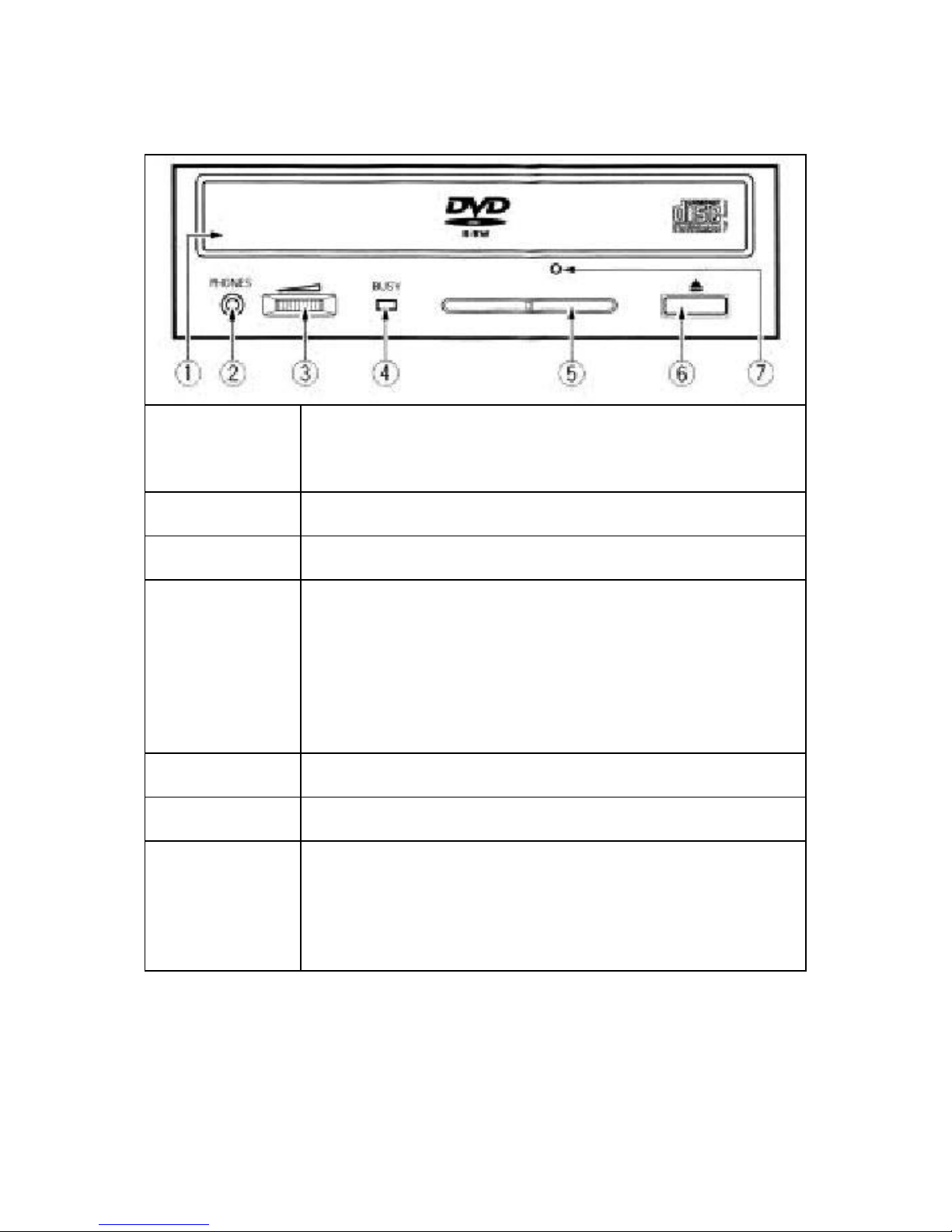
Front View –
1 – Media Tray Open the tray by pressing the load/eject button, then place
a CD/DVD into the tray with the label facing up. Close the
tray by pushing the load/eject button or pushing the front
part of the tray.
2 - Headphone
Jack
3 - Volume Knob Adjusts headphone volume level. Turn right to increase
4 - Read/Write
LED
5 – Ventilation
Holes
6 - Load/Eject
Button
7 - Emergency
Eject Hole
To connect 3.5 mm mini-jack stereo headphones. Set
volume to low before inserting headphones.
volume and left to decrease volume.
Lights in different patterns during operation.
During Reading – Steady green
During Writing – Steady orange
When an error occurs – blinking orange
* Abnormal rise of internal temperature – blinks 1 time,
pauses, then repeats
* Lens or disc is dirty – blinks 2 times, pauses then repeats
* Other error – blinks 3 times, pauses then repeats
Keeps the drive cool during operation. Do not block this
hole during operation.
Push this button to open the disc tray.
Insert a straightened paper clip (or similar object) and push
to eject the tray if the load/eject button does not work. In
normal operation, the eject button should always be used
to unload the tray. If you must use the emergency eject
hole, make sure the drive’s power is turned off and wait
until disc rotation has stopped.
9
Page 10
Back View –
10
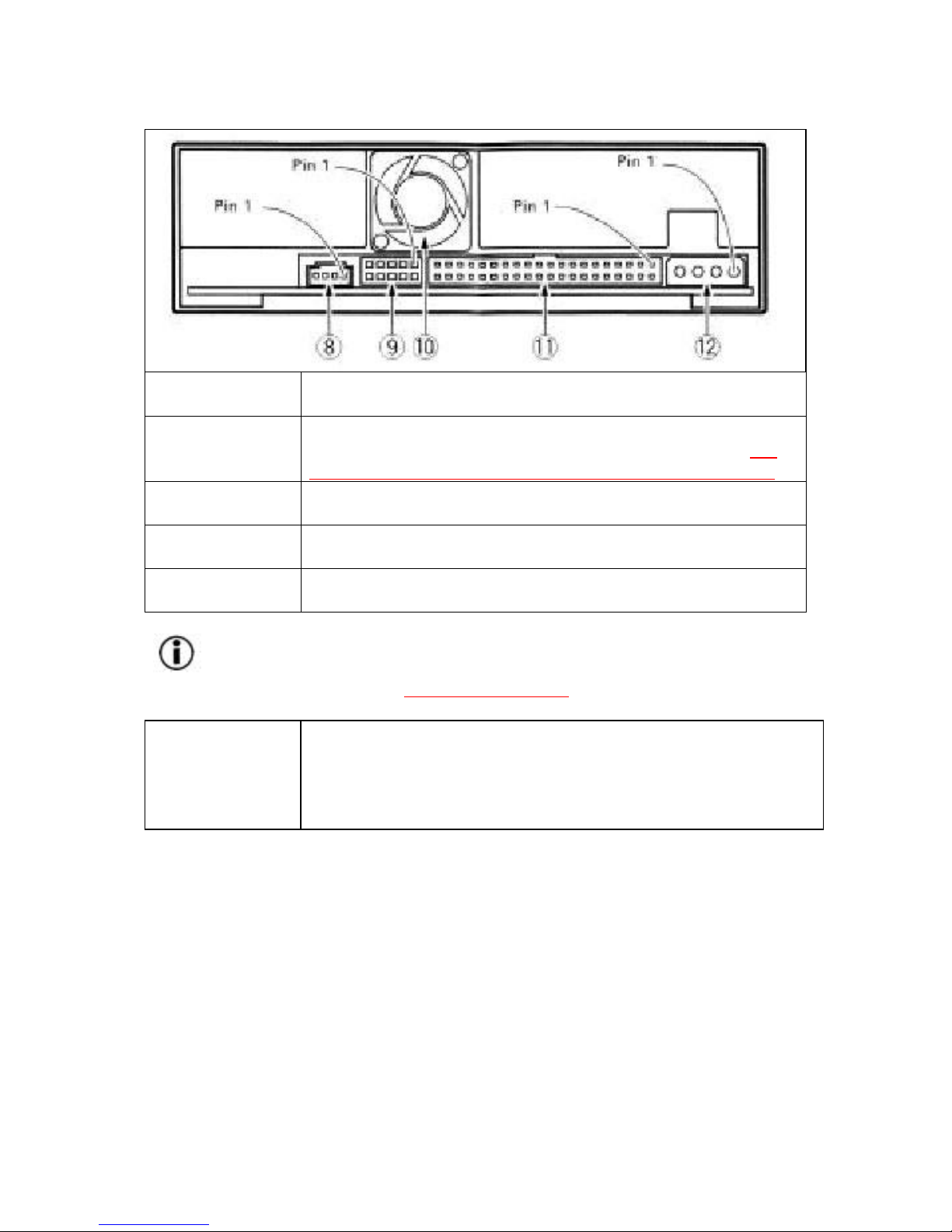
8 – Audio
Insert the included analogic audio cable here.
Output
9 – Device
Configuration
Jumper
10 – Cooling
With the unit turned off, set the jumper switch to the drive
mode supporting the computer. For more details, see 5.1
Device Configuration Jumper (Master and Slave) Settings.
Used to cool the drive during operation.
Fan
11 – Host IDE
Interface
Insert a 40-pin I/O connector, in accordance with ATA
specifications.
12 – DC Input The input for a DC +5 V and DC +12 V power supply
connector.
Important Note: For a complete list of pin assignments for the
Audio Output, Device Configuration Jumper, Host IDE Interface and
DC Input, please see 3.3 Pin Assignments.
Serial Number
Sticker
Write down the serial number and keep it in a safe place,
because you will need to provide the number in the event you
have to call LaCie Technical Support for any reason in regard
to the drive’s performance. The serial number would also
come in handy if your drive is lost or stolen.
Page 11

3. Installing Your LaCie DVD Recorder
Warning! Before handling and installing your LaCie DVD Recorder,
ensure that you have properly grounded yourself. Electrostatic
Discharge (ESD) can quickly and easily damage or destroy your
component or your computer. Please read the following information
to properly ground yourself.
3.1 Electrostatic Discharge (ESD)
Static electricity is an electric charge caused by an imbalance of electrons on
the surface of a material. When you touch an object and are shocked, this is
the transfer of the static charge or the balancing of your charge to that of the
object. This exchange is called Electrostatic Discharge or ESD.
ESD can cause two different types of damage to computers and peripherals:
(1) Catastrophic, which is the complete loss of device functionality, and (2)
Latent Defect, where the device is only partially effected, and the device loses
part of its productivity and longevity.
11
Because we cannot eliminate the generation of static electricity, it is extremely
important to follow the proper steps to ground yourself before handling your
LaCie DVD Recorder or touching any internal component of your computer.
This can be accomplished by proper grounding in conjunction with the use of
ESD safe mats, wrist or shoe straps. Consult your computer supply specialist
for more details on the correct ESD dissipative device to fit your needs.
3.2 Hardware Installation
Tools: Philips-head and/or flat-head screw driver
Computer System Manual
Important Note: Due to the wide variety of computer system
manufacturers and varying case designs, it is extremely important
that you reference your computer system’s manual when installing
your LaCie DVD Recorder. The installation steps that follow are
generic steps, and may not directly reflect the unique configurations
that are specific to your particular computer system.
1) Turn off your computer and disconnect all external peripheral devices and
cables, i.e. power cord, modem/fax line, monitor, etc.
2) Remove your computer’s cover. For most computers, there are screws that
will need to be unseated before you can remove the computer’s cover, and
these screws are usually located at the rear of the computer, along the edge
of the cover. However, placement of these screws and cover attachment may
Page 12
12
vary by manufacturer, so please refer to your computer system’s manual for
specific details.
3) Once you have removed the cover, you may need to remove the front bezel
of your computer case. The removal of the front bezel of the computer case
will vary dependant upon manufacture, so please refer to your computer
system’s manual for specific details.
4) Remove the cover from the empty drive bay. Please refer to your computer
system’s manual for specific details.
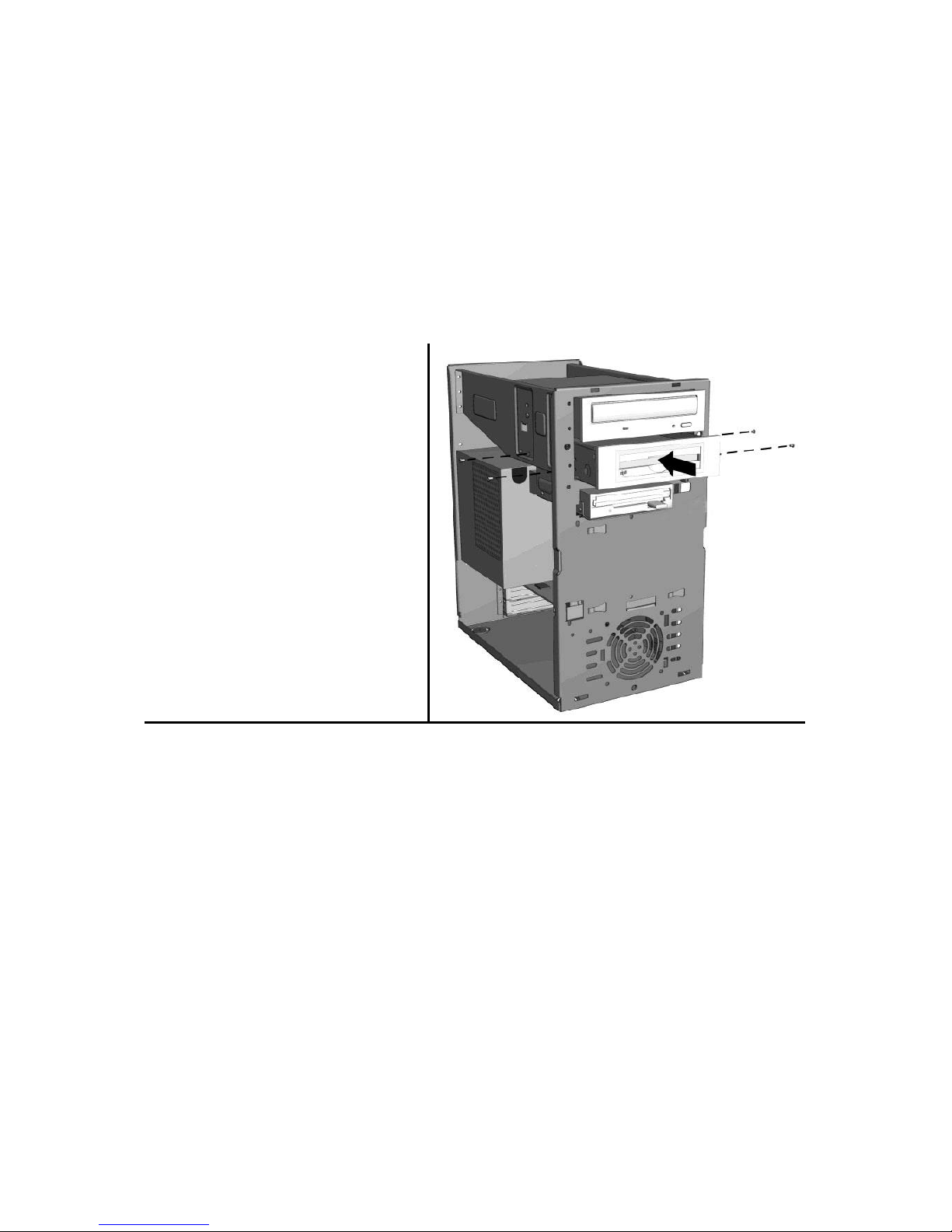
5) Insert the LaCie DVD
Recorder into the available drive
bay by sliding it into the front of
the drive cage, as shown below.
6) Match up the screw holes on either side of the drive with the screw holes on
your computer’s chassis, as shown above. You may need to attach a
horizontal bracket to both sides of the drive to ensure that the drive fits
properly. Use of the brackets will depend on your computer model. Consult
your computer system’s manual for further details.
7) Insert two screws into each side of the drive and tighten.
Page 13
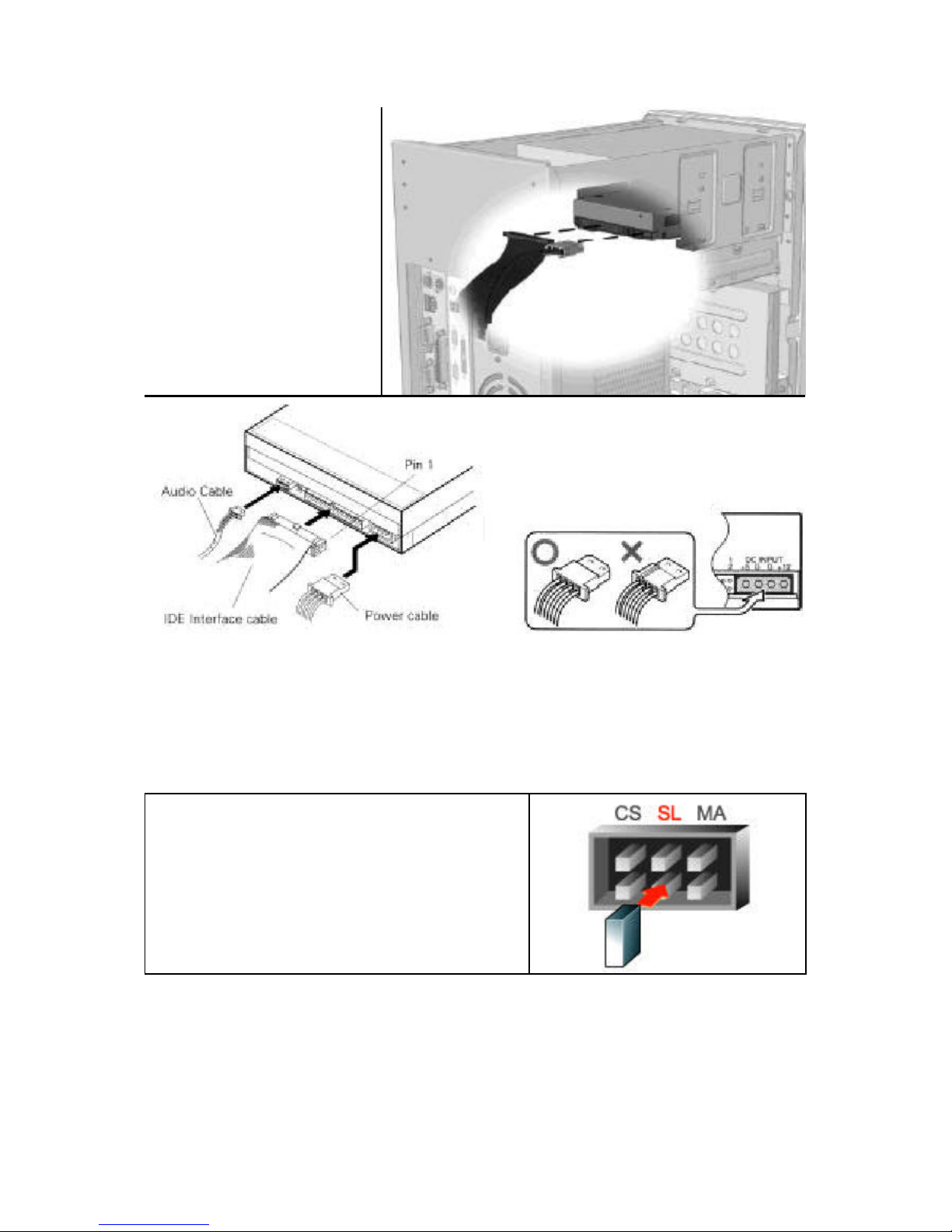
8) Next, you will have to
connect the drive’s power,
IDE and audio cables, as
shown in the figures
below. Connect the cables
in the following order:
13
A) Connect the power cable from the computer to the DVD drive, paying close
attention to the polarity of the cable.
B) Connect the IDE interface cable. Make sure that Pin 1 on the drive
corresponds to Pin 1 on the cable.
When using one IDE interface cable, place
the Device Configuration Jumper on the
Slave setting, as shown below.
Page 14
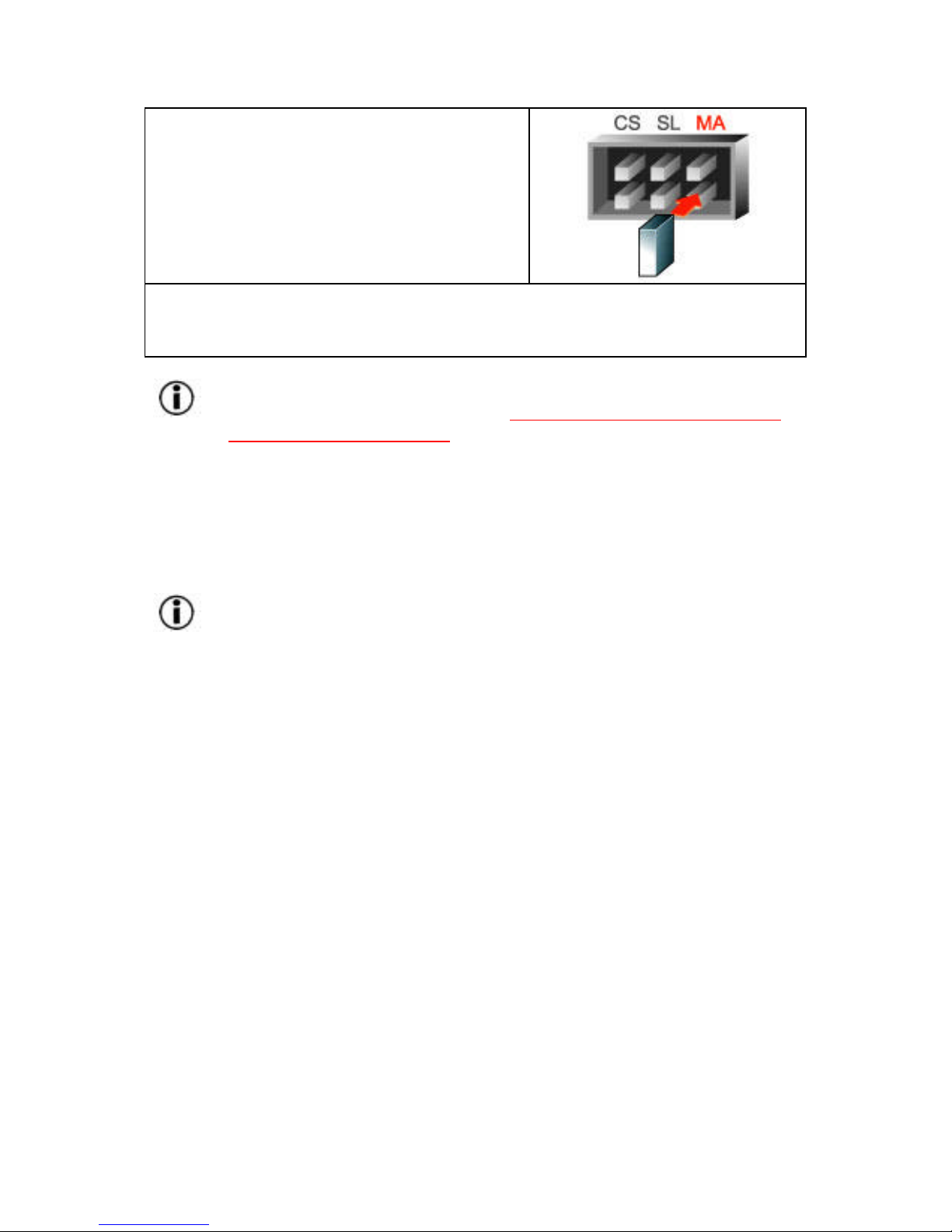
When using two IDE interface cables and
there is only one DVD-R/RW drive, place the
Device Configuration Jumper on the Master
setting, as shown below. The LaCie DVD
Recorder is pre-configured to the Master
setting.
When using two IDE interface cables and there are two DVD-R/RW or another
CD-ROM/R/RW drive, place the Device Configuration Jumper on the Slave
setting.
Important Note: For a more detailed discussion of the Device
Configuration Jumper, please see 5.1 Device Configuration Jumper
(Master and Slave) Settings.
C) Connect the drive’s audio cable between the sound output terminal on the
drive and the audio output terminal on the sound card.
14
9) Now you are ready to put the computer’s cover back on and reconnect all
of your external peripheral devices and cables.
Important Note: Once your LaCie DVD Recorder is installed, you
will need to install the recording utilities, included on the LaCie DVD
Utilities CD-ROM. Please see this disc for complete information about
the software and installation procedures.
Page 15
3.3 Pin Assignments
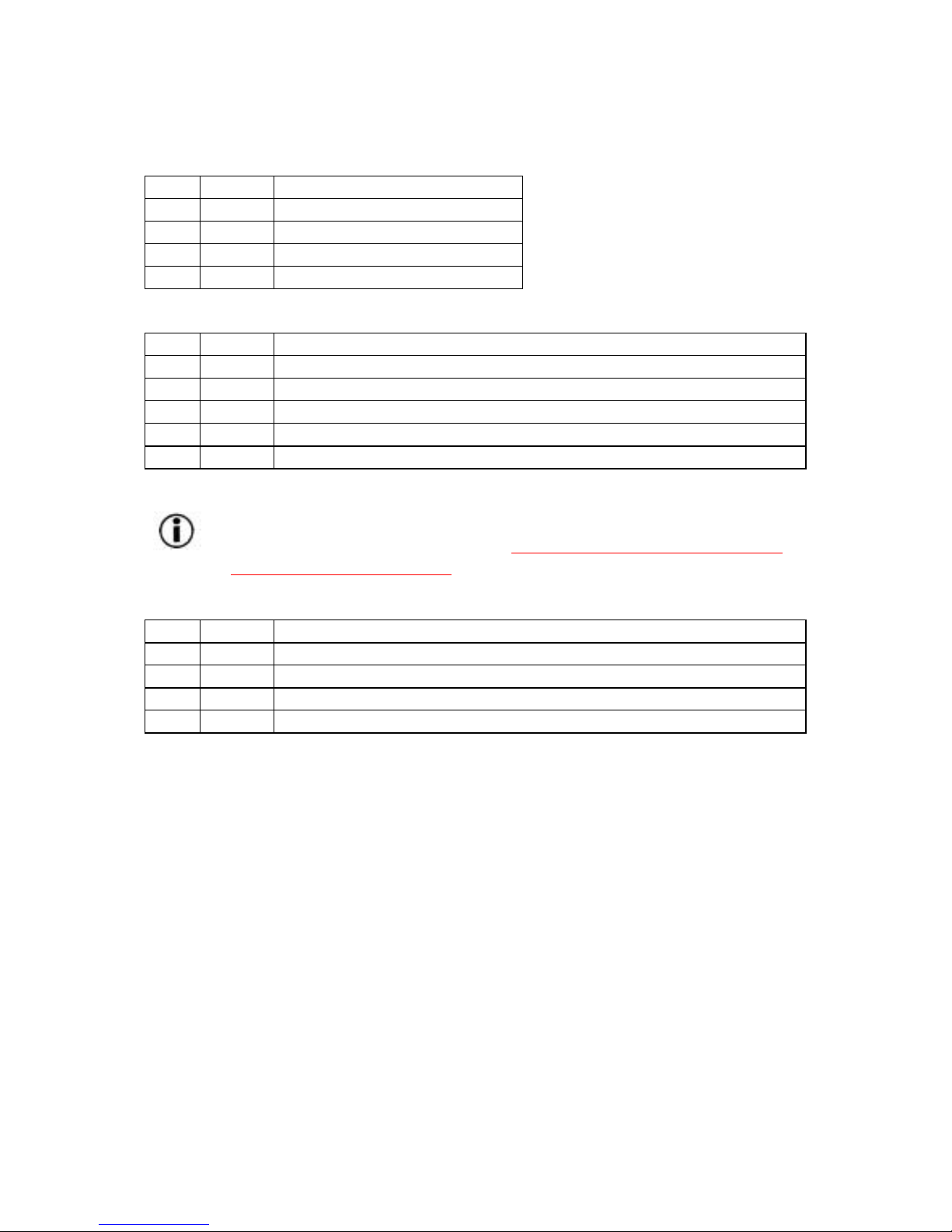
Audio Output
Pin Name Function
1 L Left channel audio output
2 G Ground
3 G Ground
4 R Right channel audio output
Device Configuration Jumper
Pin Name Function
1 MA* On – Drive set to Master mode
2 SL On – Drive set to Slave mode
3 CS On – Drive set to Cable Select mode
4 Reserved
5 Reserved
*Pin #1 is active upon initial shipment.
15
Important Note: For a more detailed discussion of the Device
Configuration Jumper, please see 5.1 Device Configuration Jumper
(Master and Slave) Settings.
DC Input
Pin Name Function
1 +12 Power supply input for DC +12 V
2 G Ground
3 G Ground
4 +5 Power supply input for DC +5 V
Page 16

4. Using Your LaCie DVD Recorder
Inserting Media
To insert a disc, push the load/eject button on your LaCie DVD Recorder.
When the disc tray opens, put the DVD/CD media into the tray with the label
side facing up. Make sure the DVD/CD is correctly placed in the center of the
disc tray. Gently push in the disc tray or push the load/eject button to close it.
Ejecting Media
Warning! Do not attempt to open the drive's media tray or remove
the DVD/CD while the unit is in use and being accessed by the
computer. You may injure yourself, and damage the drive and/or
your computer system.
After you have finished using the DVD drive and the computer is no longer
accessing it, push the load/eject button. When the disc tray is fully open,
remove the DVD/CD. After removing the disc, gently push in the disc tray or
push on the load/eject button to close it.
16
You can also go into My Computer and right click the DVD/CD drive icon. In
the drop-down menu that follows, select the Eject option. The disc tray will
open, then you can access your media.
Emergency Ejection of Media
In the event that a DVD/CD cannot be ejected with the load/eject button and
the software is not controlling the drive, use the emergency eject operation to
open the disc tray. First, switch off your computer.
Warning! Make sure the DVD drive is off and the power unplugged
before attempting the emergency ejection procedure.
On the front of the drive is the Emergency Eject Hole. Insert a small metal
poker, such as an unbent paper clip, into the Emergency Eject Hole until the
poker presses against the manual eject mechanism. You will feel the
mechanism eject the disc tray. Only use this method when the load/eject
button is not working.
Read Mode
The DVD/CD volume will appear in My Computer. Click on My Computer
to view the contents of the CD and to have access to the folders and files on it.
You can also gain access to the files and folders contained on the disc by
going into Windows Explorer and clicking on the CD/DVD-ROM drive icon.
Page 17

Write Mode
Please refer to the individual software programs user’s guide for information
on how to best use your DVD drive in write mode.
17
Page 18

5. Technical Information
5.1 Device Configuration Jumper (Master and Slave)
Settings
The IDE interface on the back of your LaCie DVD Recorder can support two
devices, and most computer motherboards come with dual IDE interfaces,
primary and secondary, to allow up to four IDE devices. The controller is
integrated with the drive, and does not decide which device has priority in
communicating with the computer.
In allowing for two devices on the same cable, IDE incorporates a unique
configuration to allow control of the devices, called Master (MA) and Slave
(SL). In this configuration, Master means drive 0, and Slave refers to drive 1,
which allows the drives to work independently.
Pin 39 on the IDE interface carries a special signal, called the Drive
Active/Slave Present (DASP), that allows the computer to determine if there is
a second (slave) drive attached.
18
The master drive should be attached to the connector at the very end of the
IDE ribbon cable, although it will work in either position. This is where the
Device Configuration Jumper settings become very important – the Device
Configuration Jumper identifies the drive as either the master or slave drive.
The drive’s controller board will look to the Device Configuration Jumper for
instructions as to whether it is the master or slave device.
The LaCie DVD Recorder offers an option as an alternative to the permanent
selection of a master or slave – the Cable Select (CS) option. By using a special
type of IDE ribbon cable, CS allows the drive to be auto-configured as either
slave or master.
In CS mode, each device attached to the IDE cable has its jumper set to the CS
option. The cable has one important difference from other typical IDE ribbon
cables; with a CS IDE ribbon cable, Pin 28 only connects to the master drive
connector. This way, when the computer is powered on, the IDE interface
sends a signal along the Pin 28 wire, and only the device that is attached to
the master connector receives the signal, which then automatically configures
the device as the master, leaving the other device as the slave.
The Device Configuration Jumpers are the six straight angle pins located on
the rear of the drive (see 2.3 LaCie DVD Recorder – Views/ Back View – 2).
The jumper is the tiny, black rectangular piece covering the two vertical pins
below the MA letters on the back of the drive.
Page 19

19
Your LaCie DVD Recorder is pre-configured in the factory to the master setting
(MA). By removing the jumper on the pins and then placing it on the two
vertical CS pins, you can configure the device in the CS mode, or place it on
the two vertical SL pins to configure it as the slave device.
In most installations, the jumper should remain in the master position. If
possible, you should install the LaCie DVD Recorder on the secondary IDE bus,
using a separate IDE cable. If you will be installing the drive on the primary
IDE bus, your hard drive should be set as the master (MA), and the LaCie drive
should be set as the slave (SL).
5.2 User Advice on MPEG-II Decoders
All DVD-Video material is compressed using MPEG-II compression. DVDVideo, with full-motion video and multi-channel sound (multi-lingual
soundtracks, surround sound, etc.), is a data-hungry application. Without
compression, you would only be able to fit a 5-minute movie onto a 4.5GB
disc. MPEG-II compression allows you to fit a full-length feature film, plus
bonus material, on just one disc.
In order to play DVD-Video discs using your LaCie ATAPI DVD Recorder, you
need to have an appropriate MPEG-II decoder. You have two options: (1)
install the MPEG-II decoder software included with your drive; or (2) purchase
a PCI MPEG-II decoder card (sold separately).
1) Install the MPEG-II decoder software (WinDVD) if your PC is equipped with
a processor that is 400MHz or faster. The decoder software will give you
smoother images when playing DVD-Video discs using your drive (as with any
application, the more RAM you have, the better playback performance will be).
2) Purchase and install a PCI MPEG-II decoder card if your PC is equipped with
a processor that is 400MHz or slower. The decoder card should help you
obtain better performance during playback with your LaCie drive.
Page 20

20
6. Troubleshooting
In the event that your LaCie DVD Recorder is not working correctly, please
refer to the following checklist to find out where the problem is coming from. If
you have gone through all of the points on the checklist and your drive is still
not working correctly, please have a look at the FAQs that are regularly
published on our Web site – www.lacie.com. One of these FAQs may
provide an answer to your specific question. You can also visit the drivers
pages, where the most recent software updates will be available.
If you need further assistance, please contact LaCie Technical Support (see 7.
Contacting Customer Service for details).
The Problem Questions to Ask Possible Solutions
The drive is not
recognized.
The drive's media tray
will not open.
Does an icon for the drive
appear on the computer?
(On a Mac a CD/DVDROM must be inserted in
the drive)
Is the drive powered up? Check the drive's power
Is there a conflict with
other device drivers or
extensions?
Is the drive being accessed
for read or write
operations?
Is the drive turned on? Make sure the Power LED
Check for an icon on the
Desktop (on a Mac) or in
My Computer (on a PC).
cable. Make sure the
Power LED is on.
Contact LaCie Technical
Support.
Check to see if the drive's
read/write activity LED is
blinking.
is on.
The d r iv e
a ut om a ti ca l ly e j ec ts a
CD or DV D w he n y ou
t ry t o r ec ord on i t.
Is the CD/DVD already
full?
Does the DVD-RW drive
support the format of the
CD/DVD you have
Verify the contents of the
CD/DVD and try recording
on a blank one.
Check 2.2 Supported
DVD/CD Formats for the
formats supported by your
Page 21

inserted? drive.
• If recording from CD or
21
The d r iv e i s not w ri t ing
t o CD corr e ct ly .
Is the CD/DVD media
damaged?
Has Easy CD Creator
been installed correctly?
Has buffer underrun
occurred (has something
interrupted the stream of
data to the recorder)?
Carefully inspect the disc.
If in doubt, try another
CD/DVD disc.
Reinstall Easy CD Creator.
• Disable all other
software programs that
are running during the
CD recording session.
• Disconnect the
network, if you are
using one.
• Check to see that your
hard drive is fast
enough.
DVD-ROM to CD,
make sure that the
speed of the source
device is high enough
to provide a sufficient
data stream to the
LaCie drive. Reduce
the write speed of the
LaCie drive using the
appropriate menu in
Easy CD Creator.
The drive does not
write to DVD-R/DVDRW media correctly.
Is the CD-R/CD-RW media
bad or scratched?
Are you using the right
type of DVD-R/DVD-RW
media?
Check your CD-R/CD-RW
media and try writing to a
different disc.
Make sure that you are
using DVD-R/DVD-RW
General use media. DVDR/DVD-RW Authoring
media and
DVD+R/DVD+RW media
cannot be written to using
your LaCie drive.
Page 22

22
• If recording from CD or
Has buffer underrun
occurred (has something
interrupted the stream of
data to the recorder)?
• Disable all other
software programs that
are running during the
CD recording session.
• Disconnect the
network, if you are
using one. On a Mac,
deactivate File Sharing.
• Check to see that your
hard drive is fast
enough.
DVD-ROM to CD,
make sure that the
speed of the source
device is high enough
to provide a sufficient
data stream to the
LaCie drive. Reduce
the write speed of the
LaCie drive using the
appropriate menu in
Easy CD Creator.
The d r iv e
a ut om a ti ca l ly e j ec ts a
D VD /CD w he n y ou
i nser t i t.
DVD-Video playback
will not work in
Windows.
Does the drive support the
format of the DVD/CD you
have inserted?
Is the DVD/CD media
damaged?
Have you installed the
appropriate MPEG-II
decoder software?
Do you have a Pentium II
350 MHz (or equivalent)
processor or greater?
Check 2.2 Supported
DVD/CD Formats for the
formats supported by your
drive.
Try another DVD/CD disc.
Check that WinDVD has
been installed correctly.
Check your processor
(Start > Settings >
Control Panel >
System > General tab.)
If your processor does not
meet the minimum
requirements, you may
Page 23

23
need to purchase an
MPEG-II decoder card.
Consult your computer
supply specialist for
details.
DVD playback is not
as smooth as it should
be.
Has the LaCie drive been
set as the default DVD
drive in WinDVD?
Are you running other
software programs
simultaneously?
If using Windows, do you
have a Pentium II 350
MHz (or equivalent)
processor or greater?
See the LaCie DVD
Software Guide, as well
as the WinDVD online
help.
Check to see if other
programs are running. If
so, close them. Depending
on your computer’s
configuration, playback
may be possible only if the
DVD player software is the
only program running.
Check your processor
(Start > Settings >
Control Panel >
System > General tab.)
If your processor does not
meet the minimum
requirements, you may
need to purchase an
MPEG-II decoder card.
Consult your computer
supply specialist for
details.
Are you running other
software programs
simultaneously?
Check to see if other
programs are running. If
so, close them. Playback
may become smoother
when only the DVD player
software is running.
Page 24

24
7. Contacting Customer Support
Before You Call Technical Support
1) Read the manual and review the Troubleshooting section.
2) Try to isolate the problem.
If you have asked yourself all of the pertinent questions in the troubleshooting
checklist, and you still can't get your LaCie drive to work properly, call us
directly using the number below or send us an email. Before calling or sending
an email, make sure that you are in front of your computer and that you have
the following information on hand:
1) Your drive's serial number
2) Computer brand and model
3) Operating system and version (Mac OS or Windows)
4) Amount of memory installed
5) Names of CD or DVD drives installed on your computer
6) Names of any other devices installed on your computer
Technical Support Help Hours
LaCie Australia
• Monday through Friday, 9:30AM –
5:30PM EST
Contact Us At:
• (61)2 9669 6900
LaCie Canada
• Monday through Friday, 9:30AM –
5:30PM EST
Contact Us At:
• (416) 530 2545 phone
• (416) 530 2546 fax
LaCie France
• Monday through Friday, 9AM – 5PM
Contact Us At:
• 33 (0) 1 69 32 84 23
LaCie Belgium
• Monday through Friday, 9AM – 5PM
Contact Us At:
• 32 (0) 2 639 14 71
LaCie Denmark
• Monday through Friday, 9AM – 5PM
Contact Us At:
• 45 70 27 65 43
LaCie Germany
• Monday through Friday, 9AM – 5PM
Contact Us At:
• 49 (0) 211 30 121-111
Page 25

25
LaCie Italy
• Monday through Friday, 9AM – 6PM
Contact Us At:
• 39 02 89 14 09 20
LaCie Netherlands
• Monday through Friday, 9AM – 5PM
Contact Us At:
• 31 (0) 713 326 833
LaCie Spain
• Monday through Friday, 9AM – 2PM,
and 4PM – 7PM
Contact Us At:
• 34 91 323 83 11
LaCie Japan
• Monday through Friday, 9AM – 5PM
Contact Us At:
• 81 3 5733 2205
LaCie Nordic
(Finland, Norway and Sweden)
• Monday through Friday, 9AM – 5PM
Contact Us At:
• 46 (0) 8 411 60 02
LaCie Switzerland
• Monday through Friday, 9AM – 5:30PM
Contact Us At:
• 41 (0) 61 386 80 45
LaCie United Kingdom & Ireland
• Monday through Friday, 9AM – 5PM
Contact Us At:
• 44 (0) 20 7872 0872
LaCie USA
• Monday through Friday, 6AM – 6PM PST
Contact Us At:
• 503-844-4503 phone
• 503-844-4505 fax
Page 26

26
7.1 Warranty
LaCie warrants your drive against any defect in material and workmanship,
under normal use, for the period designated on your warranty certificate. In
the event this product is found to be defective within the warranty period,
LaCie will, at its option, repair or replace the defective drive.
This warranty is void if:
• The drive was operated/stored in abnormal use or maintenance conditions;
• The drive is repaired, modified or altered, unless such repair, modification or
alteration is expressly authorized in writing by LaCie;
• The drive was subjected to abuse, neglect, lightning strike, electrical fault,
improper packaging or accident;
• The drive was installed improperly;
• The serial number of the drive is defaced or missing;
• The broken part is a replacement part such as a pickup tray, etc.
• The tamper seal on the drive casing is broken.
LaCie will not, under any circumstances, be liable for direct, special or
consequential damages such as, but not limited to, damage or loss of property
or equipment, loss of profits or revenues, cost of replacement goods, or
expense or inconvenience caused by service interruptions.
Under no circumstances will any person be entitled to any sum greater than
the purchase price paid for the drive.
To obtain warranty service, call LaCie Technical Support. You may be asked to
furnish proof of purchase to confirm that the drive is still under warranty.
All drives returned to LaCie must be securely packaged in their original box
and shipped with postage prepaid.
Page 27

27
8. Glossary
ATA (Advanced Technology Attachment) – The official name that the
American National Standards Institute (ANSI) uses for what the computer
industry calls Integrated Drive Electronics (IDE) – which is the standard
electronic interface used between a computer motherboard's data paths, or
bus, and the computer's disk storage devices.
Authoring – Creation, combination and setup of various files for a DVDVideo, DVD-ROM or audio disc. This includes audio, video, graphics and text
files.
Backup – (1) The act of creating at least one additional copy of data onto a
different (and safe) storage device from where it can be retrieved at a later
time if needed. (2) A copy of a file, directory, or volume on a separate storage
device from the original, for the purposes of retrieval in case the original is
erased, damaged, or destroyed.
Bit – The smallest measure of computerized data, either a 1 or a 0. Eight
bits equal one byte, or one character.
Block – A very small section of the storage media comprised of one or more
sectors. A block is the smallest amount of space allocated on a drive for data
storage. By default, a sector of data consists of 512 bytes.
Buffer – RAM cache that is faster than the data that is being delivered.
Buffers are used so data may be stored and delivered to the receiving item as
it is needed.
Buffer Underrun – A condition when the drive’s buffer runs out of data
while the CD-R/RW or DVD-R/RW media is still being written. The recording of
a CD/DVD is a system-intensive process, and the recorder needs a constant
stream of data. A buffer underrun occurs when the stream to the recorder is
not fast enough to keep the recorder’s buffer full, causing the recording to
abort.
Bus – Electronic links that enable data to flow between the processor, RAM
and extension cables (peripherals).
Byte – A sequence of adjacent binary digits, or bits, considered as a unit, 8
bits in length. There are 8 bits in 1 byte. See also MB (Megabyte) or GB
(Gigabyte).
Page 28

28
Cache, -ing – This is an area of electronic storage (usually RAM) set aside to
store frequently used data from electro-mechanical storage (hard drives,
floppy disks, CD/DVD-ROM, tape cartridges, etc.) Therefore, storing frequently
used data in RAM can enhance your system’s overall response to diskintensive operations significantly.
CD-R (Compact Disc Recordable) – Recordable optical disc that has up to
700MB of storage capacity.
CD-ROM (Compact Disc Read Only Memory) – Small optical disc made
of plastic that cannot be erased or written to.
CD-RW (Compact Disc ReWritable) – Rewritable optical disc that has up
to 700MB of storage capacity and which theoretically can be rewritten 1,000
times.
CD-XA (CD-Extended Architecture) – A format developed by Philips and
Sony that is intended to store computer data, video and audio tracks on the
same CD-ROM.
Configuration – When talking about a PC, configuration is understood to be
the sum of the internal and external components of the system, including
memory, disk drives, the keyboard, the video subsystem and other peripherals,
such as the mouse, modem or printer. The configuration also implies software:
the operating system and various device managers (drivers), as well as
hardware settings and options set by the user via configuration files.
Controller – This is a component or an electronic card (referred to in this
case as a "controller card") that enables a computer to communicate with or
manage certain peripherals. The controller manages the operation of the
peripheral associated with it, and links the PC bus to the peripheral via a
ribbon cable inside the PC. An external controller is an expansion card which
fills one of the free slots inside your PC and which enables a peripheral (CDROM drive, scanner or printer, for instance) to be connected to the computer.
Cross-platform – Term that refers to a device that is able to be operated by
both Mac and Windows operating systems.
Data Stream – The flow of data that accomplishes a task, usually related to
moving data from storage to computer RAM or between storage devices. In
DVD-Video, these bits are processed by the decoder on the video player. This
stream contains all the information necessary for the decoder to work and
view the image on the DVD video player.
Page 29

29
Decoder – The electronic component that deciphers the MPEG-II video
stream. It paints the picture to the viewer’s screen.
Digital – Discrete information that can be broken down to zero or one bits.
Disc at Once (DAO) – Authoring process in which the entire CD/DVD is
recorded in one session, and data cannot be added after the recording is
finished. This mode allows for the most control of the recording process for
audio CDs because the gap between tracks can be set and the maximum
capacity of the CD can be utilized.
Driver (peripheral manager) – A software component that enables the
computer system to communicate with a peripheral. Most peripherals will not
operate correctly – if at all – if the appropriate drivers are not installed on the
system.
DVD (Digital Versatile Disc) – Optical disc technology that is replacing the
CD-ROM disc (as well as the audio compact disc). DVD holds 4.7GB of
information on one of its two sides, or enough for a 133-minute movie. With
two layers on each of its two sides, it will hold up to 17GB of video, audio, or
other information (compare this to the current CD-ROM disc of the same
physical size, holding 700MB). DVD uses the MPEG-II file and compression
standard. MPEG-II images have four times the resolution of MPEG-I images
and can be delivered at 60 interlaced fields per second where two fields
constitute one image frame (MPEG-I can deliver 30 non-interlaced frames per
second). Audio quality on DVD is comparable to that of current audio compact
discs.
DVD-R – DVD Recordable. These discs have the same write-once concept as
CD-R, but with the added benefits of DVD media. There are two types of DVDR disc: DVD-R General, intended for home use, and DVD-R Authoring,
intended for professional DVD-Video development applications. These two
types of DVD-R disc are not compatible, i.e. DVD-R Authoring discs cannot be
written to in a DVD-R General-compatible drive and vice versa. Both kinds of
discs are readable in most DVD players and drives, however. The latest DVD-R
discs feature 4.7GB capacity.
DVD-RW – DVD ReWritable. Same multiple-write concept as CD-RW –
theoretically, it can be rewritten about 1,000 times - but with the added
benefits of DVD media. Discs have a 4.7GB capacity and are playable in many
DVD drives and players.
DVD-RAM – DVD-RAM (DVD-Random Access Memory) is a rewritable DVD
format that allows for more than 100,000 rewrites. DVD-RAM drives are
available in internal and external units in a range of interfaces. DVD-RAM
Page 30

30
media uses a phase-change recording layer and is available as a bare disc, a
single-sided disc in a removable cartridge, or a dual-sided disc in a permanent
cartridge.
DVD-ROM – DVD (Digital Versatile Disc Read Only Memory) a disc with a
capacity up to 25 times greater than that of a CD-ROM, which offers digital
quality images for superior multimedia processing. The term DVD-ROM, which
indicates it is a disc that can be used in read-only mode, is generally used to
refer to a multimedia disc.
DVD-Video – Using the same technology for DVD, this format is designed to
store movies on a DVD medium. Most DVD drives have the ability to read
DVD-Video.
File System – Links the physical map of a disc to its logical structure. Thanks
to the file system, users and computers can easily display path, directories and
files recorded onto the disc.
Firmware – Permanent or semi-permanent instructions and data
programmed directly into the circuitry of a programmable read-only memory
or an electronically-erasable, programmable read-only memory chip. Used for
controlling the operation of the computer or tape drive. Distinct from the
software, which is stored in random access memory and can be altered.
Folder – A list created on a disk to store files. Creating folders and subfolders enables you to organize the storage of your files in a logical,
hierarchical manner so that you can find and manage them more easily.
Format, -ting, -ted – This is a process where a device is prepared to record
data. In this process, the hard disk writes special information onto its own
recording surfaces into areas (blocks) that are ready to accept user data. Since
this operation causes all current user data stored on the hard disk to be lost,
this is an infrequent operation that usually only happens at the factory that
created the hard disk. It is unusual for something to happen to a hard disk
that requires the end-user to initially perform this operation.
GB (Gigabyte) – This value is normally associated with data storage
capacity. Basically, it means a thousand million or a billion bytes. In fact, it
equals 1,073,741,824 bytes (or 1,024 x 1,024 x 1,024).
Hardware – Physical components of a computer system, including the
computer itself and peripherals such as printers, modems, mice, etc.
Page 31

31
Host Bus Adapter (HBA) – A printed circuit board that installs in a standard
microcomputer and an interface between the device controller and the
computer. Also called a controller.
Hot-plug, -gable – The ability to plug in a cable or connector while the
computer and peripheral are powered-on without danger of system errors.
Both FireWire and USB interfaces are hot-pluggable, while SCSI is not.
Hub- A device which links several peripherals together onto the same bus.
Active hubs, which regenerate and retransmit signals down the cable, require
a power supply. Passive hubs only interconnect various components.
Initialize, -ed, Initialization – After a hard drive (or other storage device)
is formatted and partitioned, some special data needs to be written to it that
helps the Mac and Windows create files and save data. The process is called
initialization. This process, like formatting, causes all user data on the storage
device to be lost.
Integrated Drive Electronics (IDE) – The standard electronic interface
used between a computer motherboard's data paths, or bus, and the
computer's disk storage devices. The IDE interface is based on the IBM PC
Industry Standard Architecture (ISA) 16-bit bus standard, but it is also used in
computers that use other bus standards. Most computers sold today use an
enhanced version of IDE called Enhanced Integrated Drive Electronics (EIDE).
In today's computers, the IDE controller is often built into the motherboard.
IDE was adopted as a standard by American National Standards Institute
(ANSI) in November, 1990. The ANSI name for IDE is Advanced Technology
Attachment (ATA).
Interface – The protocol data transmitters, data receivers, logic and wiring
that link one piece of computer equipment to another, such as a hard drive to
an adapter or an adapter to a system bus. Protocol means a set of rules for
operating the physical interface, such as: do not read or write before the drive
is ready.
I/O (Input/Output) – Refers to an operation, program or device whose
purpose is to enter data into or to extract data from a computer.
Kb (Kilobit) – Equivalent to 1,000 bits.
Kb/s – Kilobits per second. 480Kb/s is equal to 60KB/s.
KB (Kilobyte) – Basically, this means 1,000 bytes, but it is actually 1,024
bytes.
Page 32

KB/s – Kilobytes per second. A means of measuring throughput.
Mb (Megabit) – Equivalent to 1,000,000 bits.
Mb/s – Megabits per second. A means of measuring throughput. 480Mb/s is
equal to 60MB/s.
MB (Megabyte) – Basically means one million bytes, but is actually 1,024
Kilobytes or 1,024 x 1,024 bytes, which equals 1,048,576 bytes.
MB/s – Megabytes per second. A means of measuring throughput.
Media – The material or device used to store information in a storage
subsystem, such as a tape cartridge, CD, DVD or disk drive.
MPEG-II – Digital signal compression developed by the Moving Pictures
Expert Group. It delivers excellent video playback with variable compression.
Works by removing redundant signal information that occurs during the video
encoding process.
32
Multisession – Authoring process where data is added incrementally to a
CD/DVD in more than one recording session. This mode uses TAO, allowing
you to add data during several sessions. With this mode, though, every time a
session is added, nearly 15MB of information is used to create information
about the session.
Operating System (OS) – Software that controls the assignment and use of
hardware resources such as memory, processor time, disk space and
peripherals. An operating system is the basis on which software (applications)
run. Windows, Mac OS and UNIX are among the most common.
Overwrite – To write data on top of existing data thus erasing the original
data.
Packet Writing (PW) – Authoring process that is very useful for data
backup, but cannot be used to write audio CDs. Buffer underrun is impossible
in this mode, because the data is written in “packets” of a few KB.
Partition, -ing – After being formatted, the hard drive is not quite yet ready
to store files. It must first be divided into sections that will contain special
information required for a Mac or PC to operate and other sections that will
contain the files. This process of dividing up the hard drive is called
partitioning. A partition is just one section of the hard drive that will contain
either special data put there by Silverlining or other files and data.
Page 33

33
Peripheral – A generic term applied to printers, scanners, mice, keyboards,
serial ports, graphics cords, disk drives and other computer subsystems. This
type of peripheral often relies on its own control software, known as a
peripheral driver.
Plug and Play – Term used to refer to the ability of a device that can be
connected and/or disconnected while the computer is running.
Port, hardware – A connection component (FireWire port, for example) that
enables a microprocessor to communicate with a compatible peripheral.
Port, software – A memory address that identifies the physical circuit used
to transfer information between a microprocessor and a peripheral.
RAM (Random Access Memory) – Generally referred to as a computer’s
“memory.” An integrated circuit memory chip that allows information to be
stored and retrieved by a microprocessor or controller. The information can be
stored or accessed in any order, and all storage locations are equally
accessible.
Regional Protection Code (RPC) – This playback management system
introduced with DVD-Video divides the world into six regions and sets a
regional identification for both players and discs. This allows playback of discs
only in their applicable region. Reproduction in more than one region may be
made possible, depending on a software company’s decision.
Seek Time – The amount of time (in thousandths of a second, or
milliseconds) that it takes a hard drive’s read/write head to move to a specific
location n the disk. Average seek, then, is the average of a large number of
random samplings all over the disk. Seek time is CPU independent, meaning
that seek time is the same for a disk drive, whether it is attached to a
computer or not.
Session at Once (SAO) – Authoring process which is similar to DAO, where
all of the information is written to in one session, but SAO allows for the
ability to begin another session and record at a later time. This mode allows
for greater control of the recording process than MiS, PW or TAO, and more
disc space can be utilized because there is no need for gaps between tracks.
Software – In a nutshell, software is a set of instructions for the computer. A
set of instructions to perform a particular task is called a program. There are
two main types of software: system software (an operating system such as Mac
OS or Windows) which controls the operation of the computer and application
software (programs such as Word or Excel) which enable users to perform
tasks such as word processing, spreadsheet creation, graphics, etc.
Page 34

34
Storage – In computers, any equipment in which information may be kept.
PCs generally use disk units and other external storage media (diskettes, CDROMs, magnetic disks, etc.) for permanent storage of information.
Track at Once (TAO) – Authoring process where data is added one track at
a time, and the data can be added at a later time. The CD being written to,
though, can only be read in the CD recorder until the disc is finalized
(meaning that no more data can be added). There is also a gap of 2 seconds
added between tracks, which will be heard as noise in some audio players.
Transfer Rate – The rate at which the drive sends and receives data from
the controller. Transfer rates for reading data from the disk drive may not be
the same as the transfer rate for writing data to the disk drive. Transfer rates
are CPU dependent, meaning that regardless of how great a transfer rate your
drive is capable of, the actual transfer rate can only be as fast as the slowest
of your hard drive and computer.
UDF – The Universal Disc Format developed by the Optical Storage
Technology Association (OSTA), is a single file system for interchange of
information in the computer arena. This file system was designed to be able to
handle files from all other common file systems (computers).
Volume – A desktop mountable storage area, may be a partition of a hard
drive, a removable disk or a cartridge. Typically measured in Megabytes or
Gigabytes.
Utility – Software designed to perform maintenance tasks on the system or its
components. Examples include backup programs, programs to retrieve files
and data on disk, programs for preparing (or formatting) a disk or and
resource editors.
Page 35

35
9. Health, Safety and General Use Precautions
The drive you have just purchased includes a laser diode device, which
classifies it as a "Laser Class I" product. This laser is not dangerous for the user
under normal operating conditions. However, we strongly advise you not to
place any reflective objects in the disc loading system, due to the risk of
exposure to laser emissions that may be reflected by such objects.
Always follow the basic precautions listed below to use your LaCie drive safely
and correctly. Respecting these guidelines will help to avoid the possibility of
personal injury to yourself or others, as well as to prevent damage to your
device and other computer equipment. These precautions include, but are not
limited to, the following:
Health and Safety Precautions:
• Read this User's Manual carefully, and follow the correct procedure when
setting up the device.
• Do not look inside or place your hand over the open DVD/CD media tray.
Never look directly or indirectly (with a mirror) at the laser diode, even
when the device is not in operation. If you expose your eyes or skin to the
laser inside you drive, you risk damage or loss of your vision or other
personal injury.
• Do not open your drive or attempt to disassemble or modify it. Never insert
any metallic object into the drive to avoid any risk of electrical shock, fire,
short-circuiting or dangerous emissions. Your drive contains no userserviceable parts. If it appears to be malfunctioning, have it inspected by
qualified LaCie service staff.
• Never expose your device to rain or use it near water or in damp or wet
conditions. Never place containers on it containing liquids that may spill
into its openings. Doing so increases the risk of electrical shock, shortcircuiting, fire or personal injury.
• Make sure that the computer and drive are electrically grounded. If the
devices are not grounded, there is an increased risk of electrical shock.
• Do not listen to audio with headphones at an excessive volume for
prolonged periods of time. Doing so increases the risk of hearing damage
or loss.
• Before listening to music with your drive, set the volume control to
minimum. Sudden bursts of sound at loud volumes can cause immediate
hearing damage or loss.
General Use Precautions:
• Do not expose the drive to temperatures outside the range of 5° C to 45° C
(41° F to 104° F). Doing so may damage the drive or disfigure its casing.
Avoid placing your drive near a source of heat or exposing it to sunlight
Page 36

(even through a window). Inversely, placing your drive in an environment
that is too cold or humid may damage the unit.
• Always unplug the drive from the electrical outlet if there is a risk of
lightning or if it will not be used for an extended period of time. Otherwise,
there is an increased risk of electrical shock, short-circuiting or fire.
• Use only the power supply shipped with the device.
• Do not place heavy objects on top of the drive or use excessive force on its
buttons, connectors and tray. Doing so increases the risk of damage to the
device.
• Always place your drive in a horizontal position before using it. Otherwise,
it may fall, causing damage to the device and / or corruption or loss of
data.
• Always remove the disc from the disc tray before transporting your drive.
Otherwise, written data may be destroyed or the drive's internal
components may be damaged.
• Never use excessive force on the disc loading system; discs should be
inserted effortlessly into your drive. If you detect a problem, consult the
Troubleshooting section.
• Protect your drive from excessive exposure to dust during use or storage.
Dust can build up inside the device, increasing the risk of damage or
malfunction.
36
Never use benzene, paint thinners, detergent or other chemical products to
clean the outside of the drive. Such products will disfigure and discolor the
front panel and casing. Instead, use a soft, dry cloth to wipe the device.
 Loading...