

Page 1
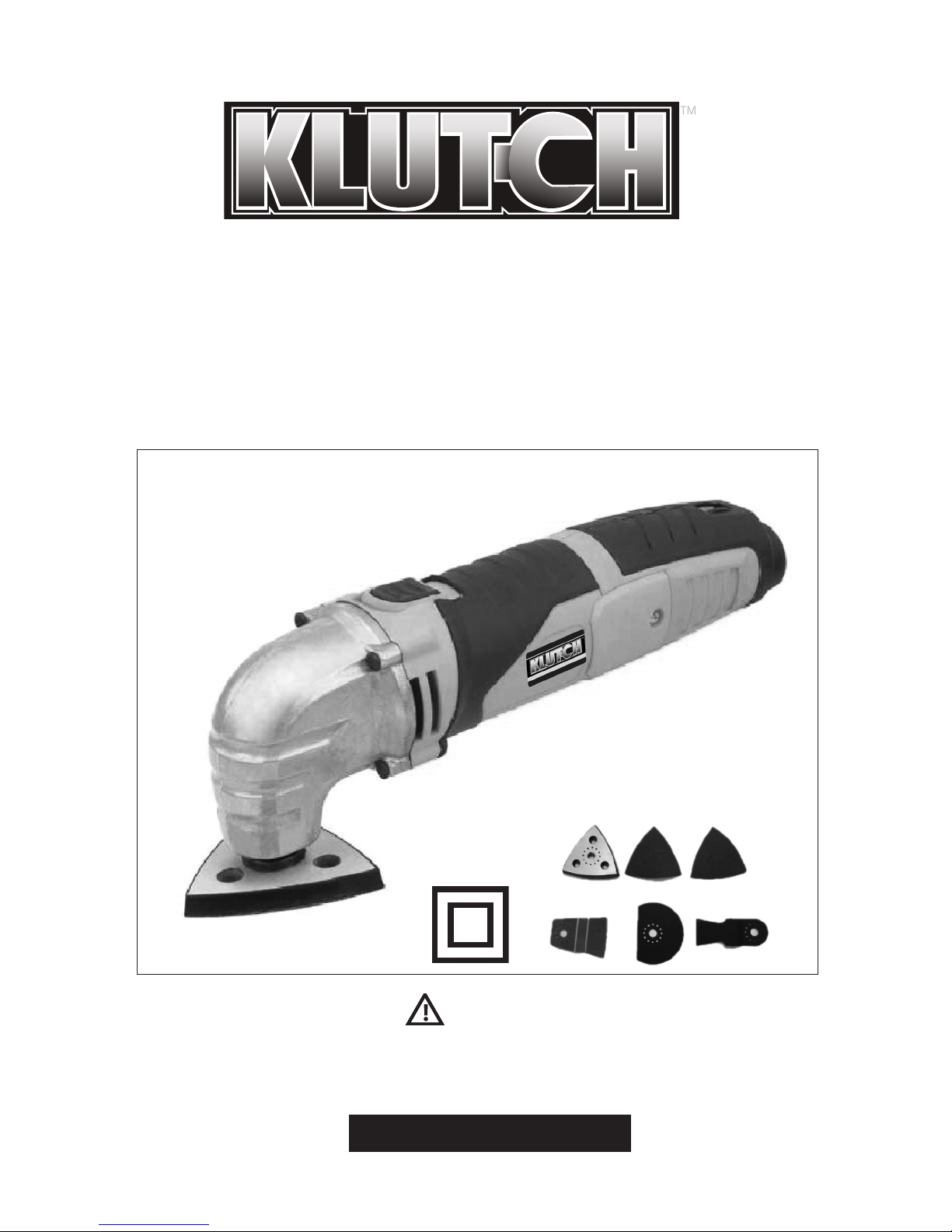
Multi-Function
Tool
OWNER'S MANUAL
Read carefully and understand all INSTRUCTIONS before
operating. Failure to follow the safety rules and other basic
safety precautions may result in serious personal injury.
WARNING:
Item # 343901
0210
Page 2

Thank you very much for choosing a KlutchTMproduct! For future reference, please complete
the owner's record below:
Model: _______________ Purchase Date: _______________
Save the receipt, warranty and these instructions. It is important that you read the entire
manual to become familiar with this product before you begin using it.
This machine is designed for certain applications only. The distributor cannot be responsible
for issues arising from modification. We strongly recommend this machine is not modified
and/or used for any application other than that for which it was designed. If you have any
questions relative to a particular application, do not use the machine until you have first
contacted the distributor to determine if it can or should be performed on the product.
For technical questions please call 1-800-222-5381.
INTENDED USE
This Multi-Function Tool is intended for sawing, sanding, polishing and cutting.
TECHNICAL SPECIFICATIONS
Description Specifications
Motor: 120V ~ 60Hz, 2 Amps
No load speed: 1000 - 21000 RPM
Packed weight: 2.6 lbs
UNPACKING
When unpacking the tool, please check if any parts are missing or broken. Please call Product Support at 1800-222-5381.
. . . . .
Qty
1
1
1
2
Description
. . . . . . . .
ool
Multifunction
Allen key . . . . . . . . . . . . . . .1
Straight saw blade
Bending shoval blade
Half circular saw blade . . . .1
riangle sand disc . . . . . . .1
T
Sanding paper
T
. . . . . . .
. . . . . . . . . .
GENERAL SAFETY RULES
ARNING!
W
in electric shock, fire and/or serious injury
WARNING! The warnings, cautions, and instructions discussed in this instruction manual cannot
cover all possible conditions or situations that could occur
that common sense and caution are factors which cannot be built into this product, but must be
supplied by the operator
Read and understand all instructions.
.
.
Failure to follow all instructions listed
. It must be understood by the operator
below may result
1
Page 3
VE THESE INSTRUCTIONS
SA
WORK AREA
• Keep work area clean,
free of clutter and well lit. Cluttered and dark work areas can cause accidents.
• Do not use your tool where there is a risk of causing a fire or an explosion; e.g. in the presence of
flammable liquids, gasses, or dust. Power tools create sparks, which may ignite the dust or fumes.
• Keep children and bystanders away while operating a power tool. Distractions can cause you to lose
control, so visitors should remain at a safe distance from the work area.
• Be aware of all power lines, electrical circuits, water pipes and other mechanical hazards in your work
area, particularly those hazards below the work surface hidden from the operator's view that may be
unintentionally contacted and may cause personal harm or property damage.
• Be alert of your surroundings. Using power tools in confined work areas may put you dangerously close to
cutting tools and rotating parts.
ELECTRICAL SAFETY
WARNING! Always check to ensure the power supply corresponds to the voltage on the rating plate.
• Do not abuse the cord. Never carry a portable tool by its power cord, or yank tool or extension cords from
the receptacle. Keep power and extension cords away from heat, oil, sharp edges or moving parts. Replace
damaged cords immediately. Damaged cords may cause a fire and increase the risk of electric shock.
• Grounded tools must be plugged into an outlet properly installed and grounded in accordance with all codes
and ordinances. Never remove the grounding prong or modify the plug in any way. Do not use any adapter
plugs. Check with a qualified electrician if you are in doubt as to whether the outlet is properly grounded.
• Double insulated tools are equipped with a polarized plug (one blade is wider than the other). This plug will
fit in a polarized outlet only one way. If the plug does not fit fully in the outlet, reverse the plug. If it still doesn't
fit, contact a qualified electrician to install a polarized outlet. Do not change the plug in any way.
• Avoid body contact with grounded surfaces such as pipes, radiators, ranges, and refrigerators. There is an
increased risk of electric shock if your body is grounded.
• When operating a power tool outside, use an outdoor extension cord marked “W-A” or “W.” These cords
are rated for outdoor use and reduce the risk of electric shock.
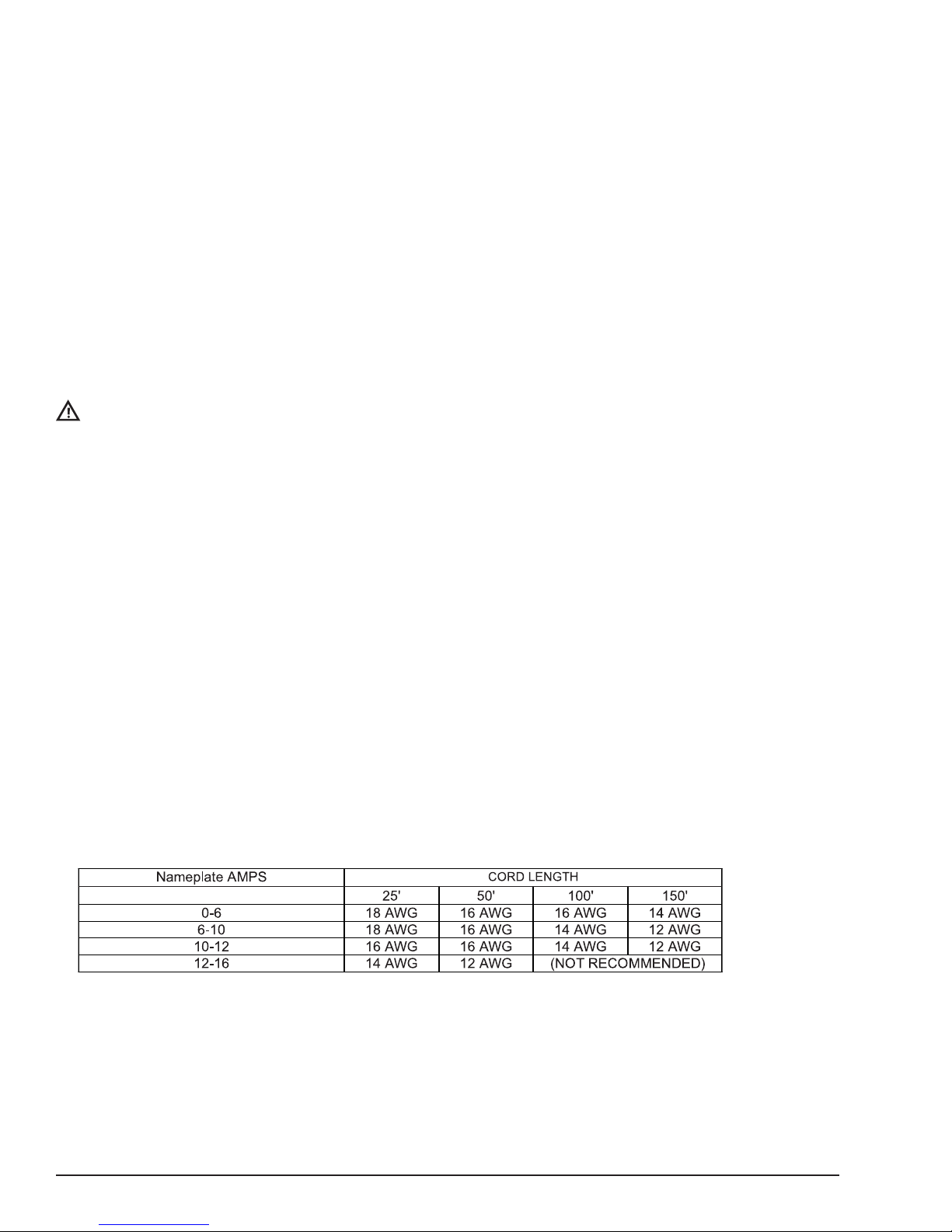
• Extension Cord Use:
A. Use only 'Listed' extension cords. If used outdoors, they must be marked “For Outdoor Use.” Those
cords having 3-prong grounding type plugs and mating receptacles are to be used with grounded tools.
B. Replace damaged or worn cords immediately.
C. Check the name plate rating of your tool. Use of improper size or gauge of extension cord may cause
unsafe or inefficient operation of your tool. Be sure your extension cord is rated to allow sufficient current
flow to the motor. For the proper wire gauge for your tool, see chart.
CHART FOR MINIMUM WIRE SIZE OF EXTENSION CORD:
If in doubt, use larger cord. Be sure to check voltage requirements of the tool to your incoming power source.
• Do not expose power tools to rain or wet conditions. Water entering a power tool will increase the risk of
electric shock.
• Do not let your fingers touch the terminals of plug when installing to or removing from the outlet.
• Ground fault circuit interrupters. If work area is not equipped with a permanently installed Ground Fault
Circuit Interrupter outlet (GFCI), use a plug-in GFCI between power tool or extension cord and power receptacle.
2
Page 4

PERSONAL
Stay alert,
•
SAFETY
watch what you are doing and use common sense when operating a power tool. Do not use a
power tool while you are tired or under the influence of drugs, alcohol or medication. A moment of inattention
while operating power tools may result in serious personal injury
Dress properly.
•
Do not wear loose clothing, dangling objects, or jewelry
.
. Keep your hair, clothing and gloves
away from moving parts. Loose clothes, jewelry or long hair can be caught in moving parts. Air vents often
cover moving parts and should be avoided.
• Use safety apparel and equipment. Use ANSI-approved safety goggles or safety glasses with side shields
which comply with current national standards, or when needed, a face shield. Use a dust mask in dusty work
conditions. This applies to all persons in the work area. Also use non-skid safety shoes, hardhat, gloves, dust
collection systems, and hearing protection when appropriate.
• Avoid accidental starting. Do not carry the power tool with your finger on the switch. Ensure the switch is in
the off position before plugging tool into power outlet. In the event of a power failure, while a tool is being
used, turn the switch off to prevent surprise starting when power is restored.
• Do not overreach. Keep proper footing and balance at all times.
• Remove adjusting keys or wrenches before connecting to the power supply or turning on the tool. A
wrench or key that is left attached to a rotating part of the tool may result in personal injury.
TOOL USE AND CARE
• Do not force the tool. Tools do a better and safer job when used in the manner for which they are designed.
Plan your work, and use the correct tool for the job.
• Never use a tool with a malfunctioning switch. Any power tool that cannot be controlled with the switch is
dangerous and must be repaired by an authorized service representative before using.
• Disconnect power from tool and place the switch in the locked or off position before servicing, adjusting,
installing accessories or attachments, or storing. Such preventive safety measures reduce the risk of starting
the power tool accidentally.
• Secure work with clamps or a vise instead of your hand to hold work when practical. This safety precaution
allows for proper tool operation using both hands.
• Store idle tools. When tools are not is use, store them in a dry, secure place out of the reach of children.
Inspect tools for good working condition prior to storage and before re-use.
• Use only accessories that are recommended by the manufacturer for your model. Accessories that may be
suitable for one tool may create a risk of injury when used on another tool.
SPECIFIC SAFETY WARNINGS FOR MULTI-FUNCTION TOOL
• This power tool
is intended for sawing, sanding, polishing and cutting. Read all safety warnings, instructions,
illustrations, and specifications that are included with this tool. Neglecting to follow all of the instructions listed
below can result in electric shock, fire and/or serious injury
• Do not use accessories which are not intended to be used with this tool and which are not recommended
by the manufacturer. Even if the accessory can be attached to your power tool, there is no guarantee that it
can be used safely.
• Keep all bystanders at a distance. Everyone who visits the place of work must wear personal protective
equipment. Debris from the object worked upon or from a damaged accessory can fly away and result in
injury outside of the work’s immediate vicinity.
.
3
Page 5
• Only hold the power tool by its isolated grip when working in positions when the tool might possibly cut
through hidden cables or its own mains lead.
metal parts of the power tool and subject the user to an electric shock.
• Regularly clean the motor’s ventilation ports. The motor’s fan pulls in dust, which gets inside the outer
casing and a build up of this collected metal dust can lead to electrical dangers.
• Do not use the power tool near flammable material. Sparks can easily ignite flammable material.
• Do not use accessories, which require liquid coolants. The use of water or other liquid coolants can result in
electric shock or electrocution.
Tool which come in contact with an electric cable can electrify
Specific safety instructions for sanding
• Extra caution should be taken when sanding lead paint, wood, metal or other materials which produce
toxic dust. Make sure any bystanders in the work area are well protected.
• Remember that dust caused by sanding can be very flammable when mixed with air.
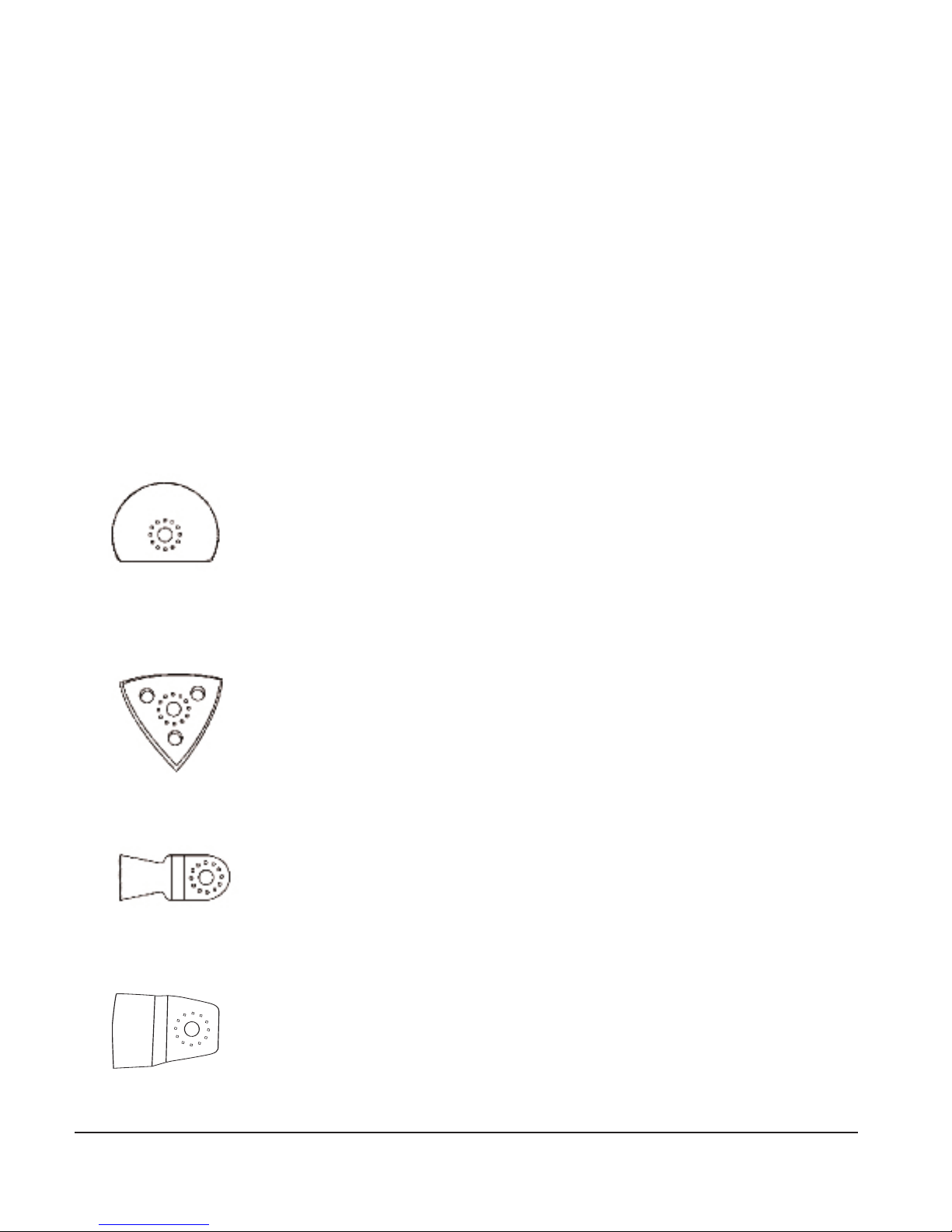
Supplied accessories
Half circular saw blade
Half circular saw blade is for cuttingoff/parting-off. This tool is ideal for
sawing in those hard-to-reach places
such as in corners when laying floors or
skirting boards.This saw blade can even
saw through nails.
Triangle sand disc
Bending shoval blade
Straight saw blade
Perfect for sanding those hard-to-reach
places, such as corners. Changing the
grade of sandpaper used allows you to
sand wood, stone, paint and so forth.
Ideal for deep incisions in wood, e.g.
cutting holes for fitting air vents. Can
also be used for sawing in confined
spaces. This saw blade can even saw
through nails.
Ideal for slow, more precise cuts in wood
and drywall.
4
Page 6
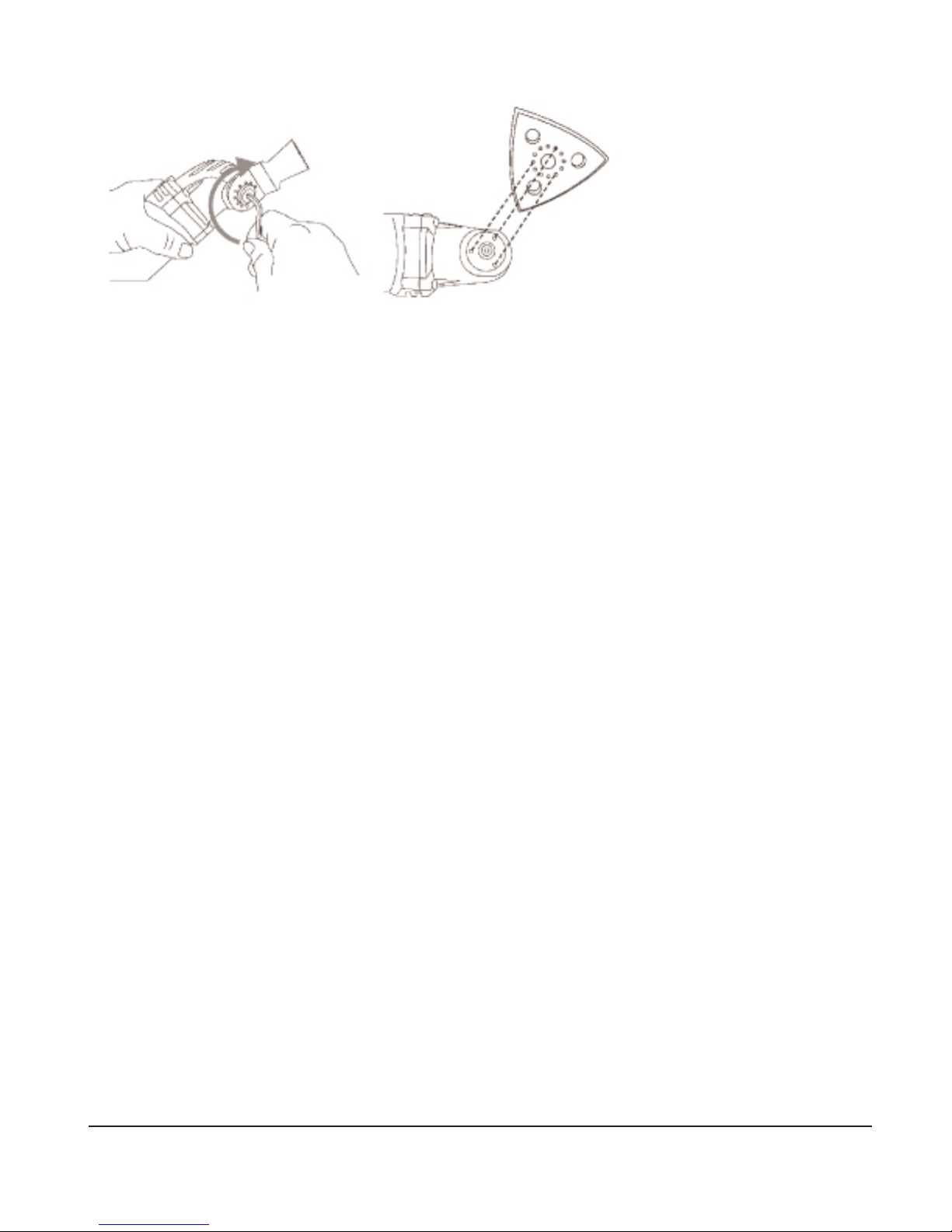
Changing accessories
1. First remove any accessory that might already be in the tool. Undo the locking screw by turning it
counterclockwise using the supplied Allen key.
2. Fit the accessory onto the tool attachment making sure that the holes pass over the lugs.
3. Tighten the locking screw using the Allen key.
Changing sanding sheets
The sanding sheets are attached with hook-and-loop fasteners. Remove the old sanding sheet, brush off the
hook-and-loop fabric on the sanding pad if necessary, and then attach the new sanding sheet.
Operation
Starting the machine
1. Before connecting the machine to the power point, make sure that the ON/OFF switch is set to OFF.
2. Start the machine by sliding the ON/OFF switch to the ON position.
Speed selection
• The speed can be regulated using the speed selector.
• The choice of speed depends on the type of work being carried out and the type of material being worked.
Experiment until you find the best setting.
Cutting off and sawing
• If you are using the bending shoval blade, make sure the there are no nails or screws in the workpiece.
Remove any nails and screws or use the half circular saw blade.
If you are cutting wall tiles, bear in mind that the tool will be subjected to hard wear during prolonged use.
•
5
Page 7

Sanding
The tool does not
start.
The tool runs slowly.
No power.
Worn brushes.
Short circuit
Faulty power switch.
Worn/damaged accessory.
Speed too low.
The motor is overheated.
Check the power point
Contact us in case of motor or
electrical faults.
Sharpen or change the
accessory.
Do not press down too hard.
Heavy vibration. Loose accessory.Tighten the tool and make sure
it is set correctly.
Sparks in the motor Brushes jammed.
Winding short circuited.
Dirt on commutator.
Contact distributor in case of
motor or electrical faults.
• Always use undamaged sandpaper and change it often. This will not only give you better results but also
prolong the life of your tool.
Do not use excessive force when sanding; apply a constant, light pressure. Applying too much pressure will
•
not speed up the sanding process; it will merely wear out the sandpaper and Multi-Function Tool more
.
quickly
• Do not use sandpaper that you have previously used for sanding metal to sand wood.
Care and maintenance
• Always keep the motor’s ventilation openings free of dust and debris.
• Clean the machine regularly using a moist cloth. Avoid using strong detergents.
Troubleshooting guide
6
Page 8

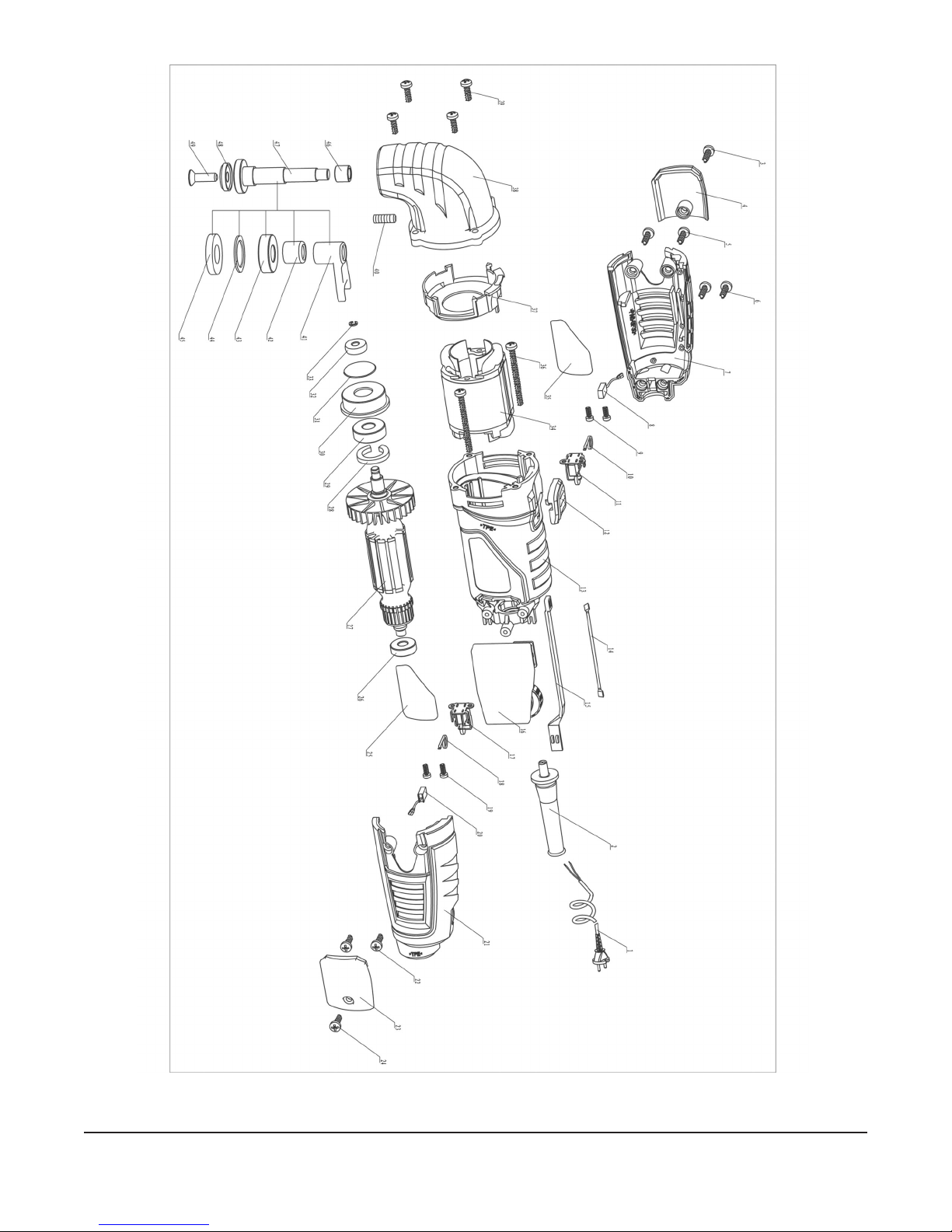
NO.
1
2
3
4
5
6
7
8
9
10
11
12
13
14
15
16
17
18
19
20
21
22
23
24
25
Name
Power line
Cord protector
Cord protector
Right Brush cover
Screw
Screw
Right handing
Brush
Screw
Spring
Brush holder
Switch button
Housing
Capacitor leader
Switch draft bar
Actiyator
Brush holder
Spring
Screw
Brush
Left handing
Screw
Left Brush cover
Screw
Brand
1
1
1
1
2
2
1
1
2
1
1
1
1
1
1
1
1
1
2
1
1
1
1
1
1
Parts List
NO.
26
27
28
29
30
31
32
33
34
35
36
37
38
39
40
41
42
43
44
45
46
47
48
49
Name
Bearing
Rotor
Bead flange
Bearing
Bearing
Seal ring
Bearing
Bead flange
Stator
Nameplate
Screw
Battle
Gear box cover
Screw
Screw
Shift lever
Stop collar
Bearing
Bead flange
Oil seal
Bearing
Backswing arbor
Binder plate
Binder plate Screw
1
1
1
1
1
1
1
1
1
1
2
1
1
4
1
1
1
1
1
1
1
1
1
1
7
Page 9
8
Page 10
WARRANTY
One-year Limited Warranty
WARNING
Some dust created by power sanding, sawing, grinding, drilling, and other
construction activities contains chemicals known to the State of California to
cause cancer, birth defects or other reproductive harm. Some examples of
these chemicals are:
• lead from lead-based paints,
• crystalline silica from bricks and cement and other masonry products, and
• arsenic and chromium from chemically-treated lumber.
Your risk from these exposures varies, depending on how often you do this
type of work. To reduce your exposure to these chemicals: work in a well
ventilated area, and work with approved safety equipment, such as those dust
masks that are specially designed to filter out microscopic particles.
Northern Tool & Equipment Co., Inc.
Distributed by
Burnsville, MN 55306
Northern Tool.com
Made in China
 Loading...