

klover ECOMPACT Series, ECOMPACT 150, ECOMPACT 250, ECOMPACT 290, ECOMPACT 190 Installation, Use, Maintenance And Helpful Tips
Page 1
ENGLISH
Pellet-burning
boiler ECOMPACT
150-190-250-290
INSTALLATION, USE, MAINTENANCE AND
HELPFUL TIPS
Main Revision 1.1
FPH_supplement: 001
Page 2

Page 3

DICHIARAZIONE DI
CONFORMITÀ
DECLARATION OF
CONFORMITY
Emesso da - Issued by
Indirizzo - Address
:
KLOVER s.r.l.
Via A. Volta, 8
37047 San Bonifacio (VR)
Tipo di apparecchio - Type of equipment
:
Heating boiler for solid fuel automatically stoked
Marchio commerciale -Trademark
:
KLOVER
Modello o tipo - Model or type
:
ECOMPACT 150
Uso - Use
:
Central heating in residential buildings
Costruttore - Manufacturer
:
KLOVER s.r.l.
L’oggetto della presente dichiarazione è conforme alle seguenti direttive UE:
The object of this declaration is comply with the following EU directives
2006/42/CE Direttiva macchine.
2006/42/CE Machinery Directive.
2014/35/UE del 26 Febbraio 2014 relativa l’armonizzazione delle legislazioni degli stati membri relative alla messa a disposizione sul mercato del
materiale elettrico destinato ad essere adoperato entro taluni limiti di tensione.
2014/35/UE 26 February 2014 on the harmonization of the laws of the Member States relating to the making available on the market of electrical
equipment designed for use within certain voltage limits.
2014/30/UE del 26 Febbraio 2014 relativa l’armonizzazione delle legislazioni degli stati membri relative alla compatibilità elettromagnetica.
2014/30/UE 26 February 2014 on the harmonization of the laws of the Member States relating to electromagnetic compatibility.
2011/65/UE del 21 Luglio 2016 relativa l’armonizzazione delle legislazioni degli stati membri relative alla restrizione all’uso di sostanze pericolose
nelle apparecchiature elettriche e elettroniche.
2016/65/UE 21 July 2016 on the harmonization of the laws of the Member States relating to the restriction in use of hazardous substances in
electrical and electronic equipment.
Riferimenti alle norme armonizzate:
References to the relevant harmonized standards:
EN 303-5
EN 55014-1 EN 55014-2
EN 61000-3-2 EN 61000-3-3
EN 62233
EN 60335-1
EN 60335-2-102
EN 50581
In qualità di costruttore e/o rappresentante autorizzato della società all’interno della CEE, si dichiara sotto la propria responsabilità che gli
apparecchi sono conformi alle esigenze essenziali previste dalle Direttive su menzionate.
As the manufacturer’s authorised representative within the EEC, we hereby declare under our sole responsibility that the equipment complies with
the provisions of the Directives stated above.
San Bonifacio (VR), 22/03/2018
Mario Muraro
Chairman of the Board
Page 4

DICHIARAZIONE DI
CONFORMITÀ
DECLARATION OF
CONFORMITY
Emesso da - Issued by
Indirizzo - Address
:
KLOVER s.r.l.
Via A. Volta, 8
37047 San Bonifacio (VR)
Tipo di apparecchio - Type of equipment
:
Heating boiler for solid fuel automatically stoked
Marchio commerciale -Trademark
:
KLOVER
Modello o tipo - Model or type
:
ECOMPACT 190
Uso - Use
:
Central heating in residential buildings
Costruttore - Manufacturer
:
KLOVER s.r.l.
L’oggetto della presente dichiarazione è conforme alle seguenti direttive UE:
The object of this declaration is comply with the following EU directives
2006/42/CE Direttiva macchine.
2006/42/CE Machinery Directive.
2014/35/UE del 26 Febbraio 2014 relativa l’armonizzazione delle legislazioni degli stati membri relative alla messa a disposizione sul mercato del
materiale elettrico destinato ad essere adoperato entro taluni limiti di tensione.
2014/35/UE 26 February 2014 on the harmonization of the laws of the Member States relating to the making available on the market of electrical
equipment designed for use within certain voltage limits.
2014/30/UE del 26 Febbraio 2014 relativa l’armonizzazione delle legislazioni degli stati membri relative alla compatibilità elettromagnetica.
2014/30/UE 26 February 2014 on the harmonization of the laws of the Member States relating to electromagnetic compatibility.
2011/65/UE del 21 Luglio 2016 relativa l’armonizzazione delle legislazioni degli stati membri relative alla restrizione all’uso di sostanze pericolose
nelle apparecchiature elettriche e elettroniche.
2016/65/UE 21 July 2016 on the harmonization of the laws of the Member States relating to the restriction in use of hazardous substances in
electrical and electronic equipment.
Riferimenti alle norme armonizzate:
References to the relevant harmonized standards:
EN 303-5
EN 55014-1 EN 55014-2
EN 61000-3-2 EN 61000-3-3
EN 62233
EN 60335-1
EN 60335-2-102
EN 50581
In qualità di costruttore e/o rappresentante autorizzato della società all’interno della CEE, si dichiara sotto la propria responsabilità che gli
apparecchi sono conformi alle esigenze essenziali previste dalle Direttive su menzionate.
As the manufacturer’s authorised representative within the EEC, we hereby declare under our sole responsibility that the equipment complies with
the provisions of the Directives stated above.
San Bonifacio (VR), 22/03/2018
Mario Muraro
Chairman of the Board
Page 5

DICHIARAZIONE DI
CONFORMITÀ
DECLARATION OF
CONFORMITY
Emesso da - Issued by
Indirizzo - Address
:
KLOVER s.r.l.
Via A. Volta, 8
37047 San Bonifacio (VR)
Tipo di apparecchio - Type of equipment
:
Heating boiler for solid fuel automatically stoked
Marchio commerciale -Trademark
:
KLOVER
Modello o tipo - Model or type
:
ECOMPACT 250
Uso - Use
:
Central heating in residential buildings
Costruttore - Manufacturer
:
KLOVER s.r.l.
L’oggetto della presente dichiarazione è conforme alle seguenti direttive UE:
The object of this declaration is comply with the following EU directives
2006/42/CE Direttiva macchine.
2006/42/CE Machinery Directive.
2014/35/UE del 26 Febbraio 2014 relativa l’armonizzazione delle legislazioni degli stati membri relative alla messa a disposizione sul mercato del
materiale elettrico destinato ad essere adoperato entro taluni limiti di tensione.
2014/35/UE 26 February 2014 on the harmonization of the laws of the Member States relating to the making available on the market of electrical
equipment designed for use within certain voltage limits.
2014/30/UE del 26 Febbraio 2014 relativa l’armonizzazione delle legislazioni degli stati membri relative alla compatibilità elettromagnetica.
2014/30/UE 26 February 2014 on the harmonization of the laws of the Member States relating to electromagnetic compatibility.
2011/65/UE del 21 Luglio 2016 relativa l’armonizzazione delle legislazioni degli stati membri relative alla restrizione all’uso di sostanze pericolose
nelle apparecchiature elettriche e elettroniche.
2016/65/UE 21 July 2016 on the harmonization of the laws of the Member States relating to the restriction in use of hazardous substances in
electrical and electronic equipment.
Riferimenti alle norme armonizzate:
References to the relevant harmonized standards:
EN 303-5
EN 55014-1 EN 55014-2
EN 61000-3-2 EN 61000-3-3
EN 62233
EN 60335-1
EN 60335-2-102
EN 50581
In qualità di costruttore e/o rappresentante autorizzato della società all’interno della CEE, si dichiara sotto la propria responsabilità che gli
apparecchi sono conformi alle esigenze essenziali previste dalle Direttive su menzionate.
As the manufacturer’s authorised representative within the EEC, we hereby declare under our sole responsibility that the equipment complies with
the provisions of the Directives stated above.
San Bonifacio (VR), 17/07/2017
Mario Muraro
Chairman of the Board
Page 6

DICHIARAZIONE DI
CONFORMITÀ
DECLARATION OF
CONFORMITY
Emesso da - Issued by
Indirizzo - Address
:
KLOVER s.r.l.
Via A. Volta, 8
37047 San Bonifacio (VR)
Tipo di apparecchio - Type of equipment
:
Heating boiler for solid fuel automatically stoked
Marchio commerciale -Trademark
:
KLOVER
Modello o tipo - Model or type
:
ECOMPACT 290
Uso - Use
:
Central heating in residential buildings
Costruttore - Manufacturer
:
KLOVER s.r.l.
L’oggetto della presente dichiarazione è conforme alle seguenti direttive UE:
The object of this declaration is comply with the following EU directives
2006/42/CE Direttiva macchine.
2006/42/CE Machinery Directive.
2014/35/UE del 26 Febbraio 2014 relativa l’armonizzazione delle legislazioni degli stati membri relative alla messa a disposizione sul mercato del
materiale elettrico destinato ad essere adoperato entro taluni limiti di tensione.
2014/35/UE 26 February 2014 on the harmonization of the laws of the Member States relating to the making available on the market of electrical
equipment designed for use within certain voltage limits.
2014/30/UE del 26 Febbraio 2014 relativa l’armonizzazione delle legislazioni degli stati membri relative alla compatibilità elettromagnetica.
2014/30/UE 26 February 2014 on the harmonization of the laws of the Member States relating to electromagnetic compatibility.
2011/65/UE del 21 Luglio 2016 relativa l’armonizzazione delle legislazioni degli stati membri relative alla restrizione all’uso di sostanze pericolose
nelle apparecchiature elettriche e elettroniche.
2016/65/UE 21 July 2016 on the harmonization of the laws of the Member States relating to the restriction in use of hazardous substances in
electrical and electronic equipment.
Riferimenti alle norme armonizzate:
References to the relevant harmonized standards:
EN 303-5
EN 55014-1 EN 55014-2
EN 61000-3-2 EN 61000-3-3
EN 62233
EN 60335-1
EN 60335-2-102
EN 50581
In qualità di costruttore e/o rappresentante autorizzato della società all’interno della CEE, si dichiara sotto la propria responsabilità che gli
apparecchi sono conformi alle esigenze essenziali previste dalle Direttive su menzionate.
As the manufacturer’s authorised representative within the EEC, we hereby declare under our sole responsibility that the equipment complies with
the provisions of the Directives stated above.
San Bonifacio (VR), 17/07/2017
Mario Muraro
Chairman of the Board
Page 7

CONTENTS
CONTENTS ........................................................................................................................................................................ 1
INTRODUCTION ................................................................................................................................................................. 3
IMPORTANT SAFETY INSTRUCTIONS ................................................................................................................................... 3
THE MACHINE AND THE PELLETS ................................................................................................................................. 4
COMPONENTS OF THE APPLIANCE ..................................................................................................................................... 4
OVERALL DIMENSIONS ECOMPACT 150 - 190 ................................................................................................................. 6
OVERALL DIMENSIONS ECOMPACT 250 - 290 ................................................................................................................. 7
CONNECTIONS DATA SHEET ECOMPACT 150 - 190 ......................................................................................................... 8
CONNECTIONS DATA SHEET ECOMPACT 250 - 290 ......................................................................................................... 9
TECHNICAL SPECIFICATIONS ECOMPACT 150 ............................................................................................................... 10
TECHNICAL SPECIFICATIONS ECOMPACT 190 ............................................................................................................... 11
TECHNICAL SPECIFICATIONS ECOMPACT 250 ............................................................................................................... 12
TECHNICAL SPECIFICATIONS ECOMPACT 290 ............................................................................................................... 13
AIRBORNE NOISE DATA ................................................................................................................................................... 14
PELLET PROPERTIES ...................................................................................................................................................... 14
REQUIREMENTS OF THE PLACE OF INSTALLATION ................................................................................................. 15
POSITIONING .................................................................................................................................................................. 15
SPACES AROUND AND ABOVE THE APPLIANCE .................................................................................................................. 15
EXTERNAL AIR INTAKE .................................................................................................................................................... 16
THE FLUE AND CONNECTION TO THE SAME ....................................................................................................................... 16
CHIMNEY ....................................................................................................................................................................... 18
ELECTRICAL CONNECTION .......................................................................................................................................... 19
CONTROL OF ANY COUPLED BOILER ................................................................................................................................ 19
CONTROL OF A POSSIBLE THREE-WAY MOTORIZED VALVE FOR DHW SYSTEM MANAGEMENT ............................................. 19
CONNECTION TO THE ROOM THERMOSTAT ....................................................................................................................... 20
HYDRAULIC CONNECTION ............................................................................................................................................ 20
THE DISPLAY .................................................................................................................................................................. 21
THE MENU ....................................................................................................................................................................... 23
INITIAL START-UP .......................................................................................................................................................... 26
SYSTEM CONFIGURATION ............................................................................................................................................... 26
FILLING THE SYSTEM FOR THE FIRST TIME........................................................................................................................ 28
PELLET LOADING AND CONNECTION TO THE MAINS POWER SUPPLY ................................................................................... 29
IGNITION CYCLE.............................................................................................................................................................. 29
SWITCH-OFF CYCLE ........................................................................................................................................................ 29
MODIFYING THE WORKING POWER .................................................................................................................................. 30
CHANGING THE WATER TEMPERATURE BOILER OR BUFFER ............................................................................................... 30
PROBLEMS, ALARMS, USEFUL ADVICES ................................................................................................................... 31
USEFUL INFO… .............................................................................................................................................................. 31
WHAT HAPPENS IF… ...................................................................................................................................................... 31
ALARM SIGNALS ............................................................................................................................................................. 32
CLEANING AND MAINTENANCE ................................................................................................................................... 33
PRECAUTIONS BEFORE CLEANING ................................................................................................................................... 33
ROUTINE CLEANING ........................................................................................................................................................ 33
NON-ROUTINE CLEANING ................................................................................................................................................ 35
CLEANING THE CERAMIC GLASS ...................................................................................................................................... 36
CLEANING THE FLUE ....................................................................................................................................................... 37
1
Page 8

PELLET-BURNING BOILER ECOMPACT 150-190-250-290
EN - Rev 1.1
MAINTENANCE ............................................................................................................................................................... 37
PCB PARAMETERS ........................................................................................................................................................ 38
PARAMETER TABLES ECOMPACT 150 ........................................................................................................................... 38
PARAMETER TABLES ECOMPACT 190 ........................................................................................................................... 40
PARAMETER TABLES ECOMPACT 250 ........................................................................................................................... 42
PARAMETER TABLES ECOMPACT 290 ........................................................................................................................... 44
WIRING DIAGRAM ........................................................................................................................................................... 46
STANDARD WARRANTY CONDITIONS ......................................................................................................................... 47
Dear client,
First of all we would like to thank you for choosing a “KLOVER” product and we hope you will be satisfied with this
product.
Read carefully the warranty certificate on the last page of this User guide.
We would like to thank you again for trusting KLOVER products, and we would also like inform you that these models
are the result of forty years of experience in the manufacture of solid fuel products using water as heat transfer fluid.
Every single detail of the product is manufactured by qualified staff, using the most advanced equipment.
The manual contains a detailed description of the appliance and its operation, instructions for proper installation, basic
maintenance and control points, which must be periodically performed; furthermore it contains practical advice which
helps to obtain maximum performance from the appliance with minimum fuel consumption.
Stay warm with KLOVER!
Copyright
All rights reserved. The reproduction of any part of this manual, in any form, without the explicit written permission of
KLOVER Srl. is forbidden. The content of this manual may be modified without notice. Although the documentation
contained in this manual has been carefully compiled and checked, KLOVER srl cannot be held liable for any damages
arising from the use of the same.
Copyright © 2018 KLOVER srl
2
Page 9

PELLET-BURNING BOILER ECOMPACT 150-190-250-290
EN - Rev 1.1
INTRODUCTION
Important safety instructions
Please read these instructions before installing and using the product.
- The installation and initial start-up of the appliance must be performed by skilled personnel trained in the relevant
safety standards. They will be responsible for the definitive installation of the appliance and its proper operation.
KLOVER srl shall not be held liable if these precautions are not observed.
- During the installation and use of the appliance, all local regulations - including those referring to national and
European Standards - must be observed.
- Connect the flue gas outlet to a flue with the specifications described in the “Flue and its connection” section of this
User guide.
- The appliance is not suitable for installation on a shared flue system.
- If the flue should catch fire, use appropriate fire extinguishing equipment or call the fire brigade.
- Connect the product to an earthed power socket. Avoid using sockets controlled by switches or automatic timers.
- Do not use the power supply cable if damaged or worn.
- If a multiple socket is used, make sure that the total voltage of the connected devices does not exceed the rated
voltage for the socket. Also make sure that the total voltage of all the devices connected to the socket does not
exceed the maximum permitted level.
- The plug on the appliance’s power cable should be connected only once the assembly and installation of the
appliance is complete. It should remain accessible after installation if the appliance is not fitted with a suitable and
accessible two-pole switch.
- Do not use flammable substances to clean the appliance or its parts.
- Do not leave flammable containers and substances in the place where the appliance is installed.
- The appliance works exclusively with wood pellets and only with the hearth door shut.
- NEVER open the door of the appliance during normal operation.
- The use of poor quality pellets or any other material can damage the appliance operation, voiding the warranty and
exempting the manufacturer from all liability.
- Do not use the appliance as an incinerator or for any use other than that for which it was designed.
- Do not use fuels other than those recommended.
- Do not use liquid fuels.
- The appliance, and its outer surfaces in particular, become very hot to the touch during operation; handle with
caution in order to avoid burns.
- Keep fuel and flammable materials at a safe distance.
- Only use original spare parts recommended by the manufacturer.
- Do not make any unauthorised modifications to the appliance.
- Do not touch the hot components of the product (ceramic glass, flue pipe) during normal operation.
- Never touch the appliance if you are barefoot and/or if you have wet or damp parts of the body.
- Use the appropriate button to switch off the electrical panel. Do not disconnect the power supply cable while the
appliance is operating.
- During the ignition phase and normal operation of the appliance, maintain the necessary safety distance and do not
remain standing in front of it.
- Keep children away from the appliance when it is running since they could get burned by touching its hot
components.
- Do not leave the packaging elements within reach of children or unassisted disabled persons.
- Children and inexperienced people must not be allowed to use the appliance.
- The appliance may be used by children no younger than 8 years of age and people with reduced physical, sensory or
mental capabilities, or those without experience of the appliance, as long as they are supervised or have received
instructions on how to use the appliance safely and understand the hazards inherent to the appliance.
- Children should not play with the appliance.
- User maintenance and cleaning operations should not be carried out by unsupervised children.
- Do not use the appliance in ways other than those indicated in this user guide.
- The appliance is designed for indoor use only.
- The appliance is designed for heating water and should therefore be connected to a plumbing system (radiators,
under-floor heaters, etc.). This system should be suitably designed and sized to distribute the power generated by
the appliance.
3
Page 10

PELLET-BURNING BOILER ECOMPACT 150-190-250-290
EN - Rev 1.1
Expansion tank
10 l
Safety valve
2.5 bar
Pressure gauge
0 – 4 bar
Automatic air vent valve
Yes
Heating system pump
Yes. Mod.25/70
Electrical setting for the connection of the domestic water flow switch
Yes
Electrical setting for boiler / buffer sensor
Yes
Electrical setting for the control of the optional automatic pellet loader
Yes
Remote control
Optional
- This user guide constitutes an integral part of the appliance. If the product is sold to another user, this manual must
be passed on to the new owner.
- The Klover ECOMPACT boilers are not suitable for use in UK smoke exempt areas.
KLOVER S.R.L. DECLINES ALL LIABILITY IN CASE OF ACCIDENTS DUE TO FAILURE TO COMPLY WITH THE
SPECIFICATIONS OF THIS MANUAL.
KLOVER S.R.L. DECLINES ALL LIABILITY DUE TO INCORRECT USE OF THE PRODUCT BY THE USER,
UNAUTHORISED MODIFICATION AND/OR REPAIRS, AND USE OF NON-ORIGINAL SPARE PARTS OR SPARE
PARTS NOT SPECIFICALLY DESIGNED FOR USE ON THIS PRODUCT MODEL.
KLOVER S.R.L. SHALL NOT BE HELD LIABLE FOR THE STOVE'S INSTALLATION. THE INSTALLER IS THE
SOLE PARTY RESPONSIBLE FOR THIS OPERATION AND IS ALSO ENTRUSTED WITH CHECKING THE FLUE,
EXTERNAL AIR VENT AND THE CORRECTNESS OF THE PROPOSED INSTALLATION SOLUTIONS. ALL THE
SAFETY REGULATIONS SET OUT IN THE SPECIFIC LAWS IN FORCE IN THE COUNTRY WHERE THE MACHINE
IS INSTALLED MUST BE OBSERVED.
NON-ROUTINE MAINTENANCE MUST ONLY BE PERFORMED BY AUTHORISED AND QUALIFIED STAFF.
To ensure the validity of the warranty, the user must comply with the instructions contained in this guide and, in
particular, must:
- Use the appliance within its operating limits;
- Regularly perform all maintenance activities;
- Authorise expert and competent people to use the appliance.
Failure to comply with the instructions contained in this guide shall automatically void the warranty.
THE MACHINE AND THE PELLETS
Components of the appliance
The table below shows the standard features of the appliance:
The appliance is delivered with the following equipment:
- No. 1 - user, installation and maintenance guide;
- No. 1 - power supply cable;
4
Page 11
PELLET-BURNING BOILER ECOMPACT 150-190-250-290
EN - Rev 1.1
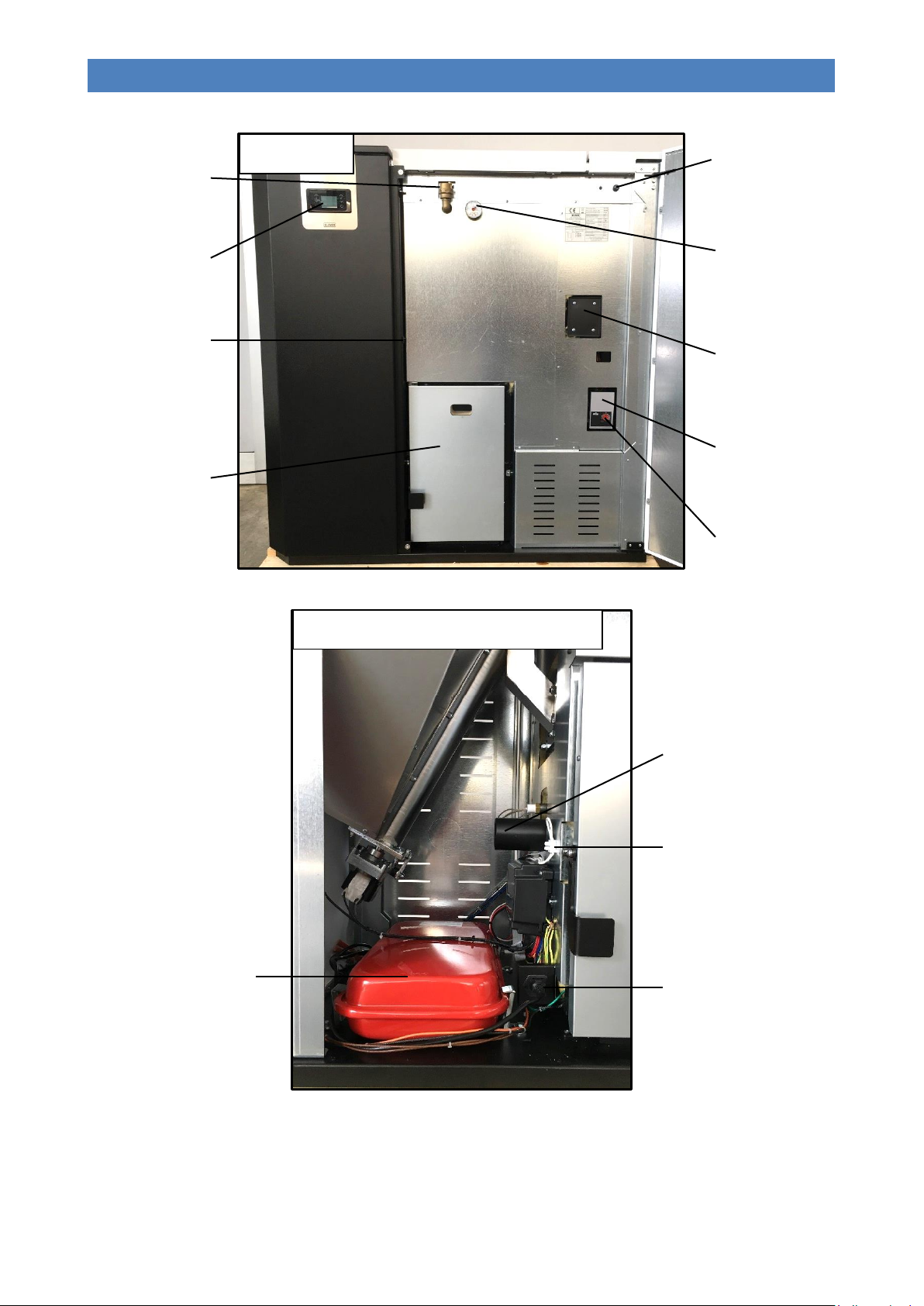
Automatic air vent
valve
Main ON/OFF switch
Extractor flue gas pass
inspection
Safety thermostat
with manual reset
Pressure gauge
(indicates the
pressure of the
heating system)
High-efficiency
circulating pump for
heating system
Combustion chamber
door
Display
FRONT VIEW
LEFT FRONT TECHNICAL COMPARTMENT
Terminal for room
thermostat connection
Air intake pipe
Anti-interference filter
connection for power supply cable
with 2 built-in fuses (4A 250V).
Exapnsion vessel 10 lt with
pre-load 1 bar
Circulating pump speed
switch
5
Page 12
PELLET-BURNING BOILER ECOMPACT 150-190-250-290
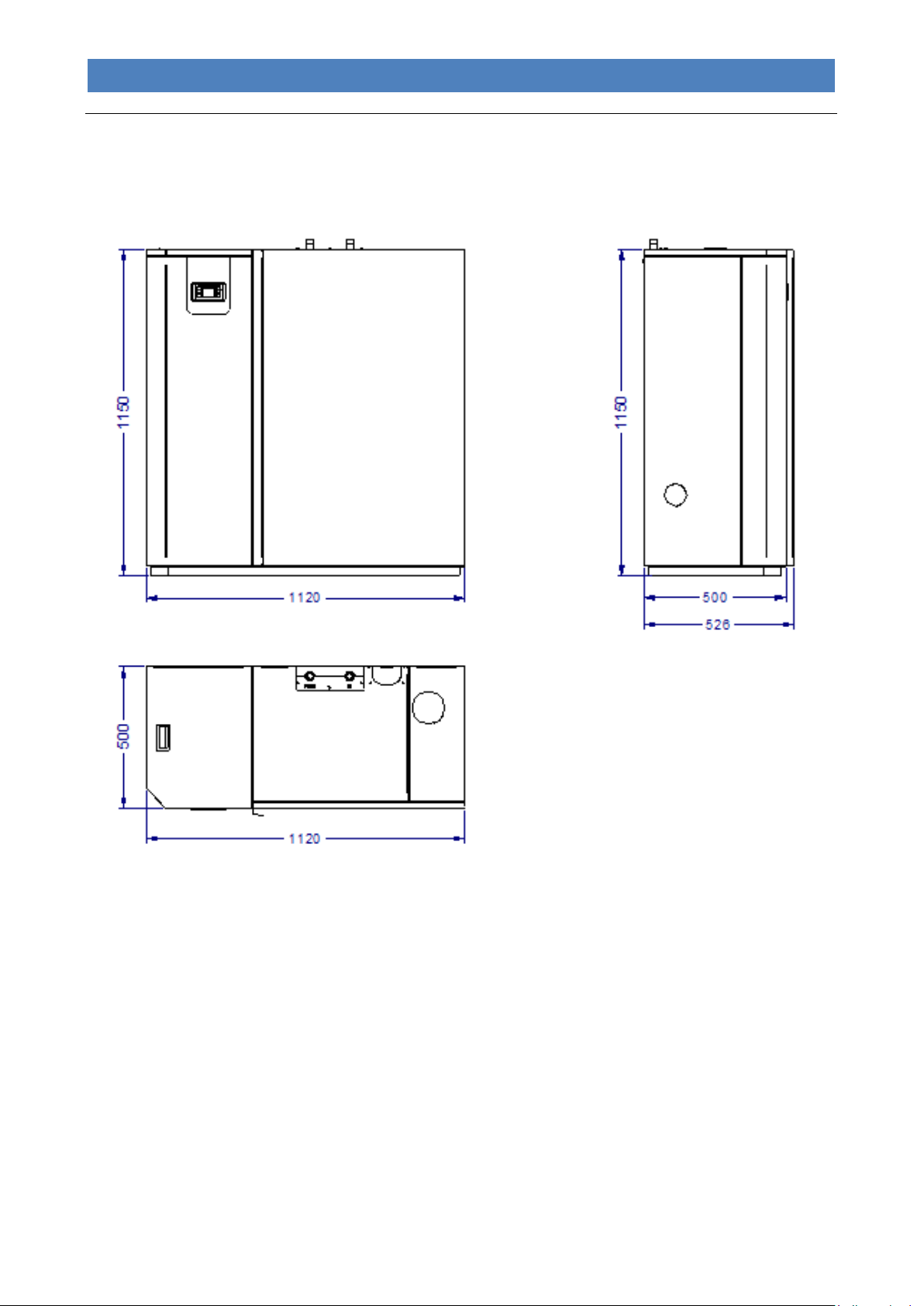
Overall dimensions ECOMPACT 150 - 190
EN - Rev 1.1
6
Page 13
PELLET-BURNING BOILER ECOMPACT 150-190-250-290
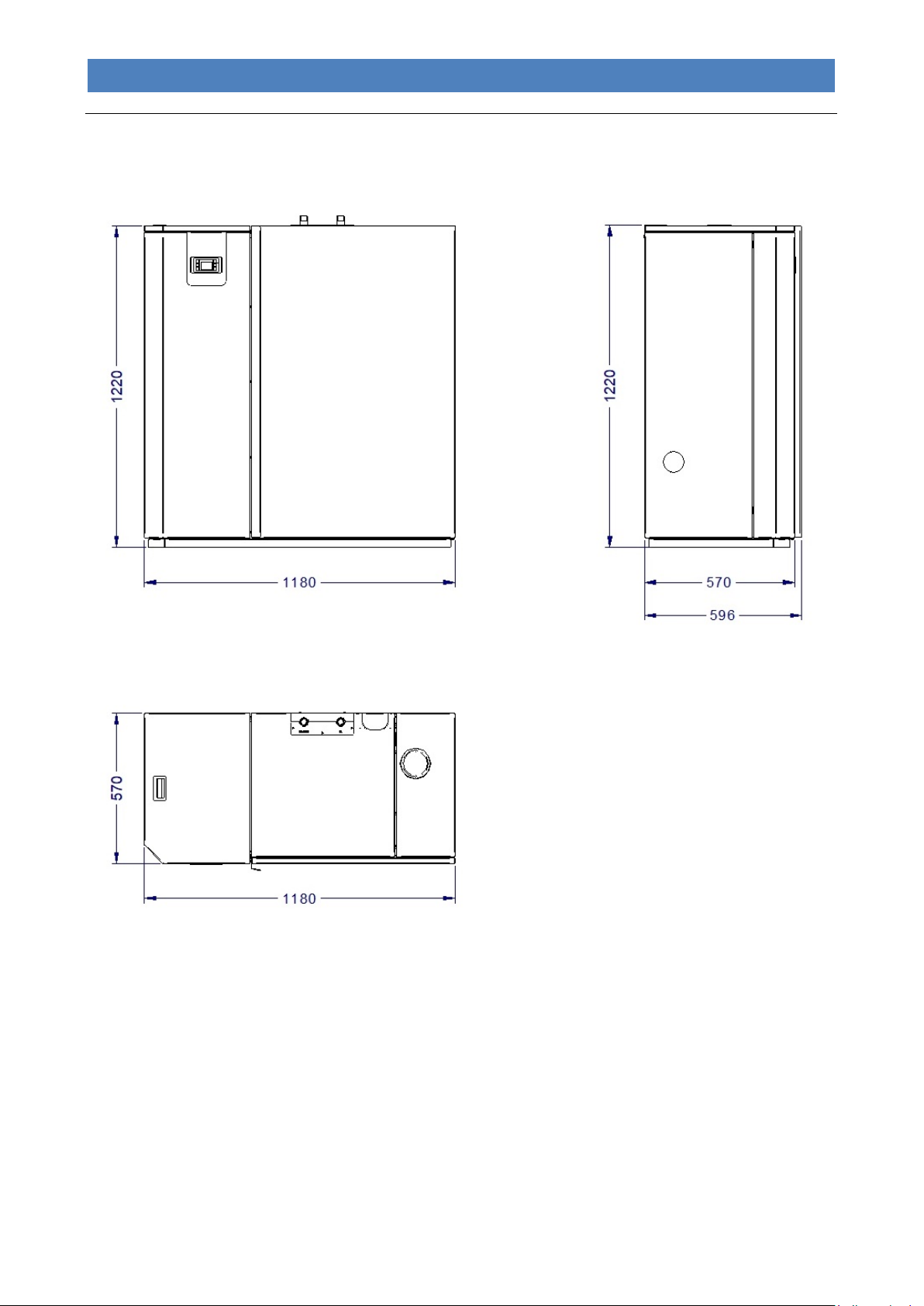
Overall dimensions ECOMPACT 250 - 290
EN - Rev 1.1
7
Page 14
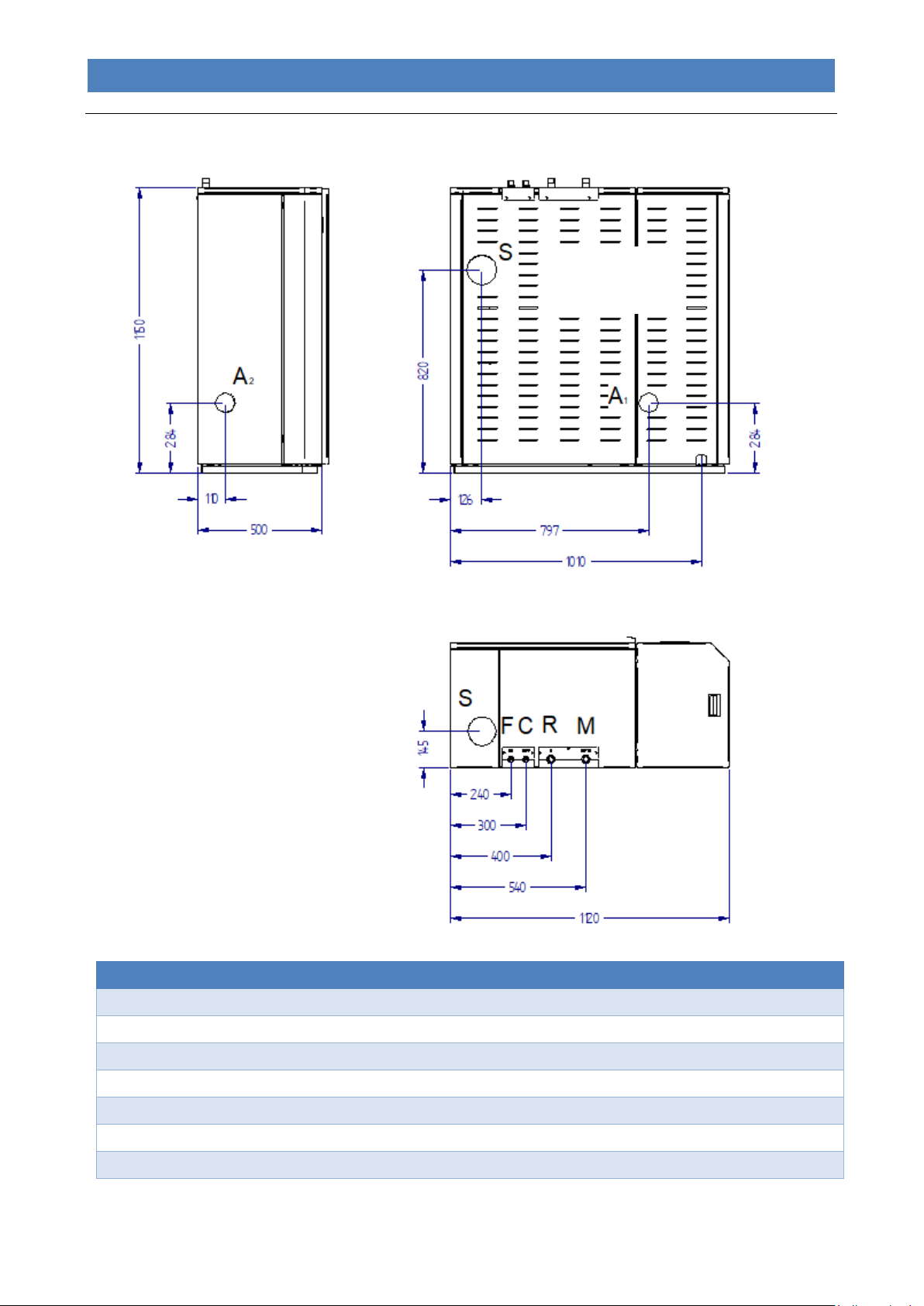
PELLET-BURNING BOILER ECOMPACT 150-190-250-290
Connections data sheet ECOMPACT 150 - 190
Description of connections
M = System Delivery
3/4" M
R = System Return
3/4" M
F = Domestic cold water inlet (on prepared models only)
1/2" M
C = Domestic hot water outlet (on prepared models only)
1/2" M
S = Upper or rear flue gas outlet
100 mm M
A = Rear or side fitting for connection of optional extraction pipe
40 mm
E = Electrical cable outlet
REAR VIEW
EN - Rev 1.1
8
Page 15
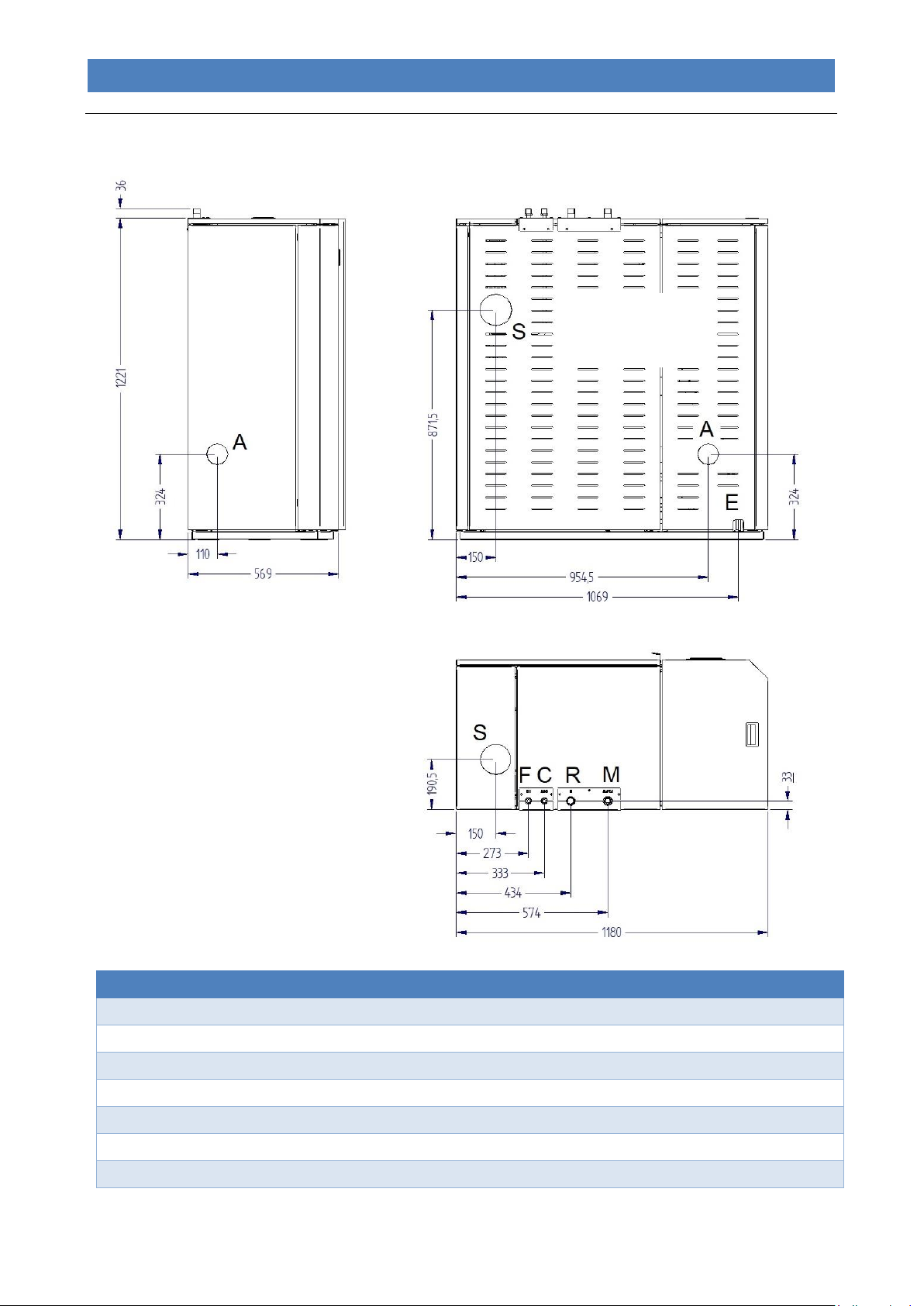
PELLET-BURNING BOILER ECOMPACT 150-190-250-290
Connections data sheet ECOMPACT 250 - 290
Description of connections
M = System Delivery
3/4" M
R = System Return
3/4" M
F = Domestic cold water inlet (on prepared models only)
1/2" M
C = Domestic hot water outlet (on prepared models only)
1/2" M
S = Upper or rear flue gas outlet
100 mm M
A = Rear or side fitting for connection of optional extraction pipe
50 mm
E = Electrical cable outlet
REAR VIEW
EN - Rev 1.1
9
Page 16

PELLET-BURNING BOILER ECOMPACT 150-190-250-290
Technical specifications ECOMPACT 150
Heat input (nominal setting)
kW (Kcal/h)
15.7 (13,500)
Heat input (reduced setting)
kW (Kcal/h)
4.5 (3,850)
Nominal thermal output
kW (Kcal/h)
14.6 (12,550)
Reduced thermal power
kW (Kcal/h)
4.2 (3,600)
Efficiency delivered to water at nominal thermal power
%
92.6
Efficiency delivered to water at reduced thermal power
%
93.3
CO at 10% oxygen at nominal thermal power
%
0.010
CO at 10% oxygen at reduced thermal power
%
0.033
Maximum power uptake
Watt
430*
Power uptake during operation at nominal thermal power
Watt
63
Power uptake during operation at reduced thermal power
Watt
35
Power uptake in stand-by
Watt
2
Nominal voltage
V
230
Nominal frequency
Hz
50
Expansion vessel litres/preloading bar
10 / 1
Maximum operating/recommended pressure
bar
2.5 / 1.5
Water side resistance at Δt= 20 K
mbar
135
Flue outlet diameter
mm
100
Air intake pipe diameter
mm
40
Minimum chimney draught at nominal thermal power
Pa
10.5
Minimum chimney draught at reduced power
Pa
6.7
Combustion gas mass at nominal thermal power
g/s
10.3
Combustion gas mass at reduced power
g/s
4.5
Pellet tank capacity
lt (kg)
92 (55)
Pellet tank filling opening dimensions
mm
330 x 260
Average exhaust flue gas temperature at nominal thermal power
°C
107.3
Average exhaust flue gas temperature at reduced power
°C
85.2
Boiler unit capacity
litres
42
Width
mm
1120
Height
mm
1150
Depth
mm
500
Minimum safety distance from flammable materials (side/rear)
mm
200 / 200
Weight
Kg
300
Boiler class as per EN303-5:2012
5
EN - Rev 1.1
* Power consumption only during the ignition cycle.
The appliance's heat output may vary depending on the type of pellets used.
10
Page 17

PELLET-BURNING BOILER ECOMPACT 150-190-250-290
Technical specifications ECOMPACT 190
Heat input (nominal setting)
kW (Kcal/h)
19.7 (16,950)
Heat input (reduced setting)
kW (Kcal/h)
4.5 (3,850)
Nominal thermal output
kW (Kcal/h)
18.2 (15,650)
Reduced thermal power
kW (Kcal/h)
4.2 (3,600)
Efficiency delivered to water at nominal thermal power
%
92.3
Efficiency delivered to water at reduced thermal power
%
93.3
CO at 10% oxygen at nominal thermal power
%
0.010
CO at 10% oxygen at reduced thermal power
%
0.033
Maximum power uptake
Watt
430*
Power uptake during operation at nominal thermal power
Watt
63
Power uptake during operation at reduced thermal power
Watt
35
Power uptake in stand-by
Watt
2
Nominal voltage
V
230
Nominal frequency
Hz
50
Expansion vessel litres/preloading bar
10 / 1
Maximum operating/recommended pressure
bar
2.5 / 1.5
Water side resistance at Δt= 20 K
mbar
145
Flue outlet diameter
mm
100
Air intake pipe diameter
mm
40
Minimum chimney draught at nominal thermal power
Pa
10.0
Minimum chimney draught at reduced power
Pa
6.7
Combustion gas mass at nominal thermal power
g/s
12.3
Combustion gas mass at reduced power
g/s
4.5
Pellet tank capacity
lt (kg)
92 (55)
Pellet tank filling opening dimensions
mm
330 x 260
Average exhaust flue gas temperature at nominal thermal power
°C
114.0
Average exhaust flue gas temperature at reduced power
°C
85.2
Boiler unit capacity
litres
42
Width
mm
1120
Height
mm
1150
Depth
mm
500
Minimum safety distance from flammable materials (side/rear)
mm
200 / 200
Weight
Kg
300
Boiler class as per EN303-5:2012
5
EN - Rev 1.1
* Power consumption only during the ignition cycle.
The appliance's heat output may vary depending on the type of pellets used.
11
Page 18

PELLET-BURNING BOILER ECOMPACT 150-190-250-290
Technical specifications ECOMPACT 250
Heat input (nominal setting)
kW (Kcal/h)
25.8 (22,100)
Heat input (reduced setting)
kW (Kcal/h)
7.5 (6,450)
Nominal thermal output
kW (Kcal/h)
23.3 (20,050)
Reduced thermal power
kW (Kcal/h)
6.5 (5,600)
Combustion efficiency at nominal thermal power
%
95.3
Efficiency delivered to water at nominal thermal power
%
90.3
Combustion efficiency at reduced thermal power
%
93.3
Efficiency delivered to water at reduced thermal power
%
87.9
CO at 10% oxygen at nominal thermal power
%
0.004
CO at 10% oxygen at reduced thermal power
%
0.022
Maximum power uptake
Watt
430*
Power uptake during operation at nominal thermal power
Watt
87
Power uptake during operation at reduced thermal power
Watt
54
Power uptake in stand-by
Watt
3.2
Nominal voltage
V
230
Nominal frequency
Hz
50
Expansion vessel litres/preloading bar
10 / 1
Maximum operating/recommended pressure
bar
2.5 / 1.5
Water side resistance at Δt= 20 K
mbar
184
Flue outlet diameter
mm
100
Air intake pipe diameter
mm
60
Minimum chimney draught at nominal thermal power
Pa
12.6
Minimum chimney draught at reduced power
Pa
10.6
Combustion gas mass at nominal thermal power
g/s
12.7
Combustion gas mass at reduced power
g/s
6.0
Pellet tank capacity
lt (kg)
120 (75)
Pellet tank filling opening dimensions
mm
400 x 290
Average exhaust flue gas temperature at nominal thermal power
°C
95.7
Average exhaust flue gas temperature at reduced power
°C
65.4
Boiler unit capacity
litres
52
Width
mm
1180
Height
mm
1220
Depth
mm
570
Minimum safety distance from flammable materials (side/rear)
mm
200 / 200
Weight
Kg
380
Boiler class as per EN303-5:2012
5
EN - Rev 1.1
* Power consumption only during the ignition cycle.
The appliance's heat output may vary depending on the type of pellets used.
12
Page 19

PELLET-BURNING BOILER ECOMPACT 150-190-250-290
Technical specifications ECOMPACT 290
Heat input (nominal setting)
kW (Kcal/h)
29.7 (25,550)
Heat input (reduced setting)
kW (Kcal/h)
7.3 (6,300)
Nominal thermal output
kW (Kcal/h)
26.8 (23,050)
Reduced thermal power
kW (Kcal/h)
6.6 (5,700)
Combustion efficiency at nominal thermal power
%
95.1
Efficiency delivered to water at nominal thermal power
%
90.1
Combustion efficiency at reduced thermal power
%
94.3
Efficiency delivered to water at reduced thermal power
%
89.7
CO at 10% oxygen at nominal thermal power
%
0.002
CO at 10% oxygen at reduced thermal power
%
0.028
Maximum power uptake
Watt
430*
Power uptake during operation at nominal thermal power
Watt
87
Power uptake during operation at reduced thermal power
Watt
54
Power uptake in stand-by
Watt
3.2
Nominal voltage
V
230
Nominal frequency
Hz
50
Expansion vessel litres/preloading bar
10 / 1
Maximum operating/recommended pressure
bar
2.5 / 1.5
Water side resistance at Δt= 20 K
mbar
211
Flue outlet diameter
mm
100
Air intake pipe diameter
mm
60
Minimum chimney draught at nominal thermal power
Pa
11.7
Minimum chimney draught at reduced power
Pa
9.8
Combustion gas mass at nominal thermal power
g/s
15.8
Combustion gas mass at reduced power
g/s
5.5
Pellet tank capacity
lt (kg)
120 (75)
Pellet tank filling opening dimensions
mm
400 x 290
Average exhaust flue gas temperature at nominal thermal power
°C
112.3
Average exhaust flue gas temperature at reduced power
°C
65.3
Boiler unit capacity
litres
52
Width
mm
1180
Height
mm
1220
Depth
mm
570
Minimum safety distance from flammable materials (side/rear)
mm
200 / 200
Weight
Kg
380
Boiler class as per EN303-5:2012
5
EN - Rev 1.1
* Power consumption only during the ignition cycle.
The appliance's heat output may vary depending on the type of pellets used.
13
Page 20

PELLET-BURNING BOILER ECOMPACT 150-190-250-290
EN - Rev 1.1
UNIT
MEASUREMENT
UNIT IN CONTINUOUS OPERATION
Extract fan (Power level 1)
35
Extract fan (Power level 5)
43
Extract fan (Cleaning cycle)
49
UNITS IN NON-CONTINUOUS OPERATION
Auger screw motor
42
Turbulator cleaning motor
43
Circulating pump
38
Airborne noise data
The sound levels in the following table are basaed on the sound measurement of an Ecompact 250.
The sound level of the individual units was pltted at the distance of 1m from the sound source.
Ambient level measurement: 33 dB.
Please note that all of the measurements were taken in-house and do not come from a certified test centre.
This data should therefore be viewed as guidance only.
Pellet properties
The appliance has been tested with all types of pellets available on the market. The pellets must have the following
properties:
- Diameter 6 mm.
- Maximum length 35 mm.
- Maximum humidity content 8 – 9 %.
- 100% wood. Totally additive-free.
- Maximum ash residue 1.1 %.
To obtain good performance from the appliance, we recommend using good quality pellets. Pellets should be poured
into the tank using a shovel, and not directly from the bag.
Good quality pellets should have the following properties:
- Constant diameter cylinders with a smooth, shiny surface;
- There should not be a lot of sawdust inside the packaging;
- After grabbing a bunch of pellets and placing them into a container filled with water, good-quality pellets will sink and
poor-quality ones will tend to float;
- The quality certification data, in particular conformity to international standards such as EN14961-2, DIN 51731 and
O-NORM M7135, should be indicated on the packaging;
- The packages should be intact since pellets tend to absorb humidity. Humidity not only reduces the calorific value
and increases the amount of flue gases expelled, but also causes swelling of the product which may create problems
with the appliance.
The production of pellets must be compliant with some international standards (such as EN14961-2, DIN 51731 and ONORM M7135) which establish minimum values for quality checks on pellets. To facilitate the right choice of the
combustible material you can find below one of the most common certification marks identifying the quality of the pellets:
14
Page 21

PELLET-BURNING BOILER ECOMPACT 150-190-250-290
EN - Rev 1.1
Indication of the standard,
base reference for the quality
classes ENplus
Indication of the quality
class of the certified pellet
(preferably A1)
IT xxx
Code of the certified company
consisting of two elements:
- Symbol of the country of
production (example “IT”)
- Progressive number assigned at
the acquisition of the
certification (example "xxx")
The use of poor quality pellets or any other material can damage the appliance operation, voiding the warranty
and exempting the manufacturer from all liability.
In order to guarantee trouble-free combustion, the pellets must be stored in a dry place.
REQUIREMENTS OF THE PLACE OF INSTALLATION
Positioning
The initial phase for best installation of the appliance is to determine its optimum location; the following elements need to
be considered:
- The possibility of creating an external air vent;
- The possibility of creating a straight flue, preferably coaxial to the outlet of the appliance;
- Proximity to the main water drain and/or the boiler (if one already exists);
- Proximity or ease of connection to the water system;
- Ease of access for cleaning the appliance, the flue gas exhaust pipes and the flue.
The unit must be installed on a floor with a suitable load capacity. If the existing building does not fulfil this requirement
appropriate measures (e.g. load distribution plate) must be taken.
The minimum safety distance from flammable materials must be at least 200 mm from the sides and 100 mm
from the back of the appliance.
The installation must guarantee easy access for cleaning the appliance, the flue gas exhaust pipes and the flue, and any
subsequent maintenance operation by the Authorised technical assistance centre.
Once you have found the best location for the appliance, position it following the instructions given below.
The appliance must not be installed in small rooms, bedrooms, bathrooms or in areas with an explosive atmosphere.
Spaces around and above the appliance
The figure below shows the minimum distances from walls or other not-easily-removable furniture, that need to be taken
into consideration when positioning the appliance.
15
Page 22

PELLET-BURNING BOILER ECOMPACT 150-190-250-290
EN - Rev 1.1
30 cm
15 cm
Any shelves or false ceilings mounted above the appliance must be at least 50 cm away from the top part of it.
Furniture and movable objects made from flammable materials must be positioned at least 20 cm from the side surfaces
of the appliance; these objects must be moved when performing maintenance on the appliance.
Protect all structures that can catch fire against the radiated heat of the fire.
Any extra intervention by the Authorised technical assistance centre, which requires the appliance to be
disconnected from the system, will not be covered under warranty as described in the chapter “Standard
Warranty Conditions”.
External air intake
During operation, the appliance takes in air from the environment in which it is installed; It is therefore essential that this
air is replaced through an external air vent. The absence of the air vent may affect the flue draught and therefore the
combustion and the safety of the appliance.
Therefore it is mandatory to install an external air vent with a minimum completely free passage of at least 80 cm2
(round hole with minimum diameter of 15 cm protected with a special fixed large mesh grille).
If it not possible to put the external air vent in the same room as where the appliance is installed, this hole can be made
in an adjoining room as long as this room communicates permanently, by means of a transit hole (15 cm minimum
diameter).
The hole must be protected externally with a fixed grille. The protective grille must be checked periodically to ensure that
it is not obstructed, thereby impeding the passage of air. Therefore keep the air vents clear of obstructions.
The Standard FORBIDS the drawing of combustion air from garages, warehouses storing combustible materials, or from
business premises with a fire hazard.
If there are other heating or extraction devices inside the room, the air vents must guarantee a sufficient amount of air for
properly operating all the devices.
Only sealed appliances (e.g. C type gas appliances, according to the Standard) or appliances that do not cause a lower
pressure compared with the external environment can pre-exist or be installed in the place where the appliance is
installed.
Extractor fans can cause malfunctions to the appliance if used in the same room.
Chimney and Flue pipe
The chimney is essential to the efficient operation of a Klover appliance. The chimney should be constructed according
to these instructions, the relevant BS EN regulations and Building Regulations Approved Document J.
Shape and size of chimney: A round chimney of 125mm diameter is recommended. 125mm is also the minimum
diameter which should be used. If the appliance is DEFRA Exempt then it should be connected to a 125mm chimney as
standard (assuming that the outlet is not larger than 125mm). If it is not DEFRA Exempt then a calculation according to
BS EN 13384-1:2002 must be completed if it is to be connected to a 125mm diameter chimney.
The maximum recommended round chimney diameter is 150mm.
16
Page 23

PELLET-BURNING BOILER ECOMPACT 150-190-250-290
EN - Rev 1.1
Square or rectangular cross-sections must have rounded corners with radius not less than to 20 mm Rectangular crosssections must have a maximum ratio of 1.5 between the sides.
The chimney must have a constant, and unobstructed, internal cross section
Under no circumstances should the chimney be of a smaller diameter than the appliance outlet.
Connecting flue pipe: Short runs of single skin flue pipe to connect to the chimney may be run in a (minimum) diameter
of 100mm (as long as this is not smaller than the appliance outlet). An analysis port should be incorporated to enable,
flue gas analysis, draught measurement and commissioning.
Existing chimneys: Existing masonry chimneys should be lined with flexible stainless steel liner and the liner should be
insulated. All connections must be appropriately sealed.
Existing chimneys must be inspected, be clear of obstruction and have been swept clean immediately before installation
of the lining system.
No shared chimneys: Each appliance must connect to its own flue. No other appliance must connect to the same flue or
chimney. No other pipes or conduits must pass through the chimney or flue.
Sealed joins and connections: The appliance works with the combustion chamber in negative pressure and the flue pipe
under positive pressure; it is essential that all joints and flue and chimney connections are sealed. Single skin and twin
wall flue pipe should incorporate silicone seals at each joint. Other connections should be sealed with a suitable sealant
(for example high temperature silicone). All seals must be able to withstand 250ºC or more.
Suitable materials: Flue and chimney products used, including fixings and components, must be made of suitable, noncombustible materials conforming to the applicable regulations.
Aluminium and fibre cement pipes are forbidden.
Orientation and initial vertical rise: The flue system should run as vertically as possible as any deviations off the vertical
can adversely affect the draw. 45º is the maximum off-vertical angle than may be used. Non-vertical sections should
make up no more than ¼ of the effective height of the flue or chimney (measured from the appliance outlet to the top of
the chimney), and must not be longer than 2,000 mm.
There should be no more than 4 bends in the system, with a tee counting as 2 bends.
Securely fix and support the system to avoid vibration and movement.
90º bends should not be used. When using the rear outlet on the appliance a 90º tee should be used with sweeping
access and debris collection space.
When using the rear outlet any horizontal run should not exceed 150mm, including the arm of the tee.
An initial vertical run of 600mm from the appliance is recommended before any change in direction.
Cleaning Access: The system must provide access so that the entire system can be swept and cleaned.
Flue pipes must not pass through rooms in which the installation of combustion devices is prohibited.
IT IS STRICTLY FORBIDDEN TO INSTALL FLUE DAMPERS/BUTTERFLY VALVES.
Heat shielding: If combustible materials are present then minimum separation distances will need to be adhered or heat
shielding will be required. Please refer to Building Regulations Approved Document J, and also these installation
instructions.
Termination/Cowl: The cowl terminates the chimney and it is recommended that an effective anti-downdraft cowl should
always be used. It must have a usable outlet cross-section no less than double that of the flue onto which it is inserted.
In must prevent rainwater or snow entry. It must be ensure the discharge of combustion by-products even in the event of
winds from every direction and inclination.
17
Page 24

PELLET-BURNING BOILER ECOMPACT 150-190-250-290
EN - Rev 1.1
Height and draught: In order for the appliance to perform satisfactorily the chimney height must be sufficient to ensure a
draught of 12 Pa so as to clear the products of combustion and prevent smoke problems into the room.
A chimney height of not less than 4.5 m measured vertically from the outlet of the stove to the top of the chimney
should be satisfactory. Alternatively the calculation procedure given in BS EN 13384-1:2002 may be used as the basis
for deciding whether a particular chimney design will provide sufficient draught.
The outlet from the chimney should be above the roof of the building in accordance with the provisions of Building
Regulations Approved Document J diagram 17 or 18. Please see the diagram below.
18
Page 25

PELLET-BURNING BOILER ECOMPACT 150-190-250-290
EN - Rev 1.1
CN16
ELECTRICAL CONNECTION
The electric connection must only be performed by qualified staff, in compliance with all general and local safety
standards.
Check that the power supply voltage and frequency correspond to 230V – 50 Hz.
The appliance's safety is ensured when it is properly connected to an efficient earthing system.
In the electric connection to the mains power supply, include a 6 A – Id 30 mA differential trip-switch with suitable
breaking load. The electric connections, including the earth connection, must be made after shutting off the electrical
system.
When completing the system, bear in mind that the cables must be laid in an unmovable manner and far from parts
subject to high temperatures. During the final wiring of the circuit, only use components with a suitable electrical
protection rating. Do not pass electric cables in the immediate vicinity of the flue gas pipe, unless they are insulated with
suitable materials.
KLOVER srl declines all responsibility for injury to persons and animals or damage to objects due to failure to
connect the appliance to earth or to comply with IEC specifications.
Control of any coupled boiler
If the pellet appliance is to be coupled with a previously installed boiler in the system (e.g. wall-hung gas boiler), you
must ensure that the standard boiler stops when the pellet appliance takes over the heating of the system. The electrical
setting, which is accessible from the left-hand technical compartment, intervenes on the standard boiler when the
heating circulating pump of the pellet appliance starts up so as to avoid having two boilers operating simultaneously on
the same system. The coupled boiler is however always available for the production of domestic hot water.
The two wires fitted on the left-hand technical compartment of the appliance (blue and brown wires) will have an
output voltage of 230 V when the pellet appliance pump is working, and no voltage when the pump stops.
It is therefore necessary to connect the 2 wires to a relay that will control the Room Thermostat (R.T.) input of the
coupled boiler (see the following example).
Control of a possible three-way motorized valve for DHW system management
The pellet appliance is equipped as standard with a control for a possible 3-way motorised valve to be installed on the
domestic water circuit based on the selected system type (see “System configuration”). In the left-hand technical
compartment of the appliance there are four wires with fastons protected by a red seal, which can be used for controlling
the valve (see also “wiring diagram”). The four wires have different colours, and precisely:
- Blue wire = 3-WAY VALVE COMMON (Neutral 230 V)
- Black wire = SANITARY SIDE (Phase 230 V with DHW demand)
- Black wire = HEATING SIDE (Phase 230 V with no DHW demand)
- Yellow/green wire = GND
19
Page 26

PELLET-BURNING BOILER ECOMPACT 150-190-250-290
EN - Rev 1.1
Connection to the room thermostat
On the left-hand technical compartment of the appliance there is a bridged terminal which is used to connect the room
thermostat that will command the operation. The operation of the room thermostat is enabled with system types 1, 2 and
3 (see“System configuration”).
OPERATING PRINCIPLE
Open contact:
- The appliance switches directly to economy mode operation “T-AMB ECONOMY”
thus minimising its operating power.
- The heating circulating pump of the appliance switches off.
- The temperature in the boiler increases due to thermal inertia until it reaches the
temperature set with “SET H2O” and displays “T-H2O ECONOMY” on its monitor.
- The appliance now switches itself off automatically if at least one of the following
conditions occurs:
- If it remains in Economy mode Operation “T-H2O ECONOMY” for a time set
on Pr44 (20 minutes as default setting).
- If it exceeds the temperature differential set on Pr43 (set as default at 5°C),
in other words if Temperature H2O > (“SET H2O” + Pr43).
- The appliance will switch on again automatically if both of the following conditions
occur:
- The contact of the room thermostat closes.
- If it goes below the temperature differential of the “SET H2O”.
If the above condition occurs during the switch-off cycle, please wait until the cycle is complete.
N.B.: If the water temperature exceeds the set threshold of 80°C (safety temperature), the circulating pump of the
system is forcedly switched-on to ensure the disposal of excessive heat, thus avoiding high water temperatures in the
boiler. For this reason it is recommended that the heating system is not entirely closed.
In the configuration “System type 3”, the appliance switches to economy mode and then switches off only if the “SET
BOILER” temperature setting has been reached.
ATTENTION: In the event that the room sensor in the “Remote control” for the appliance is enabled, the appliance
switches to economy mode if the “SET ROOM” temperature setting has also been reached.
HYDRAULIC CONNECTION
The plumbing connections must be made in a rational way using the connections on the template of the appliance. To
facilitate connection of the pipes, all plumbing attachments have been fitted to the upper part of the appliance.
The appliance can be coupled with any other boiler already installed on the system. In this case it is essential to fit all the
necessary safety devices and shut-off valves based on the system and intended use. It is also necessary to consider all
laws and national, regional, provincial and municipal regulations of the country where the appliance is installed.
The appliance can be installed with the expansion vessel closed because it is equipped with a device for stopping fuel
loading, a safety manual reset thermostat and an audible alarm, which are activated if the temperature becomes too
high.
You can install the appliance in the same room as another boiler only if this has a sealed chamber; installation
must be performed in compliance with the current regulations.
When installing the appliance, it is advisable to fit an anti-condensation mixer valve between the delivery and
return pipes on the appliance’s heating system. The anti-condensation valve should be calibrated to 55°C with a
Kv value equal to or greater than 8 m3/h.
20
Page 27

PELLET-BURNING BOILER ECOMPACT 150-190-250-290
EN - Rev 1.1
Set
1
2
3
6
5
4
Set
1
2
3
6
5
4
DIALOGUE
REAL WORK POWER
(It is shown flashing only when it is different
from the one actually set)
17:19
t.H2O 60°C
WORK 3
2
CLOCK
TEMPERATURE REFERENCE
t.H2O = water temperature in boiler
t.BoL = boiler DHW storage tank
temperature
t.PUF = centralised buffer temperature
t.AMb = room temperature
TEMPERATURE
2nd LED SERIES
1st LED SERIES
When connecting the appliance to the system, you should provide a zone that is always open (such as
bathroom area) to enable the excess heat dissipation of the water in the body of the boiler.
The maximum mains water pressure should never exceed 2.5 bar; recommended operating pressure is 1.5 bar
(with the appliance in operation).
In the event of water with hardness exceeding 28 °f, an anti-limescale device must be installed. This must be
selected on the basis of the specific properties of the water.
TO AVOID COMPROMISING THE OPERATION AND LIFE OF THE HEAT PUMP, INSTALLATION OF A FILTER
AND A MAGNETIC DIRT SEPARATOR IS RECOMMENDED DOWNSTREAM OF THE RETURN PIPE ON THE
APPLIANCE.
The appliance must be mounted exclusively by qualified personnel. Scrupulously comply with the instructions given
in this guide.
The manufacturer declines any liability for damages caused due to incorrect assembly.
THE DISPLAY
The appliance's operating mode is displayed on the console. After turning on the menu, it is possible to choose from
many types of display and available settings according to the selected menu.
The figures below show the display when the appliance is in ON mode.
21
Page 28

PELLET-BURNING BOILER ECOMPACT 150-190-250-290
EN - Rev 1.1
!
Set
1
2
3
6
5
4
ROOM THERMOSTAT: the LED is on when the thermostat contact is open.
PROGRAMMABLE THERMOSTAT: the LED lights up when at least one start-up and switch-off program is active.
IGNITION PLUG: the LED is on when the ignition plug is active.
SCREW FEED: the LED lights up when the pellet loading gear motor is started.
FLUE GAS EXTRACTOR: the LED lights up when the flue gas extractor is active.
DHW DEMAND: the LED lights up when the DHW flow switch contact is closed (which means there is demand for
hot water) or the DHW storage boiler or buffer (where fitted) is in demand.
PUMP: the LED lights up when the system circulation pump is active.
ALARM: the LED lights up when the boiler is in a state of alarm.
1 2 3 4 5 6 7
On
M - 3 - 2 - 01
TIMER
DAY
DIALOGUE
MENU LEVEL
INPUT
The following figure describes the meanings of the status signals appearing on the left side of the display (1st LED
SERIES).
The meanings of the status signals appearing on the top right side of the display are described below (2nd LED
SERIES).
- LED 1: the LED lights up when the daily programme of the on off settings is active.
- LED 2: the LED lights up when the weekly programme of the on off settings is active.
- LED 3: the LED lights up when the weekend programme of the on off settings is active.
- LED 4: the LED lights up (flashing) when the operation parameters are being edited.
- LED 5: the LED lights up when the summer function is active.
- LED 6: the LED lights up when the winter function is active.
- LED 7: the LED is not currently used.
The following diagram shows the display when setting or programming operating parameters.
The INPUT area shows the entered programming values.
The MENU LEVEL area shows the current parameter/menu level.
The DIALOGUE area displays the meaning of the current parameter/menu.
22
Page 29

PELLET-BURNING BOILER ECOMPACT 150-190-250-290
The table explains how the buttons on the display work.
KEY
DESCRIPTION
MODE
ACTION
1
Increase
temperature (1)
Programming mode..
Changes/increases the value of the selected menu item.
Working/off..
It increases the temperature of the room/water thermostat.
2
Decrease
temperature (2)
Programming mode..
Changes/decreases the value of the selected menu item.
Working/off..
It decreases the temperature of the room/water thermostat.
3
Set
-
Enters the menu in question.
Menu mode..
Accesses the next level of sub-menus.
4
ON/OFF
Outlet
Working..
Switches the appliance on and/or off when pressed for 2 seconds.
In alarm block..
Releases the alarm.
Menu/programming mode..
Moves you to the previous menu level, saving the changes made.
5
Decrease
power (3)
Working/off..
Decreases the working/fan power of the appliance.
Menu mode..
Moves you to the next menu item.
Programming mode..
Moves you to the next submenu item, storing the changes made.
6
Increase
power (3)
Working/off..
Increases the working/fan power of the appliance.
Menu mode..
Moves you to the previous menu item.
Programming mode..
Moves you to the previous submenu item, storing the changes made.
EN - Rev 1.1
(1) The first press selects “Set temperature for boiler water - SET H2O” or “Set DHW boiler temperature - SET BOILER”
or “Set centralised buffer temperature - SET BUFFER” based on the system configuration type.
(2) It selects “Set temperature for boiler water - SET H2O” when first pressed.
(3) It selects the operating power “SET POWER” when first pressed.
THE MENU
Access the Menu by pressing key 3 (Set).
The menu is divided into different items and levels, providing access to the programming and settings options of the
appliance.
Buttons 5 and 6 allow you to select the menus to be modified.
Buttons 1 and 2 allow you to change the set value in the selected menu.
Listed below are the menus present on the PCB, with the relevant explanations.
Menu 01 – Choose season
Allows you to set the season for appliance use (SUMMER / WINTER). Can only be used with plumbing system 3 (see
“System configuration”).
Menu 02 – Set clock
Allows for setting the current date and time.
23
Page 30

PELLET-BURNING BOILER ECOMPACT 150-190-250-290
EN - Rev 1.1
MENU LEVEL
SELECTION
MEANING
POSSIBLE VALUES
03 – 01 – 01
ACTIVATE TIMER
Enable/disable set programs
ON – OFF
MENU LEVEL
SELECTION
MEANING
POSSIBLE VALUES
03 – 02 – 01
DAILY TIMER
Enable/disable the daily programme
ON – OFF
03 – 02 – 02
START 1st DAY
Turn-on time of the first programme
Time – OFF
03 – 02 – 03
STOP 1st DAY
Turn-off time of the first programme
Time – OFF
03 – 02 – 04
START 2nd DAY
Turn-on time of the second programme
Time – OFF
03 – 02 – 05
STOP 2nd DAY
Turn-off time of the second programme
Time – OFF
MENU LEVEL
SELECTION
MEANING
POSSIBLE VALUES
03 – 03 – 01
WEEK TIMER
Enable/disable the weekly programme
ON – OFF
PROGRAMME 1
MENU LEVEL
SELECTION
MEANING
POSSIBLE VALUES
03 – 03 – 02
START PROG 1
Turn-on time of the first programme
Time – OFF
03 – 03 – 03
STOP PROG 1
Turn-off time of the first programme
Time – OFF
03 – 03 – 04
MONDAY PROG 1
Reference days of the first programme
On/off
03 – 03 – 05
TUESDAY PROG 1
On/off
03 – 03 – 06
WEDNESDAY PROG 1
On/off
03 – 03 – 07
THURSDAY PROG 1
On/off
03 – 03 – 08
FRIDAY PROG 1
On/off
03 – 03 – 09
SATURDAY PROG 1
On/off
03 – 03 – 10
SUNDAY PROG 1
On/off
PROGRAMME 2
MENU LEVEL
SELECTION
MEANING
POSSIBLE VALUES
03 – 03 – 11
START PROG 2
Turn-on time of the second programme
Time – OFF
03 – 03 – 12
STOP PROG 2
Turn-off time of the second programme
Time – OFF
03 – 03 – 13
MONDAY PROG 2
Reference days of the second programme
On/off
03 – 03 – 14
TUESDAY PROG 2
On/off
03 – 03 – 15
WEDNESDAY PROG 2
On/off
03 – 03 – 16
THURSDAY PROG 2
On/off
03 – 03 – 17
FRIDAY PROG 2
On/off
03 – 03 – 18
SATURDAY PROG 2
On/off
03 – 03 – 19
SUNDAY PROG 2
On/off
Menu 03 – Set timer
Sub-menu 03 – 01 – enable timer
Allows you to globally enable and disable all programmable thermostat functions. For the correct operation it is
recommended to enable it (“ON”) when at least one on/off programme (daily, weekly or weekend programme) is
activated.
Submenu 03 – 02 – daily program
Allows you to enable, disable and set the programmable thermostat daily programme functions.
Two operating time slots can be set according to the following table, where OFF signals the clock to ignore the
command:
Sub-menu 03 – 03 – weekly program
Allows you to enable, disable and set the programmable thermostat weekly program functions.
The weekly programmer has 4 independent on/off programmes; it is not essential to use all four simultaneously.
By setting OFF in the time field, the clock ignores the corresponding command.
24
Page 31

PELLET-BURNING BOILER ECOMPACT 150-190-250-290
EN - Rev 1.1
PROGRAMME 3
MENU LEVEL
SELECTION
MEANING
POSSIBLE VALUES
03 – 03 – 20
START PROG 3
Turn-on time of the third programme
Time – OFF
03 – 03 – 21
STOP PROG 3
Turn-off time of the third programme
Time – OFF
03 – 03 – 22
MONDAY PROG 3
Reference days of the third programme
On/off
03 – 03 – 23
TUESDAY PROG 3
On/off
03 – 03 – 24
WEDNESDAY PROG 3
On/off
03 – 03 – 25
THURSDAY PROG 3
On/off
03 – 03 – 26
FRIDAY PROG 3
On/off
03 – 03 – 27
SATURDAY PROG 3
On/off
03 – 03 – 28
SUNDAY PROG 3
On/off
PROGRAMME 4
MENU LEVEL
SELECTION
MEANING
POSSIBLE VALUES
03 – 03 – 29
START PROG 4
Turn-on time of the fourth programme
Time – OFF
03 – 03 – 30
STOP PROG 4
Turn-off time of the fourth programme
Time – OFF
03 – 03 – 31
MONDAY PROG 4
Reference days of the fourth programme
On/off
03 – 03 – 32
TUESDAY PROG 4
On/off
03 – 03 – 33
WEDNESDAY PROG 4
On/off
03 – 03 – 34
THURSDAY PROG 4
On/off
03 – 03 – 35
FRIDAY PROG 4
On/off
03 – 03 – 36
SATURDAY PROG 4
On/off
03 – 03 – 37
SUNDAY PROG 4
On/off
MENU LEVEL
SELECTION
MEANING
POSSIBLE VALUES
03 – 04 – 01
WEEKEND TIMER
Enable/disable the weekend programme
ON – OFF
03 – 04 – 02
START 1st WEEKEND
Turn-on time of the first programme
Time – OFF
03 – 04 – 03
STOP 1st WEEKEND
Turn-off time of the first programme
Time – OFF
03 – 04 – 04
START 2nd WEEKEND
Turn-on time of the second programme
Time – OFF
03 – 04 – 05
STOP 2nd WEEKEND
Turn-off time of the second programme
Time – OFF
TIP: in order to avoid confusion and any undesired switching on/off operations, only activate a single programme at a time (daily,
weekly or weekend programme).
Deactivate the daily program if you wish to use the weekly program instead. If you use the weekly program in programs 1, 2, 3
and 4, always keep the week-end program disabled.
Only enable week-end programming after disabling the weekly program.
Sub-menu 03 – 04 – week-end program
Enables/disables/sets the programmable timer's weekend functions (Saturday and Sunday).
Menu 04 – Choose language
Allows you to select the dialogue language from the available choices (Italian, English, French, German and Spanish).
Menu 05 – Acoustic alarm
Allows you to enable or disable the acoustic signal in the event of an alarm. The alarm signal is only available on the
appliance board, and not on the external “Remote control”.
Menu 06 – Initial load
Enables pellet pre-loading for 180” when the appliance is switched off and cooled down. Start the function with button 1
and stop with button 4. This may be useful if the appliance is switched on after the tank has been completely emptied, or
25
Page 32

PELLET-BURNING BOILER ECOMPACT 150-190-250-290
EN - Rev 1.1
T.A.
AB B
A
when it is filled for the first time. Warning: once the operation has been completed, before switching on the
appliance you should empty the accumulation of pellets deposited inside the brazier.
Menu 07 – Fireplace status
It allows for viewing the instantaneous state of the appliance, by showing the state of the various devices connected to it.
Several pages are displayed in succession. The data is reserved for Technical assistance Centre.
Menu 08 – Technical calibration
Allows you to access all data reserved for the Technical Assistance Centre. Access is protected by a password.
Unauthorised access can cause serious damage to the equipment, to things and the environment as well as personal
injuries.
Menu 09 – System type
Allows you to configure the appliance according to the type of system is has been connected to (see “System
configuration”).
INITIAL START-UP
System configuration
Before commissioning the appliance it is advisable to choose which type of system it has been connected to, by
accessing “Menu 06 – System type”.
The available configurations are given here below:
PLUMBING LAYOUT “1” – Boiler connected to a heating system and (potentially) an external plate heat exchanger for
the generation of DHW.
Plumbing layout 1 involves the connection of the boiler to a heating system (or centralised buffer) managed by one or
more room thermostats. These are connected to the terminal provided inside the left technical compartment on the
appliance. DHW generation, where required, will be achieved using a plate heat exchanger fitted externally to the boiler
and controlled by a flow-switch. This is also connected to a terminal provided on the boiler. This serves to bring the
appliance immediately to DHW output working mode and to switch a three-way motorised valve to give it priority.
26
Page 33

PELLET-BURNING BOILER ECOMPACT 150-190-250-290
EN - Rev 1.1
PLUMBING LAYOUT “2” – Boiler with built-in instant DHW, connected to a heating system with an additional DHW
generator.
Plumbing layout 2 involves the connection of the boiler with built-in instant DHW (prepared models only) to a heating
system managed by one or more room thermostats. These are connected to the terminal provided inside the left
technical compartment on the appliance. DHW generation is achieved via a mini storage tank built-into the appliance. It
is recommended to fit an alternative generator in order to guarantee constant DHW in this type of system. Control of this
combination is ensured by a three-way motorised valve connected to the pellet boiler. This allows the DHW generated by
the pellet boiler to be used only when it is operational and at a suitable temperature.
PLUMBING LAYOUT “3” – Boiler connected to a heating system and DHW storage boiler.
Plumbing layout 3 involves the connection of the boiler to a heating system managed by one or more room thermostats.
These are connected to the terminal provided inside the left technical compartment on the appliance. Any DHW
generation is achieved by a storage boiler fitted externally to the boiler. This is controlled by a temperature sensor
connected to the appliance.
27
Page 34

PELLET-BURNING BOILER ECOMPACT 150-190-250-290
EN - Rev 1.1
Centralised
buffer
The three-way motorised valve, controlled by the pellet boiler, manages the heating of the system or boiler, giving priority
to the latter.
Setting “Menu 01 – Select season” to SUMMER allows you to control the storage boiler only during the summer (with the
heating system off).
PLUMBING LAYOUT “4” – Boiler connected to a centralised buffer controlled by a H2O sensor connected to the boiler.
Plumbing layout 4 involves the connection of the boiler to a centralised buffer controlled by a temperature sensor
connected to the appliance. The boiler therefore operates only at the set temperature of the centralised buffer (“SET
BUFFER” can be set using keys 1 and 2). In this type of system there are no room thermostats or three-way valves
connected to the pellet boiler.
Filling the system for the first time
After the water connection of the appliance, fill the system as follows:
- Check the seal of all piping, the expansion vessel, and the circulation pump;
- Open the “automatic air release valve” on the appliance;
- Open the system load cock (mounted on the appliance) to load the system. Gradually allow the air to come out from
the appliance through the “automatic air release valve”; optimum working pressure is 1.5 bar (when the
appliance is operating);
- Vent all radiators and any other de-aeration systems to ensure that there are no air bubbles in the system.
After installation, check the seal of all plumbing joints for the first few days of operation.
The system and the water inside the boiler can be emptied by opening the “boiler body and system drain cock” situated
on the right side of the appliance.
In intensely cold periods it is good practice to leave the heating system running. In the event of a prolonged
absence, anti-freeze must be added to the heating water or the system must be completely emptied.
In a system subject to being emptied frequently, it is essential that filling is performed with water suitably treated to
remove hardness which can give rise to scaling.
28
Page 35

PELLET-BURNING BOILER ECOMPACT 150-190-250-290
EN - Rev 1.1
Pellet loading and connection to the mains power supply
Perform the following operations:
- Connect the appliance to the electrical system by using the provided cable;
- Set the “power ON/OFF switch” on the front of the appliance to “׀” (on);
- Fill the pellet tank; for the first ever ignition, to avoid wasting the time required for filling the entire screw feed channel
(this should be done every time the appliance runs out of pellets), we recommend you follow the instructions in
the “Menu 08 – Initial load”;
- Switch the appliance on by using the ignition button on the display (button 4). See the instructions below. Warning:
before switching on the device make sure that there are no pellets in the brazier; otherwise it is necessary to
empty and clean the brazier.
We recommend that you use high quality pellets so as not to impair the operation of the appliance. Damage
caused by poor-quality pellets shall not be covered by the warranty.
Do not pour pellets directly into the brazier.
Ignition cycle
Pressing button 4 (ON/OFF) for a few seconds allows you to start the ignition cycle. After a while, the display shows
“START”, and the flue gas intake device and ignition plug switch on. After a few seconds, the appliance enters a preload phase “PELLET P-LOAD” during which a continuous supply of pellets is loaded. After the pre-loading phase the
appliance switches to the “WAITING FLAME” phase where the pellets are loaded into the brazier at regular intervals.
When the flame is lit, the display shows the message “FIRE”. This step is used to allow the fire to spread evenly across
the brazier and burn all the unburned pellets from the previous phases. After these phases, the appliance enters the
work mode at the pre-set power value.
If the ignition fails, the display will show the alarm “NO IGNITION”. The alarm may also occur if the brazier is dirty; in
this case, clean the brazier and re-start.
Summary:
The ignition cycle can last 20/25 minutes max. and is divided into five steps:
Step 1 - START = Ignition of the flue gas extractor.
Step 2 - WAITING PREHEATING = Waiting for the plug preheating. (Not as standard settings).
Step 3 - PELLET P-LOAD = Pellet pre-load (initial continuous load) and plug ignition.
Step 4 - WAITING FLAME = Loading pellets (intermittent load) and plug operating.
Step 5 - FIRE = Plug switch-off and flame stabilisation.
The appliance switches into working mode after ignition phase at the power output set during ignition via buttons 1 and
2.
Warning: during the ignition phase and normal operation of the appliance, maintain the necessary safety
distance and do not stand in front of it.
Switch-off cycle
The appliance switches off if you press button 4 (ON/OFF) during normal operation. The display will show “FINAL
CLEANING”. The pellet loading stops and the flue gas extractor speed increases to maximum and then switches off after
the cooling of the appliance, displaying "OFF”.
If button 4 (ON/OFF) is pressed during the ignition cycle, the appliance switches to “WAITING OFF” and the appliance
will be tutned off only at the end of the entire cycle; if, however, button 4 (ON/OFF) is pressed by mistake during this
phase, you only need to press it again to delete “WAITING OFF”: the appliance will return to normal operation at the end
of the entire ignition cycle.
29
Page 36

PELLET-BURNING BOILER ECOMPACT 150-190-250-290
EN - Rev 1.1
Set
1
2
3
6
5
4
Set
1
2
3
6
5
4
Set
1
2
3
6
5
4
70°C
SET H2O
65°C
SET BOILER
3
POWER SET
Modifying the working power
To modify the maximum working power you must select “SET POWER” by pressing buttons 5 or 6. Press buttons 5 and
6 to change the setting. During this operation, the display will appear as in the following picture.
After setting the desired value, press button 4 or wait a few seconds to confirm.
Changing the water temperature boiler or buffer
- Boiler Water Temperature
For system types 1, 2 and 3, to modify the boiler water temperature, simply select “SET H2O” by pressing button 2. Now
use buttons 1 and 2. During this operation, the display will appear as in the following picture.
After setting the desired value, press button 4 or wait a few seconds to confirm.
During the working mode the appliance enters “Economy mode operation” when that temperature value is reached.
- DHW storage boiler temperature
For system type 3, to modify the boiler temperature, simply select “SET BOILER” by pressing button 1. Now use buttons
1 and 2. During this operation, the display will appear as in the following picture.
After setting the desired value, press button 4 or wait a few seconds.
During the working phase, if the boiler is in demand the appliance will switch to “Economy mode” if T.H2O > SET
BOILER + 10°C.
Here below are the operating modes in the event that the “SET BOILER” temperature is reached:
30
Page 37

PELLET-BURNING BOILER ECOMPACT 150-190-250-290
EN - Rev 1.1
Set
1
2
3
6
5
4
65°C
SET BUFFER
- “Menu 01 – Select season = SUMMER” the appliance will immediately go into stand-by “STOP FLAME”.
- “Menu 01 – Select season = WINTER” the motorised three-way valve and the appliance will go into stand-by “STOP
FLAME” only if the conditions in the heating system are satisfied.
- Buffer temperature
For system type 4, to modify the buffer temperature, simply select “SET BUFFER” by pressing buttons 1 or 2. Now use
buttons 1 and 2. During this operation, the display will appear as in the following picture.
After setting the desired value, press button 4 or wait a few seconds.
During the working phase the appliance will switch to “Economy mode” if T.H2O > SET BUFFER + 10°C.
It will go into stand-by “STOP FLAME” only if the “SET BUFFER” temperature is reached.
PROBLEMS, ALARMS, USEFUL ADVICES
Useful info…
Listed below is some important information regarding the appliance:
- It is normal for the appliance to emit a smell of paint during its first few days of operation. We recommend ventilating
the installation room during the initial start-up. For the first few days of operation we also recommend that you set the
appliance to near-maximum level.
- The boiler unit is treated with anti-oxidant paint in order to protect it against oxidation in the event of long periods of
inactivity. After initial start-up, this paint no longer preserves its original features and any wear of the paint inside the
combustion chamber should not be regarded as a manufacturing fault.
- Do not clean with water inside the combustion chamber; any oxidation of the combustion chamber after a long period
of inactivity is not to be considered as a manufacturing fault.
- Any perceived noise during operation may be caused by the expansion settling of the plates that make up the boiler
unit. These noises are accentuated especially during ignition and switching off phases of the appliance and are not to
be considered a manufacturing fault.
- If ignition fails, empty the pellets out of the brazier; only then can you reignite the appliance in order to avoid
gasification and consequent “explosion” during ignition which could lead to the breakage of the door glass.
- The appliance works exclusively with wooden pellets; do not burn different fuels.
- The appliance can work only if connected to the heating system and with water inside the boiler unit. Do not start the
appliance for any reason if a plumbing connection in compliance with current regulations has not been done and if
you have not filled the entire boiler unit and system with water in order not to compromise its life.
- The noise heard during the ignition stage is due to the automatic cleaning of the turbulators.
- The noise level of the appliance is emphasised if the pellet container is empty. Therefore we recommend that you
always keep the pellet level to at least half tank.
- If there is soot and fine particulate in the room where the appliance is installed, check the seal on the flue gas pipes
and the filter of the ash vacuum device used for cleaning.
- In the event of overheating, the appliance will switch off when it reaches 85°C.
What happens if…
…the pellets do not ignite
If the ignition fails, the display will show the alarm message “NO IGNITION”.
Cancel the alarm and reset the appliance to standard condition by pressing button 4 for a few seconds.
31
Page 38

PELLET-BURNING BOILER ECOMPACT 150-190-250-290
EN - Rev 1.1
Previous state
Black-out duration
State after power restore
OFF
any
OFF
START
duration < Pr48
START
START
duration > Pr48
START
P-LOAD PELLET
any
BLACK OUT ALARM
FLAME STAND-BY
any
BLACK OUT ALARM
FIRE PRESENT
duration < Pr48
FIRE PRESENT
FIRE PRESENT
duration > Pr48
STOP FIRE with automatic re-ignition after machine cooling
WORK (any phase)
duration < Pr48
WORK (any phase)
WORK (any phase)
duration > Pr48
STOP FIRE with automatic re-ignition after machine cooling
BRAZIER CLEANING
duration < Pr48
BRAZIER CLEANING
BRAZIER CLEANING
duration > Pr48
STOP FIRE with automatic re-ignition after machine cooling
FINAL CLEANING
duration < Pr48
FINAL CLEANING and after cooling OFF
FINAL CLEANING
duration > Pr48
FINAL CLEANING and after cooling OFF
STOP FIRE
any
STOP FIRE
DISPLAY VISUALISATION
ORIGIN OF ALARM
AL 1 - BLACK OUT
ACTIVE ALARM
Black-out alarm. When power is cut off under determined conditions (see“What happens if…”)
AL 2 - FLUE GAS PROBE
ACTIVE ALARM
Faulty or disconnected flue gas temperature sensor.
AL 3 - HOT TEMP
ACTIVE ALARM
Flue gas over-temperature. Before displaying the alarm, or when flue gas maximum temperature
is reached (Pr14). the display shows “HOT FLUE GAS”.
AL 4 - EXTRACTOR-FAILURE
ACTIVE ALARM
Faulty flue gas extractor. When the encoder (tachometer) in the extractor detects an extractor
speed equal to 0.
AL 5 - NO IGNITION
ACTIVE ALARM
No ignition. When the flue gas minimum temperature (Pr13) is not reached within the maximum
ignition cycle time (Pr01).
If ignition fails, empty the pellets out of the brazier; to avoid gasification, the appliance can only be re-ignited
after having emptied the un-burnt pellets.
...the fire door or the pellet container door is open or not properly closed
If the door is left open or not properly closed, the pellet loading will not start, therefore the appliance will not switch itself
on. If the door is opened during normal operation, the appliance switches to “THERMAL SAFETY” alarm.
...the flue pipe is dirty, blocked or not correctly installed
If the flue is dirty, blocked or incorrectly manufactured, pellet loading will not start, thus the appliance will not switch itself
on. If the flue is obstructed during normal operation, the appliance switches to “DEPRESS.-FAILURE” alarm.
...the appliance is overheated
If the water in the boiler body is overheated (>94°C), the pellet will not be loaded because the manual reset thermostat
cuts in. If this happens during normal operation, the appliance switches to “THERMAL SAFETY” alarm. It is therefore
necessary to reset the “manual reset thermostat” (see “Components of the appliance”) before switching the appliance on
again. To reset, it is necessary to remove the black cap and press the button below.
...lack of power (blackout)
If a power blackout occurs for a shorter time than Pr48, when power is restored, the appliance will immediately re-start in
the working mode (recovering the set working power).
If the outage lasts longer than Pr48, when power is restored, the appliance will enter the “STOP FIRE” (stand-by) mode
running the entire switch-off cycle until cooling. When this phase is over, the appliance can be restarted resuming work
at the set power.
Alarm signals
The following table describes the different alarms which may appear.
32
Page 39

PELLET-BURNING BOILER ECOMPACT 150-190-250-290
EN - Rev 1.1
AL 6 - NO PELLET
ACTIVE ALARM
Sudden shut-down during the work phase. When, during the work phase, the flue gas
temperature drops below the minimum threshold (Pr28).
AL 7 - THERMAL-SAFETY
ACTIVE ALARM
Temperature safety device. When the safety thermostat (water over temperature) or one of the
micro switches (contact interrupted) fitted in the fire door or pellet container door cuts in. If the
safety thermostat cuts in the boiler stove must be manually rearmed.
AL 8 - DEPRESS.-FAILURE
ACTIVE ALARM
Poor depression. When the flue gas pressure switch cuts in (contact interrupted) due to poor
draught in the flue pipe.
AL 9 - WATER PROBE
ACTIVE ALARM
Faulty or disconnected water temperature probe.
AL c - SF TRIAC ERROR
ACTIVE ALARM
Screw feed TRIAC error. When the screw feed gear motor does not stop for at least 0.2 seconds
during the maximum work interval of 8.0 seconds. Before the alarm is activated a safety relay
cuts in and forcibly cuts off the power supply to the gear motor.
Every alarm causes the appliance to switch-off immediately. The alarm state is reached after the time set on Pr11 (set as
default at 60”) and it can be reset by pressing button 4 for a while.
CLEANING AND MAINTENANCE
Precautions before cleaning
Before carrying out any cleaning or maintenance operations, make sure that:
- the appliance is off and has cooled down completely;
- the ash is completely cold.
- the ash vacuum device used for cleaning is suitable and its filter is in good condition.
Before re-starting the appliance, re-install all previously removed components.
During cleaning operations, use the personal protection devices specified in Directive 89/391/EEC.
The frequency for cleaning depends on the type and quality of pellet burnt; therefore, the indicated times may change.
Any problem affecting the appliance caused by lack of cleaning will not be covered by the warranty. The failure
of these operations could affect the safety of the product.
Cleaning operations may be carried out by the end user, as indicated in the paragraph below.
Routine cleaning
The routine cleaning of the appliance must be done at least every 10 days of operation or after 20 ignition cycles, so as
to always guarantee efficient performance and optimal operation. Please proceed as follows:
33
Page 40

PELLET-BURNING BOILER ECOMPACT 150-190-250-290
Empty the ash drawer (Figure 1).
3 2 1
EN - Rev 1.1
Thoroughly clean the brazier from combustion residues by taking it out from its position and removing any residues
inside (Figure 2). Use a suitable ash vacuum device to remove any ash deposited under the brazier (Figure 3).
To remove any deposits, it is also recommended that you scrape the inner walls of the combustion chamber with a
spatula. Do not use tools that can reduce the thickness of the metal sheet of the boiler unit.
WARNING: use suitable ash vacuum devices equipped with a fine mesh filter in order to prevent ash from being
blown into the room and to prevent damaging the vacuum cleaner. We do not recommend the use of normal
vacuum cleaners.
34
Page 41

PELLET-BURNING BOILER ECOMPACT 150-190-250-290
EN - Rev 1.1
6 7 4
5
Non-routine cleaning
The extraordinary cleaning of the appliance must be done at least every 90 days so as to always guarantee efficient
performance and optimal operation. Please proceed as follows:
Perform routine cleaning;
Remove the “extractor flue gas pass inspection front plate” by unscrewing the 4 screws (figure 4).
Using the ash vacuum, vacuum the deposit inside (figure 5).
Remove the front guard (figures 6 and 7).
35
Page 42

PELLET-BURNING BOILER ECOMPACT 150-190-250-290
EN - Rev 1.1
10 9 8
After removing the turbulator inspection front plate (Figure 8), vacuum the deposits on the inside using a suitable ash
vacuum device (Figure 9). When finished, replace the plate and front guard.
To ensure correct operation, it is necessary to remove the sawdust deposited on the base of the tank (Figure 10) at least
once every 30 days. The pellet tank must be emptied at the end of every season.
Cleaning the ceramic glass
Always clean the glass when the appliance is off and has cooled down completely. Use a damp cloth or a detergent
specifically formulated for ceramic glass. Do not use abrasive sponges. Do not clean the glass if still warm; changes in
temperature can lead to breakage.
36
Page 43

PELLET-BURNING BOILER ECOMPACT 150-190-250-290
EN - Rev 1.1
Cleaning the flue
The flue must be cleaned at least once a year, at the beginning of winter, and whenever it becomes necessary.
It is important to check for any obstructions in the flue before switching the appliance on following long periods of
inactivity.
If the flue is not cleaned, the operation of the appliance and its components may be compromised.
The cleaning frequency of the appliance and flue depends on the quality of the pellets used.
USE TOP QUALITY PELLETS TO OBTAIN THE BEST RESULTS.
Maintenance
Timely and systematic maintenance is essential for guaranteeing correct operation, optimal heat performance and
durability of the device. Therefore, qualified staff should check the appliance at least once a year at the beginning of the
season.
You must periodically check the seals because the latter guarantee the air- and water-tightness of the appliance and its
good functioning; if they are worn or damaged you need to be replace them immediately by contacting a Klover
Authorised technical assistance centre.
For proper operation, the appliance must undergo routine maintenance performed by a Klover Authorised
technical assistance centre at least once a year.
37
Page 44

PELLET-BURNING BOILER ECOMPACT 150-190-250-290
EN - Rev 1.1
Parameters “VARIOUS CALIBRATIONS” - Mod. ECO150 (i05_220318)
Parameter
Menu level
Description
Display
Measurement
Value field
Database
M0
Pr38
M08 – 4 – 01
Re-ignition block
RE-IGNIT BLOCK
Minutes
0 – 10
6
Pr39
M08 – 4 – 02
Flue gas extractor switch-off time
MIN-EXT OFF
Minutes
0 – 20
10
Pr40
M08 – 4 – 03
Pre-loading time in ignition
IGNIT- PRE-LOAD
Seconds
0 – 255
240
Pr41
M08 – 4 – 04
Stand-by time after pre-loading
AFTER-PRE STAND-BY
Seconds
0 – 255
180
Pr42
M08 – 4 – 05
Extractor speed in pre-loading phase
FLUE GAS-EXT
PRELOAD
RPM
350 – 2800
2200
Pr43
M08 – 4 – 06
ON/OFF temperature hysteresis on “SET H2O”
DELTA ON OFF AUTO
°C
0.0 – 20.0
5.0
Pr44
M08 – 4 – 07
Delay at economy operation mode switch-off (timer after reaching “SET
H2O”)
DELAY-OFF AUTO
Minutes
2 – 120
20
Pr45
M08 – 4 – 08
Power change delay
POWER CHANGE
Seconds
0 – 60
20
Pr46
M08 – 4 – 09
ON/OFF Temperature hysteresis on “SET ROOM”
DELTA ON AUTO
°C
0.0 – 15.0
2.0
Pr47
M08 – 4 – 10
Keypad lock enable
KEY LOCK-EN
On – off
On – off
Off
Pr48
M08 – 4 – 11
Time after which an alarm is triggered in the event of a blackout
BLACKOUT ALARM
Seconds
0 – 60
30
Pr49
M08 – 4 – 12
Pellet level sensor enable
PELLET RESERVE
On – off
On – off
On
Pr50
M08 – 4 – 13
Pump start threshold and power modulation for overheating safety
PUMP SAFETY
°C
60 – 90
80
Pr51
M08 – 4 – 14
3-way switching and re-ignition delta on “SET BOILER” and “SET
BUFFER”
DELTA PUF-BOI
°C
0 – 15
5
Pr52
M08 – 4 – 15
Preheating time
PREHEATING TIME
Seconds
0 – 480
0
Pr53
M08 – 4 – 16
Extractor speed in preheating phase
PREHEAT-F.GASSPEED
RPM
500 – 2800
2800
Pr54
M08 – 4 – 17
Time after which the “NO PELLET” alarm is triggered if “PELLET
RESERVE”
RESERVE ALARM
Minutes
1 – 180
40
Pr55
M08 – 4 – 18
ON time for turbulator cleaning gear motor
TURBOLAT DURATION
Seconds
0 – 600”
120
Pr56
M08 – 4 – 19
ON time for brazier cleaning gear motor (NOT USED)
CLEANING TIME
Seconds
0 – 120”
0
Pr57
M08 – 4 – 20
Time from switching OFF after which the brazier cleaning takes place
(NOT USED)
CLEANER DELAY
Minutes
1 – 15’
1
Pr58
M08 – 4 – 21
Time from switching ON after which the brazier cleaning takes place (NOT
USED)
CLEANER STAND-BY
Hours
1 – 24
24
Pr59
M08 – 4 – 22
Pump activation threshold and switching 3-way valve in DHW OUTPUT
MODE (with Type 2 System)
PUMP THRESHOLD I2
°C
55 – 75
60
Parameters “VACUUM CALIBRATIONS” - Mod. ECO150 (i05_220318)
Parameter
Menu level
Description
Display
Measurement
Value field
Database
M0
Pr133
M08 – A – 01
Enable automatic pellet loading vacuum
ENABLE VACUUM
On – off
On – Off
Off
Pr134
M08 – A – 02
Vacuum on time
VACUUM ACTIVE
Seconds
1 – 180
20
Pr135
M08 – A – 03
Vacuum rest time
VACUUM PAUSE
Seconds
5 – 60
10
Pr136
M08 – A – 04
Number of operating cycles
VACUUM CYCLES
Number
1 – 20
15
Pr137
M08 – A – 05
Enables a Vacuum operating test to be performed
VACUUM TEST
On – off
On – off
Off
Parameters “FACTORY CALIBRATIONS” - Mod. ECO150 (i05_220318)
Parameter
Menu level
Description
Display
Measurement
Value field
Database
M0
Pr01
M08 – 6 – 01
Ignition cycle maximum time
IGNIT- MINUTES
Minutes
5 – 25
18
Pr02
M08 – 6 – 02
Start time
START MINUTES
Minutes
2 – 12
8
PCB PARAMETERS
The parameters stored on the PCB are essential for the correct operation.
The following parameters are already stored during the testing of the appliance directly in the factory; these parameters
are the result of special tests using several types of pellets and must not be changed without the authorisation of Klover
srl so as not to impair the operation of the appliance.
The company shall not be held liable for any damage caused by the incorrect entry of parameters.
Parameter tables ECOMPACT 150
38
Page 45

PELLET-BURNING BOILER ECOMPACT 150-190-250-290
EN - Rev 1.1
Pr03
M08 – 6 – 03
Time interval between the two brazier cleaning operations
BRAZIER CLEANING
Minutes
3 – 240
60
Pr04
M08 – 6 – 04
Screw feed gear motor ON time in ignition phase
IGNIT- SCREW FEED
Seconds
0.1 – 8.0
1.2
Pr05
M08 – 6 – 05
Screw feed gear motor ON time in start phase
SCREW FEED START
Seconds
0.1 – 8.0
1.4
Pr06
M08 – 6 – 06
Screw feed gear motor ON time in power 1 work phase
OUTPUT 1 SCREW
FEED
Seconds
0.1 – 8.0
3.4
Pr07
M08 – 6 – 07
Screw feed gear motor ON time in power 2 work phase
OUTPUT 2 SCREW
FEED
Seconds
0.1 – 8.0
4.0
Pr08
M08 – 6 – 08
Screw feed gear motor ON time in power 3 work phase
OUTPUT 3 SCREW
FEED
Seconds
0.1 – 8.0
4.8
Pr09
M08 – 6 – 09
Screw feed gear motor ON time in power 4 work phase
OUTPUT 4 SCREW
FEED
Seconds
0.1 – 8.0
5.4
Pr10
M08 – 6 – 10
Screw feed gear motor ON time in power 5 work phase
OUTPUT 5 SCREW
FEED
Seconds
0.1 – 8.0
6.2
Pr11
M08 – 6 – 11
Alarm delay
ALARM DELAY
Seconds
0 – 120
90
Pr12
M08 – 6 – 12
Brazier cleaning duration
BRAZIER CLEANING
Seconds
0 – 120
50
Pr13
M08 – 6 – 13
Flue gas minimum temperature for considering the stove on
MINIMUM THRESHOLD
°C
40 – 600
112
Pr14
M08 – 6 – 14
Flue gas maximum temperature
MAXIMUM
THRESHOLD
°C
200 – 880
880
Pr15
M08 – 6 – 15
Flue gas temperature threshold for the air exchanger start-up (NOT USED)
FAN THRESHOLD
°C
200 – 720
720
Pr16
M08 – 6 – 16
Flue gas extraction speed in ignition phase
IGNIT FLUE GAS
SPEED
RPM
500 – 2800
2000
Pr17
M08 – 6 – 17
Flue gas extraction speed in start phase
START FLUE GAS
SPEED
RPM
500 – 2800
1800
Pr18
M08 – 6 – 18
Flue gas extraction speed in power 1 work phase
P 1 FLUE GAS SPEED
RPM
500 – 2800
1500
Pr19
M08 – 6 – 19
Flue gas extraction speed in power 2 work phase
P 2 FLUE GAS SPEED
RPM
500 – 2800
1650
Pr20
M08 – 6 – 20
Flue gas extraction speed in power 3 work phase
P 3 FLUE GAS SPEED
RPM
500 – 2800
1750
Pr21
M08 – 6 – 21
Flue gas extraction speed in power 4 work phase
P 4 FLUE GAS SPEED
RPM
500 – 2800
1900
Pr22
M08 – 6 – 22
Flue gas extraction speed in power 5 work phase
P 5 FLUE GAS SPEED
RPM
500 – 2800
2100
Pr23
M08 – 6 – 23
Exchanger 1 motor speed in output 1 working mode (NOT USED)
AIR 1 SPEED
Volt
65 – 225
65
Pr24
M08 – 6 – 24
Exchanger 1 motor speed in output 2 working mode (NOT USED)
AIR 2 SPEED
Volt
65 – 225
65
Pr25
M08 – 6 – 25
Exchanger 1 motor speed in output 3 working mode (NOT USED)
AIR 3 SPEED
Volt
65 – 225
65
Pr26
M08 – 6 – 26
Exchanger 1 motor speed in output 4 working mode (NOT USED)
AIR 4 SPEED
Volt
65 – 225
65
Pr27
M08 – 6 – 27
Exchanger 1 motor speed in output 5 working mode (NOT USED)
AIR 5 SPEED
Volt
65 – 225
65
Pr28
M08 – 6 – 28
Threshold beneath which the appliance is considered to be OFF
THRESHOLD OFF
°C
80 – 600
140
Pr29
M08 – 6 – 29
Flue gas extraction speed in brazier cleaning phase
FLUE GAS-EXT
CLEANING
RPM
500 – 2800
2800
Pr30
M08 – 6 – 30
Screw feed gear motor ON time in cleaning phase
CLEANING SCREW
FEED
Seconds
0.0 – 8.0
1.8
Pr31
M08 – 6 – 31
Flue gas extractor encoder enable
(NOT USED)
ENCODER
On – off
On – Off
On
Pr32
M08 – 6 – 32
Screw feed brake time
BRAKE TIME
Seconds
0.0 – 0.5
0.2
Pr33
M08 – 6 – 33
Pump activation threshold
PUMP THRESHOLD
°C
20 – 70
55
Pr34
M08 – 6 – 34
Water pressure switch enable
(NOT USED)
WATER
PRESSURESW.
On – off
On – Off
On
Pr35
M08 – 6 – 35
Water pressure threshold (NOT USED)
PRESSURE
THRESHOLD
Bar
1.5 – 3.0
2.5
Pr36
M08 – 6 – 36
Screw feed motor reducer ON time in DHW output working mode
DHW SCREW FEED
Seconds
0.1 – 8.0
6.2
Pr37
M08 – 6 – 37
Flue gas intake speed in DHW output working mode
DHW FLUE GASINTAKE DEVICE
RPM
500 – 2800
2100
39
Page 46

PELLET-BURNING BOILER ECOMPACT 150-190-250-290
Parameter tables ECOMPACT 190
Parameters “VARIOUS CALIBRATIONS” - Mod. ECO190 (i05_220318)
Parameter
Menu level
Description
Display
Measurement
Value field
Database
n0
Pr38
M08 – 4 – 01
Re-ignition block
RE-IGNIT BLOCK
Minutes
0 – 10
6
Pr39
M08 – 4 – 02
Flue gas extractor switch-off time
MIN-EXT OFF
Minutes
0 – 20
10
Pr40
M08 – 4 – 03
Pre-loading time in ignition
IGNIT- PRE-LOAD
Seconds
0 – 255
145
Pr41
M08 – 4 – 04
Stand-by time after pre-loading
AFTER-PRE STAND-BY
Seconds
0 – 255
180
Pr42
M08 – 4 – 05
Extractor speed in pre-loading phase
FLUE GAS-EXT
PRELOAD
RPM
350 – 2800
2200
Pr43
M08 – 4 – 06
ON/OFF temperature hysteresis on “SET H2O”
DELTA ON OFF AUTO
°C
0.0 – 20.0
5.0
Pr44
M08 – 4 – 07
Delay at economy operation mode switch-off (timer after reaching “SET
H2O”)
DELAY-OFF AUTO
Minutes
2 – 120
20
Pr45
M08 – 4 – 08
Power change delay
POWER CHANGE
Seconds
0 – 60
20
Pr46
M08 – 4 – 09
ON/OFF Temperature hysteresis on “SET ROOM”
DELTA ON AUTO
°C
0.0 – 15.0
2.0
Pr47
M08 – 4 – 10
Keypad lock enable
KEY LOCK-EN
On – off
On – off
Off
Pr48
M08 – 4 – 11
Time after which an alarm is triggered in the event of a blackout
BLACKOUT ALARM
Seconds
0 – 60
30
Pr49
M08 – 4 – 12
Pellet level sensor enable
PELLET RESERVE
On – off
On – off
On
Pr50
M08 – 4 – 13
Pump start threshold and power modulation for overheating safety
PUMP SAFETY
°C
60 – 90
80
Pr51
M08 – 4 – 14
3-way switching and re-ignition delta on “SET BOILER” and “SET
BUFFER”
DELTA PUF-BOI
°C
0 – 15
5
Pr52
M08 – 4 – 15
Preheating time
PREHEATING TIME
Seconds
0 – 480
0
Pr53
M08 – 4 – 16
Extractor speed in preheating phase
PREHEAT-F.GASSPEED
RPM
500 – 2800
2800
Pr54
M08 – 4 – 17
Time after which the “NO PELLET” alarm is triggered if “PELLET
RESERVE”
RESERVE ALARM
Minutes
1 – 180
40
Pr55
M08 – 4 – 18
ON time for turbulator cleaning gear motor
TURBOLAT DURATION
Seconds
0 – 600”
120
Pr56
M08 – 4 – 19
ON time for brazier cleaning gear motor (NOT USED)
CLEANING TIME
Seconds
0 – 120”
0
Pr57
M08 – 4 – 20
Time from switching off after which the brazier cleaning takes place (NOT
USED)
CLEANER DELAY
Minutes
1 – 15’
1
Pr58
M08 – 4 – 21
Time from switching ON after which the brazier cleaning takes place (NOT
USED)
CLEANER STAND-BY
Hours
1 – 24
24
Pr59
M08 – 4 – 22
Pump activation threshold and switching 3-way valve in DHW OUTPUT
MODE (with Type 2 System)
PUMP THRESHOLD I2
°C
55 – 75
60
Parameters “VACUUM CALIBRATIONS” - Mod. ECO190 (i05_220318)
Parameter
Menu level
Description
Display
Measurement
Value field
Database
n0
Pr133
M08 – A – 01
Enable automatic pellet loading vacuum
ENABLE VACUUM
On – off
On – Off
Off
Pr134
M08 – A – 02
Vacuum on time
VACUUM ACTIVE
Seconds
1 – 180
20
Pr135
M08 – A – 03
Vacuum rest time
VACUUM PAUSE
Seconds
5 – 60
10
Pr136
M08 – A – 04
Number of operating cycles
VACUUM CYCLES
Number
1 – 20
15
Pr137
M08 – A – 05
Enables a Vacuum operating test to be performed
VACUUM TEST
On – off
On – off
Off
Parameters “FACTORY CALIBRATIONS” - Mod. ECO190 (i05_220318)
Parameter
Menu level
Description
Display
Measurement
Value field
Database
n0
Pr01
M08 – 6 – 01
Ignition cycle maximum time
IGNIT- MINUTES
Minutes
5 – 25
18
Pr02
M08 – 6 – 02
Start time
START MINUTES
Minutes
2 – 12
8
Pr03
M08 – 6 – 03
Time interval between the two brazier cleaning operations
BRAZIER CLEANING
Minutes
3 – 240
60
Pr04
M08 – 6 – 04
Screw feed gear motor ON time in ignition phase
IGNIT- SCREW FEED
Seconds
0.1 – 8.0
0.9
Pr05
M08 – 6 – 05
Screw feed gear motor ON time in start phase
SCREW FEED START
Seconds
0.1 – 8.0
1.2
Pr06
M08 – 6 – 06
Screw feed gear motor ON time in power 1 work phase
OUTPUT 1 SCREW
FEED
Seconds
0.1 – 8.0
2.4
Pr07
M08 – 6 – 07
Screw feed gear motor ON time in power 2 work phase
OUTPUT 2 SCREW
FEED
Seconds
0.1 – 8.0
3.0
Pr08
M08 – 6 – 08
Screw feed gear motor ON time in power 3 work phase
OUTPUT 3 SCREW
FEED
Seconds
0.1 – 8.0
3.8
EN - Rev 1.1
40
Page 47

PELLET-BURNING BOILER ECOMPACT 150-190-250-290
EN - Rev 1.1
Pr09
M08 – 6 – 09
Screw feed gear motor ON time in power 4 work phase
OUTPUT 4 SCREW
FEED
Seconds
0.1 – 8.0
4.6
Pr10
M08 – 6 – 10
Screw feed gear motor ON time in power 5 work phase
OUTPUT 5 SCREW
FEED
Seconds
0.1 – 8.0
5.2
Pr11
M08 – 6 – 11
Alarm delay
ALARM DELAY
Seconds
0 – 120
90
Pr12
M08 – 6 – 12
Brazier cleaning duration
BRAZIER CLEANING
Seconds
0 – 120
50
Pr13
M08 – 6 – 13
Flue gas minimum temperature for considering the stove on
MINIMUM THRESHOLD
°C
40 – 600
112
Pr14
M08 – 6 – 14
Flue gas maximum temperature
MAXIMUM
THRESHOLD
°C
200 – 880
880
Pr15
M08 – 6 – 15
Flue gas temperature threshold for the air exchanger start-up (NOT USED)
FAN THRESHOLD
°C
200 – 720
720
Pr16
M08 – 6 – 16
Flue gas extraction speed in ignition phase
IGNIT FLUE GAS
SPEED
RPM
500 – 2800
2000
Pr17
M08 – 6 – 17
Flue gas extraction speed in start phase
START FLUE GAS
SPEED
RPM
500 – 2800
1800
Pr18
M08 – 6 – 18
Flue gas extraction speed in power 1 work phase
P 1 FLUE GAS SPEED
RPM
500 – 2800
1550
Pr19
M08 – 6 – 19
Flue gas extraction speed in power 2 work phase
P 2 FLUE GAS SPEED
RPM
500 – 2800
1700
Pr20
M08 – 6 – 20
Flue gas extraction speed in power 3 work phase
P 3 FLUE GAS SPEED
RPM
500 – 2800
1850
Pr21
M08 – 6 – 21
Flue gas extraction speed in power 4 work phase
P 4 FLUE GAS SPEED
RPM
500 – 2800
2050
Pr22
M08 – 6 – 22
Flue gas extraction speed in power 5 work phase
P 5 FLUE GAS SPEED
RPM
500 – 2800
2200
Pr23
M08 – 6 – 23
Exchanger 1 motor speed in output 1 working mode (NOT USED)
AIR 1 SPEED
Volt
65 – 225
65
Pr24
M08 – 6 – 24
Exchanger 1 motor speed in output 2 working mode (NOT USED)
AIR 2 SPEED
Volt
65 – 225
65
Pr25
M08 – 6 – 25
Exchanger 1 motor speed in output 3 working mode (NOT USED)
AIR 3 SPEED
Volt
65 – 225
65
Pr26
M08 – 6 – 26
Exchanger 1 motor speed in output 4 working mode (NOT USED)
AIR 4 SPEED
Volt
65 – 225
65
Pr27
M08 – 6 – 27
Exchanger 1 motor speed in output 5 working mode (NOT USED)
AIR 5 SPEED
Volt
65 – 225
65
Pr28
M08 – 6 – 28
Threshold beneath which the appliance is considered to be OFF
THRESHOLD OFF
°C
80 – 600
140
Pr29
M08 – 6 – 29
Flue gas extraction speed in brazier cleaning phase
FLUE GAS-EXT
CLEANING
RPM
500 – 2800
2800
Pr30
M08 – 6 – 30
Screw feed gear motor ON time in cleaning phase
CLEANING SCREW
FEED
Seconds
0.0 – 8.0
1.8
Pr31
M08 – 6 – 31
Flue gas extractor encoder enable
(NOT USED)
ENCODER
On – off
On – Off
On
Pr32
M08 – 6 – 32
Screw feed brake time
BRAKE TIME
Seconds
0.0 – 0.5
0.2
Pr33
M08 – 6 – 33
Pump activation threshold
PUMP THRESHOLD
°C
20 – 70
55
Pr34
M08 – 6 – 34
Water pressure switch enable
(NOT USED)
WATER
PRESSURESW.
On – off
On – Off
On
Pr35
M08 – 6 – 35
Water pressure threshold (NOT USED)
PRESSURE
THRESHOLD
Bar
1.5 – 3.0
2.5
Pr36
M08 – 6 – 36
Screw feed motor reducer ON time in DHW output working mode
DHW SCREW FEED
Seconds
0.1 – 8.0
5.2
Pr37
M08 – 6 – 37
Flue gas intake speed in DHW output working mode
DHW FLUE GASINTAKE DEVICE
RPM
500 – 2800
2200
41
Page 48

PELLET-BURNING BOILER ECOMPACT 150-190-250-290
Parameter tables ECOMPACT 250
Parameters “VARIOUS CALIBRATIONS” - Mod. ECO250 (i05_220318)
Parameter
Menu level
Description
Display
Measurement
Value field
Database
P0
Pr38
M08 – 4 – 01
Re-ignition block
RE-IGNIT BLOCK
Minutes
0 – 10
6
Pr39
M08 – 4 – 02
Flue gas extractor switch-off time
MIN-EXT OFF
Minutes
0 – 20
10
Pr40
M08 – 4 – 03
Pre-loading time in ignition
IGNIT- PRE-LOAD
Seconds
0 – 255
180
Pr41
M08 – 4 – 04
Stand-by time after pre-loading
AFTER-PRE STAND-BY
Seconds
0 – 255
160
Pr42
M08 – 4 – 05
Extractor speed in pre-loading phase
FLUE GAS-EXT
PRELOAD
RPM
350 – 2800
2100
Pr43
M08 – 4 – 06
ON/OFF temperature hysteresis on “SET H2O”
DELTA ON OFF AUTO
°C
0.0 – 20.0
5.0
Pr44
M08 – 4 – 07
Delay at economy operation mode switch-off (timer after reaching “SET
H2O”)
DELAY-OFF AUTO
Minutes
2 – 120
20
Pr45
M08 – 4 – 08
Power change delay
POWER CHANGE
Seconds
0 – 60
20
Pr46
M08 – 4 – 09
ON/OFF Temperature hysteresis on “SET ROOM”
DELTA ON AUTO
°C
0.0 – 15.0
2.0
Pr47
M08 – 4 – 10
Keypad lock enable
KEY LOCK-EN
On – off
On – off
Off
Pr48
M08 – 4 – 11
Time after which an alarm is triggered in the event of a blackout
BLACKOUT ALARM
Seconds
0 – 60
30
Pr49
M08 – 4 – 12
Pellet level sensor enable
PELLET RESERVE
On – off
On – off
On
Pr50
M08 – 4 – 13
Pump start threshold and power modulation for overheating safety
PUMP SAFETY
°C
60 – 90
80
Pr51
M08 – 4 – 14
3-way switching and re-ignition delta on “SET BOILER” and “SET
BUFFER”
DELTA PUF-BOI
°C
0 – 15
5
Pr52
M08 – 4 – 15
Preheating time
PREHEATING TIME
Seconds
0 – 480
0
Pr53
M08 – 4 – 16
Extractor speed in preheating phase
PREHEAT-F.GASSPEED
RPM
500 – 2800
2800
Pr54
M08 – 4 – 17
Time after which the “NO PELLET” alarm is triggered if “PELLET
RESERVE”
RESERVE ALARM
Minutes
1 – 180
40
Pr55
M08 – 4 – 18
ON time for turbulator cleaning gear motor
TURBOLAT DURATION
Seconds
0 – 600”
120
Pr56
M08 – 4 – 19
ON time for brazier cleaning gear motor (NOT USED)
CLEANING TIME
Seconds
0 – 120”
0
Pr57
M08 – 4 – 20
Time from switching off after which the brazier cleaning takes place (NOT
USED)
CLEANER DELAY
Minutes
1 – 15’
1
Pr58
M08 – 4 – 21
Time from switching ON after which the brazier cleaning takes place (NOT
USED)
CLEANER STAND-BY
Hours
1 – 24
24
Pr59
M08 – 4 – 22
Pump activation threshold and switching 3-way valve in DHW OUTPUT
MODE (with Type 2 System)
PUMP THRESHOLD I2
°C
55 – 75
60
Parameters “VACUUM CALIBRATIONS” - Mod. ECO250 (i05_220318)
Parameter
Menu level
Description
Display
Measurement
Value field
Database
P0
Pr133
M08 – A – 01
Enable automatic pellet loading vacuum
ENABLE VACUUM
On – off
On – Off
Off
Pr134
M08 – A – 02
Vacuum on time
VACUUM ACTIVE
Seconds
1 – 180
20
Pr135
M08 – A – 03
Vacuum rest time
VACUUM PAUSE
Seconds
5 – 60
10
Pr136
M08 – A – 04
Number of operating cycles
VACUUM CYCLES
Number
1 – 20
15
Pr137
M08 – A – 05
Enables a Vacuum operating test to be performed
VACUUM TEST
On – off
On – off
Off
Parameters “FACTORY CALIBRATIONS” - Mod. ECO250 (i05_220318)
Parameter
Menu level
Description
Display
Measurement
Value field
Database
P0
Pr01
M08 – 6 – 01
Ignition cycle maximum time
IGNIT- MINUTES
Minutes
5 – 25
18
Pr02
M08 – 6 – 02
Start time
START MINUTES
Minutes
2 – 12
8
Pr03
M08 – 6 – 03
Time interval between the two brazier cleaning operations
BRAZIER CLEANING
Minutes
3 – 240
90
Pr04
M08 – 6 – 04
Screw feed gear motor ON time in ignition phase
IGNIT- SCREW FEED
Seconds
0.1 – 8.0
0.9
Pr05
M08 – 6 – 05
Screw feed gear motor ON time in start phase
SCREW FEED START
Seconds
0.1 – 8.0
1.2
Pr06
M08 – 6 – 06
Screw feed gear motor ON time in power 1 work phase
OUTPUT 1 SCREW
FEED
Seconds
0.1 – 8.0
2.8
Pr07
M08 – 6 – 07
Screw feed gear motor ON time in power 2 work phase
OUTPUT 2 SCREW
FEED
Seconds
0.1 – 8.0
4.0
Pr08
M08 – 6 – 08
Screw feed gear motor ON time in power 3 work phase
OUTPUT 3 SCREW
FEED
Seconds
0.1 – 8.0
5.0
EN - Rev 1.1
42
Page 49

PELLET-BURNING BOILER ECOMPACT 150-190-250-290
EN - Rev 1.1
Pr09
M08 – 6 – 09
Screw feed gear motor ON time in power 4 work phase
OUTPUT 4 SCREW
FEED
Seconds
0.1 – 8.0
6.2
Pr10
M08 – 6 – 10
Screw feed gear motor ON time in power 5 work phase
OUTPUT 5 SCREW
FEED
Seconds
0.1 – 8.0
7.2
Pr11
M08 – 6 – 11
Alarm delay
ALARM DELAY
Seconds
0 – 120
90
Pr12
M08 – 6 – 12
Brazier cleaning duration
BRAZIER CLEANING
Seconds
0 – 120
50
Pr13
M08 – 6 – 13
Flue gas minimum temperature for considering the stove on
MINIMUM THRESHOLD
°C
40 – 600
112
Pr14
M08 – 6 – 14
Flue gas maximum temperature
MAXIMUM
THRESHOLD
°C
200 – 880
880
Pr15
M08 – 6 – 15
Flue gas temperature threshold for the air exchanger start-up (NOT USED)
FAN THRESHOLD
°C
200 – 720
720
Pr16
M08 – 6 – 16
Flue gas extraction speed in ignition phase
IGNIT FLUE GAS
SPEED
RPM
500 – 2800
1900
Pr17
M08 – 6 – 17
Flue gas extraction speed in start phase
START FLUE GAS
SPEED
RPM
500 – 2800
1600
Pr18
M08 – 6 – 18
Flue gas extraction speed in power 1 work phase
P 1 FLUE GAS SPEED
RPM
500 – 2800
1400
Pr19
M08 – 6 – 19
Flue gas extraction speed in power 2 work phase
P 2 FLUE GAS SPEED
RPM
500 – 2800
1600
Pr20
M08 – 6 – 20
Flue gas extraction speed in power 3 work phase
P 3 FLUE GAS SPEED
RPM
500 – 2800
1700
Pr21
M08 – 6 – 21
Flue gas extraction speed in power 4 work phase
P 4 FLUE GAS SPEED
RPM
500 – 2800
1800
Pr22
M08 – 6 – 22
Flue gas extraction speed in power 5 work phase
P 5 FLUE GAS SPEED
RPM
500 – 2800
2000
Pr23
M08 – 6 – 23
Exchanger 1 motor speed in output 1 working mode (NOT USED)
AIR 1 SPEED
Volt
65 – 225
65
Pr24
M08 – 6 – 24
Exchanger 1 motor speed in output 2 working mode (NOT USED)
AIR 2 SPEED
Volt
65 – 225
65
Pr25
M08 – 6 – 25
Exchanger 1 motor speed in output 3 working mode (NOT USED)
AIR 3 SPEED
Volt
65 – 225
65
Pr26
M08 – 6 – 26
Exchanger 1 motor speed in output 4 working mode (NOT USED)
AIR 4 SPEED
Volt
65 – 225
65
Pr27
M08 – 6 – 27
Exchanger 1 motor speed in output 5 working mode (NOT USED)
AIR 5 SPEED
Volt
65 – 225
65
Pr28
M08 – 6 – 28
Threshold beneath which the appliance is considered to be OFF
THRESHOLD OFF
°C
80 – 600
140
Pr29
M08 – 6 – 29
Flue gas extraction speed in brazier cleaning phase
FLUE GAS-EXT
CLEANING
RPM
500 – 2800
2800
Pr30
M08 – 6 – 30
Screw feed gear motor ON time in cleaning phase
CLEANING SCREW
FEED
Seconds
0.0 – 8.0
1.8
Pr31
M08 – 6 – 31
Flue gas extractor encoder enable
(NOT USED)
ENCODER
On – off
On – Off
On
Pr32
M08 – 6 – 32
Screw feed brake time
BRAKE TIME
Seconds
0.0 – 0.5
0.2
Pr33
M08 – 6 – 33
Pump activation threshold
PUMP THRESHOLD
°C
20 – 70
55
Pr34
M08 – 6 – 34
Water pressure switch enable
(NOT USED)
WATER
PRESSURESW.
On – off
On – Off
On
Pr35
M08 – 6 – 35
Water pressure threshold (NOT USED)
PRESSURE
THRESHOLD
Bar
1.5 – 3.0
2.5
Pr36
M08 – 6 – 36
Screw feed motor reducer ON time in DHW output working mode
DHW SCREW FEED
Seconds
0.1 – 8.0
7.2
Pr37
M08 – 6 – 37
Flue gas intake speed in DHW output working mode
DHW FLUE GASINTAKE DEVICE
RPM
500 – 2800
2000
43
Page 50

PELLET-BURNING BOILER ECOMPACT 150-190-250-290
Parameter tables ECOMPACT 290
Parameters “VARIOUS CALIBRATIONS” - Mod. ECO290 (i05_220318)
Parameter
Menu level
Description
Display
Measurement
Value field
Database
o0
Pr38
M08 – 4 – 01
Re-ignition block
RE-IGNIT BLOCK
Minutes
0 – 10
6
Pr39
M08 – 4 – 02
Flue gas extractor switch-off time
MIN-EXT OFF
Minutes
0 – 20
10
Pr40
M08 – 4 – 03
Pre-loading time in ignition
IGNIT- PRE-LOAD
Seconds
0 – 255
140
Pr41
M08 – 4 – 04
Stand-by time after pre-loading
AFTER-PRE STAND-BY
Seconds
0 – 255
160
Pr42
M08 – 4 – 05
Extractor speed in pre-loading phase
FLUE GAS-EXT
PRELOAD
RPM
350 – 2800
2100
Pr43
M08 – 4 – 06
ON/OFF temperature hysteresis on “SET H2O”
DELTA ON OFF AUTO
°C
0.0 – 20.0
5.0
Pr44
M08 – 4 – 07
Delay at economy operation mode switch-off (timer after reaching “SET
H2O”)
DELAY-OFF AUTO
Minutes
2 – 120
20
Pr45
M08 – 4 – 08
Power change delay
POWER CHANGE
Seconds
0 – 60
20
Pr46
M08 – 4 – 09
ON/OFF Temperature hysteresis on “SET ROOM”
DELTA ON AUTO
°C
0.0 – 15.0
2.0
Pr47
M08 – 4 – 10
Keypad lock enable
KEY LOCK-EN
On – off
On – off
Off
Pr48
M08 – 4 – 11
Time after which an alarm is triggered in the event of a blackout
BLACKOUT ALARM
Seconds
0 – 60
30
Pr49
M08 – 4 – 12
Pellet level sensor enable
PELLET RESERVE
On – off
On – off
On
Pr50
M08 – 4 – 13
Pump start threshold and power modulation for overheating safety
PUMP SAFETY
°C
60 – 90
80
Pr51
M08 – 4 – 14
3-way switching and re-ignition delta on “SET BOILER” and “SET
BUFFER”
DELTA PUF-BOI
°C
0 – 15
5
Pr52
M08 – 4 – 15
Preheating time
PREHEATING TIME
Seconds
0 – 480
0
Pr53
M08 – 4 – 16
Extractor speed in preheating phase
PREHEAT-F.GASSPEED
RPM
500 – 2800
2800
Pr54
M08 – 4 – 17
Time after which the “NO PELLET” alarm is triggered if “PELLET
RESERVE”
RESERVE ALARM
Minutes
1 – 180
40
Pr55
M08 – 4 – 18
ON time for turbulator cleaning gear motor
TURBOLAT DURATION
Seconds
0 – 600”
120
Pr56
M08 – 4 – 19
ON time for brazier cleaning gear motor (NOT USED)
CLEANING TIME
Seconds
0 – 120”
0
Pr57
M08 – 4 – 20
Time from switching off after which the brazier cleaning takes place (NOT
USED)
CLEANER DELAY
Minutes
1 – 15’
1
Pr58
M08 – 4 – 21
Time from switching ON after which the brazier cleaning takes place (NOT
USED)
CLEANER STAND-BY
Hours
1 – 24
24
Pr59
M08 – 4 – 22
Pump activation threshold and switching 3-way valve in DHW OUTPUT
MODE (with Type 2 System)
PUMP THRESHOLD I2
°C
55 – 75
60
Parameters “VACUUM CALIBRATIONS” - Mod. ECO290 (i05_220318)
Parameter
Menu level
Description
Display
Measurement
Value field
Database
o0
Pr133
M08 – A – 01
Enable automatic pellet loading vacuum
ENABLE VACUUM
On – off
On – Off
Off
Pr134
M08 – A – 02
Vacuum on time
VACUUM ACTIVE
Seconds
1 – 180
20
Pr135
M08 – A – 03
Vacuum rest time
VACUUM PAUSE
Seconds
5 – 60
10
Pr136
M08 – A – 04
Number of operating cycles
VACUUM CYCLES
Number
1 – 20
15
Pr137
M08 – A – 05
Enables a Vacuum operating test to be performed
VACUUM TEST
On – off
On – off
Off
Parameters “FACTORY CALIBRATIONS” - Mod. ECO290 (i05_220318)
Parameter
Menu level
Description
Display
Measurement
Value field
Database
o0
Pr01
M08 – 6 – 01
Ignition cycle maximum time
IGNIT- MINUTES
Minutes
5 – 25
18
Pr02
M08 – 6 – 02
Start time
START MINUTES
Minutes
2 – 12
8
Pr03
M08 – 6 – 03
Time interval between the two brazier cleaning operations
BRAZIER CLEANING
Minutes
3 – 240
90
Pr04
M08 – 6 – 04
Screw feed gear motor ON time in ignition phase
IGNIT- SCREW FEED
Seconds
0.1 – 8.0
0.6
Pr05
M08 – 6 – 05
Screw feed gear motor ON time in start phase
SCREW FEED START
Seconds
0.1 – 8.0
0.8
Pr06
M08 – 6 – 06
Screw feed gear motor ON time in power 1 work phase
OUTPUT 1 SCREW
FEED
Seconds
0.1 – 8.0
2.4
Pr07
M08 – 6 – 07
Screw feed gear motor ON time in power 2 work phase
OUTPUT 2 SCREW
FEED
Seconds
0.1 – 8.0
3.6
Pr08
M08 – 6 – 08
Screw feed gear motor ON time in power 3 work phase
OUTPUT 3 SCREW
FEED
Seconds
0.1 – 8.0
4.6
EN - Rev 1.1
44
Page 51

PELLET-BURNING BOILER ECOMPACT 150-190-250-290
EN - Rev 1.1
Pr09
M08 – 6 – 09
Screw feed gear motor ON time in power 4 work phase
OUTPUT 4 SCREW
FEED
Seconds
0.1 – 8.0
5.4
Pr10
M08 – 6 – 10
Screw feed gear motor ON time in power 5 work phase
OUTPUT 5 SCREW
FEED
Seconds
0.1 – 8.0
6.4
Pr11
M08 – 6 – 11
Alarm delay
ALARM DELAY
Seconds
0 – 120
90
Pr12
M08 – 6 – 12
Brazier cleaning duration
BRAZIER CLEANING
Seconds
0 – 120
50
Pr13
M08 – 6 – 13
Flue gas minimum temperature for considering the stove on
MINIMUM THRESHOLD
°C
40 – 600
112
Pr14
M08 – 6 – 14
Flue gas maximum temperature
MAXIMUM
THRESHOLD
°C
200 – 880
880
Pr15
M08 – 6 – 15
Flue gas temperature threshold for the air exchanger start-up (NOT USED)
FAN THRESHOLD
°C
200 – 720
720
Pr16
M08 – 6 – 16
Flue gas extraction speed in ignition phase
IGNIT FLUE GAS
SPEED
RPM
500 – 2800
1900
Pr17
M08 – 6 – 17
Flue gas extraction speed in start phase
START FLUE GAS
SPEED
RPM
500 – 2800
1600
Pr18
M08 – 6 – 18
Flue gas extraction speed in power 1 work phase
P 1 FLUE GAS SPEED
RPM
500 – 2800
1500
Pr19
M08 – 6 – 19
Flue gas extraction speed in power 2 work phase
P 2 FLUE GAS SPEED
RPM
500 – 2800
1600
Pr20
M08 – 6 – 20
Flue gas extraction speed in power 3 work phase
P 3 FLUE GAS SPEED
RPM
500 – 2800
1800
Pr21
M08 – 6 – 21
Flue gas extraction speed in power 4 work phase
P 4 FLUE GAS SPEED
RPM
500 – 2800
2000
Pr22
M08 – 6 – 22
Flue gas extraction speed in power 5 work phase
P 5 FLUE GAS SPEED
RPM
500 – 2800
2200
Pr23
M08 – 6 – 23
Exchanger 1 motor speed in output 1 working mode (NOT USED)
AIR 1 SPEED
Volt
65 – 225
65
Pr24
M08 – 6 – 24
Exchanger 1 motor speed in output 2 working mode (NOT USED)
AIR 2 SPEED
Volt
65 – 225
65
Pr25
M08 – 6 – 25
Exchanger 1 motor speed in output 3 working mode (NOT USED)
AIR 3 SPEED
Volt
65 – 225
65
Pr26
M08 – 6 – 26
Exchanger 1 motor speed in output 4 working mode (NOT USED)
AIR 4 SPEED
Volt
65 – 225
65
Pr27
M08 – 6 – 27
Exchanger 1 motor speed in output 5 working mode (NOT USED)
AIR 5 SPEED
Volt
65 – 225
65
Pr28
M08 – 6 – 28
Threshold beneath which the appliance is considered to be OFF
THRESHOLD OFF
°C
80 – 600
140
Pr29
M08 – 6 – 29
Flue gas extraction speed in brazier cleaning phase
FLUE GAS-EXT
CLEANING
RPM
500 – 2800
2800
Pr30
M08 – 6 – 30
Screw feed gear motor ON time in cleaning phase
CLEANING SCREW
FEED
Seconds
0.0 – 8.0
1.5
Pr31
M08 – 6 – 31
Flue gas extractor encoder enable
(NOT USED)
ENCODER
On – off
On – Off
On
Pr32
M08 – 6 – 32
Screw feed brake time
BRAKE TIME
Seconds
0.0 – 0.5
0.2
Pr33
M08 – 6 – 33
Pump activation threshold
PUMP THRESHOLD
°C
20 – 70
55
Pr34
M08 – 6 – 34
Water pressure switch enable
(NOT USED)
WATER
PRESSURESW.
On – off
On – Off
On
Pr35
M08 – 6 – 35
Water pressure threshold (NOT USED)
PRESSURE
THRESHOLD
Bar
1.5 – 3.0
2.5
Pr36
M08 – 6 – 36
Screw feed motor reducer ON time in DHW output working mode
DHW SCREW FEED
Seconds
0.1 – 8.0
6.4
Pr37
M08 – 6 – 37
Flue gas intake speed in DHW output working mode
DHW FLUE GASINTAKE DEVICE
RPM
500 – 2800
2200
45
Page 52

PELLET-BURNING BOILER ECOMPACT 150-190-250-290
WIRING DIAGRAM
EN - Rev 1.1
46
Page 53

PELLET-BURNING BOILER ECOMPACT 150-190-250-290
EN - Rev 1.1
STANDARD WARRANTY CONDITIONS
1. General information
This standard warranty (“Klover Warranty”) is issued by Klover Srl, San Bonifacio, Via A. Volta no. 8, for the products
shown on the website www.klover.it (the “Products”). The Klover Warranty does not affect the rights provided for by
European directive 99/44/EC or by Italian legislative decree no. 206/2005 “Consumer Code”, where applicable.
The Klover Warranty is limited to Italy. Klover Srl invites Consumers not based in Italy to contact the dealer from which
they bought the Product, to obtain the current warranty conditions.
2. Activation of Warranty
The Klover Warranty must be activated, within 60 days from the date of purchase, on the website www.klover.it in the
section “Register your warranty”. The requested details should be completed, and a delivery note or other fiscal proof of
purchase (e.g. receipt) should be attached).
Alternatively, the warranty certificate, which can be found in each Product pack (the “Warranty Certificate”) must be sent
to Klover Srl, within the same period of 60 days from the date of purchase, by following the instructions on the certificate.
When registering or sending the guarantee, please ensure that the customer copy of the Warranty Certificate is retained.
It must be duly completed and signed by the Consumer and by the installer, together with the delivery note or other form
of proof of purchase, in order for the Klover Warranty to be valid.
3. Two-year Klover Warranty
The Klover Warranty covers the free repair of the Product all parts of the Product that are found to be defective at origin,
due to defects confirmed by Klover Srl to be exclusively attributable to the manufacturer. If it is not possible to repair the
Product in any way, it will be replaced. In both cases, there will be no change to the expiry or terms of the warranty provided
when the Product was purchased.
The Klover Warranty offers all the advantages of a service guaranteed directly by Klover Srl through its network of
authorised service centres (Centri di Assistenza Tecnica or “C.A.T.”) in Italy. The list can be found on the website
www.klover.it.
The Klover Warranty will remain in effect for a period of 2 years from the date of purchase, if proven by a delivery note or
other proof of purchase (e.g. receipt), stating the name of the seller, the product that was bought, and the date of purchase.
Product components replaced by an authorised dealer at the Consumer’s expense as they were “out of warranty” after
expiry of the two-year period will be guaranteed by Klover Srl for one year from the date of replacement, excluding costs
of intervention, labour and ancillary costs.
4. Five-year Klover Warranty
If the First Switch-on service is provided by an authorised dealer, within 3 months from the date of purchase, the Consumer
will be entitled to the Warranty on the main boiler unit for a period of 5 years from the date of purchase.
The cost of the First Switch-on service is paid by the Consumer.
This Klover Warranty is valid on condition that the seasonal maintenance is performed by the local service centre as
indicated in the user manual (for example, Safe Top boiler units require annual use of the Long Life protection).
The First Switch-on Report, duly completed and signed, must be kept carefully to ensure that the Klover Warranty remains
operational.
5. Complaints and Assistance
As provided for by Legislative Decree 24/2002, complaints should be sent to the retailer through whom the Product was
bought.
Once the retailer has checked that the Klover Warranty is in force and has not been invalidated, they will contact the local
service centre to agree the terms of intervention to verify and eliminate the reported fault. If the Consumer contacts the
service centre directly, the service centre must immediately inform the retailer from whom the Product was bought.
If, while inspecting the Product, the service centre finds that the reported defect is not one of the defects covered by the
Warranty, the call-out and any works completed, will be paid by the Consumer.
In order to improve the service and reduce intervention time, Consumers are asked to provide the details of the Product
they are calling about. In particular, the following information should be provided: • Warranty Certificate number • the name,
model and serial number of the Product • the date of purchase • the reported defect.
Klover Srl will not be liable for any delays in carrying out repairs or replacements of the Product.
47
Page 54

PELLET-BURNING BOILER ECOMPACT 150-190-250-290
EN - Rev 1.1
6. Disclaimer
Klover Products must undergo functional testing before any related masonry works are carried out (for example before
tiling, installation of pilasters, or painting of the walls). Klover Srl is not liable for any costs incurred as a result of removal
and/or reconstruction of related installations, or for any other ancillary intervention even if it is the result of works to replace
defective parts.
Klover Srl is not liable for any faults in the Product that may be attributable to external conditions and/or events, including
but not limited to insufficient installation capacity, mis-installation, lack of maintenance for maintenance not carried out in
accordance with the instructions in the user manual, or misuse of the Product. The cost of any works will be paid by the
Consumer in such cases.
Klover Srl declines all liability in respect of any loss or damage that may be caused directly or indirectly to the Consumer
and/or to a third party or to persons, animals or property as a result of failure to comply with all the relevant instructions
concerning installation, use and maintenance of the Product. The injured party must prove the loss or damage, the defect,
and the causal connection, and must the retailer from which the Product was bought, in accordance with Legislative Decree
24/2002.
7. Exclusions from Klover Warranty
The Klover Warranty does not include:
• Defects in the Product that are not attributable to manufacturing defects • Defects in the products related to mis-installation
or inappropriate installation • Defects related to improper functioning of the chimney flue • Defects in the Product caused
by negligence, accidental breakage, normal wear and tear, tampering and/or damage during transport (scratches, dents
etc.), including shipments sent free to destination, works carried out by unauthorised personnel, and additional damage
caused by inappropriate intervention by the Consumer • Calibration of settings • Damage caused by the use of expired or
inappropriate fuel • Transport costs.
The Klover Warranty excludes the following Product components:
• Ceramic or tempered glass, ceramic/majolica tiling and/or lacquered steel and/or cast iron. Changes in colour shades,
speckling, superficial cracking, shading and minor dimensional variations are not considered Product defects, but are
characteristics of the artisanal manufacturing process • Painted, chromed or gilded details, handles, dials • All the external
components of the Product on which the Consumer may intervene directly during use and/or maintenance, or which may
be subject to wear and tear and/or the formation of rust, or blemishes on the steel caused by harsh detergents, in particular
the use of wood at a rate that exceeds the recommended hourly capacity, or the use of fuels that were not recommended
or were not included in the instructions • Refractory materials or vermiculite • The pellet brazier, grille and cast iron cooking
plate, the smoke deflector or flame guard, the seals, fuses or batteries in the Product’s electronic components and any
other removable component that may be subject to normal wear and tear • Electrical and electronic parts found to be faulty
as a result of non-standard electrical connections, natural disasters or voltage variations other than the nominal variation.
8. Forum
The Court of Verona will have sole jurisdiction in the event of a dispute.
48
Page 55

PELLET-BURNING BOILER ECOMPACT 150-190-250-290
EN - Rev 1.1
49
Page 56

Cod. CS.IST.ECO-EN.FP
KLOVER Srl
Via A. Volta, 8
37047 San Bonifacio (VR)
VAT No. 02324280235
www.klover.it
 Loading...