

Page 1
P100 HALF-MASK RESPIRATOR INSTRUCTIONS
INSTRUCCIONES DEL RESPIRADOR DE MEDIA CARA P100
INSTRUCTIONS POUR LE DEMI-MASQUE RESPIRATOIREP100
60244
ENGLISH
FIG. 1
THIS RESPIRATOR IS ONLY APPROVED IN THE FOLLOWING CONFIGURATIONS:
RESPIRATOR COMPONENTS
CAUTIONS AND
LIMITATIONS
FIG. 2
TC- PROTECTION1ALTERNATE FACEPIECE FILTERS
51.039.0003 40.039.0005 40.069.0006
84A-6949 P100 X X X ABCJLMNOPS
1. PROTECTION:
P100 - Particulate Filter (99.97% filter efficiency level) effective against all particulate aerosols
2. CAUTIONS AND LIMITATIONS:
A - Not for use in atmospheres containing less than 19.5 percent oxygen.
B - Not for use in atmospheres immediately dangerous to life or health.
C - Do not exceed maximum use concentrations established by regulatory standards.
J - Failure to properly use and maintain this product could result in injury or death.
L - Follow the manufacturer’s User Instructions for changing cartridges, canister and/or filters.
M - All approved respirators shall be selected, fitted, used, and maintained in accordance with
MSHA, OSHA, and other applicable regulations.
N - Never substitute, modify, add, or omit parts. Use only exact replacement parts in the
configuration as specified by the manufacturer.
O - Refer to User Instructions, and/or maintenance manuals for information on use and
maintenance of theserespirators.
P - NIOSH does not evaluate respirators for use as surgical masks.
S - Special or critical User Instructions and/or specific use limitations apply. Refer to User
Instructions before donning.
ESPAÑOL
ESTE RESPIRADOR SOLO ESTÁ APROBADO EN LAS SIGUIENTES CONFIGURACIONES:
COMPONENTES DEL RESPIRADOR
FIG. 3
FIG. 4
PIEZA FACIAL
TC- PROTECCIÓN
84A-6949 P100 X X X ABCJLMNOPS
1. PROTECCIÓN:
P100 - Filtro para partículas (nivel de eficacia del filtro del 99,97%) efectivo contra todas las
partículas de aerosol
2. PRECAUCIONES Y LIMITACIONES:
A - No es apto para utilizar en ambientes con menos de 19,5% de oxígeno.
B - No es apto para utilizar en ambientes que representen un peligro inmediato para la vida o la salud.
C - No exceda las concentraciones máximas de uso establecidas por las normas reguladoras.
J - Si no se utiliza ni se mantiene correctamente este producto, podría causar lesiones o incluso la muerte.
L - Siga las instrucciones de los fabricantes al momento de cambiar cartuchos, botes y/o filtros.
M - Todos los respiradores aprobados se deben seleccionar, adaptar, utilizar y mantener de acuerdo
con las normas de MSHA, OSHA y otras normas aplicables.
N - Nunca sustituya, modifique, agregue o retire piezas. Utilice únicamente las piezas de repuesto
exactas en la configuración como lo especifica el fabricante.
O - Consulte las instrucciones para el usuario y/o los manuales de mantenimiento si necesita
información sobre el uso y mantenimiento de estos respiradores.
P - NIOSH no evalúa respiradores para utilizarlos como máscaras quirúrgicas.
S - Aplican las instrucciones especiales o críticas para el usuario, y/o las limitaciones específicas
de uso. Consulte las instrucciones para el usuario antes de colocarse el respirador.
FRANÇAIS
CE RESPIRATEUR N’EST APPROUVÉ QUE DANS LES CONFIGURATIONS SUIVANTES:
1
ALTERNATIVA
51.039.0003 40.039.0005 40.069.0006
FILTROS
PRECAUCIONES Y
LIMITACIONES
COMPOSANTS DU RESPIRATEUR
TC- PROTECTION1MASQUE DE RECHANGE
51.039.0003 40.039.0005 40.069.0006
84A-6949 P100 X X X ABCJLMNOPS
1. PROTECTION
Filtre à particulesP100 (efficacité de 99,97%) efficace contre tous les aérosols.
2. MISES EN GARDE ET LIMITES
A– N’utilisez pas dans une atmosphère contenant moins de 19,5% d’oxygène.
B– N’utilisez pas dans une atmosphère directement dangereuse pour la santé ou la vie.
C– Ne dépassez pas les concentrations maximales établies par les normes réglementaires.
J– Une utilisation ou un entretien inadéquats peuvent entraîner des blessures, voire la mort.
L– Suivez les instructions d’utilisation du fabricant pour le changement des cartouches, des boîtes
FIG. 5
1390380 Rev 01/20 B10.016.0638.00.AA
Find Quality Products Online at: [email protected]
www.GlobalTestSupply.com
filtrantes ou des filtres.
M– Tous les respirateurs approuvés doivent être choisis, ajustés, utilisés et entretenus
conformément aux règlements et aux normes MHSA et OSHA applicables.
N– Vous ne devez jamais remplacer, modifier, ajouter ou omettre des pièces. Utilisez toujours les
pièces de rechange et la configuration spécifiées par le fabricant.
O– Consultez les instructions d’utilisation ou le guide d’entretien pour obtenir des informations
concernant l’utilisation et l’entretien du respirateur.
P– Le NIOSH n’évalue pas les respirateurs pour une utilisation en tant que masque chirurgical.
S– Des instructions particulières ou importantes ou des limites d’utilisation particulières
s’appliquent. Consultez les instructions d’utilisation avant de porter l’appareil.
FILTRES
MISES EN GARDE ET
LIMITES
2
2
2
Page 2
ENGLISH
KEEP THESE INSTRUCTIONS FOR FUTURE REFERENCE
GENERAL SPECIFICATIONS
STANDARDS
The P100 Safety Respirator 60244 / 60246 is approved as a half-mask in accordance with NIOSH Standards 42 CFR
Part 84. The P100 filter is part of the approved assembly and only when the above items are used together is the
device approved for occupational applications.
APPLICATIONS
The P100 mask together with P100 filters give protection against hazardous and toxic solid and liquid particles: dust,
metal fumes and mist. The protection provided by classification P100 also covers the protection provided by lower
class filters. Guidelines for the selection and use may vary between countries, always check prior to use to ensure that
your selection for the intended application meets national requirements
WARNINGS
To ensure safe operations, follow these instructions. Failure to observe these warnings instructions may result
in sickness or death.
• NOT FOR USE in atmospheres containing less than 19.5% oxygen.
• NOT FOR USE in atmospheres immediately dangerous to life or health.
• DO NOT exceed maximum use concentrations established by regulatory standards. Failure to properly use and
maintain this product could result in injury or death.
• Follow the manufacturers Users Instructions for changing cartridges, canisters and/or filters.
• All approved respirators shall be selected, fitted, used and maintained in accordance with MHSA, OSHA and other
applicable regulations.
• NEVER substitute, modify, add or omit parts. Use only exact replacement parts in the configuration as specified by
the manufacturer.
• Refer to user’s instructions and/or maintenance manuals for information on use and maintenance of these
respirators.
• NIOSH does not evaluate respirators for use in surgical masks.
• ALWAYS conduct a pressure face fit check prior to each use. If the check fails the mask may be faulty or require
replacement depending on age, frequency of use and replacement of filters.
The use of this respirator presupposes exact knowledge of the instructions for use, applicable health and safety
standards, guidelines for selection and use, and appropriate training in matters of personal respiratory protection.
Leave the contaminated area immediately if:
• Dizziness or distress is experienced
• You taste or smell contaminants or irritation occurs
• Breathing becomes difficult
• A defect is discovered in the respirator
Store respirator as per instructions.
Before occupational use of this respirator a written respiratory protection program must be implemented meeting all
the local government requirements. In the United States employers must comply with OSHA 29 CFR 1910.134 which
includes medical evaluation, training, and fit testing.
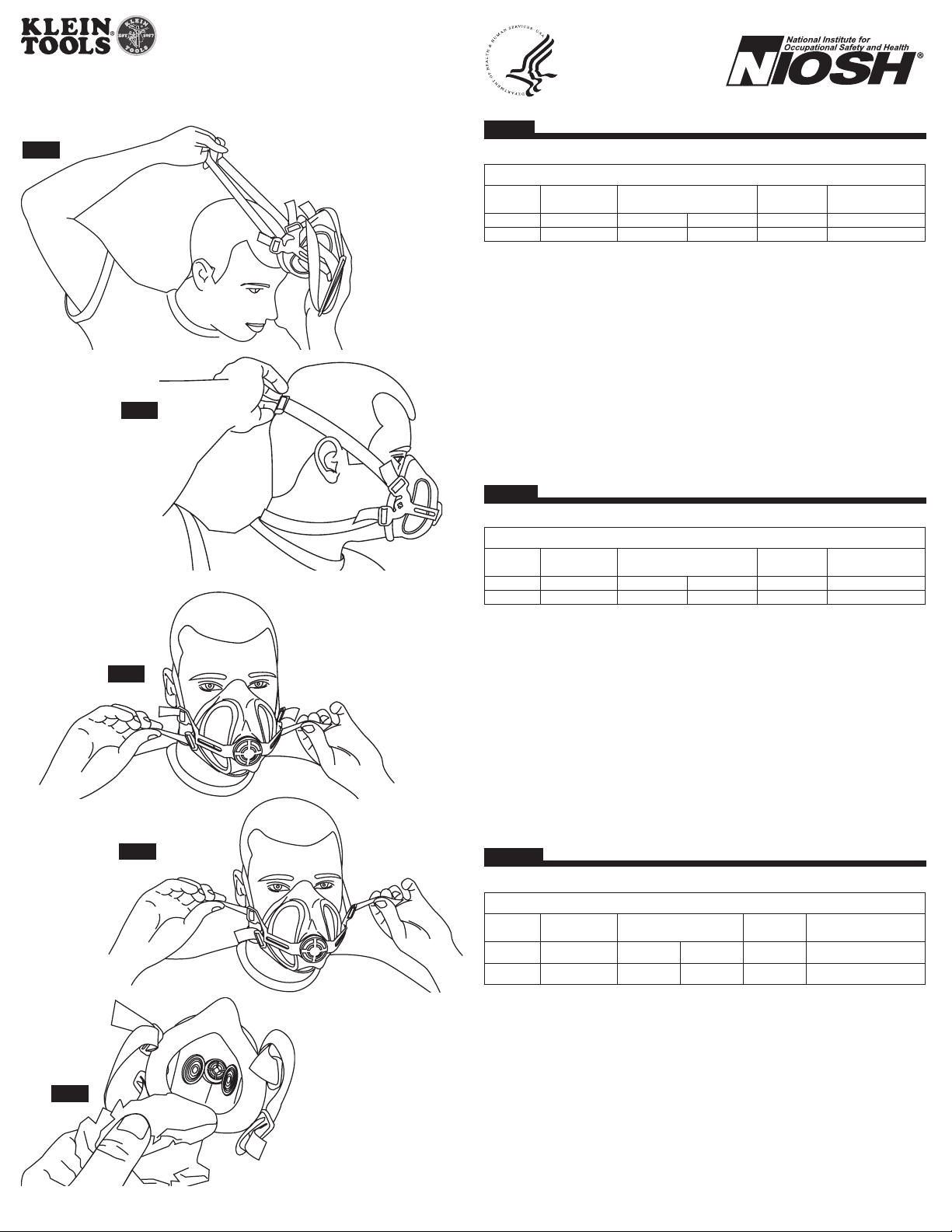
FITTING (FIG. 1, 2, 3, 4)
The respirator must be inspected by the wearer before and after each use to ensure that it is in good working
condition and valves and filters are seated correctly. Remove eyewear (if worn). If facial hair goes beyond the border
of the mask an effective seal will not be achieved and a powered respirator will be required. NOTE: OSHA regulations
require that all users be fit tested prior to use either qualitatively or quantitatively.
STEP 1 (FIG. 1): Grasp the respirator with one hand and the lower headband with the other hand, put the headband
over your head and allow to rest around the neck.
STEP 2 (FIG. 2): Place the respirator over mouth and nose then lift the upper headband over the crown of your head
to support the respirator.
STEP 3 (FIG. 3): Grip lower headband ends at the respirator buckle and gently pull towards back of head to tighten.
STEP 4 (FIG. 4): Grip upper headband ends at the respirator buckle, and gently pull towards back of head to tighten.
Check respirator is seated correctly when tight enough to prevent air leakage between respirator and face.
STEP 5: POSITIVE PRESSURE FACE FIT CHECK: Place the palm of your hand over the exhalation valve and exhale
moderately. If the face piece bulges slightly and no air leaks between the face and the face piece are detected, a
proper fit has been achieved. If air leakage is detected, reposition the respirator on the face and/or readjust the elastic
strap to eliminate the leakage.
CLEANING (FIG. 5)
DO NOT WASH FILTERS.
Clean face-piece assembly periodically with a soft cloth dampened with mild soapy water (no solvents). This will form
part of the face mask maintenance and should be logged. Deep cleaning will entail:
•
Disassemble mask by removing the filters, head straps and valves.
•
Immerse in warm water and scrub with a soft brush. A neutral detergent can be used if necessary.
•
The mask can also be soaked in a disinfectant for a short period of time.
•
104°F
Read instructions
before using
Year/Month Expiration date
(-10°C)
14°F
(40°C)
Temperature range of storage
0 – 95%
conditions
R.H.
Humidity range of storage
<95%
R.H.
conditions
Find Quality Products Online at: [email protected]
www.GlobalTestSupply.com
 Loading...