

Page 1

Springeld
Kühlschrank
Fridge
Frigoríco
Réfrigérateur
Frigorifero
10033123 10033124
Page 2

Page 3
Sehr geehrter Kunde,
wir gratulieren Ihnen zum Erwerb Ihres Gerätes. Lesen Sie
die folgenden Hinweise sorgfältig durch und befolgen Sie
diese, um möglichen Schäden vorzubeugen. Für Schäden,
die durch Missachtung der Hinweise und unsachgemäßen
Gebrauch entstehen, übernehmen wir keine Haftung. Scannen
Sie den folgenden QR-Code, um Zugriff auf die aktuellste
Bedienungsanleitung und weitere Informationen rund um das
Produkt zu erhalten:
INHALTSVERZEICHNIS
DE
Sicherheitshinweise4
Türdrehung5
Geräteübersicht7
Bedienung8
Reinigung und Pege9
Fehlerbehebung9
Hinweise zur Entsorgung10
TECHNISCHE DATEN
Artikelnummer 10033123, 10033124
Stromversorgung 220-240 V ~ 50/60 Hz
KONFORMITÄTSERKLÄRUNG
Hersteller:
Chal-Tec GmbH, Wallstraße 16, 10179 Berlin, Deutschland.
Dieses Produkt entspricht den folgenden Europäischen
Richtlinien:
2014/30/EU (EMV)
2014/35/EU (LVD)
2011/65/EU (RoHS)
643/2009/EG (ErP)
1060/2010/EU (ErP)
English 11
Français 19
Español 27
Italiano 35
3
Page 4

DE
SICHERHEITSHINWEISE
Dieses Gerät enthält das Kältemittel Isobutan (R600a), ein Naturgas mit hoher
Umweltverträglichkeit, aber brennbar. Obwohl es brennbar ist, schädigt es nicht
die Ozonschicht und verstärkt nicht den Treibhauseffekt. Die Verwendung dieses
Kältemittels führt zu einer etwas höheren Geräuschentwicklung des Gerätes.
Zusätzlich zum Kompressorgeräusch können Sie den Fluss des Kältemittels hören.
Dies ist unvermeidlich und hat keine negative Wirkung auf die Leistung des Gerätes.
Seien Sie während des Transports vorsichtig, so dass der Kältemittelkreislauf nicht
beschädigt wird. Kältemittellecks können die Augen reizen.
Besondere Hinweise
• Kinder im Alter von 3 bis 8 Jahren dürfen Kühlgeräte beladen und entladen.
• Achten Sie bei der Positionierung des Gerätes darauf, dass das Netzkabel nicht
eingeklemmt oder beschädigt ist.
• Achten Sie darauf, dass sich keine Mehrfachsteckdosen oder Netzteile auf der
Rückseite des Geräts be nden.
Um eine Kontamination von Lebensmitteln zu vermeiden, beachten Sie bitte die
folgenden Anweisungen:
• Ein längeres Öffnen der Tür kann zu einem deutlichen Temperaturanstieg in den
Fächern des Gerätes führen.
• Reinigen Sie regelmäßig Ober ächen, die mit Lebensmitteln in Berührung kommen
können. Reinigen Sie Regelmäßig den Wasserablauf.
• Lagern Sie rohes Fleisch und Fisch in geeigneten Behältern im Kühlschrank, damit
Fleisch und Fisch nicht mit anderen Lebensmitteln in Berührung kommt oder auf
diese tropft.
Hinweise zu den Tiefkühlfächern
• Zwei-Sterne-Tiefkühlfächer eignen sich für die Lagerung von vorgefrorenen Lebensmitteln,
die Lagerung oder Herstellung von Eiscreme und die Herstellung von Eiswürfeln.
• Ein-, Zwei- und Drei-Sterne-Tiefkühlfächer sind nicht für das Einfrieren von frischen
Lebensmitteln geeignet.
• Wenn das Kühlgerät über einen längeren Zeitraum leer bleibt, schalten Sie es aus,
lassen Sie es abtauen, reinigen Sie es, trocknen Sie es und lassen Sie die Tür offen,
damit sich kein Schimmel im Gerät bildet.
WARNUNG
Achten Sie bei Gebrauch, Wartung und Entsorgung des Gerätes auf
das linke Symbol, das sich auf der Rückseite oder am Kompressor des
Gerätes be ndet. Dieses Symbol warnt vor möglichen Bränden. In den
Kältemittelleitungen und im Kompressor be nden sich brennbare Stoffe.
Halten Sie das Gerät bei Gebrauch, Wartung und Entsorgung von
Feuerquellen fern.
4
Page 5
TÜRDREHUNG
Sie benötigen: Kreuzschlitzschraubenzieher, Flacher Schraubenzieher,
Sechskantschlüssel.
Wichtige Hinweise
• Vergewissern Sie sich, dass das Gerät ausgesteckt und leer ist.
• Zum Abnehmen der Tür muss das Gerät nach hinten gekippt werden.
• Sie sollten das Gerät auf etwas Festes stellen, so dass es beim Kippen nicht
verrutscht.
• Alle entfernten Teile müssen für den Wiedereinbau der Tür aufbewahrt werden.
• Legen Sie das Gerät nicht ach hin, da dies das Kühlsystem beschädigen kann.
• Es ist besser, wenn 2 Personen das Gerät während der Montage halten.
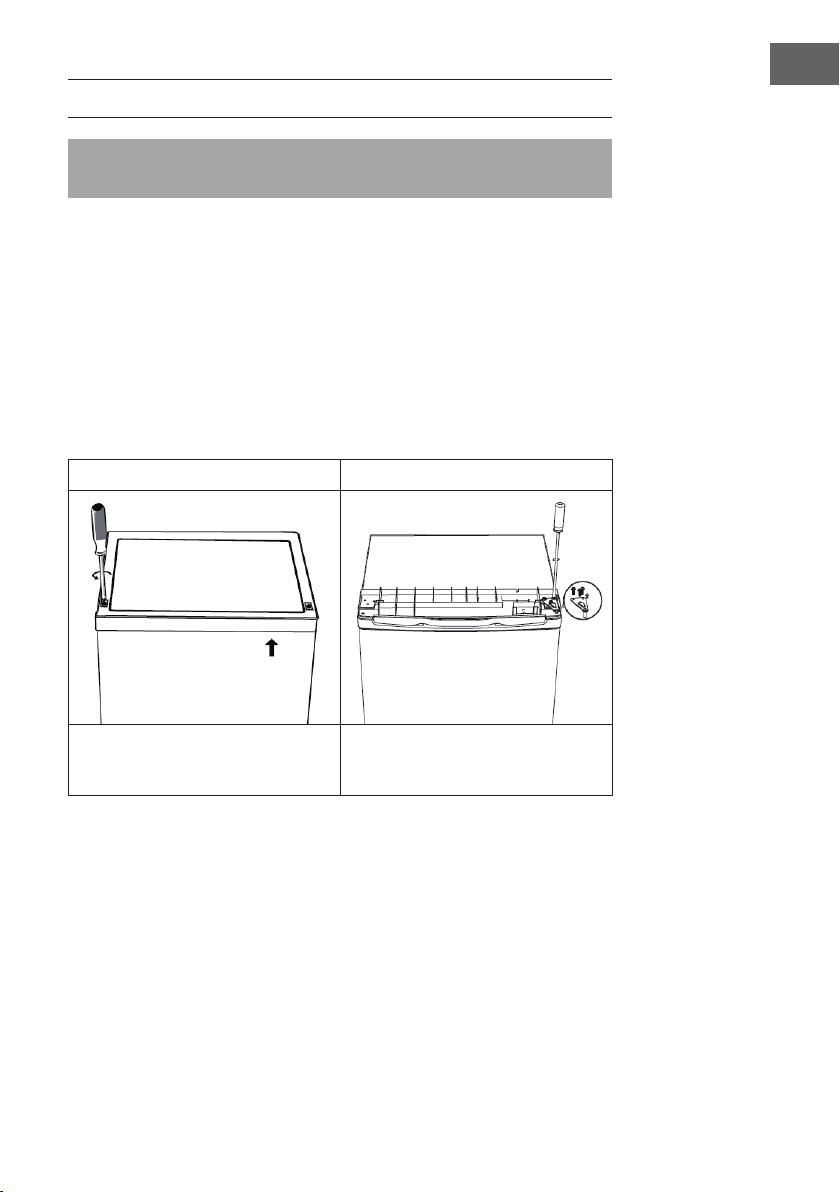
Türdrehung
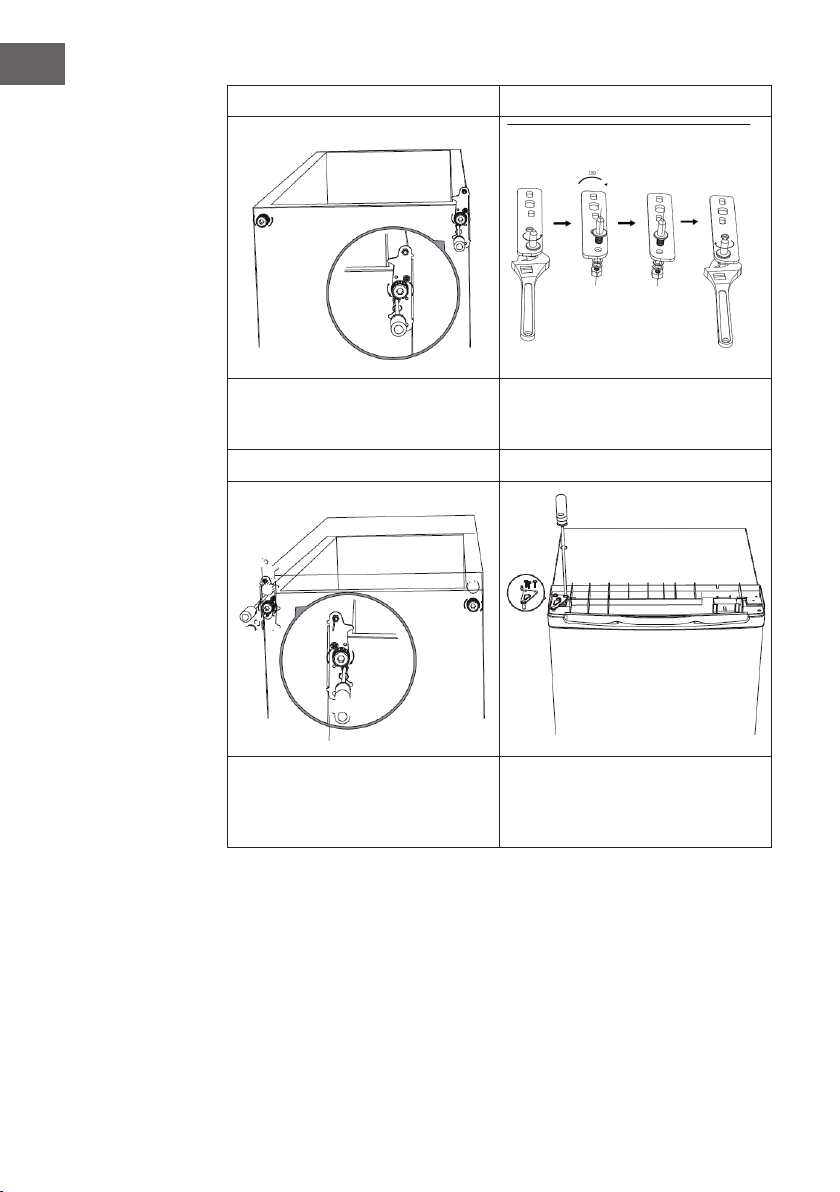
1 2
DE
Entfernen Sie die Schrauben der
Abdeckung und nehmen Sie die
Abdeckung ab.
Lösen Sie die Schrauben und entfernen
Sie die obere Aufhängung.
5
Page 6
DE
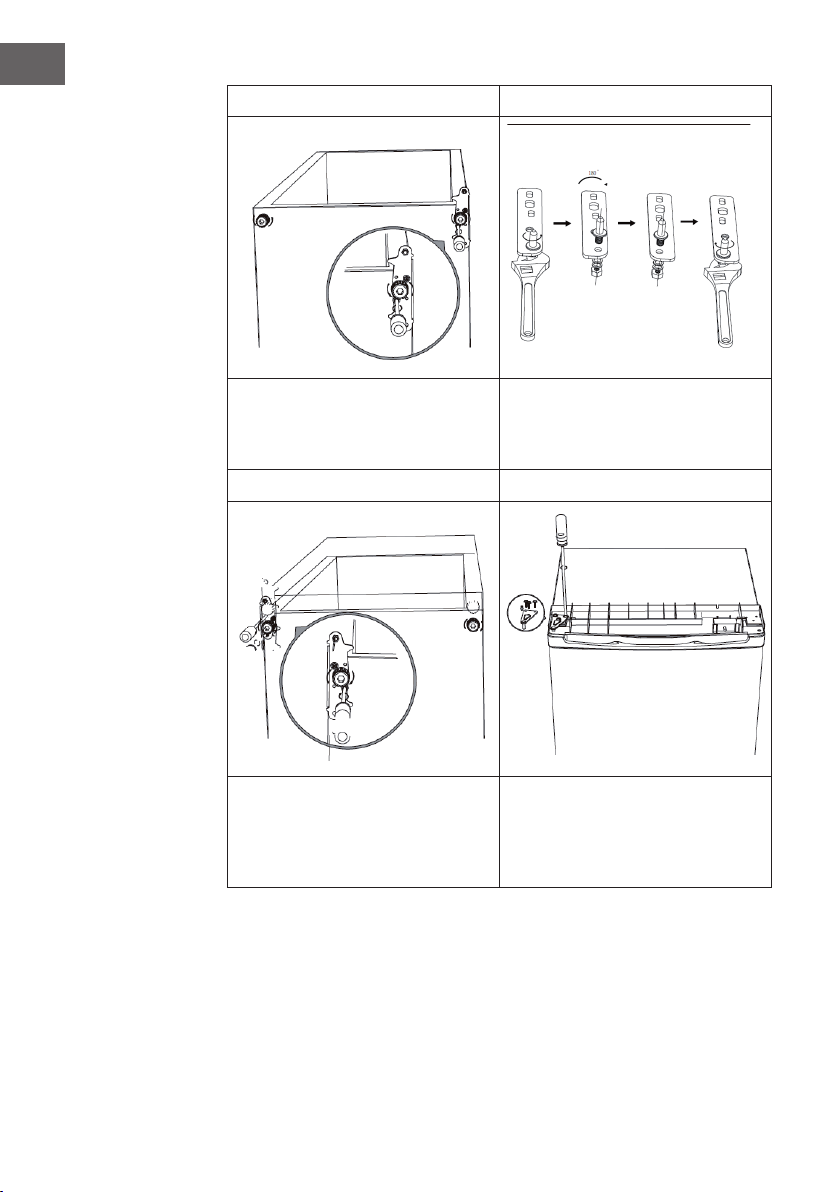
3 4
Entfernen Sie die untere Aufhängung und
die verstellbaren Füße.
5 6
Bringen Sie die untere Aufhängung
an der gegenüberliegenden Seite
an. Bringen Sie die Füße an der
gegenüberliegenden Seite an.
Entfernen Sie den Stift an der unteren
Aufhängung. Drehen Sie die Aufhängung
um 180° und installieren Sie den Stift
wieder.
Platzieren Sie die Tür auf der unteren
Aufhängung und richten Sie sie gerade
aus. Befestigen Sie dann die obere
Aufhängung. Befestigen Sie zum Schluss
die Obere Abdeckung mit 2 Schrauben.
6
Page 7
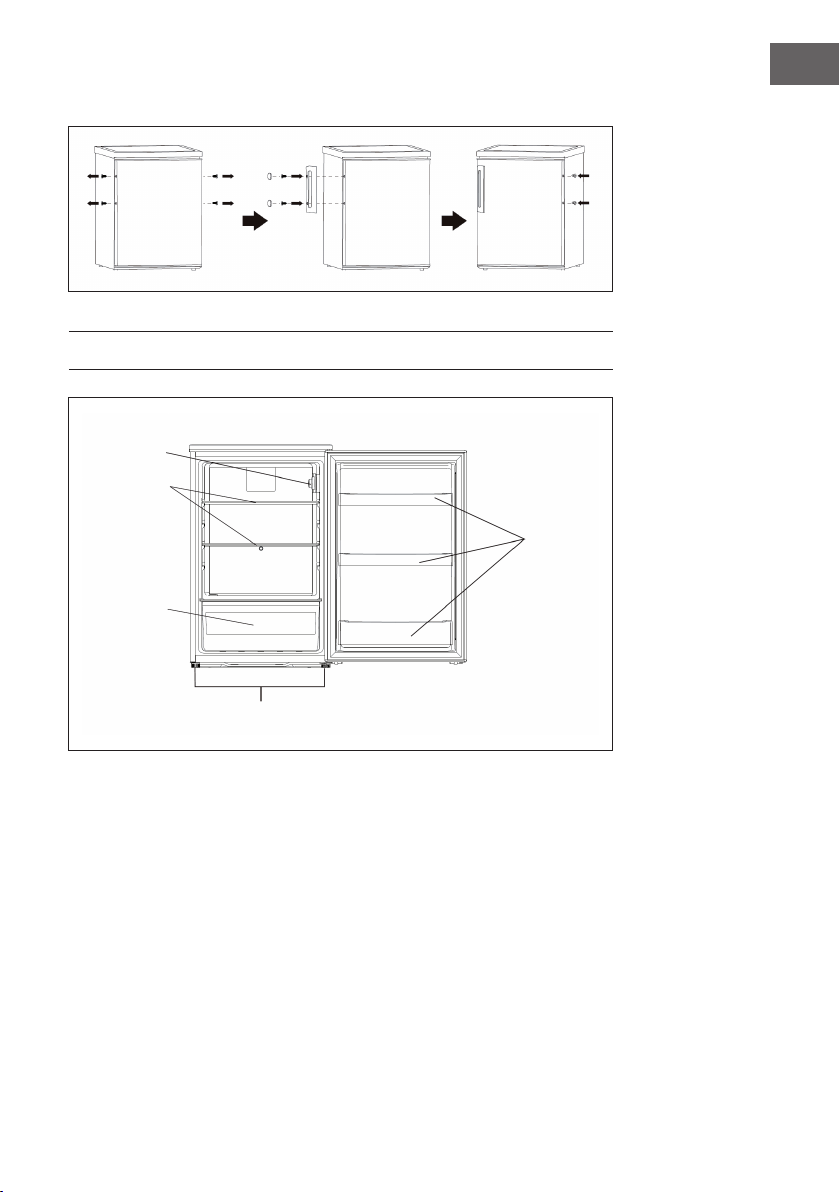
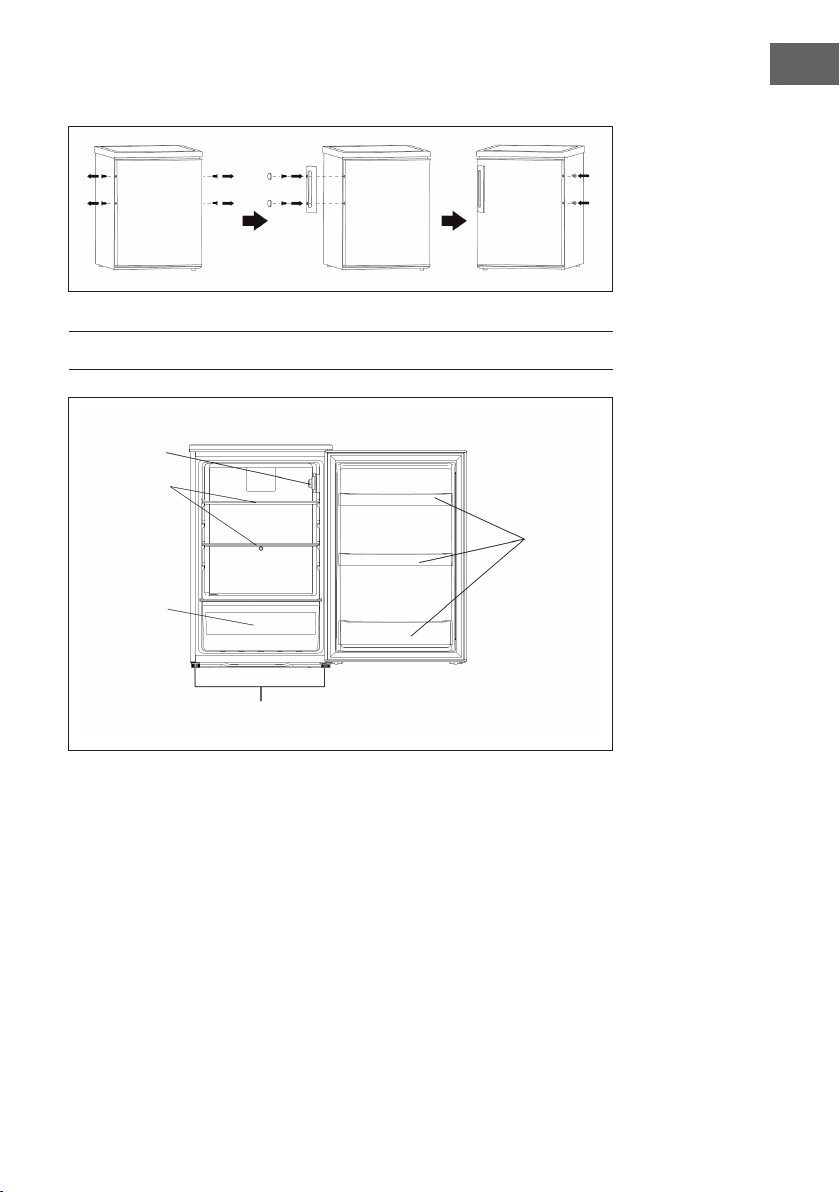
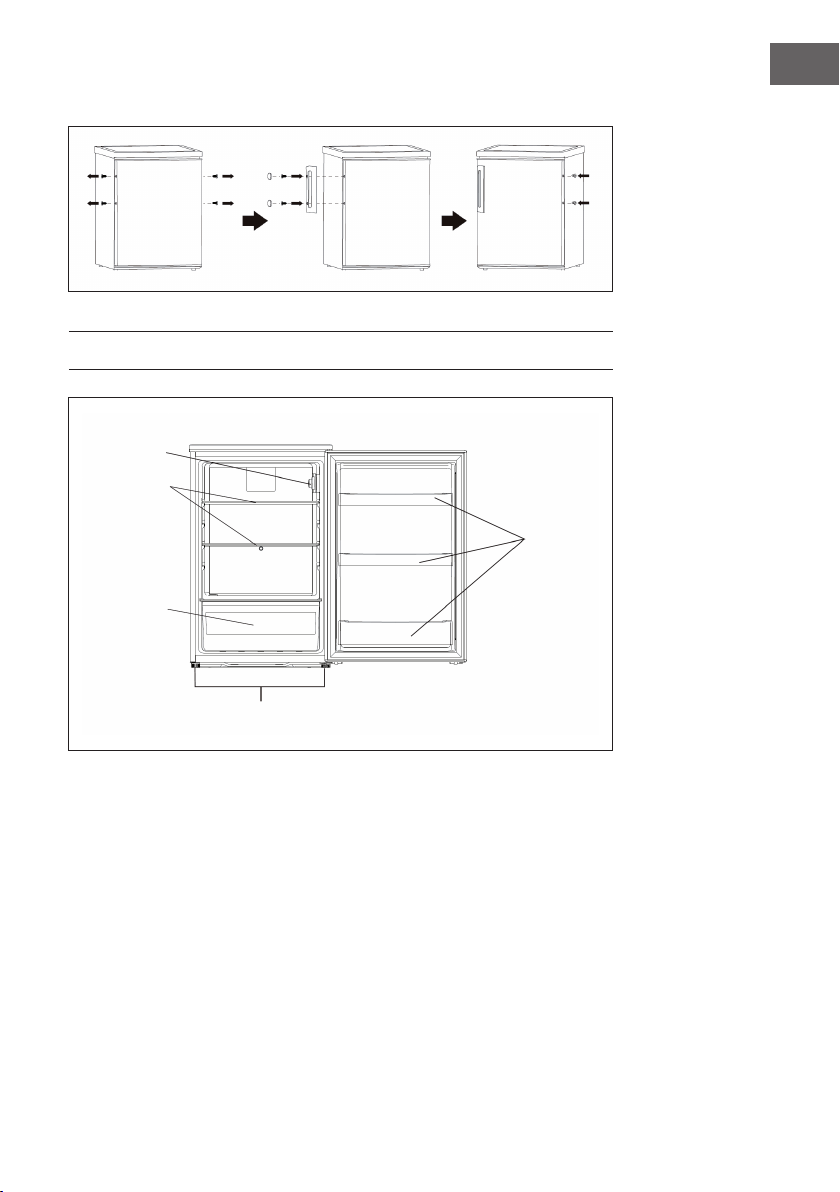
So befestigen Sie den Türgriff
GERÄTEÜBERSICHT
Thermostat
Regale
Schublade
DE
Fächer
Stellfüße
7
Page 8
DE
BEDIENUNG
Hinweis: Bevor Sie das Gerät zum ersten Mal benutzen, waschen Sie den
Innenraum und das Zubehör mit lauwarmem Wasser und etwas Spülmittel ab, um
den typischen Geruch des neuen Produktes zu entfernen. Trocknen Sie den Innenraum
und alle Teile danach sorgfältig ab.
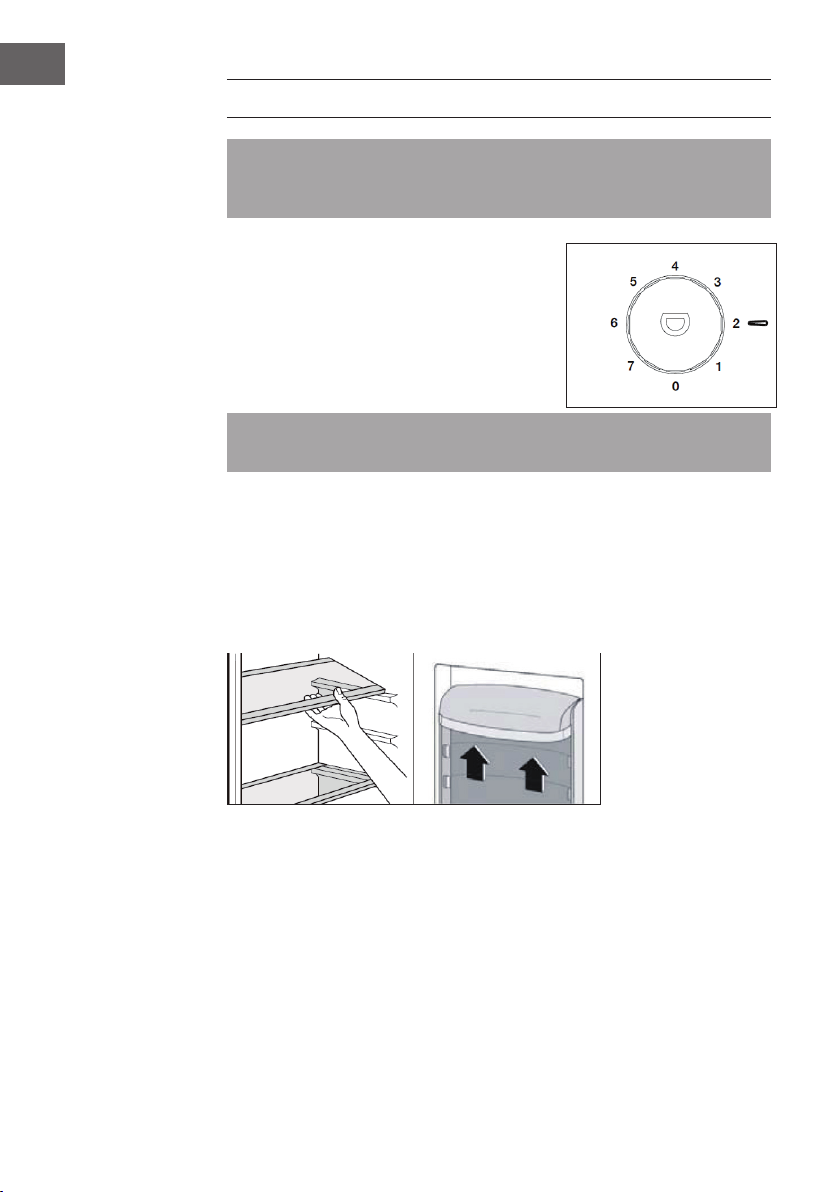
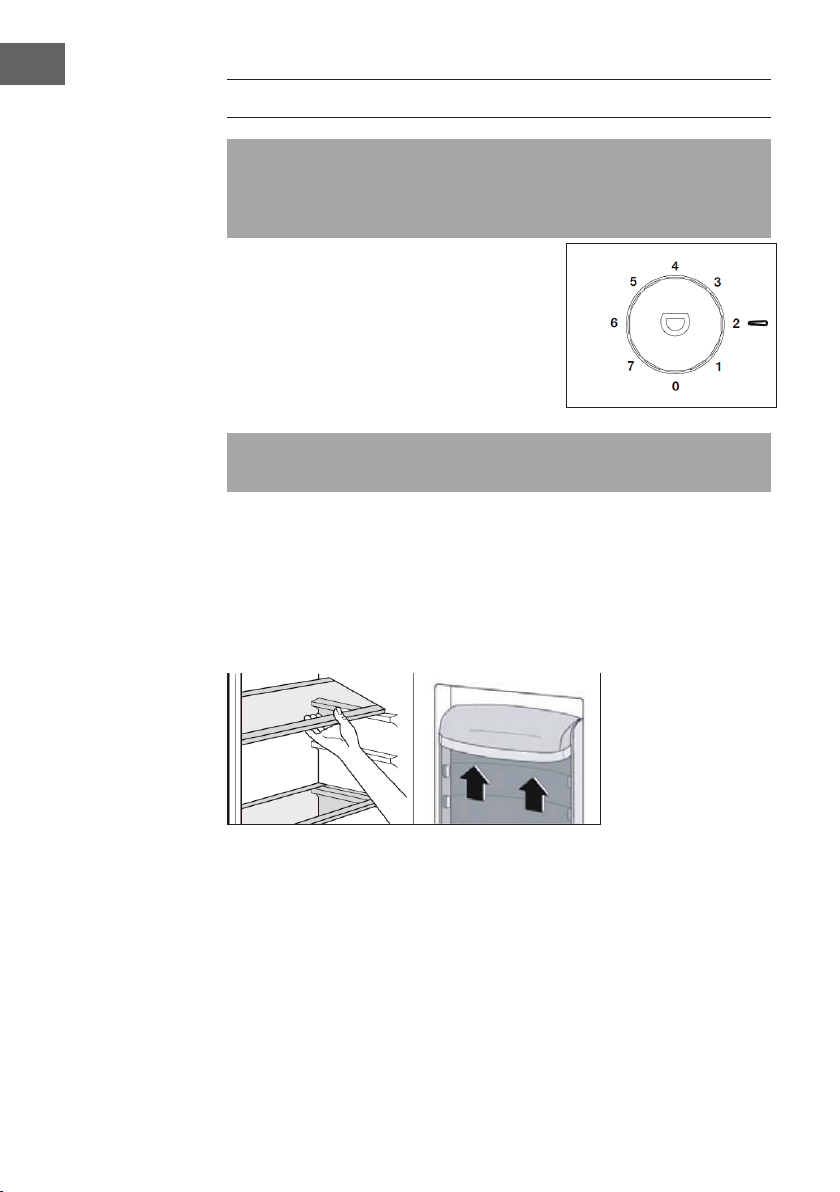
Temperatur einstellen
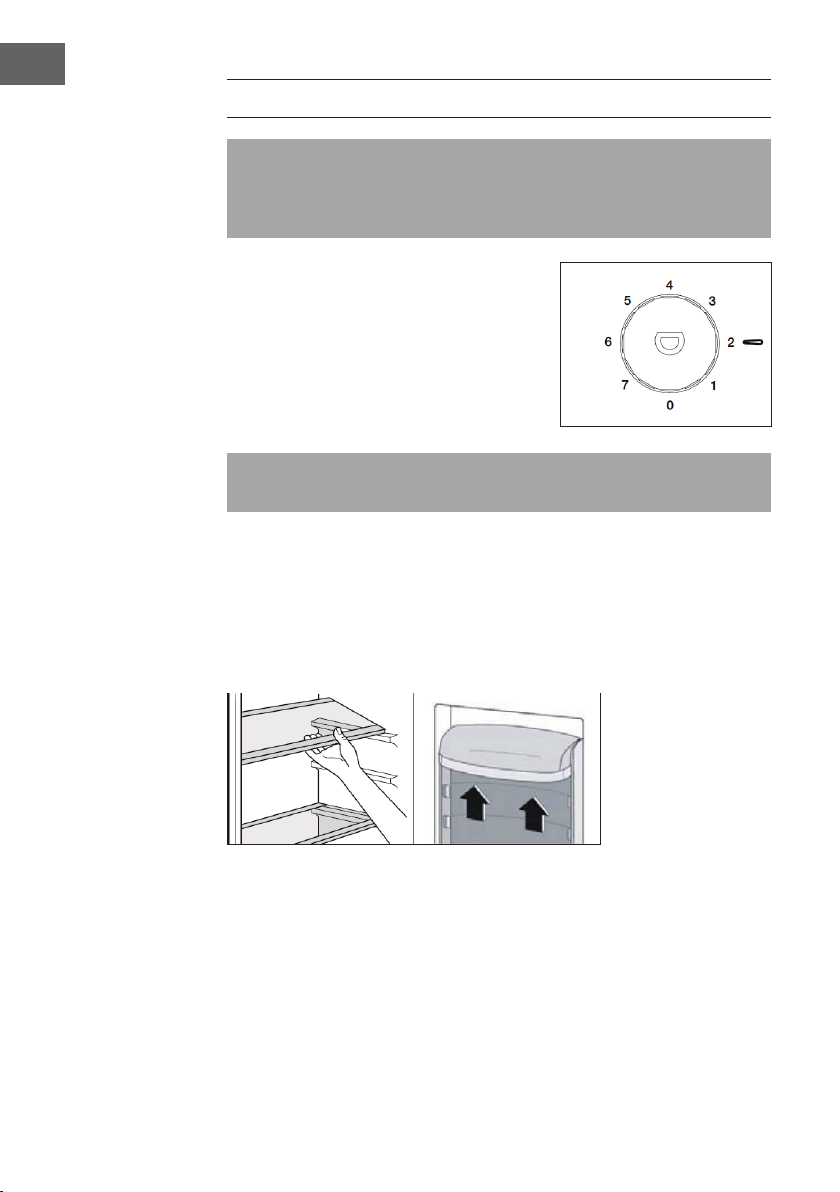
Stecken Sie den Stecker in die Steckdose. Der
Thermostat hat 8 Einstellungen. [1] ist die am
wenigsten kalte Einstellungen, [8] die kälteste
Einstellungen. Wenn Sie [0] einstellen, ist der
Kühlschrank aus.
Hinweis: Wenn die Umgebungstemperatur sehr hoch ist oder die Tür oft geöffnet
wird kann es sein, dass die gewünschte Temperatur nicht erreicht wird.
Positionierung der Regale und Türfächer
Der Kühlschrank ist mit mehreren Regalen ausgestattet, die beliebig positioniert werden
können. Um die Lagerung von Lebensmittelverpackungen unterschiedlicher Größe zu
ermöglichen, können die Türfächer in verschiedenen Höhen angebracht werden. Ziehen
Sie den Balkon dafür in Richtung der Pfeile, bis er sich löst und positionieren Sie ihn
dann nach Bedarf.
8
Page 9
REINIGUNG UND PFLEGE
• Reinigen Sie den Kühlschrank einmal im Monat.
• Ziehen Sie immer zuerst den Stecker aus der Steckdose, bevor Sie das Gerät
reinigen.
• Wischen sie den Innenraum mit einem feuchten Tuch ab. Falls er sehr dreckig ist,
verwenden Sie zusätzlich etwas Neutralreiniger und trocknen Sie hinterher alles mit
einem trockenen Lappen ab. Die Glasablagen können mit Glasreiniger gereinigt
werden.
• Benutzen Sie zur Reinigung kein heißes Wasser, Petroleum, Alkohol, Kerosin,
Waschmittel, alkalische Reiniger, Säure oder chemische Reiniger, um den Lack und
die Plastikteile nicht zu beschädigen. Besprühen Sie den Kühlschrank nicht direkt mit
Wasser, da er sonst schnell zu rosten beginnt oder undicht wird.
• Reinigen Sie die Dichtungen regelmäßig, um ihre Lebensdauer zu erhöhen.
FEHLERBEHEBUNG
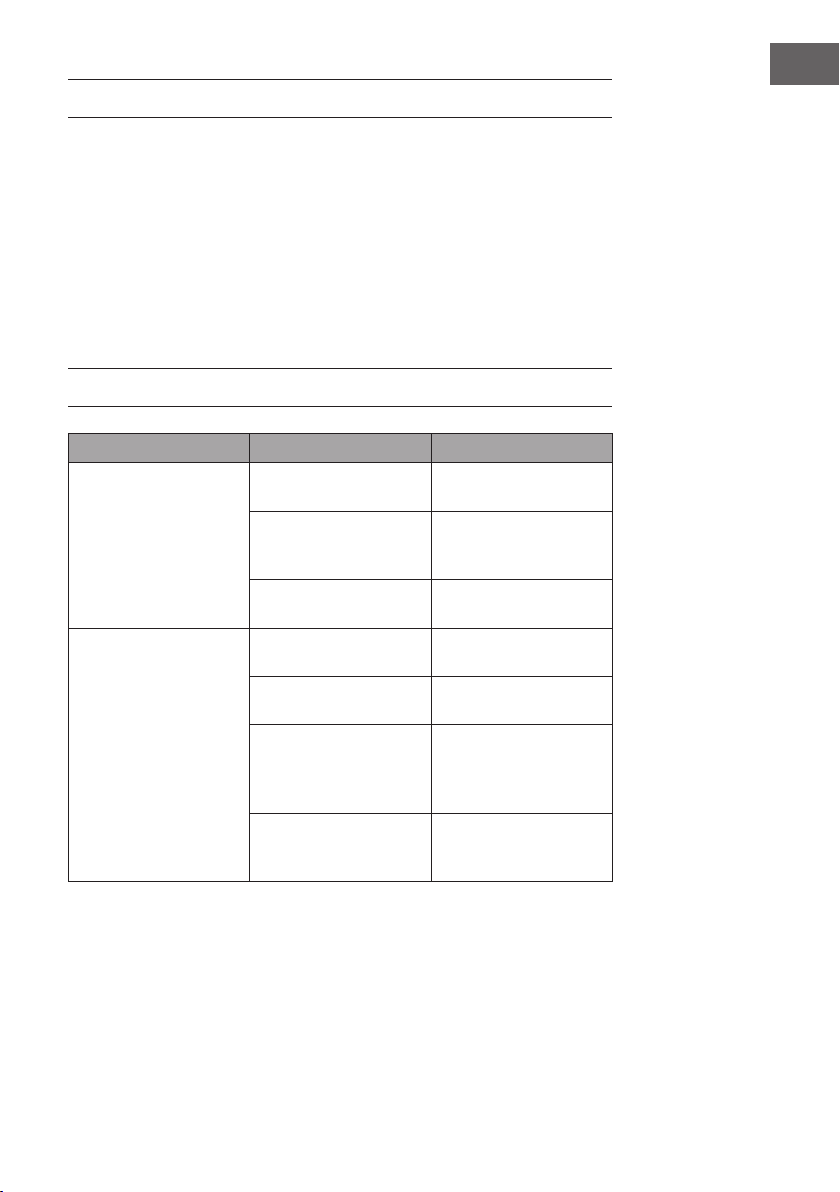
Problem Mögliche Ursache Lösungsansatz
Das Gerät läuft nicht. Der Thermostat steht auf 0. Drehen Sie den Thermostat
auf die gewünschte Stufe.
Der Stecker ist nicht
eingesteckt oder lose.
Die Sicherung ist raus oder
Kaputt.
Das Essen ist warm. Die Temperatur ist nicht
richtig eingestellt
Die Tür wurde häug
geöffnet.
Eine große Menge warmer
Lebensmittel wurde in den
Kühlschrank gegeben.
Das Gerät steht neben
einer Wärmequelle.
Stecken Sie den Stecker
fest in die Steckdose.
Prüfen Sie die Sicherung.
Stellen Sie die Temperatur
auf eine kühlere Stufe.
Öffnen Sie die Tür so
selten, wie möglich.
Stellen Sie die Temperatur
auf eine kühlere Stufe.
Stellen Sie das Gerät an
einem anderen Ort auf.
DE
9
Page 10
DE
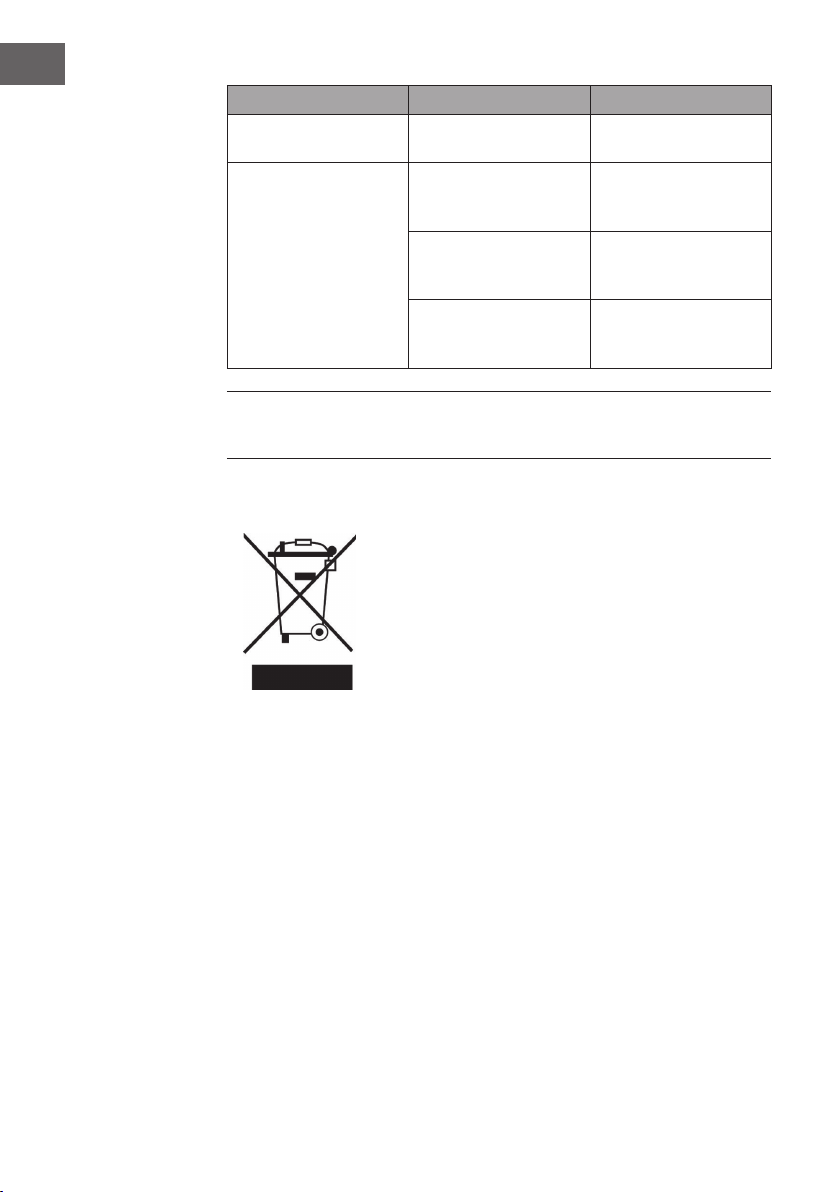
Problem Mögliche Ursache Lösungsansatz
Das Gerät kühlt zu stark. Die Temperatur ist nicht
richtig eingestellt
Ungewöhnliche
Geräusche
Das Gerät steht nicht eben. Stellen Sie die Füße richtig
Das Gerät berührt eine
Wand oder einen anderen
Gegenstand.
Eine Gerätekomponente
berührt einen anderen Teil
des Geräts.
Stellen Sie die Temperatur
auf eine weniger kühle
Stufe.
ein.
Achten Sie darauf, dass
das Gerät frei steht.
Falls möglich versuche
sie die Komponente leicht
wegzudrehen.
HINWEISE ZUR ENTSORGUNG
Bendet sich die linke Abbildung (durchgestrichene Mülltonne
auf Rädern) auf dem Produkt, gilt die Europäische Richtlinie
2012/19/EU. Diese Produkte dürfen nicht mit dem normalen
Hausmüll entsorgt werden. Informieren Sie sich über die
örtlichen Regelungen zur getrennten Sammlung elektrischer
und elektronischer Gerätschaften. Richten Sie sich nach
den örtlichen Regelungen und entsorgen Sie Altgeräte nicht
über den Hausmüll. Durch die regelkonforme Entsorgung
der Altgeräte werden Umwelt und die Gesundheit ihrer
Mitmenschen vor möglichen negativen Konsequenzen
geschützt. Materialrecycling hilft, den Verbrauch von
Rohstoffen zu verringern.
10
Page 11
Dear Customer,
Congratulations on purchasing this equipment. Please read
this manual carefully and take care of the following hints to
avoid damages. Any failure caused by ignoring the items and
cautions mentioned in the instruction manual is not covered
by our warranty and any liability. Scan the QR code to get
access to the latest user mannual and other information about
the product
CONTENT
Safety Instructions12
Reverse Door13
Product Overview15
Operation16
Cleaning and Care17
Troubleshooting17
Hints on Disposal18
TECHNICAL DATA
Item number 10033123, 10033124
Power supply 220-240 V ~ 50/60 Hz
EN
DECLARATION OF CONFORMITY
Producer:
Chal-Tec GmbH, Wallstraße 16, 10179 Berlin, Germany.
This product is conform to the following European
Directives:
2014/30/EU (EMC)
2014/35/EU (LVD)
2011/65/EU (RoHS)
643/2009/EG (ErP)
1060/2010/EU (ErP)
11
Page 12

EN
SAFETY INSTRUCTIONS
This appliance contains the coolant isobutane (R600a), a natural gas which
is environmentally friendly. Although it is ammable, it does not damage the
ozone layer and does not increase the greenhouse effect. The use of this coolant
has,however,led to a slight increase in the noise level of the appliance. In addition to
the noise of the compressor,you might be able to hear the coolant owing around the
system. This is unavoidable,and does not have any adverse effect on the performance
of the appliance. Care must be taken during the transportation and setting up of the
appliance that no parts of the cooling system are damaged. Leaking coolant can
damage the eyes.
Special Notes
• Children between the ages of 3 and 8 are allowed to load and unload
refrigerators.
• When positioning the unit, make sure that the power cord is not pinched or
damaged.
• Make sure that there are no multiple sockets or power supplies on the back of the
unit.
To avoid contamination of food, please follow the instructions below:
• A prolonged opening of the door can lead to a signi cant rise in temperature in the
compartments of the appliance.
• Regularly clean surfaces that may come into contact with food. Clean the water
drain regularly.
• Store raw meat and sh in suitable containers in the refrigerator so that meat and
sh do not come into contact with or drip on other foods.
Notes on the freezer compartments
• Two-star freezer compartments are suitable for storing pre-frozen foods, storing or
making ice cream and making ice cubes.
• One-, two- and three-star freezer compartments are not suitable for freezing fresh
food.
• If the refrigerator remains empty for an extended period, turn it off, defrost it, clean
it, dry it and leave the door open to prevent mould from forming in the appliance.
WARNING
When using, servicing and disposing of the unit, pay attention to the left
symbol on the rear of the unit or on the compressor. This symbol warns
of possible res. There are ammable substances in the refrigerant lines
and in the compressor. Keep the appliance away from sources of re
during use, maintenance and disposal.
12
Page 13
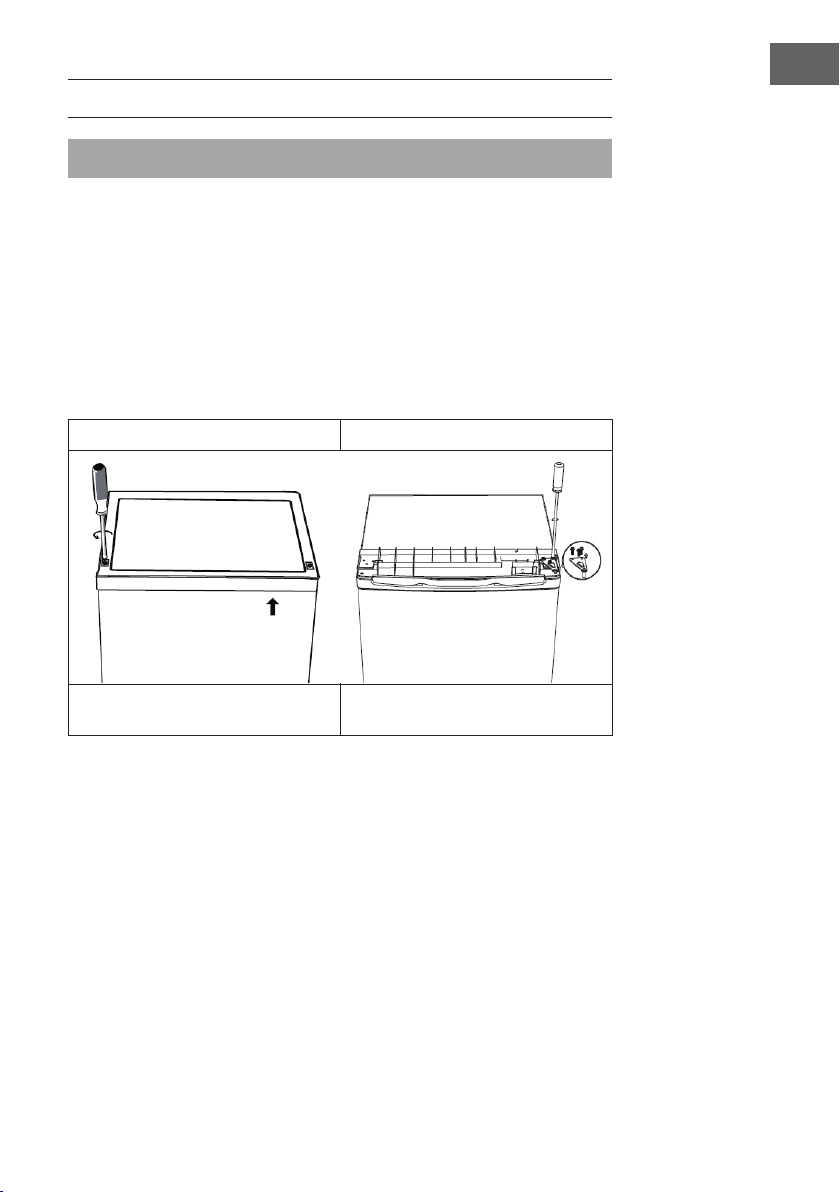
REVERSE DOOR
You need: Phillips screwdriver, at-bladed screwdriver, Allen wrench.
Important information
• Make sure the device is unplugged and empty.
• To remove the door, the device must be tilted backwards.
• You should set the unit on something rm so that it does not slip when tilted.
• All removed parts must be kept for reinstallation of the door.
• Do not lay the unit at, as this can damage the cooling system.
• It is better if 2 people hold the device during installation.
Door rotation
1 2
EN
Remove the cover screws and remove
the cover.
Loosen the screws and remove the upper
hinge.
13
Page 14
EN
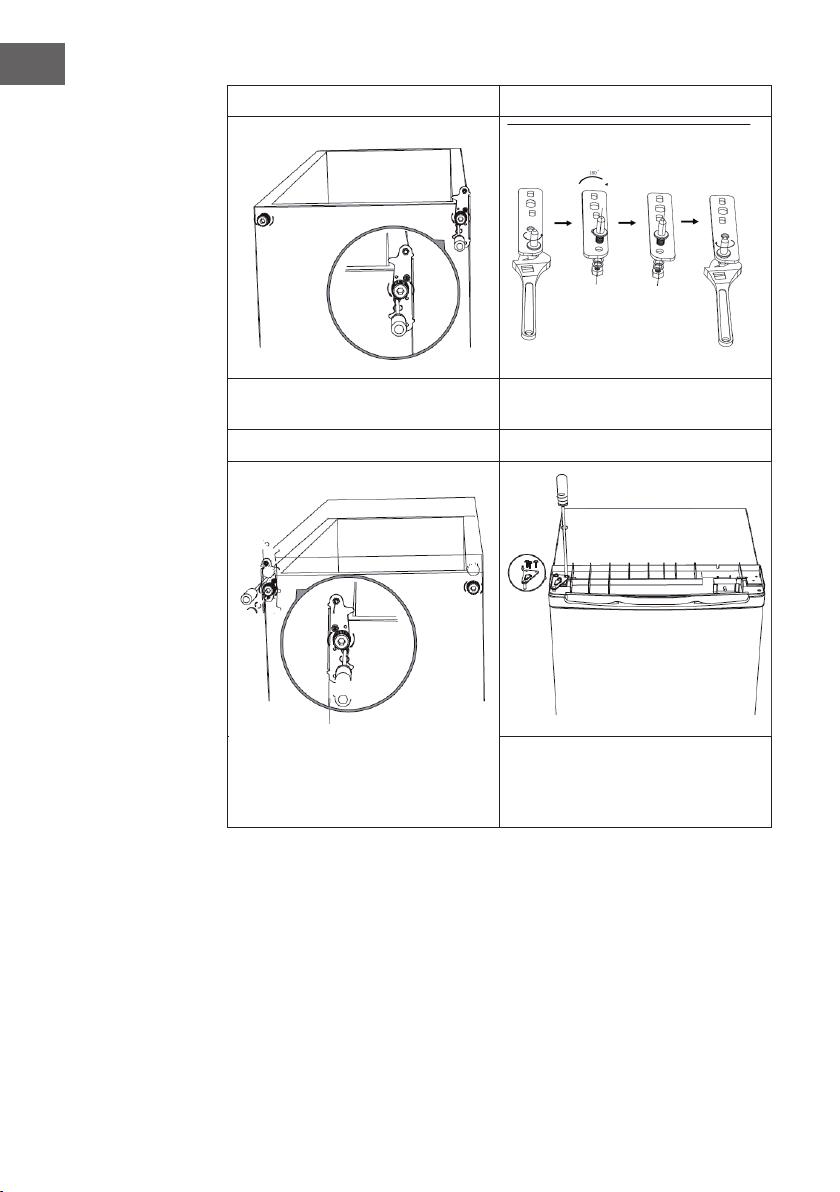
3 4
Remove the lower hinge and the
adjustable feet.
5 6
Attach the lower hinge to the opposite
side. Attach the feet to the opposite side.
Remove the pin from the lower hinge.
Turn the hinge 180° and reinstall the pin.
Place the door on the lower hinge and
straighten it. Then attach the upper
hinge. Finally, fasten the top cover with
2 screws.
14
Page 15
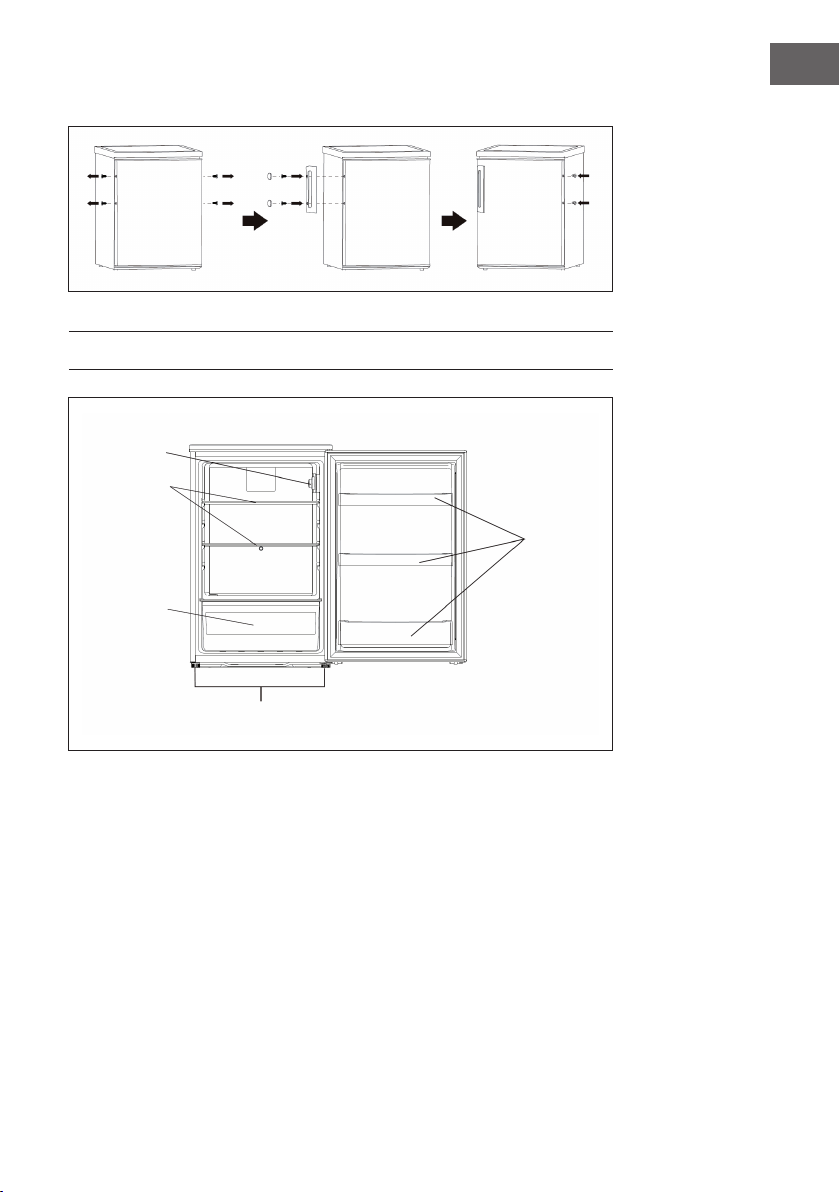
Install door handle
PRODUCT OVERVIEW
Thermostat
Shelves
Crisper
EN
Balconies
Levelling feet
15
Page 16
EN
OPERATION
Note: Before using the appliance for the rst time, wash the interior and accessories
with lukewarm water and a little detergent to remove the typical smell of the new
product. Dry the interior and all parts carefully afterwards.
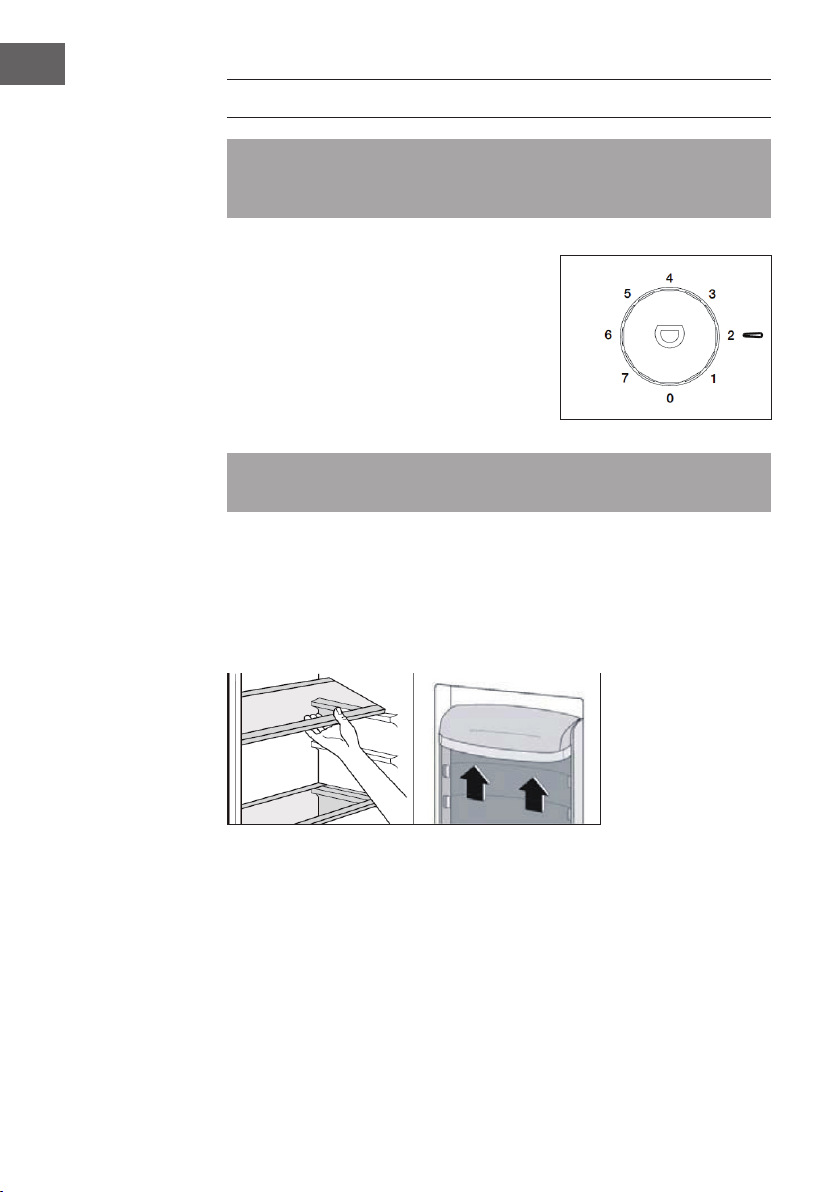
Temperature Setting
Plug on your appliance. The internal temperature
is controlled by a thermostat. There are 8 settings.
[1] is warm est setting and [7] is coldest setting.
[0] is to turn off the appliance.
Note: The appliance may not operate at the correct temperature if it is in a
particularly hot or if you open the door often.
Positioning of shelves and door compartments
The refrigerator is equipped with several shelves that can be positioned as required. To
enable the storage of food packaging of different sizes, the door compartments can
be mounted at different heights. To do this, pull the balcony towards the arrows until it
detaches and then position it as required.
16
Page 17
CLEANING AND CARE
• The refrigerator should be cleaned and maintained once a month.
• When performing maintenance, make absolutely sure that the power plug is rst
disconnected from the power outlet.
• Wipe the inner and outer surface of the refrigerator and its accessories with wet
cloth, if they are too dirty, scrub them with neutral detergent and then clean them
with water and dry them with clean cloth. After this, a small quantify of glass wax is
recommended to polish the refrigerator surface with a annelette.
• For cleaning don’t use hot water, diluent, petrol, alcohol, kerosene, washing
powder, cleanser, aikallinous detergent, acid, chemical cloth, etc. So as not
damaged the lacquer coat and plastics it is forbidden than the refrigerators directly
with water. Otherwise, it would cause rusty or weaken the insulation.
• Be careful to upkeep the sealing rubber bars of the doors. They should always be
cleaned.
TROUBLESHOOTING
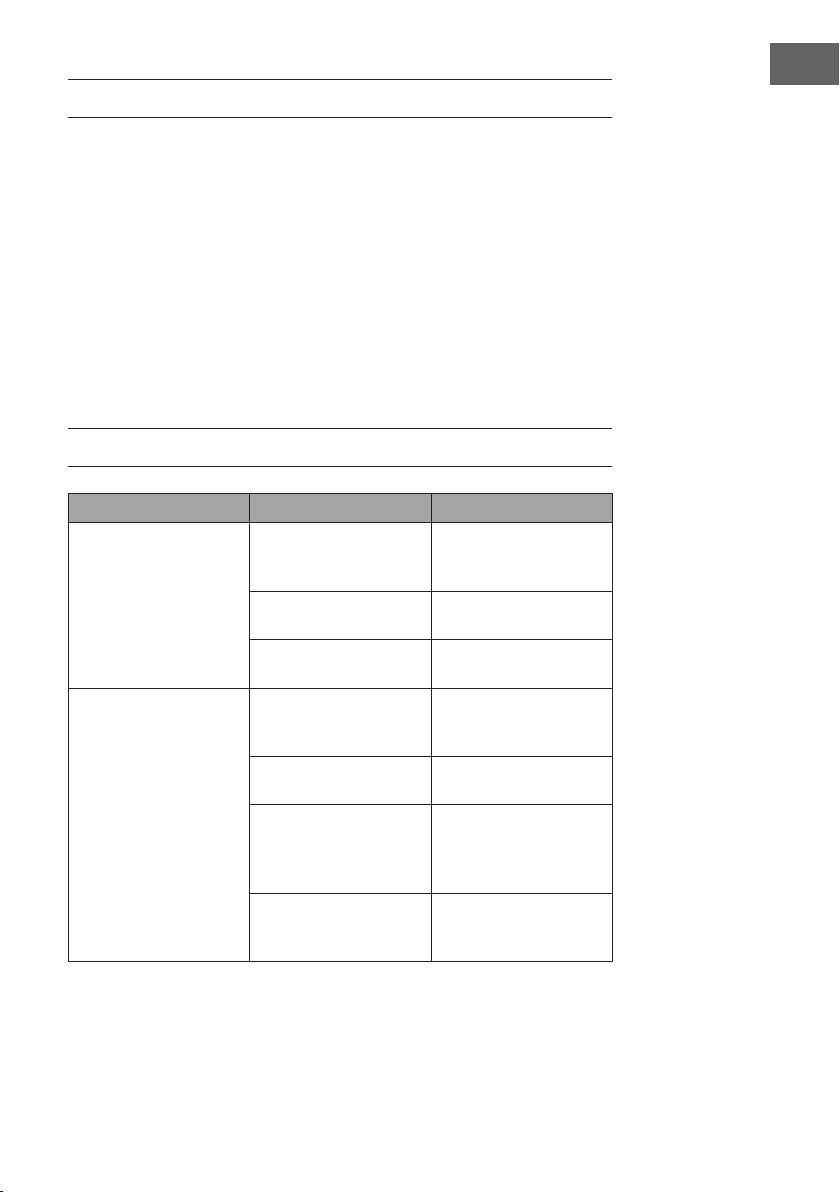
Problem Possible cause Solution
Appliance does not work. Temperature regulation
knob is set at number “0”.
Mains plug is not plugged
in or is loose
Fuse has blown or is
defective
The food is too warm. Temperature is not properly
adjusted.
Door was open for an
extended period.
A large quantity of warm
food was placed in the
appliance within the last
24 hours.
The appliance is near a
heat source.
Set the knob at other
number to switch on the
appliance.
Insert mains plug.
Check fuse, replace if
necessary.
Please look in the initial
Temperature Setting
section.
Open the door only as
long as necessary.
Turn the temperature
regulation to a colder
setting temporarily.
Please look in the
installation location
section.
EN
17
Page 18
EN
Problem Possible cause Solution
Appliance cools too much. Temperature is set too cold. Turn the temperature
regulation knob to a
warmer setting temporarily.
Unusual noises. Appliance is not level. Re-adjust the feet.
The appliance is touching
the wall or other objects.
A component, e.g. a
pipe, on the rear of the
appliance is touching
another part of the
appliance or the wall.
Move the appliance
slightly.
If necessary, carefully
bend the component out of
the way.
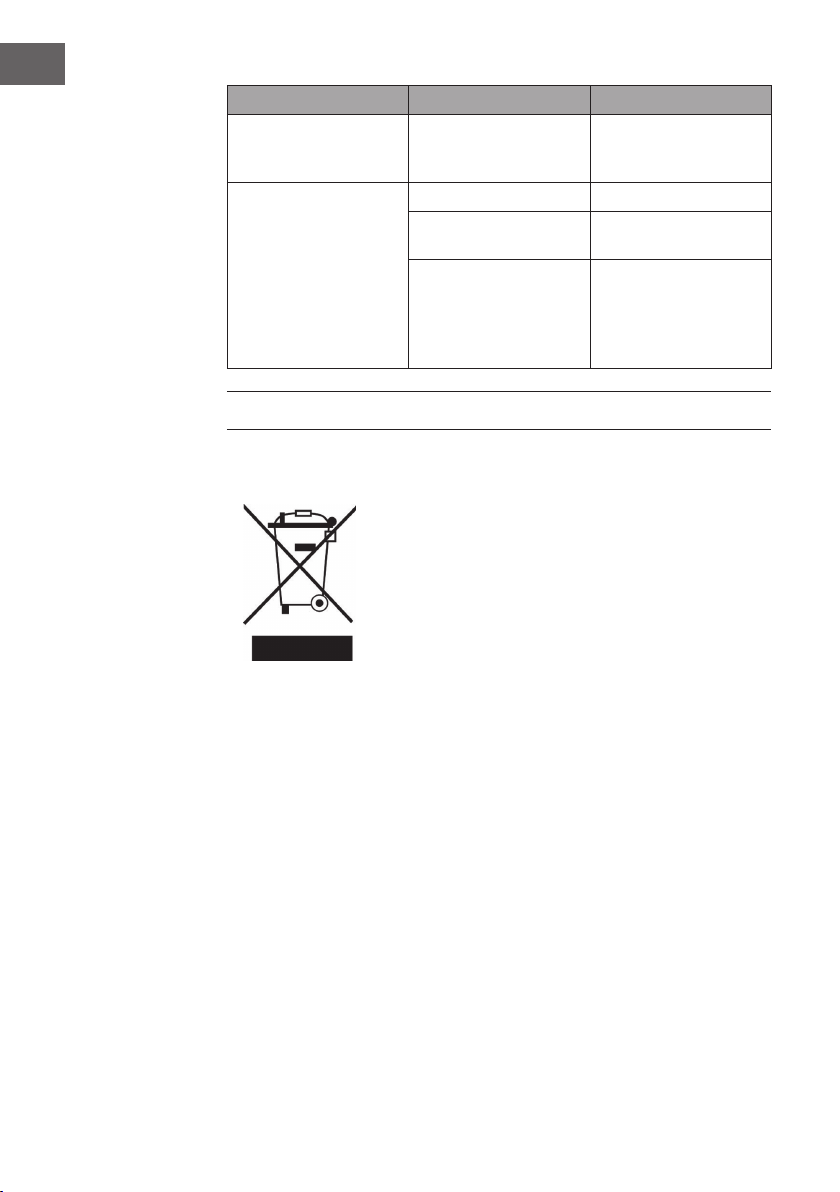
HINTS ON DISPOSAL
According to the European waste regulation 2012/19/EU this
symbol on the product or on its packaging indicates that this
product may not be treated as household waste. Instead it should
be taken to the appropriate collection point for the recycling of
electrical and electronic equipment. By ensuring this product is
disposed of correctly, you will help prevent potential negative
consequences for the environment and human health, which
could otherwise be caused by inappropriate waste handling of
this product. For more detailled information about recycling of
this product, please contact your local council or your household
waste disposal service.
18
Page 19
Chère cliente, cher client,
Toutes nos félicitations pour l’acquisition de ce nouvel appareil.
Veuillez lire attentivement et respecter les instructions de ce mode
d’emploi an d’éviter d’éventuels dommages. Nous ne saurions
être tenus pour responsables des dommages dus au non-respect
des consignes et à la mauvaise utilisation de l’appareil. Scannez
le QR-Code pour obtenir la dernière version du mode d‘emploi
et à d‘autres informations concernant le produit :
SOMMAIRE
Consignes de sécurité 20
Modication du sens d‘ouverture de la porte 21
Aperçu de l‘appareil 23
Utilisation 24
Nettoyage et entretien 25
Résolution des problèmes 25
Informations sur le recyclage 26
FICHE TECHNIQUE
Numéro d'article 10033123, 10033124
Alimentation 220-240 V ~ 50/60 Hz
FR
DÉCLARATION DE CONFORMITÉ
Fabricant :
Chal-Tec GmbH, Wallstraße 16, 10179 Berlin, Allemagne.
Ce produit est conforme aux directives européennes
suivantes :
2014/30/UE (CEM)
2014/35/UE (LVD)
2011/65/UE (RoHS)
643/2009/CE (ErP)
1060/2010/UE (ErP)
19
Page 20

FR
CONSIGNES DE SÉCURITÉ
Cet appareil contient du liquide réfrigérant Isobutane (R600a), un gaz naturel très
respectueux de l’environnement mais in ammable. Bien qu’il soit in ammable, il ne
détruit pas la couche d’ozone et ne renforce pas l’effet de serre. L’utilisation de ce
liquide réfrigérant provoque toutefois un niveau sonore de l’appareil légèrement
plus élevé. Outre les bruits du compresseur, vous pouvez percevoir le ux du liquide
réfrigérant. Cela est inévitable et n’a aucune in uence négative sur la puissance de
l’appareil. Faites attention pendant le transport a n de ne pas endommager le circuit
réfrigérant. Les fuites de liquide réfrigérant peuvent irriter les yeux.
Remarques particulières
• Les enfants âgés de 3 à 8 ans sont autorisés à charger et décharger les
réfrigérateurs.
• Lors du positionnement de l‘appareil, assurez-vous que le cordon d‘alimentation
n‘est pas pincé ou endommagé.
• Assurez-vous qu‘il n‘y a pas de prises multiples ou d‘alimentations multiples à
l‘arrière de l‘appareil.
Pour éviter la contamination des aliments, veuillez suivre les instructions ci-dessous :
• Une ouverture prolongée de la porte peut entraîner une augmentation signi cative
de la température dans les compartiments de l‘appareil.
• Nettoyer régulièrement les surfaces qui peuvent entrer en contact avec les aliments.
Nettoyez régulièrement l‘évacuation d‘eau.
• Entreposer la viande et le poisson crus dans des contenants appropriés au
réfrigérateur a n que la viande et le poisson n‘entrent pas en contact avec d‘autres
aliments ni ne s‘égouttent.
20
Remarques sur les compartiments de congélation
• Les compartiments de congélation à deux étoiles conviennent à la conservation des
aliments pré-congelés, à la conservation ou à la fabrication de crème glacée et de
glaçons.
• Les compartiments de congélation à une, deux et trois étoiles ne conviennent pas à
la congélation d‘aliments frais.
• Si le réfrigérateur reste vide pendant une période prolongée, éteignez-le,
décongelez-le, nettoyez-le, séchez-le et laissez la porte ouverte pour éviter la
formation de moisissures dans l‘appareil.
MISE EN GARDE
Lors de l‘utilisation, de l‘entretien et de la mise au rebut de l‘appareil,
faites attention au symbole de gauche à l‘arrière de l‘appareil ou sur le
compresseur. Ce symbole avertit d‘un éventuel incendie. Il y a des
substances in ammables dans les conduites de uide frigorigène et
dans le compresseur. Tenez l‘appareil à l‘écart de toute source
d‘incendie pendant son utilisation, son entretien et son élimination.
Page 21
MODIFICATION DU SENS D‘OUVERTURE DE LA
PORTE
Il vous faut : Tournevis cruciforme, tournevis plat, clé Allen.
Remarques importantes
• Assurez-vous que l‘appareil est débranché et vide.
• Pour retirer la porte, l‘appareil doit être incliné vers l‘arrière.
• Posez l‘appareil sur quelque chose de stable pour qu‘il ne glisse pas lorsqu‘il est
incliné.
• Toutes les pièces retirées doivent être stockées pour réinstaller la porte.
• Ne posez pas l‘appareil à plat car cela pourrait endommager le système de
refroidissement.
• Il est préférable que 2 personnes tiennent l‘appareil pendant l‘assemblage.
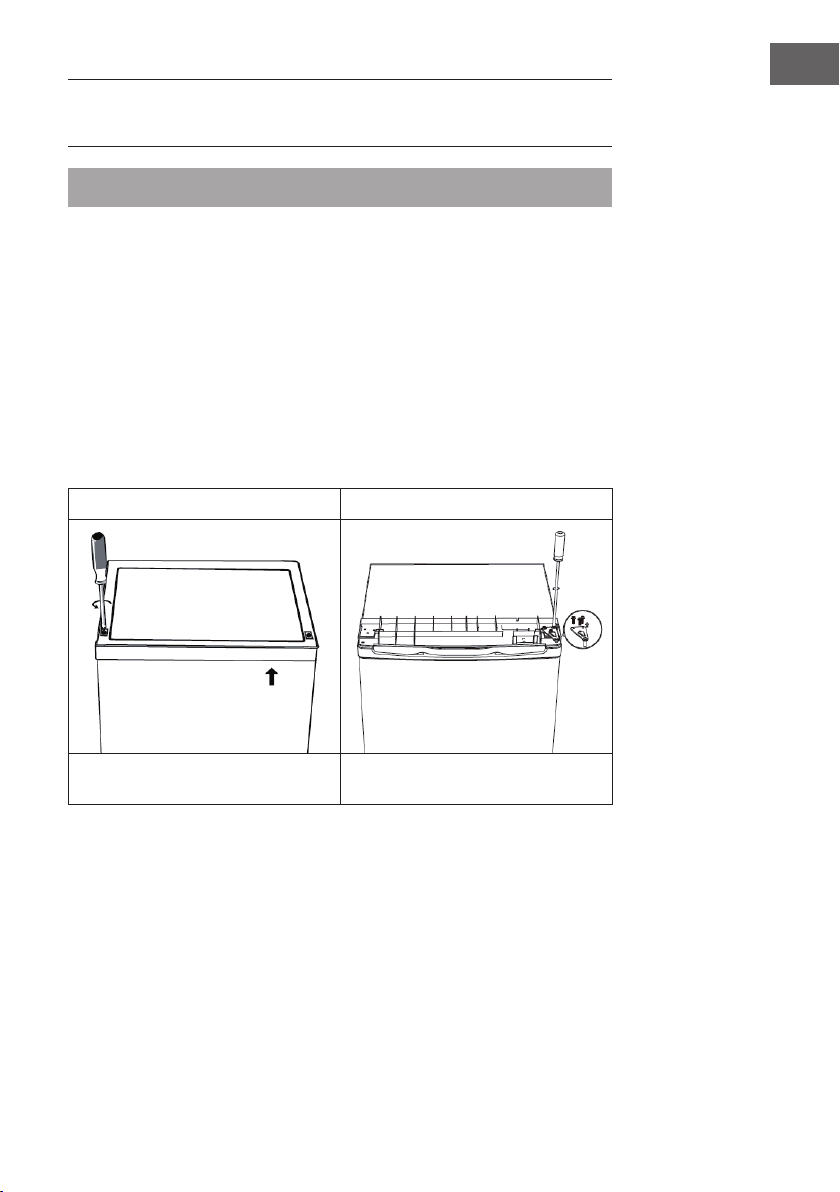
Modication de la porte
1 2
FR
Retirez les vis du couvercle et retirez le
couvercle.
Desserrez les vis et retirez la suspension
supérieure.
21
Page 22
FR
3 4
Retirez la suspension inférieure et les
pieds réglables.
5 6
Fixez la suspension inférieure au côté
opposé. Installez les pieds du côté
opposé.
Retirez la goupille de la suspension
inférieure. Tourner la suspension à 180 °
et réinstallez la goupille.
Placez la porte sur la suspension
inférieure et alignez-la. Fixez ensuite
la suspension supérieure. Fixez enn le
cache supérieur avec 2 vis.
22
Page 23
Fixation de la poignée de porte
APERÇU DE L‘APPAREIL
Thermostat
Clayettes
Tiroir
FR
Compartiments
Pieds réglables
23
Page 24
FR
UTILISATION
Remarque : Avant d‘utiliser l‘appareil pour la première fois, nettoyez l‘intérieur et les
accessoires à l‘eau tiède avec une petite quantité de détergent pour éliminer l‘odeur
typique du produit neuf. Séchez ensuite l‘intérieur et toutes les pièces.
Réglage de la température
Branchez la che dans la prise. Le thermostat
possède 8 réglages. [1] est le réglage le moins
froid, [8] le plus froid. Si vous dénissez [0], le
réfrigérateur s‘éteint.
Remarque : Si la température ambiante est très élevée ou si la porte est souvent
ouverte, il se peut que la température souhaitée ne soit pas atteinte.
Positionnement des clayettes et des compartiments de porte
Le réfrigérateur est équipé de plusieurs clayettes pouvant être placées n‘importe
où. Pour permettre le stockage des emballages alimentaires de différentes tailles,
les compartiments de porte peuvent être montés à différentes hauteurs. Tirez le
compartiment dans le sens des èches jusqu‘à ce qu‘il se dégage et placez-le en
fonction de vos besoins.
24
Page 25
NETTOYAGE ET ENTRETIEN
• Nettoyez le réfrigérateur une fois par mois.
• Débranchez toujours l‘appareil avant de le nettoyer.
• Essuyez l‘intérieur avec un chiffon humide. S‘il est très sale, utilisez un détergent
neutre et séchez-le ensuite avec un chiffon sec. Les clayettes en verre peuvent être
nettoyées avec un nettoyant à vitre.
• N‘utilisez pas d‘eau chaude, de pétrole, d‘alcool, de kérosène, de détergents, de
nettoyants alcalins, de produits acides ou chimiques pour nettoyer la peinture et les
pièces en plastique. Ne pas vaporiser le réfrigérateur directement avec de l‘eau,
car il risque de rouiller ou de fuir.
• Nettoyez les joints régulièrement pour augmenter leur durée de vie.
RÉSOLUTION DES PROBLÈMES
Problème Cause possible Solution
L'appareil ne fonctionne
pas.
Les aliments sont chauds. La température est mal
Le thermostat est réglé
sur 0.
La che n'est pas branchée
ou mal branchée.
Le fusible est débranché ou
hors service.
réglée
La porte a été ouverte trop
souvent.
Vous avez placé
une grande quantité
d'aliments chauds dans le
réfrigérateur.
L'appareil est à côté d'une
source de chaleur.
Tournez le thermostat au
niveau souhaité.
Insérez la che
correctement dans la prise.
Vériez le fusible.
Réglez la température à un
niveau plus froid.
Ouvrez la porte aussi
rarement que possible.
Réglez la température à un
niveau plus froid.
Changez l'emplacement
de l'appareil.
FR
25
Page 26
FR
Problème Cause possible Solution
L'appareil refroidit trop. La température est mal
réglée
Bruits inhabituels L'appareil n'est pas posé
bien à plat.
L'appareil touche un mur
ou un autre objet.
Un composant de
l'appareil touche une autre
partie.
Réglez une température
moins froide.
Ajustez les pieds réglables.
Veillez à ce que l'appareil
soi en pose libre.
Si possible, essayez
d’éloigner légèrement le
composant.
INFORMATIONS SUR LE RECYCLAGE
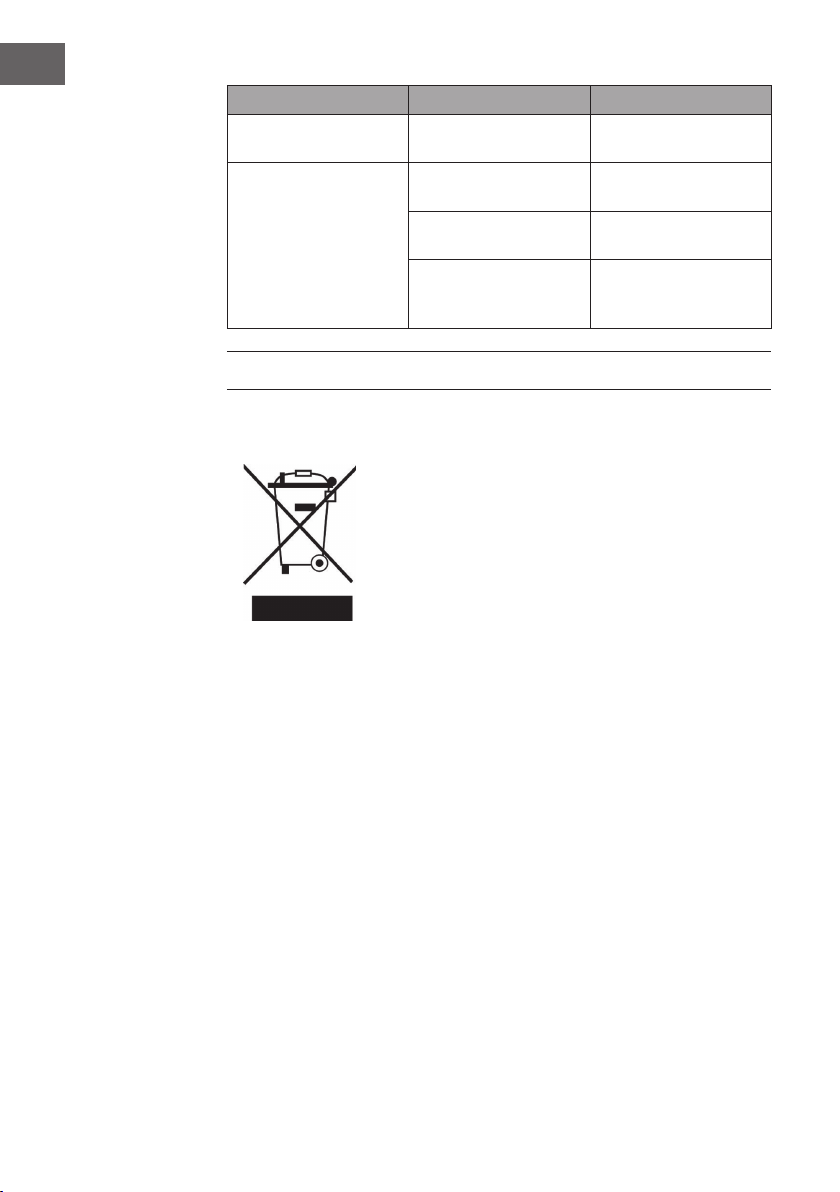
Vous trouverez sur le produit l’image ci-contre (une poubelle
sur roues, barrée d‘une croix), ce qui indique que le produit
se trouve soumis à la directive européenne 2012/19/
UE. Renseignez-vous sur les dispositions en vigueur dans
votre région concernant la collecte séparée des appareils
électriques et électroniques. Respectez-les et ne jetez pas
les appareils usagés avec les ordures ménagères. La mise
en rebut correcte du produit usagé permet de préserver
l’environnement et la santé. Le recyclage des matériaux
contribue à la préservation des ressources naturelles.
26
Page 27
Estimado cliente:
Le felicitamos por la adquisición de este producto. Lea
atentamente el siguiente manual y siga cuidadosamente las
instrucciones de uso con el n de evitar posibles daños. La
empresa no se responsabiliza de los daños ocasionados por
un uso indebido del producto o por haber desatendido las
indicaciones de seguridad. Escanee el código QR para obtener
acceso al manual de usuario más reciente y otra información
sobre el producto:
ÍNDICE
Indicaciones de seguridad 28
Cambiar el lado de apertura de la puerta 29
Vista general del aparato 31
Funcionamiento 32
Limpieza y cuidado 33
Detección y resolución de anomalías 33
Indicaciones sobre la retirada del aparato 34
DATOS TÉCNICOS
ES
Número de artículo 10033123, 10033124
Fuente de alimentación 220-240 V ~ 50/60 Hz
DECLARACIÓN DE CONFORMIDAD
Fabricante:
Chal-Tec GmbH, Wallstraße 16, 10179 Berlín, Alemania.
Este producto cumple con las siguientes directivas
europeas:
2014/30/UE (EMC)
2014/35/UE (baja tensión)
2011/65/UE (refundición RoHS)
643/2009/CE (ErP)
1060/2010/UE (Etiquetado energético)
27
Page 28

ES
INDICACIONES DE SEGURIDAD
Este aparato contiene refrigerante isobutano (R600a), un gas natural que no es
nocivo para el medioambiente pero sí in amable. Aunque sea in amable, no es
perjudicial para la capa de ozono ni aumenta el efecto invernadero. La utilización
de este refrigerante provoca un aumento de ruido del aparato. Además del ruido del
compresor, podrá escuchar también el ujo del refrigerante. Este hecho es inevitable
y no produce ningún efecto negativo en el rendimiento del aparato. Durante el
transporte, tenga cuidado para evitar dañar el circuito de refrigeración. Las fugas de
líquido refrigerante pueden irritar los ojos.
Notas especiales
• Los niños de entre 3 y 8 años pueden cargar y descargar refrigeradores.
• Cuando coloque la unidad, asegúrese de que el cable de alimentación no esté
pellizcado ni dañado.
• Asegúrese de que no haya varias tomas o fuentes de alimentación en la parte
posterior de la unidad.
Para evitar la contaminación de los alimentos, siga las siguientes instrucciones:
• Una apertura prolongada de la puerta puede provocar un aumento signi cativo
de la temperatura en los compartimentos del aparato.
• Limpie regularmente las super cies que puedan entrar en contacto con los
alimentos. Limpie el desagüe regularmente.
• Almacene la carne y el pescado crudos en recipientes adecuados en el
refrigerador para que la carne y el pescado no entren en contacto con otros
alimentos ni goteen sobre ellos.
28
Notas sobre los compartimentos congeladores
• Los congeladores de dos estrellas son adecuados para almacenar alimentos pre-
congelados, almacenar o hacer helados y hacer cubitos de hielo.
• Los congeladores de una, dos y tres estrellas no son adecuados para la
congelación de alimentos frescos.
• Si la nevera permanece vacía durante un tiempo prolongado, apáguela,
descongélela, límpiela, séquela y deje la puerta abierta para evitar que se forme
moho en el aparato.
ADVERTENCIA
Cuando utilice, repare y elimine la unidad, preste atención al símbolo
izquierdo en la parte posterior de la unidad o en el compresor. Este
símbolo advierte de posibles incendios. Hay sustancias in amables en las
líneas de refrigerante y en el compresor. Mantenga el aparato alejado de
fuentes de fuego durante su uso, mantenimiento y eliminación.
Page 29
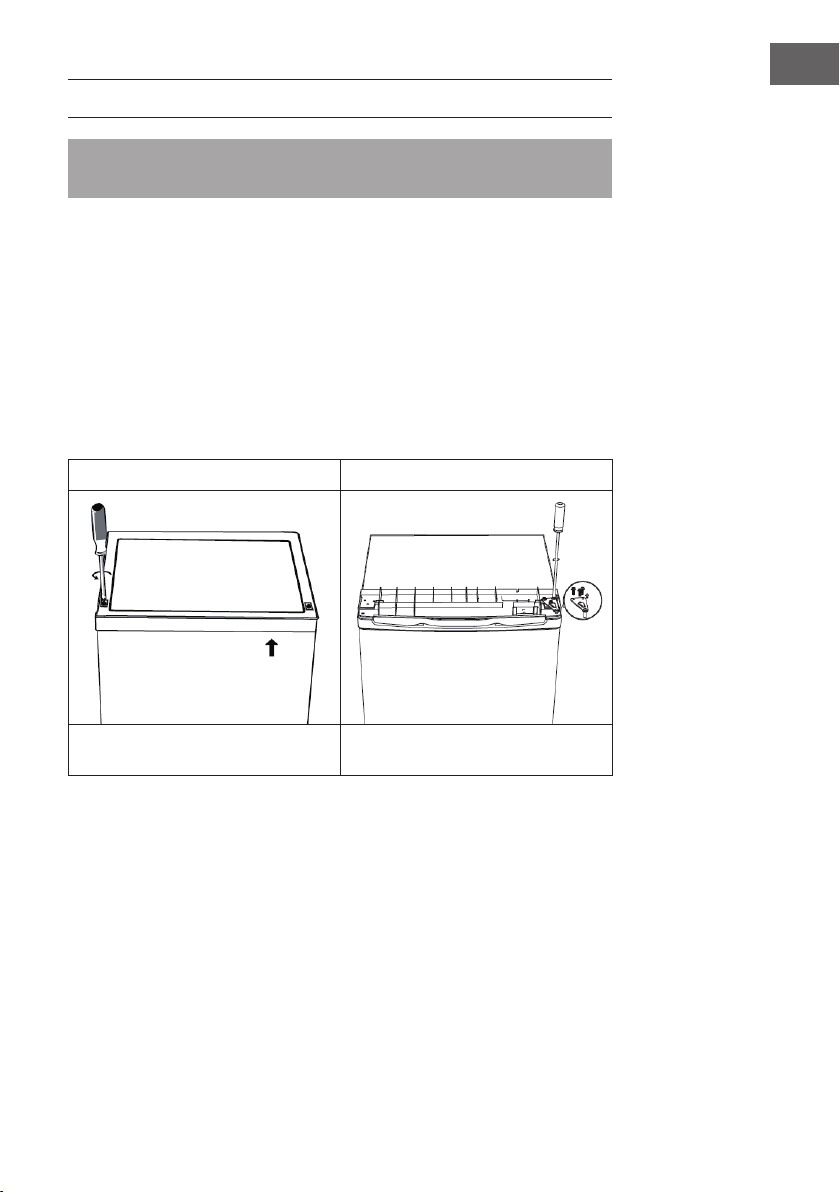
CAMBIAR EL LADO DE APERTURA DE LA PUERTA
Herramientas necesarias: destornillador de estrella, destornillador plano, llave
hexagonal.
Indicaciones importantes
• Asegúrese de que el frigoríco esté desenchufado y vacío.
• Para retirar la puerta, incline el frigoríco hacia atrás.
• Instale el aparato sobre una supercie rme para que no resbale al inclinarlo.
• Guarde todas las piezas desmontadas para la reinstalación de la puerta.
• No coloque el aparato en una posición horizontal, ya que puede dañar el sistema
de refrigeración.
• Es mejor si 2 personas aguanten el frigoríco durante el montaje.
Cambiar el lado de apertura
1 2
ES
Aoje los tornillos de la cubierta y
retírela.
Aoje los tornillos y retire la suspensión
superior.
29
Page 30
ES
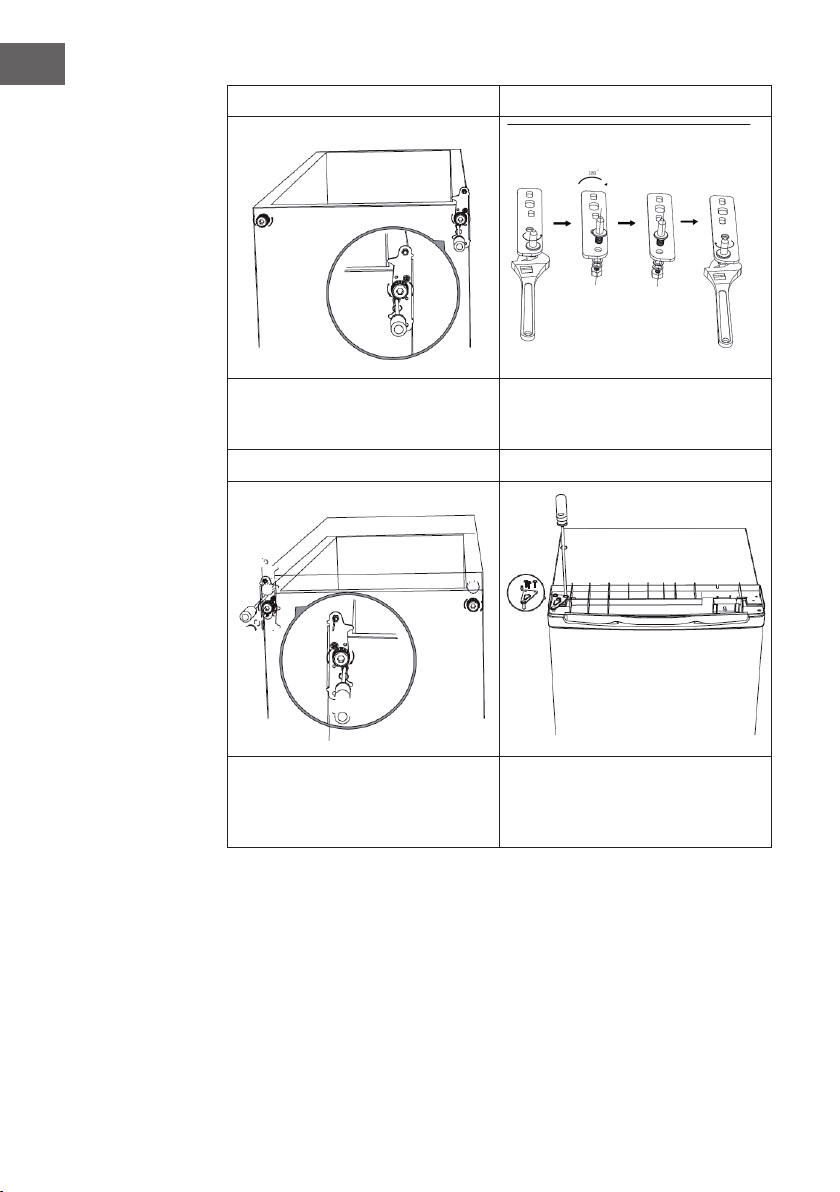
3 4
Retire la suspensión inferior y las patas
regulables.
5 6
Monte la suspensión inferior en el lado
opuesto. Monte las patas regulables en
el lado opuesto.
Retire la espiga en la suspensión inferior.
Gire la suspensión 180° y vuelva a
colocar la espiga.
Coloque la puerta en la suspensión
inferior y póngala recta. A continuación,
monte la suspensión superior. Finalmente,
je la cubierta superior con 2 tornillos.
30
Page 31
Montaje del asa
VISTA GENERAL DEL APARATO
Termóstato
Baldas
Cajón
ES
Compartimentos
Patas ajustables
31
Page 32
ES
FUNCIONAMIENTO
Atención: antes de usar el aparato por primera vez, lave el interior y todos los
accesorios con agua tibia y un poco de producto de limpieza neutro para eliminar el
olor típico de un producto nuevo. A continuación, seque bien el interior del aparato
y los accesorios.
Congurar la temperatura
Introduzca el cable de alimentación en la toma de
corriente. El termostato tiene 8 posiciones: [1] es
el nivel menos frío, mientras que [8] es el nivel más
frío. Si posiciona el termostato en [0], el frigoríco
se apagará
Atención: si la temperatura ambiente es muy elevada o si abre la puerta con mucha
frecuencia, es posible que no se pueda alcanzar la temperatura interior deseada.
Instalación de los estantes y compartimentos de las puertas
El frigoríco está equipado con varios estantes que se pueden colocar según las
necesidades. Para facilitar el almacenamiento de envases de alimentos de diferentes
tamaños, los compartimentos de las puertas pueden montarse a diferentes alturas.
Para ello, tire del compartimento en el sentido de las echas hasta que se suelte y, a
continuación, instálelo según sea necesario.
32
Page 33
LIMPIEZA Y CUIDADO
• Limpie el frigoríco una vez al mes.
• Antes de limpiar el aparato, desconéctelo de la toma de corriente.
• Limpie el interior con un paño húmedo. Si tiene demasiada suciedad, utilice un
poco de un producto de limpieza neutro y seque el frigoríco con un paño seco.
Las baldas de cristal pueden limpiarse con limpiacristales.
• No utilice agua caliente, petróleo, alcohol, queroseno, detergentes, limpiadores
alcalinos, ácidos ni productos químicos para limpiar el frigoríco, ya que podría
dañar el acabado y las piezas de plástico. No rocíe el frigoríco con agua, pues
podría acelerar el proceso de oxidación o desgastar las juntas.
• Limpie regularmente las juntas para asegurar una mayor vida útil
DETECCIÓN Y RESOLUCIÓN DE ANOMALÍAS
Anomalía Posible causa Posible solución
El aparato no se pone en
marcha.
Los alimentos están
calientes.
El termostato está en
posición «0».
El enchufe no está
conectado o está suelto.
El fusible se ha fundido o
ha saltado.
La temperatura no está
bien congurada.
La puerta se abre con
demasiada frecuencia.
Ha guardado en el
frigoríco una gran
cantidad de alimentos
calientes.
El frigoríco está instalado
cerca de una fuente de
calor.
Gire el termostato hasta la
temperatura deseada.
Introduzca el cable de
alimentación en la toma
de corriente.
Compruebe el fusible.
Ajuste la temperatura a un
nivel más frío.
Abra la puerta con la
menor frecuencia posible.
Ajuste la temperatura a un
nivel más frío.
Coloque el aparato en
otro lugar.
ES
33
Page 34
ES
Anomalía Posible causa Posible solución
El aparato enfría
demasiado.
Ruidos inusuales. El aparato no está recto. Ajuste las patas del
La temperatura no está
bien congurada.
El aparato toca una pared
o cualquier otro objeto.
Una pieza del frigoríco
toca otra parte del
frigoríco.
Ajuste la temperatura a un
nivel menos frío.
aparato de modo que esté
totalmente recto.
Asegúrese de que el
aparato no entra en
contacto con las paredes.
Si es posible, intente girar
ligeramente la pieza a
otro lado.
INDICACIONES SOBRE LA RETIRADA DEL
APARATO
Si el aparato lleva adherida la ilustración de la izquierda (el
contenedor de basura tachado), entonces rige la directiva
europea 2012/19/UE. Este producto no debe arrojarse a
un contenedor de basura común. Infórmese sobre las leyes
territoriales que regulan la recogida separada de aparatos
eléctricos y electrónicos. Respete las leyes territoriales y
no arroje aparatos viejos al cubo de la basura doméstica.
Una retirada de aparatos conforme a las leyes contribuye a
proteger el medio ambiente y a las personas a su alrededor
frente a posibles consecuencias perjudiciales para la salud. El
reciclaje ayuda a reducir el consumo de materias primas.
34
Page 35
Gentile Cliente,
La ringraziamo per aver acquistato il dispositivo. La preghiamo
di leggere attentamente le seguenti istruzioni per l’uso e di
seguirle per evitare possibili danni tecnici. Non ci assumiamo
alcuna responsabilità per danni scaturiti da una mancata
osservazione delle avvertenze di sicurezza e da un uso
improprio del dispositivo.
INDICE
Avvertenze di sicurezza 36
Invertire il lato di apertura dello sportello 37
Descrizione del dispositivo 39
Utilizzo 40
Pulizia e manutenzione 41
Risoluzione dei problemi 41
Smaltimento 42
DATI TECNICI
Numero articolo 10033123, 10033124
Alimentazione 220-240 V ~ 50/60 Hz
IT
DICHIARAZIONE DI CONFORMITÀ
Produttore:
Chal-Tec GmbH, Wallstraße 16, 10179 Berlino, Germania.
Questo prodotto è conforme alle seguenti direttive
europee:
2014/30/UE (EMC)
2014/35/UE (LVD)
2011/65/UE (RoHS)
643/2009/CE (ErP)
1060/2010/UE (ErP)
35
Page 36

IT
AVVERTENZE DI SICUREZZA
Questo dispositivo contiene il refrigerante isobutano (R600a), un gas naturale
ecocompatibile ma in ammabile. Anche se è in ammabile, non danneggia lo strato
di ozono e non aumenta l´effetto serra. Tenere presente che l´utilizzo di questo
refrigerante comporta rumori del dispositivo. Oltre al rumore del compressore si può
sentire anche il usso del liquido refrigerante. Ciò è inevitabile e non ha un effetto
negativo sulle prestazioni del dispositivo. Trasportare il dispositivo con cautela per
evitare di danneggiare il circuito di refrigerazione. Le perdite di liquido refrigerante
possono causare irritazioni agli occhi.
Note speciali
• I bambini tra i 3 e gli 8 anni possono caricare e scaricare i frigoriferi.
• Quando si posiziona l‘unità, assicurarsi che il cavo di alimentazione non sia
schiacciato o danneggiato.
• Assicurarsi che non vi siano prese multiple o alimentatori sul retro dell‘unità.
Per evitare la contaminazione degli alimenti, seguire le seguenti istruzioni:
• Un‘apertura prolungata dello sportello può portare ad un signi cativo aumento
della temperatura nei vani dell‘apparecchio.
• Pulire regolarmente le super ci che possono venire a contatto con gli alimenti.
Pulire regolarmente lo scarico dell‘acqua.
• Conservare la carne e il pesce crudo in appositi contenitori in frigorifero in modo
che la carne e il pesce non entrino in contatto con altri alimenti o non gocciolino su
altri alimenti.
36
Note sui vani congelatore
• Gli scomparti freezer a due stelle sono adatti per conservare gli alimenti pre-
congelati, conservare o fare il gelato e fare i cubetti di ghiaccio.
• Gli scomparti freezer a una, due e tre stelle non sono adatti al congelamento di
alimenti freschi.
• Se il frigorifero rimane vuoto per un lungo periodo di tempo, spegnerlo, sbrinarlo,
pulirlo, asciugarlo, asciugarlo e lasciare aperta la porta per evitare la formazione
di muffa nell‘apparecchio.
AVVERTENZA
Durante l‘uso, la manutenzione e lo smaltimento dell‘unità, prestare
attenzione al simbolo a sinistra sul retro dell‘unità o sul compressore.
Questo simbolo avverte di possibili incendi. Ci sono sostanze
in ammabili nelle linee frigorifere e nel compressore. Tenere
l‘apparecchio lontano da fonti di incendio durante l‘uso, la
manutenzione e lo smaltimento.
Page 37
INVERTIRE IL LATO DI APERTURA DELLO
SPORTELLO
Sono necessari: cacciavite a croce, cacciavite a taglio e chiave a brugola.
Indicazioni importanti
• Assicurarsi che il dispositivo sia scollegato e vuoto.
• Per rimuovere lo sportello, il dispositivo deve essere inclinato all’indietro.
• Posizionare il dispositivo su un fondo solido, in modo che non scivoli quando viene
inclinato.
• Tutti i componenti rimossi devono essere conservati per rimontare lo sportello.
• Non sdraiare il dispositivo, in quanto potrebbe causare danni al sistema
refrigerante.
• Si consiglia di tenere il dispositivo in 2 durante il montaggio.
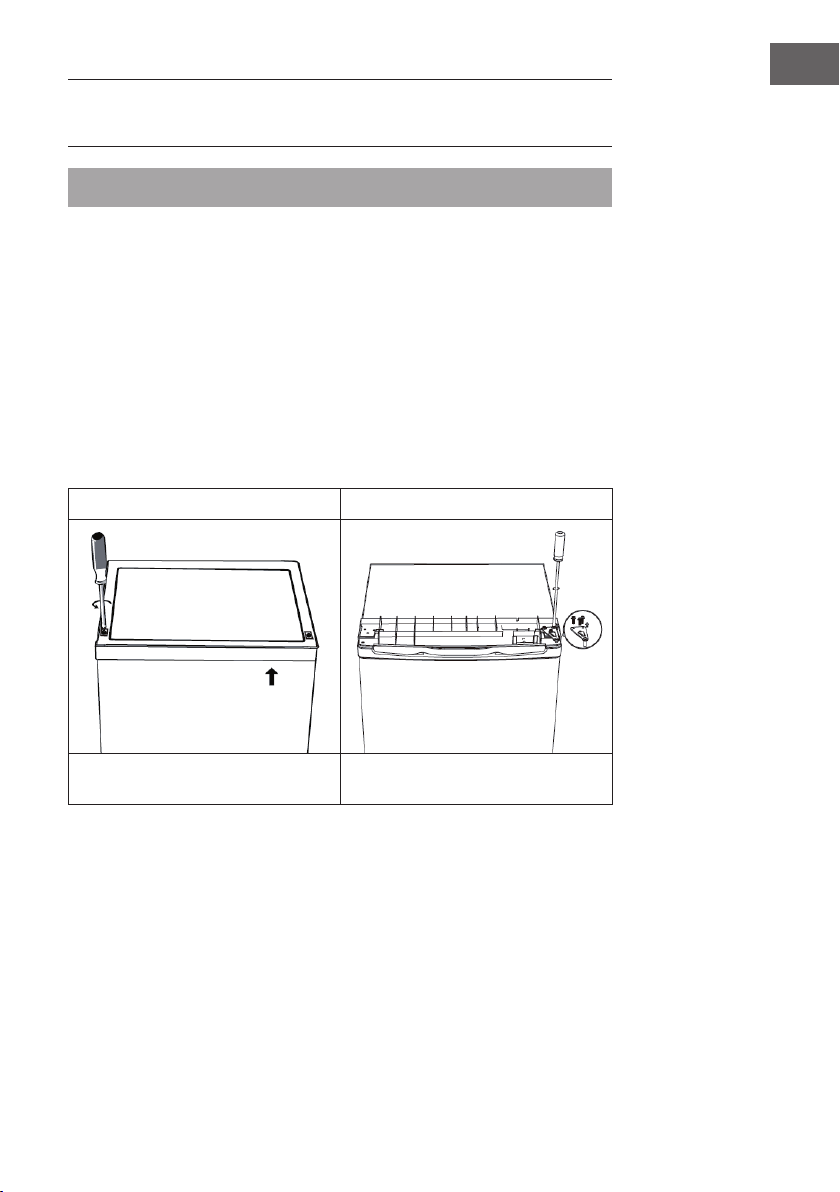
Modicare il lato di apertura
1 2
IT
Rimuovere le viti della copertura e
toglierla
Svitare le viti e staccare il gancio
superiore.
37
Page 38
IT
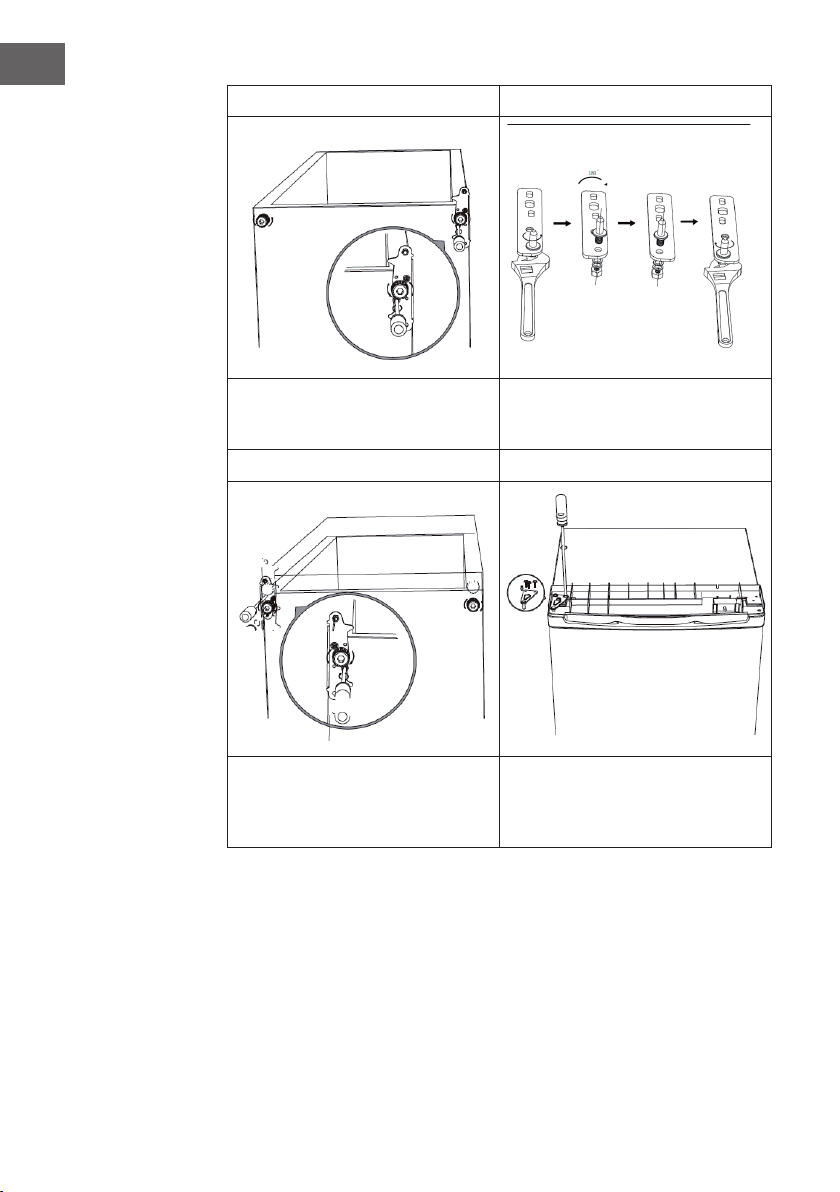
3 4
Rimuovere il gancio inferiore e i piedi
d’appoggio regolabili.
5 6
Montate il gancio inferiore sul lato
opposto. Montare i piedi d’appoggio sul
lato opposto.
Rimuovere il perno sul gancio inferiore.
Ruotare il gancio di 180° e reinserire il
perno.
Posizionare lo sportello sul gancio
inferiore e raddrizzarlo. Fissare il gancio
superiore. Fissare poi la copertura
superiore con 2 viti.
38
Page 39
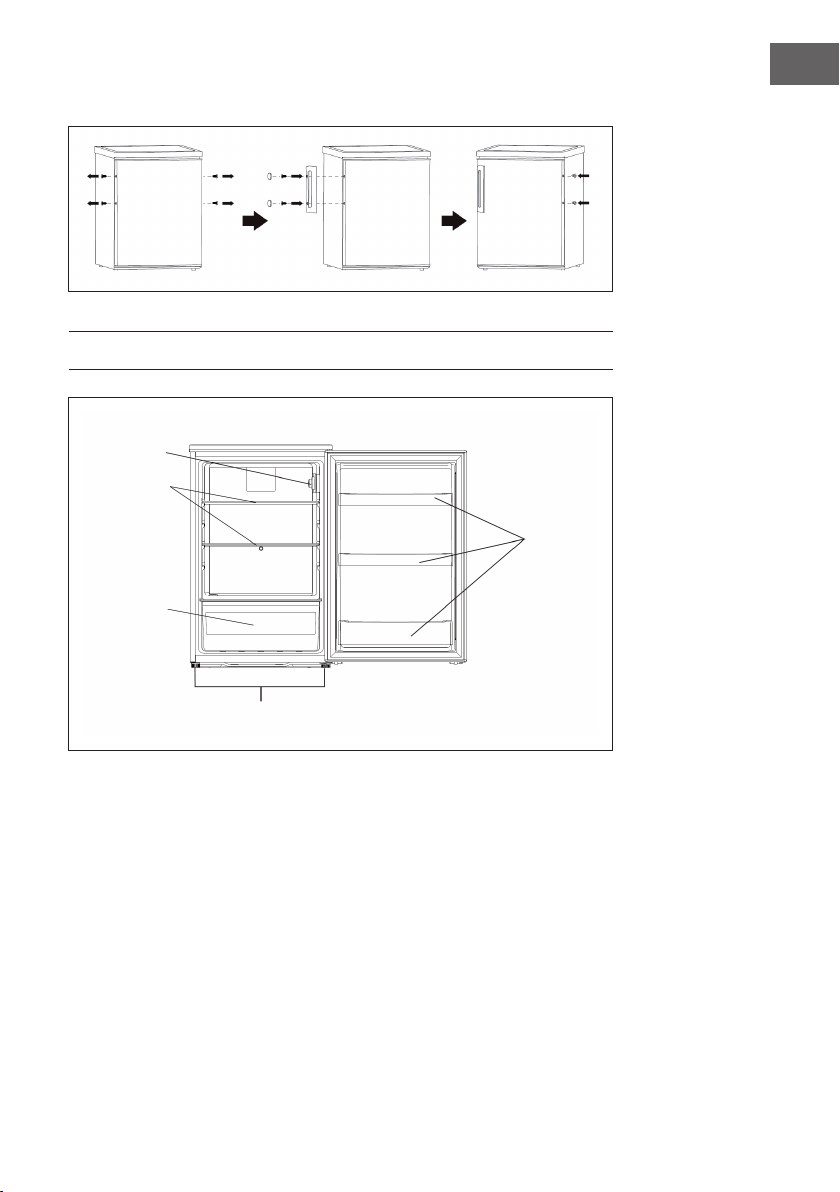
Come ssare la maniglia dello sportello
DESCRIZIONE DEL DISPOSITIVO
Termostato
Ripiani
Cassetto
IT
Vani
Piedi regolabili
39
Page 40
IT
UTILIZZO
Avvertenza: prima di utilizzare il dispositivo per la prima volta, lavare il vano
interno e gli accessori con acqua tiepida e un po’ di detergente per piatti, per
togliere l’odore tipico dei nuovi prodotti. Asciugare con cura l’interno e tutti i
componenti.
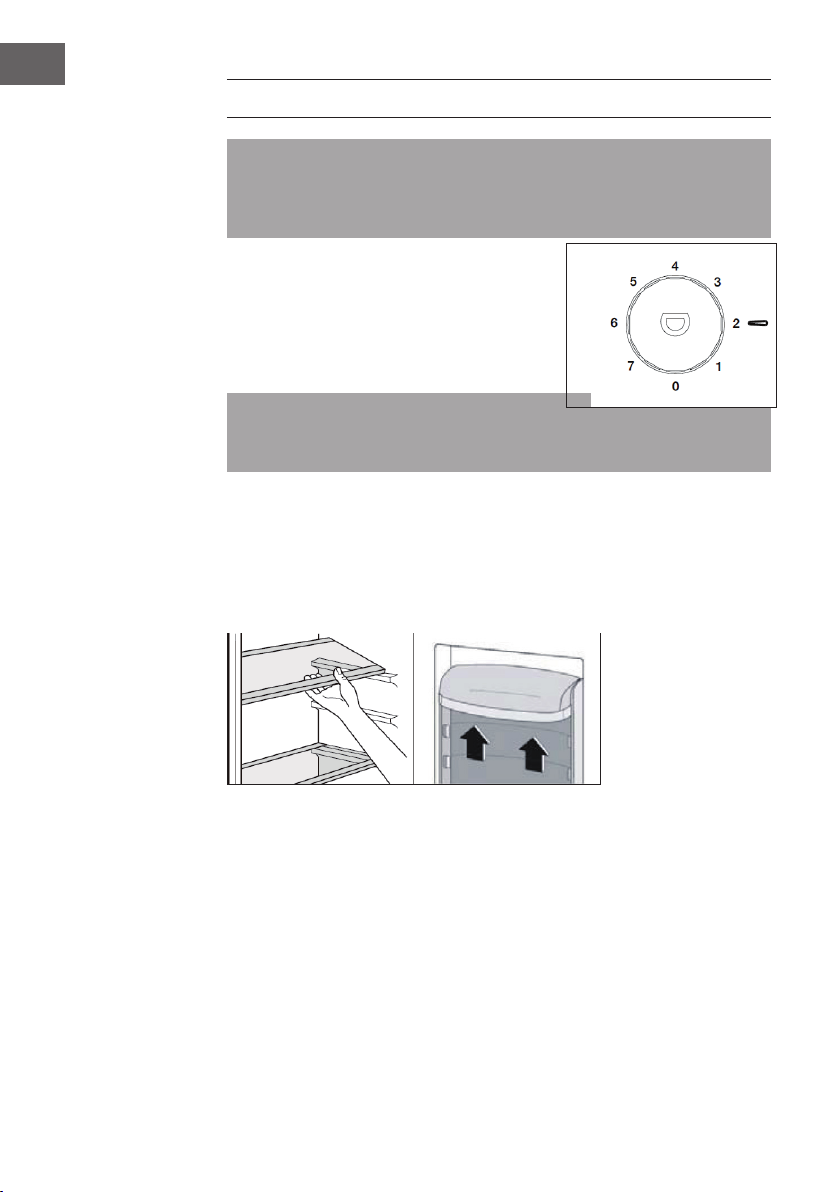
Impostare la temperatura
Collegare la spina. Il termostato ha 8 impostazioni.
(1) è l’impostazione meno fredda e (8) è quella
più fredda. Impostando (0), il frigorifero è spento.
Avvertenza: se la temperatura ambiente è molto
elevata o lo sportello viene aperto spesso, è possibile che la temperatura desiderata
non venga raggiunta.
Posizionare i ripiani e i vani sullo sportello
Il frigorifero è dotato di diversi ripiani che possono essere posizionati a piacere.
Per conservare alimenti di diverse dimensioni, i vani sullo sportello possono essere
agganciati a diverse altezze. Tirare i vani in direzione della freccia, no a quando si
stacca e posizionarlo secondo necessità.
40
Page 41
PULIZIA E MANUTENZIONE
• Pulire il frigorifero una volta al mese.
• Prima di pulire il dispositivo, staccare sempre la spina.
• Lavare l’interno con un panno umido. Se è molto sporco, utilizzare un detergente
neutro e asciugarlo con un panno asciutto. I ripiani in vetro possono essere puliti
con un detergente per vetri.
• Non utilizzare per la pulizia acqua bollente, petrolio, alcool, cherosene, detersivo,
detergenti alcalini, acidi o detergenti chimici, in modo da non rovinare vernice e
componenti in plastica. Non spruzzare acqua direttamente sul frigorifero, altrimenti
potrebbe arrugginire e non perdere tenuta.
• Pulire regolarmente le guarnizioni per prolungarne la vita utile.
RISOLUZIONE DEI PROBLEMI
Anomalía Posible causa Posible solución
Il dispositivo non funziona. Il termostato è su 0. Posizionare il termostato
sul livello desiderato.
La spina non è inserita
bene nella presa o è
staccata.
Il fusibile è fuori posizione
o guasto.
Gli alimenti sono caldi. La temperatura non è
impostata correttamente.
Lo sportello è stato aperto
di frequente.
Sono stati messi nel
frigorifero numerosi
alimenti caldi.
Il dispositivo è vicino a una
fonte di calore.
Collegare bene la spina.
Controllare il fusibile.
Impostare la temperatura
su un livello più freddo.
Aprire lo sportello il meno
possibile.
Abbassare la temperatura.
Spostare il dispositivo.
IT
41
Page 42
IT
Problema Possibile causa Soluzioni
Il dispositivo raffredda
troppo.
Rumori insoliti. Il dispositivo non è diritto. Regolare i piedi
La temperatura non è
impostata correttamente.
Il dispositivo è in contatto
con una parete o un altro
oggetto.
Un componente del
dispositivo è in contatto
con un altro componente.
Impostare la temperatura
su un livello meno freddo.
d’appoggio.
Assicurarsi che il
dispositivo non sia in
contatto con nulla.
Se possibile cercare di
distanziare i componenti
leggermente.
SMALTIMENTO
Se sul prodotto è presente la gura a sinistra (il bidone dei
riuti con le ruote), si applica la direttiva europea 2012/19/
UE. Questi prodotti non possono essere smaltiti con i riuti
normali. Informarsi sulle disposizioni vigenti per la raccolta
di dispositivi elettrici ed elettronici. Attenersi alle disposizioni
vigenti e non smaltire i vecchi dispositivi con i riuti domestici.
Grazie al corretto smaltimento dei vecchi dispositivi si tutela
il pianeta e la salute delle persone da possibili conseguenze
negative. Il riciclo di materiali aiuta a diminuire il consumo di
materie prime.
42
Page 43

Page 44

 Loading...