

Page 1
10010814
Kühlschrank
Page 2
Sehr geehrter Kunde,
wir gratulieren Ihnen zum Erwerb Ihres Gerätes. Lesen Sie die folgenden Hinweise sorgfältig durch
und befolgen Sie diese, um möglichen Schäden vorzubeugen. Für Schäden, die durch Missachtung
der Hinweise und unsachgemäßen Gebrauch entstehen, übernehmen wir keine Haftung.
Sicherheitshinweise
• Kinder sollten während der Benutzung des Geräts beaufsichtigt werden.
• Beim Abtauchen dürfen keine mechanischen Hilfsmittel verwendet werden.
• Vermeiden Sie Beschädigungen des Kühlkreislaufes.
• Betreiben Sie keine anderen elektrischen Geräte innerhalb des Kühlschranks.
• Nur für den Hausgebrauch.
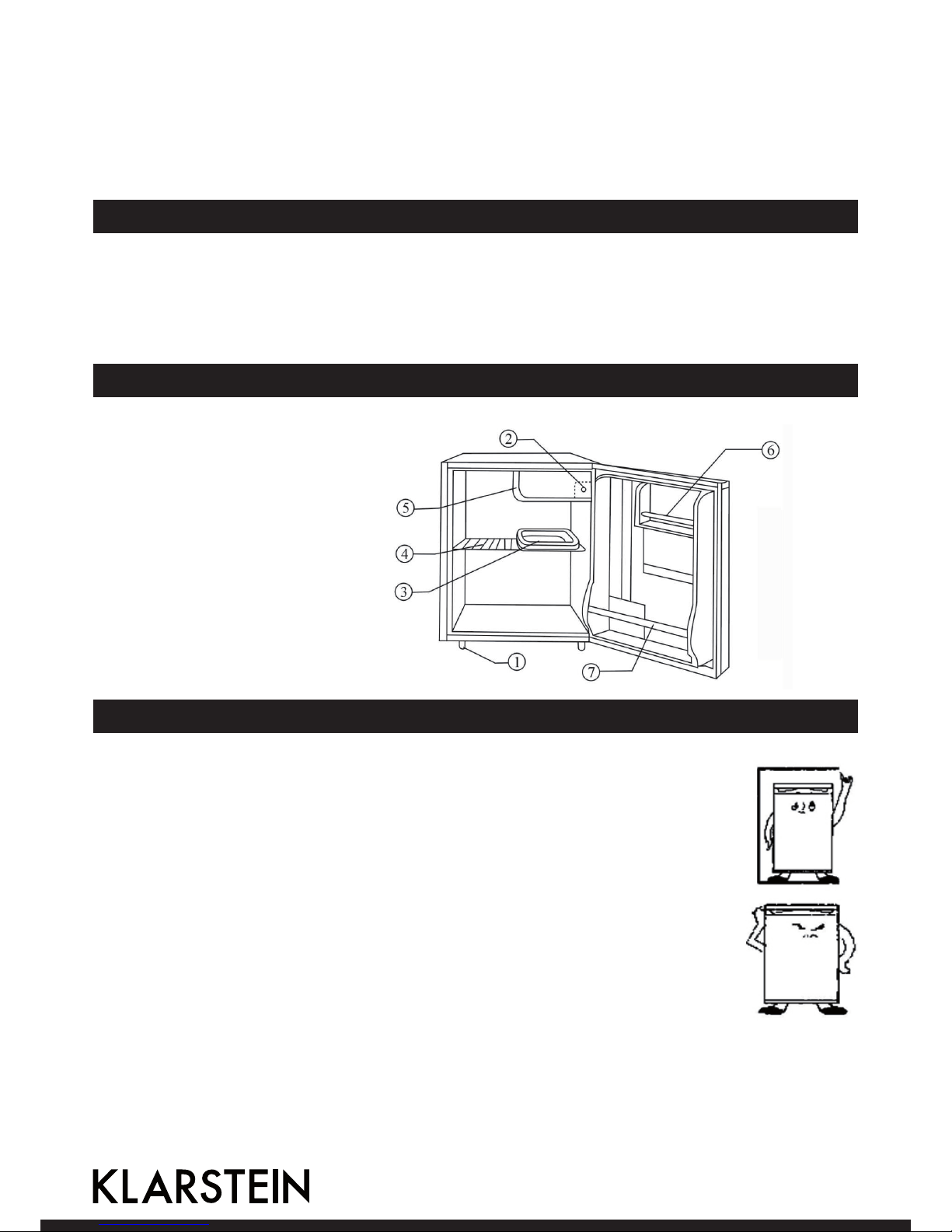
Geräteübersicht
1. Einstellbare Standfüße
2. Temperaturegler
3. Tropfschale
4. Entnehmbare Böden
5. Gefrierfach
6. Ablagefach
7. Flascheablage
Aufbauhinweise
Gut belüftet
Eine gute Belüftung ist für eine zufriedenstellende Kühlung wichtig. Halten
Sie einen Mindestabstand zur Wand von 10mm ein, zu den beiden Seiten von
100mm und nach oben 200mm ein. Die Tür sollte bis zu einem Winkel von
160° geönet werden können.
Stromversorgung
Der Kühlschrank benötigt eine Netzspannung AC 220-240V/50Hz. Prüfen Sie
diesen vor dem Anschluss. Achten Sie darauf, dass Sie eine geerdete Steckdose verwenden.
2
Page 3
Netzkabel
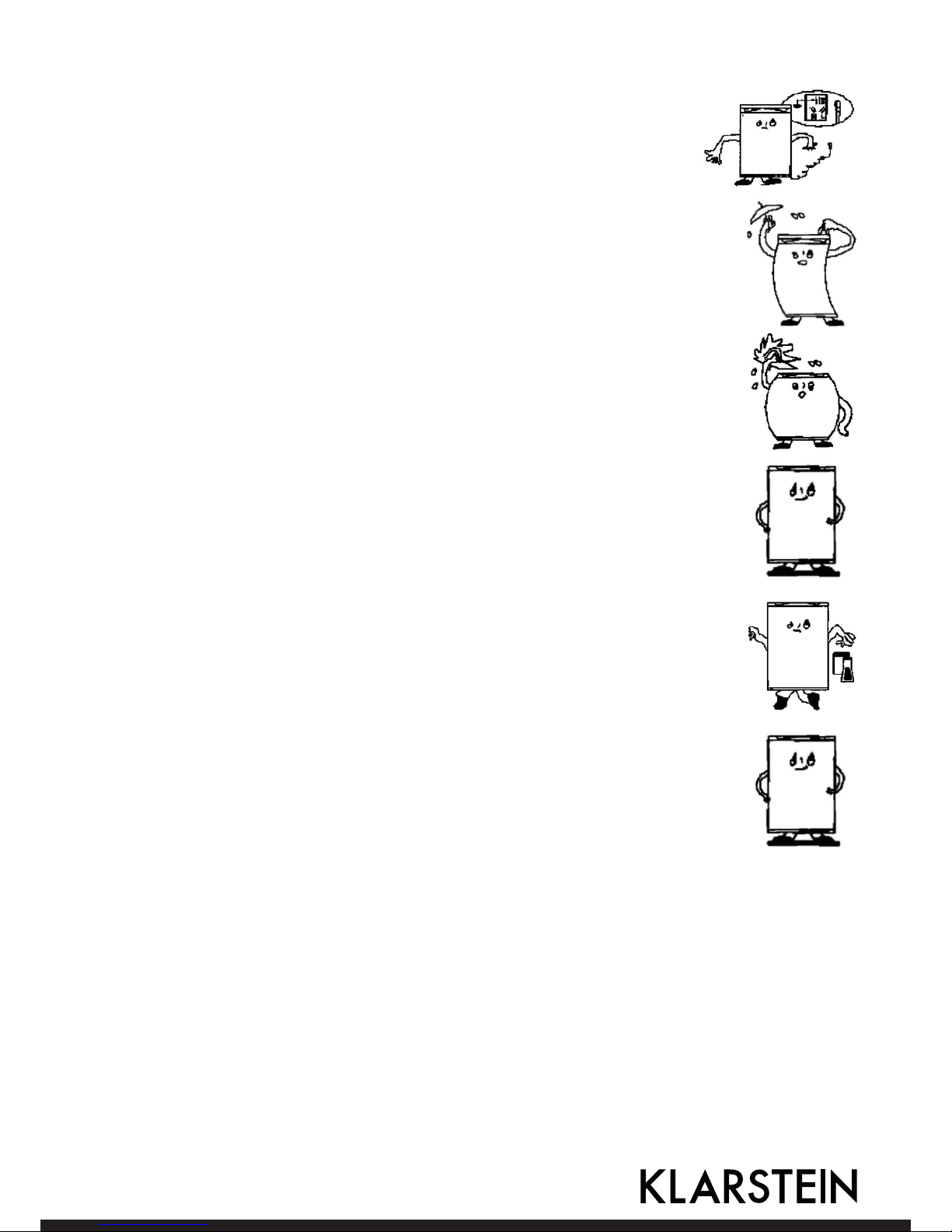
Das Netzkabel darf nicht geknickt oder überdehnt werden. Es darf auch nicht
in der Nähe des Kompressors verlegt werden. Halten Sie es auch von anderen
Hitzequellen fern.
Schutz vor Nässe
Das Gerät darf nicht hoher Luftfeuchtigkeit oder Spritzwasser ausgesetzt werden.
Die Metallteile können rosten und die elektrischen Bauteile Schaden nehmen.
Schutz vor Hitze
Halten Sie das Gerät fern von Hitze oder direkter Sonnenstrahlung
Stabiler Stand
Der Standort muss eben und stabil sein. Es dürfen keine weichen Unterlagen wie
z.B. Styropor verwendet werden. Stellen Sie wenn nötig die Standfüße ein.
Gefahrstoe verhalten
Stellen Sie niemals Gefahrstoe wie Benzin, Alkohol oder Öl in oder in die
Nähe des Kühlschranks.
Transport
Während des Transports darf der Kühlschrank nicht über 45° geneigt oder
sogar umgedreht werden.
3
Page 4
Bedienung
• Durch die bei geöneter Tür eintretende Luftfeuchtigkeit kann sich eine Eisschicht bilden. Diese
mindert die Kühlleistung. Ist die Schicht dicker als 2mm, muss der Kühlschrank abgetaut werden.
• Der Kühlschrank muss manuell abgetaut werden. Entnehmen Sie vor dem Abtauen alle Lebens mittel, den Eiswürfelbehälter und die Ablage. Stellen Sie den Temperaturregler auf „0“ (der Kom pressor ist nun ausgeschaltet) und lassen Sie die Tür oen stehen. Nachdem das Eis geschmolzen
ist, wischen Sie das Wasser aus dem Gerät. Zum schnelleren abtauen können Sie eine Schale mit
warmen Wasser (ca. 50°C) ist das Gerät stellen.
• Sie dürfen das Gerät nicht mit einem elektrischen Heizgerät abtauen, da sich durch die heiße Luft
die Innenverkleidung verformen kann.
• Kratzen Sie auch kein Eis mit scharfen oder spitzen Gegenständen aus dem Gerät. Da hierdurch
das Gehäuse oder der Kühlkreislauf beschädigt werden kann.
• Sollte das Netzkabel beschädigt sein, muss dieses umgehend von einem Fachmann neuert werden.
Reinigung und Pege
• Der Gefrierschrank sollte einmal im Monat gereinigt werden.
• Trennen Sie das Gerät vor der Reinigung bzw. Wartung vom Stromnetz.
• Reiben Sie das Gerät mit einem feuchten Tuch aus. Falls nötig kann zusätzlich ein mildes Reini gungsmittel verwendet werden. Wischen Sie das mit klarem Wasser nach und trocken die Flächen.
• Verwenden Sie zum Reinigen kein heißes Wasser, Lösungsmittel, Benzin, Alkohol, Wasserpulver
oder andere starken Chemikalien. Das diese zu Schäden an der Innenverkleidung führen. Verwenden
Sie auch kein ießendes Wasser.
• Behandeln Sie die Gummidichtung an der Tür sorgsam. Auch diese sollte gereinigt werden.
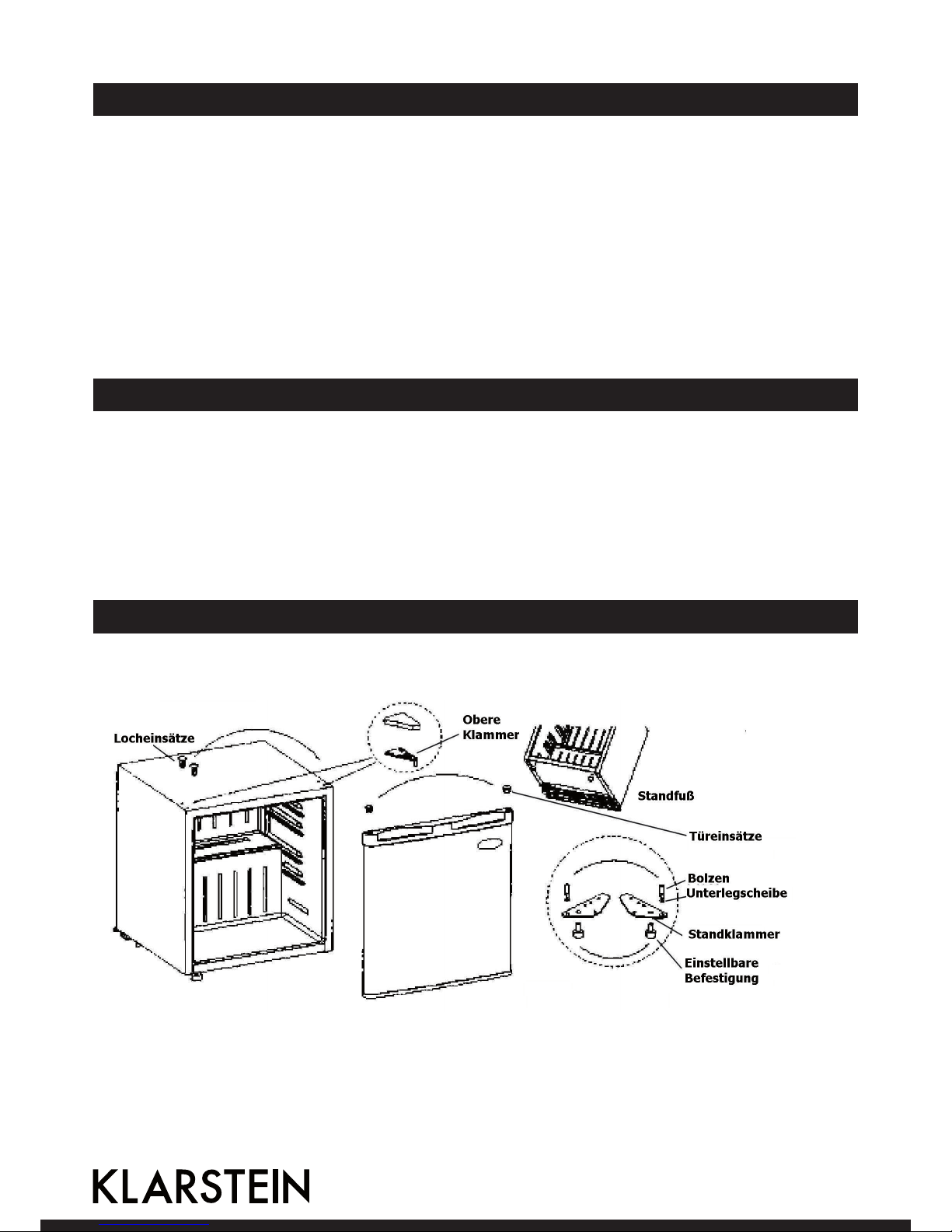
Türanschlag ändern
Sie können den Türanschlag wie auf diesem Bild zu sehen ändern.
4
Page 5
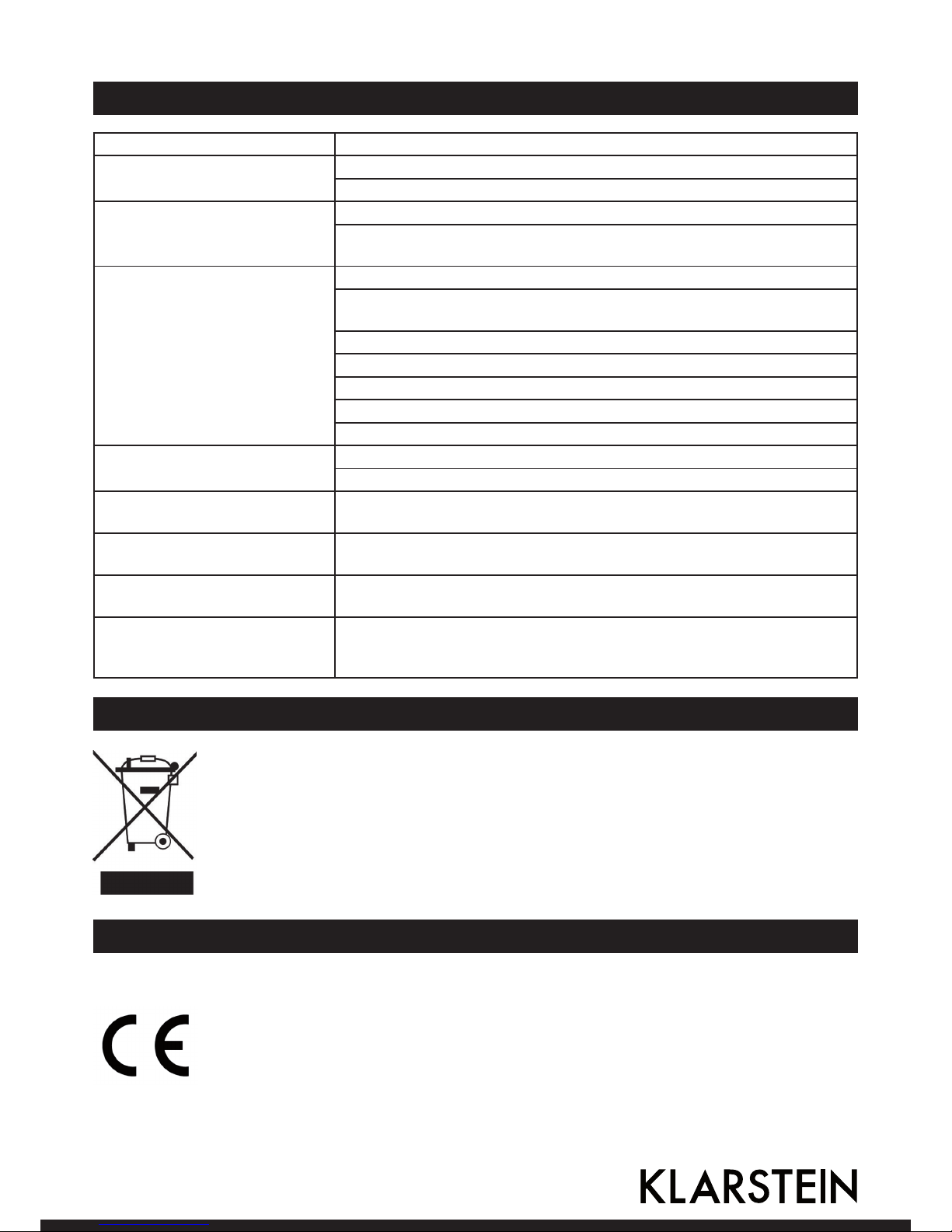
Fehlerbehebung
Problem Mögliche Lösung
Gerät ohne Funktion. Stromversorgung prüfen.
Netzstecker auf richtigen Sitz prüfen.
Gerät kühlt zu stark. Zu hohe Stufe eingestellt.
Mit Lebensmittel kann Feuchtigkeit in das Gerät kommen. Dieses
erhöht die Kühlleistung.
Gerät kühlt zu wenig. Lebensmittel verdecken den Luftauslass.
Sie haben zu viele warme bzw. zu heiße Dinge in den Kühlschrank
gelegt.
Tür nicht richtig geschlossen.
Türdichtung beschädigt.
Gerät nicht ausreichend belüftet.
Mindestabstand zu den Seiten nicht eingehalten.
Falsche Kühlstufe eingestellt.
Das Wasser läuft beim
Abtauen aus dem Gerät.
Prüfen Sie den Abstand inkl. Schlauch auf Verstopfungen.
Prüfen Sie ob den Schlauch am Ablauf sitzt.
Die Front des Kühlschranks
heizt sich auf.
Um Kondenz zu vermeiden, leitet ein Schlauch warme Luft zur Front
und diese wird hierdurch aufgewärmt.
Es bildet sich Kondenz am
Geräteäußeren.
Kondenz ist bei hoher Luftfeuchtigkeit normal.
Reiben Sie das Gerät mit einem Tuch trocken.
Geräusch wie ießendes
Wasser zu hören.
Diese ist das normale Betriebsgeräusch.
Die Seiten des Kühlschranks
heizen sich auf.
Die Tür könnte in kurzer Zeit zu häu g geö net worden sein.
Eine andere Ursache könnte eine hohe Umgebungstemperatur sein.
Fassen Sie die heißen Ober ächen nicht an.
Hinweise zur Entsorgung
Be ndet sich die linke Abbildung (durchgestrichene Mülltonne auf Rädern) auf dem Pro-
dukt, gilt die Europäische Richtlinie 2012/19/EU. Diese Produkte dürfen nicht mit dem
normalen Hausmüll entsorgt werden. Informieren Sie sich über die örtlichen Regelungen zur getrennten Sammlung elektrischer und elektronischer Gerätschaften. Richten
Sie sich nach den örtlichen Regelungen und entsorgen Sie Altgeräte nicht über den
Hausmüll. Durch die regelkonforme Entsorgung der Altgeräte werden Umwelt und die
Gesundheit ihrer Mitmenschen vor möglichen negativen Konsequenzen geschützt. Mate-
rialrecycling hilft, den Verbrauch von Rohsto en zu verringern.
Konformitätserklärung
Hersteller: Chal-Tec GmbH, Wallstraße 16, 10179 Berlin, Deutschland.
Dieses Produkt entspricht den folgenden Europäischen Richtlinien:
2014/30/EU (EMV)
2014/35/EU (LVD)
2011/65/EU (RoHS)
643/2009/EG (ErP)
1060/2010/EU (ErP)
5
Page 6

Warning
• Children should be supervised to ensure that they do not play with the appliance.
• Do not use mechanical devices or other means to accelerate the defrosting process, other than
those recommended by the manufacturer.
• Do not damage the refrigerant circuit.
• Do not use electrical appliances inside the food storage compartments of appliance, unless they
are of the type recommended by the manufacturer.
• House hold used only.
Name of parts
1. Adjustable Foot
2. Temperature Control Knop
3. Drip Tray
4. Removable Shelves
5. Freezer Compartment
6. Dairy Rack
7. Bottle Rack
Correctly positioning
Well Ventilating
There is need of good ventilation around the refrigerator for easy dissipation
of heat, high eciency of refrigeration and low power consumption. For this
purpose, sucient clear space should be needed around the refrigerator. Its
back is at least 10mm away from the wall. Its sides at least have a space of
100mm separately andThe height from over a top is not less than 200mm. A
clear space should be left to open the door to 160°.
Power Supply
The refrigerator is only applied with power supply of single phase alternating
current of 220-240V/50Hz if uctuation of voltage in the distinct user is of
so large that the voltage onwards the above scope. For safety sake, be sure
to apply A.C automatic voltage regulator to the refrigerator. The refrigerator
must employ a special power socket instead of common one with other electric appliance. Its plug must match the socket with ground wire.
Power Line Cord
The cord should be neither lengthened nor folded into coil during operation.
Moreover, it id forbidden that cord is kept close onto the compressor at the
back of the refrigerator. The surface temperature of which is quite high when
operating. Touching with it would deactivate the insulation on cause leakage
for electricity.
6
Page 7

Protection From Moisture
Avoiding placing the refrigerator in a place where heavy moisture is present so
as to minimize possibly of rusty for its metal parts still more, the refrigerator
is forbidden to be directly sprayed by water. Otherwise, poor insulation and
current leakage would occur.
Protection From Heat
The refrigerator should be far away from any heat source or direct sunshine.
Fixing Stable
Floor on which refrigerator will be placed must be at and bold. It should not
be laid on any soft material such as foam plastic, etc. If the refrigerator is not
on the same level. Adjust the screw suitably. The refrigerator should not be
placed near anything which may echo.
Behave hazardous substances
It is inadvisable that the refrigerator is placed near any vitalization or combustibles such as gas, patrol, alcohol, lacquer and banana oil
etc. The above-mentioned objects can not be stored in the refrigerator.
Moving
When xed or moved, the refrigerator can not be set horizontally or declined
to more then 45° or upside-down.
Cautions
• What contained in fold or getting into air inside the refrigerator by opening doors may form a layer
of frost inside. It will weaken the refrigerator when the frost is thick while it is more than 2mm
thick, you should defrost.
• Defrosting in freezer chamber is operated manually. Before defrosting, take the food, the ice tray
and the shelf out into the cold storing chamber separately, then set the knob of the temperature
regulator to position “0” (where the compressor will stop working and leave the door open unit
ice and frost dissolve thoroughly deposited at bottom of the freezer chamber) wipe o the water
with soft cloth in the case of speeding up the defrosting. You may put a bowl of warm water (about
50°C) into thefreezer chamber and be sure to set the knob of the temperature regulator to orignal
position after defrosting.
• It’s inadvisable to be heat freezer chamber directly, with hot water or high dryer while defrosting
to present deformation of the inner case.
7
Page 8

• It’s also inadvisable to scrape of ice frost or separate food from the containers which have been
congealed together with the food with sharp load or wooden bars. So as not to damage the inner
casing or the surface of the evaporator.
• If the supply cord of the appliance is damaged, it must only be replaced by a repair shop appoited
by the manufacturer. Because special purpose tools are required
Maintenance
• The refrigerator should be cleaned and maintained once a month.
• When performing maintenance, make absolutely sure that the power plug is rst disconnected
from the power outlet.
• Wipe the inner and outer surface of the refrigerator and its accessories with wet cloth, if they are
too dirty, scrub them with neutral detergent and then clean them with water and dry them with
clean cloth. After this, a small quantify of glass wax is recommended to polish the refrigerator
surface with a annelette.
• For cleaning don’t use hot water, diluent, petrol, alcohol, kerosene, washing powder, cleanser,
alkalinous detergent, acid, chemical cloth, etc. So as not damaged the lacquer coat and plastics.
It is forbidden than the refrigerators directly with water. Otherwise, it would cause rusty or weaken
the insulation.
• Be careful to upkeep the sealing rubber bars of the doors. They should always be cleaned.
Door Reversal Instructions
In order to reverse the opening direction of your door, please follow these simple instructions.
8
Page 9

Trouble Shooting
Problem Possible Solution
When the refrigerator does not
work
• Check if there is a power failure.
• Check if the power plug is plugged into power outlet.
When the refrigerator is cooling
excessively.
• The temperature control dial may be set too high.
• If you place foodstus containing a lot of moisture directly under
the cool air outlet, they will freezer easily. This does not indicate a
malfunction.
When the refrigerator is not
cooling suciently.
• The food may be packed too tightly together which will block the
ow of cool air.
• You may have put something hot or a lot of foodstus into the ref-
rigerator.
• The door may not have been closed properly.
• The door gaskets may be damaged.
• The refrigerator may not be ventilated.
• There may be insucient clearance between the refrigerator and the
surfaced immediately both sides and above.
• The temperature control dial may not be set properly.
When the defrosting water
overows inside the refrigerator and onto the oor.
• Checks that the drain pipe and drain hose are not clogged.
• Check that the drain pan is house properly.
When the refrigerator’s cabinet
front heats up.
In order to safeguard against condensation, there is an anti condensation pipe which heats up the cabinet front when running actuated.
A warm cabinet front does not indicate a malfunction.
When condensation form on
the outside of the refrigerator.
Condensation may form on the outside when the humidity is high such
as during a wet season. This is the same result as the condensation
formed when chilled water is poured into a glass. It does not, therefore, indicate a failure, wipe dry with a dry cloth.
When you hear a sound like
water owing.
A sound like water owing is the refrigerant owing. It doesn’t indica-
te a malfunction.
When the cabinet’s side panel
heats up.
The side panel of the cabinet will heat up when the door is opened or
closed frequently. When starting the unit and when the unit operates
in summer with high ambient outside temperature. In such case, do
not touch the panel, it results from the dissipation of the heat from
inside the cabinet, and it does not mean that something is wrong with
the refrigerator.
9
Page 10

Hints on Disposal
According to the European waste regulation 2012/19/EU this symbol on the product
or on its packaging indicates that this product may not be treated as household waste. Instead it should be taken to the appropriate collection point for the recycling of
electrical and electronic equipment. By ensuring this product is disposed of correctly, you will help prevent potential negative consequences for the environment and
human health, which could otherwise be caused by inappropriate waste handling of
this product. For more detailled information about recycling of this product, please
contact your local council or your household waste disposial service.
Declaration of Conformity
Producer: Chal-Tec GmbH, Wallstraße 16, 10179 Berlin, Germany.
This product is conform to the following European Directives:
2014/30/EU (EMC)
2014/35/EU (LVD)
2011/65/EU (RoHS)
643/2009/EC (ErP)
1060/2010/EU (ErP)
10
Page 11

Chère cliente, cher client,
Toutes nos félicitations pour l’acquisition de ce nouvel appareil. Veuillez lire attentivement et respecter les
instructions de ce mode d’emploi an d’éviter d’éventuels dommages. Nous ne saurions être tenus pour
responsables des dommages dus au non-respect des consignes et à la mauvaise utilisation de l’appareil.
Consignes de sécurité
• Les enfants doivent être surveillés en cas d’utilisation de l’appareil.
• Si l’appareil est sous eau, ne pas utiliser d’outils mécaniques.
• Ne pas endommager le circuit de refroidissement.
• Ne pas faire fonctionner aucun appareil électrique à l‘intérieur du réfrigérateur.
• Destiné uniquement à usage domestique.
Aperçu de l‘appareil
1. Pieds réglables
2. Régulateur de température
3. Bac égouttoir
4. Etagères amovibles
5. Congélateur
6. Compartiment de rangement
7. Compartiment pour bouteille
Conseils pour l’installation
Une bonne aération
Une bonne aération est importante pour un refroidissement satisfaisant. Gar-
dez une distance minimale de 10 mm des murs, de 100 mm entre les deux
côtés et de 200 mm du plafond. La porte doit pouvoir être ouverte à un angle
de 160°.
Alimentation
Le réfrigérateur nécessite une alimentation de 220-240V AC/50Hz. Vériez
cela avant de le brancher. Assurez-vous d’utiliser une prise de terre.
11
Page 12

Cordon d’alimentation
Le cordon d‘alimentation ne doit pas être plié ou étiré. Il ne doit pas être placé
à côté du compresseur. Eloignez-le également des autres sources de chaleur.
Protection contre l‘humidité
L’appareil ne doit pas être exposé à une forte humidité ou aux projections
d‘eau. Les parties métalliques peuvent rouiller et les composants électriques
peuvent être endommagés.
Protection contre la chaleur
Gardez l‘appareil éloigné de la chaleur ou de la lumière solaire directe.
Positionnement stable
Le lieu de positionnement doit être plat et solide. Ne pas utiliser les surfaces
souples telles que la mousse de polystyrène. Mettre en place si nécessaire les
pieds support.
Substances dangereuses
Ne jamais poser des substances dangereuses comme l‘essence, l‘alcool ou
l‘huile dans ou à côté du réfrigérateur.
Transport
Pendant le transport, le réfrigérateur ne doit pas être incliné de plus de 45°
ou alors retourné.
12
Page 13

Fonctionnement
• Une couche de glace peut se former si l‘humidité de l’air pénètre par la porte ouverte. Cela réduit
la capacité de refroidissement. Si la couche a une épaisseur qui dépasse 2 mm, le réfrigérateur
doit être dégivré.
• Le réfrigérateur doit être dégivré manuellement. Retirer avant la décongélation tous les aliments,
le bac à glaçons et le plateau. Réglez le contrôle de la température à « 0 » (le compresseur est
maintenant hors service) et laisser la porte ouverte. Après que la glace ait fondu, essuyez l‘eau
de l‘appareil. Pour une décongélation plus rapide, vous pouvez placer un récipient avec de l’eau
chaude (env. 50° C) dans l’appareil.
• Ne pas dégivrer l‘appareil avec un appareil de chauage électrique qui peut déformer le revêtement intérieur par l‘air chaud.
• Ne pas gratter la glace avec des objets tranchants ou pointus. Ce qui risquerait d’endommager le
boîtier ou le circuit de refroidissement.
• Si le cordon d‘alimentation est endommagé, il doit être changé immédiatement par un personnel qualié.
Nettoyage et entretien
• Le congélateur doit être nettoyé une fois par mois.
• Débranchez l‘appareil du réseau électrique avant le nettoyage ou l‘entretien.
• Essuyez l‘appareil avec un chion humide. Utilisez en cas de besoin un détergent doux. Essuyez
avec de l‘eau claire et séchez les surfaces.
• Ne pas utiliser pour le nettoyage l’eau chaude, les solvants, l‘essence, l‘alcool, l’eau à poudre ou les
autres produits chimiques forts. Ils pourraient endommager le revêtement intérieur. Ne pas utiliser
également l’eau courante.
• Manipulez soigneusement le joint en caoutchouc sur la porte. Il doit être également nettoyé.
Changer la butée de porte
Vous pouvez changer la butée de porte comme illustré sur cette image.
13
Page 14

Dépannage
Problème Solution éventuelle
L’appareil ne fonctionne pas. Véri er l'alimentation.
Véri ez si la che est bien en place.
L'appareil refroidit trop. Le niveau est trop élevé.
L'humidité peut pénétrer dans l’appareil avec les aliments. Cela aug-
mente la puissance de refroidissement.
L’appareil refroidit trop peu. Des aliments obstruent la sortie d'air.
Vous avez mis trop de choses chaudes ou très chaudes dans le réfrigérateur.
La porte est mal fermée.
Le joint de porte est endommagé.
L’appareil n’est pas su samment aéré.
La distance minimale sur les côtés n’est pas respectée.
Le niveau de refroidissement est mal réglé.
L'eau coule de l'appareil pen-
dant le dégivrage.
Véri ez la distance et si le tuyau est bouché.
Véri ez si le tuyau d’écoulement est bien xé.
La face frontale du réfrigéra-
teur se chau e.
Pour éviter que l’appareil ne prenne l‘humidité, un tuyau conduit l’air
chaude à l’avant. Ce qui amène que la face frontale chau e.
De l’humidité se forme sur les
faces extérieures.
L’eau condensée est normale si l’humidité de l’air est très élevée.
Essuyez l'appareil avec un chi on sec.
On entend le bruit de l’eau qui
coule.
C’est le bruit de fonctionnement normal.
Les côtés du réfrigérateur
chau ent.
La porte pourrait être récemment ouverte trop souvent. Une température ambiante élevée pourrait être à l’origine. Ne pas toucher les
surfaces chaudes.
Informations sur le recyclage
Vous trouverez sur le produit l’image ci-contre (une poubelle sur roues, barrée d‘une
croix), ce qui indique que le produit se trouve soumis à la directive européenne 2012/19/
CE. Renseignez-vous sur les dispositions en vigueur dans votre région concernant la
collecte séparée des appareils électriques et électroniques. Respectez-les et ne jetez pas
les appareils usagés avec les ordures ménagères. La mise au rebut correcte du produit
usagé permet de préserver l’environnement et la santé. Le recyclage des matériaux
contribue à la préservation des ressources naturelles
Déclaration de conformité
Fabricant : Chal-Tec GmbH, Wallstraße 16, 10179 Berlin, Allemagne
Ce produit est conforme aux directives européennes suivantes :
2014/30/UE (CEM)
2014/35/UE (LVD)
2011/65/UE (RoHS)
643/2009/CE (ErP)
1060/2010/UE (ErP)
14
 Loading...