

KitchenAid KUDE20FB*0, KUDE20IX*9, KUDE50CX*9, KUDE50FB*0, KUDE60FX*5 Technical Education
...Page 1
TECHNICAL EDUCATION
2013 Stainless Steel
Tall Tub Dishwasher
KD-15
KUDE20FB*0, KUDE20IX*9, KUDE40FX*6, KUDE48FX*5,
KUDE50CX*9, KUDE50FB*0, KUDE60FX*5, KUDE60HX*5,
*All Colors
KUDE70FX*5, KUDL15FX*6
JOB AID W10573282
Page 2

FORWARD
This KitchenAid Job Aid, "2013 Stainless Steel Tall Tub Dishwasher" (Part No. W10573282), provides the
In-Home Service Professional with informaon on the installaon, operaon, and service of the “Global
Wash System" with variable speed wash and drain motors. For specic operang informaon on the
model being serviced, refer to the “Use and Care Guide” provided with the dishwasher.
GOALS AND OBJECTIVES
The goal of this Job Aid is to provide informaon that will enable the In-Home Service Professional to
properly diagnose malfuncons and repair the "KitchenAid 2013 Stainless Steel Tall Tub Dishwasher.”
The objecves of this Job Aid are to:
• Understand and follow proper safety precauons.
• Successfully troubleshoot and diagnose malfuncons.
• Successfully perform necessary repairs.
• Successfully return the dishwasher to its proper operaonal status.
WHIRLPOOL CORPORATION assumes no responsibility for any repairs made on our
products by anyone other than authorized In-Home Service Professionals.
Copyright © 2013, Whirlpool Corporaon, Benton Harbor, MI 49022
ii n
KitchenAid 2013 Tall Tub Stainless Steel Dishwasher
Page 3

TABLE OF CONTENTS
KitchenAid 2013 Stainless Steel Tall Tub Dishwasher
SECTION 1 — GENERAL INFORMATION
DISHWASHER SAFETY .........................................................................................................................1-2
BEFORE USING YOUR DISHWASHER ..................................................................................................1-3
MODEL & SERIAL NUMBER LABEL .....................................................................................................1-4
TECH SHEET LOCATION .......................................................................................................................1-4
MODEL & SERIAL NUMBER NOMENCLATURE ...................................................................................1-5
PRODUCT SPECIFICATIONS ................................................................................................................1-6
PARTS & FEATURES .............................................................................................................................1-7
NOTES .................................................................................................................................................1-8
SECTION 2 — OPERATION
START-UP / QUICK REFERENCE ..........................................................................................................2-2
QUICK STEPS .......................................................................................................................................2-3
DISHWASHER USE ..............................................................................................................................2-3
CYCLE & OPTION DESCRIPTIONS ........................................................................................................2-5
DISHWASHER FEEDBACK SECTION ....................................................................................................2-8
DISHWASHER FEATURES ....................................................................................................................2-9
FILTRATION SYSTEM .........................................................................................................................2-11
DISHWASHER CARE ..........................................................................................................................2-13
CONSUMER TROUBLESHOOTING GUIDE .........................................................................................2-14
NOTES ...............................................................................................................................................2-16
SECTION 3 — INSTALLATION
DISHWASHER SAFETY .........................................................................................................................3-2
INSTALLATION REQUIREMENTS .........................................................................................................3-4
LOCATION REQUIREMENTS ................................................................................................................3-5
DRAIN REQUIREMENTS ......................................................................................................................3-7
ELECTRICAL REQUIREMENTS .............................................................................................................3-7
INSTALLATION INSTRUCTIONS ...........................................................................................................3-8
DETERMINE CABINET OPENING .......................................................................................................3-15
INSTALL DOOR HANDLE ....................................................................................................................3-16
INSTALL CUSTOM PANEL ..................................................................................................................3-16
CHOOSE ATTACHMENT OPTION .......................................................................................................3-19
PREPARE WATER SUPPLY LINE .........................................................................................................3-20
CONNECT WATER SUPPLY .................................................................................................................3-22
CONNECT TO DRAIN .........................................................................................................................3-22
MAKE DIRECT WIRE ELECTRICAL CONNECTION ..............................................................................3-23
SECURE DISHWASHER TO CABINET OPENING .................................................................................3-25
COMPLETE INSTALLATION ................................................................................................................3-26
NOTES ...............................................................................................................................................3-28
SECTION 4 — COMPONENT ACCESS
INSULATION BLANKET ........................................................................................................................4-2
DOOR LATCH STRIKE ...........................................................................................................................4-2
ADJUSTABLE DOOR SPRINGS .............................................................................................................4-3
WATER INLET & DRAIN HOSE .............................................................................................................4-3
OVERFILL ASSEMBLY ..........................................................................................................................4-4
ACCESSING DOOR COMPONENTS ......................................................................................................4-5
KitchenAid 2013 Tall Tub Stainless Steel Dishwasher
n
iii
Page 4

REMOVING USER INTERFACE .............................................................................................................4-6
REMOVING LATCH ASSEMBLY ............................................................................................................4-7
REMOVING ELECTRONIC CONTROL BOARD ......................................................................................4-8
REMOVING DISPENSER ASSEMBLY ....................................................................................................4-9
SPRAY ARMS, FEED TUBE, AND MANIFOLD .....................................................................................4-10
TUB COMPONENTS — STAINLESS STEEL TUB MODELS ...................................................................4-11
REMOVING THE UPPER RACK(S) ......................................................................................................4-12
REMOVING LOWER SPRAY ARM ......................................................................................................4-13
REMOVING FILTERS ..........................................................................................................................4-14
REMOVING PROSCRUB MANIFOLD .................................................................................................4-15
REMOVING DIVERTER DISK..............................................................................................................4-15
UNDER THE TUB COMPONENTS ......................................................................................................4-18
HEATER..............................................................................................................................................4-19
REMOVING SUMP ASSEMBLY & DRAIN PUMP ................................................................................4-20
REMOVING OPTICAL WATER INDICATOR ........................................................................................4-23
REMOVING DIVERTER MOTOR ........................................................................................................4-24
WASH MOTOR REPLACEMENT .........................................................................................................4-25
SECTION 5 — DIAGNOSTICS & TROUBLESHOOTING
SAFETY WARNINGS ............................................................................................................................5-2
WASH CYCLES .....................................................................................................................................5-3
SERVICE DIAGNOSTIC CYCLE ..............................................................................................................5-4
SERVICE DIAGNOSTIC CYCLE NOTES ..................................................................................................5-5
DIAGNOSTIC GUIDE ............................................................................................................................5-5
SERVICE DIAGNOSTICS WITH ERROR CODES .....................................................................................5-6
SERVICE ERROR CODES ......................................................................................................................5-7
TROUBLESHOOTING GUIDE .............................................................................................................5-12
SECTION 6 — TESTING
SAFETY WARNINGS ............................................................................................................................6-2
WIRING DIAGRAM ..............................................................................................................................6-3
CONTROL BOARD INFORMATION/SPECS ..........................................................................................6-4
COMPONENT TESTING .......................................................................................................................6-4
ELECTRONIC CONTROL BOARD ..........................................................................................................6-5
GENERAL THEORY OF OPERATION .....................................................................................................6-6
POWER CHECK ....................................................................................................................................6-6
DOOR SWITCH CIRCUIT ......................................................................................................................6-7
FILL CIRCUIT ........................................................................................................................................6-8
DISPENSER CIRCUIT ............................................................................................................................6-9
WATER HEATING / HEAT DRY ...........................................................................................................6-10
WATER SENSING WITH OWI SENSOR ...............................................................................................6-11
DIVERTER MOTOR ............................................................................................................................6-12
DIVERTER SENSOR / POSITION SWITCH ..........................................................................................6-13
WASH MOTOR (VARIABLE SPEED) ....................................................................................................6-14
DRAIN MOTOR (VARIABLE SPEED) ...................................................................................................6-15
VENT WAX MOTOR ...........................................................................................................................6-16
VENT FAN ..........................................................................................................................................6-17
USER INTERFACE ...............................................................................................................................6-18
PRODUCT SPECIFICATIONS & WARRANTY INFORMATION SOURCES (inside back cover)
iv n
KitchenAid 2013 Tall Tub Stainless Steel Dishwasher
Page 5

GENERAL INFORMATION
Section 1:
General Information
This secon provides general safety, parts, and informaon for
the “KitchenAid Stainless Steel Tall Tub Dishwasher.”
■ Dishwasher Safety
■ Before Using Your Dishwasher
■ Model & Serial Number Label
■ Tech Sheet Locaons
■ Model & Serial Number Nomenclature
■ Product Specicaons
■ Parts & Features
■ Notes
KitchenAid 2013 Tall Tub Stainless Steel Dishwasher
n
1-1
Page 6
GENERAL INFORMATION
Dishwasher Safety
Your safety and the safety of others are very important.
We have provided many important safety messages in this manual and on your appliance. Always read and obey all safety
messages.
This is the safety alert symbol.
This symbol alerts you to potential hazards that can kill or hurt you and others.
All safety messages will follow the safety alert symbol and either the word “DANGER” or “WARNING.”
These words mean:
You can be killed or seriously injured if you don't immediately
DANGER
WARNING
All safety messages will tell you what the potential hazard is, tell you how to reduce the chance of injury, and tell you what can
happen if the instructions are not followed.
follow instructions.
You
can be killed or seriously injured if you don't
instructions.
follow
IMPORTANT SAFETY INSTRUCTIONS
WARNING: When using the dishwasher, follow basic precauons, including the following:
■ Read all instrucons before using the dishwasher.
■ Use the dishwasher only for its intended funcon.
■ Use only detergents or rinse agents recommended for
use in a dishwasher, and keep them out of the reach of
children.
■ When loading items to be washed:
1) Locate sharp items so that they are not likely to
damage the door seal; and
2) Load sharp knives with the handles up to reduce the
risk of cut-type injuries.
■ Do not wash plasc items unless they are marked
“dishwasher safe” or the equivalent. For plasc items not
so marked, check the manufacturer’s recommendaons.
■ Do not touch the heang element during or immediately
aer use.
■ Do not operate the dishwasher unless all enclosure
panels are properly in place.
■ Do not tamper with controls.
■ Do not abuse, sit on, or stand on the door, lid, or dish
racks of the dishwasher.
■ To reduce the risk of injury, do not allow children to play
in or on the dishwasher.
■ Under certain condions, hydrogen gas may be produced
in a hot water system that has not been used for two
weeks or more. HYDROGEN GAS IS EXPLOSIVE. If the hot
water system has not been used for such a period, before
using the dishwasher turn on all hot water faucets and
let the water ow from each for several minutes. This
will release any accumulated hydrogen gas. As the gas is
ammable, do not smoke or use an open ame during
this me.
■ Remove the door or lid to the washing compartment
when removing an old dishwasher from service or
discarding it.
SAVE THESE INSTRUCTIONS
State of California Proposion 65 Warnings:
WARNING: This product contains one or more chemicals known to the State of California to cause cancer.
WARNING: This product contains one or more chemicals known to the State of California to cause birth defects or other
reproducve harm.
1-2 n
KitchenAid 2013 Stainless Steel Tall Tub Dishwasher
Page 7
Before Using Your Dishwasher
GROUNDING INSTRUCTIONS
GENERAL INFORMATION
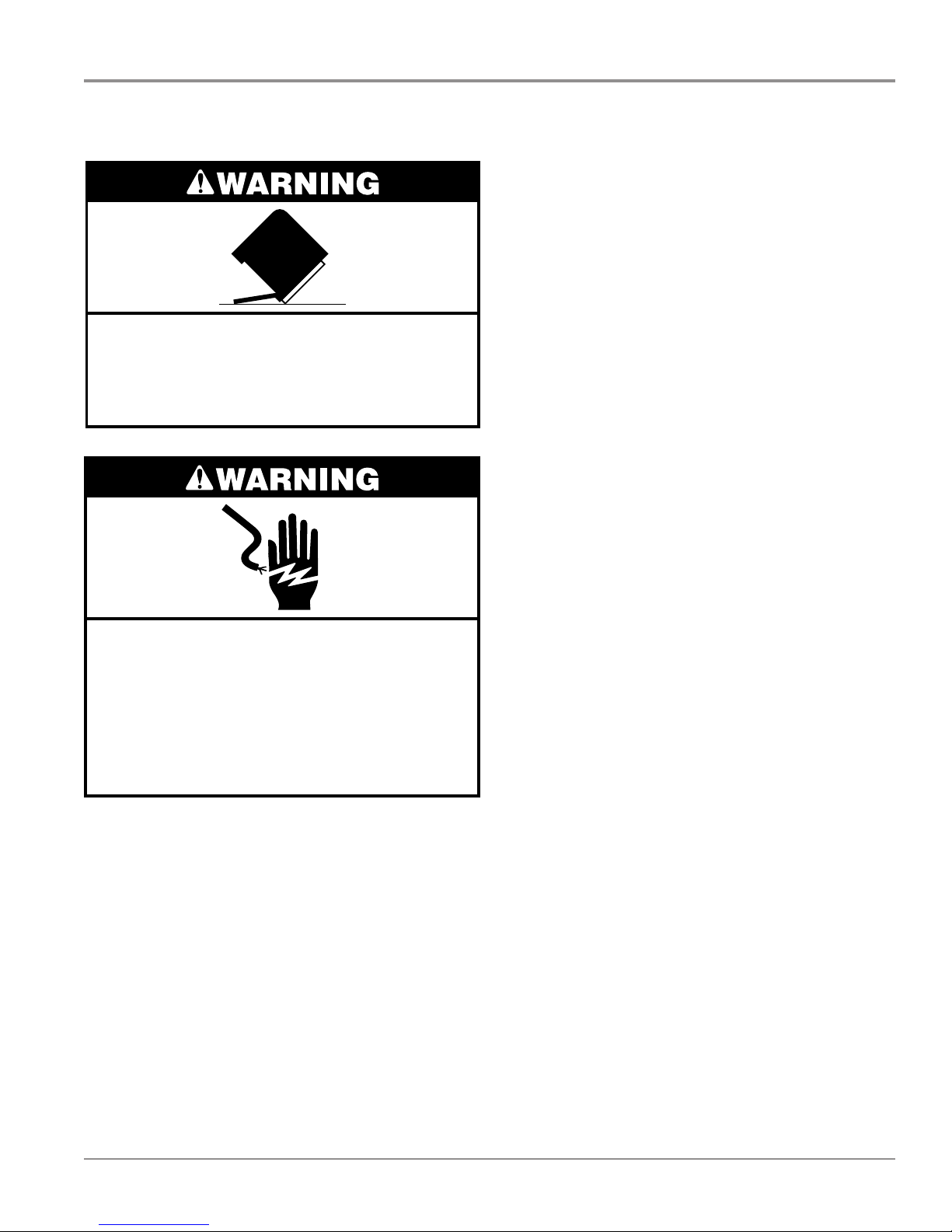
Tip Over Hazard
Do not use dishwasher until completely installed.
Do not push down on open door.
Doing so can result in serious injury or cuts.
Electrical Shock Hazard
Electrically ground dishwasher.
Connect ground wire to green ground connector
in terminal box.
Do not use an extension cord.
Failure to follow these instructions can result in
death, fire, or electrical shock.
• For a grounded, cord-connected dishwasher:
must be grounded. In the event of a malfuncon or
breakdown, grounding will reduce the risk of electric
shock by providing a path of least resistance for electric
current. The dishwasher is equipped with a cord having
an equipment-grounding conductor and a grounding plug.
The plug must be plugged into an appropriate outlet that
is installed and grounded in accordance with all local
codes and ordinances.
WARNING: Improper connecon of the equipmentgrounding conductor can result in a risk of electric shock.
Check with a qualied electrician or service representave
if you are in doubt whether the dishwasher is properly
grounded. Do not modify the plug provided with the
dishwasher; if it will not t the outlet, have a proper outlet
installed by a qualied electrician.
• For a permanently connected dishwasher:
must be connected to a grounded metal, permanent
wiring system, or an equipment-grounding conductor must
be run with the circuit conductors and connected to the
equipment-grounding terminal or lead on the dishwasher.
The dishwasher
The dishwasher
SAVE THESE INSTRUCTIONS
• Install where dishwasher is sheltered from the elements.
Avoid possible rupture of ll valve from freezing. Such
ruptures are not covered by the warranty. See “Storing”
secon for winter storage informaon.
• Install and level dishwasher on a oor that will hold the
weight, and in an area suitable for its size and use.
• Remove all shipping plugs from hoses and connectors
(such as the cap on the drain outlet) before installing. See
Installaon Instrucons or complete informaon.
KitchenAid 2013 Tall Tub Stainless Steel Dishwasher
n
1-3
Page 8

GENERAL INFORMATION
Model & Serial Number
Label Location
Model & Serial Number Label
Tech Sheet Location
Tech Sheet Location
(Behind Toe Kick Panel)
1-4 n
KitchenAid 2013 Stainless Steel Tall Tub Dishwasher
Page 9

GENERAL INFORMATION
Model & Serial Number Nomenclature
MODEL NUMBER K UD E 60 F X BL 5
INTERNATIONAL SALES OR
MARKETING CHANNEL
K = KITCHENAID BRAND
PRODUCT IDENTIFIER
PD = Convertible/Portable UD = Undercounter
E = TRI-FILTER SYSTEM
SERIES CONFIGURATION
FEATURES
F = Fully Integrated Door C = 2.5” Console w/Display I = 2.5” Console
H = Heritage S = Water Softener
YEAR OF MODEL INTRODUCTION
X = 2010 B = CU Model
COLOR CODE
WH = White SS = Stainless Steel BL = Black
BT = Biscuit SP = Stainless Proline PA = Panel Ready
ENGINEERING CHANGE
0 = Basic Release; 1 = First Revision; 2 = Second Revision
SERIAL NUMBER F 2 25 10000
MANUFACTURING SITE
F = FINDLAY, OH
YEAR OF MANUFACTURE
2 = 2012
WEEK OF MANUFACTURE
PRODUCT SEQUENCE NUMBER
KitchenAid 2013 Tall Tub Stainless Steel Dishwasher
n
1-5
Page 10
GENERAL INFORMATION
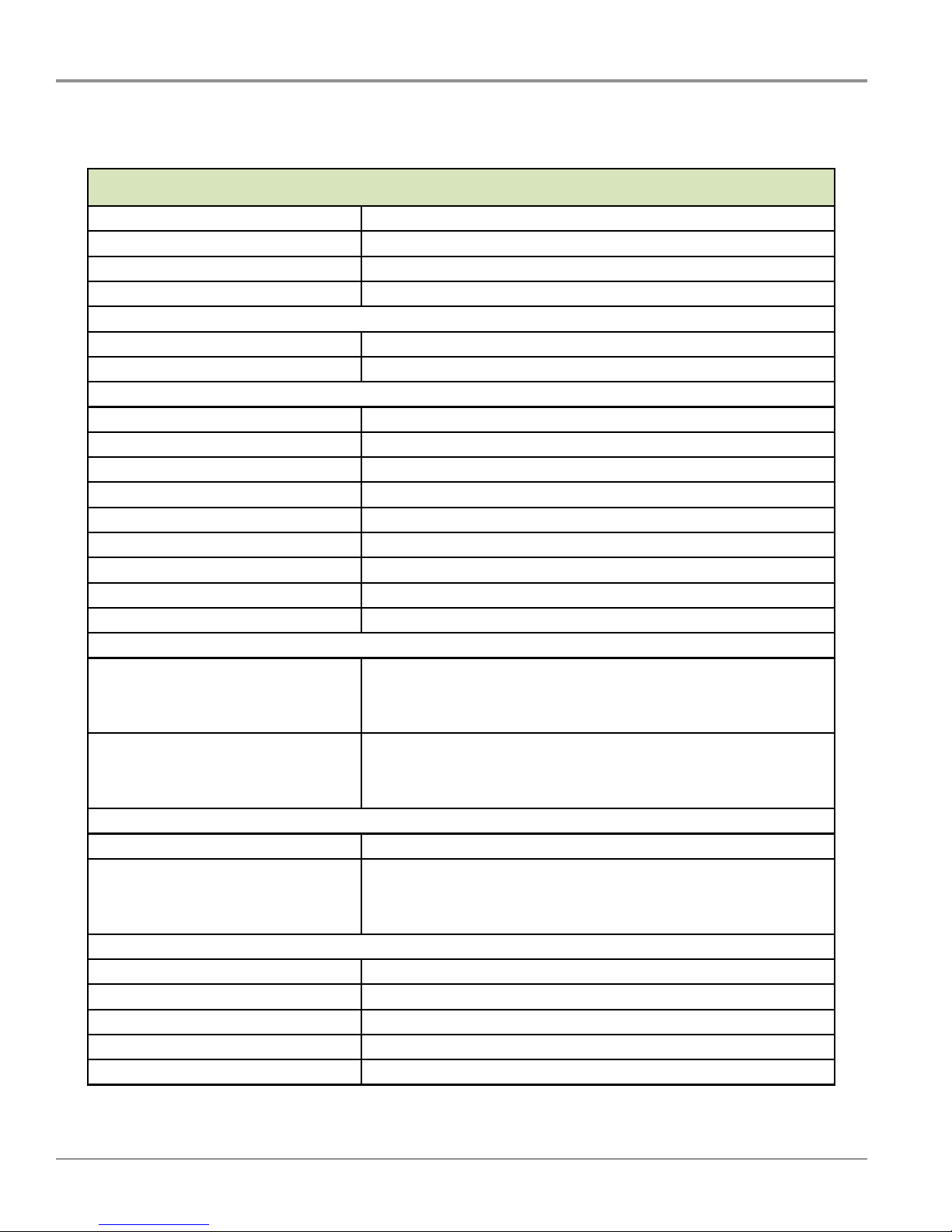
LineVoltage: 120VAC
Frequency: 60Hz
Amps: 10A
LowVoltsPowerSupply: +15V,+13V,+5V,+3.3
WaterPressure: 120psiMax,20psiMin
SupplyWaterTemperature: Minimum‐120°F(49°C)
Control: ElectronicControlw/IntegratedVSMControl
WashMotor: 3‐PhaseVariableSpeedMotor(VSM)
DrainMotor: 3‐PhaseVariableSpeedMotor(VSM)
DiverterMotor: 120VAC
FillValve: 120VAC
Heater: 120VAC
Dispenser: 120VAC
SprayArmMotor: 120VAC(somemodels)
FanMotor: +5VDC(somemodels)
Product Specifications
DISHASHERSPECIFICATIONS
Sensors: TemperatureSensor
WaterSensor(OWI)
SprayArmSensor(somemodels)
Switches: DiverterPositionSwitch(5VDC)
DoorSwitch(13VDC)
FloatSwitch(120VAC)
TCO/Bi‐Metal: IncorporatedintoControlBoard(PenninsulaSlots)
Fuses: Line(L1)Fuse
MotorControlFuse
TriacFuse
LowerWashArm: "S"Design
UpperWashArm: StraightDesign
Filtration: 3‐StageFilterSystem
ProScrub: Availableoncertainmodels
WaterSoftenerModel: KUDE60SXSS4
1-6 n
KitchenAid 2013 Stainless Steel Tall Tub Dishwasher
Page 11
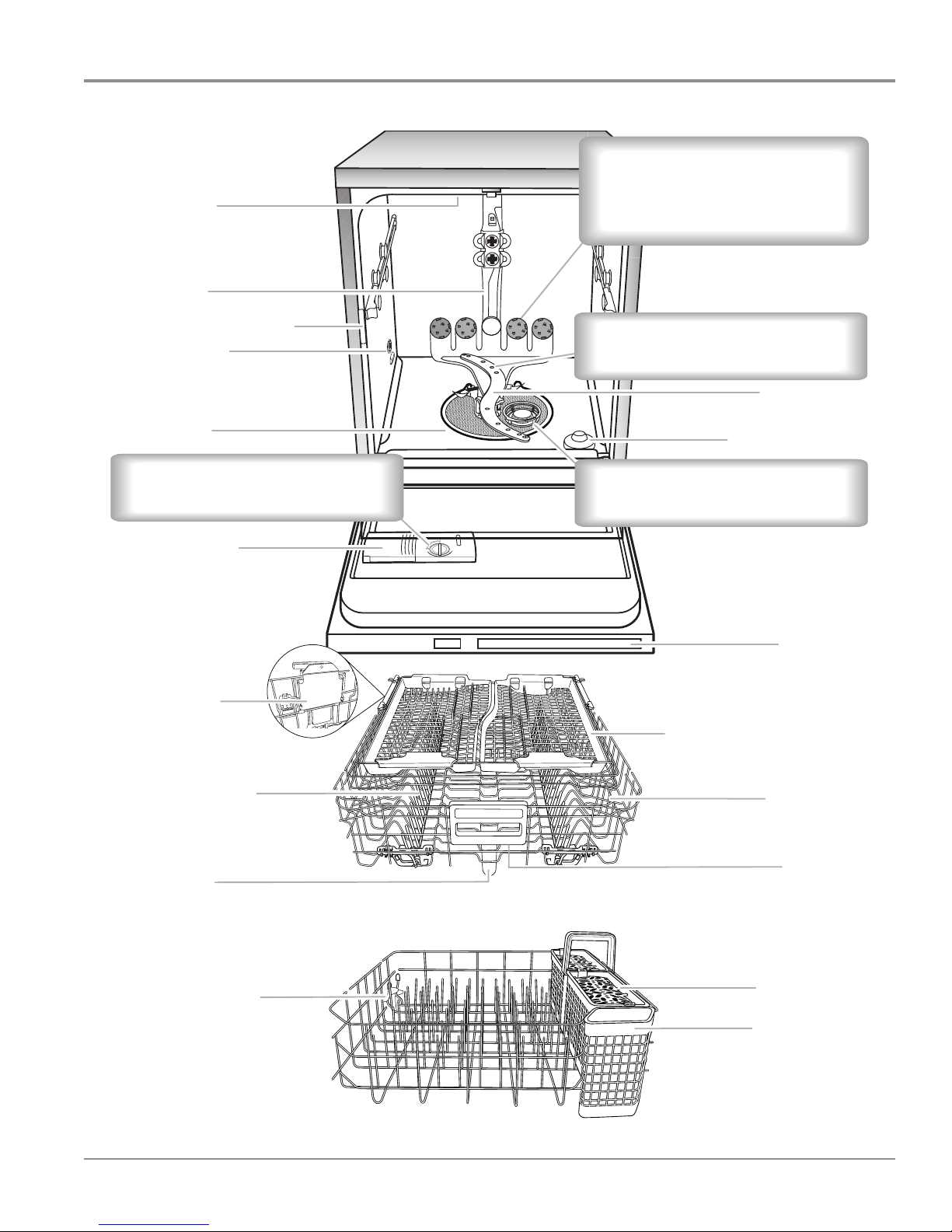
Parts and Features
Upper level wash
BOTTOM RACK
h
r
Water feed tube
Parts & Features
GENERAL INFORMATION
ProScrub® (on some models)
powerful jets target water toward pots,
pans, or casserole dishes loaded in the
back of the dishwasher to clean
stubborn messes.
Model and serial number label
Water inlet opening
Heating element
Rinse aid dispenser reduces spotting
and improves drying.
Detergent dispenser
Premium top rack
adjusters
Pressurized spray nozzles and variable
speed motor provide effective cleaning.
Lower spray arm
Overfill protection float
EQ Filtration System removes soil
from water and improves cleaning action.
Control panel
Culinary tool rack/3rd level rack
(on some models)
Flexible fold-down tines
(on some models)
Upper spray arm
Flexible fold-down tines
TOP RACK
Cup shelves wit
stemware holde
Rack handle
Silverware basket
Culinary Caddy
utensil basket
(on some models)
KitchenAid 2013 Tall Tub Stainless Steel Dishwasher
n
®
1-7
Page 12

GENERAL INFORMATION
Notes
1-8 n
KitchenAid 2013 Stainless Steel Tall Tub Dishwasher
Page 13

OPERATION
Section 2:
Operation
This secon provides operaonal use and care informaon for
the “KitchenAid Stainless Steel Tall Tub Dishwasher.”
■ Start-Up / Quick Reference
■ Quick Steps
■ Dishwasher Use
■ Cycle and Opon Descripons
■ Dishwasher Feedback Secon
■ Dishwasher Features
■ Filtraon System
■ Dishwasher Care
■ Consumer Troubleshoong Guide
■ Notes
KitchenAid 2013 Stainless Steel Tall Tub Dishwasher
n
2-1
Page 14
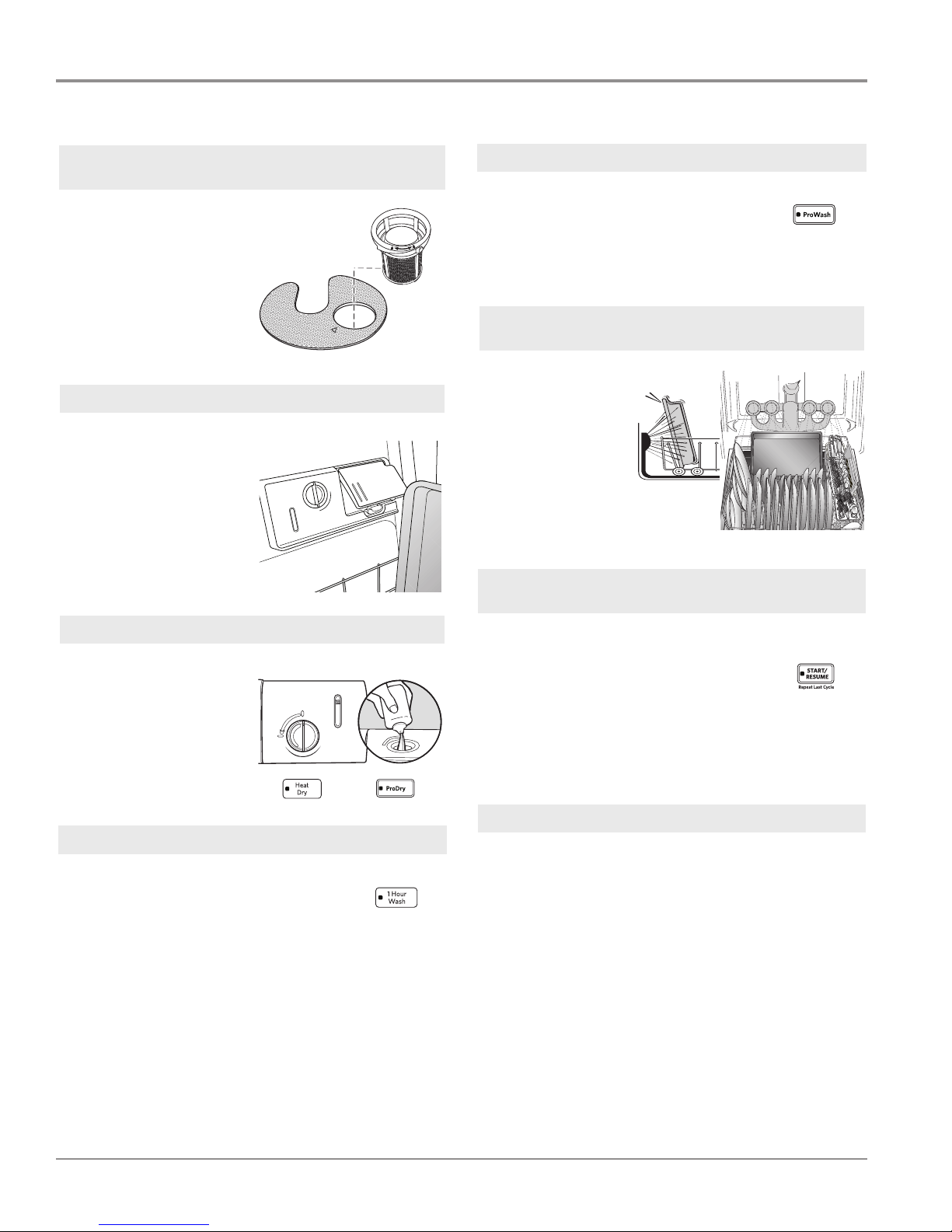
OPERATION
Start-Up / Quick Reference (varies by model)
Start-Up / Quick Reference
Clean EQ Wash System removable filters to maintain
peak performance.
Cleaning the filters
periodically helps keep the
dishwasher working at peak
performance. The filters can
be found at the bottom center
of your dishwasher.
See the “Filtration System”
section for information on
removing and maintaining the
filters.
W
N
O
&
D
T
H
U
S
R
U
N
P
L
O
L
N
C
U
K
IMPORTANT: Do not block detergent dispenser.
Tall items placed in the lower
rack may block the dispenser
door. Cookie sheets and
cutting boards loaded on the
left-hand side of the
dishwasher can easily block
the dispenser. If detergent is
inside of the dispenser or on
the bottom of the tub after the
cycle is complete, the
dispenser was blocked.
ProWash™ cycle for optimal cleaning
The most advanced and versatile cycle.
ProWash™ cycle senses the load size, soil
K
C
O
amount, and toughness of soil, to adjust the
cycle for optimal cleaning using only the
amount of water and energy needed. The
ProWash™ and Heavy Duty cycles are
recommended for tough soil. No need to
prerinse dishes; just scrape and load.
ProScrub® Option for loading to clean baked-on
food (some models)
When the ProScrub
option is selected, it
provides a
concentrated wash
on the back of the
lower dish rack for
hard-to-clean dishes.
Place these dishes
with the soiled
surface of the dish
toward the
ProScrub
®
spray jets
in the lower rack of
the dishwasher.
®
Press START/RESUME every time you
add a dish.
Drying - Rinse Aid is essential.
You must use a drying agent
such as a rinse aid for good
drying performance (sample
included). Rinse aid along
with the Heat Dry or ProDry™
option will provide best drying
and avoid excessive moisture
in the dishwasher interior.
USE RINSE AID FOR
BETTER DRYING
Refill
Full
Lock
Add
IMPORTANT: If anyone opens the door (such
as, for adding a dish, even during the Delay
Hours option), the Start/Resume button must
be pressed each time.
If the Start/Resume button is located on top of
door: Push door firmly closed within
3 seconds of pressing START/RESUME. If the
door is not closed within 3 seconds, the Start/
Resume button LED will flash, an audible tone
will be heard, and the cycle will not start.
or
Proper Detergent Dosing
1 Hour Wash - When you need fast results.
Efficient dishwashers run longer to save water
and energy, just as driving a car slower saves
on gas. When you need fast results, the
1 Hour Wash will clean your dishes using
slightly more water and energy. Select the
Heat Dry or ProDry™ option to speed drying
times (adds approximately 27 to 35 minutes
to the 1 Hour Wash cycle)
It is possible to use too much detergent in your dishwasher.
This can lead to etching of your dishes. See “Add Detergent” in
the “Dishwasher Use” section, to determine the amount of
detergent needed based on your water hardness.
2-2 n
KitchenAid 2013 Stainless Steel Tall Tub Dishwasher
Page 15
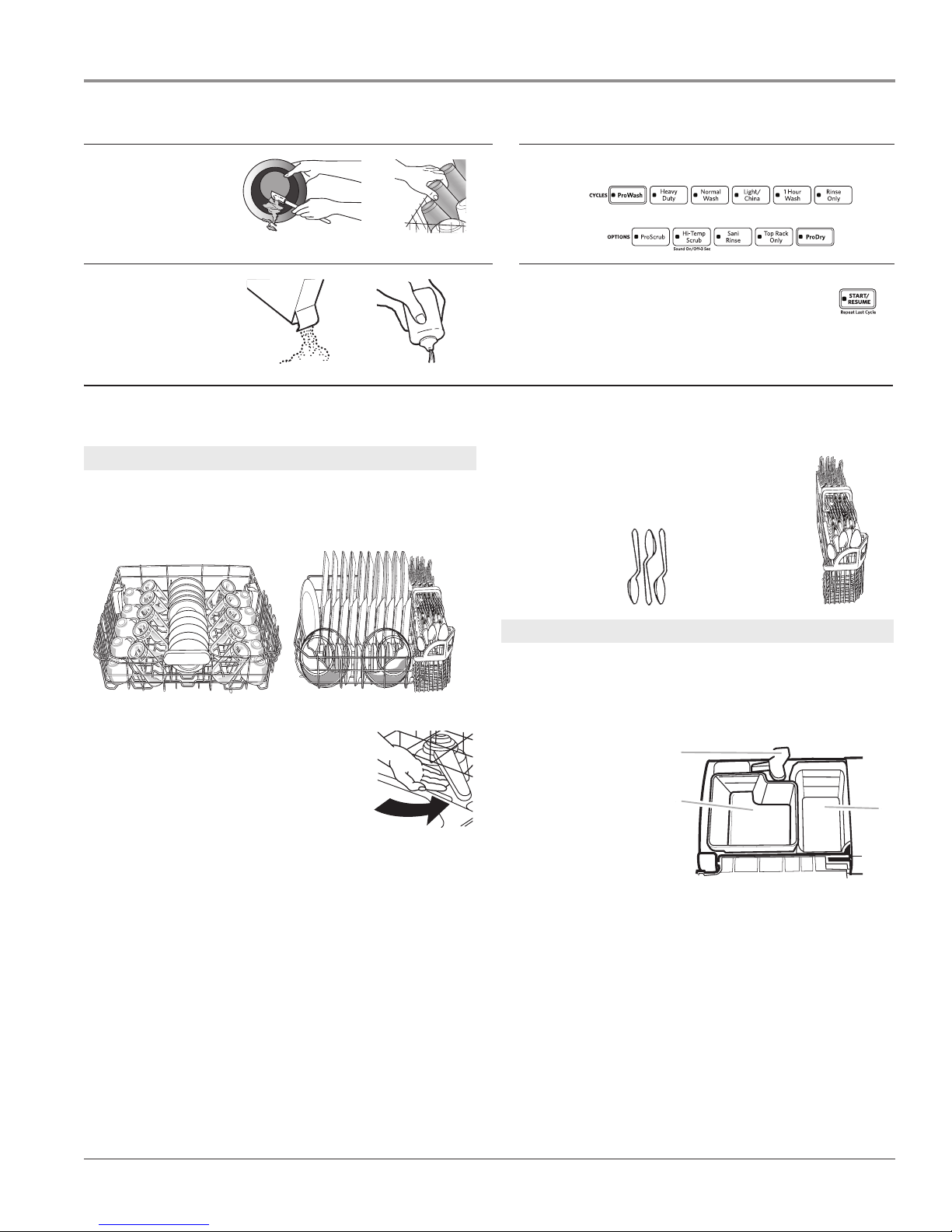
Quick Steps
Quick Steps
Quick Steps
Dishwasher Use
1
Prepare and load
dishwasher.
3
Select a cycle and option.
2
Add detergent
for cleaning and
rinse aid for
drying.
4
Start dishwasher.
NOTE: If the Start/Resume button is located
on the top of door, push door firmly closed
within 3 seconds of pressing START/RESUME.
C
OPERATION
1
2
Prepare and Load the Dishwasher
IMPORTANT: Remove leftover food, bones, toothpicks and other
hard items from the dishes. Remove labels from containers before
washing.
Prepare and load
dishwasher.
Add detergent
for cleaning and
rinse aid for
drying.
STEP 1
Dishwasher Use
Select a cycle and option.
3
■ When loading silverware, always place sharp
Start dishwasher.
4
NOTE: If the Start/Resume button is located
on the top of door, push door firmly closed
within 3 seconds of pressing START/RESUME.
items pointing down. Mix items in each
section of the basket with some pointing up
and some down to avoid nesting. Spray
cannot reach nested items.
Upper rack Lower rack
Make sure nothing keeps spray arm(s) from
spinning freely. It is important for the water
spray to reach all soiled surfaces.
■ Make sure that when the dishwasher door is closed no items
are blocking the detergent dispenser.
■ Items should be loaded with soiled surfaces facing down and
inward to the spray as shown. This will improve cleaning and
drying results.
■ Avoid overlapping items like bowls or plates that may trap food.
■ Place plastics, small plates and glasses in the upper rack.
Wash only plastic items marked “dishwasher safe.”
■ To avoid thumping/clattering noises during operation, load
dishes so they do not touch one another. Make sure lightweight
load items are secured in the racks.
■ Improper loading can cause dishes to be chipped or damaged.
When loading glasses or mugs, it is best to load these items in
between rows of tines instead of loading them over tines, as
shown in the image above.
STEP 2
Add Detergent
NOTE: If you do not plan to run a wash cycle soon, run a rinse
cycle. Do not use detergent.
Use automatic dishwasher detergent only. Add powder, liquid
■
or tablet detergent just before starting a cycle.
■ Fresh automatic
dishwasher detergent
results in better
cleaning. Store tightly
closed detergent
container in a cool, dry
place.
■ The amount of detergent to use depends on:
How much soil remains on the items - Heavily soiled loads
require more detergent.
The hardness of the water - If you use too little in hard water,
dishes won't be clean. If you use too much in soft water,
glassware will etch.
Soft to Medium Water (0-6 grains per U.S. gallon)
[typical water softener water and some city water]
Medium to Hard Water (7-12 grains per U.S. gallon)
[well water and some city water]
■ Depending on your water hardness, fill the Main Wash section
of the dispenser as shown. Fill the Pre-Wash section to the
level shown, if needed.
A
Hard Water
Soft Water
B
MAIN WASH
A. Cover latch
B. Main Wash section
C. Pre-Wash section
Hard Water
Soft Water
PREWASH
KitchenAid 2013 Stainless Steel Tall Tub Dishwasher
n
2-3
Page 16
OPERATION
Dishwasher Use (continued)
NOTE: Fill amounts shown
are for standard powdered
detergent. Follow
instructions on the package
when using other dishwasher
Hard Water
Soft Water
Main Wash Pre-Wash
Hard Water
Soft Water
detergent types.
Premeasured forms are suitable for all hardness and soil levels.
Always place premeasured detergents in the main compartment
and close the lid.
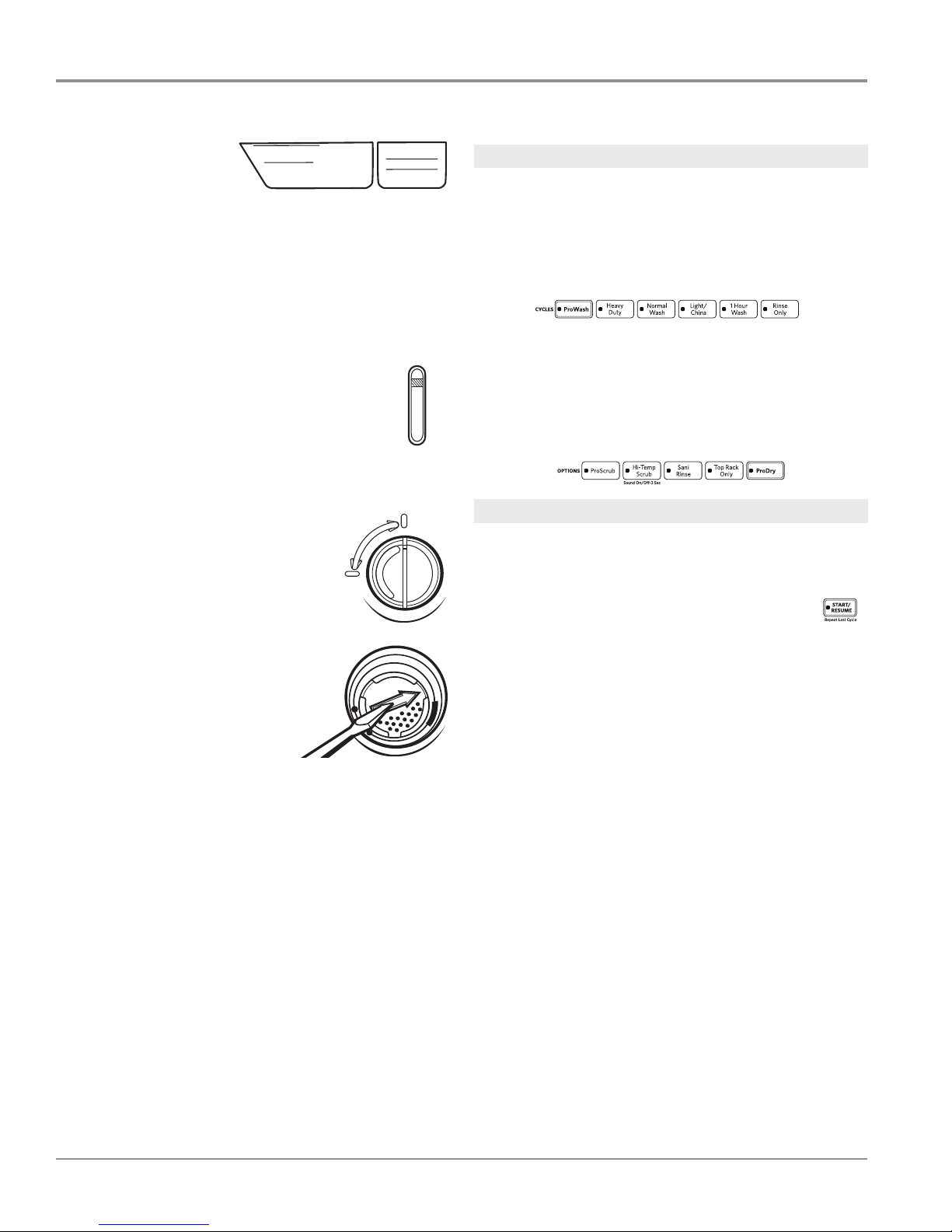
Add Rinse Aid
■ Your dishwasher is designed to use rinse aid for good drying
performance. Without rinse aid your dishes and dishwasher
interior will have excessive moisture. The heat dry option will
not perform as well without rinse aid.
■ Rinse aid keeps water from forming droplets that can
dry as spots or streaks. They also improve drying by
allowing water to drain off of the dishes after the final
rinse.
■ Rinse aid helps to reduce excess moisture on the dish
racks and interior of your dishwasher.
■ Check the rinse aid indicator. Add rinse aid when indicator
drops to “Add” level.
■ To add rinse aid, turn the dispenser cap
to “Refill” and lift off. Pour rinse aid into
the opening until the indicator level is at
“Full.” Replace the dispenser cap and
turn to “Lock.” Make sure cap is fully
locked.
NOTE: For most water conditions, the
factory setting of 2 will give good
results. If you have hard water or notice
rings or spots, try a higher setting. Turn
the arrow adjuster inside the dispenser
by either using your fingers or inserting
a flat-blade screwdriver into the center
of the arrow and turning.
Refill
ILOO
PD[
¹⁄₄
turn to lock
ILOO
PD[
Lock
Full
Add
STEP 3
Select a Cycle (cycles vary by model)
See “Cycle and Option Descriptions” charts in the following
section.
Efficient dishwashers run longer to save water and energy, just as
driving a car slower saves on gas. Typical cycle time is
approximately 2¹⁄₂ hours, but can take less or more time to
complete depending on selections.
Select Options (options vary by model)
See “Cycle and Option Descriptions” charts in the following
section.
You can customize your cycles by pressing the options desired. If
you change your mind, press the option again to turn off the option.
Not all options are available for every cycle. If an invalid option is
selected for a given cycle, the lights will flash.
STEP 4
Start or Resume a Cycle
■ Run hot water at the sink nearest your dishwasher until the
water is hot. Turn off water.
Press START/RESUME once to show which
■
selections you used. Select the wash cycle and
options desired OR press START/RESUME to repeat
the same cycle and options as in the previous wash
cycle.
IMPORTANT: If anyone opens the door (such as, for adding a dish,
even during the Delay Hours option), the Start/Resume button
must be pressed each time.
■ If the Start/Resume button is located on top of door, push door
firmly closed within 3 seconds of pressing START/RESUME. If
the door is not closed within 3 seconds, the Start/Resume
button LED will flash, an audible tone will be heard, and the
cycle will not start.
2-4 n
KitchenAid 2013 Stainless Steel Tall Tub Dishwasher
Page 17
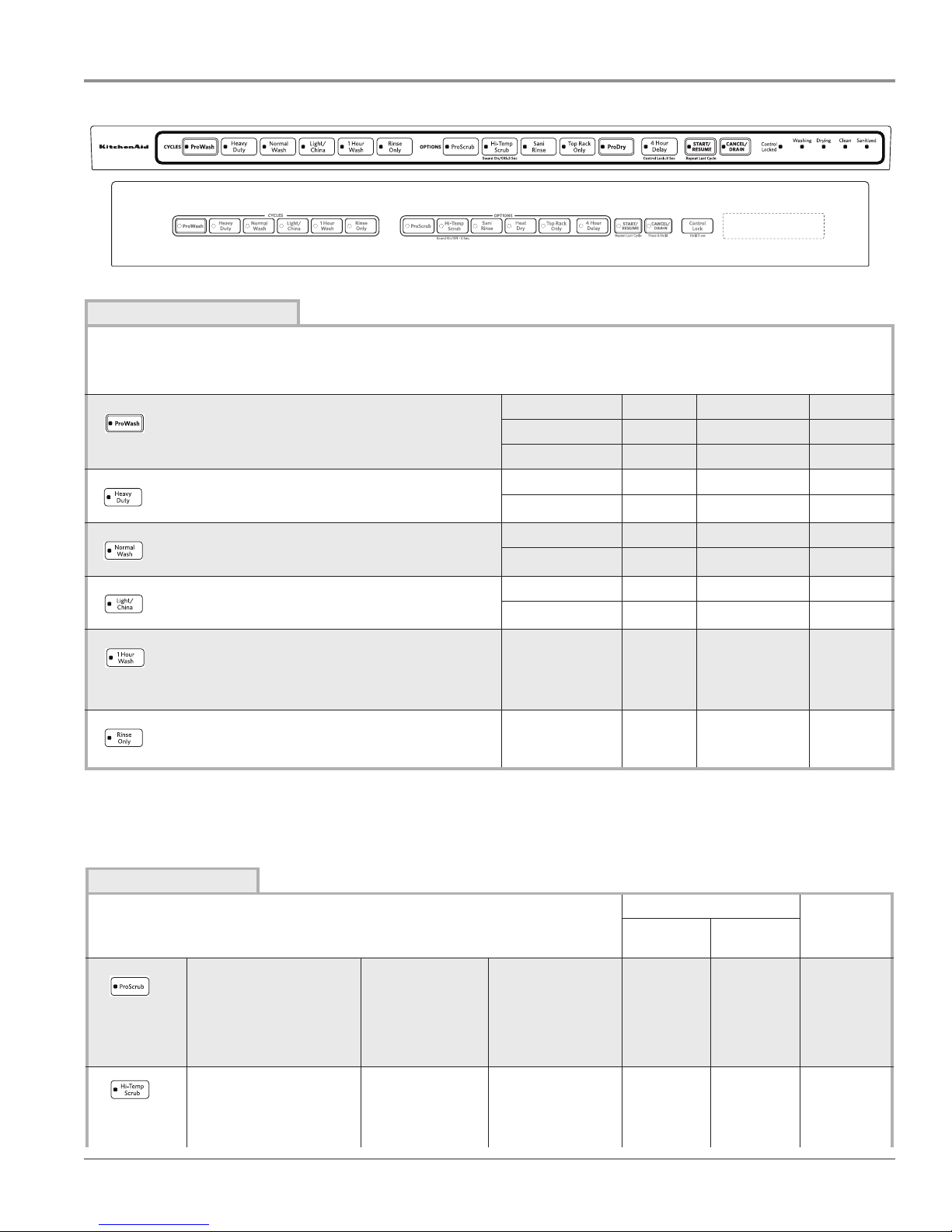
Cycle and Option Descriptions
Cycle and Option Descriptions
OPTION SELECTIONS
OPTIONS CAN BE
SELECTED WITH
WHAT IT DOES ADDED TIME TO CYCLE ADDED
WATER
GALLONS
(LITERS)
TYPICAL MAX
Cleans pans, casseroles,
etc., with tough food soil
to eliminate the need for
soaking and scrubbing of
dirty, baked-on dishes.
Heavy Duty
Normal Wash
Activates the
ProScrub
®
spray
jets to provide
intensified cleaning
power to items at
the back of the
lower rack.
53 73 0 - 3.0
(0 - 11.2)
Raises the main wash
temperature to improve
cleaning for loads
containing tough, bakedon food.
Heavy Duty
Normal Wash
Raises the main
wash temperature
from 105°F (41°C)
to 120°F (49°C).
22 40 0 - 3.0
(0 - 11.2)
This information covers several different models. Your dishwasher may not have all of the cycles and options described.
CYCLE SELECTIONS
CYCLES SOIL LEVEL WASH TIME* (MINS.)
The most advanced and versatile cycle. ProWash™
cycle senses the load size, soil amount, and toughness
of soil, to adjust the cycle for optimal cleaning using
only the amount of water and energy needed.
Use for hard-to-clean, heavily soiled pots, pans,
casseroles, and regular tableware.
Light to Medium 110 150 4.2 (16.1)
Tough/Baked-On 125 190 5.0 (19.1)
Heavy 125 190 6.8 (25.8)
Light to Medium 130 150 5.0 (19.1)
Heavy/Baked-On 140 205 6.8 (25.8)
W/O OPTIONS
Typical** Max
OPERATION
WATER
USAGE
GALLONS
(Liters)
Use for loads with normal amounts of food soil. The
energy-usage label is based on this cycle.
Use for lightly soiled items or china and crystal. Light to Medium 105 145 4.2 (15.2)
When you need fast results, the 1 Hour Wash will clean
dishes using slightly more water and energy. Select the
Heat Dry or ProDry™ option to speed drying times (add
approximately 27 to 35 minutes to the 1 Hour Wash
cycle).
Use for rinsing dishes, glasses, and silverware that will
not be washed right away.
Do not use detergent.
Wash times depend on water temperature, heavy soil condition, dish load size and options selected. Adding options will add time to the
cycle.
* Adding options will add time to the cycle. See options information section.
** This is the approximate cycle time obtained with 120°F (49°C) hot water available at the dishwasher. Increase in time results from low
temperature of the incoming water.
Light to Medium 110 150 4.0 (15.0)
Heavy 125 190 6.8 (25.8)
Heavy/Baked-On 120 185 6.8 (25.8)
All soil levels 58 62 7.9 (30.0)
All soil levels 17 20
KitchenAid 2013 Stainless Steel Tall Tub Dishwasher
n
2-5
Page 18
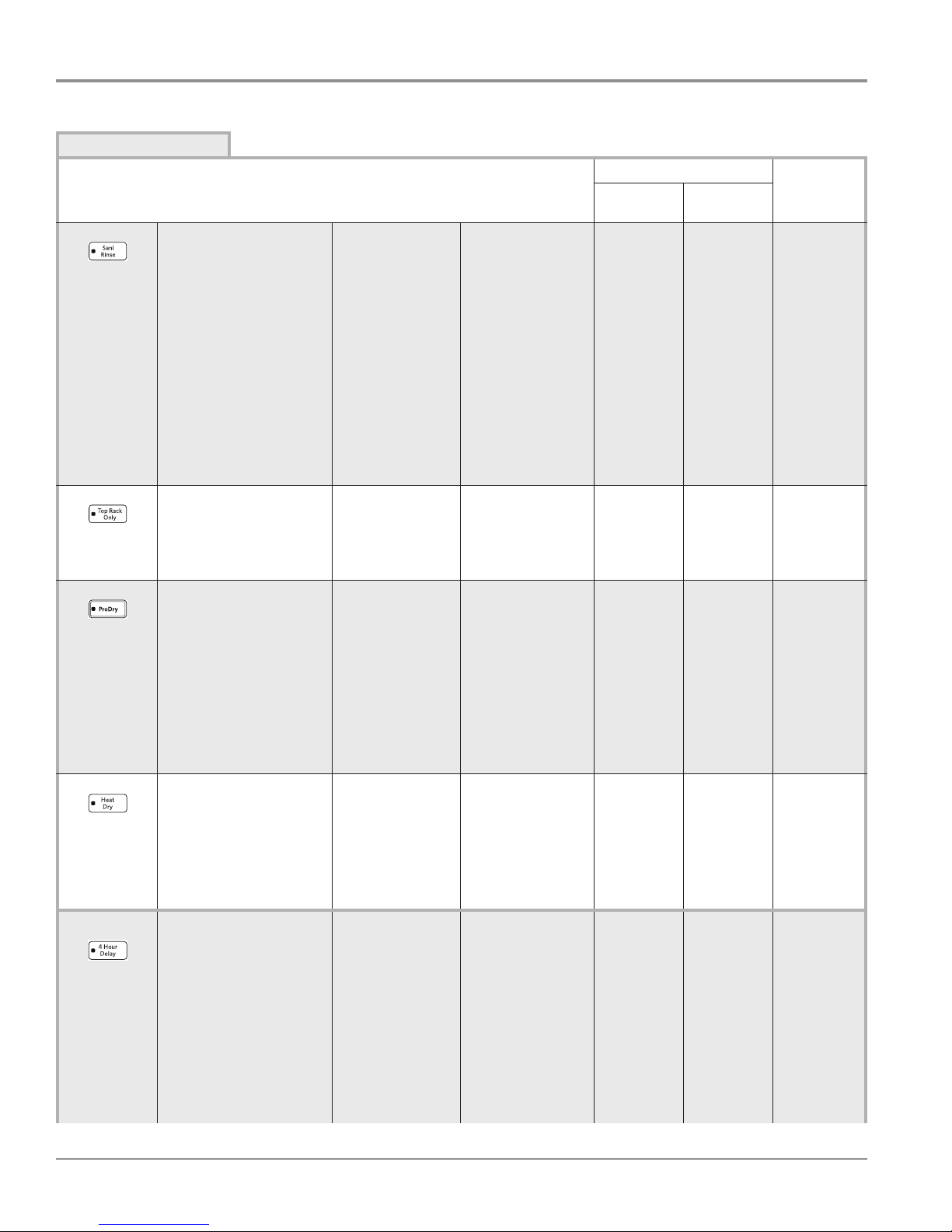
OPERATION
OPTION SELECTIONS
Cycle and Option Descriptions (continued)
OPTIONS CAN BE
Sanitizes dishes and
glassware in accordance
with National Sanitation
Foundation (NSF)/ANSI
Standard 184 for
Residential Dishwashers.
Certified residential
dishwashers are not
intended for licensed food
establishments. The Sani
indicator indicates at the
end of the cycle whether
the Sani Rinse option was
successfully completed. If
the indicator is not
activated, it is probably
due to the cycle being
interrupted.
For added convenience,
use for washing a small
load of dishes in the top
rack to help keep the
kitchen continuously
clean.
Dries dishes with heat and
a fan. This option with the
use of rinse aid will provide
the best drying
performance. Plastic items
are less likely to deform
when loaded in the top
rack. Turn ProDry™ option
off for an air dry.
Dries dishes with heat.
This option with the use of
rinse aid will provide the
best drying performance.
Plastic items are less likely
to deform when loaded in
the top rack. Turn Heat Dry
off for an air dry.
Runs the dishwasher at a
later time or during offpeak electrical hours.
Select a wash cycle and
options. Press 4 Hour
Delay. Press START/
RESUME. Close the door
firmly.
NOTE: Anytime the door is
opened (such as, to add a
dish), the Start/Resume
button must be pressed
again to resume the delay
countdown.
SELECTED WITH
Heavy Duty
Normal Wash
Available with any
cycle
Cannot be used
with ProScrub
Option
Available with any
cycle except Rinse
Available with any
cycle except Rinse
Available with any
cycle
Only
Only
WHAT IT DOES ADDED TIME TO CYCLE ADDED
TYPICAL MAX
Increased the main
wash temperature
from 105°F (41°C)
to 130°F (54°C) and
the final rinse from
140°F (60°C) to
155°F (68°C).
Slightly faster wash
for smaller loads
®
Uses the heating
element to heat air,
plus a system of
vents and a fan that
ventilates moist air
out of the
dishwasher to
speed drying times.
ProDry™ option
defaults to ON
when any cycle is
selected except for
1 Hour Wash.
Activates the
heating element at
the end of the wash
cycle to speed
drying times. Heat
Dry defaults to ON
when any cycle is
selected except for
1 Hour Wash.
Delays the start of a
cycle up to 4 hours
53 73 0 - 3.0
-7 -30 0
44 51 0
52 52 0
240 240 0
WATER
GALLONS
(LITERS)
(0 - 11.2)
2-6 n
KitchenAid 2013 Stainless Steel Tall Tub Dishwasher
Page 19
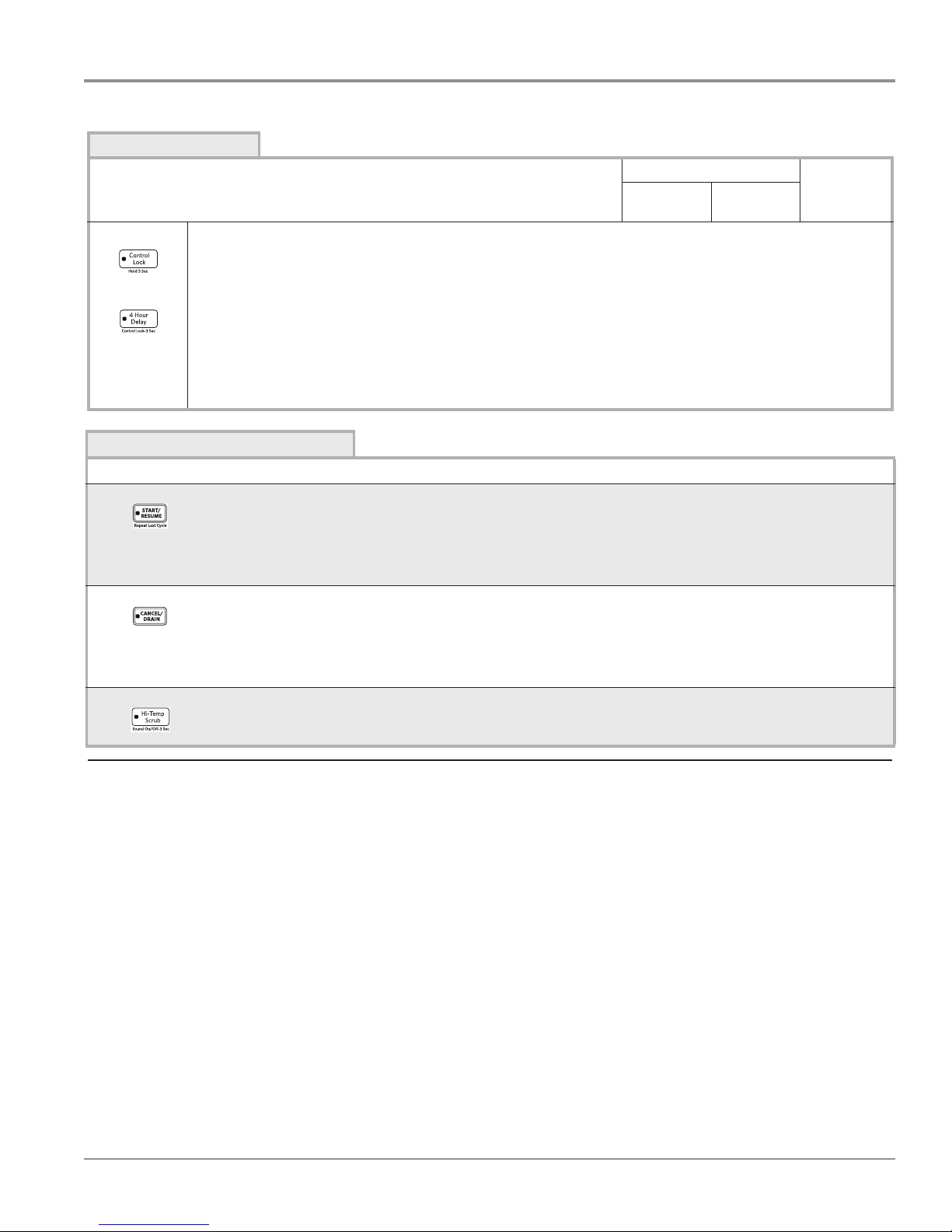
Cycle and Option Descriptions (continued)
OPTION SELECTIONS
OPTIONS CAN BE
Control Lock Avoids unintended use of the dishwasher between cycles, or cycle and option changes during a cycle.
To turn on Lock, press and hold CONTROL LOCK or 4 HOUR DELAY (depending on model) for 3 seconds. The Control
Lock light will stay on for a short time, indicating that it is activated, and all buttons are disabled. If you press any button
or
CONTROLS AND CYCLE STATUS
CONTROL PURPOSE COMMENTS
while your dishwasher is locked, the light flashes 3 times. The dishwasher door can still be opened/closed while the
controls are locked.
NOTE: You may need to disable Sleep Mode by pressing either START/RESUME or CANCEL, or by opening and
closing the door before you are able to turn Control Lock off.
To turn off Control Lock, press and hold CONTROL LOCK or 4 HOUR DELAY (depending on model) for 3 seconds. The
light turns off.
NOTE: If your model requires you to press and hold 4 HOUR DELAY to lock the controls, the Control Lock LED will be
on or off to indicate if Control Lock is active or not.
To start or resume a
wash cycle
To reset any cycle or
options during
selection.
To cancel a wash
cycle after it's
started.
To turn the audible
tones on or off.
SELECTED WITH
If the door is opened during a cycle or the power is interrupted, the Start/Resume indicator
flashes. The cycle will not resume until the door is closed and START/RESUME is pressed.
NOTE: If the Start/Resume button is located on top of door, push door firmly closed within
3 seconds of pressing START/RESUME. If the door is not closed within 3 seconds, the
Start/Resume button LED will flash, an audible tone will be heard, and the cycle will not
start.
Press and hold CANCEL/DRAIN to reset any control selections made.
See “Canceling A Cycle After Dishwasher Is Started” and “Changing A Cycle After
Dishwasher Is Started” sections.
Press and hold the Hi-Temp Scrub button for 3 seconds to turn the audible tones on or off.
Only audible tones for confirming button presses can be turned on/off. Important audible
tones, such as indicating a cycle has been interrupted, cannot be deactivated.
WHAT IT DOES ADDED TIME TO CYCLE ADDED
TYPICAL MAX
OPERATION
WATER
GALLONS
(LITERS)
KitchenAid 2013 Stainless Steel Tall Tub Dishwasher
n
2-7
Page 20
OPERATION
Dishwasher Feedback Section
Control Lock Avoids unintended use of the dishwasher between cycles, or cycle and option changes during a cycle.
To turn on Lock, press and hold CONTROL LOCK or 4 HOUR DELAY (depending on model) for 3 seconds. The Control
Lock light will stay on for a short time, indicating that it is activated, and all buttons are disabled. If you press any button
while your dishwasher is locked, the light flashes 3 times. The dishwasher door can still be opened/closed while the
controls are locked.
NOTE: You may need to disable Sleep Mode by pressing either START/RESUME or CANCEL, or by opening and
closing the door before you are able to turn Control Lock off.
To turn off Control Lock, press and hold CONTROL LOCK or 4 HOUR DELAY (depending on model) for 3 seconds. The
light turns off.
NOTE: If your model requires you to press and hold 4 HOUR DELAY to lock the controls, the Control Lock LED will be
on or off to indicate if Control Lock is active or not.
CONTROLS AND CYCLE STATUS
CONTROL PURPOSE COMMENTS
To start or resume a
wash cycle
If the door is opened during a cycle or the power is interrupted, the Start/Resume indicator
flashes. The cycle will not resume until the door is closed and START/RESUME is pressed.
NOTE: If the Start/Resume button is located on top of door, push door firmly closed within
3 seconds of pressing START/RESUME. If the door is not closed within 3 seconds, the
Start/Resume button LED will flash, an audible tone will be heard, and the cycle will not
start.
To reset any cycle or
options during
selection.
To cancel a wash
cycle after it's
started.
Press and hold CANCEL/DRAIN to reset any control selections made.
See “Canceling A Cycle After Dishwasher Is Started” and “Changing A Cycle After
Dishwasher Is Started” sections.
To turn the audible
tones on or off.
Press and hold the Hi-Temp Scrub button for 3 seconds to turn the audible tones on or off.
Only audible tones for confirming button presses can be turned on/off. Important audible
tones, such as indicating a cycle has been interrupted, cannot be deactivated.
OPTION SELECTIONS
OPTIONS CAN BE
SELECTED WITH
WHAT IT DOES ADDED TIME TO CYCLE ADDED
WATER
GALLONS
(LITERS)
TYPICAL MAX
or
Canceling A Cycle
4. Press and hold CANCEL/DRAIN twice to reset the control.
5. Select new cycles and options.
Dishwasher Feedback Section
CONTROLS AND CYCLE STATUS
CONTROL PURPOSE COMMENTS
1. Open the door slightly to stop the cycle. Wait for the spraying
2. Press and hold Cancel/Drain button once. The Cancel/Drain
3. Close the door and the dishwasher starts a drain cycle (if water
Changing A Cycle After Dishwasher Is Started
1. You can interrupt a cycle and restart your dishwasher from the
2. Open the door slightly to stop the cycle. Wait for the spraying
3. Check that detergent dispenser cover is still closed. If cover is
action to stop before completely opening the door.
light will light up.
remains in bottom of dishwasher). Let the dishwasher drain
completely. The Cancel/Drain light turns off after 2 minutes.
beginning using the following procedure.
action to stop, then open the door completely.
open, you will need to refill the detergent dispenser before
restarting your new cycle.
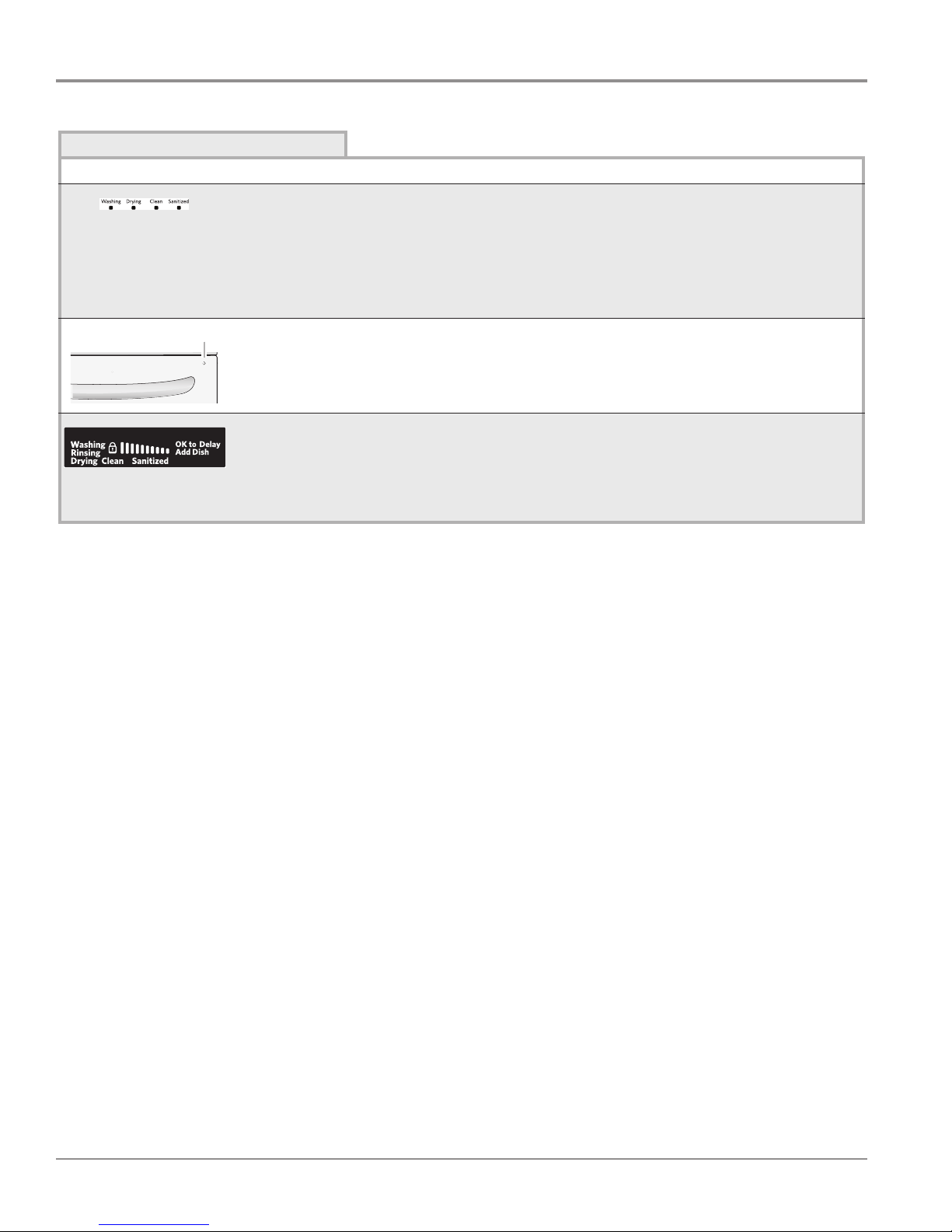
The Cycle Status Indicator
Lights are used to follow the
progress of the dishwasher
cycle. Located on the front
of the dishwasher for front
control models, and located
on the top of the door for
hidden control models.
The Front Indicator Light or
A
Single Exterior Light (A)
shows progress of your
dishwasher cycle by color
(for hidden control models
only).
The Cycle Status Display is
used to follow the progress
of the dishwasher cycle, and
to show other information.
(Available on some models
instead of Cycle Status
Indicator Lights)
Clean indicator glows when a cycle is finished.
If you select the Sani Rinse option, when the Sani Rinse cycle is finished,
the Sanitized indicator glows. If your dishwasher did not properly sanitize
your dishes, the light flashes at the end of the cycle. This can happen if the
cycle is interrupted, or the water could not be heated to the required
temperature.
The Clean and Sanitized lights go off when you open and close the door or
press and hold CANCEL.
The light will be blue if the dishwasher is washing or rinsing. The light will
be red when the dishwasher is drying. The light will be green to indicate
that the cycle is complete. If the Front Indicator Light is blinking, see
“Troubleshooting” section.
The indicators will inform you if you are able to add a dish to the cycle after
it has started. It will also inform you if the dishwasher is washing, rinsing,
drying, complete, and/or sanitized. They will show whether the control is
locked and/or the delay option is selected. A series of bars will count down
the duration of the cycle remaining from left to right. Each bar equals
approximately 24 minutes of cycle length. The bars will also count down
the delay feature from left to right, and the delay indicator will be activated.
6. Press START/RESUME.
Adding A Dish After Dishwasher Is Started
1. Check if Add a Dish indicator is lit. (Available on some models.
Otherwise, proceed to Step 2.)
2. Open the door slightly to stop the cycle. Wait for the spraying
action to stop, and then open the door completely.
3. Check whether the detergent dispenser cover is still closed. If
it is open, the wash cycle has already started and adding a
dish is not recommended.
4. If detergent has not yet been used (detergent dispenser cover
is closed), you may add a dish.
5. Press START/RESUME.
2-8 n
KitchenAid 2013 Stainless Steel Tall Tub Dishwasher
Page 21
Dishwasher Features
Canceling A Cycle
1. Open the door slightly to stop the cycle. Wait for the spraying
action to stop before completely opening the door.
2. Press and hold Cancel/Drain button once. The Cancel/Drain
light will light up.
3. Close the door and the dishwasher starts a drain cycle (if water
remains in bottom of dishwasher). Let the dishwasher drain
completely. The Cancel/Drain light turns off after 2 minutes.
Changing A Cycle After Dishwasher Is Started
1. You can interrupt a cycle and restart your dishwasher from the
beginning using the following procedure.
2. Open the door slightly to stop the cycle. Wait for the spraying
action to stop, then open the door completely.
3. Check that detergent dispenser cover is still closed. If cover is
open, you will need to refill the detergent dispenser before
restarting your new cycle.
4. Press and hold CANCEL/DRAIN twice to reset the control.
5. Select new cycles and options.
6. Press START/RESUME.
Adding A Dish After Dishwasher Is Started
1. Check if Add a Dish indicator is lit. (Available on some models.
Otherwise, proceed to Step 2.)
2. Open the door slightly to stop the cycle. Wait for the spraying
action to stop, and then open the door completely.
3. Check whether the detergent dispenser cover is still closed. If
it is open, the wash cycle has already started and adding a
dish is not recommended.
4. If detergent has not yet been used (detergent dispenser cover
is closed), you may add a dish.
5. Press START/RESUME.
Dishwasher Features
Your KitchenAid dishwasher may have some or all of these features.
right-hand side of the
such
OPERATION
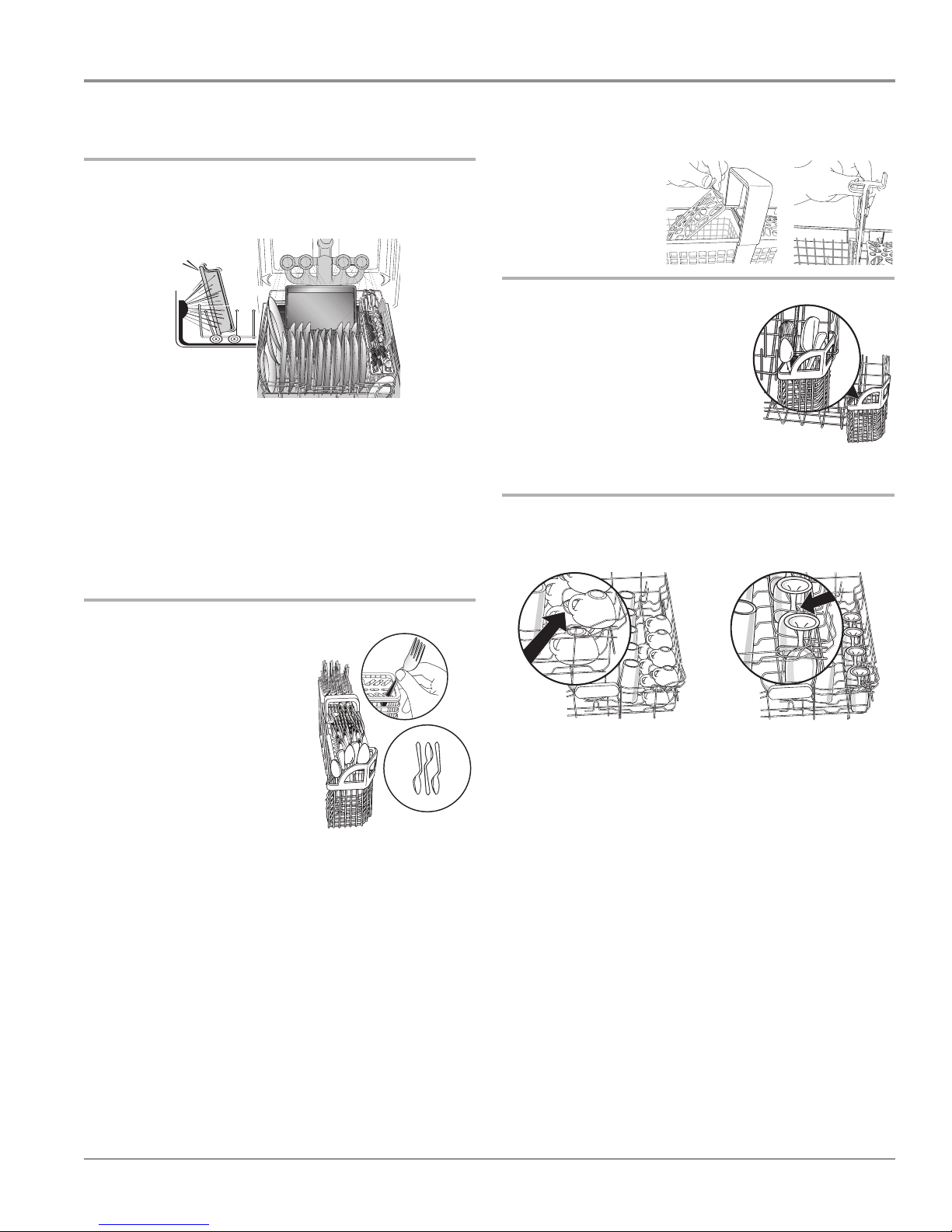
ProScrub® Option Wash Area
The ProScrub® option wash area is located at the back of the lower
level rack.
NOTE: You must select the ProScrub
Make sure items do not interfere with the water feed tube, spray
arms, or ProScrub
■ Keep the last tine row in the back of the lower rack in the
60° angled position when using the ProScrub
■ Load pans, casserole dishes, etc. in the back of the lower dish
rack with the soiled surfaces facing the ProScrub
and resting on the last row of tines in the angled position
■ Only one row of items may face the ProScrub
Stacking, overlapping or nesting items will keep the ProScrub
spray jets from contacting all of the surfaces.
®
spray jets.
®
option to use this feature.
®
option.
®
spray jets.
Silverware Basket
Use the slots in the covers to
keep your silverware separated
for optimum wash. There are
specially designed slots (small
round holes) for chopsticks. Mix
silverware types to keep them
separated. Load knives down,
forks up, and alternate spoons,
for best cleaning results.
NOTE: If your silverware
does not fit into the
designated slots, flip the
covers up and push them
down into the basket.
®
spray jets,
CULINARY CADDY® Utensil Basket
Use the utensil basket to hold specialty
cooking utensils (serving spoons,
spatulas, and similar items), or overflow
silverware items.
The basket hangs on the bottom rack in
the right-hand corner. Load the basket
while it is on the bottom rack or remove
the basket for loading on a counter or
table.
NOTE: Spin the spray arms. Be sure
items in the basket do not stop the
rotation of the spray arms.
SURE-HOLD® Cup and Stemware Holder
Fold down the extra shelf on the left-hand or
mid level rack to hold additional cups, stemware or long items
as utensils and spatulas.
®
NOTE: Remove the culinary tool basket(s) when washing tall
stemware or other tall items in the top rack.
KitchenAid 2013 Stainless Steel Tall Tub Dishwasher
n
2-9
Page 22
OPERATION
ess the tab on the track in and pull up the front end
move the back end of the rack, by pulling the back end out
place.
B
Dishwasher Features (continued)
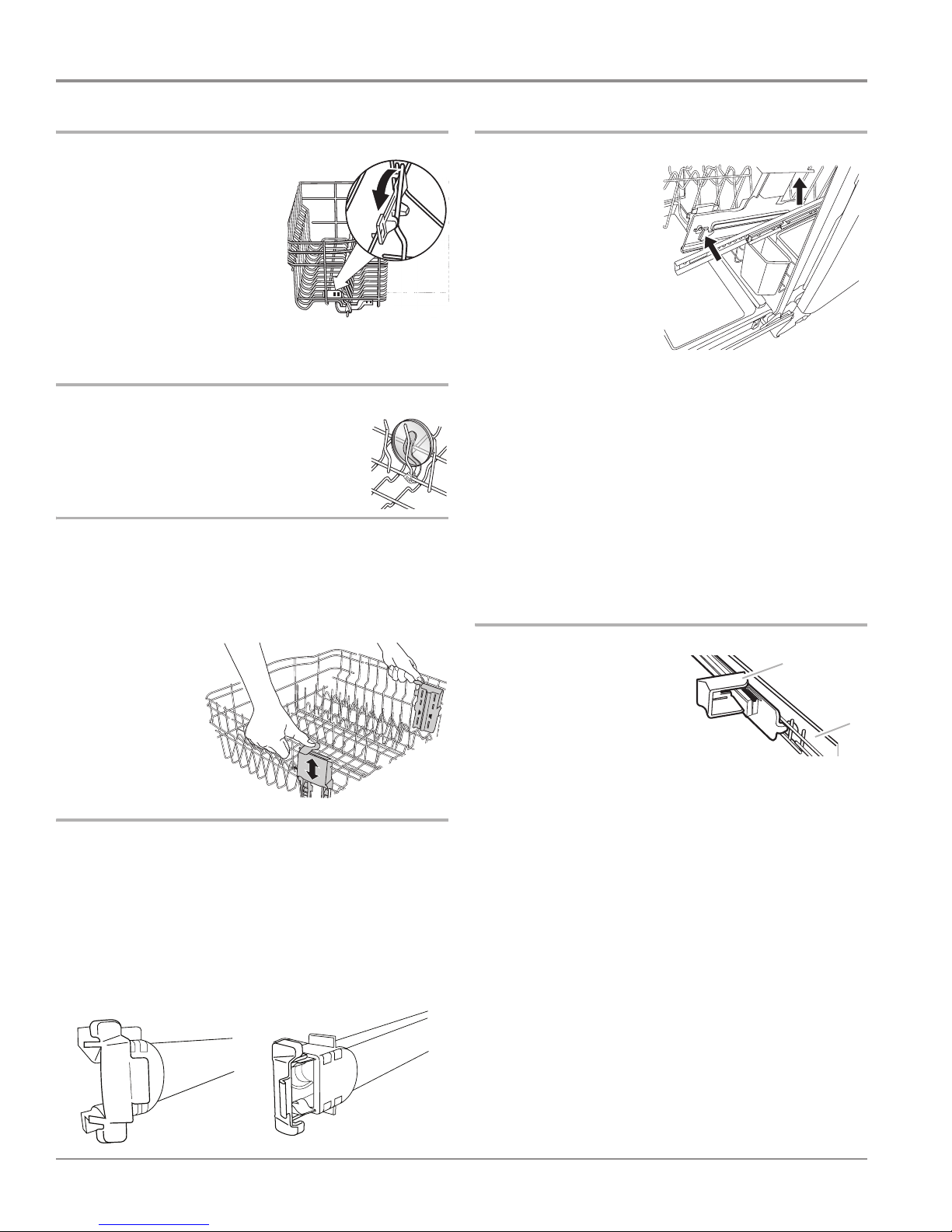
FLEXI-FOLD DOWN™ Flexible Tines
The row of tines on the left-hand and
right-hand sides of the top rack can
be adjusted to make room for a
variety of dishes.
To adjust the fold-down tines:
1. Grasp the tip of the tine that is in
the tine holder.
2. Gently push the tine out of the
holder.
3. Lay the tines down, toward the
center of the rack.
NOTE: The bottom rack may also have 1 or 2 rows of flexible tines
located in the back of the rack. Follow the same instructions to
adjust.
SURE-HOLD® Light Item Clips
The light item clips hold lightweight plastic items
such as cups, lids, or bowls in place during
washing.
To move a clip:
1. Pull the clip up and off the tine.
2. Reposition the clip on another tine.
Premium Adjustable 2-Position Top Rack
After removing the culinary tool rack, you can raise or lower the top
rack to fit tall items in either the top or bottom rack. Adjusters are
located on each side of the top rack. Each adjuster has 2 preset
positions.
To raise the rack,
is in the Up position and level.
To lower the rack,
press both rack
adjusters and slide the
rack to its Down
position and level.
press both rack adjusters and lift the rack until it
Removable Top Rack (for SatinGlide® rails)
The removable top rack allows you to wash larger items such as
pots, roasters, and cookie sheets in the bottom rack.
IMPORTANT: Remove dishes prior to removing the top rack from
dishwasher.
To remove the rack
To gain access to the track stops, pull the upper rack forward
about halfway out of the tub.
To open, flip the track stop toward the outside of the tub.
After opening both track stops, pull top rack out of the rails.
Removable Top Rack (for SatinGlide® Max rails)
The removable top rack
allows you to wash larger
items such as pots, roasters,
and cookie sheets in the
bottom rack.
IMPORTANT: Remove
dishes prior to removing the
top rack from the
dishwasher.
To remove the rack:
To gain access to the
removable tabs on the
tracks/rails, pull the upper
rack forward about halfway out of the tub.
On one side, pr
of the rack out of the track. Then repeat this step on the other side
to completely remove the front end of the rack.
Then re
with a slightly forward, and then upward motion.
To replace the rack:
Pull the tracks forward about halfway out of the tub.
Along the sides of the racks are round attachment tabs. Align the
rack's back end attachment tabs with the cutout in the track. Push
down into place.
Pull the tracks completely out, and align the rack's front end
attachment tabs with the cutout in the track. Push down into
You will hear a snap when the front end of the rack is secured into
place on each side.
Removable Culinary Tool Rack (3rd level rack)
The removable culinary tool rack
(3rd level rack) allows you to wash
larger items in the upper rack, or
remove both the culinary tool rack
and top rack to wash larger times
in the lower rack. See “Removable
Top Rack” section.
To remove the rack:
1. To access track stops, pull the
rack forward until it stops and
clicks into place.
2. To open track stops, flip the track stop to the outside of the
track.
3. After opening both track stops, slide front wheels up and out
of the slot in track. Continue to pull rack forward in track and
slide the back wheels up and out of the track.
4. Close track stops.
5. Slide rack tracks back into dishwasher.
To replace the rack:
1. Gently pull rack tracks forward in dishwasher until they stop
and click into place.
2. To open track stops, flip the track stop to the outside of the
track.
3. Place the back rack rollers on each side of the rack into the
track slot and roll the rack back into the tracks.
4. Insert front rack rollers on each side of the rack into the rack
slots.
5. Close track stops on both sides of rack and slide rack back
into dishwasher.
A
A. Track stop
B. Track
2-10 n
KitchenAid 2013 Stainless Steel Tall Tub Dishwasher
Track stop openTrack stop closed
Page 23
Dishwasher Features (continued)
IMPORTANT: When you are using the culinary tool baskets in the
OPERATION
Culinary Tool Rack (3rd level rack)
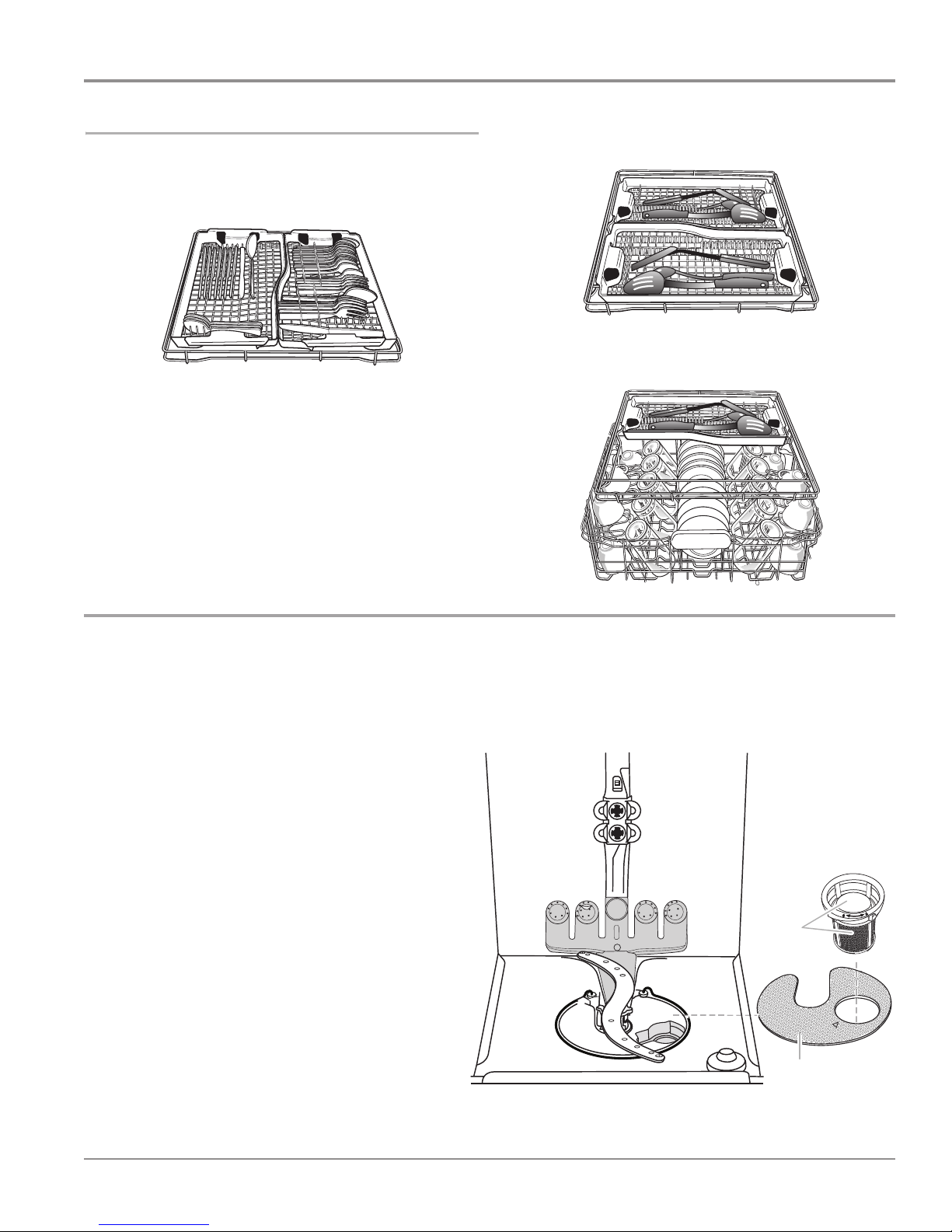
The culinary tool rack is designed with 2 movable baskets to hold
extra silverware, knives and cooking utensils.
Install the baskets in this up position when you have extra
silverware and flatware to wash.
Up position
Install the baskets in this down position when you have extra
silverware, knives, or utensils requiring more room to wash.
down position, the top rack must also be in the lowest position.
Down position
Remove the front basket in the down position, when you are using
the cup shelves or other tall items in the top rack for more room.
Filtration System
Filtration System
Your dishwasher has the latest technology in dishwasher filtration. This triple filtration system minimizes sound and optimizes water and
energy conservation while providing superior cleaning performance. Throughout the life of your dishwasher, the filter will require
maintenance to sustain peak cleaning performance.
The triple filter system consists of 2 parts, an upper filter
assembly and a lower filter.
■ The upper filter assembly keeps oversized items and
foreign objects, along with very fine food particles, out of
the pump.
The lower filter keeps food from being recirculated onto
■
your dishware.
The filters may need to be cleaned when:
■ Visible objects or soils are on the upper filter assembly.
■ There is degradation in cleaning performance (that is,
soils still present on dishes).
■ Dishes feel gritty to the touch.
Upper Filter
Assembly
W
N
O
&
D
T
H
U
S
R
U
N
P
L
O
C
O
L
N
U
K
It is very easy to remove and maintain the filters. The chart
below shows the recommended cleaning frequency.
Lower Filter
K
C
KitchenAid 2013 Stainless Steel Tall Tub Dishwasher
n
2-11
Page 24
OPERATION
Filtration System (continued)
RECOMMENDED TIME INTERVAL TO CLEAN YOUR FILTER
Number of Loads
Per Week
1-3 Once per year Once per year Twice per year Every two months
4-7 Once per year Once per year Twice per year Once per month
8-12 Once per year Twice per year Every three months Every two weeks
13-14 Once per year Twice per year Every three months Once per week
*Manufacturer's recommendation: This practice will conserve the water and energy that you would have used to prepare your dishes. This
will also save you time and effort.
Very Hard Water
If you have hard water (above 15 grains), clean your filter at least
once per month. Building up of white residue on your dishwasher
indicates hard water. For tips on removing spots and stains, see
“Troubleshooting” section.
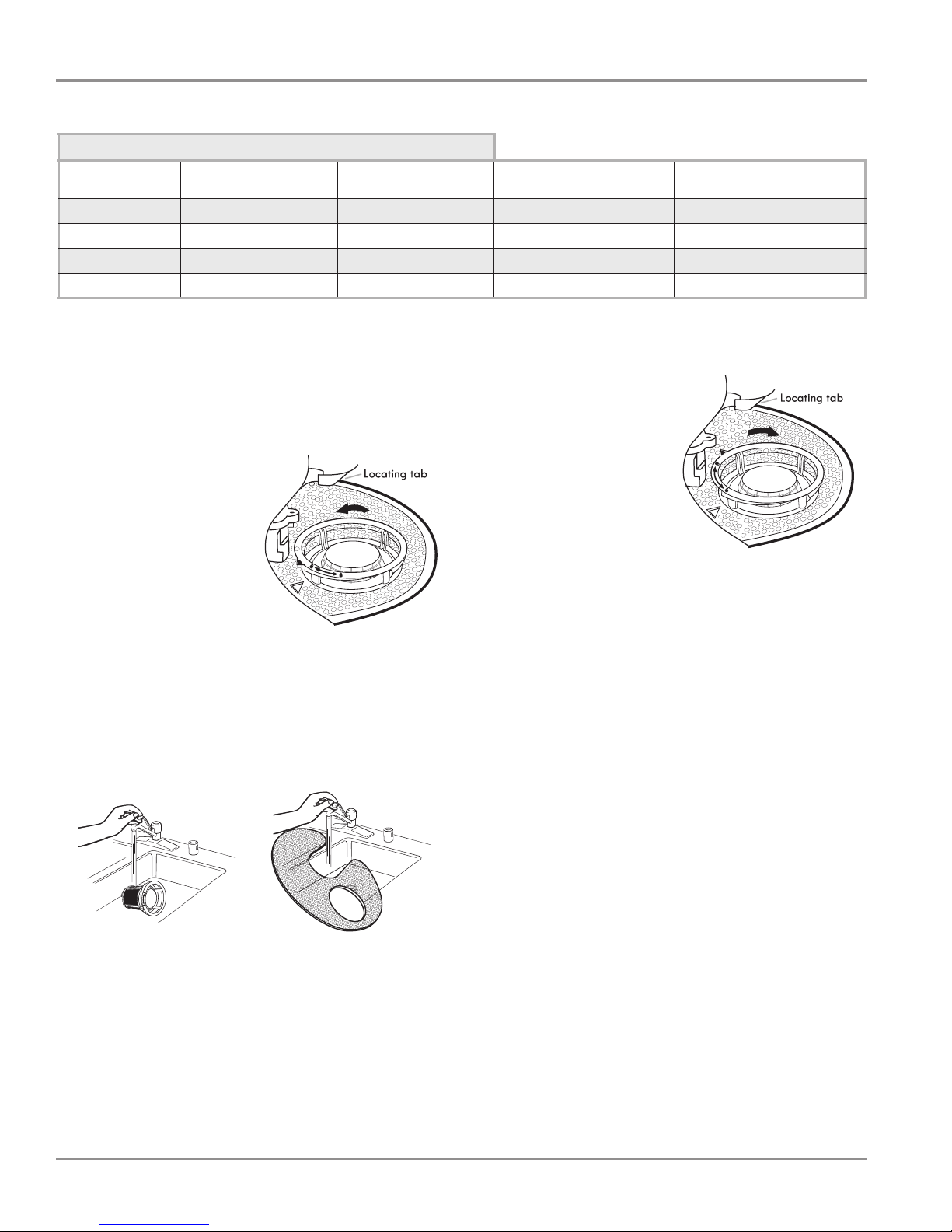
Filter Removal Instructions
1. Turn the upper filter
assembly ¹⁄₄ turn
counterclockwise and lift
out.
2. Grasp the lower filter in the
circular opening, lift
slightly, and pull forward to
remove.
3. Clean the filters as shown
below.
Cleaning Instructions
IMPORTANT: Do not use wire brush, scouring pad, etc., as they
may damage the filters.
Rinse filter under running water until most soils are removed. If you
have hard-to-remove soils or calcium deposits from hard water, a
soft brush may be required.
If you wash
before loading
To remove upper filter assembly
If you scrape and rinse
before loading
If you only scrape
before loading*
If you do not scrape or rinse
before loading
Filter Reinstallation Instructions
1. Noting the previous
illustrations, place the
lower filter under the
D
H
O
S
W
U
N
P
&
T
U
R
L
O
C
K
U
N
K
C
O
L
N
locating tabs in the bottom
of the dishwasher so the
round opening for the
upper filter assembly lines
up with the round opening
in the bottom of the tub.
O
C
K
U
N
To replace upper filter assembly
P
L
U
S
H
D
O
W
N
&
T
U
R
L
O
C
K
N
2. Insert the upper filter assembly into the circular opening in
the lower filter.
3. Slowly rotate the filter clockwise until it drops into place.
Continue to rotate until the filter is locked into place. If the
filter is not fully seated (still turns freely), continue to turn
the filter clockwise until it drops and locks into place.
NOTE: The upper filter assembly arrow does not have to
align with the arrow in the lower filter as long as the filter is
locked.
IMPORTANT: To avoid damage to dishwasher, do not operate your
dishwasher without the filters properly installed. Be sure the lower
filter is securely in place and the upper filter assembly is locked into
place. If the upper filter assembly turns freely, it is not locked into
place.
L
O
C
K
P
U
S
H
D
O
W
N
&
T
U
U
R
N
N
L
O
C
K
2-12 n
KitchenAid 2013 Stainless Steel Tall Tub Dishwasher
Page 25
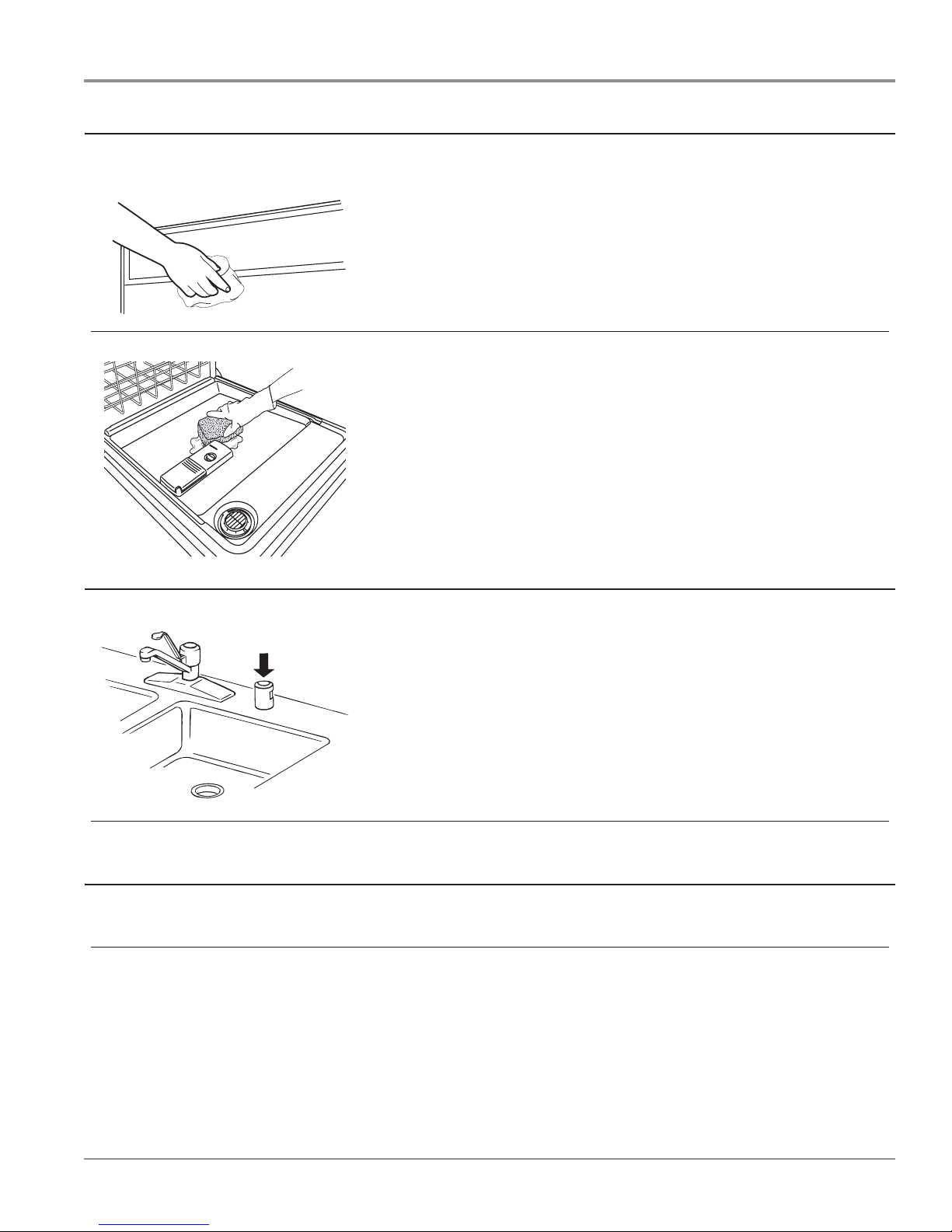
Dishwasher Care
Cleaning
Cleaning the exterior
OPERATION
Dishwasher Care
In most cases, regular use of a soft, damp cloth or sponge and a mild detergent is all
that is necessary to keep the outside of your dishwasher looking nice and clean. If your
dishwasher has a stainless steel exterior, a stainless steel cleaner is recommended.
Cleaning the interior
Drain Air Gap
Hard water minerals can cause a white film to build up on the inside surfaces, especially
just beneath the door area.
Do not clean the dishwasher interior until it has cooled. You may want to wear rubber
gloves. Do not use any type of cleanser other than dishwasher detergent because it may
cause foaming or sudsing.
To clean interior
Make a paste with powdered dishwasher detergent on a damp sponge and clean.
OR
Use liquid automatic dishwasher detergent and clean with a damp sponge.
OR
See the vinegar rinse procedure in “Cloudy or Spotted Dishware (and Hard Water
Solution)” in “Troubleshooting” section.
NOTE: Run a normal cycle with dishwasher detergent after cleaning the interior.
Some state or local plumbing codes require the addition of a drain air gap between a
built-in dishwasher and the home drain system. Check the drain air gap when your
dishwasher is not draining well.
The drain air gap is usually located on top of the sink or countertop near the dishwasher.
NOTE: The drain air gap is an external plumbing device that is not part of your
dishwasher. The warranty provided with your dishwasher does not cover service costs
directly associated with the cleaning or repair of the external drain air gap.
To clean the drain air gap
Storing
Storing for the summer
Storing for the winter
Clean the drain air gap periodically to ensure proper drainage of your dishwasher. With
most types, you lift off the chrome cover. Unscrew the plastic cap. Then check for any
soil buildup. Clean if necessary.
If your dishwasher is not in use during the summer months, turn off the water supply and
power supply to the dishwasher.
Avoid possible water damage to your home and dishwasher due to freezing water lines.
If your dishwasher is left in a seasonal dwelling or could be exposed to near freezing
temperatures, have your dishwasher winterized by authorized service personnel.
KitchenAid 2013 Stainless Steel Tall Tub Dishwasher
n
2-13
Page 26

OPERATION
Troubleshooting
First try the solutions suggested here or visit our website and reference FAQs (Frequently Asked Questions)
Consumer Troubleshooting Guide
In the U.S.A., www.kitchenaid.com In Canada, www.kitchenaid.ca
PROBLEM SOLUTION
DISHWASHER DOES
NOT RUN
DETERGENT REMAINS IN
THE DISPENSER OR
TABLET IS ON BOTTOM
OF TUB
CYCLE RUNS TOO LONG NOTES:
DISHWASHER NOT DRYING NOTE: Plastic and items with nonstick surfaces are difficult to dry because they have a porous
WILL NOT FILL Be sure the water is turned on to the dishwasher.
WATER REMAINS IN THE
TUB/WILL NOT DRAIN
HARD WATER
(WHITE RESIDUE ON
DISHWASHER INTERIOR OR
GLASSWARE)
NOTE: It is normal for the dishwasher to repeatedly pause several times during a cycle.
If the Start/Resume light is blinking, close the door and push START/RESUME.
Be sure the door is closed and latched.
Be sure you have disabled Sleep Mode by pressing either START/RESUME or CANCEL, or opening
and closing the door before selecting your cycle/option.
Check that there is not an interference with large casserole dishes and the wash system at the back
of the dishwasher. Adjust loading as necessary to ensure door is closed and latched.
Be sure you have selected a cycle. (See “Cycles and Options Descriptions” section.)
Be sure there is power to the dishwasher. A circuit breaker or fuse may have tripped.
If lights other than Start/Resume blink and the unit will not run, you will need to call for service.
Check for dishware such as cookie sheets, cutting boards, or large containers, etc., that may be
blocking the detergent dispenser from opening properly.
Be sure your detergent is fresh and lump free.
Be sure the cycle has completed (the Clean light is on). If it has not completed, you will need to
resume the cycle by closing the door and pressing START/RESUME.
■ To use less water and reduce energy consumption you will encounter cycles that typically run for
■ A water heater setting of 120°F (49°C) is best, the dishwasher will delay longer while heating
■ Some options will add time to the cycle. (See “Cycles and Options Descriptions” section.) The
Try the 1 Hour Wash cycle.
Run the hot water at a faucet close to the dishwasher before starting the cycle.
surface which tends to collect water droplets. Towel drying may be necessary.
Use of rinse aid along with the ProDry™ or Heat Dry option is needed for proper drying.
Proper loading of items can affect drying. (See specific loading instructions within this guide.)
Glasses and cups with concave bottoms hold water. This water may spill onto other items when
unloading.
■ Unload the bottom rack first.
■ Locate these items on the more slanted side of the rack for improved results.
Check that the float is free from obstructions. (See “Parts and Features.”)
Check for suds in the dishwasher. If foam or suds are detected, the dishwasher may not operate
properly or may not fill with water. (See “Blinking Lights” in “Troubleshooting” section.)
Be sure the cycle has completed (the Clean light is on). If it has not, you will need to resume the cycle
by closing the door and pressing START/RESUME.
If dishwasher is connected to a food waste disposer, be sure the knockout plug has been removed
from the disposer inlet.
Check for kinks in the drain hose.
Check for food obstructions in the drain or disposer.
Check your house fuse or circuit breaker.
NOTE: Extremely hard water mineral deposits can cause damage to your dishwasher and make it
difficult to achieve good cleaning. A water softener is strongly recommended if your hardness is
15 grains or more. If a water softener is not installed, the following steps may help:
Use a commercial cleaner designed for dishwashers once per month.
Clean the upper and lower filters at least once per month. (See “Cleaning Instructions” in the
“Filtration System” section.)
Always use a rinse aid.
Always use a high-quality, fresh detergent.
Use a detergent booster/water softener additive designed for dishwashers.
to possibly avoid the cost of a service call.
up to 3 hours.
cooler water.
ProDry™ or Heat Dry option adds approximately ¹⁄₂ hour.
2-14 n
KitchenAid 2013 Stainless Steel Tall Tub Dishwasher
Page 27

OPERATION
PROBLEM SOLUTION
ODORS NOTE: If the dishwasher is not used daily, you can run a rinse cycle with the partial load daily until a
NOISY NOTES:
FOOD SOILS REMAIN
ON DISHES
DISHES DIRTY/SUDS IN
DISHWASHER/CYCLE NOT
COMPLETE
DID NOT SANITIZE If the sanitized light is blinking, the load is NOT sanitized. The cycle was interrupted in the final rinse,
DAMAGE TO DISHWARE Improper loading can cause dishes to become chipped or damaged. (See specific loading
BLINKING LIGHTS Blinking LED's will occur when the cycle is paused or when the cycle has been interrupted by
CLOUDY OR SPOTTED
DISHWARE (AND HARD
WATER SOLUTION)
full load is ready to run, or use the Top Rack Only option (on some models) for partial loads.
Run a vinegar rinse through the dishwasher by putting 2 cups (500 mL) of white vinegar in an upright
glass measuring cup in the lower rack. Run a normal cycle with the Heat Dry option turned off. Do
not use detergent.
The dishwasher may not be draining properly, see “Water Remains In The Tub/Will Not Drain” in the
“Troubleshooting” section.
■ Surging sounds can occur periodically throughout the cycle while the dishwasher is draining.
Normal water valve hissing may be heard periodically.
■
■ A normal snap sound may be heard when the detergent dispenser opens during the cycle and
when the door is opened at the end of the cycle.
■ Improper installation will affect noise levels.
Be sure the filters are properly installed.
A thumping sound may be heard if items extend beyond the racks and interfere with the wash arms.
Readjust the dishware and resume the cycle.
Be sure the dishwasher is loaded correctly. Improper loading can greatly decrease the washing
performance (see “Dishwasher Use” section).
Check filter to ensure it is properly installed. Clean it if needed. (See “Cleaning Instructions” in the
“Filtration System” section for details.)
Select the proper cycle and option for the type of soils. The ProWash™ or the Heavy Duty cycle with
the ProScrub
®
(on some models) option can be used for tougher loads.
Be sure the incoming water temperature is at least 120°F (49°C).
Use the proper amount of fresh detergent. More detergent is needed for heavier-soiled loads and
hard water conditions.
Scrape food from dishes prior to loading (do not prerinse).
If foam or suds are detected by the dishwasher sensing system, the dishwasher may not operate
properly or may not fill with water.
Suds can come from:
■ Using the incorrect type of detergent, such as dish detergent for hand washing dishes, laundry
detergent, or hand soap.
■ Not replacing the rinse aid dispenser cap after filling (or refilling) the rinse aid.
■ Using an excessive amount of dishwasher detergent.
Call for service.
If no water was present in the machine at any time during a heated wash cycle, the cycle will end and
the Clean LED will not come on. See “Will Not Fill” in the “Troubleshooting” section.
or the temperature for your water heater is set too low. Set your water heater to 120ºF (49°C).
instructions within this guide.)
opening the door. In this case, the Start/Resume button LED, the Cycle Status Indicator LED(s), and
the countdown bars on the Cycle Status Display all blink together to indicate that attention is
needed. See “Start or Resume a Cycle” in the “Dishwasher Use” section.
Blinking LED's can also occur when certain errors have been detected. In this case, the Clean/
Complete LED will blink 4 times in a row with a pause in between each set of blinks. When this error
occurs, the controls will lock out and not allow another cycle to be started.
Call for service.
NOTES:
■ Liquid rinse aid is necessary for drying and to reduce spotting.
■ Use the correct amount of detergent.
Confirm that the cloudiness is removable by soaking the item in white vinegar for 5 minutes. If the
cloudiness disappears, it is due to hard water. Adjust the amount of detergent and rinse aid. See
“Hard Water (White Residue On Dishwasher Interior Or Glassware)” in the “Troubleshooting” section.
If it does not come clear, it is due to etching (see below).
Be sure the incoming water temperature is set at 120°F (49°C).
Try using the High Temp and Sani Rinse options.
To remove spotting, run a vinegar rinse through the dishwasher.
■ Wash and rinse the affected dishware and load into dishwasher. Remove all silverware and metal
items. Put 2 cups (500 mL) of white vinegar in a glass measuring cup in the lower rack. Run a
normal cycle with the Heat Dry option turned off. No detergent is needed.
KitchenAid 2013 Stainless Steel Tall Tub Dishwasher
n
2-15
Page 28

OPERATION
PROBLEM SOLUTION
ETCHING (PERMANENT
CLOUDINESS)
LEAKING WATER Be sure dishwasher has been installed properly and is level.
TUB IS DISCOLORED NOTES:
This is an erosion of the surface of the glassware and can be caused by a combination of: water that
is too hot, from using too much detergent with soft water or by pre-washing. Detergent needs food
soil to act upon. If etching has occurred, the glassware is permanently damaged. To avoid further
etching, adjust the detergent amount to match the water hardness, stop pre-washing, and use water
heating options only when incoming water temperature is below 120°F (49°C).
Suds can cause the dishwasher to overflow. Measure the detergent accurately and use only
detergents designed for use in a dishwasher. Less detergent is needed in soft water. Try another
brand of detergent if sudsing continues.
To avoid rinse aid leaking from the dispenser, be sure the lid is securely attached and avoid
overfilling.
■ High iron content in the water can discolor the tub.
■ Tomato-based foods can discolor the tub or dishware.
■ A citrus-based cleaner can be used to clean.
Notes
2-16 n
KitchenAid 2013 Stainless Steel Tall Tub Dishwasher
Page 29

INSTALLATION
Section 3:
Installation
This secon provides installaon requirements and procedures
for the “KitchenAid Stainless Steel Tall Tub Dishwasher.”
■ Dishwasher Safety
■ Installaon Requirements
■ Locaon Requirements
■ Drain Requirements
■ Water Supply Requirements
■ Electrical Requirements
■ Installaon Instrucons
■ Install Custom Panel
■ Check Operaon
■ Addional Tips
■ Notes
KitchenAid 2013 Stainless Steel Tall Tub Dishwasher
n
3-1
Page 30
INSTALLATION
Dishwasher Safety
Your safety and the safety of others are very important.
We have provided many important safety messages in this manual and on your appliance. Always read and obey all safety
messages.
This is the safety alert symbol.
This symbol alerts you to potential hazards that can kill or hurt you and others.
All safety messages will follow the safety alert symbol and either the word “DANGER” or “WARNING.”
These words mean:
You can be killed or seriously injured if you don't immediately
DANGER
WARNING
All safety messages will tell you what the potential hazard is, tell you how to reduce the chance of injury, and tell you what can
happen if the instructions are not followed.
follow instructions.
You
can be killed or seriously injured if you don't
instructions.
follow
IMPORTANT SAFETY INSTRUCTIONS
WARNING: When using the dishwasher, follow basic precauons, including the following:
■ Read all instrucons before using the dishwasher.
■ Use the dishwasher only for its intended funcon.
■ Use only detergents or rinse agents recommended for
use in a dishwasher, and keep them out of the reach of
children.
■ When loading items to be washed:
1) Locate sharp items so that they are not likely to
damage the door seal; and
2) Load sharp knives with the handles up to reduce the
risk of cut-type injuries.
■ Do not wash plasc items unless they are marked
“dishwasher safe” or the equivalent. For plasc items not
so marked, check the manufacturer’s recommendaons.
■ Do not touch the heang element during or immediately
aer use.
■ Do not operate the dishwasher unless all enclosure
panels are properly in place.
■ Do not tamper with controls.
■ Do not abuse, sit on, or stand on the door, lid, or dish
racks of the dishwasher.
■ To reduce the risk of injury, do not allow children to play
in or on the dishwasher.
■ Under certain condions, hydrogen gas may be produced
in a hot water system that has not been used for two
weeks or more. HYDROGEN GAS IS EXPLOSIVE. If the hot
water system has not been used for such a period, before
using the dishwasher turn on all hot water faucets and
let the water ow from each for several minutes. This
will release any accumulated hydrogen gas. As the gas is
ammable, do not smoke or use an open ame during
this me.
■ Remove the door or lid to the washing compartment
when removing an old dishwasher from service or
discarding it.
SAVE THESE INSTRUCTIONS
State of California Proposion 65 Warnings:
WARNING: This product contains one or more chemicals known to the State of California to cause cancer.
WARNING: This product contains one or more chemicals known to the State of California to cause birth defects or other
reproducve harm.
3-2 n
KitchenAid 2013 Stainless Steel Tall Tub Dishwasher
Page 31

Dishwasher Safety
GROUNDING INSTRUCTIONS
INSTALLATION
Tip Over Hazard
Do not use dishwasher until completely installed.
Do not push down on open door.
Doing so can result in serious injury or cuts.
Electrical Shock Hazard
Electrically ground dishwasher.
Connect ground wire to green ground connector
in terminal box.
Do not use an extension cord.
Failure to follow these instructions can result in
death, fire, or electrical shock.
• For a grounded, cord-connected dishwasher:
must be grounded. In the event of a malfuncon or
breakdown, grounding will reduce the risk of electric
shock by providing a path of least resistance for electric
current. The dishwasher is equipped with a cord having
an equipment-grounding conductor and a grounding plug.
The plug must be plugged into an appropriate outlet that
is installed and grounded in accordance with all local
codes and ordinances.
WARNING: Improper connecon of the equipmentgrounding conductor can result in a risk of electric shock.
Check with a qualied electrician or service representave
if you are in doubt whether the dishwasher is properly
grounded. Do not modify the plug provided with the
dishwasher; if it will not t the outlet, have a proper outlet
installed by a qualied electrician.
• For a permanently connected dishwasher:
must be connected to a grounded metal, permanent
wiring system, or an equipment-grounding conductor must
be run with the circuit conductors and connected to the
equipment-grounding terminal or lead on the dishwasher.
The dishwasher
The dishwasher
SAVE THESE INSTRUCTIONS
• Install where dishwasher is sheltered from the elements.
Avoid possible rupture of ll valve from freezing. Such
ruptures are not covered by the warranty. See “Storing”
secon for winter storage informaon.
• Install and level dishwasher on a oor that will hold the
weight, and in an area suitable for its size and use.
• Remove all shipping plugs from hoses and connectors
(such as the cap on the drain outlet) before installing. See
Installaon Instrucons or complete informaon.
KitchenAid 2013 Stainless Steel Tall Tub Dishwasher
n
3-3
Page 32

INSTALLATION
INSTALLATION REQUIREMENTS
Supplied in Kit:
Check
Installation Requirements
Tools and Parts
Gather the recommended tools and parts before starting
installation. Read and follow the instructions provided with any
tools listed here.
All Installations
Tools needed:
*Must be the proper size to connect your household wiring to 16-
gauge wiring in dishwasher.
Other useful items you may need:
4 Plastic studs (attached to each other by runners)
4 Short screws (10-16 hex head screw)
4 Long screws (8-18 Torx
1 Template (located inside Use and Care Guide bag assembly)
1 Instruction sheet (located inside Use and Care Guide bag
assembly)
NOTE: The screws supplied are used for only ³⁄₄" thick wooden
panel. If the wooden panel is less than ³⁄₄" thick, customer must
purchase screws locally.
Other parts you may also need:
NOTES:
■ Moisture barrier tape is recommended when installing a
dishwasher under a wood countertop.
Parts available for purchase in plumbing supply stores.
■
local codes. Check existing electrical supply. See “Electrical
Requirements” section. It is recommended that electrical
connections be made by a licensed electrical installer.
In addition, for first-time installations
Tools needed:
®
head screws)
Parts supplied:
Parts needed:
4 #10 x ¹/₂" wood screws (if installing custom front panels)
Parts needed:
Additional parts supplied with top-venting models only:
Additional parts supplied with certain models only
Make sure all these parts are included in the literature package.
If parts are not included, call 1-800-422-1230.
†®TORX and T20 are registered trademarks of Saturn Fasteners, Inc.
3-4 n
KitchenAid 2013 Stainless Steel Tall Tub Dishwasher
Page 33

Location Requirements
e a 2" (5.1 cm) minimum clearance
ont of opening is not level with floor
eezing, have it winterized by
Location Requirements
INSTALLATION
Grounded electrical supply required.
Do not run drain lines, water lines or electrical wiring where they
can interfere with or contact dishwasher motor or legs.
The location where the dishwasher will be installed must provide
clearance between motor and flooring. Motor should not touch
the floor.
Do not install dishwasher over carpeted flooring.
Shelter dishwasher and water lines leading to dishwasher against
freezing. Damage from freezing is not covered by the warranty.
A side panel kit is available from your dealer for installing your
dishwasher at the end of your cabinetry.
A moisture barrier accessory (Part Number 4396277) is available
from your dealer for installing underneath the countertop.
Call 1-800-422-1230 to order.
Check location where dishwasher will be installed. The location
must provide:
■ easy access to water, electricity and drain.
■ convenient access for loading and unloading dishes.
Corner locations requir
between the side of the dishwasher door and the wall or
cabinet.
square opening for proper operation and appearance.
■
■ cabinet front perpendicular to floor.
■ level floor. (If floor at fr
at rear of opening, shims may be needed to level
dishwasher.)
Helpful Tip: Be sure to accurately measure dimensions and
ensure dishwasher is level if the floor in the dishwasher opening is
uneven (example: Flooring extends only partway into opening).
NOTE: To avoid shifting during dishwasher operation, shims must
be securely attached to the floor.
If dishwasher will be left unused for a period of time or in a
location where it may be subject to fr
authorized service personnel.
Make sure pipes, wires and drain hose are within the shaded area
shown in the “Product and Cabinet Opening Dimensions” section.
KitchenAid 2013 Stainless Steel Tall Tub Dishwasher
n
3-5
Page 34

INSTALLATION
3-6 n
KitchenAid 2013 Stainless Steel Tall Tub Dishwasher
Page 35

INSTALLATION
A
Drain Requirements
■ A new drain hose is supplied with your dishwasher. If drain
hose is not long enough, use a new drain hose with a
maximum length of 12 ft (3.7 m) (Part Number 3385556) that
meets all current AHAM/IAPMO test standards, is resistant to
heat and detergent, and fits the 1" (2.5 cm) drain connector of
the dishwasher.
■ Make sure to connect drain hose to waste tee or disposer inlet
above drain trap in house plumbing and 20" (50.8 cm)
minimum above the floor. It is recommended that the drain
hose either be looped up and securely fastened to the
underside of the counter, or be connected to an air gap.
■ Make sure to use an air gap if the drain hose is connected to
house plumbing lower than 20" (50.8 cm) above subfloor or
floor.
Use ¹₂" minimum I.D. drain line fittings.
■
■ If required, the air gap should be installed in accordance with
the air gap installation instructions. When you are connecting
the air gap, a rubber hose (not provided) will be needed to
connect to the waste tee or disposer inlet.
Electrical Requirements
Be sure that the electrical connection and wire size are adequate
and in conformance with the National Electrical Code, ANSI/NFP
70 - latest edition and all local codes and ordinances.
A copy of the above code standards can be obtained from:
National Fire Protection Association
1 Batterymarch Park
Quincy, MA 02169-7471
You must have:
■ 120-volt, 60 Hz, AC-only, 15- or 20-amp, fused electrical
supply.
■ Copper wire only.
We recommend:
■ A time-delay fuse or circuit breaker.
■ A separate circuit.
If connecting dishwasher with a
power supply cord:
■ Use UL Listed power supply cord kit
(Part Number 4317824) marked for
use with dishwasher.
Power supply cord must plug into a grounded
■
3 prong outlet, located in the cabinet next to
the dishwasher opening. Outlet must meet all
local codes and ordinances.
If connecting dishwasher with direct wiring:
■ Use flexible, armored or nonmetallic
sheathed, copper wire with
grounding wire that meets the
wiring requirements for your home
and local codes and ordinances.
■ Use a UL Listed/CSA Approved strain relief.
Water Supply Requirements
■ A hot water line with 20 to 120 psi (138 to 862 kPa) water
pressure can be verified by a licensed plumber.
■ 120°F (49°C) water at dishwasher.
■ ³⁄₈" O.D. copper tubing with compression fitting or flexible
braided water supply line (Part Number 4396897RP).
NOTE: ¹⁄₂" minimum plastic tubing is not recommended.
■ A 90° elbow with ³⁄₄" hose connection with rubber washer.
Do not solder within 6" (15.2 cm) of the water inlet valve.
■
KitchenAid 2013 Stainless Steel Tall Tub Dishwasher
n
3-7
Page 36

INSTALLATION
INSTALLATION INSTRUCTIONS
far
Opening—
next
See “Product and Cabinet Opening Dimensions” section.
Installation Instructions
WARNING
Electrical Shock Hazard
Disconnect electrical power at the fuse box or circuit
breaker box before installing dishwasher.
Failure to do so can result in death or electrical shock.
Prepare Cabinet Opening—Existing
Utilities
If the water line and the cable extend to the locations shown,
proceed to the “Install Drain Hose” section. If they do not reach
enough, follow the instructions in the “Prepare Cabinet
New Utilities” section.
Prepare Cabinet Opening—New Utilities
Prepare and route the electrical supply
3-8 n
KitchenAid 2013 Stainless Steel Tall Tub Dishwasher
Option A, Power Supply Cord:
NOTE: A grounded 3 prong outlet is required inside a cabinet
to the dishwasher cabinet opening.
Drill a 1¹⁄₂" (3.8 cm) hole in cabinet side or rear.
Page 37

INSTALLATION
cabinet hole (cable must
when
cabinet
e overall length of copper tubing for the water supply line.
Wood cabinet: Sand the hole until smooth.
Metal cabinet: Cover hole with grommet included with power
supply cord kit.
Option B, Direct Wire:
Helpful Tip: Wiring the dishwasher will be easier if you route the
cable into the cabinet opening from the right-hand side.
Drill a 1¹⁄₂" (3.8 cm) hole in right-hand cabinet side or rear.
See “Product and Cabinet Opening Dimensions” section.
Route cable from power supply through
extend to the right front side of cabinet opening). Tape cable to
the floor in area shown. This will prohibit cable from moving
dishwasher is moved into cabinet opening.
Prepare and Route Water Line
Helpful Tip: Routing the water line through the left side of
opening will make water connection easier.
Drill a ¹⁄₂" (1.3 cm) hole in the cabinet side or rear.
Wood cabinet: Sand the hole until smooth.
Metal cabinet: Cover hole with grommet (Part Number 302797 -
not provided).
Measur
KitchenAid 2013 Stainless Steel Tall Tub Dishwasher
n
3-9
Page 38

INSTALLATION
to
side
Attach the water supply line (copper tubing or flexible braided line)
to the hot water line using a connection configuration that is in
compliance with local codes and ordinances. The water supply to
the dishwasher should have a manual shutoff valve located under
the sink.
Route water line and tape it to the floor in area shown. This will
keep it from moving when dishwasher is moved into cabinet
opening.
Install Drain Hose
IMPORTANT: Always use a new drain hose. Check local codes
determine whether an air gap is required.
Slowly route water supply line through hole in cabinet. (If you are
using copper tubing, it will bend and kink easily, so be gentle.) It
should be far enough into the cabinet opening to connect it to the
dishwasher inlet on the front left side of the dishwasher.
Slowly turn water shutoff valve to “ON” position. Flush water into
a shallow pan until clear to get rid of particles that could clog the
inlet valve. Turn shutoff valve to “OFF” position.
If needed, drill a 1¹⁄₂" (3.8 cm) diameter hole in cabinet wall or
of the opening closest to the sink.
Route drain hose as shown through hole in cabinet to the front
center of opening where drain connection will be made. Tape
drain hose to the floor in area shown. This will prohibit it from
moving when dishwasher is moved into cabinet opening.
3-10 n
KitchenAid 2013 Stainless Steel Tall Tub Dishwasher
Page 39

INSTALLATION
1. Fit rubber end of drain hose to waste
Connect rubber end of drain hose to
tee and cut if needed.
NOTE: Do not cut ribbed section.
IMPORTANT: The drain hose connection of the disposer or a
waste tee must be made before the drain trap and at least
20" (50.8 cm) above the floor where the dishwasher will be
installed.
Helpful Tip: To reduce vibration of the hose, keep the hose away
from the floor.
Option A, Waste disposer – no air gap
1. Using a hammer and screwdriver,
knock plug into disposer.
2. Attach rubber end of drain hose to
waste tee with a large drain hose
clamp (provided). Use pliers to
squeeze clamp open and move into
position. If the drain hose was cut,
use a 1¹⁄₂" to 2" (3.8 to 5 cm) screwtype clamp (not provided).
Option C, Waste disposer – with air gap
1. Using a hammer and screwdriver,
knock plug into disposer.
2. Use needle-nose pliers to remove
plug.
3. Attach drain hose to disposer inlet
with large drain hose clamp
(provided). Use pliers to squeeze
clamp open and move into position.
Option B, No waste disposer – no air gap
2. Use needle-nose pliers to remove
plug.
3.
air gap and cut if needed.
NOTE: Do not cut ribbed section.
4. Attach drain hose to air gap with
large drain hose clamp (provided).
Use pliers to squeeze clamp open
and move into position. If the drain
hose was cut, use a 1¹⁄₂" to 2" (3.8 to
5 cm) screw-type clamp (not
provided).
5. Use a rubber hose (not provided)
with screw-type clamps (not
provided) to connect from air gap to
disposer inlet.
KitchenAid 2013 Stainless Steel Tall Tub Dishwasher
n
3-11
Page 40

INSTALLATION
Option D, No waste disposer – with air gap
1. Connect rubber end of drain hose to
air gap and cut if needed.
NOTE: Do not cut ribbed section.
2. Attach drain hose to air gap with
large drain hose clamp (provided).
Use pliers to squeeze clamp open
and move into position. If the drain
hose was cut, use a 1¹⁄₂" to 2" (3.8 to
5 cm) screw-type clamp (not
provided).
Prepare Dishwasher
WARNING
Tip Over Hazard
Do not use dishwasher until completely installed.
Do not push down on open door.
Doing so can result in serious injury or cuts.
WARNING
Excessive Weight Hazard
Use two or more people to move and install
dishwasher.
Failure to do so can result in back or other injury.
3. Use a rubber hose (not provided)
with screw-type clamps (not
provided) to connect from waste tee
to air gap.
Install Moisture Barrier
(under a wood countertop)
Helpful Tip: Place cardboard under dishwasher until installed in
cabinet opening to avoid damaging floor covering. Do not use
door panel as a worktable without first covering with a towel to
avoid scratching the door panel.
Using 2 or more people, grasp sides of dishwasher door frame
and place dishwasher on its back.
Make sure the area under the cabinet is clean and dry for
installation of the moisture barrier.
Remove the backing of the moisture barrier and apply to
underside of the countertop along the front edge of the
counter.
3-12 n
KitchenAid 2013 Stainless Steel Tall Tub Dishwasher
Page 41

Option A, Remove Access Panel - Plastic Panel
Using a flat-blade scr
counter
tech sheet fr
Using a
re
dishwasher
Using
re
Option B, Remove Access Panel - Metal Panel
clockwise to unlock them. Remove panel. Do not remove
ewdriver, turn the plastic fasteners ¹⁄₄ turn
om access panel.
INSTALLATION
Install a UL Listed/CSA Approved strain relief. Make sure screw
heads are facing to the left when tightening conduit nut. Strain
relief is provided with the power supply cord kit.
NOTE: If using Option B, proceed to “Determine Cabinet
Opening,” to continue with the installation of your dishwasher.
Make Power Supply Cord Connection
Option A, Power Supply Cord:
¹⁄₄" hex head socket, nut driver or Phillips screwdriver,
move 2 screws attaching access panel and lower panel to
. Do not remove tech sheet from access panel.
a ¹⁄₄" hex head socket, nut driver or Torx®† T20® screwdriver,
move terminal box cover. Retain for later use.
Route cord so that it does not touch dishwasher motor to lower
part of dishwasher tub. Pull cord through strain relief in terminal
box.
Select UL Listed/CSA Approved twist-on wire connectors rated to
connect your power supply cord to 16-gauge dishwasher wiring.
KitchenAid 2013 Stainless Steel Tall Tub Dishwasher
n
3-13
Page 42

INSTALLATION
Connect wires black to black and white to white, using UL Listed/
WARNING
Electrical Shock Hazard
Electrically ground dishwasher.
Connect ground wire to green ground connector in
terminal box.
Do not use an extension cord.
Failure to follow these instructions can result in death,
fire, or electrical shock.
CSA Approved twist-on wire connectors (included with power
supply cord kit).
If needed, see website for animated representation of this step.
Visit www.kitchenaid.com/electrical under FAQ tab.
Remove the green grounding screw and place through the ring
terminal of the green ground wire. Reattach and tighten the green
screw.
NOTE: Do not pre-twist stranded wire. Twist on wire connector.
Gently tug on wires to be sure both are secured.
Tighten strain relief screws to secure cord.
Place wires inside terminal box. Insert tabs on left side of cover.
Make sure wires are tucked inside box. Close cover ensuring
wires are not pinched. Use ¹⁄₄" hex head socket, nut driver or Torx
®
screwdriver and previously removed screw to secure cover.
T20
NOTE: Do not plug into outlet until instructed to do so.
®
3-14 n
KitchenAid 2013 Stainless Steel Tall Tub Dishwasher
Page 43

Determine Cabinet Opening
Measure height of cabinet opening from underside of countertop
to floor where dishwasher will be installed (you will need to
measure the lowest point on the underside of the countertop and
the highest point on the floor). Refer to “Dishwasher Height
Adjustment Chart” for wheel position and the number of turns
needed.
INSTALLATION
Turn both leveler legs to the same height. Put wheels in the
required position determined from “Dishwasher Height
Adjustment Chart.”
NOTE: If the minimum cabinet opening height is less than 34"
(86.4 cm), the rear wheels can be removed for additional
clearance. This will allow the dishwasher to fit into a 33⁷⁄₈" (86 cm)
high cabinet opening, but the dishwasher will be more difficult to
move. (Measurements are approximate. Wheels and legs are
preset at the factory for 34¹⁄₂" [87.6 cm].) If the minimum cabinet
opening height is 33³⁄₄" (85.7 cm), a section in the insulation
blanket can be removed by cutting along the perforation.
Built-up floors: If the kitchen floor is higher than the cabinet
opening's floor - for example, the kitchen floor tile does not
extend into the cabinet opening - add shims as needed in the area
shown to bring the dishwasher up to 34" (86.4 cm) below the
countertop.
NOTE: Shims must be securely attached to floor to avoid
movement when the dishwasher is in use.
KitchenAid 2013 Stainless Steel Tall Tub Dishwasher
n
3-15
Page 44

INSTALLATION
the
Install Door Handle
(on some models)
TANT: Do not scratch the front panel during this
ocedure.
rdware bag containing the
ews and hex key from the cardboard box. Setscrews are
eady installed in the handle. Place handle on mounting studs
ews facing down. Push the door handle tightly
. Insert the short end of the hex key into the
ews. Tighten the setscrews ¹⁄₄ turn past snug.
Custom Panel Dimensions
Install Custom Panel
Follow steps below:
A customer supplied panel must weigh no more than 16 lbs
(7.3 kg) and must be made to specific dimensions. It is
recommended that a cabinetmaker cut the customer panel
because of the precise dimensions needed.
NOTES:
The handle for the custom panel is not included.
■
■ All mounting hardware supplied is for a ³⁄₄" (19.1 mm) thick
wood panel. If a thinner wood panel or materials other than
wood are used, it is the customer’s responsibility to obtain
proper length screws and adjust the pilot holes accordingly.
IMPORTANT: Use a moisture-resistant sealer on both sides and
all edges of the panel to avoid damage from moisture.
WARNING
Excessive Weight Hazard
Use two or more people to move and install
dishwasher.
Failure to do so can result in back or other injury.
3-16 n
KitchenAid 2013 Stainless Steel Tall Tub Dishwasher
Using 2 or more people, stand the dishwasher up.
NOTE: Do not install kick plate until instructed to do so.
Page 45

INSTALLATION
template
Using the template provided, attach it to the backside of the
custom panel with tape. Make sure that the center of the
is aligned with the center of the wooden panel and top of the
template is aligned to the top face of the wooden panel.
Install the custom hardware handle(s) on the front of the wooden
panel inside dotted line.
IMPORTANT: If the handle is attached from the back of the
custom panel, the screw holes should be countersunk for the
screws heads to be flush with the panel. If the handle is attached
to the front of the custom panel, the screw lengths cannot exceed
the panel thickness.
NOTE: Do not drill deeper then ⁵⁄₈" (16 mm) to keep from drilling
through panel. Pilot hole depths given are for ³⁄₄" (19 mm) thick
panel.
Mark 4 pilot holes on the wooden panel using the template
provided. Predrill 4 pilot holes using a ³⁄₃₂" drill bit. Use tape to
mark the drill bit to gauge hole depth. Drill pilot holes
approximately ⁵⁄₈" (16 mm) into the custom panel.
Aach the 4 plasc studs to the wooden panel
using the 4 short hex head (⁵⁄₁₆”) screws provided.
KitchenAid 2013 Stainless Steel Tall Tub Dishwasher
n
3-17
Page 46

INSTALLATION
Check custom tape alignment with metal door slots; verify tape is
right-side up, and that the tape does not overhang the metal door
on the top, bottom or side interfaces. Remove the backing from
the custom tape by pulling straight down on the liner. Align the
custom tape to the keyhole slots on the metal door (see image)
and apply. Repeat steps for one side and then the other.
NOTE: The adhesive on the tape is aggressive, so proper
alignment and attachment to the metal door needs to occur on
the first try.
Align the studs on the custom wood panel to the keyhole slots on
the door assembly. Ensure that all 4 plastic studs are engaged in
the keyhole slots. Slide wood panel down until the top surface of
the wooden panel is flush with the top of the door.
Open the door and align top edges. Predrill 2 pilot holes using a
³⁄₃₂" drill bit. Use tape to mark the drill bit to gauge hole depth. Drill
pilot holes approximately 1¹⁄₂" (3.8 cm) into the top corners of the
door using hole in liner as a guide.
Install 2 long screws supplied in top corners to secure custom
wood panel in place.
Remove the short screws (3rd from top) on either side of the inner
door panel. Predrill 2 pilot holes using a ³⁄₃₂" drill bit. Use tape to
mark the drill bit to gauge the hole depth. Drill pilot holes
approximately 1¹⁄₂" (3.8 cm) using the door liner hole as a guide
into the panel. Install the 2 remaining long screws.
3-18 n
KitchenAid 2013 Stainless Steel Tall Tub Dishwasher
Page 47

INSTALLATION
Choose Attachment Option
ar of the dishwasher to keep it
, and bend tab in
WARNING
Excessive Weight Hazard
Use two or more people to move and install
dishwasher.
Failure to do so can result in back or other injury.
Use 2 or more people to move and install dishwasher.
IMPORTANT: The dishwasher must be secured to the cabinet.
There are two brackets found in the parts bag. Attach the
brackets using Option A if the countertop is wood, laminate or
another similar surface. If your countertop is marble, granite or
another hard surface, install using Option B.
Option A, Countertop attachment:
Option B, Dishwasher side attachment:
NOTE: Remove the brackets from the parts package.
Break off the end of the bracket along the scored line.
With another person holding the re
from tipping, open dishwasher door and place towel over pump
assembly and spray arm of dishwasher. This will keep screws
from falling into pump area when you are securing dishwasher to
cabinet.
Remove the brackets from the package and insert into the open
slots on the left and right-hand top of the dishwasher collar as
shown.
Using a pair of pliers, bend the tab down to secure the bracket in
place. Repeat this step for the other side.
NOTE: Do not attach the dishwasher. This will be done later.
Push the plastic buttons out of the side of the tub.
NOTE: Save the buttons to cover the holes after dishwasher is
installed.
Push bracket into slot on the side of dishwasher
toward the side of the dishwasher so that it keeps the bracket in
place. Repeat this step for the other side of the dishwasher.
NOTE: Do not attach the dishwasher. This will be done later.
KitchenAid 2013 Stainless Steel Tall Tub Dishwasher
n
3-19
Page 48

INSTALLATION
Check that water line is on the left side of opening and drain hose
Prepare Water Supply Line
Copper tubing only: Slide nut, then ferrule, about 1" (2.5 cm) onto
copper tubing.
NOTE: To avoid vibration during operation, route the water supply
line so that it does not touch the dishwasher base, frame or motor.
Connect the ³⁄₈" compression fitting to the water supply line prior
to installing the unit into the cabinet opening. Attach such that the
³⁄₄" connection is facing upward as shown above.
Copper tubing only: Put the tubing into the 90° elbow fitting as far
as it will go (the copper tubing bends and kinks easily). Slide the
nut and ferrule forward and start the nut onto the elbow threads.
Flexible braided connection: Secure nut to elbow using ⁵⁄₈" open
ended wrench or adjustable wrench.
NOTE: Do not use Teflon
®†
tape with compression fittings.
IMPORTANT: Double-check correct placement of utilities. Grasp
the sides of the dishwasher at the edges of the door panel. Tilt
dishwasher backward on wheels and move dishwasher close to
cabinet opening.
NOTE: Do not push on the front of the panel or on the console.
Panel or console may dent.
Helpful Tip: Temporarily tape utilities to the floor in the locations
shown to prohibit them from moving when dishwasher is moved
into the cabinet opening.
is near the center of the cabinet opening.
Move Dishwasher Close to Cabinet
Opening
WARNING
Excessive Weight Hazard
Use two or more people to move and install
dishwasher.
Failure to do so can result in back or other injury.
Use 2 or more people to move and install dishwasher.
3-20 n
KitchenAid 2013 Stainless Steel Tall Tub Dishwasher
With another person holding the dishwasher to keep it from
tipping, open and close the door a few times. If the door closes or
falls open under its own weight, the door tension will need to be
adjusted.
Page 49

To
leg of dishwasher
Using
tensioner
The
dishwasher
lower
r
NOTE:
at same holes.
When door is unlatched, if door opens by itself, move the
tensioner to a highe
Reattach door spring to
NOTE:
at same holes.
. Slowly move dishwasher completely into
It is all right if dishwasher fits tightly into cabinet opening. Do
sound
ear leg.
adjust the door spring tension, unhook the spring from the rear
.
a ⁵⁄₁₆" nut driver or hex socket, remove the screw from the
.
screw can be put into one of 3 holes (1, 2, 3) in the front leg of
. If the door closes by itself, move the tensioner to a
-numbered hole and replace screw. Reattach door spring to
Tensioners on both sides of dishwasher should be secured
INSTALLATION
IMPORTANT: If wheels were removed, cover the floor when
moving the dishwasher
cabinet opening. Do not kink or pinch water line, drain hose,
power supply cord or direct wire between dishwasher and
cabinet. Remove cardboard from under dishwasher.
NOTES:
■
■ If using power cord, make sure to route end through hole in
■ For models with water softener, make sure that the drain hose
not remove insulation blanket – the blanket reduces the
level.
cutout before sliding dishwasher into cabinet opening.
stays on the hanger that is on the right-hand side and is
tucked in on the side of the unit.
r-numbered hole and replace the screw.
rear leg.
Tensioners on both sides of dishwasher should be secured
Align front of dishwasher door panel with front of cabinet doors.
You may need to adjust alignment to be even with your cabinets.
KitchenAid 2013 Stainless Steel Tall Tub Dishwasher
n
3-21
Page 50

INSTALLATION
Check that leveling legs are firmly against the floor. Close and
latch the door, and place level against the front panel. Check that
dishwasher is centered from front to back in the opening. If
needed, adjust leveling leg until dishwasher is plumb. Repeat for
other side of dishwasher.
Helpful Tip: Push up on front of dishwasher to raise dishwasher
off the ground to adjust front legs. With some installations, it may
be easier to adjust the front leg using the ³⁄₁₆" hex head socket or
adjustable wrench.
Connect to Water Supply
Be sure rubber washer is properly seated in fitting. Slide the
³⁄₄" fitting up to the valve and hand tighten to avoid crossthreading. Hand tighten until the coupling is tight.
Using pliers, check the tightness of the coupling. An additional
¹⁄₄ to ¹⁄₂ turn may be required to seal the rubber gasket.
NOTE: Do not overtighten. Damage to the coupling can result.
Place level against top front opening of tub. Check that
dishwasher is level from side-to-side. If dishwasher is not level,
adjust front legs up or down until dishwasher is level.
†®TEFLON is a registered trademark of E.I. Du Pont De Nemours and Company.
3-22 n
KitchenAid 2013 Stainless Steel Tall Tub Dishwasher
Place paper towel under 90° elbow fitting. Turn on water supply
and check for leaks. If leak occurs, repeat previous step.
If needed, see website for animated representation of this step.
Visit www.kitchenaid.com/watersupply under FAQ tab.
NOTE: Do not use Teflon
®†
tape with compression fittings.
Connect to Drain
Place towel under drain hose to catch any water in drain hose.
Place the small drain hose clamp onto the small end of the drain
hose. Push the new drain hose into the black drain hose
connector up to the drain hose stop.
Page 51

Using pliers, squeeze open the small drain hose clamp and slide
onto connector between stops.
INSTALLATION
Make Direct Wire Electrical Connection
NOTE: If the power supply cord was connected earlier, proceed to
“Secure Dishwasher in Cabinet Opening” section.
Option B, Direct Wire:
Route cable so that it does not touch dishwasher motor or lower
part of dishwasher tub. Pull cable through UL Listed/CSA
Approved strain relief in terminal box. Strain relief is not supplied
with the dishwasher. Owner must purchase a ⁷⁄₈" screw-in type
strain relief.
Select UL Listed/CSA Approved twist-on wire connectors (not
included) rated to connect your household wiring to 16-gauge
dishwasher wiring.
After hose is connected, remove towel.
If needed, see website for animated representation of this step.
Visit www.kitchenaid.com/drain under FAQ tab.
KitchenAid 2013 Stainless Steel Tall Tub Dishwasher
n
3-23
Page 52

INSTALLATION
Connect wires black to black and white to white, using UL
WARNING
Electrical Shock Hazard
Electrically ground dishwasher.
Connect ground wire to green ground connector in
terminal box.
Do not use an extension cord.
Failure to follow these instructions can result in death,
fire, or electrical shock.
Listed/CSA Approved twist-on wire connectors (not included).
If needed, see website for animated representation of this step.
Visit www.kitchenaid.com/electrical under FAQ tab.
Form bare ground wire into a U-shaped hook. Wrap ground wire
hook clockwise around ground connector screw and under the
washer. Securely tighten ground connector.
NOTE: Twist on UL Listed/CSA Approved wire connector. Gently
tug on wires to be sure both are secured.
Tighten strain relief screws to secure cable.
Place wires inside terminal box. Insert tabs on left side of cover.
Make sure wires are tucked inside box. Close cover ensuring
wires are not pinched. Use ¹⁄₄" hex head socket, nut driver or Torx
T20® screwdriver and previously removed screw to secure cover.
®
3-24 n
KitchenAid 2013 Stainless Steel Tall Tub Dishwasher
Page 53

Secure Dishwasher in Cabinet Opening
door is opened.
not
plastic buttons.
INSTALLATION
Check that dishwasher is still level front-to-back and side-to-side
in cabinet opening.
Open dishwasher door, remove lower dish rack, and place towel
over pump assembly and lower spray arm of dishwasher. This will
keep screws from falling into pump area when you are securing
dishwasher to countertop.
Check that top of door does not contact screws, brackets or
countertop. If it does, adjust leveling legs.
Open door and check that space between dishwasher cabinet
opening and tub is equal on both sides. If spacing is not equal,
loosen bracket screws secured and shift tub. Tighten bracket
screws.
NOTES:
■ Do not drop screws into bottom of dishwasher.
■ If side mounting, you must drill pilot holes in cabinet to avoid
splitting the wood before installing screws. Locate brackets
on top of dishwasher and secure dishwasher to countertop
with two #10 x ¹⁄₂" Phillips-head screws (included). The
dishwasher must be secured to keep it from shifting when
If securing with a side attachment, check that sides of door do
rub against the screw heads. If they do, dishwasher must be
re-centered. When dishwasher is properly centered, replace
KitchenAid 2013 Stainless Steel Tall Tub Dishwasher
n
3-25
Page 54

INSTALLATION
clockwise
to lock into place. The fasteners slot will be straight up and down
Complete Installation
Option A, Install Access Panel - Plastic Panel
Remove towel from dishwasher. Reinstall the lower dish rack.
If needed, see website for animated representation of this step.
Visit www.kitchenaid.com/anchoring under FAQ tab.
Bottom Sound Pad Installation
(on some models)
1. Remove the bottom sound pad from inside the dishwasher
and take it out of the plastic bag.
2. Place pad on the floor in front of the dishwasher, making sure
lettering is facing up and vinyl pad faces down.
3. Fold up and hold the side panels down. Slowly slide the pad
toward the back of the dishwasher as far as it will go, making
sure not to push or pull any wires or hoses. (Do not force.)
Side panels will open to proper position.
NOTE: If there are pipes or other obstructions coming up
through the floor, you will need to cut a slit in the pad to fit
around the obstacle.
Place the plastic access panel against the dishwasher leg.
Check that the lower edge of the access panel touches the floor.
Adjust if necessary.
4. Fold the front end of the pad up into position. Make sure the
vinyl pad is tucked up behind the door and the dishwasher
front legs, as shown.
3-26 n
KitchenAid 2013 Stainless Steel Tall Tub Dishwasher
Using a flat-blade screwdriver, turn the fasteners ¹⁄₄ turn
when properly locked.
Page 55

Option B, Install Access Panel - Metal Panel
INSTALLATION
Tighten access panel screws.
Check that grounding clip is attached to the lower panel. Position
the lower panel behind the access panel. On some models there
is insulation on the access panel that must fall behind the
insulation on the lower panel.
Hold the 2 panels together and place them against dishwasher
leg. Using a Phillips or ¹⁄₄" screwdriver, reinstall the screws through
the holes in the access panel and the slots in the lower panel.
WARNING
Electrical Shock Hazard
Plug into a grounded 3 prong outlet.
Do not remove ground prong.
Do not use an adapter.
Do not use an extension cord.
Failure to follow these instructions can result in death,
fire, or electrical shock.
Check that the lower edge of the lower panel contacts the floor.
Adjust if necessary.
Plug into a grounded 3 prong outlet. Check that power supply
cord does not touch dishwasher motor or lower part of
dishwasher tub.
KitchenAid 2013 Stainless Steel Tall Tub Dishwasher
n
3-27
Page 56

INSTALLATION
Reconnect Power
Check Operation
■ Read the Dishwasher User Instructions that came with your
dishwasher.
■ Check that all parts have been installed and no steps were
skipped. Check that you have all tools used.
■ Start dishwasher and allow it to complete the shortest wash
cycle. After the first 2 minutes, unlatch door, wait 5 seconds,
then open door. Check that there is water in the bottom of the
dishwasher tub. Check that dishwasher is working properly.
If the dishwasher is not working properly, disconnect power or
unplug dishwasher and see “If Dishwasher Does Not Operate”
section.
If Dishwasher Does Not Operate
First try the solutions suggested here to possibly avoid the cost of
a service call.
■ Has the circuit breaker tripped or the house fuse blown?
■ Is the door closed tightly and latched?
■ Has the cycle been set correctly to start the dishwasher?
■ Is the water turned on?
If none of these possible solutions work, please see your Use and
Care Guide for service contact information.
Additional Tips
Expect longer wash times. Your new dishwasher will average
2-3 hours per load, but use nearly 40% less energy than older
models. Designed with a low wattage, low energy consumption
motor, your dishwasher washes longer to ensure exceptional
cleaning. Certain models are equipped with an optical water
sensor so the first cycle will run longer to calibrate to optical
sensor. Selecting certain options could increase cycle time past
3.5 hours.
Rinse Aid is necessary for good drying results:
This dishwasher is designed to be used with rinse aid for good
drying performance and controlling hard water deposit buildup.
Energy efficient dishwashers use less water and energy, so they
depend on the water sheeting action of rinse aid for good drying
performance.
Start/Resume light may flash:
When pressing Start/Resume, you must make sure the door is
closed within 3 seconds. If you do not close the door within
3 seconds, the Start/Resume light will flash until you press it
again. (You must also do this when adding a dish during the
middle of a cycle.)
NOTE: If a braided supply hose is used, replace inlet hose after
5 years to reduce the risk of hose failure. Record hose installation
or replacement dates on the hose for future reference.
Notes
3-28 n
KitchenAid 2013 Stainless Steel Tall Tub Dishwasher
Page 57

COMPONENT ACCESS
Section 4:
Component Access
This secon provides service parts access, removal, and
installaon instrucons for the “KitchenAid Stainless Steel Tall
Tub Dishwasher.”
■ Insulaon Blanket
■ Door Latch Strike
■ Door Spring Adjustment
■ Water Inlet & Drain Hose
■ Overll Assembly
■ Accessing Door Components
■ Removing User Interface
■ Removing Latch Assembly
■ Removing Electronic Control Board
■ Removing Dispenser Assembly
■ Spray Arms, Feed Tube, and Manifold
■ Tub Components–Stainless Steel Models
■ Removing the Upper Rack(s)
■ Removing the Lower Spray Arm
■ Removing Filters
■ Removing ProScrub Manifold & Diverter Disk
■ Under the Tub Components
■ Heater
■ Removing Sump Assembly / Drain Pump
■ Removing Opcal Water Indicator
■ Removing Diverter Motor
■ Wash Motor
KitchenAid 2013 Stainless Steel Tall Tub Dishwasher
n
4-1
Page 58

COMPONENT ACCESS
Insulation Blanket and Door Latch Strike
WARNING
Electrical Shock Hazard
Disconnect power before servicing.
Replace all parts and panels before operating.
Failure to do so can result in death or
electrical shock.
Installing Insulaon Blanket
(Stainless Steel Tub Models Only)
1. Fasten the blanket on the tabs located on the sides of the
tub, see gures 1 and 2.
Removing Door Latch Strike
(FID and 2 ½” Console)
1. Open the dishwasher door.
2. Depress the 2 outside bars and pull out the latch, see
gures 1, 2 and 3.
Figure 1
Figure 1
Figure 2
4-2 n
KitchenAid 2013 Stainless Steel Tall Tub Dishwasher
Figure 2
Figure 3
Page 59

COMPONENT ACCESS
WARNING
Adjustable Door Springs, Wheels, Water Inlet and Drain Hose
Water Inlet and Drain Hose
Drain loop must be higher than drain to prevent
siphoning.
Drain Hose Loop
Electrical Shock Hazard
Disconnect power before servicing.
Replace all parts and panels before operating.
Failure to do so can result in death or
electrical shock.
Door Spring Adjustment
1. Unplug dishwasher or disconnect power.
2. Remove the dishwasher from the installaon.
3. With another person holding the dishwasher to keep it
from pping, open and close the door a few mes. IF the
door closes or falls open under its own weight, the door
tension will need to be adjusted.
4. To adjust the door spring tension, unhook the spring from
the rear leg of dishwasher. See gure 1.
5. Using a 5/16” nut driver or hex socket, remove the screw
from the tensioner.
6. The screw can be put into one of 3 holes (1, 2, 3) in the
front leg of dishwasher, see gure 1. If the door closes by
itself, move the tensioner to a lower-numbered hole and
replace screw.
7. Reaach door spring to rear leg.
NOTE: Tensioners on both sides of dishwasher should be
secured at same holes.
Inlet Hose
Water Inlet
Drain Hose
Figure 1
Water Inlet Components
Figure 1
Figure 2
KitchenAid 2013 Stainless Steel Tall Tub Dishwasher
n
4-3
Page 60

COMPONENT ACCESS
Overfill Assembly
WARNING
Electrical Shock Hazard
Disconnect power before servicing.
Replace all parts and panels before operating.
Failure to do so can result in death or
electrical shock.
Overll Assembly Components
Float
Accessing Overll Assembly
Figure 2 - Location of Overfill Assembly
1. Unplug or disconnect power.
2. Open right and le side covers. See gure 3.
Housing and standpipe
Switch
Standpipe nut
Flat Gasket
Switch Lever
Left Cover
Figure 3
Locaon of oat switch components. See gure 4.
Float Switch
Switch Lever
Right Cover
Float Stem
Figure 1
4-4 n
KitchenAid 2013 Stainless Steel Tall Tub Dishwasher
Figure 4
Page 61

Accessing Door Components
WARNING
Electrical Shock Hazard
Disconnect power before servicing.
Replace all parts and panels before operating.
Failure to do so can result in death or
electrical shock.
COMPONENT ACCESS
3. Remove the outer door panel, see gure 3.
Removing Door Panel
1. Unplug dishwasher or disconnect power.
2. Remove 4 screws (long) across top of door and 8 to 10
screws (short) on the sides, see gures 1 and 2.
Figure 1
Door Components
Vent Assembly
(some models only)
Dispenser
Figure 3
Electronic Control
Figure 2
Figure 4
KitchenAid 2013 Stainless Steel Tall Tub Dishwasher
n
4-5
Page 62

COMPONENT ACCESS
Removing User Interface
WARNING
Electrical Shock Hazard
Disconnect power before servicing.
Replace all parts and panels before operating.
Failure to do so can result in death or
electrical shock.
1. Unplugdishwasherordisconnectpower.
2. Removetheouterpanelfromthedoor.
3.Removeuserinterfaceassemblyfromdoorpanel.
4. Disconnecttheuserinterfacewiringharness,andonsome
models,theLEDstatuslightharness,seegures2and3.
Control Board and User Interface
G
F
B
E
D
I
H
4-6 n
Figure 1
Figure 2
UserInterface
StatusLEDBoard
(ifavailable)
Figure 3
KitchenAid 2013 Stainless Steel Tall Tub Dishwasher
A
Figure 4
Control & UI Components
A. Console Assembly
B. Control Clip
C. Box Connector
D. Screw
E. Latch Assembly
F. Electronic Control
G. Connector Brace
H. Status Light
I. 4-Wire Jumper
NOTE: Thisgurerepresents
theconguraonforcapacive
touchUIandstatusLEDboard.
Connectorconguraonmayvary
dependingonmodelandUI.
C
Page 63

Removing Latch Assembly
Figure 4
Figure 5
WARNING
Electrical Shock Hazard
Disconnect power before servicing.
Replace all parts and panels before operating.
Failure to do so can result in death or
electrical shock.
1. Unplug dishwasher or disconnect power.
2. Remove the outer panel from the door.
3. Remove the user interface from the door.
4. To remove latch assembly, insert a small at-blade
screwdriver into the clip slots on each side of the latch.
Gently push in to release latch clips, see gure 1 and 2.
COMPONENT ACCESS
4. Remove latch assembly from door. See gure 3.
5. Disconnect harness assembly.
Figure 1
Figure 2
Door Latch
Assembly
KitchenAid 2013 Stainless Steel Tall Tub Dishwasher
n
4-7
Page 64

COMPONENT ACCESS
WARNING
Removing Electronic Control Board
Electrical Shock Hazard
Disconnect power before servicing.
Replace all parts and panels before operating.
Failure to do so can result in death or
electrical shock.
1. Unplug dishwasher or disconnect power.
2. Remove the outer panel from the door.
3. Disconnect harness(es) from control board.
3. Li up locking tab, see gure 1
4. Slide the electronic control to the le to unhook the tabs
on the back of the control from the slots in the door
bracket, see gures 2 and 3.
Figure 2
Figure 1
Tab Slots
Figure 3
NOTE: There are two tabs on the back of the control that hook
into slots in the door bracket.
4-8 n
KitchenAid 2013 Stainless Steel Tall Tub Dishwasher
Page 65

Removing Dispenser Assembly
WARNING
Electrical Shock Hazard
Disconnect power before servicing.
Replace all parts and panels before operating.
Failure to do so can result in death or
electrical shock.
1. Unplug dishwasher or disconnect power.
2. Remove the outer panel from the door.
3. Remove - 6 - ¼” hex head screws securing the dispenser to
the door, see gure 1.
4. Disconnect switch wires.
5. Remove dispenser assembly and bracket, see gure 2.
COMPONENT ACCESS
Dispenser
Assembly
Bracket
Inner
Door Panel
Figure 2
Figure 1
KitchenAid 2013 Stainless Steel Tall Tub Dishwasher
n
4-9
Page 66

COMPONENT ACCESS
Spray Arms, Feed Tube, and Manifold
Spray arm
Manifold
Feed tube
Seal
Spray arm
Component Identication
4-10 n
KitchenAid 2013 Stainless Steel Tall Tub Dishwasher
Page 67

COMPONENT ACCESS
Tub Components – Stainless Steel Models
Feed Tube to Middle and
Upper Spray Arms
Water Inlet
Inset 120VAC Heater
(available on some models)
Lower Filter
ProScrub® Manifold
Lower Spray Arm
Upper Filter
Water Level Float
Tub Component Identication
KitchenAid 2013 Stainless Steel Tall Tub Dishwasher
n
4-11
Page 68

COMPONENT ACCESS
the tine holder.
holder.
center of the rack.
®
Light Item Clips
press both rack adjusters and lift the rack until it
®
rails)
Removable Top Rack (for SatinGlide® Max rails)
The removable top rack
allows you to wash larger
items such as pots, roasters,
and cookie sheets in the
bottom rack.
IMPORTANT: Remove
dishes prior to removing the
top rack from the
dishwasher.
To remove the rack:
To gain access to the
removable tabs on the
tracks/rails, pull the upper
rack forward about halfway out of the tub.
On one side, press the tab on the track in and pull up the front end
of the rack out of the track. Then repeat this step on the other side
to completely remove the front end of the rack.
Then remove the back end of the rack, by pulling the back end out
with a slightly forward, and then upward motion.
To replace the rack:
Pull the tracks forward about halfway out of the tub.
Along the sides of the racks are round attachment tabs. Align the
rack's back end attachment tabs with the cutout in the track. Push
down into place.
Pull the tracks completely out, and align the rack's front end
attachment tabs with the cutout in the track. Push down into place.
You will hear a snap when the front end of the rack is secured into
place on each side.
Removable Culinary Tool Rack (3rd level rack)
The removable culinary tool rack
(3rd level rack) allows you to wash
larger items in the upper rack, or
remove both the culinary tool rack
and top rack to wash larger times
in the lower rack. See “Removable
Top Rack” section.
To remove the rack:
1. To access track stops, pull the
rack forward until it stops and
clicks into place.
2. To open track stops, flip the track stop to the outside of the
track.
3. After opening both track stops, slide front wheels up and out
of the slot in track. Continue to pull rack forward in track and
slide the back wheels up and out of the track.
4. Close track stops.
5. Slide rack tracks back into dishwasher.
To replace the rack:
1. Gently pull rack tracks forward in dishwasher until they stop
and click into place.
2. To open track stops, flip the track stop to the outside of the
track.
3. Place the back rack rollers on each side of the rack into the
track slot and roll the rack back into the tracks.
4. Insert front rack rollers on each side of the rack into the rack
slots.
5. Close track stops on both sides of rack and slide rack back
into dishwasher.
A. Track stop
B. Track
A
B
®
Max rails)
A. Track stop
B. Track
A
B
Removing the Upper Rack(s)
Removing The Upper Rack
(for SatinGlide Max rails)
1. Togainaccesstotheremovabletabsonthetracks/rails,
pulltheupperrackforwardabouthalfwayoutofthetub.
2. Ononeside,pressthetabonthetrackinandpullupthe
frontendoftherackoutofthetrack.Seegures1&2.
3. Thenrepeatthisstepontheothersidetocompletely
removethefrontendoftherack.
4. Thenremovethebackendoftherack,bypullingtheback
endoutwithaslightlyforward,andthenupwardmoon.
Figure 1
Figure 2
Removing The Upper Rack
(for SatinGlide rails)
1. Togainaccesstothetrackstops,pulltheupperrack
forwardabouthalfwayoutofthetub.
2. Toopen,ipthetrackstoptowardtheoutsideofthetub.
Aeropeningbothtrackstops,pulltoprackoutofthe
rails.Seegure3.
7UDFNVWRSFORVHG 7UDFNVWRSRSHQ
Removing the Culinary Tool Rack
(3rd level rack - available on some models)
1. Toaccesstrackstops,pulltherackforwardunlitstops
andclicksintoplace.
2. Toopentrackstops,ipthetrackstoptotheoutsideof
thetrack,seegure4
3. Aeropeningbothtrackstops,slidefrontwheelsupand
outoftheslotintrack.Connuetopullrackforwardin
trackandslidethebackwheelsupandoutofthetrack.
4. Closetrackstops.
5. Slideracktracksbackintodishwasher.
Figure 3
Figure 4
4-12 n
KitchenAid 2013 Stainless Steel Tall Tub Dishwasher
Page 69

Removing Lower Spray Arm
To remove the lower spray arm:
COMPONENT ACCESS
1. Lower spray arm nut locaon, see gure 1.
Figure 1
2. Rotate the lower spray arm nut ¼ turn counter clockwise
to remove the spray arm, see gure 2.
3. Li o, see gure 3.
Figure 3
Lower Spray Arm Assembly
Water Jets
Figure 2
Nut
KitchenAid 2013 Stainless Steel Tall Tub Dishwasher
n
4-13
Page 70

COMPONENT ACCESS
IMPORTANT: When you are using the culinary tool baskets in the
down position, the top rack must also be in the lowest position.
Remove the front basket in the down position, when you are using
the cup shelves or other tall items in the top rack for more room.
Down position
Removing Filters
To remove the lters:
1. Upper Filter-Push down and turn lter 1/4
turn counterclockwise and li out, see
gures 1 and 2.
Figure 1
Filtraon System
Figure 4 - Filtration System
Upper Filter
Assembly
Lower Filter
W
N
O
&
D
T
H
U
S
R
U
N
P
K
L
O
C
O
L
N
C
U
K
Figure 2
2. Lower Filter- Li out of sump, see gure 3.
Figure 3
4-14 n
KitchenAid 2013 Stainless Steel Tall Tub Dishwasher
Page 71

COMPONENT ACCESS
Removing ProScrub® Manifold and Diverter Disk
To Remove ProScrub® Manifold:
(available on some models)
1. Unsnap manifold from distribuon tube.
2. Disconnect the manifold tube from the sump by liing up,
see gure 1.
Figure 1
Accessing Diverter Disk
(stainless steel tub)
1. Unsnap distribuon tube from tub clips. See gures 1 & 2.
Figure 1
NOTE: Powerful xed jets target water towards pots, pans, or
casserole dishes loaded in the back of the dishwasher.
2. Disconnect the feed tube
gure 3.
Figure 2
from the diverter housing, see
Figure 3
connued next page . . .
KitchenAid 2013 Stainless Steel Tall Tub Dishwasher
n
4-15
Page 72

COMPONENT ACCESS
Removing Diverter Disk (continued)
3. Release the lock on the diverter housing, see gure 4.
Figure 4
4. Rotate the housing counterclockwise, see gure 5.
5. Li out the housing, see gure 6.
Figure 6
Figure 5
Diverter Disk
6. The diverter disc aaches to a keyed sha, see gure 7.
Figure 7
4-16 n
KitchenAid 2013 Stainless Steel Tall Tub Dishwasher
connued next page . . .
Page 73

COMPONENT ACCESS
Removing Diverter Disk (continued)
7. Lift off the disc, see figures 8 and 9.
Figure 8
Installing Diverter Housing
1. Align the arrow on the diverter housing to the lower
arrow on the sump.
2. Rotate the housing clock wise unl the diverter housing
locks in place, see gure 1.
Figure 1
Figure 9
KitchenAid 2013 Stainless Steel Tall Tub Dishwasher
n
4-17
Page 74

COMPONENT ACCESS
Under the Tub Components
Fill Valve
VS Drain Motor
Diverter Motor
& Switch
Overfill/Float Valve
Junction Box
Heater
OWI / NTC
Adjustable
Wheels
VS Wash
Motor
Figure 1
4-18 n
KitchenAid 2013 Stainless Steel Tall Tub Dishwasher
Page 75

Heater
Connection
COMPONENT ACCESS
Heater
Heater
Connection
Figure 1
Heater Components
A. Heater Element Assembly
B. Rubber Washer
C. Heater Element Nut
D. Speed Nut
E. Heater Probe Shield
A
B
E
D
C
Figure 2
KitchenAid 2013 Stainless Steel Tall Tub Dishwasher
n
4-19
Page 76

COMPONENT ACCESS
WARNING
Removing Sump Assembly & Drain Pump
Electrical Shock Hazard
Disconnect power before servicing.
Replace all parts and panels before operating.
Failure to do so can result in death or
electrical shock.
3. Remove the wire harness from the bracket on the side of
the sump and move o to the side, see gures 3 and 4.
1. Unplug dishwasher or disconnect power.
2. Release hose clamp and pull o the hose, see gures 1
and 2.
Note: Be prepared to catch the water from the sump area.
Figure 1
Figure 3
Figure 4
4. Unplug the wire harness connected to the drain pump,
see gure 5.
Figure 2
4-20 n
KitchenAid 2013 Stainless Steel Tall Tub Dishwasher
Figure 5
connued next page . . .
Page 77

Removing Sump Assembly & Drain Pump (continued)
5. Rotate the drain pump 1/4 turn counter clockwise, see
gure 6.
Figure 6
6. Remove the drain pump, see gure 7.
COMPONENT ACCESS
Figure 9 - Locked
Figure 7
7. Unlock the three tabs securing the motor and sump
assembly to the tub, see gures 8, 9 and 10.
Figure 8 - Tab Locations
Figure 10 - Unlocked
8. Depress the locking tab and push upward on sump to
detach from tub, see gure 11.
Figure 11
connued next page . . .
KitchenAid 2013 Stainless Steel Tall Tub Dishwasher
n
4-21
Page 78

COMPONENT ACCESS
Removing Sump Assembly & Drain Pump (continued)
9. Tilttheassemblyandliouttoremove,seegures12.
Figure 12
NOTE: Wheninstallingthesumpassembly,alignthetabonthe
assemblywiththeslotinthetub,seegures13and14.
11. Unplugthedivertermotorharness,seegure16.
Figure 16
12. UnplugtheOWI/NTCharness,seegure17.
Figure 13
Figure 14
10. Unplugthediverterposionswitchharness,seegure15.
Figure 17
13. Unplugthewashmotorharness,seegure18.
Figure 15
4-22 n
KitchenAid 2013 Stainless Steel Tall Tub Dishwasher
Figure 18
Page 79

Removing Optical Water Indicator
WARNING
Electrical Shock Hazard
Disconnect power before servicing.
Replace all parts and panels before operating.
Failure to do so can result in death or
electrical shock.
Opcal water indicator–exterior view, see gure 1.
COMPONENT ACCESS
1. Rotate opcal water indicator counter-clockwise 1/4 turn,
see gure 3.
Figure 3
2. Pull out to remove, see gure 4.
Figure 1
Opcal water indicator in sump area, see gure 2.
Figure 2
Figure 4
KitchenAid 2013 Stainless Steel Tall Tub Dishwasher
n
4-23
Page 80

COMPONENT ACCESS
WARNING
Removing Diverter Motor
Electrical Shock Hazard
Disconnect power before servicing.
Replace all parts and panels before operating.
Failure to do so can result in death or
electrical shock.
To remove the Diverter Motor:
1. Unplug dishwasher or disconnect power.
2. Remove 2 Torx screws, see gure 1.
3. Li out, see gure 2.
Remove 2 #10 Torx screws
Figure 1
Note: The diverter disc is keyed onto the motor sha. The
diverter motor can be removed with out removing the diverter
disc rst but to install the diverter motor, the diverter housing
must be removed to align the diverter disc to the motor sha.
Motor and Sump Assembly
Grommet
Figure 2
Isolator
Hose Assembly
(includes 2 clamps)
Wash Motor
4-24 n
KitchenAid 2013 Stainless Steel Tall Tub Dishwasher
Latch &
Screw (3)
Sump and Seal
Page 81

Wash Motor Replacement
Steps for Removing Old Wash Motor
WARNING
Electrical Shock Hazard
Disconnect power before servicing.
Replace all parts and panels before operating.
Failure to do so can result in death or
electrical shock.
1. Use a pair of diagonal pliers to cut o the hose clamps,
see gures 1 and 2.
COMPONENT ACCESS
2. Remove old clamps, see gure 3.
Figure 1
Figure 3
Figure 2
connued next page . . .
KitchenAid 2013 Stainless Steel Tall Tub Dishwasher
n
4-25
Page 82

COMPONENT ACCESS
Steps for Removing Old Wash Motor (continued)
3. Remove motor from seal, see gure 4. 5. Remove seal, see gure 6.
4
Figure 4
4. Pry up on old seal, see gure 5.
6
Figure 6
Figure 5
4-26 n
KitchenAid 2013 Stainless Steel Tall Tub Dishwasher
5
Page 83

Steps for Installing New Wash Motor
WARNING
Electrical Shock Hazard
Disconnect power before servicing.
Replace all parts and panels before operating.
Failure to do so can result in death or
electrical shock.
1. Install new Seal, see gure 1
COMPONENT ACCESS
3. Seat new seal, see gure 3.
Figure 1
2. Install motor, see gure 2.
Figure 3
4. Seal installed correctly, see gure 4.
Figure 2
Figure 4
connued next page . . .
KitchenAid 2013 Stainless Steel Tall Tub Dishwasher
n
4-27
Page 84

COMPONENT ACCESS
Steps for Installing New Wash Motor (continued)
5. Wash motor hose and clamps, see gure 5.
5
Figure 5
6. Install clamps with screws toward boom, see gure 6.
7. Align tabs and ghten clamps, see gures 7 and 8.
7
Figure 7
Figure 6
6
8
Figure 8
8. Install motor and pump assembly. Fill sump with water
and check for leaks.
4-28 n
KitchenAid 2013 Stainless Steel Tall Tub Dishwasher
Page 85

DIAGNOSTICS & TROUBLESHOOTING
Section 5:
Diagnostics &
Troubleshooting
This secon provides diagnosc, fault codes, and
troubleshoong informaon for the “KitchenAid Stainless Steel
Tall Tub Dishwasher.”
■ Safety First
■ Wash Cycles
■ Service Diagnosc Cycle
■ Service Diagnosc Cycle Notes
■ Diagnosc Guide
■ Service Diagnoscs with Error Codes
■ Service Error Codes
■ Troubleshoong Guide
■ Notes
KitchenAid 2013 Stainless Steel Tall Tub Dishwasher
n
5-1
Page 86

DIAGNOSTICS & TROUBLESHOOTING
WARNING
For Service Technician Use Only
DANGER
Electrical Shock Hazard
Only authorized technicians should perform
diagnostic voltage measurements.
After performing voltage measurements,
disconnect power before servicing.
Failure to follow these instructions can result in
death or electrical shock.
Disconnect power before servicing.
Replace all parts and panels before operating.
Failure to do so can result in death or
electrical shock.
Electrical Shock Hazard
Voltage Measurement Safety Information
When performing live voltage measurements, you must do the following:
n Verifythecontrolsareintheoffpositionsothattheappliancedoesnotstartwhenenergized.
n Allowenoughspacetoperformthevoltagemeasurementswithoutobstructions.
n Keepotherpeopleasafedistanceawayfromtheappliancetopreventpotentialinjury.
n Alwaysusethepropertestingequipment.
n Aftervoltagemeasurements,alwaysdisconnectpowerbeforeservicing.
IMPORTANT: Electrostatic Discharge (ESD) Sensitive Electronics
ESD problems are present everywhere. Most people begin to feel an ESD discharge at approximately
3000V. It takes as little as 10V to destroy, damage, or weaken the main control assembly. The new
main control assembly may appear to work well after repair is nished, but a malfunction may occur
at a later date due to ESD stress.
n Use an anti-static wrist strap. Connect wrist strap to green ground connection point or unpainted
metal in the appliance
n Touch your nger repeatedly to a green ground connection point or unpainted metal in the
appliance.
n Before removing the part from its package, touch the anti-static bag to a green ground
connection point or unpainted metal in the appliance.
n Avoid touching electronic parts or terminal contacts; handle electronic control assembly by
edges only.
n When repackaging main control assembly in anti-static bag, observe above instructions.
IMPORTANT SAFETY NOTICE — “For Technicians only”
This service data sheet is intended for use by persons having electrical, electronic, and mechanical
experience and knowledge at a level generally considered acceptable in the appliance repair trade.
Any attempt to repair a major appliance may result in personal injury and property damage. The
manufacturer or seller cannot be responsible, nor assume any liability for injury or damage of any
kind arising from the use of this data sheet.
5-2 n
KitchenAid 2013 Stainless Steel Tall Tub Dishwasher
-OR-
Page 87

DIAGNOSTICS & TROUBLESHOOTING
For Service Technician Use Only
Wash Cycles
Normal Cycle (NOTE: Each sequence box contains multiple intervals.)
DRAIN
0 MIN,
0:40 MAX
FILL
0:55
WASH
6:50
DETER-
GENT
DISPENSE
WASH
2:30
THERMAL
HOLD (1,2)
41°C (105°f)
OR 40:00
WASH
20:00-
25:00
DRAIN
SEQUENCE
2:06 (4)
FILL
0:18
WASH
1:47
DRAIN
SEQUENCE
0:57
FILL
0:43
WASH
5:06
DRAIN
SEQUENCE
1:25
FILL
0:51
HEATED
WASH (2)
15:00
THERMAL
HOLD (1,2)
137-140°F
(58.5-60°C)
OR 45:00
RINSE AID
DISPENSE
WASH
2:00
RINSE AID
DISPENSE
HEATED
WASH
3:00
One Hour Wash (NOTE: Each sequence box contains multiple intervals.)
DRAIN
0 MIN,
0:40 MAX
FILL
0:47
FILL
1:14
HEATED
WASH
6:36 (2)
HEATED
WASH
3:00 (2)
DRAIN
SEQUENCE
1:34 (4)
DRAIN
SEQUENCE
2:06 (4)
FILL
1:06
FILL
1:06
HEATED
WASH
12:20
(2)
HEATED
WASH
3:00 (2)
RINSE
AID
DISPENSE
DRAIN
SEQUENCE
1:34 (4)
WASH
2:00
FILL
1:14
RINSE
AID
DISPENSE
DETERGENT
DISPENSE
WASH
2:30
Pots & Pans Cycle (NOTE: Each sequence box contains multiple intervals.)
DRAIN
0 MIN,
0:40 MAX
DETERGENT
DISPENSE
FILL
1:03
WASH
2:30
WASH
3:40
THERMAL
HOLD
54°C (130°F)
OR 60:00
DRAIN
SEQUENCE
2:06 (4)
WASH
55:00
Cycle repeats sequence once WASH
FILL
0:15
DRAIN
SEQUENCE
2:06 (4)
WASH
SEQUENCE
0:54-1:39
FILL
0:15
DRAIN
SEQUENCE
0:34 (4)
WASH
SEQUENCE
0:54-1:39
FILL
0:59
DRAIN
SEQUENCE
0:34
DRAIN
SEQUENCE
0:40 (4)
HEATED
WASH
16:00 (2)
DRAIN
SEQUENCE
0:40 (4)
3:40
FILL
0:59
PAUSE
6:00
DRAIN
SEQUENCE
2:06 (4)
PAUSE
6:00 (3)
DRAIN
SEQUENCE
1:44
Cycle repeats sequence...
WASH
6:00
DRY (2,3)
SMART DRY
35:00
HEATED DRY
42:30
FILL
0:22
DRY (2,3)
SMART DRY
17:30
HEATED DRY
25.30
0:59
DRAIN
SEQUENCE
2:06 (4)
WASH
0:30
FILL
...once HEATED
FILL
0:59
WASH
15:00
THERMAL
HOLD
60°C (140°F)
OR 45:00
1: THERMAL HOLD = HEATED WASH UNTIL TEMPERATURE REACHED OR MAXIMUM TIME
2: HEATER NOT ON FOR ENTIRE DRY TIME
3: IF HEATED DRY SELECTED
4: SENSED DRAIN = DRAINS UNTIL WATER IS REMOVED FROM TUB OR MAXIMUM TIME
NOTES: - Cycles shown depict typical low soil version.
- Cycles will vary based on sensor inputs and opons selected.
- All washers alternate spray arms and vary motor speed.
- To invoke rapid advance mode, press HI TEMP - HEATED DRY - HI TEMP - HEATED DRY with door open or closed aer
starng cycle.
- Press START/RESUME to advance cycle interval.
RINSE AID
DISPENSE
WASH
2:00
RINSE AID
DISPENSE
HEATED
WASH
4:30 (2)
DRAIN
SEQUENCE
0:40 (4)
PAUSE
6:00
DRY (2,3)
SMART DRY 42:00
HEATED DRY 42:30
KitchenAid 2013 Stainless Steel Tall Tub Dishwasher
n
5-3
Page 88

DIAGNOSTICS & TROUBLESHOOTING
For Service Technician Use Only
Service Diagnosc Cycle
5-4 n
KitchenAid 2013 Stainless Steel Tall Tub Dishwasher
Service Diagnostic Notes
See Service Diagnostic Cycle Notes on following page.
Page 89

For Service Technician Use Only
Service Diagnosc Cycle Notes
DIAGNOSTICS & TROUBLESHOOTING
1. To invoke the diagnoscs cycle, perform the following key
presses while in standby.
• Press any 3 keys in the sequence 1-2-3, 1-2-3, 1-2-3
with no more than 1 second between key presses.
• The Service Diagnosc Cycle will start when the door
is closed.
• To rapid advance 1 interval at a me, press the START/
RESUME key. Rapid Advancing may skip sensor checks
as some checks require two complete intervals.
NOTE: While in the Diagnosc cycle, the START/
RESUME feature is turned o (i.e., auto resume aer
door interrupts) START/RESUME key serves as interval
advance key.
• Invoking Service Diagnoscs clears all status and last
ran informaon from memory and restores defaults.
It also forces the next cycle to be a sensor calibraon
cycle.
• Last Ran Cycle and Opons returned to default
(Normal Cycle with Heated Dry Opon).
• Last Ran Delay returns to lowest delay increment.
• Calibraon Cycle may force an extra rinse to occur
prior to nal rinse (to assure clear water), then
calibrates the OWI and the Fill amount during the
nal rinse.
• Operang state returns to standby upon compleng
or terminang the service diagnoscs cycle.
2. Tun on all LED’s immediately upon receiving the entry
sequence (even if door is open) and throughout this rst
interval as a display test.
3. Diverter will be on connuously in Interval 14. In all other
diverter intervals, diverter will only be on unl it reaches
the intended posion for that interval.
4. Press HI TEMP key in this interval to clear customer error
history.
5. Thermistor (Temperature Sensor) checks — turn Clean
LED on if thermistor is in its normal temperature range
(32° F to 167° F); turn Sanized LED on if Fill temperature
is above 85° F.
6. O.W.I. (Opcal Soil Sensor/Opcal Water Indicator) checks
• OWI Sensor for the presence of water during the 5
second pause in Interval 16 and turns on the Clean
LED in Interval 15 if water detected.
• OWI Sensor for presence of bulk soil during Pause
Interval 13 and turns on the Clean LED in Interval 12 if
bulk soil detected.
• Drain unl OWI sensor sees the presence of air or a
maximum of 1:52 during Intervals 5 and turns on the
Clean LED in Interval 4 if air detected.
7. DC fan motor is on during upper rack washing intervals.
8. Turn o all LED’s during pause prior to displaying error
codes.
9. Pause to allow for cold rst Fill detecon.
10. Lower Spray Arm (LSA) models idened by nger-shaped
sensor in tub, protruding from boom le side of sump.
Check for LSA motor and sensor during Interval 10 per detail
below or look for error code (F9E4) at end of service cycle.
Interval 10 (4 Min. Lower Wash) Diagnostic Details:
NOTE: Lower Spray Arm (LSA) motor and sensor status
indicaon given during 3rd and 4th minute of Interval 10.
(Only available on certain models.)
Minute 1: LSA Rotates CCW
Minute 2: LSA Rotates CW
Minute 3: LSA Rotates CCW
¾ Clean LED lit to indicate LSA motor status good.
Minute 4: LSA Rotates CW
¾ Clean LED lit to indicate LSA sensor status good.
NOTE: Inoperable LSA motor will also cause LSA sensor to
indicate bad status (F9E4). See error code table to diagnose.
Interval 3: LSA moves to home posion aer drain completes.
Home posion = LSA roughly 5 clockwise from 12 O’clock.
Diagnosc Guide
Before servicing, check the following:
■ If applicable, make sure there is power at the wall outlet.
■ Has a household fuse blown or circuit breaker tripped?
■ Is the water supply turned on?
■ Are the drain hoses unobstructed?
■ All tests/checks should be made with a VOM (volt-
ohm-milliammeter) or DVM (digital-voltmeter) having a
sensivity of 20,000 Ω per volt DC or greater.
■ Resistance checks must be made with dishwasher
unplugged or power disconnected.
■ IMPORTANT: Avoid using large diameter probes when
checking harness connectors as the probes may damage
the connectors upon inseron.
■ Check all harnesses and connecons before replacing
components. Look for connectors not fully seated, broken
or loose wires and terminals, pin inseron, or wires not
pressed into connectors far enough to engage metal barbs.
■ A potenal cause of a control not funconing is corrosion
or contaminaon on connecons. Use an ohmmeter to
check for connuity across suspected connecons.
KitchenAid 2013 Stainless Steel Tall Tub Dishwasher
n
5-5
Page 90

DIAGNOSTICS & TROUBLESHOOTING
For Service Technician Use Only
Service Diagnoscs With Error Codes
Entry Sequence:
To invoke the diagnoscs cycle, perform the following key presses while in standby. Press any 3 keys in the sequence 1-2-3, 1-23, 1-2-3 with no more than 1 second between key presses. NOTE: Some models have replaced the “Clean” LED with “Complete.”
5-6 n
KitchenAid 2013 Stainless Steel Tall Tub Dishwasher
Page 91

For Service Technician Use Only
Service Error Codes #1
FUNCTION
CODE
1 - CONTROL 1-PILOT
2-USER INTERFACE 1-STUCK
3-THERMISTOR/
OWI
PROBLEM
CAUSES WHAT TO CHECK
CODE
CONTROL DETECTED K400 PILOT RELAY STUCK
STUCK ON
2-CONTROL
SOFTWARE
ISSUE
KEY
2-NO
RESPONSE
FROM UI
1-OPEN - OPEN CONNECTION OR COMPONENT IN
2-SHORTED - INCOMING WATER TEMPERATURE ABOVE
CLOSED.
DAMAGED OR CORRUPTED MEMORY ON
CONTROL BOARD; INCOMPATIBLE SOFTWARE
COMPONENTS INSIDE MICRO.
CONTROL DETECTED STUCK KEY(S) IN KEYPAD
OR KEYPAD CONNECTION.
NOTE: CONTROL ONLY ALERTS CUSTOMER IF
START/RESUME OR CANCEL KEY IS STUCK. IF
ANY OTHER KEYS ARE STUCK, THE STUCK KEY(S)
WILL BE IGNORED AND AN ERROR RECORDED
TO SERVICE HISTORY, BUT NO ALERT TO
CUSTOMER.
USER INTERFACE CAN NOT COMMUNICATE
WITH MAIN CONTROL. LOOSE USER INTERFACE
CONNECTION.
WRONG CONTROL INSTALLED VERIFY CORRECT CONTROL IS INSTALLED. CONTROL SHOULD HAVE
TEMPERATURE SENSING CIRCUIT.
- OPEN OR FAULTY TEMPERATURE SENSOR
- FAULTY TEMPERATURE SENSOR INPUT ON
CONTROL.
167F(75 C)
- SHORTED CONNECTION OR COMPONENT IN
TEMPERATURE SENSING CIRCUIT.
- SHORTED OR FAULTY TEMPERATURE SENSOR.
- FAULTY TEMPERATURE SENSOR INPUT ON
CONTROL.
DIAGNOSTICS & TROUBLESHOOTING
1. UNPLUG DISHWASHER OR DISCONNECT POWER.
2. CHECK ALL LOADS ON K400 PILOT RELAY FOR SHORTS.
3. REPLACE CONTROL AND ALL SHORTED COMPONENTS.
1. UNPLUG DISHWASHER OR DISCONNECT POWER.
2. REPLACE CONTROL BOARD.
CHECK RESPONSIVENESS OF EACH KEY.
(1) IF SOME KEYS DO NOT RESPOND, THEN:
- UNPLUG DISHWASHER OR DISCONNECT POWER.
- DISASSEMBLE DOOR AND DISCONNECT KEYPAD CONNECTION
FROM CONTROL OR LCD DISPLAY MODULE.
- VERIFY ALL OTHER CONNECTIONS TO CONTROL ARE MADE.
- RE-ASSEMBLE DOOR BUT DO NOT CLOSE DOOR.
- PLUG IN DISHWASHER OR RECONNECT POWER
- WAIT AT LEAST 7 SECONDS FOR CONTROL TO POWER UP
COMPLETELY.
- CLOSE DISHWASHER DOOR & MONITOR CONTROL RESPONSE:
(A) IF CONTROL IS OK (NO LONGER SEES STUCK KEYS WITH
KEYPAD UNPLUGGED), IT WILL RESPOND BY TURNING ON
THE DRAIN MOTOR FOR 2 MINUTES. REPLACE KEYPAD AND
CONSOLE.
(B) IF CONTROL IS NOT OK (STILL SEES STUCK KEYS WITH
KEYPAD UNPLUGGED), IT WILL NOT TURN ON DRAIN
MOTOR. WAIT FOR AT LEAST 10 SECONDS. IF STILL NO
DRAIN RESPONSE, THEN REPLACE CONTROL OR LCD
DISPLAY MODULE (WHICHEVER ONE THE KEYPAD WAS
CONNECTED TO).
(2) IF KEYS APPEAR OR INTERMITTENT, AND KEYPAD IS
CAPACITIVE TOUCH TYPE, THEN:
(A) VERIFY TUB BRACKETS ARE SCREWED TO UNDERSIDE OF
COUNTERTOP AND NOT HANGING OVER KEYS (IF SCREW
HEADS TOO CLOSE, RELOCATE SCREW TO ALTERNATE
HOLE).
(B) CHECK FOR EVIDENCE OF MOISTURE OR DEBRIS ON THE
SURFACE OF THE KEYS; IF EVIDENT, CLEAN AND INSTRUCT
CUSTOMER ABOUT KEEPING SURFACE CLEAN. CHECK
ERROR CODE HISTORY FOR VENT ERROR 10-2 AND/OR FAN
ERROR 10-3 AS POTENTIAL CAUSE OF CONDENSATION ON
USER INTERFACE.
1. UNPLUG DISHWASHER OR DISCONNECT POWER.
2. CHECK CONNECTIONS BETWEEN LCD DISPLAY MODULE AND P1C
CONNECTOR ON THE CONTROL:
IF CONNECTION(S) LOOSE, THEN RE-CONNECT.
3. CHECK FOR 5VDC FROM P1C-2 TO P1C-4. IF NO VOLTAGE AT
CONTROL, REMOVE POWER AND REPLACE MAIN CONTROL
BOARD
NO CONNECTOR PRESENT AT P1A. IF WRONG DISCONNECT POWER
AND REPLACE CONTROL.
1. CHECK OPERATION OF TEMPERATURE SENSOR IN SERVICE
DIAGNOSTICS CYCLE.
2. UNPLUG DISHWASHER OR DISCONNECT POWER.
3. CHECK ALL COMPONENTS AND CONNECTIONS IN THE
TEMPERATURE SENSING CIRCUIT WITH METER, FIX/REPLACE
OPEN CONNECTION / PART.
1. CHECK INCOMING WATER TEMPERATURE.
2. CHECK OPERATION OF TEMPERATURE SENSOR IN SERVICE
DIAGNOSTICS CYCLE.
3. UNPLUG DISHWASHER OR DISCONNECT POWER.
4. CHECK ALL COMPONENTS AND CONNECTIONS IN THE
TEMPERATURE SENSING CIRCUIT WITH METER, FIX/REPLACE
SHORTED WIRES / PART. (SEE OWI SENSOR STRIP CIRCUIT)
KitchenAid 2013 Stainless Steel Tall Tub Dishwasher
n
5-7
Page 92

DIAGNOSTICS & TROUBLESHOOTING
For Service Technician Use Only
Service Error Codes #2
FUNCTION
CODE
3-THERMISTOR/
OWI
4-WASH MOTOR 4-MOTOR
5-DOOR
SWITCH
6-INLET
WATER
PROBLEM
CODE
3-FAILED
CALIBRATION
FAILURE
1-DOOR
STUCK
OPEN
2-DOOR
STUCK
CLOSED
1-LOW/NO
WATER
(MECHANICAL
PROBLEM)
CAUSES WHAT TO CHECK
OWI FAILURE 1. UNPLUG DISHWASHER OR DISCONNECT POWER.
2. REMOVE OWI AND CHECK LENS SURFACE. LENS SHOULD
BE CLEAR AND SURFACE SHOULD BE FREE OF DEBRIS AND
SCRATCHES. CLEAN LENS OR REPLACE OWI AS NEEDED.
3. CHECK ALL CONNECTIONS IN SOIL SENSING CIRCUIT WITH
METER, FIX/REPLACE BAD CONNECTION / PART.
NOTE: RUN DIAGNOSTICS CYCLE AFTER INSTALLING NEW OWI TO
FORCE CALIBRATION ON NEXT REGULAR WASH CYCLE.
DRAIN HOSE CHECK VALVE NOT SEALING. DIRTY WATER BACKS INTO DISHWASHER AFTER DRAINING.
1. DISCONNECT DRAIN HOSE AT PLUMBING CONNECTION.
2. ELEVATE HOSE ABOVE DISHWASHER AND FILL WITH WATER. IF
WATER FLOWS INTO DISHWASHER, REPLACE ENTIRE DRAIN LOOP
(INSTALL AS HIGH AS POSSIBLE AND ATTACH TO UNDERSIDE OF
COUNTERTOP IF POSSIBLE).
LOOSE CONNECTION IN WASH MOTOR CIRCUIT
AND/OR OPEN WASH MOTOR.
MOTOR FUSE ON CONTROL OPEN. REFER TO FUSE SERVICE & DIAGNOSTIC CHECKS ON PAGE 1 (NEXT
FAULTY WASH MOTOR DRIVE CIRCUIT ON THE
CONTROL.
FAULTY WASH MOTOR
DOOR WAS NOT LATCHED WITHIN 3 SECONDS
OF PRESSING THE START / RESUME KEY.
LOOSE CONNECTION IN DOOR SWITCH CIRCUIT
AND/OR DOOR SWITCH CONTACTS STUCK
OPEN AND / OR DOOR SWITCH NOT MAKING
CONTACT:
- FAULTY OR SLOPPY DOOR LATCH ASSEMBLY
(WHICH CAN BE AGGRAVATED BY HIGH DOOR
CLOSURE FORCE KEEPING STRIKE PLATE FROM
FULLY SEATING).
- FAULTY DOOR SWITCH (HIGH RESISTANCE).
FAULTY CONTROL 1. WITH DOOR OPEN, VERIFY 13 VDC PRESENT ACROSS P9-5 AND
CONTROL PROGRAMMED TO NOT START IF IT
SUSPECTS THE DOOR SWITCH IS STUCK CLOSED.
CONTROL LOOKS FOR THE DOOR SWITCH TO
OPEN BETWEEN CYCLES.
- CUSTOMER DIDN’T OPEN THE DOOR BETWEEN
CYCLES OR DOOR SWITCH CONTACTS STUCK
CLOSED.
NO WATER TO DISHWASHER. VERIFY WATER SUPPLY IS TURNED ON AND SUPPLY LINE ADEQUATE.
BOWLS OR POTS LOADED OR FLIPPED UPSIDE
DOWN AND CAPTURED WASH WATER.
DRAIN LOOP DETACHED FROM TUB AND/OR
IMPROPER DRAIN CONNECTION.
WATER LEAKING FROM DISHWASHER CHECK FOR LEAKS UNDER DISHWASHER.
1. UNPLUG DISHWASHER OR DISCONNECT POWER.
2. CHECK ALL CONNECTIONS IN WASH MOTOR CIRCUIT WITH
METER, FIX/REPLACE OPEN CONNECTION / PART.
TO METER CHECK DIAGRAM).
INSTRUCT CUSTOMER. REFER TO USE & CARE GUIDE.
1. CHECK STRIKE PLATE AND DOOR CLOSURE FORCE. VERIFY DOOR
SEAL IS SEATED PROPERLY. CHECK FOR INTERFERENCE BETWEEN
DISH RACKS AND DOOR. TRY BENDING STRIKE PLATE DOWN FOR
BETTER ENGAGEMENT.
2. UNPLUG DISHWASHER OR DISCONNECT POWER.
3. CHECK DOOR SWITCH CONTACTS AND ALL CONNECTIONS IN
THE DOOR SWITCH CIRCUIT WITH METER, WHILE OPENING AND
CLOSING THE DOOR LATCH.
- IF HIGH RESISTANCE WITH DOOR CLOSED, CHECK / FIX LOOSE
CONNECTIONS.
4. MEASURE RESISTANCE OF DOOR SWITCH CONTACTS WHILE
CHECKING MECHANICAL OPERATION OF LATCH ASSEMBLY.
CHECK FOR BROKEN PLASTIC PIECES ON LATCH ASSEMBLY.
REPLACE LATCH IF FAULTY.
P9-6.
2. IF NO VOLTAGE PRESENT, UNPLUG DISHWASHER OR DISCONNECT
POWER AND REPLACE CONTROL.
1. OPEN AND CLOSE DOOR AND THEN PRESS START/RESUME KEY. IF
WORKS NOW, INSTRUCT CUSTOMER TO OPEN DOOR BETWEEN
CYCLES.
2. UNPLUG DISHWASHER OR DISCONNECT POWER.
3. MEASURE RESISTANCE OF DOOR SWITCH CONTACTS WHILE
CHECKING MECHANICAL OPERATION OF LATCH ASSEMBLY.
INSTRUCT CUSTOMER ON LOADING. REFER TO USE AND CARE
GUIDE.
CHECK FOR WATER SIPHONING OUT OF UNIT:
1. ALLOW DISHWASHER TO COMPLETE NORMAL FILL.
2. DRAIN FOR 5-10 SECONDS BY PRESSING CANCEL/DRAIN.
3. OPEN DOOR AND CONFIRM WATER DOES NOT SIPHON OUT OF
UNIT. IF IT DOES, CONFIRM DRAIN LOOP IS ATTACHED TO SIDE OF
DISHWASHER AND DRAIN HOSE IS CONNECTED TO A DRAIN AT
LEAST 50.8 CM (20 INCHES) OFF THE FLOOR.
5-8 n
KitchenAid 2013 Stainless Steel Tall Tub Dishwasher
Page 93

For Service Technician Use Only
Service Error Codes #3
FUNCTION
CODE
6-INLET
WATER
PROBLEM
CODE
1-LOW/NO
WATER
(MECHANICAL
PROBLEM)
2-FILL
VALVE
ELECTRICAL
PROBLEM
3-SUDS/AIR
IN PUMP
4-FLOAT
SWITCH
OPEN
CAUSES WHAT TO CHECK
FILL VALVE OR WATER LINE PLUGGED WITH
DEBRIS.
OVERFILL SWITCH STUCK IN “OVERFILL”
POSITION AND/OR DISHWASHER NOT LEVEL.
FILL VALVE ELECTRICAL PROBLEM. CHECK OTHER ERROR CODES TO SEE IF 6-2 ALSO OCCURRED. SEE
LOOSE CONNECTION IN FILL VALVE CIRCUIT
AND/OR OPEN FILL VALVE SOLENOID.
OPEN FUSE ON CONTROL TO FILL VALVE. REFER TO FUSE SERVICE & DIAGNOSTIC CHECKS ON PAGE 1 (NEXT
FAULTY FILL VALVE DRIVE CIRCUIT ON THE
CONTROL.
TOO MANY SUDS. 1. ALLOW UNIT TO FILL AND WASH FOR 1 MINUTE. OPEN DOOR
BOWLS OR POTS LOADED OR FLIPPED UPSIDE
DOWN AND CAPTURED WASH WATER.
WATER LEAKING FROM DISHWASHER. CHECK FOR LEAKS UNDER DISHWASHER.
DIVERTER DISK IN SUMP IS MISSING. REMOVE LOWER SPRAY ARM, TURBO ZONE ASSEMBLY, REAR
OVERFILL SWITCH STUCK IN “OVERFILL” (OPEN)
POSITION AND/OR DISHWASHER NOT LEVEL.
DRAIN HOSE CHECK VALVE NOT SEALING. WATER BACKS INTO DISHWASHER AFTER DRAINING AND ELEVATES
FILL VALVE TRIAC ON CONTROL SHORTED. IF STILL FILLING WHILE DOOR IS OPEN, FILL VALVE IS MECHANICALLY
FILL VALVE MECHANICALLY STUCK OPEN. CONFIRM DISHWASHER FILLS WHILE DOOR IS OPEN. IF YES, THEN
TOO MANY SUDS. 1. ALLOW UNIT TO FILL AND WASH FOR 1 MINUTE. OPEN DOOR
OPEN FUSE TO FILL VALVE AND OTHER TRIAC
LOADS.
DIAGNOSTICS & TROUBLESHOOTING
TURN OFF WATER SUPPLY TO DISHWASHER DISCONNECT WATER,
LINE TO INLET VALVE AND INSPECT/CLEAN THE INLET SCREEN OF
FILL VALVE AND RECONNECT WATER.
CHECK OTHER ERROR CODES TO SEE IF 6-4 ALSO OCCURRED. SEE
6 - 4 ERROR CODE BELOW.
6 - 2 ERROR CODE BELOW.
UNPLUG DISHWASHER OR DISCONNECT POWER AND CHECK
RESISTANCES OF FILL VALVE SOLENOID AND ALL CONNECTIONS IN
THE FILL CIRCUIT WITH METER. FIX / REPLACE OPEN CONNECTION
/ PART.
TO METER CHECK DIAGRAM).
UNPLUG DISHWASHER OR DISCONNECT POWER AND REPLACE
CONTROL.
AND CHECK FOR EXCESSIVE SUDSING.
2. CONFIRM USING PROPER DISHWASHER DETERGENT, NOT HAND
DETERGENT.
3. CHECK FOR EXCESSIVE RINSE AID LEAKAGE.
INSTRUCT CUSTOMER ON LOADING. REFER TO USE AND CARE
MANUAL.
FEEDTUBE AND OUTLET COVER AND VERIFY WHETHER THE RED
DIVERTER DISK IS INSTALLED.
REMOVE ANY ITEMS STUCK UNDER FLOAT. VERIFY THAT THE
FLOAT MOVES FREELY AND YOU HEAR THE “CLICK” OF THE SWITCH
CONTACTS. CHECK LEVELNESS OF THE DISHWASHER. MEASURE
SWITCH RESISTANCE (SEE FILL CIRCUIT DIAGRAM).
WATER LEVEL.
1. DISCONNECT DRAIN HOSE AT PLUMBING CONNECTION.
2. ELEVATE HOSE ABOVE DISHWASHER AND FILL WITH WATER. IF
WATER FLOWS INTO DISHWASHER, REPLACE ENTIRE DRAIN LOOP
(INSTALL AS HIGH AS POSSIBLE AND ATTACH TO UNDERSIDE OF
COUNTERTOP IF POSSIBLE).
STUCK OPEN (SEE BELOW). IF NO FILL WITH DOOR OPEN, CHECK
OPERATION IN SERVICE DIAGNOSTICS TEST CYCLE. ADVANCE
SERVICE CYCLE UNTIL DETERGENT DISPENSER OPENS. FILL VALVE
SHOULD BE OFF. LISTEN TO SEE IF DISHWASHER STILL FILLING.
IF STILL FILLING, THEN UNPLUG DISHWASHER OR DISCONNECT
POWER AND REPLACE CONTROL.
UNPLUG DISHWASHER OR DISCONNECT POWER, TURN OFF WATER
TO DISHWASHER, REPLACE FILL VALVE. AND TURN WATER BACK ON.
AND CHECK FOR EXCESSIVE SUDSING.
2. INSTRUCT CUSTOMER IF USING IMPROPER DISHWASHER
DETERGENT (HAND DETERGENT).
3. DISCONNECT POWER & REPLACE DISPENSER IF SEE EXCESSIVE
RINSE AID LEAKAGE.
REFER TO FUSE SERVICE & DIAGNOSTIC CHECKS ON PAGE 1 (NEXT
TO METER CHECK DIAGRAM).
KitchenAid 2013 Stainless Steel Tall Tub Dishwasher
n
5-9
Page 94

DIAGNOSTICS & TROUBLESHOOTING
For Service Technician Use Only
Service Error Codes #4
FUNCTION
CODE
6-INLET
WATER
7-HEATING 1-NO
8-DRAINING 1-SLOW
9-DIVERTER 1-DIVERTER
PROBLEM
CODE
6-COOL
WATER
HEAT
2-HEATER
STUCK ON
DRAIN
4-DRAIN
MOTOR
ELECTRICAL
PROBLEM
CAN’T
FIND
POSITION
2-DIVERTER
STUCK ON
CAUSES WHAT TO CHECK
INCOMING WATER UNDER 18 C/65°F. 1. BE SURE DISHWASHER IS CONNECTED TO THE HOT WATER
CONTROL PROGRAMMED TO DISABLE HEATER,
BUT CONTINUE RUNNING CYCLES, IF IT DETECTS
A WATER HEATING PROBLEM.
HEATER CIRCUIT PROBLEM:
- OPEN IN HEATER.
- OPEN CONNECTION OR COMPONENT IN
HEATER CIRCUIT.
FAULTY HEATER DRIVE CIRCUIT ON THE
CONTROL.
FAULTY HEATER DRIVE CIRCUIT ON THE
CONTROL.
OBSTRUCTED DRAIN HOSE OR PATH 1. UNPLUG DISHWASHER OR DISCONNECT POWER.
DRAIN PUMP IMPELLER FRACTURED OR
DAMAGED
LOOSE CONNECTION IN DRAIN MOTOR CIRCUIT
AND/OR OPEN DRAIN MOTOR WINDING.
OPEN FUSE ON CONTROL TO DRAIN MOTOR. REFER TO FUSE SERVICE & DIAGNOSTIC CHECKS ON PAGE 1 NEXT
FAULTY DRAIN MOTOR DRIVE CIRCUIT ON THE
CONTROL.
FAULTY DRAIN MOTOR
CORRODED OR LOOSE CONNECTION IN
DIVERTER SENSOR / MOTOR CIRCUIT.
MECHANICAL BINDING OF DIVERTER SHAFT /
DISC.
OPEN FUSE ON CONTROL TO DIVERTER MOTOR. REFER TO FUSE SERVICE & DIAGNOSTIC CHECKS ON PAGE 1 (NEXT
FAULTY DIVERTER MOTOR DRIVE CIRCUIT ON
THE CONTROL.
FAULTY DIVERTER DRIVE CIRCUIT ON THE
CONTROL.
SUPPLY.
2. CONFIRM TEMPERATURE AT SINK (RECOMMENDED 49°C/120°F).
INSTRUCT CUSTOMER TO RUN WATER AT SINK BEFORE RUNNING
DISHWASHER.
3. UNPLUG DISHWASHER OR DISCONNECT POWER AND CHECK ALL
CONNECTIONS AND MEASURE RESISTANCE IN “TEMPERATURE
SENSING CIRCUIT”. REPLACE OWI IF RESISTANCE HIGH.
RUNNING DIAGNOSTICS CLEARS THE CONTROL AND ALLOWS THE
HEATER TO TURN ON AGAIN, BUT MUST ALSO CORRECT THE WATER
HEATING PROBLEM OR THE CONTROL WILL DISABLE THE HEATER
AGAIN. SEE HEATER CIRCUIT PROBLEM BELOW.
1. UNPLUG DISHWASHER OR DISCONNECT POWER.
2. MEASURE RESISTANCE OF HEATER AND ALL COMPONENTS AND
CONNECTIONS IN WATER HEATING CIRCUIT/ HEAT DRY CIRCUIT.
FIX / REPLACE OPEN CONNECTION / PART.
UNPLUG DISHWASHER OR DISCONNECT POWER AND REPLACE
CONTROL.
1. UNPLUG DISHWASHER OR DISCONNECT POWER AND REPLACE
CONTROL.
2. INSPECT HEATER AND CONNECTIONS FOR OVERHEATING /
SHORTING. IF EVIDENCE OF OVERHEATING OR SHORTS EXISTS,
REPLACE.
2. CHECK FOR BLOCKAGES FROM SUMP CHECK VALVE TO
CUSTOMER’S PLUMBING. POTENTIAL ITEMS, PLUGGED GARBAGE
DISPOSER OR PLUG NOT KNOCKED OUT, DRAIN LOOP CHECK
VALVE STUCK, AND/OR PLUGGED HOSES.
UNPLUG DISHWASHER OR DISCONNECT POWER AND REPLACE
DRAIN PUMP.
UNPLUG DISHWASHER OR DISCONNECT POWER AND CHECK
RESISTANCES OF DRAIN MOTOR WINDING AND ALL CONNECTIONS
IN THE DRAIN CIRCUIT. FIX / REPLACE OPEN CONNECTION / PART.
TO METER CHECK DIAGRAM).
1. CHECK OPERATION IN SERVICE DIAGNOSTICS CYCLE. LISTEN FOR
CAM CLICKING AS IT ROTATES OR INSPECT SHAFT WITH MIRROR
TO SEE IF ROTATING DURING DIVERTER INTERVAL. IF ROTATING,
THEN LIKELY THE SENSOR CIRCUIT.
2. UNPLUG DISHWASHER OR DISCONNECT POWER AND CHECK
CONNECTIONS / PARTS IN DIVERTER SENSOR AND MOTOR
CIRCUIT WITH METER. FIX / REPLACE CONNECTIONS / PARTS.
3. INSPECT DIVERTER SENSOR FOR EVIDENCE OF WATER OR
CONTAMINANTS; IF YES, REPLACE.
CHECK OPERATION OF DIVERTER MOTOR DURING DIAGNOSTICS.
INSPECT DIVERTER SHAFT WITH MIRROR IF MOTOR APPEARS TO BE
ON (HUMS, VIBRATES) BUT SEE LIMITED ROTATION, THEN REPLACE
DIVERTER AND SEAL.
TO METER CHECK DIAGRAM).
1. UNPLUG DISHWASHER OR DISCONNECT POWER AND REPLACE
CONTROL.
2. INSPECT DIVERTER MOTOR AND CONNECTIONS FOR
OVERHEATING / SHORTING. IF EVIDENCE OF OVERHEATING /
SHORTING EXISTS, REPLACE.
5-10 n
KitchenAid 2013 Stainless Steel Tall Tub Dishwasher
Page 95

For Service Technician Use Only
Service Error Codes #5
FUNCTION
CODE
9-DIVERTER 3-DIVERTER
PROBLEM
CODE
DISC
MISSING
4-LOWER
SPRAY ARM
ERROR
CAUSES WHAT TO CHECK
CONTROL DETECTED DIVERTER DISK IN SUMP IS
MISSING.
MECHANICAL BINDING OR BLOCKING OF SPRAY
ARM.
CORRODED OR LOOSE CONNECTION IN SPRAY
ARM SENSOR/MOTOR CIRCUIT.
OPEN FUSE ON CONTROL TO SPRAY ARM
MOTOR.
FAULTY SPRAY ARM DRIVE CIRCUIT ON THE
CONTROL.
DIAGNOSTICS & TROUBLESHOOTING
REMOVE LOWER SPRAY ARM, TURBO ZONE ASSEMBLY, REAR FEED
TUBE AND OUTLET COVER AND VERIFY THE ROUND DIVERTER DISK
IS INSTALLED.
1. CHECK FOR AND REMOVE ANY BLOCKAGE OF LOWER SPRAY ARM
(UTENSILS, POT HANDLES).
2. RUN THE SERVICE DIAGNOSTIC CYCLE AND CHECK FOR THE LSA
OPERATION/FAULT DETECTION (NOTE 10). IF FAILURE STILL
EXISTS THEN:
3. DISCONNECT POWER FROM THE UNIT AND CHECK WIRING
CONNECTION OR DAMAGE AT CONTROLLED LOWER SPRAY ARM
MOTOR AND SENSOR.
4. CHECK “TRIAC FUSE DIAGNOSTIC” NEAR “METER CHECK OF
LOADS” ON PAGE 1 (REPLACE CONTROL IF OPEN).
5. CHECK FOR OPEN OR SHORTED LSA MOTOR WINDING
RESISTANCE. (REPLACE DIVERTER MODULE).
10-OTHER 1-DISPENSER
ELECTRICAL
PROBLEM
2-VENT
WAX
MOTOR
ELECTRICAL
PROBLEM
(NOT ALL
MODELS)
3-DRYING
FAN
ERROR
(ON MODELS
WITH FAN)
LOOSE CONNECTION IN DISPENSER CIRCUIT
AND/OR OPEN DISPENSER SOLENOID.
OPEN FUSE ON CONTROL TO DISPENSER. REFER TO FUSE SERVICE & DIAGNOSTIC CHECKS ON PAGE 1 (NEXT
FAULTY DISPENSER DRIVE CIRCUIT ON THE
CONTROL.
LOOSE CONNECTION IN VENT CIRCUIT AND/OR
OPEN VENT WAX MOTOR.
OPEN FUSE ON CONTROL TO VENT. REFER TO FUSE SERVICE & DIAGNOSTIC CHECKS ON PAGE 1 (NEXT
FAULTY VENT DRIVE CIRCUIT ON THE CONTROL. UNPLUG DISHWASHER OR DISCONNECT POWER AND REPLACE
LOOSE CONNECTION IN FAN CIRCUIT AND/OR
OPEN FAN MOTOR.
FAULTY FAN DRIVE CIRCUIT ON THE CONTROL. UNPLUG DISHWASHER OR DISCONNECT POWER AND REPLACE
UNPLUG DISHWASHER OR DISCONNECT POWER AND CHECK
RESISTANCES OF DISPENSER SOLENOID OR WAX MOTOR AND ALL
CONNECTIONS IN THE DISPENSER CIRCUIT. FIX / REPLACE OPEN
CONNECTION / PART.
TO METER CHECK DIAGRAM).
UNPLUG DISHWASHER OR DISCONNECT POWER AND REPLACE
CONTROL.
UNPLUG DISHWASHER OR DISCONNECT POWER AND CHECK
RESISTANCES OF VENT WAX MOTOR AND ALL CONNECTIONS IN THE
VENT CIRCUIT. FIT / REPLACE OPEN CONNECTION / PARTS.
TO METER CHECK DIAGRAM).
CONTROL.
UNPLUG DISHWASHER OR DISCONNECT POWER AND CHECK
RESISTANCES OF FAN MOTOR AND ALL CONNECTIONS IN THE FAN
CIRCUIT. FIX / REPLACE OPEN CONNECTIONS OR FAN.
CONTROL.
KitchenAid 2013 Stainless Steel Tall Tub Dishwasher
n
5-11
Page 96

DIAGNOSTICS & TROUBLESHOOTING
For Service Technician Use Only
Troubleshoong Guide #1
NOTES:
■ For resistance checks, refer to the “Dishwasher Strip Circuits” secon.
■ For checking operaon with diagnoscs, refer to “Service Diagnoscs Cycle” secon.
■ For informaon on Normal Cycle, 1-Hour Cycle, and Pots & Pans Cycle, See “Wash Cycle Operaon” secon.
CUSTOMER
POTENTIAL CAUSES CHECK RELATED
DESCRIPTION
CLEAN LED FLASHES CONTROL PROGRAMMED WITH SELF
WON’T RUN or POWER UP
(“DEAD” KEYPAD/CONSOLE)
- NO OPERATION
- NO KEYPAD RESPONSE
- NO LEDS OR DISPLAY
WON’T RUN AND LED FOR
START/RESUME KEY IS
BLINKING SLOWLY
WON’T RUN AND
LED ABOVE KEY IS
FLASHING RAPIDLY AND
CONTINUOUSLY
WON’T RUN AND ALL LEDS ONSOFTWARE / HARDWARE INCOMPATIBILITY
WON’T START AND START/
RESUME KEY LED FLASHES
3 TIMES WHEN START/
RESUME KEY IS PRESSED
WON’T ACCEPT KEY
PRESSES AND CONTROL
LOCK LED ON
DIAGNOSTICS.
NO POWER TO UNIT OR BAD CONNECTION. CHECK FUSES, CIRCUIT BREAKERS AND JUNCTION BOX
LOOSE CONNECTIONS IN DISHWASHER
POWER UP CIRCUIT OR BETWEEN KEYPAD(S)
AND CONTROL.
MODEL HAS AN LCD DISPLAY AND THE
CONTROL HAS BEEN EXCHANGED FOR ONE
THAT IS NOT COMPATIBLE WITH THE LCD
DISPLAY MODULE.
FAULTY USER INTERFACE OR CONTROL 1. UNPLUG DISHWASHER OR DISCONNECT POWER. DISASSEMBLE
BY DESIGN, IF THE DOOR IS OPENED FOR
MORE THAN 5 SECONDS OR POWER IS
INTERRUPTED DURING A CYCLE, THE USER
MUST PRESS THE START/RESUME KEY TO
RESUME OPERATION.
START/RESUME KEY NOT RESPONDING. SEE “ONE OR MORE KEYS WON’T RESPOND”.
CONTROL DETECTED DOOR SWITCH
PROBLEM.
STUCK KEY / SHORT CIRCUIT(S) IN KEYPAD
OR IN CONTROL’S INPUT LINES THAT READ
THE KEYS.
PROBLEM WITH CONTROL.
CONTROL LOOKING FOR DOOR TO OPEN
BETWEEN CYCLES:
- CUSTOMER HAS NOT OPENED DOOR SINCE
LAST CYCLE.
- DOOR SWITCH CONTACTS STUCK CLOSED.
CONTROL LOCKOUT FEATURE ACCIDENTALLY
TURNED ON BY CUSTOMER.
ERROR
CODES
READ FUNCTION CODE BEING DISPLAYED TO CUSTOMER AND
REFER TO FUNCTION CODES PORTION OF ERROR CODE TABLE.
RUN SERVICE DIAGNOSTICS TEST CYCLE TO READ FULL HISTORY
OF ERROR CODES.
CONNECTIONS.
1. UNPLUG DISHWASHER OR DISCONNECT POWER.
2. CHECK CONTINUITY POWER CONNECTIONS TO CONTROL AND
CONNECTIONS BETWEEN KEYPAD(S) AND CONTROL.
VERIFY CORRECT CONTROL IS INSTALLED. CONTROL SHOULD
HAVE NO 4-PIN USER INTERFACE CONNECTOR PRESENT AT P1A IF
IT IS CONFIGURED FOR AN LCD MODEL . REPLACE CONTROL.
DOOR AND INSPECT CONTROL POWER CONNECTOR (P4) AND
ADJACENT PC BOARD FOR DAMAGE. REPLACE AS NEEDED.
2. REFER TO SERVICE ERROR CODES TABLE FOR STUCK KEY (2-1).
RUN THE DIAGNOSTIC CHECK, ITEM (1).
-IF DRAIN MOTOR TURNS ON, CONTROL IS OK. REPLACE THE UI.
-IF DRAIN MOTOR DOES NOT TURN ON, REPLACE CONTROL.
3. INSPECT UI CABLE FOR LOOSE OR DAMAGED WIRING. REPLACE
AS NEEDED.
4. INSPECT UI ASSEMBLY FOR DAMAGE OR CONTAMINATION.
REPLACE UI AS NEEDED.
INSTRUCT CUSTOMER. REFER TO USE & CARE MANUAL.
REFER TO SERVICE ERROR CODES TABLE.
REFER TO SERVICE ERROR CODES TABLE.
REFER TO SERVICE ERROR CODES TABLE.
REFER TO SERVICE ERROR CODES TABLE.
INSTRUCT CUSTOMER. REFER TO U &C MANUAL (PRESS & HOLD
CONTROL LOCK KEY 5 SEC TO TURN ON/OFF). 2-1
2-1
5-1
2-1
1-2
5-2
5-12 n
KitchenAid 2013 Stainless Steel Tall Tub Dishwasher
Page 97

For Service Technician Use Only
Troubleshoong Guide #2
CUSTOMER
DESCRIPTION
ONE OR MORE KEYS WON’T
RESPOND (BUT SOME KEYS
WORK)
-OR
UNUSUAL LED/ DISPLAY /
KEY BEHAVIOR
DISHWASHER BEEPS
CONSTANTLY (FOR MODELS
WITH BEEPERS)
LONG CYCLES AND/OR
STUCK IN CERTAIN PART OF
CYCLE
LEDS/OR DISPLAYS RUN
FOR SHORT TIME (BUT NO
LOADS RUNNING) AND
THEN SHUTS OFF
CAN START A CYCLE
BUT ONLY RUNS FOR A
SHORT TIME - DOES NOT
COMPLETE CYCLE (CLEAN
LED OR COMPLETE MIGHT
ALSO BLINK)
POTENTIAL CAUSES CHECK RELATED
STUCK KEY / SHORT CIRCUIT(S) IN KEYPAD
OR IN CONTROL’S INPUT LINES THAT READ
THE KEYS.
CAPACITIVE TOUCH KEYPAD ADHESIVE
COMING LOOSE FROM CONSOLE.
LOOSE CONNECTIONS BETWEEN KEYPAD
AND CONTROL AND / OR BENT OR
CONTAMINATED CONNECTOR PINS.
EXCESSIVE CONDENSATION ON USER
INTERFACE PARTS DUE TO VENT AND/OR FAN
PROBLEM.
DEFECTIVE USER INTERFACE 1. UNPLUG DISHWASHER OR DISCONNECT POWER.
USER OPENED DOOR DURING CYCLE AND
CLOSED DOOR WITHOUT PRESSING START /
RESUME TO RESUME CYCLE.
NORMAL BEEPER OPERATION IS EXCESSIVE
TO CUSTOMER.
DOOR NOT OPENED BETWEEN THE CYCLES. INSTRUCT CUSTOMER. CONTROL WILL BEEP IF NEW CYCLE
AS PART OF NORMAL OPERATION, THE
DISHWASHER PAUSES 2 OR 3 TIMES DURING
THE CYCLE FOR THERMAL HOLDS AND
ADVANCES ONCE TEMPERATURE IS MET.
OWI SOIL SENSOR PICKING HIGH SOIL CYCLE
TOO OFTEN.
A WATER HEATING PROBLEM COULD CAUSE
LONG CYCLES BUT WILL TYPICALLY CAUSE A
“WATER HEATING FAULT”.
HEATER TAKES A LONG TIME TO HEAT WATER
WITH LOW VOLTAGE.
INCOMING WATER TOO COLD REFER TO SERVICE ERROR CODES TABLE. 6-6
SUDS / AIR IN PUMP REQUIRES REPEATED
WASH PERIODS.
OWI OR NTC SENSOR PROBLEM. REFER TO SERVICE ERROR CODES TABLE. 3-1, 3-3
UNIT IS IN SALES DEMO MODE. CHECK OPERATION OF CANCEL KEY; IF NO CANCEL LED RESPONSE
OPEN F8 (WASH MOTOR) FUSE OR F9 (TRIAC
LOAD FUSE) ON CONTROL DISABLED LOADS.
CONTROL CANCELLED CYCLE DUE TO ERROR
DETECTED WITH WASH MOTOR, DRAIN
MOTOR, LOW WATER OR SUDS.
UNIT IN SALES DEMO MODE RUN SERVICE DIAGNOSTICS CYCLE TO CLEAR DEMO MODE.
DIAGNOSTICS & TROUBLESHOOTING
ERROR
CODES
REFER TO SERVICE ERROR CODES TABLE.
1. UNPLUG DISHWASHER OR DISCONNECT POWER.
2. INSPECT KEYPAD BOARD FOR SEPARATION FROM CONSOLE.
REPLACE KEYPAD AND CONSOLE IF SEPARATION IS SEEN.
1. UNPLUG DISHWASHER OR DISCONNECT POWER.
2. INSPECT CONNECTIONS IN USER INTERFACE CIRCUITS. RECONNECT LOOSE CONNECTIONS. REPLACE PART(S) IF PINS
DAMAGED OR CONTAMINATED.
CHECK ERROR HISTORY FOR 10-2 VENT ERROR OR 10-3 FAN
ERROR. REFER TO SERVICE ERROR CODES TABLE.
2. REPLACE USER INTERFACE CONSOLE ASSEMBLY.
INSTRUCT CUSTOMER. DISHWASHER CONTROL IS DESIGNED TO
BEEP IF DISHWASHER IS IN “CYCLE INTERRUPT” MODE WITH
DOOR LATCHED. CONTROL WILL STOP BEEPING WHEN DOOR IS
OPENED AND/OR START / RESUME KEY IS PRESSED TO RESUME
CYCLE.
INSTRUCT CUSTOMER HOW TO TURN BEEPER OFF/ON. PRESS
AND HOLD HI TEMP KEY FOR 3 SECONDS (TONE SOUNDS).
STARTED AND THE DISHWASHER DOOR WAS NOT OPENED SINCE
THE LAST COMPLETED CYCLE.
INSTRUCT CUSTOMER. EXPLAIN THERMAL HOLDS AND HOW THE
CYCLE PAUSES WHEN THEY OCCUR. EXPLAIN HOW TODAY’S MORE
ENERGY EFFICIENT DISHWASHERS RUN LONGER CYCLES BUT USE
LESS ENERGY OVERALL.
1. RUN SERVICE DIAGNOSTICS CYCLE TO CHECK IF OWI SHOWING
HIGH SOIL WITH CLEAR WATER.
2. CHECK LENS SURFACE. CLEAN IF NEEDED.
3. UNPLUG DISHWASHER OR DISCONNECT POWER.
4. REPLACE OWI & RUN DIAGNOSTICS AFTER INSTALLING NEW
OWI TO FORCE CALIBRATION ON NEXT WASH CYCLE.
REFER TO SERVICE ERROR CODES TABLE.
CHECK FOR AT LEAST 100VAC AT POWER SOURCE.
REFER TO SERVICE ERROR CODES TABLE.
TO MULTIPLE CANCEL KEY PRESSES, THE CONTROL IS LIKELY IN
SALES DEMO MODE. RUN SERVICE DIAGNOSTICS CYCLE TO CLEAR
DEMO MODE.
REFER TO FUSE SERVICE & RESISTANCE CHECKS ON PAGE 1 (NEXT
TO METER CHECK DIAGRAM).
REFER TO SERVICE ERROR CODES TABLE. 4-4
2-2
10-2
10-3
5-2
7-1
6-3
6-1, 6-3
8-4
KitchenAid 2013 Stainless Steel Tall Tub Dishwasher
n
5-13
Page 98

DIAGNOSTICS & TROUBLESHOOTING
For Service Technician Use Only
Troubleshoong Guide #3
CUSTOMER
DESCRIPTION
WILL NOT DRAIN OR
EXCESS WATER LEFT IN
DISHWASHER.
NOTE: CHECK ERROR
HISTORY. IF NO ERROR
CODES FOR ELECTRICAL
PROBLEMS, PROBLEM IS
MECHANICAL. DO NOT
REPLACE CONTROL.
LOWER SPRAY ARM
BLOCKING THE FILTER CUP
REMOVAL. (CONTROLLED
ROTATION LOWER SPRAY
ARM MODELS).
DETERGENT NOT
DISPENSING OR DETERGENT
LEFT IN DISPENSER NOTE:
CHECK ERROR HISTORY
IF NO ERROR CODES FOR
ELECTRICAL PROBLEMS,
PROBLEM IS MECHANICAL.
DO NOT REPLACE CONTROL
POOR WASH CYCLE SELECTION OF CUSTOMER NOT
POTENTIAL CAUSES CHECK RELATED
DRAIN LOOP CHECK VALVE NOT SEALING. 1. DISCONNECT DRAIN HOSE AT PLUMBING CONNECTION.
CUSTOMER MISUNDERSTANDS WATER LEVEL
AFTER DRAIN.
DRAINING PROBLEM REFER TO SERVICE ERROR CODES TABLE. 8-1 , 8-4
DOOR OPENED WHILE LOWER SPRAY ARM
MOVING.
CORRODED OR LOOSE CONNECTION IN
SPRAY ARM SENSOR/MOTOR CIRCUIT
CAUSING LSA TO STOP SOMEWHERE OTHER
THAN HOME POSITION (HOME POSITION
= LSA ROUGHLY 5 CLOCKWISE FROM 12
O’CLOCK.
ITEM IN LOWER RACK BLOCKED LID OR
BLOCKED SPRAY OF WATER TO DISPENSER.
MECHANICAL BINDING OF DISPENSER LID. 1. UNPLUG DISHWASHER OR DISCONNECT POWER.
LID LATCH BINDING DUE TO EXCESS
DETERGENT IN MECHANISM.
DISPENSER ELECTRICAL PROBLEM REFER TO SERVICE ERROR CODES TABLE. 10-1
CONTROL CANCELLED CYCLE DUE TO ERROR
DETECTED WITH WASH MOTOR, DRAIN
MOTOR, LOW WATER, OR SUDS.
APPROPRIATE FOR DISH LOAD.
PLUGGED OR DAMAGED SCREENS. INSPECT FOLLOWING THREE SCREENS:
SPRAY ARMS NOT ROTATING OR PLUGGED. 1. CHECK ARM ROTATION. IF ARMS BLOCKED BY DISH ITEM,
POOR WASH DUE TO DRAINING, DISPENSING
&/OR TEMPERATURE PROBLEMS.
CONTROL CANCELLED CYCLE DUE TO ERROR
DETECTED WITH WASH MOTOR, DRAIN
MOTOR, LOW WATER, OR SUDS.
SOIL SENSOR PROBLEM REFER TO SERVICE ERROR CODES TABLE NOTE: EVEN IF NO ERROR
DIVERTER PROBLEM REFER TO SERVICE ERROR CODES TABLE. 9-1
DIVERTER DISC MISSING REMOVE OUTLET COVER AND INSPECT FOR RED PLASTIC DISC
ERROR
CODES
2. ELEVATE HOSE ABOVE DISHWASHER AND FILL WITH WATER.
IF WATER FLOWS INTO DISHWASHER, REPLACE ENTIRE DRAIN
LOOP (INSTALL AS HIGH AS POSSIBLE).
INSTRUCT CUSTOMER. SUMP WILL NORMALLY HAVE ABOUT 2.4
CM (1 INCH) OF WATER REMAINING IN FILTER CUP HOLE AFTER
CYCLE.
INSTRUCT CUSTOMER CONTROLLED LOWER SPRAY ARM POWER
IS CUT OFF WHEN DOOR IS OPENED.
DISCONNECT POWER AND CHECK CONNECTION AT CONTROLLED
LOWER SPRAY ARM MOTOR AND SENSOR AT THE CONTROL.
INSPECT CONNECTORS FOR WATER AND CONTAMINATION AND
REPLACE AS NEEDED.
RUN THE SERVICE DIAGNOSTIC CYCLE AND CHECK FOR THE LSA
MOTOR/SENSOR OPERATION (NOTE 10). REFER TO SERVICE
ERROR CODE TABLE.
INSTRUCT CUSTOMER ON PROPER DISH LOADING.
2. CHECK/REPLACE DISPENSER.
INSTRUCT CUSTOMER ON PROPER DISPENSER FILLING.
REFER TO SERVICE ERROR CODES TABLE. 4-4
INSTRUCT CUSTOMER ON CYCLE SELECTION. RECOMMEND “HIGH
TEMP” OPTION FOR WASH PERFORMANCE BOOST.
- FILTER CUP COARSE SCREEN
- FILTER CUP FINE SCREEN
- SUMP FINE SCREEN
INSTRUCT CUSTOMER. ALSO CHECK FOR CORRECT UPPER
SPRAY ARM ALIGNMENT WITH DOCKING STATION LOCATED ON
FEED TUBE AT BACK TUB WALL.
2. CHECK NOZZLES; IF PLUGGED CLEAN NOZZLES AND CONFIRM
FILTERS INSTALLED PROPERLY.
3. CONTROLLED LOWER SPRAY ARM MOTOR FAILED. CHECK
SPRAY ARM MOVING IN BOTH DIRECTIONS DURING
DIAGNOSTICS CYCLE.
SEE “WILL NOT DRAIN OR EXCESS WATER LEFT IN UNIT”,
OR “DETERGENT NOT DISPENSING OR DETERGENT LEFT IN
DISPENSER”, OR DETAILS ON TEMPERATURE SENSING IN “LONG
CYCLES AND/OR STUCK IN CERTAIN PART OF CYCLE”.
REFER TO SERVICE ERROR CODES TABLE. 4-4
CODE RECORDED, CONFIRM OWI PASSES ALL OWI CHECKS IN
SERVICE DIAGNOSTICS CYCLE AND SEE CHECKS FOR ERROR 3-3.
THROUGH HOLES IN OUTLET. INSTALL NEW DISC IF MISSING.
9-4
6-1, 6-3
8-4
9-4
6-1, 6-3
8-4
3-2
3-3
9-2
5-14 n
KitchenAid 2013 Stainless Steel Tall Tub Dishwasher
Page 99

DIAGNOSTICS & TROUBLESHOOTING
For Service Technician Use Only
Troubleshoong Guide #4
CUSTOMER
DESCRIPTION
POOR WASH HEATING PROBLEM REFER TO SERVICE ERROR CODES TABLE. 7-1
FILM OR SPOTS ON GLASSES
AND/OR DISHES
POOR DRY CUSTOMER NOT USING RINSE AID OR
SANITIZED LED BLINKS OR
INCOMPLETE SANITIZATION
MESSAGE AT END OF CYCLE
(CONTROL COULD NOT
CONFIRM SANITIZATION
ACHIEVED)
POTENTIAL CAUSES CHECK RELATED
ERROR
CODES
SOFTENER PROBLEM
(ONLY SOME MODELS)
CUSTOMER NOT USING RINSE AID AND/OR
HEATED DRY.
RINSE AID DISPENSER PROBLEM. REFER TO SERVICE ERROR CODES TABLE. 10-1
HARD WATER LEAVING FILM ON DISHES. CHECK WATER HARDNESS. IF HARD, INSTRUCT CUSTOMER TO
DETERGENT CARRYOVER OR OVER SUDSING. CHECK WATER HARDNESS. IF BELOW 10 GRAINS, THEN INSTRUCT
ETCHING OF GLASS FROM TOO MUCH
DETERGENT AT TOO HIGH OF TEMPERATURE.
DIVERTER PROBLEMS REFER TO SERVICE ERROR CODES TABLE. 9-1, 9-2
DRAIN LOOP CHECK VALVE NOT SEALING. 1. DISCONNECT DRAIN HOSE AT PLUMBING CONNECTION.
DISPENSER EMPTY.
CUSTOMER NOT USING HEATED DRY
OPTION.
RINSE AID DISPENSER PROBLEM REFER TO SERVICE ERROR CODES TABLE. 10-1
VENT STUCK CLOSED DUE TO PILOT RELAY
STUCK ON (NOT ALL MODELS).
FAN PROBLEM
(ON MODELS WITH FAN)
CONTROL CANCELLED CYCLE DUE TO ERROR
DETECTED WITH WASH MOTOR, DRAIN
MOTOR, LOW WATER, OR SUDS.
HEATING PROBLEM REFER TO SERVICE ERROR CODES TABLE. 7-1
DOOR OPENED DURING FINAL RINSE OR DRY. INSTRUCT CUSTOMER.
INCOMING WATER TOO COLD. REFER TO SERVICE ERROR CODES TABLE. 6-6
HEATING PROBLEM REFER TO SERVICE ERROR CODES TABLE. 7-1
THERMISTOR / OWI SENSOR PROBLEM REFER TO SERVICE ERROR CODES TABLE. 3-1, 3-2
INTERMITTENT DOOR SWITCH / LATCH
CONNECTION.
LINE VOLTAGE TOO LOW TO HEAT FAST
ENOUGH.
AIR PRESSURE SURGES IN DISHWASHER
DUE TO WASHING WITH HIGH SUDS CAUSES
BRIEF OPENING OF DOOR SWITCH CONTACTS
DURING FINAL RINSE.
REFER TO SERVICE ERROR CODES TABLE.
CHECK RINSE AID GAGE LEVEL ON DISPENSER;INSTRUCT
CUSTOMER HOW TO FILL AND MONITOR ADD / USE RINSE AID.
USE MAXIMUM DETERGENT OR TRY POURING ¼ CUP OF GLASS
MAGIC INTO BOTTOM OF DISHWASHER. ALSO RECOMMEND 1 HR
WASH CYCLE.
FOR MODELS WITH WATER SOFTENER: CHECK “ADD SALT” LED AT
END OF CYCLE; IF ON, ADD SALT; INSTRUCT CUSTOMER.
FOR MODELS WITH WATER SOFTENER: REGEN VALVE ELECTRICAL
PROBLEM; REFER TO SERVICE ERROR CODES TABLE.
CUSTOMER TO USE LESS DETERGENT AND RECOMMEND THE “1
HR WASH” CYCLE.
CHECK WATER HARDNESS. IF BELOW 10 GRAINS, THEN INSTRUCT
CUSTOMER TO USE LESS DETERGENT AND RECOMMEND THE “1
HR WASH” CYCLE.
2. ELEVATE HOSE ABOVE DISHWASHER AND FILL WITH WATER.
IF WATER FLOWS INTO DISHWASHER, REPLACE ENTIRE
DRAIN LOOP (INSTALL AS HIGH AS POSSIBLE AND ATTACH TO
UNDERSIDE OF COUNTERTOP IF POSSIBLE).
CHECK RINSE AID GAUGE LEVEL ON DISPENSER; INSTRUCT
CUSTOMER HOW TO FILL AND MONITOR ADD / USE RINSE AID.
RECOMMEND USE OF HEATED DRY OR SMART DRY TO
CUSTOMER.
REFER TO SERVICE ERROR CODES TABLE.
REFER TO SERVICE ERROR CODES TABLE.
REFER TO SERVICE ERROR CODES TABLE. 4-4
6-1, 6-3
REFER TO SERVICE ERROR CODES TABLE.
CHECK POWER SOURCE. CONFIRM AT LEAST 100V AC.
REFER TO SERVICE ERROR CODES TABLE.
5-1, 5-2
6-8
6-3
1-1
10-3
8-4
6-3
KitchenAid 2013 Stainless Steel Tall Tub Dishwasher
n
5-15
Page 100

DIAGNOSTICS & TROUBLESHOOTING
For Service Technician Use Only
Troubleshoong Guide #5
CUSTOMER
DESCRIPTION
MELTED DISHWARE AND/
OR SPRAY ARM AND/OR
DISHWASHER ALWAYS HOT
NOISY OPERATION SPRAY ARM STALLED OR BLOCKED AND
LEAKS OR DRIPS ON
CABINET OR FLOOR
POTENTIAL CAUSES CHECK RELATED
CUSTOMER USES NON-DISHWASHER SAFE
DISHES OR LOADS PLASTIC DISHES DIRECTLY
OVER HEATER.
TEMPERATURE SENSING PROBLEM. REFER TO SERVICE ERROR CODES TABLE. 3-1
WATER HEATING PROBLEM, HEATER STUCK
ON.
WATER HEATER DISPLACED FROM
MOUNTING CLIP AND / OR PULLED OFF
CENTER.
SPRAYING ON THE DOOR.
DIVERTER PROBLEM REFER TO SERVICE ERROR CODES TABLE. 9-1
MOTOR PROBLEMS FORCE CYCLE TO START
AND STOP REPEATEDLY.
NO OR LOW WATER REFER TO SERVICE ERROR CODES TABLE. 6-1, 6-2
DRAINS TOO LONG SLOW DRAIN PROBLEM - REFER TO SERVICE ERROR CODE TABLE
VENT STUCK OPEN REFER TO SERVICE ERROR CODES TABLE. 10-2
FAN RUNS (MAKES NOISE) AFTER CYCLE
COMPLETED (ON MODELS WITH FAN).
EXCESSIVE FAN NOISE DUE TO FAULTY FAN
(ON MODELS WITH FAN).
VENT WAX MOTOR PROBLEM (NOT ALL
MODELS)
FAN PROBLEM
(ON MODELS WITH FAN)
TOO MANY SUDS REFER TO SERVICE ERROR CODES TABLE. 6-3
LEAKING DISHWASHER CHECK DOOR / TUB GASKET AND ALL WATER CONNECTIONS
UNIT UNLEVEL (LEANING FORWARD) AND
WATER SURGES OVER FRONT LIP DURING
CYCLE.
AIR PRESSURE SURGE WHEN DOOR IS
OPENED AND IMMEDIATELY CLOSED WHILE
DISHWASHER IS HOT CAN FORCE DROPLETS
OUT THE VENT DUCT.
INSTRUCT CUSTOMER.
REFER TO SERVICE ERROR CODES TABLE.
INSPECT HEATER. ADJUST BACK INTO POSITION IF NEEDED.
- INSTRUCT CUSTOMER IF BLOCKED.
- CHECK SPRAY ARM ROTATION AND INSPECT FOR PLUGGED
NOZZLES. IF PLUGGED, CLEAN NOZZLES AND CONFIRM FILTERS
INSTALLED PROPERLY.
- CONTROLLED LOWER SPRAY ARM MOTOR FAILED. CHECK SPRAY
ARM MOVING IN BOTH DIRECTIONS DURING DIAGNOSTICS
CYCLE.
REFER TO SERVICE ERROR CODES TABLE.
FOR 8-1.
DISHWASHER IS DESIGNED TO KEEP FAN RUNNING AFTER CYCLE
TO PREVENT MOISTURE BUILDUP IN DISHWASHER. FAN WILL
TURN OFF IF DOOR IS OPENED LONGER THAN 5 SEC. INSTRUCT
CUSTOMER.
1. CHECK FAN OPERATION DURING SERVICE DIAGNOSTICS TEST
CYCLE.
2. UNPLUG DISHWASHER OR DISCONNECT POWER.
3. REPLACE FAN IF DOES NOT SPIN FREELY.
REFER TO SERVICE ERROR CODES TABLE.
REFER TO SERVICE ERROR CODES TABLE.
UNDER DISHWASHER. REFER TO SERVICE ERROR TABLE.
CHECK ERROR HISTORY FOR FLOAT ERROR 6-4. ERROR 6-4 IS
LIKELY TO OCCUR IF UNIT IS SIGNIFICANTLY UNLEVEL AND
LEANING FORWARD. REFER TO SERVICE ERROR TABLE.
INSTRUCT CUSTOMER TO LEAVE DOOR OPEN A FEW MINUTES
BEFORE RE-CLOSING IF OPENED WHILE DISHWASHER IS HOT
TECH.
ERROR
CODES
7-2
9-4
9-2,9-3
4-2
6-3, 6-4
8-1
10-2
10-3
6-4
6-1
6-3
6-4
5-16 n
KitchenAid 2013 Stainless Steel Tall Tub Dishwasher
 Loading...