

Page 1

0945
For models: 0945, 0946
0946
Ionization Smoke Alarm
User’s Guide
0945 9 Volt Battery Operated Smoke Alarm
0946 9 Volt Battery Operated Smoke Alarm w/HUSH®Control
Thank you for purchasing this smoke alarm. It is an important part of
your family’s home safety plan. You can trust this product to provide
the highest quality safety protection. We know you expect nothing
less when the lives of your family are at stake.
Please take a few minutes to read this User’s Guide and save it for
future reference. Teach children how to respond to the alarms, and
that they should never play with the unit.
Ionization sensing alarms may detect visible particles (associated with
fast flaming fires) sooner than photoelectric alarms. Photoelectric
sensing alarms may detect visible fire particles (associated with slow
smoldering fires) sooner than ionization alarms. Home fires develop
in different ways and are often unpredictable. Kidde recommends
that Ionization and Photoelectric alarms be installed.
For your convenience, write down the following
information. If you call our Consumer Hotline,
these are the first questions you will be asked.
Smoke Alarm Model Number
(located on back of alarm):
Date Code (located on back of alarm).
National Fire Protection Association
(NFPA) and the manufacturer
recommends replacing this alarm
ten years from the date code:
Date of Purchase:
Where Purchased:
820-1015 REV. D
11/2006
Page 2

This alarm detects products of combustion using the ionization
technique. It contains 0.9 microcurie of Americium 241, a radioactive material (see Section 9). Distributed under U.S. NRC License
No. 32-23858-01E. Manufactured in compliance with U.S. NRC
safety criteria in 10 CFR 32.27. The purchaser is exempt from any
regulatory requirements. Do not try to repair the smoke alarm
yourself. Refer to the instructions in Section 12 for service.
WARNING! UNIT WILL NOT ATTACH TO MOUNTING BRACKET
UNLESS BATTERY IS PRESENT. REMOVAL OF BATTERY WILL
RENDER THE SMOKE ALARM INOPERATIVE.
IMPORTANT! READ ALL INSTRUCTIONS BEFORE INSTALLATION AND KEEP THIS MANUAL NEAR THE ALARM FOR
FUTURE REFERENCE.
CONTENTS OF THIS MANUAL
1 -- RECOMMENDED LOCATIONS FOR SMOKE ALARMS
2 -- LOCATIONS TO AVOID
3 -- INSTALLATION INSTRUCTIONS
4 -- OPERATION AND TESTING
5 -- NUISANCE ALARMS
6 -- MAINTENANCE
7 -- LIMITATIONS OF SMOKE ALARMS
8 -- GOOD SAFETY HABITS
9 -- NRC INFORMATION
10 -- NFPA PROTECTION STANDARD 72
11 --
CALIFORNIA STATE FIRE MARSHAL REQUIRED INFORMATION
12 -- SERVICE AND WARRANTY
1. RECOMMENDED LOCATIONS FOR ALARMS
• Locate the first alarm in the immediate area of the bedrooms.
Try to monitor the exit path as the bedrooms are usually farthest
from the exit. If more than one sleeping area exists, locate additional alarms in each sleeping area.
• Locate additional alarms to monitor any stairway as stairways act
like chimneys for smoke and heat.
• Locate at least one alarm on every floor level.
• Locate an alarm in every bedroom.
• Locate an alarm in every room where electrical appliances are
operated (i.e. portable heaters or humidifiers).
Page 3
• Locate an alarm in every room where someone sleeps with the
door closed. The closed door may prevent an alarm not located
in that room from waking the sleeper.
• Smoke, heat, and combustion products rise to the ceiling and
spread horizontally. Mounting the smoke alarm on the ceiling in
the center of the room places it closest to all points in the room.
Ceiling mounting is preferred in ordinary residential construction.
• For mobile home installation, select locations carefully to avoid
thermal barriers that may form at the ceiling. For more details,
see MOBILE HOME INSTALLATION below.
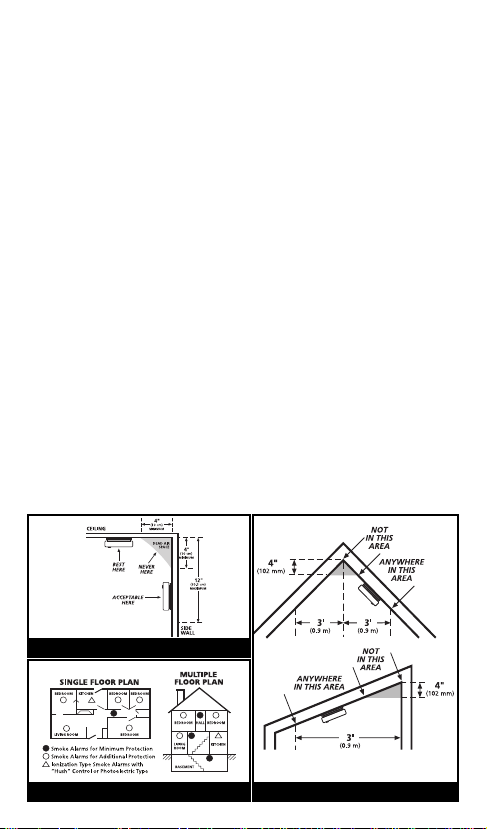
• When mounting an alarm on the ceiling, locate it at a minimum
of 4” (10cm) from the side wall (see Figure 1).
• When mounting the alarm on the wall, use an inside wall with
the top edge of the alarm at a minimum of 4” (10cm) and a
maximum of 12” (30.5cm) below the ceiling. (see Figure 1).
• Put smoke alarms at both ends of a bedroom hallway or large
room if the hallway or room is more than 30 feet (9.1 m) long.
• Install Smoke Alarms on sloped, peaked or cathedral ceilings at
or within 3ft (0.9m)of the highest point (measured horizontally).
NFPA 72 states: “Smoke alarms in rooms with ceiling slopes
greater than 1 foot in 8 feet (.3m in 2.4m) horizontally shall be
located on the high side of the room.” NFPA 72 states: “A row
of alarms shall be spaced and located within 3 ft (0.9m) of the
peak of the ceiling measured horizontally” (see Figure 3).
FIGURE 1
FIGURE 2 FIGURE 3
Page 4

MOBILE HOME INSTALLATION
Modern mobile homes have been designed and built to be energy
efficient. Install smoke alarms as recommended above (refer to
RECOMMENDED LOCATIONS and Figures 1 and 2).
In older mobile homes that are not well insulated compared to
present standards, extreme heat or cold can be transferred from
the outside to the inside through poorly insulated walls and roof.
This may create a thermal barrier which can prevent the smoke
from reaching an alarm mounted on the ceiling. In such units,
install the smoke alarm on an inside wall with the top edge of the
alarm at a minimum of 4” (10cm) and a maximum of 12”
(30.5cm) below the ceiling (see Figure 1).
If you are not sure about the insulation in your mobile home, or if
you notice that the outer walls and ceiling are either hot or cold,
install the alarm on an inside wall. For minimum protection, install
at least one alarm close to the bedrooms. For additional protection, see SINGLE FLOOR PLAN in Figure 2.
WARNING: TEST YOUR SMOKE ALARM OPERATION AFTER R.V.
OR MOBILE HOME VEHICLE HAS BEEN IN STORAGE, BEFORE
EACH TRIP, AND AT LEAST ONCE A WEEK DURING USE.
2. LOCATIONS TO AVOID
• In the garage. Products of combustion are present when you
start your automobile.
• Less than 4” (10cm) from the peak of an “A” frame type ceil-
ing.
• In an area where the temperature may fall below 40ºF or rise
above 100ºF, such as garages and unfinished attics.
• In dusty areas. Dust particles may cause nuisance alarm or fail-
ure to alarm.
• In very humid areas. Moisture or steam can cause nuisance
alarms.
• In insect-infested areas.
• Smoke alarms should not be installed within 3 ft (.9m) of the
following: the door to a kitchen, the door to a bathroom containing a tub or shower, forced air supply ducts used for heating
or cooling, ceiling or whole house ventilating fans, or other high
air flow areas.
Page 5
• Kitchens. Normal cooking may cause nuisance alarms. If a
kitchen alarm is desired, it should have an alarm silence feature
or be a photoelectric type.
• Near fluorescent lights. Electronic “noise” may cause nuisance
alarms.
• Smoke alarms are not to be used with detector guards unless
the combination (alarm and guard) has been evaluated and
found suitable for that purpose.
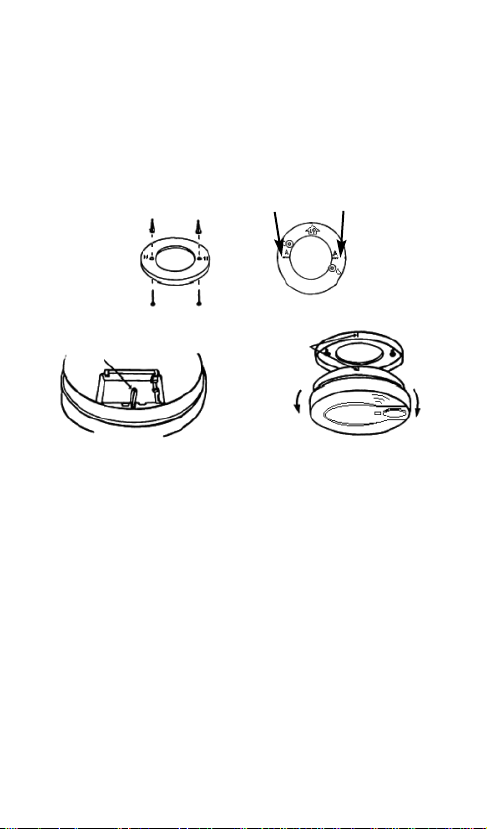
Alignment Marks
When mounting in a hallway,
the “A” line
should be
parallel with
the hallway.
Push Down
FIGURE 4
FIGURE 5
Alignment
Marks
For wall mounting the “A”
line should be
horizontal and
the arrow must
be pointing up.
Install
FIGURE 6 FIGURE 7
Remove
3. INSTALLATION INSTRUCTIONS
CAUTION: THIS UNIT IS SEALED. THE COVER IS NOT REMOVABLE!
1. Remove the mounting plate from the back of the alarm by hold-
ing the mounting plate and twisting the alarm in the direction
indicated by the “OFF” arrow on the alarm cover.
2. To insure aesthetic alignment of the alarm with the hallway or
wall, the “A” line on the mounting plate should be parallel with
the hallway when ceiling mounting or horizontal when wall
mounting.
3. After selecting the proper smoke alarm location as described in
Section 1, attach the mounting plate to the ceiling as shown in
Figure 4. For wall mounting see Figure 5. Place mounting plate
on the wall. Be sure the “UP FOR WALL MOUNTING “ text and
arrow are facing up. Use the screws and anchors provided to
secure the mounting plate (use 3/16” drill bit for anchor holes).
Page 6
4. When installing the battery, press the battery reminder finger
down into the battery compartment and install the battery (see
Figure 6).
CAUTION! IF THE BATTERY REMINDER FINGER IS NOT HELD
DOWN IN THE BATTERY COMPARTMENT BY THE BATTERY,
THE ALARM WILL NOT ATTACH TO THE MOUNTING BRACKET.
5. Alignment marks are provided on the edge of the trim plate
and the alarm. After installing the mounting plate, place the
alarm on the mounting plate with the alignment marks lined up.
Twist the alarm in the direction indicated by the “ON” arrow on
the alarm cover (see Figure 7) until it locks in place.
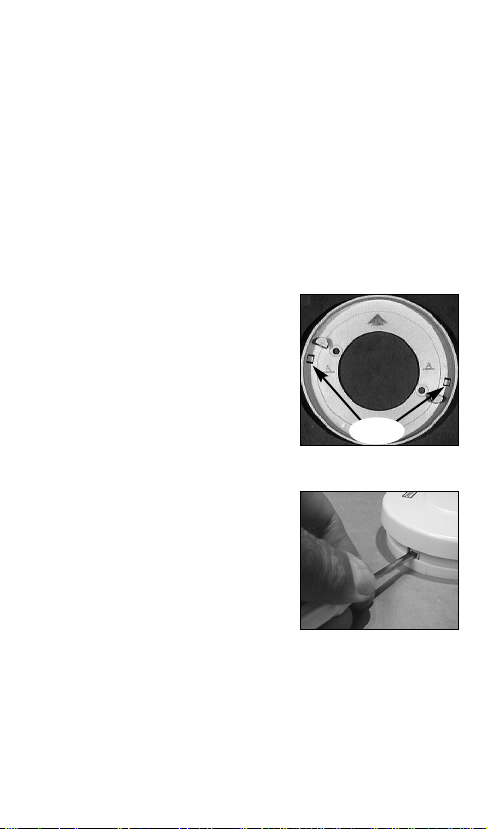
6. TAMPER RESIST FEATURE:
ACTIVATING THE TAMPER RESIST FEATURE
To make your smoke alarm tamper
resistant, a tamper resist means has
been provided. To activate this feature
you must break out the tamper resist
blocks. Use a small screwdriver to
break out these blocks on the alarm
(See figure 8).
Using this feature will help deter children and others from removing the
alarm from the mounting plate. With
Break
out
FIGURE 8
the blocks removed the tamper resist
feature will be activated when the
alarm is installed on the mounting
plate.
7. REMOVING ALARM WITH TAMPER
RESIST FEATURE ACTIVE
The tamper resist tab will have to be
released in order to change the battery. Using a tool (small screwdriver)
pull the tamper resist tab away from
FIGURE 9
the mounting plate (See Figure 9).
With the tamper resist tab held away from the alarm and rotate
the alarm in the off direction.
8. After installation, test your alarm by depressing and holding
down the test button for several seconds, this should sound the
alarm.
Page 7

4. OPERATION AND TESTING
OPERATION: The smoke alarm is operational once a fresh battery is
installed and testing is complete. When products of combustion
are sensed, the unit sounds a loud 85db pulsating alarm until the
air is cleared.
INTELLIGENT HUSH®CONTROL
NOTE: MODEL 0945 DOES NOT HAVE HUSH
®
HUSH®CONTROL: The HUSH®feature has the capability of temporarily desensitizing the alarm circuit for approximately 8 minutes.
This feature is to be used only when a known alarm condition, such
as smoke from cooking, activates the alarm. The smoke alarm is
desensitized by pushing the HUSH®button on the smoke alarm
cover. If the smoke is not too dense, the alarm will silence immediately and the red LED will illuminate for 1.5 seconds every 8 seconds for 8 minutes. This indicates that the alarm is in a temporarily
desensitized condition. The smoke alarm will automatically reset
after approximately 8 minutes and sound the alarm if particles of
combustion are still present. The HUSH®feature can be used
repeatedly until the air has been cleared of the condition causing
the alarm. Pushing the test/reset button on the alarm will end the
temporarily desensitized period.
NOTE: DENSE SMOKE WILL OVERRIDE THE HUSH®CONTROL
FEATURE AND SOUND A CONTINUOUS ALARM.
CAUTION: BEFORE USING THE ALARM SMART HUSH
TM
FEATURE, IDENTIFY THE SOURCE OF THE SMOKE AND BE CERTAIN A SAFE CONDITION EXISTS.
FLASHING LED LIGHT: This smoke alarm is equipped with a flashing
red indicator light with four modes of operation:
• The LED will flash every 40-45 seconds in the standby mode sig-
nifying that the alarm is receiving power.
• The LED will flash every 1.5 seconds when the alarm is sounding.
• The LED will illuminate for 1.5 seconds every 8 seconds while the
alarm is in the temporarily desensitized mode.
TESTING: Test by pushing the test button on the cover and hold it
down for a minimum of 5 seconds (or until the alarm sounds). This
will sound the alarm if the electronic circuitry, horn and batteries
are working. If no alarm sounds, the unit has defective batteries or
other failure. DO NOT use an open flame to test your alarm, you
Page 8

could damage the alarm or ignite combustible materials and start a
structure fire.
TEST THE ALARM WEEKLY TO ENSURE PROPER OPERATION. Erratic
or low sound coming from your alarm may indicate a defective
alarm, and it should be returned for service (see Section 12).
NOTE: WEEKLY TESTING IS REQUIRED.
5. NUISANCE ALARMS
Smoke alarms are designed to minimize nuisance alarms. Cigarette
smoke will not normally set off the alarm, unless the smoke is
blown directly into the alarm. Combustion particles from cooking
may set off the alarm if the alarm is located close to the cooking
area. Large quantities of combustible particles are generated from
spills or when broiling. Using the fan on a range hood which vents
to the outside (non-recirculating type) will also help remove these
combustible products from the kitchen.
The 0946 has a SMART HUSHTMcontrol that is extremely useful in a
kitchen area or other areas prone to nuisance alarms. For more
information refer to Section 4, OPERATION AND TESTING.
If the alarm does sound, check for fires first. If a fire is discovered,
get out of the building and call the fire department. If no fire is
present, check to see if one of the reasons listed in Section 2 may
have caused the alarm.
6. MAINTENANCE
BATTERY REPLACEMENT
If tamper resist feature has been used, refer to "REMOVING
ALARM WITH TAMPER RESIST FEATURE ACTIVE" in Section 3 for
removal instructions.
To replace the battery, remove the alarm from the mounting plate
by rotating the alarm in the direction of the “OFF” arrow on the
cover (see Section 3, Figure 7).
This Smoke Alarm is powered by 9 volt battery (carbon Zinc, alkaline, and Lithium batteries may be used). A fresh battery should
last for one year under normal operating conditions. Alkaline and
Lithium batteries will last longer than Carbon Zinc batteries.
This alarm has a low battery monitor circuit which will cause the
alarm to “chirp” approximately every 30 - 40 seconds for a minimum of seven (7) days when the battery gets low. Replace the
Page 9

battery when this condition occurs.
The low battery chirp will occur approximately 20 seconds after
the red LED flash.
USE ONLY THE FOLLOWING 9 VOL T BATTERIES FOR SMOKE
ALARM REPLACEMENT.
Carbon Zinc Type: EVEREADY 1222; GOLD PEAK 1604S
Alkaline Type: ENERGIZER 522; DURACELL MN1604,
Lithium Type: ULTRALIFE U9VL-J
These batteries can be purchased at your local retailer.
NOTE: WEEKLY TESTING IS REQUIRED.
WARNING!! USE ONLY THE BATTERIES SPECIFIED. USE OF
DIFFERENT BATTERIES MAY HAVE A DETRIMENTAL EFFECT
ON THE SMOKE ALARM.
MX1604, GOLD PEAK 1604A ;
PANASONIC 6AM6, 6AM-6, 6AM-6PI,
6AM6X, 6LR61(GA)
CLEANING YOUR ALARM
YOUR ALARM SHOULD BE CLEANED AT LEAST ONCE A YEAR
To clean your alarm, remove it from the mounting bracket as outlined in the beginning of this section (If tamper resist feature has
been used, refer to "REMOVING ALARM WITH TAMPER RESIST
FEATURE ACTIVE" in Section 3 for removal instructions).
You can clean the interior of your alarm (sensing chamber) by
using compressed air or a vacuum cleaner hose and blowing or
vacuuming through the openings around the perimeter of the
alarm. The outside of the alarm can be wiped with a damp cloth.
After cleaning, reinstall your alarm and test your alarm by using
the test button. If cleaning does not restore the alarm to normal
operation the alarm should be replaced.
Do not paint your alarm. Paint will seal the vents and interfere
with the alarms ability to detect smoke and produce sound. Never
attempt to dismantle the alarm or clean the inside, as this will void
the warranty.
7. LIMITATIONS OF SMOKE ALARMS
WARNING: PLEASE READ CAREFULLY AND THOROUGHLY
Page 10

• NFPA 72 states: Life safety from fire in residential occupancies is
based primarily on early notification to occupants of the need to
escape, followed by the appropriate egress actions by those
occupants. Fire warning systems for dwelling units are capable of
protecting about half of the occupants in potentially fatal fires.
Victims are often intimate with the fire, too old or young, or
physically or mentally impaired such that they cannot escape
even when warned early enough that escape should be possible.
For these people, other strategies such as protection-in-place or
assisted escape or rescue are necessary.
• Smoke alarms are devices that can provide early warning of pos-
sible fires at a reasonable cost; however, alarms have sensing limitations. Ionization sensing alarms may detect invisible fire particles (associated with fast flaming fires) sooner than photoelectric
alarms. Photoelectric sensing alarms may detect visible fire particles (associated with slow smoldering fires) sooner than ionization alarms. Home fires develop in different ways and are often
unpredictable. For maximum protection, Kidde recommends that
both Ionization and Photoelectric alarms be installed.
• Abattery poweredalarm must havea battery of the specifiedtype,
ingood condition andinstalled properly.
• A.C. powered alarms (without battery backup) will not operate if
the A.C. power has been cut off, such as by an electrical fire or
an open fuse.
• Smoke alarms must be tested regularly to make sure the batteries
and the alarm circuits are in good operating condition.
• Smoke alarms cannot provide an alarm if smoke does not reach
the alarm. Therefore, smoke alarms may not sense fires starting
in chimneys, walls, on roofs, on the other side of a closed door
or on a different floor.
• If the alarm is located outside the bedroom or on a different
floor, it may not wake up a sound sleeper.
• The use of alcohol or drugs may also impair one’s ability to hear
the smoke alarm. For maximum protection, a smoke alarm
should be installed in each sleeping area on every level of a
home.
• Although smoke alarms can help save lives by providing an early
warning of a fire, they are not a substitute for an insurance policy. Home owners and renters should have adequate insurance to
protect their lives and property.
Page 11

8. GOOD SAFETY HABITS
DEVELOP AND PRACTICE A PLAN OF ESCAPE
• Make a floor plan indicating all doors and windows and at least
two (2) escape routes from each room. Second story windows
may need a rope or chain ladder.
• Have a family meeting and discuss your escape plan, showing
everyone what to do in case of fire.
• Determine a place outside your home where you all can meet if a
fire occurs.
• Familiarize everyone with the sound of the smoke alarm and train
them to leave your home when they hear it.
• Practice a fire drill at least every six months, including fire drills at
night. Ensure that small children hear the alarm and wake when
it sounds. They must wake up in order to execute the escape
plan. Practice allows all occupants to test your plan before an
emergency. You may not be able to reach your children. It is
important they know what to do.
• Install and maintain fire extinguishers on every level of the home
and in the kitchen, basement and garage. Know how to use a
fire extinguisher prior to an emergency.
• Current studies have shown smoke alarms may not awaken all
sleeping individuals, and that it is the responsibility of individuals
in the household that are capable of assisting others to provide
assistance to those who may not be awakened by the alarm
sound, or to those who may be incapable of safely evacuating
the area unassisted.
WHAT TO DO WHEN THE ALARM SOUNDS
• Alert small children in the home.
• Leave immediately by your escape plan. Every second counts, so
don’t waste time getting dressed or picking up valuables.
• In leaving, don’t open any inside door without first feeling its sur-
face. If hot, or if you see smoke seeping through cracks, don’t
open that door! Instead, use your alternate exit. If the inside of
the door is cool, place your shoulder against it, open it slightly
and be ready to slam it shut if heat and smoke rush in.
• Stay close to the floor if the air is smoky. Breathe shallowly through
a cloth, wet if possible.
Page 12

• Once outside, go to your selected meeting place and make sure
everyone is there.
• Call the fire department from your neighbor’s home - not from
yours!
• Don’t return to your home until the fire officials say that it is all
right to do so.
There are situations where a smoke alarm may not be effective to
protect against fire as stated in the NFPA Standard 72. For instance:
a) smoking in bed
b) leaving children home alone
c) cleaning with flammable liquids, such as gasoline
9. NRC INFORMATION
Ionization type smoke alarms use a very small amount of a
radioactive element in the sensing chamber to enable detection of
visible and invisible combustion products. The radioactive element
is safely contained in the chamber and requires no adjustments or
maintenance. This smoke alarm meets or exceeds all government
standards. It is manufactured and distributed under license from
the U.S. Nuclear Regulatory Commission.
10. NFPA REQUIRED PROTECTION
The National Fire Protection Association’s Standard 72 provides the
following information:
Smoke Detection - Where required by applicable laws, codes, or
standards for the specified occupancy, approved single- and multiple-station smoke alarms shall be installed as follows: (1) In all
sleeping rooms Exception: Smoke alarms shall not be required in
sleeping rooms in existing one- and two-family dwelling units. (2)
Outside of each separate sleeping area, in immediate vicinity of
the sleeping rooms. (3) On each level of the dwelling unit, including basements Exception: In existing one- and two-family dwelling
units, approved smoke alarms powered by batteries are permitted.
Smoke Detection - Are More Smoke Alarms Desirable? The
required number of smoke alarms might not provide reliable early
warning protection for those areas separated by a door from the
areas protected by the required smoke alarms. For this reason, it is
recommended that the householder consider the use of additional
smoke alarms for those areas for increased protection. The addi-
Page 13

tional areas include the basement, bedrooms, dining room, furnace room, utility room, and hallways not protected by the
required smoke alarms. The installation of the smoke alarms in
the kitchen, attic (finished or unfinished), or garage is normally not
recommended, as these locations occasionally experience conditions that can result in improper operation.
This equipment should be installed in accordance with the
National Fire Protection Association’s Standard 72 (NFPA,
Batterymarch Park, Quincy, MA 02269).
NOTIFY YOUR LOCAL FIRE DEPARTMENT AND INSURANCE COMPANY OF YOUR SMOKE ALARM INSTALLATION.
11. CAUTION (AS REQUIRED BY THE CALIFORNIA
STATE FIRE MARSHAL)
“Early warning fire detection is best achieved by the installation of
fire detection equipment in all rooms and areas of the household
as follows. A smoke alarm installed in each separate sleeping area
(in the vicinity of, but outside of the bedrooms), and heat or
smoke alarms in the living rooms, dining rooms, bedrooms,
kitchens, hallways, attics, furnace rooms, closets, utility and storage rooms, basements and attached garages.”
12. SERVICE AND WARRANTY
If after reviewing this manual you feel that your smoke alarm is
defective in any way, do not tamper with the unit. Return it for
servicing to: KIDDE, 1016 Corporate Park Dr., Mebane, NC 27302.
1-800-880-6788 (See Warranty for in-warranty returns).
Page 14

FIVE YEAR LIMITED WARRANTY
Kidde warrants to the original purchaser that the enclosed smoke alarm (but not
the battery) will be free from defects in material and workmanship or design under
normal use and service for a period of five years from the date of purchase. The
obligation of Kidde under this warranty is limited to repairing or replacing the
smoke alarm or any part which we find to be defective in material, workmanship
or design, free of charge to the customer, upon sending the smoke alarm with
proof of date of purchase, postage and return postage prepaid, to Warranty
Service Department, Kidde, 1016 Corporate Park Dr., Mebane, NC 27302.
This warranty shall not apply to the smoke alarm if it has been damaged, modified,
abused or altered after the date of purchase or if it fails to operate due to improper maintenance or inadequate A.C. or D.C. electrical power.
THE LIABILITY OF KIDDE OR ANY OF ITS PARENT OR SUBSIDIARY CORPORATIONS
ARISING FROM THE SALE OF THIS SMOKE ALARM OR UNDER THE TERMS OF THIS
LIMITED WARRANTY SHALL NOT IN ANY CASE EXCEED THE COST OF REPLACEMENT OF SMOKE ALARM AND, IN NO CASE, SHALL KIDDE OR ANY OF ITS PARENT OR SUBSIDIARY CORPORATIONS BE LIABLE FOR CONSEQUENTIAL LOSS OR
DAMAGES RESULTING FROM THE FAILURE OF THE SMOKE ALARM OR FOR
BREACH OF THIS OR ANY OTHER WARRANTY, EXPRESS OR IMPLIED, EVEN IF THE
LOSS OR DAMAGE IS CAUSED BY THE COMPANY’S NEGLIGENCE OR FAULT.
Since some states do not allow limitations on the duration of an implied warranty
or do not allow the exclusion or limitation of incidental or consequential damages,
the above limitations or exclusions may not apply to you. While this warranty gives
you specific legal rights, you may also have other rights which vary from state to
state.
Also, Kidde makes no warranty, express or implied, written or oral, including that
of merchantability or fitness for any particular purpose, with respect to the battery.
The above warranty may not be altered except in writing signed by both parties
hereto.
Page 15

Model 0946 with Ultralife lithium battery
TEN YEAR LIMITED WARRANTY
Kidde warrants to the original purchaser that the enclosed smoke alarm and
Ultralife Batteries Inc., warrants to the Purchaser that the enclosed Ultra life 9 volt
lithium battery when used with the enclosed smoke alarm, will be free from
defects in material and workmanship or design under normal use and service for
a period of ten years from the date of purchase.
The obligation of Kidde under this warranty is limited to repairing or replacing the
smoke alarm or any part which we find to be defective in material, workmanship
or design, free of charge to the customer.
To return a defective Ultralife battery, return the battery along with proof of purchase and a note describing the difficulty to: Ultralife Batteries Inc., P.O. Box 622,
1350 Route 88 South, Newark, New York 14313. To return a defective smoke
alarm, return this alarm with proof of date of purchase, postage and return
postage prepaid, to Warranty Service Department, Kidde, 1016 Corporate Park
Dr., Mebane, NC 27302.
This warranty shall not apply to the smoke alarm if it has been damaged, modified, abused or altered after the date of purchase or if it fails to operate due to
improper maintenance or inadequate A.C. or D.C. electrical power.
THE LIABILITY OF KIDDE OR ANY OF ITS PARENT OR SUBSIDIARY CORPORATIONS
ARISING FROM THE SALE OF THIS SMOKE ALARM OR THE ENCLOSED ULTRALIFE
BATTERY UNDER THE TERMS OF THIS LIMITED WARRANTY SHALL NOT IN ANY
CASE EXCEED THE COST OF REPLACEMENT OF THIS SMOKE ALARM OR THIS
BATTERY AND, IN NO CASE, SHALL KIDDE OR ANY OF ITS PARENT OR SUBSIDIARY CORPORATIONS BE LIABLE FOR CONSEQUENTIAL LOSS OR DAMAGES
RESULTING FROM THE FAILURE OF THE SMOKE ALARM OR FOR BREACH OF THIS
OR ANY OTHER WARRANTY, EXPRESS OR IMPLIED, EVEN IF THE LOSS OR DAMAGE IS CAUSED BY THE COMPANY’S NEGLIGENCE OR FAULT.
Since some states do not allow limitations on the duration of an implied warranty
or do not allow the exclusion or limitation of incidental or consequential damages, the above limitations or exclusions may not apply to you. While this warranty gives you specific legal rights, you may also have other rights which vary
from state to state.
Also, Kidde makes no warranty, express or implied, written or oral, including that
of merchantability or fitness for any particular purpose, with respect to the battery.
The above warranty may not be altered except in writing signed by both parties
hereto.
QUESTIONS OR FOR MORE INFORMATION
Call our Consumer Hotline at 1-800-880-6788 or contact
us at our website at
www.kidde.com
Kidde 1016 Corporate Park Drive, Mebane, NC 27302
 Loading...