

Page 1
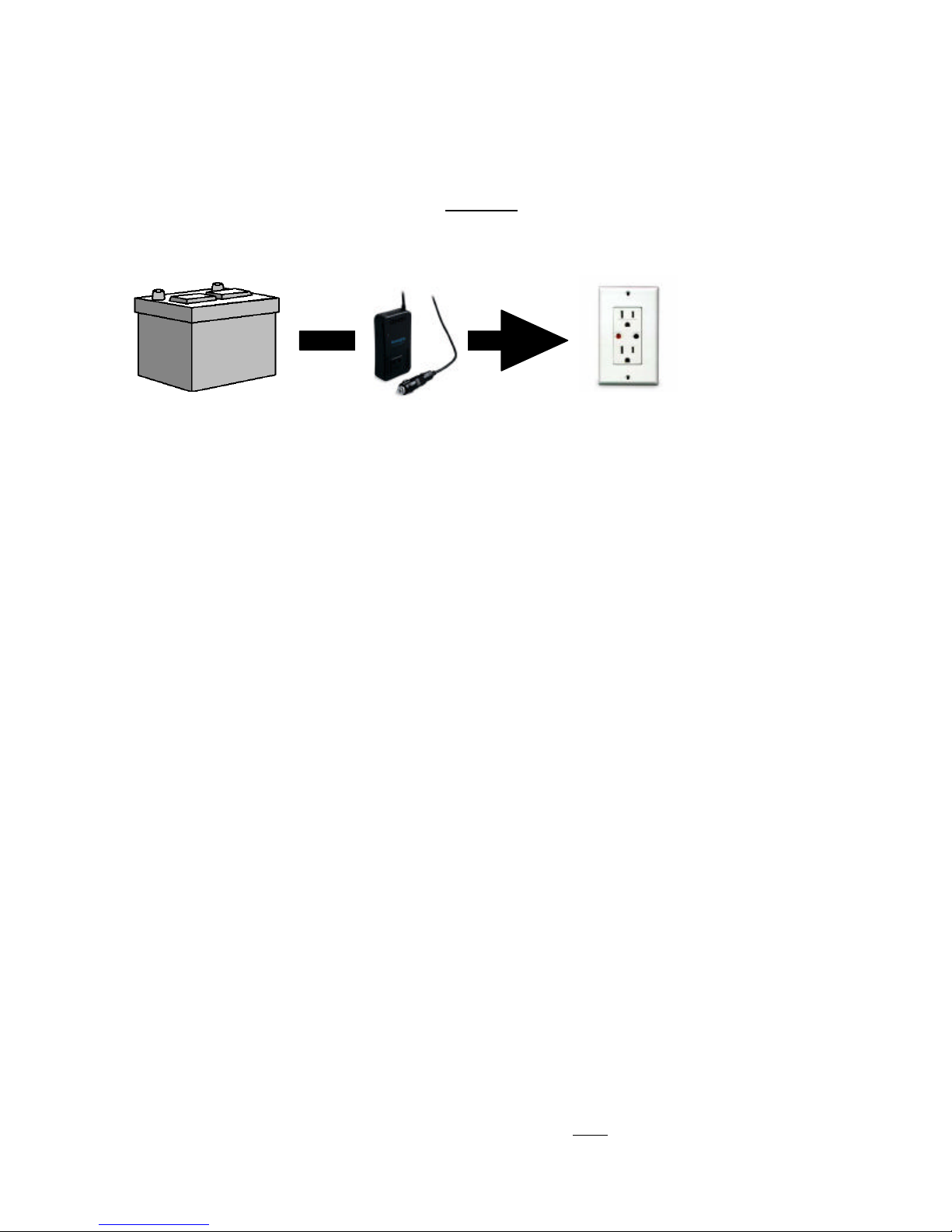
All About Inverters
Wall (AC) Power
INVERTER
Why would I want to buy an Inverter?
Inverters provide an AC (Wall) outlet in your car or on the plane!
Inverters allow you to us e your portable electronic devices such us Notebook Computers, Cell Phones,
DVD players , MP3 Players, Digital Cameras, etc. anywhere you travel by providing a common source of
power compatible with most portable electronic devices.
Inverters convert Direct Currently (DC) that is usually stored in a battery and available from a Vehicle
Power Port (or Airline Power Port) to Alternating Current (AC) as found at a wall outlet in your home or
office.
What can be powered from an Inverter ?
Unlike wall outlets in your home and office an Inverter can only support portable electronic devices
compatible with the Inverter’s continuous power rating expressed in Watts. 120 to 150 Watts is a good
output to support most notebook computers commonly in use today.
Some electrical appliances with heating elements (resistive loads) draw far more power than an Inverter
can produce. This is why Inverters do not work with hairdryers, kettles, etc.
Inverters are very easy to use. Simply plug your portable electronic device into the Inverter and plug the
Inverter into your Vehicle Power Port (Cigarette Lighter Port) or Airline Power Port.
What to consider when shopping for Inverters
There are different factors to consider when shopping for Inverters. Some of the most important are:
Single AC (Wall) Outlet vs. Multiple AC (Wall) Outlets and USB ports
The idea with Inverters offering multiple AC (Wall) sockets is to power two devices at the same time.
While this appears to be a nice feature, there are some drawbacks to be considered with this particular
design.
There is only a limited amount of energy (power) available from a Vehicle Power Port – approximately
150 Watts. The Vehicle Power Port in a vehicle is usually fused at 15 Amps. Attempting to draw more
than 15 Amps by powering multiple portable electronic devices could blow the fuse in the vehicle!
Given the availability of a maximum of 150 Watts from the Vehicle Power Port and the increasing power
demands of new notebook computers (120 Watts and more) it is NOT a good idea to include multiple AC
Battery (DC) Power
o Single AC (Wall) Outlet vs. Multiple AC (Wall) Outlets and USB Port(s)
o Size
o Continuous and Peak Power
o Additional Features
Page 2

(Wall) outlets on an Inverter that is powered thru a Vehicle Power Port. This feature can become more
of a hindrance that a benefit.
The addition of a second AC (Wall) outlet would encourage connecting multiple devices that could blow
automotive fuses or generate automatic shutdowns due to overloading of the built -in circuit protection
features.
In addition, multiple AC (Wall) outlets models suffer from potential electrical safety defects if incorrectly
designed. In 2005 several adapters were recalled from the market due to safety issues.
Adding USB port(s) may just compound the problem of not having enough available power along with
multiple AC (Wall) outlets.
Products with a single AC (Wall) outlet deliver reliable performance to operate a newer notebook
computer given the limitations of the power source, providing the user with an experience free of having
to replace blown automotive fuses or suffering from automatic shutdowns due to overloading of the
built-in circuit protection features.
Size
Size and form factor could be a deciding factor when shopping for Inverters. Normally size and
power are related. Some of the new Inverters such as Kensington Ultra Portable Power Inverter
150 (K33362), deliver high power in a compact, lightweight design.
Continuous and Peak Power
The Continuous Power rating of an Inverter refers to the amount of power that the Inverter can
sustain during continuous use.
The purpose of Peak Power is to allow for operating power spikes. If the Peak Power rating is exceeded
the Inverter will usually have to be restarted after approximately 10 minutes to allow it to cool.
Additional Features
Some Inverters have a built -in LED to warn of undesirable operating conditions. Some other features you
may find on Inverters are built -in safety features including over current protection, low and over supply
voltage protection and over temperature protection.
There are many products on the market, but do your research to determine the best solution for you.
For a complete listing of Kensington power solutions visit www.kensington.com
 Loading...