

Page 1
KAITO
KAITO
KA009R
KA009R is manufactured for
KAITO
Electronics Inc(USA)by Kaito Enterprises Corp.in China
SELF-POWERED MULTIBAND
WORLD RECEIVER WITH EMERGENCY
CELLPHONE CHARGER AND FLASHLIGHT
Page 2
KA009R
Kaito
KA009R
Kaito
Thank You:
Thank you for purchasing the KA009R super portable receiver. Please
read the manual thoroughly before operating and keep this book in a
safe place for future reference. With proper care, you will receive many
years of trouble-free service from your new radio.
Description:
The KA009R portable radio is perfect for emergency situations and is
also ideal for anyone who does not have access to a reliable AC power
source. The radio can be powered by solar energy, batteries, AC adapter
and hand-crank generator (magneto). With coverage of the AM/FM/TV/
AIR/Weather broadcast bands, plus 4 shortwave bands, you'll never run
out of things to listen to!
1 2
Features:
1. Ten Bands: Receives AM/FM/TV1/TV2/AIR/Weather broadcast
bands and four shortwave bands (SW1-SW4).
2. Built-in power generator: Under emergency conditions where
AC power, batteries and sunlight sources are unavailable, you can
crank-up the radio to charge the internal batteries.
3. Solar power: The built-in solar panel is powerful enough to run the
radio in direct sunlight.* It charges the batteries even in weak light
conditions.
4. Rechargeable pack: It provides reliable, renewable internal power
for everyday use. The high quality Ni-MH rechargeable batteries are
installed inside the radio and will last for many years without needing
replacement.
Page 3
KA009R
Kaito
KA009R
Kaito
5. 2 1/2 diameter speaker: The high quality speaker provides clear
dynamic audio.
6. AC/DC power adapter: You can use this adapter to charge the built-in
battery or to directly power the radio.
7. DC jack: A built-in 6V DC jack is provided for external power connection.
8. Earphone: Stereo Earphones are provided for private listening.
9. Antennas: The telescopic antenna can be positioned to improve reception
of FM/TV/AIR/Weather and shortwave stations. A built-in AM ferrite
antenna provides good sensitivity for AM reception. Also included with
the radio is a portable wire antenna that can be used to further improve
shortwave reception by plugging it into the earphone jack.
10. Cellphone charger tips. We include the adaptors for the popular
cellphones on the market for self-charging. See the info on the separate
page.
3 4
11. Super bright LED Flashlight: Long life super bright LED is
convenient flashlight to use in the dark.
12. Battery compartment: Operates on 3 x "AA" size batteries.
(Batteries not included)
*Important Notice Regarding Solar Operation:
The built-in solar panel can be used to directly power the radio even
if the internal batteries are dead! The solar panel must face direct
sunlight to get enough energy to operate the radio's speaker. If you
cannot position the radio in direct sunlight, try to use the earphones.
Earphones require less energy to operate than the speaker does.
When switching to solar power always start with the volume control
at the minimum position. The higher you turn the volume the more
light you will need.
Page 4
KA009R
Kaito
KA009R
Kaito
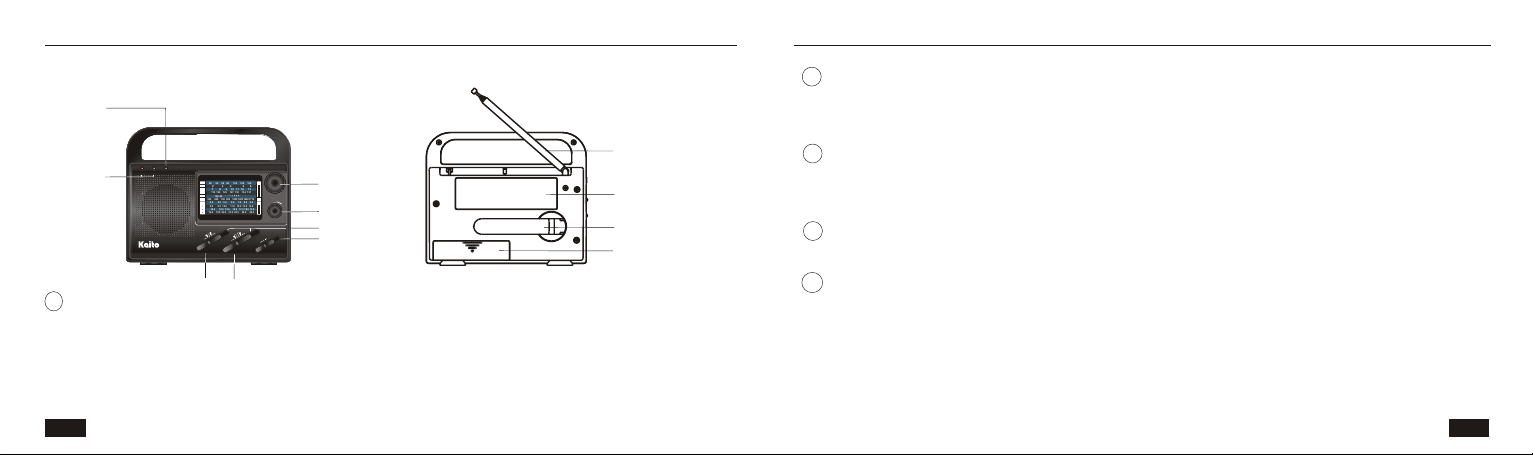
Operation at a Glance (see diagram for location of controls)
5
2. Band selector: Switch 2A selects AM/FM/TV1/TV2/AIR/WB.
Switch 2B selects AM bands for AM/SW1/SW2/SW3/SW4. (Switch
2B only works when Switch 2A is in the AM position.)
LO HI TUN/CH
6
FM/TV/AIR/WB/AM/SW1-4 PORTABLE RECEIVER
FM
MHz
88 92 95
108
10298105
TV1
5
6
234
TV2
789
10
13
11
12
AIR
118
130 134120 137
123 127
162.55
WB
162.40
KHz
AM
800
530 600 700
120014001000 1710
SW1
MHz
8.0 9.0
4.0 4.5 5.0 6.0
7.0
2
9.0 9.5
10.0 11.0 12.0 13.014.0
3
18.019.0
14.0 14.5 15.0 16.0 17.0
4
19.0 19.5
20.0
26.0
21.0
22.0 24.0
DYNAMO & SOLAR POWER
3
4
2
R
B
W
W
I
2
V
S
S
W
A
T
W
S
M
F
1
W
1
S
M
A
KA009R
L
V
O
T
S
W
S
C
M/
D
/
A
T
T
A
B
A
B
4
TUNING
F
F
O
E
M
U
L
O
V
3
2
N
Y
D
1
SOLAR
9
8
7
1. Power source selector: Down for battery or external power source, up
for the built-in rechargeable batteries, the middle is for solar power.
10
3. Volume control with main power off switch: To adjust the speaker
volume or earphone volume, or power off the radio. The off position
will turn off all power sources.
4. Tuner: Rotate the tuner control to select the station you want to listen
to.
5. Tuner/Charge light: this LED is a two-color LED. It will light up in RED
when you have optimized the tuning, it turns to GREEN if you crank
charge the radio.
(This radio uses three Nickel-Metal Hydride rechargeable batteries,
which have no memory effect and can be fully recharged over 1000
times.)
5 6
Page 5
KA009R
Kaito
KA009R
Kaito
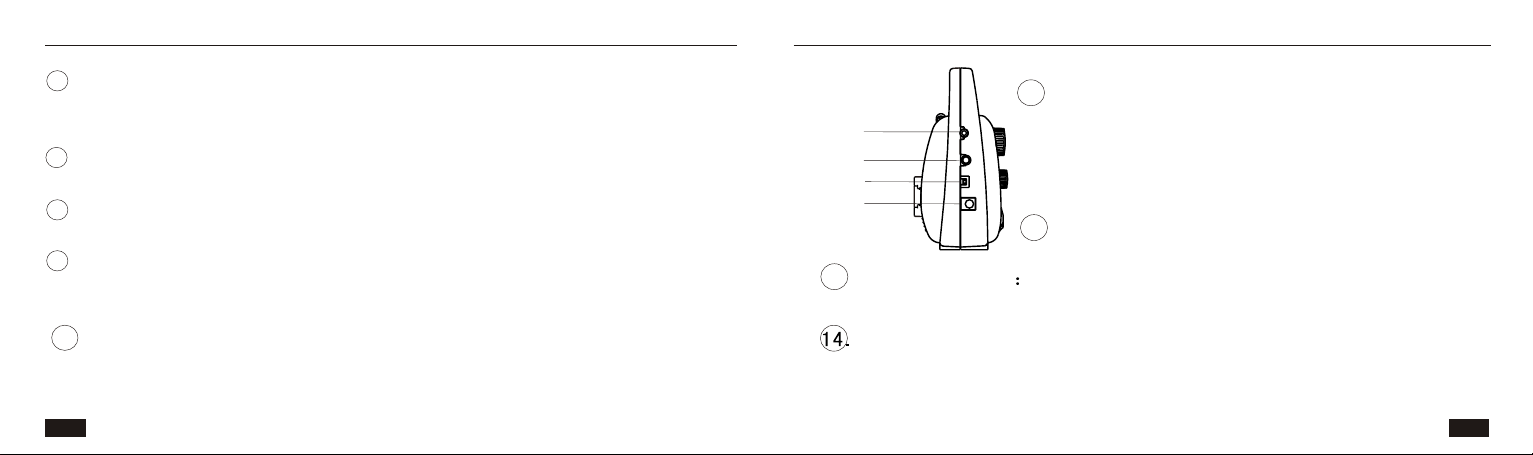
6. Battery level: The green (HI) LED indicates the battery level is OK
to use.
The red (LO) LED indicates it is time to charge the internal battery.
7. Battery compartment: for 3 "AA" batteries. (Alkaline batteries are
recommended.)
8. Dynamo cranking handle: Turn the crank handle to charge the
11
12
13
14
built-in batteries.
9. Solar Panel: Works as a power source when using the radio in the
sun. The solar panel charges the batteries whenever the radio is
exposed to daylight.
10. Antenna: Telescopic with 360 degrees rotation for FM/TV/AIR/WB
/SW reception. (You have to rotate the radio for optimum AM
reception.)
7 8
13. LED light switch Set the switch to ON position, the bright LED
will light. Set the switch to OFF to turn off the LED light.
DC 6V jack: The external power source is plugged in via this jack
for radio operation or to charge the built-in batteries by DC
adapter.
11.
Earphone jack: To hear the radio privately,
plug the earphone into the jack. The speaker
will automatically shut off. The earphone jack
also works as a jack for the included wire
shortwave antenna.
12. Super bright LED.
Page 6
KA009R
Kaito
KA009R
Kaito
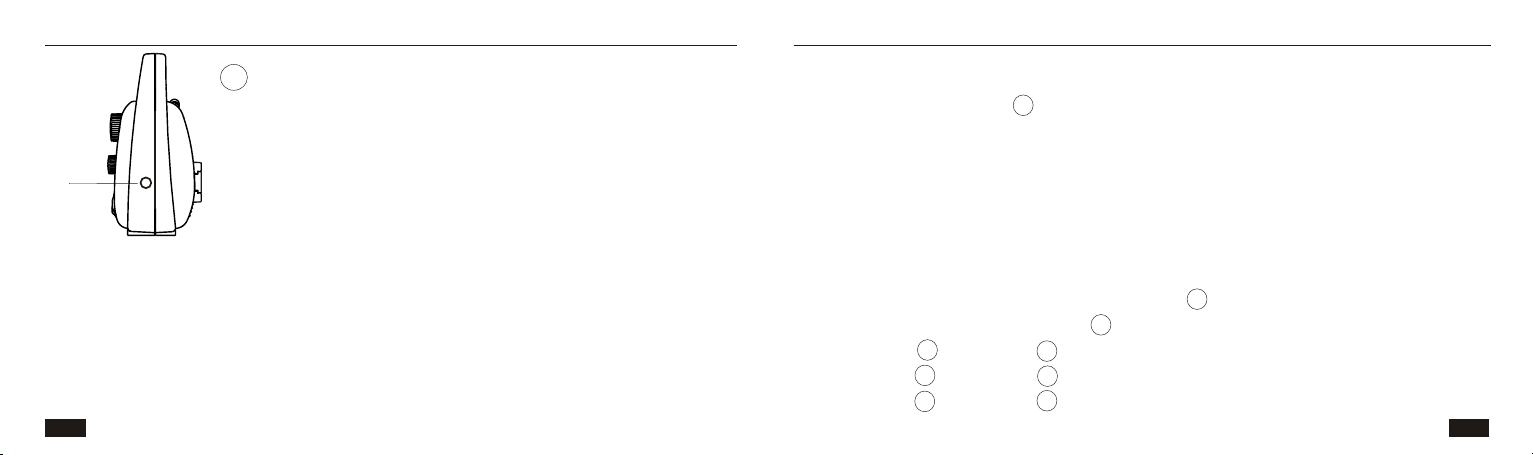
15. Cellphone Charger Jack
1. Connect the Cellphone to the Jack
Use the included cable to connect the cellphone and
15
Method 1: Crank the Dynamo Cranking Handle smoothly to charge the
cellphone.
Method 2: Use the AC adaptor to charge the cellphone. Plug the AC adaptor
to the power outlet, the radio will charge the cellphone.
Note: If you want to charge the built-in Ni-MH batteries with the AC adaptor,
please pull out the phone cable. When the phone is connected with
the Radio, it would not charge the built-in Ni-MH batteries.
9 10
the charger. Insert one end of the cable to jack, find
a proper tip to connect the cable and cellphone.
2. Charging the Cellphone (Two ways to charge)
Radio Operation (see diagram for location of controls)
Set the power switch 1 to the desired power source: AC/DC adapter,
external batteries, internal rechargeable "AA" batteries or solar power.
Band selection:
There are two band selector switches which work in conjunction with
each other to allow the selection of FM/TV/AIR/WB/AM/SW1/SW2/
SW3/SW4.
To receive :
Medium Wave: (AM Broadcast Band) 2 A should be in AM/SW
position and 2 B should be in AM position
FM : set 2 A to FM, 2 B can be on any position.
TV1: set 2 A to TV1, 2 B can be on any position.
TV2: set 2 A to TV2, 2 B can be on any position.
Page 7
KA009R
Kaito
KA009R
Kaito
AIR: set 2 A to AIR, 2 B can be on any position.
WB(Weather): set 2 A to WB, 2 B can be on any position.
Shortwave: 2 A must be on AM/SW position, 2 B to choose from
SW1/SW2/SW3/SW4
Tuning a Station:
Station can be tuned in with rotary knob 4 . If a station is accurately
tuned in, the Tuning LED lights up unless the signal is very weak.
Antennas:
The telescopic antenna 10 is for FM/TV/AIR/WB/SW stations. A wire
antenna is included which can be plugged into the earphone jack to
improve shortwave reception. The AM band uses an internal ferrite bar
antenna. Rotate or reposition the radio for best reception on the AM
(MW medium wave) band.
11
Four- Way Power Source
1. Battery Power: Insert 3 x "AA" batteries in the battery compartment.
Make sure you have the correct polarity. Put the power switch to
BATT/DC.
2. Solar: The built-in solar panel can be used to directly power the radio
even if the batteries are dead! The solar panel must face direct sunlight
to get enough energy to operate the radio's speaker. If you cannot
position the radio in direct sunlight try using the earphones.
Earphones require less energy to operate than the speaker does.
When switching to solar power always start with the volume control
at the minimum position. The higher you turn the volume the more
light you will need. Even when the main power is switched off, the
solar panel will still charge the built-in rechargeable batteries as
long as the solar panel is exposed to bright light.
12
Page 8
KA009R
Kaito
KA009R
Kaito
3. Dynamo: Put power switch to DYN, the radio will work on the internal
built-in battery. You can crank it to charge the battery while the main
power is switched off. For improved charge efficiency, we recommended
that you switch off the radio while cranking the generator.
4. Adapter: Plug the AC adapter to a power outlet on selector 13 . This
adapter can be used to power the radio and charge the internal battery.
Charging the built-in Ni-MH rechargeable batteries
1. Dynamo: Switch main power off, then use crank handle 8 , at 2 turns
per second, cranking for 90 seconds, you will get about 30 minutes
radio play time.
2. Adapter (110V or 220V): The internal battery will begin charging as
soon as the adapter is plugged in. The radio will work on the adapter
13
Power when turning the main power switch on. The first time you
charge the internal battery, it is recommended that you charge the
battery for no less than 4 hours, but no more than 6 hours. Knob 1
can be in any position while the battery is charging. If fully charged
for at least 5 hours, it will produce 10 hours or more of continuous
playing on all bands.
3. Solar Panel: If the main power switch is in the Off position, the solar
panel will charge the built-in batteries whenever there is enough light.
4. Regular batteries: it is recommended that you use alkaline "AA"
batteries for best performance. It depends on battery capacity for
listening time, from weeks to months. If you store your radio for an
extended period of time, we strongly recommend that you remove
the "AA" batteries from the radio.
14
Page 9
KA009R
Kaito
KA009R
Kaito
Specifications
FM : 88 - 108 MHz
TV1: Channel 2-6
AIR: 118-137MHz
NOAA Weather: 162.400/162.425/162.475/162.50/162.525/162.55
(continuous band)
TV2: Channel 7-13
AM (MW): 530 -1710 KHz
SW1: 4.00- 9.00 Mhz
SW2: 9.00- 14.00 MHz
SW3: 14.00 - 19.00 Mhz
SW4: 19.00- 26.00 MHz
Output power: 200 MW peak power using built-in speaker.
Headset jack socket: 3.5 mm
External DC supply socket: 6 mm (positive center)
15
Sensitivity
FM < 20uV
MW: <2.5mV
SW: <30uV
Rechargeable batteries: 3 NI-MH batteries 600mAh
Size: 165 x 137 x 70 mm
Weight : 460g (battery not included)
Caution: On the VHF and AIR bands, if there is a strong FM station
near you, you might receive interference from that strong station, but
when you tune in a used frequency in the VHF/AIR band, you will hear
the tuned in station.
16
Page 10
KA009R
Kaito
KA009R
Kaito
Care and Maintenance
1. Use soft cloth to clean the radio. Do not use aggressive polish or
cleaners.
2. Do not expose to moisture or temperature above 130 F
3. Take "AA" batteries out of the radio when you do not use the radio for
a long period of time.
17
Frequently Asked Questions:
Q: How long will the radio play when you use the Dynamo cranking to
charge the batteries?
A: There are several factors to be taken into consideration to answer
this question:
1. When using the crank as your source of power, we recommend
that you charge the batteries as soon as the low battery indicator
illuminates. If you use the dynamo when the batteries are almost
completely dead, your play time will be dramatically shorter.
Important: if the battery is completely exhausted, we recommend
that you use the AC adapter to rejuvenate the battery pack.
2. If you crank from a low battery, it will take approximately 2 minutes
of cranking to get 10 minutes play time.
3. The longer you crank, the longer time it will play. Turn the crank
18
Page 11
KA009R
smoothly and evenly to avoid damaging the crank handle.
Q: What is the best way to power the radio?
A: 1. The adapter will give you the fastest charge and easiest operation.
We recommend that you fully charge the internal battery initially
before using any of the other charging methods.
2. "AA" batteries will run this energy efficient radio for a long time.
One set of batteries may last several months.
3. Solar power: If there is sunshine, you can use the solar panel to
directly power the radio. If you leave your radio in bright light, the
internal battery will always be charged and ready for use.
4. Dynamo: The dynamo is ideal for emergency situations when
other power sources are not readily available.
Kaito
KA009R
Q. How long will the built-in battery pack last?
A: The rechargeable battery will last as long as a couple of years if you
use it properly. The powerful NI-MH batteries are good for at least
500 charge cycles. If the battery pack does need to be replaced, it
is recommended that you have a professional do this for you. Any
damage incurred for improper replacement will void all warranty.
Q: Which shortwave stations can I hear?
A: This powerful shortwave radio can receive shortwave stations in
many languages from all over the world. What stations you will be
able to receive depends on numerous factors including the time of
day or night and your location. Reception will be best if you use the
radio outside. If you are in a building with a lot of metal of electrical
Kaito
19
20
Page 12
KA009R
Kaito
KA009R
Kaito
equipment, your reception will not be as good. Bringing the radio
close to a window should improve reception somewhat. Generally
speaking, reception is better during the evening than it is during
the day.
Q: Will the solar panel charge the internal battery even if it is dead?
A: Whenever the internal battery goes completely dead it is always
best to charge it with the AC adapter. Please note that the battery
is always charging via the solar panel whenever there is bright light
present. The radio does not need to be on and the power source
switch 1 does not need to be in the SOL position for solar charging
to take place.
If you have any further questions about this radio, please call toll free
number at 1866 524 8676 or visit our website www.kaitousa.com
21
Appendix
Shortwave Frequencies
Tip: Listen to Asia and Australia in the morning. Listen to Europe at night.
ALASKA: 7365 9635
ALBANIA: 6115 7160 9510 9635
ALGERIA: 11715 15160
ARGENTINA: 11710 15345
AUSTRALIA: 5995 6020 9500 9580
11880 13605 15240 15515
BANGILADESH : 7185 9550 15520
BELGIUM : 15565
BRAZIL : 15265 15445
BULGARIA : 9400 11700 11720 15700 17500
CAMBODIA : 11940
CANADA RCI : 5960 9535 9755 11715 11830
11855 11895 13650 13670
13755 15305
15325 17765 17800 17820
CANADA CBC NQ : 9625
CANADA CFRX : 6070
CHINA : 5990 7405 9560 9570 9690 9730
9945 11660 11675
COSTA RICA RFPI : 6975 15049 21460-USB
CROTIA : 5945 7365 9830 9925 13820 13830
CUBA : 6000 6180 9550 9820 9830-USB
11705-USB 13605-USB 13720
CZECH REP : 5930 7345 9435 11600 11615
13580 5535 15545 17485 21745
ECUADOR : 9745 11855 11950 12005
12015 15115 17330 21455-USB
EGYPT : 9475 9900
FINLAND : 11735 11900 15400 17660
FRANCE : 11995 12015 15155 15195 15210
15540 17560 17605 17850
GEORGIA : 11760 11910
GERMANY : 6040 6145 6160 7225 9535 9615
9640 9670 11795 11810 13720 13780
13790 15105 15135
GREECE : 7450 9375 9420 11645 12015
15630 17705 17765
GUYANA : 5950
HUGARY : 6120 9560 9840 11910
22
Page 13
KA009R KA009R
INDIA : 7410 9545 9700 9705 9910
9950 11585 11620 11715
11735 11740 11935 13700
15020 15050 17387 17840
INDONESIA : 9525 15150
IRAN : 9022 9795 11680 11740 11970
13605 13710 13745 15150 15255
IRAQ : 9685 11787
IRELAND : 11740 12160 17885
ISRAEL : 7465 9435 11605 15615
15640 15650 17535 17545
ITALY : 6010 9675 11800 11900 15240
JAPAN : 5960 6110 6120 9505 9538 9665
9835 11705 13630 15230 17685
17810 17835 21610 21670
JORDAN : 11690
KOREA, N : 6575 9975 11335 11700 13650
13760 15130 15230
KOREA, S: 9570 9650 11715 13670 15575
KUWAIT : 11990 15110
LIBYA : 11815 15415 15435
LITHUANIA : 9710 9855
MOLDOVA : 7520
MONGOLIA : 9720 12015
NETHERLANDS : 6020 6165 9590 9720
9820 9845 9860 9890 11655 12090
15315 11590 17605 21590
NEW ZEALAND : 6105 9700 11695 11905
17675
NIGERIA : 7255 11560 15120
PAKISTAN : 11570 11930 13610 15170
15455 15485 15530 17720 17835
PHILIPPINES : 11635 11995 15450
POLAND : 7285 9525 11820
ROMANIA : 5990 6155 9510 9570 9690
11725 11740 11810 11830 11940
15105 15390 17720 17735 17790
RUSSIA : 7125 7180 9665 9820 11675
12050 15425 15455 15465 15520
15595 15735 17565 17630 17660
17690
SERBIA : 7115 7130 9580 11870
SINGAPORE : 6015 6150
SLOVAKIA : 5930 7300 9440
SAFRICA : 5955 11720 11900 15215
17860 17870 21520
SPAIN : 6055 9595 15205 15285 15385
Kaito Kaito
SUDAN : 9200
SWEDEN : 6065 7135 9495 11650 12060
13740 15240 17505 18960 21810
SWITZERLAND : 9575 9885 9905 13635
13685 13710 13735 13770 15220
15315 15545 17580 17670 21770
SYRIA : 12085 13610
TAIWAN : 5950 7130 9610 9680 9985
11565 11740 15600 17750
THAILAND : 9680 9830 9885 11890
11905 15395 7190 7270 7300 9655
11655 11765-USB 13640 13965
17650 17830 21715
UKRAINE : 5905 6020 7180 9550 9945
12040 12050 13590 21510
UAE : 11945 12005 13630 13675
15395 15400 21485 21605
UK BBC : 5965 5970 5975 6005 6175
6185 6195 7145 9176 9410 9515
9590 9600 9740 9915 11750 11835
11865 11955 12095 15190 15220 15400
15485 15565 15575 17640 17830 17840
21470 21490 21660
23
UK MERLIN : 6010 6110 9600 9795 9915
11985 13645 13660 13690
17630 17650 17695 21550
USA AFTRTS : 4278.6-USB 6458.5-USB
12689.5
USA VOA : 5985 5995 6035 6080 6110
6130 6160 6165 7105 7195 7280 7340
7405 7415 9455 9575 9590 9760 9775
11695 11715 11975 13740 15135 15205
15240 15410 15445 15580 17725 17755
17820 17895
USA WBCQ : 7415
USA WEWN : 5810 7425 11875 13615
15745
USA WRMI : 9955
USA WWCR : 3210 3215 5070 9475
12160 15685
UZBEKISTAN : 5060 5975 7285 9540
9545 9715 15295 17775
VATICAN : 7250 7305 9605 9645 12055
13765
VIETNAM : 5940 7250 7260 7285 9830
9840 12020 12070 13740
24
Page 14
KA009R KA009R
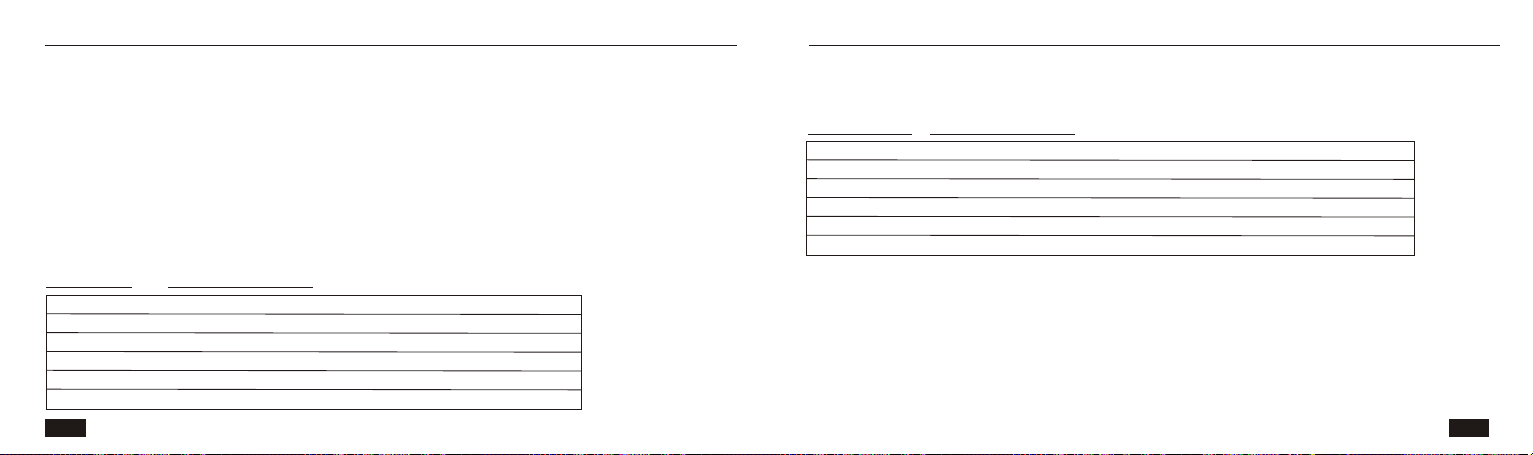
BEGINNER'S GUIDE TO THE SHORTWAVE BANDS
Listed below are the characteristics of the major shortwave bands. Follow these guidelines for best listening
results. Bucause shortwave signals depend on such factors as the sun, the ionosphere and earth itself, signals
canot be heard on all bands throughout the day. Some bands are best during the daylight hours, and some are
best at night. If the term "band" is new to you, please read the section titled WHAT ARE BANDS?
DAYTIME LISTENING
Shortwave listening is generally at its poorest during the daylight hours of about 10 a.m. to 3 p.m. The major
reason for this is that the broadcasters are not transmitting to North America at this time. They assume that we
are all either at work or at school and are not able to listen during the day. If you want to try daytime listening,
use the guidelines below. You will have some success, but not nearly as good as during the evening hours.
The best bands are BOLD.
DAY BANDS
13m Results vary. Worth trying.
16m Similar to 19m.
19m The best daytime band.
22m Similar to 19m with fewer stations.
25m Best around sunrise and sunset. Results vary during mid-day.
31m Similar to 25m.
CHARACTERISTICS
Kaito Kaito
EVENING/NIGHT LISTENING
This is the best time to listen, because the broadcasters are deliberately transmitting to North America. These
bands may be extremly good around sunset and sunrise too. Best bands are BOLD.
NIGHT BANDS
19m Summer months.
22m Summer months.
25m Best two hours before/after sunset/sunrise.
31m Good all night everywhere.
41m Good all night in Eastern North America; varies in Western North America.
49m The best night band everywhere.
NOTE: Getting close to a window may substantially improve your reception. The construsion materials of
some buildings simply do not let signals in very well. Signals penetrate wood frame buildings easiest, while
concrete and brick buildings usually block signals. If you are in a building with one or more stories above you,
signals can also be impaired in strength. In such a situation, position yourself and especially the radio's antenna,
as close to a window as possible while listening.
WHAT ARE BANDS?
If you have ever listened to AM or FM radio, then you already know what a band is. The AM band is 530-1600
25
CHARACTERISTICS
26
Page 15
KA009R KA009R
KHz, the FM band is 88-108 MHz. A band is simply a frequency range where stations are located. When you
look for stations in these "bands", you simply tune around until you find a station you like. Shortwave is similar,
and the shortwave bands have names like 25 meters, 31 meters, 49 meters, etc. These are abbreviated 25m,
31m and 49m. Just like in AM and FM radio, one simply gets into the shortwave band and tunes around, looking
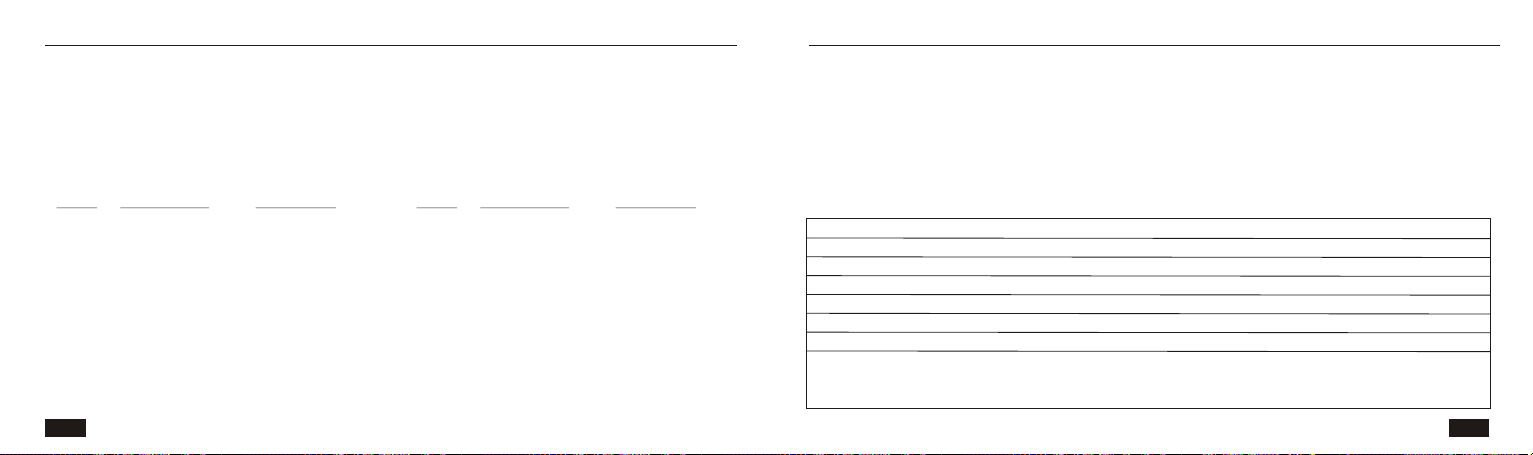
for stations. For example, the 19 meter shortwave band encompasses the frequency range of 15100 to 15600
kilohertz. Here is a list of the shortwave bands used for international broadcasts and their corresponding
frequencies. Since some radios show frequency in megathertz and some in kilohertz, both are shown here.
BAND MEGAHERTZ KILOHERTZ
11m 25.67-26.10 MHz 25670-26100 KHz
13m 21.45-21.85 MHz 21450-21850 KHz
16m 17.55-17.90 MHz 17550-17900 KHz
19m 15.10-15.60 MHz 15100-15600 KHz
22m 13.60-13.80 MHz 13600-13800 KHz
25m 11.65-12.05 MHz 11650-12050 KHz
31m 9.500-9.900 MHz 9500-9900 KHz
WHAT IS HEARD ON SHORTEAVE RADIO?
International foreign broadcats intended for listening in your area, e.g.. North America. Long distance two-way
amateur radio, maritime and aeronautical communications.
BAND MEGAHERTZ KILOHERTZ
41m 7.100-7.300 MHz 7100-7300 KHz
49m 5.950-6.200 MHz 5950-6200 KHz
60m 4.750-5.060 MHz 4750-5060 KHz
75m 3.900-4.000 MHz 3900-4000 KHz
90m 3.200-3.400 MHz 3200-3400 KHz
120m 2.300-2.490 MHz 2300-2490 KHz
Kaito Kaito
WHAT COUNTRIES ARE HEARD ON SHORTEAVE RADIO?
The chart below shows some of the countries targeting North America with their broadcasts. Unless otherwise
noted, frequencies are for evening listening in North America. Other countries do not deliberately target North
America but can be heard anyway. Whether or not a country can be heard depends on many factors, including
signal strength, your geographic location and the condition of the earth's ionosphere. Frequencies in BOLD are
mainly used for the country's native language broadcast. The complete schedules of all shortwave broadcast
statiions, showing language, time and target area, are available in the major frequency directories shown on
the other side of this sheet.
Australia (Radio Australia): 9580, 9860, 15365, 17795
Austria (Radio Austria International): 6015, 9655
Canada (Radio Canada International): 5960, 6120, 9755
China (China Radio International): 9690, 9780, 11680, 11715, 11840
Cuba (Radio Habana): 6060, 6080, 6180, 9510, 9820
Ecuador (HCJB-Voice of the Andes): 9745, 11925, 12005, 15140
France (Radio France International)Bold: 5920, 5945, 9790, 9800
Germany (Deutsche Welle)Bold: 5960, 6040, 6045, 6075, 6085, 6100, 6120, 6145, 6185, 9515, 9565, 9535,
9640, 9545, 9650, 9670, 9700, 9730, 9735, 11705, 11740, 11750, 11810, 11865, 13780, 15275, 15410,
17810, 17860
27
28
Page 16
KA009R
Holland (Radio Nederland)Bold: 6020, 6025, 6165, 9590, 9715, 9840, 9895, 11655
Japan (Radio Japan/NHK)Bold: 5960, 6025, 9610, 9680, 9725, 11885, 11895, 15230
Russia (Radio Moscow International): 7105, 7115, 7150, 7270, 9750, 9765, 11805, 11840, 12050, 15410,
15425
Taiwan (Voice of Free China): 5950, 9680, 11740, 11855, 15440
United Kingdom (BBC World Service)
MORNING: 5965, 6195, 9515, 9740, 11750, 17840
EVENING: 5975, 6175, 7325, 9590, 9640, 15260
IS THERE ENGLISH LANGUAGE PROGRAMMING?
Yes! Since English is such an important world language, most major international broadcasters incorporate
English programming.
WHAT IS THE PROGRAM CONTENT LIKE?
This can vary considerably from country to country: however, programming usually consists of world news, local
news from the country of origin, news commentary, interview programs, culturally oriented programs, music
oriented programs and even political propaganda.
Kaito
29
 Loading...