

Page 1
www.joy-it.net
Pascalstr. 8 47506 Neukirchen-Vluyn
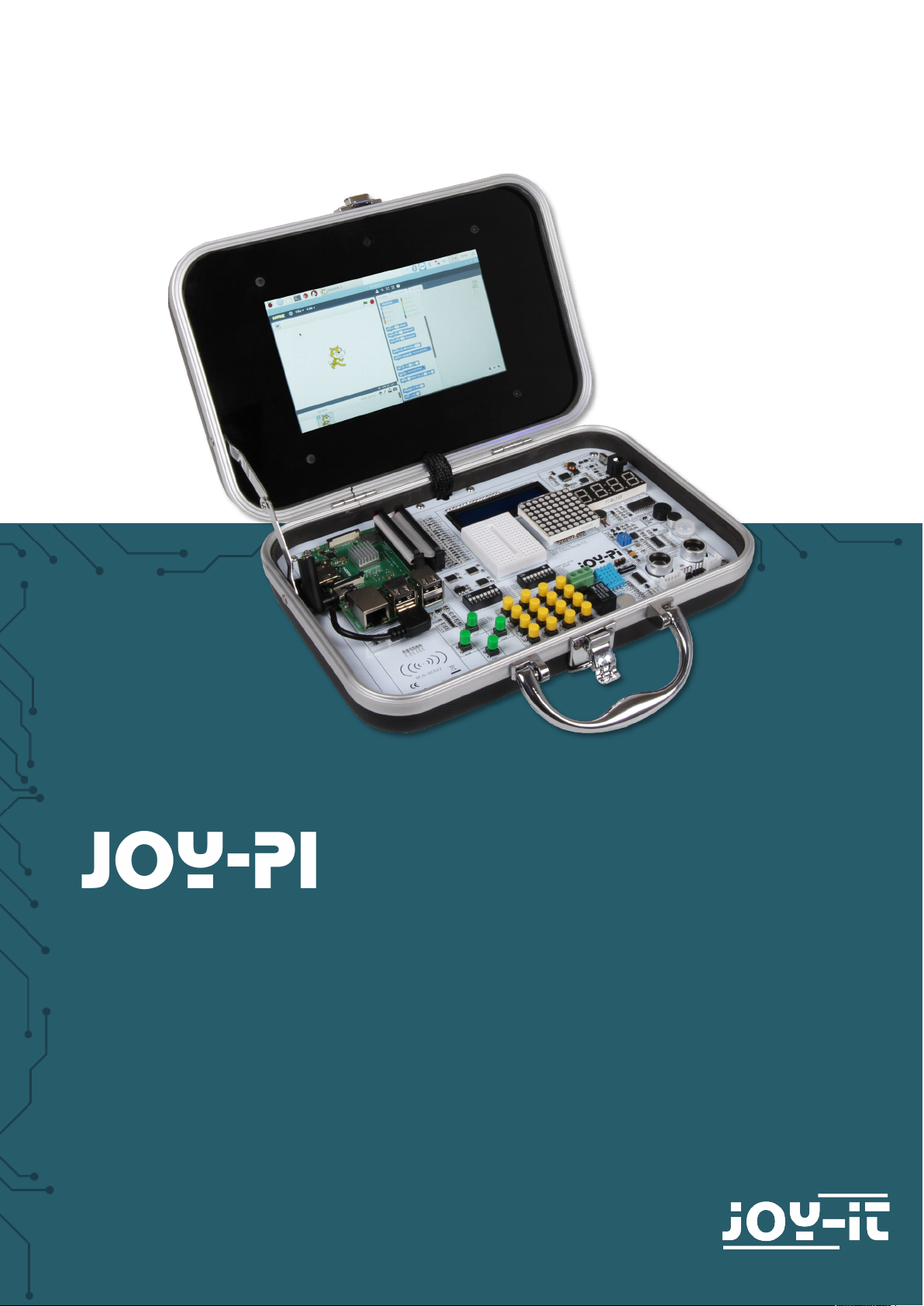
Experimentier- und Education-Koer
Page 2

www.joy-it.net
Pascalstr. 8 47506 Neukirchen-Vluyn
1. INHALTSVERZEICHNIS
1. Inhaltsverzeichnis
2. Allgemeine Informationen
3. Details
4. Modulwechsel und Verwendung der GPIOs
5. Verwendung von Python und Linux
6. Lektionen
1. Lektion : Verwenden des Buzzers für Warntöne
2. Lektion : Buzzer mit Taste steuern
3. Lektion : Wie ein Relais funktioniert und wie man es steuert
4. Lektion : Senden Sie ein Vibrationssignal
5. Lektion : Geräusche mit dem Schallsensor erkennen
6. Lektion : Erkennen der Helligkeit mit dem Lichtsensor
7. Lektion : Erkennen der Temperatur und der Lufeuchtigkeit
8. Lektion : Bewegungen erkennen
9. Lektion : Entfernungen mit dem Ultraschallsensor messen
10. Lektion : Steuern des LCD-Displays
11. Lektion : Lesen und Schreiben von RFID - Karten
12. Lektion : Schrittmotoren verwenden
13. Lektion : Steuerung von Servomotoren
14. Lektion : Steuern der 8 x 8 LED - Matrix
15. Lektion : Steuern des 7 - Segment - Displays
16. Lektion : Berührungen erkennen
17. Lektion : Neigungen mit dem Neigungssensor erkennen
18. Lektion : Verwenden der Taster - Matrix
19. Lektion : Steuern und Verwenden des IR - Sensors
20. Lektion : Eigene Schaltungen mit dem Breadboard
21. Lektion : Fotografieren mit der Raspberry Pi Kamera
7. Sonstige Informationen
8. Rechtliches
9. Support
Die Anmeldedaten sind:
Username : pi
Passwort : 12345
Page 3
www.joy-it.net
Pascalstr. 8 47506 Neukirchen-Vluyn
2. ALLGEMEINE INFORMATIONEN
Sehr geehrter Kunde,
vielen Dank, dass Sie sich für unser Produkt entschieden haben.
Im Folgenden zeigen wir Ihnen, was bei der Inbetriebnahme und der
Verwendung zu beachten ist. Sollten Sie während der Verwendung
unerwartet auf Probleme stoßen, so können Sie uns selbstverständlich
gerne kontaktieren.
Die folgenden Lektionen sind so konzipiert, dass Sie, unabhängig davon
wie viel Vorwissen Sie bereits haben, alle Lektionen ohne Probleme
ausführen können. Für die verschiedenen Lektionen müssen Sie
Beispieldateien herunterladen und auf dem Joy-Pi ausführen. Wie Sie
dies durchführen, können Sie ebenfalls dieser Anleitung entnehmen.
Doch diese Tutorials sind nur der Anfang, denn Ihrer Kreativität sind keine Grenzen gesetzt. Sie können unseren Joy-Pi für die verschiedensten
Projekte verwenden und auch Projekte erstellen, wo der Joy-Pi im Fokus
steht.
Wir freuen uns darauf zu sehen, was Sie mit unserem Joy-Pi machen
werden.
3. DETAILS
Page 4

www.joy-it.net
Pascalstr. 8 47506 Neukirchen-Vluyn
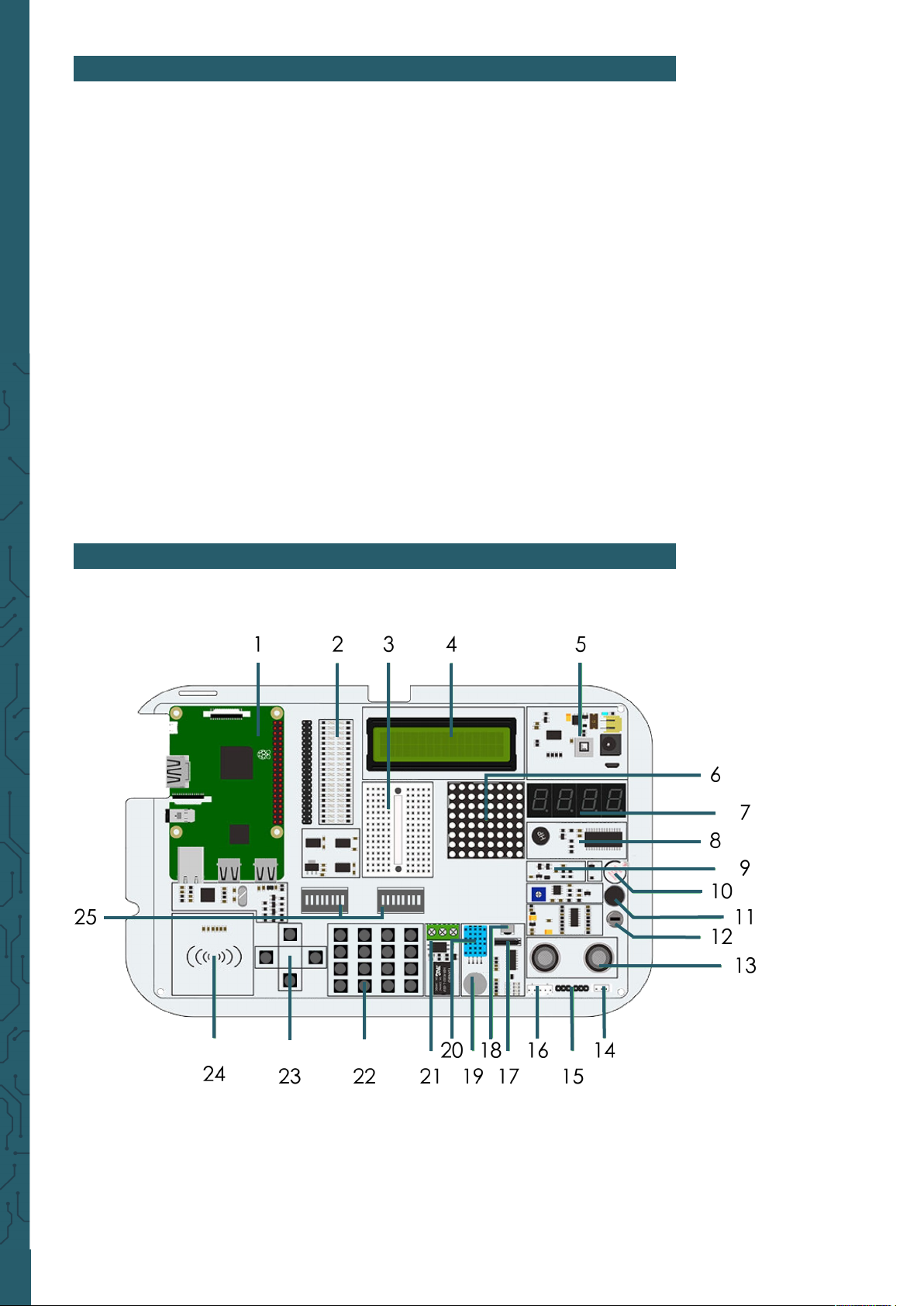
1 Raspberry Pi
2 GPIO LED Anzeige
3 Breadboard
4 16 x 2 LCD Modul (MCP23008)
5 Stromversorgung
6 8 x 8 LED Matrix (MAX7219)
7 7 Segment LED Anzeige (HT16K33)
8 Vibrationsmodul
9 Lichtsensor (BH1750)
10 Buzzer
11 Schallsensor
12 Bewegungssensor (LH1778)
13 Ultraschallabstandssensor
14 / 15 Servo - Schnittstellen
16 Schrittmotor - Schnittstelle
17 Neigungssensor (SW-200D)
18 Infrarotsensor
19 Berührungssensor
20
DHT11 Temperatur - und
Lufeuchtigkeitssensor
21 Relais
22 Taster - Matrix
23 Unabhängige Taster
24 RFID - Modul (MFRC522)
25 Schalter
26 Lüeranschluss
27 Stromversorgung microUSB
Page 5
www.joy-it.net
Pascalstr. 8 47506 Neukirchen-Vluyn
4. MODULWECHSEL UND VERWENDUNG DER GPIOS
4.1 Modulwechsel
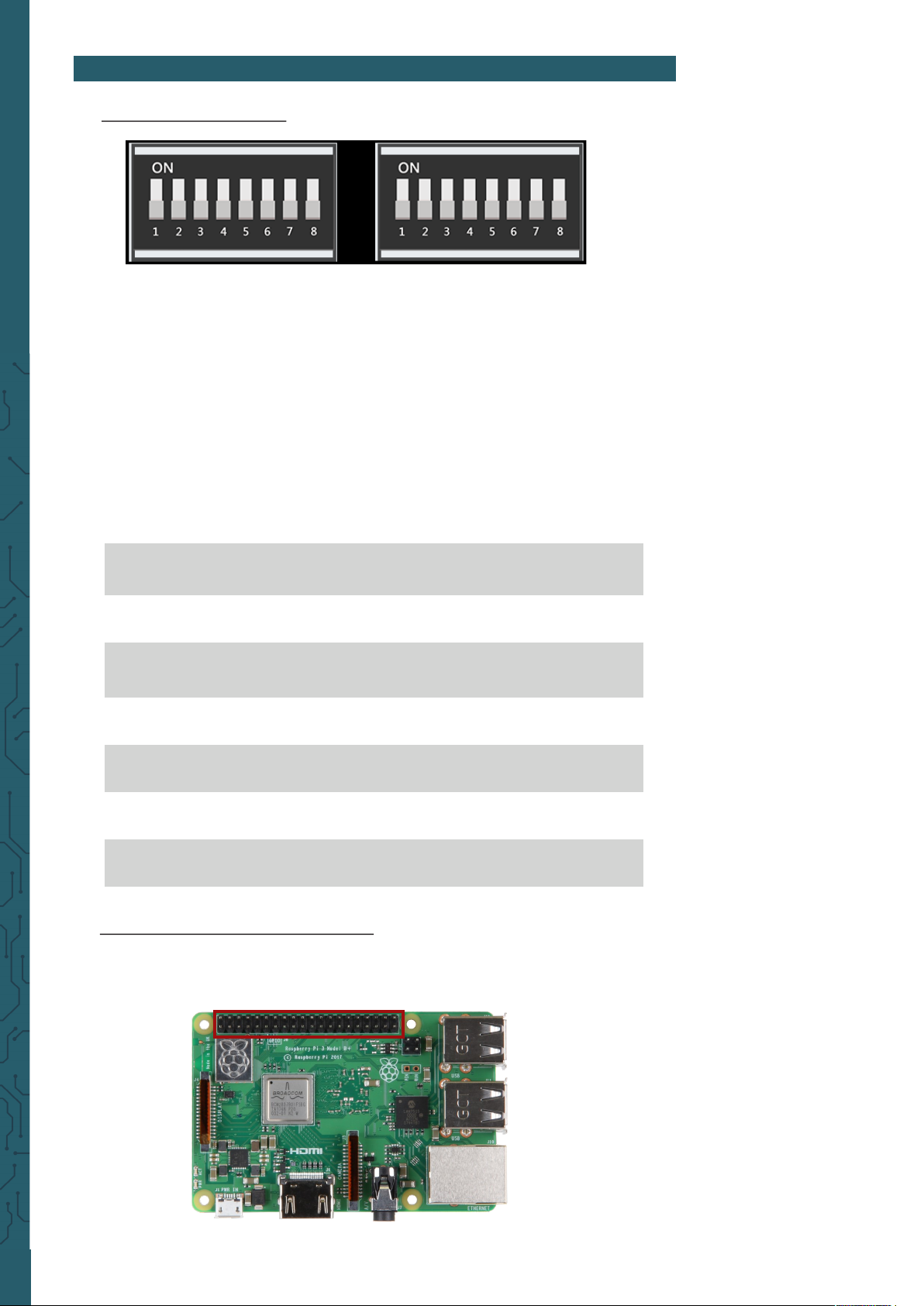
Auf der Joy-Pi Platine befinden sich zwei Schaltereinheiten à 8 Schalter.
Die Schalter ermöglichen es, zwischen verschiedenen Sensoren und
Modulen zu wechseln. Da der Raspberry Pi nur eine begrenzte Anzahl an
GPIO - Pins hat, werden diese Schalter benötigt um mehr Sensoren und
Module zu verwenden zu können als GPIO - Pins vorhanden sind.
Die Verwendung dieser Schalter ist ziemlich einfach und wird in einigen
der folgenden Lektionen benötigt.
In der Tabelle sehen Sie, welcher Schalter welchen Sensor bzw. welches
Modul schaltet,
Sensoren / Module Schalteinheit Schalter
Taster - Matrix Links 1 - 8
unabhängige Taster Links 5 - 8
Vibrationsmodul Rechts 1
Neigungssensor Rechts 2
Schrittmotor Rechts 3, 4, 5, 6
Servomotor Rechts 7, 8
4.2 Verwendung der GPIOs
Im Folgenden werden wir Ihnen genauer erläutern, was GPIO-Pins sind,
wie diese funktionieren und wie diese gesteuert werden.
Page 6
www.joy-it.net
Pascalstr. 8 47506 Neukirchen-Vluyn
GPIO steht für:
General - purpose input / output (Universal Eingang /
Ausgang).
GPIO - Pins haben keine festgelegte Funktion. Es kann konfiguriert
werden, ob die GPIO - Pins als digitaler Eingang oder als digitaler Ausgang
dienen.
Beispiel Eingangs - Pin: Taster
Wenn der Taster gedrückt wird, gelangt das Signal zur weiteren
Verarbeitung über den Eingang - Pin zum Raspberry Pi.
Beispiel Ausgangs - Pin: Buzzer
Über den Ausgangs - Pin wird ein Signal in Richtung Buzzer
gesendet, um diesen zu steuern.
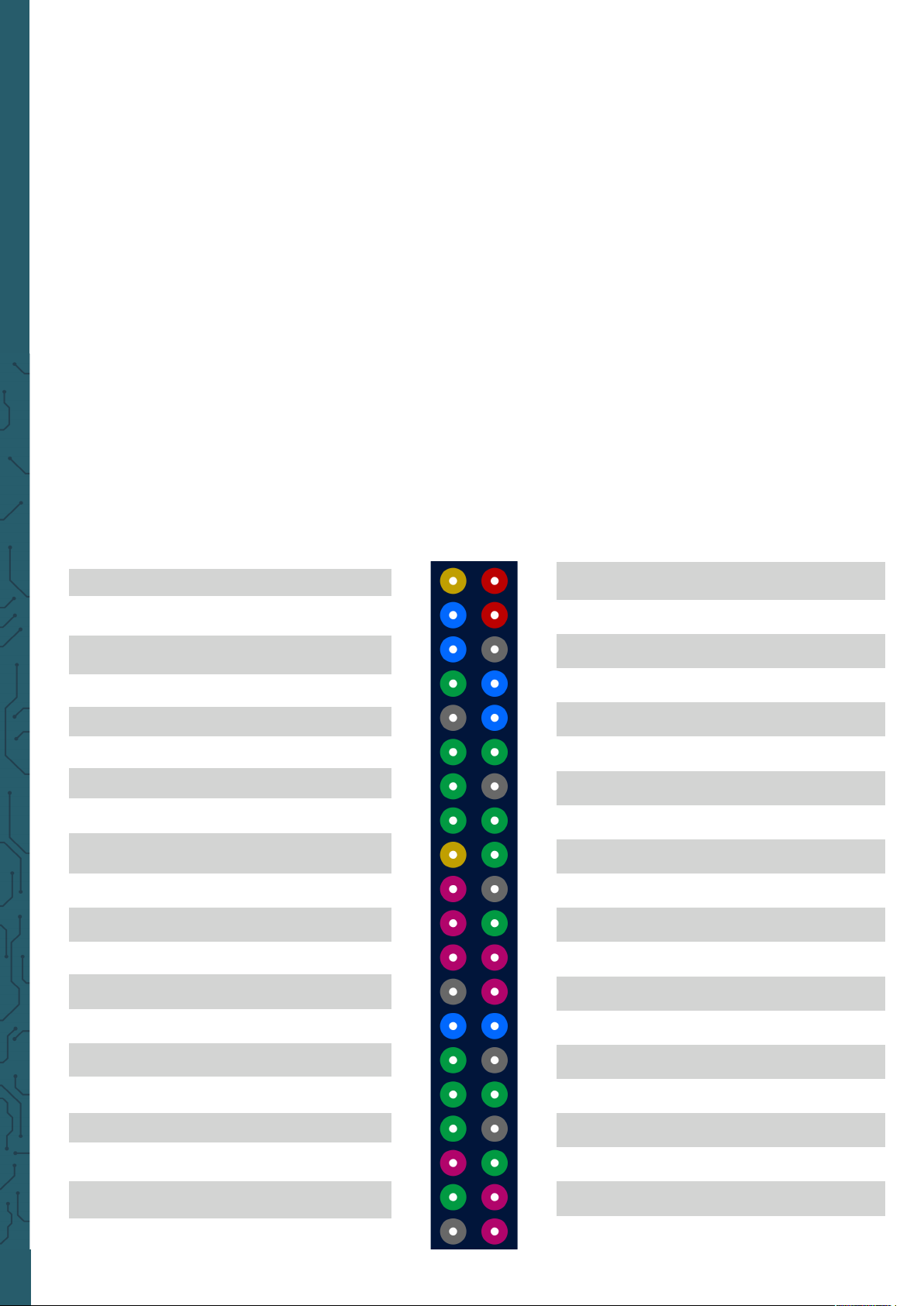
Wenn Sie den geöneten Joy - Pi von vorne betrachten, befinden sich die
GPIO - Pins auf der rechten Seite des Raspberry Pis.
Es gibt 2 mögliche Raspberry Pi GPIO Schemata: GPIO - BOARD und
GPIO - BCM.
Die GPIO - BOARD Option gibt an, dass Sie sich auf die Pins anhand der
Nummer des Pins beziehen. Das heißt es werden die unten
voranstehenden Pin - Nummern verwendet.
Die Option GPIO - BCM bedeutet, dass Sie sich auf die Pins des
Broadcom
SOC Channel
beziehen. Dies sind die Zahlen nach GPIO:
1 3.3 V DC
3 GPIO 2 (SDA1, I2C)
5 GPIO 3 (SCL1, I2C)
7 GPIO 4
9 Ground
11 GPIO 17
13 GPIO 27
15 GPIO 22
17 3.3 V
19 GPIO 10 (SPI, MOSI)
21 GPIO 9 (SPI, MISO)
23 GPIO 11 (SPI, CLK)
25 Ground
27 ID_SD (I2C, EEPROM)
29 GPIO 5
31 GPIO 6
33 GPIO 13
35 GPIO 19
37 GPIO 26
39 Ground
2 5 V DC
4 5 V DC
6 Ground
8 GPIO 14 (TXD0)
10 GPIO 15 (RXD0)
12 GPIO 18
14 Ground
16 GPIO 23
18 GPIO 24
20 Ground
22 GPIO 25
24 GPIO 8 (SPI)
26 GPIO 7 (SPI)
28 ID_SC
30 Ground
32 GPIO 12
34 Ground
36 GPIO 16
38 GPIO 20
40 GPIO 21
Page 7

www.joy-it.net
Pascalstr. 8 47506 Neukirchen-Vluyn
GPIO - BOARD Sensoren und Module
1 3.3 V
2 5.0 V
3 I2C, SDA1 (Lichtsensor, LCD Display, 7 Segment Display)
4 5.0 V
5 I2C. SCL1 (Lichtsensor, LCD Display, 7 Segment Display)
6 Ground
7 DHT11 Sensor
8 TXD0
9 Ground
10 RXD0
11 Touchsensor
12 Buzzer
13 Schaltflächenmatrix (ROW1), Vibrationsmotor
14 Ground
15 Schaltflächenmatrix (ROW2), Neigungssensor
16 Bewegungssensor
17 3.3 V
18 Schallsensor
19 SPI
20 Ground
21 SPI
22 Servo2, Schaltflächenmatrix (COL1), Le Button
23 SPI
24 RFID - Modul
25 Ground
26 LED - Matrix
27
IS_SD (I2C, EEPROM (Electrically Erasable
Programmable Read - only Memory))
28 ID_SC
29 Schrittmotor (STEP1), Schaltflächenmatrix (ROW3)
30 Ground
31 Schrittmotor (STEP2), Schaltflächenmatrix (ROW4)
32 Ultraschallsensor (Echo)
33 Schrittmotor (STEP3), Schaltflächenmatrix (COL4),
34 Ground
35 Schrittmotor (STEP4), Schaltflächenmatrix (COL3),
36 Ultraschallsensor (TRIG)
37 Servo1, Schaltflächenmatrix (COL2), Up Button
38 Infrarotsensor
39 Ground
40 Relais
Page 8

www.joy-it.net
Pascalstr. 8 47506 Neukirchen-Vluyn
In unseren Beispiel verwenden wir die Programmiersprache
Python
, um
die GPIO-Pins zu steuern. In Python gibt es eine Bibliothek namens
RPi.GPIO.
Dies ist eine Bibliothek, die dabei hil, die Pins mit Python zu
steuern.
Das folgende Beispiel und die Kommentare im Code sollen Ihnen helfen
das Programm zu verstehen.
Als Erstes müssen die benötigten Bibliothek mit Hilfe des import Befehls
importiert werden. Die Variablen TOUCH und BUZZER verweisen auf die
Pins des Touchsensors und des Buzzers. Im Anschluss wird mit
GPIO.setmode(GPIO.BOARD)
das verwendete GPIO Schema definiert. Als
Nächstes werden die zuvor festgelegten Variablen mit Hilfe des Befehls
GPIO.setup()
als Ein- bzw. Ausgang konfiguriert. Pin 11 (TOUCH) wird als
Eingang und Pin 12 (BUZZER) wird als Ausgang festgelegt.
Die Funktion main fragt ab, ob es eine Berührung des Touchsensors gibt.
Ist dies der Fall wird die Funktion do_smt ausgeführt.
Die Funktion do_smt druckt den Text
Touch wurde erkannt
, setzt dann
den Buzzer-Pin
HIGH
und eine Sekunde später wieder
LOW
(der Buzzer
summt eine Sekunde).
import RPi.GPIO as GPIO
import time #importieren der Bibliotheken
import signal
TOUCH = 11 #Deklaration der Pins
BUZZER = 12
def setup_gpio(): #Definition der Ein- und Ausgaenge
GPIO.setmode(GPIO.BOARD)
GPIO.setup(TOUCH, GPIO.IN, pull_up_down=GPIO.PUD_UP)
GPIO.setup(BUZZER, GPIO.OUT)
def do_smt(channel): #Funktion zur Ausgabe das Touch erkannt wurde
print(“Touch wurde erkannt“) #und Ausgabe das Touch erkannt wurde
GPIO.output(BUZZER, GPIO.HIGH) #Signalausgabe
time.sleep (1) #1 Sekunde warten
GPIO.output(BUZZER, GPIO.LOW) #Signalausgabe stoppen
def main():
setup_gpio()
try: #Pruefung ob ein Touch erkannt wurde
GPIO.add_event_detect(TOUCH,GPIO.FALLING,callback=do_smt,bouncetime=200)
except KeyboardInterrupt: #STRG + C beendet das Programm
pass
finally:
GPIO.cleanup()
if _name_==‘_main_‘:
main()
Um noch mehr über den Zweck und die Verwendung von GPIOs zu
erfahren, empfehlen wir Ihnen sich die oizielle Dokumentation der
Raspberry Pi Foundation zum Thema GPIO anzuschauen.
https://www.raspberrypi.org/documentation/usage/gpio/
Page 9
www.joy-it.net
Pascalstr. 8 47506 Neukirchen-Vluyn
4.3 Sowareinstallation für den Joy-Pi
Auf der mitgelieferten microSD-Karte ist schon ein vorinstalliertes
Betriebssystem aufgespielt. Wenn Sie die Karte neu beschreiben
möchten, können Sie dies wie folgt durchführen:
Als erstes sollten Sie die aktuellste Image-Datei für den Joy-Pi von
unserer Website www.joy-pi.net herunterladen.
1. Laden Sie die Image-Datei (.zip Format) auf Ihren PC. Nach dem
Entpacken der Datei erhalten Sie eine Datei mit der Endung .img.
2. Schließen Sie eine microSD-Karte an Ihren PC an und formatieren
Sie diese mit dem Programm SD Formatter. Ein
microSD-Kartenlesegerät ist im Lieferumfang enthalten.
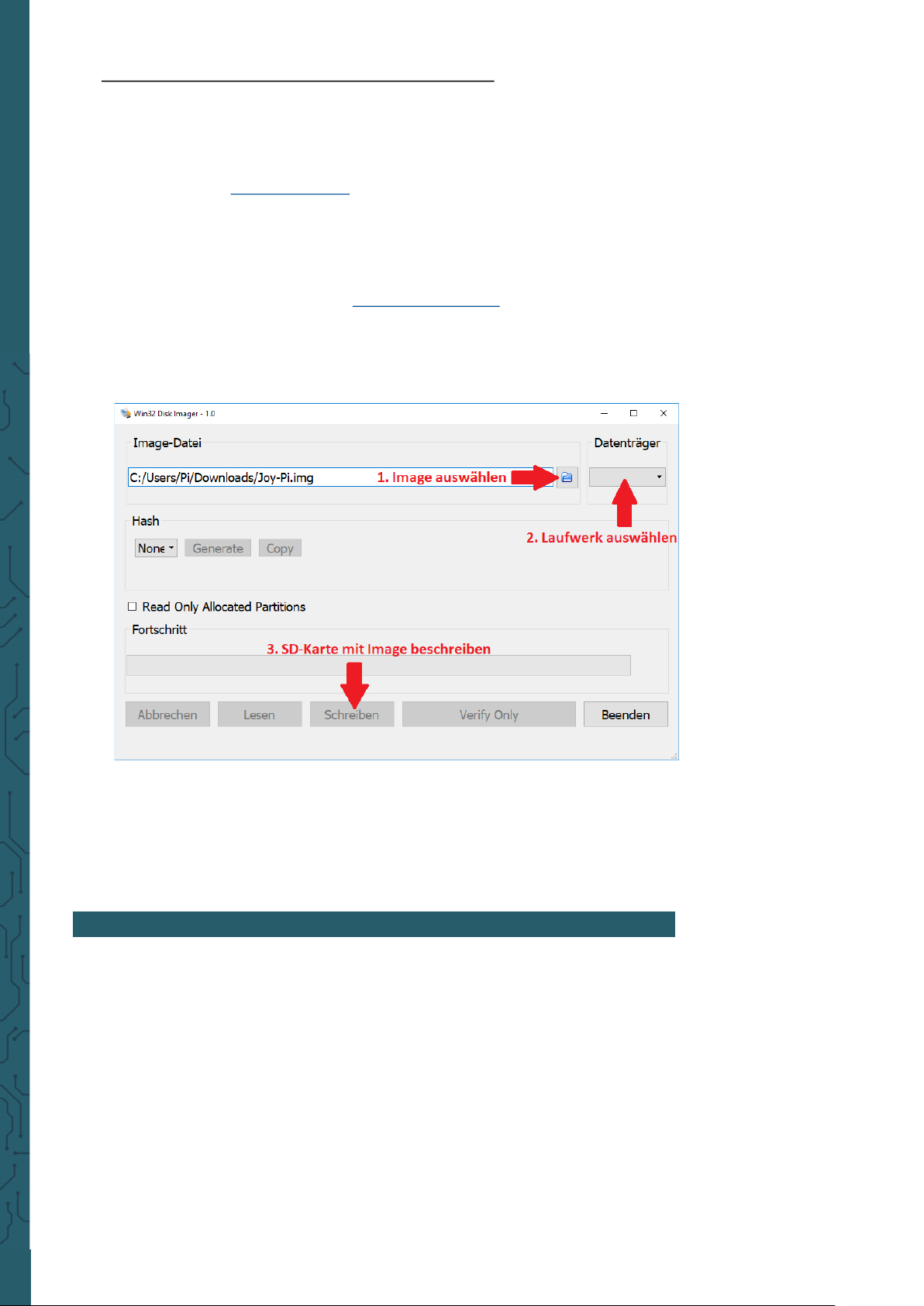
3. Starten Sie das Programm Win32-Disk-Imager und wählen Sie
① die heruntergeladene Image-Datei aus.
② das zu beschreibende Laufwerk aus.
4. Nun ist die Karte mit dem Betriebssystem beschrieben und Sie
können diese in den microSD-Kartenslot des Raspberry Pi stecken.
5. Zum Schluss müssen Sie das Image noch auf die Größe Ihrer
SD-Karte anpassen. Starten Sie dafür Ihren Raspberry Pi, önen Sie
das Terminal und geben sudo raspi-config ein. Gehen Sie nun
auf
Advanced Options
und dann auf
Expand Filesystem
. Nach
einem Neustart wird die Image-Größe auf Ihre SD-Karte angepasst.
5. VERWENDUNG VON PYTHON UND LINUX
Dieser Schritt ist optional, macht es jedoch einfacher Skripte
auszuführen, ohne sie einzeln erstellen zu müssen. Auf der mitgelieferten
microSD-Karte befinden sich Skripte auf dem Desktop.
Die in der Anleitung verwendeten Skripte können direkt in einem Paket
heruntergeladen werden.
Folgen Sie dazu einfach den folgenden Anweisungen:
Page 10
www.joy-it.net
Pascalstr. 8 47506 Neukirchen-Vluyn
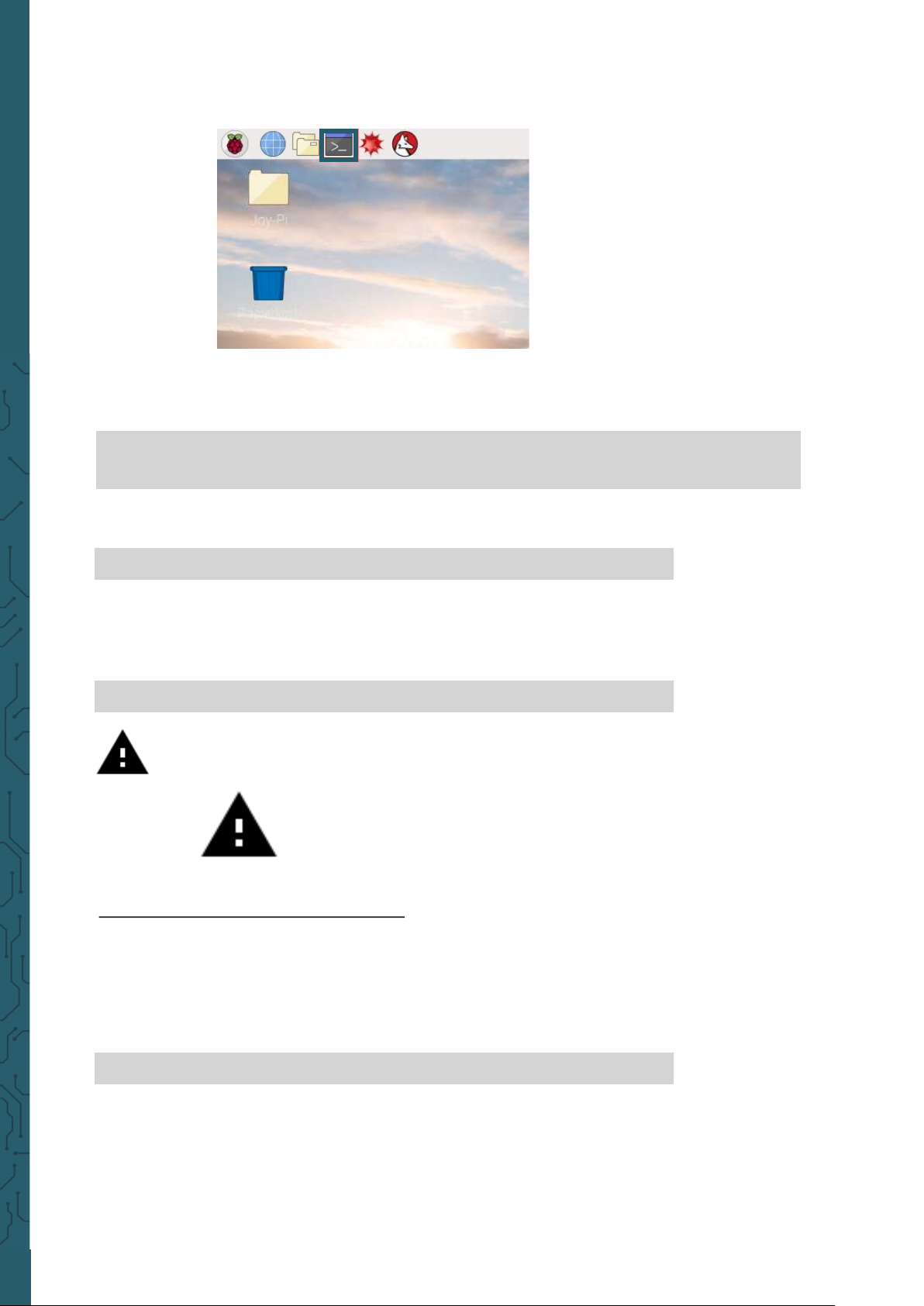
1. Önen Sie das Terminal. Dies benutzen wir, um die meisten
unserer Python Skripte auszuführen und Erweiterungen und
Skripte herunterzuladen.
2. Nachdem wir das Terminal erfolgreich geönet haben, müssen wir
bei Bedarf das Skriptarchiv mit dem folgenden Befehl auf den
Desktop herunterladen (gegebenenfalls auf dem Image enthalten):
cd Desktop/
wget https://www.joy-it.net/files/files/Produkte/RB-JoyPi/Joy-Pi.zip
3. Drücken Sie Enter auf Ihrer Tastatur. Nun muss das Archiv nur noch
entpackt werden:
unzip Joy-Pi.zip
4. Drücken Sie Enter auf Ihrer Tastatur und warten Sie bis der Vorgang
abgeschlossen ist.
5. Mit dem Befehl cd wechseln Sie in das richtige Verzeichnis damit die
Skripte verwendet werden können, welche sich dort befinden:
cd Joy-Pi/Python3
Achtung! Jedes Mal, wenn Sie Ihren Joy-Pi ausschalten,
müssen Sie die Schritte des Verzeichniswechsels wiederholen.
Die Anmeldedaten sind:
Username : pi
Passwort : 12345
Ausführen von Python Skripts
Nachdem die Skripte erfolgreich von unserer Website heruntergeladen
wurden, möchten wir es jetzt ausführen. Önen Sie erneut das Terminal
und befolgen Sie die folgende Anweisung, um das Skript auszuführen:
1. Geben Sie den Befehl sudo python3 <script name> ein, um
ein Python-Skript auszuführen, wie zum Beispiel:
sudo python3 buzzer.py
Der Befehl setzt sich aus 3 Teilen zusammen. Durch den Befehl sudo wird
der folgende Teil der Befehlszeile mit root-Berechtigungen (Admin-
Berechtigungen ausgeführt. python3 ist der Befehl der gleichnamigen
Programmiersprache, in der die Skripte geschrieben sind. Am Ende steht
der Name des Skripts. Hierbei ist zu beachten, dass man sich entweder in
dem Ordner befindet, in dem das jeweilige Skript gespeichert ist oder den
Pfad (z.B. ~/Joy-Pi/buzzer.py) angibt.
Page 11

www.joy-it.net
Pascalstr. 8 47506 Neukirchen-Vluyn
6. LEKTIONEN
Lektion 1 : Verwenden des Buzzers für Warntöne
In der vorherigen Erklärung haben wir gelernt, wie man den GPIO-Pin
sowohl als Ausgabe als auch als Eingabe verwendet. Um dies nun zu
testen, gehen wir mit einem realen Beispiel voran und wenden unser
Wissen aus der vorherigen Lektionen an. Das Modul, welches wir
verwenden werden, ist der Buzzer.
Wir werden den GPIO-Ausgang verwenden, um ein Signal an den Buzzer
zu senden und die Schaltung zu schließen, um ein lautes Summen zu
Erzeugen. Dann werden wir ein weiteres Signal senden, um es
auszuschalten.
Der Buzzer befindet sich auf der rechten Seite des Joy-Pi-Boards und ist
durch das laute Geräusch, dass er bei Aktivierung macht leicht zu
erkennen. Wenn Sie Ihren Raspberry Pi zum ersten Mal verwenden, ist der
Buzzer möglicherweise mit einem Schutzaufkleber versehen. Stellen Sie
sicher, dass dieser Aufkleber vor Gebrauch des Buzzers entfernt wurde.
Genau wie im vorherigen Beispiel haben wir ein spezielles Skript mit
detaillierten Kommentaren vorbereitet, die erklären werden, wie der
gesamte Buzzer-Prozess funktioniert und wie wir den Buzzer mit den
GPIOs steuern können.
Zuerst importieren wir die RPi.GPIO-Bibliothek und die
time-Bibliothek. Dann konfigurieren wir den Buzzer. An Pin 12 richten wir
den GPIO-Modus auf GPIO BOARD und den Pin als OUTPUT ein.
Wir geben ein Signal für 0,5 Sekunden aus und schalten dieses dann aus.
Achtung! Für dieses Beispiel müssen Sie alle Schalter der linken
und rechten Schalteinheit auf OFF stellen.
Page 12
www.joy-it.net
Pascalstr. 8 47506 Neukirchen-Vluyn
#!/usr/bin/python
import RPI.GPIO as GPIO #importieren der benoetigten Bibliotheken
import time
buzzer_pin = 12 #buzzer_pin wird definiert
GPIO.setmode(GPIO.BOARD)
GPIO.setup(buzzer_pin, GPIO.OUT)
GPIO.output(buzzer_pin, GPIO.HIGH) #gebe Geraeusch aus
time.sleep(0.5) #warte eine halbe Sekunde
GPIO.output(buzzer_pin, GPIO.LOW) #stoppe Geraeuschausgabe
GPIO.cleanup()
Führen Sie die folgenden Befehle aus und versuchen Sie es selbst:
cd /home/pi/Desktop/Joy-Pi/Python3
sudo python3 buzzer.py
Lektion 2 : Buzzer mit Taster steuern
Nachdem Sie nun wissen, wie man den Buzzer ein- und ausschaltet, ist es
Zeit, die Ding ein wenig aufregender zu gestalten. In dieser Lektion wird
ein Taster mit dem Buzzer kombiniert, sodass der Buzzer nur durch Drücken des Tasters eingeschaltet wird.
Dieses Mal werden 2 GPIO-Setups verwendet. Einer wird der GPIO.INPUT
sein, der den Taster als Eingabemöglichkeit einstellt, ein anderer wird der
GPIO.OUTPUT sein, der ein Signal an den Buzzer sendet um ein Geräusch
auszugeben.
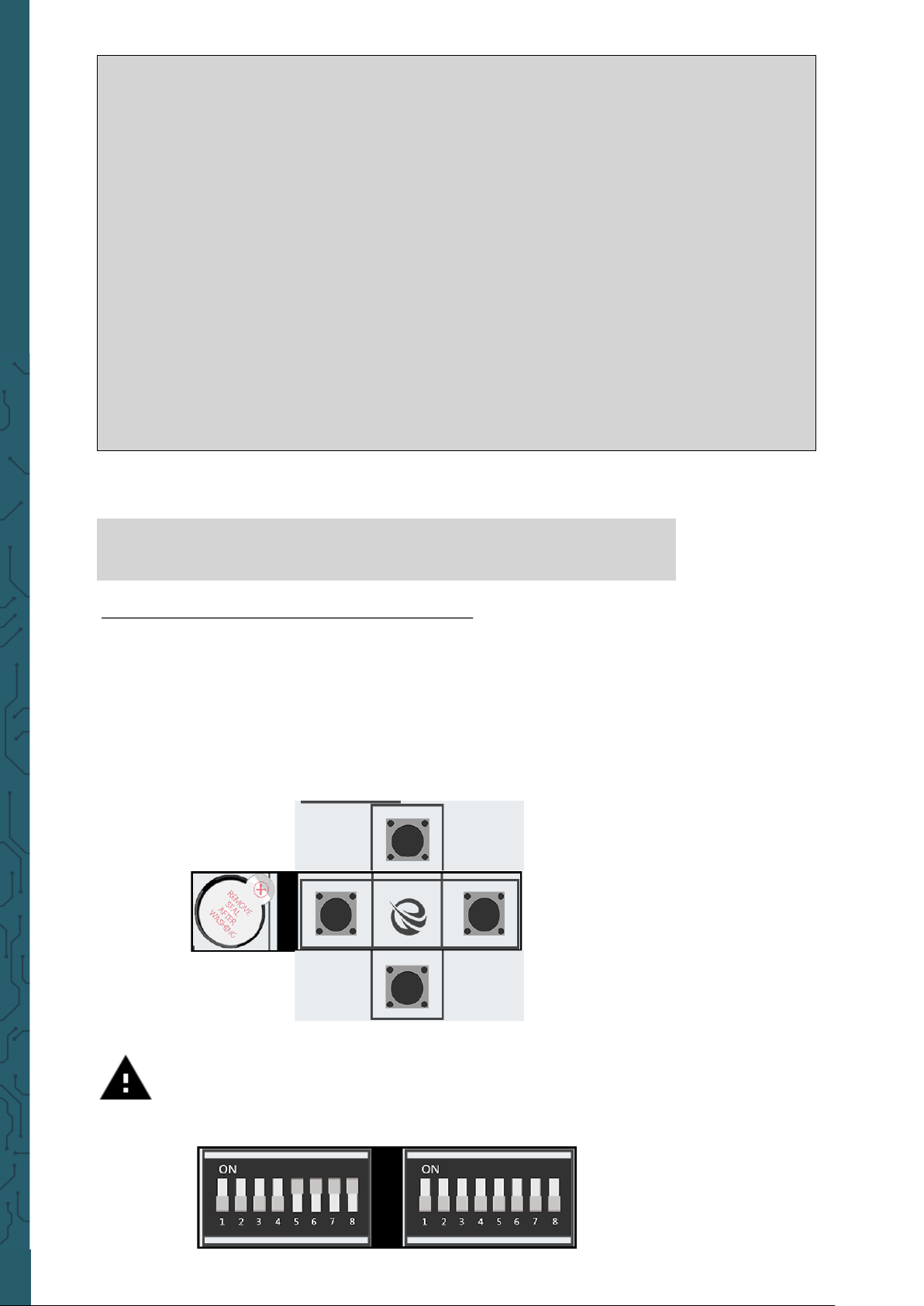
Achtung! Für dieses Beispiel müssen Sie zwischen den Modulen
wechseln. Stellen Sie die Schalter Nummer 5, 6, 7 und 8 der
linken Schalteinheit auf ON. Alle anderen Schalter sollten auf
OFF stehen.
Page 13

www.joy-it.net
Pascalstr. 8 47506 Neukirchen-Vluyn
In diesem Beispiel wird der Obere der 4 Taster auf der unteren linken Seite verwendet. Theoretisch kann jedoch jeder der 4 Taster verwendet
werden. Wenn Sie trotzdem einen anderen Taster verwenden möchten,
müssen Sie die Pinbelegung dementsprechend ändern.
GPIO37 Oberer Taster
GPIO33 Unterer Taster
GPIO22 Linker Taster
GPIO35 Rechter Taster
Für diesen Teil des Tutorials müssen 2 GPIO-Einstellungen verwendet
werden: eine Eingabe und eine Ausgabe. Der GPIO-Eingang wird verwendet um zu bestimmen, wann ein Taster gedrückt wurde und die GPIOAusgabe wird verwendet um den Buzzer zu aktivieren, sobald dieser Taster gedrückt wird.
Wenn Sie den Taster auf Ihrem Joy-Pi drücken, ertönt der Buzzer! Lassen
Sie den Taster los und der Buzzer verstummt. Das Programm läu solange bis STRG + C gedrückt wird.
Beispielcode:
#!/usr/bin/python
import RPI.GPIO as GPIO #importieren der benoetigten Bibliotheken
import time
#definiere Pins
button_pin = 37
buzzer_pin = 12
#setze Board Modus zu GPIO.BOARD
GPIO.setmode(GPIO.BOARD)
#lege button_pin als Eingang und buzzer_pin als Ausgang fest
GPIO.setup(button_pin, GPIO.IN, pull_up_down=GPIO.PUD_UP)
GPIO.setup(buzzer_pin, GPIO.OUT)
try:
while True:
#ueberpruefe ob Knopf gedrueckt wird
if (GPIO.input(button_pin) == 0):
#Buzzer ein
GPIO.output(buzzer_pin, GPIO.LOW)
else:
#Buzzer aus
GPIO.output(buzzer_pin, GPIO.LOW)
except KeyboardInterrupt:
GPIO.cleanup()
Page 14
www.joy-it.net
Pascalstr. 8 47506 Neukirchen-Vluyn
Führen Sie die folgenden Befehle aus und versuchen Sie es selbst:
Lektion 3 : Wie ein Relais funktioniert und wie man es steuert
cd /home/pi/Desktop/Joy-Pi/Python3
sudo python3 button_buzzer.py
Nachdem wir jetzt alles Nötige über den Buzzer wissen, ist es Zeit für die
nächste Lektion. Nun lernen wir, wie das Relais zu verwenden ist, welche
Funktion das Relais hat und wie man es steuert.
Ein Relais ist vereinfacht ein Schalter, dem (unteranderem) mit Hilfe von
GPIO-Pins ein- und ausschalten kann. Relais werden verwendet, um eine
Schaltung durch ein separates Niederleistungssignal zu steuern oder
wenn mehrere Schaltungen durch ein Signal gesteuert werden müssen.
In unserem Beispiel zeigen wir, wie ein GPIO-Signal gesendet wird um das
Relais zu schließen, um eine benutzerdefinierte Schaltung zu aktivieren
und wie man ein weiteres Signal sendet, um das Relais zu önen und die
Schaltung zu deaktivieren.
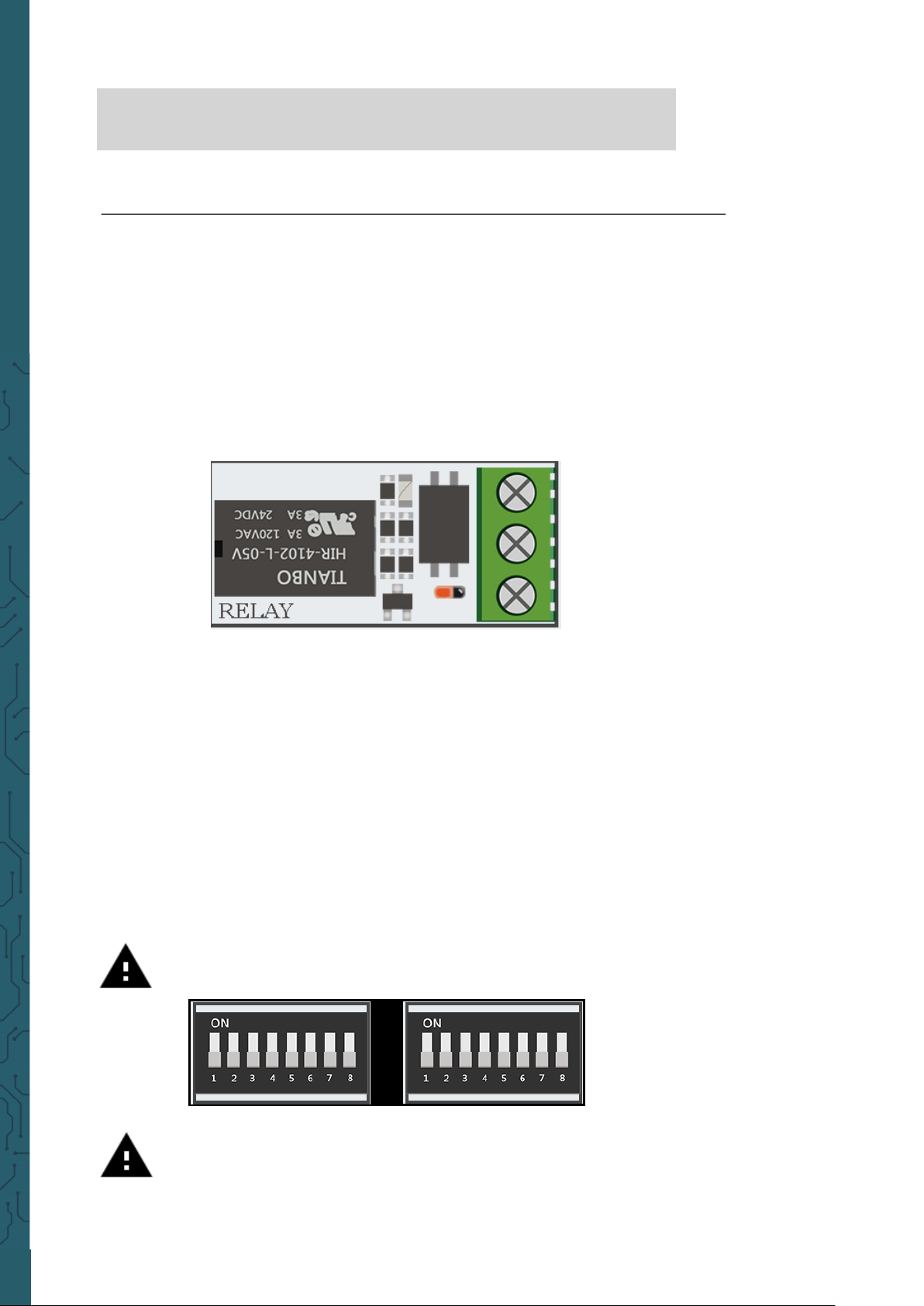
Das Relais befindet sich im mittleren, unteren Teil der Platine, direkt
neben der Taster-Matrix. Es hat drei Anschlüsse, von denen wir 2 in
diesem Beispiel benutzen werden. NC steht für
normally closed
, NO steht
für
normally open
und COM steht für
common. Common
steht in dem Fall
für die gemeinsame Masse.
Wenn ein Stromkreis an NC und COM angeschlossen wird, ist der Stromkreis geschlossen, wenn der Steuerstromkreis spannungslos ist
(GPIO.LOW). Wird der Steuerstromkreis unter Spannung gesetzt
(GPIO.HIGH), önet das Relais die Verbindung im Arbeitsstromkreis und
der Stromfluss wird unterbrochen.
Bei der Nutzung von NO und COM verhält sich genau umgekehrt. Ist der
Steuerstromkreis spannungslos (GPIO.LOW), ist das Relais geönet und
der Arbeitsstromkreis unterbrochen. Wird der Steuerstromkreis mit
Spannung versorgt (GPIO.HIGH), schließt das Relais den Arbeitsstromkreis und der Strom kann fließen.
Achtung! Für dieses Beispiel müssen Sie alle Schalter der linken
und der rechten Schalteinheit auf OFF stellen
Achtung! Es ist sehr wichtig nicht zu versuchen
Hochspannungsgeräte an das Relais anzuschließen
(z.B. Tischlampe, Kaeemaschine usw.). Dies könnte zu
Stromschlägen und schweren Verletzungen führen.
Page 15
www.joy-it.net
Pascalstr. 8 47506 Neukirchen-Vluyn
Führen Sie die folgenden Befehle aus und versuchen Sie es selbst:
#!/usr/bin/python
import RPI.GPIO as GPIO
import time
#definiere Relais Pin
relay_pin = 40
#Board Modus GPIO.BOARD
GPIO.setmode(GPIO.BOARD)
#relay_pin als Ausgang
GPIO.setup(relay_pin, GPIO.OUT)
#Oeffne Relais
GPIO.output(relay_pin, GPIO.LOW)
#warte eine halbe Sekunde
time.sleep(0.5)
#schliesse Relais
GPIO.output(relay_pin, GPIO.HIGH)
GPIO.cleanup()
cd /home/pi/Desktop/Joy-Pi/Python3
sudo python3 relay.py
Lektion 4 : Senden eines Vibrationssignals
Haben Sie sich schon einmal gefragt, wie Ihr Telefon vibriert, wenn Sie
jemand anru oder wenn Sie eine Nachricht erhalten? Wir haben das
gleiche Modul in unserem Joy-Pi verbaut und nun werden Sie lernen, wie
man es verwendet.
Das Vibrationsmodul befindet sich auf der rechten Seite der LED-Matrix
und unterhalb der Segment-LED. Wenn es eingeschaltet ist, ist es
schwierig zu erkennen, woher die Vibration kommt, da es sich so anfühlt,
als vibriere das ganze Joy-Pi Board.
Das Vibrationsmodul verwendet ein GPIO.OUTPUT-Signal, genau wie der
Buzzer und andere Module zuvor. Durch Senden eines Ausgangssignals
vibriert das Vibrationsmodul durch Stoppen des Signals mit GPIO.LOW
hört die Vibration auf.
Mit verschiedenen
time.sleep()
Intervallen kann man die Dauer der Vibration regeln. Versuchen Sie es selbst und schauen Sie , wie Sie das Beispiel
erweitern können.
Page 16
www.joy-it.net
Pascalstr. 8 47506 Neukirchen-Vluyn
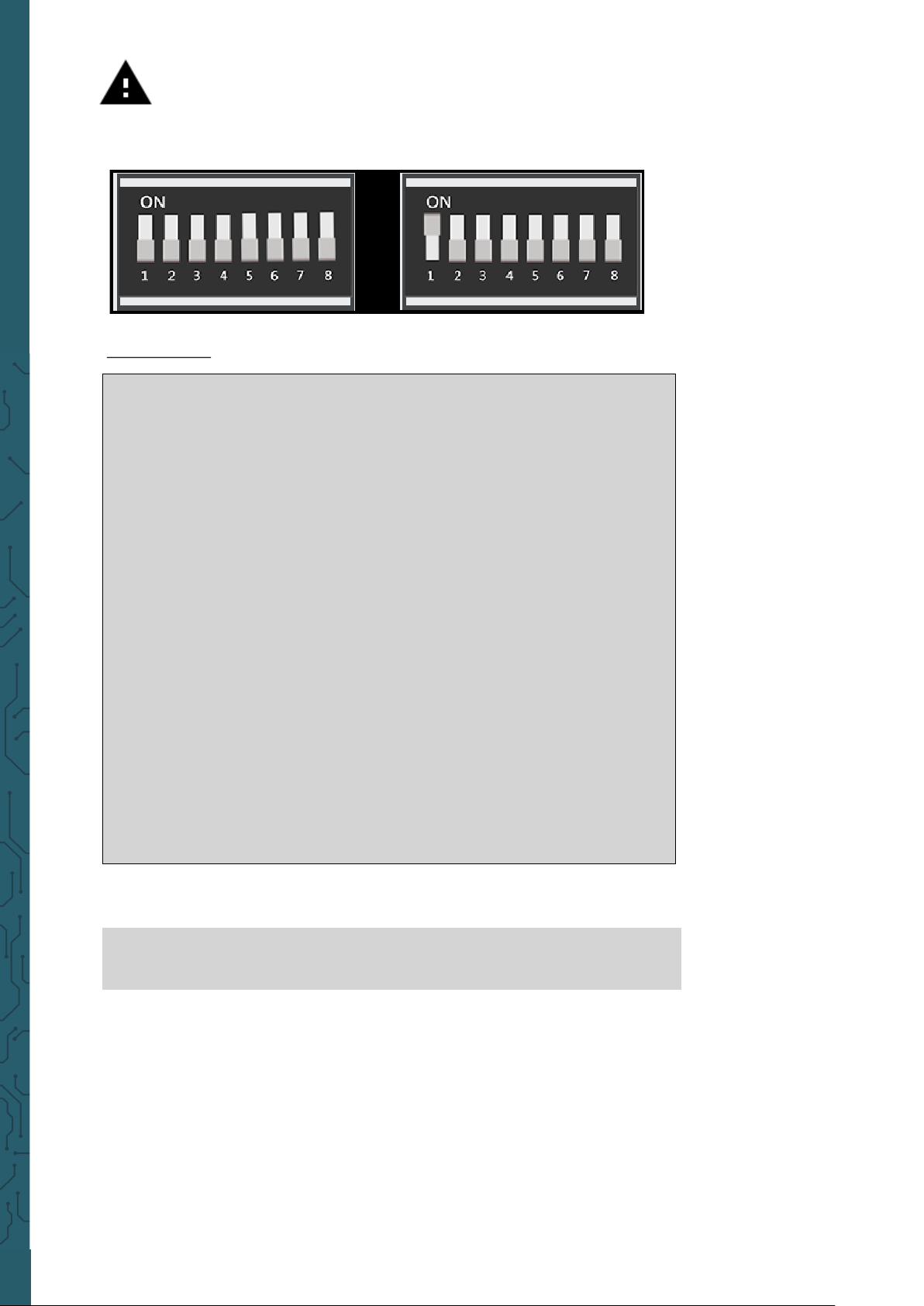
Achtung! Für dieses Beispiel müssen Sie zwischen den Modulen
wechseln. Stellen Sie Schalter Nummer 1 der rechten
Schalteinheit auf ON. Alle anderen Schalter sollten auf OFF
stehen.
Beispielcode:
#!/usr/bin/python
import RPI.GPIO as GPIO
import time
#definiere des Vibrationspins
vibration_pin = 13
#setze Board Modus zu GPIO.BOARD
GPIO.setmode(GPIO.BOARD)
#lege Vibrationspin als Ausgang fest
GPIO.setup(vibration_pin, GPIO.OUT)
#schalte Vibration ein
GPIO.output(vibration_pin, GPIO.HIGH)
#warte eine Sekunde
time.sleep(1)
#schalte Vibration aus
GPIO.output(vibration_pin, GPIO.LOW)
GPIO.cleanup()
Führen Sie die folgenden Befehle aus und versuchen Sie es selbst:
cd /home/pi/Desktop/Joy-Pi/Python3
sudo python3 vibration.py
Page 17
www.joy-it.net
Pascalstr. 8 47506 Neukirchen-Vluyn
Lektion 5 : Geräusche mit dem Schallsensor erkennen
In dieser Lektion lernen wir, wie man über den Schallsensor Eingaben
tätigt, laute Geräusche erkennt und entsprechend reagiert. So können
Sie Ihr eigenes Alarmsystem aufbauen, das laute Geräusche erkennt oder
eine LED durch Klatschen einschalten!
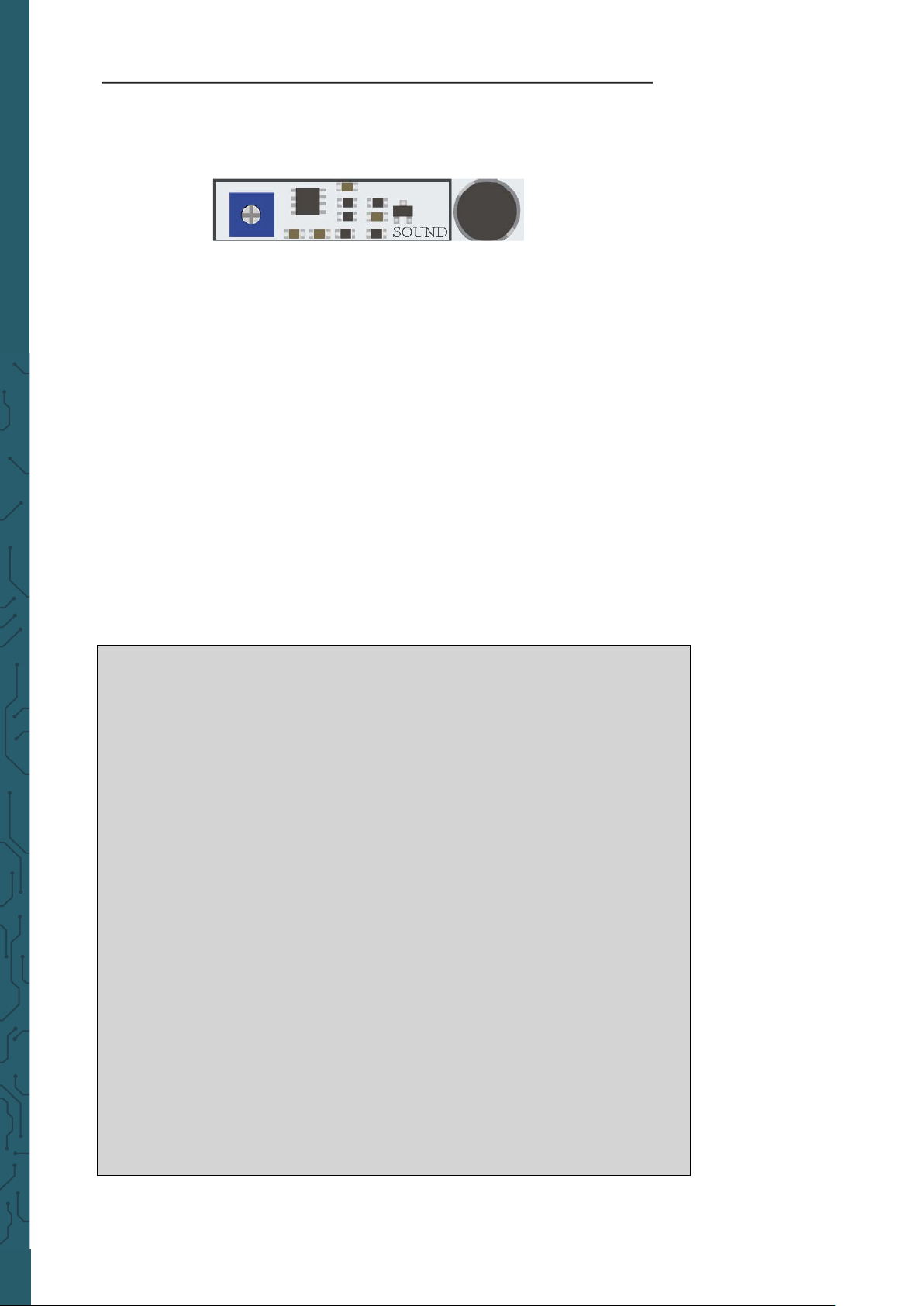
Der aus 2 Teilen aufgebaute Schallsensor besteht aus einem blauen Potentiometer, dass für die Regulierung der Empfindlichkeit zuständig ist
und dem Sensor selbst, der Geräusche erkennt. Der Schallsensor ist gut
am blauen Potentiometer zu erkennen und der Sensor selbst befindet
sich rechts unter dem Buzzer.
Mit Hilfe des Potentiometers können wir die Empfindlichkeit des Sensors
regulieren.
Damit unser Skript funktioniert, müssen wir zuerst lernen, wie man die
Empfindlichkeit steuert. Um die Empfindlichkeit zu regulieren, müssen
Sie die kleine Schraube am Potentiometer mit einem Schraubendreher
nach links oder rechts drehen. Wenn sie gegen den Uhrzeigersinn drehen,
steigt die Empfindlichkeit und mit dem Uhrzeigersinn verringert sich
diese. Der beste Weg die Empfindlichkeit zu testen ist das Skript
auszuführen. Klatschen Sie in die Hände und schauen Sie, ob das Gerät
ein Signal empfängt. Wenn kein Signal empfangen wird bedeutet dies,
dass die Empfindlichkeit des Sensors nicht hoch genug eingestellt ist.
Dies können Sie durch drehen des Potentiometers einfach beheben.
#!/usr/bin/python
import RPI.GPIO as GPIO
import time
#sound_pin wird definiert
sound_pin = 18
#GPIO mode wird auf GPIO.BOARD gesetzt
GPIO.setmode(GPIO.BOARD)
#sound_pin wird als Eingang festgelegt
GPIO.setup(sound_pin, GPIO.IN, pull_up_down=GPIO.PUD_UP)
try:
while True:
#ueberpruefe ob ein Geraeusch erkannt wird
if(GPIO.input(sound_pin)==GPIO.LOW):
print(‘Sound erkannt‘)
time.sleep(0.1)
except KeyboardInterrupt:
#STRG+C beendet das Programm
GPIO.cleanup()
Page 18
www.joy-it.net
Pascalstr. 8 47506 Neukirchen-Vluyn
Wir definieren zuerst unseren Pin, GPIO18. Dann setzen wir eine
while-Schleife, um dieses Skript dauerha laufen zu lassen. Wir prüfen,
ob wir vom Schallsensor eine Eingabe erhalten haben, die anzeigt, dass
laute Geräusche erkannt wurden und dann drucken wir
Sound Detected
.
Wenn STRG + C gedrückt wird, wird das Programm beendet.
Führen Sie die folgenden Befehle aus und versuchen Sie es selbst:
cd /home/pi/Desktop/Joy-Pi/Python3
sudo python3 sound.py
Achtung! Für dieses Beispiel müssen Sie alle Schalter der linken
und der rechten Schalteinheit auf OFF stellen
Lektion 6 : Erkennen der Helligkeit mit dem Lichtsensor
Der Lichtsensor ist einer unserer Lieblinge. Er ist in vielen Projekten und
Situationen äußerst nützlich, zum Beispiel bei Lampen, die automatisch
angehen, sobald es dunkel wird. Mit dem Lichtsensor kann man
erkennen, wie hell die Moduloberfläche ist.
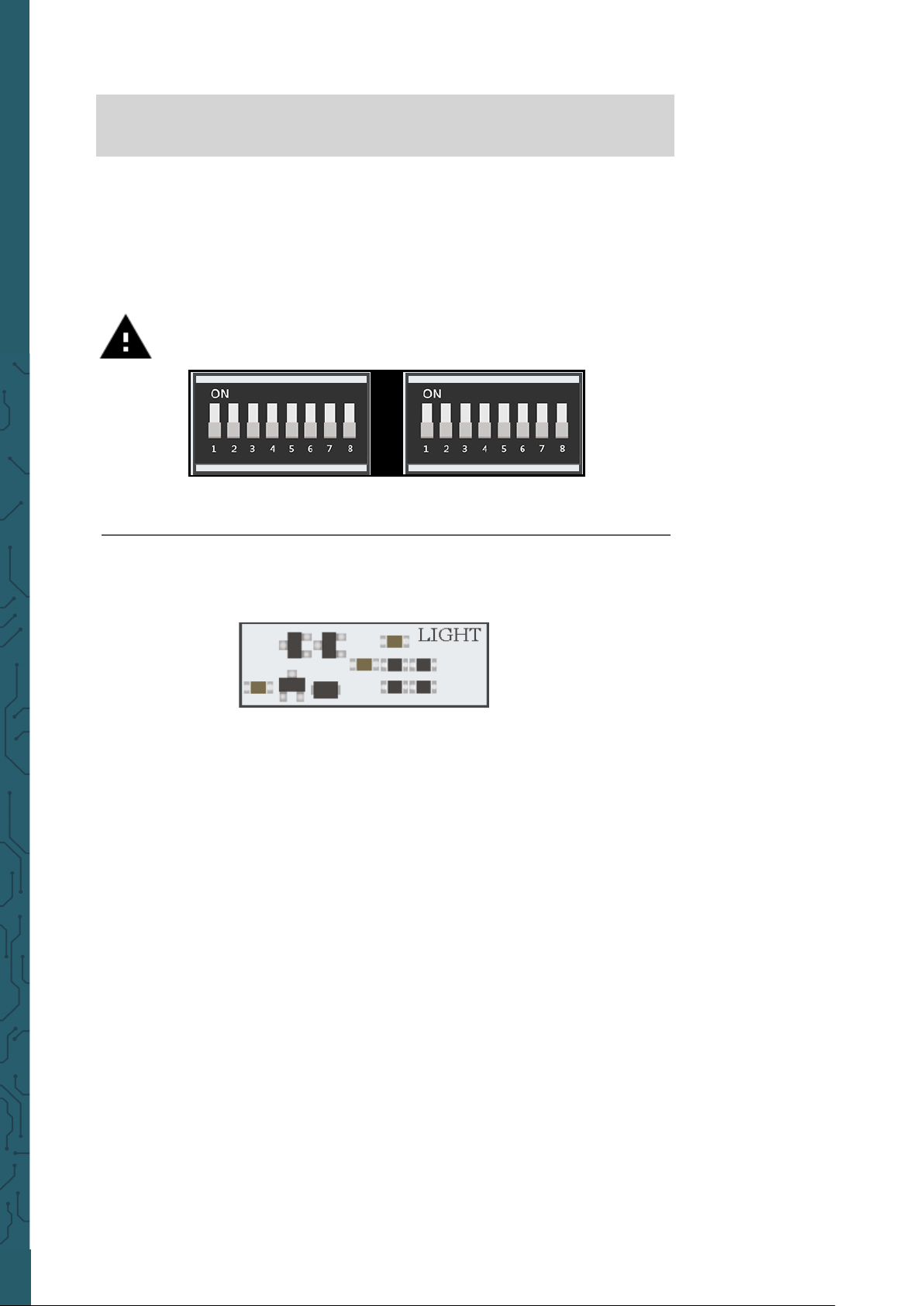
Der Lichtsensor ist schwer zu erkennen, da er aus sehr kleinen Teilen
besteht. Der Sensor liegt links neben dem Buzzer. Wenn Sie ihn mit Ihrem
Finger verdecken, sollte die Ausgabe des Lichtsensors nahe null gehen,
da ihn kein Licht mehr erreichen kann.
Nun ist es Zeit, den Sensor zu testen und zu sehen, wie er funktioniert.
Jedoch ist der Lichtsensor ein wenig anders, als andere Sensoren, da er
mit I2C funktioniert und nicht mit den normalen GPIOs, wie Sie es in den
Lektionen zuvor gelernt haben.
In diesem Skript wird eine Funktion verwendet um mit dem Lichtsensor
zu kommunizieren und die gewünschte Ausgabe mit der Helligkeit zu
erhalten. Je höher die ausgegebene Zahl ist, desto heller ist die
Umgebung.
Page 19

www.joy-it.net
Pascalstr. 8 47506 Neukirchen-Vluyn
#!/usr/bin/python
# -*- coding: utf-8 -*-
# Author: Matt Hawkins
# Author's Git: https://bitbucket.org/MattHawkinsUK/
# Author's website: https://www.raspberrypi-spy.co.uk
import RPi.GPIO as GPIO
import smbus
import time
if(GPIO.RPI_REVISION == 1):
bus = smbus.SMBus(0)
else:
bus = smbus.SMBus(1)
class LightSensor():
def __init__(self):
# Definiere Konstante vom Datenblatt
self.DEVICE = 0x5c # Standard I2C Geräteadresse
self.POWER_DOWN = 0x00 # Kein aktiver zustand
self.POWER_ON = 0x01 # Betriebsbereit
self.RESET = 0x07 # Reset des Data registers
# Starte Messungen ab 4 Lux.
self.CONTINUOUS_LOW_RES_MODE = 0x13
# Starte Messungen ab 1 Lux.
self.CONTINUOUS_HIGH_RES_MODE_1 = 0x10
# Starte Messungen ab 0.5 Lux.
self.CONTINUOUS_HIGH_RES_MODE_2 = 0x11
# Starte Messungen ab 1 Lux.
# Nach Messung wird Gerät in einen inaktiven Zustand gesetzt.
self.ONE_TIME_HIGH_RES_MODE_1 = 0x20
# Starte Messungen ab 0.5 Lux.
# Nach Messung wird Gerät in einen inaktiven Zustand gesetzt.
self.ONE_TIME_HIGH_RES_MODE_2 = 0x21
# Starte Messungen ab 4 Lux.
# Nach Messung wird Gerät in einen inaktiven Zustand gesetzt.
self.ONE_TIME_LOW_RES_MODE = 0x23
def convertToNumber(self, data):
# Einfache Funktion um 2 Bytes Daten
# in eine Dezimalzahl umzuwandeln
return ((data[1] + (256 * data[0])) / 1.2)
def readLight(self):
data = bus.read_i2c_block_data(self.DEVICE,self.ONE_TIME_HIGH_RES_MODE_1)
return self.convertToNumber(data)
def main():
sensor = LightSensor()
try:
while True:
print("Light Level : " + str(sensor.readLight()) + " lx")
time.sleep(0.5)
except KeyboardInterrupt:
pass
if __name__ == "__main__":
main()
Page 20
www.joy-it.net
Pascalstr. 8 47506 Neukirchen-Vluyn
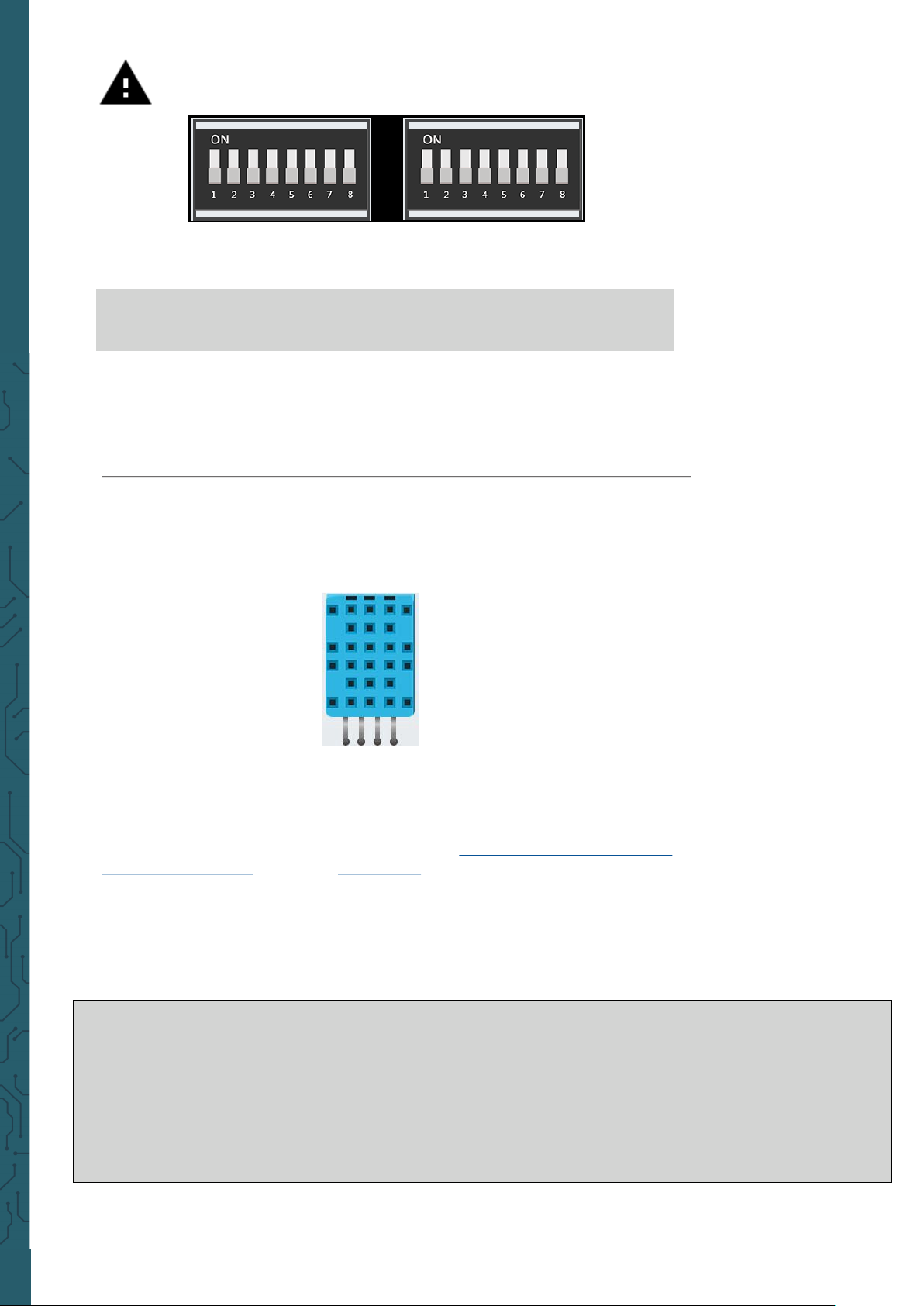
Achtung! Für dieses Beispiel müssen Sie alle Schalter der linken
und der rechten Schalteinheit auf OFF stellen
Lektion 7 : Erkennen der Temperatur und Lufeuchtigkeit
Der DHT11-Sensor ist sehr einfach zu erkennen. Ein kleiner blauer Sensor
mit vielen kleinen Löchern. Er liegt rechts neben dem Relais und
oberhalb des Berührungssensors. Als besonders zugänglich hat sich die
Python DHT Sensor Library erwiesen, die auf https://github.com/coding-
world/Python_DHT unter der [MIT-Lizenz] veröentlicht wurde.
Die Bibliothek wird verwendet, um Temperatur und Feuchtigkeit als
Werte auszugeben ohne dabei komplizierte mathematische
Berechnungen durchführen zu müssen.
Führen Sie die folgenden Befehle aus und versuchen Sie es selbst:
cd /home/pi/Desktop/Joy-Pi/Python3
sudo python3 light_sensor.py
Der DHT11 ist ein sehr interessanter Sensor, da er nicht nur eine Funktion
hat, sondern zwei! Er enthält sowohl einen Feuchtigkeitssensor als auch
einen Temperatursensor, welche beide sehr genau sind. Ideal für jedes
Wetterstationsprojekt, oder wenn Sie die Temperatur und Lufeuchtigkeit im Raum überprüfen möchten!
import Python_DHT
sensor = Python_DHT.DHT11
pin = 4
feuchtigkeit, temperatur = Python_DHT.read_retry(sensor, pin)
print("Temperatur = "+str(temperatur)+ "C Feuchtigkeit = "+str( feuchtigkeit)+"%")
Page 21
www.joy-it.net
Pascalstr. 8 47506 Neukirchen-Vluyn
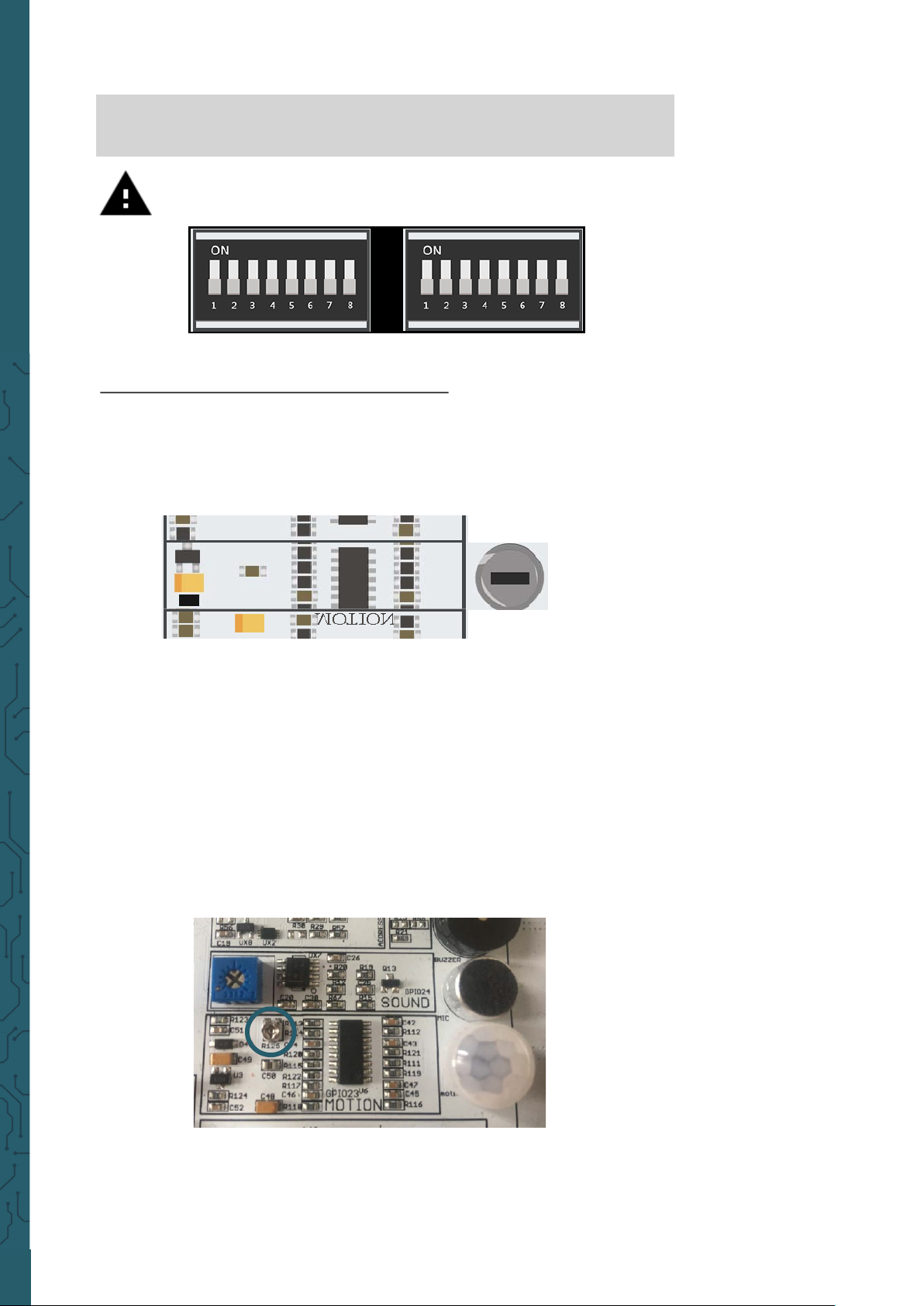
Achtung! Für dieses Beispiel müssen Sie alle Schalter der linken
und der rechten Schalteinheit auf OFF stellen
Führen Sie die folgenden Befehle aus und versuchen Sie es selbst:
cd /home/pi/Desktop/Joy-Pi/Python3
sudo python3 dht11.py
Lektion 8 : Bewegungen erkennen
Der Bewegungssensor ist einer der nützlichsten und am häufigsten
benutzten Sensoren. Man kann mit ihm zum Beispiel eine Alarmanlage
bauen. Wenn der Sensor eine Bewegung erkennt, kann er ein Signal an
den Buzzer senden, der dann einen lauten Alarmton von sich gibt.
Der Bewegungssensor befindet sich direkt unter dem Schallsensor und
wird von einer kleinen, transparenten Kappe abgedeckt. Die Kappe hil
dem Sensor mehr Bewegungen zu erkennen, indem sie das Infrarotlicht
der Umgebung bricht. Die Empfindlichkeit des Bewegungssensors wird,
wie die des Schallsensors mit einem Potentiometer geregelt. Dieser befindet sich unterhalb des Potentiometers des Schallsensors, ist jedoch
deutlich kleiner. Mit Hilfe eines Kreuzschraubendrehers können Sie
einstellen, über welche Entfernungen der Bewegungssensor auslösen
soll. Wenn Sie gegen den Uhrzeigersinn drehen, steigt die
Empfindlichkeit, mit dem Uhrzeigersinn verringert sie sich.
Der Bewegungssensor wird durch die GPIO-Pins gesteuert. Wenn eine
Bewegung erkannt wird, wird der Bewegungssensor ein Signal senden.
Dieses hält einige Zeit an und hört dann wieder auf bis der Sensor die
nächste Bewegung erkennt.
Page 22

www.joy-it.net
Pascalstr. 8 47506 Neukirchen-Vluyn
#!/usr/bin/python
# -*- coding: utf-8 -*-
import RPi.GPIO as GPIO
import time #Importieren der Bibliotheken
motion_pin = 16 #Den Pin des Bewegungssensors einer Variable zuweisen.
GPIO.setmode(GPIO.BOARD) #Die GPIO Boardkonfiguration benutzen.
GPIO.setup(motion_pin, GPIO.IN) #Der Pin der Deklarierten Variable wird als Input gesetzt
try: # Beginn einer Schleife
while True:
if(GPIO.input(motion_pin) == 0): # Wenn der Sensor Input = 0 ist
print("Keine Bewegung ...") # Wird der print Befehl ausgeführt
elif(GPIO.input(motion_pin) == 1): # Wenn der Sensor Input = 1 ist
print("Bewegung Erkannt!") # Wird der print Befehl ausgeführt
time.sleep(0.1) # 0,1 Sekunde Warten
except KeyboardInterrupt:
GPIO.cleanup() # Gibt GPIO Ports wieder frei.
Achtung! Für dieses Beispiel müssen Sie alle Schalter der linken
und der rechten Schalteinheit auf OFF stellen
Führen Sie die folgenden Befehle aus und versuchen Sie es selbst:
cd /home/pi/Desktop/Joy-Pi/Python3
sudo python3 motion.py
Lektion 9 : Entfernungen mit dem Ultraschallsensor messen
Nun werden wir lernen, wie wir den Ultraschallsensor verwenden um
Entfernungen zu messen und auf dem Joy-Pi Bildschirm auszugeben.
Autos verwenden übrigens die gleiche Methode um Abstände zu messen.
Page 23

www.joy-it.net
Pascalstr. 8 47506 Neukirchen-Vluyn
Achtung! Für dieses Beispiel müssen Sie alle Schalter der linken
und der rechten Schalteinheit auf OFF stellen
Der Ultraschallsensor befindet sich rechts unten auf der Joy Pi Platine,
direkt über der Schrittmotor- und der Servo-Schnittstellen. Er ist leicht an
den zwei großen Kreisen zu erkennen. Wir werden unsere Hände über
dem Entfernungssensor bewegen um die Entfernung zwischen unseren
Händen und dem Joy Pi zu messen.
Der Abstandssensor arbeitet mit GPIO.INPUT, doch es ist etwas anders
als das, was wir in unseren vorherigen Lektionen verwendet haben. Der
Sensor benötigt ein gewisses Intervall um in der Lage zu sein, die
Entfernung auf genaue Art und Weise zu erfassen. Er sendet ein
Ultraschallsignal und empfängt mit einem eingebauten Sensor das Echo,
das von einem Hindernis zurückgeworfen wird. Aus dem zeitlichen
Abstand zwischen dem Senden des Signals und dem Empfangen des
Echos, wird die Distanz berechnet.
#!/usr/bin/python
# -*- coding: utf-8 -*# Author : www.modmypi.com
# Link: https://www.modmypi.com/blog/hc-sr04-ultrasonic-range-sensor-on-the-raspberry-pi
import RPi.GPIO as GPIO
import time
GPIO.setmode(GPIO.BOARD) # Setze die GPIO Boardkonfiguration ein.
TRIG = 36 # Variablendeklaration
ECHO = 32 # Variablendeklaration
print ("Entfernung wird ermittelt.") # Ausgabe von Text in der Konsole
GPIO.setup(TRIG,GPIO.OUT) # Variable TRIG als Output festlegen.
GPIO.setup(ECHO,GPIO.IN) # Variable ECHO als Input festlegen.
GPIO.output(TRIG, False)
print ("Warte auf den Sensor.")
time.sleep(2) # 2 Sekunden Wartezeit.
GPIO.output(TRIG, True) # Sendet ein Ultraschallsignal
time.sleep(0.00001) # Wartet 0,00001 Sekunden
GPIO.output(TRIG, False) # Beendet das senden des Ultraschallsignals
while GPIO.input(ECHO)==0:
pulse_start = time.time()
while GPIO.input(ECHO)==1:
pulse_end = time.time()
Page 24

www.joy-it.net
Pascalstr. 8 47506 Neukirchen-Vluyn
Der LCD-Bildschirm nimmt einen großen Teil des Joy Pi Boards ein.
Er befindet sich oben in der Mitte des Joy Pis, rechts von der GPIO
LED-Anzeige. Sobald das Demo-Skript und die Beispiele ausgeführt
werden, schaltet sich das Display ein. Dank der integrierten
Hintergrundbeleuchtung kann man auch in völliger Dunkelheit Daten von
dem Display ablesen.
Wie bereits der Schall- und der Bewegungssensor, hat auch das LCD ein
zugehöriges Potentiometer. Mit diesem Potentiometer lässt sich der
Kontrast des Displays einstellen.
Wenn Sie gegen den Uhrzeigersinn drehen, wird der Kontrast höher und
mit dem Uhrzeigersinn schwächer.
pulse_duration = pulse_end - pulse_start # Berechnung für die Dauer Des Pulses
distance = pulse_duration * 17150 # Berechnung zur Bestimmung der Entfernung.
distance = round(distance, 2) # Ergebnis wird auf 2 Nachkommastellen gerundet.
print ("Distance:",distance,"cm") # Konsolenausgabe der Distanz in cm.
GPIO.cleanup() # Gibt GPIO Ports wieder frei.
Führen Sie die folgenden Befehle aus und versuchen Sie es selbst:
cd /home/pi/Desktop/Joy-Pi/Python3
sudo python3 distance.py
Lektion 10 : Steuern des LCDs
Mit dem Joy Pi können Sie Daten auf dem LCD anzeigen lassen, die Sie
mit Ihren Sensoren sammeln und aktualisieren Sie in Echtzeit, abhängig
von den Änderungen, die die Module durchlaufen. Zum Beispiel in
Verbindung mit dem Temperatursensor - lassen Sie immer die aktuelle
Temperatur und Lufeuchtigkeit auf dem LCD anzeigen.
Page 25

www.joy-it.net
Pascalstr. 8 47506 Neukirchen-Vluyn
Das LCD, sowie einige andere Sensoren funktionieren nicht mit der
GPIO-Technologie. Deshalb wird das Bussystem "I2C" verwendet, das
eignet sich besonders gut um mehrere integrierte Schaltungen
kommunizieren zu lassen. Das LCD hat die Adresse 0x21, indem wir eine
Verbindung zu dieser I2C-Adresse herstellen, können Befehle wie z.B.
schreiben von Text, Einschalten der Hintergrundbeleuchtung des LCDs,
Aktivieren des Cursors usw. gesendet werden.
Zur Steuerung des LCDs wird die Adafruit_CharLCDBackpack Bibliothek
verwendet.
Achtung! Für dieses Beispiel müssen Sie alle Schalter der linken
und der rechten Schalteinheit auf OFF stellen
#!/usr/bin/python
# -*- coding: utf-8 -*-
import time
import board
import busio
import adafruit_character_lcd.character_lcd_i2c as character_lcd
# Definiere LCD Zeilen und Spaltenanzahl.
lcd_columns = 16
lcd_rows = 2
# Initialisierung I2C Bus
i2c = busio.I2C(board.SCL, board.SDA)
# Festlegen des LCDs in die Variable LCD
lcd = character_lcd.Character_LCD_I2C(i2c, lcd_columns, lcd_rows)
try:
# Hintergrundbeleuchtung einschalten
lcd.backlight = True
# Zwei Worte mit Zeilenumbruch werden ausgegeben
lcd.message = "Hallo\nWelt!"
# 5 Sekunden warten
time.sleep(5.0)
# Cursor anzeigen lassen.
lcd.clear()
lcd.cursor = True
lcd.message = "Show Cursor!"
# 5 Sekunden warten
time.sleep(5.0)
# Cursor blinken lassen
lcd.clear()
lcd.blink = True
lcd.message = "Blinky Cursor!"
# 5 Sekunden warten, den blinkenden Cursor stoppen und Cursor ausblenden
time.sleep(5)
lcd.blink = False
lcd.clear()
Page 26

www.joy-it.net
Pascalstr. 8 47506 Neukirchen-Vluyn
Das LCD, sowie einige andere Sensoren funktionieren nicht mit der
GPIO-Technologie. Deshalb wird das Bussystem "I2C" verwendet, das
eignet sich besonders gut um mehrere integrierte Schaltungen
kommunizieren zu lassen. Das LCD hat die Adresse 0x21, indem wir eine
Verbindung zu dieser I2C-Adresse herstellen, können Befehle wie z.B.
schreiben von Text, Einschalten der Hintergrundbeleuchtung des LCDs,
Aktivieren des Cursors usw. gesendet werden.
Zur Steuerung des LCDs wird die Adafruit_CharLCDBackpack Bibliothek
verwendet.
# Nachricht von Rechts/Links scrollen lassen.
lcd.clear()
scroll_msg = "<-- Scroll -->"
lcd.message = scroll_msg
for i in range(len(scroll_msg)):
time.sleep(0.5)
lcd.move_right()
for i in range(len(scroll_msg)):
time.sleep(0.5)
lcd.move_left()
# Hintergrundbeleuchtung an und ausschalten.
lcd.clear()
lcd.message = "Flash backlight\nin 5 seconds..."
time.sleep(5.0)
# Hintergrundbeleuchtung ausschalten.
lcd.backlight = False
time.sleep(1.0)
lcd.backlight = True
time.sleep(1.0)
lcd.backlight = False
# Nachricht ändern.
lcd.clear()
lcd.message = "Goodbye"
# Hintergrundbeleuchtung einschalten.
lcd.backlight = True
# Hintergrundbeleuchtung ausschalten.
time.sleep(2.0)
lcd.clear()
lcd.backlight = False
except KeyboardInterrupt:
# LCD ausschalten.
lcd.clear()
lcd.backlight = False
Führen Sie die folgenden Befehle aus und versuchen Sie es selbst:
cd /home/pi/Desktop/Joy-Pi/Python3
python3 lcd.py
Page 27

www.joy-it.net
Pascalstr. 8 47506 Neukirchen-Vluyn
Das RFID-Modul befindet sich direkt unter dem Raspberry Pi und sieht
wie ein kleines WiFi-Symbol aus. Dieses Symbol bedeutet drahtlose
Konnektivität. Um es zu benutzen, müssen wir den Chip oder die Karte
nehmen, die mit dem Joy Pi geliefert wird und die über den Joy Pi
RFID-Chip Bereich halten. Es muss nah genug für unser Skript sein, damit
es erkannt wird. 2 - 4 cm sollten nah genug sein. Probieren Sie es einfach
aus!
Für das RFID RC522 Shield verwenden wir den SPI-Bus. Damit der Kernel
beim Starten geladen wird, bearbeiten wir die config.txt Datei indem wir
folgenden Befehl eingeben:
Lektion 11 : Lesen und Schreiben von RFID - Karten
In dieser Lektion werden Sie lernen, wie man das RFID-Modul steuert. Das
RFID-Modul ist ein sehr interessantes und nützliches Modul. Es wird
weltweit in einer Vielzahl von Lösungen eingesetzt, wie z.B. intelligente
Türschlösser, mitarbeiterausweise, Visitenkarten und sogar
Hundehalsbänder.
sudo nano /boot/config.txt
Folgender Inhalt wird an das Ende der Datei hinzugefügt:
Gespeichert und beendet wird mit STRG + O und STRG + X.
Danach aktivieren Sie noch SPI:
device_tree_param=spi=on
dtoverlay=spi-bcm2708
sudo raspi-config
Achtung! Für dieses Beispiel müssen Sie alle Schalter der linken
und der rechten Schalteinheit auf OFF stellen
Unter
Interfacing Options → SPI
aktivieren und anschließend den
Raspberry Pi neu starten.
Page 28

www.joy-it.net
Pascalstr. 8 47506 Neukirchen-Vluyn
Um in den Ordner für die Skripte des RFID Lesers zu gelangen, geben Sie
folgenden Befehl ein:
cd /home/pi/Desktop/Joy-Pi/Python3/MFRC522-python
Wenn Sie nun die RFID Karte oder den Chip beschreiben wollen,
benutzen Sie folgenden Befehl:
sudo python3 Write.py
Um die Dateien zu bearbeiten die Sie auf dem Chip oder der Karte
speichern, müssen Sie den Quellcode bearbeiten:
Um die Dateien die gespeichert werden zu verändern, müssen Sie nun
die Zahlen in der eckigen Klammer verändern, allerdings können diese
Zahlen nicht kleiner als 0 und nicht größer als 255 sein.
Wenn Sie anschließend die Zahlenfolge auslesen möchten, benutzen Sie
den folgenden Befehl:
sudo python Read.py
Wenn Sie nun die Karte oder den Chip auf den Leser legen wird Ihnen die
auf der Karte gespeicherte Zahlenfolge angezeigt.
Page 29

www.joy-it.net
Pascalstr. 8 47506 Neukirchen-Vluyn
#!/usr/bin/env python
# -*- coding: utf8 -*#
# Copyright 2014,2018 Mario Gomez <mario.gomez@teubi.co>
# This file is part of MFRC522-Python
# MFRC522-Python is a simple Python implementation for
# the MFRC522 NFC Card Reader for the Raspberry Pi.
# MFRC522-Python is free software: you can redistribute it and/or modify
# it under the terms of the GNU Lesser General Public License as published by
# the Free Software Foundation, either version 3 of the License, or
# (at your option) any later version.
# MFRC522-Python is distributed in the hope that it will be useful,
# but WITHOUT ANY WARRANTY; without even the implied warranty of
# MERCHANTABILITY or FITNESS FOR A PARTICULAR PURPOSE. See the
# GNU Lesser General Public License for more details.
# You should have received a copy of the GNU Lesser General Public License
# along with MFRC522-Python. If not, see <http://www.gnu.org/licenses/>.
import RPi.GPIO as GPIO
import MFRC522
import signal
continue_reading = True
# Capture SIGINT for cleanup when the script is aborted
def end_read(signal,frame):
global continue_reading
print("Ctrl+C captured, ending read.")
continue_reading = False
GPIO.cleanup()
# Hook the SIGINT
signal.signal(signal.SIGINT, end_read)
# Create an object of the class MFRC522
MIFAREReader = MFRC522.MFRC522()
# Welcome message
print("Welcome to the MFRC522 data read example")
print("Press Ctrl-C to stop.")
# This loop keeps checking for chips. If one is near it will get the UID and authenticate
while continue_reading:
# Scan for cards
(status,TagType) = MIFAREReader.MFRC522_Request(MIFAREReader.PICC_REQIDL)
# If a card is found
if status == MIFAREReader.MI_OK:
print("Card detected")
# Get the UID of the card
(status,uid) = MIFAREReader.MFRC522_Anticoll()
Beispielcode RFID-Read:
Page 30

www.joy-it.net
Pascalstr. 8 47506 Neukirchen-Vluyn
# Print UID
print("Card read UID: %s,%s,%s,%s".format(uid[0], uid[1], uid[2], uid[3]))
# This is the default key for authentication
key = [0xFF,0xFF,0xFF,0xFF,0xFF,0xFF]
# Select the scanned tag
MIFAREReader.MFRC522_SelectTag(uid)
# Authenticate
status = MIFAREReader.MFRC522_Auth(MIFAREReader.PICC_AUTHENT1A, 8, key, uid)
# Check if authenticated
if status == MIFAREReader.MI_OK:
MIFAREReader.MFRC522_Read(8)
MIFAREReader.MFRC522_StopCrypto1()
else:
print("Authentication error")
Beispielcode RFID-Write:
#!/usr/bin/env python
# -*- coding: utf8 -*-
import RPi.GPIO as GPIO
import MFRC522
import signal
continue_reading = True
# Funktion um cleanup Funktionen durchzuführen wenn das Script abgebrochen wird.
def end_read(signal,frame):
global continue_reading
print ("Ctrl+C captured, ending read.")
continue_reading = False
GPIO.cleanup()
signal.signal(signal.SIGINT, end_read)
# Erstelle ein Objekt aus der Klasse MFRC522
MIFAREReader = MFRC522.MFRC522()
# Diese Schleife Sucht dauerhaft nach Chips oder Karten. Wenn eine nah ist bezieht er
die UID und identifiziert sich.
while continue_reading:
# SUcht Karten
(status,TagType) = MIFAREReader.MFRC522_Request(MIFAREReader.PICC_REQIDL)
# Wenn Karte gefunden
if status == MIFAREReader.MI_OK:
print ("Card detected")
# UID der Karte erhalten
(status,uid) = MIFAREReader.MFRC522_Anticoll()
Page 31

www.joy-it.net
Pascalstr. 8 47506 Neukirchen-Vluyn
# Wenn UID erhalten, fortfahren
if status == MIFAREReader.MI_OK:
# UID in Konsole ausgeben
print ("Card read UID: %s,%s,%s,%s" % (uid[0], uid[1], uid[2], uid[3]))
# Standard Schlüssel für Authentifizierungen
key = [0xFF,0xFF,0xFF,0xFF,0xFF,0xFF]
MIFAREReader.MFRC522_SelectTag(uid)
# Authentifizieren
status = MIFAREReader.MFRC522_Auth(MIFAREReader.PICC_AUTHENT1A, 8, key, uid)
print ("\n")
# Prüfen ob authentifiziert
if status == MIFAREReader.MI_OK:
# Variablen der Werte die auf der Karte gespeichert werden sollen.
data = [99, 11, 55, 66, 44, 111, 222, 210, 125, 153, 136, 199, 144, 177, 166, 188]
for x in range(0,16):
data.append(0xFF)
print ("Sector 8 looked like this:")
# Block 8 lesen
MIFAREReader.MFRC522_Read(8)
print ("\n")
print ("Sector 8 will now be filled with 0xFF:")
# Dateien Schreiben
MIFAREReader.MFRC522_Write(8, data)
print ("\n")
print ("It now looks like this:")
# Überprüfen ob beschrieben wurde
MIFAREReader.MFRC522_Read(8)
print ("\n")
MIFAREReader.MFRC522_StopCrypto1()
# Sicherstellen das, das Kartenlesen eingestellt wird.
continue_reading = False
else:
print ("Authentification error")
Page 32

www.joy-it.net
Pascalstr. 8 47506 Neukirchen-Vluyn
Der Schrittmotor ist ein unabhängiges Modul, welches Sie mit dem Board
verbinden müssen.
Verbinden Sie den Schrittmotor einfach am folgenden Anschluss des
Joy Pi Boards:
Lektion 12 : Schrittmotoren verwenden
Der Schrittmotor kann sich während der Verwendung erwärmen. Dies ist
technisch bedingt und nicht ungewöhnlich.
Der Schrittmotor ist mit 4 GPIO-Pins verbunden, welche schnell
hintereinander eingeschaltet werden. Dies bewirkt, dass der Schrittmotor
vorwärts "schiebt" und einen Schritt macht. Mit der Funktion turnSteps
kann eine beliebige Anzahl von Schritten ausgeführt werden. Die
Funktion turnDegrees lässt den Motor um einen bestimmten Winkel
drehen.
Achtung! Für dieses Beispiel müssen Sie zwischen den Modulen
wechseln. Stellen Sie die Schalter Nummer 3, 4, 5 und 6 der
rechten Schalteinheit auf ON. Alle anderen Schalter sollten auf
OFF stehen.
Page 33

www.joy-it.net
Pascalstr. 8 47506 Neukirchen-Vluyn
#!/usr/bin/
python
# -*- coding: utf-8 -*# Author : Original author ludwigschuster
# Original Author Github: https://github.com/ludwigschuster/RasPi-GPIO-Stepmotor
import time
import RPi.GPIO as GPIO
import math
class Stepmotor:
def __init__(self):
# GPIO modus Festlegen
GPIO.setmode(GPIO.BOARD)
# Das Sind die Pins Ihres RasperryPis die benutzt werden.
self.pin_A = 29
self.pin_B = 31
self.pin_C = 33
self.pin_D = 35
self.interval = 0.010
# Pins als Output Deklarieren
GPIO.setup(self.pin_A,GPIO.OUT)
GPIO.setup(self.pin_B,GPIO.OUT)
GPIO.setup(self.pin_C,GPIO.OUT)
GPIO.setup(self.pin_D,GPIO.OUT)
GPIO.output(self.pin_A, False)
GPIO.output(self.pin_B, False)
GPIO.output(self.pin_C, False)
GPIO.output(self.pin_D, False)
def Step1(self):
GPIO.output(self.pin_D, True)
time.sleep(self.interval)
GPIO.output(self.pin_D, False)
def Step2(self):
GPIO.output(self.pin_D, True)
GPIO.output(self.pin_C, True)
time.sleep(self.interval)
GPIO.output(self.pin_D, False)
GPIO.output(self.pin_C, False)
def Step3(self):
GPIO.output(self.pin_C, True)
time.sleep(self.interval)
GPIO.output(self.pin_C, False)
def Step4(self):
GPIO.output(self.pin_B, True)
GPIO.output(self.pin_C, True)
time.sleep(self.interval)
GPIO.output(self.pin_B, False)
GPIO.output(self.pin_C, False)
def Step5(self):
GPIO.output(self.pin_B, True)
time.sleep(self.interval)
Beispielcode Schrittmotor
Page 34

www.joy-it.net
Pascalstr. 8 47506 Neukirchen-Vluyn
def Step6(self):
GPIO.output(self.pin_A, True)
GPIO.output(self.pin_B, True)
time.sleep(self.interval)
GPIO.output(self.pin_A, False)
GPIO.output(self.pin_B, False)
def Step7(self):
GPIO.output(self.pin_A, True)
time.sleep(self.interval)
GPIO.output(self.pin_A, False)
def Step8(self):
GPIO.output(self.pin_D, True)
GPIO.output(self.pin_A, True)
time.sleep(self.interval)
GPIO.output(self.pin_D, False)
GPIO.output(self.pin_A, False)
def turn(self,count):
for i in range (int(count)):
self.Step1()
self.Step2()
self.Step3()
self.Step4()
self.Step5()
self.Step6()
self.Step7()
self.Step8()
def close(self):
# Die GPIO Pins fuer andere Aktivitaeten freigeben.
GPIO.cleanup()
def turnSteps(self, count):
# Bewegen um n schritte
# (n wird von Ihnen festgelegt.)
for i in range (count):
self.turn(1)
def turnDegrees(self, count):
# Bewegen um n Grad (Kleine Werte koennen zu Ungenauigkeit fuehren.)
# (Gradnummer die gedreht werden soll angeben.)
self.turn(round(count*512/360,0))
def turnDistance(self, dist, rad):
self.turn(round(512*dist/(2*math.pi*rad),0))
def main():
print("Bewegung gestartet.")
motor = Stepmotor()
print("Ein Schritt")
motor.turnSteps(1)
time.sleep(0.5)
print("20 Schritte")
motor.turnSteps(20)
time.sleep(0.5)
Page 35

www.joy-it.net
Pascalstr. 8 47506 Neukirchen-Vluyn
print("Viertel Umdrehung")
motor.turnDegrees(90)
print("Bewegung gestoppt.")
motor.close()
if __name__ == "__main__":
main()
Führen Sie die folgenden Befehle aus und versuchen Sie es selbst:
cd /home/pi/Desktop/Joy-Pi/Python3
sudo python3 stepmotor.py
Lektion 13 : Steuerung von Servomotoren
Mit Hilfe des Servomotors lassen sich Geräte mechanisch steuern und
Teile bewegen. So können beispielsweise intelligente Abfalleimer, eine
Schachtel mit intelligenter, önender / schließender Tür und viele andere
interessante Projekte erstellt werden.
Der Joy Pi besitzt zwei Servo-Schnittstellen, die beide zur Steuerung von
Servomotoren genutzt werden können. In diesem Tutorial verwenden wir
die Schnittstelle Nummer zwei, die als
Servo2
markiert ist. Sie können
natürlich auch die anderen Servo-Schnittstellen verwenden, dazu
müssen Sie jedoch das Skript auf die richtigen GPIOs anpassen.
Der Servomotor benötigt drei Pins: Positiv, Negativ und den Daten-Pin.
Der positive Pin ist das rote Kabel, der negative Pin das schwarze Kabel
(auch Masse genannt) und das Datenkabel ist Gelb.
Page 36

www.joy-it.net
Pascalstr. 8 47506 Neukirchen-Vluyn
Schauen Sie sich den Beispielcode an, um ihn besser zu verstehen:
Der Servo benutzt die GPIO.Board Nummer 22. Jedes Mal wird das Skript
die Richtung vom Servomotor festlegen, um zu drehen. Wir können positive Gradzahlen verwenden, um links herumzudrehen und negative, um
rechts herumzudrehen. Verändern Sie einfach die Gradzahlen und
schauen Sie, wie sich die Drehung des Motors verändert.
Achtung! Für dieses Beispiel müssen Sie zwischen den Modulen
wechseln. Stellen Sie die Schalter Nummer 7 und 8 der rechten
Schalteinheit auf ON. Alle anderen Schalter sollten auf OFF
stehen.
Kabel Pin
Rot
Mittlerer Pin von
Servo2
Schwarz
Rechter Pin von
Servo2
Bunt
Linker Pin von
Servo2
Führen Sie die folgenden Befehle aus und versuchen Sie es selbst:
cd /home/pi/Desktop/Joy-Pi/Python3
sudo python3 servo.py
#!/usr/bin/python
# -*- coding: utf-8 -*# Author : Original author WindVoiceVox
# Original Author Github: https://github.com/WindVoiceVox/Raspi_SG90
import RPi.GPIO as GPIO
import time
import sys
class sg90:
def __init__( self, pin, direction ):
GPIO.setmode( GPIO.BOARD )
GPIO.setup( pin, GPIO.OUT )
self.pin = int( pin )
self.direction = int( direction )
self.servo = GPIO.PWM( self.pin, 50 )
self.servo.start(0.0)
def cleanup( self ): #Funktion zum Stoppen und GPIO Pins Freigeben
self.servo.ChangeDutyCycle(self._henkan(0))
time.sleep(0.3)
self.servo.stop()
GPIO.cleanup()
Beispielcode Servomotor:
Page 37

www.joy-it.net
Pascalstr. 8 47506 Neukirchen-Vluyn
Lektion 14 : Steurern der 8 x 8 LED-Matrix
Die LED-Matrix spielt in vielen blinkenden LED-Projekten eine wichtige
Rolle. Selbst wenn Sie es auf den ersten Blick nicht sehen, kann die
LED-Matrix viel mehr als nur rot blinken. Sie kann verwendet werden, um
kleine Symbole anzuzeigen und sogar um ein Spiel wie Snake zu spielen.
Das LED-Matrixmodul ist ein großes quadratisches Modul, das sich auf
der linken Seite der Segment-LED und direkt unter dem LCD befindet. Es
kann leicht durch die kleinen weißen Punkte, welche die LEDs sind,
erkannt werden.
In diesem Beispiel wird ein kurzer Text auf der LED-Matrix angezeigt.
Im Skript wird eine Zeichenfolge mit einer Nachricht erstellt und mit der
Funktion show_message(), auf dem Matrix-Display angezeigt.
Sie können Eigenschaen, wie z.B. Verzögerungen steuern, die den
Nachrichtenfluss etwas verlangsamt. Die LED-Matrix verwendet im
Gegensatz zu anderen Modulen eine SPI-Schnittstelle von der die Matrix
aus gesteuert werden kann. Probieren Sie das Beispiel aus und ändern
Sie den Code, um zu sehen, was passiert.
def currentdirection( self ): #Funktion die die Momentane Position feststellt.
return self.direction
def _henkan( self, value ):
return 0.05 * value + 7.0
def setdirection( self, direction, speed ): #Funktion um die Richtung anzugeben
for d in range( self.direction, direction, int(speed) ):
self.servo.ChangeDutyCycle( self._henkan( d ) )
self.direction = d
time.sleep(0.1)
self.servo.ChangeDutyCycle( self._henkan( direction ) )
self.direction = direction
def main():
servo_pin = 22
s = sg90(servo_pin,0) #Deklaration von Pin und Motor
try:
while True:
print ("Turn left ...")
s.setdirection( 100, 10 ) #Links Herum drehen
time.sleep(0.5) #0,5 Sekunden warten
print ("Turn right ...")
s.setdirection( -100, -10 ) #Rechts Herum drehen
time.sleep(0.5) #0,5 Sekunden warten
except KeyboardInterrupt:
s.cleanup()
if __name__ == "__main__":
main()
Achtung! Für dieses Beispiel müssen Sie alle Schalter der linken
und der rechten Schalteinheit auf OFF stellen
Beispielcode fortgeführt:
Page 38

www.joy-it.net
Pascalstr. 8 47506 Neukirchen-Vluyn
#!/usr/bin/env python
# -*- coding: utf-8 -*-
# Copyright (c) 2017-18 Richard Hull and contributors
# License: https://github.com/rm-hull/luma.led_matrix/blob/master/LICENSE.rst
# Github link: https://github.com/rm-hull/luma.led_matrix/
# Alle benötigten Module importieren
import re
import time
from luma.led_matrix.device import max7219
from luma.core.interface.serial import spi, noop
from luma.core.render import canvas
from luma.core.virtual import viewport
from luma.core.legacy import text, show_message
from luma.core.legacy.font import proportional, CP437_FONT, TINY_FONT, SINCLAIR_FONT, LCD_FONT
def main(cascaded, block_orientation, rotate):
# Matrix Gerät festlegen und erstellen.
serial = spi(port=0, device=1, gpio=noop())
device = max7219(serial, cascaded=cascaded or 1, block_orientation=block_orientation,
rotate=rotate or 0)
# Matrix Initialisierung in der Konsole anzeigen
print("[-] Matrix initialized")
# Hallo Welt in der Matrix anzeigen
msg = "Hallo Welt"
# Ausgegebenen Text in der Konsole Anzeigen
print("[-] Printing: %s" % msg)
show_message(device, msg, fill="white", font=proportional(CP437_FONT), scroll_delay=0.1)
if __name__ == "__main__":
# cascaded = Anzahl von MAX7219 LED Matrixen, standart=1
# block_orientation = choices 0, 90, -90, standart=0
# rotate = choices 0, 1, 2, 3, Rotate display 0=0°, 1=90°, 2=180°, 3=270°, standart=0
try:
main(cascaded=1, block_orientation=90, rotate=0)
except KeyboardInterrupt:
pass
Führen Sie die folgenden Befehle aus und versuchen Sie es selbst:
cd /home/pi/Desktop/Joy-Pi/Python3
sudo python3 matrix_demo.py
Beispielcode LED-Matrix
Page 39

www.joy-it.net
Pascalstr. 8 47506 Neukirchen-Vluyn
Lektion 15 : Steuern des 7 - Segment - Displays
Die Segment-Anzeige ist ein sehr nützliches Display, wenn es um Zahlen
geht. Es kann uns die Zeit zeigen oder zählen, wie o wir bestimmte Dinge getan haben. Ihrer Fantasie sind keine Grenzen gesetzt. Die
Segment-Anzeige wird außerdem in vielen industriellen Lösungen, wie
z.B. in Aufzügen verwendet.
Die Segment-Anzeige befindet sich direkt über dem Vibrationssensor und
neben der LED-Matrix. Wenn sie ausgeschaltet ist, sind 4 Achten zu
erkennen. Sobald Sie das Segment-Display-Modul verwenden, wird die
dunkle Farbe zu glänzendem, hellem Rot.
In unserem Beispiel demonstrieren wir eine Uhr. Wir werden die
Uhrzeit- und Datumsmodule verwenden, um die Systemzeit des
Raspberry Pi zu erhalten, welche wir mit dem Befehl
segment.write_display() auf der Anzeige ausgeben. Der Befehl set_digit()
in Kombination mit den Nummern 0, 1, 2 und 3 legt die Position auf dem
Display fest, an der die Nummer angezeigt werden soll.
Da in diesem Beispiel die aktuelle Systemzeit abgerufen wird, ist es
notwendig den Raspberry Pi zuerst auf die richtige Zeitzone zu
konfigurieren. Önen Sie dazu ein Terminalfenster und geben Sie den
folgenden Befehl ein:
sudo dpkg-reconfigure tzdata
Es önet sich ein Fenster in dem Sie Ihre aktuelle Zeitzone auswählen
können. Nachdem Sie die richtige Zeitzone ausgewählt haben, bestätigen
Sie mit OK und drücken Sie noch einmal Enter zur Bestätigung.
Führen Sie die folgenden Befehle aus und versuchen Sie es selbst:
cd /home/pi/Desktop/Joy-Pi/Python3
sudo python3 segment.py
Achtung! Für dieses Beispiel müssen Sie alle Schalter der linken
und der rechten Schalteinheit auf OFF stellen
Page 40

www.joy-it.net
Pascalstr. 8 47506 Neukirchen-Vluyn
#!/usr/bin/python
# -*- coding: utf-8 -*-
import time
import datetime
from Adafruit_LED_Backpack import SevenSegment
segment = SevenSegment.SevenSegment(address=0x70)
#segment der I2C Adresse 0x70 und die Displaydefinition zuweisen
segment.begin()
# Initialisierung des Displays. Muss einmal ausgeführt werden bevor das Display benutzt wird.
print ("STRG+C Druecken zum beenden.") #print Befehl für Ausgabe zum beenden des Scriptes
#Schleife welche dauerhaft die Zeit updated und sie auf dem Display anzeigt.
try:
while(True):
now = datetime.datetime.now()
hour = now.hour
minute = now.minute
second = now.second
segment.clear()
# Anzeige für die Stunden.
segment.set_digit(0, int(hour / 10)) # Zehnerzahlen
segment.set_digit(1, hour % 10) # Einerzahlen
# Anzeige für die Minuten.
segment.set_digit(2, int(minute / 10)) # Zehnerzahlen
segment.set_digit(3, minute % 10) # Einerzahlen
segment.set_colon(second % 2)
segment.write_display() # Wird benötigt um die Display LEDs zu updaten.
time.sleep(1) # Warte eine Sekunde
except KeyboardInterrupt:
segment.clear()
segment.write_display()
Beispielcode Segment-Anzeige:
Page 41

www.joy-it.net
Pascalstr. 8 47506 Neukirchen-Vluyn
Lektion 16 : Berührungen erkennen
Der Touch-Sensor ist sehr nützlich, wenn es um Tastenfunktionen geht.
Viele Produkte auf dem Markt verwenden Touch anstelle eines
Knopfdrucks, zum Beispiel Smartphones und Tablets. Der
Berührungssensor befindet sich direkt unter dem DHT11-Sensor und
rechts neben dem Relais. Die leicht zugängliche Positionierung auf dem
Joy Pi ermöglicht eine einfache Bedienung.
Der Berührungssensor funktioniert wie jedes andere Tastenmodul. Der
einzige Unterschied besteht darin, dass er nur berührt werden muss an-
statt gedrückt zu werden. Durch Berühren des Berührungssensors
schließt das Modul eine Schaltung, da der Computer erkennt, dass der
Sensor berührt wurde. Der Berührungssensor benutzt GPIO Board Pin 11.
Beispielcode Touchsensor:
Achtung! Für dieses Beispiel müssen Sie alle Schalter der linken
und der rechten Schalteinheit auf OFF stellen
#!/usr/bin/env python
# -*- coding: utf-8 -*-
from RPi import GPIO # Bibliotheken einfügen
import signal
TOUCH = 11 # TOUCH pin 11 zuweisen (Variablendeklaration).
def setup_gpio(): # Funktion setup_gpio erstellen
GPIO.setmode(GPIO.BOARD) # Benutze GPIO Pins nach GPIO Board Schema.
GPIO.setup(TOUCH, GPIO.IN, pull_up_down=GPIO.PUD_UP)
def do_smt(channel):
print("Touch wurde erkannt")
def main():
setup_gpio()
try:
GPIO.add_event_detect(TOUCH, GPIO.FALLING, callback=do_smt, bouncetime=200)
signal.pause()
except KeyboardInterrupt:
pass
finally:
GPIO.cleanup()
if __name__ == '__main__':
main()
Page 42

www.joy-it.net
Pascalstr. 8 47506 Neukirchen-Vluyn
Achtung! Für dieses Beispiel müssen Sie zwischen den Modulen
wechseln. Stellen Sie den Schalter Nummer 2 der rechten
Schalteinheit auf ON. Alle anderen Schalter sollten auf OFF
stehen.
Führen Sie die folgenden Befehle aus und versuchen Sie es selbst:
cd /home/pi/Desktop/Joy-Pi/Python3
sudo python3 touch.py
Lektion 17 : Neigungen mit dem Neigungssensor erkennen
Der Neigungssensor ermöglicht es eine Neigung nach rechts oder links zu
erkennen. Er wird in der Robotik und anderen Industrien verwendet um
sicherzustellen, dass Dinge gerade gehalten werden. Er ist ein kleiner,
länglicher, schwarzer Sensor, der zwischen dem DHT11 und dem
Ultraschallsensor liegt. Man kann ihn leicht an dem Klang erkennen, den
er macht, wenn Sie das Board zur Seite neigen.
Wenn der Neigungssensor nach links geneigt ist, wird die Schaltung
aktiviert und ein
GPIO HIGH -
Signal wird gesendet. Bei einer Neigung
nach rechts wird die Schaltung deaktiviert und ein
GPIO LOW -
Signal
gesendet.
Beispielcode Neigungssensor:
#!/usr/bin/python
import time
import RPi.GPIO as GPIO
#tilt_pin wird definiert
tilt_pin = 15
#GPIO Modus wird auf GPIO.BOARD gesetzt
GPIO.setmode(GPIO.BOARD)
# Pin wird als Eingang festgelegt
GPIO.setup(tilt_pin, GPIO.IN)
try:
while True:
#positiv ist nach rechts, negativ ist nach links geneigt
if GPIO.input(tilt_pin):
print ("[-] Left Tilt")
else:
print ("[-] Right Tilt")
time.sleep(1)
except KeyboardInterrupt:
#Strg+c beendet das Programm
GPIO.cleanup()
Page 43

www.joy-it.net
Pascalstr. 8 47506 Neukirchen-Vluyn
Achtung! Für dieses Beispiel müssen Sie zwischen den Modulen
wechseln. Stellen Sie ALLE Schalter der linken Schalteinheit auf
ON. Alle anderen Schalter sollten auf OFF stehen.
Führen Sie die folgenden Befehle aus und versuchen Sie es selbst:
cd /home/pi/Desktop/Joy-Pi/Python3
sudo python3 tilt.py
Lektion 18: Verwenden der Taster-Matrix
Die Taster-Matrix ist ein Modul mit 16 unabhängigen Tastern, die für viele
Projekte benutzt werden können wie z.B. eine Tastatur oder ein
Memory-Spiel.
Die Taster-Matrix befindet sich unten in der Mitte des Joy Pi Boards,
rechts neben dem Relais. Sie ist leicht an den 16 einzelnen tasten zu
erkennen. Die hervorragende Positionierung auf dem Board ermöglicht
eine einfache Bedienung der Taster, während man trotzdem noch einen
guten Überblick über alle anderen Sensoren hat.
Die Taster-Matrix besteht aus vier Spalten und Zeilen. Die Zeilen und
Spalten werden mit ihren GPIO-Pins konfiguriert und das Objekt
ButtonMatrix() wird als Schaltflächenvariable initialisiert.
Danach können Sie jeden Taster der Matrix drücken und feststellen,
welcher Taster gedrückt wurde.
In diesem Beispiel wird die Funktion activateButton(), nachdem ein
Tasterdruck erkannt wurde, aktiviert wodurch die Nummer des
gedrückten Tasters angezeigt wird. Sie können diesen Code
selbstverständlich nach Ihren eigenen Vorstellungen bearbeiten.
Zeile (COL):
1 2 3 4
Reihe (ROW):
1
2
3 4
Page 44

www.joy-it.net
Pascalstr. 8 47506 Neukirchen-Vluyn
#!/usr/bin/python
# -*- coding: utf-8 -*# Author : original author stenobot
# Original Author Github: https://github.com/stenobot/SoundMatrixPi
import RPi.GPIO as GPIO
import time
class ButtonMatrix():
def __init__(self):
GPIO.setmode(GPIO.BOARD)
# Die IDs der Buttons werden festgelegt
self.buttonIDs = [[4,3,2,1],[8,7,6,5],[12,11,10,9],[16,15,14,13]]
# GPIO Pins für die Zeilen werden deklariert.
self.rowPins = [13,15,29,31]
# GPIO Pins für die Spalte werden deklariert.
self.columnPins = [33,35,37,22]
# Definiere Vier Inputs mit pull up Widerständen.
for i in range(len(self.rowPins)):
GPIO.setup(self.rowPins[i], GPIO.IN, pull_up_down = GPIO.PUD_UP)
# Definiere Vier Outputs und setze sie auf high.
for j in range(len(self.columnPins)):
GPIO.setup(self.columnPins[j], GPIO.OUT)
GPIO.output(self.columnPins[j], 1)
def activateButton(self, rowPin, colPin):
# Erhalte die Button Nummer
btnIndex = self.buttonIDs[rowPin][colPin] - 1
print("button " + str(btnIndex + 1) + " pressed")
# Verhindert mehrere Knopfdrücke in zu kurzer zeit
time.sleep(.3)
def buttonHeldDown(self,pin):
if(GPIO.input(self.rowPins[pin]) == 0):
return True
return False
def main():
# Initialisierung der Button Matrix
buttons = ButtonMatrix()
try:
while(True):
for j in range(len(buttons.columnPins)):
# Jeder Output Pin wird auf low gesetzt.
GPIO.output(buttons.columnPins[j],0)
for i in range(len(buttons.rowPins)):
if GPIO.input(buttons.rowPins[i]) == 0:
buttons.activateButton(i,j)
# Nichts tun solange der Button gedrückt gehalten wird.
while(buttons.buttonHeldDown(i)):
pass
GPIO.output(buttons.columnPins[j],1)
except KeyboardInterrupt:
GPIO.cleanup()
if __name__ == "__main__":
main()
Beispielcode Tastermatrix:
Page 45

www.joy-it.net
Pascalstr. 8 47506 Neukirchen-Vluyn
Wichtig! Ziehen Sie den IR-Sensor aus dem Steckplatz heraus
bevor Sie den Koer schließen.
Führen Sie die folgenden Befehle aus und versuchen Sie es selbst:
cd /home/pi/Desktop/Joy-Pi/Python3
sudo python3 button_matrix.py
Lektion 19: Steuern und Verwenden des IR-Sensors
In dieser Lektion lernen Sie, wie man den Infrarotempfänger benutzt um
IR-Codes von einer Fernbedienung zu erkennen. Die Verwendung dieser
Methode ist äußerst nützlich, da wir verschieden Aktionen für
verschiedene Tasten festlegen können. Mit einer Fernbedienung können
Sie z.B. bei jedem Tastendruck verschiedene LEDs einschalten oder den
Servomotor steuern.
Der Sensor ist im Lieferumfang enthalten, ist jedoch nicht bereits in dem
Koer verbaut, sondern wird separat verpackt.
Der Steckplatz des IR-Sensors befindet sich rechts neben dem
DHT11-Sensor und über dem Neigungssensor. Stecken Sie den IR-Sensor
wie im Bild oben zusehen in den Steckplatz. Zusätzlich benötigen Sie die
IR-Fernbedienung, die ebenfalls im Lieferumfang des Joy Pi Kits
enthalten ist.
Der IR-Empfänger verwendet eine Bibliothek namens LIRC und
Python-LIRC um die Codes, die wir mit der IR-Fernbedienung senden, zu
verstehen. Die Out-Variable enthält die Taste, die wir gedrückt haben. Mit
Hilfe von if-Abfragen können wir überprüfen, ob bestimmte Tasten
gedrückt wurden. Anhand dieser Informationen können wir
entsprechende Befehle ausführen.
Achtung! Für dieses Beispiel müssen Sie alle Schalter der linken
und der rechten Schalteinheit auf OFF stellen
Hinweis! Der IR-Sensor kann nur mit Python 2 Skripten
ausgeführt werden und nicht mit Python 3.
Page 46

www.joy-it.net
Pascalstr. 8 47506 Neukirchen-Vluyn
#!/usr/bin/env python
import socket, signal
import lirc, time, sys
import RPi.GPIO as GPIO
from array import array
GPIO.setmode(11)
#PORT = 42001
#HOST = "localhost"
Socket = socket.socket(socket.AF_INET, socket.SOCK_STREAM)
Lirc = lirc.init("keys")
#lirc.set_blocking(False, Lirc) # Un-Comment to stop nextcode() from
waiting for a signal ( will return empty array when no key is pressed )
def handler(signal, frame):
Socket.close()
GPIO.cleanup()
exit(0)
signal.signal(signal.SIGTSTP, handler)
def sendCmd(cmd):
n = len(cmd)
a = array('c')
a.append(chr((n >> 24) & 0xFF))
a.append(chr((n >> 16) & 0xFF))
a.append(chr((n >> 8) & 0xFF))
a.append(chr(n & 0xFF))
Socket.send(a.tostring() + cmd)
while True:
Out = lirc.nextcode()
print Out[0]
Beispielcode IR-Receiver:
cd /home/pi/Desktop/Joy-Pi/Python2
sudo python IR.py
Lektion 20: Eigene Schaltungen mit dem Breadboard
Das Breadboard ist ein äußerst nützliches Teil im Joy Pi, dass es uns
ermöglicht eigene Schaltungen und Funktionen zu erstellen. Nachdem
wir gelernt haben wie man all die Sensoren benutzt, ist es nun an der Zeit
unseren eigenen zu erstellen. In dieser Lektion erstellen Sie Ihre erste
benutzerdefinierte Schaltung anhand eines blinkenden LED Beispiels.
Das Breadboard ist eine sogenannte Steckplatine und befindet sich in der
Mitte des Joy Pis.
Führen Sie die folgenden Befehle aus und versuchen Sie es selbst:
Page 47

www.joy-it.net
Pascalstr. 8 47506 Neukirchen-Vluyn
In diesem Beispiel wird eine benutzerdefinierte Schaltung erstellt mit der
Funktion, eine LED blinken zu lassen.
Um dies zu tun, müssen Sie einen GPIO-Pin als Ausgabe wie Sie es bereits
in früheren Lektionen getan haben und einen GND-Pin verwenden. Dazu
wird die Servo-Schnittstelle (SERVO1-Schnittstelle) an GPIO 37
verwendet.
Achtung! Für dieses Beispiel müssen Sie zwischen den Modulen
wechseln, da die Servo-Pins verwendet werden. Stellen Sie
dafür die Schalter 7 und 8 der rechten Schalteinheit auf ON. Alle
anderen Schalter sollten auf OFF stehen.
Sie können sich an diesem Bild orientieren um Ihre Schaltung auf dem
Steckbrett zu erstellen. Vergessen Sie nicht, dass sich Pin Nummer 37 am
GPIO-Port und Masse am GND-Port der SERVO1-Schnittstelle befinden.
Sie müssen einen Widerstand verwenden und ihn an der negativen Seite
der LED anschließen (die negative Seite der LED ist die mit dem kürzeren
Bein). Die andere Seite des Widerstands müssen Sie direkt mit einem
Kabel mit dem GND-Pin der SERVO1-Schnittstelle verbinden. Die positive
Seite der LED verbinden Sie mit dem GPIO37 Pin der
SERVO1-Schnittstellle.
Page 48

www.joy-it.net
Pascalstr. 8 47506 Neukirchen-Vluyn
Nachdem Sie die Schaltung erfolgreich aufgebaut haben, ist es Zeit den
Code zu schreiben um die LED zu kontrollieren. Das Signal des SERVO1
GPIO-Pin wird durch GPIO.HIGH high gesetzt und nach 0,2 Sekunden
durch GPIO.LOW wieder heruntergesetzt. Dies hat zur Folge, dass die
Leuchtdiode angeht und nach 0,2 Sekunden sich wieder abschaltet.
Dadurch wird die LED anfangen zu blinken bis das Programm mit
STRG + C beendet wird.
Wichtig! Die LED, der Widerstand und die Kabel sind nicht im
Lieferumfang enthalten.
#!/usr/bin/python
import time
import RPi.GPIO as GPIO
#definiere LED Pin
led_pin = 37
#setze GPIO Modus auf GPIO.BOARD
GPIO.setmode(GPIO.BOARD)
#lege Pin als Ausgang fest
GPIO.setup(led_pin, GPIO.OUT)
try:
while True:
#LED an
GPIO.output(led_pin, GPIO.HIGH)
#warte 0,2 Sekunden
time.sleep(0.2)
#LED aus
GPIO.output(led_pin, GPIO.LOW)
#warte 0,2 Sekunden
time.sleep(0.2)
except KeyboardInterrupt:
#STRG+C zum Beenden des Programms
GPIO.cleanup()
Beispielcode:
Page 49

www.joy-it.net
Pascalstr. 8 47506 Neukirchen-Vluyn
Führen Sie die folgenden Befehle aus und versuchen Sie es selbst:
cd /home/pi/Desktop/Joy-Pi/Python3
sudo python3 blinking_led.py
Lektion 21: Fotografieren mit der Joy Pi Kamera
Die Joy Pi Kamera ist äußerst nützlich und kann für eine Vielzahl an
Projekten verwendet werden. Beispielsweise für Sicherheitskameras,
Gesichtserkennung und vieles mehr. In der folgenden Lektion werden
Ihnen die Grundlagen zur Verwendung der Joy Pi Kamera näher gebracht.
Die Kamera befindet sich mittig über dem Bildschirm des Joy Pis und ist
mit einem USB-Kabel direkt mit dem Raspberry Pi verbunden.
Als nächstes, nachdem Sie sichergestellt haben, dass die Kamera
verbunden ist, müssen Sie das
fswebcam
Paket mit folgendem Befehl
installieren (das Paket ist in dem vorbereiteten Image bereits installiert):
sudo apt-get install fswebcam
Geben Sie den Befehl
fswebcam
gefolgt von einem Dateinamen ein. Mit
der Webcam wird ein Bild aufgenommen und unter dem angegebenen
Dateinamen gespeichert:
fswebcam image.jpg
So können Sie ein Bild in der Auflösung 1280 x 1024 aufnehmen:
fswebcam -r 1280-1024 image2.jpg
Wenn Sie jetzt den Befehl
--no-banner
hinzufügen entfernen Sie den Zeit-
und Datumsstempel:
fswebcam -r 1280-1024 --no-banner image3.jpg
Page 50

www.joy-it.net
Pascalstr. 8 47506 Neukirchen-Vluyn
Um ein Video aufzunehmen, benutzen Sie den folgenden Befehl, wobei
die Auflösung variabel ist:
ffmpeg -f v4l2 -r 25 -s 780x480 -i /dev/video0 Beispiel.avi
7. SONSTIGE INFORMATIONEN
Unsere Informations- und Rücknahmepflichten nach dem
Elektrogesetz (ElektroG)
Symbol auf Elektro- und Elektronikgeräten:
Diese durchgestrichene Mülltonne bedeutet, dass Elektro- und
Elektronikgeräte nicht in den Hausmüll gehören. Sie müssen die
Altgeräte an einer Erfassungsstelle abgeben. Vor der Abgabe haben Sie
Altbatterien und Altakkumulatoren, die nicht vom Altgerät umschlossen
sind, von diesem zu trennen.
Rückgabemöglichkeiten:
Als Endnutzer können Sie beim Kauf eines neuen Gerätes, Ihr Altgerät (das
im Wesentlichen die gleiche Funktion wie das bei uns erworbene neue
erfüllt) kostenlos zur Entsorgung abgeben. Kleingeräte bei denen keine
äußere Abmessungen größer als 25 cm sind können unabhängig vom Kauf
eines Neugerätes in Haushaltsüblichen Mengen abgeben werden.
Möglichkeit Rückgabe an unserem Firmenstandort während der
Önungszeiten:
Simac GmbH, Pascalstr. 8, D-47506 Neukirchen-Vluyn
Möglichkeit Rückgabe in Ihrer Nähe:
Wir senden Ihnen eine Paketmarke zu mit der Sie das Gerät kostenlos an uns
zurücksenden können. Hierzu wenden Sie sich bitte per E-Mail an
Service@joy-it.net oder per Telefon an uns.
Informationen zur Verpackung:
Verpacken Sie Ihr Altgerät bitte transportsicher, sollten Sie kein
geeignetes Verpackungsmaterial haben oder kein eigenes nutzen
möchten kontaktieren Sie uns, wir lassen Ihnen dann eine geeignete
Verpackung zukommen.
8. RECHTLICHES
Dieses Produkt enthält Soware, welche ganz oder teilweise als freie
Soware den Lizenzbedingungen der GNU General Public License,
Version 2 (GPL) oder X11 License (auch MIT License genannt) unterliegt.
Die vollständigen Lizenztexte ersehen Sie nachfolgend. Näheres über die
Lizenzbedingungen erfahren Sie unter
http://www.gnu.org/licenses/old-licenses/gpl-2.0 und
https://www.gnu.org/licenses/license-list.html. Da es sich um freie
Soware handelt, besteht keinerlei Gewährleistung, soweit gesetzlich
zulässig. Details hierzu finden Sie in der GNU General Public License und
der X11 License. Bitte beachten Sie, dass die Gewährleistung für die
Hardware davon natürlich nicht betroen ist und in vollem Umfang
besteht.
Ferner verpflichten wir uns für 3 Jahre, den Quellcode auf Anfrage jeden
in maschinenlesbarer Form zur Verfügung zu stellen, berechnet werden
lediglich die Herstellungskosten des Mediums. Die Anfrage ist zu senden
an service@joy-it.net.
Weitere Fragen beantworten wir Ihnen gerne unter service@joy-it.net.
Page 51

www.joy-it.net
Pascalstr. 8 47506 Neukirchen-Vluyn
GNU GENERAL PUBLIC LICENSE
Version 2, June 1991
Copyright (C) 1989, 1991 Free Soware Foundation, Inc.
51 Franklin Street, Fih Floor, Boston, MA 02110-1301, USA
Everyone is permitted to copy and distribute verbatim copies of this license document,
but changing it is not allowed.
Preamble
The licenses for most soware are designed to take away your freedom
to share and change it. By contrast, the GNU General Public License is
intended to guarantee your freedom to share and change free
soware--to make sure the soware is free for all its users. This General
Public License applies to most of the Free Soware Foundation's
soware and to any other program whose authors commit to using it.
(Some other Free Soware Foundation soware is covered by the GNU
Lesser General Public License instead.) You can apply it to your programs,
too.
When we speak of free soware, we are referring to freedom, not price.
Our General Public Licenses are designed to make sure that you have the
freedom to distribute copies of free soware (and charge for this service
if you wish), that you receive source code or can get it if you want it, that
you can change the soware or use pieces of it in new free programs; and
that you know you can do these things.
To protect your rights, we need to make restrictions that forbid anyone to
deny you these rights or to ask you to surrender the rights. These
restrictions translate to certain responsibilities for you if you distribute
copies of the soware, or if you modify it.
For example, if you distribute copies of such a program, whether gratis or
for a fee, you must give the recipients all the rights that you have. You
must make sure that they, too, receive or can get the source code. And
you must show them these terms so they know their rights.
We protect your rights with two steps: (1) copyright the soware, and (2)
oer you this license which gives you legal permission to copy, distribute
and/or modify the soware.
Also, for each author's protection and ours, we want to make certain that
everyone understands that there is no warranty for this free soware. If
the soware is modified by someone else and passed on, we want its
recipients to know that what they have is not the original, so that any
problems introduced by others will not reflect on the original authors'
reputations.
Finally, any free program is threatened constantly by soware patents.
We wish to avoid the danger that redistributors of a free program will
individually obtain patent licenses, in eect making the program
proprietary. To prevent this, we have made it clear that any patent must
be licensed for everyone's free use or not licensed at all.
The precise terms and conditions for copying, distribution and
modification follow.
Page 52

www.joy-it.net
Pascalstr. 8 47506 Neukirchen-Vluyn
Terms and conditions for copying, distribution and modification
0. This License applies to any program or other work which contains a
notice placed by the copyright holder saying it may be distributed
under the terms of this General Public License. The "Program",
below, refers to any such program or work, and a "work based on
the Program" means either the Program or any derivative work
under copyright law: that is to say, a work containing the Program
or a portion of it, either verbatim or with modifications and/or
translated into another language. (Hereinaer, translation is
included without limitation in the term "modification".) Each l
icensee is addressed as "you".
Activities other than copying, distribution and modification are not
covered by this License; they are outside its scope. The act of
running the Program is not restricted, and the output from the
Program is covered only if its contents constitute a work based on
the Program (independent of having been made by running the
Program). Whether that is true depends on what the Program does.
1. You may copy and distribute verbatim copies of the Program's
source code as you receive it, in any medium, provided that you
conspicuously and appropriately publish on each copy an
appropriate copyright notice and disclaimer of warranty; keep
intact all the notices that refer to this License and to the absence of
any warranty; and give any other recipients of the Program a copy
of this License along with the Program.
You may charge a fee for the physical act of transferring a copy, and
you may at your option oer warranty protection in exchange for a
fee.
2. You may modify your copy or copies of the Program or any portion
of it, thus forming a work based on the Program, and copy and
distribute such modifications or work under the terms of Section 1
above, provided that you also meet all of these conditions:
a. You must cause the modified files to carry prominent
notices stating that you changed the files and the date of
any change.
b. You must cause any work that you distribute or publish,
that in whole or in part contains or is derived from the
Program or any part thereof, to be licensed as a whole at no
charge to all third parties under the terms of this License.
c. If the modified program normally reads commands
interactively when run, you must cause it, when started
running for such interactive use in the most ordinary way,
to print or display an announcement including an
appropriate copyright notice and a notice that there is no
warranty (or else, saying that you provide a warranty) and
that users may redistribute the program under these
conditions, and telling the user how to view a copy of this
License. (Exception: if the Program itself is interactive but
does not normally print such an announcement, your work
based on the Program is not required to print an
announcement.)
These requirements apply to the modified work as a whole. If
identifiable sections of that work are not derived from the Program,
and can be reasonably considered independent and separate works
in themselves, then this License, and its terms, do not apply to
those sections when you distribute them as separate works. But
when you distribute the same sections as part of a whole which is a
work based on the Program, the distribution of the whole must be
on the terms of this License, whose permissions for other licensees
extend to the entire whole, and thus to each and every part
regardless of who wrote it.
Page 53

www.joy-it.net
Pascalstr. 8 47506 Neukirchen-Vluyn
Thus, it is not the intent of this section to claim rights or contest
your rights to work written entirely by you; rather, the intent is to
exercise the right to control the distribution of derivative or
collective works based on the Program.
In addition, mere aggregation of another work not based on the
Program with the Program (or with a work based on the Program)
on a volume of a storage or distribution medium does not bring the
other work under the scope of this License.
3. You may copy and distribute the Program (or a work based on it,
under Section 2) in object code or executable form under the terms
of Sections 1 and 2 above provided that you also do one of the
following:
a) Accompany it with the complete corresponding
machine-readable source code, which must be distributed
under the terms of Sections 1 and 2 above on a medium
customarily used for soware interchange; or,
b) Accompany it with a written oer, valid for at least three
years, to give any third party, for a charge no more than your
cost of physically performing source distribution, a complete
machine-readable copy of the corresponding source code, to
be distributed under the terms of Sections 1 and 2 above on a
medium customarily used for soware interchange; or,
c) Accompany it with the information you received as to the
oer to distribute corresponding source code. (This alternative is allowed only for noncommercial distribution and only if
you received the program in object code or executable form
with such an oer, in accord with Subsection b above.)
The source code for a work means the preferred form of the work
for making modifications to it. For an executable work, complete
source code means all the source code for all modules it contains,
plus any associated interface definition files, plus the scripts used
to control compilation and installation of the executable. However,
as a special exception, the source code distributed need not include
anything that is normally distributed (in either source or binary
form) with the major components (compiler, kernel, and so on) of
the operating system on which the executable runs, unless that
component itself accompanies the executable.
If distribution of executable or object code is made by oering
access to copy from a designated place, then oering equivalent
access to copy the source code from the same place counts as
distribution of the source code, even though third parties are not
compelled to copy the source along with the object code.
4. You may not copy, modify, sublicense, or distribute the Program
except as expressly provided under this License. Any attempt
otherwise to copy, modify, sublicense or distribute the Program is
void, and will automatically terminate your rights under this
License. However, parties who have received copies, or rights, from
you under this License will not have their licenses terminated so
long as such parties remain in full compliance.
5. You are not required to accept this License, since you have not
signed it. However, nothing else grants you permission to modify or
distribute the Program or its derivative works. These actions are
prohibited by law if you do not accept this License. Therefore, by
modifying or distributing the Program (or any work based on the
Program), you indicate your acceptance of this License to do so,
and all its terms and conditions for copying, distributing or
modifying the Program or works based on it.
6. Each time you redistribute the Program (or any work based on the
Program), the recipient automatically receives a license from the
Page 54

www.joy-it.net
Pascalstr. 8 47506 Neukirchen-Vluyn
original licensor to copy, distribute or modify the Program subject
to these terms and conditions. You may not impose any further
restrictions on the recipients' exercise of the rights granted herein.
You are not responsible for enforcing compliance by third parties to
this License.
7. If, as a consequence of a court judgment or allegation of patent
infringement or for any other reason (not limited to patent issues),
conditions are imposed on you (whether by court order, agreement
or otherwise) that contradict the conditions of this License, they do
not excuse you from the conditions of this License. If you cannot
distribute so as to satisfy simultaneously your obligations under
this License and any other pertinent obligations, then as a
consequence you may not distribute the Program at all. For
example, if a patent license would not permit royalty-free
redistribution of the Program by all those who receive copies
directly or indirectly through you, then the only way you could
satisfy both it and this License would be to refrain entirely from
distribution of the Program. If any portion of this section is held
invalid or unenforceable under any particular circumstance, the
balance of the section is intended to apply and the section as a
whole is intended to apply in other circumstances.
It is not the purpose of this section to induce you to infringe any
patents or other property right claims or to contest validity of any
such claims; this section has the sole purpose of protecting the
integrity of the free soware distribution system, which is
implemented by public license practices. Many people have made
generous contributions to the wide range of soware distributed
through that system in reliance on consistent application of that
system; it is up to the author/donor to decide if he or she is willing
to distribute soware through any other system and a licensee
cannot impose that choice.
This section is intended to make thoroughly clear what is believed
to be a consequence of the rest of this License.
8. If the distribution and/or use of the Program is restricted in certain
countries either by patents or by copyrighted interfaces, the
original copyright holder who places the Program under this
License may add an explicit geographical distribution limitation
excluding those countries, so that distribution is permitted only in
or among countries not thus excluded. In such case, this License
incorporates the limitation as if written in the body of this License.
9. The Free Soware Foundation may publish revised and/or new
versions of the General Public License from time to time. Such new
versions will be similar in spirit to the present version, but may
dier in detail to address new problems or concerns.
Each version is given a distinguishing version number. If the
Program specifies a version number of this License which applies to
it and "any later version", you have the option of following the
terms and conditions either of that version or of any later version
published by the Free Soware Foundation. If the Program does not
specify a version number of this License, you may choose any
version ever published by the Free Soware Foundation.
10. If you wish to incorporate parts of the Program into other free
programs whose distribution conditions are dierent, write to the
author to ask for permission. For soware which is copyrighted by
the Free Soware Foundation, write to the Free Soware
Foundation; we sometimes make exceptions for this. Our decision
will be guided by the two goals of preserving the free status of all
derivatives of our free soware and of promoting the sharing and
reuse of soware generally.
NO WARRANTY
Page 55

www.joy-it.net
Pascalstr. 8 47506 Neukirchen-Vluyn
11. BECAUSE THE PROGRAM IS LICENSED FREE OF CHARGE, THERE IS
NO WARRANTY FOR THE PROGRAM, TO THE EXTENT PERMITTED BY
APPLICABLE LAW. EXCEPT WHEN OTHERWISE STATED IN WRITING
THE COPYRIGHT HOLDERS AND/OR OTHER PARTIES PROVIDE THE
PROGRAM "AS IS" WITHOUT WARRANTY OF ANY KIND, EITHER
EXPRESSED OR IMPLIED, INCLUDING, BUT NOT LIMITED TO, THE
IMPLIED WARRANTIES OF MERCHANTABILITY AND FITNESS FOR A
PARTICULAR PURPOSE. THE ENTIRE RISK AS TO THE QUALITY AND
PERFORMANCE OF THE PROGRAM IS WITH YOU. SHOULD THE
PROGRAM PROVE DEFECTIVE, YOU ASSUME THE COST OF ALL
NECESSARY SERVICING, REPAIR OR CORRECTION.
12. IN NO EVENT UNLESS REQUIRED BY APPLICABLE LAW OR AGREED
TO IN WRITING WILL ANY COPYRIGHT HOLDER, OR ANY OTHER
PARTY WHO MAY MODIFY AND/OR REDISTRIBUTE THE PROGRAM AS
PERMITTED ABOVE, BE LIABLE TO YOU FOR DAMAGES, INCLUDING
ANY GENERAL, SPECIAL, INCIDENTAL OR CONSEQUENTIAL
DAMAGES ARISING OUT OF THE USE OR INABILITY TO USE THE
PROGRAM (INCLUDING BUT NOT LIMITED TO LOSS OF DATA OR
DATA BEING RENDERED INACCURATE OR LOSSES SUSTAINED BY
YOU OR THIRD PARTIES OR A FAILURE OF THE PROGRAM TO
OPERATE WITH ANY OTHER PROGRAMS), EVEN IF SUCH HOLDER OR
OTHER PARTY HAS BEEN ADVISED OF THE POSSIBILITY OF SUCH
DAMAGES.
END OF TERMS AND CONDITIONS
How to Apply These Terms to Your New Programs
If you develop a new program, and you want it to be of the greatest
possible use to the public, the best way to achieve this is to make it free
soware which everyone can redistribute and change under these terms.
To do so, attach the following notices to the program. It is safest to attach
them to the start of each source file to most eectively convey the
exclusion of warranty; and each file should have at least the "copyright"
lineand a pointer to where the full notice is found.
one line to give the program's name and an idea of what it does.
Copyright (C) yyyy name of author
This program is free soware; you can redistribute it and/or modify it
under the terms of the GNU General Public License as published by the
Free Soware Foundation; either version 2 of the License, or (at your
option) any later version.
This program is distributed in the hope that it will be useful, but
WITHOUT ANY WARRANTY; without even the implied warranty of
MERCHANTABILITY or FITNESS FOR A PARTICULAR PURPOSE. See the
GNU General Public License for more details.
You should have received a copy of the GNU General Public License along
with this program; if not, write to the Free Soware Foundation, Inc., 51
Franklin Street, Fih Floor, Boston, MA 02110-1301, USA.
Also add information on how to contact you by electronic and paper mail.
If the program is interactive, make it output a short notice like this when
it starts in an interactive mode:
Gnomovision version 69, Copyright (C) year name of author Gnomovision
comes with ABSOLUTELY NO WARRANTY; for details type `show w'. This
is free soware, and you are welcome to redistribute it under certain
conditions; type `show c' for details.
The hypothetical commands `show w' and `show c' should show the appropriate parts of the General Public License. Of course, the commands
you use may be called something other than `show w' and `show c'; they
could even be mouse-clicks or menu items--whatever suits your program.
Page 56

www.joy-it.net
Pascalstr. 8 47506 Neukirchen-Vluyn
You should also get your employer (if you work as a programmer) or your
school, if any, to sign a "copyright disclaimer" for the program, if
necessary. Here is a sample; alter the names:
Yoyodyne, Inc., hereby disclaims all copyright interest in the program
`Gnomovision'(which makes passes at compilers) written by James
Hacker.
signature of Ty Coon, 1 April 1989
Ty Coon, President of Vice
GNU GENERAL PUBLIC LICENSE
Version 3, 29 June 2007 Copyright © 2007 Free Soware Foundation, Inc.
<https://fsf.org/> Everyone is permitted to copy and distribute verbatim
copies of this license document, but changing it is not allowed.
Preamble
The GNU General Public License is a free, copyle license for soware
and other kinds of works. The licenses for most soware and other
practical works are designed to take away your freedom to share and
change the works. By contrast, the GNU General Public License is
intended to guarantee your freedom to share and change all versions of a
program--to make sure it remains free soware for all its users. We, the
Free Soware Foundation, use the GNU General Public License for most
of our soware; it applies also to any other work released this way by its
authors. You can apply it to your programs, too. When we speak of free
soware, we are referring to freedom, not price. Our General Public
Licenses are designed to make sure that you have the freedom to
distribute copies of free soware (and charge for them if you wish), that
you receive source code or can get it if you want it, that you can change
the soware or use pieces of it in new free programs, and that you know
you can do these things. To protect your rights, we need to prevent
others from denying you these rights or asking you to surrender the
rights. Therefore, you have certain responsibilities if you distribute copies
of the soware, or if you modify it: responsibilities to respect the freedom
of others. For example, if you distribute copies of such a program,
whether gratis or for a fee, you must pass on to the recipients the same
freedoms that you received. You must make sure that they, too, receive
or can get the source code. And you must show them these terms so they
know their rights. Developers that use the GNU GPL protect your rights
with two steps: (1) assert copyright on the soware, and (2) oer you this
License giving you legal permission to copy, distribute and/or modify it.
For the developers' and authors' protection, the GPL clearly explains that
there is no warranty for this free soware. For both users' and authors'
sake, the GPL requires that modified versions be marked as changed, so
that their problems will not be attributed erroneously to authors of
previous versions. Some devices are designed to deny users access to
install or run modified versions of the soware inside them, although the
manufacturer can do so. This is fundamentally incompatible with the aim
of protecting users' freedom to change the soware. The systematic
pattern of such abuse occurs in the area of products for individuals to
use, which is precisely where it is most unacceptable. Therefore, we have
designed this version of the GPL to prohibit the practice for those
products. If such problems arise substantially in other domains, we stand
ready to extend this provision to those domains in future versions of the
GPL, as needed to protect the freedom of users.
Finally, every program is threatened constantly by soware patents.
States should not allow patents to restrict development and use of
soware on general-purpose computers, but in those that do, we wish to
avoid the special danger that patents applied to a free program could
make it eectively proprietary. To prevent this, the GPL assures that
patents cannot be used to render the program non-free. The precise
terms and conditions for copying, distribution and modification follow.
Page 57

www.joy-it.net
Pascalstr. 8 47506 Neukirchen-Vluyn
TERMS AND CONDITIONS
0. Definitions.
“This License” refers to version 3 of the GNU General Public License.
“Copyright” also means copyright-like laws that apply to other
kinds of works, such as semiconductor masks. “The Program” refers
to any copyrightable work licensed under this License. Each
licensee is addressed as “you”. “Licensees” and “recipients” may be
individuals or organizations.
To “modify” a work means to copy from or adapt all or part of the
work in a fashion requiring copyright permission, other than the
making of an exact copy. The resulting work is called a “modified
version” of the earlier work or a work “based on” the earlier work.
A “covered work” means either the unmodified Program or a work
based on the Program.
To “propagate” a work means to do anything with it that, without
permission, would make you directly or secondarily liable for
infringement under applicable copyright law, except executing it on
a computer or modifying a private copy. Propagation includes
copying, distribution (with or without modification), making
available to the public, and in some countries other activities as
well.
To “convey” a work means any kind of propagation that enables
other parties to make or receive copies. Mere interaction with a user
through a computer network, with no transfer of a copy, is not
conveying.
An interactive user interface displays “Appropriate Legal Notices”
to the extent that it includes a convenient and prominently visible
feature that (1) displays an appropriate copyright notice, and (2)
tells the user that there is no warranty for the work (except to the
extent that warranties are provided), that licensees may convey the
work under this License, and how to view a copy of this License. If
the interface presents a list of user commands or options, such as a
menu, a prominent item in the list meets this criterion.
1. Source Code.
The “source code” for a work means the preferred form of the work
for making modifications to it. “Object code” means any
non-source form of a work. A “Standard Interface” means an
interface that either is an oicial standard defined by a recognized
standards body, or, in the case of interfaces specified for a
particular programming language, one that is widely used among
developers working in that language.
The “System Libraries” of an executable work include anything,
other than the work as a whole, that (a) is included in the normal
form of packaging a Major Component, but which is not part of that
Major Component, and (b) serves only to enable use of the work
with that Major Component, or to implement a Standard Interface
for which an implementation is available to the public in source
code form. A “Major Component”, in this context, means a major
essential component (kernel, window system, and so on) of the
specific operating system (if any) on which the executable work
runs, or a compiler used to produce the work, or an object code
interpreter used to run it.
The “Corresponding Source” for a work in object code form means
all the source code needed to generate, install, and (for an
executable work) run the object code and to modify the work,
including scripts to control those activities. However, it does not
include the work's System Libraries, or general-purpose tools or
generally available free programs which are used unmodified in
performing those activities but which are not part of the work. For
example, Corresponding Source includes interface definition files
associated with source files for the work, and the source code for
shared libraries and dynamically linked subprograms that the work
Page 58

www.joy-it.net
Pascalstr. 8 47506 Neukirchen-Vluyn
is specifically designed to require, such as by intimate data
communication or control flow between those subprograms and
other parts of the work.
The Corresponding Source need not include anything that users
can regenerate automatically from other parts of the
Corresponding Source. The Corresponding Source for a work in
source code form is that same work.
2. Basic Permissions.
All rights granted under this License are granted for the term of
copyright on the Program, and are irrevocable provided the stated
conditions are met. This License explicitly airms your unlimited
permission to run the unmodified Program. The output from
running a covered work is covered by this License only if the output,
given its content, constitutes a covered work. This License
acknowledges your rights of fair use or other equivalent, as
provided by copyright law. You may make, run and propagate
covered works that you do not convey, without conditions so long
as your license otherwise remains in force. You may convey covered
works to others for the sole purpose of having them make
modifications exclusively for you, or provide you with facilities for
running those works, provided that you comply with the terms of
this License in conveying all material for which you do not control
copyright. Those thus making or running the covered works for you
must do so exclusively on your behalf, under your direction and
control, on terms that prohibit them from making any copies of
your copyrighted material outside their relationship with you.
Conveying under any other circumstances is permitted solely under
the conditions stated below. Sublicensing is not allowed; section 10
makes it unnecessary.
3. Protecting Users' Legal Rights From Anti-Circumvention Law.
No covered work shall be deemed part of an eective technological
measure under any applicable law fulfilling obligations under
article 11 of the WIPO copyright treaty adopted on 20 December
1996, or similar laws prohibiting or restricting circumvention of
such measures. When you convey a covered work, you waive any
legal power to forbid circumvention of technological measures to
the extent such circumvention is eected by exercising rights under
this License with respect to the covered work, and you disclaim any
intention to limit operation or modification of the work as a means
of enforcing, against the work's users, your or third parties' legal
rights to forbid circumvention of technological measures.
4. Conveying Verbatim Copies.
You may convey verbatim copies of the Program's source code as
you receive it, in any medium, provided that you conspicuously and
appropriately publish on each copy an appropriate copyright
notice; keep intact all notices stating that this License and any
non-permissive terms added in accord with section 7 apply to the
code; keep intact all notices of the absence of any warranty; and
give all recipients a copy of this License along with the Program.
You may charge any price or no price for each copy that you convey,
and you may oer support or warranty protection for a fee.
5. Conveying Modified Source Versions. You may convey a work based
on the Program, or the modifications to produce it from the
Program, in the form of source code under the terms of section 4,
provided that you also meet all of these conditions:
a. The work must carry prominent notices stating that you
modified it, and giving a relevant date.
b. The work must carry prominent notices stating that it is
released under this License and any conditions added under
section 7. This requirement modifies the requirement in
Page 59

www.joy-it.net
Pascalstr. 8 47506 Neukirchen-Vluyn
section 4 to “keep intact all notices”.
c. You must license the entire work, as a whole, under this
License to anyone who comes into possession of a copy. This
License will therefore apply, along with any applicable section
7 additional terms, to the whole of the work, and all its parts,
regardless of how they are packaged. This License gives no
permission to license the work in any other way, but it does
not invalidate such permission if you have separately received
it.
d. If the work has interactive user interfaces, each must
display Appropriate Legal Notices; however, if the Program
has interactive interfaces that do not display Appropriate
Legal Notices, your work need not make them do so.
A compilation of a covered work with other separate and
independent works, which are not by their nature extensions of the
covered work, and which are not combined with it such as to form a
larger program, in or on a volume of a storage or distribution
medium, is called an “aggregate” if the compilation and its
resulting copyright are not used to limit the access or legal rights of
the compilation's users beyond what the individual works permit.
Inclusion of a covered work in an aggregate does not cause this
License to apply to the other parts of the aggregate.
6. Conveying Non-Source Forms.
You may convey a covered work in object code form under the
terms of sections 4 and 5, provided that you also convey the
machine-readable Corresponding Source under the terms of this
License, in one of these ways:
a. Convey the object code in, or embodied in, a physical product
(including a physical distribution medium), accompanied by
the Corresponding Source fixed on a durable physical medium customarily used for soware interchange.
b. Convey the object code in, or embodied in, a physical product
(including a physical distribution medium), accompanied by a
written oer, valid for at least three years and valid for as long
as you oer spare parts or customer support for that product
model, to give anyone who possesses the object code either
(1) a copy of the Corresponding Source for all the soware in
the product that is covered by this License, on a durable
physical medium customarily used for soware interchange,
for a price no more than your reasonable cost of physically
performing this conveying of source, or (2) access to copy the
Corresponding Source from a network server at no charge.
c. Convey individual copies of the object code with a copy of the
written oer to provide the Corresponding Source. This
alternative is allowed only occasionally and noncommercially,
and only if you received the object code with such an oer, in
accord with subsection 6b.
d. Convey the object code by oering access from a designated
place (gratis or for a charge), and oer equivalent access to
the Corresponding Source in the same way through the same
Page 60

www.joy-it.net
Pascalstr. 8 47506 Neukirchen-Vluyn
place at no further charge. You need not require recipients to
copy the Corresponding Source along with the object code. If
the place to copy the object code is a network server, the
Corresponding Source may be on a dierent server (operated
by you or a third party) that supports equivalent copying
facilities, provided you maintain clear directions next to the
object code saying where to find the Corresponding Source.
Regardless of what server hosts the Corresponding Source,
you remain obligated to ensure that it is available for as long
as needed to satisfy these requirements.
e. Convey the object code using peer-to-peer transmission,
provided you inform other peers where the object code and
Corresponding Source of the work are being oered to the
general public at no charge under subsection 6d.
A separable portion of the object code, whose source code is
excluded from the Corresponding Source as a System Library, need
not be included in conveying the object code work. A “User
Product” is either (1) a “consumer product”, which means any
tangible personal property which is normally used for personal,
family, or household purposes, or (2) anything designed or sold for
incorporation into a dwelling. In determining whether a product is a
consumer product, doubtful cases shall be resolved in favor of
coverage. For a particular product received by a particular user,
“normally used” refers to a typical or common use of that class of
product, regardless of the status of the particular user or of the way
in which the particular user actually uses, or expects or is expected
to use, the product. A product is a consumer product regardless of
whether the product has substantial commercial, industrial or
non-consumer uses, unless such uses represent the only significant
mode of use of the product. “Installation Information” for a User
Product means any methods, procedures, authorization keys, or
other information required to install and execute modified versions
of a covered work in that User Product from a modified version of
its Corresponding Source. The information must suice to ensure
that the continued functioning of the modified object code is in no
case prevented or interfered with solely because modification has
been made. If you convey an object code work under this section in,
or with, or specifically for use in, a User Product, and the conveying
occurs as part of a transaction in which the right of possession and
use of the User Product is transferred to the recipient in perpetuity
or for a fixed term (regardless of how the transaction is
characterized), the Corresponding Source conveyed under this
section must be accompanied by the Installation Information. But
this requirement does not apply if neither you nor any third party
retains the ability to install modified object code on the User
Product (for example, the work has been installed in ROM). The
requirement to provide Installation Information does not include a
requirement to continue to provide support service, warranty, or
updates for a work that has been modified or installed by the
recipient, or for the User Product in which it has been modified or
installed. Access to a network may be denied when the
modification itself materially and adversely aects the operation of
Page 61

www.joy-it.net
Pascalstr. 8 47506 Neukirchen-Vluyn
the network or violates the rules and protocols for communication
across the network. Corresponding Source conveyed, and
Installation Information provided, in accord with this section must
be in a format that is publicly documented (and with an
implementation available to the public in source code form), and
must require no special password or key for unpacking, reading or
copying.
7. Additional Terms.
“Additional permissions” are terms that supplement the terms of
this License by making exceptions from one or more of its
conditions. Additional permissions that are applicable to the entire
Program shall be treated as though they were included in this
License, to the extent that they are valid under applicable law. If
additional permissions apply only to part of the Program, that part
may be used separately under those permissions, but the entire
Program remains governed by this License without regard to the
additional permissions. When you convey a copy of a covered work,
you may at your option remove any additional permissions from
that copy, or from any part of it. (Additional permissions may be
written to require their own removal in certain cases when you
modify the work.) You may place additional permissions on
material, added by you to a covered work, for which you have or
can give appropriate copyright permission.
Notwithstanding any other provision of this License, for material
you add to a covered work, you may (if authorized by the copyright
holders of that material) supplement the terms of this License with
terms:
a. Disclaiming warranty or limiting liability dierently from the
terms of sections 15 and 16 of this License; or
b. Requiring preservation of specified reasonable legal notices
or author attributions in that material or in the Appropriate
Legal Notices displayed by works containing it; or
c. Prohibiting misrepresentation of the origin of that material, or
requiring that modified versions of such material be marked
in reasonable ways as dierent from the original version; or
d. Limiting the use for publicity purposes of names of licensors
or authors of the material; or
e. Declining to grant rights under trademark law for use of some
trade names, trademarks, or service marks; or
f. Requiring indemnification of licensors and authors of that
material by anyone who conveys the material (or modified
versions of it) with contractual assumptions of liability to the
recipient, for any liability that these contractual assumptions
directly impose on those licensors and authors.
All other non-permissive additional terms are considered “further
restrictions” within the meaning of section 10. If the Program as you
received it, or any part of it, contains a notice stating that it is
governed by this License along with a term that is a further
restriction, you may remove that term. If a license document
contains a further restriction but permits relicensing or conveying
Page 62

www.joy-it.net
Pascalstr. 8 47506 Neukirchen-Vluyn
under this License, you may add to a covered work material
governed by the terms of that license document, provided that the
further restriction does not survive such relicensing or conveying. If
you add terms to a covered work in accord with this section, you
must place, in the relevant source files, a statement of the
additional terms that apply to those files, or a notice indicating
where to find the applicable terms. Additional terms, permissive or
non-permissive, may be stated in the form of a separately written
license, or stated as exceptions; the above requirements apply
either way.
8. Termination. You may not propagate or modify a covered work
except as expressly provided under this License. Any attempt
otherwise to propagate or modify it is void, and will automatically
terminate your rights under this License (including any patent
licenses granted under the third paragraph of section 11). However,
if you cease all violation of this License, then your license from a
particular copyright holder is reinstated (a) provisionally, unless
and until the copyright holder explicitly and finally terminates your
license, and (b) permanently, if the copyright holder fails to notify
you of the violation by some reasonable means prior to 60 days
aer the cessation. Moreover, your license from a particular
copyright holder is reinstated permanently if the copyright holder
notifies you of the violation by some reasonable means, this is the
first time you have received notice of violation of this License (for
any work) from that copyright holder, and you cure the violation
prior to 30 days aer your receipt of the notice. Termination of your
rights under this section does not terminate the licenses of parties
who have received copies or rights from you under this License. If
your rights have been terminated and not permanently reinstated,
you do not qualify to receive new licenses for the same material
under section 10.
9. Acceptance Not Required for Having Copies. You are not required to
accept this License in order to receive or run a copy of the Program.
Ancillary propagation of a covered work occurring solely as a
consequence of using peer-to-peer transmission to receive a copy
likewise does not require acceptance. However, nothing other than
this License grants you permission to propagate or modify any
covered work. These actions infringe copyright if you do not accept
this License. Therefore, by modifying or propagating a covered
work, you indicate your acceptance of this License to do so.
10. Automatic Licensing of Downstream Recipients. Each time you
convey a covered work, the recipient automatically receives a
license from the original licensors, to run, modify and propagate
that work, subject to this License. You are not responsible for
enforcing compliance by third parties with this License. An “entity
transaction” is a transaction transferring control of an organization,
or substantially all assets of one, or subdividing an organization, or
merging organizations. If propagation of a covered work results
from an entity transaction, each party to that transaction who
receives a copy of the work also receives whatever licenses to the
work the party's predecessor in interest had or could give under the
previous paragraph, plus a right to possession of the Corresponding
Page 63

www.joy-it.net
Pascalstr. 8 47506 Neukirchen-Vluyn
Source of the work from the predecessor in interest, if the
predecessor has it or can get it with reasonable eorts. You may not
impose any further restrictions on the exercise of the rights granted
or airmed under this License. For example, you may not impose a
license fee, royalty, or other charge for exercise of rights granted
under this License, and you may not initiate litigation (including a
cross-claim or counterclaim in a lawsuit) alleging that any patent
claim is infringed by making, using, selling, oering for sale, or
importing the Program or any portion of it.
11. Patents.
A “contributor” is a copyright holder who authorizes use under this
License of the Program or a work on which the Program is based.
The work thus licensed is called the contributor's “contributor
version”. A contributor's “essential patent claims” are all patent
claims owned or controlled by the contributor, whether already
acquired or hereaer acquired, that would be infringed by some
manner, permitted by this License, of making, using, or selling its
contributor version, but do not include claims that would be
infringed only as a consequence of further modification of the
contributor version. For purposes of this definition, “control”
includes the right to grant patent sublicenses in a manner
consistent with the requirements of this License. Each contributor
grants you a non-exclusive, worldwide, royalty-free patent license
under the contributor's essential patent claims, to make, use, sell,
oer for sale, import and otherwise run, modify and propagate the
contents of its contributor version. In the following three
paragraphs, a “patent license” is any express agreement or
commitment, however denominated, not to enforce a patent (such
as an express permission to practice a patent or covenant not to
sue for patent infringement). To “grant” such a patent license to a
party means to make such an agreement or commitment not to
enforce a patent against the party. If you convey a covered work,
knowingly relying on a patent license, and the Corresponding
Source of the work is not available for anyone to copy, free of
charge and under the terms of this License, through a publicly
available network server or other readily accessible means, then
you must either (1) cause the Corresponding Source to be so
available, or (2) arrange to deprive yourself of the benefit of the
patent license for this particular work, or (3) arrange, in a manner
consistent with the requirements of this License, to extend the
patent license to downstream recipients. “Knowingly relying”
means you have actual knowledge that, but for the patent license,
your conveying the covered work in a country, or your recipient's
use of the covered work in a country, would infringe one or more
identifiable patents in that country that you have reason to believe
are valid. If, pursuant to or in connection with a single transaction
or arrangement, you convey, or propagate by procuring
conveyance of, a covered work, and grant a patent license to some
of the parties receiving the covered work authorizing them to use,
propagate, modify or convey a specific copy of the covered work,
then the patent license you grant is automatically extended to all
recipients of the covered work and works based on it. A patent
license is “discriminatory” if it does not include within the scope of
Page 64

www.joy-it.net
Pascalstr. 8 47506 Neukirchen-Vluyn
its coverage, prohibits the exercise of, or is conditioned on the
non-exercise of one or more of the rights that are specifically
granted under this License. You may not convey a covered work if
you are a party to an arrangement with a third party that is in the
business of distributing soware, under which you make payment
to the third party based on the extent of your activity of conveying
the work, and under which the third party grants, to any of the
parties who would receive the covered work from you, a
discriminatory patent license (a) in connection with copies of the
covered work conveyed by you (or copies made from those copies),
or (b) primarily for and in connection with specific products or
compilations that contain the covered work, unless you entered
into that arrangement, or that patent license was granted, prior to
28 March 2007. Nothing in this License shall be construed as
excluding or limiting any implied license or other defenses to
infringement that may otherwise be available to you under
applicable patent law.
12. No Surrender of Others' Freedom.
If conditions are imposed on you (whether by court order, agreement or otherwise) that contradict the conditions of this License,
they do not excuse you from the
conditions of this License. If you cannot convey a covered work so
as to satisfy simultaneously your obligations under this License and
any other pertinent obligations, then as a consequence you may
not convey it at all. For example, if you agree to terms that obligate
you to collect a royalty for further conveying from those to whom
you convey the Program, the only way you could satisfy both those
terms and this License would be to refrain entirely from conveying
the Program.
13. Use with the GNU Aero General Public License.
Notwithstanding any other provision of this License, you have permission to link or combine any covered work with a work licensed
under version 3 of the GNU Aero General Public License into a single combined work, and to convey the resulting work. The terms of
this License will continue to apply to the part which is the covered
work, but the special requirements of the GNU Aero General
Public License, section 13, concerning interaction through a network will apply to the combination as such.
14. Revised Versions of this License.
The Free Soware Foundation may publish revised and/or new
versions of the GNU General Public License from time to time. Such
new versions will be similar in spirit to the present version, but may
dier in detail to address new problems or concerns. Each version is
given a distinguishing version number. If the Program specifies that
a certain numbered version of the GNU General Public License “or
any later version” applies to it, you have the option of following the
terms and conditions either of that numbered version or of any
later version published by the Free Soware Foundation. If the
Program does not specify a version number of the GNU General
Public License, you may choose any version ever published by the
Free Soware Foundation.
If the Program specifies that a proxy can decide which future
Page 65

www.joy-it.net
Pascalstr. 8 47506 Neukirchen-Vluyn
versions of the GNU General Public License can be used, that
proxy's public statement of acceptance of a version permanently
authorizes you to choose that version for the Program. Later license
versions may give you additional or dierent permissions. However,
no additional obligations are imposed on any author or copyright
holder as a result of your choosing to follow a later version.
15. Disclaimer of Warranty.
THERE IS NO WARRANTY FOR THE PROGRAM, TO THE EXTENT
PERMITTED BY APPLICABLE LAW. EXCEPT WHEN OTHERWISE
STATED IN WRITING THE COPYRIGHT HOLDERS AND/OR OTHER
PARTIES PROVIDE THE PROGRAM “AS IS” WITHOUT WARRANTY OF
ANY KIND, EITHER EXPRESSED OR IMPLIED, INCLUDING, BUT NOT
LIMITED TO, THE IMPLIED WARRANTIES OF MERCHANTABILITY AND
FITNESS FOR A PARTICULAR PURPOSE. THE ENTIRE RISK AS TO THE
QUALITY AND PERFORMANCE OF THE PROGRAM IS WITH YOU.
SHOULD THE PROGRAM PROVE DEFECTIVE, YOU ASSUME THE COST
OF ALL NECESSARY SERVICING, REPAIR OR CORRECTION.
16. Limitation of Liability.
IN NO EVENT UNLESS REQUIRED BY APPLICABLE LAW OR AGREED
TO IN WRITING WILL ANY COPYRIGHT HOLDER, OR ANY OTHER
PARTY WHO MODIFIES AND/OR CONVEYS THE PROGRAM AS
PERMITTED ABOVE, BE LIABLE TO YOU FOR DAMAGES, INCLUDING
ANY GENERAL, SPECIAL, INCIDENTAL OR CONSEQUENTIAL
DAMAGES ARISING OUT OF THE USE OR INABILITY TO USE THE
PROGRAM (INCLUDING BUT NOT LIMITED TO LOSS OF DATA OR
DATA BEING RENDERED INACCURATE OR LOSSES SUSTAINED BY
YOU OR THIRD PARTIES OR A FAILURE OF THE PROGRAM TO
OPERATE WITH ANY OTHER PROGRAMS), EVEN IF SUCH HOLDER OR
OTHER PARTY HAS BEEN ADVISED OF THE POSSIBILITY OF SUCH
DAMAGES.
17. Interpretation of Sections 15 and 16.
If the disclaimer of warranty and limitation of liability provided
above cannot be given local legal eect according to their terms,
reviewing courts shall apply local law that most closely
approximates an absolute waiver of all civil liability in connection
with the Program, unless a warranty or assumption of liability
accompanies a copy of the Program in return for a fee.
END OF TERMS AND CONDITIONS
How to Apply These Terms to Your New Programs
If you develop a new program, and you want it to be of the greatest
possible use to the public, the best way to achieve this is to make it free
soware which everyone can redistribute and change under these terms.
To do so, attach the following notices to the program. It is safest to attach
them to the start of each source file to most eectively state the
exclusion of warranty; and each file should have at least the “copyright”
line and a pointer to where the full notice is found.
Page 66

www.joy-it.net
Pascalstr. 8 47506 Neukirchen-Vluyn
<one line to give the program's name and a brief idea of what it does.>
Copyright (C) <year> <name of author>
This program is free soware: you can redistribute it and/or modify it
under the terms of the GNU General Public License as published by the
Free Soware Foundation, either version 3 of the License, or (at your
option) any later version.
This program is distributed in the hope that it will be useful, but
WITHOUT ANY WARRANTY; without even the implied warranty of
MERCHANTABILITY or FITNESS FOR A PARTICULAR PURPOSE. See the
GNU General Public License for more details.
You should have received a copy of the GNU General Public License along
with this program. If not, see <https://www.gnu.org/licenses/>.
Also add information on how to contact you by electronic and paper mail.
If the program does terminal interaction, make it output a short notice
like this when it starts in an interactive mode:
<program> Copyright (C) <year> <name of author>
This program comes with ABSOLUTELY NO WARRANTY; for details type
`show w'.
This is free soware, and you are welcome to redistribute it under certain
conditions; type `show c' for details.
The hypothetical commands `show w' and `show c' should show the
appropriate parts of the General Public License. Of course, your
program's commands might be dierent; for a GUI interface, you would
use an “about box”. You should also get your employer (if you work as a
programmer) or school, if any, to sign a “copyright disclaimer” for the
program, if necessary. For more information on this, and how to apply
and follow the GNU GPL, see <https://www.gnu.org/licenses/>.
The GNU General Public License does not permit incorporating your
program into proprietary programs. If your program is a subroutine
library, you may consider it more useful to permit linking proprietary
applications with the library. If this is what you want to do, use the
GNU Lesser General Public License instead of this License. But first,
please read <https://www.gnu.org/licenses/why-not-lgpl.html>.
X11 License (MIT License)
Copyright (C) 1996 X Consortium
Permission is hereby granted, free of charge, to any person obtaining a
copy of this soware and associated documentation files (the
"Soware"), to deal in the Soware without restriction, including without
limitation the rights to use, copy, modify, merge, publish, distribute,
sublicense, and/or sell copies of the Soware, and to permit persons to
whom the Soware is furnished to do so, subject to the following
conditions:
The above copyright notice and this permission notice shall be included
in all copies or substantial portions of the Soware.
THE SOFTWARE IS PROVIDED "AS IS", WITHOUT WARRANTY OF ANY KIND,
EXPRESS OR IMPLIED, INCLUDING BUT NOT LIMITED TO THE
WARRANTIES OF MERCHANTABILITY, FITNESS FOR A PARTICULAR
PURPOSE AND NONINFRINGEMENT. IN NO EVENT SHALL THE X
CONSORTIUM BE LIABLE FOR ANY CLAIM, DAMAGES OR OTHER LIABILITY,
Page 67

www.joy-it.net
Pascalstr. 8 47506 Neukirchen-Vluyn
WHETHER IN AN ACTION OF CONTRACT, TORT OR OTHERWISE, ARISING
FROM, OUT OF OR IN CONNECTION WITH THE SOFTWARE OR THE USE OR
OTHER DEALINGS IN THE SOFTWARE.
Except as contained in this notice, the name of the X Consortium shall not
be used in advertising or otherwise to promote the sale, use or other
dealings in this Soware without prior written authorization from the X
Consortium.
X Window System is a trademark of X Consortium, Inc.
Adafruit Python DHT Sensor Library
Python library to read the DHT series of humidity and temperature
sensors on a Raspberry Pi or Beaglebone Black. Designed specifically to
work with the Adafruit DHT series sensors ---->
https://www.adafruit.com/products/385 Currently the library is tested
with Python 2.6, 2.7, 3.3 and 3.4. It should work with Python greater than
3.4, too.
Installing
Dependencies
For all platforms (Raspberry Pi and Beaglebone Black) make sure your
system is able to compile and download Python extensions with pip:
On Raspbian or Beaglebone Black's Debian/Ubuntu image you can
ensure your system is ready by running one or two of the following sets of
commands:
Python 2:
Python 3:
Install with pip
Use pip to install from PyPI.
Python 2:
Python 3:
Compile and install from the repository
First download the library source code from the GitHub releases page,
unzipping the archive, and execute:
Python 2:
sudo apt-get update
sudo apt-get install python-pip
sudo python -m pip install --upgrade pip setuptools wheel
sudo apt-get update
sudo apt-get install python3-pip
sudo python3 -m pip install --upgrade pip setuptools wheel
sudo pip install Adafruit_DHT
sudo pip3 install Adafruit_DHT
cd Adafruit_Python_DHT
sudo python setup.py install
Page 68

www.joy-it.net
Pascalstr. 8 47506 Neukirchen-Vluyn
Python 3:
You may also git clone the repository if you want to test an unreleased
version:
Usage
See example of usage in the example folder.
Author
Adafruit invests time and resources providing this open source code,
please support Adafruit and open-source hardware by purchasing
products from Adafruit!
Written by Tony DiCola for Adafruit Industries.
MIT license, all text above must be included in any redistribution
DEPRECATED LIBRARY.Adafruit Python CharLCD
This library has been deprecated! We are leaving this up for historical and
research purposes but archiving the repository.
We are now only supporting the use of our CircuitPython libraries for use
with Python.
Check out this guide for info on using character LCDs with the
CircuitPython library:
https://learn.adafruit.com/character-lcds/python-circuitpython
Adafruit_Python_CharLCD
Python library for accessing Adafruit character LCDs from a Raspberry Pi
or BeagleBone Black. Designed specifically to work with the Adafruit
character LCDs ----> https://learn.adafruit.com/character-lcds/overview
For all platforms (Raspberry Pi and Beaglebone Black) make sure you
have the following dependencies:
For a Raspberry Pi make sure you have the RPi.GPIO library by executing:
For a BeagleBone Black make sure you have the Adafruit_BBIO library by
executing:
Install the library by downloading with the download link on the right,
unzipping the archive, navigating inside the library's directory and
executing:
git clone https://github.com/adafruit/Adafruit_Python_DHT.git
cd Adafruit_Python_DHT
sudo python3 setup.py install
sudo apt-get update
sudo pip install RPi.GPIO
sudo pip install Adafruit_BBIO
sudo python setup.py install
Page 69

www.joy-it.net
Pascalstr. 8 47506 Neukirchen-Vluyn
9. SUPPORT
Wir sind auch nach dem Kauf für Sie da. Sollten noch Fragen oen
bleiben oder Probleme auauchen stehen wir Ihnen auch per E-Mail,
Telefon und Ticket-Supportsystem zur Seite.
E-Mail: service@joy-it.net
Ticket-System: http://support.joy-it.net
Telefon: +49 (0)2845 98469 – 66 (10 - 17 Uhr)
Für weitere Informationen besuchen Sie unsere Website:
www.joy-it.net
Veröentlicht: 29.01.2020
www.joy-it.net
Simac Electronics Handel GmbH
Pascalstr. 8 47506 Neukirchen-Vluyn
See example of usage in the examples folder.
Adafruit invests time and resources providing this open source code,
please support Adafruit and open-source hardware by purchasing
products from Adafruit!
Written by Tony DiCola for Adafruit Industries.
MIT license, all text above must be included in any redistribution
 Loading...