

Page 1

Page 2

JOSEPHSON ENGINEERING, Inc.
329A Ingalls Street, Santa Cruz, California 95060
Tel 831-420-0888 Fax 831-420-0890
email [email protected]
http://www.josephson.com
©2016 Josephson Engineering, Inc.
Josephson Engineering, Inc. certifies that the C715 microphone conforms to
the applicable requirements of the European Union directives as follows:
Machinery 93/68/EEC Exempt – passive sensor
Low Voltage 93/68/EEC Exempt – passive sensor
EMC 93/68/EEC Exempt – passive sensor
RoHS 2002/95/EEC Compliant for Hg, Cd,
Cr6, PBB, PBDE and Pb
Warranty
Josephson microphones are warranted to be free of defects
for five years from the date of original purchase. If purchase
documents are not available, the warranty period begins
when the microphone was shipped from the factory.
Josephson Engineering will, at its option, repair or replace any
microphone that fails, providing that it is returned to the
factory prepaid and has not been abused or altered.
There are no user-serviceable parts inside Josephson
Engineering microphones. Disassembling a Josephson
microphone will void its warranty.
For service information please contact Josephson at
831-420-0888. Repair shipments may be sent to Josephson
Engineering, Inc., 329A Ingalls St., Santa Cruz CA 95060
Certificate of Compliance
Page 3
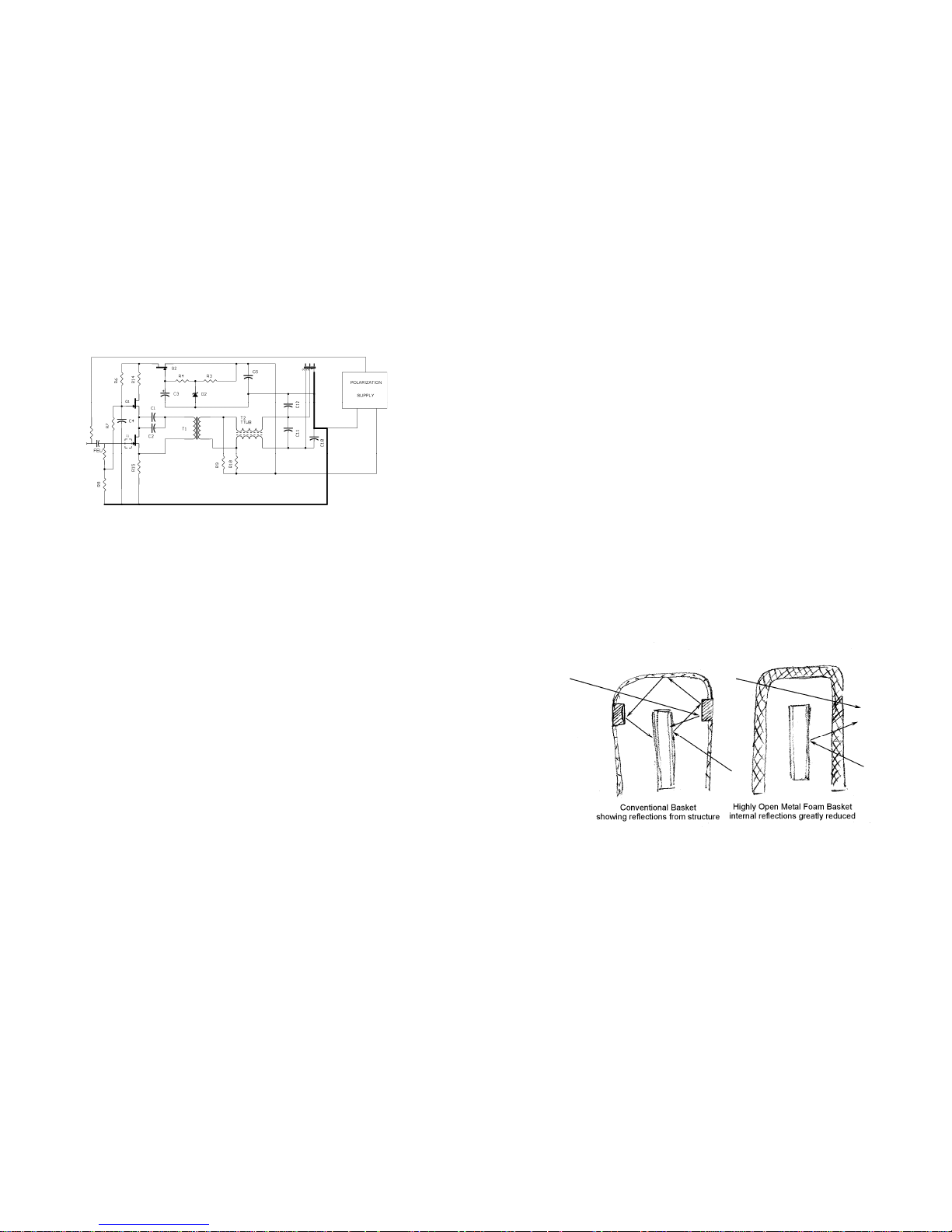
C715 schematic diagram
C715 Specifications
Type: Electrostatic pressure/pressure-gradient transducer, omni and
cardioid characteristic
Rated power supply: Phantom 48 ±4 volts, 5 mA max.
Internal impedance: 100 ohms
Rated impedance: 200 ohms
Minimum load impedance: 1k ohms
Sensitivity: 1.8 mV/Pa (-55 dB ref 1V/Pa)
Frequency Range: 20-20,000 Hz
Directional characteristics: continuously adjustable omni to cardioid
Overload sound pressure: 140 dB SPL at 1000 Hz
Equivalent sound pressure due to inherent noise: 19 dB SPL, Aweighted rms in accordance with IEC 60268-1
The Josephson C715 is part of the Series Seven range of large
diaphragm side-address microphones. It uses a capsule with a single
large diaphragm, with an adjustable rear port to select between
cardioid and omnidirectional patterns.
A unique feature of the C715 is its open-cell metal foam grille,
subject of our US Patent 8,005,250. Unlike traditional microphone
housings made of perforated metal or wire screen with reflective
metal support structures, this highly open material protects the
capsule mechanically, provides electrical shielding and some pop
and wind screening without needing any additional support
structure. A fine, acoustically transparent screen inside the grille
helps protect the capsule from breath moisture when the C715 is
used as a vocal mic. We were able to avoid using a traditional
basket support structure because the foam itself is a tough selfsupporting aluminum alloy. It’s a highly open structure so that
internal reflections are negligible, while the metal still provides full
protection for the capsule. Traditional designs incorporate rings and
bars to support the basket material, leading to the reflections shown
in the left illustration.
These reflections in turn introduce acoustic resonances in the
microphone response, which contribute to frequency response and
Page 4

phase anomalies (which can lead to harshness and other unpleasant
sounds in the pickup). Maintaining acoustical transparency around
the capsule is important in achieving the sonic clarity that is this mic’s
signature.
Pattern Control
The directional pattern of the C715 is adjusted using a mechanical
vent that, when open, provides the additional acoustical port needed
to produce a cardioid polar pattern from half pressure and half
pressure-gradient operation. When the vent is closed, the
microphone is omnidirectional. The vent is adjusted by turning the
pattern control screw, which is accessible through a port in the rear
of the grille. A special screwdriver is provided.
Pattern control port, as shown from back of microphone.
Turning the screw clockwise closes the vent (omni) while turning
counterclockwise opens it (cardioid). These patterns are marked on
the control port.
Although the adjustment screw is provided to adjust the acoustical
circuit, it is also part of the electrical circuit of the microphone.
Touching it with a screwdriver will produce a very high level signal
at the microphone output.
Adjust the microphone pattern ONLY when the
microphone is disconnected, powered off, or its
output is muted.
While it won’t damage the microphone, if you adjust the microphone
pattern while the output is active, you risk damaging your hearing
and any monitor speakers or headphones that might be connected to
your equipment.
About Directional Patterns
The C715 achieves its directional response by subtracting sound that
comes from the back, from the sound entering the front of the
capsule. This allows us to tune a “null” toward the rear, and the
response to sounds arriving from the back may be reduced 20 dB or
more from response to sounds coming from other directions. The
C715 allows the traditional omni and cardioid patterns to be
selected repeatably, and with some care, it is possible to set the
pattern control vent to produce “wide” or “subcardioid” patterns.
However, the range from omni (full clockwise) to cardioid
(counterclockwise 90 degrees to the stop) is not linear; subcardioid
is achieved with the adjustment vent just slightly counterclockwise
from omni (fully closed), and results for intermediate patterns are not
easily repeatable from microphone to microphone or if the
adjustment is moved.
About the C715 Circuit
Like most Josephson microphones, the C715 uses an all-discrete
class-A circuit to transform the high impedance of the capsule to a
suitable level for interface with mic preamps and consoles. A
cascode FET stage directly drives a special Lundahl output
transformer, which uses a high permeability nickel alloy core
material. The result is a much higher overload point, even when the
mic is driving long cables. This also means that the output level is
much lower than with many modern condenser microphones. High
output level can overload preamps and mixers when used close to
loud sound sources, so we have chosen to set the sensitivity of the
C715 to work well with a wide range of sound sources and with a
variety of preamps and other equipment.
The internal power supply of the C715 uses a new electrostatic
circuit that provides capsule polarization charge without the use of
oscillators or external power supplies.
 Loading...