

Page 1

Surgical Technique Guide
Page 2

The MEDSTREAM Programmable Infusion System is intended for
the intrathecal delivery of selected drugs for pain management or
CONSULTING PHYSICIANS
Robert M. Levy, MD, PhD
Neurological Surgery
Northwestern University Hospital
Chicago, IL
spasticity management.
The implantable components of the system
include the infusion pump, pump catheter, connector and strain-relief
sleeve. The accessories needed to prepare the pump for implantation are
included with the pump in the O.R. prep kit.
The pump must be connected to a suitable intraspinal catheter.
The following intraspinal catheters are designed for use with the
MEDSTREAM pump:
CODMAN
This guide covers the implantation of the SURESTREAM
Catheter. For instructions on implantation of the CODMAN
®
Intraspinal Catheter Kit
SURESTREAM
™
Intraspinal Catheter Kit
™
Intraspinal
®
Intraspinal Catheter, please refer to its instructions for use.
The MEDSTREAM Control Unit is an external part of the system that is
required to prepare the pump for implantation, and to program the daily
dosage postoperatively. The control unit uses radio frequency to create
two-way communication with the pump. It is used to retrieve status
information from and transmit programming changes to the pump.
The control unit also must be used each time the reservoir is refilled.
Timothy R. Deer, MD
Anesthesiology, Pain Medicine
Center for Pain Relief
Charleston, WV
CAUTION: Do not implant the MEDSTREAM Pump without ensuring
a thorough familiarity with the information contained in this manual,
the Control Unit instructions and the MEDSTREAM Programming Guide.
Page 3

MEDSTREAM™PROGRAMMABLE INFUSION SYSTEM Surgical Technique Guide
Surgical Technique Guide
PATIENT POSITIONING AND PREPARATION Page 3
PREOPERATIVE PUMP PREPARATION Page 3
PLACE THE INTRASPINAL CATHETER Page 4
PREPARE THE PUMP Page 9
PREPARE THE PUMP POCKET Page 10
TUNNEL THE INTRASPINAL CATHETER Page 11
TO THE PUMP POCKET
PREPARE THE CATHETER CONNECTION Page 12
PLACE AND SECURE PUMP Page 14
POSTOPERATIVE PROGRAMMING Page 15
ESSENTIAL PRESCRIBING INFORMATION Page 16
Page 4
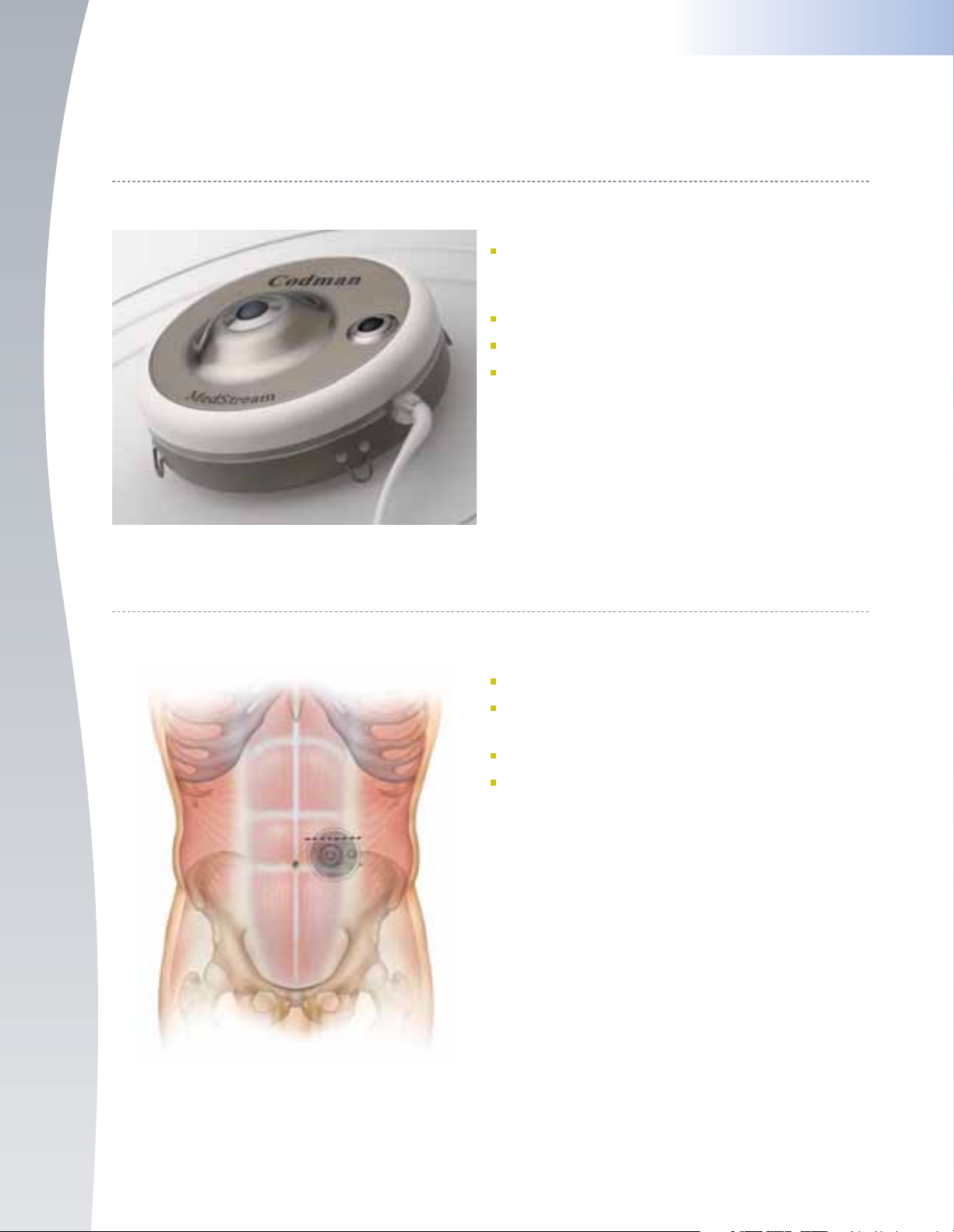
SUPPLIES NEEDED FROM CODMAN
PREOPERATIVE PLANNING
MEDSTREAM Implantable Pump (20 mL or 40 mL)
MEDSTREAM OR Prep Kit
CODMAN Pump Catheter
MEDSTREAM Control Unit
™
SURESTREAM
CODMAN Tunneler
Intraspinal Catheter
Identify pump location before surgery with patient.
The pump is usually located between costal margin and
iliac crest however optimal placement is patient specific.
Draw position on skin while patient stands or sits upright.
Avoid positioning the incision line directly over refill
septum.
2
Page 5
MEDSTREAM™PROGRAMMABLE INFUSION SYSTEM Surgical Technique Guide
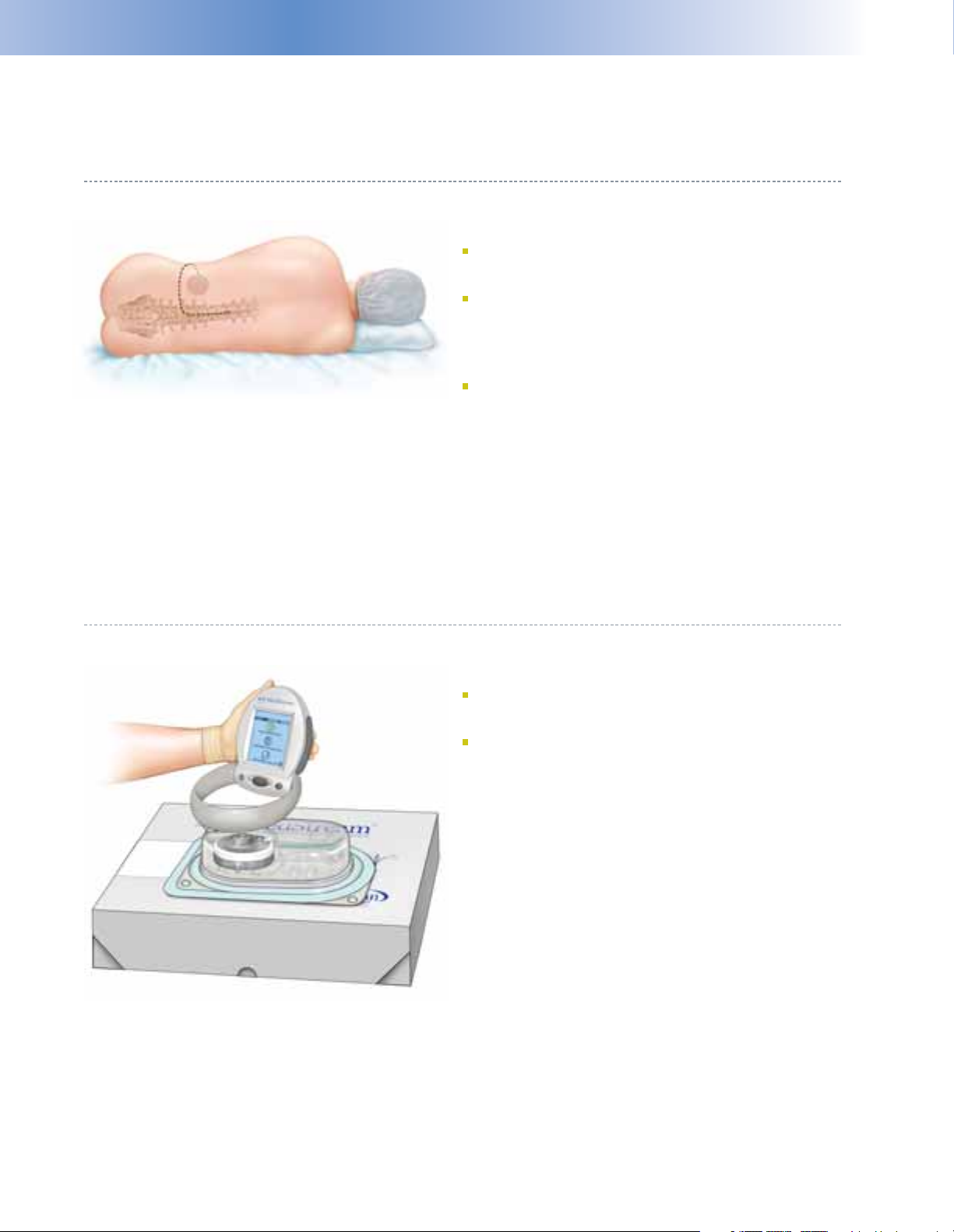
PATIENT POSITIONING
Place patient in a right or left lateral decubitus position
with the lumbar region slightly flexed.
The skin should be prepared using an appropriate
antimicrobial solution over the desired area in the back,
flank, chest, and lower abdomen where the catheter will
be tunneled to the pump.
Sterile drapes should be applied.
PREOPERATIVE PUMP PREPARATION
Follow the pump preparation procedure detailed in the
MEDSTREAM Pump Instructions for Use.
Using the MEDSTREAM Control Unit, perform the pump
internal check and ensure that pump is deemed ready for
implant.
3
Page 6
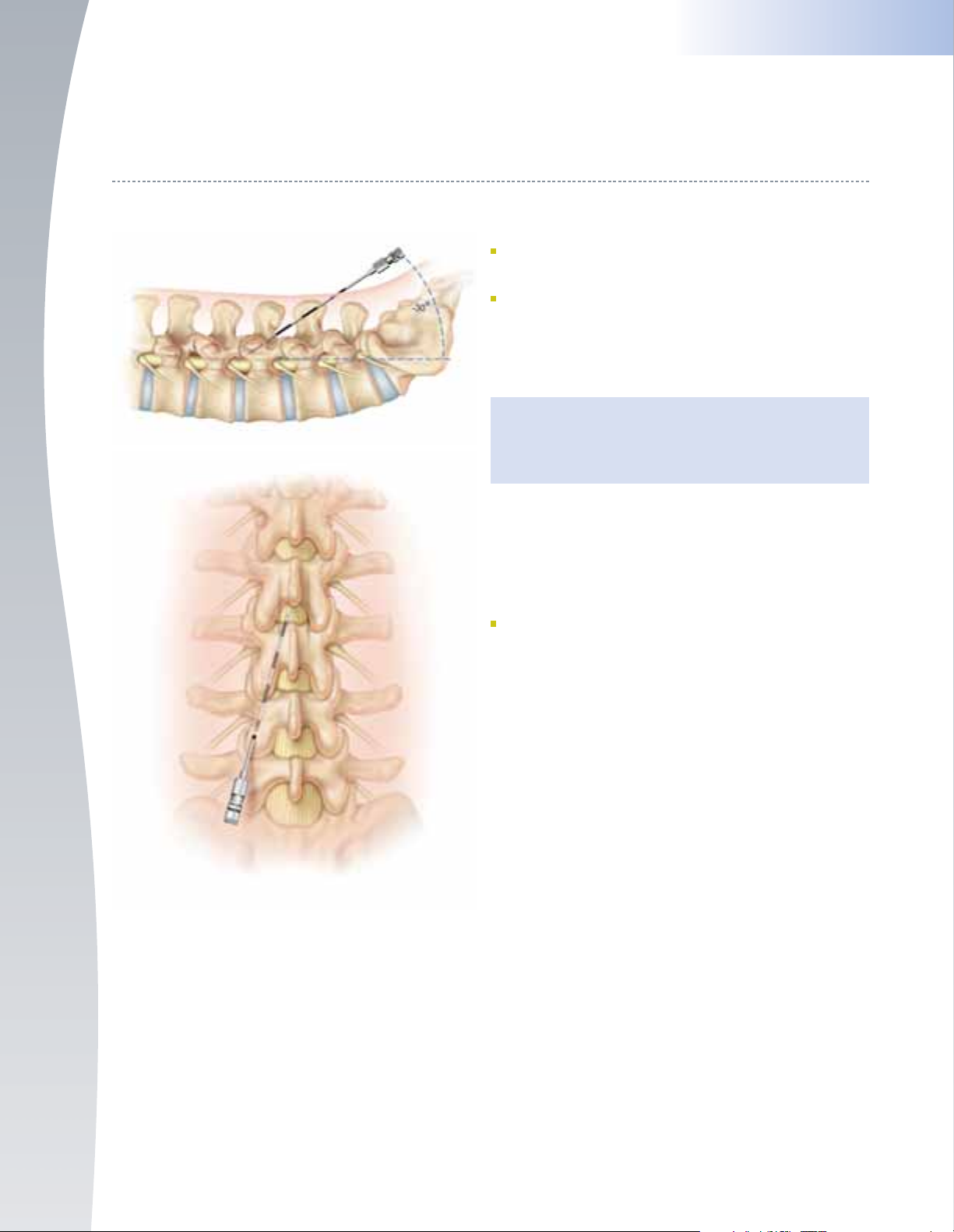
STEP 1. Place the Intraspinal Catheter
POSITION THE SPINAL NEEDLE
Under fluoroscopy, insert the 17 gauge Touhy needle
using a shallow, oblique paramedian insertion technique.
The skin entry point will be parallel to the vertebral
pedicle, approximately ½ to 2 cm off of midline and
½ to 1 ½ vertebral levels below the targeted
interlaminar space.
Note:
In patients with difficult spinal anatomy, the
needle angle may need to be adjusted.
ALTERNATIVE TECHNIQUE:
A small incision, centered around the desired needle
entry point, may be made before needle insertion.
4
Page 7
MEDSTREAM™PROGRAMMABLE INFUSION SYSTEM Surgical Technique Guide
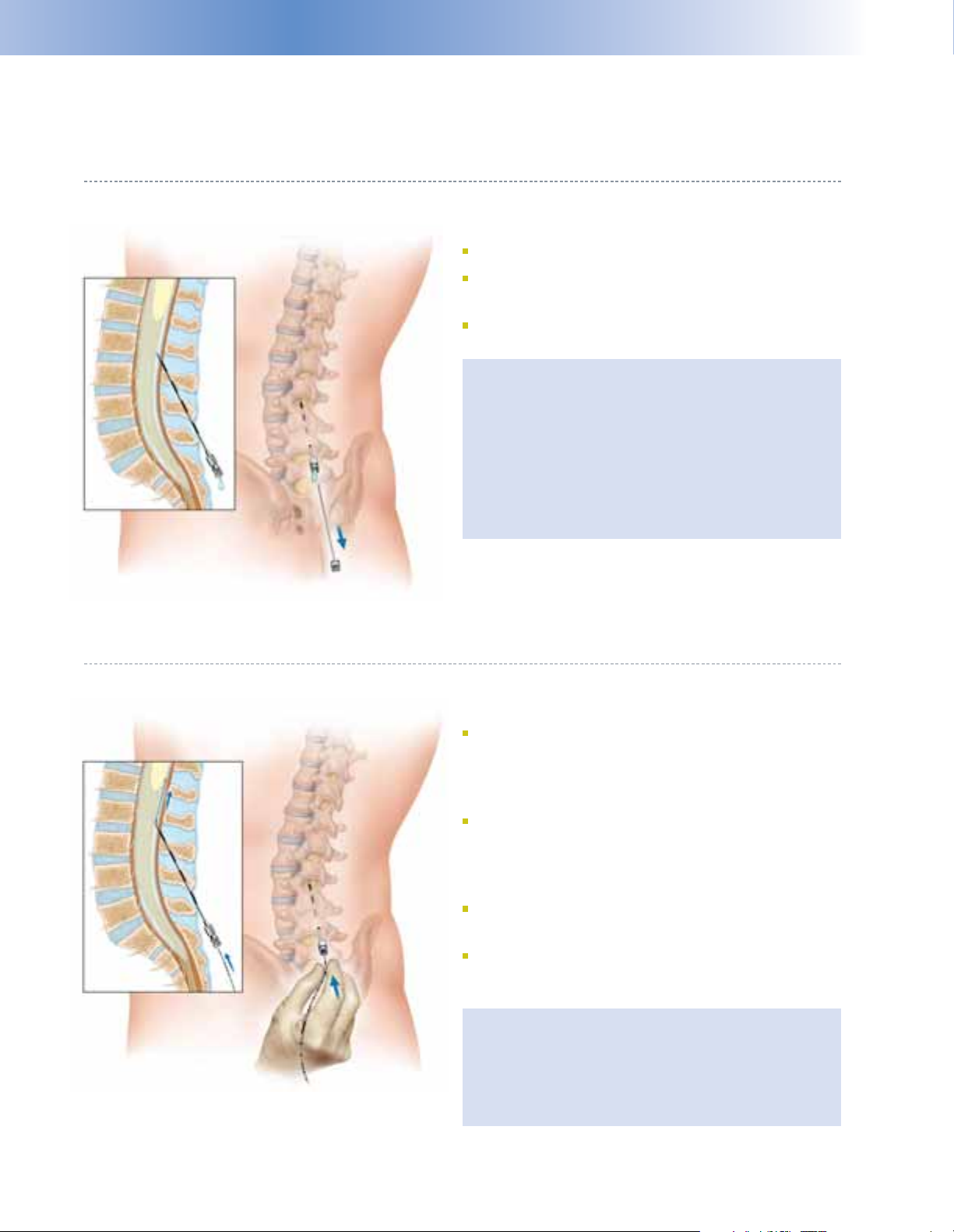
ENTER THE INTRATHECAL SPACE
Advance the needle until the dura is penetrated.
Remove the needle stylet to observe cerebrospinal fluid
(CSF) backflow and confirm intrathecal location.
Replace needle stylet to prevent CSF leakage.
Caution:
If parathesia occurs, redirect the needle to avoid
neural injury.
If the patient develops neurological signs or
symptoms, discontinue.
INSERT THE INTRASPINAL CATHETER
If excessive bleeding is encountered, stop and
reevaluate.
When the needle position is properly located and
confirmed by fluoroscopy, remove the stylet. Orient the
needle bevel cephalad and thread the distal tip of
catheter through the needle.
When the wide marker band on the catheter is at the
hub of the needle, the catheter tip is at the tip of the
needle. A slight increase in advancement pressure may
be noted.
Advance the catheter with the guidewire to the desired
location in the intrathecal space.
Markers are provided on the SURESTREAM catheter in
centimeter increments.
Caution:
Pulling back on the guide wire while the catheter
and guide wire are still inserted in the Touhy
needle may damage the catheter.
5
Page 8
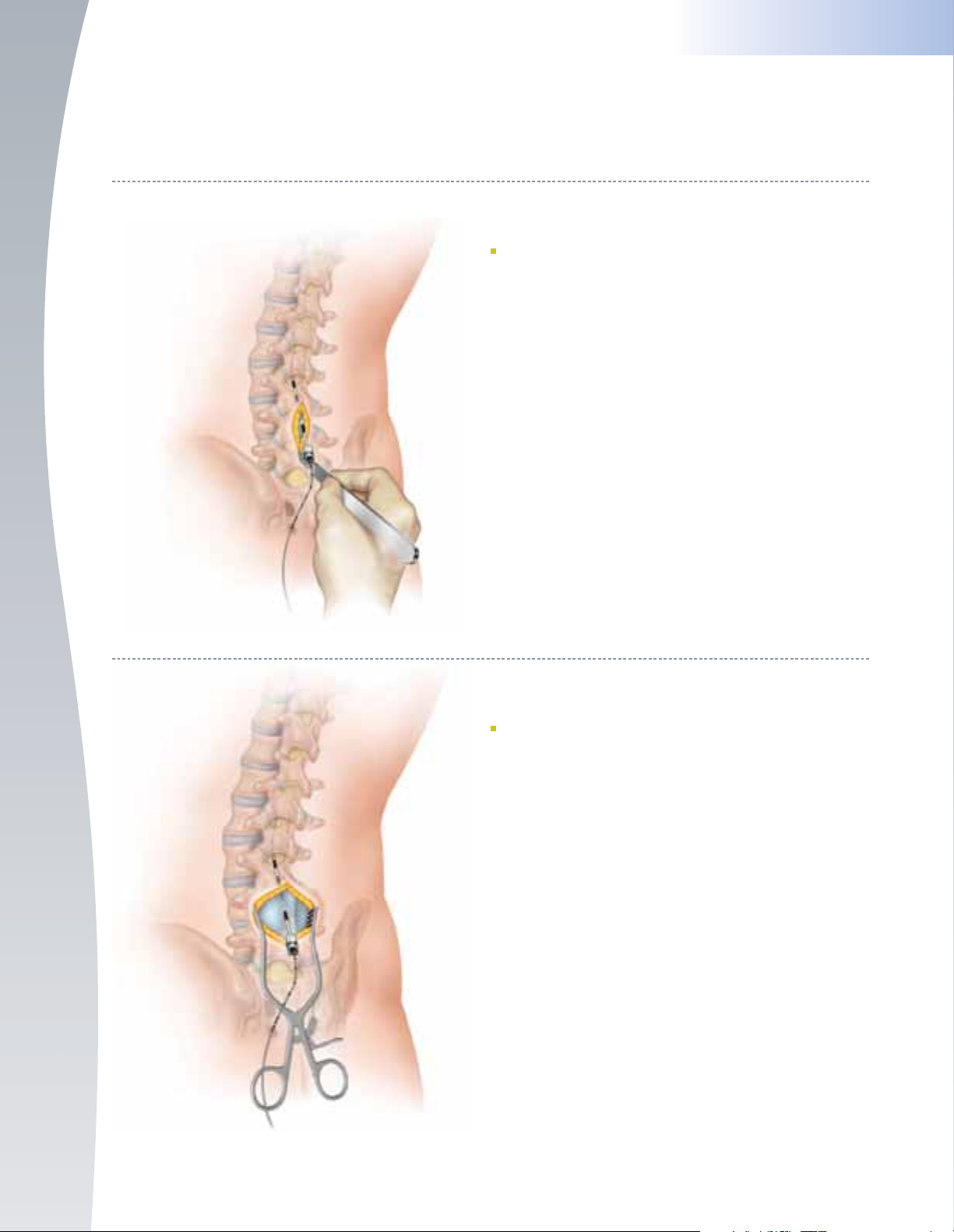
MAKE A SKIN INCISION
Make an incision centered at the needle insertion site.
Expose an area of the fascia that is large enough to
place the catheter anchor.
6
Page 9
MEDSTREAM™PROGRAMMABLE INFUSION SYSTEM Surgical Technique Guide
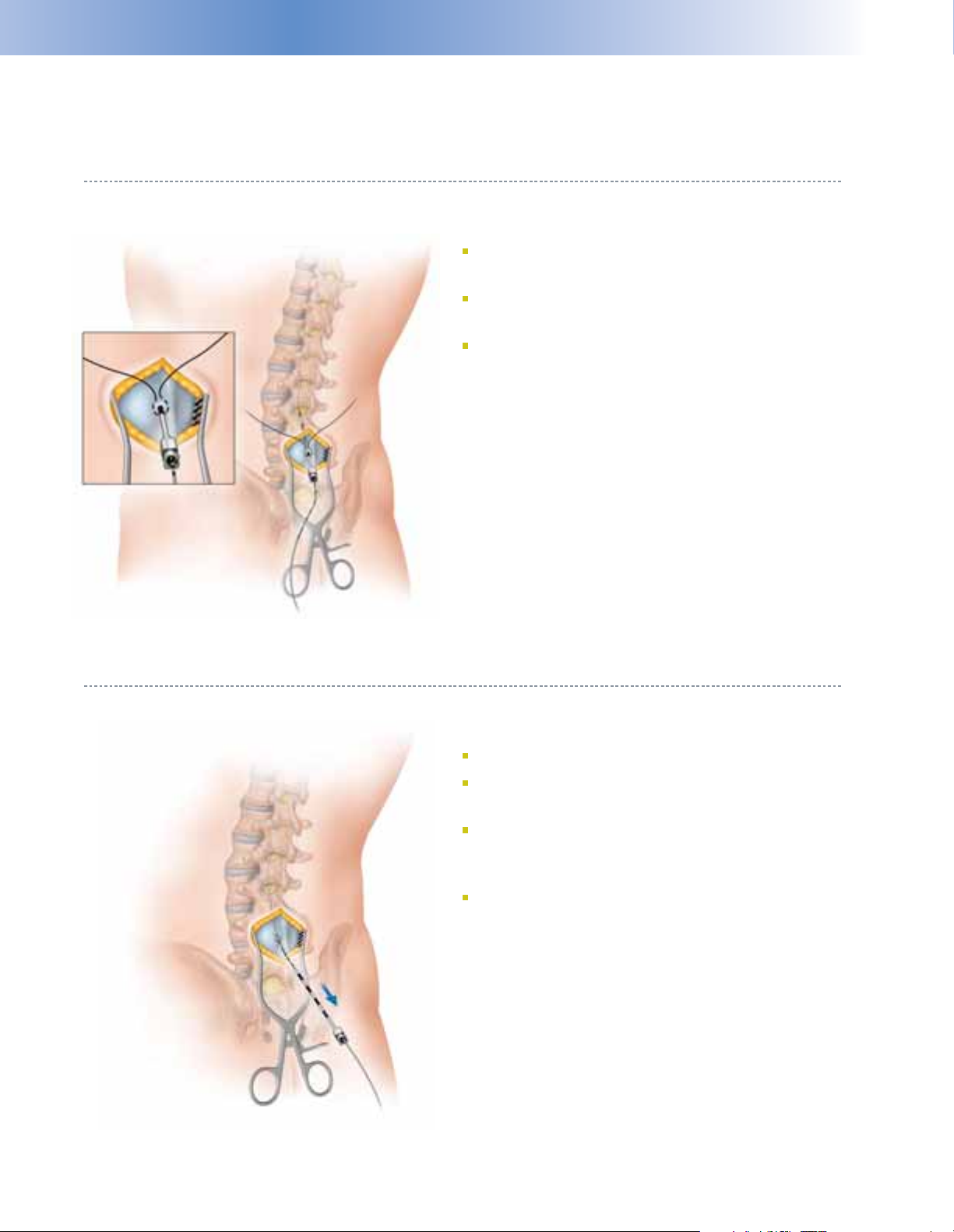
PLACE PURSE-STRING SUTURE
Place a purse-string suture through the lumbo-dorsal
fascia and around the catheter.
The purse-string suture should be placed before
removing the Touhy needle.
The purse-string suture will help the surrounding tissue
fibrose and may reduce the likelihood of CSF leakage,
subcutaneous CSF collection and/or postoperative
headache.
REMOVE NEEDLE AND GUIDE WIRE
Carefully remove the needle tip from the fascia.
Gently tighten the purse-string suture around the
catheter taking care not to occlude or kink the catheter.
Before removing the guide wire, grasp the catheter near
the fascial exit site and carefully slide the needle to the
end of the catheter.
Remove the guide wire and needle from the catheter
simultaneously.
7
Page 10
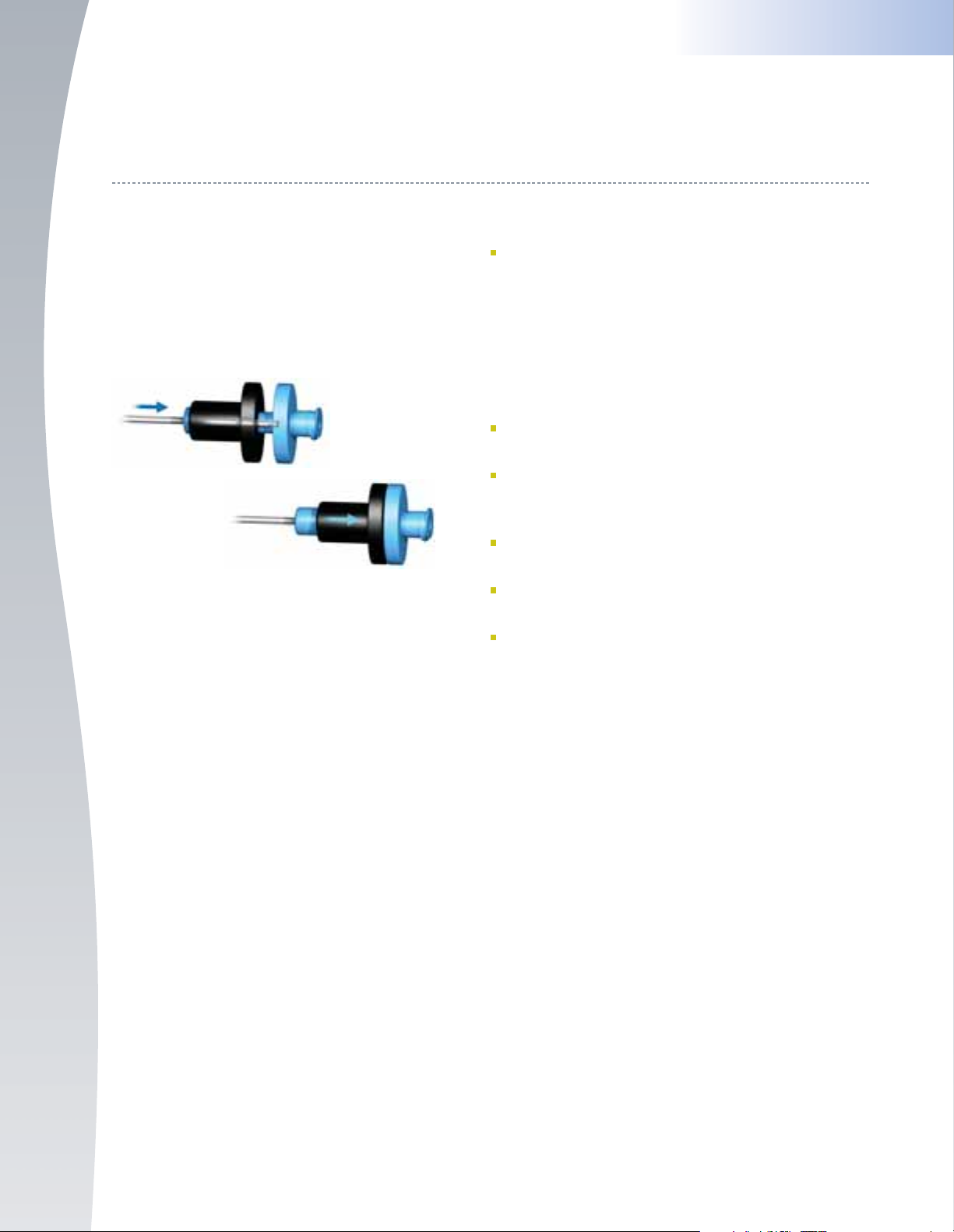
TEST FOR INTRASPINAL CATHETER PATENCY.
Catheter patency may be confirmed by observing
continuous CSF backflow through the catheter. If CSF
backflow is inadequate, patency may be tested via saline
injection detailed in the alternative technique.
ALTERNATIVE TECHNIQUE:
Insert the proximal end of the catheter into the
SNAPLOCK
While maintaining the catheter position, tighten the
adaptor by squeezing the black collar toward the luer
hub until the gap between the pieces is closed.
To ensure that the connection is secure, gently tug the
catheter near the adaptor.
Attach a 10ml syringe filled with preservative free saline
and flush the catheter to test for patency.
Replace the SNAPLOCK
™
Adaptor until the catheter bottoms out.
™
cap to prevent CSF leakage.
8
Page 11
MEDSTREAM™PROGRAMMABLE INFUSION SYSTEM Surgical Technique Guide
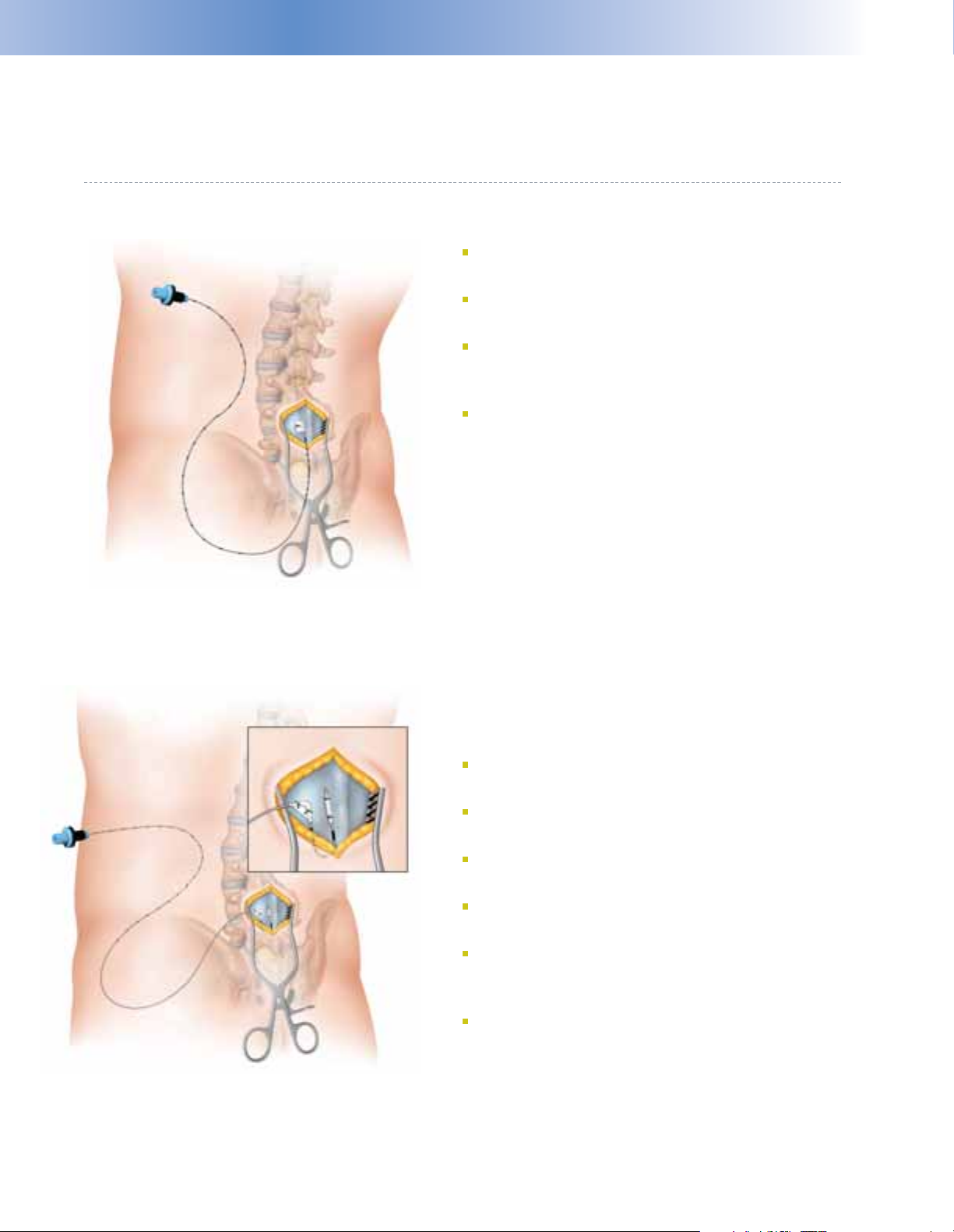
ANCHOR INTRASPINAL CATHETER TO THE FASCIA
Attach the silicone anchor to the catheter where the
catheter enters the lumbo-dorsal fascia.
Fasten the anchor to the fascia using heavy nonabsorbable suture.
Reconfirm catheter patency with saline flush or CSF
backflow. Replace the SNAPLOCK
CSF leakage.
Verify and document catheter position using fluoroscopy.
™
cap to prevent
ALTERNATIVE TECHNIQUE (DUAL ANCHOR):
Attach the cylindrical silicone anchor to the catheter
where the catheter enters the lumbo-dorsal fascia.
Fasten the anchor to the fascia using heavy nonabsorbable suture.
Create a strain relief loop in the catheter of
approximately 3 cm.
Attach the right angle silicone anchor to the catheter and
fasten to the fascia using heavy non-absorbable suture.
Reconfirm catheter patency with saline flush or CSF
backflow. Replace the SNAPLOCK
™
cap to prevent
CSF leakage.
Verify and document catheter position using fluoroscopy.
9
Page 12
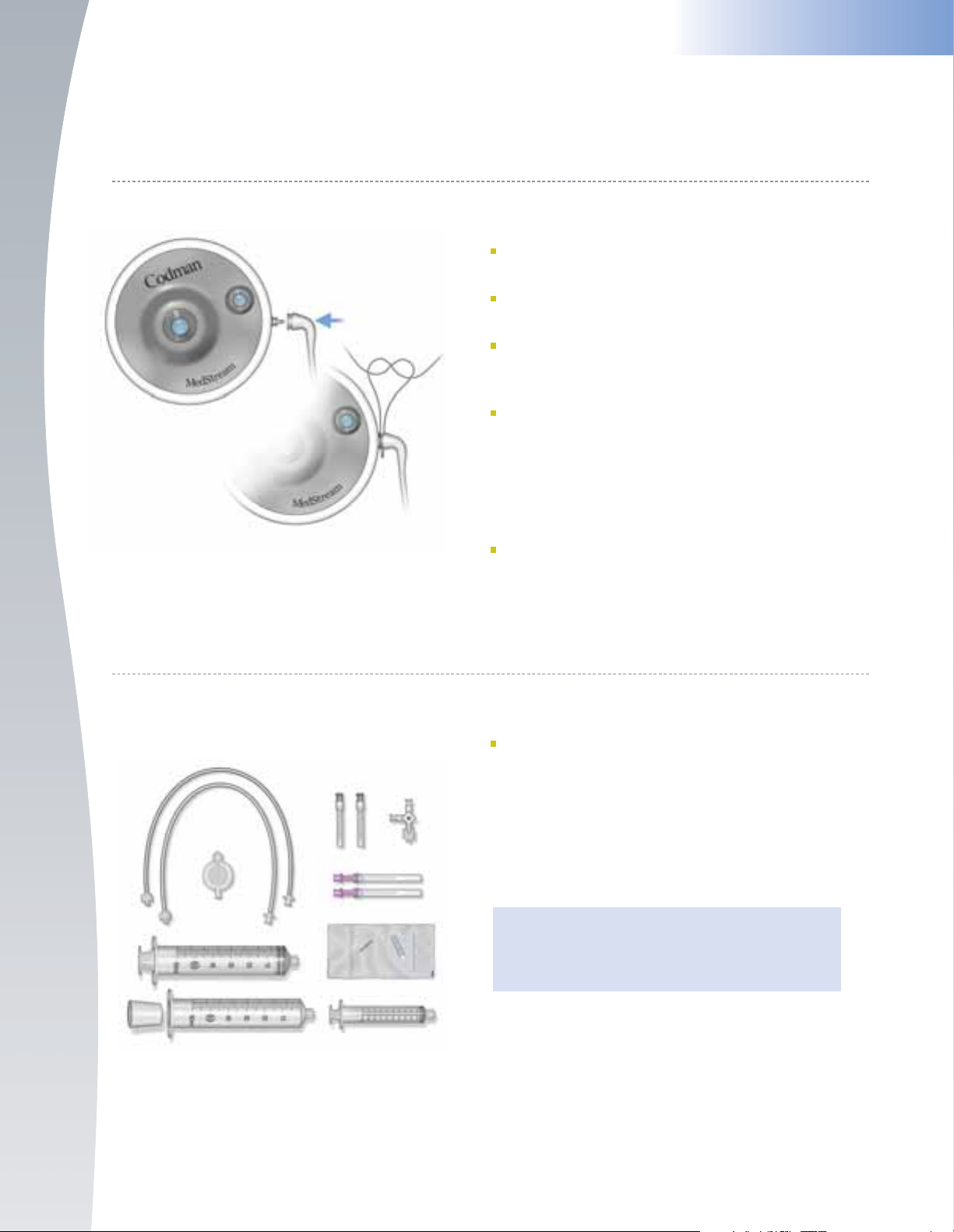
STEP 2. Prepare the Pump
ATTACH THE PUMP CATHETER
Aseptically deliver the pump and pump catheter to a
sterile surface.
Firmly press the catheter’s silicone connector onto the
pump’s catheter port.
Secure the connector with a heavy, non-absorbable
suture placed in the suture groove at the base of
the connector.
Check the catheter for any tears.
ALTERNATIVE TECHNIQUE:
The pump catheter may be attached to the intraspinal
catheter before attaching to the pump.
FILL AND PRIME THE PUMP
Using the OR Prep Kit, follow the MEDSTREAM Pump
Instructions for Use to perform the following steps.
1. Empty the reservoir
2. Flush the reservoir
3. Fill the reservoir
4. Prime the bolus channel
Note:
Also refer to the MEDSTREAM OR Poster for
detailed instructions and illustrations.
10
Page 13
MEDSTREAM™PROGRAMMABLE INFUSION SYSTEM Surgical Technique Guide
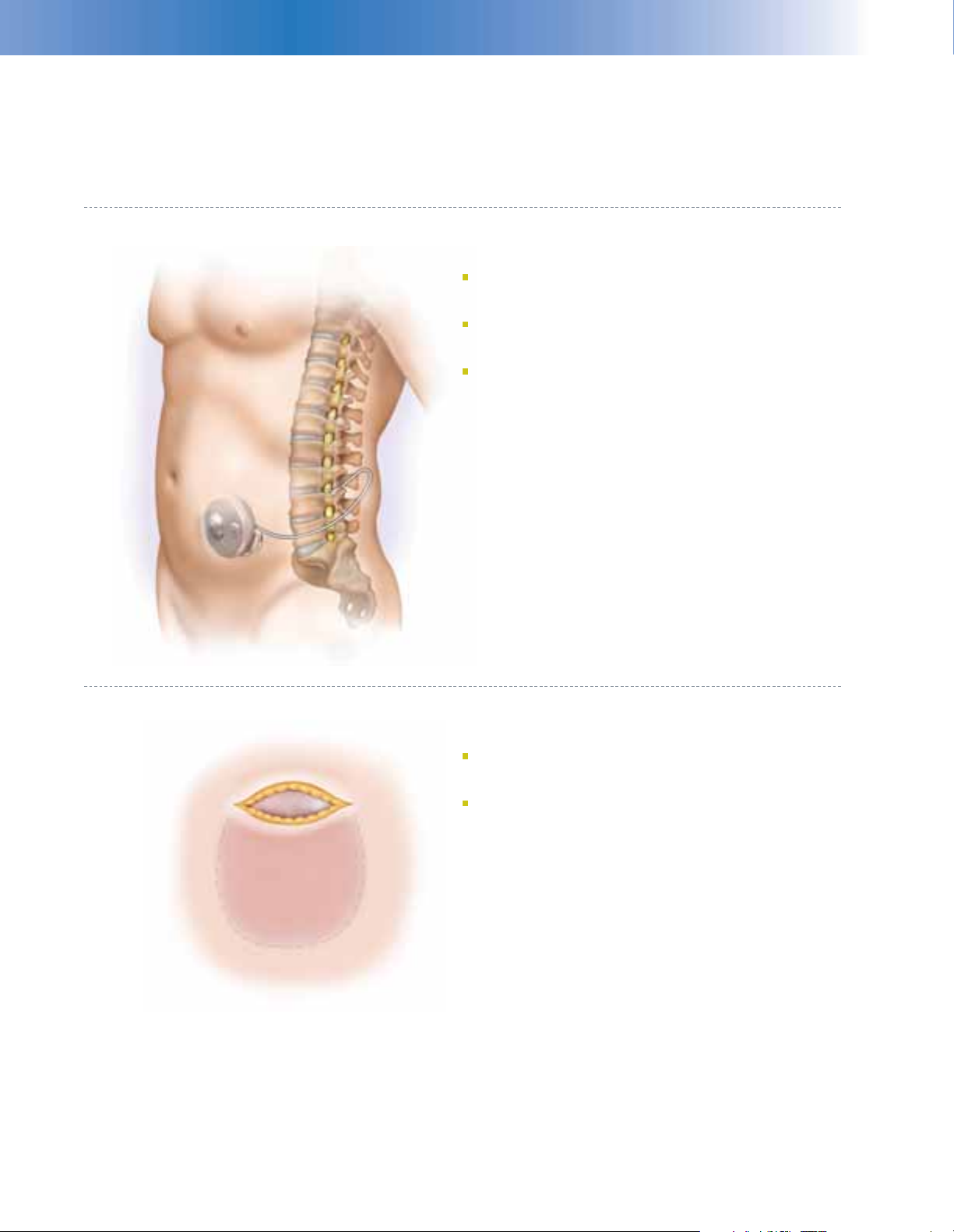
STEP 3. Prepare the Pump Pocket
CONSIDER THE FOLLOWING BEFORE PLACING THE PUMP
The pump should be no more than 2.5 cm from the
surface of the skin.
Avoid positioning the incision line directly over the refill
or bolus septum.
The refill port should be accessible after implantation.
CREATE A SUBCUTANEOUS POCKET FOR THE PUMP.
When possible, the incision should be along relaxed skin
tension lines and not across skin creases.
Care should be taken to apply meticulous hemostasis to
avoid hematoma or seroma formation after surgery.
11
11
Page 14
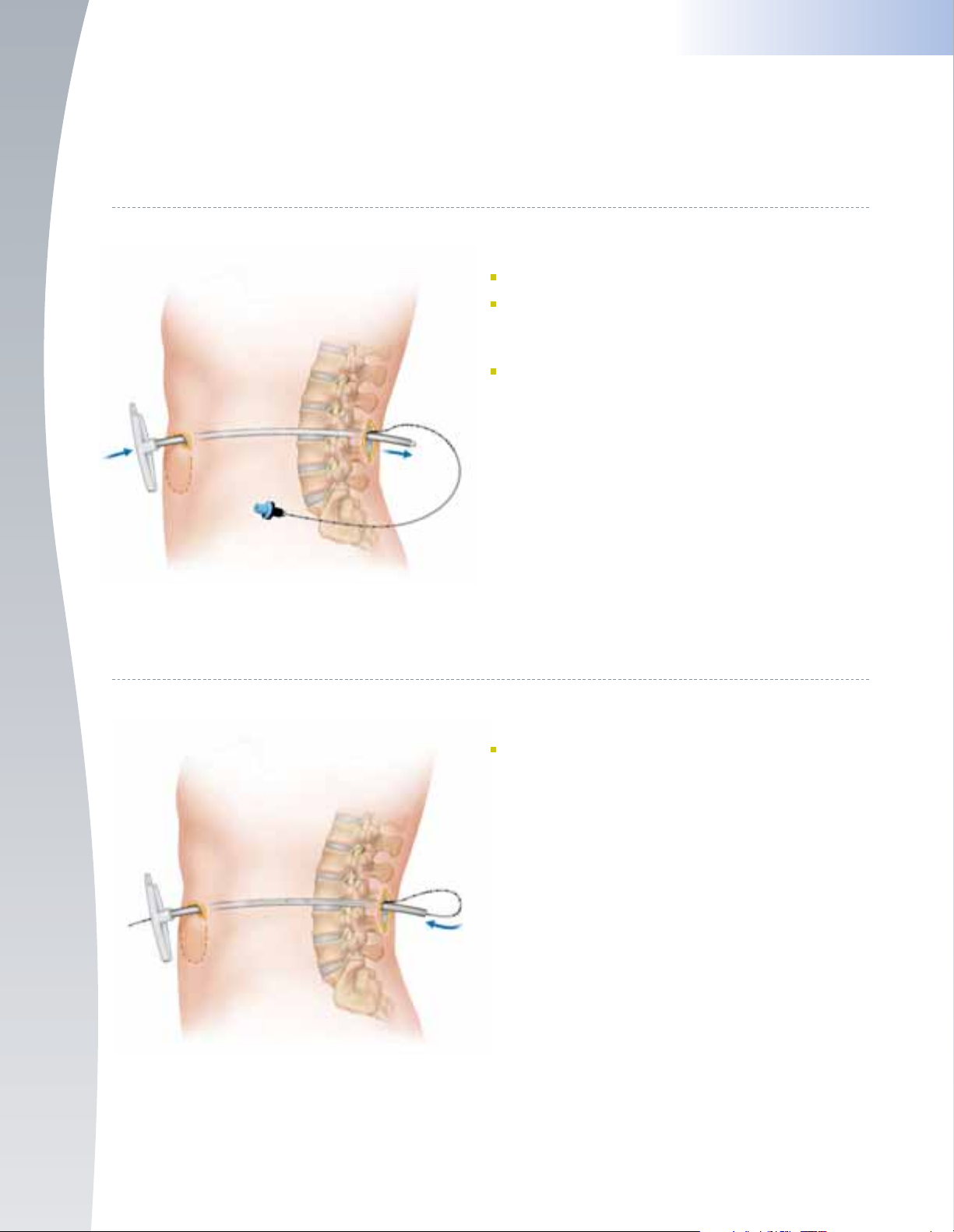
STEP 4. Tunnel the Intraspinal Catheter
to the Pump Pocket
CREATE SUBCUTANEOUS TUNNEL
Bend the tunneler to conform to the patient’s contour.
Insert the tunneler through the pump pocket wound
and advance to the intraspinal catheter exit wound
in the back.
Remove the plastic insert from the tunneler tube.
THREAD THE CATHETER TO THE PUMP POCKET
Remove the SNAPLOCK Adapter from the SURESTREAM
catheter and thread the catheter through the tunneler to
the pump pocket.
12
Page 15
MEDSTREAM™PROGRAMMABLE INFUSION SYSTEM Surgical Technique Guide
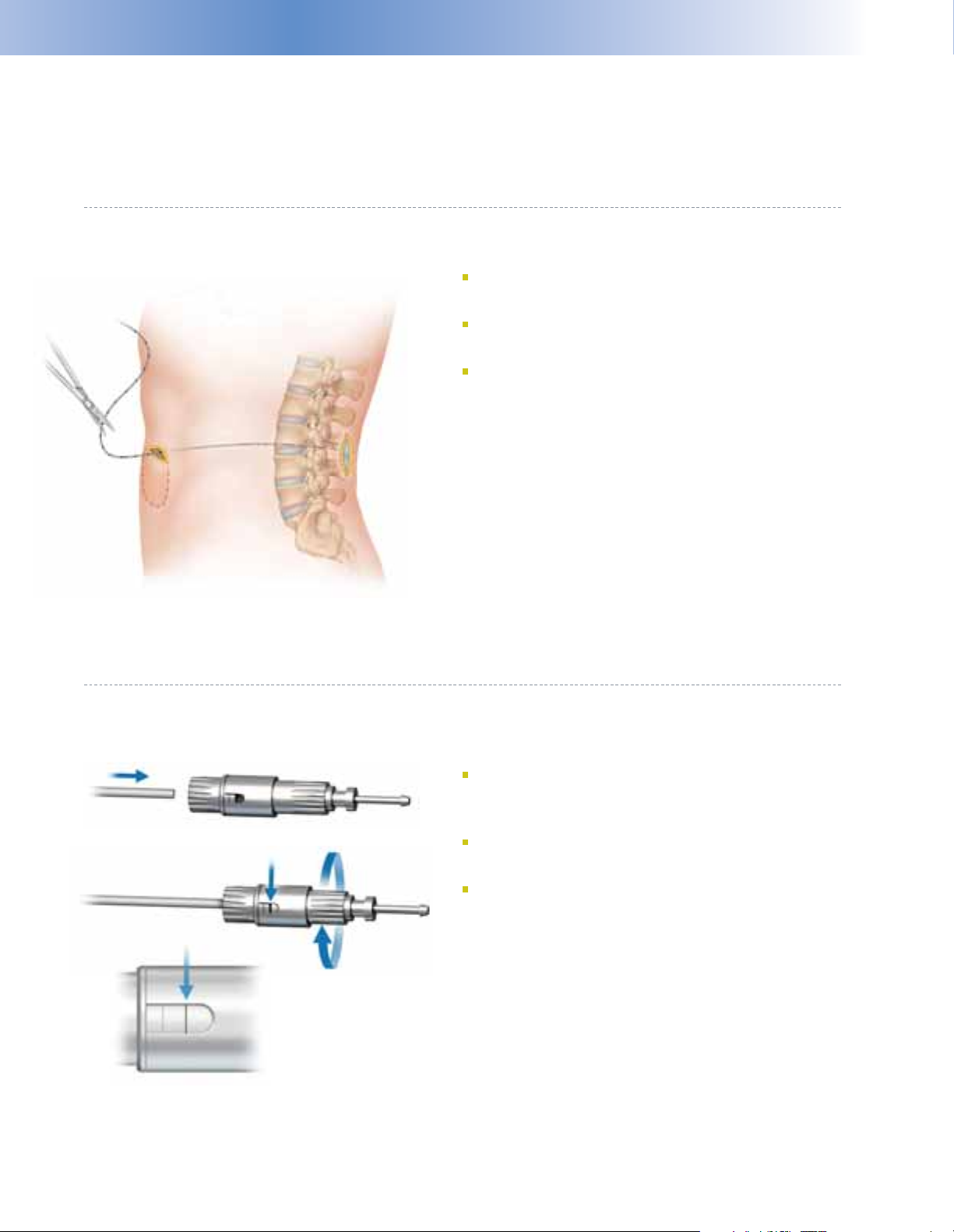
STEP 5. Prepare Catheter Connection
TRIM THE CATHETERS
Trim the MEDSTREAM pump catheter and the
SURESTREAM catheter to the desired lengths.
Provide sufficient slack in the pump catheter to allow the
catheter to be coiled at least once under the pump.
Document the length of the trimmed catheters to
determine the implanted catheter volume.
CONNECT THE SURESTREAM INTRASPINAL CATHETER
TO THE SURESTREAM CONNECTOR
Insert the trimmed end of the SURESTREAM Catheter
into the opening in the connector thumbscrew until it
cannot be advanced any further into the housing.
Tighten the thumbscrew until there is no visible gap in
the viewing window.
If needed, use an instrument, such as a Kelly clamp,
for tightening.
13
Page 16
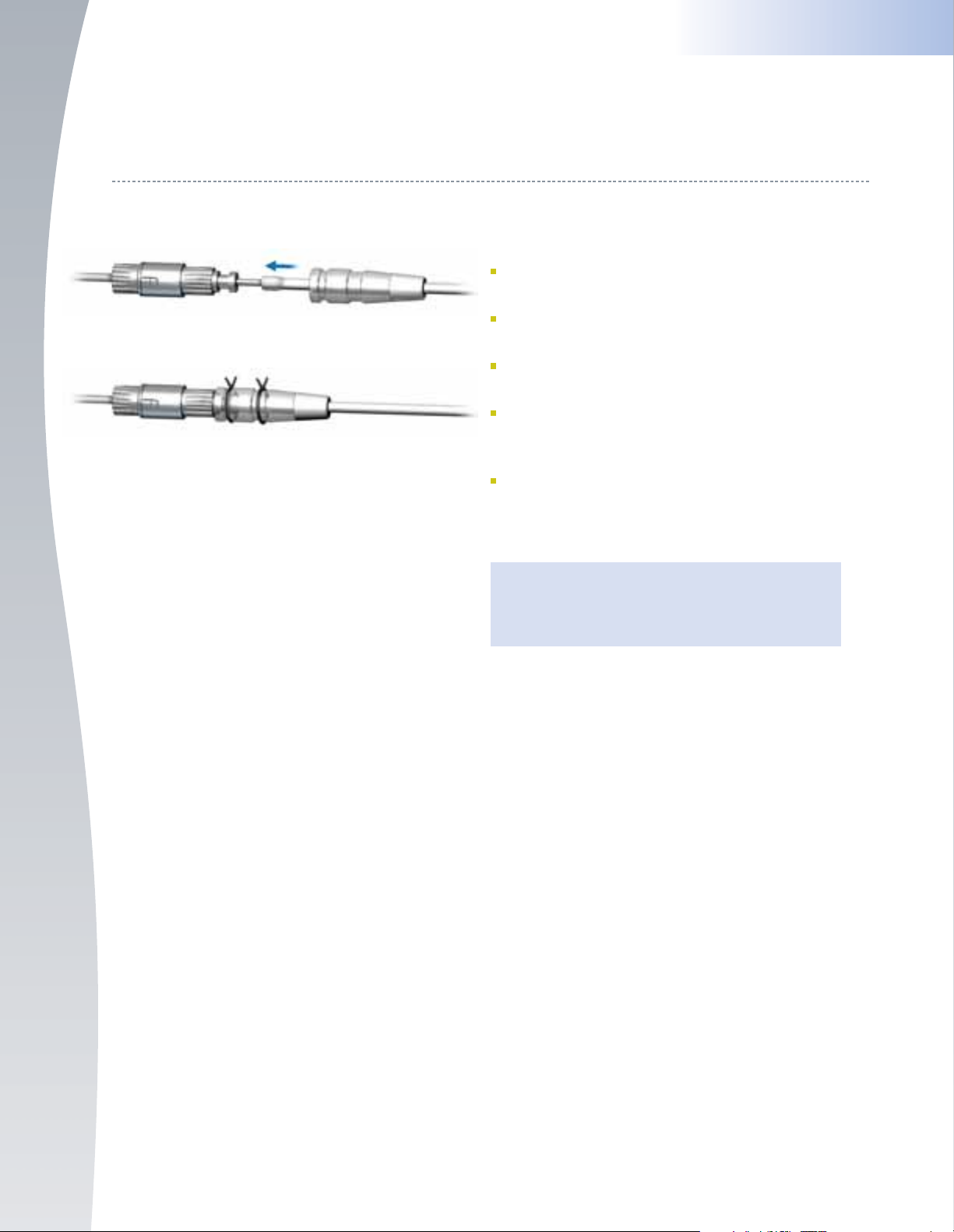
CONNECT THE MEDSTREAM PUMP CATHETER
TO THE SURESTREAM CONNECTOR
Slide the small diameter end of the strain relief sleeve
approximately 4 cm over the pump catheter.
Slide the end of the pump catheter onto the pin
connector with a slight twisting motion.
Slide the strain relief sleeve over the pin connector until it
contacts the stop.
Secure the strain relief sleeve onto the catheter and the
connector by tying 2 ligatures of heavy non-absorbable
suture.
Test for leaks and catheter patency by administering a
bolus injection of preservative free saline through the
bolus port.
Note:
Refer to the MEDSTREAM OR Poster for
detailed bolus instructions and illustrations.
14
Page 17
MEDSTREAM™PROGRAMMABLE INFUSION SYSTEM Surgical Technique Guide
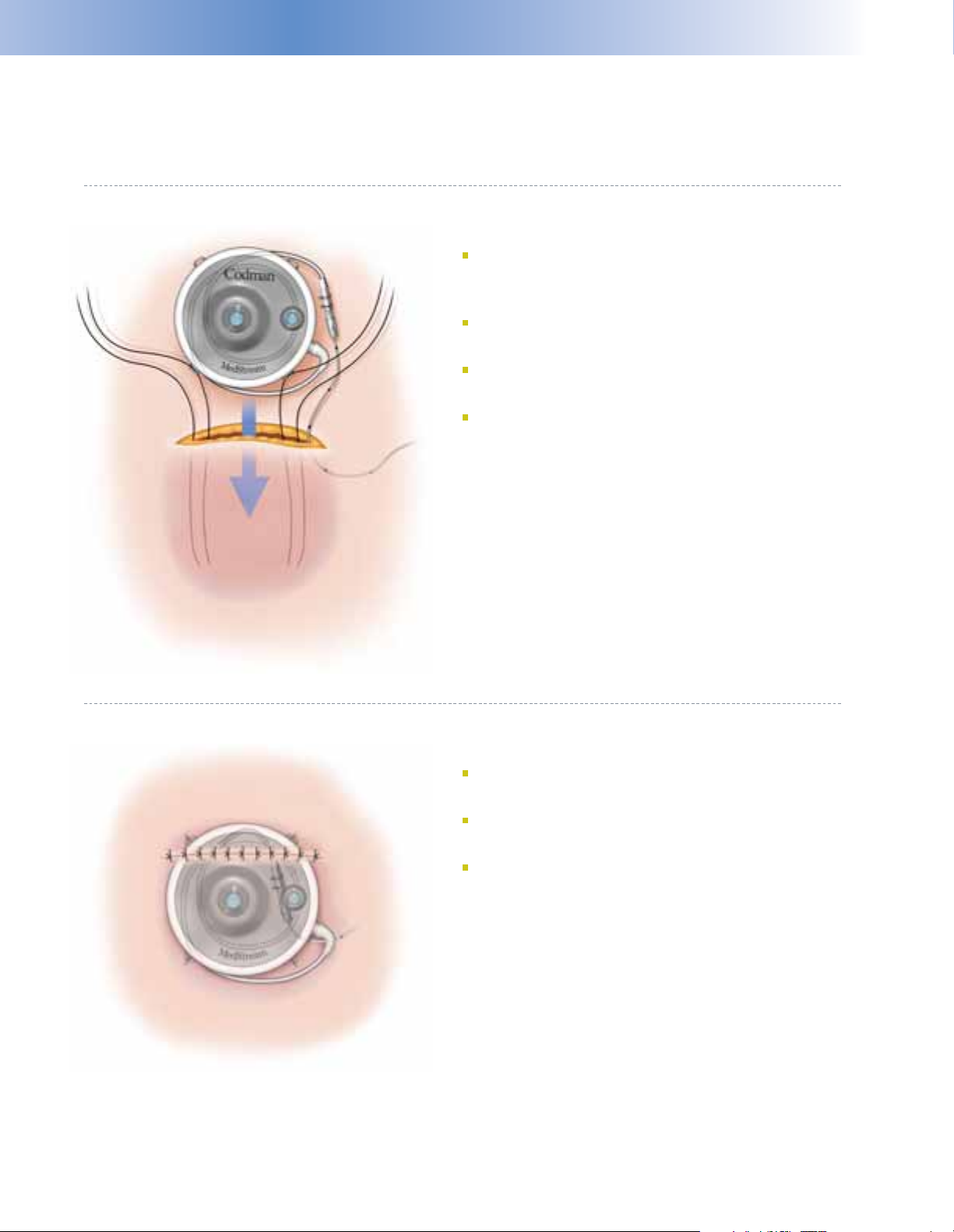
STEP 6. Place and Secure Pump
SECURE THE PUMP WITH SUTURE LOOPS
Firmly secure the pump using heavy non-absorbable
suture in a minimum of three of the four available
suture loops.
The sutures should be deep into the fascia and not in the
fatty tissue.
Place the SURESTREAM Connector and at least one loop
of pump catheter under the pump.
Re-test for catheter patency and leaks at the connection
site via the bolus port and MEDSTREAM Bolus Needle.
CLOSE INCISIONS
Irrigate the pump pocket and spinal incision site
thoroughly.
Close the incisions using subcutaneous and skin sutures
and apply dressing.
Care should be taken to avoid having skin sutures directly
overlying the refill port or the bolus port.
15
Page 18

Step 7. Post Operative Programming
Refer to the MEDSTREAM Pump Instructions for Use and
the MEDSTREAM Programming Guide for detailed
programming instructions.
16
Page 19

MEDSTREAM™PROGRAMMABLE INFUSION SYSTEM Surgical Technique Guide
Notes
17
Page 20

Notes
18
Page 21

MEDSTREAM™PROGRAMMABLE INFUSION SYSTEM Surgical Technique Guide
Notes
19
Page 22

Essential Prescribing Information
MEDSTREAM™Programmable Infusion System
Essential Prescribing Information:
Product instructions for use and appropriate drug labeling must be reviewed prior to use
for detailed disclosure.
INDICATIONS:
The MEDSTREAM™Programmable Infusion System is indicated for the chronic intrathecal
infusion of preservative-free morphine sulfate sterile solution (4.0 pH to 7.0 pH) in the
treatment of chronic, intractable pain (benign or malignant), and Baclofen injection sterile
solution (5.0 pH to 7.0 pH) in the treatment of severe spasticity.
CONTRAINDICATIONS:
The pump is contraindicated under the following conditions: in the presence of active or
incompletely treated infection; if the top surface of the implanted pump will be more
than 2.5 cm from the surface of the skin; if the patient’s body size is insufficient to accept
the bulk and weight of the pump; when conservative treatment is appropriate; and in the
presence of spinal anomalies that might complicate the implantation and fixation of an
intraspinal catheter. In addition, observe all contraindications relating to the use of the
prescribed drug.
Thoroughly review product instructions for use for a detailed listing of Indications,
Contraindications, Warnings, Precautions and Adverse Events.
LIMITED WARRANTY AND DISCLAIMER:
CODMAN products are sold with a limited warranty to the original purchaser against
defects in workmanship and materials. Any other express or implied warranties, including
warranties of merchantability or fitness, are hereby disclaimed.
CAUTION:
This device is restricted to sale by or on the order of a physician (or properly licensed
practitioner) who has appropriate training or experience.
20
Page 23

MEDSTREAM™PROGRAMMABLE INFUSION SYSTEM Surgical Technique Guide
CONTACT INFORMATION
Germany
Johnson & Johnson MEDICAL GmbH
Geschäftsbereich Codman
Oststrasse I
D-22844 Norderstedt
e-Mail: [email protected]
Marketing and Vertrieb:
Telefon: +49 040-5297 4614
Telefax: +49 040-5297 4617
Auftragsbearbeitung:
Telefon: +49 01801-000 829
Telefax: +49 0800-1016 138
Italy
Johnson & Johnson Medical SPA
Via Del Mare, 56
00040 Pratica Di Mare RM
+39-06-911.94.500 fax +39-06-911.94.505
United Kingdom
Johnson & Johnson Medical Ltd
Pinewood Campus, Nine Mile Ride
Wokingham
RG40 3EW
United Kingdom
Office Contact Information:
Telephone: +44 (0) 1344 871000
Fax: +44 (0) 1344 871120
Customer Services Contact Information:
Telephone: +44 (0) 800 864 060
Fax: +44 (0) 1344 864 018
Email: [email protected]
USA
Codman & Shurtleff, Inc.
325 Paramount Drive
Raynham, MA 02767
(800) 225-0460
Page 24
ACTIVE GUIDANCE™, MEDSTREAM™, and SURESTREAM™are
trademarks of Codman & Shurtleff, Inc.
CODMAN®is a registered trademark of Codman & Shurtleff, Inc.
For more information, contact your Codman Sales Representative
325 Paramount Drive
Raynham, MA 02767
www.codman.com
©2009 Codman & Shurtleff, Inc. All rights reserved.
DDS-90-001 04/09 JC/UM
 Loading...