

Page 1

How-To Guide
www.jitterbug.com
1-800-733-6632
Subject to Customer Agreement. Screen images simulated. Copyright ©2008 GreatCall, Inc. Jitterbug
is a registered trademark and GreatCall is a trademark of Great Call, Inc. Samsung is a registered
trademark of Samsung Electronics America, Inc. and its related entities.
800201_HTG_031308.qxp:user guide 3/13/08 1:05 PM Page 2
Page 2

Welcome to the Jitterbug®Family!
We are pleased to share with you the only cell phone
experience that is simple, helpful and affordable. Soon
you’ll see how easy it is to stay in touch with family and
friends by using your new Jitterbug.
Please read this guide carefully, it will help you
understand:
• e basics about getting started.
• How your Jitterbug works.
• When and how to use the Jitterbug operator.
• e important health and safety information about
your phone.
The entire Jitterbug experience has been created for
your comfort, convenience and ease of use. As we
constantly want to improve our service, we welcome
your feedback anytime. If we can help, please call – you
can even use your Jitterbug.
Best regards,
Your friends at Jitterbug
800201_HTG_031308.qxp:user guide 3/13/08 1:05 PM Page 4
Page 3

TABLE OF CONTENTS
Table of Contents I
TABLE OF CONTENTS
Table of Contents
Section 1: Getting Started................................1
How to use this guide ..............................................2
Key items in the Jitterbug® box .................................3
Installing the battery.................................................4
Charging the battery.................................................5
Low battery indicator ...............................................6
Turning your Jitterbug on/off ...................................7
Getting more information ........................................8
Contacting Customer Service ...................................8
Jitterbug operator assistance .....................................9
Section 2: Phone Features ..............................11
Closed view of your phone – front .........................12
Closed view of your phone–back ..........................14
Open view of your phone .......................................16
Display screen ........................................................18
Start-up features .....................................................19
Moving between features ........................................20
Optional services ....................................................21
Adjusting the ringer volume ...................................23
Adjusting the ear piece volume ...............................24
Speakerphone .........................................................24
Emergency 911 service ...........................................25
800201_HTG_031308.qxp:user guide 3/13/08 1:05 PM Page I
Page 4

II Table of Contents
TABLE OF CONTENTS
TABLE OF CONTENTS
Table of Contents III
TABLE OF CONTENTS
TABLE OF CONTENTS
Section 3: Placing and Receiving Calls ........29
Placing a call ..........................................................30
Receiving a call ......................................................33
Silencing a call .......................................................35
Section 4:Your Phone List .............................37
Adding, changing and deleting numbers ................38
Create a new member account ...............................39
Finding numbers in your phone list .......................46
Section 5: Call History ....................................49
Using call history to see recent calls .......................50
Returning missed calls and redialing ......................51
Saving numbers from your call history ...................52
Section 6:Voicemail ........................................55
Using voicemail .....................................................56
• Setting up voicemail ........................................56
• Recording your voicemail greeting ...................56
• Letting you know that you have voicemail
messages ..........................................................57
• Listening to voicemail messages .......................57
• Saving or deleting voicemail messages ..............58
• Listening to saved voicemail messages ..............58
• Changing your voicemail greeting ...................59
Section 7:Voice Dialing ...................................61
Setting up voice dialing ..........................................62
Voice dialing tips ....................................................63
Health and Safety Information .....................65
The Fine Print ..................................................97
Index .................................................................110
800201_HTG_031308.qxp:user guide 3/13/08 1:05 PM Page II
Page 5

Getting Started 1
SECTION 1
SECTION 1
Section 1
Getting Started
is section explains how to start using your
Jitterbug®phone.
Topics
• How to use this guide.
• Key items in the Jitterbug box.
• Installing the battery.
• Charging the battery.
• Low battery indicator.
• Turning your phone on/off.
• Getting more information.
• Contacting Customer Service.
• Jitterbug operator assistance.
For more information about Jitterbug, visit us online
at www.jitterbug.com
800201_HTG_031308.qxp:user guide 3/13/08 1:05 PM Page IV
Page 6
Getting Started 3
SECTION 1
2 Getting Started
SECTION 1
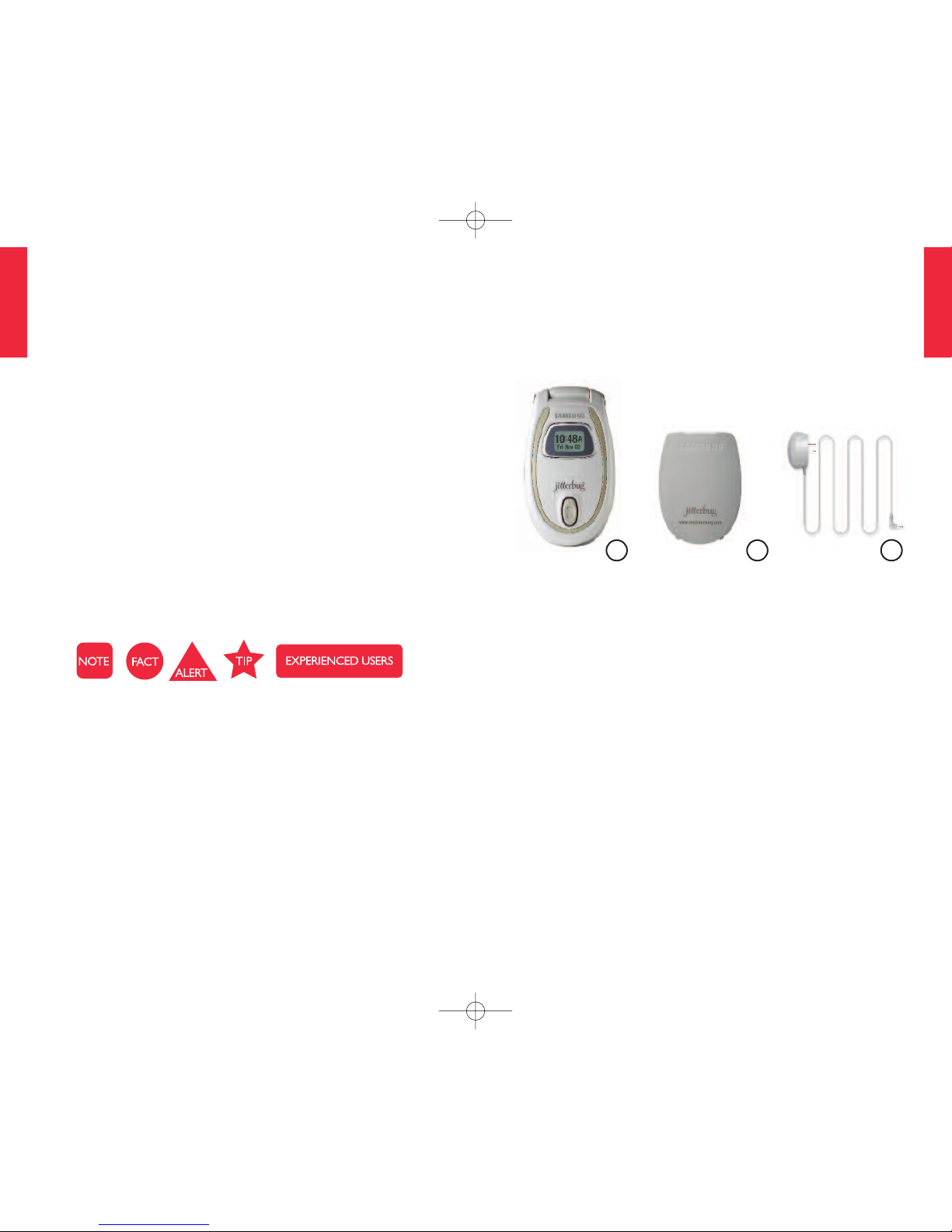
Key items in the Jitterbug box
The Jitterbug package you received includes everything
you need to get started:
1. Jitterbug Cell Phone.
2. Rechargeable Battery – slides into the back
of your phone.
3. AC Charger – to charge your battery.
How to use this guide
is How-To Guide is divided into seven sections that
describe the features of your Jitterbug®and how to use
them in a few simple steps. We recommend that you
read the entire guide and keep it handy for easy
reference.
You can also skip directly to the section you’re looking
for by using the Table of Contents on page I, the red
side tabs on each page, or the Index on page 110.
Throughout this guide we have included the following
illustrations, images and symbols to highlight useful
information.
A few features in this guide might be tricky for a first
time cell phone user. If you need assistance, please give
us a call anytime.
For more information, visit www.jitterbug.com or call
us at 1-800-733-6632.
2
3
1
800201_HTG_031308.qxp:user guide 3/13/08 1:05 PM Page 2
Page 7
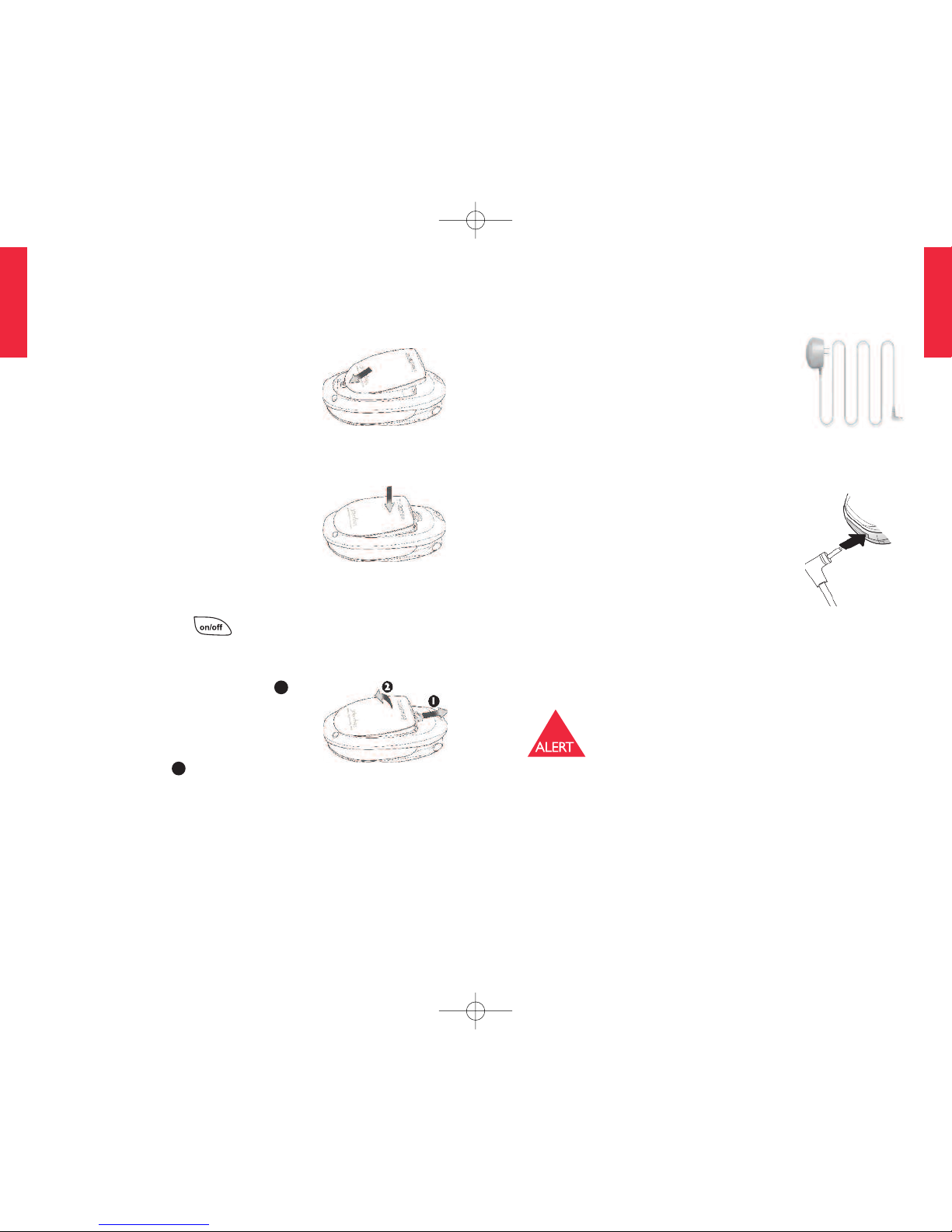
Installing the battery
To insert the battery:
1. Slide the rounded end of the
battery into the back of your
phone, lining up the gold contacts
on thebattery with the gold contacts
inside the phone.
2. Press the top end of the battery
down until it snaps into place.
To remove the battery:
1. If thephone is on, turn it off by opening the phone and
holding down the button for two seconds until
the Jitterbug®tune plays.
2. Slide the battery release latch1on
the back of the phone toward the
top end of the phone and hold.
3. Lift the battery
2
up and away from
the phone, top end first, or simply
turn your phone over. The battery
will drop out.
Getting Started 5
SECTION 1
4 Getting Started
SECTION 1
Back Side
Charging the battery
To charge your Jitterbug:
1. An AC Charger is included in the
box with your Jitterbug phone.
2. Plug the large end of the charger into
a standard wall outlet (120/220 VAC).
3. Plug the smaller end into the
bottom of your phone. You’ll
see a “Charging” message in
the display window.
4. When the battery is fully charged,
you’ll see a “Completed” message in the
display window.
You must fully charge your battery before
using your phone for the first time. Failure to
do so may damage your battery.
800201_HTG_031308.qxp:user guide 3/13/08 1:05 PM Page 4
Page 8
Getting Started 7
SECTION 1
6 Getting Started
SECTION 1
Low battery indicator
Jitterbug®phones remind you to charge your battery.
Reminders appear on the screen with the following
messages:
• “Charge Battery” appears when you have used
approximately 50% of your battery. Don’t be
alarmed and feel free to continue using your
Jitterbug normally. is notice merely reminds you
to charge the battery at your earliest convenience.
• “BatteryVery Low” appears when you have
approximately ten minutes of battery life remaining.
• “Battery Critical” appears when you have
approximately two minutes of battery life remaining.
e message reappears every ten seconds until you
connect your phone to a charger.
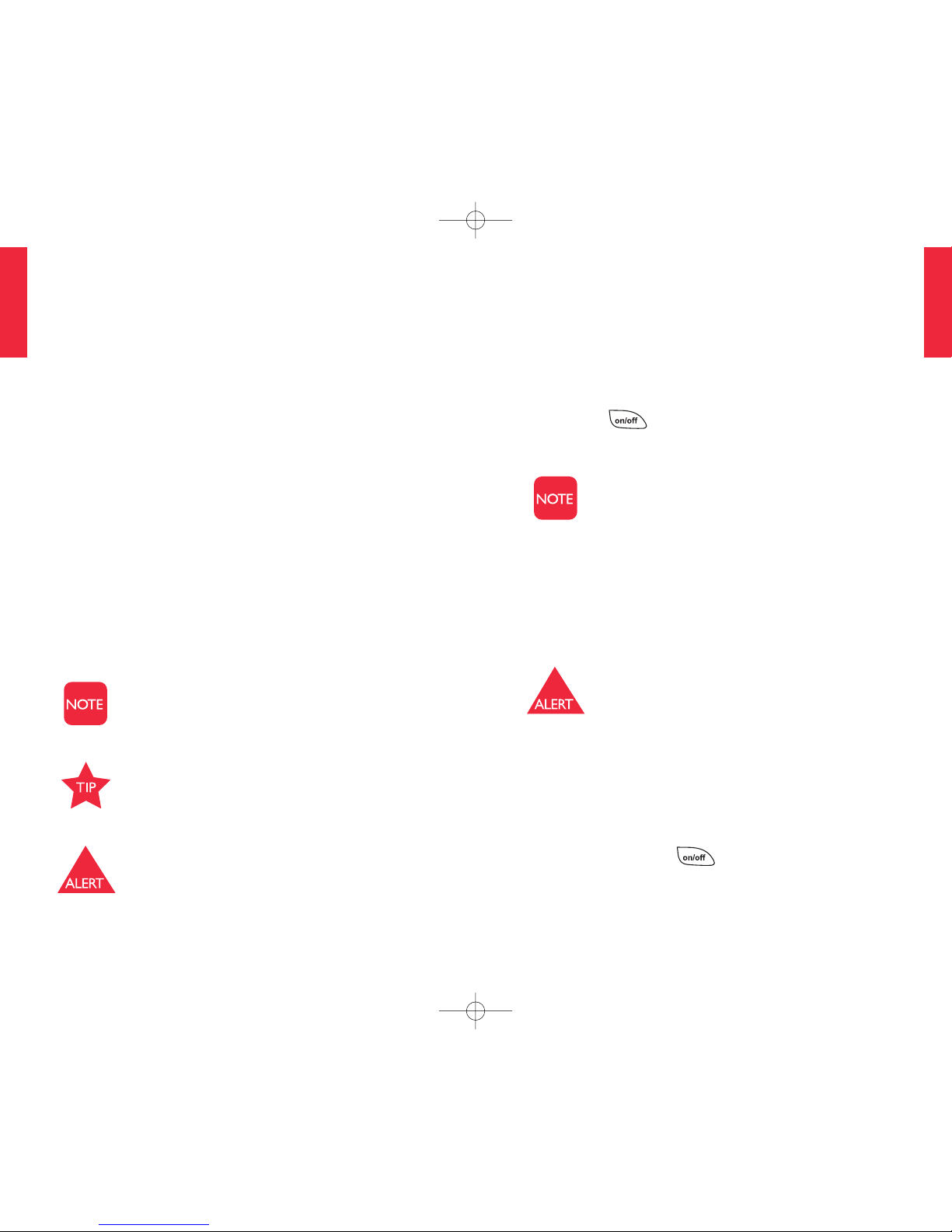
You can also find your battery strength on
the phone info screen. See section 2 (pg 21)
of this guide for more details.
If you use your phone without charging
the battery, and it is critically low, it will turn
itself off.
Jitterbug accessories are designed to maximize
the battery’s life. Using other accessories could
damage yourphoneand mayvoidyourwarranty.
Turning your Jitterbug on/off
To turn your Jitterbug on:
1. Open the phone.
2. Press the button in the upper right corner of
the keypad until the screen lights up.
The “Jitterbug” logo will appear on the
screen before your phone is ready to use.
If a connection isn’t possible, you’ll see
“No Service” on the screen, and you won’t
get a dial tone.
3. When you hear a dial tone, your phone has service
and is ready to use.
If you are not able to place a call, please call
1-800-733-6632 from another phone so we
can help you.
To turn your Jitterbug off:
1. Open the phone.
2. Press and hold the button until the Jitterbug
tune plays. Your phone is off.
800201_HTG_031308.qxp:user guide 3/13/08 1:05 PM Page 6
Page 9

Getting Started 9
SECTION 1
8 Getting Started
SECTION 1
Getting more information
Visit www.jitterbug.com to:
• Update your Phone List See section 4 (pg 38).
• Shop for the latest Jitterbug®phones and
accessories.
• Learn about new Jitterbug services.
• See answers to frequently asked questions.
Contacting Customer Service
Use any of these ways to contact us:
• Send us an e-mail at:
• Call us toll-free at: 1-800-733-6632
• Write to us at:
Jitterbug Customer Service
P.O. Box 4428
Carlsbad, CA 92018
Jitterbug operator assistance
Live Jitterbug operators are available 24 hours a day,
seven days a week, and can help you:
1. Update your Phone List.
2. Look up a residential, business or government phone
number.
3. Connect you to any number in the U.S. or Canada.
4. Place calls to anyone on your Phone List, which is
on file with the operator.
To call a Jitterbug operator:
Press the “0” button, then press the button. e
live operator will greet you by name and ask how they
may assist you.
Minutes are used normally while speaking
with the operator and for the length of any
call they connect to you. If the operator
performs one of the convenient four items
listed above, an additional five minutes will
be deducted from your account for the
service. Most wireless carriers charge over $1
in cash for services like 411; we keep it simple
by deducting only 5 minutes.
800201_HTG_031308.qxp:user guide 3/13/08 1:05 PM Page 8
Page 10
Phone Features 1110 Phone Features
SECTION 2
SECTION 2
Section 2
Phone Features
is section describes the key features and services of
your Jitterbug®phone and how to use them.
Topics
• Closed view of your phone–front.
• Closed view of your phone–back.
• Open view of your phone.
• Display screen.
• Start-up features.
• Moving between features.
• Optional services.
• Adjusting ringer volume.
• Adjusting the ear piece volume.
• Speakerphone.
• Emergency 911 service.
For more information about Jitterbug, visit us online
at www.jitterbug.com
The first cellular phone weighed 40
ounces. Your Jitterbug weighs only 4.5
ounces.
800201_HTG_031308.qxp:user guide 3/13/08 1:05 PM Page 10
Page 11
Phone Features 1312 Phone Features
SECTION 2
SECTION 2
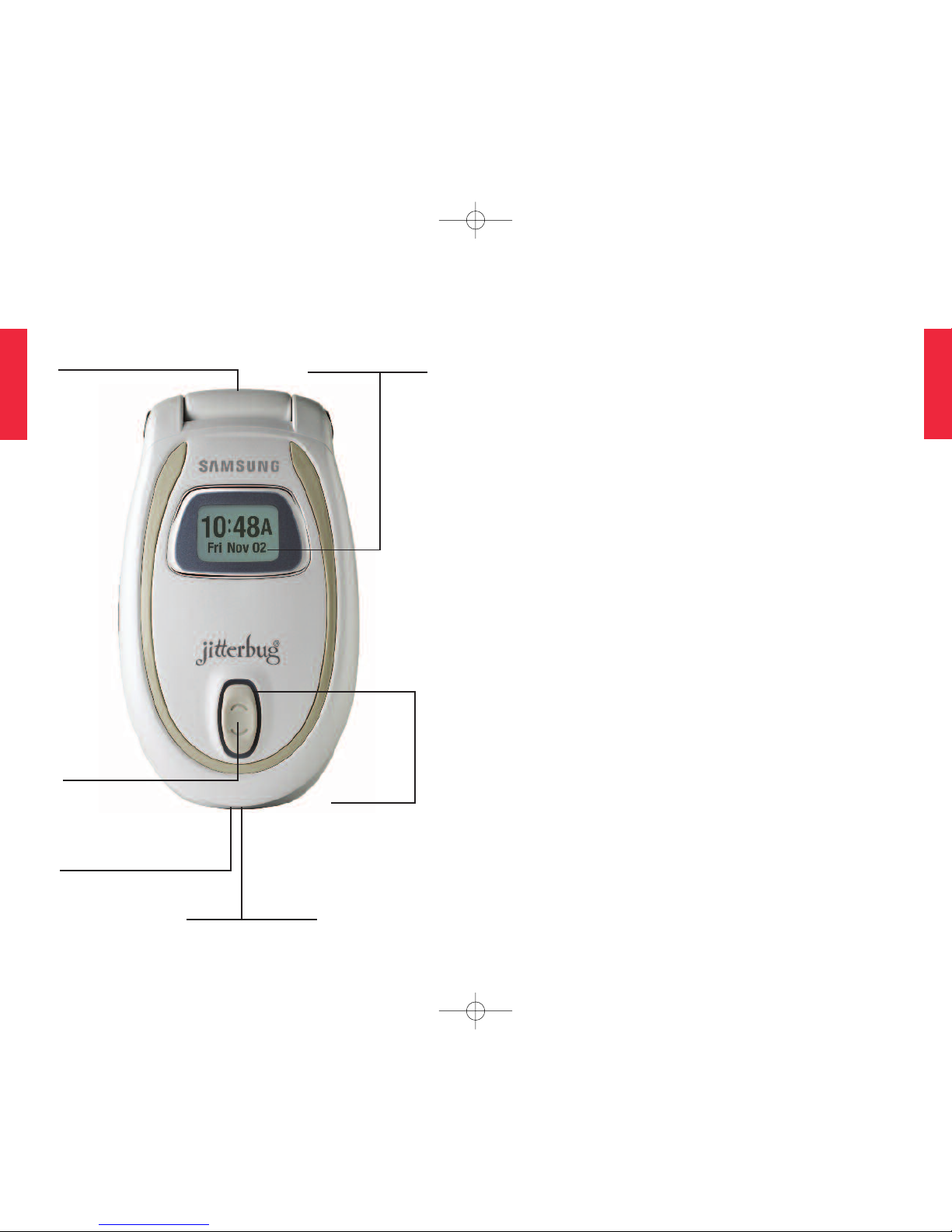
1. Internal Antenna Connects with the cellular
network so you can use your phone.
2. Volume Button Adjusts the ringer volume or the
voice volume during a call. (To silence the ringer
during an incoming call, tap the volume button.)
3. Accessory Connector Links accessories to your
phone.
4. Power Connector Connects the AC Charger to
your phone.
5. Display Window Shows time, day and date (when
yourphoneison). Indicateswhen you have an incoming
call or message.
6. Light Alert The area around the volume button will
light up for incoming calls or when the phone is fully
charged. The following list outlines the light alerts and
what each one means:
When your phone is plugged in:
• Light is on briefly means charging has begun.
• Light is on steady means charging is complete.
When your phone is unplugged:
• Light has a constant flash means your
phone needs recharging.
• Light has a short flash means you have an
incoming call or voice message.
Closed view of your phone – front
1 Internal Antenna
5 Display Window
3 Accessory Connector
4 Power Connector
2 Volume Button
6 Light Alert
800201_HTG_031308.qxp:user guide 3/13/08 1:05 PM Page 12
Page 12
Phone Features 1514 Phone Features
SECTION 2
SECTION 2
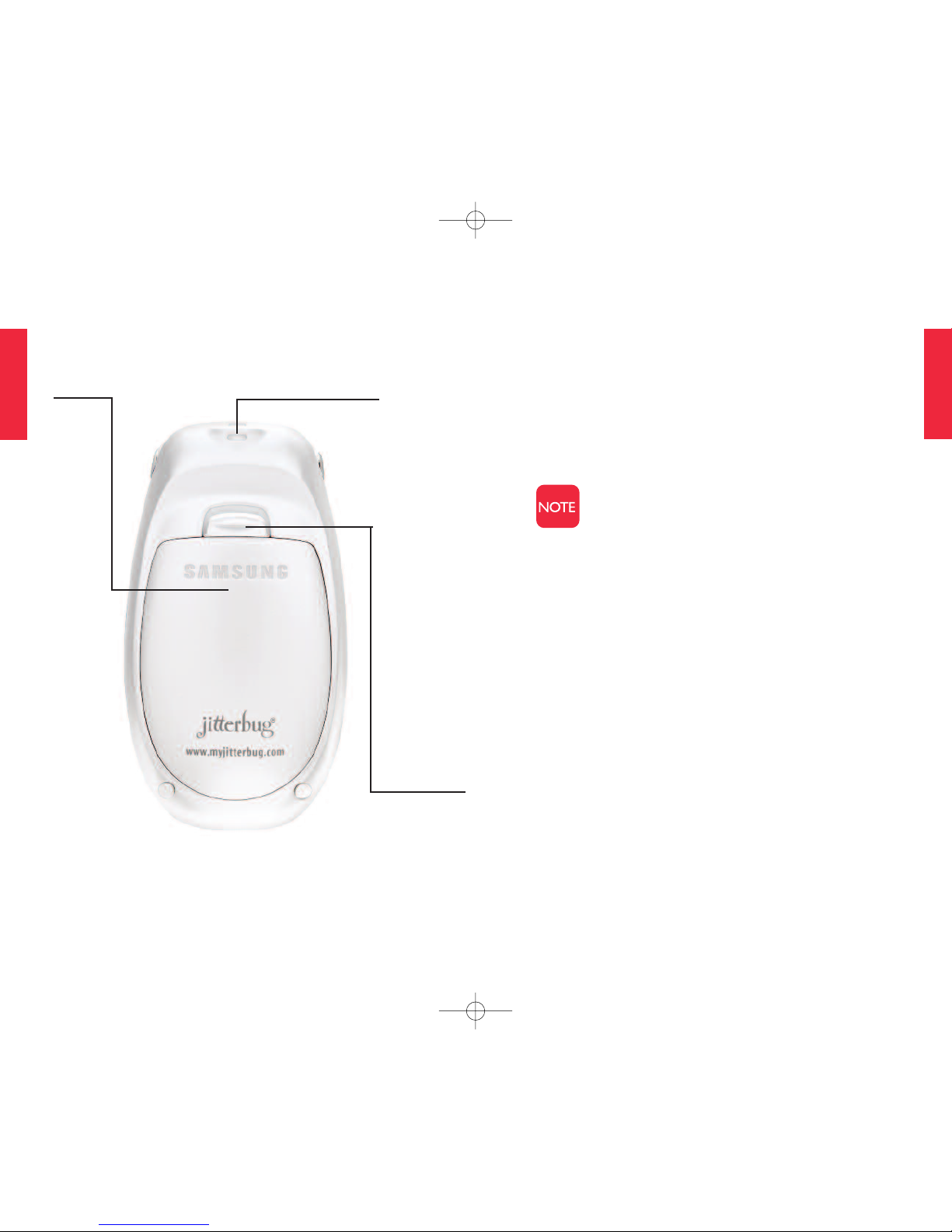
1. Battery Delivers power to make your phone
function.
2. Lanyard Connector Makes it easy to attach a
lanyard or wrist-strap to carry your phone.
3. Battery Latch Slides to open for easy battery
removal.
To purchase a Jitterbug®lanyard or any
other Jitterbug accessory, visit us online at
www.jitterbug.com/accessories.
Closed view of your phone – back
1 Battery
2 Lanyard Connector
3 Battery Latch
800201_HTG_031308.qxp:user guide 3/13/08 1:05 PM Page 14
Page 13
Phone Features 1716 Phone Features
SECTION 2
SECTION 2
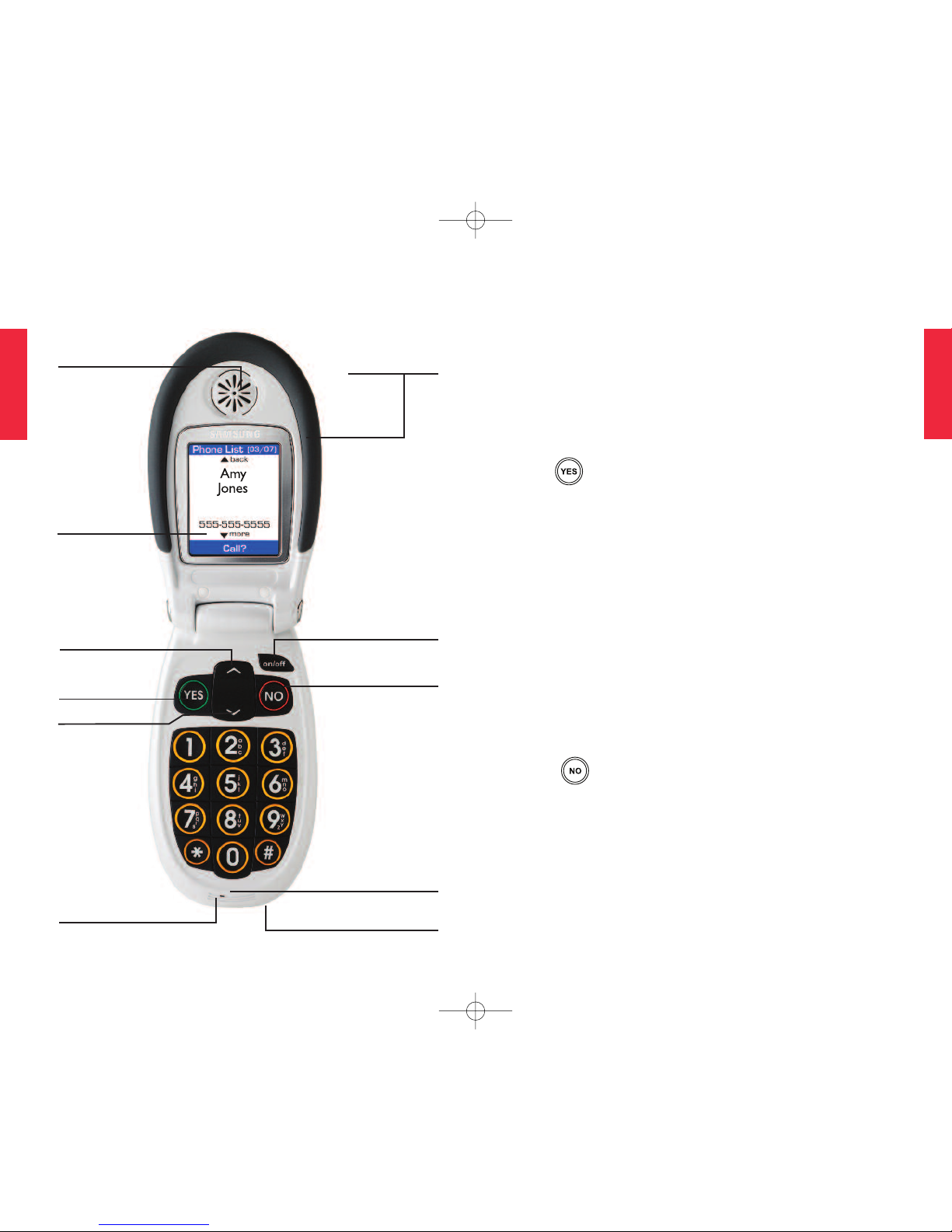
1. Speaker Hear the caller loud and clear.
2. Display Screen Shows all the information you
need to operate your phone.
3. Up/Back Arrow Button Returns to previous
screen on your Phone List or Call History.
4. Button Allows you to respond “Yes” to
questions or commands on the display screen.
5. Down/More Arrow Button Advances to next
screen on your Phone List or Call History.
6. Accessory Connector Accessories such as our
Hands Free Car Kit connect into your phone.
7. Patented Ear Cushion Fits comfortably around
your ear while reducing unwanted noise.
8. Power Button Turns your phone on and off.
9. Button Allows you to respond “No” to
questions or commands on the display screen.
10. Microphone Picks up the sound of your voice
for calls and voice dialing.
11. Power Connector Both the AC Charger and
Car Charger connect here to recharge your phone.
Open view of your phone
1 Speaker
2 Display
Screen
3 Up/Back
10 Microphone
6 Accessory
Connector
11 Power Connector
4 “Yes” Button
5 Down/More
9 “No” Button
8 Power Button
7 Patented
Ear Cushion
800201_HTG_031308.qxp:user guide 3/13/08 1:05 PM Page 16
Page 14
Phone Features 1918 Phone Features
SECTION 2
SECTION 2
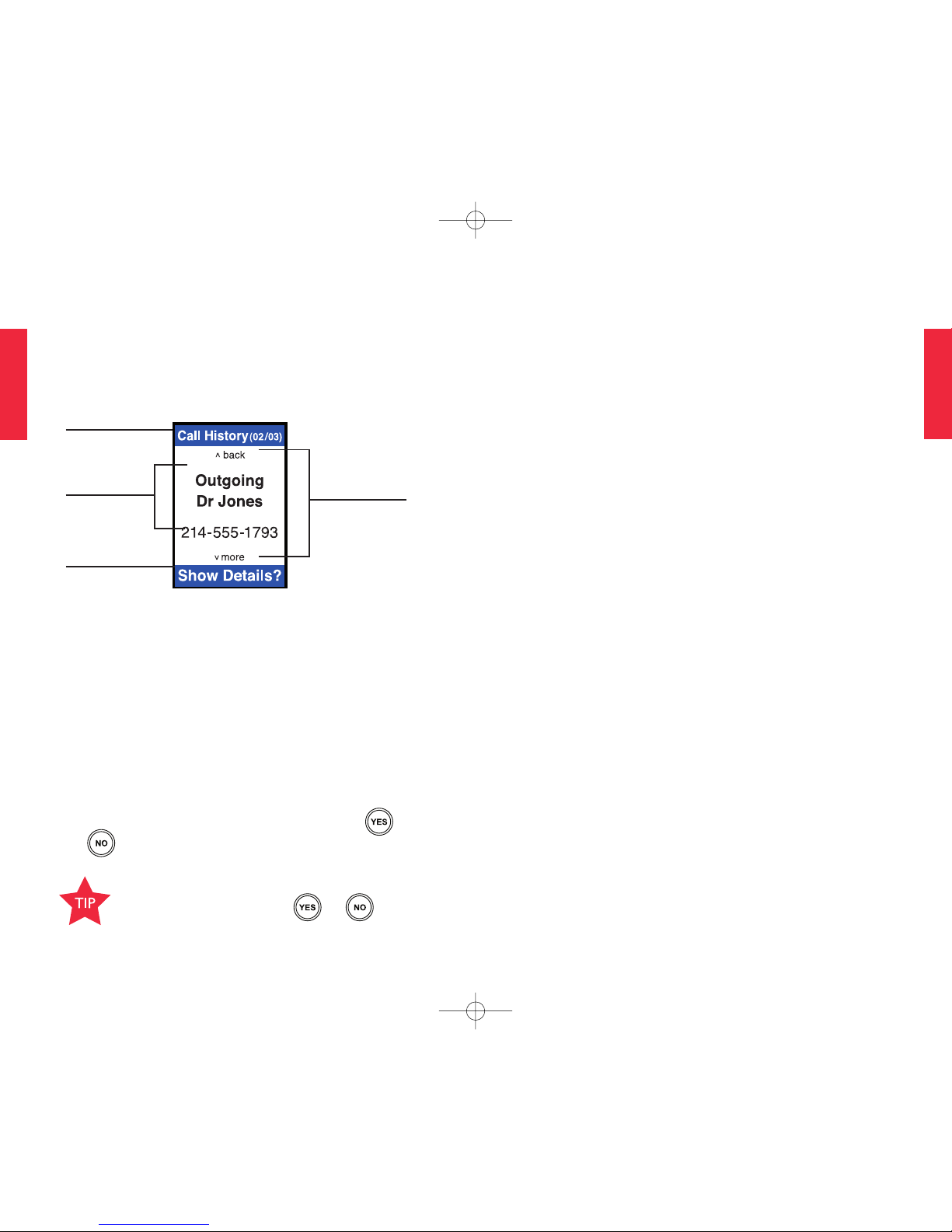
4. Additional Entries Indicates when entries are
available before or after the current page. Use the
Up/Down arrow buttons to scroll through entries.
• “Back” Entries available before the current page.
• “More” Entries available after the current page.
Start-up features
Your Jitterbug includes the following important start
up features:
• Phone List Up to 50 of the numbers you call
most often can be stored in your phone. Jitterbug
operators can even set up the Phone List for
you. See section 4 (pg 38) for more details.
• Call History An easy way to review your last
ten incoming, outgoing and missed calls.
• Phone Information gives you important
information about your phone and battery.
Display screen
This is what you may see on the screen while using
your Jitterbug®.
1. Feature Area The top of the display screen is the
“Feature Area.” It identifies the feature you are using.
2. Detail Area The middle of the display screen
indicates the detailed entries from your Phone List,
phone call status, and received messages in adjustable
type size (shorter messages appear in larger type).
3. Command Area e bottom of the display screen
in the “Command Area” displays questions or
commands you can choose by pressing the
or buttons.
Remember to read the Command Area line
and respond by using the or buttons.
1
4
2
3
Feature Area
Detail
Area
Command
Area
Additional
Entries
800201_HTG_031308.qxp:user guide 3/13/08 1:05 PM Page 18
Page 15
Phone Features 2120 Phone Features
SECTION 2
SECTION 2
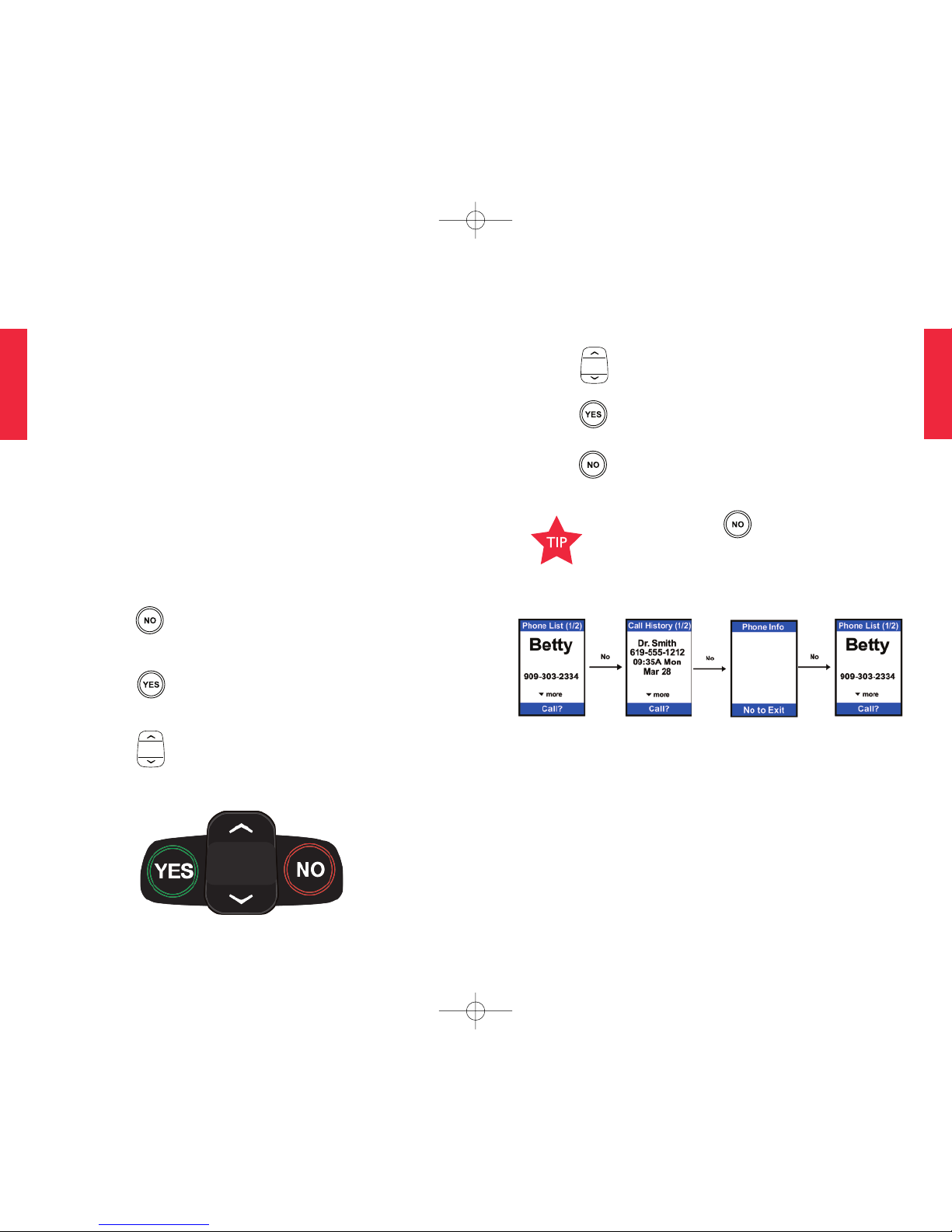
When your phone is first turned on, it will be on the
“Phone List” feature.
Press the button to scroll through Phone List entries.
Pressthe button to calltheentryshowingon the screen.
Pressthe button to move to the next feature.
Keep pressing the button to cycle
through the features on your phone.
Optional services
The following optional services can be turned on or off
at your request by calling Jitterbug Customer Service at
1-800-733-6632.
Voicemail Allows callers to leave you a message if you
don’t answer (service fees and airtime may apply).
Battery is at
100%
Signal is
Strong
Approx Minutes
Used:
169 minutes
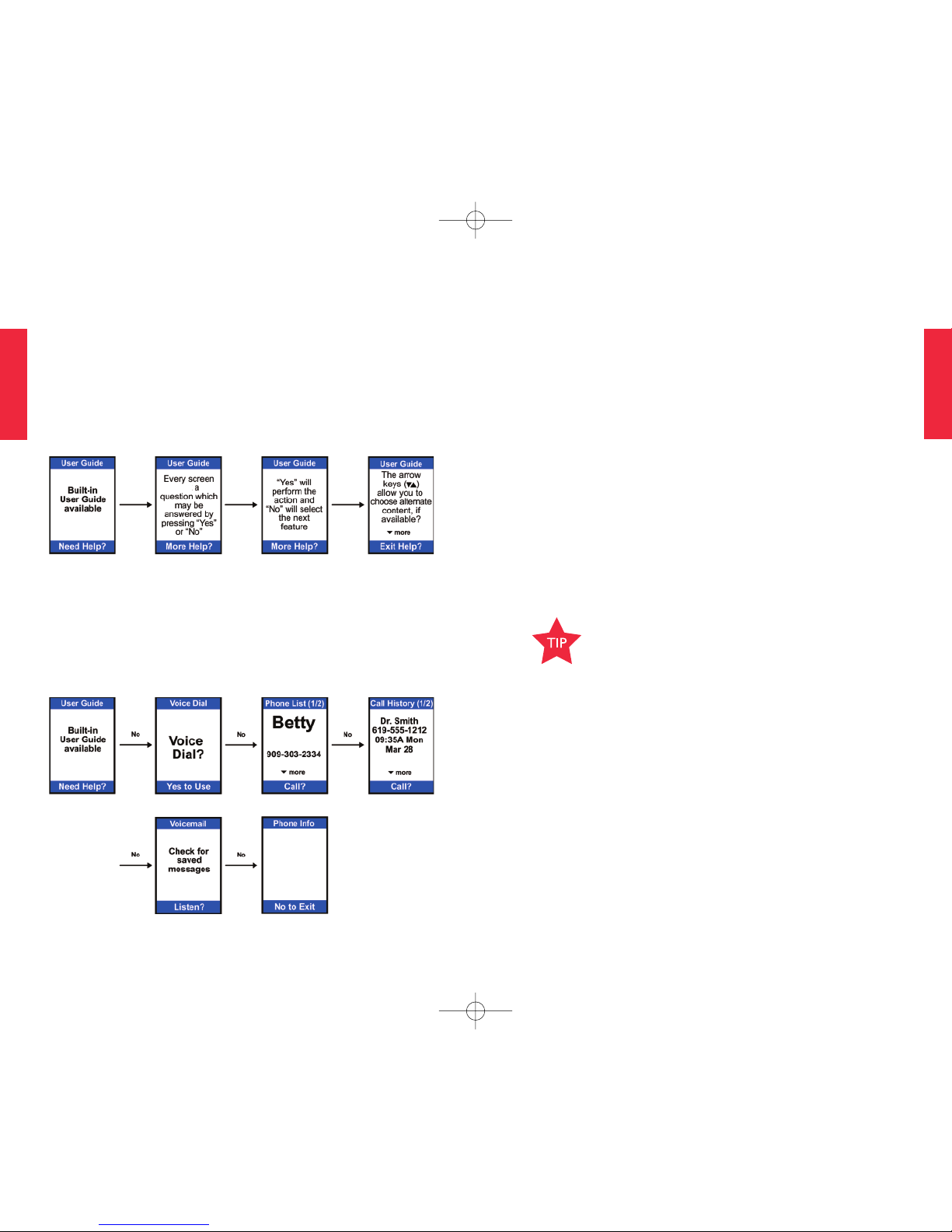
Moving between features
Everything about Jitterbug was designed to be easy. You
can move through all available features with three simple
buttons located at the top of the keypad.
1. Press the button to continue to the next feature
or item.
2. Press the button to choose the feature or item
displayed on your screen.
3. Press the button to move through a list within
a feature.
• Jitterbug®Operator Greets you by name,
makes calls for you, provides directory assistance
and can add names and numbers to your Phone
List (per minute charges for operator services may
apply).
• Emergency 911 service Just in case you ever
need it.
800201_HTG_031308.qxp:user guide 3/13/08 1:05 PM Page 20
Page 16
Phone Features 2322 Phone Features
SECTION 2
SECTION 2
Adjusting the ringer volume
1. Open your Jitterbug and confirm it’s turned on.
2. Press the Up/Down volume button on the outside of
the phone below the display window. Press repeatedly
to cycle through the available options below:
• Ringer Volume Ring Max
• Ringer Volume High
• Ringer Volume Med
• Ringer Volume Low
• Ringer Volume Silent
The ringer and keypad can be silenced by
pressing the volume button down until
“Silent” appears on the screen. Your Jitterbug
will now only vibrate to alert you to incoming
calls (This can come in handy at a movie, a
library or any other location where a ringer
may be a distraction).
Voice Dialing Speak a name exactly as it appears in
your Phone List and your Jitterbug®will connect you
right away.
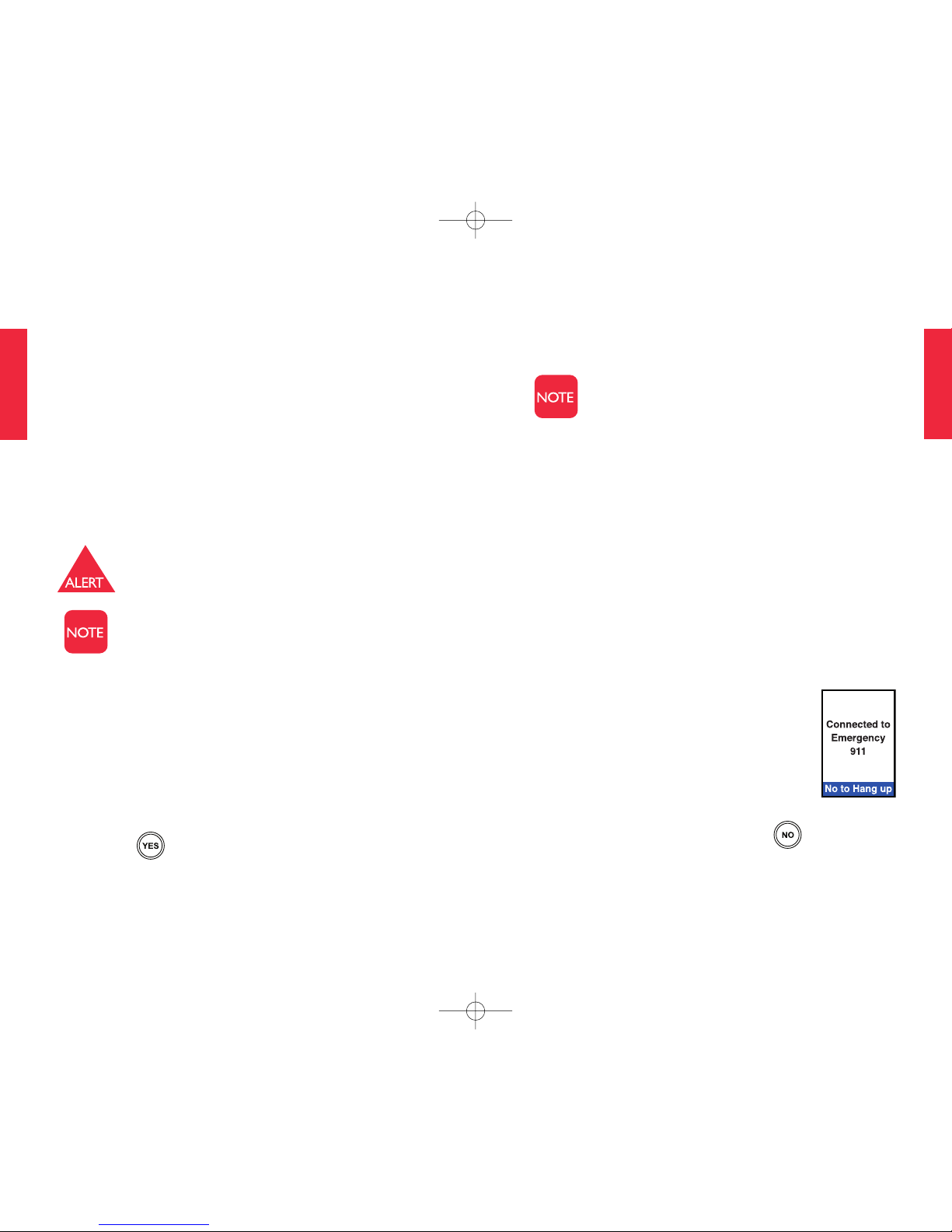
Built-in User Guide Provides simple instructions
about moving through Jitterbug features and works as
follows:
For help with any of the above optional features, please
call Jitterbug Customer Service.
If you have activated some or all of these features, you
will move between them in this order.
Battery is at
100%
Signal is
Strong
Approx Minutes
Used:
169 minutes
asks
Yes Yes Yes
800201_HTG_031308.qxp:user guide 3/13/08 1:05 PM Page 22
Page 17
SECTION 2
SECTION 2
Phone Features 2524 Phone Features
To exit speakerphone:
While you’re on a call, press the volume button down
to turn this feature off.
Your phone automatically exits the
Speakerphone setting when you end a call.
Emergency 911 service
When you dial 911, your phone automatically enters
Emergency Callback mode for 30 minutes. While in
this mode, you cannot make other calls.
To make an emergency call:
1. Dial the numbers 9-1-1. “Calling Emergency” will
appear on the screen.
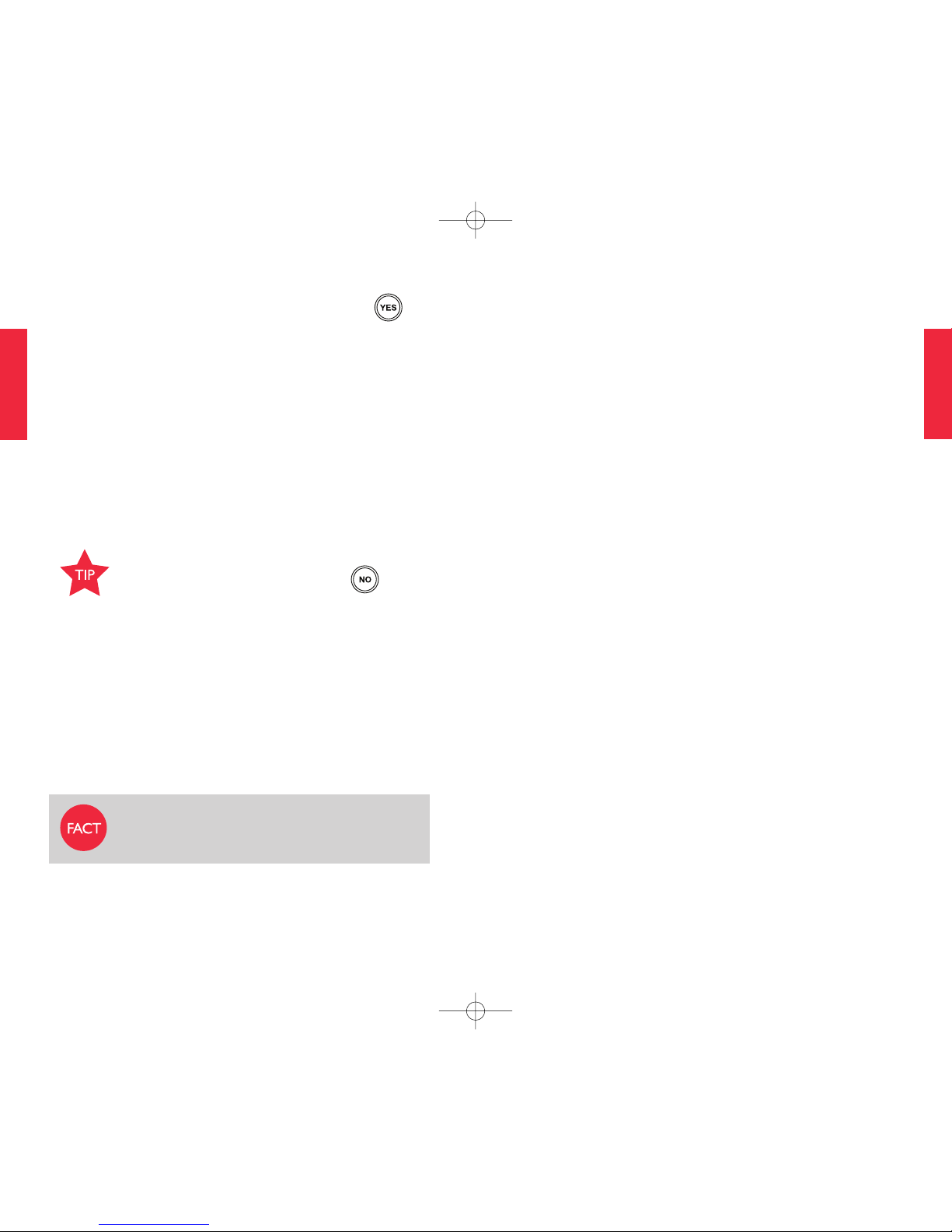
2. When the 911 operator answers,
“Connected to Emergency” appears
on the screen, as shown.
To end an emergency call:
1. If the “No to Hang up” command is showing at the
bottom of the screen, press the button. Your
phone will now be in Emergency Callback mode.
While your phone is in Emergency Callback mode
you cannot make calls for 30 minutes in
case the 911 operator needs to call you back.
Adjusting the ear piece volume
When you’re on a call, press the volume button up or
down until the sound reaches a comfortable volume.
Speakerphone
Use the Speakerphone setting to conduct a call without
holding the phone to your ear (and allow others to
participate in your phone call).
Don’t hold the phone up to your ear when
it’s in Speakerphone mode.The volume may
be too loud.
You must be on a call to use this setting.
To use the speakerphone:
1. When you have placed or answered a call, you will
see a “Connected to…” message on the screen.
2. Press the Volume button up repeatedly until you see
“Press Yes for SPKR Phone”.
3. Press the button.
800201_HTG_031308.qxp:user guide 3/13/08 1:05 PM Page 24
Page 18
Phone Features 27
SECTION 2
26 Phone Features
SECTION 2
2. To reconnect to the 911 operator, press the
button. You will know that you are in the
Emergency Callback mode when you open your
phone and see “Emergency Callback” on the
screen.
Why do I have an emergency callback setting?
If you dial 911, your mobile phone line is kept free so
that the 911 operator can call you back or stay on the line
with you.
If you mistakenly call 911, end the call as
soon as possible by pressing the button
to hang up or close your phone.
All 911 calls made from your Jitterbug
®
phone are free.
800201_HTG_031308.qxp:user guide 3/13/08 1:05 PM Page 26
Page 19
28 Placing and Receiving Calls
Placing and Receiving Calls 29
SECTION 3
SECTION 3
Section 3
Placing and Receiving Calls
is section explains how to use your phone’s calling
and answering features.
Topics
• Placing a call.
– Dialing manually.
– Placing a call via the Jitterbug®operator.
– Using your Phone List to make a call.
• Receiving a call.
– Indications of incoming calls when your
phone is open.
– Indications of incoming calls when your
phone is closed.
– Receiving a call when your phone is open.
– Receiving a call when your phone is closed.
– To end a call.
– To ignore a call when the phone is closed.
– To ignore a call when the phone is open.
• Silencing a call
For more information about Jitterbug, visit us online
at www.jitterbug.com
More than 196 million Amer icans
subscribe to a wireless ser vice.
800201_HTG_031308.qxp:user guide 3/13/08 1:05 PM Page 28
Page 20
30 Placing and Receiving Calls
Placing and Receiving Calls 31
SECTION 3
SECTION 3
Placing a call via the Jitterbug®operator:
A live Jitterbug operator can connect you to anyone on
your Phone List or to any number in the U.S. or
Canada.
1. Press the “0” button.
2. Press the button when you see “Call?” at the
bottom of the screen. “Calling” will appear on the
screen.
3. When the operator answers, “Connected to” will
appear on the screen.
4. Tell the operator the name of the person in your
Phone List you want to call, or tell them the ten
digit number you want to be connected to.
You can end any call or exit any screen by
closing, then re-opening your phone.
Placing a call
Dialing manually:
You can dial a number directly from any screen on your
phone with 2 easy steps:
1. Dial the full ten digit number using your keypad.
You are not required to dial one (1) first before
placing a long distance call.
2. Press the button when you see “Call?” at the
bottom of your screen.
If you make a mistake while entering the number,
press the button to back up and delete your
entry.
A dial tone means service is available. If service
is not available you’ll see “No Service” on
the screen.
Always dial thefull ten digit number including
area code even if it’s a local call (except 911).
You are not required to dial one (1) first
before placing a long distance call.
800201_HTG_031308.qxp:user guide 3/13/08 1:05 PM Page 30
Page 21
32 Placing and Receiving Calls
Placing and Receiving Calls 33
SECTION 3
SECTION 3
Receiving a call
Your phone rings or vibrates (depending on how you set
the volume level) to indicate an incoming call.
Additionally, there are other indications of incomingcalls:
Indications of incoming calls when your phone is
open:
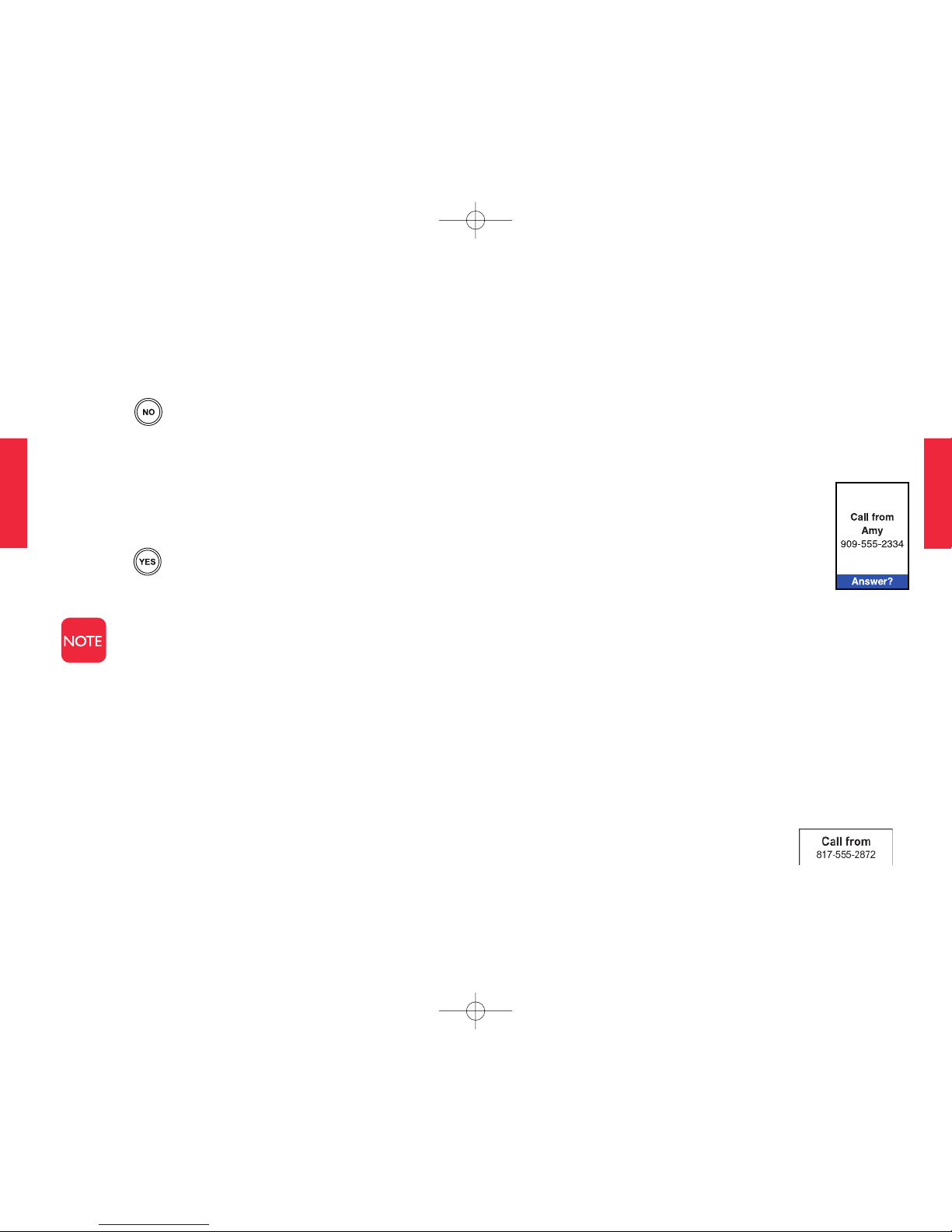
• If the caller’s name and number are
stored on your Phone List, a phone
number or name appears on your
phone screen, as shown.
• If the caller can’t be identified, you
will see one of the following messages:
– Call from unavailable number
– Call from restricted number
– No number
Indications of incoming calls when your phone is
closed:
• e volume button on the front of your phone
flashes.
• A phone number or name
appears in the display window,
as shown.
Using your phone list to make a call:
Your Jitterbug®phone can store up to 50 numbers and
contact names on your Phone List. See section 4 (pg 38)
for more details.To place a call to a number on your list:
1. Press the button repeatedly until the “Phone
List” screen appears.
2. Press the Up/Down arrow button to move back
and forward through your Phone List until you
find the name and number you want to call.
3. Press the button when you see the “Call?”
question at the bottom of your screen.
You can control the order of the numbers on
your Phone List from our password protected
secure website www.MyJitterbug.com. See
section 4 (page 39) to learn how to use the
Internet to manage your Phone List. Changes
may take up to 24 hours to be displayed in
your Phone List.
800201_HTG_031308.qxp:user guide 3/13/08 1:05 PM Page 32
Page 22
34 Placing and Receiving Calls
Placing and Receiving Calls 35
SECTION 3
SECTION 3
Receiving a call when your phone is open:
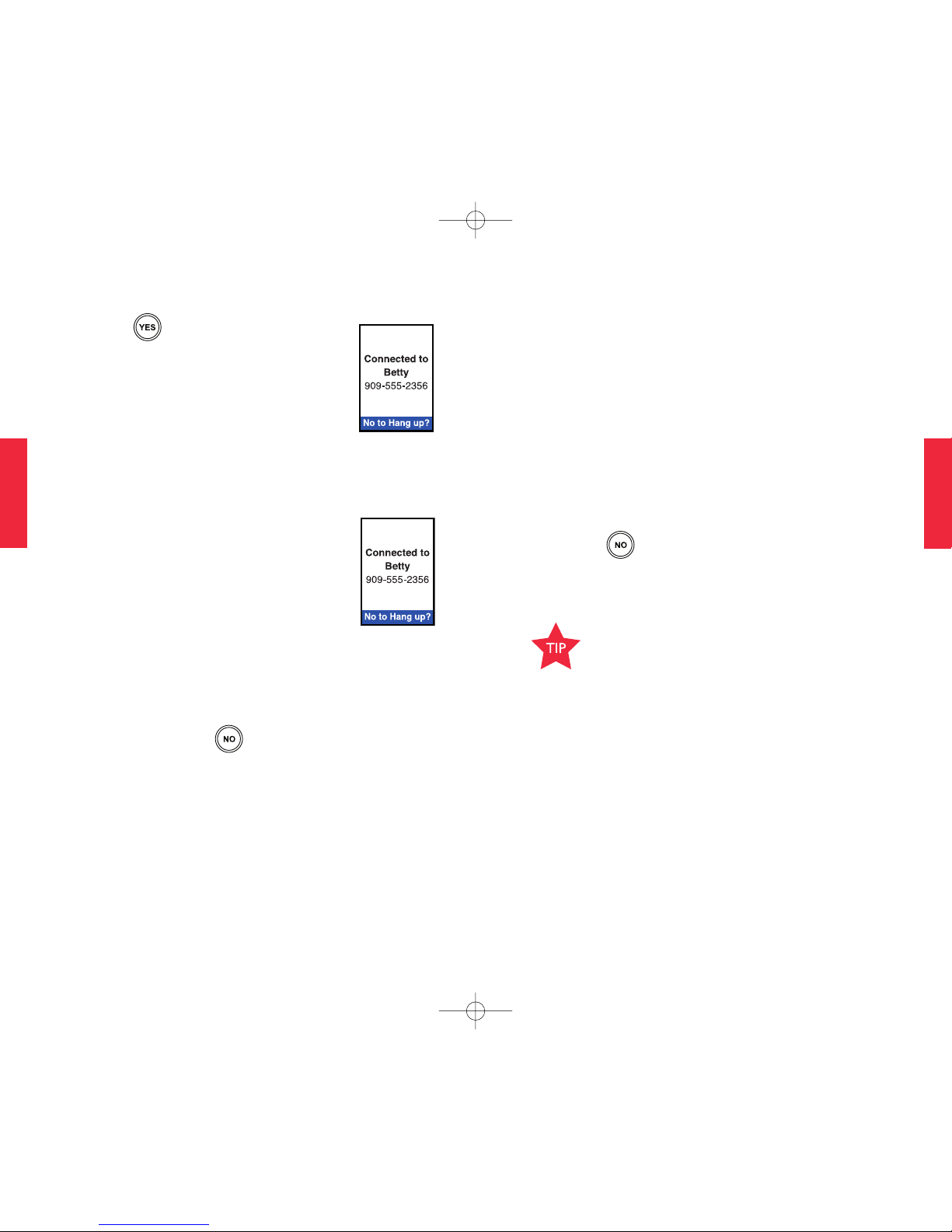
1. Press the button to connect.
2. A “Connected to...” message will
appear on the display screen as shown.
The caller’s voice can be heard through
the earpiece.
Receiving a call when your phone is closed:
1. Open the phone when you hear it ring.
The ring tone will stop when the phone
is open.
2. A “Connected to...” message will
appear on the display screen as shown.
The caller’s voice can be heard.
To end a call:
To end a call, press the button or close
the phone.
To ignore a call when the phone is closed:
When the phone is ringing you can press the volume
button to mute the ringer.
If Voicemail is active, the caller will be directed to your
Voicemail. If Voicemail is not active, callers will get a
message that you are not available.
To ignore a call when the phone is open:
You can send a caller directly to your Voicemail by
pressing the button when you see “Answer?” at the
bottom of the display screen. This will also give an
unavailable message if you do not have Voicemail.
Your phone continues to ring until:
• You answer the call.
• e calling party ends the call.
• You mute the ringer.
• e call is sent to Voicemail.
Silencing a call
Turn the ringer off by opening the phone and pressing
the volume button on the outside of the phone until
“Silent” appears on the display screen. Your phone
will vibrate to alert you to incoming calls.
800201_HTG_031308.qxp:user guide 3/13/08 1:05 PM Page 34
Page 23

36 Your Phone List Your Phone List 37
SECTION 4
SECTION 4
Section 4
Your Phone List
is section explains how to useyourphone listto save and
find the names and numbers of people youcall frequently.
Topics
• Adding, changing and deleting numbers.
• Creating a new member account.
– Creating and editing your phone list.
– Moving, editing and deleting numbers from
your phone list.
• Finding numbers in your phone list.
For more information about Jitterbug®, visit us online
at www.jitterbug.com
800201_HTG_031308.qxp:user guide 3/13/08 1:05 PM Page 36
Page 24
38 Your Phone List Your Phone List 39
SECTION 4
SECTION 4
OPTION 2: Use the Internet at
www.MyJitterbug.com:
We’ve made it easy for you to update your Phone List
by using the internet at www.MyJitterbug.com.
Create a new member account
If this is your first time visiting MyJitterbug, please
follow these easy steps to create your account:
1. Go to www.MyJitterbug.com. Once you have arrived
at MyJitterbug, you will see two options on the left
side of the page:
• Click on the button for Jitterbug
owners with an existing MyJitterbug account.
• Click on the button for Jitterbug
owners that have not created a MyJitterbug account.
2. Click on the button.
Adding, changing and deleting numbers
You can store up to 50 names and numbers in your
Phone List.
ere are two simple options to add, change or delete
names and numbers:
1. Using the live Jitterbug®operator.
2. Using the Internet at www.MyJitterbug.com.
OPTION 1: Use the live Jitterbug operator:
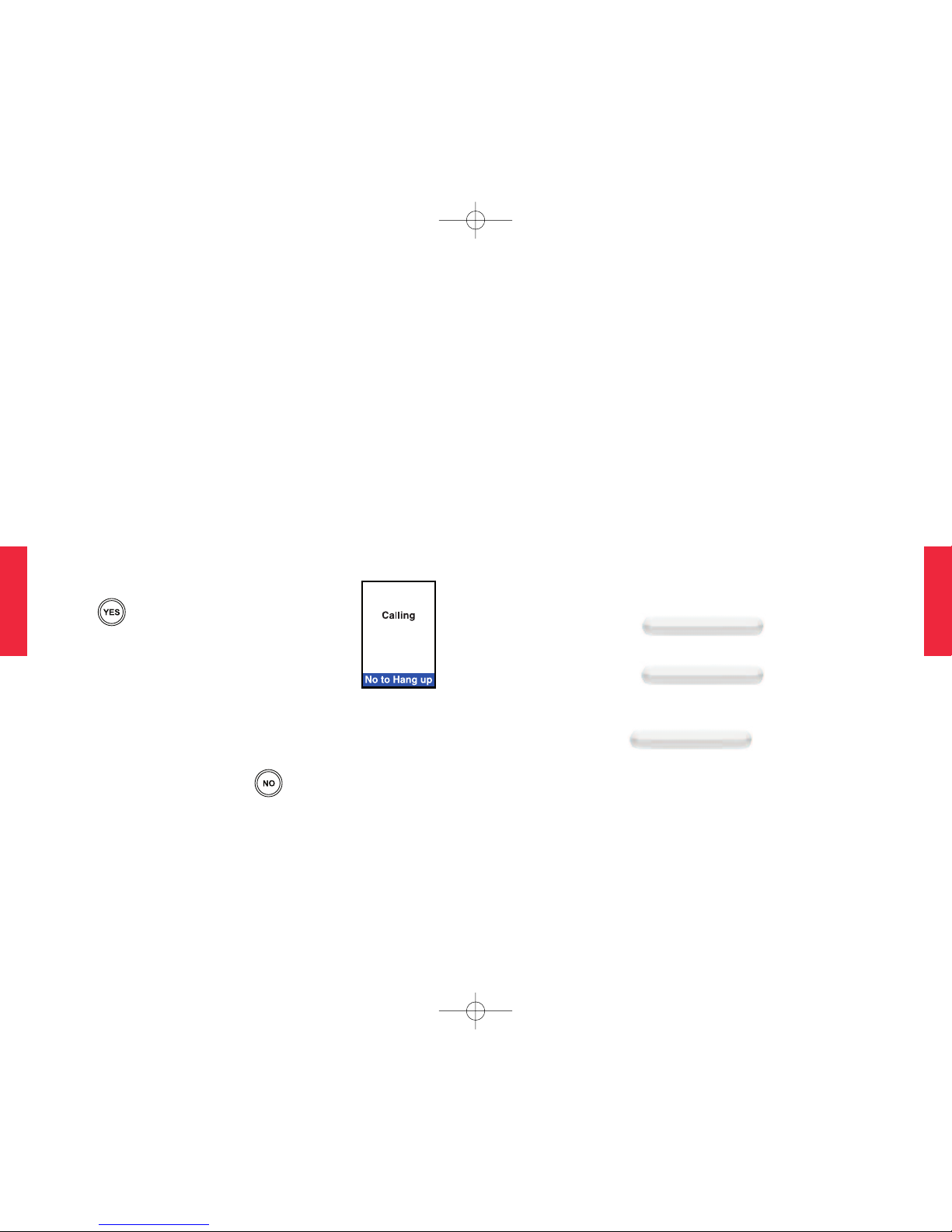
1. Press the “0” button, then press
the button. A “Calling” message
appears, as shown.
2. When the operator answers, a
“Connected to” message appears. Tell
the operator the name and number you want to
add, change or delete.
3. To end the call, press the button or close your
phone.
RETURNING MEMBER
NEW MEMBER
NEW MEMBER
800201_HTG_031308.qxp:user guide 3/13/08 1:06 PM Page 38
Page 25
40 Your Phone List Your Phone List 41
SECTION 4
SECTION 4
4. After the appropriate information is completely filled
out, please click on the button.
5. Now that you have successfully created a MyJitterbug
account, you can create your Phone List.
Create and edit your phone list
1. Go to www.MyJitterbug.com.
2. Click the button located on the
left side of the page.
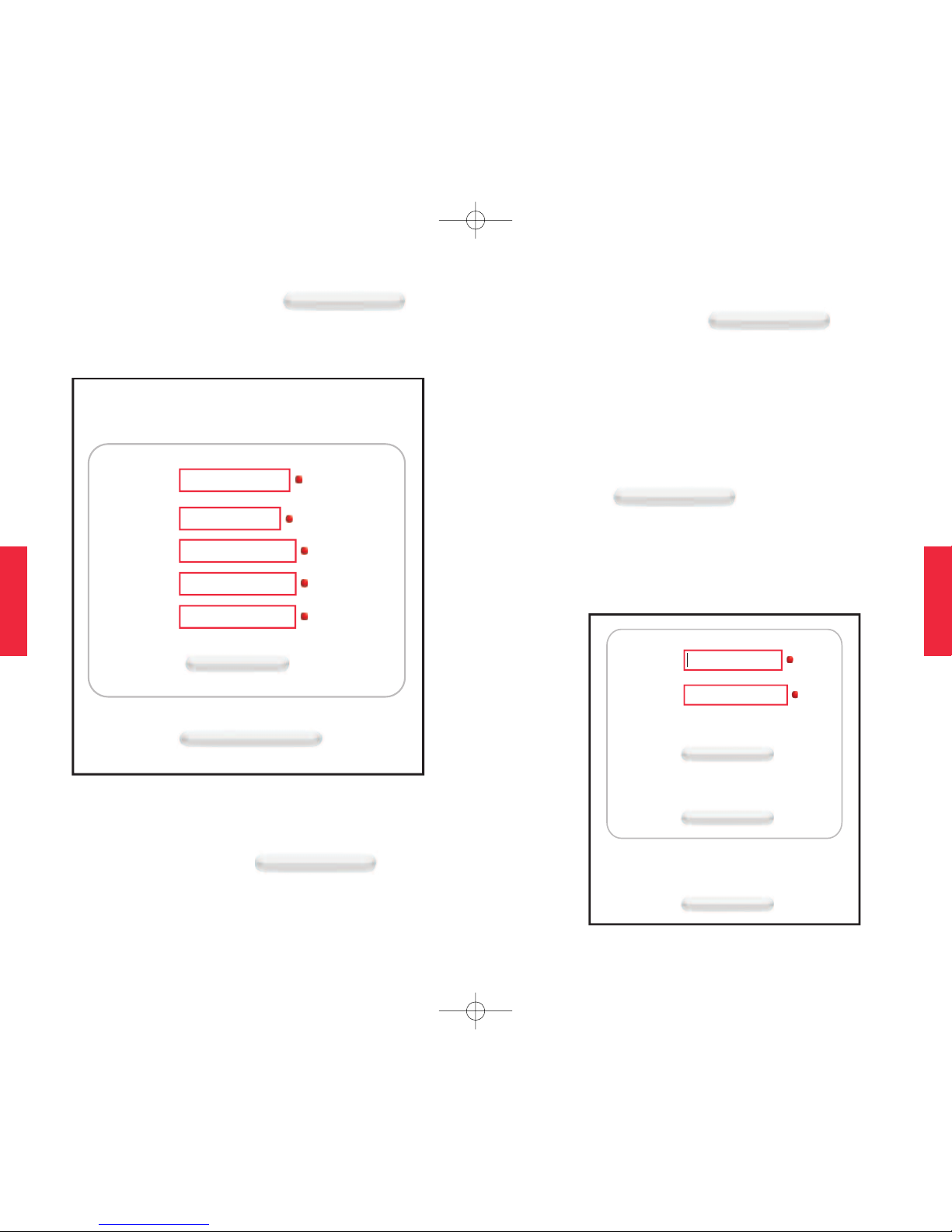
3. e following screen will appear. Type in your
Jitterbug®phone number and password.
Jitterbug
Phone
Number:
Password:
YES
Ready to Continue?
HELP
Forgot your password? No problem.
Click the button below and we’ll help.
NEW MEMBER
Don’t have your MyJitterbug account yet,
click the New Member button below
and we’ll get you started.
NEW MEMBER
Jitterbug
Phone
Number:
Zip Code:
Email
Address:
Password:
Confirm
Password:
SEND
RETURNING MEMBER
SEND
RETURNING MEMBER
3. After you have clicked on the
button you will see the following request for
information screen:
Please fill in all the information. If you come to this page
and realize that you have already entered this information
you can simply click on the button
and you will be able to access your existing account.
NEW MEMBER
RETURNING MEMBER
800201_HTG_031308.qxp:user guide 3/13/08 1:06 PM Page 40
Page 26
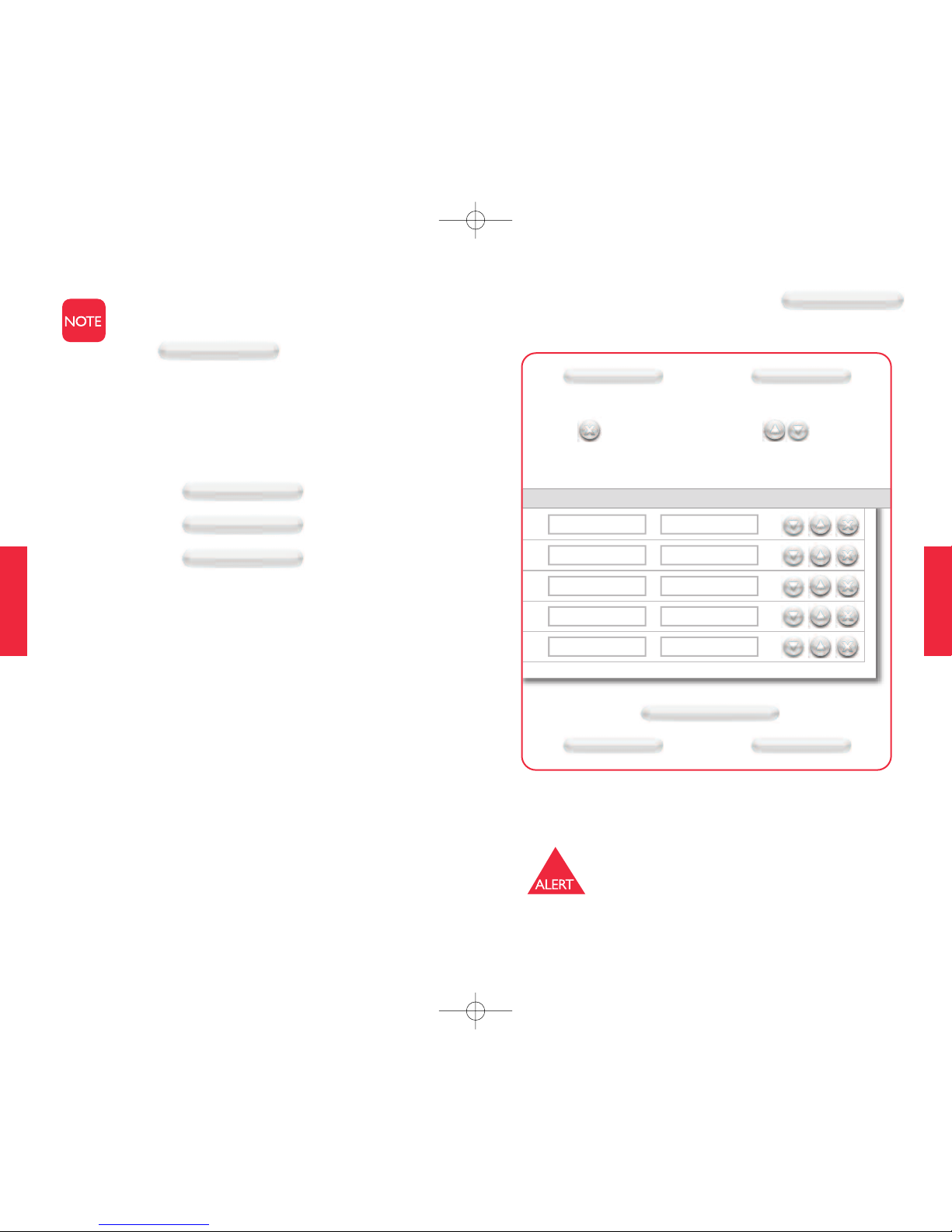
5. To update your Phone List click
on the button. e following screen will appear:
is is where you enter the names and numbers for
all of your contacts.
Make sure you only enter the ten digit
number. You are not required to dial one (1)
first before placing a long distance call.
Amy Jones
800-555-1212
CANCEL SAVE
CANCEL SAVE
Edit the names and numbers below to correct any errors.
Don’t forget to save your changes before leaving the page.
Phone List
Clicking will delete an entry.Click the arrows to
move an entry to a new position in the list.
ADD NEW CONTAC T
1.
2.
3.
4.
5.
42 Your Phone List Your Phone List 43
SECTION 4
SECTION 4
If you reach this page and realize that you do
not have a MyJitterbug account, click on
the button to create one.
4. Now that you have accessed your account, you will
see three options on the left side of the page:
NEW MEMBER
MY PHONE BOOK
MYJITTERBUG HOME
CHANGE PASSWORD
MY PHONE BOOK
800201_HTG_031308.qxp:user guide 3/13/08 1:06 PM Page 42
Page 27
44 Your Phone List
Your Phone List 45
SECTION 4
SECTION 4
Moving, editing and deleting numbers from your
phone list:
You can easily move, edit and delete numbers from your
Phone List using the following steps:
1. Go to www.MyJitterbug.com and log into your
account using your phone number and password.
en click on the button to access
your Phone List.
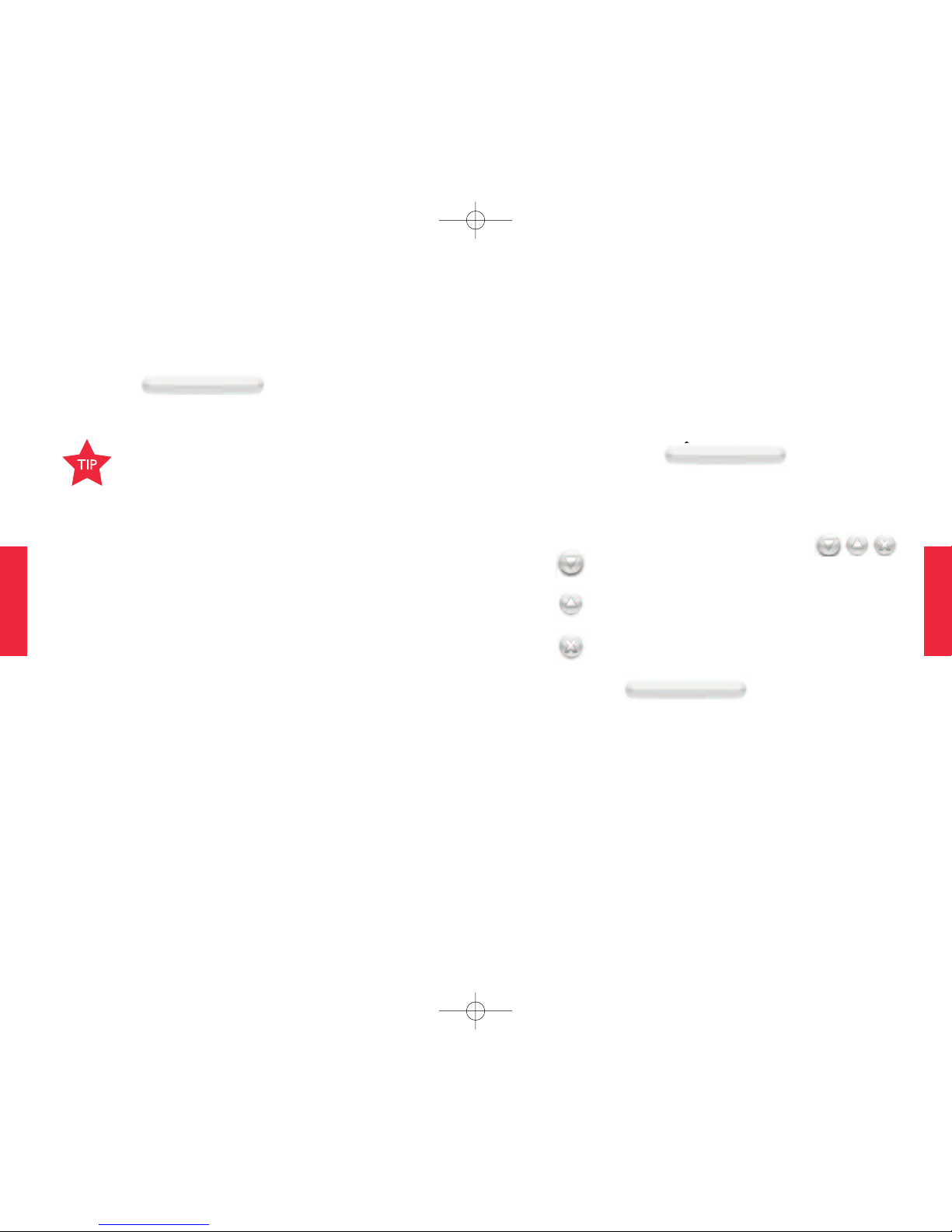
2. Next to the list of your contact names and phone
numbers you will see these three options:
• Click this button to move a
contact down on your Phone List.
• Click this button to move a contact up on your
Phone List.
• Click this button to delete a contact.
3. Click onthe button to save changes.
6. Please enter the names of your contacts in the first
column on the left and their phone numbers in the
second column on the right.
7. Press the button once you have
added all the contacts into your list.
S
AVE
MY PHONE BOOK
SAVE
Here are a few essential guidelines to follow
when adding contacts to your phone book:
• Make sure your phone is on while you
are making changes to your Phone List.
• Your changes should appear on your
phone within four hours. (Please note,
this process can take up to 24 hours,
depending on network traffic).
• If the Phone List on your Jitterbug
®
does not look right after about 24 hours,
please contact Customer Service.
800201_HTG_031308.qxp:user guide 3/13/08 1:06 PM Page 44
Page 28
46 Your Phone List
Your Phone List 47
SECTION 4
SECTION 4
Finding numbers in your phone list
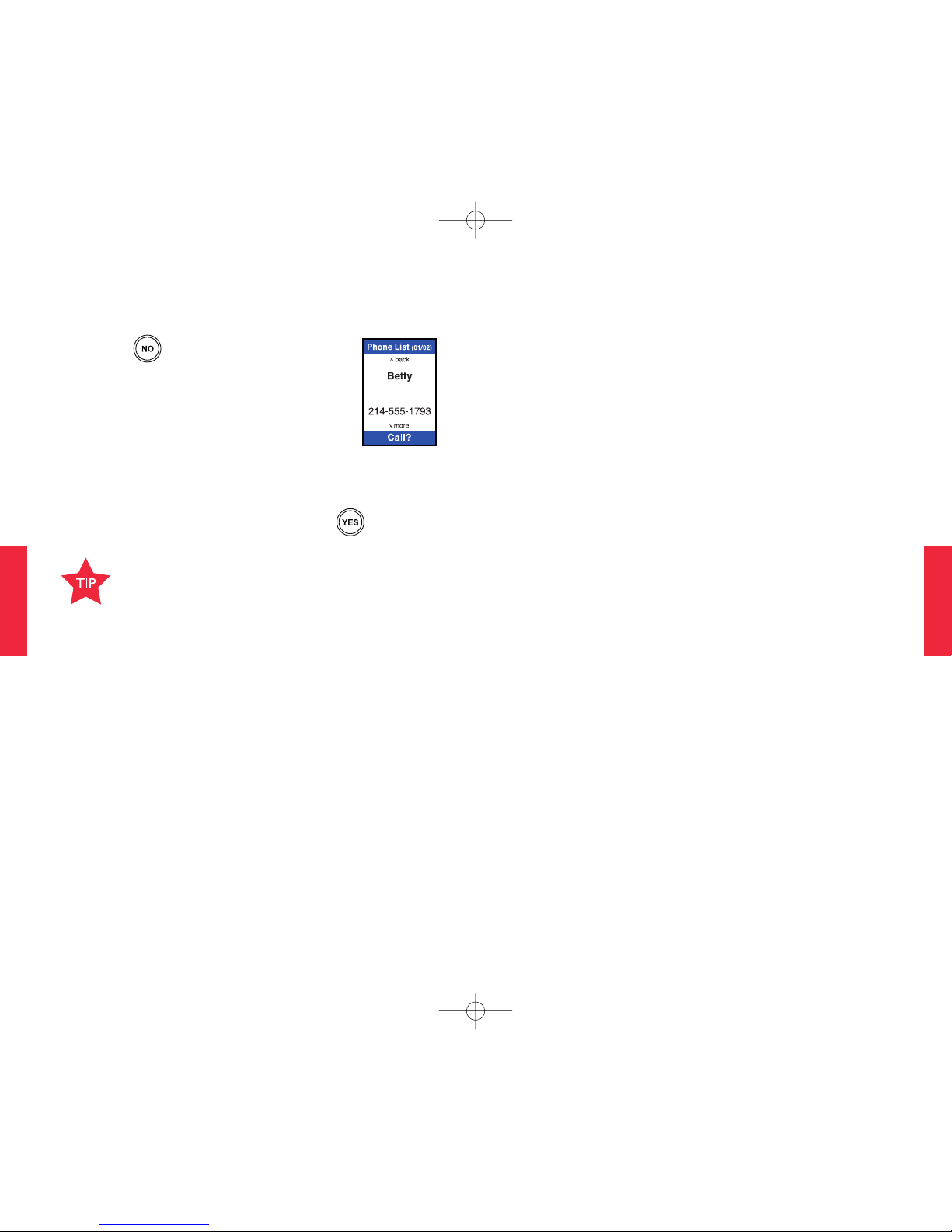
1. Press the button repeatedly until
the “Phone List” screen appears, as
shown.
2. Press the Up/Down button to go
through your Phone List until you
find the number you’re looking for.
3. To call the selected number, press the button.
Remember that the Up/Down button is used
to scroll through your Phone List.
800201_HTG_031308.qxp:user guide 3/13/08 1:06 PM Page 46
Page 29
Call History 4948 Call History
SECTION 5
SECTION 5
Section 5
Call History
is section explains howto review andreturnmissed calls.
Topics
• Using call history to see recent calls.
• Returning missed calls and redialing.
• Saving numbers from your call history.
For more information about Jitterbug, visit us online
at www.jitterbug.com
The co-founder of Jitterbug®, Arlene Harris,
became the first female innovator ever
inducted into the RCR Wireless News Hall
of Fame in May 2007.The Hall of Fame
honor recognized Harris’ significant
contributions to the advancement of
wireless communications.
800201_HTG_031308.qxp:user guide 3/13/08 1:06 PM Page 48
Page 30
Call History 5150 Call History
SECTION 5
SECTION 5
Returning missed calls and redialing
You can use the Call History to directly return missed
calls and redial both incoming or outgoing calls.
1. Press the button repeatedly until “Call History”
appears on the display screen.
2. Use the Up/Down arrow button to find your desired
call and press the button.
3. Answer the “Call?” question by pressing the
button to dial that number again. You will receive a
notification when you miss a call.
e Call History option on your Jitterbug
®
allows you to save numbers and update your
Phone List directly from this menu.
To keep it simple, we suggest that you update your
Phone List via the Jitterbug operator or by logging
onto www.MyJitterbug.com. Detailed instructions on
updating your Phone List can be found in section 4
(pg 38) of this guide. If you need assistance, please
call 1-800-733-6632.
Using call history to see recent calls
Your phone keeps a list of your ten most recent outgoing,
incoming and missed calls.
To review call history:
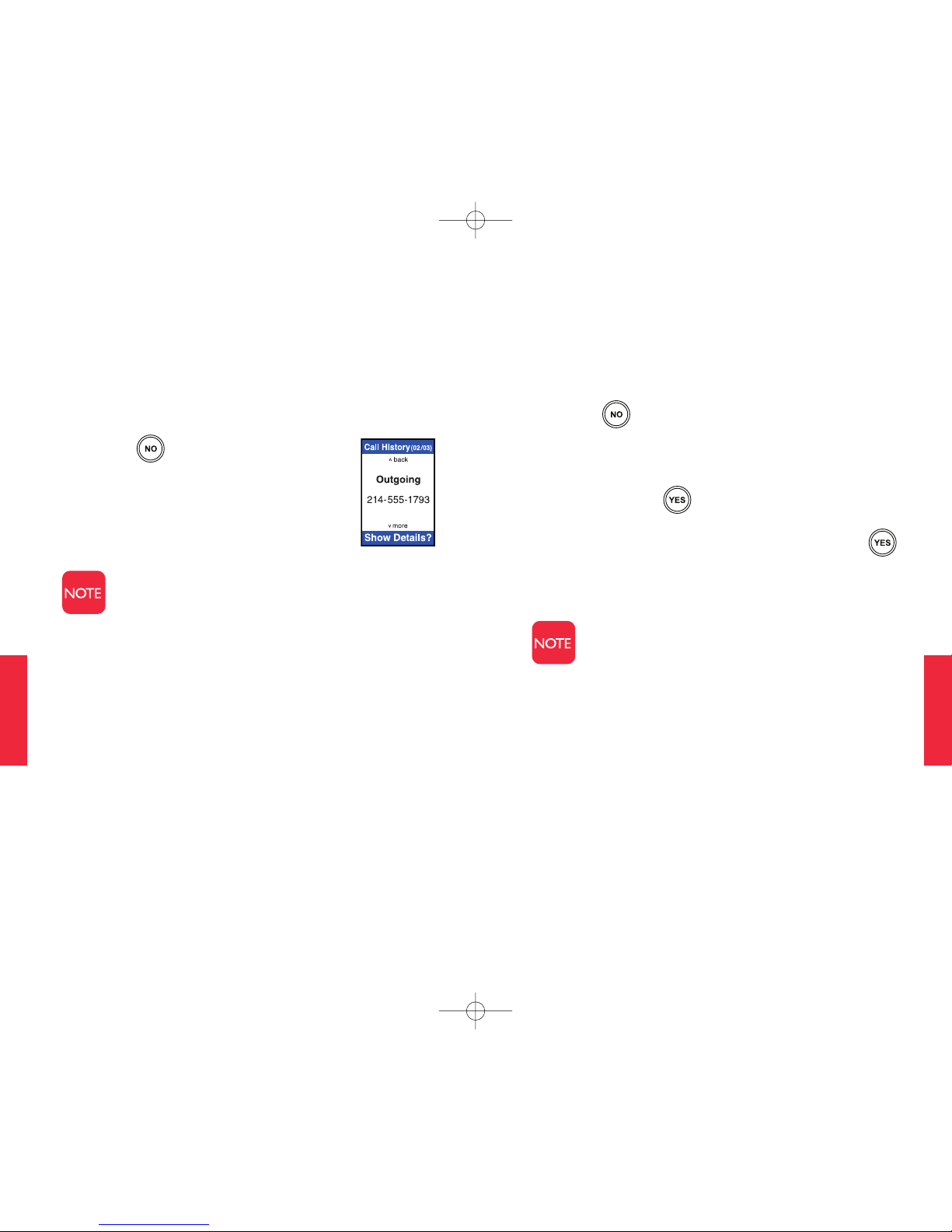
1. Press the button repeatedly until a
“Call History” screen appears, as shown.
2. Use the Up/Down arrow button to
scroll through your Call History.
If an outgoing, incoming, or missed call
matches a number from your Phone List,
the name of that person and that number
will appear on the screen with the
incoming number.
800201_HTG_031308.qxp:user guide 3/13/08 1:06 PM Page 50
Page 31
Call History 5352 Call History
SECTION 5
SECTION 5
Saving numbers from your call history
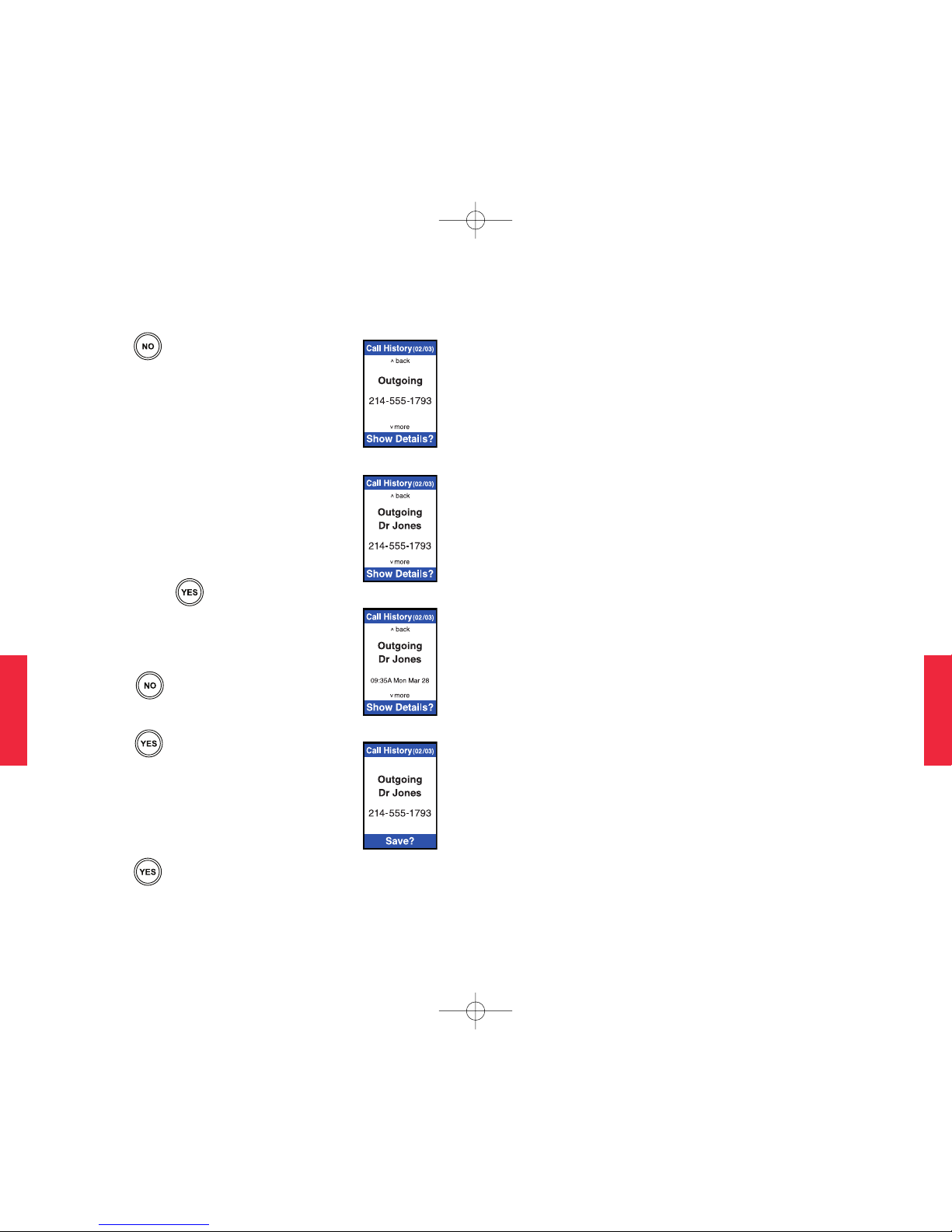
1. Press the button repeatedly until
“Call History” appears on the display
screen.
2. Press the Up/Down arrow button to find
the number you want to move to your
Phone List. “Show Details” will appear
at the bottom of the display screen.
3. en press the button. You will
see the time and date that the call was
made or received, as shown.
4. Press the button when you see
“Call?” at the bottom of the screen.
5. Press the button when you see
“Save?” on the screen.
6. You will see “Are you sure?”
7. If this is the number you want to save,
press the button. A three-second flash indicates
that the number is being saved. It will be stored as
the last entry on your Phone List.
800201_HTG_031308.qxp:user guide 3/13/08 1:06 PM Page 52
Page 32

Voicemail 5554 Voicemail
SECTION 6
SECTION 6
Section 6
Voicemail
is section explains how to use and manage voicemail
on your Jitterbug®(this service is optional).
Topics
• Using voicemail.
– Setting up voicemail.
– Recording your voicemail greeting.
– Letting you know that youhave voicemailmessages.
– Listening to voicemail messages.
– Saving or deleting voicemail messages.
– Listening to saved voicemail messages.
– Changing your voicemail greetings.
For more information about Jitterbug, visit us online
at www.jitterbug.com
800201_HTG_031308.qxp:user guide 3/13/08 1:06 PM Page 54
Page 33
Voicemail 5756 Voicemail
SECTION 6
SECTION 6
Using voicemail
Setting up voicemail:
is section only applies if you have purchased
Voicemail. To purchase Voicemail, please call Customer
Service at 1-800-733-6632.
Recording your voicemail greeting:
You have a choice of using a personalized greeting (in
your own words and voice) or a standard greeting. A
standard greeting will be generated by the Jitterbug
®
system and will tell the caller you are not available.
We recommend you recorda personalgreeting.
To set up Voicemail, you need to do the following:
1. Press the button repeatedly until
the “Voicemail” screen appears. The
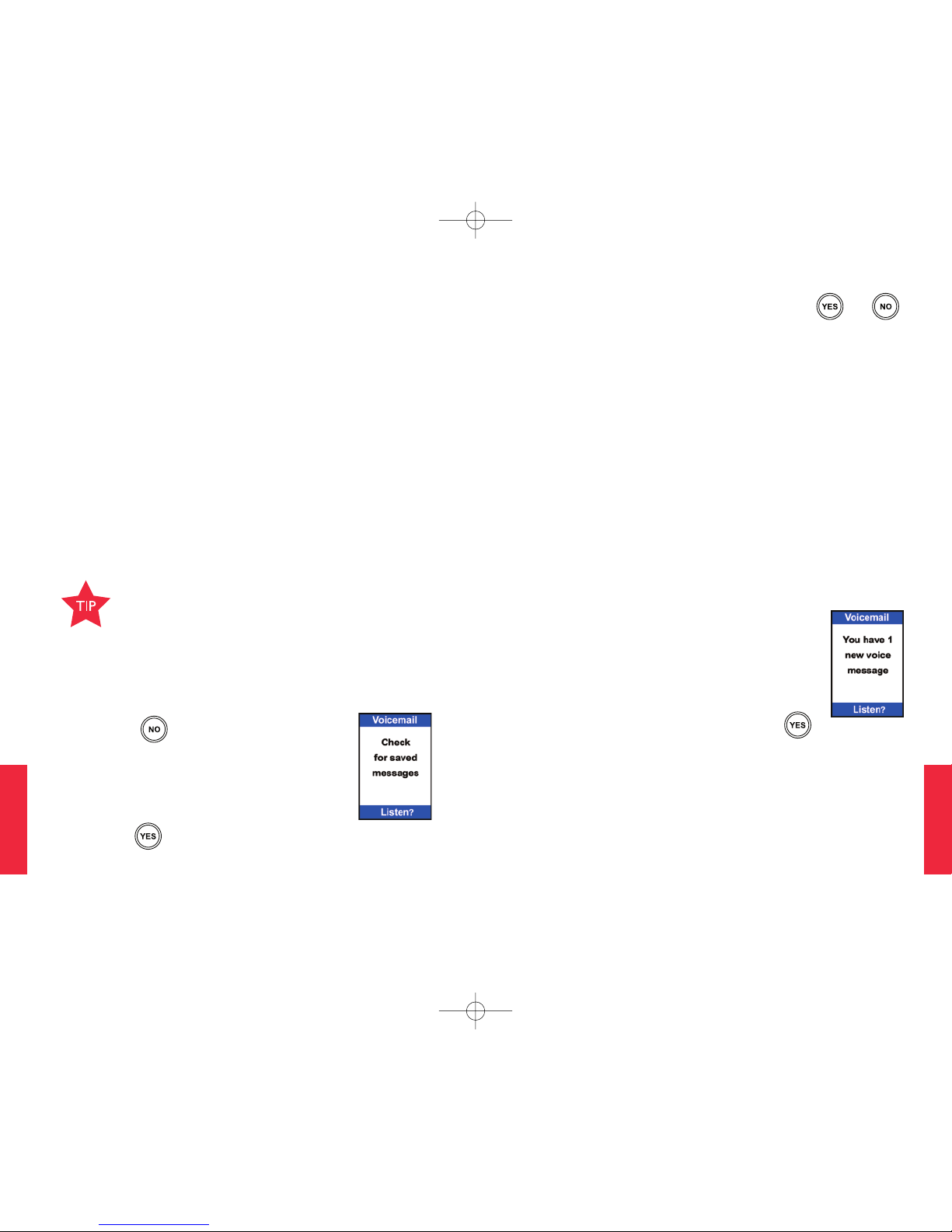
screen will say “Chec k for saved
messages” as shown here:
2. Press the button to enter the Voicemail feature
and listen to the prompts. e Jitterbug system will
know it is your first time setting up Voicemail.
3. Follow the instructions, pressing the or
buttons as prompted.
Letting you know that you have voicemail
messages:
If you miss a call and the caller leaves you a message,
your Jitterbug will notify you by:
1. Saying “New voicemail” on the display screen on
the outside of your phone.
2. Saying “You have 1 new voice message” on the
display screen on the inside of your phone.
Listening to voicemail messages:
If you have a new Voicemail message, your
Jitterbug lets you know. When you open
the phone you will see “You have 1 new
voice message” with the question “Listen?”
at the bottom of the screen. Press the
button to listen to your message.
800201_HTG_031308.qxp:user guide 3/13/08 1:06 PM Page 56
Page 34
Voicemail 5958 Voicemail
SECTION 6
SECTION 6
Saving or deleting voicemail messages:
After listening to each message, the Voicemail system
will ask if you would like to:
• “Replay the message?” If you want to listen to
the message again, press the button. If not,
press the button.
• Then the Jitterbug®system will ask you if you
want to delete the message.
If you want to delete it, press the button.
If you want to save the message press
the button.
Once you delete a message, the information
is gone. You cannot retrieve a deleted
message.
Listening to saved voicemail messages:
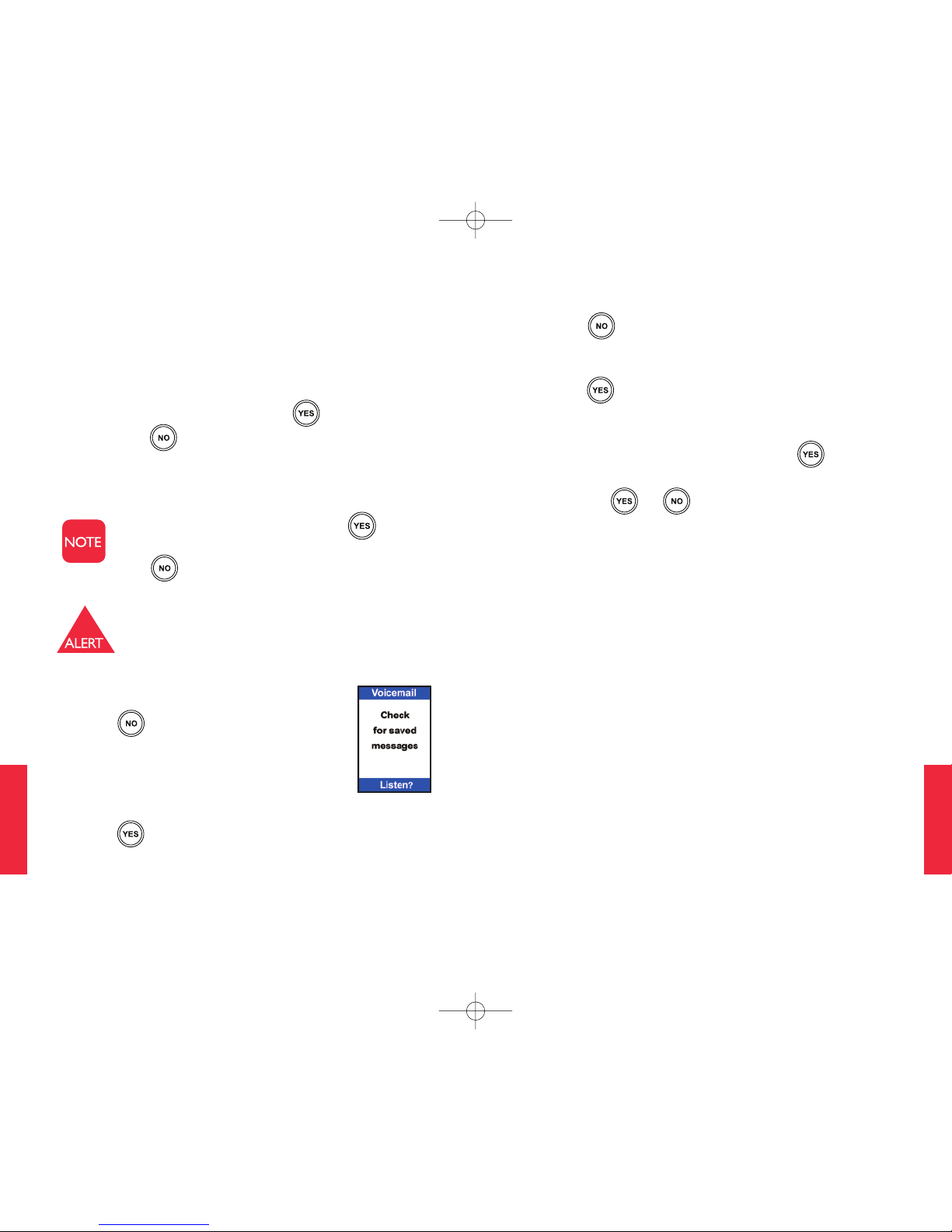
Press the button repeatedly until the
“Voicemail” screen appears. e screen
should say “Check for saved messages”
as shown here:
Press the button to enter Voicemail and listen to
the prompts. e Jitterbug system will play your saved
messages. To exit your Voicemail, simply close your
phone at anytime.
Changing your voicemail greeting:
Press the button repeatedly until the Voicemail
screen appears on your phone.
Press the button to enter Voicemail and listen to
the prompts. After playing any saved messages, the
system will ask you “Would you like to review
your voicemail greeting?” Press the button to
change your greeting by following the prompts and
pressing the or buttons.
800201_HTG_031308.qxp:user guide 3/13/08 1:06 PM Page 58
Page 35
Voice Dialing 61
SECTION 7
60 Voice Dialing
SECTION 7
Section 7
Voice Dialing
is section explains how to use the voice dial feature
on your phone to call a contact on your phone list.
Topics
• Setting up voice dialing.
• Voice dialing tips.
For more information about Jitterbug, visit us online
at www.jitterbug.com
April 3, 2008 is the 35th anniversar y of
the first public phone call made on a
portable cell phone.That call was placed
by Martin Cooper who created Jitterbug
®
with his wife, Arlene Harris, the founder
of Jitterbug.
800201_HTG_031308.qxp:user guide 3/13/08 1:06 PM Page 60
Page 36
Voice Dialing 63
SECTION 7
62 Voice Dialing
SECTION 7
To activate this feature, call Customer
Service at 1-800-733-6632.
Setting up voice dialing
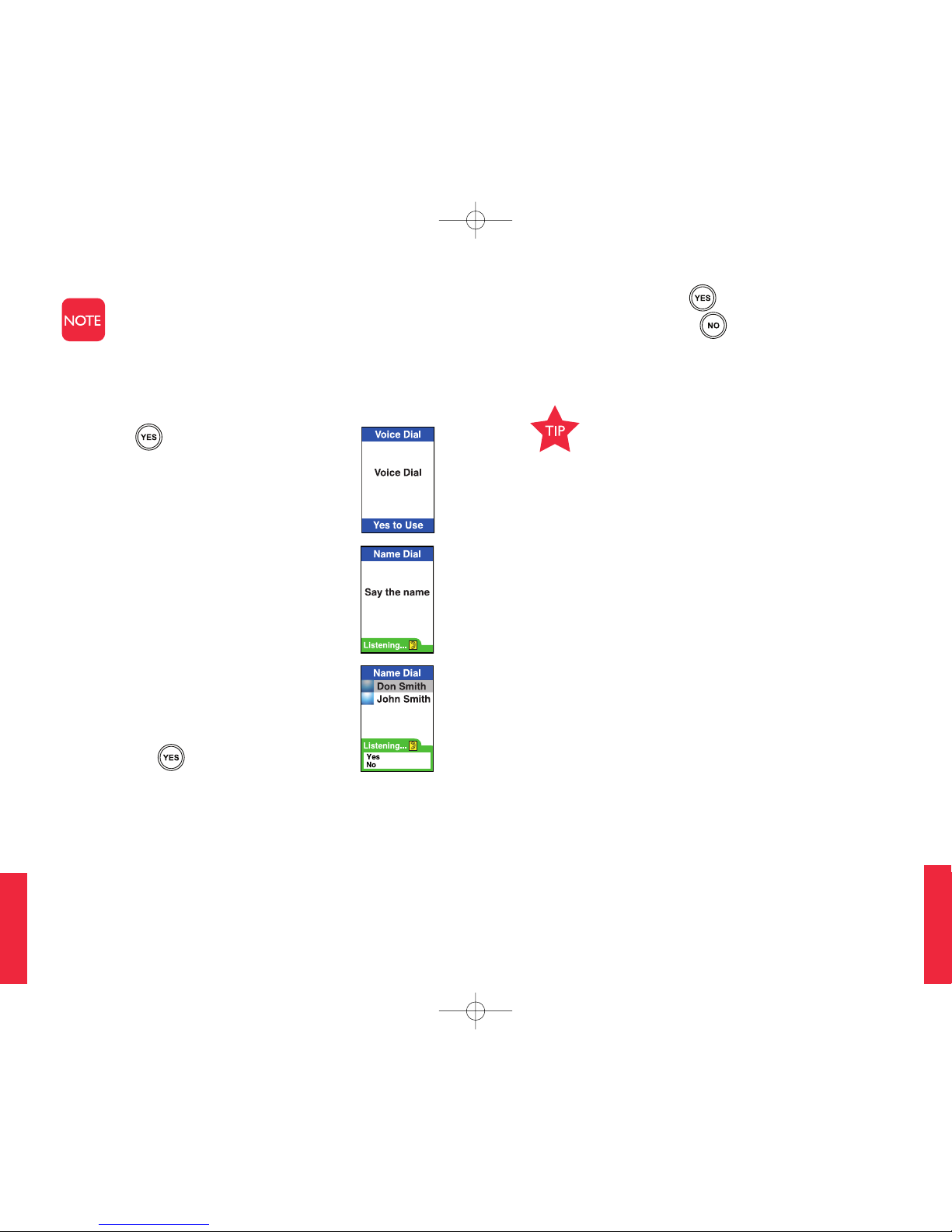
1. Press the button when you see
“Voice Dial” on your screen. (e
command “Yes to Use” will appear
at the bottom of the display screen).
2. Say the name of the person you want
to call, exactly as it appears on your
Phone List.
3. If Voice Dial recognizes the name,
your phone will confirm the request by
asking “Did you say [NAME]?”
Confirm by saying “Yes” or by
pressing the button.
4. If Voice Dial is not sure which name you said, you
will hear the question “Did you say?” followed by
the first of three possible names.
5. Say “Yes” or press the button to confirm a name;
say “No” or press the button to hear the next
name. When you confirm a name, that number will
be dialed.
Voice dialing tips
• Wait for the beep before speaking.
• Speak in a normal volume, as if you were
talking to someone on the phone.
• Say the name, exactly as it appears on
your Phone List.
• Speak clearly.
800201_HTG_031308.qxp:user guide 3/13/08 1:06 PM Page 62
Page 37

Health and Safety Information 6564 Health and Safety Information
HEALTH AND SAFETY INFORMATION
HEALTH AND SAFETY INFORMATION
Health and Safety Information
is section covers common questions about the healthy
use of cell phones and recommended safety precautions.
Topics
• Operating environment.
• Health and safety information.
• Consumer questions and answers.
• Road safety.
• FCC notice.
• Other important safety information.
• Product performance.
• Battery precautions.
• Care and maintenance.
800201_HTG_031308.qxp:user guide 3/13/08 1:06 PM Page 64
Page 38

Health and Safety Information 6766 Health and Safety Information
HEALTH AND SAFETY INFORMATION
HEALTH AND SAFETY INFORMATION
interference with the pacemaker. ese recommendations
are consistent with the independent research and
recommendations of Wireless Technology Research.
Persons with pacemakers:
• Should always keep the phone more than 15 cm
(6 inches) from their pacemaker when the phone is
switched on.
• Should not carry the phone in a breast pocket.
• Should use the ear opposite the pacemaker to
minimize potential interference.
If you have any reason to suspect that interference is
taking place, switch your phone off immediately.
Hearing aids:
Some digital wireless phones may interfere with some
hearing aids. In the event of such interference, you may
wish to consult your hearing aid manufacturer to discuss
alternatives.
Other medical devices:
If you use any other personal medical devices, consult
the manufacturer of your device to determine if it is
adequately shielded from external RF energy. Your
physician may be able to assist you in obtaining this
information.
Operating environment
Remember to follow any special regulations enforced
in any area and always switch your phone off whenever
it is forbidden to use it, or when it may cause
interference or danger. When connecting the phone or
any accessory to another device, read its user’s guide
for detailed safety instructions. Do not connect
incompatible products.
As with other mobile radio transmitting equipment,
users are advised that for the satisfactory operation of the
equipment and for the safety of personnel, it is
recommended that the equipment should only be used
in the normal operating position (held to your ear with
the antenna pointing over your shoulder).
Using your phone near other electronic
devices:
Most modern electronic equipment is shielded from
radio frequency (RF) signals. However, certain electronic
equipment may not be shielded against the RF signals
from your wireless phone. Consult the manufacturer to
discuss alternatives.
Pacemakers:
Pacemaker manufacturers recommend that a minimum
distance of 15 cm (6 inches) be maintained between a
wireless phone and a pacemaker to avoid potential
800201_HTG_031308.qxp:user guide 3/13/08 1:06 PM Page 66
Page 39

Health and Safety Information 6968 Health and Safety Information
HEALTH AND SAFETY INFORMATION
HEALTH AND SAFETY INFORMATION
Areas with a potentially explosive atmosphere are often
but not always clearly marked. ey include below deck
on boats, chemical transfer or storage facilities, vehicles
using liquefied petroleum gas (such as propane or
butane), areas where the air contains chemicals or
particles, such as grain, dust or metal powders, and any
other area where you would normally be advised to turn
off your vehicle engine.
Emergency calls:
is phone, like any wireless phone, operates using radio
signals, wireless and landline networks as well as
user-programmed functions, which cannot guarantee
connection in all conditions. erefore, you should
never rely solely on any wireless phone for essential
communications (medical emergencies, for example).
Remember, to make or receive any calls the phone must
be switched on and in a service area with adequate signal
strength. Emergency calls may not be possible on all
wireless phone networks or when certain network
services and/or phone features are in use. Check
with local service providers. To make an emergency call:
1. If the phone is off, turn it on.
2. Press the 9-1-1 buttons.
Switch your phone off in health care facilities when any
regulations posted in these areas instruct you to do so.
Hospitals or health care facilities may be using
equipment that could be sensitive to external RF energy.
Vehicles:
RF signals may affect improperly installed or
inadequately shielded electronic systems in motor
vehicles. Check with the manufacturer or its
representative regarding your vehicle. You should also
consult the manufacturer of any equipment that has
been added to your vehicle.
Posted facilities:
Switch your phone off in any facility where posted
notices require you to do so.
Potentially explosive environments
Switch your phone off when in any area with a
potentially explosive atmosphere and obey all signs and
instructions. Sparks in such areas could cause an
explosion or fire resulting in bodily injury or even death.
Users are advised to switch the phone off while at a
refueling point (service station). Users are reminded of
the need to observe restrictions on the use of radio
equipment in fuel depots (fuel storage and distribution
areas), chemical plants or where blasting operations are
in progress.
800201_HTG_031308.qxp:user guide 3/13/08 1:06 PM Page 68
Page 40

Health and Safety Information 7170 Health and Safety Information
HEALTH AND SAFETY INFORMATION
HEALTH AND SAFETY INFORMATION
Health and Safety Information
Exposure to radio frequency (RF) signals
certification information (SAR)
Your wireless phone is a radio transmitter and receiver.
It is designed and manufactured not to exceed the
exposure limits for radio frequency (RF) energy set by
the Federal Communications Commission (FCC) of
the U.S. Government. ese FCC exposure limits are
derived from the recommendations of two expert
organizations, the National Counsel on Radiation
Protection and Measurement (NCRP) and the Institute
of Electrical and Electronics Engineers (IEEE). In both
cases, the recommendations were developed by scientific
and engineering experts drawn from industry,
government, and academia after extensive reviews of
the scientific literature related to the biological effects of
RF energy.
e exposure limit set by the FCC for wireless mobile
phones employs a unit of measurement known as the
Specific Absorption Rate (SAR). e SAR is a measure
of the rate of absorption of RF energy by the human
body expressed in units of watts per kilogram (W/kg).
e FCC requires wireless phones to comply with a
safety limit of 1.6 watts per kilogram (1.6 W/kg). e
FCC exposure limit incorporates a substantial margin
of safety to give additional protection to the public and
to account for any variations in measurements.
SAR tests are conducted using standard operating
When making an emergency call, remember to give all
the necessary information as accurately as possible.
Remember that your phone may be the only means of
communication at the scene of an accident; do not
hang-up the call until given permission to do so.
Restricting children’s access to your phone:
Your phone is not a toy. Children should not be allowed
to play with it because they could hurt themselves and
others, damage the phone or make calls that increase
your phone bill.
800201_HTG_031308.qxp:user guide 3/13/08 1:06 PM Page 70
Page 41

Health and Safety Information 7372 Health and Safety Information
HEALTH AND SAFETY INFORMATION
HEALTH AND SAFETY INFORMATION
AMPS/CDMA Mode(Part 22) Head: 0.662 W/kg
CDMA, Body-worn: 0.571 W/kg
PCS Mode(Part 24) Head: 1.06 W/kg,
Body-worn:0.651 W/kg
SAR information on this and other model phones can
be viewed online at www.fcc.gov/oet/fccid. To find
information that pertains to a particular model phone,
this site uses the phone FCC ID number which is
usually printed somewhere on the case of the phone.
Sometimes it may be necessary to remove the battery
pack to find the number. Once you have the FCC ID
number for a particular phone, follow the instructions
on the Web site and it should provide values for typical
or maximum SAR for a particular phone. Additional
product specific SAR information can also be obtained
at www.fcc.gov/cgb/sar.
Consumer information on wireless phones
e U.S. Food and Drug Administration (FDA) has
published a series of Questions and Answers for
consumers relating to radio frequency (RF) exposure
from wireless phones. e FDA publication includes
the following information:
What kinds of phones are the subject of this
update?
e term “wireless phone” refers here to hand-held
wireless phones with built-in antennas, often called
“cell,” “mobile,” or “PCS” phones. ese types of wireless
positions accepted by the FCC with the phone
transmitting at its highest certified power level in all
tested frequency bands. Although the SAR is determined
at the highest certified power level, the actual SAR level
of the phone while operating can be well below the
maximum value. is is because the phone is designed
to operate at multiple power levels so as to use only the
power required to reach the network. In general, the
closer you are to a wireless base station antenna, the lower
the power output. Before a new model phone is available
for sale to the public, it must be tested and certified to
the FCC that it does not exceed the exposure limit
established by the FCC. Tests for each model phone are
performed in positions and locations (e.g., at the ear and
worn on the body) as required by the FCC. Body-worn
operations are restricted to Samsung-supplied, approved,
or non-Samsung designated accessories that have no
metal and must provide at least 1.5 cm separation
between the device, including its antenna (whether
extended or retracted) and the user’s body.
Non-compliance with the above restrictions may result
in violation of FCC RF exposure guidelines.
e FCC has granted an Equipment Authorization for
this mobile phone with all reported SAR levels evaluated
as in compliance with the FCC RF exposure guidelines.
e maximum SAR values for this model phone as
reported to the FCC are:
800201_HTG_031308.qxp:user guide 3/13/08 1:06 PM Page 72
Page 42

Health and Safety Information 7574 Health and Safety Information
HEALTH AND SAFETY INFORMATION
HEALTH AND SAFETY INFORMATION
researchers have had difficulty in reproducing those
studies, or in determining the reasons for inconsistent
results.
What is the FDA’s role concerning the
safety of wireless phones?
Under the law, the FDA does not review the safety of
radiation-emitting consumer products such as wireless
phones before they can be sold, as it does with new
drugs or medical devices. However, the agency has
authority to take action if wireless phones are shown to
emit radio frequency energy (RF) at a level that is
hazardous to the user. In such a case, the FDA could
require the manufacturers of wireless phones to notify
users of the health hazard and to repair, replace or recall
the phones so that the hazard no longer exists.
Although the existing scientific data do not justify FDA
regulatory actions, FDA has urged the wireless phone
industry to take a number of steps, including the
following:
• Support needed research into possible biological
effects of RF of the type emitted by wireless phones;
• Design wireless phones in a way that minimizes any
RF exposure to the user that is not necessary for
device function; and
• Cooperate in providing users of wireless phones
with the best possible information on possible effects
of wireless phone use on human health.
phones can expose the user to measurable radio
frequency energy (RF) because of the short distance
between the phone and the user’s head. ese RF
exposures are limited by Federal Communications
Commission safety guidelines that were developed with
the advice of FDA and other federal health and safety
agencies. When the phone is located at greater distances
from the user, the exposure to RF is drastically lower
because a person’s RF exposure decreases rapidly with
increasing distance from the source. e so-called
“cordless phones,” which have a base unit connected to
the telephone wiring in a house, typically operate at far
lower power levels, and thus produce RF exposures well
within the FCC’s compliance limits.
Do wireless phones pose a health hazard?
e available scientific evidence does not show that any
health problems are associated with using wireless
phones. ere is no proof, however, that wireless phones
are absolutely safe. Wireless phones emit low levels of
radio frequency energy (RF) in the microwave range
while being used. ey also emit very low levels of RF
when in the stand-by mode. Whereas high levels of RF
can produce health effects (by heating tissue), exposure
to low level RF that does not produce heating effects
causes no known adverse health effects. Many studies of
low level RF exposures have not found any biological
effects. Some studies have suggested that some biological
effects may occur, but such findings have not been
confirmed by additional research. In some cases, other
800201_HTG_031308.qxp:user guide 3/13/08 1:06 PM Page 74
Page 43

Health and Safety Information 77
76 Health and Safety Information
HEALTH AND SAFETY INFORMATION
HEALTH AND SAFETY INFORMATION
are thus not the primary subject of the safety questions
discussed in this document.
What are the results of the research done
already?
e research done thus far has produced conflicting
results, and many studies have suffered from flaws in
their research methods. Animal experiments
investigating the effects of radio frequency energy (RF)
exposures characteristic of wireless phones have yielded
conflicting results that often cannot be repeated in other
laboratories. A few animal studies, however, have
suggested that low levels of RF could accelerate the
development of cancer in laboratory animals. However,
many of the studies that showed increased tumor
development used animals that had been genetically
engineered or treated with cancer-causing chemicals so
as to be pre-disposed to develop cancer in the absence
of RF exposure. Other studies exposed the animals to
RF for up to 22 hours per day. ese conditions are not
similar to the conditions under which people use wireless
phones, so we don’t know with certainty what the results
of such studies mean for human health.
ree large epidemiology studies have been published
since December 2000. Between them, the studies
investigated any possible association between the use of
wireless phones and primary brain cancer, glioma,
meningioma, or acoustic neuroma, tumors of the brain
e FDA belongs to an interagency working group of
the federal agencies that have responsibility for different
aspects of RF safety to ensure coordinated efforts at the
federal level. e following agencies belong to this
working group:
• National Institute for Occupational Safety and
Health
• Environmental Protection Agency
• Federal Communications Commission
• Occupational Safety and Health Administration
• National Telecommunications and Information
Administration
e National Institutes of Health participates in some
interagency working group activities, as well.
e FDA shares regulatory responsibilities for wireless
phones with the Federal Communications Commission
(FCC). All phones that are sold in the United States
must comply with FCC safety guidelines that limit RF
exposure. FCC relies on FDA and other health agencies
for safety questions about wireless phones.
e FCC also regulates the base stations that the wireless
phone networks rely upon. While these base stations
operate at higher power than do the wireless phones
themselves, the RF exposures that people get from these
base stations are typically thousands of times lower than
those they can get from wireless phones. Base stations
800201_HTG_031308.qxp:user guide 3/13/08 1:06 PM Page 76
Page 44

Health and Safety Information 7978 Health and Safety Information
HEALTH AND SAFETY INFORMATION
HEALTH AND SAFETY INFORMATION
What is the FDA doing to find out more
about the possible health effects of wireless
phone RF?
e FDA is working with the U.S. NationalToxicology
Program and with groups of investigators around the
world to ensure that high priority animal studies are
conducted to address important questions about the
effects of exposure to radio frequency energy (RF).
e FDA has been a leading participant in the World
Health Organization international Electromagnetic
Fields (EMF) Project since its inception in 1996. An
influential result of this work has been the development
of a detailed agenda of research needs that has driven the
establishment of new research programs around the
world. e Project has also helped develop a series of
public information documents on EMF issues.
e FDA and the Cellular Telecommunications &
Internet Association (CTIA) have a formal Cooperative
Research and Development Agreement (CRADA) to
do research on wireless phone safety. e FDA provides
the scientific oversight, obtaining input from experts in
government, industry, and academic organizations.
CTIA-funded research is conducted through contracts
to independent investigators. e initial research will
include both laboratory studies and studies of wireless
phone users.
or salivary gland, leukemia, or other cancers. None of
the studies demonstrated the existence of any harmful
health effects from wireless phones RF exposures.
However, none of the studies can answer questions about
long-term exposures, since the average period of phone
use in these studies was around three years.
What research is needed to decide whether
RF exposure from wireless phones poses a
health risk?
A combination of laboratory studies and epidemiological
studies of people actually using wireless phones would
provide some of the data that are needed. Lifetime
animal exposure studies could be completed in a few
years. However, very large numbers of animals would be
needed to provide reliable proof of a cancer promoting
effect if one exists. Epidemiological studies can provide
data that is directly applicable to human populations,
but ten or more years’ follow-up may be needed to
provide answers about some health effects, such as
cancer. is is because the interval between the time of
exposure to a cancer-causing agent and the time tumors
develop - if they do - may be many, many years. e
interpretation of epidemiological studies is hampered
by difficulties in measuring actual RF exposure during
day-to-day use of wireless phones. Many factors affect
this measurement, such as the angle at which the phone
is held, or which model of phone is used.
800201_HTG_031308.qxp:user guide 3/13/08 1:06 PM Page 78
Page 45

Health and Safety Information 8180 Health and Safety Information
HEALTH AND SAFETY INFORMATION
HEALTH AND SAFETY INFORMATION
What about children using wireless phones?
e scientific evidence does not show a danger to users
of wireless phones, including children and teenagers. If
you want to take steps to lower exposure to radio
frequency energy (RF), the measures described above
would apply to children and teenagers using wireless
phones. Reducing the time of wireless phone use and
increasing the distance between the user and the RF
source will reduce RF exposure.
Some groups sponsored by other national governments
have advised that children be discouraged from using
wireless phones at all. For example, the government in
the United Kingdom distributed leaflets containing such
a recommendation in December 2000. ey noted that
no evidence exists that using a wireless phone causes
brain tumors or other ill effects. eir recommendation
to limit wireless phone use by children was strictly
precautionary; it was not based on scientific evidence
that any health hazard exists.
Do hands-free kits for wireless phones
reduce risks from exposure to RF emissions?
Since there are no known risks from exposure to RF
emissions from wireless phones, there is no reason to
believe that hands-free kits reduce risks. Hands-free kits
can be used with wireless phones for convenience and
comfort. ese systems reduce the absorption of RF
energy in the head because the phone, which is the
e CRADA will also include a broad assessment of
additional research needs in the context of the latest
research developments around the world.
What steps can I take to reduce my
exposure to radio frequency energy from
my wireless phone?
If there is a risk from these products - and at this point
we do not know that there is - it is probably very small.
But if you are concerned about avoiding even potential
risks, you can take a few simple steps to minimize your
exposure to radio frequency energy (RF). Since time is
a key factor in how much exposure a person receives,
reducing the amount of time spent using a wireless
phone will reduce RF exposure.
If you must conduct extended conversations by wireless
phone every day, you could place more distance between
your body and the source of the RF, since the exposure
level drops off dramatically with distance. For example,
you could use a headset and carry the wireless phone
away from your body or use a wireless phone connected
to a remote antenna.
Again, the scientific data do not demonstrate that
wireless phones are harmful. But if you are concerned
about the RF exposure from these products, you can
use measures like those described above to reduce your
RF exposure from wireless phone use.
800201_HTG_031308.qxp:user guide 3/13/08 1:06 PM Page 80
Page 46

Health and Safety Information 8382 Health and Safety Information
HEALTH AND SAFETY INFORMATION
HEALTH AND SAFETY INFORMATION
What about wireless phone interference
with medical equipment?
Radio frequency energy (RF) from wireless phones can
interact with some electronic devices. For this reason,
FDA helped develop a detailed test method to measure
electromagnetic interference (EMI) of implanted cardiac
pacemakers and defibrillators from wireless telephones.
is test method is now part of a standard sponsored by
the Association for the Advancement of Medical
instrumentation (AAMI). e final draft, a joint effort
by FDA, medical device manufacturers, and many other
groups, was completed in late 2000. is standard will
allow manufacturers to ensure that cardiac pacemakers
and defibrillators are safe from wireless phone EMI.
FDA has tested wireless phones and helped develop a
voluntary standard sponsored by the Institute of
Electrical and Electronic Engineers (IEEE). is standard
specifies test methods and performance requirements for
hearing aids and wireless phones so that no interference
occurs when a person uses a compatible phone and a
compatible hearing aid at the same time. is standard
was approved by the IEEE in 2000.
e FDA continues to monitor the use of wireless
phones for possible interactions with other medical
devices. Should harmful interference be found to occur,
the FDA will conduct testing to assess the interference
and work to resolve the problem.
Additional information on the safety of RF exposures
source of the RF emissions, will not be placed against
the head. On the other hand, if the phone is mounted
against the waist or other part of the body during use,
then that part of the body will absorb more RF energy.
Wireless phones marketed in the U.S. are required to
meet safety requirements regardless of whether they are
used against the head or against the body. Either
configuration should result in compliance with the safety
limit.
Do wireless phone accessories that claim to
shield the head from RF radiation work?
Since there are no known risks from exposure to RF
emissions from wireless phones, there is no reason to
believe that accessories that claim to shield the head
from those emissions reduce risks. Some products that
claim to shield the user from RF absorption use special
phone cases, while others involve nothing more than a
metallic accessory attached to the phone. Studies have
shown that these products generally do not work as
advertised. Unlike “hands-free” kits, these so-called
“shields” may interfere with proper operation of the
phone. e phone may be forced to boost its power to
compensate, leading to an increase in RF absorption.
In February 2002, the FederalTrade Commission (FTC)
charged two companies that sold devices that claimed
to protect wireless phone users from radiation with
making false and unsubstantiated claims. According to
the FTC, these defendants lacked a reasonable basis to
substantiate their claim.
800201_HTG_031308.qxp:user guide 3/13/08 1:06 PM Page 82
Page 47

Health and Safety Information 8584 Health and Safety Information
HEALTH AND SAFETY INFORMATION
HEALTH AND SAFETY INFORMATION
help you place your call without taking your attention
off the road.
2. When available, use a hands-free device. If possible,
add an additional layer of convenience and safety to
your wireless phone with one of the many hands-free
accessories available today.
3. Position your wireless phone within easy reach. Be
able to access your wireless phone without removing
your eyes from the road. If you get an incoming call
at an inconvenient time, let your voice mail answer
it for you.
4. Let the person you are speaking with know you are
driving; if necessary, suspend the call in heavy traffic
or hazardous weather conditions. Rain, sleet, snow,
ice and even heavy traffic can be hazardous.
5. Do not take notes or look up phone numbers while
driving. Jotting down a “to do” list or flipping through
your address book takes attention away from your
primary responsibility, driving safely.
6. Dial sensibly and assess the traffic; if possible, place
calls when you are not moving or before pulling into
traffic. Try to plan calls when your car will be
stationary. If you need to make a call while moving,
dial only a few numbers, check the road and your
mirrors, then continue.
from various sources can be obtained from the following
organizations:
• FCC RF Safety Program
http://www.fcc.gov/oet/rfsafety
• Environmental Protection Agency (EPA)
http://www.epa.gov/radiation/
• Occupational Safety and Health Administration’s
(OSHA):
http://www.osha.gov/SLTC/radiofrequency
radiation/index.html
• National Institute for Occupational Safety and
Health (NIOSH):
http://www.cdc.gov/niosh/topics/emf
• World Health Organization (WHO):
http://www.who.int/peh-emf/
• International Commission on Non-Ionizing
Radiation Protection: http://www.icnirp.de
• National Radiation Protection Board (UK):
http://www.hpa.org.uk/radiation/
Road safety
When driving a car, driving is your first responsibility.
When using your wireless phone behind the wheel of a
car, practice good common sense and remember the
following tips:
1. Get to know your wireless phone and its features,
such as speed dial and redial. If available, these features
800201_HTG_031308.qxp:user guide 3/13/08 1:06 PM Page 84
Page 48

Health and Safety Information 8786 Health and Safety Information
HEALTH AND SAFETY INFORMATION
HEALTH AND SAFETY INFORMATION
Cellular Telecommunications & Internet Association.
• US Food and Drug Administration:
http://www.fda.gov/cellphones
FCC notice
e phone may cause TV or radio interference if used
in close proximity to receiving equipment. e FCC
can require you to stop using the phone if such
interference cannot be eliminated.
Vehicles using liquefied petroleum gas (such as propane
or butane) must comply with the National Fire
Protection Standard (NFPA-58). For a copy of this
standard, contact the National Fire Protection
Association, One Batterymarch Park, Quincy, MA
02269, Attn: Publication Sales Division.
FCC cautions
Any changes or modifications to your phone not expressly
approved in this document could void your warranty for
this equipment, and void your authority to operate this
equipment. Only use approved batteries, antennas and
chargers. e use of any unauthorized accessories may
be dangerous and void the phone warranty if said
accessories cause damage or a defect to the phone.
Although your phone is quite sturdy, it is a complex
piece of equipment and can be broken. Avoid dropping,
hitting, bending or sitting on it.
7. Do not engage in stressful or emotional conversations
that may be distracting. Make people you are talking
with aware you are driving and suspend conversations
that have the potential to divert your attention from
the road.
8. Use your wireless phone to call for help. Press the
911 button or other local emergency number in the
case of fire, traffic accident or medical emergencies.
Remember, it is a free call on your wireless phone!
9. Use your wireless phone to help others in
emergencies. If you see an auto accident, crime in
progress or other serious emergency where lives are in
danger, press the 911 button or other local emergency
number, as you would want others to do for you.
10. Call roadside assistance or a special non-emergency
wireless assistance number when necessary. If you see
a broken-down vehicle posing no serious hazard, a
broken traffic signal, a minor traffic accident where
no one appears injured, or a vehicle you know to be
stolen, call roadside assistance or other special
non-emergency number.
The wireless industry reminds you to use
your phone safely when driving.
For more information, please call 1-888-901-SAFE, or
visit our website www.wow-com.com provided by the
800201_HTG_031308.qxp:user guide 3/13/08 1:06 PM Page 86
Page 49

Health and Safety Information 8988 Health and Safety Information
HEALTH AND SAFETY INFORMATION
HEALTH AND SAFETY INFORMATION
Product performance
Getting the most out of your signal
reception
e quality of each call you make or receive depends on
the signal strength in your area. You will know that you
have a signal when you hear a dial-tone. If you do not
have a dial tone there is no signal in that immediate area.
If you’re inside a building, being near a window may
give you better reception.
Understanding how your phone operates
Your phone is basically a radio transmitter and receiver.
Whenit’s turned on, it receivesandtransmits radio frequency
(RF)signals.When you use your phone,the system handling
your call controls the power level. is power can range
from 0.006 watts to 0.2 watts in digital mode.
Maintaining your phone’s peak performance
For the best care of your phone, only authorized
personnel should service your phone and accessories.
Faulty service may void the warranty.
Avoid exposing your phone and accessories to rain or
liquid spills. If your phone does get wet, immediately
turn the power off and remove the battery. If it is
inoperable, call Customer Service at 1-800-733-6632.
Other important safety information
• Only qualified personnel should service the phone
or install the phone in a vehicle. Faulty installation
or service may be dangerous and may invalidate
any warranty applicable to the device.
• Check regularly that all wireless phone equipment
in your vehicle is mounted and operating properly.
• Do not store or carry flammable liquids, gases or
explosive materials in the same compartment as the
phone, its parts or accessories.
• For vehicles equipped with an air bag, remember
that an air bag inflates with great force. Do not
place objects, including both installed or portable
wireless equipment in the area over the air bag or
in the air bag deployment area. If wireless equipment
is improperly installed and the air bag inflates,
serious injury could result.
• Switch your phone off before boarding an aircraft.
e use of wireless phones in aircraft is illegal and
may be dangerous to the aircraft’s operation.
• Failure to observe these instructions may lead to
the suspension or denial of telephone services to
the offender, or legal action, or both.
800201_HTG_031308.qxp:user guide 3/13/08 1:06 PM Page 88
Page 50

Health and Safety Information 9190 Health and Safety Information
HEALTH AND SAFETY INFORMATION
HEALTH AND SAFETY INFORMATION
used. e battery can be charged and discharged
hundreds of times, but it will gradually wear out.
When the operation time (talk time and standby
time) is noticeably shorter than normal, it is time
to buy a new battery.
– If left unused, a fully-charged battery will
discharge itself over time.
– Use only Samsung-approved batteries
and re charge your batt ery only with
Samsung-approved chargers. When a charger
is not in use, disconnect it from the power
source. Do not leave the battery connected to
a charger for more than a week, sin ce
overcharging may shorten its life.
– Do not useincompatible cell phone batteries and
chargers. Some Websitesand second-hand dealers,
not associated with reputable manufacturers and
carriers, might be selling incompatible or even
counterfeit batteries and chargers.
– Extreme temperatures will affect the charging
capacity of your battery: it may require cooling
or warming first.
– Do not leave the battery in hot or cold places,
such as in a car in summer or winter conditions,
as you will reduce the capacity and lifetime of
the battery. Always try to keep the battery at
room temperature. A phone with a hot or cold
battery may temporarily not work, even when
the battery is fully charged. Li-Ion batteries
Availability of various features
Many services and features are network dependent and
may require additional subscription and/or usage
charges. Not all features are available for purchase
or use in all areas. Log on to www.jitterbug.com
for more information or call Customer Service at
1-800-733-6632.
Battery standby and talk time
Standby and talk times will vary depending on phone
usage patterns and conditions. Battery power
consumption depends on factors such as network
configuration, signal strength, operating temperature,
features selected, frequency of calls, and voice, data, and
other application usage patterns.
Battery precautions
• Avoid dropping the cell phone. Dropping it,
especially on a hard surface, can potentially cause
damage to the phone and battery. If you suspect
damage to the phone or batter y, call us at
1-800-733-6632.
• Never use any charger or battery that is damaged in
any way.
• Use the battery only for its intended purpose.
• Follow battery usage, storage and charging
guidelines found in your How-To Guide.
• Battery charging time depends on the remaining
battery charge and the type of battery and charger
800201_HTG_031308.qxp:user guide 3/13/08 1:06 PM Page 90
Page 51

Health and Safety Information 9392 Health and Safety Information
HEALTH AND SAFETY INFORMATION
HEALTH AND SAFETY INFORMATION
Care and maintenance
Your phone is a product of superior design and
craftsmanship and should be treated with care. e
suggestions below will help you fulfill any warranty
obligations and ensure usage for many years.
• Keep the phone and all its parts and accessories out
of the reach of small children.
• Keep thephone dry. Precipitation, humidity andliquids
contain minerals that will corrode electronic circuits.
• Do not use the phone with a wet hand. Doing so
may cause an electric shock to you or damage to
the phone.
• Do not use or store the phone in dusty, dirty areas,
as its moving parts may be damaged.
• Do not store the phone in hot areas. High
temperatures can shorten the life of electronic devices,
damage batteries and warp or melt certain plastics.
• Do not store the phone in cold areas. When the
phone warms up to itsnormal operating temperature,
moisture can form inside, which may damage the
phone’s electronic circuit boards.
• Do not drop, knock or shake the phone. Rough
handling can break internal circuit boards.
• Do not use harsh chemicals, cleaning solvents or
strong detergents to clean the phone. Wipe it with a
soft cloth slightly dampened in a mild soap-and-water
solution.
• Do not paint the phone. Paint can clog the moving
parts and prevent proper operation.
are particularly affected by temperatures below
0 °C (32 °F).
– Do not place the phone in areas that may get
very hot, such as on or near a cooking surface,
cooking appliance, iron, or radiator.
– Do not get your phone or battery wet. Even
though they will dry and appear to operate
normally, the circuitry could slowly corrode and
pose a safety hazard.
– Do not short-circuit the battery. Accidental
short-circuiting can occur when a metallic object
(coin, clip or pen) causes a direct connection
between the + and - terminals of the battery
(metal strips on the battery), for example when
you carry a spare battery in a pocket or bag.
Short-circuiting the terminals may damage the
battery or the object causing the short-circuiting.
– Do not permit a battery out of the phone to
come in contact with metal objects, such as
coins, keys or jewelry.
– Do not crush, puncture or put a high degree of
pressure on the battery as this can cause an
internal short-circuit, resulting in overheating.
– Dispose of used batteries in accordance with
local regulations. In some areas, the disposal of
batteries in household or business trash may be
prohibited. For safe disposal options for Li-Ion
batteries, call us at 1-800-733-6632. Always
recycle. Do not dispose of batteries in a fire.
800201_HTG_031308.qxp:user guide 3/13/08 1:06 PM Page 92
Page 52

Health and Safety Information 9594 Health and Safety Information
HEALTH AND SAFETY INFORMATION
HEALTH AND SAFETY INFORMATION
• Do not put the phone in or on heating devices,
such as a microwave oven, a stove or a radiator. e
phone may explode when overheated.
• If the phone, battery, charger or any accessory is
not working properly, call Customer Service at
1-800-733-6632. e personnel there will assist
you, and if necessary, arrange for service.
800201_HTG_031308.qxp:user guide 3/13/08 1:06 PM Page 94
Page 53

The Fine Print 9796 The Fine Print
THE FINE PRINT
THE FINE PRINT
The Fine Print
Topics
• Intellectual property.
• Disclaimer of warranties.
• Standard limited warranty.
800201_HTG_031308.qxp:user guide 3/13/08 1:06 PM Page 96
Page 54

The Fine Print 9998 The Fine Print
THE FINE PRINT
THE FINE PRINT
Customer Care Center:
P.O. Box 4428
Carlsbad, CA 92018
Tel: 1- 800-733-6632
Internet Address:
www.jitterbug.com
Copyright ©2008 GreatCall, Inc. Jitterbug is a registered
trademark and GreatCallis a trademark of Great Call,Inc.
SAMSUNG Telecommunications America (STA),
LLC
1301 East Lookout Drive
Richardson, Texas 75082
Tel: 1- 858-SAMSUNG
Internet Address:
www.samsungmobileusa.com
Copyright ©2008 SAMSUNG Telecommunications
America, LLC. SAMSUNG is a registered trademark of
SAMSUNG Electronics America, Inc. and its related
entities.
GH68-12706A
RSA® is a registered Trademark RSA Security, Inc.
Intellectual property
All Intellectual Property, as defined below, owned by or
which is otherwise the property of SAMSUNG and
GreatCall, or their respective suppliers relating to the
Cellular Phone, including but not limited to, accessories,
parts, or software relating thereto (the “Phone System”),
is proprietary to SAMSUNG and GreatCall and their
respective suppliers and is protected under federal laws,
state laws and international treaty provisions. Intellectual
Property includes, but is not limited to, inventions
(patentable or unpatentable), patents, trade secrets,
copyrights, software, computer programs and related
documentation and other works of authorship. You may
not infringe or otherwise violate the rights secured by the
Intellectual Property. Moreover, you agree that you will
not (and will not attempt to) modify, prepare derivative
works of, reverse engineer, decompile, disassemble, or
otherwise attempt to create source code from the
software. No title to or ownership in the Intellectual
Property is transferred to you. All applicable rights of the
Intellectual Property shall remain with SAMSUNG,
GreatCall and their respective suppliers.
GreatCall, Inc.
Headquarters:
100 Via Del La Valle
Suite 100
Del Mar, CA 92014
Tel: 1-858-847-0009
800201_HTG_031308.qxp:user guide 3/13/08 1:06 PM Page 98
Page 55

The Fine Print 101100 The Fine Print
THE FINE PRINT
THE FINE PRINT
ARISING FROM THE BREACH OF THE EXPRESS
WARRANTY, INCLUDING INCIDENTAL,
SPECIAL OR CONSEQUENTIAL DAMAGES, OR
LOSS OF ANTICIPATED PROFITS OR BENEFITS.
Standard limited warranty
What is covered and for how long?
SamsungTelecommunicationsAmerica, Inc.
(“SAMSUNG”) warrants to the original purchaser
(“Purchaser”) that SAMSUNG’s Phones and accessories
(“Products”) are free from defects in material and
workmanship under normal use and service for the
period commencing upon the date of purchase and
continuing for the following specified period of time
after that date:
Phone
1 Year
Batteries
1 Year
Leather Case
90 Days
Other Phone Accessories
1 Year
Disclaimer of warranties; Exclusion of
liability
EXCEPT AS SET FORTH IN THE EXPRESS
WARRANTY CONTAINED ON THE WARRANTY
PAGE ENCLOSED WITH THE PRODUCT, THE
PURCHASERTAKESTHE PRODUCT “AS IS”, AND
NEITHER SAMSUNG NOR GREATCALL MAKES
ANY EXPRESS OR IMPLIED WARRANTY OF ANY
KIND WHATSOEVER WITH RESPECT TO THE
PRODUCT, INCLUDING BUT NOT LIMITED TO
THE MERCHANTABILITY OF THE PRODUCT
OR ITS FITNESS FOR ANY PARTICULAR
PURPOSE OR USE; THE DESIGN, CONDITION
OR QUALITY OF THE PRODUCT; THE
PERFORMANCE OF THE PRODUCT; THE
WORKMANSHIP OF THE PRODUCT OR THE
COMPONENTS CONTAINED THEREIN; OR
COMPLIANCE OF THE PRODUCT WITH THE
REQUIREMENTS OF ANY LAW, RULE,
SPECIFICATIONS OR CONTRACT PERTAINING
THERETO. NOTHING CONTAINED IN THE
INSTRUCTION MANUAL SHALL BE
CONSTRUED TO CREATE AN EXPRESS OR
IMPLIED WARRANTY OF ANY KIND
WHATSOEVER WITH RESPECT TO THE
PRODUCT. IN ADDITION, NEITHER SAMSUNG
NOR GREATCALL SHALL BE LIABLE FOR ANY
DAMAGES OF ANY KIND RESULTING FROM
THE PURCHASE OR USE OF THE PRODUCT OR
800201_HTG_031308.qxp:user guide 3/13/08 1:06 PM Page 100
Page 56

The Fine Print 103102 The Fine Print
THE FINE PRINT
THE FINE PRINT
What are SAMSUNG’s obligations?
During the applicable warranty period, SAMSUNG
will repair or replace, at SAMSUNG’s sole option,
without charge to Purchaser, any defective component
part of Product. To obtain service under this Limited
Warranty, Purchaser must return Product to an
authorized phone service facility in an adequate
container for shipping, accompanied by Purchaser’s sales
receipt or comparable substitute proof of sale showing
the date of purchase, the serial number of Product and
the sellers’ name and address. To obtain assistance on
where to deliver the Product, call Samsung Customer
Care at 1-888-987-4357. Upon receipt, SAMSUNG
will promptly repair or replace the defective Product.
SAMSUNG may, at SAMSUNG’s sole option, use
rebuilt, reconditioned, or new parts or components
when repairing any Product or replace Product with a
rebuilt, reconditioned or new Product. Repaired/
replaced leather cases, pouches and holsters will be
warranted for a period of ninety (90) days. All other
repaired/replaced Product will be warranted for a period
equal to the remainder of the original Limited Warranty
on the original Product or for 90 days, whichever is
longer. All replaced parts, components, boards and
equipment shall become the property of SAMSUNG.
If SAMSUNG determines that any Product is not
covered by this Limited Warranty, Purchaser must pay
all parts, shipping, and labor charges for the repair or
return of such Product.
What is not covered?
is limited warranty is conditioned upon proper use of
Product by Purchaser. is Limited Warranty does not
cover: (a) defects or damage resulting from accident,
misuse, abuse, neglect, unusual physical, electrical or
electromechanical stress, or modification of any part of
Product, including antenna, or cosmetic damage; (b)
equipment that has the serial number removed or made
illegible; (c) any plastic surfaces or other externally
exposed parts that are scratched or damaged due to
normal use; (d) malfunctions resulting from the use of
Product in conjunction with accessories, products, or
ancillary/peripheral equipment not furnished or
approved by SAMSUNG; (e) defects or damage from
improper testing, operation, maintenance, installation,
or adjustment; (f) installation, maintenance, and service
of Product, or (g) Product used or purchased outside
the United States or Canada.
is Limited Warranty covers batteries only if battery
capacity falls below 80% of rated capacity or the battery
leaks, and this Limited Warranty does not cover any
battery if (i) the battery has been charged by a battery
charger not specified or approved by SAMSUNG for
charging the battery, (ii) any of the seals on the battery
are broken or show evidence of tampering, or (iii) the
battery has been used in equipment other than the
SAMSUNG phone for which it is specified.
800201_HTG_031308.qxp:user guide 3/13/08 1:06 PM Page 102
Page 57

The Fine Print 105104 The Fine Print
THE FINE PRINT
THE FINE PRINT
NOTHING CONTAINED IN THE INSTRUCTION
MANUAL SHALL BE CONSTRUED TO CREATE
AN EXPRESS WARRANTY OF ANY KIND
WHATSOEVER WITH RESPECT TO THE
PRODUCT. ALL IMPLIED WARRANTIES AND
CONDITIONS THAT MAY ARISE BY OPERATION
OF LAW, INCLUDING IF APPLICABLE THE
IMPLIEDWARRANTIES OF MERCHANTABILITY
AND FITNESS FOR A PARTICULAR PURPOSE,
ARE HEREBY LIMITED TO THE SAME
DURATION OF TIME AS THE EXPRESS
WRITTEN WARRANTY STATED HEREIN. SOME
STATES/PROVINCES DO NOT ALLOW
LIMITATIONS ON HOW LONG A WARRANTY
LASTS, SO THE ABOVE LIMITATION MAY NOT
APPLY TO YOU. IN ADDITION, SAMSUNG
SHALL NOT BE LIABLE FOR ANY DAMAGES OF
ANY KIND RESULTING FROMTHE PURCHASE,
USE, OR MISUSE OF, OR INABILITY TO USE THE
PRODUCT OR ARISING DIRECTLY OR
INDIRECTLY FROM THE USE OR LOSS OF USE
OF THE PRODUCT OR FROMTHE BREACH OF
THE EXPRESS WARRANTY, INCLUDING
INCIDENTAL, SPECIAL, CONSEQUENTIAL OR
SIMILAR DAMAGES, OR LOSS OF ANTICIPATED
PROFITS OR BENEFITS, OR FOR DAMAGES
ARISING FROM ANY TORT (INCLUDING
NEGLIGENCE OR GROSS NEGLIGENCE) OR
FAULT COMMITTED BY SAMSUNG, ITS
What are the limits on SAMSUNG’s
warranty/liability?
EXCEPT AS SET FORTH IN THE EXPRESS
WARRANTY CONTAINED HEREIN, PURCHASER
TAKES THE PRODUCT “AS IS,” AND SAMSUNG
MAKES NO WARRANTY OR REPRESENTATION
AND THERE ARE NO CONDITIONS, EXPRESS
OR IMPLIED, STATUTORY OR OTHERWISE,
OF ANY KIND WHATSOEVER WITH RESPECT
TO THE PRODUCT, INCLUDING BUT NOT
LIMITED TO:
• THE MERCHANTABILITY OF THE
PRODUCT OR ITS FITNESS FOR ANY
PARTICULAR PURPOSE OR USE;
• “WARRANTIES OF TITLE OR
NON-INFRINGEMENT; “DESIGN,
CONDITION, QUALITY, OR
PERFORMANCE OF THE PRODUCT;
• “THE WORKMANSHIP OF THE PRODUCT
OR THE COMPONENTS CONTAINED
THEREIN; OR
• “COMPLIANCE OF THE PRODUCT WITH
THE REQUIREMENTS OF ANY LAW,
RULE, SPECIFICATION OR CONTRACT
PERTAINING THERETO.
800201_HTG_031308.qxp:user guide 3/13/08 1:06 PM Page 104
Page 58

The Fine Print 107106 The Fine Print
THE FINE PRINT
THE FINE PRINT
OR REPRESENTATIONS AND THERE ARE
NO CONDITIONS, EXPRESS OR IMPLIED,
STATUTORY OR OTHERWISE, AS TO THE
QUALITY, CAPABILITIES, OPERATIONS,
PERFORMANCE OR SUITABILITY OF ANY
THIRD-PARTY SOFTWARE OR EQUIPMENT,
WHETHER SUCHTHIRD-PARTY SOFTWARE OR
EQUIPMENT IS INCLUDED WITH THE
PRODUCT DISTRIBUTED BY SAMSUNG OR
OTHERWISE, INCLUDING THE ABILITY TO
INTEGRATE ANY SUCH SOFTWARE OR
EQUIPMENT WITH THE PRODUCT. THE
QUALITY, CAPABILITIES, OPERATIONS,
PERFORMANCE AND SUITABILITY OF ANY
SUCH THIRD-PARTY SOFTWARE OR
EQUIPMENT LIE SOLELY WITH THE
PURCHASER AND THE DIRECT VENDOR,
OWNER OR SUPPLIER OF SUCH
THIRD-PARTY SOFTWARE OR EQUIPMENT, AS
THE CASE MAY BE.
AGENTS OR EMPLOYEES, OR FOR ANY BREACH
OF CONTRACT OR FOR ANY CLAIM BROUGHT
AGAINST PURCHASER BY ANY OTHER PARTY.
SOME STATES/PROVINCES DO NOT ALLOW
THE EXCLUSION OR LIMITATION OF
INCIDENTAL OR CONSEQUENTIAL DAMAGES,
SO THE ABOVE LIMITATION OR EXCLUSION
MAY NOT APPLY TO YOU. THIS WARRANTY
GIVES YOU SPECIFIC LEGAL RIGHTS, AND YOU
MAY ALSO HAVE OTHER RIGHTS, WHICH VARY
FROM STATE TO STATE/PROVINCE TO
PROVINCE. THIS LIMITED WARRANTY SHALL
NOT EXTENDTO ANYONE OTHER THAN THE
ORIGINAL PURCHASER OF THIS PRODUCT
AND STATES PURCHASER’S EXCLUSIVE
REMEDY. IF ANY PORTION OF THIS
LIMITED WARRANTY IS HELD ILLEGAL OR
UNENFORCEABLE BY REASON OF ANY
LAW, SUCH PARTIAL ILLEGALITY OR
UNENFORCEABILITY SHALL NOT AFFECT THE
ENFORCEABILITY FOR THE REMAINDER
OF THIS LIMITED WARRANTY WHICH
PURCHASER ACKNOWLEDGES IS AND WILL
ALWAYS BE CONSTRUEDTO BE LIMITED BY ITS
TERMS OR AS LIMITED AS THE LAW PERMITS.
THE PARTIES UNDERSTAND THAT THE
PURCHASERMAY USETHIRD-PARTY SOFTWARE
OR EQUIPMENT IN CONJUNCTION WITH THE
PRODUCT. SAMSUNG MAKES NO WARRANTIES
800201_HTG_031308.qxp:user guide 3/13/08 1:06 PM Page 106
Page 59

The Fine Print 109108 The Fine Print
THE FINE PRINT
THE FINE PRINT
CDMA Technology is licensed by
QUALCOMM Incorporated
under one or more of the following patents:
4,901,307 5,109,390 5,267,262 5,416,797
5,506,865 5,544,196 5,657,420 5,101,501
5,267,261 5,414,796 5,504,773 5,535,239
5,600,754 5,778,338 5,228,054 5,337,338
5,710,784 5,056,109 5,568,483 5,659,569
5,490,165 5,511,073
Printed in Korea.
is Limited Warranty allocates risk of Product failure
between Purchaser and SAMSUNG, and SAMSUNG’s
Product pricing reflects this allocation of risk and the
limitations of liability contained in this Limited
Warranty. e agents, employees, distributors, and
dealers of SAMSUNG are not authorized to make
modifications to this Limited Warranty, or make
additional warranties binding on SAMSUNG.
Accordingly, additional statements such as dealer
advertising or presentation, whether oral or written, do
not constitute warranties by SAMSUNG and should
not be relied upon.
Samsung Telecommunications America, LLC
1301 East Lookout Drive
Richardson, Texas 75082
Phone: 1-800-SAMSUNG
Phone: 1-888-987-HELP (4357)
Copyright ©2008 SAMSUNG Telecommunications
America, LLC. SAMSUNG is a registered trademark
of SAMSUNG Electronics America, Inc. and its related
entities.
No reproduction in whole or in part allowed without
prior written approval. Specifications and availability
subject to change without notice.
800201_HTG_031308.qxp:user guide 3/13/08 1:06 PM Page 108
Page 60

Index 111
INDEX
INDEX
110 Index
H
Health and safety 65
Help ....................8
Contacting us ......8,9
I
Installing the
battery ................4
J
Jitterbug®Customer
Service ................8
Jitterbug operator
assistance ..........9
M
Making calls
Calling via a Jitterbug
operator ........9,31
Calling 911 ..........25
Messaging
Alert notification ..57
Deleting messages 58
Saved messages ..58
Voicemail ............55
O
Operator calls
Calling operator 9,31
P
Phone List ............37
Create and edit
your phone list ..41
R
Receiving a call ....33
Returning calls ....51
Ringer volume ....23
S
Speakerphone ....24
T
Turning your
Jitterbug on/off . .7
V
Voicemail..............55
Voice dialing ........61
W
Websites
jitterbug.com ........8
MyJitterbug.com ..39
Index
A
Adding, changing
and deleting
numbers ............38
Adjusting ringer....23
Adjusting volume 24
B
Battery
Charging ................5
Installing ................4
Low battery ............6
C
Call history ..........49
Reviewing and
returning calls..50,51
Saving numbers
from your call
history ..............52
Calls
Dialing manually ..30
Emergency calling 25
Ignoring a call ......35
Missed calls ..........51
Operator calls ......31
Placing a call ........30
Receiving a call ....33
Silencing a call ......35
Using voicemail ....56
Voice dialing ........61
Contacting us ......8,9
D
Display screen ....18
Deleting
Numbers ............38
Voicemail ............58
E
Emergency 911
Service ............25
F
Features ..............11
Built-in user guide 22
Closed view of your
phone–front ......12
Closed view of your
phone–back ......14
Display screen ......18
Open view of your
phone ..............16
Fine print . . . . ......97
G
Getting started ......1
Charging the
battery ..............5
Installing the
battery ................4
Placing a call ........30
Setting up voicemail 56
800201_HTG_031308.qxp:user guide 3/13/08 1:06 PM Page 110
 Loading...