

Page 1
Safety Data Sheet: 2-Component Fast Set
Manufacturer/Supplier:
JE Tomes & Associates, Inc.
Blue Island, IL 60406
Phone: (800) 538-6637
Fax: (708) 653-5101
www.jetomes.com
Trade Name and Synonyms:
2-Component Fast Set
Product Description:
Concrete repair mortar, patching mortar
Revision Date: 05/27/2015
1) Chemical Product and Company Identification
Product details:
2) Hazardous Identifications
According to Regulation 2012 OSHA Hazard Communication Standard; 29 CFR Part 1910.1200
Classification of the Product
Skin Corr./Irrit. 2 Skin corrosion/irritation
Eye Dam./Irrit. 1 Serious eye damage/eye irritation
STOT SE 3 (irritating to respiratory system) Specific target organ toxicity – single exposure
STOT RE 1 (by inhalation) Specific target organ toxicity – repeated exposure
Label elements
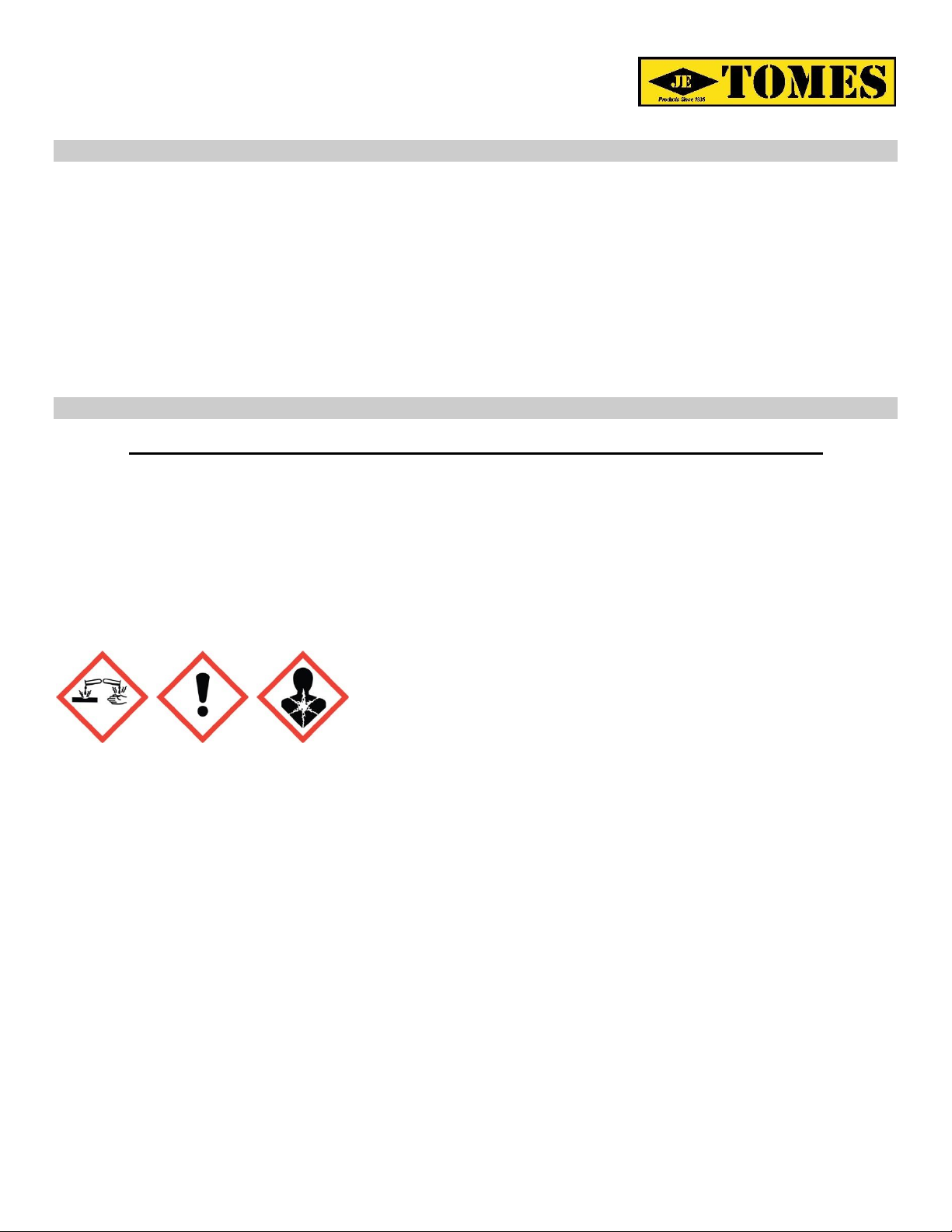
Pictogram:
Signal Word: Danger
Hazard Statement:
H318 Causes serious eye damage.
H315 Causes skin irritation.
H335 May cause respiratory irritation.
H372 Causes damage to organs (Lung) through prolonged or repeated exposure (inhalation).
Precautionary Statements (Prevention):
P289 Wear protective gloves and eye/face protection.
P271 Use only outdoors or in a well-ventilated area.
P260 Do not breathe dust/gas/mist/vapors.
P270 Do not eat, drink or smoke when using this product.
P264 Wash with plenty of water and soap thoroughly after handling.
Precautionary Statements (Response):
P305+P351+P338 IF IN EYES: Rinse cautiously with water for several minutes. Remove contact lenses, if present
P310 Immediately call a POISON CENTER or doctor/physician.
P303+P352 IF ON SKIN (or hari): Wash with plenty of soap and water.
P362+P364 Take off contaminated clothing and wash before reuse.
Page 1 of 8
and easy to do. Continue rinsing.
Page 2
Safety Data Sheet: 2-Component Fast Set
CAS #
Component
Percent
65997-15-1
Portland cement
15 - 50
65997-16-2
Calcium Aluminate Cement
0.1 - 20
14808-60-7
Crystalline silica
45 - 95
Revision Date: 05/27/2015
Precautionary Statements (Storage):
P403+P233 Store in a well-ventilated place. Keep container tightly closed.
P405 Store locked up.
Precautionary Statements (Disposal):
P501 Dispose of contents/container to hazardous or special waste collection point.
Hazards not otherwise classified
If applicable, information is provided in this section on other hazards which to not result in classification, but which may
contribute to the overall hazards of the substance or mixture.
3) Composition/Information on Ingredients
According to Regulation 2012 OSHA Hazard Communication Standard; 29 CFR Part 1910.1200
Note: Exact percentages of ingredients have been withheld as a trade secret in accordance with OSHA
4) First Aid Measures
General Advice
First aid personnel should pay attention to their own safety. Remove contaminated clothing.
First Aid: Eyes
Immediately flush eyes with plenty of water for at least 15 minutes. If irritation persists, get medical attention.
First Aid: Skin
Flush with large amounts of water. Do not use organic solvents. If irritation persists, get medical attention.
First Aid: Ingestion
If material is ingested, immediately contact a physician or poison control center. Drink plenty of water and flush out mouth
with water. Do not induce vomiting, unless instructed by poison control center or doctor.
First Aid: Inhalation
Immediately remove the affected person to fresh air. If symptoms persist, seek medical attention.
First Aid: Notes to Physician
Provide general supportive measures and treat symptomatically.
5) Fire-Fighting Measures and Fire Hazards
Extinguishing Media
Foam, water spray, dry powder, carbon dioxide
Unsuitable Extinguishing Media
Water jet (for safety reasons)
Additional Information:
Product is non-combustible. Packaging materials can catch fire. The extinguishing agents normally used are sufficient.
Page 2 of 8
Page 3

Safety Data Sheet: 2-Component Fast Set
Revision Date: 05/27/2015
Special hazards arising from the substance or mixture
Hazards during fire-fighting:
Carbon monoxide, carbon dioxide, harmful vapors
Evolution of fumes/fog. The substances/groups of substances mentioned can released in case of fire. Product is not
combustible or explosive.
Advice for fire-fighters
Protective equipment for fire-fighting:
Wear self-contained breathing apparatus and chemical-protective clothing.
Further information:
Product itself is non-combustible; fire extinguishing method of surrounding areas must be considered. The degree of risk
is governed by the burning substance and the fire conditions. Dispose of fire debris and contaminated extinguishing water
in accordance with official regulations.
6) Accidental Release Measures (Spills or Leaks)
Personal Precautions
Avoid the generation of dusts during clean-up. Avoid contact with skin and eyes. Wear appropriate protective equipment
and clothing during clean-up.
Containment Procedures
Contain the discharged material.
Environmental Precautions
Dispose of waste material according to Local, State, Federal, and Provincial Environmental Regulations. Do not discharge
into drains/surface waters/groundwater.
Clean-Up Procedures
Attempt to reclaim the free product, if this is possible. Shovel the material into waste container. Thoroughly wash the area
with water after a spill or leak clean-up. Wear appropriate protective equipment and clothing during clean-up. Keep out of
the reach of children.
Evacuation Procedures
None identified.
Special Procedures
Wear a dust mask if dust is generated above exposure limits.
7) Handling and Storage
Handling Procedures
Avoid dust formation. The Cement contained in this product reacts alkaline when in contact with water or humidity. This
may cause severe irritation of skin or mucous membranes. The humidity of the skin or mucous membranes is enough for
this reaction. Prolonged direct contact to the dry product should be avoided therefore. Avoid inhalation of dusts. Avoid
skin contact. Pour downwind and allow as little free fall as possible when emptying bags into equipment. Breathing must
be protected when large quantities are decanted without local exhaust ventilation.
Protection against fire and explosion:
No special precautions necessary.
Conditions for safe storage, including any incompatibilities
Segregate from metals. Segregate from acids. Segregate from lyes, Segregate from oxidants. Segregate from foods
and animal feeds.
Page 3 of 8
Page 4
Safety Data Sheet: 2-Component Fast Set
ACGIH:
1 mg/m3 TWA (particulate matter containing no asbestos and <1% crystalline silica, respirable fraction)
OSHA:
15 mg/m3 TWA (total dust); 5 mg/m3 TWA (respirable fraction)
ACGIH:
3 mg/m3 TWA (respirable particles); 10 mg/m3 TWA (inhalable particles)
OSHA:
15 mg/m3 TWA (total dust); 5 mg/m3 TWA (respirable fraction)
ACGIH:
0.025 mg/m3 TWA (respirable fraction)
OSHA:
0.1 mg/m3 TWA (respirable dust)
Revision Date: 05/27/2015
Suitable materials for containers: tinned carbon steel (Tinplate)
Further information on storage conditions: Containers should be stored tightly sealed in a dry place.
8) Exposure Controls, Personal Protection
COMPONENT EXPOSURE LIMITS
Portland Cement (65997-15-1)
Calcium Aluminate Cement (65997-16-2)
Crystalline Silica (14808-60-7)
Engineering Controls
Provide adequate local exhaust ventilation to maintain worker exposure below exposure limits. Local exhaust is
suggested for use, where possible, in enclosed or confined spaces.
PERSONAL PROTECTIVE EQUIPMENT
Personal Protective Equipment: Eyes/Face
Wear safety glasses with side shields or goggles.
Personal Protective Equipment: Skin
The use of nitrile-latex gloves is recommended
Personal Protective Equipment: Respiratory
If airborne concentrations are above the applicable exposure limits, use NIOSH approved respiratory protection.
Personal Protective Equipment: General
Launder contaminated clothing before reuse. Use good industrial hygiene practices in handling this material.
General safety and hygiene measures:
Avoid contact with the skin, eyes and clothing. Avoid inhalation of dusts. In order to prevent contamination while
handling, closed working clothes and working gloves should be used. Handle in accordance with good building materials
hygiene and safety practice. When using, do not eat, drink or smoke. Hands and/or face should be washed before
breaks and at the end of the shift. At the end of the shift the skin should be cleaned and skin-care agents applied. Gloves
must be inspected regularly and prior to each use. Replace if necessary (e.g. pinhole leaks). Contaminated equipment or
clothing should be cleaned after each use or disposed of.
9) Physical and Chemical Properties
Form: powder
Odor: odorless
Odor threshold: Not determined due to potential health hazard by
inhalation.
Color gray
pH value: neutral to slightly alkaline
Melting point: Unspecified
Page 4 of 8
Page 5

Safety Data Sheet: 2-Component Fast Set
Revision Date: 05/27/2015
Boiling point: N/A
Sublimation point: N/A
Flash point: The substance/product is non-combustible
Flammability: not determined
Lower explosion limit: As a result of our experience with this product and our
knowledge of its composition, we do not expect any
hazard as long as the product is used appropriately and
in accordance with the intended use.
Upper explosion limit: As a result of our experience with this product and our
knowledge of its composition, we do not expect any
hazard as long as the product is used appropriately and
in accordance with the intended use.
Autoignition: N/A
Vapor Pressure: N/A
Density: N/A
Relative density: 2.8
Bulk density: 1,800-2,400 kg/m3
Vapor density: N/A
Partitioning coefficient n-octanol/water (low Pow): N/A
Self-ignition temperature: not self-igniting
Thermal decomposition No decomposition if stored and handled as
prescribed/indicated.
Viscosity, dynamic: N/A
Viscosity, kinematic: N/A
Solubility in water: Product has not been tested.
Solubility (quantitative): N/A
Solubility (qualitative): N/A
Evaporation Rate N/A
Other information: If necessary, information on other physical and chemical
parameters is indicated in this section.
10) Stability and Reactivity
Reactivity
No hazardous reactions if stored and handle as prescribed/indicated.
Oxidizing properties:
Based on its structural properties, the product is not classified as oxidizing.
Chemical Stability
The product is stable if stored and handled as prescribed/indicated.
Possibility of hazardous reactions
The product is stable if store and handles as prescribed/indicated. Strong bases are formed on the addition of water.
Conditions to avoid
Avoid dust formation. Avoid humidity.
Incompatible materials
Strong bases, strong acids
Hazardous decomposition products
Decomposition products:
Page 5 of 8
Page 6

Safety Data Sheet: 2-Component Fast Set
Revision Date: 05/27/2015
No hazardous decomposition products if stored and handled as prescribed/indicated.
Thermal decomposition:
No decomposition of stored and handled as prescribed/indicated.
11) Toxicological Information
Primary routes of exposure
Routes of entry for solids and liquids are ingestion and inhalation, but may include eye or skin contact. Routes of entry for
gases include inhalation and eye contact. Skin contact may be a route of entry for liquefied gases.
Acute Toxicity/Effects
Acute toxicity
Assessment of acute toxicity: Product may present a nuisance dust hazard. Inhalation of dust may cause respiratory
tract irritation, coughing and breathing difficulties.
Oral
N/A
Inhalation
N/A
Dermal
N/A
Chronic Toxicity/Effects
Repeated dose toxicity
Assessment of repeated dose toxicity: This product contains crystalline silica (quartz). Prolonged or repeated inhalation
of respirable crystalline silica may result in silicosis.
Genetic toxicity
Assessment of mutagenicity: The chemical structure does not suggest a specific alert for such an effect. Based on
available data, the classification criteria are not met.
Carcinogenicity
Exposure to quarts (the most stable and common form of crystalline silica) is responsible for the majority of clinically
diagnosed silicosis. Silicosis in a fibronodular lung disease that occurs after occupational exposure to crystalline silica for
5 years or longer. Inhalation of quartz dusts may cause shortness of breath, limitation of chest expansion, dry cough, and
a lessened capacity for work. Individuals with a pre-existing disease in, or a history of ailments involving the skin or
respiratory tract, are at a greater risk of developing adverse health effects when exposed to this material. There may be a
relationship between silicosis and certain cancers.
Reproductive toxicity
Assessment of reproductive toxicity: The chemical structure does not suggest a specific alert for such an effect. Based
on available data, the classification criterial are not met.
Teratogenicity
Assessment of teratogenicity: The chemical structure does not suggest a specific alert for such an effect. Based on
available data, the classification criterial are not met.
Other information
Page 6 of 8
Page 7

Safety Data Sheet: 2-Component Fast Set
Revision Date: 05/27/2015
Based on our experience and the information available, no adverse health effects are expected if handled as
recommended with suitable precautions for designated uses. The product has not been tested. The statements on
toxicology have been derived from the properties of the individual components.
Sensitization
No information available for the product.
12) Ecological Information
Toxicity
Aquatic toxicity
Assessment of aquatic toxicity:
There is a high probability that the product is not acutely harmful to aquatic organisms.
The product gives rise to pH shifts. Based on available data, the classification criteria are not met.
Persistence and degradability
Assessment of biodegradation and elimination (H20)
Inorganic product which cannot be eliminated from water by biological purification processes. The product is slightly
soluble in water. It can be largely eliminated from the water by abiotic processes, e.g. mechanical separation.
Experience shows this product to be inert and non-degradable.
Elimination information: N/A
Bioaccumulative potential
Assessment of bioaccumulation potential
The product will not be readily bioabailable due to its consistency and insolubility in water.
Mobility in soil
Assessment of transport between environmental compartments
The substance will not evaporate into the atmosphere from the water surface.
Following exposure to soil, adsorption to solid soil particles is probable, therefore contamination of groundwater is not
expected.
Additional Information
Other ecotoxicological advice:
Do not discharge product into the environment without control. The product has not been tested. The statements on
ecotoxicology have been derived from the properties of the individual components.
13) Disposal Considerations
US EPA Waste Number & Descriptions
A: General Product Information
No additional information available.
B: Component Waste Numbers
No EPA Waste Numbers are applicable for this product’s components.
Disposal Instructions
Page 7 of 8
Page 8

Safety Data Sheet: 2-Component Fast Set
Revision Date: 05/27/2015
Waste must be handled in accordance with all federal, state, provincial, and local regulations. Consult authorities before
disposal.
See Section 7 for Handling Procedures. See Section 8 for Personal Protective Equipment recommendations.
14) Transportation Information
International Transportation Regulations
Not regulated as dangerous goods.
15) Regulatory Information
US Federal Regulations
All of the components of this product are listed on, or are exempted from listing on the U.S. EPA TSCA Inventory of
Chemical Substances. All components of this product are included, or are exempt from inclusion, in the Canadian
Domestic Substance List unless otherwise noted.
State Regulations
The following statement(s) are provided under the California State Drinking Water and Toxic Enforcement Act of 1986
(Proposition 65): WARNING! This product contains a chemical known to the state of California to cause cancer. This
product contains a chemical know to the state of California to cause reproductive/developmental effects.
NFPA Hazard codes:
Health: 3 Fire: 0 Reactivity: 0 Special:
16) Other Information
Disclaimer: Reasonable care has been taken in the preparation of this information, but the manufacturer makes no
warranty of merchantability or any other warranty, expressed or implied, with respect to this information. The
manufacturer makes no representations and assumes no liability for any direct, incidental or consequential damages
resulting from its use. The information herein is presented in good faith and believed to be accurate as of the effective
date given. It is the buyer’s responsibility to ensure that its activities comply with Federal, State or provincial and local
laws.
Page 8 of 8
 Loading...