

Page 1
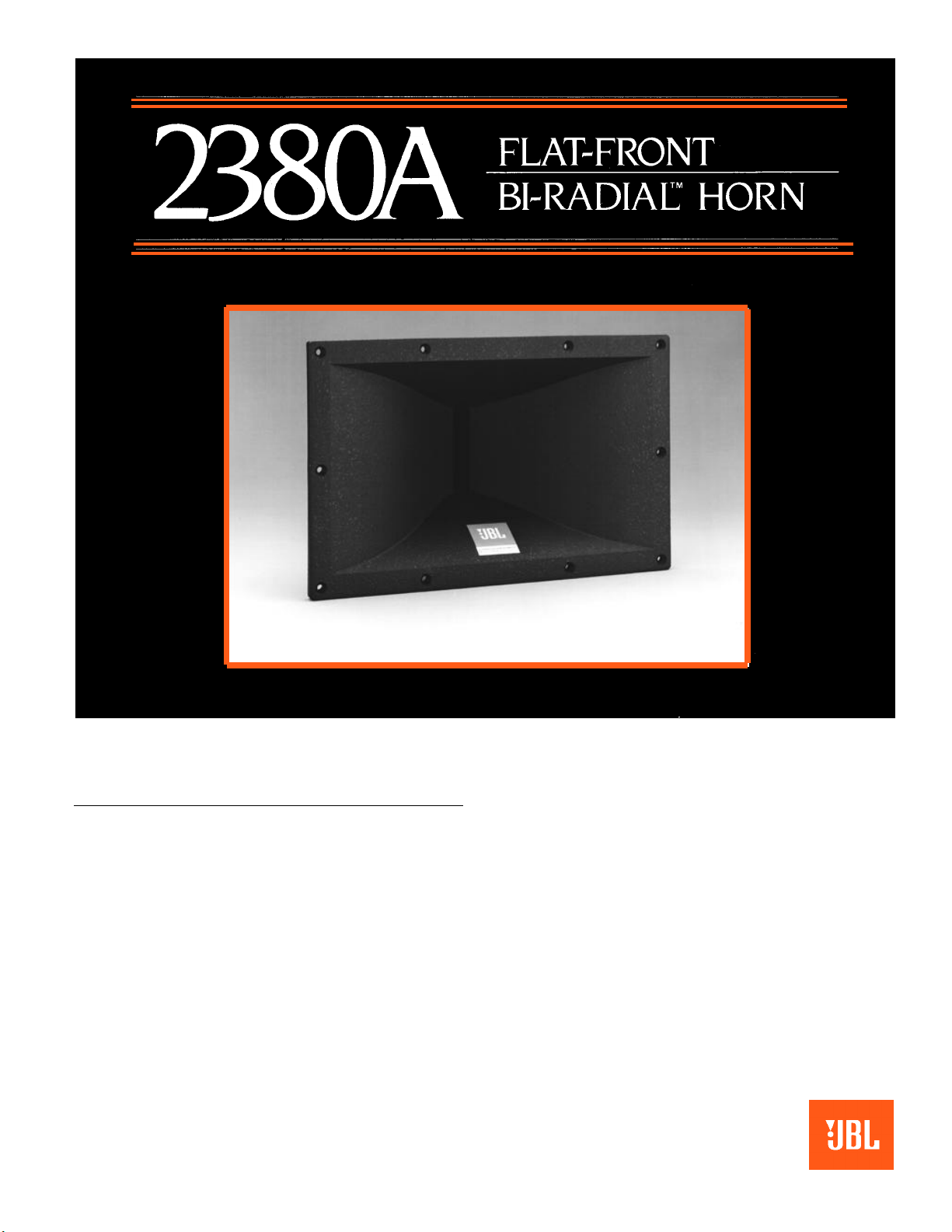
PROFESSIONAL SERIES
FEATURES:
Uniform horizontal on and off axis frequency
response
Precise horizontal and vertical pattern control
Full horn loading to 500 Hz
Flat front and compact size
Lightweight construction
49 mm (2 in) throat entry
The JBL 2380A Bi-Radial horn¹ is designed for
flush cabinet mounting or compact cluster applications. The 2380A has a nominal coverage pattern of
90° horizontal x 40° vertical. The horn provides uniform on and off axis frequency response from 500 Hz
to beyond 16 kHz in the horizontal plane and 2 kHz
to 16 kHz in the vertical plane with constant directivity above 2 kHz. The horns small vertical mouth
dimension (just slightly larger than the compression driver used to drive the horn) allows very
compact single and multiple horn/driver systems
to be put together Should vertical pattern control
be required below 2 kHz, two or more horns may
be stacked vertically to restore full Bi-Radial
performance.
Page 2
The exceptionally consistent horizontal dispersion eliminates the midrange narrowing and high
frequency beaming problems typically associated
with conventional horn designs. Additionally, the
highly predictable performance of the 2380A
greatly simplifies cluster design. The need for
horn overlapping is minimized and lobing and
comb filter effects are virtually eliminated.
Computer-aided design techniques were used
to derive the horn contours in the horizontal and
vertical planes. Utilizing sidewall contours based
on a polynomial power series formula, the horn
design yields smooth response, low distortion, and
SPECIFICATIONS:
Horizontal Coverage:
Angle Degrees (-6 dB): 100 (+23. -23)
Vertical Coverage
Angle Degrees (-6 dB):
Directivity Factor (Q):
Directivity Index (Di): 10.3 dB (+1.0, -1.4)
Usable Low-Frequency Limit: 400 Hz
Minimum Recommended
Crossover Frequency: 500 Hz
Axial Pressure Sensitivity¹: 112 dB SPL, 1 W @ 1 m
Throw: Short
Average Range:
Average Range: 2 kHz 16 kHz
Average Range: 1 kHz 16 kHz
500 Hz 16 kHz
40 (+ 11, -11)
10.7 (+1.3, -2.51
even coverage. This design avoids the performance disadvantages of horns that feature sharp
flare transitions and flat sidewalls. The Bi-Radial
TM
compound flare configuration provides constant
coverage over defined, solid angles. To ensure light
weight, superior strength, and freedom from resonances, the horn bell is constructed of molded
structural foam.
The 2380A will accept the 49 mm (2 in) diameter
throat 2441, 2445, or 2485 compression driver With
the addition of the 2327 adapter, the horn will
also accept the 25 mm (I in) throat 2425 driver
¹U.S. Patent No. 4,308,932. Foreign patents pending.
Construction
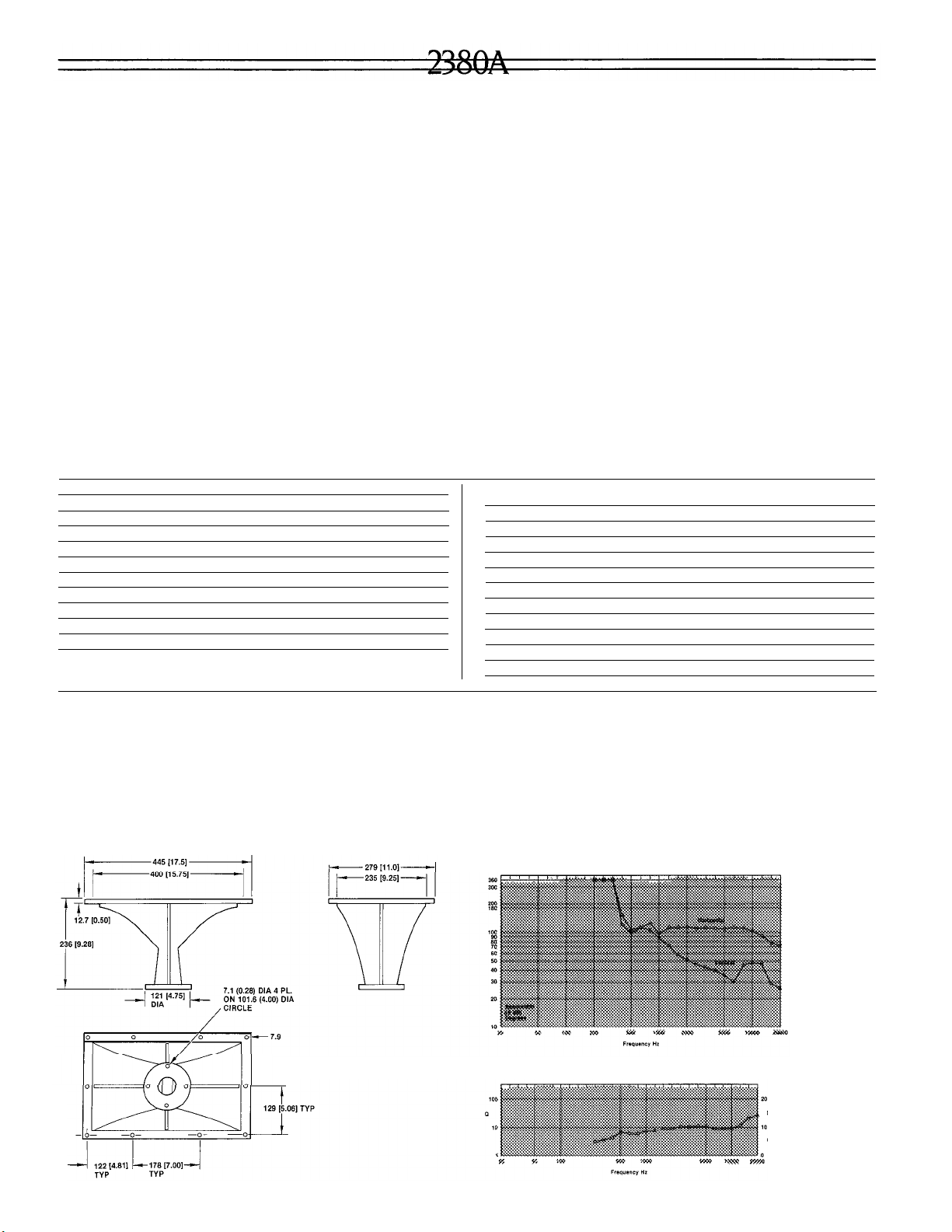
Overall Dimensions,
Mouth Height. 279 mm [11 in]
Mouth Width: 445 mm
Mounting Dimensions:
Baffle Cutout Required: (Front mounting only)
¹Measured on axis in the far field with I watt input (4.0 volts RMS. 16 ohms) and
referenced to I meter distance using the inverse square law Listed sound
pressures (SPL re 20 µPa) represent an average from 1 kHz to 4 kHz using the
2441 or 2445 driver.
Rear Height:
Rear Width: 400 mm [15.75 in]
Net Weight: 2.2 kg [6 lb]
Shipping Weight: 4.6 kg [10 lb]
Molded structural foam (nominal 10 mm (0.38 in)
wall thickness1
235 mm
[17.5 in]
[9.25
3/8
in]
7/8
in]
in]
in]
Length: 236mm[9.28
Height: 238 mm [9
Width: 403 mm [15
Beamwidth vs Frequency
Directivity vs Frequency
Page 3

Frontal Isobar Contours
500 Hz octave bandwidth constant sound pressure contours
of 0 to -15 dB in steps of -3 dB. The contours are plotted on
polar grid lines with on axis being the center of the plot. The
data was gathered by taking an octave polar plot at all
oblique angles from 0° (horizontal) to 90° (vertical) in steps of
15°. Same test conditions as horizontal polar response.
1 kHz octave bandwidth constant sound pressure contours.
Same conditions as 500 Hz contours.
4 kHz octave bandwidth constant sound pressure contours.
Same conditions as 500 Hz contours.
2 kHz octave bandwidth constant sound pressure contours.
Same conditions as 500 Hz contours.
8 kHz octave bandwidth constant sound pressure contours.
Same conditions as 500 Hz contours.
Page 4

Harmonic distortion.
curves of the 2380A with 1 watt (4.0 V RMS) and 10 watts (12.65
V RMS) applied to the JBL Model 2445 compression driver.
Second and third harmonic distortion
Frequency response and impedance.
Frequency response of
the 2380A, measured on axis at a distance of 1 meter with I
watt (4.0 V RMS) applied to a JBL Model 2445 compression
Measured on axis at a distance of I meter in a reflection-free driver, in a reflection-free environment, with impedance vs.
environment.
frequency curve.
Horizontal off-axis response.
Horizontal off-axis response taken at 15 degree intervals out to 60° off axis. Both
normalized (equalized flat on axis) and unequalized responses are shown.
Vertical off-axis response.
Vertical off-axis response taken at 15° intervals out to 60° off axis. Both normalized
(equalized flat on axis) and unequalized responses are shown.
JBL continually engages in research related to product improvement. New materials, production methods, and design refinements are introduced info existing products without notice as a routine
expression of that philosophy. For this reason. any current JBL product may differ in some respect from its published description. but will always equal or exceed the orginal design specifications unless
otherwise stated
JBL Professional, 8500 Balboa Boulevard, PO. Box 2200, Northridge, California 91329 U.S.A.
67160 15M 10/88 P829 Printed in U.S.A.
 Loading...