

Page 1
User maintenance and troubleshooting
GOOD CHEMISTRY
Symptom Possible cause Remedy
Drift Junction blocked Remove and clean sleeve
Membrane unclean
or contaminated
Noisy Poor connection
Inaccurate
readings
or poor
reproducibility
to meter
Junction not
immersed fully
Insufcient
electrolyte or
bubble
Contaminated
standard(s)
Improperly made
standards
Contamination
from electrolyte
Remove sleeve. Gently
polish membrane with
P1200 “Wet & Dry”
Check connection
Lower electrode into
solution below junction
Rell electrolyte
Make up fresh calibration
standards and recalibrate
Recalibrate using freshly
made standards
Use 1M potassium nitrate
in sleeve
Warranty
IJ electrodes have a warranty of 12 months from date of purchase.
Any electrode found to be faulty due to manufacture within
this time will be replaced.
Ionode reserves the right to limit or modify product warranty
if it is deemed that the electrode has been used in unsuitable
applications. Electrodes with broken stems, connectors or
cables are not covered by warranty.
Electrode life may be reduced in chemically aggressive or
abrasive samples and at high temperatures.
Visit www.ionode.com for more information.
All specications and values are subject to change without notice. © 2012
Images are illustrative only.
Operators Manual
Short-Form
Intermediate Junction Series
IJ-I
IODIDE
ION SELECTIVE
ELECTRODE
Temperature
differences between
calibration and
sample
measurement
No ISA used Add ISA
Sensitivity to light Perform calibration and
Ensure calibration and
sample measurements
are done at the same
temperature
measurements in dark
beakers or away from
bright light
Parameter Operating Range
Concentration range 0.01 to 130,000 mg/L
Temperature range 0 – 60ºC
pH range 2-12 pH
Reference Type Double Junction Ag/AgCl/rellable
Sensor materials Polycrystalline solid state
membrane
Body and sleeve Polypropylene/PEEK
Overall length 150mm
Barrel diameter 12mm
Cable length 1m standard, longer to order.
Maximum 20m
Connector BNC standard, others on request
Page 2
Introduction
This guide contains the basic information for proper use
of your Iodide Ion-selective electrode.
Preparation
IJ series electrodes are shipped without sleeve electrolyte,
and must be lled prior to use. To ll, hold the electrode
by the sleeve and gently ease off the rubber wetting cap.
Prepare as follows:
1. 2.
Application
The Ionode IJ-I Ion selective electrode responds reversibly
to Iodide, Cyanide and Silver ions. The limit of detection
-8
is 5 x 10
M Iodide. Use known addition for [I-] > 0.1M. Try
to avoid exposure of the electrode to direct sunlight, and
avoid use in strong reducing agents.
Interfering Ions
Max. ratio of Interfering Ions/ Bromide Ion as follows
Chloride: 1 x 10
Sulphide: Must be absent.
6
, Bromide: 1 x 10³, Cyanide: 2 x 10
-2
Cleaning
If the membrane is poisoned by interferences, the surface
may be renewed by careful polishing with ne wet-and-dry
(P1200 grade). The electrode surface should appear yellow or
yellow-grey with waxy lustre. Always inspect the membrane
before use, and clean if necessary. Organic contaminants
can be removed with ethanol. DO NOT use the electrode in
chlorinated hydrocarbons.Routinely remove the sleeve and
replace the potassium nitrate electrolyte.
Calibration Procedure
With your meter set on mV (or on concentration on
Ion Meters), calibrate by immersing the electrode in a
stirred calibration standard (with added ISA), starting
with the lowest concentration rst.
Wait for stability, note the potential in mV, and then
carefully rinse and blot dry the electrode before repeating
with the next highest standard, until all the calibration
standards have been measured.
When using meters that do not have direct concentration
readouts, record the data and graph the potential against
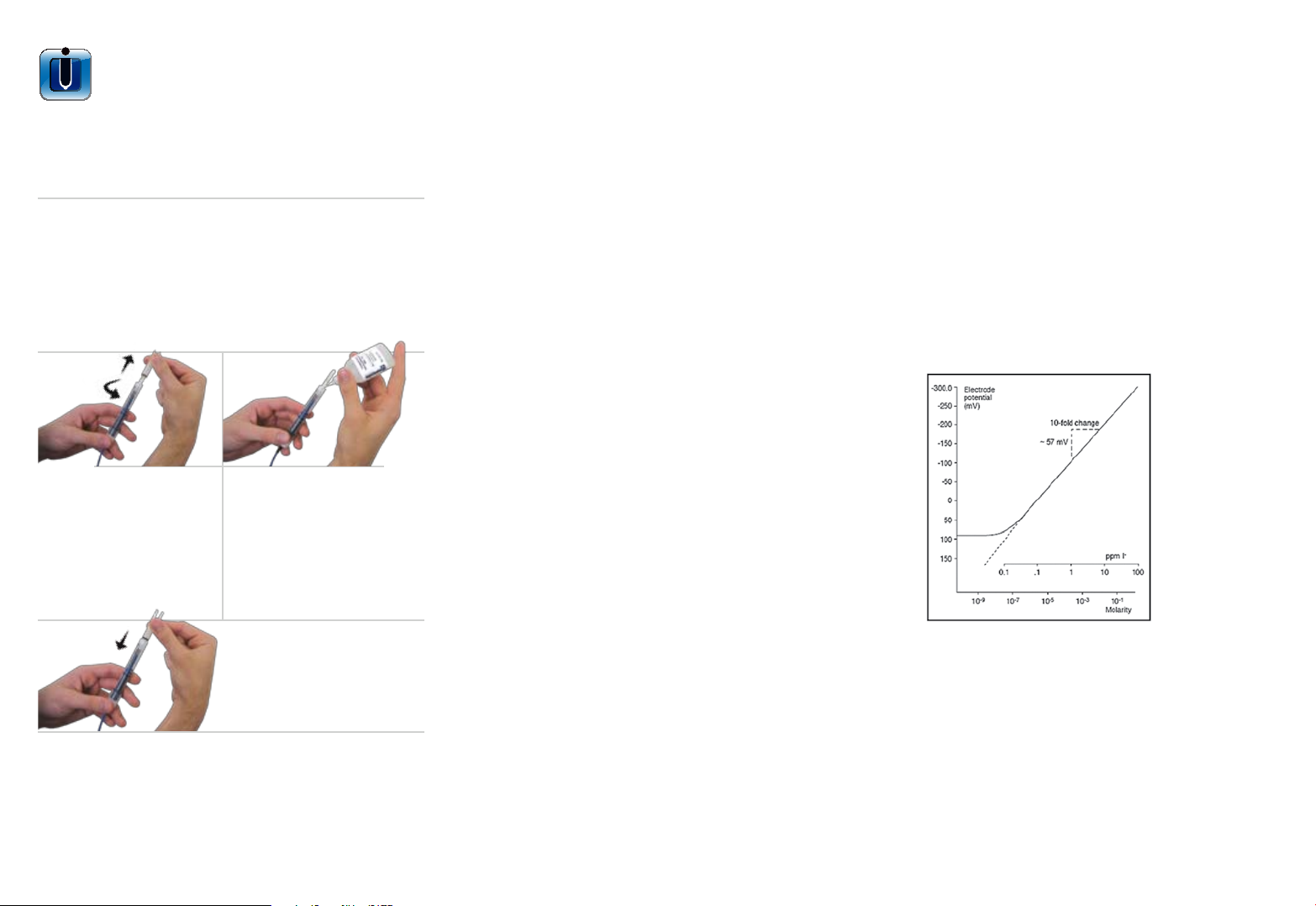
log of the Bromide Ion concentration. The graph should
have a slope of approximately -55mV/decade of
concentration at 25C.
Typical Calibration Curve
1.
Invert the electrode. Hold the
electrode just below the sleeve
and with careful rotation and
pulling along the axis of the
electrode, remove the sleeve.
DO NOT BEND.
2.
Fill the annular space with
electrolyte to approximately half
to three quarter full.
1M potassium nitrate is normally
recommended.
3.
3.
Slide the sleeve back onto the electrode ensuring the black O-ring
is well seated within the electrode body. Do not exert sideways
force. Any excess electrolyte will be expelled from the end of the
electrode through the ground junction. Ensure there are no air
bubbles in the sleeve.Wash off any excess electrolyte before use.
Electrolyte Replacement
The electrode has an inbuilt double junction Ag/AgCl with
a replaceable sleeve electrolyte. 1M potassium nitrate is
suitable for most applications. Please consult Ionode Customer
Service if you wish to use a different sleeve electrolyte.
Calibration Standards
Standard solutions of Iodide Ion should preferably bracket
the expected measurement range. For example, to determine
Iodide ions in the 1-40mg/L range, it is usually adequate to
use standard Iodide solutions in the following values:-
1.0, 10.0 and 100.0 mg/L
The need for ISA (Ionic Strength Adjuster)
It is important to use ISA, so that the Ionic Strength of standards
and samples is independent of the concentration of the Iodide
Ion. A suitable ISA is potassium nitrate, which is added to
both standards and samples. As a guide, add 5ml 1M potassium
nitrate to every 25ml of calibration standard or sample.
Sample Measurement
Follow the same basic procedures as calibration,
substituting the calibration standard for your sample.
It is important to use the same stirring conditions,
temperature, etc for best results. Use the same ratio of
sample/ISA as used in the calibration step.
Read off the concentration from the graph or directly
from Ion meters.
For more information, visit ionode.com
 Loading...