

Page 1
GOOD CHEMISTRY
Reference Electrode Potentials @ 25ºC
Reference
Type
Hg/Hg2Cl
Hg/Hg
2Cl2
Ag/AgCl Sat. KCl 199
Ag/AgCl 3.5M KCl 205
Ag/AgCl 1M KCl 236
Electrolyte Potential. mV vs. SHE
2
Sat. KCl 244
1M KCl 280
Warranty
IJ electrodes have a pro-rata warranty of 12 months from
date of purchase. Any electrode found to be faulty due to
manufacture within this time will be replaced.
Ionode reserves the right to limit or modify product warranty
if it is deemed that the electrode has been used in unsuitable
applications.
IJ electrodes have an expected lifetime of 2-4 years in ideal
samples at room temperature. This may be reduced in
chemically aggressive or abrasive samples and at high
temperatures.
Please visit www.ionode.com to register your purchase as
soon as you receive your electrode.
Operators Manual
Short-Form
Intermediate Junction Series
Ag/AgCl
seawater
Hg/Hg
2SO4
Cu/CuSO
Seawater Approx 250
Sat. KCl 650
4
Sat. KCl 316
Troubleshooting
Symptom Possible cause Remedy
Drift Junction blocked Remove sleeve. Clean
Air bubbles in
sleeve electrolyte
Noisy/Off
scale
Insufcient
electrolyte
Poor connection Check connection
Junction not
immersed fully
Insufcient
electrolyte
glass stem and sleeve.
Rell with electrolyte and
replace sleeve.
Remove sleeve and
replace electrolyte
(see preparation)
Rell electrolyte
Lower electrode into
solution below junction
Rell electrolyte
All specications and values are subject to change without notice. © 2009
Parameter Operating Range
Half-cell potential -44mV ± 10mV with respect to SCE
All specications and values are subject to change without notice. © 2009
Reference type Double Junction Ag/AgCl/sat KCl
Temperature range 0 – 60ºC
Sleeve electrolyte KCl gel electrolyte is supplied as
Body and sleeve Polypropylene
Overall length 150mm
Barrel diameter 12mm
Cable length 1m standard, longer to order.
Connector 4mm banana plug standard, others
(saturated calomel electrode)
standard. Other electrolytes such as
sat KCl, KNO
can be used depending on the application
Maximum 50m
on request
and LiCl in ethanol
3
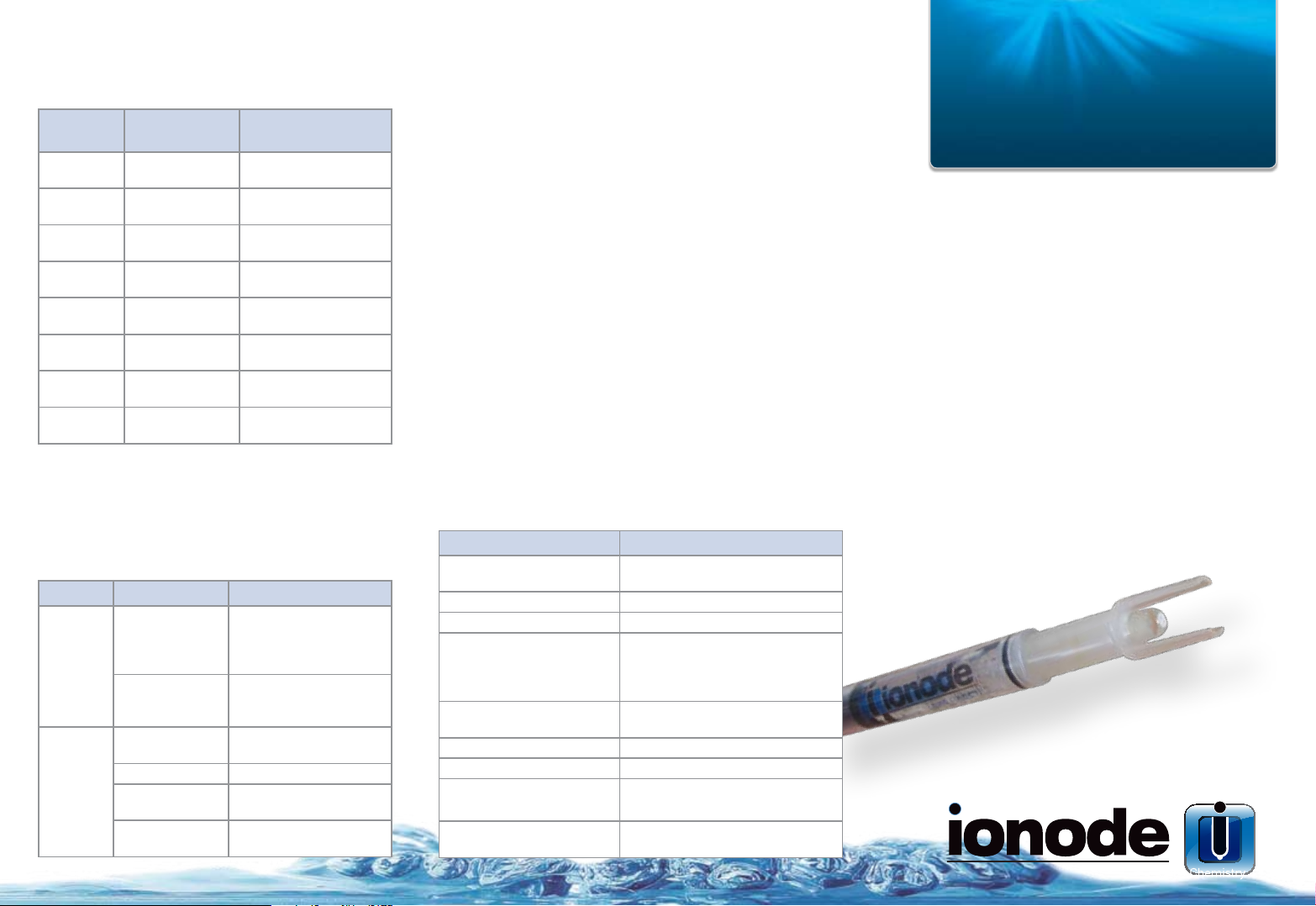
IJ14
Reference Electrode
Page 2
Introduction
GOOD CHEMISTRY
The IJ14 is a double junction Ag/AgCl reference electrode
suited for use with a wide variety of indicator electrodes
such as pH, ISE and metal half-cells. The double junction
design allows the user to select electrolytes suitable for
use with the majority of ion selective electrode half-cells.
Suitable electrolytes commonly used include KCl, KNO
NH
, and ethanolic LiCl. The IJ14 can also be used to
4NO3
,
3
monitor potentials of various processes such as corrosion.
This guide contains the basic information for correct use
and maintenance of your new IJ14 reference electrode.
A more comprehensive manual is available for download
from www.ionode.com.au
Preparation
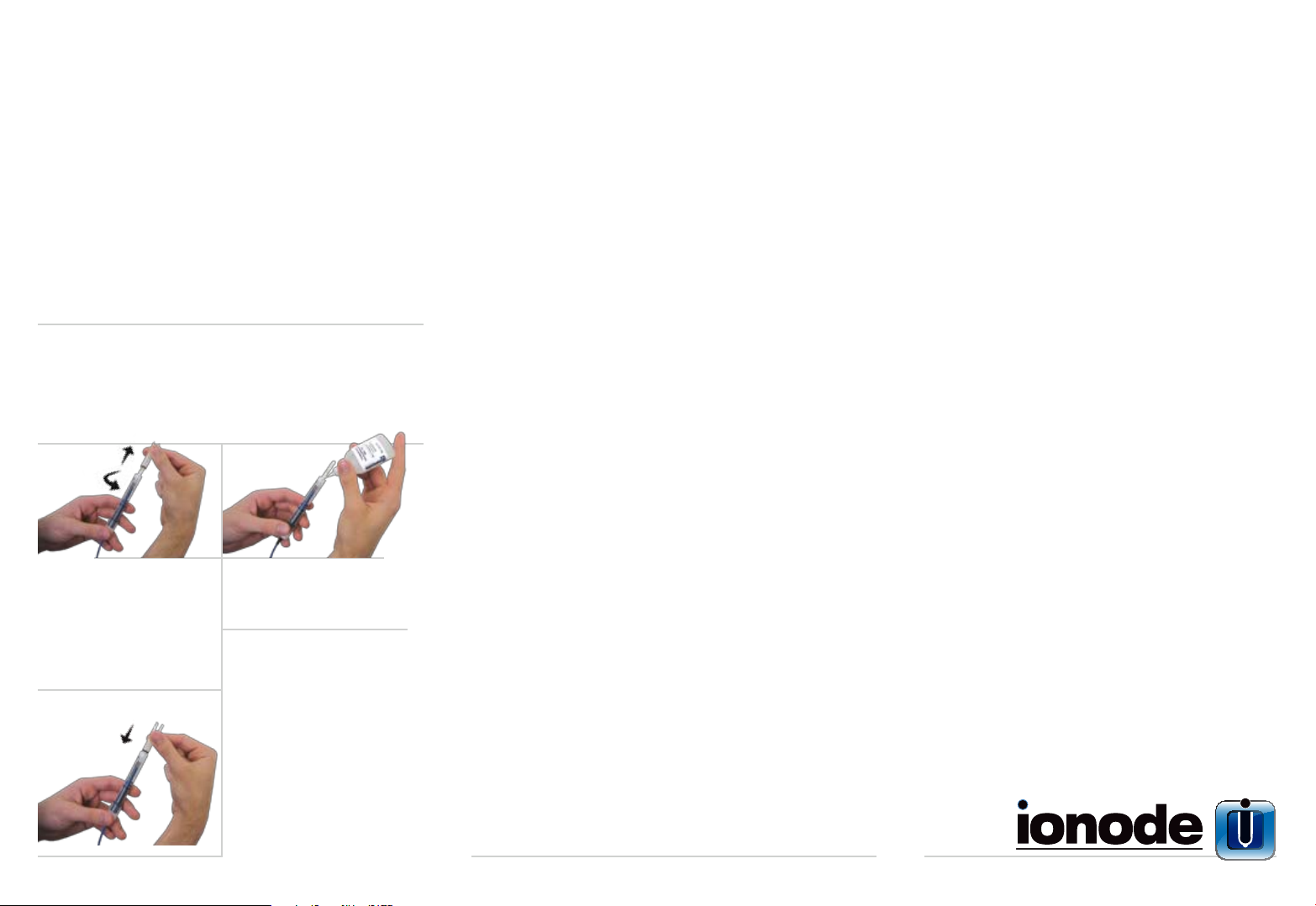
IJ14 series electrodes are shipped without sleeve electrolyte,
and must be lled prior to use. To ll, hold the electrode
by the sleeve and gently ease off the rubber wetting cap.
Prepare as follows:
1. 2.
Theory in brief
Electrochemical measurements are relative, which raises
the question—what is the correct value?
The standard hydrogen electrode (SHE) has an arbitrarily
assigned value of 0.000V. However, the SHE is impractical to
use, and in most cases either calomel (Hg/Hg
/sat KCl) or
2Cl2
Ag/AgCl/sat KCl electrodes are used.
The IJ14 will have a constant potential providing the electrolyte
concentration is kept constant and the secondary sleeve
junction is maintained in a good condition.
Helpful Hints
• Select the correct sleeve electrolyte for the application.
• Keep all connections dry.
• Use a dedicated high impedance pH meter.
• Immerse the electrode so that the reference junction is
below the liquid surface.
• Minimise contact with sulphide vapours and change the
sleeve electrolyte frequently in these conditions.
Maintenance
• When not in use (short term storage), keep the
electrode immersed in 2-3M KCl solution to stabilise
junction potentials.
• Replace sleeve electrolyte when necessary.
The frequency of this is best determined by experience,
however this should be done more often when
measuring contaminated samples.
• For long term storage, remove and clean the sleeve.
Replace the sleeve (without electrolyte) and attach
the wetting cap.
• DO NOT store the electrode in deionized or distilled water.
Cleaning
Cleanliness of the sensor and junction is critical for
accurate measurement as drift is often due to an
unclean sensor/junction. Clean the electrode periodically.
Remove the sleeve and clean the membrane, ground
glass stem and sleeve using one of the following methods.
DO NOT use abrasive materials.
Method One: Alkaline samples and scale: Soak membrane
in 1M HCl for an hour. Wash well with water and
condition in 20% KCl before use.
1.
Invert the electrode. Hold the
electrode just below the sleeve
and with careful rotation and
pulling along the axis of the
electrode, remove the sleeve.
DO NOT BEND.
3.
2.
Fill the annular space with gel
or electrolyte to approximately
half to three quarter full.
3.
Slide the sleeve back onto the
electrode ensuring the black
O-ring is well seated within the
electrode body. Do not exert sideways force. Any excess electrolyte
will be expelled from the end of
the electrode through the ground
junction. Ensure there are no air
bubbles in the sleeve.Wash off
any excess electrolyte and store
in 2-3M KCl before use.
Method Two: Grease and oil: Wipe the membrane and
ground stem with cotton or tissue soaked in acetone
followed by methylated spirits. Wash with distilled
water before use.
Method Three: Solids and organics: Wipe the membrane
and junction with cotton or tissue soaked in a mild
non-alkaline detergent. Wash with distilled water and
condition in 20% KCl before before use.
 Loading...